EP4288833B1 - Dynamic glazing comprising a substrate with interlaced mesh electrodes - Google Patents
Dynamic glazing comprising a substrate with interlaced mesh electrodes Download PDFInfo
- Publication number
- EP4288833B1 EP4288833B1 EP22713651.2A EP22713651A EP4288833B1 EP 4288833 B1 EP4288833 B1 EP 4288833B1 EP 22713651 A EP22713651 A EP 22713651A EP 4288833 B1 EP4288833 B1 EP 4288833B1
- Authority
- EP
- European Patent Office
- Prior art keywords
- substrate
- mesh
- electrodes
- light modulator
- mesh electrodes
- Prior art date
- Legal status (The legal status is an assumption and is not a legal conclusion. Google has not performed a legal analysis and makes no representation as to the accuracy of the status listed.)
- Active
Links
Images













Classifications
-
- G—PHYSICS
- G02—OPTICS
- G02F—OPTICAL DEVICES OR ARRANGEMENTS FOR THE CONTROL OF LIGHT BY MODIFICATION OF THE OPTICAL PROPERTIES OF THE MEDIA OF THE ELEMENTS INVOLVED THEREIN; NON-LINEAR OPTICS; FREQUENCY-CHANGING OF LIGHT; OPTICAL LOGIC ELEMENTS; OPTICAL ANALOGUE/DIGITAL CONVERTERS
- G02F1/00—Devices or arrangements for the control of the intensity, colour, phase, polarisation or direction of light arriving from an independent light source, e.g. switching, gating or modulating; Non-linear optics
- G02F1/01—Devices or arrangements for the control of the intensity, colour, phase, polarisation or direction of light arriving from an independent light source, e.g. switching, gating or modulating; Non-linear optics for the control of the intensity, phase, polarisation or colour
- G02F1/165—Devices or arrangements for the control of the intensity, colour, phase, polarisation or direction of light arriving from an independent light source, e.g. switching, gating or modulating; Non-linear optics for the control of the intensity, phase, polarisation or colour based on translational movement of particles in a fluid under the influence of an applied field
- G02F1/1675—Constructional details
- G02F1/1676—Electrodes
-
- G—PHYSICS
- G02—OPTICS
- G02F—OPTICAL DEVICES OR ARRANGEMENTS FOR THE CONTROL OF LIGHT BY MODIFICATION OF THE OPTICAL PROPERTIES OF THE MEDIA OF THE ELEMENTS INVOLVED THEREIN; NON-LINEAR OPTICS; FREQUENCY-CHANGING OF LIGHT; OPTICAL LOGIC ELEMENTS; OPTICAL ANALOGUE/DIGITAL CONVERTERS
- G02F1/00—Devices or arrangements for the control of the intensity, colour, phase, polarisation or direction of light arriving from an independent light source, e.g. switching, gating or modulating; Non-linear optics
- G02F1/01—Devices or arrangements for the control of the intensity, colour, phase, polarisation or direction of light arriving from an independent light source, e.g. switching, gating or modulating; Non-linear optics for the control of the intensity, phase, polarisation or colour
- G02F1/13—Devices or arrangements for the control of the intensity, colour, phase, polarisation or direction of light arriving from an independent light source, e.g. switching, gating or modulating; Non-linear optics for the control of the intensity, phase, polarisation or colour based on liquid crystals, e.g. single liquid crystal display cells
- G02F1/133—Constructional arrangements; Operation of liquid crystal cells; Circuit arrangements
- G02F1/1333—Constructional arrangements; Manufacturing methods
- G02F1/1343—Electrodes
- G02F1/13439—Electrodes characterised by their electrical, optical, physical properties; materials therefor; method of making
-
- G—PHYSICS
- G02—OPTICS
- G02F—OPTICAL DEVICES OR ARRANGEMENTS FOR THE CONTROL OF LIGHT BY MODIFICATION OF THE OPTICAL PROPERTIES OF THE MEDIA OF THE ELEMENTS INVOLVED THEREIN; NON-LINEAR OPTICS; FREQUENCY-CHANGING OF LIGHT; OPTICAL LOGIC ELEMENTS; OPTICAL ANALOGUE/DIGITAL CONVERTERS
- G02F1/00—Devices or arrangements for the control of the intensity, colour, phase, polarisation or direction of light arriving from an independent light source, e.g. switching, gating or modulating; Non-linear optics
- G02F1/01—Devices or arrangements for the control of the intensity, colour, phase, polarisation or direction of light arriving from an independent light source, e.g. switching, gating or modulating; Non-linear optics for the control of the intensity, phase, polarisation or colour
- G02F1/165—Devices or arrangements for the control of the intensity, colour, phase, polarisation or direction of light arriving from an independent light source, e.g. switching, gating or modulating; Non-linear optics for the control of the intensity, phase, polarisation or colour based on translational movement of particles in a fluid under the influence of an applied field
- G02F1/166—Devices or arrangements for the control of the intensity, colour, phase, polarisation or direction of light arriving from an independent light source, e.g. switching, gating or modulating; Non-linear optics for the control of the intensity, phase, polarisation or colour based on translational movement of particles in a fluid under the influence of an applied field characterised by the electro-optical or magneto-optical effect
- G02F1/167—Devices or arrangements for the control of the intensity, colour, phase, polarisation or direction of light arriving from an independent light source, e.g. switching, gating or modulating; Non-linear optics for the control of the intensity, phase, polarisation or colour based on translational movement of particles in a fluid under the influence of an applied field characterised by the electro-optical or magneto-optical effect by electrophoresis
-
- G—PHYSICS
- G02—OPTICS
- G02F—OPTICAL DEVICES OR ARRANGEMENTS FOR THE CONTROL OF LIGHT BY MODIFICATION OF THE OPTICAL PROPERTIES OF THE MEDIA OF THE ELEMENTS INVOLVED THEREIN; NON-LINEAR OPTICS; FREQUENCY-CHANGING OF LIGHT; OPTICAL LOGIC ELEMENTS; OPTICAL ANALOGUE/DIGITAL CONVERTERS
- G02F1/00—Devices or arrangements for the control of the intensity, colour, phase, polarisation or direction of light arriving from an independent light source, e.g. switching, gating or modulating; Non-linear optics
- G02F1/01—Devices or arrangements for the control of the intensity, colour, phase, polarisation or direction of light arriving from an independent light source, e.g. switching, gating or modulating; Non-linear optics for the control of the intensity, phase, polarisation or colour
- G02F1/165—Devices or arrangements for the control of the intensity, colour, phase, polarisation or direction of light arriving from an independent light source, e.g. switching, gating or modulating; Non-linear optics for the control of the intensity, phase, polarisation or colour based on translational movement of particles in a fluid under the influence of an applied field
- G02F1/1675—Constructional details
- G02F1/16755—Substrates
-
- G—PHYSICS
- G02—OPTICS
- G02F—OPTICAL DEVICES OR ARRANGEMENTS FOR THE CONTROL OF LIGHT BY MODIFICATION OF THE OPTICAL PROPERTIES OF THE MEDIA OF THE ELEMENTS INVOLVED THEREIN; NON-LINEAR OPTICS; FREQUENCY-CHANGING OF LIGHT; OPTICAL LOGIC ELEMENTS; OPTICAL ANALOGUE/DIGITAL CONVERTERS
- G02F1/00—Devices or arrangements for the control of the intensity, colour, phase, polarisation or direction of light arriving from an independent light source, e.g. switching, gating or modulating; Non-linear optics
- G02F1/01—Devices or arrangements for the control of the intensity, colour, phase, polarisation or direction of light arriving from an independent light source, e.g. switching, gating or modulating; Non-linear optics for the control of the intensity, phase, polarisation or colour
- G02F1/165—Devices or arrangements for the control of the intensity, colour, phase, polarisation or direction of light arriving from an independent light source, e.g. switching, gating or modulating; Non-linear optics for the control of the intensity, phase, polarisation or colour based on translational movement of particles in a fluid under the influence of an applied field
- G02F1/1675—Constructional details
- G02F1/1676—Electrodes
- G02F1/16761—Side-by-side arrangement of working electrodes and counter-electrodes
-
- G—PHYSICS
- G02—OPTICS
- G02F—OPTICAL DEVICES OR ARRANGEMENTS FOR THE CONTROL OF LIGHT BY MODIFICATION OF THE OPTICAL PROPERTIES OF THE MEDIA OF THE ELEMENTS INVOLVED THEREIN; NON-LINEAR OPTICS; FREQUENCY-CHANGING OF LIGHT; OPTICAL LOGIC ELEMENTS; OPTICAL ANALOGUE/DIGITAL CONVERTERS
- G02F1/00—Devices or arrangements for the control of the intensity, colour, phase, polarisation or direction of light arriving from an independent light source, e.g. switching, gating or modulating; Non-linear optics
- G02F1/01—Devices or arrangements for the control of the intensity, colour, phase, polarisation or direction of light arriving from an independent light source, e.g. switching, gating or modulating; Non-linear optics for the control of the intensity, phase, polarisation or colour
- G02F1/165—Devices or arrangements for the control of the intensity, colour, phase, polarisation or direction of light arriving from an independent light source, e.g. switching, gating or modulating; Non-linear optics for the control of the intensity, phase, polarisation or colour based on translational movement of particles in a fluid under the influence of an applied field
- G02F1/1675—Constructional details
- G02F1/1679—Gaskets; Spacers; Sealing of cells; Filling or closing of cells
-
- G—PHYSICS
- G02—OPTICS
- G02F—OPTICAL DEVICES OR ARRANGEMENTS FOR THE CONTROL OF LIGHT BY MODIFICATION OF THE OPTICAL PROPERTIES OF THE MEDIA OF THE ELEMENTS INVOLVED THEREIN; NON-LINEAR OPTICS; FREQUENCY-CHANGING OF LIGHT; OPTICAL LOGIC ELEMENTS; OPTICAL ANALOGUE/DIGITAL CONVERTERS
- G02F1/00—Devices or arrangements for the control of the intensity, colour, phase, polarisation or direction of light arriving from an independent light source, e.g. switching, gating or modulating; Non-linear optics
- G02F1/01—Devices or arrangements for the control of the intensity, colour, phase, polarisation or direction of light arriving from an independent light source, e.g. switching, gating or modulating; Non-linear optics for the control of the intensity, phase, polarisation or colour
- G02F1/165—Devices or arrangements for the control of the intensity, colour, phase, polarisation or direction of light arriving from an independent light source, e.g. switching, gating or modulating; Non-linear optics for the control of the intensity, phase, polarisation or colour based on translational movement of particles in a fluid under the influence of an applied field
- G02F1/1685—Operation of cells; Circuit arrangements affecting the entire cell
-
- G—PHYSICS
- G02—OPTICS
- G02F—OPTICAL DEVICES OR ARRANGEMENTS FOR THE CONTROL OF LIGHT BY MODIFICATION OF THE OPTICAL PROPERTIES OF THE MEDIA OF THE ELEMENTS INVOLVED THEREIN; NON-LINEAR OPTICS; FREQUENCY-CHANGING OF LIGHT; OPTICAL LOGIC ELEMENTS; OPTICAL ANALOGUE/DIGITAL CONVERTERS
- G02F2203/00—Function characteristic
- G02F2203/12—Function characteristic spatial light modulator
Definitions
- the presently disclosed subject matter relates to dynamic glazing, a light modulator, a substrate, a method of manufacturing a substrate, a method of manufacturing a light modulator, a dynamic glazing method, a computer readable medium.
- the expected lifetime of the known device is limited. After repeated cycles of changing the transparency, an electrode can break. If that happens, part of the known device will cease functioning. A problem of breaking electrode lines can also occur during manufacturing. A break in the long narrow lines employed in conventional dynamic glazing impacts the yield of the manufacturing.
- interlaced mesh electrodes makes the light modulator locally more homogeneous in potential. Interlaced mesh electrodes also improve large scale homogeneity; this is improved even more so if the electrode material is highly conductive.
- the mesh electrodes cross on the substrate at multiple crossing-points. At such a crossing point there is an opportunity for current to flow from one mesh electrode to another. It is desirable to control such current flows. For example, one may arrange a dielectric between the two mesh electrodes to block such current flow altogether. In an embodiment, current is not always blocked but may be allowed when a predetermined criterion is met. For example, current may be controlled to flow only if the potential difference between the two mesh electrodes is larger than a threshold.
- a current controlling component may be obtained by semiconductor deposition and/or patterning at the crossing point(s).
- a diode such as a Zenner diode may be installed in a crossing point between the two mesh electrodes. The Zenner diode may comprise two opposite junctions; alternatively some spacers may comprise a Zenner junction in a different orientation.
- a spacer may be installed in a crossing point, e.g., above or below an interconnecting at the crossing point. This reduces the optical impact of the spacers.
- a spacer may comprise an electrically insulating material.
- a spacer may comprise semiconducting material. The spacers are preferably transparent.
- spacers may be insulating and help to keep the substrates in a light modulator at a fixed distance.
- a further spacer in particular not at a crossing point, may be conductive, and configured to connect a mesh electrode to a connecting point at the opposite substrate. Also such a spacer is preferably transparent.
- the spacer material is typically a dielectric to block current from flowing from one substrate to another.
- the spacer be configured to allow current if some pre-determined condition is met, e.g., if a potential difference between a mesh electrode on one substrate and a mesh electrode on another substrate is above a threshold.
- a substrate according to an embodiment may be used in a light modulator, also known as an optical modulator.
- Dynamic glazing is an important application of light modulators.
- a transparent or reflective substrate for applications such as these, e.g., dynamic glazing, may have two mesh electrodes that each has multiple main lines. The main lines are arranged on the substrate alternatingly, so that an electric field can be established between subsequent or adjacent lines by providing a potential difference to the electrodes.
- two such substrates may be arranged opposite to each other, so that charged particles suspended in a fluid between the substrates can be moved by applying voltages to the electrodes.
- the electrode designs for the bottom and top substrates are identical, but this is not necessary.
- the two designs are typically aligned with each other, but this is also not necessary.
- the particles may absorb or reflect light. Reflection may be specular or diffusive, or in between. Particles may emit light, e.g., having phosphorescence or fluorescence.
- a light modulator provides a panel of which transparency or reflectivity, etc., can be modified. In an embodiment, color or color intensity, etc., may be changed.
- a light modulator may be used as cover, e.g., a cover of a container, e.g., a closed, cabinet, and the like.
- An especially advantageous application is in dynamic glazing. Dynamic glazing is also referred to as smart windows, or as optically active glazing.
- a controller is configured to apply an electric potential to the electrodes on the substrates of a light modulator to obtain an electric field between the electrodes.
- the electro-magnetic field provides electrophoretic movement of the particles towards or from an electrode.
- the optical properties of the panel changes, e.g., its transparency or reflectivity. If the particles are colored then also the color of the panel may change.
- control of a light modulator need not be restricted to solely changing between which electrodes a field is applied or not, but can also comprise changing the maximum amplitude. Note that, advantageously, alternating current is used.
- the controller may be configured to obtain one of a multiple levels of transparency or reflectivity in the light modulator by using an alternating current of one of multiple maximum amplitudes.
- the relationship may be indicated by an algorithm, etc.
- the relationship between levels of transparency or reflectivity and maximum amplitudes can be governed by a look-up table, e.g., indicating a sequence of maximum amplitudes to drive toward a transparency or reflectivity. Note that alternating voltage is also possible.
- the controller may be configured to interface between the mesh electrodes and a power source.
- the controller may be implemented as a single integrated device, e.g., a microchip, but may also be distributed over multiple sub-controllers.
- the multiple sub-controllers may, e.g., control different parts of the device. For example, there may be a sub-controller assigned to each substrate.
- the controllers may be integrated with the substrate, e.g., in a spacer, in the optical layer, on the substrate outside the optical layer, etc., but may also be external to the light modulator. Multiple controllers may communicate wirelessly, or wired.
- the controller may comprise one or more microchips implementing the controller functionality.
- a further aspect of the invention is a building comprising a light modulator according to an embodiment to provide dynamic glazing.
- the light modulator may for example, modulate the optical properties of a windowpane.
- a further aspect of the invention is a car comprising a light modulator according to an embodiment.
- the car and/or building may comprise the light modulator and a controller configured for controlling transparency or reflectivity of the light modulator by controlling voltage on electrodes of the light modulator, the controller being electrically connected or connectable to the light modulator.
- a further aspect of the invention is a light modulator which could be applied in other applications than dynamic glazing.
- the present invention provides a substrate for use in a light modulator.
- Manufacturing a substrate with multiple interlaced mesh electrodes may be done in various ways. Some of which have additional advantages, e.g., having all main lines in the same plane, having all main lines configured for fluidic contact, e.g., exposed on a surface of the substrate, avoiding the use of vias and so on.
- An embodiment of the method may be implemented on a computer as a computer implemented method, or in dedicated hardware, or in a combination of both.
- Executable code for an embodiment of the method may be stored on a computer program product.
- Examples of computer program products include memory devices, optical storage devices, integrated circuits, servers, online software, etc.
- the computer program product comprises non-transitory program code stored on a computer readable medium for performing an embodiment of the method when said program product is executed on a computer.
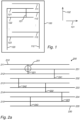
- Figure 1 schematically shows an example of an embodiment of a substrate 100. There are at least two mesh electrodes arranged in a pattern across a surface of substrate 100. Shown in figure 1 are two electrodes on the same surface: a first electrode 110 and a second electrode 120.
- First mesh electrode 110 and second mesh electrode 120 each comprise multiple main lines. As shown in figure 1 , first mesh electrode 110 comprises main lines 111, 112, and 113, and second mesh electrode 120 comprises main lines 121, 122 and 123. Typically, each mesh electrode will comprise more lines than three.
- the main lines extend across the substrate.
- the mesh electrodes are electrically isolated or isolatable from each other.
- the multiple main lines of the first and second electrode are arranged alternatingly with respect to each other on the substrate.
- the main lines extend across the substrate in a first direction 101. When viewed in a second direction 102, the main lines are encountered alternately from different multiples, e.g., from the first and second multiple of main lines in the first and second mesh electrode, respectively.
- the first and second direction make an angle with each other; the angle may be substantially perpendicular, but this is not necessary.
- the first and second direction may each be parallel to a side of the substrate, but this is not necessary.
- interleaved mesh electrodes ash shown in figure 1 are combs that are interleaved into one another in pairs.
- Each mesh electrode in this figure has a connecting line running, in this case, along the left and right of the substrate, that does not cross main lines. I should be noted that, having interconnections, such connecting lines are not necessary, and in fact is preferably avoided.
- the two mesh electrodes are interlaced; for example each on the mesh electrodes comprises multiple main lines that are arranged alternatingly on the substrate. Such an alternating arrangement is also referred to as interdigitated.
- the mesh electrodes have an increased internal connection through the interconnects. For example, there are multiple electrical paths from most or even substantially all parts of the main lines to an electrical connector.
- Electrodes there could be more than two electrodes on the same side of the substrate, e.g., to facilitate more fine-grained control.
- different voltages may be placed on the mesh electrodes causing effects on the particles that cannot be achieved with two mesh electrodes.
- multiple electrodes may be used to facilitate a segmented substrate, e.g., for a segmented light modulator.
- some zones may have different optical properties, e.g., a different transparency or reflectivity.
- Below an embodiment with two electrodes is shown, but additional electrodes could be added to them, e.g., by replicating similar structures next to each other.
- first mesh electrode 110 and second mesh electrode 120 are applied to a same side of the substrate.
- the main lines may be in fluidic contact with a fluid in an optical layer.
- interconnects such as interconnect 151 may be applied in a different layer or plane as the main lines. This is not necessary though, in a different arrangement part of the main lines may not be in fluidic contact, e.g., to electrically isolate mesh electrodes 120 and 110 in a different manner.
- the two electrodes are arranged in a pattern across the substrate. There could also be one, two or more electrodes on the other surface of substrate 100, e.g., to facilitate stacking of three or more substrates. Applying electrodes to a substrate may be done by photolithography, e.g., using a mask representing the electrodes pattern. Electrodes may also be applied by embedding them in the substrate.
- Two or more substrates, such as substrate 100 may be combined into a light modulator.
- a motivating application for a light modulator is in dynamic glazing, also known as smart glazing, e.g., a light modulator, which may be applied in domestic housing, offices, green houses, cars, and the like.
- Optical properties such as a level of transparency or reflectivity of the dynamic glazing can be adapted electrically.
- two substrates such as substrate 100 may be stacked so that the sides on which the two electrodes are applied face each other.
- a fluid with particles is enclosed between the two substrates, which is known as an optical layer.
- the particles are charged or chargeable.
- the optical properties that change may depend on various factors, including the type of particles. For example, if the particles absorb light, then a change in transparency may be obtained. For example, if the particles reflect, then a change in reflection may be obtained.
- FIG. 1 shows one interconnect 151, which has a crossing point with main line 112.
- crossing points there are many crossing points. They may be distributed across the substrate in a regular pattern. They may be distributed across the substrate in a random pattern.
- the main lines are connected to a connecting-line connecting the main lines of the mesh electrode to each other without crossing another mesh electrode on the substrate-in figure 1 , a connecting-line runs on the left for electrode 120 and on the right for electrode 110.
- mesh electrodes do not need such connecting-lines.
- a voltage or current may be applied to both mesh electrodes from any point along the left and right edge of substrate 1. This is advantageous for instance when installing substrate 100, e.g., in a light modulator, in particular dynamic glazing. Dynamic glazing embodiments are further discussed elsewhere in this document.
- Light modulators may be adapted for other optical effects. For example, if desired, embodiments could be modified to different levels of translucency instead of different levels of transparency.
- the type of particle that is used can be used in an embodiment can be varied, e.g., to particles that differ in which wavelengths they absorb or reflect, and how specular of diffuse the reflection is.
- a light modulator can modulate different levels of reflection. Particles can also emit light. Stacking multiple optical layers further increases the possibilities.
- the main lines of the multiple mesh electrodes extend in a same direction, e.g., in first direction 101, e.g., they are parallel.
- the main lines can be used to control the optical properties of a light modulator.
- the main lines of the multiple mesh electrodes are arranged on the substrate in an alternating pattern, that is interspersed. Such a pattern is also referred to as interdigitated.
- the main lines of mesh electrodes 210 and 230 are arranged in turn; the two multiples taking turns on the substrate.
- the plurality of crossing points may be distributed in various ways across the substrate. For example, they may be distributed randomly across the substrate. For example, they may be distributed in a regular pattern. For example, the distribution may be obtained as a result of an optimization process, e.g., an optimization for diffraction, homogeneity, and possibly other desirable properties.
- an optimization process e.g., an optimization for diffraction, homogeneity, and possibly other desirable properties.
- a main line with one or more other main lines of the same mesh electrode is advantageous, e.g., it protects that particular main line from cuts. It is advantageous that all main lines are provided with interconnecting lines, but this is not necessary.
- the number of the main lines in the mesh electrode(s) that comprise at least two interconnecting lines is at least two, at least 10, at least half of the number of main lines, at least 90% of the main lines, or substantially all main lines.
- a main line is connected to at least 2, at least 4, at least 8, or at least 16 interconnection lines.
- a main line is connected to an interconnecting line within distance of the edge of the substrate, the distance being less than 10% of the length of the main line, less than 10 cm, or less than 5 cm, etc.
- the electrodes lines may not be at the same level. It is also possible to place the main lines at the same level above a whole surface of dielectric. For example, one may pattern the main lines of all mesh electrodes, and place the interconnects underneath a dielectric, e.g., that covers the whole surface. Electrical connection between the interconnects and the electrode lines may be done using a via, e.g., a hole in the dielectric at the specific location of the intersection and covers with metal. Typically, the substrate is itself dielectric.
- the interconnections allow the mesh electrodes to be powered from points that are close together, e.g., from the same edge, from the same connector, from the same point, which has several advantages. Without interconnecting lines, e.g., when powered from opposite edges of the substrate, there would be a locally different potential between main lines even if the input voltage is the same. At a fixed area in the device, this difference is created by the distance from the connector that creates a specific electrode line resistance. This distance, and thus resistance, is different between the two interdigit electrodes and varies across the substrate as the considered area is closer to one connector or to the other.
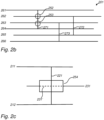
- FIG. 2b schematically shows an example of an embodiment of a substrate 201.
- a light-modulator such as a light-modulator used in dynamic glazing
- more electrodes may be added on the substrate.
- at least three electrodes may be applied to at least one of the first substrate and the second substrate.
- two electrodes may be applied to a first substrate and three electrodes to a second substrate. See for example, US patent application 16/994918 , published as US2021342235A1 , for many examples of configurations with a different number of electrodes, which electrodes may be implemented as mesh electrodes.
- interconnecting line 271 has two crossing points: crossing points 252 and 253.
- the crossing points can be made as in embodiments with two mesh electrodes.
- a dielectric may be arranged between the interconnecting line, e.g., interconnecting line 271 and the main line of the other mesh electrode.
- an interconnect line may be in a different plane than the mesh electrodes; the mesh electrodes may be in the same plane or in a different plane
- the current controlling component may be a Zenner diode.
- the Zenner diodes comprises two back to back Zenner junctions in series with opposite polarity. If the voltage difference is larger than threshold T or smaller than threshold - T than current can flow, otherwise it does not. Such a Zenner diode avoids a large voltage difference that might otherwise damage the system, e.g., a so-called overvoltage. A Zenner diode is also beneficial if the connecting points of the mesh electrodes are far apart.
- the open drive is 24V AC on both mesh 1 and mesh 2 of a substrate.
- a Zenner diode is configured to pass current when the potential difference is higher than 23V. So if a part of mesh 1 were to break and become insulated, mesh1 would be at 0V, but mesh2 would be at 24V. At that point, the Zenner diode would pass electricity and so that the potential of mesh 1 equals the one of mesh 2, in this case 24V.
- When closing mesh 1 may be at a potential of 10V, as an example, and mesh2 could then be at a potential of -10V.
- the potential difference for the Zenner diode is then 20V, which is below 23V, so the Zenner diode blocks current, which means a horizontal electric field is created.
- an electrode mesh 1 becomes insulated. This may happen for example if there are two cuts between two interconnects. In that case, you have a floating line. Using a Zenner diode approach for the dielectric interconnect of the second mesh will help to discharge this insulated portion. The driving at high voltage would have charged the portion of electrode of mesh 1. When closing the device, the Zenner diode from the interconnect of the mesh 2 will discharge the insulated branch until the potential is below what activate the Zenner diode. Therefore, this portion of electrode mesh 1 will not remain transparent as the device is driven to opaque state.
- Using mesh electrodes has a further important advantage, which is that the substrate may be cut in various shapes.
- substrate 400 may be manufactured in the form of a rectangle. But after the rectangular shape has been produced it can be cut in a different shape.
- Figure 4 shows a cutting line 412 in the form of a thick dashed line, along which substrate 400 may be cut.
- An unending variety of shapes may be cut from substrate 400 without changing the manufacturing of the substrate itself.
- the connector 411 connects to all the mesh electrodes. In conventional designs without interconnecting lines it is not possible to cut the design, since the main lines are sensitive to line interruption.
- the substrate may be cut before two substrates are combined into a light-modulator but also after they are combined.
- an assembly comprising at least two substrates an optical layer with a fluid and particles between two substrates can form a light modulator.
- the assembly may be cut after assembly, thus obtaining a light modulator in a particular shape.
- a substrate By first manufacturing a rectangular substrate and then cutting it, a substrate can be provided that is not a rectangle. Connecting points can be assigned on the substrate(s). For example, an electric connector can be provided to the mesh electrodes on a substrate at a single point.
- a connector such as connector 411 may be mounted on the light modulator before or after the cutting.
- a connector may be mounted on an edge of a substrate, the connector may be connected to all multiple mesh electrodes on a substrate, or even to all mesh electrodes on both substrates.
- the connector may be connectable to a controller.
- the cutting may even include holes.
- When cutting the cut edges of the substrate may be closed, e.g., by melting, e.g., by gluing. Closing keeps the fluid between the substrates.
- the light modulator is much less sensitive to damage. For example, if part of the light modulator is cut by accident, e.g., because of a collision with an object, the light modulator will remain functional. If fluid were to leak from the collision, this can be stopped by gluing, melting, or otherwise closing the cut part of the light-modulator.
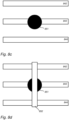
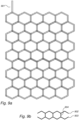
- main lines 821, 822 and 823 Shown in figures 8a and 8b are three main lines: main lines 821, 822 and 823.
- Main lines 821 and 823 belong to the same first mesh electrode.
- Main line 822 belong to a different, second mesh electrode.
- Main lines 821 and 823 are connected through an interconnecting line 831.
- the interconnecting line 831 runs beneath a dielectric 851, as is visible in the plan view of figure 8b .
- the dielectric 851 is indicated with a dashed line in figure 8b .
- Main line 822 runs over dielectric 851.
- dielectric 851 is transparent.
- the spacer may comprise a current controlling component configured to control a current between a first mesh electrode on a first substrate and a second mesh electrode on the second substrate.
- the spacer may be a dielectric to block current.
- the current controlling component may be arranged to allow current to pass if the voltage difference exceed a threshold and to block current if not.
- the spacer may comprise a Zenner diode.
- the number of spacers with current controlling functionality may be limited to one or more or all of the spacers.
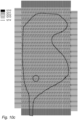
- FIG 10a shows a zoomed-out picture and figure 10b shows an enlarged detail.
- the mesh electrodes 1210 and 1211 each comprise multiple main lines connected together with multiple interconnecting lines. Where an interconnecting line crosses a main line, a dielectric 1212 is applied between them. Note that the foil supports connecting lines. On the left and right side the connecting lines connect to the first two main from the edge of the substrate, while on the top and bottom connecting lines connect to all the main lines.
- Numeral 1210 and 1211 in figure 10b indicate a connecting line of each mesh electrode. Connecting lines at the left or right, or top or bottom are optional, as long as both mesh electrodes remain connectable from outside the substrate.
- Additional vias connecting each of the mesh electrodes may be created between the mesh electrode and the other side of the substrate. It is then possible to cut the substrate/product wherever and still be capable of interconnecting it. Density of vias will indicate the minimum step of cutting which is possible.
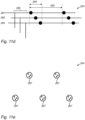
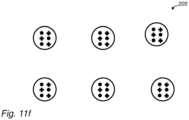
- Figure 11a show a distance 288 between successive vias of mesh electrode 281.
- the maximum distance between successive vias of the mesh electrodes is related to the size of smaller substrates that can be cut from a mother substrate, e.g., substrate 202.
- the vias are place on the main lines, and the maximum distance is the maximum distance measured along a main line.
- the maximum distance may be at most 10 cm, at most 1 cm, at most 1mm, etc.
- Light modulator 10 can be switched electronically between a transparent state and a non-transparent state and vice versa, or between a reflective state and a non-reflective state and vice versa.
- Light modulator 10 comprises a first substrate 11 and a second substrate 12 arranged opposite to each other.
- first substrate 11 At least two electrodes are applied: shown are electrodes 14a, 14b. These at least two electrodes are together referred to as electrodes 13.
- electrodes 15a, 15b On an inner-side of second substrate 12 at least two electrodes are applied: shown are electrodes 15a, 15b. These at least two electrodes are together referred to as electrodes 14.
- Electrodes 14a, 14b and electrodes 15a, 15b are mesh electrodes according to an embodiment.
- FIG 12a two interconnections are shown, although in practice there may be many more.
- the light modulator substrates (11,12) are aligned, and/or electrodes (13,14) are aligned.
- electrodes 14a, 14b and electrodes 15a, 15b may be aligned to be opposite each other.
- aligned substrates electrodes on different substrates fall behind each other when viewed in a direction orthogonal to the substrates.
- Figure 12b schematically shows an example of an embodiment of a light modulator 40.
- Light modulator 40 is similar to light modulator 10, except that it comprises multiple optical layers; in the example as shown two optical layers. There may be more than two optical layers. Each optical layer is arranged between two substrates.
- Light modulator 40 can be regarded as a stack of two-substrate light modulators as in figure 12a . As shown, light modulator 40 comprises three substrates: first substrate 41, second substrate 42 and third substrate 43. Between substrates 41 and 42 is an optical layer, and between substrates 42 and 43 is an optical layer. The optical layers may be similar to those in light modulator 10.
- a controller 46 may be similar to controller 16.
- controller 46 may be configured to control electrical potential and/or current on the electrodes of the substrates.
- controller 46 may be electrically connected to at least 4 times 2 equals 8 electrodes.
- controller 16 also controller 46 may be embodied over multiple sub-controllers.
- the surfaces of the substrates that face another substrate may be supplied with two or more patterns, e.g., as in an embodiment.
- the outer substrates 41 and 43 may receive electrodes only on an inner side, while the inner substrate, e.g., substrate 42, may have electrodes on both sides.
- Substrates 41 and 42 may together be regarded as an embodiment of a light modulator. Likewise, substrates 42 and 43 may together be regarded as an embodiment of a light modulator.
- Figure 12c schematically shows an example of an embodiment of a car 20 having dynamic glazing for windows 21.
- This is a particularly advantageous embodiment, since while driving the level of incident lighting can change often and rapidly.
- Using dynamic glazing in a car has the advantage that light levels can be maintained as a constant level by adjusting the transparency of the car windows. Moreover, the reduced diffraction effect improves safety as it reduces driver distraction.
- Car 20 may comprise a controller configured for controlling the transparency or reflectivity of windows 21.
- the dynamic glazing can also be used in other glazing applications, especially, where the amount of incident light is variable, e.g., buildings, offices, houses, green houses, skylights.
- Skylights are windows arranged in the ceiling to allow sunlight to enter the room.
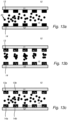
- Figures 13a-13b schematically show a side view of an embodiment of a light modulator in use. Applying an electric field to the electrodes on the substrates causes an electrical force on the particles. Using this effect, the particles can be moved around and so different transparency or reflectivity states can be caused in the light modulator.
- a controller may control the electric field, e.g., its amplitude, frequency, and phase.
- the controller is connected to at least four electrodes: two for each substrate. But more electrodes may be used and connected to the controller; for example, more than 2 electrodes may be used for a substrate to better fine-tune grey scales, and driving to non-transparent or non-reflective state. Multiple electrodes may also be used to support multiple segments on the substrate.
- Figure 13b shows the light modulator wherein, say at an instance P1, a potential +V1 is applied to each micro wire electrode on the top substrate, while a negative voltage, say -V1, is applied to each micro wire electrode of the bottom substrate.
- a potential +V1 is applied to each micro wire electrode on the top substrate
- a negative voltage say -V1
- the same positive potential is applied to all electrodes 13, and the same negative potential is applied to electrodes 14.
- the difference in potential causes negatively charged particles to flow to the vicinity of the electrodes of the top substrate, where the particles will substantially align with the top electrodes.
- both the top and bottom substrate are transparent, the transparency of light modulator 10 will increase.
- Applying a waveform is optional, but it is a useful measure to increase the lifetime of the light modulator by reducing corrosion. Corrosion can form for example, when using copper electrodes since copper ions dissolve in an ionic fluid at one substrate and flow to electrode on the opposite substrate, where they deposit. By applying a waveform the direction of copper ion transport is frequently reversed, thus reducing corrosion damage. Between the two instances P1 and P2 the corrosion current between the two substrates is balanced or substantially, e.g., >95%, balanced, e.g., as corrosion rate of an electrode of the top plate occurs there is a balancing deposition of copper on the bottom electrode between each instance of time, P1 and vice versa in instance P2.
- Figure 13c shows how a state of decreased transparency or reflectivity can be obtained.
- An alternating voltage is applied on the same substrate.
- a potential +V2 is applied a first electrode and the next immediate neighboring electrode has an opposite potential -V2 etc., as shown in fig. 13c .
- This is indicated in figure 13c by the first ⁇ +' or the first '-' drawn in an electrode.
- This can be obtained by applying the potential +V2 to electrode 14a and the opposite potential -V2 to electrode 14b.
- the potential +V2 may be applied to electrode 15a and the opposite potential -V2 to electrode 15b.
- the electrodes may be arranged so that the electrodes on the substrates are aligned; an electrode on the top substrate having an opposite electrode on the bottom substrate, and vice versa.
- a similar transparency or reflectivity can be achieved, when in a second instance, the voltages of the top electrodes and bottom electrodes are reversed. This is indicated in figure 13c by the second ⁇ +' or the second '-' drawn in an electrode.
- the potential on the electrodes may alternative between positive and negative as indicated by the '+/-' and ⁇ -/+' indicated on the electrodes.
- the opposite electrode may receive the same potential, while neighboring electrodes receive an opposite potential.
- An embodiment is shown in figure 13c , wherein four electrodes are indicated with the reference numbers 14a, 14b, 15a and 15b, and the rest of the electrodes continue to alternate.
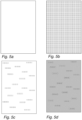
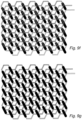
- the AC drive cycle may be implemented by using an interdigitated line configuration combining the top and bottom electrode configuration shown in plan view in figures 5 , 6a-6d , etc.
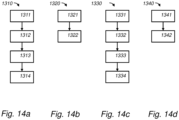
- Figure 14a schematically shows an example of an embodiment of a method 1310 of manufacturing a substrate.
- the substrate is for use in a light modulator, such as used in dynamic glazing.
- Method 1310 comprises
- the multiple interlaced mesh electrodes extend in a two-dimensional pattern across the substrate.
- the plurality of crossing points may be created during the applying of the mesh electrodes.
- a dielectric or other current controlling component may be applied to control current flowing between the first and second mesh electrode.
- a mesh electrode is applied without interruption. It is not necessary that a mesh electrode is applied all at once; a mesh electrode may be applied in parts.
- a mesh electrode may be built op from a multiple of main lines and interconnections.
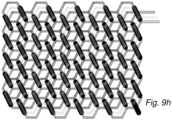
- figure 14b shows an embodiment in which a mesh electrode is built up from main lines and interconnecting lines.
- Applying the mesh electrodes, and/or the main lines, and/or the interconnecting lines and/or current controlling components may be done by patterning.
- Direct printing may also be used, especially for interconnecting lines and current controlling components such as dielectrics
- the light modulator may directly be manufactured in the desired shape.
- cutting allows the light modulator to be built according to a default configuration after which its shape can be modified. After or during the cutting of the light modulator, its edges may be closed to keep the fluid in the optical layer.
- a controller may be connected to the multiple mesh electrodes on the substrates.
- the controller may be configured to select an alternating current or voltage based on user inputs, e.g., an input indicating a desired optical property, e.g., a desired transparency, a program indicating a desired optical property say for a time of day, sensor inputs, e.g., sensors in the light modulator, e.g., sensor for incident light, ambient light, etc., e.g., incident sunlight, e.g., ambient room lighting, etc. e.g., sensor for the current on the mesh electrodes.
- a software program executed by the controller may select, e.g., look-up or compute, an appropriate driving signal to drive the light modulator closer to a new state and/or to maintain a current state.
- the selected driving signal may be applied by a current controller or a voltage controller, etc.
- Embodiments of the method may be executed using software, which comprises instructions for causing a processor system to perform a driving method, such a method 1340.
- Software may only include those steps taken by a particular sub-entity of the system.
- the software may be stored in a suitable storage medium, such as a hard disk, a floppy, a memory, an optical disc, etc.
- the software may be sent as a signal along a wire, or wireless, or using a data network, e.g., the Internet.
- the software may be made available for download and/or for remote usage on a server.
- Embodiments of the method may be executed using a bitstream arranged to configure programmable logic, e.g., a field-programmable gate array (FPGA), to perform the method.
- FPGA field-programmable gate array
- the presently disclosed subject matter also extends to computer programs, particularly computer programs on or in a carrier, adapted for putting the presently disclosed subject matter into practice.
- the program may be in the form of source code, object code, a code intermediate source, and object code such as partially compiled form, or in any other form suitable for use in the implementation of an embodiment of the method.
- An embodiment relating to a computer program product comprises computer executable instructions corresponding to each of the processing steps of at least one of the methods set forth. These instructions may be subdivided into subroutines and/or be stored in one or more files that may be linked statically or dynamically.
- Another embodiment relating to a computer program product comprises computer executable instructions corresponding to each of the devices, units and/or parts of at least one of the systems and/or products set forth.
- the presently disclosed subject matter may be implemented by hardware comprising several distinct elements, and by a suitably programmed computer.
- the device claim enumerating several parts several of these parts may be embodied by one and the same item of hardware.
- the mere fact that certain measures are recited in mutually different dependent claims does not indicate that a combination of these measures cannot be used to advantage.
Landscapes
- Physics & Mathematics (AREA)
- Nonlinear Science (AREA)
- General Physics & Mathematics (AREA)
- Optics & Photonics (AREA)
- Chemical & Material Sciences (AREA)
- Life Sciences & Earth Sciences (AREA)
- Health & Medical Sciences (AREA)
- Chemical Kinetics & Catalysis (AREA)
- Electrochemistry (AREA)
- Molecular Biology (AREA)
- Mathematical Physics (AREA)
- Crystallography & Structural Chemistry (AREA)
- Electrochromic Elements, Electrophoresis, Or Variable Reflection Or Absorption Elements (AREA)
Applications Claiming Priority (2)
| Application Number | Priority Date | Filing Date | Title |
|---|---|---|---|
| NL2027746A NL2027746B1 (en) | 2021-03-12 | 2021-03-12 | Dynamic glazing comprising a substrate with interlaced mesh electrodes |
| PCT/EP2022/056315 WO2022189617A1 (en) | 2021-03-12 | 2022-03-11 | Dynamic glazing comprising a substrate with interlaced mesh electrodes |
Publications (2)
| Publication Number | Publication Date |
|---|---|
| EP4288833A1 EP4288833A1 (en) | 2023-12-13 |
| EP4288833B1 true EP4288833B1 (en) | 2024-07-03 |
Family
ID=77711335
Family Applications (1)
| Application Number | Title | Priority Date | Filing Date |
|---|---|---|---|
| EP22713651.2A Active EP4288833B1 (en) | 2021-03-12 | 2022-03-11 | Dynamic glazing comprising a substrate with interlaced mesh electrodes |
Country Status (7)
| Country | Link |
|---|---|
| US (1) | US20240310687A1 (https=) |
| EP (1) | EP4288833B1 (https=) |
| JP (1) | JP7813808B2 (https=) |
| CN (1) | CN117321501B (https=) |
| ES (1) | ES2993595T3 (https=) |
| NL (1) | NL2027746B1 (https=) |
| WO (1) | WO2022189617A1 (https=) |
Cited By (2)
| Publication number | Priority date | Publication date | Assignee | Title |
|---|---|---|---|---|
| US12259630B2 (en) | 2021-12-24 | 2025-03-25 | Elstar Dynamics Patents B.V. | Substrate comprising electrodes and light modulator with reduced diffraction |
| EP4675346A1 (en) * | 2024-07-05 | 2026-01-07 | eLstar Dynamics Patents B.V. | Light modulator, light modulator method and substrate for a light modulator with heating function |
Family Cites Families (8)
| Publication number | Priority date | Publication date | Assignee | Title |
|---|---|---|---|---|
| US4157908A (en) | 1978-09-01 | 1979-06-12 | Ppg Industries, Inc. | Method and apparatus for thickness control of float glass with toothed cylindrical member that has axis extended in the direction of glass flow |
| JPH08211422A (ja) * | 1994-10-31 | 1996-08-20 | Fujikura Ltd | 窓 |
| US20050185104A1 (en) | 2002-07-25 | 2005-08-25 | Genewave | Optically active glazing |
| WO2006015044A1 (en) * | 2004-07-27 | 2006-02-09 | E Ink Corporation | Electro-optic displays |
| EP2494579B1 (en) * | 2009-10-26 | 2017-08-02 | Mapper Lithography IP B.V. | Charged particle multi-beamlet lithography system, modulation device, and method of manufacturing thereof |
| JP5900233B2 (ja) | 2012-08-08 | 2016-04-06 | 日立化成株式会社 | 調光素子、調光装置、および、それらの駆動方法 |
| US11404589B2 (en) * | 2018-08-21 | 2022-08-02 | Eastman Kodak Company | Open electrodes for in-plane field generation |
| NL2022504B1 (en) * | 2019-02-04 | 2020-08-19 | Elstar Dynamics Patents B V | Improved optical modulator |
-
2021
- 2021-03-12 NL NL2027746A patent/NL2027746B1/en active
-
2022
- 2022-03-11 ES ES22713651T patent/ES2993595T3/es active Active
- 2022-03-11 WO PCT/EP2022/056315 patent/WO2022189617A1/en not_active Ceased
- 2022-03-11 US US18/281,183 patent/US20240310687A1/en active Pending
- 2022-03-11 EP EP22713651.2A patent/EP4288833B1/en active Active
- 2022-03-11 CN CN202280034066.5A patent/CN117321501B/zh active Active
- 2022-03-11 JP JP2023555554A patent/JP7813808B2/ja active Active
Cited By (3)
| Publication number | Priority date | Publication date | Assignee | Title |
|---|---|---|---|---|
| US12259630B2 (en) | 2021-12-24 | 2025-03-25 | Elstar Dynamics Patents B.V. | Substrate comprising electrodes and light modulator with reduced diffraction |
| EP4675346A1 (en) * | 2024-07-05 | 2026-01-07 | eLstar Dynamics Patents B.V. | Light modulator, light modulator method and substrate for a light modulator with heating function |
| WO2026008651A1 (en) | 2024-07-05 | 2026-01-08 | Elstar Dynamics Patents B.V. | Light modulator, light modulator method and substrate for a light modulator with heating function |
Also Published As
| Publication number | Publication date |
|---|---|
| WO2022189617A1 (en) | 2022-09-15 |
| US20240310687A1 (en) | 2024-09-19 |
| CN117321501A (zh) | 2023-12-29 |
| KR20230152762A (ko) | 2023-11-03 |
| JP7813808B2 (ja) | 2026-02-13 |
| TW202235984A (zh) | 2022-09-16 |
| EP4288833A1 (en) | 2023-12-13 |
| CN117321501B (zh) | 2025-03-11 |
| ES2993595T3 (en) | 2025-01-02 |
| NL2027746B1 (en) | 2022-09-29 |
| JP2024510740A (ja) | 2024-03-11 |
Similar Documents
| Publication | Publication Date | Title |
|---|---|---|
| TWI813511B (zh) | 光調變器、包含電極及智能玻璃的基板 | |
| EP4288833B1 (en) | Dynamic glazing comprising a substrate with interlaced mesh electrodes | |
| US20260063961A1 (en) | Asymmetric driving for optical modulator | |
| CN118632789A (zh) | 包括电极的基板和具有减小的衍射的光调制器 | |
| KR102958916B1 (ko) | 인터레이스 메시 전극들을 갖는 기판을 포함하는 동적 글레이징 | |
| EP4446801A1 (en) | Light modulator and substrate having an energy conversion layer | |
| EP4625033A1 (en) | Light modulator with connection area | |
| US20260126697A1 (en) | Light modulator and substrate having an energy conversion layer | |
| EP4675346A1 (en) | Light modulator, light modulator method and substrate for a light modulator with heating function | |
| EP4726467A1 (en) | Light modulator comprising one or more continuous spacer walls | |
| TWI919085B (zh) | 用於光學調變器之非對稱驅動 | |
| JP2026514058A (ja) | エネルギー変換層を有する光変調器および基板 | |
| WO2024213644A1 (en) | Light modulator and substrate having electrodes comprising apertures | |
| TW202601260A (zh) | 包含低壓層之光調變器 |
Legal Events
| Date | Code | Title | Description |
|---|---|---|---|
| STAA | Information on the status of an ep patent application or granted ep patent |
Free format text: STATUS: UNKNOWN |
|
| STAA | Information on the status of an ep patent application or granted ep patent |
Free format text: STATUS: THE INTERNATIONAL PUBLICATION HAS BEEN MADE |
|
| PUAI | Public reference made under article 153(3) epc to a published international application that has entered the european phase |
Free format text: ORIGINAL CODE: 0009012 |
|
| STAA | Information on the status of an ep patent application or granted ep patent |
Free format text: STATUS: REQUEST FOR EXAMINATION WAS MADE |
|
| 17P | Request for examination filed |
Effective date: 20230904 |
|
| AK | Designated contracting states |
Kind code of ref document: A1 Designated state(s): AL AT BE BG CH CY CZ DE DK EE ES FI FR GB GR HR HU IE IS IT LI LT LU LV MC MK MT NL NO PL PT RO RS SE SI SK SM TR |
|
| GRAP | Despatch of communication of intention to grant a patent |
Free format text: ORIGINAL CODE: EPIDOSNIGR1 |
|
| STAA | Information on the status of an ep patent application or granted ep patent |
Free format text: STATUS: GRANT OF PATENT IS INTENDED |
|
| DAV | Request for validation of the european patent (deleted) | ||
| DAX | Request for extension of the european patent (deleted) | ||
| INTG | Intention to grant announced |
Effective date: 20240125 |
|
| GRAS | Grant fee paid |
Free format text: ORIGINAL CODE: EPIDOSNIGR3 |
|
| GRAA | (expected) grant |
Free format text: ORIGINAL CODE: 0009210 |
|
| STAA | Information on the status of an ep patent application or granted ep patent |
Free format text: STATUS: THE PATENT HAS BEEN GRANTED |
|
| AK | Designated contracting states |
Kind code of ref document: B1 Designated state(s): AL AT BE BG CH CY CZ DE DK EE ES FI FR GB GR HR HU IE IS IT LI LT LU LV MC MK MT NL NO PL PT RO RS SE SI SK SM TR |
|
| REG | Reference to a national code |
Ref country code: CH Ref legal event code: EP |
|
| REG | Reference to a national code |
Ref country code: DE Ref legal event code: R096 Ref document number: 602022004355 Country of ref document: DE |
|
| REG | Reference to a national code |
Ref country code: NL Ref legal event code: FP |
|
| REG | Reference to a national code |
Ref country code: LT Ref legal event code: MG9D |
|
| PG25 | Lapsed in a contracting state [announced via postgrant information from national office to epo] |
Ref country code: PT Free format text: LAPSE BECAUSE OF FAILURE TO SUBMIT A TRANSLATION OF THE DESCRIPTION OR TO PAY THE FEE WITHIN THE PRESCRIBED TIME-LIMIT Effective date: 20241104 |
|
| REG | Reference to a national code |
Ref country code: AT Ref legal event code: MK05 Ref document number: 1700440 Country of ref document: AT Kind code of ref document: T Effective date: 20240703 |
|
| PG25 | Lapsed in a contracting state [announced via postgrant information from national office to epo] |
Ref country code: PT Free format text: LAPSE BECAUSE OF FAILURE TO SUBMIT A TRANSLATION OF THE DESCRIPTION OR TO PAY THE FEE WITHIN THE PRESCRIBED TIME-LIMIT Effective date: 20241104 |
|
| REG | Reference to a national code |
Ref country code: ES Ref legal event code: FG2A Ref document number: 2993595 Country of ref document: ES Kind code of ref document: T3 Effective date: 20250102 |
|
| PG25 | Lapsed in a contracting state [announced via postgrant information from national office to epo] |
Ref country code: NO Free format text: LAPSE BECAUSE OF FAILURE TO SUBMIT A TRANSLATION OF THE DESCRIPTION OR TO PAY THE FEE WITHIN THE PRESCRIBED TIME-LIMIT Effective date: 20241003 |
|
| PG25 | Lapsed in a contracting state [announced via postgrant information from national office to epo] |
Ref country code: FI Free format text: LAPSE BECAUSE OF FAILURE TO SUBMIT A TRANSLATION OF THE DESCRIPTION OR TO PAY THE FEE WITHIN THE PRESCRIBED TIME-LIMIT Effective date: 20240703 Ref country code: GR Free format text: LAPSE BECAUSE OF FAILURE TO SUBMIT A TRANSLATION OF THE DESCRIPTION OR TO PAY THE FEE WITHIN THE PRESCRIBED TIME-LIMIT Effective date: 20241004 Ref country code: PL Free format text: LAPSE BECAUSE OF FAILURE TO SUBMIT A TRANSLATION OF THE DESCRIPTION OR TO PAY THE FEE WITHIN THE PRESCRIBED TIME-LIMIT Effective date: 20240703 |
|
| PG25 | Lapsed in a contracting state [announced via postgrant information from national office to epo] |
Ref country code: BG Free format text: LAPSE BECAUSE OF FAILURE TO SUBMIT A TRANSLATION OF THE DESCRIPTION OR TO PAY THE FEE WITHIN THE PRESCRIBED TIME-LIMIT Effective date: 20240703 |
|
| PG25 | Lapsed in a contracting state [announced via postgrant information from national office to epo] |
Ref country code: LV Free format text: LAPSE BECAUSE OF FAILURE TO SUBMIT A TRANSLATION OF THE DESCRIPTION OR TO PAY THE FEE WITHIN THE PRESCRIBED TIME-LIMIT Effective date: 20240703 |
|
| PG25 | Lapsed in a contracting state [announced via postgrant information from national office to epo] |
Ref country code: IS Free format text: LAPSE BECAUSE OF FAILURE TO SUBMIT A TRANSLATION OF THE DESCRIPTION OR TO PAY THE FEE WITHIN THE PRESCRIBED TIME-LIMIT Effective date: 20241103 Ref country code: AT Free format text: LAPSE BECAUSE OF FAILURE TO SUBMIT A TRANSLATION OF THE DESCRIPTION OR TO PAY THE FEE WITHIN THE PRESCRIBED TIME-LIMIT Effective date: 20240703 |
|
| PG25 | Lapsed in a contracting state [announced via postgrant information from national office to epo] |
Ref country code: HR Free format text: LAPSE BECAUSE OF FAILURE TO SUBMIT A TRANSLATION OF THE DESCRIPTION OR TO PAY THE FEE WITHIN THE PRESCRIBED TIME-LIMIT Effective date: 20240703 Ref country code: CZ Free format text: LAPSE BECAUSE OF FAILURE TO SUBMIT A TRANSLATION OF THE DESCRIPTION OR TO PAY THE FEE WITHIN THE PRESCRIBED TIME-LIMIT Effective date: 20240703 |
|
| PG25 | Lapsed in a contracting state [announced via postgrant information from national office to epo] |
Ref country code: RS Free format text: LAPSE BECAUSE OF FAILURE TO SUBMIT A TRANSLATION OF THE DESCRIPTION OR TO PAY THE FEE WITHIN THE PRESCRIBED TIME-LIMIT Effective date: 20241003 |
|
| PG25 | Lapsed in a contracting state [announced via postgrant information from national office to epo] |
Ref country code: RS Free format text: LAPSE BECAUSE OF FAILURE TO SUBMIT A TRANSLATION OF THE DESCRIPTION OR TO PAY THE FEE WITHIN THE PRESCRIBED TIME-LIMIT Effective date: 20241003 Ref country code: PL Free format text: LAPSE BECAUSE OF FAILURE TO SUBMIT A TRANSLATION OF THE DESCRIPTION OR TO PAY THE FEE WITHIN THE PRESCRIBED TIME-LIMIT Effective date: 20240703 Ref country code: NO Free format text: LAPSE BECAUSE OF FAILURE TO SUBMIT A TRANSLATION OF THE DESCRIPTION OR TO PAY THE FEE WITHIN THE PRESCRIBED TIME-LIMIT Effective date: 20241003 Ref country code: LV Free format text: LAPSE BECAUSE OF FAILURE TO SUBMIT A TRANSLATION OF THE DESCRIPTION OR TO PAY THE FEE WITHIN THE PRESCRIBED TIME-LIMIT Effective date: 20240703 Ref country code: IS Free format text: LAPSE BECAUSE OF FAILURE TO SUBMIT A TRANSLATION OF THE DESCRIPTION OR TO PAY THE FEE WITHIN THE PRESCRIBED TIME-LIMIT Effective date: 20241103 Ref country code: HR Free format text: LAPSE BECAUSE OF FAILURE TO SUBMIT A TRANSLATION OF THE DESCRIPTION OR TO PAY THE FEE WITHIN THE PRESCRIBED TIME-LIMIT Effective date: 20240703 Ref country code: GR Free format text: LAPSE BECAUSE OF FAILURE TO SUBMIT A TRANSLATION OF THE DESCRIPTION OR TO PAY THE FEE WITHIN THE PRESCRIBED TIME-LIMIT Effective date: 20241004 Ref country code: FI Free format text: LAPSE BECAUSE OF FAILURE TO SUBMIT A TRANSLATION OF THE DESCRIPTION OR TO PAY THE FEE WITHIN THE PRESCRIBED TIME-LIMIT Effective date: 20240703 Ref country code: CZ Free format text: LAPSE BECAUSE OF FAILURE TO SUBMIT A TRANSLATION OF THE DESCRIPTION OR TO PAY THE FEE WITHIN THE PRESCRIBED TIME-LIMIT Effective date: 20240703 Ref country code: BG Free format text: LAPSE BECAUSE OF FAILURE TO SUBMIT A TRANSLATION OF THE DESCRIPTION OR TO PAY THE FEE WITHIN THE PRESCRIBED TIME-LIMIT Effective date: 20240703 Ref country code: AT Free format text: LAPSE BECAUSE OF FAILURE TO SUBMIT A TRANSLATION OF THE DESCRIPTION OR TO PAY THE FEE WITHIN THE PRESCRIBED TIME-LIMIT Effective date: 20240703 |
|
| REG | Reference to a national code |
Ref country code: DE Ref legal event code: R097 Ref document number: 602022004355 Country of ref document: DE |
|
| PG25 | Lapsed in a contracting state [announced via postgrant information from national office to epo] |
Ref country code: RO Free format text: LAPSE BECAUSE OF FAILURE TO SUBMIT A TRANSLATION OF THE DESCRIPTION OR TO PAY THE FEE WITHIN THE PRESCRIBED TIME-LIMIT Effective date: 20240703 Ref country code: DK Free format text: LAPSE BECAUSE OF FAILURE TO SUBMIT A TRANSLATION OF THE DESCRIPTION OR TO PAY THE FEE WITHIN THE PRESCRIBED TIME-LIMIT Effective date: 20240703 Ref country code: SM Free format text: LAPSE BECAUSE OF FAILURE TO SUBMIT A TRANSLATION OF THE DESCRIPTION OR TO PAY THE FEE WITHIN THE PRESCRIBED TIME-LIMIT Effective date: 20240703 |
|
| PG25 | Lapsed in a contracting state [announced via postgrant information from national office to epo] |
Ref country code: EE Free format text: LAPSE BECAUSE OF FAILURE TO SUBMIT A TRANSLATION OF THE DESCRIPTION OR TO PAY THE FEE WITHIN THE PRESCRIBED TIME-LIMIT Effective date: 20240703 |
|
| PG25 | Lapsed in a contracting state [announced via postgrant information from national office to epo] |
Ref country code: SK Free format text: LAPSE BECAUSE OF FAILURE TO SUBMIT A TRANSLATION OF THE DESCRIPTION OR TO PAY THE FEE WITHIN THE PRESCRIBED TIME-LIMIT Effective date: 20240703 |
|
| PLBE | No opposition filed within time limit |
Free format text: ORIGINAL CODE: 0009261 |
|
| STAA | Information on the status of an ep patent application or granted ep patent |
Free format text: STATUS: NO OPPOSITION FILED WITHIN TIME LIMIT |
|
| 26N | No opposition filed |
Effective date: 20250404 |
|
| PGFP | Annual fee paid to national office [announced via postgrant information from national office to epo] |
Ref country code: ES Payment date: 20250401 Year of fee payment: 4 |
|
| PG25 | Lapsed in a contracting state [announced via postgrant information from national office to epo] |
Ref country code: SE Free format text: LAPSE BECAUSE OF FAILURE TO SUBMIT A TRANSLATION OF THE DESCRIPTION OR TO PAY THE FEE WITHIN THE PRESCRIBED TIME-LIMIT Effective date: 20240703 |
|
| PG25 | Lapsed in a contracting state [announced via postgrant information from national office to epo] |
Ref country code: MC Free format text: LAPSE BECAUSE OF FAILURE TO SUBMIT A TRANSLATION OF THE DESCRIPTION OR TO PAY THE FEE WITHIN THE PRESCRIBED TIME-LIMIT Effective date: 20240703 |
|
| REG | Reference to a national code |
Ref country code: CH Ref legal event code: H13 Free format text: ST27 STATUS EVENT CODE: U-0-0-H10-H13 (AS PROVIDED BY THE NATIONAL OFFICE) Effective date: 20251024 |
|
| PG25 | Lapsed in a contracting state [announced via postgrant information from national office to epo] |
Ref country code: LU Free format text: LAPSE BECAUSE OF NON-PAYMENT OF DUE FEES Effective date: 20250311 |
|
| PG25 | Lapsed in a contracting state [announced via postgrant information from national office to epo] |
Ref country code: CH Free format text: LAPSE BECAUSE OF NON-PAYMENT OF DUE FEES Effective date: 20250331 |
|
| PG25 | Lapsed in a contracting state [announced via postgrant information from national office to epo] |
Ref country code: IE Free format text: LAPSE BECAUSE OF NON-PAYMENT OF DUE FEES Effective date: 20250311 |
|
| PGFP | Annual fee paid to national office [announced via postgrant information from national office to epo] |
Ref country code: GB Payment date: 20260327 Year of fee payment: 5 |
|
| PGFP | Annual fee paid to national office [announced via postgrant information from national office to epo] |
Ref country code: DE Payment date: 20260327 Year of fee payment: 5 |
|
| PGFP | Annual fee paid to national office [announced via postgrant information from national office to epo] |
Ref country code: BE Payment date: 20260327 Year of fee payment: 5 Ref country code: IT Payment date: 20260319 Year of fee payment: 5 |
|
| PGFP | Annual fee paid to national office [announced via postgrant information from national office to epo] |
Ref country code: NL Payment date: 20260326 Year of fee payment: 5 |
|
| PGFP | Annual fee paid to national office [announced via postgrant information from national office to epo] |
Ref country code: FR Payment date: 20260325 Year of fee payment: 5 |