EP4288017B1 - Koaxialer nadeladapter und führungshalterung für eine robotische flüssigkeitshandhabungsplattform - Google Patents
Koaxialer nadeladapter und führungshalterung für eine robotische flüssigkeitshandhabungsplattform Download PDFInfo
- Publication number
- EP4288017B1 EP4288017B1 EP22708646.9A EP22708646A EP4288017B1 EP 4288017 B1 EP4288017 B1 EP 4288017B1 EP 22708646 A EP22708646 A EP 22708646A EP 4288017 B1 EP4288017 B1 EP 4288017B1
- Authority
- EP
- European Patent Office
- Prior art keywords
- drug
- vial
- coaxial needle
- robotic arm
- bracket member
- Prior art date
- Legal status (The legal status is an assumption and is not a legal conclusion. Google has not performed a legal analysis and makes no representation as to the accuracy of the status listed.)
- Active
Links
Images



Classifications
-
- A—HUMAN NECESSITIES
- A61—MEDICAL OR VETERINARY SCIENCE; HYGIENE
- A61J—CONTAINERS SPECIALLY ADAPTED FOR MEDICAL OR PHARMACEUTICAL PURPOSES; DEVICES OR METHODS SPECIALLY ADAPTED FOR BRINGING PHARMACEUTICAL PRODUCTS INTO PARTICULAR PHYSICAL OR ADMINISTERING FORMS; DEVICES FOR ADMINISTERING FOOD OR MEDICINES ORALLY; BABY COMFORTERS; DEVICES FOR RECEIVING SPITTLE
- A61J1/00—Containers specially adapted for medical or pharmaceutical purposes
- A61J1/14—Details; Accessories therefor
- A61J1/20—Arrangements for transferring or mixing fluids, e.g. from vial to syringe
-
- A—HUMAN NECESSITIES
- A61—MEDICAL OR VETERINARY SCIENCE; HYGIENE
- A61J—CONTAINERS SPECIALLY ADAPTED FOR MEDICAL OR PHARMACEUTICAL PURPOSES; DEVICES OR METHODS SPECIALLY ADAPTED FOR BRINGING PHARMACEUTICAL PRODUCTS INTO PARTICULAR PHYSICAL OR ADMINISTERING FORMS; DEVICES FOR ADMINISTERING FOOD OR MEDICINES ORALLY; BABY COMFORTERS; DEVICES FOR RECEIVING SPITTLE
- A61J1/00—Containers specially adapted for medical or pharmaceutical purposes
- A61J1/14—Details; Accessories therefor
- A61J1/20—Arrangements for transferring or mixing fluids, e.g. from vial to syringe
- A61J1/2003—Accessories used in combination with means for transfer or mixing of fluids, e.g. for activating fluid flow, separating fluids, filtering fluid or venting
- A61J1/2006—Piercing means
- A61J1/201—Piercing means having one piercing end
-
- A—HUMAN NECESSITIES
- A61—MEDICAL OR VETERINARY SCIENCE; HYGIENE
- A61J—CONTAINERS SPECIALLY ADAPTED FOR MEDICAL OR PHARMACEUTICAL PURPOSES; DEVICES OR METHODS SPECIALLY ADAPTED FOR BRINGING PHARMACEUTICAL PRODUCTS INTO PARTICULAR PHYSICAL OR ADMINISTERING FORMS; DEVICES FOR ADMINISTERING FOOD OR MEDICINES ORALLY; BABY COMFORTERS; DEVICES FOR RECEIVING SPITTLE
- A61J1/00—Containers specially adapted for medical or pharmaceutical purposes
- A61J1/14—Details; Accessories therefor
- A61J1/20—Arrangements for transferring or mixing fluids, e.g. from vial to syringe
- A61J1/2003—Accessories used in combination with means for transfer or mixing of fluids, e.g. for activating fluid flow, separating fluids, filtering fluid or venting
- A61J1/2068—Venting means
-
- A—HUMAN NECESSITIES
- A61—MEDICAL OR VETERINARY SCIENCE; HYGIENE
- A61J—CONTAINERS SPECIALLY ADAPTED FOR MEDICAL OR PHARMACEUTICAL PURPOSES; DEVICES OR METHODS SPECIALLY ADAPTED FOR BRINGING PHARMACEUTICAL PRODUCTS INTO PARTICULAR PHYSICAL OR ADMINISTERING FORMS; DEVICES FOR ADMINISTERING FOOD OR MEDICINES ORALLY; BABY COMFORTERS; DEVICES FOR RECEIVING SPITTLE
- A61J3/00—Devices or methods specially adapted for bringing pharmaceutical products into particular physical or administering forms
- A61J3/002—Compounding apparatus specially for enteral or parenteral nutritive solutions
-
- B—PERFORMING OPERATIONS; TRANSPORTING
- B01—PHYSICAL OR CHEMICAL PROCESSES OR APPARATUS IN GENERAL
- B01J—CHEMICAL OR PHYSICAL PROCESSES, e.g. CATALYSIS OR COLLOID CHEMISTRY; THEIR RELEVANT APPARATUS
- B01J19/00—Chemical, physical or physico-chemical processes in general; Their relevant apparatus
- B01J19/0046—Sequential or parallel reactions, e.g. for the synthesis of polypeptides or polynucleotides; Apparatus and devices for combinatorial chemistry or for making molecular arrays
-
- B—PERFORMING OPERATIONS; TRANSPORTING
- B01—PHYSICAL OR CHEMICAL PROCESSES OR APPARATUS IN GENERAL
- B01J—CHEMICAL OR PHYSICAL PROCESSES, e.g. CATALYSIS OR COLLOID CHEMISTRY; THEIR RELEVANT APPARATUS
- B01J2219/00—Chemical, physical or physico-chemical processes in general; Their relevant apparatus
- B01J2219/00002—Chemical plants
- B01J2219/00004—Scale aspects
- B01J2219/00011—Laboratory-scale plants
-
- B—PERFORMING OPERATIONS; TRANSPORTING
- B01—PHYSICAL OR CHEMICAL PROCESSES OR APPARATUS IN GENERAL
- B01J—CHEMICAL OR PHYSICAL PROCESSES, e.g. CATALYSIS OR COLLOID CHEMISTRY; THEIR RELEVANT APPARATUS
- B01J2219/00—Chemical, physical or physico-chemical processes in general; Their relevant apparatus
- B01J2219/00274—Sequential or parallel reactions; Apparatus and devices for combinatorial chemistry or for making arrays; Chemical library technology
- B01J2219/00277—Apparatus
- B01J2219/00351—Means for dispensing and evacuation of reagents
- B01J2219/00373—Hollow needles
-
- B—PERFORMING OPERATIONS; TRANSPORTING
- B01—PHYSICAL OR CHEMICAL PROCESSES OR APPARATUS IN GENERAL
- B01J—CHEMICAL OR PHYSICAL PROCESSES, e.g. CATALYSIS OR COLLOID CHEMISTRY; THEIR RELEVANT APPARATUS
- B01J2219/00—Chemical, physical or physico-chemical processes in general; Their relevant apparatus
- B01J2219/00274—Sequential or parallel reactions; Apparatus and devices for combinatorial chemistry or for making arrays; Chemical library technology
- B01J2219/0068—Means for controlling the apparatus of the process
- B01J2219/00686—Automatic
- B01J2219/00691—Automatic using robots
Definitions
- the present disclosure generally relates to drug delivery systems, and, more particularly, to robotic based reconstitution approaches for drug delivery systems.
- Drugs are administered to treat a variety of conditions and diseases. These drug dosings may be performed in a healthcare facility, or in some instances, at remote locations such as a patient's home. In certain applications, a drug product may be shipped to a healthcare facility (e.g., an inpatient facility, an outpatient facility, and/or a pharmacy) in a powdered or lyophilized form or alternatively in a liquid form.
- a healthcare facility e.g., an inpatient facility, an outpatient facility, and/or a pharmacy
- bi-specific T-cell engagers may require exceptionally accurate quantities of the drug product and/or other fluids required for dosing.
- the healthcare professional must prepare the drug by closely following a set of steps to ensure a sterile environment is maintained and that correct quantities of ingredients are added to the delivery container. As a result, the reconstitution process may be time-consuming, tedious, and may have an unacceptable or undesirable error rate.
- a needle assembly may be provided that includes a piercing needle and a separate venting needle. Due in part to the thickness of the seal of the drug product vial, such an arrangement could result in one or both of the piercing and venting needles becoming damaged or otherwise broken during insertion. Further, in these systems, one or both of the needles could become stuck in the seal, and as a result, upon raising the needle assembly, the seal and/or the drug product vial may remain coupled with the needle or needles, causing the drug product vial to be lifted out of its storage rack. As such, these existing systems oftentimes require manually removing the drug product vial from the needle or needles, and may lead to potential sources of contamination.
- the present disclosure sets forth systems and methods for using a robotic-based reconstitution system embodying advantageous alternatives to existing systems and methods, and that may address one or more of the challenges or needs mentioned herein, as well as provide other benefits and advantages.
- US2003116497A1 discloses apparatuses and methods for creating and testing pre-formulations and systems for same.
- US7549978B2 discloses a needle assembly.
- EP1467205A1 discloses a method for characterizing polymorphs.
- a drug reconstitution system includes a robotic arm movable between a plurality of positions, at least one bracket member operably coupled with the robotic arm, and at least one coaxial needle operably coupled with the robotic arm.
- the at least one bracket member includes a mounting region, a support surface, an upper surface, and a throughbore extending through the support surface and the upper surface.
- the at least one coaxial needle is movably disposed between the throughbore of the at least one bracket member.
- the at least one coaxial needle is adapted to pierce at least a portion of a vial and dispense a liquid into the vial during drug reconstitution.
- the at least one coaxial needle includes a proximal end, a distal end, an elongated length extending therebetween, a piercing tip positioned at the proximal end, a dispensing opening positioned at or near the proximal end, and a first venting hole positioned along the elongated length.
- the piercing tip and the dispensing opening of the at least one coaxial needle may be disposed on an inner member, and the first venting hole may be disposed on an outer member.
- the outer member may be at least partially hollow to receive at least a portion of the inner member.
- a second venting hole may be provided that is disposed on the outer member distally from the first venting hole. The first venting hole and the second venting hole may cooperate to create a venting path to an external environment.
- the support surface of the at least one bracket member is adapted to engage a contact face of a drug vial during at least one of drug aspiration or drug reconstitution via movement of the robotic arm to a lowered position.
- the at least one coaxial needle may be movable relative to the at least one bracket member such that the at least one coaxial needle may be selectively raised while the support surface of the at least one bracket member remains engaged with the contact face of the drug vial.
- an urging member may be provided to exert an urging force on the at least one bracket member.
- the drug reconstitution system may include a needle assembly operably coupled with the robotic arm, the at least one bracket member, and the at least one coaxial needle.
- the needle assembly may include a liquid reservoir to dispense into the at least one coaxial needle.
- an approach for reconstituting a drug via a robotic arm movable between a plurality of positions includes operably coupling at least one bracket member with the robotic arm and operably coupling at least one coaxial needle with the robotic arm.
- the at least one coaxial needle is fluidly coupled with a reconstituting fluid.
- the robotic arm is lowered to a lowered position whereby the at least one bracket member and the at least one coaxial needle move to a lowered position adjacent to a drug vial.
- the approach further includes reconstituting the drug by causing the reconstituting fluid to flow through at least a portion of the at least one coaxial needle.
- the at least one coaxial needle is raised to a raised position while the at least one bracket member remains adjacent to the drug vial.
- the at least one bracket member is raised to a raised position.
- the drug reconstitution system includes a drug product vial containing a drug product, a robotic arm adapted to move between a plurality of positions, at least one bracket member operably coupled with the robotic arm, and at least one coaxial needle operably coupled with the robotic arm.
- the drug product vial includes a seal member to retain the drug product within the drug product vial.
- the at least one bracket member includes a mounting region, a support surface, an upper surface, and a throughbore extending through the support surface and the upper surface.
- the at least one coaxial needle is at least partially disposed between the throughbore of the at least one bracket member and movable relative thereto.
- the at least one coaxial needle includes a first end, a second end operably coupled with the robotic arm, an outer member, an inner member at least partially disposed within the outer member, a piercing tip positioned at the first end, and at least one venting hole disposed on the outer member.
- the piercing tip of the at least one coaxial needle is adapted to pierce at least a portion of the seal member of the drug product vial and the support surface of the at least one bracket member is adapted to be positioned adjacent to the seal member of the drug product vial.
- an adapter bracket and coaxial needle are provided.
- the adapter bracket acts as a guide and a support for the coaxial needle, which is used to reconstitute lyophilized drug product such as, for example, a bispecific T cell engager (BiTE) in an automated workflow.
- the coaxial needle and adapter bracket are each mounted to a robotic arm, and more specifically, a needle assembly or liquid handling platform thereof, which in some examples may be a part of a larger automated liquid handling platform.
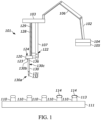
- a drug reconstitution system 100 includes a robotic arm 102, a holder 111 that accommodates a number of drug vials 110, any number of bracket members 120, and any number of coaxial needles 130. It is appreciated that the drug reconstitution system 100 provided herein is but one example of such a system.
- the drug reconstitution system 100 may reconstitute, extract, and/or process a large number (e.g., approximately 60) of drug vials 110 every minute, and in some examples, can actively perform chemical analyses such as ascertaining sample protein concentrations at a similarly high rate.
- the robotic arm 102 is movable between a number of positions within the confines of a three-dimensional area such as, for example, a raised position that is spatially removed from the holder 111 and/or drug vials 110, and a lowered position that is adjacent to the holder 111 and/or the drug vials 110.
- a needle assembly (or liquid handling platform) 103 may be operably coupled with an end of the robotic arm 102 to reconstitute and/or otherwise prepare the drug vials 110 for use.
- the needle assembly 103 may be fluidly coupled with a fluid reservoir 104 that may include a fluid such as a reconstituting fluid (e.g., a diluent) to be used during reconstitution.
- any number of fluid lines 106 may extend from the fluid reservoir 104 to the needle assembly 102.
- the fluid reservoir 104 may include a pumping mechanism (not illustrated) to urge specific quantities of the reconstituting fluid to the needle assembly 102 as desired.
- the robotic arm 102 may include any number of mechanical and electromechanical components, sub-components, systems, power sources, measuring devices, processors, controllers, and the like to operate in an autonomous or semi-autonomous manner.
- the drug vial 110 may be in the form of a prefilled container and includes a vial body defining an inner volume 112 and a vial seal or stopper 113.
- the drug vial 110 may also include a vial adapter 114 used to releasably couple with other components (e.g., a drug delivery container, a syringe, a drug delivery device, etc.).
- the inner volume 112 may be sterile.
- the vial seal 113 may be in the form of a rubber stopper having a thickness of approximately 13mm. Other examples are possible.
- the vial seal 113 includes a contact surface 113a positioned on an upper side thereof that, in some examples, may be exposed to an external environment 101 (i.e., an environment outside of the inner volume 112). Further, in some examples, the vial adapter 114 may also be a CSTD that mates, engages, and/or couples to other adapters such as, for example, a delivery container adapter (not illustrated).
- an external environment 101 i.e., an environment outside of the inner volume 112
- the vial adapter 114 may also be a CSTD that mates, engages, and/or couples to other adapters such as, for example, a delivery container adapter (not illustrated).
- the inner volume 112 of the drug vial 110 contains a predetermined quantity of drug product or active pharmaceutical ingredient ("API") 116 (e.g., between approximately 2 mcg and approximately 100 mcg), depending on the BiTE and vial size, which, in the illustrated example, is in powdered form (i.e., lyophilized) requiring reconstitution.
- the drug product 116 may be in liquid form and may not require reconstitution. Nonetheless, the system 100 includes an accurate quantity of drug product 116, and thus does not require the need to add additional quantities thereto in a sterile environment.
- the API may be in the form of a half-life extended (“HLE”) BiTE and/or an IV-admin monoclonal antibody (“mAbs”) as desired.
- HLE BiTEs include an antibody Fc region that advantageously provides different drug properties such as longer and extended half-lives. Accordingly, such APIs may be preferred due to their ability to maintain protective levels in the patient for relatively longer periods of time. Nonetheless, in other examples, the API may be in the form of a canonical-BiTE that is to be administered in a professional healthcare environment.
- the fluid reservoir may contain and/or dispense a predetermined quantity of reconstituting fluid 105 or diluent (e.g., preservative-free water for injection or "WFI"; between approximately 0.5 mL and approximately 10mL) to be added to the prefilled drug vial 110 for reconstitution of the drug product 116.
- a benzyl alcohol preserved (or any other preservative) WFI may be used.
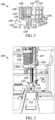
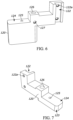
- the bracket member 120 is operably coupled with the robotic arm 102. More specifically, the bracket member 120 includes a mounting region 122 in the form of a recessed area having any number of mounting holes 122a.
- the bracket member 120 is operably coupled with the needle assembly 103 by aligning a mounting plate 107 of the needle assembly 103 with the corresponding mounting region 122 and coupling the two members together via a fastener or fasteners (see, e.g., Fig. 2 ).
- Other mounting approaches are possible such as, for example, a friction fit coupling, a snap coupling, and the like.
- Any number of bracket members 120 may be operably coupled with the needle assembly 103 via respective mounting plates 107.
- the bracket member 120 further includes a lower or support surface 123, an upper surface 124, a throughbore 125 extending between the support surface 123 and the upper surface 124. Further, the bracket member 120 may include a rod mounting portion 126 in the form of a hole and a bore 127 to receive a set screw (not illustrated) used to retain a rod 128 ( Fig. 2 ) therein. A resilient member 129 in the form of a spring may be coupled with and/or surround the rod 128.
- an alternative bracket member 220 is provided that includes similar features as the bracket member 120, but includes a relatively higher support surface 223 than the support surface 123 of the bracket member 120.
- the coaxial needle 130 includes a first or proximal end 130a, second or distal end 130b operably coupled with the robotic arm 102 (e.g., via a portion of the needle assembly 103), an elongated length 130c, an inner member 131, and an outer member or sheath 136.
- the inner member 131 may be a 19 GA needle
- the outer member 136 may be 15 GA.
- the outer member 136 does not extend fully to the proximal end 130a and instead terminates along a portion of the elongated length 130c. However, other arrangements are possible.
- a piercing tip 132 used to pierce at least a portion of the vial seal 113.
- a dispensing opening 133 is also positioned at or near the proximal end 130a.
- the inner member 131 may be hollow and in fluid communication with the fluid reservoir 104 via the fluid line 106. More specifically, in some examples, the inner member 131 and/or the outer member 136 may be coupled with a port (not illustrated) of the needle assembly 103 via a threaded coupling to create a fluid path from the needle assembly 103 to the dispensing opening 133.
- the coaxial needle 130 may include a male threaded region at the distal end 130b that insertably couples with a female threaded region on the needle assembly. Such a coupling eliminates a need for a set screw to retain the coaxial needle 130.
- the outer member 136 is also at least partially hollow, and surrounds at least a portion of the inner member 131.
- the outer member 136 includes a number of vent holes 137 along the elongated length 130c.
- the upper end of outer member 136 may be open to the external environment 101, and in other examples, the upper end of the outer member 136 may be closed and/or abut against a portion of the needle assembly 103.
- a second venting hole 137 is positioned above or distal to the first venting hole 137.
- the second venting hole 137 may be positioned at any number of locations at or near the second end 130b of needle.
- the distance between the venting holes 137 may be defined relative to the dimensions of the drug vial 110 such that upon inserting the coaxial needle 130 into the inner volume 112 thereof, one venting hole 137 is positioned inside the inner volume 112 (i.e., below the vial seal 113), and one venting hole 137 is positioned outside the drug vial 110 (i.e., exposed to the external environment 101). Further, the first or lower vent hole 137 is positioned at a specified length such that it is higher than the fill level in the drug vial 110 under any circumstances (even after drug reconstitution).
- the coaxial needle 130 may also include a chamfered or tapered region 138 positioned at the end of the outer member 136 to allow for a gradual transition in the varying outer diameter of the inner member 131 and the outer member 136. Such a chamfered region 138 may allow for the coaxial needle 130 to more smoothly penetrate the vial seal 113.
- the coaxial needle 130 is disposed at least partially through the throughbore 125. As such, the throughbore 125 acts as a guide to limit movement of the coaxial needle 130.
- the coaxial needle 130 is movable relative to the bracket member 120. As with the bracket member 120, any number of coaxial needles 130 may be used and coupled with the robotic arm 102 to perform multiple operations concurrently.
- the robotic arm 102 moves from an initial position in which the coaxial needle 130 is spaced away from the drug vial 110 to a raised position located axially above the drug vial 110. It is noted that in some examples, the robotic arm 102 may already be positioned above the drug vial 110 so the initial movement may not be necessary. The robotic arm 102 may lower to a lowered position which causes the piercing tip 132 of the coaxial needle 130 to pierce at least a portion of the vial seal 113. With reference to Figs. 8 and 9 , upon piercing the vial seal 113, the first end 130a of the coaxial needle 130 is positioned within the inner volume 112 of the drug vial 110. More specifically, both the dispensing opening 133 and the lower venting hole 137 are positioned within the inner volume of the drug vial 110.
- the system 100 initiates drug reconstitution by adding (automatically, in some examples) a predetermined quantity of reconstituting fluid 105 from the fluid reservoir 104 through the fluid lines 106, to the needle assembly 103, through the second end 130b of the coaxial needle 130 (i.e., through the inner member 131), to the first end 130a of the coaxial needle 130 and out the dispensing opening 130.
- the process of reconstitution may generate a gas as the reconstituting fluid 105 is added to the drug vial 110, and as illustrated in Fig. 8 , the gas may enter the lower venting hole 137, travel through the inside of the outer member 136 (while remaining separate from the fluid 105 traveling through the inner member 131), and out the second venting hole 137. Accordingly, the coaxial needle 130 may vent the pressure generated by reconstitution to reduce a risk of over pressurization.
- the bracket member 120 when the robotic arm 102 lowers, the bracket member 120 also lowers relative to the drug vial 110.
- the support surface 123 of the bracket member 120 may either rest on an upper surface 113b of the vial seal 113 or near (e.g., within approximately 2.0 cm) the upper surface 113b of the vial seal 113.
- the resilient member 129 may urge the bracket member 120 downwardly and against the vial seal 113.
- the bracket member 120 i.e., the throughbore 125 not only guides movement of the coaxial needle 130, but also assists in retaining the vial 110 within the holder 111 by limiting the ability of the drug vial 110 to move axially out of the holder 111.
- the robotic arm 102 may raise to a raised position relative to the drug vial 110. This movement may then cause the coaxial needle 130 to be moved upwardly from the drug vial 110.
- the bracket member 120 remains in the lowered position, and as such, the support surface 123 of the bracket member 120 may retain the drug vial 110 within the holder 111 to allow the coaxial needle 130 to be retracted from the vial seal 113.
- the resilient member 129 may urge the bracket member 120 against the vial seal 113 to exert an opposing force on the drug vial 110 that opposes the retracting force from the coaxial needle 130 being retracted from the drug vial 110.
- bracket member 120 may then be raised to allow for additional processing as needed.
- the spring-loaded support rod 128 holds down the vial 110 as the robotic arm 102 retracts the coaxial needle 130 from the vial 110.
- the support surface 123 of the bracket member 120 is flush with the piercing tip 132 of the coaxial needle 130 such that when the arm 102 is fully raised, the bracket member 120 is retracted from the top of the vial 110.
- the drug vial 110 remains in the holder 111 during the entire reconstitution process.
- the robotic arm 102 may include a first movable member that causes the coaxial needle 130 to move and a second movable member that causes the bracket member 120 to move.
- the first and second movable members may be separately actuatable such that the coaxial needle 130 and the bracket member 120 may move together initially to be positioned at or near the drug vial 110, and subsequently, the first movable member may be moved separately to retract the coaxial needle 130.
- the system 100 may also be used to aspirate or draw the drug product 116 from the drug vial 110.
- the needle assembly 103 may include a pumping mechanism capable of drawing the drug product 116 from the drug vial 110.
- air enters the upper vent hole 137 and enters the inner volume 112 of the drug vial 110 via the lower vent hole 137.
- the reconstituted drug container 110 may then be visually inspected for imperfections and/or to ensure adequate mixing has occurred.
- the reconstituted drug contained in the prefilled drug vial 110 may then be transferred into any number of containers (e.g., a drug delivery container (not illustrated) by mating the vial adapter 114 of the prefilled drug vial 110 to a corresponding delivery container adapter. So configured, this system may quickly perform the step of reconstitution (thus greatly reducing preparation times) and safely.
- the systems described herein avoid and/or eliminate the potential occurrence of needle sticking and/or spills due to over-pressurizing of the vial. Additionally, contamination is mitigated via the venting holes.
- systems and approaches described herein may be used for the storage and transport of drugs in various states, such as but not limited to drug products which have undergone completion of mixing and/or other finishing steps, drug substances which are intended to be mixed and/or finished after shipping, components or ingredients to be used in a drug, or other drug-related states or components.
- the above description describes various devices, assemblies, components, subsystems and methods for use related to a drug delivery device.
- the devices, assemblies, components, subsystems, methods or drug delivery devices can further comprise or be used with a drug including but not limited to those drugs identified below as well as their generic and biosimilar counterparts.
- drug as used herein, can be used interchangeably with other similar terms and can be used to refer to any type of medicament or therapeutic material including traditional and non-traditional pharmaceuticals, nutraceuticals, supplements, biologics, biologically active agents and compositions, large molecules, biosimilars, bioequivalents, therapeutic antibodies, polypeptides, proteins, small molecules and generics.
- Non-therapeutic injectable materials are also encompassed.
- the drug may be in liquid form, a lyophilized form, or in a reconstituted from lyophilized form.
- the following example list of drugs should not be considered as all-inclusive or limiting.
- the drug will be contained in a reservoir.
- the reservoir is a primary container that is either filled or pre-filled for treatment with the drug.
- the primary container can be a vial, a cartridge or a pre-filled syringe.
- the reservoir of the drug delivery device may be filled with or the device can be used with colony stimulating factors, such as granulocyte colony-stimulating factor (G-CSF).
- G-CSF agents include but are not limited to Neulasta ® (pegfilgrastim, pegylated filgastrim, pegylated G-CSF, pegylated hu-Met-G-CSF) and Neupogen ® (filgrastim, G-CSF, hu-MetG-CSF), UDENYCA ® (pegfilgrastim-cbqv), Ziextenzo ® (LA-EP2006; pegfilgrastim-bmez), or FULPHILA (pegfilgrastim-bmez).
- Neulasta ® pegfilgrastim, pegylated filgastrim, pegylated G-CSF, pegylated hu-Met-G-CSF
- Neupogen ® filgrastim, G-
- the drug delivery device may contain or be used with an erythropoiesis stimulating agent (ESA), which may be in liquid or lyophilized form.
- ESA erythropoiesis stimulating agent
- An ESA is any molecule that stimulates erythropoiesis.
- an ESA is an erythropoiesis stimulating protein.
- erythropoiesis stimulating protein means any protein that directly or indirectly causes activation of the erythropoietin receptor, for example, by binding to and causing dimerization of the receptor.
- Erythropoiesis stimulating proteins include erythropoietin and variants, analogs, or derivatives thereof that bind to and activate erythropoietin receptor; antibodies that bind to erythropoietin receptor and activate the receptor; or peptides that bind to and activate erythropoietin receptor.
- Erythropoiesis stimulating proteins include, but are not limited to, Epogen ® (epoetin alfa), Aranesp ® (darbepoetin alfa), Dynepo ® (epoetin delta), Mircera ® (methyoxy polyethylene glycol-epoetin beta), Hematide ® , MRK-2578, INS-22, Retacrit ® (epoetin zeta), Neorecormon ® (epoetin beta), Silapo ® (epoetin zeta), Binocrit ® (epoetin alfa), epoetin alfa Hexal, Abseamed ® (epoetin alfa), Ratioepo ® (epoetin theta), Eporatio ® (epoetin theta), Biopoin ® (epoetin theta
- proteins are the specific proteins set forth below, including fusions, fragments, analogs, variants or derivatives thereof: OPGL specific antibodies, peptibodies, related proteins, and the like (also referred to as RANKL specific antibodies, peptibodies and the like), including fully humanized and human OPGL specific antibodies, particularly fully humanized monoclonal antibodies; Myostatin binding proteins, peptibodies, related proteins, and the like, including myostatin specific peptibodies; IL-4 receptor specific antibodies, peptibodies, related proteins, and the like, particularly those that inhibit activities mediated by binding of IL-4 and/or IL-13 to the receptor; Interleukin 1-receptor 1 ("IL1-R1") specific antibodies, peptibodies, related proteins, and the like; Ang2 specific antibodies, peptibodies, related proteins, and the like; NGF specific antibodies, peptibodies, related proteins, and the like; CD22 specific antibodies, peukin 1-receptor 1
- Reopro ® (abciximab, anti-GP Ilb/llia receptor monoclonal antibody); Actemra ® (anti-IL6 Receptor mAb); Avastin ® (bevacizumab), HuMax-CD4 (zanolimumab); MvasiTM (bevacizumab-awwb); Rituxan ® (rituximab, anti-CD20 mAb); Tarceva ® (erlotinib); Roferon-A ® -(interferon alfa-2a); Simulect ® (basiliximab); Prexige ® (lumiracoxib); Synagis ® (palivizumab); 145c7-CHO (anti-IL15 antibody, see U.S.
- Patent No. 7,153,507 Tysabri ® (natalizumab, anti-?4integrin mAb); Valortim ® (MDX-1303, anti-B. anthracis protective antigen mAb); ABthrax TM ; Xolair ® (omalizumab); ETI211 (anti-MRSA mAb); IL-1 trap (the Fc portion of human IgG1 and the extracellular domains of both IL-1 receptor components (the Type I receptor and receptor accessory protein)); VEGF trap (Ig domains of VEGFR1 fused to IgG1 Fc); Zenapax ® (daclizumab); Zenapax ® (daclizumab, anti-IL-2R?
- mAb mAb
- Zevalin ® ibritumomab tiuxetan
- Zetia ® ezetimibe
- Orencia ® atacicept, TACI-Ig
- anti-CD80 monoclonal antibody galiximab
- anti-CD23 mAb lumiliximab
- BR2-Fc huBR3 / huFc fusion protein, soluble BAFF antagonist
- CNTO 148 golimumab, anti-TNF?
- HGS-ETR1 mapatumumab; human anti-TRAIL Receptor-1 mAb
- HuMax-CD20 osteocalcinab
- HuMax-EGFR zalutumumab
- M200 volociximab, anti-?5?1 integrin mAb
- MDX-010 ipilimumab, anti-CTLA-4 mAb and VEGFR-1 (IMC-18F1)
- anti-BR3 mAb anti-C.
- mAb (MEDI-545, MDX-198); anti-IGF1R mAb; anti-IGF-1R mAb (HuMax-Inflam); anti-IL12 mAb (ABT-874); anti-IL12/IL23 mAb (CNTO 1275); anti-IL13 mAb (CAT-354); anti-IL2Ra mAb (HuMax-TAC); anti-IL5 Receptor mAb; anti-integrin receptors mAb (MDX-018, CNTO 95); anti-IP10 Ulcerative Colitis mAb (MDX-1100); BMS-66513; anti-Mannose Receptor/hCG?
- mAb (MDX-1307); anti-mesothelin dsFv-PE38 conjugate (CAT-5001); anti-PD1mAb (MDX-1106 (ONO-4538)); anti-PDGFR? antibody (IMC-3G3); anti-TGFß mAb (GC-1008); anti-TRAIL Receptor-2 human mAb (HGS-ETR2); anti-TWEAK mAb; anti-VEGFR/Flt-1 mAb; and anti-ZP3 mAb (HuMax-ZP3).
- the drug delivery device may contain or be used with a sclerostin antibody, such as but not limited to romosozumab, blosozumab, BPS 804 (Novartis), Evenity TM (romosozumab-aqqg), another product containing romosozumab for treatment of postmenopausal osteoporosis and/or fracture healing and in other embodiments, a monoclonal antibody (IgG) that binds human Proprotein Convertase Subtilisin/Kexin Type 9 (PCSK9).
- a sclerostin antibody such as but not limited to romosozumab, blosozumab, BPS 804 (Novartis), Evenity TM (romosozumab-aqqg), another product containing romosozumab for treatment of postmenopausal osteoporosis and/or fracture healing and in other embodiments, a monoclonal antibody
- PCSK9 specific antibodies include, but are not limited to, Repatha ® (evolocumab) and Praluent ® (alirocumab).
- the drug delivery device may contain or be used with rilotumumab, bixalomer, trebananib, ganitumab, conatumumab, motesanib diphosphate, brodalumab, vidupiprant or panitumumab.
- the reservoir of the drug delivery device may be filled with or the device can be used with IMLYGIC ® (talimogene laherparepvec) or another oncolytic HSV for the treatment of melanoma or other cancers including but are not limited to OncoVEXGALV/CD; OrienX010; G207, 1716; NV1020; NV12023; NV1034; and NV1042.
- the drug delivery device may contain or be used with endogenous tissue inhibitors of metalloproteinases (TIMPs) such as but not limited to TIMP-3.
- TIMP-3 tissue inhibitors of metalloproteinases
- the drug delivery device may contain or be used with Aimovig ® (erenumab-aooe), anti-human CGRP-R (calcitonin gene-related peptide type 1 receptor) or another product containing erenumab for the treatment of migraine headaches.
- Antagonistic antibodies for human calcitonin gene-related peptide (CGRP) receptor such as but not limited to erenumab and bispecific antibody molecules that target the CGRP receptor and other headache targets may also be delivered with a drug delivery device of the present disclosure.
- bispecific T cell engager (BiTE ® ) molecules such as but not limited to BLINCYTO ® (blinatumomab) can be used in or with the drug delivery device of the present disclosure.
- the drug delivery device may contain or be used with an APJ large molecule agonist such as but not limited to apelin or analogues thereof.
- a therapeutically effective amount of an anti-thymic stromal lymphopoietin (TSLP) or TSLP receptor antibody is used in or with the drug delivery device of the present disclosure.
- the drug delivery device may contain or be used with AvsolaTM (infliximab-axxq), anti-TNF ?
- the drug delivery device may contain or be used with Kyprolis ® (carfilzomib), (2S)-N-((S)-1-((S)-4-methyl-1-((R)-2-methyloxiran-2-yl)-1-oxopentan-2-ylcarbamoyl)-2-phenylethyl)-2-((S)-2-(2-morpholinoacetamido)-4-phenylbutanamido)-4-methylpentanamide, or another product containing carfilzomib for the treatment of multiple myeloma.
- the drug delivery device may contain or be used with Otezla ® (apremilast), N-[2-[(1S)-1-(3-ethoxy-4-methoxyphenyl)-2-(methylsulfonyl)ethyl]-2,3-dihydro-1,3-dioxo- 1H-isoindol-4-yl]acetamide, or another product containing apremilast for the treatment of various inflammatory diseases.
- Otezla ® as apremilast
- N-[2-[(1S)-1-(3-ethoxy-4-methoxyphenyl)-2-(methylsulfonyl)ethyl]-2,3-dihydro-1,3-dioxo- 1H-isoindol-4-yl]acetamide or another product containing apremilast for the treatment of various inflammatory diseases.
- the drug delivery device may contain or be used with ParsabivTM (etelcalcetide HCI, KAI-4169) or another product containing etelcalcetide HCl for the treatment of secondary hyperparathyroidism (sHPT) such as in patients with chronic kidney disease (KD) on hemodialysis.
- the drug delivery device may contain or be used with ABP 798 (rituximab), a biosimilar candidate to Rituxan ® /MabThera TM , or another product containing an anti-CD20 monoclonal antibody.
- the drug delivery device may contain or be used with a VEGF antagonist such as a non-antibody VEGF antagonist and/or a VEGF-Trap such as aflibercept (Ig domain 2 from VEGFR1 and Ig domain 3 from VEGFR2, fused to Fc domain of IgG1).
- a VEGF antagonist such as a non-antibody VEGF antagonist and/or a VEGF-Trap such as aflibercept (Ig domain 2 from VEGFR1 and Ig domain 3 from VEGFR2, fused to Fc domain of IgG1).
- the drug delivery device may contain or be used with ABP 959 (eculizumab), a biosimilar candidate to Soliris ® , or another product containing a monoclonal antibody that specifically binds to the complement protein C5.
- the drug delivery device may contain or be used with Rozibafusp alfa (formerly AMG 570) is a novel bispecific antibody-peptide conjugate that simultaneously blocks ICOSL and BAFF activity.
- the drug delivery device may contain or be used with Omecamtiv mecarbil, a small molecule selective cardiac myosin activator, or myotrope, which directly targets the contractile mechanisms of the heart, or another product containing a small molecule selective cardiac myosin activator.
- the drug delivery device may contain or be used with Sotorasib (formerly known as AMG 510), a KRASG12C small molecule inhibitor, or another product containing a KRASG12C small molecule inhibitor.
- the drug delivery device may contain or be used with Tezepelumab, a human monoclonal antibody that inhibits the action of thymic stromal lymphopoietin (TSLP), or another product containing a human monoclonal antibody that inhibits the action of TSLP.
- the drug delivery device may contain or be used with AMG 714, a human monoclonal antibody that binds to Interleukin-15 (IL-15) or another product containing a human monoclonal antibody that binds to Interleukin-15 (IL-15).
- the drug delivery device may contain or be used with AMG 890, a small interfering RNA (siRNA) that lowers lipoprotein(a), also known as Lp(a), or another product containing a small interfering RNA (siRNA) that lowers lipoprotein(a).
- the drug delivery device may contain or be used with ABP 654 (human IgG1 kappa antibody), a biosimilar candidate to Stelara ® , or another product that contains human IgG1 kappa antibody and/or binds to the p40 subunit of human cytokines interleukin (IL)-12 and IL-23.
- the drug delivery device may contain or be used with AmjevitaTM or AmgevitaTM (formerly ABP 501) (mab anti-TNF human IgG1), a biosimilar candidate to Humira ® , or another product that contains human mab anti-TNF human IgG1.
- the drug delivery device may contain or be used with AMG 160, or another product that contains a half-life extended (HLE) anti-prostate-specific membrane antigen (PSMA) x anti-CD3 BiTE ® (bispecific T cell engager) construct.
- HLE half-life extended
- PSMA anti-prostate-specific membrane antigen
- the drug delivery device may contain or be used with AMG 119, or another product containing a delta-like ligand 3 (DLL3) CAR T (chimeric antigen receptor T cell) cellular therapy. In some embodiments, the drug delivery device may contain or be used with AMG 119, or another product containing a delta-like ligand 3 (DLL3) CAR T (chimeric antigen receptor T cell) cellular therapy. In some embodiments, the drug delivery device may contain or be used with AMG 133, or another product containing a gastric inhibitory polypeptide receptor (GIPR) antagonist and GLP-1R agonist.
- GIPR gastric inhibitory polypeptide receptor
- the drug delivery device may contain or be used with AMG 171 or another product containing a Growth Differential Factor 15 (GDF15) analog.
- the drug delivery device may contain or be used with AMG 176 or another product containing a small molecule inhibitor of myeloid cell leukemia 1 (MCL-1).
- the drug delivery device may contain or be used with AMG 199 or another product containing a half-life extended (HLE) bispecific T cell engager construct (BiTE ® ).
- the drug delivery device may contain or be used with AMG 256 or another product containing an anti-PD-1 x IL21 mutein and/or an IL-21 receptor agonist designed to selectively turn on the Interleukin 21 (IL-21) pathway in programmed cell death-1 (PD-1) positive cells.
- the drug delivery device may contain or be used with AMG 330 or another product containing an anti-CD33 x anti-CD3 BiTE ® (bispecific T cell engager) construct.
- the drug delivery device may contain or be used with AMG 404 or another product containing a human anti-programmed cell death-1(PD-1) monoclonal antibody being investigated as a treatment for patients with solid tumors.
- the drug delivery device may contain or be used with AMG 427 or another product containing a half-life extended (HLE) anti-fms-like tyrosine kinase 3 (FLT3) x anti-CD3 BiTE ® (bispecific T cell engager) construct.
- the drug delivery device may contain or be used with AMG 430 or another product containing an anti-Jagged-1 monoclonal antibody.
- the drug delivery device may contain or be used with AMG 506 or another product containing a multi-specific FAP x 4-1BB-targeting DARPin ® biologic under investigation as a treatment for solid tumors.
- the drug delivery device may contain or be used with AMG 509 or another product containing a bivalent T-cell engager and is designed using XmAb ® 2+1 technology.
- the drug delivery device may contain or be used with AMG 562 or another product containing a half-life extended (HLE) CD19 x CD3 BiTE ® (bispecific T cell engager) construct.
- the drug delivery device may contain or be used with Efavaleukin alfa (formerly AMG 592) or another product containing an IL-2 mutein Fc fusion protein.
- the drug delivery device may contain or be used with AMG 596 or another product containing a CD3 x epidermal growth factor receptor vIII (EGFRvIII) BiTE ® (bispecific T cell engager) molecule.
- the drug delivery device may contain or be used with AMG 673 or another product containing a half-life extended (HLE) anti-CD33 x anti-CD3 BiTE ® (bispecific T cell engager) construct.
- the drug delivery device may contain or be used with AMG 701 or another product containing a half-life extended (HLE) anti-B-cell maturation antigen (BCMA) x anti-CD3 BiTE ® (bispecific T cell engager) construct.
- the drug delivery device may contain or be used with AMG 757 or another product containing a half-life extended (HLE) anti- delta-like ligand 3 (DLL3) x anti-CD3 BiTE ® (bispecific T cell engager) construct.
- the drug delivery device may contain or be used with AMG 910 or another product containing a half-life extended (HLE) epithelial cell tight junction protein claudin 18.2 x CD3 BiTE ® (bispecific T cell engager) construct.
Landscapes
- Health & Medical Sciences (AREA)
- Chemical & Material Sciences (AREA)
- Veterinary Medicine (AREA)
- Animal Behavior & Ethology (AREA)
- General Health & Medical Sciences (AREA)
- Public Health (AREA)
- Life Sciences & Earth Sciences (AREA)
- Pharmacology & Pharmacy (AREA)
- Organic Chemistry (AREA)
- Physics & Mathematics (AREA)
- Fluid Mechanics (AREA)
- Chemical Kinetics & Catalysis (AREA)
- Nutrition Science (AREA)
- Medicinal Chemistry (AREA)
- Medical Preparation Storing Or Oral Administration Devices (AREA)
Claims (15)
- Arzneimittel-Rekonstitutionssystem (100), umfassend:einen Roboterarm (102), der zwischen einer Vielzahl von Positionen bewegbar ist;mindestens ein Halterungselement (120), das funktionsfähig mit dem Roboterarm gekoppelt ist, wobei das mindestens eine Halterungselement einen Befestigungsbereich (122), eine Tragfläche (123), eine obere Fläche und eine Durchgangsbohrung, die sich durch die Tragfläche und die obere Fläche erstreckt, umfasst; undmindestens eine koaxiale Nadel (130), die funktionsfähig mit dem Roboterarm gekoppelt und bewegbar zwischen der Durchgangsbohrung des mindestens einen Halterungselements angeordnet ist, wobei die mindestens eine koaxiale Nadel angepasst ist, um mindestens einen Abschnitt eines Fläschchens zu durchstechen und während der Arzneimittelrekonstitution eine Flüssigkeit in das Fläschchen abzugeben.
- Arzneimittel-Rekonstitutionssystem nach Anspruch 1, wobei die mindestens eine koaxiale Nadel Folgendes umfasst: ein proximales Ende (130a), ein distales Ende (130b), eine sich dazwischen erstreckende längliche Länge (130c), eine an dem proximalen Ende positionierte Durchstechspitze (132), eine am oder in der Nähe des proximalen Endes positionierte Abgabeöffnung (133) und ein erstes entlang der länglichen Länge positioniertes Entlüftungsloch (137).
- Arzneimittel-Rekonstitutionssystem nach Anspruch 2, wobei die Durchstechspitze und die Abgabeöffnung der mindestens einen koaxialen Nadel an einem Innenelement (131) angeordnet sind und das erste Entlüftungsloch an einem Außenelement (136) angeordnet ist, wobei das Außenelement mindestens teilweise hohl ist, um mindestens einen Abschnitt des Innenelement aufzunehmen, und
optional ferner umfassend ein zweites Entlüftungsloch (137), das an dem Außenelement distal von dem ersten Entlüftungsloch angeordnet ist, wobei das erste Entlüftungsloch und das zweite Entlüftungsloch zusammenwirken, um einen Entlüftungsweg zu einer äußeren Umgebung zu schaffen. - Arzneimittel-Rekonstitutionssystem nach einem der Ansprüche 1 bis 3, wobei die Tragfläche des mindestens einen Halterungselements angepasst ist, um während mindestens einem von Arzneimittelaspiration oder Arzneimittelrekonstitution durch Bewegung des Roboterarms in eine abgesenkte Position mit einer Kontaktfläche (113b) eines Arzneimittelfläschchens (110) in Eingriff zu kommen.
- Arzneimittel-Rekonstitutionssystem nach Anspruch 4, wobei die mindestens eine koaxiale Nadel angepasst ist, um relativ zu dem mindestens einen Halterungselement bewegbar zu sein, so dass die mindestens eine koaxiale Nadel selektiv angehoben werden kann, während die Tragfläche des mindestens einen Halterungselements mit der Kontaktfläche des Arzneimittelfläschchens in Eingriff bleibt, und
optional ferner umfassend ein Druckelement (129), das angepasst ist, um eine Druckkraft auf das mindestens eine Halterungselement auszuüben. - Arzneimittel-Rekonstitutionssystem nach einem der Ansprüche 1 bis 5, ferner umfassend eine Nadelanordnung (103), die funktionsfähig mit dem Roboterarm, dem mindestens einen Halterungselement und der mindestens einen koaxialen Nadel gekoppelt ist, wobei die Nadelanordnung ein Flüssigkeitsreservoir zum Abgeben in die mindestens eine koaxiale Nadel umfasst.
- Arzneimittel-Rekonstitutionssystem (100) nach Anspruch 1, ferner umfassend das Fläschchen (110), wobei das Fläschchen ein Arzneimittelprodukt (116) enthält und das Fläschchen ein Dichtungselement (113) umfasst, um das Arzneimittelprodukt im Fläschchen zurückzuhalten, wobei:die mindestens eine koaxiale Nadel (130) relativ zu der Durchgangsbohrung (125) des mindestens einen Halterungselements (120) bewegbar ist, und die mindestens eine koaxiale Nadel ein erstes Ende (130a), ein zweites Ende (130b), das funktionsfähig mit dem Roboterarm gekoppelt ist, ein Außenelement (136), ein zumindest teilweise innerhalb des Außenelements angeordnetes Innenelement (131), eine an dem ersten Ende positionierte Durchstechspitze (132) und mindestens ein an dem Außenelement angeordnetes Entlüftungsloch (137) umfasst; unddas System so konfiguriert ist, dass beim Bewegen des Roboterarms in eine abgesenkte Position die Durchstechspitze der mindestens einen koaxialen Nadel angepasst ist, um mindestens einen Abschnitt des Dichtungselements des Fläschchens zu durchstechen, und die Tragfläche des mindestens einen Halterungselements angepasst ist, um benachbart zum Dichtungselement des Fläschchens positioniert zu sein.
- Arzneimittel-Rekonstitutionssystem nach Anspruch 7, wobei die mindestens eine koaxiale Nadel ferner eine Abgabeöffnung (133) umfasst, die am oder in der Nähe des ersten Endes positioniert ist, wobei beim Bewegen des Roboterarms in die abgesenkte Position ein Fluid durch die Abgabeöffnung und in das Fläschchen fließt.
- Arzneimittel-Rekonstitutionssystem nach Anspruch 7 oder 8, wobei beim Bewegen des Roboterarms in die abgesenkte Position das mindestens eine Entlüftungsloch angepasst ist, um in einer Höhe über einer Höhe des Arzneimittelprodukts innerhalb des Fläschchens positioniert zu sein, und
optional ferner umfassend eine zweite Entlüftungsöffnung umfasst, die am oder in der Nähe des zweiten Endes der mindestens einen koaxialen Nadel positioniert ist. - Arzneimittel-Rekonstitutionssystem nach einem der Ansprüche 7 bis 9, wobei die mindestens eine koaxiale Nadel angepasst ist, um relativ zu dem mindestens einen Halterungselement bewegbar zu sein, so dass beim Anheben des Roboterarms die mindestens eine koaxiale Nadel in eine angehobene Position bewegt werden kann, während die Tragfläche des mindestens einen Halterungselements mit dem Dichtungselement des Arzneimittelfläschchens in Eingriff bleibt, und
optional ferner umfassend ein Druckelement, das angepasst ist, um eine Druckkraft auf das mindestens eine Halterungselement auszuüben. - Verfahren zum Rekonstituieren eines Arzneimittels über einen Roboterarm (102), der zwischen einer Vielzahl von Positionen bewegbar ist, das Verfahren umfassend:funktionsfähiges Koppeln mindestens eines Halterungselements (120) mit dem Roboterarm;funktionsfähiges Koppeln mindestens einer koaxialen Nadel (130) mit dem Roboterarm, wobei die mindestens eine koaxiale Nadel mit einem Rekonstitutionsfluid fluidgekoppelt ist;Absenken des Roboterarms in eine abgesenkte Position, wodurch das mindestens eine Halterungselement und die mindestens eine koaxiale Nadel in eine abgesenkte Position benachbart zu einem Arzneimittelfläschchen (110) bewegt werden;Rekonstituieren des Arzneimittels, indem bewirkt wird, dass das Rekonstitutionsfluid durch mindestens einen Abschnitt der mindestens einen koaxialen Nadel fließt;Anheben der mindestens einen koaxialen Nadel in eine angehobene Position, während das mindestens eine Halterungselement benachbart zum Arzneimittelfläschchen bleibt; undAnheben des mindestens einen Halterungselements in eine angehobene Position.
- Verfahren nach Anspruch 11, wobei beim Absenken des Roboterarms in die abgesenkte Position die mindestens eine koaxiale Nadel mindestens einen Abschnitt eines Dichtungselements des Arzneimittelfläschchens durchsticht.
- Verfahren nach Anspruch 11 oder 12, wobei beim Absenken des Roboterarms in die abgesenkte Position eine Eingriffsfläche des mindestens einen Halterungselements in eine Eingriffsfläche (113b) des Arzneimittelfläschchens eingreift, um dessen axiale Bewegung davon zu begrenzen.
- Verfahren nach einem der Ansprüche 11 bis 13, wobei der Schritt des Rekonstituierens des Arzneimittels umfasst, dass das Rekonstitutionsfluid durch ein Innenelement zu einer an dem Innenelement ausgebildeten Abgabeöffnung fließen kann.
- Verfahren nach einem der Ansprüche 11 bis 14, wobei der Schritt des Anhebens der mindestens einen koaxialen Nadel ferner das Drücken des mindestens einen Halterungselements nach unten in Richtung des Arzneimittelfläschchens umfasst.
Applications Claiming Priority (2)
| Application Number | Priority Date | Filing Date | Title |
|---|---|---|---|
| US202163145214P | 2021-02-03 | 2021-02-03 | |
| PCT/US2022/014652 WO2022169724A1 (en) | 2021-02-03 | 2022-02-01 | Coaxial needle adapter and guide bracket for robotic liquid handling platform |
Publications (2)
| Publication Number | Publication Date |
|---|---|
| EP4288017A1 EP4288017A1 (de) | 2023-12-13 |
| EP4288017B1 true EP4288017B1 (de) | 2025-06-25 |
Family
ID=80682783
Family Applications (1)
| Application Number | Title | Priority Date | Filing Date |
|---|---|---|---|
| EP22708646.9A Active EP4288017B1 (de) | 2021-02-03 | 2022-02-01 | Koaxialer nadeladapter und führungshalterung für eine robotische flüssigkeitshandhabungsplattform |
Country Status (4)
| Country | Link |
|---|---|
| US (1) | US20240082110A1 (de) |
| EP (1) | EP4288017B1 (de) |
| ES (1) | ES3040332T3 (de) |
| WO (1) | WO2022169724A1 (de) |
Family Cites Families (18)
| Publication number | Priority date | Publication date | Assignee | Title |
|---|---|---|---|---|
| JP3472325B2 (ja) * | 1992-11-04 | 2003-12-02 | アジレント・テクノロジーズ・インク | 試料注入装置 |
| US5431201A (en) * | 1993-12-03 | 1995-07-11 | Technology 2000 Incororated | Robotic admixture system |
| US5814742A (en) * | 1996-10-11 | 1998-09-29 | L C Packings, Nederland B.V. | Fully automated micro-autosampler for micro, capillary and nano high performance liquid chromatography |
| US5945070A (en) * | 1996-10-31 | 1999-08-31 | Merck & Co., Inc. | Reaction vessel filter for combinatorial chemistry or biological use |
| US5935523A (en) * | 1997-05-29 | 1999-08-10 | Medical Laboratory Automation, Inc. | Apparatus for accessing a sealed container |
| US6257076B1 (en) * | 1999-01-26 | 2001-07-10 | Merlin Instrument Company | Sample injector with plunger release for chemical analysis systems |
| EP1075869B1 (de) * | 1999-08-09 | 2006-06-14 | Thk Co. Ltd. | Vorrichtung zur Herstellung von Mikroarrays |
| US6240984B1 (en) * | 2000-03-08 | 2001-06-05 | Gilson, Inc. | Foot seal for liquid handler |
| US6360794B1 (en) * | 2000-12-19 | 2002-03-26 | Bechtel Bwxt Idaho, Llc | Apparatus and method for delivering a fluid to a container |
| US20030119060A1 (en) * | 2001-08-10 | 2003-06-26 | Desrosiers Peter J. | Apparatuses and methods for creating and testing pre-formulations and systems for same |
| EP1467208A1 (de) * | 2001-08-10 | 2004-10-13 | Symyx Technologies | Verfahren zum Auswählen von Lösungsmitteln |
| WO2003017935A2 (en) | 2001-08-23 | 2003-03-06 | Genmab A/S | Human antibodies specific for interleukin 15 (il-15) |
| US6915823B2 (en) * | 2002-12-03 | 2005-07-12 | Forhealth Technologies, Inc. | Automated apparatus and process for reconstitution and delivery of medication to an automated syringe preparation apparatus |
| US7481978B2 (en) * | 2005-03-23 | 2009-01-27 | Beckman Coulter, Inc. | Apparatus for aspirating liquids from sealed containers |
| US7900658B2 (en) * | 2006-10-20 | 2011-03-08 | Fht, Inc. | Automated drug preparation apparatus including drug vial handling, venting, cannula positioning functionality |
| JP5275182B2 (ja) * | 2009-09-11 | 2013-08-28 | 株式会社日立ハイテクノロジーズ | 分注装置及び分析装置 |
| DE102015221024B3 (de) * | 2015-10-28 | 2017-03-30 | Bruker Biospin Gmbh | Nadelführung mit Zentrierung für Septum-Piercing |
| US11197803B2 (en) * | 2017-03-24 | 2021-12-14 | Carefusion 303, Inc. | Needleless cartridge for automatic drug compounder |
-
2022
- 2022-02-01 US US18/275,520 patent/US20240082110A1/en active Pending
- 2022-02-01 EP EP22708646.9A patent/EP4288017B1/de active Active
- 2022-02-01 ES ES22708646T patent/ES3040332T3/es active Active
- 2022-02-01 WO PCT/US2022/014652 patent/WO2022169724A1/en not_active Ceased
Also Published As
| Publication number | Publication date |
|---|---|
| WO2022169724A1 (en) | 2022-08-11 |
| US20240082110A1 (en) | 2024-03-14 |
| ES3040332T3 (en) | 2025-10-30 |
| EP4288017A1 (de) | 2023-12-13 |
Similar Documents
| Publication | Publication Date | Title |
|---|---|---|
| JP2022519132A (ja) | 投薬システム及び手法 | |
| US12427241B2 (en) | Systems and methods for drug delivery | |
| US20240115462A1 (en) | High-throughput automated reconstitution of lyophilized drug product | |
| EP4288017B1 (de) | Koaxialer nadeladapter und führungshalterung für eine robotische flüssigkeitshandhabungsplattform | |
| US20230355895A1 (en) | Controlled dispense syringe | |
| US20220087901A1 (en) | Systems and approaches for drug delivery device reconstitution | |
| US20240269380A1 (en) | Safety device for drug delivery system | |
| US20220409817A1 (en) | Syringes, assemblies, and methods of manufacture | |
| JP7714533B2 (ja) | 薬物送達デバイス再構成のためのシステム及び手法 | |
| US20240103025A1 (en) | Systems and approaches for drug processing | |
| US20220378657A1 (en) | Systems and components for drug delivery and components for preparation of the same | |
| WO2024049793A1 (en) | System and method of limiting subvisible particles in a syringe | |
| US20220331203A1 (en) | Systems and approaches for drug delivery device reconstitution |
Legal Events
| Date | Code | Title | Description |
|---|---|---|---|
| STAA | Information on the status of an ep patent application or granted ep patent |
Free format text: STATUS: UNKNOWN |
|
| STAA | Information on the status of an ep patent application or granted ep patent |
Free format text: STATUS: THE INTERNATIONAL PUBLICATION HAS BEEN MADE |
|
| PUAI | Public reference made under article 153(3) epc to a published international application that has entered the european phase |
Free format text: ORIGINAL CODE: 0009012 |
|
| STAA | Information on the status of an ep patent application or granted ep patent |
Free format text: STATUS: REQUEST FOR EXAMINATION WAS MADE |
|
| 17P | Request for examination filed |
Effective date: 20230719 |
|
| AK | Designated contracting states |
Kind code of ref document: A1 Designated state(s): AL AT BE BG CH CY CZ DE DK EE ES FI FR GB GR HR HU IE IS IT LI LT LU LV MC MK MT NL NO PL PT RO RS SE SI SK SM TR |
|
| DAV | Request for validation of the european patent (deleted) | ||
| DAX | Request for extension of the european patent (deleted) | ||
| GRAP | Despatch of communication of intention to grant a patent |
Free format text: ORIGINAL CODE: EPIDOSNIGR1 |
|
| STAA | Information on the status of an ep patent application or granted ep patent |
Free format text: STATUS: GRANT OF PATENT IS INTENDED |
|
| INTG | Intention to grant announced |
Effective date: 20250210 |
|
| RAP3 | Party data changed (applicant data changed or rights of an application transferred) |
Owner name: AMGEN INC. |
|
| GRAS | Grant fee paid |
Free format text: ORIGINAL CODE: EPIDOSNIGR3 |
|
| GRAA | (expected) grant |
Free format text: ORIGINAL CODE: 0009210 |
|
| STAA | Information on the status of an ep patent application or granted ep patent |
Free format text: STATUS: THE PATENT HAS BEEN GRANTED |
|
| AK | Designated contracting states |
Kind code of ref document: B1 Designated state(s): AL AT BE BG CH CY CZ DE DK EE ES FI FR GB GR HR HU IE IS IT LI LT LU LV MC MK MT NL NO PL PT RO RS SE SI SK SM TR |
|
| REG | Reference to a national code |
Ref country code: GB Ref legal event code: FG4D |
|
| REG | Reference to a national code |
Ref country code: CH Ref legal event code: EP |
|
| REG | Reference to a national code |
Ref country code: DE Ref legal event code: R096 Ref document number: 602022016426 Country of ref document: DE |
|
| REG | Reference to a national code |
Ref country code: CH Ref legal event code: EP |
|
| REG | Reference to a national code |
Ref country code: IE Ref legal event code: FG4D |
|
| PG25 | Lapsed in a contracting state [announced via postgrant information from national office to epo] |
Ref country code: FI Free format text: LAPSE BECAUSE OF FAILURE TO SUBMIT A TRANSLATION OF THE DESCRIPTION OR TO PAY THE FEE WITHIN THE PRESCRIBED TIME-LIMIT Effective date: 20250625 |
|
| REG | Reference to a national code |
Ref country code: LT Ref legal event code: MG9D |
|
| PG25 | Lapsed in a contracting state [announced via postgrant information from national office to epo] |
Ref country code: NO Free format text: LAPSE BECAUSE OF FAILURE TO SUBMIT A TRANSLATION OF THE DESCRIPTION OR TO PAY THE FEE WITHIN THE PRESCRIBED TIME-LIMIT Effective date: 20250925 Ref country code: GR Free format text: LAPSE BECAUSE OF FAILURE TO SUBMIT A TRANSLATION OF THE DESCRIPTION OR TO PAY THE FEE WITHIN THE PRESCRIBED TIME-LIMIT Effective date: 20250926 |
|
| PG25 | Lapsed in a contracting state [announced via postgrant information from national office to epo] |
Ref country code: BG Free format text: LAPSE BECAUSE OF FAILURE TO SUBMIT A TRANSLATION OF THE DESCRIPTION OR TO PAY THE FEE WITHIN THE PRESCRIBED TIME-LIMIT Effective date: 20250625 |
|
| PG25 | Lapsed in a contracting state [announced via postgrant information from national office to epo] |
Ref country code: HR Free format text: LAPSE BECAUSE OF FAILURE TO SUBMIT A TRANSLATION OF THE DESCRIPTION OR TO PAY THE FEE WITHIN THE PRESCRIBED TIME-LIMIT Effective date: 20250625 |
|
| PG25 | Lapsed in a contracting state [announced via postgrant information from national office to epo] |
Ref country code: RS Free format text: LAPSE BECAUSE OF FAILURE TO SUBMIT A TRANSLATION OF THE DESCRIPTION OR TO PAY THE FEE WITHIN THE PRESCRIBED TIME-LIMIT Effective date: 20250925 |
|
| PG25 | Lapsed in a contracting state [announced via postgrant information from national office to epo] |
Ref country code: LV Free format text: LAPSE BECAUSE OF FAILURE TO SUBMIT A TRANSLATION OF THE DESCRIPTION OR TO PAY THE FEE WITHIN THE PRESCRIBED TIME-LIMIT Effective date: 20250625 |
|
| REG | Reference to a national code |
Ref country code: NL Ref legal event code: MP Effective date: 20250625 |
|
| REG | Reference to a national code |
Ref country code: ES Ref legal event code: FG2A Ref document number: 3040332 Country of ref document: ES Kind code of ref document: T3 Effective date: 20251030 |
|
| PG25 | Lapsed in a contracting state [announced via postgrant information from national office to epo] |
Ref country code: NL Free format text: LAPSE BECAUSE OF FAILURE TO SUBMIT A TRANSLATION OF THE DESCRIPTION OR TO PAY THE FEE WITHIN THE PRESCRIBED TIME-LIMIT Effective date: 20250625 |
|
| PG25 | Lapsed in a contracting state [announced via postgrant information from national office to epo] |
Ref country code: PT Free format text: LAPSE BECAUSE OF FAILURE TO SUBMIT A TRANSLATION OF THE DESCRIPTION OR TO PAY THE FEE WITHIN THE PRESCRIBED TIME-LIMIT Effective date: 20251027 |
|
| REG | Reference to a national code |
Ref country code: AT Ref legal event code: MK05 Ref document number: 1805717 Country of ref document: AT Kind code of ref document: T Effective date: 20250625 |