EP4287112B1 - Determination method, determination program, and information processing device - Google Patents
Determination method, determination program, and information processing device Download PDFInfo
- Publication number
- EP4287112B1 EP4287112B1 EP21922784.0A EP21922784A EP4287112B1 EP 4287112 B1 EP4287112 B1 EP 4287112B1 EP 21922784 A EP21922784 A EP 21922784A EP 4287112 B1 EP4287112 B1 EP 4287112B1
- Authority
- EP
- European Patent Office
- Prior art keywords
- image data
- face image
- acquired
- difference
- face
- Prior art date
- Legal status (The legal status is an assumption and is not a legal conclusion. Google has not performed a legal analysis and makes no representation as to the accuracy of the status listed.)
- Active
Links
Images




Classifications
-
- G—PHYSICS
- G06—COMPUTING OR CALCULATING; COUNTING
- G06V—IMAGE OR VIDEO RECOGNITION OR UNDERSTANDING
- G06V40/00—Recognition of biometric, human-related or animal-related patterns in image or video data
- G06V40/10—Human or animal bodies, e.g. vehicle occupants or pedestrians; Body parts, e.g. hands
- G06V40/16—Human faces, e.g. facial parts, sketches or expressions
- G06V40/172—Classification, e.g. identification
-
- G—PHYSICS
- G06—COMPUTING OR CALCULATING; COUNTING
- G06T—IMAGE DATA PROCESSING OR GENERATION, IN GENERAL
- G06T5/00—Image enhancement or restoration
- G06T5/70—Denoising; Smoothing
-
- G—PHYSICS
- G06—COMPUTING OR CALCULATING; COUNTING
- G06T—IMAGE DATA PROCESSING OR GENERATION, IN GENERAL
- G06T7/00—Image analysis
-
- G—PHYSICS
- G06—COMPUTING OR CALCULATING; COUNTING
- G06V—IMAGE OR VIDEO RECOGNITION OR UNDERSTANDING
- G06V10/00—Arrangements for image or video recognition or understanding
- G06V10/40—Extraction of image or video features
- G06V10/42—Global feature extraction by analysis of the whole pattern, e.g. using frequency domain transformations or autocorrelation
- G06V10/431—Frequency domain transformation; Autocorrelation
-
- G—PHYSICS
- G06—COMPUTING OR CALCULATING; COUNTING
- G06V—IMAGE OR VIDEO RECOGNITION OR UNDERSTANDING
- G06V10/00—Arrangements for image or video recognition or understanding
- G06V10/70—Arrangements for image or video recognition or understanding using pattern recognition or machine learning
- G06V10/82—Arrangements for image or video recognition or understanding using pattern recognition or machine learning using neural networks
-
- G—PHYSICS
- G06—COMPUTING OR CALCULATING; COUNTING
- G06V—IMAGE OR VIDEO RECOGNITION OR UNDERSTANDING
- G06V20/00—Scenes; Scene-specific elements
- G06V20/95—Pattern authentication; Markers therefor; Forgery detection
-
- G—PHYSICS
- G06—COMPUTING OR CALCULATING; COUNTING
- G06T—IMAGE DATA PROCESSING OR GENERATION, IN GENERAL
- G06T2207/00—Indexing scheme for image analysis or image enhancement
- G06T2207/20—Special algorithmic details
- G06T2207/20212—Image combination
- G06T2207/20224—Image subtraction
-
- G—PHYSICS
- G06—COMPUTING OR CALCULATING; COUNTING
- G06T—IMAGE DATA PROCESSING OR GENERATION, IN GENERAL
- G06T2207/00—Indexing scheme for image analysis or image enhancement
- G06T2207/30—Subject of image; Context of image processing
- G06T2207/30196—Human being; Person
- G06T2207/30201—Face
-
- G—PHYSICS
- G06—COMPUTING OR CALCULATING; COUNTING
- G06V—IMAGE OR VIDEO RECOGNITION OR UNDERSTANDING
- G06V10/00—Arrangements for image or video recognition or understanding
- G06V10/20—Image preprocessing
- G06V10/30—Noise filtering
Definitions
- This case discussed herein is related to a determination method, a determination program, and an information processing device.
- Patent Document 1 In face authentication, a fraudulent act called a morphing attack is sometimes performed. Therefore, a technique to determine whether or not face image data is a morphing image has been disclosed (see, for example, Patent Document 1, or ATHGEB CHRISTIAN ET AL: "PRNU-based detection of facial retouching", IET BIOMETRICS, IEEE, vol. 9, no. 4, 1 July 2020, pages 154-164, XP006090764 ).
- an object of the present disclosure is to provide a determination method, a determination program, and an information processing device capable of improving determination accuracy of determining whether or not face image data is a morphing image.
- a determination method implemented by a computer, the determination method including: generating face image data from which noise is removed by a specific algorithm from face image data when the face image data is acquired; generating difference image data concerning difference between the face image data that has been acquired and the face image data that has been generated; determining whether the face image data that has been acquired is a composite image based on information included in the difference image data; and determining whether the face image data that has been acquired is a composite image based on information included in frequency data generated from the difference image data in a case where the face image data that has been acquired is not determined to be a composite image.
- Determination accuracy can be improved.
- Face authentication is a technique to perform identity verification by using a face feature.
- identity verification is performed by comparing (collating) collation face feature data acquired by a sensor with registered face feature data registered in advance in a situation where verification is needed, and determining whether or not similarity is equal to or higher than an identity verification threshold value.
- the face authentication is used in passport registration places, ID card registration places, entrance/exit management, and the like.
- a fraudulent act called a morphing attack is sometimes performed.
- a morphing attack as exemplified in FIG. 1 , a source image of a first person and a target image of a second person are combined by a morphing technique to generate a composite image.
- This composite image is referred to as a morphing image.
- the source image of the first person is not a face image to which correction or the like has been applied, but an actual face image of the first person.
- the target image of the second person is not a face image to which correction or the like has been applied, but an actual face image of the second person.
- the morphing image includes a fusion image (so-called cut-and-paste image) obtained by partially combining two face images.
- the cut-and-paste image is, for example, an image obtained by cutting out an eye portion and a mouth portion and replacing them with those of another person.
- the morphing image includes an interpolation image obtained by interpolating two face images.
- the interpolation image is an image obtained by applying interpolation to two face images.
- the interpolation image is obtained by averaging two face images.
- the morphing image has both a face feature of the first person and a face feature of the second person. Therefore, when the morphing image is registered as the registered face feature data, there is a possibility that both the first person and the second person are successfully identified in identity verification. For example, if the morphing image in which the face image data (source image) of the first person and the face image data (target image) of the second person are combined is registered at the time of creating a passport, both the first person and the second person can use the issued one passport.
- a method to detect the morphing attack will be examined.
- a technique that uses pattern noise (PRNU: Photo Response Non-Uniformity) of an image sensor can be considered. Specifically, it is considered to use energy characteristics of spatial features and spectral features extracted from PRNU patterns across image cells.
- PRNU Pattern Noise
- this method needs a special sensor, it is costly and processing becomes complicated.
- a technique that uses residual noise based on deep learning is considered. Specifically, it is a technique that determines whether or not face image data, which is a target, is a morphing image by using residual noise obtained by obtaining a difference between the face image data and the face image data after noise removal.
- residual noise since only spatial domain information is used, there is a possibility that determination can be made only for a specific type of morphing image.
- the morphing image includes an interpolation image, a cut-and-paste image, and the like. These are combined from pieces of face image data of a plurality of different persons.
- Each piece of face image data is acquired by, for example, a different camera.
- noise with a different intensity remains in each piece of face image data.
- difference image data concerning difference between the morphing image and the morphing image subjected to noise removal processing is acquired.
- a removed noise component remains in this difference image data. Therefore, the difference image data represents the residual noise. Since noise having different intensities remains in the residual noise, discontinuous noise intensity appears. Therefore, signal abnormality caused by morphing processing can be detected.
- a pattern that is difficult to appear in the spatial domain information may appear in frequency domain.
- other traces of manipulation such as peaks and lines that do not appear in the spatial domain information may appear in the frequency domain represented by the logarithmic amplitude scale. Therefore, by analyzing this frequency domain information and detecting the signal abnormality caused by the morphing processing, the determination accuracy of determining whether or not the face image data, which is a target, is the morphing image is improved.
- FIG. 2A is a diagram that exemplifies actual face image data of the first person.
- FIG. 2B is a diagram that exemplifies actual face image data of the second person.
- No trace of the morphing processing remains in the residual noise of the face image data. Therefore, as exemplified in FIG. 2C , even if the residual noise is converted into the frequency space, the signal abnormality caused by the morphing processing does not appear as a feature.
- FIG. 2D is a diagram that exemplifies a cut-and-paste image in which face image data of the first person and face image data of the second person are partially combined.
- FIG. 2E illustrates spatial domain information in a case where the residual noise of the cut-and-paste image is represented by a predetermined spatial domain. In this spatial domain information, it is possible to easily detect an edge of each cut and pasted portion as signal abnormality.
- FIG. 2F is a diagram that exemplifies frequency domain information in a case where residual noise of a cut-and-paste image is converted into a frequency space. As exemplified in FIG. 2F , a feature such as a vertical line passing through the center is more likely to appear as the signal abnormality than in the case of FIG. 2C .
- FIG. 2G is a diagram that exemplifies an interpolation image obtained by averaging the face image data of the first person and the face image data of the second person.
- FIG. 2H illustrates spatial domain information in a case where the residual noise of the interpolation image is represented by a predetermined spatial domain. Since the interpolation image does not include an edge, a feature of the signal abnormality is less likely to appear in the spatial domain information.
- FIG. 2I is a diagram that exemplifies frequency domain information in a case where the residual noise of the interpolation image is converted into a frequency space. As exemplified by arrows in FIG. 2I , peaks, lines, and the like that do not appear in the spatial domain information appear as features of the signal abnormality.
- the determination accuracy of the morphing image is improved by performing redetermination in the frequency domain information.
- the cost can be suppressed.
- FIG. 3A is a block diagram that exemplifies an overall configuration of an information processing device 100.
- the information processing device 100 includes a feature extraction processing unit 10, a training processing unit 20, a determination processing unit 30, and an output processing unit 40.
- the feature extraction processing unit 10 includes a face image acquisition unit 11, a color space conversion unit 12, a noise filter unit 13, a difference image generation unit 14, a first feature extraction unit 15, a second feature extraction unit 16, a feature score calculation unit 17, a determination unit 18, and an output unit 19.
- the training processing unit 20 includes a teacher data storage unit 21, a teacher data acquisition unit 22, a teacher data classification unit 23, and a model creation unit 24.
- the determination processing unit 30 includes a face image acquisition unit 31 and a determination unit 32.
- FIG. 3B is a block diagram that exemplifies a hardware configuration of the feature extraction processing unit 10, the training processing unit 20, the determination processing unit 30, and the output processing unit 40.
- the information processing device 100 includes a CPU 101, a RAM 102, a storage device 103, a display device 104, an interface 105, and the like.
- the CPU (Central Processing Unit) 101 is a central processing unit.
- the CPU 101 includes one or more cores.
- the RAM (Random Access Memory) 102 is a volatile memory that temporarily stores a program to be executed by the CPU 101, data to be processed by the CPU 101, or the like.
- the storage device 103 is a nonvolatile storage device. As the storage device 103, for example, a ROM (Read Only Memory), a solid state drive (SSD) such as a flash memory, a hard disk to be driven by a hard disk drive, or the like may be used.
- the storage device 103 stores the determination program according to the present embodiment.
- the display device 104 is a display device such as a liquid crystal display.
- the interface 105 is an interface device with an external device.
- face image data can be acquired from an external device via the interface 105.
- the feature extraction processing unit 10, the training processing unit 20, the determination processing unit 30, and the output processing unit 40 of the information processing device 100 are implemented when the CPU 101 executes the determination program.
- hardware such as a dedicated circuit may be used as the feature extraction processing unit 10, the training processing unit 20, the determination processing unit 30, and the output processing unit 40.
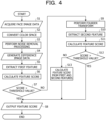
- FIG. 4 is a flowchart that exemplifies feature extraction processing executed by the feature extraction processing unit 10.
- the face image acquisition unit 11 acquires face image data (step S1).
- the color space conversion unit 12 converts the color space of the face image data acquired in step S1 into a predetermined color space (step S2).
- the color space conversion unit 12 converts the face image data into an HSV color space including three components of hue (Hue), saturation (Saturation Chroma), and value (Value Brightness).
- hue Hue
- saturation saturation Chroma
- Value Value
- luminance or image intensity can be separated from saturation or color information.
- the noise filter unit 13 generates face image data from which noise has been removed by performing noise removal processing on the face image data obtained in step S2 (step S3).
- the noise filter unit 13 performs the noise removal processing by using a specific algorithm.
- a known technique that removes image noise or the like can be used.
- the difference image generation unit 14 generates difference image data concerning difference between the face image data obtained in step S2 and the face image obtained in step S3 (step S4).
- the residual noise that remains in the face image acquired in step S1 can be obtained by generating the difference image data. Note that, when the processing in step S2 is not performed, difference image data concerning difference between the face image data acquired in step S1 and the face image data after the noise removal processing may be generated.
- the first feature extraction unit 15 extracts, as a first feature, a feature of signal abnormality caused by the morphing processing from the spatial domain information of the difference image data (step S5).
- the first feature extraction unit 15 extracts a vector value of spatial domain information such as LBP (Local Binary Pattern) or CoHOG (Co-occurrence Histograms of Oriented Gradients) as a feature of signal abnormality.
- the first feature extraction unit 15 can extract a vector value in a spatial domain by using a statistic obtained by comparing a pixel value of a pixel of interest with pixel values of pixels around the pixel of interest.
- the first feature extraction unit 15 may extract a vector value in a spatial domain by using deep learning.
- the first feature extraction unit 15 may use a feature amount represented by numerical expression.
- the feature score calculation unit 17 calculates, as a feature score, a degree of certainty that the face image data acquired in step S1 is morphing image data, from the first feature extracted in step S5 (step S6).
- the statistic or the like of the vector value obtained in step S5 can be used as the feature score.
- the determination unit 18 determines whether or not the feature score calculated in Step S5 exceeds a threshold value (step S7).
- This threshold value can be determined in advance from, for example, a variation value in a case where the feature score is calculated from the spatial domain for a plurality of pieces of face image data, or the like.
- step S7 the output unit 19 outputs the feature score calculated in step S6 (step S8).
- the second feature extraction unit 16 In a case where "No" is determined in step S7, the second feature extraction unit 16 generates frequency information in the frequency domain from the difference image data (step S9).
- the second feature extraction unit 16 can generate frequency information in the frequency domain by performing digital Fourier transform on the difference image data.
- the second feature extraction unit 16 extracts, as a second feature, a feature of signal abnormality caused by the morphing processing from the frequency information generated in step S9 (step S10).
- the second feature extraction unit 16 extracts, as a feature of signal abnormality, a vector value in a frequency domain such as a gray level co-occurrence matrix (GLCM).
- GLCM gray level co-occurrence matrix
- the second feature extraction unit 16 can extract a vector value in a frequency domain by using a statistic obtained by comparing a pixel value of a pixel of interest with pixel values of pixels around the pixel of interest.
- the second feature extraction unit 16 may extract a vector value in a frequency domain by using deep learning.
- the second feature extraction unit 16 may use a feature amount represented by numerical expression.
- the feature score calculation unit 17 calculates, as a feature score, a degree of certainty that the face image data acquired in step S1 is morphing image data, from the frequency feature extracted in step S10 (step S11). For example, the statistic or the like of the vector value obtained in step S10 can be used as the feature score.
- the determination unit 18 determines whether or not the feature score calculated in step S11 exceeds a threshold value (step S12).
- the threshold value in step S12 can be determined in advance from, for example, a variation value in a case where the feature score is calculated from the frequency domain for a plurality of pieces of face image data, or the like.
- step S12 the output processing unit 40 outputs the feature score calculated in step S11 (step S8).
- the feature score calculation unit 17 calculates, as a feature score, the degree of certainty that the face image data acquired in step S1 is morphing image data, from the first feature extracted in step S5 and the second feature extracted in step S10 (step S13). Thereafter, the output processing unit 40 outputs the feature score calculated in step S13 (step S8).
- FIG. 5 is a flowchart that exemplifies training processing executed by the training processing unit 20.
- the teacher data acquisition unit 22 acquires each piece of teacher data stored in the teacher data storage unit 21 (step S21).
- the teacher data is teacher data of a face image, and includes actual face image data that is not corrected and morphing image data.
- one of an identifier (Bonafide), which indicates actual face image data, and an identifier (Morphing), which indicates a morphing image is associated with each piece of teacher data.
- These pieces of teacher data are created in advance by a user or the like and stored in the teacher data storage unit 21.
- the feature extraction processing in FIG. 4 is executed for each piece of teacher data acquired in step S21.
- the teacher data classification unit 23 classifies, for each piece of teacher data, the feature score output by the output unit 19, into the actual face image data and the morphing image data according to the identifier stored in the teacher data storage unit 21 (step S22).
- the model creation unit 24 creates a model for evaluation, based on the result of the classification in step S22 (step S23).
- a model for classification is created by, for example, subtracting the separation hyperplane (boundary plane) from the relationship between the identifier and the space in which the feature score of each piece of teacher data is distributed.
- FIG. 7 is a flowchart that exemplifies determination processing executed by the determination processing unit 30.
- the face image acquisition unit 31 acquires face image data (step S31).
- the feature extraction processing in FIG. 4 is performed on the face image data acquired in step S31. Since the face image data is, for example, face image data for creation of a passport, the face image data is input from an external device through the interface 105.
- the determination unit 32 determines whether or not the feature score output by the output unit 19 is an actual image or a morphing image based on the model for classification created by the model creation unit 24 (step S32).
- a determination result of step S32 is output by the output processing unit 40.
- the determination result output by the output processing unit 40 is displayed on the display device 104.
- whether or not face image data is a morphing image is determined by using spatial domain information of residual noise.
- the spatial domain information of the residual noise By using the spatial domain information of the residual noise, a discontinuous point of the noise intensity and the like can be easily detected.
- whether or not the face image data is a morphing image is redetermined by using frequency domain information. By using the frequency domain information, determination accuracy is improved. In addition, since it is not needed to use a special image sensor or the like, the cost can be reduced.
- the noise filter unit 13 is an example of a face image data generation unit that generates face image data in which noise is removed by a specific algorithm from the face image data in a case where the face image data is acquired.
- the difference image generation unit 14 is an example of a difference image data generation unit that generates difference image data concerning difference between the face image data that has been acquired, and the face image data that has been generated.
- the determination unit 18 is an example of a first determination unit that determines whether or not the face image data that has been acquired is a composite image based on information included in the difference image data.
- the determination unit 18 is an example of a second determination unit that determines whether or not the face image data that has been acquired is a composite image based on information included in the frequency data.
- the determination processing unit 30 is an example of a determination processing unit that further determines whether or not the face image data, which has been determined whether or not the face image data is the composite image, is a composite image using a classification model machine-learned (i.e., trained) by using teacher data of a plurality of pieces of face image data.
- the second feature extraction unit 16 is an example of a frequency data generation unit that generates the frequency data from the difference image data by digital Fourier transform.
- Patent Document 1 Japanese National Publication of International Patent Application No. 2020-525947
Landscapes
- Engineering & Computer Science (AREA)
- Theoretical Computer Science (AREA)
- Physics & Mathematics (AREA)
- General Physics & Mathematics (AREA)
- Multimedia (AREA)
- Computer Vision & Pattern Recognition (AREA)
- Health & Medical Sciences (AREA)
- General Health & Medical Sciences (AREA)
- Evolutionary Computation (AREA)
- Human Computer Interaction (AREA)
- Oral & Maxillofacial Surgery (AREA)
- Artificial Intelligence (AREA)
- Computing Systems (AREA)
- Databases & Information Systems (AREA)
- Medical Informatics (AREA)
- Software Systems (AREA)
- Image Analysis (AREA)
- Image Processing (AREA)
- Collating Specific Patterns (AREA)
Applications Claiming Priority (1)
| Application Number | Priority Date | Filing Date | Title |
|---|---|---|---|
| PCT/JP2021/002736 WO2022162760A1 (ja) | 2021-01-27 | 2021-01-27 | 判定方法、判定プログラム、および情報処理装置 |
Publications (3)
| Publication Number | Publication Date |
|---|---|
| EP4287112A1 EP4287112A1 (en) | 2023-12-06 |
| EP4287112A4 EP4287112A4 (en) | 2024-01-10 |
| EP4287112B1 true EP4287112B1 (en) | 2024-10-30 |
Family
ID=82653178
Family Applications (1)
| Application Number | Title | Priority Date | Filing Date |
|---|---|---|---|
| EP21922784.0A Active EP4287112B1 (en) | 2021-01-27 | 2021-01-27 | Determination method, determination program, and information processing device |
Country Status (5)
| Country | Link |
|---|---|
| US (1) | US12437373B2 (https=) |
| EP (1) | EP4287112B1 (https=) |
| JP (1) | JP7415202B2 (https=) |
| CN (1) | CN116724332B (https=) |
| WO (1) | WO2022162760A1 (https=) |
Families Citing this family (1)
| Publication number | Priority date | Publication date | Assignee | Title |
|---|---|---|---|---|
| WO2024142399A1 (ja) | 2022-12-28 | 2024-07-04 | 日本電気株式会社 | 情報処理装置、情報処理システム、情報処理方法、及び、記録媒体 |
Family Cites Families (19)
| Publication number | Priority date | Publication date | Assignee | Title |
|---|---|---|---|---|
| US8023747B2 (en) * | 2007-02-09 | 2011-09-20 | New Jersey Institute Of Technology | Method and apparatus for a natural image model based approach to image/splicing/tampering detection |
| JP4947216B2 (ja) * | 2008-09-17 | 2012-06-06 | 富士通株式会社 | 画像処理装置および画像処理方法 |
| US8548257B2 (en) * | 2009-01-05 | 2013-10-01 | Apple Inc. | Distinguishing between faces and non-faces |
| JP2012065002A (ja) * | 2010-09-14 | 2012-03-29 | Casio Comput Co Ltd | 画像合成装置、画像合成方法及びプログラム |
| CN104106080B (zh) | 2011-12-27 | 2017-10-03 | 英特尔公司 | 基于图灵测试的用户认证和用户在场验证系统、设备和方法 |
| WO2015172235A1 (en) * | 2014-05-15 | 2015-11-19 | Tandemlaunch Technologies Inc. | Time-space methods and systems for the reduction of video noise |
| JP6516830B2 (ja) * | 2015-03-25 | 2019-05-22 | オリンパス株式会社 | 画像処理装置、画像処理方法およびプログラム |
| JP6584173B2 (ja) * | 2015-07-06 | 2019-10-02 | キヤノン株式会社 | 画像処理装置及び画像処理方法 |
| CN106485192B (zh) * | 2015-09-02 | 2019-12-06 | 富士通株式会社 | 用于图像识别的神经网络的训练方法和装置 |
| US11238271B2 (en) * | 2017-06-20 | 2022-02-01 | Hochschule Darmstadt | Detecting artificial facial images using facial landmarks |
| GB201710560D0 (en) | 2017-06-30 | 2017-08-16 | Norwegian Univ Of Science And Tech (Ntnu) | Detection of manipulated images |
| JP6924128B2 (ja) * | 2017-11-24 | 2021-08-25 | Kddi株式会社 | モーフィング画像生成装置及びモーフィング画像生成方法 |
| US10762337B2 (en) * | 2018-04-27 | 2020-09-01 | Apple Inc. | Face synthesis using generative adversarial networks |
| CN110084775B (zh) * | 2019-05-09 | 2021-11-26 | 深圳市商汤科技有限公司 | 图像处理方法及装置、电子设备和存储介质 |
| US11151694B2 (en) * | 2019-05-15 | 2021-10-19 | Gopro, Inc. | Method and apparatus for convolutional neural network-based video denoising |
| CN110349136A (zh) * | 2019-06-28 | 2019-10-18 | 厦门大学 | 一种基于深度学习的篡改图像检测方法 |
| CN110428399B (zh) * | 2019-07-05 | 2022-06-14 | 百度在线网络技术(北京)有限公司 | 用于检测图像的方法、装置、设备和存储介质 |
| US11688200B2 (en) * | 2020-12-28 | 2023-06-27 | Fortinet, Inc. | Joint facial feature extraction and facial image quality estimation using a deep neural network (DNN) trained with a custom-labeled training dataset and having a common DNN backbone |
| TR2022002073A1 (tr) * | 2022-02-16 | 2023-08-21 | Bahcesehir Ueniversitesi | Yüz tanıma yöntemi. |
-
2021
- 2021-01-27 WO PCT/JP2021/002736 patent/WO2022162760A1/ja not_active Ceased
- 2021-01-27 CN CN202180082849.6A patent/CN116724332B/zh active Active
- 2021-01-27 EP EP21922784.0A patent/EP4287112B1/en active Active
- 2021-01-27 JP JP2022577856A patent/JP7415202B2/ja active Active
-
2023
- 2023-05-25 US US18/323,718 patent/US12437373B2/en active Active
Also Published As
| Publication number | Publication date |
|---|---|
| EP4287112A1 (en) | 2023-12-06 |
| CN116724332A (zh) | 2023-09-08 |
| JP7415202B2 (ja) | 2024-01-17 |
| EP4287112A4 (en) | 2024-01-10 |
| CN116724332B (zh) | 2026-04-17 |
| US12437373B2 (en) | 2025-10-07 |
| US20230298140A1 (en) | 2023-09-21 |
| JPWO2022162760A1 (https=) | 2022-08-04 |
| WO2022162760A1 (ja) | 2022-08-04 |
Similar Documents
| Publication | Publication Date | Title |
|---|---|---|
| CN110084135B (zh) | 人脸识别方法、装置、计算机设备及存储介质 | |
| Venkatesh et al. | Morphed face detection based on deep color residual noise | |
| Debiasi et al. | PRNU-based detection of morphed face images | |
| CN110428399B (zh) | 用于检测图像的方法、装置、设备和存储介质 | |
| CN104915972B (zh) | 图像处理装置、图像处理方法以及程序 | |
| JP4877374B2 (ja) | 画像処理装置及びプログラム | |
| Chung et al. | Efficient shadow detection of color aerial images based on successive thresholding scheme | |
| Ramachandra et al. | Towards making morphing attack detection robust using hybrid scale-space colour texture features | |
| Liang et al. | Salient object detection in hyperspectral imagery | |
| Wang et al. | An effective method for plate number recognition | |
| JP2000003452A (ja) | デジタル画像における顔面の検出方法、顔面検出装置、画像判定方法、画像判定装置およびコンピュ―タ可読な記録媒体 | |
| JP2016081212A (ja) | 画像認識装置、画像認識方法、および、画像認識プログラム | |
| CN113657197A (zh) | 图像识别方法、图像识别模型的训练方法以及相关装置 | |
| Nguyen et al. | Face presentation attack detection based on a statistical model of image noise | |
| Zafar et al. | Minutiae based fingerprint matching techniques | |
| JPWO2017061106A1 (ja) | 情報処理装置、画像処理システム、画像処理方法及びプログラム | |
| JP2019121187A (ja) | 画像処理装置、画像処理方法および画像処理プログラム | |
| KR102463353B1 (ko) | 페이크 얼굴 검출 장치 및 검출 방법 | |
| US12437373B2 (en) | Determination method, non-transitory computer-readable recording medium storing determination program, and information processing device | |
| JP2000348173A (ja) | 唇抽出方法 | |
| US12613959B2 (en) | Image processing device, attack coutermeasure method, and computer readable medium | |
| KR101014486B1 (ko) | 적응적 피부색 검출을 통한 유해 이미지 분류 방법 및 시스템 | |
| Das et al. | Human face detection in color images using HSV color histogram and WLD | |
| CN113221842A (zh) | 模型训练方法、图像识别方法、装置、设备及介质 | |
| Chowdhury et al. | Fuzzy rule based approach for face and facial feature extraction in biometric authentication |
Legal Events
| Date | Code | Title | Description |
|---|---|---|---|
| STAA | Information on the status of an ep patent application or granted ep patent |
Free format text: STATUS: THE INTERNATIONAL PUBLICATION HAS BEEN MADE |
|
| PUAI | Public reference made under article 153(3) epc to a published international application that has entered the european phase |
Free format text: ORIGINAL CODE: 0009012 |
|
| STAA | Information on the status of an ep patent application or granted ep patent |
Free format text: STATUS: REQUEST FOR EXAMINATION WAS MADE |
|
| 17P | Request for examination filed |
Effective date: 20230526 |
|
| AK | Designated contracting states |
Kind code of ref document: A1 Designated state(s): AL AT BE BG CH CY CZ DE DK EE ES FI FR GB GR HR HU IE IS IT LI LT LU LV MC MK MT NL NO PL PT RO RS SE SI SK SM TR |
|
| A4 | Supplementary search report drawn up and despatched |
Effective date: 20231208 |
|
| RIC1 | Information provided on ipc code assigned before grant |
Ipc: G06V 40/16 20220101ALI20231204BHEP Ipc: G06V 10/82 20220101ALI20231204BHEP Ipc: G06V 20/00 20220101ALI20231204BHEP Ipc: G06V 10/42 20220101ALI20231204BHEP Ipc: G06T 7/00 20170101AFI20231204BHEP |
|
| DAV | Request for validation of the european patent (deleted) | ||
| DAX | Request for extension of the european patent (deleted) | ||
| GRAP | Despatch of communication of intention to grant a patent |
Free format text: ORIGINAL CODE: EPIDOSNIGR1 |
|
| STAA | Information on the status of an ep patent application or granted ep patent |
Free format text: STATUS: GRANT OF PATENT IS INTENDED |
|
| RIC1 | Information provided on ipc code assigned before grant |
Ipc: G06V 40/16 20220101ALI20240614BHEP Ipc: G06V 10/82 20220101ALI20240614BHEP Ipc: G06V 20/00 20220101ALI20240614BHEP Ipc: G06V 10/42 20220101ALI20240614BHEP Ipc: G06T 7/00 20170101AFI20240614BHEP |
|
| INTG | Intention to grant announced |
Effective date: 20240702 |
|
| GRAS | Grant fee paid |
Free format text: ORIGINAL CODE: EPIDOSNIGR3 |
|
| GRAA | (expected) grant |
Free format text: ORIGINAL CODE: 0009210 |
|
| STAA | Information on the status of an ep patent application or granted ep patent |
Free format text: STATUS: THE PATENT HAS BEEN GRANTED |
|
| AK | Designated contracting states |
Kind code of ref document: B1 Designated state(s): AL AT BE BG CH CY CZ DE DK EE ES FI FR GB GR HR HU IE IS IT LI LT LU LV MC MK MT NL NO PL PT RO RS SE SI SK SM TR |
|
| REG | Reference to a national code |
Ref country code: GB Ref legal event code: FG4D |
|
| REG | Reference to a national code |
Ref country code: CH Ref legal event code: EP |
|
| REG | Reference to a national code |
Ref country code: IE Ref legal event code: FG4D |
|
| REG | Reference to a national code |
Ref country code: DE Ref legal event code: R096 Ref document number: 602021021218 Country of ref document: DE |
|
| REG | Reference to a national code |
Ref country code: LT Ref legal event code: MG9D |
|
| REG | Reference to a national code |
Ref country code: NL Ref legal event code: MP Effective date: 20241030 |
|
| PG25 | Lapsed in a contracting state [announced via postgrant information from national office to epo] |
Ref country code: HR Free format text: LAPSE BECAUSE OF FAILURE TO SUBMIT A TRANSLATION OF THE DESCRIPTION OR TO PAY THE FEE WITHIN THE PRESCRIBED TIME-LIMIT Effective date: 20241030 Ref country code: PT Free format text: LAPSE BECAUSE OF FAILURE TO SUBMIT A TRANSLATION OF THE DESCRIPTION OR TO PAY THE FEE WITHIN THE PRESCRIBED TIME-LIMIT Effective date: 20250228 Ref country code: IS Free format text: LAPSE BECAUSE OF FAILURE TO SUBMIT A TRANSLATION OF THE DESCRIPTION OR TO PAY THE FEE WITHIN THE PRESCRIBED TIME-LIMIT Effective date: 20250228 |
|
| PG25 | Lapsed in a contracting state [announced via postgrant information from national office to epo] |
Ref country code: NL Free format text: LAPSE BECAUSE OF FAILURE TO SUBMIT A TRANSLATION OF THE DESCRIPTION OR TO PAY THE FEE WITHIN THE PRESCRIBED TIME-LIMIT Effective date: 20241030 Ref country code: FI Free format text: LAPSE BECAUSE OF FAILURE TO SUBMIT A TRANSLATION OF THE DESCRIPTION OR TO PAY THE FEE WITHIN THE PRESCRIBED TIME-LIMIT Effective date: 20241030 |
|
| REG | Reference to a national code |
Ref country code: AT Ref legal event code: MK05 Ref document number: 1737680 Country of ref document: AT Kind code of ref document: T Effective date: 20241030 |
|
| PG25 | Lapsed in a contracting state [announced via postgrant information from national office to epo] |
Ref country code: BG Free format text: LAPSE BECAUSE OF FAILURE TO SUBMIT A TRANSLATION OF THE DESCRIPTION OR TO PAY THE FEE WITHIN THE PRESCRIBED TIME-LIMIT Effective date: 20241030 |
|
| PG25 | Lapsed in a contracting state [announced via postgrant information from national office to epo] |
Ref country code: ES Free format text: LAPSE BECAUSE OF FAILURE TO SUBMIT A TRANSLATION OF THE DESCRIPTION OR TO PAY THE FEE WITHIN THE PRESCRIBED TIME-LIMIT Effective date: 20241030 |
|
| PG25 | Lapsed in a contracting state [announced via postgrant information from national office to epo] |
Ref country code: NO Free format text: LAPSE BECAUSE OF FAILURE TO SUBMIT A TRANSLATION OF THE DESCRIPTION OR TO PAY THE FEE WITHIN THE PRESCRIBED TIME-LIMIT Effective date: 20250130 |
|
| PG25 | Lapsed in a contracting state [announced via postgrant information from national office to epo] |
Ref country code: AT Free format text: LAPSE BECAUSE OF FAILURE TO SUBMIT A TRANSLATION OF THE DESCRIPTION OR TO PAY THE FEE WITHIN THE PRESCRIBED TIME-LIMIT Effective date: 20241030 Ref country code: LV Free format text: LAPSE BECAUSE OF FAILURE TO SUBMIT A TRANSLATION OF THE DESCRIPTION OR TO PAY THE FEE WITHIN THE PRESCRIBED TIME-LIMIT Effective date: 20241030 Ref country code: GR Free format text: LAPSE BECAUSE OF FAILURE TO SUBMIT A TRANSLATION OF THE DESCRIPTION OR TO PAY THE FEE WITHIN THE PRESCRIBED TIME-LIMIT Effective date: 20250131 |
|
| PG25 | Lapsed in a contracting state [announced via postgrant information from national office to epo] |
Ref country code: PL Free format text: LAPSE BECAUSE OF FAILURE TO SUBMIT A TRANSLATION OF THE DESCRIPTION OR TO PAY THE FEE WITHIN THE PRESCRIBED TIME-LIMIT Effective date: 20241030 |
|
| PG25 | Lapsed in a contracting state [announced via postgrant information from national office to epo] |
Ref country code: RS Free format text: LAPSE BECAUSE OF FAILURE TO SUBMIT A TRANSLATION OF THE DESCRIPTION OR TO PAY THE FEE WITHIN THE PRESCRIBED TIME-LIMIT Effective date: 20250130 |
|
| PG25 | Lapsed in a contracting state [announced via postgrant information from national office to epo] |
Ref country code: SM Free format text: LAPSE BECAUSE OF FAILURE TO SUBMIT A TRANSLATION OF THE DESCRIPTION OR TO PAY THE FEE WITHIN THE PRESCRIBED TIME-LIMIT Effective date: 20241030 |
|
| PG25 | Lapsed in a contracting state [announced via postgrant information from national office to epo] |
Ref country code: DK Free format text: LAPSE BECAUSE OF FAILURE TO SUBMIT A TRANSLATION OF THE DESCRIPTION OR TO PAY THE FEE WITHIN THE PRESCRIBED TIME-LIMIT Effective date: 20241030 |
|
| PG25 | Lapsed in a contracting state [announced via postgrant information from national office to epo] |
Ref country code: EE Free format text: LAPSE BECAUSE OF FAILURE TO SUBMIT A TRANSLATION OF THE DESCRIPTION OR TO PAY THE FEE WITHIN THE PRESCRIBED TIME-LIMIT Effective date: 20241030 |
|
| PG25 | Lapsed in a contracting state [announced via postgrant information from national office to epo] |
Ref country code: RO Free format text: LAPSE BECAUSE OF FAILURE TO SUBMIT A TRANSLATION OF THE DESCRIPTION OR TO PAY THE FEE WITHIN THE PRESCRIBED TIME-LIMIT Effective date: 20241030 |
|
| PG25 | Lapsed in a contracting state [announced via postgrant information from national office to epo] |
Ref country code: SK Free format text: LAPSE BECAUSE OF FAILURE TO SUBMIT A TRANSLATION OF THE DESCRIPTION OR TO PAY THE FEE WITHIN THE PRESCRIBED TIME-LIMIT Effective date: 20241030 |
|
| PG25 | Lapsed in a contracting state [announced via postgrant information from national office to epo] |
Ref country code: CZ Free format text: LAPSE BECAUSE OF FAILURE TO SUBMIT A TRANSLATION OF THE DESCRIPTION OR TO PAY THE FEE WITHIN THE PRESCRIBED TIME-LIMIT Effective date: 20241030 |
|
| PG25 | Lapsed in a contracting state [announced via postgrant information from national office to epo] |
Ref country code: IT Free format text: LAPSE BECAUSE OF FAILURE TO SUBMIT A TRANSLATION OF THE DESCRIPTION OR TO PAY THE FEE WITHIN THE PRESCRIBED TIME-LIMIT Effective date: 20241030 |
|
| REG | Reference to a national code |
Ref country code: DE Ref legal event code: R097 Ref document number: 602021021218 Country of ref document: DE |
|
| REG | Reference to a national code |
Ref country code: CH Ref legal event code: PL |
|
| PLBE | No opposition filed within time limit |
Free format text: ORIGINAL CODE: 0009261 |
|
| STAA | Information on the status of an ep patent application or granted ep patent |
Free format text: STATUS: NO OPPOSITION FILED WITHIN TIME LIMIT |
|
| PG25 | Lapsed in a contracting state [announced via postgrant information from national office to epo] |
Ref country code: SE Free format text: LAPSE BECAUSE OF FAILURE TO SUBMIT A TRANSLATION OF THE DESCRIPTION OR TO PAY THE FEE WITHIN THE PRESCRIBED TIME-LIMIT Effective date: 20241030 |
|
| PG25 | Lapsed in a contracting state [announced via postgrant information from national office to epo] |
Ref country code: MC Free format text: LAPSE BECAUSE OF FAILURE TO SUBMIT A TRANSLATION OF THE DESCRIPTION OR TO PAY THE FEE WITHIN THE PRESCRIBED TIME-LIMIT Effective date: 20241030 Ref country code: LU Free format text: LAPSE BECAUSE OF NON-PAYMENT OF DUE FEES Effective date: 20250127 |
|
| 26N | No opposition filed |
Effective date: 20250731 |
|
| PG25 | Lapsed in a contracting state [announced via postgrant information from national office to epo] |
Ref country code: BE Free format text: LAPSE BECAUSE OF NON-PAYMENT OF DUE FEES Effective date: 20250131 |
|
| PG25 | Lapsed in a contracting state [announced via postgrant information from national office to epo] |
Ref country code: CH Free format text: LAPSE BECAUSE OF NON-PAYMENT OF DUE FEES Effective date: 20250131 |
|
| REG | Reference to a national code |
Ref country code: BE Ref legal event code: MM Effective date: 20250131 |
|
| PGFP | Annual fee paid to national office [announced via postgrant information from national office to epo] |
Ref country code: GB Payment date: 20251220 Year of fee payment: 6 |
|
| PGFP | Annual fee paid to national office [announced via postgrant information from national office to epo] |
Ref country code: FR Payment date: 20251218 Year of fee payment: 6 |
|
| PG25 | Lapsed in a contracting state [announced via postgrant information from national office to epo] |
Ref country code: IE Free format text: LAPSE BECAUSE OF NON-PAYMENT OF DUE FEES Effective date: 20250127 |
|
| PGFP | Annual fee paid to national office [announced via postgrant information from national office to epo] |
Ref country code: DE Payment date: 20251217 Year of fee payment: 6 |