EP4286360A2 - Neues bettmaterial zur thermolytischen fragmentierung von zuckern - Google Patents
Neues bettmaterial zur thermolytischen fragmentierung von zuckern Download PDFInfo
- Publication number
- EP4286360A2 EP4286360A2 EP23203502.2A EP23203502A EP4286360A2 EP 4286360 A2 EP4286360 A2 EP 4286360A2 EP 23203502 A EP23203502 A EP 23203502A EP 4286360 A2 EP4286360 A2 EP 4286360A2
- Authority
- EP
- European Patent Office
- Prior art keywords
- heat carrying
- carrying particles
- fragmentation
- process according
- oxygenates
- Prior art date
- Legal status (The legal status is an assumption and is not a legal conclusion. Google has not performed a legal analysis and makes no representation as to the accuracy of the status listed.)
- Pending
Links
- 238000006062 fragmentation reaction Methods 0.000 title claims abstract description 110
- 238000013467 fragmentation Methods 0.000 title claims abstract description 108
- 235000000346 sugar Nutrition 0.000 title claims abstract description 55
- 239000000463 material Substances 0.000 title claims description 102
- 150000008163 sugars Chemical class 0.000 title description 16
- 239000002245 particle Substances 0.000 claims abstract description 181
- WGCNASOHLSPBMP-UHFFFAOYSA-N Glycolaldehyde Chemical compound OCC=O WGCNASOHLSPBMP-UHFFFAOYSA-N 0.000 claims abstract description 116
- 238000000034 method Methods 0.000 claims abstract description 67
- 230000008569 process Effects 0.000 claims abstract description 56
- 239000000203 mixture Substances 0.000 claims abstract description 42
- 238000005243 fluidization Methods 0.000 claims abstract description 27
- 238000010438 heat treatment Methods 0.000 claims description 41
- 229910052782 aluminium Inorganic materials 0.000 claims description 28
- XUIMIQQOPSSXEZ-UHFFFAOYSA-N Silicon Chemical compound [Si] XUIMIQQOPSSXEZ-UHFFFAOYSA-N 0.000 claims description 21
- XAGFODPZIPBFFR-UHFFFAOYSA-N aluminium Chemical compound [Al] XAGFODPZIPBFFR-UHFFFAOYSA-N 0.000 claims description 21
- 239000004411 aluminium Substances 0.000 claims description 20
- QVGXLLKOCUKJST-UHFFFAOYSA-N atomic oxygen Chemical compound [O] QVGXLLKOCUKJST-UHFFFAOYSA-N 0.000 claims description 14
- 229910052760 oxygen Inorganic materials 0.000 claims description 14
- 239000001301 oxygen Substances 0.000 claims description 14
- 239000000243 solution Substances 0.000 claims description 14
- WSFSSNUMVMOOMR-UHFFFAOYSA-N Formaldehyde Chemical compound O=C WSFSSNUMVMOOMR-UHFFFAOYSA-N 0.000 claims description 12
- AIJULSRZWUXGPQ-UHFFFAOYSA-N Methylglyoxal Chemical compound CC(=O)C=O AIJULSRZWUXGPQ-UHFFFAOYSA-N 0.000 claims description 12
- 239000002253 acid Substances 0.000 claims description 12
- KZHJGOXRZJKJNY-UHFFFAOYSA-N dioxosilane;oxo(oxoalumanyloxy)alumane Chemical compound O=[Si]=O.O=[Si]=O.O=[Al]O[Al]=O.O=[Al]O[Al]=O.O=[Al]O[Al]=O KZHJGOXRZJKJNY-UHFFFAOYSA-N 0.000 claims description 12
- LEQAOMBKQFMDFZ-UHFFFAOYSA-N glyoxal Chemical compound O=CC=O LEQAOMBKQFMDFZ-UHFFFAOYSA-N 0.000 claims description 12
- 229910052863 mullite Inorganic materials 0.000 claims description 12
- WQZGKKKJIJFFOK-GASJEMHNSA-N Glucose Natural products OC[C@H]1OC(O)[C@H](O)[C@@H](O)[C@@H]1O WQZGKKKJIJFFOK-GASJEMHNSA-N 0.000 claims description 7
- 239000008103 glucose Substances 0.000 claims description 6
- 229940015043 glyoxal Drugs 0.000 claims description 6
- XLSMFKSTNGKWQX-UHFFFAOYSA-N hydroxyacetone Chemical compound CC(=O)CO XLSMFKSTNGKWQX-UHFFFAOYSA-N 0.000 claims description 6
- 229940120731 pyruvaldehyde Drugs 0.000 claims description 6
- 239000007864 aqueous solution Substances 0.000 claims description 5
- 238000001816 cooling Methods 0.000 claims description 5
- 238000002844 melting Methods 0.000 claims description 5
- 230000008018 melting Effects 0.000 claims description 5
- SRBFZHDQGSBBOR-IOVATXLUSA-N D-xylopyranose Chemical compound O[C@@H]1COC(O)[C@H](O)[C@H]1O SRBFZHDQGSBBOR-IOVATXLUSA-N 0.000 claims description 4
- PYMYPHUHKUWMLA-UHFFFAOYSA-N arabinose Natural products OCC(O)C(O)C(O)C=O PYMYPHUHKUWMLA-UHFFFAOYSA-N 0.000 claims description 4
- SRBFZHDQGSBBOR-UHFFFAOYSA-N beta-D-Pyranose-Lyxose Natural products OC1COC(O)C(O)C1O SRBFZHDQGSBBOR-UHFFFAOYSA-N 0.000 claims description 4
- 238000005984 hydrogenation reaction Methods 0.000 claims description 4
- 238000011044 inertial separation Methods 0.000 claims description 3
- 238000010791 quenching Methods 0.000 claims description 3
- GUBGYTABKSRVRQ-XLOQQCSPSA-N Alpha-Lactose Chemical compound O[C@@H]1[C@@H](O)[C@@H](O)[C@@H](CO)O[C@H]1O[C@@H]1[C@@H](CO)O[C@H](O)[C@H](O)[C@H]1O GUBGYTABKSRVRQ-XLOQQCSPSA-N 0.000 claims description 2
- WQZGKKKJIJFFOK-QTVWNMPRSA-N D-mannopyranose Chemical compound OC[C@H]1OC(O)[C@@H](O)[C@@H](O)[C@@H]1O WQZGKKKJIJFFOK-QTVWNMPRSA-N 0.000 claims description 2
- HMFHBZSHGGEWLO-SOOFDHNKSA-N D-ribofuranose Chemical compound OC[C@H]1OC(O)[C@H](O)[C@@H]1O HMFHBZSHGGEWLO-SOOFDHNKSA-N 0.000 claims description 2
- 229930091371 Fructose Natural products 0.000 claims description 2
- 239000005715 Fructose Substances 0.000 claims description 2
- RFSUNEUAIZKAJO-ARQDHWQXSA-N Fructose Chemical compound OC[C@H]1O[C@](O)(CO)[C@@H](O)[C@@H]1O RFSUNEUAIZKAJO-ARQDHWQXSA-N 0.000 claims description 2
- GUBGYTABKSRVRQ-QKKXKWKRSA-N Lactose Natural products OC[C@H]1O[C@@H](O[C@H]2[C@H](O)[C@@H](O)C(O)O[C@@H]2CO)[C@H](O)[C@@H](O)[C@H]1O GUBGYTABKSRVRQ-QKKXKWKRSA-N 0.000 claims description 2
- PYMYPHUHKUWMLA-LMVFSUKVSA-N Ribose Natural products OC[C@@H](O)[C@@H](O)[C@@H](O)C=O PYMYPHUHKUWMLA-LMVFSUKVSA-N 0.000 claims description 2
- 229930006000 Sucrose Natural products 0.000 claims description 2
- HMFHBZSHGGEWLO-UHFFFAOYSA-N alpha-D-Furanose-Ribose Natural products OCC1OC(O)C(O)C1O HMFHBZSHGGEWLO-UHFFFAOYSA-N 0.000 claims description 2
- WQZGKKKJIJFFOK-PHYPRBDBSA-N alpha-D-galactose Chemical compound OC[C@H]1O[C@H](O)[C@H](O)[C@@H](O)[C@H]1O WQZGKKKJIJFFOK-PHYPRBDBSA-N 0.000 claims description 2
- PYMYPHUHKUWMLA-WDCZJNDASA-N arabinose Chemical compound OC[C@@H](O)[C@@H](O)[C@H](O)C=O PYMYPHUHKUWMLA-WDCZJNDASA-N 0.000 claims description 2
- WQZGKKKJIJFFOK-VFUOTHLCSA-N beta-D-glucose Chemical compound OC[C@H]1O[C@@H](O)[C@H](O)[C@@H](O)[C@@H]1O WQZGKKKJIJFFOK-VFUOTHLCSA-N 0.000 claims description 2
- 229930182830 galactose Natural products 0.000 claims description 2
- BJHIKXHVCXFQLS-PQLUHFTBSA-N keto-D-tagatose Chemical compound OC[C@@H](O)[C@H](O)[C@H](O)C(=O)CO BJHIKXHVCXFQLS-PQLUHFTBSA-N 0.000 claims description 2
- 239000008101 lactose Substances 0.000 claims description 2
- 238000002459 porosimetry Methods 0.000 claims description 2
- 238000003303 reheating Methods 0.000 claims description 2
- 239000005720 sucrose Substances 0.000 claims description 2
- 150000005846 sugar alcohols Polymers 0.000 claims description 2
- CZMRCDWAGMRECN-UGDNZRGBSA-N Sucrose Chemical compound O[C@H]1[C@H](O)[C@@H](CO)O[C@@]1(CO)O[C@@H]1[C@H](O)[C@@H](O)[C@H](O)[C@@H](CO)O1 CZMRCDWAGMRECN-UGDNZRGBSA-N 0.000 claims 1
- 238000004519 manufacturing process Methods 0.000 abstract description 4
- VYPSYNLAJGMNEJ-UHFFFAOYSA-N Silicium dioxide Chemical compound O=[Si]=O VYPSYNLAJGMNEJ-UHFFFAOYSA-N 0.000 description 42
- PNEYBMLMFCGWSK-UHFFFAOYSA-N aluminium oxide Inorganic materials [O-2].[O-2].[O-2].[Al+3].[Al+3] PNEYBMLMFCGWSK-UHFFFAOYSA-N 0.000 description 33
- 239000000047 product Substances 0.000 description 21
- 239000004576 sand Substances 0.000 description 18
- 239000007789 gas Substances 0.000 description 15
- 238000001354 calcination Methods 0.000 description 14
- LYCAIKOWRPUZTN-UHFFFAOYSA-N Ethylene glycol Chemical compound OCCO LYCAIKOWRPUZTN-UHFFFAOYSA-N 0.000 description 9
- 229910052799 carbon Inorganic materials 0.000 description 9
- 239000000377 silicon dioxide Substances 0.000 description 9
- 239000000126 substance Substances 0.000 description 9
- 239000012530 fluid Substances 0.000 description 8
- 238000004231 fluid catalytic cracking Methods 0.000 description 8
- 238000012360 testing method Methods 0.000 description 8
- OKTJSMMVPCPJKN-UHFFFAOYSA-N Carbon Chemical compound [C] OKTJSMMVPCPJKN-UHFFFAOYSA-N 0.000 description 7
- 230000008901 benefit Effects 0.000 description 7
- 150000001720 carbohydrates Chemical class 0.000 description 7
- 235000014633 carbohydrates Nutrition 0.000 description 7
- 230000005587 bubbling Effects 0.000 description 6
- 238000006243 chemical reaction Methods 0.000 description 6
- 238000000197 pyrolysis Methods 0.000 description 6
- 239000003054 catalyst Substances 0.000 description 5
- 238000000926 separation method Methods 0.000 description 5
- 238000005245 sintering Methods 0.000 description 5
- 239000002028 Biomass Substances 0.000 description 4
- 150000001875 compounds Chemical class 0.000 description 4
- 230000007774 longterm Effects 0.000 description 4
- XLYOFNOQVPJJNP-UHFFFAOYSA-N water Substances O XLYOFNOQVPJJNP-UHFFFAOYSA-N 0.000 description 4
- VTYYLEPIZMXCLO-UHFFFAOYSA-L Calcium carbonate Chemical compound [Ca+2].[O-]C([O-])=O VTYYLEPIZMXCLO-UHFFFAOYSA-L 0.000 description 3
- LFQSCWFLJHTTHZ-UHFFFAOYSA-N Ethanol Chemical compound CCO LFQSCWFLJHTTHZ-UHFFFAOYSA-N 0.000 description 3
- OKKJLVBELUTLKV-UHFFFAOYSA-N Methanol Chemical compound OC OKKJLVBELUTLKV-UHFFFAOYSA-N 0.000 description 3
- DNIAPMSPPWPWGF-UHFFFAOYSA-N Propylene glycol Chemical compound CC(O)CO DNIAPMSPPWPWGF-UHFFFAOYSA-N 0.000 description 3
- 238000004375 physisorption Methods 0.000 description 3
- 239000000843 powder Substances 0.000 description 3
- 238000002360 preparation method Methods 0.000 description 3
- 235000012239 silicon dioxide Nutrition 0.000 description 3
- 239000002904 solvent Substances 0.000 description 3
- 238000001149 thermolysis Methods 0.000 description 3
- AEMRFAOFKBGASW-UHFFFAOYSA-N Glycolic acid Chemical compound OCC(O)=O AEMRFAOFKBGASW-UHFFFAOYSA-N 0.000 description 2
- 239000006004 Quartz sand Substances 0.000 description 2
- 230000002378 acidificating effect Effects 0.000 description 2
- 239000006227 byproduct Substances 0.000 description 2
- 239000007795 chemical reaction product Substances 0.000 description 2
- 229910052681 coesite Inorganic materials 0.000 description 2
- 229910052593 corundum Inorganic materials 0.000 description 2
- 238000005336 cracking Methods 0.000 description 2
- 229910052906 cristobalite Inorganic materials 0.000 description 2
- 238000000354 decomposition reaction Methods 0.000 description 2
- 230000001627 detrimental effect Effects 0.000 description 2
- 230000000694 effects Effects 0.000 description 2
- 238000002474 experimental method Methods 0.000 description 2
- 238000004128 high performance liquid chromatography Methods 0.000 description 2
- 239000007788 liquid Substances 0.000 description 2
- 229910052751 metal Inorganic materials 0.000 description 2
- 239000002184 metal Substances 0.000 description 2
- 150000002739 metals Chemical class 0.000 description 2
- 239000010453 quartz Substances 0.000 description 2
- 230000000717 retained effect Effects 0.000 description 2
- 239000011435 rock Substances 0.000 description 2
- 229910052710 silicon Inorganic materials 0.000 description 2
- 239000007787 solid Substances 0.000 description 2
- 229910052682 stishovite Inorganic materials 0.000 description 2
- 229910052719 titanium Inorganic materials 0.000 description 2
- 229910052905 tridymite Inorganic materials 0.000 description 2
- 229910001845 yogo sapphire Inorganic materials 0.000 description 2
- VGGSQFUCUMXWEO-UHFFFAOYSA-N Ethene Chemical compound C=C VGGSQFUCUMXWEO-UHFFFAOYSA-N 0.000 description 1
- 239000005977 Ethylene Substances 0.000 description 1
- 229920002472 Starch Polymers 0.000 description 1
- 229910000831 Steel Inorganic materials 0.000 description 1
- 230000002411 adverse Effects 0.000 description 1
- 238000005273 aeration Methods 0.000 description 1
- 230000001476 alcoholic effect Effects 0.000 description 1
- 229910001569 aluminium mineral Inorganic materials 0.000 description 1
- 230000009286 beneficial effect Effects 0.000 description 1
- 230000015572 biosynthetic process Effects 0.000 description 1
- 238000007664 blowing Methods 0.000 description 1
- 229910000019 calcium carbonate Inorganic materials 0.000 description 1
- 239000003575 carbonaceous material Substances 0.000 description 1
- 125000002915 carbonyl group Chemical group [*:2]C([*:1])=O 0.000 description 1
- 239000012159 carrier gas Substances 0.000 description 1
- 230000003197 catalytic effect Effects 0.000 description 1
- 230000008859 change Effects 0.000 description 1
- 239000013626 chemical specie Substances 0.000 description 1
- 239000003245 coal Substances 0.000 description 1
- 239000000567 combustion gas Substances 0.000 description 1
- 238000002485 combustion reaction Methods 0.000 description 1
- 238000009833 condensation Methods 0.000 description 1
- 230000005494 condensation Effects 0.000 description 1
- 239000000470 constituent Substances 0.000 description 1
- 238000010924 continuous production Methods 0.000 description 1
- 238000004320 controlled atmosphere Methods 0.000 description 1
- 229910052802 copper Inorganic materials 0.000 description 1
- 230000001419 dependent effect Effects 0.000 description 1
- 238000013461 design Methods 0.000 description 1
- 238000011161 development Methods 0.000 description 1
- 239000008121 dextrose Substances 0.000 description 1
- 238000010586 diagram Methods 0.000 description 1
- CCGKOQOJPYTBIH-UHFFFAOYSA-N ethenone Chemical compound C=C=O CCGKOQOJPYTBIH-UHFFFAOYSA-N 0.000 description 1
- -1 for example Chemical compound 0.000 description 1
- 239000000446 fuel Substances 0.000 description 1
- 238000002309 gasification Methods 0.000 description 1
- 239000011521 glass Substances 0.000 description 1
- 239000008187 granular material Substances 0.000 description 1
- 125000002887 hydroxy group Chemical group [H]O* 0.000 description 1
- 230000006872 improvement Effects 0.000 description 1
- 239000012535 impurity Substances 0.000 description 1
- 229910052500 inorganic mineral Inorganic materials 0.000 description 1
- 229910052742 iron Inorganic materials 0.000 description 1
- 230000002427 irreversible effect Effects 0.000 description 1
- 229910052746 lanthanum Inorganic materials 0.000 description 1
- 239000011707 mineral Substances 0.000 description 1
- 150000002772 monosaccharides Chemical group 0.000 description 1
- 229910052759 nickel Inorganic materials 0.000 description 1
- 239000003208 petroleum Substances 0.000 description 1
- 239000002574 poison Substances 0.000 description 1
- 231100000614 poison Toxicity 0.000 description 1
- 238000006116 polymerization reaction Methods 0.000 description 1
- 239000011148 porous material Substances 0.000 description 1
- 238000004321 preservation Methods 0.000 description 1
- 238000012545 processing Methods 0.000 description 1
- 238000000746 purification Methods 0.000 description 1
- 230000009257 reactivity Effects 0.000 description 1
- 102220082005 rs863223872 Human genes 0.000 description 1
- 238000007086 side reaction Methods 0.000 description 1
- SCPYDCQAZCOKTP-UHFFFAOYSA-N silanol Chemical compound [SiH3]O SCPYDCQAZCOKTP-UHFFFAOYSA-N 0.000 description 1
- 125000005372 silanol group Chemical group 0.000 description 1
- 229910052604 silicate mineral Inorganic materials 0.000 description 1
- 229910010271 silicon carbide Inorganic materials 0.000 description 1
- HBMJWWWQQXIZIP-UHFFFAOYSA-N silicon carbide Chemical compound [Si+]#[C-] HBMJWWWQQXIZIP-UHFFFAOYSA-N 0.000 description 1
- 229910052814 silicon oxide Inorganic materials 0.000 description 1
- 239000008107 starch Substances 0.000 description 1
- 235000019698 starch Nutrition 0.000 description 1
- 239000010959 steel Substances 0.000 description 1
- 239000010902 straw Substances 0.000 description 1
- 239000000758 substrate Substances 0.000 description 1
- 125000000185 sucrose group Chemical group 0.000 description 1
- 230000001502 supplementing effect Effects 0.000 description 1
- 238000005979 thermal decomposition reaction Methods 0.000 description 1
- 238000005292 vacuum distillation Methods 0.000 description 1
- 230000000007 visual effect Effects 0.000 description 1
- 239000002023 wood Substances 0.000 description 1
Images
Classifications
-
- C—CHEMISTRY; METALLURGY
- C07—ORGANIC CHEMISTRY
- C07C—ACYCLIC OR CARBOCYCLIC COMPOUNDS
- C07C45/00—Preparation of compounds having >C = O groups bound only to carbon or hydrogen atoms; Preparation of chelates of such compounds
- C07C45/51—Preparation of compounds having >C = O groups bound only to carbon or hydrogen atoms; Preparation of chelates of such compounds by pyrolysis, rearrangement or decomposition
-
- B—PERFORMING OPERATIONS; TRANSPORTING
- B01—PHYSICAL OR CHEMICAL PROCESSES OR APPARATUS IN GENERAL
- B01J—CHEMICAL OR PHYSICAL PROCESSES, e.g. CATALYSIS OR COLLOID CHEMISTRY; THEIR RELEVANT APPARATUS
- B01J6/00—Heat treatments such as Calcining; Fusing ; Pyrolysis
- B01J6/008—Pyrolysis reactions
-
- B—PERFORMING OPERATIONS; TRANSPORTING
- B01—PHYSICAL OR CHEMICAL PROCESSES OR APPARATUS IN GENERAL
- B01J—CHEMICAL OR PHYSICAL PROCESSES, e.g. CATALYSIS OR COLLOID CHEMISTRY; THEIR RELEVANT APPARATUS
- B01J8/00—Chemical or physical processes in general, conducted in the presence of fluids and solid particles; Apparatus for such processes
- B01J8/0015—Feeding of the particles in the reactor; Evacuation of the particles out of the reactor
- B01J8/003—Feeding of the particles in the reactor; Evacuation of the particles out of the reactor in a downward flow
-
- B—PERFORMING OPERATIONS; TRANSPORTING
- B01—PHYSICAL OR CHEMICAL PROCESSES OR APPARATUS IN GENERAL
- B01J—CHEMICAL OR PHYSICAL PROCESSES, e.g. CATALYSIS OR COLLOID CHEMISTRY; THEIR RELEVANT APPARATUS
- B01J8/00—Chemical or physical processes in general, conducted in the presence of fluids and solid particles; Apparatus for such processes
- B01J8/005—Separating solid material from the gas/liquid stream
- B01J8/0055—Separating solid material from the gas/liquid stream using cyclones
-
- B—PERFORMING OPERATIONS; TRANSPORTING
- B01—PHYSICAL OR CHEMICAL PROCESSES OR APPARATUS IN GENERAL
- B01J—CHEMICAL OR PHYSICAL PROCESSES, e.g. CATALYSIS OR COLLOID CHEMISTRY; THEIR RELEVANT APPARATUS
- B01J8/00—Chemical or physical processes in general, conducted in the presence of fluids and solid particles; Apparatus for such processes
- B01J8/005—Separating solid material from the gas/liquid stream
- B01J8/0065—Separating solid material from the gas/liquid stream by impingement against stationary members
-
- B—PERFORMING OPERATIONS; TRANSPORTING
- B01—PHYSICAL OR CHEMICAL PROCESSES OR APPARATUS IN GENERAL
- B01J—CHEMICAL OR PHYSICAL PROCESSES, e.g. CATALYSIS OR COLLOID CHEMISTRY; THEIR RELEVANT APPARATUS
- B01J8/00—Chemical or physical processes in general, conducted in the presence of fluids and solid particles; Apparatus for such processes
- B01J8/08—Chemical or physical processes in general, conducted in the presence of fluids and solid particles; Apparatus for such processes with moving particles
-
- B—PERFORMING OPERATIONS; TRANSPORTING
- B01—PHYSICAL OR CHEMICAL PROCESSES OR APPARATUS IN GENERAL
- B01J—CHEMICAL OR PHYSICAL PROCESSES, e.g. CATALYSIS OR COLLOID CHEMISTRY; THEIR RELEVANT APPARATUS
- B01J8/00—Chemical or physical processes in general, conducted in the presence of fluids and solid particles; Apparatus for such processes
- B01J8/18—Chemical or physical processes in general, conducted in the presence of fluids and solid particles; Apparatus for such processes with fluidised particles
- B01J8/1818—Feeding of the fluidising gas
-
- B—PERFORMING OPERATIONS; TRANSPORTING
- B01—PHYSICAL OR CHEMICAL PROCESSES OR APPARATUS IN GENERAL
- B01J—CHEMICAL OR PHYSICAL PROCESSES, e.g. CATALYSIS OR COLLOID CHEMISTRY; THEIR RELEVANT APPARATUS
- B01J8/00—Chemical or physical processes in general, conducted in the presence of fluids and solid particles; Apparatus for such processes
- B01J8/18—Chemical or physical processes in general, conducted in the presence of fluids and solid particles; Apparatus for such processes with fluidised particles
- B01J8/1836—Heating and cooling the reactor
-
- B—PERFORMING OPERATIONS; TRANSPORTING
- B01—PHYSICAL OR CHEMICAL PROCESSES OR APPARATUS IN GENERAL
- B01J—CHEMICAL OR PHYSICAL PROCESSES, e.g. CATALYSIS OR COLLOID CHEMISTRY; THEIR RELEVANT APPARATUS
- B01J8/00—Chemical or physical processes in general, conducted in the presence of fluids and solid particles; Apparatus for such processes
- B01J8/18—Chemical or physical processes in general, conducted in the presence of fluids and solid particles; Apparatus for such processes with fluidised particles
- B01J8/24—Chemical or physical processes in general, conducted in the presence of fluids and solid particles; Apparatus for such processes with fluidised particles according to "fluidised-bed" technique
- B01J8/38—Chemical or physical processes in general, conducted in the presence of fluids and solid particles; Apparatus for such processes with fluidised particles according to "fluidised-bed" technique with fluidised bed containing a rotatable device or being subject to rotation or to a circulatory movement, i.e. leaving a vessel and subsequently re-entering it
- B01J8/384—Chemical or physical processes in general, conducted in the presence of fluids and solid particles; Apparatus for such processes with fluidised particles according to "fluidised-bed" technique with fluidised bed containing a rotatable device or being subject to rotation or to a circulatory movement, i.e. leaving a vessel and subsequently re-entering it being subject to a circulatory movement only
- B01J8/388—Chemical or physical processes in general, conducted in the presence of fluids and solid particles; Apparatus for such processes with fluidised particles according to "fluidised-bed" technique with fluidised bed containing a rotatable device or being subject to rotation or to a circulatory movement, i.e. leaving a vessel and subsequently re-entering it being subject to a circulatory movement only externally, i.e. the particles leaving the vessel and subsequently re-entering it
-
- C—CHEMISTRY; METALLURGY
- C07—ORGANIC CHEMISTRY
- C07C—ACYCLIC OR CARBOCYCLIC COMPOUNDS
- C07C45/00—Preparation of compounds having >C = O groups bound only to carbon or hydrogen atoms; Preparation of chelates of such compounds
- C07C45/56—Preparation of compounds having >C = O groups bound only to carbon or hydrogen atoms; Preparation of chelates of such compounds from heterocyclic compounds
-
- C—CHEMISTRY; METALLURGY
- C07—ORGANIC CHEMISTRY
- C07C—ACYCLIC OR CARBOCYCLIC COMPOUNDS
- C07C45/00—Preparation of compounds having >C = O groups bound only to carbon or hydrogen atoms; Preparation of chelates of such compounds
- C07C45/56—Preparation of compounds having >C = O groups bound only to carbon or hydrogen atoms; Preparation of chelates of such compounds from heterocyclic compounds
- C07C45/57—Preparation of compounds having >C = O groups bound only to carbon or hydrogen atoms; Preparation of chelates of such compounds from heterocyclic compounds with oxygen as the only heteroatom
- C07C45/60—Preparation of compounds having >C = O groups bound only to carbon or hydrogen atoms; Preparation of chelates of such compounds from heterocyclic compounds with oxygen as the only heteroatom in six-membered rings
-
- C—CHEMISTRY; METALLURGY
- C07—ORGANIC CHEMISTRY
- C07C—ACYCLIC OR CARBOCYCLIC COMPOUNDS
- C07C47/00—Compounds having —CHO groups
- C07C47/02—Saturated compounds having —CHO groups bound to acyclic carbon atoms or to hydrogen
- C07C47/19—Saturated compounds having —CHO groups bound to acyclic carbon atoms or to hydrogen containing hydroxy groups
-
- B—PERFORMING OPERATIONS; TRANSPORTING
- B01—PHYSICAL OR CHEMICAL PROCESSES OR APPARATUS IN GENERAL
- B01J—CHEMICAL OR PHYSICAL PROCESSES, e.g. CATALYSIS OR COLLOID CHEMISTRY; THEIR RELEVANT APPARATUS
- B01J2208/00—Processes carried out in the presence of solid particles; Reactors therefor
- B01J2208/00008—Controlling the process
- B01J2208/00017—Controlling the temperature
- B01J2208/00327—Controlling the temperature by direct heat exchange
- B01J2208/00336—Controlling the temperature by direct heat exchange adding a temperature modifying medium to the reactants
- B01J2208/00353—Non-cryogenic fluids
- B01J2208/00362—Liquid
-
- B—PERFORMING OPERATIONS; TRANSPORTING
- B01—PHYSICAL OR CHEMICAL PROCESSES OR APPARATUS IN GENERAL
- B01J—CHEMICAL OR PHYSICAL PROCESSES, e.g. CATALYSIS OR COLLOID CHEMISTRY; THEIR RELEVANT APPARATUS
- B01J2208/00—Processes carried out in the presence of solid particles; Reactors therefor
- B01J2208/00008—Controlling the process
- B01J2208/00017—Controlling the temperature
- B01J2208/00327—Controlling the temperature by direct heat exchange
- B01J2208/00336—Controlling the temperature by direct heat exchange adding a temperature modifying medium to the reactants
- B01J2208/0038—Solids
Definitions
- the present invention relates to a process for thermolytic fragmentation of a sugar into a composition comprising C 1 -C 3 oxygenates.
- it relates to the use of certain heat carrying particles providing improved yields of C 1 -C 3 oxygenates and improved fluidization characteristics making it suitable for industrial scale production of e.g. glycolaldehyde.
- It also regards a circulating fluidized bed system comprising the heat carrying particles.
- Biomass, and sugars derived therefrom are of particular interest due to its potential for supplementing, and possibly replacing, fossil resources as a feedstock for the preparation of commercial chemicals.
- Pyrolysis processes refer to the thermal decomposition of carbonaceous materials at elevated temperatures in an inert atmosphere. It involves a change of chemical composition and is irreversible. The process is used for example, to produce ethylene, many forms of carbon, and other chemicals from petroleum, coal, and even wood and other biomass materials.
- thermolytic fragmentation One pyrolysis method for converting carbohydrates, and in particular sugars, into commercially interesting chemicals is "thermolytic fragmentation”. It may be followed by further process steps. It may also be referred to as “hydrous thermolysis” or “carbohydrate cracking”. Thermolytic fragmentation is in the present context meant to refer to a selective decomposition of monosaccharides into C 1 -C 3 oxygenates brought about by heating the sugar to intermediate temperatures (400-600°C) under inert conditions and with very short residence time. The employed heating rate is very high (> 1000°C/s) and the residence time low ( ⁇ 1 s) to minimize the selectivity to polymerization products or permanent gases.
- glycolaldehyde hydroxyacetaldehyde
- Glycolaldehyde is the smallest compound containing both a hydroxy and a carbonyl group, and it may be referred to as a sugar compound. It is a useful platform chemical for making other chemicals such as ethylene glycol and glycolic acid. It is known to be an unstable molecule at elevated temperatures. See e.g. EP 0158517 B1 , which recommends low temperature vacuum distillation for purifying glycolaldehyde.
- sugars can be converted by thermolytic fragmentation into a composition comprising C 1 -C 3 oxygenates in a circulating fluidized bed of sand.
- thermolytic fragmentation of sugars into a C 1 -C 3 oxygenate mixture in a circulating fluidized bed is described in WO 2017/216311 .
- Sugars such as glucose are converted into C 1 -C 3 oxygenate mixtures comprising glycolaldehyde.
- Exemplary bed materials are sand, silica, glass, alumina, steel, and silicon carbide.
- the mean particle size of the heat carrying particles is from 20-400 ⁇ m and the fragmentation takes place at a temperature in the range of from 250-900 °C.
- WO 2014/131764 discloses a pyrolysis process for preparing ketene from a sugar, wherein a fluidized bed material is used having a surface area of up to 600 m 2 /g, a pore volume of up to 0.80 ml/g, and a silanol concentration of 4.0 M.
- the sugar may be an aqueous solution of a sugar at a concentration of up to 60% by weight.
- sand is not a chemical term defining a specific composition. Rather, it is a geological definition.
- the term "sand” generally refers to a granular material composed of finely divided rock and mineral particles. It is defined by its particle size, being finer than gravel and coarser than silt.
- the composition of sand varies, depending on the local rock sources and conditions, but the most common constituent of sand in inland continental settings and non-tropical coastal settings is silica (silicon dioxide, or SiO 2 ), usually in the form of quartz.
- the second most common type of sand is calcium carbonate, for example, aragonite. Aluminium minerals such as aluminium oxide are not common in sand and typically constitutes less than 5% of sand by weight.
- the bed material should be fluidizable and suitable for being circulated at a very stable and high rate for an extended period of time, and without catalyzing unwanted side-reactions.
- the present inventors having a desire to produce high purity C 1 -C 3 oxygenates on an industrial scale, have found, that using the bed materials of the prior art processes for converting a sugar into glycolaldehyde and other C 1 -C 3 oxygenates by thermolytic fragmentation, still has drawbacks, even though some seem to have the necessary qualities and characteristics to provide a suitable circulating fluidized bed material.
- the inventors found that the yield of glycolaldehyde varied significantly with time from startup of the process. They also found that the maximum yield of C 1 -C 3 oxygenates had potential for improvement. In addition, they found that some materials had fluidization problems. See e.g. examples 1A to 1E.
- Glycolaldehyde is an important and valuable oxygenate product (C 2 oxygenate).
- C 2 oxygenate oxygenate product
- the inventors have now found a bed material which is suitable for use in a circulating fluidized bed and which provides improved yields of glycolaldehyde, improved fluidization characteristics and which has improved long term stability in a thermolytic fragmentation process.
- a bed material which is suitable for use in a circulating fluidized bed and which provides improved yields of glycolaldehyde, improved fluidization characteristics and which has improved long term stability in a thermolytic fragmentation process.
- thermolytic fragmentation of a sugar into a composition comprising C 1 -C 3 oxygenates comprising:
- the particle surface area of the heat carrying particles is below 3 square metres per g as measured by Kr physisorption, such as below 1, 0.5, 0.2 or 0.15 square metres per g.
- each of the upper limits given for the surface area may have a lower limit of e.g. 0.001 or of 0.01.
- suitable ranges could be 3-0.001 m2/g or 1-0.01 m2/g.
- the heat carrying particles consist of silicium, aluminium and oxygen wherein the mass ratio of silicium to aluminium is from 0.25 to 1.
- Heat carrying particles with such composition will upon calcination at high temperatures form a large amount of mullite.
- Such heat carrying particles will have very low surface area (below 3 m 2 /g) and a very low number of acid and basic sites and the fluidization characteristics are very suitable for use in a circulating fluidized bed reactor.
- the heat carrying particles may consist essentially of Al, Si and oxygen. It is to be understood that when the heat carrying particles are said to consist essentially of Al, Si and oxygen, the amount of oxygen bound in the structure is given by the amount of Aluminium (Al) and silicium (Si) respectively. However, some impurities may be present.
- the amount of oxygen in the heat carrying particles is given by the amounts of silicium (Si) and aluminium (Al) present, since it will be bound with the stoichiometry of SiO 2 and Al 2 O 3 , respectively.
- the number of acid sites on the surface of the heat carrying particles is less than 3 ⁇ mol/g as measured by NH 3 -TPD, such as less than 1, 0.5, 0.1, 0.05 or 0.01 ⁇ mol/g.
- Acid sites on the surface of the particles could for instance be -OH groups, such as silanol groups.
- the number of basic sites on the surface of the heat carrying particles is less than 1 ⁇ mol/g as measured by CO2-TPD.
- the process according to any of the embodiments of the invention is suitable for continuous operation in which case the stream of heat carrying particles is a circulating stream.
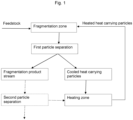
- Such system may be referred to as a circulating fluidized bed system, wherein the heat carrying particles are continuously recirculated between a fragmentation zone and a heating zone.
- An advantage of continuous operation is that that the heat carrying particles have shown to provide an increasing yield of glycolaldehyde with time on stream until a steady state yield is achieved. Steady state may be achieved after 2-4 hours on stream (TOS) but it may also take longer or shorter. It will partly depend on the reactor design and operation conditions.
- the amount of bed material may be adjusted whenever needed by removing or adding bed material to obtain the desired amount of bed material in the circulating fluidized bed system.
- the "recovering the composition comprising C 1 -C 3 oxygenates from the fragmentation product stream” is meant to refer either to collecting the fragmentation product stream as it is without further separation or to directing the same to a subsequent step, such as to a purification unit or a hydrogenation unit.
- the process according to the present invention thus provides several advantages to achieve high glycolaldehyde selectivity and a high degree of preservation of glycolaldehyde once it has been formed.
- the heat carrying particles used in the process according to the present invention has the advantages that they have a high melting point, a very low surface area, a low number of acidic groups per weight, a low tendency to sintering during use and during calcining, a high fluidization index and a long de-aeration time. All these characteristics, provide excellent yield of glycolaldehyde and the heat carrying particles retain their excellent fluidization characteristics for an extended period of time thus making it suitable for continuous exploitation on an industrial scale.
- An advantage of having a very low number of acidic and/or basic groups on the surface of the heat carrying particles is that the glycolaldehyde yield is improved.
- a circulating fluidized bed system for fragmentation of a sugar into C 1 -C 3 oxygenates, which system comprises a thermolytic fragmentation reactor comprising a fragmentation zone, a reheater comprising a heating zone, a first flow means arranged to convey fluidized bed material from the thermolytic fragmentation reactor to the reheater and second flow means arranged to convey fluidized bed material from the reheater to the thermolytic fragmentation reactor, and heat carrying particles, wherein the particle surface area of the heat carrying particles is below 3 square metres per g, such as below 1, 0.5, 0.2 or 0.15 as measured by Kr physisorption, and wherein at least 90% by weight of the heat carrying particles consist of silicium, aluminium and oxygen and the mass ratio of silicium to aluminium is from 0.25 to 1.
- a circulating fluidized bed system for fragmentation of a sugar into C 1 -C 3 oxygenates, which system comprises a thermolytic fragmentation reactor comprising a fragmentation zone, a reheater comprising a heating zone, a first flow means arranged to convey fluidized bed material from the thermolytic fragmentation reactor to the reheater and second flow means arranged to convey fluidized bed material from the reheater to the thermolytic fragmentation reactor, and heat carrying particles, wherein the number of acid sites on the surface of the heat carrying particles is less than 1 ⁇ mol/g as measured by NH 3 -TPD, such as less than 0.5 or 0.1 ⁇ mol/g.
- Such a system has the advantage of providing excellent yield of glycolaldehyde and the heat carrying particles retain their excellent fluidization characteristics for an extended period of time thus making it suitable for continuous exploitation on an industrial scale.
- Fig. 1 is a sketch of the process according to the present invention.
- bed material In the present context the terms "bed material” "fluidized bed material” and “heat carrying particles” are used interchangeably.
- the stream of heat carrying particles which circulates between the to the heating zone, through the heating zone, from the heating zone to the fragmentation zone, through the fragmentation zone and from the fragmentation zone to the heating zones are the particles which make up the stream of heat carrying particles.
- the stream is referred to as "cooled heat carrying particles” or “stream of cooled heat carrying particles” and between the heating zone and the fragmentation zone, the stream is referred to as "heated heat carrying particles” or "stream of heated heat carrying particles”.
- the terms "stream of heat carrying particles”, “fluidized stream of heat carrying particles”, “circulating, fluidized stream of heat carrying particles” are intended to refer to the circulating stream of particles as such.
- the particles may be in a heated state or in a cooled stage or be in the process of giving off heat to the feedstock solution in the fragmentation zone or in the process of taking up heat in the heating zone.
- the stream may include the heat carrying particles and various fluids, such as carrier gas, feedstock solution comprising a sugar, C 1 -C 3 oxygenates and by-products being formed from the sugar, combustion gas for heating the particles, stripping gas for removing unwanted components etc.
- yield is in the present context meant to refer to the molar fraction of carbon in the carbohydrate which is converted into carbon bound in the relevant oxygenate.
- conversion is in the present context meant to refer to the molar fraction of the carbohydrate which was converted into another chemical species.
- selectivity is meant to refer to the molar fraction of carbon incorporated into the desired product per carbohydrate converted. The selectivity may be calculated as yield divided by conversion.
- heating or “calcined” of heat carrying particles is meant to refer to a heating of the heat carrying particles to high temperatures in a controlled atmosphere, such as air or oxygen.
- a bed material as such is composed of small particles and has the visual appearance of a powder (in the present context referred to as heat carrying particles). It comprises small solid particles, which becomes fluidized by blowing a fluidization stream through the bed material preferably in a direction against the gravitational force. When fluidized, the bed material behaves almost as a fluid. The characteristics of the particles or powder influence the fluidization behavior significantly.
- Bed material powders may be grouped into four groups depending on the fluidization characteristics, which are referred to as Geldart A, B, C and D.
- the groups are defined by their locations on a diagram of solid-fluid density difference and particle size.
- the Geldart group of particles for a bed material is useful when designing fluidized beds.
- the "fluidization index” is the ratio of the minimum fluidization velocity to the minimum bubbling velocity. Briefly, the minimum fluidization velocity is determined by measuring the pressure drop across a bed of solids at varying superficial gas velocities. The pressure drop will increase with increasing superficial gas velocity until a given point, where it becomes constant. The superficial gas velocity at this point is the minimum fluidization velocity. The minimum bubbling velocity is the minimum superficial gas velocity, where bubbles are observed.
- the fluidization index will be one (by definition), while for a Geldart A material it will be greater than one.
- the "deaeration time” is the time it takes for a fluidized bed to collapse after the fluidization gas flow is interrupted.
- the time can be measured by fluidizing the material at a given superficial gas velocity, which will cause the bed to expand. Interrupting the flow of gas will cause the bed to collapse; the time until a stable bed height is reached is the deaeration time.
- the measured time will be dependent on the procedure used, and different materials must therefore be measured with identical procedures for comparing the deaeration time.
- Example 1A The present inventors found during their work that the sand materials as proposed in the prior art (Example 1A) were not satisfactory as bed material in continuous, industrial scale thermolytic fragmentation processes for converting sugars into C 1 -C 3 oxygenates. The inventors also found that it was not just a question of the Geldart type of the particles, which decided whether they were suitable or not.
- Fluidized bed systems are used in many fields for chemical and/or thermolytic conversion of chemical compounds.
- the inventors looked in fields such as gasification of straw and support materials for Fluid Catalytic Cracking (FCC) for a suitable bed material for a continuous, industrial scale process for converting sugars into a composition comprising C 1 -C 3 oxygenates (e.g. WO 2018/057076 and US 4,608,357 ).
- FCC Fluid Catalytic Cracking
- Examples 1B-1C these materials were not as efficient as desired for thermolytically fragmenting sugars into oxygenates in a circulating fluidized bed system.
- the bed material needed to be fluidisable and suitable for use in a circulating fluidized bed system and to provide high selectivity towards glycolaldehyde for an extended period of time.
- the inventors realized that if the heat carrying particles were selected such that at least 90% by weight of the heat carrying particles consisted of silicium, aluminium and oxygen and the mass ratio of silicium to aluminium was from 0.25 to 1 before calcination, AND the heat carrying particles where calcined at a very high temperature, such heat carrying particles provided high yields of glycolaldehyde and good fluidization characteristics and a low tendency to sintering in a circulating fluidized bed system for thermolytic fragmentation of sugars into a composition comprising C 1 -C 3 oxygenates. Such heat carrying particles were superior to any of the prior art materials.
- Calcining at a very high temperature turned out to reduce the surface area even more than proposed in the prior art and resulted in bed materials which improved the yield of oxygenates and in particular of glycolaldehyde.
- the heat carrying particles have been calcined at a temperature of at least 1000 °C, such as in the range of from 1200 to 2000 °C, from 1400-1800 °C or from 1500 to 1700 °C.
- calcining the heat carrying particles at temperatures above 1400 °C provided an ultra-low surface area which lowered the reactivity of the heat carrying particles compared to both low surface area particles and high porosity particles.
- an ultra-low surface area may be below 3 square metres per g as measured by Kr physisorption, such as below 1, 0.5, 0.2 or 0.15 square metres per g.
- the inventors found that calcining/sintering at a high temperature such as above 1400 °C, resulted in a surface having a low number of acid sites on the surface of the heat carrying particles of less than 3 ⁇ mol/g as measured by NH 3 -TPD, such as less than 1, 0.5, 0.1, 0.05 or 0.01 ⁇ mol/g.
- the inventors found that having less acid sites on the surface resulted in less decomposition of the C 1 -C 3 oxygenates formed during the thermolytic fragmentation and this an improved yield.
- the inventors further found that when at least 90% of - or essentially all of - the heat carrying particles consisted of silicium, aluminium and oxygen and the mass ratio of silicium to aluminium was from 0.25 to 1 before calcination, a large amount of mullite was formed during calcination at high temperatures.
- Mullite is a rare naturally occuring silicate mineral.
- the heat carrying particles do not contain significant amounts of metals catalyzing formation of byproducts (other products than the C1-C3 oxygenates).
- the heat carrying particles contain less than 2%, such as less than 1% or 0.05% of catalytically active metals, such as Ti, Ni or Cu.
- the heat carrying particles has a melting point above 1100 °C, such as in the range of from 1100 to 3000°C.
- the fluidization index of the heat carrying particles is above 1, corresponding to a Geldart A material.
- 90-100%, such as 95-99.9% or 98-99.8% by weight of the heat carrying particles consist of silicium, aluminium and oxygen and the mass ratio of silicium to aluminium is of from 0.25 to 1, such as from 0.4 to 0.8 or 0.45 to 0.55.
- At least 50% by weight such as at least 50%, 60%, 70%, 80%, 50-99%, 60-95% or 65-90%, of the heat carrying particles consist of mullite.
- Mullite in the bed material has a surprisingly advantageous effect on the fluidization properties.
- Such a bed material is very heat tolerant, has high strength and is very inert.
- the heat carrying particles may comprise alpha-alumina and/or amorphous silica.
- Alpha-alumina provides high density particles.
- the presence of amorphous silica lowers the melting point of the particles. Therefore, alpha-alumina and/or amorphous silica is tolerated in the heat carrying particles, but if the amounts are too high, it has an adverse effect on the fluidization properties. Accordingly, the inventors also found that a large excess of free SiOz tended to lower the melting point of the particles and that a large excess of free Al 2 O 3 tended to increase the density of the particles
- the heat carrying particles may have a particle density below 3.5 g/ml, such as in the range of from 2-3 g/ml, as measured by Hg porosimetry.
- the Sauter mean diameter of the heat carrying particles is from 50-150 ⁇ m.
- the Sauter mean diameter is a general term, which is often used in fluid dynamics. It is defined as the diameter of a sphere that has the same volume/surface area ratio as a particle of interest.
- the fragmentation zone and the heating zone are arranged in a single reactor equipped with means for conveying the heated heat carrying particles from the heating zone to the fragmentation zone and for conveying the cooled heat carrying particles from the fragmentation zone to the heating zone.
- the fragmentation zone and the heating zone are arranged in separate reactors equipped with means for conveying the heated heat carrying particles from the heating zone to the fragmentation zone and for conveying the cooled heat carrying particles from the fragmentation zone to the heating zone.
- the feedstock solution comprising the sugar is fed directly into the fragmentation zone of the circulating fluidized bed.
- the feedstock solution comprises the sugar dissolved in a solvent.
- a preferred solvent is water, but also methanol, ethanol, ethylene glycol and other alcoholic or polyolic solvents may be used.
- the sugar is a mono- and/or di-saccharide.
- the sugar is selected from the group consisting of sucrose, lactose, xylose, arabinose, ribose, mannose, tagatose, galactose, glucose and fructose; or mixtures thereof.
- the concentration of sugar in the feedstock solution is between 10 and 90% by weight, such as between 20 and 90, or 30 and 90 weight%.
- the composition comprising the C 1 -C 3 oxygenates typically comprises one or both of the C 2 oxygenates glycolaldehyde and glyoxal, and/or one or both of the C 3 oxygenates pyruvaldehyde and acetol and/or the C 1 oxygenate formaldehyde.
- the present invention aims in particular at improving the yield of glycolaldehyde.
- the composition comprising C 1 -C 3 oxygenates comprises one or more of glycolaldehyde, glyoxal, pyruvaldehyde, acetol and formaldehyde.
- formaldehyde is normally not preferred, since it can poison downstream catalysts and normally is not wanted in the end product.
- the composition comprising C 1 -C 3 oxygenates comprises glycolaldehyde.
- the fragmentation zone has a fragmentation temperature in the range of from 250 - 900 °C, such as from 300-750, 350-650, or 400-550 °C.
- This fragmentation temperature is obtained by heating the heat carrying particles to a temperature in the range of from 300-950 °C, such as from 350-800, 400-700 or 450-650 °C as measured when the heated heat carrying particles leave the heating zone.
- the resulting cooled heat carrying particles will have a temperature in the range of from 200-850 °C, such as from 250-700, 300-600, or 350-550 °C.
- the fragmentation zone will normally be delimited by a reactor wall, and preferably it is delimited by a riser suitable for conducting thermolytic fragmentation of a feedstock solution comprising a sugar and suitable for fluidizing the stream of heat carrying particles.
- the heating zone will normally be delimited by a reactor wall, and preferably it is delimited by a riser suitable for heating and suitable for fluidizing the stream of heat carrying particles.
- the fragmentation product stream comprising C 1 -C 3 oxygenates may be separated from the stream of cooled heat carrying particles by inertial separation, such as in a cyclone. It is to be understood that when reference is made to "separating the fragmentation stream comprising C 1 -C 3 oxygenates from the stream of cooled heat carrying particles" this refers to a separation of at least a fraction of the cooled heat carrying particles from the C 1 -C 3 oxygenates. In an embodiment according to the present invention at least 50 weight%, such as at least 60, 70 80 or 90 weight% of the heat carrying particles are separated from the C 1 -C 3 oxygenates in step c. Any remaining heat carrying particles may be removed in subsequent separation steps.
- step d) of recovering the composition comprising C 1 -C 3 oxygenates comprises collecting the fragmentation product stream and conveying it to a hydrogenation unit to convert the C 1 -C 3 oxygenates into the corresponding poly-alcohols (e.g. glycolaldehyde and glyoxal into ethylene glycol and pyruvaldehyde and acetol into propylene glycol).
- poly-alcohols e.g. glycolaldehyde and glyoxal into ethylene glycol and pyruvaldehyde and acetol into propylene glycol.
- the ratio of the mass of heat carrying particles per mass of feedstock is between 12:1 and 200:1.
- the feedstock is an aqueous sugar solution and the mass of feedstock is the mass of sugar dissolved in the water.
- a circulating fluidized bed system for fragmentation of a sugar into a composition comprising C1-C3 oxygenates, which system comprises a thermolytic fragmentation reactor comprising a fragmentation zone, a reheater comprising a heating zone, a first flow means arranged to transport (or convey) fluidized bed material from the thermolytic fragmentation reactor to the reheater and second flow means arranged to transport (or convey) fluidized bed material from the reheater to the thermolytic fragmentation reactor, and the system comprising heat carrying particles, wherein the particle surface area of the heat carrying particles is below 3 square metres per g, such as below 1, 0.5, 0.2 or 0.15 and wherein at least 90% by weight of the heat carrying particles consist of silicium, aluminium and oxygen and the mass ratio of silicium to aluminium is from 0.25 to 1.
- a circulating fluidized bed system for fragmentation of a sugar into a composition comprising C1-C3 oxygenates, which system comprises a thermolytic fragmentation reactor comprising a fragmentation zone, a reheater comprising a heating zone, a first flow means arranged to transport (or convey) fluidized bed material from the thermolytic fragmentation reactor to the reheater and second flow means arranged to transport (or convey) fluidized bed material from the reheater to the thermolytic fragmentation reactor, and the system comprising heat carrying particles, wherein the number of acid sites on the surface of the heat carrying particles is less than 1 ⁇ mol/g as measured by NH3-TPD, such as less than 0.5 or 0.1 ⁇ mol/g.
- the particle surface area of the heat carrying particles is below 3 square metres per g, such as below 1, 0.5, 0.2 or 0.15.
- the system according to the present invention may comprise further features designed to conduct the process of the invention, such as an inlet valve for introducing the feedstock solution into the fragmentation zone, separation means for separating the fragmentation product stream from the stream of cooled heat carrying particles (such as an inertial separation unit), cooling means for cooling the fragmentation product stream (such as a condensation unit),
- the heating zone may be delimited by a riser or a boubbling bed reactor designed to heat the heat carrrrying particles according to the invention.
- the heating zone may accordingly comprise means for providing heat to the heating zone (such as a fuel combustion unit or a resistance heating system),
- the fragmentation zone may be delimited by a riser or a bubbling bed reactor designed to conduct the thermolytic fragmentation according to the invention.
- the means for transporting or conveying the heat carrying particles may be e.g. valves or pumps,
- yields are given as previously defined (molar fraction of carbon bound in the carbohydrate converted per carbon bound in the relevant oxygenate produced).
- Example 1A Test of various silica bed materials.
- silica (sand) materials were tested as bed material in a laboratory bubbling fluidized bed reactor. For all of the experiments, the bed material was fractioned to 90-150 ⁇ m before testing.
- a bed volume (tapped volume before fluidization) of 10 mL was loaded in a bubbling fluid bed reactor (22 mm ID) and fluidized at a superficial gas velocity of approx. 50 cm/s.
- the temperature was increased to 500°C, at which point water was injected into the bed through a two-fluid nozzle at a rate of 0.5 g/min.
- the feed was switched to a 10 wt.% aqueous solution of glucose and time set as t 0 .
- the gas leaving the reactor was cooled to 1°C in a surface condenser, and the liquid condensate collected.
- the concentration of oxygenates in the condensate was determined by HPLC analysis, and the yield of oxygenates calculated based on the mass of collected product.
- the mean vapor residence time in the reactor was 1-2 s. Vapor product samples were collected at steady state in the time period between 1.5 and 8.25 hours after switching the feed to aqueous glucose.
- the steady state yields of glycolaldehyde (GA yield) for the various bed materials can be found in Table 1.
- the bed materials used all had surface areas below 1 m 2 /g.
- the silicium to aluminum content was in the range of from 47 to 2214.
- all of the materials are Geldart A or B and thus should fluidize well.
- the superficial gas velocity employed for the experiments was above the minimum fluidization velocity. In practice, several of the materials proved difficult to fluidize and this caused most materials to provide quite low GA yields. The results show that it was quite unpredictable from the established requirements to bed materials (or the heat carrying particles) which materials would provide high yield of GA and which would not.
- a bed mass of 100 g was loaded in a bubbling fluid bed reactor (42 mm ID) and fluidized at a superficial gas velocity of approx. 30 cm/s.
- the temperature was increased to 500°C, at which point water was injected into the bed through a two-fluid nozzle at a rate of 2 g/min.
- the feed was switched to a 10 wt.% aqueous solution of glucose and time set as t 0 .
- the gas leaving the reactor was cooled to 1°C in a surface condenser, and the liquid condensate collected.
- the concentration of oxygenates in the condensate was determined by HPLC analysis, and the yield of oxygenates calculated based on the mass of collected product.
- Tabel 2 Characteristics of the FCC bed material Property Value Surface area [m 2 /g] 194 D 3,2 [ ⁇ m] 70 Elemental composition Si: 22.4 wt.% Al: 22.0 wt.% La: 1.9 wt.% Ti: 1.3 wt.% Phase composition (XRD) ⁇ -alumina: 19 wt.% Silica (amorphous): 46 wt.% Mullite: 23 wt.% FAU: 12 wt.% Table 3: Yield of glycolaldehyde for FCC catalyst as a function of time on stream TOS [hr] Yield of glycolaldehyde 2.49 5.2% 4.49 8.9% 6.49 11.9% 8.49 14.8% 10.49 17.1% 12.49 19.6% 14.49 22.2% 16.49 25.2% 18.49 27.3%
- Example 1C Test of silica-alumina with low surface area as bed material:
- a spherical silica-alumina material was calcined at 1150°C, to convert it into primarily ⁇ -alumina and ⁇ -alumina (as determined by XRD).
- the bed material tested in 1C turned out to be less suitable for thermolytic fragmentation of sugar into C 1 -C 3 oxygenates.
- Example 1D Test of silica-alumina with low surface area as bed material:
- a spherical silica-alumina material was calcined at 1500°C, to convert it into primarily ⁇ -alumina and mullite (as determined by XRD).
- This low surface area bed material showed good yield of glycolaldehyde after a few hours on stream.
- Example 1E test of alumina bed material with low surface area.
- a spherical alumina material was calcined at 1400 and 1600°C, respectively, which resulted in particle surface area of 1.6 m 2 /g and 0.1 m 2 /g, respectively. Both materials were completely converted to ⁇ -alumina (as determined by XRD).
- the example shows that using heat carrying particles having a surface area of 1.6 m 2 /g provides a good yield of glycolaldehyde, but that using heat carrying particles having a surface area of 0.1 m 2 /g provides an even better yield of glycolaldehyde in thermolytic fragmentation of sugar.
- the surface area of the material was 0.14 m 2 /g.
- Table 10: Characteristics of the bed material according to the invention Property Value Surface area [m 2 /g] 0.14 D 3,2 [ ⁇ m] 88 Elemental composition Si: 16.1 wt.% Al: 32.6 wt.% Fe: 0.55 wt. % Phase composition (XRD) ⁇ -alumina: 4 wt.% Mullite: 72 wt.% Amorphous silica: 24 wt.%
- the calcination at 1680°C quickly leads to a high yield of glycolaldehyde, as was the case for the pure alumina material, however in this case the particle density was still only 2.9 g/ml despite the higher calcination temperature. Furthermore, no particle sintering was observed and the material was still highly spherical. Thus, the fluidization properties of the material were retained, while still obtaining a high yield of glycolaldehyde. These characteristics were retained for an extended period of time, making the heat carrying particles of this composition highly suitable for industrial application.
Landscapes
- Chemical & Material Sciences (AREA)
- Organic Chemistry (AREA)
- Chemical Kinetics & Catalysis (AREA)
- Engineering & Computer Science (AREA)
- Combustion & Propulsion (AREA)
- Physics & Mathematics (AREA)
- Thermal Sciences (AREA)
- Organic Low-Molecular-Weight Compounds And Preparation Thereof (AREA)
- Devices And Processes Conducted In The Presence Of Fluids And Solid Particles (AREA)
Applications Claiming Priority (4)
| Application Number | Priority Date | Filing Date | Title |
|---|---|---|---|
| DKPA201900972 | 2019-08-16 | ||
| DKPA201900973 | 2019-08-16 | ||
| PCT/EP2020/072756 WO2021032590A1 (en) | 2019-08-16 | 2020-08-13 | New bed material for thermolytic fragmentation of sugars |
| EP20757287.6A EP4013737B1 (de) | 2019-08-16 | 2020-08-13 | Neues bettmaterial zur thermolytischen fragmentierung von zuckern |
Related Parent Applications (2)
| Application Number | Title | Priority Date | Filing Date |
|---|---|---|---|
| EP20757287.6A Division-Into EP4013737B1 (de) | 2019-08-16 | 2020-08-13 | Neues bettmaterial zur thermolytischen fragmentierung von zuckern |
| EP20757287.6A Division EP4013737B1 (de) | 2019-08-16 | 2020-08-13 | Neues bettmaterial zur thermolytischen fragmentierung von zuckern |
Publications (2)
| Publication Number | Publication Date |
|---|---|
| EP4286360A2 true EP4286360A2 (de) | 2023-12-06 |
| EP4286360A3 EP4286360A3 (de) | 2024-03-13 |
Family
ID=72088102
Family Applications (2)
| Application Number | Title | Priority Date | Filing Date |
|---|---|---|---|
| EP20757287.6A Active EP4013737B1 (de) | 2019-08-16 | 2020-08-13 | Neues bettmaterial zur thermolytischen fragmentierung von zuckern |
| EP23203502.2A Pending EP4286360A3 (de) | 2019-08-16 | 2020-08-13 | Neues bettmaterial zur thermolytischen fragmentierung von zuckern |
Family Applications Before (1)
| Application Number | Title | Priority Date | Filing Date |
|---|---|---|---|
| EP20757287.6A Active EP4013737B1 (de) | 2019-08-16 | 2020-08-13 | Neues bettmaterial zur thermolytischen fragmentierung von zuckern |
Country Status (10)
| Country | Link |
|---|---|
| US (2) | US12344576B2 (de) |
| EP (2) | EP4013737B1 (de) |
| JP (1) | JP2022544685A (de) |
| KR (1) | KR20220044780A (de) |
| CN (1) | CN114008011B (de) |
| AU (2) | AU2020334188B2 (de) |
| PL (1) | PL4013737T3 (de) |
| TW (1) | TWI870439B (de) |
| WO (1) | WO2021032590A1 (de) |
| ZA (1) | ZA202110355B (de) |
Families Citing this family (3)
| Publication number | Priority date | Publication date | Assignee | Title |
|---|---|---|---|---|
| WO2021231089A1 (en) | 2020-05-12 | 2021-11-18 | Archer Daniels Midland Company | Processes for the pyrolysis of carbohydrates |
| WO2024046969A1 (en) | 2022-08-29 | 2024-03-07 | Topsoe A/S | Thermolytic fragmentation of sugars |
| KR20250054059A (ko) | 2022-08-29 | 2025-04-22 | 토프쉐 에이/에스 | 당의 열분해 단편화 |
Citations (7)
| Publication number | Priority date | Publication date | Assignee | Title |
|---|---|---|---|---|
| US4608357A (en) | 1984-02-06 | 1986-08-26 | Engelhard Corporation | Catalytic cracking with mullite composition promoted combustion of carbon monoxide |
| EP0158517B1 (de) | 1984-04-05 | 1991-12-11 | Montvale Process Company Incorporated | Verfahren zur Herstellung von Ethylenglycol |
| US5397582A (en) | 1989-05-26 | 1995-03-14 | Red Arrow Products Company Inc. | Flavoring and browning materials by pyrolysis of sugars and starches |
| WO2002040436A1 (en) | 2000-11-20 | 2002-05-23 | Resource Transforms International Ltd. | Production of glycolaldehyde by hydrous thermolysis of sugars |
| WO2014131764A1 (en) | 2013-02-27 | 2014-09-04 | Haldor Topsøe A/S | Process for preparing ketene in the presence of a fluidized bed material with a surface area of up to 600 m2/g |
| WO2017216311A1 (en) | 2016-06-16 | 2017-12-21 | Haldor Topsøe A/S | Thermolytic fragmentation of sugars |
| WO2018057076A1 (en) | 2016-09-26 | 2018-03-29 | Intel Corporation | Splitting signal radio bearer enhancements for standalone 5g new rat multi-connectivity |
Family Cites Families (3)
| Publication number | Priority date | Publication date | Assignee | Title |
|---|---|---|---|---|
| US9441887B2 (en) * | 2011-02-22 | 2016-09-13 | Ensyn Renewables, Inc. | Heat removal and recovery in biomass pyrolysis |
| KR102749466B1 (ko) | 2016-12-08 | 2025-01-03 | 토프쉐 에이/에스 | 열분해 단편화에 의한 글리콜알데하이드의 생성 |
| MX2021000545A (es) | 2018-07-16 | 2023-01-26 | Haldor Topsoe As | Fragmentacion termolitica de azucares usando calentamiento por resistencia. |
-
2020
- 2020-08-12 TW TW109127356A patent/TWI870439B/zh active
- 2020-08-13 EP EP20757287.6A patent/EP4013737B1/de active Active
- 2020-08-13 PL PL20757287.6T patent/PL4013737T3/pl unknown
- 2020-08-13 US US17/624,299 patent/US12344576B2/en active Active
- 2020-08-13 AU AU2020334188A patent/AU2020334188B2/en active Active
- 2020-08-13 CN CN202080045142.3A patent/CN114008011B/zh active Active
- 2020-08-13 WO PCT/EP2020/072756 patent/WO2021032590A1/en not_active Ceased
- 2020-08-13 KR KR1020227007422A patent/KR20220044780A/ko not_active Ceased
- 2020-08-13 JP JP2022509673A patent/JP2022544685A/ja active Pending
- 2020-08-13 EP EP23203502.2A patent/EP4286360A3/de active Pending
-
2021
- 2021-12-13 ZA ZA2021/10355A patent/ZA202110355B/en unknown
-
2024
- 2024-12-18 AU AU2024278582A patent/AU2024278582A1/en active Pending
-
2025
- 2025-05-30 US US19/223,855 patent/US20250289776A1/en active Pending
Patent Citations (7)
| Publication number | Priority date | Publication date | Assignee | Title |
|---|---|---|---|---|
| US4608357A (en) | 1984-02-06 | 1986-08-26 | Engelhard Corporation | Catalytic cracking with mullite composition promoted combustion of carbon monoxide |
| EP0158517B1 (de) | 1984-04-05 | 1991-12-11 | Montvale Process Company Incorporated | Verfahren zur Herstellung von Ethylenglycol |
| US5397582A (en) | 1989-05-26 | 1995-03-14 | Red Arrow Products Company Inc. | Flavoring and browning materials by pyrolysis of sugars and starches |
| WO2002040436A1 (en) | 2000-11-20 | 2002-05-23 | Resource Transforms International Ltd. | Production of glycolaldehyde by hydrous thermolysis of sugars |
| WO2014131764A1 (en) | 2013-02-27 | 2014-09-04 | Haldor Topsøe A/S | Process for preparing ketene in the presence of a fluidized bed material with a surface area of up to 600 m2/g |
| WO2017216311A1 (en) | 2016-06-16 | 2017-12-21 | Haldor Topsøe A/S | Thermolytic fragmentation of sugars |
| WO2018057076A1 (en) | 2016-09-26 | 2018-03-29 | Intel Corporation | Splitting signal radio bearer enhancements for standalone 5g new rat multi-connectivity |
Also Published As
| Publication number | Publication date |
|---|---|
| WO2021032590A1 (en) | 2021-02-25 |
| EP4013737A1 (de) | 2022-06-22 |
| KR20220044780A (ko) | 2022-04-11 |
| US12344576B2 (en) | 2025-07-01 |
| EP4013737B1 (de) | 2024-08-07 |
| CN114008011A (zh) | 2022-02-01 |
| AU2020334188B2 (en) | 2024-10-03 |
| CN114008011B (zh) | 2024-05-24 |
| AU2020334188A1 (en) | 2022-03-03 |
| JP2022544685A (ja) | 2022-10-20 |
| PL4013737T3 (pl) | 2024-10-21 |
| US20250289776A1 (en) | 2025-09-18 |
| US20220411357A1 (en) | 2022-12-29 |
| TW202120180A (zh) | 2021-06-01 |
| TWI870439B (zh) | 2025-01-21 |
| EP4013737C0 (de) | 2024-08-07 |
| ZA202110355B (en) | 2025-04-30 |
| AU2024278582A1 (en) | 2025-01-16 |
| BR112022002893A2 (pt) | 2022-05-10 |
| BR122022002964A2 (pt) | 2022-05-24 |
| EP4286360A3 (de) | 2024-03-13 |
Similar Documents
| Publication | Publication Date | Title |
|---|---|---|
| US20250289776A1 (en) | Bed material for thermolytic fragmentation of sugars | |
| EP1058580B2 (de) | Verfahren zur herstellung von fischer-tropsch katalysatoren | |
| EP0967262A1 (de) | Verfahren zur Herstellung von Kohlenwasserstoffen aus Synthesegas | |
| US20040186188A1 (en) | Production of fischer-tropsch synthesis produced wax | |
| US9539567B2 (en) | Catalysts | |
| EP3496856B1 (de) | Eine cobalt enthaltende zusammensetzung | |
| US9327273B2 (en) | Catalysts | |
| WO2003087265A1 (en) | Hydrocarbon synthesis process using an alkali promoted iron catalyst | |
| KR20020010673A (ko) | 알루미나상 코발트 촉매의 개선된 피셔-트롭슈 활성 | |
| FI66540C (fi) | Foerfarande foer foerbaettring av kvaliteten av ett fast i kaenda kemiska reaktioner anvaent fluidiserat katalytmaterialskikt och ett fluidiserat skikt | |
| EP3262018B1 (de) | Kohlenwasserstoffsynthesekatalysator, dessen herstellungsverfahren und dessen verwendung | |
| CN104114274B (zh) | 用于从合成气合成二甲醚的催化活性体 | |
| US8901027B2 (en) | Stable slurry bed fischer-tropsch catalyst with high surface area and activity | |
| WO2017085603A2 (en) | Methods for the conversion of co2 into syngas for use in the production of olefins | |
| RU2741385C2 (ru) | Способ извлечения металлического компонента | |
| SA97180437B1 (ar) | محفز فيشر - تروبش Fischer - Tropsch وعملية لتحضير هيدروكربونات hydrocarbons | |
| US7144924B2 (en) | Process for the production in continuous of hydrocarbons from synthesis gas in slurry reactors and for the separation of the liquid phase produced from the solid phase | |
| GB1560599A (en) | Process for demetallizing hydrocarbon oils | |
| BR112022002893B1 (pt) | Processo para fragmentação termolítica de um açúcar em uma composição que compreende oxigenados c1-c3 | |
| CN113694912A (zh) | 一种用于三聚氰胺生产的催化剂及其制备方法 | |
| BR122022002964B1 (pt) | Processo para fragmentação termolítica de um açúcar em uma composição que compreende oxigenados c1-c3 e sistemas de leito fluidizado circulante | |
| EP1782885A1 (de) | Kobaltkatalysator mit Kohlenstoffnanoröhren als Träger für die Umwandlung von Synthesegas in Kohlenwasserstoffe | |
| US20250345779A1 (en) | Catalysts and processes for a reverse water gas shift reaction for converting carbon dioxide to carbon monoxide | |
| Rytter et al. | QA and optimization issues during development of the Statoil FT-catalyst | |
| WO2025178918A1 (en) | Method for making catalysts that includes platinum |
Legal Events
| Date | Code | Title | Description |
|---|---|---|---|
| PUAI | Public reference made under article 153(3) epc to a published international application that has entered the european phase |
Free format text: ORIGINAL CODE: 0009012 |
|
| STAA | Information on the status of an ep patent application or granted ep patent |
Free format text: STATUS: THE APPLICATION HAS BEEN PUBLISHED |
|
| AC | Divisional application: reference to earlier application |
Ref document number: 4013737 Country of ref document: EP Kind code of ref document: P |
|
| AK | Designated contracting states |
Kind code of ref document: A2 Designated state(s): AL AT BE BG CH CY CZ DE DK EE ES FI FR GB GR HR HU IE IS IT LI LT LU LV MC MK MT NL NO PL PT RO RS SE SI SK SM TR |
|
| REG | Reference to a national code |
Ref country code: DE Ref legal event code: R079 Free format text: PREVIOUS MAIN CLASS: C07C0049185000 Ipc: C07C0045600000 |
|
| PUAL | Search report despatched |
Free format text: ORIGINAL CODE: 0009013 |
|
| AK | Designated contracting states |
Kind code of ref document: A3 Designated state(s): AL AT BE BG CH CY CZ DE DK EE ES FI FR GB GR HR HU IE IS IT LI LT LU LV MC MK MT NL NO PL PT RO RS SE SI SK SM TR |
|
| RIC1 | Information provided on ipc code assigned before grant |
Ipc: C07C 49/185 20060101ALI20240202BHEP Ipc: C07C 49/17 20060101ALI20240202BHEP Ipc: C07C 47/27 20060101ALI20240202BHEP Ipc: C07C 47/04 20060101ALI20240202BHEP Ipc: C07C 47/19 20060101ALI20240202BHEP Ipc: C07C 45/60 20060101AFI20240202BHEP |
|
| STAA | Information on the status of an ep patent application or granted ep patent |
Free format text: STATUS: REQUEST FOR EXAMINATION WAS MADE |
|
| 17P | Request for examination filed |
Effective date: 20240911 |
|
| RBV | Designated contracting states (corrected) |
Designated state(s): AL AT BE BG CH CY CZ DE DK EE ES FI FR GB GR HR HU IE IS IT LI LT LU LV MC MK MT NL NO PL PT RO RS SE SI SK SM TR |