EP4285367B1 - Verfahren und system zum suchen eines zielknotens in bezug auf eine abgefragte einheit in einem netzwerk - Google Patents
Verfahren und system zum suchen eines zielknotens in bezug auf eine abgefragte einheit in einem netzwerk Download PDFInfo
- Publication number
- EP4285367B1 EP4285367B1 EP22746262.9A EP22746262A EP4285367B1 EP 4285367 B1 EP4285367 B1 EP 4285367B1 EP 22746262 A EP22746262 A EP 22746262A EP 4285367 B1 EP4285367 B1 EP 4285367B1
- Authority
- EP
- European Patent Office
- Prior art keywords
- nodes
- value
- node
- entity
- edge
- Prior art date
- Legal status (The legal status is an assumption and is not a legal conclusion. Google has not performed a legal analysis and makes no representation as to the accuracy of the status listed.)
- Active
Links
Images




Classifications
-
- G—PHYSICS
- G16—INFORMATION AND COMMUNICATION TECHNOLOGY [ICT] SPECIALLY ADAPTED FOR SPECIFIC APPLICATION FIELDS
- G16B—BIOINFORMATICS, i.e. INFORMATION AND COMMUNICATION TECHNOLOGY [ICT] SPECIALLY ADAPTED FOR GENETIC OR PROTEIN-RELATED DATA PROCESSING IN COMPUTATIONAL MOLECULAR BIOLOGY
- G16B5/00—ICT specially adapted for modelling or simulations in systems biology, e.g. gene-regulatory networks, protein interaction networks or metabolic networks
- G16B5/20—Probabilistic models
-
- G—PHYSICS
- G16—INFORMATION AND COMMUNICATION TECHNOLOGY [ICT] SPECIALLY ADAPTED FOR SPECIFIC APPLICATION FIELDS
- G16B—BIOINFORMATICS, i.e. INFORMATION AND COMMUNICATION TECHNOLOGY [ICT] SPECIALLY ADAPTED FOR GENETIC OR PROTEIN-RELATED DATA PROCESSING IN COMPUTATIONAL MOLECULAR BIOLOGY
- G16B5/00—ICT specially adapted for modelling or simulations in systems biology, e.g. gene-regulatory networks, protein interaction networks or metabolic networks
-
- G—PHYSICS
- G16—INFORMATION AND COMMUNICATION TECHNOLOGY [ICT] SPECIALLY ADAPTED FOR SPECIFIC APPLICATION FIELDS
- G16B—BIOINFORMATICS, i.e. INFORMATION AND COMMUNICATION TECHNOLOGY [ICT] SPECIALLY ADAPTED FOR GENETIC OR PROTEIN-RELATED DATA PROCESSING IN COMPUTATIONAL MOLECULAR BIOLOGY
- G16B15/00—ICT specially adapted for analysing two-dimensional [2D] or three-dimensional [3D] molecular structures, e.g. structural or functional relations or structure alignment
- G16B15/20—Protein or domain folding
-
- G—PHYSICS
- G16—INFORMATION AND COMMUNICATION TECHNOLOGY [ICT] SPECIALLY ADAPTED FOR SPECIFIC APPLICATION FIELDS
- G16B—BIOINFORMATICS, i.e. INFORMATION AND COMMUNICATION TECHNOLOGY [ICT] SPECIALLY ADAPTED FOR GENETIC OR PROTEIN-RELATED DATA PROCESSING IN COMPUTATIONAL MOLECULAR BIOLOGY
- G16B40/00—ICT specially adapted for biostatistics; ICT specially adapted for bioinformatics-related machine learning or data mining, e.g. knowledge discovery or pattern finding
-
- G—PHYSICS
- G16—INFORMATION AND COMMUNICATION TECHNOLOGY [ICT] SPECIALLY ADAPTED FOR SPECIFIC APPLICATION FIELDS
- G16B—BIOINFORMATICS, i.e. INFORMATION AND COMMUNICATION TECHNOLOGY [ICT] SPECIALLY ADAPTED FOR GENETIC OR PROTEIN-RELATED DATA PROCESSING IN COMPUTATIONAL MOLECULAR BIOLOGY
- G16B40/00—ICT specially adapted for biostatistics; ICT specially adapted for bioinformatics-related machine learning or data mining, e.g. knowledge discovery or pattern finding
- G16B40/20—Supervised data analysis
-
- G—PHYSICS
- G16—INFORMATION AND COMMUNICATION TECHNOLOGY [ICT] SPECIALLY ADAPTED FOR SPECIFIC APPLICATION FIELDS
- G16B—BIOINFORMATICS, i.e. INFORMATION AND COMMUNICATION TECHNOLOGY [ICT] SPECIALLY ADAPTED FOR GENETIC OR PROTEIN-RELATED DATA PROCESSING IN COMPUTATIONAL MOLECULAR BIOLOGY
- G16B45/00—ICT specially adapted for bioinformatics-related data visualisation, e.g. displaying of maps or networks
Definitions
- the present disclosure relates to a method for searching for a target node related to a queried entity in a network including a plurality of nodes and edges, and more specifically to a method and a system, whereby weights are assigned to the plurality of edges so that signal propagation can be made centered on the edges having high weights and thus a target node can be searched for with high accuracy.
- Searching for target genes or proteins for treating a disease is a first step in drug development and is an important task that has a decisive influence on the success rate of drug development. Recently, it has become possible to process data with high throughput due to technology development. However, processing efficiency and accuracy may be lowered because conventional random walk-based methods rely on an undirected network to diffuse the information assigned to nodes.
- Korean Patent Laid-open Publication No. 10-2016-0149623 discloses an apparatus for predicting pharmacodynamic drug-drug interactions through signal propagation interference in a protein-protein interaction network. It uses a technology in which a signal is propagated by a random walk-based method. Specifically, the signal propagation of a first drug is simulated, and the signal propagation of a second drug different from the first drug is simulated in order to predict a drug-drug interaction.
- a signal is propagated by the random walk-based method, signal propagation occurs randomly, which causes a noise problem that may lead to inaccurate results.
- the present inventors have invented a method whereby directionality is provided to signal propagation so that data can be processed with high throughput and a target protein can be predicted with high accuracy.
- Network Enhancement a general method to denoise weighted biological networks
- ARXIV.ORG CORNELL UNIVERSITY LIBRARY
- NE Network Enhancement
- the NE takes as input a noisy, undirected, weighted network and outputs a network on the same set of nodes but with a new set of edge weights
- the main crux of NE is that nodes connected through paths with high-weight edges are more likely to have a direct, high-weight edge between them.
- Curvature graph network International Conference on Learning Representations outlines a network architecture that incorporates a discrete graph curvature, which measures how the neighborhoods of a pair of nodes are structurally related, wherein the curvature of an edge (x, y) is defined by comparing the distance taken to travel from neighbors of x to neighbors of y, with the length of edge (x, g).
- the present disclosure provides a method and system whereby a noise problem occurring in the related art is solved because a signal is propagated with predetermined directionality rather than non-directionally in an existing random walk-based method.
- the present disclosure also provides a method and system with high prediction accuracy of a target node related to a queried entity because the direction of signal propagation is biased toward nodes and edges with high importance.
- the present disclosure also provides a method and system with high prediction accuracy of a target node related to a queried entity, whereby the direction of signal propagation is determined by using both the curvature of an edge and prior knowledge so that a signal can be propagated along edges and nodes with high importance.
- a method for searching for a target node related to an input queried entity in a network including a plurality of nodes and edges including (a) computing curvatures of edges included in the network by using a curvature computation device, and assigning a weight to each of edges based on the computed curvatures by using a weight assigning device, (b) inputting the queried entity through an input device, (c) assigning a first value to one or more main nodes corresponding to a first entity known to be related to the queried entity and assigning a second value to a node corresponding to a second entity other than the first entity by using a data assigning device, (d) propagating a signal from the main node, and propagating the signal centering on an edge having a high weight, (e) assigning a corrected weight to each of the edges included in the network by increasing the weight of the edge included in a signal propagation path in (d) and decreasing the weight of the edge that is not
- the method may be a method for searching for a target node related to an input queried entity in a homogeneous network which includes a plurality of nodes belonging to a same category among categories including diseases, proteins or genes, and drugs, and a plurality of edges connecting the nodes; and wherein (b) may include inputting a queried entity belonging to a category different from that of a node constituting the homogeneous network.
- the method may further include, after (g), (h) determining one or more of the nodes included in the signal propagation path in (g) as the target node; and (i) outputting an entity corresponding to the determined target node as an entity related to the queried entity through an output device.
- (g) may further include propagating a signal centering on an edge having a higher corrected weight, and wherein, in (g), as the signal propagates, a data value of the node constituting the network changes, and a state in which the data value of the node does not change is defined as a signal propagation saturation state; and wherein (h) may further include determining a target node based on the data value of the node in the signal propagation saturation state.
- the third value may include a value of comparative data obtained by comparing first biological data possessed by a person having a disease corresponding to the queried entity with second biological data possessed by a person without a disease corresponding to the queried entity.
- the third value is a p-value indicating the significance of a degree of increase or decrease in expression for each protein or gene of a patient having a disease corresponding to the queried entity, or a degree of gene mutation of a patient having a disease corresponding to the queried entity is quantified.
- the third value may include a change value of biological data appearing in a specific entity when the drug corresponding to the queried entity is treated to the specific entity.
- the third value may be a p-value indicating the significance of a degree of expression change for each protein or gene when the drug corresponding to the queried entity is treated.
- the curvature of each edge may be determined based on the numbers of neighboring nodes adjacent to nodes connected to each other through the edge.
- the curvature of each edge may be determined based on the numbers of neighboring nodes adjacent to the first and second nodes connected to each other through the edge, when the number of third nodes connected to the first node through the edge is N_s, the number of fourth nodes connected to the second node through the edge is N_t and the number of intersections of the third nodes and the fourth nodes is N_i, the curvature of each edge may be determined based on N_s, N_t, and N_i.
- the curvature of each edge may be determined by 4 - (N_s) - (N_t) + 3 ⁇ (N_i).
- a weight assigned to each edge may be determined by a value outputted from a monotonically increasing function with curvature determined as 4 - (N_s) - (N_t) + 3 ⁇ (N_i) as a variable.
- y a weight
- ⁇ a coefficient for controlling the effect of curvature on weights
- k is the curvature of the corresponding edge
- k is the average of the curvatures
- sd(k) corresponds to the standard deviation of the curvatures.
- the network may be a homogeneous network with a protein as a node and a relation between the protein as an edge.
- the queried entity may be a disease or a drug
- the first entity may be a protein known to be related to the disease or the drug.
- the queried entity may be a protein, and the first entity may be a disease or a drug known to be related to the protein.
- the method may further include, before (a), (a0) extracting a homogeneous network including a node and an edge which is a relation between the nodes by extracting a node of only one type of a disease, a protein or a gene, and a drug from a heterogeneous network in which one or more of diseases, proteins, genes, and drugs are defined as nodes and a relation between the nodes is defined as an edge, by using the network extraction device.
- a computer program stored in a computer-readable recording medium to execute the method described above.
- a signal can be propagated along edges and nodes of high importance so that the prediction accuracy of a target node related to a queried entity is high.
- an algorithm according to the present disclosure showed remarkably high performance in various networks having different characteristics/ structures, the algorithm has high versatility compared to other algorithms that show performance only in a specific network.
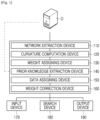
- a system 100 includes a network extraction device 110, a curvature computation device 120, a weight assigning device 130, a prior knowledge extraction device 140, a data assigning device 150, a weight correction device 160, an input device 170, a search device 180, and an output device 190.
- the system 100 is provided with a communication device (not shown), so that mutual wired/wireless communication is possible with external databases D through a communication network.
- the database D may be an external database independent of the system 100 of the present disclosure (e . g ., a dissertation database, a medical information database, a pharmaceutical information database, and a search portal database), and an internal database included in the system 100 of the present disclosure.
- the database D may be a database in which protein-protein interaction (PPI) network information is stored, and examples of the PPI network may include STRING (Nucleic Acids Res. 2005 ) and BioGRID (Nucleic Acids Res. 2006 ).
- PPI protein-protein interaction
- STRING Nucleic Acids Res. 2005
- BioGRID Nucleic Acids Res. 2006
- embodiments of the present disclosure are not limited to the illustrated PPI network.
- heterogeneous network information including nodes and edges, in which each disease, protein or gene, or drug is defined as a node, and the relation between nodes is defined as an edge, may be stored in the database D.
- a network presented in Korean Patent Registration No. 10-2225278 by the present applicant may be included as a reference.
- the network extraction device 110 is configured to extract nodes corresponding to any one type among nodes constituting the heterogeneous network stored in advance in the database D and to extract homogeneous network information including the extracted nodes and edges that are the relation between the extracted nodes.
- the network extraction device 110 may extract network information such as a network including a disease node and an edge between the disease nodes, a network including a protein node and an edge between the protein nodes, or a network including a drug node and an edge between the drug nodes.
- the network extraction device 110 may extract human protein-protein interaction network information, and a disease-specific network in which protein binding information in a specific disease (e . g ., diabetes, Alzheimer's disease, etc .) is added to the extracted human protein-protein interaction network information may be used.
- a disease-specific network in which protein binding information in a specific disease (e . g ., diabetes, Alzheimer's disease, etc .) is added to the extracted human protein-protein interaction network information may be used.
- specific information that appears in the disease/drug/protein/gene of interest is combined with the homogeneous network information extracted by the network extraction device 110 so as to configure a network, so that the search accuracy of a target node related to a queried entity input through the input device 170 may be increased.
- the curvature computation device 120 is configured to compute the curvature of edges constituting the homogeneous network according to a predetermined method in a homogeneous network including only one type of node and an edge between the nodes.
- a curvature computation process using the curvature computation device 120 will be described in detail with reference to FIG. 3 .
- each edge is determined according to the number of neighboring nodes adjacent to nodes connected to each other through the edge.
- NODE 1 and NODE 2 connected to each other through EDGE 1 may exist.
- the number of neighboring nodes adjacent to NODE 1 through an arbitrary edge is 10, and the number of neighboring nodes adjacent to NODE 2 through an arbitrary edge is 1.
- the neighboring node for each node means a node connected to each node through only one edge.
- nodes connected through two or more edges may also be referred to as "neighboring nodes.”
- the curvature computation device 120 computes the curvature of the edge through the following equation: 4 ⁇ N _ s ⁇ N _ t + 3 ⁇ N _ i , where N_s represents the number of first neighboring nodes connected to NODE 1 through an edge, N_t represents the number of second neighboring nodes connected to NODE 2 through an edge, and N_i represents the number of intersections of the first neighboring nodes and the second neighboring nodes.
- N_s 10
- N_t 1
- N_i 0 (with respect to EDGE 1, there is no intersection between the neighboring nodes of NODE 1 and the neighboring nodes of NODE 2.).
- EDGE 2 will be used as another example to be described.
- NODE 1 and NODE 3 are connected to each other through EDGE 2, the number of neighboring nodes adjacent to NODE 1 through an edge is 10, and the number of neighboring nodes adjacent to NODE 3 through an edge is 5.
- the curvature computation device 120 computes the curvature of each edge constituting the network, and the computed curvature is converted into a weight by using a predetermined method.
- the monotonically increasing function means a function in which the y value increases as an x value increases.
- y e ⁇ k ⁇ k ⁇ sd k
- y e ⁇ k ⁇ k ⁇ sd k
- ⁇ a coefficient for controlling the effect of curvature
- k the curvature of the corresponding edge
- k the average of the curvatures
- sd(k) corresponds to the standard deviation of the curvatures.
- the propagation starts from a node that corresponds to an entity that is known to be related to a queried entity input through the input device 170 and falls into the same category as a node constituting a network (hereinafter, referred to as a "main node").
- the propagation is performed from one node to another with a probability that depends on the weight of an edge connecting the nodes. For example, the higher the edge weight assigned by the weight assigning device 130 is, the higher the probability that a signal will be propagated along the edge is.
- the target node by giving directionality to a signal propagation based on the weight assigned by the weight assigning device 130, the target node can be searched for with higher accuracy compared to the related art in which the same weights are assigned to all edges to perform signal propagation.
- the prior knowledge extraction device 140 is configured to extract information (entities) known to be related to the queried entity input through the input device 170.
- the prior knowledge extraction device 140 is configured to extract "a queried entity - an entity known to be related to the queried entity among entities corresponding to the same type as the type of nodes constituting the homogeneous network (for example, in the case of a homogeneous network including only of protein nodes, the category of the extracted entity is a protein)" in a plurality of papers stored in advance in the database D.
- the prior knowledge extraction device 140 may extract protein B as prior knowledge related to disease A.
- the data assigning device 150 is configured to assign a first value to a node corresponding to the prior knowledge extracted by the prior knowledge extraction device 140 and to assign a second value to a node that does not correspond to the prior knowledge.
- the first value may be "1" and the second value may be "0,” but as long as the first value and the second value are distinguishable from each other, embodiments of the present disclosure are not limited thereto.
- the data assigning device 150 assigns a first value (e.g., 1) to the main node corresponding to a first entity known to be related to the queried entity and assigns a second value (e.g., 0) to a node corresponding to a second entity other than the first entity.
- a first value e.g., 1
- a second value e.g., 0
- the first value is assigned to an entity that is known to be related to the queried entity
- the second value is assigned to an entity that is not known to be related to the queried entity, so that a signal is propagated from the main node in a signal propagation process. That is, the probability that a signal propagation along nodes corresponding to the entity known to be related to the queried entity increases, and the target node can be searched for with higher accuracy than in the related art.
- the weight correcting apparatus 160 serves to correct weights assigned to edges by increasing the weights of edges included in the signal propagation path and decreasing the weights of edges that are not included in the signal propagation path.
- first signal propagation starting from the main node may be performed.
- the first signal propagation may be performed with the main node as a starting point in such a way that the higher the weight assigned to the edge by the weight assigning device 130 is, the higher the probability of signal propagation along the corresponding edge is.
- the weight correction device 160 increases the weight of the edge included in a first signal propagation path and decreases the weight of the edge not included in the first signal propagation path.
- the corrected weight is assigned to each edge constituting the homogeneous network by the weight correction device 160.
- the data values of nodes change (e.g., even though a neighboring node adjacent to the main node had the second value at the beginning of the signal propagation, the data value of the neighboring node may change to a value between the first value and the second value as the signal propagation proceeds).
- the data value may change in a direction in which the data value of a node increases in proportion to the number of times at which a signal passes through the node in the signal propagation process.
- the weight of an edge is re-adjusted using the data value of a node when the data value of the node no longer changes, that is, when the signal propagation is completed (signal propagation saturation) ( e . g ., in a way whereby a specific data value is assigned to the edge included in the first signal propagation path).
- the signal propagation saturation means a state in which the data value no longer changes even when time has elapsed.
- the data assigning device 150 is configured to assign a third value in which association between the input queried entity and the entities corresponding to a plurality of nodes constituting the network is quantified, to the nodes forming the network.
- the third value may be a value of comparative data obtained by comparing first biological data possessed by a person having a disease corresponding to the queried entity with one or more of second biological data possessed by a person without the disease corresponding to the queried entity or a person having a disease other than the disease corresponding to the queried entity.
- the third value may be derived by comparing the first biological data possessed by a person having the disease corresponding to the queried entity with the second biological data possessed by a normal person without the disease, by comparing the first biological data with the second biological data possessed by a person with a disease other than the disease, or by comparing the first biological data with summarized data obtained by adding the biological data possessed by a normal person without the disease to the biological data possessed by a person with a disease other than the disease.
- embodiments of the present disclosure are not limited to the above-described example, and all values that can be derived by comparing the first biological data with one or more of the second biological data may be included in the third value.
- biological data may include all biological information possessed by a specific entity, such as gene information, gene expression information, protein information, and protein expression information. That is, biological data may include all biological information that may be quantified, and examples of the biological data may include various levels of omics data such as genomics information, transcriptomics information, proteomics information, and metabolomics information, and optical values using fluorescent proteins. More specifically, the third value may be a value in which association between a queried entity and a plurality of nodes constituting the network is quantified, such as a p-value indicating the significance of the degree of increase or decrease in expression for each protein/gene in the patient's protein or gene expression data compared to a normal person and a value indicating the degree of gene mutation. The quantified third value may be assigned to each of the plurality of nodes.
- the third value may be the value of change in biological data that appears in a specific entity when the drug corresponding to the queried entity is treated to the specific entity.
- a p-value indicating the significance of the degree of change in gene or protein expression when the drug is treated may correspond to the third value.
- the input device 170 may be a touch panel, a keyboard, or a scanner, but embodiments of the present disclosure are not particularly limited thereto as long as the input device 170 can receive a user command and transmit the command to the system according to the present disclosure.
- the search device 180 is configured to search an entity corresponding to a node included in a second signal propagation path as an entity related to the queried entity by allowing a signal to propagate (second signal propagation) centering on edges having high corrected weights and nodes having high third values.
- propagation of a signal centering on a node having a high third value means that the magnitude of the third value assigned to the node affects the intensity of the signal.
- all nodes constituting the network can be a starting point of signal propagation (meaning that signal propagation starting from each node can be performed with its own intensity)
- a node with a higher third value has a higher signal intensity starting from the node, and thus signal propagation can be made centering on the node to which the high third value is assigned.
- a data value of a node changes until the signal propagation reaches a saturated state.
- Target nodes may be determined using data values of nodes in a state in which signal propagation is saturated, and ranks of the target nodes may be determined based on the data values. That is, a target node with a higher data value may correspond to a high-ranking target node, and a target node with a lower data value may correspond to a low-ranking target node.
- Entities corresponding to the target nodes determined by the search device 180 may be listed based on the determined ranks and outputted through the output device 190. Thus, it is possible for a system user to intuitively check the entities corresponding to the target nodes related to the queried entity in order of importance.
- the output device 190 may be a monitor or a display panel, but embodiments of the present disclosure are not particularly limited thereto as long as a computation result of the system according to the present disclosure can be visually checked by the output device 190.
- the network may be a homogeneous network including only one type of entity (e.g., a disease node, a protein or gene node, or a drug node) and the relation between these entities (edge).
- entity e.g., a disease node, a protein or gene node, or a drug node
- a process of extracting a homogeneous network by the network extraction device 110 from a heterogeneous network stored in advance in a database D or the like may be preceded.
- the network may be formed by combining specific information that appears in the disease/drug/protein/gene of interest (e . g ., protein binding information in a specific disease, protein expression information when a specific drug is treated), with a homogeneous network.
- each edge may be determined based on the number of neighboring nodes adjacent to nodes connected through the edge, and a description thereof has been described above.
- the weight assigning device 130 assigns a weight to each of the edges included in the network (S22).
- the queried entity may be a disease or a drug when the network includes a protein node and an edge corresponding to a relation between the protein nodes, but embodiments of the present disclosure are not limited thereto as long as the queried entity may be any entity related to the protein.
- the queried entity may have any one category of disease, protein, drug, and gene.
- the prior knowledge extraction device 140 extracts an entity that is known to be related to the input queried entity and falls under the same category as the node constituting the network (for example, a protein when the node constituting the network is a protein), from prior knowledge data stored in the database D.
- an entity that is known to be related to the input queried entity falls under the same category as the node constituting the network (for example, a protein when the node constituting the network is a protein), from prior knowledge data stored in the database D.
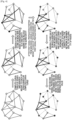
- the data assigning device 150 assigns a first value to a node (main node) corresponding to a first entity extracted by the prior knowledge extraction device 140, and assigns a second value to a node corresponding to an entity other than the first entity (a second entity) (S24) (see the upper right drawing of FIG. 4 ).
- a signal is propagated from the main node with a probability that depends on the edge weight, for example, with a probability that is proportional to the weight of the edge connecting nodes.
- a first signal is propagated with directionality centering on an edge with a high weight (S25). That is, the higher the weight of an edge is, the more the signal propagates along the edge.
- the weight correction device 160 increases the weights of edges included in the first signal propagation path, and decreases the weights of edges that are not included in the first signal propagation path, thereby correcting the weights of the edges included in the network (S27). That is, corrected weights are assigned to the edges included in the network by the weight correction device 160 (see the lower right drawing of FIG. 4 ).
- the data assigning device 150 assigns a third value in which the association between the input queried entity and the entities corresponding to a plurality of nodes constituting the network is quantified, to the nodes constituting the network (S28).
- the third value may be computed as a form of a p-value indicating the significance of the degree of increase or decrease in expression for each protein/gene in the patient's protein or gene expression data compared to a normal person or a value in which the degree of gene mutation of the patient is quantified, and the computed third value may be assigned to each of the plurality of nodes.
- a p-value indicating the significance of the degree of change in gene or protein expression when the drug is treated may correspond to the third value ( see the lower center drawing of FIG. 4 ).
- a second signal is propagated centering on an edge having a high corrected weight and a node having a high third value (S29).
- Nodes included in the second signal propagation path may be determined as target nodes (S30), and entities corresponding to the determined target nodes may be outputted through the output device 190 as entities related to the queried entity (S31).
- the ranks of the target nodes may be determined using a signal propagation result value (e.g., a data value of a node in a state in which signal propagation is saturated), and the target nodes may be listed and outputted to the output device 190 in descending order from a target node having the highest rank to a target node having the lowest rank.
- the method according to the present disclosure is applicable to various networks having different characteristics to each other, and has a remarkably high performance even when it is applied to any network.
- Equation 1 For each of the RWR method, the RWR w/ GDC (NeurIPS 2019) method, and the RWR w/ curvature method (RWR method to which a weight using the curvature of an edge is applied), an experiment was conducted to search for a target node related to a queried entity while adjusting ⁇ (beta) (see Equation 1), which is a coefficient affecting the weight assigned to an edge according to the curvature.
- ⁇ is a coefficient applied to the monotonically increasing function (see Equation 1). As the value of ⁇ changes, the rate of change of the weight assigned to an edge changes (that is, ⁇ corresponds to a parameter for controlling the effect of the edge curvature).
- the prediction performance of the method according to the present disclosure and that of the uKIN (RECOMB 2020) method were evaluated.
- the present disclosure including both a weight assigning process based on the curvature of the edge and a node data assigning process based on the prior knowledge, showed higher prediction performance than the related art including only one process.
- All or at least a part of the configuration of the system according to the embodiment of the present disclosure may be implemented in the form of a hardware module or a software module, or may be implemented in a form in which a hardware module and a software module are combined.
- the software module may be understood as, for example, instructions executed by a processor that controls operations in the system, and these instructions may have a form mounted in a memory in the target node prediction system.
- the method for searching for a target node according to the present disclosure described above may be implemented in the form of program instructions that can be executed through various computer means and recorded in a computer-readable medium.
- the computer-readable medium may include program instructions, data files, data structures, etc., alone or in combination.
- the program instructions recorded on the medium may be specially designed and configured for the present disclosure, or may be known and available to those skilled in the art of computer software.
- Examples of the computer-readable recording medium include magnetic media such as hard disks, floppy disks, and magnetic tapes, optical media such as CD-ROMs and DVDs, magneto-optical media such as floptical disks, or hardware devices specifically configured to store and execute program instructions, such as ROM, RAM, and flash memory, and the like.
- Examples of program instructions include not only machine language codes such as those generated by a compiler, but also high-level language codes that can be executed by a computer using an interpreter or the like.
- the hardware devices described above may be configured to operate as one or more software modules to carry out the operations of the present disclosure, and vice versa.
Landscapes
- Physics & Mathematics (AREA)
- Life Sciences & Earth Sciences (AREA)
- Engineering & Computer Science (AREA)
- Health & Medical Sciences (AREA)
- Medical Informatics (AREA)
- Bioinformatics & Cheminformatics (AREA)
- Spectroscopy & Molecular Physics (AREA)
- Biophysics (AREA)
- Theoretical Computer Science (AREA)
- Bioinformatics & Computational Biology (AREA)
- Biotechnology (AREA)
- Evolutionary Biology (AREA)
- General Health & Medical Sciences (AREA)
- Data Mining & Analysis (AREA)
- Molecular Biology (AREA)
- Epidemiology (AREA)
- Artificial Intelligence (AREA)
- Bioethics (AREA)
- Computer Vision & Pattern Recognition (AREA)
- Software Systems (AREA)
- Databases & Information Systems (AREA)
- Physiology (AREA)
- Evolutionary Computation (AREA)
- Public Health (AREA)
- Chemical & Material Sciences (AREA)
- Crystallography & Structural Chemistry (AREA)
- Probability & Statistics with Applications (AREA)
- Management, Administration, Business Operations System, And Electronic Commerce (AREA)
Claims (14)
- Computerimplementiertes Verfahren zum Suchen nach Zielknoten mit Bezug auf eine eingegebene abgefragte Einheit in einem Netzwerk, das eine Mehrzahl von Knoten und Kanten umfasst, wobei jeder der Mehrzahl von Knoten eine Krankheit, ein Protein, ein Gen oder ein Arzneimittel bezeichnet, wobei das Verfahren umfasst:(a) Berechnen von Krümmungen von im Netzwerk enthaltenen Kanten unter Verwendung einer Krümmungsberechnungsvorrichtung (120) und Zuweisen eines Gewichts zu jeder von Kanten basierend auf den berechneten Krümmungen unter Verwendung einer Gewichtszuweisungsvorrichtung (130);(b) Eingeben der abgefragten Einheit über eine Eingabevorrichtung (170);(c) Zuweisen eines ersten Werts, wie etwa 1, zu einem Hauptknoten entsprechend einer ersten Einheit, von der bekannt ist, dass sie mit der abgefragten Einheit in Beziehung steht, und Zuweisen eines zweiten Werts, wie etwa 0, zu einem Knoten entsprechend einer von einer ersten Einheit verschiedenen zweiten Einheit unter Verwendung einer Datenzuweisungsvorrichtung (150);(d) Ausbreiten eines ersten Signals vom Hauptknoten, wobei das erste Signal mit einer Direktionalität entlang einer Kante mit einem höheren Gewicht ausgebreitet wird;(e) Zuweisen eines korrigierten Gewichts zu jeder der im Netzwerk enthaltenen Kanten durch Erhöhen des Gewichts der in (d) in einem Signalausbreitungspfad enthaltenen Kante und Verringern des Gewichts der Kante, die nicht im Signalausbreitungspfad enthalten ist, unter Verwendung einer Gewichtskorrekturvorrichtung (160);(f) Zuweisen eines dritten Werts, der aus einer Verbindung zwischen der eingegeben abgefragten Einheit und Einheiten, die der Mehrzahl von Knoten entsprechen, die das Netzwerk bilden, quantifiziert wurde, wie etwa eines p-Werts, der eine Signifikanz eines Ausmaßes einer Zunahme oder Abnahme einer Expression für jedes Protein/Gen in Protein- oder Genexpressionsdaten eines Patienten im Vergleich zu einer normalen Person angibt, oder eines Werts, der ein Ausmaß einer Genmutation angibt, zu der Mehrzahl von Knoten unter Verwendung der Datenzuweisungsvorrichtung (150);(g) Ausbreiten eines zweiten Signals basierend auf dem korrigierten Gewicht und dem dritten Wert;(h) Bestimmen von Knoten, die im Ausbreitungspfad des zweiten Signals in (g) enthalten sind, als die Zielknoten und(i) Ausgeben von Einheiten entsprechend den bestimmten Zielknoten als Einheiten mit Bezug auf die abgefragte Einheit über eine Ausgabevorrichtung (190).
- Computerimplementiertes Verfahren nach Anspruch 1, wobei das Verfahren ein Verfahren zum Suchen nach einem Zielknoten mit Bezug auf eine eingegebene abgefragte Einheit in einem homogenen Netzwerk ist, das eine Mehrzahl von Knoten, die zu einer gleichen Kategorie unter Kategorien wie Krankheiten, Proteine oder Gene und Arzneimittel gehören, und eine Mehrzahl von Kanten umfasst, die die Knoten verbinden; und wobei (b) ein Eingeben einer abgefragten Einheit umfasst, die zu einer Kategorie gehört, die von jener eines Knotens verschieden ist, der das homogene Netzwerk bildet.
- Computerimplementiertes Verfahren nach Anspruch 1, wobei in (g) ein Knoten mit einem höheren dritten Wert ausgehend vom entsprechenden Knoten eine höhere Signalintensität aufweist, wobei das zweite Signal mit einer Direktionalität entlang einer Kante mit einem höheren korrigierten Gewicht ausgebreitet wird; wobei sich in (g) bei Ausbreitung des zweiten Signals ein Datenwert des Knotens des Netzwerks ändert und ein Zustand, in dem sich der Datenwert des Knotens nicht ändert, als ein Signalausbreitungssättigungszustand definiert wird; wobei (h) weiterhin ein Bestimmen der Zielknoten basierend auf Datenwerten der Knoten im Signalausbreitungssättigungszustand umfasst, wobei sich der Datenwert in einer Richtung ändert, in der der Datenwert des Knotens proportional zur Anzahl der Durchläufe des zweiten Signals durch den Knoten im Signalausbreitungsprozess zunimmt.
- Computerimplementiertes Verfahren nach Anspruch 1, wobei, wenn eine Kategorie der abgefragten Einheit eine Krankheit ist, der dritte Wert einen Wert von Vergleichsdaten umfasst, die durch Vergleichen erster biologischer Daten, die eine Person mit einer der abgefragten Einheit entsprechenden Krankheit besitzt, mit zweiten biologischen Daten, die eine Person ohne eine der abgefragten Einheit entsprechende Krankheit besitzt, erhalten werden.
- Computerimplementiertes Verfahren nach Anspruch 4, wobei der dritte Wert ein p-Wert, der die Signifikanz eines Ausmaßes einer Zunahme oder Abnahme einer Expression für jedes Protein oder Gen eines Patienten mit einer der abgefragten Einheit entsprechenden Krankheit angibt, oder ein Wert ist, in dem ein Ausmaß einer Genmutation eines Patienten mit einer der abgefragten Einheit entsprechenden Krankheit quantifiziert wird.
- Computerimplementiertes Verfahren nach Anspruch 1, wobei, wenn eine Kategorie der abgefragten Einheit ein Arzneimittel ist, der dritte Wert einen Änderungswert biologischer Daten umfasst, die in einer spezifischen Einheit auftreten, wenn die spezifische Einheit mit dem der abgefragten Einheit entsprechenden Arzneimittel behandelt wird.
- Computerimplementiertes Verfahren nach Anspruch 6, wobei der dritte Wert ein p-Wert ist, der die Signifikanz eines Ausmaßes einer Expressionsänderung für jedes Protein oder Gen angibt, wenn die spezifische Einheit mit dem der abgefragten Einheit entsprechenden Arzneimittel behandelt wird.
- Computerimplementiertes Verfahren nach Anspruch 1, wobei in (a) die Krümmung jeder Kante basierend auf Anzahlen benachbarter Knoten bestimmt wird, die an die ersten und zweiten Knoten angrenzen, die durch die Kante miteinander verbunden sind, wobei, wenn die Anzahl dritter Knoten, die durch die Kante mit dem ersten Knoten verbunden sind, N_s ist, die Anzahl vierter Knoten, die durch die Kante mit dem zweiten Knoten verbunden sind, N_t ist und die Anzahl von Schnittpunkten der dritten Knoten und der vierten Knoten N_i ist, die Krümmung jeder Kante durch 4 - (N_s) - (N_t) + 3 × (N_i) bestimmt wird.
- Computerimplementiertes Verfahren nach Anspruch 8, wobei in (a) ein jeder Kante zugewiesenes Gewicht durch einen Wert bestimmt wird, der von einer monoton zunehmenden Funktion mit einer Krümmung ausgegeben wird, die als 4 - (N_s) - (N_t) + 3 × (N_i) als eine Variable bestimmt wird.
- Computerimplementiertes Verfahren nach Anspruch 9, wobei die monoton zunehmende Funktion ist:

k der Durchschnitt der Krümmungen ist und sd(k) der Standardabweichung der Krümmungen entspricht. - Computerimplementiertes Verfahren nach Anspruch 1, wobei das Netzwerk ein homogenes Netzwerk ist, das Proteinknoten und eine Beziehung zwischen den Proteinknoten als eine Kante umfasst, die abgefragte Einheit eine Krankheit oder ein Arzneimittel ist und die erste Einheit ein Protein ist, von dem bekannt ist, dass es mit der Krankheit oder dem Arzneimittel in Zusammenhang steht.
- Verfahren nach Anspruch 1, weiterhin umfassend, vor (a), (a0) Extrahieren eines homogenen Netzwerks mit Knoten und einer Kante, die eine Beziehung zwischen den Knoten darstellt, indem unter Verwendung der Netzwerkextraktionsvorrichtung ein Knoten von nur einem Typ einer Krankheit, eines Proteins oder eines Gens und eines Arzneimittels aus einem heterogenen Netzwerk extrahiert wird, in dem eine oder mehrere Krankheiten, Proteine, Gene und Arzneimittel als Knoten definiert sind und eine Beziehung zwischen den Knoten als eine Kante definiert ist.
- System (100), das unter Verwendung des Verfahrens nach einem der Ansprüche 1 bis 12 aufgebaut ist.
- Nichtflüchtiges computerlesbares Programmprodukt zum Ausführen des Verfahrens nach einem der Ansprüche 1 bis 12.
Applications Claiming Priority (3)
| Application Number | Priority Date | Filing Date | Title |
|---|---|---|---|
| KR20210012015 | 2021-01-28 | ||
| KR1020210057257A KR102288957B1 (ko) | 2021-01-28 | 2021-05-03 | 네트워크에서 질의 개체와 관련된 타겟 노드를 탐색하는 방법 및 시스템 |
| PCT/KR2022/001512 WO2022164236A1 (en) | 2021-01-28 | 2022-01-27 | Method and system for searching target node related to queried entity in network |
Publications (3)
| Publication Number | Publication Date |
|---|---|
| EP4285367A1 EP4285367A1 (de) | 2023-12-06 |
| EP4285367A4 EP4285367A4 (de) | 2024-07-03 |
| EP4285367B1 true EP4285367B1 (de) | 2025-06-04 |
Family
ID=77314482
Family Applications (1)
| Application Number | Title | Priority Date | Filing Date |
|---|---|---|---|
| EP22746262.9A Active EP4285367B1 (de) | 2021-01-28 | 2022-01-27 | Verfahren und system zum suchen eines zielknotens in bezug auf eine abgefragte einheit in einem netzwerk |
Country Status (3)
| Country | Link |
|---|---|
| EP (1) | EP4285367B1 (de) |
| KR (2) | KR102288957B1 (de) |
| WO (1) | WO2022164236A1 (de) |
Families Citing this family (1)
| Publication number | Priority date | Publication date | Assignee | Title |
|---|---|---|---|---|
| KR102288957B1 (ko) * | 2021-01-28 | 2021-08-12 | 주식회사 스탠다임 | 네트워크에서 질의 개체와 관련된 타겟 노드를 탐색하는 방법 및 시스템 |
Family Cites Families (5)
| Publication number | Priority date | Publication date | Assignee | Title |
|---|---|---|---|---|
| KR101450784B1 (ko) * | 2013-07-02 | 2014-10-23 | 아주대학교산학협력단 | 전자의무기록과 약물/질환 네트워크 정보 기반의 신약 재창출 후보 예측 방법 |
| KR102334532B1 (ko) | 2015-06-18 | 2021-12-03 | 재단법인 전통천연물기반 유전자동의보감 사업단 | 단백질 상호 작용 네트워크에서 신호 전파 간섭을 통한 약력학적 약물 상호 작용 예측 장치 및 방법 |
| KR102174630B1 (ko) * | 2018-04-30 | 2020-11-06 | 아주대학교산학협력단 | 질병 관련 유전자 순위정보 제공 방법 |
| KR102321732B1 (ko) * | 2018-12-26 | 2021-11-03 | 가천대학교 산학협력단 | Snp를 포함하는 약물의 효능변화 예측장치, 방법, 및 컴퓨터-판독가능매체 |
| KR102288957B1 (ko) * | 2021-01-28 | 2021-08-12 | 주식회사 스탠다임 | 네트워크에서 질의 개체와 관련된 타겟 노드를 탐색하는 방법 및 시스템 |
-
2021
- 2021-05-03 KR KR1020210057257A patent/KR102288957B1/ko active Active
- 2021-08-05 KR KR1020210103264A patent/KR102658417B1/ko active Active
-
2022
- 2022-01-27 EP EP22746262.9A patent/EP4285367B1/de active Active
- 2022-01-27 WO PCT/KR2022/001512 patent/WO2022164236A1/en not_active Ceased
Also Published As
| Publication number | Publication date |
|---|---|
| EP4285367A1 (de) | 2023-12-06 |
| EP4285367A4 (de) | 2024-07-03 |
| WO2022164236A1 (en) | 2022-08-04 |
| KR20220109285A (ko) | 2022-08-04 |
| KR102288957B1 (ko) | 2021-08-12 |
| KR102658417B1 (ko) | 2024-04-17 |
Similar Documents
| Publication | Publication Date | Title |
|---|---|---|
| US20250013867A1 (en) | Apparatus and method of compressing neural network | |
| EP3912099B1 (de) | Verbundmodellskalierung für neuronale netze | |
| CN109243538B (zh) | 一种预测疾病与LncRNA关联关系的方法及系统 | |
| US20210303967A1 (en) | Neural architecture search with weight sharing | |
| CN113703768B (zh) | 张量程序优化方法及装置 | |
| US9063914B2 (en) | Systems and methods for transcriptome analysis | |
| Das et al. | SDhaP: haplotype assembly for diploids and polyploids via semi-definite programming | |
| US20220215899A1 (en) | Affinity prediction method and apparatus, method and apparatus for training affinity prediction model, device and medium | |
| Tan et al. | Efficient search of the best warping window for dynamic time warping | |
| CN116705169A (zh) | 多源数据融合方法、装置、电子设备及存储介质 | |
| CN113488104A (zh) | 基于局部和全局的网络中心性分析的癌症驱动基因预测方法及系统 | |
| US20200327963A1 (en) | Latent Space Exploration Using Linear-Spherical Interpolation Region Method | |
| EP3474274A1 (de) | Spracherkennungsverfahren und -vorrichtung | |
| US20160070854A1 (en) | Aligning and clustering sequence patterns to reveal classificatory functionality of sequences | |
| EP3696710A1 (de) | Verfahren und vorrichtung auf basis eines modells eines neuronalen netzes und speichermedium | |
| US20240395367A1 (en) | Method and apparatus for designing ligand molecules | |
| Xia et al. | A sequential niche multimodal conformational sampling algorithm for protein structure prediction | |
| Saraswathi et al. | Fast learning optimized prediction methodology (FLOPRED) for protein secondary structure prediction | |
| US11048852B1 (en) | System, method and computer program product for automatic generation of sizing constraints by reusing existing electronic designs | |
| KR102658417B1 (ko) | 방향성을 가지는 네트워크를 이용한 타겟 탐색 방법 | |
| US20240045873A1 (en) | Method and system for searching target node related to queried entity in network | |
| Avraham et al. | The discrete Fréchet distance with shortcuts via approximate distance counting and selection | |
| WO2025101414A1 (en) | Knowledge graph framework for drug target identification | |
| Rupavath et al. | A Deep Learning Based Metastasis Prediction System Using Multi Omics Data and Recursive Neural Network | |
| US20230410936A1 (en) | Network approach to navigating the human genome |
Legal Events
| Date | Code | Title | Description |
|---|---|---|---|
| STAA | Information on the status of an ep patent application or granted ep patent |
Free format text: STATUS: THE INTERNATIONAL PUBLICATION HAS BEEN MADE |
|
| PUAI | Public reference made under article 153(3) epc to a published international application that has entered the european phase |
Free format text: ORIGINAL CODE: 0009012 |
|
| STAA | Information on the status of an ep patent application or granted ep patent |
Free format text: STATUS: REQUEST FOR EXAMINATION WAS MADE |
|
| 17P | Request for examination filed |
Effective date: 20230808 |
|
| AK | Designated contracting states |
Kind code of ref document: A1 Designated state(s): AL AT BE BG CH CY CZ DE DK EE ES FI FR GB GR HR HU IE IS IT LI LT LU LV MC MK MT NL NO PL PT RO RS SE SI SK SM TR |
|
| DAV | Request for validation of the european patent (deleted) | ||
| DAX | Request for extension of the european patent (deleted) | ||
| A4 | Supplementary search report drawn up and despatched |
Effective date: 20240605 |
|
| RIC1 | Information provided on ipc code assigned before grant |
Ipc: G16B 45/00 20190101ALI20240530BHEP Ipc: G16B 40/20 20190101ALI20240530BHEP Ipc: G16B 5/00 20190101AFI20240530BHEP |
|
| GRAP | Despatch of communication of intention to grant a patent |
Free format text: ORIGINAL CODE: EPIDOSNIGR1 |
|
| STAA | Information on the status of an ep patent application or granted ep patent |
Free format text: STATUS: GRANT OF PATENT IS INTENDED |
|
| INTG | Intention to grant announced |
Effective date: 20250107 |
|
| GRAS | Grant fee paid |
Free format text: ORIGINAL CODE: EPIDOSNIGR3 |
|
| GRAA | (expected) grant |
Free format text: ORIGINAL CODE: 0009210 |
|
| STAA | Information on the status of an ep patent application or granted ep patent |
Free format text: STATUS: THE PATENT HAS BEEN GRANTED |
|
| AK | Designated contracting states |
Kind code of ref document: B1 Designated state(s): AL AT BE BG CH CY CZ DE DK EE ES FI FR GB GR HR HU IE IS IT LI LT LU LV MC MK MT NL NO PL PT RO RS SE SI SK SM TR |
|
| RAP3 | Party data changed (applicant data changed or rights of an application transferred) |
Owner name: STANDIGM INC. |
|
| REG | Reference to a national code |
Ref country code: GB Ref legal event code: FG4D |
|
| RIN1 | Information on inventor provided before grant (corrected) |
Inventor name: YUN, SO JEONG Inventor name: KOO, HEE JUNG Inventor name: KIM, TAE YONG Inventor name: HAN, SEOKJIN |
|
| REG | Reference to a national code |
Ref country code: CH Ref legal event code: EP |
|
| REG | Reference to a national code |
Ref country code: DE Ref legal event code: R096 Ref document number: 602022015583 Country of ref document: DE |
|
| REG | Reference to a national code |
Ref country code: IE Ref legal event code: FG4D |
|
| REG | Reference to a national code |
Ref country code: NL Ref legal event code: MP Effective date: 20250604 |
|
| PG25 | Lapsed in a contracting state [announced via postgrant information from national office to epo] |
Ref country code: ES Free format text: LAPSE BECAUSE OF FAILURE TO SUBMIT A TRANSLATION OF THE DESCRIPTION OR TO PAY THE FEE WITHIN THE PRESCRIBED TIME-LIMIT Effective date: 20250604 Ref country code: FI Free format text: LAPSE BECAUSE OF FAILURE TO SUBMIT A TRANSLATION OF THE DESCRIPTION OR TO PAY THE FEE WITHIN THE PRESCRIBED TIME-LIMIT Effective date: 20250604 |
|
| REG | Reference to a national code |
Ref country code: LT Ref legal event code: MG9D |
|
| PG25 | Lapsed in a contracting state [announced via postgrant information from national office to epo] |
Ref country code: NO Free format text: LAPSE BECAUSE OF FAILURE TO SUBMIT A TRANSLATION OF THE DESCRIPTION OR TO PAY THE FEE WITHIN THE PRESCRIBED TIME-LIMIT Effective date: 20250904 Ref country code: GR Free format text: LAPSE BECAUSE OF FAILURE TO SUBMIT A TRANSLATION OF THE DESCRIPTION OR TO PAY THE FEE WITHIN THE PRESCRIBED TIME-LIMIT Effective date: 20250905 |
|
| PG25 | Lapsed in a contracting state [announced via postgrant information from national office to epo] |
Ref country code: PL Free format text: LAPSE BECAUSE OF FAILURE TO SUBMIT A TRANSLATION OF THE DESCRIPTION OR TO PAY THE FEE WITHIN THE PRESCRIBED TIME-LIMIT Effective date: 20250604 |
|
| PG25 | Lapsed in a contracting state [announced via postgrant information from national office to epo] |
Ref country code: BG Free format text: LAPSE BECAUSE OF FAILURE TO SUBMIT A TRANSLATION OF THE DESCRIPTION OR TO PAY THE FEE WITHIN THE PRESCRIBED TIME-LIMIT Effective date: 20250604 |
|
| PG25 | Lapsed in a contracting state [announced via postgrant information from national office to epo] |
Ref country code: HR Free format text: LAPSE BECAUSE OF FAILURE TO SUBMIT A TRANSLATION OF THE DESCRIPTION OR TO PAY THE FEE WITHIN THE PRESCRIBED TIME-LIMIT Effective date: 20250604 |
|
| PG25 | Lapsed in a contracting state [announced via postgrant information from national office to epo] |
Ref country code: RS Free format text: LAPSE BECAUSE OF FAILURE TO SUBMIT A TRANSLATION OF THE DESCRIPTION OR TO PAY THE FEE WITHIN THE PRESCRIBED TIME-LIMIT Effective date: 20250904 |
|
| PG25 | Lapsed in a contracting state [announced via postgrant information from national office to epo] |
Ref country code: LV Free format text: LAPSE BECAUSE OF FAILURE TO SUBMIT A TRANSLATION OF THE DESCRIPTION OR TO PAY THE FEE WITHIN THE PRESCRIBED TIME-LIMIT Effective date: 20250604 |
|
| PG25 | Lapsed in a contracting state [announced via postgrant information from national office to epo] |
Ref country code: NL Free format text: LAPSE BECAUSE OF FAILURE TO SUBMIT A TRANSLATION OF THE DESCRIPTION OR TO PAY THE FEE WITHIN THE PRESCRIBED TIME-LIMIT Effective date: 20250604 |
|
| PG25 | Lapsed in a contracting state [announced via postgrant information from national office to epo] |
Ref country code: PT Free format text: LAPSE BECAUSE OF FAILURE TO SUBMIT A TRANSLATION OF THE DESCRIPTION OR TO PAY THE FEE WITHIN THE PRESCRIBED TIME-LIMIT Effective date: 20251006 |
|
| REG | Reference to a national code |
Ref country code: AT Ref legal event code: MK05 Ref document number: 1801191 Country of ref document: AT Kind code of ref document: T Effective date: 20250604 |
|
| PG25 | Lapsed in a contracting state [announced via postgrant information from national office to epo] |
Ref country code: IS Free format text: LAPSE BECAUSE OF FAILURE TO SUBMIT A TRANSLATION OF THE DESCRIPTION OR TO PAY THE FEE WITHIN THE PRESCRIBED TIME-LIMIT Effective date: 20251004 |
|
| PG25 | Lapsed in a contracting state [announced via postgrant information from national office to epo] |
Ref country code: AT Free format text: LAPSE BECAUSE OF FAILURE TO SUBMIT A TRANSLATION OF THE DESCRIPTION OR TO PAY THE FEE WITHIN THE PRESCRIBED TIME-LIMIT Effective date: 20250604 Ref country code: SM Free format text: LAPSE BECAUSE OF FAILURE TO SUBMIT A TRANSLATION OF THE DESCRIPTION OR TO PAY THE FEE WITHIN THE PRESCRIBED TIME-LIMIT Effective date: 20250604 |
|
| PG25 | Lapsed in a contracting state [announced via postgrant information from national office to epo] |
Ref country code: CZ Free format text: LAPSE BECAUSE OF FAILURE TO SUBMIT A TRANSLATION OF THE DESCRIPTION OR TO PAY THE FEE WITHIN THE PRESCRIBED TIME-LIMIT Effective date: 20250604 |
|
| PG25 | Lapsed in a contracting state [announced via postgrant information from national office to epo] |
Ref country code: EE Free format text: LAPSE BECAUSE OF FAILURE TO SUBMIT A TRANSLATION OF THE DESCRIPTION OR TO PAY THE FEE WITHIN THE PRESCRIBED TIME-LIMIT Effective date: 20250604 |
|
| PG25 | Lapsed in a contracting state [announced via postgrant information from national office to epo] |
Ref country code: SK Free format text: LAPSE BECAUSE OF FAILURE TO SUBMIT A TRANSLATION OF THE DESCRIPTION OR TO PAY THE FEE WITHIN THE PRESCRIBED TIME-LIMIT Effective date: 20250604 |
|
| PG25 | Lapsed in a contracting state [announced via postgrant information from national office to epo] |
Ref country code: IT Free format text: LAPSE BECAUSE OF FAILURE TO SUBMIT A TRANSLATION OF THE DESCRIPTION OR TO PAY THE FEE WITHIN THE PRESCRIBED TIME-LIMIT Effective date: 20250604 |
|
| REG | Reference to a national code |
Ref country code: DE Ref legal event code: R097 Ref document number: 602022015583 Country of ref document: DE |
|
| PGFP | Annual fee paid to national office [announced via postgrant information from national office to epo] |
Ref country code: GB Payment date: 20260122 Year of fee payment: 5 |
|
| PLBE | No opposition filed within time limit |
Free format text: ORIGINAL CODE: 0009261 |
|
| STAA | Information on the status of an ep patent application or granted ep patent |
Free format text: STATUS: NO OPPOSITION FILED WITHIN TIME LIMIT |
|
| PG25 | Lapsed in a contracting state [announced via postgrant information from national office to epo] |
Ref country code: DK Free format text: LAPSE BECAUSE OF FAILURE TO SUBMIT A TRANSLATION OF THE DESCRIPTION OR TO PAY THE FEE WITHIN THE PRESCRIBED TIME-LIMIT Effective date: 20250604 |
|
| REG | Reference to a national code |
Ref country code: CH Ref legal event code: L10 Free format text: ST27 STATUS EVENT CODE: U-0-0-L10-L00 (AS PROVIDED BY THE NATIONAL OFFICE) Effective date: 20260416 |
|
| 26N | No opposition filed |
Effective date: 20260305 |