EP4285090B1 - Elektronischer strebenmonitor - Google Patents
Elektronischer strebenmonitor Download PDFInfo
- Publication number
- EP4285090B1 EP4285090B1 EP22704268.6A EP22704268A EP4285090B1 EP 4285090 B1 EP4285090 B1 EP 4285090B1 EP 22704268 A EP22704268 A EP 22704268A EP 4285090 B1 EP4285090 B1 EP 4285090B1
- Authority
- EP
- European Patent Office
- Prior art keywords
- monitor
- housing
- monitoring device
- coupling mechanism
- strut
- Prior art date
- Legal status (The legal status is an assumption and is not a legal conclusion. Google has not performed a legal analysis and makes no representation as to the accuracy of the status listed.)
- Active
Links
Images







Classifications
-
- G—PHYSICS
- G06—COMPUTING OR CALCULATING; COUNTING
- G06K—GRAPHICAL DATA READING; PRESENTATION OF DATA; RECORD CARRIERS; HANDLING RECORD CARRIERS
- G06K7/00—Methods or arrangements for sensing record carriers, e.g. for reading patterns
- G06K7/10—Methods or arrangements for sensing record carriers, e.g. for reading patterns by electromagnetic radiation, e.g. optical sensing; by corpuscular radiation
- G06K7/10009—Methods or arrangements for sensing record carriers, e.g. for reading patterns by electromagnetic radiation, e.g. optical sensing; by corpuscular radiation sensing by radiation using wavelengths larger than 0.1 mm, e.g. radio-waves or microwaves
- G06K7/10366—Methods or arrangements for sensing record carriers, e.g. for reading patterns by electromagnetic radiation, e.g. optical sensing; by corpuscular radiation sensing by radiation using wavelengths larger than 0.1 mm, e.g. radio-waves or microwaves the interrogation device being adapted for miscellaneous applications
-
- E—FIXED CONSTRUCTIONS
- E04—BUILDING
- E04G—SCAFFOLDING; FORMS; SHUTTERING; BUILDING IMPLEMENTS OR AIDS, OR THEIR USE; HANDLING BUILDING MATERIALS ON THE SITE; REPAIRING, BREAKING-UP OR OTHER WORK ON EXISTING BUILDINGS
- E04G25/00—Shores or struts; Chocks
- E04G25/04—Shores or struts; Chocks telescopic
-
- G—PHYSICS
- G01—MEASURING; TESTING
- G01C—MEASURING DISTANCES, LEVELS OR BEARINGS; SURVEYING; NAVIGATION; GYROSCOPIC INSTRUMENTS; PHOTOGRAMMETRY OR VIDEOGRAMMETRY
- G01C9/00—Measuring inclination, e.g. by clinometers, by levels
- G01C9/02—Details
- G01C9/04—Transmission means between sensing element and final indicator for giving an enlarged reading
-
- G—PHYSICS
- G01—MEASURING; TESTING
- G01H—MEASUREMENT OF MECHANICAL VIBRATIONS OR ULTRASONIC, SONIC OR INFRASONIC WAVES
- G01H1/00—Measuring characteristics of vibrations in solids by using direct conduction to the detector
-
- G—PHYSICS
- G01—MEASURING; TESTING
- G01L—MEASURING FORCE, STRESS, TORQUE, WORK, MECHANICAL POWER, MECHANICAL EFFICIENCY, OR FLUID PRESSURE
- G01L1/00—Measuring force or stress, in general
- G01L1/005—Measuring force or stress, in general by electrical means and not provided for in G01L1/06 - G01L1/22
-
- G—PHYSICS
- G01—MEASURING; TESTING
- G01M—TESTING STATIC OR DYNAMIC BALANCE OF MACHINES OR STRUCTURES; TESTING OF STRUCTURES OR APPARATUS, NOT OTHERWISE PROVIDED FOR
- G01M5/00—Investigating the elasticity of structures, e.g. deflection of bridges or air-craft wings
- G01M5/0041—Investigating the elasticity of structures, e.g. deflection of bridges or air-craft wings by determining deflection or stress
- G01M5/005—Investigating the elasticity of structures, e.g. deflection of bridges or air-craft wings by determining deflection or stress by means of external apparatus, e.g. test benches or portable test systems
- G01M5/0058—Investigating the elasticity of structures, e.g. deflection of bridges or air-craft wings by determining deflection or stress by means of external apparatus, e.g. test benches or portable test systems of elongated objects, e.g. pipes, masts, towers or railways
-
- G—PHYSICS
- G01—MEASURING; TESTING
- G01M—TESTING STATIC OR DYNAMIC BALANCE OF MACHINES OR STRUCTURES; TESTING OF STRUCTURES OR APPARATUS, NOT OTHERWISE PROVIDED FOR
- G01M5/00—Investigating the elasticity of structures, e.g. deflection of bridges or air-craft wings
- G01M5/0066—Investigating the elasticity of structures, e.g. deflection of bridges or air-craft wings by exciting or detecting vibration or acceleration
-
- G—PHYSICS
- G06—COMPUTING OR CALCULATING; COUNTING
- G06K—GRAPHICAL DATA READING; PRESENTATION OF DATA; RECORD CARRIERS; HANDLING RECORD CARRIERS
- G06K19/00—Record carriers for use with machines and with at least a part designed to carry digital markings
- G06K19/06—Record carriers for use with machines and with at least a part designed to carry digital markings characterised by the kind of the digital marking, e.g. shape, nature, code
- G06K19/067—Record carriers with conductive marks, printed circuits or semiconductor circuit elements, e.g. credit or identity cards also with resonating or responding marks without active components
- G06K19/07—Record carriers with conductive marks, printed circuits or semiconductor circuit elements, e.g. credit or identity cards also with resonating or responding marks without active components with integrated circuit chips
- G06K19/077—Constructional details, e.g. mounting of circuits in the carrier
- G06K19/07749—Constructional details, e.g. mounting of circuits in the carrier the record carrier being capable of non-contact communication, e.g. constructional details of the antenna of a non-contact smart card
- G06K19/07758—Constructional details, e.g. mounting of circuits in the carrier the record carrier being capable of non-contact communication, e.g. constructional details of the antenna of a non-contact smart card arrangements for adhering the record carrier to further objects or living beings, functioning as an identification tag
-
- G—PHYSICS
- G06—COMPUTING OR CALCULATING; COUNTING
- G06Q—INFORMATION AND COMMUNICATION TECHNOLOGY [ICT] SPECIALLY ADAPTED FOR ADMINISTRATIVE, COMMERCIAL, FINANCIAL, MANAGERIAL OR SUPERVISORY PURPOSES; SYSTEMS OR METHODS SPECIALLY ADAPTED FOR ADMINISTRATIVE, COMMERCIAL, FINANCIAL, MANAGERIAL OR SUPERVISORY PURPOSES, NOT OTHERWISE PROVIDED FOR
- G06Q50/00—Information and communication technology [ICT] specially adapted for implementation of business processes of specific business sectors, e.g. utilities or tourism
- G06Q50/10—Services
-
- G—PHYSICS
- G08—SIGNALLING
- G08B—SIGNALLING OR CALLING SYSTEMS; ORDER TELEGRAPHS; ALARM SYSTEMS
- G08B21/00—Alarms responsive to a single specified undesired or abnormal condition and not otherwise provided for
- G08B21/18—Status alarms
-
- G—PHYSICS
- G08—SIGNALLING
- G08B—SIGNALLING OR CALLING SYSTEMS; ORDER TELEGRAPHS; ALARM SYSTEMS
- G08B21/00—Alarms responsive to a single specified undesired or abnormal condition and not otherwise provided for
- G08B21/18—Status alarms
- G08B21/182—Level alarms, e.g. alarms responsive to variables exceeding a threshold
-
- G—PHYSICS
- G08—SIGNALLING
- G08C—TRANSMISSION SYSTEMS FOR MEASURED VALUES, CONTROL OR SIMILAR SIGNALS
- G08C17/00—Arrangements for transmitting signals characterised by the use of a wireless electrical link
- G08C17/02—Arrangements for transmitting signals characterised by the use of a wireless electrical link using a radio link
Definitions
- a strut may be utilized to brace an unstable structure.
- one or more struts may be positioned to brace an unstable structure of a vehicle following an accident.
- one or more struts may be positioned to reinforce damaged structures within a ship, such as bulkheads, sections of a hull, or hatches.
- one or more struts may be positioned to bear part, or all, of a weight of a wall, a ceiling, or a roof of an unstable structure.
- a strut may be utilized by emergency services, or other users, in time-sensitive situations and/or situations in which the types of on-hand materials are limited, and in which there is a possibility of/ there has been structural failure of load-bearing elements.
- CN 108 798 068 A describes a safe supporting system suitable for fabricated building and bridge construction.
- the safe supporting system comprises a lower supporting pipe, an upper supporting pipe and an adjusting supporting pipe; a first through groove penetrating in the front-rear direction is formed in the lower end of the main support.
- US 2020/299983 A1 describes a strut which includes a first post section and a second post section.
- the first post section includes a first portion that is coaxial with, annular to and slidably disposed within a second portion of the second post section.
- a damping actuator is interposed between the first post section and the second post section, and is arranged to dynamically control a position of the first post section in relation to the second post section.
- US 2015/144762 A1 describes a system for adjustable construction or demolition temporary supports.
- the adjustable construction or demolition temporary support includes a plurality of sensor devices for measuring load on the support and signal detection and communication device that being in communication with the sensor devices.
- the communication device further comprises a display unit and/or audio output unit for providing visual and/or audible alarm for alarming conditions.
- US 2015/308474 A1 describes a shaft adapter configured to be removably-coupled to shafts of differing diameters.
- the shaft adapter may have a stepped cylinder cavity with multiple inner diameters.
- the shaft adapter may further have a spring-loaded adapter ring configured to translate along an inner wall of the stepped cylinder cavity, and may be configured to support an outer wall of a first shaft received into the shaft adapter, or may be configured to be urged into a compressed position when the shaft adapter receives a second shaft.
- an electronic monitor configured to monitor the structural conditions of a structure or a strut that is part of a bracing system.
- FIG. 1 depicts an electronic monitor device 100.
- the electronic monitor device 100 may be referred to as an electronic monitor 100, an electronic strut monitor 100 or an in-line electronic strut monitor 100.
- the electronic monitor 100 is configured to be removably coupled to a temporary support strut, according to one or more aspects described herein.
- the electronic monitor 100 may also be configured to be operable when coupled to other structural elements/ structure types.
- the electronic monitor may be coupled to a clamp that is, in turn, coupled to a structure, such as an unstable structure.
- the in-line electronic strut monitor 100 may otherwise be referred to as monitor 100 throughout this disclosure, and includes a housing 102.
- This housing 102 may be configured to be positioned within a structural support system, and as such, may have structural geometries and materials configured to withstand external forces exerted upon the housing 102 from one or more structural members to which the monitor 100 is removably coupled.
- the housing 102 has a first end 104 spaced apart from a second end 106 along an axial length that is schematically depicted as axial length 108/axial direction 108.
- the first end 104 has a first bore 105 that extends at least partially into the housing 104 and is configured to receive a first end of an external temporary support strut (not depicted in FIG. 1 ).
- the housing 102 has one or more cylindrical geometries configured to the attached to external cylindrical temporary support strut elements.
- the schematic axial length 108 may extend through a center of these cylindrical structures.
- the various disclosures described herein related to an in-line electronic strut monitor 100 may utilize a housing with alternative geometries.
- housing 102 may be constructed from one or more metals, alloys, polymers, ceramics, or fiber-reinforced materials.
- the load-bearing components of the housing 102 may be constructed from an aluminum alloy.
- the monitor 100 additionally includes a first coupling mechanism 110 at the first end 104.
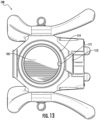
- the first coupling mechanism 110 may comprise a spring-loaded catch 171 (depicted in FIG. 13 ) that extends into the bore 105 and is configured to interact with a circumferential channel extending around a portion of a first end of an external temporary support strut that is received into the bore 105.
- the spring-loaded catch 171 that extends into the bore 105 may be implemented with a geometry such that when a first end of a temporary support strut is received into the bore 105, the spring-loaded catch 171 is urged back into a side wall of the housing 102 without requiring the pull button 112 on an external sidewall 114 of the first end 104 of the housing 102 to be manually actuated.
- the pull button 112 may be manually actuated in order to receive an external support strut into the first coupling mechanism 110.
- the pull button 112 in order to actuate the first coupling mechanism 110, the pull button 112 is manually pulled away from the side wall 114, which retracts the spring-loaded catch 171 within the bore 105 back into the side wall 114 of the housing 104.
- the coupling mechanism 110 may be implemented such that an internal spring urges the catch 171 out of the side wall 114 and into the bore 105 when a manual force is not applied to pull the pull button 112 away from the side wall 114.
- the second end 106 of the housing 102 includes a second coupling mechanism 111.
- the second coupling mechanism 111 may include geometrical features configured to be received into a coupling mechanism similar to that of the first coupling mechanism 110.
- the monitor 100 may be compatible with/removably coupled with similar structures to those that the temporary support strut is configured to be compatible with.
- the geometries of the second coupling mechanism 111 may be similar to the geometries of a first end of a temporary support strut (not depicted) that is configured to be received into the first coupling mechanism 110.
- the second coupling mechanism 111 may have a cylindrical structure 116/cylindrical shaft 116 with a diameter configured to be received into a bore with a bore geometry similar to that of bore 105.
- the second coupling mechanism 11 additionally includes a circumferential channel 118 that extends around a circumference of the cylindrical shaft 116. This circumferential channel 118 may be configured to interact with a catch structure of a coupling mechanism, similar to the catch 171 attached to the pull button 112 of the first coupling mechanism 110. Accordingly, the catch structure is configured to be received into the channel 118, and thereby prevent the cylindrical shaft 116 from translating along the axial direction 108.
- the second coupling mechanism 111 additionally includes a chamfered/filleted surface 120 configured to guide the cylindrical shaft 118 into a receiving bore similar to bore 105.
- the housing 102 may have a cylindrical outer sidewall 114 adjacent to the first end 104 and cylindrical outer sidewall 122 adjacent to the second end 106.
- the housing 102 may include a substantially cuboidal structure 124 spaced between the first end 104 and the second end 106. This substantially cuboidal structure 124 of the housing 102 may include planar outer sidewalls.
- a first sidewall 125 may include a third coupling mechanism 170 (depicted in greater detail in FIG. 9 ).
- the housing 102 additionally includes a monitoring device 130.
- Monitoring device 130 may include external elements visible on the exterior of the monitor 100, and internal elements within the housing 102.
- the monitoring device 130 includes a load cell configured to measure a force exerted on the first coupling mechanism 110. This force may be exerted by an external structure on the coupling mechanism 110. In one example, the external force may be exerted by a removably coupled temporary support strut, a first end of which is securely and removably coupled within the first coupling mechanism 110.
- the load cell of the monitoring device 130 is configured to measure at least a portion of a compressive load (force) exerted on the housing 102 and/or on the first coupling 110.
- force compressive load
- a total force exerted on the monitor 100 may be extrapolated based upon knowledge of the geometry of the load cell relative to the first coupling mechanism 110 as a whole.
- the load cell of the monitoring device 130 may be subjected to a full load/force exerted by an external structure upon the housing 102 of the monitor 100.
- the load cell of the monitoring device 130 may utilize any load cell configuration and/or materials without departing from the scope of the invention as defined by the claims.
- the load cell of the monitoring device 130 may be configured to measure a compressive force and/or a tensile force exerted on the in-line electronic strut monitor 100.
- the load cell of the monitoring device 130 may be configured to measure a torsional force exerted on the in-line electronic strut monitor 100.
- the monitoring device 130 may additionally include an inclination sensor configured to monitor an angle of the in-line electronic strut monitor 100.
- the inclination sensor may be configured to measure an angle of the axial direction 108 relative to level ground or an axis normal to level ground (corresponding to a direction of a force of gravity).
- the inclination sensor may thereby be configured to monitor a tilt angle of a structural member, such as a temporary support strut to which the monitor 100 is removably coupled.
- a temporary support strut may be useful in providing an early indication/warning of a possible collapse of a temporary support structure.
- the monitoring device 130 may include a vibration sensor configured to detect a magnitude and/or frequency/energy content of vibrations to which the housing 102 of the monitor 100 is subjected.
- a vibration sensor configured to detect a magnitude and/or frequency/energy content of vibrations to which the housing 102 of the monitor 100 is subjected.
- This vibration monitoring may be used to detect ongoing seismic activity, such as aftershocks, in an area that has experienced an earthquake.
- the inclination sensor and/or vibration sensor may be implemented using a multi-axis inertial chip positioned within the monitoring device 130.
- This inertial chip may include an accelerometer and/or a gyroscope sensor. It is contemplated that any inertial chip technologies may be utilized, without departing from the scope of the invention as defined by the claims. These technologies may include piezoelectric elements, among others.
- the housing 102 additionally includes a second sidewall 127 that is opposite to a third sidewall 129.
- a fourth sidewall 131 is opposite the first sidewall 125.
- Monitoring device 130 may include a monitoring device housing 132 that is rigidly coupled to the fourth sidewall 131.
- This monitoring device housing 132 may be constructed of any durable material, such as one or more polymers, with said materials configured to withstand incidental contact as the monitor 100 is used within various rescue situations. It is contemplated that the housing 132 may have any geometrical shape.
- the housing 132 includes an electronic interface that may include a graphical interface/screen/ electronic display 134, and/or input knobs/buttons/joysticks 136, otherwise referred to as inputs 136.
- the screen 134 may be a touchscreen or may be interacted with through the inputs 136.
- the inputs 136 may be configured to activate, deactivate, and/or adjust various settings of the monitoring device 130.
- the housing 102 may additionally include a visual beacon 141.
- This visual beacon 141 may include multiple high-intensity lights, which may be light emitting diodes (LEDs).
- This visual beacon 141 may be positioned on both the second side wall 127 and the third sidewall 129. Further, the visual beacon 141 may be actuated based upon a sensor reading from one or more of the sensors of the monitoring device 130.
- the monitoring device 130 may include an audible beacon/siren/alarm that may be configured to output an audible indication that the monitoring device 130 has detected a sensor reading above a predetermined threshold. This predetermined threshold may be associated with a safety threshold of load, angle, or vibration to which the housing 102 is subjected.
- the visual beacon 141 and the audible beacon may be referred to as alert indicators, and may utilize any pattern of lighting and/or sound to alert users within the vicinity of the monitor 100 of a load, a tilt angle, and/or a vibration energy that is above one or more threshold values, or has changed by a threshold amount from set point values set when the monitoring device 130 was installed within a temporary support structure, among others.
- the alert indicators may be configured to indicate that the monitor 100 is running low on battery power, or that the monitor 100 has not been correctly installed within a support structure.
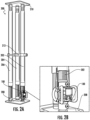
- a total compressive load between the base plates 208 and 210 may be calculated by multiplying by three the compressive load calculated by the monitor 100. It is contemplated that the monitor 100 may be utilized to detect sudden changes in a load, and the total stress between plates 208 and 210 may be of less importance to a user. Additionally, the monitor 100 may be configured to detect an angle of inclination of the strut 202, which may alert a user if the strut 202 appears to be leaning outside of a vertical plane. This specific scenario may represent a potential risk of collapse of a structure that is being supported by the struts 202, 204, and 206. Similarly, the monitor 100 may be configured to monitor vibration within the support configuration 200, which may provide a user with an early indication of a potential failure/collapse event.
- FIG. 3 depicts the in-line electronic strut monitor 100 installed in another example of a temporary structural support configuration 300, according to one or more aspects described herein.
- the monitor 100 is configured to be positioned between a support strut 304 and base plate 302.
- the configuration 300 includes multiple different strut elements beyond that strut 304, which may be configured to provide a shoring of a vertical structure.
- the monitor 100 may be configured to detect a compressive force to which the strut 304 is subjected. A user may extrapolate this detected force information to determine stresses at different points within the configuration 300.
- the in-line electronic strut monitor 100 may be configured to be removably coupled to a variety of structural members intended to form configurations to provide temporary structural support to one or more unstable structures. These formed configurations may utilize multiple different adjustable strut elements, with one of these strut elements being received into the monitor 100. Additionally, the in-line electronic strut monitor 100 may be coupled to an external structure using the third coupling mechanism 170, and/or may not be coupled to a strut.
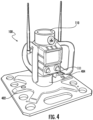
- FIG. 4 depicts the monitor 100 removably coupled to a base plate 402. This baseplate 402 may be configured to position the monitor 100 against a surface that is normal to an axial length of a strut that is received into the first coupling mechanism 110.
- the baseplate 402 may include a coupling mechanism 404 that is similar to the first coupling mechanism 110, and configured to receive the second coupling mechanism 111 of the monitor 100.
- FIG. 5 depicts the monitor 100 removably coupled to a clamp structure 502. Specifically, the clamp structure 502 may be removably coupled to the third coupling mechanism of the monitor 100.
- FIG. 6 depicts the monitor 100 removably coupled to a side plate structure 602. Specifically, the side plate structure 602 may be removably coupled to the third coupling mechanism of the monitor 100.
- FIG. 7 depicts the monitor 100 removably coupled to a suction clamp structure 702. Specifically, the suction clamp structure 702 may be removably coupled to the third coupling mechanism of the monitor 100.
- FIG. 8 depicts another isometric view of the in-line electronic strut monitor 100, according to one or more aspects described herein. Specifically, FIG. 8 depicts a backside view of the monitor 100. FIG. 8 depicts the monitor 100 coupled to the clamp structure 502 of FIG. 5 . The clamp structure 502 is removably coupled to the monitor 100 in an alternative orientation in FIG. 8 .
- FIG. 9 depicts an isometric view of the in-line electronic strut monitor 100, according to one or more aspects described herein. Specifically, FIG. 9 depicts a more detailed view of the third coupling mechanism 170.
- the third coupling mechanism 170 includes an upper rail 902 and a lower rail 904.
- An attachment plate 906 may be removably coupled to the housing 102 of the monitor 100.
- the attachment plate 906 may include an attachment rail 905 with corresponding geometry to the lower rail 904, and configured to catch on the lower rail 904 when the attachment plate 906 is removably coupled to and urged toward an upper attachment bracket 908.
- the upper attachment bracket includes an attachment rail 910 with corresponding geometry to the upper rail 902.
- the upper attachment bracket 908 is removably coupled to the attachment plate 906 by actuating the thumb screw coupling mechanism 912 (which may actuate one or more of a spring-loaded catch or a screw, among others). Removably coupling the upper attachment bracket to the attachment plate 906 clamps the attachment plate 906 and upper attachment bracket 908 between the upper rail 902 and lower rail 904.
- the attachment plate 906 may be coupled to the housing 902 by one or more bolts.
- the attachment plate 906 includes one or more, or an array of threaded holes configured to receive bolts of one or more sizes.
- the attachment plate 906 includes one or more, or an array of threaded holes configured to receive bolts of one or more sizes.
- any size bolts may be utilized, without departing from the scope of the invention as defined by the claims.
- Depicted in FIG. 9 are four bolts 920a-d. These bolts 920a-d are used to couple, for example, the clamp 502 to the housing 102 in FIG. 8 .
- FIG. 10 depicts an isometric view of the in-line electronic strut monitor 100, according to one or more aspects described herein.
- the isometric view of FIG. 10 depicts the monitor 100 without the attachment plate 906 and upper attachment bracket 908.
- the housing 102 includes a battery cover 1002 that is configured to provide access to a user-replaceable battery.
- FIG. 11 depicts a side view of the in-line electronic strut monitor 100, according to one or more aspects described herein.
- FIG. 12 depicts a front view of the in-line electronic strut monitor 100, according to one or more aspects described herein.
- the input controls 136a and 136b may be used to setup the monitor 100 for monitoring one or more of load, vibration and inclination/tilt angle.
- the monitor 100 when installed in a support structure and loaded, the monitor 100 may be initiated by actuating one or more of the input controls 136a-136b. This initiation may record setpoint values of load, tilt angle and vibration frequency/ energy.
- the monitor 100 may actuate one or more alarm elements (e.g., one or more of an audible or visible alarm, and/or an electronic signal communicated to an external device, such as a phone, tablet, computer) when the monitored values of load, tilt angle or vibration frequency/energy change by a certain predetermined amount, such a predetermined percentage amount or predetermined absolute value amount. It is contemplated that this predetermined amount may be any amount. It is also contemplated that the change in monitored value that initiates one or more alarm elements may be an automatically set amount, or may be a manually selected amount, selected using one or more of the input controls 136a-136b.
- FIG. 13 depicts a top view of the in-line electronic strut monitor 100, according to one or more aspects described herein.
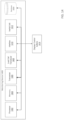
- FIG. 14 schematically depicts a monitoring device 1400, according to one or more aspects described herein.
- the monitoring device 1400 may be similar to monitoring device 130. Accordingly, the monitoring device 1400 may include application-specific integrated circuits and/or general purpose circuitry configured to monitor one or more parameters of a strut to which the monitoring device 1400 is coupled. In one example, the monitoring device 1400 may be configured to monitor load (force), vibration (vibration intensity, frequency among others), and tilt angle.
- the monitoring device 1400 may include a processor 1402 that is configured to control the overall operation of the device 1400.
- the processor 1400 may execute instructions received from memory 1404.
- memory 1404 may be a form of volatile or persistent memory of any type, and may be RAM, ROM, among others.
- the transceiver 1406 may be configured with requisite hardware, firmware and software to facilitate wired and/or wireless communication between the monitoring device 1400 and one or more external devices, such as smartphones, wireless internet routers.
- the transceiver 1406 may be configured to send and/or receive information to/from an application running on a connected device, such a wirelessly connected smartphone or tablet. This application may be used to monitor data generated by the monitoring device 1400 from a remote location, and/or to send setting information to the monitoring device 1400.
- the transceiver 1406 may be configured to receive information from hardware to which the monitoring device 1400 is configured to be removably coupled. Specifically, the transceiver 1406 may receive information from a strut (e.g., strut 304) or another type of support hardware (e.g., base 302). This received information may identify the connected hardware elements, and this information may be used to determine a maximum load to which the coupled hardware may be subjected. It is contemplated that the transceiver 1406 may be configured to communicate across any wired or wireless communication channel utilizing any communication protocol. Examples include, but are not limited to Wi-Fi, Bluetooth, Ethernet, a cellular network, infrared, RFID, among others.
- the transceiver 1406 may be configured with a location determining sensor, such as a global positioning system (GPS) receiver, or another location determining receiver or transceiver.
- a location determining sensor such as a global positioning system (GPS) receiver, or another location determining receiver or transceiver.
- GPS global positioning system
- the monitoring device 1400 includes a load cell transducer 1408 configured to output a signal proportional to a load, or a force, to which the transducer is subjected. Accordingly, the load cell transducer 1408 may be positioned such that the force of a connected strut is transmitted partially or wholly through to the transducer 1408. It is contemplated that any transducer technology may be utilized, without departing from the scope of the invention as defined by the claims.
- the database 1414 may store information related to a type of hardware to which the monitoring device 1400 is coupled, loads exerted on the monitor (e.g., monitor 100) within which the monitoring device 1400 is encapsulated, loading events corresponding to changes in load exerted on the monitor within which the monitoring device 1400 is encapsulated, vibration data, tilt angle data, among others. It is contemplated that any database structure and/or protocol may be used to store the information within database 1414, without departing from the scope of the invention as defined by the claims.
- the various embodiments described herein may be implemented by general-purpose or specialized computer hardware.
- the computer hardware may comprise one or more processors, otherwise referred to as microprocessors, having one or more processing cores configured to allow for parallel processing/execution of instructions.
- the various disclosures described herein may be implemented as software coding, wherein those of skill in the computer arts will recognize various coding languages that may be employed with the disclosures described herein.
- the disclosures described herein may be utilized in the implementation of application-specific integrated circuits (ASICs), or in the implementation of various electronic components comprising conventional electronic circuits (otherwise referred to as off-the-shelf components).
- ASICs application-specific integrated circuits
- One or more of the disclosures described herein may comprise a computer program product having computer-readable medium/media with instructions stored thereon/therein that, when executed by a processor, are configured to perform one or more methods, techniques, systems, or embodiments described herein.
- the instructions stored on the computer-readable media may comprise actions to be executed for performing various steps of the methods, techniques, systems, or embodiments described herein.
- the computer-readable medium/media may comprise a storage medium with instructions configured to be processed by a computing device, and specifically a processor associated with a computing device.
- the received information may include a length of the strut, which may be a fixed length of a length at which the strut has been adjusted.
- a length of the strut which may be a fixed length of a length at which the strut has been adjusted.
- the loading to which a strut may be subjected will depend upon the strut geometry, which may include the material type, material thickness, one or more strut widths, and/or a length of the strut.
- the strut length and type may be identified block 1502 based upon manually entered information received by the monitoring device 1400.
- One or more processes may be executed at block 1504 to identify maximum conditions to which the strut may be subjected, based upon the identified strut type and length from block 1502. These maximum conditions may include a maximum load, a maximum vibration frequency/energy, and/or a maximum tilt angle, among others.
- FIG. 16 depicts an isometric view of an alternative coupling mechanism 1600, according to one or more aspects described herein.
- the coupling mechanism 1600 may be similar to coupling mechanism 170.
- the coupling mechanism 1600 may be configured to be removably coupled to the monitor 100 in a manner similar to the mechanism 170.
- the coupling mechanisms 170 and 1600 may be referred to as "backpack" elements.
- the coupling mechanism 1600 may be utilized to facilitate rapid coupling and uncoupling of structures to the monitor 100. These structures may include clamp structure 502, plate structure 602, and suction clamp structure 702 among others.
- the coupling mechanism 1600 may include attachment rails 1602 and 1604, which may be configured to be removably coupled to the upper rail 902 and lower rail 904 of the monitor 100, as previously described. Similar to coupling mechanism 170, the coupling mechanism 1600 may include an upper attachment bracket 1606 (similar to upper attachment bracket 908) that is removably coupled to an attachment plate 1608 (similar to attachment plate 906) by a thumb screw coupling mechanism 1610 (similar to coupling mechanism 912).
- the plug sleeve 1622 may have 4 substantially symmetrical sides with holes similar to hold 1620 such that the catch 1618 can engage with the plug sleeve 1622 regardless of the orientation of the plug sleeve 1622 relative to the socket sleeve 1612.
- the quick-attach bracket 1614 may additionally include an attachment surface 1624 to which external structures may be bolted. These external structures may include, among others, structures 502, 602, and/or 702. Accordingly, the attachment surface 1624 of the quick-attach bracket 1614 may include tapped or untapped attachment holes configured to receive bolts 1626a-d. It is contemplated, similar to the other structures throughout this disclosure, that the bolts 1626a-d may be of any size and the tapped/ untapped holes into which they are received may be spaced with any spacing pattern relative to one another.
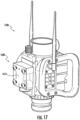
- FIG. 17 depicts an isometric view of an electronic strut monitor 1700, according to one or more aspects described herein.
- the electronic strut monitor 1700 may be similar to electronic strut monitor 100, as previously described.
- the electronic strut monitor 1700 is removably coupled to the backpack coupling mechanism 1600, as described in relation to FIG. 16 .
- the backpack coupling mechanism 1600 is removably coupled to the quick-attach bracket 1614, which may in turn be coupled (bolted) to external clamp elements (not depicted in FIG. 17 ).
- FIG. 18 depicts an isometric view of the electronic strut monitor 1700 decoupled from the backpack coupling mechanism 1600, according to one or more aspects described herein.
- the backpack coupling mechanism 1600 has been decoupled from quick-attach bracket 1614.
- the backpack coupling mechanism 1600 has been decoupled from the electronic strut monitor 1700, which exposes the battery cover 1702.
- This battery cover 1702 provides access to one or more batteries powering the electronics of the monitor 1700.
- the battery cover 1702 may be similar to battery cover 1002, but the battery cover 1702 is affixed to the casing 1704 of the monitor 1700 by two fasteners 1706a, 1706b (which may be two bolts, although the those of ordinary skill in the art will recognize that any fixture type may be used in place of the depicted fixtures throughout this disclosure).
Landscapes
- Physics & Mathematics (AREA)
- General Physics & Mathematics (AREA)
- Engineering & Computer Science (AREA)
- Business, Economics & Management (AREA)
- Aviation & Aerospace Engineering (AREA)
- Theoretical Computer Science (AREA)
- Health & Medical Sciences (AREA)
- Tourism & Hospitality (AREA)
- Emergency Management (AREA)
- Toxicology (AREA)
- General Health & Medical Sciences (AREA)
- Architecture (AREA)
- Microelectronics & Electronic Packaging (AREA)
- Computer Networks & Wireless Communication (AREA)
- Artificial Intelligence (AREA)
- Computer Hardware Design (AREA)
- Electromagnetism (AREA)
- Computer Vision & Pattern Recognition (AREA)
- General Business, Economics & Management (AREA)
- Radar, Positioning & Navigation (AREA)
- Remote Sensing (AREA)
- Strategic Management (AREA)
- Economics (AREA)
- Human Resources & Organizations (AREA)
- Marketing (AREA)
- Primary Health Care (AREA)
- Mechanical Engineering (AREA)
- Civil Engineering (AREA)
- Structural Engineering (AREA)
- Emergency Alarm Devices (AREA)
- Testing Of Devices, Machine Parts, Or Other Structures Thereof (AREA)
- Force Measurement Appropriate To Specific Purposes (AREA)
- Arrangements For Transmission Of Measured Signals (AREA)
Claims (9)
- Elektronischer Monitor (100), Folgendes umfassend:ein Gehäuse (102), das ein erstes Ende (104) mit einer Bohrung (105), die sich in das Gehäuse (102) erstreckt, und ein zweites Ende, das von dem ersten Ende (104) entlang einer axialen Länge beabstandet ist, aufweist, wobei das Gehäuse (102) Folgendes umfassteine erste Seitenwand (125) und das Gehäuse (102) umfasst ferner eine zweite Seitenwand und eine dritte Seitenwand, wobei der elektronische Monitor (100) ferner eine erste Griffstruktur (161), die starr mit der zweiten Seitenwand gekoppelt ist, und eine zweite Griffstruktur (162), die starr mit der dritten Seitenwand gekoppelt ist, umfasst;einen ersten Kopplungsmechanismus (110) an dem ersten Ende (104), der dazu konfiguriert ist, das erste Ende (104) des Gehäuses (102) abnehmbar mit einer temporären Stützstrebe zu koppeln;einen zweiten Kupplungsmechanismus an dem zweiten Ende des Gehäuses (102), wobei der zweite Kupplungsmechanismus einen zylindrischen Schaft (116) mit einem umlaufenden Kanal (118) umfasst;eine Überwachungsvorrichtung, die innerhalb des Gehäuses (102) positioniert ist, wobei die Überwachungsvorrichtung eine Kraftmessdose umfasst, die dazu konfiguriert ist, mindestens einen Teil einer Kraft zu messen, die auf den ersten Kopplungsmechanismus (110) durch die temporäre Stützstrebe ausgeübt wird; undeine elektronische Schnittstelle (134), die dazu konfiguriert ist, einem Benutzer Informationen über die von der Kraftmessdose gemessene Kraft zu übermitteln, dadurch gekennzeichnet, dass die erste und die zweite Griffstruktur jeweils eine geschlossene Schleifenstruktur umfassen, die zusätzlich dazu konfiguriert ist, zu verhindern, dass die elektronische Schnittstelle (134) versehentlich von einer externen Oberfläche getroffen wird.
- Elektronischer Monitor (100) nach Anspruch 1, wobei die elektronische Schnittstelle (1410) einen drahtlosen Sendeempfänger umfasst, der dazu konfiguriert ist, Sensorinformationen zu einer entfernten Vorrichtung des Benutzers zu übertragen.
- Elektronischer Monitor (100) nach Anspruch 1, wobei die Überwachungsvorrichtung ferner einen Neigungssensor umfasst, der dazu konfiguriert ist, einen Neigungswinkel der axialen Länge des Gehäuses (102) zu erfassen.
- Elektronischer Monitor (100) nach Anspruch 1, wobei die Überwachungsvorrichtung einen Schwingungssensor umfasst.
- Elektronischer Monitor (100) nach einem der Ansprüche 1 bis 3, Folgendes umfassend:einen dritten Kopplungsmechanismus, der an einer Seitenwand positioniert ist, die sich entlang eines Teils des Gehäuses (102) zwischen dem ersten Ende (104) und dem zweiten Ende erstreckt,wobei die Überwachungsvorrichtung einen Schwingungssensor umfasst.
- Elektronischer Monitor (100) nach Anspruch 5, wobei der zweite Kopplungsmechanismus oder der dritte Kopplungsmechanismus dazu konfiguriert ist, abnehmbar mit einer externen Befestigungsstruktur gekoppelt zu werden.
- Elektronischer Monitor (100) nach Anspruch 5, wobei die elektronische Schnittstelle (134) eine elektronische Anzeige umfasst, die an einer vierten Seitenwand (131) des Gehäuses (102) befestigt ist.
- Elektronischer Monitor (100) nach Anspruch 5, wobei die Überwachungsvorrichtung einen Alarm umfasst, der mit akustischen und sichtbaren Warnanzeigen konfiguriert ist.
- Elektronischer Monitor (100) nach Anspruch 5, wobei der erste Kopplungsmechanismus (110) einen federbelasteten Riegel umfasst, der dazu konfiguriert ist, sich von der Seitenwand des Gehäuses (102) in die Bohrung (105) zu erstrecken, und dazu konfiguriert ist, in einen Kanal des ersten Endes (104) der temporären Stützstrebe aufgenommen zu werden.
Applications Claiming Priority (4)
| Application Number | Priority Date | Filing Date | Title |
|---|---|---|---|
| US202163142331P | 2021-01-27 | 2021-01-27 | |
| US202163181762P | 2021-04-29 | 2021-04-29 | |
| US17/582,864 US11763109B2 (en) | 2021-01-27 | 2022-01-24 | Electronic strut monitor |
| PCT/US2022/070331 WO2022165480A1 (en) | 2021-01-27 | 2022-01-25 | Electronic strut monitor |
Publications (3)
| Publication Number | Publication Date |
|---|---|
| EP4285090A1 EP4285090A1 (de) | 2023-12-06 |
| EP4285090B1 true EP4285090B1 (de) | 2025-06-04 |
| EP4285090C0 EP4285090C0 (de) | 2025-06-04 |
Family
ID=82495584
Family Applications (1)
| Application Number | Title | Priority Date | Filing Date |
|---|---|---|---|
| EP22704268.6A Active EP4285090B1 (de) | 2021-01-27 | 2022-01-25 | Elektronischer strebenmonitor |
Country Status (5)
| Country | Link |
|---|---|
| US (1) | US11763109B2 (de) |
| EP (1) | EP4285090B1 (de) |
| JP (1) | JP7520241B2 (de) |
| KR (1) | KR102665769B1 (de) |
| CN (1) | CN116964423B (de) |
Families Citing this family (1)
| Publication number | Priority date | Publication date | Assignee | Title |
|---|---|---|---|---|
| US11774318B2 (en) * | 2019-07-05 | 2023-10-03 | Ronald Chun Yu LAM | Force and inclination monitoring system with self-position recognition |
Citations (1)
| Publication number | Priority date | Publication date | Assignee | Title |
|---|---|---|---|---|
| US20070255424A1 (en) * | 2006-04-28 | 2007-11-01 | Leydet Michael G | Prosthetic sensing systems and methods |
Family Cites Families (44)
| Publication number | Priority date | Publication date | Assignee | Title |
|---|---|---|---|---|
| US1737514A (en) * | 1929-04-01 | 1929-11-26 | Nikolish Mike | Signal for mines |
| US3594773A (en) * | 1968-11-12 | 1971-07-20 | Ellsworth V Conkle | Mine roof gauge and indicator |
| US3662596A (en) * | 1970-11-12 | 1972-05-16 | Goodyear Tire & Rubber | Device for measuring stress in metal tire cords |
| US5668325A (en) * | 1996-03-27 | 1997-09-16 | Cyprus Amax Coal Company | Method and apparatus for determining compressive stress in pillars |
| US5979218A (en) * | 1997-11-12 | 1999-11-09 | Chrysler Corporation | Strut mount transducer |
| US6957166B1 (en) * | 1998-04-30 | 2005-10-18 | The United States Of America As Represented By The Department Of Health And Human Services | Method and apparatus for load rate monitoring |
| JP4040971B2 (ja) * | 2002-12-27 | 2008-01-30 | 株式会社山武 | 差圧・圧力発信器 |
| US6823753B1 (en) * | 2003-05-16 | 2004-11-30 | Asm America, Inc. | Sensor signal transmission from processing system |
| US20050103123A1 (en) * | 2003-11-14 | 2005-05-19 | Newman Kenneth R. | Tubular monitor systems and methods |
| US7496454B2 (en) * | 2004-07-19 | 2009-02-24 | University Of Virginia Patent Foundation | High mast inspection system, equipment and method |
| FR2963681B1 (fr) * | 2010-08-04 | 2012-08-31 | Sercel Rech Const Elect | Module d'acquisition de donnees et connecteur de cable pour la fixation au module |
| US8474331B2 (en) * | 2006-02-24 | 2013-07-02 | David Pekin | Force measurement system |
| US7584932B2 (en) * | 2007-10-23 | 2009-09-08 | Lung Ching Shih | Construction prop |
| ZA200900118B (en) * | 2008-01-07 | 2009-12-30 | David Douglas Senogles | Monitoring system |
| WO2014043592A2 (en) * | 2012-09-14 | 2014-03-20 | Flir Systems, Inc. | Measurement device for electrical installations and related methods |
| JP2011085514A (ja) * | 2009-10-16 | 2011-04-28 | Hitachi Cable Ltd | 棒状体の荷重測定センサ及び荷重測定システム |
| AU2011216967B2 (en) * | 2010-02-19 | 2016-10-20 | Council Of Scientific & Industrial Research | A device for roof support of underground mine/tunnel |
| GB2479008B (en) * | 2010-04-20 | 2012-06-06 | Byrne Bros Formwork Ltd | Power tool for falsework assemblies |
| WO2012048237A2 (en) * | 2010-10-08 | 2012-04-12 | Checkit Technologies, Llc | Structural integrity system and methods |
| US20130126249A1 (en) * | 2011-11-22 | 2013-05-23 | Simmonds Precision Products, Inc. | Load cell and applications thereof |
| US8973899B2 (en) * | 2011-12-12 | 2015-03-10 | Mark Allen BUCKINGHAM | Jacking pole |
| US9033619B2 (en) * | 2012-12-14 | 2015-05-19 | John Riggle, JR. | Trench shoring apparatuses |
| US9664043B2 (en) * | 2013-09-05 | 2017-05-30 | Ncm Innovations (Pty) Ltd | Rock wall closure detection device |
| US10225629B2 (en) * | 2013-11-25 | 2019-03-05 | Chi Hung Louis Lam | System for monitoring condition of adjustable construction temporary supports |
| US9850930B2 (en) * | 2014-04-24 | 2017-12-26 | Paratech, Incorporated | Shaft adapter |
| GB2526883B (en) * | 2014-06-06 | 2021-04-21 | Mmc Innovations Llp | Temporary support & raising device |
| US9534406B2 (en) * | 2014-10-01 | 2017-01-03 | Paratech, Incorporated | Adjustable strut with locking mechanism |
| US9955274B2 (en) * | 2015-04-08 | 2018-04-24 | The Boeing Company | Vibration monitoring systems |
| GB201506496D0 (en) * | 2015-04-16 | 2015-06-03 | Expro North Sea Ltd | Measurement system and methods |
| US20160371957A1 (en) * | 2015-06-22 | 2016-12-22 | Mc10, Inc. | Method and system for structural health monitoring |
| US11306492B2 (en) * | 2016-06-24 | 2022-04-19 | Apache Industrial Services, Inc | Load bearing components and safety deck of an integrated construction system |
| US10436759B2 (en) * | 2017-01-12 | 2019-10-08 | Fisher Controls International Llc | Methods and apparatus to monitor a condition of a structure |
| US10302510B2 (en) * | 2017-01-30 | 2019-05-28 | Tecat Performance Systems, Llc | Wireless axial load cell and sensor assembly |
| JP6910840B2 (ja) * | 2017-04-24 | 2021-07-28 | 株式会社マキタ | 電動工具 |
| US10801593B2 (en) * | 2017-04-26 | 2020-10-13 | Paratech, Incorporated | Strut extender mechanism |
| US10473540B2 (en) * | 2017-09-01 | 2019-11-12 | GM Global Technology Operations LLC | Gas strut force active monitor system |
| CN207589672U (zh) * | 2017-10-27 | 2018-07-10 | 贵溪市原林果业专业合作社 | 一种果树种植用监控报警器 |
| CN108798068A (zh) | 2018-07-05 | 2018-11-13 | 象山企盛智能科技有限公司 | 一种适用于装配式建筑和桥梁施工的安全支撑系统 |
| US11124978B2 (en) | 2019-03-20 | 2021-09-21 | Big Time Investment, Llc | Strut for a multi-story building |
| US11774318B2 (en) * | 2019-07-05 | 2023-10-03 | Ronald Chun Yu LAM | Force and inclination monitoring system with self-position recognition |
| US20220364944A1 (en) * | 2019-10-06 | 2022-11-17 | Christopher Robert Fuller | External-Mounted Strain Sensor System for Non-Invasive Measurement of Internal Static and Dynamic Pressures in Elastic Bodies |
| DE102019216792A1 (de) * | 2019-10-30 | 2021-05-06 | Peri Gmbh | Computergestütztes Verfahren und System zur Ermittlung und Visualisierung von Kraftflüssen in einem Baugerüst |
| CN110847632A (zh) * | 2019-12-19 | 2020-02-28 | 天津联东兴达科技有限公司 | 一种建筑支撑装置 |
| US11686710B2 (en) * | 2020-03-31 | 2023-06-27 | Evident Canada, Inc. | Longitudinal and circumferential ultrasound scanner |
-
2022
- 2022-01-24 US US17/582,864 patent/US11763109B2/en active Active
- 2022-01-25 EP EP22704268.6A patent/EP4285090B1/de active Active
- 2022-01-25 KR KR1020237028976A patent/KR102665769B1/ko active Active
- 2022-01-25 CN CN202280020242.XA patent/CN116964423B/zh active Active
- 2022-01-25 JP JP2023546029A patent/JP7520241B2/ja active Active
Patent Citations (1)
| Publication number | Priority date | Publication date | Assignee | Title |
|---|---|---|---|---|
| US20070255424A1 (en) * | 2006-04-28 | 2007-11-01 | Leydet Michael G | Prosthetic sensing systems and methods |
Also Published As
| Publication number | Publication date |
|---|---|
| CN116964423B (zh) | 2024-05-28 |
| US11763109B2 (en) | 2023-09-19 |
| KR102665769B1 (ko) | 2024-05-14 |
| JP2024506845A (ja) | 2024-02-15 |
| US20220237395A1 (en) | 2022-07-28 |
| CN116964423A (zh) | 2023-10-27 |
| JP7520241B2 (ja) | 2024-07-22 |
| EP4285090C0 (de) | 2025-06-04 |
| KR20230133906A (ko) | 2023-09-19 |
| EP4285090A1 (de) | 2023-12-06 |
Similar Documents
| Publication | Publication Date | Title |
|---|---|---|
| US11255989B2 (en) | Building integrity assessment system | |
| US11745035B2 (en) | Fall protection compliance system and method | |
| KR101064577B1 (ko) | 붕괴에 따른 조난 구조 시스템 | |
| CN103345819B (zh) | 车辆倾翻预警系统、预警方法及包含该系统的工程机械 | |
| KR101809602B1 (ko) | 센서들과 자동 분리 장치를 포함하는 선박 위치 발신 장치와 이를 이용하여 선박 감시 서비스를 제공하는 방법 | |
| EP4285090B1 (de) | Elektronischer strebenmonitor | |
| CN106840091A (zh) | 一种模板支架沉降监测预警装置 | |
| US12467792B2 (en) | Flame detecting arrangement | |
| US20210113865A1 (en) | Self-retracting lanyard with fall protection harness tracker | |
| JP2022097703A (ja) | 電動工具 | |
| CN110006525A (zh) | 一种长输架空管道分布式应力振动在线监测系统及方法 | |
| US20250121469A1 (en) | Power tool including fall detection and autostop | |
| KR101904092B1 (ko) | 에어펜더 관리 방법 및 시스템 | |
| WO2022165480A1 (en) | Electronic strut monitor | |
| CN215626268U (zh) | 配重监测系统、臂架监测系统、吊载安全监测系统及起重设备 | |
| JP2001220086A (ja) | ロードセル及びクレーンの転倒警報装置 | |
| KR101502062B1 (ko) | 지진 검출 방법 및 이를 이용한 지진계 | |
| EP2088407A1 (de) | Lastanzeigesystem | |
| JP2018204210A (ja) | 状態変化を危険度に応じて報知する路上設置型道路標識 | |
| JP3252471U (ja) | 安全帯の使用状況確認装置、及び、その通信親機格納装置 | |
| US20230264654A1 (en) | Catalytic converter alarm | |
| US20230173313A1 (en) | Lanyard Device for Monitoring Safety of a User | |
| JP3997122B2 (ja) | 沈下・浮上検知システム、沈下・浮上検知方法、沈下・浮上検知プログラム、及び、コンピュータ読取可能な記録媒体 | |
| WO2026018194A1 (en) | Smart harness | |
| US7023354B2 (en) | Platform assembly |
Legal Events
| Date | Code | Title | Description |
|---|---|---|---|
| STAA | Information on the status of an ep patent application or granted ep patent |
Free format text: STATUS: UNKNOWN |
|
| STAA | Information on the status of an ep patent application or granted ep patent |
Free format text: STATUS: THE INTERNATIONAL PUBLICATION HAS BEEN MADE |
|
| PUAI | Public reference made under article 153(3) epc to a published international application that has entered the european phase |
Free format text: ORIGINAL CODE: 0009012 |
|
| STAA | Information on the status of an ep patent application or granted ep patent |
Free format text: STATUS: REQUEST FOR EXAMINATION WAS MADE |
|
| 17P | Request for examination filed |
Effective date: 20230731 |
|
| AK | Designated contracting states |
Kind code of ref document: A1 Designated state(s): AL AT BE BG CH CY CZ DE DK EE ES FI FR GB GR HR HU IE IS IT LI LT LU LV MC MK MT NL NO PL PT RO RS SE SI SK SM TR |
|
| DAV | Request for validation of the european patent (deleted) | ||
| DAX | Request for extension of the european patent (deleted) | ||
| STAA | Information on the status of an ep patent application or granted ep patent |
Free format text: STATUS: EXAMINATION IS IN PROGRESS |
|
| 17Q | First examination report despatched |
Effective date: 20240605 |
|
| GRAP | Despatch of communication of intention to grant a patent |
Free format text: ORIGINAL CODE: EPIDOSNIGR1 |
|
| STAA | Information on the status of an ep patent application or granted ep patent |
Free format text: STATUS: GRANT OF PATENT IS INTENDED |
|
| INTG | Intention to grant announced |
Effective date: 20241121 |
|
| RAP3 | Party data changed (applicant data changed or rights of an application transferred) |
Owner name: PARATECH, INCORPORATED |
|
| GRAS | Grant fee paid |
Free format text: ORIGINAL CODE: EPIDOSNIGR3 |
|
| GRAA | (expected) grant |
Free format text: ORIGINAL CODE: 0009210 |
|
| STAA | Information on the status of an ep patent application or granted ep patent |
Free format text: STATUS: THE PATENT HAS BEEN GRANTED |
|
| AK | Designated contracting states |
Kind code of ref document: B1 Designated state(s): AL AT BE BG CH CY CZ DE DK EE ES FI FR GB GR HR HU IE IS IT LI LT LU LV MC MK MT NL NO PL PT RO RS SE SI SK SM TR |
|
| REG | Reference to a national code |
Ref country code: GB Ref legal event code: FG4D |
|
| REG | Reference to a national code |
Ref country code: CH Ref legal event code: EP |
|
| REG | Reference to a national code |
Ref country code: DE Ref legal event code: R096 Ref document number: 602022015470 Country of ref document: DE |
|
| REG | Reference to a national code |
Ref country code: IE Ref legal event code: FG4D |
|
| U01 | Request for unitary effect filed |
Effective date: 20250627 |
|
| U07 | Unitary effect registered |
Designated state(s): AT BE BG DE DK EE FI FR IT LT LU LV MT NL PT RO SE SI Effective date: 20250704 |
|
| PG25 | Lapsed in a contracting state [announced via postgrant information from national office to epo] |
Ref country code: ES Free format text: LAPSE BECAUSE OF FAILURE TO SUBMIT A TRANSLATION OF THE DESCRIPTION OR TO PAY THE FEE WITHIN THE PRESCRIBED TIME-LIMIT Effective date: 20250604 |
|
| PG25 | Lapsed in a contracting state [announced via postgrant information from national office to epo] |
Ref country code: NO Free format text: LAPSE BECAUSE OF FAILURE TO SUBMIT A TRANSLATION OF THE DESCRIPTION OR TO PAY THE FEE WITHIN THE PRESCRIBED TIME-LIMIT Effective date: 20250904 Ref country code: GR Free format text: LAPSE BECAUSE OF FAILURE TO SUBMIT A TRANSLATION OF THE DESCRIPTION OR TO PAY THE FEE WITHIN THE PRESCRIBED TIME-LIMIT Effective date: 20250905 |
|
| PG25 | Lapsed in a contracting state [announced via postgrant information from national office to epo] |
Ref country code: PL Free format text: LAPSE BECAUSE OF FAILURE TO SUBMIT A TRANSLATION OF THE DESCRIPTION OR TO PAY THE FEE WITHIN THE PRESCRIBED TIME-LIMIT Effective date: 20250604 |
|
| PG25 | Lapsed in a contracting state [announced via postgrant information from national office to epo] |
Ref country code: HR Free format text: LAPSE BECAUSE OF FAILURE TO SUBMIT A TRANSLATION OF THE DESCRIPTION OR TO PAY THE FEE WITHIN THE PRESCRIBED TIME-LIMIT Effective date: 20250604 |
|
| PG25 | Lapsed in a contracting state [announced via postgrant information from national office to epo] |
Ref country code: RS Free format text: LAPSE BECAUSE OF FAILURE TO SUBMIT A TRANSLATION OF THE DESCRIPTION OR TO PAY THE FEE WITHIN THE PRESCRIBED TIME-LIMIT Effective date: 20250904 |
|
| PG25 | Lapsed in a contracting state [announced via postgrant information from national office to epo] |
Ref country code: IS Free format text: LAPSE BECAUSE OF FAILURE TO SUBMIT A TRANSLATION OF THE DESCRIPTION OR TO PAY THE FEE WITHIN THE PRESCRIBED TIME-LIMIT Effective date: 20251004 |
|
| PG25 | Lapsed in a contracting state [announced via postgrant information from national office to epo] |
Ref country code: SM Free format text: LAPSE BECAUSE OF FAILURE TO SUBMIT A TRANSLATION OF THE DESCRIPTION OR TO PAY THE FEE WITHIN THE PRESCRIBED TIME-LIMIT Effective date: 20250604 |
|
| PG25 | Lapsed in a contracting state [announced via postgrant information from national office to epo] |
Ref country code: CZ Free format text: LAPSE BECAUSE OF FAILURE TO SUBMIT A TRANSLATION OF THE DESCRIPTION OR TO PAY THE FEE WITHIN THE PRESCRIBED TIME-LIMIT Effective date: 20250604 |
|
| PG25 | Lapsed in a contracting state [announced via postgrant information from national office to epo] |
Ref country code: SK Free format text: LAPSE BECAUSE OF FAILURE TO SUBMIT A TRANSLATION OF THE DESCRIPTION OR TO PAY THE FEE WITHIN THE PRESCRIBED TIME-LIMIT Effective date: 20250604 |