EP4281659B1 - Anordnung mit einem flugzeugturbinentriebwerk und montagepylon dafür - Google Patents
Anordnung mit einem flugzeugturbinentriebwerk und montagepylon dafür Download PDFInfo
- Publication number
- EP4281659B1 EP4281659B1 EP22702768.7A EP22702768A EP4281659B1 EP 4281659 B1 EP4281659 B1 EP 4281659B1 EP 22702768 A EP22702768 A EP 22702768A EP 4281659 B1 EP4281659 B1 EP 4281659B1
- Authority
- EP
- European Patent Office
- Prior art keywords
- pylon
- turbomachine
- turbine engine
- plane
- assembly according
- Prior art date
- Legal status (The legal status is an assumption and is not a legal conclusion. Google has not performed a legal analysis and makes no representation as to the accuracy of the status listed.)
- Active
Links
Images




Classifications
-
- F—MECHANICAL ENGINEERING; LIGHTING; HEATING; WEAPONS; BLASTING
- F02—COMBUSTION ENGINES; HOT-GAS OR COMBUSTION-PRODUCT ENGINE PLANTS
- F02C—GAS-TURBINE PLANTS; AIR INTAKES FOR JET-PROPULSION PLANTS; CONTROLLING FUEL SUPPLY IN AIR-BREATHING JET-PROPULSION PLANTS
- F02C7/00—Features, components parts, details or accessories, not provided for in, or of interest apart form groups F02C1/00 - F02C6/00; Air intakes for jet-propulsion plants
- F02C7/20—Mounting or supporting of plant; Accommodating heat expansion or creep
-
- B—PERFORMING OPERATIONS; TRANSPORTING
- B64—AIRCRAFT; AVIATION; COSMONAUTICS
- B64D—EQUIPMENT FOR FITTING IN OR TO AIRCRAFT; FLIGHT SUITS; PARACHUTES; ARRANGEMENT OR MOUNTING OF POWER PLANTS OR PROPULSION TRANSMISSIONS IN AIRCRAFT
- B64D27/00—Arrangement or mounting of power plants in aircraft; Aircraft characterised by the type or position of power plants
- B64D27/02—Aircraft characterised by the type or position of power plants
- B64D27/10—Aircraft characterised by the type or position of power plants of gas-turbine type
-
- B—PERFORMING OPERATIONS; TRANSPORTING
- B64—AIRCRAFT; AVIATION; COSMONAUTICS
- B64D—EQUIPMENT FOR FITTING IN OR TO AIRCRAFT; FLIGHT SUITS; PARACHUTES; ARRANGEMENT OR MOUNTING OF POWER PLANTS OR PROPULSION TRANSMISSIONS IN AIRCRAFT
- B64D27/00—Arrangement or mounting of power plants in aircraft; Aircraft characterised by the type or position of power plants
- B64D27/40—Arrangements for mounting power plants in aircraft
- B64D27/402—Arrangements for mounting power plants in aircraft comprising box like supporting frames, e.g. pylons or arrangements for embracing the power plant
-
- B—PERFORMING OPERATIONS; TRANSPORTING
- B64—AIRCRAFT; AVIATION; COSMONAUTICS
- B64D—EQUIPMENT FOR FITTING IN OR TO AIRCRAFT; FLIGHT SUITS; PARACHUTES; ARRANGEMENT OR MOUNTING OF POWER PLANTS OR PROPULSION TRANSMISSIONS IN AIRCRAFT
- B64D27/00—Arrangement or mounting of power plants in aircraft; Aircraft characterised by the type or position of power plants
- B64D27/40—Arrangements for mounting power plants in aircraft
- B64D27/404—Suspension arrangements specially adapted for supporting vertical loads
-
- F—MECHANICAL ENGINEERING; LIGHTING; HEATING; WEAPONS; BLASTING
- F01—MACHINES OR ENGINES IN GENERAL; ENGINE PLANTS IN GENERAL; STEAM ENGINES
- F01D—NON-POSITIVE DISPLACEMENT MACHINES OR ENGINES, e.g. STEAM TURBINES
- F01D25/00—Component parts, details, or accessories, not provided for in, or of interest apart from, other groups
- F01D25/04—Antivibration arrangements
-
- F—MECHANICAL ENGINEERING; LIGHTING; HEATING; WEAPONS; BLASTING
- F01—MACHINES OR ENGINES IN GENERAL; ENGINE PLANTS IN GENERAL; STEAM ENGINES
- F01D—NON-POSITIVE DISPLACEMENT MACHINES OR ENGINES, e.g. STEAM TURBINES
- F01D25/00—Component parts, details, or accessories, not provided for in, or of interest apart from, other groups
- F01D25/28—Supporting or mounting arrangements, e.g. for turbine casing
-
- F—MECHANICAL ENGINEERING; LIGHTING; HEATING; WEAPONS; BLASTING
- F16—ENGINEERING ELEMENTS AND UNITS; GENERAL MEASURES FOR PRODUCING AND MAINTAINING EFFECTIVE FUNCTIONING OF MACHINES OR INSTALLATIONS; THERMAL INSULATION IN GENERAL
- F16F—SPRINGS; SHOCK-ABSORBERS; MEANS FOR DAMPING VIBRATION
- F16F15/00—Suppression of vibrations in systems; Means or arrangements for avoiding or reducing out-of-balance forces, e.g. due to motion
- F16F15/02—Suppression of vibrations of non-rotating, e.g. reciprocating systems; Suppression of vibrations of rotating systems by use of members not moving with the rotating systems
- F16F15/04—Suppression of vibrations of non-rotating, e.g. reciprocating systems; Suppression of vibrations of rotating systems by use of members not moving with the rotating systems using elastic means
-
- F—MECHANICAL ENGINEERING; LIGHTING; HEATING; WEAPONS; BLASTING
- F16—ENGINEERING ELEMENTS AND UNITS; GENERAL MEASURES FOR PRODUCING AND MAINTAINING EFFECTIVE FUNCTIONING OF MACHINES OR INSTALLATIONS; THERMAL INSULATION IN GENERAL
- F16F—SPRINGS; SHOCK-ABSORBERS; MEANS FOR DAMPING VIBRATION
- F16F9/00—Springs, vibration-dampers, shock-absorbers, or similarly-constructed movement-dampers using a fluid or the equivalent as damping medium
- F16F9/10—Springs, vibration-dampers, shock-absorbers, or similarly-constructed movement-dampers using a fluid or the equivalent as damping medium using liquid only; using a fluid of which the nature is immaterial
- F16F9/14—Devices with one or more members, e.g. pistons, vanes, moving to and fro in chambers and using throttling effect
- F16F9/145—Devices with one or more members, e.g. pistons, vanes, moving to and fro in chambers and using throttling effect involving only rotary movement of the effective parts
-
- F—MECHANICAL ENGINEERING; LIGHTING; HEATING; WEAPONS; BLASTING
- F16—ENGINEERING ELEMENTS AND UNITS; GENERAL MEASURES FOR PRODUCING AND MAINTAINING EFFECTIVE FUNCTIONING OF MACHINES OR INSTALLATIONS; THERMAL INSULATION IN GENERAL
- F16F—SPRINGS; SHOCK-ABSORBERS; MEANS FOR DAMPING VIBRATION
- F16F9/00—Springs, vibration-dampers, shock-absorbers, or similarly-constructed movement-dampers using a fluid or the equivalent as damping medium
- F16F9/10—Springs, vibration-dampers, shock-absorbers, or similarly-constructed movement-dampers using a fluid or the equivalent as damping medium using liquid only; using a fluid of which the nature is immaterial
- F16F9/14—Devices with one or more members, e.g. pistons, vanes, moving to and fro in chambers and using throttling effect
- F16F9/16—Devices with one or more members, e.g. pistons, vanes, moving to and fro in chambers and using throttling effect involving only straight-line movement of the effective parts
- F16F9/18—Devices with one or more members, e.g. pistons, vanes, moving to and fro in chambers and using throttling effect involving only straight-line movement of the effective parts with a closed cylinder and a piston separating two or more working spaces therein
- F16F9/19—Devices with one or more members, e.g. pistons, vanes, moving to and fro in chambers and using throttling effect involving only straight-line movement of the effective parts with a closed cylinder and a piston separating two or more working spaces therein with a single cylinder and of single-tube type
-
- F—MECHANICAL ENGINEERING; LIGHTING; HEATING; WEAPONS; BLASTING
- F05—INDEXING SCHEMES RELATING TO ENGINES OR PUMPS IN VARIOUS SUBCLASSES OF CLASSES F01-F04
- F05D—INDEXING SCHEME FOR ASPECTS RELATING TO NON-POSITIVE-DISPLACEMENT MACHINES OR ENGINES, GAS-TURBINES OR JET-PROPULSION PLANTS
- F05D2260/00—Function
- F05D2260/50—Kinematic linkage, i.e. transmission of position
- F05D2260/56—Kinematic linkage, i.e. transmission of position using cams or eccentrics
-
- F—MECHANICAL ENGINEERING; LIGHTING; HEATING; WEAPONS; BLASTING
- F05—INDEXING SCHEMES RELATING TO ENGINES OR PUMPS IN VARIOUS SUBCLASSES OF CLASSES F01-F04
- F05D—INDEXING SCHEME FOR ASPECTS RELATING TO NON-POSITIVE-DISPLACEMENT MACHINES OR ENGINES, GAS-TURBINES OR JET-PROPULSION PLANTS
- F05D2260/00—Function
- F05D2260/96—Preventing, counteracting or reducing vibration or noise
Definitions
- the present invention relates to an assembly comprising an aircraft turbomachine and its attachment pylon.
- the state of the art includes in particular the documents FR-A1-2 969 700 , FR-A1-2 987 401 And FR-A1-3 053 661 .
- An aircraft turbomachine comprises a gas generator which conventionally comprises, from upstream to downstream, with reference to the flow of gases in the turbomachine, at least one compressor, an annular combustion chamber and at least one turbine.
- the gas generator successively comprises a low pressure compressor, a high pressure compressor, the combustion chamber, the high pressure turbine and the low pressure turbine.
- the gas generator defines an annular flow vein for a gas flow which passes through the compressors, the combustion chamber and the turbines.
- the rotor of the high-pressure compressor is connected to the rotor of the high-pressure turbine by a high-pressure shaft.
- the rotor of the low-pressure compressor is connected to the rotor of the low-pressure turbine by a low-pressure shaft which passes through the high-pressure shaft and which rotates a propulsion propeller generally located upstream of the gas generator.
- this propeller When this propeller is shrouded and therefore surrounded by an annular casing, this propeller is called a fan and generates an airflow that flows around the gas generator. When the propeller is not shrouded, it also generates an airflow that flows around the gas generator.
- the turbomachine is attached to an element of the aircraft, such as a wing or the fuselage, by means of a mounting pylon also called a mast.
- This pylon generally has an elongated general shape and comprises a beam which extends parallel to the longitudinal axis of the turbomachine.
- the pylon is located at 12 o'clock (12 o'clock) by analogy with the dial of a clock.
- the pylon comprises upstream members for suspending the turbomachine and downstream members for suspending the turbomachine.
- the gas generator ensures a transmission of forces between the upstream and downstream attachment points to the pylon, which result in deformations of the generator and gas and in changes in the clearances between the rotors and stators of the gas generator.
- the gas generator is thus subjected to a moment generated by the axial forces (off-axis thrust and thrust recovery).
- the turbomachine is also subjected to a moment generated by the asymmetry of axial forces on the blades of the fan propeller, and to forces originating from the air capture (stem forces) by the turbomachine.
- the present invention provides an improvement to current technologies, which makes it possible to resolve at least some of the problems and drawbacks mentioned above.
- the invention relates to an assembly comprising an aircraft turbomachine and a pylon for attaching the turbomachine to an element of the aircraft, the turbomachine having a longitudinal axis and comprising a gas generator comprising from upstream to downstream, in the direction of gas flow, at least one compressor, an annular combustion chamber and at least one turbine, the pylon having a generally elongated shape along said axis and comprising members for suspending the turbomachine, these members being connected to the turbomachine in at least one plane which is perpendicular to the axis and which is located upstream of the combustion chamber so that the turbomachine is fixed in a cantilever manner to the pylon, characterized in that it further comprises at least one shock absorber which connects the turbomachine to the pylon and which is located in a plane perpendicular to the axis located downstream of the combustion chamber, this shock absorber being configured to limit the relative movements between the turbomachine and the pylon without transmitting forces.
- the invention thus proposes to dampen the rear or downstream part of a turbomachine mounted in a cantilever manner by its front or upstream part on a pylon.
- this damper is arranged downstream of the turbomachine, and in particular downstream of the combustion chamber, this damper is not intended to transmit forces from the turbomachine to the pylon but only to dampen and limit the relative movements and vibrations of the turbomachine in operation.
- the damper therefore forms a flexible connection as opposed to a conventional suspension member which forms a rigid connection.
- turbomachine 10 for an aircraft, this turbomachine 10 here being a double-flow and double-spool turbojet.
- the A axis designates the longitudinal axis of the turbomachine.
- the orthonormal XYZ reference frame is represented in certain figures including the figure 1 .
- the X direction is parallel to the X axis and oriented upstream or forward of the turbomachine 10, the Z axis is oriented upward, and the Y axis is oriented to one side.
- the turbomachine 10 comprises a gas generator 12 which comprises from upstream to downstream with reference to the flow of gases along the axis A, a BP 14 or low pressure compressor, an HP 16 or high pressure compressor, an annular combustion chamber 18, an HP 20 or high pressure turbine and a BP 22 or low pressure turbine.
- a gas generator 12 which comprises from upstream to downstream with reference to the flow of gases along the axis A, a BP 14 or low pressure compressor, an HP 16 or high pressure compressor, an annular combustion chamber 18, an HP 20 or high pressure turbine and a BP 22 or low pressure turbine.
- the rotor of the HP compressor 16 is connected to the rotor of the HP turbine 20 by a high pressure shaft
- the rotor of the LP compressor 14 is connected to the rotor of the LP turbine 22 by a low pressure shaft which passes through the high pressure shaft and which rotates a propulsion propeller located upstream of the gas generator 12 and which is surrounded by an annular casing called the fan casing 24.
- the fan housing 24 is connected to the gas generator 12 by an intermediate housing 26 which comprises a central hub 28 and a series of radial arms connecting the hub 28 to the fan housing 24.
- the gas generator 12 defines a main annular flow vein of a first air flow, called the primary flow.
- the gas generator is surrounded by a secondary annular flow vein of a second air flow, called the secondary flow.
- the air flow entering the blower is divided into a portion forming the primary flow.
- the air of this primary flow is compressed in the BP 14 and HP 16 compressors, then mixed with fuel and burned in the combustion chamber 18.
- the combustion gases of the primary flow are then expanded in the HP 20 and BP 22 turbines and finally flow into an exhaust nozzle 30.
- the other part of the air flow entering the blower forms the secondary flow and is intended to be mixed with the primary flow downstream of the nozzle 30.
- the turbomachine 10 is fixed to an element of the aircraft by means of a pylon 32 which has a generally elongated shape along the axis A and which comprises members 34, 36, 38 for fixing and suspending the turbomachine 10.
- a first fixing member 34 ensures the connection of the pylon 32 to the fan casing 24.
- the fixing member 38 ensures the fixing of the pylon 32 to a turbine or exhaust casing 40.
- This fixing member 38 is further connected by thrust recovery bars 36 to the hub 28 of the intermediate casing 26. These bars 36 ensure the transmission of the thrust from the turbomachine 10 to the pylon 32 and therefore to the aircraft.
- the turbomachine is fixed in cantilever to the pylon 32.
- the fixing member 34 ensures the connection of the pylon 32 to the fan casing 24, and thrust recovery connecting rods 36 ensure the connection of the hub 28 of the intermediate casing 26 to the pylon 32, by means of a fixing member (not shown) which is fixed to the pylon without being fixed to the turbomachine.
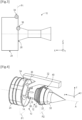
- FIG 4 schematically illustrates the general principle of the invention which is to provide, in addition to the suspension members 34, 36 of the turbomachine 10 which are located upstream of the combustion chamber 18, at least one shock absorber 40 which connects the turbomachine 10 to the pylon 32 and which is located downstream of the combustion chamber 18.
- the members 34, 36 take up the loads in the directions Y and Z as well as the moments Mx, My and Mz in all directions.
- the thrust of the turbomachine in the direction X is taken up by a system integrated into the members 34 or 36 or independent.
- the damper 40 extends in a plane P2 which is perpendicular to the axis A and which passes for example through a turbine or exhaust casing of the turbomachine 10.
- the damper 40 is configured to limit the relative movements between the turbomachine 10 and the pylon 32 without transmitting forces, as will be explained below.
- FIGS. 5 to 9d illustrate a first embodiment of the shock absorber 40 which is here of the vane type.
- the shock absorber 40 comprises at least two connecting rods 42, 44.
- a first connecting rod 42 comprises a first end 42a articulated on a yoke 45a of the pylon 32 and the second connecting rod 44 comprises a first end 44a articulated on a yoke 45b of the turbomachine 10.
- the connecting rods 42, 44 have second ends 42b, 44b which are connected together by a damping device 46.
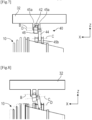
- the ends 42a, 42b, 44a, 44b of the connecting rods 42, 44 have articulation or connection axes B, C, D substantially parallel to each other and to the longitudinal axis A of the turbomachine 10, in particular in the rest position visible in the figure 7 .
- the ends 42a, 44a of the connecting rods 42, 44 are preferably connected by ball joints respectively to the pylon 32 and to the turbomachine 10, so that the shock absorber 40 can allow relative movements of the turbomachine 10 with respect to the pylon 32, along the axis A (cf. figure 8 ). This avoids generating stresses during engine elongation linked to operating temperature.
- the damping device 46 is of the vane type and comprises a cage 48 secured to the connecting rod 42, and a vane 50 secured to the connecting rod 44.
- the vane 50 is capable of rotating in a cavity 52 of the cage 48, which is filled with a damping liquid.
- the cavity 52 of the cage 48 comprises stops 54a, 54b, 56a, 56b configured to limit the angular movement of the pallet 50 in the cavity (cf. figure 6 ), and therefore the relative movements of the turbomachine 10 with respect to the pylon 32.
- the vane 50 comprises two diametrically opposed ears 50a, 50b configured to bear on the stops 54a, 54b, 56a, 56b.
- the ear 50a can move between the stop 54a and the stop 54b, and the ear 50b can move between the stop 56a and the stop 56b.
- a first limit position of the vane 50 in the cavity 48 corresponds to the case where the ears 50a, 50b are respectively supported on the stops 54a and 56b.
- a second limit position of the vane 50 in the cavity 48 corresponds to the case where the ears 50a, 50b are respectively supported on the stops 54b and 56a.
- FIGS. 9a to 9d show the extreme positions of the turbomachine 10 with respect to the pylon 32, in the plane P2 in which the shock absorber 40 extends.
- the end 44a of the connecting rod 44, and in particular its axis of connection to the turbomachine, is located on a first angle of a square of displacement of this end in the aforementioned plane.
- This square has two parallel sides oriented in the Z direction and two parallel sides oriented in the Y direction.
- the turbomachine 10 has moved upwards (movement along the Z axis: Z+), and also on an opposite side (movement along the Y axis: Y+), with respect to the pylon 32.
- the end 44a of the connecting rod 44 is located on a third angle of the displacement square.
- the turbomachine 10 moved downwards (movement along the Z axis: Z-), and on the same side as in the figure 9c (displacement along the Y axis: Y+), opposite the pylon 32.
- the end 44a of the connecting rod 44 is located on a fourth and final angle of the displacement square.
- the pallet rests on the cage stops to block any additional movement of the turbomachine and to ensure, if necessary, the transmission of forces from the turbomachine to the pylon.
- the liquid contained in the cavity 48 for moving the pallet 50 may be Newtonian or non-Newtonian.
- a non-Newtonian fluid is a fluid whose viscosity varies with the stress or force applied and time.
- the most common example of a non-Newtonian fluid is cornstarch dissolved in water.
- Newtonian fluids such as water can be described exclusively by temperature and pressure.
- the physical behavior of the non-Newtonian fluid depends on the forces acting on it over time.
- the viscosity of some fluids increases when the force applied increases. They are called shear-thickening fluids.
- the viscosity of some fluids decreases when they are subjected to a force; these are shear-thinning fluids.
- this liquid can be an oil, a silicone liquid, water, etc.
- this liquid is preferably rheothickening and is for example a fluid consisting of rough grains in a liquid.
- this liquid is then very low viscosity.
- stress is applied, the grains lock together, and the liquid can no longer flow between them.
- the mixture solidifies and its viscosity increases.
- the turbomachine moves in the Z and Y directions as shown in Figures 9a to 9d , depending on the constraints applied to the stators
- non-Newtonian liquid thus allows a progressive damping rate, depending on the speed and the force transmitted by the pallet 50.
- the invention therefore makes it possible to protect the structure from significant loads, particularly in the case of ultimate dynamic loads (loss of propeller blade or part of a turbine blade crown) or in the case of ultimate static maneuvers (G/gyroscopic factor) while retaining the advantages of the chosen cantilever suspension system to protect the performance of the turbomachine in the case of nominal loads.
- FIGS. 10a and 10b illustrate a second embodiment of the shock absorber 40 which is here of the piston type 60.
- the shock absorber 40 here comprises four connecting rods 42, 44.
- Two first connecting rods 42 each comprise a first end 42a articulated on the pylon 32 and two second connecting rods 44 each comprise a first end 44a articulated on the turbomachine 10.
- the second ends 42b, 44b of one of the connecting rods 42 and one of the connecting rods 44 are hinged to each other.
- the second ends 42b, 44b of the other of the connecting rods 42 and the other of the connecting rods 44 are connected together by a damping device 46 with a piston 60.
- the ends 42a, 44a of the connecting rods 42, 44 are preferably connected by swivel connections respectively to each other and to the pylon 32 and to the turbomachine 10.
- the damping device 46 comprises a piston 60 which is integral with the connecting rod 42, and a cylinder 62 which is integral with the connecting rod 44 and in which the piston 60 can slide.
- the piston 60 is able to slide in the cylinder in the aforementioned plane P2.
- Cylinder 62 is filled with a damping fluid, as discussed above.
- the 40 shock absorber stroke is calculated to have a functional range and margin with two piston end stops.
- FIGS. 11a and 11b illustrate a second embodiment of the shock absorber 40 which is here of the spring type, that is to say with an elastically deformable element.
- the shock absorber 40 here comprises four connecting rods 42, 44.
- Two first connecting rods 42 each comprise a first end 42a articulated on the pylon 32 and two second connecting rods 44 each comprise a first end 44a articulated on the turbomachine 10.
- the second ends 42b, 44b of one of the connecting rods 42 and one of the connecting rods 44 are hinged to each other.
- the second ends 42b, 44b of the other of the connecting rods 42 and the other of the connecting rods 44 are connected together by a damping device 46 with a spring 70.
- the ends 42a, 44a of the connecting rods 42, 44 are preferably connected by swivel connections respectively to each other and to the pylon 32 and to the turbomachine 10.
- the damping device 46 comprises a spring 70 which is integral with the connecting rod 42, and a guide 72 which is integral with the connecting rod 44 and in or on which the spring 70 can deform.
- the spring 70 is capable of deforming in the aforementioned plane P2.
- the 40 shock absorber stroke is calculated to have a functional range and margin with two spring end stops.
- the damping device 46 with pallet 50 is equipped with a rotary motion sensor 80 which therefore measures the angular movements of the pallet 50 around its axis of rotation.
- the damping device 46 with piston 70 or spring 80 is equipped with a translation sensor 80 which therefore measures the movements of the piston or the deformations of the spring.
- the damper In nominal operation, the relative movements and vibrations of the turbomachine are thus damped by the damper. This is the case, for example, in normal operation of the turbomachine and aircraft maneuvers. There is then no transmission of forces between the turbomachine and the pylon. In ultimate operation, for example in the event of blade loss and ultimate aircraft maneuvers, the damper locks and ensures transmission of forces.
Landscapes
- Engineering & Computer Science (AREA)
- General Engineering & Computer Science (AREA)
- Mechanical Engineering (AREA)
- Aviation & Aerospace Engineering (AREA)
- Chemical & Material Sciences (AREA)
- Combustion & Propulsion (AREA)
- Physics & Mathematics (AREA)
- Acoustics & Sound (AREA)
- Structures Of Non-Positive Displacement Pumps (AREA)
- Turbine Rotor Nozzle Sealing (AREA)
- Vibration Prevention Devices (AREA)
- Vibration Dampers (AREA)
Claims (11)
- Anordnung, die ein Flugzeugturbotriebwerk (10) und einen Pylon (32) zur Montage des Turbotriebwerks an einem Flugzeugelement umfasst,wobei das Turbotriebwerk eine Längsachse (A) aufweist und einen Gasgenerator (12) umfasst, der in der Gasströmungsrichtung von stromaufwärts nach stromabwärts mindestens einen Kompressor (14,16), eine ringförmige Brennkammer (18) und mindestens eine Turbine (20, 22) umfasst,wobei der Pylon eine allgemeine entlang der Achse (A) langgestreckte Form aufweist und Elemente (34, 36) zur Aufhängung des Turbotriebwerks (10) umfasst, wobei diese Elemente derart mit dem Turbotriebwerk in mindestens einer Ebene (P1), die senkrecht zur Achse (A) ist und die sich stromaufwärts der Brennkammer (18) befindet, verbunden sind, dass das Turbotriebwerk (10) überhängend zum Pylon (32) befestigt ist,dadurch gekennzeichnet, dass sie weiter mindestens einen Dämpfer (40) umfasst, der das Turbotriebwerk (10) mit dem Pylon (32) verbindet und der sich in einer Ebene (P2) senkrecht zur Achse (A) befindet, die sich stromabwärts der Brennkammer (18) befindet, wobei dieser Dämpfer (40) konfiguriert ist, um die relativen Verschiebungen in der Ebene (P2) zwischen dem Turbotriebwerk (10) und dem Pylon (32) ohne Kraftübertragung zu begrenzen.
- Anordnung nach Anspruch 1, wobei der Dämpfer (40) konfiguriert ist, um die Verschiebungen ohne Kraftübertragung in der Ebene (P2) auf einer ersten vorbestimmten Strecke in einer ersten Richtung (Z), die in der Ebene (P2) enthalten ist, und auf einer zweiten vorbestimmten Strecke in einer zweiten Richtung (Y), die in der Ebene (P2) enthalten ist und senkrecht zur ersten Richtung (Z) ist, zu begrenzen und jegliche Verschiebung des Turbotriebwerks gegenüber dem Pylon jenseits dieser Strecken mit Kraftübertragung zu blockieren.
- Anordnung nach Anspruch 1 oder 2, wobei der Dämpfer (40) mindestens zwei Pleuel (42, 44) umfasst, wobei ein erstes Pleuel (42) ein erstes Ende (42a) umfasst, das am Pylon (32) angelenkt ist, und ein zweites Pleuel (44) ein erstes Ende (44a) umfasst, das am Turbotriebwerk (10) angelenkt ist, wobei das erste und das zweite Pleuel (42, 44) zweite Enden (42b, 44b) umfassen, die über eine Dämpfvorrichtung (46) miteinander verbunden sind, wobei die ersten und zweiten Enden (42a, 42b, 44a, 44b) der Pleuel (42, 44) Achsen (B, C, D) zur im Wesentlichen parallelen Artikulation oder Verbindung untereinander und mit der Längsachse (A) des Turbotriebwerks aufweisen.
- Anordnung nach Anspruch 3, wobei die ersten Enden (42a, 44a) der Pleuel (42, 44) durch Drehgelenkverbindungen mit dem Pylon (32) bzw. mit dem Turbotriebwerk (10) verbunden sind.
- Anordnung nach Anspruch 3 oder 4, wobei die Dämpfvorrichtung (46) vom Palettentyp (50) ist und einen Käfig (48), der fest mit dem einen des ersten und des zweiten Pleuels (42) verbunden ist, und eine Palette (50) umfasst, die fest mit dem anderen des ersten und des zweiten Pleuels (44) verbunden ist, wobei die Palette (50) imstande ist, sich in einem Hohlraum (52) des Käfigs (48) zu drehen, der mit einer Dämpfflüssigkeit gefüllt ist.
- Anordnung nach Anspruch 5, wobei die Dämpfflüssigkeit eine nichtnewtonsche Flüssigkeit ist.
- Anordnung nach Anspruch 5, wobei die Dämpfflüssigkeit eine newtonsche Flüssigkeit ist.
- Anordnung nach einem der Ansprüche 5 bis 7, wobei der Hohlraum (52) des Käfigs (48) Anschläge (54a, 54b, 56a, 56b) umfasst, die konfiguriert sind, um den Winkelausschlag der Palette (50) im Hohlraum (52) zu begrenzen.
- Anordnung nach Anspruch 8, wobei die Palette (50) zwei Laschen (50a, 50b) umfasst, die sich diametral gegenüberliegen und konfiguriert sind, um auf den Anschlägen (54a, 54b, 56a, 56b) aufzuliegen.
- Anordnung nach Anspruch 3 oder 4, wobei die Dämpfvorrichtung (46) vom Kolbentyp (60) oder vom Federtyp (70) ist.
- Anordnung nach einem der vorstehenden Ansprüche, wobei die Dämpfvorrichtung (46) mit einem Bewegungssensor (80) ausgestattet ist.
Applications Claiming Priority (2)
| Application Number | Priority Date | Filing Date | Title |
|---|---|---|---|
| FR2100556A FR3118992B1 (fr) | 2021-01-21 | 2021-01-21 | Ensemble comportant une turbomachine d’aeronef et son pylone d’accrochage |
| PCT/FR2022/050074 WO2022157443A1 (fr) | 2021-01-21 | 2022-01-13 | Ensemble comportant une turbomachine d'aeronef et son pylone d'accrochage |
Publications (2)
| Publication Number | Publication Date |
|---|---|
| EP4281659A1 EP4281659A1 (de) | 2023-11-29 |
| EP4281659B1 true EP4281659B1 (de) | 2024-11-06 |
Family
ID=74759137
Family Applications (1)
| Application Number | Title | Priority Date | Filing Date |
|---|---|---|---|
| EP22702768.7A Active EP4281659B1 (de) | 2021-01-21 | 2022-01-13 | Anordnung mit einem flugzeugturbinentriebwerk und montagepylon dafür |
Country Status (5)
| Country | Link |
|---|---|
| US (1) | US12296967B2 (de) |
| EP (1) | EP4281659B1 (de) |
| CN (1) | CN116783379A (de) |
| FR (1) | FR3118992B1 (de) |
| WO (1) | WO2022157443A1 (de) |
Families Citing this family (7)
| Publication number | Priority date | Publication date | Assignee | Title |
|---|---|---|---|---|
| FR3133839B1 (fr) * | 2022-03-28 | 2024-03-22 | Safran Aircraft Engines | ensemble de suspension pour une turbomachine |
| EP4488179A1 (de) * | 2023-07-04 | 2025-01-08 | Airbus Operations (S.A.S.) | Antriebsanordnung mit einem aufhängungssystem des hinteren teils des motorisierungsverfahrens, luftfahrzeug mit mindestens einer solchen antriebsanordnung |
| FR3158095A1 (fr) | 2024-01-04 | 2025-07-11 | Safran Aircraft Engines | Ensemble comportant une turbomachine d’aeronef et son pylone d’accrochage |
| FR3158096A1 (fr) | 2024-01-04 | 2025-07-11 | Safran Aircraft Engines | Ensemble comportant une turbomachine d’aeronef et son pylone d’accrochage |
| FR3158499A1 (fr) | 2024-01-22 | 2025-07-25 | Safran Aircraft Engines | Ensemble comportant une turbomachine d’aeronef et son pylone d’accrochage |
| FR3160674A1 (fr) | 2024-04-02 | 2025-10-03 | Safran Aircraft Engines | Ensemble comprenant une turbomachine d’aeronef et son pylone d’accrochage |
| FR3160673A1 (fr) * | 2024-04-02 | 2025-10-03 | Safran Aircraft Engines | Ensemble comprenant une turbomachine d’aeronef et son pylone d’accrochage |
Family Cites Families (7)
| Publication number | Priority date | Publication date | Assignee | Title |
|---|---|---|---|---|
| US4717094A (en) * | 1986-05-19 | 1988-01-05 | The Boeing Company | Aircraft engine mount system with vibration isolators |
| FR2969700B1 (fr) | 2010-12-23 | 2015-05-15 | Snecma | Systeme propulsif pour aeronef |
| US9046001B2 (en) * | 2011-08-29 | 2015-06-02 | Honeywell International Inc. | Annular bearing support dampers, gas turbine engines including the same, and methods for the manufacture thereof |
| FR2987401B1 (fr) | 2012-02-28 | 2017-05-12 | Snecma | Procede pour maintenir une piece d'adaptation sur un carter tubulaire d'un turbomoteur, piece d'adaptation et systeme de maintien correspondants. |
| FR2995282B1 (fr) * | 2012-09-13 | 2015-06-19 | Snecma | Pylone de montage d'un moteur a la structure d'un aeronef |
| FR3053661B1 (fr) * | 2016-07-11 | 2018-07-13 | Safran Aircraft Engines | Dispositif de propulsion pour un aeronef, tel par exemple qu'un turbopropulseur |
| US11560840B2 (en) * | 2020-10-16 | 2023-01-24 | General Electric Company | Damper engine mount links |
-
2021
- 2021-01-21 FR FR2100556A patent/FR3118992B1/fr active Active
-
2022
- 2022-01-13 CN CN202280010402.2A patent/CN116783379A/zh active Pending
- 2022-01-13 US US18/260,923 patent/US12296967B2/en active Active
- 2022-01-13 WO PCT/FR2022/050074 patent/WO2022157443A1/fr not_active Ceased
- 2022-01-13 EP EP22702768.7A patent/EP4281659B1/de active Active
Also Published As
| Publication number | Publication date |
|---|---|
| WO2022157443A1 (fr) | 2022-07-28 |
| CN116783379A (zh) | 2023-09-19 |
| FR3118992A1 (fr) | 2022-07-22 |
| US20240052781A1 (en) | 2024-02-15 |
| US12296967B2 (en) | 2025-05-13 |
| EP4281659A1 (de) | 2023-11-29 |
| FR3118992B1 (fr) | 2022-12-09 |
Similar Documents
| Publication | Publication Date | Title |
|---|---|---|
| EP4281659B1 (de) | Anordnung mit einem flugzeugturbinentriebwerk und montagepylon dafür | |
| EP4347401B1 (de) | Struktur zur verbindung und befestigung einer turbomaschine an einem flugzeugpylon | |
| EP2075413B1 (de) | Vorrichtung zur Versteifung eines Stators einer Strömungsmaschine und deren Anwendung in Luftfahrzeugmotoren | |
| EP4087784B1 (de) | Anordnung zwischen einem flugzeugmast und einer turbomaschine | |
| EP1659266A1 (de) | Gemeinsame Entkopplungsvorrichtung für das erste und das zweite Lager der Antriebswelle einer Turbomaschine, und Verdichter und Turbomaschine mit einer solchen Vorrichtung | |
| CA2928696C (fr) | Turbomachine equipee de moyens de reprise des efforts de poussee de son moteur | |
| FR3114129A1 (fr) | Ensemble comportant une turbomachine d’aeronef et son pylone d’accrochage | |
| WO2022248795A1 (fr) | Ensemble de supportage d'une boite d'accessoires d'une turbomachine d'aeronef | |
| EP3863928B1 (de) | Turbostrahltriebwerk mit mittel zur aufhängung des triebwerks | |
| EP3394400B1 (de) | Turbostrahltriebwerk mit einem mittel zur kraftübertragung auf das gehäuse des zwischenverdichters | |
| EP1653053B1 (de) | Zwei-Steifigkeiten Vorrichtung für die Montage eines Lagers auf die Welle eines Rotationsmotor | |
| WO2025146525A1 (fr) | Ensemble comportant une turbomachine d'aeronef et son pylone d'accrochage | |
| WO2025120280A1 (fr) | Ensemble comportant une turbomachine d'aeronef et son pylone d'accrochage | |
| WO2014174222A1 (fr) | Structure de suspension d'un turbopropulseur a double helices non carenees sur un element structurel d'un aeronef | |
| WO2022189720A1 (fr) | Palier pour pivot d'aube de redresseur à calage variable de turbomachine, aube de redresseur comportant un tel palier et turbomachine comportant de telles aubes de redresseur | |
| FR3158499A1 (fr) | Ensemble comportant une turbomachine d’aeronef et son pylone d’accrochage | |
| WO2025120281A1 (fr) | Ensemble comportant une turbomachine d'aeronef et son pylone d'accrochage | |
| EP4352350B1 (de) | Flugzeugturbinentriebwerkanordnung mit einer stütze für ausrüstung | |
| FR3118093A1 (fr) | Aube de turbine, en particulier destinée à une turbine contrarotative | |
| WO2025146524A1 (fr) | Ensemble comportant une turbomachine d'aeronef et son pylone d'accrochage | |
| FR3096345A1 (fr) | Turbomachine comportant des moyens perfectionnés de suspension d'un moteur à turbine à gaz | |
| FR3159667A1 (fr) | Dispositif de simulation de balourd transitoire et turbomachine équipée d’un tel dispositif | |
| FR3153107A1 (fr) | Dispositif de support pour au moins une aube statorique d’une turbomachine d’aéronef et son procédé d’utilisation | |
| WO2026047301A1 (fr) | Systeme de suspension pour turbomachine d'aeronef a liaison bi-rotulee et pivot glissant | |
| FR3061147A1 (fr) | Turbopropulseur d'aeronef de type a arbre deporte comportant des moyens de suspension a un pylone d'aeronef |
Legal Events
| Date | Code | Title | Description |
|---|---|---|---|
| STAA | Information on the status of an ep patent application or granted ep patent |
Free format text: STATUS: UNKNOWN |
|
| STAA | Information on the status of an ep patent application or granted ep patent |
Free format text: STATUS: THE INTERNATIONAL PUBLICATION HAS BEEN MADE |
|
| PUAI | Public reference made under article 153(3) epc to a published international application that has entered the european phase |
Free format text: ORIGINAL CODE: 0009012 |
|
| STAA | Information on the status of an ep patent application or granted ep patent |
Free format text: STATUS: REQUEST FOR EXAMINATION WAS MADE |
|
| 17P | Request for examination filed |
Effective date: 20230712 |
|
| AK | Designated contracting states |
Kind code of ref document: A1 Designated state(s): AL AT BE BG CH CY CZ DE DK EE ES FI FR GB GR HR HU IE IS IT LI LT LU LV MC MK MT NL NO PL PT RO RS SE SI SK SM TR |
|
| DAV | Request for validation of the european patent (deleted) | ||
| DAX | Request for extension of the european patent (deleted) | ||
| REG | Reference to a national code |
Ref legal event code: R079 Ref country code: DE Ref legal event code: R079 Ref document number: 602022007509 Country of ref document: DE Free format text: PREVIOUS MAIN CLASS: F02C0007200000 Ipc: B64D0027400000 |
|
| GRAP | Despatch of communication of intention to grant a patent |
Free format text: ORIGINAL CODE: EPIDOSNIGR1 |
|
| STAA | Information on the status of an ep patent application or granted ep patent |
Free format text: STATUS: GRANT OF PATENT IS INTENDED |
|
| RIC1 | Information provided on ipc code assigned before grant |
Ipc: F01D 25/28 20060101ALI20240814BHEP Ipc: F02C 7/20 20060101ALI20240814BHEP Ipc: F01D 25/04 20060101ALI20240814BHEP Ipc: B64D 27/40 20240101AFI20240814BHEP |
|
| GRAS | Grant fee paid |
Free format text: ORIGINAL CODE: EPIDOSNIGR3 |
|
| INTG | Intention to grant announced |
Effective date: 20240903 |
|
| GRAA | (expected) grant |
Free format text: ORIGINAL CODE: 0009210 |
|
| STAA | Information on the status of an ep patent application or granted ep patent |
Free format text: STATUS: THE PATENT HAS BEEN GRANTED |
|
| AK | Designated contracting states |
Kind code of ref document: B1 Designated state(s): AL AT BE BG CH CY CZ DE DK EE ES FI FR GB GR HR HU IE IS IT LI LT LU LV MC MK MT NL NO PL PT RO RS SE SI SK SM TR |
|
| REG | Reference to a national code |
Ref country code: GB Ref legal event code: FG4D Free format text: NOT ENGLISH |
|
| REG | Reference to a national code |
Ref country code: CH Ref legal event code: EP |
|
| REG | Reference to a national code |
Ref country code: DE Ref legal event code: R096 Ref document number: 602022007509 Country of ref document: DE |
|
| REG | Reference to a national code |
Ref country code: IE Ref legal event code: FG4D Free format text: LANGUAGE OF EP DOCUMENT: FRENCH |
|
| REG | Reference to a national code |
Ref country code: LT Ref legal event code: MG9D |
|
| REG | Reference to a national code |
Ref country code: NL Ref legal event code: MP Effective date: 20241106 |
|
| PG25 | Lapsed in a contracting state [announced via postgrant information from national office to epo] |
Ref country code: HR Free format text: LAPSE BECAUSE OF FAILURE TO SUBMIT A TRANSLATION OF THE DESCRIPTION OR TO PAY THE FEE WITHIN THE PRESCRIBED TIME-LIMIT Effective date: 20241106 Ref country code: PT Free format text: LAPSE BECAUSE OF FAILURE TO SUBMIT A TRANSLATION OF THE DESCRIPTION OR TO PAY THE FEE WITHIN THE PRESCRIBED TIME-LIMIT Effective date: 20250306 Ref country code: IS Free format text: LAPSE BECAUSE OF FAILURE TO SUBMIT A TRANSLATION OF THE DESCRIPTION OR TO PAY THE FEE WITHIN THE PRESCRIBED TIME-LIMIT Effective date: 20250306 |
|
| PG25 | Lapsed in a contracting state [announced via postgrant information from national office to epo] |
Ref country code: FI Free format text: LAPSE BECAUSE OF FAILURE TO SUBMIT A TRANSLATION OF THE DESCRIPTION OR TO PAY THE FEE WITHIN THE PRESCRIBED TIME-LIMIT Effective date: 20241106 Ref country code: NL Free format text: LAPSE BECAUSE OF FAILURE TO SUBMIT A TRANSLATION OF THE DESCRIPTION OR TO PAY THE FEE WITHIN THE PRESCRIBED TIME-LIMIT Effective date: 20241106 |
|
| REG | Reference to a national code |
Ref country code: AT Ref legal event code: MK05 Ref document number: 1739142 Country of ref document: AT Kind code of ref document: T Effective date: 20241106 |
|
| PG25 | Lapsed in a contracting state [announced via postgrant information from national office to epo] |
Ref country code: BG Free format text: LAPSE BECAUSE OF FAILURE TO SUBMIT A TRANSLATION OF THE DESCRIPTION OR TO PAY THE FEE WITHIN THE PRESCRIBED TIME-LIMIT Effective date: 20241106 |
|
| PG25 | Lapsed in a contracting state [announced via postgrant information from national office to epo] |
Ref country code: ES Free format text: LAPSE BECAUSE OF FAILURE TO SUBMIT A TRANSLATION OF THE DESCRIPTION OR TO PAY THE FEE WITHIN THE PRESCRIBED TIME-LIMIT Effective date: 20241106 |
|
| PG25 | Lapsed in a contracting state [announced via postgrant information from national office to epo] |
Ref country code: NO Free format text: LAPSE BECAUSE OF FAILURE TO SUBMIT A TRANSLATION OF THE DESCRIPTION OR TO PAY THE FEE WITHIN THE PRESCRIBED TIME-LIMIT Effective date: 20250206 |
|
| PG25 | Lapsed in a contracting state [announced via postgrant information from national office to epo] |
Ref country code: LV Free format text: LAPSE BECAUSE OF FAILURE TO SUBMIT A TRANSLATION OF THE DESCRIPTION OR TO PAY THE FEE WITHIN THE PRESCRIBED TIME-LIMIT Effective date: 20241106 Ref country code: GR Free format text: LAPSE BECAUSE OF FAILURE TO SUBMIT A TRANSLATION OF THE DESCRIPTION OR TO PAY THE FEE WITHIN THE PRESCRIBED TIME-LIMIT Effective date: 20250207 Ref country code: AT Free format text: LAPSE BECAUSE OF FAILURE TO SUBMIT A TRANSLATION OF THE DESCRIPTION OR TO PAY THE FEE WITHIN THE PRESCRIBED TIME-LIMIT Effective date: 20241106 |
|
| PG25 | Lapsed in a contracting state [announced via postgrant information from national office to epo] |
Ref country code: PL Free format text: LAPSE BECAUSE OF FAILURE TO SUBMIT A TRANSLATION OF THE DESCRIPTION OR TO PAY THE FEE WITHIN THE PRESCRIBED TIME-LIMIT Effective date: 20241106 |
|
| PG25 | Lapsed in a contracting state [announced via postgrant information from national office to epo] |
Ref country code: RS Free format text: LAPSE BECAUSE OF FAILURE TO SUBMIT A TRANSLATION OF THE DESCRIPTION OR TO PAY THE FEE WITHIN THE PRESCRIBED TIME-LIMIT Effective date: 20250206 |
|
| PG25 | Lapsed in a contracting state [announced via postgrant information from national office to epo] |
Ref country code: SM Free format text: LAPSE BECAUSE OF FAILURE TO SUBMIT A TRANSLATION OF THE DESCRIPTION OR TO PAY THE FEE WITHIN THE PRESCRIBED TIME-LIMIT Effective date: 20241106 |
|
| PG25 | Lapsed in a contracting state [announced via postgrant information from national office to epo] |
Ref country code: DK Free format text: LAPSE BECAUSE OF FAILURE TO SUBMIT A TRANSLATION OF THE DESCRIPTION OR TO PAY THE FEE WITHIN THE PRESCRIBED TIME-LIMIT Effective date: 20241106 |
|
| PG25 | Lapsed in a contracting state [announced via postgrant information from national office to epo] |
Ref country code: EE Free format text: LAPSE BECAUSE OF FAILURE TO SUBMIT A TRANSLATION OF THE DESCRIPTION OR TO PAY THE FEE WITHIN THE PRESCRIBED TIME-LIMIT Effective date: 20241106 |
|
| PG25 | Lapsed in a contracting state [announced via postgrant information from national office to epo] |
Ref country code: RO Free format text: LAPSE BECAUSE OF FAILURE TO SUBMIT A TRANSLATION OF THE DESCRIPTION OR TO PAY THE FEE WITHIN THE PRESCRIBED TIME-LIMIT Effective date: 20241106 |
|
| PG25 | Lapsed in a contracting state [announced via postgrant information from national office to epo] |
Ref country code: SK Free format text: LAPSE BECAUSE OF FAILURE TO SUBMIT A TRANSLATION OF THE DESCRIPTION OR TO PAY THE FEE WITHIN THE PRESCRIBED TIME-LIMIT Effective date: 20241106 |
|
| PG25 | Lapsed in a contracting state [announced via postgrant information from national office to epo] |
Ref country code: CZ Free format text: LAPSE BECAUSE OF FAILURE TO SUBMIT A TRANSLATION OF THE DESCRIPTION OR TO PAY THE FEE WITHIN THE PRESCRIBED TIME-LIMIT Effective date: 20241106 |
|
| PG25 | Lapsed in a contracting state [announced via postgrant information from national office to epo] |
Ref country code: IT Free format text: LAPSE BECAUSE OF FAILURE TO SUBMIT A TRANSLATION OF THE DESCRIPTION OR TO PAY THE FEE WITHIN THE PRESCRIBED TIME-LIMIT Effective date: 20241106 |
|
| REG | Reference to a national code |
Ref country code: DE Ref legal event code: R097 Ref document number: 602022007509 Country of ref document: DE |
|
| REG | Reference to a national code |
Ref country code: CH Ref legal event code: PL |
|
| PG25 | Lapsed in a contracting state [announced via postgrant information from national office to epo] |
Ref country code: SE Free format text: LAPSE BECAUSE OF FAILURE TO SUBMIT A TRANSLATION OF THE DESCRIPTION OR TO PAY THE FEE WITHIN THE PRESCRIBED TIME-LIMIT Effective date: 20241106 |
|
| PLBE | No opposition filed within time limit |
Free format text: ORIGINAL CODE: 0009261 |
|
| STAA | Information on the status of an ep patent application or granted ep patent |
Free format text: STATUS: NO OPPOSITION FILED WITHIN TIME LIMIT |
|
| PG25 | Lapsed in a contracting state [announced via postgrant information from national office to epo] |
Ref country code: LU Free format text: LAPSE BECAUSE OF NON-PAYMENT OF DUE FEES Effective date: 20250113 Ref country code: MC Free format text: LAPSE BECAUSE OF FAILURE TO SUBMIT A TRANSLATION OF THE DESCRIPTION OR TO PAY THE FEE WITHIN THE PRESCRIBED TIME-LIMIT Effective date: 20241106 |
|
| 26N | No opposition filed |
Effective date: 20250807 |
|
| PG25 | Lapsed in a contracting state [announced via postgrant information from national office to epo] |
Ref country code: BE Free format text: LAPSE BECAUSE OF NON-PAYMENT OF DUE FEES Effective date: 20250131 |
|
| PG25 | Lapsed in a contracting state [announced via postgrant information from national office to epo] |
Ref country code: CH Free format text: LAPSE BECAUSE OF NON-PAYMENT OF DUE FEES Effective date: 20250131 |
|
| REG | Reference to a national code |
Ref country code: BE Ref legal event code: MM Effective date: 20250131 |
|
| PG25 | Lapsed in a contracting state [announced via postgrant information from national office to epo] |
Ref country code: IE Free format text: LAPSE BECAUSE OF NON-PAYMENT OF DUE FEES Effective date: 20250113 |
|
| PGFP | Annual fee paid to national office [announced via postgrant information from national office to epo] |
Ref country code: GB Payment date: 20260122 Year of fee payment: 5 |
|
| PGFP | Annual fee paid to national office [announced via postgrant information from national office to epo] |
Ref country code: DE Payment date: 20260120 Year of fee payment: 5 |
|
| PGFP | Annual fee paid to national office [announced via postgrant information from national office to epo] |
Ref country code: FR Payment date: 20260116 Year of fee payment: 5 |