EP4267574B1 - 6-heteroaryloxy benzimidazoles and azabenzimidazoles as jak2 inhibitors - Google Patents
6-heteroaryloxy benzimidazoles and azabenzimidazoles as jak2 inhibitors Download PDFInfo
- Publication number
- EP4267574B1 EP4267574B1 EP21847625.7A EP21847625A EP4267574B1 EP 4267574 B1 EP4267574 B1 EP 4267574B1 EP 21847625 A EP21847625 A EP 21847625A EP 4267574 B1 EP4267574 B1 EP 4267574B1
- Authority
- EP
- European Patent Office
- Prior art keywords
- optionally substituted
- int
- nitrogen
- sulfur
- oxygen
- Prior art date
- Legal status (The legal status is an assumption and is not a legal conclusion. Google has not performed a legal analysis and makes no representation as to the accuracy of the status listed.)
- Active
Links
Classifications
-
- C—CHEMISTRY; METALLURGY
- C07—ORGANIC CHEMISTRY
- C07D—HETEROCYCLIC COMPOUNDS
- C07D471/00—Heterocyclic compounds containing nitrogen atoms as the only ring hetero atoms in the condensed system, at least one ring being a six-membered ring with one nitrogen atom, not provided for by groups C07D451/00 - C07D463/00
- C07D471/02—Heterocyclic compounds containing nitrogen atoms as the only ring hetero atoms in the condensed system, at least one ring being a six-membered ring with one nitrogen atom, not provided for by groups C07D451/00 - C07D463/00 in which the condensed system contains two hetero rings
- C07D471/04—Ortho-condensed systems
-
- C—CHEMISTRY; METALLURGY
- C07—ORGANIC CHEMISTRY
- C07D—HETEROCYCLIC COMPOUNDS
- C07D519/00—Heterocyclic compounds containing more than one system of two or more relevant hetero rings condensed among themselves or condensed with a common carbocyclic ring system not provided for in groups C07D453/00 or C07D455/00
-
- A—HUMAN NECESSITIES
- A61—MEDICAL OR VETERINARY SCIENCE; HYGIENE
- A61P—SPECIFIC THERAPEUTIC ACTIVITY OF CHEMICAL COMPOUNDS OR MEDICINAL PREPARATIONS
- A61P35/00—Antineoplastic agents
-
- C—CHEMISTRY; METALLURGY
- C07—ORGANIC CHEMISTRY
- C07D—HETEROCYCLIC COMPOUNDS
- C07D487/00—Heterocyclic compounds containing nitrogen atoms as the only ring hetero atoms in the condensed system, not provided for by groups C07D451/00 - C07D477/00
- C07D487/02—Heterocyclic compounds containing nitrogen atoms as the only ring hetero atoms in the condensed system, not provided for by groups C07D451/00 - C07D477/00 in which the condensed system contains two hetero rings
- C07D487/04—Ortho-condensed systems
-
- C—CHEMISTRY; METALLURGY
- C07—ORGANIC CHEMISTRY
- C07D—HETEROCYCLIC COMPOUNDS
- C07D495/00—Heterocyclic compounds containing in the condensed system at least one hetero ring having sulfur atoms as the only ring hetero atoms
- C07D495/02—Heterocyclic compounds containing in the condensed system at least one hetero ring having sulfur atoms as the only ring hetero atoms in which the condensed system contains two hetero rings
- C07D495/04—Ortho-condensed systems
-
- C—CHEMISTRY; METALLURGY
- C07—ORGANIC CHEMISTRY
- C07D—HETEROCYCLIC COMPOUNDS
- C07D513/00—Heterocyclic compounds containing in the condensed system at least one hetero ring having nitrogen and sulfur atoms as the only ring hetero atoms, not provided for in groups C07D463/00, C07D477/00 or C07D499/00 - C07D507/00
- C07D513/02—Heterocyclic compounds containing in the condensed system at least one hetero ring having nitrogen and sulfur atoms as the only ring hetero atoms, not provided for in groups C07D463/00, C07D477/00 or C07D499/00 - C07D507/00 in which the condensed system contains two hetero rings
- C07D513/04—Ortho-condensed systems
Definitions
- Janus kinase 2 is a non-receptor tyrosine kinase involved in the JAK-STAT signaling pathway, which plays a role in cell processes such as immunity, cell division, and cell death.
- Dysfunction of the JAK-STAT pathway is implicated in various diseases, including cancer and other proliferative diseases, as well as diseases of the immune system.
- essentially all BCR-ABL1 -negative myeloproliferative neoplasms are associated with mutations that activate JAK2.
- JAK2 V617F is the most prevalent mutation in myeloproliferative neoplasms, occurring in approx.
- JAK2 JAK2
- Type I inhibitors are those that bind the ATP-binding site in the active conformation of the kinase domain, thereby blocking catalysis (Vainchenker, W. et al.).
- Type I inhibitors increased phosphorylation of the JAK2 activation loop is observed with Type I inhibitors and may lead to acquired resistance in certain patients ( Meyer S. C., Levine, R. L. Clin. Cancer Res. 2014, 20(8):2051-9 ).
- Type II inhibitors bind the ATP-binding site of the kinase domain in the inactive conformation and, therefore, may avoid hyperphosphorylation observed with Type I inhibitors ( Wu, S. C. et al. Cancer Cell 2015 Jul 13, 28(1):29-41 ).
- Examples of JAK and/or JAK2 inhibitors are found in WO 2020/097398 .
- 1H-pyrazolo[3,4-d]pyrimidine derivatives are described in Wang, Y. et al. Eur. J. Med. Chem. 2018, 155:210-228 and in CN107383014 .
- the present disclosure provides compounds useful for inhibiting JAK2.
- provided compounds are useful for, among other things, treating and/or preventing diseases, disorders, or conditions associated with JAK2.
- the present invention provides a compound of Formula I-D, or Formula I-E: or a pharmaceutically acceptable salt thereof, wherein Ring A, Ring B, L, W, X, Y, Z, R 1 , R a , and R b are as defined herein.
- structures depicted herein are meant to include all stereoisomeric (e.g., enantiomeric or diastereomeric) forms of the structure, as well as all geometric or conformational isomeric forms of the structure.
- R and S configurations of each stereocenter are contemplated as part of the disclosure. Therefore, single stereochemical isomers, as well as enantiomeric, diastereomic, and geometric (or conformational) mixtures of provided compounds are within the scope of the disclosure.
- Table 1 shows one or more stereoisomers of a compound, and unless otherwise indicated, represents each stereoisomer alone and/or as a mixture. Unless otherwise stated, all tautomeric forms of provided compounds are within the scope of the disclosure.
- structures depicted herein are meant to include compounds that differ only in the presence of one or more isotopically enriched atoms.
- compounds having the present structures including replacement of hydrogen by deuterium or tritium, or replacement of a carbon by 13 C- or 14 C-enriched carbon are within the scope of this disclosure.
- Aliphatic refers to a straight-chain (i.e., unbranched) or branched, optionally substituted hydrocarbon chain that is completely saturated or that contains one or more units of unsaturation, or a monocyclic or bicyclic hydrocarbon that is completely saturated or that contains one or more units of unsaturation but which is not aromatic (also referred to herein as "carbocyclic” or “cycloaliphatic”), that has a single point of attachment to the rest of the molecule.
- aliphatic groups contain 1-12 aliphatic carbon atoms. In some embodiments, aliphatic groups contain 1-6 aliphatic carbon atoms (e.g., C 1-6 ).
- aliphatic groups contain 1-5 aliphatic carbon atoms (e.g., C 1-5 ). In other embodiments, aliphatic groups contain 1-4 aliphatic carbon atoms (e.g., C 1-4 ). In still other embodiments, aliphatic groups contain 1-3 aliphatic carbon atoms (e.g., C 1-3 ), and in yet other embodiments, aliphatic groups contain 1-2 aliphatic carbon atoms (e.g., C 1-2 ). Suitable aliphatic groups include, but are not limited to, linear or branched, substituted or unsubstituted alkyl, alkenyl, alkynyl groups and hybrids thereof.
- aliphatic refers to a straight-chain (i.e., unbranched) or branched, optionally substituted hydrocarbon chain that is completely saturated or that contains one or more units of unsaturation that has a single point of attachment to the rest of the molecule.
- Alkyl refers to a saturated, optionally substituted straight or branched hydrocarbon group having (unless otherwise specified) 1-12, 1-10, 1-8, 1-6, 1-4, 1-3, or 1-2 carbon atoms (e.g., C 1-12 , C 1-10 , C 1-8 , C 1-6 , C 1-4 , C 1-3 , or C 1-2 ).
- exemplary alkyl groups include methyl, ethyl, propyl, butyl, pentyl, hexyl, and heptyl.
- Carbocyclyl The terms “carbocyclyl,” “carbocycle,” and “carbocyclic ring” as used herein, refer to saturated or partially unsaturated cyclic aliphatic monocyclic, bicyclic, or polycyclic ring systems, as described herein, having from 3 to 14 members, wherein the aliphatic ring system is optionally substituted as described herein.
- Carbocyclic groups include, without limitation, cyclopropyl, cyclobutyl, cyclopentyl, cyclopentenyl, cyclohexyl, cyclohexenyl, cycloheptyl, cycloheptenyl, cyclooctyl, cyclooctenyl, norbornyl, adamantyl, and cyclooctadienyl.
- Carbocyclyl refers to an optionally substituted monocyclic C 3 -C 8 hydrocarbon, or an optionally substituted C 7 -C 10 bicyclic hydrocarbon that is completely saturated or that contains one or more units of unsaturation, but which is not aromatic, that has a single point of attachment to the rest of the molecule.
- cycloalkyl refers to an optionally substituted saturated ring system of about 3 to about 10 ring carbon atoms. In some embodiments, cycloalkyl groups have 3-6 carbons.
- Alkenyl refers to an optionally substituted straight or branched hydrocarbon chain having at least one double bond and having (unless otherwise specified) 2-12, 2-10, 2-8, 2-6, 2-4, or 2-3 carbon atoms (e.g., C 2-12 , C 2-10 , C 2-8 , C 2-6 , C 2-4 , or C 2-3 ).
- alkenyl groups include ethenyl, propenyl, butenyl, pentenyl, hexenyl, and heptenyl.
- Alkynyl refers to an optionally substituted straight or branched chain hydrocarbon group having at least one triple bond and having (unless otherwise specified) 2-12, 2-10, 2-8, 2-6, 2-4, or 2-3 carbon atoms (e.g., C 2-12 , C 2-10 , C 2-8 , C 2-6 , C 2-4 , or C 2-3 ).
- exemplary alkynyl groups include ethynyl, propynyl, butynyl, pentynyl, hexynyl, and heptynyl.
- Aryl refers to monocyclic and bicyclic ring systems having a total of six to fourteen ring members (e.g., C 6-14 ), wherein at least one ring in the system is aromatic and wherein each ring in the system contains three to seven ring members.
- the term “aryl” may be used interchangeably with the term “aryl ring”.
- “aryl” refers to an aromatic ring system which includes, but not limited to, phenyl, naphthyl, anthracyl and the like, which may bear one or more substituents. Unless otherwise specified, "aryl” groups are hydrocarbons.
- Heteroaryl and “heteroar-”, used alone or as part of a larger moiety, e.g., “heteroaralkyl”, or “heteroaralkoxy”, refer to monocyclic or bicyclic ring groups having 5 to 10 ring atoms (e.g., 5- to 6-membered monocyclic heteroaryl or 9- to 10-membered bicyclic heteroaryl); having 6, 10, or 14 ⁇ electrons shared in a cyclic array; and having, in addition to carbon atoms, from one to five heteroatoms.
- heteroaryl and “heteroar-”, used alone or as part of a larger moiety, e.g., “heteroaralkyl”, or “heteroaralkoxy” refer to monocyclic or bicyclic ring groups having 5 to 10 ring atoms (e.g., 5- to 6-membered monocyclic heteroaryl or 9- to 10-membered bicyclic heteroaryl); having 6, 10, or 14 ⁇ electrons shared in a
- heteroaryl groups include, without limitation, thienyl, furanyl, pyrrolyl, imidazolyl, pyrazolyl, triazolyl, tetrazolyl, oxazolyl, isoxazolyl, oxadiazolyl, thiazolyl, isothiazolyl, thiadiazolyl, pyridyl, pyridonyl, pyridazinyl, pyrimidinyl, pyrazinyl, indolizinyl, purinyl, naphthyridinyl, pteridinyl, imidazo[1,2-a]pyrimidinyl, imidazo[1,2-a]pyridinyl, thienopyrimidinyl, triazolopyridinyl, and benzoisoxazolyl.
- heteroaryl and “heteroar-”, as used herein, also include groups in which a heteroaromatic ring is fused to one or more aryl, cycloaliphatic, or heterocyclyl rings, where the radical or point of attachment is on the heteroaromatic ring (i.e., a bicyclic heteroaryl ring having 1 to 3 heteroatoms).
- Nonlimiting examples include indolyl, isoindolyl, benzothienyl, benzofuranyl, dibenzofuranyl, indazolyl, benzimidazolyl, benzothiazolyl, benzothiadiazolyl, benzoxazolyl, quinolyl, isoquinolyl, cinnolinyl, phthalazinyl, quinazolinyl, quinoxalinyl, 4 H- quinolizinyl, carbazolyl, acridinyl, phenazinyl, phenothiazinyl, phenoxazinyl, tetrahydroquinolinyl, tetrahydroisoquinolinyl, pyrido[2,3-b]-1,4-oxazin-3(4H)-one, and benzoisoxazolyl.
- heteroaryl may be used interchangeably with the terms “heteroaryl ring", "heteroxazoly
- Heteroatom refers to nitrogen, oxygen, or sulfur, and includes any oxidized form of nitrogen or sulfur, and any quaternized form of a basic nitrogen.
- Heterocycle As used herein, the terms “heterocycle”, “heterocyclyl”, and “heterocyclic ring” are used interchangeably and refer to a stable 3- to 8-membered monocyclic or 7- to 10-membered bicyclic heterocyclic moiety that is either saturated or partially unsaturated, and having, in addition to carbon atoms, one or more, such as one to four, heteroatoms, as defined above.
- nitrogen includes a substituted nitrogen.
- the nitrogen may be N (as in 3,4-dihydro-2H-pyrrolyl), NH (as in pyrrolidinyl), or NR + (as in N-substituted pyrrolidinyl).
- a heterocyclic ring can be attached to its pendant group at any heteroatom or carbon atom that results in a stable structure and any of the ring atoms can be optionally substituted.
- saturated or partially unsaturated heterocyclic radicals include, without limitation, tetrahydrofuranyl, tetrahydrothienyl, piperidinyl, decahydroquinolinyl, oxazolidinyl, piperazinyl, dioxanyl, dioxolanyl, diazepinyl, oxazepinyl, thiazepinyl, morpholinyl, and thiamorpholinyl.
- a heterocyclyl group may be mono-, bi-, tri-, or polycyclic, preferably mono-, bi-, or tricyclic, more preferably mono- or bicyclic.
- a bicyclic heterocyclic ring also includes groups in which the heterocyclic ring is fused to one or more aryl, heteroaryl, or cycloaliphatic rings.
- Exemplary bicyclic heterocyclic groups include indolinyl, isoindolinyl, benzodioxolyl, 1,3-dihydroisobenzofuranyl, 2,3-dihydrobenzofuranyl, and tetrahydroquinolinyl.
- a bicyclic heterocyclic ring can also be a spirocyclic ring system (e.g., 7- to 11-membered spirocyclic fused heterocyclic ring having, in addition to carbon atoms, one or more heteroatoms as defined above (e.g., one, two, three or four heteroatoms)).
- a spirocyclic ring system e.g., 7- to 11-membered spirocyclic fused heterocyclic ring having, in addition to carbon atoms, one or more heteroatoms as defined above (e.g., one, two, three or four heteroatoms)).
- Partially unsaturated when referring to a ring moiety, means a ring moiety that includes at least one double or triple bond between ring atoms.
- the term “partially unsaturated” is intended to encompass rings having multiple sites of unsaturation, but is not intended to include aromatic (e.g., aryl or heteroaryl) moieties, as herein defined.
- a patient refers to any organism to which a provided composition is or may be administered, e.g., for experimental, diagnostic, prophylactic, cosmetic, and/or therapeutic purposes. Typical patients or subjects include animals (e.g., mammals such as mice, rats, rabbits, non-human primates, and/or humans). In some embodiments, a patient is a human. In some embodiments, a patient or a subject is suffering from or susceptible to one or more disorders or conditions. In some embodiments, a patient or subject displays one or more symptoms of a disorder or condition. In some embodiments, a patient or subject has been diagnosed with one or more disorders or conditions. In some embodiments, a patient or a subject is receiving or has received certain therapy to diagnose and/or to treat a disease, disorder, or condition.
- animals e.g., mammals such as mice, rats, rabbits, non-human primates, and/or humans.
- a patient is a human.
- a patient or a subject is suffering from or susceptible to one or more disorders or conditions
- Substituted or optionally substituted As described herein, compounds of this disclosure may contain "optionally substituted” moieties.
- the term “substituted,” whether preceded by the term “optionally” or not, means that one or more hydrogens of the designated moiety are replaced with a suitable substituent.
- “Substituted” applies to one or more hydrogens that are either explicit or implicit from the structure (e.g., refers to at least and refers to at least or Unless otherwise indicated, an "optionally substituted” group may have a suitable substituent at each substitutable position of the group, and when more than one position in any given structure may be substituted with more than one substituent selected from a specified group, the substituent may be either the same or different at every position.
- Combinations of substituents envisioned by this invention are preferably those that result in the formation of stable or chemically feasible compounds.
- stable refers to compounds that are not substantially altered when subjected to conditions to allow for their production, detection, and, in certain embodiments, their recovery, purification, and use for one or more of the purposes provided herein.
- Groups described as being “substituted” preferably have between 1 and 4 substituents, more preferably 1 or 2 substituents.
- Groups described as being “optionally substituted” may be unsubstituted or be "substituted” as described above.
- Suitable monovalent substituents on R° are independently halogen, -(CH 2 ) 0-2 R • , -(haloR • ), -(CH 2 ) 0-2 OH, -(CH 2 ) 0-2 OR • , -(CH 2 ) 0-2 CH(OR • ) 2 , -O(haloR • ), -CN, -N 3 , -(CH 2 ) 0-2 C(O)R • , -(CH 2 ) 0-2 C(O)OH, -(CH 2 ) 0-2 C(O)OR • , -(CH 2 ) 0-2 SR • , -(CH 2 ) 0-2 SH, -(CH 2 ) 0-2 NH 2 , - (CH 2 ) 0-2 NHR•, -(CH 2 ) 0-2 NR • 2 ,
- Suitable divalent substituents that are bound to vicinal substitutable carbons of an "optionally substituted” group include: -O(CR * 2 ) 2-3 O-, wherein each independent occurrence of R* is selected from hydrogen, C 1-6 aliphatic which may be substituted as defined below, or an unsubstituted 5-6-membered saturated, partially unsaturated, or aryl ring having 0-4 heteroatoms independently selected from nitrogen, oxygen, or sulfur.
- Suitable substituents on the aliphatic group of R * include halogen, -R • , -(haloR • ), -OH, -OR • , -O(haloR • ), -CN, -C(O)OH, -C(O)OR • , -NH 2 , -NHR • , -NR • 2 , or -NO 2 , wherein each R • is unsubstituted or where preceded by "halo" is substituted only with one or more halogens, and is independently C 1-4 aliphatic, -CH 2 Ph, -O(CH 2 ) 0-1 Ph, or a 3- to 6-membered saturated, partially unsaturated, or aryl ring having 0-4 heteroatoms independently selected from nitrogen, oxygen, or sulfur.
- Suitable substituents on a substitutable nitrogen of an "optionally substituted" group include -R ⁇ , -NR ⁇ 2 , -C(O)R ⁇ , -C(O)OR ⁇ , -C(O)C(O)R ⁇ , - C(0)CH 2 C(O)R ⁇ , -S(O) 2 R ⁇ , -S(O) 2 NR ⁇ 2 , -C(S)NR ⁇ 2 , -C(NH)NR ⁇ 2 , or -N(R ⁇ )S(O) 2 R ⁇ ; wherein each R ⁇ is independently hydrogen, C 1-6 aliphatic which may be substituted as defined below, or an unsubstituted 3- to 6-membered saturated, partially unsaturated, or aryl ring having 0-4 heteroatoms independently selected from nitrogen, oxygen, or sulfur, or, notwithstanding the definition above, two independent occurrences of R ⁇ , taken together with their intervening
- Suitable substituents on the aliphatic group of R ⁇ are independently halogen, - R • , -(haloR • ), -OH, -OR • , -O(haloR • ), -CN, -C(O)OH, -C(O)OR • , -NH 2 , -NHR • , -NR • 2 , or -NO 2 , wherein each R • is unsubstituted or where preceded by "halo" is substituted only with one or more halogens, and is independently C 1-4 aliphatic, -CH 2 Ph, -O(CH 2 ) 0-1 Ph, or a 3- to 6-membered saturated, partially unsaturated, or aryl ring having 0-4 heteroatoms independently selected from nitrogen, oxygen, or sulfur.
- treat refers to any administration of a therapy that partially or completely alleviates, ameliorates, relives, inhibits, delays onset of, reduces severity of, and/or reduces incidence of one or more symptoms, features, and/or causes of a particular disease, disorder, and/or condition.
- treatment may be of a subject who does not exhibit signs of the relevant disease, disorder and/or condition and/or of a subject who exhibits only early signs of the disease, disorder, and/or condition.
- such treatment may be of a subject who exhibits one or more established signs of the relevant disease, disorder and/or condition.
- treatment may be of a subject who has been diagnosed as suffering from the relevant disease, disorder, and/or condition.
- the present invention provides compounds of Formula I-D and Formula I-E. Other general formulae and specific compounds are disclosed as reference.
- the present disclosure provides a compound of Formula I: or a pharmaceutically acceptable salt thereof, wherein:
- the present disclosure provides a compound of Formula II: or a pharmaceutically acceptable salt thereof, wherein Ring A, Ring B, L, Z, R 1 , R a , R x , and R y are as defined above for Formula I and described in classes and subclasses herein, both singly and in combination.
- the present disclosure provides a compound of Formula III: or a pharmaceutically acceptable salt thereof, wherein Ring A, Ring B, L, Z, R 1 , R a , and R y are as defined above for Formula I and described in classes and subclasses herein, both singly and in combination.
- the present disclosure provides a compound of Formula IV: or a pharmaceutically acceptable salt thereof, wherein Ring A, Ring B, L, Z, R 1 , R a , and R x are as defined above for Formula I and described in classes and subclasses herein, both singly and in combination.
- the present disclosure provides a compound of Formula I-A: or a pharmaceutically acceptable salt thereof, wherein Ring A, L, W, X, Y, Z, R 1 , and R a are as defined above for Formula I and described in classes and subclasses herein, both singly and in combination; and:
- the present disclosure provides a compound of Formula II-A: or a pharmaceutically acceptable salt thereof, wherein Ring A, Ring B1, Ring B2, L, Z, R 1 , R a , R x , and R y are as defined above for Formula I-A and described in classes and subclasses herein, both singly and in combination.
- the present disclosure provides a compound of Formula III-A: or a pharmaceutically acceptable salt thereof, wherein Ring A, Ring B1, Ring B2, L, Z, R 1 , R a , and R y are as defined above for Formula I-A and described in classes and subclasses herein, both singly and in combination.
- the present disclosure provides a compound of Formula IV-A: or a pharmaceutically acceptable salt thereof, wherein Ring A, Ring B1, Ring B2, L, Z, R 1 , R a , and R x are as defined above for Formula I-A and described in classes and subclasses herein, both singly and in combination.
- the present disclosure provides a compound of Formula I-B: or a pharmaceutically acceptable salt thereof, wherein Ring A, Ring B, L, W, X, Y, Z, R 1 , and R a are as defined above for Formula I and described in classes and subclasses herein, both singly and in combination; and:
- the present disclosure provides a compound of Formula I-B, wherein Ring A, Ring B, L, W, X, Y, Z, R 1 , and R a are as defined above for Formula I and described in classes and subclasses herein, both singly and in combination; and:
- the present disclosure provides a compound of Formula II-B: or a pharmaceutically acceptable salt thereof, wherein Ring A, Ring B, L, Z, R 1 , R a , R b , R x , and R y are as defined above for Formula I-B and described in classes and subclasses herein, both singly and in combination.
- the present disclosure provides a compound of Formula III-B: or a pharmaceutically acceptable salt thereof, wherein Ring A, Ring B, L, Z, R 1 , R a , R b , and R y are as defined above for Formula I-B and described in classes and subclasses herein, both singly and in combination.
- the present disclosure provides a compound of Formula IV-B: or a pharmaceutically acceptable salt thereof, wherein Ring A, Ring B, L, Z, R 1 , R a , R b , and R x are as defined above for Formula I-B and described in classes and subclasses herein, both singly and in combination.
- the present disclosure provides a compound of Formula I-C: or a pharmaceutically acceptable salt thereof, wherein Ring B, L, W, X, Y, Z, R 1 , R a , and R b are as defined above for Formula I-B and described in classes and subclasses herein, both singly and in combination.
- the present disclosure provides a compound of Formula II-C: or a pharmaceutically acceptable salt thereof, wherein Ring B, L, Z, R 1 , R a , R b , R x , and R y are as defined above for Formula I-B and described in classes and subclasses herein, both singly and in combination.
- the present disclosure provides a compound of Formula III-C: or a pharmaceutically acceptable salt thereof, wherein Ring B, L, Z, R 1 , R a , R b , and R y are as defined above for Formula I-B and described in classes and subclasses herein, both singly and in combination.
- the present disclosure provides a compound of Formula IV-C: or a pharmaceutically acceptable salt thereof, wherein Ring B, L, Z, R 1 , R a , R b , and R x are as defined above for Formula I-B and described in classes and subclasses herein, both singly and in combination.
- the invention provides a compound of Formula I-D: or a pharmaceutically acceptable salt thereof, wherein Ring B, L, W, X, Y, Z, R 1 , R a , and R b are as defined above for Formula I-B and described in classes and subclasses herein, both singly and in combination.
- the compound is a compound of Formula II-D: or a pharmaceutically acceptable salt thereof, wherein Ring B, L, Z, R 1 , R a , R b , R x , and R y are as defined above for Formula I-B and described in classes and subclasses herein, both singly and in combination.
- the compound is a compound of Formula III-D: or a pharmaceutically acceptable salt thereof, wherein Ring B, L, Z, R 1 , R a , R b , and R y are as defined above for Formula I-B and described in classes and subclasses herein, both singly and in combination.
- the compound is a compound of Formula IV-D: or a pharmaceutically acceptable salt thereof, wherein Ring B, L, Z, R 1 , R a , R b , and R x are as defined above for Formula I-B and described in classes and subclasses herein, both singly and in combination.
- the invention also provides a compound of Formula I-E: or a pharmaceutically acceptable salt thereof, wherein Ring A, L, W, X, Y, Z, R 1 , and R a are as defined above for Formula I and described in classes and subclasses herein, both singly and in combination.
- the compound is a compound of Formula II-E: or a pharmaceutically acceptable salt thereof, wherein Ring A, L, Z, R 1 , R a , R x , and R y are as defined above for Formula I and described in classes and subclasses herein, both singly and in combination.
- the compound is a compound of Formula III-E: or a pharmaceutically acceptable salt thereof, wherein Ring A, L, Z, R 1 , R a , and R y are as defined above for Formula I and described in classes and subclasses herein, both singly and in combination.
- the compound is a compound of Formula IV-E: or a pharmaceutically acceptable salt thereof, wherein Ring A, L, Z, R 1 , R a , and R x are as defined above for Formula I and described in classes and subclasses herein, both singly and in combination.
- W is CR w . In some embodiments, W is N.
- X is CR x . In some embodiments, X is N.
- Y is CR y . In some embodiments, Y is N.
- W is CR w or N
- X is CR x or N
- Y is CR y or N, and no more than one of W, X, and Y is N.
- W is CR w or N
- X is CR x or N
- Y is CR y or N, and no more than two of W, X, and Y is N.
- Z is -O-. In some embodiments, Z is -NR z -. In some embodiments, Z is -NH-.
- R w is hydrogen, halogen, or optionally substituted C 1-6 aliphatic.
- R w is hydrogen.
- R w is halogen.
- R w is fluoro.
- R w is chloro.
- R w is -OR 2 .
- R w is -OR 2 , wherein R 2 is optionally substituted C 1-6 aliphatic.
- Y is N, W is CR w , and R w is -OR 2 wherein R 2 is optionally substituted C 1-6 aliphatic.
- R w is -N(R 2 ) 2 .
- R w is -SR 2 .
- R w is -SR 2 , wherein R 2 is optionally substituted C 1-6 aliphatic.
- Y is N, W is CR w , and R w is -SR 2 wherein R 2 is optionally substituted C 1-6 aliphatic.
- R w is optionally substituted C 1-6 aliphatic.
- R w is optionally substituted straight-chain or branched C 1-6 aliphatic (i.e., optionally substituted acyclic C 1-6 aliphatic). In some embodiments, R w is optionally substituted C 1-6 alkyl. In some embodiments, R w is optionally substituted C 1-4 alkyl. In some embodiments, R w is optionally substituted C 1-2 alkyl. In some embodiments, R w is optionally substituted methyl (e.g., methyl optionally substituted with one or more fluoro). In some embodiments, R w is -CN.
- R x is hydrogen, halogen, -CN, -OR 2 , or optionally substituted C 1-6 aliphatic.
- R x is hydrogen, halogen, -CN, -O(C 1-4 alkyl), or C 1-4 alkyl optionally substituted with one or more halogen.
- R x is hydrogen, halogen, -OR 2 , or optionally substituted C 1-6 aliphatic.
- R x is hydrogen, halogen, -O(C 1-4 alkyl), or C 1-4 alkyl optionally substituted with one or more halogen. In some embodiments, R x is hydrogen, halogen, or optionally substituted C 1-6 aliphatic. In some embodiments, R x is hydrogen. In some embodiments, R x is halogen. In some embodiments, R x is fluoro. In some embodiments, R x is chloro. In some embodiments, R x is -OR 2 . In some embodiments, R x is -OR 2 , wherein R 2 is optionally substituted C 1-6 aliphatic (e.g., optionally substituted C 1-6 alkyl).
- R x is -O(C 1-4 alkyl). In some embodiments, R x is - OCH 3 . In some embodiments, R x is -N(R 2 ) 2 . In some embodiments, R x is -SR 2 . In some embodiments, R x is -SR 2 , wherein R 2 is optionally substituted C 1-6 aliphatic. In some embodiments, R x is optionally substituted C 1-6 aliphatic. In some embodiments, R x is optionally substituted straight-chain or branched C 1-6 aliphatic (i.e., optionally substituted acyclic C 1-6 aliphatic).
- R x is optionally substituted C 1-6 alkyl (e.g., C 1-6 alkyl optionally substituted with one or more fluoro). In some embodiments, R x is optionally substituted C 1-4 alkyl (e.g., C 1-4 alkyl optionally substituted with one or more fluoro). In some embodiments, R x is optionally substituted C 1-2 alkyl (e.g., C 1-2 alkyl optionally substituted with one or more fluoro). In some embodiments, R x is optionally substituted methyl (e.g., methyl optionally substituted with one or more fluoro, e.g., -CHF 2 ). In some embodiments, R x is -CN.
- R y is hydrogen, halogen, or optionally substituted C 1-6 aliphatic. In some embodiments, R y is hydrogen. In some embodiments, R y is halogen. In some embodiments, R y is fluoro. In some embodiments, R y is chloro. In some embodiments, R y is -OR 2 .
- R y is -OR 2 , wherein R 2 is optionally substituted C 1-6 aliphatic.
- W is N, Y is CR y , and R y is -OR 2 wherein R 2 is optionally substituted C 1-6 aliphatic.
- R y is -N(R 2 ) 2 .
- R y is - SR 2 .
- R y is -SR 2 , wherein R 2 is optionally substituted C 1-6 aliphatic.
- W is N, Y is CR y , and R y is -SR 2 wherein R 2 is optionally substituted C 1-6 aliphatic.
- R y is optionally substituted C 1-6 aliphatic. In some embodiments, R y is optionally substituted straight-chain or branched C 1-6 aliphatic (i.e., optionally substituted acyclic C 1-6 aliphatic). In some embodiments, R y is optionally substituted C 1-6 alkyl. In some embodiments, R y is optionally substituted C 1-4 alkyl. In some embodiments, R y is optionally substituted C 1-2 alkyl. In some embodiments, R y is optionally substituted methyl (e.g., methyl optionally substituted with one or more fluoro). In some embodiments, R y is -CN.
- R z is hydrogen.
- R z is optionally substituted C 1-6 aliphatic.
- R z is optionally substituted straight-chain or branched C 1-6 aliphatic (i.e., optionally substituted acyclic C 1-6 aliphatic).
- R z is optionally substituted C 1-6 alkyl. In some embodiments, R z is optionally substituted C 1-4 alkyl. In some embodiments, R z is unsubstituted C 1-4 alkyl. In some embodiments, R z is optionally substituted C 1-2 alkyl. In some embodiments, R z is unsubstituted C 1-2 alkyl.
- R 1 is optionally substituted straight-chain or branched C 1-6 aliphatic (i.e., optionally substituted acyclic C 1-6 aliphatic). In some embodiments, R 1 is optionally substituted C 1-6 alkyl. In some embodiments, R 1 is optionally substituted C 1-4 alkyl.
- R 1 is unsubstituted C 1-4 alkyl. In some embodiments, R 1 is optionally substituted C 1-2 alkyl. In some embodiments, R 1 is unsubstituted C 1-2 alkyl. In some embodiments, R 1 is methyl.
- each R 2 is independently hydrogen or optionally substituted C 1-4 aliphatic. In some embodiments, each R 2 is independently hydrogen or optionally substituted C 1-2 aliphatic. In some embodiments, each R 2 is hydrogen. In some embodiments, each R 2 is independently optionally substituted C 1-6 aliphatic.
- each R 2 is independently optionally substituted straight-chain or branched C 1-6 aliphatic (i.e., optionally substituted acyclic C 1-6 aliphatic). In some embodiments, each R 2 is independently optionally substituted C 1-4 aliphatic. In some embodiments, each R 2 is independently optionally substituted straight-chain or branched C 1-4 aliphatic (i.e., optionally substituted acyclic C 1-4 aliphatic). In some embodiments, each R 2 is independently optionally substituted C 1-2 aliphatic. In some embodiments, each R 2 is independently hydrogen or C 1-6 alkyl. In some embodiments, each R 2 is independently hydrogen or C 1-4 alkyl. In some embodiments, each R 2 is independently hydrogen or C 1-2 alkyl.
- Ring A is (i) optionally substituted on a substitutable carbon atom with one or more groups independently selected from oxo, halogen, R°, -CN, -OR°, -O(CH 2 ) 1-4 R°, -SR°, -N(R°) 2 , -NO 2 , -C(O)R°, - C(O)OR°, -C(O)NR° 2 , -OC(O)R°, -OC(O)NR° 2 , -OC(O)OR°, -OS(O) 2 R°, -OS(O) 2 R°, -OS(O) 2 R°, -OS(O) 2 R°, -OS(O) 2 R°, -OS(O) 2 R°, -OS(O) 2 R°, -OS(O) 2 R°, -OS(O) 2 R°, -OS(O) 2 R°, -OS(O) 2 R°, -OS(O
- Ring A is (i) optionally substituted on a substitutable carbon atom with one or more groups independently selected from oxo, halogen, R°, -CN, -OR°, -O(CH 2 ) 1-4 R°, -N(R°) 2 , and -C(O)NR° 2 , and (ii) optionally substituted on a substitutable nitrogen atom with one or more groups selected from -R ⁇ .
- Ring A is (i) optionally substituted on a substitutable carbon atom with one or more groups independently selected from oxo, halogen, and R°, and (ii) optionally substituted on a substitutable nitrogen atom with one or more groups selected from -R ⁇ . In some embodiments, Ring A is (i) optionally substituted on a substitutable carbon atom with one or more groups independently selected from halogen and R°, and (ii) optionally substituted on a substitutable nitrogen atom with one or more groups selected from - R ⁇ .
- Ring A is optionally substituted with one or more R b (i.e., in addition to being substituted with -L-R a ), wherein R b is as defined in Formula I-B above and described in classes and subclasses herein. In some embodiments, Ring A is substituted with zero, one, two, three, four, or five R b , as valency allows.
- Ring A is optionally substituted phenyl, optionally substituted 5- to 6-membered monocyclic heteroaryl having 1-4 heteroatoms independently selected from nitrogen, oxygen, and sulfur, or optionally substituted 8- to 10-membered bicyclic heteroaryl having 1-4 heteroatoms independently selected from nitrogen, oxygen, and sulfur.
- Ring A is optionally substituted 5- to 6-membered monocyclic heteroaryl having 1-4 heteroatoms independently selected from nitrogen, oxygen, and sulfur or optionally substituted 8- to 10-membered bicyclic heteroaryl having 1-4 heteroatoms independently selected from nitrogen, oxygen, and sulfur.
- Ring A is optionally substituted 5- to 6-membered monocyclic heteroaryl having 1-4 heteroatoms independently selected from nitrogen, oxygen, and sulfur, optionally substituted 8- to 10-membered bicyclic heteroaryl having 1-4 heteroatoms independently selected from nitrogen, oxygen, and sulfur, or optionally substituted 3- to 7-membered saturated or partially unsaturated monocyclic heterocyclyl having 1-3 heteroatoms independently selected from nitrogen, oxygen, and sulfur.
- Ring A is optionally substituted phenyl. In some embodiments, Ring A is not optionally substituted phenyl.
- Ring A is optionally substituted 6-membered monocyclic heteroaryl having 1-4 heteroatoms independently selected from nitrogen, oxygen, and sulfur. In some embodiments, Ring A is optionally substituted pyridyl, pyridonyl, pyridazinonyl, pyrimidyl, pyrimidonyl, or pyrimidinedionyl. In some embodiments, Ring A is optionally substituted pyridonyl or pyridazinonyl. In some embodiments, Ring A is optionally substituted pyridonyl.
- Ring A is optionally substituted 8- to 10-membered bicyclic heteroaryl having 1-4 heteroatoms independently selected from nitrogen, oxygen, and sulfur. In some embodiments, Ring A is optionally substituted 8-membered bicyclic heteroaryl having 1-4 heteroatoms independently selected from nitrogen, oxygen, and sulfur. In some embodiments, Ring A is optionally substituted 9-membered bicyclic heteroaryl having 1-4 heteroatoms independently selected from nitrogen, oxygen, and sulfur. In some embodiments, Ring A is optionally substituted 10-membered bicyclic heteroaryl having 1-4 heteroatoms independently selected from nitrogen, oxygen, and sulfur.
- Ring A is optionally substituted 3- to 7-membered saturated or partially unsaturated monocyclic carbocyclyl. In some embodiments, Ring A is optionally substituted 3-membered saturated or partially unsaturated monocyclic carbocyclyl. In some embodiments, Ring A is optionally substituted 4-membered saturated or partially unsaturated monocyclic carbocyclyl. In some embodiments, Ring A is optionally substituted 5-membered saturated or partially unsaturated monocyclic carbocyclyl. In some embodiments, Ring A is optionally substituted 6-membered saturated or partially unsaturated monocyclic carbocyclyl. In some embodiments, Ring A is not optionally substituted 6-membered saturated or partially unsaturated monocyclic carbocyclyl. In some embodiments, Ring A is optionally substituted 7-membered saturated or partially unsaturated monocyclic carbocyclyl.
- Ring A is optionally substituted 6-membered saturated or partially unsaturated monocyclic heterocyclyl having 1-3 heteroatoms independently selected from nitrogen, oxygen, and sulfur. In some embodiments, Ring A is optionally substituted 7-membered saturated or partially unsaturated monocyclic heterocyclyl having 1-3 heteroatoms independently selected from nitrogen, oxygen, and sulfur.
- Ring A is optionally substituted 7- to 10-membered saturated or partially unsaturated bicyclic heterocyclyl having 1-4 heteroatoms independently selected from nitrogen, oxygen, and sulfur. In some embodiments, Ring A is optionally substituted 7-membered saturated or partially unsaturated bicyclic heterocyclyl having 1-4 heteroatoms independently selected from nitrogen, oxygen, and sulfur. In some embodiments, Ring A is optionally substituted 8-membered saturated or partially unsaturated bicyclic heterocyclyl having 1-4 heteroatoms independently selected from nitrogen, oxygen, and sulfur.
- Ring A is not optionally substituted 8-membered saturated or partially unsaturated bicyclic heterocyclyl having 1-4 heteroatoms independently selected from nitrogen, oxygen, and sulfur (e.g., optionally substituted hexahydrofuro[3,2-b]furan).
- Ring A is optionally substituted 9-membered saturated or partially unsaturated bicyclic heterocyclyl having 1-4 heteroatoms independently selected from nitrogen, oxygen, and sulfur.
- Ring A is optionally substituted 10-membered saturated or partially unsaturated bicyclic heterocyclyl having 1-4 heteroatoms independently selected from nitrogen, oxygen, and sulfur.
- L is a covalent bond.
- L is a bivalent C 1-3 straight or branched hydrocarbon chain.
- L is a bivalent C 1-2 straight or branched hydrocarbon chain.
- L is methylene (i.e., -CH 2 -).
- L is -CH 2 CH 2 -.
- L is -CH 2 CH 2 CH 2 -.
- L is a covalent bond or -CH 2 -.
- R a is halogen, optionally substituted C 1-6 aliphatic, optionally substituted phenyl, optionally substituted 5- to 6-membered monocyclic heteroaryl having 1-4 heteroatoms independently selected from nitrogen, oxygen, and sulfur, optionally substituted 3- to 7-membered saturated or partially unsaturated monocyclic carbocyclyl, optionally substituted 3- to 7-membered saturated or partially unsaturated monocyclic heterocyclyl having 1-3 heteroatoms independently selected from nitrogen, oxygen, and sulfur, or optionally substituted 7- to 10-membered saturated or partially unsaturated bicyclic heterocyclyl having 1-4 heteroatom
- R a is hydrogen, halogen, optionally substituted C 1-6 aliphatic, optionally substituted 5- to 6-membered monocyclic heteroaryl having 1-4 heteroatoms independently selected from nitrogen, oxygen, and sulfur, optionally substituted 3- to 7-membered saturated or partially unsaturated monocyclic carbocyclyl, optionally substituted 3- to 7-membered saturated or partially unsaturated monocyclic heterocyclyl having 1-3 heteroatoms independently selected from nitrogen, oxygen, and sulfur, or optionally substituted 7- to 10-membered saturated or partially unsaturated bicyclic heterocyclyl having 1-4 heteroatoms independently selected from nitrogen, oxygen, and sulfur.
- R a is optionally substituted C 1-6 aliphatic, optionally substituted 5- to 6-membered monocyclic heteroaryl having 1-4 heteroatoms independently selected from nitrogen, oxygen, and sulfur, optionally substituted 3- to 7-membered saturated or partially unsaturated monocyclic carbocyclyl, optionally substituted 3- to 7-membered saturated or partially unsaturated monocyclic heterocyclyl having 1-3 heteroatoms independently selected from nitrogen, oxygen, and sulfur, or optionally substituted 7- to 10-membered saturated or partially unsaturated bicyclic heterocyclyl having 1-4 heteroatoms independently selected from nitrogen, oxygen, and sulfur.
- R a is hydrogen, halogen, or an optionally substituted group selected from C 1-4 alkyl, 5- to 6-membered monocyclic heteroaryl having 1-2 heteroatoms independently selected from nitrogen, oxygen, and sulfur, 3- to 6-membered cycloalkyl, 3- to 7-membered saturated monocyclic heterocyclyl having 1-2 heteroatoms independently selected from nitrogen, oxygen, and sulfur, or optionally substituted 7- to 8-membered saturated, spirocyclic, bicyclic heterocyclyl having 1-2 heteroatoms independently selected from nitrogen, oxygen, and sulfur.
- R a is an optionally substituted group selected from C 1-4 alkyl, 5- to 6-membered monocyclic heteroaryl having 1-2 heteroatoms independently selected from nitrogen, oxygen, and sulfur, 3- to 6-membered cycloalkyl, 3- to 6-membered saturated monocyclic heterocyclyl having 1-2 heteroatoms independently selected from nitrogen, oxygen, and sulfur, or optionally substituted 7- to 8-membered saturated, spirocyclic, bicyclic heterocyclyl having 1-2 heteroatoms independently selected from nitrogen, oxygen, and sulfur.
- R a is an optionally substituted group selected from C 1-4 alkyl, 5- to 6-membered monocyclic heteroaryl having 1-2 heteroatoms independently selected from nitrogen, oxygen, and sulfur, 3- to 6-membered cycloalkyl, 3- to 6-membered saturated monocyclic heterocyclyl having 1-2 heteroatoms independently selected from nitrogen, oxygen, and sulfur, or optionally substituted 7- to 10-membered saturated, spirocyclic, bicyclic heterocyclyl having 1-2 heteroatoms independently selected from nitrogen, oxygen, and sulfur.
- R a is optionally substituted C 1-6 aliphatic, optionally substituted 3- to 7-membered saturated or partially unsaturated monocyclic carbocyclyl, optionally substituted 3- to 7-membered saturated or partially unsaturated monocyclic heterocyclyl having 1-3 heteroatoms independently selected from nitrogen, oxygen, and sulfur, or optionally substituted 7- to 10-membered saturated or partially unsaturated bicyclic heterocyclyl having 1-4 heteroatoms independently selected from nitrogen, oxygen, and sulfur.
- R a is hydrogen. In some embodiments, R a is not hydrogen.
- R a is halogen. In some embodiments, R a is fluoro, chloro, bromo, or iodo. In some embodiments, R a is fluoro. In some embodiments, R a is chloro. In some embodiments, R a is not halogen. In some embodiments, R a is not fluoro. In some embodiments, R a is not chloro. In some embodiments, when L is a covalent bond, R a is not halogen. In some embodiments, when L is a covalent bond, R a is not fluoro. In some embodiments, when L is a covalent bond, R a is not chloro.
- R a is optionally substituted C 1-6 aliphatic. In some embodiments, R a is optionally substituted straight-chain or branched C 1-6 aliphatic (i.e., optionally substituted acyclic C 1-6 aliphatic). In some embodiments, R a is C 1-6 aliphatic optionally substituted with one or more halogen, -CN, -O(C 1-6 alkyl), or -OH. In some embodiments, R a is optionally substituted C 1-6 alkyl. In some embodiments, R a is C 1-6 alkyl optionally substituted with one or more halogen, -CN, -O(C 1-6 alkyl), or -OH.
- R a is optionally substituted C 1-4 alkyl. In some embodiments, R a is C 1-4 alkyl optionally substituted with one or more halogen, -CN, -O(C 1-6 alkyl), or -OH. In some embodiments, R a is -CH 3 , -CH 2 CN, -CH 2 CH 2 OCH 3 , - CH 2 CH 2 OH, -CH 2 CHF 2 , -CH 2 CH(OH)CH 3 , -CH(CH 3 )CH 2 CN, -CH 2 C(CH 3 ) 2 OCH 3 , or - CH 2 CH(CH 3 )CH 2 OH.
- R a is -CH 3 , -CH 2 CN, -CH 2 CH 2 CN, - CH 2 CH 2 OCH 3 , -CH 2 CH 2 OH, -CH 2 CHF 2 , -CH 2 CH(OH)CH 3 , -CH(CH 3 )CH 2 CN, - CH 2 C(CH 3 ) 2 OCH 3 , or -CH 2 CH(CH 3 )CH 2 OH.
- R a is -CH 3 , -CD 3 , -CF 3 , - CH 2 CN, -CH 2 CH 3 , -CH 2 CH 2 CN, -CH 2 CH 2 OCH 3 , -CH 2 CH 2 OH, -CH 2 CHF 2 , -CH(CH 3 ) 2 , - CH 2 CH(OH)CH 3 , -CH(CH 3 )CH 2 CN, -CH 2 C(CH 3 ) 2 OCH 3 , or -CH 2 CH(CH 3 )CH 2 OH.
- L is a covalent bond
- R a is not -CF 3 .
- R a is optionally substituted phenyl.
- R a is optionally substituted 5- to 6-membered monocyclic heteroaryl having 1-4 heteroatoms independently selected from nitrogen, oxygen, and sulfur. In some embodiments, R a is optionally substituted 5- to 6-membered monocyclic heteroaryl having 1-2 heteroatoms independently selected from nitrogen, oxygen, and sulfur. In some embodiments, R a is optionally substituted 5-membered monocyclic heteroaryl having 1-4 heteroatoms independently selected from nitrogen, oxygen, and sulfur. In some embodiments, R a is a 5-membered monocyclic heteroaryl having 1-4 heteroatoms independently selected from nitrogen, oxygen, and sulfur optionally substituted with one or more C 1-6 alkyl (e.g., methyl).
- C 1-6 alkyl e.g., methyl
- R a is optionally substituted pyrazolyl or imidazolyl. In some embodiments, R a is optionally substituted pyrazolyl. In some embodiments, R a is pyrazolyl or imidazolyl optionally substituted with one or more C 1-6 alkyl (e.g., methyl). In some embodiments, R a is pyrazolyl optionally substituted with one or more C 1-6 alkyl (e.g., methyl). In some embodiments, R a is or . In some embodiments, R a is optionally substituted 6-membered monocyclic heteroaryl having 1-4 heteroatoms independently selected from nitrogen, oxygen, and sulfur. In some embodiments, R a is optionally substituted pyridinyl. In some embodiments, R a is pyridinyl. In some embodiments, R a is pyridinyl. In some embodiments, R a is pyridinyl. In some embodiments, R a is pyridinyl.
- R a is optionally substituted 3- to 7-membered saturated or partially unsaturated monocyclic carbocyclyl. In some embodiments, R a is 3- to 7-membered saturated or partially unsaturated monocyclic carbocyclyl optionally substituted with one or more -CN or -OH. In some embodiments, R a is optionally substituted 3- to 6-membered saturated monocyclic carbocyclyl. In some embodiments, R a is optionally substituted 4- to 6-membered saturated monocyclic carbocyclyl. In some embodiments, R a is 3- to 6-membered saturated monocyclic carbocyclyl optionally substituted with one or more -CN or -OH.
- R a is 4- to 6-membered saturated monocyclic carbocyclyl optionally substituted with one or more -CN or -OH. In some embodiments, R a is optionally substituted 3-membered saturated monocyclic carbocyclyl. In some embodiments, R a is optionally substituted 4-membered saturated monocyclic carbocyclyl. In some embodiments, R a is optionally substituted 5-membered saturated monocyclic carbocyclyl. In some embodiments, R a is optionally substituted 6-membered saturated monocyclic carbocyclyl. In some embodiments, R a is optionally substituted 7-membered saturated monocyclic carbocyclyl. In some embodiments, R a is or
- R a is optionally substituted 3- to 7-membered saturated or partially unsaturated monocyclic heterocyclyl having 1-3 heteroatoms independently selected from nitrogen, oxygen, and sulfur. In some embodiments, R a is 3- to 7-membered saturated or partially unsaturated monocyclic heterocyclyl having 1-3 heteroatoms independently selected from nitrogen, oxygen, and sulfur optionally substituted with one or more optionally substituted C 1-6 alkyl or -OH.
- R a is 3- to 7-membered saturated or partially unsaturated monocyclic heterocyclyl having 1-3 heteroatoms independently selected from nitrogen, oxygen, and sulfur optionally substituted with one or more halogen, optionally substituted C 1-6 alkyl, - C(O)(C 1-6 alkyl), or -OH.
- R a is 3- to 7-membered saturated or partially unsaturated monocyclic heterocyclyl having 1-3 heteroatoms independently selected from nitrogen, oxygen, and sulfur optionally substituted with one or more halogen, -OH, -O(C 1-4 alkyl), -N(C 1-4 alkyl) 2 , -C(O)(C 1-6 alkyl), -CN, or optionally substituted C 1-6 alkyl.
- R a is optionally substituted 4- to 7-membered saturated monocyclic heterocyclyl having 1-2 heteroatoms independently selected from nitrogen, oxygen, and sulfur.
- R a is optionally substituted 4- to 6-membered saturated monocyclic heterocyclyl having 1-2 heteroatoms independently selected from nitrogen, oxygen, and sulfur. In some embodiments, R a is 4- to 6-membered saturated monocyclic heterocyclyl having 1-2 heteroatoms independently selected from nitrogen, oxygen, and sulfur optionally substituted with one or more optionally substituted C 1-6 alkyl or -OH. In some embodiments, R a is 4- to 6-membered saturated monocyclic heterocyclyl having 1-2 heteroatoms independently selected from nitrogen, oxygen, and sulfur optionally substituted with one or more halogen, optionally substituted C 1-6 alkyl, -C(O)(C 1-6 alkyl), or -OH.
- R a is 4- to 7-membered saturated or partially unsaturated monocyclic heterocyclyl having 1-2 heteroatoms independently selected from nitrogen, oxygen, and sulfur optionally substituted with one or more halogen, -OH, -O(C 1-4 alkyl), -N(C 1-4 alkyl) 2 , - C(O)(C 1-6 alkyl), -CN, or optionally substituted C 1-6 alkyl.
- R a is optionally substituted 3-membered saturated monocyclic heterocyclyl having 1 heteroatom independently selected from nitrogen, oxygen, and sulfur.
- R a is optionally substituted 4-membered saturated monocyclic heterocyclyl having 1-2 heteroatoms independently selected from nitrogen, oxygen, and sulfur. In some embodiments, R a is optionally substituted azetidinyl or oxetanyl. In some embodiments, R a is or In some embodiments, R a is optionally substituted 5-membered saturated monocyclic heterocyclyl having 1-3 heteroatoms independently selected from nitrogen, oxygen, and sulfur. In some embodiments, R a is optionally substituted pyrrolidinyl or tetrahydrofuranyl.
- R a is pyrrolidinyl or tetrahydrofuranyl optionally substituted with one or more optionally substituted C 1-6 alkyl or -OH. In some embodiments, R a is pyrrolidinyl or tetrahydrofuranyl optionally substituted with one or more halogen, -OH, or optionally substituted C 1-6 alkyl. In some embodiments, R a is pyrrolidinyl or tetrahydrofuranyl optionally substituted with one or more halogen, -OH, -O(C 1-4 alkyl), -N(C 1-4 alkyl) 2 , -CN, or optionally substituted C 1-6 alkyl.
- R a is or In some embodiments, R a is optionally substituted 6-membered saturated monocyclic heterocyclyl having 1-3 heteroatoms independently selected from nitrogen, oxygen, and sulfur. In some embodiments, R a is optionally substituted tetrahydropyranyl, piperidinyl, morpholinyl, or piperazinyl. In some embodiments, R a is tetrahydropyranyl, piperidinyl, morpholinyl, or piperazinyl optionally substituted with one or more halogen, -OH, -O(C 1-4 alkyl), or optionally substituted C 1-6 alkyl.
- R a is optionally substituted tetrahydropyranyl, morpholinyl, or piperazinyl. In some embodiments, R a is optionally substituted tetrahydropyranyl. In some embodiments, R a is or R a is not optionally substituted 6-membered saturated monocyclic heterocyclyl having 1-3 heteroatoms independently selected from nitrogen, oxygen, and sulfur. In some embodiments, when L is -CH 2 -, R a is not In some embodiments, R a is optionally substituted 7-membered saturated monocyclic heterocyclyl having 1-3 heteroatoms independently selected from nitrogen, oxygen, and sulfur. In some embodiments, R a is optionally substituted oxazepanyl or diazepanyl. In some embodiments, R a is or
- R a is optionally substituted 7- to 10-membered saturated or partially unsaturated bicyclic heterocyclyl having 1-4 heteroatoms independently selected from nitrogen, oxygen, and sulfur. In some embodiments, R a is unsubstituted 7- to 10-membered saturated or partially unsaturated bicyclic heterocyclyl having 1-4 heteroatoms independently selected from nitrogen, oxygen, and sulfur. In some embodiments, R a is optionally substituted 7-to 10-membered saturated, spirocyclic, bicyclic heterocyclyl having 1-4 heteroatoms independently selected from nitrogen, oxygen, and sulfur.
- R a is optionally substituted 7- to 8-membered saturated, spirocyclic, bicyclic heterocyclyl having 1-2 heteroatoms independently selected from nitrogen, oxygen, and sulfur. In some embodiments R a is optionally substituted 7-membered saturated, spirocyclic, bicyclic heterocyclyl having 1-4 heteroatoms independently selected from nitrogen, oxygen, and sulfur. In some embodiments, R a is optionally substituted 2-oxaspiro[3.3]heptanyl or 4-oxaspiro[2.4]heptanyl.
- R a is optionally substituted 8-membered saturated, spirocyclic, bicyclic heterocyclyl having 1-4 heteroatoms independently selected from nitrogen, oxygen, and sulfur. In some embodiments R a is optionally substituted 9-membered saturated, spirocyclic, bicyclic heterocyclyl having 1-4 heteroatoms independently selected from nitrogen, oxygen, and sulfur. In some embodiments R a is optionally substituted 10-membered saturated, spirocyclic, bicyclic heterocyclyl having 1-4 heteroatoms independently selected from nitrogen, oxygen, and sulfur. In some embodiments, R a is or
- R a is selected from the group consisting of:
- any of Formulae I, II, III, IV, I-A, II-A, III-A, IV-A, I-B, II-B, III-B, IV-B, I-C, II-C, III-C, IV-C, I-D, II-D, III-D, IV-D, I-E, II-E, III-E, and IV-E is -R a (i.e., L is a covalent bond).
- is -(C 1-3 alkylene)-R a i.e., L is a C 1-3 straight or branched hydrocarbon chain).
- is -(C 1-2 alkylene)-R a i.e., L is a C 1-2 straight or branched hydrocarbon chain.
- is - CH 2 -R a i.e., L is a C 1 hydrocarbon chain).
- is -CH 2 CH 2 -R a i.e., L is a C 2 straight hydrocarbon chain.
- is -CH 2 CH 2 CH 2 -R a i.e., L is a C 3 straight hydrocarbon chain).
- R b up to five occurrences of R b may be present, as allowed by valency rules, and is each independently halogen, -CN, -OR, -O(CH 2 ) n R, -SR, -N(R) 2 , -NO 2 , -C(O)R', - C(O)OR, -C(O)N(R) 2 , -OC(O)R', -OC(O)N(R) 2 , -OC(O)OR, -OSO 2 R, -OSO 2 N(R) 2 , - N(R)C(O)R', -N(R)SO 2 R', -SO 2 R', -SO 2 R', -SO 2 N(R) 2 , -SO 3 R',
- R b may be present, as allowed by valency rules, and is each independently halogen, -CN, -OR, -SR, -N(R) 2 , -NO 2 , -C(O)R', -C(O)OR, -C(O)N(R) 2 , -OC(O)R', -OC(O)N(R) 2 , -OC(O)OR, -OSO 2 R, - OSO 2 N(R) 2 , -N(R)C(O)R', -N(R)SO 2 R', -SO 2 R', -SO 2 N(R) 2 , -SO 3 R', optionally substituted C 1-6 aliphatic, optionally substituted 3- to 6-membered saturated or partially unsaturated monocyclic carbocyclyl, optionally substituted 3- to 6-membered saturated or partially unsaturated monocyclic heterocyclyl having 1-3 heteroatom
- each occurrence of R b is independently hydrogen, halogen, -CN, -OR, -O(CH 2 ) n R, -N(R) 2 , -C(O)N(R) 2 , optionally substituted C 1-6 aliphatic, or optionally substituted 3- to 6-membered saturated or partially unsaturated monocyclic carbocyclyl.
- each occurrence of R b is independently hydrogen, optionally substituted C 1-6 aliphatic, or optionally substituted 3- to 6-membered saturated or partially unsaturated monocyclic carbocyclyl.
- each occurrence of R b is independently halogen, -CN, -OR, -O(CH 2 ) n R, -N(R) 2 , -C(O)N(R) 2 , optionally substituted C 1-6 aliphatic, or optionally substituted 3- to 6-membered saturated or partially unsaturated monocyclic carbocyclyl.
- each occurrence of R b is independently optionally substituted C 1-6 aliphatic or optionally substituted 3- to 6-membered saturated or partially unsaturated monocyclic carbocyclyl.
- each occurrence of R b is independently hydrogen, halogen, -CN, -OR, -OCH 2 R, -N(R) 2 , -C(O)N(R) 2 , optionally substituted C 1-4 alkyl, or optionally substituted C 3 -C 4 cycloalkyl. In some embodiments, each occurrence of R b is independently hydrogen, optionally substituted C 1-4 alkyl, or optionally substituted C 3 -C 4 cycloalkyl. In some embodiments, each occurrence of R b is independently optionally substituted C 1-4 alkyl or optionally substituted C 3 -C 4 cycloalkyl.
- each occurrence of R b is independently halogen, -CN, -OR, -OCH 2 R, -N(R) 2 , -C(O)N(R) 2 , optionally substituted C 1-4 alkyl, or optionally substituted C 3 -C 4 cycloalkyl.
- each occurrence of R b is independently C 3-4 cycloalkyl or C 1-4 alkyl optionally substituted with one or more halogen or -CN.
- each occurrence of R b is independently C 3-4 cycloalkyl or C 1-4 alkyl optionally substituted with one or more halogen.
- R b is hydrogen
- R b is halogen. In some embodiments, R b is fluoro, chloro, bromo, or iodo. In some embodiments, R b is fluoro. In some embodiments, R b is chloro. In some embodiments, R b is not halogen. In some embodiments, R b is not fluoro. In some embodiments, R b is not chloro.
- R b is -CN, -OR, -O(CH 2 ) n R, -SR, -N(R) 2 , -NO 2 , -C(O)R', - C(O)OR, -C(O)N(R) 2 , -OC(O)R', -OC(O)N(R) 2 , -OC(O)OR, -OSO 2 R, -OSO 2 N(R) 2 , - N(R)C(O)R', -N(R)SO 2 R', -SO 2 R, -SO 2 N(R) 2 , or -SO 3 R'.
- R b is -CN, -OR, -SR, -N(R) 2 , -NO 2 , -C(O)R', -C(O)OR, -C(O)N(R) 2 , -OC(O)R', -OC(O)N(R) 2 , -OC(O)OR, - OSO 2 R, -OSO 2 N(R) 2 , -N(R)C(O)R', -N(R)SO 2 R', -SO 2 R, -SO 2 N(R) 2 , or -SO 3 R'.
- R b is -CN, -SR, -N(R) 2 , -NO 2 , -C(O)R', -C(O)OR, -C(O)N(R) 2 , -OC(O)R', - OC(O)N(R) 2 , -OC(O)OR, -OSO 2 R, -OSO 2 N(R) 2 , -N(R)C(O)R', -N(R)SO 2 R', -SO 2 R, -SO 2 N(R) 2 , or -SO 3 R'.
- R b is not -OR.
- R b is not - OSi(tBu)(Me) 2 , or
- R b is -CN.
- R b is -OR. In some embodiments, R b is -OR, wherein R is optionally substituted 3- to 7-membered saturated or partially unsaturated monocyclic heterocyclyl having 1-3 heteroatoms independently selected from nitrogen, oxygen, and sulfur. In some embodiments, R b is -OR, wherein R is optionally substituted 4- to 6-membered saturated monocyclic heterocyclyl having 1-2 heteroatoms independently selected from nitrogen, oxygen, and sulfur. In some embodiments, R b is -OR, wherein R is 4- to 6-membered saturated monocyclic heterocyclyl having 1-2 heteroatoms independently selected from nitrogen, oxygen, and sulfur and optionally substituted with one or more C 1-6 alkyl (e.g., methyl).
- C 1-6 alkyl e.g., methyl
- R b is - OR, wherein R is optionally substituted azetidinyl or pyrrolidinyl. In some embodiments, R b is - OR, wherein R is azetidinyl or pyrrolidinyl optionally substituted with one or more C 1-6 alkyl (e.g., methyl). In some embodiments, R b is or
- R b is -O(CH 2 ) n R. In some embodiments, R b is -OCH 2 R. In some embodiments, R b is -O(CH 2 ) n R, wherein R is optionally substituted 3- to 7-membered saturated or partially unsaturated monocyclic heterocyclyl having 1-3 heteroatoms independently selected from nitrogen, oxygen, and sulfur. In some embodiments, R b is -O(CH 2 ) n R, wherein R is optionally substituted 4- to 6-membered saturated monocyclic heterocyclyl having 1-2 heteroatoms independently selected from nitrogen, oxygen, and sulfur.
- R b is -O(CH 2 ) n R, wherein R is 4- to 6-membered saturated monocyclic heterocyclyl having 1-2 heteroatoms independently selected from nitrogen, oxygen, and sulfur and optionally substituted with one or more C 1-6 alkyl (e.g., methyl).
- R b is -O(CH 2 ) n R, wherein R is optionally substituted azetidinyl, pyrrolidinyl, or piperidinyl.
- R b is - O(CH 2 ) n R, wherein R is azetidinyl, pyrrolidinyl, or piperidinyl optionally substituted with one or more C 1-6 alkyl (e.g., methyl). In some embodiments, R b is or
- R b is -N(R) 2 . In some embodiments, R b is -N(C 1-6 aliphatic) 2 . In some embodiments, R b is -N(C 1-6 alkyl) 2 . In some embodiments, R b is -N(C 1-4 alkyl) 2 . In some embodiments, R b is -N(C 1-2 alkyl) 2 . In some embodiments, R b is -N(CH 3 ) 2 .
- R b is -C(O)N(R) 2 . In some embodiments, R b is -C(O)N(R) 2 , wherein each R is independently hydrogen or optionally substituted C 1-6 aliphatic, or two R are taken together to form an optionally substituted 3- to 7-membered saturated or partially unsaturated monocyclic heterocyclyl having 0-2 additional heteroatoms independently selected from nitrogen, oxygen, and sulfur.
- R b is -C(O)N(R) 2 , wherein each R is independently hydrogen or optionally substituted C 1-6 alkyl, or two R are taken together to form an optionally substituted 4- to 6-membered saturated monocyclic heterocyclyl having 0-1 additional heteroatoms independently selected from nitrogen, oxygen, and sulfur. In some embodiments, R b is or
- R b is optionally substituted C 1-6 aliphatic. In some embodiments, R b is optionally substituted straight-chain or branched C 1-6 aliphatic (i.e., optionally substituted acyclic C 1-6 aliphatic). In some embodiments, R b is optionally substituted C 1-6 alkyl. In some embodiments, R b is optionally substituted C 1-4 alkyl. In some embodiments, R b is C 1-4 alkyl optionally substituted with one or more of halogen, -CN, and -N(C 1-4 alkyl) 2 . In some embodiments, R b is C 1-4 alkyl optionally substituted with one or more of halogen and -CN.
- R b is C 1-4 alkyl optionally substituted with one or more halogen.
- each R b is independently selected from the group consisting of -CF 3 , -C(CH 3 ) 3 , - C(CH 3 ) 2 CN, and -CF 2 CF 3 .
- each R b is independently selected from the group consisting of -CH 3 , -CF 3 , -CH 2 N(CH 3 ) 2 , -C(CH 3 ) 3 , -C(CH 3 ) 2 CN, and -CF 2 CF 3 .
- Ring A is phenyl
- R b is not -CF 3 .
- when Ring A is phenyl R b is not
- R b is optionally substituted 3- to 6-membered saturated or partially unsaturated monocyclic carbocyclyl. In some embodiments, R b is optionally substituted C 3 -C 6 cycloalkyl. In some embodiments, R b is optionally substituted 3-membered saturated or partially unsaturated monocyclic carbocyclyl. In some embodiments, R b is cyclopropyl. In some embodiments, R b is optionally substituted 4-membered saturated or partially unsaturated monocyclic carbocyclyl. In some embodiments, R b is optionally substituted 5-membered saturated or partially unsaturated monocyclic carbocyclyl. In some embodiments, R b is optionally substituted 6-membered saturated or partially unsaturated monocyclic carbocyclyl.
- R b is optionally substituted 3- to 6-membered saturated or partially unsaturated monocyclic heterocyclyl having 1-3 heteroatoms independently selected from nitrogen, oxygen, and sulfur.
- R b is optionally substituted 5- to 6-membered monocyclic heteroaryl having 1-4 heteroatoms independently selected from nitrogen, oxygen, and sulfur.
- R b is not fluoro, -OR, or -CF 3 . In some embodiments, R b is not fluoro, -CF 3 , -OSi(tBu)(Me) 2 , or
- optionally substituted is In some embodiments of any of Formulae I, II, III, IV, I-A, II-A, III-A, IV-A, I-E, II-E, III-E, and IV-E, optionally substituted is In some embodiments, optionally substituted is optionally substituted or In some embodiments, optionally substituted is optionally substituted or
- Ring B is (i) optionally substituted on a substitutable carbon atom with one or more groups independently selected from oxo, halogen, R°, -CN, -OR°, -SR°, -N(R°) 2 , -NO 2 , -C(O)R°, -C(O)OR°, -C(O)NR° 2 , -OC(O)R°, -OC(O)NR° 2 , -OC(O)OR°, - OS(O) 2 R°, -OS(O) 2 NR° 2 , -N(R°)C(O)R°, -N(R°)S(O) 2 R°, -S(O) 2 R°, -S(O) 2 R°,
- Ring B is (i) optionally substituted on a substitutable carbon atom with one or more groups independently selected from oxo, halogen, R°, -CN, -OR°, and -N(R°) 2 , and (ii) optionally substituted on a substitutable nitrogen with -R ⁇ . In some embodiments, Ring B is optionally substituted on a substitutable carbon atom with one or more groups independently selected from - CN and R°.
- each ring in a bicyclic or polycyclic ring system of Ring B contains at least one heteroatom. In some embodiments, one and only one ring of a bicyclic or polycyclic ring system of Ring B contains no heteroatoms.
- each ring in a bicyclic or polycyclic ring system of Ring B is aromatic. In some embodiments, one and only one ring of a bicyclic or polycyclic ring system of Ring B is aromatic. In some embodiments, no ring in a bicyclic or polycyclic ring system of Ring B is aromatic.
- Ring B is optionally substituted 8- to 10-membered bicyclic heteroaryl having 1-4 heteroatoms independently selected from nitrogen, oxygen, and sulfur, optionally substituted 10- to 16-membered polycyclic heteroaryl having 1-5 heteroatoms independently selected from nitrogen, oxygen, and sulfur, optionally substituted 7- to 10-membered bicyclic heterocyclyl having 1-4 heteroatoms independently selected from nitrogen, oxygen, and sulfur, or optionally substituted 10- to 16-membered polycyclic heterocyclyl having 1-5 heteroatoms independently selected from nitrogen, oxygen, and sulfur.
- Ring B is optionally substituted 8- to 10-membered bicyclic heteroaryl having 1-4 heteroatoms independently selected from nitrogen, oxygen, and sulfur or optionally substituted 10- to 16-membered polycyclic heteroaryl having 1-5 heteroatoms independently selected from nitrogen, oxygen, and sulfur.
- Ring B is optionally substituted 9- to 16-membered bicyclic or tricyclic aryl. In some embodiments, Ring B is optionally substituted 9- to 10-membered bicyclic aryl. In some embodiments, Ring B is optionally substituted 9-membered bicyclic aryl (e.g., a 5-membered carbocycle fused to a phenyl ring). In some embodiments, Ring B is not substituted indanyl (e.g., indanyl substituted with one or more halogens). In some embodiments, Ring B is optionally substituted 10-membered bicyclic aryl (e.g., naphthyl or a 6-membered carbocycle fused to a phenyl ring).
- Ring B is optionally substituted 8- to 10-membered bicyclic heteroaryl having 1-4 heteroatoms independently selected from nitrogen, oxygen, and sulfur.
- Ring B is 8- to 10-membered bicyclic heteroaryl having 1-4 heteroatoms independently selected from nitrogen, oxygen, and sulfur optionally substituted with one or more oxo, halogen, -O(optionally substituted C 1-6 alkyl), -O(optionally substituted C 3-6 carbocyclyl), - NH(optionally substituted C 1-6 alkyl), -NH(optionally substituted 3- to 6-membered saturated heterocyclyl), -N(optionally substituted C 1-6 alkyl) 2 , -CN, optionally substituted C 1-6 aliphatic (e.g., optionally substituted C 1-6 alkyl), optionally substituted C 3-6 carbocyclyl (e.g., optionally substituted C 3-6 cycloalkyl), and optionally substituted 3- to 6-membered
- Ring B is 8- to 10-membered bicyclic heteroaryl having 1-4 heteroatoms independently selected from nitrogen, oxygen, and sulfur optionally substituted with one or more -O(C 1-6 alkyl), -CN, optionally substituted C 1-6 aliphatic (e.g., optionally substituted C 1-6 alkyl) and optionally substituted C 3-6 carbocyclyl (e.g., optionally substituted C 3-6 cycloalkyl).
- Ring B is 8- to 10-membered bicyclic heteroaryl having 1-4 heteroatoms independently selected from nitrogen, oxygen, and sulfur optionally substituted with one or more halogen, -O(C 1-6 alkyl), -CN, optionally substituted C 1-6 aliphatic (e.g., optionally substituted C 1-6 alkyl) and optionally substituted C 3-6 carbocyclyl (e.g., optionally substituted C 3-6 cycloalkyl).
- Ring B is 8- to 10-membered bicyclic heteroaryl having 1-4 heteroatoms independently selected from nitrogen, oxygen, and sulfur optionally substituted with one or more selected from the group consisting of -O(C 1-4 alkyl), -CN, C 1-4 alkyl optionally substituted with one or more -O(C 1-4 alkyl), and C 3-4 cycloalkyl.
- Ring B is 8- to 10-membered bicyclic heteroaryl having 1-4 heteroatoms independently selected from nitrogen, oxygen, and sulfur optionally substituted with one or more selected from the group consisting of halogen, -O(C 1-4 alkyl), -CN, C 1-4 alkyl optionally substituted with one or more halogen or -O(C 1-4 alkyl), and C 3-4 cycloalkyl.
- Ring B is 8- to 10-membered bicyclic heteroaryl having 1-4 heteroatoms independently selected from nitrogen, oxygen, and sulfur optionally substituted with one or more selected from the group consisting of halogen, -O(C 1-4 alkyl), -NH(C 1-4 alkyl), -CN, C 1-4 alkyl optionally substituted with one or more halogen or -O(C 1-4 alkyl), and C 3-4 cycloalkyl.
- Ring B is 8-to 10-membered bicyclic heteroaryl having 1-4 heteroatoms independently selected from nitrogen, oxygen, and sulfur optionally substituted with one or more groups selected from:
- Ring B is optionally substituted 8-membered bicyclic heteroaryl having 1-4 heteroatoms independently selected from nitrogen, oxygen, and sulfur. In some embodiments, Ring B is optionally substituted 9-membered bicyclic heteroaryl having 1-4 heteroatoms independently selected from nitrogen, oxygen, and sulfur.
- Ring B is a 9-membered bicyclic heteroaryl having 1-4 heteroatoms independently selected from nitrogen, oxygen, and sulfur optionally substituted with one or more oxo, halogen, -O(optionally substituted C 1-6 alkyl), -O(optionally substituted C 3-6 carbocyclyl), -NH(optionally substituted C 1-6 alkyl), -NH(optionally substituted 3- to 6-membered saturated heterocyclyl), -N(optionally substituted C 1-6 alkyl) 2 , -CN, optionally substituted C 1-6 aliphatic (e.g., optionally substituted C 1-6 alkyl), optionally substituted C 3-6 carbocyclyl (e.g., optionally substituted C 3-6 cycloalkyl), and optionally substituted 3- to 6-membered saturated or partially unsaturated heterocyclyl having 1-2 heteroatoms selected from nitrogen, oxygen, and sulfur (e.g., optionally substituted 3- to 6-membered saturated heterocyclyl having
- Ring B is 9-membered bicyclic heteroaryl having 1-4 heteroatoms independently selected from nitrogen, oxygen, and sulfur optionally substituted with one or more -O(C 1-6 alkyl), -CN, optionally substituted C 1-6 aliphatic (e.g., optionally substituted C 1-6 alkyl) and optionally substituted C 3-6 carbocyclyl (e.g., optionally substituted C 3-6 cycloalkyl).
- Ring B is 9-membered bicyclic heteroaryl having 1-4 heteroatoms independently selected from nitrogen, oxygen, and sulfur optionally substituted with one or more halogen, -O(C 1-6 alkyl), -CN, optionally substituted C 1-6 aliphatic (e.g., optionally substituted C 1-6 alkyl) and optionally substituted C 3-6 carbocyclyl (e.g., optionally substituted C 3-6 cycloalkyl).
- Ring B is 9-membered bicyclic heteroaryl having 1-4 heteroatoms independently selected from nitrogen, oxygen, and sulfur optionally substituted with one or more selected from the group consisting of -O(C 1-4 alkyl), -CN, C 1-4 alkyl optionally substituted with one or more - O(C 1-4 alkyl), and C 3-4 cycloalkyl.
- Ring B is 9-membered bicyclic heteroaryl having 1-4 heteroatoms independently selected from nitrogen, oxygen, and sulfur optionally substituted with one or more selected from the group consisting of halogen, -O(C 1-4 alkyl), -CN, C 1-4 alkyl optionally substituted with one or more halogen or -O(C 1-4 alkyl), and C 3-4 cycloalkyl.
- Ring B is a 9-membered bicyclic heteroaryl having 1-4 heteroatoms independently selected from nitrogen, oxygen, and sulfur optionally substituted with one or more selected from the group consisting of halogen, -O(C 1-4 alkyl), -NH(C 1-4 alkyl), -CN, C 1-4 alkyl optionally substituted with one or more halogen or -O(C 1-4 alkyl), and C 3-4 cycloalkyl.
- Ring B is optionally substituted pyrazol[1,5-a]pyridyl, 1H-pyrrolo[2,3-b]pyridinyl, 1H-pyrazolo[3,4-b]pyridinyl, pyrazolo[1,5-a]pyrazinyl, pyrazolo[1,5-a]pyrimidinyl, imidazo[1,2-b]pyridazinyl, imidazo[1,5-a]pyrimidinyl, [1,2,4]triazolo[4,3-b]pyridazinyl, thieno[2,3-b]pyridinyl, or thiazolo[5,4-b]pyridinyl.
- Ring B is optionally substituted pyrazol[1,5-a]pyridyl, 1H-pyrrolo[2,3-b]pyridinyl, 1H-pyrazolo[3,4-b]pyridinyl, pyrazolo[1,5-a]pyrazinyl, pyrazolo[1,5-a]pyrimidinyl, imidazo[1,2-b]pyridazinyl, imidazo[1,5-a]pyrimidinyl, 3H-imidazo[4,5-b]pyridyl, imidazo[1,5-b]pyridazinyl, [1,2,4]triazolo[4,3-b]pyridazinyl, thieno[2,3-b]pyridinyl, or thiazolo[5,4-b]pyridinyl.
- Ring B is not optionally substituted thiazolo[5,4-b]pyridinyl (e.g., thiazolo[5,4-b]pyridinyl substituted with -NHC(O)(C 3 cycloalkyl)).
- Ring B is optionally substituted 10-membered bicyclic heteroaryl having 1-4 heteroatoms independently selected from nitrogen, oxygen, and sulfur.
- Ring B is not optionally substituted 10-membered bicyclic heteroaryl having 1-4 heteroatoms independently selected from nitrogen, oxygen, and sulfur (e.g., quinazolinyl).
- Ring B is optionally substituted 10- to 16-membered polycyclic heteroaryl having 1-5 heteroatoms independently selected from nitrogen, oxygen, and sulfur. In some embodiments, Ring B is optionally substituted 5,6,7,8-tetrahydrocyclopenta[4,5]pyrrolo[2,3-b]pyridyl.
- Ring B is optionally substituted 7- to 10-membered bicyclic heterocyclyl having 1-4 heteroatoms independently selected from nitrogen, oxygen, and sulfur. In some embodiments, Ring B is optionally substituted 7- to 10-membered fused bicyclic heterocyclyl having 1-4 heteroatoms independently selected from nitrogen, oxygen, and sulfur.
- Ring B is optionally substituted 7-membered bicyclic heterocyclyl having 1-3 heteroatoms independently selected from nitrogen, oxygen, and sulfur. In some embodiments, Ring B is optionally substituted 7-membered fused bicyclic heterocyclyl having 1-3 heteroatoms independently selected from nitrogen, oxygen, and sulfur. In some embodiments, Ring B is not 7-membered spirocyclic bicyclic heterocyclyl having 1-4 heteroatoms independently selected from nitrogen, oxygen, and sulfur (e.g., 2-oxaspiro[3.3]heptanyl). In some embodiments, Ring B is optionally substituted 8-membered bicyclic heterocyclyl having 1-3 heteroatoms independently selected from nitrogen, oxygen, and sulfur.
- Ring B is optionally substituted 9-membered bicyclic heterocyclyl having 1-3 heteroatoms independently selected from nitrogen, oxygen, and sulfur. In some embodiments, Ring B is not a 9-membered bicyclic heterocyclyl having 1 nitrogen (e.g., 6,7-dihydro-5H-cyclopenta[b]pyridyl). In some embodiments, Ring B is optionally substituted 10-membered bicyclic heterocyclyl having 1-3 heteroatoms independently selected from nitrogen, oxygen, and sulfur.
- Ring B is optionally substituted 10- to 16-membered polycyclic heterocyclyl having 1-5 heteroatoms independently selected from nitrogen, oxygen, and sulfur.
- Ring B is selected from the group consisting of:
- Ring B is wherein Ring B1 and Ring B2 are defined as in Formula I-A and described in classes and subclasses herein, both singly and in combination; and Ring B1 is fused to Ring B2; and Ring B2 is optionally (i) further fused to Ring B3 or (ii) Ring B2 and Ring B3 combine to form a spirocycle.
- Ring B1 is an optionally substituted ring selected from 5- to 6-membered monocyclic heteroaryl having 1-3 heteroatoms independently selected from nitrogen, oxygen, and sulfur and 5- to 6-membered saturated or partially unsaturated monocyclic heterocyclyl having 1-3 heteroatoms independently selected from nitrogen, oxygen, and sulfur.
- Ring B1 is optionally substituted phenyl. In some embodiments, when Ring B1 is phenyl, Ring B2 contains at least one heteroatom.
- Ring B1 is optionally substituted 5- to 6-membered monocyclic heteroaryl having 1-3 heteroatoms independently selected from nitrogen, oxygen, and sulfur. In some embodiments, Ring B1 is 5- to 6-membered monocyclic heteroaryl having 1-3 heteroatoms independently selected from nitrogen, oxygen, and sulfur optionally substituted with one or more halogen or C 1-6 alkyl. In some embodiments, Ring B1 is unsubstituted 5- to 6-membered monocyclic heteroaryl having 1-3 heteroatoms independently selected from nitrogen, oxygen, and sulfur. In some embodiments, Ring B1 is optionally substituted 5-membered monocyclic heteroaryl having 1-3 heteroatoms independently selected from nitrogen, oxygen, and sulfur.
- Ring B1 is optionally substituted pyrazole. In some embodiments, Ring B1 is optionally substituted pyrrole or pyrazole. In some embodiments, Ring B1 is optionally substituted 6-membered monocyclic heteroaryl having 1-3 heteroatoms independently selected from nitrogen, oxygen, and sulfur. In some embodiments, Ring B1 is optionally substituted pyridine, pyridazine, or pyrimidine (e.g., pyridine, pyridazine, or pyrimidine optionally substituted with one or more halogen or C 1-6 alkyl).
- Ring B1 is optionally substituted 5- to 6-membered saturated or partially unsaturated monocyclic carbocyclyl. In some embodiments, when Ring B1 is optionally substituted 5- to 6-membered saturated or partially unsaturated monocyclic carbocyclyl, Ring B2 contains at least one heteroatom. In some embodiments, when Ring B2 is not aromatic, Ring B1 is optionally substituted 5- to 6-membered saturated monocyclic carbocyclyl. In some embodiments, Ring B1 is optionally substituted 5- to 6-membered partially saturated monocyclic carbocyclyl.
- Ring B1 is optionally substituted 5- to 6-membered saturated or partially unsaturated monocyclic heterocyclyl having 1-3 heteroatoms independently selected from nitrogen, oxygen, and sulfur. In some embodiments, when Ring B2 is not aromatic, Ring B1 is optionally substituted 5- to 6-membered saturated monocyclic heterocyclyl having 1-3 heteroatoms independently selected from nitrogen, oxygen, and sulfur. In some embodiments, Ring B1 is optionally substituted 5- to 6-membered partially saturated monocyclic heterocyclyl having 1-3 heteroatoms independently selected from nitrogen, oxygen, and sulfur.
- optionally substituted Ring B1 fused to Ring B2 is selected from the group consisting of:
- Ring B2 is an optionally substituted ring selected from 5- to 6-membered monocyclic heteroaryl having 1-3 heteroatoms independently selected from nitrogen, oxygen, and sulfur and 5- to 6-membered saturated or partially unsaturated monocyclic heterocyclyl having 1-3 heteroatoms independently selected from nitrogen, oxygen, and sulfur.
- Ring B2 is optionally substituted phenyl. In some embodiments, when Ring B2 is phenyl, Ring B1 contains at least one heteroatom.
- Ring B2 is optionally substituted 5- to 6-membered monocyclic heteroaryl having 1-3 heteroatoms independently selected from nitrogen, oxygen, and sulfur.
- Ring B2 is 5- to 6-membered monocyclic heteroaryl having 1-3 heteroatoms independently selected from nitrogen, oxygen, and sulfur optionally substituted with one or more with one or more oxo, halogen, -O(optionally substituted C 1-6 alkyl), -O(optionally substituted C 3-6 carbocyclyl), -NH(optionally substituted C 1-6 alkyl), -NH(optionally substituted 3- to 6-membered saturated heterocyclyl), -N(optionally substituted C 1-6 alkyl) 2 , -CN, optionally substituted C 1-6 aliphatic (e.g., optionally substituted C 1-6 alkyl), optionally substituted C 3-6 carbocyclyl (e.g., optionally substituted C 3-6 cycloalkyl), and optionally substituted 3- to 6-
- Ring B2 is 5- to 6-membered monocyclic heteroaryl having 1-3 heteroatoms independently selected from nitrogen, oxygen, and sulfur optionally substituted with one or more -O(C 1-6 alkyl), -CN, optionally substituted C 1-6 aliphatic (e.g., optionally substituted C 1-6 alkyl) and optionally substituted C 3-6 carbocyclyl (e.g., optionally substituted C 3-6 cycloalkyl).
- Ring B2 is 5- to 6-membered monocyclic heteroaryl having 1-3 heteroatoms independently selected from nitrogen, oxygen, and sulfur optionally substituted with one or more -O(C 1-4 alkyl), -CN, C 1-4 alkyl optionally substituted with one or more -O(C 1-4 alkyl), and C 3-4 cycloalkyl.
- Ring B2 is 5- to 6-membered monocyclic heteroaryl having 1-3 heteroatoms independently selected from nitrogen, oxygen, and sulfur optionally substituted with one or more -O(C 1-4 alkyl), -CN, C 1-4 alkyl optionally substituted with one or more halogen or -O(C 1-4 alkyl), and C 3-4 cycloalkyl.
- Ring B2 is 5- to 6-membered monocyclic heteroaryl having 1-3 heteroatoms independently selected from nitrogen, oxygen, and sulfur optionally substituted with one or more halogen, -O(C 1-4 alkyl), -NH(C 1-4 alkyl), -CN, C 1-4 alkyl optionally substituted with one or more halogen or -O(C 1-4 alkyl), and C 3-4 cycloalkyl.
- Ring B2 is optionally substituted 5-membered monocyclic heteroaryl having 1-3 heteroatoms independently selected from nitrogen, oxygen, and sulfur.
- Ring B2 is optionally substituted pyrrole, pyrazole, imidazole, triazole, thiophene, or thiazole. In some embodiments, Ring B2 is optionally substituted 6-membered monocyclic heteroaryl having 1-3 heteroatoms independently selected from nitrogen, oxygen, and sulfur. In some embodiments, Ring B2 is unsubstituted 6-membered monocyclic heteroaryl having 1-3 heteroatoms independently selected from nitrogen, oxygen, and sulfur. In some embodiments, Ring B2 is optionally substituted pyridine or pyrazine. In some embodiments, Ring B2 is pyridine or pyrazine. In some embodiments, Ring B2 is not pyridine.
- Ring B2 is optionally substituted 5- to 6-membered saturated or partially unsaturated monocyclic carbocyclyl. In some embodiments, when Ring B2 is optionally substituted 5- to 6-membered saturated or partially unsaturated monocyclic carbocyclyl, Ring B1 contains at least one heteroatom. In some embodiments, when Ring B1 is not aromatic, Ring B2 is optionally substituted 5- to 6-membered saturated monocyclic carbocyclyl. In some embodiments, Ring B2 is optionally substituted 5- to 6-membered partially saturated monocyclic carbocyclyl.
- Ring B2 is optionally substituted 5- to 6-membered saturated or partially unsaturated monocyclic heterocyclyl having 1-3 heteroatoms independently selected from nitrogen, oxygen, and sulfur.
- Ring B1 when Ring B1 (and Ring B3, if present) is not aromatic, Ring B2 is optionally substituted 5- to 6-membered saturated monocyclic heterocyclyl having 1-3 heteroatoms independently selected from nitrogen, oxygen, and sulfur.
- Ring B2 is optionally substituted 5- to 6-membered partially saturated monocyclic heterocyclyl having 1-3 heteroatoms independently selected from nitrogen, oxygen, and sulfur.
- optionally substituted Ring B2 fused to Ring B1 is selected from the group consisting of:
- Ring B1 and Ring B2 are both optionally substituted 5- to 6-membered monocyclic heteroaryl having 1-3 heteroatoms independently selected from nitrogen, oxygen, and sulfur.
- Ring B1 is optionally substituted 5-membered monocyclic heteroaryl having 1-3 heteroatoms independently selected from nitrogen, oxygen, and sulfur
- Ring B2 is optionally substituted 6-membered monocyclic heteroaryl having 1-3 heteroatoms independently selected from nitrogen, oxygen, and sulfur.
- Ring B1 is optionally substituted 6-membered monocyclic heteroaryl having 1-3 heteroatoms independently selected from nitrogen, oxygen, and sulfur
- Ring B2 is optionally substituted 5-membered monocyclic heteroaryl having 1-3 heteroatoms independently selected from nitrogen, oxygen, and sulfur.
- Ring B2 is further fused to Ring B3. In some embodiments, Ring B2 and Ring B3 combine to form a spirocycle.
- Ring B3, when present, is optionally substituted phenyl.
- Ring B3 is 5- to 6-membered monocyclic heteroaryl having 1-3 heteroatoms independently selected from nitrogen, oxygen, and sulfur.
- Ring B3 is 3- to 7-membered saturated or partially unsaturated monocyclic carbocyclyl.
- Ring B3, when not fused to an aromatic Ring B2, is 3- to 7-membered saturated monocyclic carbocyclyl.
- Ring B3 is 3- to 7-membered partially saturated monocyclic carbocyclyl.
- Ring B3 is 3- to 7-membered saturated or partially unsaturated monocyclic heterocyclyl having 1-3 heteroatoms independently selected from nitrogen, oxygen, and sulfur. In some embodiments, Ring B3, when not fused to an aromatic Ring B2, is 3- to 7-membered saturated monocyclic heterocyclyl having 1-3 heteroatoms independently selected from nitrogen, oxygen, and sulfur. In some embodiments, Ring B3 is 3- to 7-membered partially saturated monocyclic heterocyclyl having 1-3 heteroatoms independently selected from nitrogen, oxygen, and sulfur.
- each R is independently hydrogen or optionally substituted C 1-6 aliphatic. In some embodiments, R is hydrogen.
- R is optionally substituted C 1-6 aliphatic (e.g., C 1-6 aliphatic optionally substituted with one or more 3- to 7-membered saturated or partially unsaturated monocyclic heterocyclyl having 1-3 heteroatoms independently selected from nitrogen, oxygen, and sulfur).
- R is optionally substituted straight-chain or branched C 1-6 aliphatic (i.e., optionally substituted acyclic C 1-6 aliphatic).
- R is optionally substituted C 1-6 alkyl (e.g., C 1-6 alkyl optionally substituted with one or more 3- to 7-membered saturated or partially unsaturated monocyclic heterocyclyl having 1-3 heteroatoms independently selected from nitrogen, oxygen, and sulfur). In some embodiments, R is optionally substituted 3-to 7-membered saturated or partially unsaturated carbocyclyl. In some embodiments, R is optionally substituted 3- to 7-membered saturated or partially unsaturated monocyclic heterocyclyl having 1-3 heteroatoms independently selected from nitrogen, oxygen, and sulfur.
- R is 3- to 7-membered saturated or partially unsaturated monocyclic heterocyclyl having 1-3 heteroatoms independently selected from nitrogen, oxygen, and sulfur and optionally substituted with one or more C 1-6 alkyl.
- R is optionally substituted 4- to 6-membered saturated monocyclic heterocyclyl having 1-2 heteroatoms independently selected from nitrogen, oxygen, and sulfur.
- R is 4- to 6-membered saturated monocyclic heterocyclyl having 1-2 heteroatoms independently selected from nitrogen, oxygen, and sulfur and optionally substituted with one or more C 1-6 alkyl.
- R is optionally substituted phenyl.
- R is optionally substituted 5- to 6-membered monocyclic heteroaryl having 1-3 heteroatoms independently selected from nitrogen, oxygen, and sulfur.
- two R when attached to the same nitrogen atom are taken together form a 3- to 7-membered saturated or partially unsaturated monocyclic heterocyclyl having 0-2 additional heteroatoms independently selected from nitrogen, oxygen, and sulfur.
- two R when attached to the same nitrogen atom are taken together form a 4- to 6-membered saturated monocyclic heterocyclyl having 0-1 additional heteroatoms independently selected from nitrogen, oxygen, and sulfur.
- R' is optionally substituted C 1-6 aliphatic.
- R' is optionally substituted straight-chain or branched C 1-6 aliphatic (i.e., optionally substituted acyclic C 1-6 aliphatic).
- R' is optionally substituted C 1-6 alkyl.
- R' is 3- to 7-membered saturated or partially unsaturated carbocyclyl.
- n is 1 or 2. In some embodiments, n is 1. In some embodiments, n is 2. In some embodiments, n is 3.
- the compound is not:
- Ring A when Ring A is phenyl, R a is not fluoro, chloro, -CF 3 , or In some embodiments, when Ring A is phenyl and L is a covalent bond, R a is not fluoro, chloro, -CF 3 , or
- Ring A is phenyl
- R b is not fluoro, -OR, -CF 3 , or
- R 1 when Ring A is phenyl, R 1 is unsubstituted C 1-6 alkyl (e.g., unsubstituted C 1-4 alkyl, e.g., unsubstituted C 1-2 alkyl). In some embodiments, when Ring A is phenyl, R 1 is not -C(O)OC(CH 3 ) 3 .
- Ring A is phenyl
- Ring B is not
- Ring B when Ring A is phenyl, Ring B is not optionally substituted 10-membered bicyclic heteroaryl having 1-4 heteroatoms independently selected from nitrogen, oxygen, and sulfur (e.g., quinazolinyl).
- Ring A when Ring A is phenyl, Ring B is unsubstituted.
- Ring A is 3- to 7-membered saturated or partially unsaturated monocyclic carbocyclyl (e.g., cyclohexyl)
- R b is not -OR.
- Ring A is 3- to 7-membered saturated or partially unsaturated monocyclic carbocyclyl (e.g., cyclohexyl)
- R a is not hydrogen
- Ring A is 8-membered saturated bicyclic heterocyclyl having 1-4 heteroatoms independently selected from nitrogen, oxygen, and sulfur (e.g., hexahydrofuro[3,2-b]furan), then R b is not -OR.
- Ring A is 8-membered saturated bicyclic heterocyclyl having 1-4 heteroatoms independently selected from nitrogen, oxygen, and sulfur (e.g., hexahydrofuro[3,2-b]furan), then R a is not hydrogen.
- the present disclosure provides compounds selected from Table 1 (compounds falling outside the scope of the claims are provided for reference purposes only): or a pharmaceutically acceptable salt thereof.
- the present disclosure encompasses the recognition that provided compounds display certain desirable characteristics, e.g., as compared to other known compounds.
- provided compounds are more potent in one or more biochemical or cellular assays (e.g., the JAK2 Binding Assay or SET2-pSTAT5 Cellular Assay described herein) and/or have one or more other characteristics that make them more suitable for drug development, such as better selectivity over other kinases and/or better ADME (absorption, distribution, metabolism, and excretion) properties including but not limited to better permeability, cytotoxicity, hepatocyte stability, solubility, and/or plasma protein binding profiles (e.g., based on assays described in the ensuing examples), than other known compounds.
- biochemical or cellular assays e.g., the JAK2 Binding Assay or SET2-pSTAT5 Cellular Assay described herein
- ADME absorption, distribution, metabolism, and excretion
- plasma protein binding profiles e.g.,
- provided compounds display certain desirable characteristics in one or more assays described herein, e.g., compared to other known compounds.
- the present disclosure encompasses the recognition that 6-heteroaryloxy benzimidazoles and azabenzimidazoles can display certain more desirable characteristics (such as better properties in one or more assays described herein) than corresponding 5-heteroaryloxy benzimidazoles and azabenzimidazoles.
- provided compounds are provided and/or utilized in a salt form (e.g., a pharmaceutically acceptable salt form).
- a salt form e.g., a pharmaceutically acceptable salt form.
- Reference to a compound provided herein is understood to include reference to salts thereof, unless otherwise indicated.
- Pharmaceutically acceptable salt forms are known in the art. For example, S. M. Berge, et al. describes pharmaceutically acceptable salts in detail in J. Pharmaceutical Sciences, 66:1-19(1977 ).
- reference to a compound of Formula I is intended to also include Formulae II, III, IV, I-A, II-A, III-A, IV-A, I-B, II-B, III-B, IV-B, I-C, II-C, III-C, IV-C, I-D, II-D, III-D, IV-D, I-E, II-E, III-E, and IV-E, and compound species of such formulas disclosed herein.
- provided compounds may generally be made by the processes described in the ensuing schemes and examples.
- provided compounds e.g., compounds of Formula I wherein Z is -NH-
- provided compounds are prepared according to the following Scheme: wherein Ring A, Ring B, L, W, X, Y, R 1 , and R a are as defined above for Formula I and described in classes and subclasses herein, both singly and in combination.
- intermediate A.2 is prepared by a process comprising contacting intermediate A.1 with thiophosgene in the presence of a suitable base (e.g., NaHCO 3 ).
- compound A-1 is prepared by a process comprising contacting intermediate A.2 with intermediate A.3-1 in the presence of a suitable coupling agent (e.g., 1-ethyl-3-(3-dimethylaminopropyl)carbodiimide hydrochloride) and/or a suitable base (e.g., potassium tert-butoxide).
- a process for preparing compound A-1 further comprises a deprotection step under suitable conditions.
- a process for preparing compound A-1 further comprises a functionalization step (e.g., cyanation, methylation, or acetylation) under suitable conditions.
- provided compounds are prepared according to the following Scheme: wherein LG is a suitable leaving group (e.g., halogen, e.g., chloro or bromo) and Ring A, Ring B, L, W, X, Y, Z, R 1 , and R a are as defined above for Formula I and described in classes and subclasses herein, both singly and in combination.
- LG is a suitable leaving group (e.g., halogen, e.g., chloro or bromo) and Ring A, Ring B, L, W, X, Y, Z, R 1 , and R a are as defined above for Formula I and described in classes and subclasses herein, both singly and in combination.
- compound B is prepared by a process comprising contacting intermediate B.1 with intermediate B.2 in the presence of a suitable base (e.g., K 3 PO 4 , K 2 CO 3 , or Cs 2 CO 3 ).
- compound B is prepared by a process comprising contacting intermediate B.1 with intermediate B.2 in the presence of a suitable base (e.g., K 3 PO 4 , K 2 CO 3 , or Cs 2 CO 3 ), a suitable metal complex (e.g., a palladium complex such as tris(dibenzylideneacetone)dipalladium(0) or [(2 - di- tert- butylphosphino-2',4',6'-triisopropyl-1,1'-biphenyl)-2-(2'-amino-1,1'-biphenyl)]palladium(II) methanesulfonate), and, optionally, a suitable ligand (e.g., 4,5-bis(diphenylphosphino)-9,9-dimethylxanthene).
- a suitable base e.g., K 3 PO 4 , K 2 CO 3 , or Cs 2 CO 3
- a suitable metal complex
- a process for preparing compound B further comprises a deprotection step under suitable conditions. In some embodiments, a process for preparing compound B further comprises a funtionalization step (e.g., cyanation, methylation, or acetylation) under suitable conditions.
- a funtionalization step e.g., cyanation, methylation, or acetylation
- provided compounds e.g., compounds of Formula I, wherein Ring B is substituted with a -OR or -N(R) 2 moiety
- LG 2 is a suitable leaving group (e.g., halogen, e.g., fluoro or chloro) and Ring A, Ring B, L, W, X, Y, Z, R, R 1 , and R a are as defined above for Formula I and described in classes and subclasses herein, both singly and in combination.
- compound C is prepared by a process comprising contacting intermediate C.1 with a suitable RO-H or (R) 2 N-H compound, optionally in the presence of a suitable base (e.g., tBuOK).
- a suitable base e.g., tBuOK
- intermediate C.1 can be prepared by a process described herein, such as that described in the Schemes above for the synthesis of compound A-1 or compound B.
- a provided compound is obtained by a process comprising a purification method described in the Examples section.
- a compound is the 1 st eluting isomer.
- a compound is the 2 nd eluting isomer.
- a compound is the 3 rd eluting isomer.
- a compound is the 4 th eluting isomer.
- a compound is the 5 th , 6 th , 7 th , 8 th , or more eluting isomer.
- compositions comprising a compound provided herein with one or more other components.
- provided compositions comprise and/or deliver a compound described herein (e.g., compounds of Formulae I, II, III, IV, I-A, II-A, III-A, IV-A, I-B, II-B, III-B, IV-B, I-C, II-C, III-C, IV-C, I-D, II-D, III-D, IV-D, I-E, II-E, III-E, and IV-E).
- a compound described herein e.g., compounds of Formulae I, II, III, IV, I-A, II-A, III-A, IV-A, I-B, II-B, III-B, IV-B, I-C, II-C, III-C, IV-C, I-D, II-D, III-D, IV-D, I-E, II-E, III-E, and IV-E).
- a provided composition is a pharmaceutical composition that comprises and/or delivers a compound provided herein (e.g., compounds of Formulae I, II, III, IV, I-A, II-A, III-A, IV-A, I-B, II-B, III-B, IV-B, I-C, II-C, III-C, IV-C, I-D, II-D, III-D, IV-D, I-E, II-E, III-E, and IV-E) and further comprises a pharmaceutically acceptable carrier.
- Pharmaceutical compositions typically contain an active agent (e.g., a compound described herein) in an amount effective to achieve a desired therapeutic effect while avoiding or minimizing adverse side effects.
- provided pharmaceutical compositions comprise a compound described herein and one or more fillers, disintegrants, lubricants, glidants, anti-adherents, and/or anti-statics, etc.
- Provided pharmaceutical compositions can be in a variety of forms including oral dosage forms, topical creams, topical patches, iontophoresis forms, suppository, nasal spray and/or inhaler, eye drops, intraocular injection forms, depot forms, as well as injectable and infusible solutions. Methods of preparing pharmaceutical compositions are well known in the art.
- provided compounds are formulated in a unit dosage form for ease of administration and uniformity of dosage.
- unit dosage form refers to a physically discrete unit of an active agent (e.g., a compound described herein) for administration to a subject. Typically, each such unit contains a predetermined quantity of active agent.
- a unit dosage form contains an entire single dose of the agent. In some embodiments, more than one unit dosage form is administered to achieve a total single dose. In some embodiments, administration of multiple unit dosage forms is required, or expected to be required, in order to achieve an intended effect.
- a unit dosage form may be, for example, a liquid pharmaceutical composition containing a predetermined quantity of one or more active agents, a solid pharmaceutical composition (e.g., a tablet, a capsule, or the like) containing a predetermined amount of one or more active agents, a sustained release formulation containing a predetermined quantity of one or more active agents, or a drug delivery device containing a predetermined amount of one or more active agents, etc.
- a liquid pharmaceutical composition containing a predetermined quantity of one or more active agents
- a solid pharmaceutical composition e.g., a tablet, a capsule, or the like
- sustained release formulation containing a predetermined quantity of one or more active agents
- a drug delivery device containing a predetermined amount of one or more active agents
- compositions may be administered using any amount and any route of administration effective for treating or lessening the severity of any disease or disorder described herein.
- provided compounds and compositions are useful in medicine (e.g., as therapy).
- provided compounds and compositions are useful in research as, for example, analytical tools and/or control compounds in biological assays.
- the present disclosure provides theprovided compounds or compositions for use in methods of administration to a subject in need thereof. In some embodiments, the present disclosure provides the provided compounds or compositions for use in methods of administration to a subject suffering from or susceptible to a disease, disorder, or condition associated with JAK2.
- provided compounds are useful as JAK2 inhibitors. In some embodiments, provided compounds are useful as Type II JAK2 inhibitors. In some embodiments, the present disclosure provides a provided compound or composition for use in methods of inhibiting JAK2 in a subject. In some embodiments, the present disclosure provides methods of inhibiting JAK2 in a biological sample comprising contacting the sample with a provided compound or composition.
- JAK e.g., JAK2
- JAK2 has been implicated in various diseases, disorders, and conditions, such as myeloproliferative neoplasms ( Vainchenker, W. et al., F1000Research 2018, 7(F1000 Faculty Rev):82 ), atopic dermatitis ( Rodrigues, M. A. and Torres, T. J. Derm. Treat. 2019, 31(1), 33-40 ) and acute respiratory syndrome, hyperinflammation, and/or cytokine storm syndrome ( The Lancet. doi:10.1016/S0140-6736(20)30628-0 ).
- the present disclosure provides a provided compound or composition for use in methods of treating a disease, disorder or condition associated with JAK2 in a subject in need thereof comprising administering the compound or composition to the subject.
- a disease, disorder or condition is associated with overexpression of JAK2.
- the present disclosure provides a provided compound or composition for use in methods of treating cancer, comprising administering the provided compound or composition to a subject in need thereof. In some embodiments, the present disclosure provides a provided compound or composition for use in methods of treating proliferative diseases, comprising administering the provided compound or composition to a subject in need thereof.
- a hematological malignancy is leukemia (e.g., chronic lymphocytic leukemia, acute lymphoblastic leukemia, T-cell acute lymphoblastic leukemia, chronic myelogenous leukemia, acute myelogenous leukemia, or acute monocytic leukemia).
- a hematological malignancy is lymphoma (e.g., Burkitt's lymphoma, Hodgkin's lymphoma, or non-Hodgkin's lymphoma).
- a non-Hodgkin's lymphoma is a B-cell lymphoma. In some embodiments, a non-Hodgkin's lymphoma is a NK/T-cell lymphoma (e.g., cutaneous T-cell lymphoma). In some embodiments, a hematological malignancy is myeloma (e.g., multiple myeloma). In some embodiments, a hematological malignancy is myeloproliferative neoplasm (e.g., polycythemia vera, essential thrombocytopenia, or myelofibrosis). In some embodiments, a hematological malignancy is myelodysplastic syndrome.
- myeloma e.g., multiple myeloma
- myeloproliferative neoplasm e.g., polycythemia vera, essential thrombocytopenia, or myelofibrosis
- the present disclosure provides compounds and compositions for use in methods of treating an inflammatory disease, disorder, or condition (e.g., acute respiratory syndrome, hyperinflammation, and/or cytokine storm syndrome (including those associated with COVID-19) or atopic dermatitis), comprising administering the provided compound or composition to a subject in need thereof.
- an inflammatory disease, disorder, or condition e.g., acute respiratory syndrome, hyperinflammation, and/or cytokine storm syndrome (including those associated with COVID-19) or atopic dermatitis
- a provided compound or composition is administered as part of a combination therapy.
- combination therapy refers to those situations in which a subject is simultaneously exposed to two or more therapeutic or prophylactic regimens (e.g., two or more therapeutic or prophylactic agents).
- the two or more regimens may be administered simultaneously; in some embodiments, such regimens may be administered sequentially (e.g., all "doses" of a first regimen are administered prior to administration of any doses of a second regimen); in some embodiments, such agents are administered in overlapping dosing regimens.
- "administration" of combination therapy may involve administration of one or more agent(s) or modality(ies) to a subject receiving the other agent(s) or modality(ies) in the combination.
- combination therapy does not require that individual agents be administered together in a single composition (or even necessarily at the same time), although in some embodiments, two or more agents, or active moieties thereof, may be administered together in a combination composition.
- a provided compound or composition is administered to a subject who is receiving or has received one or more additional therapies (e.g., an anti-cancer therapy and/or therapy to address one or more side effects of such anti-cancer therapy, or otherwise to provide palliative care).
- additional therapies include BCL2 inhibitors (e.g., venetoclax), HDAC inhibitors (e.g., vorinostat), BET inhibitors (e.g., mivebresib), proteasome inhibitors (e.g., bortezomib), LSD1 inhibitors (e.g., IMG-7289), and CXCR2 inhibitors.
- JAK2 inhibitors Useful combinations of a JAK2 inhibitor with BCL2, HDAC, BET, and proteasome inhibitors have been demonstrated in cells derived from cutaneous T-cell lymphoma patients ( Yumeen, S., et al., Blood Adv. 2020, 4(10), 2213-2226 ).
- CXCR2 activity has been shown to modulate signaling pathways involved in tumor growth, angiogenesis, and/or metastasis, including the JAK-STAT3 pathway ( Jaffer, T., Ma, D. Transl. Cancer Res. 2016, 5(Suppl. 4), S616-S628 ).
- reaction mixture was degassed for 5 min and stirred at 110 °C for 12 h. It was cooled to room temperature, transferred into water and extracted with ethyl acetate. The combined organic layers were washed with brine, dried over anhydrous sodium sulfate, filtered and concentrated under reduced pressure. The residue was purified by flash column chromatography on silica gel (CombiFlash ® , 1.2% methanol in DCM) to afford Int-31.2. MS(ES): m / z 193.09 [M+H] + .
- reaction mixture was degassed for another 5 min and stirred at 110 °C for 12 h. It was cooled to room temperature, transferred into water and extracted with ethyl acetate. The combined organic layers were washed with brine, dried over anhydrous sodium sulfate, filtered and concentrated under reduced pressure. The residue was purified by flash column chromatography on silica gel (CombiFlash ® , 2.1% methanol in DCM) to afford Int-51.1. MS(ES): m / z 261.2 [M+H] + .
Landscapes
- Chemical & Material Sciences (AREA)
- Organic Chemistry (AREA)
- Health & Medical Sciences (AREA)
- General Chemical & Material Sciences (AREA)
- Medicinal Chemistry (AREA)
- Nuclear Medicine, Radiotherapy & Molecular Imaging (AREA)
- Chemical Kinetics & Catalysis (AREA)
- Pharmacology & Pharmacy (AREA)
- Life Sciences & Earth Sciences (AREA)
- Animal Behavior & Ethology (AREA)
- General Health & Medical Sciences (AREA)
- Public Health (AREA)
- Veterinary Medicine (AREA)
- Pharmaceuticals Containing Other Organic And Inorganic Compounds (AREA)
- Nitrogen Condensed Heterocyclic Rings (AREA)
Description
- Janus kinase 2 (JAK2) is a non-receptor tyrosine kinase involved in the JAK-STAT signaling pathway, which plays a role in cell processes such as immunity, cell division, and cell death. Dysfunction of the JAK-STAT pathway is implicated in various diseases, including cancer and other proliferative diseases, as well as diseases of the immune system. For example, essentially all BCR-ABL1-negative myeloproliferative neoplasms are associated with mutations that activate JAK2. In particular, JAK2V617F is the most prevalent mutation in myeloproliferative neoplasms, occurring in approx. 70% of all patients, and in up to 95% of patients with polycythemia vera. (Vainchenker, W., Kralovics, R. Blood 2017, 129(6):667-79). Even less common mutations, such as in MPL and CALR, have been shown to effect activation of JAK2, thereby initiating and/or driving disease progression. (Vainchenker, W. et al., F1000Research 2018, 7(F1000 Faculty Rev):82). Furthermore, polymorphisms in JAK2 have been linked to various autoimmune diseases and inflammatory conditions, such as psoriasis and inflammatory bowel disease. (O' Shea, J. J. et al., Ann. Rheum. Dis. 2013 Apr, 72:ii111-ii115). Increased signaling through JAK2, as well as other members of the JAK family, is also associated with atopic dermatitis. (Rodrigues, M. A. and Torres, T. J. Derm. Treat. 2019, 31(1):33-40).
- Inhibitors of JAKs (e.g., JAK2) are classified based on their binding mode. All currently approved JAK inhibitors are Type I inhibitors, which are those that bind the ATP-binding site in the active conformation of the kinase domain, thereby blocking catalysis (Vainchenker, W. et al.). However, increased phosphorylation of the JAK2 activation loop is observed with Type I inhibitors and may lead to acquired resistance in certain patients (Meyer S. C., Levine, R. L. Clin. Cancer Res. 2014, 20(8):2051-9). Type II inhibitors, on the other hand, bind the ATP-binding site of the kinase domain in the inactive conformation and, therefore, may avoid hyperphosphorylation observed with Type I inhibitors (Wu, S. C. et al. Cancer Cell 2015 Jul 13, 28(1):29-41). Examples of JAK and/or JAK2 inhibitors are found in
WO 2020/097398 . 1H-pyrazolo[3,4-d]pyrimidine derivatives are described in Wang, Y. et al. Eur. J. Med. Chem. 2018, 155:210-228 and inCN107383014 . - The present disclosure provides compounds useful for inhibiting JAK2. In some embodiments, provided compounds are useful for, among other things, treating and/or preventing diseases, disorders, or conditions associated with JAK2.
- The present invention provides a compound of Formula I-D, or Formula I-E:


- Compounds of this invention include those described generally above, and are further illustrated by the classes, subclasses, and species disclosed herein. As used herein, the following definitions shall apply unless otherwise indicated. For purposes of this invention, the chemical elements are identified in accordance with the Periodic Table of the Elements, CAS version, Handbook of Chemistry and Physics, 75th Ed. Additionally, general principles of organic chemistry are described in "Organic Chemistry", Thomas Sorrell, University Science Books, Sausalito: 1999, and "March's Advanced Organic Chemistry", 5th Ed., Ed.: Smith, M.B. and March, J., John Wiley & Sons, New York: 2001.
- Unless otherwise stated, structures depicted herein are meant to include all stereoisomeric (e.g., enantiomeric or diastereomeric) forms of the structure, as well as all geometric or conformational isomeric forms of the structure. For example, the R and S configurations of each stereocenter are contemplated as part of the disclosure. Therefore, single stereochemical isomers, as well as enantiomeric, diastereomic, and geometric (or conformational) mixtures of provided compounds are within the scope of the disclosure. For example, in some case, Table 1 shows one or more stereoisomers of a compound, and unless otherwise indicated, represents each stereoisomer alone and/or as a mixture. Unless otherwise stated, all tautomeric forms of provided compounds are within the scope of the disclosure.
- Unless otherwise indicated, structures depicted herein are meant to include compounds that differ only in the presence of one or more isotopically enriched atoms. For example, compounds having the present structures including replacement of hydrogen by deuterium or tritium, or replacement of a carbon by 13C- or 14C-enriched carbon are within the scope of this disclosure.
- Aliphatic: The term "aliphatic" refers to a straight-chain (i.e., unbranched) or branched, optionally substituted hydrocarbon chain that is completely saturated or that contains one or more units of unsaturation, or a monocyclic or bicyclic hydrocarbon that is completely saturated or that contains one or more units of unsaturation but which is not aromatic (also referred to herein as "carbocyclic" or "cycloaliphatic"), that has a single point of attachment to the rest of the molecule. Unless otherwise specified, aliphatic groups contain 1-12 aliphatic carbon atoms. In some embodiments, aliphatic groups contain 1-6 aliphatic carbon atoms (e.g., C1-6). In some embodiments, aliphatic groups contain 1-5 aliphatic carbon atoms (e.g., C1-5). In other embodiments, aliphatic groups contain 1-4 aliphatic carbon atoms (e.g., C1-4). In still other embodiments, aliphatic groups contain 1-3 aliphatic carbon atoms (e.g., C1-3), and in yet other embodiments, aliphatic groups contain 1-2 aliphatic carbon atoms (e.g., C1-2). Suitable aliphatic groups include, but are not limited to, linear or branched, substituted or unsubstituted alkyl, alkenyl, alkynyl groups and hybrids thereof. In some embodiments, "aliphatic" refers to a straight-chain (i.e., unbranched) or branched, optionally substituted hydrocarbon chain that is completely saturated or that contains one or more units of unsaturation that has a single point of attachment to the rest of the molecule.
- Alkyl: The term "alkyl", used alone or as part of a larger moiety, refers to a saturated, optionally substituted straight or branched hydrocarbon group having (unless otherwise specified) 1-12, 1-10, 1-8, 1-6, 1-4, 1-3, or 1-2 carbon atoms (e.g., C1-12, C1-10, C1-8, C1-6, C1-4, C1-3, or C1-2). Exemplary alkyl groups include methyl, ethyl, propyl, butyl, pentyl, hexyl, and heptyl.
- Carbocyclyl: The terms "carbocyclyl," "carbocycle," and "carbocyclic ring" as used herein, refer to saturated or partially unsaturated cyclic aliphatic monocyclic, bicyclic, or polycyclic ring systems, as described herein, having from 3 to 14 members, wherein the aliphatic ring system is optionally substituted as described herein. Carbocyclic groups include, without limitation, cyclopropyl, cyclobutyl, cyclopentyl, cyclopentenyl, cyclohexyl, cyclohexenyl, cycloheptyl, cycloheptenyl, cyclooctyl, cyclooctenyl, norbornyl, adamantyl, and cyclooctadienyl. In some embodiments, "carbocyclyl" (or "cycloaliphatic") refers to an optionally substituted monocyclic C3-C8 hydrocarbon, or an optionally substituted C7-C10 bicyclic hydrocarbon that is completely saturated or that contains one or more units of unsaturation, but which is not aromatic, that has a single point of attachment to the rest of the molecule. The term "cycloalkyl" refers to an optionally substituted saturated ring system of about 3 to about 10 ring carbon atoms. In some embodiments, cycloalkyl groups have 3-6 carbons. Exemplary monocyclic cycloalkyl rings include cyclopropyl, cyclobutyl, cyclopentyl, cyclohexyl, and cycloheptyl. The term "cycloalkenyl" refers to an optionally substituted non-aromatic monocyclic or multicyclic ring system containing at least one carbon-carbon double bond and having about 3 to about 10 carbon atoms. Exemplary monocyclic cycloalkenyl rings include cyclopentenyl, cyclohexenyl, and cycloheptenyl.
- Alkenyl: The term "alkenyl", used alone or as part of a larger moiety, refers to an optionally substituted straight or branched hydrocarbon chain having at least one double bond and having (unless otherwise specified) 2-12, 2-10, 2-8, 2-6, 2-4, or 2-3 carbon atoms (e.g., C2-12, C2-10, C2-8, C2-6, C2-4, or C2-3). Exemplary alkenyl groups include ethenyl, propenyl, butenyl, pentenyl, hexenyl, and heptenyl.
- Alkynyl: The term "alkynyl", used alone or as part of a larger moiety, refers to an optionally substituted straight or branched chain hydrocarbon group having at least one triple bond and having (unless otherwise specified) 2-12, 2-10, 2-8, 2-6, 2-4, or 2-3 carbon atoms (e.g., C2-12, C2-10, C2-8, C2-6, C2-4, or C2-3). Exemplary alkynyl groups include ethynyl, propynyl, butynyl, pentynyl, hexynyl, and heptynyl.
- Aryl: The term "aryl" refers to monocyclic and bicyclic ring systems having a total of six to fourteen ring members (e.g., C6-14), wherein at least one ring in the system is aromatic and wherein each ring in the system contains three to seven ring members. The term "aryl" may be used interchangeably with the term "aryl ring". In some embodiments, "aryl" refers to an aromatic ring system which includes, but not limited to, phenyl, naphthyl, anthracyl and the like, which may bear one or more substituents. Unless otherwise specified, "aryl" groups are hydrocarbons.
- Heteroaryl: The terms "heteroaryl" and "heteroar-", used alone or as part of a larger moiety, e.g., "heteroaralkyl", or "heteroaralkoxy", refer to monocyclic or bicyclic ring groups having 5 to 10 ring atoms (e.g., 5- to 6-membered monocyclic heteroaryl or 9- to 10-membered bicyclic heteroaryl); having 6, 10, or 14 π electrons shared in a cyclic array; and having, in addition to carbon atoms, from one to five heteroatoms. Exemplary heteroaryl groups include, without limitation, thienyl, furanyl, pyrrolyl, imidazolyl, pyrazolyl, triazolyl, tetrazolyl, oxazolyl, isoxazolyl, oxadiazolyl, thiazolyl, isothiazolyl, thiadiazolyl, pyridyl, pyridonyl, pyridazinyl, pyrimidinyl, pyrazinyl, indolizinyl, purinyl, naphthyridinyl, pteridinyl, imidazo[1,2-a]pyrimidinyl, imidazo[1,2-a]pyridinyl, thienopyrimidinyl, triazolopyridinyl, and benzoisoxazolyl. The terms "heteroaryl" and "heteroar-", as used herein, also include groups in which a heteroaromatic ring is fused to one or more aryl, cycloaliphatic, or heterocyclyl rings, where the radical or point of attachment is on the heteroaromatic ring (i.e., a bicyclic heteroaryl ring having 1 to 3 heteroatoms). Nonlimiting examples include indolyl, isoindolyl, benzothienyl, benzofuranyl, dibenzofuranyl, indazolyl, benzimidazolyl, benzothiazolyl, benzothiadiazolyl, benzoxazolyl, quinolyl, isoquinolyl, cinnolinyl, phthalazinyl, quinazolinyl, quinoxalinyl, 4H-quinolizinyl, carbazolyl, acridinyl, phenazinyl, phenothiazinyl, phenoxazinyl, tetrahydroquinolinyl, tetrahydroisoquinolinyl, pyrido[2,3-b]-1,4-oxazin-3(4H)-one, and benzoisoxazolyl. The term "heteroaryl" may be used interchangeably with the terms "heteroaryl ring", "heteroaryl group", or "heteroaromatic", any of which terms include rings that are optionally substituted.
- Heteroatom: The term "heteroatom" as used herein refers to nitrogen, oxygen, or sulfur, and includes any oxidized form of nitrogen or sulfur, and any quaternized form of a basic nitrogen.
- Heterocycle: As used herein, the terms "heterocycle", "heterocyclyl", and "heterocyclic ring" are used interchangeably and refer to a stable 3- to 8-membered monocyclic or 7- to 10-membered bicyclic heterocyclic moiety that is either saturated or partially unsaturated, and having, in addition to carbon atoms, one or more, such as one to four, heteroatoms, as defined above. When used in reference to a ring atom of a heterocycle, the term "nitrogen" includes a substituted nitrogen. As an example, in a saturated or partially unsaturated ring having 0-3 heteroatoms selected from oxygen, sulfur or nitrogen, the nitrogen may be N (as in 3,4-dihydro-2H-pyrrolyl), NH (as in pyrrolidinyl), or NR+ (as in N-substituted pyrrolidinyl). A heterocyclic ring can be attached to its pendant group at any heteroatom or carbon atom that results in a stable structure and any of the ring atoms can be optionally substituted. Examples of such saturated or partially unsaturated heterocyclic radicals include, without limitation, tetrahydrofuranyl, tetrahydrothienyl, piperidinyl, decahydroquinolinyl, oxazolidinyl, piperazinyl, dioxanyl, dioxolanyl, diazepinyl, oxazepinyl, thiazepinyl, morpholinyl, and thiamorpholinyl. A heterocyclyl group may be mono-, bi-, tri-, or polycyclic, preferably mono-, bi-, or tricyclic, more preferably mono- or bicyclic. A bicyclic heterocyclic ring also includes groups in which the heterocyclic ring is fused to one or more aryl, heteroaryl, or cycloaliphatic rings. Exemplary bicyclic heterocyclic groups include indolinyl, isoindolinyl, benzodioxolyl, 1,3-dihydroisobenzofuranyl, 2,3-dihydrobenzofuranyl, and tetrahydroquinolinyl. A bicyclic heterocyclic ring can also be a spirocyclic ring system (e.g., 7- to 11-membered spirocyclic fused heterocyclic ring having, in addition to carbon atoms, one or more heteroatoms as defined above (e.g., one, two, three or four heteroatoms)).
- Partially Unsaturated: As used herein, the term "partially unsaturated", when referring to a ring moiety, means a ring moiety that includes at least one double or triple bond between ring atoms. The term "partially unsaturated" is intended to encompass rings having multiple sites of unsaturation, but is not intended to include aromatic (e.g., aryl or heteroaryl) moieties, as herein defined.
- Patient or subject: As used herein, the term "patient" or "subject" refers to any organism to which a provided composition is or may be administered, e.g., for experimental, diagnostic, prophylactic, cosmetic, and/or therapeutic purposes. Typical patients or subjects include animals (e.g., mammals such as mice, rats, rabbits, non-human primates, and/or humans). In some embodiments, a patient is a human. In some embodiments, a patient or a subject is suffering from or susceptible to one or more disorders or conditions. In some embodiments, a patient or subject displays one or more symptoms of a disorder or condition. In some embodiments, a patient or subject has been diagnosed with one or more disorders or conditions. In some embodiments, a patient or a subject is receiving or has received certain therapy to diagnose and/or to treat a disease, disorder, or condition.
- Substituted or optionally substituted: As described herein, compounds of this disclosure may contain "optionally substituted" moieties. In general, the term "substituted," whether preceded by the term "optionally" or not, means that one or more hydrogens of the designated moiety are replaced with a suitable substituent. "Substituted" applies to one or more hydrogens that are either explicit or implicit from the structure (e.g.,


- Suitable monovalent substituents on a substitutable carbon atom of an "optionally substituted" group are independently halogen; -(CH2)0-4R°; -(CH2)0-4OR°; -O(CH2)0-4R°, -O-(CH2)0-4C(O)OR°; -(CH2)0-4CH(OR°)2; -(CH2)0-4SR°; -(CH2)0-4Ph, which may be substituted with R°; -(CH2)0-4O(CH2)0-1Ph which may be substituted with R°; -CH=CHPh, which may be substituted with R°; -(CH2)0-4O(CH2)0-1-pyridyl which may be substituted with R°; -NO2; -CN; -N3; -(CH2)0-4N(R°)2; -(CH2)0-4N(R°)C(O)R°; -N(R°)C(S)R°; -(CH2)0-4N(R°)C(O)NR°2; -N(R°)C(S)NR°2; -(CH2)0-4N(R°)C(O)OR°; - N(R°)N(R°)C(O)R°; -N(R°)N(R°)C(O)NR°2; -N(R°)N(R°)C(O)OR°; -(CH2)0-4C(O)R°; - C(S)R°; -(CH2)0-4C(O)OR°; -(CH2)0-4C(O)SR°; -(CH2)0-4C(O)OSiR°3; -(CH2)0-4OC(O)R°; - OC(O)(CH2)0-4SR°; -(CH2)0-4SC(O)R°; -(CH2)0-4C(O)NR°2; -C(S)NR°2; -C(S)SR°; - SC(S)SR°, -(CH2)0-4OC(O)NR°2; -C(O)N(OR°)R°; -C(O)C(O)R°; -C(O)CH2C(O)R°; - C(NOR°)R°; -(CH2)0-4SSR°; -(CH2)0-4S(O)2R°; -(CH2)0-4S(O)2OR°; -(CH2)0-4OS(O)2R°; - S(O)2NR°2; -(CH2)0-4S(O)R°; -N(R°)S(O)2NR°2; -N(R°)S(O)2R°; -N(OR°)R°; -C(NH)NR°2; - P(O)2R°; -P(O)R°2; -OP(O)R°2; -OP(O)(OR°)2; -SiR°3; -(C1-4 straight or branched alkylene)ON(R°)2; or -(C1-4 straight or branched alkylene)C(O)O-N(R°)2, wherein each R° may be substituted as defined below and is independently hydrogen, C1-6 aliphatic, -CH2Ph, -O(CH2)0-1Ph, -CH2-(5- to 6-membered heteroaryl ring), or a 3- to 6-membered saturated, partially unsaturated, or aryl ring having 0-4 heteroatoms independently selected from nitrogen, oxygen, or sulfur, or, notwithstanding the definition above, two independent occurrences of R°, taken together with their intervening atom(s), form a 3- to 12-membered saturated, partially unsaturated, or aryl mono- or bicyclic ring having 0-4 heteroatoms independently selected from nitrogen, oxygen, or sulfur, which may be substituted as defined below.
- Suitable monovalent substituents on R° (or the ring formed by taking two independent occurrences of R° together with their intervening atoms), are independently halogen, -(CH2)0-2R•, -(haloR•), -(CH2)0-2OH, -(CH2)0-2OR•, -(CH2)0-2CH(OR•)2, -O(haloR•), -CN, -N3, -(CH2)0-2C(O)R•, -(CH2)0-2C(O)OH, -(CH2)0-2C(O)OR•, -(CH2)0-2SR•, -(CH2)0-2SH, -(CH2)0-2NH2, - (CH2)0-2NHR•, -(CH2)0-2NR• 2, -NO2, -SiR• 3, -OSiR• 3, -C(O)SR•, -(C1-4 straight or branched alkylene)C(O)OR•, or -SSR• wherein each R• is unsubstituted or where preceded by "halo" is substituted only with one or more halogens, and is independently selected from C1-4 aliphatic, - CH2Ph, -O(CH2)0-1Ph, or a 3- to 6-membered saturated, partially unsaturated, or aryl ring having 0-4 heteroatoms independently selected from nitrogen, oxygen, or sulfur. Suitable divalent substituents on a saturated carbon atom of R° include =O and =S.
- Suitable divalent substituents on a saturated carbon atom of an "optionally substituted" group include the following: =O ("oxo"), =S, =NNR* 2, =NNHC(O)R*, =NNHC(O)OR*, =NNHS(O)2R*, =NR*, =NOR*, -O(C(R* 2))2-3O-, or -S(C(R* 2))2-3S-, wherein each independent occurrence of R* is selected from hydrogen, C1-6 aliphatic which may be substituted as defined below, or an unsubstituted 3- to 6-membered saturated, partially unsaturated, or aryl ring having 0-4 heteroatoms independently selected from nitrogen, oxygen, or sulfur. Suitable divalent substituents that are bound to vicinal substitutable carbons of an "optionally substituted" group include: -O(CR* 2)2-3O-, wherein each independent occurrence of R* is selected from hydrogen, C1-6 aliphatic which may be substituted as defined below, or an unsubstituted 5-6-membered saturated, partially unsaturated, or aryl ring having 0-4 heteroatoms independently selected from nitrogen, oxygen, or sulfur.
- Suitable substituents on the aliphatic group of R* include halogen, -R•, -(haloR•), -OH, -OR•, -O(haloR•), -CN, -C(O)OH, -C(O)OR•, -NH2, -NHR•, -NR• 2, or -NO2, wherein each R• is unsubstituted or where preceded by "halo" is substituted only with one or more halogens, and is independently C1-4 aliphatic, -CH2Ph, -O(CH2)0-1Ph, or a 3- to 6-membered saturated, partially unsaturated, or aryl ring having 0-4 heteroatoms independently selected from nitrogen, oxygen, or sulfur.
- Suitable substituents on a substitutable nitrogen of an "optionally substituted" group include -R†, -NR† 2, -C(O)R†, -C(O)OR†, -C(O)C(O)R†, - C(0)CH2C(O)R†, -S(O)2R†, -S(O)2NR† 2, -C(S)NR† 2, -C(NH)NR† 2, or -N(R†)S(O)2R†; wherein each R† is independently hydrogen, C1-6 aliphatic which may be substituted as defined below, or an unsubstituted 3- to 6-membered saturated, partially unsaturated, or aryl ring having 0-4 heteroatoms independently selected from nitrogen, oxygen, or sulfur, or, notwithstanding the definition above, two independent occurrences of R†, taken together with their intervening atom(s) form an unsubstituted 3- to 12-membered saturated, partially unsaturated, or aryl mono- or bicyclic ring having 0-4 heteroatoms independently selected from nitrogen, oxygen, or sulfur.
- Suitable substituents on the aliphatic group of R† are independently halogen, - R• , -(haloR•), -OH, -OR•, -O(haloR•), -CN, -C(O)OH, -C(O)OR•, -NH2, -NHR•, -NR• 2, or -NO2, wherein each R• is unsubstituted or where preceded by "halo" is substituted only with one or more halogens, and is independently C1-4 aliphatic, -CH2Ph, -O(CH2)0-1Ph, or a 3- to 6-membered saturated, partially unsaturated, or aryl ring having 0-4 heteroatoms independently selected from nitrogen, oxygen, or sulfur.
- Treat: As used herein, the term "treat" (also "treatment" or "treating") refers to any administration of a therapy that partially or completely alleviates, ameliorates, relives, inhibits, delays onset of, reduces severity of, and/or reduces incidence of one or more symptoms, features, and/or causes of a particular disease, disorder, and/or condition. In some embodiments, such treatment may be of a subject who does not exhibit signs of the relevant disease, disorder and/or condition and/or of a subject who exhibits only early signs of the disease, disorder, and/or condition. Alternatively or additionally, such treatment may be of a subject who exhibits one or more established signs of the relevant disease, disorder and/or condition. In some embodiments, treatment may be of a subject who has been diagnosed as suffering from the relevant disease, disorder, and/or condition.
- The present invention provides compounds of Formula I-D and Formula I-E. Other general formulae and specific compounds are disclosed as reference.
- The present disclosure provides a compound of Formula I:

- W is CRw or N;
- X is CRx or N;
- Y is CRy or N;
- Z is -O- or -NRz-;
- Rw, Rx and Ry are each independently hydrogen, halogen, -OR2, -N(R2)2, -SR2, optionally substituted C1-6 aliphatic, or -CN;
- Rz is hydrogen or optionally substituted C1-6 aliphatic;
- R1 is optionally substituted C1-6 aliphatic;
- each R2 is independently hydrogen or optionally substituted C1-6 aliphatic;
- Ring A is optionally substituted phenyl, optionally substituted 5- to 6-membered monocyclic heteroaryl having 1-4 heteroatoms independently selected from nitrogen, oxygen, and sulfur, optionally substituted 8- to 10-membered bicyclic heteroaryl having 1-4 heteroatoms independently selected from nitrogen, oxygen, and sulfur, optionally substituted 3- to 7-membered saturated or partially unsaturated monocyclic carbocyclyl, optionally substituted 3-to 7-membered saturated or partially unsaturated monocyclic heterocyclyl having 1-3 heteroatoms independently selected from nitrogen, oxygen, and sulfur, or optionally substituted 7- to 10-membered saturated or partially unsaturated bicyclic heterocyclyl having 1-4 heteroatoms independently selected from nitrogen, oxygen, and sulfur;
- Ring B is optionally substituted 9- to 16-membered bicyclic or tricyclic aryl, optionally substituted optionally substituted 8- to 10-membered bicyclic heteroaryl having 1-4 heteroatoms independently selected from nitrogen, oxygen, and sulfur, optionally substituted 10- to 16-membered polycyclic heteroaryl having 1-5 heteroatoms independently selected from nitrogen, oxygen, and sulfur, optionally substituted 7- to 10-membered bicyclic heterocyclyl having 1-4 heteroatoms independently selected from nitrogen, oxygen, and sulfur, or optionally substituted 10- to 16-membered polycyclic heterocyclyl having 1-5 heteroatoms independently selected from nitrogen, oxygen, and sulfur;
- L is a covalent bond or a bivalent C1-3 straight or branched hydrocarbon chain; and
- Ra is hydrogen, halogen, optionally substituted C1-6 aliphatic, optionally substituted phenyl, optionally substituted 5- to 6-membered monocyclic heteroaryl having 1-4 heteroatoms independently selected from nitrogen, oxygen, and sulfur, optionally substituted 3- to 7-membered saturated or partially unsaturated monocyclic carbocyclyl, optionally substituted 3-to 7-membered saturated or partially unsaturated monocyclic heterocyclyl having 1-3 heteroatoms independently selected from nitrogen, oxygen, and sulfur, or optionally substituted 7- to 10-membered saturated or partially unsaturated bicyclic heterocyclyl having 1-4 heteroatoms independently selected from nitrogen, oxygen, and sulfur.
- In some embodiments, the present disclosure provides a compound of Formula II:

- In some embodiments, the present disclosure provides a compound of Formula III:

- In some embodiments, the present disclosure provides a compound of Formula IV:

- In some embodiments, the present disclosure provides a compound of Formula I-A:

- Ring B1 is an optionally substituted ring selected from phenyl, 5- to 6-membered monocyclic heteroaryl having 1-3 heteroatoms independently selected from nitrogen, oxygen, and sulfur, 5- to 6-membered saturated or partially unsaturated monocyclic carbocyclyl, and 5- to 6-membered saturated or partially unsaturated monocyclic heterocyclyl having 1-3 heteroatoms independently selected from nitrogen, oxygen, and sulfur;
wherein Ring B1 is fused to Ring B2; - Ring B2 is an optionally substituted ring selected from phenyl, 5- to 6-membered monocyclic heteroaryl having 1-3 heteroatoms independently selected from nitrogen, oxygen, and sulfur, 5- to 6-membered saturated or partially unsaturated monocyclic carbocyclyl, and 5- to 6-membered saturated or partially unsaturated monocyclic heterocyclyl having 1-3 heteroatoms independently selected from nitrogen, oxygen, and sulfur;
- wherein Ring B2 is optionally (i) further fused to Ring B3,
- or (ii) Ring B2 and Ring B3 combine to form a spirocycle; and
- Ring B3, when present, is an optionally substituted ring selected from phenyl, 5- to 6-membered monocyclic heteroaryl having 1-3 heteroatoms independently selected from nitrogen, oxygen, and sulfur, 3- to 7-membered saturated or partially unsaturated monocyclic carbocyclyl, and 3- to 7-membered saturated or partially unsaturated monocyclic heterocyclyl having 1-3 heteroatoms independently selected from nitrogen, oxygen, and sulfur.
- In some embodiments, the present disclosure provides a compound of Formula II-A:

- In some embodiments, the present disclosure provides a compound of Formula III-A:

- In some embodiments, the present disclosure provides a compound of Formula IV-A:

- In some embodiments, the present disclosure provides a compound of Formula I-B:

- Rb is hydrogen, halogen, -CN, -OR, -O(CH2)nR, -SR, -N(R)2, -NO2, -C(O)R', -C(O)OR, - C(O)N(R)2, -OC(O)R', -OC(O)N(R)2, -OC(O)OR, -OSO2R, -OSO2N(R)2, -N(R)C(O)R', - N(R)SO2R', -SO2R', -SO2N(R)2, -SO3R', optionally substituted C1-6 aliphatic, optionally substituted 3- to 6-membered saturated or partially unsaturated monocyclic carbocyclyl, optionally substituted 3- to 6-membered saturated or partially unsaturated monocyclic heterocyclyl having 1-3 heteroatoms independently selected from nitrogen, oxygen, and sulfur, or optionally substituted 5- to 6-membered monocyclic heteroaryl having 1-4 heteroatoms independently selected from nitrogen, oxygen, and sulfur;
- each R is independently hydrogen, optionally substituted C1-6 aliphatic, optionally substituted phenyl, optionally substituted 5- to 6-membered monocyclic heteroaryl having 1-3 heteroatoms independently selected from nitrogen, oxygen, and sulfur, optionally substituted 3- to 7-membered saturated or partially unsaturated carbocyclyl, or optionally substituted 3- to 7-membered saturated or partially unsaturated monocyclic heterocyclyl having 1-3 heteroatoms independently selected from nitrogen, oxygen, and sulfur, or two R when attached to the same nitrogen atom are taken together form an optionally substituted 3- to 7-membered saturated or partially unsaturated monocyclic heterocyclyl having 0-2 additional heteroatoms independently selected from nitrogen, oxygen, and sulfur;
- each R' is independently optionally substituted C1-6 aliphatic or optionally substituted 3- to 7-membered saturated or partially unsaturated carbocyclyl; and
- n is 1, 2, or 3.
- In some embodiments, the present disclosure provides a compound of Formula I-B, wherein Ring A, Ring B, L, W, X, Y, Z, R1, and Ra are as defined above for Formula I and described in classes and subclasses herein, both singly and in combination; and:
- Rb is hydrogen, halogen, -CN, -OR, -SR, -N(R)2, -NO2, -C(O)R', -C(O)OR, -C(O)N(R)2, - OC(O)R', -OC(O)N(R)2, -OC(O)OR, -OSO2R, -OSO2N(R)2, -N(R)C(O)R', -N(R)SO2R', - SO2R', -SO2N(R)2, -SO3R', optionally substituted C1-6 aliphatic, optionally substituted 3- to 6-membered saturated or partially unsaturated monocyclic carbocyclyl, optionally substituted 3-to 6-membered saturated or partially unsaturated monocyclic heterocyclyl having 1-3 heteroatoms independently selected from nitrogen, oxygen, and sulfur, or optionally substituted 5- to 6-membered monocyclic heteroaryl having 1-4 heteroatoms independently selected from nitrogen, oxygen, and sulfur;
- each R is independently hydrogen, optionally substituted C1-6 aliphatic, optionally substituted 3-to 7-membered saturated or partially unsaturated carbocyclyl, or optionally substituted 3- to 7-membered saturated or partially unsaturated monocyclic heterocyclyl having 1-3 heteroatoms independently selected from nitrogen, oxygen, and sulfur, or two R when attached to the same nitrogen atom are taken together form an optionally substituted 3- to 7-membered saturated or partially unsaturated monocyclic heterocyclyl having 0-2 additional heteroatoms independently selected from nitrogen, oxygen, and sulfur; and
- each R' is independently optionally substituted C1-6 aliphatic or optionally substituted 3- to 7-membered saturated or partially unsaturated carbocyclyl.
- In some embodiments, the present disclosure provides a compound of Formula II-B:

- In some embodiments, the present disclosure provides a compound of Formula III-B:

- In some embodiments, the present disclosure provides a compound of Formula IV-B:

- In some embodiments, the present disclosure provides a compound of Formula I-C:

- In some embodiments, the present disclosure provides a compound of Formula II-C:

- In some embodiments, the present disclosure provides a compound of Formula III-C:

- In some embodiments, the present disclosure provides a compound of Formula IV-C:

- The invention provides a compound of Formula I-D:

- In some embodiments, the compound is a compound of Formula II-D:

- In some embodiments, the compound is a compound of Formula III-D:
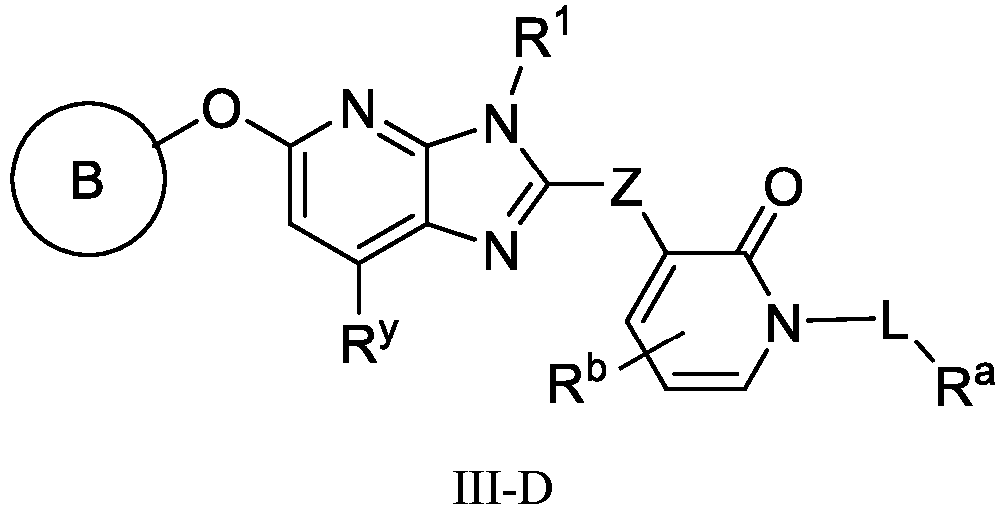
- In some embodiments, the compound is a compound of Formula IV-D:

- The invention also provides a compound of Formula I-E:

- In some embodiments, the compound is a compound of Formula II-E:

- In some embodiments, the compound is a compound of Formula III-E:

- In some embodiments, the compound is a compound of Formula IV-E:

- In some embodiments of any of Formulae I, I-A, I-B, I-C, I-D, and I-E, W is CRw. In some embodiments, W is N.
- In some embodiments of any of Formulae I, I-A, I-B, I-C, I-D, and I-E, X is CRx. In some embodiments, X is N.
- In some embodiments of any of Formulae I, I-A, I-B, I-C, I-D, and I-E, Y is CRy. In some embodiments, Y is N.
- In some embodiments of any of Formulae I, I-A, I-B, I-C, I-D, and I-E, W is CRw or N, X is CRx or N, and Y is CRy or N, and no more than one of W, X, and Y is N. In some embodiments, W is CRw or N, X is CRx or N, and Y is CRy or N, and no more than two of W, X, and Y is N.
- In some embodiments of any of Formulae I, II, III, IV, I-A, II-A, III-A, IV-A, I-B, II-B, III-B, IV-B, I-C, II-C, III-C, IV-C, I-D, II-D, III-D, IV-D, I-E, II-E, III-E, and IV-E, Z is -O-. In some embodiments, Z is -NRz-. In some embodiments, Z is -NH-.
- In some embodiments of any of Formulae I, I-A, I-B, I-C, I-D, and I-E, Rw is hydrogen, halogen, or optionally substituted C1-6 aliphatic. In some embodiments, Rw is hydrogen. In some embodiments, Rw is halogen. In some embodiments, Rw is fluoro. In some embodiments, Rw is chloro. In some embodiments, Rw is -OR2. In some embodiments, Rw is -OR2, wherein R2 is optionally substituted C1-6 aliphatic. In some embodiments, Y is N, W is CRw, and Rw is -OR2 wherein R2 is optionally substituted C1-6 aliphatic. In some embodiments, Rw is -N(R2)2. In some embodiments, Rw is -SR2. In some embodiments, Rw is -SR2, wherein R2 is optionally substituted C1-6 aliphatic. In some embodiments, Y is N, W is CRw, and Rw is -SR2 wherein R2 is optionally substituted C1-6 aliphatic. In some embodiments, Rw is optionally substituted C1-6 aliphatic. In some embodiments, Rw is optionally substituted straight-chain or branched C1-6 aliphatic (i.e., optionally substituted acyclic C1-6 aliphatic). In some embodiments, Rw is optionally substituted C1-6 alkyl. In some embodiments, Rw is optionally substituted C1-4 alkyl. In some embodiments, Rw is optionally substituted C1-2 alkyl. In some embodiments, Rw is optionally substituted methyl (e.g., methyl optionally substituted with one or more fluoro). In some embodiments, Rw is -CN.
- In some embodiments of any of Formulae I, II, IV, I-A, II-A, IV-A, I-B, II-B, IV-B, I-C, II-C, IV-C, I-D, II-D, IV-D, I-E, II-E, and IV-E, Rx is hydrogen, halogen, -CN, -OR2, or optionally substituted C1-6 aliphatic. In some embodiments, Rx is hydrogen, halogen, -CN, -O(C1-4 alkyl), or C1-4 alkyl optionally substituted with one or more halogen. In some embodiments, Rx is hydrogen, halogen, -OR2, or optionally substituted C1-6 aliphatic. In some embodiments, Rx is hydrogen, halogen, -O(C1-4 alkyl), or C1-4 alkyl optionally substituted with one or more halogen. In some embodiments, Rx is hydrogen, halogen, or optionally substituted C1-6 aliphatic. In some embodiments, Rx is hydrogen. In some embodiments, Rx is halogen. In some embodiments, Rx is fluoro. In some embodiments, Rx is chloro. In some embodiments, Rx is -OR2. In some embodiments, Rx is -OR2, wherein R2 is optionally substituted C1-6 aliphatic (e.g., optionally substituted C1-6 alkyl). In some embodiments, Rx is -O(C1-4 alkyl). In some embodiments, Rx is - OCH3. In some embodiments, Rx is -N(R2)2. In some embodiments, Rx is -SR2. In some embodiments, Rx is -SR2, wherein R2 is optionally substituted C1-6 aliphatic. In some embodiments, Rx is optionally substituted C1-6 aliphatic. In some embodiments, Rx is optionally substituted straight-chain or branched C1-6 aliphatic (i.e., optionally substituted acyclic C1-6 aliphatic). In some embodiments, Rx is optionally substituted C1-6 alkyl (e.g., C1-6 alkyl optionally substituted with one or more fluoro). In some embodiments, Rx is optionally substituted C1-4 alkyl (e.g., C1-4 alkyl optionally substituted with one or more fluoro). In some embodiments, Rx is optionally substituted C1-2 alkyl (e.g., C1-2 alkyl optionally substituted with one or more fluoro). In some embodiments, Rx is optionally substituted methyl (e.g., methyl optionally substituted with one or more fluoro, e.g., -CHF2). In some embodiments, Rx is -CN.
- In some embodiments of any of Formulae I, II, III, I-A, II-A, III-A, I-B, II-B, III-B, I-C, II-C, III-C, I-D, II-D, III-D, I-E, II-E, and III-E, Ry is hydrogen, halogen, or optionally substituted C1-6 aliphatic. In some embodiments, Ry is hydrogen. In some embodiments, Ry is halogen. In some embodiments, Ry is fluoro. In some embodiments, Ry is chloro. In some embodiments, Ry is -OR2. In some embodiments, Ry is -OR2, wherein R2 is optionally substituted C1-6 aliphatic. In some embodiments, W is N, Y is CRy, and Ry is -OR2 wherein R2 is optionally substituted C1-6 aliphatic. In some embodiments, Ry is -N(R2)2. In some embodiments, Ry is - SR2. In some embodiments, Ry is -SR2, wherein R2 is optionally substituted C1-6 aliphatic. In some embodiments, W is N, Y is CRy, and Ry is -SR2 wherein R2 is optionally substituted C1-6 aliphatic. In some embodiments, Ry is optionally substituted C1-6 aliphatic. In some embodiments, Ry is optionally substituted straight-chain or branched C1-6 aliphatic (i.e., optionally substituted acyclic C1-6 aliphatic). In some embodiments, Ry is optionally substituted C1-6 alkyl. In some embodiments, Ry is optionally substituted C1-4 alkyl. In some embodiments, Ry is optionally substituted C1-2 alkyl. In some embodiments, Ry is optionally substituted methyl (e.g., methyl optionally substituted with one or more fluoro). In some embodiments, Ry is -CN.
- In some embodiments of any of Formulae I, II, III, IV, I-A, II-A, III-A, IV-A, I-B, II-B, III-B, IV-B, I-C, II-C, III-C, IV-C, I-D, II-D, III-D, IV-D, I-E, II-E, III-E, and IV-E, Rz is hydrogen. In some embodiments, Rz is optionally substituted C1-6 aliphatic. In some embodiments, Rz is optionally substituted straight-chain or branched C1-6 aliphatic (i.e., optionally substituted acyclic C1-6 aliphatic). In some embodiments, Rz is optionally substituted C1-6 alkyl. In some embodiments, Rz is optionally substituted C1-4 alkyl. In some embodiments, Rz is unsubstituted C1-4 alkyl. In some embodiments, Rz is optionally substituted C1-2 alkyl. In some embodiments, Rz is unsubstituted C1-2 alkyl.
- In some embodiments of any of Formulae I, II, III, IV, I-A, II-A, III-A, IV-A, I-B, II-B, III-B, IV-B, I-C, II-C, III-C, IV-C, I-D, II-D, III-D, IV-D, I-E, II-E, III-E, and IV-E, R1 is optionally substituted straight-chain or branched C1-6 aliphatic (i.e., optionally substituted acyclic C1-6 aliphatic). In some embodiments, R1 is optionally substituted C1-6 alkyl. In some embodiments, R1 is optionally substituted C1-4 alkyl. In some embodiments, R1 is unsubstituted C1-4 alkyl. In some embodiments, R1 is optionally substituted C1-2 alkyl. In some embodiments, R1 is unsubstituted C1-2 alkyl. In some embodiments, R1 is methyl.
- In some embodiments of any of Formulae I, II, III, IV, I-A, II-A, III-A, IV-A, I-B, II-B, III-B, IV-B, I-C, II-C, III-C, IV-C, I-D, II-D, III-D, IV-D, I-E, II-E, III-E, and IV-E, each R2 is independently hydrogen or optionally substituted C1-4 aliphatic. In some embodiments, each R2 is independently hydrogen or optionally substituted C1-2 aliphatic. In some embodiments, each R2 is hydrogen. In some embodiments, each R2 is independently optionally substituted C1-6 aliphatic. In some embodiments, each R2 is independently optionally substituted straight-chain or branched C1-6 aliphatic (i.e., optionally substituted acyclic C1-6 aliphatic). In some embodiments, each R2 is independently optionally substituted C1-4 aliphatic. In some embodiments, each R2 is independently optionally substituted straight-chain or branched C1-4 aliphatic (i.e., optionally substituted acyclic C1-4 aliphatic). In some embodiments, each R2 is independently optionally substituted C1-2 aliphatic. In some embodiments, each R2 is independently hydrogen or C1-6 alkyl. In some embodiments, each R2 is independently hydrogen or C1-4 alkyl. In some embodiments, each R2 is independently hydrogen or C1-2 alkyl.
- In some embodiments of any of Formulae I, II, III, IV, I-A, II-A, III-A, IV-A, I-B, II-B, III-B, IV-B, I-C, II-C, III-C, IV-C, I-D, II-D, III-D, IV-D, I-E, II-E, III-E, and IV-E, Ring A is (i) optionally substituted on a substitutable carbon atom with one or more groups independently selected from oxo, halogen, R°, -CN, -OR°, -O(CH2)1-4R°, -SR°, -N(R°)2, -NO2, -C(O)R°, - C(O)OR°, -C(O)NR°2, -OC(O)R°, -OC(O)NR°2, -OC(O)OR°, -OS(O)2R°, -OS(O)2NR°2, - N(R°)C(O)R°, -N(R°)S(O)2R°, -S(O)2R°, -SO2NR°2, and -S(O)2OR°, and (ii) optionally substituted on a substitutable nitrogen atom with one or more groups selected from -R†, -NR† 2, - C(O)R†, -C(O)OR†, -S(O)2R†, and -S(O)2NR† 2. In some embodiments, Ring A is (i) optionally substituted on a substitutable carbon atom with one or more groups independently selected from oxo, halogen, R°, -CN, -OR°, -SR°, -N(R°)2, -NO2, -C(O)R°, -C(O)OR°, -C(O)NR°2, -OC(O)R°, -OC(O)NR°2, -OC(O)OR°, -OS(O)2R°, -OS(O)2NR°2, -N(R°)C(O)R°, -N(R°)S(O)2R°, -S(O)2R°, -SO2NR°2, and -S(O)2OR°, and (ii) optionally substituted on a substitutable nitrogen atom with one or more groups selected from -R†, -NR† 2, -C(O)R†, -C(O)OR†, -S(O)2R†, and -S(O)2NR† 2. In some embodiments, Ring A is (i) optionally substituted on a substitutable carbon atom with one or more groups independently selected from oxo, halogen, R°, -CN, -OR°, -O(CH2)1-4R°, -N(R°)2, and -C(O)NR°2, and (ii) optionally substituted on a substitutable nitrogen atom with one or more groups selected from -R†. In some embodiments, Ring A is (i) optionally substituted on a substitutable carbon atom with one or more groups independently selected from oxo, halogen, and R°, and (ii) optionally substituted on a substitutable nitrogen atom with one or more groups selected from -R†. In some embodiments, Ring A is (i) optionally substituted on a substitutable carbon atom with one or more groups independently selected from halogen and R°, and (ii) optionally substituted on a substitutable nitrogen atom with one or more groups selected from - R†.
- In some embodiments, Ring A is optionally substituted with one or more Rb (i.e., in addition to being substituted with -L-Ra), wherein Rb is as defined in Formula I-B above and described in classes and subclasses herein. In some embodiments, Ring A is substituted with zero, one, two, three, four, or five Rb, as valency allows.
- In some embodiments, Ring A is optionally substituted phenyl, optionally substituted 5- to 6-membered monocyclic heteroaryl having 1-4 heteroatoms independently selected from nitrogen, oxygen, and sulfur, or optionally substituted 8- to 10-membered bicyclic heteroaryl having 1-4 heteroatoms independently selected from nitrogen, oxygen, and sulfur.
- In some embodiments, Ring A is optionally substituted 5- to 6-membered monocyclic heteroaryl having 1-4 heteroatoms independently selected from nitrogen, oxygen, and sulfur or optionally substituted 8- to 10-membered bicyclic heteroaryl having 1-4 heteroatoms independently selected from nitrogen, oxygen, and sulfur.
- In some embodiments, Ring A is optionally substituted 5- to 6-membered monocyclic heteroaryl having 1-4 heteroatoms independently selected from nitrogen, oxygen, and sulfur, optionally substituted 8- to 10-membered bicyclic heteroaryl having 1-4 heteroatoms independently selected from nitrogen, oxygen, and sulfur, or optionally substituted 3- to 7-membered saturated or partially unsaturated monocyclic heterocyclyl having 1-3 heteroatoms independently selected from nitrogen, oxygen, and sulfur.
- In some embodiments, Ring A is optionally substituted phenyl. In some embodiments, Ring A is not optionally substituted phenyl.
- In some embodiments, Ring A is optionally substituted 5- to 6-membered monocyclic heteroaryl having 1-4 heteroatoms independently selected from nitrogen, oxygen, and sulfur. In some embodiments, Ring A is optionally substituted 5- to 6-membered monocyclic heteroaryl having 1-2 heteroatoms independently selected from nitrogen, oxygen, and sulfur. In some embodiments, Ring A is optionally substituted 5-membered monocyclic heteroaryl having 1-4 heteroatoms independently selected from nitrogen, oxygen, and sulfur. In some embodiments, Ring A is optionally substituted pyrazolyl or thiazolyl. In some embodiments, Ring A is optionally substituted pyrazolyl. In some embodiments, Ring A is optionally substituted 6-membered monocyclic heteroaryl having 1-4 heteroatoms independently selected from nitrogen, oxygen, and sulfur. In some embodiments, Ring A is optionally substituted pyridyl, pyridonyl, pyridazinonyl, pyrimidyl, pyrimidonyl, or pyrimidinedionyl. In some embodiments, Ring A is optionally substituted pyridonyl or pyridazinonyl. In some embodiments, Ring A is optionally substituted pyridonyl.
- In some embodiments, Ring A is optionally substituted 8- to 10-membered bicyclic heteroaryl having 1-4 heteroatoms independently selected from nitrogen, oxygen, and sulfur. In some embodiments, Ring A is optionally substituted 8-membered bicyclic heteroaryl having 1-4 heteroatoms independently selected from nitrogen, oxygen, and sulfur. In some embodiments, Ring A is optionally substituted 9-membered bicyclic heteroaryl having 1-4 heteroatoms independently selected from nitrogen, oxygen, and sulfur. In some embodiments, Ring A is optionally substituted 10-membered bicyclic heteroaryl having 1-4 heteroatoms independently selected from nitrogen, oxygen, and sulfur.
- In some embodiments, Ring A is optionally substituted 3- to 7-membered saturated or partially unsaturated monocyclic carbocyclyl. In some embodiments, Ring A is optionally substituted 3-membered saturated or partially unsaturated monocyclic carbocyclyl. In some embodiments, Ring A is optionally substituted 4-membered saturated or partially unsaturated monocyclic carbocyclyl. In some embodiments, Ring A is optionally substituted 5-membered saturated or partially unsaturated monocyclic carbocyclyl. In some embodiments, Ring A is optionally substituted 6-membered saturated or partially unsaturated monocyclic carbocyclyl. In some embodiments, Ring A is not optionally substituted 6-membered saturated or partially unsaturated monocyclic carbocyclyl. In some embodiments, Ring A is optionally substituted 7-membered saturated or partially unsaturated monocyclic carbocyclyl.
- In some embodiments, Ring A is optionally substituted 3- to 7-membered saturated or partially unsaturated monocyclic heterocyclyl having 1-3 heteroatoms independently selected from nitrogen, oxygen, and sulfur. In some embodiments, Ring A is optionally substituted 3-membered saturated or partially unsaturated monocyclic heterocyclyl having 1-2 heteroatoms independently selected from nitrogen, oxygen, and sulfur. In some embodiments, Ring A is optionally substituted 4-membered saturated or partially unsaturated monocyclic heterocyclyl having 1-3 heteroatoms independently selected from nitrogen, oxygen, and sulfur. In some embodiments, Ring A is optionally substituted 5-membered saturated or partially unsaturated monocyclic heterocyclyl having 1-3 heteroatoms independently selected from nitrogen, oxygen, and sulfur. In some embodiments, Ring A is optionally substituted 6-membered saturated or partially unsaturated monocyclic heterocyclyl having 1-3 heteroatoms independently selected from nitrogen, oxygen, and sulfur. In some embodiments, Ring A is optionally substituted 7-membered saturated or partially unsaturated monocyclic heterocyclyl having 1-3 heteroatoms independently selected from nitrogen, oxygen, and sulfur.
- In some embodiments, Ring A is optionally substituted 7- to 10-membered saturated or partially unsaturated bicyclic heterocyclyl having 1-4 heteroatoms independently selected from nitrogen, oxygen, and sulfur. In some embodiments, Ring A is optionally substituted 7-membered saturated or partially unsaturated bicyclic heterocyclyl having 1-4 heteroatoms independently selected from nitrogen, oxygen, and sulfur. In some embodiments, Ring A is optionally substituted 8-membered saturated or partially unsaturated bicyclic heterocyclyl having 1-4 heteroatoms independently selected from nitrogen, oxygen, and sulfur. In some embodiments, Ring A is not optionally substituted 8-membered saturated or partially unsaturated bicyclic heterocyclyl having 1-4 heteroatoms independently selected from nitrogen, oxygen, and sulfur (e.g., optionally substituted hexahydrofuro[3,2-b]furan). In some embodiments, Ring A is optionally substituted 9-membered saturated or partially unsaturated bicyclic heterocyclyl having 1-4 heteroatoms independently selected from nitrogen, oxygen, and sulfur. In some embodiments, Ring A is optionally substituted 10-membered saturated or partially unsaturated bicyclic heterocyclyl having 1-4 heteroatoms independently selected from nitrogen, oxygen, and sulfur.
- In some embodiments of any of Formulae I, II, III, IV, I-A, II-A, III-A, IV-A, I-B, II-B, III-B, IV-B, I-C, II-C, III-C, IV-C, I-D, II-D, III-D, IV-D, I-E, II-E, III-E, and IV-E, L is a covalent bond. In some embodiments, L is a bivalent C1-3 straight or branched hydrocarbon chain. In some embodiments, L is a bivalent C1-2 straight or branched hydrocarbon chain. In some embodiments, L is methylene (i.e., -CH2-). In some embodiments, L is -CH2CH2-. In some embodiments, L is -CH2CH2CH2-. In some embodiments, L is a covalent bond or -CH2-.
- In some embodiments of any of Formulae I, II, III, IV, I-A, II-A, III-A, IV-A, I-B, II-B, III-B, IV-B, I-C, II-C, III-C, IV-C, I-D, II-D, III-D, IV-D, I-E, II-E, III-E, and IV-E, Ra is halogen, optionally substituted C1-6 aliphatic, optionally substituted phenyl, optionally substituted 5- to 6-membered monocyclic heteroaryl having 1-4 heteroatoms independently selected from nitrogen, oxygen, and sulfur, optionally substituted 3- to 7-membered saturated or partially unsaturated monocyclic carbocyclyl, optionally substituted 3- to 7-membered saturated or partially unsaturated monocyclic heterocyclyl having 1-3 heteroatoms independently selected from nitrogen, oxygen, and sulfur, or optionally substituted 7- to 10-membered saturated or partially unsaturated bicyclic heterocyclyl having 1-4 heteroatoms independently selected from nitrogen, oxygen, and sulfur. In some embodiments, Ra is hydrogen, halogen, optionally substituted C1-6 aliphatic, optionally substituted 5- to 6-membered monocyclic heteroaryl having 1-4 heteroatoms independently selected from nitrogen, oxygen, and sulfur, optionally substituted 3- to 7-membered saturated or partially unsaturated monocyclic carbocyclyl, optionally substituted 3- to 7-membered saturated or partially unsaturated monocyclic heterocyclyl having 1-3 heteroatoms independently selected from nitrogen, oxygen, and sulfur, or optionally substituted 7- to 10-membered saturated or partially unsaturated bicyclic heterocyclyl having 1-4 heteroatoms independently selected from nitrogen, oxygen, and sulfur. In some embodiments, Ra is optionally substituted C1-6 aliphatic, optionally substituted 5- to 6-membered monocyclic heteroaryl having 1-4 heteroatoms independently selected from nitrogen, oxygen, and sulfur, optionally substituted 3- to 7-membered saturated or partially unsaturated monocyclic carbocyclyl, optionally substituted 3- to 7-membered saturated or partially unsaturated monocyclic heterocyclyl having 1-3 heteroatoms independently selected from nitrogen, oxygen, and sulfur, or optionally substituted 7- to 10-membered saturated or partially unsaturated bicyclic heterocyclyl having 1-4 heteroatoms independently selected from nitrogen, oxygen, and sulfur. In some embodiments, Ra is hydrogen, halogen, or an optionally substituted group selected from C1-4 alkyl, 5- to 6-membered monocyclic heteroaryl having 1-2 heteroatoms independently selected from nitrogen, oxygen, and sulfur, 3- to 6-membered cycloalkyl, 3- to 7-membered saturated monocyclic heterocyclyl having 1-2 heteroatoms independently selected from nitrogen, oxygen, and sulfur, or optionally substituted 7- to 8-membered saturated, spirocyclic, bicyclic heterocyclyl having 1-2 heteroatoms independently selected from nitrogen, oxygen, and sulfur. In some embodiments, Ra is an optionally substituted group selected from C1-4 alkyl, 5- to 6-membered monocyclic heteroaryl having 1-2 heteroatoms independently selected from nitrogen, oxygen, and sulfur, 3- to 6-membered cycloalkyl, 3- to 6-membered saturated monocyclic heterocyclyl having 1-2 heteroatoms independently selected from nitrogen, oxygen, and sulfur, or optionally substituted 7- to 8-membered saturated, spirocyclic, bicyclic heterocyclyl having 1-2 heteroatoms independently selected from nitrogen, oxygen, and sulfur. In some embodiments, Ra is an optionally substituted group selected from C1-4 alkyl, 5- to 6-membered monocyclic heteroaryl having 1-2 heteroatoms independently selected from nitrogen, oxygen, and sulfur, 3- to 6-membered cycloalkyl, 3- to 6-membered saturated monocyclic heterocyclyl having 1-2 heteroatoms independently selected from nitrogen, oxygen, and sulfur, or optionally substituted 7- to 10-membered saturated, spirocyclic, bicyclic heterocyclyl having 1-2 heteroatoms independently selected from nitrogen, oxygen, and sulfur. In some embodiments, Ra is optionally substituted C1-6 aliphatic, optionally substituted 3- to 7-membered saturated or partially unsaturated monocyclic carbocyclyl, optionally substituted 3- to 7-membered saturated or partially unsaturated monocyclic heterocyclyl having 1-3 heteroatoms independently selected from nitrogen, oxygen, and sulfur, or optionally substituted 7- to 10-membered saturated or partially unsaturated bicyclic heterocyclyl having 1-4 heteroatoms independently selected from nitrogen, oxygen, and sulfur.
- In some embodiments, Ra is hydrogen. In some embodiments, Ra is not hydrogen.
- In some embodiments, Ra is halogen. In some embodiments, Ra is fluoro, chloro, bromo, or iodo. In some embodiments, Ra is fluoro. In some embodiments, Ra is chloro. In some embodiments, Ra is not halogen. In some embodiments, Ra is not fluoro. In some embodiments, Ra is not chloro. In some embodiments, when L is a covalent bond, Ra is not halogen. In some embodiments, when L is a covalent bond, Ra is not fluoro. In some embodiments, when L is a covalent bond, Ra is not chloro.
- In some embodiments, Ra is optionally substituted C1-6 aliphatic. In some embodiments, Ra is optionally substituted straight-chain or branched C1-6 aliphatic (i.e., optionally substituted acyclic C1-6 aliphatic). In some embodiments, Ra is C1-6 aliphatic optionally substituted with one or more halogen, -CN, -O(C1-6 alkyl), or -OH. In some embodiments, Ra is optionally substituted C1-6 alkyl. In some embodiments, Ra is C1-6 alkyl optionally substituted with one or more halogen, -CN, -O(C1-6 alkyl), or -OH. In some embodiments, Ra is optionally substituted C1-4 alkyl. In some embodiments, Ra is C1-4 alkyl optionally substituted with one or more halogen, -CN, -O(C1-6 alkyl), or -OH. In some embodiments, Ra is -CH3, -CH2CN, -CH2CH2OCH3, - CH2CH2OH, -CH2CHF2, -CH2CH(OH)CH3, -CH(CH3)CH2CN, -CH2C(CH3)2OCH3, or - CH2CH(CH3)CH2OH. In some embodiments, Ra is -CH3, -CH2CN, -CH2CH2CN, - CH2CH2OCH3, -CH2CH2OH, -CH2CHF2, -CH2CH(OH)CH3, -CH(CH3)CH2CN, - CH2C(CH3)2OCH3, or -CH2CH(CH3)CH2OH. In some embodiments, Ra is -CH3, -CD3, -CF3, - CH2CN, -CH2CH3, -CH2CH2CN, -CH2CH2OCH3, -CH2CH2OH, -CH2CHF2, -CH(CH3)2, - CH2CH(OH)CH3, -CH(CH3)CH2CN, -CH2C(CH3)2OCH3, or -CH2CH(CH3)CH2OH. In some embodiments, when L is a covalent bond, Ra is not -CF3.
- In some embodiments, Ra is optionally substituted phenyl.
- In some embodiments, Ra is optionally substituted 5- to 6-membered monocyclic heteroaryl having 1-4 heteroatoms independently selected from nitrogen, oxygen, and sulfur. In some embodiments, Ra is optionally substituted 5- to 6-membered monocyclic heteroaryl having 1-2 heteroatoms independently selected from nitrogen, oxygen, and sulfur. In some embodiments, Ra is optionally substituted 5-membered monocyclic heteroaryl having 1-4 heteroatoms independently selected from nitrogen, oxygen, and sulfur. In some embodiments, Ra is a 5-membered monocyclic heteroaryl having 1-4 heteroatoms independently selected from nitrogen, oxygen, and sulfur optionally substituted with one or more C1-6 alkyl (e.g., methyl). In some embodiments, Ra is optionally substituted pyrazolyl or imidazolyl. In some embodiments, Ra is optionally substituted pyrazolyl. In some embodiments, Ra is pyrazolyl or imidazolyl optionally substituted with one or more C1-6 alkyl (e.g., methyl). In some embodiments, Ra is pyrazolyl optionally substituted with one or more C1-6 alkyl (e.g., methyl). In some embodiments, Ra is


- In some embodiments, Ra is optionally substituted 3- to 7-membered saturated or partially unsaturated monocyclic carbocyclyl. In some embodiments, Ra is 3- to 7-membered saturated or partially unsaturated monocyclic carbocyclyl optionally substituted with one or more -CN or -OH. In some embodiments, Ra is optionally substituted 3- to 6-membered saturated monocyclic carbocyclyl. In some embodiments, Ra is optionally substituted 4- to 6-membered saturated monocyclic carbocyclyl. In some embodiments, Ra is 3- to 6-membered saturated monocyclic carbocyclyl optionally substituted with one or more -CN or -OH. In some embodiments, Ra is 4- to 6-membered saturated monocyclic carbocyclyl optionally substituted with one or more -CN or -OH. In some embodiments, Ra is optionally substituted 3-membered saturated monocyclic carbocyclyl. In some embodiments, Ra is optionally substituted 4-membered saturated monocyclic carbocyclyl. In some embodiments, Ra is optionally substituted 5-membered saturated monocyclic carbocyclyl. In some embodiments, Ra is optionally substituted 6-membered saturated monocyclic carbocyclyl. In some embodiments, Ra is optionally substituted 7-membered saturated monocyclic carbocyclyl. In some embodiments, Ra is
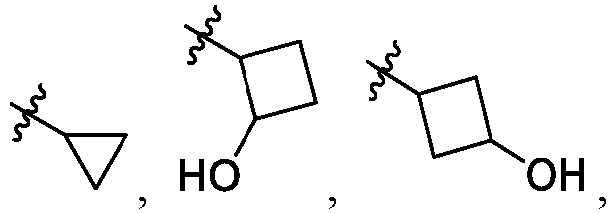


- In some embodiments, Ra is optionally substituted 3- to 7-membered saturated or partially unsaturated monocyclic heterocyclyl having 1-3 heteroatoms independently selected from nitrogen, oxygen, and sulfur. In some embodiments, Ra is 3- to 7-membered saturated or partially unsaturated monocyclic heterocyclyl having 1-3 heteroatoms independently selected from nitrogen, oxygen, and sulfur optionally substituted with one or more optionally substituted C1-6 alkyl or -OH. In some embodiments, Ra is 3- to 7-membered saturated or partially unsaturated monocyclic heterocyclyl having 1-3 heteroatoms independently selected from nitrogen, oxygen, and sulfur optionally substituted with one or more halogen, optionally substituted C1-6 alkyl, - C(O)(C1-6 alkyl), or -OH. In some embodiments, Ra is 3- to 7-membered saturated or partially unsaturated monocyclic heterocyclyl having 1-3 heteroatoms independently selected from nitrogen, oxygen, and sulfur optionally substituted with one or more halogen, -OH, -O(C1-4 alkyl), -N(C1-4 alkyl)2, -C(O)(C1-6 alkyl), -CN, or optionally substituted C1-6 alkyl. In some embodiments, Ra is optionally substituted 4- to 7-membered saturated monocyclic heterocyclyl having 1-2 heteroatoms independently selected from nitrogen, oxygen, and sulfur. In some embodiments, Ra is optionally substituted 4- to 6-membered saturated monocyclic heterocyclyl having 1-2 heteroatoms independently selected from nitrogen, oxygen, and sulfur. In some embodiments, Ra is 4- to 6-membered saturated monocyclic heterocyclyl having 1-2 heteroatoms independently selected from nitrogen, oxygen, and sulfur optionally substituted with one or more optionally substituted C1-6 alkyl or -OH. In some embodiments, Ra is 4- to 6-membered saturated monocyclic heterocyclyl having 1-2 heteroatoms independently selected from nitrogen, oxygen, and sulfur optionally substituted with one or more halogen, optionally substituted C1-6 alkyl, -C(O)(C1-6 alkyl), or -OH. In some embodiments, Ra is 4- to 7-membered saturated or partially unsaturated monocyclic heterocyclyl having 1-2 heteroatoms independently selected from nitrogen, oxygen, and sulfur optionally substituted with one or more halogen, -OH, -O(C1-4 alkyl), -N(C1-4 alkyl)2, - C(O)(C1-6 alkyl), -CN, or optionally substituted C1-6 alkyl. In some embodiments, Ra is optionally substituted 3-membered saturated monocyclic heterocyclyl having 1 heteroatom independently selected from nitrogen, oxygen, and sulfur. In some embodiments, Ra is optionally substituted 4-membered saturated monocyclic heterocyclyl having 1-2 heteroatoms independently selected from nitrogen, oxygen, and sulfur. In some embodiments, Ra is optionally substituted azetidinyl or oxetanyl. In some embodiments, Ra is


- In some embodiments, Ra is optionally substituted 7- to 10-membered saturated or partially unsaturated bicyclic heterocyclyl having 1-4 heteroatoms independently selected from nitrogen, oxygen, and sulfur. In some embodiments, Ra is unsubstituted 7- to 10-membered saturated or partially unsaturated bicyclic heterocyclyl having 1-4 heteroatoms independently selected from nitrogen, oxygen, and sulfur. In some embodiments, Ra is optionally substituted 7-to 10-membered saturated, spirocyclic, bicyclic heterocyclyl having 1-4 heteroatoms independently selected from nitrogen, oxygen, and sulfur. In some embodiments, Ra is optionally substituted 7- to 8-membered saturated, spirocyclic, bicyclic heterocyclyl having 1-2 heteroatoms independently selected from nitrogen, oxygen, and sulfur. In some embodiments Ra is optionally substituted 7-membered saturated, spirocyclic, bicyclic heterocyclyl having 1-4 heteroatoms independently selected from nitrogen, oxygen, and sulfur. In some embodiments, Ra is optionally substituted 2-oxaspiro[3.3]heptanyl or 4-oxaspiro[2.4]heptanyl. In some embodiments Ra is optionally substituted 8-membered saturated, spirocyclic, bicyclic heterocyclyl having 1-4 heteroatoms independently selected from nitrogen, oxygen, and sulfur. In some embodiments Ra is optionally substituted 9-membered saturated, spirocyclic, bicyclic heterocyclyl having 1-4 heteroatoms independently selected from nitrogen, oxygen, and sulfur. In some embodiments Ra is optionally substituted 10-membered saturated, spirocyclic, bicyclic heterocyclyl having 1-4 heteroatoms independently selected from nitrogen, oxygen, and sulfur. In some embodiments, Ra is


- In some embodiments, Ra is selected from the group consisting of:


- In some embodiments of any of Formulae I, II, III, IV, I-A, II-A, III-A, IV-A, I-B, II-B, III-B, IV-B, I-C, II-C, III-C, IV-C, I-D, II-D, III-D, IV-D, I-E, II-E, III-E, and IV-E,


- In some embodiments of any of Formulae I-B, II-B, III-B, IV-B, I-C, II-C, III-C, IV-C, I-D, II-D, III-D, and IV-D, up to five occurrences of Rb may be present, as allowed by valency rules, and is each independently halogen, -CN, -OR, -O(CH2)nR, -SR, -N(R)2, -NO2, -C(O)R', - C(O)OR, -C(O)N(R)2, -OC(O)R', -OC(O)N(R)2, -OC(O)OR, -OSO2R, -OSO2N(R)2, - N(R)C(O)R', -N(R)SO2R', -SO2R', -SO2N(R)2, -SO3R', optionally substituted C1-6 aliphatic, optionally substituted 3- to 6-membered saturated or partially unsaturated monocyclic carbocyclyl, optionally substituted 3- to 6-membered saturated or partially unsaturated monocyclic heterocyclyl having 1-3 heteroatoms independently selected from nitrogen, oxygen, and sulfur, or optionally substituted 5- to 6-membered monocyclic heteroaryl having 1-4 heteroatoms independently selected from nitrogen, oxygen, and sulfur. In some embodiments, up to five occurrences of Rb may be present, as allowed by valency rules, and is each independently halogen, -CN, -OR, -SR, -N(R)2, -NO2, -C(O)R', -C(O)OR, -C(O)N(R)2, -OC(O)R', -OC(O)N(R)2, -OC(O)OR, -OSO2R, - OSO2N(R)2, -N(R)C(O)R', -N(R)SO2R', -SO2R', -SO2N(R)2, -SO3R', optionally substituted C1-6 aliphatic, optionally substituted 3- to 6-membered saturated or partially unsaturated monocyclic carbocyclyl, optionally substituted 3- to 6-membered saturated or partially unsaturated monocyclic heterocyclyl having 1-3 heteroatoms independently selected from nitrogen, oxygen, and sulfur, or optionally substituted 5- to 6-membered monocyclic heteroaryl having 1-4 heteroatoms independently selected from nitrogen, oxygen, and sulfur. In some embodiments, each occurrence of Rb is independently hydrogen, halogen, -CN, -OR, -O(CH2)nR, -N(R)2, -C(O)N(R)2, optionally substituted C1-6 aliphatic, or optionally substituted 3- to 6-membered saturated or partially unsaturated monocyclic carbocyclyl. In some embodiments, each occurrence of Rb is independently hydrogen, optionally substituted C1-6 aliphatic, or optionally substituted 3- to 6-membered saturated or partially unsaturated monocyclic carbocyclyl. In some embodiments, each occurrence of Rb is independently halogen, -CN, -OR, -O(CH2)nR, -N(R)2, -C(O)N(R)2, optionally substituted C1-6 aliphatic, or optionally substituted 3- to 6-membered saturated or partially unsaturated monocyclic carbocyclyl. In some embodiments, each occurrence of Rb is independently optionally substituted C1-6 aliphatic or optionally substituted 3- to 6-membered saturated or partially unsaturated monocyclic carbocyclyl. In some embodiments, each occurrence of Rb is independently hydrogen, halogen, -CN, -OR, -OCH2R, -N(R)2, -C(O)N(R)2, optionally substituted C1-4 alkyl, or optionally substituted C3-C4 cycloalkyl. In some embodiments, each occurrence of Rb is independently hydrogen, optionally substituted C1-4 alkyl, or optionally substituted C3-C4 cycloalkyl. In some embodiments, each occurrence of Rb is independently optionally substituted C1-4 alkyl or optionally substituted C3-C4 cycloalkyl. In some embodiments, each occurrence of Rb is independently halogen, -CN, -OR, -OCH2R, -N(R)2, -C(O)N(R)2, optionally substituted C1-4 alkyl, or optionally substituted C3-C4 cycloalkyl. In some embodiments, each occurrence of Rb is independently C3-4 cycloalkyl or C1-4 alkyl optionally substituted with one or more halogen or -CN. In some embodiments, each occurrence of Rb is independently C3-4 cycloalkyl or C1-4 alkyl optionally substituted with one or more halogen.
- In some embodiments, Rb is hydrogen.
- In some embodiments, Rb is halogen. In some embodiments, Rb is fluoro, chloro, bromo, or iodo. In some embodiments, Rb is fluoro. In some embodiments, Rb is chloro. In some embodiments, Rb is not halogen. In some embodiments, Rb is not fluoro. In some embodiments, Rb is not chloro.
- In some embodiments, Rb is -CN, -OR, -O(CH2)nR, -SR, -N(R)2, -NO2, -C(O)R', - C(O)OR, -C(O)N(R)2, -OC(O)R', -OC(O)N(R)2, -OC(O)OR, -OSO2R, -OSO2N(R)2, - N(R)C(O)R', -N(R)SO2R', -SO2R, -SO2N(R)2, or -SO3R'. In some embodiments, Rb is -CN, -OR, -SR, -N(R)2, -NO2, -C(O)R', -C(O)OR, -C(O)N(R)2, -OC(O)R', -OC(O)N(R)2, -OC(O)OR, - OSO2R, -OSO2N(R)2, -N(R)C(O)R', -N(R)SO2R', -SO2R, -SO2N(R)2, or -SO3R'. In some embodiments, Rb is -CN, -SR, -N(R)2, -NO2, -C(O)R', -C(O)OR, -C(O)N(R)2, -OC(O)R', - OC(O)N(R)2, -OC(O)OR, -OSO2R, -OSO2N(R)2, -N(R)C(O)R', -N(R)SO2R', -SO2R, -SO2N(R)2, or -SO3R'. In some embodiments, Rb is not -OR. In some embodiments, Rb is not - OSi(tBu)(Me)2,


- In some embodiments, Rb is -CN.
- In some embodiments, Rb is -OR. In some embodiments, Rb is -OR, wherein R is optionally substituted 3- to 7-membered saturated or partially unsaturated monocyclic heterocyclyl having 1-3 heteroatoms independently selected from nitrogen, oxygen, and sulfur. In some embodiments, Rb is -OR, wherein R is optionally substituted 4- to 6-membered saturated monocyclic heterocyclyl having 1-2 heteroatoms independently selected from nitrogen, oxygen, and sulfur. In some embodiments, Rb is -OR, wherein R is 4- to 6-membered saturated monocyclic heterocyclyl having 1-2 heteroatoms independently selected from nitrogen, oxygen, and sulfur and optionally substituted with one or more C1-6 alkyl (e.g., methyl). In some embodiments, Rb is - OR, wherein R is optionally substituted azetidinyl or pyrrolidinyl. In some embodiments, Rb is - OR, wherein R is azetidinyl or pyrrolidinyl optionally substituted with one or more C1-6 alkyl (e.g., methyl). In some embodiments, Rb is


- In some embodiments, Rb is -O(CH2)nR. In some embodiments, Rb is -OCH2R. In some embodiments, Rb is -O(CH2)nR, wherein R is optionally substituted 3- to 7-membered saturated or partially unsaturated monocyclic heterocyclyl having 1-3 heteroatoms independently selected from nitrogen, oxygen, and sulfur. In some embodiments, Rb is -O(CH2)nR, wherein R is optionally substituted 4- to 6-membered saturated monocyclic heterocyclyl having 1-2 heteroatoms independently selected from nitrogen, oxygen, and sulfur. In some embodiments, Rb is -O(CH2)nR, wherein R is 4- to 6-membered saturated monocyclic heterocyclyl having 1-2 heteroatoms independently selected from nitrogen, oxygen, and sulfur and optionally substituted with one or more C1-6 alkyl (e.g., methyl). In some embodiments, Rb is -O(CH2)nR, wherein R is optionally substituted azetidinyl, pyrrolidinyl, or piperidinyl. In some embodiments, Rb is - O(CH2)nR, wherein R is azetidinyl, pyrrolidinyl, or piperidinyl optionally substituted with one or more C1-6 alkyl (e.g., methyl). In some embodiments, Rb is


- In some embodiments, Rb is -N(R)2. In some embodiments, Rb is -N(C1-6 aliphatic)2. In some embodiments, Rb is -N(C1-6 alkyl)2. In some embodiments, Rb is -N(C1-4 alkyl)2. In some embodiments, Rb is -N(C1-2 alkyl)2. In some embodiments, Rb is -N(CH3)2.
- In some embodiments, Rb is -C(O)N(R)2. In some embodiments, Rb is -C(O)N(R)2, wherein each R is independently hydrogen or optionally substituted C1-6 aliphatic, or two R are taken together to form an optionally substituted 3- to 7-membered saturated or partially unsaturated monocyclic heterocyclyl having 0-2 additional heteroatoms independently selected from nitrogen, oxygen, and sulfur. In some embodiments, Rb is -C(O)N(R)2, wherein each R is independently hydrogen or optionally substituted C1-6 alkyl, or two R are taken together to form an optionally substituted 4- to 6-membered saturated monocyclic heterocyclyl having 0-1 additional heteroatoms independently selected from nitrogen, oxygen, and sulfur. In some embodiments, Rb is
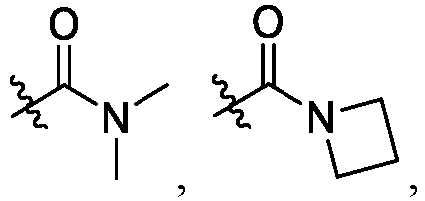

- In some embodiments, Rb is optionally substituted C1-6 aliphatic. In some embodiments, Rb is optionally substituted straight-chain or branched C1-6 aliphatic (i.e., optionally substituted acyclic C1-6 aliphatic). In some embodiments, Rb is optionally substituted C1-6 alkyl. In some embodiments, Rb is optionally substituted C1-4 alkyl. In some embodiments, Rb is C1-4 alkyl optionally substituted with one or more of halogen, -CN, and -N(C1-4 alkyl)2. In some embodiments, Rb is C1-4 alkyl optionally substituted with one or more of halogen and -CN. In some embodiments, Rb is C1-4 alkyl optionally substituted with one or more halogen. In some embodiments, each Rb is independently selected from the group consisting of -CF3, -C(CH3)3, - C(CH3)2CN, and -CF2CF3. In some embodiments, each Rb is independently selected from the group consisting of -CH3, -CF3, -CH2N(CH3)2, -C(CH3)3, -C(CH3)2CN, and -CF2CF3. In some embodiments, when Ring A is phenyl, Rb is not -CF3. In some embodiments, when Ring A is phenyl, Rb is not
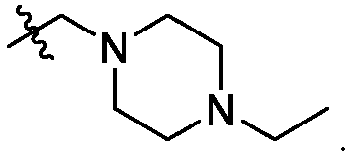
- In some embodiments, Rb is optionally substituted 3- to 6-membered saturated or partially unsaturated monocyclic carbocyclyl. In some embodiments, Rb is optionally substituted C3-C6 cycloalkyl. In some embodiments, Rb is optionally substituted 3-membered saturated or partially unsaturated monocyclic carbocyclyl. In some embodiments, Rb is cyclopropyl. In some embodiments, Rb is optionally substituted 4-membered saturated or partially unsaturated monocyclic carbocyclyl. In some embodiments, Rb is optionally substituted 5-membered saturated or partially unsaturated monocyclic carbocyclyl. In some embodiments, Rb is optionally substituted 6-membered saturated or partially unsaturated monocyclic carbocyclyl.
- In some embodiments, Rb is optionally substituted 3- to 6-membered saturated or partially unsaturated monocyclic heterocyclyl having 1-3 heteroatoms independently selected from nitrogen, oxygen, and sulfur.
- In some embodiments, Rb is optionally substituted 5- to 6-membered monocyclic heteroaryl having 1-4 heteroatoms independently selected from nitrogen, oxygen, and sulfur.
- In some embodiments, Rb is not fluoro, -OR, or -CF3. In some embodiments, Rb is not fluoro, -CF3, -OSi(tBu)(Me)2,


- In some embodiments of any of Formulae I, II, III, IV, I-A, II-A, III-A, IV-A, I-E, II-E, III-E, and IV-E, optionally substituted


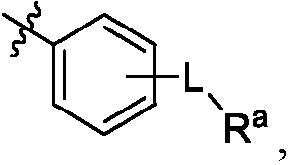


- In some embodiments,





- In some embodiments,


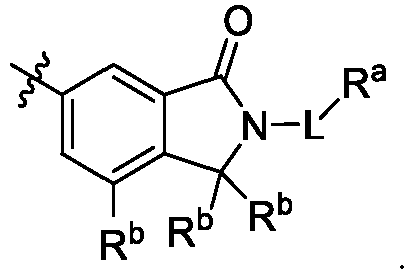
- In some embodiments,





- In some embodiments of any of Formulae I, II, III, IV, I-B, II-B, III-B, IV-B, I-C, II-C, III-C, IV-C, I-D, II-D, III-D, and IV-D, Ring B is (i) optionally substituted on a substitutable carbon atom with one or more groups independently selected from oxo, halogen, R°, -CN, -OR°, -SR°, -N(R°)2, -NO2, -C(O)R°, -C(O)OR°, -C(O)NR°2, -OC(O)R°, -OC(O)NR°2, -OC(O)OR°, - OS(O)2R°, -OS(O)2NR°2, -N(R°)C(O)R°, -N(R°)S(O)2R°, -S(O)2R°, -SO2NR°2, and -S(O)2OR°, and (ii) optionally substituted on a substitutable nitrogen atom with one or more groups selected from -R†, -NR† 2, -C(O)R†, -C(O)OR†, -S(O)2R†, and -S(O)2NR† 2. In some embodiments, Ring B is (i) optionally substituted on a substitutable carbon atom with one or more groups independently selected from oxo, halogen, R°, -CN, -OR°, and -N(R°)2, and (ii) optionally substituted on a substitutable nitrogen with -R†. In some embodiments, Ring B is optionally substituted on a substitutable carbon atom with one or more groups independently selected from - CN and R°.
- In some embodiments, each ring in a bicyclic or polycyclic ring system of Ring B contains at least one heteroatom. In some embodiments, one and only one ring of a bicyclic or polycyclic ring system of Ring B contains no heteroatoms.
- In some embodiments, each ring in a bicyclic or polycyclic ring system of Ring B is aromatic. In some embodiments, one and only one ring of a bicyclic or polycyclic ring system of Ring B is aromatic. In some embodiments, no ring in a bicyclic or polycyclic ring system of Ring B is aromatic.
- In some embodiments, Ring B is optionally substituted 8- to 10-membered bicyclic heteroaryl having 1-4 heteroatoms independently selected from nitrogen, oxygen, and sulfur, optionally substituted 10- to 16-membered polycyclic heteroaryl having 1-5 heteroatoms independently selected from nitrogen, oxygen, and sulfur, optionally substituted 7- to 10-membered bicyclic heterocyclyl having 1-4 heteroatoms independently selected from nitrogen, oxygen, and sulfur, or optionally substituted 10- to 16-membered polycyclic heterocyclyl having 1-5 heteroatoms independently selected from nitrogen, oxygen, and sulfur. In some embodiments, Ring B is optionally substituted 8- to 10-membered bicyclic heteroaryl having 1-4 heteroatoms independently selected from nitrogen, oxygen, and sulfur or optionally substituted 10- to 16-membered polycyclic heteroaryl having 1-5 heteroatoms independently selected from nitrogen, oxygen, and sulfur.
- In some embodiments, Ring B is optionally substituted 9- to 16-membered bicyclic or tricyclic aryl. In some embodiments, Ring B is optionally substituted 9- to 10-membered bicyclic aryl. In some embodiments, Ring B is optionally substituted 9-membered bicyclic aryl (e.g., a 5-membered carbocycle fused to a phenyl ring). In some embodiments, Ring B is not substituted indanyl (e.g., indanyl substituted with one or more halogens). In some embodiments, Ring B is optionally substituted 10-membered bicyclic aryl (e.g., naphthyl or a 6-membered carbocycle fused to a phenyl ring).
- In some embodiments, Ring B is optionally substituted 8- to 10-membered bicyclic heteroaryl having 1-4 heteroatoms independently selected from nitrogen, oxygen, and sulfur. In some embodiments, Ring B is 8- to 10-membered bicyclic heteroaryl having 1-4 heteroatoms independently selected from nitrogen, oxygen, and sulfur optionally substituted with one or more oxo, halogen, -O(optionally substituted C1-6 alkyl), -O(optionally substituted C3-6 carbocyclyl), - NH(optionally substituted C1-6 alkyl), -NH(optionally substituted 3- to 6-membered saturated heterocyclyl), -N(optionally substituted C1-6 alkyl)2, -CN, optionally substituted C1-6 aliphatic (e.g., optionally substituted C1-6 alkyl), optionally substituted C3-6 carbocyclyl (e.g., optionally substituted C3-6 cycloalkyl), and optionally substituted 3- to 6-membered saturated or partially unsaturated heterocyclyl having 1-2 heteroatoms selected from nitrogen, oxygen, and sulfur (e.g., optionally substituted 3- to 6-membered saturated heterocyclyl having 1-2 heteroatoms selected from nitrogen, oxygen, and sulfur). In some embodiments, Ring B is 8- to 10-membered bicyclic heteroaryl having 1-4 heteroatoms independently selected from nitrogen, oxygen, and sulfur optionally substituted with one or more -O(C1-6 alkyl), -CN, optionally substituted C1-6 aliphatic (e.g., optionally substituted C1-6 alkyl) and optionally substituted C3-6 carbocyclyl (e.g., optionally substituted C3-6 cycloalkyl). In some embodiments, Ring B is 8- to 10-membered bicyclic heteroaryl having 1-4 heteroatoms independently selected from nitrogen, oxygen, and sulfur optionally substituted with one or more halogen, -O(C1-6 alkyl), -CN, optionally substituted C1-6 aliphatic (e.g., optionally substituted C1-6 alkyl) and optionally substituted C3-6 carbocyclyl (e.g., optionally substituted C3-6 cycloalkyl). In some embodiments, Ring B is 8- to 10-membered bicyclic heteroaryl having 1-4 heteroatoms independently selected from nitrogen, oxygen, and sulfur optionally substituted with one or more selected from the group consisting of -O(C1-4 alkyl), -CN, C1-4 alkyl optionally substituted with one or more -O(C1-4 alkyl), and C3-4 cycloalkyl. In some embodiments, Ring B is 8- to 10-membered bicyclic heteroaryl having 1-4 heteroatoms independently selected from nitrogen, oxygen, and sulfur optionally substituted with one or more selected from the group consisting of halogen, -O(C1-4 alkyl), -CN, C1-4 alkyl optionally substituted with one or more halogen or -O(C1-4 alkyl), and C3-4 cycloalkyl. In some embodiments, Ring B is 8- to 10-membered bicyclic heteroaryl having 1-4 heteroatoms independently selected from nitrogen, oxygen, and sulfur optionally substituted with one or more selected from the group consisting of halogen, -O(C1-4 alkyl), -NH(C1-4 alkyl), -CN, C1-4 alkyl optionally substituted with one or more halogen or -O(C1-4 alkyl), and C3-4 cycloalkyl. In some embodiments, Ring B is 8-to 10-membered bicyclic heteroaryl having 1-4 heteroatoms independently selected from nitrogen, oxygen, and sulfur optionally substituted with one or more groups selected from:


- In some embodiments, Ring B is optionally substituted 8-membered bicyclic heteroaryl having 1-4 heteroatoms independently selected from nitrogen, oxygen, and sulfur. In some embodiments, Ring B is optionally substituted 9-membered bicyclic heteroaryl having 1-4 heteroatoms independently selected from nitrogen, oxygen, and sulfur. In some embodiments, Ring B is a 9-membered bicyclic heteroaryl having 1-4 heteroatoms independently selected from nitrogen, oxygen, and sulfur optionally substituted with one or more oxo, halogen, -O(optionally substituted C1-6 alkyl), -O(optionally substituted C3-6 carbocyclyl), -NH(optionally substituted C1-6 alkyl), -NH(optionally substituted 3- to 6-membered saturated heterocyclyl), -N(optionally substituted C1-6 alkyl)2, -CN, optionally substituted C1-6 aliphatic (e.g., optionally substituted C1-6 alkyl), optionally substituted C3-6 carbocyclyl (e.g., optionally substituted C3-6 cycloalkyl), and optionally substituted 3- to 6-membered saturated or partially unsaturated heterocyclyl having 1-2 heteroatoms selected from nitrogen, oxygen, and sulfur (e.g., optionally substituted 3- to 6-membered saturated heterocyclyl having 1-2 heteroatoms selected from nitrogen, oxygen, and sulfur). In some embodiments, Ring B is 9-membered bicyclic heteroaryl having 1-4 heteroatoms independently selected from nitrogen, oxygen, and sulfur optionally substituted with one or more -O(C1-6 alkyl), -CN, optionally substituted C1-6 aliphatic (e.g., optionally substituted C1-6 alkyl) and optionally substituted C3-6 carbocyclyl (e.g., optionally substituted C3-6 cycloalkyl). In some embodiments, Ring B is 9-membered bicyclic heteroaryl having 1-4 heteroatoms independently selected from nitrogen, oxygen, and sulfur optionally substituted with one or more halogen, -O(C1-6 alkyl), -CN, optionally substituted C1-6 aliphatic (e.g., optionally substituted C1-6 alkyl) and optionally substituted C3-6 carbocyclyl (e.g., optionally substituted C3-6 cycloalkyl). In some embodiments, Ring B is 9-membered bicyclic heteroaryl having 1-4 heteroatoms independently selected from nitrogen, oxygen, and sulfur optionally substituted with one or more selected from the group consisting of -O(C1-4 alkyl), -CN, C1-4 alkyl optionally substituted with one or more - O(C1-4 alkyl), and C3-4 cycloalkyl. In some embodiments, Ring B is 9-membered bicyclic heteroaryl having 1-4 heteroatoms independently selected from nitrogen, oxygen, and sulfur optionally substituted with one or more selected from the group consisting of halogen, -O(C1-4 alkyl), -CN, C1-4 alkyl optionally substituted with one or more halogen or -O(C1-4 alkyl), and C3-4 cycloalkyl. In some embodiments, Ring B is a 9-membered bicyclic heteroaryl having 1-4 heteroatoms independently selected from nitrogen, oxygen, and sulfur optionally substituted with one or more selected from the group consisting of halogen, -O(C1-4 alkyl), -NH(C1-4 alkyl), -CN, C1-4 alkyl optionally substituted with one or more halogen or -O(C1-4 alkyl), and C3-4 cycloalkyl. In some embodiments, Ring B is optionally substituted pyrazol[1,5-a]pyridyl, 1H-pyrrolo[2,3-b]pyridinyl, 1H-pyrazolo[3,4-b]pyridinyl, pyrazolo[1,5-a]pyrazinyl, pyrazolo[1,5-a]pyrimidinyl, imidazo[1,2-b]pyridazinyl, imidazo[1,5-a]pyrimidinyl, [1,2,4]triazolo[4,3-b]pyridazinyl, thieno[2,3-b]pyridinyl, or thiazolo[5,4-b]pyridinyl. In some embodiments, Ring B is optionally substituted pyrazol[1,5-a]pyridyl, 1H-pyrrolo[2,3-b]pyridinyl, 1H-pyrazolo[3,4-b]pyridinyl, pyrazolo[1,5-a]pyrazinyl, pyrazolo[1,5-a]pyrimidinyl, imidazo[1,2-b]pyridazinyl, imidazo[1,5-a]pyrimidinyl, 3H-imidazo[4,5-b]pyridyl, imidazo[1,5-b]pyridazinyl, [1,2,4]triazolo[4,3-b]pyridazinyl, thieno[2,3-b]pyridinyl, or thiazolo[5,4-b]pyridinyl. In some embodiments, Ring B is not optionally substituted thiazolo[5,4-b]pyridinyl (e.g., thiazolo[5,4-b]pyridinyl substituted with -NHC(O)(C3 cycloalkyl)). In some embodiments, Ring B is optionally substituted 10-membered bicyclic heteroaryl having 1-4 heteroatoms independently selected from nitrogen, oxygen, and sulfur. In some embodiments, Ring B is not optionally substituted 10-membered bicyclic heteroaryl having 1-4 heteroatoms independently selected from nitrogen, oxygen, and sulfur (e.g., quinazolinyl).
- In some embodiments, Ring B is optionally substituted 10- to 16-membered polycyclic heteroaryl having 1-5 heteroatoms independently selected from nitrogen, oxygen, and sulfur. In some embodiments, Ring B is optionally substituted 5,6,7,8-tetrahydrocyclopenta[4,5]pyrrolo[2,3-b]pyridyl.
- In some embodiments, Ring B is optionally substituted 7- to 10-membered bicyclic heterocyclyl having 1-4 heteroatoms independently selected from nitrogen, oxygen, and sulfur. In some embodiments, Ring B is optionally substituted 7- to 10-membered fused bicyclic heterocyclyl having 1-4 heteroatoms independently selected from nitrogen, oxygen, and sulfur.
- In some embodiments, Ring B is optionally substituted 7-membered bicyclic heterocyclyl having 1-3 heteroatoms independently selected from nitrogen, oxygen, and sulfur. In some embodiments, Ring B is optionally substituted 7-membered fused bicyclic heterocyclyl having 1-3 heteroatoms independently selected from nitrogen, oxygen, and sulfur. In some embodiments, Ring B is not 7-membered spirocyclic bicyclic heterocyclyl having 1-4 heteroatoms independently selected from nitrogen, oxygen, and sulfur (e.g., 2-oxaspiro[3.3]heptanyl). In some embodiments, Ring B is optionally substituted 8-membered bicyclic heterocyclyl having 1-3 heteroatoms independently selected from nitrogen, oxygen, and sulfur. In some embodiments, Ring B is optionally substituted 9-membered bicyclic heterocyclyl having 1-3 heteroatoms independently selected from nitrogen, oxygen, and sulfur. In some embodiments, Ring B is not a 9-membered bicyclic heterocyclyl having 1 nitrogen (e.g., 6,7-dihydro-5H-cyclopenta[b]pyridyl). In some embodiments, Ring B is optionally substituted 10-membered bicyclic heterocyclyl having 1-3 heteroatoms independently selected from nitrogen, oxygen, and sulfur.
- In some embodiments, Ring B is optionally substituted 10- to 16-membered polycyclic heterocyclyl having 1-5 heteroatoms independently selected from nitrogen, oxygen, and sulfur.
- In some embodiments, Ring B is selected from the group consisting of:







- In some embodiments, Ring B is

- In some embodiments, Ring B1 is an optionally substituted ring selected from 5- to 6-membered monocyclic heteroaryl having 1-3 heteroatoms independently selected from nitrogen, oxygen, and sulfur and 5- to 6-membered saturated or partially unsaturated monocyclic heterocyclyl having 1-3 heteroatoms independently selected from nitrogen, oxygen, and sulfur.
- In some embodiments, Ring B1 is optionally substituted phenyl. In some embodiments, when Ring B1 is phenyl, Ring B2 contains at least one heteroatom.
- In some embodiments, Ring B1 is optionally substituted 5- to 6-membered monocyclic heteroaryl having 1-3 heteroatoms independently selected from nitrogen, oxygen, and sulfur. In some embodiments, Ring B1 is 5- to 6-membered monocyclic heteroaryl having 1-3 heteroatoms independently selected from nitrogen, oxygen, and sulfur optionally substituted with one or more halogen or C1-6 alkyl. In some embodiments, Ring B1 is unsubstituted 5- to 6-membered monocyclic heteroaryl having 1-3 heteroatoms independently selected from nitrogen, oxygen, and sulfur. In some embodiments, Ring B1 is optionally substituted 5-membered monocyclic heteroaryl having 1-3 heteroatoms independently selected from nitrogen, oxygen, and sulfur. In some embodiments, Ring B1 is optionally substituted pyrazole. In some embodiments, Ring B1 is optionally substituted pyrrole or pyrazole. In some embodiments, Ring B1 is optionally substituted 6-membered monocyclic heteroaryl having 1-3 heteroatoms independently selected from nitrogen, oxygen, and sulfur. In some embodiments, Ring B1 is optionally substituted pyridine, pyridazine, or pyrimidine (e.g., pyridine, pyridazine, or pyrimidine optionally substituted with one or more halogen or C1-6 alkyl).
- In some embodiments, Ring B1 is optionally substituted 5- to 6-membered saturated or partially unsaturated monocyclic carbocyclyl. In some embodiments, when Ring B1 is optionally substituted 5- to 6-membered saturated or partially unsaturated monocyclic carbocyclyl, Ring B2 contains at least one heteroatom. In some embodiments, when Ring B2 is not aromatic, Ring B1 is optionally substituted 5- to 6-membered saturated monocyclic carbocyclyl. In some embodiments, Ring B1 is optionally substituted 5- to 6-membered partially saturated monocyclic carbocyclyl.
- In some embodiments, Ring B1 is optionally substituted 5- to 6-membered saturated or partially unsaturated monocyclic heterocyclyl having 1-3 heteroatoms independently selected from nitrogen, oxygen, and sulfur. In some embodiments, when Ring B2 is not aromatic, Ring B1 is optionally substituted 5- to 6-membered saturated monocyclic heterocyclyl having 1-3 heteroatoms independently selected from nitrogen, oxygen, and sulfur. In some embodiments, Ring B1 is optionally substituted 5- to 6-membered partially saturated monocyclic heterocyclyl having 1-3 heteroatoms independently selected from nitrogen, oxygen, and sulfur.
- In some embodiments, optionally substituted Ring B1 fused to Ring B2 is selected from the group consisting of:

- In some embodiments, Ring B2 is an optionally substituted ring selected from 5- to 6-membered monocyclic heteroaryl having 1-3 heteroatoms independently selected from nitrogen, oxygen, and sulfur and 5- to 6-membered saturated or partially unsaturated monocyclic heterocyclyl having 1-3 heteroatoms independently selected from nitrogen, oxygen, and sulfur.
- In some embodiments, Ring B2 is optionally substituted phenyl. In some embodiments, when Ring B2 is phenyl, Ring B1 contains at least one heteroatom.
- In some embodiments, Ring B2 is optionally substituted 5- to 6-membered monocyclic heteroaryl having 1-3 heteroatoms independently selected from nitrogen, oxygen, and sulfur. In some embodiments, Ring B2 is 5- to 6-membered monocyclic heteroaryl having 1-3 heteroatoms independently selected from nitrogen, oxygen, and sulfur optionally substituted with one or more with one or more oxo, halogen, -O(optionally substituted C1-6 alkyl), -O(optionally substituted C3-6 carbocyclyl), -NH(optionally substituted C1-6 alkyl), -NH(optionally substituted 3- to 6-membered saturated heterocyclyl), -N(optionally substituted C1-6 alkyl)2, -CN, optionally substituted C1-6 aliphatic (e.g., optionally substituted C1-6 alkyl), optionally substituted C3-6 carbocyclyl (e.g., optionally substituted C3-6 cycloalkyl), and optionally substituted 3- to 6-membered saturated or partially unsaturated heterocyclyl having 1-2 heteroatoms selected from nitrogen, oxygen, and sulfur (e.g., optionally substituted 3- to 6-membered saturated heterocyclyl having 1-2 heteroatoms selected from nitrogen, oxygen, and sulfur). In some embodiments, Ring B2 is 5- to 6-membered monocyclic heteroaryl having 1-3 heteroatoms independently selected from nitrogen, oxygen, and sulfur optionally substituted with one or more -O(C1-6 alkyl), -CN, optionally substituted C1-6 aliphatic (e.g., optionally substituted C1-6 alkyl) and optionally substituted C3-6 carbocyclyl (e.g., optionally substituted C3-6 cycloalkyl). In some embodiments, Ring B2 is 5- to 6-membered monocyclic heteroaryl having 1-3 heteroatoms independently selected from nitrogen, oxygen, and sulfur optionally substituted with one or more -O(C1-4 alkyl), -CN, C1-4 alkyl optionally substituted with one or more -O(C1-4 alkyl), and C3-4 cycloalkyl. In some embodiments, Ring B2 is 5- to 6-membered monocyclic heteroaryl having 1-3 heteroatoms independently selected from nitrogen, oxygen, and sulfur optionally substituted with one or more -O(C1-4 alkyl), -CN, C1-4 alkyl optionally substituted with one or more halogen or -O(C1-4 alkyl), and C3-4 cycloalkyl. In some embodiments, Ring B2 is 5- to 6-membered monocyclic heteroaryl having 1-3 heteroatoms independently selected from nitrogen, oxygen, and sulfur optionally substituted with one or more halogen, -O(C1-4 alkyl), -NH(C1-4 alkyl), -CN, C1-4 alkyl optionally substituted with one or more halogen or -O(C1-4 alkyl), and C3-4 cycloalkyl. In some embodiments, Ring B2 is optionally substituted 5-membered monocyclic heteroaryl having 1-3 heteroatoms independently selected from nitrogen, oxygen, and sulfur. In some embodiments, Ring B2 is optionally substituted pyrrole, pyrazole, imidazole, triazole, thiophene, or thiazole. In some embodiments, Ring B2 is optionally substituted 6-membered monocyclic heteroaryl having 1-3 heteroatoms independently selected from nitrogen, oxygen, and sulfur. In some embodiments, Ring B2 is unsubstituted 6-membered monocyclic heteroaryl having 1-3 heteroatoms independently selected from nitrogen, oxygen, and sulfur. In some embodiments, Ring B2 is optionally substituted pyridine or pyrazine. In some embodiments, Ring B2 is pyridine or pyrazine. In some embodiments, Ring B2 is not pyridine.
- In some embodiments, Ring B2 is optionally substituted 5- to 6-membered saturated or partially unsaturated monocyclic carbocyclyl. In some embodiments, when Ring B2 is optionally substituted 5- to 6-membered saturated or partially unsaturated monocyclic carbocyclyl, Ring B1 contains at least one heteroatom. In some embodiments, when Ring B1 is not aromatic, Ring B2 is optionally substituted 5- to 6-membered saturated monocyclic carbocyclyl. In some embodiments, Ring B2 is optionally substituted 5- to 6-membered partially saturated monocyclic carbocyclyl.
- In some embodiments, Ring B2 is optionally substituted 5- to 6-membered saturated or partially unsaturated monocyclic heterocyclyl having 1-3 heteroatoms independently selected from nitrogen, oxygen, and sulfur. In some embodiments, when Ring B1 (and Ring B3, if present) is not aromatic, Ring B2 is optionally substituted 5- to 6-membered saturated monocyclic heterocyclyl having 1-3 heteroatoms independently selected from nitrogen, oxygen, and sulfur. In some embodiments, Ring B2 is optionally substituted 5- to 6-membered partially saturated monocyclic heterocyclyl having 1-3 heteroatoms independently selected from nitrogen, oxygen, and sulfur.
- In some embodiments, optionally substituted Ring B2 fused to Ring B1 is selected from the group consisting of:


- In some embodiments, Ring B1 and Ring B2 are both optionally substituted 5- to 6-membered monocyclic heteroaryl having 1-3 heteroatoms independently selected from nitrogen, oxygen, and sulfur. In some embodiments, Ring B1 is optionally substituted 5-membered monocyclic heteroaryl having 1-3 heteroatoms independently selected from nitrogen, oxygen, and sulfur, and Ring B2 is optionally substituted 6-membered monocyclic heteroaryl having 1-3 heteroatoms independently selected from nitrogen, oxygen, and sulfur. In some embodiments, Ring B1 is optionally substituted 6-membered monocyclic heteroaryl having 1-3 heteroatoms independently selected from nitrogen, oxygen, and sulfur, and Ring B2 is optionally substituted 5-membered monocyclic heteroaryl having 1-3 heteroatoms independently selected from nitrogen, oxygen, and sulfur.
- In some embodiments, Ring B2 is further fused to Ring B3. In some embodiments, Ring B2 and Ring B3 combine to form a spirocycle.
- In some embodiments, Ring B3, when present, is optionally substituted phenyl. In some embodiments, Ring B3 is 5- to 6-membered monocyclic heteroaryl having 1-3 heteroatoms independently selected from nitrogen, oxygen, and sulfur. In some embodiments, Ring B3 is 3- to 7-membered saturated or partially unsaturated monocyclic carbocyclyl. In some embodiments, Ring B3, when not fused to an aromatic Ring B2, is 3- to 7-membered saturated monocyclic carbocyclyl. In some embodiments, Ring B3 is 3- to 7-membered partially saturated monocyclic carbocyclyl. In some embodiments, Ring B3 is 3- to 7-membered saturated or partially unsaturated monocyclic heterocyclyl having 1-3 heteroatoms independently selected from nitrogen, oxygen, and sulfur. In some embodiments, Ring B3, when not fused to an aromatic Ring B2, is 3- to 7-membered saturated monocyclic heterocyclyl having 1-3 heteroatoms independently selected from nitrogen, oxygen, and sulfur. In some embodiments, Ring B3 is 3- to 7-membered partially saturated monocyclic heterocyclyl having 1-3 heteroatoms independently selected from nitrogen, oxygen, and sulfur.
- In some embodiments of any of Formulae I, II, III, IV, I-A, II-A, III-A, IV-A, I-B, II-B, III-B, IV-B, I-C, II-C, III-C, IV-C, I-D, II-D, III-D, IV-D, I-E, II-E, III-E, and IV-E, each R is independently hydrogen or optionally substituted C1-6 aliphatic. In some embodiments, R is hydrogen. In some embodiments, R is optionally substituted C1-6 aliphatic (e.g., C1-6 aliphatic optionally substituted with one or more 3- to 7-membered saturated or partially unsaturated monocyclic heterocyclyl having 1-3 heteroatoms independently selected from nitrogen, oxygen, and sulfur). In some embodiments, R is optionally substituted straight-chain or branched C1-6 aliphatic (i.e., optionally substituted acyclic C1-6 aliphatic). In some embodiments, R is optionally substituted C1-6 alkyl (e.g., C1-6 alkyl optionally substituted with one or more 3- to 7-membered saturated or partially unsaturated monocyclic heterocyclyl having 1-3 heteroatoms independently selected from nitrogen, oxygen, and sulfur). In some embodiments, R is optionally substituted 3-to 7-membered saturated or partially unsaturated carbocyclyl. In some embodiments, R is optionally substituted 3- to 7-membered saturated or partially unsaturated monocyclic heterocyclyl having 1-3 heteroatoms independently selected from nitrogen, oxygen, and sulfur. In some embodiments, R is 3- to 7-membered saturated or partially unsaturated monocyclic heterocyclyl having 1-3 heteroatoms independently selected from nitrogen, oxygen, and sulfur and optionally substituted with one or more C1-6 alkyl. In some embodiments, R is optionally substituted 4- to 6-membered saturated monocyclic heterocyclyl having 1-2 heteroatoms independently selected from nitrogen, oxygen, and sulfur. In some embodiments, R is 4- to 6-membered saturated monocyclic heterocyclyl having 1-2 heteroatoms independently selected from nitrogen, oxygen, and sulfur and optionally substituted with one or more C1-6 alkyl. In some embodiments, R is optionally substituted phenyl. In some embodiments, R is optionally substituted 5- to 6-membered monocyclic heteroaryl having 1-3 heteroatoms independently selected from nitrogen, oxygen, and sulfur. In some embodiments, two R when attached to the same nitrogen atom are taken together form a 3- to 7-membered saturated or partially unsaturated monocyclic heterocyclyl having 0-2 additional heteroatoms independently selected from nitrogen, oxygen, and sulfur. In some embodiments, two R when attached to the same nitrogen atom are taken together form a 4- to 6-membered saturated monocyclic heterocyclyl having 0-1 additional heteroatoms independently selected from nitrogen, oxygen, and sulfur.
- In some embodiments of any of Formulae I, II, III, IV, I-A, II-A, III-A, IV-A, I-B, II-B, III-B, IV-B, I-C, II-C, III-C, IV-C, I-D, II-D, III-D, IV-D, I-E, II-E, III-E, and IV-E, R' is optionally substituted C1-6 aliphatic. In some embodiments, R' is optionally substituted straight-chain or branched C1-6 aliphatic (i.e., optionally substituted acyclic C1-6 aliphatic). In some embodiments, R' is optionally substituted C1-6 alkyl. In some embodiments, R' is 3- to 7-membered saturated or partially unsaturated carbocyclyl.
- In some embodiments of any of Formulae I, II, III, IV, I-A, II-A, III-A, IV-A, I-B, II-B, III-B, IV-B, I-C, II-C, III-C, IV-C, I-D, II-D, III-D, IV-D, I-E, II-E, III-E, and IV-E, n is 1 or 2. In some embodiments, n is 1. In some embodiments, n is 2. In some embodiments, n is 3.
- In some embodiments of any of Formulae I, II, III, IV, I-A, II-A, III-A, IV-A, I-B, II-B, III-B, and IV-B, the compound is not:


- In some embodiments, when Ring A is phenyl, Ra is not fluoro, chloro, -CF3, or


- In some embodiments, when Ring A is phenyl, Rb is not fluoro, -OR, -CF3, or

- In some embodiments, when Ring A is phenyl, R1 is unsubstituted C1-6 alkyl (e.g., unsubstituted C1-4 alkyl, e.g., unsubstituted C1-2 alkyl). In some embodiments, when Ring A is phenyl, R1 is not -C(O)OC(CH3)3.
- In some embodiments, when Ring A is phenyl, Ring B is not

- In some embodiments, when Ring A is phenyl, Ring B is not optionally substituted 10-membered bicyclic heteroaryl having 1-4 heteroatoms independently selected from nitrogen, oxygen, and sulfur (e.g., quinazolinyl).
- In some embodiments, when Ring A is phenyl, Ring B is unsubstituted.
- In some embodiments, when Ring A is 3- to 7-membered saturated or partially unsaturated monocyclic carbocyclyl (e.g., cyclohexyl), then Rb is not -OR.
- In some embodiments, when Ring A is 3- to 7-membered saturated or partially unsaturated monocyclic carbocyclyl (e.g., cyclohexyl), then Ra is not hydrogen.
- In some embodiments, when Ring A is 8-membered saturated bicyclic heterocyclyl having 1-4 heteroatoms independently selected from nitrogen, oxygen, and sulfur (e.g., hexahydrofuro[3,2-b]furan), then Rb is not -OR.
- In some embodiments, when Ring A is 8-membered saturated bicyclic heterocyclyl having 1-4 heteroatoms independently selected from nitrogen, oxygen, and sulfur (e.g., hexahydrofuro[3,2-b]furan), then Ra is not hydrogen.
- In some embodiments, the present disclosure provides compounds selected from Table 1 (compounds falling outside the scope of the claims are provided for reference purposes only):


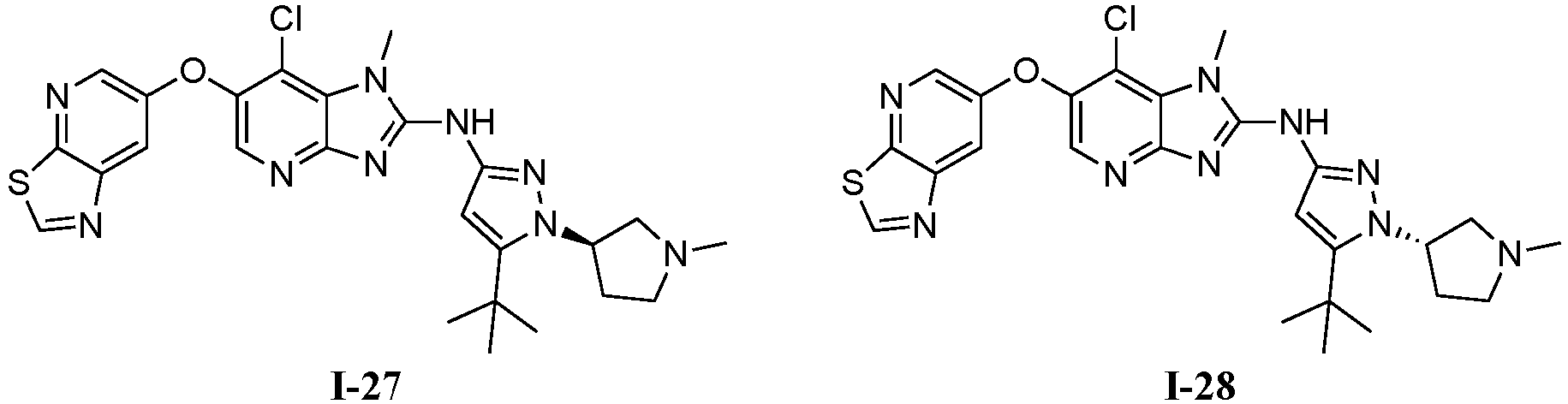


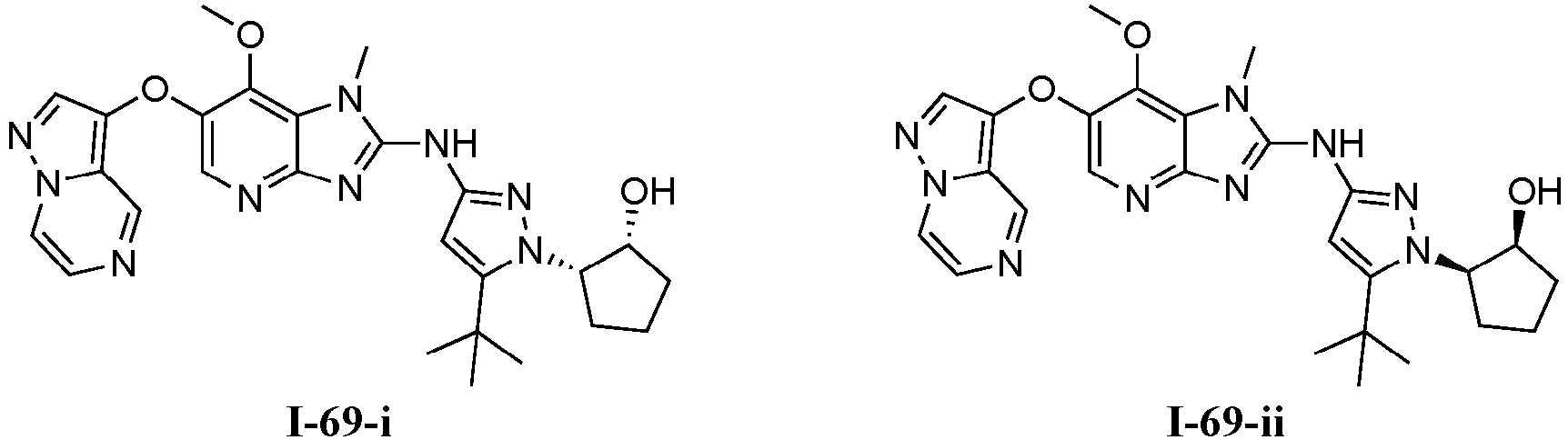


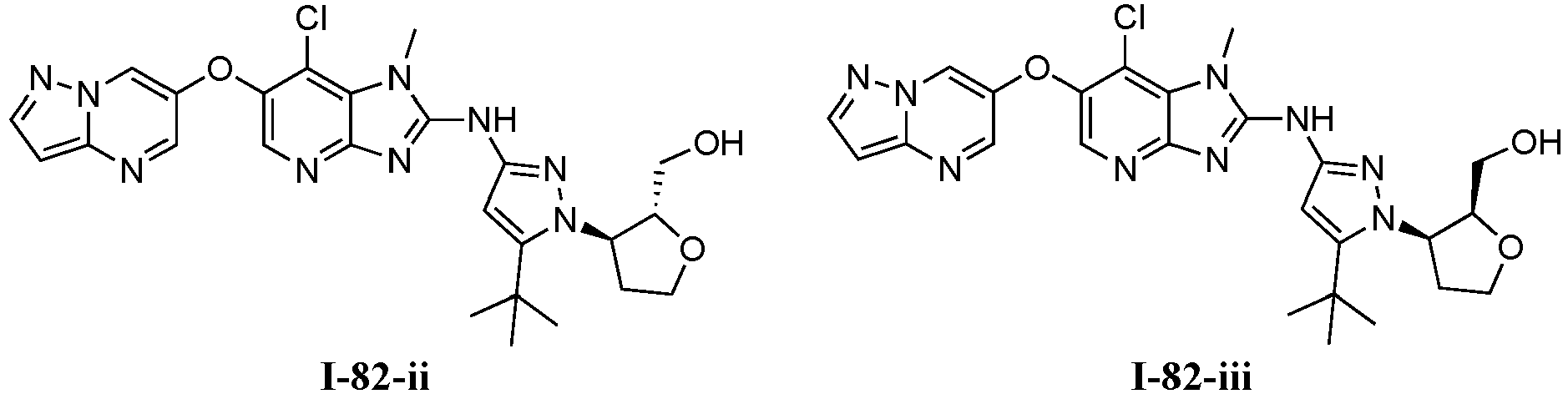


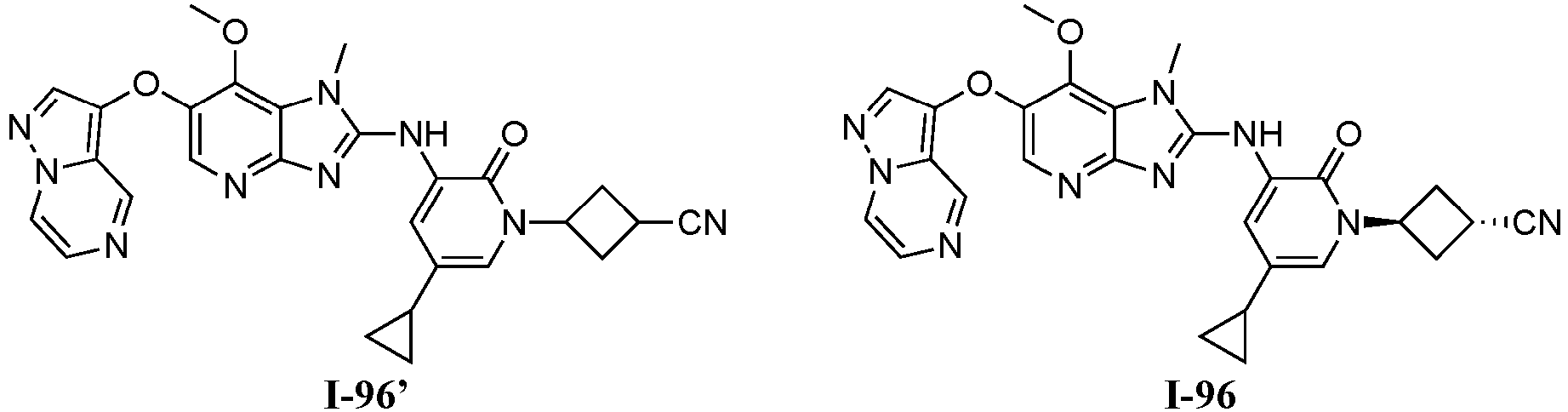


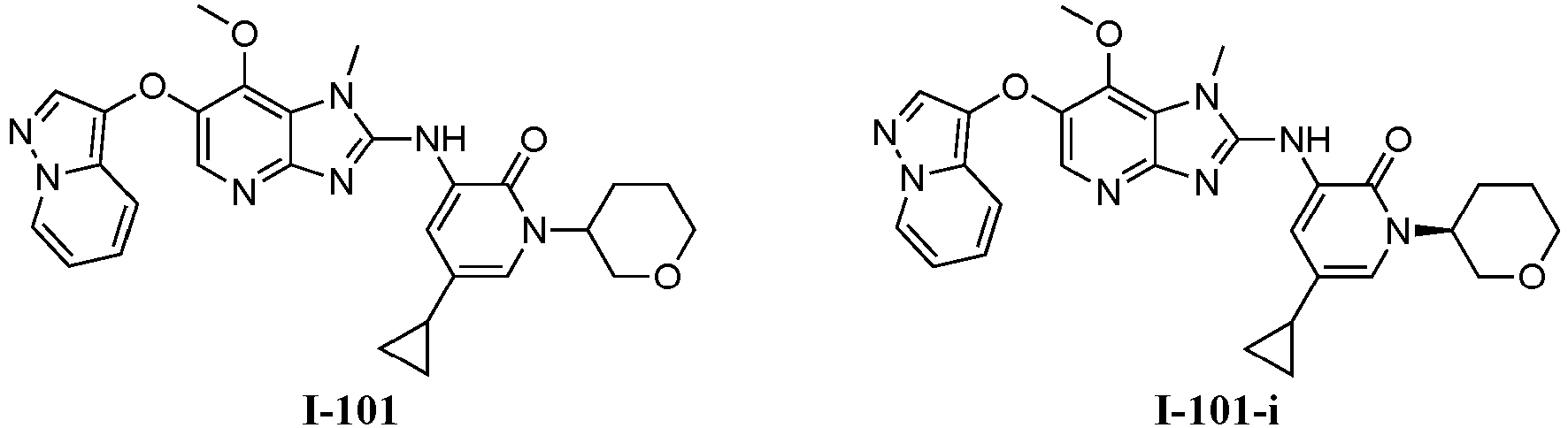


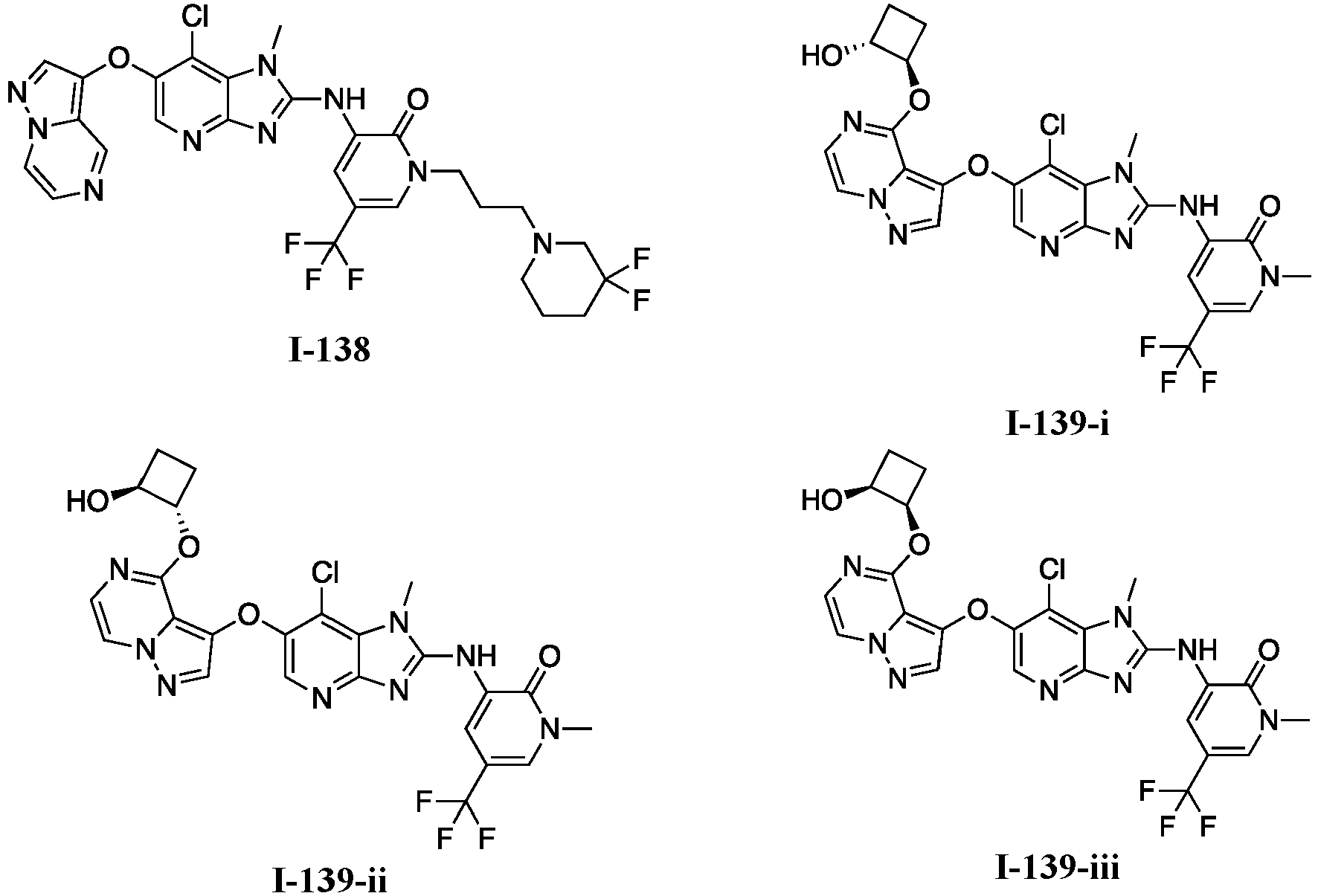


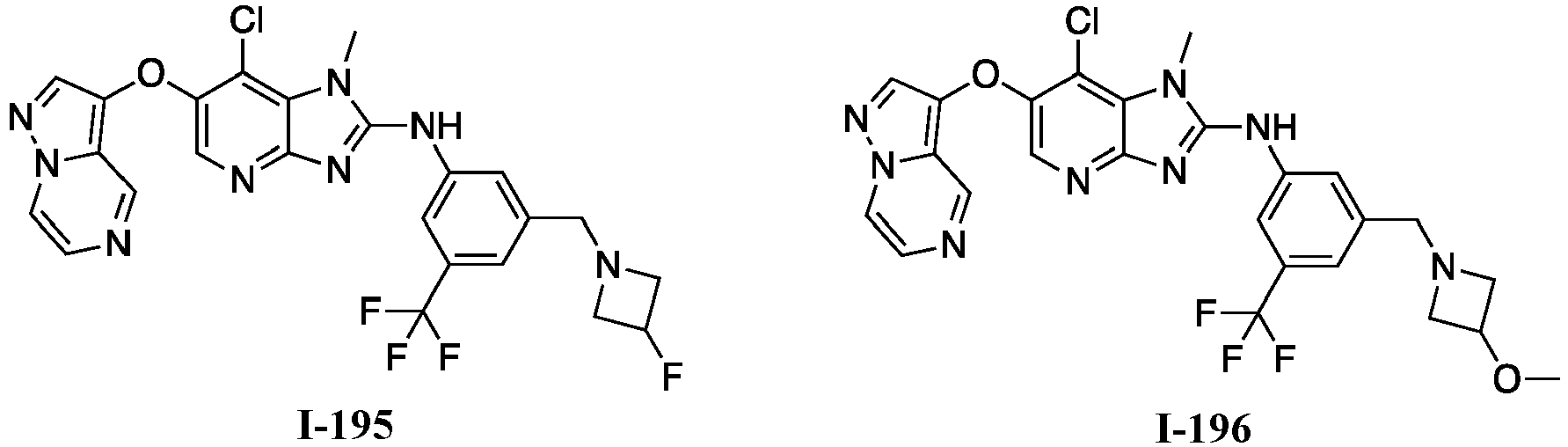


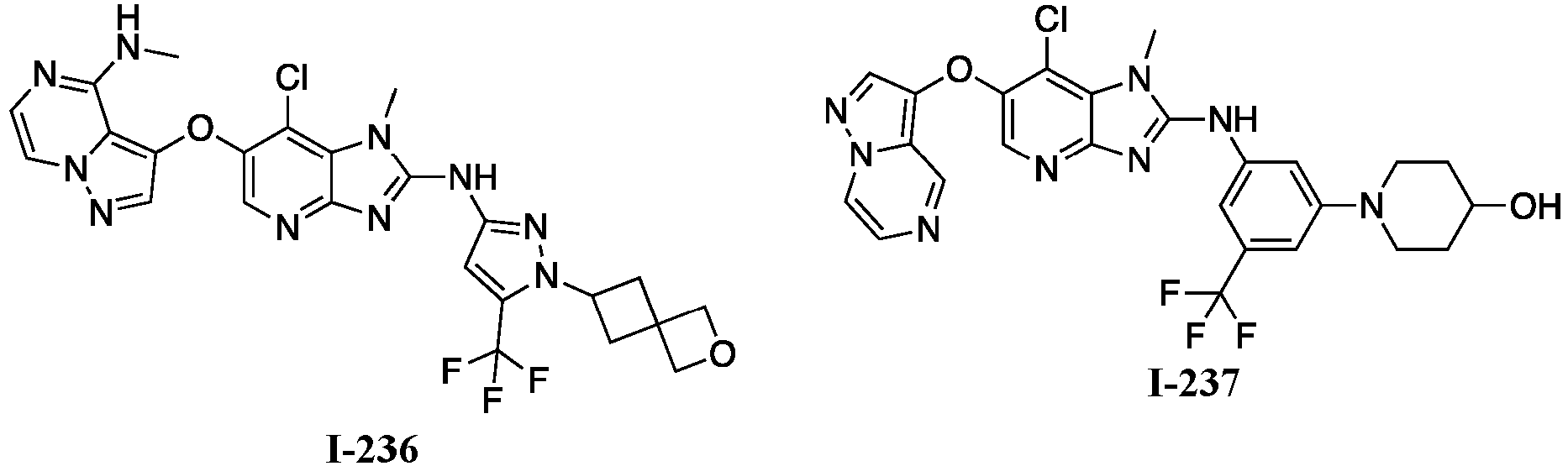


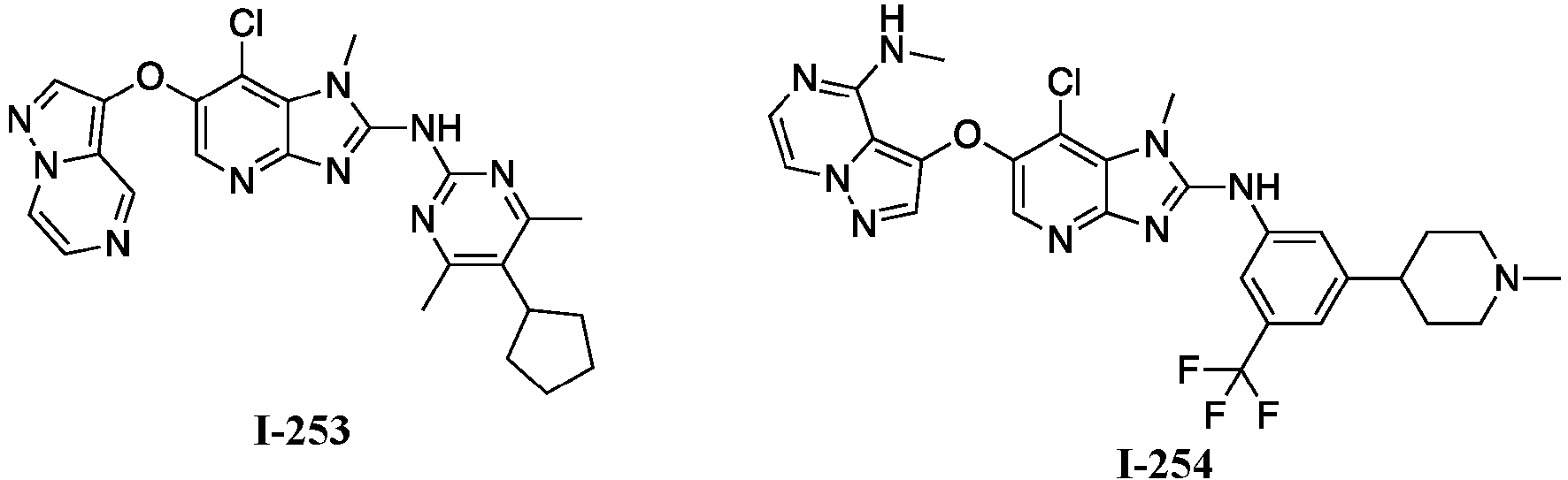
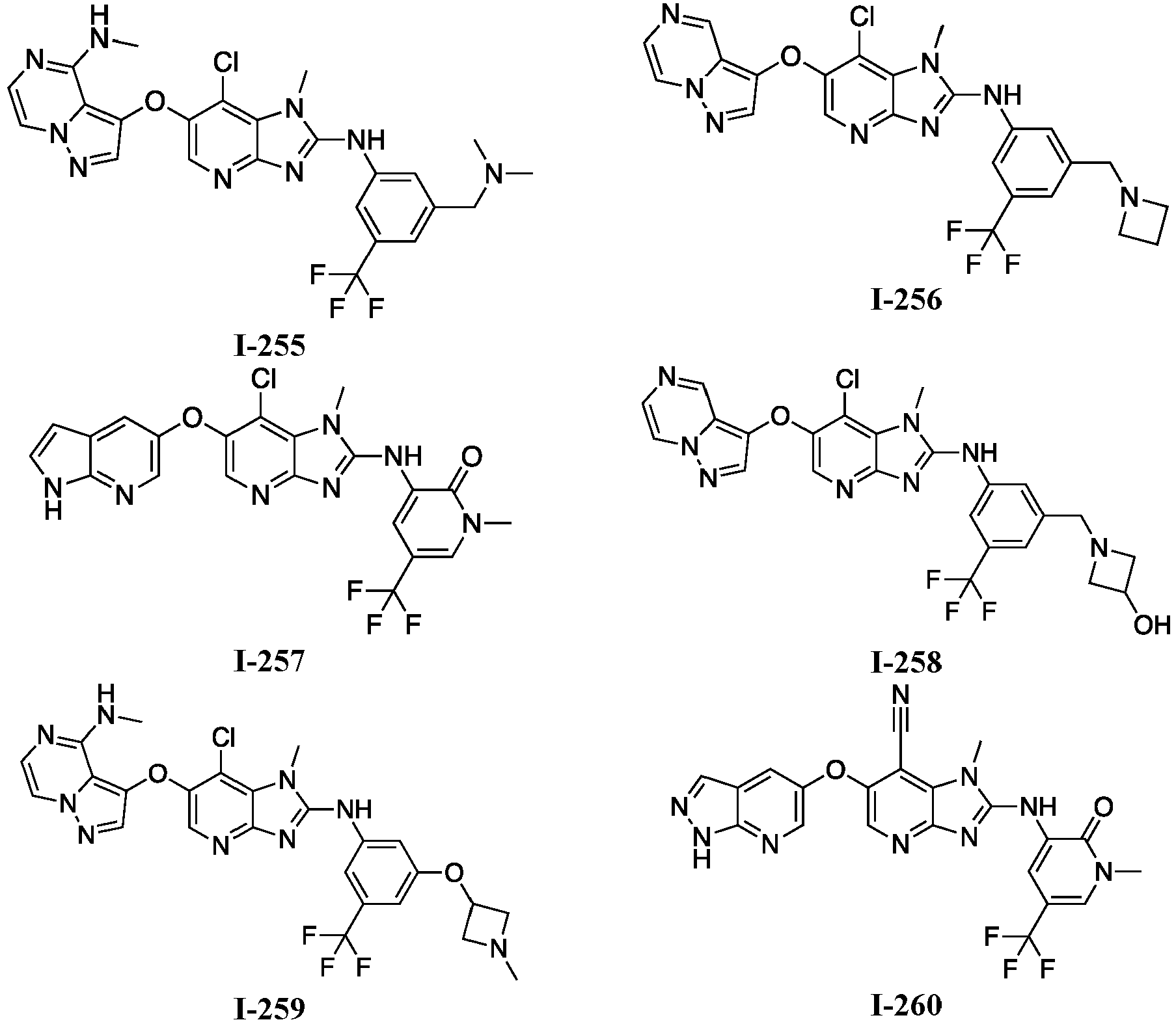
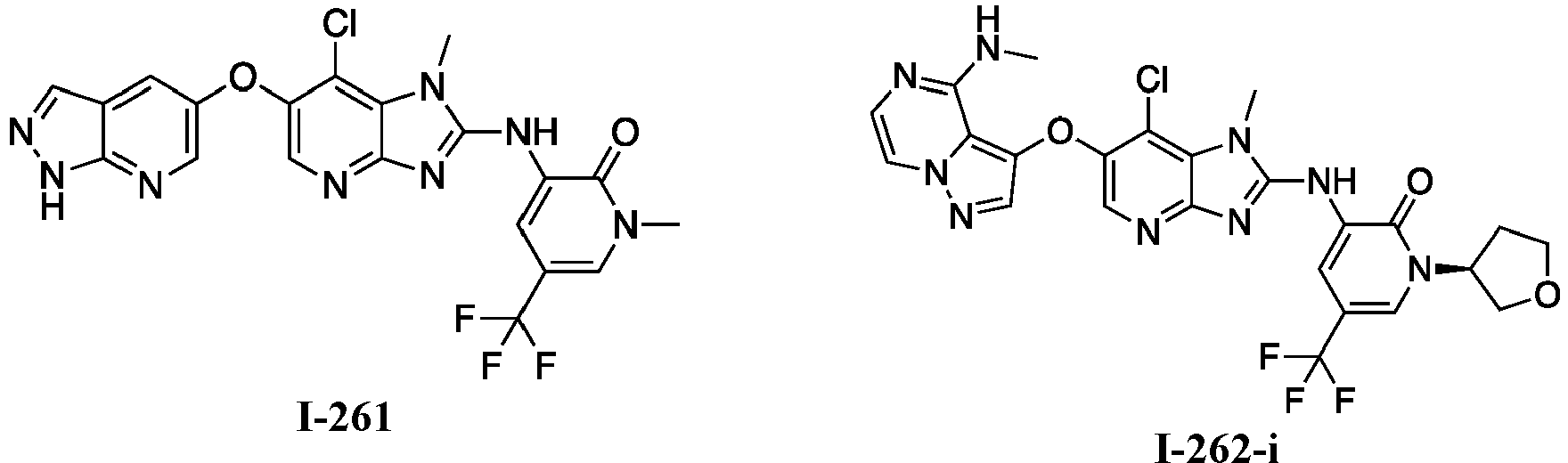


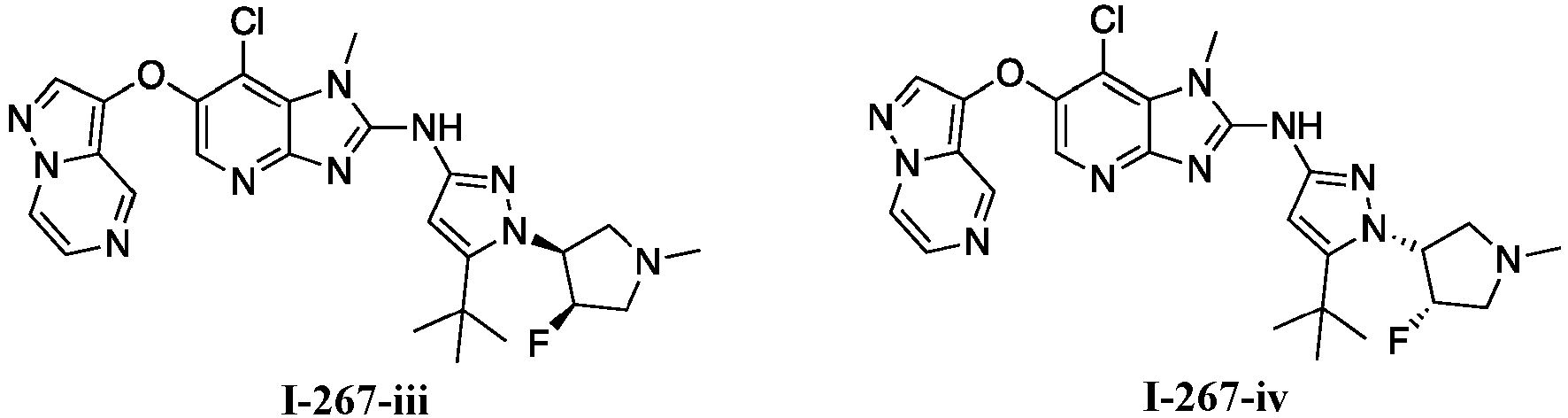


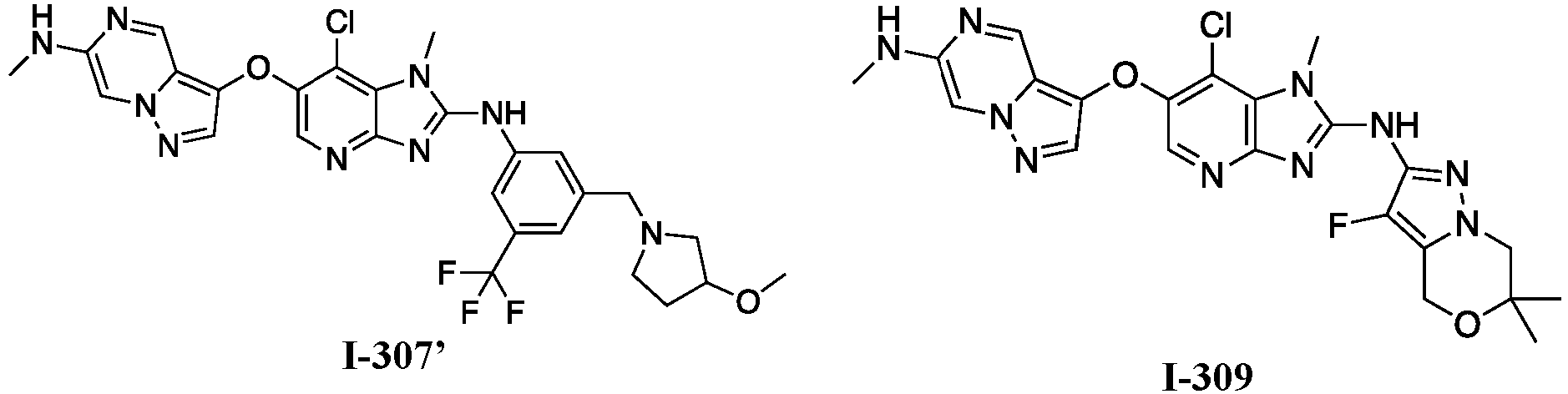

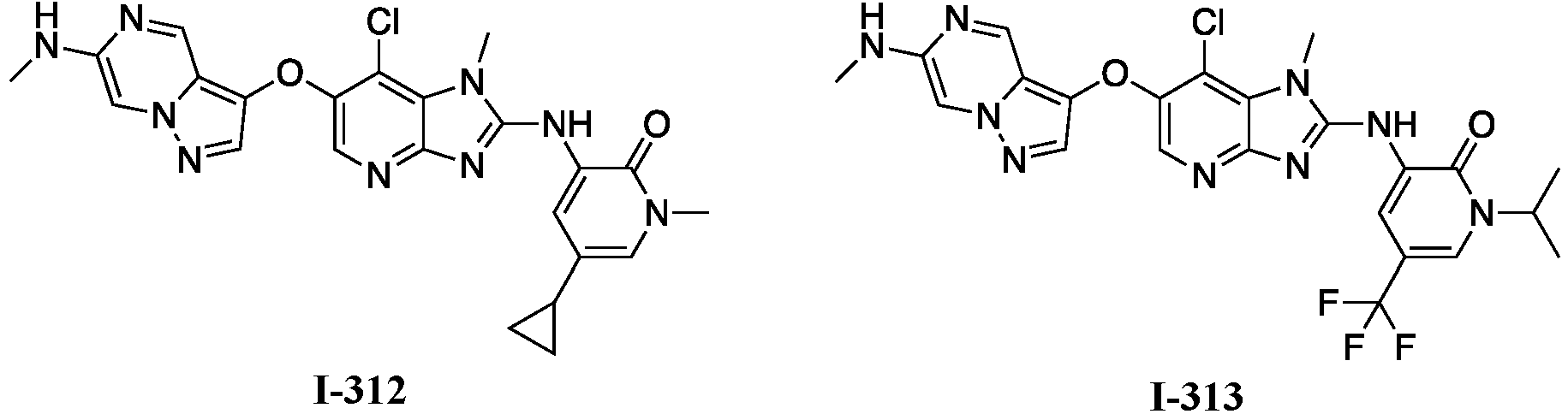
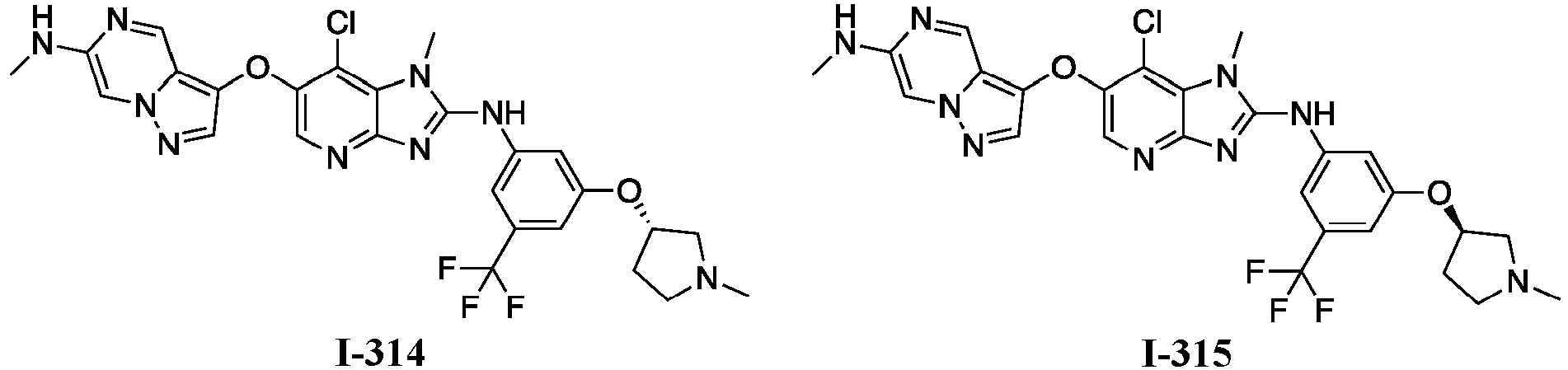


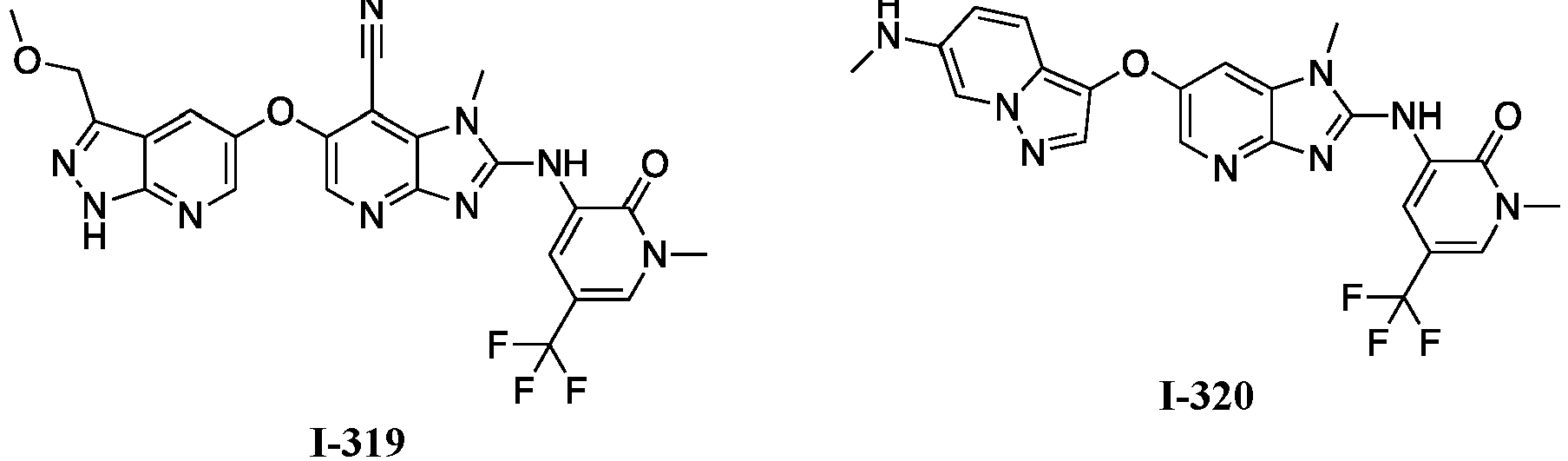


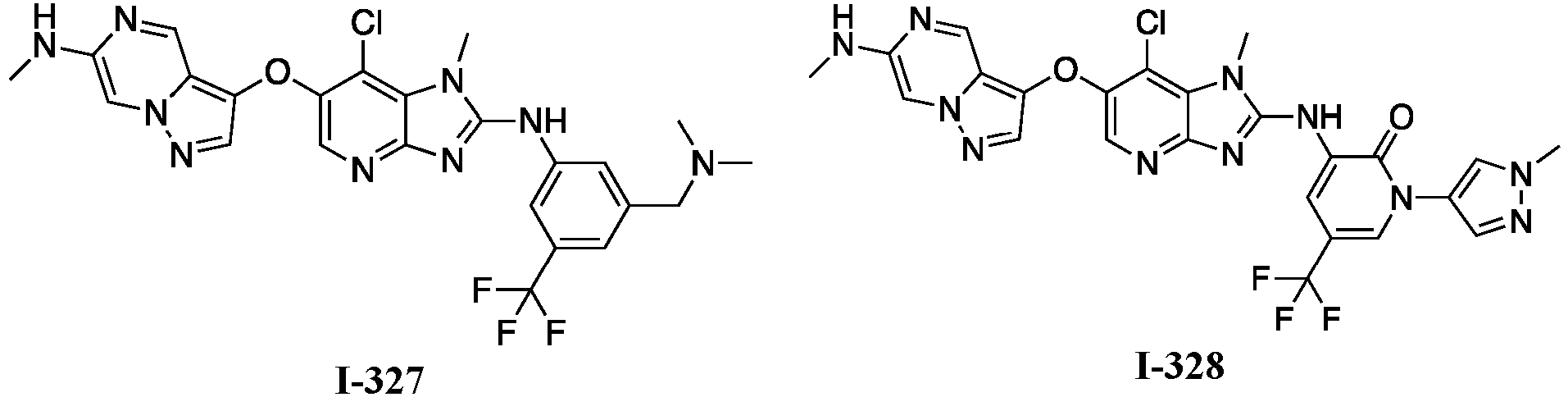


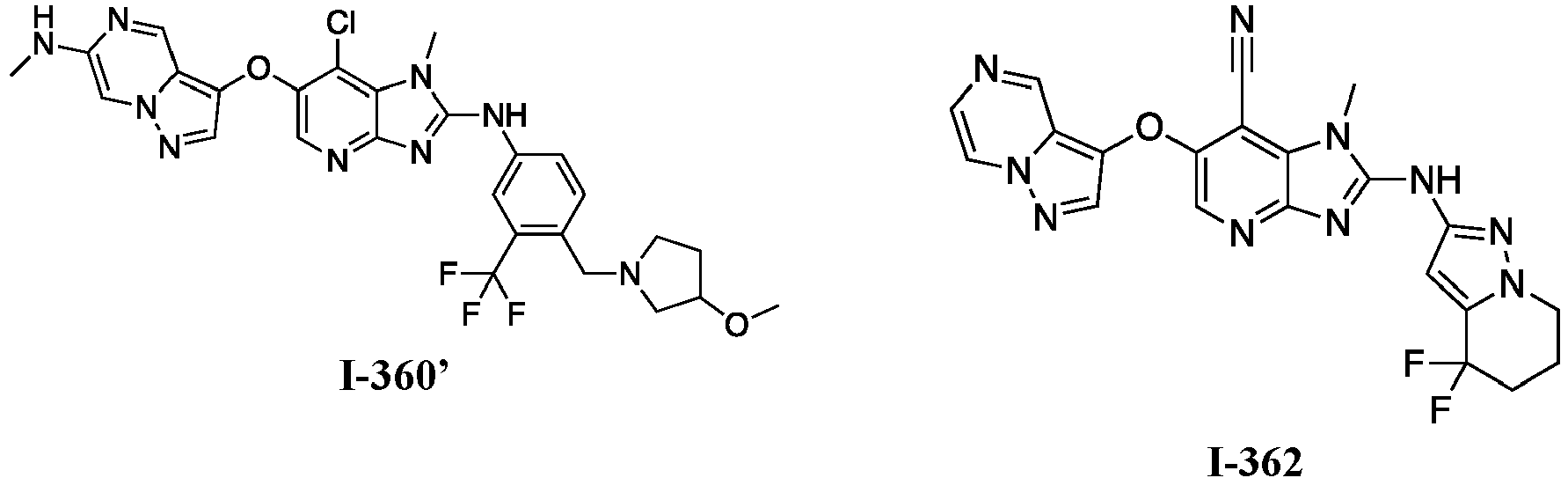


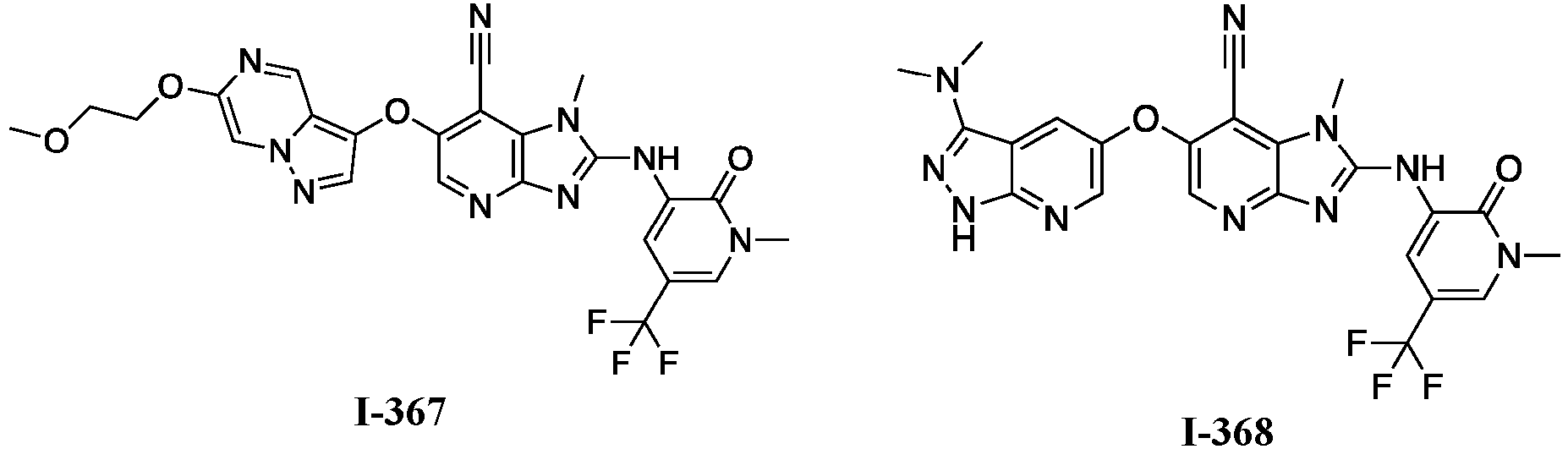


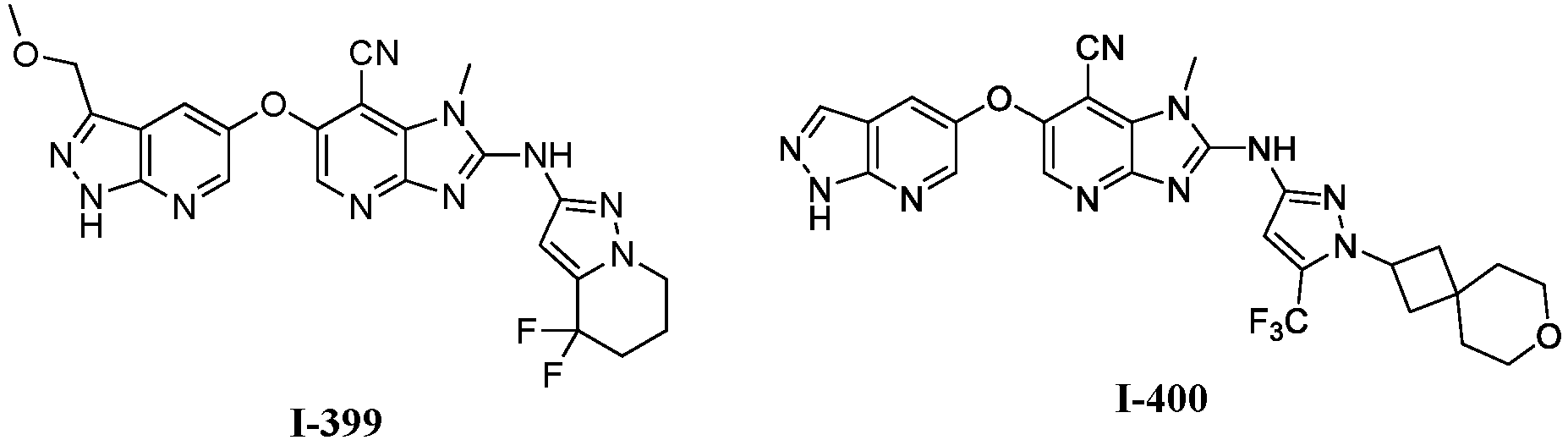


- In some embodiments, the present disclosure encompasses the recognition that provided compounds display certain desirable characteristics, e.g., as compared to other known compounds. For example, in some embodiments, provided compounds are more potent in one or more biochemical or cellular assays (e.g., the JAK2 Binding Assay or SET2-pSTAT5 Cellular Assay described herein) and/or have one or more other characteristics that make them more suitable for drug development, such as better selectivity over other kinases and/or better ADME (absorption, distribution, metabolism, and excretion) properties including but not limited to better permeability, cytotoxicity, hepatocyte stability, solubility, and/or plasma protein binding profiles (e.g., based on assays described in the ensuing examples), than other known compounds. In some embodiments, provided compounds display certain desirable characteristics in one or more assays described herein, e.g., compared to other known compounds. Without wishing to be bound by any particular theory, the present disclosure encompasses the recognition that 6-heteroaryloxy benzimidazoles and azabenzimidazoles can display certain more desirable characteristics (such as better properties in one or more assays described herein) than corresponding 5-heteroaryloxy benzimidazoles and azabenzimidazoles.
- In some embodiments, provided compounds are provided and/or utilized in a salt form (e.g., a pharmaceutically acceptable salt form). Reference to a compound provided herein is understood to include reference to salts thereof, unless otherwise indicated. Pharmaceutically acceptable salt forms are known in the art. For example, S. M. Berge, et al. describes pharmaceutically acceptable salts in detail in J. Pharmaceutical Sciences, 66:1-19(1977).
- It will be appreciated that throughout the present disclosure, unless otherwise indicated, reference to a compound of Formula I is intended to also include Formulae II, III, IV, I-A, II-A, III-A, IV-A, I-B, II-B, III-B, IV-B, I-C, II-C, III-C, IV-C, I-D, II-D, III-D, IV-D, I-E, II-E, III-E, and IV-E, and compound species of such formulas disclosed herein.
- Provided compounds may generally be made by the processes described in the ensuing schemes and examples. In some embodiments, provided compounds (e.g., compounds of Formula I wherein Z is -NH-) are prepared according to the following Scheme:

- In some embodiments, provided compounds (e.g., compounds of Formula I wherein Z is -NRz- or -O-) are prepared according to the following Scheme:
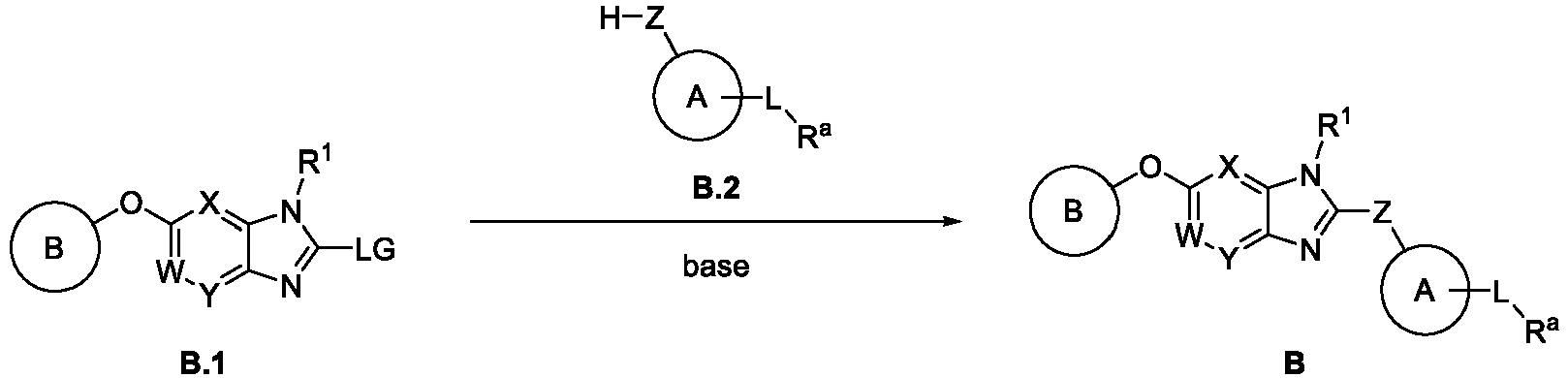
- In some embodiments, provided compounds (e.g., compounds of Formula I, wherein Ring B is substituted with a -OR or -N(R)2 moiety) are prepared according to the following Scheme:
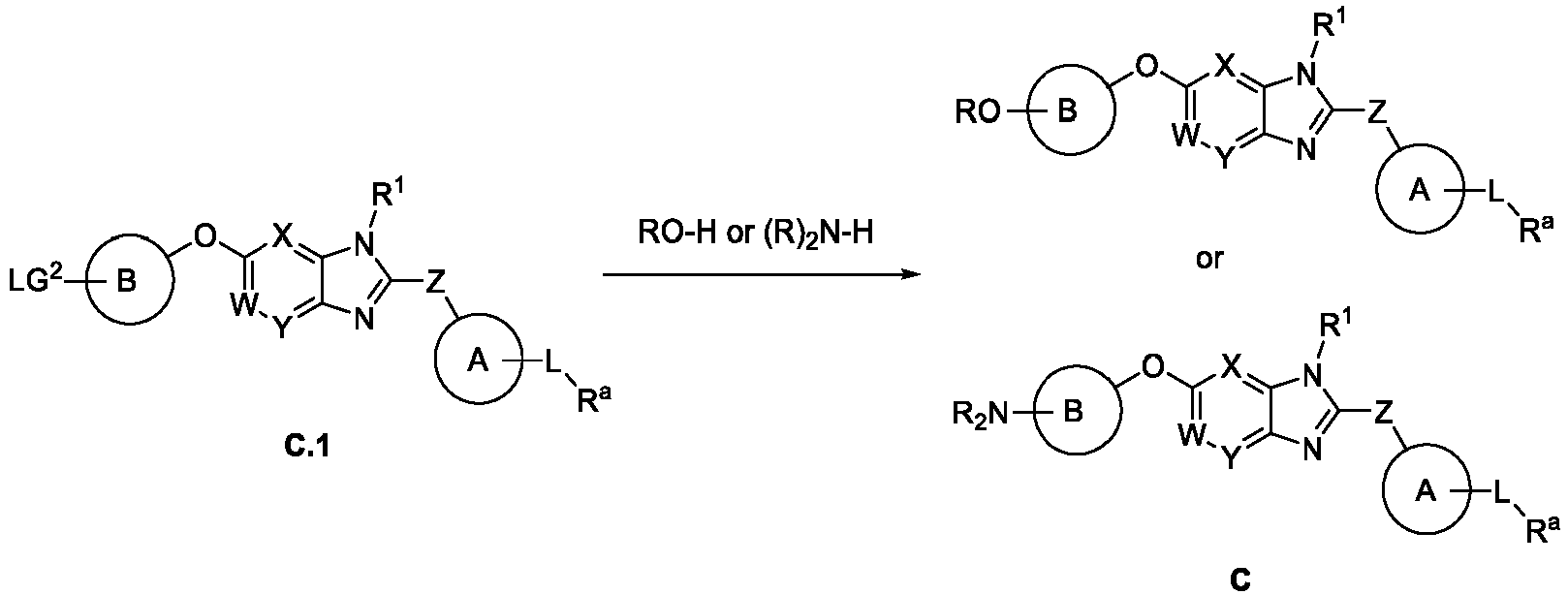
- In some embodiments, a provided compound is obtained by a process comprising a purification method described in the Examples section. In some such embodiments, a compound is the 1st eluting isomer. In some such embodiments, a compound is the 2nd eluting isomer. In some embodiments, a compound is the 3rd eluting isomer. In some embodiments, a compound is the 4th eluting isomer. In some embodiments, a compound is the 5th, 6th, 7th, 8th, or more eluting isomer.
- The present disclosure also provides compositions comprising a compound provided herein with one or more other components. In some embodiments, provided compositions comprise and/or deliver a compound described herein (e.g., compounds of Formulae I, II, III, IV, I-A, II-A, III-A, IV-A, I-B, II-B, III-B, IV-B, I-C, II-C, III-C, IV-C, I-D, II-D, III-D, IV-D, I-E, II-E, III-E, and IV-E).
- In some embodiments, a provided composition is a pharmaceutical composition that comprises and/or delivers a compound provided herein (e.g., compounds of Formulae I, II, III, IV, I-A, II-A, III-A, IV-A, I-B, II-B, III-B, IV-B, I-C, II-C, III-C, IV-C, I-D, II-D, III-D, IV-D, I-E, II-E, III-E, and IV-E) and further comprises a pharmaceutically acceptable carrier. Pharmaceutical compositions typically contain an active agent (e.g., a compound described herein) in an amount effective to achieve a desired therapeutic effect while avoiding or minimizing adverse side effects. In some embodiments, provided pharmaceutical compositions comprise a compound described herein and one or more fillers, disintegrants, lubricants, glidants, anti-adherents, and/or anti-statics, etc. Provided pharmaceutical compositions can be in a variety of forms including oral dosage forms, topical creams, topical patches, iontophoresis forms, suppository, nasal spray and/or inhaler, eye drops, intraocular injection forms, depot forms, as well as injectable and infusible solutions. Methods of preparing pharmaceutical compositions are well known in the art.
- In some embodiments, provided compounds are formulated in a unit dosage form for ease of administration and uniformity of dosage. The expression "unit dosage form" as used herein refers to a physically discrete unit of an active agent (e.g., a compound described herein) for administration to a subject. Typically, each such unit contains a predetermined quantity of active agent. In some embodiments, a unit dosage form contains an entire single dose of the agent. In some embodiments, more than one unit dosage form is administered to achieve a total single dose. In some embodiments, administration of multiple unit dosage forms is required, or expected to be required, in order to achieve an intended effect. A unit dosage form may be, for example, a liquid pharmaceutical composition containing a predetermined quantity of one or more active agents, a solid pharmaceutical composition (e.g., a tablet, a capsule, or the like) containing a predetermined amount of one or more active agents, a sustained release formulation containing a predetermined quantity of one or more active agents, or a drug delivery device containing a predetermined amount of one or more active agents, etc.
- Provided compositions may be administered using any amount and any route of administration effective for treating or lessening the severity of any disease or disorder described herein.
- The present disclosure provides uses for compounds and compositions described herein. In some embodiments, provided compounds and compositions are useful in medicine (e.g., as therapy). In some embodiments, provided compounds and compositions are useful in research as, for example, analytical tools and/or control compounds in biological assays.
- In some embodiments, the present disclosure provides theprovided compounds or compositions for use in methods of administration to a subject in need thereof. In some embodiments, the present disclosure provides the provided compounds or compositions for use in methods of administration to a subject suffering from or susceptible to a disease, disorder, or condition associated with JAK2.
- In some embodiments, provided compounds are useful as JAK2 inhibitors. In some embodiments, provided compounds are useful as Type II JAK2 inhibitors. In some embodiments, the present disclosure provides a provided compound or composition for use in methods of inhibiting JAK2 in a subject. In some embodiments, the present disclosure provides methods of inhibiting JAK2 in a biological sample comprising contacting the sample with a provided compound or composition.
- JAK (e.g., JAK2) has been implicated in various diseases, disorders, and conditions, such as myeloproliferative neoplasms (Vainchenker, W. et al., F1000Research 2018, 7(F1000 Faculty Rev):82), atopic dermatitis (Rodrigues, M. A. and Torres, T. J. Derm. Treat. 2019, 31(1), 33-40) and acute respiratory syndrome, hyperinflammation, and/or cytokine storm syndrome (The Lancet. doi:10.1016/S0140-6736(20)30628-0). Accordingly, in some embodiments, the present disclosure provides a provided compound or composition for use in methods of treating a disease, disorder or condition associated with JAK2 in a subject in need thereof comprising administering the compound or composition to the subject. In some embodiments, a disease, disorder or condition is associated with overexpression of JAK2.
- In some embodiments, the present disclosure provides a provided compound or composition for use in methods of treating cancer, comprising administering the provided compound or composition to a subject in need thereof. In some embodiments, the present disclosure provides a provided compound or composition for use in methods of treating proliferative diseases, comprising administering the provided compound or composition to a subject in need thereof.
- In some embodiments, the present disclosure provides compounds and compositions for use in methods of treating a hematological malignancy, comprising administering the provided compound or composition to a subject in need thereof. In some embodiments, a hematological malignancy is leukemia (e.g., chronic lymphocytic leukemia, acute lymphoblastic leukemia, T-cell acute lymphoblastic leukemia, chronic myelogenous leukemia, acute myelogenous leukemia, or acute monocytic leukemia). In some embodiments, a hematological malignancy is lymphoma (e.g., Burkitt's lymphoma, Hodgkin's lymphoma, or non-Hodgkin's lymphoma). In some embodiments, a non-Hodgkin's lymphoma is a B-cell lymphoma. In some embodiments, a non-Hodgkin's lymphoma is a NK/T-cell lymphoma (e.g., cutaneous T-cell lymphoma). In some embodiments, a hematological malignancy is myeloma (e.g., multiple myeloma). In some embodiments, a hematological malignancy is myeloproliferative neoplasm (e.g., polycythemia vera, essential thrombocytopenia, or myelofibrosis). In some embodiments, a hematological malignancy is myelodysplastic syndrome.
- In some embodiments, the present disclosure provides compounds and compositions for use in methods of treating an inflammatory disease, disorder, or condition (e.g., acute respiratory syndrome, hyperinflammation, and/or cytokine storm syndrome (including those associated with COVID-19) or atopic dermatitis), comprising administering the provided compound or composition to a subject in need thereof.
- In some embodiments, a provided compound or composition is administered as part of a combination therapy. As used herein, the term "combination therapy" refers to those situations in which a subject is simultaneously exposed to two or more therapeutic or prophylactic regimens (e.g., two or more therapeutic or prophylactic agents). In some embodiments, the two or more regimens may be administered simultaneously; in some embodiments, such regimens may be administered sequentially (e.g., all "doses" of a first regimen are administered prior to administration of any doses of a second regimen); in some embodiments, such agents are administered in overlapping dosing regimens. In some embodiments, "administration" of combination therapy may involve administration of one or more agent(s) or modality(ies) to a subject receiving the other agent(s) or modality(ies) in the combination. For clarity, combination therapy does not require that individual agents be administered together in a single composition (or even necessarily at the same time), although in some embodiments, two or more agents, or active moieties thereof, may be administered together in a combination composition.
- For example, in some embodiments, a provided compound or composition is administered to a subject who is receiving or has received one or more additional therapies (e.g., an anti-cancer therapy and/or therapy to address one or more side effects of such anti-cancer therapy, or otherwise to provide palliative care). Exemplary additional therapies include BCL2 inhibitors (e.g., venetoclax), HDAC inhibitors (e.g., vorinostat), BET inhibitors (e.g., mivebresib), proteasome inhibitors (e.g., bortezomib), LSD1 inhibitors (e.g., IMG-7289), and CXCR2 inhibitors. Useful combinations of a JAK2 inhibitor with BCL2, HDAC, BET, and proteasome inhibitors have been demonstrated in cells derived from cutaneous T-cell lymphoma patients (Yumeen, S., et al., Blood Adv. 2020, 4(10), 2213-2226). A combination of a JAK2 inhibitor with a LSD1 inhibitor demonstrated good efficacy in a mouse model of myeloproliferative neoplasms (Jutzi, J.S., et al., HemaSphere 2018, 2(3), http://dx.doi.org/10.1097/HS9.0000000000000054). CXCR2 activity has been shown to modulate signaling pathways involved in tumor growth, angiogenesis, and/or metastasis, including the JAK-STAT3 pathway (Jaffer, T., Ma, D. Transl. Cancer Res. 2016, 5(Suppl. 4), S616-S628).
- The following numbered embodiments, while non-limiting, are exemplary of certain aspects of the present disclosure:
- 1. A compound of Formula I:

- W is CRw or N;
- X is CRx or N;
- Y is CRy or N;
- Z is -O- or -NRz-;
- Rw, Rx and Ry are each independently hydrogen, halogen, -OR2, -N(R2)2, -SR2, optionally substituted C1-6 aliphatic, or -CN;
- Rz is hydrogen or optionally substituted C1-6 aliphatic;
- R1 is optionally substituted C1-6 aliphatic;
- each R2 is independently hydrogen or optionally substituted C1-6 aliphatic;
- Ring A is optionally substituted phenyl, optionally substituted 5- to 6-membered monocyclic heteroaryl having 1-4 heteroatoms independently selected from nitrogen, oxygen, and sulfur, optionally substituted 8- to 10-membered bicyclic heteroaryl having 1-4 heteroatoms independently selected from nitrogen, oxygen, and sulfur, optionally substituted 3- to 7-membered saturated or partially unsaturated monocyclic carbocyclyl, optionally substituted 3-to 7-membered saturated or partially unsaturated monocyclic heterocyclyl having 1-3 heteroatoms independently selected from nitrogen, oxygen, and sulfur, or optionally substituted 7- to 10- membered saturated or partially unsaturated bicyclic heterocyclyl having 1-4 heteroatoms independently selected from nitrogen, oxygen, and sulfur;
- Ring B is optionally substituted 9- to 16-membered bicyclic or tricyclic aryl, optionally substituted 8- to 10-membered bicyclic heteroaryl having 1-4 heteroatoms independently selected from nitrogen, oxygen, and sulfur, optionally substituted 10- to 16-membered polycyclic heteroaryl having 1-5 heteroatoms independently selected from nitrogen, oxygen, and sulfur, optionally substituted 7- to 10-membered bicyclic heterocyclyl having 1-4 heteroatoms independently selected from nitrogen, oxygen, and sulfur, or optionally substituted 10- to 16-membered polycyclic heterocyclyl having 1-5 heteroatoms independently selected from nitrogen, oxygen, and sulfur;
- L is a covalent bond or a bivalent C1-3 straight or branched hydrocarbon chain; and
- Ra is hydrogen, halogen, optionally substituted C1-6 aliphatic, optionally substituted phenyl, optionally substituted 5- to 6-membered monocyclic heteroaryl having 1-4 heteroatoms independently selected from nitrogen, oxygen, and sulfur, optionally substituted 3- to 7-membered saturated or partially unsaturated monocyclic carbocyclyl, optionally substituted 3-to 7-membered saturated or partially unsaturated monocyclic heterocyclyl having 1-3 heteroatoms independently selected from nitrogen, oxygen, and sulfur, or optionally substituted 7- to 10-membered saturated or partially unsaturated bicyclic heterocyclyl having 1-4 heteroatoms independently selected from nitrogen, oxygen, and sulfur.
- 2. The compound of embodiment 1, wherein the compound is not:


- 3. The compound of any one of the preceding embodiments, wherein Ring A is optionally substituted 5- to 6-membered monocyclic heteroaryl having 1-4 heteroatoms independently selected from nitrogen, oxygen, and sulfur, optionally substituted 8- to 10-membered bicyclic heteroaryl having 1-4 heteroatoms independently selected from nitrogen, oxygen, and sulfur, optionally substituted 3- to 7-membered saturated or partially unsaturated monocyclic carbocyclyl, optionally substituted 3- to 7-membered saturated or partially unsaturated monocyclic heterocyclyl having 1-3 heteroatoms independently selected from nitrogen, oxygen, and sulfur, or optionally substituted 7- to 10- membered saturated or partially unsaturated bicyclic heterocyclyl having 1-4 heteroatoms independently selected from nitrogen, oxygen, and sulfur.
- 4. The compound of embodiment 1 or 2, wherein Ring A is optionally substituted phenyl, optionally substituted 5- to 6-membered monocyclic heteroaryl having 1-4 heteroatoms independently selected from nitrogen, oxygen, and sulfur, or optionally substituted 8- to 10-membered bicyclic heteroaryl having 1-4 heteroatoms independently selected from nitrogen, oxygen, and sulfur.
- 5. The compound of any one of the preceding embodiments, wherein Ring A is optionally substituted 5- to 6-membered monocyclic heteroaryl having 1-4 heteroatoms independently selected from nitrogen, oxygen, and sulfur.
- 6. The compound of any one of embodiments 1-4, wherein Ring A is optionally substituted phenyl.
- 7. The compound of any one of the preceding embodiments, wherein Ra is halogen, optionally substituted C1-6 aliphatic, optionally substituted phenyl, optionally substituted 5- to 6-membered monocyclic heteroaryl having 1-4 heteroatoms independently selected from nitrogen, oxygen, and sulfur, optionally substituted 3- to 7-membered saturated or partially unsaturated monocyclic carbocyclyl, optionally substituted 3- to 7-membered saturated or partially unsaturated monocyclic heterocyclyl having 1-3 heteroatoms independently selected from nitrogen, oxygen, and sulfur, or optionally substituted 7- to 10-membered saturated or partially unsaturated bicyclic heterocyclyl having 1-4 heteroatoms independently selected from nitrogen, oxygen, and sulfur.
- 8. The compound of any one of embodiments 1-6, wherein Ra is hydrogen, halogen, optionally substituted C1-6 aliphatic, optionally substituted 5- to 6-membered monocyclic heteroaryl having 1-4 heteroatoms independently selected from nitrogen, oxygen, and sulfur, optionally substituted 3- to 7-membered saturated or partially unsaturated monocyclic carbocyclyl, optionally substituted 3- to 7-membered saturated or partially unsaturated monocyclic heterocyclyl having 1-3 heteroatoms independently selected from nitrogen, oxygen, and sulfur, or optionally substituted 7- to 10-membered saturated or partially unsaturated bicyclic heterocyclyl having 1-4 heteroatoms independently selected from nitrogen, oxygen, and sulfur.
- 9. The compound of any one of the preceding embodiments, wherein Ra is optionally substituted C1-6 aliphatic, optionally substituted 5- to 6-membered monocyclic heteroaryl having 1-4 heteroatoms independently selected from nitrogen, oxygen, and sulfur, optionally substituted 3- to 7-membered saturated or partially unsaturated monocyclic carbocyclyl, optionally substituted 3- to 7-membered saturated or partially unsaturated monocyclic heterocyclyl having 1-3 heteroatoms independently selected from nitrogen, oxygen, and sulfur, or optionally substituted 7-to 10-membered saturated or partially unsaturated bicyclic heterocyclyl having 1-4 heteroatoms independently selected from nitrogen, oxygen, and sulfur.
- 10. The compound of any one of the preceding embodiments, wherein Ra is optionally substituted C1-6 aliphatic, optionally substituted 3- to 7-membered saturated or partially unsaturated monocyclic carbocyclyl, optionally substituted 3- to 7-membered saturated or partially unsaturated monocyclic heterocyclyl having 1-3 heteroatoms independently selected from nitrogen, oxygen, and sulfur, or optionally substituted 7- to 10-membered saturated or partially unsaturated bicyclic heterocyclyl having 1-4 heteroatoms independently selected from nitrogen, oxygen, and sulfur.
- 11. The compound of any one of the preceding embodiments, wherein:

- each Rb is independently hydrogen, halogen, -CN, -OR, -O(CH2)nR, -SR, -N(R)2, -NO2, -C(O)R', -C(O)OR, -C(O)N(R)2, -OC(O)R', -OC(O)N(R)2, -OC(O)OR, -OSO2R, -OSO2N(R)2, - N(R)C(O)R', -N(R)SO2R', -SO2R', -SO2N(R)2, -SO3R', optionally substituted C1-6 aliphatic, optionally substituted 3- to 6-membered saturated or partially unsaturated monocyclic carbocyclyl, optionally substituted 3- to 6-membered saturated or partially unsaturated monocyclic heterocyclyl having 1-3 heteroatoms independently selected from nitrogen, oxygen, and sulfur, or optionally substituted 5- to 6-membered monocyclic heteroaryl having 1-4 heteroatoms independently selected from nitrogen, oxygen, and sulfur;
- each R is independently hydrogen, optionally substituted C1-6 aliphatic, optionally substituted phenyl, optionally substituted 5- to 6-membered monocyclic heteroaryl having 1-3 heteroatoms independently selected from nitrogen, oxygen, and sulfur, optionally substituted 3- to 7-membered saturated or partially unsaturated carbocyclyl, or optionally substituted 3- to 7-membered saturated or partially unsaturated monocyclic heterocyclyl having 1-3 heteroatoms independently selected from nitrogen, oxygen, and sulfur, or two R when attached to the same nitrogen atom are taken together form an optionally substituted 3- to 7-membered saturated or partially unsaturated monocyclic heterocyclyl having 0-2 additional heteroatoms independently selected from nitrogen, oxygen, and sulfur;
- each R' is independently optionally substituted C1-6 aliphatic or optionally substituted 3- to 7-membered saturated or partially unsaturated carbocyclyl; and
- n is 1, 2, or 3.
- 12. The compound of any one of the preceding embodiments, wherein:


- Rb is hydrogen, halogen, -CN, -OR, -SR, -N(R)2, -NO2, -C(O)R', -C(O)OR, -C(O)N(R)2, - OC(O)R', -OC(O)N(R)2, -OC(O)OR, -OSO2R, -OSO2N(R)2, -N(R)C(O)R', -N(R)SO2R', - SO2R', -SO2N(R)2, -SO3R', optionally substituted C1-6 aliphatic, optionally substituted 3- to 6-membered saturated or partially unsaturated monocyclic carbocyclyl, optionally substituted 3-to 6-membered saturated or partially unsaturated monocyclic heterocyclyl having 1-3 heteroatoms independently selected from nitrogen, oxygen, and sulfur, optionally substituted 5- to 6-membered monocyclic heteroaryl having 1-4 heteroatoms independently selected from nitrogen, oxygen, and sulfur;
- each R is independently hydrogen, optionally substituted C1-6 aliphatic, optionally substituted 3-to 7-membered saturated or partially unsaturated carbocyclyl, or optionally substituted 3- to 7-membered saturated or partially unsaturated monocyclic heterocyclyl having 1-3 heteroatoms independently selected from nitrogen, oxygen, and sulfur, or two R when attached to the same nitrogen atom are taken together form an optionally substituted 3- to 7-membered saturated or partially unsaturated monocyclic heterocyclyl having 0-2 additional heteroatoms independently selected from nitrogen, oxygen, and sulfur; and
- each R' is independently optionally substituted C1-6 aliphatic or optionally substituted 3- to 7-membered saturated or partially unsaturated carbocyclyl.
- 13. The compound of embodiment 11, wherein each Rb is independently hydrogen, halogen, - CN, -OR, -O(CH2)nR, -N(R)2, -C(O)N(R)2, optionally substituted C1-6 aliphatic, or optionally substituted 3- to 6-membered saturated or partially unsaturated monocyclic carbocyclyl.
- 14. The compound of any one of embodiments 11-13, wherein Rb is hydrogen, optionally substituted C1-6 aliphatic or optionally substituted 3- to 6-membered saturated or partially unsaturated monocyclic carbocyclyl.
- 15. The compound of any one of embodiments 11-14, wherein Rb is optionally substituted C1-4 alkyl or optionally substituted C3-C4 cycloalkyl.
- 16. The compound of any one of embodiments 11-15, wherein


- 17. The compound of any one of embodiments 11-16, wherein


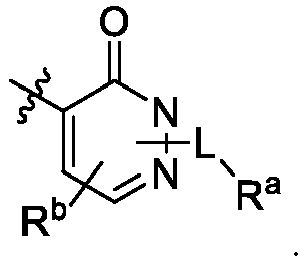
- 18. The compound of any one of embodiments 11-17, wherein


- 19. The compound of any one of the preceding embodiments, wherein L is a covalent bond.
- 20. The compound of any one of the preceding embodiments, wherein L is -CH2-.
- 21. The compound of any one of the preceding embodiments, wherein Ring B is optionally substituted 8- to 10-membered bicyclic heteroaryl having 1-4 heteroatoms independently selected from nitrogen, oxygen, and sulfur or optionally substituted 10- to 16-membered polycyclic heteroaryl having 1-5 heteroatoms independently selected from nitrogen, oxygen, and sulfur.
- 22. The compound of any one of the preceding embodiments, wherein Ring B is optionally substituted 8- to 10-membered bicyclic heteroaryl having 1-4 heteroatoms independently selected from nitrogen, oxygen, and sulfur.
- 23. The compound of any one of the preceding embodiments, wherein Ring B is 8- to 10-membered bicyclic heteroaryl having 1-4 heteroatoms independently selected from nitrogen, oxygen, and sulfur, and is optionally substituted with one or more oxo, halogen, -O(optionally substituted C1-6 alkyl), -O(optionally substituted C3-6 carbocyclyl), -NH(optionally substituted C1-6 alkyl), -NH(optionally substituted 3- to 6-membered saturated heterocyclyl), -N(optionally substituted C1-6 alkyl)2, -CN, optionally substituted C1-6 aliphatic, optionally substituted C3-6 carbocyclyl, or optionally substituted 3- to 6-membered saturated or partially unsaturated heterocyclyl having 1-2 heteroatoms selected from nitrogen, oxygen, and sulfur.
- 24. The compound of any one of the preceding embodiments, wherein Ring B is 8- to 10-membered bicyclic heteroaryl having 1-4 heteroatoms independently selected from nitrogen, oxygen, and sulfur, and is optionally substituted with one or more -O(C1-6 alkyl), -CN, optionally substituted C1-6 aliphatic, or optionally substituted C3-6 carbocyclyl.
- 25. The compound of any one of the preceding embodiments, wherein:
- Ring B is

- Ring B1 is an optionally substituted ring selected from phenyl, 5- to 6-membered monocyclic heteroaryl having 1-3 heteroatoms independently selected from nitrogen, oxygen, and sulfur, 5- to 6-membered saturated or partially unsaturated monocyclic carbocyclyl, and 5- to 6-membered saturated or partially unsaturated monocyclic heterocyclyl having 1-3 heteroatoms independently selected from nitrogen, oxygen, and sulfur;
wherein Ring B1 is fused to Ring B2; - Ring B2 is an optionally substituted ring selected from phenyl, 5- to 6-membered monocyclic heteroaryl having 1-3 heteroatoms independently selected from nitrogen, oxygen, and sulfur, 5- to 6-membered saturated or partially unsaturated monocyclic carbocyclyl, and 5- to 6-membered saturated or partially unsaturated monocyclic heterocyclyl having 1-3 heteroatoms independently selected from nitrogen, oxygen, and sulfur;
- wherein Ring B2 is optionally (i) further fused to Ring B3,
- or (ii) Ring B2 and Ring B3 combine to form a spirocycle; and
- Ring B3, when present, is an optionally substituted ring selected from phenyl, 5- to 6-membered monocyclic heteroaryl having 1-3 heteroatoms independently selected from nitrogen, oxygen, and sulfur, 3- to 7-membered saturated or partially unsaturated monocyclic carbocyclyl, and 3- to 7-membered saturated or partially unsaturated monocyclic heterocyclyl having 1-3 heteroatoms independently selected from nitrogen, oxygen, and sulfur.
- Ring B is
- 26. The compound of embodiment 25, wherein Ring B1 is optionally substituted 5- to 6-membered monocyclic heteroaryl having 1-3 heteroatoms independently selected from nitrogen, oxygen, and sulfur.
- 27. The compound of embodiment 25 or 26, wherein Ring B is selected from the group consisting of:

- 28. The compound of any one of embodiments 25-27, wherein Ring B2 is optionally substituted 5- to 6-membered monocyclic heteroaryl having 1-3 heteroatoms independently selected from nitrogen, oxygen, and sulfur.
- 29. The compound of any one of embodiments 25-28, wherein Ring B is selected from the group consisting of:


- 30. The compound of any one of the preceding embodiments, wherein R1 is C1-4 alkyl.
- 31. The compound of any one of the preceding embodiments, wherein W is CRw.
- 32. The compound of embodiment 31, wherein Rw is hydrogen.
- 33. The compound of any one of embodiments 1-30, wherein W is N.
- 34. The compound of any one of the preceding embodiments, wherein X is CRx.
- 35. The compound of embodiment 34, wherein Rx is hydrogen, halogen, -CN, -OR2, or optionally substituted C1-6 aliphatic.
- 36. The compound of embodiment 34, wherein Rx is hydrogen, halogen, -OR2, or optionally substituted C1-6 aliphatic.
- 37. The compound of any one of embodiments 1-33, wherein X is N.
- 38. The compound of any one of the preceding embodiments, wherein Y is CRy.
- 39. The compound of embodiment 38, wherein Ry is hydrogen.
- 40. The compound of any one of embodiments 1-37, wherein Y is N.
- 41. The compound of any one of the preceding embodiments, wherein Z is -O-.
- 42. The compound of any one of embodiments 1-40, wherein Z is -NRz-.
- 43. The compound of embodiment 42, wherein Rz is hydrogen.
- 44. The compound of any one of the preceding embodiments, wherein the compound is of Formula I-A:

- 45. The compound of any one of the preceding embodiments, wherein the compound is of Formula I-B:

- 46. The compound of any one of the preceding embodiments, wherein the compound is of Formula I-C:

- 47. The compound of any one of the preceding embodiments, wherein the compound is of Formula I-D:

- 48. The compound of any one of the preceding embodiments, wherein the compound is of Formula I-E:

- 49. A compound selected from Table 1, or a pharmaceutically acceptable salt thereof.
- 50. A pharmaceutical composition comprising a compound of any one of the preceding embodiments, or a pharmaceutically acceptable salt thereof, and a pharmaceutically acceptable carrier.
- 51. A method of inhibiting JAK2 in a subject comprising administering the compound of any one of embodiments 1-49 or the composition of embodiment 50.
- 52. A method of treating a disease, disorder, or condition associated with JAK2, comprising administering to a subject in need thereof the compound of any one of embodiments 1-49 or the composition of embodiment 50.
- 53. A method of treating cancer, comprising administering to a subject in need thereof the compound of any one of embodiments 1-49 or the composition of embodiment 50.
- 54. A method of treating a hematological malignancy, comprising administering to a subject in need thereof the compound of any one of embodiments 1-49 or the composition of embodiment 50.
- 55. The method of embodiment 54, wherein the hematological malignancy is leukemia or lymphoma.
- 56. A method of treating a myeloproliferative neoplasm, comprising administering to a subject in need thereof the compound of any one of embodiments 1-49 or the composition of embodiment 50.
- 57. The method of embodiment 56, wherein the myeloproliferative neoplasm is polycythemia vera, essential thrombocytopenia or myelofibrosis.
- 58. The method of any one of embodiments 53-57, wherein the compound is not:

- As described in the Examples below, in certain exemplary embodiments, compounds are prepared according to the following general procedures. It will be appreciated that, although the general methods depict the synthesis of certain compounds of the present disclosure, the following general methods and other methods known to one of ordinary skill in the art can be applied to all compounds and subclasses and species of each of these compounds, as described herein. Exemplified compounds listed in the Examples which do not fall within the scope of the claims are provided for reference purposes only.
-

- Synthesis of compound Int-1.1. To a round-bottom flask equipped with a Dean-Stark apparatus and a condenser was charged with 5-(tert-butyl)-1H-pyrazol-3-amine (5.0 g, 35.92 mmol, 1.0 equiv), 2, 5-hexanedione (4.09 g, 35.92 mmol, 1.0 equiv), toluene (100 mL) and a few drops of acetic acid (catalytic). The reaction mixture was heated to reflux for 3 hours. It was cooled rt and concentrated under reduced pressure. The residue was purified by flash column chromatography on silica gel (CombiFlash®, 12% ethyl acetate in hexane as eluant) to afford Int-1.1. MS (ES): m/z 218.3 [M+H]+.
- Synthesis of compound Int-1.2 and Int-1.3. A mixture of Int-1.1 (2.5 g, 11.50 mmol, 1.0 equiv), (R)-tetrahydrofuran-3-yl methanesulfonate (1.91 g, 11.50 mmol, 1.0 equiv) and cesium carbonate (7.49 g, 23 mmol, 2.0 equiv) in DMF (15 mL) was stirred at 70 °C for 12 h under nitrogen. It was poured into ice-water, stirred and extracted with ethyl acetate. The combined organic layers were washed with brine, dried over anhydrous sodium sulfate, filtered and concentrated under reduced pressure. The residue was purified by flash column chromatography on silica gel (CombiFlash®, 2% ethyl acetate in hexane as eluant) to afford Int-1.2. MS (ES): m/z 287.4 [M+H]+ and Int-1.3. MS (ES): m/z 248.3 [M+H]+.
- Synthesis of compound Int-1.4. To a solution of Int-1.3 (0.120 g, 0.417 mmol, 1.0 equiv) in ethanol-water (2:1, 2 mL) was added hydroxylamine hydrochloride (0.287 g, 4.17 mmol, 10 equiv). The reaction mixture was stirred at 120°C in a microwave reactor for 1 h. It was poured over ice-water, basified by 2 N sodium hydroxide and extracted with dichloromethane. The combined organic layers were washed with brine, dried over anhydrous sodium sulfate, filtered and concentrated under reduced pressure to afford Int-1.4. MS (ES): m/z 210.3 [M+H]+.
- Synthesis of compound Int-1. To a solution of Int-1.4 (0.070 g, 0.334 mmol, 1.0 equiv) in dichloromethane (2 mL) was added a solution of sodium bicarbonate (0.140 g, 1.67 mmol, 5.0 equiv) in water (1 mL) followed by thiophosgene (0.096 g, 0.835 mmol, 2.5 equiv) at 0 °C. The reaction mixture was stirred at room temperature for 2 h. It was poured over ice-water and extracted with dichloromethane. The combined organic layers were washed with brine, dried over anhydrous sodium sulfate, filtered and concentrated under reduced pressure to afford Int-1. MS (ES): m/z 252.3 [M+H]+.
-

- Synthesis of compound Int-2. Compound Int-2 was prepared from Int-1.2, following the procedures described in the synthesis of Int-1. MS (ES): m/z 252.3 [M+H]+.
-

- Synthesis of compound Int-3.1 Hydrogen peroxide (30 wt%, 31 mL) was added dropwise to concentrated sulfuric acid (60 mL) at 0 °C. To the solution was added a solution of 3,5-difluoropyridin-2-amine (5.0 g, 38.43 mmol, 1.0 equiv) in concentrated sulfuric acid (60 mL) dropwise at 0 °C. The reaction mixture was stirred at room temperature for 48 h. It was carefully poured over crushed ice and stirred. The aqueous mixture was basified with saturated aqueous sodium bicarbonate. Precipitates were removed by filtration and the filtrate was extracted with ethyl acetate. The combined organic layers were washed with brine, dried over anhydrous sodium sulfate, filtered and concentrated under reduced pressure to afford Int-3.1. 1H NMR (CDCl3, 400 MHz): δ 8.35 (bs, 1H), 7.62-7.58 (m, 1H).
- Synthesis of compound Int-3. To a solution of Int-3.1 (2.3 g, 14.37 mmol, 1.0 equiv) in acetonitrile (20 mL) was added aqueous methylamine solution (40%, 1.1 mL, 14.37 mmol, 1.0 equiv) dropwise at 0 °C. The reaction mixture was stirred at room temperature for 1 h. It was poured over ice-water and extracted with ethyl acetate. The combined organic layers were washed with brine, dried over anhydrous sodium sulfate, filtered and concentrated under reduced pressure to afford Int-3. 1H NMR (CDCl3, 400 MHz): δ 7.93 (bs, 1H), 7.78-7.75 (d, 1H), 7.02-6.99 (m, 1H), 3.06 (s, 3H).
-

- Synthesis of compound Int-4.1. To a solution of 3,5-difluoropyridin-2-amine (10 g, 76.87 mmol, 1.0 equiv) in THF (200 mL), was added n-butyllithium (2.5 M in hexane, 61.4 mL, 153.7 mmol, 2.0 equiv). The reaction mixture was stirred at -78 °C for 40 min. Hexachloroethane (36.3 g, 153.7 mmol, 2.0 equiv) was added and the reaction mixture was stirred at -78 °C for 30-40 min. A saturated ammonium chloride solution was added carefully to quench the reaction. The mixture was warmed to room temperature and extracted with ethyl acetate. The combined organic layers were washed with brine, dried over anhydrous sodium sulfate, filtered and concentrated under reduced pressure. The residue was purified by flash column chromatography on silica gel (CombiFlash®, 12% ethyl acetate in hexane) to afford Int-4.1. 1H NMR (DMSO-d6, 400 MHz): δ 7.98-7.94 (m, 1H), 6.48 (bs, 2H).
- Synthesis of compound Int-4.2. Concentrated sulfuric acid (3 mL, 6 vol) was added dropwise to potassium persulfate (2.05 g, 7.6 mmol, 2.5 equiv) at room temperature and stirred for 15 min. To the mixture was added Int-4.1 (0.5 g, 3.04 mmol, 1.0 equiv) in small portions maintaining temperature at 30-40 °C. The reaction mixture was stirred at room temperature for 3-4 h. It was poured over crushed ice, stirred, basified with saturated sodium bicarbonate and extracted with ethyl acetate. The combined organic layers were washed with brine, dried over anhydrous sodium sulfate, filtered and concentrated under reduced pressure. The residue was purified by flash column chromatography on silica gel (CombiFlash®, 2-3% ethyl acetate in hexane) to afford Int-4.2. 1H NMR (DMSO-d6, 400 MHz): δ 8.78 (s, 1H).
- Synthesis of compound Int-4. To a solution of Int-4.2 (0.970 g, 4.99 mmol, 1.0 equiv) in acetonitrile (10 mL) was added aqueous methylamine solution (40%, 0.8 mL, 9.98 mmol, 2.0 equiv) dropwise at 0 °C. The reaction mixture was stirred at room temperature for 10-20 min. It was poured over ice-water and extracted with ethyl acetate. The combined organic layers were washed with brine, dried over anhydrous sodium sulfate, filtered and concentrated under reduced pressure. The residue was purified by flash column chromatography on silica gel (CombiFlash®, 10% ethyl acetate in hexane) to afford Int-4. 1H NMR (DMSO-d6, 400 MHz): δ 7.98 (s, 1H), 7.05 (bs, 1H), 2.79 (d, 3H).
-
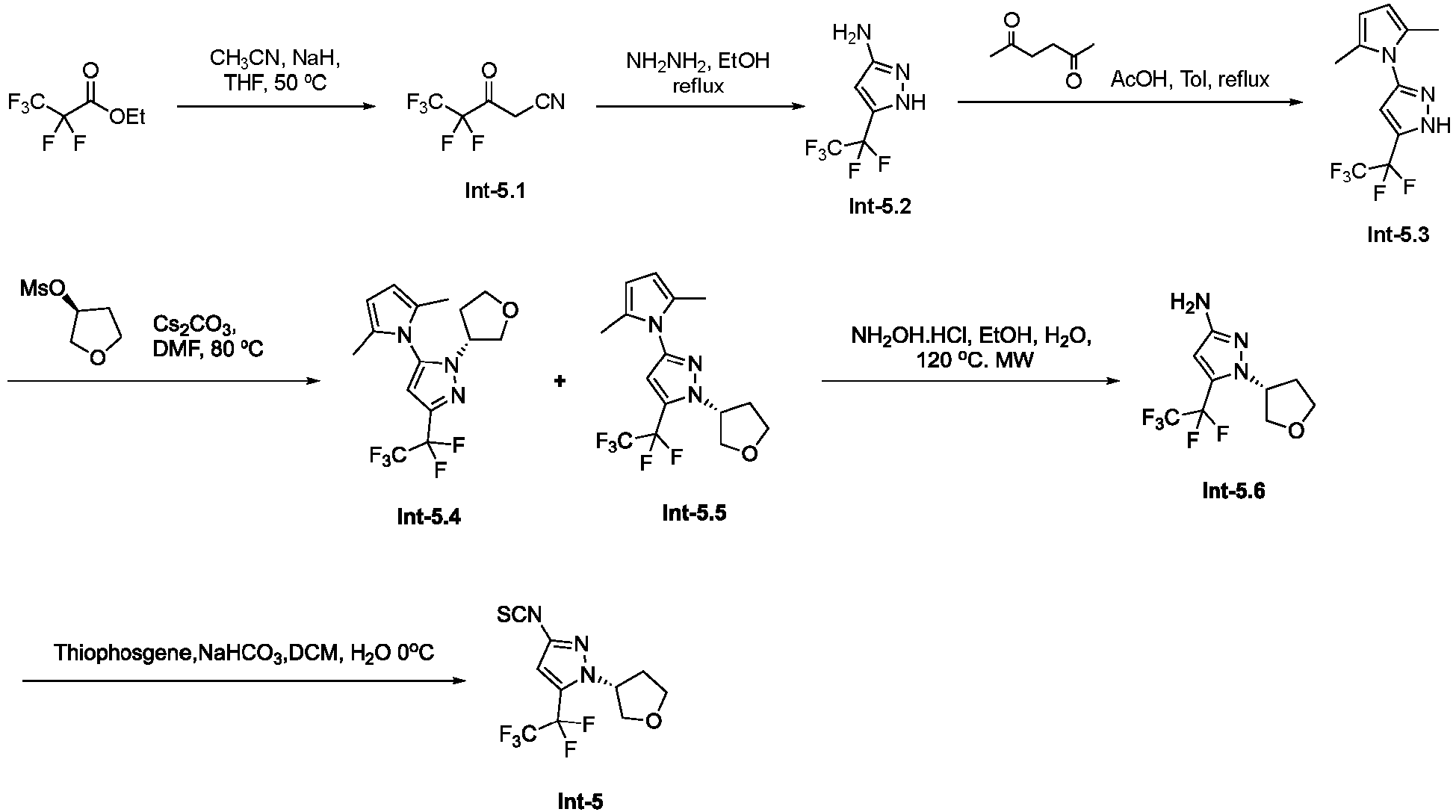
- Synthesis of compound Int-5.1. To a suspension of sodium hydride (6.2 g, 156.18 mmol, 3.0 equiv) in THF (100 mL) was added ethyl 2,2,3,3,3-pentafluoropropanoate (10 g, 52.06 mmol, 1.0 equiv) and acetonitrile (1.68 mL, 52.06 mmol, 1.0 equiv) at 50 °C and the reaction mixture was stirred at same temperature for 4 h. It was concentrated under reduced pressure. To the mixture was added 4 N hydrochloric acid and it was extracted with diethyl ether. The combined organic layers were washed with brine, dried over anhydrous sodium sulfate, filtered and concentrated under reduced pressure to afford Int-5.1. The crude product was used in the next step without further purification.
- Synthesis of compound Int-5.1. A mixture of Int-5.1 (6.0 g, 32.07 mmol, 1.0 equiv) and hydrazine hydrate (98%, 3.14 mL, 64.14 mmol, 2.0 equiv) in ethanol (60 mL) was heated to reflux for 12 h. It was poured over ice-water, stirred and extracted with ethyl acetate. The combined organic layers were washed with brine, dried over anhydrous sodium sulfate, filtered and concentrated under reduced pressure to afford Int-5.2. MS (ES): m/z 202.1 [M+H]+.
- Synthesis of compound Int-5.3. A mixture of Int-5.2 (3.0 g, 14.92 mmol, 1.0 equiv), hexane-2,5-dione (1.87 g, 16.41 mmol, 1.1 equiv) and acetic acid (0.2 mL, catalytic) in toluene (30 mL) was heated to reflux for 4-5 h. It was poured into water, stirred and extracted with ethyl acetate. The combined organic layers were washed with brine, dried over anhydrous sodium sulfate, filtered and concentrated under reduced pressure. The residue was purified by flash column chromatography on silica gel (CombiFlash®, 4-6% ethyl acetate in hexane) to afford Int-5.3. MS (ES): m/z 280.2 [M+H]+.
- Synthesis of compound Int-5.5. A mixture of Int-5.3 (0.700 g, 2.51 mmol, 1.0 equiv), (S)-tetrahydrofuran-3-yl methanesulfonate (0.416 g, 2.51 mmol, 1.0 equiv) and cesium carbonate (2.44 g, 7.53 mmol, 3.0 equiv) in DMF (10 mL) was stirred at 80-90 °C for 12 h. It was poured over ice-water, stirred and extracted with ethyl acetate. The combined organic layers were washed with brine, dried over anhydrous sodium sulfate, filtered and concentrated under reduced pressure. The residue was purified by flash column chromatography on silica gel (CombiFlash®, 5-6% ethyl acetate in hexane) to afford Int-5.5. MS (ES): m/z 350.3 [M+H]+ and 1.7b (0.100 g, yield: 11.42%). MS (ES): m/z 350.3 [M+H]+.
- Synthesis of compound Int-5.6. Compound Int-5.6 was prepared from Int-5.5, following the procedure described in the synthesis of Int-1.4. The product was purified by flash column chromatography on silica gel (CombiFlash®, 3-4% methanol in dichloromethane). MS (ES): m/z 272.2 [M+H]+.
- Synthesis of compound Int-5. Compound Int-5 was prepared from Int-5.6, following the procedure described in the synthesis of Int-1. The product was purified by flash column chromatography on silica gel (CombiFlash®, 6% ethyl acetate in hexane). MS (ES): m/z 314.1 [M+H]+.
-

- Synthesis of compound Int-6. Compound Int-6 was prepared from Int-5.3 and (R)-tetrahydrofuran-3-yl methanesulfonate, following the procedures described in the synthesis ofInt-5. MS (ES): m/z 314.1 [M+H]+.
-
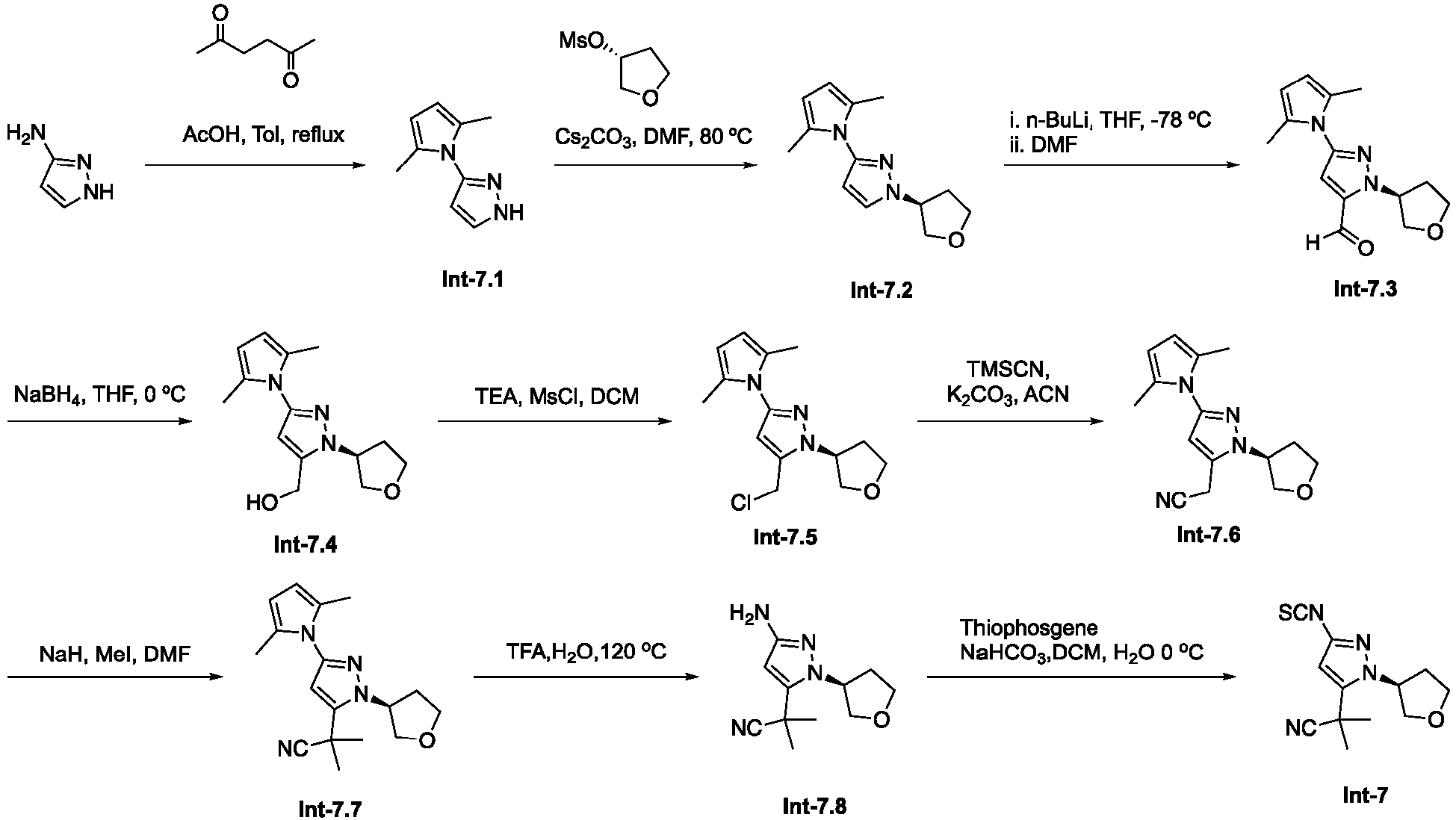
- Synthesis of compound Int-7.1. To a solution of 1H-pyrazol-3-amine (10.0 g, 120.35 mmol, 1.0 equiv) and hexane-2,5-dione (13.74 g, 120.35 mmol, 1.0 equiv) in toluene (100 mL) was added acetic acid (catalytic). The reaction mixture was heated to reflux with a Dean-Stark trap to remove water. The reaction mixture was cooled to room temperature and concentrated under reduced pressure. The residue was purified by flash column chromatography on silica gel (CombiFlash®, 25% ethyl acetate in hexane) to afford Int-7.1. MS (ES): m/z 162.2 [M+H]+.
- Synthesis of compound Int-7.2. A mixture of Int-7.1 (15 g, 93.05 mmol, 1.0 equiv), (R)-tetrahydrofuran-3-yl methanesulfonate (18.56 g, 111.66 mmol, 1.2 equiv) and cesium carbonate (60.48 g, 186.01 mmol, 2.0 equiv) in DMF (150 mL) was stirred at 80-90 °C for 5 h. It was poured over ice-water, stirred and extracted with ethyl acetate. The combined organic layers were washed with brine, dried over anhydrous sodium sulfate, filtered and concentrated under reduced pressure. The residue was purified by flash column chromatography on silica gel (CombiFlash®, 17% ethyl acetate in hexane) to afford Int-7.2. MS (ES): m/z 232.3 [M+H]+.
- Synthesis of compound Int-7.3. To a solution of Int-7.2 (10 g, 43.23 mmol, 1.0 equiv) in THF (100 mL) was added n-butyllithium (2.5 M in hexane, 22.5 mL, 56.19 mmol, 1.3 equiv) dropwise at -78 °C and stirred for 1 h. To the solution was added DMF (7.3 mL, 95.10 mmol, 2.2 equiv) and the reaction mixture was stirred at -78 °C for 30-40 min. A saturated aqueous solution of ammonium chloride was added carefully to quench the reaction. The mixture was warmed to room temperature and extracted with ethyl acetate. The combined organic layers were washed with brine, dried over anhydrous sodium sulfate, filtered and concentrated under reduced pressure. The residue was purified by flash column chromatography on silica gel (CombiFlash®, 15% ethyl acetate in hexane) to afford Int-7.3.
- Synthesis of compound Int-7.4. To a solution of Int-7.3 (3.5 g, 13.50 mmol, 1.0 equiv) in THF (50 mL), was added sodium borohydride (0.62 g, 16.2 mmol, 1.2 equiv) at 0 °C. The reaction mixture was stirred at 0 °C for 1 h. It was poured over ice-water, stirred and extracted with ethyl acetate. The combined organic layers were washed with brine, dried over anhydrous sodium sulfate, filtered and concentrated under reduced pressure to afford Int-7.4.
- Synthesis of compound Int-7.5. To a solution of Int-7.4 (2.5 g, 9.57 mmol, 1.0 equiv) and triethylamine (4.0 mL, 28.71 mmol, 3.0 equiv) in dichloromethane (40 mL) at 0 °C was added MsCl (1.1 mL, 14.35 mmol, 1.5 equiv). The reaction mixture was allowed to warm to rt and stirred for 1 h. It was poured over ice-water, stirred and extracted with dichloromethane. The combined organic layers were washed with saturated aqueous sodium bicarbonate followed by brine, dried over anhydrous sodium sulfate, filtered and concentrated under reduced pressure. The residue was purified by flash column chromatography on silica gel (CombiFlash®, 15% ethyl acetate in hexane) to afford Int-7.5. MS (ES): m/z 280.7 [M+H]+.
- Synthesis of compound Int-7.6. To a solution of Int-7.5 (2.0 g, 7.15 mmol, 1.0 equiv) in acetonitrile (40 mL) was added potassium carbonate (1.97 g, 14.3 mmol, 2.0 equiv) followed by addition of trimethylsilyl cyanide (1.415 g, 14.3 mmol, 2.0 equiv). The reaction mixture was stirred at 80 °C for 5 h. It was poured over ice-water, stirred and extracted with ethyl acetate. The combined organic layers were washed with brine, dried over anhydrous sodium sulfate, filtered and concentrated under reduced pressure. The residue was purified by flash column chromatography on silica gel (CombiFlash®, 25% ethyl acetate in hexane) to afford Int-7.6. MS (ES): m/z 271.3 [M+H]+.
- Synthesis of compound Int-7.7. To a solution of Int-7.6 (1.0 g, 3.70 mmol, 1.0 equiv) in DMF (15 mL), was added sodium hydride (0.592 g, 14.8 mmol, 4.0 equiv) at 0 °C and stirred for 20 min. To the mixture was added methyl iodide (2.1 g, 14.8 mmol, 4.0 equiv) and it was allowed to warm to rt stirring for 30 min. It was poured into ice, stirred and extracted with ethyl acetate. The combined organic layers were washed with brine, dried over anhydrous sodium sulfate, filtered and concentrated under reduced pressure. The residue was purified by flash column chromatography on silica gel (CombiFlash®, 22% ethyl acetate in hexane) to afford Int-7.7. MS (ES): m/z 299.4 [M+H]+.
- Synthesis of compound Int-7.8. To a suspension of Int-7.7 (0.3 g, 1.01 mmol, 1.0 equiv) in water (10 mL) was added trifluoroacetic acid (3 mL) and stirred at 120 °C for 30 min. The reaction mixture was poured into a mixture of ice-saturated aqueous solution of sodium bicarbonate, stirred and extracted with dichloromethane. The combined organic layers were washed with brine, dried over anhydrous sodium sulfate, filtered and concentrated under reduced pressure. The residue was purified by flash column chromatography on silica gel (CombiFlash®, 2.4% methanol in dichloromethane) to afford Int-7.8. MS (ES): m/z 221.3 [M+H]+.
- Synthesis of compound Int-7. Compound Int-7 was prepared from Int-7.8, following the procedure described in the synthesis of Int-1. The residue was purified by flash column chromatography on silica gel (CombiFlash®, 8% ethyl acetate in hexane) to afford Int-7. MS (ES): m/z 263.3 [M+H]+.
-


- Synthesis of compound Int-8. Compound Int-8 was prepared following the procedures described in the synthesis of Int-7. The residue was purified by flash column chromatography on silica gel (CombiFlash®, 8% ethyl acetate in hexane). MS (ES): m/z 263.3 [M+H]+.
-

- Synthesis of compound Int-9.1. To a solution of tert-butyl (R)-3-hydroxypyrrolidine-1-carboxylate (25 g, 133.52 mmol, 1.0 equiv) in dichloromethane (250 mL) was added triethylamine (46.5 mL, 333.8 mmol, 2.5 equiv) at 0 °C followed by addition of mesyl chloride (15.56 mL, 200.28 mmol, 1.5 equiv). The reaction mixture was stirred at room temperature for 1 h. It was poured over ice-water, stirred and extracted with dichloromethane. The combined organic layers were washed with saturated sodium bicarbonate followed by brine, dried over anhydrous sodium sulfate, filtered and concentrated under reduced pressure to afford Int-9.1. 1H NMR (DMSO-d6, 400 MHz): δ 5.24 (bs, 1H), 3.55-3.51 (m, 2H), 3.48-3.39 (m, 2H), 3.24 (s, 3H), 2.12 (bs, 2H), 1.41 (s, 9H).
- Synthesis of compound Int-9.3. A mixture of Int-1.1 (15 g, 69.02 mmol, 1.0 equiv), Int-9.1 (27 g, 103.5 mmol, 1.5 equiv) and cesium carbonate (56 g, 172.5 mmol, 2.5 equiv) in DMF (150 mL) was stirred at 100 °C for 12 h. It was poured over ice-water, stirred and extracted with ethyl acetate. The combined organic layers were washed with brine, dried over anhydrous sodium sulfate, filtered and concentrated under reduced pressure. The residue was purified by flash column chromatography on silica gel (CombiFlash®, 10-12% ethyl acetate in hexane) to afford Int-9.3. MS (ES): m/z 387.5 [M+H]+.
- Synthesis of compound Int-9.4. To a solution of Int-9.3 (4.5 g, 11.64 mmol, 1.0 equiv) in THF (45 mL) was added lithium aluminum hydride solution (1 M in THF, 69.8 mL, 69.84 mmol, 6.0 equiv) at 0 °C and the reaction mixture was stirred at 70°C for 2 h. It was cooled to rt and quenched by the addition of saturated aqueous anhydrous sodium sulfate. The reaction mixture was filtered through a pad of Celite® and rinsed with diethyl ether. The organic layer was separated, dried over anhydrous sodium sulfate, filtered and concentrated under reduced pressure. The residue was purified by flash column chromatography on silica gel (CombiFlash®, 60% ethyl acetate in hexane) to afford Int-9.4. MS (ES): m/z 301.5 [M+H]+.
- Synthesis of compound Int-9.5. Compound Int-9.5 was prepared from Int-9.4, following the procedure described in the synthesis of Int-1.4. The product was purified by flash column chromatography on silica gel (CombiFlash®, 7-8% methanol in dichloromethane) to afford Int-9.5. MS (ES): m/z 223.3 [M+H]+.
- Synthesis of compound Int-9. Compound Int-9 was prepared from Int-9.5, following the procedure described in the synthesis of Int-1. The product was purified by flash column chromatography on silica gel (CombiFlash®, 6% ethyl acetate in hexane). MS (ES): m/z 265.3 [M+H]+.
-


- Synthesis of compound Int-10. Compound Int-10 was prepared following the procedures described in the synthesis of Int-9.
-

- Synthesis of compound trans-(±)-Int-11.1. A mixture of compound Int-1.1 (40 g, 184 mmol, 1.0 equiv), 3,6-dioxabicyclo[3.1.0]hexane (23.77 g, 276 mmol, 1.5 equiv) and cesium carbonate (239 g, 736 mmol, 4.0 equiv) in DMF (400 mL) was stirred at 90 °C for 6 h. It was poured into water and extracted with ethyl acetate. The combined organic layers were washed with brine, dried over anhydrous sodium sulfate, filtered and concentrated under reduced pressure. The residue was purified by flash column chromatography on silica gel (CombiFlash®, 20% ethyl acetate in hexane) to afford trans-(±)-Int-11.1 . MS (ES): m/z 304.3 [M+H]+.
- Synthesis of compound trans-(±)-Int-11.2. To a suspension of sodium hydride (0.514 g, 12.85 mmol, 1.5 equiv) in THF (10 mL) was added a solution of trans-(±)-Int-11.1 (2.6 g, 8.57 mmol, 1.0 equiv) in THF (15 mL) and stirred at 70 °C for 1 h followed by addition of benzyl bromide (1.22 mL, 10.28 mmol, 1.2 equiv) and the reaction mixture was stirred at room temperature for 7 h. It was transferred into ice, stirred and extracted with ethyl acetate. The combined organic layers were washed with brine, dried over anhydrous sodium sulfate, filtered and concentrated under reduced pressure. The residue was purified by flash column chromatography on silica gel (CombiFlash®, 10% ethyl acetate in hexane) to afford trans-(±)-Int-11.2. MS (ES): m/z 394.4 [M+H]+.
- Synthesis of compound trans-(±)-Int-11.3. Compound trans-(±)-Int-11.3 was prepared from trans -(±)-Int-11.2 , following the procedure described in the synthesis of Int-1.4. The product was purified by flash column chromatography on silica gel (CombiFlash®, 80% ethyl acetate in hexane). MS (ES): m/z 316.3 [M+H]+.
- Separation of compound trans-Int-11.4a and trans-Int-11.4b. Enantiomers of trans-(±)-Int-11.3 (0.970g) were separated by HPLC (column: CHIRALCAL OX-H (250 mm x 21 mm, 5 µm); mobile phase: (A) 0.1% DEA in n-hexane, (B) 0.1% DEA in 2-propanol; flow rate = 20 mL/min) to afford first eluting fraction ( trans-Int-11.4a, MS (ES): m/z : 316.3 [M+H]+) and second eluting fraction ( trans-Int-11.4b, MS (ES): m/z : 316.3 [M+H]+). (*Absolute stereochemistry not confirmed.)
- Synthesis of compound trans-Int-11a. Compound trans-Int-11a was prepared from trans-Int-11.4a, following the procedure described in the synthesis of Int-1. The product was purified by flash column chromatography on silica gel (CombiFlash®, 20% ethyl acetate in hexane). MS (ES): m/z 358.4 [M+H]+.
- Synthesis of compound trans-Int-11b . Compound trans-Int-11b was prepared from trans-Int-11.4b, following the procedure described in the synthesis of Int-1. The product was purified by flash column chromatography on silica gel (CombiFlash®, 20% ethyl acetate in hexane). MS (ES): m/z 358.4 [M+H]+.
-

- Synthesis of compound Int-12.1. To a solution of Int-9.3 (4.1 g, 10.61 mmol, 1.0 equiv) in dichloromethane (40 mL) was added trifluoroacetic acid (10 mL) at 0 °C. The reaction mixture was stirred at room temperature for 3 h. It was poured over ice-water, followed by addition of saturated sodium bicarbonate solution and extracted with ethyl acetate. The combined organic layers were washed with brine, dried over anhydrous sodium sulfate, filtered and concentrated under reduced pressure to afford Int-12.1. MS (ES): m/z 287.4 [M+H]+.
- Synthesis of compound Int-12.2. A mixture of Int-12.1 (2.0 g, 6.98 mmol, 1.0 equiv), 1-fluoro-2-iodoethane (1.82 g, 10.47 mmol, 1.5 equiv) and potassium carbonate (2.89 g, 20.94 mmol, 3.0 equiv) in DMF (20 mL) was stirred at 120 °C for 5 h. It was poured over ice-water, stirred and extracted with ethyl acetate. The combined organic layers were washed with brine, dried over anhydrous sodium sulfate, filtered and concentrated under reduced pressure. The residue was purified by flash column chromatography on silica gel (CombiFlash®, 4-6% ethyl acetate in hexane) to afford Int-12.2. MS (ES): m/z 333.4 [M+H]+.
- Synthesis of compound Int-12.3. Compound Int-12.3 was prepared from Int-12.2, following the procedure described in the synthesis of Int-1.4. The product was purified by flash column chromatography on silica gel (CombiFlash®, 4-5% methanol in dichloromethane). MS (ES): m/z 255.3 [M+H]+.
- Synthesis of compound Int-12. Compound Int-12 was prepared from Int-12.3, following the procedure described in the synthesis of Int-1.
-

- Synthesis of compound Int-13. Compound Int-13 was prepared following the procedures described in the synthesis of Int-12.
-

- Synthesis of compound Int-14.1. Concentrated sulfuric acid (60 mL, 6 fvol) was added dropwise to potassium persulfate (54.31 g, 201.15 mmol, 2.8 equiv) at room temperature and stirred for 15 min. To the mixture was added Int-1.1 (10 g, 71.84 mmol, 1.0 equiv) in small portions maintaining temperature at 30-40 °C. The reaction mixture was stirred at room temperature for 30 min. It was poured over crushed ice, stirred and basified with saturated sodium bicarbonate and extracted with ethyl acetate. The combined organic layers were washed with brine, dried over anhydrous sodium sulfate, filtered and concentrated under reduced pressure. The residue was purified by flash column chromatography on silica gel (CombiFlash®, 15% ethyl acetate in hexane) to afford Int-14.1. 1H NMR (DMSO-d6, 400 MHz): δ 11.20 (s, 1H), 6.26 (s, 1H), 1.29 (s, 9H).
- Synthesis of compound Int-14.2. To a solution of Int-14.1 (1.2 g, 7.09 mmol, 1.0 equiv) and 2-oxaspiro[3.3]heptan-6-yl methanesulfonate (2.05 g, 10.64 mmol, 1.5 equiv) in DMF (10 mL) was added cesium carbonate (6.91 g, 21.27 mmol, 3.0 equiv) and the reaction mixture was stirred at 80-90 °C for 12 h. It was poured over ice-water, stirred and extracted with ethyl acetate. The combined organic layers were washed with brine, dried over anhydrous sodium sulfate, filtered and concentrated under reduced pressure. The residue was purified by flash column chromatography on silica gel (CombiFlash®, 15-20% ethyl acetate in hexane) to afford Int-14.2. MS (ES): m/z 266.3 [M+H]+.
- Synthesis of compound Int-14.3. To a solution of Int-14.2 (0.200 g, 0.753 mmol, 1.0 equiv) in ethanol-water (2:1, 5 mL) was added iron powder (0.210 g, 3.765 mmol, 5 equiv) followed by ammonium chloride (0.203 g, 3.765 mmol, 5 equiv). The reaction mixture was stirred at 50 °C for 30 min. It was poured over ice-water, filtered and extracted with ethyl acetate. The combined organic layers were washed with brine, dried over anhydrous sodium sulfate, filtered and concentrated under reduced pressure to afford Int-14.3. MS (ES): m/z 236.3 [M+H]+. The crude product was used in the next step without further purification.
- Synthesis of compound Int-14. Compound Int-14 was prepared following the procedures described in the synthesis of Int-7.
-

- Synthesis of compound Int-15.1. To a solution of Int-1.1 (2.5 g, 11.50 mmol, 1.0 equiv) and 2,2-difluoroethyl trifluoromethanesulfonate (3.69 g, 17.26 mmol, 1.5 equiv) in DMF (25 mL) was added cesium carbonate (11.2 g, 34.5 mmol, 3.0 equiv) and the reaction mixture was stirred at 80-90 °C for 5 h. It was poured over ice-water, stirred and extracted with ethyl acetate. The combined organic layers were washed with brine, dried over anhydrous sodium sulfate, filtered and concentrated under reduced pressure. The residue was purified by flash column chromatography on silica gel (CombiFlash®, 8-10% ethyl acetate in hexane) to afford Int-15.1. MS (ES): m/z 282.4 [M+H]+.
- Synthesis of compound Int-15.2. Compound Int-15.2 was prepared from Int-15.1, following the procedure described in the synthesis of Int-1.4. The product was purified by flash column chromatography on silica gel (CombiFlash®, 40% ethyl acetate in hexane). MS (ES): m/z 204.2 [M+H]+.
- Synthesis of compound Int-15. Compound Int-15 was prepared from Int-15.2, following the procedure described in the synthesis of Int-1.
-

- Synthesis of compound (±)-Int-16.1. To a suspension of sodium hydride (2.88 g, 72.04 mmol, 1.5 equiv) in THF (25 mL) was added a solution of methyl 2-hydroxypropanoate (5.0 g, 48.03 mmol, 1.0 equiv) in THF (25 mL) at 0 °C and stirred for 1 h followed by addition of benzyl bromide (6.85 mL, 57.63 mmol, 1.2 equiv) and the reaction mixture was stirred at room temperature for 2 h. It was poured over ice, stirred and extracted with ethyl acetate. The combined organic layers were washed with brine, dried over anhydrous sodium sulfate, filtered and concentrated under reduced pressure. The residue was purified by flash column chromatography on silica gel (CombiFlash®, 2% ethyl acetate in hexane) to afford (±)-Int-16.1. 1H NMR (DMSO-d6, 400 MHz): δ 7.39-7.30 (m, 5H), 4.59-4.56 (d, 1H), 4.46-4.43 (d, 1H), 4.16-4.11 (q, 1H), 3.69 (s, 3H), 1.34 (s, 3H).
- Synthesis of compound (±)-Int-16.2. To a solution of (±)-Int-16.1 (3.0 g, 15.45 mmol, 1.0 equiv) in THF (30 mL), was added lithium aluminum hydride solution (1M in THF, 39 mL, 38.62 mmol, 2.5 equiv) at 0 °C. The reaction mixture was stirred for 1 h and quenched by the addition of saturated aqueous anhydrous sodium. Precipitates were removed by filtering through a pad of Celite® and rinsed with ethyl acetate. The organic layer was separated and dried over anhydrous sodium sulfate, filtered and concentrated under reduced pressure to afford (±)-Int-16.2. 1H NMR (DMSO-d6, 400 MHz): δ 7.35-7.25 (m, 5H), 4.65-4.62 (t, 1H), 4.50 (s, 2H), 3.52-3.42 (m, 2H), 3.33 (bs, 1H), 1.10 (s, 3H).
- Synthesis of compound (±)-Int-16.3. To a solution of (±)-Int-16.2 (2.5 g, 15.04 mmol, 1.0 equiv) in dichloromethane (25 mL) was added triethylamine (6.3 mL, 45.12 mmol, 3.0 equiv) at 0 °C followed by addition of mesyl chloride (2.3 mL, 30.08 mmol, 2.0 equiv). The reaction mixture was stirred at 0 °C for 30 min. It was poured over ice-water, stirred and extracted with dichloromethane. The combined organic layers were washed with saturated sodium bicarbonate followed by brine, dried over anhydrous sodium sulfate, filtered and concentrated under reduced pressure to afford (±)-Int-16.3. The crude product was used without further purification.
- Synthesis of compound (±)-Int-16.4. A mixture of Int-1.1 (1.9 g, 8.74 mmol, 1.0 equiv), (±)-Int-16.3 (2.9 g, 12.24 mmol, 1.4 equiv) and cesium carbonate (8.54 g, 26.22 mmol, 3.0 equiv) in DMF (20 mL) was added stirred at 80 °C for 4 h. It was poured into water and extracted with ethyl acetate. The combined organic layers were washed with brine, dried over anhydrous sodium sulfate, filtered and concentrated under reduced pressure. The residue was purified by flash column chromatography on silica gel (CombiFlash®, 1-2% ethyl acetate in hexane) to afford (±)-Int-16.4. MS (ES): m/z 366.45 [M+H]+.
- Synthesis of compound (±)-Int-16.5. Compound (±)-Int-16.5 was prepared from (±)-Int-16.4, following the procedure described in the synthesis of Int-1.4. The product was purified by flash column chromatography on silica gel (CombiFlash®, 25% ethyl acetate in hexane). MS (ES): m/z 288.4 [M+H]+.
- Separation of compounds Int-16.5a and Int-16.5b. Enantiomers of (±)-Int-16.5 were separated by HPLC (column: CHIRALPAK IG (250mm x 21mm, 5 µm), mobile phase: (A) 0.1% DEA in n-hexane, (B) 0.1% DEA in 2-propanol; flow rate = 20 mL/min) to afford first eluting fraction (Int-16.5a, MS (ES): m/z 288.4 [M+H]+) and second eluting fraction (Int-16.5b, MS (ES): m/z 288.4 [M+H]+). (*Absolute stereochemistry not confirmed.)
-

- Synthesis of compound Int-17.1. To a solution of 3-hydroxydihydrofuran-2(3H)-one (25 g, 244.8 mmol, 1.0 equiv) and imidazole (38.3 g, 563.04 mmol, 2.3 equiv) in dichloromethane (400 mL) at 0 °C was added tert-butyldiphenylchlorosilane (80.7 g, 293.76 mmol, 1.2 equiv). The reaction mixture was stirred at room temperature for 2 h. It was poured into ice-water and extracted with dichloromethane. The combined organic layers were washed with brine, dried over anhydrous sodium sulfate, filtered and concentrated under reduced pressure. The residue was purified by flash column chromatography on silica gel (CombiFlash®, 4-6% ethyl acetate in hexane) to afford 17.1. 1H NMR (DMSO-d6, 400 MHz): δ 7.74-7.65 (m, 4H), 7.51-7.39 (m, 6H), 4.61-4.56 (m, 1H), 4.28-4.24 (m, 1H), 4.10-4.04 (m, 1H), 2.29-2.14 (m, 2H), 1.03 (s, 9H).
- Synthesis of compound Int-17.2. To a solution of Int-17.1 (40 g, 117.48 mmol, 1.0 equiv) in THF (120 mL) and diethyl ether (120 mL) at 15 °C was added titanium isopropoxide (16.69 g, 58.74 mmol, 0.5 equiv) followed by the addition of ethyl magnesium bromide (3.0 M in diethyl ether, 117.5 mL, 352.4 mmol, 3.0 equiv). It was stirred for 1 h at 15 °C and room temperature for 1 h. It was poured into a saturated solution of ammonium chloride and extracted with ethyl acetate. The combined organic layers were washed with brine, dried over anhydrous sodium sulfate, filtered and concentrated under reduced pressure. The residue was purified by flash column chromatography on silica gel (CombiFlash®, 40% ethyl acetate in hexane) to afford Int-17.2. 1H NMR (CDCl3, 400 MHz): δ 7.73-7.67 (m, 4H), 7.47-7.39 (m, 6H), 3.93-3.88 (m, 1H), 3.67-3.61 (m, 1H), 3.51 (s, 2H), 3.35-3.32 (m, 1H), 1.93-1.87 (m, 2H), 1.11 (s, 9H), 0.82-0.76 (m, 1H), 0.61-0.56 (m, 1H), 0.40-0.34 (m, 1H), 0.18-0.17 (m, 1H).
- Synthesis of compound Int-17.3. To a solution of Int-17.2 (32 g, 86.35 mmol, 1.0 equiv) in pyridine (320 mL) was added p-toluenesulfonyl chloride (32.81 g, 172.7 mmol, 2.0 equiv) in portions at 0 °C. The reaction mixture was stirred at room temperature for 2 h and it was heated to reflux for 2 h. After completion of reaction, reaction mixture was poured into water and extracted with ethyl acetate. The combined organic layers were washed with brine, dried over anhydrous sodium sulfate, filtered and concentrated under reduced pressure. The residue was purified by flash column chromatography on silica gel (CombiFlash®, 5% ethyl acetate in hexane) to afford Int-17.3. 1H NMR (CDCl3, 400 MHz): δ 7.67-7.64 (m, 4H), 7.47-7.38 (m, 6H), 4.19-4.16 (m, 1H), 4.07-4.01 (m, 1H), 3.82-3.77 (m, 1H), 2.15-2.08 (m, 1H), 2.06-1.95 (m, 1H), 1.08 (s, 9H), 0.79-0.66 (m, 3H), 0.31-0.22 (m, 1H).
- Synthesis of compound Int-17.4. To a solution of Int-17.3 (25 g, 70.91 mmol, 1.0 equiv) in THF (250 mL) was added tetra-n-butyl ammonium fluoride (1 M in THF, 142 mL, 141.82 mmol, 2.0 equiv) at 0 °C and stir for 30 min. The reaction mixture was allowed to warm to rt and stirred for 16 h. It was poured over crushed ice, stirred, neutralized with saturated aqueous sodium bicarbonate solution and extracted with ethyl acetate. The combined organic layers were washed with brine, dried over anhydrous sodium sulfate, filtered and concentrated under reduced pressure. The residue was purified by flash column chromatography on silica gel (CombiFlash®, 50% ethyl acetate in hexane) to afford Int-17.4. 1H NMR (CDCl3, 400 MHz): δ 4.12-3.99 (m, 1H), 3.98-3.90 (m, 2H), 2.45-2.36 (m, 1H), 2.12-2.05 (m, 1H), 1.09-0.94 (m, 1H), 0.88-0.80 (m, 2H), 0.65-0.59 (m, 1H).
- Synthesis of compound Int-17.5. To a solution of Int-17.4 (4.9 g, 42.93 mmol, 1.0 equiv) in dichloromethane (50 mL) was added pyridinium chlorochromate (27.68 g, 128.79 mmol, 3.0 equiv) at 0 °C. The reaction mixture was stirred at room temperature for 12 h. After completion of reaction, diethyl ether was added, and the precipitates were removed by filtration. The filtrate was concentrated under reduced pressure to obtain Int-17.5. It was used in the next step without further purification.
- Synthesis of compound Int-17.6. To a solution of Int-17.5 (2.5 g, 22.3 mmol, 1.0 equiv) in ethanol (25 mL) was added tert-butyl hydrazinecarboxylate (3.24 g, 24.53 mmol, 1.1 equiv). The reaction mixture was heated to reflux for 12 h. It was concentrated under reduced pressure. The residue was purified by flash column chromatography on silica gel (CombiFlash®, 17% ethyl acetate in hexane) to afford Int-17.6. 1H NMR (DMSO-d6, 400 MHz): δ 9.60 (s, 1H), 3.98-3.95 (m, 2H), 2.73-2.70 (m, 2H), 1.43 (s, 9H), 1.02-0.99 (m, 2H), 0.84-0.81 (m, 2H).
- Synthesis of compound Int-17.7. To a solution of Int-17.6 (1.1 g, 4.86 mmol, 1.0 equiv) in acetic acid (10 mL) was added sodium cyanoborohydride (0.301 g, 4.86 mmol, 1.0 equiv) in portions. The reaction mixture was stirred at room temperature for 1 h. It was poured into ice-water, stirred, neutralized with 1 N sodium hydroxide solution and extracted with dichloromethane. The combined organic layers were washed with brine, dried over anhydrous sodium sulfate, filtered and concentrated under reduced pressure to afford Int-17.7. 1H NMR (CDCl3, 400 MHz): δ 6.59 (s, 1H), 5.33 (s, 1H), 4.18-4.07 (m, 2H), 3.93-3.90 (m, 1H), 3.44 (bs, 1H), 2.34-2.31 (m, 1H), 1.50 (s, 9H), 1.09-1.06 (m, 2H), 0.75-0.73 (m, 1H), 0.56 (bs, 1H).
- Synthesis of compound Int-17.8. To a solution of Int-17.8 (1.0 g, 4.38 mmol, 1.0 equiv) in 1,4-dioxane (10 mL) was added 4 M hydrogen chloride in dioxane (11 mL, 43.8 mmol, 10 equiv) at 0 °C. The reaction mixture was allowed to warm to rt and stirred for 12 h. After completion of reaction, reaction mixture was concentrated under reduced pressure to obtain Int-17.8. 1H NMR (DMSO-d6, 400 MHz): δ 9.12 (bs, 1H), 3.92-3.90 (m, 2H), 3.75-3.70 (m, 2H), 2.29 (bs, 4H), 0.66-0.54 (m, 4H).
- Synthesis of compound Int-17.9. To a solution of Int-17.8 (0.700 g, 4.25 mmol, 1.0 equiv) in ethanol (10 mL) was added ethyl 5,5-dimethyl-2,4-dioxohexanoate (0.851 g, 4.25 mmol, 1.0 equiv). The reaction mixture was heated to reflux for 12 h. It was concentrated under reduced pressure. The residue was purified by flash column chromatography on silica gel (CombiFlash®, 20% ethyl acetate in hexane) to afford Int-17.9. MS (ES): m/z 293.4 [M+H]+.
- Synthesis of compound Int-17.10. To a solution of Int-17.9 (0.610 g, 2.09 mmol, 1.0 equiv) in ethanol-water (8:2, 10 mL) was added powdered sodium hydroxide (0.334 g, 8.36 mmol, 4.0 equiv) at 0 °C. The reaction mixture was stirred at room temperature for 12 h. It was transferred into ice-water. The pH was adjusted with 1N HCl solution to 2 and the mixture was extracted with ethyl acetate. The combined organic layers were washed with brine, dried over anhydrous sodium sulfate, filtered and concentrated under reduced pressure. The crude product was triturated with diethyl ether to obtain Int-17.10. MS (ES): m/z 265.3 [M+H]+.
- Synthesis of compound Int-17.11. To a solution of Int-17.10 (0.4 g, 1.51 mmol, 1.0 equiv) and triethyl amine (0.42 mL, 3.02 mmol, 2.0 equiv) in tert-butanol (6 mL) was added diphenylphosphoryl azide (0.622 g, 2.26 mmol, 1.5 equiv). The reaction mixture was stirred at 90 °C for 12 h. It was transferred into ice-cold water, stirred and extracted with ethyl acetate. The combined organic layers were washed with brine, dried over anhydrous sodium sulfate, filtered and concentrated under reduced pressure to afford Int-17.11. MS (ES): m/z 497.6 [M+H]+.
- Synthesis of compound Int-17.12. To a solution of Int-17.11 (0.4 g, 0.805 mmol, 1.0 equiv) in ethanol-water (2:0.4, 10 mL) was added 20% aqueous solution of potassium hydroxide (2.0 mL) and the reaction mixture was stirred at 160 °C in microwave reactor for 1 h. It was concentrated under reduced pressure. The residue was purified by flash column chromatography on silica gel (CombiFlash®, 1.5% methanol in dichloromethane) to afford (±)-Int-17.12. MS (ES): m/z 236.4 [M+H]+.
- Synthesis of compound Int-17. Compound Int-17 was prepared from Int-17.12, following the procedure described in the synthesis of Int-1. MS (ES): m/z 278.1 [M+H]+. Preparation of Intermediate Int-18: (S)-5-(tert-butyl)-3-isothiocyanato-1-(1-(2-methoxyethyl)pyrrolidin-3-yl)-1H-pyrazole

- Synthesis of compound Int-18.1. A mixture of Int-12.1 (1.0 g, 3.49 mmol, 1.0 equiv), 1-bromo-2-methoxyethane (0.582 g, 4.19 mmol, 1.2 equiv), potassium carbonate (1.44 g, 10.47 mmol, 3.0 equiv) and potassium iodide (0.028 g, 0.174 mmol, 0.05 equiv) in DMF (10 mL) was stirred at 120 °C for 5 h. It was poured over ice-water, stirred and extracted with ethyl acetate. The combined organic layers were washed with brine, dried over anhydrous sodium sulfate, filtered and concentrated under reduced pressure. The residue was purified by flash column chromatography on silica gel (CombiFlash®, 6-8% ethyl acetate in hexane) to afford Int-18.1. MS (ES): m/z 345.5 [M+H]+.
- Synthesis of compound Int-18.2. Compound Int-18.2 was prepared from Int-18.1 following the procedure described in the synthesis of compound Int-1.4. The product was purified by flash column chromatography on silica gel (CombiFlash®, 4-5% methanol in DCM). MS (ES): m/z 223.3 [M+H]+.
- Synthesis of Int-18. Compound Int-18 was prepared from Int-18.2 following the procedure described in the synthesis of compound Int-1. The product was purified by flash column chromatography on silica gel (CombiFlash®, 3.2% methanol in DCM). MS(ES): m/z 309.4 [M+H]+.
-

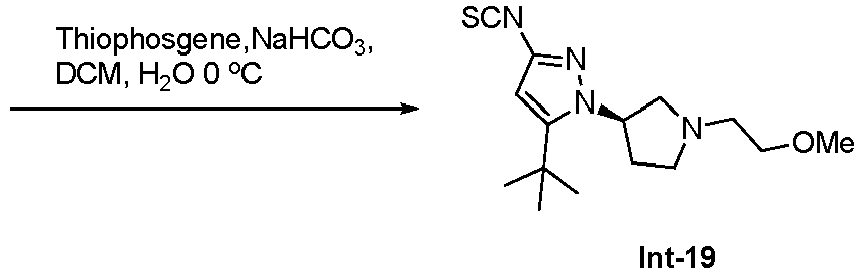
- Synthesis of Int-19. Compound Int-19 was prepared following the procedures described in the synthesis of compound Int-18. The product was purified by flash column chromatography on silica gel (CombiFlash®, 3.2% methanol in DCM). MS(ES): m/z 309.4 [M+H]+.
-

- Synthesis of compound Int-20.1. To a solution of Int-1.1 (5.0 g, 23.01 mmol, 1.0 equiv) in DMF (25 mL) was added sodium hydride (3.6 g, 92.04 mmol, 4.0 equiv) in portions at 0 °C. The reaction mixture was stirred at 0 °C for 2 h followed by addition of bromoacetonitrile (13.7 g, 115.08 mmol, 5.0 equiv) dropwise. The reaction mixture was stirred at room temperature for 16 h. It was poured into ice-water, stirred and extracted with ethyl acetate. The combined organic layers were washed with brine, dried over anhydrous sodium sulfate, filtered and concentrated under reduced pressure. The residue was purified by flash column chromatography on silica gel (CombiFlash®, 6-8% ethyl acetate in hexane) to afford Int-20.1. MS (ES): m/z 257.3 [M+H]+.
- Synthesis of compound Int-20.2. To a suspension of Int-20.1 (0.465 g, 1.82 mmol, 1.0 equiv) in water (20 mL) was added trifluoroacetic acid (10 mL). The reaction mixture was stirred at 120 °C for 10 min. It was poured into ice-water, followed by addition of saturated sodium bicarbonate solution and extracted with ethyl acetate. The combined organic layers were washed with brine, dried over anhydrous sodium sulfate, filtered and concentrated under reduced pressure. The residue was purified by flash column chromatography on silica gel (CombiFlash®, 70% ethyl acetate in hexane) to afford Int-20.2. MS(ES): m/z 179.2 [M+H]+.
- Synthesis of compound Int-20. Compound Int-20 was prepared from Int-20.2 following the procedure described in the synthesis of compound Int-1. The product was purified by flash column chromatography on silica gel (CombiFlash®, 30% ethyl acetate in hexane). MS(ES): m/z 221.2 [M+H]+.
-

- Synthesis of compound Int-21.1. To a solution of 3-(benzyloxy)cyclobutan-1-one (10 g, 56.75 mmol, 1.0 equiv) in methanol (100 mL) was added sodium borohydride (6.4 g, 170.2 mmol, 3.0 equiv) in small portions at 0 °C. The reaction mixture was stirred at room temperature for 3 h. It was poured over ice-water, stirred and extracted with ethyl acetate. The combined organic layers were washed with brine, dried over anhydrous sodium sulfate, filtered and concentrated under reduced pressure to afford Int-21.1. MS (ES): m/z 179.3 [M+H]+.
- Synthesis of compound Int-21.2 To a solution of Int-21.1 (3.0 g, 16.83 mmol, 1.0 equiv) in DCM (30 mL) was added triethylamine (3.0 mL, 21.87 mmol, 1.3 equiv) at 0 °C followed by addition of methanesulfonyl chloride (1.7 mL, 21.87 mmol, 1.3 equiv). The reaction mixture was stirred at room temperature for 12 h. It was poured into ice-water, stirred and extracted with DCM. The combined organic layers were washed with brine, dried over anhydrous sodium sulfate, filtered and concentrated under reduced pressure. The residue was purified by flash column chromatography on silica gel (CombiFlash®, 20% ethyl acetate in hexane) to afford Int-21.2. MS (ES): m/z 257.3 [M+H]+.
- Synthesis of compound Int-21.3. A mixture of Int-1.1 (3.2 g, 12.48 mmol, 1.0 equiv), Int-21.2 (2.71 g, 12.48 mmol, 1.0 equiv) and cesium carbonate (8.13 g, 24.96 mmol, 2.0 equiv) in DMF (30 mL) was stirred at 80-90 °C for 12 h. It was poured into ice-water, stirred and extracted with ethyl acetate. The combined organic layers were washed with brine, dried over anhydrous sodium sulfate, filtered and concentrated under reduced pressure. The residue was purified by flash column chromatography on silica gel (CombiFlash®, 8-12% ethyl acetate in hexane) to afford Int-21.3. MS (ES): m/z 378.5 [M+H]+.
- Synthesis of compound Int-21.4. Compound Int-21.4 was prepared from Int-21.3 following the procedure described in the synthesis of compound Int-1.4. The product was purified by flash column chromatography on silica gel (CombiFlash®, 24-28% ethyl acetate in hexane). MS(ES): m/z 300.4 [M+H]+.
- Synthesis of compound Int-21. Compound Int-21 was prepared from Int-21.4 following the procedure described in the synthesis of compound Int-1. The product was used without purification. MS(ES): m/z 342.5 [M+H]+.
-

- Synthesis of compound Int-22.1. A solution of 5-(tert-butyl)thiazol-2-amine (2.0 g, 12.80 mmol, 1.0 equiv), phthalic anhydride (3.79 g, 25.60 mmol, 2.0 equiv), triethylamine (5.4 mL, 38.4 mmol, 3.0 equiv) in toluene (20 mL) was stirred at 200 °C in a microwave reactor for 2 h. It was transferred into water, stirred and extracted with ethyl acetate. The combined organic layers were washed with brine, dried over anhydrous sodium sulfate, filtered and concentrated under reduced pressure. The residue was purified by flash column chromatography on silica gel (CombiFlash®, 11% ethyl acetate in hexane) to afford Int-22.1. MS (ES): m/z 287.3 [M+H]+.
- Synthesis of compound Int-22.2. To a solution of Int-22.1 (2.1 g, 7.33 mmol, 1.0 equiv) in DMF (20 mL) was added NBS (6.5 g, 36.6 mmol, 5.0 equiv). The reaction mixture was stirred at room temperature for 1 h. It was transferred into water, stirred and extracted with ethyl acetate. The combined organic layers were washed with brine, dried over anhydrous sodium sulfate, filtered and concentrated under reduced pressure. The residue was purified by flash column chromatography on silica gel (CombiFlash®, 15% ethyl acetate in hexane) to afford Int-22.2. MS (ES): m/z 366.2 [M+H]+.
- Synthesis of compound Int-22.3. A solution of Int-22.2 (1.9 g, 5.2 mmol, 1.0 equiv) in ethanol (20 mL) was added hydrazine (0.34 mL, 10.4 mmol, 2.0 equiv) at 0 °C. The reaction mixture was stirred at room temperature for 12 h. It was poured into ice-water, stirred and extracted with ethyl acetate. The combined organic layers were washed with brine, dried over anhydrous sodium sulfate, filtered and concentrated under reduced pressure. The residue was purified by flash column chromatography on silica gel (CombiFlash®, 70% ethyl acetate in hexane) to afford Int-22.3. MS (ES): m/z 236.1 [M+H]+.
- Synthesis of compound Int-22.4. A mixture of Int-22.3 (1.0 g, 4.25 mmol, 1.0 equiv), 2-(2,5-dihydrofuran-3-yl)-4,4,5,5-tetramethyl-1,3,2-dioxaborolane (2.5 g, 12.76 mmol, 3.0 equiv) and potassium carbonate (1.76 g, 12.76 mmol, 3.0 equiv) in 1,4-dioxane (10 mL) and water (1 mL) was degassed by bubbling through a stream of argon for 10 min. Under argon atmosphere, [1,1'-bis(diphenylphosphino)ferrocene]dichloropalladium(II)-DCM complex (0.173 g, 0.212 mmol, 0.05 equiv) was added, and the mixture was degassed for another 5 min. The reaction mixture was stirred at 130 °C for 3 h. It was cooled to room temperature and filtered through a pad of Celite®. The filtrate was transferred into water, extracted with ethyl acetate. The combined organic layers were washed with brine, dried over anhydrous sodium sulfate, filtered and concentrated under reduced pressure. The residue was purified by flash column chromatography on silica gel (CombiFlash®, 1% methanol in DCM) to afford Int-22.4. MS(ES): m/z 225.3 [M+H]+.
- Synthesis of compound (±)-Int-22. A mixture of Raney nickel (0.2 g) and compound Int-22.4 (0.250 g, 1.11 mmol, 1.0 equiv) in methanol (10 mL) was stirred under hydrogen atmosphere for 12 h. It was filtered through a pad of Celite® and rinsed with methanol. The filtrate was concentrated under reduced pressure to afford (±)-Int-22. The product was used without purification. MS(ES): m/z 227.3 [M+H]+.
-

- Synthesis of compound Int-23.1. A mixture of 5-bromo-3-nitropyridin-2(1H)-one (5.0 g, 22.83 mmol, 1.0 equiv) and potassium carbonate (6.6 g, 47.94 mmol, 2.1 equiv) in DMF (50 mL) was stirred for 15 min before the addition of methyl iodide (3.56 g, 25.11 mmol, 1.1 equiv). The reaction mixture was stirred at room temperature for 1 h. It was poured into ice-water and extracted with ethyl acetate. The combined organic layers were washed with brine, dried over anhydrous sodium sulfate, filtered and concentrated under reduced pressure to afford Int-23.1. MS(ES): m/z 234.02 [M+H]+.
- Synthesis of compound Int-23.2. A mixture of Int-23.1 (0.7 g, 3.0 mmol, 1.0 equiv), cyclopropylboronic acid (0.774 g, 9.0 mmol, 3.0 equiv), potassium phosphate (1.9 g, 9.0 mmol, 3.0 equiv) and tricyclohexylphosphine (0.168 g, 0.6 mmol, 0.2 equiv) in toluene (10 mL) and water (1 mL) was degassed by bubbling through a stream of argon for 10 min. Under argon atmosphere palladium(II) acetate (0.336 g, 1.5 mmol, 0.5 equiv) was added, and the mixture was degassed for additional 5 min. The reaction mixture was stirred at 100 °C for 2 h. It was cooled to room temperature and filtered through a pad of Celite®. The filtrate was transferred into water and extracted with ethyl acetate. The combined organic layers were washed with brine, dried over anhydrous sodium sulfate, filtered and concentrated under reduced pressure. The residue was purified by flash column chromatography on silica gel (CombiFlash®, 30% ethyl acetate in hexane) to afford Int-23.2. MS(ES): m/z 195.2 [M+H]+.
- Synthesis of compound Int-23.3. A mixture of compound Int-23.2 (0.182 g, 0.93 mmol, 1.0 equiv) and 10% palladium on carbon (0.1 g) in methanol (5 mL) was stirred under hydrogen atmosphere (1 atm) at rt for 2 h. The mixture was filtered through a pad of Celite® and rinsed with methanol. The filtrate was concentrated under reduced pressure to afford Int-23.3. MS(ES): m/z 165.21 [M+H]+.
- Synthesis of compound Int-23. Compound Int-23 was prepared from Int-23.3 following the procedure described in the synthesis of compound Int-1. The product was used without purification. MS(ES): m/z 207.3 [M+H]+.
-

- Synthesis of compound Int-24.1. A mixture of 5-bromo-3-nitropyridin-2(1H)-one (1.0 g, 4.57 mmol, 1.0 equiv) and potassium carbonate (1.57 g, 11.42 mmol, 2.5 equiv) in DMF (10 mL) was stirred for 15 min before the addition of 1-bromo-2-methoxyethane (0.698 g, 5.02 mmol, 1.1 equiv). The reaction mixture was stirred at 80 °C for 30 min. It was poured into ice-water and extracted with ethyl acetate. The combined organic layers were washed with brine, dried over anhydrous sodium sulfate, filtered and concentrated under reduced pressure. The residue was purified by flash column chromatography on silica gel (CombiFlash®, 7-8% ethyl acetate in hexane) to afford Int-24.1. MS(ES): m/z 278.1 [M+H]+.
- Synthesis of compound Int-24.2. Compound Int-24.2 was prepared from Int-24.1, following the procedure described in the synthesis of Int-23.2. The product was purified by flash column chromatography on silica gel (CombiFlash®, 30% ethyl acetate in hexane). MS(ES): m/z 239.2 [M+H]+.
- Synthesis of compound Int-24.3. Compound Int-24.3 was prepared from Int-24.2 following the procedure described in the synthesis of compound Int-23.3. The product was used without purification. MS(ES): m/z 209.3 [M+H]+.
- Synthesis of compound Int-24. Compound Int-24 was prepared from Int-24.3 following the procedure described in the synthesis of compound Int-1. The product was used without purification. MS(ES): m/z 251.3 [M+H]+.
-

- Synthesis of compound cis-(±)-Int-25.1. To a mixture of compound trans-(±)-Int-11.1 (1.6 g, 5.31 mmol, 1.0 equiv), 4-nitrobenzoic acid (1.77 g, 10.62 mmol, 2.0 equiv) and diphenylphosphoryl azide (3.17 g, 7.96 mmol, 1.5 equiv) in toluene (35 mL) at 0 °C was added diethylazodicarboxylate (1.38 g, 7.96 mmol, 1.5 equiv). The reaction mixture was stirred at room temperature for 2 h. It poured into ice-water and extracted with ethyl acetate. The combined organic layers were washed with brine, dried over anhydrous sodium sulfate, filtered and concentrated under reduced pressure. The residue was purified by flash column chromatography on silica gel (CombiFlash®, 4% ethyl acetate in hexane) to afford cis-(±)-Int-25.1. MS(ES): m/z 451.4 [M+H]+.
- Synthesis of compound cis-(±)-Int-25.2. To a solution of cis-(±)-Int-25.1 (0.8 g, 1.78 mmol, 1.0 equiv) in methanol (20 mL) was added potassium carbonate (1.96 g, 14.24 mmol, 8.0 equiv). The reaction mixture was stirred at room temperature for 1 h. It was poured into ice-water, stirred and extracted with ethyl acetate. The combined organic layers were washed with brine, dried over anhydrous sodium sulfate, filtered and concentrated under reduced pressure. The residue was purified by flash column chromatography on silica gel (CombiFlash®, 10% ethyl acetate in hexane) to afford cis-(±)-Int-25.2. MS(ES): m/z 302.4 [M+H]+.
- Synthesis of compound cis-(±)-Int-25.3. To a solution of cis-(±)-Int-25.2 (0.5 g, 1.66 mmol, 1.0 equiv) in DMF (10 mL) was added sodium hydride (0.132 g, 3.32 mmol, 2.0 equiv) at 0 °C and stirred for 20 min followed by addition of benzyl bromide (0.3 mL, 2.49 mmol, 1.5 equiv). The reaction mixture was stirred at room temperature for 30 min. It was transferred into ice, stirred and extracted with ethyl acetate. The combined organic layers were washed with brine, dried over anhydrous sodium sulfate, filtered and concentrated under reduced pressure. The residue was purified by flash column chromatography on silica gel (CombiFlash®, 5% ethyl acetate in hexane) to afford cis-(±)-Int-25.3. MS(ES): m/z 392.5 [M+H]+.
- Synthesis of compound cis-(±)-Int-25.4. Compound cis-(±)-Int-25.4 was prepared from cis-(±)-Int-25.3 following the procedure described in the synthesis of compound Int-1.4. The product was purified by flash column chromatography on silica gel (CombiFlash®, 28-30% ethyl acetate in hexane). MS(ES): m/z 314.4 [M+H]+.
- Synthesis of compound cis-(±)-Int-25. Compound cis-(±)-Int-25 was prepared from cis-(±)-Int-25.4 following the procedure described in the synthesis of compound Int-1. The product was used without purification. MS(ES): m/z 356.5 [M+H]+.
-

- Synthesis of compound Int-26.1. To a solution of Int-1.1 (15 g, 69.02 mmol, 1.0 equiv) in acetonitrile (150 mL) was added acrylonitrile (5.4 mL, 82.8 mmol, 1.2 equiv). The reaction mixture was stirred at room temperature for 16 h. It was poured into ice-water, stirred and extracted with ethyl acetate. The combined organic layers were washed with brine, dried over anhydrous sodium sulfate, filtered and concentrated under reduced pressure. The residue was purified by flash column chromatography on silica gel (CombiFlash®, 12-15% ethyl acetate in hexane) to afford Int-26.1. MS (ES): m/z 271.3 [M+H]+.
- Synthesis of compound Int-26. To a suspension of Int-26.1 (1.9 g, 7.03 mmol, 1.0 equiv) in water (20 mL) was added trifluoroacetic acid (7 mL). The reaction mixture was stirred at 120 °C for 10 min. It was poured into ice-water, followed by addition of saturated sodium bicarbonate solution and extracted with ethyl acetate. The combined organic layers were washed with brine, dried over anhydrous sodium sulfate, filtered and concentrated under reduced pressure. The residue was purified by flash column chromatography on silica gel (CombiFlash®, 4% methanol in DCM) to afford Int-26. MS(ES): m/z 193.2 [M+H]+.
-

- Synthesis of compound Int-27.1. Compound Int-27.1 was prepared from 5-bromo-3-nitropyridin-2(1H)-one, following the procedure described in the synthesis of Int-24.1. The product was purified by flash column chromatography on silica gel (CombiFlash®, 17% ethyl acetate in hexane). MS(ES): m/z 354.2 [M+H]+.
- Synthesis of compound Int-27.2. Compound Int-27.2 was prepared from Int-27.1, following the procedure described in the synthesis of Int-23.2. The product was purified by flash column chromatography on silica gel (CombiFlash®, 37% ethyl acetate in hexane). MS(ES): m/z 315.2 [M+H]+.
- Synthesis of compound Int-27.3. To a solution of Int-27.2 (0.400 g, 1.27 mmol, 1.0 equiv) in ethanol:water (2:1, 10 mL) was added iron powder (0.355 g, 6.35 mmol, 5.0 equiv) followed by ammonium chloride (0.342 g, 6.35 mmol, 5.0 equiv). The reaction mixture was stirred at 80 °C for 1 h. It was poured into ice-water, filtered and extracted with ethyl acetate. The combined organic layers were washed with brine, dried over anhydrous sodium sulfate, filtered and concentrated under reduced pressure. The residue was purified by flash column chromatography on silica gel (CombiFlash®, 2.5% methanol in DCM) to afford Int-27.3. MS(ES): m/z 285.3 [M+H]+.
- Synthesis of compound Int-27. Compound Int-27 was prepared from Int-27.3 following the procedure described in the synthesis of compound Int-1. The product was purified by flash column chromatography on silica gel (CombiFlash®, 2.0% methanol in DCM). MS(ES): m/z 326.3 [M+H]+.
-

- Synthesis of compound Int-28.2. To a solution of Int-28.1 (150 g, 619 mmol, 1.0 equiv) in pyridine (3000 mL) was added 4-dimethylaminopyridine (15.124, 123.8 mmol, 0.2 equiv) followed by tert-butyldiphenylchlorosilane (189.7 mL, 742.8 mmol, 1.2 equiv), and the mixture was stirred at room temperature for 15 h. It was transferred into ice-water, stirred and extracted with ethyl acetate. The organic layer was separated, washed with brine, dried over anhydrous sodium sulfate, filtered and concentrated under reduced pressure. The residue was purified by flash column chromatography on silica gel (CombiFlash®, 2.0% methanol in DCM) to afford Int-28.2. MS (ES): m/z 481.5 [M+H]+.
- Synthesis of compound Int-28.3. To a solution of Int-28.2 (140 g, 291 mmol, 1.0 equiv) in bis(trimethylsilyl)amine (2100 mL) was added ammonium sulfate (76.8 g, 582 mmol, 2.0 equiv), and the reaction mixture was heated to reflux for 3 h. It was cooled to room temperature, transferred into water and extracted with ethyl acetate. The combined organic layers were washed with brine, dried over anhydrous sodium sulfate, filtered and concentrated under reduced pressure. The residue was purified by flash column chromatography on silica gel (CombiFlash®, 15% ethyl acetate in hexane) to afford Int-28.3. 1H NMR (CDCl3, 400 MHz): δ 7.71-7.69 (m, 4H), 7.52-7.42 (m, 6H), 6.42-6.39 (m, 1H), 4.51-4.49 (d, 1H), 4.01-3.98 (m, 2H), 3.83-3.81 (m, 1H), 2.35-2.30 (m, 1H), 1.10 (s, 9H), 0.14 (s, 9H).
- Synthesis of compound Int-28.4. To a solution of Int-28.3 (90 g, 210 mmol, 1.0 equiv) in methanol (900 mL) was added potassium carbonate (57.9 g, 420 mmol, 2.0 equiv) and stirred at room temperature for 3 h. It was transferred into water and extracted with ethyl acetate. The combined organic layers were washed with brine, dried over anhydrous sodium sulfate, filtered and concentrated under reduced pressure. The residue was purified by flash column chromatography on silica gel (CombiFlash®, 18% ethyl acetate in hexane) to afford Int-28.4. 1H NMR (CDCl3, 400 MHz): δ 7.70-7.68 (m, 4H), 7.47-7.38 (m, 6H), 6.57-6.56 (m, 1H), 5.19-5.17 (m, 1H), 4.92-4.89 (m, 1H), 4.42-4.39 (m, 1H), 3.80-3.76 (m, 1H), 3.68-3.64 (m, 1H), 1.53-1.51 (d, 1H), 1.07 (s, 9H).
- Synthesis of compound Int-28.5. A mixture of palladium on charcoal (10 g) and Int-28.4 (36 g, 101 mmol, 1.0 equiv) in isopropyl alcohol (350 mL) was stirred under hydrogen (1 atm) for 16 h at room temperature. It was filtered through a pad of Celite® and washed with ethyl acetate. The filtrate was concentrated under reduced pressure. The residue was purified by flash column chromatography on silica gel (CombiFlash®, 20% ethyl acetate in hexane) to afford Int-28.5. 1H NMR (CDCl3, 400 MHz): δ 7.70-7.67 (m, 4H), 7.47-7.38 (m, 6H), 4.45-4.43 (m, 1H), 4.00-3.97 (m, 2H), 3.86-3.84 (m, 1H), 3.81-3.77 (m, 1H), 3.63-3.58 (m, 1H), 2.20-2.13 (m, 1H), 1.95-1.89 (m, 1H), 1.75-7.74 (d, 1H), 1.08 (s, 9H).
- Synthesis of compound Int-28.6. To a solution of compound Int-28.5 (25 g, 70.12 mmol, 1.0 equiv) in THF (250 mL) was added 4-nitrobenzoic acid (35.13 g, 210.36 mmol, 3.0 equiv) followed by triphenyl phosphine (55.11 g, 210.36 mmol, 3.0 equiv), and the reaction mixture was cooled to 0 °C. To the mixture was added diisopropylazodicarboxylate (42.49 g, 210.36 mmol, 3.0 equiv) and it was stirred at room temperature for 4 h. It poured into ice-water and extracted with DCM. The combined organic layers were washed with brine, dried over anhydrous sodium sulfate, filtered and concentrated under reduced pressure. The residue was purified by flash column chromatography on silica gel (CombiFlash®, 12% ethyl acetate in hexane) to afford Int-28.6. 1H NMR (CDCl3, 400 MHz): δ 8.27-8.25 (d, J = 8.8 Hz, 2H), 8.11-8.09 (d, J = 8.8 Hz, 2H), 7.65-7.63 (m, 2H), 7.56-7.54 (d, J = 6.8 Hz, 2H), 7.44-7.35 (m, 4H), 7.30-7.23 (m, 2H), 5.80-5.78 (m, 1H), 4.20-4.16 (m, 1H), 4.14-4.10 (m, 1H), 4.02-3.91 (m, 3H), 2.49-2.44 (m, 1H), 2.23-2.17 (m, 1H), 1.09 (s, 9H).
- Synthesis of compound Int-28.7. To a solution of Int-28.6 (16 g, 31.64 mmol, 1.0 equiv) in methanol (320 mL) and water (160 mL) was added potassium carbonate (13.09 g, 94.92 mmol, 3.0 equiv), and the mixture was stirred at room temperature for 5 h. It was transferred into water and extracted with ethyl acetate. The combined organic layers were washed with brine, dried over anhydrous sodium sulfate, filtered and concentrated under reduced pressure to afford Int-28.7. 1H NMR (CDCl3, 400 MHz): δ 7.72-7.68 (m, 4H), 7.47-7.40 (m, 6H), 4.60-4.57 (m, 1H), 4.12-4.03 (m, 1H), 4.00-3.96 (m, 2H), 3.89-3.84 (m, 2H), 2.20-2.11 (m, 1H), 2.07-2.00 (m, 1H), 1.28 (bs, 1H), 1.08 (s, 9H).
- Synthesis of compound Int-28.8. To a solution of Int-28.7 (5.7 g, 15.99 mmol, 1.0 equiv) and triethylamine (6.7 mL, 47.97 mmol, 3.0 equiv) in DCM (50 mL) at 0 °C was added methanesulfonyl chloride (2.5 mL, 31.98 mmol, 2.0 equiv). The reaction mixture was stirred at 0 °C for 30 min. It was poured into ice-water, stirred and extracted with DCM. The combined organic layers were washed with brine, dried over anhydrous sodium sulfate, filtered and concentrated under reduced pressure to afford Int-28.8. 1H NMR (CDCl3, 400 MHz): δ 7.71-7.68 (m, 4H), 7.49-7.41 (m, 6H), 5.36-5.34 (m, 1H), 4.12-4.06 (m, 1H), 4.02-3.91 (m, 4H), 3.18 (bs, 1H), 2.97 (s, 3H), 2.47-2.42 (m, 1H), 2.37-2.32 (m, 1H), 1.11 (s, 9H).
- Synthesis of compound Int-28.9. To a solution of Int-28.8 (5.4 g, 12.42 mmol, 1.0 equiv) in THF (50 mL), was added tetrabutylammonium fluoride (1 M in THF, 18.6 mL, 18.63 mmol, 1.5 equiv) at 0 °C and stirred at room temperature for 30 min. It was transferred into ice-water, stirred and extracted with ethyl acetate. The combined organic layers were washed with brine, dried over anhydrous sodium sulfate, filtered and concentrated under reduced pressure. The residue was purified by flash column chromatography on silica gel (CombiFlash®, 2.7% methanol in DCM) to afford Int-28.9. 1H NMR (CDCl3, 400 MHz): δ 5.39-5.36 (m, 1H), 4.15-4.03 (m, 1H), 4.02-3.83 (m, 4H), 3.13 (s, 3H), 2.44-2.33 (m, 2H).
- Synthesis of compound Int-28.10 and Int-28.11. To a solution of Int-1.1 (1.1 g, 5.06 mmol, 1.0 equiv) and Int-28.9 (1.5 g, 7.59 mmol, 1.5 equiv) in DMF (15 mL) was added cesium carbonate (8.2 g, 25.3 mmol, 5.0 equiv). The reaction mixture was stirred at 80-90 °C for 12 h. It was poured into ice-water, stirred and extracted with ethyl acetate. The combined organic layers were washed with brine, dried over anhydrous sodium sulfate, filtered and concentrated under reduced pressure. The residue was purified by flash column chromatography on silica gel (CombiFlash®, 25% ethyl acetate in hexane) to afford Int-28.10. MS (ES): m/z 318.4 [M+H]+.
- Synthesis of compound Int-28.11. To a solution of Int-28.10 (0.380 g, 1.2 mmol, 1.0 equiv) in DMF (4 mL) was added sodium hydride (0.072 g, 1.8 mmol, 1.5 equiv) at 0 °C and stirred for 10 min. To the mixture was added benzyl bromide (0.246 g, 1.44 mmol, 1.2 equiv). The reaction mixture was stirred at room temperature for 30 min. It was transferred into ice, stirred and extracted with ethyl acetate. The combined organic layers were washed with brine, dried over anhydrous sodium sulfate, filtered and concentrated under reduced pressure to afford Int-28.11. MS (ES): m/z 408.5 [M+H]+.
- Synthesis of compound Int-28.12. Compound Int-28.12 was prepared from Int-28.11, following the procedure described in the synthesis of Int-1.4. The product was purified by flash column chromatography on silica gel (CombiFlash®, 2.0% methanol in DCM). MS(ES): m/z 330.4 [M+H]+.
- Synthesis of compound Int-28. Compound Int-28 was prepared from Int-28.12, following the procedure described in the synthesis of Int-1. The product was used without purification. MS(ES): m/z 372.5 [M+H]+.
-


- Synthesis of compound Int-29.1. To a solution of 3-nitropyridin-2(1H)-one (3 g, 14.28 mmol, 1.0 equiv) and 2-(3,6-dihydro-2H-pyran-4-yl)-4,4,5,5-tetramethyl-1,3,2-dioxaborolane (2.4 g, 17.14 mmol, 1.2 equiv) in dioxane (30 mL) was added copper acetate (2.60 g, 14.28 mmol, 1.0 equiv) and triethylamine (5.0 mL, 35.7 mmol, 2.5 equiv) under nitrogen. The reaction was stirred at 80 °C for 5 h. It was transferred into ice-water and extracted with ethyl acetate. The combined organic layers were dried over anhydrous sodium sulfate, filtered and concentrated under reduced pressure. The residue was purified by flash column chromatography on silica gel (CombiFlash®, 10% ethyl acetate in hexane) to afford Int-29.1. MS(ES): m/z 222.20 [M+H]+.
- Synthesis of compound Int-29.2. To a mixture of Int-29.1 (1.2 g, 5.40 mmol, 1.0 equiv) and 10% palladium on charcoal (0.5 g) in methanol (15 mL) was stirred under hydrogen (1 atm) for 3 h at room temperature. It was filtered through a pad of Celite® and rinsed with methanol. The filtrate was concentrated under reduced pressure. The residue was purified by flash column chromatography on silica gel (CombiFlash®, 1.8% methanol in DCM) to afford Int-29.2. MS (ES): m/z 195.23 [M+H]+.
- Synthesis of compound Int-29.3. To a solution of Int-29.2 (0.500 g, 2.57 mmol, 1.0 equiv) and triethylamine (1.07 mL, 7.71 mmol, 3.0 equiv) in DCM (5 mL) at 0 °C was added acetic anhydride (0.51 mL, 5.14 mmol, 2.0 equiv) dropwise. The reaction mixture was stirred at room temperature for 2 h. It was poured into ice-water, stirred and extracted with DCM. The combined organic layers were washed with brine, dried over anhydrous sodium sulfate, filtered and concentrated under reduced pressure. The residue was purified by flash column chromatography on silica gel (CombiFlash®, 1.4% methanol in DCM) to afford Int-29.3. MS(ES): m/z 237.3 [M+H]+.
- Synthesis of compound Int-29.4. To a solution of Int-29.3 (0.4 g, 1.69 mmol, 1.0 equiv) in DMF (5 mL) was added NBS (0.448 g, 2.53 mmol, 1.5 equiv) and stirred at room temperature for 1 h. It was poured into ice-water and extracted with ethyl acetate. The combined organic layers were washed with brine, dried over anhydrous sodium sulfate, filtered and concentrated under reduced pressure. The residue was purified by flash column chromatography on silica gel (CombiFlash®, 80% ethyl acetate in hexane) to afford Int-29.4. MS(ES): m/z 316.2 [M+H]+.
- Synthesis of compound Int-29.5. Compound Int-29.5 was prepared from Int-29.4, following the procedure described in the synthesis of Int-27.2. The product was purified by flash column chromatography on silica gel (CombiFlash®, 1.4% methanol in DCM). MS(ES): m/z 277.3 [M+H]+.
- Synthesis of compound Int-29.6. To a solution of compound Int-29.5 (0.185 g, 0.669 mmol, 1.0 equiv) in methanol (5 mL) was added potassium carbonate (1.846 g, 13.38 mmol, 20.0 equiv). The reaction mixture was heated to reflux for 16 h. It was transferred into water and extracted with ethyl acetate. The combined organic layers were washed with brine, dried over anhydrous sodium sulfate, filtered and concentrated under reduced pressure. The residue was purified by flash column chromatography on silica gel (CombiFlash®, 2.0% methanol in DCM) to afford Int-29.6. MS(ES): m/z 235.3 [M+H]+.
- Synthesis of compound Int-29. Compound Int-29 was prepared from Int-29.6, following the procedure described in the synthesis of Int-1. The product was used without purification. MS(ES): m/z 277.4 [M+H]+.
-


- Synthesis of compound Int-30.1. To a cooled solution of methyl 2-oxo-2H-pyran-3-carboxylate (5.0 g, 32.44 mmol, 1.0 equiv) in DMF (50 mL) was added cis-3-aminocyclobutan-1-ol hydrochloride (5.21 g, 42.17 mmol, 1.3 equiv), followed by diisopropylethylamine (11.1 mL, 64.88 mmol, 2.0 equiv). The reaction mixture was stirred at 0 °C for 2 h. N-Ethyl-N'-(3-dimethylaminopropyl)carbodiimide hydrochloride (8.7 g, 45.36 mmol, 1.4 equiv) and 4-dimethylaminopyridine (0.989 g, 8.11 mmol, 0.25 equiv) were added. The reaction mixture was stirred at room temperature for 16 h. It was transferred into water and extracted with ethyl acetate. The combined organic layers were washed with brine, dried over anhydrous sodium sulfate, filtered and concentrated under reduced pressure. The residue was purified by flash column chromatography on silica gel (CombiFlash®, 2.5% methanol in DCM) to afford Int-30.1. MS(ES): m/z 224.09 [M+H]+.
- Synthesis of compound Int-30.2. To a solution of Int-30.1 (1.3 g, 5.82 mmol, 1.0 equiv), in THF:water (15 mL, 2:1) was added lithium hydroxide (1.22 g, 29.1 mmol, 5.0 equiv), and the mixture was stirred at room temperature for 24 h. It was concentrated under reduced pressure. To the residue was added water, and the mixture was acidified with 1 N hydrochloric acid to adjust pH~6-6.5 at 10 °C. The product was extracted with 10% methanol in DCM. The combined organic layers were washed with brine, dried over anhydrous sodium sulfate, filtered and concentrated under reduced pressure to afford Int-30.2. MS(ES): m/z 210.2 [M+H]+.
- Synthesis of compound Int-30.3. A solution of Int-30.2 (0.8 g, 3.82 mmol, 1.0 equiv), triethylamine (0.91 mL, 6.49 mmol, 1.7 equiv) and diphenylphosphoryl azide (1.36 g, 4.96 mmol, 1.3 equiv) in tert-butanol (15 mL) under nitrogen was stirred at 80 °C for 16 h. It cooled to room temperature, transferred into water and extracted with ethyl acetate. The combined organic layers were washed with brine, dried over anhydrous sodium sulfate, filtered and concentrated under reduced pressure. The residue was purified by flash column chromatography on silica gel (CombiFlash®, 1.5% methanol in DCM) to afford Int-30.3. MS(ES): m/z 281.3 [M+H]+.
- Synthesis of compound Int-30.4. To a cooled solution of Int-30.3 (0.4 g, 1.43 mmol, 1.0 equiv) in acetonitrile (10 mL) at 0 °C was added NBS (0.354 g, 2.00 mmol, 1.4 equiv) in portions. The reaction mixture was stirred at 0 °C for 15 min. It was poured into ice-water and extracted with ethyl acetate. The combined organic layers were washed with brine, dried over anhydrous sodium sulfate, filtered and concentrated under reduced pressure. The residue was purified by flash column chromatography on silica gel (CombiFlash®, 40% ethyl acetate in hexane) to afford Int-30.4. MS(ES): m/z 360.2 [M+H]+.
- Synthesis of compound Int-30.5. Compound Int-24.2 was prepared from Int-24.1, following the procedure described in the synthesis of Int-23.2. The product was purified by flash column chromatography on silica gel (CombiFlash®, 70% ethyl acetate in hexane). MS(ES): m/z 321.4 [M+H]+.
- Synthesis of compound Int-30.6. To a cooled solution of Int-30.5 (0.059 g, 0.184 mmol, 1 equiv) in dioxane (2 mL) was added 4 N hydrochloric acid in dioxane (1 mL) dropwise at 0 °C. The reaction mixture was stirred at room temperature for 30 min. It was transferred into saturated aqueous solution of sodium bicarbonate and extracted with DCM. The combined organic layers were washed with brine, dried over anhydrous sodium sulfate, filtered and concentrated under reduced pressure to afford Int-30.6. MS(ES): m/z 221.3 [M+H]+.
- Synthesis of compound Int-30. Compound Int-30 was prepared from Int-30.6, following the procedure described in the synthesis of Int-1. The product was used without purification. MS(ES): m/z 263.3 [M+H]+.
-


- Synthesis of compound Int-31.1. To a solution of 3,4-dihydro-2H-pyran (20 g, 238 mmol, 1.0 equiv) in DCM (200 mL) was added bromine (12.2 mL, 238 mmol, 1.0 equiv) in DCM (100 mL) at -78 °C dropwise. The reaction mixture was stirred at -78 °C for 2 h, and it was allowed to warm to room temperature stirring for 16 h. Triethylamine (66 mL, 476 mmol, 2.0 equiv) in DCM (100 mL) was added dropwise at room temperature and then stirred for 5 h. The reaction mixture was concentrated under reduced pressure to afford a residue, to which diethyl ether was added and the solid was removed by filtration. The filtrate was concentrated under reduced pressure to afford a residue which was purified by vacuum distillation (80 °C, 0.02 mmHg) to afford Int-31.1. 1H NMR (400 MHz, CDCl3): 6.68 (s, 1H), 4.02-4.00 (t, J = 4 Hz, 2H), 2.45-2.42 (m, 2H), 2.06-2.00 (m, 2H).
- Synthesis of compound Int-31.2. A mixture of Int-31.1 (8 g, 49.08 mmol, 1.0 equiv), 3-aminopyridin-2(1H)-one (6.48 g, 58.89 mmol, 1.2 equiv) and potassium carbonate (13.6 g, 98.16 mmol, 2.0 equiv) in 1,4-dioxane (100 mL) was degassed by bubbling through a stream of argon for 15 min. Copper iodide (1.4 g, 7.40 mmol, 0.15 equiv) and 1,2-dimethylethylenediamine (1.60 mL, 14.72 mmol, 0.30 equiv) were added. The reaction mixture was degassed for 5 min and stirred at 110 °C for 12 h. It was cooled to room temperature, transferred into water and extracted with ethyl acetate. The combined organic layers were washed with brine, dried over anhydrous sodium sulfate, filtered and concentrated under reduced pressure. The residue was purified by flash column chromatography on silica gel (CombiFlash®, 1.2% methanol in DCM) to afford Int-31.2. MS(ES): m/z 193.09 [M+H]+.
- Synthesis of compound (±)-Int-31.3. A mixture of Int-31.2 (8 g, 41.62 mmol, 1.0 equiv) and palladium on charcoal (4 g) in methanol (100 mL) was stirred under hydrogen (1 atm) for 16 h at room temperature. It was filtered through a pad of Celite® and rinsed with methanol. The filtrate was concentrated under reduced pressure. The residue was purified by trituration with n-pentane to afford (±)-Int-31.3. MS (ES): m/z 195.11 [M+H]+.
- Synthesis of compound (±)-Int-31.4. To a solution of (±)-Int-31.3 (2 g, 10.30 mmol, 1.0 equiv) in DCM (20 mL) at 0 °C was added triethylamine (4.33 mL, 30.9 mmol, 3.0 equiv) and acetic anhydride (1.55 mL, 16.49 mmol, 1.6 equiv). The reaction mixture was stirred at room temperature for 2 h. It was transferred into water and extracted with DCM. The combined organic layers were dried over anhydrous sodium sulfate, filtered and concentrated under reduced pressure. The residue was purified by flash column chromatography on silica gel (CombiFlash®, 0-5% methanol in DCM) to afford (±)-Int-31.4. MS (ES): m/z 237.12 [M+H]+.
- Synthesis of compound (±)-Int-31.5. To a solution of (±)-Int-31.4 (0.9 g, 3.81 mmol, 1.0 equiv) in DMF (10 mL) was added NBS (1.017 g, 5.71 mmol, 1.5 equiv), and the mixture was stirred at room temperature for 1 h. It was poured into ice-water and extracted with ethyl acetate. The combined organic layers were washed with brine, dried over anhydrous sodium sulfate, filtered and concentrated under reduced pressure. The residue was purified by flash column chromatography on silica gel (CombiFlash®, 60% ethyl acetate in hexane) to afford (±)-Int-31.5. MS(ES): m/z 316.2 [M+H]+.
- Synthesis of compound (±)-Int-31.6. Compound (±)-Int-31.6 was prepared from (±)-Int-31.5, following the procedure described in the synthesis of Int-23.2. The product was purified by flash column chromatography on silica gel (CombiFlash®, 100% ethyl acetate). MS(ES): m/z 277.3 [M+H]+.
- Synthesis of compound (±)-Int-31.7. Compound (±)-Int-31.7 was prepared from (±)-Int-31.6, following the procedure described in the synthesis of Int-29.6. The product was purified by flash column chromatography on silica gel (CombiFlash®, 2.0% methanol in DCM). MS(ES): m/z 235.3 [M+H]+.
- Synthesis of compound (±)-Int-31. Compound (±)-Int-31 was prepared from (±)-Int-31.7, following the procedure described in the synthesis of Int-1. The product was used without purification. MS(ES): m/z 277.4 [M+H]+.
-


- Synthesis of compound Int-32.1. To a solution of compound Int-21.1 (8.9 g, 49.94 mmol, 1.0 equiv) in THF (200 mL) was added 4-nitrobenzoic acid (10.01 g, 59.92 mmol, 1.2 equiv) followed by triphenylphosphine (26.16 g, 99.88 mmol, 2.0 equiv) and the reaction mixture was cooled to 0 °C. To the mixture was added diisopropylazodicarboxylate (20.17 g, 99.88 mmol, 2.0 equiv). The reaction mixture was stirred at room temperature for 2 h. It was poured into ice-water and extracted with DCM. The combined organic layers were washed with brine, dried over anhydrous sodium sulfate, filtered and concentrated under reduced pressure. The residue was purified by flash column chromatography on silica gel (CombiFlash®, 10% ethyl acetate in hexane) to afford Int-32.1. MS(ES): m/z 328.3 [M+H]+.
- Synthesis of compound Int-32.2. A mixture of Int-32.1 (9.2 g, 28.11 mmol, 1.0 equiv) and potassium carbonate (11.63 g, 84.33 mmol, 3.0 equiv) in methanol (100 mL) was stirred at room temperature for 3 h. It was poured into ice-water, stirred and extracted with ethyl acetate. The combined organic layers were washed with brine, dried over anhydrous sodium sulfate, filtered and concentrated under reduced pressure to afford Int-32.2. MS (ES): m/z 179.2 [M+H]+.
- Synthesis of compound Int-32.3. To a solution of Int-32.2 (4.2 g, 23.56 mmol, 1.0 equiv) and triethylamine (4.9 mL, 35.34 mmol, 1.5 equiv) in DCM (40 mL) at 0 °C was added methanesulfonyl chloride (2.36 mL, 30.62 mmol, 1.3 equiv). The reaction mixture was stirred at room temperature for 3 h. It was poured into ice-water, stirred and extracted with DCM. The combined organic layers were washed with brine, dried over anhydrous sodium sulfate, filtered and concentrated under reduced pressure. The residue was purified by flash column chromatography on silica gel (CombiFlash®, 12% ethyl acetate in hexane) to afford Int-32.3. MS (ES): m/z 257.3 [M+H]+.
- Synthesis of compound Int-32.4. A mixture of Int-32.3 (3.5 g, 15.15 mmol, 1.0 equiv), potassium carbonate (4.18 g, 30.3 mmol, 2.0 equiv) and N-(5-bromo-2-oxo-1,2-dihydropyridin-3-yl)acetamide (3.88 g, 15.15 mmol, 1.0 equiv) in DMF (30 mL) was stirred at 90 °C for 2 h. It was poured into ice-water and extracted with ethyl acetate. The combined organic layers were washed with brine, dried over anhydrous sodium sulfate, filtered and concentrated under reduced pressure. The residue was purified by flash column chromatography on silica gel (CombiFlash®, 40% ethyl acetate in hexane) to afford Int-32.4. MS(ES): m/z 392.2 [M+H]+.
- Synthesis of compound Int-32.5. Compound Int-32.5 was prepared from Int-32.4, following the procedure described in the synthesis of Int-23.2. The product was purified by flash column chromatography on silica gel (CombiFlash®, 60% ethyl acetate in hexane). MS(ES): m/z 353.2 [M+H]+.
- Synthesis of compound Int-32. Compound Int-32 was prepared from Int-32.5, following the procedure described in the synthesis of Int-29.6. The product was purified by flash column chromatography on silica gel (CombiFlash®, 1.5% methanol in DCM). MS(ES): m/z 311.4 [M+H]+.
-

- Synthesis of compound Int-33.3. Compound Int-33.3 was prepared from Int-21.2, following the procedures described in the synthesis of Int-29.6.
- Synthesis of compound Int-33. Compound Int-33 was prepared from Int-33.3, following the procedure described in the synthesis of Int-1. The product was purified by flash column chromatography on silica gel (CombiFlash®, 1.2% methanol in DCM). MS(ES): m/z 381.3 [M+H]+.
-

- Synthesis of compound Int-34.1. To a solution of 3-oxocyclobutane-1-carbonitrile (1.0 g, 10.52 mmol, 1.0 equiv) in methanol (10 mL) was added sodium borohydride (0.778 g, 21.04 mmol, 2.0 equiv) in portions at 0 °C. The reaction mixture was stirred at room temperature for 3 h. It was poured into ice-water, stirred and extracted with ethyl acetate. The combined organic layers were washed with brine, dried over anhydrous sodium sulfate, filtered and concentrated under reduced pressure to afford Int-34.1. 1H NMR (CDCl3, 400 MHz): 4.35-4.27 (m, 1H), 2.83-2.79 (m, 2H), 2.69-2.58 (m, 1H), 2.41-2.34 (m, 2H), 2.00 (bs, 1H).
- Synthesis of compound Int-34.2. Compound Int-34.2 was prepared from Int-34.1, following the procedure described in the synthesis of Int-32.3. The product was purified by flash column chromatography on silica gel (CombiFlash®, 15% ethyl acetate in hexane). 1H NMR (CDCl3, 400 MHz): 5.03-4.96 (m, 1H), 3.18-3.12 (m, 1H), 3.07 (s, 3H), 2.98-2.94 (m, 2H), 2.87-2.61 (m, 2H).
- Synthesis of compound Int-34.3. Compound Int-34.3 was prepared from Int-34.2, following the procedure described in the synthesis of Int-32.4. The product was purified by flash column chromatography on silica gel (CombiFlash®, 25% ethyl acetate in hexane). MS (ES): m/z 311.2 [M+H]+.
- Synthesis of compound Int-34.4. Compound Int-34.4 was prepared from Int-34.3, following the procedure described in the synthesis of Int-23.2. The product was purified by flash column chromatography on silica gel (CombiFlash®, 25% ethyl acetate in hexane). MS(ES): m/z 272.3 [M+H]+.
- Synthesis of compounds Int-34.5 and Int-34.6. A mixture of Int-34.4 (0.150 g, 0.552 mmol, 1.0 equiv) and potassium carbonate (1.52 g, 11.04 mmol, 20 equiv) in methanol (5 mL) was stirred at 100 °C for 16 h. It was poured into ice-water, stirred and extracted with ethyl acetate. The combined organic layers were washed with brine, dried over anhydrous sodium sulfate, filtered and concentrated under reduced pressure. The residue was purified by flash column chromatography on silica gel (CombiFlash®, 15% ethyl acetate in hexane), followed by SFC to afford Int-34.5, MS (ES): m/z 230.3 [M+H]+ and Int-34.6, MS (ES): m/z 230.3 [M+H]+.
- Synthesis of compound Int-34. Compound Int-34 was prepared from Int-34.5, following the procedure described in the synthesis of Int-1. The product was used without purification. MS(ES): m/z 272.3 [M+H]+.
- Synthesis of compound Int-35. Compound Int-35 was prepared from Int-34.6, following the procedure described in the synthesis of Int-1. The product was used without purification. MS(ES): m/z 272.3 [M+H]+.
-


- Synthesis of compound (±)-Int-36.1. To a suspension of sodium hydride (5.32 g, 133.15 mmol, 1.2 equiv) in THF (50 mL) was added a solution of 2-methylpropane-1,3-diol (10 g, 110.96 mmol, 1.0 equiv) in THF (100 mL) and stirred at 50 °C for 2 h. To the mixture was added benzyl bromide (13.2 mL, 110.96 mmol, 1.0 equiv), and the mixture was stirred at 60 °C for 12 h. It was transferred into ice, stirred and extracted with ethyl acetate. The combined organic layers were washed with brine, dried over anhydrous sodium sulfate, filtered and concentrated under reduced pressure. The residue was purified by flash column chromatography on silica gel (CombiFlash®, 30% ethyl acetate in hexane) to afford (±)-Int-36.1. MS(ES): m/z 181.2 [M+H]+.
- Synthesis of compound (±)-Int-36.2. Compound (±)-Int-36.2 was prepared from (±)-Int-36.1, following the procedure described in the synthesis of Int-32.3. The product was used in the next step without purification.
- Synthesis of compound (±)-Int-36.3. Compound (±)-Int-36.3 was prepared from (±)-Int-36.2 and 5-bromo-3-nitropyridin-2(1H)-one following the procedure described in the synthesis of Int-32.4. The product was purified by flash column chromatography on silica gel (CombiFlash®, 25% ethyl acetate in hexane) to afford (±)-Int-36.3. MS(ES): m/z 382.2 [M+H]+.
- Synthesis of compound (±)-Int-36.4. Compound (±)-Int-36.4 was prepared from (±)-Int-36.3, following the procedure described in the synthesis of Int-23.2. The product was purified by flash column chromatography on silica gel (CombiFlash®, 40% ethyl acetate in hexane). MS(ES): m/z 343.2 [M+H]+.
- Synthesis of compound (±)-Int-36.5. Compound (±)-Int-36.5 was prepared from (±)-Int-36.4, following the procedure described in the synthesis of Int-27.3. The product was used in the next step without purification. MS(ES): m/z 313.4 [M+H]+.
- Synthesis of compound (±)-Int-36. Compound (±)-Int-36 was prepared from (±)-Int-36.5, following the procedure described in the synthesis of Int-1. The product was purified by flash column chromatography on silica gel (CombiFlash®, 25% ethyl acetate in hexane). MS(ES): m/z 355.4 [M+H]+.
-

- Synthesis of compound Int-37.1. Compound Int-37.1 was prepared from 2-oxaspiro[3.3]heptan-6-ol, following the procedure described in the synthesis of Int-32.3. The product was used in the next step without purification. MS (ES): m/z 193.3 [M+H]+.
- Synthesis of compound Int-37.2. Compound Int-37.2 was prepared from Int-37.1 and N-(5-bromo-2-oxo-1,2-dihydropyridin-3-yl)acetamide, following the procedure described in the synthesis of Int-32.4. The product was purified by flash column chromatography on silica gel (CombiFlash®, 60% ethyl acetate in hexane). MS(ES): m/z 328.2 [M+H]+.
- Synthesis of compound Int-37.3. Compound Int-37.3 was prepared from Int-37.2, following the procedure described in the synthesis of Int-23.2. The product was purified by flash column chromatography on silica gel (CombiFlash®, 2% methanol in DCM). MS(ES): m/z 289.1 [M+H]+.
- Synthesis of compound Int-37.4. Compound Int-37.4 was prepared following the procedures described in the synthesis of Int-29.6. The product was purified by flash column chromatography on silica gel (CombiFlash®, 2.5% methanol in DCM). MS(ES): m/z 247.2 [M+H]+.
- Synthesis of compound Int-37. Compound Int-37 was prepared from Int-37.4, following the procedure described in the synthesis of Int-1. The product was used without purification. MS(ES): m/z:289.2 [M+H]+.
-

- Synthesis of compound Int-38.1. A mixture of compound Int-1.1 (2.0 g, 11.82 mmol, 1.0 equiv), 3-iodooxetane (4.35 g, 23.64 mmol, 2.0 equiv) and cesium carbonate (7.68 g, 23.64 mmol, 2.0 equiv) in DMF (20 mL) was stirred at 90 °C for 48 h. It was transferred into water and extracted with ethyl acetate. The combined organic layers were washed with brine, dried over anhydrous sodium sulfate, filtered and concentrated under reduced pressure. The residue was purified by flash column chromatography on silica gel (CombiFlash®, 25% ethyl acetate in hexane) to afford Int-38.1. MS(ES): m/z 226.2 [M+H]+.
- Synthesis of compound Int-38.2. To a solution of Int-38.1 (0.360 g, 1.6 mmol, 1.0 equiv) in ethanol:water (2:1, 10 mL) was added iron powder (0.448 g, 8.0 mmol, 5.0 equiv) followed by ammonium chloride (0.432 g, 8.0 mmol, 5.0 equiv). The reaction mixture was stirred at 80 °C for 1 h. It was poured into ice-water, filtered and extracted with ethyl acetate. The combined organic layers were washed with brine, dried over anhydrous sodium sulfate, filtered and concentrated under reduced pressure. The residue was purified by flash column chromatography on silica gel (CombiFlash®, 2.5% methanol in DCM) to afford Int-38.2. MS(ES): m/z 196.2 [M+H]+.
- Synthesis of compound Int-38. Compound Int-38 was prepared from Int-38.2, following the procedure described in the synthesis of Int-1. The product was purified by flash column chromatography on silica gel (CombiFlash®, 1.2% methanol in DCM). MS(ES): m/z 238.3 [M+H]+.
-
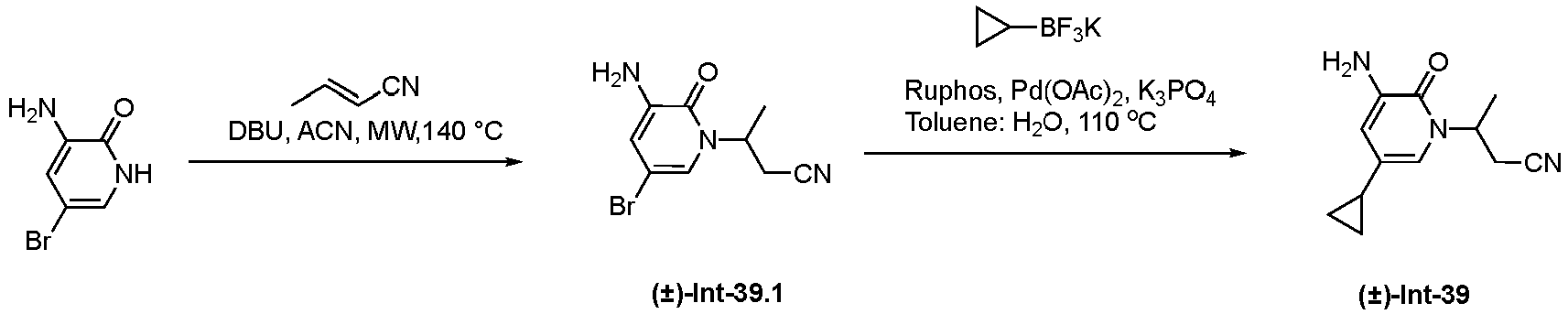
- Synthesis of compound (±)-Int-39.1. To a solution of 3-amino-5-bromopyridin-2(1H)-one (1 g, 5.29 mmol, 1.0 equiv) in acetonitrile (10 mL) was added (E)-but-2-enenitrile (2.13 g, 31.74 mmol, 6.0 equiv) followed by addition of 1,8-diazabicyclo[5.4.0]undec-7-ene (0.64 g, 4.23 mmol, 0.8 equiv). The reaction mixture was stirred at 140 °C in MW for 2 h. It transferred into water and extracted with ethyl acetate. The combined organic layers were washed with brine, dried over anhydrous sodium sulfate, filtered and concentrated under reduced pressure. The residue was purified by flash column chromatography on silica gel (CombiFlash®, 15% ethyl acetate in hexane) to afford (±)-Int-39.1. MS (ES): m/z 257.1 [M+H]+.
- Synthesis of compound (±)-Int-39. A mixture of (±)-Int-39.1 (0.510 g, 1.99 mmol, 1.0 equiv), potassium cyclopropyltrifluoroborate (0.530 g, 3.58 mmol, 1.8 equiv) and tripotassium phosphate (0.843 g, 3.98 mmol, 2.0 equiv) in toluene (9 mL) and water (1 mL) was degassed by bubbling through a stream of argon for 10 min. Under argon atmosphere was added palladium(II) acetate (0.222 g, 0.995 mmol, 0.5 equiv) and 2-dicyclohexylphosphino-2',6'-diisopropoxybiphenyl (0.278 g, 0.597 mmol, 0.3 equiv), and the mixture again degassed for 5 min. The reaction mixture was stirred at 110 °C for 12 h. It was cooled to room temperature and filtered through a pad of Celite®. The filtrate was transferred into water, extracted with ethyl acetate. The combined organic layers were washed with brine, dried over anhydrous sodium sulfate, filtered and concentrated under reduced pressure. The residue was purified by flash column chromatography on silica gel (CombiFlash®, 30-35% ethyl acetate in hexane) to afford (±)-Int-39. MS(ES): m/z 218.2 [M+H]+.
-


- Synthesis of compound Int-40.1. To a solution of 5-(trifluoromethyl)pyridin-2(1H)-one (5.0 g, 30.66 mmol, 1.0 equiv) in concentrated sulfuric acid (25 mL) was added fuming nitric acid (8 mL) at 0 °C. The reaction mixture was stirred at 65 °C for 6 h. It was transferred into crushed ice, stirred and extracted with ethyl acetate. The combined organic layers were washed with brine, dried over anhydrous sodium sulfate, filtered and concentrated under reduced pressure. The residue was purified by flash column chromatography on silica gel (CombiFlash®, 2.5% methanol in DCM) to afford Int-40.1. MS(ES): m/z 209.10 [M+H]+.
- Synthesis of compound Int-40.2. A mixture of Int-40.1 (8.0 g, 38.44 mmol, 1.0 equiv) and 10% palladium on carbon (3.0 g) in methanol (30 mL) was stirred under hydrogen (1 atm) for 2 h. It was filtered through a pad of Celite® and rinsed with methanol. The filtrate was concentrated under reduced pressure to afford Int-40.2. MS(ES): m/z 179.1 [M+H]+.
- Synthesis of compound Int-40.3. A solution of Int-40.2 (6.5 g, 36.49 mmol, 1.0 equiv) and acetic anhydride (17 mL, 182.45 mmol, 5.0 equiv) in toluene (25 mL) was heated to reflux for 2 h. It was concentrated under reduced pressure to afford crude material, which was purified by trituration with diethyl ether to afford Int-40.3. MS (ES): m/z 221.3 [M+H]+.
- Synthesis of compound Int-40.4. Compound Int-40.4 was prepared from Int-40.3 and Int-32.3, following the procedure described in the synthesis of Int-32.4. The product was purified by flash column chromatography on silica gel (CombiFlash®, 40% ethyl acetate in hexane). MS(ES): m/z 381.3 [M+H]+.
- Synthesis of compound Int-40.5. Compound Int-40.5 was prepared from Int-40.4, following the procedure described in the synthesis of Int-29.6. The product was purified by flash column chromatography on silica gel (CombiFlash®, 1.5% methanol in DCM). MS(ES): m/z 339.3 [M+H]+.
- Synthesis of compound Int-40. Compound Int-40 was prepared from Int-40.5, following the procedure described in the synthesis of Int-1. The product was used without purification.
-

- Synthesis of compound Int-41.1. Compound Int-41.1 was prepared from Int-40.3 and Int-37.1, following the procedure described in the synthesis of Int-32.4. The product was purified by flash column chromatography on silica gel (CombiFlash®, 1.3% methanol in DCM). MS(ES): m/z 317.2 [M+H]+.
- Synthesis of compound Int-41.2. Compound Int-41.2 was prepared from Int-41.1 following the procedure described in the synthesis of Int-29.6. The product was purified by flash column chromatography on silica gel (CombiFlash®, 2.5% methanol in DCM). MS(ES): m/z 275.2 [M+H]+.
- Synthesis of compound Int-41. Compound Int-41 was prepared from Int-41.2, following the procedure described in the synthesis of Int-1. The product was used without purification. MS(ES): m/z:317.3 [M+H]+.
-


- Synthesis of compound Int-42.1. Compound Int-42.1 was prepared from 3-morpholinopropan-1-ol, following the procedure described in the synthesis of Int-32.3. The product was used in the next step without purification. MS (ES): m/z 224.2 [M+H]+.
- Synthesis of compound Int-42.2. Compound Int-42.2 was prepared from Int-42.1 and Int-40.3, following the procedure described in the synthesis of Int-32.4. The product was purified by flash column chromatography on silica gel (CombiFlash®, 1.4% methanol in DCM). MS(ES): m/z 348.2 [M+H]+.
- Synthesis of compound Int-42.3. Compound Int-42.3 was prepared from Int-42.2 following the procedure described in the synthesis of Int-29.6. The product was purified by flash column chromatography on silica gel (CombiFlash®, 2.6% methanol in DCM). MS(ES): m/z 306.3 [M+H]+.
- Synthesis of compound Int-42. Compound Int-42 was prepared from Int-42.3, following the procedure described in the synthesis of Int-1. The product was used without purification. MS(ES): m/z:348.3 [M+H]+.
-

- Synthesis of compound Int-43.1. A mixture of Int-1.1 (1.0 g, 5.91 mmol, 1.0 equiv), tert-butyl 3-iodoazetidine-1-carboxylate (3.68 g, 13 mmol, 2.2 equiv) and potassium carbonate (2.44 g, 17.73 mmol, 3.0 equiv) in DMF (10 mL) was stirred at 80 °C for 2 h. It was transferred into water and extracted with ethyl acetate. The combined organic layers were washed with brine, dried over anhydrous sodium sulfate, filtered and concentrated under reduced pressure. The residue was purified by flash column chromatography on silica gel (CombiFlash®, 23% ethyl acetate in hexane) to afford Int-43.1. MS(ES): m/z 325.3 [M+H]+.
- Synthesis of compound Int-43.2. To a solution of Int-43.1 (0.300 g, 0.924 mmol, 1.0 equiv) in DCM (4 mL) was added trifluoroacetic acid (0.3 mL) at 0 °C and stirred for 30 min. It was concentrated under reduced pressure to afford Int-43.2. MS(ES): m/z: 225.1 [M+H]+.
- Synthesis of compound Int-43.3. To a solution of Int-43.2 (0.3 g, 0.886 mmol, 1.0 equiv) and triethylamine (0.37 mL, 2.658 mmol, 3.0 equiv) in DCM (2 mL) at 0 °C was added acetyl chloride (0.13 mL, 1.772 mmol, 2.0 equiv). The reaction mixture was stirred at room temperature for 30 min. It was poured into ice-water, stirred and extracted with DCM. The combined organic layers were washed with brine, dried over anhydrous sodium sulfate, filtered and concentrated under reduced pressure to afford crude material. This was purified by flash column chromatography on silica gel (CombiFlash®, 2.0% methanol in DCM) to afford Int-43.3. MS (ES): m/z 267.3 [M+H]+.
- Synthesis of compound Int-43.4. A mixture of Int-43.3 (0.150 g, 0.563 mmol, 1.0 equiv) and 10% palladium on carbon (0.075g) in methanol (2 mL) was stirred under hydrogen (1 atm) for 1 h. It was filtered through a pad of Celite® and rinsed with methanol. The filtrate was concentrated under reduced pressure to afford Int-43.4. MS(ES): m/z 237.3 [M+H]+.
- Synthesis of compound Int-43. Compound Int-43 was prepared from Int-43.4, following the procedure described in the synthesis of Int-1. The product was purified by flash column chromatography on silica gel (CombiFlash®, 1.5% methanol in DCM). MS(ES): m/z 279.3 [M+H]+.
-


- Synthesis of compound Int-44.1. To a solution of cyclobutanone (12 g, 171 mmol, 1.0 equiv) in chloroform (120 mL) was added bromine (27.3 g, 171 mmol, 1.0 equiv) dropwise at 0 °C. The reaction mixture was stirred at room temperature for 16 h. It was transferred into ice/saturated sodium bicarbonate solution, stirred and extracted with ethyl acetate. The combined organic layers were washed with aqueous sodium bisulfite, brine, dried over anhydrous sodium sulfate, filtered and concentrated under reduced pressure to afford Int-44.1. 1H NMR (CDCl3, 400 MHz): 5.18-4.99 (m, 1H), 3.31-3.22 (m, 2H), 2.83-2.73 (m, 1H), 2.33-2.29 (m, 1H).
- Synthesis of compound Int-44.2. To a solution of N-(5-bromo-2-oxo-1,2-dihydropyridin-3-yl)acetamide (10 g, 43.28 mmol, 1.0 equiv) in DMF (100 mL) was added sodium hydride (3.46 g, 86.56 mmol, 2.0 equiv) in portions at 0 °C and stirred for 30 min followed by addition of Int-44.1 (9.67 g, 64.92 mmol, 1.5 equiv). The reaction mixture was stirred at room temperature for 16 h. It was poured into ice-water, stirred and extracted with ethyl acetate. The combined organic layers were washed with brine, dried over anhydrous sodium sulfate, filtered and concentrated under reduced pressure. The residue was purified by flash column chromatography on silica gel (CombiFlash®, 40% ethyl acetate in hexane) to afford Int-44.2. 1H NMR (DMSO-d6, 400 MHz): 9.62 (s, 1H), 8.36-8.35 (d, J = 2.4 Hz, 1H), 7.71-7.70 (d, J = 2.4 Hz, 1H), 5.51-5.47 (m, 1H), 3.12-3.10 (m, 2H), 2.44-2.37 (m, 2H), 2.14 (s, 3H).
- Synthesis of compound Int-44.3. To a solution of Int-44.2 (1.8 g, 6.02 mmol, 1.0 equiv) in methanol (20 mL) and THF (5 mL) was added sodium borohydride (0.445 g, 12.04 mmol, 2.0 equiv) slowly. The reaction mixture was stirred at 0 °C for 10 min. It was poured into ice-water, stirred and extracted with ethyl acetate. The combined organic layers were washed with brine, dried over anhydrous sodium sulfate, filtered and concentrated under reduced pressure. The residue was purified by flash column chromatography on silica gel (CombiFlash®, 2.4% methanol in DCM) to afford cis-(±)-Int-44.3 MS (ES): m/z 302.1 [M+H]+ and trans-(±)-Int-44.4. MS (ES): m/z 302.1 [M+H]+.
- Synthesis of compound trans-(±)-Int-44.5. To a solution of trans-(±)-Int-44.4 (0.250 g, 0.830 mmol, 1.0 equiv) in DMF (5 mL) was added sodium hydride (0.066 g, 1.66 mmol, 2.0 equiv) at 0 °C and stirred for 30 min, followed by addition of benzyl bromide (0.30 mL, 2.49 mmol, 3.0 equiv). The reaction mixture was stirred at 0 °C for 30 min. It was transferred into ice, stirred and extracted with ethyl acetate. The combined organic layers were washed with brine, dried over anhydrous sodium sulfate, filtered and concentrated under reduced pressure. The residue was purified by flash column chromatography on silica gel (CombiFlash®, 15-20% ethyl acetate in hexane) to afford trans-(±)-Int-44.5. MS(ES): m/z 392.2 [M+H]+.
- Synthesis of compound trans-(±)-Int-44.6. Compound trans-(±)-Int-44.6 was prepared from trans-(±)-Int-44.5, following the procedure described in the synthesis of Int-23.2. The product was purified by flash column chromatography on silica gel (CombiFlash®, 30-35% ethyl acetate in hexane). MS(ES): m/z 353.2 [M+H]+.
- Synthesis of compound trans-(±)-Int-44.7 To a solution of trans-(±)-Int-44.6 (0.100 g, 0.283 mmol, 1.0 equiv) in methanol (2 mL) was added a solution of sodium hydroxide (0.339 g, 8.49 mmol, 30 equiv) in water (0.5 mL). The reaction mixture was stirred at 55-60 °C for 30 min. It concentrated under reduced pressure to afford a residue which was taken up in water and extracted with ethyl acetate. The combined organic layers were washed with brine, dried over anhydrous sodium sulfate, filtered and concentrated under reduced pressure. The residue was purified by flash column chromatography on silica gel (CombiFlash®, 1.2% methanol in DCM) to afford trans-(±)-Int-44.6. MS (ES): m/z 311.4 [M+H]+.
- Synthesis of compound trans-(±)-Int-44. Compound trans-(±)-Int-44 was prepared from trans-(±)-Int-44.7, following the procedure described in the synthesis of Int-1. The product was used without purification. MS(ES): m/z 353.3 [M+H]+.
-


- Synthesis of compound cis-(±)-Int-45.1. Compound cis-(±)-Int-45.1 was prepared from cis-(±)-Int-44.3, following the procedure described in the synthesis of trans-(±)-Int-44.5. The product was purified by flash column chromatography on silica gel (CombiFlash®, 15-20% ethyl acetate in hexane). MS(ES): m/z 392.2 [M+H]+.
- Synthesis of compound cis-(±)-Int-45.2. Compound cis-(±)-Int-45.2 was prepared from cis-(±)-Int-45.1, following the procedure described in the synthesis of Int-23.2. The product was purified by flash column chromatography on silica gel (CombiFlash®, 30-35% ethyl acetate in hexane). MS(ES): m/z 353.2 [M+H]+.
- Synthesis of compound cis-(±)-Int-45.3. Compound cis-(±)-Int-45.3 was prepared from cis-(±)-Int-45.2, following the procedure described in the synthesis of trans-(±)-Int-44.7. The product was purified by flash column chromatography on silica gel (CombiFlash®, 1.2% methanol in DCM). MS (ES): m/z 311.4 [M+H]+.
- Synthesis of compound cis-(±)-Int-45. Compound cis-(±)-Int-45 was prepared from cis-(±)-Int-45.3, following the procedure described in the synthesis of Int-1. The product was used without purification. MS(ES): m/z 353.3 [M+H]+.
-

- Synthesis of compound Int-46.1. Compound Int-46.1 was prepared from N-(5-bromo-2-oxo-1,2-dihydropyridin-3-yl)acetamide and Int-42.1, following the procedure described in the synthesis of Int-32.4. The product was purified by flash column chromatography on silica gel (CombiFlash®, 1.3% methanol in DCM). MS(ES): m/z 359.2 [M+H]+.
- Synthesis of compound Int-46.2. Compound Int-46.2 was prepared from Int-46.1, following the procedure described in the synthesis of Int-23.2. The product was purified by flash column chromatography on silica gel (CombiFlash®, 40% ethyl acetate in hexane). MS(ES): m/z 320.2 [M+H]+.
- Synthesis of compound Int-46.3. Compound Int-46.3 was prepared from Int-46.2, following the procedure described in the synthesis of trans-(±)-Int-44.7. The product was used without purification. MS (ES): m/z 278.3 [M+H]+.
- Synthesis of compound Int-46. Compound Int-46 was prepared from Int-46.3, following the procedure described in the synthesis of Int-1. The product was used without purification. MS(ES): m/z:320.4 [M+H]+.
-

- Synthesis of compound Int-47.1. To a solution of tert-butyl 4-(2-hydroxyethyl)piperazine-1-carboxylate (2.0 g, 8.68 mmol, 1.0 equiv) and triethylamine (3.0 mL, 21.7 mmol, 2.5 equiv) at 0 °C in DCM (20 mL) was added methanesulfonyl chloride (0.94 mL, 12.15 mmol, 1.4 equiv). The reaction mixture was stirred at 0 °C for 1 h. It was poured into ice-water, stirred and extracted with DCM. The combined organic layers were washed with brine, dried over anhydrous sodium sulfate, filtered and concentrated under reduced pressure to afford Int-47.1. It was used without purification. 1H NMR (DMSO-d6, 400 MHz): δ 4.03 (s, 3H), 3.76-3.72 (m, 8H), 2.33 (bs, 4H), 1.43 (s, 9H).
- Synthesis of compound Int-47.2. Compound Int-47.2 was prepared from Int-47.1, following the procedure described in the synthesis of Int-32.4. The product was purified by flash column chromatography on silica gel (CombiFlash®, 50% ethyl acetate in hexane). MS(ES): m/z 444.5 [M+H]+.
- Synthesis of compound Int-47.3. Compound Int-47.3 was prepared from Int-47.2, following the procedure described in the synthesis of Int-23.2. The product was purified by flash column chromatography on silica gel (CombiFlash®, 55% ethyl acetate in hexane). MS(ES): m/z 405.5 [M+H]+.
- Synthesis of compound Int-47.4. Compound Int-47.4 was prepared from Int-47.3, following the procedure described in the synthesis of trans-(±)-Int-44.7. The product was used without purification. MS (ES): m/z 363.3 [M+H]+.
- Synthesis of compound Int-47. Compound Int-47 was prepared from Int-47.4., following the procedure described in the synthesis of Int-1. The product was used without purification. MS(ES): m/z:405.4 [M+H]+.
-

- Synthesis of compound Int-48.1. To a mixture of Int-40.1 (0.5 g, 2.4 mmol, 1.0 equiv) and potassium carbonate (0.662 g, 4.8 mmol, 2.0 equiv) in DMF (7 mL) was added ((2-bromoethoxy)methyl)benzene (0.775 g, 3.6 mmol, 1.5 equiv). The reaction mixture was stirred at 110°C for 2 h. It was poured into ice-water and extracted with ethyl acetate. The combined organic layers were washed with brine, dried over anhydrous sodium sulfate, filtered and concentrated under reduced pressure. The residue was purified by flash column chromatography on silica gel (CombiFlash®, 30% ethyl acetate in hexane) to afford Int-48.1. MS(ES): m/z 343.2 [M+H]+.
- Synthesis of compound Int-48.2. Compound Int-48.2 was prepared from Int-48.1, following the procedure described in the synthesis of Int-27.3. The product was purified by flash column chromatography on silica gel (CombiFlash®, 2.5% methanol in DCM). MS(ES): m/z 313.3 [M+H]+.
- Synthesis of compound Int-48. Compound Int-48 was prepared from Int-48.2, following the procedure described in the synthesis of Int-1. The product was purified by flash column chromatography on silica gel (CombiFlash®, 1.5% methanol in DCM). MS(ES): m/z 355.3 [M+H]+.
-

- Synthesis of compound Int-49.1. To a solution of Int-40.3 (10 g, 45.42 mmol, 1.0 equiv) and Int-44.1 (10.15 g, 68.13 mmol, 1.5 equiv) in DMSO (100 mL) was added potassium tert-butoxide (1 M in THF, 0.62 mL, 0.62 mmol, 3.0 equiv) at 0 °C. The reaction mixture was stirred at room temperature for 16 h. It was poured into ice-water and extracted with ethyl acetate. The combined organic layers were washed with brine, dried over anhydrous sodium sulfate, filtered and concentrated under reduced pressure. The residue was purified by flash column chromatography on silica gel (CombiFlash®, 40% ethyl acetate in hexane) to afford Int-49.1. MS (ES): m/z 289.2[M+H]+.
- Synthesis of compound cis-(±)-Int-49.2 and trans-(±)-Int-49.3. To a solution of Int-49.1 (0.640 g, 2.22 mmol, 1.0 equiv) in methanol (10 mL) was added sodium borohydride (0.164 g, 4.44 mmol, 2.0 equiv) slowly. The reaction mixture was stirred at 0 °C for 10 min. It was poured into ice-water, stirred and extracted with ethyl acetate. The combined organic layers were washed with brine, dried over anhydrous sodium sulfate, filtered and concentrated under reduced pressure. The residue was purified by flash column chromatography on silica gel (CombiFlash®, 2.4% methanol in DCM) to afford cis-(±)-Int-49.2. MS (ES): m/z 291.1 [M+H]+ and trans-(±)-Int-49.3. MS (ES): m/z 291.1 [M+H]+.
- Synthesis of compound trans-(±)-Int-49.3. Compound trans-(±)-Int-49.3 was prepared from trans-(±)-Int-49.2, following the procedure described in the synthesis of trans-(±)-Int-44.5. The product was purified by flash column chromatography on silica gel (CombiFlash®, 15-20% ethyl acetate in hexane). MS(ES): m/z 381.2 [M+H]+.
- Synthesis of compound trans-(±)-Int-49.4. Compound trans-(±)-Int-49.4 was prepared from trans-(±)-Int-49.3, following the procedure described in the synthesis of trans-(±)- Int-44.7. The product was purified by flash column chromatography on silica gel (CombiFlash®, 1.6% methanol in DCM). MS (ES): m/z 339.3 [M+H]+.
- Synthesis of compound trans-(±)-Int-49. Compound trans-(±)-Int-49 was prepared from trans-(±)-Int-49.4, following the procedure described in the synthesis of Int-1. The product was purified by flash column chromatography on silica gel (CombiFlash®, 15% ethyl acetate in hexane). MS(ES): m/z 381.3 [M+H]+.
-


- Synthesis of compound Int-50.1. To a solution of 2,2-dimethyloxirane (60 g, 832 mmol, 1.0 equiv) in methanol (300 mL) was added concentrated sulfuric acid. The reaction mixture was heated to reflux for 5 h. It neutralized with methanolic potassium hydroxide to pH = 7. The reaction mixture was concentrated under reduced pressure. The residue was purified by fractional distillation to afford Int-50.1 (boiling point: 136-140 °C). 1H NMR (CDCl3, 400 MHz): δ 3.51 (s, 2H), 3.46 (bs, 1H), 3.26 (s, 3H), 1.19 (s, 6H).
- Synthesis of compound Int-50.2. To a solution of Int-50.1 (4.5 g, 43.21 mmol, 1.0 equiv) in pyridine (37 mL) was added p-toluenesulfonyl chloride (3.011 g, 15.85 mmol, 1.2 equiv) at 0 °C. The reaction mixture was stirred at room temperature for 16 h. It was transferred into ice-cold aqueous hydrochloric acid, stirred and extracted with ethyl acetate. The combined organic layers were washed with brine, dried over anhydrous sodium sulfate, filtered and concentrated under reduced pressure to afford Int-50.2. 1H NMR (CDCl3, 400 MHz): δ 7.83-7.81 (d, J = 6.8 Hz, 2H), 7.37-7.35 (J = 7.2 Hz, 2H), 3.87 (s, 2H), 2.99 (s, 3H), 2.47 (s, 3H), 1.17 (s, 6H).
- Synthesis of compound Int-50.3. To a solution of N-(5-bromo-2-oxo-1,2-dihydropyridin-3-yl)acetamide (2.0 g, 8.66 mmol, 1.0 equiv) in DMF (20 mL) was added potassium carbonate (3.585 g, 25.98 mmol, 3.0 equiv) followed by Int-50.2 (2.68 g, 10.39 mmol, 1.2 equiv). The reaction mixture stirred at 120 °C for 16 h. It was transferred into water and extracted with ethyl acetate. The combined organic layers were washed with brine, dried over anhydrous sodium sulfate, filtered and concentrated under reduced pressure. The residue was purified by flash column chromatography on silica gel (CombiFlash®, 30% ethyl acetate in hexane) to afford Int-50.3. MS(ES): m/z 318.1 [M+H]+.
- Synthesis of compound Int-50.4. Compound Int-50.4 was prepared from Int-50.3, following the procedure described in the synthesis of Int-23.2. The product was purified by flash column chromatography on silica gel (CombiFlash®, 2.0% methanol in DCM). MS(ES): m/z 279.3 [M+H]+.
- Synthesis of compound Int-50. Compound Int-50 was prepared from Int-50.4, following the procedure described in the synthesis of Int-29.6. The product was purified by flash column chromatography on silica gel (CombiFlash®, 2.5% methanol in DCM). MS (ES): m/z 237.3 [M+H]+.
-

- Synthesis of compound Int-51.1. To a solution of 3,4-dihydro-2H-pyran (20 g, 238 mmol, 1.0 equiv) in DCM (200 mL) was added bromine (12.2 mL, 238 mmol, 1.0 equiv) in DCM (100 mL) at -78 °C dropwise. The reaction mixture was stirred at -78 °C for 2 h. It was allowed to warm to room temperature and stirred for 16 h. To the reaction mixture was added triethylamine (66 mL, 476 mmol, 2.0 equiv) in DCM (100 mL) dropwise and it was stirred for 5 h. The reaction mixture was concentrated under reduced pressure. To the residue was added diethyl ether. The precipitations were removed by filtration. The filtrate was concentrated under reduced pressure. The residue was purified by vacuum distillation (80 °C, 0.02 mmHg), to afford Int-51.1. 1H NMR (400 M Hz, CDCl3): 6.68 (s, 1H), 4.02-4.00 (t, J = 4 Hz, 2H), 2.45-2.42 (m, 2H), 2.06-2.00 (m, 2H).
- Synthesis of compound Int-51.2. To a solution of Int-40.2 (0.7 g, 3.93 mmol, 1.0 equiv) and Int-51.1 (0.960 g, 5.90 mmol, 1.5 equiv) in 1,4-dioxane (10 mL) was added potassium carbonate (1.084 g, 7.86 mmol, 2.0 equiv), and the mixture was degassed by bubbling through a stream of argon for 15 min. Copper iodide (0.149 g, 0.786 mmol, 0.2 equiv) and 1,2-dimethylethylenediamine (0.138 g, 1.572 mmol, 0.4 equiv) were added. The reaction mixture was degassed for another 5 min and stirred at 110 °C for 12 h. It was cooled to room temperature, transferred into water and extracted with ethyl acetate. The combined organic layers were washed with brine, dried over anhydrous sodium sulfate, filtered and concentrated under reduced pressure. The residue was purified by flash column chromatography on silica gel (CombiFlash®, 2.1% methanol in DCM) to afford Int-51.1. MS(ES): m/z 261.2 [M+H]+.
- Synthesis of compound (±)-Int-51.3. A mixture of Int-51.2 (0.472 g, 1.81 mmol, 1.0 equiv) and 20% palladium hydroxide (0.4 g) in methanol (5 mL) was stirred under hydrogen (1 atm) for 16 h at room temperature. It was filtered through a pad of Celite® and rinsed with methanol. The filtrate was concentrated under reduced pressure. The residue was purified by trituration with n-pentane to afford (±)-Int-51.3. MS (ES): m/z 263.2 [M+H]+.
- Synthesis of compound (±)-Int-51. Compound (±)-Int-51 was prepared from (±)-Int-51.3, following the procedure described in the synthesis of Int-1. The product was purified by flash column chromatography on silica gel (CombiFlash®, 20% ethyl acetate in hexane). MS(ES): m/z 305.2 [M+H]+.
-

- Synthesis of compound Int-52.1. Compound Int-52.1 was prepared from 3-amino-5-bromopyridin-2(1H)-one and 3-bromopyridine, following the procedure described in the synthesis of Int-51.2. The product was purified by flash column chromatography on silica gel (CombiFlash®, 2.5% methanol in DCM). MS(ES): m/z 267.1 [M+H]+.
- Synthesis of compound Int-52.2. Compound Int-52.2 was prepared from Int-52.1, following the procedure described in the synthesis of Int-23.2. The product was purified by flash column chromatography on silica gel (CombiFlash®, 4.0% methanol in DCM). MS(ES): m/z 228.2 [M+H]+.
- Synthesis of compound Int-52.3. Compound Int-52.3 was prepared from Int-52.2, following the procedure described in the synthesis of Int-1. The product was purified by flash column chromatography on silica gel (CombiFlash®, 1.5% methanol in DCM). MS(ES): m/z 270.3 [M+H]+.
-
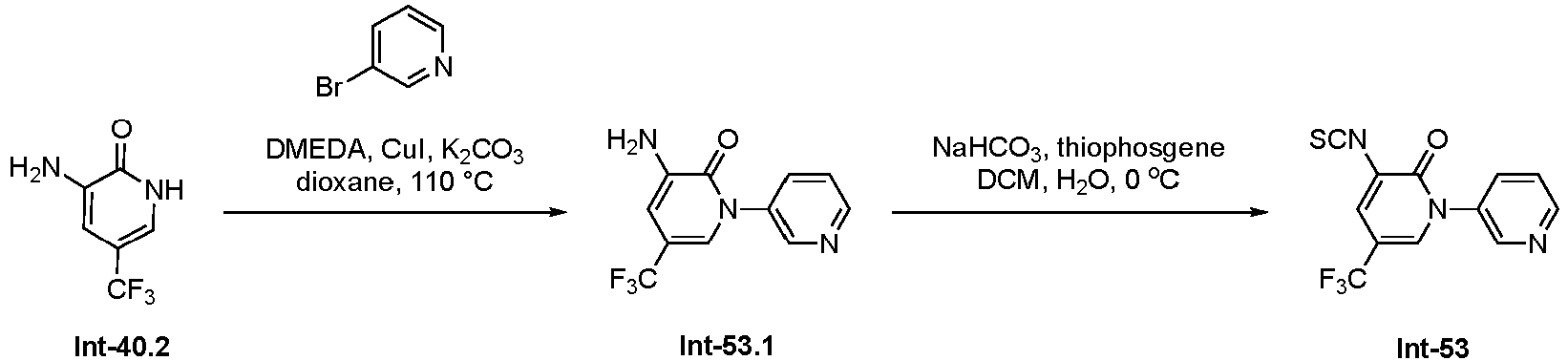
- Synthesis of compound Int-53.1. Compound Int-53.1 was prepared from Int-40.2 and 3-bromopyridine, following the procedure described in the synthesis of Int-51.2. The product was purified by flash column chromatography on silica gel (CombiFlash®, 2.7% methanol in DCM). MS(ES): m/z 256.2 [M+H]+.
- Synthesis of compound Int-53. Compound Int-53 was prepared from Int-53.1, following the procedure described in the synthesis of Int-1. The product was purified by flash column chromatography on silica gel (CombiFlash®, 1.7% methanol in DCM). MS(ES): m/z 298.2 [M+H]+.
-

- Synthesis of compound Int-54.1. Compound Int-54.1 was prepared from 3-amino-5-bromopyridin-2(1H)-one and 4-bromo-1-methyl-1H-pyrazole, following the procedure described in the synthesis of Int-51.2. The product was purified by flash column chromatography on silica gel (CombiFlash®, 2.1% methanol in DCM). MS(ES): m/z 270.1 [M+H]+.
- Synthesis of compound Int-54.2. Compound Int-54.2 was prepared from Int-54.1, following the procedure described in the synthesis of Int-23.2. The product was purified by flash column chromatography on silica gel (CombiFlash®, 2.4% methanol in DCM). MS(ES): m/z 231.2 [M+H]+.
- Synthesis of compound Int-54. Compound Int-54 was prepared from Int-54.2, following the procedure described in the synthesis of Int-1. The product was purified by flash column chromatography on silica gel (CombiFlash®, 1.4% methanol in DCM). MS(ES): m/z 273.3 [M+H]+.
-

- Synthesis of compound Int-55.1. To a solution of 3,6-dichloropyridazin-4-amine (0.9 g, 5.49 mmol, 1.0 equiv) in THF (20 mL) was added sodium hydride (0.579 g, 12.07 mmol, 2.2 equiv) at 0 °C and stirred for 10 min. Pivaloyl chloride (0.7 mL, 5.76 mmol, 1.05 equiv) was added dropwise. The reaction mixture was stirred at room temperature for 15 min. It was transferred into ice-water, stirred and extracted with ethyl acetate. The combined organic layers were washed with brine, dried over anhydrous sodium sulfate, filtered and concentrated under reduced pressure to afford Int-55.1. MS (ES): m/z 230.6 [M+H]+.
- Synthesis of compound Int-55.2. A solution of Int-55.1 (1.1 g, 4.43 mmol, 1.0 equiv) in acetic acid (10 mL) was stirred at 110 °C for 3 h. It was transferred into ice, stirred and neutralized with saturated sodium bicarbonate solution. Precipitated solid was filtered out and dried well to afford Int-55.2. MS (ES): m/z 271.3 [M+H]+.
- Synthesis of compound Int-55.3. To a solution of Int-55.2 (0.7 g, 3.05 mmol, 1.0 equiv) in DMF (7 mL) was added potassium carbonate (0.841 g, 6.1 mmol, 2.0 equiv) at room temperature and stirred for 15 min followed by addition of methyl iodide (0.519 g, 3.66 mmol, 1.2 equiv). The reaction mixture was stirred at room temperature for 16 h. It was poured into ice-water and extracted with ethyl acetate. The combined organic layers were washed with brine, dried over anhydrous sodium sulfate, filtered and concentrated under reduced pressure. The residue was purified by trituration with n-pentane to afford Int-55.3. MS(ES): m/z 244.6 [M+H]+.
- Synthesis of compound Int-55.4. To a solution of Int-55.3 (0.350 g, 1.44 mmol, 1.0 equiv) in dimethylacetamide (2 mL), water (1 mL) and ethanol (0.7 mL) was added cyclopropylboronic acid (0.27 g, 3.16 mmol, 2.2 equiv), cesium carbonate (0.938 g, 2.88 mmol, 2.0 equiv) and dichlorobis(triphenylphosphine)palladium(II) (0.090 g, 0.129 mmol, 0.09 equiv). The reaction mixture was heated in a microwave reactor at 150 °C for 30 min. It was cooled to room temperature and filtered through a pad of Celite®. The filtrate was transferred into water and extracted with DCM. The combined organic layers were washed with brine, dried over anhydrous sodium sulfate, filtered and concentrated under reduced pressure. The residue was purified by flash column chromatography on silica gel (CombiFlash®, 10% ethyl acetate in hexane) to afford Int-55.4. MS(ES): m/z 250.3 [M+H]+.
- Synthesis of compound Int-55.5. To a solution of Int-55.4 (0.155 g, 0.621 mmol, 1.0 equiv) in methanol (2.5 mL) was added sodium methoxide solution (25% in methanol, 0.4 mL, 1.86 mmol, 3.0 equiv). The reaction mixture was stirred at 65 °C for 2 h. It was concentrated under reduced pressure. The residue was transferred into water and extracted with ethyl acetate. The combined organic layers were washed with brine, dried over anhydrous sodium sulfate, filtered and concentrated under reduced pressure to afford Int-55.5. MS(ES): m/z 166.2 [M+H]+.
- Synthesis of compound Int-55. Compound Int-55 was prepared from Int-55.5, following the procedure described in the synthesis of Int-1. The product was used without purification. MS(ES): m/z 208.3 [M+H]+.
-

- Synthesis of compound Int-56.1. To a solution of 3,3-difluoropyrrolidine (10.0 g, 93.37 mmol, 1.0 equiv), triethylamine (3.0 mL, 21.7 mmol, 3.0 equiv) and 3-bromopropan-1-ol (25.95 g, 186.7 mmol, 2.0 equiv) in THF (10 mL) was stirred at 80 °C for 12 h. It was transferred into water, stirred and extracted with ethyl acetate. The combined organic layers were washed with brine, dried over anhydrous sodium sulfate, filtered and concentrated under reduced pressure. The residue was purified by flash column chromatography on silica gel (CombiFlash®, 20% ethyl acetate in hexane) to afford Int-56.1. 1H NMR (DMSO-d6, 400 MHz): δ 4.43 (bs, 1H), 3.39-3.36 (m, 2H), 2.87-2.80 (m, 2H), 2.67-2.64 (m, 2H), 2.47-2.44 (m, 2H), 2.28-2.17 (m, 2H), 1.60-1.55 (m, 2H).
- Synthesis of compound Int-56.2. Compound Int-56.2 was prepared from Int-56.1, following the procedure described in the synthesis of Int-32.3. The product was used without puridication. 1H NMR (DMSO-d6, 400 MHz): δ 4.26-4.22 (m, 2H), 3.17 (s, 3H), 2.91-2.84 (m, 2H), 2.71-2.67 (m, 2H), 2.53-2.47 (m, 2H), 2.29-2.18 (m, 2H), 1.86-1.80 (m, 2H).
- Synthesis of compound Int-56.3. Compound Int-56.3 was prepared from Int-56.2, following the procedure described in the synthesis of Int-32.4. The product was purified by preparative HPLC. MS(ES): m/z 379.2 [M+H]+.
- Synthesis of compound Int-56.4. Compound Int-56.4 was prepared from Int-56.3, following the procedure described in the synthesis of Int-23.2. The product was purified by flash column chromatography on silica gel (CombiFlash®, 2.0% methanol in DCM). MS(ES): m/z 340.2 [M+H]+.
- Synthesis of compound Int-56.5. Compound Int-56.5 was prepared from Int-56.4, following the procedure described in the synthesis of trans-(±)-Int-44.7. The product was purified by flash column chromatography on silica gel (CombiFlash®, 2.5% methanol in DCM). MS (ES): m/z 298.3 [M+H+.
- Synthesis of compound Int-56. Compound Int-56 was prepared from Int-56.5, following the procedure described in the synthesis of Int-1. The product was purified by flash column chromatography on silica gel (CombiFlash®, 1.5% methanol in DCM). MS(ES): m/z:340.4 [M+H]+.
-

- Synthesis of compound Int-57.1. Compound Int-57.1 was prepared from Int-40.3 and Int-56.2, following the procedure described in the synthesis of Int-32.4. The product was purified by flash column chromatography on silica gel (CombiFlash®, 45% ethyl acetate in hexane). MS(ES): m/z 368.3 [M+H]+.
- Synthesis of compound Int-57.2. Compound Int-57.2 was prepared from Int-57.1, following the procedure described in the synthesis of Int-29.6. The product was purified by flash column chromatography on silica gel (CombiFlash®, 28% ethyl acetate in hexane). MS (ES): m/z 326.2 [M+H]+.
- Synthesis of compound Int-57. Compound Int-57 was prepared from Int-57.2 following the procedure described in the synthesis of Int-1. The product was purified by flash column chromatography on silica gel (CombiFlash®, 1.0% methanol in DCM). MS(ES): m/z:368.3 [M+H]+.
-

- Synthesis of compound cis-(±)-Int-58.1. Compound cis-(±)-Int-58.1 was prepared from cis-(±)-Int-49.2 following the procedure described in the synthesis of trans-(±)-Int-49.3. The product was purified by flash column chromatography on silica gel (CombiFlash®, 15-20% ethyl acetate in hexane). MS(ES): m/z 381.2 [M+H]+.
- Synthesis of compound cis-(±)-Int-58.2. Compound cis-(±)-Int-58.2 was prepared from cis-(±)-Int-58.1, following the procedure described in the synthesis of trans-(±)-Int-44.7. The product was purified by flash column chromatography on silica gel (CombiFlash®, 1.6% methanol in DCM). MS (ES): m/z 339.3 [M+H]+.
- Synthesis of compound cis-(±)-Int-58. Compound cis-(±)-Int-58 was prepared from cis-(±)-Int-58.2 following the procedure described in the synthesis of Int-1. The product was purified by flash column chromatography on silica gel (CombiFlash®, 15% ethyl acetate in hexane). MS(ES): m/z 381.3 [M+H]+.
-


- Synthesis of compound Int-59.1. To a solution of 4-amino-2-(trifluoromethyl)benzoic acid (10 g, 48.75 mmol, 1.0 equiv) in DMF (30 mL) was added O-(benzotriazol-1-yl)-N,N,N',N'-tetramethyluronium tetrafluoroborate (18.4 g, 58.5 mmol, 1.2 equiv) at 0 °C. The reaction mixture was stirred for 30 min. To the mixture was added 1-ethylpiperazine (6.67, 58.5 mmol, 1.2 equiv) followed by N,N-diisopropylethylamine (24 mL, 146.25 mmol, 3.0 equiv) and stirred at room temperature for 3 h. It was transferred into ice-water, stirred and extracted with ethyl acetate. The combined organic layers were washed with brine, dried over anhydrous sodium sulfate, filtered and concentrated under reduced pressure. The residue was purified by flash column chromatography on silica gel (CombiFlash®, 1.5% methanol in DCM) to afford Int-59.1. MS (ES): m/z 302.3 [M+H]+.
- Synthesis of compound Int-59.2. To a solution of Int-59.1 (2 g, 6.64 mmol, 1.0 equiv) in THF (20 mL) was added lithium aluminum hydride solution (1 M in THF) (19.9 mL, 19.92 mmol, 3.0 equiv) at 0 °C. The reaction mixture was heated to reflux for 3 h. It was cooled to room temperature, transferred into ice-water and extracted with ethyl acetate. The combined organic layers were washed with brine, dried over anhydrous sodium sulfate, filtered and concentrated under reduced pressure to afford Int-59.2. MS(ES): m/z 288.3 [M+H]+.
- Synthesis of compound Int-59. Compound Int-59 was prepared from Int-59.2 following the procedure described in the synthesis of Int-1. The product was purified by flash column chromatography on silica gel (CombiFlash®, 3.0% methanol in DCM). MS(ES): m/z 330.3 [M+H]+.
-


- Synthesis of compound Int-60. Compound Int-60 was prepared following the procedures described in the synthesis of Int-59. The product was purified by flash column chromatography on silica gel (CombiFlash®, 2.0% methanol in dichloromethane). MS(ES): m/z 316.2 [M+H]+.
-

- Synthesis of compound Int-61.1. To a solution of δ-valerolactone (10 g, 99.88 mmol, 1.0 equiv) and methyl iodide (24.8 mL, 399.52 mmol, 4.0 equiv) in THF (200 mL) was added lithium bis(trimethylsilyl)amide (1 M in THF, 219 mL, 219.7 mmol, 2.2 equiv) at -78 °C. The reaction mixture was stirred at room temperature for 16 h. It was poured over ice-water and extracted with ethyl acetate. The combined organic layers were washed with brine, dried over anhydrous sodium sulfate, filtered and concentrated under reduced pressure. The residue was purified by flash column chromatography on silica gel (CombiFlash®, 10% ethyl acetate in hexane as eluant) to afford Int-61.1. MS (ES): m/z 129.2 [M+H]+.
- Synthesis of compound Int-61.2. To a solution of diisopropylamine (4.88 g, 48.37 mmol, 1.0 equiv) in THF (100 mL) at -78 °C was slowly added a solution of n-butyl lithium (2.5M in hexane, 24.2 mL, 60.46 mmol, 1.25 equiv). The reaction mixture was stirred for 5 min followed by addition of acetonitrile (2.5 mL, 48.37 mmol, 1.0 equiv). The reaction mixture stirred for 10 min and compound Int-61.1 (6.20 g, 48.37 mmol, 1.0 equiv) in THF (30 mL) was added to it. The reaction mixture was stirred at 5 °C for 6 h. It was poured over cold saturated ammonium chloride solution and extracted with ethyl acetate. The combined organic layers were washed with brine, dried over anhydrous sodium sulfate, filtered and concentrated under reduced pressure. The residue was purified by flash column chromatography on silica gel (CombiFlash®, 20% ethyl acetate in hexane as eluant) to afford Int-61.2. MS (ES): m/z 170.2 [M+H]+.
- Synthesis of compound Int-61.3. To a solution of Int-61.2 (3.9 g, 23.05 mmol, 1.0 equiv) in ethanol (40 mL) was added hydrazine hydrochloride (2.35 g, 34.57 mmol, 1.5 equiv) followed by addition of potassium carbonate (4.77 g, 34.57 mmol, 1.5 equiv). The reaction mixture was heated to reflux for 16 h. It was concentrated under reduced pressure. The residue was purified by flash column chromatography on silica gel (CombiFlash®, 3-4% methanol in DCM as eluant) to afford Int-61.3. MS (ES): m/z 184.26 [M+H]+
- Synthesis of compound Int-61.4. To a solution of Int-61.3 (1.1 g, 6.0 mmol, 1.0 equiv) in THF (20 mL) was added thionyl chloride (2.15 mL, 30 mmol, 5.0 equiv). The reaction mixture was stirred at room temperature for 2 h. It was poured over saturated sodium bicarbonate solution, stirred and extracted with ethyl acetate. The combined organic layers were washed with brine, dried over anhydrous sodium sulfate, filtered and concentrated under reduced pressure. The residue was purified by flash column chromatography on silica gel (CombiFlash®, 2% methanol in DCM as eluant) to afford Int-61.4. MS (ES): m/z 166.24 [M+H]+.
- Synthesis of compound Int-61. Compound Int-61 was prepared from Int-61.4 following the procedure described in the synthesis of Int-1. The crude product was used in the next step without further purification. MS (ES): m/z 208.3 [M+H]+.
-

- Synthesis of compound Int-62.1. To a suspension of Int-55.2 (3.5 g, 15.24 mmol, 1.0 equiv) and cesium carbonate (9.9 g, 30.48 mmol, 2.0 equiv) in DMF (35 mL) was added ((2-bromoethoxy)methyl)benzene (3.28 g, 15.24 mmol, 1.0 equiv). The reaction mixture was stirred at room temperature for 16 h. It was poured over ice-water and extracted with ethyl acetate. The combined organic layers were washed with brine, dried over anhydrous sodium sulfate, filtered and concentrated under reduced pressure. The residue was purified by trituration with n-pentane to afford Int-62.1. MS(ES): m/z 364.5 [M+H]+.
- Synthesis of compound Int-62.2. Compound Int-62.2 was prepared from Int-62.1, following the procedure described in the synthesis of Int-55.4. The product was purified by flash column chromatography on silica gel (CombiFlash®, 15% ethyl acetate in hexane). MS(ES): m/z 370.4 [M+H]+.
- Synthesis of compound Int-62.3. Compound Int-62.3 was prepared from Int-62.2, following the procedure described in the synthesis of Int-55.5. The product was purified by flash column chromatography on silica gel (CombiFlash®, 30% ethyl acetate in hexane). MS(ES): m/z 286.2 [M+H]+.
- Synthesis of compound Int-62. Compound Int-62 was prepared from Int-62.3, following the procedure described in the synthesis of Int-1. The product was purified by flash column chromatography on silica gel (CombiFlash®, 14% ethyl acetate in hexane). MS(ES): m/z 328.4 [M+H]+.
-

- Synthesis of compound Int-63.1. A mixture of Int-40.1 (1.0 g, 4.81 mmol, 1.0 equiv), potassium carbonate (1.3 g, 9.62 mmol, 2.0 equiv) and methyl iodide (1.0 g, 7.21 mmol, 1.5 equiv) in DMF (15 mL) was stirred at 80 °C for 2 h. It was poured over ice-water and extracted with ethyl acetate. The combined organic layers were washed with brine, dried over anhydrous sodium sulfate, filtered and concentrated under reduced pressure. The residue was purified by flash column chromatography on silica gel (CombiFlash®, 40% ethyl acetate in hexane as eluant) to afford Int-63.1. MS (ES): m/z 223.12 [M+H]+.
- Synthesis of compound Int-63.2. A mixture of compound Int-63.1 (0.57 g, 2.57 mmol, 1.0 equiv) in methanol (18 mL) and 10% palladium on carbon (0.3 g) were stirred under hydrogen (1 atm) for 1 h. The reaction mixture was filtered through a pad of Celite® and rinsed with methanol. The filtrate was concentrated under reduced pressure to obtain Int-63.2. MS(ES): m/z 193.14 [M+H]+.
- Synthesis of compound Int-63. Compound Int-63 was prepared from 63.2 following the procedure described in the synthesis of Int-59. The crude product was used in the next step without further purification. MS (ES): m/z 192.15 [M+H]+.
-

- Synthesis of compound Int-64.1. To a solution of 3,3-difluoropiperidine hydrochloride (1.0 g, 6.35 mmol, 1.0 equiv) in THF (10 mL) was added triethylamine (4.42 mL, 31.75 mmol, 5.0 equiv) at room temperature followed by addition of 3-bromopropan-1-ol (1.76 g, 12.7 mmol, 2.0 equiv). The reaction mixture was stirred at 80 °C for 12 h. It was poured over water, stirred and extracted with ethyl acetate. The combined organic layers were washed with brine, dried over anhydrous sodium sulfate, filtered and concentrated under reduced pressure. The residue was purified by flash column chromatography on silica gel (CombiFlash®, 20% ethyl acetate in hexane) to afford Int-64.1. 1H NMR (DMSO-d6, 400 MHz): δ 4.43 (bs, 1H), 3.43-3.42 (m, 2H), 2.63-2.52 (m, 2H), 2.43-2.38 (m, 4H), 1.91-1.81 (m, 2H), 1.66-1.54 (m, 4H).
- Synthesis of compound Int-64.2. Compound Int-64.2 was prepared from Int-64.1, following the procedure described in the synthesis of Int-32.3. The product was used in the next step without purification. 1H NMR (DMSO-d6, 400 MHz): δ 4.28-4.27 (m, 2H), 3.36 (s, 3H), 3.22-3.17 (m, 4H), 3.13-3.07 (m, 2H), 2.06-2.04 (m, 4H), 1.82 (bs, 2H).
- Synthesis of compound Int-64.3. Compound Int-64.3 was prepared from Int-64.1 and N-(5-bromo-2-oxo-1,2-dihydropyridin-3-yl)acetamide, following the procedure described in the synthesis of Int-32.4. The product was purified by preparative HPLC. MS(ES): m/z 393.2 [M+H]+.
- Synthesis of compound Int-64.4. Compound Int-64.4 was prepared from Int-64.3, following the procedure described in the synthesis of Int-23.2. The product was purified by flash column chromatography on silica gel (CombiFlash®, 2.0% methanol in DCM). MS(ES): m/z 354.4 [M+H]+.
- Synthesis of compound Int-64.5. To a solution of Int-64.4 (0.180 g, 0.509 mmol, 1.0 equiv) in methanol (5 mL) was added a solution of sodium hydroxide (0.814 g, 20.36 mmol, 40 equiv) in water (2 mL). The reaction mixture was heated at 55-60 °C for 3 h. It was concentrated under reduced pressure. The residue was added to water and extracted with ethyl acetate. The combined organic layers were washed with brine, dried over anhydrous sodium sulfate, filtered and concentrated under reduced pressure. The residue was purified by flash column chromatography on silica gel (CombiFlash®, 2.5% methanol in DCM) to afford Int-64.5. MS (ES): m/z 312.3 [M+H]+.
- Synthesis of compound Int-64. Compound Int-64 was prepared from Int-64.5, following the procedure described in the synthesis of Int-1. The product was purified by flash column chromatography on silica gel (CombiFlash®, 1.5% methanol in DCM). MS(ES): m/z 354.4 [M+H]+.
-

- Synthesis of compound Int-65.1. To a mixture of 5-bromo-3-nitropyridin-2(1H)-one (5.0 g, 45.66 mmol, 1.0 equiv) and potassium carbonate (18.9 g, 136.98 mmol, 3.0 equiv) in DMF (50 mL) was added methyl 2-bromoacetate (10.48 g, 68.50 mmol, 1.5 equiv). The reaction mixture was stirred at room temperature for 5 min. It was poured over ice-water and extracted with ethyl acetate. The combined organic layers were washed with brine, dried over anhydrous sodium sulfate, filtered and concentrated under reduced pressure. The residue was purified by flash column chromatography on silica gel (CombiFlash®, 30% ethyl acetate in hexane) to afford Int-65.1. MS(ES): m/z 292.0 [M+H]+.
- Synthesis of compound Int-65.2 Compound Int-65.2 was prepared from Int-65.1, following the procedure described in the synthesis of Int-27.3. The product was purified by flash column chromatography on silica gel (CombiFlash®, 2.0% methanol in DCM). MS(ES): m/z 262.1 [M+H]+.
- Synthesis of compound Int-65.3. Compound Int-65.3 was prepared from Int-65.2, following the procedure described in the synthesis of Int-23.2. The product was purified by flash column chromatography on silica gel (CombiFlash®, 2.3% methanol in DCM). MS(ES): m/z 223.2 [M+H]+.
- Synthesis of compound Int-65.4. A solution of Int-65.3 (1.0 g, 4.59 mmol, 1.0 equiv) and ammonia (7 N in methanol, 50 mL) was stirred at room temperature for 12 h. It was concentrated under reduced pressure to afford crude compound which was triturated with diethyl ether to afford Int-65.4. MS(ES): m/z 208.1 [M+H]+.
- Synthesis of compound Int-65. To a solution of Int-65.4 (0.640 g, 3.09 mmol, 1.0 equiv) in acetonitrile (10 mL) was added phosphorus pentoxide (0.877 g, 6.18 mmol, 2.0 equiv) and stirred at 80 °C for 12 h. It was cooled to room temperature, transferred into water and extracted with ethyl acetate. The combined organic layers were washed with brine, dried over anhydrous sodium sulfate, filtered and concentrated under reduced pressure. The residue was purified by flash column chromatography on silica gel (CombiFlash®, 3.0% methanol in DCM) to afford Int-65. MS(ES): m/z 190.0 [M+H]+.
-

- Synthesis of compound Int-66.1. Compound Int-66.1 was prepared from Int-40.3 and Int-64.2, following the procedure described in the synthesis of Int-32.4. The product was purified by preparative HPLC. MS(ES): m/z 382.3 [M+H]+.
- Synthesis of compound Int-66.2. Compound Int-66.2 was prepared from Int-66.1, following the procedure described in the synthesis of trans-(±)-Int-44.7. The product was purified by flash column chromatography on silica gel (CombiFlash®, 2.3% methanol in DCM. MS (ES): m/z 340.3 [M+H]+.
- Synthesis of compound Int-66. Compound Int-66 was prepared from Int-66.2, following the procedure described in the synthesis of Int-1. The product was purified by flash column chromatography on silica gel (CombiFlash®, 1.4% methanol in DCM). MS(ES): m/z 382.2 [M+H]+.
-

- Synthesis of compound Int-67.1. A mixture of Int-55.3 (10 g, 43.54 mmol, 1.0 equiv), cesium carbonate (35.4 g, 108.85 mmol, 2.5 equiv) and (S)-tetrahydrofuran-3-yl methanesulfonate (14.47 g, 87.08 mmol, 2.0 equiv) in DMF (100 mL) was stirred at 80 °C for 16 h. The reaction mixture was poured over ice-water and extracted with ethyl acetate. The combined organic layers were washed with brine, dried over anhydrous sodium sulfate, filtered and concentrated under reduced pressure. The residue was purified by flash column chromatography on silica gel (CombiFlash®, 7.0% ethyl acetate in hexane) to afford Int-67.1. MS(ES): m/z 300.1 [M+H]+.
- Synthesis of compound Int-67.2. To a solution of Int-67.1 (1.3 g, 4.34 mmol, 1.0 equiv) in dimethylacetamide (10 mL), water (5 mL) and ethanol (2 mL) was added cyclopropylboronic acid (1.12 g, 13.01 mmol, 3.0 equiv), cesium carbonate (2.82 g, 8.68 mmol, 2.0 equiv) and dichlorobis(triphenylphosphine)palladium(II) (0.304 g, 0.434 mmol, 0.1 equiv). The reaction mixture was heated in a microwave reactor at 150 °C for 15 min. It was cooled to room temperature and filtered through a pad of Celite®. The filtrate was transferred into water and extracted with dichloromethane. The combined organic layers were washed with brine, dried over anhydrous sodium sulfate and concentrated under reduced pressure. The residue was purified by flash column chromatography on silica gel (CombiFlash®, 30% ethyl acetate in hexane) to afford Int-67.2. MS(ES): m/z 306.3 [M+H]+.
- Synthesis of compound Int-67.3. To a solution of Int-67.2 (0.345 g, 1.13 mmol, 1.0 equiv) in methanol (4 mL) was added sodium methoxide solution (25% in methanol, 0.4 mL, 1.695 mmol, 1.5 equiv). The reaction mixture was heated at 65 °C for 1 h. It was concentrated under reduced pressure. The residue was transferred into water, extracted with ethyl acetate. The combined organic layers were washed with brine, dried over anhydrous sodium sulfate, filtered and concentrated under reduced pressure. The residue was purified by flash column chromatography on silica gel (CombiFlash®, 40% ethyl acetate in hexane) to afford Int-67.3. MS(ES): m/z 222.1 [M+H]+.
- Synthesis of compound Int-67. Compound Int-67 was prepared from Int-67.3, following the procedure described in the synthesis of Int-1. The product was purified by flash column chromatography on silica gel (CombiFlash®, 20% ethyl acetate in hexane. MS(ES): m/z 264.1 [M+H]+.
-

- Synthesis of compound Int-68. Compound Int-68 was prepared from Int-55.3, following the procedures described in the synthesis of Int-67. The product was purified by flash column chromatography on silica gel (CombiFlash®, 20% ethyl acetate in hexane. MS(ES): m/z 264.1 [M+H]+.
-

- Synthesis of compound Int-69.1. To a solution of 3-nitropyridin-2(1H)-one (5.0 g, 35.69 mmol, 1.0 equiv) in acetic acid (23 mL) and water (5 mL) was added conc. sulfuric acid (0.7 mL) and periodic acid (2.03 g, 8.92 mmol, 0.25 equiv). The reaction mixture was stirred at 90 °C for 15 min followed by addition of iodine (3.6 g, 14.27 mmol, 0.4 equiv) in portions. The reaction mixture was stirred for 20 min. It was cooled and saturated aqueous sodium thiosulphate solution (25 mL) was added. The precipitated solids were collected by filtration and rinsed with sodium thiosulphate (25 mL) then water. The solids were dried under vacuum to afford Int-69.1. MS(ES): m/z 266.5 [M+H]+.
- Synthesis of compound Int-69.2. To a mixture of Int-69.1 (4.5 g, 16.92 mmol, 1.0 equiv) in DMF (45 mL) was added potassium carbonate (5.83 g, 42.3 mmol, 2.5 equiv) and stirred for 30 min before the addition of methyl iodide (2.86 g, 20.30 mmol, 1.2 equiv). The reaction mixture was stirred at room temperature for 3 h. It was poured over ice-water and stirred. The precipitated solids were collected by filtration and dried under vacuum to afford Int-69.2. MS(ES): m/z 280.9 [M+H]+.
- Synthesis of compound Int-69.3. To a suspension of copper(I) chloride (0.706 g, 7.14 mmol, 2.0 equiv) in DMF (12 mL) was added potassium tert-butoxide (1.6 g, 14.28 mmol, 4.0 equiv) and stirred at room temperature for 1 h. Ethyl 2,2,3,3,3-pentafluoropropanoate (1.37 g, 7.14 mmol, 2.0 equiv) was added dropwise at 50 °C and stirred for 30 min. The reaction mixture was cooled to 0 °C and triethylamine trihydrofluoride (0.574 g, 3.57 mmol, 1.0 equiv) was added slowly. The reaction mixture was allowed to warm to room temperature, Int-69.2 (1.0 g, 3.57 mmol, 1.0 equiv) was added and stirred at 80 °C for 20 h. It was cooled to room temperature, transferred into dilute hydrochloric acid and extracted with ethyl acetate. The combined organic layers were washed with brine, dried over anhydrous sodium sulfate, filtered and concentrated under reduced pressure. The residue was purified by flash column chromatography on silica gel (CombiFlash®, 35% ethyl acetate in hexane) to afford Int-69.3. MS(ES): m/z 273.1 [M+H]+.
- Synthesis of compound Int-69.4. To a solution of Int-69.3 (0.180 g, 0.661 mmol, 1.0 equiv) in 2-propanol:water (2:1, 6 mL) was added iron powder (0.185 g, 3.305 mmol, 5.0 equiv) followed by acetic acid (0.198 g, 3.305 mmol, 5.0 equiv). The reaction mixture was heated at 100 °C for 3 h. It was poured over ice-water, filtered and extracted with ethyl acetate. The combined organic layers were washed with brine, dried over anhydrous sodium sulfate, filtered and concentrated under reduced pressure. The residue was purified by flash column chromatography on silica gel (CombiFlash®, 45% ethyl acetate in hexane) to afford Int-69.4. MS(ES): m/z 243.1 [M+H]+.
- Synthesis of compound Int-69. To a solution of Int-69.4 (0.125 g, 0.516 mmol, 1.0 equiv) in acetonitrile (5 mL) was added thiocarbonyldiimidazole (0.182 g, 1.032 mmol, 2.0 equiv) followed by imidazole (0.010 g, 0.154 mmol, 0.3 equiv). The reaction mixture was stirred at room temperature for 1 h. It was poured over water and extracted with ethyl acetate. The combined organic layers were washed with brine, dried over anhydrous sodium sulfate, filtered and concentrated under reduced pressure. The residue was purified by flash column chromatography on silica gel (CombiFlash®, 30% ethyl acetate in hexane) to afford Int-69. MS(ES): m/z 285.2 [M+H]+.
-

- Synthesis of compound Int-70.1. To a solution of 3-nitro-5-(trifluoromethyl)benzoic acid (0.5 g, 2.13 mmol, 1.0 equiv) and 2-morpholinoethan-1-amine (0.359 g, 2.76 mmol, 1.3 equiv) in DMF (5 mL) was added 1-[bis(dimethylamino)methylene]-1H-1,2,3-triazolo[4,5-b]pyridinium-3-oxide (1.214 g, 3.195 mmol, 1.5 equiv). The reaction mixture was stirred at room temperature for 30 min. N, N-Diisopropylethylamine (1.1 mL, 6.39 mmol, 3.0 equiv) was added and stirred at for 16 h. The reaction mixture was poured over ice-water and extracted with ethyl acetate. The combined organic layers were washed with brine, dried over anhydrous sodium sulfate, filtered and concentrated under reduced pressure. The residue was purified by flash column chromatography on silica gel (CombiFlash®, 3.0% methanol in DCM) to afford Int-70.1. MS(ES): m/z 348.0 [M+H]+.
- Synthesis of compound Int-70.2. A mixture of compound Int-70.1 (0.300 g, 0.863 mmol, 1.0 equiv) and 10% palladium on carbon (0.200 g) in methanol (10 mL) was stirred under hydrogen (1 atm) for 1 h. The reaction mixture was filtered through a pad of Celite® and rinsed with methanol. The filtrate was concentrated under reduced pressure to afford Int-70.2. MS(ES): m/z 318.2 [M+H]+.
- Synthesis of compound Int-70. Compound Int-70 was prepared from Int-70.2, following the procedures described in the synthesis of Int-1. The product was purified by flash column chromatography on silica gel (CombiFlash®, 1.0% methanol in DCM) t. MS(ES): m/z 359.9 [M+H]+.
-

- Synthesis of compound Int-71.1. To a solution of cyclobutanone (20 g, 285 mmol, 1.0 equiv) in chloroform (120 mL) was added solution of bromine (14.7 mL, 285 mmol, 1.0 equiv) in chloroform (80 mL) dropwise at 0 °C. The reaction mixture was stirred at room temperature for 16 h. It was poured over ice-cold saturated sodium bicarbonate solution and stirred. The organic layer was separated washed with aqueous sodium bisulfite, brine, dried over anhydrous sodium sulfate and used for next step without purification.
- Synthesis of compound Int-71.2. To a solution of 5-(tert-butyl)-3-nitro-1H-pyrazole (4.0 g, 23.64 mmol, 1.0 equiv) in DMF (100 mL) was added sodium hydride (1.89 g, 47.28 mmol, 2.0 equiv) in portions at 0 °C and stirred for 30 min followed by addition of Int-71.1 (chloroform solution from the previous step). The reaction mixture was stirred at room temperature for 1 h. It was poured over ice-water, stirred and extracted with ethyl acetate. The combined organic layers were washed with brine, dried over anhydrous sodium sulfate, filtered and concentrated under reduced pressure. The residue was purified by flash column chromatography on silica gel (CombiFlash®, 12% ethyl acetate in hexane) to afford Int-71.2. MS (ES): m/z 238.3[M+H]+.
- Synthesis of compound cis-(+)-Int-71.3. To a solution of Int-71.2 (1.9 g, 8.01 mmol, 1.0 equiv) in methanol (20 mL) was added sodium borohydride (0.608 g, 16.02 mmol, 2.0 equiv) slowly and the reaction mixture was stirred at room temperature for 1 h. It was poured over ice-water, stirred and extracted with ethyl acetate. The combined organic layers were washed with brine, dried over anhydrous sodium sulfate, filtered and concentrated under reduced pressure. The residue was purified by flash column chromatography on silica gel (CombiFlash®, 40% ethyl acetate in hexane) to afford cis-(+)-Int-71.3. MS (ES): m/z 240.1 [M+H] +.
- Synthesis of compound cis-(+)-Int-71. A mixture of compound cis-(+)-Int-71.3 (0.300 g, 1.25 mmol, 1.0 equiv) and 10% palladium on carbon (0.150 g) in methanol (10 mL) was stirred under hydrogen (1 atm) for 3 h. The reaction mixture was filtered through a pad of Celite® and rinsed with methanol. The filtrate was concentrated under reduced pressure to afford cis-(±)-Int-71. MS(ES): m/z 210.1 [M+H]+.
-

- Synthesis of compound Int-72.1. A mixture of Int-55.3 (2 g, 8.71 mmol, 1.0 equiv), Int-31.1 (2.13 g, 13.06 mmol, 1.5 equiv) and potassium carbonate (2.40 g, 17.42 mmol, 2.0 equiv) in 1,4-dioxane (20 mL) was degassed by bubbling through a stream of argon for 15 min. Copper iodide (0.330 g, 1.74 mmol, 0.2 equiv) and 1,2-dimethylethylenediamine (0.306 g, 3.48 mmol, 0.4 equiv) were added and degassed for another 5 min. The reaction mixture was stirred at 110 °C for 16 h. It was cooled to room temperature, transferred into water and extracted with ethyl acetate. The combined organic layers were washed with brine, dried over anhydrous sodium sulfate, filtered and concentrated under reduced pressure. The residue was purified by column chromatography and compound was eluted in 20% ethyl acetate in hexane to afford Int-72.1. MS(ES): m/z 312.5 [M+H]+.
- Synthesis of compound Int-72.2. Compound Int-72.2 was prepared from Int-72.1, following the procedure described in the synthesis of Int-23.2. The product was purified by flash column chromatography on silica gel (CombiFlash®, 30% ethyl acetate). MS(ES): m/z 318.3 [M+H]+.
- Synthesis of compound (±)-Int-72.3. A mixture of Int-72.2 (0.610 g, 1.92 mmol, 1.0 equiv) and 10% palladium on charcoal (0.300 g) in ethyl acetate (20 mL) was stirred under hydrogen (1 atm) at room temperature for 2 h. It was filtered through a pad of Celite® and rinsed with ethyl acetate. The filtrate was concentrated under reduced pressure to afford (±)-Int-72.3. MS (ES): m/z 320.4 [M+H]+.
- Synthesis of compound (±)-Int-72.4. To a solution of (±)-Int-72.3 (0.310 g, 0.970 mmol, 1.0 equiv) in methanol (10 mL) was added sodium methoxide solution (25% in methanol, 0.42 mL, 1.94 mmol, 2.0 equiv). The reaction mixture was heated at 65 °C for 1 h. It was concentrated under reduced pressure. The residue was transferred into water, extracted with ethyl acetate. The combined organic layers were washed with brine, dried over anhydrous sodium sulfate, filtered and concentrated under reduced pressure. The residue was purified by flash column chromatography on silica gel (CombiFlash®, 45% ethyl acetate in hexane) to afford (±)-Int-72.4. MS(ES): m/z 236.2 [M+H]+.
- Synthesis of compound (±)-Int-72. Compound (±)-Int-72 was prepared from (±)-Int-72.4, following the procedures described in the synthesis of Int-1. The product was purified by flash column chromatography on silica gel (CombiFlash®, 20% ethyl acetate in hexane) to afford 1.7 (0.149 g, 56.43%). MS(ES): m/z 278.3 [M+H]+.
-

- Synthesis of compound Int-73.1. To a solution of 4-amino-2-(trifluoromethyl)benzoic acid (3.0 g, 14.62 mmol, 1.0 equiv) and morpholine (1.91 g, 21.93 mmol, 1.5 equiv) in DCM (60 mL) was added 1-hydroxybenzotriazole (2.96 g, 21.93 mmol, 1.5 equiv), 1-ethyl-3-(3-dimethylaminopropyl)carbodiimide hydrochloride (4.18 g, 21.93 mmol, 1.5 equiv), N,N-diisopropylethylamine (5.65 g, 43.86 mmol, 3.0 equiv) and stirred at room temperature for 3 h. The reaction mixture was poured over ice-water, stirred and extracted with ethyl acetate. The combined organic layers were washed with brine, dried over sodium sulfate, filtered and concentrated under reduced pressure. The residue was purified by flash column chromatography on silica gel (CombiFlash®, 1.2% methanol in DCM) to afford Int-73.1. MS (ES): m/z 275.2 [M+H]+.
- Synthesis of compound Int-73.2. To a solution of Int-73.1 (1 g, 3.65 mmol, 1.0 equiv) in THF (10 mL) was added borane-THF (1.04 mL, 10.95 mmol, 3.0 equiv) at 0 °C. The reaction mixture was heated to reflux for 3 h. it was cooled to room temperature and added a solution of 6 N hydrochloric acid (5 mL). It was heated to reflux for another 2 h, cooled to room temperature, poured over ice-water and extracted with ethyl acetate. The combined organic layers were washed with brine, dried over sodium sulfate, filtered and concentrated under reduced pressure. The residue was purified by flash column chromatography on silica gel (CombiFlash®, 1.0% methanol in DCM) to afford Int-73.2. MS(ES): m/z 261.3 [M+H]+.
- Synthesis of compound Int-73. Compound Int-73 was prepared from Int-73.2 following the procedure described in the synthesis of Int-1. The crude product was purified by flash column chromatography on silica gel (CombiFlash®, 40% ethyl acetate in hexane). MS(ES): m/z 303.3 [M+H]+.
-

- Synthesis of compound Int-47.1. To a solution of 2-methyl-3-(trifluoromethyl)benzoic acid (1.0 g, 4.90 mmol, 1.0 equiv) in 0.2 M aqueous acetic acid (20 mL) was added nitric acid (2.08 mL, 49 mmol, 10 equiv), bromine (0.86 g, 5.39 mmol, 1.1 equiv) followed by addition of 2.5 M aqueous silver nitrate solution (2.5 mL, 6.37 mmol, 1.3 equiv) over a period of 30 min. The reaction mixture was stirred at room temperature for 48 h. It was poured over ice-water, stirred and extracted with ethyl acetate. The combined organic layers were washed with brine, dried over anhydrous sodium sulfate, filtered and concentrated under reduced pressure to obtain Int-74.1. MS (ES): m/z 284.1 [M+H]+.
- Synthesis of compound Int-74.2. To a solution of Int-74.1 (1.6 g, 5.65 mmol, 1.0 equiv) in methanol (20 mL) was added thionyl chloride (0.82 mL, 11.3 mmol, 2.0 equiv) at 0 °C. The reaction mixture was heated to reflux for 4-5 h. It was poured over ice-water, stirred and extracted with ethyl acetate. The combined organic layers were washed with brine, dried over anhydrous sodium sulfate, filtered and concentrated under reduced pressure to obtain Int-74.2. MS (ES): m/z 298.1 [M+H]+.
- Synthesis of compound Int-74.3. To a solution of Int-74.2 (0.710 g, 2.39 mmol, 1.0 equiv) in carbon tetrachloride (10 mL) was added N-bromosuccinimide (0.425 g, 2.39 mmol, 1.0 equiv) followed by azobisisobutyronitrile (0.078 g, 0.478 mmol, 0.2 equiv). The reaction mixture was heated to reflux for 1 h. It was poured over ice-water, stirred and extracted with dichloromethane. The combined organic layers were washed with brine, dried over anhydrous sodium sulfate, filtered and concentrated under reduced pressure to afford Int-74.3. MS (ES): m/z 362.9 [M+H]+.
- Synthesis of compound Int-74.4. To a solution of Int-74.3 (0.480 g, 1.33 mmol, 1.0 equiv) in methanol (5 mL) and THF (5 mL) was added aqueous ammonium hydroxide solution (2.5 mL). The reaction mixture was stirred at 50 °C and heated to reflux for 4 h. It was poured over ice-water, stirred and extracted with ethyl acetate. The combined organic layers were washed with brine, dried over anhydrous sodium sulfate, filtered and concentrated under reduced pressure. The residue was purified by flash column chromatography on silica gel (CombiFlash®, 3.0% methanol in dichloromethane as eluant) to afford Int-74.4. MS (ES): m/z 281.1 [M+H]+.
- Synthesis of compound Int-74.5. To a solution of Int-74.4 (0.205 g, 0.732 mmol, 1.0 equiv) in THF (3 mL) was added sodium hydride (0.175 g, 3.66 mmol, 5.0 equiv) in small portions at 0 °C and stirred for 20 min. To the mixture was added methyl iodide (0.620 g, 4.39 mmol, 6.0 equiv). The reaction mixture was stirred at room temperature for 24 h. It was poured over ice-water, stirred and extracted with ethyl acetate. The combined organic layers were washed with brine, dried over anhydrous sodium sulfate, filtered and concentrated under reduced pressure. The residue was purified by flash column chromatography on silica gel (CombiFlash®, 17% ethyl acetate in hexane as eluant) to afford Int-74.5. MS (ES): m/z 323.2 [M+H]+.
- Synthesis of compound Int-74.6. To a solution of Int-74.5 (0.135 g, 0.419 mmol, 1.0 equiv) in dimethyl sulfoxide (5 mL) was added L-proline (0.019 g, 0.167 mmol, 0.4 equiv), copper iodide (0.046 g, 0.251 mmol, 0.6 equiv), potassium carbonate (0.289 g, 2.095 mmol, 5.0 equiv) followed by ammonium hydroxide solution (2 mL). The reaction mixture was stirred at 90-100 °C for 16 h. It was cooled to room temperature, transferred into water and extracted with ethyl acetate. The combined organic layers were washed with brine, dried over sodium sulfate and concentrated under reduced pressure. The residue was purified by flash column chromatography on silica gel (CombiFlash®, 30% methanol in DCM) to afford Int-74.6. MS(ES): m/z 259.3 [M+H]+.
- Synthesis of compound Int-74. Compound Int-74 was prepared from Int-74.6 following the procedure described in the synthesis of Int-1. The crude product was used in the next step without further purification. MS (ES): m/z 301.3 [M+H]+.
-

- Synthesis of compound Int-75.1. To a solution of tert-butyl 6-oxo-2-azaspiro[3.3]heptane-2-carboxylate (2.0 g, 9.47 mmol, 1.0 equiv) in methanol (20 mL) was added sodium borohydride (1.439 g, 37.88 mmol, 4.0 equiv) in small portions at 0 °C. The reaction mixture was stirred at 0 °C for 2 h. It was poured over ice-water, stirred and extracted with ethyl acetate. The combined organic layers were washed with brine, dried over anhydrous sodium sulfate, filtered and concentrated under reduced pressure to obtain Int-75.1. MS (ES): m/z 214.3 [M+H]+.
- Synthesis of compound Int-75.2. Compound Int-75.2 was prepared from Int-75.1, following the procedure described in the synthesis of Int-32.3. The product was used without purification. MS (ES): m/z 292.3 [M+H]+.
- Synthesis of compound Int-75.3. Compound Int-75.3 was prepared from Int-75.2 and 5-(trifluoromethyl)-1H-pyrazol-3-amine, following the procedure described in the synthesis of Int-1.3. The isomers were isolated by preparative HPLC. MS (ES): m/z 347.3 [M+H]+.
- Synthesis of compound Int-75. Compound Int-75 was prepared from Int-75.3 following the procedure described in the synthesis of Int-1. The crude product was used in the next step without further purification. MS (ES): m/z 389.4 [M+H]+.
-

- Synthesis of compound Int-76.1 To a solution of 5-(trifluoromethyl)pyridin-2(1H)-one (5.0 g, 30.66 mmol, 1.0 equiv) in conc. sulfuric acid (25 mL) was added fuming nitric acid (8 mL) at 0 °C. The reaction mixture was stirred at 65 °C for 6 h. It was poured over crushed ice, stirred and extracted with ethyl acetate. The combined organic layers were washed with brine, dried over anhydrous sodium sulfate, filtered and concentrated under reduced pressure. The residue was purified by flash column chromatography on silica gel (CombiFlash®, 2.5% methanol in DCM) to afford Int-76.1. MS(ES): m/z 209.10 [M+H]+.
- Synthesis of compound Int-76.2. A mixture of compound Int-76.1 (8.0 g, 38.44 mmol, 1.0 equiv) and 10% palladium on carbon (3.0 g) in methanol (30 mL) was stirred under hydrogen (1 atm) for 2 h. The reaction mixture was filtered through a pad of Celite® and washed with methanol. The filtrate was concentrated under reduced pressure to afford Int-76.2 MS(ES): m/z 179.1 [M+H]+.
- Synthesis of compound Int-76.3. To a mixture of Int-76.2 (0.3 g, 2.81 mmol, 1.0 equiv), 4-bromo-1-methyl-1H-pyrazole (0.451 g, 2.81 mmol, 1.0 equiv) and potassium carbonate (0.775 g, 5.6 mmol, 2.0 equiv) in 1,4-dioxane (5 mL) was degassed for 15 min. Copper iodide (0.106 g, 0.56 mmol, 0.2 equiv) and N,N-dimethylethylenediamine (0.098 g, 1.12 mmol, 0.4 equiv) were added. The reaction mixture heated at 110 °C for 16 h. It was poured over water and extracted with ethyl acetate. The combined organic layers were washed with brine, dried over anhydrous sodium sulfate, filtered and concentrated under reduced pressure. The residue was purified by flash column chromatography on silica gel (CombiFlash®, 1.6% methanol in DCM) to afford Int-76.3. MS (ES): m/z 259.1 [M]+.
- Synthesis of compound Int-76. Compound Int-76 was prepared from Int-76.3 following the procedure described in the synthesis of Int-1. The product was purified by flash column chromatography on silica gel (CombiFlash®, 2% methanol in DCM). MS (ES): m/z 301.2 [M+H]+.
-

- Synthesis of compound Int-77.1. A mixture of ethyl 2-nitroacetate (4.0 g, 30.05 mmol, 1.0 equiv) amd N,N-dimethylformamide dimethyl acetal (6.25 g, 52.58 mmol, 1.75 equiv) was stirred at room temperature for 1 h. To the mixture was added ethanol (80 mL), pivalimidamide hydrochloride (4.52 g, 33.06 mmol, 1.1 equiv) and triethylamine (8.3 mL, 60.1 mmol, 2.0 equiv). It was heated to reflux for 8 h. It was cooled to room temperature and concentrated under reduced pressure. The residue was purified by flash column chromatography on silica gel (CombiFlash®, 3.0% methanol in DCM) to afford Int-77.1. MS (ES): m/z 198.1 [M+H]+.
- Synthesis of compound Int-77.2. To a solution of compound Int-77.1 (0.200 g, 1.01 mmol, 1.0 equiv) in dimethylformamide (5 mL) was added potassium carbonate (0.209 g, 1.51 mmol, 1.5 equiv) and ethyl iodide (0.173 g, 1.11 mmol, 1.1 equiv). The mixture was stirred at room temperature for 3 h. It was poured over water and extracted with ethyl acetate. The combined organic layers were washed with brine, dried over anhydrous sodium sulfate, filtered and concentrated under reduced pressure. The residue was purified by flash column chromatography on silica gel (CombiFlash®, 30% ethyl acetate in hexane) to afford Int-77.2. MS (ES): m/z 226.2 [M+H]+.
- Synthesis of compound Int-77.3. A mixture of compound Int-77.2 (0.120 g, 0.532 mmol, 1.0 equiv) and 10% palladium on carbon (0.060 g) in methanol (3 mL) and chloroform (3 mL) was stirred under hydrogen (1 atm) for 1 h. The reaction mixture was filtered through a pad of Celite® and washed with methanol. The filtrate was concentrated under reduced pressure to afford Int-77.3. MS(ES): m/z 196.0 [M+H]+.
- Synthesis of compound Int-77. Compound Int-77 was prepared from Int-77.3 following the procedure described in the synthesis of Int-1. The product was purified by flash column chromatography on silica gel (CombiFlash®, 1.8% methanol in DCM). MS(ES): m/z 238.2 [M+H]+.
-

- Synthesis of compound Int-78.1. A mixture of 3-bromo-5-(trifluoromethyl)aniline (0.500 g, 2.08 mmol, 1.0 equiv), 1-methylpiperazine (0.834 g, 8.33 mmol, 4.0 equiv) and cesium carbonate (1.35 g, 4.16 mmol, 2.0 equiv) in DMF (5 mL) was degassed by bubbling argon through for 10 min. Under argon atmosphere copper iodide (0.197 g, 1.04 mmol, 0.5 equiv) and 8-hydroxyquinoline (0.090 g, 0.624 mmol, 0.3 equiv) were added and degassed for another 5 min. The reaction mixture was stirred at 120 °C for 16 h. It was cooled to room temperature, filtered through a pad of Celite®. The filtrate was transferred into water, extracted with ethyl acetate. The combined organic layers were washed with brine, dried over anhydrous sodium sulfate, filtered and concentrated under reduced pressure. The residue was purified by flash column chromatography on silica gel (CombiFlash®, 7% methanol in DCM) to afford Int-78.1. MS(ES): m/z 260.1 [M+H]+.
- Synthesis of compound Int-78. Compound Int-78 was prepared from Int-78.1 following the procedure described in the synthesis of Int-1. The product was purified by flash column chromatography on silica gel (CombiFlash®, 3.0% methanol in DCM). MS(ES): m/z 302.3 [M+H]+.
-

- Synthesis of compound Int-79.1. A mixture of 4-amino-2-(trifluoromethyl)benzoic acid (1.0 g, 4.87 mmol, 1.0 equiv), 4,4-difluoropiperidine hydrochloride (1.15 g, 7.31 mmol, 1.5 equiv), 1-hydroxybenzotriazole (0.986 g, 7.30 mmol, 1.5 equiv), 1-ethyl-3-(3-dimethylaminopropyl)carbodiimide hydrochloride (1.39 g, 7.30 mmol, 1.5 equiv) and N,N-diisopropylethylamine (2.5 mL, 14.61 mmol, 3.0 equiv) in DCM (20 mL) was stirred at room temperature for 3 h. It was poured over ice cold water, stirred and extracted with ethyl acetate. The combined organic layers were washed with brine, dried over anhydrous sodium sulfate, filtered and concentrated under reduced pressure. The residue was purified by flash column chromatography on silica gel (CombiFlash®, 1.4% methanol in DCM) to afford Int-79.1. MS (ES): m/z 309.2 [M+H]+.
- Synthesis of compound Int-79.2. To a solution of Int-79.1 (0.680 g, 2.21 mmol, 1.0 equiv) in THF (10 mL) was added borane dimethylsulfide (0.63 mL, 6.63 mmol, 3.0 equiv) at 0 °C. The reaction mixture was heated to reflux for 3 h. It was cooled to room temperature and added 6 N hydrochloric acid (5 mL). The reaction mixture was heated to reflux for another 2 h. It was cooled to room temperature, transferred into ice cold 8 N sodium hydroxide solution and extracted with ethyl acetate. The combined organic layers were washed with brine, dried over anhydrous sodium sulfate, filtered and concentrated under reduced pressure. The residue was purified by flash column chromatography on silica gel (CombiFlash®, 1.5% methanol in DCM) to afford Int-79.2. MS(ES): m/z 295.3 [M+H]+.
- Synthesis of compound Int-79. Compound Int-79 was prepared from Int-79.2 following the procedure described in the synthesis of Int-1. The product was purified by flash column chromatography on silica gel (CombiFlash®, 35% ethyl acetate in hexane). MS(ES): m/z 337.3 [M+H]+.
-

- Synthesis of compound Int-80. Compound Int-80 was prepared by following the procedures described in the synthesis of Int-79. The final product was purified by flash column chromatography on silica gel (CombiFlash®, 35% ethyl acetate in hexane). MS(ES): m/z 337.3 [M+H]+.
-

- Synthesis of compound Int-81.1. Compound Int-81.1 was prepared from 4-amino-2-(trifluoromethyl)benzoic acid and (S)-3-methoxypyrrolidine, following the procedures described in the synthesis of Int-79.1. The product was purified by flash column chromatography on silica gel (CombiFlash®, 5.3% methanol in DCM). MS (ES): m/z 289.2 [M+H]+.
- Synthesis of compound Int-81.2. To a solution of Int-81.1 (0.270 g, 0.936 mmol, 1.0 equiv) in THF (10 mL) was added lithium aluminum hydride (1 M in THF, 2.8 mL, 2.808 mmol, 3.0 equiv) at 0 °C. The reaction mixture was heated to reflux for 30 min. It was cooled to room temperature, transferred into ice, stirred and extracted with ethyl acetate. The combined organic layers were washed with brine, dried over anhydrous sodium sulfate, filtered and concentrated under reduced pressure. The residue was purified by flash column chromatography on silica gel (CombiFlash®, 6.2% methanol in DCM) to afford Int-81.2. MS(ES): m/z 275.3 [M+H]+.
- Synthesis of compound Int-81. Compound Int-81 was prepared from Int-81.2, following the procedures described in the synthesis of Int-69. The product was purified by flash column chromatography on silica gel (CombiFlash®, 35% ethyl acetate in hexane). MS(ES): m/z 317.2 [M+H]+.
-

- Synthesis of compound Int-82.1. Compound Int-82.1 was prepared from 4-amino-2-(trifluoromethyl)benzoic acid and (R)-3-methoxypyrrolidine, following the procedures described in the synthesis of Int-79.1. The product was purified by flash column chromatography on silica gel (CombiFlash®, 5.3% methanol in DCM). MS (ES): m/z 289.2 [M+H]+.
- Synthesis of compound Int-82.2. Compound Int-82.2 was prepared from Int-82.1, following the procedures described in the synthesis of Int-81.2. The product was purified by flash column chromatography on silica gel (CombiFlash®, 6.2% methanol in DCM). MS(ES): m/z 275.3 [M+H]+.
- Synthesis of compound Int-82. Compound Int-82 was prepared from Int-82.2, following the procedures described in the synthesis of Int-69. The product was purified by flash column chromatography on silica gel (CombiFlash®, 35% ethyl acetate in hexane). MS(ES): m/z 317.1 [M+H]+.
-

- Synthesis of compound Int-83.1. A mixture of 3-nitro-5-(trifluoromethyl)pyridin-2(1H)-one (5.0 g, 24.03 mmol, 1.0 equiv), potassium cyclopropyltrifluoroborate (7.11 g, 48.06 mmol, 2.0 equiv), 2,2'-bipyridine (3.74 g, 24.03 mmol, 1.0 equiv), sodium carbonate (5.60 g, 52.86 mmol, 2.2 equiv) and copper(II) acetate (4.34 g, 24.03 mmol, 1.0 equiv) was saturated with air by bubbling air through 10 min. The reaction mixture was stirred at 80 °C for 36 h. It was cooled to room temperature, filtered through a pad of Celite®. The filtrate was transferred into water, extracted with ethyl acetate. The combined organic layers were washed with brine, dried over anhydrous sodium sulfate, filtered and concentrated under reduced pressure. The residue was purified by column using 20% ethyl acetate in hexane to afford Int-83.1. MS(ES): m/z 248.2 [M+H]+.
- Synthesis of compound Int-83.2. Compound Int-83.2 was prepared from Int-83.1, following the procedure described in the synthesis of 3.7. The product was purified by flash column chromatography on silica gel (CombiFlash®, 2.4% methanol in DCM). MS(ES): m/z 219.1 [M+H]+.
- Synthesis of compound Int-83. Compound Int-83 was prepared from Int-83.2 following the procedure described in the synthesis of Int-1. The product was purified by column using 50% ethyl acetate in hexane). MS(ES): m/z 261.2 [M+H]+.
-

- Synthesis of compound Int-84.1 A mixture of 3-bromo-5-(trifluoromethyl)aniline (0.500 g, 2.08 mmol, 1.0 equiv), 4-methyl-1H-imidazole (0.205 g, 2.5 mmol, 1.2 equiv) and cesium carbonate (1.35 g, 4.16 mmol, 2.0 equiv) in dimethyl sulfoxide (5 mL) was degassed by bubbling argon through for 10 min. Under argon atmosphere copper iodide (0.055 g, 0.291 mmol, 0.14 equiv) and 8-hydroxyquinoline (0.042 g, 0.291 mmol, 0.14 equiv) were added and degassed for another 5 min. The reaction mixture was stirred at 120 °C for 6 h. It was cooled to room temperature, filtered through a pad of Celite®. The filtrate was transferred into water, extracted with ethyl acetate. The combined organic layers were washed with brine, dried over anhydrous sodium sulfate, filtered and concentrated under reduced pressure. The residue was purified by flash column chromatography on silica gel (CombiFlash®, 3% methanol in DCM) to afford Int-84.1. MS(ES): m/z 242.1 [M+H]+.
- Synthesis of compound Int-84. Compound Int-84 was prepared from Int-84.1 following the procedure described in the synthesis of Int-1. The product was purified by flash column chromatography on silica gel (CombiFlash®, 1.2% methanol in DCM). MS(ES): m/z 291.5 [M+H]+.
-


- Synthesis of compound Int-85.1. Compound Int-85.1 was prepared from 3-nitro-5-(trifluoromethyl)benzoic acid and (S)-3-methoxypyrrolidine hydrochloride, following the procedures described in the synthesis of Int-79.1. The product was purified by flash column chromatography on silica gel (CombiFlash®, 40% ethyl acetate in hexane). MS (ES): m/z 319.1 [M+H]+.
- Synthesis of compound Int-85.2. A mixture of compound Int-85.1 (0.810 g, 2.55 mmol, 1.0 equiv) and 20% palladium hydroxide (0.400 g) in methanol (10 mL) was stirred under hydrogen (1 atm) for 2 h. The reaction mixture was filtered through a pad of Celite® and rinsed with methanol. The filtrate was concentrated under reduced pressure to afford Int-85.2. MS(ES): m/z 289.1 [M+H]+.
- Synthesis of compound Int-85.3. Compound Int-85.3 was prepared from Int-85.2 following the procedure described in the synthesis of Int-81.2. The product was purified by flash column chromatography on silica gel (CombiFlash®, 3.0% methanol in DCM). MS(ES): m/z 275.3 [M+H]+.
- Synthesis of compound Int-85. Compound Int-85 was prepared from Int-85.3, following the procedures described in the synthesis of Int-69. The product was purified by flash column chromatography on silica gel (CombiFlash®, 40% ethyl acetate in hexane). MS(ES): m/z 317.2 [M+H]+.
-


- Synthesis of compound Int-86. Compound Int-86 was prepared following the procedure described in the synthesis of Int-85. The product was purified by flash column chromatography on silica gel (CombiFlash®, 3.0% methanol in DCM). MS(ES): m/z 317.2 [M+H]+.
-

- Synthesis of compound Int-87.1. Compound Int-87.1 was prepared from 4-amino-2-(trifluoromethyl)benzoic acid and 3,3-difluoropyrrolidine, following the procedure described in the synthesis of Int-79.1. The product was purified by flash column chromatography on silica gel (CombiFlash®, 2.6% methanol in DCM). MS (ES): m/z 295.2 [M+H]+.
- Synthesis of compound Int-87.2. Compound Int-87.2 was prepared from Int-87.1, following the procedures described in the synthesis of Int-81.2. The product was purified by flash column chromatography on silica gel (CombiFlash®, 25% ethyl acetate in hexane). MS(ES): m/z 281.2 [M+H]+.
- Synthesis of compound I-87. Compound Int-87 was prepared from Int-87.2 following the procedure described in the synthesis of Int-1. The product was purified by column chromatography 20% ethyl acetate in hexane). MS(ES): m/z 323.3 [M+H]+.
-

- Synthesis of compound Int-88.1. Compound Int-88.1 was prepared from 4-amino-2-(trifluoromethyl)benzoic acid and (S)-3-(benzyloxy)pyrrolidine hydrochloride, following the procedure described in the synthesis of Int-79.1. The product was purified by flash column chromatography on silica gel (CombiFlash®, 30% ethyl acetate in hexane). MS (ES): m/z 365.2 [M+H]+.
- Synthesis of compound Int-88.2. Compound Int-88.2 was prepared from Int-88.1, following the procedures described in the synthesis of Int-81.2. The product was purified by flash column chromatography on silica gel (CombiFlash®, 1.5% methanol in DCM). MS(ES): m/z 351.2 [M+H]+.
- Synthesis of compound Int-88. Compound Int-88 was prepared from Int-88.2, following the procedures described in the synthesis of Int-69. The product was purified by flash column chromatography on silica gel (CombiFlash®, 15% ethyl acetate in hexane). MS(ES): m/z 393.4 [M+H]+.
-

- Synthesis of compound Int-89. Compound Int-89 was prepared following the procedures described in the synthesis of Int-88. The product was purified by flash column chromatography on silica gel (CombiFlash®, 15% ethyl acetate in hexane). MS(ES): m/z 393.4 [M+H]+.
-

- Synthesis of compound Int-90.1. Compound Int-90.1 was prepared from 4-amino-2-(trifluoromethyl)benzoic acid and 3-fluoroazetidine hydrochloride, following the procedure described in the synthesis of Int-79.1. The product was purified by flash column chromatography on silica gel (CombiFlash®, 3.0% methanol in DCM) to afford Int-90.1. MS (ES): m/z 263.2 [M+H]+.
- Synthesis of compound Int-90.2. Compound Int-90.2 was prepared from Int-90.1, following the procedures described in the synthesis of Int-81.2. The product was purified by flash column chromatography on silica gel (CombiFlash®, 2.0% methanol in DCM) to afford Int-90.2. MS(ES): m/z 249.2 [M+H]+.
- Synthesis of compound Int-90. Compound Int-90 was prepared from Int-90.2, following the procedures described in the synthesis of Int-69. The product was purified by flash column chromatography on silica gel (CombiFlash®, 35% ethyl acetate in hexane). MS(ES): m/z 291.1 [M+H]+.
-

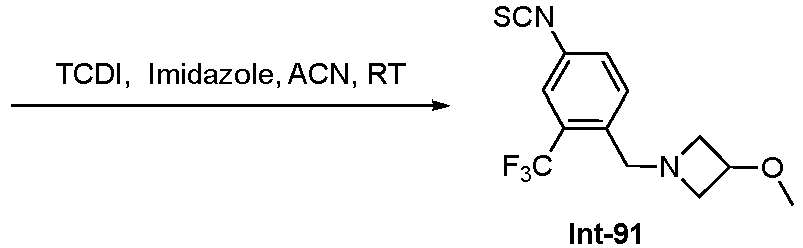
- Synthesis of compound Int-91.1. Compound Int-91.1 was prepared from 4-amino-2-(trifluoromethyl)benzoic acid and 3-methoxyazetidine hydrochloride, following the procedure described in the synthesis of Int-79.1. The product was purified by flash column chromatography on silica gel (CombiFlash®, 2.5% methanol in DCM). MS (ES): m/z 275.1 [M+H]+.
- Synthesis of compound Int-91.2. Compound Int-91.2 was prepared from Int-91.1, following the procedures described in the synthesis of Int-81.2. The product was purified by flash column chromatography on silica gel (CombiFlash®, 2.0% methanol in DCM). MS(ES): m/z 260.9 [M+H]+.
- Synthesis of compound Int-91. Compound Int-91 was prepared following the procedures described in the synthesis of Int-69. The product was purified by flash column chromatography on silica gel (CombiFlash®, 3.5% methanol in DCM). MS(ES): m/z 303.2 [M+H]+.
-

- Synthesis of compound Int-92.1. Compound Int-92.1 was prepared from 3-nitro-5-(trifluoromethyl)benzoic acid and morpholine, following the procedure described in the synthesis of Int-79.1. The product was purified by flash column chromatography on silica gel (CombiFlash®, 33% ethyl acetate in hexane). MS (ES): m/z 305.2 [M+H]+.
- Synthesis of compound Int-92.2. Compound Int-92.2 was prepared from Int-92.1, following the procedures described in the synthesis of Int-85.2. The product was used without purification. MS(ES): m/z 275.1 [M+H]+.
- Synthesis of compound Int-92.3. Compound Int-92.3 was prepared from Int-92.2, following the procedures described in the synthesis of Int-79.2. The product was purified by flash column chromatography on silica gel (CombiFlash®, 1.6% methanol in DCM). MS(ES): m/z 261.2 [M+H]+.
- Synthesis of compound Int-92. Compound Int-92 was prepared from Int-92.3 following the procedure described in the synthesis of Int-1. The product was purified by flash column chromatography on silica gel (CombiFlash®, 1.8% methanol in DCM). MS(ES): m/z 303.1 [M+H]+.
-

- Synthesis of compound Int-93.1. Compound Int-93.1 was prepared from 3-nitro-5-(trifluoromethyl)benzoic acid and 3-fluoroazetidine hydrochloride, following the procedure described in the synthesis of Int-79.1. The product was purified by flash column chromatography on silica gel (CombiFlash®, 26% ethyl acetate in hexane). MS (ES): m/z 293.1 [M+H]+.
- Synthesis of compound Int-93.2. Compound Int-93.2 was prepared from Int-93.1, following the procedures described in the synthesis of Int-85.2. The product was used without purification. MS(ES): m/z 263.2 [M+H]+.
- Synthesis of compound Int-93.3. Compound Int-93.3 was prepared from Int-93.2, following the procedures described in the synthesis of Int-79.2. The product was purified by flash column chromatography on silica gel (CombiFlash®, 1.5% methanol in DCM). MS(ES): m/z 249.2 [M+H]+.
- Synthesis of compound Int-93. Compound Int-93 was prepared from Int-93.3 following the procedure described in the synthesis of Int-69. The product was purified by flash column chromatography on silica gel (CombiFlash®, 15% ethyl acetate in hexane). MS(ES): m/z 249.2 [M+H]+.
-

- Synthesis of compound Int-94.1. Compound Int-94.1 was prepared from 3-nitro-5-(trifluoromethyl)benzoic acid and 3-methoxyazetidine hydrochloride, following the procedure described in the synthesis of Int-79.1. The product was purified by flash column chromatography on silica gel (CombiFlash®, 27% ethyl acetate in hexane). MS (ES): m/z 305.1 [M+H]+.
- Synthesis of compound Int-94.2. Compound Int-94.2 was prepared from Int-94.1, following the procedures described in the synthesis of Int-85.2. The product was used without purification. MS(ES): m/z 275.2 [M+H]+.
- Synthesis of compound Int-94.3. Compound Int-94.3 was prepared from Int-94.2, following the procedures described in the synthesis of Int-79.2. The product was purified by flash column chromatography on silica gel (CombiFlash®, 1.7% methanol in DCM). MS(ES): m/z 261.2 [M+H]+.
- Synthesis of compound Int-94. Compound Int-94 was prepared from Int-94.3 following the procedure described in the synthesis of Int-69. The product was purified by flash column chromatography on silica gel (CombiFlash®, DCM). MS(ES): m/z 303.2 [M+H]+.
-

- Synthesis of compound Int-95.1. Compound Int-95.1 was prepared from 3-nitro-5-(trifluoromethyl)benzoic acid and 3,3-difluoropyrrolidine, following the procedure described in the synthesis of Int-79.1. The product was purified by flash column chromatography on silica gel (CombiFlash®, 15% ethyl acetate in hexane). MS (ES): m/z 325.1 [M+H]+.
- Synthesis of compound Int-95.2. Compound Int-95.2 was prepared from Int-95.1, following the procedures described in the synthesis of Int-23.3. The product was used without purification. MS(ES): m/z 295.2 [M+H]+.
- Synthesis of compound Int-95.3. Compound Int-95.3 was prepared from Int-95.2, following the procedures described in the synthesis of Int-81.2. The product was purified by flash column chromatography on silica gel (CombiFlash®, 25% ethyl acetate in hexane). MS(ES): m/z 281.0 [M+H]+.
- Synthesis of compound Int-95. Compound Int-95 was prepared from Int-95.3 following the procedure described in the synthesis of Int-1. The product was purified by flash column chromatography on silica gel (CombiFlash®, 1.0% methanol in DCM). MS(ES): m/z 323.1 [M+H]+.
-


- Synthesis of compound Int-96.1. Compound Int-96.1 was prepared from 3-nitro-5-(trifluoromethyl)benzoic acid and 4-methoxypiperidine, following the procedure described in the synthesis of Int-79.1. The product was purified by flash column chromatography on silica gel (CombiFlash®, 13% ethyl acetate in hexane). MS (ES): m/z 333.0 [M+H]+.
- Synthesis of compound Int-96.2. Compound Int-96.2 was prepared from Int-96.1, following the procedures described in the synthesis of Int-23.3. The product was used without purification. MS(ES): m/z 303.1 [M+H]+.
- Synthesis of compound Int-96.3. Compound Int-96.3 was prepared from Int-96.2, following the procedures described in the synthesis of Int-81.2. The product was purified by flash column chromatography on silica gel (CombiFlash®, 23% ethyl acetate in hexane). MS(ES): m/z 289.2 [M+H]+.
- Synthesis of compound Int-96. Compound Int-96 was prepared from Int-96.3 following the procedure described in the synthesis of Int-69. The product was purified by flash column chromatography on silica gel (CombiFlash®, 10% ethyl acetate in hexane). MS(ES): m/z 331.3 [M+H]+.
-

- Synthesis of compound Int-97.1. Compound Int-97.1 was prepared from 3-nitro-5-(trifluoromethyl)benzoic acid and 2-propyl bromide, following the procedure described in the synthesis of Int-79.1. The product was purified by flash column chromatography on silica gel (CombiFlash®, 20% ethyl acetate in hexane). MS(ES): m/z 251.1 [M+H]+.
- Synthesis of compound Int-97.2. Compound Int-97.2 was prepared from Int-97.1, following the procedures described in the synthesis of Int-23.3. The product was used without purification. MS(ES): m/z 221.2 [M+H]+.
- Synthesis of compound Int-97. Compound Int-97 was prepared from Int-97.3 following the procedure described in the synthesis of Int-1. The product was purified by flash column chromatography on silica gel (CombiFlash®, 2.5% methanol in DCM). MS(ES): m/z 263.0 [M+H]+.
-
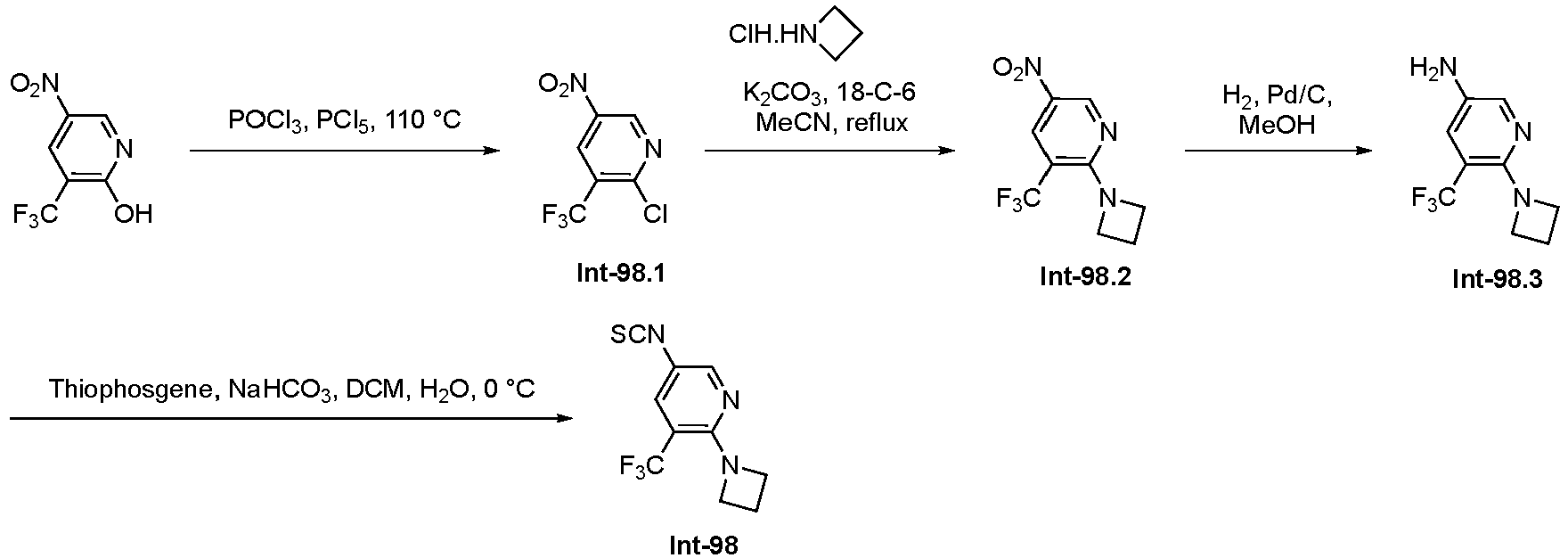
- Synthesis of compound Int-98.1. To 5-nitro-3-(trifluoromethyl)pyridin-2-ol (2.0 g, 9.61 mmol, 1.0 equiv) was added phosphorus pentachloride (2.79 g, 13.45 mmol, 1.4 equiv) followed by phosphoryl chloride (2.2 mL, 24.02 mmol, 2.5 equiv). The reaction mixture was stirred at 110 °C for 8 h. It was concentrated under reduced pressure to afford a residue which was dissolved in DCM and washed with 2 N sodium hydroxide. The combined organic layers were washed with brine, dried over anhydrous sodium sulfate, filtered and concentrated under reduced pressure to afford Int-98.1. MS (ES): m/z 227.54 [M+H]+.
- Synthesis of compound Int-98.2. A mixture of Int-98.1 (1.5 g, 6.62 mmol, 1.0 equiv), azetidine hydrochloride (0.756 g, 8.08 mmol, 1.22 equiv), potassium carbonate (3.19 g, 23.17 mmol, 3.5 equiv) and 18-crown-6 (150 mg, 10% w/w) in acetonitrile (40 mL) was heated to reflux for 8 h. It was cooled to room temperature, poured over ice-water and extracted with ethyl acetate. The combined organic layers were, dried over anhydrous sodium sulfate, filtered and concentrated under reduced pressure. The residue was purified by flash column chromatography on silica gel (CombiFlash®, 28% ethyl acetate in hexane) to afford Int-98.2. MS (ES): m/z 248.1 [M+H]+.
- Synthesis of Compound Int-98.3. Compound Int-98.3 was prepared from Int-98.2, following the procedures described in the synthesis of Int-23.3. The product was used without purification. MS(ES): m/z 218.2 [M+H]+.
- Synthesis of compound Int-98. Compound Int-98 was prepared from Int-98.3 following the procedure described in the synthesis of Int-1. The product was purified by flash column chromatography on silica gel (CombiFlash®, 2.0% methanol in DCM). MS(ES): m/z 260.1 [M+H]+.
-

- Synthesis of compound Int-99.1. Compound Int-99.1 was prepared from 3-amino-5-(trifluoromethyl)benzoic acid and (R)-3-(benzyloxy)pyrrolidine hydrochloride, following the procedure described in the synthesis of Int-79.1. The product was purified by flash column chromatography on silica gel (CombiFlash®, 30% ethyl acetate in hexane). MS (ES): m/z 365.2 [M+H]+.
- Synthesis of compound Int-99.2. Compound Int-99.2 was prepared from Int-99.1, following the procedures described in the synthesis of Int-81.2. The product was purified by flash column chromatography on silica gel (CombiFlash®, 1.5% methanol in DCM). MS(ES): m/z 351.39 [M+H]+.
- Synthesis of compound Int-99. Compound Int-99 was prepared from Int-99.2 following the procedure described in the synthesis of Int-69. The product was purified by flash column chromatography on silica gel (CombiFlash®, 15% ethyl acetate in hexane). MS(ES): m/z 393.4 [M+H]+.
-

- Synthesis of compound Int-100.1. Compound Int-100.1 was prepared from 3-amino-5-(trifluoromethyl)benzoic acid and (S)-3-(benzyloxy)pyrrolidine hydrochloride, following the procedure described in the synthesis of Int-79.1. The product was purified by flash column chromatography on silica gel (CombiFlash®, 30% ethyl acetate in hexane). MS (ES): m/z 365.1 [M+H]+.
- Synthesis of compound Int-100.2. Compound Int-100.2 was prepared from Int-100.1, following the procedures described in the synthesis of Int-81.2. The product was purified by flash column chromatography on silica gel (CombiFlash®, 1.5% methanol in DCM). MS(ES): m/z 351.39 [M+H]+.
- Synthesis of compound Int-100. Compound Int-100 was prepared from Int-100.2 following the procedure described in the synthesis of Int-69. The product was purified by flash column chromatography on silica gel (CombiFlash®, 15% ethyl acetate in hexane). MS(ES): m/z 393.5 [M+H]+.
-

- Synthesis of compound Int-101.1. To a solution of 1-fluoro-3-nitro-5-(trifluoromethyl)benzene (0.500 g, 2.39 mmol, 1.0 equiv) in DMF (10 mL) was added sodium hydride (0.143 g, 3.58 mmol, 1.5 equiv) in portions at 0 °C and stirred for 30 min followed by addition of 1-methylpiperidin-4-ol (0.33 g, 2.87 mmol, 1.2 equiv). The reaction mixture was stirred at room temperature for 1 h. It was poured over water, stirred and extracted with ethyl acetate. The combined organic layers were, dried over anhydrous sodium sulfate, filtered and concentrated under reduced pressure. The residue was purified by flash column chromatography on silica gel (CombiFlash®, 2.8% methanol in DCM) to afford Int-101.1. MS (ES): m/z 305.2 [M+H]+.
- Synthesis of compound Int-101.2. Compound Int-101.2 was prepared from Int-101.1, following the procedure described in the synthesis of 3.7. The product was purified by column using 3.5% methanol in DCM). MS(ES): m/z 275.2 [M+H]+.
- Synthesis of compound Int-101. Compound Int-101 was prepared from Int-101.2 following the procedure described in the synthesis of Int-69. The product was purified by flash column chromatography on silica gel (CombiFlash®, 25% ethyl acetate in hexane). MS(ES): m/z 317.1 [M+H]+.
-

- Synthesis of compound Int-102.1. A solution of ((2-bromoethoxy)methyl)benzene (2 g, 9.30 mmol, 1.0 equiv) and piperazine (1.2 g, 13.95 mmol, 1.5 equiv) in toluene (10 mL) was stirred at 100 °C for 2 h. It was cooled to room temperature, filtered and the filtrate was concentrated under reduced pressure. This residue was acidified with 2 M hydrochloric acid and extracted with DCM. Aqueous layer separated and basified with solid sodium hydroxide and extracted with DCM. The combined organic layers were washed with brine, dried over anhydrous sodium sulfate, filtered and concentrated under reduced pressure to afford Int-102.1. MS (ES): m/z 221.2 [M+H]+.
- Synthesis of compound Int-102.2. Compound Int-102.2 was prepared from 3-amino-5-(trifluoromethyl)benzoic acid and Int-102.1, following the procedure described in the synthesis of Int-79.1. The product was purified by flash column chromatography on silica gel (CombiFlash®, 1.6% methanol in DCM). MS (ES): m/z 408.1 [M+H]+.
- Synthesis of compound Int-102.3. Compound Int-102.3 was prepared from Int-102.2, following the procedures described in the synthesis of Int-81.2. The product was purified by flash column chromatography on silica gel (CombiFlash®, 1.8% methanol in DCM). MS(ES): m/z 394.2 [M+H]+.
- Synthesis of compound Int-102. Compound Int-102 was prepared from Int-102.3 following the procedure described in the synthesis of Int-69. The product was purified by flash column chromatography on silica gel (CombiFlash®, DCM). MS(ES): m/z 436.4 [M+H]+.
-

- Synthesis of compound Int-103.1. To a solution of 2,2-difluoroethan-1-ol (0.500 g, 6.09 mmol, 1.0 equiv) in DCM (10 mL) was added trifluoromethanesulfonic anhydride (1.53 mL, 9.14 mmol, 1.5 equiv) and triethylamine (1.7 mL, 12.18 mmol, 2.0 equiv) and stirred at 0 °C for 30 min. To the solution was added tert-butyl piperazine-1-carboxylate (0.908 g, 4.88 mmol, 0.8 equiv). It was stirred at room temperature for 9 h, poured over water, stirred and extracted with ethyl acetate. The combined organic layers were washed with saturated sodium bicarbonate followed by brine, dried over anhydrous sodium sulfate, filtered and concentrated under reduced pressure. The residue was purified by flash column chromatography on silica gel (CombiFlash®, 5% ethyl in hexane) to afford Int-103.1. MS (ES): m/z 251.1 [M+H]+.
- Synthesis of compound Int-103.2. To a solution of Int-103.1 (0.410 g, 1.64 mmol, 1.0 equiv) in 1,4-dioxane (10 mL) was added hydrogen chloride in dioxane (3 mL) stirred at room temperature for 3 h. It was concentrated under reduced pressure. The residue was purified by trituration in diethyl ether to afford Int-103.2. MS (ES): m/z 151.2 [M-HCl]+.
- Synthesis of compound Int-103.3. Compound Int-103.3 was prepared from 3-amino-5-(trifluoromethyl)benzoic acid and Int-103.2, following the procedure described in the synthesis of Int-79.1. The product was purified by flash column chromatography on silica gel (CombiFlash®, 5.1% methanol in DCM). MS (ES): m/z 338.1 [M+H]+.
- Synthesis of compound Int-103.4. Compound Int-103.4 was prepared from Int-103.3, following the procedures described in the synthesis of Int-81.2. The product was purified by flash column chromatography on silica gel (CombiFlash®, 3.1% methanol in DCM). MS(ES): m/z 324.1 [M+H]+.
- Synthesis of compound Int-103. Compound Int-103 was prepared from Int-103.4 following the procedure described in the synthesis of Int-69. The product was purified by flash column chromatography on silica gel (CombiFlash®, 1.2% methanol in DCM). MS(ES): m/z 366.3 [M+H]+.
-

- Synthesis of compound Int-104.1. Compound Int-104.1 was prepared from 1-fluoro-3-nitro-5-(trifluoromethyl)benzene and tert-butyl (R)-3-hydroxypyrrolidine-1-carboxylate, following the procedures described in the synthesis of Int-101.1. The product was purified by flash column chromatography on silica gel (CombiFlash®, 16% ethyl acetate in hexane). MS(ES): m/z 377.3 [M+H]+.
- Synthesis of compound Int-104.2. Compound Int-104.2 was prepared from Int-104.1, following the procedures described in the synthesis of Int-23.3. The product was used without purification. MS(ES): m/z 347.1 [M+H]+.
- Synthesis of compound Int-104. Compound Int-104 was prepared from Int-104.2 following the procedure described in the synthesis of Int-69. The product was purified by flash column chromatography on silica gel (CombiFlash®, 2.7% ethyl methanol in DCM). MS(ES): m/z 389.2 [M+H]+.
-

- Synthesis of compound Int-105.1. Compound Int-105.1 was prepared from 1-fluoro-3-nitro-5-(trifluoromethyl)benzene and tert-butyl (S)-3-hydroxypyrrolidine-1-carboxylate, following the procedures described in the synthesis of Int-101.1. The product was purified by flash column chromatography on silica gel (CombiFlash®, 16% ethyl acetate in hexane) to afford Int-105.1, MS(ES): m/z 377.3 [M+H]+.
- Synthesis of compound Int-105.2. Compound Int-105.2 was prepared from Int-105.1, following the procedures described in the synthesis of Int-23.3. The product was used without purification. MS(ES): m/z 347.1 [M+H]+.
- Synthesis of compound Int-105. Compound Int-105 was prepared from Int-105.2 following the procedure described in the synthesis of Int-69. The product was purified by flash column chromatography on silica gel (CombiFlash®, 2.7% ethyl methanol in DCM). MS(ES): m/z 389.2 [M+H]+.
-

- Synthesis of compound Int-106.1. To a solution of 5-fluoro-2-(trifluoromethyl)benzoic acid (3 g, 14.42 mmol, 1.0 equiv) in THF (150 mL) was added borane-THF complex (1 M in THF, 72.1 mL, 72.1 mmol, 5.0 equiv) at 0 °C. The reaction mixture was stirred at room temperature for 16 h. It was poured over ice-water and extracted with ethyl acetate. The combined organic layers were washed with brine, dried over anhydrous sodium sulfate, filtered and concentrated under reduced pressure. The residue was purified by flash column chromatography on silica gel (CombiFlash®, 4% ethyl in hexane) to afford Int-106.1 MS(ES): m/z 195.1 [M+H]+.
- Synthesis of compound Int-106.2. To a solution of Int-106.1 (1.2 g, 6.18 mmol, 1.0 equiv) and triethylamine (2.58 mL, 18.54 mmol, 3.0 equiv) in DCM (15 mL) was added methane sulfonyl chloride (0.71 mL, 9.27 mmol, 1.5 equiv) at 0 °C. The reaction mixture was stirred at room temperature for 3 h. It was poured over ice-water, stirred and extracted with DCM. The combined organic layers were washed with brine, dried over anhydrous sodium sulfate, filtered and concentrated under reduced pressure to afford Int-106.2. MS (ES): m/z 273.2 [M+H]+.
- Synthesis of compound Int-106.3. To a solution of Int-106.2 (1.3 g, 4.78 mmol, 1.0 equiv) and triethylamine (1.7 mL, 11.95 mmol, 2.5 equiv) in THF (20 mL) was added N,N dimethylamine (2 M in THF, 4.78 mL, 9.56 mmol, 2.0 equiv). The reaction mixture was stirred at 60 °C for 4 h. It was poured over ice cold water, stirred and extracted with ethyl acetate. The combined organic layers were washed with brine, dried over anhydrous sodium sulfate, filtered and concentrated under reduced pressure. The residue was purified by flash column chromatography on silica gel (CombiFlash®, 20% ethyl in hexane) to afford Int-106.3. MS (ES): m/z 221.9 [M+H]+.
- Synthesis of compound Int-106.4. To a solution of Int-106.3 (0.700 g, 3.16 mmol, 1.0 equiv) in sulfuric acid (7 mL) was added potassium nitrate (0.478 g, 4.74 mmol, 1.5 equiv) in portions at 0 °C. The reaction mixture was stirred at room temperature for 16 h. It was poured over ice-water and neutralized with sodium bicarbonate and extracted with ethyl acetate. The combined organic layers were washed with brine, dried over anhydrous sodium sulfate, filtered and concentrated under reduced pressure. The residue was purified by flash column chromatography on silica gel (CombiFlash®, 10% ethyl in hexane) to afford Int-106.4. MS(ES): m/z 267.1 [M+H]+.
- Synthesis of compound Int-106.5. To a solution of Int-106.4 (0.400 g, 1.50 mmol, 1.0 equiv) in methanol (15 mL) was added zinc powder (0.975 g, 15.0 mmol, 10.0 equiv) and ammonium chloride (0.810 g, 1.50 mmol, 10.0 equiv). The reaction mixture was stirred at room temperature for 16 h. It was filtered through a pad of Celite® and rinsed with methanol. The filtrate was concentrated under reduced pressure. The residue was purified by flash column chromatography on silica gel (CombiFlash®, 20% ethyl in hexane) to afford Int-106.5. MS(ES): m/z 237 [M+H]+.
- Synthesis of compound Int-106. Compound Int-106 was prepared from Int-106.5 following the procedure described in the synthesis of Int-69. The product was purified by flash column chromatography on silica gel (CombiFlash®, 5% ethyl in hexane). MS(ES): m/z 279.1 [M+H]+.
-

- Synthesis of compound Int-107.1. To a solution of 1-methyl-4-nitro-2-(trifluoromethyl)benzene (2.0 g, 9.75 mmol, 1.0 equiv) in 1,2-dichloroethane (30 mL) was added N-bromosuccinimide (1.73 g, 9.75 mmol, 1.0 equiv) followed by azobisisobutyronitrile (0.159 g, 0.975 mmol, 0.1 equiv). The reaction mixture was stirred at 80 °C for 5 h. It was poured over ice cold water and extracted with ethyl acetate. The combined organic layers were washed with brine, dried over anhydrous sodium sulfate, filtered and concentrated under reduced pressure. The residue was purified by flash column chromatography on silica gel (CombiFlash®, 1.0% ethyl acetate in hexane) to afford Int-107.1. MS(ES): m/z 284.9 [M+H]+.
- Synthesis of compound Int-107.2. To a solution of Int-107.2 (1.5 g, 5.28 mmol, 1.0 equiv) and azetidine-3-carbonitrile hydrochloride (0.751 g, 6.34 mmol, 1.2 equiv) in acetonitrile (30 mL) was added potassium carbonate (2.18 g, 15.84 mmol, 3.0 equiv) and stirred at room temperature for 4 h. It was poured over ice cold water and extracted with ethyl acetate. The combined organic layers were washed with brine, dried over anhydrous sodium sulfate, filtered and concentrated under reduced pressure. The residue was purified by flash column chromatography on silica gel (CombiFlash®, 12% ethyl acetate in hexane) to afford Int-107.2. MS (ES): m/z 286.1 [M+H]+.
- Synthesis of compound Int-107.3. Compound Int-107.3 was prepared from Int-107.2, following the procedure described in the synthesis of 3.7. The product was used in the next step without purification. MS(ES): m/z 256.2 [M+H]+.
- Synthesis of compound Int-107. Compound Int-107 was prepared from Int-107.3 following the procedure described in the synthesis of Int-69. The product was purified by flash column chromatography on silica gel (CombiFlash®, 20% ethyl acetate in hexane). MS(ES): m/z 298 [M+H]+.
-

- Synthesis of compound Int-108.1. A mixture of compound 3-nitro-5-(trifluoromethyl)pyridin-2(1H)-one (0.300 g, 1.44 mmol, 1.0 equiv) and potassium carbonate (0.596 g, 4.32 mmol, 3.0 equiv) in DMF (6 mL) was added deuterated iodomethane (0.271 g, 1.87 mmol, 1.3 equiv). The reaction mixture was stirred at room temperature for 3 h. The reaction mixture was poured over water and extracted with ethyl acetate. The combined organic layers were washed with brine, dried over anhydrous sodium sulfate, filtered and concentrated under reduced pressure. The residue was purified by flash column chromatography on silica gel (CombiFlash®, 1.0% methanol in DCM) to afford Int-108.1. MS (ES): m/z 226.1 [M+H]+.
- Synthesis of compound Int-108.2. To a solution of Int-108.1 (0.160 g, 0.710 mmol, 1.0 equiv) in 2-propanol:water (2:1) (3 mL) was added iron powder (0.199 g, 3.55 mmol, 5.0 equiv) followed by acetic acid (0.213 g, 3.55 mmol, 5.0 equiv). The reaction mixture was heated at 100 °C for 2 h. It was filtered through a pad of Celite® and the filtrate was concentrated under reduced pressure. The residue was purified by column using 5% Methanol in DCM) to afford Int-108.2. MS(ES): m/z 196.1 [M+H]+.
- Synthesis of compound Int-108. Compound Int-108 was prepared from Int-108.2 following the procedure described in the synthesis of Int-1. The product was purified by flash column chromatography on silica gel (CombiFlash®, 20% ethyl acetate in hexane). MS(ES): m/z 237.8 [M+H]+.
-

- Synthesis of compound Int-109.1. A mixture of 1-fluoro-3-nitro-5-(trifluoromethyl)benzene (0.600 g, 2.87 mmol, 1.0 equiv) and potassium carbonate (1.18 g, 8.60 mmol, 3.0 equiv) in DMF (5 mL) was stirred at 0 °C for 30 min and was added tert-butyl 3-hydroxyazetidine-1-carboxylate (0.595 g, 3.44 mmol, 1.2 equiv). The reaction mixture was stirred at 100 °C for 16 h. It was poured over water, stirred and extracted with ethyl acetate. The combined organic layers were washed with brine, dried over anhydrous sodium sulfate, filtered and concentrated under reduced pressure. The residue was purified by flash column chromatography on silica gel (CombiFlash®, 7% ethyl acetate in hexane) to afford Int-109.1. MS (ES): m/z 363.3 [M+H]+.
- Synthesis of compound Int-109.2. Compound Int-109.2 was prepared from Int-109.1, following the procedure described in the synthesis of 3.7. The product was purified by column using 15% ethyl acetate in hexane). MS(ES): m/z 333.1 [M+H]+.
- Synthesis of compound Int-109. Compound Int-109 was prepared from Int-109.2 following the procedure described in the synthesis of Int-69. The product was purified by flash column chromatography on silica gel (CombiFlash®, 10% ethyl acetate in hexane). MS(ES): m/z 375.2 [M+H]+.
-

- Synthesis of compound Int-110.1. To a mixture of 3-nitro-5-(trifluoromethyl)pyridin-2(1H)-one (1.0 g, 4.81 mmol, 1.0 equiv) and potassium carbonate (1.33 g, 9.62 mmol, 2.0 equiv) in DMF (10 mL) was added benzyl bromide (1.23 g, 7.21 mmol, 1.5 equiv) and was stirred at room temperature for 16 h. It was poured over ice-water and extracted with ethyl acetate. The combined organic layers were washed with brine, dried over anhydrous sodium sulfate, filtered and concentrated under reduced pressure. The residue was purified by flash column chromatography on silica gel (CombiFlash®, 20% ethyl acetate in hexane) to afford Int-110.1. MS(ES): m/z 299.1 [M+H]+.
- Synthesis of compound Int-110.2. To a mixtuer of Int-110.1 (0.800 g, 2.68 mmol 1.0 equiv), iron powder (0.750g, 13.4 mmol, 5.0 equiv) and acetic acid (0.804 g, 13.4 mmol, 5.0 equiv) in 2-propanol (10 mL) was stirred at 80 °C for 2 h. It was filtered through a pad of Celite®, transferred into ice-cold saturated sodium bicarbonate solution and extracted with ethyl acetate. The combined organic layers were washed with brine, dried over anhydrous sodium sulfate, filtered and concentrated under reduced pressure. The residue was purified by flash column chromatography on silica gel (CombiFlash®, 25% ethyl acetate in hexane) to afford Int-110.2. MS(ES): m/z 269.2 [M+H]+.
- Synthesis of compound Int-110. Compound Int-110 was prepared from Int-110.2 following the procedure described in the synthesis of Int-1. The product was purified by flash column chromatography on silica gel (CombiFlash®, 1.0% methanol in DCM). MS(ES): m/z 311.1 [M+H]+.
-

- Synthesis of compound Int-111.1. To a solution of 2-fluoro-3-(trifluoromethyl)benzoic acid (1.0 g, 4.81 mmol, 1.0 equiv) in conc. sulfuric acid (5 mL) was added fuming nitric acid (1 mL) at 0 °C. The reaction mixture was stirred at 55 °C for 2 h. It was poured over crushed ice, stirred and extracted with ethyl acetate. The combined organic layers were washed with brine, dried over anhydrous sodium sulfate, filtered and concentrated under reduced pressure. The residue was purified by flash column chromatography on silica gel (CombiFlash®, 2.5% methanol in DCM) to afford Int-111.1. MS(ES): m/z 254.1 [M+H]+.
- Synthesis of compound Int-111.2. A mixture of Int-111.1 (0.900 g, 3.56 mmol, 1.0 equiv) and 10% palladium on carbon (0.450 g) in ethyl acetate (20 mL) was stirred under hydrogen (1 atm) for 2 h. The reaction mixture was filtered through a pad of Celite® and rinsed with methanol. The filtrate was concentrated under reduced pressure to afford Int-111.2. MS(ES): m/z 224 [M+H]+.
- Synthesis of compound Int-111.3. To a solution of Int-111.2 (0.600 g, 2.69 mmol, 1.0 equiv) in THF (10 mL) was added dimethylamine (2 M in THF, 1.6 mL, 3.22 mmol, 1.2 equiv) followed by 1-[bis(dimethylamino)methylene]-1H-1,2,3-triazolo[4,5-b]pyridinium-3-oxide (1.53 g, 4.03 mmol, 1.5 equiv) and reaction mixture stirred at room temperature for 30 min. To this N,N-diisopropylethylamine (1.04 g, 8.07 mmol, 3.0 equiv) was added, The reaction mixture was stirred at 80 °C for 3 h. It was poured over ice-water and extracted with ethyl acetate. The combined organic layers were washed with brine, dried over anhydrous sodium sulfate, filtered and concentrated under reduced pressure. The residue was purified flash column chromatography on silica gel (CombiFlash®, 30% ethyl acetate in hexane) to afford Int-111.3. MS(ES): m/z 251.20 [M+H]+.
- Synthesis of compound Int-111. Compound Int-111 was prepared from Int-111.3 following the procedure described in the synthesis of Int-69. The product was purified by flash column chromatography on silica gel (CombiFlash®, DCM). MS(ES): m/z 293.2 [M+H]+.
-

- Synthesis of compound Int-112.1. Compound Int-112.1 was prepared from 1-fluoro-3-nitro-5-(trifluoromethyl)benzene and (S)-1-methylpyrrolidin-3-ol, following the procedures described in the synthesis of Int-101.1. The product was purified by flash column chromatography on silica gel (CombiFlash®, 3.0% methanol in DCM). MS(ES): m/z 291.2 [M+H]+.
- Synthesis of compound Int-112.2. Compound Int-105.2 was prepared from Int-105.1, following the procedures described in the synthesis of Int-23.3. The product was used without purification. MS(ES): m/z 261.1 [M+H]+.
- Synthesis of compound Int-112. Compound Int-112 was prepared from Int-112.2 following the procedure described in the synthesis of Int-69. The product was purified by flash column chromatography on silica gel (CombiFlash®, 2.0% methanol in DCM). MS(ES): m/z 303.2 [M+H]+.
-

- Synthesis of compound Int-113. Compound Int-113 was prepared following the procedures described in the synthesis of Int-112. The final product was purified by flash column chromatography on silica gel (CombiFlash®, 2.0% methanol in DCM). MS(ES): m/z 303.2 [M+H]+.
-

- Synthesis of compound Int-114.1 A mixture of 5-bromo-4,6-dimethylpyrimidin-2-amine (0.5 g, 2.47 mmol, 1.0 equiv) in 1,4-dioxane (5 mL), cyclopropylboronic acid (0.619 g, 7.4 mmol, 3 equiv) and cesium carbonate (2.41 g, 7.4 mmol, 3.0 equiv) was degassed by bubbling argon through for 10 min. 1,1-Bis(diphenylphosphino)ferrocene-palladium(II) dichloride DCM complex (0.060 g, 0.074 mmol, 0.03 equiv) was added, again degassed for 5 min. The reaction mixture was stirred at 100 °C for 1 h. It was poured over water and extracted with ethyl acetate. The combined organic layers were washed with brine, dried over anhydrous sodium sulfate, filtered and concentrated under reduced pressure. This residue was purified by flash column chromatography on silica gel (CombiFlash®, 2.5% methanol in DCM) to afford Int-114.1. MS(ES): m/z 164.2 [M+H]+.
- Synthesis of compound Int-114. Compound Int-114 was prepared from Int-114.1 following the procedure described in the synthesis of Int-1. The product was purified by flash column chromatography on silica gel (CombiFlash®, 20% ethyl acetate in hexane). MS(ES): m/z 206.28 [M+H]+.
-


- Synthesis of compound Int-115.1. To solution of ethyl 3-amino-1H-pyrazole-5-carboxylate (10 g, 64.45 mmol, 1.0 equiv) in acetonitrile (200 mL) was added 1-chloromethyl-4-fluoro-1,4-diazoniabicyclo[2.2.2]octane-bis(tetrafluoroborate) (10 g, 28.22 mmol, 0.4 equiv) and stirred at room temperature for 16 h. It was poured over water and extracted with ethyl acetate. The combined organic layers were washed with brine, dried over anhydrous sodium sulfate, filtered and concentrated under reduced pressure to afford crude. This was purified by flash column chromatography on silica gel (CombiFlash®, 25% ethyl acetate in hexane) to afford Int-115.1. MS(ES): m/z 174.1 [M+H]+.
- Synthesis of compound Int-115.2. To a solution of Int-115.1 (3.8 g, 21.95 mmol, 1.0 equiv) in toluene (100 mL) was added 2,5-hexanedione (2.51 g, 21.95 mmol, 1.0 equiv) and acetic acid (catalytic). The reaction mixture was refluxed with a Dean-Stark trap to remove water for 72 h. It cooled to rt, poured over water and extracted with ethyl acetate. The combined organic layers were washed with brine, dried over anhydrous sodium sulfate, filtered and concentrated under reduced pressure. The residue was purified by flash column chromatography on silica gel (CombiFlash®, 12% ethyl acetate in hexane) to afford Int-115.2. MS(ES): m/z 252.2 [M+H]+.
- Synthesis of compound Int-115.3. A mixture of Int-115.2 (1.9 g, 7.56 mmol, 1.0 equiv), 3-bromo-2-methylprop-1-ene (1.02 g, 7.56 mmol, 1.0 equiv) and cesium carbonate (4.91 g, 15.12 mmol, 2.0 equiv) in DMF (20 mL) was stirred at 70 °C for 5 h. The reaction mixture was poured over ice-water and extracted with ethyl acetate. The combined organic layers were washed with brine, dried over anhydrous sodium sulfate, filtered and concentrated under reduced pressure to afford crude. This was purified by flash column chromatography on silica gel (CombiFlash®, 15% ethyl acetate in hexane) to afford Int-115.3. MS(ES): m/z 306.1 [M+H]+.
- Synthesis of compound Int-115.4. To a solution of Int-115.3 (0.5 g, 1.64 mmol, 1.0 equiv) in THF (5 mL) was added lithium aluminum hydride (1 M in THF, 2.5 mL, 2.46 mmol, 1.5 equiv) dropwise at 0 °C and stirred for 4 h. It was poured over ice-water and extracted with ethyl acetate. The combined organic layers were washed with brine, dried over anhydrous sodium sulfate, filtered and concentrated under reduced pressure to afford crude. This was purified by flash column chromatography on silica gel (CombiFlash®, 26% ethyl acetate in hexane) to afford Int-115.4. MS(ES): m/z 263.2 [M+H]+.
- Synthesis of compound Int-115.5. To a solution of Int-115.4 (0.200 g, 0.759 mmol, 1.0 equiv) in DCM (10 mL) was added triflic acid (2.0 mL) and stirred at room temperature for 30 min. It was poured over saturated sodium bicarbonate solution and extracted with ethyl acetate. The combined organic layers were washed with brine, dried over anhydrous sodium sulfate, filtered and concentrated under reduced pressure to afford Int-115.5. MS(ES): m/z 264.3 [M+H]+.
- Synthesis of compound Int-115.6. To a solution of Int-115.5 (0.149 g, 0.565 mmol, 1.0 equiv) in ethanol:water (2:1) (8 mL) was added hydroxylamine hydrochloride (1.95 g, 28.25 mmol, 50 equiv) and the reaction mixture was stirred at 120 °C for 3-4 h. It was cooled to room temperature, transferred into 2 N aqueous sodium hydroxide solution and extracted with ethyl acetate. The combined organic layers were washed with brine, dried over anhydrous sodium sulfate, filtered and concentrated under reduced pressure. The residue was purified by flash column chromatography on silica gel (CombiFlash®, 50% ethyl acetate in hexane) to afford Int-115.6. MS (ES): m/z 186.0 [M+H]+.
- Synthesis of compound Int-115. Compound Int-115 was prepared from Int-115.6 following the procedure described in the synthesis of Int-1. The product was purified by flash column chromatography on silica gel (CombiFlash®, 45% ethyl acetate in hexane). MS(ES): m/z 228.1 [M+H]+.
-


- Synthesis of compound Int-116.1. To a mixture of 3-nitro-5-(trifluoromethyl)pyridin-2(1H)-one (5 g, 24.3 mmol, 1.0 equiv) and quinoline (2.0 g, 15.55 mmol, 0.64 equiv) was added phosphorus oxychloride (15 mL) dropwise. The reaction mixture was stirred at 120 °C for 2 h. The reaction mixture cooled to room temperature and diluted with ethyl acetate followed by addition of dilute hydrochloric acid (2 N). The combined organic layers were washed with saturated sodium bicarbonate solution followed by brine, dried over anhydrous sodium sulfate, filtered and concentrated under reduced pressure. The residue was purified by flash column chromatography on silica gel (CombiFlash®, 5% ethyl acetate in hexane) to afford Int-116.1, MS (ES): m/z 227.4 [M+H]+.
- Synthesis of compound Int-116.2. To a solution of Int-116.1 (4.0 g, 17.66 mmol, 1.0 equiv) in methanol (20 mL) was added sodium methoxide (25% in methanol, 4.2 mL, 19.42 mmol, 1.1 equiv) drop wise at -40 °C. The reaction mixture was stirred at same temperature for 20 min. It was poured over ice cold 1 N hydrochloric acid and extracted with ethyl acetate. The combined organic layers were washed with brine, dried over anhydrous sodium sulfate, filtered and concentrated under reduced pressure to afford Int-116.1, MS(ES): m/z 223.1 [M+H]+.
- Synthesis of compound Int-116.3. A mixture of compound Int-116.2 (3.6 g, 16.21 mmol, 1.0 equiv) and 20% palladium hydroxide (1.30 g) in methanol (20 mL) was stirred under hydrogen for 3 h. The reaction mixture was filtered through a pad of Celite® and rinsed with methanol. The filtrate was concentrated under reduced pressure to afford Int-116.3. MS(ES): m/z 192.9 [M+H]+.
- Synthesis of compound Int-116.4. To a solution of Int-116.3 (2.9 g, 15.09 mmol, 1.0 equiv) in DMF (48 mL) was added N-bromosuccinimide (2.68 g, 15.09 mmol, 1.0 equiv) at -40 °C and stirred for 1.5 h. It was poured over ice-water and extracted with ethyl acetate. The combined organic layers were washed with brine, dried over anhydrous sodium sulfate, filtered and concentrated under reduced pressure. The residue was purified by flash column chromatography on silica gel (CombiFlash®, 10% ethyl acetate in hexane) to afford Int-116.4. MS(ES): m/z 271.8 [M+H]+.
- Synthesis of compound Int-116.5. A mixture of Int-116.4 (1.8 g, 6.64 mmol, 1.0 equiv), zinc cyanide (0.388 g, 3.32 mmol, 0.5 equiv) and zinc powder (0.043 g, 0.66 mmol, 0.1 equiv) in DMF (15 mL) was degassed by bubbling argon through for 10 min. Under argon atmosphere 4,5-bis(diphenylphosphino)-9,9-dimethylxanthene (1.15 g, 1.99 mmol, 0.3 equiv) and tris(dibenzylideneacetone)dipalladium(O) (1.82 g, 1.99 mmol, 0.3 equiv) were added and degassed for 5 min. The reaction mixture was stirred at 120 °C for 5 h. It was cooled to room temperature, transferred into water and extracted with ethyl acetate. The combined organic layers were washed with brine, dried over anhydrous sodium sulfate, filtered and concentrated under reduced pressure. The residue was purified by flash column chromatography on silica gel (CombiFlash®, 23% ethyl acetate in hexane) to afford Int-116.5. MS(ES): m/z 218.1 [M+H]+.
- Synthesis of compound Int-116.6. To a solution of Int-116.5 (0.270 g, 1.24 mmol, 1.0 equiv) in DCM (10 mL) was added boron tribromide (1 M in dichloromethane, 3.7 mL, 3.72 mmol, 3.0 equiv) slowly at 0 °C and stirred at room temperature for 16 h. It was poured over ice-cold saturated solution of sodium bicarbonate and extracted with DCM. The combined organic layers were washed with brine, dried over anhydrous sodium sulfate, filtered and concentrated under reduced pressure. The residue was purified by flash column chromatography on silica gel (CombiFlash®, 3.5% methanol in DCM) to afford Int-116.6. MS(ES): m/z 203.9 [M+H]+.
- Synthesis of compound Int-116.7. To a solution of Int-116.6 (0.2 g, 0.984 mmol, 1.0 equiv) in DMF (5 mL) was added potassium carbonate (0.176 g, 1.28 mmol, 1.3 equiv) and stirred for 30 min. To the mixture was added methyl iodide (0.153 g, 1.082 mmol, 1.1 equiv). It was stirred at room temperature for 3 h, poured over ice-water and stirred. The precipitated solids were collected by filtration and further purified by flash column chromatography on silica gel (CombiFlash®, 23% ethyl acetate in hexane) to afford Int-116.7. MS(ES): m/z 218.2 [M+H]+.
- Synthesis of compound Int-116. Compound Int-116 was prepared from Int-116.7 following the procedure described in the synthesis of Int-1. The product was purified by flash column chromatography on silica gel (CombiFlash®,25% ethyl acetate in hexane). MS(ES): m/z 260.1 [M+H]+.
-

- Synthesis of compound Int-117.1. To a solution of 2-oxaspiro[3.3]heptan-6-one (0.600 g, 5.35 mmol, 1.0 equiv) in methanol (10 mL) was added sodium borohydride (0.203 g, 5.35 mmol, 1.0 equiv) in small portions at 0 °C. The reaction mixture was stirred at 0 °C for 2 h. It was poured over ice-water, stirred and extracted with ethyl acetate. The combined organic layers were washed with brine, dried over anhydrous sodium sulfate, filtered and concentrated under reduced pressure to obtain Int-117.1. MS (ES): m/z 115.2 [M+H]+.
- Synthesis of compound Int-117.2. To a solution of Int-117.1 (0.540 g, 4.73 mmol, 1.0 equiv) and triethylamine (1.64 mL, 11.82 mmol, 2.5 equiv) in dichloromethane (10 mL) was added methanesulfonyl chloride (0.71 mL, 9.46 mmol, 2.0 equiv) at 0 °C. The reaction mixture was stirred at room temperature for 12 h. It was poured over ice-water, stirred and extracted with dichloromethane. The combined organic layers were washed with brine, dried over anhydrous sodium sulfate, filtered and concentrated under reduced pressure. The residue was purified by flash column chromatography on silica gel (CombiFlash®, 40% ethyl acetate in hexane as eluant) to afford Int-117.2. MS (ES): m/z 193.2 [M+H]+.
- Synthesis of compound Int-117.3. To a solution of Int-117.2 (0.4 g, 2.08 mmol, 1.0 equiv) and 5-(trifluoromethyl)-1H-pyrazol-3-amine (0.314 g, 2.08 mmol, 1.0 equiv) in DMF (7 mL) was added cesium carbonate (1.352 g, 4.16 mmol, 2.0 equiv), and the reaction mixture was stirred at 80 °C for 5 h. It was poured over ice-water, stirred and extracted with ethyl acetate. The combined organic layers were washed with brine, dried over anhydrous sodium sulfate, filtered and concentrated under reduced pressure. The residue was purified by preparative HPLC to obtain Int-117.3. MS (ES): m/z 248.2 [M+H]+.
- Synthesis of compound Int-117. Compound Int-117 was prepared from Int-117.3 following the procedure described in the synthesis of Int-1. The crude product was used in the next step without further purification. MS (ES): m/z 290.2 [M+H]+.
-

- Synthesis of compound Int-118.1. Compound Int-118.1 was prepared from 1-fluoro-3-nitro-5-(trifluoromethyl)benzene and 4-(benzyloxy)piperidine, following the procedures described in the synthesis of Int-101.1. The product purified by flash column chromatography on silica gel (CombiFlash®, 15% ethyl acetate in hexane). MS(ES): m/z 381.1 [M+H]+.
- Synthesis of compound Int-118.2. Compound Int-118.2 was prepared from Int-118.1, following the procedure described in the synthesis of 3.7. The product was purified by flash column chromatography on silica gel (CombiFlash®, 25% ethyl acetate in hexane). MS(ES): m/z 351.3 [M+H]+.
- Synthesis of compound Int-118. Compound Int-118 was prepared from Int-118.2 following the procedure described in the synthesis of Int-69. The product was purified by flash column chromatography on silica gel (CombiFlash®, 25% ethyl acetate in hexane). MS(ES): m/z 393.4 [M+H]+.
-

- Synthesis of compound Int-119.1. A mixture of 3-bromo-5-(trifluoromethyl)aniline (0.9 g, 3.75 mmol, 1.0 equiv), (R)-3-(benzyloxy)pyrrolidine hydrochloride (1.2 g, 5.62 mmol, 1.5 equiv) and cesium carbonate (4.89 g, 15.0 mmol, 4.0 equiv) in DMF (9 mL) was degassed by bubbling argon through for 10 min. Under argon atmosphere copper iodide (0.213 g, 1.125 mmol, 0.3 equiv) and 8-hydroxyquinoline (0.163 g, 1.125 mmol, 0.3 equiv) was then added, again degassed for 5 min. The reaction mixture was stirred at 120 °C for 16 h. The reaction mixture was poured over ice-water and extracted with ethyl acetate. The combined organic layers were washed with brine, dried over anhydrous sodium sulfate, filtered and concentrated under reduced pressure. The residue was purified by flash column chromatography on silica gel (CombiFlash®, 20% ethyl acetate in hexane) to afford Int-119.1. MS (ES): m/z 337.3 [M+H]+.
- Synthesis of compound Int-119. Compound Int-119 was prepared from Int-119.1 following the procedure described in the synthesis of Int-69. The product was purified by flash column chromatography on silica gel (CombiFlash®, 30% ethyl acetate in hexane). MS(ES): m/z 379.2 [M+H]+.
-

- Synthesis of compound Int-120. Compound Int-120 was prepared following the procedures described in the synthesis of Int-119. The product was purified by flash column chromatography on silica gel (CombiFlash®, 30% ethyl acetate in hexane). MS(ES): m/z 379.2 [M+H]+.
-


- Synthesis of compound Int-121.1. Compound Int-121.1 was prepared from 1-fluoro-3-nitro-5-(trifluoromethyl)benzene and tert-butyl (S)-2-(hydroxymethyl)pyrrolidine-1-carboxylate, following the procedures described in the synthesis of Int-101.1. The product was purified by flash column chromatography on silica gel (CombiFlash®, 15-17% ethyl acetate in hexane). MS(ES): m/z 391.0 [M+H]+.
- Synthesis of compound Int-121.2. Compound Int-121.2 was prepared from Int-121.1, following the procedures described in the synthesis of Int-23.3. The product was purified by flash column chromatography on silica gel (CombiFlash®, 20-23% ethyl acetate in hexane). MS(ES): m/z 361.2 [M+H]+.
- Synthesis of compound Int-121.3. Compound Int-121.3 was prepared from Int-121.2, following the procedures described in the synthesis of Int-81.2. The product was purified by flash column chromatography on silica gel (CombiFlash®, 60-65% ethyl acetate in hexane). MS(ES): m/z 275.1 [M+H]+.
- Synthesis of compound Int-121. Compound Int-121 was prepared from Int-121.3 following the procedure described in the synthesis of Int-69. The product was purified by flash column chromatography on silica gel (CombiFlash®, 1.5% methanol in DCM). MS(ES): m/z 317.2 [M+H]+.
-

- Synthesis of compound Int-122. Compound Int-122 was prepared following the procedures described in the synthesis of Int-121. The product was purified by flash column chromatography on silica gel (CombiFlash®, 1.5% methanol in DCM). MS(ES): m/z 317.2 [M+H]+.
-

- Synthesis of compound Int-123.1. A mixture of 5-bromo-4,6-dimethylpyrimidin-2-amine (0.500 g, 2.47 mmol, 1.0 equiv), 2-(cyclopent-1-en-1-yl)-4,4,5,5-tetramethyl-1,3,2-dioxaborolane (1.44 g, 7.42 mmol, 3.0 equiv) and cesium carbonate (2.41 g, 7.42 mmol, 3.0 equiv) in 1,4-dioxane (5 mL) was degassed by bubbling argon through for 10 min. To the mixture was added 1,1-bis(diphenylphosphino)ferrocene-palladium(II) dichloride DCM complex (0.060 g, 0.074 mmol, 0.03 equiv) and degassed for another 5 min. The reaction mixture was stirred at 100 °C for 1 h. It was poured over water and extracted with ethyl acetate. The combined organic layers were washed with brine, dried over anhydrous sodium sulfate, filtered and concentrated under reduced pressure. The residue was purified by flash column chromatography on silica gel (CombiFlash®, 2% methanol in DCM) to afford Int-123.1. MS(ES): m/z 190.3 [M+H]+.
- Synthesis of compound Int-123.2. A mixture of Int-123.1 (0.350 g, 1.85 mmol, 1.0 equiv) and 10% palladium on charcoal (0.200 g) in methanol in an autoclave was stirred under hydrogen (100 psi) at 60 °C for 16 h. It was cooled to room temperature and filtered through a pad of Celite®, rinsed with methanol. The filtrate was concentrated under reduced pressure to afford Int-123.2. MS(ES): m/z 192.2 [M+H]+.
- Synthesis of compound Int-123. Compound Int-123 was prepared from Int-123.2 following the procedure described in the synthesis of Int-1. The product was purified by flash column chromatography on silica gel (CombiFlash®, 20% ethyl acetate in hexane) to afford Int-123. MS(ES): m/z 234.3 [M+H]+.
-

- Synthesis of compound Int-124.1. A mixture of 3-bromo-5-(trifluoromethyl)aniline (1.0 g, 4.17 mmol, 1.0 equiv), 1-methyl-4-(4,4,5,5-tetramethyl-1,3,2-dioxaborolan-2-yl)-1,2,3,6-tetrahydropyridine (2.79 g, 12.50 mmol, 3.0 equiv) and potassium carbonate (1.72 g, 12.50 mmol, 3.0 equiv) in DMF (25 mL) was degassed by bubbling argon through for 10 min. To the mixture was added 1,1-bis(diphenylphosphino)ferrocene-palladium(II) dichloride (0.304 g, 0.417 mmol, 0.1 equiv) and degassed for another 5 min. The reaction mixture was stirred at 110 °C for 16 h. It was poured over water and extracted with ethyl acetate. The combined organic layers were washed with brine, dried over anhydrous sodium sulfate, filtered and concentrated under reduced pressure. The residue was purified by flash column chromatography on silica gel (CombiFlash®, 5.0% methanol in DCM) to afford Int-124.1. MS(ES): m/z 257.2 [M+H]+.
- Synthesis of compound Int-124.2. A mixture of Int-124.1 (0.600 g, 2.34 mmol, 1.0 equiv) and 10% palladium on charcoal (0.300 g) in ethanol was stirred in an autoclave under hydrogen pressure (100 psi) at 60 °C for 16 h. It was cooled to room temperature, filtered through a pad of Celite®, rinsed with methanol. The filtrate was concentrated under reduced pressure to afford Int-124.2. MS(ES): m/z 259.1 [M+H]+.
- Synthesis of compound Int-124. Compound Int-124 was prepared from Int-124.2 following the procedure described in the synthesis of Int-69. The product was purified by flash column chromatography on silica gel (CombiFlash®, 2.0% methanol in DCM). MS(ES): m/z 300.9 [M+H]+.
-

- Synthesis of compound Int-125.1. Compound Int-125.1 was prepared from 3-amino-5-(trifluoromethyl)benzoic acid and dimethylamine hydrochloride, following the procedure described in the synthesis of Int-79.1. The product was purified by flash column chromatography on silica gel (CombiFlash®, 2.2% methanol in DCM). MS (ES): m/z 233.1 [M+H]+.
- Synthesis of compound Int-125.2. Compound Int-125.2 was prepared from Int-125.1, following the procedures described in the synthesis of Int-79.2. The product was purified by flash column chromatography on silica gel (CombiFlash®, 2.7% methanol in DCM). MS(ES): m/z 219.0 [M+H]+.
- Synthesis of compound Int-125. Compound Int-125 was prepared from Int-125.2 following the procedure described in the synthesis of Int-69. The product was purified by flash column chromatography on silica gel (CombiFlash®, 1.0% methanol in DCM). MS(ES): m/z 260.9 [M+H]+.
-

- Synthesis of compound Int-126.1. Compound Int-126.1 was prepared from 3-amino-5-(trifluoromethyl)benzoic acid and azetidine hydrochloride, following the procedure described in the synthesis of Int-79.1. The product was purified by flash column chromatography on silica gel (CombiFlash®, 2.5% methanol in DCM). MS (ES): m/z 245.1 [M+H]+.
- Synthesis of compound Int-126.2. Compound Int-126.2 was prepared from Int-126.1, following the procedures described in the synthesis of Int-81.2. The product was purified by flash column chromatography on silica gel (CombiFlash®, 4.8% methanol in DCM). MS(ES): m/z 231.0 [M+H]+.
- Synthesis of compound Int-126. Compound Int-126 was prepared from Int-126.2 following the procedure described in the synthesis of Int-69. The product was purified by flash column chromatography on silica gel (CombiFlash®, 2.0% methanol in DCM). MS(ES): m/z 272.9 [M+H]+.
-

- Synthesis of compound Int-127.1. To a solution of tert-butyl 3-hydroxyazetidine-1-carboxylate (1.0 g, 5.77 mmol, 1.0 equiv) in THF (15 mL) was added sodium hydride (0.346 g, 8.66 mmol, 1.5 equiv) at 0 °C and stirred for 30 min followed by addition of benzyl bromide (1.18 g, 6.92 mmol, 1.2 equiv) and reaction mixture was stirred at room temperature for 30 min. It was poured over water, stirred and extracted with ethyl acetate. The combined organic layers were washed with brine, dried over anhydrous sodium sulfate, filtered and concentrated under reduced pressure. The residue was purified by flash column chromatography on silica gel (CombiFlash®, 15% ethyl acetate in hexane) to afford Int-127.1. MS(ES): m/z 264.1 [M+H]+.
- Synthesis of compound Int-127.2. To a solution of Int-127.1 (1.05 g, 3.99 mmol, 1.0 equiv) in DCM (20 mL) was added 4 M hydrogen chloride in dioxane (7 mL) at 0 °C. The reaction mixture was stirred at room temperature for 1 h. It was concentrated under reduced pressure. The residue was purified by trituration in diethyl ether to afford Int-127.2. MS(ES): m/z 164.2 [M-HCl]+.
- Synthesis of compound Int-127.3. Compound Int-127.3 was prepared from 3-amino-5-(trifluoromethyl)benzoic acid and Int-127.2, following the procedure described in the synthesis of Int-79.1. The product was purified by flash column chromatography on silica gel (CombiFlash®, 2.3% methanol in DCM). MS (ES): m/z 351.1 [M+H]+.
- Synthesis of compound Int-127.4. Compound Int-127.4 was prepared from Int-127.3, following the procedures described in the synthesis of Int-81.2. The product was purified by flash column chromatography on silica gel (CombiFlash®, 25% ethyl acetate in hexane) elu. MS(ES): m/z 337.2 [M+H]+.
- Synthesis of compound Int-127. Compound Int-127 was prepared from Int-127.4 following the procedure described in the synthesis of Int-69. The product was purified by flash column chromatography on silica gel (CombiFlash®, 1.0% methanol in DCM). MS(ES): m/z 379.3 [M+H]+.
-

- Synthesis of compound (±)-Int-128.1. A mixture of 3-amino-5-(trifluoromethyl)pyridin-2(1H)-one (2.0 g, 11.23 mmol, 1.0 equiv), (±)-3-bromotetrahydrofuran (3.39 g, 22.46 mmol, 2.0 equiv) and potassium carbonate (4.64 g, 33.69 mmol, 3.0 equiv) in DMF (20 mL) was degassed by bubbling through a stream of argon for 15 min. Copper iodide (0.428 g, 2.24 mmol, 0.2 equiv) and 1,2-dimethylethylenediamine (0.395 g, 4.49 mmol, 0.4 equiv) were added and degassed for another 5 min. The mixture was stirred at 110 °C for 16 h. It was cooled to room temperature, transferred into water and extracted with ethyl acetate. The combined organic layers were washed with brine, dried over anhydrous sodium sulfate, filtered and concentrated under reduced pressure. The residue was purified by column chromatography and compound was eluted in 25% ethyl acetate in hexane) to afford (±)-Int-128.1. MS(ES): m/z 249.2 [M+H]+.
- Synthesis of compound (±)-Int-128. Compound (±)-Int-128 was prepared from (±)-Int-128.1 following the procedure described in the synthesis of Int-1. The product was purified by flash column chromatography on silica gel (CombiFlash®, 1% methanol in DCM). MS(ES): m/z 290.8 [M+H]+.
-

- Synthesis of compound Int-129.1. To solution of 2,6-dichloro-3-nitropyridine (50 g, 259 mmol, 1.0 equiv) in THF (500 mL) and methanol (9.4 mL, 233 mmol, 0.9 equiv) at 0 °C was added sodium hydride (10.3 g, 259 mmol, 1.0 equiv) in portions. After the addition, the reaction mixture was allowed to warm to room temperature and stirred for 16 h. It was poured over ice cold water and extracted with ethyl acetate. The combined organic layers were washed with brine, dried over anhydrous sodium sulfate, filtered and concentrated under reduced pressure. The residue was purified by flash column chromatography on silica gel (CombiFlash®, 8.0% ethyl acetate in hexane) to afford Int-129.1. MS(ES): m/z 189.3 [M+H]+.
- Synthesis of compound Int-129.2. A solution of Int-129.1 (27 g, 143 mmol, 1.0 equiv) and ammonia (7 N in water, 11 mL) in THF (270 mL) was stirred at 100 °C for 5 h in an autoclave. It cooled to room temperature, poured over water and extracted with ethyl acetate. The combined organic layers were washed with brine, dried over anhydrous sodium sulfate, filtered and concentrated under reduced pressure. The residue was purified by flash column chromatography on silica gel (CombiFlash®, 30% ethyl acetate in hexane) to afford Int-129.2. MS(ES): m/z 170.1 [M+H]+.
- Synthesis of compound Int-129.3. To a solution of Int-129.2 (6.0 g, 35.47 mmol, 1.0 equiv) in DMF (60 mL) was added N-bromosuccinimide (12.62 g, 70.94 mmol, 2.0 equiv) in portions at 0 °C and the reaction mixture was stirred for 2 h. It was poured over ice-water and extracted with ethyl acetate. The combined organic layers were washed with brine, dried over anhydrous sodium sulfate, filtered and concentrated under reduced pressure. The residue was purified by flash column chromatography on silica gel (CombiFlash®, 20% ethyl acetate in hexane) to afford Int-129.2. MS(ES): m/z 248.9 [M+H]+.
- Synthesis of compound Int-129.4. To a solution of hydrogen fluoride pyridine (60 mL) at 0 °C was added Int-129.3 (5.3 g, 21.37 mmol, 1.0 equiv) in portions followed by the addition of sodium nitrite (2.90 g, 42.74 mmol, 2.0 equiv). The reaction mixture was stirred 0 °C for 2 h. It was poured over ice-water and extracted with ethyl acetate. The combined organic layers were washed with brine, dried over anhydrous sodium sulfate, filtered and concentrated under reduced pressure. The residue was purified by flash column chromatography on silica gel (CombiFlash®, 10% ethyl acetate in hexane) to afford Int-129.4. MS(ES): m/z 252.01 [M+H]+.
- Synthesis of compound Int-129.5. Compound Int-129.5 was prepared from Int-129.4, following the procedure described in the synthesis of 3.7. The product was purified by flash column chromatography on silica gel (CombiFlash®, 49% ethyl acetate in hexane). MS(ES): m/z 222.1 [M+H]+.
- Synthesis of compound Int-129.6. To a solution of Int-129.5 (1.3 g, 5.88 mmol, 1.0 equiv) in DCM (30 mL) was added boron tribromide (18 mL, 14v/w) slowly and stirred at room temperature for 3 h. It was poured over ice, neutralized with sodium bicarbonate and extracted with DCM. The combined organic layers were washed with brine, dried over anhydrous sodium sulfate, filtered and concentrated under reduced pressure. The residue was purified by flash column chromatography on silica gel (CombiFlash®, 18% ethyl acetate in hexane) to afford 1nt-129.6. MS(ES): m/z 208.0 [M+H]+.
- Synthesis of compound Int-129.7. A mixture of Int-129.6 (0.380 g, 1.84 mmol, 1.0 equiv) and potassium carbonate (0.507 g, 3.68 mmol, 2.0 equiv) in DMF (3 mL) was stirred for 30 min at 0 °C. Methyl iodide (0.261 g, 1.84 mmol, 1.0 equiv) was added and the reaction mixture was stirred at 0 °C for 1 h. It was poured over ice-water and precipitated product was filtered out, dried well. The residue was purified by flash column chromatography on silica gel (CombiFlash®, 20% ethyl acetate in hexane) to afford Int-129.7. MS(ES): m/z 222.1 [M+H]+.
- Synthesis of compound Int-129. Compound Int-129 was prepared from Int-129.7, following the procedure described in the synthesis of Int-23.2. The product was purified by flash column chromatography on silica gel (CombiFlash®, 42% ethyl acetate in hexane). MS(ES): m/z 183.2 [M+H]+.
-

- Synthesis of compound (±)-Int-130.1. A solution of tert-butyl 6-oxa-3-azabicyclo[3.1.0]hexane-3-carboxylate (50 g, 269 mmol, 1.0 equiv) in triethylamine hydrofluoride (51.9 g, 322.8 mmol, 1.2 equiv) was stirred at 100 °C for 16 h. It was transferred into ice-saturated sodium bicarbonate solution, stirred, and extracted with ethyl acetate. The combined organic layers were washed with brine, dried over anhydrous sodium sulfate, filtered, and concentrated under reduced pressure. The residue was purified by flash column chromatography on silica gel (CombiFlash®, 20% ethyl acetate in hexane) to afford (±)-Int-130.1. 1H NMR (CDCl3, 400MHz): δ 5.02-4.90 (m, 1H), 4.43-4.41 (m, 1H), 3.85-3.50 (m, 4H), 2.70 (bs, 1H), 1.47 (s, 9H).
- Synthesis of compound (±)-Int-130.2. To a solution of compound (±)-Int-130.1 (27 g, 131.56 mmol, 1.0 equiv), 4-nitrobenzoic acid (43.97 g, 263.12 mmol, 2.0 equiv), and triphenyl phosphine (68.93 g, 263.12 mmol, 2.0 equiv) in THF (540 mL) at 0 °C was added diisopropyl azodicarboxylate (53.15 g, 263.12 mmol, 2.0 equiv), and reaction mixture was stirred at room temperature for 16 h. It was transferred into ice-water and extracted with ethyl acetate. The combined organic layers were washed with brine, dried over anhydrous sodium sulfate, filtered, and concentrated under reduced pressure. The residue was purified by flash column chromatography on silica gel (CombiFlash®, 6% ethyl acetate in hexane) to afford (±)-Int-130.2. 1H NMR (DMSO-d6, 400MHz): δ 8.43-8.40 (d, J=9.2 Hz, 2H), 8.35-8.33 (d, J=8.8 Hz, 2H), 4.92-4.75 (m, 6H), 1.19 (s, 9H).
- Synthesis of compound (±)-Int-130.3. To a solution of (±)-Int-130.2 (25 g, 70.55 mmol, 1.0 equiv) in THF (125 mL) was added aq. sodium hydroxide (2 N in water, 150 mL) and stirred at room temperature for 2 h. The reaction mixture was concentrated under reduced pressure. The residue was purified by flash column chromatography on silica gel (CombiFlash®, 20% ethyl acetate in hexane) to afford (±)-Int-130.3. 1H NMR (DMSO-d6, 400MHz): δ 5.53-5.52 (m, 1H), 4.98-4.85 (m, 1H), 4.19 (bs, 1H), 3.60-3.25 (m, 4H), 1.42 (s, 9H).
- Synthesis of compound (±)-Int-130.4. To a solution of (±)-Int-130.3 (10 g, 48.73 mmol, 1.0 equiv) and pyridine (19.2 g, 243.65 mmol, 5.0 equiv) in DCM (200 mL) at -10 °C was added triflic anhydride (27.48 g, 97.46 mmol, 2.0 equiv) and stirred for 2 h. It was transferred into ice-saturated citric acid solution and pH was adjusted to 5 by addition of sodium bicarbonate. The mixture was extracted with DCM. The combined organic layers were washed with brine, dried over anhydrous sodium sulfate, filtered, and concentrated under reduced pressure to afford (±)-Int-130.4. 1H NMR (DMSO-d6, 400MHz): δ 5.51-5.36 (m, 1H), 5.21-5.17 (m, 1H), 3.83-3.35 (m, 4H), 1.42 (s, 9H).
- Synthesis of compound (±)-Int-130.5. A mixture of (±)-Int-130.4 (4.0 g, 23.64 mmol, 1.0 equiv), 5-(tert-butyl)-3-nitro-1H-pyrazole (4.8 g, 28.37 mmol, 1.2 equiv), and cesium carbonate (23 g, 70.92 mmol, 3.0 equiv) in DMF (100 mL) was stirred at 95 °C for 16 h. It was transferred into water and extracted with ethyl acetate. The combined organic layers were washed with brine, dried over anhydrous sodium sulfate, filtered, and concentrated under reduced pressure. The residue was purified by flash column chromatography on silica gel (CombiFlash®, 1.0% ethyl acetate in hexane) to afford (±)-Int-130.5. MS (ES): m/z 357.2 [M+H]+.
- Synthesis of compound (±)-Int-130.6. A mixture of compound (±)-Int-130.5 (0.500 g, 1.40 mmol, 1.0 equiv) and 10% palladium on carbon (0.250 g) in methanol (10 mL) was stirred under hydrogen atmosphere for 30 min. The reaction mixture was filtered through a pad of Celite® and rinsed with methanol. The filtrate was concentrated under reduced pressure to afford (±)-Int-130.6. MS(ES): m/z 327.1 [M+H]+.
- Synthesis of compound (±)-Int-130. Compound (±)-Int-130 was prepared from (±)-Int-130.6, following the procedure described in the synthesis of Int-1. The product was purified by flash column chromatography on silica gel (CombiFlash®, DCM). MS(ES): m/z 369.2 [M+H]+.
-

- Synthesis of compound Int-131.1. A solution of 5-bromo-4,6-dimethylpyrimidin-2-amine (0.500 g, 2.47 mmol, 1.0 equiv), azetidine (0.706 g, 12.37 mmol, 5.0 equiv), and sodium tert-butoxide (0.711 g, 7.41 mmol, 3.0 equiv) in 1,4-dioxane (10 mL) was degassed by bubbling argon through for 10 min. Under argon atmosphere, 4,5-bis(diphenylphosphino)-9,9-dimethylxanthene (0.071 g, 0.123 mmol, 0.05 equiv) and tris(dibenzylideneacetone)dipalladium(0) (0.045 g, 0.049 mmol, 0.02 equiv) were added, and degassed for 5 min. The reaction mixture was stirred in a microwave reactor at 150 °C for 30 min. The reaction mixture was cooled to room temperature, transferred into water, and extracted with ethyl acetate. The combined organic layers were washed with brine, dried over anhydrous sodium sulfate, filtered, and concentrated under reduced pressure. The residue was purified by flash column chromatography on silica gel (CombiFlash®, 2.5% methanol in DCM) to afford Int-131.1. MS(ES): m/z 179.1 [M+H]+.
- Synthesis of compound Int-131. Compound Int-131 was prepared from Int-131.1, following the procedure described in the synthesis of Int-1. The product was purified by flash column chromatography on silica gel (CombiFlash®, DCM). MS(ES): m/z 221.2 [M+H]+.
-

- Synthesis of compound Int-132.1. A mixture of 3-bromo-5-(trifluoromethyl)aniline (2.5 g, 10.42 mmol, 1.0 equiv), (1-(tert-butoxycarbonyl)-1H-pyrrol-2-yl)boronic acid (4.4 g, 20.83 mmol, 2.0 equiv) and sodium carbonate (3.31 g, 31.26 mmol, 3.0 equiv) in dimethoxyethane (25 mL) was degassed by bubbling argon through for 10 min. Tetrakis (triphenylphosphine)palladium(0) (1.2 g, 1.042 mmol, 0.1 equiv) was added, and degassed for 5 min. The reaction mixture was stirred at 80 °C for 5 h. It was transferred into water and extracted with ethyl acetate. The combined organic layers were washed with brine, dried over anhydrous sodium sulfate, filtered, and concentrated under reduced pressure. The residue was purified by flash column chromatography on silica gel (CombiFlash®, 2.5% methanol in DCM) to afford Int-132.1. MS(ES): m/z 327.2 [M+H]+.
- Synthesis of compound Int-132.2. A mixture of compound Int-132.1 (2.1 g, 6.44 mmol, 1.0 equiv) and 20% palladium hydroxide (1.0 g) in methanol (20 mL) was stirred under hydrogen (1 atm) for 1 h. The reaction mixture was filtered through a pad of Celite® and rinsed with methanol. The filtrate was concentrated under reduced pressure to afford Int-132.2. MS(ES): m/z 331.1 [M+H]+.
- Synthesis of compound Int-132.3 and Int-132.4. To a solution of Int-132.2 (1.37 g, 4.15 mmol, 1.0 equiv) in THF (10 mL) was added lithium aluminum hydride (1 M in THF, 29 mL, 29.05 mmol, 7.0 equiv) at 0 °C. The reaction mixture was stirred to reflux for 30 min. The reaction mixture was cooled to room temperature, transferred into ice, stirred, and extracted with ethyl acetate. The combined organic layers were washed with brine, dried over anhydrous sodium sulfate, filtered, and concentrated under reduced pressure. The racemate was separated by HPLC (column: CHIRALPAK AD-H (250 mm x 21 mm, 5 µm); mobile phases: (A) 0.1% DEA in n-hexane, (B) 0.1% DEA in propan-2-ol; flow rate: 30 mL/min) to afford first eluting fraction (Int-132.3) and second eluting fraction (Int-132.4). MS(ES): m/z : 245.1 [M+H]+. (*Absolute stereochemistry not determined.)
- Synthesis of compound Int-132-a. To a solution of Int-132.3 (0.100 g, 0.409 mmol, 1.0 equiv) and imidazole (0.008 g, 0.122 mmol, 0.3 equiv) in acetonitrile (5 mL) was added thiocarbonyldiimidazole (0.241 g, 1.354 mmol, 2.0 equiv) and stirred at room temperature for 2 h. It was transferred into ice-water and extracted with ethyl acetate. The combined organic layers were washed with brine, dried over anhydrous sodium sulfate, filtered, and concentrated under reduced pressure. The residue was purified by flash column chromatography on silica gel (CombiFlash®, 12% ethyl acetate in hexane) to afford Int-132-a. MS(ES): m/z 287.2 [M+H]+.
- Synthesis of compound Int-132-b. Compound Int-132-b was prepared from Int-132.4, following the synthesis of Int-132-a. The product was purified by flash column chromatography on silica gel (CombiFlash®, 12% ethyl acetate in hexane). MS(ES): m/z 287.2 [M+H]+.
-

- Synthesis of compound Int-133.1. To a solution of 3-amino-5-(trifluoromethyl)benzoic acid (1 g, 4.87 mmol, 1.0 equiv) in DCM (15 mL) was added 1-hydroxybenzotriazole (0.986 g, 7.30 mmol, 1.5 equiv), 1-ethyl-3-(3-dimethylaminopropyl)carbodiimide hydrochloride (1.39 g, 7.30 mmol, 1.5 equiv) and N,N-diisopropylethylamine (4.25 mL, 24.35 mmol, 5.0 equiv) and stirred at room temperature for 30 min. To the mixture was added (R)-N,N-dimethylpyrrolidin-3-amine (0.723 g, 6.34 mmol, 1.3 equiv) and stirred at room temperature for 4 h. It was transferred into ice-water, stirred, and extracted with DCM. The combined organic layers were washed with brine, dried over anhydrous sodium sulfate, filtered, and concentrated under reduced pressure. The residue was purified by preparative HPLC to afford Int-133.1. MS (ES): m/z 302.1 [M+H]+.
- Synthesis of compound Int-133.2. To a solution of Int-133.1 (0.400 g, 1.33 mmol, 1.0 equiv) in THF (10 mL) was added lithium aluminum hydride (1 M in THF, 4.0 mL, 3.99 mmol, 3.0 equiv) at 0 °C. The reaction mixture was stirred to reflux for 2 h. The reaction mixture was cooled to room temperature, transferred into ice, stirred, and extracted with ethyl acetate. The combined organic layers were washed with brine, dried over anhydrous sodium sulfate, filtered, and concentrated under reduced pressure. The residue was purified by flash column chromatography on silica gel (CombiFlash®, 11% methanol in DCM) to afford Int-133.2. MS(ES): m/z 288.2 [M+H]+.
- Synthesis of compound Int-133. Compound Int-133 was prepared from Int-133.2, following the synthesis of Int-69. The product was purified by flash column chromatography on silica gel (CombiFlash®, 3.5% methanol in DCM). MS(ES): m/z 330.2 [M+H]+.
-

- Synthesis of compound Int-134. Compound Int-134 was prepared following the procedures described in the synthesis of Int-133. The final product was purified by flash column chromatography on silica gel (CombiFlash®, 3.4% methanol in DCM). MS(ES): m/z 330.1 [M+H]+.
-

- Synthesis of compound Int-135.1. A solution of 2-chloro-6-(trifluoromethyl)pyridin-4-amine (0.500 g, 2.54 mmol, 1.0 equiv) in dimethylamine (2 M in THF, 5 mL) was stirred in a microwave reactor at 190 °C for 12 h. The reaction mixture was cooled to room temperature and purified by flash column chromatography on silica gel (CombiFlash®, 1.2% methanol in DCM) to afford Int-135.1. MS(ES): m/z 206.1 [M+H]+.
- Synthesis of compound Int-135. Compound Int-135 was prepared from Int-135.1, following the procedure described in the synthesis of Int-1. The product was purified by flash column chromatography on silica gel (CombiFlash®, hexane). MS(ES): m/z 248.2 [M+H]+.
-

- Synthesis of compound Int-136.1. To a solution of tert-butyl 3-(hydroxymethyl)azetidine-1-carboxylate (1.0 g, 4.78 mmol, 1.0 equiv) in DMF (15 mL) was added sodium hydride (0.286 g, 7.17 mmol, 1.5 equiv) at 0 °C and stirred for 30 min. To the reaction mixture was added 1-fluoro-3-nitro-5-(trifluoromethyl)benzene (1.07 g, 5.74 mmol, 1.2 equiv) and stirred at 0 °C for 1 h. It was transferred into ice-water and precipitated solid was filtered out, washed with water, and dried to afford Int-136.1. MS(ES): m/z : 377.2 [M+H]+.
- Synthesis of compound Int-136.2. To a mixture of Int-136.1 (0.700 g, 1.86 mmol, 1.0 equiv) and 20% palladium hydroxide (0.700 g) in methanol was stirred under hydrogen (1 atm) for 1 h. The mixture was filtered through a pad of Celite® and rinsed with methanol. The filtrate was concentrated under reduced pressure. The residue was purified by flash column chromatography on silica gel (CombiFlash®, 30% ethyl acetate in hexane) to afford Int-136.2. MS(ES): m/z 347.1 [M+H]+.
- Synthesis of compound Int-136. Compound Int-136 was prepared from Int-136.2, following the procedure described in the synthesis of Int-1. The product was purified by flash column chromatography on silica gel (CombiFlash®, 20% ethyl acetate in hexane). MS(ES): m/z 389.2 [M+H]+.
-

- Synthesis of compound Int-137.1. A mixture of 5-(trifluoromethyl)-1H-pyrazol-3-amine (1.0 g, 6.62 mmol, 1.0 equiv), (S)-tetrahydrofuran-3-yl methanesulfonate (2.20 g, 13.24 mmol, 2.0 equiv) and cesium carbonate (6.45 g, 19.86 mmol, 3.0 equiv) in DMF (10 mL) was stirred at 100 °C for 12 h. It was transferred into ice-water, stirred, and extracted with ethyl acetate. The combined organic layers were washed with brine, dried over anhydrous sodium sulfate, filtered, and concentrated under reduced pressure. The residue was purified by flash column chromatography on silica gel (CombiFlash®, 20% ethyl acetate in hexane) to afford Int-137.1. MS (ES): m/z 222.1 [M+H]+.
- Synthesis of compound Int-137. Compound Int-137 was prepared from Int-137.1, following the procedure described in the synthesis of Int-1. The product was purified by flash column chromatography on silica gel (CombiFlash®, 12% ethyl acetate in hexane). MS(ES): m/z 264.3 [M+H]+.
-

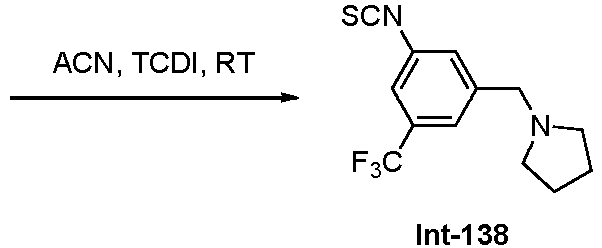
- Synthesis of compound Int-138.1. A solution of 3-amino-5-(trifluoromethyl)benzoic acid (1 g, 4.87 mmol, 1.0 equiv), 1-hydroxybenzotriazole (0.723 g, 6.34 mmol, 1.3 equiv), 1-ethyl-3-(3-dimethylaminopropyl)carbodiimide hydrochloride (1.39 g, 7.30 mmol, 1.5 equiv), and N,N-diisopropylethylamine (4.25 mL, 24.35 mmol, 5.0 equiv) in DCM (15 mL) was stirred at room temperature for 30 min. To the reaction mixture was added pyrrolidine (0.0.450 g, 6.34 mmol, 1.3 equiv) and stirred for 4 h. It was transferred into ice-water, stirred, and extracted with DCM. The combined organic layers were washed with brine, dried over anhydrous sodium sulfate, filtered, and concentrated under reduced pressure. The residue was purified by flash column chromatography on silica gel (CombiFlash®, 3.8% methanol in DCM) to afford Int-138.1. MS (ES): m/z 259.2 [M+H]+.
- Synthesis of compound Int-138.2. To a solution of Int-138.1 (0.700 g, 2.71 mmol, 1.0 equiv) in THF (10 mL) was added lithium aluminum hydride (1M in THF, 8.1 mL, 8.13 mmol, 3.0 equiv) at 0 °C. The reaction mixture was stirred to reflux for 2 h. It was cooled to room temperature, transferred into ice, stirred, and extracted with ethyl acetate. The combined organic layers were washed with brine, dried over anhydrous sodium sulfate, filtered, and concentrated under reduced pressure. The residue was purified by flash column chromatography on silica gel (CombiFlash®, 7.8% methanol in DCM) to afford Int-138.2. MS(ES): m/z 245.0 [M+H]+.
- Synthesis of compound Int-138. To a solution of Int-138.2 (0.450 g, 1.84 mmol, 1.0 equiv) and imidazole (0.037 g, 0.552 mmol, 0.3 equiv) in acetonitrile (10 mL) was added thiocarbonyldiimidazole (0.651 g, 3.68 mmol, 2.0 equiv) and stirred at room temperature for 2 h. It was transferred into ice-water and extracted with ethyl acetate. The combined organic layers were washed with brine, dried over anhydrous sodium sulfate, filtered, and concentrated under reduced pressure. The residue was purified by flash column chromatography on silica gel (CombiFlash®, 1% methanol in DCM) to afford Int-138. MS(ES): m/z 287.2 [M+H]+.
-

- Synthesis of compound Int-139.1. A solution of 5-(trifluoromethyl)-1H-pyrazol-3-amine (10.0 g, 66.18 mmol, 1.0 equiv), hexane-2,5-dione (7.55 g, 66.18 mmol, 1.0 equiv) and acetic acid (catalytic) in toluene (100 mL) was stirred to reflux in a round bottom flask equipped with a Dean-Stark trap to remove water. The reaction mixture was cooled to room temperature and concentrated under reduced pressure. The residue was purified by flash column chromatography on silica gel (CombiFlash®, 15% ethyl acetate in hexane) to afford Int-139.1. MS (ES): m/z 230.3 [M+H]+.
- Synthesis of compound (±)-Int-139.2. A mixture of compound Int-139.1 (6 g, 26.18 mmol, 1.0 equiv), 3,6-dioxabicyclo[3.1.0]hexane (3.38 g, 39.27 mmol, 1.5 equiv) and cesium carbonate (25.52 g, 78.54 mmol, 3.0 equiv) in DMF (60 mL) was stirred at 80 °C for 16 h. It was transferred into water and extracted with ethyl acetate. The combined organic layers were washed with brine, dried over anhydrous sodium sulfate, filtered, and concentrated under reduced pressure. The residue was purified by flash column chromatography on silica gel (CombiFlash®, 12% ethyl acetate in hexane) to afford (±)-Int-139.2. MS(ES): m/z 316.4 [M+H]+.
- Synthesis of compound (±)-Int-139.3. To a solution of (±)-Int-139.2 (0.460 g, 1.46 mmol, 1.0 equiv) in DMF (10 mL) was added sodium hydride (0.052 g, 2.19 mmol, 1.5 equiv) at room temperature and stirred for 30 min. To the reaction mixture was added benzyl bromide (0.27 g, 1.60 mmol, 1.1 equiv) and stirred at room temperature for 12 hr. It was transferred into ice, stirred, and extracted with ethyl acetate. The combined organic layers were washed with brine, dried over anhydrous sodium sulfate, filtered, and concentrated under reduced pressure. The residue was purified by flash column chromatography on silica gel (CombiFlash®, 15% ethyl acetate in hexane) to afford (±)-Int-139.3. MS(ES): m/z 406.5 [M+H]+.
- Synthesis of compound (±)-Int-139.4. To a solution of (±)-Int-139.3 (0.200 g, 0.493 mmol, 1.0 equiv) in ethanol:water (2:1, 10 mL) was added hydroxylamine hydrochloride (1.5 g, 24.65 mmol, 50 equiv). The reaction mixture was stirred at 100 °C for 9 h. It was transferred into ice-water, followed by 6 N sodium hydroxide, and extracted with ethyl acetate. The combined organic layers were washed with brine, dried over anhydrous sodium sulfate, filtered, and concentrated under reduced pressure. The residue was purified by flash column chromatography on silica gel (CombiFlash®, 1.5-2.0% methanol in DCM) to afford (±)-Int-139.4. MS(ES): m/z 328.4 [M+H]+.
- Synthesis of compound (±)-Int-139. Compound (±)-Int-139 was prepared from (±)-Int-139.4 following the procedure for the synthesis of I-69. The product was purified by flash column chromatography on silica gel (CombiFlash®, 2.5-3.0% methanol in DCM). MS(ES): m/z 370.2 [M+H]+.
-

- Synthesis of compound Int-140.1. A mixture of 2-chloro-6-(trifluoromethyl)pyridin-4-amine (1.0 g, 5.09 mmol, 1.0 equiv), 2-(4,5-dihydrofuran-3-yl)-4,4,5,5-tetramethyl-1,3,2-dioxaborolane (2.99 g, 15.26 mmol, 3.0 equiv) and potassium carbonate (2.10 g, 15.26 mmol, 3.0 equiv) in 1,4-dioxane (7 mL) and water (3 mL) was degassed by bubbling argon through for 10 min. [1,1'-bis(diphenylphosphino)ferrocene] dichloropalladium(II), complex with DCM (0.207 g, 0.254 mmol, 0.05 equiv) was added, and degassed for 5 min. The reaction mixture was stirred at 120 °C for 3 h. It was transferred into water and extracted with ethyl acetate. The combined organic layers were washed with brine, dried over anhydrous sodium sulfate, filtered, and concentrated under reduced pressure. The residue was purified by flash column chromatography on silica gel (CombiFlash®, 38% ethyl acetate in hexane) to afford Int-140.1. MS(ES): m/z 231.0 [M+H]+.
- Synthesis of compound (±)-Int-140.2. A mixture of compound Int-140.1 (0.409 g, 1.78 mmol, 1.0 equiv) and 20% palladium hydroxide (0.4 g) in methanol (10 mL) was stirred under hydrogen (1 atm) for 1 h. The reaction mixture was filtered through a pad of Celite® and rinsed with methanol. The filtrate was concentrated under reduced pressure to afford (±)-Int-140.2. MS(ES): m/z 233.1 [M+H]+.
- Synthesis of compound (±)-Int-140. Compound (±)-Int-140 was prepared from (±)-Int-140.2, following the procedure described in the synthesis of Int-1. The product was purified by flash column chromatography on silica gel (CombiFlash®, 8% ethyl acetate in hexane). MS(ES): m/z 275.1 [M+H]+.
-

- Synthesis of compound Int-141.1. To a solution of 2-bromo-1-fluoro-4-(trifluoromethyl)benzene (1 g, 4.12 mmol, 1.0 equiv) in THF (15 mL) was added lithium diisopropylamide solution (2.0 M in THF, 3.09 mL, 6.18 mmol, 1.5 equiv) at -78 °C and stirred for 30 min. To the solution was added DMF (0.361 g, 4.94 mmol, 1.2 equiv) and stirred for 15 min. It was transferred into ice-water, stirred, and extracted with ethyl acetate. The combined organic layers were washed with brine, dried over anhydrous sodium sulfate, filtered, and concentrated under reduced pressure. The residue was purified by flash column chromatography on silica gel (CombiFlash®, 5% ethyl acetate in hexane) to afford Int-141.1. MS (ES): m/z 272.0 [M+H]+.
- Synthesis of compound Int-141.2. To a solution of Int-141.1 (0.570 g, 2.10 mmol, 1.0 equiv) and (R)-N,N-dimethylpyrrolidin-3-amine (0.480 g, 4.21 mmol, 2.0 equiv) in anhydrous DCM (25 mL) was stirred at room temperature for 2 h. To the solution was added sodium cyanoborohydride (0.396 g, 6.3 mmol, 3.0 equiv) and stirred for 12 h. The reaction mixture was concentrated under reduced pressure. The residue was purified by flash column chromatography on silica gel (CombiFlash®, 8% methanol in DCM) to afford Int-141.2. MS(ES): m/z 370.1 [M+H]+.
- Synthesis of compound Int-141. To a mixture of Int-141.2 (0.245 g, 0.663 mmol, 1.0 equiv), L-proline (0.030 g, 0.265 mmol, 0.4 equiv), potassium carbonate (0.457 g, 3.315 mmol, 5.0 equiv) in dimethyl sulfoxide (5 mL) were added aq. ammonium hydroxide (1 mL) and copper iodide (0.075 g, 0.397 mmol, 0.6 equiv). The reaction mixture was stirred at 120 °C for 16 h. The reaction mixture was cooled to room temperature, transferred into water, and extracted with ethyl acetate. The combined organic layers were washed with brine, dried over anhydrous sodium sulfate, filtered, and concentrated under reduced pressure to afford Int-141. MS(ES): m/z 306.2 [M+H]+.
-

- Synthesis of compound Int-142. Compound Int-142 was prepared following the procedures described in the synthesis of Int-141. The final product was purified by flash column chromatography on silica gel (CombiFlash®, 8% methanol in DCM). MS(ES): m/z 370.1 [M+H]+.
-

- Synthesis of compound Int-143.1. To a solution of 3-(benzyloxy)cyclobutan-1-one (10 g, 56.75 mmol, 1.0 equiv) in methanol (60 mL) was added sodium borohydride (4.2 g, 113.63 mmol, 2.0 equiv) in portions at 0 °C and stirred for 2 h. It was transferred into ice-water, stirred, and extracted with ethyl acetate. The combined organic layers were washed with brine, dried over anhydrous sodium sulfate, filtered, and concentrated under reduced pressure to afford Int-143.1. MS(ES): m/z 179.1 [M+H]+.
- Synthesis of compound Int-143.2. To a solution of Int-143.1 (9.1 g, 51.06 mmol, 1.0 equiv) and triethylamine (17.5 mL, 127.8 mmol, 2.5 equiv) in DCM (45 mL) was added methanesulfonyl chloride (4.7 mL, 61.34 mmol, 1.2 equiv) at 0 °C. The reaction mixture was allowed to warm to room temperature and stirred for 30 min. It was transferred into ice-water, stirred, and extracted with DCM. The combined organic layers were washed with saturated sodium bicarbonate, followed by brine, dried over anhydrous sodium sulfate, filtered, and concentrated under reduced pressure to afford Int-143.2. MS(ES): m/z 257.2 [M+H]+.
- Synthesis of compound Int-143.3. A mixture of Int-143.2 (1.94 g, 7.57 mmol, 1.0 equiv), cesium carbonate (6.15 g, 18.94 mmol, 2.5 equiv) and Int-40.3 (3.0 g, 13.63 mmol, 1.8 equiv) in DMF (20 mL) was stirred at 90 °C for 16 h. It was transferred into water and extracted with ethyl acetate. The combined organic layers were washed with brine, dried over anhydrous sodium sulfate, filtered, and concentrated under reduced pressure. The residue was purified by flash column chromatography on silica gel (CombiFlash®, 15% ethyl acetate in hexane) to afford Int-143.3. MS(ES): m/z 381.1 [M+H]+.
- Synthesis of compound Int-143.4. A mixture of Int-143.3 (1.5 g, 3.94 mmol, 1.0 equiv) and potassium carbonate (10.89 g, 78.94 mmol, 20 equiv) in methanol (5 mL) was stirred at 110 °C for 16 h. It was cooled to room temperature, poured into ice-water and extracted with ethyl acetate. The combined organic layers were washed with brine, dried over anhydrous sodium sulfate, filtered, and concentrated under reduced pressure. The residue was purified by flash column chromatography on silica gel (CombiFlash®, 12% ethyl acetate in hexane) to afford Int-143.4. MS(ES): m/z 339.4 [M+H]+.
- Synthesis of compound Int-143. Compound Int-143 was prepared from Int-143.4, following the procedure described in the synthesis of Int-1. The product was purified by flash column chromatography on silica gel (CombiFlash®, 1% methanol in DCM). MS(ES): m/z 381.4 [M+H]+.
-

- Synthesis of compound Int-144.1. A solution of 4-amino-2-(trifluoromethyl)benzoic acid (0.400 g, 1.95 mmol, 1.0 equiv), 1-hydroxybenzotriazole (0.395 g, 2.90 mmol, 1.5 equiv), 1-ethyl-3-(3-dimethylaminopropyl)carbodiimide hydrochloride (0.559 g, 2.9 mmol, 1.5 equiv) and N,N-diisopropylethylamine (1.0 g, 7.8 mmol, 4.0 equiv) in DCM (8 mL) was stirred at room temperature for 15 min before the addition of 1,4-oxazepane (0.295 g, 2.92 mmol, 1.0 equiv) and stirred at room temperature for 16 h. It was transferred into ice-water, stirred, and extracted with ethyl acetate. The combined organic layers were washed with brine, dried over anhydrous sodium sulfate, filtered, and concentrated under reduced pressure. The residue was purified by flash column chromatography on silica gel (CombiFlash®, 2.4% methanol in DCM) to afford Int-144.1 MS (ES): m/z 289.2 [M+H]+.
- Synthesis of compound Int-144.2. To a solution of Int-144.1 (0.320 g, 1.11 mmol, 1.0 equiv) in THF (5 mL) was added borane dimethylsulfide (1 M in THF, 3.0 mL, 3.0 mmol, 3.0 equiv) at 0 °C. The reaction mixture was stirred to reflux for 2 h. It was cooled to room temperature, transferred into ice, stirred, and extracted with ethyl acetate. The combined organic layers were washed with brine, dried over anhydrous sodium sulfate, filtered, and concentrated under reduced pressure. The residue was purified by flash column chromatography on silica gel (CombiFlash®, 2.8% methanol in DCM) to afford Int-144.2. MS(ES): m/z 275.1 [M+H]+.
- Synthesis of compound Int-144. Compound Int-144 was prepared from Int-144.2, following the procedure described in the synthesis of Int-1. The product was purified by flash column chromatography on silica gel (CombiFlash®, 2.0% methanol in DCM). MS(ES): m/z 317.1 [M+H]+.
-

- Synthesis of compound Int-145.1. A mixture of tert-butyl 1,4-diazepane-1-carboxylate (5 g, 24.96 mmol, 1.0 equiv), iodoethane (5.8 g, 37.44 mmol, 1.5 equiv) and potassium carbonate (6.8 g, 49.92 mmol, 2.0 equiv) in acetonitrile (25 mL) was stirred to reflux for 20 h. The reaction mixture was filtered through a pad of Celite® and rinsed with methanol. The filtrate was concentrated under reduced pressure. The residue was purified by flash column chromatography on silica gel (CombiFlash®, 3.8% methanol in DCM eluant) to afford Int-145.1. MS(ES): m/z 229.1 [M+H]+.
- Synthesis of compound Int-145.2. A solution of Int-145.1 (1.0 g, 4.38 mmol, 1 equiv) in solution of hydrochloric acid in diethyl ether (2 M, 10 mL) was stirred at room temperature for 2 h. The reaction mixture was filtered to afford crude product, which was further purified by trituration with diethyl ether to afford Int-145.2. MS(ES): m/z 129.2 [M+H]+.
- Synthesis of compound Int-145.3. A solution of 4-amino-2-(trifluoromethyl)benzoic acid (0.639 g, 3.12 mmol, 1.0 equiv), 1-hydroxybenzotriazole (0.893 g, 4.68 mmol, 1.5 equiv) and 1-ethyl-3-(3-dimethylaminopropyl)carbodiimide hydrochloride (0.631 g, 4.68 mmol, 1.5 equiv) in DCM (12 mL) was stirred at 0 °C for 15 min. To the solution was added Int-145.2 (0.400 g, 3.12 mmol, 1.0 equiv) and N,N-diisopropylethylamine (2.01 g, 15.6 mmol, 5.0 equiv) and stirred at 0 °C for 3 h. It was transferred into ice-water, stirred, and extracted with DCM. The combined organic layers were washed with brine, dried over anhydrous sodium sulfate, filtered, and concentrated under reduced pressure. The residue was purified by trituration using diethyl ether to afford Int-145.3. MS(ES): m/z 316.5 [M+H]+.
- Synthesis of compound Int-145. To a solution of Int-145.3 (0.450 g, 1.43 mmol, 1.0 equiv) in THF (10 mL) was added lithium aluminum hydride (2 M in THF, 3.5 mL, 7.14 mmol, 5.0 equiv) at 0 °C. The reaction mixture was stirred to reflux for 1 h. It was cooled to room temperature, transferred into ice, stirred, and extracted with ethyl acetate. The combined organic layers were washed with brine, dried over anhydrous sodium sulfate, filtered, and concentrated under reduced pressure to afford Int-145. MS(ES): m/z 302.5 [M+H]+.
-

- Synthesis of compound Int-146.1. To a solution of δ-valerolactone (10 g, 99.88 mmol, 1.0 equiv) and methyl iodide (24.8 mL, 399.52 mmol, 4.0 equiv) in THF (200 mL) was added lithium bis(trimethylsilyl)amide (1 M in THF, 219 mL, 219.7 mmol, 2.2 equiv) at -78 °C. The reaction mixture was stirred at room temperature for 16 h. It was poured over ice-water and extracted with ethyl acetate. The combined organic layers were washed with brine, dried over anhydrous sodium sulfate, filtered, and concentrated under reduced pressure. The residue was purified by flash column chromatography on silica gel (CombiFlash®, 10% ethyl acetate in hexane as eluant) to afford Int-146.1. MS (ES): m/z 129.2 [M+H]+.
- Synthesis of compound Int-146.2. To a solution of diisopropylamine (4.88 g, 48.37 mmol, 1.0 equiv) in THF (100 mL) at -78 °C was slowly added a solution of n-butyl lithium (2.5 M in hexane, 24.2 mL, 60.46 mmol, 1.25 equiv). The reaction mixture was stirred for 5 min followed by addition of acetonitrile (2.5 mL, 48.37 mmol, 1.0 equiv). The reaction mixture stirred for 10 min and compound Int-146.1 (6.20 g, 48.37 mmol, 1.0 equiv) in THF (30 mL) was added to it. The reaction mixture was stirred at 5 °C for 6 h. It was poured over cold saturated ammonium chloride solution and extracted with ethyl acetate. The combined organic layers were washed with brine, dried over anhydrous sodium sulfate, filtered and concentrated under reduced pressure. The residue was purified by flash column chromatography on silica gel (CombiFlash®, 20% ethyl acetate in hexane as eluant) to afford Int-146.2. MS (ES): m/z 170.2 [M+H]+.
- Synthesis of compound Int-146.3. To a solution of Int-146.2 (3.9 g, 23.05 mmol, 1.0 equiv) in ethanol (40 mL) was added hydrazine hydrochloride (2.35 g, 34.57 mmol, 1.5 equiv) followed by addition of potassium carbonate (4.77 g, 34.57 mmol, 1.5 equiv). The reaction mixture was stirred to reflux for 16 h. It was concentrated under reduced pressure. The residue was purified by flash column chromatography on silica gel (CombiFlash®, 3-4% methanol in dichloromethane as eluant) to afford Int-146.3. MS (ES): m/z 184.26 [M+H]+.
- Synthesis of compound Int-146.4. To a solution of Int-146.3 (1.1 g, 6.0 mmol, 1.0 equiv) in THF (20 mL) was added thionyl chloride (2.15 mL, 30 mmol, 5.0 equiv). The reaction mixture was stirred at room temperature for 2 h. It was poured over saturated sodium bicarbonate solution, stirred, and extracted with ethyl acetate. The combined organic layers were washed with brine, dried over anhydrous sodium sulfate, filtered and concentrated under reduced pressure. The residue was purified by flash column chromatography on silica gel (CombiFlash®, 2% methanol in dichloromethane as eluant) to afford Int-146.4. MS (ES): m/z 166.24 [M+H]+.
- Synthesis of compound Int-146. Compound Int-146 was prepared from Int-146.4 following the procedure described in the synthesis of Int-1. The crude product was used in the next step without further purification. MS (ES): m/z 208.3 [M+H]+.
-

- Synthesis of compound Int-147.1. To a solution of 4-amino-2-(trifluoromethyl)benzoic acid (0.500 g, 2.44 mmol, 1.0 equiv), 1-hydroxybenzotriazole (0.362 g, 2.68 mmol, 1.1 equiv) and 1-ethyl-3-(3-dimethylaminopropyl)carbodiimide hydrochloride (0.699 g, 3.66 mmol, 1.5 equiv) in DCM (15 mL) was added pyrrolidine (0.260 g, 3.66 mmol, 1.5 equiv) and N,N-diisopropylethylamine (1.57 g, 12.2 mmol, 5.0 equiv) at 0 °C and stirred at room temperature for 3 h. It was transferred into ice-water, stirred, and extracted with DCM. The combined organic layers were washed with brine, dried over anhydrous sodium sulfate, filtered, and concentrated under reduced pressure. The residue was purified by trituration using diethyl ether) to afford Int-147.1. MS(ES): m/z 259.5 [M+H]+.
- Synthesis of compound Int-147.2. To a solution of Int-147.1 (0.500 g, 1.94 mmol, 1.0 equiv) in THF (10 mL) was added lithium aluminum hydride (2M in THF) (2.9 mL, 5.82 mmol, 3.0 equiv) at 0 °C. Reaction mixture refluxed for 1 h. It was cooled to room temperature, transferred into ice, stirred, and extracted with ethyl acetate. The combined organic layers were washed with brine, dried over anhydrous sodium sulfate, filtered, and concentrated under reduced pressure to afford Int-147.2. MS(ES): m/z 245.5 [M+H]+.
- Synthesis of compound Int-147. Compound Int-147 was synthesized following the procedure described in the synthesis of I-138. MS(ES): m/z 287.2 [M+H]+.
-

- Synthesis of compound Int-148.1. A mixture of 4-bromo-3-(trifluoromethyl)aniline (3.0 g, 12.5 mmol, 1.0 equiv), (1-(tert-butoxycarbonyl)-1H-pyrrol-2-yl)boronic acid (3.9 g, 18.7 mmol, 1.5 equiv) and sodium carbonate (5.2 g, 50.02 mmol, 4.0 equiv) in dimethoxyethane (40 mL) was degassed by bubbling argon through for 10 min. Tetrakis(triphenylphosphine) palladium(0) (1.2 g, 1.3 mmol, 0.9 equiv) was added, and degassed for 5 min. The reaction mixture was stirred at 80 °C for 5 h. It was transferred into water and extracted with ethyl acetate. The combined organic layers were washed with brine, dried over anhydrous sodium sulfate, filtered, and concentrated under reduced pressure. The residue was purified by flash column chromatography on silica gel (CombiFlash®, 8.0% methanol in DCM) to afford Int-148.1. MS(ES): m/z 327.32 [M+H]+.
- Synthesis of compound (±)-Int-148.2. A mixture of compound Int-148.1 (1.4 g, 4.29 mmol, 1.0 equiv) and 20% palladium hydroxide (1.0 g) in methanol (38 mL) was stirred under hydrogen (1 atm) for 7 h. The reaction mixture was filtered through a pad of Celite® and rinsed with methanol. The filtrate was concentrated under reduced pressure to afford (±)-Int-148.2. MS(ES): m/z 331.35 [M+H]+.
- Synthesis of compound (±)-Int-148.3. To a solution of (±)-Int-148.2 (1.2 g, 3.63 mmol, 1.0 equiv) in THF (14 mL) was added lithium aluminum hydride (1 M in THF, 25 mL, 25.41 mmol, 7.0 equiv) at 0 °C. The reaction mixture was stirred to reflux for 30 min. It was cooled to room temperature, transferred into ice, stirred, and extracted with ethyl acetate. The combined organic layers were washed with brine, dried over anhydrous sodium sulfate, filtered, and concentrated under reduced pressure to afford (±)-Int-148.3. MS(ES): m/z 245.26[M+H]+.
- Synthesis of compound (±)-Int-148. Compound (±)-Int-148 was prepared from (±)-Int-148.3 following the procedure for the synthesis of I-69. The product was purified by flash column chromatography on silica gel (CombiFlash®, 2.5-3.0% methanol in DCM). MS(ES): m/z 287.32[M+H]+.
-


- Synthesis of compound (±)-Int-149.1. To solution of (1-methylpiperidin-2-yl)methanol (1.0 g, 4.78 mmol, 1.0 equiv) in DMF (20 mL) was added sodium hydride (0.286 g, 11.95 mmol, 2.5 equiv) at 0 °C and stirred for 30 min. To the mixture was added 1-fluoro-3-nitro-5-(trifluoromethyl)benzene (0.617 g, 4.78 mmol, 1.0 equiv) and stirred at 0 °C for 1 h. It was poured into ice-water and extracted with ethyl acetate. The combined organic layers were washed with brine, dried over anhydrous sodium sulfate, filtered, and concentrated under reduced pressure. The residue was purified by flash column chromatography on silica gel (CombiFlash®, 50% ethyl acetate in hexane to afford (±)-Int-149.1. MS(ES): m/z 319.30 [M+H]+.
- Synthesis of compound Int-149.2 and Int-149.3. A mixture of compound (±)-Int-149.1 (0.900 g, 2.83 mmol, 1.0 equiv) and 10% palladium on carbon (0.450 g) in methanol (5 mL) was stirred under hydrogen (1 atm) for 4 h. The reaction mixture was filtered through a pad of Celite® and the filtrate was concentrated under reduced pressure. The residue was purified by flash column chromatography on silica gel (CombiFlash®, 5.0% methanol in DCM). The enantiomers were separated by HPLC (column: CHIRALPAK IG (250mm x 4.6mm, 5 µm); mobile phases: 0.1% DEA in methanol; flow rate: 10 mL/min) to afford first eluting fraction (Int-149.2) and second eluting fraction (Int-149.3). MS(ES): m/z 289.1. (*Absolute stereochemistry not determined.)
- Synthesis of compound Int-149-a. Compound Int-149-a was prepared from Int-149.2 following the procedure for the synthesis of I-69. The product was purified by flash column chromatography on silica gel (CombiFlash®, 2.5-3.0% methanol in DCM). MS(ES): m/z 331.2 [M+H]+.
- Synthesis of compound Int-149-b. Compound Int-149-b was prepared from Int-149.3 following the procedure for the synthesis of I-69. The product was purified by flash column chromatography on silica gel (CombiFlash®, 2.5% methanol in DCM). MS(ES): m/z 331.2 [M+H]+.
-

- Synthesis of compound Int-150.1. A solution of 3-amino-5-(trifluoromethyl)benzoic acid (2.0 g, 9.75 mmol, 1.0 equiv), 1-hydroxybenzotriazole (0.682 g, 4.8 mmol, 0.5 equiv), 1-ethyl-3-(3-dimethylaminopropyl)carbodiimide hydrochloride (5.59 g, 29.3 mmol, 3.0 equiv) and N,N-diisopropylethylamine (6.78 mL, 39.0 mmol, 4.0 equiv) in DMF (15 mL) was stirred at room temperature for 30 min. To the solution was added 2-oxa-6-azaspiro[3.3]heptane (1.16 g, 11.70 mmol, 1.2 equiv) and stirred at room temperature for 12 h. It was transferred into ice-water, stirred, and extracted with ethyl acetate. The combined organic layers were washed with brine, dried over anhydrous sodium sulfate, filtered, and concentrated under reduced pressure. The residue was purified by flash column chromatography on silica gel (CombiFlash®, 2.4 methanol in DCM) to afford Int-150.1. MS (ES): m/z 287.2 [M+H]+.
- Synthesis of compound Int-150.2. To a solution of Int-150.1 (0.800 g, 0.346 mmol, 1.0 equiv) in THF (8 mL) was added lithium aluminum hydride (1 M in THF, 2.7 mL, 2.7 mmol, 3.0 equiv) at -10 °C and stirred for 30 min. It was transferred into ice, stirred, and extracted with ethyl acetate. The combined organic layers were washed with brine, dried over anhydrous sodium sulfate, filtered, and concentrated under reduced pressure. The residue was purified by flash column chromatography on silica gel (CombiFlash®, 2.0% methanol in DCM) to afford Int-150.2. MS (ES): m/z 273.1 [M+ H]+.
- Synthesis of compound Int-150. Compound Int-150 was prepared from Int-150.2 following the procedure for the synthesis of I-69. The product was purified by flash column chromatography on silica gel (CombiFlash®, 2.0% methanol in DCM). MS(ES): m/z 315.0 [M+H]+.
-

- Synthesis of compound Int-151.1. To a solution of diethyl 1H-pyrazole-3,5-dicarboxylate (100 g, 471 mmol, 1.0 equiv) and ethyl 4-bromobutanoate (91.92 g, 471 mmol, 1.0 equiv) in acetonitrile (1000 mL) was added potassium carbonate (64.99 g, 471 mmol, 1.0 equiv) and reaction mixture was stirred at 80 °C for 4 h. It was poured into ice-water and extracted with ethyl acetate. The combined organic layers were washed with brine, dried over anhydrous sodium sulfate, filtered, and concentrated under reduced pressure. The residue was purified by trituration with diethyl ether to afford Int-151.1. MS(ES): m/z 327.2 [M+H]+.
- Synthesis of compound Int-151.2. To a solution of Int-151.1 (120 g, 367 mmol, 1.0 equiv) in toluene (1000 mL) was added potassium tert-butoxide (1M in THF) (403 mL, 403.7 mmol, 1.1 equiv) at room temperature. The reaction mixture was stirred at 90 °C for 3 h. The reaction mixture was poured into ice-water, and product extracted with ethyl acetate. The combined organic layers were washed with brine, dried over anhydrous sodium sulfate, filtered, and concentrated under reduced pressure. The residue was purified by trituration with diethyl ether to afford Int-151.2. m/z: 281.2 [M+H]+.
- Synthesis of compound Int-151.3. To Int-151.2 (65 g, 231 mmol 1.0 equiv) was added hydrochloric acid:water (2:1, 600 mL) and the reaction mixture heated 100 °C for 6 h. It was concentrated under reduced pressure. The residue was dissolved in acetonitrile-THF (1:4, 250 mL) and the solution was concentrated under reduced pressure to afford Int-151.3. MS(ES): m/z 181.1 [M+H]+.
- Synthesis of compound Int-151.4. To a solution of Int-151.3 (38 g, 210 mmol, 1.0 equiv) in DMF (4000 mL) was added potassium carbonate (57.96 g, 420 mmol, 2.0 equiv) followed by methyl iodide (15.7 mL, 252 mmol, 1.2 equiv) and reaction mixture was stirred at room temperature for 4 h. It was poured into ice-water and extracted with ethyl acetate. The combined organic layers were washed with brine, dried over anhydrous sodium sulfate, filtered, and concentrated under reduced pressure. The residue was purified by flash column chromatography on silica gel (CombiFlash®, 25% ethyl acetate in hexane) to afford Int-151.4. MS(ES): m/z 195.0 [M+H]+.
- Synthesis of compound Int-151.5. To a solution of Int-151.4 (22 g, 113.29 mmol, 1.0 equiv) in 1,2-dichloroethane (130 mL) was added diethylaminosulfur trifluoride (150 mL, 1132.9 mmol, 10.0 equiv) and reaction mixture was stirred at room temperature for 5 days. It was transferred into ice-cold saturated sodium bicarbonate solution and extracted with DCM. The combined organic layers were washed with brine, dried over anhydrous sodium sulfate, filtered, and concentrated under reduced pressure. The residue was purified by flash column chromatography on silica gel (CombiFlash®, 20% ethyl acetate in hexane) to afford Int-151.5. MS(ES): m/z 217.1 [M+H]+.
- Synthesis of compound Int-151.6. To a solution of Int-151.5 (11.2 g, 51.81 mmol, 1.0 equiv) in THF (110 mL) was added lithium hydroxide (4.35 g, 103.62 mmol, 2.0 equiv) and water (11 mL). The reaction mixture was stirred at room temperature for 16 h. It was poured into ice-water, and adjusted to pH 5 by adding 2 M hydrochloric acid. Product was extracted with ethyl acetate. The combined organic layers were washed with brine, dried over anhydrous sodium sulfate, filtered, and concentrated under reduced pressure to afford Int-151.6. MS(ES): m/z 203.0 [M+H]+.
- Synthesis of compound Int-151.7. To a suspension of Int-151.6 (8.0 g, 39.57 mmol, 1.0 equiv) in toluene (100 mL) was added triethyl amine (11 mL, 79.14 mmol, 2.0 equiv), followed by benzyl alcohol (21.4 g, 197.85 mmol, 5.0 equiv) and diphenylphosphoryl azide (21.77 g, 79.14 mmol, 2.0 equiv). The reaction mixture was stirred at 90 °C for 16 h. It was poured into ice-water and extracted with ethyl acetate. The combined organic layers were washed with brine, dried over anhydrous sodium sulfate, filtered, and concentrated under reduced pressure to afford to afford crude material. This was further purified by flash column chromatography on silica gel (CombiFlash®, 15% ethyl acetate in hexane) to afford Int-151.7. MS(ES): m/z 308.2 [M+H]+.
- Synthesis of compound Int-151.8. A mixture of Int-151.7 (5.4 g, 17.57 mmol, 1.0 equiv) and 10% palladium on charcoal (2.0 g) in methanol (100 mL) was stirred under hydrogen (1 atm) for 2 h. It was filtered through a pad of Celite®, rinsed with methanol. The filtrate was concentrated under reduced pressure to afford Int-151.8. MS(ES): m/z 174.1 [M+H]+.
- Synthesis of compound Int-151. Compound Int-151 was prepared from Int-151.8 following the procedure described in the synthesis of Int-1. It was used without purification. MS(ES): m/z 216.2 [M+H]+.
-

- Synthesis of compound Int-152.1. To a mixture of 4-methylenetetrahydro-2H-pyran (5.0 g, 50.95 mmol, 1.0 equiv) and zinc-copper couple (71.73 g, 560.45 mmol, 11.0 equiv) in tert-butyl methyl ether (100 mL) was added a solution of diphosgene (37.10 g, 204.08 mmol, 4.0 equiv) in dimethoxyethane (40 mL) at 0 °C and stirred at room temperature for 18 h. It was filtered through a pad of Celite® and the filtrate was washed with aqueous sodium bicarbonate and brine. The organic layer was separated, dried over sodium sulfate, filtered, and concentrated under reduced pressure to afford Int-152.1. MS(ES): m/z : 210.0 [M+H]+.
- Synthesis of compound Int-152.2. A mixture of Int-152.1 (8.9 g, 42.58 mmol, 1.0 equiv), saturated ammonium chloride solution in methanol (200 mL) and zinc (27.67 g, 425.8 mmol, 10.0 equiv) was stirred at room temperature for 16 h. It was filtered through a pad of Celite® and rinsed with diethyl ether. The filtrate was concentrated under reduced pressure. The residue was purified by flash column chromatography on silica gel (CombiFlash®, 30% ethyl acetate in hexane) to afford Int-152.2. MS(ES): m/z : 141.1 [M+H]+.
- Synthesis of compound Int-152.3. To a solution of Int-152.2 (3.9 g, 27.82 mmol, 1.0 equiv) in methanol (40 mL) was added sodium borohydride (0.308 g, 8.34 mmol, 0.3 equiv) at 0 °C and stirred at room temperature for 16 h. It was transferred into ice-water and extracted with ethyl acetate. The combined organic layers were washed with brine, dried over anhydrous sodium sulfate, filtered, and concentrated under reduced pressure to afford Int-152.3. MS(ES): m/z : 143.1 [M+H]+.
- Synthesis of compound Int-152.4. To a solution of Int-152.3 (3.0 g, 21.1 mmol, 1.0 equiv) and triethylamine (8.8 mL, 63.3 mmol, 3.0 equiv) in DCM (30 mL) was added methanesulfonyl chloride (2.4 mL, 31.65 mmol, 1.5 equiv) at 0 °C. The reaction mixture was stirred at room temperature for 30 min. It was transferred into ice-water, stirred, and extracted with DCM. The combined organic layers were washed with saturated sodium bicarbonate followed by brine, dried over anhydrous sodium sulfate, filtered, and concentrated under reduced pressure to afford Int-152.4. MS(ES): m/z : 221.0 [M+H]+.
- Synthesis of compound Int-152.5. To a mixture of Int-139.1 (2.8 g, 12.22 mmol, 1.0 equiv), Int-152.4 (4.04 g, 18.32 mmol, 1.3 equiv), and cesium carbonate (7.94 g, 24.44 mmol, 2.0 equiv) in DMF (15 mL) was stirred at 90 °C for 4 h. It was transferred into ice-water, stirred, and extracted with ethyl acetate. The combined organic layers were washed with brine, dried over anhydrous sodium sulfate, filtered, and concentrated under reduced pressure. The residue was purified by flash column chromatography on silica gel (CombiFlash®, 4.0% ethyl acetate in hexane) to afford Int-152.5. MS (ES): m/z 354.2 [M+H] +.
- Synthesis of compound Int-152.6. To a solution of Int-152.5 (1.5 g, 4.24 mmol, 1.0 equiv) in ethanol:water (2:1, 50 mL) was added hydroxylamine hydrochloride (11.4 g, 169.6 mmol, 40 equiv). The reaction mixture was stirred at 100 °C for 3 h. It was transferred into ice-water and neutralized by the addition of 2 N sodium hydroxide. The mixture was extracted with ethyl acetate. The combined organic layers were washed with brine, dried over anhydrous sodium sulfate, filtered, and concentrated under reduced pressure. The residue was purified by flash column chromatography on silica gel (CombiFlash®, 2.5% methanol in DCM) to afford Int-152.6. MS(ES): m/z 276.0 [M+H]+.
- Synthesis of compound Int-152. Compound Int-152 was prepared from Int-152.6 following the procedure described in the synthesis of Int-1. The product was purified by flash column chromatography on silica gel (CombiFlash®, DCM). MS(ES): m/z 318.2 [M+H]+.
-

- Synthesis of compound 1.1. To a solution of 5-methoxy-1H-pyrrolo[2,3-b]pyridine (18 g, 121 mmol, 1.0 equiv) in dichloromethane (180 mL) was added benzyltriethylammonium chloride (0.711 g, 3.12 mmol, 0.025 equiv) followed by addition of sodium hydroxide powder (14.5 g, 363 mmol, 3.0 equiv). The reaction mixture was cooled to 0 °C and benzyl sulfonyl chloride (26.62 g, 151.25 mmol, 1.25 equiv) and the reaction mixture was stirred at room temperature for 2-3 h. It filtered through a pad of Celite® and the solids were rinsed with dichloromethane. The filtrate was concentrated under reduced pressure. The residue was purified by flash column chromatography on silica gel (CombiFlash®, 20% ethyl acetate in hexane) to afford 1.1. MS (ES): m/z 289.3 [M+H]+.
- Synthesis of compound 1.2. A solution of 1.1 (22 g, 76.30 mmol, 1.0 equiv) and diisopropylamine (17.2 mL, 122.08 mmol, 1.6 equiv) in THF (200 mL) at -78 °C was added n-butyllithium (2.5 M in hexane, 48.8 mL, 122.08 mmol, 1.6 equiv) and stirred for 1 h. To the mixture was added a solution of iodine (38.72 g, 152.6 mmol, 2.0 equiv) in THF (200 mL) and the reaction mixture was stirred at -78 °C for 1 h. It was quenched by addition of a saturated ammonium chloride solution. The mixture was extracted with ethyl acetate. The combined organic layers was dried over anhydrous sodium sulfate, filtered and concentrated under reduced pressure. The residue was purified by flash column chromatography on silica gel (CombiFlash®, 20% ethyl acetate in hexane) to afford 1.2. MS (ES): m/z 415.2 [M+H]+.
- Synthesis of compound 1.3. A mixture of 1.2 (15 g, 36.21 mmol, 1.0 equiv), cyclopropylboronic acid (4.14 g, 48.16 mmol, 1.33 equiv), potassium phosphate (28.13 g, 132.5 mmol, 3.66 equiv) and tricyclohexylphosphine (2.23 g, 7.96 mmol, 0.22 equiv) in toluene (150 mL) was degassed by bubbling through a stream of argon for 10 min by bubbling through a stream of argon. Palladium(II) acetate (0.894 g, 3.98 mmol, 0.11 equiv) was added to the mixture, and degassed by bubbling through a stream of argon for 5 min. The reaction mixture was stirred at 110 °C for 4 h. It was cooled to room temperature and filtered through a pad of Celite®. The filtrate was poured into water, extracted with ethyl acetate. The combined organic layers were washed with brine, dried over anhydrous sodium sulfate, filtered and concentrated under reduced pressure. The residue was purified by flash column chromatography on silica gel (CombiFlash®, 50% dichloromethane in hexane) to afford 1.3. MS (ES): m/z 329.4 [M+H]+.
- Synthesis of compound 1.4. To a solution of 1.3 (6.0 g, 18.27 mmol, 1.0 equiv) in dichloromethane (60 mL) was added boron tribromide solution (1M in dichloromethane, 40 mL, 40.19 mmol, 2.2 equiv) at -30 °C and stirred for 2 h. It was transferred into ice-cold saturated sodium bicarbonate solution and extracted with dichloromethane. The combined organic layers were washed with brine, dried over anhydrous sodium sulfate, filtered and concentrated under reduced pressure to afford 1.4. MS (ES): m/z 315.3 [M+H]+.
- Synthesis of compound 1.5. A mixture of 1.4 (3.1 g, 9.86 mmol, 1.0 equiv), Int-3 (1.69 g, 9.86 mmol, 1.0 equiv) and sodium carbonate (2.09 g, 19.72 mmol, 2.0 equiv) in DMF (30 mL) was stirred at 110 °C for 12 h. It was cooled to room temperature, poured over ice-water and extracted with ethyl acetate. The combined organic layers were washed with brine, dried over anhydrous sodium sulfate, filtered and concentrated under reduced pressure. The residue was purified by flash column chromatography on silica gel (CombiFlash®, 50% ethyl acetate in hexane to afford 1.5. MS (ES): m/z 466.5 [M+H]+.
- Synthesis of compound 1.6. A mixture of compound 1.5 (1.7 g, 3.65 mmol, 1.0 equiv) and 10 wt% palladium on carbon (0.800 g) in methanol (20 mL) was stirred under hydrogen (1 atm) for 1 h. It was filtered through a pad of Celite® and rinsed with methanol. The filtrate was concentrated under reduced pressure. The residue was purified by flash column chromatography on silica gel (CombiFlash®, 2% methanol in dichloromethane) to afford 1.6. MS (ES): m/z 436.5 [M+H]+.
- Synthesis of compound 1.7. To a solution of 1.6 (0.100 g, 0.229 mmol, 1.0 equiv) in 1,4-dioxane (2 mL) was added Int-2 (0.057 g, 0.229 mmol, 1.0 equiv) followed by N-(3-dimethylaminopropyl)-N'-ethylcarbodiimide hydrochloride (0.131 g, 0.687 mmol, 3.0 equiv). The reaction mixture was stirred at 70 °C for 2 h. It was cooled to room temperature, poured over ice-water and extracted with ethyl acetate. The combined organic layers were washed with brine, dried over anhydrous sodium sulfate, filtered and concentrated under reduced pressure. The residue was purified by flash column chromatography on silica gel (CombiFlash®, 4.5% methanol in dichloromethane) to afford 1.7. MS (ES): m/z : 653.7 [M+H]+.
- Synthesis of I-1. To a solution of 1.7 (0.046 g, 0.070 mmol, 1.0 equiv) in methanol (2 mL) was added 40% aqueous sodium hydroxide (0.4 mL). The mixture was stirred at 100 °C for 1 h. It was cooled to room temperature, poured over ice-water and extracted with ethyl acetate. The combined organic layers were washed with brine, dried over anhydrous sodium sulfate, filtered and concentrated under reduced pressure. The residue was purified by flash column chromatography on silica gel (CombiFlash®, 7.0% methanol in dichloromethane) to afford I-1. MS (ES): m/z : 513.69 [M+H]+, 1H NMR (DMSO-d6, 400 MHz): δ 11.47 (s, 1H), 9.74 (s, 1H), 7.95-7.90 (m, 2H), 7.40-7.36 (m, 2H), 6.57 (s, 1H), 6.05 (s, 1H), 5.23 (bs, 1H), 4.07 (bs, 2H), 3.85-3.81 (m, 2H), 3.60 (s, 3H), 2.33 (bs, 1H), 2.25-2.22 (m, 1H), 2.02-1.99 (m, 1H), 1.40 (s, 9H), 0.99-0.98 (m, 2H), 0.84-0.83 (m, 2H).
-

- Synthesis of compound 2.1. Compound 2.1 was prepared from 1.6 and Int-1, following the procedure described in the synthesis of 1.7. The product was purified by flash column chromatography on silica gel (CombiFlash®, 4.4% methanol in dichloromethane). MS (ES): m/z : 653.7 [M+H]+.
- Synthesis of I-2. Compound I-2 was prepared from 2.1, following the procedure described in the synthesis of I-1. The product was purified by flash column chromatography on silica gel (CombiFlash®, 6.8% methanol in dichloromethane). MS (ES): m/z : 513.75 [M+H]+, 1H NMR (DMSO-d6, 400 MHz): δ 11.49 (s, 1H), 9.77 (s, 1H), 7.96-7.91 (m, 2H), 7.41-7.38 (m, 2H), 6.58 (s, 1H), 6.05 (s, 1H), 5.25 (bs, 1H), 4.08 (bs, 2H), 3.85-3.82 (m, 2H), 3.61 (s, 3H), 2.34 (bs, 1H), 2.26-2.23 (m, 1H), 2.03 (bs, 1H), 1.40 (s, 9H), 1.01-0.99 (m, 2H), 0.84 (bs, 2H).
-

- Synthesis of compound 3.1. To a solution of 5-bromo-6-chloropyridin-3-ol (10 g, 47.98 mmol, 1.0 equiv) in acetone (100 mL), was added potassium carbonate (7.94 g, 57.57 mmol, 1.2 equiv) followed by addition of benzyl bromide (9.02 g, 52.77 mmol, 1.1 equiv). The reaction mixture was heated to reflux for 3 h. It cooled to room temperature, poured into water and extracted with ethyl acetate. The combined organic layers were washed with brine, dried over anhydrous sodium sulfate, filtered and concentrated under reduced pressure. The residue was purified by flash column chromatography on silica gel (CombiFlash®, 15% ethyl acetate in hexane) to afford 3.1.
- Synthesis of compound 3.2. A mixture of 3.1 (10.8 g, 36.17 mmol, 1.0 equiv), triphenylphosphine (0.758 g, 2.89 mmol, 0.08 equiv) in toluene (100 mL) was degassed by bubbling through a stream of argon for 15 min. To the mixture was added tributyl(1-ethoxyvinyl)stannane (13.05 g, 36.17 mmol, 1.0 equiv) and tris(dibenzylideneacetone) dipalladium (1.65 g, 1.80 mmol, 0.05 equiv). The reaction mixture was stirred at 110 °C under argon for 4 h. It was cooled to room temperature, poured over ice-water and extracted with ethyl acetate. The organic layer was dried over anhydrous sodium sulfate, filtered and concentrated under reduced pressure to afford 3.2. MS (ES): m/z 262.3 [M+H]+.
- Synthesis of compound 3.3. A mixture of 3.2 (4.1 g, 15.67 mmol, 1.0 equiv) and hydrazine (98%, 16 mL, 4.0 equiv) was stirred at 120 °C for 5 h. It was poured over ice-water, stirred and extracted with ethyl acetate. The combined organic layers were washed with brine, dried over anhydrous sodium sulfate, filtered and concentrated under reduced pressure to afford 3.3. MS (ES): m/z 240.14 [M+H]+.
- Synthesis of compound 3.4. To a suspension of sodium hydride (0.301 g, 7.53 mmol, 1.5 equiv) in THF (10 mL) was added a solution of 3.3 (1.2 g, 5.02 mmol, 1.0 equiv) in THF (10 mL) at 0 °C. It was stirred for 30 min and (2-chloromethoxyethyl)trimethylsilane (1.0 g, 6.02 mmol, 1.2 equiv) was added. The reaction mixture was allowed to warm to room temperature stirring for 30 min. It was poured into ice, stirred and extracted with ethyl acetate. The combined organic layers were washed with brine, dried over anhydrous sodium sulfate, filtered and concentrated under reduced pressure. The residue was purified by flash column chromatography on silica gel (CombiFlash®, 4% ethyl acetate in hexane) to afford 3.4. MS (ES): m/z 370.56 [M+H]+.
- Synthesis of compound 3.5. A mixture of compound 3.4 (0.690 g, 1.87 mmol, 1.0 equiv), 10% palladium on carbon (0.350 g) and in methanol (10 mL) was stirred under hydrogen (1 atm) for 5 h. It was filtered through a pad of Celite® and rinsed with methanol. The filtrate was concentrated under reduced pressure to afford 3.5. MS (ES): m/z 280.37 [M+H]+.
- Synthesis of compound 3.6. A mixture of 3.5 (0.450 g, 1.61 mmol, 1.0 equiv), Int-3 (0.33 g, 1.93 mmol, 1.0 equiv) and potassium carbonate (0.555 g, 4.02 mmol, 2.5 equiv) in DMF (10 mL) was stirred at 80 °C for 2 h. It was cooled to room temperature, filtered through a pad of Celite®, poured over ice-water and extracted with ethyl acetate. The combined organic layers were washed with brine, dried over anhydrous sodium sulfate, filtered and concentrated under reduced pressure. The residue was purified by flash column chromatography on silica gel (CombiFlash®, 40% ethyl acetate in hexane) to afford 3.6. MS (ES): m/z 431.6 [M+H]+.
- Synthesis of compound 3.7. To a solution of 3.6 (0.450 g, 1.05 mmol, 1.0 equiv) in ethanol-water (2:1, 10 mL) was added iron powder (0.323 g, 5.77 mmol, 5.5 equiv) followed by ammonium chloride (0.283 g, 5.25 mmol, 5.0 equiv). The reaction mixture was stirred at 90 °C for 3 h. It was poured over ice-water, filtered and extracted with ethyl acetate. The combined organic layers were washed with brine, dried over anhydrous sodium sulfate, filtered and concentrated under reduced pressure. The residue was purified by flash column chromatography on silica gel (CombiFlash®, 3.5% methanol in dichloromethane) to afford 3.7. MS (ES): m/z 401.4 [M+H]+.
- Synthesis of compound 3.8. To a solution of 3.7 (0.320 g, 0.798 mmol, 1.0 equiv) in THF (5 mL) was added 1,1'-thiocarbonyldiimidazole (0.710 g, 3.99 mmol, 5.0 equiv). The reaction mixture was stirred at 80 °C for 2 h. It was cooled to room temperature and poured over ice-water. The solids were collected by filtration and triturated in hexane to afford 3.8. MS (ES): m/z : 443.6 [M+H]+.
- Synthesis of compound 3.9. To a solution of 3.8 (0.300 g, 0.677 mmol, 1.0 equiv) in acetic acid (4 mL) was added aqueous hydrobromic acid (0.082 g, 1.015 mmol, 1.5 equiv) at 0 °C followed by bromine (0.378 g, 2.36 mmol, 3.5 equiv) and the reaction mixture was stirred for 10 min. It was transferred into saturated sodium bicarbonate solution, stirred and extracted with ethyl acetate. The combined organic layers were washed with brine, dried over anhydrous sodium sulfate, filtered and concentrated under reduced pressure. The residue was purified by flash column chromatography on silica gel (CombiFlash®, 2.2% methanol in dichloromethane) to afford 3.9. MS (ES): m/z 490.4 [M+H]+.
- Synthesis of compound 3.10. A mixture of 3.9 (0.060 g, 0.122 mmol, 1.0 equiv), Int-2.3 (0.031 g, 0.147 mmol, 1.2 equiv) and potassium carbonate (0.050 g, 0.366 mmol, 3.0 equiv) in 1,4-dioxane (1.5 mL) was degassed by bubbling through a stream of argon for 10 min. To the mixture were added 4,5-bis(diphenylphosphino)-9,9-dimethylxanthene (0.014 g, 0.024 mmol, 0.2 equiv) and tris(dibenzylideneacetone)dipalladium (0.011 g, 0.012 mmol, 0.1 equiv). It was degassed for another 5 min. The reaction mixture was stirred at 110 °C under argon for 2 h. It was cooled to room temperature, poured into water and extracted with ethyl acetate. The combined organic layers were washed with brine, dried over anhydrous sodium sulfate, filtered and concentrated under reduced pressure. The residue was purified by flash column chromatography on silica gel (CombiFlash®, 2.5% methanol in dichloromethane) to afford 3.10. MS (ES): m/z : 618.5 [M+H]+.
- Synthesis of I-3. To a solution of 3.10 (0.036 g, 0.058 mmol, 1.0 equiv) in THF (2 mL) was added TBAF (1 M in THF, 0.46 mL, 0.464 mmol, 8.0 equiv) and stirred at 80 °C for 2 h. It was poured into ice-cold saturated sodium bicarbonate solution and extracted with ethyl acetate. The combined organic layers were washed with brine, dried over anhydrous sodium sulfate, filtered and concentrated under reduced pressure. The residue was purified by flash column chromatography on silica gel (CombiFlash®, 6.0% methanol in dichloromethane) to afford I-3. MS (ES): m/z : 488.49 [M+H ; 1H NMR (DMSO-d6, 400 MHz): δ 13.24 (s, 1H), 9.80 (s, 1H), 8.45-8.44 (d, J = 2.4Hz, 1H), 7.99-7.98 (d, J = 2.4Hz, 1H), 7.79-7.78 (d, J = 2.0Hz, 1H), 7.50-7.49 (d, J = 2.4Hz, 1H), 6.59 (s, 1H), 5.25 (s, 1H), 4.11-4.07 (m, 2H), 3.88-3.83 (m, 2H), 3.64 (s, 3H), 2.44 (s, 3H), 2.36-2.32 (m, 1H), 2.28-2.20 (m, 1H), 1.41 (s, 9H).
-

- Synthesis of compound 4.1. Compound 4.1 was prepared from 3.9 and Int-1.4, following the procedure described in the synthesis of 3.10. The product was purified by flash column chromatography on silica gel (CombiFlash®, 2.6% methanol in dichloromethane). MS (ES): m/z : 618.5 [M+H]+.
- Synthesis of I-4. Compound I-4 was prepared from 4.1, following the procedure described in the synthesis of I-3. The product was purified by flash column chromatography on silica gel (CombiFlash®, 6.2% methanol in dichloromethane). MS (ES): m/z : 488.77 [M+H]+, 1H NMR (DMSO-d6, 400 MHz): δ 13.24 (s, 1H), 9.80 (s, 1H), 8.44-8.43 (d, J = 2.4Hz, 1H), 7.98-7.97 (d, J = 2.4Hz, 1H), 7.78-7.77 (d, J = 2.0Hz, 1H), 7.49-7.48 (d, J = 2.4Hz, 1H), 6.58 (s, 1H), 5.24 (s, 1H), 4.10-4.06 (m, 2H), 3.87-3.81 (m, 2H), 3.63 (s, 3H), 2.43 (s, 3H), 2.37-2.30 (m, 1H), 2.27-2.20 (m, 1H), 1.40 (s, 9H).
-

- Synthesis of compound 5.1. To a solution of 3-methyl-1H-pyrazol-5-amine (5 g, 51.48 mmol, 1.0 equiv) in ethanol (50 mL) was added 2-bromomalonaldehyde (7.77 g, 51.48 mmol, 1.0 equiv) followed by addition of p-toluenesulfonic acid (0.548 g, 2.88 mmol, 0.056 equiv). The reaction mixture was stirred at 80 °C for 2 h. It was cooled to room temperature and concentrated under reduced pressure. The crude product was triturated with ethanol to afford 5.1. MS (ES): m/z 211.8 [M-H]+.
- Synthesis of compound 5.2. To a solution of 5.1 (3.5 g, 16.51 mmol, 1.0 equiv) in methanol (70 mL), was added potassium hydroxide (5.54 g, 99.06 mmol, 6.0 equiv). The reaction mixture was stirred at 65 °C for 2 h. It was cooled to room temperature and concentrated under reduced pressure. The reaction mixture was then neutralized with 1N hydrochloric acid and extracted with ethyl acetate. The organic layer was dried over anhydrous sodium sulfate, filtered and concentrated under reduced pressure to afford 5.2. MS (ES): m/z 149.95 [M+H]+.
- Synthesis of compound 5.3. A mixture of 5.2 (1.4 g, 9.39 mmol, 1.0 equiv), Int-4 (1.93 g, 9.39 mmol, 1.0 equiv) and potassium carbonate (3.23 g, 23.47 mmol, 2.5 equiv) in DMF (15 mL) was stirred at 80 °C for 1 h. It was cooled to room temperature, filtered through a pad of Celite, poured over ice-water and extracted with ethyl acetate. The combined organic layers were washed with brine, dried over anhydrous sodium sulfate, filtered and concentrated under reduced pressure. The residue was purified by flash column chromatography on silica gel (CombiFlash®, 1.8% methanol in dichloromethane) to afford 5.3. MS (ES): m/z 335.2 [M+H]+.
- Synthesis of compound 5.4. To a solution of 5.3 (0.400 g, 1.2 mmol, 1.0 equiv) in ethanol-water (2:1, 10 mL) was added iron powder (0.336 g, 6.0 mmol, 5.0 equiv) followed by ammonium chloride (0.324 g, 6.0 mmol, 5.0 equiv). The reaction mixture was stirred at 80 °C for 2 h. It was poured over ice-water, filtered and extracted with ethyl acetate. The combined organic layers were washed with brine, dried over anhydrous sodium sulfate, filtered and concentrated under reduced pressure. The residue was purified by flash column chromatography on silica gel (CombiFlash®, 2.5% methanol in dichloromethane) to afford 5.4. MS (ES): m/z 305.2 [M+H]+.
- Synthesis of I-5. A solution of 5.4 (0.200 g, 0.656 mmol, 1.0 equiv) and Int-2 (0.164 g, 0.656 mmol, 1.0 equiv) in DMF (2 mL) was stirred at 80 °C for 2 h. It was cooled to room temperature, poured over ice-water and extracted with ethyl acetate. The combined organic layers were washed with brine, dried over anhydrous sodium sulfate, filtered and concentrated under reduced pressure. The residue was dissolved in DMF (2 mL) and N-(3-dimethylaminopropyl)-N'-ethylcarbodiimide hydrochloride (0.187 g, 0.984 mmol, 1.5 equiv) was added. The reaction mixture was stirred at 80 °C for 12 h. It cooled to room temperature, poured over ice-water and extracted with ethyl acetate. The combined organic layers were washed with brine, dried over anhydrous sodium sulfate, filtered and concentrated under reduced pressure. The residue was purified by preparative HPLC to afford I-5. MS (ES): m/z : 522.4 [M+H]+, 1H NMR (DMSO-d6, 400 MHz): δ 10.01 (s, 1H), 8.82-8.81 (d, J = 2.4Hz, 1H), 8.60-8.59 (d, J = 2.8Hz, 1H), 8.11 (s, 1H), 6.57-6.55 (m, 2H), 5.27 (bs, 1H), 4.12-4.08 (m, 2H), 3.94 (s, 3H), 3.89-3.83 (m, 2H), 2.41 (s, 3H), 2.34 (bs, 1H), 2.27-2.22 (m, 1H), 1.41 (s, 9H).
-

- Synthesis of I-6. Compound I-6 was prepared from 5.4 and Int-1, following the procedure described in the synthesis of I-5. The product was purified by preparative HPLC. MS (ES): m/z : 522.4 [M+H]+; 1H NMR (DMSO-d6, 400 MHz): δ 10.00 (s, 1H), 8.80-8.79 (d, J = 2.4Hz, 1H), 8.59-8.58 (d, J = 2.8Hz, 1H), 8.10 (s, 1H), 6.55-6.54 (m, 2H), 5.26 (bs, 1H), 4.11-4.07 (m, 2H), 3.94 (s, 3H), 3.87-3.82 (m, 2H), 2.39 (s, 3H), 2.33 (bs, 1H), 2.27-2.21 (m, 1H), 1.40 (s, 9H).
-

- Synthesis of compound 7.1. Compound 7.1 was prepared following the procedure described in the synthesis of 5.1. The product was triturated in ethanol. MS (ES): m/z 197.8 [M+H]+.
- Synthesis of compound 7.2. Compound 7.2 was prepared following the procedure described in the synthesis of 5.2. The product was used in the next step without purification. MS (ES): m/z 135.94 [M+H]+.
- Synthesis of compound 7.3. Compound 7.3 was prepared following the procedure described in the synthesis of 5.3. The product was purified by flash column chromatography on silica gel (CombiFlash®, 24% ethyl acetate in hexane). MS (ES): m/z 321.1 [M+H]+.
- Synthesis of compound 7.4. Compound 7.4 was prepared following the procedure described in the synthesis of 5.4. The product was purified by flash column chromatography on silica gel (CombiFlash®, 3.0% methanol in dichloromethane). MS (ES): m/z 291.1 [M+H]+.
- Synthesis of I-7. A solution of 7.4 (0.085 g, 0.292 mmol, 1.0 equiv) and Int-5 (0.091 g, 0.292 mmol, 1.0 equiv) in dichloromethane (6 mL) was stirred at room temperature for 6 h. To the mixture was added N-(3-dimethylaminopropyl)-N'-ethylcarbodiimide hydrochloride (0.167 g, 0.876 mmol, 3.0 equiv) and it was heated to reflux for 24 h. It was cooled to room temperature, poured over ice-water and extracted with ethyl acetate. The combined organic layers were washed with brine, dried over anhydrous sodium sulfate, filtered and concentrated under reduced pressure. The residue was purified by flash column chromatography on silica gel (CombiFlash®, 1.9% methanol in dichloromethane) to afford I-7. MS (ES): m/z : 570.4 [M+H]+, 1H NMR (DMSO-d6, 400 MHz): δ 10.63 (s, 1H), 8.90-8.89 (d, J = 2.4Hz, 1H), 8.70-8.69 (d, J = 2.8Hz, 1H), 8.20-8.18 (m, 2H), 7.37 (s, 1H), 6.80-6.79 (m, 1H), 5.18 (bs, 1H), 4.15-4.06 (m, 2H), 3.99 (s, 3H), 3.95-3.93 (m, 1H), 3.88-3.83 (m, 1H), 2.47-2.42 (m, 1H), 2.34-2.31 (m, 1H).
-

- Synthesis of compound I-8. Compound I-8 was prepared from 7.4 and Int-6, following the procedure described in the synthesis of I-7. The product was purified by flash column chromatography on silica gel (CombiFlash®, 1.9% methanol in dichloromethane). MS (ES): m/z : 570.4 [M+H]+, 1H NMR (DMSO-d6, 400 MHz): δ 10.63 (s, 1H), 8.90-8.89 (d, J = 2.4Hz, 1H), 8.71-8.70 (d, J = 2.8Hz, 1H), 8.20-8.18 (m, 2H), 7.37 (s, 1H), 6.80-6.79 (m, 1H), 5.18 (bs, 1H), 4.13-4.06 (m, 2H), 3.99 (s, 3H), 3.96-3.92(m, 1H), 3.89-3.83 (m, 1H), 2.47-2.42 (m, 1H), 2.34-2.31 (m, 1H).
-

- Synthesis of compound 9.1. To a solution of 5-methoxy-1H-pyrrolo[2,3-b]pyridine (5 g, 33.75 mmol, 1.0 equiv) in dichloromethane (200 mL), was added iodine monochloride (1M in dichloromethane, 50 mL, 50.62 mmol, 1.5 equiv) at -40 °C. The reaction mixture was stirred at room temperature for 1 h. It was poured over ice-water and extracted with dichloromethane. The organic layer was washed with sodium thiosulfate solution, dried over anhydrous sodium sulfate, filtered and concentrated under reduced pressure to afford 9.1. MS (ES): m/z 275.1 [M+H]+.
- Synthesis of compound 9.2. To a solution of 9.1 (5.5 g, 20.07 mmol, 1.0 equiv) in dichloromethane (55 mL) was added benzyltriethylammonium chloride (1.138 g, 5.01 mmol, 0.25 equiv) followed by addition of sodium hydroxide powder (2.4 g, 60.21 mmol, 3.0 equiv). The reaction mixture was cooled to 0 °C and benzyl sulfonyl chloride (4.41 g, 25.08 mmol, 1.25 equiv) was added. The reaction mixture was stirred at room temperature for 1 h. It was filtered through a pad of Celite® and washed with dichloromethane. The filtrate was concentrated under reduced pressure. The residue was purified by flash column chromatography on silica gel (CombiFlash®, 15% ethyl acetate in hexane) to afford 9.2. MS (ES): m/z 415.3 [M+H]+.
- Synthesis of compound 9.3. To a solution of 9.2 (6.3 g, 15.21 mmol, 1.0 equiv) in dichloromethane (60 mL) was added boron tribromide solution (1 M in dichloromethane, 114 mL, 114 mmol, 7.5 equiv) at -78 °C. The reaction mixture was allowed to warm to room temperature stirring for 2 h. It was poured into ice-cold saturated sodium bicarbonate solution and extracted with dichloromethane. The combined organic layers were washed with brine, dried over anhydrous sodium sulfate, filtered and concentrated under reduced pressure. The residue was purified by flash column chromatography on silica gel (CombiFlash®, 20% ethyl acetate in hexane) to afford 9.3. MS (ES): m/z 401.1 [M+H]+.
- Synthesis of compound 9.4. A solution of 9.3 (4.2 g, 10.50 mmol, 1.0 equiv) and zinc cyanide (0.859 g, 7.35 mmol, 0.7 equiv) in DMF (20 mL) and water (20 mL) was degassed by bubbling through a stream of argon for 10 min. Tris(dibenzylideneacetone)dipalladium (0.480 g, 0.525 mmol, 0.05 equiv) and 1,1'-bis(diphenylphosphino)ferrocene (0.581 g, 1.05 mmol, 0.1 equiv) were added and the reaction mixture heated at 120 °C under argon for 1 h. It was poured into water and extracted with ethyl acetate. The combined organic layers were washed with brine, dried over anhydrous sodium sulfate, filtered and concentrated under reduced pressure. The residue was purified by flash column chromatography on silica gel (CombiFlash®, 22% ethyl acetate in hexane) to afford 9.4. MS (ES): m/z 300.3 [M+H]+.
- Synthesis of compound 9.5. A mixture of 9.4 (2.7 g, 9.02 mmol, 1.0 equiv), Int-3 (1.54 g, 9.02 mmol, 1.0 equiv) and sodium carbonate (1.91 g, 18.04 mmol, 2.0 equiv) in DMF (30 mL) was stirred at 120 °C for 12 h. It was cooled to room temperature, poured over ice-water and extracted with ethyl acetate. The combined organic layers were washed with brine, dried over anhydrous sodium sulfate, filtered and concentrated under reduced pressure. The residue was purified by flash column chromatography on silica gel (CombiFlash®, 1.5% methanol in dichloromethane) to afford 9.5. MS (ES): m/z 451.2 [M+H]+.
- Synthesis of compound 9.6. Compound 9.6 was prepared from 9.5, following the procedure described in the synthesis of 5.4. The product was purified by flash column chromatography on silica gel (CombiFlash®, 3.5% methanol in dichloromethane). MS (ES): m/z 421.2 [M+H]+.
- Synthesis of compound 9.7. Compound 9.7 was prepared from 9.6 and Int-2 following the procedure described in the synthesis of 1.7. The product was purified by flash column chromatography on silica gel (CombiFlash®, 2.6% methanol in dichloromethane). MS (ES): m/z : 638.5 [M+H]+.
- Synthesis of I-9. To a solution of 9.7 (0.060 g, 0.094 mmol, 1.0 equiv) in methanol (2 mL) was added 40% aqueous sodium hydroxide (0.5 mL) and stirred at room temperature for 1 h. It was poured over ice-water and extracted with ethyl acetate. The combined organic layers were washed with brine, dried over anhydrous sodium sulfate, filtered and concentrated under reduced pressure. The residue was purified by flash column chromatography on silica gel (CombiFlash®, 3.5% methanol in dichloromethane) to afford I-9. MS (ES): m/z : 498.5 [M+H]+; 1H NMR (DMSO-d6, 400 MHz): δ 10.01(s, 1H), 9.99 (s, 1H), 8.73-8.72 (d, J = 5.2Hz, 1H), 8.42-8.41 (d, J = 2.4Hz, 1H), 8.09-8.08 (d, J = 2.8Hz, 1H), 8.04-8.03 (d, J = 2.4Hz, 1H), 7.48-7.47 (d, J = 2.4Hz, 1H), 6.63 (s, 1H), 5.27 (bs, 1H), 4.11-4.07 (m, 2H), 3.88-3.83 (m, 2H), 3.73 (s, 3H), 2.41-2.36 (m, 1H), 2.26-2.21 (m, 1H), 1.41 (s, 9H).
-


- Synthesis of compound 10.1. Compound 10.1 was prepared from 9.6 and Int-1 following the procedure described in the synthesis of 1.7. The product was purified by flash column chromatography on silica gel (CombiFlash®, 2.6% methanol in dichloromethane). MS (ES): m/z : 638.5 [M+H]+.
- Synthesis of I-10. Compound I-10 was prepared from 10.1 following the procedure described in the synthesis of I-9. The product was purified by flash column chromatography on silica gel (CombiFlash®, 3.5% methanol in dichloromethane). MS (ES): m/z : 498.5 [M+H]+, 1H NMR (DMSO-d6, 400 MHz): δ 10.02 (s, 1H), 10.00 (s, 1H), 8.73-8.72 (d, J = 5.2Hz, 1H), 8.42-8.41 (d, J = 2.4Hz, 1H), 8.09-8.08 (d, J = 2.8Hz, 1H), 8.04-8.03 (d, J = 2.4Hz, 1H), 7.48-7.47 (d, J = 2.4Hz, 1H), 6.63 (s, 1H), 5.27 (bs, 1H), 4.10-4.08 (m, 2H), 3.86-3.82 (m, 2H), 3.73 (s, 3H), 2.38-2.36 (m, 1H), 2.28-2.21 (m, 1H), 1.41 (s, 9H).
-
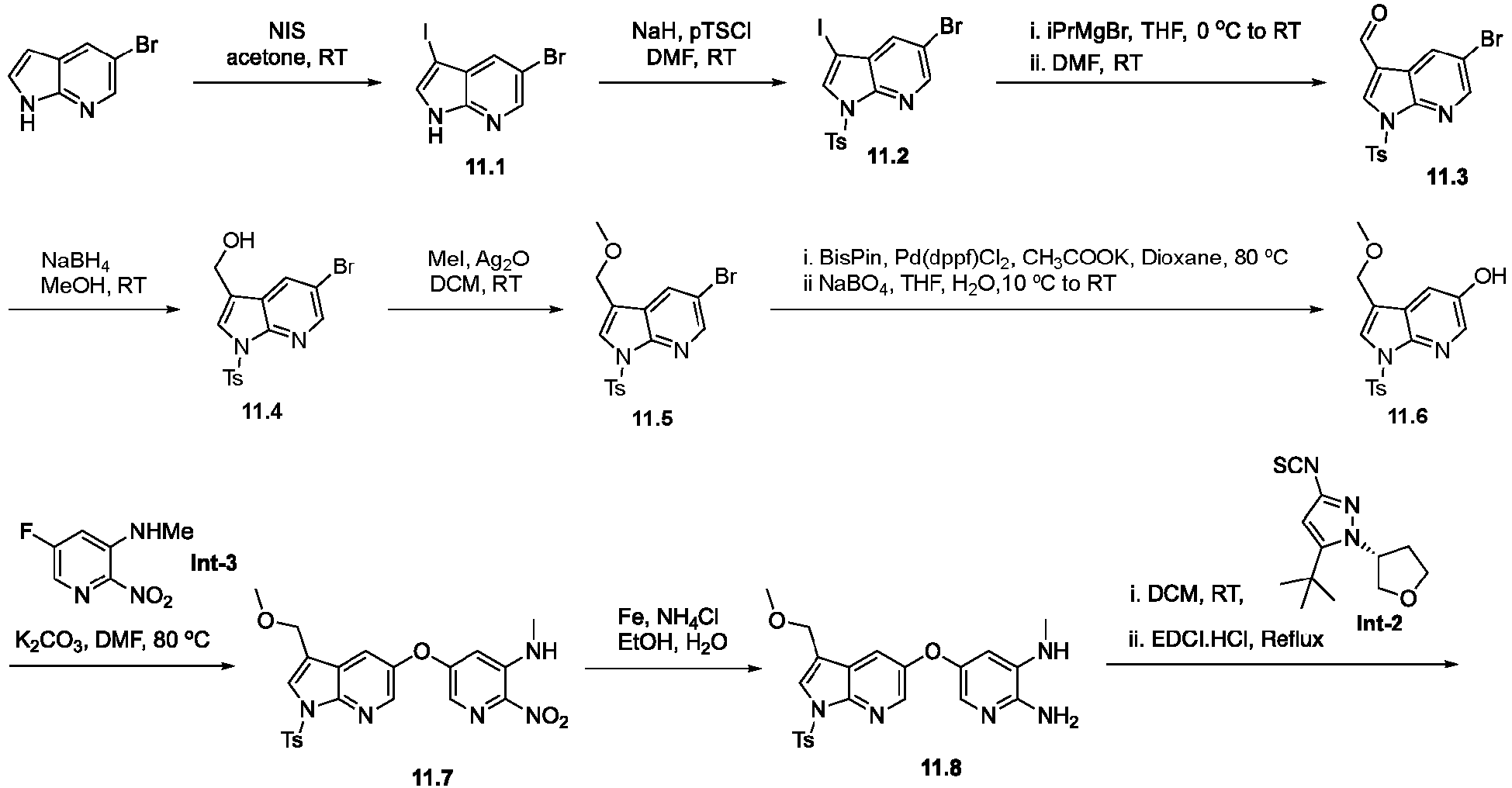

- Synthesis of compound 11.1. To a solution of 5-bromo-1H-pyrrolo[2,3-b]pyridine (20 g, 101.5 mmol, 1.0 equiv) in acetone (400 mL) was added N-iodosuccinimide (25 g, 111.65 mmol, 1.1 equiv) at 0 °C in portions. The reaction mixture was stirred at room temperature for 2 h. It was poured over ice-water and product precipitated out was filtered and dried well to obtain 11.1. MS (ES): m/z 323.1 [M+H]+.
- Synthesis of compound 11.2. To a solution of 11.1 (21.0 g, 65.03 mmol, 1.0 equiv) in DMF (200 mL) was added sodium hydride (3.9 g, 97.54 mmol, 1.5 equiv) in small portions at 0 °C. It was stirred for 1 h and then 4-toluenesulfonyl chloride was added (13.59 g, 71.53 mmol, 1.1 equiv). The reaction mixture was stirred at room temperature for 2 h. It was poured over ice-water, and the precipitated product was filtered and dried to obtain 11.2. MS (ES): m/z 477.4 [M+H]+.
- Synthesis of compound 11.3. To a solution of 11.2 (26 g, 54.49 mmol, 1.0 equiv) in THF (260 mL) at 0 °C was added isopropylmagnesium bromide (1 M in THF, 59.9 mL, 59.93 mmol, 1.1 equiv). It was stirred for 30 min and DMF (8.3 mL, 108.98 mmol, 2.0 equiv) was added. The mixture was allowed to warm to rt and stirred for 2 h. It was transferred into saturated ammonium chloride and extracted with ethyl acetate. The combined organic layers were washed with brine, dried over anhydrous sodium sulfate, filtered and concentrated under reduced pressure to afford crude product. The residue was purified by flash column chromatography on silica gel (CombiFlash®, 30% ethyl acetate in hexane) to afford 11.3. MS (ES): m/z 379.3 [M+H]+.
- Synthesis of compound 11.4. To a solution of 11.3 (12 g, 31.64 mmol, 1.0 equiv) in methanol (120 mL) was added sodium borohydride (1.75 g, 47.46 mmol, 1.5 equiv) in small portions at 0 °C. The reaction mixture was stirred at room temperature for 16 h. It was poured over ice-water, and product precipitated out was filtered, dried well to obtain 11.4. MS (ES): m/z 381.3 [M+H]+.
- Synthesis of compound 11.5. To a solution of 11.4 (9 g, 23.61 mmol, 1.0 equiv) in dichloromethane (90 mL) was added silver oxide (27.26 g, 118.05 mmol, 5.0 equiv) followed by methyl iodide (7.3 mL, 118.05 mmol, 5.0 equiv). The reaction mixture was stirred at room temperature for 24 h. It was poured over ice-water, extracted with ethyl acetate. The combined organic layers were washed with brine, dried over anhydrous sodium sulfate, filtered and concentrated under reduced pressure to afford crude. The residue was purified by flash column chromatography on silica gel (CombiFlash®, 15% ethyl acetate in hexane) to afford 11.5. MS (ES): m/z 395.5 [M+H]+.
- Synthesis of compound 11.6. A mixture of 11.5 (5.1 g, 12.90 mmol, 1.0 equiv), bis(pinacolato)diboron (4.24 g, 16.77 mmol, 1.3 equiv) and potassium acetate (4.24 g, 38.7 mmol, 3.0 equiv) in 1,4-dioxane (50 mL) was degassed by bubbling through a stream of argon for 10 min. [1,1'-Bis(diphenylphosphino)-ferrocene]palladium(II) dichloride (0.471 g, 0.645 mmol, 0.05 equiv) was added and the reaction mixture was heated at 80 °C under argon for 24 h. It was filtered through a pad of Celite® and rinsed with dichloromethane. The filtrate was concentrated under reduced pressure. The residue was dissolved in THF (50 mL) and water (10 mL), followed by addition of sodium perborate (3.94 g, 25.8 mmol, 2.0 equiv) at 10 °C. The reaction mixture was stirred at room temperature for 3 h. It was poured into water and extracted with ethyl acetate. The combined organic layers were washed with brine, dried over anhydrous sodium sulfate, filtered and concentrated under reduced pressure. The residue was purified by flash column chromatography on silica gel (CombiFlash®, 25% ethyl acetate in hexane) to afford 11.6 (2.3 g, 53.63%). MS (ES): m/z 333.4 [M+H]+.
- Synthesis of compound 11.7. A mixture of 11.6 (2.3 g, 6.92 mmol, 1.0 equiv), Int-3 (1.18 g, 6.92 mmol, 1.0 equiv) and potassium carbonate (2.38 g, 17.3 mmol, 2.5 equiv) in DMF (25 mL) was stirred at 80 °C for 2 h. It was cooled to room temperature, poured over ice-water and extracted with ethyl acetate. The combined organic layers were washed with brine, dried over anhydrous sodium sulfate, filtered and concentrated under reduced pressure. The residue was purified by flash column chromatography on silica gel (CombiFlash®, 2.0% methanol in dichloromethane) to afford 11.7. MS (ES): m/z 484.4 [M+H]+.
- Synthesis of compound 11.8. Compound 11.8 was prepared from 11.7, following the procedure described in the synthesis of 5.4. The product was purified by flash column chromatography on silica gel (CombiFlash®, 3.3% methanol in dichloromethane). MS (ES): m/z 454.6 [M+H]+.
- Synthesis of compound 11.9. Compound 11.9 was prepared from 11.8 and Int-2, following the procedure described in the synthesis of I-7. The product was purified by flash column chromatography on silica gel (CombiFlash®, 2.5% methanol in dichloromethane). MS (ES): m/z : 671.6 [M+H]+.
- Synthesis of I-11. To a solution of 11.9 (0.095 g, 0.141 mmol, 1.0 equiv) in methanol (10 mL) was added 20% aqueous sodium hydroxide (15 mL), and the reaction mixture was stirred at room temperature for 30 min. It was poured over ice-water and extracted with ethyl acetate. The combined organic layers were washed with brine, dried over anhydrous sodium sulfate, filtered and concentrated under reduced pressure. The residue was purified by flash column chromatography on silica gel (CombiFlash®, 3.5% methanol in dichloromethane) to afford I-11. MS (ES): m/z : 517.4 [M+H]+; 1H NMR (DMSO-d6, 400 MHz): δ 11.65 (s, 1H), 9.79 (s, 1H), 8.13-8.12 (d, J = 2.4Hz, 1H), 7.94-7.93 (d, J = 2.4Hz, 1H), 7.58-7.57 (d, J = 2.8Hz, 1H), 7.53-7.52 (d, J = 2.4Hz, 1H), 7.44-7.43 (d, J = 2.4Hz, 1H), 6.58 (s, 1H), 5.24 (bs, 1H), 4.48 (s, 2H), 4.10-4.06 (m, 2H), 3.85-3.81 (m, 2H), 3.62 (s, 3H), 3.19 (s, 3H), 2.33 (bs, 1H), 2.28-2.23 (m, 1H), 1.40 (s, 9H).
-

- Synthesis of compound 12.1. Compound 12.1 was prepared from 11.8 and Int-1 following the procedure described in the synthesis of I-7. The product was purified by flash column chromatography on silica gel (CombiFlash®, 2.5% methanol in dichloromethane). MS (ES): m/z : 671.6 [M+H]+.
- Synthesis of I-12. Compound I-12 was prepared from 12.1 following the procedure described in the synthesis of I-11. The product was purified by flash column chromatography on silica gel (CombiFlash®, 3.5% methanol in dichloromethane. MS (ES): m/z : 517.4 [M+H]+; 1H NMR (DMSO-d6, 400 MHz): δ 11.65 (s, 1H), 9.79 (s, 1H), 8.13-8.12 (d, J = 2.4Hz, 1H), 7.94-7.93 (d, J = 2.4Hz, 1H), 7.58-7.57 (d, J = 2.8Hz, 1H), 7.53-7.52 (d, J = 2.4Hz, 1H), 7.44-7.43 (d, J = 2.4Hz, 1H), 6.58 (s, 1H), 5.24 (bs, 1H), 4.48 (s, 2H), 4.10-4.06 (m, 2H), 3.87-3.81 (m, 2H), 3.62 (s, 3H), 3.19 (s, 3H), 2.33 (bs, 1H), 2.25-2.20 (m, 1H), 1.40 (s, 9H).
-

- Synthesis of compound 13.1. To a suspension of sodium hydride (3.2 g, 80.55 mmol, 1.2 equiv) in dry THF (100 mL) was added benzyl alcohol (7.97 g, 73.84 mmol, 1.1 equiv) at 0 °C and stirred for 15 min. To the mixture was added 3,5-dichloropyridazine (10 g, 67.13 mmol, 1.0 equiv) in small portions and the reaction mixture was stirred at room temperature for 2 h. It was transferred into ice, stirred and extracted with ethyl acetate. The combined organic layers were washed with brine, dried over anhydrous sodium sulfate, filtered and concentrated under reduced pressure. The residue was purified by flash column chromatography on silica gel (CombiFlash®, 40% ethyl acetate in hexane) to afford 13.1. MS (ES): m/z 221.2 [M+H]+.
- Synthesis of compound 13.2. A mixture of 13.1 (6.8 g, 30.82 mmol, 1.0 equiv), cyclopropanecarboxamide (7.87 g, 92.45 mmol, 3.0 equiv) and potassium carbonate (12.75 g, 92.45 mmol, 3.0 equiv) in 1,4-dioxane (70 mL) was degassed by bubbling through a stream of argon for 10 min. 4,5-Bis(diphenylphosphino)-9,9-dimethylxanthene (3.56 g, 6.16 mmol, 0.2 equiv) and tris(dibenzylideneacetone)dipalladium (2.82 g, 3.082 mmol, 0.1 equiv) was added, and degassed for 5 min. The reaction mixture was stirred at 100 °C under argon for 1 h. It was cooled to room temperature, poured into water and extracted with ethyl acetate. The combined organic layers were washed with brine, dried over anhydrous sodium sulfate, filtered and concentrated under reduced pressure. The residue was purified by flash column chromatography on silica gel (CombiFlash®, 3.0% methanol in dichloromethane) to afford 13.2. MS (ES): m/z : 270.3 [M+H]+.
- Synthesis of compound 13.3. To a solution of 13.2 (5.7 g, 21.17 mmol, 1.0 equiv) in methanol (100 mL) was added water (50 mL) followed by sodium hydroxide (8.46 g, 211.7 mmol, 10 equiv). The reaction mixture was heated to reflux for 1 h. It was poured over ice-water and extracted with ethyl acetate. The combined organic layers were washed with brine, dried over anhydrous sodium sulfate, filtered and concentrated under reduced pressure to afford 13.3. MS (ES): m/z : 202.1 [M+H]+.
- Synthesis of compound 13.4. To a solution of 13.3 (3.6 g, 17.89 mmol, 1.0 equiv) in isopropyl alcohol (70 mL) was added chloroacetaldehyde (22.7 mL, 178.9 mmol, 10 equiv) followed by sodium bicarbonate (3.00 g, 35.78 mmol, 2.0 equiv). The reaction mixture was stirred at 90 °C for 1 h. It was poured over ice-water and extracted with ethyl acetate. The combined organic layers were washed with brine, dried over anhydrous sodium sulfate, filtered and concentrated under reduced pressure. The residue was purified by flash column chromatography on silica gel (CombiFlash®, 35% ethyl acetate in hexane) to afford 13.4. MS (ES): m/z : 226.2 [M+H]+.
- Synthesis of compound 13.5. A mixture of compound 13.4 (3.1 g, 13.76 mmol, 1.0 equiv) and palladium hydroxide (20 wt% on carbon, 1.5 g) in methanol (30 mL) was stirred under hydrogen (1 atm) for 1 h. It was filtered through a pad of Celite® and rinsed with methanol. The filtrate was concentrated under reduced pressure to afford 13.5. MS (ES): m/z 136.2 [M+H]+.
- Synthesis of compound 13.6. Compound 13.6 was prepared following the procedure described in the synthesis of 5.3. The product was purified by flash column chromatography on silica gel (CombiFlash®, 3.5% methanol in dichloromethane). MS (ES): m/z 321.5 [M+H]+.
- Synthesis of compound 13.7. Compound 13.7 was prepared from 13.6, following the procedure described in the synthesis of 5.4. The product was purified by flash column chromatography on silica gel (CombiFlash®, 4.4% methanol in dichloromethane). MS (ES): m/z 291.3 [M+H]+.
- Synthesis of I-13. To a solution of 13.7 (0.150 g, 0.515 mmol, 1.0 equiv) and Int-1 (0.155 g, 0.619 mmol, 1.2 equiv) in THF (4 mL) was added potassium tert-butoxide (1 M in THF, 1.54 mL, 1.545 mmol, 3.0 equiv) at 0 °C. The reaction mixture was stirred at 0 °C for 30 min and allowed to warm to rt with stirring for 14 h. It was poured over ice-water and extracted with ethyl acetate. The combined organic layers were washed with brine, dried over anhydrous sodium sulfate, filtered and concentrated under reduced pressure. The residue was purified by flash column chromatography on silica gel (CombiFlash®, 2.6% methanol in dichloromethane) to afford I-13. MS (ES): m/z : 508.6 [M+H]+, 1H NMR (DMSO-d6, 400 MHz): δ 10.04 (s, 1H), 8.72 (s, 1H), 8.22 (s, 1H), 8.15 (s, 1H), 7.65 (bs, 1H), 7.22 (s, 1H), 6.56 (bs, 1H), 5.26 (bs, 1H), 4.09 (bs, 2H), 3.93 (s, 3H), 3.86-3.83 (m, 2H), 2.36-2.34 (m, 1H), 2.24 (bs, 1H), 1.40 (s, 9H).
-

- Synthesis of I-14. Compound I-14 was prepared from 13.7 and Int-2, following the procedure described in the synthesis of I-13. The product was purified by flash column chromatography on silica gel (CombiFlash®, 2.6% methanol in dichloromethane). MS (ES): m/z : 508.7 [M+H]+, 1H NMR (DMSO-d6, 400 MHz): δ 10.04 (s, 1H), 8.73-8.72 (d, J = 2.8Hz, 1H), 8.22 (s, 1H), 8.15 (s, 1H), 7.66-7.65 (d, J = 1.2Hz, 1H), 7.23-7.22 (d, J = 2.4Hz, 1H), 6.56 (bs, 1H), 5.28-5.24 (m, 1H), 4.11-4.06 (m, 2H), 3.93 (s, 3H), 3.86-3.82 (m, 2H), 2.40-2.35 (m, 1H), 2.26-2.20 (m, 1H), 1.40 (s, 9H).
-

- Synthesis of compound 15.1. To a solution of 3,5-dichloropyridazine (5.0 g, 33.56 mmol, 1.0 equiv) in 1,4-dioxane (20 mL) was added 2 N sodium hydroxide solution (50 mL, 10 v/w) and stirred at 100 °C for 4 h. It was transferred into ice-cold 1 N hydrochloric acid, stirred and extracted with ethyl acetate. The combined organic layers were washed with brine, dried over anhydrous sodium sulfate, filtered and concentrated under reduced pressure to afford 15.1. MS (ES): m/z 130.96 [M+H]+.
- Synthesis of compound 15.2. To a solution of 15.1 (3.0 g, 22.98 mmol, 1.0 equiv) in 1,4-dioxane (30 mL) was added hydrazine hydrate (60 mL, 20 v/w) and stirred at 130 °C for 16 h. It was concentrated under reduced pressure to afford 15.2. MS (ES): m/z 127.2 [M+H]+.
- Synthesis of compound 15.3. A solution of 15.2 (2.1 g, 16.65 mmol, 1.0 equiv) in formic acid (21 mL, 10 v/w) was stirred at 130 °C for 16 h. It was concentrated under reduced pressure. The residue was purified by preparative HPLC to afford 15.3. MS (ES): m/z 137.2 [M+H]+.
- Synthesis of compound 15.4. To a solution of 15.3 (0.810 g, 5.95 mmol, 1.0 equiv) in DMF (8 mL) was added Int-4 (1.22 g, 5.95 mmol, 1.0 equiv) followed by potassium carbonate (2.463 g, 17.85 mmol, 3.0 equiv). The reaction mixture was stirred at 60 °C for 3 h. It was cooled to room temperature, poured over ice-water and extracted with ethyl acetate. The combined organic layers were washed with brine, dried over anhydrous sodium sulfate, filtered and concentrated under reduced pressure. The residue was purified by flash column chromatography on silica gel (CombiFlash®, 2.5% methanol in dichloromethane) to afford 15.4. MS (ES): m/z 322.2 [M+H]+.
- Synthesis of compound 15.5. Compound 15.5 was prepared from 15.4, following the procedure described in the synthesis of 5.4. The product was purified by flash column chromatography on silica gel (CombiFlash®, 3.4% methanol in dichloromethane). MS (ES): m/z 292.3 [M+H]+.
- Synthesis of I-15. Compound I-15 was prepared from 15.5 and Int-2, following the procedure described in the synthesis of I-13. The product was purified by flash column chromatography on silica gel (CombiFlash®, 3.0% methanol in dichloromethane). MS (ES): m/z : 509.7 [M+H]+, 1H NMR (DMSO-d6, 400 MHz): δ 10.07 (s, 1H), 9.59-9.57 (d, J = 8Hz, 1H), 8.89-8.88 (d, J = 2.4Hz, 1H), 8.17 (s, 1H), 7.41-7.40 (d, d, J = 2.4Hz, 1H), 6.56 (s, 1H), 5.28-5.23 (m, 1H), 4.11-4.06 (m, 2H), 3.99 (s, 3H), 3.88-3.86 (m, 3H), 2.40-2.33 (m, 1H), 2.27-2.20 (m, 1H), 1.40 (s, 9H).
-

- Synthesis of I-16. Compound I-16 was prepared from 15.5 and Int-1, following the procedure described in the synthesis of I-13. The product was purified by flash column chromatography on silica gel (CombiFlash®, 2.9% methanol in dichloromethane). MS (ES): m/z : 509.6 [M+H]+, 1H NMR (DMSO-d6, 400 MHz): δ 10.06 (s, 1H), 9.60 (bs, 1H), 8.90-8.89 (d, J = 2.4Hz, 1H), 8.18 (s, 1H), 7.41-7.40 (d, d, J = 2.4Hz, 1H), 6.57 (s, 1H), 5.28 (bs, 1H), 4.12-4.09 (m, 2H), 3.99 (s, 3H), 3.89-3.84 (m, 2H), 2.37-2.34 (m, 1H), 2.27-2.24 (m, 1H), 1.40 (s, 9H). Example 17: (S)-2-(3-((7-chloro-1-methyl-6-(pyrazolo[1,5-a]pyrimidin-6-yloxy)-1H-imidazo[4,5-b]pyridin-2-yl)amino)-1-(tetrahydrofuran-3-yl)-1H-pyrazol-5-yl)-2-methylpropanenitrile

- Synthesis I-17. Compound I-17 was prepared from 7.4 and Int-7, following the procedure described in the synthesis of I-13. The product was purified by flash column chromatography on silica gel (CombiFlash®, 2.9% methanol in dichloromethane). MS (ES): m/z : 519.39 [M+H]+, 1H NMR (DMSO-d6, 400 MHz): δ 10.27 (s, 1H), 8.90-8.89 (d, J = 2.4Hz, 1H), 8.71-8.70 (d, J = 2.8Hz, 1H), 8.19-8.17 (m, 2H), 6.80 (bs, 2H), 5.34-5.31 (m, 1H), 4.19-4.09 (m, 2H), 3.97 (s, 3H), 3.89-3.85 (m, 2H), 2.34 (bs, 1H), 2.30-2.22 (m, 1H), 1.82 (s, 6H).
-

- Synthesis of I-18. Compound I-18 was prepared from 7.4 and Int-8, following the procedure described in the synthesis of I-13. The product was purified by flash column chromatography on silica gel (CombiFlash®, 3.0% methanol in dichloromethane. MS (ES): m/z : 519.75 [M+H]+, 1H NMR (DMSO-d6, 400 MHz): δ 10.26 (s, 1H), 8.89-8.88 (d, J = 2.4Hz, 1H), 8.69-8.68 (d, J = 2.8Hz, 1H), 8.16-8.16 (m, 2H), 6.79 (bs, 2H), 5.29 (bs, 1H), 4.18-4.08 (m, 2H), 3.96 (s, 3H), 3.87-3.84 (m, 2H), 2.33 (bs, 1H), 2.27-2.23 (m, 1H), 1.82 (s, 6H).
-

- Synthesis of compound 19.1. To a solution of thieno[2,3-b]pyridin-5-ol (1.0 g, 6.61 mmol, 1.0 equiv) in DMF (10 mL) was added Int-4 (1.36 g, 6.61 mmol, 1.0 equiv), followed by potassium carbonate (2.28 g, 16.52 mmol, 2.5 equiv). The reaction mixture was stirred at room temperature for 1 h. It was poured over ice-water, and the precipitated product was filtered and dried to obtain 19.1. MS (ES): m/z 337.5 [M+H]+.
- Synthesis of compound 19.2. Compound 19.2 was prepared from 19.1, following the procedure described in the synthesis of 5.4. The product was purified by flash column chromatography on silica gel (CombiFlash®, 3.5% methanol in dichloromethane). MS (ES): m/z 307.6 [M+H]+.
- Synthesis of I-19. Compound I-19 was prepared from 19.2 and Int-9, following the procedure described in the synthesis of I-13. The product was purified by flash column chromatography on silica gel (CombiFlash®, 11% methanol in dichloromethane). MS (ES): m/z : 537.7 [M+H]+, 1H NMR (DMSO-d6, 400 MHz): δ 10.02 (s, 1H), 8.52-8.51 (d, J = 2.8Hz, 1H), 8.10 (s, 1H), 7.92-7.90 (d, J = 6.0Hz, 1H), 7.68-7.67 (d, J = 2.8Hz, 1H), 7.34-7.32 (d, J = 6.0Hz, 1H), 6.51 (s, 1H), 5.08 (bs, 1H), 3.94 (s, 3H), 3.01-2.97 (m, 1H), 2.72-2.62 (m, 3H), 2.33 (bs, 1H), 2.30 (s, 3H), 2.18-2.17 (m, 1H), 1.39 (s, 9H).
-

- Synthesis of I-20. Compound I-20 was prepared from 19.2 and Int-10, following the procedure described in the synthesis of I-13. The product was purified by flash column chromatography on silica gel (CombiFlash®, 11% methanol in dichloromethane). MS (ES): m/z : 537.7 [M+H]+, 1H NMR (DMSO-d6, 400 MHz): δ 10.02 (s, 1H), 8.52-8.51 (d, J = 2.8Hz, 1H), 8.10 (s, 1H), 7.92-7.90 (d, J = 6.0Hz, 1H), 7.68-7.67 (d, J = 2.8Hz, 1H), 7.34-7.32 (d, J = 6.0Hz, 1H), 6.51 (s, 1H), 5.08-5.06 (m, 1H), 3.94 (s, 3H), 3.01-2.97 (m, 1H), 2.73-2.62 (m, 3H), 2.33 (bs, 1H), 2.30 (s, 3H), 2.18-2.17 (m, 1H), 1.39 (s, 9H).
-

- Synthesis of compound 21.1. A mixture of 4-bromo-1H-pyrazole (30 g, 204.12 mmol, 1.0 equiv), cesium carbonate (99.5 g, 306.18 mmol, 1.5 equiv) and 2-bromo-1,1-diethoxyethane (44.23 g, 224.5 mmol, 1.1 equiv) in acetonitrile (200 mL) was stirred at 80 °C for 16 h. It was cooled to room temperature, and most solvent was removed under reduced pressure. The residue was added to water and extracted with ethyl acetate. The combined organic layers were washed with brine, dried over anhydrous sodium sulfate, filtered and concentrated under reduced pressure. The residue was purified by flash column chromatography on silica gel (CombiFlash®, 4% ethyl acetate in hexane) to afford 21.1. MS (ES): m/z 263.3 [M+H]+.
- Synthesis of compound 21.2. To a solution of diisopropylamine (30.7 mL, 212.8 mmol, 1.6 equiv) in THF (200 mL) was added n-butyllithium (2.5 M in hexane, 85 mL, 212.8 mmol, 1.6 equiv) at -78 °C and stirred for 30 min. To the mixture was added a solution of 21.1 (35 g, 133 mmol, 1.0 equiv) in THF (70 mL), followed by addition of DMF (18 mL, 239.4, 1.8 equiv), and the reaction mixture was stirred for 1 h. It was quenched by addition of a saturated ammonium chloride solution and extracted with ethyl acetate. The organic layer was dried over anhydrous sodium sulfate, filtered and concentrated under reduced pressure. The residue was purified by flash column chromatography on silica gel (CombiFlash®, 4% ethyl acetate in hexane) to afford 21.2. 1H NMR (CDCl3, 400 MHz): δ 9.91 (s, 1H), 7.57 (s, 1H), 4.84-4.81 (m, 1H), 4.67-4.66 (d, 2H), 3.75-3.68 (m, 2H), 3.53-3.45 (m, 2H), 1.16-1.13 (t, 6H).
- Synthesis of compound 21.3. To a solution of 21.2 (22 g, 75.56 mmol, 1.0 equiv) in 2-methyl-THF (44 mL) was added trifluoroacetic acid (88 mL) and water (44 mL). The mixture was stirred at 40 °C for 3 h. It was cooled to room temperature and most solvent was removed under reduced pressure. The residue was dissolved in ethanol (120 mL), and acetic acid (12.9 mL, 226.68 mmol, 3.0 equiv) and ammonium acetate (17.45, 226.68 mmol, 3.0 equiv) were added. The reaction mixture was stirred at room temperature for 1 h. It was concentrated under reduced pressure. The residue was dissolved in 2-methyl-THF (400 mL) and water (400 mL). To it was added potassium carbonate in small portions to adjust pH = 8. The mixture was extracted with ethyl acetate. The combined organic layers were washed with brine, dried over anhydrous sodium sulfate, filtered and concentrated under reduced pressure. The residue was purified by flash column chromatography on silica gel (CombiFlash®, 20% ethyl acetate in hexane) to afford 21.3. MS (ES): m/z 199.8 [M+H]+.
- Synthesis of compound 21.4. A mixture of 21.3 (12 g, 60.6 mmol, 1.0 equiv) and benzyl alcohol (13 g, 121.2 mmol, 2.0 equiv) in toluene (120 mL) was degassed by bubbling through a stream of argon for 10 min. To the mixture was added cesium carbonate (59.08 g, 181.8 mmol, 3.0 equiv), 3,4,7,8-tetramethyl-1,10-phenanthroline (4.29 g, 18.18 mmol, 0.3 equiv) and copper iodide (1.72 g, 9.09 mmol, 0.15 equiv). It was degassed for 5 min and stirred at 90 °C under argon for 16 h. It was cooled to room temperature and filtered through a pad of Celite®. The filtrate was poured into water, extracted with ethyl acetate. The combined organic layers were washed with brine, dried over anhydrous sodium sulfate, filtered and concentrated under reduced pressure. The residue was purified by flash column chromatography on silica gel (CombiFlash®, 30% ethyl acetate in hexane) to afford 21.4. MS (ES): m/z 226.3 [M+H]+.
- Synthesis of compound 21.5. A mixture of compound 21.4 (1.3 g, 5.77 mmol, 1.0 equiv) and palladium on carbon (10 wt%, 0.650 g) in methanol (15 mL) was stirred under hydrogen for 1 h. It was filtered through a pad of Celite® and rinsed with methanol. The filtrate was concentrated under reduced pressure to afford 21.5. MS (ES): m/z 136.2 [M+H]+.
- Synthesis of compound 21.6. To a solution of 21.5 (0.450 g, 3.33 mmol, 1.0 equiv) in DMF (10 mL) was added Int-4 (0.684 g, 3.33 mmol, 1.0 equiv), followed by potassium carbonate (0.919 g, 6.66 mmol, 2.0 equiv). The reaction mixture was stirred at room temperature for 30 min. It was cooled to room temperature, filtered through a pad of Celite, poured over ice-water and extracted with ethyl acetate. The combined organic layers were washed with brine, dried over anhydrous sodium sulfate, filtered and concentrated under reduced pressure. The residue was purified by flash column chromatography on silica gel (CombiFlash®, 25% ethyl acetate in hexane to afford 21.6. MS (ES): m/z 321.2 [M+H]+.
- Synthesis of compound 21.7. Compound 21.7 was prepared from 21.6, following the procedure described in the synthesis of 5.4. The product was purified by flash column chromatography on silica gel (CombiFlash®, 3.2% methanol in dichloromethane). MS (ES): m/z 291.3 [M+H]+.
- Synthesis of I-21. Compound I-21 was prepared from 21.7 and Int-2, following the procedure described in the synthesis of I-13. The product was purified by flash column chromatography on silica gel (CombiFlash®, 3.5% methanol in dichloromethane). MS (ES): m/z : 508.3 [M+H]+, 1H NMR (DMSO-d6, 400 MHz): δ 10.02 (s, 1H), 9.02-9.01 (d, J = 1.2Hz, 1H), 8.69-8.67 (m, 1H), 8.12 (s, 1H), 8.02 (s, 1H), 7.87-7.86 (d, J = 5.2Hz, 1H), 6.55 (s, 1H), 5.28-5.24 (m, 1H), 4.11-4.07 (m, 2H), 3.96 (s, 3H), 3.86-3.83 (m, 2H), 2.41-2.34 (m, 1H), 2.28-2.22 (m, 1H), 1.40 (s, 9H).
-

- Synthesis of I-22. Compound I-22 was prepared from 21.7 and Int-1, following the procedure described in the synthesis of I-13. The product was purified by flash column chromatography on silica gel (CombiFlash®, 3.5% methanol in dichloromethane). MS (ES): m/z : 508.3 [M+H]+, 1H NMR (DMSO-d6, 400 MHz): δ 9.99 (s, 1H), 9.01 (s, 1H), 8.68-8.67 (d, J = 3.6Hz, 1H), 8.11 (s, 1H), 8.01 (s, 1H), 7.86-7.85 (d, J = 5.2Hz, 1H), 6.53 (s, 1H), 5.25 (bs, 1H), 4.10-4.06 (m, 2H), 3.94 (s, 3H), 3.85-3.81 (m, 2H), 2.39-2.31 (m, 1H), 2.26-2.19 (m, 1H), 1.39 (s, 9H).
-


- Synthesis of compound trans-23.1. Compound trans-23.1 was prepared from 13.7 and trans-Int-11a, following the procedure described in the synthesis of I-13. The product was purified by flash column chromatography on silica gel (CombiFlash®, 3% methanol in dichloromethane). MS (ES): m/z : 614.5 [M+H]+.
- Synthesis of I-23. To a solution of trans-23.1 (0.045 g, 0.073 mmol, 1.0 equiv) in dichloromethane (2 mL) was added triflic acid (0.1 mL) at 0 °C and stirred for 5 min. It was transferred into ice-cold saturated sodium bicarbonate solution and extracted with dichloromethane. The combined organic layers were washed with brine, dried over anhydrous sodium sulfate, filtered and concentrated under reduced pressure. The residue was purified by flash column chromatography on silica gel (CombiFlash®, 6.0% methanol in dichloromethane) to afford I-23. MS (ES): m/z : 524.8 [M+H]+, 1H NMR (DMSO-d6, 400 MHz): δ 10.06 (s, 1H), 8.74-8.73 (d, J = 2.8Hz, 1H), 8.23 (s, 1H), 8.17 (s, 1H), 7.66 (s, 1H), 7.24-7.23 (d, J = 3.2Hz, 1H), 6.56 (s, 1H), 5.56-5.55 (m, 1H), 4.93-4.91 (m, 1H), 4.57 (bs, 1H), 4.31-4.27 (m, 1H), 4.16-4.12 (m, 1H), 3.95 (s, 3H), 3.84-3.80 (m, 1H), 3.71-3.68 (m, 1H), 1.43 (s, 9H). (*Absolute stereochemistry not determined.)
- Synthesis of compound trans-24.1. Compound trans-24.1 was prepared from 13.7 and trans-Int-11b, following the procedure described in the synthesis of I-13. The product was purified by flash column chromatography on silica gel (CombiFlash®, 3% methanol in dichloromethane) to afford trans-24.1. MS (ES): m/z : 614.5 [M+H]+.
- Synthesis of I-24. Compound I-24 was prepared from trans-24.1, following the procedure described in the synthesis of I-23. The product was purified by flash column chromatography on silica gel (CombiFlash®, 6.0% methanol in dichloromethane). MS (ES): m/z : 524.8 [M+H]+, 1H NMR (DMSO-d6, 400 MHz): δ 10.06 (s, 1H), 8.74-8.73 (d, J = 2.8Hz, 1H), 8.23 (s, 1H), 8.17 (s, 1H), 7.66 (s, 1H), 7.24-7.23 (d, J = 3.2Hz, 1H), 6.60 (s, 1H), 5.56-5.55 (m, 1H), 4.93-4.91 (m, 1H), 4.58-4.56 (m, 1H), 4.31-4.27 (m, 1H), 4.16-4.12 (m, 1H), 3.95 (s, 3H), 3.84-3.80 (m, 1H), 3.71-3.68 (m, 1H), 1.43 (s, 9H). (*Absolute stereochemistry not determined.)
-

- Synthesis of I-25. Compound I-25 was prepared from 13.7 and Int-12, following the procedure described in the synthesis of I-13. The product was purified by flash column chromatography on silica gel (CombiFlash®, 6.5% methanol in dichloromethane). MS (ES): m/z : 554.8 [M+H]+, 1H NMR (DMSO-d6, 400 MHz): δ 10.05 (s, 1H), 8.73-8.72 (d, J = 2.4Hz, 1H), 8.22 (s, 1H), 8.15 (s, 1H), 7.65 (s, 1H), 7.23-7.22 (d, J = 2.4Hz, 1H), 6.53 (s, 1H), 5.10 (s, 1H), 4.61 (bs, 1H), 4.49 (bs, 1H), 3.90 (s, 3H), 3.13 (bs, 1H), 2.83-2.77 (m, 4H), 2.33-2.27 (m, 2H), 2.22-2.19 (m, 1H), 1.40 (s, 9H).
-

- Synthesis of I-26. Compound I-26 was prepared from 13.7 and Int-13, following the procedure described in the synthesis of I-13. The product was purified by flash column chromatography on silica gel (CombiFlash®, 6.4% methanol in dichloromethane). MS (ES): m/z : 553.04 [M+H]+, 1H NMR (DMSO-d6, 400 MHz): δ 10.05 (s, 1H), 8.73-8.72 (d, J = 2.4Hz, 1H), 8.22 (s, 1H), 8.15 (s, 1H), 7.65 (s, 1H), 7.23-7.22 (d, J = 2.4Hz, 1H), 6.53 (s, 1H), 5.10-08 (m, 1H), 4.61 (bs, 1H), 4.49 (bs, 1H), 3.90 (s, 3H), 3.13 (bs, 1H), 2.83-2.77 (m, 4H), 2.33-2.27 (m, 2H), 2.22-2.19 (m, 1H), 1.40 (s, 9H).
-

- Synthesis of compound 27.1. A solution of 2,5-dibromopyridin-3-amine (20 g, 79.39 mmol, 1.0 equiv) and sodium hydrosulfide (13.35 g, 238.17 mmol, 3.0 equiv) in 2-pentanol (200 mL) was stirred at 120 °C for 16 h. It was cooled to room temperature, poured into water, stirred and extracted with ethyl acetate. The combined organic layers were washed with brine, dried over anhydrous sodium sulfate, filtered and concentrated under reduced pressure. The residue was triturated in hexane to afford 27.1. MS (ES): m/z 206.4[M+H]+.
- Synthesis of compound 27.2. A mixture of 27.1 (5.2 g, 25.36 mmol, 1.0 equiv) and triethyl orthoformate (50 mL) was stirred at 120 °C for 1 h. It was cooled to room temperature, poured into water, stirred and extracted with ethyl acetate. The combined organic layers were washed with brine, dried over anhydrous sodium sulfate, filtered and concentrated under reduced pressure. The residue was purified by flash column chromatography on silica gel (CombiFlash®, 4-6% ethyl acetate in hexane) to afford 27.2. MS (ES): m/z 215.1[M+H]+.
- Synthesis of compound 27.3. A mixture of 27.2 (2.4 g, 11.16 mmol, 1.0 equiv), bis(pinacolato)diboron (3.68 g, 14.50 mmol, 1.3 equiv) and potassium acetate (2.18 g, 22.32 mmol, 2.0 equiv) in toluene (25 mL) was degassed by bubbling through a stream of argon for 10 min. To the mixture was added [1,1'-bis(diphenylphosphino)-ferrocene]palladium(II) dichloride (0.407 g, 0.558 mmol, 0.05 equiv), and it was heated at 100 °C under argon for 1.5 h. It was poured into water and extracted with ethyl acetate. The combined organic layers were washed with brine, dried over anhydrous sodium sulfate, filtered and concentrated under reduced pressure. The residue was purified by flash column chromatography on silica gel (CombiFlash®, 30% ethyl acetate in hexane) to afford 27.3. MS (ES): m/z 181.1 [M+H]+.
- Synthesis of compound 27.4. To a solution of 27.3 (2.0 g, 11.11 mmol, 1.0 equiv) in acetone (20 mL) was added a solution of oxone (3.41 g, 11.11 mmol, 1.0 equiv) in water (10 mL). The reaction mixture was stirred at room temperature for 2 h. It was transferred into 1 N hydrochloric acid and extracted with ethyl acetate. The combined organic layers were washed with brine, dried over anhydrous sodium sulfate, filtered and concentrated under reduced pressure. The residue was purified by flash column chromatography on silica gel (CombiFlash®, 2.1% methanol in dichloromethane) to afford 27.4. MS (ES): m/z 153.1 [M+H]+.
- Synthesis of compound 27.5. Compound 27.5 was prepared from 27.4 and Int-4 following the procedures described in the synthesis of 7.3. The residue was purified by flash column chromatography on silica gel (CombiFlash®, 2.4% methanol in dichloromethane). MS (ES): m/z 338.2 [M+H]+.
- Synthesis of compound 27.6. Compound 27.6 was prepared from 27.5, following the procedure described in the synthesis of 5.4. The product was purified by flash column chromatography on silica gel (CombiFlash®, 3.5% methanol in dichloromethane). MS (ES): m/z 308.3 [M+H]+.
- Synthesis of I-27. Compound I-27 was prepared from 27.6 and Int-10, following the procedure described in the synthesis of I-13. The product was purified by preparative HPLC. MS (ES): m/z : 538.4 [M+H]+, 1H NMR (DMSO-d6, 400 MHz): δ 10.02 (s, 1H), 9.58 (s, 1H), 8.64-8.63 (d, J = 2.4Hz, 1H), 8.15 (s, 1H), 7.89-7.88 (d, J = 2.8Hz, 1H), 6.52 (s, 1H), 5.12 (bs, 1H), 3.94 (s, 3H), 2.81-2.74 (m, 4H), 2.45 (s, 3H), 2.37-2.33 (m, 1H), 2.20-2.18 (m, 1H), 1.39 (s, 9H).
-

- Synthesis of I-28. Compound I-28 was prepared from 27.6 and Int-9, following the procedure described in the synthesis of I-13. The product was purified by preparative HPLC. MS (ES): m/z : 538.4 [M+H]+, 1H NMR (DMSO-d6, 400 MHz): δ 10.02 (s, 1H), 9.58 (s, 1H), 8.64-8.63 (d, J = 2.4Hz, 1H), 8.15 (s, 1H), 7.89-7.88 (d, J = 2.8Hz, 1H), 6.52 (s, 1H), 5.12 (bs, 1H), 3.94 (s, 3H), 2.81-2.74 (m, 4H), 2.45 (s, 3H), 2.36-2.33 (m, 1H), 2.20-2.18 (m, 1H), 1.39 (s, 9H). Example 29: (S)-N-(5-(tert-butyl)-1-(1-(2-fluoroethyl)pyrrolidin-3-yl)-1H-pyrazol-3-yl)-7-chloro-1-methyl-6-(pyrazolo[1,5-a]pyrazin-3-yloxy)-1H-imidazo[4,5-b]pyridin-2-amine

- Synthesis of I-29. Compound I-29 was prepared from 21.7 and Int-12, following the procedure described in the synthesis of I-13. The product was purified by flash column chromatography on silica gel (CombiFlash®, 6.0% methanol in dichloromethane. MS (ES): m/z : 553.5 [M+H]+, 1H NMR (DMSO-d6, 400 MHz): δ 10.00 (s, 1H), 9.01-9.00 (d, J = 1.2Hz, 1H), 8.68-8.67 (m, 1H), 8.11 (s, 1H), 8.01 (s, 1H), 7.86-7.85 (d, J = 4.8Hz, 1H), 6.51 (s, 1H), 5.10-5.06 (m, 1H), 4.61-4.59 (t, 1H), 4.49-4.47 (t, 1H), 3.95 (s, 3H), 3.13-3.09 (m, 1H), 2.85-2.67 (m, 5H), 2.33-2.26 (m, 1H), 2.23-2.18 (m, 1H), 1.38 (s, 9H).
-

- Synthesis of I-30. Compound I-29 was prepared from 21.7 and Int-13, following the procedure described in the synthesis of I-13. The product was purified by flash column chromatography on silica gel (CombiFlash®, 6.0% methanol in dichloromethane). MS (ES): m/z : 553.5 [M+H]+, 1H NMR (DMSO-d6, 400 MHz): δ 10.00 (s, 1H), 9.02-9.01 (d, J = 1.2Hz, 1H), 8.69-8.68 (m, 1H), 8.12 (s, 1H), 8.02 (s, 1H), 7.87-7.86 (d, J = 4.8Hz, 1H), 6.52 (s, 1H), 5.11-5.07 (m, 1H), 4.62-4.60 (t, 1H), 4.50-4.48 (t, 1H), 3.96 (s, 3H), 3.14-3.10 (m, 1H), 2.86-2.68 (m, 5H), 2.34-2.27 (m, 1H), 2.24-2.17 (m, 1H), 1.39 (s, 9H).
-

- Synthesis of I-31. Compound I-31 was prepared from 21.7 and Int-9, following the procedure described in the synthesis of I-13. The product was purified by flash column chromatography on silica gel (CombiFlash®, 8.0% methanol in dichloromethane). MS (ES): m/z : 521.7 [M+H]+, 1H NMR (DMSO-d6, 400 MHz): δ 9.99 (s, 1H), 9.00 (s, 1H), 8.68-8.67 (d, J = 4.0Hz, 1H), 8.19 (s, 1H), 8.01 (s, 1H), 7.86-7.85 (d, J = 4.8Hz, 1H), 6.50 (s, 1H), 5.08 (bs, 1H), 3.94 (s, 3H), 2.75-2.63 (m, 4H), 2.30 (bs, 4H), 2.17-2.16 (m, 1H), 1.37 (s, 9H).
-

- Synthesis of I-32. Compound I-32 was prepared from 21.7 and Int-10, following the procedure described in the synthesis of I-13. The product was purified by flash column chromatography on silica gel (CombiFlash®, 8.1% methanol in dichloromethane). MS (ES): m/z : 521.7 [M+H]+, 1H NMR (DMSO-d6, 400 MHz): δ 9.99 (s, 1H), 9.02-9.01 (d, J = 0.8Hz, 1H), 8.69-8.68 (m, 1H), 8.12 (s, 1H), 8.02 (s, 1H), 7.87-7.86 (d, J = 4.8Hz, 1H), 6.51 (s, 1H), 5.12-5.07 (m, 1H), 3.96 (s, 3H), 2.78-2.64 (m, 4H), 2.32 (bs, 4H), 2.20-2.15 (m, 1H), 1.39 (s, 9H).
-

- Synthesis of I-33. Compound I-33 was prepared from 13.7 and Int-14, following the procedure described in the synthesis of I-13. The product was purified by flash column chromatography on silica gel (CombiFlash®, 5% methanol in dichloromethane). MS (ES): m/z : 534.3 [M+H]+, 1H NMR (DMSO-d6, 400 MHz): δ 10.04 (s, 1H), 8.74-8.73 (d, J = 2.4Hz, 1H), 8.23 (s, 1H), 8.16 (s, 1H), 7.66 (s, 1H), 7.24-7.23 (d, J = 2.8Hz, 1H), 6.54 (s, 1H), 4.98-4.93 (m, 1H), 4.72 (s, 2H), 4.58 (s, 2H), 3.94 (s, 3H), 2.81-2.74 (m, 4H), 1.36 (s, 9H).
-

- Synthesis of I-34. Compound I-34 was prepared from 21.7 and Int-15, following the procedure described in the synthesis of I-13. The product was purified by flash column chromatography on silica gel (CombiFlash®, 2.5% methanol in dichloromethane). MS (ES): m/z : 502.4 [M+H]+, 1H NMR (DMSO-d6, 400 MHz): δ 10.08 (s, 1H), 9.01 (s, 1H), 8.69-8.68 (d, J = 4Hz, 1H), 8.13 (s, 1H), 8.03 (s, 1H), 7.87-7.86 (d, J= 4.8Hz, 1H), 6.64 (s, 1H), 6.59-6.31 (m, 1H), 4.65-4.57 (m, 2H), 3.95 (s, 3H), 1.39 (s, 9H).
-
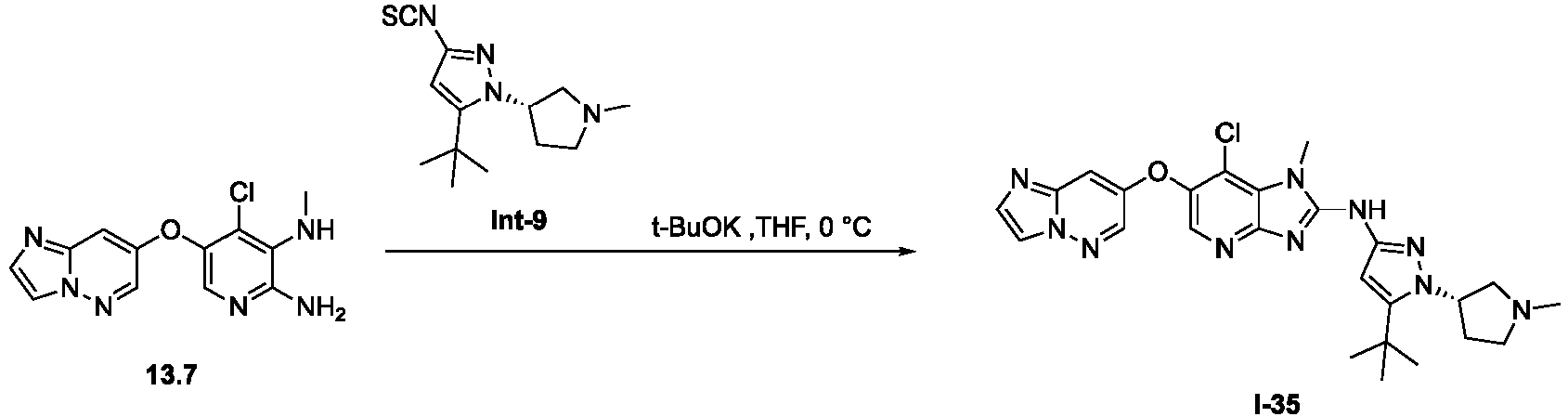
- Synthesis of I-35. Compound I-35 was prepared from 13.7 and Int-9, following the procedure described in the synthesis of I-13. The product was purified by flash column chromatography on silica gel (CombiFlash®, 10% methanol in dichloromethane). MS (ES): m/z : 521.5 [M+H]+, 1H NMR (DMSO-d6, 400 MHz): δ 10.04 (s, 1H), 8.74-8.73 (d, J = 2.4Hz, 1H), 8.23 (s, 1H), 8.18 (s, 1H), 7.66 (s, 1H), 7.24-7.23 (d, J = 2.4Hz, 1H), 6.56 (s, 1H), 5.27 (s, 1H), 3.96 (s, 3H), 3.10 (bs, 2H), 2.62 (bs, 2H), 2.45 (bs, 3H), 2.34 (bs, 1H), 2.23 (bs, 1H), 1.40 (s, 9H).
-

- Synthesis of I-36. Compound I-36 was prepared from 13.7 and Int-10, following the procedure described in the synthesis of I-13. The product was purified by flash column chromatography on silica gel (CombiFlash®, 11% methanol in dichloromethane). MS (ES): m/z : 521.03 [M+H]+, 1H NMR (DMSO-d6, 400 MHz): δ 10.03 (s, 1H), 8.74-8.73 (d, J = 2.4Hz, 1H), 8.23 (s, 1H), 8.18 (s, 1H), 7.66 (s, 1H), 7.24-7.23 (d, J = 2.4Hz, 1H), 6.54 (s, 1H), 5.27 (s, 1H), 3.96 (s, 3H), 3.10 (bs, 2H), 2.61 (bs, 2H), 2.45 (s, 3H), 2.34 (bs, 1H), 2.24-2.22 (m, 1H), 1.40 (s, 9H).
-


- Synthesis of compound 37.1. Compound 37.1 was prepared from 21.7 and Int-16a, following the procedure described in the synthesis of I-13. The product was purified by flash column chromatography on silica gel (CombiFlash®, 3.5% methanol in dichloromethane). MS (ES): m/z : 587.5 [M+H]+.
- Synthesis of I-37. Compound I-37 was prepared from 37.1, following the procedure described in the synthesis of I-23. The product was purified by flash column chromatography on silica gel (CombiFlash®, 4.5% methanol in dichloromethane). MS (ES): m/z : 496.41 [M+H]+, 1H NMR (DMSO-d6, 400 MHz): δ 9.97 (s, 1H), 9.01 (s, 1H), 8.69-8.68 (d, J = 4.0Hz, 1H), 8.12 (s, 1H), 8.02 (s, 1H), 7.87-7.86 (d, J = 4.8Hz, 1H), 6.56 (s, 1H), 4.98-4.97 (d, 1H), 4.25-4.22 (m, 1H), 4.11-4.06 (m, 1H), 3.95 (bs, 4H), 1.39 (s, 9H), 1.15-1.14 (d, 3H). (*Absolute stereochemistry not determined).
- Synthesis of compound 38.1. Compound 38.1 was prepared from 21.7 and Int-16b, following the procedure described in the synthesis of I-13. The product was purified by flash column chromatography on silica gel (CombiFlash®, 3.5% methanol in dichloromethane). MS (ES): m/z : 587.4 [M+H]+.
- Synthesis of I-38. Compound I-38 was prepared from 38.1, following the procedure described in the synthesis of I-23. The product was purified by flash column chromatography on silica gel (CombiFlash®, 4.5% methanol in dichloromethane). MS (ES): m/z : 496.41 [M+H]+, 1H NMR (DMSO-d6, 400 MHz): δ 9.97 (s, 1H), 9.01 (s, 1H), 8.69-8.68 (d, J = 4.0Hz, 1H), 8.12 (s, 1H), 8.02 (s, 1H), 7.87-7.86 (d, J = 4.8Hz, 1H), 6.56 (s, 1H), 4.98-4.97 (d, 1H), 4.25-4.21 (m, 1H), 4.11-4.05 (m, 1H), 3.95 (bs, 4H), 1.39 (s, 9H), 1.15-1.14 (d, 3H). (*Absolute stereochemistry not determined.)
-

- Synthesis of compound 39.1. To a solution of N-(3,5-difluoropyridin-2-yl)acetamide (15 g, 87.14 mmol, 1.0 equiv) and N-formylmorpholine (26.1 mL, 261.4 mmol, 3.0 equiv) in THF (150 mL) was added lithium bis(trimethylsilyl)amide (1.0 M in THF, 200 mL, 200.4 mmol, 2.3 equiv) at -20 °C dropwise. After the addition, the reaction mixture was stirred at same temperature for 2 h. It was poured into a cold aqueous solution of citric acid monohydrate (60.4 g) and sodium chloride (15 g), and the mixture was stirred at 0 °C for 15 min. The organic layer was separated, washed with 50% dipotassium hydrogen phosphate aqueous solution followed by brine. It was dried over sodium sulfate, filtered and concentrated under reduced pressure. The residue was purified by flash column chromatography on silica gel (CombiFlash®, 70% ethyl acetate in hexane) to afford 39.1. 1H NMR (DMSO-d6, 400 MHz): δ 10.46 (s, 1H), 10.22 (s, 1H), 8.53 (s, 1H), 2.09 (s, 3H).
- Synthesis of compound 39.2. To a solution of 39.1 (1.0 g, 5.0 mmol, 1.0 equiv) in dichloromethane (10 mL) was added diethylaminosulfur trifluoride (0.65 mL, 5.0 mmol, 1.0 equiv) dropwise at 0 °C. The reaction mixture was stirred at same temperature for 30 min. It was transferred into saturated sodium bicarbonate solution and extracted with ethyl acetate. The combined organic layers were washed with brine, dried over sodium sulfate, filtered and concentrated under reduced pressure. The residue was purified by flash column chromatography on silica gel (CombiFlash®, 35-40% ethyl acetate in hexane) to afford 39.2. 1H NMR (CDCl3, 400 MHz): δ 8.27 (s, 1H), 7.63 (s, 1H), 7.12-6.86 (m, 1H), 2.38 (s, 3H).
- Synthesis of compound 39.3. To a solution of 39.2 (1.8 g, 8.10 mmol, 1.0 equiv) in methanol (10 mL) was added concentrated hydrochloric acid (3 mL). The reaction mixture was heated to reflux for 1 h. It was concentrated under reduced pressure. To the residue was added ice-water and it was neutralized by saturated sodium bicarbonate solution and extracted with ethyl acetate. The combined organic layers were washed with brine, dried over sodium sulfate, filtered and concentrated under reduced pressure. The residue was purified by flash column chromatography on silica gel (CombiFlash®, 15-20% ethyl acetate in hexane) to afford 39.3. 1H NMR (DMSO-d6, 400 MHz): δ 7.99 (s, 1H), 7.44-7.18 (m, 1H), 6.54 (s, 2H).
- Synthesis of compound 39.4. Concentrated sulfuric acid (5 mL, 6 vol) was added dropwise to potassium persulfate (3.56 g, 13.21 mmol, 2.8 equiv) at room temperature and stirred for 15 min. To the mixture was added 39.3 (0.850 g, 4.72 mmol, 1.0 equiv) in portions, maintaining temperature at 30-40 °C. The reaction mixture was stirred at room temperature for 3-4 h. It was poured into crushed ice, stirred and basified with saturated sodium bicarbonate. The aqueous mixture was extracted with ethyl acetate. The combined organic layers were washed with brine, dried over sodium sulfate, filtered and concentrated under reduced pressure. The residue was purified by flash column chromatography on silica gel (CombiFlash®, 8-10% ethyl acetate in hexane) to afford 39.4. 1H NMR (CDCl3, 400 MHz): δ 8.69 (s, 1H), 7.28-6.91 (m, 1H).
- Synthesis of compound 39.5. To a solution of 39.4 (0.155 g, 0.737 mmol, 1.0 equiv) in acetonitrile (3 mL) was added aqueous methylamine solution (40%, 0.06 mL, 0.737 mmol, 1.0 equiv) dropwise at 0 °C. The reaction mixture was stirred at room temperature for 2-3 h. It was poured over ice-water and extracted with ethyl acetate. The combined organic layers were washed with brine, dried over sodium sulfate, filtered and concentrated under reduced pressure to afford 39.5. 1H NMR (DMSO-d6, 400 MHz): δ 7.96 (s, 1H), 7.54-7.41 (m, 1H), 2.86 (d, 3H).
- Synthesis of compound 39.6. To a solution of 39.5 (0.300 g, 1.36 mmol, 1.0 equiv) in DMF (10 mL) was added 27.4 (0.309 g, 2.03 mmol, 1.5 equiv) followed by potassium carbonate (0.469 g, 3.4 mmol, 2.5 equiv). The reaction mixture was stirred at room temperature for 1 h. It was poured over ice-water and extracted with ethyl acetate. The combined organic layers were washed with brine, dried over anhydrous sodium sulfate, filtered and concentrated under reduced pressure. The residue was purified by trituration with diethyl ether to afford 39.6. (0.295 g, 61.55%). MS (ES): m/z 354.2 [M+H]+.
- Synthesis of compound 39.7. Compound 39.7 was prepared from 39.6, following the procedure described in the synthesis of 5.4. The product was purified by flash column chromatography on silica gel (CombiFlash®, 3.0% methanol in dichloromethane). MS (ES): m/z 324.3 [M+H]+.
- Synthesis of I-39. Compound I-39 was prepared from 39.7 and Int-9 following the procedure described in the synthesis of 1.7. The product was purified by flash column chromatography on silica gel (CombiFlash®, 4.0% methanol in dichloromethane). MS (ES): m/z : 554.5 [M+H]+, 1H NMR (DMSO-d6, 400 MHz): ): δ 10.09 (s, 1H), 9.59 (s, 1H), 8.63-8.62 (d, J = 2.4Hz, 1H), 8.07 (s, 1H), 7.95-7.94 (d, J = 2.8Hz, 1H), 7.66-7.40 (m, 1H), 6.53 (s, 1H), 5.10-5.06 (m, 1H), 3.80 (s, 3H), 3.02-2.98 (m, 1H), 2.74-2.63 (m, 3H), 2.30 (bs, 4H), 2.18-2.17 (m, 1H), 1.38 (s, 9H).
-

- Synthesis of I-40. Compound I-40 was prepared from 39.7 and Int-10 following the procedure described in the synthesis of 1.7. The product was purified by flash column chromatography on silica gel (CombiFlash®, 4.0% methanol in dichloromethane). MS (ES): m/z : 554.4 [M+H]+, 1H NMR (DMSO-d6, 400 MHz): ): δ 10.10 (s, 1H), 9.60 (s, 1H), 8.64-8.63 (d, J = 2.4Hz, 1H), 8.09 (s, 1H), 7.96-7.95 (d, J = 2.8Hz, 1H), 7.67-7.41 (m, 1H), 6.54 (s, 1H), 5.11-5.07 (m, 1H), 3.82 (s, 3H), 3.01-2.99 (m, 1H), 2.75-2.63 (m, 3H), 2.31 (bs, 4H), 2.19-2.18 (m, 1H), 1.40 (s, 9H).
-

- Synthesis of compound (±)-I-41. To a solution of 21.7 (0.100 g, 0.343 mmol, 1.0 equiv) in THF (5 mL) was added Int-17 (0.095 g, 0.343 mmol, 1.0 equiv) followed by addition of potassium tert-butoxide (1 M in THF, 1.0 mL, 1.029 mmol, 3.0 equiv) at 0 °C. The reaction mixture was stirred for 30 min. It poured over ice-water and extracted with ethyl acetate. The combined organic layers were washed with brine, dried over anhydrous sodium sulfate, filtered and concentrated under reduced pressure. The residue was dissolved in THF (5 mL) and N-(3-dimethylaminopropyl)-N'-ethylcarbodiimide hydrochloride (0.131 g, 0.686 mmol, 2.0 equiv) was added. The reaction mixture was stirred at 80 °C for 1 h. It was poured over ice-water and extracted with ethyl acetate. The combined organic layers were washed with brine, dried over anhydrous sodium sulfate, filtered and concentrated under reduced pressure. The residue was purified by flash column chromatography on silica gel (CombiFlash®, 2.0% methanol in dichloromethane) to afford (±)-I-41. MS (ES): m/z : 534.9 [M+H]+.
- Separation of I-41a and I-41b. Enantiomers of (±)-I-41 were separated by HPLC (column: CHIRALPAK IC (250mm x 21mm, 5 µm); mobile phase: 0.1% DEA in methanol; flow rate = 20 mL/min) to afford first eluting fraction (I-41a) and second eluting fraction (I-41b).
- I-41a: MS (ES): m/z : 534.4 [M+H]+, 1H NMR (DMSO-d6, 400 MHz): δ 9.99 (s, 1H), 8.97 (s, 1H), 8.68-8.66 (m, 1H), 8.02-8.00 (d, J = 8Hz, 2H), 7.86-7.84 (d, J = 4.8Hz, 1H), 6.51 (s, 1H), 5.01-4.98 (m, 1H), 4.25-4.19 (m, 1H), 3.91 (s, 3H), 3.85-3.80 (m, 1H), 2.39-2.31 (m, 2H), 1.33 (s, 9H), 0.9-0.84 (m, 2H), 0.79-0.75 (m, 2H).
- I-41b: MS (ES): m/z : 534.4 [M+H]+, 1H NMR (DMSO-d6, 400 MHz): δ 9.97 (s, 1H), 8.97 (s, 1H), 8.68-8.66 (m, 1H), 8.02-8.00 (d, J = 8Hz, 2H), 7.86-7.84 (d, J = 4.8Hz, 1H), 6.51 (s, 1H), 5.01-4.97 (m, 1H), 4.24-4.19 (m, 1H), 3.91 (s, 3H), 3.85-3.79 (m, 1H), 2.39-2.31 (m, 2H), 1.33 (s, 9H), 0.9-0.84 (m, 2H), 0.79-0.75 (m, 2H).
-

- Synthesis of I-42. Compound I-42 was prepared from 7.4 and Int-14, following the procedure described in the synthesis of I-13. The product was purified by flash column chromatography on silica gel (CombiFlash®, 3% methanol in dichloromethane). MS (ES): m/z : 535.7 [M+H]+, 1H NMR (DMSO-d6, 400 MHz): δ 9.99 (s, 1H), 8.87-8.86 (d, J = 2.4Hz, 1H), 8.69-8.68 (d, J = 2.8Hz, 1H), 8.18-8.17 (d, J = 2.0Hz, 1H), 8.14 (s, 1H), 6.78 (s, 1H), 6.52 (s, 1H), 4.96-4.92 (m, 1H), 4.71 (s, 2H), 4.57 (s, 2H), 3.94 (s, 3H), 2.80-2.67 (m, 4H), 1.35 (s, 9H).
-


- Synthesis of compound 43.1. Compound 43.1 was prepared from 39.5 and 21.5, following the procedure described in the synthesis of 39.6. The product was purified by trituration with diethyl ether. MS (ES): m/z 337.5 [M+H]+.
- Synthesis of compound 43.2. Compound 43.2 was prepared from 43.1, following the procedure described in the synthesis of 5.4. The product was purified by flash column chromatography on silica gel (CombiFlash®, 3.0% methanol in dichloromethane). MS (ES): m/z 307.3 [M+H]+.
- Synthesis of I-43. Compound I-43 was prepared from 43.2 and Int-12, following the procedure described in the synthesis of I-41. The product was purified by flash column chromatography on silica gel (CombiFlash®, 4.0% methanol in dichloromethane). MS (ES): m/z : 569.8 [M+H]+, 1H NMR (DMSO-d6, 400 MHz): ): δ 10.08 (s, 1H), 9.02 (s, 1H), 8.71-8.70 (d, J = 4.0Hz, 1H), 8.65-8.64 (d, J = 4.0Hz, 1H), 8.07-8.05 (d, J = 7.6Hz, 1H), 7.81-7.58 (m, 1H), 6.53 (s, 1H), 6.26 (s, 1H), 5.11-5.07 (m, 1H), 4.62-4.60 (t, 2H), 4.50-4.48 (t, 2H), 3.82 (s, 3H), 3.40-3.38 (m, 2H), 3.17-3.11 (m, 2H), 2.85-2.81 (m, 1H), 2.79-2.74 (m, 1H), 1.39 (s, 9H).
-

- Synthesis of I-44. Compound I-43 was prepared from 43.2 and Int-13, following the procedure described in the synthesis of I-41. The product was purified by flash column chromatography on silica gel (CombiFlash®, 4.0% methanol in dichloromethane). MS (ES): m/z : 569.8 [M+H]+, 1H NMR (DMSO-d6, 400 MHz): δ 10.08 (s, 1H), 9.02 (s, 1H), 8.71-8.70 (d, J = 4.0Hz, 1H), 8.65-8.64 (d, J = 4.0Hz, 1H), 8.07-8.05 (d, J = 7.6Hz, 1H), 7.81-7.58 (m, 1H), 6.53 (s, 1H), 6.26 (s, 1H), 5.11-5.07 (m, 1H), 4.62-4.60 (t, 2H), 4.50-4.48 (t, 2H), 3.82 (s, 3H), 3.40-3.38 (m, 2H), 3.17-3.11 (m, 2H), 2.85-2.81 (m, 1H), 2.79-2.74 (m, 1H), 1.39 (s, 9H).
-

- Synthesis of compound 45.1. To a solution of 19.2 (0.642 g, 2.09 mmol, 1.0 equiv) in THF (15 mL) was added 1,1'-thiocarbonyldiimidazole (1.86 g, 10.45 mmol, 5.0 equiv). The reaction mixture was stirred at 70 °C for 1 h. It was cooled to room temperature and poured into ice-water. The precipitated solids were collected by filtration and triturated with hexane to afford 45.1. MS(ES): m/z: 349.5 [M+H]+.
- Synthesis of compound 45.2. To a solution of 45.1 (0.545 g, 1.56 mmol, 1.0 equiv) in methanol (2 mL) and N-methylpyrrolidine (5 mL) was added a solution of sodium methoxide (0.5 M in methanol, 7.8 mL, 3.9 mmol, 2.5 equiv) and copper iodide (0.059 g, 0.312 mmol, 0.2 equiv). The reaction mixture was stirred at 130 °C under argon for 2 h. It was cooled to room temperature, poured into ice-water, and extracted with DCM. The combined organic layers were washed with brine, dried over anhydrous sodium sulfate, filtered and concentrated under reduced pressure. The residue was purified by flash column chromatography on silica gel (CombiFlash®, 2.5% methanol in DCM) to afford 45.2. MS(ES): m/z: 345.1 [M+H]+.
- Synthesis of compound 45.3. To a solution of 45.2 (0.135 g, 0.391 mmol, 1.0 equiv) in acetonitrile (5 mL) was added sulfuryl chloride (0.4 mL, 4.995 mmol, 37 equiv) at 0 °C. The reaction mixture was stirred for 30 min. It was transferred into saturated sodium bicarbonate solution, stirred and extracted with ethyl acetate. The combined organic layers were washed with brine, dried over anhydrous sodium sulfate, filtered and concentrated under reduced pressure. The residue was purified by flash column chromatography on silica gel (CombiFlash®, 2.8% methanol in DCM) to afford 45.3. MS (ES): m/z 347.1 [M+H]+.
- Synthesis of I-45. A mixture of 45.3 (0.050 g, 0.144 mmol, 1.0 equiv), Int-9.5 (0.032 g, 0.144 mmol, 1.2 equiv) and tripotassium phosphate (0.091 g, 0.432 mmol, 3.0 equiv) in DMF (3 mL) was degassed by bubbling through a stream of argon for 10 min. Under argon atmosphere [(2-di-tert-butylphosphino-2',4',6'-triisopropyl-1,1'-biphenyl)-2-(2'-amino-1,1'-biphenyl)] palladium(II) methanesulfonate (0.034 g, 0.043 mmol, 0.3 equiv) was added, and the mixture was degassed for an additional 5 min. The reaction mixture was stirred at room temperature for 24 h. It was transferred into water and extracted with ethyl acetate. The combined organic layers were washed with brine, dried over anhydrous sodium sulfate, filtered and concentrated under reduced pressure. The residue was purified by flash column chromatography on silica gel (CombiFlash®, 10% methanol in DCM) to afford I-45. MS(ES): m/z: 533.2 [M+H]+, 1H NMR (DMSO-d6, 400 MHz): δ 9.80 (s, 1H), 8.54-8.53 (d, J = 2.4 Hz, 1H), 8.00 (s, 1H), 7.92-7.91 (d, J = 6.0 Hz, 1H), 7.69-7.68 (d, J = 2.8 Hz, 1H), 7.36-7.34 (d, J = 6.0 Hz, 1H), 6.51 (s, 1H), 5.20 (bs, 1H), 3.96 (s, 3H), 3.86 (s, 3H), 3.35 (s, 3H), 2.98 (bs, 2H), 2.21-2.19 (m, 2H), 1.39 (s, 9H), 1.28-1.20 (m, 2H).
-

- Synthesis of I-46. Compound I-46 was prepared from 45.3 following the procedure described in the synthesis of I-45. The product was purified by flash column chromatography on silica gel (CombiFlash®, 10% methanol in DCM) to afford I-46. MS(ES): m/z: 533.2 [M+H]+, 1H NMR (DMSO-d6, 400 MHz): δ 9.81 (s, 1H), 8.53 (bs, 1H), 7.99 (bs, 1H), 7.92 (bs, 1H), 7.68 (bs, 1H), 7.35 (bs, 1H), 6.51 (s, 1H), 5.19 (bs, 1H), 3.95 (s, 3H), 3.84 (s, 3H), 3.35 (s, 3H), 2.96 (bs, 2H), 2.19 (bs, 2H), 1.39 (s, 9H), 1.28-1.20 (m, 2H).
-
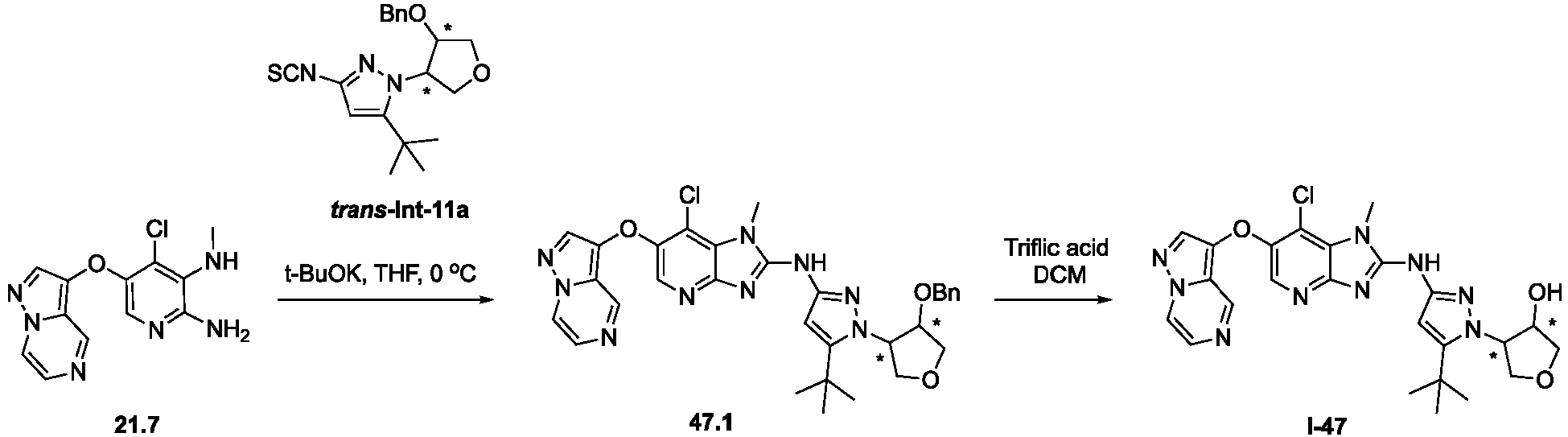
- Synthesis of compound 47.1. Compound 47.1 was prepared from 21.7 and trans-Int-11a, following the procedure described in the synthesis of I-13. The product was purified by flash column chromatography on silica gel (CombiFlash®, 3% methanol in DCM). MS(ES): m/z: 614.1 [M+H]+.
- Synthesis of I-47. Compound I-47 was prepared from 47.1, following the procedure described in the synthesis of I-23. The product was purified by flash column chromatography on silica gel (CombiFlash®, 7.0% methanol in DCM). MS(ES): m/z: 524.3 [M+H]+, LCMS purity: 100%, 1H NMR (DMSO-d6, 400 MHz): δ 10.00 (s, 1H), 9.01-9.00 (d, J = 1.6 Hz, 1H), 8.68-8.67 (m, 1H), 8.12 (s, 1H), 8.01 (s, 1H), 7.86-7.85 (d, J = 4.8 Hz, 1H), 6.56 (s, 1H), 5.55-5.53 (m, 1H), 4.91 (bs, 1H), 4.55 (bs, 1H), 4.29-4.27 (m, 1H), 4.14-4.11 (m, 1H), 3.95 (s, 3H), 3.80-3.79 (m, 1H), 3.70-3.66 (m, 1H), 1.40 (s, 9H). (*Absolute stereochemistry not determined.)

- Synthesis of compound 48.1. Compound 48.1 was prepared from 21.7 and trans-Int-11b, following the procedure described in the synthesis of I-13. The product was purified by flash column chromatography on silica gel (CombiFlash®, 3% methanol in DCM). MS(ES): m/z: 614.1 [M+H]+.
- Synthesis of I-48. Compound I-48 was prepared from 48.1, following the procedure described in the synthesis of I-23. The product was purified by flash column chromatography on silica gel (CombiFlash®, 7.0% methanol in DCM. MS(ES): m/z: 524.3 [M+H]+, LCMS purity: 100%, 1H NMR (DMSO-d6, 400 MHz): δ 10.03 (s, 1H), 9.02-9.01 (d, J = 1.6 Hz, 1H), 8.70-8.68 (m, 1H), 8.13 (s, 1H), 8.03 (s, 1H), 7.87-7.86 (d, J = 4.8 Hz, 1H), 6.57 (s, 1H), 5.55-5.53 (m, 1H), 4.92 (bs, 1H), 4.57 (bs, 1H), 4.30-4.26 (m, 1H), 4.15-4.12 (m, 1H), 3.96 (s, 3H), 3.82-3.79 (m, 1H), 3.71-3.67 (m, 1H), 1.41 (s, 9H). (*Absolute stereochemistry not determined.)
-

- Synthesis of I-49. Compound I-49 was prepared from 21.7 and Int-14, following the procedure described in the synthesis of I-13. The product was purified by flash column chromatography on silica gel (CombiFlash®, 5% methanol in DCM). MS(ES): m/z: 534.4 [M]+, 1H NMR (DMSO-d6, 400 MHz): δ 9.97 (s, 1H), 9.01 (s, 1H), 8.68-8.67 (d, J = 4.4 Hz, 1H), 8.12 (s, 1H), 8.02 (s, 1H), 7.87-7.86 (d, J = 4.8 Hz, 1H), 6.52 (s, 1H), 4.96-4.92 (m, 1H), 4.71 (s, 2H), 4.58 (s, 2H), 3.95 (s, 3H), 2.77-2.73 (m, 4H), 1.35 (s, 9H).
-


- Synthesis of compound 50.1. Compound 50.1 was prepared from 21.7, following the procedure described in the synthesis of 45.1. The product was used without purification. MS(ES): m/z: 333.5 [M+H]+.
- Synthesis of compound 50.2. Compound 50.2 was prepared from 50.1, following the procedure described in the synthesis of 45.2. The product was purified by flash column chromatography on silica gel (CombiFlash®, 3.0% methanol in DCM). MS(ES): m/z: 329.3 [M+H]+.
- Synthesis of compound 50.3. Compound 50.3 was prepared from 50.2, following the procedure described in the synthesis of 45.3. The product was purified by flash column chromatography on silica gel (CombiFlash®, 3.2% methanol in DCM). MS (ES): m/z 306.7 [M+H]+.
- Synthesis of I-50. Compound I-50 was prepared from 50.3 following the procedure described in the synthesis of Int-45. The product was purified by preparative HPLC. MS(ES): m/z: 549.8 [M+H]+, 1H NMR (DMSO-d6, 400 MHz): δ 9.79 (s, 1H), 8.96 (s, 1H), 8.66-8.65 (d, J = 4.8 Hz, 1H), 8.00 (s, 1H), 7.96 (s, 1H), 7.84-7.83 (d, J = 4.8 Hz, 1H), 6.51 (s, 1H), 5.07 (bs, 1H), 4.63-4.60 (m, 1H), 4.51-4.48 (m, 1H), 4.05 (s, 3H), 3.82 (s, 3H), 3.14-3.10 (m, 1H), 2.86-2.80 (m, 3H), 2.77-2.74 (m, 2H), 2.28-2.20 (m, 2H), 1.39 (s, 9H).
-

- Synthesis of I-51. To a solution of 43.2 (0.025 g, 0.081 mmol, 1.0 equiv) and Int-18 (0.038 g, 0.122 mmol, 1.5 equiv) in THF (3 mL) was added potassium tert-butoxide (1 M in THF) (0.36 mL, mmol, 2.2 equiv) at -78 °C. The reaction mixture was stirred at -78 °C for 30 min. It was poured into ice-water and extracted with ethyl acetate. The combined organic layers were washed with brine, dried over anhydrous sodium sulfate, filtered and concentrated under reduced pressure. The residue was dissolved in THF (5 mL) and N-(3-dimethylaminopropyl)-N'-ethylcarbodiimide hydrochloride (0.093 g, 0.489 mmol, 3.0 equiv) was added. The reaction mixture was stirred at 70 °C for 3 h. It was poured into ice-water and extracted with ethyl acetate. The combined organic layers were washed with brine, dried over anhydrous sodium sulfate, filtered and concentrated under reduced pressure. The residue was purified by flash column chromatography on silica gel (CombiFlash®, 2.5% methanol in DCM) to afford I-51. MS(ES): m/z: 581.5 [M+H]+, 1H NMR (MeOD, 400 MHz): δ 8.99 (s, 1H), 8.55-8.53 (m, 1H), 8.02 (s, 1H), 7.94 (s, 1H), 7.87-7.86 (d, J = 4.8 Hz, 1H), 7.77-7.50 (m, 1H), 6.50 (s, 1H), 5.25 (bs, 1H), 3.91 (s, 3H), 3.63-3.61 (m, 2H), 3.39 (s, 3H), 3.08-2.89 (m, 6H), 2.39-2.29 (m, 2H), 1.46 (s, 9H).
-

- Synthesis of I-52. Compound I-52 was prepared from 43.2 and Int-19 following the procedure described in the synthesis of Int-51. The product was purified by flash column chromatography on silica gel (CombiFlash®, 2.5% methanol in DCM). MS(ES): m/z: 581.4 [M+H]+, 1H NMR (MeOD, 400 MHz): δ 8.99 (s, 1H), 8.55-8.54 (d, J = 4.4 Hz, 1H), 8.02 (s, 1H), 7.94 (s, 1H), 7.87-7.86 (d, J = 4.8 Hz, 1H), 7.77-7.50 (m, 1H), 6.50 (s, 1H), 5.25 (bs, 1H), 3.91 (s, 3H), 3.63-3.61 (m, 2H), 3.39 (s, 3H), 3.08-2.90 (m, 6H), 2.39-2.29 (m, 2H), 1.46 (s, 9H).
-

- Synthesis of compound 53.1. To a solution of 43.2 (0.280 g, 0.914 mmol, 1.0 equiv) in THF (5 mL) was added 1,1'-thiocarbonyldiimidazole (0.813 g, 4.57 mmol, 5.0 equiv). The reaction mixture was stirred at 80 °C for 1 h. It was cooled to room temperature and poured into ice-water. The precipitated solids were collected by filtration and triturated with hexane to afford 53.1. MS(ES): m/z: 349.0 [M+H]+.
- Synthesis of compound 53.2. To a solution of 53.1 (0.230 g, 0.660 mmol, 1.0 equiv) in acetic acid (5 mL) was added aqueous hydrobromic acid (0.160 g, 1.98 mmol, 3.0 equiv) at 0 °C followed by bromine (0.528 g, 3.3 mmol, 5.0 equiv). The reaction mixture was stirred for 10 min. It was transferred into saturated sodium bicarbonate solution, stirred and extracted with ethyl acetate. The combined organic layers were washed with brine, dried over anhydrous sodium sulfate, filtered and concentrated under reduced pressure. The residue was purified by flash column chromatography on silica gel (CombiFlash®, 3.0% methanol in DCM) to afford 53.2. MS (ES): m/z 396.1 [M+H]+.
- Synthesis of I-53. A mixture of 53.2 (0.025 g, 0.063 mmol, 1.0 equiv), Int-14.3 (0.018 g, 0.075 mmol, 1.2 equiv) and potassium carbonate (0.021 g, 0.157 mmol, 2.5 equiv) in 1,4-dioxane (2 mL) was degassed by bubbling through a stream of argon for 10 min. Under argon atmosphere, 4,5-bis(diphenylphosphino)-9,9-dimethylxanthene (0.007 g, 0.012 mmol, 0.2 equiv) and tris(dibenzylideneacetone)dipalladium(0) (0.006 g, 0.0063 mmol, 0.1 equiv) were added, and the mixture was degassed for an additional 5 min. The reaction mixture was stirred at 120 °C for 3 h. It was cooled to room temperature, transferred into water and extracted with ethyl acetate. The combined organic layers were washed with brine, dried over anhydrous sodium sulfate, filtered and concentrated under reduced pressure. The residue was purified by preparative HPLC to afford I-53. MS(ES): m/z: 550.1 [M]+, 1H NMR (DMSO-d6, 400 MHz): δ 9.97 (s, 1H), 9.01 (s, 1H), 8.68-8.67 (d, J = 4.4 Hz, 1H), 8.12 (s, 1H), 8.02 (s, 1H), 7.87-7.86 (d, J = 4.8 Hz, 1H), 7.77-7.50 (m, 1H), 6.52 (s, 1H), 4.96-4.92 (m, 1H), 4.71 (s, 2H), 4.58 (s, 2H), 3.95 (s, 3H), 2.77-2.73 (m, 4H), 1.35 (s, 9H).
-

- Synthesis of I-54. Compound I-54 was prepared from 21.7 and Int-20 following the procedure described in the synthesis of 1.7. The product was purified by prep HPLC. MS(ES): m/z: 477.6 [M+H]+, 1H NMR (DMSO-d6, 400 MHz):: δ 10.24 (s, 1H), 8.73-8.72 (d, J = 2.8 Hz, 1H), 8.22 (s, 1H), 8.18 (s, 1H), 7.65 (s, 1H), 7.24-7.23 (d, J = 2.8 Hz, 1H), 6.69 (s, 1H), 5.49 (s, 2H), 3.94 (s, 3H), 1.40 (s, 9H).
-

- Synthesis of compound 55.1. Compound 55.1 was prepared from 21.7 and Int-21, following the procedure described in the synthesis of I-13. The product was purified by flash column chromatography on silica gel (CombiFlash®, 3% methanol in DCM). MS(ES): m/z: 598.2 [M]+.
- Synthesis of I-55. Compound I-55 was prepared from 55.1, following the procedure described in the synthesis of I-23. The product was purified by flash column chromatography on silica gel (CombiFlash®, 5.0% methanol in DCM). MS(ES): m/z: 508.2 [M+H]+, 1H NMR (DMSO-d6, 400 MHz): δ 9.96 (s, 1H), 9.00 (s, 1H), 8.68-8.67 (d, J = 4.4 Hz, 1H), 8.11 (s, 1H), 8.01 (s, 1H), 7.86-7.85 (d, J = 4.8 Hz, 1H), 6.53 (s, 1H), 5.23-5.17 (m, 2H), 4.47 (bs, 1H), 3.95 (s, 3H), 2.75-2.67 (m, 2H), 2.35-2.31 (m, 2H), 1.35 (s, 9H).
-

- Synthesis of compound 56.1. Compound 56.1 was prepared from 13.7, following the procedure described in the synthesis of 45.1. The product was used without purification. MS(ES): m/z: 333.5 [M+H]+.
- Synthesis of compound 56.2. Compound 56.2 was prepared from 56.1, following the procedure described in the synthesis of 45.3. The product was purified by flash column chromatography on silica gel (CombiFlash®, 3.5% methanol in DCM). MS (ES): m/z 336.1 [M+H]+.
- Synthesis of compound I-56-a and I-56-b. A mixture of 56.2 (0.097 g, 0.289 mmol, 1.0 equiv), (±)-Int-22 (0.066 g, 0.289 mmol, 1.0 equiv) and potassium carbonate (0.099 g, 0.722 mmol, 2.5 equiv) in 1,4-dioxane (5 mL) was degassed by bubbling through a stream of argon for 10 min. Under argon atmosphere, 4,5-bis(diphenylphosphino)-9,9-dimethylxanthene (0.033 g, 0.057 mmol, 0.2 equiv) and tris(dibenzylideneacetone)dipalladium(0) (0.025 g, 0.028 mmol, 0.1 equiv) were added, and the mixture was degassed for an additional 5 min. The reaction mixture was stirred at 130 °C for 3 h. It was cooled to room temperature, transferred into water and extracted with ethyl acetate. The combined organic layers were washed with brine, dried over anhydrous sodium sulfate, filtered and concentrated under reduced pressure. The residue was purified by flash column chromatography on silica gel (CombiFlash®, 2.5% methanol in DCM) to afford the racemate I-56. It was subjected to HPLC separation (column: CHIRALPAK IB-N (250 mm x 21 mm, 5 µm); mobile phase: (A) 0.1% DEA in n-hexane (B) 0.1% DEA in isopropanol:acetonitrile (70:30); flow rate: 20 mL/min) to afford first eluting fraction (I-56-a) and second eluting fraction (I-56-b). (*Absolute stereochemistry not determined.)
- I-56-a: MS(ES): m/z: 525.4 [M+H]+, 1H NMR (DMSO-d6, 400 MHz): δ 10.04 (s, 1H), 8.72 (bs, 1H), 8.22 (s, 1H), 8.15 (s, 1H), 7.65 (bs, 1H), 7.22 (s, 1H), 5.26 (bs, 1H), 4.09 (bs, 2H), 3.93 (s, 3H), 3.86-3.83 (m, 2H), 2.36-2.34 (m, 1H), 2.24 (bs, 1H), 1.40 (s, 9H).
- I-56-b: MS(ES): m/z: 525.4 [M+H]+, 1H NMR (DMSO-d6, 400 MHz): δ 10.04 (s, 1H), 8.73-8.72 (d, J = 2.8 Hz, 1H), 8.22 (s, 1H), 8.15 (s, 1H), 7.66-7.65 (d, J = 1.2 Hz, 1H), 7.23-7.22 (d, J = 2.4 Hz, 1H), 5.28-5.24 (m, 1H), 4.11-4.06 (m, 2H), 3.93 (s, 3H), 3.86-3.82 (m, 2H), 2.40-2.35 (m, 1H), 2.26-2.20 (m, 1H), 1.40 (s, 9H).
-

- Synthesis of I-57. Compound I-57 was prepared from 21.7 and Int-23, following the procedure described in the synthesis of I-13. The product was purified by flash column chromatography on silica gel (CombiFlash®, 2.5% methanol in DCM). MS(ES): m/z: 463.5 [M]+, 1H NMR (DMSO-d6, 400 MHz): δ 9.04 (s, 1H), 8.70-8.69 (d, J = 3.6 Hz, 1H), 8.53 (s, 1H), 8.30-8.29 (d, J= 2.0 Hz, 1H), 8.21 (s, 1H), 8.05 (s, 1H), 7.88-7.87 (d, J = 4.8 Hz, 1H), 7.25-7.24 (d, J = 2.0 Hz, 1H), 3.99 (s, 3H), 3.56 (s, 3H), 1.83-1.79 (m, 1H), 0.90-0.85 (m, 2H), 0.61-0.58 (m, 2H).
-

- Synthesis of I-58. Compound I-58 was prepared from 51.3 and Int-24.3, following the procedure described in the synthesis of I-53. The product was purified by flash column chromatography on silica gel (CombiFlash®, 3.6% methanol in DCM). MS(ES): m/z: 503.1 [M+H]+, 1H NMR (DMSO-d6, 400 MHz): δ 9.00 (s, 1H), 8.68-8.67 (d, J = 4.0 Hz, 1H), 8.35 (s, 1H), 8.29 (s, 1H), 8.13 (s, 1H), 7.99 (s, 1H), 7.86-7.85 (d, J = 3.6 Hz, 1H), 7.16 (s, 1H), 4.18 (bs, 2H), 4.11 (s, 3H), 3.90 (s, 3H), 3.67 (bs, 2H), 3.28 (s, 3H), 1.83 (bs, 1H), 0.89-0.88 (m, 2H), 0.59 (bs, 2H).
-

- Synthesis of I-59. Compound I-59 was prepared from 53.2 and Int-23.3, following the procedure described in the synthesis of I-53. The product was purified by flash column chromatography on silica gel (CombiFlash®, 3.6% methanol in DCM). MS(ES): m/z: 479.6 [M]+, 1H NMR (DMSO-d6, 400 MHz): δ 9.03 (s, 1H), 8.71-8.70 (d, J = 4.0 Hz, 1H), 8.60 (s, 1H), 8.31-8.30 (d, J = 2.0 Hz, 1H), 8.16 (s, 1H), 8.07 (s, 1H), 7.89 (s, 1H), 7.88-7.62 (m, 1H), 7.24-7.23 (d, J= 1.6 Hz, 1H), 3.18 (s, 3H), 3.55 (s, 3H), 1.84-1.78 (m, 1H), 0.88-0.84 (m, 2H), 0.60-0.56 (m, 2H).
-

- Synthesis of compound cis-(±)-60.1. Compound cis-(±)-60.1 was prepared from 21.7 and cis-(±)-Int-25, following the procedure described in the synthesis of I-13. The product was purified by flash column chromatography on silica gel (CombiFlash®, 3% methanol in DCM). MS(ES): m/z: 613.1 [M+H]+.
- Synthesis of I-60-a and I-60-b. The racemate I-60 was prepared from cis-(±)-60.1, following the procedure described in the synthesis of I-23. The product was purified by flash column chromatography on silica gel (CombiFlash®, 7.0% methanol in DCM). MS(ES): m/z: 522.4 [M+H]+. The racemate was subjected to HPLC separation (column: CHIRALPAK IB-N (250 mm x 21 mm, 5 µm); mobile phase: (A) 0.1% DEA in n-hexane (B) 0.1% DEA in isopropanol:acetonitrile (70:30); flow rate: 22 mL/min) to afford first eluting fraction (I-60-a) and second eluting fraction (I-60-b). (*Absolute stereochemistry not determined.)
- I-60-a: MS(ES): m/z: 522.4 [M+H]+, 1H NMR (DMSO-d6, 400 MHz): δ 9.90 (s, 1H), 9.01 (s, 1H), 8.68-8.67 (m, 1H), 8.12 (s, 1H), 8.02 (s, 1H), 7.87-7.86 (d, J = 4.8 Hz, 1H), 6.51 (s, 1H), 5.00 (bs, 1H), 4.60-4.56 (m, 1H), 4.48 (bs, 1H), 3.96 (s, 3H), 2.16-2.00 (m, 2H), 1.90-1.75 (m, 3H), 1.67-1.60 (m, 1H), 1.41 (s, 9H).
- I-60-b: MS(ES): m/z: 522.4 [M+H]+, 1H NMR (DMSO-d6, 400 MHz): δ 9.92 (s, 1H), 9.00 (s, 1H), 8.67-8.66 (m, 1H), 8.11 (s, 1H), 8.01 (s, 1H), 7.86-7.85 (d, J= 4.8 Hz, 1H), 6.50 (s, 1H), 5.01 (bs, 1H), 4.60-4.54 (m, 1H), 4.47 (bs, 1H), 3.95 (s, 3H), 2.14-2.00 (m, 2H), 1.88-1.75 (m, 3H), 1.65-1.60 (m, 1H), 1.40 (s, 9H).
-

- Synthesis of compound 61.1. Compound 61.1 was prepared from 21.7, following the procedure described in the synthesis of 45.1. The product was used without purification. MS(ES): m/z: 333.2 [M+H]+.
- Synthesis of compound 61.2. Compound 61.2 was prepared from 61.1, following the procedure described in the synthesis of 53.2. The product was purified by flash column chromatography on silica gel (CombiFlash®, 2.8% methanol in DCM). MS (ES): m/z 380.2 [M+H]+.
- Synthesis of I-61. Compound I-61 was prepared from 61.2 and Int-26, following the procedure described in the synthesis of Int-45. The product was purified by preparative HPLC. MS(ES): m/z: 491.5 [M]+, 1H NMR (DMSO-d6, 400 MHz): δ 9.02-9.01 (d, J = 1.2 Hz, 1H), 8.69-8.68 (m, 1H), 8.49 (s, 1H), 8.12 (s, 1H), 8.03 (s, 1H), 7.87-8.86 (d, J = 4.8 Hz, 1H), 6.58 (s, 1H), 4.42-4.39 (t, 2H), 3.95 (s, 3H), 3.14-3.10 (t, 2H), 1.40 (s, 9H).
-

- Synthesis of I-62. A mixture of 51.3 (0.050 g, 0.151 mmol, 1.0 equiv), Int-13.3 (0.046 g, 0.181 mmol, 1.2 equiv) and tripotassium phosphate (0.096 g, 0.453 mmol, 3.0 equiv) in DMF (2 mL) was degassed by bubbling through a stream of argon for 10 min. Under argon atmosphere, [(2-di-tert-butylphosphino-2',4',6'-triisopropyl-1,1'-biphenyl)-2-(2'-amino-1,1'-biphenyl)] palladium(II) methanesulfonate (0.035 g, 0.045 mmol, 0.3 equiv) was added, and the mixture was degassed for additional 5 min. The reaction mixture was stirred at 110 °C for 2 h. It was transferred into water and extracted with ethyl acetate. The combined organic layers were washed with brine, dried over anhydrous sodium sulfate, filtered and concentrated under reduced pressure. The residue was purified by flash column chromatography on silica gel (CombiFlash®, 4.8% methanol in DCM) to afford I-62. MS(ES): m/z: 549.6 [M+H]+, 1H NMR (DMSO-d6, 400 MHz): δ 9.79 (s, 1H), 8.96 (s, 1H), 8.66-8.65 (d, J = 4.8 Hz, 1H), 8.00 (s, 1H), 7.96 (s, 1H), 7.84-7.83 (d, J = 4.8 Hz, 1H), 6.51 (s, 1H), 5.07 (bs, 1H), 4.63-4.60 (m, 1H), 4.51-4.48 (m, 1H), 4.05 (s, 3H), 3.82 (s, 3H), 3.14-3.10 (m, 1H), 2.86-2.80 (m, 3H), 2.77-2.74 (m, 2H), 2.28-2.20 (m, 2H), 1.39 (s, 9H).
-

- Synthesis of I-63. Compound I-63 was prepared from 53.2 and Int-20.2, following the procedure described in the synthesis of Int-45. The product was purified by preparative HPLC. MS(ES): m/z: 493.03 [M+H]+, 1H NMR (DMSO-d6, 400 MHz): δ 10.21 (s, 1H), 9.01 (s, 1H), 8.70-8.69 (s, 1H), 8.07 (s, 1H), 8.04 (s, 1H), 7.88-7.87 (d, J= 4.8 Hz, 1H), 7.84-7.58 (m, 1H), 6.67 (s, 1H), 5.48 (s, 2H), 3.81 (s, 3H), 1.39 (s, 9H).
-

- Synthesis of I-64. Compound I-64 was prepared from 51.3 and Int-23.3, following the procedure described in the synthesis of I-53. The product was purified by flash column chromatography on silica gel (CombiFlash®, 4.0% methanol in DCM). MS(ES): m/z: 459.4 [M+H]+, 1H NMR (DMSO-d6, 400 MHz): δ 9.00-8.99 (d, J = 1.2 Hz, 1H), 8.68-8.67 (m, 1H), 8.34 (s, 1H), 8.32-8.31 (d, J = 1.2 Hz, 1H), 8.13 (s, 1H), 7.99 (s, 1H), 7.86-7.85 (d, J = 4.8 Hz, 1H), 7.22-7.21 (d, J = 2.0 Hz, 1H), 4.11 (s, 3H), 3.90 (s, 3H), 3.56 (s, 3H), 1.84-1.80 (m, 1H), 0.90-0.85 (m, 2H), 0.61-0.57 (m, 2H).
-

- Synthesis of compound 65.1. Compound 65.1 was prepared from 21.7 and Int-27, following the procedure described in the synthesis of I-13. The product was purified by flash column chromatography on silica gel (CombiFlash®, 1.5% methanol in DCM). MS(ES): m/z: 584.0 [M+H]+.
- Synthesis of I-65. Compound I-65 was prepared from 65.1, following the procedure described in the synthesis of I-23. The product was purified by flash column chromatography on silica gel (CombiFlash®, 3.0% methanol in DCM). MS(ES): m/z: 493.6 [M+H]+, 1H NMR (DMSO-d6, 400 MHz): δ 9.03 (s, 1H), 8.68-8.67 (d, J = 4.4 Hz, 1H), 8.56 (s, 1H), 8.21 (s, 1H), 8.05 (s, 1H), 7.87-7.86 (d, J = 4.8 Hz, 1H), 7.32 (s, 1H), 6.02-6.00 (d, J = 6.8 Hz, 1H), 4.97-4.94 (m, 2H), 4.08-4.05 (m, 2H), 4.00 (s, 3H), 3.72-3.69 (m, 1H), 1.86-1.85 (m, 1H), 1.23 (bs, 4H).
-
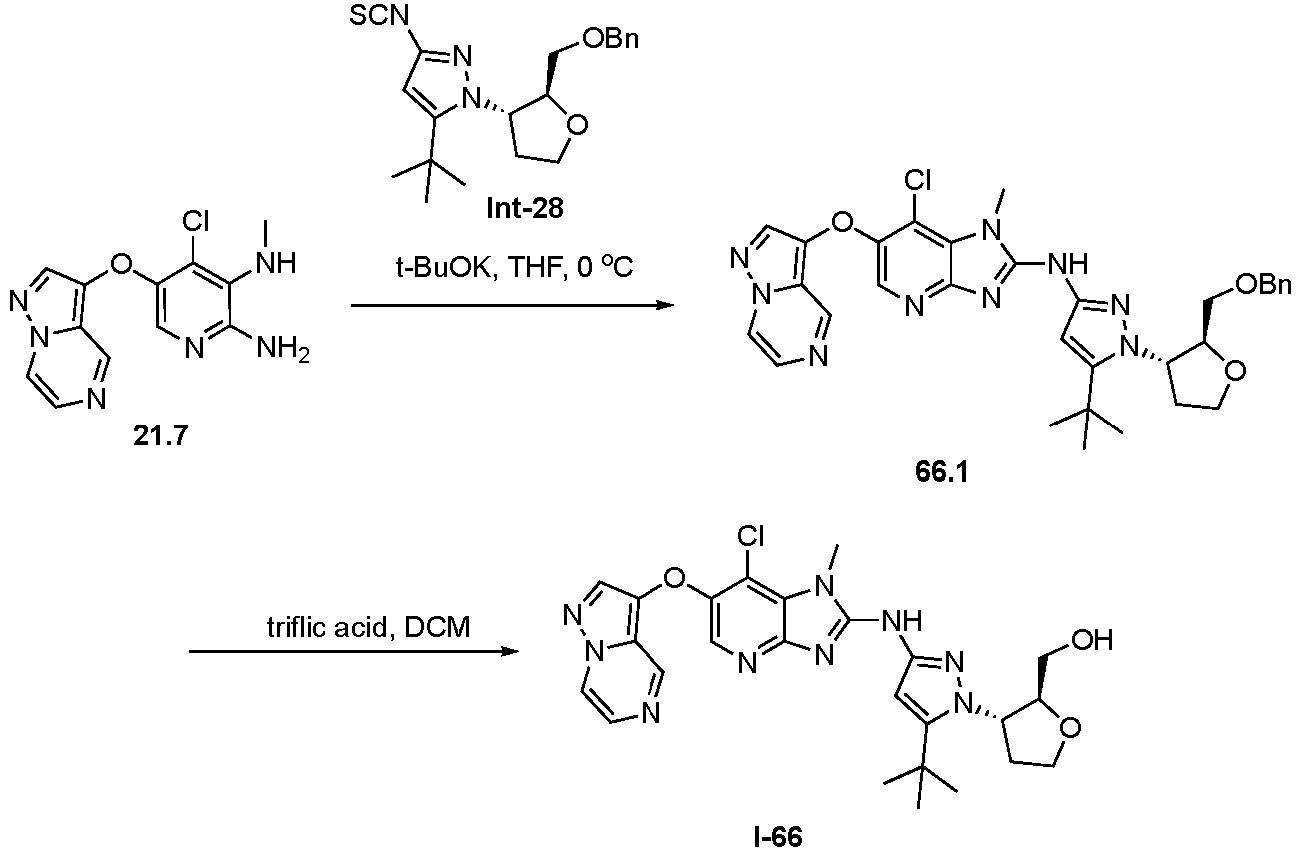
- Synthesis of compound 66.1. Compound 66.1 was prepared from 21.7 and Int-28, following the procedure described in the synthesis of I-13. The product was purified by flash column chromatography on silica gel (CombiFlash®, 3.0% methanol in DCM). MS(ES): m/z: 629.1 [M+H]+.
- Synthesis of I-66. Compound I-66 was prepared from 66.1, following the procedure described in the synthesis of I-23. The product was was purified by flash column chromatography on silica gel (CombiFlash®, 4.6% methanol in DCM). MS(ES): m/z: 538.4 [M+H]+, LCMS purity:98.54%, 1H NMR (DMSO-d6, 400 MHz): δ 9.99 (s, 1H), 9.00 (s, 1H), 8.68-8.67 (d, J = 4.0 Hz, 1H), 8.11 (s, 1H), 8.01 (s, 1H), 7.86-7.85 (d, J = 5.2 Hz, 1H), 6.54 (s, 1H), 5.06-5.01 (m, 1H), 4.93-4.90 (m, 1H), 4.37-4.36 (m, 1H), 4.11-4.06 (m, 1H), 3.95 (s, 3H), 3.59-3.54 (m, 1H), 3.49-3.43 (m, 1H), 2.39 (bs, 2H), 2.09-2.01 (m, 1H), 1.40 (s, 9H).
-

- Synthesis of I-67. Compound I-67 was prepared from 51.3 and Int-29.6, following the procedure described in the synthesis of I-53. The product was purified by flash column chromatography on silica gel (CombiFlash®, 3.0% methanol in DCM). MS(ES): m/z: 529.1 [M+H]+, 1H NMR (DMSO-d6, 400 MHz): δ 9.00-8.99 (d, J = 1.2 Hz, 1H), 8.68-8.67 (m, 1H), 8.37 (s, 1H), 8.23-8.22 (d, J = 2.4 Hz, 1H), 8.13 (s, 1H), 7.98 (s, 1H), 7.86-7.84 (d, J = 5.2 Hz, 1H), 7.27-7.26 (d, J = 2.0 Hz, 1H), 5.05-4.99 (m, 1H), 4.11 (s, 3H), 4.07-4.01 (m, 2H), 3.90 (s, 3H), 3.54-3.48 (m, 2H), 2.13-2.03 (m, 2H), 1.92-1.87 (m, 1H), 1.75-1.74 (m, 2H), 0.91-0.85 (m, 2H), 0.65-0.61 (m, 2H).
-

- Synthesis of I-68. Compound I-68 was prepared from 21.7 and Int-29, following the procedure described in the synthesis of I-13. The product was purified by flash column chromatography on silica gel (CombiFlash®, 2.5% methanol in DCM). MS(ES): m/z: 533.7 [M+H]+, 1H NMR (DMSO-d6, 400 MHz): δ 9.02 (s, 1H), 8.69-8.68 (d, J = 4Hz 1H), 8.55 (s, 1H), 8.20-8.19 (m, 2H), 8.04 (s, 1H), 7.87-7.86 (d, J = 5.2 Hz, 1H), 7.29 (s, 1H), 5.01 (bs, 1H), 4.03-4.00 (m, 2H), 3.98 (s, 3H), 3.53-3.47 (m, 2H), 2.09-2.05 (m, 2H), 1.91-1.88 (m, 1H), 1.74-1.70 (m, 2H), 0.88-0.86 (m, 2H), 0.63-0.61 (m, 2H).
-

- Synthesis of compound cis-(±)-69.1. Compound (±)-69.1 was prepared from 51.3 and (±)-Int-25.4, following the procedure described in the synthesis of I-53. The product was purified by flash column chromatography on silica gel (CombiFlash®, 3.5% methanol in DCM). MS(ES): m/z: 608.5 [M+H]+.
- Synthesis of compound I-69-a and I-69-b. The racemate I-69 was prepared from cis-(±)-69.1, following the procedure described in the synthesis of I-23. The product was purified by flash column chromatography on silica gel (CombiFlash®, 5.0% methanol in DCM). It was subjected to HPLC separation: (column: CHIRALPAK IH (250 mm x 21 mm, 5 µm); mobile phase: (A) 0.1% DEA in n-hexane, (B) 0.1% DEA in isopropanol:methanol (50:50); flow rate: 20 mL/min) to afford first eluting fraction (I-69-a) and second eluting fraction (I-69-b). (*Absolute stereochemistry not determined.)
- I-69-a: MS(ES): m/z: 518.4 [M+H]+, 1H NMR (DMSO-d6, 400 MHz): δ 9.73 (s, 1H), 8.98-8.97 (d, J = 1.6 Hz, 1H), 8.67-8.66 (m, 1H), 8.03 (s, 1H), 7.97 (s, 1H), 7.84-7.83 (d, J = 4.8 Hz, 1H), 6.50 (s, 1H), 5.04-5.02 (d, 1H), 4.58-4.57 (m, 1H), 4.49-4.48 (m, 1H), 4.06 (s, 3H), 3.84 (s, 3H), 2.05-2.01 (m, 2H), 1.79-1.76 (m, 2H), 1.67-1.61 (m, 2H), 1.41 (s, 9H).
- I-69-b: MS(ES): m/z: 518.4 [M+H]+, 1H NMR (DMSO-d6, 400 MHz): δ 9.72 (s, 1H), 8.96 (bs, 1H), 8.66-8.65 (m, 1H), 8.02 (s, 1H), 7.95 (s, 1H), 7.83-7.82 (d, J = 4.8 Hz, 1H), 6.49 (s, 1H), 5.03-5.02 (d, 1H), 4.57-4.56 (m, 1H), 4.48-4.47 (m, 1H), 4.05 (s, 3H), 3.83 (s, 3H), 2.03-1.99 (m, 2H), 1.78-1.74 (m, 2H), 1.65-1.60 (m, 2H), 1.39 (s, 9H).
-

- Synthesis of I-70. Compound I-70 was prepared from 21.7 and cis-Int-30, following the procedure described in the synthesis of I-13. The product was purified by flash column chromatography on silica gel (CombiFlash®, 4.5% methanol in DCM). MS(ES): m/z: 519.6 [M+H]+, 1H NMR (DMSO-d6, 400 MHz): δ 8.98 (s, 1H), 8.67-8.66 (d, J = 4.4 Hz 1H), 8.34 (s, 1H), 8.23 (s, 1H), 8.11 (s, 1H), 7.97 (s, 1H), 7.84-7.83 (d, J = 4.8 Hz 1H), 7.24 (s, 1H), 5.30 (bs, 1H), 4.68-4.64 (m, 1H), 4.00 (bs, 1H), 3.88 (s, 3H), 2.77-2.76 (m, 2H), 2.16-2.14 (m, 2H), 1.91 (bs, 1H), 0.90-0.87 (m, 2H), 0.62-0.61 (m, 2H).
-

- Synthesis of compound cis-(±)-71.1. Compound cis-(±)-71.1 was prepared from 53.2 and cis-(±)-Int-25.4, following the procedure described in the synthesis of I-53. The product was purified by flash column chromatography on silica gel (CombiFlash®, 3.5% methanol in DCM). MS(ES): m/z: 628.5 [M+H]+.
- Synthesis of compounds I-71-a and I-71-b. The racemate I-71 was prepared from cis-(±)-71.1, following the procedure described in the synthesis of I-23. The product was purified by flash column chromatography on silica gel (CombiFlash®, 5.0% methanol in DCM). MS(ES): m/z: 538.1 [M+H]+. It was subjected to SFC separation (column: CHIRALPAK IH (250 mm x 21 mm, 5 µm); mobile phase: (A) liquid carbon dioxide, (B) 0.1% DEA in methanol; flow rate: 80 mL/min) to afford first eluting fraction (I-71-a) and second eluting fraction (I-71-b). (*Absolute stereochemistry not determined.)
- I-71-a: MS(ES): m/z: 538.4 [M+H]+, 1H NMR (MeOD, 400 MHz): δ 8.98 (s, 1H), 8.53-8.52 (d, J = 4.8 Hz, 1H), 7.99 (s, 1H), 7.92 (s, 1H), 7.82 (bs, 1H),7.75-7.48 (m, 1H), 6.44 (s, 1H), 4.71-4.65 (m, 2H), 3.89 (s, 3H), 2.20-2.16 (m, 2H), 1.91-1.86 (m, 2H), 1.72-1.62 (m, 2H), 1.46 (s, 9H).
- I-71-b: MS(ES): m/z: 538.4 [M+H]+, 1H NMR (MeOD, 400 MHz): δ 8.99 (s, 1H), 8.54-8.53 (d, J = 4.8 Hz, 1H), 8.02 (s, 1H), 7.93 (s, 1H), 7.87-7.85 (m, 1H),7.76-7.49 (m, 1H), 6.47 (s, 1H), 4.72-4.68 (m, 2H), 3.91 (s, 3H), 2.22-2.18 (m, 2H), 1.90-1.87 (m, 2H), 1.72-1.63 (m, 2H), 1.48 (s, 9H).
-
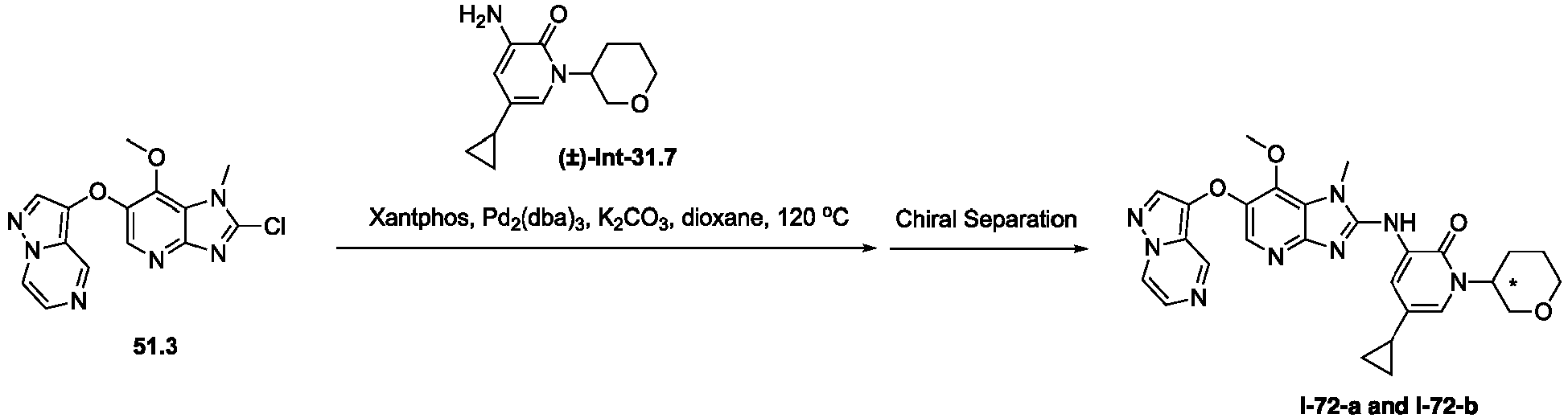
- Synthesis of compound I-72-a and I-72-b. Racemate I-72 was prepared from 51.3 and (±)-Int-31.7, following the procedure described in the synthesis of I-53. The product was purified by flash column chromatography on silica gel (CombiFlash®, 3.1% methanol in DCM). It was subjected to HPLC separation (column: CHIRALPAK IB-N (250 mm x 21 mm, 5 µm); mobile phase: (A) 0.1% DEA in n-hexane, (B) 0.1% DEA in isopropanol:acetonitrile (70:30); flow rate: 20 mL/min) to afford first eluting fraction (I-72-a) and second eluting fraction (I-72-b). (*Absolute stereochemistry not determined.)
- I-72-a: MS(ES): m/z: 529.4 [M+H]+, 1H NMR (DMSO-d6, 400 MHz): δ 8.99 (s, 1H), 8.67-8.65 (m, 1H), 8.36 (s, 1H), 8.23 (s, 1H), 8.11 (s, 1H), 7.97 (s, 1H), 7.84-7.83 (m, 1H), 7.28 (s, 1H), 4.86 (s, 1H), 4.09 (s, 3H), 3.88 (s, 3H), 3.85-3.82 (m, 2H), 3.68-3.63 (m, 1H), 3.50-3.45 (m, 1H), 2.15-2.13 (m, 1H), 1.94-1.85 (m, 2H), 1.77-1.70 (m, 2H), 0.89-0.87 (m, 2H), 0.61-0.60 (m, 2H).
- I-72-b: MS(ES): m/z: 529.4 [M+H]+, 1H NMR (DMSO-d6, 400 MHz): δ 8.99 (s, 1H), 8.67-8.65 (m, 1H), 8.37 (s, 1H), 8.23 (s, 1H), 8.12-8.11 (d, J= 1.6 Hz, 1H), 7.98-7.97 (d, J= 1.6 Hz, 1H), 7.84-7.83 (m, 1H), 7.28 (s, 1H), 4.86 (s, 1H), 4.09 (s, 3H), 3.88 (s, 3H), 3.82-3.80 (m, 2H), 3.68-3.63 (m, 1H), 3.50-3.45 (m, 1H), 2.15-2.13 (m, 1H), 1.94-1.82 (m, 2H), 1.77-1.70 (m, 2H), 0.89-0.87 (m, 2H), 0.61-0.60 (m, 2H).
-

- Synthesis of compounds I-73-a and I-73-b. Racemate I-73 was prepared from 21.7 and (±)-Int-31, following the procedure described in the synthesis of I-13. The product was purified by flash column chromatography on silica gel (CombiFlash®, 2.1% methanol in DCM). It was subjected to HPLC separation (column: CHIRALPAK IB-N (250 mm x 21 mm, 5 µm); mobile phase: (A) 0.1% DEA in n-hexane, (B) 0.1% DEA in isopropanol:acetonitrile (70:30); flow rate: 20 mL/min) to afford first eluting fraction (I-72-a) and second eluting fraction (I-72-b). (*Absolute stereochemistry not determined.)
- I-72-a: MS(ES): m/z: 533.3 [M+H]+, 1H NMR (DMSO-d6, 400 MHz): δ 9.03 (s, 1H), 8.69-8.68 (d, J = 4.8 Hz, 1H), 8.55 (s, 1H), 8.23-8.22 (d, J = 4.4 Hz, 1H), 8.20 (s, 1H), 8.04 (s, 1H), 7.87-7.86 (d, J = 4.8 Hz, 1H), 7.31 (s, 1H), 4.86-4.83 (m, 1H), 3.98 (s, 3H), 3.82-3.80 (m, 2H), 3.68-3.63 (m, 1H), 3.51-3.46 (m, 1H), 2.18-2.10 (m, 1H), 1.94-1.88 (m, 2H), 1.77-1.70 (m, 2H), 0.89-0.87 (m, 2H), 0.61-0.60 (m, 2H).
- I-72-b: MS(ES): m/z: 533.3 [M+H]+, 1H NMR (DMSO-d6, 400 MHz): δ 9.03 (s, 1H), 8.69-8.68 (d, J = 4.8 Hz, 1H), 8.55 (s, 1H), 8.23-8.22 (d, J = 4.4 Hz, 1H), 8.20 (s, 1H), 8.04 (s, 1H), 7.87-7.86 (d, J = 4.8 Hz, 1H), 7.31 (s, 1H), 4.88-4.83 (m, 1H), 3.98 (s, 3H), 3.84-3.81 (m, 2H), 3.68-3.63 (m, 1H), 3.51-3.46 (m, 1H), 2.18-2.13 (m, 1H), 1.94-1.88 (m, 2H), 1.77-1.70 (m, 2H), 0.89-0.86 (m, 2H), 0.61-0.60 (m, 2H).
-

- Synthesis of compound 74.1. Compound 74.1 was prepared from 51.3 and Int-32, following the procedure described in the synthesis of I-53. The product was purified by flash column chromatography on silica gel (CombiFlash®, 3.2% methanol in DCM). MS(ES): m/z: 605.5 [M+H]+.
- Synthesis of I-74. Compound I-74 was prepared from 74.1, following the procedure described in the synthesis of I-23. The product was purified by flash column chromatography on silica gel (CombiFlash®, 5.0% methanol in DCM). MS(ES): m/z: 515.7 [M+H]+, 1H NMR (DMSO-d6, 400 MHz): δ 8.98 (s, 1H), 8.67-8.66 (d, J = 4.4 Hz, 1H), 8.34 (s, 1H), 8.23 (s, 1H), 8.11 (s, 1H), 7.97 (s, 1H), 7.84-7.83 (d, J= 4.8 Hz, 1H), 7.24 (s, 1H), 5.30-5.28 (m, 1H), 4.68-4.64 (m, 1H), 4.09 (s, 3H), 4.00 (bs, 1H), 3.88 (s, 3H), 2.77-2.76 (m, 2H), 2.16-2.14 (m, 2H), 1.91 (bs, 1H), 0.90-0.87 (m, 2H), 0.62-0.61 (m, 2H).
-

- Synthesis of compound 75.1. Compound 75.1 was prepared from 51.3 and Int-33.3, following the procedure described in the synthesis of I-53. The product was purified by flash column chromatography on silica gel (CombiFlash®, 3.2% methanol in DCM). MS(ES): m/z: 605.5 [M+H]+.
- Synthesis of I-75. Compound I-75 was prepared from 75.1, following the procedure described in the synthesis of I-23. The product was purified by flash column chromatography on silica gel (CombiFlash®, 4.5% methanol in DCM). MS(ES): m/z: 515.7 [M+H]+, 1H NMR (DMSO-d6, 400 MHz): δ 8.99 (s, 1H), 8.67-8.66 (d, J = 4.4 Hz, 1H), 8.35 (s, 1H), 8.23 (s, 1H), 8.11 (s, 1H), 7.97 (s, 1H), 7.84-7.83 (d, J= 4.8 Hz, 1H), 7.25 (bs, 1H), 5.42-5.38 (m, 1H), 5.24-5.23 (d, 1H), 4.39-4.38 (m, 1H), 4.09 (s, 3H), 3.88 (s, 3H), 2.67-2.61 (m, 4H), 1.91-1.86 (m, 1H), 0.90-0.85 (m, 2H), 0.63-0.61 (m, 2H).
-

- Synthesis of compound 76.1. To a solution of 2-chloropyrimidin-5-ol (25 g, 191.5 mmol, 1.0 equiv) in DMF (250 mL) was added potassium carbonate (79.3 g, 574.5 mmol, 3.0 equiv) followed by methyl iodide (32.63 g, 229.8 mmol, 1.2 equiv). The reaction mixture was stirred at 60 °C for 30 min. It was transferred into ice, stirred and extracted with ethyl acetate. The combined organic layers were washed with brine, dried over anhydrous sodium sulfate, filtered and concentrated under reduced pressure. The residue was purified by flash column chromatography on silica gel (CombiFlash®, 10% ethyl acetate in hexane) to afford 76.1. MS (ES): m/z 145.5 [M+H]+.
- Synthesis of compound 76.2. A solution of 76.1 (21 g, 145.2 mmol, 1.0 equiv) in dimethylacetamide (200 mL) was degassed by bubbling through a stream of argon for 10 min. Under argon atmosphere, zinc cyanide (18.68 g, 159.7 mmol, 1.1 equiv) was added, and the mixture was degassed for 5 min. To the mixture was added tetrakis(triphenylphosphine)palladium(0) (8.38 g, 7.26 mmol, 0.05 equiv), and the reaction mixture was stirred at 160 °C for 1 h. It was cooled to room temperature, poured into ice-water and extracted with ethyl acetate. The combined organic layers were washed with brine, dried over anhydrous sodium sulfate, filtered and concentrated under reduced pressure. The residue was purified by flash column chromatography on silica gel (CombiFlash®, 10% ethyl acetate in hexane as eluant) to afford 76.2. 1H NMR (DMSO-d6, 400 MHz): δ 8.78-8.75 (m, 2H), 4.03 (s, 3H).
- Synthesis of compound 76.3. A mixture of compound 76.2 (2.6 g, 19.24 mmol, 1.0 equiv) and Raney nickel (1.3 g) in methanol (25 mL) was stirred under hydrogen (1 atm) at room temperature for 12 h. It was filtered through a pad of Celite® and rinsed with methanol. The filtrate was concentrated under reduced pressure to afford 76.3. MS(ES): m/z 140.2 [M+H]+.
- Synthesis of compound 76.4. To a solution of 76.3 (2.3 g, 16.53 mmol, 1.0 equiv) and triethylamine (6.9 mL, 49.59 mmol, 3.0 equiv) in DCM (20 mL) was added cyclopropyl carbonyl chloride (1.81 g, 17.35 mmol, 1.05 equiv) at room temperature, and the mixture was stirred for 1 h. It was transferred into ice, stirred and extracted with DCM. The combined organic layers were washed with brine, dried over anhydrous sodium sulfate, filtered and concentrated under reduced pressure. The residue was purified by flash column chromatography on silica gel (CombiFlash®, 2.1% methanol in DCM) to afford 76.4. MS (ES): m/z 208.2 [M+H]+.
- Synthesis of compound 76.5. A solution of 76.4 (0.910 g, 4.39 mmol, 1.0 equiv) in phosphorous oxychloride (9 mL) was stirred at 80 °C for 1 h. It was transferred into ice-water, neutralized by saturated sodium bicarbonate stirred and extracted with ethyl acetate. The combined organic layers were washed with brine, dried over anhydrous sodium sulfate, filtered and concentrated under reduced pressure. The residue was purified by flash column chromatography on silica gel (CombiFlash®, 1.2% methanol in DCM) to afford 76.5. MS (ES): m/z 190.2 [M+H]+.
- Synthesis of compound 76.6. To a solution of 76.5 (0.385 g, 2.03 mmol, 1.0 equiv) in DCM (5 mL) was added boron tribromide (5.8 mL, 60.9 mmol, 30 equiv) at 0 °C. The reaction mixture was stirred at room temperature for 16 h. It was transferred into ice cold saturated sodium bicarbonate solution and extracted with ethyl acetate. The combined organic layers were washed with brine, dried over anhydrous sodium sulfate, filtered and concentrated under reduced pressure to afford 76.6. MS(ES): m/z 176.1 [M+H]+.
- Synthesis of compound 76.7. A mixture of 76.6 (0.285 g, 1.63 mmol, 1.0 equiv), Int-4 (0.334 g, 1.63 mmol, 1.0 equiv) and potassium carbonate (0.674 g, 4.89 mmol, 3.0 equiv) in DMF (3 mL) was stirred at 60 °C for 2 h. It was cooled to room temperature, filtered through a pad of Celite®, poured into ice-water and extracted with ethyl acetate. The combined organic layers were washed with brine, dried over anhydrous sodium sulfate, filtered and concentrated under reduced pressure. The residue was purified by flash column chromatography on silica gel (CombiFlash®, 2.3% methanol in DCM) to afford 76.7. MS(ES): m/z 361.5 [M+H]+.
- Synthesis of compound 76.8. Compound 76.8 was prepared from 76.7, following the procedure described in the synthesis of 3.7. The product was purified by flash column chromatography on silica gel (CombiFlash®, 1.8% methanol in DCM). MS(ES): m/z 331.5 [M+H]+.
- Synthesis of compound trans-76.9-a. Compound trans-76.9-a was prepared from 76.8 and trans-Int-11a, following the procedure described in the synthesis of I-13. The product was purified by flash column chromatography on silica gel (CombiFlash®, 2.5% methanol in DCM). MS(ES): m/z: 655.1 [M+H]+. (*Absolute stereochemistry not determined.)
- Synthesis of I-76-a. Compound I-76-a was prepared from trans-76.9-a, following the procedure described in the synthesis of I-23. The product was purified by flash column chromatography on silica gel (CombiFlash®, 4.5% methanol in DCM). MS(ES): m/z: 565.7 [M+H]+, 1H NMR (DMSO-d6, 400 MHz): δ 10.03 (s, 1H), 8.35 (s, 1H), 8.22-8.21 (d, J = 2.8 Hz, 1H), 8.15 (s, 1H), 7.41 (s, 1H), 6.58 (s, 1H), 5.55-5.54 (m, 1H), 4.92 (bs, 1H), 4.56 (bs, 1H), 4.31-4.26 (m, 1H), 4.16-4.12 (m, 1H), 3.96 (s, 3H), 3.83-3.79 (m, 1H), 3.72-3.68 (m, 1H), 2.38-2.34 (m, 1H), 1.41 (s, 9H), 0.95-0.87 (m, 4H). (*Absolute stereochemistry not determined.)
- Synthesis of compound trans-76.9-b. Compound trans-76.9-b was prepared from 76.8 and trans-Int-11b, following the procedure described in the synthesis of I-13. The product was purified by flash column chromatography on silica gel (CombiFlash®, 2.5% methanol in DCM). MS(ES): m/z: 655.1 [M+H]+.
- Synthesis of I-76-b. Compound I-76-b was prepared from trans-76.9-b, following the procedure described in the synthesis of I-23. The product was purified by flash column chromatography on silica gel (CombiFlash®, 4.5% methanol in DCM). MS(ES): m/z: 564.7 [M+H]+, 1H NMR (DMSO-d6, 400 MHz): δ 10.02 (s, 1H), 8.35 (bs, 1H), 8.21-8.20 (d, J= 2.8 Hz, 1H), 8.13 (s, 1H), 7.39 (s, 1H), 6.56 (s, 1H), 5.54-5.53 (d, 1H), 4.91 (bs, 1H), 4.55 (bs, 1H), 4.29-4.25 (m, 1H), 4.14-4.11 (m, 1H), 3.94 (s, 3H), 3.81-3.78 (m, 1H), 3.70-3.66 (m, 1H), 2.39-2.34 (m, 1H), 1.39 (s, 9H), 0.93-0.83 (m, 4H).
-

- Synthesis of I-77. Compound I-77 was prepared from 21.7 and Int-34, following the procedure described in the synthesis of I-13. The product was purified by flash column chromatography on silica gel (CombiFlash®, 3.1% methanol in DCM). MS(ES): m/z: 528.2 [M+H]+, 1H NMR (CDCl3, 400 MHz): δ 9.02 (s, 1H), 8.78 (s, 1H), 8.27 (bs, 2H), 7.87-7.86 (d, J = 4.4 Hz 1H), 7.76 (s, 1H), 7.61 (s, 1H), 7.05 (s, 1H), 5.40-5.37 (m, 1H), 4.12 (s, 3H), 3.12-3.08 (m, 2H), 3.00-2.94 (m, 1H), 2.65-2.61 (m, 2H), 1.99-1.94 (m, 1H), 1.03-0.98 (m, 2H), 0.78-0.76 (m, 2H).
-

- Synthesis of compound 78.1. To a solution of pyrazolo[1,5-a]pyridine (2.0 g, 16.93 mmol, 1.0 equiv) in DMF (20 mL) was added phosphoryl chloride (4.75 mL, 50.79 mmol, 3.0 equiv). The reaction mixture was stirred at room temperature for 1 h. It was concentrated under reduced pressure to afford a residue, which was dissolved in DCM and washed with 2N sodium hydroxide. The organic layer was washed with brine, dried over anhydrous sodium sulfate, filtered and concentrated under reduced pressure to afford 78.1. MS (ES): m/z 147.1 [M+H]+.
- Synthesis of compound 78.2. To a solution of 78.1 (2.2 g, 15.05 mmol, 1.0 equiv) in DCM (50 mL) was added potassium fluoride (1.30 g, 22.57 mmol, 1.5 equiv) at 0 °C followed by addition of meta-chloroperoxybenzoic acid (3.88 g, 22.57 mmol, 1.5 equiv). The reaction mixture was stirred at room temperature for 2 h. It was cooled to 0 °C and saturated sodium bicarbonate solution was added, and the mixture was stirred for 30 min. The organic layer was separated, washed with aq. sodium bisulfite, dried over anhydrous sodium sulfate, filtered and concentrated under reduced pressure. The residue was purified by flash column chromatography on silica gel (CombiFlash®, 2.2% methanol in DCM) to afford 78.2. MS (ES): m/z 163.2 [M+H]+.
- Synthesis of compound 78.3. To a solution of 78.2 (1.6 g, 9.87 mmol, 1.0 equiv) in methanol (20 mL) was added potassium carbonate (6.81 g, 49.35 mmol, 5.0 equiv), and the reaction mixture was stirred at room temperature for 30 min. It was filtered and the filtrate was concentrated under reduced pressure. The residue was purified by flash column chromatography on silica gel (CombiFlash®, 2.5% methanol in DCM) to afford 78.3. MS(ES): m/z 135.1 [M+H]+.
- Synthesis of compound 78.4. Compound 78.4 was prepared from 78.3 and Int-4, following the procedure described in the synthesis of 76.7. The product was purified by flash column chromatography on silica gel (CombiFlash®, 25% ethyl acetate in hexane). MS(ES): m/z 320.5 [M+H]+.
- Synthesis of compound 78.5. Compound 78.5 was prepared from 78.4, following the procedure described in the synthesis of 3.7. The product was purified by flash column chromatography on silica gel (CombiFlash®, 3.5% methanol in DCM). MS(ES): m/z 290.7 [M+H]+.
- Synthesis of compound 78.6. Compound 78.6 was prepared from 78.5 and Int-27, following the procedure described in the synthesis of I-13. The product was purified by flash column chromatography on silica gel (CombiFlash®, 1.4% methanol in DCM). MS(ES): m/z: 583.0 [M+H]+.
- Synthesis of I-78. Compound I-78 was prepared from 78.6, following the procedure described in the synthesis of I-23. The product was purified by flash column chromatography on silica gel (CombiFlash®, 2.8% methanol in DCM). MS(ES): m/z: 492.6 [M+H]+; 1H NMR (DMSO-d6, 400 MHz): δ 8.63-8.61 (d, J = 7.2 Hz, 1H), 8.49 (s, 1H), 8.02-8.00 (d, J = 8.0 Hz, 2H), 8.27-8.26 (d, J = 2.4 Hz, 1H), 7.52-7.50 (d, J= 8.8 Hz, 1H), 7.20-7.15 (m, 2H), 6.91-6.88 (m, 1H), 4.93-4.90 (m, 1H), 4.06-4.03 (m, 2H), 3.99 (s, 3H), 3.71-3.67 (m, 2H), 1.83-1.79 (m, 1H), 0.88-0.84 (m, 2H), 0.58-0.54 (m, 2H).
-


- Synthesis of compound 79.1. Compound 79.1 was prepared from 78.5 and Int-33, following the procedure described in the synthesis of I-13. The product was purified by flash column chromatography on silica gel (CombiFlash®, 3.0% methanol in DCM). MS(ES): m/z: 609.1 [M+H]+.
- Synthesis of I-79. Compound I-79 was prepared from 79.1, following the procedure described in the synthesis of I-23. The product was purified by flash column chromatography on silica gel (CombiFlash®, 3.5% methanol in DCM). MS(ES): m/z: 518.5 [M]+, 1H NMR (DMSO-d6, 400 MHz): δ 8.63-8.61 (d, J = 7.2 Hz, 1H), 8.50 (s, 1H), 8.20 (s, 1H), 8.02-7.99 (d, J = 7.2 Hz, 2H), 7.51-7.49 (d, J = 9.2 Hz, 1H), 7.27 (s, 1H), 7.20-7.16 (t, J = 6.8 Hz, 8.8 Hz, 1H), 6.91-6.88 (J = 6.4 Hz, 7.2 Hz, 1H), 5.42-5.38 (m, 1H), 5.24-5.23 (m, 1H), 4.38 (bs, 1H), 3.98 (s, 3H), 2.60-2.55 (m, 2H), 2.34-2.29 (m, 2H), 1.91-1.87 (m, 1H), 0.88-0.86 (m, 2H), 0.61-0.60 (m, 2H).
-

- Synthesis of I-80. Compound I-80 was prepared from 21.7 and Int-35, following the procedure described in the synthesis of I-13. The product was purified by flash column chromatography on silica gel (CombiFlash®, 3.1% methanol in DCM). MS(ES): m/z: 528.3 [M+H]+, 1H NMR (DMSO-d6, 400 MHz): ): δ 9.02 (s, 1H), 8.69-8.68 (d, J = 4.0 Hz 1H), 8.50 (s, 1H), 8.18 (s, 1H), 8.16-8.15 (d, J = 2.0 Hz, 1H), 8.03 (s, 1H), 7.87-7.86 (d, J = 4.8 Hz 1H), 7.68-7.67 (d, J = 2.0 Hz 1H), 5.21-5.17 (m, 1H), 4.02 (s, 3H), 3.16-3.12 (m, 1H), 2.91-2.85 (m, 2H), 1.96-1.92 (m, 1H), 1.23 (bs, 2H), 0.98-0.93 (m, 2H), 0.67-0.64 (m, 2H).
-

- Synthesis of compound (±)-81.1. Compound (±)-81.1 was prepared from 21.7 and (±)-Int-36, following the procedure described in the synthesis of I-13. The product was purified by flash column chromatography on silica gel (CombiFlash®, 2.5% methanol in DCM). MS(ES): m/z: 612.1 [M+H]+.
- Synthesis of I-81-a and I-81-b. Racemate I-81 was prepared from (±)-81.1, following the procedure described in the synthesis of I-23. The product was purified by flash column chromatography on silica gel (CombiFlash®, 3.8% methanol in DCM). MS(ES): m/z 521.2 [M+H]+. It was subjected to HPLC purification (column: CHIRALPAK IH (250 mm x 21 mm, 5 µm); mobile phase: (A) 0.1% DEA in hexane, (B) 0.1% DEA in isopropanol:methanol (30:70); flow rate: 18 mL/min) to afford first eluting fraction (I-81-a) and second eluting fraction (I-81-b). (*Absolute stereochemistry not determined.)
- I-81-a: MS(ES): m/z: 521.2 [M+H]+, 1H NMR (DMSO-d6, 400 MHz): δ 9.04 (s, 1H), 8.71-8.69 (d, J = 4.8 Hz, 1H), 8.53 (bs, 1H), 8.30 (s, 1H), 8.22 (s, 1H), 8.06 (s, 1H), 7.89-7.87 (d, J= 4.8 Hz, 1H),7.18 (s, 1H), 4.67-4.64 (m, 1H), 4.00 (bs, 3H), 3.89-3.86 (m, 2H), 2.12-2.11 (m, 1H), 1.85-1.83 (m, 1H), 1.25 (bs, 3H), 1.06-1.04 (m, 2H), 0.88-0.87 (m, 4H).
- I-81-b: MS(ES): m/z: 521.2 [M+H]+, 1H NMR (DMSO-d6, 400 MHz): δ 9.04 (s, 1H), 8.71-8.69 (d, J = 4.8 Hz, 1H), 8.53 (bs, 1H), 8.29 (s, 1H), 8.22 (s, 1H), 8.06 (s, 1H), 7.89-7.87 (d, J = 4.8 Hz, 1H),7.18 (s, 1H), 4.67-4.64 (m, 1H), 4.00 (bs, 3H), 3.89-3.84 (m, 2H), 2.12-2.11 (m, 1H), 1.84-1.83 (m, 1H), 1.25 (bs, 3H), 1.06-1.04 (m, 2H), 0.88-0.87 (m, 4H).
-

- Synthesis of compound 82.1. Compound 82.1 was prepared from 7.4 and Int-28, following the procedure described in the synthesis of I-13. The product was purified by flash column chromatography on silica gel (CombiFlash®, 3.0% methanol in DCM). MS(ES): m/z: 629.2 [M+H]+.
- Synthesis of I-82. Racemate I-82 was prepared from 82.1, following the procedure described in the synthesis of I-23. The product was purified by flash column chromatography on silica gel (CombiFlash®, 4.2% methanol in DCM). MS(ES): m/z: 538.7 [M+H]+, LCMS purity: 100%, HPLC purity: 100%, Chiral HPLC: 99.17%, 1H NMR (DMSO-d6, 400 MHz): δ 10.00 (s, 1H), 8.88 (s, 1H), 8.69 (s, 1H), 8.18-8.16 (d, J = 9.6 Hz, 2H), 6.79 (s, 1H), 6.56 (s, 1H), 5.04 (bs, 1H), 4.93-4.90 (m, 1H), 4.39-4.38 (m, 1H), 4.13-4.08 (m, 1H), 3.96 (s, 3H), 3.60-3.47 (m, 2H), 2.40-2.35 (m, 2H), 2.07-2.05 (m, 1H), 1.43 (s, 9H).
-
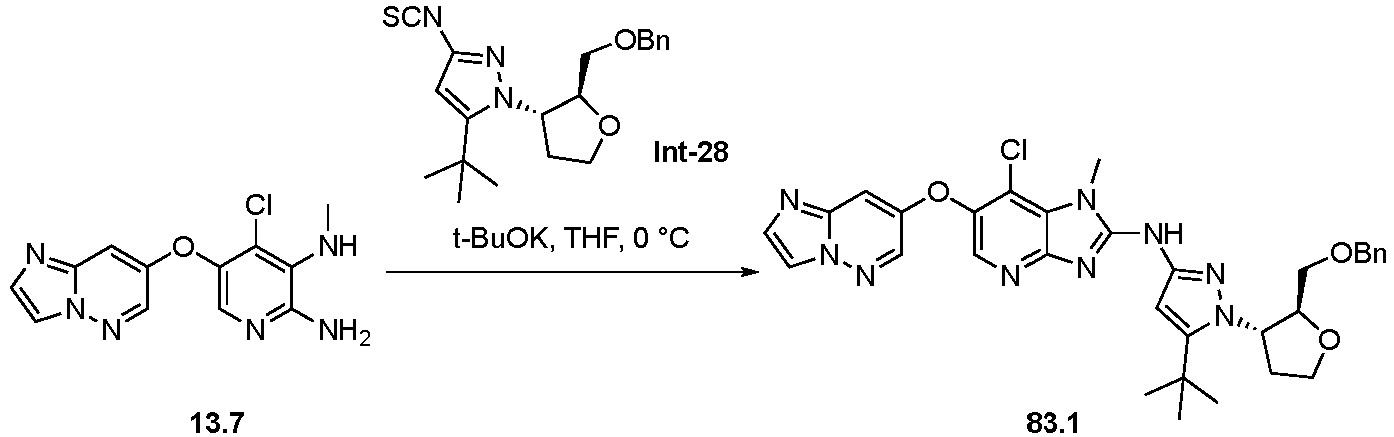

- Synthesis of compound 83.1. Compound 83.1 was prepared from 13.7 and Int-28, following the procedure described in the synthesis of I-13. The product was purified by flash column chromatography on silica gel (CombiFlash®, 2.9% methanol in DCM). MS(ES): m/z: 629.2 [M+H]+.
- Synthesis of I-83. Compound I-83 was prepared from 83.1, following the procedure described in the synthesis of I-23. The product was purified by flash column chromatography on silica gel (CombiFlash®, 4.5% methanol in DCM). MS(ES): m/z: 538.2 [M]+, 1H NMR (DMSO-d6, 400 MHz): δ 10.04 (s, 1H), 8.72 (s, 1H), 8.21 (s, 1H), 8.16 (s, 1H), 7.65 (s, 1H), 7.22 (s, 1H), 6.56 (s, 1H), 5.05 (bs, 1H), 4.92 (bs, 1H), 4.38 (bs, 1H), 4.10-4.08 (m, 1H), 3.94 (s, 3H), 3.55-3.50 (m, 2H), 2.37-2.33 (m, 2H), 2.05-2.04 (m, 1H), 1.42 (s, 9H).
-
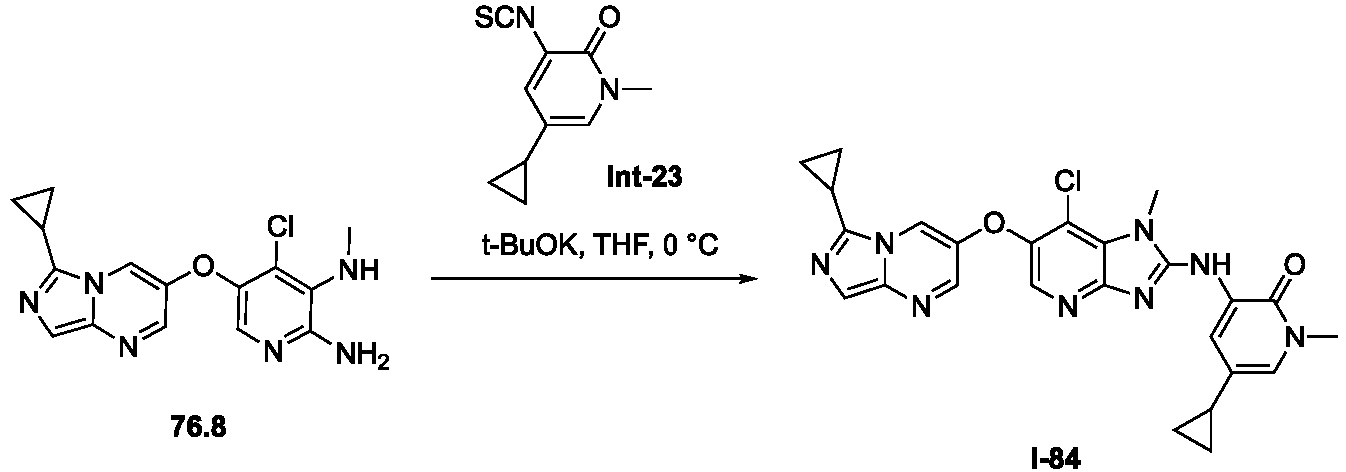
- Synthesis of I-84. Compound I-84 was prepared from 76.8 and Int-23, following the procedure described in the synthesis of I-13. The product was purified by flash column chromatography on silica gel (CombiFlash®, 2.8% methanol in DCM). MS(ES): m/z: 503.6 [M+H]+, 1H NMR (DMSO-d6, 400 MHz): δ 8.56 (s, 1H), 8.38-8.37 (d, J = 2.4 Hz, 1H), 8.30-8.29 (d, J = 2.0 Hz, 1H), 8.24 (s, 1H), 8.23-8.22 (d, J = 2.4 Hz, 1H), 7.40 (s, 1H), 7.24-7.23 (d, J = 2.0 Hz, 1H), 3.98 (s, 3H), 3.55 (s, 3H), 2.38-2.33 (m, 1H), 1.79 (bs, 1H), 0.94-0.89 (m, 4H), 0.87-0.83 (m, 2H), 0.59-0.56 (m, 2H).
-

- Synthesis of I-85. Compound I-85 was prepared from 21.7 and Int-37, following the procedure described in the synthesis of I-13. The product was purified by flash column chromatography on silica gel (CombiFlash®, 2.6% methanol in DCM). MS(ES): m/z: 545.14 [M]+, 1H NMR (DMSO-d6, 400 MHz): δ 9.03 (s, 1H), 8.70-8.69 (d, J = 4.8 Hz, 1H), 8.53 (s, 1H), 8.22-8.21 (m, 2H), 8.05 (s, 1H), 7.88-7.87 (d, J = 4.8 Hz, 1H), 7.24 (bs, 1H), 4.97-4.93 (m, 1H), 4.72 (bs, 2H), 4.60 (bs, 2H), 3.99 (s, 3H), 1.90 (bs, 2H), 1.58 (bs, 2H), 1.25 (bs, 1H), 0.90-0.88 (m, 2H), 0.63-0.61 (m, 2H).
-

- Synthesis of I-86. Compound I-86 was prepared from 21.7 and Int-39, following the procedure described in the synthesis of I-13. The product was purified by flash column chromatography on silica gel (CombiFlash®, 4.0% methanol in DCM). MS(ES): m/z: 494.5 [M]+, 1H NMR (DMSO-d6, 400 MHz): δ 10.20 (s, 1H), 9.02 (s, 1H), 8.69-8.68 (d, J = 3.6 Hz, 1H), 8.14 (s, 1H), 8.03 (s, 1H), 7.87-7.86 (d, J = 4.4 Hz, 1H), 6.63 (s, 1H), 5.82 (bs, 1H), 5.0-4.95(m, 4H), 3.99 (s, 3H), 1.34 (s, 9H).
-

- Synthesis of compound 87.1. Compound 87.1 was prepared from 76.8 and Int-28, following the procedure described in the synthesis of I-13. The product was purified by flash column chromatography on silica gel (CombiFlash®, 2.6% methanol in DCM). MS(ES): m/z: 668.8 [M+H]+.
- Synthesis of I-87. Compound I-87 was prepared from 87.1, following the procedure described in the synthesis of I-23. The product was purified by flash column chromatography on silica gel (CombiFlash®, 3.6% methanol in DCM). MS(ES): m/z: 578.6 [M]+, 1H NMR (DMSO-d6, 400 MHz): δ 9.98 (s, 1H), 8.33 (s, 1H), 8.20 (s, 1H), 8.14 (s, 1H), 7.39 (s, 1H), 6.54 (s, 1H), 5.05 (bs, 1H), 4.89-4.88 (d, 1H), 4.38-4.37 (d, 1H), 4.10-4.08 (m, 1H), 3.95 (s, 3H), 3.58-3.46 (m, 2H), 2.39-2.34 (m, 2H), 2.05-2.04 (m, 1H), 1.40 (s, 9H), 1.24 (bs, 1H), 0.94-0.89 (m, 4H).
-


- Synthesis of compound 88.1. Compound 88.1 was prepared from 76.8 and Int-21, following the procedure described in the synthesis of I-13. The product was purified by flash column chromatography on silica gel (CombiFlash®, 2.5% methanol in DCM). MS(ES): m/z: 639.1 [M+H]+.
- Synthesis of I-88. Compound I-88 was prepared from 88.1, following the procedure described in the synthesis of I-23. The product was purified by flash column chromatography on silica gel (CombiFlash®, 4.8% methanol in DCM). MS(ES): m/z: 548.7 [M+H]+, 1H NMR (DMSO-d6, 400 MHz): δ 9.99 (s, 1H), 8.36 (bs, 1H), 8.23-8.22 (d, J = 2.0 Hz, 1H), 8.15 (s, 1H), 7.41 (s, 1H), 6.54 (s, 1H), 5.23-5.19 (m, 2H), 4.18 (bs, 1H), 3.96 (s, 3H), 2.75-2.74 (m, 2H), 2.37-2.35 (m, 3H), 1.35 (s, 9H), 0.95-0.91 (m, 4H).
-

- Synthesis of compound 89.1. Compound 89.1 was prepared from 21.7 and Int-40, following the procedure described in the synthesis of I-13. The product was purified by flash column chromatography on silica gel (CombiFlash®, 3.2% methanol in DCM). MS(ES): m/z: 637.7 [M+H]+.
- Synthesis of I-89. Compound I-89 was prepared from 89.1, following the procedure described in the synthesis of I-23. The product was purified by flash column chromatography on silica gel (CombiFlash®, 4.5% methanol in DCM). MS(ES): m/z: 547.7 [M+H]+, 1H NMR (DMSO-d6, 400 MHz): δ 9.05 (s, 1H), 8.85 (s, 1H), 8.70-8.69 (d, J = 4.8 Hz, 1H), 8.63 (s, 1H), 8.26 (s, 1H), 8.06 (s, 1H), 7.91 (s, 1H), 7.89-7.88 (d, J = 4.8 Hz, 1H), 5.77 (bs, 1H), 5.30-5.28 (m, 1H), 4.67-4.63 (m, 1H), 4.02 (s, 3H), 2.85-2.84 (m, 2H), 2.24-2.19 (m, 2H).
-

- Synthesis of I-90. Compound I-90 was prepared from 21.7 and Int-41, following the procedure described in the synthesis of I-13. The product was purified by flash column chromatography on silica gel (CombiFlash®, 3.6% methanol in DCM). MS(ES): m/z: 573.6 [M+H]+, 1H NMR (DMSO-d6, 400 MHz): δ 9.05 (s, 1H), 8.84 (s, 1H), 8.71-8.70 (d, J = 4.4z, 1H), 8.62 (s, 1H), 8.25 (s, 1H), 8.06 (s, 1H), 7.94 (s, 1H), 7.89-7.88 (d, J = 4.8 Hz, 1H), 4.98-4.94 (m, 1H), 4.73 (bs, 2H), 4.58 (bs, 2H), 4.02 (s, 3H), 2.80-2.69 (m, 4H).
-

- Synthesis of I-91. Compound I-91 was prepared from 21.7 and Int-42, following the procedure described in the synthesis of I-13. The product was purified by flash column chromatography on silica gel (CombiFlash®, 4.5% methanol in DCM). MS(ES): m/z: 604.7 [M+H]+, 1H NMR (DMSO-d6, 400 MHz): δ 9.05 (s, 1H), 8.84 (s, 1H), 8.71-8.70 (d, J = 4.4z, 1H), 8.63 (s, 1H), 8.25 (s, 1H), 8.13 (s, 1H), 8.07 (s, 1H), 7.89-7.88 (d, J = 4.8 Hz, 1H), 4.18-4.17 (m, 2H), 3.98 (s, 3H), 3.56 (bs, 4H), 2.34 (bs, 6H), 1.95-1.94 (m, 2H).
-

- Synthesis of compound 92.1. To a suspension of sodium hydride (0.060 g, 1.51 mmol, 1.5 equiv) in DMF (2 mL) was added a solution of 5-bromo-1H-pyrazolo[3,4-b]pyridine (0.2 g, 1.01 mmol, 1.0 equiv) in THF (3 mL) at 0 °C, and the mixture was stirred for 30 min, followed by addition of (2-chloromethoxyethyl)trimethylsilane (0.250 g, 1.51 mmol, 1.5 equiv). The reaction mixture was stirred at room temperature for 30 min. It was transferred into ice, stirred and extracted with ethyl acetate. The combined organic layers were washed with brine, dried over anhydrous sodium sulfate, filtered and concentrated under reduced pressure. The residue was purified by flash column chromatography on silica gel (CombiFlash®, 5% ethyl acetate in hexane) to afford 92.1. MS(ES): m/z 328.3 [M]+.
- Synthesis of compound 92.2. A mixture of 92.1 (0.250 g, 0.761 mmol, 1.0 equiv), bis(pinacolato)diboron (0.386 g, 1.52 mmol, 2.0 equiv) and potassium acetate (0.148 g, 1.52 mmol, 2.0 equiv) in 1,4-dioxane (5 mL) was degassed by bubbling through a stream of argon for 10 min. Under argon atmosphere, [1,1'-bis(diphenylphosphino)ferrocene]palladium(II) dichloride (0.111 g, 0.152 mmol, 0.2 equiv) was added and, the mixture was degassed for an additional 5 min. The reaction mixture was stirred at 80 °C for 3 h. It was cooled to room temperature and filtered through a pad of Celite®. The filtrate was transferred into water and extracted with ethyl acetate. The combined organic layers were washed with brine, dried over anhydrous sodium sulfate, filtered and concentrated under reduced pressure. The residue was dissolved in methanol (7 mL) and acetonitrile (7 mL), followed by the addition of aq. hydrogen peroxide (1 mL). The reaction mixture was stirred at room temperature for 16 h. It was poured into ice-water and extracted with ethyl acetate. The combined organic layers were washed with brine, dried over anhydrous sodium sulfate, filtered and concentrated under reduced pressure. The residue was purified by flash column chromatography on silica gel (CombiFlash®, 1.0% methanol in DCM) to afford 92.2. MS(ES): m/z 266.3 [M+H]+.
- Synthesis of compound 92.3. Compound 92.3 was prepared from 92.2 and Int-4, following the procedure described in the synthesis of 19.1. The product was purified by flash column chromatography on silica gel (CombiFlash®, 25% ethyl acetate in hexane). MS(ES): m/z 451.6 [M+H]+.
- Synthesis of compound 92.4 Compound 92.4 was prepared from 92.3, following the procedure described in the synthesis of 5.4. The product was purified by flash column chromatography on silica gel (CombiFlash®, 1.5% methanol in DCM). MS(ES): m/z 421.4 [M+H]+.
- Synthesis of compound 92.5. Compound 92.5 was prepared from 92.4 and Int-23, following the procedure described in the synthesis of I-13. The product was purified by flash column chromatography on silica gel (CombiFlash®, 2.5% methanol in DCM). MS(ES): m/z: 594.1 [M+H]+.
- Synthesis of I-92. To a solution of 92.5 (0.030 g, 0.051 mmol, 1.0 equiv) in THF (2 mL) was added tetra-n-butylammonium fluoride (1 M in THF, 0.5 mL, 0.51 mmol, 10 equiv) and stirred at 80 °C for 8 h. It was transferred into ice-cold saturated sodium bicarbonate solution and extracted with ethyl acetate. The combined organic layers were washed with brine, dried over anhydrous sodium sulfate, filtered and concentrated under reduced pressure. The residue was purified by flash column chromatography on silica gel (CombiFlash®, 3.5% methanol in DCM) to afford I-92: m/z: 463.0 [M+H]+, 1H NMR (DMSO-d6, 400 MHz): δ 13.71 (s, 1H), 8.54 (bs, 2H), 8.31 (s, 1H), 8.16 (s, 1H), 8.02 (s, 1H), 7.64 (s, 1H), 7.25 (s, 1H), 3.99 (s, 3H), 3.57 (s, 3H), 1.84 (bs, 1H), 0.95-0.88 (m, 2H), 0.61 (bs, 2H).
-

- Synthesis of compound 93.1. Compound 93.1 was prepared from 76.6 and 39.5, following the procedure described in the synthesis of 76.7. The product was purified by flash column chromatography on silica gel (CombiFlash®, 2.0% methanol in DCM). MS(ES): m/z 377.5 [M+H]+.
- Synthesis of compound 93.2. A mixture of 93.1 (0.500 g, 1.33 mmol, 1.0 equiv) and palladium on charcoal (0.25 g) in ethyl acetate (10 mL) was stirred under hydrogen (1 atm) at room temperature for 16 h. It was filtered through a pad of Celite® and washed with ethyl acetate. The filtrate was concentrated under reduced pressure. The residue was purified by trituration with n-pentane to afford 93.2. MS (ES): m/z 347.2 [M+H]+.
- Synthesis of compound trans-(±)-Int-93.3. Compound trans-(±)-Int-93.3 was prepared from 93.2 and trans-(±)-Int-11, following the procedure described in the synthesis of I-51. The product was purified by flash column chromatography on silica gel (CombiFlash®, 2.5% methanol in DCM). MS(ES): m/z: 670.1 [M+H]+.
- Synthesis of 1-93-a and I-93-b. Racemate I-93 was prepared from trans-(±)-Int-93.3, following the procedure described in the synthesis of I-23. The product was purified by flash column chromatography on silica gel (CombiFlash®, 3.5% methanol in DCM. MS(ES): m/z: 580.6 [M+H]+. It was subjected to HPLC separation (column: CHIRALPAK IB-N (250 mm x 21 mm, 5 µm); mobile phase: (A) 0.1% DEA in hexane, (B) 0.1% DEA in isopropanol:methanol (50:50); flow rate: 20 mL/min) to afford first eluting fraction (I-93-a) and second eluting fraction (I-93-b). (*Absolute stereochemistry not determined.)
- I-93-a: MS(ES): m/z: 580.6 [M+H]+, 1H NMR (MeOD, 400 MHz): δ 8.32-8.31 (d, J = 6.8 Hz, 2H), 8.09 (s, 1H), 7.63-7.36 (m, 1H), 7.56 (s, 1H), 6.84-6.83 (d, J = 2.0 Hz, 1H), 6.57 (s, 1H), 5.05 (bs, 1H), 4.64 (bs, 1H), 4.38-4.29 (m, 2H), 4.00-3.97 (m, 1H), 3.89 (s, 3H), 3.85-3.82 (m, 1H), 3.38 (bs, 1H), 2.23-2.16 (m, 1H), 1.47 (s, 9H), 1.10-1.00 (m, 4H).
- I-93-b: MS(ES): m/z: 580.6 [M+H]+, 1H NMR (MeOD, 400 MHz): δ 8.33-8.29 (d, J = 6.8 Hz, 2H), 8.10 (s, 1H), 7.65-7.38 (m, 1H), 7.53 (s, 1H), 6.85-6.84 (d, J = 2.0 Hz, 1H), 6.59 (s, 1H), 5.06 (bs, 1H), 4.66 (bs, 1H), 4.40-4.30 (m, 2H), 4.02-3.98 (m, 1H), 3.90 (s, 3H), 3.86-3.84 (m, 1H), 3.38 (bs, 1H), 2.20-2.19 (m, 1H), 1.49 (s, 9H), 1.10-1.01 (m, 4H).
-

- Synthesis of I-94. Compound I-94 was prepared from 21.7 and Int-43, following the procedure described in the synthesis of I-13. The product was purified by flash column chromatography on silica gel (CombiFlash®, 2.7% methanol in DCM). MS(ES): m/z: 535.7 [M]+, 1H NMR (DMSO-d6, 400 MHz): δ 10.17 (s, 1H), 9.02 (s, 1H), 8.69 (bs, 1H), 8.14 (s, 1H), 8.03 (s, 1H), 7.88 (bs, 1H), 6.64 (s, 1H), 5.50 (bs, 1H), 4.59 (bs, 1H), 4.43 (bs, 1H), 4.32-4.26 (m, 2H), 3.98 (s, 3H), 1.83 (s, 3H), 1.37 (s, 9H).
-

- Synthesis of compound trans-(±)-95.1. Compound trans-(±)-95.1 was prepared from 21.7 and trans-(±)-Int-44, following the procedure described in the synthesis of I-13. The product was purified by flash column chromatography on silica gel (CombiFlash®, 1.6% methanol in DCM). MS(ES): m/z: 610.1 [M+H]+.
- Synthesis of compound I-95-a and I-95-b. Racemate I-95 was prepared from trans-(±)-95.1, following the procedure described in the synthesis of I-23. The product was purified by flash column chromatography on silica gel (CombiFlash®, 2.4% methanol in DCM). It was subjected to HPLC separation (column: CHIRALPAK IB-N (250 mm x 21 mm, 5 µm); mobile phase: (A) 0.1% DEA in hexane, (B) 0.1% DEA in isopropanol:acetonitrile (70:30); flow rate: 20 mL/min) to afford first eluting fraction (I-95-a) and second eluting fraction (I-95-b). (*Absolute stereochemistry not determined.)
- I-95-a: MS(ES): m/z: 519.3 [M+H]+, 1H NMR (DMSO-d6, 400 MHz): δ 9.02 (s, 1H), 8.69-8.68 (d, J= 4.8 Hz, 1H), 8.54 (bs, 1H), 8.23-8.21 (d, J = 8.4 Hz, 2H), 8.04 (s, 1H), 7.87-7.86 (d, J = 4.8 Hz, 1H), 7.29 (s, 1H), 5.62-5.60 (d, J = 6.4 Hz, 1H), 4.92-4.87 (m, 1H), 4.45-4.41 (m, 1H), 3.99 (s, 3H), 2.14-2.09 (m, 2H), 1.88 (bs, 1H), 1.71-1.59 (m, 2H), 0.89-0.87 (m, 2H), 0.63-0.62 (m, 2H).
- I-95-b: MS(ES): m/z: 519.3 [M+H]+, 1H NMR (DMSO-d6, 400 MHz): δ 9.03 (s, 1H), 8.70-8.69 (d, J= 4.8 Hz, 1H), 8.55 (bs, 1H), 8.24-8.21 (d, J = 8.8 Hz, 2H), 8.04 (s, 1H), 7.88-7.87 (d, J = 4.4 Hz, 1H), 7.29 (s, 1H), 5.63-5.61 (d, J = 6.4 Hz, 1H), 4.92-4.90 (m, 1H), 4.46-4.44 (m, 1H), 3.99 (s, 3H), 2.15-2.10 (m, 2H), 1.89 (bs, 1H), 1.70-1.62 (m, 2H), 0.90-0.88 (m, 2H), 0.64-0.63 (m, 2H).
-

- Synthesis of I-96. Compound I-96 was prepared from 51.3 and Int-34.5, following the procedure described in the synthesis of I-53. The product was purified by flash column chromatography on silica gel (CombiFlash®, 3.0% methanol in DCM). MS(ES): m/z: 524.4 [M+H]+, 1H NMR (CDCl3, 400 MHz): ): δ 9.01 (s, 1H), 8.68-8.66 (m, 1H), 8.25 (bs, 1H), 8.21 (bs, 1H), 8.11 (s, 1H), 7.99 (s, 1H), 7.85-7.84 (d, J = 4.4Hz 1H), 7.68-7.67 (d, J = 2.0Hz 1H), 5.46-5.42 (m, 1H), 4.10 (s, 3H), 3.89 (s, 3H), 3.47-3.46 (m, 1H), 2.80-2.77 (m, 2H), 2.64-2.57 (m, 2H), 1.95-1.94 (m, 1H), 0.98-0.95 (m, 2H), 0.67-0.66 (m, 2H).
-

- Synthesis of I-97. Compound I-97 was prepared from 21.7 and Int-42, following the procedure described in the synthesis of I-13. The product was purified by preparative HPLC. MS(ES): m/z: 576.3 [M+H]+, 1H NMR (DMSO-d6, 400 MHz): δ 9.03 (s, 1H), 8.69 (bs, 1H), 8.53 (s, 1H), 8.28 (s, 1H), 8.20 (s, 1H), 8.04 (s, 1H), 7.87-7.86 (d, J= 3.6 Hz, 1H), 7.22 (s, 1H), 4.02-3.98 (m, 5H), 3.58 (bs, 4H), 2.34-2.31 (m, 6H), 1.87-1.82 (m, 3H), 0.88-0.86 (m, 2H), 0.58-0.56 (m, 2H).
-

- Synthesis of compound cis-(±)-98.1. Compound cis-(±)-98.1 was prepared from 21.7 and cis-(±)-Int-45, following the procedure described in the synthesis of I-13. The product was purified by flash column chromatography on silica gel (CombiFlash®, 1.6% methanol in DCM). MS(ES): m/z: 610.1 [M+H]+.
- Synthesis of compound I-98-a and I-98-b. Racemate I-98 was prepared from cis-(±)-98.1, following the procedure described in the synthesis of I-23. The product was purified by flash column chromatography on silica gel (CombiFlash®, 2.4% methanol in DCM). It was subjected to HPLC separation (column: CHIRALPAK IB-N (250 mm x 21 mm, 5 µm); mobile phase: (A) 0.1% DEA in hexane, (B) 0.1% DEA in isopropanol:acetonitrile (70:30); flow rate: 20 mL/min) to afford first eluting fraction (I-98-a) and second eluting fraction (I-98-b). (*Absolute stereochemistry not determined.)
- I-98-a: MS(ES): m/z: 519.2 [M+H]+, 1H NMR (DMSO-d6, 400 MHz): δ 9.02 (s, 1H), 8.69-8.68 (d, J= 4.8 Hz, 1H), 8.54 (bs, 1H), 8.23-8.21 (d, J = 8.4 Hz, 2H), 8.04 (s, 1H), 7.87-7.86 (d, J = 4.8 Hz, 1H), 7.29 (s, 1H), 5.62-5.60 (d, J = 6.4 Hz, 1H), 4.94-4.90 (m, 1H), 4.45-4.43 (m, 1H), 3.98 (s, 3H), 2.14-2.12 (m, 2H), 1.89 (bs, 1H), 1.71-1.59 (m, 2H), 0.89-0.87 (m, 2H), 0.63-0.62 (m, 2H).
- I-98-b: MS(ES): m/z: 519.2 [M+H]+, 1H NMR (DMSO-d6, 400 MHz): δ 9.02 (s, 1H), 8.69-8.68 (d, J = 4.4 Hz, 1H), 8.54 (bs, 1H), 8.22 (bs, 1H), 8.20 (s, 1H), 8.04 (s, 1H), 7.87-7.86 (d, J = 4.8 Hz, 1H), 7.29 (s, 1H), 5.63-5.62 (d, J = 6.4 Hz, 1H), 4.92-4.90 (m, 1H), 4.45-4.41 (m, 1H), 3.98 (s, 3H), 2.14-2.09 (m, 2H), 1.88 (bs, 1H), 1.71-1.61 (m, 2H), 0.90-0.88 (m, 2H), 0.64-0.63 (m, 2H).
-

- Synthesis of compound trans-(±)-99.1. Compound trans-(±)-99.1 was prepared from 78.5 and trans-(±)-Int-44, following the procedure described in the synthesis of I-13. The product was purified by flash column chromatography on silica gel (CombiFlash®, 1.6% methanol in DCM). MS(ES): m/z: 609.1 [M+H]+.
- Synthesis of compound I-99-a and I-99-b. Racemate I-99 was prepared from trans-(±)-99.1, following the procedure described in the synthesis of I-23. The product was purified by flash column chromatography on silica gel (CombiFlash®, 2.4% methanol in DCM). MS(ES): m/z 518.2 [M+H]+. It was subjected to HPLC separation (column: CHIRALPAK IB-N (250 mm x 21 mm, 5 µm); mobile phase: (A) 0.1% DEA in hexane, (B) 0.1% DEA in isopropanol:acetonitrile (70:30); flow rate: 20 mL/min) to afford first eluting fraction (I-99-a) and second eluting fraction (I-99-b). (*Absolute stereochemistry not determined.)
- I-99-a: MS(ES): m/z: 518.2 [M+H]+, 1H NMR (DMSO-d6, 400 MHz): δ 8.62-8.61 (d, J = 6.4 Hz, 1H), 8.51 (bs, 1H), 8.22 (bs, 1H), 8.01-8.00 (d, J = 5.2 Hz, 2H), 7.51-7.47 (d, J = 7.6 Hz, 1H), 7.28 (s, 1H), 7.18 (bs, 1H), 6.89 (bs, 1H), 5.61-5.60 (d, J = 6.4 Hz, 1H), 4.91-4.89 (m, 1H), 4.43 (bs, 1H), 3.99 (s, 3H), 2.12-2.04 (m, 2H), 1.91-1.87 (bs, 1H), 1.68-1.61 (m, 2H), 0.87 (bs, 2H), 0.62 (bs, 2H).
- I-99-b: MS(ES): m/z: 518.2 [M+H]+, 1H NMR (DMSO-d6, 400 MHz): δ 8.63-8.61 (d, J = 7.2 Hz, 1H), 8.51 (bs, 1H), 8.22 (bs, 1H), 8.01-8.00 (d, J = 5.2 Hz, 2H), 7.51-7.49 (d, J = 7.6 Hz, 1H), 7.28 (s, 1H), 7.20-7.16 (t, J = 7.6 Hz, 8.4 Hz, 1H), 6.91-6.88 (t, J = 6.8 Hz, 6.8 Hz, 1H), 5.62-5.60 (d, J = 6.8 Hz, 1H), 4.91-4.89 (m, 1H), 4.43 (bs, 1H), 3.99 (s, 3H), 2.13-2.06 (m, 2H), 1.91-1.87 (bs, 1H), 1.68-1.61 (m, 2H), 0.89-0.86 (m, 2H), 0.62-0.61 (m, 2H).
-

- Synthesis of compound 100.1. Compound 100.1 was prepared from 78.5 and Int-27, following the procedure described in the synthesis of I-13. The product was purified by flash column chromatography on silica gel (CombiFlash®, 1.6% methanol in DCM). MS(ES): m/z: 582.1 [M+H]+.
- Synthesis of compound 100.2. To a solution of 100.1 (0.110 g, 0.188 mmol, 1.0 equiv) in methanol (1.1 mL) and N-methylpyrrolidine (6 mL) were added sodium methoxide solution (25%, 0.4 mL, 1.88 mmol, 10.0 equiv) and copper iodide (0.010 g, 0.056 mmol, 0.3 equiv). The reaction mixture was stirred at 110 °C for 16 h. It was cooled to room temperature, poured into ice-water, and extracted with DCM. The combined organic layers were washed with brine, dried over anhydrous sodium sulfate, filtered and concentrated under reduced pressure. The residue was purified by preparative HPLC to afford 100.2. MS(ES): m/z: 578.5 [M+H]+.
- Synthesis of I-100. Compound I-100 was prepared from 100.1, following the procedure described in the synthesis of I-23. The product was purified by trituration with diethyl ether. MS(ES): m/z: 488.5 [M+H]+. 1H NMR (DMSO-d6, 400 MHz): δ 8.60-8.58 (d, J = 6.8 Hz, 1H), 8.31 (s, 1H), 8.28-8.27 (d, J= 8.0 Hz, 1H), 7.95-7.93 (d, J = 6.4 Hz, 2H), 7.53-7.50 (d, J = 9.2 Hz, 1H), 7.17-7.12 (m, 2H), 6.88-6.85 (m, 1H), 4.92-4.89 (m, 1H), 4.13 (s, 3H), 4.06-4.03 (m, 2H), 3.89 (s, 3H), 3.71-3.67 (m, 2H), 1.84-1.79 (m, 1H), 0.88-0.84 (m, 2H), 0.58-0.54 (m, 2H).
-


- Synthesis of compound 101.1. To a solution of 78.5 (4.5 g, 15.53 mmol, 1.0 equiv) in THF (135 mL) was added 1,1'-thiocarbonyldiimidazole (16.58 g, 93.18 mmol, 6.0 equiv). The reaction mixture was stirred at 80 °C for 4 h. It was cooled to room temperature and poured into ice-water. The solids were collected by filtration and triturated with hexane to afford 101.1. MS(ES): m/z: 332.5 [M+H]+.
- Synthesis of compound 101.2. Compound 101.2 was prepared from 101.1, following the procedure described in the synthesis of 100.2. The product was purified by flash column chromatography on silica gel (CombiFlash®, 2.0% methanol in DCM). MS(ES): m/z: 328.3 [M+H]+.
- Synthesis of compound 101.3. Compound 101.3 was prepared from 101.2, following the procedure described in the synthesis of 45.3. The product was purified by flash column chromatography on silica gel (CombiFlash®, 2.2% methanol in DCM). MS (ES): m/z 330.7 [M+H]+.
- Synthesis of compound I-101-a and I-101-b. Racemate I-101 was prepared from 101.3 and (±)-Int-31.7, following the procedure described in the synthesis of I-53. The product was purified by flash column chromatography on silica gel (CombiFlash®, 3.0% methanol in DCM). MS(ES): m/z 528.3 [M+H]+. It was subjected to HPLC separation (column: CHIRALPAK IB-N (250 mm x 21 mm, 5 µm); mobile phase: (A) 0.1% DEA in hexane, (B) 0.1% DEA in isopropanol:acetonitrile (70:30); flow rate: 20 mL/min) to afford first eluting fraction (I-101-a) and second eluting fraction (I-101-b). (*Absolute stereochemistry not determined.)
- I-101-a: MS(ES): m/z: 528.3 [M+H]+, 1H NMR (DMSO-d6, 400 MHz): δ 8.60-8.58 (d, J = 6.8 Hz, 1H), 8.34 (bs, 1H), 8.22 (bs, 1H), 7.94-7.93 (d, J = 4.0 Hz, 2H), 7.53-7.51 (d, J = 8.8 Hz, 1H), 7.27 (s, 1H), 7.17-7.14 (t, J = 7.2 Hz,8.4 Hz, 1H), 6.89-6.85 (t, J = 6.4 Hz,6.8 Hz, 1H), 4.86 (bs, 1H), 4.13 (s, 3H), 3.89 (s, 3H), 3.85-3.80 (m, 2H), 3.67-6.62 (m, 1H), 3.50-3.45 (m, 1H), 2.14-2.12 (m, 1H), 1.93 (bs, 1H), 1.84-1.83 (m, 1H), 1.77-1.72 (m, 2H), 0.88-0.86 (m, 2H), 0.60-0.59 (m, 2H).
- I-101-b: MS(ES): m/z: 528.3 [M+H]+, 1H NMR (DMSO-d6, 400 MHz): δ 8.60-8.58 (d, J= 6.8 Hz, 1H), 8.34 (bs, 1H), 8.22 (bs, 1H), 7.95-7.93 (d, J = 6.4 Hz, 2H), 7.53-7.51 (d, J = 8.8 Hz, 1H), 7.27 (s, 1H), 7.18-7.14 (t, J = 7.2 Hz, 8.4 Hz, 1H), 6.89-6.85 (t, J = 6.4 Hz,6.8 Hz, 1H), 4.86 (bs, 1H), 4.13 (s, 3H), 3.89 (s, 3H), 3.85-3.80 (m, 2H), 3.68-6.62 (m, 1H), 3.50-3.45 (m, 1H), 2.15-2.12 (m, 1H), 1.94-1.91 (m, 1H), 1.87-1.83 (m, 1H), 1.77-1.73 (m, 2H), 0.90-0.85 (m, 2H), 0.61-0.58 (m, 2H).
-

- Synthesis of compound 102.1. Compound 102.1 was prepared from 78.5 and Int-47, following the procedure described in the synthesis of I-13. The product was purified by flash column chromatography on silica gel (CombiFlash®, 3.0% methanol in DCM). MS (ES): m/z 661.1 [M+H]+.
- Synthesis of I-102. To a solution of 102.1 (0.090 g, 0.136 mmol, 1.0 equiv) in DCM (5 mL) was added 4 M HCl in dioxane at 0 °C and stirred for 1 h. It was transferred into ice-cold aqueous sodium bicarbonate and was extracted with DCM. The combined organic layers were washed with brine, dried over anhydrous sodium sulfate, filtered and concentrated under reduced pressure. The residue was dissolved in THF-methanol (2:1, 5 mL) followed by addition of formaldehyde (0.010 g, 0.34 mmol, 2.5 equiv). The reaction mixture was stirred at room temperature for 10 min, and sodium cyanoborohydride (0.018 g, 0.272 mmol, 2.0 equiv) was added at 0 °C. It was stirred at room temperature for 30 min before it was poured into ice-water, stirred and extracted with ethyl acetate. The combined organic layers were washed with brine, dried over anhydrous sodium sulfate, filtered and concentrated under reduced pressure. The residue was purified by flash column chromatography on silica gel (CombiFlash®, 2.5% methanol in DCM) to afford I-102. MS (ES): m/z 574.4 [M+H]+, 1H NMR (DMSO-d6, 400 MHz): δ 8.64-8.62 (d, J = 6.8 Hz, 1H), 8.50 (s, 1H), 8.28 (s, 1H), 8.03-8.01 (d, J = 8.4 Hz, 1H), 7.53-7.51 (d, J = 8.8 Hz, 1H), 7.20 (s, 1H), 7.09-7.08 (d, J = 6.4 Hz, 1H), 6.84-6.82 (d, J = 6.8 Hz, 1H), 4.10 (bs, 2H), 4.00 (s, 4H), 2.00 (bs, 1H), 1.82 (bs, 1H), 1.56 (bs. 4H), 1.40 (s, 2H), 1.24 (bs, 6H), 0.88-0.86 (m, 2H), 0.59-0.58 (m, 2H).
-

- Synthesis of compound 103.1. Compound 103.1 was prepared from 78.5 and Int-48, following the procedure described in the synthesis of I-13. The product was purified by flash column chromatography on silica gel (CombiFlash®, 1.7% methanol in DCM). MS(ES): m/z: 610.5 [M+H]+.
- Synthesis of I-103. Compound I-103 was prepared from 103.1, following the procedure described in the synthesis of I-23. The product was purified by flash column chromatography on silica gel (CombiFlash®, 4.0% methanol in DCM). MS(ES): m/z: 520.3 [M+H]+, 1H NMR (DMSO-d6, 400 MHz): δ 8.80 (s, 1H), 8.63 (s, 1H), 8.62-8.61 (d, J = 2.0 Hz, 1H), 8.04-8.03 (d, J = 2.8 Hz, 2H), 7.96 (s, 1H), 7.52-7.50 (d, J = 9.2 Hz, 1H), 7.20-7.17 (m, 1H), 6.92-6.88 (m, 1H), 5.00-4.97 (m, 1H), 4.19-4.16 (m, 2H), 4.02 (s, 3H), 3.75-3.71 (m, 2H).
-
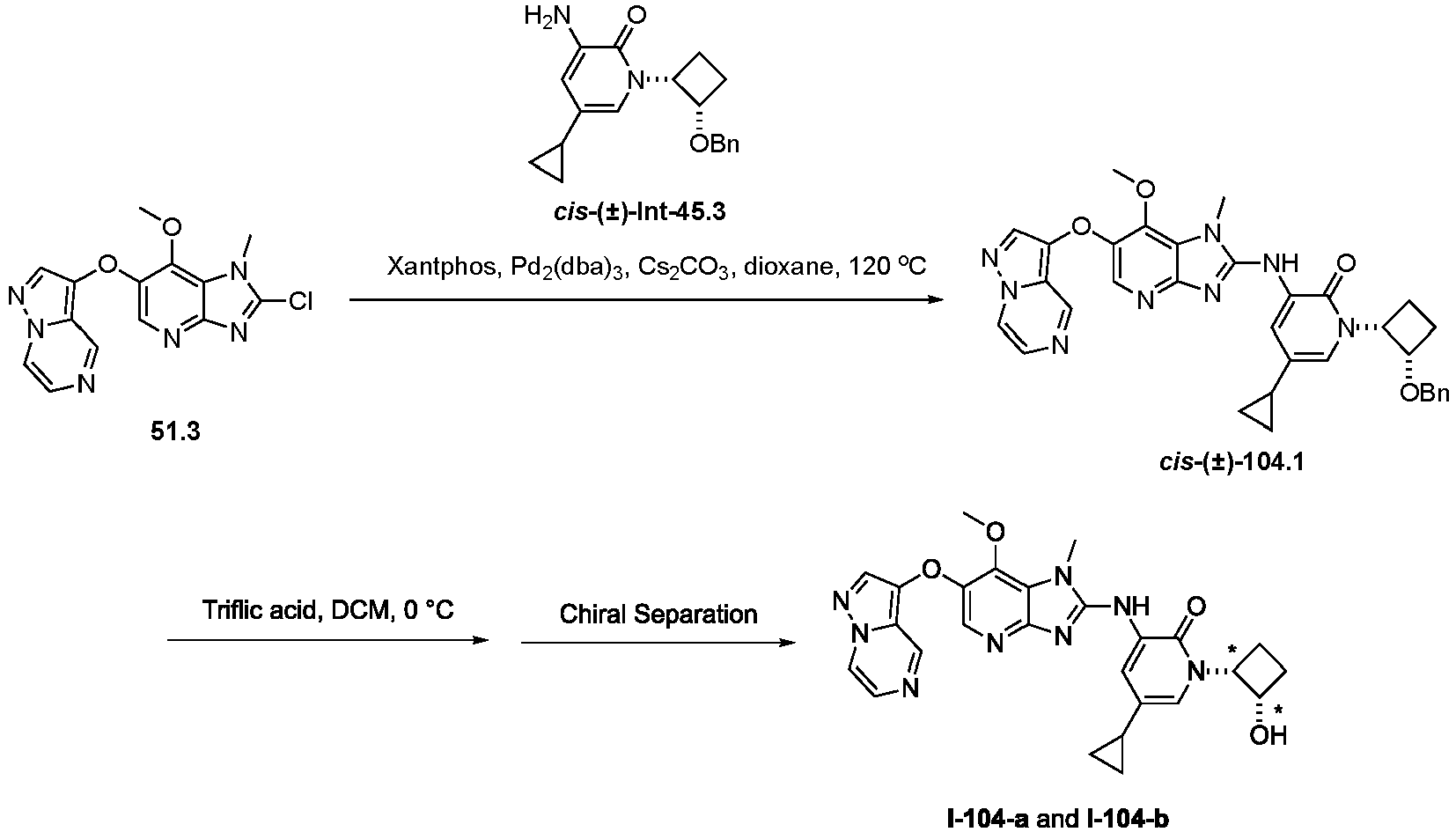
- Synthesis of compound cis-(±)-104.1. Compound cis-(+)-104.1 was prepared from 51.3 and cis-(±)-Int-45.3, following the procedure described in the synthesis of I-53. The product was purified by flash column chromatography on silica gel (CombiFlash®, 2.0% methanol in DCM). MS(ES): m/z: 605.5 [M+H]+.
- Synthesis of compound I-104-a and I-104-b. Racemate I-104 was prepared from 104.1, following the procedure described in the synthesis of I-23. The product was purified by flash column chromatography on silica gel (CombiFlash®, 5.0% methanol in DCM). MS(ES): m/z: 515.3 [M+H]+. It was subjected to HPLC separation (column: CHIRALPAK IB-N (250 mm x 21 mm, 5 µm); mobile phase: (A) 0.1% DEA in hexane, (B) 0.1% DEA in isopropanol:acetonitrile (70:30); flow rate: 20 mL/min) to afford first eluting fraction (I-104-a) and second eluting fraction (I-104-b). (*Absolute stereochemistry not determined.)
- I-104-a: MS(ES): m/z: 515.3 [M+H]+, 1H NMR (DMSO-d6, 400 MHz): δ 8.98 (s, 1H), 8.66-8.65 (d, J = 3.6 Hz, 1H), 8.35 (s, 1H), 8.24 (s, 1H), 8.12 (bs, 1H), 7.97 (s, 1H), 7.84-7.83 (d, J = 5.2 Hz, 1H), 7.25 (s, 1H), 5.60-5.58 (m, 1H), 4.91-4.89 (m, 1H), 4.45-4.41 (m, 1H), 4.10 (s, 3H), 3.89 (s, 3H), 2.12-2.09 (m, 2H), 1.91-1.88 (m, 1H), 1.71-1.61 (m, 2H), 0.89-0.87 (m, 2H), 0.63-0.62 (m, 2H).
- I-104-b: MS(ES): m/z: 515.3 [M+H]+, 1H NMR (DMSO-d6, 400 MHz): δ 8.97 (s, 1H), 8.65-8.64 (d, J= 3.6 Hz, 1H), 8.34 (s, 1H), 8.24 (s, 1H), 8.11 (bs, 1H), 7.97 (s, 1H), 7.84-7.83 (d, J = 5.2 Hz, 1H), 7.24 (s, 1H), 5.59-5.57 (m, 1H), 4.90-4.86 (m, 1H), 4.45-4.41 (m, 1H), 4.10 (s, 3H), 3.89 (s, 3H), 2.14-2.09 (m, 2H), 1.91-1.88 (m, 1H), 1.71-1.56 (m, 2H), 0.89-0.87 (m, 2H), 0.63-0.62 (m, 2H).
-

- Synthesis of compound 105.1. Compound 105.1 was prepared from 21.7 and trans-(±)-Int-49, following the procedure described in the synthesis of I-13. The product was purified by flash column chromatography on silica gel (CombiFlash®, 1.6% methanol in DCM). MS(ES): m/z: 638.0 [M+H]+.
- Synthesis of compound I-105-a and I-105-b. Racemate I-105 was prepared from 105.1, following the procedure described in the synthesis of I-23. The product was purified by flash column chromatography on silica gel (CombiFlash®, 2.4% methanol in DCM). MS(ES): m/z 547.9 [M+H]+. It was subjected to HPLC separation (column: CHIRALPAK IB-N (250 mm x 21 mm, 5 µm); mobile phase: (A) 0.1% DEA in hexane, (B) 0.1% DEA in isopropanol:acetonitrile (70:30); flow rate: 20 mL/min) to afford first eluting fraction (I-105-a) and second eluting fraction (I-105-b). (*Absolute stereochemistry not determined.)
- I-105-a: MS(ES): m/z: 547.4 [M+H]+, 1H NMR (DMSO-d6, 400 MHz): δ 9.07 (s, 1H), 8.95 (s, 1H), 8.72-8.71 (d, J = 4.4 Hz, 1H), 8.58 (bs, 1H), 8.26 (s, 1H), 8.07 (s, 1H), 8.04 (s, 1H), 7.89-7.88 (d, J = 4.8 Hz, 1H), 4.92-4.90 (m, 1H), 4.52-4.50 (m, 1H), 4.02 (s, 3H), 3.17 (s, 1H), 2.16-2.14 (m, 2H), 1.76-1.64 (m, 2H).
- I-105-b: MS(ES): m/z: 547.4 [M+H]+, 1H NMR (DMSO-d6, 400 MHz): δ 9.08 (s, 1H), 8.95 (s, 1H), 8.73-8.72 (d, J = 4.4 Hz, 1H), 8.60 (bs, 1H), 8.27 (s, 1H), 8.08 (s, 1H), 8.04 (s, 1H), 7.90-7.89 (d, J = 4.8 Hz, 1H), 7.29 (s, 1H), 4.93-4.91 (m, 1H), 4.53-4.51 (m, 1H), 4.03 (s, 3H), 3.18 (s, 1H), 2.18-2.15 (m, 2H), 1.79-1.65 (m, 2H).
-

- Synthesis of I-106. Compound I-106 was prepared from 51.3 and Int-50, following the procedure described in the synthesis of I-53. The product was purified by flash column chromatography on silica gel (CombiFlash®, 3.2% methanol in DCM). MS(ES): m/z: 531.5 [M+H]+, 1H NMR (DMSO-d6, 400 MHz): δ 8.98 (s, 1H), 8.66-8.65 (d, J = 4.0 Hz, 1H), 8.32 (s, 1H), 8.28 (s, 1H), 8.11 (s, 1H), 7.97 (s, 1H), 7.84-7.83 (d, J = 4.4 Hz, 1H), 6.99 (s, 1H), 4.09 (s, 5H), 3.88 (s, 3H), 3.20 (s, 3H), 1.82 (bs, 1H), 1.12 (s, 6H), 0.88-0.87 (m, 2H), 0.55-0.54 (m, 2H).
-

- Synthesis of compound I-107-a and I-107-b. Racemate I-107 was prepared from 21.7 and (±)-Int-51, following the procedure described in the synthesis of I-13. The product was purified by flash column chromatography on silica gel (CombiFlash®, 2.0% methanol in DCM). It was subjected to HPLC separation (column: CHIRALPAK IC (250 mm x 21 mm, 5 µm); mobile phase: (A) 0.1% DEA in methanol, (B) 0.1% DEA in acetonitrile; flow rate: 20 mL/min) to afford first eluting fraction (I-107-a) and second eluting fraction (I-107-b). (*Absolute stereochemistry not determined.)
- I-107-a: MS(ES): m/z: 561.4 [M+H]+, 1H NMR (DMSO-d6, 400 MHz): δ 9.04 (s, 1H), 8.88 (s, 1H), 8.70-8.69 (d, J = 3.6 Hz, 1H), 8.62-8.61 (d, J = 2.0 Hz, 1H), 8.24 (s, 1H), 8.11 (s, 1H), 8.05 (s, 1H), 7.88-7.86 (d, J = 4.8 Hz, 1H), 4.88 (bs, 1H), 4.01 (s, 3H), 3.89-3.87 (m, 1H), 3.82-3.77 (m, 2H), 3.58-3.55 (m, 1H), 2.25-2.16 (m, 2H), 2.00 (bs, 2H).
- I-107-b: MS(ES): m/z: 561.2 [M+H]+, 1H NMR (DMSO-d6, 400 MHz): δ 9.04 (s, 1H), 8.88 (s, 1H), 8.70-8.69 (d, J = 3.6 Hz, 1H), 8.61 (bs, 1H), 8.24 (s, 1H), 8.11 (s, 1H), 8.05 (s, 1H), 7.88-7.86 (d, J = 4.8 Hz, 1H), 4.88 (bs, 1H), 4.08 (s, 3H), 3.89-3.87 (m, 1H), 3.82-3.77 (m, 2H), 3.58-3.53 (m, 1H), 2.21-2.19 (m, 2H), 2.00 (bs, 2H).
-

- Synthesis of I-108. Compound I-108 was prepared from 21.7 and Int-52, following the procedure described in the synthesis of I-13. The product was purified by flash column chromatography on silica gel (CombiFlash®, 4.0% methanol in DCM). MS(ES): m/z: 526.2 [M+H]+, 1H NMR (DMSO-d6, 400 MHz): δ 9.04 (s, 1H), 8.75 (s, 1H), 8.69 (s, 1H), 8.63 (s, 1H), 8.37 (s, 1H), 8.24 (s, 1H), 8.05 (bs, 1H), 8.00 (bs, 1H), 7.87 (s, 1H), 7.62 (bs, 2H), 7.27 (s, 1H), 3.99 (s, 3H), 1.55 (bs, 1H), 0.88 (bs, 2H), 0.66 (bs, 2H).
-

- Synthesis of I-109. Compound I-109 was prepared from 21.7 and Int-53, following the procedure described in the synthesis of I-13. The product was purified by flash column chromatography on silica gel (CombiFlash®, 4.2% methanol in DCM). MS(ES): m/z: 554.2 [M+H]+, 1H NMR (DMSO-d6, 400 MHz): δ 9.05 (s, 1H), 8.98 (s, 1H), 8.81 (s, 1H), 8.73-8.69 (m, 3H), 8.27 (s, 1H), 8.14 (s, 1H), 8.09(s, 1H), 8.06 (s, 1H), 7.88-7.87 (d, J= 4.8 Hz, 1H), 7.66-7.63 (m, 1H), 4.01 (s, 3H).
-

- Synthesis of compound 110.1. Compound 110.1 was prepared from 51.3 and trans-(±)-Int-44, following the procedure described in the synthesis of I-53. The product was purified by flash column chromatography on silica gel (CombiFlash®, 2.1% methanol in DCM). MS(ES): m/z: 605.5 [M+H]+.
- Synthesis of compound I-110-a and I-110-b. Racemate I-110 was prepared from 110.1, following the procedure described in the synthesis of I-23. The product was purified by flash column chromatography on silica gel (CombiFlash®, 5.0% methanol in DCM). MS(ES): m/z: 515.3 [M+H]+. It was subjected to HPLC separation (column: CHIRALPAK IB-N (250 mm x 21 mm, 5 µm); mobile phase: (A) 0.1% DEA in hexane, (B) 0.1% DEA in isopropanol:acetonitrile (70:30); flow rate: 20 mL/min) to afford first eluting fraction (I-110-a) and second eluting fraction (I-110-b). (*Absolute stereochemistry not determined.)
- I-110-a: MS(ES): m/z: 515.5 [M+H]+, 1H NMR (DMSO-d6, 400 MHz): δ 8.98 (s, 1H), 8.67-8.65 (d, J = 4.0 Hz, 1H), 8.35 (s, 1H), 8.24 (s, 1H), 8.11 (bs, 1H), 7.97 (s, 1H), 7.84-7.83 (d, J = 5.2 Hz, 1H), 7.26 (s, 1H), 5.61-5.60 (m, 1H), 4.92-4.89 (m, 1H), 4.47-4.39 (m, 1H), 4.09 (s, 3H), 3.89 (s, 3H), 2.14-2.07 (m, 2H), 1.91-1.86 (m, 1H), 1.71-1.61 (m, 2H), 0.89-0.87 (m, 2H), 0.63-0.62 (m, 2H).
- I-110-b: MS(ES): m/z: 515.5 [M+H]+, 1H NMR (DMSO-d6, 400 MHz): δ 8.99 (s, 1H), 8.68-8.67 (d, J = 4.8 Hz, 1H), 8.36 (s, 1H), 8.26 (s, 1H), 8.13 (bs, 1H), 7.98 (s, 1H), 7.86-7.84 (d, J = 4.8 Hz, 1H), 7.27 (s, 1H), 5.62-5.60 (m, 1H), 4.93-4.90 (m, 1H), 4.47-4.39 (m, 1H), 4.11 (s, 3H), 3.90 (s, 3H), 2.15-2.08 (m, 2H), 1.92-1.88 (m, 1H), 1.73-1.62 (m, 2H), 0.89-0.85 (m, 2H), 0.63-0.62 (m, 2H).
-


- Synthesis of compound 111.1. Compound 111.1 was prepared from 101.2, following the procedure described in the synthesis of 53.2. The product was purified by flash column chromatography on silica gel (CombiFlash®, 2.2% methanol in DCM). MS (ES): m/z 375.2 [M+H]+.
- Synthesis of compound 111.2. Compound 111.2 was prepared from 111.1 and Int-33.3, following the procedure described in the synthesis of I-53. The product was purified by flash column chromatography on silica gel (CombiFlash®, 2.5% methanol in DCM). MS(ES): m/z: 604.5 [M+H]+.
- Synthesis of I-111. Compound I-111 was prepared from 111.2, following the procedure described in the synthesis of I-23. The product was purified by flash column chromatography on silica gel (CombiFlash®, 3.5% methanol in DCM). MS(ES): m/z: 514.5 [M+H]+, 1H NMR (DMSO-d6, 400 MHz): δ 8.61-8.59 (d, J = 7.2 Hz, 1H), 8.33 (s, 1H), 8.22 (s, 1H), 7.96-7.94 (d, J = 5.6 Hz, 2H), 7.53-7.51 (d, J = 8.8 Hz, 1H), 7.25 (s, 1H), 7.18-7.15 (t, J = 7.2 Hz, 8.0 Hz, 1H), 6.90-6.86 (t, J = 6.8 Hz, 6.8 Hz, 1H), 5.43-5.37 (m, 1H), 5.25-5.24 (m, 1H), 4.39 (bs, 1H), 4.14 (s, 3H), 3.90 (s, 3H), 3.42-3.35 (m, 2H), 2.35-2.31 (m, 2H), 1.93-1.86 (m, 1H), 0.91-0.87 (m, 2H), 0.63-0.61 (m, 2H).
-


- Synthesis of compound 112.1. Compound 112.1 was prepared from 111.1 and Int-32, following the procedure described in the synthesis of I-53. The product was purified by flash column chromatography on silica gel (CombiFlash®, 2.6% methanol in DCM). MS(ES): m/z: 604.5 [M+H]+.
- Synthesis of I-112. Compound I-112 was prepared from 112.1, following the procedure described in the synthesis of I-23. The product was purified by flash column chromatography on silica gel (CombiFlash®, 3.5% methanol in DCM). MS(ES): m/z: 514.5 [M+H]+, 1H NMR (DMSO-d6, 400 MHz): δ 8.61-8.59 (d, J = 7.2 Hz, 1H), 8.33 (s, 1H), 8.23 (s, 1H), 7.96-7.94 (d, J = 5.6 Hz, 2H), 7.54-7.52 (d, J = 8.8 Hz, 1H), 7.25 (s, 1H), 7.19-7.15 (t, J = 7.2 Hz, 8.0 Hz, 1H), 6.90-6.87 (t, J = 6.8 Hz, 6.8 Hz, 1H), 5.30-5.28 (m, 1H), 4.71-4.63 (m, 1H), 4.14 (s, 3H), 4.01 (bs, 1H), 3.90 (s, 3H), 2.78-2.77 (m, 2H), 2.17-2.15 (m, 2H), 1.95-1.88 (m, 1H), 0.91-0.89 (m, 2H), 0.63-0.61 (m, 2H).
-

- Synthesis of compound trans-(±)-113.1. Compound trans-(±)-113.1 was prepared from 51.3 and trans-(±)-Int-49.4, following the procedure described in the synthesis of I-53. The product was purified by flash column chromatography on silica gel (CombiFlash®, 2.1% methanol in DCM). MS(ES): m/z: 633.5 [M+H]+.
- Synthesis of I-113-a and I-113-b. Racemate I-113 was prepared from trans-(±)-113.1, following the procedure described in the synthesis of I-23. The product was purified by flash column chromatography on silica gel (CombiFlash®, 4.8% methanol in DCM). It was subjected to HPLC separation (column: CHIRALPAK IB-N (250 mm x 21 mm, 5 µm); mobile phase: (A) 0.1% DEA in hexane, (B) 0.1% DEA in isopropanol:acetonitrile (70:30); flow rate: 20 mL/min) to afford first eluting fraction (I-113-a) and second eluting fraction (I-113-b). (*Absolute stereochemistry not determined.)
- 1-113-a: MS(ES): m/z: 543.4 [M+H]+, 1H NMR (DMSO-d6, 400 MHz): δ 9.01 (s, 1H), 8.68-8.67 (d, J = 4.0 Hz, 2H), 8.64-8.63 (d, J = 2.0 Hz, 1H), 8.16 (s, 1H), 8.00 (s, 1H), 7.99 (s, 1H), 7.86-7.84 (d, J= 4.8 Hz, 1H), 7.27 (s, 1H), 5.72-5.70 (m, 1H), 4.95-4.89 (m, 1H), 4.53-4.49 (m, 1H), 4.12 (s, 3H), 3.93 (s, 3H), 2.19-2.13 (m, 2H), 1.79-1.72 (m, 1H), 1.69-1.62 (m, 1H).
- I-113-b: MS(ES): m/z: 543.3 [M+H]+, 1H NMR (DMSO-d6, 400 MHz): δ 9.01 (s, 1H), 8.68-8.67 (d, J = 4.0 Hz, 2H), 8.64-8.63 (d, J = 2.0 Hz, 1H), 8.16 (s, 1H), 8.00 (s, 1H), 7.99 (s, 1H), 7.86-7.84 (d, J = 4.8 Hz, 1H), 7.27 (s, 1H), 5.72-5.70 (m, 1H), 4.95-4.89 (m, 1H), 4.53-4.49 (m, 1H), 4.12 (s, 3H), 3.93 (s, 3H), 2.19-2.13 (m, 2H), 1.79-1.72 (m, 1H), 1.69-1.62 (m, 1H).
-


- Synthesis of compound cis-(±)114.1. Compound cis-(+)-114.1 was prepared from 78.5 and cis-(±)-Int-58, following the procedure described in the synthesis of I-13. The product was purified by flash column chromatography on silica gel (CombiFlash®, 2.0% methanol in DCM). MS(ES): m/z: 609.1 [M+H]+.
- Synthesis of compound I-114-a and I-114-b. Racemate I-114 was prepared from cis-(+)-114.1, following the procedure described in the synthesis of I-23. The product was purified by flash column chromatography on silica gel (CombiFlash®, 3.0% methanol in DCM). MS(ES): m/z 518.2 [M+H]+. It was subjected to HPLC separation (column: CHIRALPAK IB-N (250 mm x 21 mm, 5 µm); mobile phase: (A) 0.1% DEA in hexane, (B) 0.1% DEA in isopropanol:acetonitrile (70:30); flow rate: 20 mL/min) to afford first eluting fraction (I-114-a) and second eluting fraction (I-114-b). (*Absolute stereochemistry not determined.)
- I-114-a: MS(ES): m/z: 518.2 [M+H]+, 1H NMR (DMSO-d6, 400 MHz): δ 8.64-8.63 (d, J = 6.8 Hz, 1H), 8.52 (s, 1H), 8.23-8.22 (d, J = 1.6 Hz, 1H), 8.03-8.01 (d, J = 5.6 Hz, 2H), 7.53-7.50 (d, J = 9.2 Hz, 1H), 7.29 (s, 1H), 7.21-7.17 (m, 1H), 6.92-6.89 (m, 1H), 5.63-5.61 (d, J = 6.8 Hz, 1H), 4.93-4.91 (m, 1H), 4.46-4.40 (m, 1H), 4.00 (s, 3H), 2.17-2.10 (m, 2H), 1.90-1.86 (m, 1H), 1.69-1.62 (m, 2H), 0.90-0.85 (m, 2H), 0.63-0.62 (m, 2H).
- I-114-b: MS(ES): m/z: 518.1 [M+H]+, 1H NMR (DMSO-d6, 400 MHz): δ 8.63-8.61 (d, J = 7.2 Hz, 1H), 8.51 (s, 1H), 8.22 (bs, 1H), 8.01-8.00 (d, J = 5.6 Hz, 2H), 7.51-7.49 (d, J = 9.2 Hz, 1H), 7.28 (s, 1H), 7.20-7.16 (m, 1H), 6.91-6.88 (m, 1H), 5.62-5.60 (d, J = 6.4 Hz, 1H), 4.97-4.87 (m, 1H), 4.48-4.38 (m, 1H), 3.99 (s, 3H), 2.18-2.09 (m, 2H), 1.91-1.85 (m, 1H), 1.68-1.61 (m, 2H), 0.88-0.85 (m, 2H), 0.62-0.61 (m, 2H).
-

- Synthesis of I-115. Compound I-115 was prepared from 78.5 and Int-54, following the procedure described in the synthesis of I-13. The product was purified by flash column chromatography on silica gel (CombiFlash®, 3.8% methanol in DCM). MS(ES): m/z: 528.2 [M+H]+, 1H NMR (DMSO-d6, 400 MHz): δ 8.64 (s, 1H), 8.62 (s, 1H), 8.37 (s, 1H), 8.28-8.27 (d, J= 1.6 Hz, 1H), 8.04-8.03 (d, J = 4.0 Hz, 2H), 7.97 (s, 1H), 7.53-7.51 (d, J = 8.8 Hz, 1H), 7.35 (s, 1H), 7.22-7.18 (m, 1H), 6.93-6.89 (m, 1H), 4.01 (s, 3H), 3.92 (s, 3H), 1.89 (bs, 1H), 0.91-0.89 (m, 2H), 0.67-0.66 (m, 2H).
-

- Synthesis of I-116. Compound I-116 was prepared from 78.5 and Int-55, following the procedure described in the synthesis of I-13. The product was purified by flash column chromatography on silica gel (CombiFlash®, 2.2% methanol in DCM). MS(ES): m/z: 463.3 [M+H]+, 1H NMR (DMSO-d6, 400 MHz): δ 9.19 (s, 1H), 8.65-8.63 (d, J = 6.8 Hz, 1H), 8.10 (s, 1H), 8.06 (s, 1H), 7.97 (s, 1H), 7.54-7.52 (d, J = 9.2 Hz, 1H), 7.22-7.19 (m, 1H), 6.93-6.90 (m, 1H), 4.03 (s, 3H), 3.71 (s, 3H), 2.00-1.99 (m, 1H), 0.97-0.93 (m, 2H), 0.82-0.79 (m, 2H).
-

- Synthesis of I-117. Compound I-117 was prepared from 21.7 and Int-56, following the procedure described in the synthesis of I-51. The product was purified by flash column chromatography on silica gel (CombiFlash®, 3.0% methanol in DCM). MS (ES): m/z 596.5 [M+H]+, 1H NMR (DMSO-d6, 400 MHz): δ 9.05-9.04 (d, J = 1.6 Hz, 1H), 8.71-8.69 (m, 1H), 8.55 (s, 1H), 8.30-8.29 (d, J = 2.4 Hz, 1H), 8.22 (s, 1H), 8.06 (s, 1H), 7.89-7.87 (d, J = 5.2 Hz, 1H), 7.24-7.23 (d, J = 2.0 Hz, 1H), 4.05-4.01 (m, 2H), 4.00 (s, 3H), 2.94-2.88 (m, 2H), 2.71-2.65 (m, 2H), 2.47 (bs, 2H), 2.30-2.20 (m, 2H), 1.91-1.80 (m, 3H), 0.91-0.86 (m, 2H), 0.62-0.58 (m, 2H).
-

- Synthesis of I-118. Compound I-118 was prepared from 21.7 and Int-57, following the procedure described in the synthesis of I-51. The product was purified by flash column chromatography on silica gel (CombiFlash®, 2.5% methanol in DCM). MS(ES): m/z 624.3 [M+H]+, 1H NMR (DMSO-d6, 400 MHz): δ 9.05-9.04 (d, J = 1.6 Hz, 1H), 8.86 (bs, 1H), 8.71 (s, 1H), 8.63 (s, 1H), 8.26-8.25 (d, J = 3.6 Hz, 1H), 8.12 (s, 1H), 8.07-8.06 (d, J = 3.6 Hz, 1H), 7.88 (s, 1H), 4.17 (bs, 2H), 4.02 (s, 3H), 2.89 (bs, 2H), 2.69 (bs, 2H), 2.25 (bs, 2H), 1.93 (bs, 2H), 1.25 (bs, 2H).
-

- Synthesis of compound cis-(+)-119.1. Compound cis-(+)-119.1 was prepared from 21.7 and cis-(±)-Int-58, following the procedure described in the synthesis of I-13. The product was purified by flash column chromatography on silica gel (CombiFlash®, 1.6% methanol in DCM). MS(ES): m/z: 638.0 [M+H]+.
- Synthesis of compound I-119-a and I-119-b. Racemate I-119 was prepared from cis-(±)-119.1, following the procedure described in the synthesis of I-23. The product was purified by flash column chromatography on silica gel (CombiFlash®, 2.4% methanol in DCM). MS(ES): m/z 547.9 [M+H]+. It was subjected to HPLC separation (column: CHIRALPAK IB-N (250 mm x 21 mm, 5 µm); mobile phase: (A) 0.1% DEA in hexane, (B) 0.1% DEA in isopropanol:acetonitrile (70:30); flow rate: 20 mL/min) to afford first eluting fraction (I-119-a) and second eluting fraction (I-119-b). (*Absolute stereochemistry not determined.)
- I-119-a: MS(ES): m/z: 547.4 [M+H]+, 1H NMR (DMSO-d6, 400 MHz): δ 9.05 (s, 1H), 8.87 (s, 1H), 8.71-8.70 (m, 1H), 8.63-8.62 (d, J = 2.0 Hz, 1H), 8.26 (s, 1H), 8.06 (s, 1H), 8.04 (s, 1H), 7.89-7.88 (d, J = 4.8 Hz, 1H), 5.73-5.71 (m, 1H), 4.94-4.92 (m, 1H), 4.52-4.50 (m, 1H), 4.02 (s, 3H), 2.18-2.16 (m, 2H), 1.77-1.65 (m, 2H).
- I-119-b: MS(ES): m/z: 547.3 [M+H]+, 1H NMR (DMSO-d6, 400 MHz): δ 9.05 (s, 1H), 8.87 (s, 1H), 8.71-8.70 (m, 1H), 8.63-8.62 (d, J = 2.0 Hz, 1H), 8.26 (s, 1H), 8.06 (s, 1H), 8.04 (s, 1H), 7.89-7.88 (d, J= 4.8 Hz, 1H), 5.73-5.71 (m, 1H), 4.94-4.92 (m, 1H), 4.52-4.50 (m, 1H), 4.02 (s, 3H), 2.18-2.16 (m, 2H), 1.77-1.65 (m, 2H).
-

- Synthesis of I-120. Compound I-120 was prepared from 21.7 and Int-60, following the procedure described in the synthesis of I-13. The product was purified by preparative HPLC. MS(ES): m/z: 572.2 [M+H]+, 1H NMR (DMSO-d6, 400 MHz): ): δ 9.65 (s, 1H), 9.03 (s, 1H), 8.70-8.69 (d, J = 4.8Hz 1H), 8.30 (s, 1H), 8.21 (s, 1H), 8.16 (s, 1H), 8.04 (s, 1H), 7.88-7.87 (d, J = 4.8Hz 1H), 7.73-7.71 (d, J = 8.8Hz 1H), 4.03 (s, 3H), 3.60 (s, 3H), 2.68 (s, 4H), 2.34 (s, 4H), 2.29 (bs, 2H).
-

- Synthesis of compound I-121-a and I-121-b. Racemate I-121 was prepared from 51.3 and (±)-Int-39, following the procedure described in the synthesis of I-53. The product was purified by flash column chromatography on silica gel (CombiFlash®, 2.2% methanol in DCM). It was subjected to HPLC separation (column: CHIRALPAK IB-N (250 mm x 21 mm, 5 µm); mobile phase: (A) 0.1% DEA in hexane, (B) 0.1% DEA in isopropanol:acetonitrile (70:30); flow rate: 20 mL/min) to afford first eluting fraction (I-121-a) and second eluting fraction (I-121-b). (*Absolute stereochemistry not determined.)
- I-121-a: MS(ES): m/z: 512.3 [M+H]+, 1H NMR (MeOD, 400 MHz): δ 8.99 (s, 1H), 8.50-8.49 (m, 1H), 8.43-8.42 (d, J = 2.0 Hz, 1H), 8.10 (s, 1H), 7.85 (s, 1H), 7.82-7.81 (d, J = 5.2 Hz, 1H), 7.22 (s, 1H), 5.35-5.34 (m, 1H), 4.23 (s, 3H), 4.01 (s, 3H), 3.23-3.16 (m, 1H), 3.11-3.05 (m, 1H), 1.92-1.88 (m, 1H), 1.64-1.62 (d, 3H), 0.96-0.91 (m, 2H), 0.76-0.72 (m, 2H).
- I-121-b: MS(ES): m/z: 512.4 [M+H]+, 1H NMR (MeOD, 400 MHz): δ 9.00 (s, 1H), 8.52-8.50 (d, J = 5.2 Hz, 1H), 8.45-8.44 (d, J = 1.6 Hz, 1H), 8.12 (s, 1H), 7.86 (s, 1H), 7.82-7.81 (d, J = 5.2 Hz, 1H), 7.23 (s, 1H), 5.35-5.34 (m, 1H), 4.31 (s, 3H), 4.02 (s, 3H), 3.20-3.18 (m, 1H), 3.12-3.11 (m, 1H), 1.94-1.91 (m, 1H), 1.65-1.64 (d, 3H), 0.97-0.92 (m, 2H), 0.76-0.75 (m, 2H).
-

- Synthesis of compound trans-(±)-122.1. Compoudn trans-(±)-122.1 was prepared from 111.1 and trans-(±)-122.1, following the procedure described in the synthesis of I-53. was purified by flash column chromatography on silica gel (CombiFlash®, 2.0% methanol in DCM). MS(ES): m/z: 604.5 [M+H]+.
- Synthesis of I-122-a and 1-122-b. Racemate I-122 was prepared from trans-(±)-122.1, following the procedure described in the synthesis of I-23. The product was purified by flash column chromatography on silica gel (CombiFlash®, 4.0% methanol in DCM). It was subjected to HPLC separation: (column: CHIRALPAK IB-N (250 mm x 21 mm, 5 µm); mobile phase: (A) 0.1% DEA in hexane, (B) 0.1% DEA in isopropanol:acetonitrile (70:30); flow rate: 20 mL/min) to afford first eluting fraction (I-122-a) and second eluting fraction (I-122-b). (*Absolute stereochemistry not determined.)
- I-122-a: MS(ES): m/z: 514.5 [M+H]+, 1H NMR (DMSO-d6, 400 MHz): δ 8.61-8.59 (d, J = 7.2 Hz, 1H), 8.35 (s, 1H), 8.24 (bs, 1H), 7.96-7.94 (d, J = 7.2 Hz, 2H), 7.53-7.51 (d, J = 8.8 Hz, 1H), 7.26 (s, 1H), 7.18-7.14 (m, 1H), 6.90-6.86 (m, 1H), 5.63-5.61 (m, 1H), 4.95-4.88 (m, 1H), 4.45-4.42 (m, 1H), 4.14 (s, 3H), 3.90 (s, 3H), 2.17-2.07 (m, 2H), 1.92-1.84 (m, 1H), 1.72-1.59 (m, 2H), 0.91-0.87 (m, 2H), 0.63-0.62 (m, 2H).
- I-122-b: MS(ES): m/z: 514.5 [M+H]+, 1H NMR (DMSO-d6, 400 MHz): δ 8.61-8.59 (d, J= 7.2 Hz, 1H), 8.34 (s, 1H), 8.24 (bs, 1H), 7.96-7.94 (d, J = 7.2 Hz, 2H), 7.53-7.51 (d, J = 8.8 Hz, 1H), 7.26 (s, 1H), 7.18-7.14 (m, 1H), 6.90-6.86 (m, 1H), 5.63-5.61 (m, 1H), 4.95-4.88 (m, 1H), 4.47-4.42 (m, 1H), 4.14 (s, 3H), 3.90 (s, 3H), 2.17-2.07 (m, 2H), 1.92-1.84 (m, 1H), 1.72-1.59 (m, 2H), 0.91-0.87 (m, 2H), 0.63-0.62 (m, 2H).
-

- Synthesis of I-123. Compound I-123 was prepared from 111.1 and Int-56.5, following the procedure described in the synthesis of I-53. The product purified by flash column chromatography on silica gel (CombiFlash®, 2.8% methanol in DCM) to afford the title compound. MS(ES): m/z 591.3 [M+H]+, 1H NMR (DMSO-d6, 400 MHz): δ 8.60-8.58 (d, J = 7.2 Hz, 1H), 8.33 (s, 1H), 8.28-8.27 (d, J = 2.4 Hz, 1H), 7.94-7.93 (d, J = 4.0 Hz, 2H), 7.53-7.50 (d, J = 9.2 Hz, 1H), 7.17-7.13 (m, 2H), 6.89-6.85 (m, 1H), 4.13 (s, 3H), 4.03-3.99 (m, 2H), 3.89 (s, 3H), 2.93-2.86 (m, 2H), 2.71-2.68 (m, 2H), 2.47-2.44 (m, 2H), 2.30-2.19 (m, 2H), 1.89-1.79 (m, 3H), 0.88-0.83 (m, 2H), 0.59-0.55 (m, 2H).
-

- Synthesis of compound 124.1. A solution of tert-butyl ((mesitylsulfonyl)oxy)carbamate (335 g, 1060 mmol, 1.0 equiv) in trifluoroacetic acid (770 mL, 2.3 vol) was stirred at 0 °C for 1 h. The reaction mixture was poured over ice-water and stirred. The precipitated solids were collected by filtration, rained with water and air-dried. This crude product was dissolved in DCM, dried over anhydrous sodium sulfate, filtered and concentrated under reduced pressure to afford 124.1. MS (ES): m/z 216.6 [M+H]+.
- Synthesis of compound 124.2. To a solution of 2-chloropyrazine (100.0 g, 873.12 mmol, 1.0 equiv) in DCM (750 mL) was added 124.1 (225.2 g, 1047 mmol, 1.2 equiv) at 0 °C. The reaction mixture was stirred at room temperature for 2 h. It was poured over diethyl ether and stirred. The solids were collected by filtration and dissolved in DMF (1250 mL). To the soltuion was added trimethylamine (279.6 g, 2769 mmol, 2.0 equiv), followed by ethyl propiolate (271.3 g, 2769 mmol, 2.0 equiv) dropwise at 0 °C. The reaction mixture was stirred at room temperature for 48 h. It was poured over brine and extracted with ethyl acetate. The combined organic layers were washed with brine, dried over anhydrous sodium sulfate, filtered and concentrated under reduced pressure. The residue was purified by flash column chromatography on silica gel (6.0% ethyl acetate in hexane) to afford 124.2. MS (ES): m/z 226.5 [M+H]+.
- Synthesis of compound 124.3. To a solution of 124.2 (34.8 g, 154.23 mmol, 1.0 equiv) in THF (700 mL) was added diisobutylaluminiumhydride (1 M solution in DCM, 771 mL, 771.15 mmol, 5.0 equiv) dropwise at -78 °C. The reaction mixture was stirred at room temperature for 1 h. It was carefully poured over 1 N aqueous hydrochloric acid solution and extracted with ethyl acetate. The combined organic layers were washed with brine, dried over anhydrous sodium sulfate, filtered and concentrated under reduced pressure to afford 124.3. MS (ES): m/z 184.2 [M+H]+.
- Synthesis of compound 124.4. To a solution of 124.3 (18.5 g, 100.77 mmol, 1 equiv) in DCM was added Dess-Martin periodinane (106.8 g, 251.92 mmol, 2.5 equiv). The reaction mixture was stirred at 0 °C for 1 h. The reaction mixture was transferred into an aqueous solution of sodium bicarbonate and extracted with DCM. The combined organic layers were washed with brine, dried over anhydrous sodium sulfate, filtered and concentrated under reduced pressure. The residue was purified by flash column chromatography on silica gel (CombiFlash®, 45% ethyl acetate in hexane) to afford 124.4. MS(ES): m/z 182 [M+H]+.
- Synthesis of compound 124.5. To a solution of 124.4 (11 g, 60.58 mmol, 1 equiv) in DCM (400 mL) was added m-chloroperbenzoic acid (15.5 g, 90.87, 1.5 equiv) and trifluoroacetic acid (0.690 g, 6.05 mmol, 0.1 equiv) dropwise at 0 °C. The reaction mixture was stirred at room temperature for 7 h. It was poured over an aqueous solution of sodium bicarbonate and extracted with DCM. The combined organic layers were washed with brine, dried over anhydrous sodium sulfate, filtered and concentrated under reduced pressure. The residue was purified by flash column chromatography on silica gel (CombiFlash®, 26% ethyl acetate in hexane) to afford 124.5. MS(ES): m/z 170.5 [M+H]+.
- Synthesis of compound 124.6. Compound 124.6 was prepared from 124.5 and Int-4, following the procedure described in the synthesis of 19.1. The product was used in the next step without purification. MS(ES): m/z 356.1 [M+H]+.
- Synthesis of compound 124.7. Compound 124.7 was prepared from 124.6, following the procedure described in the synthesis of 5.4. The product was purified by flash column chromatography on silica gel (CombiFlash®, 2% methanol in DCM) to afford 124.7. MS(ES): m/z 326.1 [M+H]+.
- Synthesis of compound 124.8. Compound 124.8 was prepared from 124.7 and Int-61, following the procedure described in the synthesis of I-13. The product was purified by flash column chromatography on silica gel (CombiFlash®, 2.6% methanol in DCM) to afford 124.8. MS(ES): m/z 499.1 [M+H]+.
- Synthesis of compound 124.9. To a solution of 124.8 (0.050 g, 0.100 mmol, 1.0 equiv) in THF (3 mL) was added 2-((tert-butyldiphenylsilyl)oxy)ethan-1-ol (0.045 g, 0.150 mmol, 1.5 equiv) followed by addition of potassium tert-butoxide (1 M in THF, 0.25 mL, 0.25 mmol, 2.5 equiv) at 0 °C. The reaction mixture was stirred at room temperature for 12 h. It was poured over ice-water and extracted with ethyl acetate. The combined organic layers were washed with brine, dried over anhydrous sodium sulfate, filtered and concentrated under reduced pressure. The residue was purified by flash column chromatography on silica gel (CombiFlash®, 2.4% methanol in DCM) to afford 124.9. MS(ES): m/z 763.3 [M+H]+.
- Synthesis of I-124. To a solution of 124.9 (0.035 g, 0.059 mmol, 1.0 equiv) in THF (2 mL) was added TBAF (1 M solution in THF, 0.17 mL, 0.177 mmol, 3.0 equiv) at 0 °C. The reaction mixture was stirred at room temperature for 30 min. It was poured over ice-water and extracted with ethyl acetate. The combined organic layers were washed with brine, dried over anhydrous sodium sulfate, filtered and concentrated under reduced pressure. The residue was purified by flash column chromatography on silica gel (CombiFlash®, 4% methanol in DCM) to afford I-124. MS(ES): m/z 524.5 [M+H]+. 1H NMR (DMSO-d6, 400 MHz): δ 9.96 (s, 1H), 8.28-8.27 (d, J = 5.2 Hz, 1H), 7.91 (bs, 2H), 7.37-7.35 (d, J = 5.2 Hz, 1H), 6.58 (s, 1H), 4.74-4.73 (m, 1H), 4.38-4.36 (m, 2H), 3.95 (bs, 5H), 3.59-3.57 (m, 2H), 2.03 (bs, 2H), 1.68 (bs, 2H), 1.31 (s, 6H).
-

- Synthesis of 1-125. To a solution of 124.8 (0.030 g, 0.024 mmol, 1.0 equiv) in methanol (1 mL) was added methylamine (2 M in THF) (0.3 mL) at room temperature and stirred at 70 °C for 12 h. It was concentrated under reduced pressure. The residue was purified by trituration with methanol to afford I-125. MS(ES): m/z 493.5 [M+H]+, 1H NMR (DMSO-d6, 400 MHz): δ 8.11 (s, 1H), 7.78-7.77 (d, J = 4.4 Hz, 1H), 7.72 (bs, 1H), 7.47 (s, 1H), 7.26-7.24 (d, J = 4.4 Hz, 1H), 6.81 (bs, 1H), 6.59 (s, 1H), 3.95 (bs, 3H), 3.00-2.99 (d, 3H), 2.37 (bs, 2H), 2.04 (bs, 2H), 1.69 (bs, 2H), 1.32 (s, 6H).
-

- Synthesis of compound 126.1. Compound 126.1 was prepared from 78.5 and Int-62, following the procedure described in the synthesis of I-13. The product was purified by flash column chromatography on silica gel (CombiFlash®, 1.5% methanol in DCM). MS(ES): m/z 584 [M+H]+.
- Synthesis of I-126. To a solution of 126.1 (0.075 g, 0.128 mmol, 1.0 equiv) in DCM (5 mL) was added triflic acid (0.25 mL) at 0 °C and stirred for 5 min. It was poured over a mixture of ice and saturated sodium bicarbonate solution and extracted with DCM. The combined organic layers were washed with brine, dried over anhydrous sodium sulfate, filtered and concentrated under reduced pressure. The residue was purified by flash column chromatography on silica gel (CombiFlash®, 3.0% methanol in DCM) to afford I-126. MS(ES): m/z 493.4 [M+H]+. 1H NMR (DMSO-d6, 400 MHz): δ 9.18 (s, 1H), 8.65-8.63 (d, J = 6.8 Hz, 1H), 8.09 (s, 1H), 8.05 (s, 1H), 7.96 (s, 1H), 7.54-7.52 (d, J = 8.8 Hz, 1H), 7.22-7.18 (m, 1H), 6.93-6.90 (m, 1H), 4.86 (bs, 1H), 4.19-4.16 (m, 2H), 4.03 (s, 3H), 3.76 (bs, 2H), 2.01-1.99 (m, 1H), 0.97-0.95 (m, 2H), 0.82-0.81 (m, 2H).
-

- Synthesis of compound 127.1. Compound 127.1 was prepared from 124.7 and Int-63, following the procedure described in the synthesis of I-13. The product was purified by flash column chromatography on silica gel (CombiFlash®, 2% methanol in DCM) to afford 127.1. MS(ES): m/z 526.2 [M+H]+.
- Synthesis of I-127. To a solution of 127.1 (0.030 g, 0.057 mmol, 1.0 equiv) in THF (2 mL) was added 2-morpholinoethan-1-ol (0.008 g, 0.062 mmol, 1.1 equiv) followed by addition of potassium tert-butoxide (1 M in THF, 0.11 mL, 0.114 mmol, 2.0 equiv) at 0 °C. The reaction mixture was stirred at 0 °C for 15 min. The reaction mixture was poured over ice-water and extracted with ethyl acetate. The combined organic layers were washed with brine, dried over anhydrous sodium sulfate, filtered and concentrated under reduced pressure. The residue was purified by flash column chromatography on silica gel (CombiFlash®, 4.3% methanol in DCM) to afford I-127. MS(ES): m/z 620.20 [M+H]+, 1H NMR (DMSO-d6, 400 MHz): δ 8.84 (s, 1H), 8.59 (s, 1H), 8.32-8.30 (d, J = 4.4 Hz, 1H), 8.13 (s, 1H), 8.03 (s, 1H), 7.96 (s, 1H), 7.39-7.38 (d, J = 4.8 Hz, 1H), 4.45-4.42 (m, 2H), 4.03 (s, 3H), 3.67(s, 3H), 3.39-3.37 (m, 4H), 3.19-3.17 (m, 2H), 2.27 (bs, 4H).
-

- Synthesis of I-128. To a solution of 127.1 (0.030 g, 0.057 mmol, 1.0 equiv) and methylamine solution (2 M in THF, 0.3 mL) in methanol (1 mL) was stirred at 70 °C for 12 h. The reaction mixture was concentrated under reduced pressure. The residue was purified by trituration with methanol to afford I-128. MS(ES): m/z 520.4 [M+H]+, 1H NMR (DMSO-d6, 400 MHz): δ 8.84 (s, 1H), 8.62 (s, 1H), 8.24-8.23 (d, J = 3.2 Hz, 1H), 8.14 (s, 1H), 7.78 (s, 1H), 7.50-7.49 (d, J = 3.2 Hz, 1H), 7.25 (s, 1H), 6.83 (s, 1H), 4.01 (bs, 3H), 3.66 (s, 3H), 2.98 (s, 3H).
-

- Synthesis of I-129. Compound I-129 was prepared from 21.7 and Int-64, following the procedure described in the synthesis of I-51. The product was purified by flash column chromatography on silica gel (CombiFlash®, 3.0% methanol in DCM. MS (ES): m/z 610.4 [M+H]+, 1H NMR (DMSO-d6, 400 MHz): δ 9.03 (s, 1H), 8.69-8.68 (d, J = 4.0 Hz, 1H), 8.54 (s, 1H), 8.28 (s, 1H), 8.20 (s, 1H), 8.04 (s, 1H), 7.87-7.86 (d, J = 4.4 Hz, 1H), 7.19 (s, 1H), 3.98 (bs, 5H), 2.67-2.61 (m, 4H), 2.39-2.33 (m, 4H), 1.88-1.81 (m, 5H), 0.87-0.85 (m, 2H), 0.58-0.57 (m, 2H).
-

- Synthesis of compound 130.1. To a solution of 76.8 (0.8 g, 2.42 mmol, 1.0 equiv) in THF (8 mL) was added 1,1'-thiocarbonyldiimidazole (2.15 g, 12.1 mmol, 5.0 equiv). The reaction mixture was stirred at 90 °C for 3 h. It was cooled to room temperature and transferred into ice-water. The precipitated solids were collected by filtration and triturated with hexane to afford 130.1. MS(ES): m/z 373.5 [M+H]+.
- Synthesis of compound 130.2. Compound 130.2 was prepared from 130.1, following the procedure described in the synthesis of 100.2. The product was purified by flash column chromatography on silica gel (CombiFlash®, 2.0% methanol in DCM) to afford 130.2. MS(ES): m/z 369.3 [M+H]+.
- Synthesis of compound 130.3. To 130.2 (0.150 g, 0.407 mmol, 1.0 equiv) was added hydrobromic acid in acetic acid (3 mL) at 0 °C followed by bromine (0.325 g, 2.305 mmol, 5.0 equiv). The reaction mixture was stirred for 10 min. It was poured over saturated sodium bicarbonate solution, stirred and extracted with ethyl acetate. The combined organic layers were washed with brine, dried over anhydrous sodium sulfate, filtered and concentrated under reduced pressure. The residue was purified by flash column chromatography on silica gel (CombiFlash®, 2.2% methanol in DCM) to afford 130.3. MS (ES): m/z 416.2 [M+H]+.
- Synthesis of compound 130.4. Compound 130.4 was prepared from 130.3, following the procedure described in the synthesis of I-53. The product was purified by flash column chromatography on silica gel (CombiFlash®, 3.6% methanol in DCM). MS(ES): m/z 634.5 [M+H]+.
- Synthesis of I-130. Compound I-130 was prepared from 130.4, following the procedure described in the synthesis of I-23. The product was purified by flash column chromatography on silica gel (CombiFlash®, 3.1% methanol in DCM). MS(ES): m/z 544.5 [M+H]+, 1H NMR (MeOD, 400 MHz): δ 8.28 (s, 1H), 8.11 (s, 1H), 8.03 (bs, 1H), 7.43 (s, 1H), 6.55 (bs, 1H), 5.33-5.29 (m, 1H), 4.66 (bs, 1H), 4.17 (s, 3H), 3.93 (s, 3H), 2.89 (bs, 2H), 2.45 (bs, 2H), 2.14 (bs, 1H), 1.42 (s, 9H), 1.32 (bs, 1H), 1.04-1.02 (m, 2H), 0.96-0.95 (m, 2H).
-

- Synthesis of compound cis-(+)-131.1. Compound cis-(+)-131.1 was prepared from 101.1 and cis-(±)-Int-45.3, following the procedure described in the synthesis of I-53. The product was purified by flash column chromatography on silica gel (CombiFlash®, 2.0% methanol in DCM). MS(ES): m/z 604.5 [M+H]+.
- Synthesis of compound cis-(+)-131.2. Compound cis-(+)-131.2 was prepared from cis-(±)-131.1, following the procedure described in the synthesis of I-23. The product was purified by flash column chromatography on silica gel (CombiFlash®, 4.0% methanol in DCM). MS(ES): m/z 514.5 [M+H]+.
- Separation of I-131-a and I-131-b. cis-(±)-131.2 was separated using HPLC (column CHIRALPAK IB-N (250 mm * 21 mm, 5 µm); mobile phases: (A) 0.1% DEA in n-hexane, (B) 0.1% DEA in isopropanol:acetonitrile (70:30); flow rate = 20 mL/min) to afford first eluting fraction (I-131-a) and second eluting fraction (I-131-b). (*Absolute stereochemistry not determined.)
- I-131-a. MS(ES): m/z 514.5 [M+H]+, LCMS purity: 100%, 1H NMR (DMSO-d6, 400 MHz): δ 8.61-8.59 (d, J = 7.2 Hz, 1H), 8.34 (s, 1H), 8.24 (bs, 1H), 7.96-7.94 (d, J = 7.2 Hz, 2H), 7.53-7.51 (d, J = 8.8 Hz, 1H), 7.25 (s, 1H), 7.18-7.15 (m, 1H), 6.90-6.86 (m, 1H), 5.62-5.60 (m, 1H), 4.92-4.90 (m, 1H), 4.45-4.42 (m, 1H), 4.14 (s, 3H), 3.90 (s, 3H), 2.15-2.10 (m, 2H), 1.92-1.88 (m, 1H), 1.72-1.59 (m, 2H), 0.89-0.88 (m, 2H), 0.63-0.62 (m, 2H).
- I-131-b. MS(ES): m/z 514.5 [M+H]+, 1H NMR (DMSO-d6, 400 MHz): δ 8.60-8.58 (d, J = 7.2 Hz, 1H), 8.34 (s, 1H), 8.23 (bs, 1H), 7.95-7.93 (d, J = 7.2 Hz, 2H), 7.52-7.50 (d, J = 8.8 Hz, 1H), 7.25 (s, 1H), 7.17-7.13 (m, 1H), 6.89-6.85 (m, 1H), 5.63-5.61 (m, 1H), 4.94-4.88 (m, 1H), 4.44-4.41 (m, 1H), 4.12 (s, 3H), 3.89 (s, 3H), 2.18-2.08 (m, 2H), 1.91-1.83 (m, 1H), 1.70-1.56 (m, 2H), 0.90-0.88 (m, 2H), 0.63-0.59 (m, 2H).
-

- Synthesis of I-132. A mixture of 61.2 (0.090 g, 0.237 mmol, 1.0 equiv), Int-65 (0.054 g, 0.284 mmol, 1.2 equiv) and tripotassium phosphate (0.150 g, 0.711 mmol, 3.0 equiv) in DMF (4 mL) was degassed by bubbling through a stream of argon for 10 min. Under argon atmosphere was added [(2-di-tert-butylphosphino-2',4',6'-triisopropyl-1,1'-biphenyl)-2-(2'-amino-1,1'-biphenyl)] palladium(II) methanesulfonate (0.056 g, 0.0711 mmol, 0.3 equiv), again degassed for 5 min. The reaction mixture was stirred at 70 °C for 4 h. It was poured over water and extracted with ethyl acetate. The combined organic layers were washed with brine, dried over anhydrous sodium sulfate, filtered and concentrated under reduced pressure. The residue was purified by flash column chromatography on silica gel (CombiFlash®, 3.2% methanol in DCM) to afford I-132. MS(ES): m/z 488.5 [M+H]+, 1H NMR (DMSO-d6, 400 MHz): δ 9.04 (s, 1H), 8.70-8.69 (d, J = 4.8 Hz, 1H), 8.66 (s, 1H), 8.37-8.36 (d, J = 2.0 Hz, 1H), 8.23 (s, 1H), 8.06 (s, 1H), 7.89-7.87 (d, J = 5.2 Hz, 1H), 7.35-7.34 (d, J = 1.6 Hz, 1H), 5.11 (s, 2H), 4.01 (s, 3H), 1.86-1.82 (m, 1H), 0.92-0.88 (m, 2H), 0.62-0.58 (m, 2H).
-

- Synthesis of compound 133.1 To a solution of 1,2-bis((trimethylsilyl)oxy)cyclobut-1-ene (10 g, 43.39 mmol, 1.0 equiv) in acetone:water (20:1, 50 mL) was added ferric chloride in silica (0.050 g, 0.5%w/w). The reaction mixture was stirred at room temperature for 1.5 h. It was concentrated under reduced pressure. The residue was purified by flash column chromatography on silica gel (CombiFlash®, 11% ethyl acetate in hexane) to afford 133.1. 1H NMR (CDCl3, 400 MHz): δ 5.02-5.00 (m, 1H), 2.88-2.78 (m, 2H), 2.49-2.43 (m, 1H), 1.93-1.88 (m, 1H).
- Synthesis of compound 133.2. In compound 133.1 (2.2 g, 25.55 mmol, 1.0 equiv) was added triethylamine (5.16 g, 51.1 mmol, 2.0 equiv) and stirred at room temperature for 10 min followed by addition of tert-butyldiphenylchlorosilane (14.05 g, 51.1 mmol, 2.0 equiv). The reaction mixture was stirred at room temperature for 12 h. The reaction mixture was poured over brine and extracted with ethyl acetate. The combined organic layers were washed with brine, dried over anhydrous sodium sulfate, filtered and concentrated under reduced pressure. The residue was purified by flash column chromatography on silica gel (CombiFlash®, 5% ethyl acetate in hexane) to afford 133.2. MS (ES): m/z 325.6 [M+H]+.
- Synthesis of compound trans-(±)-133.3 and cis-(±)-133.4 . To a solution of 133.2 (2.2 g, 6.78 mmol, 1.0 equiv) in methanol (15 mL) was added sodium borohydride (0.501 g, 13.56 mmol, 2.0 equiv) in portions at 0 °C. The reaction mixture was stirred at 0 °C for 30 min. It was poured over ice-water, stirred and extracted with ethyl acetate. The combined organic layers were washed with brine, dried over anhydrous sodium sulfate, filtered and concentrated under reduced pressure. The residue was purified by flash column chromatography on silica gel (CombiFlash®, 8-10% ethyl acetate in hexane and 12-15% ethyl acetate in hexane) to afford trans-(±)-133.3, MS (ES): m/z 327.3 [M+H]+, and cis-(±)-133.3, MS (ES): m/z 327.2 [M+H]+, respectively.
- Synthesis of compound 133.5. Compound 133.5 was prepared from 124.7 and Int-23, following the procedure described in the synthesis of I-13. The product was purified by flash column chromatography on silica gel (CombiFlash®, 2.5% methanol in DCM). MS(ES): m/z 498.3 [M+H]+.
- Synthesis of compound trans-(±)-133.6 . Compound trans-(±)-133.6 was prepared from 133.5 and trans-(±)-133.3, following the procedure described in the synthesis of I-127. The product was purified by flash column chromatography on silica gel (CombiFlash®, 2.0% methanol in DCM) to afford trans-(±)-133.6. MS (ES): m/z 788.2 [M+H]+.
- Synthesis of compound 1-133-a and 1-133-b. To a solution of trans-(±)-133.6 (0.080 g, 0.101 mmol, 1.0 equiv) in THF (2 mL) was added TBAF (1 M in THF, 0.5 mL, 0.505, 5.0 equiv) at 0 °C. The reaction mixture was stirred at room temperature for 1.5 h. It was transferred into ice-water and the precipitated solids were collected by filtration and trituration with methanol to afford the racemate. The enantiomers were separated by HPLC (column: CHIRALPAK IB-N (250 mm * 21 mm, 5 µm); mobile phase: (A) 0.1% DEA in n-hexane, (B) 0.1% DEA in isopropanol:acetonitrile (70:30); flow rate = 20 mL/min) to afford first eluting fraction (I-133-a) and second eluting fraction (I-133-b). (*Absolute stereochemistry not determined.)
- 1-133-a : MS(ES): m/z 549.3 [M+H]+, 1H NMR (DMSO-d6, 400 MHz): δ 8.50 (s, 1H), 8.30-8.29 (d, J = 4.4 Hz, 2H), 8.02(s, 1H), 7.96 (s, 1H), 7.37-7.36 (d, J = 4.8 Hz, 1H), 7.23 (s, 1H), 5.39-5.37 (m, 1H), 5.00-4.99 (m, 1H), 4.01 (s, 3H), 3.56 (s, 3H), 2.08-1.94 (m, 2H), 1.81 (bs, 1H), 1.37 (bs, 1H), 1.17-1.12 (m, 2H), 0.87-0.86 (m, 2H), 0.59-0.58 (m, 2H).
- 1-133-b : MS(ES): m/z 549.3 [M+H]+, 1H NMR (DMSO-d6, 400 MHz): δ 8.50 (s, 1H), 8.29-8.28 (d, J = 4.4 Hz, 2H), 8.01 (s, 1H), 7.94 (s, 1H), 7.36-7.35 (d, J = 4.8 Hz, 1H), 7.23 (s, 1H), 5.38-5.36 (m, 1H), 5.01-4.95 (m, 1H), 4.00 (s, 3H), 3.55 (s, 3H), 2.09-1.93 (m, 2H), 1.80-1.79 (m, 1H), 1.38-1.33 (m, 1H), 1.17-1.11 (m, 2H), 0.86-0.84 (m, 2H), 0.58-0.57 (m, 2H).
-

- Synthesis of I-134. Compound I-134 was prepared from 133.5, following the procedure described in the synthesis of I-128. The product was purified by trituration with methanol. MS(ES): m/z 492.4 [M+H]+, 1H NMR (DMSO-d6, 400 MHz): δ 8.54 (s, 1H), 8.30 (s, 1H), 8.20 (s, 1H), 7.79-7.78 (d, J = 4.8 Hz, 1H), 7.49 (s, 1H), 7.26 (s, 1H), 7.25 (s, 1H), 6.84-6.83 (d, J= 4.4 Hz, 1H), 3.99 (s, 3H), 3.56 (s, 3H), 3.00-2.99 (d, J = 4.4 Hz, 3H), 1.82 (bs, 1H), 0.88-0.87 (m, 2H), 0.60-0.59 (m, 2H).
-

- Synthesis of I-135. Compound I-135 was prepared from 133.5 and 2-methoxyethan-1-ol, following the procedure described in the synthesis of I-127. The product was purified by flash column chromatography on silica gel (CombiFlash®, 2.8% methanol in DCM) to afford I-135. MS(ES): m/z 537.3 [M+H]+, 1H NMR (DMSO-d6, 400 MHz): δ 8.51 (s, 1H), 8.32-8.29 (m, 2H), 8.03 (s, 1H), 7.93 (s, 1H), 7.39-7.38 (d, J = 4.8 Hz, 1H), 7.23 (s, 1H), 4.45-4.44 (m, 2H), 4.01 (s, 3H), 3.56 (s, 3H), 3.48-3.47 (m, 2H), 3.11 (s, 3H), 1.82 (bs, 1H), 0.88-0.86 (m, 2H), 0.59-0.58 (m, 2H).
-
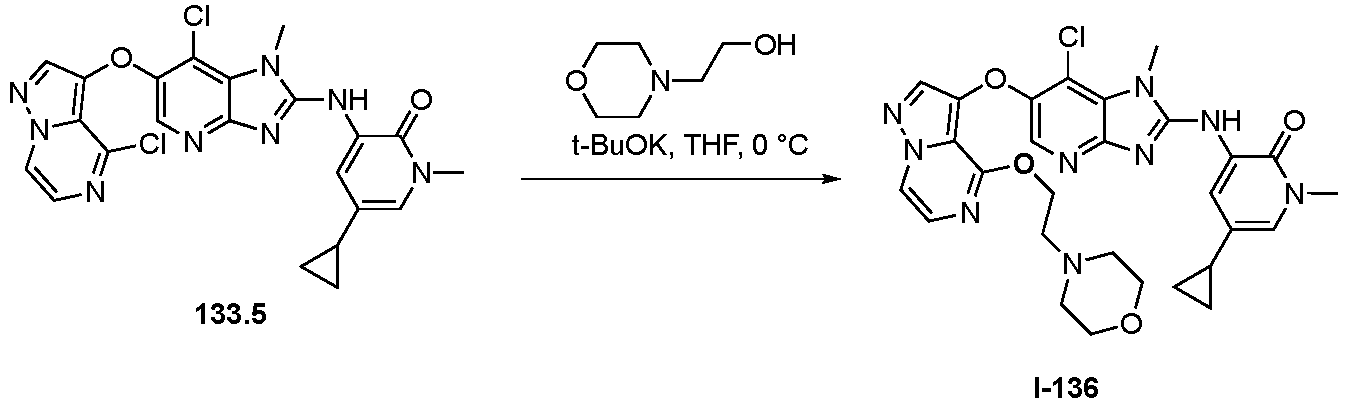
- Synthesis of I-136. Compound I-136 was prepared from 133.5 and 2-morpholinoethan-1-ol, following the procedure described in the synthesis of I-127. The product was purified by flash column chromatography on silica gel (CombiFlash®, 4.0% methanol in DCM). MS(ES): m/z 592.6 [M+H]+, 1H NMR (DMSO-d6, 400 MHz): δ 8.53 (s, 1H), 8.32-8.30 (d, J = 5.2 Hz, 1H), 8.29-8.28 (d, J = 2.4 Hz, 1H), 8.02 (s, 1H), 7.92 (s, 1H), 7.39-7.38 (d, J = 4.8 Hz, 1H), 7.24-7.23 (d, J = 1.6 Hz, 1H), 4.46-4.43 (m, 2H), 4.01 (s, 3H), 3.56 (s, 3H), 3.40-3.38 (m, 4H), 2.48-2.47 (m, 2H), 2.28 (bs, 4H), 1.83-1.79 (m, 1H), 0.89-0.84 (m, 2H), 0.60-0.56 (m, 2H). Example 137: (S)-2-((5-(tert-butyl)-1-(tetrahydrofuran-3-yl)-1H-pyrazol-3-yl)amino)-1-methyl-6-(pyrazolo[1,5-a]pyrazin-3-yloxy)-1H-imidazo[4,5-b]pyridine-7-carbonitrile
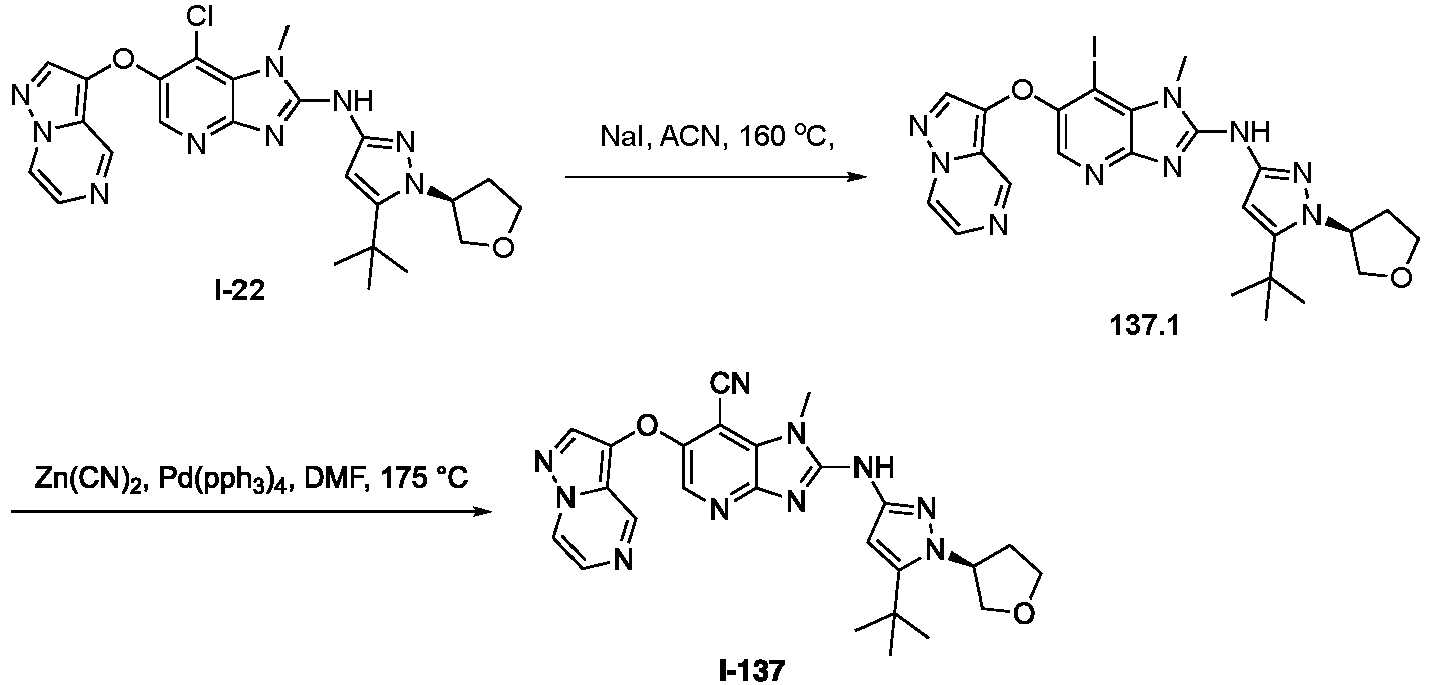
- Synthesis of compound 137.1. A mixture of I-22 (0.110 g, 0.216 mmol, 1.0 equiv) and sodium iodide (0.323 g, 2.16 mmol, 10 equiv) in acetonitrile (2 mL) was stirred at 160 °C for 16 h. It was cooled to room temperature, transferred into water and extracted with ethyl acetate. The combined organic layers were washed with brine, dried over anhydrous sodium sulfate, filtered and concentrated under reduced pressure. The residue was purified by flash column chromatography on silica gel (CombiFlash®, 1.5% methanol in DCM) to afford 137.1. MS(ES): m/z 600.1 [M]+.
- Synthesis of I-137. A mixture of 137.1 (0.075 g, 0.125 mmol, 1.0 equiv) and zinc cyanide (0.016 g, 0.137 mmol, 1.1 equiv) in DMF (2 mL) was degassed by bubbling argon through for 10 min. Under argon atmosphere tetrakis(triphenylphosphine)palladium(0) (0.014 g, 0.012 mmol, 0.1 equiv) was added, and degassed for another 5 min. The reaction mixture was stirred at 170 °C in a microwave reactor for 30 min. It was cooled to room temperature, transferred into water and extracted with ethyl acetate. The combined organic layers were washed with brine, dried over anhydrous sodium sulfate, filtered and concentrated under reduced pressure. The residue was purified by flash column chromatography on silica gel (CombiFlash®, 2.2% methanol in DCM) to afford I-137. MS(ES): m/z 499.4 [M]+, 1H NMR (DMSO-d6, 400 MHz): δ 10.29 (s, 1H), 9.08 (s, 1H), 8.75-8.74 (d, J = 3.6 Hz, 1H), 8.22 (s, 1H), 8.04 (s, 1H), 7.93-7.91 (d, J = 4.8 Hz, 1H), 6.56 (s, 1H), 5.28 (bs, 1H), 4.12-4.10 (m, 2H), 3.95 (s, 3H), 3.87-3.83 (m, 1H), 2.24 (bs, 1H), 1.57 (bs, 2H), 1.40 (s, 9H).
-

- Synthesis of I-138. Compound I-138 was prepared from 124.7 and Int-66, following the procedure described in the synthesis of I-13. The product was purified by flash column chromatography on silica gel (CombiFlash®, 3.0% methanol in DCM). MS (ES): m/z 639.1 [M+H]+; 1H NMR (DMSO-d6, 400 MHz): δ 9.04 (s, 1H), 8.86 (s, 1H), 8.70-8.69 (m, 1H), 8.62-8.61 (d, J = 2.0 Hz, 1H), 8.24 (s, 1H), 8.06 (s, 1H), 8.04 (s, 1H), 7.88-7.86 (d, J = 5.2 Hz, 1H), 4.13-4.10 (m, 2H), 4.01 (s, 3H), 2.67-2.62 (m, 2H), 2.42-2.39 (m, 4H), 1.99-1.85 (m, 4H), 1.64 (bs, 2H).
-

- Synthesis of compound 139.1. Compound 139.1 was prepared from 124.7 and Int-63, following the procedure described in the synthesis of I-13. The product was purified by flash column chromatography on silica gel (CombiFlash®, 2.5% methanol in DCM. MS(ES): m/z 526.2 [M+H]+.
- Synthesis of compound trans-(±)-139.2. Compound trans-(±)-139.2 was prepared from 139.1 and trans-(±)-133.3, following the procedure described in the synthesis of I-127. The product was purified by flash column chromatography on silica gel (CombiFlash®, 2.0% methanol in DCM). MS (ES): m/z 816.2 [M+H]+.
- Synthesis of compound trans-(±)-I-139 . Compound trans-(±)-I-139 was prepared from trans-(±)-139.2, following the procedure described in the synthesis of I-133. The product was purified by trituration with methanol. MS(ES): m/z 577.5 [M+H]+.
- I-139-a and I-139-b. trans-(±)-139 was separated by HPLC (column: CHIRALPAK IB-N (250 mm * 21 mm, 5 µm); mobile phase: (A) 0.1% DEA in n-hexane, (B) 0.1% DEA in isopropanol:methanol (50:50); flow rate = 20 mL/min) to afford first eluting fraction (I-139-a) and second eluting fraction (I-139-b). (*Absolute stereochemistry not determined.)
- I-139-a: MS(ES):m/z 577.5 [M+H]+, 1H NMR (DMSO-d6, 400MHz): δ 8.84 (s, 1H), 8.52 (s, 1H), 8.26-8.24 (d, J=4.8Hz, 1H), 7.88 (s, 1H), 7.71 (bs, 2H), 7.33-7.32 (d, J=4.8Hz, 1H), 5.44 (bs, 1H), 5.04-5.02 (m, 1H), 3.89 (bs, 4H), 3.53 (s, 3H), 2.09-2.07 (m, 1H), 1.98-1.95 (m, 1H), 1.38-1.33 (m, 1H), 1.23-1.19 (m, 1H).
- I-139-b: MS(ES):m/z 577.5 [M+H]+, 1H NMR (DMSO-d6, 400MHz): δ 8.84 (s, 1H), 8.56 (s, 1H), 8.28-8.27 (d, J=4.8Hz, 1H), 7.97 (bs, 2H), 7.87 (s, 1H), 7.35-7.34 (d, J=4.8Hz, 1H), 5.40-5.38 (m, 1H), 5.02-4.97 (m, 1H), 3.97 (s, 1H), 3.84 (bs, 1H), 3.60 (s, 3H), 2.10-2.05 (m, 1H), 1.98-1.91 (m, 1H), 1.39-1.31 (m, 1H), 1.17-1.10 (m, 1H).
-

- Synthesis of compound 140.1. Compound 140.1 was prepared from 124.7 and Int-48, following the procedure described in the synthesis of I-13. The product was purified by flash column chromatography on silica gel (CombiFlash®, 2% methanol in DCM). MS(ES): m/z 646.3 [M+H]+.
- Synthesis of compound 140.2. A solution of 140.1 (0.150 g, 0.232 mmol, 1.0 equiv) in morpholine (3 mL) was stirred at 100 °C for 1 h. It was cooled to room temperature and transferred into ice-water. The precipitated solids were collected by filtration and dried under vacuum to afford 140.2. MS(ES): m/z 696.8 [M+H]+.
- Synthesis of compound I-140. Compound I-140 was prepared from 100.1, following the procedure described in the synthesis of I-23. The product was purified by trituration with diethyl ether. MS(ES): m/z 607.0 [M+H]+. 1H NMR (DMSO-d6, 400 MHz): δ 8.84 (s, 1H), 8.64 (s, 1H), 8.17-8.15 (d, J = 4.8 Hz, 1H), 8.09 (s, 1H), 7.98 (s, 1H), 7.81 (s, 1H), 7.43-7.41 (d, J = 5.2 Hz, 1H), 5.01-4.99 (m, 1H), 4.2 (bs, 2H), 4.03 (s, 3H), 3.75-3.74 (m, 2H), 3.67 (s, 4H), 3.51 (s, 4H).
-

- Synthesis of compound 141.1. tert-Butyl ((mesitylsulfonyl)oxy)carbamate (335 g, 1060 mmol, 1.0 equiv) was dissolved in trifluoroacetic acid (770 mL, 2.3vol) at -10 °C and stirred at 0 °C for 1 h. It was poured over ice-water and stirred. The precipitated solids were collected by filtration, rinsed with water and dried under vacuum. The product was dissolved in DCM, dried over anhydrous sodium sulfate, filtered and concentrated under reduced pressure to afford 141.1. MS (ES): m/z 216.6 [M+H]+.
- Synthesis of compound 141.2 and 141.3. To a solution of 141.1 (25.0 g, 257.7 mmol, 1.0 equiv) in DCM (250 mL) was added 3-fluoropyridine (55.4 g, 257.7 mmol, 1.0 equiv) at 0 °C. The reaction mixture was stirred at room temperature for 90 min. It was poured over diethyl ether and stirred. The solids were collected by filtration and air-dried. The product was dissolved in DMF (500 mL) and added trimethylamine (98.3 g, 973.4 mmol, 2.0 equiv) followed by ethyl propiolate (95.39 g, 973.4 mmol, 2.0 equiv) at 0 °C. The reaction mixture was stirred at room temperature for 72 h. It was poured over brine and extracted with ethyl acetate. The combined organic layers were washed with brine, dried over anhydrous sodium sulfate, filtered and concentrated under reduced pressure. The residue was purified by flash column chromatography on silica gel (4% ethyl acetate in hexane) to afford 141.2, MS (ES): m/z 209.1 [M] + and 141.3, MS (ES): m/z 209.1 [M]+.
- Synthesis of compound 141.4. To a solution of 141.3 (1.5 g, 7.20 mmol, 1.0 equiv) in THF (30 mL) was added lithium aluminum hydride (1 M in THF, 14.4 mL, 14.4 mmol, 2.0 equiv) at 0 °C. The reaction mixture was refluxed for 30 min. It was cooled to room temperature, transferred into ice, stirred and extracted with ethyl acetate. The combined organic layers were washed with brine, dried over anhydrous sodium sulfate, filtered and concentrated under reduced pressure to afford 141.4. MS(ES): m/z 167.1 [M+H]+.
- Synthesis of compound 141.5. To a solution of 141.4 (1.0 g, 6.02 mmol, 1 equiv) in DCM was added Dess-Martin periodinane (6.38 g, 15.05 mmol, 2.5 equiv). The reaction mixture was stirred at room temperature for 10 min. The reaction mixture was transferred into an aqueous solution of sodium bicarbonate and extracted with DCM. The combined organic layers were washed with brine, dried over anhydrous sodium sulfate, filtered and concentrated under reduced pressure. The residue was purified by flash column chromatography on silica gel (CombiFlash®, 26% ethyl acetate in hexane) to afford 141.5. MS(ES): m/z 165.0 [M+H]+.
- Synthesis of compound 141.6. To a solution 141.5 (0.400 g, 7.43 mmol, 1.0 equiv) in DCM (10 mL) was added m-chloroperbenzoic acid (0.800 g, 11.14 mmol, 1.5 equiv) and trifluoroacetic acid (0.1 mL, 0.74 mmol, 0.1 equiv) 0 °C. The reaction mixture was stirred at room temperature for 12 h. The reaction mixture transferred into an aqueous solution of sodium bicarbonate and extracted with DCM. The combined organic layers were washed with brine, dried over anhydrous sodium sulfate, filtered and concentrated under reduced pressure. The residue was purified by flash column chromatography on silica gel (CombiFlash®, using 30% ethyl acetate in hexane) to afford 141.6. MS(ES): m/z 153.1 [M+H]+.
- Synthesis of compound 141.7. Compound 141.7 was prepared from 141.6 and Int-4, following the procedure described in the synthesis of 19.1. The product was used in the next step without purification. MS(ES): m/z 337.5 [M+H]+.
- Synthesis of compound 141.8. Compound 141.8 was prepared from 141.7, following the procedure described in the synthesis of 3.7. The product was purified by flash column chromatography on silica gel (CombiFlash®, 4% methanol in DCM). MS(ES): m/z 308.4 [M+H]+.
- Synthesis of compound 141.9. Compound 141.9 was prepared from 141.8 and Int-27, following the procedure described in the synthesis of I-13. The product was purified by flash column chromatography on silica gel (CombiFlash®, 2.8% methanol in DCM). MS(ES): m/z 600.7 [M+H]+.
- Synthesis of I-141. Compound I-141 was prepared from 141.9, following the procedure described in the synthesis of I-23. The product was purified by flash column chromatography on silica gel (CombiFlash®, 3.2% methanol in DCM). MS(ES): m/z 511 [M+H]+. 1H NMR (DMSO-d6, 400 MHz): δ 8.55 (s, 1H), 8.53-8.51 (d, J = 6.4 Hz, 1H), 8.28-8.27 (d, J = 2.0 Hz, 1H), 8.05 (s, 1H), 7.96 (s, 1H), 7.17 (bs, 1H), 7.10-7.08 (m, 1H), 6.90-6.85 (m, 1H), 4.96-4.93 (m, 1H), 4.07-4.04 (m, 2H), 4.00 (s, 3H), 3.72-3.70 (m, 2H), 1.85-1.81 (m, 1H), 0.89-0.85 (m, 2H), 0.59-0.55 (m, 2H).
-

- Synthesis of I-142. Compound I-142 was prepared from 78.5 and Int-67, following the procedure described in the synthesis of I-13. The product was purified by flash column chromatography on silica gel (CombiFlash®, 3.7% methanol in DCM). MS(ES): m/z 519.5 [M+H]+; 1H NMR (DMSO-d6, 400 MHz): δ 9.20 (s, 1H), 8.64-8.62 (d, J = 7.2 Hz, 1H), 8.08 (s, 1H), 8.05 (s, 1H), 7.99 (s, 1H), 7.53-7.51 (d, J = 8.8 Hz, 1H), 7.21-7.17 (m, 1H), 6.92-6.89 (m, 1H), 5.55 (bs, 1H), 4.07-4.04 (m, 1H), 4.02 (s, 3H), 3.97-3.91 (m, 1H), 3.89-3.86 (m, 1H), 3.78-3.75 (m, 1H), 2.28-2.25 (m, 2H), 2.01-1.98 (m, 1H), 0.96-0.94 (m, 2H), 0.81 (bs, 2H).
-

- Synthesis of I-143. Compound I-143 was prepared from 78.5 and Int-68, following the procedure described in the synthesis of I-13. The product was purified by flash column chromatography on silica gel (CombiFlash®, 3.7% methanol in DCM). MS(ES): m/z 519.5 [M+H]+; 1H NMR (DMSO-d6, 400 MHz): δ 9.20 (s, 1H), 8.64-8.62 (d, J = 7.2 Hz, 1H), 8.08 (s, 1H), 8.05 (s, 1H), 7.99 (s, 1H), 7.53-7.51 (d, J = 8.8 Hz, 1H), 7.21-7.17 (m, 1H), 6.92-6.89 (m, 1H), 5.55 (bs, 1H), 4.07-4.04 (m, 1H), 4.02 (s, 3H), 3.97-3.91 (m, 1H), 3.89-3.86 (m, 1H), 3.78-3.75 (m, 1H), 2.28-2.25 (m, 2H), 2.01-1.99 (m, 1H), 0.96-0.94 (m, 2H), 0.81 (bs, 2H).
-

- Synthesis of I-144. Compound I-144 was prepared from 61.2 and Int-69.4, following the procedure described in the synthesis of I-53. The product was purified by flash column chromatography on silica gel (CombiFlash®, 2.7% methanol in DCM). MS(ES): m/z 541.2 [M+H]+, 1H NMR (DMSO-d6, 400 MHz): δ 9.05-9.04 (d, J = 0.8 Hz, 1H), 8.84 (s, 1H), 8.71-8.70 (d, J = 3.6 Hz, 1H), 8.62 (s, 1H), 8.25 (s, 1H), 8.12 (s, 1H), 8.06 (s, 1H), 7.89-7.87 (d, J = 4.8 Hz, 1H), 4.02 (s, 3H), 3.69 (s, 3H).
-

- Synthesis of I-145. Compound I-145 was prepared from 78.5 and Int-70, following the procedure described in the synthesis of I-13. The product was purified by preparative HPLC. MS(ES): m/z 616.2 [M+H]+., 1H NMR (DMSO-d6, 400 MHz): δ 9.91 (s, 1H), 9.03 (s, 1H), 8.68 (s, 1H), 8.64-8.62 (d, J = 6.8 Hz, 1H), 8.56 (s, 1H), 8.02 (bs, 2H), 7.86 (s, 1H), 7.52-7.50 (d, J = 8.8 Hz, 1H), 7.19-7.17 (d, J = 8.4 Hz, 1H), 6.90 (s, 1H), 4.05 (bs, 4H), 3.67 (s, 3H), 3.56 (s, 4H), 3.16 (s, 4H).
-

- Synthesis of I-146. Compound I-146 was prepared from 21.7 and Int-59, following the procedure described in the synthesis of I-13. The product was purified by flash column chromatography on silica gel (CombiFlash®, 4.2% methanol in DCM). MS(ES): m/z 586.4 [M+H]+, 1H NMR (DMSO-d6, 400 MHz): ): δ 9.65 (s, 1H), 9.03 (s, 1H), 8.70-8.69 (d, J = 4.8 Hz 1H), 8.29 (s, 1H), 8.20 (s, 1H), 8.18-8.17 (d, J = 5.2 Hz 1H), 8.04 (s, 1H), 7.88-7.87 (d, J = 4.8 Hz 1H), 7.74-7.72 (d, J = 8.4 Hz 1H), 4.03 (s, 3H), 3.58 (s, 2H), 2.47 (bs, 4H), 2.40-2.34 (m, 6H), 1.03-0.99 (t, 3H).
-

- Synthesis of compound 1-147-a and I-147-b. The racemate cis-(±)-I-147 was prepared from 61.2 and cis-(±)-Int-71, following the procedure described in the synthesis of Int-45. The product was purified by flash column chromatography on silica gel (CombiFlash®, 4.0% methanol in DCM). It was separated by HPLC (column: CHIRALPAK IB-N (250 mm * 21 mm, 5 µm); mobile phase: (A) 0.1% DEA in hexane, (B) 0.1% DEA in isopropanol: acetonitrile (70:30); flow rate = 20 mL/min) to afford first eluting fraction (I-147-a) and second eluting fraction (I-147-b). (*Absolute stereochemistry not determined.)
- I-147-a: MS(ES): m/z 508.6 [M+H]+, 1H NMR (DMSO-d6, 400 MHz): δ 9.96 (s, 1H), 9.02 (s, 1H), 8.70-8.68 (d, J = 4.8 Hz, 1H), 8.13 (s, 1H), 8.03 (s, 1H), 7.87-7.86 (d, J = 4.8 Hz, 1H), 6.60 (s, 1H), 5.14-5.12 (m, 2H), 4.51 (bs, 1H), 3.98 (s, 3H), 2.24-2.19 (m, 4H), 1.36 (s, 9H).
- I-147-b: MS(ES): m/z 508.7 [M+H]+, 1H NMR (DMSO-d6, 400 MHz): δ 9.97 (s, 1H), 9.02 (s, 1H), 8.70-8.68 (d, J = 4.8 Hz, 1H), 8.13 (s, 1H), 8.03 (s, 1H), 7.88-7.86 (d, J = 4.8 Hz, 1H), 6.60 (s, 1H), 5.14-5.12 (m, 2H), 4.51 (bs, 1H), 3.98 (s, 3H), 2.24-2.19 (m, 4H), 1.36 (s, 9H).
-

- Synthesis of compound I-148-a and I-148-b. The racemate I-148 was prepared from 78.5 and (±)-Int-72, following the procedure described in the synthesis of I-13. The product was purified by flash column chromatography on silica gel (CombiFlash®, 2.4% methanol in DCM). MS(ES): m/z 533.4 [M+H]+. The enantiomers were separated by HPLC (column: CHIRALPAK IB-N (250 mm * 21 mm, 5 µm); mobile phase: (A) 0.1% DEA in n-hexane (B) 0.1% DEA in isopropanol:acetonitrile (70:30); flow rate = 20 mL/min) to afford first eluting fraction (I-148-a) and second eluting fraction (I-148-b). (*Absolute stereochemistry not determined.)
- I-148-a: MS(ES): m/z 533.3 [M+H]+, 1H NMR (DMSO-d6, 400 MHz): δ 8.65-8.63 (d, J = 6.4 Hz, 1H), 8.01(s, 1H), 7.98 (s, 1H), 7.91 (s, 1H), 7.52-7.50 (d, J = 8.8 Hz, 1H), 7.20-7.16 (m, 1H), 7.08-7.06 (d, J = 7.6 Hz, 1H), 6.89 (bs, 1H), 4.87 (bs, 1H), 3.97 (s, 3H), 3.84 (bs, 2H), 3.51-3.46 (m, 2H), 2.05-2.03 (m, 1H), 1.93-1.89 (m, 2H), 1.80-1.70 (m, 2H), 0.92 (bs, 2H), 0.78 (bs, 2H).
- I-148-b: MS(ES): m/z 533.3 [M+H]+, 1H NMR (DMSO-d6, 400 MHz): δ 8.64-8.62 (d, J = 6.8 Hz, 1H), 8.05(s, 1H), 8.03 (s, 1H), 7.93 (s, 1H), 7.52-7.50 (d, J = 8.8 Hz, 1H), 7.21-7.17 (m, 1H), 7.08-7.06 (d, J = 8.0 Hz, 1H), 6.92-6.88 (m, 1H), 4.90-4.85 (m, 1H), 4.00 (s, 3H), 3.87-3.85 (m, 2H), 3.52-3.46 (m, 2H), 2.05-2.03 (m, 1H), 1.95-1.90 (m, 2H), 1.77-1.70 (m, 2H), 0.95-0.93 (m, 2H), 0.80 (bs, 2H).
-

- Synthesis of I-149. Compound I-149 was prepared from 21.7 and Int-73, following the procedure described in the synthesis of I-13. The product was purified by flash column chromatography on silica gel (CombiFlash®, 5.0% methanol in DCM). MS(ES): m/z 559.3 [M+H]+, 1H NMR (DMSO-d6, 400 MHz): δ 9.66 (s, 1H), 9.03 (s, 1H), 8.71-8.70 (d, J = 4.4 Hz 1H), 8.30 (s, 1H), 8.21 (s, 1H), 8.18-8.16 (d, J = 8.8 Hz 1H), 8.04 (s, 1H), 7.88-7.87 (d, J = 4.8 Hz 1H), 7.76-7.74 (d, J = 8.8 Hz 1H), 4.03 (s, 3H), 3.61-3.59 (m, 6H), 2.41 (s, 4H).
-

- Synthesis of compound trans-150.1. Compound trans-150.1 was prepared from 21.7 and trans-Int-11a, following the procedure described in the synthesis of I-13. The product was purified by flash column chromatography on silica gel (CombiFlash®, 2.1% methanol in DCM) to afford trans-150.1. MS(ES): m/z 615.1 [M+H]+.
- Synthesis of compound trans-150.2. To a solution of trans-150.1 (0.160 g, 0.260 mmol, 1.0 equiv) in acetonitrile (2 mL) was added sodium iodide (0.389 g, 2.6 mmol, 10 equiv) and reaction mixture was stirred at 160 °C for 16 h. It was cooled to room temperature, transferred into water and extracted with ethyl acetate. The combined organic layers were washed with brine, dried over anhydrous sodium sulfate, filtered and concentrated under reduced pressure. The residue was purified by flash column chromatography on silica gel (CombiFlash®, 2.2% methanol in DCM) to afford trans-150.2. MS(ES): m/z 706.4 [M]+.
- Synthesis of compound trans-150.3. A mixture of trans-150.2 (0.070 g, 0.099 mmol, 1.0 equiv) and zinc cyanide (0.119 g, 0.108 mmol, 1.1 equiv) in DMF (2 mL) was degassed by bubbling argon through for 10 min. Under argon atmosphere tetrakis (triphenylphosphine)palladium(0) (0.011 g, 0.009 mmol, 0.1 equiv) was added, again degassed for 5 min. The reaction mixture was stirred at 170 °C in a microwave reactor for 30 min. It was cooled to room temperature, transferred into water and extracted with ethyl acetate. The combined organic layers were washed with brine, dried over anhydrous sodium sulfate, filtered and concentrated under reduced pressure. The residue was purified by flash column chromatography on silica gel (CombiFlash®, 2.4% methanol in DCM) to afford trans-150.3. MS(ES): m/z 605.5 [M]+.
- Synthesis of I-150-a. Compound I-150-a was prepared from trans-150.3, following the procedure described in the synthesis of I-23. The product was purified by flash column chromatography on silica gel (CombiFlash®, 5.0% methanol in DCM). MS(ES): m/z 515.0 [M+H]+, 1H NMR (DMSO-d6, 400 MHz): δ 10.32 (s, 1H), 9.09 (s, 1H), 8.76 (s, 1H), 8.23 (s, 1H), 8.04 (s, 1H), 7.92 (s, 1H), 6.59 (s, 1H), 5.58-5.57 (m, 1H), 4.93 (bs, 1H), 4.55 (bs, 1H), 4.29 (bs, 1H), 4.13-4.12 (m, 1H), 3.95 (s, 3H), 3.82-3.79 (m, 1H), 3.70-3.69 (m, 1H), 1.41 (s, 9H). (*Absolute stereochemistry not determined.)
- Synthesis of I-150-b. Compound I-150-b was prepared from trans-Int-11b, following the procedures described in the synthesis of I-150-a. The product was purified by flash column chromatography on silica gel. MS(ES): m/z 515.0 [M+H]+, 1H NMR (DMSO-d6, 400 MHz): δ 10.32 (s, 1H), 9.09 (s, 1H), 8.76 (s, 1H), 8.23 (s, 1H), 8.04 (s, 1H), 7.92 (s, 1H), 6.59 (s, 1H), 5.58-5.57 (m, 1H), 4.93 (bs, 1H), 4.55 (bs, 1H), 4.29 (bs, 1H), 4.13-4.12 (m, 1H), 3.95 (s, 3H), 3.82-3.79 (m, 1H), 3.70-3.69 (m, 1H), 1.41 (s, 9H). (*Absolute stereochemistry not determined.)
-


- Synthesis of compound 151.1. To a solution of 141.2 (6 g, 28.82 mmol, 1.0 equiv) in ethanol (100 mL) and water (20 mL) was added sodium hydroxide (5.7 g, 144.23 mmol, 5.0 equiv) at room temperature. The reaction mixture was stirred at 90 °C for 1 h. It was concentrated under reduced pressure. The residue was neutralized by dilute hydrochloric acid and the precipitated solids were collected by filtration and dried under vacuum to afford 151.1. MS (ES): m/z 181.2 [M+H]+.
- Synthesis of compound 151.2. To a solution of 151.1 (3.5 g, 19.43 mmol, 1.0 equiv) in DMF (20 mL) was added sodium bicarbonate (4.8 g, 58.33 mmol, 3.0 equiv) followed by N-bromosuccinimide (3.45 g, 19.43 mmol, 1.0 equiv) and stirred at room temperature for 6 h. It was poured over ice-water and extracted with ethyl acetate. The combined organic layers were washed with brine, dried over anhydrous sodium sulfate, filtered and concentrated under reduced pressure. The residue was purified by flash column chromatography on silica gel (CombiFlash®, 20% ethyl acetate in hexane) to afford 151.2. MS(ES): m/z 216.1 [M+H]+.
- Synthesis of compound 151.3 To a solution of 151.2 (3 g, 13.95 mmol, 1.0 equiv) in toluene was added benzyl alcohol (1.51 g, 14.01 mmol, 2.5 equiv), followed by cesium carbonate (9.11 g, 28.03 mmol, 2.0 equiv). The reaction mixture was degassed by bubbling argon through for 15 min. Copper iodide (0.133 g, 0.70 mmol, 0.05 equiv) and 3,4,7,8-tetramethyl-1,10-phenanthroline (0.330 g, 1.39 mmol, 0.1 equiv) were added. The reaction mixture was stirred at room temperature for 20 min and at 120 °C for 24 h. It was poured over water and extracted with ethyl acetate. The combined organic layers were washed with brine, dried over anhydrous sodium sulfate, filtered and concentrated under reduced pressure. The residue was purified by flash column chromatography on silica gel (CombiFlash®, 24% ethyl acetate in hexane) to afford 151.3. MS(ES): m/z 243.2 [M+H]+.
- Synthesis of compound 151.4. To a solution 151.3 (1.8 g, 7.43 mmol, 1.0 equiv) in DCM (20 mL) was added triflic acid (1.8 mL, 1 vol.) dropwise at 0 °C. The reaction mixture was stirred for 15 min. The reaction mixture was transferred into aqueous solution of sodium bicarbonate and extracted with DCM. The combined organic layers were washed with brine, dried over anhydrous sodium sulfate, filtered and concentrated under reduced pressure. The residue was purified by flash column chromatography on silica gel (CombiFlash®, 28% ethyl acetate in hexane) to afford 151.4. MS(ES): m/z 153.1 [M+H]+.
- Synthesis of compound 151.5. Compound 151.5 was prepared from 151.4 and Int-4, following the procedure described in the synthesis of 19.1. The product was purified by flash column chromatography on silica gel (CombiFlash®, 25% ethyl acetate in hexane). MS(ES): m/z 338.5 [M+H]+.
- Synthesis of compound 151.6. Compound 151.6 was prepared from 151.5, following the procedure described in the synthesis of 3.7. The product was purified by flash column chromatography on silica gel (CombiFlash®, 1.7% methanol in DCM). MS(ES): m/z 308.7 [M+H]+.
- Synthesis of compound 151.7. Compound 151.7 was prepared from 151.6 and Int-32, following the procedure described in the synthesis of I-13. The product was purified by flash column chromatography on silica gel (CombiFlash®, 1.8% methanol in DCM). MS(ES): m/z 626.7 [M+H]+.
- Synthesis of compound I-151. Compound I-151 was prepared from 151.7, following the procedure described in the synthesis of I-23. The product was purified by flash column chromatography on silica gel (CombiFlash®, 3.8% methanol in DCM). MS(ES): m/z 536.7 [M+H]+, 1H NMR (DMSO-d6, 400 MHz): δ 8.98 (s, 1H), 8.52 (s, 1H), 8.20 (s, 1H), 8.04 (s, 1H), 8.01 (s, 1H), 7.64-7.60 (m, 1H), 7.34-7.28 (m, 2H), 5.43-5.39 (m, 1H), 5.256-5.25 (m, 1H), 4.39 (bs, 1H), 3.99 (s, 3H), 2.68-2.60 (m, 2H), 2.33 (bs, 2H), 1.90 (bs, 1H), 0.89-0.87 (m, 2H), 0.62 (bs, 2H).
-

- Synthesis of compound 152.1. Compound 152.1 was prepared from 151.6 and Int-33, following the procedure described in the synthesis of I-13. The product was purified by flash column chromatography on silica gel (CombiFlash®, 2.4% methanol in DCM). MS(ES): m/z 626.2 [M+H]+.
- Synthesis of compound I-152. Compound I-152 was prepared from 152.1, following the procedure described in the synthesis of I-23. The product was purified by flash column chromatography on silica gel (CombiFlash®, 3.0% methanol in DCM). MS(ES): m/z 536.65 [M+H]+. 1H NMR (DMSO-d6, 400 MHz): δ 8.98-8.97 (d, J = 3.6 Hz, 1H), 8.52 (s, 1H), 8.21-8.20 (d, J = 1.6 Hz, 1H), 8.04 (s, 1H), 8.01 (s, 1H), 7.64-7.60 (m, 1H), 7.34-7.28 (m, 2H), 5.43-5.39 (m, 1H), 5.26-5.25 (m, 1H), 4.38 (bs, 1H), 3.99 (s, 3H), 2.65-2.60 (m, 2H), 2.35-2.30 (m, 2H), 1.93-1.88 (m, 1H), 0.91-0.87 (m, 2H), 0.62-0.60 (m, 2H).
-


- Synthesis of compound 153.1. A mixture of 6-bromopyrazolo[1,5-a]pyridine (1 g, 5.08 mmol, 1.0 equiv), 2-methoxyethan-1-ol (0.772 g, 10.15 mmol, 2.0 equiv) and cesium carbonate (4.95 g, 15.24 mmol, 3.0 equiv) in toluene (30 mL) was degassed by bubbling argon through for 10 min. Under argon atmosphere, di-tert-butyl(2',4',6'-triisopropyl-3-methoxy-6-methyl-[1,1'-biphenyl]-2-yl)phosphine (0.357 g, 0.762 mmol, 0.15 equiv) and allyl palladium(II) chloride dimer (0.092 g, 0.254 mmol, 0.05 equiv) were added and degassed for another 5 min. The reaction mixture was stirred at 90 °C for 2 h. It was cooled to room temperature, transferred into water and extracted with ethyl acetate. The combined organic layers were washed with brine, dried over anhydrous sodium sulfate, filtered and concentrated under reduced pressure. The residue was purified by flash column chromatography on silica gel (CombiFlash®, 5.3% methanol in DCM) to afford 153.1. MS (ES): m/z 193.2 [M+H]+.
- Synthesis of compound 153.2. To a solution of 153.1 (0.610 g, 3.17 mmol, 1.0 equiv) in DMF (8 mL) was added phosphoryl chloride (1.45 g, 9.51 mmol, 3.0 equiv) and the reaction mixture was stirred at room temperature for 1 h. It was concentrated under reduced pressure. The residue was dissolved in DCM and washed with 2N sodium hydroxide. Organic layers combined, washed with brine, dried over anhydrous sodium sulfate, filtered and concentrated under reduced pressure to afford pressure. The residue was purified by flash column chromatography on silica gel (CombiFlash®, 10% methanol in DCM) to afford 153.2. MS (ES): m/z 221.0 [M+H]+.
- Synthesis of compound 153.3. To a solution of 153.2 (0.450 g, 2.04 mmol, 1.0 equiv) in DCM (10 mL) was added trifluoroacetic acid (1 mL) at 0 °C followed by addition of m-chloroperoxybenzoic acid (0.351 g, 2.04 mmol, 1.0 equiv). The reaction mixture was stirred at room temperature for 2 h. It was cooled to 0 °C and added saturated sodium bicarbonate solution. The mixture was stirred for 30 min and extracted with ethyl acetate. The organic layer was separated, washed with aq. sodium bisulphite, dried over anhydrous sodium sulfate, filtered and concentrated under reduced pressure. The residue was purified by flash column chromatography on silica gel (CombiFlash®, 5% methanol in DCM) to afford 153.3. MS (ES): m/z 209.1 [M+H]+.
- Synthesis of compound 153.4. Compound 153.4 was prepared from 153.3 and Int-4, following the procedure described in the synthesis of 19.1. The product was purified by flash column chromatography on silica gel (CombiFlash®, 2.5% methanol in DCM). MS (ES): m/z 394.5 [M+H]+.
- Synthesis of compound 153.5. Compound 153.5 was prepared from 153.4, following the procedure described in the synthesis of 3.7. The product was purified by flash column chromatography on silica gel (CombiFlash®, 2.8% methanol in DCM). MS(ES): m/z 364.4 [M+H]+.
- Synthesis of Compound 153.6. Compound 153.6 was prepared from 153.5 and Int-62, following the procedure described in the synthesis of I-13. The product was purified by flash column chromatography on silica gel (CombiFlash®, 4% methanol in DCM). MS(ES): m/z 657.9 [M+H]+.
- Synthesis of I-153. Compound I-153 was prepared from 153.6, following the procedure described in the synthesis of I-23. The product was by flash column chromatography on silica gel (CombiFlash®, 4.5% methanol in DCM). MS(ES): m/z 567.3 [M+H]+, 1H NMR (DMSO-d6, 400 MHz): δ 9.19 (s, 1H), 8.37 (s, 1H), 8.09 (s, 1H), 7.96 (s, 1H), 7.90 (s, 1H), 7.45-7.43 (d, J = 9.6 Hz, 1H), 7.04-7.02 (d, J = 9.2 Hz, 1H), 4.88-4.85 (m, 1H), 4.17-4.16 (m, 4H), 4.03 (s, 3H), 3.76-3.69 (m, 4H), 3.33 (s, 3H), 1.56 (bs, 1H), 0.97-0.95 (m, 2H), 0.81 (bs, 2H).
-

- Synthesis of compound I-154. Compound I-154 was prepared from 21.7 and Int-74, following the procedure described in the synthesis of I-13. The product was purified by flash column chromatography on silica gel (CombiFlash®, 2.7% methanol in DCM). MS(ES): m/z 556.7 [M]+, 1H NMR (DMSO-d6, 400 MHz): δ 9.90 (s, 1H), 9.03 (s, 1H), 8.72-8.68 (m, 2H), 8.46-8.45 (d, J = 1.6 Hz 1H), 8.23 (s, 1H), 8.04 (s, 1H), 7.87-7.86 (d, J = 5.2 Hz 1H), 4.04 (s, 3H), 2.99 (s, 3H), 1.52 (s, 6H).
-

- Synthesis of compound 155.1. Compound 155.1 was prepared from 153.5 and Int-27, following the procedure described in the synthesis of I-13. The product was purified by flash column chromatography on silica gel (CombiFlash®, 5% methanol in DCM) to afford I-155. MS (ES): m/z 657.1 [M+H]+.
- Synthesis of I-155. Compound I-155 was prepared from 155.1, following the procedure described in the synthesis of I-23. The product was by flash column chromatography on silica gel (CombiFlash®, 4.5% methanol in DCM). MS(ES): m/z 567.3 [M+H, 1H NMR (DMSO-d6, 400 MHz): δ 8.51 (s, 1H), 8.36 (s, 1H), 8.27 (s, 1H), 8.01 (s, 1H), 7.88 (s, 1H), 7.44-7.42 (d, J = 9.6 Hz, 1H), 7.17 (s, 1H), 7.03-7.01 (d, J = 9.6 Hz, 1H), 4.95-4.94 (m, 1H), 4.16 (bs, 2H), 4.06 (s, 3H), 4.00 (s, 3H), 3.70 (bs, 4H), 3.40 (bs, 2H), 1.83 (bs, 1H), 0.88-0.86 (m, 2H), 0.58-0.57 (m, 2H).
-

- Synthesis of compound 156.1. Compound 156.1 was prepared from 21.7 and Int-75, following the procedure described in the synthesis of I-13. The product was purified by flash column chromatography on silica gel (CombiFlash®, 2.5% methanol in DCM). MS(ES): m/z 645.8 [M+H]+.
- Synthesis of compound 156.2. To a solution of 156.1 (0.080 g, 0.124 mmol, 1.0 equiv) in DCM (5 mL) was added trifluoroacetic acid (0.42 g, 3.72 mmol, 30 equiv) at 0 °C. The reaction mixture was stirred at room temperature for 2 h. It was poured over ice-cold saturated sodium bicarbonate solution and extracted with DCM. The combined organic layers were washed with brine, dried over anhydrous sodium sulfate, filtered and concentrated under reduced pressure to afford 156.2. MS(ES): m/z 545.5 [M+H]+.
- Synthesis of I-156. To a solution of 156.2 (0.050 g, 0.091 mmol, 1.0 equiv) and triethylamine (0.013 g, 0.136 mmol, 1.5 equiv) in DCM (2 mL) at 0 °C was added acetic anhydride (0.009 g, 0.091 mmol, 1.0 equiv) dropwise. The reaction mixture was stirred at 0 °C for 1 h. It was poured over ice-water, stirred and extracted with DCM. This was purified by flash column chromatography on silica gel (CombiFlash®, 4.6% methanol in DCM) to afford I-156. MS(ES): m/z 587.3 [M+H]+, 1H NMR (DMSO-d6, 400 MHz): δ 10.57-10.56 (d, J = 2.8 Hz, 1H), 9.02 (s, 1H), 8.70-8.69 (d, J = 4.8 Hz, 1H), 8.18 (s, 1H), 8.04 (s, 1H), 7.88-7.87 (d, J = 4.4 Hz, 1H), 7.32 (s, 1H), 4.93-4.87 (m, 1H), 4.27 (s, 1H), 4.15 (s, 1H), 4.00 (bs, 4H), 3.88 (s, 1H), 2.01 (s, 3H), 1.76 (bs, 2H), 1.57 (bs, 2H).
-

- Synthesis of compound 157.1. Compound 157.1 was prepared from 78.5 and Int-53, following the procedure described in the synthesis of I-13. The product was purified by flash column chromatography on silica gel (CombiFlash®, 2.2% methanol in DCM). MS(ES): m/z 553.6 [M+H]+.
- Synthesis of I-157. A mixture of 157.1 (0.100 g, 0.180 mmol, 1.0 equiv), zinc dust (0.002 g, 0.036 mmol, 0.2 equiv) and zinc cyanide (0.105 g, 0.9 mmol, 5.0 equiv) in DMA (4 mL) was degassed by bubbling argon through for 10 min. Under argon atmosphere tris(dibenzylideneacetone)dipalladium(0) (0.024 g, 0.027 mmol, 0.15 equiv) and 1,1'-bis(diphenylphosphino)ferrocene (0.029 g, 0.054 mmol, 0.3 equiv) were added, and degassed for another 5 min. The reaction mixture was stirred at 170 °C in a microwave reactor for 3 h. It was cooled to room temperature, transferred into water and extracted with ethyl acetate. The combined organic layers were washed with brine, dried over anhydrous sodium sulfate, filtered and concentrated under reduced pressure. The residue was purified by flash column chromatography on silica gel (CombiFlash®, 1.9% methanol in DCM) to afford I-157. MS(ES): m/z 543.4 [M]+, 1H NMR (DMSO-d6, 400 MHz): δ 9.12 (s, 1H), 8.81 (s, 1H), 8.71-8.68 (m, 3H), 8.19 (s, 1H), 8.16 (s, 1H), 8.09-8.07 (d, J = 8.0 Hz, 1H), 7.97 (s, 1H), 7.65 (bs, 1H), 7.56-7.54 (d, J = 8.4 Hz, 1H), 7.26-7.22 (m, 1H), 6.96-6.95 (m, 1H), 3.98 (s, 3H).
-

- Synthesis of compound 158.1. Compound 158.1 was prepared from 21.7 and Int-21, following the procedure described in the synthesis of I-13. The product was purified by flash column chromatography on silica gel (CombiFlash®, 3% methanol in DCM). MS(ES): m/z 598.2 [M]+.
- Synthesis of compound 158.2. Compound 158.2 was prepared from 158.1, following the procedure described in the synthesis of I-157. The product was purified by flash column chromatography on silica gel (CombiFlash®, 2.8% methanol in DCM). MS(ES): m/z 589.3 [M+H]+.
- Synthesis of I-158. Compound I-158 was prepared from 158.2, following the procedure described in the synthesis of I-23. The product was purified by flash column chromatography on silica gel (CombiFlash®, 3.5% methanol in DCM). MS(ES): m/z 499.7 [M+H]+, 1H NMR (DMSO-d6, 400 MHz): δ 10.27 (s, 1H), 9.07 (s, 1H), 8.74-8.73 (d, J = 4.4 Hz, 1H), 8.21 (s, 1H), 8.02 (s, 1H), 7.91-7.90 (d, J = 3.6 Hz, 1H), 6.54 (s, 1H), 5.23-5.20 (m, 2H), 4.47 (bs, 1H), 3.94 (s, 3H), 2.73-2.70 (m, 2H), 2.33 (bs, 2H), 1.34 (s, 9H).
-

- Synthesis of compound 159.1. Compound 159.1 was prepared from 78.5 and Int-42, following the procedure described in the synthesis of I-13. The product was purified by flash column chromatography on silica gel (CombiFlash®, 3.0% methanol in DCM). MS(ES): m/z 603.2 [M]+.
- Synthesis of I-159. Compound I-159 was prepared from 159.1, following the procedure described in the synthesis of I-157. The product was purified by preparative HPLC. MS(ES): m/z 594.3 [M+H]+, 1H NMR (DMSO-d6, 400 MHz): δ 8.69-8.68 (d, J = 6.8z, 1H), 8.61 (s, 1H), 8.36 (s, 1H), 8.19 (s, 1H), 8.13 (s, 1H), 7.95 (s, 1H), 7.56-7.54 (d, J = 4.8 Hz, 1H), 7.26-7.22 (m, 1H), 6.97-6.93 (m, 1H), 4.15 (bs, 2H), 3.99 (s, 3H), 3.55 (bs, 4H), 2.33 (bs, 6H), 1.92 (bs, 2H).
-


- Synthesis of compound 160.1. Compound 160.1 was prepared from 78.5 and Int-48, following the procedure described in the synthesis of I-13. The product was purified by flash column chromatography on silica gel (CombiFlash®, 1.9% methanol in DCM. MS(ES): m/z 610.0 [M]+.
- Synthesis of compound 160.2. Compound 160.2 was prepared from 160.1, following the procedure described in the synthesis of I-157. The product was purified by flash column chromatography on silica gel (CombiFlash®, 1.8% methanol in DCM). MS(ES): m/z 601.2 [M+H]+.
- Synthesis of I-160. Compound I-160 was prepared from 160.2, following the procedure described in the synthesis of I-23. The product was purified by flash column chromatography on silica gel (CombiFlash®, 3.5% methanol in DCM). MS(ES): m/z 511.6 [M+H]+, 1H NMR (DMSO-d6, 400 MHz): δ 8.99 (s, 1H), 8.70-8.68 (d, J = 6.8 Hz, 1H), 8.63 (s, 1H), 8.19 (s, 1H), 8.00 (s, 1H), 7.97 (s, 1H), 7.56-7.54 (d, J = 8.8 Hz, 1H), 7.26-7.23 (m, 1H), 6.97-6.94 (m, 1H), 5.00 (bs, 1H), 4.19 (bs, 2H), 4.00 (s, 3H), 3.75 (bs, 2H).
-

- Synthesis of compound I-161. Compound 160.1 was prepared from 151.5 and Int-76, following the procedure described in the synthesis of I-13. The product was purified by flash column chromatography on silica gel (CombiFlash®, 3.0% methanol in DCM). MS(ES): m/z 574.3 [M+H]+. 1H NMR (DMSO-d6, 400 MHz): δ 8.98 (s, 1H), 8.95 (s, 1H), 8.63 (s, 1H), 8.37 (s, 1H), 8.10- 8.09 (d, J = 6.0 Hz, 2H), 8.03 (s, 1H), 7.98 (s, 1H), 7.65-7.61 (m, 1H), 7.35-7.30 (m, 1H), 4.03 (s, 3H), 3.94 (s, 3H).
-

- Synthesis of compound 162.1. Compound 162.1 was prepared from 151.5 and Int-40, following the procedure described in the synthesis of I-13. The product was purified by flash column chromatography on silica gel (CombiFlash®, 2.0% methanol in DCM). MS(ES): m/z 654 [M+H]+.
- Synthesis of I-162. Compound I-162 was prepared from 162.1, following the procedure described in the synthesis of I-23. The product was purified by flash column chromatography on silica gel (CombiFlash®, 3.0% methanol in DCM). MS(ES): m/z 563.8 [M]+, 1H NMR (DMSO-d6, 400 MHz): δ 8.99-8.98 (d, J = 7.2 Hz, 1H), 8.91 (bs, 1H), 8.59 (s, 1H), 8.09 (s, 1H), 8.02 (s, 1H), 7.92 (s, 1H), 7.64-7.61 (m, 1H), 7.35-7.30 (m, 1H), 4.66-4.62 (m, 1H), 4.02 (s, 3H), 3.42-3.36 (m, 1H), 2.84-2.82 (m, 2H), 2.41-2.34 (m, 1H), 2.21-2.19 (m, 2H).
-

- Synthesis of compound 163.1. Compound 163.1 was prepared from 151.5 and Int-48, following the procedure described in the synthesis of I-13. The product was purified by flash column chromatography on silica gel (CombiFlash®, 2.4% methanol in DCM). MS(ES): m/z 628.8 [M+H]+.
- Synthesis of compound I-163. Compound I-163 was prepared from 163.1, following the procedure described in the synthesis of I-23. The product was purified by flash column chromatography on silica gel (CombiFlash®, 3.6% methanol in DCM). MS(ES): m/z 538.3 [M+H]+. 1H NMR (DMSO-d6, 400 MHz): δ 8.97 (bs, 1H), 8.82 (bs, 1H), 8.62 (s, 1H), 8.08 (s, 1H), 8.02 (s, 1H), 7.97 (s, 1H), 7.64-7.61 (m, 1H), 7.34-7.30 (m, 1H), 4.19 (bs, 2H), 4.02 (s, 3H), 3.74 (bs, 2H), 3.18 (bs, 1H).
-

- Synthesis of I-164. Compound I-164 was prepared from 21.7 and Int-77, following the procedure described in the synthesis of I-13. The product was purified by flash column chromatography on silica gel (CombiFlash®, 3.8% methanol in DCM). MS(ES): m/z 494.2 [M+H]+. 1H NMR (DMSO-d6, 400 MHz): δ 9.02 (s, 1H), 8.88 (s, 1H), 8.80 (s, 1H), 8.69-8.68 (d, J = 4.4 Hz, 1H), 8.16 (s, 1H), 8.03 (s, 1H), 7.87-7.86 (d, J = 4.8 Hz, 1H), 4.55 (m, 2H), 3.99 (s, 3H), 1.38 (s, 9H), 1.34 (bs, 3H).
-
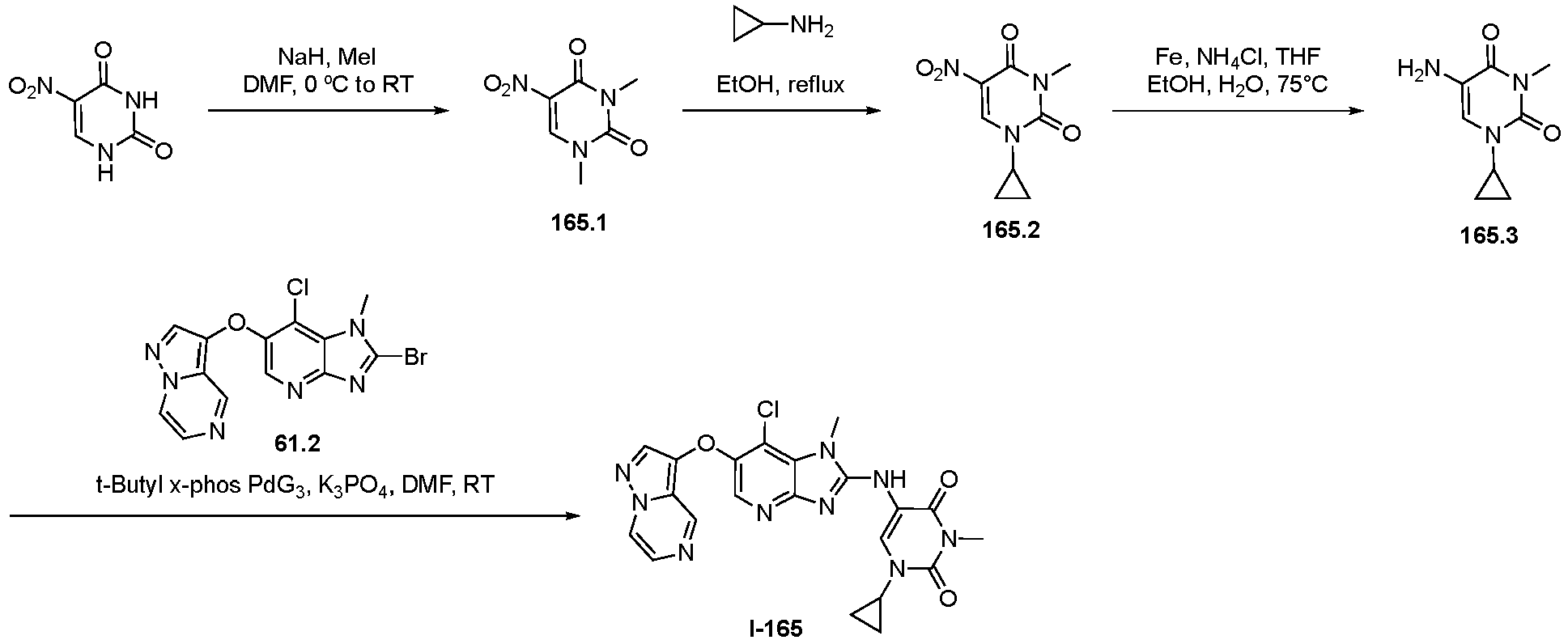
- Synthesis of compound 165.1. To a solution of 5-nitropyrimidine-2,4(1H,3H)-dione (10 g, 63.66 mmol, 1.0 equiv) in DMF (20 mL) was added sodium hydride (6.36 g, 159.15 mmol, 2.5 equiv) at 0 °C. The reaction mixture was stirred for 2 h. Iodomethane (26.9 g, 190.98 mmol, 3.0 equiv) was added and stirred at room temperature for 16 h. It was poured over ice-water and extracted with ethyl acetate. The combined organic layers were, dried over anhydrous sodium sulfate, filtered and concentrated under reduced pressure. The residue was purified by flash column chromatography on silica gel (CombiFlash®, 1.5% methanol in DCM) to afford 165.1. MS (ES): m/z 186.0 [M+H]+.
- Synthesis of compound 165.2. To a solution of 165.1 (5.0 g, 27.01 mmol, 1.0 equiv) and cyclopropanamine (23.9 g, 418.6 mmol, 15.5 equiv) in ethanol (50 mL) was heated to reflux for 48 h. It was concentrated under reduced pressure. The residue was purified by flash column chromatography on silica gel (CombiFlash®, 1.7% methanol in DCM) to afford 165.2. MS (ES): m/z 212.0 [M+H]+.
- Synthesis of compound 165.3. A mixture of 165.2 (0.500 g, 2.37 mmol, 1.0 equiv), iron powder (0.663 g, 11.85 mmol, 5.0 equiv) and ammonium chloride (0.063 g, 1.185 mmol, 0.5 equiv) in ethanol (4 mL), THF (4 mL) and water (3 mL) was stirred at 75 °C for 1 h. It was filtered and the filtrate was transferred into water and extracted with ethyl acetate. The combined organic layers were, dried over anhydrous sodium sulfate, filtered and concentrated under reduced pressure. The residue was purified by flash column chromatography on silica gel (CombiFlash®, 50% ethyl in hexane) to afford 165.3. MS(ES): m/z 182.1 [M+H]+.
- Synthesis of I-165. Compound I-165 was prepared from 165.3 and 61.2, following the procedure described in the synthesis of Int-45. was purified by flash column chromatography on silica gel (CombiFlash®, 2.8% methanol in DCM). MS(ES): m/z 479.8 [M]+, 1H NMR (DMSO-d6, 400 MHz): δ 9.01 (s, 1H), 8.69-8.68 (d, J = 3.6 Hz, 1H), 8.53 (s, 1H), 8.32 (s, 1H), 8.15 (s, 1H), 8.01 (s, 1H), 7.87-7.86 (d, J = 4.8 Hz, 1H), 3.96 (s, 3H), 3.24 (s, 3H), 1.35 (bs, 1H), 1.02-1.01 (m, 2H), 0.88-0.85 (m, 2H).
-

- Synthesis of compound 166.1. A mixture of 5-bromopyrazolo[1,5-a]pyridine (1.5 g, 7.61 mmol, 1.0 equiv), palladium acetate (0.102 g, 0.456 mmol, 0.06 equiv), 2,2'-bis(diphenylphosphino)-1,1'-binaphthyl (0.473 g, 0.761 mmol, 0.1 equiv), cesium carbonate (3.70 g, 11.41 mmol, 1.5 equiv) in toluene (15 mL) was degassed by bubbling through a stream of argon for 5 min. Morpholine (1.32 g, 15.22 mmol, 2.0 equiv) was added and degassed for another 5 min. The reaction mixture was stirred at 160 °C for 30 min in a microwave reactor. It was poured over water and extracted with ethyl acetate. The combined organic layers were, dried over anhydrous sodium sulfate, filtered and concentrated under reduced pressure. The residue was purified by flash column chromatography on silica gel (CombiFlash®, 1% methanol in DCM) to afford 166.1. MS (ES): m/z 204.2 [M]+.
- Synthesis of compound 166.2. To a solution of 166.1 (1.2 g, 5.90 mmol, 1.0 equiv) in acetonitrile (30 mL) was added N-iodosuccinimide (1.50 g, 5.90 mmol, 1.0 equiv) at 0 °C and stirred for 5 min. It was poured over sodium thiosulphate solution and extracted with ethyl acetate. The combined organic layers were washed with brine, dried over anhydrous sodium sulfate, filtered and concentrated under reduced pressure. The residue was purified by flash column chromatography on silica gel (CombiFlash®, 0.8% methanol in DCM) to afford 166.2. MS (ES): m/z 330.1 [M+H]+.
- Synthesis of compound 166.3. A mixture of 166.2 (0.800 g, 2.43 mmol, 1.0 equiv), benzyl alcohol (0.656 g, 6.07 mmol, 2.5 equiv) and cesium carbonate (1.57 g, 4.86 mmol, 2.0 equiv) in toluene (20 mL) was degassed by bubbling through a stream of argon for 15 min. Copper iodide (0.023 g, 0.121 mmol, 0.05 equiv) and 3,4,7,8-tetramethyl-1,10-phenanthroline (0.057 g, 0.243 mmol, 0.1 equiv) were added. The reaction mixture was stirred at room temperature for 20 min and heated to 110 °C for 16 h. It was cooled to room temperature, poured over water and extracted with ethyl acetate. The combined organic layers were washed with brine, dried over anhydrous sodium sulfate, filtered and concentrated under reduced pressure. The residue was purified by flash column chromatography on silica gel (CombiFlash®, 1.2% methanol in DCM) to afford 166.3. MS (ES): m/z 310.2 [M+H]+.
- Synthesis of compound 166.4. Compound 166.4 was prepared from 166.3, following the procedure described in the synthesis of I-23. The product was purified by flash column chromatography on silica gel (CombiFlash®, 1.8% methanol in DCM). MS (ES): m/z 220.2 [M+H]+.
- Synthesis of compound 166.5. Compound 166.5 was prepared from 166.4 and Int-4, following the procedure described in the synthesis of 19.1. The product was purified by flash column chromatography on silica gel (CombiFlash®, 1.5% methanol in DCM). MS(ES): m/z 405.5 [M+H]+.
- Synthesis of compound 166.6. Compound 166.6 was prepared from 166.5, following the procedure described in the synthesis of 5.4. The product was purified by flash column chromatography on silica gel (CombiFlash®, 2.5% methanol in DCM). MS(ES): m/z 375.5 [M+H]+.
- Synthesis of I-166. Compound I-166 was prepared from 166.6 and Int-63, following the procedure described in the synthesis of I-13. The product was purified by flash column chromatography on silica gel (CombiFlash®, 2.3% methanol in DCM). MS(ES): m/z 575.3 [M+H]+, 1H NMR (DMSO-d6, 400 MHz): δ 8.78 (s, 1H), 8.60-8.59 (d, J = 2.0 Hz, 1H), 8.45-8.43 (d, J = 8.0 Hz, 1H), 8.13 (bs, 1H), 7.93 (s, 1H), 7.90 (s, 1H), 6.87-6.84 (m, 1H), 6.54-6.53 (d, J = 2.0 Hz, 1H), 4.02(s, 3H), 3.74-3.72 (m, 4H), 3.66 (s, 3H), 3.19-3.18 (m, 4H).
-

- Synthesis of compound 167.1. Compound 167.1 was prepared from 78.5 and Int-40, following the procedure described in the synthesis of I-13. The product was purified by flash column chromatography on silica gel (CombiFlash®, 2.0% methanol in DCM). MS(ES): m/z 637.3 [M+H]+.
- Synthesis of compound 167.2. Compound 167.2 was prepared from 167.1, following the procedure described in the synthesis of I-157. The product was purified by flash column chromatography on silica gel (CombiFlash®, 1.9% methanol in DCM). MS(ES): m/z 627.4 [M+H]+.
- Synthesis of I-167. Compound I-167 was prepared from 167.2, following the procedure described in the synthesis of I-23. The product was purified by flash column chromatography on silica gel (CombiFlash®, 3.5% methanol in DCM). MS(ES): m/z 537.1 [M+H]+, 1H NMR (DMSO-d6, 400 MHz): δ 8.97 (s, 1H), 8.69-8.67 (d, J = 6.8 Hz, 1H), 8.61 (s, 1H), 8.18 (s, 1H), 7.96 (s, 1H), 7.92 (s, 1H), 7.55-7.53 (d, J = 8.8 Hz, 1H), 7.25-7.21 (m, 1H), 6.96-6.92 (m, 1H), 5.30-5.28 (m, 1H), 4.62-4.60 (m, 1H), 4.03 (bs, 1H), 3.99 (s, 3H), 2.83-2.82 (m, 2H), 2.20-2.18 (m, 2H).
-
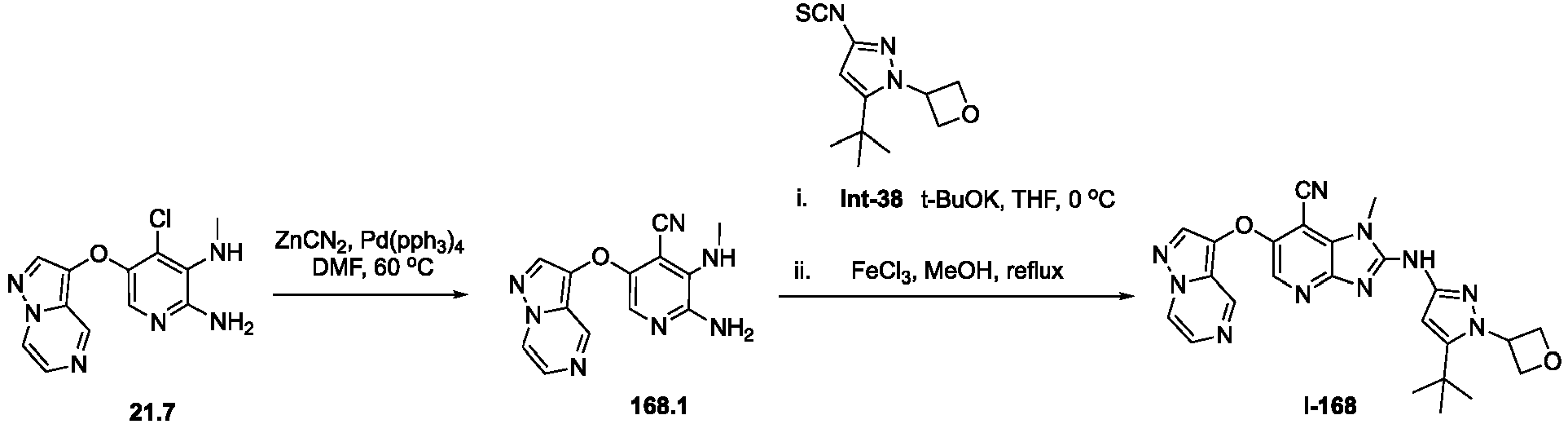
- Synthesis of compound 168.1. A mixture of 21.7 (0.500 g, 1.72 mmol, 1.0 equiv) and zinc cyanide (0.402 g, 3.44 mmol, 2.0 equiv) in DMF (15 mL) was degassed by bubbling argon through for 10 min. Under argon atmosphere tetrakis(triphenylphosphine)palladium(0) (0.198 g, 0.172 mmol, 0.1 equiv) was added and degassed for another 5 min. The reaction mixture was stirred at 160 °C for 4 h. It was cooled to room temperature, transferred into water and extracted with ethyl acetate. The combined organic layers were washed with brine, dried over anhydrous sodium sulfate, filtered and concentrated under reduced pressure. The residue was purified by flash column chromatography on silica gel (CombiFlash®, 2.0% methanol in DCM) to afford 168.1. MS(ES): m/z 282.2 [M+H]+.
- Synthesis of I-168. To a solution of 168.1 (0.070 g, 0.248 mmol, 1.0 equiv) and Int-38 (0.071 g, 0.298 mmol, 1.2 equiv) in THF (5 mL) was added potassium tert-butoxide (1 M in THF, 0.74 mL, 0.744 mmol, 3.0 equiv) at 0 °C. The reaction mixture was stirred at room temperature for 2 h. It was concentrated under reduced pressure. The residue was dissolved in methanol (10 mL), and ferric chloride (0.120 g, 0.744 mmol, 3.0 equiv) was added. The reaction mixture was refluxed for 10 min. The reaction mixture was poured over ice-water and extracted with ethyl acetate. The combined organic layers were washed with brine, dried over anhydrous sodium sulfate, filtered and concentrated under reduced pressure. The residue was purified by preparative HPLC to afford I-168. MS(ES): m/z 484.9 [M+H]+, 1H NMR (DMSO-d6, 400 MHz): δ 9.05 (s, 1H), 8.72-8.71 (d, J = 4.4 Hz, 1H), 8.16 (s, 1H), 7.89-7.88 (d, J = 4.8 Hz, 1H), 7.84 (s, 1H), 7.60 (bs, 1H), 6.60 (s, 1H), 5.78-5.75 (m, 1H), 5.01-4.99 (m, 2H), 4.92-4.89 (m, 2H), 3.84 (s, 3H), 1.31 (s, 9H).
-

- Synthesis of I-169. Compound I-169 was prepared from 151.6 and Int-9, following the procedure described in the synthesis of I-13. The product was purified by flash column chromatography on silica gel (CombiFlash®, 2.6% methanol in DCM): m/z 538.3 [M+H]+, 1H NMR (MeOD, 400 MHz): δ 8.58 (s, 1H), 7.93 (s, 1H), 7.82 (s, 1H), 7.62-7.58 (m, 1H), 7.25-7.21 (m, 1H), 6.42 (s, 1H), 5.38 (s, 1H), 4.05 (s, 3H), 3.43-3.39 (m, 3H), 3.12-3.10 (m, 1H), 2.81 (s, 3H), 2.58 (bs, 1H), 2.35-2.34 (m, 1H), 1.45 (s, 9H).
-

- Synthesis of I-170. Compound I-170 was prepared from 151.6 and Int-10, following the procedure described in the synthesis of I-13. The product was purified by flash column chromatography on silica gel (CombiFlash®, 2.6% methanol in DCM) to afford I-170. MS(ES): m/z 538.3 [M+H]+. 1HNMR (DMSO-d6, 400MHz): δ 9.97 (s, 1H), 8.97 (s, 1H), 7.98 (s, 1H), 7.97 (s, 1H), 7.62 (bs, 1H), 7.33-7.31 (m, 1H), 6.51 (s, 1H), 5.17 (s, 1H), 4.03 (bs, 4H), 3.17 (bs, 1H), 2.89 (bs, 3H), 2.35 (bs, 2H), 2.20 (bs, 1H), 2.01 (bs, 1H), 1.39 (s, 9H).
-

- Synthesis of compound 171.1. Compound 171.1 was prepared from 124.7 and Int-76, following the procedure described in the synthesis of I-13. The product was purified by flash column chromatography on silica gel (CombiFlash®, 2.1% methanol in DCM). MS(ES): m/z 592.1 [M+H]+.
- Synthesis of 1-171. To a solution of 171.1 (0.045 g, 0.076 mmol, 1.0 equiv) in methanol (2.0 mL) was added methyl amine solution (2 M in THF, 0.4 mL) at room temperature and stirred at 80 °C for 12 h. It was concentrated under reduced pressure. The residue was purified by trituration with methanol to afford I-171. MS(ES): m/z 586.3 [M+H]+, 1H NMR (DMSO-d6+TFA, 400 MHz): δ 9.24 (s, 1H), 8.53 (s, 1H), 8.41 (bs, 1H), 8.34 (bs, 1H), 8.15 (bs, 1H), 8.10 (s, 1H), 7.95 (s, 1H), 7.82 (s, 1H), 7.25 (s, 1H), 4.04 (s, 3H), 3.92 (s, 3H), 3.17 (s, 3H).
-

- Synthesis of I-172. Compound I-172 was prepared from 21.7 and Int-78, following the procedure described in the synthesis of I-13. The product was purified by flash column chromatography on silica gel (CombiFlash®, 12% methanol in DCM). 1H NMR (DMSO-d6, 400 MHz): δ 9.47 (s, 1H), 9.02 (s, 1H), 8.70-8.69 (d, J = 3.6 Hz, 1H), 8.20 (s, 1H), 8.04 (s, 1H), 7.88-7.87 (d, J = 4.8 Hz, 1H), 7.81 (s, 1H), 7.73 (bs, 1H), 6.90 (s, 1H), 4.02 (s, 3H), 3.25 (s, 4H), 2.26 (s. 3H), 1.24 (s, 4H).
-

- Synthesis of I-173. Compound I-173 was prepared from 21.7 and Int-79, following the procedure described in the synthesis of I-13. The product was purified by flash column chromatography on silica gel (CombiFlash®, 2.6% methanol in DCM). MS(ES): m/z 593.1 [M]+, 1H NMR (DMSO-d6, 400 MHz): δ 9.66 (s, 1H), 9.03 (s, 1H), 8.71-8.69 (d, J = 4.8 Hz, 1H), 8.30 (s, 1H), 8.21 (s, 1H), 8.18 (s, 1H), 8.04 (s, 1H), 7.88-7.87 (d, J = 4.8 Hz, 1H), 7.78-7.76 (d, J = 8.4 Hz, 1H), 4.03 (s, 3H), 3.67 (s, 2H), 2.45 (bs, 4H), 2.03-1.96 (m, 4H).
-

- Synthesis of I-174. Compound I-174 was prepared from 21.7 and Int-80, following the procedure described in the synthesis of I-13. The product was purified by flash column chromatography on silica gel (CombiFlash®, 2.6% methanol in DCM). MS(ES): m/z 592.9 [M]+, 1H NMR (DMSO-d6, 400 MHz): δ 9.67 (s, 1H), 9.03 (s, 1H), 8.71-8.69 (d, J = 4.8 Hz, 1H), 8.32 (s, 1H), 8.21 (s, 1H), 8.18-8.16 (d, J = 8.4 Hz, 1H), 8.05 (s, 1H), 7.88-7.87 (d, J = 4.8 Hz, 1H), 7.74-7.71 (d, J = 8.8 Hz, 1H), 4.03 (s, 3H), 3.69 (s, 2H), 2.72-2.66 (m, 2H), 2.46-2.45 (m, 2H), 1.94-1.89 (m, 2H), 1.69 (bs, 2H).
-

- Synthesis of I-175. Compound I-175 was prepared from 61.2 and Int-81.2, following the procedure described in the synthesis of I-53. The product was purified by flash column chromatography on silica gel (CombiFlash®, 5.4% methanol in DCM). MS(ES): m/z 573.1 [M+H]+, 1H NMR (DMSO-d6, 400 MHz): δ 9.65 (s, 1H), 9.03 (s,1H), 8.70-8.69 (d, J = 4.0 Hz, 1H), 8.30 (s, 1H), 8.20 (s, 1H), 8.04 (s, 1H), 7.88-7.87 (d, J = 4.8 Hz, 1H), 7.74-7.72 (d, J = 7.6 Hz, 1H), 7.40 (s, 1H), 4.03 (s, 3H), 3.92 (bs, 1H), 3.71 (bs, 2H), 3.18 (s, 3H), 2.00 (bs, 2H), 1.71-1.66 (m, 2H), 1.12-1.08 (m, 2H).
-

- Synthesis of I-176. Compound I-176 was prepared from 61.2 and Int-82.2, following the procedure described in the synthesis of I-53. The product was purified by flash column chromatography on silica gel (CombiFlash®, 5.3% methanol in DCM). MS(ES): m/z 573.3 [M+H]+, 1H NMR (DMSO-d6, 400 MHz): δ 9.64 (s, 1H), 9.03 (s,1H), 8.70-8.69 (d, J = 4.0 Hz, 1H), 8.30 (s, 1H), 8.20 (s, 1H), 8.04 (s, 1H), 7.88-7.87 (d, J = 4.8 Hz, 1H), 7.74-7.72 (d, J = 7.6 Hz, 1H), 7.39 (s, 1H), 4.03 (s, 3H), 3.92 (bs, 1H), 3.71 (bs, 2H), 3.18 (s, 3H), 2.00 (bs, 2H), 1.71-1.66 (m, 2H), 1.12-1.08 (m, 2H).
-

- Synthesis of I-177. Compound I-177 was prepared from 21.7 and Int-63, following the procedure described in the synthesis of I-13. The product was purified by flash column chromatography on silica gel (CombiFlash®, 2.2% methanol in DCM). MS(ES): m/z 490.7 [M]+, 1H NMR (DMSO-d6, 400 MHz): δ 9.05 (s, 1H), 8.85 (s, 1H), 8.71-8.70 (d, J = 4.8 Hz, 1H), 8.62-8.61 (d, J = 2.0 Hz, 1H), 8.25 (s, 1H), 8.15 (s, 1H), 8.06 (s, 1H), 7.89-7.87 (d, J = 4.8 Hz, 1H), 4.02 (s, 3H), 3.66 (s, 3H).
-

- Synthesis of compound 178.1. Compound 178.1 was prepared from 124.7 and Int-83, following the procedure described in the synthesis of I-13. The product was purified by flash column chromatography on silica gel (CombiFlash®, 2.6% methanol in DCM). MS(ES): m/z 552.1 [M+H]+.
- Synthesis of I-178. Compound I-178 was prepared from 178.1, following the procedure described in the synthesis of I-171. The product was purified by flash column chromatography on silica gel (CombiFlash®, 3.9% methanol in DCM). MS(ES): m/z 546.1 [M+H]+, 1H NMR (DMSO-d6, 400 MHz): δ 8.90 (s, 1H), 8.67-8.66 (d, J = 4.0 Hz, 1H), 8.25 (s, 1H), 8.10 (s, 1H), 7.80-7.78 (d, J = 8.0 Hz, 1H), 7.51 (s, 1H), 7.27-7.26 (d, J = 8.0 Hz, 1H), 6.86-6.84 (m, 1H), 4.02 (s, 3H), 3.00-2.99 (d, 3H), 2.57 (bs, 1H), 1.25 (bs, 4H).
-

- Synthesis of compound 179.1. Compound 179.1 was prepared from 124.7 and Int-53, following the procedure described in the synthesis of I-13. The product was purified by flash column chromatography on silica gel (CombiFlash®, 2.3% methanol in DCM). MS(ES): m/z 589.3 [M+H]+.
- Synthesis of I-179. Compound I-179 was prepared from 179.1, following the procedure described in the synthesis of I-171. The product was purified by flash column chromatography on silica gel (CombiFlash®, 3.5% methanol in DCM). MS(ES): m/z 583.4 [M+H]+, 1H NMR (DMSO-d6, 400 MHz): δ 9.01 (s, 1H), 8.81 (s, 1H), 8.72 (s, 1H), 8.26-8.25 (d, J = 6.0 Hz, 1H), 8.15 (s, 1H), 8.08 (s, 1H), 7.79-7.78 (d, J= 4.8 Hz, 1H), 7.66-7.64 (d, J = 7.6 Hz, 1H), 7.51-7.50 (d, J = 5.6 Hz, 1H), 7.26-7.25 (d, J = 5.2 Hz, 1H), 6.85 (s, 1H), 5.77-5.75 (m, 1H), 4.01-3.99 (s, 3H), 2.99-2.98 (d, 3H).
-

- Synthesis of I-180. Compound I-180 was prepared from 21.7 and Int-84, following the procedure described in the synthesis of I-13. The product was purified by flash column chromatography on silica gel (CombiFlash®, 4% methanol in DCM). MS(ES): m/z 539.9 [M]+, 1H NMR (DMSO-d6, 400 MHz): δ 9.03 (s, 1H), 8.71-8.70 (d, J = 3.6 Hz, 1H), 8.39 (s, 1H), 8.30 (s, 1H), 8.27-8.22 (m, 3H), 8.05 (s, 1H), 7.89-7.88 (d, J = 4.8 Hz, 1H), 7.65 (s, 1H), 7.49 (s, 1H), 4.06 (s, 3H), 2.21 (s, 3H).
-

- Synthesis of I-181. Compound I-181 was prepared from 61.2 and Int-85.3, following the procedure described in the synthesis of I-53. The product was purified by flash column chromatography on silica gel (CombiFlash®, 4.5% methanol in DCM. MS(ES): m/z 573.7 [M+H]+. 1H NMR (DMSO-d6, 400 MHz): δ 9.69 (s, 1H), 9.03-9.02 (d, J = 6.8 Hz, 1H), 8.70 (s, 1H), 8.35 (s, 1H), 8.21-8.20 (d, J = 7.2 Hz, 1H), 8.05-8.03 (d, J = 7.2 Hz, 2H), 7.88-7.86 (m, 1H), 7.30 (s, 1H), 4.02 (s, 3H), 3.91 (bs, 1H), 3.68 (bs, 2H), 3.16 (s, 3H), 2.68 (bs, 2H), 2.34 (bs, 2H), 2.00 (bs, 1H), 1.69 (bs, 1H).
-

- Synthesis of compound I-182. Compound I-182 was prepared from 61.2 and Int-86.3, following the procedure described in the synthesis of I-53. The product was purified by flash column chromatography on silica gel (CombiFlash®, 4.5% methanol in DCM). MS(ES): m/z 573.1 [M+H]+, 1H NMR (DMSO-d6, 400 MHz): δ 9.68 (s, 1H), 9.02 (bs, 1H), 8.70-8.68 (d, J = 4.8 Hz, 1H), 8.34 (s, 1H), 8.20 (s, 1H), 8.05-8.04 (d, J = 7.6 Hz, 2H), 7.87-7.86 (d, J = 4.8 Hz, 1H), 7.28 (s, 1H), 4.02 (s, 3H), 3.91 (bs, 1H), 3.67 (bs, 2H), 3.16 (s, 3H), 2.67 (bs, 2H), 2.33 (bs, 2H), 2.00 (bs, 1H), 1.69 (bs, 1H).
-

- Synthesis of compound 183.1. Compound 183.1 was prepared from 166.6 and Int-48, following the procedure described in the synthesis of I-13. The product was purified by flash column chromatography on silica gel (CombiFlash®, 2.4% methanol in DCM). MS(ES): m/z 695.8 [M+H]+.
- Synthesis of I-183. Compound I-183 was prepared from 183.1, following the procedure described in the synthesis of I-23. The product was purified by flash column chromatography on silica gel (CombiFlash®, 4.4% methanol in DCM). MS(ES): m/z 605.1 [M+H]+, 1H NMR (DMSO-d6, 400 MHz): δ 8.54 (s, 1H), 8.37-8.35 (d, J = 7.6 Hz, 1H), 7.98 (s, 1H), 7.93 (s, 1H), 7.83 (s, 1H), 6.80-6.78 (d, J = 5.6 Hz, 1H), 6.53 (s, 1H), 4.20-4.18 (m, 2H), 4.04 (s, 3H), 3.78-3.74 (m, 6H), 3.43-3.38 (m, 2H), 3.19 (bs, 4H).
-

- Synthesis of compound 184.1. Compound 184.1 was prepared from 124.7 and Int-87, following the procedure described in the synthesis of I-13. The product was purified by flash column chromatography on silica gel (CombiFlash®, 2.6% methanol in DCM). MS(ES): m/z 614.2 [M+H]+.
- Synthesis of I-184. Compound I-184 was prepared from 184.1, following the procedure described in the synthesis of I-171. The product was purified by flash column chromatography on silica gel (CombiFlash®, 3.9% methanol in DCM). MS(ES): m/z 608.3 [M+H]+, 1H NMR (DMSO-d6, 400 MHz): δ 9.73 (s, 1H), 8.32 (s, 1H), 8.18-8.17 (d, J = 4.8 Hz, 2H), 7.77 (s, 1H), 7.70 (s, 1H), 7.47-7.45 (d, J = 4.8 Hz, 1H), 7.25-7.23 (m, 1H), 6.82 (bs, 1H), 4.02-4.01 (bs, 3H), 3.75 (s, 2H), 2.98 (s, 3H), 2.93-2.89 (m, 2H), 2.75-2.74 (m, 2H), 2.32-2.27 (m, 2H).
-

- Synthesis of compound 185.1. Compound 185.1 was prepared from 21.7 and Int-88, following the procedure described in the synthesis of I-13. The product was purified by flash column chromatography on silica gel (CombiFlash®, 4.4% methanol in DCM). MS(ES): m/z 649.8 [M+H]+.
- Synthesis of I-185. Compound I-185 was prepared from 185.1, following the procedure described in the synthesis of I-23. The product was purified by flash column chromatography on silica gel (CombiFlash®, 9.0% methanol in DCM). MS(ES): m/z 559.2 [M+H]+, 1H NMR (DMSO-d6, 400 MHz): δ 9.64 (s, 1H), 9.01 (s, 1H), 8.68-8.67 (d, J = 4.4 Hz, 1H), 8.29 (s, 1H), 8.19 (bs, 2H), 8.02 (s, 1H), 7.86-7.85 (d, J = 4.8 Hz, 1H), 7.76 (s, 1H), 4.74 (bs, 1H), 4.24 (bs, 1H), 4.01 (s, 3H), 3.70 (bs, 2H), 2.33 (bs, 2H), 2.19 (bs, 2H), 1.60 (bs, 2H).
-


- Synthesis of compound 186.1. Compound 186.1 was prepared from 21.7 and Int-89, following the procedure described in the synthesis of I-13. The product was purified by flash column chromatography on silica gel (CombiFlash®, 4.4% methanol in DCM). MS(ES): m/z 649.5 [M+H]+.
- Synthesis of I-186. Compound I-186 was prepared from 186.1, following the procedure described in the synthesis of I-23. The product was purified by flash column chromatography on silica gel (CombiFlash®, 9.0% methanol in DCM). MS(ES): m/z 559.2 [M+H]+, 1H NMR (DMSO-d6, 400 MHz): δ 9.65 (s, 1H), 9.03 (s, 1H), 8.70-8.69 (d, J = 4.0 Hz, 1H), 8.31 (s, 1H), 8.21 (bs, 2H), 8.04 (s, 1H), 7.88-7.87 (d, J = 4.0 Hz, 1H), 7.78 (bs, 1H), 4.75 (bs, 1H), 4.25 (bs, 1H), 4.03 (s, 3H), 3.71 (bs, 2H), 2.33 (bs, 2H), 2.04 (bs, 2H), 1.60 (bs, 2H).
-

- Synthesis of I-187. Compound I-187 was prepared from 168.1 and Int-14, following the procedure described in the synthesis of I-168. The product was purified by flash column chromatography on silica gel (CombiFlash®, 3.2% methanol in DCM). MS(ES): m/z 524.5 [M]+, 1H NMR (DMSO-d6, 400 MHz): δ 9.08 (s, 1H), 8.73-8.72 (d, J = 3.6 Hz, 1H), 8.18 (s, 1H), 7.90-7.89 (d, J= 4.0 Hz, 1H), 7.82 (s, 1H), 6.75 (s, 1H), 5.23 (s, 1H), 5.05 (s, 1H), 4.25 (s, 2H), 3.80 (s, 3H), 3.56 (bs, 2H), 1.81-1.79 (d, J = 6.8 Hz 2H), 1.37 (s, 9H), 1.24 (bs, 2H).
-

- Synthesis of compound 188.1. To solution of 2,6-dichloropyridin-4-amine (10 g, 61.35 mmol, 1.0 equiv) in ethanol (20 mL) was added 21% sodium ethoxide (20 mL, 61.35 mmol, 1.0 equiv) and stirred at 150 °C for 10 h. It was cooled to room temperature, transferred into water and extracted with ethyl acetate. The combined organic layers were washed with brine, dried over anhydrous sodium sulfate, filtered and concentrated under reduced pressure. The residue was purified by flash column chromatography on silica gel (CombiFlash®, 15% ethyl acetate in hexane) to afford 188.1. MS(ES): m/z 173.2 [M+H]+.
- Synthesis of compound 188.2. To a solution of 188.1 (4.6 g, 26.65 mmol, 1.0 equiv) in toluene (150 mL) was added aluminum chloride (8.86 g, 66.62 mmol, 2.5 equiv). The reaction mixture stirred at 110 °C for 2 h. It was poured over water and extracted with ethyl acetate. The combined organic layers were washed with brine, dried over anhydrous sodium sulfate, filtered and concentrated under reduced pressure. The residue was purified by flash column chromatography on silica gel (CombiFlash®, 10% methanol in DCM) to afford 188.2. MS(ES): m/z 145.4 [M+H]+.
- Synthesis of compound 188.3. To a solution of 188.2 (2.2 g, 15.22 mmol, 1.0 equiv) and phenyl-bis(trifluoromethanesulfonimide) (5.43 g, 15.22 mmol, 1.0 equiv) in DMF (20 mL) was added triethylamine (5.3 mL, 38.05 mmol, 2.5 equiv). The reaction mixture was stirred at room temperature for 16 h. It was poured over ice-water and extracted with ethyl acetate. The combined organic layers were washed with brine, dried over anhydrous sodium sulfate, filtered and concentrated under reduced pressure. The residue was purified by flash column chromatography on silica gel (CombiFlash®, 5% methanol in DCM) to afford 188.3. MS(ES): m/z 277.5 [M+H]+.
- Synthesis of compound 188.4. A solution of 188.3 (1.97 g, 7.12 mmol, 1.0 equiv) in methanol (50 mL) was degassed by bubbling a stream of argon for 10 min. 1,1-Bis(diphenylphosphino)ferrocene-palladium(II) dichloride-DCM complex (1.16 g, 1.42 mmol, 0.2 equiv) was added followed by triethylamine (1.98 mL, 14.24 mmol, 2.0 equiv). The reaction mixture stirred for 3-4 h at 70-80 °C under carbon monoxide atmosphere. It was poured over ice-water and extracted with ethyl acetate. The combined organic layers were washed with brine, dried over anhydrous sodium sulfate, filtered and concentrated under reduced pressure. The residue was purified by flash column chromatography on silica gel (CombiFlash®, 40% ethyl acetate in hexane) to afford 188.4. MS(ES): m/z 187.5 [M+H]+.
- Synthesis of compound 188.5. To a solution of 188.4 (0.800 g, 4.29 mmol, 1.0 equiv), tetrakis(triphenylphosphine)palladium(0) (0.495 g, 0.429 mmol, 0.1 equiv) and tributylvinyltin (6.79 g, 21.45 mmol, 5.0 equiv) in 1,2-dichloroethane (20 mL) was stirred at 150 °C in a microwave reactor for 4 h. It was poured over water and extracted with ethyl acetate. The combined organic layers were washed with brine, dried over anhydrous sodium sulfate, filtered and concentrated under reduced pressure. The residue was purified by flash column chromatography on silica gel (CombiFlash®, 4% methanol in DCM) to afford 188.5. MS(ES): m/z 178.9 [M+H]+.
- Synthesis of compound 188.6. A mixture of compound 188.5 (0.312 g, 1.75 mmol, 1.0 equiv) and 20% palladium hydroxide (0.150 g) in methanol (10 mL) was stirred under hydrogen was purged through the reaction mixture for 2 h. The reaction mixture was filtered through a pad of Celite® and washed with methanol. The filtrate was concentrated under reduced pressure to afford 188.6. MS(ES): m/z 181.1 [M+H]+.
- Synthesis of compound 188.7. To a solution of 188.6 (0.180 g, 0.998 mmol, 1.0 equiv) and azetidine hydrochloride (0.280 g, 3.00 mmol, 3.0 equiv) in THF (5 mL) was added N,N-diisopropylethylamine (0.64 g, 4.99 mmol, 5.0 equiv) at 0 °C followed by addition of trimethylaluminum solution (2.0 M in toluene, 2.0 mL, 3.99 mmol, 4.0 equiv). The reaction mixture was stirred at 90 °C for 10 h. It was poured over water and extracted with ethyl acetate. The combined organic layers were washed with brine, dried over anhydrous sodium sulfate, filtered and concentrated under reduced pressure. The residue was purified by flash column chromatography on silica gel (CombiFlash®, 5% methanol in DCM) to afford 188.7. MS(ES): m/z 206.1 [M+H]+.
- Synthesis of I-188. Compound I-188 was prepared from 61.2 and 188.7, following the procedure described in the synthesis of I-53. The product was purified by flash column chromatography on silica gel (CombiFlash®, 10% methanol in DCM) to afford I-188. MS(ES): m/z 504.2 [M+H]+. 1H NMR (DMSO-d6, 400 MHz): δ 9.90 (s, 1H), 9.05 (s, 1H), 8.71 (s, 1H), 8.26 (bs, 2H), 8.07-8.06 (d, J = 4.0 Hz, 1H), 7.97 (s, 1H), 7.88 (s, 1H), 4.67 (bs, 2H), 4.09-4.04 (m, 6H), 1.29 (bs, 6H).
-

- Synthesis of compound 189.1. Compound 189.1 was prepared from 124.7 and Int-90, following the procedure described in the synthesis of I-13. The product was purified by flash column chromatography on silica gel (CombiFlash®, 2.5% methanol in DCM). MS(ES): m/z 582.2 [M+H]+.
- Synthesis of compound I-189. Compound I-189 was prepared from 189.1, following the procedure described in the synthesis of I-171. The product was purified by flash column chromatography on silica gel (CombiFlash®, 4.0% methanol in DCM). MS(ES): m/z 576.6 [M+H]+, 1H NMR (DMSO-d6, 400 MHz): δ 9.63 (s, 1H), 8.29 (s, 1H), 8.18 (s, 1H), 8.16 (s, 1H), 7.78-7.77 (d, J = 2.8 Hz, 1H), 7.66-7.64 (d, J = 8.0 Hz, 1H), 7.46 (s, 1H), 7.26-7.25 (d, J = 2.8 Hz, 1H), 6.81 (s, 1H), 5.29-5.15 (m, 1H), 4.02 (s, 3H), 3.77 (s, 3H), 3.64-3.60 (m, 2H), 3.25-3.18 (m, 2H), 2.99 (s, 2H).
-
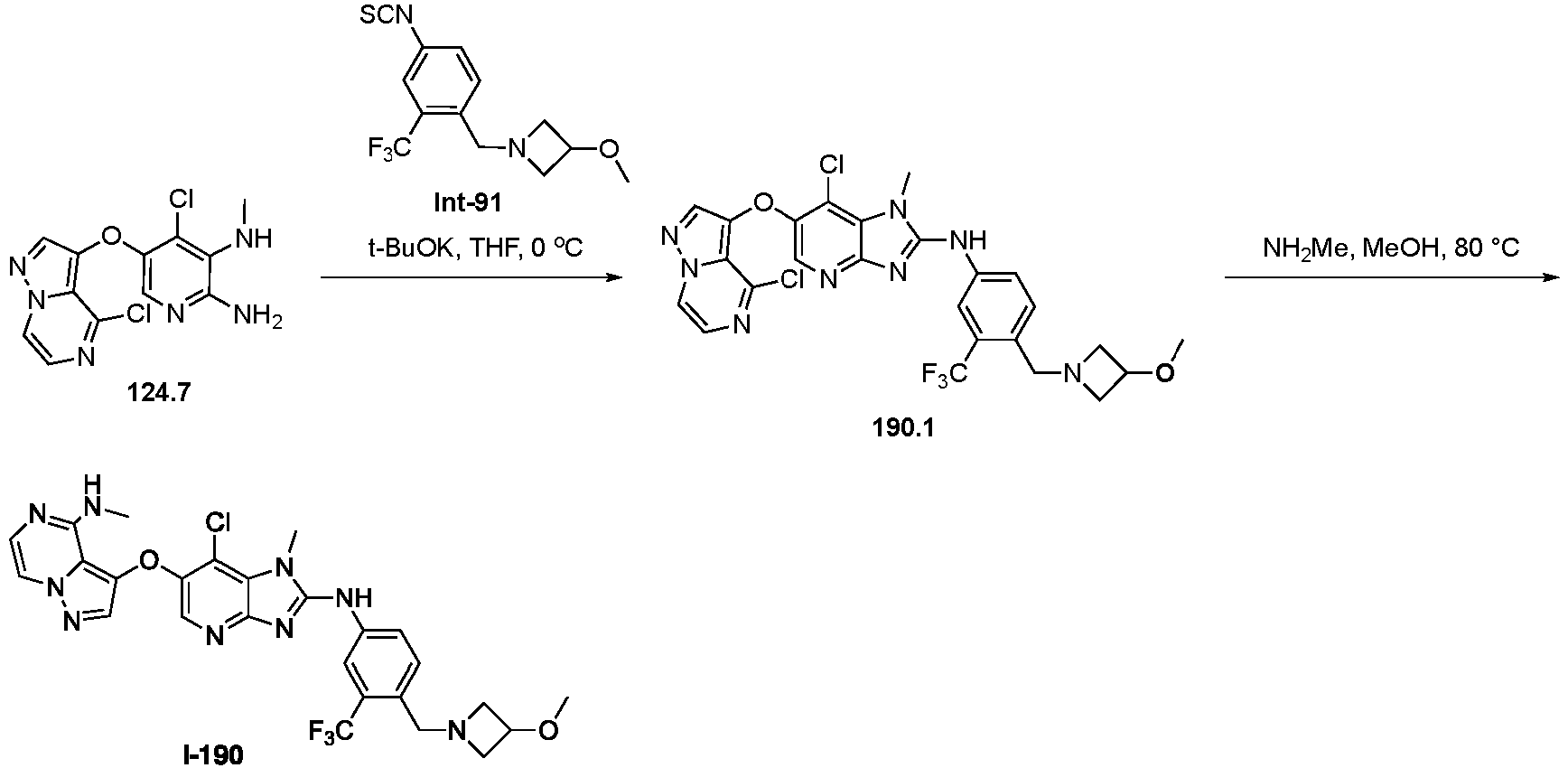
- Synthesis of compound 190.1. Compound 190.1 was prepared from 124.7 and Int-91, following the procedure described in the synthesis of I-13. The product was purified by flash column chromatography on silica gel (CombiFlash®, 8% methanol in DCM). MS(ES): m/z 594.0 [M+H]+.
- Synthesis of I-190. Compound I-190 was prepared from 190.1, following the procedure described in the synthesis of I-171. The product was purified by flash column chromatography on silica gel (CombiFlash®, 10% methanol in DCM). MS(ES): m/z 588.2 [M+H]+, 1H NMR (DMSO-d6, 400 MHz): δ 9.66 (s, 1H), 8.29 (s, 1H), 8.18 (bs, 2H), 7.77-7.76 (d, J = 4.0 Hz, 1H), 7.67-7.65 (d, J = 8.8 Hz, 1H), 7.46 (s, 1H), 7.25-7.24 (d, J = 4.0 Hz, 1H), 6.83 (s, 1H), 4.01 (s, 3H), 3.81 (bs, 2H), 3.64 (bs, 2H), 3.17 (s, 3H), 2.99 (bs, 4H), 2.57 (bs, 2H).
-

- Synthesis of compound 191.1. Compound 191.1 was prepared from 124.7 and Int-91, following the procedure described in the synthesis of I-13. The product was purified by flash column chromatography on silica gel (CombiFlash®, 7.0% methanol in DCM). MS(ES): m/z 608.1 [M+H]+.
- Synthesis of I-191. Compound I-191 was prepared from 191.1, following the procedure described in the synthesis of I-171. The product was purified by flash column chromatography on silica gel (CombiFlash®, 5.0% methanol in DCM). MS(ES): m/z 602.2 [M]+, 1H NMR (DMSO-d6, 400 MHz): δ 9.65 (s, 1H), 8.31 (s, 1H), 8.20-8.16 (m, 2H), 7.79-7.78 (d, J = 4.0 Hz, 1H), 7.75-7.73 (d, J = 8.0 Hz, 1H), 7.48 (s, 1H), 7.27-7.26 (d, J = 4.0 Hz, 1H), 6.83 (s, 1H), 4.03 (s, 3H), 3.93 (bs, 1H), 3.71 (bs, 2H), 3.19 (s, 3H), 3.01-3.00 (d, 3H), 2.73 (bs, 2H), 2.02 (bs, 2H), 1.71 (bs, 2H).
-


- Synthesis of compound 192.1. Compound 192.1 was prepared from 124.7 and Int-82, following the procedure described in the synthesis of I-13. The product was purified by flash column chromatography on silica gel (CombiFlash®, 7.0% methanol in DCM). MS(ES): m/z 608.2 [M+H]+.
- Synthesis of I-192. Compound I-192 was prepared from 192.1, following the procedure described in the synthesis of I-171. The product was purified by flash column chromatography on silica gel (CombiFlash®, 5.0% methanol in DCM). MS(ES): m/z 602.2 [M]+, 1H NMR (DMSO-d6, 400 MHz): δ 9.65 (s, 1H), 8.31 (s, 1H), 8.20-8.16 (m, 2H), 7.79-7.78 (d, J = 4.0 Hz, 1H), 7.75-7.73 (d, J = 8.0 Hz, 1H), 7.48 (s, 1H), 7.27-7.26 (d, J = 4.0 Hz, 1H), 6.83 (s, 1H), 4.03 (s, 3H), 3.93 (bs, 1H), 3.71 (bs, 2H), 3.19 (s, 3H), 3.01-3.00 (d, 3H), 2.73 (bs, 2H), 2.02 (bs, 2H), 1.71 (bs, 2H).
-

- Synthesis of I-193. Compound I-193 was prepared from I-128, following the procedure described in the synthesis of I-157. The product was purified by flash column chromatography on silica gel (CombiFlash®, 2.0% methanol in DCM). MS(ES): m/z 511.5 [M+H]+, 1H NMR (DMSO-d6, 400 MHz): δ 9.00 (s, 1H), 8.62 (s, 1H), 8.17 (s, 1H), 8.14 (s, 1H), 7.85-7.84 (d, J= 4.8 Hz, 1H), 7.79 (s, 1H), 7.30-7.29 (d, J = 4.8 Hz, 1H), 6.83 (s, 1H), 3.99 (s, 3H), 3.66 (bs, 3H), 2.95-2.94 (d, 3H).
-
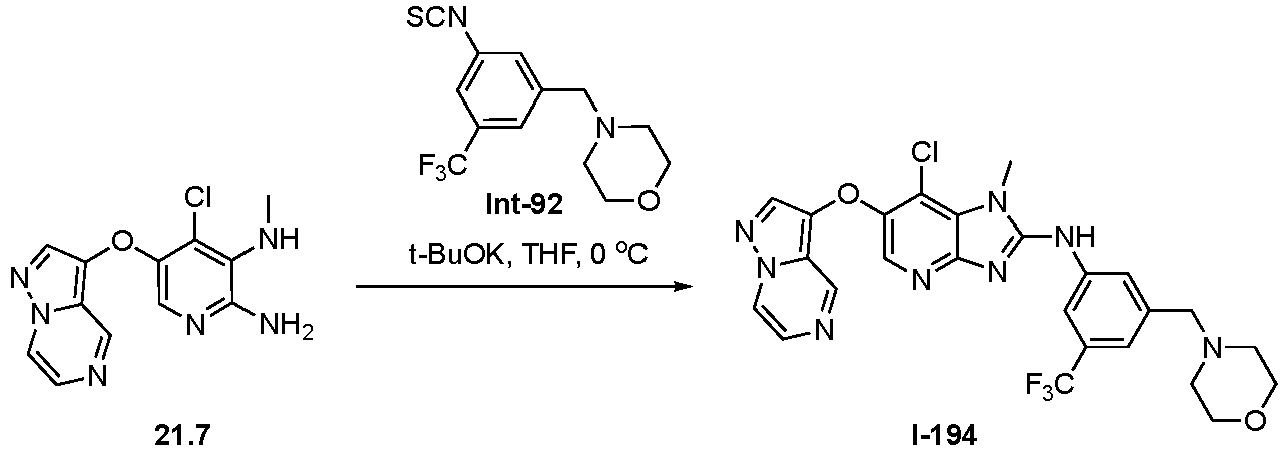
- Synthesis of I-194. Compound I-194 was prepared from 21.7 and Int-92, following the procedure described in the synthesis of I-13. The product was purified by flash column chromatography on silica gel (CombiFlash®, 3.0% methanol in DCM). m/z 559.2 [M+H]+, 1H NMR (DMSO-d6, 400 MHz): δ 9.67 (s, 1H), 9.01 (s, 1H), 8.69-8.68 (d, J = 4.0 Hz, 1H), 8.34 (s, 1H), 8.19 (s, 1H), 8.08 (s, 1H), 8.03 (s, 1H), 7.86-7.85 (d, J = 3.2 Hz, 1H), 7.29 (s, 1H). 4.02 (s, 3H), 3.60 (bs, 4H), 3.57 (s, 2H), 2.41 (bs, 4H).
-

- Synthesis of I-195. Compound I-195 was prepared from 21.7 and Int-93, following the procedure described in the synthesis of I-13. The product was purified by flash column chromatography on silica gel (CombiFlash®, 3.5% methanol in DCM). m/z 547.11 [M+H]+, 1H NMR (DMSO-d6, 400 MHz): δ 9.68 (s, 1H), 9.04 (s, 1H), 8.71-8.70 (d, J = 4 Hz, 1H), 8.32 (s, 1H), 8.22 (s, 1H), 8.08 (s, 1H), 8.05 (s, 1H), 7.89-7.88 (d, J = 4 Hz, 1H), 7.28 (s, 1H), 5.32-5.15 (m, 1H), 4.04 (s, 3H), 3.77 (s, 2H), 3.65-3.61 (m, 2H), 3.27-3.21 (m, 2H).
-
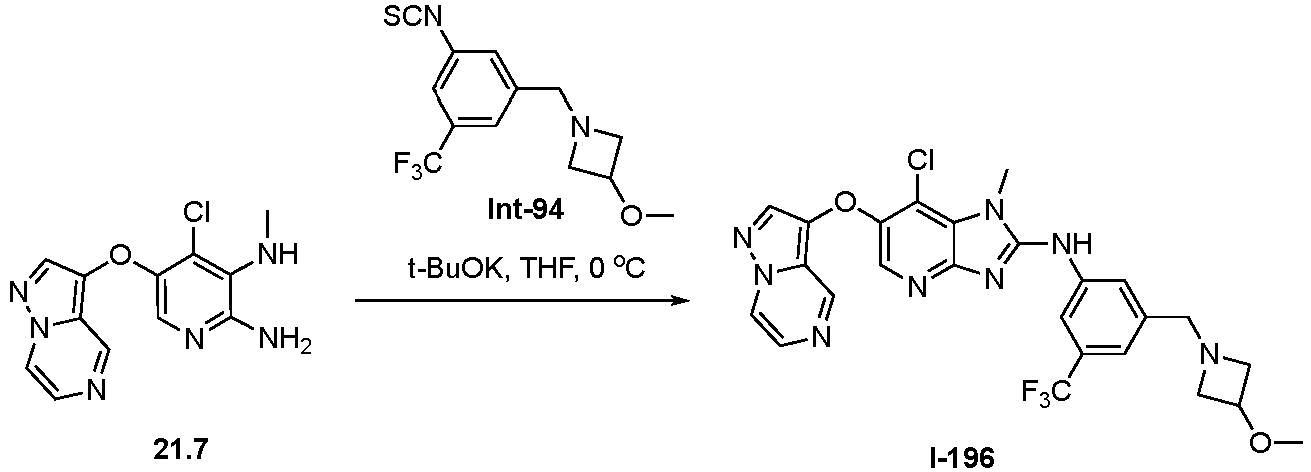
- Synthesis of I-196. Compound I-196 was prepared from 21.7 and Int-94, following the procedure described in the synthesis of I-13. The product was purified by flash column chromatography on silica gel (CombiFlash®, 3.5% methanol in DCM). MS(ES): m/z 559.30 [M+H]+, 1H NMR (DMSO-d6, 400 MHz): δ 9.66 (s, 1H), 9.02 (s, 1H), 8.70-8.69 (d, J = 4 Hz, 1H), 8.31 (s, 1H), 8.20 (s, 1H), 8.06-8.04 (d, J = 8 Hz, 2H), 7.87-7.86 (d, J = 4 Hz, 1H), 7.26 (s, 1H), 4.03 (s, 4H), 3.71 (bs, 2H), 3.56 (bs, 2H), 3.16 (s, 3H), 2.94 (bs, 2H).
-
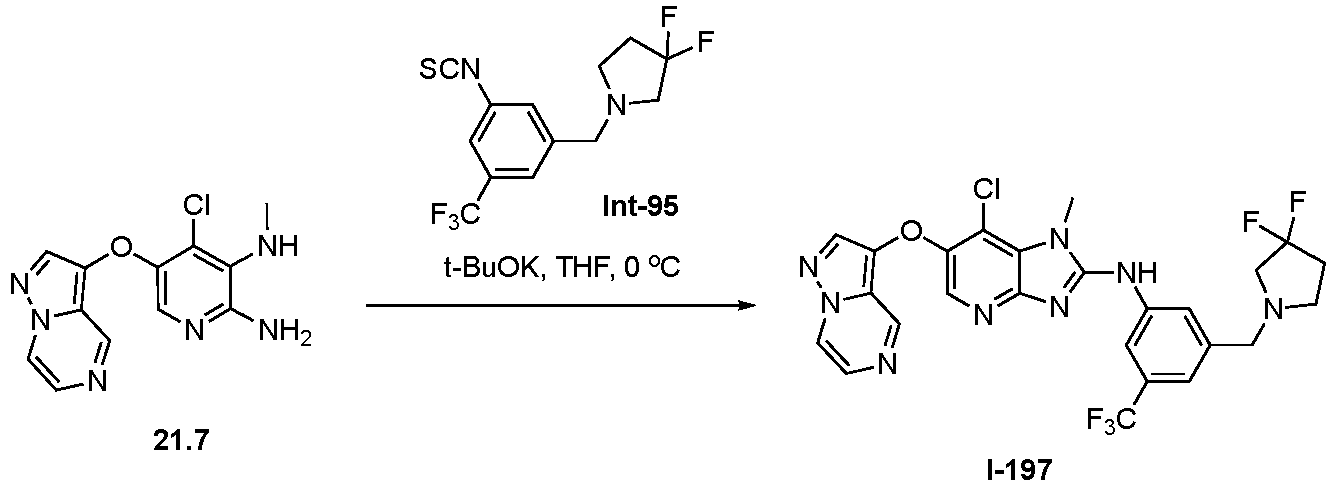
- Synthesis of I-197. Compound I-197 was prepared from 21.7 and Int-95, following the procedure described in the synthesis of I-13. The product was purified by flash column chromatography on silica gel (CombiFlash®, 2.4% methanol in DCM) t. MS(ES): m/z 578.9 [M]+. 1H NMR (DMSO-d6, 400 MHz): δ 9.69 (s, 1H), 9.02 (s, 1H), 8.69-8.68 (d, J = 4.8 Hz, 1H), 8.36 (s, 1H), 8.20 (s, 1H), 8.07 (s, 1H), 8.03 (s, 1H), 7.87-7.86 (d, J = 4 Hz, 1H), 7.30 (s, 1H), 4.02 (s, 3H), 3.74 (bs, 2H), 2.96-2.90 (m, 2H), 2.76-2.73 (m, 2H), 2.33-2.25 (m, 2H).
-

- Synthesis of I-198. Compound I-198 was prepared from 21.7 and Int-96, following the procedure described in the synthesis of I-13. The product was purified by flash column chromatography on silica gel (CombiFlash®, 3.5% methanol in DCM). MS(ES): m/z 587.8 [M+H]+, 1H NMR (DMSO-d6, 400 MHz): δ 9.68 (s, 1H), 9.02 (s, 1H), 8.69 (bs, 1H), 8.36 (s, 1H), 8.20 (s, 1H), 8.04 (s, 1H), 8.03 (s, 1H), 7.87-7.86 (d, J = 4.4 Hz, 1H), 7.28 (s, 1H), 4.03 (s, 3H), 3.55-3.50 (m, 3H), 3.22 (s, 3H), 2.68 (bs, 2H), 2.14 (bs, 2H), 1.84 (bs, 2H), 1.46 (bs, 2H).
-

- Synthesis of compound 199.1. Compound 199.1 was prepared from 21.7 and Int-55, following the procedure described in the synthesis of I-13. The product was purified by flash column chromatography on silica gel (CombiFlash®, 2.6% methanol in DCM). MS(ES): m/z 499.1 [M+H]+.
- Synthesis of I-199. Compound I-199 was prepared from 199.1, following the procedure described in the synthesis of I-171. The product was purified by flash column chromatography on silica gel (CombiFlash®, 4.6% methanol in DCM). MS(ES): m/z 493.2 [M+H]+, 1H NMR (DMSO-d6, 400 MHz): δ 9.23 (s, 1H), 8.28 (s, 1H), 7.99 (s, 1H), 7.78 (bs, 1H), 7.51 (s, 1H), 7.26 (s, 1H), 6.84 (bs, 1H), 4.01 (s, 3H), 3.70 (s, 3H), 2.98 (s, 3H), 1.23 (bs, 1H), 0.96-0.95 (m, 2H), 0.81 (bs, 2H).
-

- Synthesis of I-200. Compound I-200 was prepared from 61.2 and Int-116.7, following the procedure described in the synthesis of I-53. The product was purified by flash column chromatography on silica gel (CombiFlash®, 3.2% methanol in DCM). MS(ES): m/z 516.1 [M+H]+, 1H NMR (DMSO-d6, 400 MHz): δ 9.64 (s, 1H), 9.07 (bs, 1H), 9.05 (bs, 1H), 8.71-8.70 (d, J = 4.0 Hz, 1H), 8.32 (s, 1H), 8.08 (s, 1H), 7.89-7.88 (d, J = 4.8 Hz, 1H), 4.17 (s, 3H), 4.02 (s, 3H).
-

- Synthesis of compound 201.1. Compound 201.1 was prepared from 124.7 and Int-69, following the procedure described in the synthesis of I-13. The product was purified by flash column chromatography on silica gel (CombiFlash®, 1.2% methanol in DCM). MS(ES): m/z 576.2 [M]+.
- Synthesis of I-201. Compound I-201 was prepared from 201.1, following the procedure described in the synthesis of I-171. The product was purified by flash column chromatography on silica gel (CombiFlash®, 3.5% methanol in DCM). MS(ES): m/z 569.9 [M]+, 1H NMR (DMSO-d6, 400 MHz): δ 8.84 (s, 1H), 8.62 (s, 1H), 8.23 (s, 1H), 8.10 (s, 1H), 7.78-7.77 (d, J = 2.8 Hz, 1H), 7.48 (s, 1H), 7.25-7.24 (d, J = 2.8 Hz, 1H), 6.85 (bs, 1H), 4.00 (s, 3H), 3.68 (s, 3H), 2.99-2.98 (d, 3H).
-

- Synthesis of compound 202.1. Compound 202.1 was prepared from 124.7 and Int-97, following the procedure described in the synthesis of I-13. The product was purified by flash column chromatography on silica gel (CombiFlash®, 2.1% methanol in DCM). MS(ES): m/z 554.2[M+H]+.
- Synthesis of I-202. Compound I-202 was prepared from 202.1, following the procedure described in the synthesis of I-171. The product was purified by flash column chromatography on silica gel (CombiFlash®, 4.0% methanol in DCM). MS(ES): m/z 548.9 [M+H]+, 1H NMR (DMSO-d6, 400 MHz): δ 8.86 (s, 1H), 8.61 (s, 1H), 8.23 (s, 1H), 7.99 (s, 1H), 7.78-7.77 (d, J = 4.8 Hz, 1H), 7.50 (s, 1H), 7.25-7.24 (d, J = 5.2 Hz, 1H), 6.83-6.82 (d, J = 4.0 Hz, 1H), 5.18-5.15 (m, 1H), 4.01 (s, 3H), 2.99-2.98 (d, 3H), 1.44-1.43 (d, 6H).
-

- Synthesis of I-203. Compound I-203 was prepared from 21.7 and Int-98, following the procedure described in the synthesis of I-13. The product was purified by flash column chromatography on silica gel (CombiFlash®, 3.5% methanol in DCM). MS(ES): m/z 516.1 [M+H]+, 1H NMR (DMSO-d6, 400 MHz): δ 9.01 (bs, 2H), 8.69-8.68 (d, J = 4.0 Hz, 1H), 8.37 (s, 1H), 8.13 (s, 1H), 8.01 (s, 1H), 7.88-7.86 (m, 2H), 4.15-4.13 (m, 4H), 3.96 (s, 3H), 2.27-2.23 (m, 2H).
-

- Synthesis of compound 204.1. Compound 204.1 was prepared from 21.7 and Int-99, following the procedure described in the synthesis of I-13. The product was purified by flash column chromatography on silica gel (CombiFlash®, 4.4% methanol in DCM). MS(ES): m/z 650.8 [M+H]+.
- Synthesis of I-204. Compound I-204 was prepared from 204.1, following the procedure described in the synthesis of I-23. The product was purified by flash column chromatography on silica gel (CombiFlash®, 9.0% methanol in DCM). MS(ES): m/z 559.2 [M+H]+, 1H NMR (DMSO-d6, 400 MHz): δ 9.66 (s, 1H), 9.01 (s, 1H), 8.69-8.68 (d, J = 4.0 Hz, 1H), 8.33 (s, 1H), 8.20 (bs, 1H), 8.07 (s, 1H), 8.03 (s, 1H), 7.87-7.86 (d, J = 4.0 Hz, 1H), 7.30 (s, 1H), 4.76 (bs, 1H), 4.24 (bs, 1H), 4.02 (s, 3H), 3.71 (bs, 2H), 2.77-2.75 (m, 2H), 2.67 (bs, 2H), 2.04-2.00 (m, 2H).
-


- Synthesis of compound 205.1. Compound 205.1 was prepared from 21.7 and Int-100, following the procedure described in the synthesis of I-13. The product was purified by flash column chromatography on silica gel (CombiFlash®, 4.4% methanol in DCM). MS(ES): m/z 650.1 [M+H]+.
- Synthesis of compound I-205. Compound I-205 was prepared from 205.1, following the procedure described in the synthesis of I-23. The product was purified by flash column chromatography on silica gel (CombiFlash®, 9.0% methanol in DCM). MS(ES): m/z 559.2 [M+H]+, 1H NMR (DMSO-d6, 400 MHz): δ 9.68 (s, 1H), 9.03 (s, 1H), 8.71-8.69 (d, J = 4.4 Hz, 1H), 8.34 (s, 1H), 8.21 (bs, 1H), 8.09 (s, 1H), 8.05 (s, 1H), 7.88-7.87 (d, J = 4.4 Hz, 1H), 7.32 (s, 1H), 4.78 (bs, 1H), 4.25 (bs, 1H), 4.04 (s, 3H), 3.72 (bs, 2H), 2.78-2.77 (m, 2H), 2.68-2.67 (m, 2H), 2.07-2.02 (m, 2H).
-
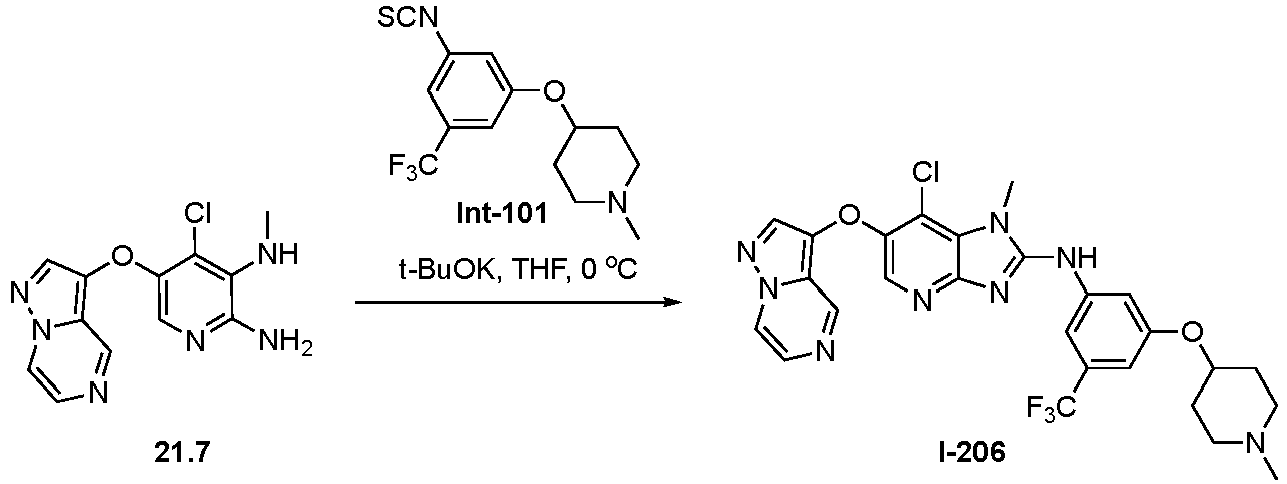
- Synthesis of I-206. Compound I-206 was prepared from 21.7 and Int-101, following the procedure described in the synthesis of I-13. The product was purified by preparative HPLC. MS(ES): m/z 573.2 [M+H]+, 1H NMR (DMSO-d6, 400 MHz): δ 9.61 (s, 1H), 9.04 (s, 1H), 8.71-8.70 (d, J = 4.0 Hz, 1H), 8.23 (s, 1H), 8.05 (s, 1H), 7.93 (s, 1H), 7.88 (bs, 2H), 6.94 (s, 1H), 4.49 (bs, 1H), 4.04 (s, 3H), 2.69- 2.63 (m, 4H), 2.21 (s, 3H), 1.99 (bs, 2H), 1.72 (bs, 2H).
-

- Synthesis of compound 207.1. Compound 207.1 was prepared from 21.7 and Int-102, following the procedure described in the synthesis of I-13. The product was purified by flash column chromatography on silica gel (CombiFlash®, 2.1% methanol in DCM). MS(ES): m/z 693.0 [M+H]+.
- Synthesis of I-207. Compound I-207 was prepared from 207.1, following the procedure described in the synthesis of I-23. The product was purified by flash column chromatography on silica gel (CombiFlash®, 3.9% methanol in DCM). MS(ES): m/z 602.2 [M+H]+, 1H NMR (DMSO-d6, 400 MHz): δ 9.67 (s, 1H), 9.02 (s, 1H), 8.69-8.68 (d, J = 4.8 Hz, 1H), 8.29 (s, 1H), 8.19 (s, 1H), 8.17-8.14 (d, J = 8.8 Hz, 1H), 8.03 (s, 1H), 7.87-7.86 (d, J = 4.8 Hz, 1H), 7.73-7.70 (d, J = 8.4 Hz, 1H), 4.03 (s, 3H), 3.57-3.51 (m, 5H), 2.67-2.57 (m, 10H).
-

- Synthesis of I-208. Compound I-208 was prepared from 21.7 and Int-103, following the procedure described in the synthesis of I-13. The product was purified by flash column chromatography on silica gel (CombiFlash®, 5.1% methanol in DCM). MS(ES): m/z 622.1 [M]+, 1H NMR (DMSO-d6, 400 MHz): δ 9.63 (s, 1H), 9.02 (s, 1H), 8.69 (bs, 1H), 8.28 (s, 1H), 8.19 (s, 1H), 8.16-8.14 (d, J = 8.8 Hz, 1H), 8.03 (s, 1H), 7.87-7.86 (d, J = 4.4 Hz, 1H), 7.72-7.70 (d, J = 8.4 Hz, 1H), 6.25-6.00 (m, 1H), 4.78 (bs, 2H), 4.02 (s, 3H), 3.57 (bs, 2H), 2.67-2.57 (m, 8H).
-

- Synthesis of compound 209.1. Compound 209.1 was prepared from 21.7 and Int-104, following the procedure described in the synthesis of I-13. The product was purified by flash column chromatography on silica gel (CombiFlash®, 4.2% methanol in DCM). MS(ES): m/z 646.0 [M+H]+.
- Synthesis of compound 209.2. To a solution of 209.1 (0.105 g, 0.162 mmol, 1.0 equiv) in DCM (5 mL) was added hydrogen chloride in dioxane (4.0 M, 2 mL) at 0 °C and stirred at room temperature for 1 h. It was poured over saturated sodium bicarbonate solution and extracted with ethyl acetate. The combined organic layers were washed with brine, dried over anhydrous sodium sulfate, filtered and concentrated under reduced pressure to afford 209.2. MS (ES): m/z 545.8 [M+H]+.
- Synthesis of I-209. To a solution of 210.2 (0.065 g, 0.119 mmol, 1.0 equiv) in methanol (7.5 mL) was added formaldehyde (0.017 g, 0.595 mmol, 5.0 equiv) and acetic acid (0.017 g, 0.297 mmol, 2.5 equiv) at 0 °C. After 10 min, sodium triacetoxyborohydride (0.075 g, 0.357 mmol, 3.0 equiv) was added. The reaction mixture was stirred at room temperature for 30 min. It was poured over ice cold water and extracted with ethyl acetate. The combined organic layers were washed with brine, dried over anhydrous sodium sulfate, filtered and concentrated under reduced pressure. The residue was purified by flash column chromatography on silica gel (CombiFlash®, 12% methanol in DCM) to afford I-209. MS(ES): m/z 559.2 [M+H]+, 1H NMR (DMSO-d6, 400 MHz): δ 9.92 (s, 1H), 9.03 (bs, 1H), 8.70-8.69 (d, J = 3.6 Hz, 1H), 8.21 (s, 1H), 8.05 (bs, 2H), 7.94 (s, 1H), 7.88-7.87 (d, J = 4.8 Hz, 1H), 6.89 (s, 1H), 5.11 (bs, 1H), 4.08 (s, 3H), 3.10 (bs, 2H), 2.90-2.68 (m, 6H), 2.02 (bs, 1H).
-

- Synthesis of I-210. Compound I-210 was prepared from 21.7 and Int-105, following the procedures described in the synthesis of I-209. The final product was purified by flash column chromatography on silica gel (CombiFlash®, 12% methanol in DCM). MS(ES): m/z 559.2 [M+H]+, LCMS purity: 100%, HPLC purity: 98.46%, Chiral HPLC purity: 99.81%, 1H NMR (DMSO-d6, 400MHz): δ 10.03 (s, 1H), 9.03 (bs, 1H), 8.70-8.69 (d, J = 3.6Hz, 1H), 8.21 (s, 1H), 8.05 (bs, 2H), 7.97 (s, 1H), 7.88-7.87 (d, J = 4.8Hz, 1H), 6.88 (s, 1H), 5.11 (bs, 1H), 4.09 (s, 3H), 3.08 (bs, 2H), 2.87 (bs, 1H), 2.57 (bs, 5H), 2.02 (bs, 1H).
-

- Synthesis of I-211. To a solution of 133.5 (0.100 g, 0.201 mmol, 1.0 equiv) in N-methyl-2-pyrrolidone (1.0 mL) was added sodium methoxide solution (5 N in methanol, 1.0 mL) followed by copper iodide (0.007 g, 0.040 mmol, 0.2 equiv) at room temperature. The mixture was stirred at 100 °C for 16 h. It was poured over ice-water and extracted with ethyl acetate. The combined organic layers were washed with brine, dried over anhydrous sodium sulfate, filtered and concentrated under reduced pressure. The residue was purified by preparative HPLC to afford I-211. MS(ES): m/z 489.2 [M+H]+, 1H NMR (DMSO-d6, 400 MHz): δ 8.34 (s, 1H), 8.30 (s, 1H), 8.28-8.27 (d, J = 5.2 Hz, 1H), 7.97 (s, 1H), 7.78 (s, 1H), 7.39-7.38 (d, J = 4.8 Hz, 1H), 7.19 (s, 1H), 4.09 (s, 3H), 4.01 (s, 3H), 3.89 (s, 3H), 3.55 (s, 3H), 1.81 (bs, 1H), 0.88-0.86 (m, 2H), 0.59-0.58 (m, 2H).
-

- Synthesis of compound 212.1. Compound 212.1 was prepared from 78.5 and Int-63, following the procedure described in the synthesis of I-13. The product was purified by flash column chromatography on silica gel (CombiFlash®, 3.2% methanol in DCM). MS(ES): m/z 490.5 [M+H]+.
- Synthesis of I-212. Compound I-212 was prepared from 212.1, following the procedure described in the synthesis of I-157. The product was purified by flash column chromatography on silica gel (CombiFlash®, 2.8% methanol in DCM). MS (ES): m/z 481.2 [M+H]+, 1H NMR (DMSO-d6, 400 MHz): δ 8.95 (s, 1H), 8.68-8.67 (d, J = 6.8 Hz, 1H), 8.60 (s, 1H), 8.18 (s, 1H), 8.15 (s, 1H), 7.95 (s, 1H), 7.55-7.53 (d, J = 9.2 Hz, 1H), 7.25 -7.21 (m, 1H), 6.96-6.92 (m, 1H), 3.98 (s, 3H), 3.65 (s, 3H).
-

- Synthesis of compound 213.1. A mixture of 2-chloro-4-fluoropyridine (20 g, 152.05 mmol, 1.0 equiv), ethynyltrimethylsilane (32.86 g, 334.51 mmol, 2.2 equiv), bis(acetonitrile)dichloropalladium(II) (1.96 g, 7.6 mmol, 0.05 equiv) and 2-dicyclohexylphosphino-2',4',6'-triisopropylbiphenyl (0.723 g, 1.52 mmol, 0.01 equiv) in N-methyl-2-pyrrolidone (140 mL) was degassed for 30 min. Under argon atmosphere was added triethylamine (30.7 g, 304.1 mmol, 2.0 equiv) and degassed for 5 min. The reaction mixture was stirred at 55 °C for 24 h. It was poured over brine and extracted with ethyl acetate. The combined organic layers were washed with brine, dried over anhydrous sodium sulfate, filtered and concentrated under reduced pressure. The residue was purified by flash column chromatography on silica gel (CombiFlash®, 4% ethyl acetate in hexane) to afford 213.1. MS (ES): m/z 194.3 [M+H]+.
- Synthesis of compound 213.2. To a solution of 213.1 (3.8 g, 19.66 mmol, 1.0 equiv) in DCM (38 mL), was added O-(mesitylsulfonyl)-hydroxylamine (4.2 g, 19.66 mmol, 1.0 equiv) at 0 °C. The reaction mixture was stirred at room temperature for 48 h. It was concentrated under reduced pressure and residue was dissolved in DMF (25 mL), followed by the addition of potassium carbonate (8.1 g, 58.98 mmol, 3.0 equiv). The reaction mixture was stirred at room temperature for 24 h. It was poured over brine and extracted with ethyl acetate. The combined organic layers were washed with brine, dried over anhydrous sodium sulfate, filtered and concentrated under reduced pressure. The residue was purified by flash column chromatography on silica gel (CombiFlash®, 12% ethyl acetate in hexane) to afford 213.2. MS (ES): m/z 209.1 [M+H]+.
- Synthesis of compound 213.3. To a solution of 213.2 (1.2 g, 5.76 mmol, 1.0 equiv) in chloroform (18 mL) was added N-iodosuccinimide (1.42 g, 6.33 mmol, 1.1 equiv) at room temperature. The reaction mixture was stirred at room temperature for 1 h. The reaction mixture was transferred into water and extracted with ethyl acetate. The combined organic layers were washed with brine, dried over anhydrous sodium sulfate, filtered and concentrated under reduced pressure. The residue was purified by flash column chromatography on silica gel (CombiFlash®, 10% ethyl acetate in hexane) to afford 213.3. MS (ES): m/z 335.2 [M+H]+.
- Synthesis of compound 213.4. To a solution of 213.3 (1.3 g, 3.89 mmol, 1.0 equiv) in THF (2 mL) was added tetra-n-butylammoniumfluoride (1M in THF, 1.3 mL, 1 volume) at 0 °C. The reaction mixture was stirred at room temperature for 4-5 h. It was poured over ice-water and extracted with ethyl acetate. The combined organic layers were washed with brine, dried over anhydrous sodium sulfate, filtered and concentrated under reduced pressure. The residue was purified by flash column chromatography on silica gel (CombiFlash®, 16% ethyl acetate in hexane) to afford 213.4. MS(ES): m/z 263.0 [M+H]+.
- Synthesis of compound 213.5. A mixture of 213.4 (0.400 g, 1.53 mmol, 1 equiv), benzyl alcohol (0.413 g, 3.82 mmol, 2.5 equiv) and cesium carbonate (0.994 g, 3.06 mmol, 2 equiv) in toluene was degassed by bubbling through a stream of argon for 15 min. Copper iodide (0.020 g, 0.107 mmol, 0.07 equiv) and 3,4,7,8-tetramethyl-1,10-phenanthroline (0.036 g, 0.153 mmol, 0.1 equiv) were added. The reaction mixture was stirred at room temperature for 20 min and heated to 120 °C for 24 h. The reaction mixture was poured over water and extracted with ethyl acetate. The combined organic layers were washed with brine, dried over anhydrous sodium sulfate, filtered and concentrated under reduced pressure. The residue was purified by flash column chromatography on silica gel (CombiFlash®, 24% ethyl acetate in hexane) to afford 213.5. MS(ES): m/z 243.1 [M+H]+.
- Synthesis of compound 213.6. Compound 213.6 was prepared from 213.5, following the procedure described in the synthesis of I-23. The product was purified by flash column chromatography on silica gel (CombiFlash®, 28% ethyl acetate in hexane). MS(ES): m/z 153.1 [M+H]+.
- Synthesis of compound 213.7. Compound 213.7 was prepared from 213.6 and Int-4, following the procedure described in the synthesis of 19.1. The product was purified by flash column chromatography on silica gel (CombiFlash®, 25% ethyl acetate in hexane). MS(ES): m/z 338.5 [M+H]+.
- Synthesis of compound 213.8. Compound 213.8 was prepared from 213.7, following the procedure described in the synthesis of 5.4. The product was purified by flash column chromatography on silica gel (CombiFlash®, 1.7% methanol in DCM). MS(ES): m/z 308.6 [M+H]+.
- Synthesis of compound 213.9. Compound 213.9 was prepared from 213.8 and Int-40, following the procedures described in the synthesis of I-13. The final product was purified by flash column chromatography on silica gel (CombiFlash®, 2.5% methanol in DCM). MS(ES): m/z 655.0 [M+H]+.
- Synthesis of I-213. Compound I-213 was prepared from 213.9, following the procedure described in the synthesis of I-23. The product was purified by trituration in diethyl ether. MS(ES): m/z 564.2 [M+H]+, 1H NMR (MeOD, 400 MHz): δ 8.66-8.65 (d, J = 1.8 Hz, 1H), 8.62-8.59 (m, 1H), 8.08 (s, 1H), 8.04 (s, 1H), 8.02 (s, 1H), 7.33-7.31 (m, 1H), 6.94-6.90 (m, 1H), 4.77-4.75 (m, 1H), 4.23-4.19 (m, 4H), 3.02-3.01 (m, 2H), 2.27-2.25 (m, 2H).
-

- Synthesis of compound 214.1. Compound 214.1 was prepared from 124.7 and Int-40, following the procedure described in the synthesis of I-13. The product was purified by flash column chromatography on silica gel (CombiFlash®, 1.2% methanol in DCM). MS(ES): m/z 672.2 [M+H]+.
- Synthesis of compound 214.2. Compound 214.2 was prepared from 214.1, following the procedure described in the synthesis of I-171. The product was purified by flash column chromatography on silica gel (CombiFlash®, 3.5% methanol in DCM). MS(ES): m/z 666.7 [M+H]+.
- Synthesis of I-214. Compound I-214 was prepared from 214.2, following the procedure described in the synthesis of I-23. The product was purified by flash column chromatography on silica gel (CombiFlash®, 4.7% methanol in DCM). MS(ES): m/z 576.2 [M+H]+, 1H NMR (DMSO-d6, 400 MHz): δ 8.87 (s, 1H), 865 (s, 1H), 8.25 (s, 1H), 7.92 (s, 1H), 7.79-7.78 (d, J = 4.0 Hz, 1H), 7.51 (s, 1H), 7.27-7.26 (d, J = 4.0 Hz, 1H), 6.84-6.83 (d, J = 4.0 Hz, 1H), 5.31-5.29 (m, 1H), 4.68-4.63 (m, 1H), 4.06-4.02 (m, 4H), 3.01-2.99 (d, 3H), 2.86-2.84 (m, 2H), 2.22-2.20 (m, 2H).
-

- Synthesis of I-215. Compound I-215 was prepared from 21.7 and Int-106, following the procedure described in the synthesis of I-13. The product was purified by flash column chromatography on silica gel (CombiFlash®, 2.0% methanol in DCM). MS(ES): m/z 536.1 [M+H]+, 1H NMR (DMSO-d6, 400 MHz): δ 9.42 (s, 1H), 9.04 (s, 1H), 8.70-8.69 (d, J = 4.0 Hz, 1H), 8.36-8.35 (d, J = 4.0 Hz, 1H), 8.20 (s, 1H), 8.04 (s, 1H), 7.88-7.87 (d, J = 4.0 Hz, 1H), 7.66-7.63 (d, J = 8.4 Hz, 1H), 4.01 (s, 3H), 3.55 (s, 2H), 2.24 (s, 6H).
-

- Synthesis of compound 216.1. Compound 216.1 was prepared from 124.7 and Int-107, following the procedure described in the synthesis of I-13. The product was purified by flash column chromatography on silica gel (CombiFlash®, 1.9% methanol in DCM). MS(ES): m/z 589.1 [M+H]+.
- Synthesis of I-216. Compound I-216 was prepared from 216.1, following the procedure described in the synthesis of I-171. The product was purified by flash column chromatography on silica gel (CombiFlash®, 2.8% methanol in DCM). MS(ES): m/z 583.2 [M+H]+, 1H NMR (DMSO-d6, 400 MHz): δ 9.65 (s, 1H), 8.31 (s, 1H), 8.20 (s, 1H), 8.17 (s, 1H), 7.79-7.78 (d, J = 4.8 Hz, 1H), 7.67-7.65 (d, J = 8.4 Hz, 1H), 7.48 (s, 1H), 7.26-7.25 (d, J = 4.8 Hz, 1H), 6.83-6.82 (d, J = 4.4 Hz, 1H), 4.03 (s, 3H), 3.74 (s, 2H), 3.38 (bs, 1H), 3.54 (s, 4H), 3.00-2.99 (d, 3H).
-
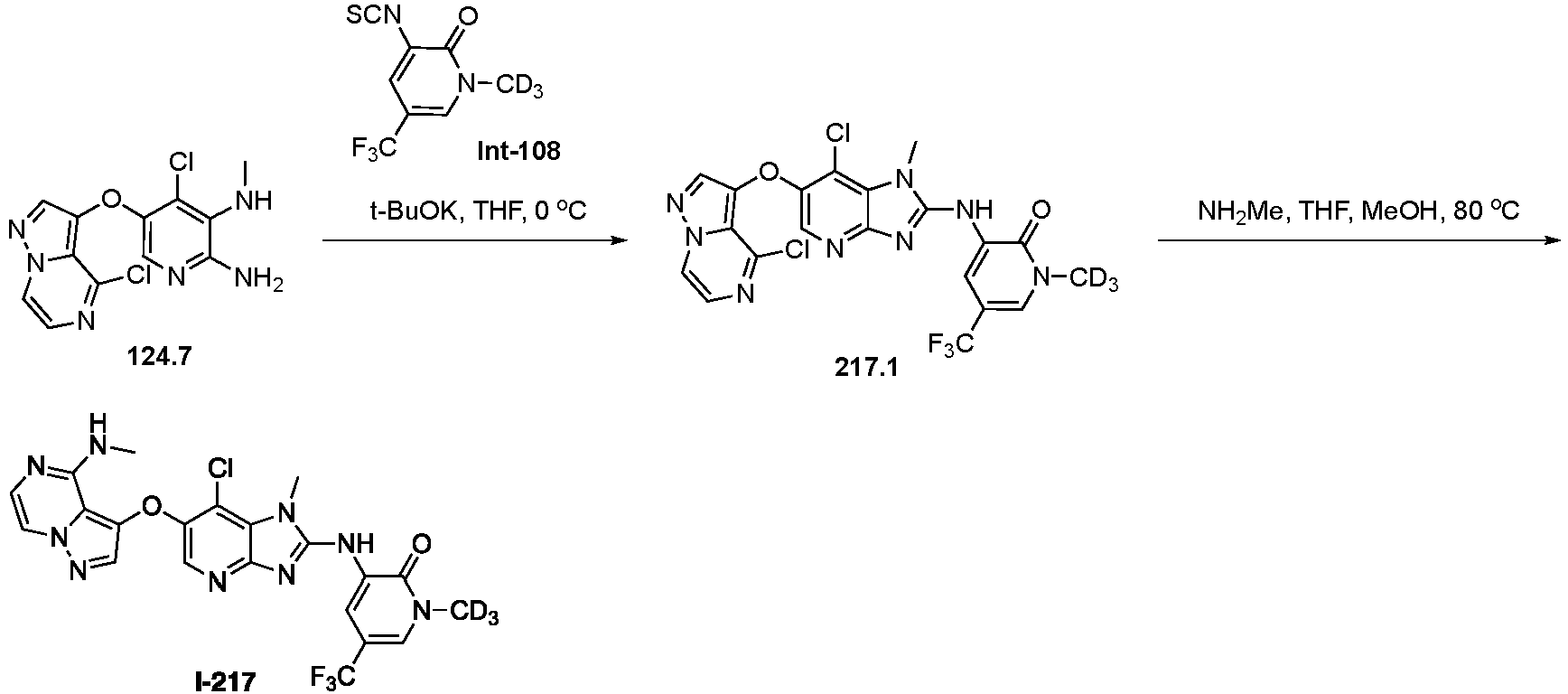
- Synthesis of compound 217.1. Compound 217.1 was prepared from 124.7 and Int-108, following the procedure described in the synthesis of I-13. The product was purified by flash column chromatography on silica gel (CombiFlash®, 1.5% methanol in DCM). MS(ES): m/z 529 [M+H]+.
- Synthesis of I-217. Compound I-217 was prepared from 217.1, following the procedure described in the synthesis of I-171. The product was purified by flash column chromatography on silica gel (CombiFlash®, 3.5% methanol in DCM). MS(ES): m/z 523.2 [M+H]+, 1H NMR (DMSO-d6, 400 MHz): δ 8.84 (s, 1H), 8.62 (s, 1H), 8.24 (s, 1H), 8.14 (s, 1H), 7.79-7.77 (d, J = 4.8 Hz, 1H), 7.50 (s, 1H), 7.26-7.25 (d, J = 4.8 Hz, 1H), 6.84 (s, 1H), 4.01 (s, 3H), 3.00-2.99 (d, 3H).
-

- Synthesis of compound 218.1. Compound 218.1 was prepared from 21.7 and Int-109, following the procedure described in the synthesis of I-13. The product was purified by flash column chromatography on silica gel (CombiFlash®, 1.5% methanol in DCM). MS(ES): m/z 632.0[M+H]+.
- Synthesis of compound 218.2. To a solution of 218.1 (0.080 g, 0.126 mmol, 1.0 equiv) in DCM (3 mL) was added trifluoroacetic acid (0.2 mL) dropwise at 0 °C. The reaction mixture was stirred at room temperature for 2 h. It was concentrated under reduced pressure to afford residue which was triturated with diethyl ether to afford 218.2. MS(ES): m/z 531.8 [M+H]+.
- Synthesis I-218. To a solution of 218.2 (0.050 g, 0.094 mmol, 1.0 equiv) in methanol (2 mL) was added formaldehyde (0.014 g, 0.47 mmol, 5.0 equiv), sodium triacetoxyborohydride (0.039 g, 0.188 mmol, 2.0 equiv) and acetic acid (0.1 mL). The reaction mixture was stirred at room temperature for 30 min. The reaction mixture was poured over ice-water and extracted with ethyl acetate. The combined organic layers were washed with brine, dried over anhydrous sodium sulfate, filtered and concentrated under reduced pressure. The residue was purified by preparative HPLC to afford I-218. MS(ES): m/z 545.2 [M+H]+, 1H NMR (DMSO-d6, 400 MHz): 9.66 (s, 1H), 9.03 (s, 1H), 8.70-8.69 (d, J = 4.0 Hz, 1H), 8.23 (s, 1H), 8.20 (s, 1H), 8.04 (s, 1H), 7.91-7.86 (m, 2H), 6.78 (s, 1H), 4.86-4.85 (m, 1H), 4.03 (s, 3H), 3.82 (bs, 2H), 3.05 (bs, 2H), 2.33 (s, 3H).
-

- Synthesis of compound 219.1. Compound 219.1 was prepared from 124.7 and Int-84, following the procedure described in the synthesis of I-13. The product was purified by column using 2.8% methanol in DCM). MS(ES): m/z 575.2 [M+H]+.
- Synthesis of I-219. Compound I-219 was prepared from 219.1, following the procedure described in the synthesis of I-171. The product was purified by flash column chromatography on silica gel (CombiFlash®, 4.2% methanol in DCM). MS(ES): m/z 569.1 [M+H]+, 1H NMR (DMSO-d6, 400 MHz): δ 9.87 (s, 1H), 8.39 (s, 1H), 8.30 (s, 1H), 8.22-8.21 (d, J = 5.6 Hz, 2H), 7.78-7.77 (d, J = 4.4 Hz, 1H), 7.65 (s, 1H), 7.47 (bs, 2H), 7.26-7.24 (d, J = 4.8 Hz, 1H), 6.83 (s, 1H), 4.05 (s, 3H), 2.99-2.98 (d, 3H), 2.20 (s, 3H).
-

- Synthesis of compound 220.1 Compound 220.1 was prepared from 124.7 and Int-78, following the procedure described in the synthesis of I-13. The product was purified by flash column chromatography on silica gel (CombiFlash®, 5.2% methanol in DCM). MS(ES): m/z 593.2 [M+H]+.
- Synthesis of I-220. Compound I-220 was prepared from 220.1, following the procedure described in the synthesis of I-171. The product was purified by trituration with methanol. MS(ES): m/z 587.2 [M+H]+, 1H NMR (DMSO-d6, 400 MHz): δ 9.58 (s, 1H), 8.21 (s, 1H), 7.86 (s, 1H), 7.80-7.79 (m, 2H), 7.48 (s, 1H), 7.28-7.27 (d, J = 4.8 Hz, 1H), 6.95 (s, 1H), 6.85-6.84 (d, J = 4.4 Hz, 1H), 4.05 (bs, 4H), 3.02-3.01 (d, 4H), 2.70 (s, 3H), 2.39 (bs, 6H).
-

- Synthesis of compound 221.1. To a mixture of Int-3 (0.1 g, 0.584 mmol, 1.0 equiv) and sodium carbonate (0.153 g, 1.46 mmol, 2.5 equiv) in DMF (2 mL) was added 124.5 (0.099 g, 0.584 mmol, 1.0 equiv) and the reaction mixture was stirred at room temperature for 1 h. It was poured over ice-water and extracted with ethyl acetate. The combined organic layers were washed with brine, dried over anhydrous sodium sulfate, filtered and concentrated under reduced pressure. The residue was purified by flash column chromatography on silica gel (CombiFlash®, 20% ethyl acetate in hexane) to afford 221.1. MS(ES): m/z 321.5 [M+H]+.
- Synthesis of compound 221.2. Compound 221.2 was prepared from 221.1, following the procedure described in the synthesis of 5.4. The product was purified by flash column chromatography on silica gel (CombiFlash®, 30% ethyl acetate in hexane). MS(ES): m/z 291.2 [M+H]+.
- Synthesis of compound 221.3 Compound 221.3 was prepared from 221.2 and Int-63, following the procedure described in the synthesis of I-13. The product was purified by flash column chromatography on silica gel (CombiFlash®, 3.2% methanol in DCM). MS(ES): m/z 491.6 [M+H]+.
- Synthesis of I-221. Compound I-221 was prepared from 221.3, following the procedure described in the synthesis of I-171. The product was purified by flash column chromatography on silica gel (CombiFlash®, 5.5% methanol in DCM). MS(ES): m/z 486.43[M+H]+, 1H NMR (MeOD, 400 MHz): δ 8.89 (s, 1H), 8.52 (bs, 1H), 8.23 (s, 1H), 7.89 (s, 1H), 7.72 (bs, 2H), 7.63 (s, 1H), 7.26 (bs, 1H), 3.79 (s, 3H), 3.76-3.75 (d, 3H), 3.08 (s, 3H).
-


- Synthesis of compound 222.1. To a 1 M aqueous solution of sodium hydroxide (51 mL, 135 mmol, 1.0 equiv) at 0 °C was added pyridine-2,3-diol (15 g, 135 mmol, 1.0 equiv). After 15 min, dimethyl sulfate (12.8 mL, 135 mmol, 1.0 equiv) was added at 0 °C. The reaction mixture was stirred at room temperature for 3 h. It was neutralized with acetic acid to pH 7 and extracted with dichloromethane. The combined organic layers were washed with brine, dried over anhydrous sodium sulfate, filtered and concentrated under reduced pressure. The residue was purified by flash column chromatography on silica gel (CombiFlash®, 3.2% methanol in dichloromethane) to afford 222.1. MS (ES): m/z 126.2 [M+H]+.
- Synthesis of compound 222.2. To a solution of 222.1 (4.0 g, 31.97 mmol, 1.0 equiv) in dichloromethane (40 mL) was added N-bromosuccinimide (6.79 g, 38.36 mmol, 1.2 equiv) at 0 °C. The reaction mixture was stirred at room temperature for 30 min. It was poured over ice-water, stirred and extracted with dichloromethane. The combined organic layers were washed with brine, dried over anhydrous sodium sulfate, filtered and concentrated under reduced pressure. The residue was purified by flash column chromatography on silica gel (CombiFlash®, 3% methanol in dichloromethane) to afford 222.2. MS (ES): m/z 205.1 [M+H]+.
- Synthesis of compound 222.3. To a solution of 222.2 (2.0 g, 9.8 mmol, 1.0 equiv) in dimethoxyethane (20 mL) was added cesium carbonate (7.96 g, 24.5 mmol, 2.5 equiv) and stirred at room temperature for 15 min. To the mixture was added 2-bromopropane (2.41 g, 19.61 mmol, 1.5 equiv). The reaction mixture was stirred at 80 °C for 16 h. It was poured over ice-water, stirred and extracted with ethyl acetate. The combined organic layers were washed with brine, dried over anhydrous sodium sulfate, filtered and concentrated under reduced pressure. The residue was purified by flash column chromatography on silica gel (CombiFlash®, 1.1% methanol in dichloromethane) to afford 222.3. MS (ES): m/z 247.1 [M+H]+.
- Synthesis of compound 222.4. Compound 222.4 was prepared from 222.3 following the procedure described in the synthesis of Int-23.2. The product was purified by flash column chromatography on silica gel (CombiFlash®, 2.5% methanol in dichloromethane). MS (ES): m/z 180.2 [M+H]+.
- Synthesis of compound 222.5. To a solution of 222.4 (0.950 g, 4.58 mmol, 1.0 equiv) in dichloromethane (10 mL) was added boron tribromide (0.88 mL, 9.16 mmol, 2.0 equiv) at 0 °C. The reaction mixture was stirred for 30 min. It was poured over saturated sodium bicarbonate solution, stirred and extracted with dichloromethane. The combined organic layers were washed with brine, dried over anhydrous sodium sulfate, filtered and concentrated under reduced pressure. The residue was purified by flash column chromatography on silica gel (CombiFlash®, 1.5% methanol in dichloromethane as eluant) to afford 222.5. MS (ES): m/z 194.3 [M+H]+.
- Synthesis of compound 222.6. To a solution of 124.6 (0.8 g, 2.25 mmol, 1.0 equiv) in ethanol (20 mL) was added N-diisopropylethylamine (0.870 g, 6.75 mmol, 3.0 equiv) followed by N-methylbenzylamine (1.361 g, 11.25 mmol, 5.0 equiv) and the reaction mixture was stirred at 80 °C for 16 h. It was cooled to room temperature, poured over ice-water and extracted with ethyl acetate. The combined organic layers were washed with brine, dried over anhydrous sodium sulfate, filtered and concentrated under reduced pressure. The residue was purified by flash column chromatography on silica gel (CombiFlash®, 50% ethyl acetate in hexane) to afford 222.6. MS(ES): m/z 440.5 [M+H]+.
- Synthesis of compound 222.7. Compound 222.7 was prepared from 222.6, following the procedure described in the synthesis of 5.4. The product was used in the next step without purification. MS(ES): m/z 410.5 [M+H]+.
- Synthesis of compound 222.8. To a solution of 222.7 (0.490 g, 1.20 mmol, 1.0 equiv) in THF (5 mL) was added thiocarbonyldiimidazole (1.068 g, 6.0 mmol, 5.0 equiv). The reaction mixture was heated to reflux for 1 h. It was concentrated under reduced pressure to afford residue which was transferred into water and precipitated product was filtered and dried well to afford 222.8. MS(ES): m/z 452.8 [M+H]+.
- Synthesis of compound 222.9. To a solution of 222.8 (0.390 g, 0.862 mmol, 1.0 equiv) in DMF (10 mL) was added potassium carbonate (0.237 g, 1.724 mmol, 2.0 equiv) followed by addition of methyl iodide (0.134 g, 0.948 mmol, 1.1 equiv). The reaction mixture was stirred at room temperature for 30 min. It was poured over ice-water and stirred. The precipitated solids were collected by filtration and dried under vacuum to afford 222.9. MS(ES): m/z 466.7 [M+H]+.
- Synthesis of compound 222.10. To a solution of 222.9 (0.310 g, 0.665 mmol, 1.0 equiv) in acetonitrile:water (1:1) (10 mL) was added oxone (0.857 g, 1.396 mmol, 2.1 equiv) and the reaction mixture was stirred at room temperature for 30 min. It was poured over ice-water and extracted with ethyl acetate. The combined organic layers were washed with brine, dried over anhydrous sodium sulfate, filtered and concentrated under reduced pressure. The residue was purified by flash column chromatography on silica gel (CombiFlash®, 2.1% methanol in DCM) to afford 222.10. MS(ES): m/z 498.6 [M+H]+.
- Synthesis of compound 222.11. A mixture of 222.10 (0.180 g, 0.361 mmol, 1.0 equiv), 222.5 (0.069 g, 0.361 mmol, 1.0 equiv) and potassium carbonate (0.149 g, 1.083 mmol, 3.0 equiv) in DMF (5 mL) was stirred at 80 °C for 4 h. It was poured over ice-water and extracted with ethyl acetate. The combined organic layers were washed with brine, dried over anhydrous sodium sulfate, filtered and concentrated under reduced pressure. The residue was purified by flash column chromatography on silica gel (CombiFlash®, 2.6% methanol in DCM) to afford 222.11. MS(ES): m/z 611.9 [M+H]+.
- Synthesis of I-222. Compound I-222 was prepared from 222.11, following the procedure described in the synthesis of I-23. The product was purified by flash column chromatography on silica gel (CombiFlash®, 3.9% methanol in DCM). MS(ES): m/z 521.2 [M+H]+, 1H NMR (DMSO-d6, 400 MHz): δ 8.27 (s, 1H), 7.95 (s, 1H), 7.77-7.75 (d, J = 8.0 Hz, 1H), 7.52 (s, 1H), 7.25 (s, 1H), 6.81 (s, 1H), 6.37 (bs, 1H), 5.02 (bs, 1H), 4.00 (s, 3H), 2.98 (s, 3H), 1.34-1.33 (d, 6H), 1.25 (bs, 1H), 1.10 (bs, 2H), 0.78 (bs, 2H).
-

- Synthesis of compound 223.1. Compound 223.1 was prepared from 124.7 and Int-110, following the procedure described in the synthesis of I-13. The product was purified by flash column chromatography on silica gel (CombiFlash®, 1.2% methanol in DCM). m/z 602.2 [M+H]+.
- Synthesis of compound 223.2. Compound 223.2 was prepared from 223.1, following the procedure described in the synthesis of I-171. The product was purified by trituration with methanol. MS(ES): m/z 596.5 [M+H]+.
- Synthesis of I-223. Compound I-223 was prepared from 223.2, following the procedure described in the synthesis of I-23. The product was purified by trituration with methanol. MS(ES): m/z 506.8 [M+H]+, 1H NMR (DMSO-d6, 400 MHz): δ 12.72 (s, 1H), 8.79 (s, 1H), 8.64-8.63 (d, J = 4.0 Hz, 1H), 8.24 (s, 1H), 7.79-7.78 (d, J = 4.0 Hz, 1H), 7.70 (s, 1H), 7.51 (s, 1H), 7.27-7.26 (d, J = 4.8 Hz, 1H), 6.84-6.83 (d, J = 4.0 Hz, 1H), 4.02 (s, 3H), 3.00-2.99 (d, 3H).
-

- Synthesis of I-224. A solution of 127.1 (0.050 g, 0.095 mmol, 1.0 equiv) in sodium methoxide solution (25% in methanol, 3 mL) stirred at 80 °C for 2 h. It was concentrated under reduced pressure. The residue was purified by trituration with methanol to afford I-224. MS(ES): m/z 521.06 [M+H]+, 1H NMR (DMSO-d6, 400 MHz): δ 8.28 (bs, 2H), 8.21-8.19 (m, 3H), 7.94 (s, 1H), 7.36-7.35 (m, 1H), 4.07 (s, 3H), 3.88 (s, 3H), 3.62 (s, 3H).
-

- Synthesis of 1-225. To a solution of 127.1 (0.050 g, 0.095 mmol, 1.0 equiv) in THF (3 mL) was added (S)-tetrahydrofuran-3-amine (0.082 g, 0.951 mmol, 10.0 equiv) followed by potassium carbonate (0.026 g, 0.190 mmol, 2.0 equiv). The reaction mixture was stirred at 80 °C for 3 days. It was cooled to room temperature, transferred into ice cold water and extracted with DCM. The combined organic layers were washed with brine, dried over anhydrous sodium sulfate, filtered and concentrated under reduced pressure. The residue was purified by trituration with methanol to afford I-225. MS(ES): m/z 576.2 [M+H]+, 1H NMR (DMSO-d6, 400 MHz): δ 8.63 (s, 1H), 8.31 (s, 1H), 8.15 (s, 1H), 7.89-7.88 (d, J = 4.0 Hz, 1H), 7.68 (s, 1H), 7.30-7.29 (d, J = 4.0 Hz, 1H), 6.32-6.31 (d, J = 4.0 Hz, 1H), 4.68 (bs, 1H), 4.02 (s, 3H), 3.94-3.90 (m, 1H), 3.86-3.84 (m, 1H), 3.77-3.67 (m, 6H), 2.35-2.25 (m, 2H).
-

- Synthesis of compound 226.1. Compound 226.1 was prepared from 124.7 and Int-111, following the procedure described in the synthesis of I-13. The product was purified by flash column chromatography on silica gel (CombiFlash®, 3.0% methanol in DCM). MS(ES): m/z 584.1 [M+H]+.
- Synthesis of I-226. Compound I-226 was prepared from 226.1, following the procedure described in the synthesis of I-171. The product was purified by flash column chromatography on silica gel (CombiFlash®, 5.6% methanol in DCM). MS(ES): m/z 577.9 [M]+, 1H NMR (DMSO-d6, 400 MHz): δ 9.81 (s, 1H), 8.36 (bs, 2H), 8.21 (s, 1H), 7.79-7.78 (d, J = 4.0 Hz, 1H), 7.48 (s, 1H), 7.27-7.26 (d, J = 4.0 Hz, 1H), 6.82 (s, 1H), 4.04 (s, 3H), 3.08 (s, 3H), 3.01-3.00 (d, 3H), 2.94 (s, 3H).
-

- Synthesis of compound 227.1. Compound 227.1 was prepared from 124.7 and Int-101, following the procedure described in the synthesis of I-13. The product was purified by flash column chromatography on silica gel (CombiFlash®, 5.0% methanol in DCM). MS(ES): m/z 608.2 [M+H]+.
- Synthesis of I-227. Compound I-227 was prepared from 227.1, following the procedure described in the synthesis of I-171. The product was purified by flash column chromatography on silica gel (CombiFlash®, 10% methanol in DCM). MS(ES): m/z 603.2 [M+H]+, 1H NMR (DMSO-d6, 400 MHz): δ 9.61 (s, 1H), 8.21 (s, 1H), 7.93 (s, 1H), 7.88 (s, 1H), 7.79-7.78 (d, J = 4.8 Hz, 1H), 7.47 (s, 1H), 7.26-7.25 (d, J = 4.8 Hz, 1H), 6.94 (s, 1H), 6.84-6.82 (d, J = 4.8 Hz, 1H), 4.5 (bs, 1H), 4.03 (s, 3H), 3.00-2.99 (d, 3H), 2.68-2.65 (m, 4H), 2.23 (s, 3H), 1.99 (bs, 2H), 1.73 (bs, 2H).
-

- Synthesis of compound 228.1. Compound 228.1 was prepared from 124.7 and Int-112, following the procedure described in the synthesis of I-13. The product was purified by flash column chromatography on silica gel (CombiFlash®, 10% methanol in DCM). MS(ES): m/z 594.3 [M+H]+.
- Synthesis of I-228. Compound I-228 was prepared from 228.1, following the procedure described in the synthesis of I-171. The product was purified by flash column chromatography on silica gel (CombiFlash®, 12% methanol in DCM). MS(ES): m/z 588.3 [M+H]+, 1H NMR (DMSO-d6, 400 MHz): δ 9.81 (s, 1H), 8.22 (s, 1H), 8.00 (s, 1H), 7.92 (s, 1H), 7.80-7.78 (d, J = 4.4 Hz, 1H), 7.49 (s, 1H), 7.28-7.26 (d, J = 4.4 Hz, 1H), 6.87 (s, 1H), 6.83-6.82 (d, J = 4.0 Hz, 1H), 5.04 (bs, 1H), 4.07 (s, 3H), 3.02-3.01 (d, 3H), 2.86 (bs, 2H), 2.41 (s, 3H), 2.30 (bs, 2H), 1.93 (bs, 1H), 1.58 (bs, 1H).
-


- Synthesis of compound 229.1. Compound 229.1 was prepared from 124.7 and Int-113, following the procedure described in the synthesis of I-13. The product was purified by flash column chromatography on silica gel (CombiFlash®, 10% methanol in DCM) to afford 229.1. MS(ES): m/z 594.3 [M+H]+.
- Synthesis I-229. Compound I-229 was prepared from 229.1, following the procedure described in the synthesis of I-171. The product was purified by flash column chromatography on silica gel (CombiFlash®, 12% methanol in DCM). MS(ES): m/z 588.2 [M+H]+, 1H NMR (DMSO-d6, 400 MHz): δ 9.78 (s, 1H), 8.22 (s, 1H), 7.98 (s, 1H), 7.91 (s, 1H), 7.80-7.79 (d, J = 4.0 Hz, 1H), 7.49 (s, 1H), 7.27-7.26 (d, J = 4.0 Hz, 1H), 6.86 (bs, 2H), 5.02 (bs, 1H), 4.06 (s, 3H), 3.01-3.00 (d, 3H), 2.81 (bs, 2H), 2.38 (bs, 5H), 1.93-1.90 (m, 1H), 1.58 (bs, 1H).
-

- Synthesis of compound 230.1. Compound 230.1 was prepared from 124.7 and Int-77, following the procedure described in the synthesis of I-13. The product was purified by flash column chromatography on silica gel (CombiFlash®, 1.8% methanol in DCM). MS(ES): m/z 529.2 [M+H]+.
- Synthesis of I-230. Compound I-230 was prepared from 230.1, following the procedure described in the synthesis of I-171. The product was purified by flash column chromatography on silica gel (CombiFlash®, 2.8% methanol in DCM). MS(ES): m/z 523.2 [M+H]+, 1H NMR (DMSO-d6, 400 MHz): δ 8.81 (s, 1H), 8.14 (s, 1H), 7.78 (bs, 2H), 7.48 (s, 1H), 7.26 (s, 1H), 6.81 (s, 1H), 4.53-4.52 (m, 2H), 3.99 (s, 3H), 3.00 (s, 3H), 2.38 (s, 3H), 1.39 (s, 9H).
-

- Synthesis of compound I-231. Compound I-231 was prepared from 21.7 and Int-114, following the procedure described in the synthesis of I-13. The product was purified by flash column chromatography on silica gel (CombiFlash®, 2.8% methanol in DCM). MS(ES): m/z 462.1 [M+H]+, 1H NMR (DMSO-d6, 400 MHz): δ 10.18 (s, 1H), 9.18 (s, 1H), 8.71-8.70 (d, J = 4.0 Hz, 1H), 8.33 (s, 1H), 8.09 (s, 1H), 7.90-7.89 (d, J = 4.0 Hz, 1H), 3.84 (s, 3H), 2.46 (s, 6H), 1.71 (bs, 1H), 1.03-1.01 (m, 2H), 0.53-0.52 (m, 2H).
-

- Synthesis of compound I-232. Compound I-232 was prepared from 21.7 and Int-115, following the procedure described in the synthesis of I-13. The product was purified by flash column chromatography on silica gel (CombiFlash®, 2.7% methanol in DCM). MS(ES): m/z 485.1 [M+H]+, 1H NMR (DMSO-d6, 400 MHz): δ 9.57 (s, 1H), 9.02 (s, 1H), 8.68 (bs, 1H), 8.12 (s, 1H), 8.01 (s, 1H), 7.86-7.85 (d, J = 4.8 Hz, 1H), 4.86 (s, 3H), 3.94 (s, 2H), 3.86 (s, 2H), 1.32 (s, 6H).
-

- Synthesis of compound 233.1. Compound 233.1 was prepared from 124.7 and Int-116, following the procedure described in the synthesis of I-13. The product was purified by flash column chromatography on silica gel (CombiFlash®, 2.2% methanol in DCM). MS(ES): m/z 551.1 [M+H]+.
- Synthesis of I-233. Compound I-233 was prepared from 233.1, following the procedure described in the synthesis of I-171. The product was purified by flash column chromatography on silica gel (CombiFlash®, 3.5% methanol in DCM). MS(ES): m/z 546.0 [M+H]+, 1H NMR (DMSO-d6, 400 MHz): δ 9.61 (s, 1H), 9.05 (bs, 2H), 8.70 (s, 1H), 8.31 (s, 1H), 8.07 (s, 1H), 7.88-7.87 (m, 1H), 4.16 (s, 3H), 4.01 (s, 3H), 2.69-2.67 (d, 3H).
-


- Synthesis of compound 234.1. Compound 234.1 was prepared from 124.7 and Int-74, following the procedure described in the synthesis of I-13. The product was purified by flash column chromatography on silica gel (CombiFlash®, 2.7% methanol in DCM). MS(ES): m/z 592.1 [M+H]+.
- Synthesis of I-234. Compound I-234 was prepared from 234.1, following the procedure described in the synthesis of I-171. The product was purified by flash column chromatography on silica gel (CombiFlash®, 3.4% methanol in DCM). MS(ES): m/z 586.6 [M+H]+, 1H NMR (DMSO-d6, 400 MHz): δ 9.90 (s, 1H), 8.72 (s, 1H), 8.48 (s, 1H), 8.24 (s, 1H), 7.79-7.78 (d, J = 4.8 Hz, 1H), 7.49 (s, 1H), 7.27-7.26 (d, J = 4.8 Hz, 1H), 6.83-6.82 (d, J = 4.0 Hz, 1H), 4.06 (s, 3H), 3.01 (s, 6H), 1.55 (s, 6H).
-

- Synthesis of compound 235.1. Compound 235.1 was prepared from 124.7 and Int-106, following the procedure described in the synthesis of I-13. The product was purified by flash column chromatography on silica gel (CombiFlash®, 3.0% methanol in DCM). m/z 570.2 [M+H]+.
- Synthesis of I-235. Compound I-235 was prepared from 235.1, following the procedure described in the synthesis of I-171. The product was purified by flash column chromatography on silica gel (CombiFlash®, 4.5% methanol in DCM). MS(ES): m/z 563.9 [M]+, 1H NMR (DMSO-d6, 400 MHz): δ 9.41 (s, 1H), 8.36-8.35 (d, J = 4.0 Hz, 1H), 8.18 (s, 1H), 7.78-7.76 (d, J= 8.0 Hz, 1H), 7.66-7.63 (d, J = 8.4 Hz, 1H), 7.47 (s, 1H), 7.25-7.24 (d, J = 4.0 Hz, 1H), 6.81 (s, 1H), 4.00 (s, 3H), 3.55 (s, 2H), 2.99-2.98 (d, 3H), 2.24 (s 6H).
-
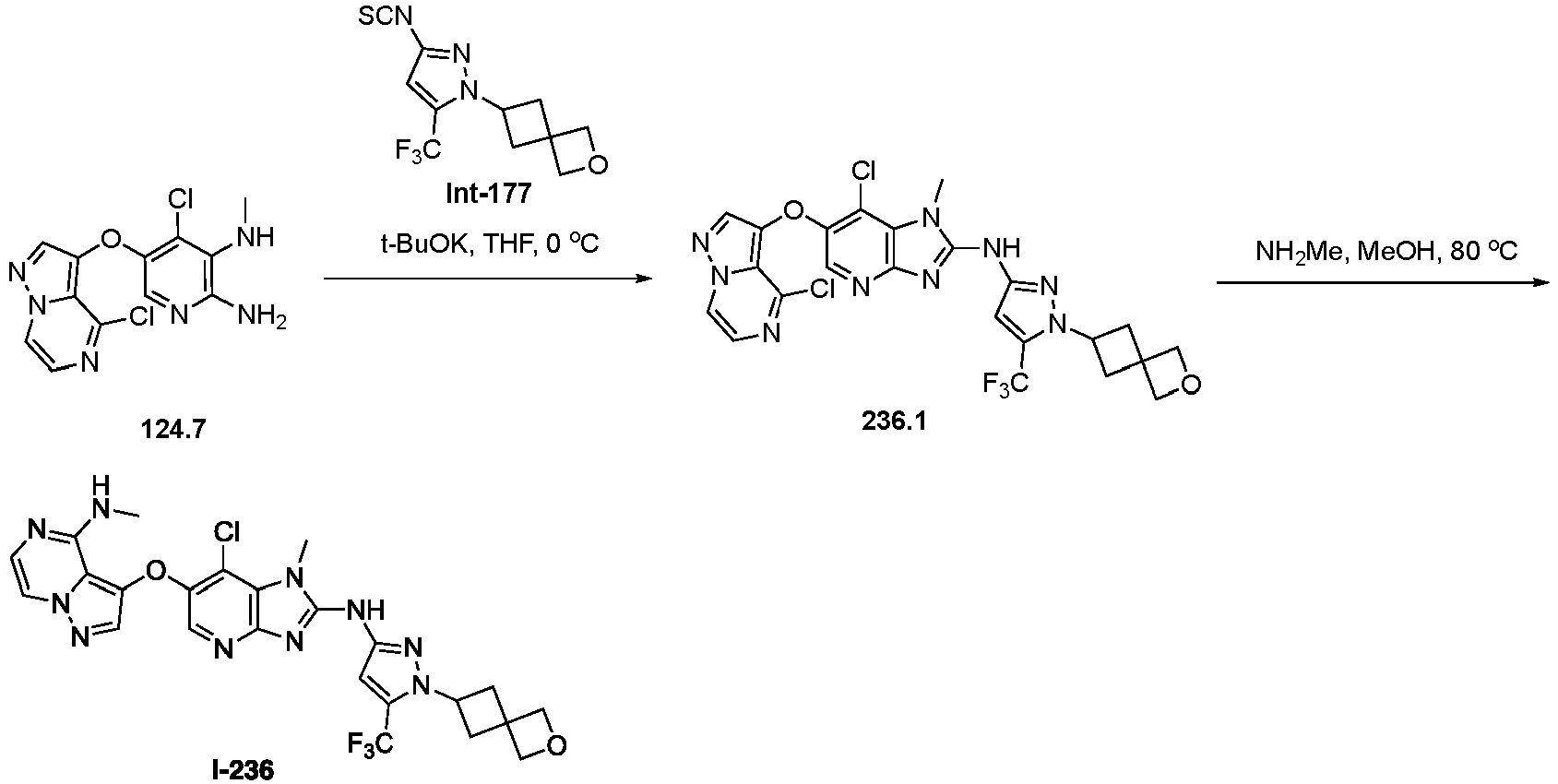
- Synthesis of compound 236.1. Compound 236.1 was prepared from 124.7 and Int-177, following the procedure described in the synthesis of I-13. The product was purified by flash column chromatography on silica gel (CombiFlash®, 1.4% methanol in DCM). MS(ES): m/z 580.9 [M+H]+.
- Synthesis of I-236. Compound I-236 was prepared from 236.1, following the procedure described in the synthesis of I-171. The product was purified by flash column chromatography on silica gel (CombiFlash®, 2.7% methanol in DCM). MS(ES): m/z 575.1 [M]+, 1H NMR (DMSO-d6, 400 MHz): δ 10.95 (s, 1H), 8.17 (s, 1H), 7.79-7.77 (d, J = 4.8 Hz, 1H), 7.48 (s, 1H), 7.32 (s, 1H), 7.26-7.25 (d, J = 4.8 Hz, 1H), 6.82 (s, 1H), 4.85-4.82 (m, 1H), 4.72 (s, 2H), 4.60 (s, 2H), 4.00 (s, 3H), 3.01-3.00 (s, 3H), 2.83-2.81 (m, 4H).
-

- Synthesis of compound 237.1. Compound 237.1 was prepared from 21.7 and Int-118, following the procedure described in the synthesis of I-13. The product was purified by flash column chromatography on silica gel (CombiFlash®, 2.8% methanol in DCM). MS(ES): m/z 650.0 [M+H]+.
- Synthesis of I-237. Compound I-237 was prepared from 237.1, following the procedure described in the synthesis of I-23. The product was purified by flash column chromatography on silica gel (CombiFlash®, 5.0% methanol in DCM). MS(ES): m/z 559.2 [M+H]+, 1H NMR (DMSO-d6, 400 MHz): δ 9.43 (s, 1H), 9.03 (s, 1H), 8.70-8.69 (d, J = 4.0 Hz, 1H), 8.21 (s, 1H), 8.05 (s, 1H), 7.89-7.88 (d, J = 4.0 Hz, 1H), 7.77-7.75 (d, J = 8.0 Hz, 2H), 6.89 (s, 1H), 4.74 (bs, 1H), 4.04 (s, 3H), 3.71 (bs, 1H), 3.63 (bs, 2H), 3.04-3.02 (m, 2H), 1.86 (bs, 2H), 1.53-1.51 (m, 2H).
-


- Synthesis of compound 238.1. Compound 238.1 was prepared from 21.7 and Int-119, following the procedure described in the synthesis of I-13. The product was purified by flash column chromatography on silica gel (CombiFlash®, 2.4% methanol in DCM). MS(ES): m/z 636.1 [M+H]+.
- Synthesis of I-238. Compound I-238 was prepared from 238.1, following the procedure described in the synthesis of I-23. The product was purified by flash column chromatography on silica gel (CombiFlash®, 3.9% methanol in DCM). MS(ES): m/z 545.3 [M+H]+, 1H NMR (DMSO-d6, 400 MHz): δ 9.41 (s, 1H), 9.03 (s, 1H), 8.70-8.69 (d, J = 4.0 Hz, 1H), 8.19 (s, 1H), 8.04 (s, 1H), 7.88-7.87 (d, J = 4.0 Hz, 1H), 7.61 (s, 1H), 7.37 (s, 1H), 6.44 (s, 1H), 5.04-5.03 (d, J = 4.0 Hz, 1H), 4.46 (bs, 1H), 4.03 (s, 3H), 3.51-3.48 (m, 1H), 3.43-3.39 (m, 2H), 3.18-3.16 (m, 1H), 2.11-2.07 (m, 1H), 1.97-1.96 (m, 1H).
-

- Synthesis of compound 239.1. Compound 239.1 was prepared from 21.7 and Int-120, following the procedure described in the synthesis of I-13. The product was purified by flash column chromatography on silica gel (CombiFlash®, 2.4% methanol in DCM). MS(ES): m/z 636.1 [M+H]+.
- Synthesis of I-239. Compound I-239 was prepared from 239.1, following the procedure described in the synthesis of I-23. The product was purified by flash column chromatography on silica gel (CombiFlash®, 3.9% methanol in DCM). MS(ES): m/z 545.3 [M+H]+, 1H NMR (DMSO-d6, 400 MHz): δ 9.41 (s, 1H), 9.03 (s, 1H), 8.70-8.69 (d, J = 4.0 Hz, 1H), 8.19 (s, 1H), 8.04 (s, 1H), 7.88-7.87 (d, J = 4.0 Hz, 1H), 7.61 (s, 1H), 7.36 (s, 1H), 6.44 (s, 1H), 5.04-5.03 (d, J = 4.0 Hz, 1H), 4.45 (bs, 1H), 4.03 (s, 3H), 3.51-3.48 (m, 1H), 3.43-3.39 (m, 2H), 3.18-3.16 (m, 1H), 2.11-2.07 (m, 1H), 1.97-1.96 (m, 1H).
-

- Synthesis of compound I-240. Compound I-240 was prepared from I-234, following the procedure described in the synthesis of I-157. The product was purified by flash column chromatography on silica gel (CombiFlash®, 2.8% methanol in DCM). MS (ES): m/z 577.3 [M+H]+, 1H NMR (DMSO-d6, 400 MHz): δ 10.09 (s, 1H), 8.73 (s, 1H), 8.48 (s, 1H), 8.13 (s, 1H), 7.84-7.83 (d, J = 4.8 Hz, 1H), 7.76 (s, 1H), 7.30-7.29 (d, J = 4.8 Hz, 1H), 6.81 (bs, 1H), 4.03 (s, 3H), 2.99 (s, 3H), 2.97-2.96 (d, 3H), 1.53 (s, 6H).
-


- Synthesis of compound 241.1. Compound 241.1 was prepared from 124.7 and Int-121, following the procedure described in the synthesis of I-13. The product was purified by flash column chromatography on silica gel (CombiFlash®, 2.5% methanol in DCM). MS(ES): m/z 608.2 [M+H]+.
- Synthesis of I-241. Compound I-241 was prepared from 241.1, following the procedure described in the synthesis of I-171. The product was purified by flash column chromatography on silica gel (CombiFlash®, 4.0% methanol in DCM). MS(ES): m/z 602.7 [M+H]+, 1H NMR (DMSO-d6, 400 MHz): δ 9.67 (s, 1H), 8.20 (s, 1H), 7.96 (s, 1H), 7.90 (s, 1H), 7.78-7.77 (d, J = 4.0 Hz, 1H), 7.47 (s, 1H), 7.26-7.25 (d, J = 4.0 Hz, 1H), 6.94 (s, 1H), 6.82-6.81 (d, J = 4.0 Hz, 1H), 4.13 (bs, 2H), 4.03 (s, 3H), 3.09 (bs, 1H), 3.00-2.99 (d, 3H), 2.57 (bs, 3H), 2.05 (bs, 2H), 1.80-1.65 (m, 4H).
-

- Synthesis of compound 242.1. Compound 242.1 was prepared from 124.7 and Int-122, following the procedure described in the synthesis of I-13. The product was purified by flash column chromatography on silica gel (CombiFlash®, 2.5% methanol in DCM). MS(ES): m/z 608.2 [M+H]+.
- Synthesis of I-242. Compound I-242 was prepared from 242.1, following the procedure described in the synthesis of I-171. The product was purified by flash column chromatography on silica gel (CombiFlash®, 4.0% methanol in DCM). MS(ES): m/z 603.0 [M+H]+, 1H NMR (DMSO-d6, 400 MHz): δ 9.71 (s, 1H), 8.20 (s, 1H), 7.98 (s, 1H), 7.92 (s, 1H), 7.79-7.77 (d, J = 4.8 Hz, 1H), 7.48 (s, 1H), 7.27-7.25 (d, J = 4.8 Hz, 1H), 6.95 (s, 1H), 6.82-6.81 (d, J = 4.4 Hz, 1H), 4.14 (bs, 2H), 4.05 (s, 3H), 3.09 (bs, 1H), 3.01-3.00 (d, 3H), 2.57 (bs, 3H), 2.07 (bs, 2H), 1.78-1.70 (m, 4H).
-

- Synthesis of I-243. Compound I-243 was prepared from 21.7 and Int-121, following the procedure described in the synthesis of I-13. The product was purified by flash column chromatography on silica gel (CombiFlash®, 3.0% methanol in DCM). MS(ES): m/z: 573.3 [M+H]+. 1H NMR (DMSO-d6, 400 MHz): δ 9.61 (s, 1H), 9.02 (s, 1H), 8.69-8.68 (d, J = 4.0 Hz, 1H), 8.21 (s, 1H), 8.03 (s, 1H), 7.94 (s, 1H), 7.87 (bs, 2H), 6.92 (s, 1H), 4.08 (bs, 2H), 4.02 (s, 3H), 3.00 (bs, 1H), 2.42 (s, 3H), 2.25 (bs, 2H), 2.01-1.99 (m, 2H), 1.72 (bs, 2H).
-

- Synthesis of I-244. Compound I-244 was prepared from 21.7 and Int-122, following the procedure described in the synthesis of I-13. The product was purified by flash column chromatography on silica gel (CombiFlash®, 3.0% methanol in DCM). MS(ES): m/z 573.2 [M+H]+, 1H NMR (DMSO-d6, 400 MHz): δ 9.61 (s, 1H), 9.01 (s, 1H), 8.68 (bs, 1H), 8.20 (s, 1H), 8.03 (s, 1H), 7.94 (s, 1H), 7.87 (bs, 2H), 6.92 (s, 1H), 4.09 (bs, 2H), 4.02 (s, 3H), 3.02 (bs, 1H), 2.43 (s, 3H), 2.25 (bs, 2H), 2.02 (bs, 2H), 1.73 (bs, 2H).
-

- Synthesis of compound (±)-245.1. Compound (±)-245.1 was prepared from 124.7 and (±)-Int-51, following the procedure described in the synthesis of I-13. The product was purified by flash column chromatography on silica gel (CombiFlash®, 2.3% methanol in DCM). m/z 596.36 [M+H]+.
- Synthesis of compound I-245-a and I-245-b. The racemate was prepared from (±)-245.1, following the procedure described in the synthesis of I-171. The product was purified by flash column chromatography on silica gel (CombiFlash®, 3.1% methanol in DCM). MS(ES): m/z 590.5 [M+H]+. It was subjected for chiral HPLC separation (column: CHIRALPAK IB-N (250 mm * 21 mm, 5 µm); mobile phase: (A) 0.1% DEA in n-hexane; (B) 0.1% DEA in isopropanol:acetonitrile (70:30); flow rate = 20 mL/min) to afford first eluting fraction (I-245-a) and second eluting fraction (I-245-b). (*Absolute stereochemistry not determined.)
- I-245-a: MS(ES): m/z 590.3 [M+H]+, 1H NMR (DMSO-d6, 400 MHz): δ 8.91 (s, 1H), 8.61 (s, 1H), 8.23 (s, 1H), 8.10 (s, 1H), 7.77 (bs, 1H), 7.49 (s, 1H), 7.25 (bs, 1H), 6.83 (s, 1H), 4.88 (bs, 1H), 4.00 (s, 3H), 3.87-3.79 (m, 2H), 3.55-3.53 (m, 1H), 2.98 (s, 3H), 2.21-2.19 (m, 1H), 2.09 (bs, 1H), 2.00 (bs, 1H), 1.75 (bs, 2H).
- I-245-b: MS(ES): m/z 590.1 [M+H]+, 1H NMR (DMSO-d6, 400 MHz): δ 8.91 (s, 1H), 8.62 (s, 1H), 8.23 (s, 1H), 8.10 (s, 1H), 7.78-7.77 (d, J = 4.8 Hz, 1H), 7.49 (s, 1H), 7.25-7.24 (d, J = 4.8 Hz, 1H), 6.84 (s, 1H), 4.88 (bs, 1H), 4.00 (s, 3H), 3.87-3.79 (m, 2H), 3.55-3.52 (m, 1H), 2.98 (s, 3H), 2.21-2.19 (m, 1H), 2.09 (bs, 1H), 2.00 (bs, 1H), 1.76 (bs, 2H).
-

- Synthesis of compound 246.1. Compound 246.1 was prepared from 124.7 and Int-93, following the procedure described in the synthesis of I-13. The product was purified by flash column chromatography on silica gel (CombiFlash®, 3.0% methanol in DCM). MS(ES): m/z 582.1 [M+H]+.
- Synthesis of I-246. Compound I-246 was prepared from 246.1, following the procedure described in the synthesis of I-171. The product was purified by flash column chromatography on silica gel (CombiFlash®, 3.5% methanol in DCM). MS(ES): m/z 576.2 [M+H]+, 1H NMR (DMSO-d6, 400 MHz): δ 9.66 (s, 1H), 8.31 (s, 1H), 8.20-8.19 (d, J = 3.2 Hz, 1H), 8.07 (s, 1H), 7.77-7.76 (d, J = 4.2 Hz, 1H), 7.47-7.46 (d, J = 3.2 Hz, 1H), 7.26-7.25 (d, J = 3.6 Hz, 2H), 6.81 (s, 1H), 5.29-5.15 (m, 1H), 4.03-4.02 (d, 3H), 3.75 (s, 2H), 3.61-3.59 (m, 2H), 3.26-3.19 (m, 2H), 2.99 (s, 3H).
-
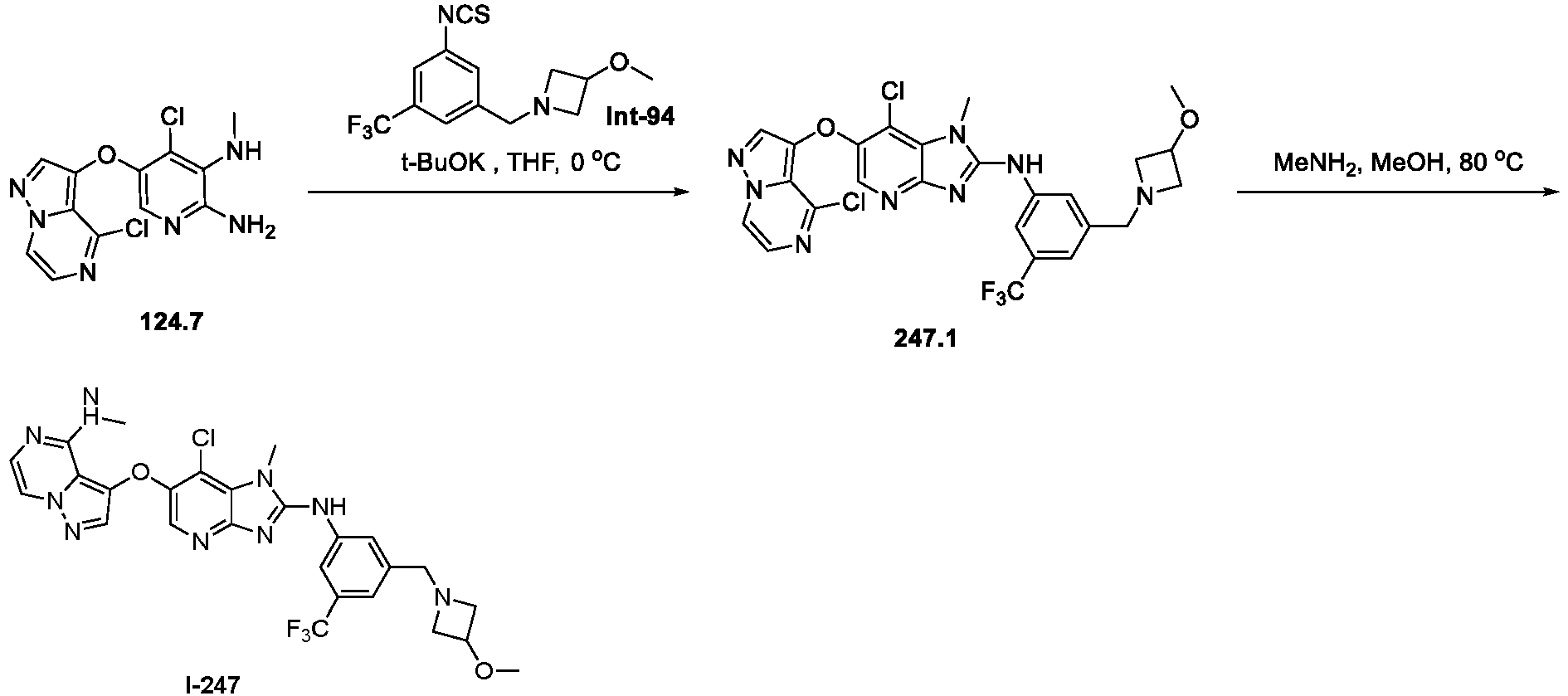
- Synthesis of compound 247.1. Compound 247.1 was prepared from 124.7 and Int-94, following the procedure described in the synthesis of I-13. The product was purified by flash column chromatography on silica gel (CombiFlash®, 2.2% methanol in DCM). MS(ES): m/z 594.2 [M+H]+.
- Synthesis of I-247: Compound I-247 was prepared from 247.1, following the procedure described in the synthesis of I-171. The product was purified by flash column chromatography on silica gel (CombiFlash®, 3.8% methanol in DCM). MS(ES): m/z : 588.2 [M+H]+, 1H NMR (DMSO-d6, 400MHz): δ 9.66 (s, 1H), 8.31 (s, 1H), 8.19-8.17 (d, J=7.6Hz, 1H), 8.06 (s, 1H), 7.77 (s, 1H), 7.47-7.45 (d, J=7.6Hz, 1H), 7.26 (bs, 2H), 6.81 (s, 1H), 4.02 (s, 3H), 3.71 (bs, 2H), 3.55 (bs, 2H), 3.34 (bs, 2H), 3.18-3.16 (d, 3H), 2.99-2.94 (m, 4H).
-

- Synthesis of compound 248.1. Compound 248.1 was prepared from 124.7 and Int-63, following the procedure described in the synthesis of I-13. The product was purified by flash column chromatography on silica gel (CombiFlash®, 2.0% methanol in DCM). MS(ES): m/z 526.2 [M+H]+.
- Synthesis of I-248. A mixture of 248.1 (0.060 g, 0.114 mmol, 1.0 equiv), potassium carbonate (0.047 g, 0.342 mmol, 3.0 equiv) and 2-morpholinoethan-1-amine (0.16 g,0.125 mmol, 1.1 equiv) in DMF (2 mL) was stirred at 70 °C for 72 h. It was filtered and filtrate was transferred into water, stirred and extracted with ethyl acetate. The combined organic layers were washed with brine, dried over anhydrous sodium sulfate, filtered and concentrated under reduced pressure. The residue was purified by flash column chromatography on silica gel (CombiFlash®, 3.4% methanol in DCM). MS(ES): m/z 619.2 [M+H]+, 1H NMR (DMSO-d6, 400 MHz): δ 8.83 (s, 1H), 8.61 (s, 1H), 8.24 (s, 1H), 8.13 (s, 1H), 7.81-7.80 (d, J = 4.8 Hz, 1H), 7.60 (s, 1H), 7.26-7.25 (d, J = 4.8 Hz, 1H), 6.72 (s, 1H), 4.01 (bs, 4H), 3.66 (s, 3H), 3.58 (bs, 3H), 3.42 (bs, 4H), 2.38 (bs, 4H).
-


- Synthesis of compound 249.1. To a solution of 124.7 (0.100 g, 0.307 mmol, 1.0 equiv) and Int-85 (0.116 g, 0.369 mmol, 1.2 equiv) in THF (5 mL) was added potassium tert-butoxide (1 M in THF) (0.9 mL, 0.921 mmol, 3.0 equiv) at -78 °C and stirred for 30 min. The reaction mixture was poured over ice-water and extracted with ethyl acetate. The combined organic layers were washed with brine, dried over anhydrous sodium sulfate, filtered and concentrated under reduced pressure. The residue was dissolved in THF (3 mL) and N-(3-dimethylaminopropyl)-N'-ethylcarbodiimide hydrochloride (0.175 g, 0.921 mmol, 3.0 equiv) was added. The reaction mixture was heated at 80 °C for 2 h. It was poured over water and extracted with ethyl acetate. The combined organic layers were washed with brine, dried over anhydrous sodium sulfate, filtered and concentrated under reduced pressure. The residue was purified by flash column chromatography on silica gel (CombiFlash®, 4.8% methanol in DCM). MS (ES): m/z 608.2 [M+H]+.
- Synthesis of I-249. Compound I-249 was prepared from 249.1, following the procedure described in the synthesis of I-171. The product was purified by flash column chromatography on silica gel (CombiFlash®, 6.8 % methanol in DCM). MS(ES): m/z 602.3 [M+H]+, 1H NMR (DMSO-d6, 400 MHz): δ 9.70 (s, 1H), 8.38 (s, 1H), 8.22 (s, 1H), 8.10 (s, 1H), 7.81-7.79 (d, J = 8.0 Hz, 1H), 7.49 (s, 1H), 7.32 (s, 1H), 7.28-7.27 (d, J = 4.0 Hz, 1H), 6.85-6.84 (d, J = 4.0 Hz, 1H), 4.05 (s, 3H), 3.94 (bs, 1H), 3.71 (bs, 2H), 3.20 (s, 3H), 3.03-3.01 (d, 3H), 2.75 (bs, 2H), 2.06-2.03 (m, 2H), 1.71 (bs, 2H).
-

- Synthesis of compound 250.1. Compound 250.1 was prepared from 124.7 and Int-86, following the procedure described in the synthesis of 249.1. The product was purified by flash column chromatography on silica gel (CombiFlash®, 4.8% methanol in DCM). MS (ES): m/z 608.2 [M+H]+.
- Synthesis of I-250. Compound I-250 was prepared from 250.1, following the procedure described in the synthesis of I-171. The product was purified by flash column chromatography on silica gel (CombiFlash®, 6.8 % methanol in DCM). MS(ES): m/z 602.4 [M+H]+, 1H NMR (DMSO-d6, 400 MHz): δ 9.69 (s, 1H), 8.37 (s, 1H), 8.21 (s, 1H), 8.09 (s, 1H), 7.80-7.79 (d, J = 4.0 Hz, 1H), 7.49 (s, 1H), 7.32 (s, 1H), 7.27-7.26 (d, J = 4.0 Hz, 1H), 6.84-6.83 (d, J = 4.0 Hz, 1H), 4.05 (s, 3H), 3.94 (bs, 1H), 3.71 (bs, 2H), 3.19 (s, 3H), 3.02-3.00 (d, 3H), 2.75 (bs, 2H), 2.07-2.04 (m, 2H), 1.72 (bs, 2H).
-
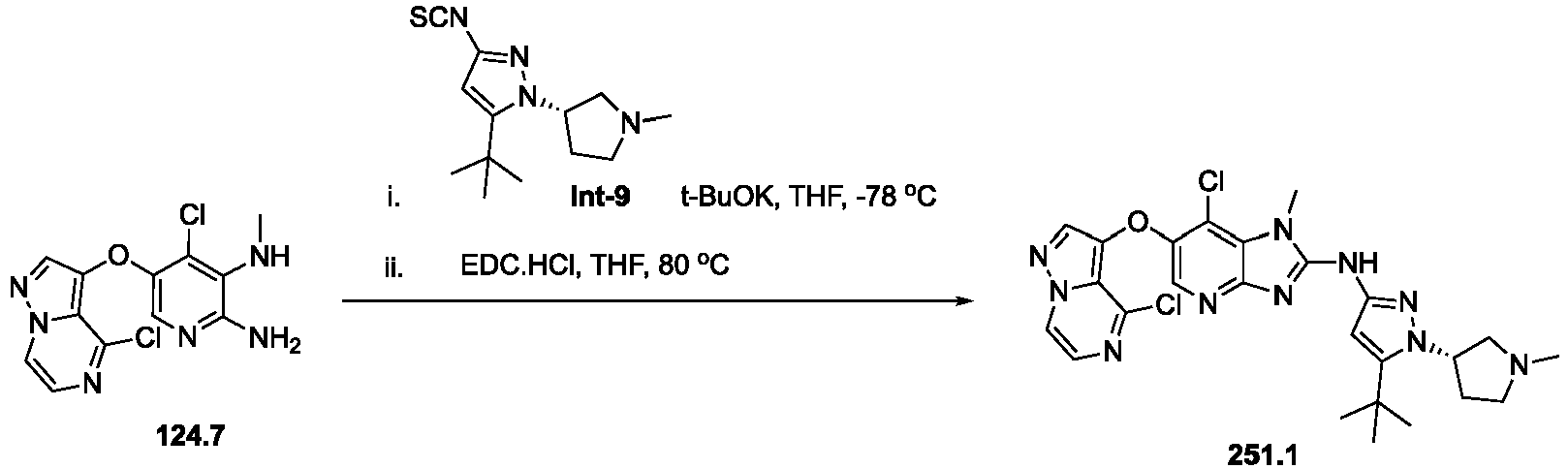

- Synthesis of compound 251.1. Compound 251.1 was prepared from 124.7 and Int-9, following the procedure described in the synthesis of 249.1. The product was purified by flash column chromatography on silica gel (CombiFlash®, 7.5% methanol in DCM). MS (ES): m/z 642.3 [M+H]+.
- Synthesis of I-251. Compound I-251 was prepared from 251.1, following the procedure described in the synthesis of I-171. The product was purified by preparative HPLC. MS(ES): m/z 550.4 [M+H]+, 1H NMR (DMSO-d6, 400 MHz): δ 9.97 (s, 1H), 8.10 (s, 1H), 7.77-7.76 (d, J = 4.4 Hz, 1H), 7.47 (s, 1H), 7.26-7.25 (d, J = 4.4 Hz, 1H), 6.79-6.78 (d, J = 4.0 Hz, 1H), 6.52 (s, 1H), 5.08 (bs, 1H), 3.96 (s, 3H), 3.00-2.99 (m, 3H), 2.73-2.62 (m, 3H), 2.34-2.31 (m, 6H), 1.39 (s, 9H).
-

- Synthesis of compound 252.1. Compound 252.1 was prepared from 124.7 and Int-10, following the procedure described in the synthesis of 249.1. The product was purified by flash column chromatography on silica gel (CombiFlash®, 8.0% methanol in DCM). MS (ES): m/z 642.4 [M+H]+.
- Synthesis of I-252. Compound I-252 was prepared from 252.1, following the procedure described in the synthesis of I-171. The product was purified by preparative HPLC. MS(ES): m/z 551.1 [M+H]+, 1H NMR (DMSO-d6, 400 MHz): δ 9.96 (s, 1H), 8.12 (s, 1H), 7.77 (bs, 1H), 7.47 (s, 1H), 7.25 (bs, 1H), 6.79 (bs, 1H), 6.51 (s, 1H), 5.26 (bs, 1H), 3.96 (s, 3H), 3.00 (s, 3H), 2.68-2.63 (m, 3H), 2.34-2.25 (m, 6H), 1.40 (s, 9H).
-

- Synthesis of I-253. Compound I-253 was prepared from 24.7 and Int-123, following the procedure described in the synthesis of I-13. The product was purified by flash column chromatography on silica gel (CombiFlash®, 2.8% methanol in DCM). MS(ES): m/z 490.5 [M+H]+, 1H NMR (DMSO-d6, 400 MHz): δ 10.13 (s, 1H), 9.09 (s, 1H), 8.71-8.69 (d, J = 4.8 Hz, 1H), 8.32 (s, 1H), 8.08 (s, 1H), 7.89-7.88 (d, J = 4.8 Hz, 1H), 3.85 (s, 3H), 2.71 (bs, 1H), 2.42 (s, 6H), 1.94 (bs, 2H), 1.85 (bs, 2H), 1.70 (bs, 4H).
-


- Synthesis of compound 254.1. Compound 254.1 was prepared from 124.7 and Int-124, following the procedure described in the synthesis of I-13. The product was purified by flash column chromatography on silica gel (CombiFlash®, 5.0% methanol in DCM). m/z 592.2 [M+H]+.
- Synthesis of I-254. Compound I-254 was prepared from 254.1, following the procedure described in the synthesis of I-171. The product was purified by flash column chromatography on silica gel (CombiFlash®, 7.0% methanol in DCM). MS(ES): m/z 586.6 [M+H]+, 1H NMR (DMSO-d6, 400 MHz): δ 9.84 (s, 1H), 8.29 (s, 1H), 8.18 (s, 1H), 8.11 (s, 1H), 7.76 (s, 1H), 7.47 (s, 1H), 7.25 (bs, 2H), 6.81 (s, 1H), 4.05 (s, 3H), 2.99 (s, 3H), 2.75-2.67 (m, 1H), 2.60 (bs, 4H), 1.97 (bs, 4H), 1.33 (s, 3H).
-

- Synthesis of compound 255.1. Compound 255.1 was prepared from 124.7 and Int-125, following the procedure described in the synthesis of 249.1. The product was purified by flash column chromatography on silica gel (CombiFlash®, 2.8% methanol in DCM). MS(ES): m/z 552.1 [M+H]+.
- Synthesis of I-255. Compound I-255 was prepared from 255.1, following the procedure described in the synthesis of I-171. The product was purified by flash column chromatography on silica gel (CombiFlash®, 3.5% methanol in DCM). MS(ES): m/z 546.2 [M+H]+, 1H NMR (DMSO-d6, 400 MHz): δ 9.69 (s, 1H), 8.35 (s, 1H), 8.20 (s, 1H), 8.11 (s, 1H), 7.79-7.77 (d, J = 4.4 Hz, 1H), 7.47 (s, 1H), 7.31 (s, 1H), 7.26-7.25 (d, J = 4.4 Hz, 1H), 6.84-6.83 (d, J = 4.4 Hz, 1H), 4.03 (s, 3H), 3.56 (bs, 2H), 3.00-2.99 (d, 3H), 2.25 (bs, 6H).
-

- Synthesis of I-256. Compound I-256 was prepared from 24.7 and Int-126, following the procedure described in the synthesis of I-13. The product was purified by flash column chromatography on silica gel (CombiFlash®, 2.8% methanol in DCM). MS(ES): m/z 529.3 [M+H]+, 1H NMR (DMSO-d6, 400 MHz): δ 9.71 (s, 1H), 9.02 (s, 1H), 8.70-8.69 (d, J = 4.0 Hz, 1H), 8.30 (s, 1H), 8.21 (s, 1H), 8.11 (s, 1H), 8.04 (s, 1H), 7.88-7.86 (d, J = 8.0 Hz, 1H), 7.30 (s, 1H), 4.03 (s, 3H), 3.79 (bs, 2H), 2.08 (bs, 2H), 1.24 (bs, 4H).
-


- Synthesis of compound 257.1. To a solution of 5-bromo-1H-pyrrolo[2,3-b]pyridine (10.0 g, 50.75 mmol, 1.0 equiv) in DCM (100 mL) was added benzyltriethylammonium chloride (0.230 g, 1.015 mmol, 0.02 equiv), followed by powdered sodium hydroxide (6.33 g, 158.3 mmol, 3.12 equiv) and cooled to 0 °C. To the mixture was added benzyl sulphonyl chloride (11.16 g, 63.43 mmol, 1.25 equiv) and the reaction mixture was stirred at 0 °C for 1 h. It was filtered through a pad of Celite® and rinsed with DCM. The filtrate was concentrated under reduced pressure. The residue was purified by flash column chromatography on silica gel (CombiFlash®, DCM) to afford 257.1. MS (ES): m/z 338.1 [M+H]+.
- Synthesis of compound 257.2. A solution of 257.1 (2.0 g, 5.93 mmol, 1.0 equiv), bis(pinacolato)diboron (3.02 g, 11.86 mmol, 2.0 equiv) and potassium acetate (1.16 g, 11.86 mmol, 2.0 equiv) in 1,4-dioxane (15 mL) was degassed by bubbling argon through for 5 min. To the mixture was added 1,1-bis(diphenylphosphino)ferrocene-palladium(II) dichloride DCM complex (0.868 g, 1.186 mmol, 0.2 equiv) and degassed for another 5 min. The reaction mixture was heated at 100 °C for 30 min. It was cooled to room temperature and transferred into ice cold water, stirred and extracted with ethyl acetate. The combined organic layers were washed with brine, dried over anhydrous sodium sulfate, filtered and concentrated under reduced pressure. To the residue was added acetonitrile (70 mL), methanol (70 mL) and hydrogen peroxide (20 mL). The reaction mixture was stirred at room temperature for 16 h. It was poured over ice cold water, stirred and extracted with ethyl acetate. The combined organic layers were washed with brine, dried over anhydrous sodium sulfate, filtered and concentrated under reduced pressure to afford 257.2. MS(ES): m/z 275.1 [M+H]+.
- Synthesis of compound 257.3. Compound 257.3 was prepared from 257.2 and Int-4, following the procedure described in the synthesis of 19.1. The product was used in the next step without purification. MS(ES): m/z 460.5 [M+H]+.
- Synthesis of compound 257.4. Compound 257.4 was prepared from 257.3, following the procedure described in the synthesis of 5.4. The product was purified by flash column chromatography on silica gel (CombiFlash®, 2% methanol in DCM). MS(ES): m/z 430.2 [M+H]+.
- Synthesis of I-257. Compound I-257 was prepared from 257.4 and Int-63, following the procedure described in the synthesis of I-13. The product was purified by flash column chromatography on silica gel (CombiFlash®, 4.2% methanol in DCM). MS(ES): m/z 490.2 [M+H]+, 1H NMR (DMSO-d6, 400 MHz): δ 11.69 (s, 1H), 8.79 (s, 1H), 8.62-8.61 (d, J = 2.0 Hz, 1H), 8.13-8.09 (m, 3H), 7.50-7.48 (m, 2H), 6.37 (s, 1H), 4.00 (s, 3H), 3.66 (s, 3H).
-
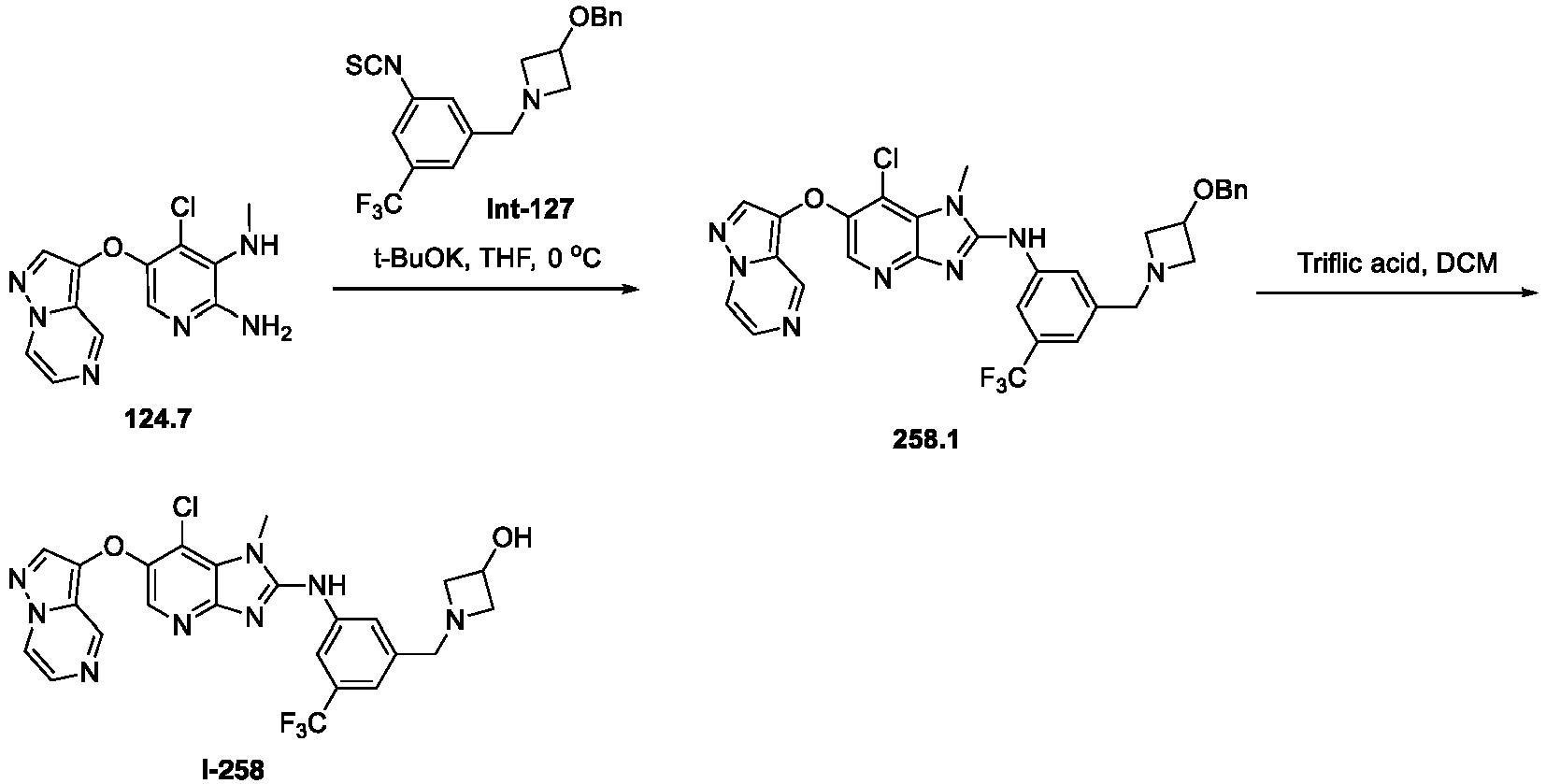
- Synthesis of compound 258.1. Compound 258.1 was prepared from 124.7 and Int-127, following the procedure described in the synthesis of I-13. The product was purified by flash column chromatography on silica gel (CombiFlash®, 3.0% methanol in DCM). MS(ES): m/z 636.0 [M+H]+.
- Synthesis of I-258. Compound I-258 was prepared from 258.1, following the procedure described in the synthesis of I-23. The product was purified by flash column chromatography on silica gel (CombiFlash®, 3.7% methanol in DCM). MS(ES): m/z 545.2 [M+H]+, 1H NMR (DMSO-d6, 400 MHz): δ 9.75 (s, 1H), 9.02 (s, 1H), 8.70-8.69 (d, J = 4.0 Hz, 1H), 8.30 (s, 1H), 8.21 (bs, 2H), 8.04 (s, 1H), 7.88-7.87 (d, J = 4.0 Hz, 1H), 7.40 (s, 1H), 5.82 (bs, 1H), 4.40 (bs, 1H), 4.04 (s, 3H), 3.41 (bs, 2H), 2.68 (bs, 4H).
-

- Synthesis of compound 259.1. Compound 259.1 was prepared from 124.7 and Int-109, following the procedure described in the synthesis of I-13. The product was purified by flash column chromatography on silica gel (CombiFlash®, 2.2% methanol in DCM) to afford 259.1. MS(ES): m/z 666.3 [M+H]+.
- Synthesis of compound 259.2. To a solution of 259.1 (0.120 g, 0.180 mmol, 1.0 equiv) in DCM (3 mL) was added trifluoroacetic acid (0.2 mL) dropwise at 0 °C. The reaction mixture was stirred at room temperature for 2 h. It was concentrated under reduced pressure to afford residue which was triturated with diethyl ether to afford 259.2. MS(ES): m/z 566.2 [M+H]+.
- Synthesis of compound 259.3. To a solution of 259.2 (0.100 g, 0.176 mmol, 1.0 equiv) in methanol (5 mL) was added formaldehyde (0.026 g, 0.880 mmol, 5.0 equiv), sodium triacetoxyborohydride (0.074 g, 0.352 mmol, 2.0 equiv) and acetic acid (0.1 mL). The reaction mixture was stirred at room temperature for 30 min. The reaction mixture was poured over ice-water and extracted with ethyl acetate. The combined organic layers were washed with brine, dried over anhydrous sodium sulfate, filtered and concentrated under reduced pressure. The residue was purified by flash column chromatography on silica gel (CombiFlash®, 8.0% methanol in DCM) afford 259.3. MS(ES): m/z 579.9 [M+H]+.
- Synthesis of I-259. Compound I-259 was prepared from 259.3, following the procedure described in the synthesis of I-171. The product was purified by flash column chromatography on silica gel (CombiFlash®, 11% methanol in DCM). MS(ES): m/z 574.2 [M+H]+, 1H NMR (DMSO-d6, 400 MHz): δ 9.81 (s, 1H), 8.20 (s, 1H), 7.98 (s, 1H), 7.90 (s, 1H), 7.78-7.77 (d, J = 4.8 Hz, 1H), 7.47 (s, 1H), 7.25-7.24 (d, J = 4.8 Hz, 1H), 6.80 (bs, 2H), 5.02 (bs, 1H), 4.04 (s, 3H), 4.00-3.96 (m, 2H), 3.61 (bs, 2H), 2.99-2.98 (d, 3H), 2.36 (s, 3H).
-

- Synthesis of compound 260.1. To solution of 5-bromo-1H-pyrazolo[3,4-b]pyridine (5.0 g, 25.25 mmol, 1.0 equiv) in DMF (50 mL) was added sodium hydride (1.5 g, 37.87 mmol, 1.5 equiv) at 0 °C portionwise and reaction mixture was stirred for 15 min followed by addition of 2-(trimethylsilyl) ethoxymethyl choride (6.32 g, 37.87 mmol, 1.5 equiv). The reaction mixture was stirred at room temperature for 3 h. It was poured over water and extracted with ethyl acetate. The combined organic layers were washed with brine, dried over anhydrous sodium sulfate, filtered and concentrated under reduced pressure to afford 260.1. MS(ES): m/z 328.1 [M+H]+.
- Synthesis of compound 260.2. A solution of 260.1 (5.2 g, 15.84 mmol, 1.0 equiv), bis(pinacolato)diboron (8.04 g, 31.68 mmol, 2.0 equiv) and potassium acetate (3.10 g, 31.68 mmol, 2.0 equiv) in 1,4-dioxane (50 mL) was degassed by bubbling through a stream of argon for 5 min. To the mixture was added 1,1-bis(diphenylphosphino)ferrocene-palladium(II) dichloride DCM complex (2.31 g, 3.168 mmol, 0.2 equiv) and degassed for another 5 min. It was stirred at 100 °C for 30 min, cooled to room temperature, transferred into ice cold water, stirred and extracted with ethyl acetate. The combined organic layers were washed with brine, dried over anhydrous sodium sulfate, filtered and concentrated under reduced pressure. The residue was added acetonitrile (100 mL), methanol (100 mL) and hydrogen peroxide (30 mL). The mixture was stirred at room temperature for 16 h. It was poured over ice cold water, stirred and extracted with ethyl acetate. The combined organic layers were washed with brine, dried over anhydrous sodium sulfate, filtered and concentrated under reduced pressure to afford 260.2. MS(ES): m/z 266.2 [M+H]+.
- Synthesis of compound 260.3. Compound 260.3 was prepared from 260.2 and Int-4, following the procedure described in the synthesis of 19.1. The product was purified by flash column chromatography on silica gel (CombiFlash®, 30% ethyl acetate in hexane). MS(ES): m/z 451.6 [M+H]+.
- Synthesis of compound 260.4. Compound 260.4 was prepared from 260.3, following the procedure described in the synthesis of 5.4. The product was purified by flash column chromatography on silica gel (CombiFlash®, 2.0% methanol in DCM). MS(ES): m/z 421.3 [M+H]+.
- Synthesis of compound 260.5. Compound 260.5 was prepared from 260.4 and Int-63, following the procedure described in the synthesis of I-13. The product was purified by flash column chromatography on silica gel (CombiFlash®, 2.2% methanol in DCM). MS(ES): m/z 622.8 [M+H]+.
- Synthesis of compound 260.6. Compound 260.6 was prepared from 260.5, following the procedure described in the synthesis of I-157. The product was purified by flash column chromatography on silica gel (CombiFlash®, 3.0% methanol in DCM). MS (ES): m/z 612.5 [M+H]+.
- Synthesis of I-260. To a solution of 260.6 (0.110 g, 0.179 mmol, 1.0 equiv) in THF (2.0 mL) was added tetra-n-butyl ammonium fluoride (1 M in THF, 4 mL) and stirred at 80 °C for 16 h. The reaction mixture was cooled to room temperature, transferred into water and extracted with ethyl acetate. The combined organic layers were washed with brine, dried over anhydrous sodium sulfate, filtered and concentrated under reduced pressure. The residue was purified by flash column chromatography on silica gel (CombiFlash®, 3.5% methanol in DCM) to afford I-260. MS (ES): m/z 482.2 [M+H] +, 1H NMR (DMSO-d6, 400 MHz): δ 13.82 (s, 1H), 9.03 (s, 1H), 8.66-8.65 (d, J = 4.0 Hz, 1H), 8.61-8.60 (d, J = 4.0 Hz, 1H), 8.20 (s, 1H), 8.13 (bs, 2H), 7.99-7.98 (d, J = 4.0 Hz, 1H), 4.01 (s, 3H), 3.69 (s, 3H).
-
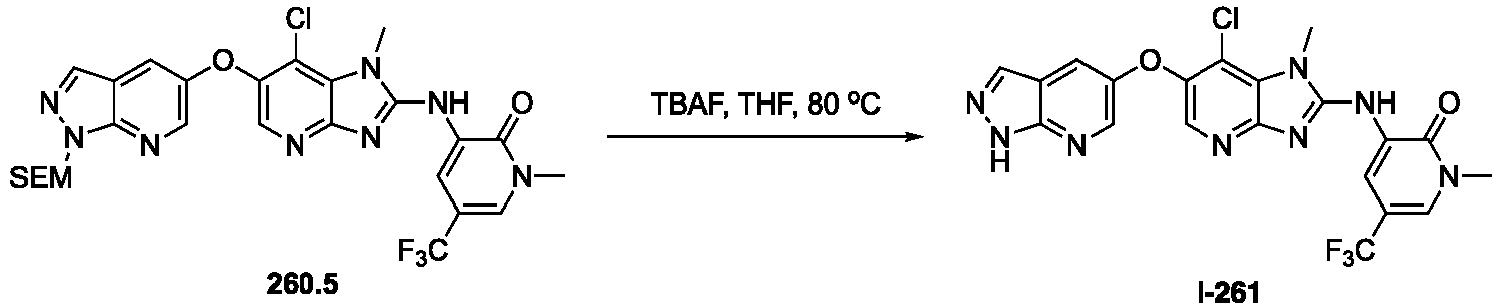
- Synthesis of I-261. To a solution of 260.5 (0.160 g, 0.257 mmol, 1.0 equiv) in THF (3.0 mL) was added tetra-n-butyl ammonium fluoride (5 mL). The reaction mixture was stirred at 80 °C for 16 h. It was cooled to room temperature, transferred into water and extracted with ethyl acetate. The combined organic layers were washed with brine, dried over anhydrous sodium sulfate, filtered and concentrated under reduced pressure. The residue was purified by flash column chromatography on silica gel (CombiFlash®, 3.5% methanol in DCM) to afford I-261. MS (ES): m/z 491.2 [M+H] +, 1H NMR (DMSO-d6, 400 MHz): δ 13.71 (s, 1H), 8.86 (s, 1H), 8.63-8.62 (d, J = 4.0 Hz, 1H), 8.54-8.53 (d, J = 4.0 Hz, 1H), 8.19 (s, 1H), 8.15 (bs, 1H), 8.01 (s, 1H), 7.65-7.64 (d, J= 4.0 Hz, 1H), 4.00 (s, 3H), 3.66 (s, 3H).
-

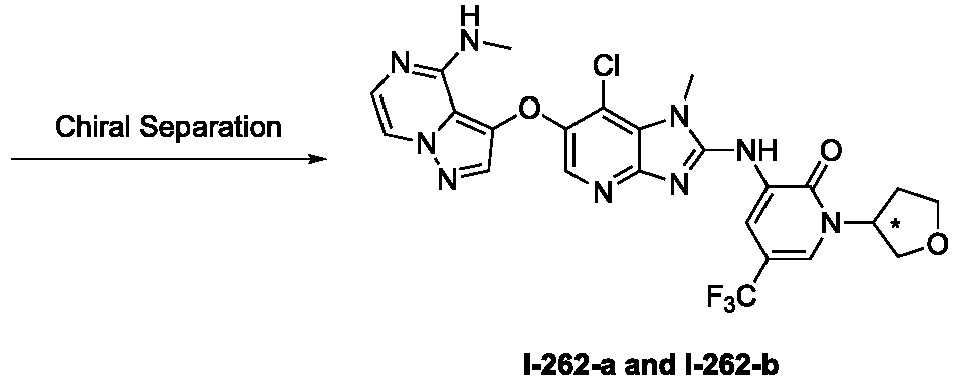
- Synthesis of compound (±)-262.1. Compound (±)-262.1 was prepared from 124.7 and (±)-Int-128, following the procedure described in the synthesis of I-13. The product was purified by flash column chromatography on silica gel (CombiFlash®, 2.0% methanol in DCM). MS(ES): m/z 582.1 [M+H]+.
- Synthesis of compound I-262-a and I-262-b. To a solution (±)-262.1 (0.140 g, 0.240 mmol, 1.0 equiv) in methanol (2 mL) was added methylamine solution (2 M in THF, 1.4 mL) and stirred at 80 °C for 16 h. It was concentrated under reduced pressure. The residue was purified by flash column chromatography on silica gel (CombiFlash®, 5.0% methanol in DCM). The racemate was separated by HPLC (column: CHIRALPAK IB-N (250 mm * 21 mm, 5 µm); mobile phase: (A) 0.1% DEA in n-hexane (B) 0.1% DEA in isopropanol:acetonitrile (70:30); flow rate = 20 mL/min) to afford first eluting fraction (I-262-a) and second eluting fraction (I-262-b). (*Absolute stereochemistry not determined.)
- I-262-a: MS(ES): m/z 576.2 [M+H]+, 1H NMR (DMSO-d6, 400 MHz): δ 8.90 (s, 1H), 8.62 (s, 1H), 8.24 (s, 1H), 7.78-7.77 (d, J = 4.8 Hz, 1H), 7.74 (s, 1H), 7.50 (s, 1H), 7.26-7.24 (d, J = 4.8 Hz, 1H), 6.83-6.82 (d, J= 4.4 Hz, 1H), 5.48 (bs, 1H), 4.12-4.06 (m, 2H), 4.01 (s, 3H), 3.92-3.90 (m, 1H), 3.80-3.78 (m, 1H), 2.99-2.98 (d, 3H), 2.14 (bs, 2H).
- I-262-b: MS(ES): m/z 576.2 [M+H]+, 1H NMR (DMSO-d6, 400 MHz): δ 8.91 (s, 1H), 8.63 (s, 1H), 8.25 (s, 1H), 7.80-7.79 (d, J = 4.8 Hz, 1H), 7.75 (s, 1H), 7.51 (s, 1H), 7.27-7.26 (d, J = 4.8 Hz, 1H), 6.85 (bs, 1H), 5.49 (bs, 1H), 4.15-4.10 (m, 2H), 4.03 (s, 3H), 3.94-3.90 (m, 1H), 3.81-3.77 (m, 1H), 3.00-2.99 (d, 3H), 2.16 (bs, 2H).
-

- Synthesis of compound 263.1. Compound 263.1 was prepared from 124.7 and Int-126, following the procedure described in the synthesis of I-13. The product was purified by flash column chromatography on silica gel (CombiFlash®, 7.0% methanol in DCM) t. m/z 564.3 [M+H]+.
- Synthesis of I-263. Compound I-263 was prepared from 263.1, following the procedure described in the synthesis of I-171. The product was purified by trituration in diethyl ether. MS(ES): m/z 558.2 [M]+, 1H NMR (DMSO-d6, 400 MHz): δ 9.81 (s, 1H), 8.33 (s, 1H), 8.21 (s, 1H), 8.17 (s, 1H), 7.79-7.78 (d, J = 4.8 Hz, 1H), 7.48 (s, 1H), 7.36 (s, 1H), 7.27-7.26 (d,J = 4.8 Hz, 1H), 6.83-6.82 (d, J = 4.0 Hz, 1H), 4.05 (s, 3H), 3.91 (bs, 2H), 3.45 (bs, 2H), 3.01-3.00 (d, 3H), 2.38 (s, 2H), 2.14 (s, 2H).
-


- Synthesis of compound 264.1. Compound 264.1 was prepared from 124.7 and Int-127, following the procedure described in the synthesis of 249.1. The product was purified by flash column chromatography on silica gel (CombiFlash®, 2.4% methanol in DCM). MS (ES): m/z 670.3 [M+H]+.
- Synthesis of compound 264.2. Compound 264.2 was prepared from 264.1, following the procedure described in the synthesis of I-171. The product was purified by trituration in methanol. MS(ES): m/z 664.8 [M+H]+.
- Synthesis of I-264. Compound I-264 was prepared from 264.2, following the procedure described in the synthesis of I-23. The product was purified by flash column chromatography on silica gel (CombiFlash®, 5.4% methanol in DCM). MS(ES): m/z 574.2 [M+H]+, 1H NMR (DMSO-d6, 400 MHz): δ 9.71 (s, 1H), 8.31 (s, 1H), 8.21 (s, 1H), 8.14 (s, 1H), 7.79-7.78 (d, J = 4.8 Hz, 1H), 7.48 (s, 1H), 7.33 (s, 1H), 7.27-7.26 (s, 1H), 6.83-6.82 (d, J = 4.0 Hz, 1H), 5.58 (bs, 1H), 4.32 (bs, 1H), 4.04 (s, 3H), 3.74 (bs, 2H), 3.01-3.00 (d, 3H), 2.62 (bs, 4H).
-

- Synthesis of I-265. Compound I-265 was prepared from I-257, following the procedure described in the synthesis of I-157. The product was purified by flash column chromatography on silica gel (CombiFlash®, 3.5% methanol in DCM). MS (ES): m/z 481.3 [M+H] +, 1H NMR (DMSO-d6, 400 MHz): δ 11.82 (s, 1H), 8.97 (s, 1H), 8.63 (s, 1H), 8.22-8.21 (d, J = 2.4 Hz, 1H), 8.17 (s, 1H), 7.99 (s, 1H), 7.77 (s, 1H), 7.57 (s, 1H), 6.45 (s, 1H), 3.99 (s, 3H), 3.67 (s, 3H).
-

- Synthesis of I-266. Compound I-266 was prepared from 61.2 and Int-129, following the procedure described in the synthesis of I-53. The product was purified by flash column chromatography on silica gel (CombiFlash®, 2.4% methanol in DCM). MS(ES): m/z 481.2 [M+H]+. 1H NMR (DMSO-d6, 400 MHz): δ 9.03 (s, 1H), 8.70-8.69 (d, J = 4.4 Hz, 1H), 8.47 (s, 1H), 8.23 (s, 1H), 8.20 (s, 1H), 8.04 (s, 1H), 7.88-7.87 (d, J = 4.8 Hz, 1H), 3.98 (s, 3H), 3.56 (s, 3H), 1.89 (bs, 1H), 0.96-0.94 (m, 2H), 0.63-0.62 (m, 2H).
-

- Synthesis of compound (±)-267.1. Compound (±)-267.1 was prepared from 21.7 and (±)-trans-Int-130, following the procedure described in the synthesis of I-13. The product was purified by flash column chromatography on silica gel (CombiFlash®, 2.1% methanol in DCM). MS(ES): m/z 626.1 [M+H]+.
- Synthesis of compound (±)-267.2. To solution of (±)-267.1 (0.125 g, 0.199 mmol, 1.0 equiv) in DCM (3 mL) was added trifluoroacetic acid (1 mL) at 0 °C and stirred for 30 min. It was transferred into ice-saturated sodium bicarbonate solution and extracted with DCM. The combined organic layers were washed with brine, dried over anhydrous sodium sulfate, filtered, and concentrated under reduced pressure to afford (±)-267.2. MS(ES): m/z 525.5 [M+H]+.
- Synthesis of compound (±)-I-267. To a solution of (±)-267.2 (0.080 g, 0.152 mmol, 1.0 equiv) and formaldehyde (0.022 g, 0.76 mmol, 5.0 equiv) in methanol (2 mL) and THF (2 mL) was added sodium triacetoxyborohydride (0.096 g, 0.456 mmol, 3.0 equiv) and acetic acid (0.2 mL). The reaction mixture was stirred at room temperature for 30 min. It was poured into ice-water and extracted with ethyl acetate. The combined organic layers were washed with brine, dried over anhydrous sodium sulfate, filtered, and concentrated under reduced pressure. The residue was purified by flash column chromatography on silica gel (CombiFlash®, 4.2% methanol in DCM) to afford (±)-I-267. MS(ES): m/z 539.3 [M+H]+.
- I-267-a and I-276-b. (±)-I-267 was submitted to HPLC separation (column: CHIRALPAK IB-N (250 mm * 21 mm, 5 µm); mobile phases: (A) 0.1% DEA in hexane, (B) 0.1% DEA in propan-2-ol:acetonitrile (70:30); flow rate: 20 mL/min) to afford first eluting fraction (I-267-a) and second eluting fraction (I-267-b). (*Absolute stereochemistry not determined.)
- I-267-a: MS(ES): m/z 539.3 [M+H]+, 1H NMR (DMSO-d6, 400 MHz): δ 9.05 (s, 1H), 8.71 (s, 1H), 8.11-8.04 (m, 2H), 7.89 (bs, 2H), 6.25 (s, 1H), 5.49 (bs, 1H), 5.35 (bs, 1H), 3.96 (bs, 2H), 3.78 (bs, 2H), 3.46 (s, 3H), 2.34 (s, 3H), 1.27 (s, 9H).
- I-267-b: MS(ES): m/z 539.3 [M+H]+, 1H NMR (DMSO-d6, 400 MHz): δ 9.05 (s, 1H), 8.71 (s, 1H), 8.12-8.05 (m, 2H), 7.89 (bs, 2H), 6.29 (s, 1H), 5.49 (bs, 1H), 5.36 (bs, 1H), 3.97 (bs, 2H), 3.79 (bs, 2H), 3.46 (s, 3H), 2.35 (s, 3H), 1.28 (s, 9H).
-

- Synthesis of I-268. Compound I-268 was prepared from 21.7 and Int-131, following the procedure described in the synthesis of I-13. The product was purified by flash column chromatography on silica gel (CombiFlash®, 2.8% methanol in DCM) to afford I-268 (0.040 g, Yield: 20.32%). MS(ES): m/z 477.3 [M+H]+, 1H NMR (DMSO-d6, 400 MHz): δ 9.95 (s, 1H), 9.07 (s, 1H), 8.69 (bs, 1H), 8.26 (s, 1H), 8.05 (s, 1H), 7.87 (bs, 1H), 4.02-4.01 (m, 4H), 3.83 (s, 3H), 2.33 (s, 6H), 2.19-2.17 (m, 2H).
-

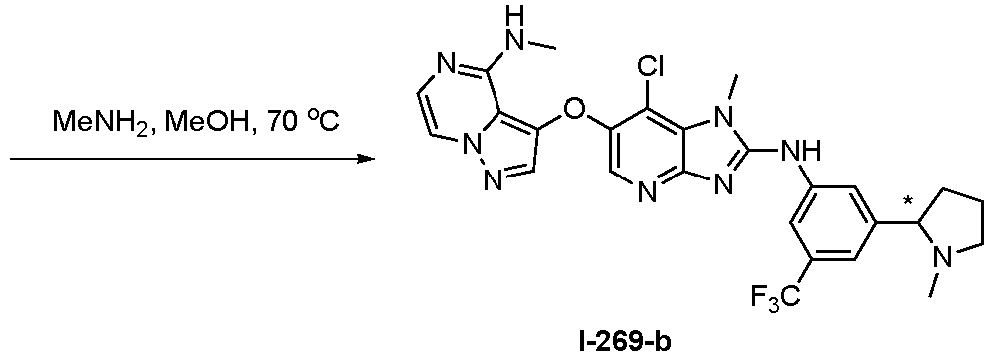
- Synthesis of compound 269.1. Compound 269.1 was prepared from 124.7 and Int-132-a, following the procedure described in the synthesis of I-51. The product was purified by flash column chromatography on silica gel (CombiFlash®, 5.0% methanol in DCM). MS(ES): m/z 578.2 [M+H]+.
- Synthesis of I-269-a. To a solution of 269.1 (0.061 g, 0.105 mmol, 1.0 equiv) in methanol (2 mL) was added methylamine solution (2 M in THF, 0.6 mL) and stirred at 70 °C for 4 h. It was transferred into ice-saturated sodium bicarbonate solution and extracted with ethyl acetate. The combined organic layers were washed with brine, dried over anhydrous sodium sulfate, filtered, and concentrated under reduced pressure. The residue was purified by flash column chromatography on silica gel (CombiFlash®, 5.2% methanol in DCM) to afford I-269-a. MS(ES): m/z 572.3 [M+H]+, 1H NMR (DMSO-d6, 400 MHz): δ 9.68 (s, 1H), 8.39 (s, 1H), 8.20-8.19 (d, J = 3.6 Hz, 1H), 8.09 (s, 1H), 7.78-7.77 (d, J = 4.8 Hz, 1H), 7.48-7.47 (d, J = 4.0 Hz, 1H), 7.32 (s, 1H), 7.26-7.25 (d, J = 4.4 Hz, 1H), 6.82 (bs, 1H), 4.04-4.03 (d, 3H), 3.21 (s, 3H), 3.00 (s, 3H), 2.30-2.28 (m, 1H), 2.17 (bs, 2H), 1.83 (bs, 2H), 1.57 (bs, 2H). (*Absolute stereochemistry not determined.)
- Synthesis of compound I-269-b. Compound I-269-b was prepared from compound 124.7 and Int-132-b, following the procedures described in the synthesis of I-269-a. The product was purified by flash column chromatography on silica gel (CombiFlash®, 5.4% methanol in DCM). MS(ES): m/z 572.3 [M+H]+, 1H NMR (DMSO-d6, 400 MHz): δ 9.68 (s, 1H), 8.38 (s, 1H), 8.19 (s, 1H), 8.08 (s, 1H), 7.78-7.77 (d, J = 4.8 Hz, 1H), 7.47 (d, J = 4.0 Hz, 1H), 7.31 (s, 1H), 7.25-7.24 (d, J = 4.4 Hz, 1H), 6.83-6.82 (d, J = 4.4 Hz, 1H), 4.02 (s, 3H), 3.21 (bs, 3H), 2.99 (s, 3H), 2.30-2.28 (m, 1H), 2.16 (bs, 2H), 1.82 (bs, 2H), 1.57 (bs, 2H). (*Absolute stereochemistry not determined.)
-

- Synthesis of I-270-a. Compound I-270-a was prepared from 61.2 and Int-132.3, following the procedure described in the synthesis of I-53. The product was purified by flash column chromatography on silica gel (CombiFlash®, 3.5% methanol in DCM). MS(ES): m/z 543.2 [M+H]+, 1H NMR (DMSO-d6, 400 MHz): δ 9.67 (s, 1H), 9.03 (bs, 1H), 8.70-8.69 (d, J = 4.8 Hz, 1H), 8.39 (s, 1H), 8.21 (s, 1H), 8.08 (s, 1H), 8.04 (s, 1H), 7.88-7.87 (d, J = 4.8 Hz, 1H), 7.32 (s, 1H), 4.04 (s, 3H), 3.23-3.22 (m, 2H), 2.35 (bs, 1H), 2.16 (bs, 3H), 1.90-1.81 (m, 2H), 1.62 (bs, 2H).
- Synthesis of I-270-b. Compound I-270-b was prepared from 61.2 and Int-132.4, following the procedure described in the synthesis of I-53. The product was purified by flash column chromatography on silica gel (CombiFlash®, 3.5% methanol in DCM). MS(ES): m/z 543.2 [M+H]+, 1H NMR (DMSO-d6, 400 MHz): δ 9.66 (s, 1H), 9.01 (bs, 1H), 8.69-8.68 (d, J = 4.8 Hz, 1H), 8.37 (s, 1H), 8.20 (s, 1H), 8.06 (s, 1H), 8.03 (s, 1H), 7.87-7.86 (d, J = 4.8 Hz, 1H), 7.30 (s, 1H), 4.02 (s, 3H), 3.21-3.17 (m, 2H), 2.32 (bs, 1H), 2.15 (bs, 3H), 1.86-1.80 (m, 2H), 1.61 (bs, 2H).
-

- Synthesis of I-271. Compound I-271 was prepared from 61.2 and Int-133.2, following the procedure described in the synthesis of I-53. The product was purified by flash column chromatography on silica gel (CombiFlash®, 10% methanol in DCM). MS(ES): m/z 587.3 [M+H]+, 1H NMR (DMSO-d6, 400 MHz): δ 9.66 (s, 1H), 9.01 (s, 1H), 8.69 (bs, 1H), 8.32 (s, 1H), 8.19 (s, 1H), 8.05 (s, 1H), 8.03 (s, 1H), 7.87-7.86 (d, J = 3.2 Hz, 1H), 7.27 (s, 1H), 4.02 (s, 3H), 3.74-3.71 (m, 1H), 3.60-3.57 (m, 1H), 2.70 (bs, 2H), 2.63-2.62 (m, 2H), 2.31 (bs, 1H), 2.08 (s, 6H), 1.86 (bs, 1H), 1.64 (bs, 1H).
-

- Synthesis of I-272. Compound I-272 was prepared from 61.2 and Int-134.2, following the procedure described in the synthesis of I-53. The product was purified by flash column chromatography on silica gel (CombiFlash®, 10% methanol in DCM). MS(ES): m/z 587.2 [M+H]+, 1H NMR (DMSO-d6, 400 MHz): δ 9.67 (s, 1H), 9.03 (s, 1H), 8.71-8.69 (d, J = 4.4 Hz, 1H), 8.33 (s, 1H), 8.21 (s, 1H), 8.08 (s, 1H), 8.05 (s, 1H), 7.88-7.87 (d, J = 4.8 Hz, 1H), 7.29 (s, 1H), 4.04 (s, 3H), 3.76-3.72 (m, 1H), 3.62-3.59 (m, 1H), 2.73 (bs, 2H), 2.63-2.61 (m, 2H), 2.33 (bs, 1H), 2.06 (s, 6H), 1.99-1.88 (m, 1H), 1.65-1.64 (m, 1H).
-

- Synthesis of I-273. To a solution of 236.1 (0.054 g, 0.093 mmol, 1.0 equiv) and 2-methoxyethan-1-ol (0.008 g, 0.111 mmol, 1.2 equiv) in THF (5 mL) was added potassium tert-butoxide (1 M in THF, 0.28 mL, 0.279 mmol, 3.0 equiv) at 0 °C and reaction mixture was stirred at 0 °C for 1 h. It was poured into ice-water and extracted with ethyl acetate. The combined organic layers were washed with brine, dried over anhydrous sodium sulfate, filtered, and concentrated under reduced pressure. The residue was purified by flash column chromatography on silica gel (CombiFlash®, 3.1% methanol in DCM) to afford I-273. MS(ES): m/z 620.2 [M]+, 1H NMR (DMSO-d6, 400 MHz): δ 10.48 (s, 1H), 8.29-8.28 (d, J = 4.8 Hz, 1H), 7.99 (s, 1H), 7.88 (s, 1H), 7.37-7.35 (d, J = 4.8 Hz, 1H), 7.28 (s, 1H), 4.84-4.80 (m, 1H), 4.69 (s, 2H), 4.58 (s, 2H), 4.43 (bs, 2H), 3.99 (s, 3H), 3.47-3.46 (m, 2H), 3.10 (s, 3H), 2.80-2.78 (m, 4H).
-

- Synthesis of I-274. Compound I-274 was prepared from 21.7 and Int-135, following the procedure described in the synthesis of I-13. The product was purified by flash column chromatography on silica gel (CombiFlash®, 3.4% methanol in DCM). MS(ES): m/z 504.2 [M+H]+, 1H NMR (DMSO-d6, 400 MHz): δ 9.81 (s, 1H), 9.03 (s, 1H), 8.70-8.69 (d, J = 4.0 Hz, 1H), 8.25 (s, 1H), 8.05 (s, 1H), 7.89-7.87 (d, J = 4.4 Hz, 1H), 7.64 (s, 1H), 7.47 (s, 1H), 4.04 (s, 3H), 3.10 (s, 6H).
-
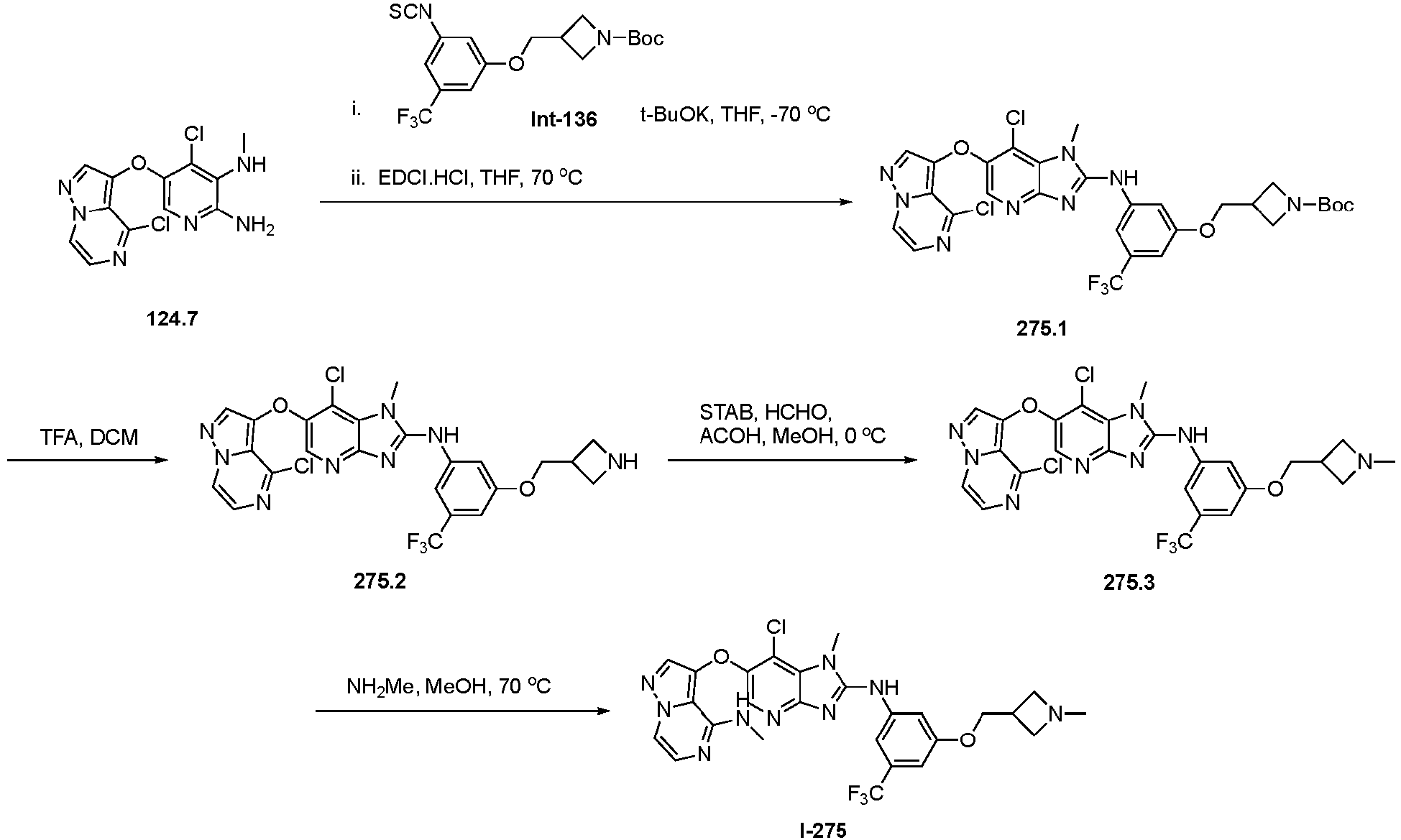
- Synthesis of compound 275.1. Compound 275.1 was prepared from 124.7 and Int-136, following the procedure described in the synthesis of I-51. The product was purified by flash column chromatography on silica gel (CombiFlash®, 3.1% methanol in DCM). MS(ES): m/z 680.1 [M+H]+.
- Synthesis of compound 275.2. To solution of 275.1 (0.070 g, 0.103 mmol, 1.0 equiv) in DCM (3 mL) was added trifluoroacetic acid (0.5 mL) at 0 °C and stirred for 30 min. It was transferred into ice-saturated sodium bicarbonate solution and extracted with DCM. The combined organic layers were washed with brine, dried over anhydrous sodium sulfate, filtered, and concentrated under reduced pressure to afford 275.2. MS(ES): m/z 580.3 [M+H]+.
- Synthesis of compound 275.3. To a solution of 275.2 (0.059 g, 0.101 mmol, 1.0 equiv), formaldehyde (0.015 g, 0.505 mmol, 5.0 equiv) and acetic acid (0.1 mL) in methanol (3 mL) was added was stirred at 0 °C for 20 min. To the reaction solution was added sodium triacetoxyborohydride (0.064 g, 0.303 mmol, 3.0 equiv) and stirred for 30 min. It was poured into ice-water and extracted with ethyl acetate. The combined organic layers were washed with brine, dried over anhydrous sodium sulfate, filtered, and concentrated under reduced pressure to afford 275.3. MS(ES): m/z 594.1 [M+H]+.
- Synthesis of I-275. To a solution of 275.3 (0.060 g, 0.101 mmol, 1.0 equiv) in methanol (3 mL) was added methylamine solution (1 M in THF, 0.6 mL) and stirred at 70 °C for 2 h. The reaction mixture was concentrated under reduced pressure. The residue was purified by preparative HPLC to afford I-275. MS(ES): m/z 588.3 [M+H]+, 1H NMR (DMSO-d6, 400 MHz): δ 8.4 (s, 1H), 8.19 (s, 1H), 7.93 (s, 1H), 7.89 (s, 1H), 7.77-7.76 (d, J = 4.4 Hz, 1H), 7.47 (s, 1H), 7.25-7.24 (d, J = 4.8 Hz, 1H), 6.91 (s, 1H), 6.81 (s, 1H), 4.20-4.09 (d, J = 6.4 Hz, 2H), 4.03 (s, 3H), 3.33 (bs, 3H), 3.01-2.99 (m, 4H), 2.8 (bs, 1H), 2.24 (s, 3H).
-

- Synthesis of compound 276.1. Compound 276.1 was prepared from 124.7 and Int-137, following the procedure described in the synthesis of I-13. The product was purified by flash column chromatography on silica gel (CombiFlash®, 5.7% methanol in DCM). MS(ES): m/z 555.1 [M+H]+.
- Synthesis of I-276. To a solution of 276.1 (0.042 g, 0.075 mmol, 1.0 equiv) in methanol (2 mL) was added methylamine solution (1 M in THF, 0.4 mL) and stirred at 80 °C for 2 h. The reaction mixture was concentrated under reduced pressure. The residue was purified by flash column chromatography on silica gel (CombiFlash®, 7.0% methanol in DCM) to afford I-276. MS(ES): m/z 549.2 [M+H]+, 1H NMR (DMSO-d6, 400 MHz): δ 10.56 (s, 1H), 8.15 (s, 1H), 7.77-7.76 (d, J = 4.4 Hz, 1H), 7.47 (s, 1H), 7.33 (s, 1H), 7.25-7.24 (d, J = 4.4 Hz, 1H), 6.81-6.80 (d, J = 4.0 Hz, 1H), 5.12 (bs, 1H), 4.09-4.05 (m, 2H), 3.98 (s, 3H), 3.95-3.92 (m, 1H), 3.87-3.82 (m, 1H), 2.98-2.97 (d, 3H), 2.33 (bs, 2H).
-

- Synthesis of I-277. Compound I-277 was prepared from 21.7 and Int-138, following the procedure described in the synthesis of I-13. The product was purified by flash column chromatography on silica gel (CombiFlash®, 2.5% methanol in DCM). MS(ES): m/z 543.3 [M+H]+, 1H NMR (DMSO-d6, 400 MHz): δ 9.64 (s, 1H), 9.03 (s, 1H), 8.70-8.69 (d, J = 4.0 Hz, 1H), 8.20 (s, 1H), 8.29 (s, 1H), 8.17 (s, 1H), 8.04 (s, 1H), 7.88-7.87 (d, J = 4.8 Hz, 1H), 7.76-7.74 (d, J = 8.0 Hz, 1H), 4.03 (s, 3H), 3.72 (s, 2H), 2.34 (bs, 4H), 1.74 (bs, 4H).
-

- Synthesis of compound 278.1. Compound 278.1 was prepared from 78.5 and Int-75, following the procedure described in the synthesis of I-13. The product was purified by flash column chromatography on silica gel (CombiFlash®, 2.3% methanol in DCM. MS(ES): m/z 645.1 [M+H]+.
- Synthesis of compound 278.2. To a solution of 278.2 (0.120 g, 0.186 mmol, 1.0 equiv) in DCM (5 mL) was added trifluoroacetic acid (0.4 mL, 5.58 mmol, 30 equiv) at 0 °C. The reaction mixture was stirred at room temperature for 2 h. It was transferred into ice-saturated sodium bicarbonate solution and extracted with DCM. The combined organic layers were washed with brine, dried over anhydrous sodium sulfate, filtered, and concentrated under reduced pressure to afford 278.2. MS(ES): m/z 544.5 [M+H]+.
- Synthesis of I-278. To a solution of 278.2 (0.075 g, 0.137 mmol, 1.0 equiv) in DCM (2 mL) was added triethylamine (0.021 g, 0.205 mmol, 1.5 equiv) at 0 °C followed by the addition of acetic anhydride (0.028 g, 0.137 mmol, 1.0 equiv) dropwise. The reaction mixture was stirred at 0 °C for 1 h. It was transferred into ice-water, stirred, and extracted with DCM. The residue was purified by flash column chromatography on silica gel (CombiFlash®, 4.5% methanol in DCM) to afford I-278. MS(ES): m/z 586.5 [M+H]+, 1H NMR (DMSO-d6, 400 MHz): δ 10.50 (s, 1H), 8.62-8.60 (d, J = 6.8 Hz, 1H), 7.99 (s, 1H), 7.96 (s, 1H), 7.51-7.49 (d, J = 8.8 Hz, 1H), 7.29 (s, 1H), 7.20-7.16 (m, 1H), 6.90-6.87 (m, 1H), 4.89-4.87 (m, 1H), 4.25 (bs, 1H), 4.14 (bs, 1H), 3.99 (s, 3H), 3.98 (bs, 1H), 3.87 (bs, 1H), 2.78-2.76 (m, 4H), 1.75 (s, 3H).
-


- Synthesis of compound (±)-279.1. Compound (±)-279.1 was prepared from 124.7 and (±)-Int-139, following the procedure described in the synthesis of I-13. The product was purified by flash column chromatography on silica gel (CombiFlash®, 1.7% methanol in DCM). MS(ES): m/z 661.7 [M+H]+.
- Synthesis of compound (±)-279.2. To a solution of (±)-279.1 (0.030 g, 0.045 mmol, 1.0 equiv) in methanol (10 mL) was added methylamine solution (2M in THF) (0.4 mL) and stirred at 85 °C for 6 h. The reaction mixture was concentrated under reduced pressure. The residue was purified by trituration using methanol) to afford (±)-279.2. MS(ES): m/z 656.5 [M+H]+.
- Synthesis of compound I-279-a and I-279-b. To a solution of (±)-279.2 (0.023 g, 0.035 mmol, 1.0 equiv) in DCM (2 mL) was added triflic acid (0.05 mL) at 0 °C and stirred for 5 min. It was transferred into ice-saturated sodium bicarbonate solution and extracted with DCM. The combined organic layers were washed with brine, dried over anhydrous sodium sulfate, filtered, and concentrated under reduced pressure. The residue was purified by flash column chromatography on silica gel (CombiFlash®, 3.5% methanol in DCM). The racemate was separated by HPLC (column CHIRALPAK IB-N (250mm x 4.6mm, 5 µm); mobile phases: (A) 0.1% DEA in n-hexane, (B) 0.1% DEA in propan-2-ol:acetonitrile (70:30); flow rate: 20 mL/min) to afford first eluting fraction (I-279-a) and second eluting fraction (I-279-b). (*Absolute stereochemistry not determined.)
- I-279-a: MS(ES): m/z 565.2 [M+H]+, 1H NMR (MeOH-d4, 400 MHz): δ 8.18 (s, 1H), 7.67-7.65 (d, J = 4.8 Hz, 1H), 7.39 (bs, 2H), 7.23-7.22 (d, J = 4.8 Hz, 1H), 4.68 (bs, 1H), 4.36 (bs, 2H), 4.28 (bs, 2H), 4.03 (s, 3H), 3.85 (bs, 1H), 3.10 (s, 3H).
- I-279-b: MS(ES): m/z 565.2 [M+H]+, 1H NMR (MeOH-d4, 400 MHz): δ 8.18 (s, 1H), 7.67-7.65 (d, J = 4.8 Hz, 1H), 7.39 (bs, 2H), 7.23-7.22 (d, J = 4.8 Hz, 1H), 4.68 (bs, 1H), 4.36 (bs, 2H), 4.28 (bs, 2H), 4.03 (s, 3H), 3.85 (bs, 1H), 3.10 (s, 3H).
-

- Synthesis of compound 280.1 and 280.2. The racemic mixture of 280.1 and 280.2 was prepared from 124.7 and (±)-Int-140, following the procedure described in the synthesis of I-51. The product was purified by flash column chromatography on silica gel (CombiFlash®, 4.5% methanol in DCM). It was separated by HPLC (column: CHIRALPAK AD-H (250 mm * 21 mm, 5 µm); mobile phases: (A) 0.1% DEA in n-hexane, (B) 0.1% DEA in propan-2-ol; flow rate: 20 mL/min) to afford first eluting fraction (280.1) and second eluting fraction (280.2). MS(ES): m/z 566.2 [M+H]+. (*Absolute stereochemistry not determined.)
- Synthesis of I-280-a. To a solution of 280.1 (0.031 g, 0.054 mmol, 1.0 equiv) in methanol (2 mL) was added methylamine solution (2 M in THF, 0.5 mL) and stirred at 70 °C for 4 h. It was transferred into ice-saturated sodium bicarbonate solution and extracted with ethyl acetate. The combined organic layers were washed with brine, dried over anhydrous sodium sulfate, filtered, and concentrated under reduced pressure. The residue was purified by flash column chromatography on silica gel (CombiFlash®, 5.4% methanol in DCM) to afford I-280-a. MS(ES): m/z 560.2 [M+H]+, 1H NMR (DMSO-d6, 400 MHz): δ 10.18 (s, 1H), 8.37 (s, 1H), 8.27 (s, 1H), 8.02 (s, 1H), 7.78-7.77 (d, J = 4.8 Hz, 1H), 7.48 (d, J = 4.0 Hz, 1H), 7.26-7.25 (d, J = 4.8 Hz, 1H), 6.83-6.82 (d, J = 4.4 Hz, 1H), 4.12-4.08 (m, 1H), 4.05 (s, 3H), 3.98-3.94 (m, 1H), 3.86-3.77 (m, 2H), 3.67-3.62 (m, 1H), 2.99 (bs, 3H), 2.40-2.33 (m, 1H), 2.16-2.09 (m, 1H).
- Synthesis of I-280-b. To a solution of 280.2 (0.033 g, 0.058 mmol, 1.0 equiv) in methanol (2 mL) was added methylamine solution (2 M in THF, 0.5 mL) and stirred at 70 °C for 4 h. It was transferred into ice-saturated sodium bicarbonate solution and extracted with ethyl acetate. The combined organic layers were washed with brine, dried over anhydrous sodium sulfate, filtered, and concentrated under reduced pressure. The residue was purified by flash column chromatography on silica gel (CombiFlash®, 5.4% methanol in DCM) to afford I-280-b. MS(ES): m/z 560.2 [M+H]+, 1H NMR (DMSO-d6, 400 MHz): δ 10.19 (s, 1H), 8.37 (s, 1H), 8.27 (s, 1H), 8.02 (s, 1H), 7.78-7.77 (d, J = 4.8 Hz, 1H), 7.48 (d, J = 4.0 Hz, 1H), 7.26-7.25 (d, J = 4.8 Hz, 1H), 6.83-6.82 (d, J = 4.4 Hz, 1H), 4.12-4.08 (m, 1H), 4.05 (s, 3H), 3.98-3.96 (m, 1H), 3.86-3.77 (m, 2H), 3.67-3.62 (m, 1H), 2.99 (bs, 3H), 2.40-2.33 (m, 1H), 2.14-2.09 (m, 1H).
-


- Synthesis of compound 281.1. A mixture of 5-bromopyrazolo[1,5-a]pyridine (2.0 g, 10.15 mmol, 1.0 equiv), cesium carbonate (4.9 g, 15.22 mmol, 1.5 equiv), (2,2'-bis(diphenylphosphino)-1,1'-binaphthyl) (0.631 g, 1.01 mmol, 0.1 equiv) and palladium acetate (0.136 g, 0.609 mmol, 0.06 equiv) in toluene (20 mL) was degassed by bubbling argon through for 15 min. Under argon atmosphere, morpholine (1.76 g, 20.30 mmol, 2.0 equiv) was added dropwise, and degassed for 15 min. The reaction mixture was stirred at 160 °C in microwave for 1 h. It was transferred into water and extracted with ethyl acetate. The combined organic layers were washed with brine, dried over anhydrous sodium sulfate, filtered, and concentrated under reduced pressure. The residue was purified by flash column chromatography on silica gel (CombiFlash®, 35% ethyl acetate in hexane) to afford 281.1. MS(ES): m/z 204.2 [M+H]+.
- Synthesis of compound 281.2. To a solution of 281.1 (1.5 g, 7.38 mmol, 1.0 equiv) in acetonitrile (10 mL) was added N-bromosuccinimide (1.4 g, 8.11 mmol, 1.1 equiv) in portions at 0 °C. The reaction was allowed to warm to room temperature and stirred for 15 min. It was poured into ice-water and extracted with ethyl acetate. The combined organic layers were washed with brine, dried over anhydrous sodium sulfate, filtered, and concentrated under reduced pressure. The residue was purified by flash column chromatography on silica gel (CombiFlash®, 18% ethyl acetate in hexane) to afford 281.2. MS(ES): m/z 283 [M+H]+.
- Synthesis of compound 281.3. A mixture of 281.2 (0.800 g, 2.84 mmol, 1.0 equiv), benzyl alcohol (0.765 g, 7.092 mmol, 2.5 equiv), and cesium carbonate (1.8 g, 5.68 mmol, 2.0 equiv) in toluene (8 mL) was degassed by bubbling argon through for 15 min. Under argon atmosphere, 3,4,7,8-tetramethyl-1,10-phenanthroline (0.100 g, 0.426 mmol, 0.15 equiv) and copper iodide (0.03 g, 0.198 mmol, 0.07 equiv) were added. The reaction mixture was stirred at 120 °C for 16 h. It was cooled to room temperature, transferred into water and extracted with ethyl acetate. The combined organic layers were washed with brine, dried over anhydrous sodium sulfate, filtered, and concentrated under reduced pressure. The residue was purified by flash column chromatography on silica gel (CombiFlash®, 27% ethyl acetate in hexane) to afford 281.3. MS(ES): m/z 310.4 [M+H]+.
- Synthesis of compound 281.4. A mixture of compound 281.3 (0.470 g, 1.52 mmol, 1.0 equiv) and palladium on charcoal (0.117 g) in methanol (10 mL) was stirred under hydrogen (1 atm) for 2 h. The reaction mixture was filtered through a pad of Celite® and rinsed with methanol. The filtrate was concentrated under reduced pressure to afford 281.4. MS(ES): m/z 220.2 [M+H]+.
- Synthesis of compound 281.5. A solution of 281.4 (0.180 g, 0.821 mmol, 1.0 equiv), Int-4 (0.185 g, 0.903 mmol, 1.1 equiv), and potassium carbonate (0.226 g, 1.642 mmol, 2.0 equiv) in DMF (5 mL) was stirred at room temperature for 35 min. It was transferred into water and extracted with ethyl acetate. The combined organic layers were washed with brine, dried over anhydrous sodium sulfate, filtered, and concentrated under reduced pressure. The residue was purified by flash column chromatography on silica gel (CombiFlash®, 30% ethyl acetate in hexane) to afford 281.5. MS(ES): m/z 405.5 [M+H]+.
- Synthesis of compound 281.6. To a solution of 281.5 (0.100 g, 0.247 mmol, 1.0 equiv) in ethanol:water (2:1, 8 mL) was added iron powder (0.069 g, 1.23 mmol, 5.0 equiv) followed by ammonium chloride (0.066 g, 1.23 mmol, 5.0 equiv). The reaction mixture was stirred at 90 °C for 1 h. It was transferred into ice-water, filtered, and extracted with ethyl acetate. The combined organic layers were washed with brine, dried over anhydrous sodium sulfate, filtered, and concentrated under reduced pressure. The residue was purified by flash column chromatography on silica gel (CombiFlash®, 1.8% methanol in DCM) to afford 281.6. MS(ES): m/z 375.5 [M+H]+.
- Synthesis of compound 281.7. Compound 281.7 was prepared from 281.6 and Int-63, following the procedure described in the synthesis of I-51. The product was purified by flash column chromatography on silica gel (CombiFlash®, 1.6% methanol in DCM. MS(ES): m/z 575.21 [M+H]+.
- Synthesis of I-281. A mixture of 281.7 (0.050 g, 0.086 mmol, 1.0 equiv), zinc dust (0.001 g, 0.017 mmol, 0.2 equiv), and zinc cyanide (0.039 g, 0.34 mmol, 5.0 equiv) in N,N-dimethylacetamide (2 mL) was degassed by bubbling argon through for 10 min. Under argon atmosphere, tris(dibenzylideneacetone)dipalladium(0) (0.005 g, 0.005 mmol, 0.07 equiv) and 1,1'-bis(diphenylphosphino)ferrocene (0.007 g, 0.013 mmol, 0.15 equiv) were added, and degassed for 5 min. The reaction mixture was stirred at 200 °C in microwave for 1 h. It was cooled to room temperature, transferred into water, and extracted with ethyl acetate. The combined organic layers were washed with brine, dried over anhydrous sodium sulfate, filtered, and concentrated under reduced pressure. The residue was purified by flash column chromatography on silica gel (CombiFlash®, 4.2% methanol in DCM) to afford I-281. MS(ES): m/z 566.4 [M+H]+, 1H NMR (DMSO-d6, 400 MHz): δ 8.91 (s, 1H), 8.60 (s, 1H), 8.48-8.46 (d, J = 8.0 Hz, 1H), 8.14 (s, 1H), 8.01 (s, 1H), 7.86 (s, 1H), 6.88-6.86 (d, J = 8.0 Hz, 1H), 6.54, (s, 1H), 3.98 (s, 3H), 3.71 (s, 4H), 3.65 (s, 3H), 3.17 (s, 4H).
-

- Synthesis of compound 282.1. Compound 282.1 was prepared from 124.7 and Int-133, following the procedure described in the synthesis of I-13. The product was purified by flash column chromatography on silica gel (CombiFlash®, 7.2% methanol in DCM). m/z 621.2 [M+H]+.
- Synthesis of I-282. To a solution of 282.1 (0.040 g, 0.064 mmol, 1.0 equiv) in methanol (2 mL) was added methylamine solution (1 M in THF, 0.4 mL) and stirred at 70 °C for 2 h. The reaction mixture was concentrated under reduced pressure. The residue was purified by flash column chromatography on silica gel (CombiFlash®, 9.0% methanol in DCM) to afford I-282. MS(ES): m/z 616.3 [M+H]+, 1H NMR (DMSO-d6, 400 MHz): δ 9.92 (s, 1H), 8.30 (s, 1H), 8.24 (s, 1H), 8.18 (s, 1H), 7.78-7.76 (d, J = 4.8 Hz, 1H), 7.47 (s, 1H), 7.29 (s, 1H), 7.25-7.24 (d, J = 4.8 Hz, 1H), 6.82-6.81 (d, J = 4.8 Hz, 1H), 4.06 (s, 3H), 3.78-3.63 (m, 2H), 2.99-2.98 (d, 3H), 2.71 (bs, 2H), 2.62 (bs, 6H), 2.18-1.94 (m, 4H), 1.55 (bs, 1H).
-

- Synthesis of I-283. Compound I-283 was prepared from 61.2 and Int-141, following the procedure described in the synthesis of I-53. The product was purified by flash column chromatography on silica gel (CombiFlash®, 10% methanol in DCM). MS(ES): m/z 604.5 [M+H]+, 1H NMR (DMSO-d6, 400 MHz): δ 9.40 (bs, 1H), 9.04 (s, 1H), 8.71-8.69 (d, J = 4.8 Hz, 1H), 8.32 (bs, 1H), 8.19 (s, 1H), 8.04 (s, 1H), 7.88-7.87 (d, J = 5.2 Hz, 1H), 7.52 (s, 1H), 4.00 (s, 3H), 3.81-3.69 (m, 1H), 2.80 (bs, 2H), 2.75-2.71 (m, 2H), 2.34 (bs, 2H), 2.15 (s, 6H), 1.92-1.87 (m, 1H), 1.66-1.64 (m, 1H).
-

- Synthesis of compound 284.1. Compound 284.1 was prepared from 124.7 and Int-138, following the procedure described in the synthesis of I-13. The product was purified by flash column chromatography on silica gel (CombiFlash®, 7.0% methanol in DCM). m/z 578.2 [M+H]+.
- Synthesis of I-284. To a solution of 284.1 (0.042 g, 0.075 mmol, 1.0 equiv) in methanol (2 mL) was added methylamine solution (1 M in THF, 0.4 mL) and stirred at 80 °C for 2 h. The reaction mixture was concentrated under reduced pressure The residue was purified by flash column chromatography on silica gel (CombiFlash®, 7.0% methanol in DCM) to afford I-284. MS(ES): m/z 572.3 [M+H]+, 1H NMR (DMSO-d6, 400 MHz): δ 10.72 (s, 1H), 10.06 (s, 1H). 8.31 (s, 1H), 8.08 (s, 1H), 7.77-7.76 (d, J = 4.4 Hz, 1H), 7.70 (s, 1H), 7.47 (s, 1H), 7.25-7.24 (d, J = 4.4 Hz, 1H), 6.83 (bs, 1H), 4.94 (bs, 2H), 4.05 (s, 3H), 2.99 (s, 3H), 2.36 (bs, 4H), 1.91 (bs, 4H).
-

- Synthesis of compound I-285. Compound I-285 was prepared from 61.2 and Int-142, following the procedure described in the synthesis of I-53. The product was purified by flash column chromatography on silica gel (CombiFlash®, 10% methanol in DCM). MS(ES): m/z 604.5 [M+H]+, 1H NMR (DMSO-d6, 400 MHz): δ 9.38 (bs, 1H), 9.0 (s, 1H), 8.69-8.68 (d, J = 4.8 Hz, 1H), 8.30 (bs, 1H), 8.18 (s, 1H), 8.03 (s, 1H), 7.87-7.86 (d, J = 5.2 Hz, 1H), 7.50 (s, 1H), 3.99 (s, 3H), 3.80-3.68 (m, 1H), 2.80 (bs, 2H), 2.71-2.67 (m, 2H), 2.33 (bs, 2H), 2.14 (s, 6H), 1.88 (bs, 1H), 1.65 (bs, 1H).
-

- Synthesis of compound 286.1. Compound 286.1 was prepared from 124.7 and Int-134, following the procedure described in the synthesis of I-13. The product was purified by flash column chromatography on silica gel (CombiFlash®, 7.3% methanol in DCM). MS(ES): m/z 621.3 [M+H]+.
- Synthesis of I-286 To a solution of 286.1 (0.050 g, 0.080 mmol, 1.0 equiv) in methanol (2 mL) was added methylamine solution (1 M in THF, 0.5 mL) and stirred at 70 °C for 3 h. The reaction mixture was concentrated under reduced pressure. The residue was purified by flash column chromatography on silica gel (CombiFlash®, 8.8% methanol in DCM) to afford I-286. MS(ES): m/z 616.2 [M+H]+, 1H NMR (DMSO-d6, 400 MHz): δ 9.92 (s, 1H), 8.30 (s, 1H), 8.24 (s, 1H), 8.18 (s, 1H), 7.78-7.76 (d, J = 4.8 Hz, 1H), 7.47 (s, 1H), 7.29 (s, 1H), 7.25-7.24 (d, J = 4.8 Hz, 1H), 6.82-6.81 (d, J = 4.8 Hz, 1H), 4.05 (s, 3H), 3.77-3.61 (m, 2H), 2.99-2.98 (d, 3H), 2.71 (bs, 2H), 2.62 (bs, 6H), 2.18-1.94 (m, 4H), 1.55 (bs, 1H).
-

- Synthesis of compound 287.1. A mixture of 5-bromo-4,6-dimethylpyrimidin-2-amine (2.0 g, 9.90 mmol, 1.0 equiv), pyrrolidine (1.76 g, 24.75 mmol, 2.5 equiv) and sodium tert-butoxide (2.85 g, 29.70 mmol, 3.0 equiv) in 1,4-dioxane (15 mL) was degassed by bubbling argon through for 10 min. Under argon atmosphere, 4,5-bis(diphenylphosphino)-9,9-dimethylxanthene (0.286 g, 0.495 mmol, 0.05 equiv) and tris(dibenzylideneacetone) dipalladium(0) (0.226 g, 0.247 mmol, 0.025 equiv) were added, and degassed for 5 min. The reaction mixture was stirred in a microwave reactor at 150°C for 30 min. It was cooled to room temperature, transferred into water, and extracted with ethyl acetate. The combined organic layers were washed with brine, dried over anhydrous sodium sulfate, filtered, and concentrated under reduced pressure. The residue was purified by column chromatography) to afford 287.1. MS(ES): m/z 193.2 [M+H]+.
- Synthesis of I-287. Compound I-287 was prepared from 61.2 and 287.1, following the procedure described in the synthesis of I-53. The product was purified by flash column chromatography on silica gel (CombiFlash®, 3.0% methanol in DCM). MS(ES): m/z 491.40 [M+H]+, 1H NMR (DMSO-d6, 400 MHz): δ 10.27 (s, 1H), 9.09 (s, 1H), 8.70-8.69 (d, J = 4.4 Hz, 1H), 8.29 (s, 1H), 8.08 (s, 1H), 7.88-7.87 (d, J = 3.6 Hz, 1H), 3.84 (s, 4H), 3.08 (s, 4H), 2.31 (s, 6H), 1.95 (s, 3H).
-

- Synthesis of compound 288.1. To a solution of 5-bromo-1H-pyrrolo[2,3-b]pyridine (5.0 g, 25.38 mmol, 1.0 equiv) in acetonitrile (500 mL) was added 1-chloromethyl-4-fluoro-1,4-diazoniabicyclo[2.2.2]octane-bis(tetrafluoroborate) (13 g, 38.07 mmol, 1.5 equiv) followed by acetic acid (125 mL). The reaction mixture was stirred at room temperature for 16 h. It was transferred into water and extracted with ethyl acetate. The combined organic layers were washed with brine, dried over anhydrous sodium sulfate, filtered, and concentrated under reduced pressure to afford crude material. The residue was purified by flash column chromatography on silica gel (CombiFlash®, 25% ethyl acetate in hexane to afford 288.1. MS(ES): m/z 216.03 [M+H]+.
- Synthesis of compound 288.2. To a solution of 288.1 (0.623 g, 2.90 mmol, 1.0 equiv) in DCM (6 mL) was added benzyltriethylammonium chloride (0.013 g, 0.072 mmol, 0.025 equiv) followed by the addition of sodium hydroxide powder (0.347 g, 8.70 mmol, 3.0 equiv). It was cooled to 0 °C and benzyl sulfonyl chloride (0.611 g, 3.62 mmol, 1.25 equiv) was added. The reaction mixture was stirred at room temperature for 2 h. It was filtered through a pad of Celite® and rinsed with DCM. The filtrate was concentrated under reduced pressure. The residue was purified by flash column chromatography on silica gel (CombiFlash®, 20% ethyl acetate in hexane) to afford 288.2. MS (ES): m/z 291.31 [M+H]+.
- Synthesis of compound 288.3. A solution of 288.2 (0.590 g, 2.03 mmol, 1.0 equiv), bis(pinacolato)diboron (1.03 g, 4.06 mmol, 2.0 equiv) and potassium acetate (0.398 g, 4.06 mmol, 2.0 equiv) in 1,4-dioxane (5 mL) was degassed by bubbling argon through under argon atmosphere for 5 min. To the mixture was added 1,1-bis(diphenylphosphino)ferrocene-palladium(II)dichloride DCM complex (0.297 g, 0.406 mmol, 0.2 equiv) and degassed for 5 min. The reaction mixture was stirred at 80 °C for 30 min. It was cooled to room temperature, transferred into ice-water, stirred, and extracted with ethyl acetate. The combined organic layers were washed with brine, dried over anhydrous sodium sulfate, filtered, and concentrated under reduced pressure to afford 288.3. MS(ES): m/z 403.25 [M+H]+.
- Synthesis of compound 288.4. To a solution of 288.3 (0.410 g, 1.02 mmol, 1.0 equiv) in acetonitrile (25 mL) and methanol (25 mL) was added hydrogen peroxide (3 mL). The reaction mixture stirred at room temperature for 16 h. It was transferred into ice-water, stirred, and extracted with ethyl acetate. The combined organic layers were washed with brine, dried over anhydrous sodium sulfate, filtered, and concentrated under reduced pressure to afford 288.4. MS(ES): m/z 293.28 [M+H]+.
- Synthesis of compound 288.5. To a mixture of 288.4 (0.205 g, 0.701 mmol, 1.0 equiv), sodium carbonate (0.148 g, 1.40 mmol, 2.0 equiv) and Int-4 (0.087 g, 0.420 mmol, 0.6 equiv) in DMF (5 mL) was stirred at room temperature for 30 min. The reaction mixture was filtered, and the filtrate was transferred into water, stirred, and extracted with ethyl acetate. The combined organic layers were washed with brine, dried over anhydrous sodium sulfate, filtered, and concentrated under reduced pressure to afford 288.5. MS(ES): m/z 478.85 [M+H]+.
- Synthesis of compound 288.6. Compound 288.6 was prepared from 288.5 following the procedure described in the synthesis of 5.4. The product was purified by flash column chromatography on silica gel (CombiFlash®, 2% methanol in DCM) to afford 288.6. MS(ES): m/z 448.87 [M+H]+.
- Synthesis of compound 288.7. Compound 288.7 was prepared from 288.6 and Int-63, following the procedure described in the synthesis of I-13. The product was purified by flash column chromatography on silica gel (CombiFlash®, 4.2% methanol in DCM). MS(ES): m/z 448.99 [M+H]+.
- Synthesis of I-288. To a solution of 288.7 (0.109 g, 0.168 mmol, 1.0 equiv) in methanol (5 mL) was added 40% aq. sodium hydroxide solution (1 mL) and stirred at 80 °C for 4 h. It was transferred into ice-saturated sodium bicarbonate solution and extracted with ethyl acetate. The combined organic layers were washed with brine, dried over anhydrous sodium sulfate, filtered, and concentrated under reduced pressure. The residue was purified by flash column chromatography on silica gel (CombiFlash®, 5.5% methanol in DCM) to afford I-288. MS(ES): m/z 508.1 [M+H]+, 1H NMR (DMSO-d6, 400 MHz): δ 11.59 (s, 1H), 8.88 (s, 1H), 8.64 (s, 1H), 8.37 (s, 1H), 8.29 (bs, 2H), 7.54-7.50 (m, 2H), 4.01 (s, 3H), 3.67 (s, 3H).
-

- Synthesis of I-289. Compound I-289 was prepared from I-288 following the procedure described in the synthesis of I-157. The product was purified by flash column chromatography on silica gel (CombiFlash®, 4.2% methanol in DCM). MS(ES): m/z 499.2 [M+H]+, 1H NMR (DMSO-d6, 400 MHz): δ 11.68 (s, 1H), 9.01 (s, 1H), 8.64 (bs, 1H), 8.30 (bs, 1H), 8.17 (s, 1H), 8.04 (s, 1H), 7.80 (s, 1H), 7.59 (s, 1H), 3.99 (s, 3H), 3.67 (s, 3H).
-


- Synthesis of compound 290.1. To a solution of 5-methoxy-1H-pyrrolo[2,3-b]pyridine (7.9 g, 53.32 mmol, 1.0 equiv) in DCM (250 mL) was added benzyltriethylammonium chloride (0.242 g, 1.33 mmol, 0.025 equiv) followed by the addition of sodium hydroxide powder (7.3 g, 159.9 mmol, 3.0 equiv). It was cooled to 0 °C, benzyl sulfonyl chloride (11.74 g, 66.65 mmol, 1.25 equiv) was added, and reaction mixture was stirred at room temperature for 2 h. The reaction mixture was filtered through a pad of Celite® and washed with DCM. Filtrate was concentrated under reduced pressure. The residue was purified by flash column chromatography on silica gel (CombiFlash®, 20% ethyl acetate in hexane) to afford 290.1. MS (ES): m/z 289.3 [M+H]+.
- Synthesis of compound 290.2. To a solution of 290.1 (5.2 g, 18.04 mmol, 1.0 equiv) in THF (100 mL) was added lithium diisopropylamide solution (2.0 M in THF, 18 mL, 36.8 mmol, 2.0 equiv) at -78 °C and stirred for 30 min followed by the addition of methyl iodide (4.5 mL, 72.16 mmol, 4.0 equiv) and stirred at same temperature for 15 min. It was transferred into ice-water, stirred, and extracted with ethyl acetate. The combined organic layers were washed with brine, dried over anhydrous sodium sulfate, filtered, and concentrated under reduced pressure. The residue was purified by flash column chromatography on silica gel (CombiFlash®, 5% ethyl acetate in hexane) to afford 290.2. MS (ES): m/z 303.1 [M+H]+.
- Synthesis of compound 290.3. To a solution of 290.2 (1.7 g, 5.29 mmol, 1.0 equiv) in DCM (34 mL) was added boron tribromide solution (1 M in DCM, 42 mL, 42.16 mmol, 7.5 equiv) at -78 °C and stirred for 3 h. It was transferred into ice-saturated sodium bicarbonate solution and extracted with DCM. The combined organic layers were washed with brine, dried over anhydrous sodium sulfate, filtered, and concentrated under reduced pressure. The residue was purified by flash column chromatography on silica gel (CombiFlash®, 45% ethyl acetate in hexane) to afford 290.3. MS(ES): m/z 289.2 [M+H]+.
- Synthesis of compound 290.4. A mixture of 290.3 (1.0 g, 3.47 mmol, 1.0 equiv), sodium carbonate (0.736 g, 6.94 mmol, 2.0 equiv) and Int-4 (0.427 g, 2.08 mmol, 0.6 equiv) in DMF (7 mL) was stirred at room temperature for 30 min. The reaction mixture was filtered, and the filtrate was transferred into water, stirred, and extracted with ethyl acetate. The combined organic layers were washed with brine, dried over anhydrous sodium sulfate, filtered, and concentrated under reduced pressure to afford 290.4. MS(ES): m/z 474.5 [M+H]+.
- Synthesis of compound 290.5. Compound 290.5 was prepared from 290.4 following the procedure described in the synthesis of 5.4. The product was purified by flash column chromatography on silica gel (CombiFlash®, 2% methanol in DCM). MS(ES): m/z 448.6 [M+H]+.
- Synthesis of compound 290.6. Compound 290.6 was prepared from 290.5 and Int-63, following the procedure described in the synthesis of I-13. The product was purified by flash column chromatography on silica gel (CombiFlash®, 4.2% methanol in DCM). MS(ES): m/z 645.03 [M+H]+.
- Synthesis of compound 290.7. To a solution of 290.6 (0.200 g, 0.310 mmol, 1.0 equiv) in methanol (5 mL) was added 40% aq. sodium hydroxide solution (1 mL) and stirred at 80 °C for 4 h. It was transferred into ice-saturated sodium bicarbonate solution and extracted with ethyl acetate. The combined organic layers were washed with brine, dried over anhydrous sodium sulfate, filtered, and concentrated under reduced pressure. The residue was purified by flash column chromatography on silica gel (CombiFlash®, 5.5% methanol in DCM) to afford 290.7. MS(ES): m/z 504.87[M+H]+.
- Synthesis of I-290. Compound I-290 was prepared from 290.7 following the procedure described in the synthesis of I-157. The product was purified by flash column chromatography on silica gel (CombiFlash®, 4.1% methanol in DCM). MS(ES): m/z 495.2 [M+H]+, 1H NMR (DMSO-d6, 400 MHz): δ 11.53 (s, 1H), 8.82 (s, 1H), 8.61 (bs, 1H), 8.13 (s, 1H), 8.05 (s, 1H), 7.98 (s, 1H), 7.34 (s, 1H), 6.07 (s, 1H), 3.99 (s, 3H), 3.66 (s, 3H), 2.37 (s, 3H).
-

- Synthesis of compound 291.1. A solution of 6-bromopyrazolo[1,5-a]pyridine (1.5 g, 7.61 mmol, 1.0 equiv), sodium methoxide in methanol (1 M, 15 mL) and copper iodide (2.9 g, 15.3 mmol, 2.0 equiv) was stirred at 120 °C for 2 h. It was transferred into water and extracted with ethyl acetate. The combined organic layers were washed with brine, dried over anhydrous sodium sulfate, filtered, and concentrated under reduced pressure. The residue was purified by flash column chromatography on silica gel (CombiFlash®, 35% ethyl acetate in hexane) to afford 291.1. MS(ES): m/z 149.2 [M+H]+.
- Synthesis of compound 291.2. To a solution of 291.1 (0.9 g, 6.07 mmol, 1.0 equiv) in acetonitrile (10 mL) was added N-bromosuccinimide (2.16 g, 12.14 mmol, 2.0 equiv) in portions at 0 °C. It was allowed to warm to room temperature and stirred for 15 min. It was transferred into aqueous sodium bicarbonate solution and extracted with ethyl acetate. The combined organic layers were washed with brine, dried over anhydrous sodium sulfate, filtered, and concentrated under reduced pressure. The residue was purified by flash column chromatography on silica gel (CombiFlash®, 25% ethyl acetate in hexane) to afford 291.2. MS(ES): m/z 228.5 [M+H]+.
- Synthesis of compound 291.3. To a mixture of 291.2 (0.840 g, 3.7 mmol, 1.0 equiv) in toluene (8 mL) was added benzyl alcohol (0.994 g, 9.25 mmol, 2.5 equiv) followed by cesium carbonate (2.3 g, 7.4 mmol, 2.0 equiv). The reaction mixture was degassed by bubbling argon through for 15 min. Under argon atmosphere, 3,4,7,8-Tetramethyl-1,10-phenanthroline (0.173 g, 0.736 mmol, 0.2 equiv) and copper iodide (0.069 g, 0.37 mmol, 0.1 equiv) was added. The reaction mixture was stirred at 100 °C for 1 h. It was cooled to room temperature was transferred into water and extracted with ethyl acetate. The combined organic layers were washed with brine, dried over anhydrous sodium sulfate, filtered, and concentrated under reduced pressure. The residue was purified by flash column chromatography on silica gel (CombiFlash®, 11% ethyl acetate in hexane) to afford 291.3 (0.440 g, 46.77%). MS(ES): m/z 255.4 [M+H]+.
- Synthesis of compound 291.4. A mixture of compound 291.3 (0.440 g, 1.73 mmol, 1.0 equiv) and palladium on charcoal (0.110 g) in methanol (10 mL) was stirred under hydrogen (1 atm) for 4 h. The reaction mixture was filtered through a pad of Celite® and rinsed with methanol. The filtrate was concentrated under reduced pressure to afford 291.4. MS(ES): m/z 165.2 [M+H]+.
- Synthesis of compound 291.5. Compound 291.5 was prepared from 291.4 following the procedure described in the synthesis of 19.1. The product was purified by flash column chromatography on silica gel (CombiFlash®, 35% ethyl acetate in hexane). MS(ES): m/z 350.5 [M+H]+.
- Synthesis of compound 291.6. Compound 291.6 was prepared from 291.5 following the procedure described in the synthesis of 5.4. The product was purified by flash column chromatography on silica gel (CombiFlash®, 70% ethyl acetate in hexane) to afford 291.6. MS(ES): m/z 320.5 [M+H]+.
- Synthesis of compound 291.7. Compound 291.7 was prepared from 291.6 and Int-63, following the procedure described in the synthesis of I-13. The product was purified by flash column chromatography on silica gel (CombiFlash®, 1.6% methanol in DCM). MS(ES): m/z 520.21 [M+H]+.
- Synthesis of I-291. Compound I-291 was prepared from 291.7 following the procedure described in the synthesis of I-281. The product was purified by flash column chromatography on silica gel (CombiFlash®, 4% methanol in DCM). MS(ES): m/z 511.3 [M+H]+, 1H NMR (DMSO-d6, 400 MHz): δ 8.96 (s, 1H), 8.62-8.61 (s, J = 2.0 Hz, 1H), 8.40 (s, 1H), 8.17 (s, 1H), 8.05 (s, 1H), 7.97 (s, 1H), 7.49-7.47 (d, J = 9.6 Hz, 1H), 7.07-7.05 (d, J = 9.6 Hz 1H), 4.00 (s, 3H), 3.85 (s, 3H), 3.67 (s, 3H).
-

- Synthesis of compound 292.1. A mixture of 6-bromopyrazolo[1,5-a]pyridine (4.0 g, 20.3 mmol, 1.0 equiv), tetrakis(triphenylphosphine)palladium(0) (2.3 g, 2.0 mmol, 0.1 equiv) and zinc cyanide (2.37 g, 20.3 mmol, 1.0 equiv) in DMF (25 mL) was stirred at 100 °C for 2 h. It was cooled to room temperature, transferred into water, and extracted with ethyl acetate. The combined organic layers were washed with brine, dried over anhydrous sodium sulfate, filtered, and concentrated under reduced pressure. The residue was purified by flash column chromatography on silica gel (CombiFlash®, 16% ethyl acetate in hexane) to afford 292.1. MS(ES): m/z 144.15 [M+H]+.
- Synthesis of compound 292.2. To a solution of 292.1 (2.0 g, 13.97 mmol, 1.0 equiv) in DMF (15 mL), was added phosphoryl chloride (6.4 g, 41.9 mmol, 3.0 equiv) and stirred at room temperature for 1 h. The reaction mixture was concentrated under reduced pressure to afford a residue, which was dissolved in DCM and washed with 2 N sodium hydroxide. The combined organic layers were washed with brine, dried over anhydrous sodium sulfate, filtered, and concentrated under reduced pressure to afford pressure. The residue was purified by flash column chromatography on silica gel (CombiFlash®, 30% ethyl acetate in hexane) to afford 292.2. MS (ES): m/z 172.16 [M+H]+.
- Synthesis of compound 292.3. To a solution of 292.2 (1.1 g, 6.43 mmol, 1.0 equiv) in DCM (10 mL) was added trifluoroacetic acid (49.1 mL, 0.643 mmol, 0.1 equiv) at 0 °C followed by the addition of m-chloroperoxybenzoic acid (1.65 g, 9.6 mmol, 1.5 equiv). The reaction mixture was stirred at room temperature for 2 h. It was cooled to 0 °C and saturated sodium bicarbonate solution was added, stirred for 30 min and extracted with ethyl acetate. The combined organic layers were washed with aq. sodium bisulfite, dried over anhydrous sodium sulfate, filtered, and concentrated under reduced pressure. The residue was purified by flash column chromatography on silica gel (CombiFlash®, 60% ethyl acetate in hexane) to afford 292.3. MS (ES): m/z 160.15 [M+H]+.
- Synthesis of compound 292.4. Compound 292.4 was prepared from 292.3 and Int-4, following the procedure described in the synthesis of 19.1. The reaction mixture was filtered, and the filtrate was concentrated under reduced pressure. The residue was purified by flash column chromatography on silica gel (CombiFlash®, 2.5% methanol in DCM). MS (ES): m/z 345.72 [M+H]+.
- Synthesis of compound 292.5. Compound 292.5 was prepared from 292.4 following the procedure described in the synthesis of 5.4. The product was purified by flash column chromatography on silica gel (CombiFlash®, 2.8% methanol in DCM). MS(ES): m/z 315.73 [M+H]+.
- Synthesis of compound I-292. Compound I-292 was prepared from 291.5 and Int-63, following the procedure described in the synthesis of I-51. The product was purified by flash column chromatography on silica gel (CombiFlash®, 2.8% methanol in DCM). MS(ES): m/z 515.2 [M+H]+, 1H NMR (DMSO-d6, 400 MHz): δ 9.56 (s, 1H), 8.84 (s, 1H), 8.62 (s, 1H), 8.31 (s, 1H), 8.14 (bs, 2H), 7.70-7.67 (d, J = 9.2 Hz, 1H), 7.41-7.38 (d, J = 9.2 Hz, 1H), 4.03 (s, 3H), 3.68 (s, 3H).
-


- Synthesis of compound 293.1. To a solution of 5-methoxy-1H-pyrrolo[2,3-b]pyridine (7.9 g, 53.32 mmol, 1.0 equiv) and benzyltriethylammonium chloride (0.242 g, 1.33 mmol, 0.025 equiv) in DCM (250 mL) was added sodium hydroxide powder (7.3 g, 159.9 mmol, 3.0 equiv). To the reaction mixture was added benzyl sulfonyl chloride (11.74 g, 66.65 mmol, 1.25 equiv) at 0 °C, and it was allowed to warm to room temperature and stirred for 2 h. It was filtered through a pad of Celite® and rinsed with DCM. The filtrate was concentrated under reduced pressure. The residue was purified by flash column chromatography on silica gel (CombiFlash®, 20% ethyl acetate in hexane) to afford 293.1. MS (ES): m/z 289.3 [M+H]+.
- Synthesis of compound 293.2. To a solution of 293.1 (5.2 g, 18.04 mmol, 1.0 equiv) in THF (100 mL) was added lithium diisopropylamide solution (2.0M in THF, 18 mL, 36.8 mmol, 2.0 equiv) at -78 °C and stirred for 30 min before the addition of methyl iodide (4.5 mL, 72.16 mmol, 4.0 equiv). The mixture was allowed to warm to room temperature for 15 min. It was transferred into ice-water, stirred, and extracted with ethyl acetate. The combined organic layers were washed with brine, dried over anhydrous sodium sulfate, filtered, and concentrated under reduced pressure. The residue was purified by flash column chromatography on silica gel (CombiFlash®, 5% ethyl acetate in hexane) to afford 293.2. MS (ES): m/z 303.1 [M+H]+.
- Synthesis of compound 293.3. To a solution of 293.2 (1.7 g, 5.29 mmol, 1.0 equiv) in DCM (34 mL) was added boron tribromide solution (1M in DCM) (42 mL, 42.16 mmol, 7.5 equiv) at -78 °C and stirred for 3 h. It was transferred into ice-saturated sodium bicarbonate solution and extracted with DCM. The combined organic layers were washed with brine, dried over anhydrous sodium sulfate, filtered, and concentrated under reduced pressure. The residue was purified by flash column chromatography on silica gel (CombiFlash®, 45% ethyl acetate in hexane) to afford 293.3. MS(ES): m/z 289.2 [M+H]+.
- Synthesis of compound 293.4. A mixture of 293.3 (1.0 g, 3.47 mmol, 1.0 equiv), sodium carbonate (0.736 g, 6.94 mmol, 2.0 equiv) and Int-4 (0.427 g, 2.08 mmol, 0.6 equiv) in DMF (7 mL) was stirred at room temperature for 30 min. The reaction mixture was filtered, and the filtrate was transferred into water stirred, and extracted with ethyl acetate. The combined organic layers were washed with brine, dried over anhydrous sodium sulfate, filtered, and concentrated under reduced pressure to afford 293.3. MS(ES): m/z 474.5 [M+H]+.
- Synthesis of compound 293.5. Compound 293.5 was prepared from 293.4 following the procedure described in the synthesis of 5.4. The product was purified by flash column chromatography on silica gel (CombiFlash®, 2% methanol in DCM). MS(ES): m/z 448.6 [M+H]+.
- Synthesis of compound 293.6. Compound 293.6 was prepared from 293.5 and Int-63, following the procedure described in the synthesis of I-13. The product was purified by flash column chromatography on silica gel (CombiFlash®, 4.2% methanol in DCM). MS(ES): m/z 645.0 [M+H]+.
- Synthesis of I-293. To a solution of 293.6 (0.200 g, 0.310 mmol, 1.0 equiv) in methanol (5 mL) was added 40% aq. sodium hydroxide solution (1 mL) and stirred at 80 °C for 4 h. It was transferred into ice-saturated sodium bicarbonate solution and extracted with ethyl acetate. The combined organic layers were washed with brine, dried over anhydrous sodium sulfate, filtered, and concentrated under reduced pressure. The residue was purified by flash column chromatography on silica gel (CombiFlash®, 5.5% methanol in DCM) to afford I-293. MS(ES): m/z 504.2 [M+H]+, 1H NMR (DMSO-d6, 400 MHz): δ 11.53 (s, 1H), 8.82 (s, 1H), 8.62 (bs, 1H), 8.14 (s, 1H), 8.06 (s, 1H), 8.00 (bs, 1H), 7.35 (bs, 1H), 6.08 (s, 1H), 4.01 (s, 3H), 3.60 (s, 3H), 2.39 (s, 3H).
-


- Synthesis of compound 294.1. To a solution of 293.1 (2.0 g, 6.94 mmol, 1.0 equiv) in THF (40 mL) was added lithium diisopropylamide solution (2.0 M in THF, 14 mL, 13.88 mmol, 2.0 equiv) at -78 °C and stirred for 30 min before the addition of iodine (5.29 g, 20.83 mmol, 3.0 equiv). The reaction mixture was allowed to warm to room temperature and stirred for 15 min. It was transferred into ice-water, stirred, and extracted with ethyl acetate. The combined organic layers were washed with brine, dried over anhydrous sodium sulfate, filtered, and concentrated under reduced pressure. The residue was purified by flash column chromatography on silica gel (CombiFlash®, 4% ethyl acetate in hexane) to afford 294.1. MS (ES): m/z 415.2 [M+H]+.
- Synthesis of compound 294.2. A mixture of 294.1 (0.910 g, 2.20 mmol, 1.0 equiv), cyclopropylboronic acid (0.245 g, 2.86 mmol, 1.3 equiv), potassium phosphate (1.67 g, 7.91 mmol, 3.6 equiv) and tricyclohexylphosphine (0.123 g, 0.439 mmol, 0.2 equiv) in toluene (15 mL) and water (2 mL) was degassed by bubbling argon through for 10 min. Under argon atmosphere, palladium(II) acetate (0.049 g, 0.219 mmol, 0.17 equiv) was added, and degassed for 5 min. The reaction mixture was stirred at 100 °C for 4 h. It was cooled to room temperature, filtered through a pad of Celite®. The filtrate was transferred into water and extracted with ethyl acetate. The combined organic layers were washed with brine, dried over anhydrous sodium sulfate, filtered, and concentrated under reduced pressure. The residue was purified by flash column chromatography on silica gel (CombiFlash®, 40% ethyl acetate in hexane) to afford 294.2. MS(ES): m/z 329.2 [M+H]+.
- Synthesis of compound 294.3. To a solution of compound 294.2 (0.610 g, 1.86 mmol, 1.0 equiv) in DCM (25 mL) was added boron tribromide solution (1 M in DCM, 14 mL, 13.87 mmol, 7.5 equiv) at -78 °C and stirred for 3 h. It was transferred into ice-saturated sodium bicarbonate solution and extracted with DCM. The combined organic layers were washed with brine, dried over anhydrous sodium sulfate, filtered, and concentrated under reduced pressure. The residue was purified by flash column chromatography on silica gel (CombiFlash®, 43% ethyl acetate in hexane) to afford 294.3. MS(ES): m/z 315.3 [M+H]+.
- Synthesis of compound 294.5. Compound 294.5 was prepared from 294.3 and Int-4 following the procedure described in the synthesis of 293.4. The crude product was used without purification. MS(ES): m/z 500.8 [M+H]+.
- Synthesis of compound 294.6. Compound 294.6 was prepared from 294.5 following the procedure described in the synthesis of 5.4. The product was purified by flash column chromatography on silica gel (CombiFlash®, 2% methanol in DCM) t. MS(ES): m/z 470.7 [M+H]+.
- Synthesis of compound 294.7. Compound 294.7 was prepared from 294.6 and Int-63, following the procedure described in the synthesis of I-13. The product was purified by flash column chromatography on silica gel (CombiFlash®, 4.2% methanol in DCM). MS(ES): m/z 671.0 [M+H]+.
- Synthesis of I-294. Compound I-294 was prepared from 294.7 following the procedure described in the synthesis of I-293. The product was purified by flash column chromatography on silica gel (CombiFlash®, 5.5% methanol in DCM). MS(ES): m/z 530.4 [M+H]+, 1H NMR (DMSO-d6, 400 MHz): δ 11.52 (s, 1H), 8.83 (s, 1H), 8.63 (bs, 1H), 8.15 (s, 1H), 8.06 (s, 1H), 7.97 (s, 1H), 7.32 (s, 1H), 6.04 (s, 1H), 4.01 (s, 3H), 3.68 (s, 3H), 2.03-2.02 (m, 1H), 1.01-0.99 (m, 2H), 0.85 (bs, 2H).
-

- Synthesis of compound 295.1. Compound 295.1 was prepared from 141.8 and Int-143, following the procedure described in the synthesis of I-51. The product was purified by flash column chromatography on silica gel (CombiFlash®, 1.8% methanol in DCM). MS(ES): m/z 655.7 [M+H]+.
- Synthesis of I-295. To a solution of 295.1 (0.050 g, 0.076 mmol, 1.0 equiv) in DCM (2 mL) was added triflic acid (0.1 mL) at 0 °C and stirred for 5 min. It was transferred into ice-saturated sodium bicarbonate solution and extracted with DCM. The combined organic layers were washed with brine, dried over anhydrous sodium sulfate, filtered, and concentrated under reduced pressure. The residue was purified by flash column chromatography on silica gel (CombiFlash®, 4.2% methanol in DCM) to afford I-295. MS(ES): m/z 564.5 [M+H]+. 1H NMR (DMSO-d6, 400 MHz): δ 8.82 (s, 1H), 8.61 (s, 1H), 8.55-8.53 (d, J = 6.8 Hz, 1H), 8.06 (s, 1H), 8.01 (s, 1H), 7.93 (s, 1H), 7.10-7.05 (m, 1H), 6.91-6.87 (m, 1H), 5.39-5.35 (m, 1H), 5.29-5.28 (d, J = 4.0 Hz 1H), 4.37 (bs, 1H), 4.03 (s, 3H), 2.68 (bs, 2H), 2.40-2.35 (m, 2H).
-


- Synthesis of compound 296.1. A mixture of I-294 (0.139 g, 0.207 mmol, 1.0 equiv), zinc dust (0.007 g, 0.041 mmol, 0.2 equiv) and zinc cyanide (0.012 g, 0.103 mmol, 0.5 equiv) in N,N-dimethylacetamide (11 mL) was degassed by bubbling argon through for 10 min. Under argon atmosphere, tris(dibenzylideneacetone)dipalladium(0) (0.056 g, 0.062 mmol, 0.3 equiv) and 1,1'-bis(diphenylphosphino)ferrocene (0.025 g, 0.031 mmol, 0.15 equiv) were added, and degassed for 5 min. The reaction mixture was stirred at 210 °C for 12 h. It was cooled to room temperature, transferred into water and extracted with ethyl acetate. The combined organic layers were washed with brine, dried over anhydrous sodium sulfate, filtered, and concentrated under reduced pressure. The residue was purified by flash column chromatography on silica gel (CombiFlash®, 4.5% methanol in DCM) to afford 296.1. MS(ES): m/z 661.4 [M+H]+.
- Synthesis of I-296. Compound I-296 was prepared from 296.1 following the procedure described in the synthesis of I-293. The product was purified by flash column chromatography on silica gel (CombiFlash®, 5.2% methanol in DCM). MS(ES): m/z 521.2 [M+H]+, 1H NMR (DMSO-d6, 400 MHz): δ 11.62 (s, 1H), 8.97 (s, 1H), 8.63 (bs, 1H), 8.17 (s, 1H), 8.05 (s, 1H), 7.95 (s, 1H), 7.57 (s, 1H), 6.11 (s, 1H), 3.99 (s, 3H), 3.67 (s, 3H), 2.03-2.02 (m, 1H), 1.03 (bs 2H), 0.85 (bs, 2H).
-

- Synthesis of compound 297.1. Compound 297.1 was prepared from 295.1 following the procedure described in the synthesis of I-157. The product was purified by flash column chromatography on silica gel (CombiFlash®, 4.2% methanol in DCM). MS(ES): m/z 645.4 [M+H]+.
- Synthesis of I-297. To a solution of 297.1 (0.040 g, 0.062 mmol, 1.0 equiv) in DCM (2 mL) was added triflic acid (0.1 mL) at 0 °C and stirred for 5 min. It was transferred into ice-saturated sodium bicarbonate solution and extracted with DCM. The combined organic layers were washed with brine, dried over anhydrous sodium sulfate, filtered, and concentrated under reduced pressure. The residue was purified by flash column chromatography on silica gel (CombiFlash®, 4.2% methanol in DCM) to afford I-297. MS(ES): m/z 555.21 [M+H]+. 1H NMR (DMSO-d6, 400 MHz): δ 8.97 (s, 1H), 8.62 (s, 1H), 8.60-8.58 (d, J = 7.2 Hz, 1H), 8.25 (s, 1H), 8.00 (s, 1H), 7.95 (s, 1H), 7.15-7.10 (m, 1H), 6.95-6.90 (m, 1H), 5.39-5.35 (m, 1H), 5.29-5.28 (m, 1H), 4.37 (bs, 1H), 4.00 (s, 3H), 2.68 (bs, 2H), 2.40-2.35 (m, 2H).
-

- Synthesis of compound I-298. Compound I-298 was prepared from 21.7 and Int-144, following the procedure described in the synthesis of I-13. The product was purified by flash column chromatography on silica gel (CombiFlash®, 2.7% methanol in DCM). MS(ES): m/z 573.3 [M+H]+, 1H NMR (DMSO-d6, 400 MHz): δ 9.64 (s, 1H), 9.03 (s, 1H), 8.70-8.69 (d, J = 4.4 Hz, 1H), 8.29 (s, 1H), 8.21 (s, 1H), 8.18-8.16 (d, J = 8.0 Hz, 1H), 8.04 (s, 1H), 7.88-7.87 (d, J = 4.8 Hz, 1H), 7.82-7.79 (d, J = 8.8 Hz, 1H), 4.03 (s, 3H), 3.75-3.72 (m, 6H), 3.64 (bs, 2H), 2.66 (bs, 2H), 1.84 (bs, 2H).
-

- Synthesis of compound 299.1. To a solution of methyl 5-bromo-2-chloronicotinate (2.0 g, 7.98 mmol, 1.0 equiv) and hydrazine hydrate (13 mL) in ethanol (40 mL) was stirred at 80 °C for 16 h. The reaction mixture was concentrated under reduced pressure. The residue was purified by flash column chromatography on silica gel (CombiFlash®, 38% ethyl acetate in hexane) to afford 299.1. MS (ES): m/z 215.0 [M+H]+.
- Synthesis of compound 299.2. To a solution of 299.1 (0.903 g, 4.22 mmol, 1.0 equiv) in dimethyl sulfoxide (25 mL) was added sodium hydride (0.253 g, 6.3 mmol, 1.5 equiv) at 0 °C in portions and stirred for 30 min, before the addition of 4-methoxybenzyl chloride (0.986 g, 6.3 mmol, 4.8 equiv). The reaction mixture was stirred at room temperature for 30 min. It was poured into ice-water and stirred. The precipitated solids were collected by filtration and dried under vacuum to afford 299.2. MS(ES): m/z 335.1 [M+H]+.
- Synthesis of compound 299.3. To a solution of 299.2 (0.589 g, 1.76 mmol, 1.0 equiv) in DMF (8 mL) was added sodium hydride (0.101 g, 2.1 mmol, 1.2 equiv) at 0 °C and stirred for 30 min. To the mixture was added methyl iodide (0.298 g, 2.1 mmol, 1.2 equiv) and stirred at room temperature for 16 h. It was transferred into ice, stirred, and extracted with ethyl acetate. The combined organic layers were washed with brine, dried over anhydrous sodium sulfate, filtered, and concentrated under reduced pressure. The residue was purified by flash column chromatography on silica gel (CombiFlash®, 22% ethyl acetate in hexane) to afford 299.3. MS (ES): m/z 349.0 [M+H]+.
- Synthesis of compound 299.4. A mixture of 299.3 (0.207 g, 5.09 mmol, 1.0 equiv), bis(pinacolato)diboron (0.300 g, 1.1 mmol, 2.0 equiv) and potassium acetate (0.107 g, 1.1 mmol, 2.0 equiv) in 1,4-dioxane (7 mL) and water (3 mL) was degassed by bubbling argon through for 10 min. [1,1'-Bis(diphenylphosphino)ferrocene]dichloropalladium(II), complex with DCM (0.087 g, 0.11 mmol, 0.2 equiv) was added, and degassed for 5 min. The reaction mixture was stirred at 111°C for 1 h. It was transferred into water and extracted with ethyl acetate. The combined organic layers were washed with brine, dried over anhydrous sodium sulfate, filtered, and concentrated under reduced pressure to afford 299.4. MS(ES): m/z 396.1 [M+H]+.
- Synthesis of compound 299.5 To a solution of 299.4 (0.230 g, 0.581 mmol, 1.0 equiv) in methanol (10 mL) was added acetonitrile (10 mL) and hydrogen peroxide (8 mL) at 0 °C and stirred for 5 h. It was transferred into ice, stirred, and extracted with ethyl acetate. The combined organic layers were washed with brine, dried over anhydrous sodium sulfate, filtered, and concentrated under reduced pressure. The residue was purified by flash column chromatography on silica gel (CombiFlash®, 22% ethyl acetate in hexane) to afford 299.5. MS (ES): m/z 286.2 [M+H]+.
- Synthesis of compound 299.6. A mixture of 299.5 (0.700 g, 4.33 mmol, 1.0 equiv), potassium carbonate (1.1 g, 7.9 mmol, 3.0 equiv) and Int-4 (0.910 g, 4.33mmol 1.0 equiv) in DMF (8 mL) was stirred at room temperature for 30 min. The reaction mixture was filtered, and the filtrate was concentrated under reduced pressure. The residue was purified by flash column chromatography on silica gel (CombiFlash®, 42% ethyl acetate in hexane) to afford 299.6. MS(ES): m/z 471.6 [M+H]+.
- Synthesis of compound 299.7. Compound 299.7 was prepared from 299.6 following the procedure described in the synthesis of 5.4. The product was purified by flash column chromatography on silica gel (CombiFlash®, 40% ethyl acetate in hexane). MS(ES): m/z 441.7 [M+H]+.
- Synthesis of compound 299.8. Compound 299.8 was prepared from 299.7 and Int-63, following the procedure described in the synthesis of I-13. The product was purified by flash column chromatography on silica gel (CombiFlash®, 2.6% methanol in DCM). MS(ES): m/z: 642.01[M+H]+.
- Synthesis of compound 299.9. Compound 299.9 was prepared from 299.8 following the procedure described in the synthesis of I-157. The product was purified by flash column chromatography on silica gel (CombiFlash®, 4.5% methanol in DCM). MS (ES): m/z 632.58.
- Synthesis of compound I-299. To a solution of 299.9 (0.069 g, 0.109 mmol, 1.0 equiv) in DCM (4 mL) was added triflic acid (0.3 mL) at 0 °C and stirred for 5 min. It was transferred into ice-saturated sodium bicarbonate solution and extracted with DCM. The combined organic layers were washed with brine, dried over anhydrous sodium sulfate, filtered, and concentrated under reduced pressure The residue was purified by flash column chromatography on silica gel (CombiFlash®, 2.1% methanol in DCM) to afford I-299. MS(ES): m/z 512.2 [M+H]+, 1H NMR (DMSO-d6, 400 MHz): δ 12.71 (s, 1H), 9.00 (s, 1H), 8.63 (s, 1H), 8.55-8.54 (d, J = 2.8 Hz, 1H), 8.17 (s, 1H), 8.06 (s, 1H), 7.84-7.83 (d, J = 2.4 Hz, 1H), 3.97 (bs, 6H), 3.66 (s, 3H).
-


- Synthesis of compound 300.1. To a solution of 5-methoxy-1H-pyrrolo[2,3-b]pyridine (1.0 g, 6.75 mmol, 1.0 equiv) in DCM (10 mL) was added iodine monochloride (8 mL, 152 mmol, 22 equiv) at -40 °C and stirred at room temperature for 2 h. It was poured into ice-water and extracted with DCM. The combined organic layers were washed with brine, dried over anhydrous sodium sulfate, filtered, and concentrated under reduced pressure to afford 300.1. MS(ES): m/z 275.1 [M+H]+.
- Synthesis of compound 300.2. To a solution of 300.1 (0.9 g, 3.28 mmol, 1.0 equiv) in DCM (10 mL), was added benzyltriethylammonium chloride (0.018 g, 0.082 mmol, 0.025 equiv) followed by the addition of sodium hydroxide powder (0.393 g, 9.84 mmol, 3.0 equiv). It was cooled to 0 °C and added benzyl sulfonyl chloride (0.721 g, 4.1 mmol, 1.25 equiv). The reaction mixture was stirred at room temperature for 2 h. The reaction mixture filtered through a pad of Celite® and rinsed with DCM. The filtrate was concentrated under reduced pressure. The residue was purified by flash column chromatography on silica gel (CombiFlash®, 20% ethyl acetate in hexane) to afford 300.2. MS (ES): m/z 415.1 [M+H]+.
- Synthesis of compound 300.3. To a solution of 300.2 (0.850 g, 2.05 mmol, 1.0 equiv) in DCM (10 mL) was added boron tribromide solution (1 M in DCM, 15 mL, 15.37 mmol, 7.5 equiv) at -78 °C and stirred for 3 h. It was transferred into ice-saturated sodium bicarbonate solution and extracted with DCM. The combined organic layers were washed with brine, dried over anhydrous sodium sulfate, filtered, and concentrated under reduced pressure. The residue was purified by flash column chromatography on silica gel (CombiFlash®, 45% ethyl acetate in hexane) to afford 300.3. MS(ES): m/z 401.0 [M+H]+.
- Synthesis of compound 300.4. A mixture of 300.3 (0.640 g, 1.6 mmol, 1.0 equiv), zinc cyanide (0.131 g, 1.12 mmol, 0.7 equiv) in DMF (4 mL) and water (4 mL) was degassed by bubbling argon through for 10 min. Under argon atmosphere were added tris(dibenzylideneacetone)dipalladium(0) (0.073 g, 0.08 mmol, 0.05 equiv) and 1,1'-bis(diphenylphosphino)ferrocene (0.088 g, 0.16 mmol, 0.1 equiv), and degassed for 5 min. The reaction mixture was stirred at 120 °C for 2 h. It was cooled to room temperature, transferred into water, and extracted with ethyl acetate. The combined organic layers were washed with brine, dried over anhydrous sodium sulfate, filtered, and concentrated under reduced pressure. The residue was purified by flash column chromatography on silica gel (CombiFlash®, 50% ethyl acetate in hexane eluant) to afford 300.4. MS(ES): m/z 300.2 [M+H]+.
- Synthesis of compound 300.5. Compound 300.5 was prepared from compound 300.4 and Int-4, following the procedure described in the synthesis of 19.1. The product was used in the next step without purification. MS(ES): m/z 485.5 [M+H]+.
- Synthesis of compound 300.6. To a solution of 300.5 (0.470 g, 0.969 mmol, 1.0 equiv) in isopropyl alcohol (5 mL) and water (2 mL) was added iron powder (0.271 g, 4.84 mmol, 5.0 equiv) followed by acetic acid (0.290 g, 4.84 mmol, 5.0 equiv). The reaction mixture was stirred at 100 °C for 1 h. The reaction mixture was concentrated under reduced pressure. This was transferred into saturated sodium bicarbonate and extracted with ethyl acetate. The combined organic layers were washed with brine, dried over anhydrous sodium sulfate, filtered, and concentrated under reduced pressure. The residue was purified by flash column chromatography on silica gel (CombiFlash®, 2.2% methanol in DCM) to afford 300.6. MS(ES): m/z 455.5 [M+H]+.
- Synthesis of compound 300.7. Compound 300.7 was prepared from 300.6 and Int-63, following the procedure described in the synthesis of I-13. The product was purified by flash column chromatography on silica gel (CombiFlash®, 2.8% methanol in DCM). MS(ES): m/z 656.0 [M+H]+.
- Synthesis of compound 300.8. A mixture of 300.7 (0.200 g, 0.305 mmol, 1.0 equiv), zinc dust (0.004 g, 0.061 mmol, 0.2 equiv) and zinc cyanide (0.178 g, 1.525 mmol, 5.0 equiv) in N,N-dimethylacetamide (8 mL) was degassed by bubbling argon through for 10 min. Under argon atmosphere tris(dibenzylideneacetone)dipalladium(0) (0.041 g, 0.045 mmol, 0.15 equiv) and 1,1'-bis(diphenylphosphino)ferrocene (0.050 g, 0.091 mmol, 0.30 equiv) were added, and degassed for 5 min. The reaction mixture was stirred at 220 °C in microwave for 2 h. It was cooled to room temperature, transferred into water, and extracted with ethyl acetate. The combined organic layers were washed with brine, dried over anhydrous sodium sulfate, filtered, and concentrated under reduced pressure. The residue was purified by flash column chromatography on silica gel (CombiFlash®, 3.3% methanol in DCM) to afford 300.8. MS(ES): m/z 646.4 [M+H]+.
- Synthesis of I-300. To a solution of 300.8 (0.060 g, 0.070 mmol, 1.0 equiv) in methanol (3 mL) was added 40% aqueous sodium hydroxide (0.5 mL) and stirred at room temperature for 30 min. It was poured into ice-water and extracted with ethyl acetate. The combined organic layers were washed with brine, dried over anhydrous sodium sulfate, filtered, and concentrated under reduced pressure. The residue was purified by flash column chromatography on silica gel (CombiFlash®, 5.5% methanol in DCM) to afford I-300. MS(ES): m/z 506.2 [M+H]+, 1H NMR (DMSO-d6, 400 MHz): δ 10.09 (s, 1H), 9.12 (s, 1H), 8.75 (s, 1H), 8.67 (s, 1H), 8.54 (s, 1H), 8.23 (s, 1H), 8.06 (s, 1H), 7.52 (s, 1H), 4.00 (s, 3H), 3.67 (s, 3H).
-

- Synthesis of I-301. Compound I-301 was prepared from 61.2 and Int-145, following the procedure described in the synthesis of I-53. The product was purified by flash column chromatography on silica gel (CombiFlash®, 3.8% methanol in DCM). MS(ES): m/z 600.3 [M+H]+, 1H NMR (DMSO-d6, 400 MHz): δ 9.66 (s, 1H), 9.03(s, 1H), 8.70-8.69 (d, J = 4.8 Hz, 1H), 8.27 (s, 1H), 8.20 (s, 1H), 8.17 (s, 1H), 8.04 (s, 1H), 7.88-7.87 (d, J = 4.4 Hz, 1H), 7.81-7.78 (d, J = 8.4 Hz, 1H), 4.03 (s, 2H), 3.73 (s, 2H), 2.84 (s, 2H), 2.77 (s, 2H), 2.68-2.65 (m, 6H), 1.80 (s, 2H), 1.25 (s, 1H), 1.06-1.03 (m, 3H).
-

- Synthesis of compound 302.1. To a solution of 6-bromopyrazolo[1,5-a]pyridine (5.0 g, 25.38 mmol, 1.0 equiv) in DMF (25 mL) was added phosphoryl chloride (11.6 g, 76.1 mmol, 3.0 equiv) and stirred at room temperature for 1 h. The reaction mixture was concentrated under reduced pressure. The residue was dissolved in DCM and washed with 2 N sodium hydroxide followed by brine. It was separated, dried over anhydrous sodium sulfate, filtered, and concentrated under reduced pressure. The residue was purified by flash column chromatography on silica gel (CombiFlash®, 15% ethyl acetate in hexane) to afford 302.1. MS (ES): m/z 226.0 [M+H]+.
- Synthesis of compound 302.2. To a solution of 302.1 (3.6 g, 16.0 mmol, 1.0 equiv) in DCM (17 mL) was added trifluoroacetic acid (1.2 mL, 1.6 mmol, 0.1 equiv)) at 0 °C followed by the addition of m-chloroperoxybenzoic acid (4.12 g, 24.0 mmol, 1.5 equiv). The reaction mixture was stirred at room temperature for 2 h. It was cooled to 0 °C and adjust pH to neutral by saturated sodium bicarbonate. The mixture was extracted with ethyl acetate. The combined organic layers were washed with aq. sodium bisulfite, dried over anhydrous sodium sulfate, filtered, and concentrated under reduced pressure. The residue was dissolve in methanol then added potassium carbonate (4.41 g, 32.0 mmol, 2.0 equiv). The reaction mixture was stirred at room temperature for 15 min. It was poured into ice-water and extracted with ethyl acetate. The combined organic layers were washed with brine, dried over anhydrous sodium sulfate, filtered, and concentrated under reduced pressure. The residue was purified by flash column chromatography on silica gel (CombiFlash®, 60% ethyl acetate in hexane) to afford 302.2. MS (ES): m/z 214.0 [M+H]+.
- Synthesis of compound 302.3. To a solution of 302.2 (2.3 g, 10.80 mmol, 1.0 equiv) in DMF (30 mL) was added potassium carbonate (4.4 g, 32.39 mmol, 3.0 equiv) stirred for 5 min before the addition of benzyl bromide (1.92 mL, 16.1 mmol, 3.0 equiv). The reaction mixture was stirred at room temperature for 2 h. It was poured into ice-water and extracted with ethyl acetate. The combined organic layers were washed with brine, dried over anhydrous sodium sulfate, filtered, and concentrated under reduced pressure. The residue was purified by flash column chromatography on silica gel (CombiFlash®, 8.0% ethyl acetate in hexane) to afford 302.3. MS(ES): m/z 304.1 [M+H]+.
- Synthesis of compound 302.4. A mixture of 302.3 (2.1 g, 6.93 mmol, 1.0 equiv), tert-butyl methylcarbamate (2.73 g, 20.78 mmol, 3.0 equiv) and cesium carbonate (0.830 g, 2.56 mmol, 3.0 equiv) in 1,4-dioxane (35 mL) was degassed by bubbling argon through for 10 min. Under argon atmosphere, 4,5-bis(diphenylphosphino)-9,9-dimethylxanthene (0.798 g, 1.3 mmol, 0.2 equiv) and tris(dibenzylideneacetone)dipalladium(0) (0.634 g, 0.693 mmol, 0.1 equiv) were added, and degassed for 5 min. The reaction mixture was stirred at 110 °C for 2 h. It was cooled to room temperature, transferred into water, and extracted with ethyl acetate. The combined organic layers were washed with brine, dried over anhydrous sodium sulfate, filtered, and concentrated under reduced pressure. The residue was purified by flash column chromatography on silica gel (CombiFlash®, 12% ethyl acetate in hexane) to afford 302.4. MS(ES): m/z 354.2 [M+H]+.
- Synthesis of compound 302.5. A mixture of compound 302.4 (1.4 g, 3.96 mmol, 1.0 equiv) and 20% palladium hydroxide (0.800 g) in methanol (20 mL) and THF (20 mL) was stirred under hydrogen for 2 h. The reaction mixture was filtered through a pad of Celite® and rinsed with methanol. The filtrate was concentrated under reduced pressure to afford 302.5. MS(ES): m/z 264.1 [M+H]+.
- Synthesis of compound 302.6. Compound 302.6 was prepared from compound 302.5 and Int-4, following the procedure described in the synthesis of 19.1. The product was purified by flash column chromatography on silica gel (CombiFlash®, 40% ethyl acetate in hexane). MS(ES): m/z 449.6[M+H]+.
- Synthesis of compound 302.7. Compound 302.7 was prepared from 302.6 following the procedure described in the synthesis of 5.4. The product was purified by flash column chromatography on silica gel (CombiFlash®, 3.4% methanol in DCM). MS(ES): m/z 419.7 [M+H]+.
- Synthesis of compound 302.8. Compound 302.8 was prepared from 302.7 and Int-63, following the procedure described in the synthesis of I-13. The product was purified by flash column chromatography on silica gel (CombiFlash®, 3.6% methanol in DCM). MS(ES): m/z:620.0 [M+H]+.
- Synthesis of compound I-302. Compound I-302 was prepared from 302.8 following the procedure described in the synthesis of I-157. The product was purified by flash column chromatography on silica gel (CombiFlash®, 4.5% methanol in DCM). MS (ES): m/z 510.2, 1H NMR (DMSO-d6, 400 MHz): δ 8.96 (s, 1H), 8.62 (s, 1H), 8.17 (s, 1H), 7.93 (s, 1H), 7.84 (s, 1H), 7.63 (s, 1H), 7.31-7.28 (d, J = 9.6 Hz, 1H), 5.75-5.74 (d, J = 4.8 Hz, 1H), 6.87-6.85 (d, J = 9.6 Hz, 1H), 3.99 (s, 3H), 3.66 (s, 3H), 2.70-2.69 (d, 3H).
-

- Synthesis of I-303. To a solution of 302.8 (0.050 g, 0.080 mmol, 1.0 equiv) in DCM (4 mL) was added trifluoracetic acid (0.5 mL) at 0 °C and stirred for 5 min. It was transferred into ice-saturated sodium bicarbonate solution and extracted with DCM. The combined organic layers were washed with brine, dried over anhydrous sodium sulfate, filtered, and concentrated under reduced pressure. The crude product was triturated with diethyl ether to afford I-303. MS(ES): m/z:519.3 [M+H]+, 1H NMR (DMSO-d6, 400 MHz): δ 8.79 (s, 1H), 8.59 (s, 1H), 8.12 (s, 1H), 7.98 (s, 1H), 7.68 (s, 1H), 7.57 (s, 1H), 7.27-7.25 (d, J = 9.6 Hz, 1H), 6.82-6.80 (d, J = 9.2 Hz, 1H), 5.70-5.69 (d, J = 4.8 Hz, 1H), 4.01 (s, 3H), 3.65 (s, 3H), 2.67-2.66 (d, 3H).
-


- Synthesis of compound 304.1. To a solution of 2-bromopyrazine (432.0 g, 2720 mmol, 1.0 equiv) in DCM (5180 mL) was added 124.1 (701.9 g, 3260 mmol, 1.2 equiv) at 0 °C. The reaction mixture was stirred at room temperature for 1 h. It was transferred into diethyl ether, stirred, and the precipitates were collected by filtration (691 g). To the solution of the residue in DMF (2160 mL) was added trimethylamine (372.2 g, 3685 mmol, 2.0 equiv) followed by ethyl propiolate (361.16 g, 3685 mmol, 2.0 equiv) at 0 °C. The reaction mixture was stirred at room temperature for 48 h. It was poured into brine and extracted with ethyl acetate. The combined organic layers were washed with brine, dried over anhydrous sodium sulfate, filtered, and concentrated under reduced pressure. The residue was purified by flash column chromatography on silica gel (4% ethyl acetate in hexane) to afford 304.1. MS (ES): m/z 271.1 [M+H]+.
- Synthesis of compound 304.2. To a solution of 304.1 (20.0 g, 74.05 mmol, 1.0 equiv) in THF (400 mL) was added diisobutylaluminum hydride (1 M solution in DCM, 222 mL, 222.15 mmol, 3.0 equiv) dropwise at -78 °C. The reaction mixture was stirred at room temperature for 1 h. It was transferred into 2 M aqueous hydrochloric acid solution and extracted with ethyl acetate. The combined organic layers were washed with brine, dried over anhydrous sodium sulfate, filtered, and concentrated under reduced pressure to afford 304.2. MS (ES): m/z 229.2 [M+H]+.
- Synthesis of compound 304.3. To a solution of 304.2 (12.3 g, 53.94 mmol, 1 equiv) in DCM was added Dess-Martin periodinane (45.84 g, 107.88 mmol, 2 equiv) at 0 °C and stirred for 1 h. The reaction mixture was transferred into aqueous sodium bicarbonate solution and extracted with DCM. The combined organic layers were washed with brine, dried over anhydrous sodium sulfate, filtered, and concentrated under reduced pressure. The residue was purified by flash column chromatography on silica gel (CombiFlash®, 47% ethyl acetate in hexane) to afford 304.3. MS(ES): m/z 227 [M+H]+.
- Synthesis of compound 304.4. To a solution of 304.3 (7.7 g, 34.11 mmol, 1 equiv) in DCM (154 mL) was added m-chloroperbenzoic acid (60%) (8.7 g, 51.16, 1.5 equiv) and triflouroacetic acid (0.392 g, 3.4 mmol, 0.1 equiv) dropwise at 0 °C. The reaction mixture was stirred at room temperature for 18 h. The reaction mixture was poured into aqueous sodium bicarbonate solution and extracted with DCM. The combined organic layers were washed with brine, dried over anhydrous sodium sulfate, filtered, and concentrated under reduced pressure. The residue was purified by flash column chromatography on silica gel (CombiFlash®, 27% ethyl acetate in hexane) to afford 304.4. MS(ES): m/z 215.5 [M+H]+.
- Synthesis of compound 304.5. To a solution of 304.4 (3.7 g, 17.29 mmol, 1.0 equiv) and potassium carbonate (4.7 g, 34.58 mmol, 2.0 equiv) in DMF (55 mL) was added benzyl bromide (18.5 mL). The reaction mixture was stirred at room temperature for 2 h. It was poured into ice-water and extracted with ethyl acetate. The combined organic layers were washed with brine, dried over anhydrous sodium sulfate, filtered, and concentrated under reduced pressure. The residue was purified by flash column chromatography on silica gel (CombiFlash®, 8.0% ethyl acetate in hexane) to afford 304.5. MS(ES): m/z 305.3 [M+H]+.
- Synthesis of compound 304.6. A mixture of 304.5 (3.2 g, 10.52 mmol, 1.0 equiv), N-methylcyclopropanecarboxamide (2.6 g, 31.56 mmol, 3.0 equiv) and cesium carbonate (10.25 g, 31.56 mmol, 3.0 equiv) in 1,4-dioxane (30 mL) was degassed by bubbling argon through for 10 min. Under argon atmosphere, 4,5-bis(diphenylphosphino)-9,9-dimethylxanthene (1.2 g, 2.1 mmol, 0.2 equiv) and tris(dibenzylideneacetone)dipalladium(0) (0.962 g, 1.052 mmol, 0.1 equiv) were added, and degassed for 5 min. The reaction mixture was stirred at 120 °C for 30 min. It was cooled to room temperature, transferred into water, and extracted with ethyl acetate. The combined organic layers were washed with brine, dried over anhydrous sodium sulfate, filtered, and concentrated under reduced pressure. The residue was purified by flash column chromatography on silica gel (CombiFlash®, 3.1% methanol in DCM) to afford 304.6. MS(ES): m/z 323.5 [M+H]+.
- Synthesis of compound 304.7. A mixture of compound 304.6 (2.2 g, 6.82 mmol, 1.0 equiv) and 10% palladium on charcoal (1.1 g) in methanol:THF (1:1) (44 mL) was stirred under hydrogen (1 atm) for 4 h. It was filtered through a pad of Celite® and rinsed with methanol. The filtrate was concentrated under reduced pressure to afford 304.7. MS(ES): m/z 233.2 [M+H]+.
- Synthesis of compound 304.8. Compound 304.8 was prepared from compound 304.7 and Int-4, following the procedure described in the synthesis of 19.1. The product was purified by flash column chromatography on silica gel (CombiFlash®, 25% ethyl acetate in hexane). MS(ES): m/z 418.5 [M+H]+.
- Synthesis of compound 304.9. Compound 304.9 was prepared from 304.8 following the procedure described in the synthesis of 5.4. The product was purified by flash column chromatography on silica gel (CombiFlash®, 2.4% methanol in DCM). MS(ES): m/z 388.5 [M+H]+.
- Synthesis of compound 304.10. Compound 304.10 was prepared from 304.9 and Int-63, following the procedure described in the synthesis of I-13. The product was purified by flash column chromatography on silica gel (CombiFlash®, 2.4% methanol in DCM). MS(ES): m/z 588.6 [M+H]+.
- Synthesis of I-304. To a solution of 304.10 (0.030 g, 0.051 mmol, 1.0 equiv) in methanol (3 mL) was added a solution of sodium hydroxide (0.020 g, 0.51 mmol, 10 equiv) in water (2 mL) and stirred at room temperature for 30 min. It was poured into ice-water and extracted with ethyl acetate. The combined organic layers were washed with brine, dried over anhydrous sodium sulfate, filtered, and concentrated under reduced pressure. The residue was purified by flash column chromatography on silica gel (CombiFlash®, 3.0% methanol in DCM) to afford I-304. MS(ES): m/z 520.2 [M+H]+, 1H NMR (DMSO-d6, 400 MHz): δ 8.78 (bs, 1H), 8.68 (s, 1H), 8.60 (s, 1H), 8.17 (s, 1H), 8.12 (s, 1H), 7.65 (s, 1H), 7.54 (s, 1H), 6.13 (bs, 1H), 4.00 (s, 3H), 3.65 (s, 3H), 2.71-2.70 (d, J = 4.8 Hz, 3H).
-


- Synthesis of compound (±)-305.1. Compound (±)-305.1 was prepared from 304.9 and (±)-Int-128, following the procedure described in the synthesis of I-51. The product was purified by flash column chromatography on silica gel (CombiFlash®, 4.5% methanol in DCM). MS(ES): m/z 645.0 [M+H]+.
- Synthesis of compound I-305 and I-306. The racemate was prepared from (±)-305.1 following the procedure described in the synthesis of I-304. The product was purified by flash column chromatography on silica gel (CombiFlash®, 2.5% methanol in DCM). The enantiomers were separated by HPLC (column: CHIRALPAK IB-N (250 mm * 21 mm, 5 µm); mobile phase: (A) 0.1% DEA in n-hexane, (B) 0.1% DEA in propan-2-ol:acetonitrile (70: 30); flow rate: 20 mL/min) to afford first eluting fraction (I-305) and second eluting fraction (I-306). (*Absolute stereochemistry not determined.)
- I-305: MS(ES): m/z 576.3 [M+H]+, 1H NMR (DMSO-d6, 400 MHz): δ 8.84 (s, 1H), 8.70 (s, 1H), 8.61 (s, 1H), 8.18 (s, 1H), 7.73 (s, 1H), 7.66 (s, 1H), 7.56 (s, 1H), 6.15-6.14 (d, J = 4.8 Hz, 1H), 5.49 (bs, 1H), 4.11-4.06 (m, 2H), 4.01 (s, 3H), 3.92-3.90 (m, 1H), 3.80-3.78 (m, 1H), 2.72-2.71 (d, 3H), 2.14 (bs, 2H).
- I-306: MS(ES): m/z 576.2 [M+H]+, 1H NMR (DMSO-d6, 400 MHz): δ 8.88 (s, 1H), 8.69 (s, 1H), 8.60 (s, 1H), 8.18 (s, 1H), 7.73 (s, 1H), 7.65 (s, 1H), 7.55 (s, 1H), 6.16-6.15 (d, J = 4.8 Hz, 1H), 5.47 (bs, 1H), 4.13-4.08 (m, 2H), 4.01 (s, 3H), 3.96-3.88 (m, 1H), 3.81-3.75 (m, 1H), 2.71-2.70 (d, 3H), 2.15 (bs, 2H).
-

- Synthesis of compound 307.1. Compound 307.1 was prepared from 304.9 and Int-85, following the procedure described in the synthesis of I-13. The product was purified by flash column chromatography on silica gel (CombiFlash®, 2.5% methanol in DCM). MS(ES): m/z 671.0 [M+H]+.
- Synthesis of I-307. Compound I-307 was prepared from 307.1 following the procedure described in the synthesis of I-304. The product was purified by flash column chromatography on silica gel (CombiFlash®, 3.9% methanol in DCM). MS(ES): m/z 602.4 [M+H]+, 1H NMR (DMSO-d6, 400 MHz): δ 9.66 (s, 1H), 8.67 (s, 1H), 8.34 (s, 1H), 8.13 (s, 1H), 8.05 (s, 1H), 7.63 (s, 1H), 7.54 (s, 1H), 7.28 (s, 1H), 6.14-6.13 (d, J = 5.2 Hz, 1H), 4.02 (s, 3H), 3.91 (bs, 1H), 3.67 (bs, 2H), 3.16 (s, 3H), 2.71-2.70 (d, 3H), 2.67 (bs, 2H), 2.02-2.01 (m, 2H), 1.60 (bs, 2H).
-


- Synthesis of compound 308.1. Compound 308.1 was prepared from 304.9 and Int-86, following the procedure described in the synthesis of I-13. The product was purified by flash column chromatography on silica gel (CombiFlash®, 2.0% methanol in DCM). MS(ES): m/z 671.90 [M+H]+.
- Synthesis of I-308. Compound I-308 was prepared from 308.1 following the procedure described in the synthesis of I-304. The product was purified by flash column chromatography on silica gel (CombiFlash®, 3.0% methanol in DCM). MS(ES): m/z 603.4 [M+H]+, 1H NMR (DMSO-d6, 400 MHz): δ 9.66 (s, 1H), 8.67 (s, 1H), 8.34 (s, 1H), 8.13 (s, 1H), 8.05 (s, 1H), 7.63 (s, 1H), 7.54 (s, 1H), 7.27 (s, 1H), 6.15-6.13 (d, J = 5.2 Hz, 1H), 4.02 (s, 3H), 3.90 (bs, 1H), 3.67 (s, 2H), 3.16 (s, 3H), 2.71-2.70 (d, 3H), 2.0 (bs, 2H), 1.60 (bs, 2H) 1.23 (bs, 2H).
-

- Synthesis of compound 309.1. Compound 309.1 was prepared from 304.9 and Int-115, following the procedure described in the synthesis of I-51. The product was purified by flash column chromatography on silica gel (CombiFlash®, 2.1% methanol in DCM). MS(ES): m/z 581.9 [M+H]+.
- Synthesis of I-309. Compound I-309 was prepared from 309.1 following the procedure described in the synthesis of I-304. The product was purified by flash column chromatography on silica gel (CombiFlash®, 2.5% methanol in DCM). MS(ES): m/z 513.2 [M+H]+, 1H NMR (DMSO-d6, 400 MHz): δ 9.56 (s, 1H), 8.69 (s, 1H), 8.08 (s, 1H), 7.54 (s, 1H), 7.08 (s, 1H), 6.14 (bs, 1H), 4.88 (s, 2H), 3.96 (s, 3H), 3.88 (s, 2H), 2.72-2.71 (d, 3H), 1.34 (s, 6H).
-

- Synthesis of compound 310.1. Compound 310.1 was prepared from 304.9 and Int-117, following the procedure described in the synthesis of I-13. The product was purified by flash column chromatography on silica gel (CombiFlash®, 2.0% methanol in dichloromethane) to afford 310.1. MS(ES): m/z 644.03 [M+H]+.
- Synthesis of I-310. Compound I-310 was prepared from 310.1 following the procedure described in the synthesis of I-304. The product was purified by flash column chromatography on silica gel (CombiFlash®, 3.8% methanol in DCM) to afford I-310. MS(ES): m/z 575.6 [M+H]+, 1H NMR (DMSO-d6, 400 MHz): δ 11.97 (s, 1H), 8.69 (s, 1H), 7.88 (s, 1H), 7.69 (s, 1H), 7.56 (s, 1H), 6.59 (bs, 1H), 6.16-6.15 (d, J=4.8 Hz, 1H), 5.01 (bs, 1H), 4.70 (s, 2H), 4.59 (s, 2H), 3.80 (s, 3H), 2.72-2.71 (d, 3H), 2.34 (bs, 2H), 1.25 (bs, 2H).
-

- Synthesis of compound 311.1. Compound 311.1 was prepared from 304.9 and Int-74, following the procedure described in the synthesis of I-13. The product was purified by flash column chromatography on silica gel (CombiFlash®, 3.1% methanol in DCM). MS(ES): m/z 655.0 [M+H]+.
- Synthesis of I-311. Compound I-311 was prepared from 311.1 following the procedure described in the synthesis of I-304. The product was purified by flash column chromatography on silica gel (CombiFlash®, 6.8% methanol in DCM). MS(ES): m/z 586.3 [M+H]+, 1H NMR (DMSO-d6, 400 MHz): δ 9.89 (s, 1H), 8.72 (s, 1H), 8.70-8.69 (d, J = 1.2 Hz, 1H), 8.47 (s, 1H), 8.25-8.10 (m, 1H), 7.65 (s, 1H), 7.56-7.55 (d, J = 1.2 Hz, 1H), 6.15-6.13 (d, J = 5.2 Hz, 1H), 4.06 (s, 3H), 3.00 (s, 3H), 2.73-2.71 (d, 3H), 1.54 (s, 6H).
-


- Synthesis of compound 312.1. Compound 312.1 was prepared from 304.9 and Int-23, following the procedure described in the synthesis of I-51. The product was purified by flash column chromatography on silica gel (CombiFlash®, 2.7% methanol in DCM. MS(ES): m/z 561.2 [M+H]+.
- Synthesis of I-312. Compound I-312 was prepared from 312.1 following the procedure described in the synthesis of I-304. The product was purified by flash column chromatography on silica gel (CombiFlash®, 2.0% methanol in DCM). MS(ES): m/z 493.1 [M+H]+, 1H NMR (DMSO-d6, 400 MHz): δ 8.68 (s, 1H), 8.50 (s, 1H), 8.28 (s, 1H), 8.14 (s, 1H), 7.64 (s, 1H), 7.54 (s, 1H), 7.23 (s, 1H), 6.15-6.14 (d, J = 5.2 Hz, 1H), 3.98 (s, 3H), 3.55 (s, 3H), 2.71-2.70 (d, 3H), 1.23 (bs, 1H), 0.87-0.85 (m, 2H), 0.58-0.57 (m, 2H).
-

- Synthesis of compound 313.1. Compound 313.1 was prepared from 304.9 and Int-97, following the procedure described in the synthesis of I-51. The product was purified by flash column chromatography on silica gel (CombiFlash®, 2.7% methanol in DCM). MS(ES): m/z 617.0 [M+H]+.
- Synthesis of I-313. Compound I-313 was prepared from 313.1 following the procedure described in the synthesis of I-304. The product was purified by flash column chromatography on silica gel (CombiFlash®, 4.0% methanol in DCM). MS(ES): m/z 548.2 [M+H]+, 1H NMR (DMSO-d6, 400 MHz): δ 8.85 (s, 1H), 8.71 (s, 1H), 8.62-8.61 (d, J = 2.0 Hz, 1H), 8.19 (s, 1H), 8.00 (s, 1H), 7.67 (s, 1H), 7.56 (s, 1H), 6.17-6.15 (d, J = 4.8 Hz, 1H), 5.20-5.17 (m, 1H), 4.03 (s, 3H), 2.73-2.72 (d, 3H), 1.46-1.44 (d, 6H).
-

- Synthesis of compound 314.1. Compound 314.1 was prepared from 304.9 and Int-112, following the procedure described in the synthesis of I-51. The product was purified by flash column chromatography on silica gel (CombiFlash®, 13.0% methanol in DCM) to afford 1.2 (0.062 g, Yield: 91.63%). MS(ES): m/z 657.1 [M+H]+.
- Synthesis of I-314. Compound I-314 was prepared from 314.1 following the procedure described in the synthesis of I-304. The product was purified by flash column chromatography on silica gel (CombiFlash®, 14% methanol in DCM). MS(ES): m/z 588.3 [M+H]+, 1H NMR (DMSO-d6, 400 MHz): 9.64 (s, 1H), 8.67 (s, 1H), 8.14 (s, 1H), 7.94 (s, 1H), 7.84 (s, 1H), 7.63 (s, 1H), 7.54 (s, 1H), 6.84 (s, 1H), 6.14 (s, 1H), 4.99 (b s, 1H), 4.02 (s, 3H), 2.91 (bs, 2H), 2.78 (bs, 2H), 2.71-2.70 (d, 3H), 2.35 (s, 3H), 1.91-1.88 (m, 2H).
-

- Synthesis of compound 315.1. Compound 315.1 was prepared from 304.9 and Int-113, following the procedure described in the synthesis of I-51. The product was purified by flash column chromatography on silica gel (CombiFlash®, 13.0% methanol in DCM. MS(ES): m/z 657.3 [M+H]+.
- Synthesis of I-315. Compound I-315 was prepared from 315.1 following the procedure described in the synthesis of I-304. The product was purified by flash column chromatography on silica gel (CombiFlash®, 14% methanol in DCM). MS(ES): m/z 588.3 [M+H]+, 1H NMR (DMSO-d6, 400 MHz): 9.63 (s, 1H), 8.69 (s, 1H), 8.16 (s, 1H), 7.94 (s, 1H), 7.86 (s, 1H), 7.64 (s, 1H), 7.56 (s, 1H), 6.84 (s, 1H), 6.15-6.14 (d, J = 4.8 Hz, 1H), 4.98 (bs, 1H), 4.04 (s, 3H), 2.91 (bs, 2H), 2.78 (bs, 2H), 2.73-2.72 (d, 3H), 2.32 (s, 3H), 1.92-1.87 (m, 2H).
-


- Synthesis of compound 316.1. Compound 316.1 was prepared from 304.9 and Int-138, following the procedure described in the synthesis of I-13. The product was purified by flash column chromatography on silica gel (CombiFlash®, 3.8% methanol in DCM). MS(ES): m/z 641.1 [M+H]+.
- Synthesis of I-316. Compound I-316 was prepared from 316.1 following the procedure described in the synthesis of I-304. The product was purified by flash column chromatography on silica gel (CombiFlash®, 8% methanol in DCM). MS(ES): m/z 572.3 [M+H]+, 1H NMR (DMSO-d6, 400 MHz): 9.61 (s, 1H), 8.67 (s, 1H), 8.28 (s, 1H), 8.13 (bs, 2H),7.74 (s, 1H), 7.62 (s, 1H), 7.54 (s, 1H), 6.14 (s, 1H), 4.01 (s, 3H), 3.70 (bs, 2H), 2.71-2.70 (d, J = 4.4 Hz, 3H), 1.73 (bs, 4H), 1.33-1.23 (m, 4H).
-

- Synthesis of compound 317.1. Compound 317.1 was prepared from 304.9 and Int-55, following the procedure described in the synthesis of I-13. The product was purified by flash column chromatography on silica gel (CombiFlash®, 2.6% methanol in DCM). MS(ES): m/z 562.1 [M+H]+.
- Synthesis of I-317. Compound I-317 was prepared from 317.1 following the procedure described in the synthesis of I-304. The product was purified by flash column chromatography on silica gel (CombiFlash®, 4.1% methanol in DCM). MS(ES): m/z 493.2 [M+H]+, 1H NMR (DMSO-d6, 400 MHz): 9.21 (s, 1H), 8.70 (s, 1H), 8.22 (s, 1H), 7.97 (s, 1H), 7.67 (s, 1H), 7.55 (s, 1H), 6.16 (s, 1H), 4.01 (s, 3H), 3.70 (s, 3H), 2.71-2.70 (d, 3H), 1.99 (bs, 1H), 0.96-0.94 (m, 2H), 0.80 (bs, 2H).
-

- Synthesis of compound 318.1. To a solution of Int-4.1 (0.500 g, 0.164 mmol, 1.0 eq) in methanol (3 mL) was added sodium methoxide solution (0.5 M in methanol, 9.1 mL). The reaction mixture was stirred at 90 °C for 16 h. It was concentrated under reduced pressure. The residue was purified by flash column chromatography on silica gel (CombiFlash®, 25% ethyl acetate in hexane) to afford 318.1. MS(ES): m/z 161.5 [M+H]+.
- Synthesis of compound 318.2. Concentrated sulfuric acid (5.2 mL) was added dropwise to potassium persulfate (1.77 g, 6.56 mmol, 2.0 equiv) at 0 °C and stirred for 15 min. To the mixture was added 318.1 (0.525 g, 3.28 mmol, 1.0 equiv) in portions while maintaining the reaction temperature at 30-40 °C. It was stirred at room temperature for 18 h, transferred into crushed ice, stirred, and basified with saturated sodium bicarbonate and extracted with ethyl acetate. The combined organic layers were washed with brine, dried over anhydrous sodium sulfate, filtered, and concentrated under reduced pressure. The residue was purified by flash column chromatography on silica gel (CombiFlash®, 12% ethyl acetate in hexane) to afford 318.2. MS(ES): m/z 161.5 [M+H]+.
- Synthesis of compound 318.3. To a solution of 318.2 (0.385 g, 2.03 mmol, 1.0 equiv) in acetonitrile (10 mL) was added aqueous methylamine solution (40 wt%, 0.094 g, 3.04 mmol, 1.5 equiv) dropwise. The reaction mixture was stirred at room temperature for 20 min. It was poured into ice-water and extracted with ethyl acetate. The combined organic layers were washed with brine, dried over anhydrous sodium sulfate, filtered, and concentrated under reduced pressure to afford 318.3. MS(ES): m/z 202.5 [M+H]+.
- Synthesis of compound 318.4. A mixture of 318.3 (0.230 g, 1.14 mmol, 1.0 equiv), 304.7 (0.318 g, 1.37 mmol, 1.2 equiv) and potassium carbonate (0.471 g, 3.4 mmol, 3.0 equiv) in DMF (7 mL) was stirred at 70 °C for 2 h. It was poured into ice-water and extracted with ethyl acetate. The combined organic layers were washed with brine, dried over anhydrous sodium sulfate, filtered, and concentrated under reduced pressure. The residue was purified by flash column chromatography on silica gel (CombiFlash®, 2.4% methanol in DCM) to afford 318.4. MS(ES): m/z 414.5 [M+H]+.
- Synthesis of compound 318.5. A solution of 318.4 (0.180 g, 0.435 mmol, 1.0 equiv), iron powder (0.146 g, 2.61 mmol, 6.0 equiv), and ammonium chloride (0.140 g, 2.61 mmol, 6.0 equiv) in ethanol:water (3:1, 8 mL) was stirred at 100 °C for 10 h. It was transferred into ice-water, filtered, and extracted with ethyl acetate. The combined organic layers were washed with brine, dried over anhydrous sodium sulfate, filtered, and concentrated under reduced pressure. The residue was purified by flash column chromatography on silica gel (CombiFlash®, 3% methanol in DCM) to afford 318.5. MS(ES): m/z 384.5 [M+H]+.
- Synthesis of compound 318.6. Compound 318.6 was prepared from 318.5 and Int-63, following the procedure described in the synthesis of I-51. The product was purified by flash column chromatography on silica gel (CombiFlash®, 2.5% methanol in DCM). MS(ES): m/z 584.3 [M+H]+.
- Synthesis of I-318. Compound I-318 was prepared from 318.6 following the procedure described in the synthesis of I-304. The product was purified by flash column chromatography on silica gel (CombiFlash®, 3.5% methanol in DCM). MS(ES): m/z 516.4 [M+H]+, 1H NMR (DMSO-d6, 400 MHz): 8.66 (s, 1H), 8.61-8.60 (d, J = 3.6 Hz, 2H), 8.10 (bs, 2H), 7.56 (s, 1H), 7.52 (s, 1H), 6.11-6.10 (d, J = 4.4 Hz, 1H), 4.11 (s, 3H), 3.91 (s, 3H), 3.65 (s, 3H), 2.71-2.70 (d, J = 4 Hz, 3H).
-


- Synthesis of compound 319.1. To a solution of lithium diisopropylamide (2 M in THF, 14.65 mL, 29.31 mmol, 1.3 equiv) was added 5-bromo-2-fluoropyridine (5.16 g, 29.32 mmol, 1.3 equiv) in THF (40 mL) at -78 °C and stirred for 30 min. To the mixture was added N,2-dimethoxy-N-methylacetamide (3.0 g, 22.55 mmol, 1.0 equiv) and stirred for 45 min. It was transferred into aqueous ammonium chloride solution and extracted with ethyl acetate. The combined organic layers were washed with brine, dried over anhydrous sodium sulfate, filtered, and concentrated under reduced pressure to afford 319.1. MS(ES): m/z 249.1 [M+H]+.
- Synthesis of compound 319.2. To a solution of 319.2 (1.4 g, 5.64 mmol, 1.0 equiv) in isopropyl alcohol (30 mL) was added hydrazine hydrate (1.4 g, 28.2 mmol, 5.0 equiv) at room temperature. The reaction mixture was stirred at 80 °C for 16 h. It was cooled to room temperature, transferred into ice, stirred, and extracted with ethyl acetate. The combined organic layers were washed with brine, dried over anhydrous sodium sulfate, filtered, and concentrated under reduced pressure. The residue was purified by flash column chromatography on silica gel (CombiFlash®, 25% ethyl acetate in hexane) to afford 319.2. MS(ES): m/z 243.1 [M+H]+.
- Synthesis of compound 319.3. To a suspension of sodium hydride (0.074 g, 3.1 mmol, 1.5 equiv) in DMF (5 mL) was added a solution of 319.2 (0.500 g, 2.07 mmol, 1.0 equiv) in DMF (5 mL) at 0 °C and stirred for 30 min. To the mixture was added (2-chloromethoxyethyl)trimethylsilane (0.412 g, 2.48 mmol, 1.2 equiv) and stirred at room temperature for 30 min. It was transferred into ice, stirred, and extracted with ethyl acetate. The combined organic layers were washed with brine, dried over anhydrous sodium sulfate, filtered, and concentrated under reduced pressure. The residue was purified by flash column chromatography on silica gel (CombiFlash®, 18% ethyl acetate in hexane) to afford 319.3. MS(ES): m/z 373.2 [M+H]+.
- Synthesis of compound 319.4. A mixture of 319.3 (0.450 g, 1.21 mmol, 1.0 equiv), bis(pinacolato)diboron (0.778 g, 3.02 mmol, 2.5 equiv) and potassium acetate (0.355 g, 3.63 mmol, 3 equiv) in 1,4-dioxane (9 mL) was degassed by bubbling argon through for 30 min. Under argon atmosphere, 1,1-bis(diphenylphosphino)ferrocene-palladium(II) dichloride DCM complex (0.088 g, 0.121 mmol, 0.1 equiv) was added. The reaction mixture was stirred at 80 °C for 6 h. It was poured into ice-water and extracted with ethyl acetate. The combined organic layers were washed with brine, dried over anhydrous sodium sulfate, filtered, and concentrated under reduced pressure to afford 319.4. MS(ES): m/z 420.1 [M+H]+.
- Synthesis of compound 319.5. To a solution 319.4 (0.450 g, 1.07 mmol, 1.0 equiv) in acetonitrile:methanol (1:1, 10 mL) was added aqueous hydrogen peroxide solution (9 mL). The reaction mixture was stirred at room temperature for 16 h. It was transferred into ice, stirred, and extracted with ethyl acetate. The combined organic layers were washed with brine, dried over anhydrous sodium sulfate, filtered, and concentrated under reduced pressure. The residue was purified by flash column chromatography on silica gel (CombiFlash®, 2.8% methanol in DCM) to afford 319.5. MS(ES): m/z 310.2 [M+H]+.
- Synthesis of compound 319.6. Compound 319.6 was prepared from compound 319.5 and Int-4, following the procedure described in the synthesis of 19.1. The product was purified by flash column chromatography on silica gel (CombiFlash®, 35% ethyl acetate in hexane. MS(ES): m/z 496.5 [M+H]+.
- Synthesis of compound 319.7. Compound 319.7 was prepared from 319.6 following the procedure described in the synthesis of 5.4. The product was purified by flash column chromatography on silica gel (CombiFlash®, 1.8% methanol in DCM). MS(ES): m/z 466.5 [M+H]+.
- Synthesis of compound 319.8. Compound 319.8 was prepared from 319.7 and Int-63, following the procedure described in the synthesis of I-13. The product was purified by flash column chromatography on silica gel (CombiFlash®, 1.8% methanol in DCM). MS(ES): m/z 666.7 [M+H]+.
- Synthesis of compound 319.9. Compound 319.9 was prepared from 319.8 following the procedure described in the synthesis of I-157. The product was purified by flash column chromatography on silica gel (CombiFlash®, 4.1% methanol in DCM). MS(ES): m/z 656 [M+H]+.
- Synthesis of I-319. To a solution of 319.9 (0.095 g, 0.144 mmol, 1.0 equiv) in DCM (2 mL) was added a solution of tetra-n-butylammonium fluoride (1 M in THF, 1 mL) and stirred at 80 °C for 12 h. It was poured into ice-water and extracted with ethyl acetate. The combined organic layers were washed with brine, dried over anhydrous sodium sulfate, filtered, and concentrated under reduced pressure. The residue was purified by flash column chromatography on silica gel (CombiFlash®, 4.2% methanol in DCM) to afford I-319. MS(ES): m/z 526.3 [M+H]+. 1H NMR (DMSO-d6, 400 MHz): δ 13.74 (s, 1H), 9.03 (s, 1H), 8.66-8.65 (d, J = 2.0 Hz, 1H), 8.61-8.60 (d, J = 2.8 Hz, 1H), 8.19 (s, 1H), 8.12 (s, 1H), 7.98-7.97 (d, J = 2.0 Hz, 1H), 4.68 (s, 2H), 4.00 (s, 3H), 3.68 (s, 3H), 3.27(s, 3H).
-

- Compound I-320 was isolated as a side product in the synthesis of I-302. MS (ES): m/z 485.3, 1H NMR (DMSO-d6, 400 MHz): δ 8.67 (s, 1H), 8.59 (s, 1H), 8.10 (bs, 2H), 7.73 (s, 1H), 7.59 (s, 1H), 7.57 (s, 1H), 7.25-7.22 (d, J = 9.6 Hz, 1H), 6.81-6.78 (d, J = 9.2 Hz, 1H), 5.68 (bs, 1H), 3.70 (s, 3H), 3.65 (s, 3H), 2.68 (s, 3H).
-

- Synthesis of compound 321.1. Compound 321.1 was prepared from 304.9 and Int-83, following the procedure described in the synthesis of I-51. The product was purified by flash column chromatography on silica gel (CombiFlash®, 3.3% methanol in DCM). MS(ES): m/z 614.1 [M+H]+.
- Synthesis of I-321. Compound I-321 was prepared from 321.1 following the procedure described in the synthesis of I-304. The product was purified by flash column chromatography on silica gel (CombiFlash®, 2.5% methanol in DCM). MS(ES): m/z 546.3 [M+H]+, 1H NMR (DMSO-d6, 400 MHz): 8.87 (s, 1H), 8.70 (s, 1H), 8.65 (s, 1H), 8.19 (s, 1H), 8.09 (s, 1H), 7.67 (s, 1H), 7.56 (s, 1H), 6.16-6.15 (d, J = 5.2 Hz, 1H), 4.02 (s, 3H), 2.73-2.72 (d, 3H), 2.57 (bs, 1H), 1.25 (bs, 4H).
-

- Synthesis of compound 322.1. Compound 322.1 was prepared from 257.4 and Int-117, following the procedure described in the synthesis of I-13. The product was purified by flash column chromatography on silica gel (CombiFlash®, 4.1% methanol in DCM). MS(ES): m/z 686.0 [M+H]+.
- Synthesis of compound 322.2. Compound 322.2 was prepared from 322.1 following the procedure described in the synthesis of 296.1. The product was purified by flash column chromatography on silica gel (CombiFlash®, 3.8% methanol in DCM). MS(ES): m/z 676.4 [M+H]+.
- Synthesis of I-322. Compound I-322 was prepared from 322.2 following the procedure described in the synthesis of I-304. The product was purified by flash column chromatography on silica gel (CombiFlash®, 5.2% methanol in DCM). MS(ES): m/z 536.3 [M+H]+, 1H NMR (DMSO-d6, 400 MHz): δ 11.81 (s, 1H), 10.78 (s, 1H), 8.20-8.19 (d, J = 2.4 Hz, 1H), 7.92 (s, 1H), 7.73 (s, 1H), 7.57 (s, 1H), 7.32 (s, 1H), 6.44 (s, 1H), 4.88-4.84 (m, 1H), 4.71 (s, 2H), 4.60 (s, 2H), 3.97 (s, 3H), 1.25 (bs, 4H).
-

- Synthesis of compound 323.1. To a solution of 4-chloropyrazolo[1,5-a]pyrazin-3-ol (1.0 g, 5.90 mmol, 1.0 equiv) in DMF (22 mL) was added potassium carbonate (1.63 g, 11.83 mmol, 2.0 equiv) and stirred for 5 min followed by the addition of benzyl bromide (1.11 g, 6.50 mmol, 1.1 equiv). The reaction mixture was stirred at room temperature for 2 h. It was cooled to room temperature, poured into ice-water, and extracted with ethyl acetate. The combined organic layers were washed with brine, dried over anhydrous sodium sulfate, filtered, and concentrated under reduced pressure. The residue was purified by flash column chromatography on silica gel (CombiFlash®, 8.0% ethyl acetate in hexane) to afford 323.1. MS(ES): m/z 260.5 [M+H]+.
- Synthesis of compound 323.2. A solution of 323.1 (0.910 g, 231mmol 1.0 equiv) in 20% aq. sodium hydroxide solution (10 mL) was heated to 100 °C for 2 h. The reaction mixture was diluted with water and neutralized with citric acid. The precipitated solids were collected by filtration and dried under vacuum to afford 323.2. MS(ES): m/z 242.1 [M+H]+.
- Synthesis of compound 323.3. To a solution of 323.2 (0.510 g, 2.11 mmol, 1.0 equiv) in THF (20 mL) was added sodium hydride (0.071 g, 2.96 mmol, 1.4 equiv) at room temperature and stirred for 30 min followed by the addition of methyl iodide (0.330 g, 2.32 mmol, 1.1 equiv). The reaction mixture was stirred at room temperature for 12 h. It was transferred into ice, stirred, and extracted with ethyl acetate. The combined organic layers were washed with brine, dried over anhydrous sodium sulfate, filtered, and concentrated under reduced pressure. The residue was purified by flash column chromatography on silica gel (CombiFlash®, 15% ethyl acetate in hexane) to afford 323.3. MS(ES): m/z 256.2 [M+H]+.
- Synthesis of compound 323.4. A mixture of 323.3 (0.280 g, 1.10 mmol, 1.0 equiv) and 10% palladium on carbon (0.140 g) in methanol (3 mL) was stirred under hydrogen (1 atm) for 2 h. The reaction mixture was filtered through a pad of Celite® and rinsed with methanol. The filtrate was concentrated under reduced pressure to afford 323.4. MS(ES): m/z 166.15 [M+H]+.
- Synthesis of compound 323.5. Compound 323.5 was prepared from compound 323.4 and Int-4, following the procedure described in the synthesis of 19.1. The product was purified by flash column chromatography on silica gel (CombiFlash®, 30% ethyl acetate in hexane). MS(ES): m/z 351.72 [M+H]+.
- Synthesis of compound 323.6. Compound 323.6 was prepared from 323.5 following the procedure described in the synthesis of 5.4. The product was purified by flash column chromatography on silica gel (CombiFlash®, 2.5% methanol in DCM). MS(ES): m/z 321.74 [M+H]+.
- Synthesis of I-323. Compound I-323 was prepared from 323.6 and Int-63, following the procedure described in the synthesis of I-13. The product was purified by flash column chromatography on silica gel (CombiFlash®, 2.4% methanol in DCM). MS(ES): m/z 521.1 [M+H]+, 1H NMR (DMSO-d6, 400 MHz): δ 8.80 (s, 1H), 8.59 (s, 1H), 8.12 (s, 1H), 8.01 (s, 1H), 7.75 (s, 1H), 7.69-7.68 (d, J = 5.6 Hz, 1H), 7.10-7.09 (d, J = 5.6 Hz, 1H), 4.01 (s, 3H), 3.65 (s, 3H), 2.50 (s, 3H).
-


- Synthesis of compound 324.1. Compound 324.1 was prepared from 304.9 and Int-53, following the procedure described in the synthesis of I-13. The product was purified by flash column chromatography on silica gel (CombiFlash®, 3.8% methanol in DCM). MS(ES): m/z 652.0 [M+H]+.
- Synthesis of I-324. Compound I-324 was prepared from 324.1 following the procedure described in the synthesis of I-304. The product was purified by flash column chromatography on silica gel (CombiFlash®, 2.5% methanol in DCM). MS(ES): m/z 583.1[M+H]+, 1H NMR (DMSO-d6, 400 MHz): δ 8.99 (s, 1H), 8.82 (s, 1H), 8.74-8.72 (m, 3H), 8.21 (bs, 1H), 8.15 (bs, 1H), 8.11-8.09 (d, J = 7.2 Hz, 1H), 7.68 (bs, 2H), 7.57 (s, 1H), 6.17-6.15 (d, J = 4.8 Hz, 1H), 4.02 (s, 3H), 2.73-2.72 (d, 3H).
-

- Synthesis of compound 325.1. Compound 325.1 was prepared from 304.9 and Int-108, following the procedure described in the synthesis of I-51. The product was purified by flash column chromatography on silica gel (CombiFlash®, 2.0% methanol in DCM). MS(ES): m/z 591.97 [M+H]+.
- Synthesis of I-325. Compound I-325 was prepared from 325.1 following the procedure described in the synthesis of I-304. The product was purified by flash column chromatography on silica gel (CombiFlash®, 10% methanol in DCM). MS(ES): m/z 523.7 [M+H]+, 1H NMR (DMSO-d6, 400 MHz): δ 8.82 (s, 1H), 8.70 (s, 1H), 8.62 (s, 1H), 8.19 (s, 1H), 8.14 (s, 1H), 7.66 (s, 1H), 7.56 (s, 1H), 6.16-6.15 (d, J = 4.8 Hz, 1H), 4.02 (s, 3H), 2.73-2.71 (d, 3H).
-

- Synthesis of compound 326.1. Compound 326.1 was prepared from 304.9 and Int-87, following the procedure described in the synthesis of I-51. The product was purified by flash column chromatography on silica gel (CombiFlash®, 3.3% methanol in DCM). MS(ES): m/z 677.05 [M+H]+.
- Synthesis of I-326. Compound I-326 was prepared from 326.1 following the procedure described in the synthesis of I-304. The product was purified by flash column chromatography on silica gel (CombiFlash®, 2.5% methanol in DCM). MS(ES): m/z 609.0 [M+H]+, 1H NMR (DMSO-d6, 400 MHz): δ 9.65 (s, 1H), 8.68 (s, 1H), 8.32 (s, 1H), 8.17 (s, 1H), 8.13 (s, 1H), 8.09 (s, 1H), 7.72-7.70 (d, J = 8.8 Hz, 1H), 7.64 (s, 1H), 7.55 (s, 1H), 4.03 (s, 3H), 3.77 (s, 2H), 2.97-2.91 (m, 2H), 2.78-2.75 (m, 2H), 2.73-2.71 (d, 3H), 2.31-2.28 (m, 2H).
-

- Synthesis of compound 327.1. Compound 327.1 was prepared from 304.9 and Int-125, following the procedure described in the synthesis of I-13. The product was purified by flash column chromatography on silica gel (CombiFlash®, 3.2% methanol in DCM). MS(ES): m/z 615.0 [M+H]+.
- Synthesis of I-327. Compound I-327 was prepared from 327.1 following the procedure described in the synthesis of I-304. The product was purified by flash column chromatography on silica gel (CombiFlash®, 7.0% methanol in DCM). MS(ES): m/z 546.4 [M+H]+, 1H NMR (DMSO-d6, 400 MHz): δ 9.79 (s, 1H), 8.68 (s, 1H), 8.35 (s, 1H), 8.21 (s, 1H), 8.09 (s, 1H), 7.64 (s, 1H), 7.55 (s, 1H), 7.46 (s, 1H), 6.14-6.12 (d, J = 4.8 Hz, 1H), 4.05 (s, 3H), 3.87 (bs, 2H), 2.73-2.72 (d, 3H), 2.68 (s, 6H).
-


- Synthesis of compound 328.1. Compound 328.1 was prepared from 304.9 and Int-76, following the procedure described in the synthesis of I-51. The product was purified by flash column chromatography on silica gel (CombiFlash®, 1.8% methanol in DCM). MS(ES): m/z 655.3 [M+H]+.
- Synthesis of I-328. Compound I-328 was prepared from 328.1 following the procedure described in the synthesis of I-304. The product was purified by trituration by methanol). MS(ES): m/z 586.3 [M+H]+, 1H NMR (DMSO-d6, 400 MHz): 8.94 (s, 1H), 8.69 (s, 1H), 8.63 (s, 1H), 8.36 (s, 1H), 8.19 (s, 1H), 8.07 (s, 1H), 7.97 (s, 1H), 7.66 (s, 1H), 7.55 (s, 1H), 6.15-6.14 (d, J = 4.8.4 Hz, 1H), 4.01 (s, 3H), 3.92 (s, 3H), 3.17-3.16 (d, J = 4.8 Hz, 3H).
-


- Synthesis of compound 329.1. To a solution of 5-bromo-3-methyl-1H-pyrrolo[2,3-b]pyridine (2.0 g, 9.48 mmol, 1.0 equiv) and benzyltriethylammonium chloride (0.043 g, 0.189 mmol, 0.02 equiv) in DCM (20 mL) was added sodium hydroxide powder (1.13 g, 28.44 mmol, 3.0 equiv) at 0 °C. To the mixture was added benzyl sulfonyl chloride (2.08 g, 11.85 mmol, 1.25 equiv) and stirred at room temperature for 2 h. It was transferred into ice-water, stirred, and extracted with DCM. The combined organic layers were washed with brine, dried over anhydrous sodium sulfate, filtered, and concentrated under reduced pressure. The residue was purified by flash column chromatography on silica gel (CombiFlash®, 15% ethyl acetate in hexane) to afford 329.1. MS (ES): m/z 352.1 [M+H]+.
- Synthesis of compound 329.2. A solution of 329.1 (1.5 g, 4.27 mmol, 1.0 equiv), bis(pinacolato)diboron (2.16 g, 8.54 mmol, 2.0 equiv) and potassium acetate (0.836 g, 8.54 mmol, 2.0 equiv) in 1,4-dioxane (15 mL) was degassed by bubbling argon through for 5 min. Under argon atmosphere, 1,1-bis(diphenylphosphino)ferrocene-palladium(II) dichloride DCM complex (0.062 g, 0.085 mmol, 0.02 equiv) was added and degassed for 5 min. The reaction mixture was stirred at 90 °C for 2 h. It was cooled to room temperature, transferred into ice-water, stirred, and extracted with ethyl acetate. The combined organic layers were washed with brine, dried over anhydrous sodium sulfate, filtered, and concentrated under reduced pressure. The residue was dissoved in acetonitrile (10 mL) and methanol (10 mL) and treated with hydrogen peroxide (10 mL) at room temperature for 16 h. It was transferred into ice-water, stirred, and extracted with ethyl acetate. The combined organic layers were washed with brine, dried over anhydrous sodium sulfate, filtered, and concentrated under reduced pressure to afford 329.2. MS(ES): m/z 289.1 [M+H]+.
- Synthesis of compound 329.3. Compound 329.3 was prepared from compound 329.2 and Int-4, following the procedure described in the synthesis of 19.1. The product was used in the next step without purification. MS(ES): m/z 474.5 [M+H]+.
- Synthesis of compound 329.4. To a solution of 329.3 (0.390 g, 0.822 mmol, 1.0 equiv) in isopropyl alcohol:water (1:1, 10 mL) was added iron powder (0.230 g, 4.11 mmol, 5.0 equiv) followed by acetic acid (0.221 g, 4.11 mmol, 5.0 equiv). The reaction mixture was stirred at 90 °C for 1 h. It was transferred into ice-water, filtered, and extracted with ethyl acetate. The combined organic layers were washed with brine, dried over anhydrous sodium sulfate, filtered, and concentrated under reduced pressure. The residue was purified by flash column chromatography on silica gel (CombiFlash®, 1.4% methanol in DCM) to afford 329.4. MS(ES): m/z 444.5 [M+H]+.
- Synthesis of compound 329.5. Compound 329.5 was prepared from 329.4 and Int-63, following the procedure described in the synthesis of I-51. The product was purified by flash column chromatography on silica gel (CombiFlash®, 40% ethyl acetate in hexane). MS(ES): m/z 645.3 [M+H]+.
- Synthesis of compound 329.6. Compound 329.6 was prepared from 329.5 following the procedure described in the synthesis of 300.8. The product was purified by flash column chromatography on silica gel (CombiFlash®, 1.8% methanol in DCM). MS(ES): m/z:635.4 [M]+.
- Synthesis of I-329. Compound I-329 was prepared from 329.6 following the procedure described in the synthesis of I-304. The product was purified by flash column chromatography on silica gel (CombiFlash®, 4% methanol in DCM). MS(ES): m/z 495.2 [M+H]+, 1H NMR (DMSO-d6, 400 MHz): 11.47 (s, 1H), 8.97 (s, 1H), 8.62 (s, 1H), 8.17 (bs, 2H), 7.96 (s, 1H), 7.73 (s, 1H), 7.33 (s, 1H), 3.98 (s, 3H), 3.66 (s, 3H), 2.21 (s, 3H).
-


- Synthesis of compound 330.1. To a suspension of sodium hydride (60%, 1.6 g, 40.40 mmol, 1.5 equiv) in DMF (30 mL) was added a solution of 5-bromo-1H-pyrazolo[3,4-b]pyridine (4 g, 20.20 mmol, 1.0 equiv) in DMF (10 mL) at 0 °C and stirred for 15 min. To the mixture was added (2-chloromethoxyethyl)trimethylsilane (4.048 g, 24.24 mmol, 1.2 equiv) and stirred at room temperature for 3 h. It was transferred into ice, stirred, and extracted with ethyl acetate. The combined organic layers were washed with brine, dried over anhydrous sodium sulfate, filtered, and concentrated under reduced pressure. The residue was purified by flash column chromatography on silica gel (CombiFlash®, 12% ethyl acetate in hexane) to afford 330.1. MS(ES): m/z 329.2 [M+H]+.
- Synthesis of compound 330.2. A mixture of 330.1 (3.5 g, 10.66 mmol, 1.0 equiv), bis(pinacolato)diboron (4.9 g, 19.40 mmol, 1.82 equiv) and potassium acetate (1.9 g, 19.40 mmol, 1.82 equiv) in 1,4 dioxane (25 mL) was degassed by bubbling argon through for 10 min. Under argon atmosphere, 1,1-bis(diphenylphosphino)ferrocene-palladium(II) dichloride DCM complex (0.155 g, 0.213 mmol, 0.02 equiv) was added. The reaction mixture was stirred at 80 °C for 18 h. It was poured into ice-water and extracted with ethyl acetate. The combined organic layers were washed with brine, dried over anhydrous sodium sulfate, filtered, and concentrated under reduced pressure. To the residue was added aqueous hydrogen peroxide solution (18 mL) and stirred at room temperature for 5 h. It was transferred into ice, stirred, and extracted with ethyl acetate. The combined organic layers were washed with brine, dried over anhydrous sodium sulfate, filtered, and concentrated under reduced pressure. The residue was purified by flash column chromatography on silica gel (CombiFlash®, 45% ethyl acetate in hexane) to afford 330.2. MS(ES): m/z 266.2 [M+H]+.
- Synthesis of compound 330.3. A mixture of 330.2 (1.5 g, 5.65 mmol, 1.3 equiv), Int-4 (0.893 g, 4.35 mmol, 1.0 equiv) and potassium carbonate (1.8 g, 1.938 mmol, 3.0 equiv) in DMF (15 mL) was stirred at 90 °C for 3 h. It was transferred into water and extracted with ethyl acetate. The combined organic layers were washed with brine, dried over anhydrous sodium sulfate, filtered, and concentrated under reduced pressure. The residue was purified by flash column chromatography on silica gel (CombiFlash®, 2% methanol in DCM) to afford 330.3. MS(ES): m/z 451.5 [M+H]+.
- Synthesis of compound 330.4. To a solution of 330.4 (1.2 g, 2.66 mmol, 1.0 equiv) in isopropyl alcohol:water (2:1, 18 mL) was added iron powder (0.582 g, 10.4 mmol, 4.0 equiv) followed by acetic acid (0.798 g, 13.3 mmol, 5.0 equiv). The reaction mixture was stirred at 90 °C for 3 h. It was transferred into ice-water, filtered, and extracted with ethyl acetate. The combined organic layers were washed with brine, dried over anhydrous sodium sulfate, filtered, and concentrated under reduced pressure. The residue was purified by flash column chromatography on silica gel (CombiFlash®, 10% methanol in DCM) to afford 330.4. MS(ES): m/z 421.5 [M+H]+.
- Synthesis of compound 330.5. Compound 330.5 was prepared from 330.4 and Int-117, following the procedure described in the synthesis of I-13. The product was purified by flash column chromatography on silica gel (CombiFlash®, 2.5% methanol in DCM). MS(ES): m/z 677.7 [M+H]+.
- Synthesis of compound 330.6. A mixture of 330.5 (0.065 g, 0.096 mmol, 1.0 equiv), zinc dust (0.001 g, 0.019 mmol, 0.2 equiv) and zinc cyanide (0.005 g, 0.048 mmol, 0.5 equiv) in N,N-dimethylacetamide (7 mL) was degassed by bubbling argon through for 10 min. Under argon atmosphere tris(dibenzylideneacetone)dipalladium(0) (0.013 g, 0.014 mmol, 0.15 equiv) and 1,1'-bis(diphenylphosphino)ferrocene (0.015 g, 0.028 mmol, 0.3 equiv) were added, and degassed for 5 min. The reaction mixture was stirred at 210 °C in microwave for 2 h. It was cooled to room temperature, transferred into water and extracted with ethyl acetate. The combined organic layers were washed with brine, dried over anhydrous sodium sulfate, filtered, and concentrated under reduced pressure. The residue was purified by flash column chromatography on silica gel (CombiFlash®, 3.1% methanol in DCM) to afford 330.6. MS(ES): m/z 656 [M+H]+.
- Synthesis of I-330. To a solution of 330.6 (0.029 g, 0.043 mmol, 1.0 equiv) in DCM (2 mL) was added a solution of tetra-n-butylammonium fluoride (1 M in THF, 1 mL) and stirred at 80 °C for 6 h. It was poured into ice-water and extracted with ethyl acetate. The combined organic layers were washed with brine, dried over anhydrous sodium sulfate, filtered, and concentrated under reduced pressure. The residue was purified by flash column chromatography on silica gel (CombiFlash®, 4.2% methanol in DCM) to afford I-330. MS(ES): m/z 537.3 [M+H]+. 1H NMR (DMSO-d6, 400 MHz): δ 13.79 (s, 1H), 10.81 (s, 1H), 8.56 (s, 1H), 8.08 (s, 1H), 8.02 (s, 1H), 7.90 (s, 1H), 7.31 (s, 1H), 4.86-4.83 (m, 1H), 4.70 (s, 2H), 4.58 (s, 2H), 3.95 (s, 3H), 1.60 (bs, 2H), 1.32 (bs, 2H).
-

- Synthesis of compound 331.1. To a solution of 304.9 (0.040 g, 0.126 mmol, 1.5 equiv) and Int-121 (0.032 g, 0.084 mmol, 1.0 equiv) in THF (2 mL) was added potassium tert-butoxide (1 M in THF, 0.25 mL, 0.252 mmol, 3.0 equiv) at 0 °C. The reaction mixture was stirred at room temperature for 15 min. It was poured into ice-water and extracted with ethyl acetate. The combined organic layers were washed with brine, dried over anhydrous sodium sulfate, filtered, and concentrated under reduced pressure. To the residue was added THF (5 mL) and N-(3-dimethylaminopropyl)-N'-ethylcarbodiimide hydrochloride (0.144 g, 0.252 mmol, 3.0 equiv). The reaction mixture was stirred at 80 °C for 30 min. It was cooled to room temperature, poured into ice-water, and extracted with ethyl acetate. The combined organic layers were washed with brine, dried over anhydrous sodium sulfate, filtered, and concentrated under reduced pressure. The residue was purified by flash column chromatography on silica gel (CombiFlash®, 2.8% methanol in DCM) to afford 331.1. MS(ES): m/z 671.0 [M+H]+.
- Synthesis of I-331. Compound I-331 was prepared from 331.1 following the procedure described in the synthesis of I-304. The product was purified by flash column chromatography on silica gel (CombiFlash®, 2.6% methanol in DCM). MS (ES): m/z 602.3 [M+H]+, 1H NMR (MeOH-d4, 400 MHz): δ 8.66 (s, 1H), 8.10 (s, 1H), 7.89 (s, 1H), 7.75 (s, 1H), 7.53 (s, 1H), 7.50 (s, 1H), 6.95 (s, 1H), 4.19 (s, 2H), 4.09 (s, 3H), 3.08 (bs, 1H), 2.85 (s, 3H), 2.66 (s, 3H), 2.61-2.58 (m, 2H), 2.21 (bs, 2H), 1.94 (bs, 2H).
-

- Synthesis of compound 332.1. Compound 332.1 was prepared from 304.9 and Int-122, following the procedure described in the synthesis of 331.1. The product was purified by flash column chromatography on silica gel (CombiFlash®, 2.8% methanol in DCM). MS(ES): m/z 671.2 [M+H]+.
- Synthesis of I-332. Compound I-332 was prepared from 332.1 following the procedure described in the synthesis of I-304. The product was purified by flash column chromatography on silica gel (CombiFlash®, 2.6% methanol in DCM). MS (ES): m/z 602.4 [M+H]+, 1H NMR (DMSO-d6, 400 MHz): δ 9.63 (s, 1H), 8.69 (s, 1H), 8.16 (s, 1H), 7.97 (s, 1H), 7.88 (s, 1H), 7.64 (s, 1H), 7.56 (s, 2H), 6.95 (s, 1H), 6.16-6.14 (d, J = 5.2HZ, 1H), 4.12 (bs, 2H), 4.03 (s, 3H), 3.30 (s, 1H), 2.73-2.71 (d, 3H), 2.47 (bs, 3H), 2.44 (bs, 2H), 2.05 (bs, 2H), 1.75 (bs, 2H).
-

- Synthesis of compound 333.1. To solution of lithium diisopropylamide (2 M in THF, (14.2 mL, 28.41 mmol, 1.0 equiv) at -78 °C in THF (60 mL) was added 5-bromo-2-fluoropyridine (5.0 g, 28.41 mmol, 1.0 equiv) and stirred at -78 °C for 30 min. To the mixture was added ethyl 2,2,2-trifluoroacetate (4.43 g, 31.25 mmol, 1.1 equiv) at -78 °C and stirred for 30 min. It was transferred into aqueous ammonium chloride solution and extracted with ethyl acetate. The combined organic layers were washed with brine, dried over anhydrous sodium sulfate, filtered, and concentrated under reduced pressure. To the residence was added isopropyl alcohol (50 mL) and hydrazine hydrate (2.96 g, 59.25 mmol, 5.0 equiv) at room temperature. The reaction mixture was stirred at 80 °C for 18 h. It was cooled to room temperature, transferred into ice, stirred, and extracted with ethyl acetate. The combined organic layers were washed with brine, dried over anhydrous sodium sulfate, filtered, and concentrated under reduced pressure. The residue was purified by flash column chromatography on silica gel (CombiFlash®, 30% ethyl acetate in hexane) to afford 333.1. MS(ES): m/z 267.1 [M+H]+.
- Synthesis of compound 333.2. To a suspension of sodium hydride (0.523 g, 21.8 mmol, 2.0 equiv) in DMF (10 mL) was added a solution of 333.1 (2.9 g, 10.90 mmol, 1.0 equiv) in DMF (5 mL) at 0 °C and stirred for 5 min. To the mixture was added (2-chloromethoxyethyl)trimethylsilane (2.36 g, 14.17 mmol, 1.3 equiv) and stirred at room temperature for 30 min. It was transferred into ice, stirred, and extracted with ethyl acetate. The combined organic layers were washed with brine, dried over anhydrous sodium sulfate, filtered, and concentrated under reduced pressure. The residue was purified by flash column chromatography on silica gel (CombiFlash®, 7% ethyl acetate in hexane) to afford 333.2. MS(ES): m/z 397.2 [M+H]+.
- Synthesis of compound 333.3. A mixture of 333.2 (1.8 g, 4.54 mmol, 1.0 equiv), bis(pinacolato)diboron (2.3 g, 9.08 mmol, 2.0 equiv) and potassium acetate (0.889 g, 9.08 mmol, 2.0 equiv) in 1,4-dioxane (15 mL) was degassed by bubbling argon through for 5 min. Under argon atmosphere 1,1-bis(diphenylphosphino)ferrocene-palladium(II) dichloride DCM complex (0.066 g, 0.0908 mmol, 0.02 equiv) was added. The reaction mixture was stirred at 100 °C for 18 h. It was poured into ice-water and extracted with ethyl acetate. The combined organic layers were washed with brine, dried over anhydrous sodium sulfate, filtered, and concentrated under reduced pressure to afford 333.3. MS(ES): m/z 444.1 [M+H]+.
- Synthesis of compound 333.4. A mixture of compound 333.3 (1.5 g, 3.38 mmol, 1.0 equiv) and hydrogen peroxide solution (20 mL) was stirred at room temperature for 8 h. It was transferred into ice, stirred, and extracted with ethyl acetate. The combined organic layers were washed with brine, dried over anhydrous sodium sulfate, filtered, and concentrated under reduced pressure. The residue was purified by flash column chromatography on silica gel (CombiFlash®, 2.8% methanol in DCM) to afford 333.4. MS(ES): m/z 334.2 [M+H]+.
- Synthesis of compound 333.5. Compound 333.5 was prepared from compound 333.4 and Int-4, following the procedure described in the synthesis of 19.1. The product was purified by flash column chromatography on silica gel (CombiFlash®, 35% ethyl acetate in hexane). MS(ES): m/z 519.5 [M+H]+.
- Synthesis of compound 333.6. To a solution of 333.5 (0.850 g, 1.64 mmol, 1.0 equiv) in ethanol:water (2:1, 8 mL) was added iron powder (0.459 g, 8.2 mmol, 5.0 equiv) followed by acetic acid (0.492 g, 8.2 mmol, 5.0 equiv). The reaction mixture was stirred at 100 °C for 1 h. It was transferred into ice-water, filtered, and extracted with ethyl acetate. The combined organic layers were washed with brine, dried over anhydrous sodium sulfate, filtered, and concentrated under reduced pressure. The residue was purified by flash column chromatography on silica gel (CombiFlash®, 30% ethyl acetate in hexane) to afford 333.6. MS(ES): m/z 489.5 [M+H]+.
- Synthesis of compound 333.7. Compound 333.7 was prepared from 333.6 and Int-63, following the procedure described in the synthesis of I-13. The product was purified by flash column chromatography on silica gel (CombiFlash®, 1.0% methanol in DCM). MS(ES): m/z 690.7 [M+H]+.
- Synthesis of compound 333.8. Compound 333.8 was prepared from 333.7 following the procedure described in the synthesis of 330.6. The product was purified by flash column chromatography on silica gel (CombiFlash®, 1.5% methanol in DCM). MS(ES): m/z 680.4 [M+H]+.
- Synthesis of I-333. To a solution of 333.8 (0.075 g, 0.110 mmol, 1.0 equiv) in DCM (4 mL) was added trifluoroacetic acid (1 mL) and stirred at room temperature for 24 h. The reaction mixture was concentrated under reduced pressure. To a solution of crude material in methanol (3 mL) was added water (1 mL), trimethylamine (1 mL) and stirred at room temperature for 18 h. It was poured into ice-water and extracted with ethyl acetate. The combined organic layers were washed with brine, dried over anhydrous sodium sulfate, filtered, and concentrated under reduced pressure. The residue was purified by flash column chromatography on silica gel (CombiFlash®, 4.5% methanol in DCM) to afford I-333. MS(ES): m/z 550.5 [M+H]+, 1H NMR (DMSO-d6, 400 MHz): δ 14.74 (s, 1H), 8.79-8.78 (d, J = 2.4 Hz, 1H), 8.65 (s, 1H), 8.18 (s, 2H), 8.00 (s, 1H), 4.00 (s, 3H), 3.67 (s, 3H).
-


- Synthesis of compound 334.1. To a solution of 5-bromo-4-methylpyridin-2-amine (9.0 g, 48.12 mmol, 1.0 equiv) in DMF (180 mL) was added trifluoroacetic acid (6.5gm, 57.74 mmol, 1.2 equiv) at 0 °C followed by the addition of N-iodosuccinimide (16.16 g, 72.18 mmol, 1.5 equiv). The reaction mixture was stirred at 55 °C for 2 h. It was transferred into aqueous solution of sodium thiosulphate, saturated sodium bicarbonate solution was added, and stirred. The brown solids were collected by filtration and purified by flash column chromatography on silica gel (CombiFlash®, 1% methanol in DCM) to afford 334.1. MS (ES): m/z 313.1 [M+H]+.
- Synthesis of compound 334.2. A mixture of 334.1 (10 g, 31.96 mmol, 1.0 equiv), ethynyltrimethylsilane (4.08 g, 41.5 mmol, 1.3 equiv) and triethylamine (21.8 mL, 159.8 mmol, 5.0 equiv) in DMF (10 mL) was degassed by bubbling argon through for 10 min. Under argon atmosphere, bis(triphenylphosphine)palladium(II) dichloride (0.336 g, 0.479 mmol, 0.015 equiv) and copper iodide (0.122 g, 0.639 mmol, 0.02 equiv) were added, and degassed for 5 min. The reaction mixture was stirred at room temperature for 16 h. It was transferred into water and extracted with ethyl acetate. The combined organic layers were washed with brine, dried over anhydrous sodium sulfate, filtered, and concentrated under reduced pressure. The residue was purified by flash column chromatography on silica gel (CombiFlash®, 2% ethyl acetate in hexane) to afford 334.2. MS (ES): m/z 284.1 [M+H]+.
- Synthesis of compound 334.3. To a solution of 334.2 (8 g, 28.24 mmol, 1.0 equiv) in N-methyl-2-pyrrolidone (80 mL) was added potassium tert-butoxide (1 M in THF, 56.48 mL, 56.48 mmol, 2.0 equiv). The reaction mixture was stirred at 80 °C for 30 min. It was cooled to room temperature, poured into ice-water, and extracted with ethyl acetate. The combined organic layers were washed with brine, dried over anhydrous sodium sulfate, filtered, and concentrated under reduced pressure. The residue was purified by flash column chromatography on silica gel (CombiFlash®, 2% methanol in DCM) to afford 334.3. MS(ES): m/z 212.3 [M+H]+.
- Synthesis of compound 334.4. To a solution of 334.3 (3.0 g, 14.21 mmol, 1.0 equiv) in DMF (30 mL) was added sodium hydride (0.511 g, 21.31 mmol, 1.5 equiv) at 0 °C and stirred for 30 min. To the mixture was added benzyl sulphonyl chloride (3.2 g, 18.47 mmol, 1.3 equiv) and stirred at room temperature for 2 h. It was transferred into ice-water, stirred, and extracted with DCM. The combined organic layers were washed with brine, dried over anhydrous sodium sulfate, filtered, and concentrated under reduced pressure. The residue was purified by flash column chromatography on silica gel (CombiFlash®, 1.5% methanol in DCM) to afford 334.4. MS (ES): m/z 352.1 [M+H]+.
- Synthesis of compound 334.5. A mixture of 333.4 (1.7 g, 4.84 mmol, 1.0 equiv), bis(pinacolato)diboron (1.59 g, 6.29 mmol, 1.3 equiv) and potassium acetate (1.4 g, 14.52 mmol, 3 equiv) in 1,4-dioxane (17 mL) was degassed by bubbling argon through for 30 min. Under argon atmosphere, 1,1-bis(diphenylphosphino)ferrocene-palladium(II) dichloride DCM complex (0.176 g, 0.242 mmol, 0.05 equiv) was added. The reaction mixture was stirred at 90 °C for 5 h. The reaction mixture was poured into ice-water and extracted with ethyl acetate. The combined organic layers were washed with brine, dried over anhydrous sodium sulfate, filtered, and concentrated under reduced pressure to afford 334.5. MS(ES): m/z 399.1 [M+H]+.
- Synthesis of compound 334.6. To a solution of 334.5 (1.7 g, 4.27 mmol, 1.0 equiv) in acetonitrile:methanol (1:1, 17 mL) was added aqueous hydrogen peroxide solution (8.5 mL). The reaction mixture was stirred at room temperature for 12 h. It was transferred into ice, stirred, and extracted with ethyl acetate. The combined organic layers were washed with brine, dried over anhydrous sodium sulfate, filtered, and concentrated under reduced pressure. The residue was purified by flash column chromatography on silica gel (CombiFlash®, 45% ethyl acetate in hexane) to afford 334.6. MS(ES): m/z 289.2 [M+H]+.
- Synthesis of compound 334.7. Compound 334.7 was prepared from compound 334.6 and Int-4, following the procedure described in the synthesis of 19.1. The product was purified by flash column chromatography on silica gel (CombiFlash®, 25% ethyl acetate in hexane). MS(ES): m/z 474.5 [M+H]+.
- Synthesis of compound 334.8. Compound 334.8 was prepared from 334.7 following the procedure described in the synthesis of 5.4. The product was purified by flash column chromatography on silica gel (CombiFlash®, 30% ethyl acetate in hexane). MS(ES): m/z 444.5 [M+H]+.
- Synthesis of compound 334.9. Compound 334.9 was prepared from 334.8 and Int-63, following the procedure described in the synthesis of I-13. The product was purified by flash column chromatography on silica gel (CombiFlash®, 50% ethyl acetate in hexane). MS(ES): m/z 645.7 [M+H]+.
- Synthesis of compound 334.10. Compound 334.10 was prepared from 334.9 following the procedure described in the synthesis of 300.8. The product was purified by flash column chromatography on silica gel (CombiFlash®, 30% ethyl acetate in hexane) to afford 334.10. MS(ES): m/z 635.3 [M+H]+.
- Synthesis of I-334. To a solution of 334.10 (0.070 g, 0.110 mmol, 1.0 equiv) in methanol:THF (4:1, 2 mL) was added a solution of sodium hydroxide (0.044 g, 1.1 mmol, 40 equiv) in water (1 mL). The reaction mixture was stirred at 80 °C for 30 min. It was cooled to room temperature and concentrated under reduced pressure. The residue was transferred into water and extracted with DCM. The combined organic layers were washed with brine, dried over anhydrous sodium sulfate, filtered, and concentrated under reduced pressure. The residue was purified by trituration by methanol) to afford I-334. MS(ES): m/z 495.2 [M+H]+, 1H NMR (DMSO-d6, 400 MHz): δ 11.80 (s, 1H), 8.95 (s, 1H), 8.61(s, 1H), 8.16 (s, 1H), 8.08 (s, 1H), 7.66 (s, 1H), 7.56 (s, 1H), 6.61 (s, 1H), 4.00 (s, 3H), 3.67 (s, 3H), 2.52(s, 3H).
-


- Synthesis of compound 335.1 To a solution of 4-bromo-1H-pyrrolo[2,3-b]pyridine (10.0 g, 50.75 mmol, 1.0 equiv) in THF (200 mL) was added sodium hydride (1.46 g, 60.9 mmol, 1.2 equiv) at 0 °C and stirred for 10 min. To the mixture was added triisopropylsilyl chloride (20.462 g, 106.57 mmol, 2.1 equiv) and stirred at 0 °C for 1 h. It was transferred into ice-water, stirred, and extracted with ethyl acetate. The combined organic layers were washed with brine, dried over anhydrous sodium sulfate, filtered, and concentrated under reduced pressure. The residue was purified by flash column chromatography on silica gel (CombiFlash®, hexane) to afford 335.1. MS (ES): m/z 354.1 [M+H]+.
- Synthesis of compound 335.2. To a solution of 335.1 (4.0 g, 11.32 mmol, 1.0 equiv) in THF (40 mL) was added n-butyl lithium (2.5M in THF) (6.79 mL, 16.98 mmol, 1.5 equiv) at - 78 °C and stirred for 15 min followed by a solution of N-fluorobenzenesulfonimide (4.27 g, 13.58 mmol, 1.2 equiv) in THF (10 mL) and stirred at -78 °C for 15 min. It was transferred into ice-water, stirred, and extracted with ethyl acetate. The combined organic layers were washed with brine, dried over anhydrous sodium sulfate, filtered, and concentrated under reduced pressure. The residue was purified by flash column chromatography on silica gel (CombiFlash®, 5% ethyl acetate in hexane) to afford 335.2. MS (ES): m/z 293.1 [M+H]+.
- Synthesis of compound 335.3. To a solution of 335.2 (1.4 g, 4.79 mmol, 1.0 equiv) in THF (30 mL) was added sec-butyl lithium (1.3 M in THF, 8.1 mL, 10.53 mmol, 2.2 equiv) at -78 °C and stirred for 1 h. To the solution was added (1R)-(-)-(10-camphorsulfonyl)oxaziridine (2.74 g, 11.97 mmol, 2.5 equiv) in THF (20 mL) and stirred at for 1 h. It was transferred into ice-water, stirred, and extracted with ethyl acetate. The combined organic layers were washed with brine, dried over anhydrous sodium sulfate, filtered, and concentrated under reduced pressure. The residue was purified by flash column chromatography on silica gel (CombiFlash®, 7% ethyl acetate in hexane) to afford 335.3. MS (ES): m/z 309.1 [M+H]+.
- Synthesis of compound 335.4. Compound 335.4 was prepared from 335.3 and Int-4, following the procedure described in the synthesis of 19.1. The product was purified by flash column chromatography on silica gel (CombiFlash®, 30% ethyl acetate in hexane). MS(ES): m/z 338.5 [M+H]+.
- Synthesis of compound 335.5. To a solution of 335.4 (0.300 g, 0.888 mmol, 1.0 equiv) and benzyltriethylammonium chloride (0.004 g, 0.0177 mmol, 0.02 equiv) in DCM (7 mL) was added powdered sodium hydroxide (0.110 g, 2.77 mmol, 3.12 equiv) at 0 °C. To the mixture was added benzyl sulphonyl chloride (0.155 g, 0.888 mmol, 1.0 equiv) and stirred at 0 °C for 30 min. It was transferred into ice-water, stirred, and extracted with ethyl acetate. The combined organic layers were washed with brine, dried over anhydrous sodium sulfate, filtered, and concentrated under reduced pressure. The residue was purified by flash column chromatography on silica gel (CombiFlash®, 20% ethyl acetate in hexane) to afford 335.5. MS (ES): m/z 478.1 [M+H]+.
- Synthesis of compound 335.6. Compound 335.6 was prepared from 335.5 following the procedure described in the synthesis of 5.4. The product was purified by flash column chromatography on silica gel (CombiFlash®, 18% ethyl acetate in hexane). MS(ES): m/z 448.5 [M+H]+.
- Synthesis of compound 335.7. Compound 335.7 was prepared from 335.6 and Int-63, following the procedure described in the synthesis of 331.1. The product was purified by flash column chromatography on silica gel (CombiFlash®, 2.5% methanol in DCM). MS(ES): m/z 508.7 [M+H]+.
- Synthesis of I-335. Compound I-335 was prepared from 335.7 following the procedure described in the synthesis of 300.8. The product was purified by flash column chromatography on silica gel (CombiFlash®, 3.0% methanol in DCM). MS(ES): m/z 499.3 [M+H]+, 1H NMR (DMSO-d6, 400 MHz): δ 12.20 (s, 1H), 8.96 (s, 1H), 8.61(s, 1H), 8.33-8.30 (d, J = 9.6, 1H), 8.16 (s, 1H), 7.90 (s, 1H), 7.64 (s, 1H), 6.63 (s, 1H), 3.99 (s, 3H), 3.66 (s, 3H).
-

- Synthesis of compound 336.1. To a mixture of 302.2 (1.0 g, 4.69 mmol, 1.0 equiv) and potassium carbonate (1.6 g, 11.72 mmol, 2.5 equiv) in DMF (20 mL) was added benzyl bromide (1.25 g, 7.035 mmol, 1.5 equiv) at 0 °C. The reaction mixture was stirred at room temperature for 2 h. It was cooled to room temperature, poured into ice-water, and extracted with ethyl acetate. The combined organic layers were washed with brine, dried over anhydrous sodium sulfate, filtered, and concentrated under reduced pressure. The residue was purified by flash column chromatography on silica gel (CombiFlash®, 18% ethyl acetate in hexane) to afford 336.1. MS(ES): m/z 304.3 [M+H]+.
- Synthesis of compound 336.2. A suspension of 2-di(tert-butyl)phosphino-2',4',6'-triisopropyl-3-methoxy-6-methylbiphenyl (0.162 g, 0.346 mmol, 0.15 equiv), allylpalladium(II) chloride dimer (0.042 g, 0.115 mmol, 0.05 equiv) and cesium carbonate (1.12 g, 3.46 mmol, 1.5 equiv) in toluene (10 mL) was degassed by bubbling argon through for 10 min. Under argon atmosphere, 336.1 (0.700 g, 2.31 mmol, 1.0 equiv) and 2-morpholinoethan-1-ol (0.605 g, 4.62 mmol, 2.0 equiv) were added, and degassed for 5 min. The reaction mixture was stirred at 80 °C in a microwave reactor for 2 h. It was cooled to room temperature, transferred into water, and extracted with ethyl acetate. The combined organic layers were washed with brine, dried over anhydrous sodium sulfate, filtered, and concentrated under reduced pressure. The residue was purified by flash column chromatography on silica gel (CombiFlash®, 25% ethyl acetate in hexane) to afford 336.2. MS(ES): m/z 354.5 [M+H]+.
- Synthesis of compound 336.3. A mixture of compound 336.2 (0.350 g, 0.990 mmol, 1.0 equiv) and 10% palladium on charcoal (0.115 g) in methanol (10 mL) was stirred under hydrogen (1 atm) for 4 h. The reaction mixture was filtered through a pad of Celite® and rinsed with methanol. The filtrate was concentrated under reduced pressure to afford 336.3. MS(ES): m/z 264.2 [M+H]+.
- Synthesis of compound 336.4. Compound 336.4 was prepared from 336.3 and Int-4, following the procedure described in the synthesis of 19.1. The product was purified by flash column chromatography on silica gel (CombiFlash®, 2% methanol in DCM). MS(ES): m/z 449.5 [M+H]+.
- Synthesis of compound 336.5. Compound 336.5 was prepared from 336.4 following the procedure described in the synthesis of 5.4. The product was purified by flash column chromatography on silica gel (CombiFlash®, 3% methanol in DCM). MS(ES): m/z 419.5 [M+H]+.
- Synthesis of compound 336.6. Compound 336.6 was prepared from 336.5 and Int-63, following the procedure described in the synthesis of 331.1. The product was purified by flash column chromatography on silica gel (CombiFlash®, 2.1% methanol in DCM). MS(ES): m/z 620.3 [M+H]+.
- Synthesis of I-336. A mixture of 336.6 (0.070 g, 0.113 mmol, 1.0 equiv), zinc dust (0.001 g, 0.002 mmol, 0.02 equiv) and zinc cyanide (0.065 g, 0.565 mmol, 5 equiv) in N,N-dimethylacetamide (2 mL) was degassed by bubbling argon through for 10 min. Under argon atmosphere, tris(dibenzylideneacetone)dipalladium(0) (0.007 g, 0.008 mmol, 0.07 equiv) and 1,1'-bis(diphenylphosphino)ferrocene (0.009 g, 0.016 mmol, 0.15 equiv) were added, and degassed for 5 min. The reaction mixture was stirred at 200 °C for 1 h. It was cooled to room temperature, transferred into water and extracted with ethyl acetate. The combined organic layers were washed with brine, dried over anhydrous sodium sulfate, filtered, and concentrated under reduced pressure. The residue was purified by flash column chromatography on silica gel (CombiFlash®, 2.2% methanol in DCM) to afford I-336. MS(ES): m/z 610.4 [M+H]+, 1H NMR (DMSO-d6, 400 MHz): δ 8.97 (s, 1H), 8.62 (s, 1H), 8.44 (s, 1H), 8.17 (s, 1H), 8.05 (s, 1H), 7.96 (s, 1H), 7.47-7.45 (d, J = 8.0 Hz, 1H), 7.08 (bs, 1H), 4.16 (s, 2H), 4.00 (s, 3H), 3.67 (bs, 4H), 3.60 (bs, 4H), 2.73 (bs, 5H).
-

- Synthesis of compound 337.1. To a suspension of sodium hydride (2.4 g, 102.0 mmol, 2.0 equiv) in DMF (50 mL) was added a solution of 5-bromo-3-iodo-1H-pyrazolo[3,4-b]pyridine (20 g, 61.74 mmol, 1.0 equiv) in DMF (110 mL) at 0 °C and stirred for 15 min. To the mixture was added (2-chloromethoxyethyl)trimethylsilane (14.36 g, 86.5 mmol, 1.7 equiv) and stirred at room temperature for 2 h. It was transferred into ice, stirred, and extracted with ethyl acetate. The combined organic layers were washed with brine, dried over anhydrous sodium sulfate, filtered, and concentrated under reduced pressure. The residue was purified by flash column chromatography on silica gel (CombiFlash®, 12% ethyl acetate in hexane) to afford 337.1. MS(ES): m/z 455.1 [M+H]+.
- Synthesis of compound 337.2. A mixture of 337.1 (2.0 g, 4.40 mmol, 1.0 equiv), cyclopropylboronic acid (1.51 g, 17.6 mmol, 4.0 equiv) and potassium phosphate (0.107 g, 1.1 mmol, 2.0 equiv) in 1,4-dioxane (20 mL) was degassed by bubbling argon through for 10 min. [1,1'-Bis(diphenylphosphino)ferrocene]dichloropalladium(II) complex with DCM (0.018 g, 0.022 mmol, 0.05 equiv) was added, and degassed for 5 min. The reaction mixture was stirred at 110 °C for 1 h. It was transferred into water and extracted with ethyl acetate. The combined organic layers were washed with brine, dried over anhydrous sodium sulfate, filtered, and concentrated under reduced pressure. The residue was purified by flash column chromatography on silica gel (CombiFlash®, 9.0% ethyl acetate in hexane) to afford 337.2. MS(ES): m/z 369.2 [M+H]+.
- Synthesis of compound 337.3. A mixture of 337.2 (0.700 g, 1.9 mmol, 1.0 equiv), bis(pinacolato)diboron (0.578 g, 2.2 mmol, 2.0 equiv) and potassium acetate (0.371 g, 3.7 mmol, 2.0 equiv) in 1,4-dioxane (15 mL) was degassed by bubbling argon through for 10 min. To the mixture was added [1,1'-bis(diphenylphosphino)ferrocene]dichloropalladium(II) complex with DCM (0.067 g, 0.09 mmol, 0.02 equiv), and degassed for 5 min. The reaction mixture was stirred at 111 °C for 1 h. It was transferred into water and extracted with ethyl acetate. The combined organic layers were washed with brine, dried over anhydrous sodium sulfate, filtered, and concentrated under reduced pressure to afford 337.3. MS(ES): m/z 416.1 [M+H]+.
- Synthesis of compound 337.4. To a solution of 337.3 (0.550 g, 1.32 mmol, 1.0 equiv) in methanol (10 mL) and acetonitrile (10 mL) was added hydrogen peroxide (8 mL) at 0 °C and stirred for 6 h. It was transferred into ice, stirred, and extracted with ethyl acetate. The combined organic layers were washed with brine, dried over anhydrous sodium sulfate, filtered, and concentrated under reduced pressure. The residue was purified by flash column chromatography on silica gel (CombiFlash®, 35% ethyl acetate in hexane) to afford 337.4. MS (ES): m/z 306.1 [M+H]+.
- Synthesis of compound 337.5. Compound 337.5 was prepared from 337.4 and Int-4, following the procedure described in the synthesis of 19.1. The product residue was purified by flash column chromatography on silica gel (CombiFlash®, 42% ethyl acetate in hexane). MS(ES): m/z 492.0[M+H]+.
- Synthesis of compound 337.6. Compound 337.6 was prepared from 337.5 following the procedure described in the synthesis of 5.4. The product was purified by flash column chromatography on silica gel (CombiFlash®, 25% ethyl acetate in hexane). MS(ES): m/z 462.0 [M+H]+.
- Synthesis of compound 337.7. Compound 337.7 was prepared from 337.6 and Int-63, following the procedure described in the synthesis of I-13. The product was purified by flash column chromatography on silica gel (CombiFlash®, 2.6% methanol in DCM. MS(ES): m/z:662.1 [M+H]+.
- Synthesis of compound 337.8. Compound 337.8 was prepared from 337.7 following the procedure described in the synthesis of I-157. The product was purified by flash column chromatography on silica gel (CombiFlash®, 1.5% methanol in DCM). MS (ES): m/z 652.0 [M+H]+.
- Synthesis of I-337. To a solution of 337.8 (0.090 g, 0.138 mmol, 1.0 equiv) in DCM (4 mL) was added trifluoracetic acid (1.0 mL) at 0 °C and stirred for 2 h. It was transferred into ice-saturated sodium bicarbonate solution and extracted with DCM. The combined organic layers were washed with brine, dried over anhydrous sodium sulfate, filtered, and concentrated under reduced pressure. To the residue in a mixture of methanol-water was added triethylamine (1.5 mL). The reaction mixture was stirred at 80 °C for 2 h. It was transferred into ice-saturated sodium bicarbonate solution and extracted with DCM. The combined organic layers were washed with brine, dried over anhydrous sodium sulfate, filtered, and concentrated under reduced pressure. The residue was purified by flash column chromatography on silica gel (CombiFlash®, 2.5% methanol in DCM) to afford I-337. MS(ES): m/z:522.3 [M+H]+, 1H NMR (DMSO-d6, 400 MHz): δ 13.31 (s, 1H), 9.02 (s, 1H), 8.65 (s, 1H), 8.55-8.54 (d, J = 2.4 Hz, 1H), 8.18 (s, 1H), 8.10 (s, 1H), 8.05 (s, 1H), 4.00 (s, 3H), 3.67 (s, 3H), 2.31-2.26 (m, 1H), 0.96 (bs, 4H).
-

- Synthesis of compound 338.1. Compound 338.1 was prepared from 304.9 and Int-146, following the procedure described in the synthesis of I-51. The product was purified by flash column chromatography on silica gel (CombiFlash®, 2.5% methanol in DCM). MS(ES): m/z 562.05 [M+H]+.
- Synthesis of I-338. Compound I-338 was prepared from 338.1 following the procedure described in the synthesis of I-304. The product was purified by flash column chromatography on silica gel (CombiFlash®, 3.5% methanol in DCM). MS(ES): m/z 493.3 [M+H]+, 1H NMR (DMSO-d6, 400 MHz): δ 9.97 (s, 1H), 8.66 (s, 1H), 8.05 (s, 1H), 7.61 (s, 1H), 7.53 (s, 1H), 6.57 (s, 1H), 6.13-6.12 (d, J = 5.2 Hz, 1H), 3.93 (s, 3H), 2.71-2.69 (d, 3H), 2.02-1.99 (m, 2H), 1.68-1.67 (m, 2H), 1.30 (s, 6H), 1.23 (bs, 2H).
-

- Synthesis of compound 339.1. Compound 339.1 was prepared from 304.9 and Int-84, following the procedure described in the synthesis of I-13. The product was purified by flash column chromatography on silica gel (CombiFlash®, 3.0% methanol in DCM). MS(ES): m/z 638.02 [M+H]+.
- Synthesis of I-339. Compound I-339 was prepared from 339.1 following the procedure described in the synthesis of I-304. The product was purified by flash column chromatography on silica gel (CombiFlash®, 3.9% methanol in DCM). MS(ES): m/z 569.2 [M+H]+, 1H NMR (DMSO-d6, 400 MHz): δ 9.87 (s, 1H), 8.69 (s, 1H), 8.39 (s, 1H), 8.30 (s, 1H), 8.22 (s, 1H), 8.18 (s, 1H), 7.65 (bs, 2H), 7.56 (s, 1H), 7.48 (s, 1H), 6.16-6.15 (d, J = 4.0 Hz, 1H), 4.06 (s, 3H), 2.73-2.72 (d, 3H), 2.21 (s, 3H).
-


- Synthesis of compound 340.1. Compound 340.1 was prepared from 304.9 and Int-137, following the procedure described in the synthesis of I-13. The product was purified by flash column chromatography on silica gel (CombiFlash®, 2.1% methanol in DCM). MS(ES): m/z 617.99 [M+H]+.
- Synthesis of I-340. Compound I-340 was prepared from 340.1 following the procedure described in the synthesis of I-304. The product was purified by flash column chromatography on silica gel (CombiFlash®, 3.1% methanol in DCM). MS(ES): m/z 549.4 [M+H]+, 1H NMR (DMSO-d6, 400 MHz): δ 8.93 (s, 1H), 8.66 (s, 1H), 8.06 (s, 1H), 7.61 (s, 1H), 7.53 (s, 1H), 7.31 (s, 1H), 6.13-6.12 (d, J = 4.8 Hz, 1H), 5.10 (bs, 1H), 4.08 (s, 3H), 4.06-4.04 (m, 2H), 3.71 (bs, 2H), 2.71-2.69 (d, 3H), 2.67 (bs, 2H).
-


- Synthesis of compound 341.1. To a suspension of sodium hydride (0.750 g, 18.0 mmol, 2.0 equiv) in DMF (5 mL) was added a solution of 5-bromo-3-methyl-1H-pyrazolo[3,4-b]pyridine (2 g, 9.43 mmol, 1.0 equiv) in DMF (15 mL) at 0 °C and stirred for 15 min. To the mixture was added (2-chloromethoxyethyl)trimethylsilane (2.6 g, 16.0 mmol, 1.7 equiv) and stirred at room temperature for 2 h. It was transferred into ice, stirred, and extracted with ethyl acetate. The combined organic layers were washed with brine, dried over anhydrous sodium sulfate, filtered, and concentrated under reduced pressure. The residue was purified by flash column chromatography on silica gel (CombiFlash®, 15% ethyl acetate in hexane) to afford 341.1. MS(ES): m/z 343.1 [M+H]+.
- Synthesis of compound 341.2. A mixture of 341.1 (2.7 g, 7.89 mmol, 1.0 equiv), bis(pinacolato)diboron (4.0 g, 15.7 mmol, 2.0 equiv) and potassium acetate (1.5 g, 15.7 mmol, 2.0 equiv) in 1,4-dioxane (25 mL) and water (5 mL) was degassed by bubbling argon through for 10 min. [1,1'-Bis(diphenylphosphino)ferrocene]dichloropalladium(II) complex with DCM (0.115 g, 0.15 mmol, 0.02 equiv) was added, and degassed for 5 min. The reaction mixture was stirred at 80 °C for 8 h. It was transferred into water and extracted with ethyl acetate. The combined organic layers were washed with brine, dried over anhydrous sodium sulfate, filtered, and concentrated under reduced pressure to afford 341.2. MS(ES): m/z 390.3 [M+H]+.
- Synthesis of compound 341.3. To a solution of 341.2 (2.20 g, 5.65 mmol, 1.0 equiv) in methanol (10 mL) and acetonitrile (10 mL) was added hydrogen peroxide (20 mL) at 0 °C and stirred for 8 h. It was transferred into ice, stirred, and extracted with ethyl acetate. The combined organic layers were washed with brine, dried over anhydrous sodium sulfate, filtered, and concentrated under reduced pressure. The residue was purified by flash column chromatography on silica gel (CombiFlash®, 35% ethyl acetate in hexane to afford pure) to afford 341.3. MS (ES): m/z 280.2 [M+H]+.
- Synthesis of compound 341.4. Compound 341.4 was prepared from 341.3 and Int-4, following the procedure described in the synthesis of 19.1. The product was purified by flash column chromatography on silica gel (CombiFlash®, 20% ethyl acetate in hexane). MS(ES): m/z 468.6 [M+H]+.
- Synthesis of compound 341.5. Compound 341.5 was prepared from 341.4 following the procedure described in the synthesis of 5.4. The product was purified by flash column chromatography on silica gel (CombiFlash®, 40% ethyl acetate in hexane). MS(ES): m/z 436.0 [M+H]+.
- Synthesis of compound 341.6. Compound 341.6 was prepared from 341.5 and Int-63, following the procedure described in the synthesis of I-13. The product was purified by flash column chromatography on silica gel (CombiFlash®, 50% ethyl acetate in hexane). MS(ES): m/z:636.1 [M+H]+.
- Synthesis of compound 341.7. Compound 341.7 was prepared from 341.6 following the procedure described in the synthesis of I-157. The product was purified by flash column chromatography on silica gel (CombiFlash®, 61.0% methanol in DCM). MS (ES): m/z 626.5 [M+H]+.
- Synthesis of I-341. To a solution of 341.7 (0.090 g, 0.143 mmol, 1.0 equiv) in DCM (5 mL) was added trifluoroacetic acid (1.5 mL) at 0 °C and stirred for 2 h. It was transferred into ice-saturated sodium bicarbonate solution and extracted with DCM. The combined organic layers were washed with brine, dried over anhydrous sodium sulfate, filtered, and concentrated under reduced pressure. To the residue was added methanol (4 mL), water (2 mL) and triethylamine (1.5 mL) and stirred at room temperature for 3 h. It was transferred into ice-saturated sodium bicarbonate solution and extracted with DCM. The combined organic layers were washed with brine, dried over anhydrous sodium sulfate, filtered, and concentrated under reduced pressure. The residue was purified by flash column chromatography on silica gel (CombiFlash®, 3.8 % methanol in DCM) to afford I-341. MS(ES): m/z:496.2 [M+H]+, 1H NMR (DMSO-d6, 400 MHz): δ 13.35 (s, 1H), 9.01 (s, 1H), 8.63 (s, 1H), 8.53 (s, 1H), 8.17 (s, 1H), 8.08 (s, 1H), 7.96 (s, 1H), 3.98 (s, 3H), 3.66 (s, 3H), 2.44 (s, 3H).
-

- Synthesis of compound I-342. To a solution of 168.1 (0.050 g, 0.177 mmol, 1.0 equiv) and Int-147 (0.081 g, 0.284 mmol, 1.6 equiv) in THF (5 mL) was added potassium tert-butoxide (1 M in THF, (0.53 mL, 0.531 mmol, 3.0 equiv) at 0 °C. The reaction mixture was stirred at room temperature for 15 min. It was poured into ice-water and extracted with ethyl acetate. The combined organic layers were washed with brine, dried over anhydrous sodium sulfate, filtered, and concentrated under reduced pressure. The residue was added methanol (5 mL) and ferric chloride (0.086 g, 0.531 mmol, 3.0 equiv). The reaction mixture was stirred at 80 °C for 30 min. It was cooled to room temperature, poured into ice-water, and extracted with ethyl acetate. The combined organic layers were washed with brine, dried over anhydrous sodium sulfate, filtered, and concentrated under reduced pressure. The residue was purified by flash column chromatography on silica gel (CombiFlash®, 2.8% methanol in DCM) to afford I-342. MS(ES): m/z 534.3 [M+H]+, 1H NMR (DMSO-d6, 400 MHz): δ 9.86 (s, 1H), 9.09 (s, 1H), 8.77-8.76 (d, J = 4.4 Hz, 1H), 8.32 (s, 1H), 8.25 (s, 1H), 8.20 (s, 1H), 8.13 (s, 1H), 7.94-7.93 (d, J = 4.8, 1H), 7.78 (s, 1H), 4.01 (s, 3H), 3.72 (s, 2H), 1.75 (s, 6H), 1.25 (s, 2H).
-
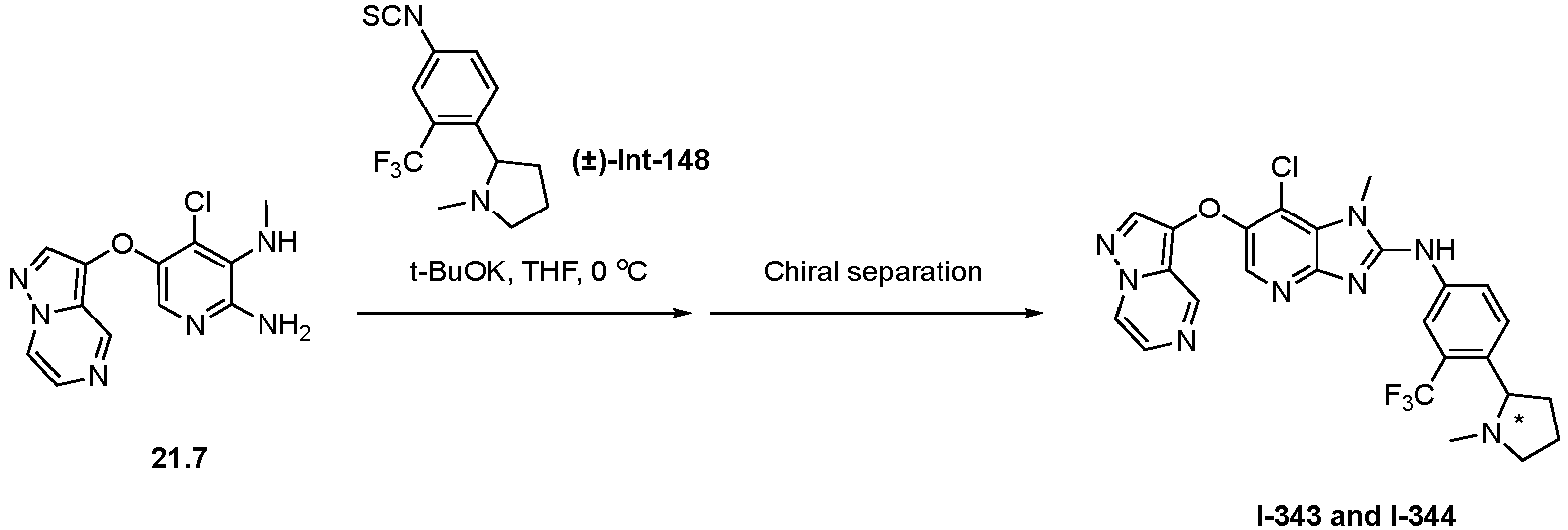
- Synthesis of I-343 and I-344. The racemate was prepared from 21.7 and (±)-Int-148, following the procedure described in the synthesis of I-13. The product was purified by flash column chromatography on silica gel (CombiFlash®, 2.2% methanol in DCM). The enantiomers were separated by SFC (column: CHIRALPAK AD-H (250 mm * 21 mm, 5 µm); mobile phases: (A) liquid CO2 (B) 0.1% diethylamine in propan-2-ol:acetronitrile (50:50); flow rate: 80 mL/min) to afford first eluting fraction (I-343) and second eluting fraction (I-344). (*Absolute stereochemistry not determined.)
- I-343: MS(ES): m/z 543.4 [M+H]+, 1H NMR (DMSO-d6, 400 MHz): δ 9.62 (s, 1H), 9.02 (s, 1H), 8.69-8.68 (d, J = 4.4 Hz, 1H), 8.25 (s, 1H), 8.18 (s, 1H), 8.16-8.14 (d, J = 8.0 Hz, 1H), 8.03 (s, 1H), 7.86 (bs, 2H), 4.01 (s, 3H), 3.19-3.17 (m, 1H), 2.29-2.25 (m, 1H), 2.17 (bs, 1H), 2.08 (s, 3H), 1.89 (bs, 1H), 1.75 (bs, 2H), 1.54 (bs, 1H).
- I-343: MS(ES): m/z 543.4 [M+H]+, 1H NMR (DMSO-d6, 400 MHz): δ 9.63 (s, 1H), 9.03 (s, 1H), 8.70-8.69 (d, J = 4.4 Hz, 1H), 8.26 (s, 1H), 8.17 (s, 1H), 8.17-8.15 (d, J = 8.0 Hz, 1H), 8.04 (s, 1H), 7.88 (bs, 2H), 4.02 (s, 3H), 3.20-3.18 (m, 1H), 2.29-2.25 (m, 1H), 2.19 (bs, 1H), 2.09 (s, 3H), 1.90 (bs, 1H), 1.79 (bs, 2H), 1.56 (bs, 1H).
-

- Synthesis of compound 345.1. Compound 345.1 was prepared from 304.9 and Int-77, following the procedure described in the synthesis of I-13. The product was purified by flash column chromatography on silica gel (CombiFlash®, 3.5% methanol in DCM). MS(ES): m/z 592.0 [M+H]+.
- Synthesis of I-345. Compound I-345 was prepared from 345.1 following the procedure described in the synthesis of I-304. The product was purified by flash column chromatography on silica gel (CombiFlash®, 4.0% methanol in DCM). MS(ES): m/z 523.3 [M+H]+, 1H NMR (DMSO-d6, 400 MHz): δ 8.85 (s, 1H), 8.80 (s, 1H), 8.68 (s, 1H), 8.10 (s, 1H), 7.62 (s, 1H), 7.54 (s, 1H), 6.14 (s, 1H), 4.52-4.51 (m, 2H), 3.99 (s, 3H), 2.72-2.71 (d, 3H), 1.38 (s, 9H), 1.24 (bs, 3H).
-
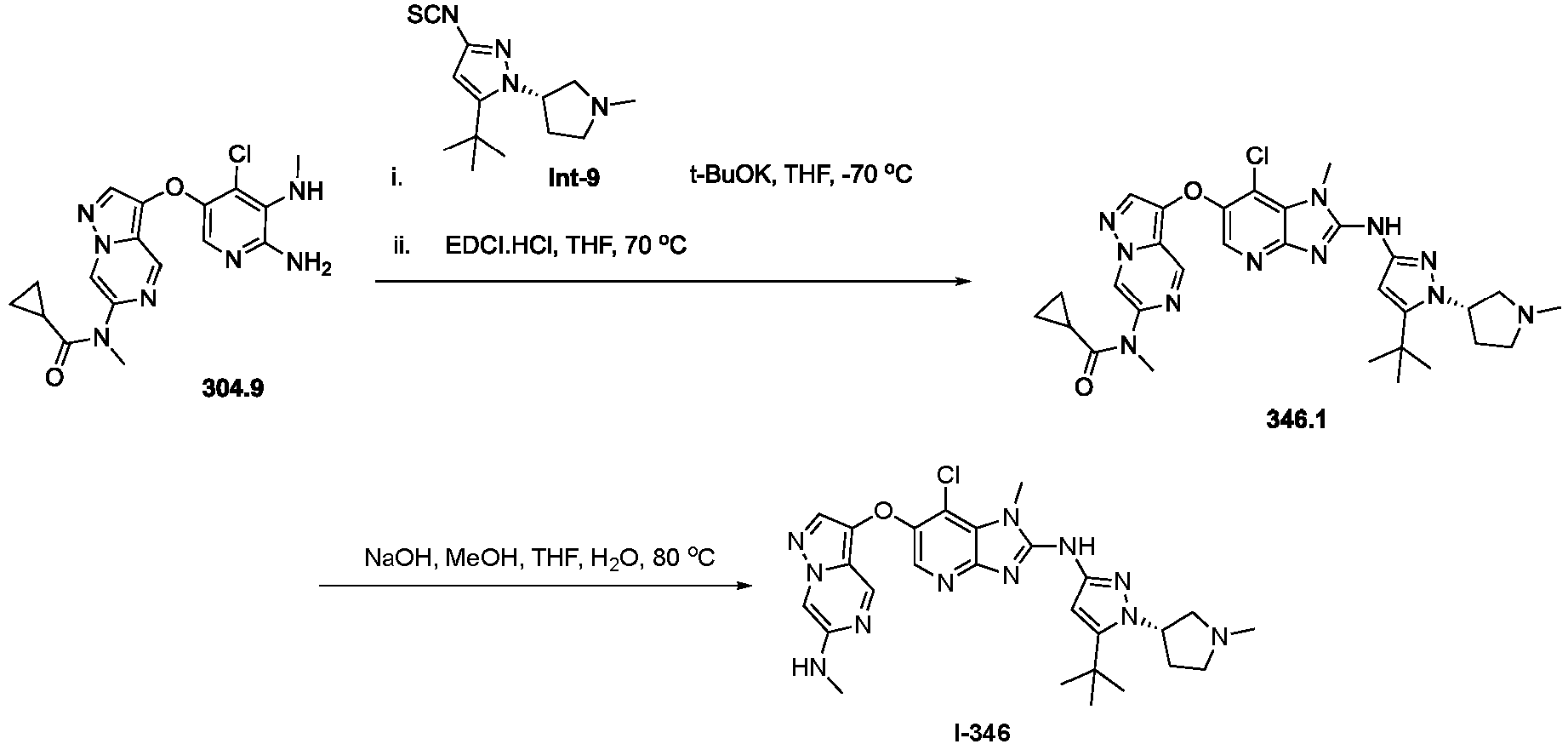
- Synthesis of compound 346.1. Compound 346.1 was prepared from 304.9 and Int-9, following the procedure described in the synthesis of I-51. The product was purified by flash column chromatography on silica gel (CombiFlash®, 3.0% methanol in DCM). MS(ES): m/z 619.1 [M+H]+.
- Synthesis of I-346. Compound I-346 was prepared from 346.1 following the procedure described in the synthesis of I-304. The product was purified by flash column chromatography on silica gel (CombiFlash®, 2.5% methanol in DCM). MS(ES): m/z 550.4 [M+H]+, 1H NMR (DMSO-d6, 400 MHz): δ 9.95 (s, 1H), 8.67 (s, 1H), 8.06 (s, 1H), 7.62 (s, 1H), 7.54 (s, 1H), 6.51 (s, 1H), 6.14 (bs, 1H), 5.10 (bs, 1H), 3.96 (s, 3H), 2.72-2.71 (d, 3H), 2.68 (bs, 7H), 1.39 (s, 9H), 1.24 (bs, 2H).
-
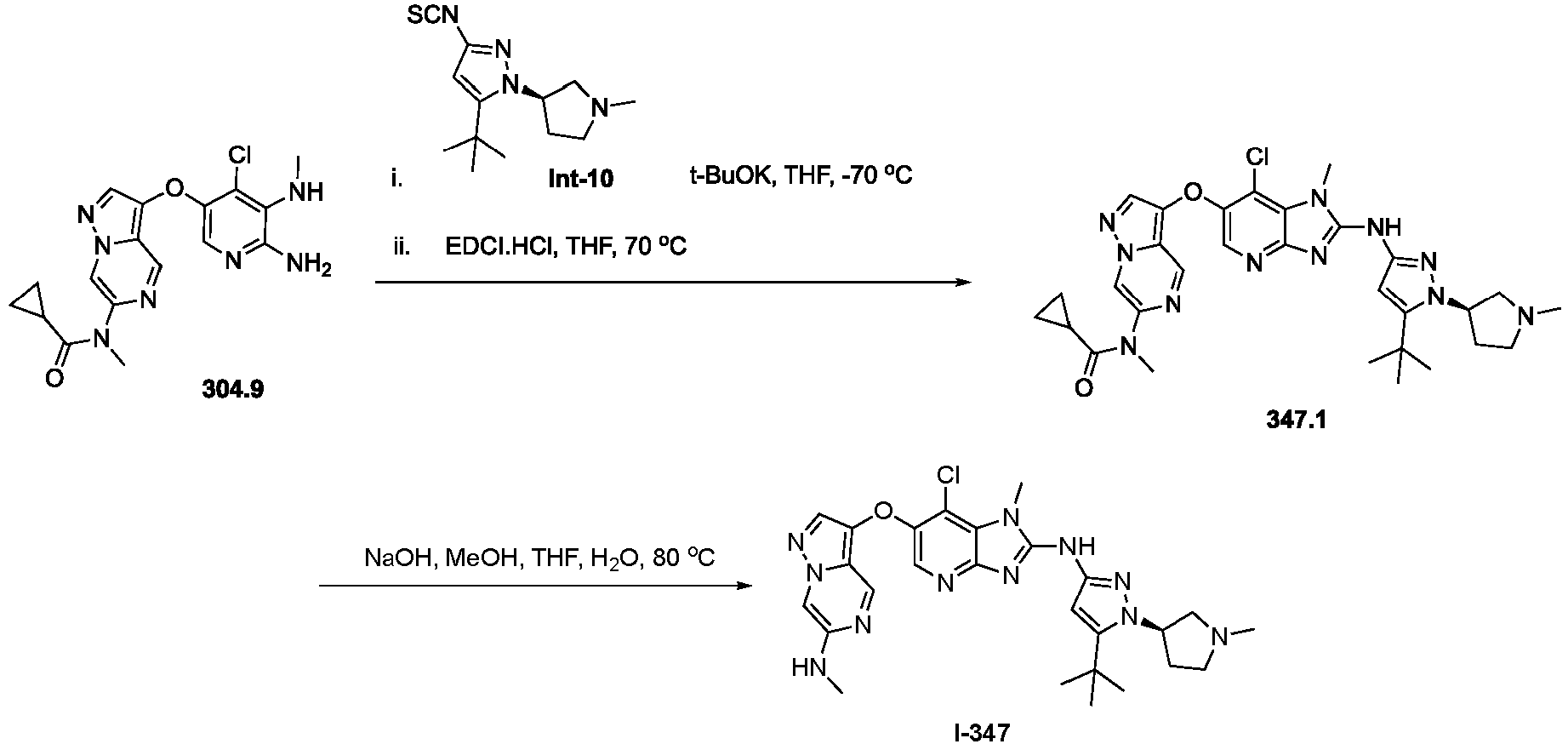
- Synthesis of compound 347.1. Compound 347.1 was prepared from 304.9 and Int-10, following the procedure described in the synthesis of I-51. The product was purified by flash column chromatography on silica gel (CombiFlash®, 3.0% methanol in DCM). MS(ES): m/z 619.1 [M+H]+.
- Synthesis of I-347. Compound I-347 was prepared from 347.1 following the procedure described in the synthesis of I-304. The product was purified by flash column chromatography on silica gel (CombiFlash®, 2.5% methanol in DCM. MS(ES): m/z 550.3 [M+H]+, 1H NMR (DMSO-d6, 400 MHz): δ 9.97 (s, 1H), 8.66 (s, 1H), 8.05 (s, 1H), 7.61 (s, 1H), 7.53 (s, 1H), 6.50 (s, 1H), 6.14 (bs, 1H), 5.15 (bs, 1H), 3.96 (s, 3H), 2.71-2.69 (d, 3H), 2.68 (bs, 7H), 1.39 (s, 9H), 1.23 (bs, 2H).
-


- Synthesis of compound 348.1. Compound 348.1 was prepared from 304.9 and Int-111, following the procedure described in the synthesis of 331.1. The product was purified by flash column chromatography on silica gel (CombiFlash®, 3.0% methanol in DCM). MS(ES): m/z 647.1 [M+H]+.
- Synthesis of I-348. Compound I-348 was prepared from 348.1 following the procedure described in the synthesis of I-304. The product was purified by flash column chromatography on silica gel (CombiFlash®, 2.8% methanol in DCM). MS(ES): m/z 578.3 [M+H]+, 1H NMR (DMSO-d6, 400 MHz): 9.79 (s, 1H), 8.68 (s, 1H), 8.35-8.34 (d, J= 5.2 Hz, 2H), 8.16 (s, 1H), 7.65 (s, 1H), 7.56 (s, 1H), 6.15-6.14 (d, J= 5.2 Hz, 1H), 4.03 (s, 3H), 3.07 (s, 3H), 2.93 (s, 3H), 2.72-2.71 (d, 3H).
-


- Synthesis of compound 349.1. To a solution of 5-bromo-1H-pyrrolo[2,3-b]pyridine (40.0 g, 203.01 mmol, 1.0 equiv) in acetic acid (92 mL) was added water (184 mL) followed by hexamethylenetetramine (39.8 g, 284.34 mmol, 1.4 equiv). The reaction mixture was stirred at 120 °C for 16 h. It was transferred into ice-water, stirred, and precipitated solid was filtered, dried under vacuum to afford 349.1. MS (ES): m/z 226.1 [M+H]+.
- Synthesis of compound 349.2. To a solution of 349.1 (30.0 g, 133.31 mmol, 1.0 equiv) and triethylamine (22.74 mL, 166.63 mmol, 1.25 equiv) in THF (750 mL) was added benzylsulfonyl chloride (21.65 mL, 159.97 mmol, 1.2 equiv) and stirred at room temperature for 16 h. It was transferred into ice-water, stirred, and extracted with DCM. The combined organic layers were washed with brine, dried over anhydrous sodium sulfate, filtered, and concentrated under reduced pressure. The residue was purified by flash column chromatography on silica gel (CombiFlash®, 12% ethyl acetate in hexane) to afford 349.2. MS (ES): m/z 366.1 [M+H]+.
- Synthesis of compound 349.3. To a solution of 349.2 (5.0 g, 13.69 mmol, 1 equiv) in DCM (100 mL) was added m-chloroperbenzoic acid (3.53 g, 20.53, 1.5 equiv) at 0 °C. The reaction mixture was stirred at room temperature for 8 h. The reaction mixture was transferred into aqueous sodium bicarbonate solution and extracted with DCM. The combined organic layers were washed with brine, dried over anhydrous sodium sulfate, filtered, and concentrated under reduced pressure. The residue was purified by flash column chromatography on silica gel (CombiFlash®, 15% ethyl acetate in hexane) to afford 349.3. MS(ES): m/z 354.5 [M+H]+.
- Synthesis of compound 349.4. To a solution of 349.3 (2.0 g, 5.66 mmol, 1.0 equiv) in methanol:THF (1:1, 80 mL) was added trimethylsilyl diazomethane solution (1 M in THF, 15 mL). The reaction mixture was stirred at room temperature for 16 h. A few drops of acetic acid was added to quench the reaction and the reaction mixture was concentrated under reduced pressure. The residue was purified by flash column chromatography on silica gel (CombiFlash®, 10% ethyl acetate in hexane) to afford 349.4. MS(ES): m/z 368.1 [M+H]+.
- Synthesis of compound 349.5. A mixture of 349.4 (1.2 g, 3.27 mmol, 1.0 equiv), bis(pinacolato)diboron (1.65 g, 6.54 mmol, 2.0 equiv) and potassium acetate (0.640 g, 6.54 mmol, 2 equiv) in 1,4 dioxane (12 mL) was degassed by bubbling argon through for 30 min. Under argon atmosphere, 1,1-bis(diphenylphosphino)ferrocene-palladium(II) dichloride DCM complex (0.047 g, 0.065 mmol, 0.02 equiv) was added. The reaction mixture was stirred at 80 °C for 6 h. It was poured into ice-water and extracted with ethyl acetate. The combined organic layers were washed with brine, dried over anhydrous sodium sulfate, filtered, and concentrated under reduced pressure to afford 349.5. MS(ES): m/z 415.1 [M+H]+.
- Synthesis of compound 349.6. Compound 349.5 (1.2 g, 2.90 mmol, 1.0 equiv) was stirred with aqueous hydrogen peroxide solution (6 mL) at room temperature for 16 h. It was transferred into ice, stirred, and extracted with ethyl acetate. The combined organic layers were washed with brine, dried over anhydrous sodium sulfate, filtered, and concentrated under reduced pressure. The residue was purified by flash column chromatography on silica gel (CombiFlash®, 35% ethyl acetate in hexane) to afford 349.6. MS(ES): m/z 305.2 [M+H]+.
- Synthesis of compound 349.7. To a solution of 349.6 (0.600 g, 1.97 mmol, 1.0 equiv) and Int-4 (0.323 g, 1.576 mmol, 0.8 equiv) in DMF (10 mL) was added potassium carbonate (0.815 g, 5.91 mmol, 3.0 equiv). The reaction mixture was stirred at 60 °C for 1 h. It was transferred into water and extracted with ethyl acetate. The combined organic layers were washed with brine, dried over anhydrous sodium sulfate, filtered, and concentrated under reduced pressure. The residue was purified by flash column chromatography on silica gel (CombiFlash®, 30% ethyl acetate in hexane) to afford 349.7. MS(ES): m/z 490.5 [M+H]+.
- Synthesis of compound 349.8. Compound 349.8 was prepared from 349.7 following the procedure described in the synthesis of 5.4. The product was purified by flash column chromatography on silica gel (CombiFlash®, 40% ethyl acetate in hexane). MS(ES): m/z 460.5 [M+H]+.
- Synthesis of compound 349.9. Compound 349.9 was prepared from 349.8 and Int-63, following the procedure described in the synthesis of I-13. The product was purified by flash column chromatography on silica gel (CombiFlash®, 75% ethyl acetate in hexane). MS(ES): m/z 661.7 [M+H]+.
- Synthesis of compound 349.10. Compound 349.10 was prepared from 349.9 following the procedure described in the synthesis of I-157. The product was purified by flash column chromatography on silica gel (CombiFlash®, 70% ethyl acetate in hexane). MS(ES): m/z 651.3 [M+H]+.
- Synthesis of I-349. To a solution of 349.10 (0.070 g, 0.106 mmol, 1.0 equiv) in methanol:THF (1:1, 4 mL) was added a solution of sodium hydroxide (0.042 g, 1.06 mmol, 10 equiv) in water (2 mL). The reaction mixture was stirred at 60 °C for 30 min. The reaction mixture concentrated under reduced pressure to afford residue. Residue was transferred into cold water and extracted with DCM. The combined organic layers were washed with brine, dried over anhydrous sodium sulfate, filtered, and concentrated under reduced pressure. The residue was purified by trituration by methanol) to afford I-349. MS(ES): m/z 511.3 [M+H]+, 1H NMR (DMSO-d6, 400 MHz): δ 11.21 (s, 1H), 8.62 (s, 1H), 8.21(s, 1H), 8.14 (s, 2H), 7.97 (s, 1H), 7.62 (s, 1H), 7.15 (s, 1H), 3.96 (s, 3H), 3.78 (s, 3H), 3.65 (s, 3H).
-

- Synthesis of I-350-a. Compound I-350-a was prepared from 21.7 and Int-149-a, following the procedure described in the synthesis of I-13. The product was purified by flash column chromatography on silica gel (CombiFlash®, 2.2% methanol in DCM). MS(ES): m/z 587.4 [M+H]+, 1H NMR (DMSO-d6, 400 MHz): δ 9.66 (s, 1H), 9.02 (s, 1H), 8.69-8.68 (d, J = 4.4 Hz, 1H), 8.20 (s, 1H), 8.04 (s, 1H), 7.98 (s, 1H), 7.87(s, 1H), 7.86 (s, 1H), 6.94 (s, 1H), 4.17 (bs, 2H), 4.02 (bs, 4H), 2.45 (s, 3H), 2.33 (bs, 2H), 1.80-1.72 (m, 4H), 1.57 (bs, 2H).
- Synthesis of I-350-b. Compound I-350-b was prepared from 21.7 and Int-149-b, following the procedure described in the synthesis of I-13. The product was purified by flash column chromatography on silica gel (CombiFlash®, 2.2% methanol in DCM). MS(ES): m/z 587.3 [M+H]+, 1H NMR (DMSO-d6, 400 MHz): δ 9.73 (s, 1H), 9.03 (s, 1H), 8.71-8.70 (d, J = 4.4 Hz, 1H), 8.22 (s, 1H), 8.05 (s, 1H), 8.03 (s, 1H), 7.87 (bs, 2H), 6.97 (s, 1H), 4.22 (bs, 2H), 4.02 (bs, 4H), 2.45 (s, 3H), 2.33 (bs, 2H), 1.80-1.74 (m, 4H), 1.56 (bs, 2H).
-

- Synthesis of compound 351.1. Compound 351.1 was prepared from 304.9 and Int-78, following the procedure described in the synthesis of I-13. The product was purified by flash column chromatography on silica gel (CombiFlash®, 3.8% methanol in DCM). MS(ES): m/z 656.0 [M+H]+.
- Synthesis of I-351. Compound I-351 was prepared from 351.1 following the procedure described in the synthesis of I-304. The product was purified by flash column chromatography on silica gel (CombiFlash®, 8% methanol in DCM). MS(ES): m/z 587.3 [M+H]+, 1H NMR (DMSO-d6, 400 MHz): δ 9.44 (s, 1H), 8.66 (s, 1H), 8.12 (s, 1H), 7.79 (s, 1H), 7.72 (s, 1H), 7.62 (s, 1H), 7.54 (s, 1H), 6.88 (s, 1H), 6.13 (s, 1H), 4.01 (s, 3H), 3.23 (s, 4H), 2.71-2.70 (d, 3H), 2.33 (s, 3H), 2.24 (s, 4H).
-

- Synthesis of compound (±)-352.1. Compound (±)-352.1 was prepared from 304.9 and (±)-Int-51, following the procedure described in the synthesis of I-13. The product was purified by flash column chromatography on silica gel (CombiFlash®, 3.5% methanol in DCM. MS(ES): m/z 659.0 [M+H]+.
- Synthesis of compound I-352-a and I-352-b. The racemate was prepared from (±)-352.1 following the procedure described in the synthesis of I-304. The product was purified by flash column chromatography on silica gel (CombiFlash®, 2.6% methanol in DCM). The enantiomers were separated by HPLC (column: CHIRALPAK IB-N (250 mm x 4.6 mm, 5 µm), mobile phase: (A) 0.1% DEA in n-hexane, (B) 0.1% DEA in propan-2-ol:acetonitrile (70:30); flow rate: 20 mL/min) to afford first eluting fraction (I-352-a) and second eluting fraction (I-352-b).
- I-352-a: MS(ES): m/z 590.3 [M+H]+, 1H NMR (DMSO-d6, 400 MHz): δ 8.80 (s, 1H), 8.69 (s, 1H), 8.60 (s, 1H), 8.18 (s, 1H), 8.10 (s, 1H), 7.65 (s, 1H), 7.54 (s, 1H), 6.12-6.11 (d, J = 4.8 Hz, 1H), 4.87 (bs, 1H), 4.01 (s, 3H), 3.89-3.88 (m, 2H), 3.81-3.79 (m, 2H), 2.72-2.70 (d, 3H), 2.21-2.16 (m, 2H), 2.00 (bs, 2H).
- I-352-b: MS(ES): m/z 590.2 [M+H]+, 1H NMR (DMSO-d6, 400 MHz): δ 8.80 (s, 1H), 8.68 (s, 1H), 8.60 (s, 1H), 8.18 (s, 1H), 8.09 (s, 1H), 7.65 (s, 1H), 7.54 (s, 1H), 6.10 (bs, 1H), 4.87 (bs, 1H), 4.01 (s, 3H), 3.88-3.87 (m, 2H), 3.82-3.80 (m, 2H), 2.72-2.70 (d, 3H), 2.21-2.16 (m, 2H), 2.01 (bs, 2H).
-

- Synthesis of compound 353.1. Compound 353.1 was prepared from 304.9 and Int-124, following the procedure described in the synthesis of 331.1. The product was purified by flash column chromatography on silica gel (CombiFlash®, 7.8% methanol in DCM). MS(ES): m/z 655.10 [M+H]+.
- Synthesis of I-353. Compound I-353 was prepared from 353.1 following the procedure described in the synthesis of I-304. The product was purified by flash column chromatography on silica gel (CombiFlash®, 10.0% methanol in DCM). MS(ES): m/z 586.3 [M+H]+, 1H NMR (DMSO-d6, 400 MHz): 9.72 (s, 1H), 8.67 (s, 1H), 8.25 (s, 1H), 8.13 (s, 1H), 8.10 (s, 1H), 7.63 (s, 1H), 7.54 (s, 1H), 7.24 (s, 1H), 6.15-6.14 (d, J = 4.4 Hz, 1H), 4.03 (s, 3H), 2.71-2.70 (d, 3H), 2.67 (bs, 1H), 2.49 (s, 3H), 1.91 (bs, 2H), 1.85 (bs, 2H), 1.23 (bs, 4H).
-


- Synthesis of compound 354.1. To a solution of 3-bromo-5-fluoropyridine (50.0 g, 284.0 mmol, 1.0 equiv) in DCM (2180 mL) was added O-(mesitylsulfonyl)hydroxylamine (78.77 g, 365.9 mmol, 1.2 equiv) at 0 °C. The reaction mixture was stirred at room temperature for 1 h. It was transferred into diethyl ether and the solids were collected by filtration. The solids were added DMF (175 mL) and trimethylamine (76.0 mL, 571.0 mmol, 2.0 equiv), followed by ethyl propiolate ((55.7 g, 568.0 mmol, 2.0 equiv)) at 0 °C. The reaction mixture was stirred at room temperature for 48 h. It was transferred into brine and extracted with ethyl acetate. The combined organic layers were washed with brine, dried over anhydrous sodium sulfate, filtered, and concentrated under reduced pressure. The residue was purified by flash column chromatography on silica gel (4% ethyl acetate in hexane) to afford 354.1. MS (ES): m/z 288.0 [M+H]+.
- Synthesis of compound 354.2. To a solution of 354.1 (4.1 g, 14.28 mmol, 1.0 equiv) in THF (70 mL) was added diisobutylaluminum hydride (1 M solution in DCM, 42 mL, 42.0 mmol, 3.0 equiv) dropwise at -78 °C. The reaction mixture was stirred at room temperature for 1 h. It was transferred into 2 M aqueous hydrochloric acid solution and extracted with ethyl acetate. The combined organic layers were washed with brine, dried over anhydrous sodium sulfate, filtered, and concentrated under reduced pressure to afford 354.2. MS (ES): m/z 246.1 [M+H]+.
- Synthesis of compound 354.3. To a solution of 354.2 (3.1 g, 12.65 mmol, 1.0 equiv) in DCM (60 mL) was added Dess-Martin periodinane (4.44 g, 25.3 mmol, 2.0 equiv). The reaction mixture was stirred at 0 °C for 1 h. It was transferred into aqueous sodium bicarbonate solution and extracted with DCM. The combined organic layers were washed with brine, dried over anhydrous sodium sulfate, filtered, and concentrated under reduced pressure. The residue was purified by flash column chromatography on silica gel (CombiFlash®, 20% ethyl acetate in hexane) to afford 354.3. MS(ES): m/z 243.8 [M+H]+.
- Synthesis of compound 354.4. To a solution of 354.3 (2.3 g, 9.46 mmol, 1 equiv) in DCM (154 mL) was added m-chloroperbenzoic acid (60%, 3.2 g, 18.9 mmol, 2.0 equiv) and trifluoroacetic acid (0.1 g, 0.946 mmol, 0.1 equiv) at 0 °C. The reaction mixture was stirred at room temperature for 18 h. The reaction mixture was transferred into aqueous sodium bicarbonate solution and extracted with DCM. The combined organic layers were washed with brine, dried over anhydrous sodium sulfate, filtered, and concentrated under reduced pressure. The residue was purified by flash column chromatography on silica gel (CombiFlash®, 25% ethyl acetate in hexane) to afford 354.4. MS(ES): m/z 232.1 [M+H]+.
- Synthesis of compound 354.5. To a mixture of 354.4 (0.900 g, 3.9 mmol, 1.0 equiv) and potassium carbonate (1.07 g, 7.7 mmol, 2.0 equiv) in DMF (7 mL) was added benzyl bromide (0.9 mL) and stirred at room temperature for 30 min. It was poured into ice-water and extracted with ethyl acetate. The combined organic layers were washed with brine, dried over anhydrous sodium sulfate, filtered, and concentrated under reduced pressure. The residue was purified by flash column chromatography on silica gel (CombiFlash®, 7.0% ethyl acetate in hexane) to afford 354.5. MS(ES): m/z 322.0 [M+H]+.
- Synthesis of compound 354.6. A mixture of 354.5 (0.550 g, 1.71 mmol, 1.0 equiv), cyclopropyl carboxamide (2.6 g, 31.56 mmol, 3.0 equiv) and cesium carbonate (10.25 g, 31.56 mmol, 3.0 equiv) in 1,4-dioxane (3 mL) was degassed by bubbling argon through for 10 min. Under argon atmosphere, 4,5-bis(diphenylphosphino)-9,9-dimethylxanthene (1.2 g, 2.1 mmol, 0.2 equiv) and tris(dibenzylideneacetone)dipalladium(0) (0.962 g, 1.052 mmol, 0.1 equiv) were added, and degassed for 5 min. The reaction mixture was stirred at 100 °C for 1 h. It was cooled to room temperature, transferred into water, and extracted with ethyl acetate. The combined organic layers were washed with brine, dried over anhydrous sodium sulfate, filtered, and concentrated under reduced pressure. The residue was dissolved in DMF and treated with NaH followed by methyl iodide at 0 °C. The product was purified by flash column chromatography on silica gel (CombiFlash®, 15% ethyl acetate in hexane) to afford 354.6. MS(ES): m/z 340.2 [M+H]+.
- Synthesis of compound 354.7. A mixture of compound 354.6 (0.385 g, 1.13 mmol, 1.0 equiv) and 10% palladium on charcoal (0.200 g) in methanol:THF (1:1, 30 mL) was stirred under hydrogen for 4 h. It was filtered through a pad of Celite® and rinsed with methanol. The filtrate was concentrated under reduced pressure to afford 354.7. MS(ES): m/z 250.1 [M+H]+.
- Synthesis of compound 354.8. Compound 354.8 was prepared from 354.7 and Int-4, following the procedure described in the synthesis of 19.1. The product was purified by flash column chromatography on silica gel (CombiFlash®, 22% ethyl acetate in hexane). MS(ES): m/z 435.6 [M+H]+.
- Synthesis of compound 354.9. Compound 354.9 was prepared from 354.8 following the procedure described in the synthesis of 5.4. The product was purified by flash column chromatography on silica gel (CombiFlash®, 2.1% methanol in DCM). MS(ES): m/z 405.5 [M+H]+.
- Synthesis of compound 354.10. Compound 354.10 was prepared from 354.9 and Int-63, following the procedure described in the synthesis of I-13. The product was purified by flash column chromatography on silica gel (CombiFlash®, 2.8% methanol in DCM). MS(ES): m/z 605.8 [M+H]+.
- Synthesis of I-354. Compound I-354 was prepared from 354.10 following the procedure described in the synthesis of I-304. MS(ES): m/z 537.2 [M+H]+, 1H NMR (CDCl3, 400 MHz): 8.88 (bs, 1H), 8.17 (s, 1H), 8.06 (s, 1H), 7.60 (s, 1H), 7.49 (s, 1H), 7.42 (s, 1H), 7.28 (s, 1H), 6.38 (bs, 1H), 4.10 (s, 3H), 3.74 (s, 3H), 2.86 (s, 3H).
-

- Synthesis of I-355. Compound I-355 was prepared from 153.5 and Int-63, following the procedure described in the synthesis of I-13. The product was purified by flash column chromatography on silica gel (CombiFlash®, 3.6% methanol in DCM). MS(ES): m/z 564.2 [M+H]+, 1H NMR (DMSO-d6, 400 MHz): δ 8.79 (s, 1H), 8.60 (s, 1H), 8.36 (s, 1H), 8.13 (s, 1H), 8.04 (s, 1H), 7.88 (s, 1H), 7.44-7.42 (d, J = 9.6 Hz, 1H), 7.03-7.01 (d, J = 9.6 Hz, 1H), 4.15 (bs, 2H), 4.02 (s, 3H), 3.69 (bs, 2H), 3.66 (s, 3H), 3.33 (s, 3H).
-

- Synthesis of compound 356.1. Compound 356.1 was prepared from 304.9 and Int-150, following the procedure described in the synthesis of I-13. The product was purified by flash column chromatography on silica gel (CombiFlash®, 5.0% methanol in DCM). MS(ES): m/z 669.08 [M+H]+.
- Synthesis of I-356. Compound I-356 was prepared from 356.1 following the procedure described in the synthesis of I-304. The product was purified by flash column chromatography on silica gel (CombiFlash®, 7.0% methanol in DCM). MS(ES): m/z 600.3 [M+H]+, 1H NMR (DMSO-d6, 400 MHz): δ 9.65 (s, 1H), 8.67 (s, 1H), 8.29 (s, 1H), 8.14 (s, 1H), 8.05 (s, 1H), 7.63 (s, 1H), 7.54 (s, 1H), 7.22 (s, 1H), 6.14 (bs, 1H), 4.63 (bs, 4H), 4.02 (s, 3H), 3.62 (bs, 2H), 3.20 (bs, 4H), 2.71 (bs, 3H).
-

- Synthesis of compound 357.1. Compound 357.1 was prepared from 304.9 and Int-126, following the procedure described in the synthesis of I-13. The product was purified by flash column chromatography on silica gel (CombiFlash®, 9.8% methanol in DCM). MS(ES): m/z 627.0 [M+H]+.
- Synthesis of I-357. Compound I-357 was prepared from 357.1 following the procedure described in the synthesis of I-304. The product was purified by flash column chromatography on silica gel (CombiFlash®, 15% methanol in DCM). MS(ES): m/z 558.3 [M+H]+, 1H NMR (DMSO-d6, 400 MHz): δ 9.96 (s, 1H), 8.67 (s, 1H), 8.35 (s, 1H), 8.22 (s, 1H), 8.14 (s, 1H), 7.63 (s, 1H), 7.55 (s, 1H), 7.44 (s, 1H), 6.16-6.14 (d, J = 5.2 Hz, 1H), 4.02 (s, 3H), 3.68 (s, 2H), 2.71-2.70 (d, 3H), 2.21 (bs, 4H), 1.23 (bs, 2H).
-

- Synthesis of compound 358.1. Compound 358.1 was prepared from 304.9 and Int-93, following the procedure described in the synthesis of 331.1. The product was purified by flash column chromatography on silica gel (CombiFlash®, 4.0% methanol in DCM). MS(ES): m/z 645.0 [M+H]+.
- Synthesis of I-358. Compound I-358 was prepared from 358.1 following the procedure described in the synthesis of I-304. The product was purified by flash column chromatography on silica gel (CombiFlash®, 4.5% methanol in DCM). MS(ES): m/z 576.3 [M+H]+, 1H NMR (DMSO-d6, 400 MHz): δ 9.65 (s, 1H), 8.67 (s, 1H), 8.30 (s, 1H), 8.14 (s, 1H), 8.06 (s, 1H), 7.63 (s, 1H), 7.54 (bs, 2H), 7.26 (s, 1H), 4.02 (s, 3H), 3.75 (s, 2H), 3.63-3.58 (m, 4H), 3.17 (bs, 1H), 2.71-2.70 (d, 3H).
-


- Synthesis of compound 359.1. Compound 359.1 was prepared from 304.9 and Int-132-a, following the procedure described in the synthesis of 331.1. The product was purified by flash column chromatography on silica gel (CombiFlash®, 7.2% methanol in DCM). MS(ES): m/z 641.0 [M+H]+.
- Synthesis of I-359-a. Compound I-359-a was prepared from 359.1 following the procedure described in the synthesis of I-304. The product was purified by flash column chromatography on silica gel (CombiFlash®, 10.0% methanol in DCM). MS(ES): m/z 573.0 [M+H]+, 1H NMR (DMSO-d6, 400 MHz): δ 9.67 (s, 1H), 8.67 (s, 1H), 8.38 (s, 1H), 8.14 (s, 1H), 8.10 (s, 1H), 7.63 (s, 1H), 7.54 (s, 1H), 7.30 (bs, 1H), 6.14 (bs, 1H), 4.02 (s, 3H), 2.71-2.70 (d, 3H), 2.33 (bs, 3H), 2.15 (bs, 1H), 1.23 (bs, 4H). (*Absolute stereochemistry not determined.)
- Synthesis of compound 359.2. Compound 359.2 was prepared from 304.9 and Int-132-b, following the procedure described in the synthesis of 331.1. The product was purified by flash column chromatography on silica gel (CombiFlash®, 7.1% methanol in DCM). MS(ES): m/z 641.0 [M+H]+.
- Synthesis of I-359-b. Compound I-359-b was prepared from 359.2 following the procedure described in the synthesis of I-304. The product was purified by flash column chromatography on silica gel (CombiFlash®, 10.0% methanol in DCM). MS(ES): m/z 573.0 [M+H]+, 1H NMR (DMSO-d6, 400 MHz): δ 9.65 (s, 1H), 8.67 (s, 1H), 8.38 (s, 1H), 8.13 (s, 1H), 8.06 (s, 1H), 7.63 (s, 1H), 7.54 (s, 1H), 7.30 (bs, 1H), 6.14 (bs, 1H), 4.02 (s, 3H), 3.20 (bs, 3H), 2.71-2.70 (d, 3H), 2.14 (bs, 3H), 1.60 (bs, 2H), 1.23 (bs, 2H). (*Absolute stereochemistry not determined.)
-

- Synthesis of compound 360.1. Compound 360.1 was prepared from 304.9 and Int-81, following the procedure described in the synthesis of I-13. The product was purified by flash column chromatography on silica gel (CombiFlash®, 3.9% methanol in DCM). MS(ES): m/z 671.0 [M+H]+.
- Synthesis of I-360. Compound I-360 was prepared from 360.1 following the procedure described in the synthesis of I-304. The product was purified by flash column chromatography on silica gel (CombiFlash®, 4.2% methanol in DCM). MS(ES): m/z 602.4 [M+H]+, 1 H NMR (DMSO-d6, 400 MHz): δ 9.61 (s, 1H), 8.67 (s, 1H), 8.28 (s, 1H), 8.13 (s, 1H), 7.72-7.70 (d, J = 8.4 Hz, 1H), 7.62 (s, 1H), 7.54 (s, 1H), 6.14-6.13 (m, 1H), 4.01 (s, 1H), 3.90 (bs, 1H), 3.69 (s, 2H), 3.17 (s, 3H), 2.71-2.70 (d, 3H), 2.60 (bs, 2H), 2.04-1.99 (m, 1H), 1.69 (bs, 2H).
-

- Synthesis of compound 361.1. Compound 361.1 was prepared from 304.9 and Int-82, following the procedure described in the synthesis of I-13. The product was purified by flash column chromatography on silica gel (CombiFlash®, 4.0% methanol in DCM). MS(ES): m/z 671.0 [M+H]+.
- Synthesis of I-361. Compound I-361 was prepared from 361.1 following the procedure described in the synthesis of I-304. The product was purified by flash column chromatography on silica gel (CombiFlash®, 4.5% methanol in DCM). MS(ES): m/z 602.3 [M+H]+, 1H NMR (DMSO-d6, 400 MHz): δ 9.61 (s, 1H), 8.68 (s, 1H), 8.29 (s, 1H), 8.13 (s, 1H), 7.73-7.71 (d, J = 7.6 Hz, 1H), 7.63 (s, 1H), 7.55 (s, 1H), 6.13 (s, 1H), 4.02 (s, 1H), 3.91 (bs, 1H), 3.70 (s, 2H), 3.17 (s, 3H), 2.71-2.70 (d, 3H), 2.60 (bs, 2H), 2.03-2.01 (m, 1H), 1.69 (bs, 2H).
-

- Synthesis of compound 362.1. Compound 362.1 was prepared from 21.7 and Int-151, following the procedure described in the synthesis of I-13. The product was purified by flash column chromatography on silica gel (CombiFlash®, 3.0% methanol in DCM). MS(ES): m/z 471.6 [M+H]+.
- Synthesis of I-362. A mixture of 362.1 (0.050 g, 0.106 mmol, 1.0 equiv), zinc dust (0.001 g, 0.021 mmol, 0.2 equiv) and zinc cyanide (0.024 g, 0.212 mmol, 2.0 equiv) in N,N-dimethylacetamide (4 mL) was degassed by bubbling argon through for 10 min. Under argon atmosphere, tris(dibenzylideneacetone)dipalladium(0) (0.009 g, 0.010 mmol, 0.1 equiv) and 1,1'-bis(diphenylphosphino)ferrocene (0.005 g, 0.010 mmol, 0.1 equiv) were added, and degassed for 5 min. The reaction mixture was stirred at 170 °C in a microwave reactor for 3 h. It was cooled to room temperature, transferred into water, and extracted with ethyl acetate. The combined organic layers were washed with brine, dried over anhydrous sodium sulfate, filtered, and concentrated under reduced pressure. The residue was purified by flash column chromatography on silica gel (CombiFlash®, 4.5% methanol in DCM) to afford I-362. MS (ES): m/z 463.1, 1H NMR (DMSO-d6, 400 MHz): δ 10.62 (s, 1H), 9.08 (s, 1H), 8.75 (s, 1H), 8.22 (s, 1H), 8.09 (s, 1H), 7.92-7.91 (d, J = 4.4 Hz, 1H), 7.08 (s, 1H), 4.15 (bs, 2H), 3.96 (s, 3H), 2.19 (bs, 2H), 1.24 (bs, 2H).
-

- Synthesis of compound 363.1. A solution of 336.1 (1.0 g, 3.29 mmol, 1.0 equiv) and sodium methoxide solution (25% in methanol, 15 mL) was stirred at 80 °C for 1 h. The reaction mixture was concentrated under reduced pressure. The residue was transferred into ice-water and extracted with ethyl acetate. The combined organic layers were washed with brine, dried over sodium sulfate and concentrated under reduced pressure to afford 363.1. MS(ES): m/z 256.1 [M+H]+.
- Synthesis of compound 363.2. A mixture of compound 363.1 (0.500g, 1.96 mmol, 1.0 equiv) and 10% palladium on carbon (0.500 g) in methanol (10 mL) and THF (1 mL) was stirred under hydrogen (1 atm) for 1 h. The reaction mixture filtered through a pad of Celite® and rinsed with methanol. The filtrate was concentrated under reduced pressure to obtain 363.2. MS(ES): m/z 166.2 [M+H]+.
- Synthesis of compound 363.3. Compound 363.3 was prepared from 363.2 and Int-4, following the procedure described in the synthesis of 19.1. The product was purified by flash column chromatography on silica gel (CombiFlash®, 40% ethyl acetate in hexane). MS (ES): m/z 351.5 [M+H]+.
- Synthesis of compound 363.4. Compound 363.4 was prepared from 363.3 following the procedure described in the synthesis of 5.4. The product was purified by flash column chromatography on silica gel (CombiFlash®, 3.0% methanol in DCM) to afford 363.4. MS(ES): m/z 321.6 [M+H]+.
- Synthesis of I-363. Compound I-363 was prepared from 363.4 and Int-63, following the procedure described in the synthesis of 331.1. The product was purified by flash column chromatography on silica gel (CombiFlash®, 2.2% methanol in DCM). MS(ES): m/z 521.3 [M+H]+, 1H NMR (DMSO-d6, 400 MHz): δ 8.83 (bs, 2H), 8.61 (s, 1H), 8.35 (s, 1H), 8.23 (s, 1H), 8.14 (s, 1H), 7.89 (s, 1H), 4.02 (s, 3H), 3.90 (s, 3H), 3.67 (s, 3H).
-

- Synthesis of I-364. Compound I-364 was prepared from I-363 following the procedure described in the synthesis of I-157. The product was purified by flash column chromatography on silica gel (CombiFlash®, 5.0% methanol in DCM). MS(ES): m/z 512.0 [M+H]+, 1H NMR (DMSO-d6, 400 MHz): δ 9.00 (s, 1H), 8.89 (s, 1H), 8.62 (s, 1H), 8.42 (s, 1H), 8.17 (s, 1H), 8.14 (s, 1H), 8.10 (s, 1H), 4.00 (s, 3H), 3.91 (s, 3H), 3.66 (s, 3H).
-

- Synthesis of compound 365.1. A mixture of 336.1 (1 g, 5.08 mmol, 1.0 equiv), 2-methoxyethan-1-ol (0.772 g, 10.15 mmol, 2.0 equiv) and cesium carbonate (4.95 g, 15.24 mmol, 3.0 equiv) in toluene (30 mL) was degassed by bubbling argon through for 10 min. Under argon atmosphere, di-tert-butyl(2',4',6'-triisopropyl-3-methoxy-6-methyl-[1,1'-biphenyl]-2-yl)phosphine (0.357 g, 0.762 mmol, 0.15 equiv) and allyl palladium(II) chloride dimer (0.092 g, 0.254 mmol, 0.05 equiv) were added, and degassed for 5 min. The reaction mixture was stirred at 90°C for 2 h. It was cooled to room temperature, transferred into water, and extracted with ethyl acetate. The combined organic layers were washed with brine, dried over anhydrous sodium sulfate, filtered, and concentrated under reduced pressure. The residue was purified by flash column chromatography on silica gel (CombiFlash®, 5.3% methanol in DCM) to afford 365.1). MS (ES): m/z 300.1 [M+H]+.
- Synthesis of compound 365.2. A mixture of compound 365.1 (0.580 g, 2.83 mmol, 1.0 equiv) and 10% palladium on carbon (0.250 g) in methanol (10 mL) was stirred under hydrogen (1 atm) for 4 h. The reaction mixture was filtered through a pad of Celite® and rinsed with methanol. The filtrate was concentrated under reduced pressure. The residue was purified by flash column chromatography on silica gel (CombiFlash®, 5.0% Methanol in DCM) to afford 365.2. MS(ES): m/z 210.2 [M+H]+.
- Synthesis of compound 365.3. Compound 365.3 was prepared from 365.2 and Int-4, following the procedure described in the synthesis of 19.1. The product was purified by flash column chromatography on silica gel (CombiFlash®, 2.8% methanol in DCM). MS (ES): m/z 395.5 [M+H]+.
- Synthesis of compound 365.4. Compound 365.4 was prepared from 365.3 following the procedure described in the synthesis of 5.4. The product was purified by flash column chromatography on silica gel (CombiFlash®, 3.0% methanol in DCM). MS(ES): m/z 365.6 [M+H]+.
- Synthesis of I-365. Compound I-365 was prepared from 365.4 and Int-63, following the procedure described in the synthesis of I-13. The product was purified by flash column chromatography on silica gel (CombiFlash®, 3.8% methanol in DCM. MS(ES): m/z 565.2 [M+H]+, 1H NMR (DMSO-d6, 400 MHz): δ 8.85 (s, 1H), 8.82 (s, 1H), 8.61 (s, 1H), 8.36 (s, 1H), 8.23 (s, 1H), 8.14 (s, 1H), 7.89 (s, 1H), 4.34 (s, 3H), 4.02 (s, 3H), 3.69-3.67 (m, 7H).
-

- Synthesis of compound 366.1. Compound 366.1 was prepared from 78.5 and Int-151, following the procedure described in the synthesis of I-13. The product was purified by flash column chromatography on silica gel (CombiFlash®, 2.8% methanol in DCM). MS(ES): m/z 471.6 [M+H]+.
- Synthesis of I-366. Compound 1-366 was prepared from 366.1 following the procedure described in the synthesis of I-157. The product was purified by flash column chromatography on silica gel (CombiFlash®, 4.2% methanol in DCM). MS (ES): m/z 462.2, 1H NMR (DMSO-d6, 400 MHz): δ 8.39 (s, 1H), 8.00 (s, 1H), 7.88 (s, 1H), 7.60 (s, 1H), 7.48-7.43 (m, 2H), 7.06 (s, 1H), 6.83 (s, 1H), 3.95 (s, 3H), 3.68 (bs, 2H), 2.19 (bs, 2H), 1.55 (bs, 2H).
-

- Synthesis of I-367. Compound I-367 was prepared from I-365 following the procedure described in the synthesis of I-157. The product was purified by flash column chromatography on silica gel (CombiFlash®, 5.0% methanol in DCM). MS (ES): m/z 556.3, 1H NMR (DMSO-d6, 400 MHz): δ 9.00 (s, 1H), 8.88 (s, 1H), 8.61 (s, 1H), 8.43 (s, 1H), 8.15 (s, 1H), 8.12 (s, 1H), 8.09 (s, 1H), 4.35-4.33 (t, 2H), 3.98 (s, 3H), 3.70-3.68 (t, 2H), 3.65 (s, 3H), 3.31 (s, 3H).
-


- Synthesis of compound 368.1. To a solution of 5-bromo-2-chloronicotinic acid (10 g, 42.29 mmol, 1.0 equiv) and DMF (1 mL) in DCM (100 mL) was added oxalyl chloride (7.99 g, 63.43 mmol, 1.5 equiv) at 0 °C and stirred for 2 h. The reaction mixture was concentrated under reduced pressure to afford 368.1. MS (ES): m/z 255.1 [M+H]+.
- Synthesis of compound 368.2 To a solution of 368.1 (10 g, 39.23 mmol, 1.0 equiv) in DCM (100 mL) was added dimethylamine hydrochloride (7.3 g, 90.22 mmol, 2.3 equiv) and stirred at room temperature for 16 h. It was transferred into ice-water, stirred, and extracted with DCM. The combined organic layers were washed with brine, dried over anhydrous sodium sulfate, filtered, and concentrated under reduced pressure. The residue was purified by flash column chromatography on silica gel (CombiFlash®, 60% ethyl acetate in hexane) to afford 368.2. MS (ES): m/z 264.1 [M+H]+.
- Synthesis of compound 368.3 To a solution of 368.2 (3.6 g, 13.66 mmol, 1.0 equiv) in THF (36 mL) was added Lawesson's reagent (11.03 g, 27.32 mmol, 2.0 equiv). The solution was heated to reflux for 15 min. It was cooled to room temperature and concentrated under reduced pressure. The residue was purified by flash column chromatography on silica gel (CombiFlash®, 11% ethyl acetate in hexane) to afford 368.3. MS (ES): m/z 280.1 [M+H]+.
- Synthesis of compound 368.4 To a solution of 368.3 (3.0 g, 10.73 mmol, 1.0 equiv) in dimethyl sulfoxide (30 mL) was added hydrazine hydrate (5.36 g, 107.3 mmol, 10 equiv) and stirred at 120 °C for 5 h. It was transferred into ice-water, stirred, and extracted with ethyl acetate. The combined organic layers were washed with brine, dried over anhydrous sodium sulfate, filtered, and concentrated under reduced pressure. The residue was purified by flash column chromatography on silica gel (CombiFlash®, 26% ethyl acetate in hexane) to afford 368.4. MS (ES): m/z 242.1 [M+H]+.
- Synthesis of compound 368.5. To a solution of 368.4 (1.3 g, 5.39 mmol, 1.0 equiv), benzyltriethylammonium chloride (0.024 g, 0.107 mmol, 0.02 equiv) and sodium hydroxide (0.646 g, 16.17 mmol, 3.0 equiv) in DCM (20 mL) was added benzyl sulphonyl chloride (1.18 g, 6.73 mmol, 1.25 equiv) at 0 °C. The reaction mixture was allowed to warm to room temperature and stirred for 2 h. It was transferred into ice-water, stirred, and extracted with DCM. The combined organic layers were washed with brine, dried over anhydrous sodium sulfate, filtered, and concentrated under reduced pressure. The residue was purified by flash column chromatography on silica gel (CombiFlash®, 20% ethyl acetate in hexane) to afford 368.5. MS (ES): m/z 382.1 [M+H]+.
- Synthesis of compound 368.6. A mixture of 368.5 (0.910 g, 2.39 mmol, 1.0 equiv), bis(pinacolato)diboron (1.21 g, 3.02 mmol, 2.0 equiv) and potassium acetate (0.295 g, 3.02 mmol, 2.0 equiv) in DMF (18 mL) was degassed by bubbling argon through for 30 min. Under argon atmosphere, 1,1-bis(diphenylphosphino)ferrocene-palladium(II) dichloride DCM complex (0.034 g, 0.047 mmol, 0.02 equiv) was added. The reaction mixture was stirred at 90 °C for 2 h. It was poured into ice-water and extracted with ethyl acetate. The combined organic layers were washed with brine, dried over anhydrous sodium sulfate, filtered, and concentrated under reduced pressure to afford 368.6. MS(ES): m/z 429.1 [M+H]+.
- Synthesis of compound 368.7. To a solution 368.6 (0.900 g, 2.10 mmol, 1.0 equiv) in acetonitrile:methanol (1:1, 27 mL) was added aqueous hydrogen peroxide solution (18 mL). The reaction mixture was stirred at room temperature for 16 h. It was transferred into ice, stirred, and extracted with ethyl acetate. The combined organic layers were washed with brine, dried over anhydrous sodium sulfate, filtered, and concentrated under reduced pressure. The residue was purified by flash column chromatography on silica gel (CombiFlash®, 2% methanol in DCM) to afford 368.7. MS(ES): m/z 318.2 [M+H]+.
- Synthesis of compound 368.8. Compound 368.8 was prepared from 368.7 and Int-4, following the procedure described in the synthesis of 19.1. The product was used in the next step without purification. MS(ES): m/z 504.5 [M+H]+.
- Synthesis of compound 368.9. Compound 368.9 was prepared from 368.8 following the procedure described in the synthesis of 5.4. The product was purified by flash column chromatography on silica gel (CombiFlash®, 0.5% methanol in DCM). MS(ES): m/z 474.5 [M+H]+.
- Synthesis of compound 368.10. Compound 368.10 was prepared from 368.9 and Int-63, following the procedure described in the synthesis of I-13. The product was purified by flash column chromatography on silica gel (CombiFlash®, 2% methanol in DCM). MS(ES): m/z 675.7 [M+H]+.
- Synthesis of compound 368.11. Compound 368.11 was prepared from 368.10 following the procedure described in the synthesis of 330.6. The product was purified by flash column chromatography on silica gel (CombiFlash®, 3% methanol in DCM). MS(ES): m/z 665.3 [M+H]+.
- Synthesis of I-368. Compound I-368 was prepared from 368.11 following the procedure described in the synthesis of I-304. The product was purified by flash column chromatography on silica gel (CombiFlash®, 3% methanol in DCM). MS(ES): m/z 525.2 [M+H]+, 1H NMR (DMSO-d6, 400 MHz): δ 8.99 (s, 1H), 8.63 (s, 1H), 8.44 (s, 1H), 8.17 (s, 1H), 7.98 (s, 1H), 7.08 (s, 1H), 6.84 (s, 1H), 3.99 (s, 3H), 3.67 (s, 3H), 2.97 (s, 6H).
-

- Synthesis of compound 369.1. Compound 369.1 was prepared from 153.5 and Int-151, following the procedure described in the synthesis of I-13. The product was purified by flash column chromatography on silica gel (CombiFlash®, 2.5% methanol in DCM). MS(ES): m/z 545.5 [M+H]+.
- Synthesis of I-369. Compound I-369 was prepared from 369.1 following the procedure described in the synthesis of I-157. The product was purified by flash column chromatography on silica gel (CombiFlash®, 4.2% methanol in DCM). MS (ES): m/z 536.52, [M+H]+, 1H NMR (DMSO-d6, 400 MHz): δ 8.39 (s, 1H), 8.00 (s, 1H), 7.88 (s, 1H), 7.60 (s, 1H), 7.48-7.43 (m, 2H), 7.06 (s, 1H), 4.16 (bs, 5H), 3.95 (s, 3H), 3.74-3.68 (m, 4H), 2.19 (bs, 2H), 1.55 (bs, 2H).
-

- Synthesis of compound 370.1. Compound 370.1 was prepared from 260.4 and Int-151, following the procedure described in the synthesis of I-13. The product was purified by flash column chromatography on silica gel (CombiFlash®, 2.5% methanol in DCM). MS(ES): m/z 603.1 [M+H]+.
- Synthesis of compound 370.2. Compound 370.2 was prepared from 370.1 following the procedure described in the synthesis of I-157. The product was purified by flash column chromatography on silica gel (CombiFlash®, 3.1% methanol in DCM). MS(ES): m/z 593.5 [M+H]+.
- Synthesis of I-370. To a solution of 370.2 (0.070 g, 0.138 mmol, 1.0 equiv) in DCM (4 mL) was added trifluoroacetic acid (1.0 mL) at 0 °C and stirred for 2 h. It was transferred into ice-saturated sodium bicarbonate solution and extracted with DCM. The combined organic layers were washed with brine, dried over anhydrous sodium sulfate, filtered, and concentrated under reduced pressure. The residue was diluted with methanol (2 mL) and water (2 mL) followed by the addition of triethylamine (1.5 mL). The reaction mixture was stirred at room temperature for 12 h. It was transferred into ice-saturated sodium bicarbonate solution and extracted with DCM. The combined organic layers were washed with brine, dried over anhydrous sodium sulfate, filtered, and concentrated under reduced pressure. The residue was purified by flash column chromatography on silica gel (CombiFlash®, 4.3% methanol in DCM) to afford I-370. MS(ES): m/z 463.2 [M+H]+, 1H NMR (DMSO-d6, 400 MHz): δ 13.79 (s, 1H), 10.63 (s, 1H), 8.58-8.57 (d, J = 2.4 Hz, 1H), 8.10 (s, 1H), 8.04 (s, 1H), 7.91 (s, 1H), 7.09 (s, 1H), 4.17 (bs, 2H), 3.95 (s, 3H), 2.47 (bs, 2H), 2.20 (bs, 2H).
-

- Synthesis of compound 371.1. Compound 371.1 was prepared from 304.9 and Int-101, following the procedure described in the synthesis of I-13. The product was purified by flash column chromatography on silica gel (CombiFlash®, 5.5% methanol in DCM). MS(ES): m/z 671.1 [M+H]+.
- Synthesis of I-371. Compound I-371 was prepared from 371.1 following the procedure described in the synthesis of I-304. The product was purified by flash column chromatography on silica gel (CombiFlash®, 4.2% methanol in DCM). MS(ES): m/z 601.3 [M-H]+.
-

- Synthesis of compound 372.1. Compound 372.1 was prepared from 304.9 and Int-91, following the procedure described in the synthesis of I-13. The product was purified by flash column chromatography on silica gel (CombiFlash®, 4.5% methanol in DCM). MS(ES): m/z 657.0 [M+H]+.
- Synthesis of I-372. Compound 1-372 was prepared from 372.1 following the procedure described in the synthesis of I-304. The product was purified by flash column chromatography on silica gel (CombiFlash®, 4.0% methanol in DCM). MS(ES): m/z 588.2 [M+H]+.
-

- Synthesis of compound 373.1. Compound 373.1 was prepared from 124.7 and Int-151, following the procedure described in the synthesis of 331.1. The product was purified by flash column chromatography on silica gel (CombiFlash®, 3.0% methanol in DCM). MS(ES): m/z 507.1 [M+H]+.
- Synthesis of compound 373.2. To a solution of 373.1 (0.060 g, 0.118 mmol, 1.0 equiv) in methanol (3 mL) was added methylamine solution (2 M in THF, 0.6 mL) and reaction mixture was stirred at 70 °C for 6 h. The reaction mixture was concentrated under reduced pressure. The residue was purified by trituration in methanol to afford 373.2. MS(ES): m/z 501.6 [M+H]+.
- Synthesis of I-373. Compound 1-373 was prepared from 373.2 following the procedure described in the synthesis of 330.6. The product was purified by flash column chromatography on silica gel (CombiFlash®, 3.5% methanol in DCM). MS (ES): m/z 492.7 [M+H]+, 1H NMR (DMSO-d6, 400 MHz): δ 10.64 (s, 1H), 8.04 (s, 1H), 7.83-7.82 (d, J= 4.8 Hz, 1H), 7.73 (s, 1H), 7.29-7.28 (d, J = 4.8 Hz, 1H), 7.06 (s, 1H), 6.80-6.79 (d, J = 4.4 Hz, 1H), 4.14 (bs, 2H), 3.94 (s, 3H), 2.96-2.95 (d, 3H), 2.45 (bs, 2H), 2.18 (bs, 2H).
-

- Synthesis of compound 374.1. Compound 374.1 was prepared from 291.6 and Int-151, following the procedure described in the synthesis of I-13. The product was purified by flash column chromatography on silica gel (CombiFlash®, 2.6% methanol in DCM). MS(ES): m/z 501.7 [M+H]+.
- Synthesis of I-374. Compound 1-374 was prepared from 374.1 following the procedure described in the synthesis of I-157. The product was purified by flash column chromatography on silica gel (CombiFlash®, 5.2% methanol in DCM). MS (ES): m/z 492.1 [M+H]+, 1H NMR (DMSO-d6, 400 MHz): δ 10.57 (s, 1H), 8.38 (s, 1H), 8.01 (s, 1H), 7.88 (s, 1H), 7.48-7.46 (d, J = 9.2 Hz, 1H), 7.06 (s, 1H), 7.04 (s, 1H), 3.96 (s, 3H), 3.85 (bs, 2H), 3.33 (s, 3H), 2.46 (bs, 2H), 2.20 (bs, 2H).
-

- Synthesis of I-375. Compound I-375 was prepared from 365.4 and Int-23, following the procedure described in the synthesis of 331.1. The product was purified by flash column chromatography on silica gel (CombiFlash®, 4.0% methanol in DCM). MS(ES): m/z 537.4 [M+H]+, 1H NMR (DMSO-d6, 400 MHz): δ 8.83 (s, 1H), 8.51 (s, 1H), 8.35 (s, 1H), 8.28 (s, 1H), 8.18 (s, 1H), 7.87 (s, 1H), 7.23 (s, 1H), 4.33 (bs, 2H), 3.98 (s, 3H), 3.68 (bs, 2H), 3.55 (s, 3H), 3.31 (s, 3H), 1.56 (bs, 1H), 0.87-0.85 (m, 2H), 0.58-0.57 (m, 2H).
-
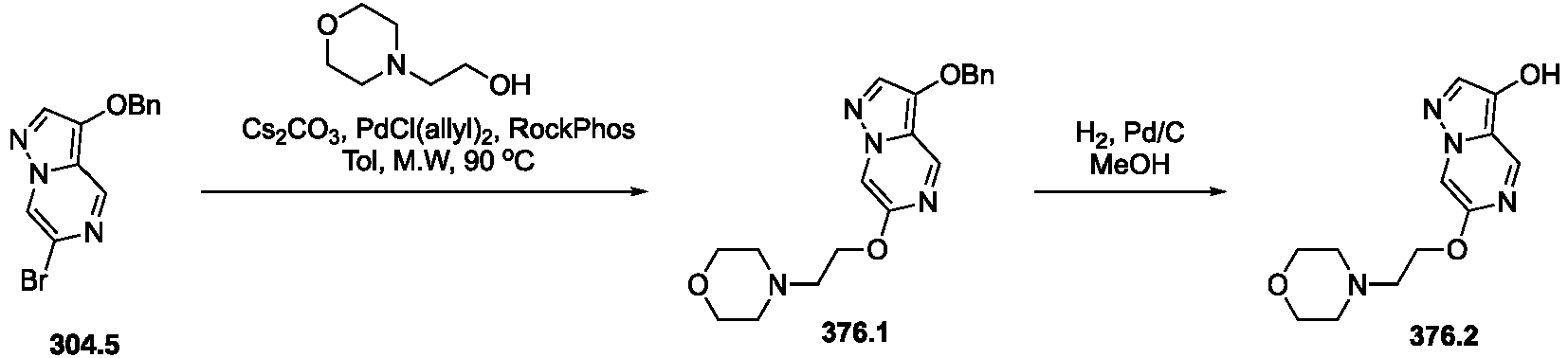

- Synthesis of compound 376.1. A suspension of di-tert-butyl(2',4',6'-triisopropyl-3-methoxy-6-methyl-[1,1'-biphenyl]-2-yl)phosphine (0.154 g, 0.329 mmol, 0.1 equiv), allylpalladium(II) chloride dimer (0.060 g, 0.164 mmol, 0.05 equiv), and cesium carbonate (1.60 g, 4.93 mmol, 1.5 equiv) in toluene (10 mL) was degassed by bubbling argon through for 10 min. Under argon atmosphere, 304.5 (1.0 g, 3.29 mmol, 1.0 equiv) and 2-morpholinoethan-1-ol (0.862 g, 6.58 mmol, 2.0 equiv) were added, and degassed for 5 min. The reaction mixture was stirred at 90 °C for 5 h. It was cooled to room temperature, transferred into water, and extracted with ethyl acetate. The combined organic layers were washed with brine, dried over anhydrous sodium sulfate, filtered, and concentrated under reduced pressure. The residue was purified by flash column chromatography on silica gel (CombiFlash®, 2.6% methanol in DCM) to afford 376.1. MS(ES): m/z 355.5 [M+H]+.
- Synthesis of compound 376.2. A mixture of compound 376.1 (0.500 g, 1.41 mmol, 1.0 equiv) and 10% palladium on charcoal (0.500 g) in methanol (10 mL) was stirred under hydrogen (1 atm) for 30 min. The reaction mixture was filtered through a pad of Celite® and rinsed with methanol. The filtrate was concentrated under reduced pressure to afford 376.2. MS(ES): m/z 265.2 [M+H]+.
- Synthesis of compound 376.3. Compound 376.3 was prepared from 376.2 and Int-4, following the procedure described in the synthesis of 19.1. The product was purified by flash column chromatography on silica gel (CombiFlash®, 40% ethyl acetate in hexane). MS(ES): m/z 450.5 [M+H]+.
- Synthesis of compound 376.4. Compound 376.4 was prepared from 376.3 following the procedure described in the synthesis of 5.4. The product was purified by flash column chromatography on silica gel (CombiFlash®, 3.4% methanol in DCM). MS(ES): m/z 420.5 [M+H]+.
- Synthesis of I-376. Compound I-376 was prepared from 376.4 and Int-63, following the procedure described in the synthesis of 331.1. The product was purified by flash column chromatography on silica gel (CombiFlash®, 4% methanol in DCM). MS(ES): m/z 620.3 [M+H]+, 1H NMR (DMSO-d6, 400 MHz): δ 8.83 (s, 2H), 8.61 (s, 1H), 8.36 (s, 1H), 8.21 (s, 1H), 8.14 (s, 1H), 7.88 (s, 1H), 4.31 (bs, 2H), 4.01 (s, 3H), 3.66 (s, 3H), 3.57 (s, 4H), 2.71 (bs, 2H), 2.68(bs, 4H).
-

- Synthesis of I-377. Compound 1-377 was prepared from I-376 following the procedure described in the synthesis of I-157. The product was purified by flash column chromatography on silica gel (CombiFlash®, 5% methanol in DCM). MS(ES): m/z 610.4 [M+H]+, 1H NMR (DMSO-d6, 400 MHz): δ 9.00 (s, 1H), 8.88 (s, 1H), 8.62 (s, 1H), 8.43 (s, 1H), 8.17 (s, 1H), 8.13 (s, 1H), 8.10 (s, 1H), 4.32 (bs, 2H), 3.99 (s, 3H), 3.66 (s, 3H), 3.57 (s, 4H), 3.51 (s, 2H), 2.72 (s, 4H).
-


- Synthesis of compound 378.1. Compound 378.1 was prepared from 299.7 and Int-151, following the procedure described in the synthesis of I-13. The product was purified by flash column chromatography on silica gel (CombiFlash®, 3.8% methanol in DCM). MS(ES): m/z 623.7 [M+H]+.
- Synthesis of compound 378.2. Compound 378.2 was prepared from 378.1 following the procedure described in the synthesis of I-157. The product was purified by flash column chromatography on silica gel (CombiFlash®, 4% methanol in DCM). MS(ES): m/z 613.3 [M+H]+.
- Synthesis of I-378. To a solution of 378.2 (0.050 g, 0.081 mmol, 1.0 equiv) in DCM (4 mL) was added triflic acid (0.5 mL) at 0 °C. The reaction mixture was stirred at room temperature for 35 min. It was concentrated under reduced pressure. The residue was transferred into an aqueous sodium bicarbonate solution and extracted with DCM. The combined organic layers were washed with brine, dried over anhydrous sodium sulfate, filtered, and concentrated under reduced pressure. The residue was purified by flash column chromatography on silica gel (CombiFlash®, 4.5% methanol in DCM) to afford I-378. MS(ES): m/z 493.3 [M+H]+. 1H NMR (DMSO-d6, 400 MHz): δ 10.60 (s, 1H), 8.53 (s, 1H), 8.00 (s, 1H), 7.76 (s, 1H), 7.09 (s, 1H), 6.84-6.82 (d, J= 6.4 Hz, 1H), 4.16 (s, 3H), 3.98 (s, 3H), 3.94 (s, 2H), 2.20 (bs, 2H), 1.56 (bs, 2H).
-


- Synthesis of compound 395.1. A mixture of 354.5 (1.3 g, 4.05 mmol, 1.0 equiv), tert-butyl carbamate (1.42 g, 12.14 mmol, 3.0 equiv) and cesium carbonate (3.9 g, 12.14 mmol, 3.0 equiv) in 1,4-dioxane (3 mL) was degassed by bubbling argon through for 10 min. Under argon atmosphere, 4,5-bis(diphenylphosphino)-9,9-dimethylxanthene (0.234 g, 0.404 mmol, 0.1 equiv) and tris(dibenzylideneacetone)dipalladium(0) (0.185 g, 0.202 mmol, 0.05 equiv) were added, and degassed for 5 min. The reaction mixture was stirred at 110 °C for 6 h. It was cooled to room temperature, transferred into water, and extracted with ethyl acetate. The combined organic layers were washed with brine, dried over anhydrous sodium sulfate, filtered, and concentrated under reduced pressure. The residue was purified by flash column chromatography on silica gel (CombiFlash®, 15% ethyl acetate in hexane) to afford 379.1. MS(ES): m/z 358.2 [M+H]+.
- Synthesis of compound 395.2. To a solution of 395.1 (1.0 g, 2.8 mmol, 1.0 equiv) in DMF (20 mL) was added sodium hydride (0.134 g, 5.6 mmol, 2.0 equiv) at 0 °C and stirred for 30 min. To the mixture was added methyl iodide (0.477 g, 3.3 mmol, 1.3 equiv) and stirred at room temperature for 2 h. It was transferred into ice, stirred, and extracted with ethyl acetate. The combined organic layers were washed with brine, dried over anhydrous sodium sulfate, filtered, and concentrated under reduced pressure. The residue was purified by flash column chromatography on silica gel (CombiFlash®, 17% ethyl acetate in hexane). To the residue was added methanol:THF (1:1, 30 mL) and 10% palladium on charcoal (0.500 g). The mixture was stirred under hydrogen (1 atm) for 4 h. It was filtered through a pad of Celite® and rinsed with methanol. The filtrate was concentrated under reduced pressure to afford 395.2. MS(ES): m/z 282.1 [M+H]+.
- Synthesis of compound 395.3. Compound 395.3 was prepared from 395.2 and Int-4, following the procedure described in the synthesis of 19.1. The product was purified by flash column chromatography on silica gel (CombiFlash®, 20% ethyl acetate in hexane). MS(ES): m/z 467.7 [M+H]+.
- Synthesis of compound 395.4. Compound 395.4 was prepared from 395.3 following the procedure described in the synthesis of 5.4. The product was purified by flash column chromatography on silica gel (CombiFlash®, 1.8% methanol in DCM). MS(ES): m/z 437.5 [M+H]+.
- Synthesis of compound 395.5. Compound 395.5 was prepared from 395.4 and Int-63, following the procedure described in the synthesis of I-13. The product was purified by flash column chromatography on silica gel (CombiFlash®, 2.8% methanol in DCM). MS(ES): m/z 637.6 [M+H]+.
- Synthesis of I-395. Compound I-395was prepared from 395.5 following the procedure described in the synthesis of 330.6. The product was purified by flash column chromatography on silica gel (CombiFlash®, 3.7% methanol in DCM). MS (ES): m/z 528.1, 1H NMR (DMSO-d6, 400 MHz): δ 8.94 (s, 1H), 8.62-8.61 (d, J= 2.0 Hz, 1H), 8.17 (s, 1H), 7.96 (s, 1H), 7.90 (s, 1H), 7.57 (s, 1H), 6.74(bs, 1H), 5.84-5.82 (d, J = 5.2 Hz, 1H), 3.99 (s, 3H), 3.67 (s, 3H), 2.71-2.70 (d, 3H).
-


- Synthesis of compound 396.1. To a mixture of ethyl 1H-pyrazole-3-carboxylate (100 g, 713.56 mmol, 1.0 equiv) and cesium carbonate (417 g, 1284.4 mmol, 1.8 equiv) in DMF (1000 mL) was added 2-chloroacetonitrile (64.6 g, 856.27 mmol, 1.2 equiv) and stirred at room temperature for 16 h. It was transferred into ice-water and extracted with ethyl acetate. The combined organic layers were washed with brine, dried over anhydrous sodium sulfate, and concentrated under reduced pressure. The residue was purified by flash column chromatography on silica gel (CombiFlash®, 25% ethyl acetate in hexane) to afford 396.1. MS(ES): m/z 180.1 [M+H]+.
- Synthesis of compound 396.2. To a solution of 396.1 (38 g, 212.08 mmol, 1.0 equiv) in trifluoroacetic acid (230 mL) was added concentrated sulfuric acid (110.7 g, 1130.38 mmol, 5.33 equiv). The reaction mixture was stirred at room temperature for 16 h. It was concentrated under reduced pressure. To the residue was added ice-water and extracted with ethyl acetate. The combined organic layers were washed with saturated sodium bicarbonate followed by brine, dried over anhydrous sodium sulfate, and concentrated under reduced pressure to afford 396.2. MS(ES): m/z 198.0 [M+H]+.
- Synthesis of compound 396.3. To a solution of 396.2 (40 g, 202.85 mmol, 1.0 equiv) in ethanol:THF (8:2, 400 mL) was added sodium tert-butoxide (46.7 g, 486.84 mmol, 2.4 equiv) and stirred at 70 °C for 16 h. It was concentrated under reduced pressure to afford 396.3. It was used for the next step without further purification.
- Synthesis of compound 396.4. To a suspension of 396.3 (55 g, 363 mmol, 1.0 equiv) and phosphorous oxychloride (550 mL) was added pyridine hydrochloride (41.74 g, 363 mmol, 1.0 equiv). The reaction mixture was stirred at 120 °C for 12 h. It was concentrated under reduced pressure. The residue was transferred into ice-water, neutralized with saturated sodium bicarbonate, and extracted with ethyl acetate. The combined organic layers were washed with saturated sodium bicarbonate followed by brine, dried over anhydrous sodium sulfate, and concentrated under reduced pressure to afford 396.4. MS(ES): m/z 189.0 [M+H]+.
- Synthesis of compound 396.5. To a solution of 396.4 (8.7 g, 46.27 mmol, 1.0 equiv) in 1,4-dioxane:water (1:1, 90 mL) was added trimethyl boroxine (50% in THF, 23 mL, 92.54 mmol, 2.0 equiv) and sodium carbonate (7.35 g, 69.40 mmol, 1.5 equiv). The reaction mixture was degassed for 30 min. Under argon atmosphere, 1,1-bis(diphenylphosphino)ferrocene-palladium(II) dichloride DCM complex (3.38 g, 4.627 mmol, 0.1 equiv) was added. The reaction mixture was stirred at 70 °C for 4 h. It was transferred into ice-water and extracted with ethyl acetate. The combined organic layers were washed with brine, dried over anhydrous sodium sulfate, and concentrated under reduced pressure. The residue was purified by flash column chromatography on silica gel (CombiFlash®, 25% ethyl acetate in hexane) to afford 396.5. MS(ES): m/z 168.5 [M+H]+.
- Synthesis of compound 396.6. A mixture of 396.5 (6.5 g, 38.78 mmol, 1.0 equiv), cyclopropyl carboxamide (16.48 g, 193.9 mmol, 5.0 equiv) and cesium carbonate (31.51 g, 96.95 mmol, 2.5 equiv) in 1,4-dioxane (100 mL) was degassed for 10 min. Under argon atmosphere, 4,5-bis(diphenylphosphino)-9,9-dimethylxanthene (4.48 g, 7.756 mmol, 0.2 equiv) and tris(dibenzylideneacetone)dipalladium(0) (3.56 g, 3.878 mmol, 0.1 equiv) were added, and degassed for 5 min. The reaction mixture was stirred at 110 °C for 12 h. It was cooled to room temperature, transferred into water, and extracted with ethyl acetate. The combined organic layers were washed with brine, dried over anhydrous sodium sulfate, and concentrated under reduced pressure. The residue was purified by flash column chromatography on silica gel (CombiFlash®, 35% ethyl acetate in hexane) to afford 396.6. MS(ES): m/z 217.1 [M+H]+.
- Synthesis of compound 396.7. To a solution of 396.6 (3.2 g, 14.80 mmol, 1.0 equiv) in DMF (30 mL) was added sodium hydride (0.888 g, 22.2 mmol, 1.5 equiv) at 0 °C and stirred for 30 min. To the mixture was added methyl iodide (2.62 g, 18.5 mmol, 1.25 equiv) and stirred at room temperature for 12 h. It was transferred into ice, stirred, and extracted with ethyl acetate. The combined organic layers were washed with brine, dried over anhydrous sodium sulfate, and concentrated under reduced pressure. The residue was purified by flash column chromatography on silica gel (CombiFlash®, 30% ethyl acetate in hexane) to afford 396.7. MS(ES): m/z 231.2 [M+H]+.
- Synthesis of compound 396.8. To a solution of 396.7 (1.9 g, 8.25 mmol, 1.0 equiv) in acetonitrile (20 mL) was added N-iodosuccinimide (2.78 g, 12.37 mmol, 1.5 equiv) at 0 °C and stirred for 30 min. It was transferred into saturated sodium bicarbonate solution, stirred, and extracted with ethyl acetate. The combined organic layers were washed with brine, dried over anhydrous sodium sulfate, and concentrated under reduced pressure. The residue was purified by flash column chromatography on silica gel (CombiFlash®, 20% ethyl acetate in hexane) to afford 396.8. MS(ES): m/z 357.1 [M+H]+
- Synthesis of compound 396.9. A mixture of 396.8 (1.5 g, 4.21 mmol, 1.0 equiv), benzyl alcohol (1.36 g, 12.63 mmol, 3.0 equiv), and cesium carbonate (3.42 g, 10.52 mmol, 2.5 equiv) in toluene (20 mL) was degassed for 10 min. Under argon atmosphere, 3,4,7,8-tetramethyl-1,10-phenanthroline (0.149 g, 0.631 mmol, 0.15 equiv) and copper iodide (0.056 g, 0.294 mmol, 0.07 equiv) were added, and degassed for 5 min. The reaction mixture was stirred at 100 °C for 12 h. It was cooled to room temperature, transferred into water, and extracted with ethyl acetate. The combined organic layers were washed with brine, dried over anhydrous sodium sulfate, and concentrated under reduced pressure. The residue was purified by flash column chromatography on silica gel (CombiFlash®, 25% ethyl acetate in hexane) to afford 396.9. MS(ES): m/z 337.1 [M+H]+.
- Synthesis of compound 396.10. A mixture of compound 396.9 (0.270 g, 0.802 mmol, 1.0 equiv) and 10% palladium on charcoal (0.125 g) in methanol (5 mL) was stirred under hydrogen (1 atm) for 4 h. It was filtered through a pad of Celite® and rinsed with methanol. The filtrate was concentrated under reduced pressure to afford 396.10. MS(ES): m/z 247.2 [M+H]+.
- Synthesis of compound 396.11. Compound 396.11 was prepared from 396.10 and Int-4, following the procedure described in the synthesis of 19.1. The product was purified by flash column chromatography on silica gel (CombiFlash®, 30% ethyl acetate in hexane). MS(ES): m/z 432.5 [M+H]+.
- Synthesis of compound 396.12. Compound 396.12 was prepared from 396.11 following the procedure described in the synthesis of 5.4. The product was purified by flash column chromatography on silica gel (CombiFlash®, 2.0% methanol in DCM. MS(ES): m/z 402.5 [M+H]+.
- Synthesis of compound 396.13. Compound 396.13 was prepared from 396.12 and Int-63, following the procedure described in the synthesis of 331.1. The product was purified by column chromatography on silica gel (CombiFlash®, 2.2% methanol in DCM). MS(ES): m/z 602.7 [M+H]+.
- Synthesis of compound 396.14. Compound 396.14 was prepared from 396.13 following the procedure described in the synthesis of 330.6. The product was purified by flash column chromatography on silica gel (CombiFlash®, 2.5% methanol in DCM). MS(ES): m/z 593.3 [M+H]+.
- Synthesis of compound 396.15. Compound 396.15 was prepared from 396.14 following the procedure described in the synthesis of I-304. The product was used in the next step without purification. MS(ES): m/z 543.2 [M+H]+.
- Synthesis of I-396. To a solution of 396.15 (0.010 g, 0.018 mmol, 1.0 equiv) in DCM (1 mL) was added trifluoroacetic anhydride (0.1 mL) followed by triethylamine (0.1 mL) at 0 °C and stirred for 2 h. It was transferred into ice-cold saturated sodium bicarbonate solution and extracted with DCM. The combined organic layers were washed with brine, dried over anhydrous sodium sulfate, and concentrated under reduced pressure. The residue was treated with methanol (1 mL) and potassium carbonate (0.010 g) at room temperature for 30 min. It was filtered and the filtrate was concentrated under reduced pressure. The residue was purified by column chromatography on silica gel (CombiFlash®, 2.7% methanol in DCM) to afford I-396. MS(ES): m/z 525.3 [M+H]+, 1H NMR (MeOD, 400 MHz): δ 8.87 (s, 1H), 8.04 (s, 1H), 7.91 (s, 1H), 7.52 (s, 1H), 7.35 (s, 1H), 3.89 (s, 3H), 3.75 (s, 3H), 2.85 (s, 3H), 2.71 (s, 3H).
-

- Synthesis of compound 397.1. A suspension of di-tert-butyl(2',4',6'-triisopropyl-3-methoxy-6-methyl-[1,1'-biphenyl]-2-yl)phosphine (0.154 g, 0.329 mmol, 0.1 equiv), allylpalladium(II) chloride dimer (0.060 g, 0.164 mmol, 0.05 equiv), and cesium carbonate (1.60 g, 4.93 mmol, 1.5 equiv) in toluene (10 mL) was degassed for 10 min. Under argon atmosphere, 304.5 (1.0 g, 3.29 mmol, 1.0 equiv) and 2-((tert-butyldiphenylsilyl)oxy)ethan-1-ol (1.98 g, 6.58 mmol, 2.0 equiv) were added, and degassed for 5 min. The reaction mixture was stirred at 90 °C for 5 h. It was cooled to room temperature, transferred into water, and extracted with ethyl acetate. The combined organic layers were washed with brine, dried over anhydrous sodium sulfate, filtered, and concentrated under reduced pressure. The residue was purified by flash column chromatography on silica gel (CombiFlash®, 2.6% methanol in DCM) to afford 397.1. MS(ES): m/z 524.5 [M+H]+.
- Synthesis of compound 397.2. A mixture of compound 397.1 (0.510 g, 0.973 mmol, 1.0 equiv) and 10% palladium on charcoal (0.500 g) in methanol (10 mL) was stirred under hydrogen for 30 min. It was filtered through a pad of Celite® and washed with methanol. The filtrate was concentrated under reduced pressure to afford 397.2. MS(ES): m/z 434.4 [M+H]+.
- Synthesis of compound 397.3. Compound 397.3 was prepared from 397.2 and Int-4, following the procedure described in the synthesis of 19.1. The product was purified by flash column chromatography on silica gel (CombiFlash®, 40% ethyl acetate in hexane). MS(ES): m/z 620.1 [M+H]+.
- Synthesis of compound 397.4. Compound 397.4 was prepared from 397.3 following the procedure described in the synthesis of 5.4. The product was purified by flash column chromatography on silica gel (CombiFlash®, 3.4% methanol in DCM) to afford 397.4. MS(ES): m/z 590.1 [M+H]+.
- Synthesis of compound 397.5. Compound 397.5 was prepared from 397.4 and Int-63, following the procedure described in the synthesis of I-51. The product was purified by flash column chromatography on silica gel (CombiFlash®, 4.0% methanol in DCM). MS(ES): m/z 790.1 [M+H]+.
- Synthesis of 1-397. To a solution of 397.5 (0.035 g, 0.044 mmol, 1.0 equiv) in DCM (2 mL) was added tetra-butylammonium fluoride solution (1 M in THF, 0.5 mL) at 0 °C and stirred for 30 min. It was transferred into ice-water and extracted with ethyl acetate. The combined organic layers were washed with brine, dried over anhydrous sodium sulfate, filtered, and concentrated under reduced pressure. The residue was purified by flash column chromatography on silica gel (CombiFlash®, 4.2% methanol in DCM) to afford 1-397. MS(ES): m/z 551.2 [M+H]+, 1H NMR (DMSO-d6, 400 MHz): δ 8.84-8.83 (d, J = 6.0 Hz, 2H), 8.61-8.60 (d, J = 1.6 Hz, 1H), 8.33 (s, 1H), 8.21 (s, 1H), 8.14 (s, 1H), 7.88 (s, 1H), 4.95-4.92 (m, 1H), 4.22-4.20 (m, 2H), 4.05 (s, 3H), 3.75-3.71 (m, 2H), 3.65 (s, 3H).
-

- Synthesis of compound 398.1. Compound 398.1 was prepared from 397.4 and Int-61, following the procedure described in the synthesis of I-51. The product was purified by flash column chromatography on silica gel (CombiFlash®, 3.8% methanol in DCM). MS(ES): m/z 763.1 [M+H]+.
- Synthesis of I-398. To a solution of 398.1 (0.038 g, 0.049 mmol, 1.0 equiv) in DCM (2 mL) was added tetra-butyl ammonium fluoride solution (1 M in THF, 0.5 mL) at 0 °C and stirred for 30 min. It was transferred into ice-water and extracted with ethyl acetate. The combined organic layers were washed with brine, dried over anhydrous sodium sulfate, filtered, and concentrated under reduced pressure. The residue was purified by flash column chromatography on silica gel (CombiFlash®, 4.0% methanol in DCM) to afford I-398. MS(ES): m/z 524.3 [M+H]+, 1H NMR (DMSO-d6, 400M Hz): δ 9.99 (s, 1H), 8.81 (s, 1H), 8.31 (s, 1H), 8.09 (s, 1H), 7.84 (s, 1H), 6.57 (s, 1H), 4.95-4.92 (m, 1H), 4.21-4.19 (m, 2H), 4.02-3.93 (m, 5H), 3.73-3.72 (m, 2H), 2.02-1.99 (m, 2H), 1.68 (bs, 2H), 1.30 (s, 6H).
-

- Synthesis of compound 399.1. Compound 399.1 was prepared from 319.7 and Int-151, following the procedure described in the synthesis of I-51. The product was purified by column chromatography on silica gel (CombiFlash®, 1.8% methanol in DCM). MS(ES): m/z 647.0 [M+H]+.
- Synthesis of compound 399.2. Compound 399.2 was prepared from 399.1 following the procedure described in the synthesis of 330.6. The product was purified by flash column chromatography on silica gel (CombiFlash®, 1.8% methanol in DCM). MS(ES): m/z 637.5 [M+H]+.
- Synthesis of I-399. To a solution of 399.2 (0.080 g, 0.125 mmol, 1.0 equiv) in DCM (10 mL) was added trifluoroacetic acid (1.0 mL) at 0 °C and stirred for 2 h. It was transferred into ice-cold saturated sodium bicarbonate solution and extracted with DCM. The combined organic layers were washed with brine, dried over anhydrous sodium sulfate, filtered, and concentrated under reduced pressure. The residue was diluted with methanol (5 mL) and water (2 mL) followed by addition of triethylamine (2 mL). The reaction mixture was stirred at room temperature for 8 h. It was transferred into ice-cold saturated sodium bicarbonate solution and extracted with DCM. The combined organic layers were washed with brine, dried over anhydrous sodium sulfate, filtered, and concentrated under reduced pressure. The residue was purified by column chromatography on silica gel (CombiFlash®, 2.2% methanol in DCM) to afford I-399. MS(ES): m/z 507.3 [M+H]+, 1H NMR (DMSO-d6, 400M Hz): δ 13.71 (s, 1H), 10.63 (s, 1H), 8.58-8.57 (d, J = 2.8 Hz, 1H), 8.02 (s, 1H), 7.89-7.88 (d, J = 2.0 Hz, 1H), 7.08 (s, 1H), 4.66 (s, 2H), 4.15-4.11 (m, 2H), 3.94 (s, 3H), 3.27-3.25 (s, 3H), 2.46 (bs, 2H), 2.19 (bs, 2H).
-

- Synthesis of compound 400.1. Compound 400.1 was prepared from 260.4 and Int-152, following the procedure described in the synthesis of I-51. The product was purified by flash column chromatography on silica gel (CombiFlash®, 2.0% methanol in DCM). MS(ES): m/z 705.0 [M+H]+.
- Synthesis of compound 400.2. Compound 400.2 was prepared from 400.1 following the procedure described in the synthesis of 330.6. The product was purified by flash column chromatography on silica gel (CombiFlash®, 2.0% methanol in DCM). MS(ES): m/z 695.5 [M+H]+.
- Synthesis of I-400. Compound I-400 was prepared from 400.2 following the procedure described in the synthesis of I-333. The product was purified by flash column chromatography on silica gel (CombiFlash®, 2.2% methanol in DCM). MS(ES): m/z 565.4 [M+H]+, 1H NMR (DMSO-d6, 400 MHz): δ 13.79 (s, 1H), 10.77 (s, 1H), 8.57 (s, 1H), 8.09 (s, 1H), 8.03 (d, J = 2.0 Hz, 1H), 7.91 (s, 1H), 7.31 (s, 1H), 4.91-4.91 (m, 1H), 3.96 (s, 3H), 3.57 (bs, 2H), 3.50 (bs, 2H), 2.45 (bs, 4H), 1.70 (bs, 2H), 1.62 (bs, 2H).
-

- Synthesis of compound 401.1. Compound 401.1 was prepared from 257.4 and Int-152, following the procedure described in the synthesis of I-51. The product was purified by column chromatography on silica gel (CombiFlash®, 50% ethyl acetate in hexane). MS(ES): m/z 714.1 [M+H]+.
- Synthesis of compound 401.2. Compound 401.2 was prepared from 401.1 following the procedure described in the synthesis of 330.6. The product was purified by flash column chromatography on silica gel (CombiFlash®, 60% ethyl acetate in hexane). MS(ES): m/z 704.5 [M+H]+.
- Synthesis of I-401. To a solution of 401.2 (0.080 g, 0.113 mmol, 1.0 equiv) in methanol (5 mL) was added solution of sodium hydroxide (0.180 g, 4.52 mmol, 40 equiv) in water (2 mL). The reaction mixture was stirred at room temperature for 1 h. It was concentrated under reduced pressure. The residue was transferred into water and extracted with DCM. The combined organic layers were washed with brine, dried over anhydrous sodium sulfate, filtered, and concentrated under reduced pressure. The residue was purified by flash column chromatography on silica gel (CombiFlash®, 3.0% methanol in DCM) to afford I-401. MS(ES): m/z 564.4 [M+H]+. 1H NMR (DMSO-d6, 400 MHz): δ 11.80 (s, 1H), 10.73 (s, 1H), 8.19-8.18 (d, J = 4.0 Hz, 1H), 7.91 (s, 1H), 7.72 (s, 1H), 7.56 (s, 1H), 7.32 (s, 1H), 6.43 (s, 1H), 4.95-4.91 (m, 1H), 3.96 (s, 3H), 3.57 (bs, 2H), 3.50 (bs, 2H), 2.45 (bs, 4H), 1.70 (bs, 2H), 1.62 (bs, 2H).
-

- Synthesis of I-402. A mixture of 139.1 (0.050 g, 0.095 mmol, 1.0 equiv), (R)-tetrahydrofuran-3-amine (0.082 g, 0.951 mmol, 10.0 equiv) and potassium carbonate (0.026 g, 0.190 mmol, 2.0 equiv) in THF (3 mL) was stirred at 70 °C for 3 days. It was cooled to room temperature, transferred into ice cold water and extracted with DCM. The combined organic layers were washed with brine, dried over anhydrous sodium sulfate, filtered, and concentrated under reduced pressure. The residue was purified by preparative HPLC to afford I-142. MS(ES): m/z 576.2 [M+H]+, 1H NMR (DMSO-d6, 400M Hz): δ 8.63 (s, 1H), 8.31 (s, 1H), 8.15 (s, 1H), 7.88-7.87 (d, J = 4.0 Hz, 1H), 7.68 (s, 1H), 7.30-7.28 (d, J= 4.0 Hz, 1H), 6.32-6.31 (d, J = 4.0 Hz, 1H), 4.68 (bs, 1H), 4.01 (s, 3H), 3.93-3.90 (m, 1H), 3.86-3.82 (m, 1H), 3.76-3.67 (m, 6H), 2.34-2.23 (m, 2H).
-


- Synthesis of compound 403.1. A mixture of 304.5 (1.0 g, 3.29 mmol, 1.0 equiv), cyclopropyl carboxamide (0.839 g, 9.86 mmol, 3.0 equiv) and cesium carbonate (3.2 g, 9.86 mmol, 3.0 equiv) in 1,4-dioxane (10 mL) was degassed for 10 min. Under argon atmosphere, 4,5-bis(diphenylphosphino)-9,9-dimethylxanthene (0.380 g, 0.658 mmol, 0.2 equiv) and tris(dibenzylideneacetone)dipalladium(0) (0.301 g, 0.329 mmol, 0.1 equiv) were added, and degassed for 5 min. The reaction mixture was stirred at 110 °C for 5 h. It was cooled to room temperature, transferred into water, and extracted with ethyl acetate. The combined organic layers were washed with brine, dried over anhydrous sodium sulfate, filtered, and concentrated under reduced pressure. The residue was purified by flash column chromatography on silica gel (CombiFlash®, 20% ethyl acetate in hexane) to afford 403.1. MS(ES): m/z 309.2 [M+H]+.
- Synthesis of compound 403.2. To a solution of 403.1 (0.9 g, 2.92 mmol, 1.0 equiv) and 1-(2-chloroethyl)-3,3-difluoropyrrolidine (0.594 g, 3.50 mmol, 1.2 equiv) in N,N-dimethylacetamide (10 mL) was added sodium tert-butoxide (0.840 g, 8.76 mmol, 3.0 equiv) and stirred at 120 °C for 30 min. It was transferred into water, stirred, and extracted with ethyl acetate. The combined organic layers were washed with brine, dried over anhydrous sodium sulfate, filtered, and concentrated under reduced pressure. The residue was purified by flash column chromatography on silica gel (CombiFlash®, 30% ethyl acetate in hexane as eluant to afford 403.2. MS(ES): m/z 442.3 [M+H]+.
- Synthesis of compound 403.3. A mixture of 403.2 (0.200 g, 0.453 mmol, 1.0 equiv) and 10% palladium on carbon (0.100 g) in methanol (10 mL) was stirred under hydrogen (1 atm) for 30 min. It was filtered through a pad of Celite® and rinsed with methanol. The filtrate was concentrated under reduced pressure to afford 403.3. MS(ES): m/z 352.1 [M+H]+.
- Synthesis of compound 403.4. Compound 403.4 was prepared from 403.3 and Int-4, following the procedure described in the synthesis of 19.1. The product was purified by flash column chromatography on silica gel (CombiFlash®, 100% ethyl acetate). MS(ES): m/z 537.6 [M+H]+.
- Synthesis of compound 403.5. Compound 403.5 was prepared from 403.4 following the procedure described in the synthesis of 5.4. The product was purified by flash column chromatography on silica gel (CombiFlash®, 2.0% methanol in DCM). MS(ES): m/z 507.5 [M+H]+.
- Synthesis of compound 403.6. Compound 403.6 was prepared from 403.5 and Int-63, following the procedure described in the synthesis of I-51. The product was purified by column chromatography on silica gel (CombiFlash®, 3.9% methanol in DCM). MS(ES): m/z 707.9 [M+H]+.
- Synthesis of I-403. Compound 1-403 was prepared from 403.6 following the procedure described in the synthesis of I-304. The product was purified by column chromatography on silica gel (CombiFlash®, 4.8% methanol in DCM). MS (ES): m/z 639.3 [M+H]+, 1H NMR (DMSO-d6, 400M Hz): δ 8.81 (s, 1H), 8.70 (s, 1H), 8.60 (s, 1H), 8.18 (s, 1H), 8.13 (s, 1H), 7.71 (s, 1H), 7.66 (s, 1H), 5.96 (bs, 1H), 4.01 (s, 3H), 3.66 (s, 3H), 3.23-3.21 (m, 2H), 2.99-2.92 (m, 2H), 2.78-2.74 (m, 2H), 2.68 (bs, 2H), 2.28-2.20 (m, 2H).
-

- Synthesis of compound 404.1. To a mixture of Int-3 (0.3 g, 1.75 mmol, 1.0 equiv), potassium carbonate (0.483 g, 3.5 mmol, 2.0 equiv) and 304.7 (0.407 g, 1.75 mmol, 1.0 equiv) in DMF (6 mL) was stirred at room temperature for 1 h. It was transferred into ice-water and extracted with ethyl acetate. The combined organic layers were washed with brine, dried over anhydrous sodium sulfate, filtered, and concentrated under reduced pressure. The residue was purified by flash column chromatography on silica gel (CombiFlash®, 40% ethyl acetate in hexane) to afford 404.1. MS(ES): m/z 384.1 [M+H]+.
- Synthesis of compound 404.2. Compound 404.2 was prepared from 404.1 following the procedure described in the synthesis of 5.4. The product was purified by flash column chromatography on silica gel (CombiFlash®, 3.0% methanol in DCM). MS(ES): m/z 354.0 [M+H]+.
- Synthesis of compound 404.3. Compound 404.3 was prepared from 404.2 and Int-63, following the procedure described in the synthesis of I-51. The product was purified by column chromatography on silica gel (CombiFlash®, 3.9% methanol in DCM). MS(ES): m/z 554.3 [M+H]+.
- Synthesis of I-404. Compound 1-404 was prepared from 404.3 following the procedure described in the synthesis of I-304. The product was purified by column chromatography on silica gel (CombiFlash®, 4.5% methanol in DCM). MS (ES): m/z 486.1 [M+H]+, 1H NMR (DMSO-d6, 400 MHz): δ 8.69 (s, 1H), 8.66 (s, 1H), 8.61 (s, 1H), 8.19 (s, 1H), 8.11 (s, 1H), 7.77 (s, 1H), 7.72 (s, 1H), 7.59 (s, 1H), 6.14-6.13 (d, J = 4.4 Hz, 1H), 3.73 (s, 3H), 3.67 (s, 3H), 2.74-2.73 (d, 3H).
- JAK2 (JH1domain-catalytic, Y1007F,Y1008F) kinase was expressed as N-terminal fusion to the DNA binding domain of NFkB in transiently transfected HEK293 cells and subsequently tagged with DNA for qPCR detection. Streptavidin-coated magnetic beads were treated with biotinylated small molecule ligands for 30 minutes at room temperature to generate affinity resins for kinase assays. The liganded beads were blocked with excess biotin and washed with blocking buffer (SeaBlock (Pierce), 1% BSA, 0.05% Tween 20, 1 mmol/L DTT) to remove unbound ligand and to reduce nonspecific phage binding. Binding reactions were assembled by combining kinases, liganded affinity beads, and test compounds in 1x binding buffer (1x PBS, 0.05% Tween 20, 0.1% BSA, 1 mmol/L DTT). Test compound was prepared as 111x stocks in 100% DMSO and directly diluted into the assay wells. All reactions were performed in polypropylene 384-well plates in a final volume of 0.02 mL. The assay plates were incubated at room temperature with shaking for 1 hour and the affinity beads were washed with wash buffer (1x PBS, 0.05 % Tween 20). The beads were then re-suspended in elution buffer (1x PBS, 0.05 % Tween 20, 0.5 µmol/L non-biotinylated affinity ligand) and incubated at room temperature with shaking for 30 minutes. The kinase concentration in the eluate was measured by qPCR.
- Results of the JAK2 JH1 Domain Binding Assay described above are presented in Table 2. Compounds denoted as "A" had a Kd < 10 nM; compounds denoted as "B" had a Kd ≥ 10 nM and < 50 nM; compounds denoted as "C" had a Kd ≥ 50 nM and < 1 µM; compounds denoted as "D" had a Kd ≥ 1 µM and < 5 µM.
Table 2 Compound JAK2 Kd I-1 B I-2 B I-3 A I-4 A I-5 B I-6 B I-7 B I-8 B I-9 C I-10 D I-11 A I-12 A I-13 B I-14 B I-15 C I-16 B I-17 B I-18 B I-19 B I-20 C I-21 A I-22 A I-23 B I-24 C I-25 B I-26 C I-27 B I-28 B I-29 A I-30 A I-31 A I-32 A I-33 B I-34 A I-35 B I-36 C I-37 A I-38 A I-39 B I-40 B I-41-a A I-41-b A I-42 B I-43 B I-44 C I-45 B I-46 C I-47 A I-48 A I-49 A I-50 B I-51 B I-52 B I-53 A I-54 B I-55 A I-56-a B I-56-b B I-57 A I-58 A I-59 A I-60-a B I-60-b A I-61 A I-62 B I-63 B I-64 A I-65 A I-66 A I-67 A I-68 A I-69-a C I-69-b B I-70 A I-71-a C I-71-b B I-72-a A I-72-b A I-73-a A I-73-b A I-74 A I-75 A I-76-a B I-76-b B I-77 A I-78 A I-79 A I-80 A I-81-a A I-81-b A I-82 B I-83 B I-84 A I-85 A I-86 A I-87 B I-88 B I-89 A I-90 A I-91 A I-92 A I-93-a B I-93-b C I-94 A I-95-a A I-95-b A I-96 B I-97 A I-98-a A I-98-b A I-99-a A I-99-b A I-100 B I-101-a A I-101-b A I-102 A I-103 A I-104-a A I-104-b A I-105-a A I-105-b A I-106 B I-107-a A I-107-b A I-108 A I-109 A I-110-a A I-110-b B I-111 A I-112 A I-113-a B I-113-b B I-114-a A I-114-b A I-115 A I-116 A I-117 A I-118 B I-119-a A I-119-b A I-120 A I-121-a A I-121-b A I-122-a A I-122-b A I-123 B I-124 A I-125 B I-126 A I-127 B I-128 A I-129 B I-130 B I-131-a A I-131-b B I-132 A I-133-a A I-133-b A I-134 A I-135 A I-136 B I-137 B I-138 B I-139-a A I-139-b A I-140 B I-141 A I-142 A I-143 A I-144 A I-145 B I-146 A I-147-a A I-147-b A I-148-a A I-148-b B I-149 A I-150-a B I-150-b B I-151 A I-152 A I-153 A I-154 A I-155 A I-156 A I-157 A I-158 A I-159 A I-160 A I-161 A I-162 A I-163 A I-164 B I-165 D I-166 A I-167 A I-168 B I-169 A I-170 B I-171 A I-172 A I-173 B I-174 B I-175 B I-176 A I-177 A I-178 A I-179 A I-180 A I-181 A I-182 A I-183 A I-184 C I-185 A I-186 A I-187 B I-188 A I-189 B I-190 B I-191 B I-192 B I-193 A I-194 A I-195 A I-196 A I-197 A I-198 A I-199 A I-200 B I-201 A I-202 A I-203 B I-204 A I-205 A I-206 A I-207 A I-208 C I-209 B I-210 A I-211 A I-212 A I-213 B I-214 A I-215 A I-216 B I-217 A I-218 A I-219 B I-220 B I-221 B I-222 B I-223 A I-224 A I-225 A I-226 B I-227 B I-228 B I-229 B I-230 C I-231 A I-232 A I-233 C I-234 B I-235 B I-236 A I-237 B I-238 A I-239 A I-240 C I-241 A I-242 A I-243 A I-244 A I-245-a A I-245-b B I-246 B I-247 B I-248 A I-249 B I-250 B I-251 A I-252 B I-253 A I-254 A I-255 A I-256 A I-257 A I-258 A I-259 B I-260 A I-261 A I-262-a A I-262-b A I-263 A I-264 B I-265 A I-266 A I-267-a B I-267-b C I-268 C I-269-a B I-269-b B I-270-a A I-270-b A I-271 A I-272 A I-273 B I-274 B I-275 B I-276 B I-277 A I-278 A I-279-a A I-279-b A I-280-a B I-280-b B I-281 A I-282 B I-283 B I-284 B I-285 B I-286 B I-287 B I-288 B I-289 B I-290 B I-291 A I-292 A I-293 B I-294 B I-295 B I-296 B I-297 A I-298 A I-299 A I-300 C I-301 A I-302 B I-303 A I-304 A I-305 A I-306 B I-307 C I-308 B I-309 A I-310 C I-311 B I-312 A I-313 A I-314 A I-315 A I-316 B I-317 B I-318 B I-319 A I-320 B I-321 A I-322 B I-323 B I-324 C I-325 B I-326 C I-327 B I-328 B I-329 A I-330 A I-331 A I-332 A I-333 B I-334 B I-335 A I-336 A I-337 A I-338 A I-339 A I-340 A I-341 A I-342 B I-343 A I-344 A I-345 B I-346 B I-347 C I-348 B I-349 A I-350-a A I-350-b A I-351 B I-352-a B I-352-b B I-353 A I-354 A I-355 A I-356 B I-357 C I-358 C I-359-a C I-359-b C I-360 C I-361 C I-362 B I-363 B I-364 B I-365 A I-366 A I-367 A I-368 A I-369 A I-370 A I-373 A I-374 A I-375 A I-376 A I-377 A I-378 A I-395 A I-396 B I-397 A I-398 A I-399 A I-400 A I-401 B I-402 A I-403 A I-404 B - Provided compounds are evaluated for selectivity by comparing their JAK2 binding affinity (Kd) in the above JAK2 Binding Assay with their binding affinity (Kd) for one or more other kinases. Binding affinity for other kinases is determined as follows: Kinase-tagged T7 phage strains are prepared in an E. coli host derived from the BL21 strain. E. coli are grown to log-phase and infected with T7 phage and incubated with shaking at 32 °C until lysis. The lysates are centrifuged and filtered to remove cell debris. The remaining kinases are produced in HEK-293 cells and subsequently tagged with DNA for qPCR detection. Streptavidin-coated magnetic beads are treated with biotinylated small molecule ligands for 30 minutes at room temperature to generate affinity resins for kinase assays. The liganded beads are blocked with excess biotin and washed with blocking buffer (SeaBlock (Pierce), 1% BSA, 0.05% Tween 20, 1 mM DTT) to remove unbound ligand and to reduce non-specific binding. Binding reactions are assembled by combining kinases, liganded affinity beads, and test compounds in 1x binding buffer (20% SeaBlock, 0.17x PBS, 0.05% Tween 20, 6 mM DTT). Test compounds are prepared as 111X stocks in 100% DMSO. Kds are determined using an 11-point 3-fold compound dilution series with three DMSO control points. All compounds for Kd measurements are distributed by acoustic transfer (noncontact dispensing) in 100% DMSO. The compounds are then diluted directly into the assays such that the final concentration of DMSO is 0.9%. All reactions are performed in polypropylene 384-well plate. Each has a final volume of 0.02 ml. The assay plates are incubated at room temperature with shaking for 1 hour and the affinity beads are washed with wash buffer (1x PBS, 0.05% Tween 20). The beads are then re-suspended in elution buffer (1x PBS, 0.05% Tween 20, 0.5 µM non-biotinylated affinity ligand) and incubated at room temperature with shaking for 30 minutes. The kinase concentration in the eluates is measured by qPCR. Compounds that exhibit a better binding affinity for JAK2 compared to one or more other kinases are considered to be JAK2-selective compounds. In some embodiments, provided compounds may be JAK2-selective over one or more of the following kinases: JAK1, JAK3, and Tyk2.
- This assay measures inhibition of JAK2-mediated pSTAT5 signaling in constitutively active essential thrombocytopenia cells carrying the V617F mutation. Cells are harvested from a flask into cell culture medium, and the number of cells is counted. The cells are diluted with culture medium and 100 µL of cell suspension (50000/well) is added into each well of a 96-well cell culture plate. A solution of test compound is added to the assay plate. The plates are covered with a lid and placed in a 37 °C 5% CO2 incubator for 4 hours. After 4 hours, the cells are spun, and the cell pellets are re-suspended with 100 µL cold PBS. Then, the cells are spun again at 4 °C and 4000 rpm for 5 min. PBS is aspirated, and 25 µL lysis buffer (with protease and phosphatase inhibitor cocktail) is added to each cell pellet. The cell lysate is shaken at 4 °C for 20 min to fully lyse the cells. The cell lysate is spun at 4 °C and 4000 rpm for 15 min, and then the supernatant is transferred into a new plate and stored at -80 °C. Meso-scale discovery (MSD) is used to analyze plates as follows: a standard MSD plate is coated with capture antibody in PBS (40 µL/well) and is incubated at 4 °C overnight with shaking. The MSD plate is washed three times with 150 µL/well of 1x MSD Wash Buffer (Tris-buffered saline with 0.1% Tween® 20 detergent, TBST). The MSD plates are then blocked with 150 µL of blocking buffer (5% BSA in TBST) and shaken for 1 h at room temperature and 600 rpm. The MSD plate is washed three times with 150 µL/well of 1x MSD Wash Buffer (TBST). Sample lysates are then added to MSD plates (25 µL/well) and shaken for 1 h at room temperature and 600 rpm. The MSD plate is washed three times with 150 µL/well of 1x MSD Wash Buffer (TBST). Detection antibody (prepared in Antibody Detection buffer, 1% BSA in 1xTBST) is then added to the MSD plates, and they are shaken for 1 h at room temperature and 600 rpm. The MSD plate is washed three times with 150 µL/well of 1x MSD Wash Buffer (TBST). A secondary detection antibody (prepared in Antibody Detection buffer, 1% BSA in 1xTBST) is then added to the MSD plates, and they are shaken for 1 h at room temperature and 600 rpm. The MSD plate is washed three times with 150 µL/well of 1x MSD Wash Buffer (TBST). MSD reading buffer (1x) is added to the plates (150 µL/well), and they are diluted from 4x with water. The plates are imaged using an MSD imaging instrument according to the manufacturer's instructions.
- Preparation of Caco-2 Cells: 50 µL and 25 mL of cell culture medium are added to each well of a Transwell® insert and reservoir, respectively. Then, the HTS Transwell® plates are incubated at 37 °C, 5% CO2 for 1 hour before cell seeding. Caco-2 cell cells are diluted to 6.86x10⁵ cells/mL with culture medium, and 50 µL of cell suspension are dispensed into the filter well of the 96-well HTS Transwell® plate. Cells are cultivated for 14-18 days in a cell culture incubator at 37 °C, 5% CO2, 95% relative humidity. Cell culture medium is replaced every other day, beginning no later than 24 hours after initial plating.
- Preparation of Stock Solutions: 10 mM stock solutions of test compounds are prepared in DMSO. The stock solutions of positive controls are prepared in DMSO at the concentration of 10 mM. Digoxin and propranolol are used as control compounds in this assay.
- Assessment of Cell Monolayer Integrity: Medium is removed from the reservoir and each Transwell® insert and is replaced with prewarmed fresh cuture medium. Transepithelial electrical resistance (TEER) across the monolayer is measured using Millicell Epithelial Volt-Ohm measuring system (Millipore, USA). The Plate is returned to the incubator once the measurement is done. The TEER value isss calucated according to the following equation: TEER measurement (ohms) × Area of membrane (cm2) = TEER value (ohm•cm2). A TEER value greater than 230 ohm•cm2 indicates a well-qualified Caco-2 monolayer.
- Assay Procedure: The Caco-2 plate is removed from the incubator and washed twice with pre-warmed HBSS (10 mM HEPES, pH 7.4), and then incubated at 37 °C for 30 minutes. The stock solutions of control compounds are diluted in DMSO to get 1 mM solutions and then diluted with HBSS (10 mM HEPES, pH 7.4) to get 5 µM working solutions. The stock solutions of the test compounds are diluted in DMSO to get 1 mM solutions and then diluted with HBSS (10 mM HEPES and 4% BSA, pH 7.4) to get 5 µM working solutions. The final concentration of DMSO in the incubation system is 0.5%. To determine the rate of drug transport in the apical to basolateral direction. 75 µL of 5 µM working solutions of test compounds are added to the Transwell® insert (apical compartment) and the wells in the receiver plate (basolateral compartment) are filled with 235 µL of HBSS (10 mM HEPES and 4% BSA, pH 7.4). To determine the rate of drug transport in the basolateral to apical direction, 235 µL of 5 µM working solutions of test compounds are added to the receiver plate wells (basolateral compartment) and then the Transwell® inserts (apical compartment) are filled with 75 µL of HBSS (10 mM HEPES and 4% BSA, pH 7.4). Time 0 samples are prepared by transferring 50 µL of 5 µM working solution to wells of the 96-deepwell plate, followed by the addition of 200 µL cold methanol containing appropriate internal standards (IS). The plates are incuabted at 37 °C for 2 hours. At the end of the incubation, 50 µL samples from donor sides (apical compartment for Ap→Bl flux, and basolateral compartment for Bl→Ap) and receiver sides (basolateral compartment for Ap→Bl flux, and apical compartment for Bl→Ap) are transferred to wells of a new 96-well plate, followed by the addition of 4 volume of cold acetonitrile or methanol containing appropriate internal standards (IS). Samples are vortexed for 5 minutes and then centrifuged at 3,220 g for 40 minutes. An aliquot of 100 µL of the supernatant is mixed with an appropriate volume of ultra-pure water before LC-MS/MS analysis. To determine the Lucifer Yellow leakage after 2 hour transport period, stock solution of Lucifer yellow is prepared in ultra-pure water and diluted with HBSS (10 mM HEPES, pH 7.4) to reach the final concentration of 100 µM. 100 µL of the Lucifer yellow solution is added to each Transwell® insert (apical compartment), followed by filling the wells in the receiver plate (basolateral compartment) with 300 µL of HBSS (10 mM HEPES, pH 7.4). The plates are incubated at 37 °C for 30 minutes. 80 µL samples are removed directly from the apical and basolateral wells (using the basolateral access holes) and transferred to wells of new 96 wells plates. The Lucifer Yellow fluorescence (to monitor monolayer integrity) signal is measured in a fluorescence plate reader at 485 nM excitation and 530 nM emission.
- HEK293T cells are harvested from flask into cell culture medium, and then the cells are counted. The cells are diluted with culture medium to the desired density, and 40 µL of cell suspension is added into each well of a 384-well cell culture plate. The plates are covered with a lid and spun at room temperature at 1,000 RPM for 1 minute and then transferred into 37 °C 5% CO2 incubator overnight. Test compounds are dissolved at 10 mM DMSO stock solution. 45 µL of stock solution is then transferred to a 384 PP-plate. A 3-fold, 10-point dilution is performed via transferring 15 µL compound into 30 µL DMSO by using TECAN (EVO200) liquid handler. The plates are spun at room temperature at 1,000 RPM for 1 minute and shaken on a plate shaker for 2 minutes. 40 nL of diluted compound is transferred from compound source plate into the cell plate by using liquid handler Echo550. After compound treatment for 48 hours, CTG detection is performed for compound treatment plates: the plates are removed from incubators and equilibrated at room temperature for 15 minutes. 30 µL of CellTiter-Glo reagent is added into each well to be detected. The plates are then placed at room temperature for 30 min followed by reading on EnVision. Inhibition activity is calculated with the following formula: %Inhibition = 100 × (LumHC - LumSample) / (LumHC -LumLC), wherein HC is reading obtained from cells treated with 0.1% DMSO only and LC is reading from cells treated with 10 µL staurosporine. IC50 values are calculated using XLFit (equation 201).
- 10 mM stock solutions of test compound and positive control are prepared in DMSO. Stock solutions are diluted to 100 µM by combining 198 µL of 50% acetonitrile/50% water and 2 µL of 10 mM stock solution. Verapamil is used as positive control in the assay. Vials of cryopreserved hepatocytes are thawed in a 37 °C water bath with gently shaking. The contents are poured into the 50 mL thawing medium conical tube. Vials are centrifuged at 100 g for 10 minutes at room temperature. Thawing medium is aspirated and hepatocytes are re-suspended with serum-free incubation medium to yield ~1.5 × 10⁶ cells/mL. Cell viability and density are counted using a Trypan Blue exclusion, and then cells are diluted with serum-free incubation medium to a working cell density of 0.5×10⁶ viable cells/mL. A portion of the hepatocytes at 0.5×10⁶ viable cells/mL are boiled for 5 min prior to adding to the plate as negative control to eliminate the enzymatic activity so that little or no substrate turnover should be observed. Aliquots of 198 µL hepatocytes are dispensed into each well of a 96-well non-coated plate. The plate is placed in the incubator for approximately 10 minutes. Aliquots of 2 µL of the 100 µM test compound and 2 µL positive control are added into respective wells of a non-coated 96-well plate to start the reaction. The final concentration of test compound is 1 µM. This assay is performed in duplicate. The plate is incubated in the incubator for the designed time points. 25 µL of contents are transferred and mixed with 6 volumes (150 µL) of cold acetonitrile with internal standard (100 nM alprazolam, 200 nM labetalol, 200 nM caffeine and 200 nM diclofenac) to terminate the reaction at time points of 0, 15, 30, 60, 90 and 120 minutes. Samples are centrifuged for 25 minutes at 3,220 g and aliquots of 150 µL of the supernatants are used for LC-MS/MS analysis.
- Stock solutions of test compounds are prepared in DMSO at the concentration of 10 mM, and a stock solution of control compound is prepared in DMSO at the concentration of 30 mM. Diclofenac is used as positive control in the assay. 30 µL stock solution of each compound is placed into their a 96-well rack, followed by adding 970 µL of PBS at pH 4.0 and pH 7.4 into each vial of the cap-less solubility sample plate. This study is performed in duplicate. One stir stick is added to each vial and then vials are sealed using a molded PTDE/SIL 96-Well Plate Cover. The solubility sample plate is transferred to the Thermomixer comfort plate shaker and incubated at RT for 2 hours with shaking at 1100 rpm. After 2 hours incubation, stir sticks are removed using a big magnet and all samples from the solubility sample plate are transferred into the filter plate. All the samples are filtered by vacuum manifold. The filtered samples are diluted with methanol. Samples are analyzed by LC-MS/MS and quantified against a standard of known concentration in DMSO using LC coupled with Mass spectral peak identification and quantitation. The solubility values of the test compounds are calculated as follows, wherein INJ VOL is injection volume, DF is dilution factor, and STD is standard:

- Working solutions of test compounds and control compound are prepared in DMSO at the concentration of 200 µM, and then the working solutions are spiked into plasma. The final concentration of compound is 1 µM. The final concentration of DMSO is 0.5%. Ketoconazole is used as positive control in the assay. Dialysis membranes are soaked in ultrapure water for 60 minutes to separate strips, then in 20% ethanol for 20 minutes, finally in dialysis buffer for 20 minutes. The dialysis set up is assembled according to the manufacturer's instruction. Each Cell is with 150 µL of plasma sample and dialyzed against equal volume of dialysis buffer (PBS). The assay is performed in duplicate. The dialysis plate is sealed and incubated in an incubator at 37 °C with 5% CO2 at 100 rpm for 6 hours. At the end of incubation, 50 µL of samples from both buffer and plasma chambers are transferred to wells of a 96-well plate. 50 µL of plasma is added to each buffer samples and an equal volume of PBS is supplemented to the collected plasma sample. 400 µL of precipitation buffer acetonitrile containing internal standards (IS, 100 nM alprazolam, 200 nM labetalol, 200 nM imipramine and 2 µM ketoplofen) is added to precipitate protein and release compounds. Samples are vortexed for 2 minutes and centrifuged for 30 minutes at 3,220 g. Aliquot of 50 µL of the supernatant is diluted by 150 µL acetonitrile containing internal standards : ultra-pure H2O = 1 : 1, and the mixture is used for LC-MS/MS analysis.
While we have described a number of embodiments of this invention, it is apparent that our basic examples may be altered to provide other embodiments that utilize the compounds and methods of this invention. Therefore, it will be appreciated that the scope of this invention is to be defined by the appended claims rather than by the specific embodiments that have been represented by way of example.
Claims (15)
- A compound of Formula I-D, or Formula I-E:

 W is CRw or N;X is CRx or N;Y is CRy or N;Z is -O- or -NRz-;Rw, Rx and Ry are each independently hydrogen, halogen, -OR2, -N(R2)2, -SR2, optionally substituted C1-6 aliphatic, or -CN;Rz is hydrogen or optionally substituted C1-6 aliphatic;R1 is optionally substituted C1-6 aliphatic;each R2 is independently hydrogen or optionally substituted C1-6 aliphatic;Ring A is optionally substituted phenyl, optionally substituted 5- to 6-membered monocyclic heteroaryl having 1-4 heteroatoms independently selected from nitrogen, oxygen, and sulfur, optionally substituted 8- to 10-membered bicyclic heteroaryl having 1-4 heteroatoms independently selected from nitrogen, oxygen, and sulfur, optionally substituted 3- to 7-membered saturated or partially unsaturated monocyclic carbocyclyl, optionally substituted 3-to 7-membered saturated or partially unsaturated monocyclic heterocyclyl having 1-3 heteroatoms independently selected from nitrogen, oxygen, and sulfur, or optionally substituted 7- to 10- membered saturated or partially unsaturated bicyclic heterocyclyl having 1-4 heteroatoms independently selected from nitrogen, oxygen, and sulfur;Ring B is optionally substituted 9- to 16-membered bicyclic or tricyclic aryl, optionally substituted 8- to 10-membered bicyclic heteroaryl having 1-4 heteroatoms independently selected from nitrogen, oxygen, and sulfur, optionally substituted 10- to 16-membered polycyclic heteroaryl having 1-5 heteroatoms independently selected from nitrogen, oxygen, and sulfur, optionally substituted 7- to 10-membered bicyclic heterocyclyl having 1-4 heteroatoms independently selected from nitrogen, oxygen, and sulfur, or optionally substituted 10- to 16-membered polycyclic heterocyclyl having 1-5 heteroatoms independently selected from nitrogen, oxygen, and sulfur;L is a covalent bond or a bivalent C1-3 straight or branched hydrocarbon chain;Ra is hydrogen, halogen, optionally substituted C1-6 aliphatic, optionally substituted phenyl,optionally substituted 5- to 6-membered monocyclic heteroaryl having 1-4 heteroatoms independently selected from nitrogen, oxygen, and sulfur, optionally substituted 3- to 7-membered saturated or partially unsaturated monocyclic carbocyclyl, optionally substituted 3- to 7-membered saturated or partially unsaturated monocyclic heterocyclyl having 1-3 heteroatoms independently selected from nitrogen, oxygen, and sulfur, or optionally substituted 7- to 10-membered saturated or partially unsaturated bicyclic heterocyclyl having 1-4 heteroatoms independently selected from nitrogen, oxygen, and sulfur;Rb is hydrogen, halogen, -CN, -OR, -O(CH2)nR, -SR, -N(R)2, -NO2, -C(O)R', -C(O)OR, - C(O)N(R)2, -OC(O)R', -OC(O)N(R)2, -OC(O)OR, -OSO2R, -OSO2N(R)2, -N(R)C(O)R', - N(R)SO2R', -SO2R', -SO2N(R)2, -SO3R', optionally substituted C1-6 aliphatic, optionally substituted 3- to 6-membered saturated or partially unsaturated monocyclic carbocyclyl, optionally substituted 3- to 6-membered saturated or partially unsaturated monocyclic heterocyclyl having 1-3 heteroatoms independently selected from nitrogen, oxygen, and sulfur, or optionally substituted 5- to 6-membered monocyclic heteroaryl having 1-4 heteroatoms independently selected from nitrogen, oxygen, and sulfur;each R is independently hydrogen, optionally substituted C1-6 aliphatic, optionally substituted phenyl, optionally substituted 5- to 6-membered monocyclic heteroaryl having 1-3 heteroatoms independently selected from nitrogen, oxygen, and sulfur, optionally substituted 3- to 7-membered saturated or partially unsaturated carbocyclyl, or optionally substituted 3- to 7-membered saturated or partially unsaturated monocyclic heterocyclyl having 1-3 heteroatoms independently selected from nitrogen, oxygen, and sulfur, or two R when attached to the same nitrogen atom are taken together form an optionally substituted 3- to 7- membered saturated or partially unsaturated monocyclic heterocyclyl having 0-2 additional heteroatoms independently selected from nitrogen, oxygen, and sulfur; andeach R' is independently optionally substituted C1-6 aliphatic or optionally substituted 3- to 7-membered saturated or partially unsaturated carbocyclyl; andn is 1, 2 or 3.
 - The compound of claim 1, wherein Ra is hydrogen, halogen, optionally substituted C1-6 aliphatic, optionally substituted 5- to 6-membered monocyclic heteroaryl having 1-4 heteroatoms independently selected from nitrogen, oxygen, and sulfur, optionally substituted 3- to 7-membered saturated or partially unsaturated monocyclic carbocyclyl, optionally substituted 3- to 7-membered saturated or partially unsaturated monocyclic heterocyclyl having 1-3 heteroatoms independently selected from nitrogen, oxygen, and sulfur, or optionally substituted 7- to 10-membered saturated or partially unsaturated bicyclic heterocyclyl having 1-4 heteroatoms independently selected from nitrogen, oxygen, and sulfur; optionally whereinRa is optionally substituted 3- to 7-membered saturated or partially unsaturated monocyclic heterocyclyl having 1-3 heteroatoms independently selected from nitrogen, oxygen, and sulfur; further optionally whereinRa is optionally substituted 7- to 10-membered saturated or partially unsaturated bicyclic heterocyclyl having 1-4 heteroatoms independently selected from nitrogen, oxygen, and sulfur.
- The compound of claim 1, wherein


- The compound of any one of the preceding claims, wherein each Rb is independently optionally substituted C1-4 alkyl or optionally substituted C3-C4 cycloalkyl.
- The compound of any one of the preceding claims, wherein L is a covalent bond, or L is -CH2-.
- The compound of any one of the preceding claims, wherein Ring B is optionally substituted 8- to 10-membered bicyclic heteroaryl having 1-4 heteroatoms independently selected from nitrogen, oxygen, and sulfur or optionally substituted 10- to 16-membered polycyclic heteroaryl having 1-5 heteroatoms independently selected from nitrogen, oxygen, and sulfur.
- The compound of any one of the preceding claims, wherein:Ring B is
 Ring B1 is an optionally substituted ring selected from phenyl, 5- to 6-membered monocyclic heteroaryl having 1-3 heteroatoms independently selected from nitrogen, oxygen, and sulfur, 5- to 6-membered saturated or partially unsaturated monocyclic carbocyclyl, and 5- to 6-membered saturated or partially unsaturated monocyclic heterocyclyl having 1-3 heteroatoms independently selected from nitrogen, oxygen, and sulfur;
wherein Ring B1 is fused to Ring B2;Ring B2 is an optionally substituted ring selected from phenyl, 5- to 6-membered monocyclic heteroaryl having 1-3 heteroatoms independently selected from nitrogen, oxygen, and sulfur, 5- to 6-membered saturated or partially unsaturated monocyclic carbocyclyl, and 5- to 6-membered saturated or partially unsaturated monocyclic heterocyclyl having 1-3 heteroatoms independently selected from nitrogen, oxygen, and sulfur;wherein Ring B2 is optionally (i) further fused to Ring B3,or (ii) Ring B2 and Ring B3 combine to form a spirocycle; andRing B3, when present, is an optionally substituted ring selected from phenyl, 5- to 6-membered monocyclic heteroaryl having 1-3 heteroatoms independently selected from nitrogen, oxygen, and sulfur, 3- to 7-membered saturated or partially unsaturated monocyclic carbocyclyl, and 3- to 7-membered saturated or partially unsaturated monocyclic heterocyclyl having 1-3 heteroatoms independently selected from nitrogen, oxygen, and sulfur; andoptionally wherein Ring B is selected from the group consisting of:


- The compound of any one of the preceding claims, wherein R1 is C1-4 alkyl.
- The compound of any one of the preceding claims, wherein W is CH and Y is N.
- The compound of any one of the preceding claims, wherein X is CRx, and Rx is hydrogen, halogen, -CN, -OR2, or optionally substituted C1-6 aliphatic.
- The compound of any one of the preceding claims, wherein Z is -NH.
- The compound of any one of the preceding claims, wherein Ring A is optionally substituted 8- to 10-membered bicyclic heteroaryl having 1-4 heteroatoms independently selected from nitrogen, oxygen, and sulfur; or is optionally substituted 5- to 6-membered monocyclic heteroaryl having 1-4 heteroatoms independently selected from nitrogen, oxygen, and sulfur; or is optionally substituted phenyl.
- The compound of claim 1, wherein the compound is selected from:


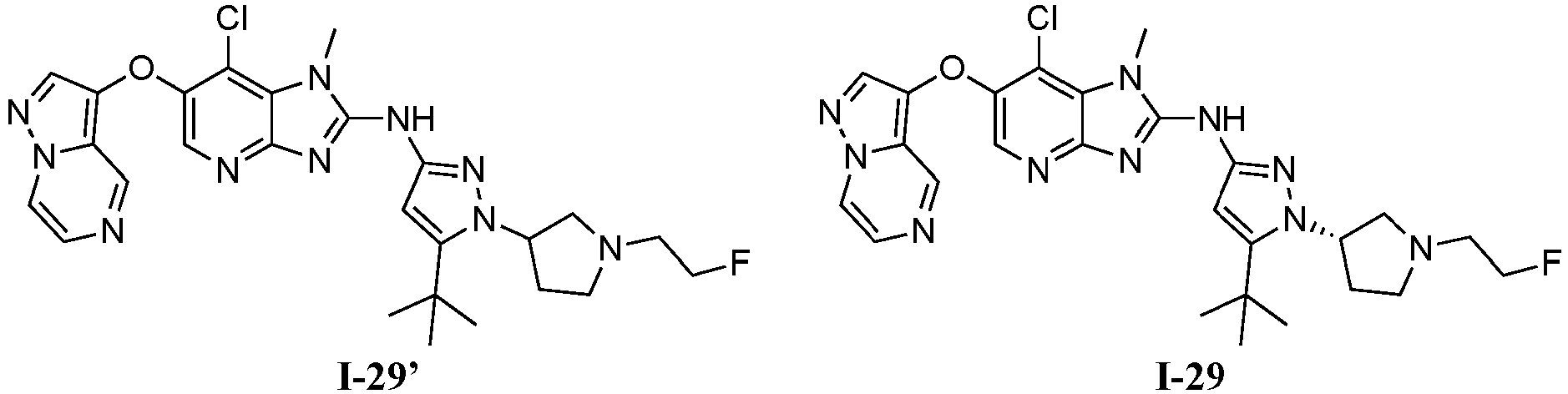


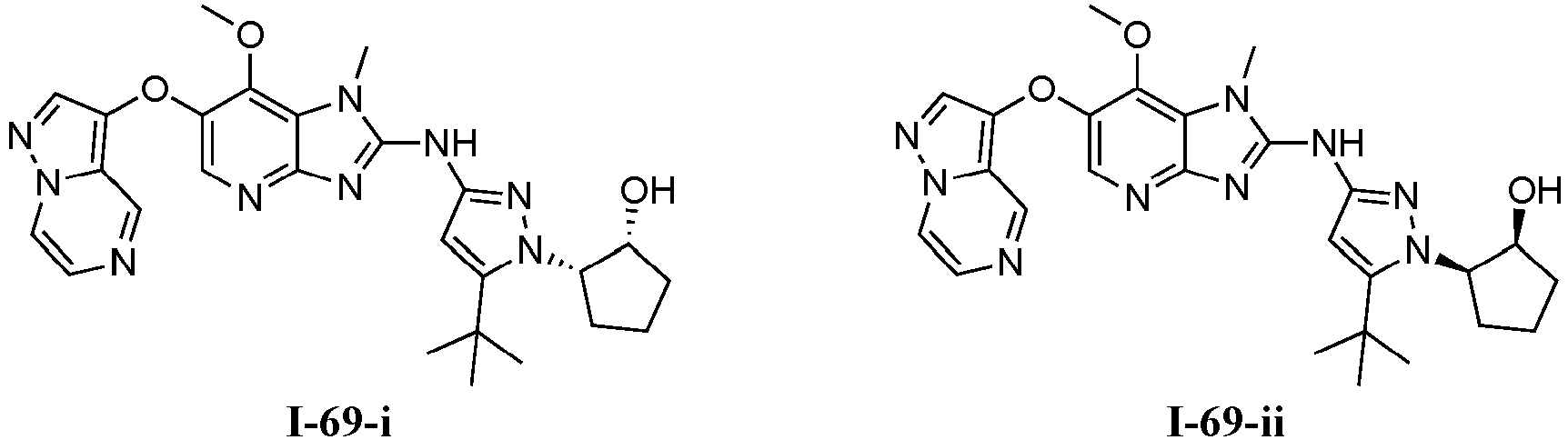


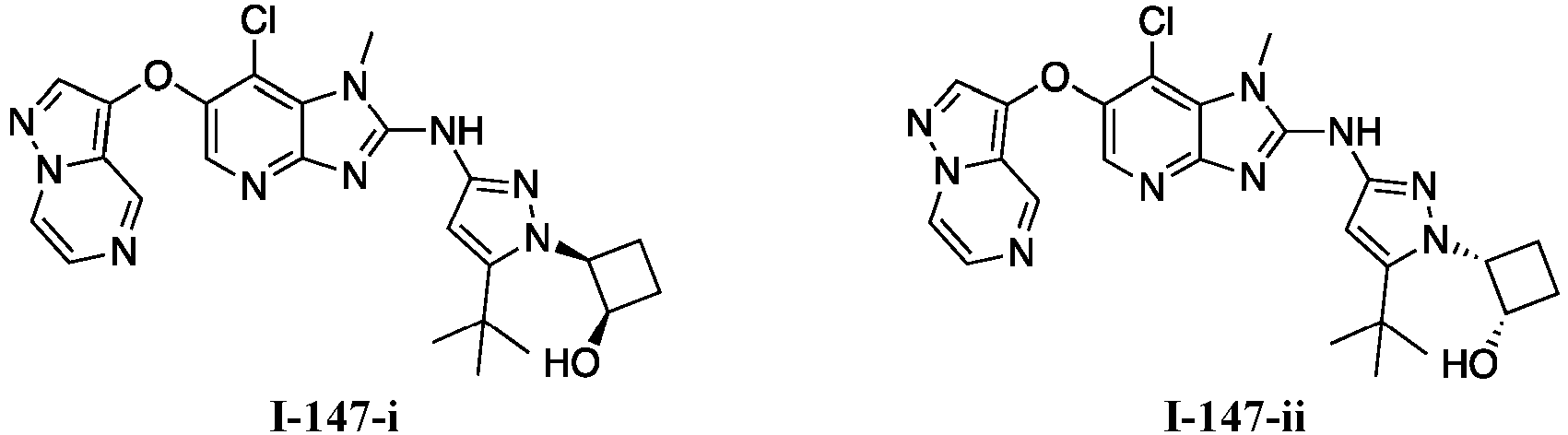


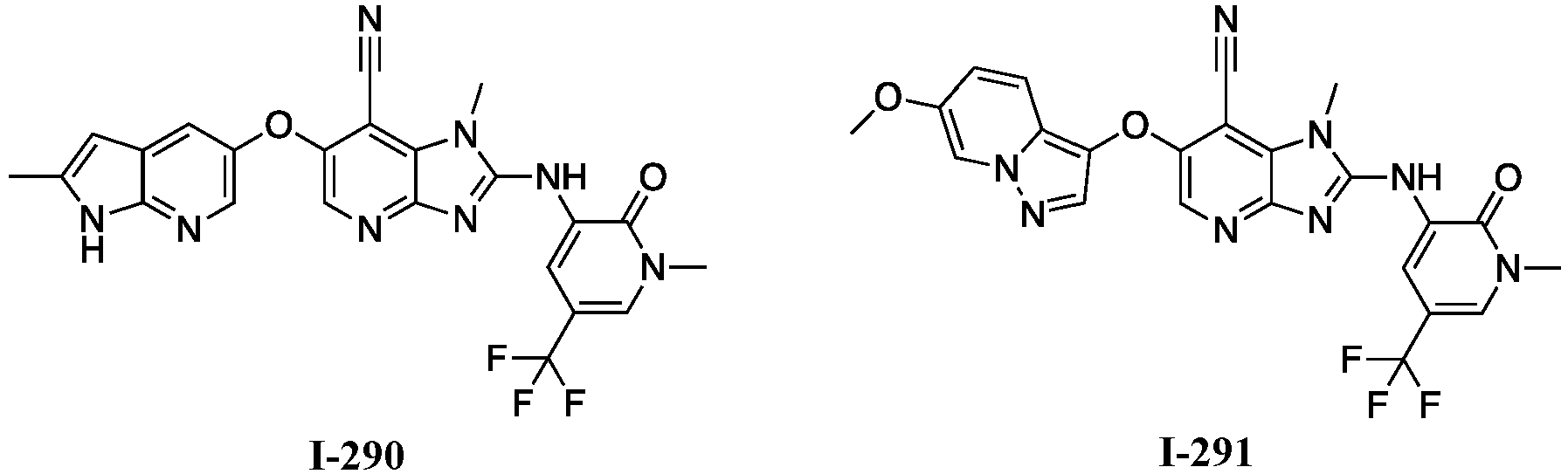

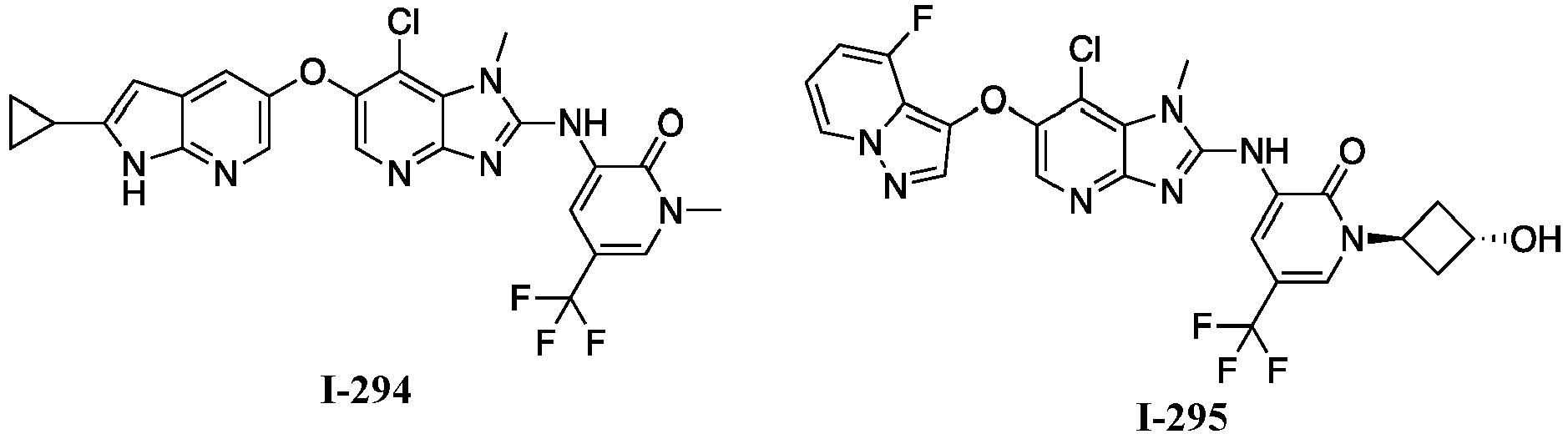


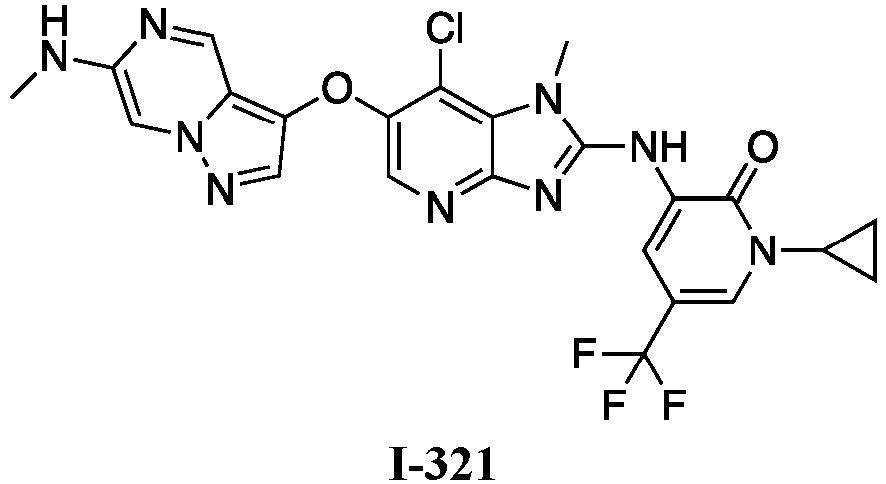


- A pharmaceutical composition comprising a compound of any one of the preceding claims, or a pharmaceutically acceptable salt thereof, and a pharmaceutically acceptable carrier.
- A compound as defined in any one of claims 1 to 13, or a composition as defined in claim 14, for use in a method of treating a disease, disorder, or condition associated with JAK2, comprising administering to a subject in need thereof the compound or the composition; optionally wherein the disease, disorder or condition is(a) cancer, or(b) a hematological malignancy, optionally wherein the hematological malignancy is leukemia or lymphoma, or(c) a myeloproliferative neoplasm, optionally wherein the myeloproliferative neoplasm is polycythemia vera, essential thrombocytopenia or myelofibrosis.
Applications Claiming Priority (4)
| Application Number | Priority Date | Filing Date | Title |
|---|---|---|---|
| US202063130251P | 2020-12-23 | 2020-12-23 | |
| US202163218097P | 2021-07-02 | 2021-07-02 | |
| US202163277337P | 2021-11-09 | 2021-11-09 | |
| PCT/US2021/064830 WO2022140527A1 (en) | 2020-12-23 | 2021-12-22 | 6-heteroaryloxy benzimidazoles and azabenzimidazoles as jak2 inhibitors |
Publications (2)
| Publication Number | Publication Date |
|---|---|
| EP4267574A1 EP4267574A1 (en) | 2023-11-01 |
| EP4267574B1 true EP4267574B1 (en) | 2025-04-23 |
Family
ID=82158403
Family Applications (1)
| Application Number | Title | Priority Date | Filing Date |
|---|---|---|---|
| EP21847625.7A Active EP4267574B1 (en) | 2020-12-23 | 2021-12-22 | 6-heteroaryloxy benzimidazoles and azabenzimidazoles as jak2 inhibitors |
Country Status (3)
| Country | Link |
|---|---|
| US (1) | US12043632B2 (en) |
| EP (1) | EP4267574B1 (en) |
| WO (1) | WO2022140527A1 (en) |
Families Citing this family (9)
| Publication number | Priority date | Publication date | Assignee | Title |
|---|---|---|---|---|
| WO2020097400A1 (en) | 2018-11-07 | 2020-05-14 | Dana-Farber Cancer Institute, Inc. | Imidazopyridine derivatives and aza-imidazopyridine derivatives as janus kinase 2 inhibitors and uses thereof |
| EP3876939A4 (en) | 2018-11-07 | 2022-08-10 | Dana-Farber Cancer Institute, Inc. | BENZOTHIAZOLE DERIVATIVES AND 7-AZA-BENZOTHIAZOLE DERIVATIVES AS JANUS KINASE-2 INHIBITORS AND USES THEREOF |
| EP3876930A4 (en) | 2018-11-07 | 2022-07-20 | Dana-Farber Cancer Institute, Inc. | BENZIMIDAZOLE DERIVATIVES AND AZA-BENZIMIDAZOLE DERIVATIVES AS JANUS KINASE 2 INHIBITORS AND THEIR USES |
| BR112022022409A2 (en) | 2020-05-06 | 2023-02-07 | Ajax Therapeutics Inc | 6-HETEROARYLOXY BENZIMIDAZOLES AND AZABENZIMIDAZOLES AS JAK2 INHIBITORS |
| WO2022140527A1 (en) | 2020-12-23 | 2022-06-30 | Ajax Therapeutics, Inc. | 6-heteroaryloxy benzimidazoles and azabenzimidazoles as jak2 inhibitors |
| CA3234638A1 (en) | 2021-11-09 | 2023-05-19 | Ajax Therapeutics, Inc. | 6-heteroaryloxy benzimidazoles and azabenzimidazoles as jak2 inhibitors |
| WO2023086320A1 (en) | 2021-11-09 | 2023-05-19 | Ajax Therapeutics, Inc. | Forms and compositions of inhibitors of jak2 |
| CN115925618A (en) * | 2023-01-06 | 2023-04-07 | 河南省科学院化学研究所有限公司 | A kind of synthetic method of 2-(2,2,2-trifluoroethoxy)-6-chloro-3-aminopyridine |
| CN117551050B (en) * | 2023-11-14 | 2024-11-08 | 湖北天义药业有限公司 | Preparation method of zolmitriptan key intermediate |
Family Cites Families (271)
| Publication number | Priority date | Publication date | Assignee | Title |
|---|---|---|---|---|
| JP2729545B2 (en) | 1991-06-05 | 1998-03-18 | 富士写真フイルム株式会社 | Processing solution for silver halide color photographic light-sensitive material and processing method using the same |
| DK152291D0 (en) | 1991-08-28 | 1991-08-28 | Danisco | PROCEDURE AND CHEMICAL RELATIONS |
| US5994629A (en) | 1991-08-28 | 1999-11-30 | Novartis Ag | Positive selection |
| RU2105005C1 (en) | 1992-07-03 | 1998-02-20 | Кумиай Кемикал Индастри Ко., Лтд. | Condensed heterocyclic derivative, method of its synthesis and herbicide agent |
| EP0639573A1 (en) | 1993-08-03 | 1995-02-22 | Hoechst Aktiengesellschaft | Benzocondensed five membered heterocycles, process of their preparation, their use as drug, as diagnostic means and pharmaceuticals containing it |
| US5852046A (en) | 1993-08-03 | 1998-12-22 | Hoechst Aktiengesellschaft | Benzo-fused heterocyclic compounds having a 5-membered ring processes for their preparation their use as medicaments their use as diagnostic agents and medicaments containing them |
| FR2719843B1 (en) | 1994-05-10 | 1996-06-07 | Synthelabo | Derivatives of 5,6-dihydro-4h-imidazo [2 ', 1': 2,3] imidazo- [4,5,1-ij] quinoline and 4,5-dihydroimidazo [1,2-a] pyrrolo- [1,2,3-cd] benzimidazole, their preparation and their therapeutic application. |
| DE4441676A1 (en) | 1994-11-23 | 1996-05-30 | Basf Ag | Iminooxymethylene anilides, process for their preparation and their use |
| DE19507913C2 (en) | 1995-03-07 | 1998-04-16 | Agfa Gevaert Ag | Color photographic silver halide material |
| IL123421A0 (en) | 1995-09-18 | 1998-09-24 | Basf Ag | Phenylacetic acids their preparation and compositions comprising them |
| CN1056370C (en) | 1995-10-17 | 2000-09-13 | 化学工业部沈阳化工研究院 | 4-aryloxy (arylthio or arylamino) pyrimidine derivative with herbicide active, and method for prepn. of same |
| US6444816B1 (en) | 1997-10-27 | 2002-09-03 | Dr. Reddy's Research Foundation | Fused 7-oxo-pyrimidinyl compounds, preparation, composition and use thereof |
| WO1999026932A1 (en) | 1997-11-26 | 1999-06-03 | Axys Pharmaceuticals, Inc. | By amidino group substituted heterocyclic derivatives and their use as anticoagulants |
| JPH11283746A (en) | 1998-03-27 | 1999-10-15 | Fuji Photo Film Co Ltd | Electroluminescent element using bisbenzazole compound and manufacture of bisbenzazole compound |
| US6346531B1 (en) | 1998-05-22 | 2002-02-12 | Smithkline Beecham Corporation | G-CSF mimetics |
| US6630470B1 (en) | 1998-05-22 | 2003-10-07 | Smithkline Beecham Corporation | G-CSF mimetics |
| US6329383B1 (en) | 1999-01-25 | 2001-12-11 | Pharmacia Ab | 2-amino-5-pyrimidine acetic acid compounds |
| CZ27399A3 (en) | 1999-01-26 | 2000-08-16 | Ústav Experimentální Botaniky Av Čr | Substituted nitrogen heterocyclic derivatives process of their preparation, the derivatives employed as medicaments, pharmaceutical composition and a compound pharmaceutical preparation in which these derivatives are comprised as well as use of these derivatives for preparing medicaments |
| EE200100528A (en) | 1999-04-12 | 2003-02-17 | Aventis Pharma Limited | Substituted bicyclic heteroaryl compound, pharmaceutical composition containing it and their therapeutic use |
| JP4000711B2 (en) | 1999-04-13 | 2007-10-31 | 東レ株式会社 | Light emitting element |
| ATE281433T1 (en) | 1999-05-05 | 2004-11-15 | Aventis Pharma Ltd | SUBSTITUTED PYRROLIDINES AS CELL ADHESION INHIBITORS |
| EP1065207A1 (en) | 1999-07-02 | 2001-01-03 | Aventis Pharma Deutschland GmbH | Naphthyridine derivatives, processes for their preparation, their use, and pharmaceutical compositions comprising them |
| EP1065208A1 (en) | 1999-07-02 | 2001-01-03 | Aventis Pharma Deutschland GmbH | Substituted purine derivatives as inhibitors of cell adhesion |
| US6566372B1 (en) | 1999-08-27 | 2003-05-20 | Ligand Pharmaceuticals Incorporated | Bicyclic androgen and progesterone receptor modulator compounds and methods |
| US7115589B2 (en) | 1999-12-17 | 2006-10-03 | Ariad Pharmaceuticals, Inc. | Purine derivatives |
| EP1244679B1 (en) | 1999-12-17 | 2006-11-15 | Ariad Pharmaceuticals, Inc. | Purine derivatives |
| AU2583901A (en) | 1999-12-17 | 2001-06-25 | Ariad Pharmaceuticals, Inc. | Proton pump inhibitors |
| DE60118521T2 (en) | 2000-01-07 | 2006-10-12 | Universitaire Instelling Antwerpen | Purine derivatives, their preparation and their use |
| GB0004686D0 (en) | 2000-02-28 | 2000-04-19 | Aventis Pharma Ltd | Chemical compounds |
| AU2001238690A1 (en) | 2000-03-14 | 2001-09-24 | Sepracor, Inc. | 3-substituted piperidines comprising urea functionality, and methods of use thereof |
| AU2001249397A1 (en) | 2000-03-24 | 2001-10-08 | Cor Therapeutics, Inc. | Oxindole inhibitors of factor xa |
| WO2001072712A1 (en) | 2000-03-24 | 2001-10-04 | Cor Therapeutics, Inc. | ISOQUINOLONE INHIBITORS OF FACTOR Xa |
| AU2002232439A1 (en) | 2000-11-29 | 2002-06-11 | Glaxo Group Limited | Benzimidazole derivatives useful as tie-2 and/or vegfr-2 inhibitors |
| AUPR213700A0 (en) | 2000-12-18 | 2001-01-25 | Biota Scientific Management Pty Ltd | Antiviral agents |
| US6452014B1 (en) | 2000-12-22 | 2002-09-17 | Geron Corporation | Telomerase inhibitors and methods of their use |
| US6693125B2 (en) | 2001-01-24 | 2004-02-17 | Combinatorx Incorporated | Combinations of drugs (e.g., a benzimidazole and pentamidine) for the treatment of neoplastic disorders |
| US20030009034A1 (en) | 2001-03-22 | 2003-01-09 | Neil Wishart | Transition metal mediated process |
| US20030109714A1 (en) | 2001-03-22 | 2003-06-12 | Neil Wishart | Transition metal mediated process |
| WO2002102783A1 (en) | 2001-06-19 | 2002-12-27 | Merck & Co., Inc. | Tyrosine kinase inhibitors |
| EP1440072A4 (en) | 2001-10-30 | 2005-02-02 | Conforma Therapeutic Corp | Purine analogs having hsp90-inhibiting activity |
| AU2002349477A1 (en) | 2001-11-26 | 2003-06-10 | Takeda Chemical Industries, Ltd. | Bicyclic derivative, process for producing the same, and use |
| US20040006117A1 (en) | 2002-02-15 | 2004-01-08 | Schering Aktiengesellschaft | Microglia inhibitors for interrupting interleukin 12 and IFN-gamma-mediated immune reactions |
| US8299108B2 (en) | 2002-03-29 | 2012-10-30 | Novartis Ag | Substituted benzazoles and methods of their use as inhibitors of raf kinase |
| ATE447404T1 (en) | 2002-03-29 | 2009-11-15 | Novartis Vaccines & Diagnostic | SUBSTITUTED BENZAZOLES AND THEIR USE AS RAF-KINASE INHIBITORS |
| NZ537301A (en) | 2002-06-07 | 2006-06-30 | Cortical Pty Ltd | Therapeutic molecules and methods-1 |
| CN100427487C (en) | 2002-06-27 | 2008-10-22 | 弗·哈夫曼·拉罗切有限公司 | Synthesis of Purine Derivatives |
| GB0215293D0 (en) | 2002-07-03 | 2002-08-14 | Rega Foundation | Viral inhibitors |
| WO2004006849A2 (en) | 2002-07-15 | 2004-01-22 | Combinatorx, Incorporated | Combinations of drugs for the treatment of neoplasms |
| JP2004067629A (en) | 2002-08-09 | 2004-03-04 | Yamanouchi Pharmaceut Co Ltd | Mitochondria function-activating agent and new benzimidazole derivative |
| AU2002951247A0 (en) | 2002-09-06 | 2002-09-19 | Alchemia Limited | Compounds that interact with kinases |
| TW200408393A (en) | 2002-10-03 | 2004-06-01 | Ono Pharmaceutical Co | Antagonist of lysophosphatidine acid receptor |
| CA2502356A1 (en) | 2002-10-15 | 2004-04-29 | Synta Pharmaceuticals Corp. | Aromatic bicyclic heterocyles to modulate 1l - 12 production |
| MXPA05005983A (en) | 2002-12-04 | 2005-08-18 | Eisai Co Ltd | 1,3-dihydroimidazole fused-ring compound. |
| US7531553B2 (en) | 2003-03-21 | 2009-05-12 | Amgen Inc. | Heterocyclic compounds and methods of use |
| EP2258365B1 (en) | 2003-03-28 | 2013-05-29 | Novartis Vaccines and Diagnostics, Inc. | Use of organic compounds for immunopotentiation |
| WO2004100525A2 (en) | 2003-05-05 | 2004-11-18 | Thomson Licensing S.A. | System and method for blocking television signal having multiple different content ratings |
| CA2527079A1 (en) | 2003-05-29 | 2005-01-06 | Synta Pharmaceuticals, Corp. | Heterocyclic compounds for preventing and treating disorders associated with excessive bone loss |
| KR101127201B1 (en) | 2003-09-22 | 2012-04-12 | 에스*바이오 피티이 리미티드 | Benzimidazole derivatives: preparation and pharmaceutical applications |
| WO2005035526A1 (en) | 2003-10-09 | 2005-04-21 | Argenta Discovery Ltd. | Bicyclic compounds and their therapeutic use |
| JP4755991B2 (en) | 2003-10-16 | 2011-08-24 | ノバルティス バクシンズ アンド ダイアグノスティックス,インコーポレーテッド | Substituted benzazoles and their use as Raf kinase inhibitors |
| US7256196B1 (en) | 2003-12-09 | 2007-08-14 | The Procter & Gamble Company | Purine cytokine inhibitors |
| US7301036B2 (en) | 2003-12-19 | 2007-11-27 | Merck & Co., Inc. | Cyclic guanidines, compositions containing such compounds and methods of use |
| WO2005066151A2 (en) | 2003-12-19 | 2005-07-21 | Takeda San Diego, Inc. | Histone deacetylase inhibitors |
| WO2005085237A1 (en) | 2004-03-04 | 2005-09-15 | Kissei Pharmaceutical Co., Ltd. | Fused heterocycle derivative, medicinal composition containing the same, and medicinal use thereof |
| JP4528013B2 (en) | 2004-04-01 | 2010-08-18 | 三井化学株式会社 | Anthracene compound and organic electroluminescent device containing the anthracene compound |
| US7745436B2 (en) | 2004-04-13 | 2010-06-29 | Synta Pharmaceuticals Corporation | Disalt inhibitors of IL-12 production |
| EP1751124A4 (en) | 2004-05-07 | 2010-04-14 | Exelixis Inc | Raf modulators and methods of use |
| JP2008501714A (en) | 2004-06-04 | 2008-01-24 | 武田薬品工業株式会社 | Dipeptidyl peptidase inhibitor |
| US7371264B2 (en) | 2004-08-26 | 2008-05-13 | The Procter & Gamble Company | Keratin dyeing compounds, keratin dyeing compositions containing them, and use thereof |
| US7371737B2 (en) | 2004-09-09 | 2008-05-13 | Solvay Pharmaceuticals, B.V. | 2-substituted-6-trifluoromethyl purine derivatives with adenosine-A3 antagonistic activity |
| AR050630A1 (en) | 2004-09-09 | 2006-11-08 | Solvay Pharm Bv | DERIVATIVES OF 6- TRIFLUOROMETIL PURINA 2- REPLACED WITH ANTAGONIST ACTIVITY OF ADENOSINA-A3. PROCESSES OF OBTAINING AND PHARMACEUTICAL COMPOSITIONS. |
| GB0420719D0 (en) | 2004-09-17 | 2004-10-20 | Addex Pharmaceuticals Sa | Novel allosteric modulators |
| EP1805187A1 (en) | 2004-10-21 | 2007-07-11 | Pfizer, Inc. | Inhibitors of hepatitis c virus protease, and compositions and treatments using the same |
| WO2006053342A2 (en) | 2004-11-12 | 2006-05-18 | Osi Pharmaceuticals, Inc. | Integrin antagonists useful as anticancer agents |
| WO2006078907A1 (en) | 2005-01-20 | 2006-07-27 | Amgen Inc. | 2-substituted benzimidazole derivatives as vanilloid receptor ligands and their use in treatments |
| EP1888563A1 (en) | 2005-05-23 | 2008-02-20 | Merck & Co., Inc. | Proline bis-amide orexin receptor antagonists |
| WO2006128129A2 (en) | 2005-05-26 | 2006-11-30 | Synta Pharmaceuticals Corp. | Method for treating cancer |
| WO2006128172A2 (en) | 2005-05-26 | 2006-11-30 | Synta Pharmaceuticals Corp. | Method for treating b cell regulated autoimmune disorders |
| WO2006130469A1 (en) | 2005-05-27 | 2006-12-07 | Oregon Health & Science University | Stimulation of neurite outgrowth by small molecules |
| WO2006138418A2 (en) | 2005-06-14 | 2006-12-28 | President And Fellows Of Harvard College | Improvement of cognitive performance with sirtuin activators |
| WO2007007463A1 (en) | 2005-07-11 | 2007-01-18 | Idemitsu Kosan Co., Ltd. | Nitrogen-containing heterocyclic derivative having electron-attracting substituent and organic electroluminescence element using the same |
| WO2007007464A1 (en) | 2005-07-11 | 2007-01-18 | Idemitsu Kosan Co., Ltd. | Nitrogen-containing heterocyclic derivative and organic electroluminescence element using the same |
| JP2007039406A (en) | 2005-08-05 | 2007-02-15 | Idemitsu Kosan Co Ltd | Nitrogen-containing heterocyclic derivative and organic electroluminescence device using the same |
| EP1945209B1 (en) | 2005-08-12 | 2018-05-30 | United States Government As Represented By The Secretary of The United States Army And The U.S. Army Medical Research & Materiel Command | Broad spectrum antibacterial compounds |
| TW200804345A (en) | 2005-08-30 | 2008-01-16 | Novartis Ag | Substituted benzimidazoles and methods of preparation |
| US8338594B2 (en) | 2005-12-02 | 2012-12-25 | Bayer Healthcare Llc | Pyrrolotriazine derivatives useful for treating cancer through inhibition of aurora kinase |
| DK1973545T3 (en) | 2005-12-23 | 2013-02-25 | Ariad Pharma Inc | Bicyclic heteroaryl compounds |
| WO2007084390A2 (en) | 2006-01-13 | 2007-07-26 | Takeda San Diego, Inc. | Histone deacetylase inhibitors |
| WO2007091950A1 (en) | 2006-02-07 | 2007-08-16 | Astrazeneca Ab | Benzimidazoles and imidazopyridines useful in the treatment of diseases or disorders associated with cannabinoid receptor 2 (cb2) such as pain |
| AU2007215247B2 (en) | 2006-02-10 | 2012-12-13 | Transtech Pharma, Llc | Benzazole derivatives, compositions, and methods of use as Aurora kinase inhibitors |
| EP2007765B1 (en) | 2006-03-23 | 2012-06-27 | Novartis AG | Immunopotentiating compounds |
| US20100010217A1 (en) | 2006-03-23 | 2010-01-14 | Valiante Nicholas M | Methods for the preparation of imidazole-containing compounds |
| DK2010528T3 (en) | 2006-04-19 | 2018-01-15 | Novartis Ag | 6-O-Substituted Benzoxazole and Benzothiazole Compounds and Methods for Inhibiting CSF-1R Signaling |
| EP2029597A4 (en) | 2006-05-31 | 2011-11-23 | Univ California | ANALOGUES OF THE PURINE |
| PT2038290E (en) | 2006-07-07 | 2013-12-10 | Gilead Sciences Inc | Modulators of toll-like receptor 7 |
| WO2008016666A2 (en) | 2006-08-02 | 2008-02-07 | Cytokinetics, Incorporated | Certain chemical entities, compositions, and methods |
| US7635683B2 (en) | 2006-08-04 | 2009-12-22 | Enanta Pharmaceuticals, Inc. | Quinoxalinyl tripeptide hepatitis C virus inhibitors |
| RU2459821C2 (en) | 2006-09-07 | 2012-08-27 | Байоджен Айдек Ма Инк. | Modulators of interleukin-1 receptor-associated kinase |
| CL2007002994A1 (en) | 2006-10-19 | 2008-02-08 | Wyeth Corp | HETEROCICLIC DERIVATIVE COMPOUNDS CONTAINING SULFAMOIL, INHIBITORS OF HSP90; PHARMACEUTICAL COMPOSITION; AND USE FOR THE TREATMENT OF CANCER, SUCH AS CANCER OF BREAST, COLON AND PROSTATE, BETWEEN OTHERS. |
| EP2091329A4 (en) | 2006-12-05 | 2011-02-23 | Univ Nat Chiao Tung | INDAZOLE COMPOUNDS |
| WO2008080015A2 (en) | 2006-12-21 | 2008-07-03 | Plexxikon, Inc. | Compounds and methods for kinase modulation, and indications therefor |
| US20080161254A1 (en) | 2007-01-03 | 2008-07-03 | Virobay, Inc. | Hcv inhibitors |
| WO2008124145A1 (en) | 2007-04-05 | 2008-10-16 | Government Of The U.S.A., As Represented By The Secretary, Department Of Health And Human Services | Steroid compounds, compositions, and methods of treatment |
| US8022085B2 (en) | 2007-05-07 | 2011-09-20 | Amgen Inc. | Pyrazolo-pyridinone and pyrazolo-pyrazinone compounds as P38 modulators and methods of use thereof |
| BRPI0812159A2 (en) | 2007-05-21 | 2017-05-02 | Novartis Ag | csf-1r inhibitors, compositions and methods of use |
| CL2008001626A1 (en) | 2007-06-05 | 2009-06-05 | Takeda Pharmaceuticals Co | Compounds derived from fused heterocycles, a pharmaceutical agent that comprises them and their use in the prophylaxis and treatment of cancer. |
| SI2170888T1 (en) | 2007-06-29 | 2015-10-30 | Gilead Sciences, Inc. | Purine derivatives and their use as modulators of toll-like receptor 7 |
| CN101820881B (en) | 2007-07-12 | 2013-05-01 | 坎莫森特里克斯公司 | Fused heteroaryl pyridyl and phenyl benzenesuflonamides as CCR2 modulators for the treament of inflammation |
| WO2009011775A1 (en) | 2007-07-13 | 2009-01-22 | Merck & Co., Inc. | Amidoethyl alkylamino orexin receptor antagonists |
| WO2009017954A1 (en) | 2007-08-01 | 2009-02-05 | Phenomix Corporation | Inhibitors of jak2 kinase |
| US20120121540A1 (en) | 2007-08-10 | 2012-05-17 | Franz Ulrich Schmitz | Certain Nitrogen Containing Bicyclic Chemical Entities For Treating Viral Infections |
| JP5350247B2 (en) | 2007-08-29 | 2013-11-27 | 武田薬品工業株式会社 | Heterocyclic compounds and uses thereof |
| WO2009034386A1 (en) | 2007-09-13 | 2009-03-19 | Astrazeneca Ab | Derivatives of adenine and 8-aza-adenine and uses thereof-796 |
| US20100261679A1 (en) | 2007-10-18 | 2010-10-14 | James Sutton | CSF-1R, Inhibitors, Compositions, and Methods of Use |
| JP2009149589A (en) | 2007-12-24 | 2009-07-09 | Dnp Fine Chemicals Co Ltd | Process for producing asymmetric monoazamethine cyanine |
| CN101239980B (en) | 2008-02-18 | 2011-06-22 | 靳广毅 | Immune receptor regulator couplet precursor, couplet and application thereof |
| AU2009233711B2 (en) | 2008-04-09 | 2015-02-12 | Infinity Pharmaceuticals, Inc | Inhibitors of fatty acid amide hydrolase |
| WO2010002492A1 (en) | 2008-04-29 | 2010-01-07 | University Of Chicago | Methods of use of adenine derivatives for the treatment of diabetes and other disorders |
| WO2009134850A1 (en) | 2008-04-30 | 2009-11-05 | Smithkline Beecham Corporation | Prolyl hydroxylase inhibitors |
| US20100197688A1 (en) | 2008-05-29 | 2010-08-05 | Nantermet Philippe G | Epha4 rtk inhibitors for treatment of neurological and neurodegenerative disorders and cancer |
| US20100035875A1 (en) | 2008-06-20 | 2010-02-11 | Bing-Yan Zhu | Triazolopyridine jak inhibitor compounds and methods |
| JO3041B1 (en) | 2008-07-25 | 2016-09-05 | Galapagos Nv | Novel compounds useful for the treatment of degenerative and inflammatory diseases |
| US9643922B2 (en) | 2008-08-18 | 2017-05-09 | Yale University | MIF modulators |
| UY32138A (en) | 2008-09-25 | 2010-04-30 | Boehringer Ingelheim Int | SUBSTITUTED AMIDES 2- (2,6-DICLORO-PHENYLAMINE) -6-FLUORO-1-METHYL-1H-BENCIMIDAZOL-5-CARBOXYL AND ITS PHARMACEUTICALLY ACCEPTABLE SALTS |
| US20100093747A1 (en) | 2008-10-10 | 2010-04-15 | Erica Brook Goodhew | Method of inducing negative chemotaxis |
| US8697874B2 (en) | 2008-12-01 | 2014-04-15 | Takeda Pharmaceutical Company Limited | Heterocyclic compound and use thereof |
| JO3101B1 (en) | 2008-12-02 | 2017-09-20 | Takeda Pharmaceuticals Co | Benzothiazole derivatives as anticancer agents |
| EP2389436A2 (en) | 2009-01-22 | 2011-11-30 | ITI Scotland Limited | Stem cell culture methods |
| US20100204265A1 (en) | 2009-02-09 | 2010-08-12 | Genelabs Technologies, Inc. | Certain Nitrogen Containing Bicyclic Chemical Entities for Treating Viral Infections |
| WO2010093436A2 (en) | 2009-02-11 | 2010-08-19 | Carson Dennis A | Toll-like receptor modulators and treatment of diseases |
| UY32470A (en) | 2009-03-05 | 2010-10-29 | Boehringer Ingelheim Int | DERIVATIVES OF 2- {2-CHLORINE-5 - [(REPLACED) METHYL] PHENYLAMINE} -1-METHYL] PHENYLAMINE} -1-METHYLBENCIMIDAZOL-5-CARBOXAMIDES-N- (SUBSTITUTED) AND ITS PHYSIOLOGICALLY ACCEPTABLE SALTS, COMPOSITIONS AND APPLIANCE |
| WO2010124097A2 (en) | 2009-04-22 | 2010-10-28 | Paratek Pharmaceuticals, Inc. | Transcription factor modulating compounds and methods of use thereof |
| NZ597140A (en) | 2009-06-05 | 2014-01-31 | Cephalon Inc | Preparation and uses of 1,2,4-triazolo [1,5a] pyridine derivatives |
| WO2010143733A1 (en) | 2009-06-09 | 2010-12-16 | Takeda Pharmaceutical Company Limited | Novel fused cyclic compound and use thereof |
| EP2440058A4 (en) | 2009-06-12 | 2012-11-21 | Dana Farber Cancer Inst Inc | FOUNDED HETEROCYCLIC COMPOUNDS AND USES THEREOF |
| US9556426B2 (en) | 2009-09-16 | 2017-01-31 | Celgene Avilomics Research, Inc. | Protein kinase conjugates and inhibitors |
| EP2343297A1 (en) | 2009-11-30 | 2011-07-13 | Bayer Schering Pharma AG | Triazolopyridines |
| US8486967B2 (en) | 2010-02-17 | 2013-07-16 | Hoffmann-La Roche Inc. | Heteroaryl substituted piperidines |
| CA2789471C (en) | 2010-03-04 | 2018-01-02 | Merck Sharp & Dohme Corp. | Inhibitors of catechol o-methyl transferase and their use in the treatment of psychotic disorders |
| EP2545187B1 (en) | 2010-03-09 | 2018-09-05 | Dana-Farber Cancer Institute, Inc. | Methods of diagnosing and treating cancer in patients having or developing resistance to a first cancer therapy |
| PT2556071T (en) | 2010-04-06 | 2016-11-22 | Univ Health Network | Kinase inhibitors and their use in treating cancer |
| CN102219725B (en) | 2010-04-16 | 2013-10-09 | 中国科学院上海药物研究所 | Benzoheterocyclic compound and its preparation method and use |
| WO2011133661A2 (en) | 2010-04-21 | 2011-10-27 | Research Development Foundation | Methods and compositions related to dopaminergic neuronal cells |
| CA2835596A1 (en) | 2010-05-11 | 2011-11-17 | 8337187 Canada Inc. | Benzo- or pyrido-imidazole derivative |
| EP3450432A1 (en) | 2010-05-17 | 2019-03-06 | Incozen Therapeutics Pvt. Ltd. | Novel 3,5-disubstitued-3h-imidazo[4,5-b]pyridine and 3,5- disubstitued - 3h-[1,2,3]triazolo[4,5-b] pyridine compounds as modulators of protein kinases |
| EP2588473A1 (en) | 2010-06-30 | 2013-05-08 | Amgen Inc. | Nitrogen containing heterocyclic compounds as pik3 -delta inhibitors |
| US8697739B2 (en) | 2010-07-29 | 2014-04-15 | Novartis Ag | Bicyclic acetyl-CoA carboxylase inhibitors and uses thereof |
| WO2012016133A2 (en) | 2010-07-29 | 2012-02-02 | President And Fellows Of Harvard College | Ros1 kinase inhibitors for the treatment of glioblastoma and other p53-deficient cancers |
| US9212130B2 (en) | 2010-08-10 | 2015-12-15 | Shionogi & Co., Ltd. | Heterocyclic derivative and pharmaceutical composition comprising the same |
| US8759537B2 (en) | 2010-08-20 | 2014-06-24 | Boehringer Ingelheim International Gmbh | 3H-imidazo [4, 5-C] pyridine-6-carboxamides as anti-inflammatory agents |
| US8586604B2 (en) | 2010-08-20 | 2013-11-19 | Boehringer Ingelheim International Gmbh | Inhibitors of the microsomal prostaglandin E2 synthase-1 |
| CA2811025C (en) | 2010-09-10 | 2018-07-17 | Shionogi & Co., Ltd. | Hetero ring-fused imidazole derivative having ampk activating effect |
| HUE037860T2 (en) | 2010-11-19 | 2018-09-28 | Ligand Pharm Inc | Heterocycle amines and uses thereof |
| CA2819620A1 (en) | 2010-12-03 | 2012-06-21 | Epizyme, Inc. | Modulators of histone methyltransferase, and methods of use thereof |
| AU2011336272A1 (en) | 2010-12-03 | 2013-06-20 | Epizyme, Inc. | 7-deazapurine modulators of histone methyltransferase, and methods of use thereof |
| EP2654748B1 (en) | 2010-12-21 | 2016-07-27 | Merck Sharp & Dohme Corp. | Indazole derivatives useful as erk inhibitors |
| US8710082B2 (en) | 2011-02-18 | 2014-04-29 | Board Of Trustees Of Michigan State University | Benzimidazole inhibition of biofilm formation |
| WO2012122383A2 (en) | 2011-03-09 | 2012-09-13 | Avila Therapeutics, Inc. | Pi3 kinase inhibitors and uses thereof |
| CA2840380A1 (en) | 2011-06-24 | 2012-12-27 | Dana-Farber Cancer Institute, Inc. | Selective inhibitors of histone deacetylase isoform 6 and methods thereof |
| WO2013011932A1 (en) | 2011-07-15 | 2013-01-24 | 塩野義製薬株式会社 | Azabenzimidazole derivative having ampk-activating activity |
| EP2741611A4 (en) | 2011-08-08 | 2015-03-04 | California Inst Of Techn | SMALL MOLECULE COMPOUNDS THAT REGULATE THE PATHOGENIC NEMATODES OF PLANTS AND INSECTS |
| EP2766379A4 (en) | 2011-08-08 | 2015-03-04 | Thompson Boyce Plant Res | SMALL MOLECULE COMPOUNDS FOR THE FIGHT AGAINST NEMATODES |
| HK1197060A1 (en) | 2011-08-17 | 2015-01-02 | F. Hoffmann-La Roche Ag | Inhibitors of bruton's tyrosine kinase |
| WO2013044360A1 (en) | 2011-09-30 | 2013-04-04 | Methylgene Inc. | Inhibitors of protein tyrosine kinase activity |
| US20130096136A1 (en) | 2011-09-30 | 2013-04-18 | Methylgene Inc. | Inhibitors of Protein Tyrosine Kinase Activity |
| US10292390B2 (en) | 2011-11-04 | 2019-05-21 | Wisconsin Alumni Research Foundation | Inhibition and dispersion of bacterial biofilms with 2-aminobenzimidazole derivatives |
| AU2013207712B2 (en) | 2012-01-13 | 2017-08-31 | Acea Biosciences Inc. | Heterocyclic compounds and uses as anticancer agents. |
| US8889677B2 (en) | 2012-01-17 | 2014-11-18 | Boehringer Ingellheim International GmbH | Substituted triazoles useful as mGlu5 receptor modulators |
| US9550763B2 (en) | 2012-02-09 | 2017-01-24 | Shionogi & Co., Ltd. | Heterocyclic ring and carbocyclic derivative |
| WO2013120045A1 (en) | 2012-02-10 | 2013-08-15 | University Of Utah Research Foundation | Substituted 1h-indazol-1-ol analogs as inhibitors of beta catenin/tcf protein-protein interactions |
| AP3908A (en) | 2012-03-30 | 2016-11-24 | Rhizen Pharmaceuticals Sa | Novel 3,5-disubstituted-3H-imidazo[4,5-B]pyridine and 3,5-disubstituted-3H-[1,2,3]triazolo [4,5-B] pyridine compounds as modulators of C-met protein kinases |
| EP2847201B1 (en) | 2012-05-07 | 2017-08-16 | The University of Queensland | 6-oxopurine phosphoribosyltransferase inhibitors |
| AU2013204604B2 (en) | 2012-05-30 | 2016-05-19 | Biodiem Limited | Method of treating Scedosporium spp. infection |
| CA2874303C (en) | 2012-06-11 | 2020-10-13 | Ucb Biopharma Sprl | Tnf -alpha modulating benz imidazoles |
| US9040498B2 (en) | 2012-07-06 | 2015-05-26 | Research Foundation Of The City University Of New York | 1,2,3-Triazolyl purine derivatives |
| WO2014014874A1 (en) | 2012-07-17 | 2014-01-23 | Boehringer Ingelheim International Gmbh | Pyrazole derivatives which inhibit leukotriene production |
| CN104780764A (en) | 2012-09-05 | 2015-07-15 | 拜尔农作物科学股份公司 | Use of substituted 2-amidobenzimidazoles, 2-amidobenzoxazoles and 2-amidobenzothiazoles or salts thereof as active substances against abiotic plant stress |
| WO2014069426A1 (en) | 2012-10-31 | 2014-05-08 | 塩野義製薬株式会社 | Benzimidazole having ampk activating effect and azabenzimidazole derivative |
| GB201220157D0 (en) | 2012-11-08 | 2012-12-26 | Selvita Sa | Substitute tricyclic benzimidazoles as kinase inhibitors |
| EP2970266B1 (en) | 2013-03-15 | 2018-01-31 | Epizyme, Inc. | 1-phenoxy-3-(alkylamino)-propan-2-ol derivatives as carm1 inhibitors and uses thereof |
| WO2014175330A1 (en) | 2013-04-24 | 2014-10-30 | 塩野義製薬株式会社 | 5-oxybenzimidazole and 5-oxyaza benzimidazole derivative having ampk activation effect |
| ES2688815T3 (en) | 2013-05-10 | 2018-11-07 | Karus Therapeutics Limited | Novel histone deacetylase inhibitors |
| AU2014287209B2 (en) | 2013-07-09 | 2019-01-24 | Dana-Farber Cancer Institute, Inc. | Kinase inhibitors for the treatment of disease |
| JP2016169161A (en) | 2013-07-19 | 2016-09-23 | 大日本住友製薬株式会社 | New imidazopyridine compounds |
| JPWO2015056782A1 (en) | 2013-10-17 | 2017-03-09 | 塩野義製薬株式会社 | New alkylene derivatives |
| US9828348B2 (en) | 2013-11-08 | 2017-11-28 | Purdue Pharma L.P. | Benzimidazole derivatives and use thereof |
| WO2015086519A1 (en) | 2013-12-09 | 2015-06-18 | Ucb Biopharma Sprl | Imidazopyridine derivatives as modulators of tnf activity |
| GB201321741D0 (en) | 2013-12-09 | 2014-01-22 | Ucb Pharma Sa | Therapeutic agents |
| GB201321739D0 (en) | 2013-12-09 | 2014-01-22 | Ucb Pharma Sa | Therapeutic agents |
| GB201321744D0 (en) | 2013-12-09 | 2014-01-22 | Ucb Pharma Sa | Therapeutic agents |
| GB201321748D0 (en) | 2013-12-09 | 2014-01-22 | Ucb Pharma Sa | Therapeutic agents |
| US10403825B2 (en) | 2014-02-27 | 2019-09-03 | Universal Display Corporation | Organic electroluminescent materials and devices |
| US9190620B2 (en) | 2014-03-01 | 2015-11-17 | Universal Display Corporation | Organic electroluminescent materials and devices |
| WO2015188369A1 (en) | 2014-06-13 | 2015-12-17 | Merck Sharp & Dohme Corp. | Purine inhibitors of human phosphatidylinositol 3-kinase delta |
| JP2017518339A (en) | 2014-06-20 | 2017-07-06 | インスティチュート パスツール コリア | Anti-infective compounds |
| US10903430B2 (en) | 2014-07-21 | 2021-01-26 | Merck Patent Gmbh | Materials for electronic devices |
| US9777061B2 (en) | 2014-07-21 | 2017-10-03 | Novartis Ag | Treatment of cancer using a CD33 chimeric antigen receptor |
| EP3206691B1 (en) | 2014-10-14 | 2018-09-19 | Sunshine Lake Pharma Co., Ltd. | Substituted heteroaryl compounds and methods of use |
| JP2016079168A (en) | 2014-10-17 | 2016-05-16 | 塩野義製薬株式会社 | 9 membered condensed-ring derivative |
| RU2700703C2 (en) | 2014-10-28 | 2019-09-19 | Сионоги Энд Ко., Лтд. | Heterocyclic derivative having activating ampk activity |
| CA2968884A1 (en) | 2014-12-10 | 2016-06-16 | Massachusetts Institute Of Technology | Fused 1,3-azole derivatives useful for the treatment of proliferative diseases |
| JP2016132649A (en) | 2015-01-21 | 2016-07-25 | 大日本住友製薬株式会社 | Novel imidazo pyridine derivative and pharmaceutical use thereof |
| CN107428749B (en) | 2015-01-28 | 2020-07-24 | 上海复旦张江生物医药股份有限公司 | Substituted imidazo[1,2-α]pyridin-2-ylamine compounds and their pharmaceutical compositions and methods of use |
| WO2016134091A1 (en) | 2015-02-19 | 2016-08-25 | St. Jude Children's Research Hospital, Inc. | Method for improving learning |
| US10654808B2 (en) | 2015-04-07 | 2020-05-19 | Guangdong Raynovent Biotech Co., Ltd. | Tyrosine kinase inhibitor and pharmaceutical composition comprising same |
| WO2016196991A1 (en) | 2015-06-04 | 2016-12-08 | Children's Hospital Medical Center | Therapeutic targeting of myeloproliferative neoplasms by dusp1 inhibition |
| WO2016200401A1 (en) | 2015-06-12 | 2016-12-15 | Transitions Optical, Inc. | Alignment compounds |
| GB2545499A (en) | 2015-12-18 | 2017-06-21 | Cambridge Display Tech Ltd | Dopant, charge transfer salt and organic electronic device |
| WO2017053537A1 (en) | 2015-09-23 | 2017-03-30 | Capella Therapeutics, Inc. | Benzimidazoles for use in the treatment of cancer and inflammatory diseases |
| WO2017143014A1 (en) | 2016-02-16 | 2017-08-24 | Brian Kim | Jak inhibitors and uses thereof |
| GB201603311D0 (en) | 2016-02-25 | 2016-04-13 | Jakobsson Per Johan | New uses and methods |
| US10526345B2 (en) | 2016-04-08 | 2020-01-07 | Mankind Pharma Ltd. | Compounds as GPR119 agonists |
| CN109311912A (en) | 2016-04-26 | 2019-02-05 | 盐野义制药株式会社 | 5-Substituted Azabenzimidazole Derivatives with AMPK Activation |
| US10406140B2 (en) | 2016-05-20 | 2019-09-10 | Shionogi & Co., Ltd. | 5-substituted benzimidazole and 5-substituted azabenzimidazole derivative both having AMPK activation effect |
| EP3497087B1 (en) | 2016-08-15 | 2021-11-10 | Neupharma, Inc. | Pyrrolo[1,2-c]pyrimidine, imidazo[1,5-c]pyrimidine, quinazoline, purine and imidazo[1,5-a][1,3,5]triazine derivatives as tyrosine kinase inhibitors for the treatment of cancer |
| WO2018039557A1 (en) | 2016-08-26 | 2018-03-01 | Ngm Biopharmaceuticals, Inc. | Methods of treating fibroblast growth factor 19-mediated cancers and tumors |
| EP4105203A1 (en) | 2016-09-30 | 2022-12-21 | Epizyme Inc | Spiro-condensed indole compounds as ehmt2 inhibitors |
| WO2018064498A1 (en) | 2016-09-30 | 2018-04-05 | Pairnomix, Llc | Methods of treating epilepsy and related neurological conditions |
| JP6899993B2 (en) | 2016-10-04 | 2021-07-07 | 国立医薬品食品衛生研究所長 | Heterocyclic compound |
| JP6932394B2 (en) | 2016-11-11 | 2021-09-08 | ヘポ ファーマスーティカル カンパニー リミテッド | Nitrogen-containing heterocyclic compounds, production methods, intermediates, pharmaceutical compositions and applications |
| HUE063405T2 (en) | 2016-12-19 | 2024-01-28 | Epizyme Inc | Amine-substituted heterocyclic compounds as ehmt2 inhibitors and methods of use thereof |
| WO2018140513A1 (en) | 2017-01-26 | 2018-08-02 | Araxes Pharma Llc | 1-(3-(6-(3-hydroxynaphthalen-1-yl)benzofuran-2-yl)azetidin-1yl)prop-2-en-1-one derivatives and similar compounds as kras g12c modulators for treating cancer |
| WO2018138358A1 (en) | 2017-01-30 | 2018-08-02 | Université de Liège | Perk and ire-1a inhibitors against neurodevelopmental disorders |
| US20200268753A1 (en) | 2017-01-30 | 2020-08-27 | Université de Liège | Perk and ire-1a inhibitors against neurodevelopmental disorders |
| EP3583951B1 (en) | 2017-02-20 | 2026-03-25 | Kyoto University | Pharmaceutical composition and treatment method for genetic disease associated with splicing abnormalities |
| FR3064268A1 (en) | 2017-03-23 | 2018-09-28 | Universite De Montpellier | ACYCLONUCLEOSIDES PHOSPHONATES, THEIR PRODUCTS, AND THEIR USE AS MEDICAMENTS. |
| WO2018183923A1 (en) | 2017-03-31 | 2018-10-04 | Epizyme, Inc. | Methods of using ehmt2 inhibitors |
| WO2018191146A1 (en) | 2017-04-10 | 2018-10-18 | Navitor Pharmaceuticals, Inc. | Heteroaryl rheb inhibitors and uses thereof |
| CN108689942B (en) | 2017-04-11 | 2023-06-09 | 广东东阳光药业有限公司 | Nitrogen-containing bicyclic compound and its preparation method and use |
| US11738009B2 (en) | 2017-04-18 | 2023-08-29 | Tempest Therapeutics, Inc. | Bicyclic compounds and their use in the treatment of cancer |
| WO2018195450A1 (en) | 2017-04-21 | 2018-10-25 | Epizyme, Inc. | Combination therapies with ehmt2 inhibitors |
| US11957931B2 (en) | 2017-04-26 | 2024-04-16 | Yale University | Compositions and methods for treating vitiligo |
| AU2018258338B2 (en) | 2017-04-26 | 2022-07-14 | The Board Of Trustees Of The University Of Illinois | Nrf and HIF activators/HDAC inhibitors and therapeutic methods using the same |
| CA3062829A1 (en) | 2017-05-03 | 2018-11-08 | Universite Grenoble Alpes | Method for synthesizing diversely substituted purines |
| WO2018204765A1 (en) | 2017-05-05 | 2018-11-08 | Pairnomix, Llc | Methods of treating epilepsy and kcnq2 related conditions |
| CN107383014B (en) * | 2017-06-21 | 2019-04-30 | 南方医科大学 | A kind of 1H-pyrazolo[3,4-d]pyrimidine compound and its preparation method and application |
| CA3066939A1 (en) | 2017-06-21 | 2018-12-27 | SHY Therapeutics LLC | Compounds that interact with the ras superfamily for the treatment of cancers, inflammatory diseases, rasopathies, and fibrotic disease |
| WO2019000683A1 (en) | 2017-06-30 | 2019-01-03 | 北京泰德制药股份有限公司 | Rho-associated protein kinase inhibitor, pharmaceutical composition containing rho-associated protein kinase inhibitor, preparation method and use of the pharmaceutical composition |
| WO2019018119A1 (en) | 2017-07-18 | 2019-01-24 | Pairnomix, Llc | Methods of treating epilepsy and kcnti related conditions |
| AU2018310749A1 (en) | 2017-08-01 | 2020-02-20 | Opal Biosciences Limited | Treatment of Staphylococcal and Enterococcal infections using substituted nitrostyrene compounds |
| WO2019038683A1 (en) | 2017-08-24 | 2019-02-28 | Institute For Stem Cell Biology And Regenerative Medicine | Compounds targeting tandem brct domains of brca1, compositions and methods thereof |
| US10758540B2 (en) | 2017-10-11 | 2020-09-01 | Chemocentryx, Inc. | Treatment of focal segmental glomerulosclerosis with CCR2 antagonists |
| CA3079260A1 (en) | 2017-10-17 | 2019-04-25 | Epizyme, Inc. | Amine-substituted heterocyclic compounds as ehmt2 inhibitors and derivatives thereof |
| US20210213014A1 (en) | 2017-10-18 | 2021-07-15 | Epizyme, Inc. | Methods of using ehmt2 inhibitors in immunotherapies |
| CA3081946A1 (en) | 2017-10-18 | 2019-04-25 | Epizyme, Inc. | Methods of using ehmt2 inhibitors in preventing or treating blood disorders |
| JP2021035910A (en) | 2017-11-01 | 2021-03-04 | 大日本住友製薬株式会社 | Substituted purine compound |
| KR102706420B1 (en) | 2017-11-30 | 2024-09-13 | 솔브레인 주식회사 | Compound and organic light emitting device comprising the same |
| CN110092798A (en) | 2018-01-29 | 2019-08-06 | 上海新契博生物科技有限公司 | It is a kind of as the heterocyclic compound and its synthetic method of FGFR inhibitor and application |
| EP3790540A4 (en) | 2018-05-11 | 2022-05-18 | The University of Arizona | METHODS OF TREATMENT AND RESTRICTION OF THE DEVELOPMENT OF NEUROLOGICAL DISORDERS RELATED TO CARDIOVASCULAR DISEASE |
| US20210330672A1 (en) | 2018-07-13 | 2021-10-28 | Teqla Therapeutics Inc. | Use of bcl6 inhibitors for treating autoimmune diseases |
| CN113412259B (en) | 2018-10-15 | 2024-07-16 | 紐力克斯治疗公司 | Bifunctional compounds that degrade BTK via the ubiquitin proteasome pathway |
| PY1991601A (en) | 2018-11-02 | 2020-11-02 | Aicuris Gmbh & Co Kg | NEW 6,7-DIHYDRO-4H-PYRAZOLE [1,5-A]PYRAZINE INDOLE-2-CARBOXAMIDES ACTIVE AGAINST HEPATITIS B VIRUS (HBV) |
| WO2020097400A1 (en) | 2018-11-07 | 2020-05-14 | Dana-Farber Cancer Institute, Inc. | Imidazopyridine derivatives and aza-imidazopyridine derivatives as janus kinase 2 inhibitors and uses thereof |
| WO2020093905A1 (en) | 2018-11-07 | 2020-05-14 | 四川科伦博泰生物医药股份有限公司 | Ring-fused compound, preparation method therefor and application thereof |
| EP3876930A4 (en) | 2018-11-07 | 2022-07-20 | Dana-Farber Cancer Institute, Inc. | BENZIMIDAZOLE DERIVATIVES AND AZA-BENZIMIDAZOLE DERIVATIVES AS JANUS KINASE 2 INHIBITORS AND THEIR USES |
| EP3876939A4 (en) | 2018-11-07 | 2022-08-10 | Dana-Farber Cancer Institute, Inc. | BENZOTHIAZOLE DERIVATIVES AND 7-AZA-BENZOTHIAZOLE DERIVATIVES AS JANUS KINASE-2 INHIBITORS AND USES THEREOF |
| JP2022511030A (en) | 2018-12-05 | 2022-01-28 | アルデイラ セラピューティクス, インコーポレイテッド | Injectable formulation |
| IL264854A (en) | 2019-02-14 | 2020-08-31 | Bahat Anat | Spt5 inhibitors and methods of use thereof |
| WO2020176597A1 (en) | 2019-02-27 | 2020-09-03 | The Regents Of The University Of California | N-substituted indoles and other heterocycles for treating brain disorders |
| JP2022522777A (en) | 2019-03-01 | 2022-04-20 | レボリューション メディシンズ インコーポレイテッド | Bicyclic heteroaryl compounds and their use |
| MX2021010701A (en) | 2019-03-05 | 2022-02-21 | F Star Therapeutics Inc | Compounds, compositions, and methods for the treatment of disease. |
| KR102913995B1 (en) | 2019-04-12 | 2026-01-16 | 내셔날 헬스 리서치 인스티튜트 | Heterocyclic compounds as kinase inhibitors for therapeutic use |
| WO2020210339A1 (en) | 2019-04-12 | 2020-10-15 | Mitobridge, Inc. | Hmox1 inducers |
| WO2020243457A1 (en) | 2019-05-29 | 2020-12-03 | Viogen Biosciences, Llc | Compounds and therapeutic uses thereof |
| EP4041236A4 (en) | 2019-10-03 | 2023-10-25 | Dana-Farber Cancer Institute, Inc. | TRICYCLIC KINASE INHIBITORS AND THEIR USES |
| WO2021091575A1 (en) | 2019-11-08 | 2021-05-14 | Nurix Therapeutics, Inc. | Bifunctional compounds for degrading btk via ubiquitin proteosome pathway |
| MX2022006672A (en) | 2019-12-04 | 2022-08-08 | Nurix Therapeutics Inc | Bifunctional compounds for degrading btk via ubiquitin proteosome pathway. |
| BR112022022409A2 (en) | 2020-05-06 | 2023-02-07 | Ajax Therapeutics Inc | 6-HETEROARYLOXY BENZIMIDAZOLES AND AZABENZIMIDAZOLES AS JAK2 INHIBITORS |
| WO2022140527A1 (en) | 2020-12-23 | 2022-06-30 | Ajax Therapeutics, Inc. | 6-heteroaryloxy benzimidazoles and azabenzimidazoles as jak2 inhibitors |
| CA3234638A1 (en) | 2021-11-09 | 2023-05-19 | Ajax Therapeutics, Inc. | 6-heteroaryloxy benzimidazoles and azabenzimidazoles as jak2 inhibitors |
| WO2023086320A1 (en) | 2021-11-09 | 2023-05-19 | Ajax Therapeutics, Inc. | Forms and compositions of inhibitors of jak2 |
-
2021
- 2021-12-22 WO PCT/US2021/064830 patent/WO2022140527A1/en not_active Ceased
- 2021-12-22 US US17/559,051 patent/US12043632B2/en active Active
- 2021-12-22 EP EP21847625.7A patent/EP4267574B1/en active Active
Also Published As
| Publication number | Publication date |
|---|---|
| EP4267574A1 (en) | 2023-11-01 |
| US12043632B2 (en) | 2024-07-23 |
| US20230099203A1 (en) | 2023-03-30 |
| WO2022140527A1 (en) | 2022-06-30 |
| TW202241889A (en) | 2022-11-01 |
Similar Documents
| Publication | Publication Date | Title |
|---|---|---|
| US11572356B2 (en) | Biaryl inhibitors of Bruton's tyrosine kinase | |
| US12043632B2 (en) | 6-heteroaryloxy benzimidazoles and azabenzimidazoles as JAK2 inhibitors | |
| JP6845897B2 (en) | Tetrahydroquinoline composition as a BET bromodomain inhibitor | |
| TW202304917A (en) | Tead inhibitors and uses thereof | |
| TWI923653B (en) | 6-heteroaryloxy benzimidazoles and azabenzimidazoles as jak2 inhibitors and pharmaceutical composition and use thereof | |
| HK40058075A (en) | Intermediates and processes for the preparation of biaryl compounds | |
| US20260078131A1 (en) | Pyrrolo-pyridazine inhibitors of jak2 | |
| HK40041129A (en) | Tetrahydroquinoline derivatives for use as bet inhibitors | |
| HK40020074A (en) | Tetrahydroquinoline compositions as bet bromodomain inhibitors | |
| HK1228786A1 (en) | Tetrahydroquinoline compositions as bet bromodomain inhibitors | |
| HK1228786B (en) | Tetrahydroquinoline compositions as bet bromodomain inhibitors | |
| HK1229244A1 (en) | Benzopiperazine compositions as bet bromodomain inhibitors | |
| HK1229244B (en) | Benzopiperazine compositions as bet bromodomain inhibitors |
Legal Events
| Date | Code | Title | Description |
|---|---|---|---|
| STAA | Information on the status of an ep patent application or granted ep patent |
Free format text: STATUS: UNKNOWN |
|
| STAA | Information on the status of an ep patent application or granted ep patent |
Free format text: STATUS: THE INTERNATIONAL PUBLICATION HAS BEEN MADE |
|
| PUAI | Public reference made under article 153(3) epc to a published international application that has entered the european phase |
Free format text: ORIGINAL CODE: 0009012 |
|
| STAA | Information on the status of an ep patent application or granted ep patent |
Free format text: STATUS: REQUEST FOR EXAMINATION WAS MADE |
|
| 17P | Request for examination filed |
Effective date: 20230601 |
|
| AK | Designated contracting states |
Kind code of ref document: A1 Designated state(s): AL AT BE BG CH CY CZ DE DK EE ES FI FR GB GR HR HU IE IS IT LI LT LU LV MC MK MT NL NO PL PT RO RS SE SI SK SM TR |
|
| DAV | Request for validation of the european patent (deleted) | ||
| DAX | Request for extension of the european patent (deleted) | ||
| STAA | Information on the status of an ep patent application or granted ep patent |
Free format text: STATUS: EXAMINATION IS IN PROGRESS |
|
| 17Q | First examination report despatched |
Effective date: 20240528 |
|
| GRAP | Despatch of communication of intention to grant a patent |
Free format text: ORIGINAL CODE: EPIDOSNIGR1 |
|
| STAA | Information on the status of an ep patent application or granted ep patent |
Free format text: STATUS: GRANT OF PATENT IS INTENDED |
|
| INTG | Intention to grant announced |
Effective date: 20241209 |
|
| GRAS | Grant fee paid |
Free format text: ORIGINAL CODE: EPIDOSNIGR3 |
|
| GRAA | (expected) grant |
Free format text: ORIGINAL CODE: 0009210 |
|
| STAA | Information on the status of an ep patent application or granted ep patent |
Free format text: STATUS: THE PATENT HAS BEEN GRANTED |
|
| AK | Designated contracting states |
Kind code of ref document: B1 Designated state(s): AL AT BE BG CH CY CZ DE DK EE ES FI FR GB GR HR HU IE IS IT LI LT LU LV MC MK MT NL NO PL PT RO RS SE SI SK SM TR |
|
| P01 | Opt-out of the competence of the unified patent court (upc) registered |
Free format text: CASE NUMBER: APP_12945/2025 Effective date: 20250314 |
|
| REG | Reference to a national code |
Ref country code: GB Ref legal event code: FG4D |
|
| REG | Reference to a national code |
Ref country code: CH Ref legal event code: EP |
|
| REG | Reference to a national code |
Ref country code: DE Ref legal event code: R096 Ref document number: 602021029764 Country of ref document: DE |
|
| REG | Reference to a national code |
Ref country code: IE Ref legal event code: FG4D |
|
| REG | Reference to a national code |
Ref country code: NL Ref legal event code: MP Effective date: 20250423 |
|
| PG25 | Lapsed in a contracting state [announced via postgrant information from national office to epo] |
Ref country code: NL Free format text: LAPSE BECAUSE OF FAILURE TO SUBMIT A TRANSLATION OF THE DESCRIPTION OR TO PAY THE FEE WITHIN THE PRESCRIBED TIME-LIMIT Effective date: 20250423 |
|
| REG | Reference to a national code |
Ref country code: AT Ref legal event code: MK05 Ref document number: 1787685 Country of ref document: AT Kind code of ref document: T Effective date: 20250423 |
|
| PG25 | Lapsed in a contracting state [announced via postgrant information from national office to epo] |
Ref country code: ES Free format text: LAPSE BECAUSE OF FAILURE TO SUBMIT A TRANSLATION OF THE DESCRIPTION OR TO PAY THE FEE WITHIN THE PRESCRIBED TIME-LIMIT Effective date: 20250423 Ref country code: PT Free format text: LAPSE BECAUSE OF FAILURE TO SUBMIT A TRANSLATION OF THE DESCRIPTION OR TO PAY THE FEE WITHIN THE PRESCRIBED TIME-LIMIT Effective date: 20250825 Ref country code: FI Free format text: LAPSE BECAUSE OF FAILURE TO SUBMIT A TRANSLATION OF THE DESCRIPTION OR TO PAY THE FEE WITHIN THE PRESCRIBED TIME-LIMIT Effective date: 20250423 |
|
| REG | Reference to a national code |
Ref country code: LT Ref legal event code: MG9D |
|
| PG25 | Lapsed in a contracting state [announced via postgrant information from national office to epo] |
Ref country code: NO Free format text: LAPSE BECAUSE OF FAILURE TO SUBMIT A TRANSLATION OF THE DESCRIPTION OR TO PAY THE FEE WITHIN THE PRESCRIBED TIME-LIMIT Effective date: 20250723 Ref country code: GR Free format text: LAPSE BECAUSE OF FAILURE TO SUBMIT A TRANSLATION OF THE DESCRIPTION OR TO PAY THE FEE WITHIN THE PRESCRIBED TIME-LIMIT Effective date: 20250724 |
|
| PG25 | Lapsed in a contracting state [announced via postgrant information from national office to epo] |
Ref country code: PL Free format text: LAPSE BECAUSE OF FAILURE TO SUBMIT A TRANSLATION OF THE DESCRIPTION OR TO PAY THE FEE WITHIN THE PRESCRIBED TIME-LIMIT Effective date: 20250423 |
|
| PG25 | Lapsed in a contracting state [announced via postgrant information from national office to epo] |
Ref country code: BG Free format text: LAPSE BECAUSE OF FAILURE TO SUBMIT A TRANSLATION OF THE DESCRIPTION OR TO PAY THE FEE WITHIN THE PRESCRIBED TIME-LIMIT Effective date: 20250423 |
|
| PG25 | Lapsed in a contracting state [announced via postgrant information from national office to epo] |
Ref country code: HR Free format text: LAPSE BECAUSE OF FAILURE TO SUBMIT A TRANSLATION OF THE DESCRIPTION OR TO PAY THE FEE WITHIN THE PRESCRIBED TIME-LIMIT Effective date: 20250423 |
|
| PG25 | Lapsed in a contracting state [announced via postgrant information from national office to epo] |
Ref country code: AT Free format text: LAPSE BECAUSE OF FAILURE TO SUBMIT A TRANSLATION OF THE DESCRIPTION OR TO PAY THE FEE WITHIN THE PRESCRIBED TIME-LIMIT Effective date: 20250423 |
|
| PG25 | Lapsed in a contracting state [announced via postgrant information from national office to epo] |
Ref country code: RS Free format text: LAPSE BECAUSE OF FAILURE TO SUBMIT A TRANSLATION OF THE DESCRIPTION OR TO PAY THE FEE WITHIN THE PRESCRIBED TIME-LIMIT Effective date: 20250723 |
|
| PG25 | Lapsed in a contracting state [announced via postgrant information from national office to epo] |
Ref country code: IS Free format text: LAPSE BECAUSE OF FAILURE TO SUBMIT A TRANSLATION OF THE DESCRIPTION OR TO PAY THE FEE WITHIN THE PRESCRIBED TIME-LIMIT Effective date: 20250823 |
|
| PG25 | Lapsed in a contracting state [announced via postgrant information from national office to epo] |
Ref country code: LV Free format text: LAPSE BECAUSE OF FAILURE TO SUBMIT A TRANSLATION OF THE DESCRIPTION OR TO PAY THE FEE WITHIN THE PRESCRIBED TIME-LIMIT Effective date: 20250423 |
|
| PGFP | Annual fee paid to national office [announced via postgrant information from national office to epo] |
Ref country code: GB Payment date: 20251229 Year of fee payment: 5 |
|
| PG25 | Lapsed in a contracting state [announced via postgrant information from national office to epo] |
Ref country code: DK Free format text: LAPSE BECAUSE OF FAILURE TO SUBMIT A TRANSLATION OF THE DESCRIPTION OR TO PAY THE FEE WITHIN THE PRESCRIBED TIME-LIMIT Effective date: 20250423 Ref country code: SM Free format text: LAPSE BECAUSE OF FAILURE TO SUBMIT A TRANSLATION OF THE DESCRIPTION OR TO PAY THE FEE WITHIN THE PRESCRIBED TIME-LIMIT Effective date: 20250423 |
|
| PGFP | Annual fee paid to national office [announced via postgrant information from national office to epo] |
Ref country code: FR Payment date: 20251226 Year of fee payment: 5 |
|
| PG25 | Lapsed in a contracting state [announced via postgrant information from national office to epo] |
Ref country code: CZ Free format text: LAPSE BECAUSE OF FAILURE TO SUBMIT A TRANSLATION OF THE DESCRIPTION OR TO PAY THE FEE WITHIN THE PRESCRIBED TIME-LIMIT Effective date: 20250423 |
|
| PG25 | Lapsed in a contracting state [announced via postgrant information from national office to epo] |
Ref country code: EE Free format text: LAPSE BECAUSE OF FAILURE TO SUBMIT A TRANSLATION OF THE DESCRIPTION OR TO PAY THE FEE WITHIN THE PRESCRIBED TIME-LIMIT Effective date: 20250423 |
|
| REG | Reference to a national code |
Ref country code: DE Ref legal event code: R097 Ref document number: 602021029764 Country of ref document: DE |
|
| PG25 | Lapsed in a contracting state [announced via postgrant information from national office to epo] |
Ref country code: SK Free format text: LAPSE BECAUSE OF FAILURE TO SUBMIT A TRANSLATION OF THE DESCRIPTION OR TO PAY THE FEE WITHIN THE PRESCRIBED TIME-LIMIT Effective date: 20250423 |
|
| PG25 | Lapsed in a contracting state [announced via postgrant information from national office to epo] |
Ref country code: IT Free format text: LAPSE BECAUSE OF FAILURE TO SUBMIT A TRANSLATION OF THE DESCRIPTION OR TO PAY THE FEE WITHIN THE PRESCRIBED TIME-LIMIT Effective date: 20250423 |
|
| PLBE | No opposition filed within time limit |
Free format text: ORIGINAL CODE: 0009261 |
|
| STAA | Information on the status of an ep patent application or granted ep patent |
Free format text: STATUS: NO OPPOSITION FILED WITHIN TIME LIMIT |
|
| REG | Reference to a national code |
Ref country code: CH Ref legal event code: L10 Free format text: ST27 STATUS EVENT CODE: U-0-0-L10-L00 (AS PROVIDED BY THE NATIONAL OFFICE) Effective date: 20260304 |
|
| PG25 | Lapsed in a contracting state [announced via postgrant information from national office to epo] |
Ref country code: RO Free format text: LAPSE BECAUSE OF FAILURE TO SUBMIT A TRANSLATION OF THE DESCRIPTION OR TO PAY THE FEE WITHIN THE PRESCRIBED TIME-LIMIT Effective date: 20250423 |
|
| 26N | No opposition filed |
Effective date: 20260126 |
|
| PGFP | Annual fee paid to national office [announced via postgrant information from national office to epo] |
Ref country code: DE Payment date: 20251229 Year of fee payment: 5 |