EP4266486B1 - Verfahren zur herstellung eines durchsichtigen offenen behälters - Google Patents
Verfahren zur herstellung eines durchsichtigen offenen behälters Download PDFInfo
- Publication number
- EP4266486B1 EP4266486B1 EP22169298.1A EP22169298A EP4266486B1 EP 4266486 B1 EP4266486 B1 EP 4266486B1 EP 22169298 A EP22169298 A EP 22169298A EP 4266486 B1 EP4266486 B1 EP 4266486B1
- Authority
- EP
- European Patent Office
- Prior art keywords
- transparent
- antenna system
- open container
- metallic
- panel
- Prior art date
- Legal status (The legal status is an assumption and is not a legal conclusion. Google has not performed a legal analysis and makes no representation as to the accuracy of the status listed.)
- Active
Links
Images




Classifications
-
- C—CHEMISTRY; METALLURGY
- C03—GLASS; MINERAL OR SLAG WOOL
- C03B—MANUFACTURE, SHAPING, OR SUPPLEMENTARY PROCESSES
- C03B23/00—Re-forming shaped glass
- C03B23/04—Re-forming tubes or rods
- C03B23/06—Re-forming tubes or rods by bending
-
- H—ELECTRICITY
- H01—ELECTRIC ELEMENTS
- H01Q—ANTENNAS, i.e. RADIO AERIALS
- H01Q1/00—Details of, or arrangements associated with, antennas
- H01Q1/12—Supports; Mounting means
- H01Q1/1271—Supports; Mounting means for mounting on windscreens
-
- B—PERFORMING OPERATIONS; TRANSPORTING
- B29—WORKING OF PLASTICS; WORKING OF SUBSTANCES IN A PLASTIC STATE IN GENERAL
- B29C—SHAPING OR JOINING OF PLASTICS; SHAPING OF MATERIAL IN A PLASTIC STATE, NOT OTHERWISE PROVIDED FOR; AFTER-TREATMENT OF THE SHAPED PRODUCTS, e.g. REPAIRING
- B29C66/00—General aspects of processes or apparatus for joining preformed parts
- B29C66/40—General aspects of joining substantially flat articles, e.g. plates, sheets or web-like materials; Making flat seams in tubular or hollow articles; Joining single elements to substantially flat surfaces
- B29C66/47—Joining single elements to sheets, plates or other substantially flat surfaces
-
- B—PERFORMING OPERATIONS; TRANSPORTING
- B29—WORKING OF PLASTICS; WORKING OF SUBSTANCES IN A PLASTIC STATE IN GENERAL
- B29C—SHAPING OR JOINING OF PLASTICS; SHAPING OF MATERIAL IN A PLASTIC STATE, NOT OTHERWISE PROVIDED FOR; AFTER-TREATMENT OF THE SHAPED PRODUCTS, e.g. REPAIRING
- B29C66/00—General aspects of processes or apparatus for joining preformed parts
- B29C66/70—General aspects of processes or apparatus for joining preformed parts characterised by the composition, physical properties or the structure of the material of the parts to be joined; Joining with non-plastics material
- B29C66/74—Joining plastics material to non-plastics material
- B29C66/742—Joining plastics material to non-plastics material to metals or their alloys
-
- B—PERFORMING OPERATIONS; TRANSPORTING
- B32—LAYERED PRODUCTS
- B32B—LAYERED PRODUCTS, i.e. PRODUCTS BUILT-UP OF STRATA OF FLAT OR NON-FLAT, e.g. CELLULAR OR HONEYCOMB, FORM
- B32B15/00—Layered products comprising a layer of metal
- B32B15/02—Layer formed of wires, e.g. mesh
-
- B—PERFORMING OPERATIONS; TRANSPORTING
- B32—LAYERED PRODUCTS
- B32B—LAYERED PRODUCTS, i.e. PRODUCTS BUILT-UP OF STRATA OF FLAT OR NON-FLAT, e.g. CELLULAR OR HONEYCOMB, FORM
- B32B17/00—Layered products essentially comprising sheet glass, or glass, slag, or like fibres
- B32B17/06—Layered products essentially comprising sheet glass, or glass, slag, or like fibres comprising glass as the main or only constituent of a layer, next to another layer of a specific material
- B32B17/10—Layered products essentially comprising sheet glass, or glass, slag, or like fibres comprising glass as the main or only constituent of a layer, next to another layer of a specific material of synthetic resin
- B32B17/10005—Layered products essentially comprising sheet glass, or glass, slag, or like fibres comprising glass as the main or only constituent of a layer, next to another layer of a specific material of synthetic resin laminated safety glass or glazing
- B32B17/10009—Layered products essentially comprising sheet glass, or glass, slag, or like fibres comprising glass as the main or only constituent of a layer, next to another layer of a specific material of synthetic resin laminated safety glass or glazing characterized by the number, the constitution or treatment of glass sheets
- B32B17/10018—Layered products essentially comprising sheet glass, or glass, slag, or like fibres comprising glass as the main or only constituent of a layer, next to another layer of a specific material of synthetic resin laminated safety glass or glazing characterized by the number, the constitution or treatment of glass sheets comprising only one glass sheet
-
- B—PERFORMING OPERATIONS; TRANSPORTING
- B32—LAYERED PRODUCTS
- B32B—LAYERED PRODUCTS, i.e. PRODUCTS BUILT-UP OF STRATA OF FLAT OR NON-FLAT, e.g. CELLULAR OR HONEYCOMB, FORM
- B32B17/00—Layered products essentially comprising sheet glass, or glass, slag, or like fibres
- B32B17/06—Layered products essentially comprising sheet glass, or glass, slag, or like fibres comprising glass as the main or only constituent of a layer, next to another layer of a specific material
- B32B17/10—Layered products essentially comprising sheet glass, or glass, slag, or like fibres comprising glass as the main or only constituent of a layer, next to another layer of a specific material of synthetic resin
- B32B17/10005—Layered products essentially comprising sheet glass, or glass, slag, or like fibres comprising glass as the main or only constituent of a layer, next to another layer of a specific material of synthetic resin laminated safety glass or glazing
- B32B17/10165—Functional features of the laminated safety glass or glazing
- B32B17/10174—Coatings of a metallic or dielectric material on a constituent layer of glass or polymer
- B32B17/1022—Metallic coatings
-
- B—PERFORMING OPERATIONS; TRANSPORTING
- B32—LAYERED PRODUCTS
- B32B—LAYERED PRODUCTS, i.e. PRODUCTS BUILT-UP OF STRATA OF FLAT OR NON-FLAT, e.g. CELLULAR OR HONEYCOMB, FORM
- B32B17/00—Layered products essentially comprising sheet glass, or glass, slag, or like fibres
- B32B17/06—Layered products essentially comprising sheet glass, or glass, slag, or like fibres comprising glass as the main or only constituent of a layer, next to another layer of a specific material
- B32B17/10—Layered products essentially comprising sheet glass, or glass, slag, or like fibres comprising glass as the main or only constituent of a layer, next to another layer of a specific material of synthetic resin
- B32B17/10005—Layered products essentially comprising sheet glass, or glass, slag, or like fibres comprising glass as the main or only constituent of a layer, next to another layer of a specific material of synthetic resin laminated safety glass or glazing
- B32B17/10807—Making laminated safety glass or glazing; Apparatus therefor
- B32B17/10889—Making laminated safety glass or glazing; Apparatus therefor shaping the sheets, e.g. by using a mould
-
- H—ELECTRICITY
- H01—ELECTRIC ELEMENTS
- H01Q—ANTENNAS, i.e. RADIO AERIALS
- H01Q1/00—Details of, or arrangements associated with, antennas
- H01Q1/12—Supports; Mounting means
-
- H—ELECTRICITY
- H01—ELECTRIC ELEMENTS
- H01Q—ANTENNAS, i.e. RADIO AERIALS
- H01Q1/00—Details of, or arrangements associated with, antennas
- H01Q1/12—Supports; Mounting means
- H01Q1/22—Supports; Mounting means by structural association with other equipment or articles
-
- B—PERFORMING OPERATIONS; TRANSPORTING
- B29—WORKING OF PLASTICS; WORKING OF SUBSTANCES IN A PLASTIC STATE IN GENERAL
- B29L—INDEXING SCHEME ASSOCIATED WITH SUBCLASS B29C, RELATING TO PARTICULAR ARTICLES
- B29L2031/00—Other particular articles
- B29L2031/34—Electrical apparatus, e.g. sparking plugs or parts thereof
- B29L2031/3456—Antennas, e.g. radomes
-
- B—PERFORMING OPERATIONS; TRANSPORTING
- B32—LAYERED PRODUCTS
- B32B—LAYERED PRODUCTS, i.e. PRODUCTS BUILT-UP OF STRATA OF FLAT OR NON-FLAT, e.g. CELLULAR OR HONEYCOMB, FORM
- B32B2305/00—Condition, form or state of the layers or laminate
- B32B2305/38—Meshes, lattices or nets
-
- B—PERFORMING OPERATIONS; TRANSPORTING
- B32—LAYERED PRODUCTS
- B32B—LAYERED PRODUCTS, i.e. PRODUCTS BUILT-UP OF STRATA OF FLAT OR NON-FLAT, e.g. CELLULAR OR HONEYCOMB, FORM
- B32B2457/00—Electrical equipment
-
- H—ELECTRICITY
- H01—ELECTRIC ELEMENTS
- H01Q—ANTENNAS, i.e. RADIO AERIALS
- H01Q1/00—Details of, or arrangements associated with, antennas
- H01Q1/12—Supports; Mounting means
- H01Q1/22—Supports; Mounting means by structural association with other equipment or articles
- H01Q1/24—Supports; Mounting means by structural association with other equipment or articles with receiving set
- H01Q1/241—Supports; Mounting means by structural association with other equipment or articles with receiving set used in mobile communications, e.g. GSM
- H01Q1/246—Supports; Mounting means by structural association with other equipment or articles with receiving set used in mobile communications, e.g. GSM specially adapted for base stations
Definitions
- the present invention relates to a method for manufacturing a transparent open container in general and, more specifically, to a method for manufacturing an enhanced performance antenna system where a transparent open container is used to reduce back radiation of the antenna system.
- the antenna system can be designed in such a way that it provides coverage for both indoors and outdoors.
- the antenna system is a transparent antenna in order to keep the aesthetics of the building as much as possible.
- the antenna itself not only radiates within its main beam, but also emits an amount of energy in all directions including backwards.
- the document JP4849776 describes a transparent open container with a metallic-based sheet bent to obtain a casing and the associated manufacturing method.
- JP2007288116 describes a casing for countermeasures against EMI.
- JP2008135476 describes an electromagnetic-shielding goods which have the shape of a case bodily shape and the associated manufacturing method.
- An object of one embodiment of the present invention is to provide an antenna system such that its back radiation has to be minimized.
- Another object of one embodiment of the present invention is to provide an antenna system installed in front of a glazing such that the backward radiation due to the reflection of the radiated energy from the interface of the air and the glazing has to be minimized.
- the present invention relates, in a first aspect, to method for manufacturing a transparent open container.
- This transparent open container permits to surround an antenna to reduce the radiation towards undesired directions such as backwards.
- the present invention relates, in a second aspect, to method of assembling a communication system comprising the manufacturing of a transparent open container by the method according to the first aspect of the invention, and a step G of placing an antenna system inside the transparent open container.
- the present invention allows the antenna system to radiate higher effective isotropic radiated power towards the desired direction and /or to radiate lower effective isotropic radiated power towards the undesired directions while placing a transparent open container manufactured by the first aspect of the present invention.
- the present invention relates, in a third aspect, to a communication system comprising a transparent open container manufactured by the first aspect of the invention and an antenna system.
- the transparent open container manufactured by the first aspect of the invention helps to reduce the energy emitted at a determined distance from the antenna system behind a window according to the third aspect of the invention.
- the present invention solves the need to reduce health risk by reducing the electromagnetic field emission of the antenna system.
- first, second and the like in the description and in the claims are used for distinguishing between similar elements and not necessarily for describing a sequence, either temporally, spatially, in ranking or in any other manner. It is to be understood that the terms so used are interchangeable under appropriate circumstances and that the embodiments of the invention described herein are capable of operation in other sequences than described or illustrated herein.
- a constituent element e.g., a first constituent element
- another constituent element e.g., a second constituent element
- the constituent element may be directly connected to the another constituent element or may be connected to the another constituent element through another constituent element (e.g., a third constituent element).
- the object of the present invention is to alleviate the above described problems and to remove the barriers to outdoor 4G and 5G network densification while having enhanced antennas installed in front of a window.
- the object of the first aspect of the present invention is to manufacture a transparent open container to be installed around an antenna system to reduce the back radiation.
- in front of denotes that the antenna system is facing a main surface of the window.
- the antenna system is attached directly in front of on the main surface meaning that are substantially against the main surface of the window.
- the invention relates to a method for manufacturing a transparent open container 1.
- optical transparency and optical discretion are preferred.
- the latter is defined as a function of human eye acuity, which is the eye ability to distinguish objects separated from an observation distance.
- transparent meaning optically transparent, denotes a property illustrating the average TL (light transmission) of visible light transmitted through a material in the visible spectrum of at least 1%.
- transparent relates to a TL property of at least 10%. More preferably, transparent denotes a TL of at least 50%. Ideally, transparent denotes a TL of at least 70%.
- open container denotes a container having at least an opened side.
- the transparent open container comprises at least a back side and a lateral side.
- the at least an opened side is at least the front side.
- the transparent open container comprises at least a back side and two lateral sides.
- the method comprises a step A of providing a continuous metallic-based sheet 10, having a first surface 101 and a second surface 102; the continuous metallic-based sheet, having folding lines 11 forming a central zone 12 and at least two lateral zones 13, 14, 15, 16.
- the at least two lateral zone are opposite to each other from the central zone.
- the two opposite lateral zones are along the X-axis as illustrated in FIG. 2 .
- two opposite lateral zones are along the Z-axis.
- continuous means that the metallic-based sheet is composed of unseparated parts.
- the continuous metallic-based sheet is preferably a transparent continuous metallic-based sheet.
- the continuous metallic-based sheet is a metallic meshed structure.
- the metallic meshed structure is preferably a metallic mesh in form of a grid.
- the grid can have any shape such as rectangular, hex, squared, circular, ⁇ in order to shield against EM fields at a given range of wavelengths.
- the metallic meshed structure can be advantageously a transparent metallic meshed structure made of transparent semiconductor materials such as Indium Thin Oxide.
- the metallic meshed structure is not transparent.
- the metallic meshed structure can be made by any known methods such as pulverisation, vacuum evaporation, laser ablation, chemical deposition (silvering, coppering, gilding, aluminiuming, tinning, nickeling%), silkscreen printing, electrolytic deposit, chemical deposition in vapour phase (CVD, PECVD, OMCVD %), etc.
- the openings of the metallic meshed structure can be made by standard methods such as photolithography from a photomask or a mask transferred by laser writer onto a reserve and associated chemical etching, or any other known method.
- a coating can be applied on top and / or bottom of the metallic meshed structure, preferably a blackened coating to protect the metallic material while reducing the diffusion.
- the conductive metallic meshed structure can be obtained from a metallic foil machined in such a way it becomes optically transparent while keeping an electrical opacity. This machining is called “meshing" and is described as follows.
- the metallic meshing is for example of iron, nickel, chrome, titanium, tantalum, molybdenum, tin, indium, zinc, tungsten, platinum, manganese, magnesium, lead, preferably made of silver, copper, gold or aluminum or alloy of metals selected according to conductivity electrical. It typically takes the form of a grid whereof the ratio between the dimension of the openings of the mesh and the width of the metallic tracks of the mesh defines the level of optical transparency of the sheet.
- dimensions of the meshing is characterized by its pitch (or its periodicity), by the width and the thickness of the conductive tracks (or by the opening made in the pitch).
- the thickness and the width of the meshing is equal to or higher than three times the skin depth of the metallic material at the given range of wavelengths, preferably thickness and the width of the meshing is equal to or higher than four times the skin depth of the metallic material at the given range of wavelengths, and more preferably thickness and the width of the meshing is equal to or higher than five times the skin depth of the metallic material at the given range of wavelengths.
- the optical transparency of the metallic meshed structure, TLm is defined, in a first approximation, as the ratio of opened surfaces over total surface.
- the ratio can be adapted to obtain the desired optical transparency keeping an electrical opacity.
- the unit cell of the grid should much lower than the operating wavelength of an enclosed antenna system, given by the operating frequency f, in GigaHertz (GHz).
- the meshed structure is a woven metallic mesh and more preferably a fine woven metallic mesh to have this optical transparency while keeping the electrical opacity.
- the meshed structure is a metal, such as copper, Aluminium, silver, stainless steel.
- the meshed structure can be disposed on a plastic film, preferably with a thickness of 25 to 200 ⁇ m.
- the plastic film is preferably a polymer film and a transparent polymer film.
- transparent polymer film can be polyvinyl butyral (PVB), ethylene-vinyl acetate (EVA), polymethyl methacrylate (PMMA), a polycarbonate (PC), a polystyrene (PS), a polyvinyl chloride (PVC), a polyamide (PA), a polyetherimide (PEI), a polyethylene terephthalate (PET), a polyurethane, an acrylonitrile butadiene styrene copolymer (ABS), a styrene acrylonitrile copolymer (SAN), a styrene methyl methacrylate copolymer (SMMA) and any mixtures of these, a crosslinked resin, an ionoplast, an ionomer, a cyclo-olefin polymer (COP), cyclo-Olefin copolymer (COC) or an Optical Clear Adhesive (OCA).
- PVB polyvinyl
- Crosslinked or cured resins are known to the skilled person and are three dimensional polymer networks obtained by the crosslinking/curing of low molecular weight species either by reaction with a curing agent also known as crosslinker or upon exposure to heat, UV radiations (UV) or electron beam (EB).
- Non exhaustive examples of crosslinked resins are epoxy resins, polyurethane resins, UV or EB curable resins.
- the precursors of the crosslinked resin may be transparent or not provided that the crosslinked resin is transparent.
- the method further comprises, after the step A, a step B of depositing on the first surface 101 of the continuous metallic-based sheet, a transparent dielectric panel 20, 21, 22, 23, 24, 25, 120, 121, 122, 123, 124, 125 being fixed by an interlayer (30, 31, 32, 33, 34, 35, 130, 131, 132, 133, 134, 135); forming a flat assembly, extending along a plane, P, defined by a longitudinal axis, X, and a vertical axis, Z; having a width, W, measured along the longitudinal axis, X, and a height, H, measured along the vertical axis, Z.
- the method further comprises after step B, a step D of bending on the folding lines the flat assembly to form the open container to form a folded transparent open container, defined by X, Z and a Y-axis, and having a depth, D, measured along the Y-axis.
- FIGs. 2 to 12 illustrates some embodiments according to the method illustrated in FIG. 1 .
- FIG. 2 shows an embodiment in which the continuous metallic-based sheet of step A has two folding lines 11 forming a central zone 12 and two lateral zones 13, 14.
- folding line means a virtual line on which the continuous metallic-based sheet will be bent with a defined curvature angle and radius or folded when the defined curvature radius is very small.
- Folding lines are preferably straight lines to easily bend the continuous metallic-based sheet.
- the central zone is the zone corresponding to the back side of the transparent open container once it is manufactured.
- the central zone has a shape in the X-Z plane corresponding to the shape of the antenna system to be placed inside the transparent open container.
- the central zone has a rectangular shape in the X-Z plane to easily bend lateral zone and handle it.
- lateral zones are zones corresponding to lateral sides of the transparent open container once it is manufactured.
- the lateral zones are opposite pair(s) with reference to the central zone.
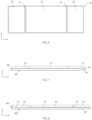
- FIGs. 3 and 4 illustrates an embodiment corresponding to step B.
- a transparent dielectric panel 20 is deposited on the first surface of the continuous metallic-based sheet 10.
- the transparent dielectric panel is disposed on the majority of the first surface to cover at least 80% of surfaces of the central zone and lateral zones of the continuous metallic-based sheet, preferably at least 85% of surfaces of the central zone and lateral zones of the continuous metallic-based sheet, more preferably 90% of surfaces of the central zone and lateral zones of the continuous metallic-based sheet, more preferably 95% of surfaces of the central zone and lateral zones of the continuous metallic-based sheet and even more preferably 99% of surfaces of the central zone and lateral zones of the continuous metallic-based sheet.
- the transparent open container comprises a dielectric panel to ensure the mechanical strength.
- a dielectric panel is a panel that is not electrically conductive.
- the transparent dielectric panel can have different chemical composition, such as plastic-based composition.
- the plastic-based composition can be PET, polycarbonate, PVC or any other transparent dielectric plastic-based that can be used as a panel.
- the transparent dielectric panel comprises a glass panel.
- the glass panel can comprises at least 50 % in weight of SiO2 such as glass like soda lime glass, aluminosilicate glass or borosilicate glass.
- transparent dielectric panels has the same chemical composition to reduce the handling and the process of manufacturing.
- the dielectric panels can be manufactured by a known manufacturing method such as a float method, a fusion method, a redraw method, a press molding method, or a pulling method.
- a manufacturing method of the glass panel from the viewpoint of productivity and cost, it is preferable to use the float method.
- Each transparent dielectric panel can be independently processed and / or colored, ⁇ and / or have different thickness in order to improve the aesthetic, safety, ⁇
- Each transparent dielectric panel can be processed, i.e. annealed, tempered, ⁇ to respect the specifications of security requirements.
- the transparent dielectric panel can independently be a clear or a colored transparent dielectric panel, tinted with a specific composition or by applying an additional coating or a plastic layer for example.
- borders of transparent dielectric panels are chamfered to avoid breakage, default during step D.
- the interlayer(s) is fixing the continuous metallic-based sheet with the transparent dielectric panel(s).
- the interlayer 30 permits to fix the continuous metallic-based sheet with the transparent dielectric panel on the fixing surface of the transparent dielectric panel.
- Interlayer is placed between the transparent dielectric panel and the continuous metallic-based sheet.
- the interlayer is fixing the majority of the surface of the transparent dielectric panel.
- the interlayer can be made of a single layer of material or multiple layer of single or different materials.
- the interlayer can be made of single sheet of material or a plurality of sheets placed next to each other to form a single-like sheet.
- the interlayer is a glue.
- the interlayer is a interlayer able to laminate the transparent dielectric panel with the continuous metallic-based sheet.
- such interlayer can be transparent plastic interlayer.
- Transparent plastic interlayer can be polyvinyl butyral (PVB), ethylene-vinyl acetate (EVA), polymethyl methacrylate (PMMA), a polycarbonate (PC), a polystyrene (PS), a polyvinyl chloride (PVC), a polyamide (PA), a polyetherimide (PEI), a polyethylene terephthalate (PET), a polyurethane, an acrylonitrile butadiene styrene copolymer (ABS), a styrene acrylonitrile copolymer (SAN), a styrene methyl methacrylate copolymer (SMMA) and any mixtures of these, a crosslinked resin, an ionoplast, an ionomer, a cyclo-ole
- Crosslinked or cured resins are known to the skilled person and are three dimensional polymer networks obtained by the crosslinking/curing of low molecular weight species either by reaction with a curing agent also known as crosslinker or upon exposure to heat, UV radiations (UV) or electron beam (EB).
- Non exhaustive examples of crosslinked resins are epoxy resins, polyurethane resins, UV or EB curable resins.
- the precursors of the crosslinked resin may be transparent or not provided that the crosslinked resin is transparent.
- the flat assembly corresponds to the stacked layers of the continuous metallic-based sheet, interlayer(s) and transparent dielectric panel(s) and the flat assembly is extending along a plane, P, defined by a longitudinal axis, X, and a vertical axis, Z; having a width, W, measured along the longitudinal axis, X, and a height, H, measured along the vertical axis, Z.
- Plane P is corresponding to a plane parallel to surface of the continuous metallic-based sheet.
- FIG. 5 illustrates an embodiment of a transparent open container after the bending step D.
- the transparent dielectric panel is bent on the folding lines to form a U-shape-like transparent open container defined by X, Z and a Y-axis, and having a depth, D, measured along the Y-axis.
- the bending angle meaning the angle formed between the central zone and a folded lateral zone, is equal to or greater than 30° , preferably the bending angle is equal to or greater than 45° , more preferably the bending angle is equal to or greater than 60° , more preferably the bending angle is equal to or greater than 80° and even more preferably the bending angle is equal to or greater than 85° .
- the bending angle is lower than or is equal to 90° .
- the bending angle is substantially equal to 90° .
- the bending angle is measure in the X-Y plane or the Y-Z plane depending on the bent lateral zone.
- interlayer and transparent dielectric panel are thin and flexible enough to be bend with the desired curvature angle.
- a transparent dielectric panel is deposited on each central and lateral zones of the continuous metallic-based sheet; each panel being fixed by an interlayer; forming the flat assembly
- FIGs. 6, 7, 8 and 9 illustrates some other embodiments to form a U-shape-like transparent open container by the method of the first aspect of the invention.
- FIG. 6 illustrates an embodiment where the central zone and lateral zones of the continuous metallic-based sheet 10 are fixed to different transparent dielectric panels 21, 22, 23.
- the transparent dielectric panels can have any shape corresponding to the zone on which it will be fixed.
- the shape of the transparent dielectric panels in a plan view is not limited to a rectangle and may be a trapezoid, a triangle, a square, a circle or the like.
- the transparent dielectric panel has substantially the same shape that the zone(s) on which is fixed.
- dimensions of adjacent transparent dielectric panels are matching, meaning that adjacent transparent dielectric panels have same width or/and same height for the parallel and adjacent side.
- surface, dimensions and shape of transparent dielectric panels are lower than or equal to the surface, dimensions and shape needed for corresponding zone(s).
- the transparent dielectric panel(s) is(are) fixed by an(several) interlayer(s) forming a flat assembly.
- FIG. 7 shown an embodiment where transparent dielectric panels 21, 22, 23 are fixed with a interlayer 30 to minimize handling issues forming a flat assembly.
- FIG. 8 illustrates another embodiment where each transparent dielectric panel 21, 22, 23 is fixed with a corresponding interlayer 31, 32, 33 to facilitate the assembling step forming a flat assembly.
- transparent dielectric panels can be separated from adjacent transparent dielectric panels to be bent or folded without any risk of contact between adjacent panels. This distance is equal to or greater than the maximum between the sum of thicknesses of the interlayer and corresponding transparent dielectric panel and the sum of thicknesses of adjacent interlayer and corresponding transparent dielectric panel.
- FIG. 9 illustrates a transparent open container obtained by folding the flat assembly on the folding lines.
- the continuous metallic-based sheet can comprises more than two folding lines depending on the desired 3D shape.
- FIGs. 10 , 11, and 12 illustrate some other embodiments where the continuous metallic-based sheet comprises at least four folding lines forming a central zone and at least four lateral zones opposite two-by-two from the central zone.
- a transparent dielectric panel 21, 22, 23, 24, 25 per corresponding zone 12, 13, 14, 15, 16 it is preferred to have on the first surface a transparent dielectric panel 21, 22, 23, 24, 25 per corresponding zone 12, 13, 14, 15, 16 to be fixed on the continuous metallic-based sheet 10 by a corresponding interlayer.
- FIG. 11 illustrates an embodiment where the continuous metallic-based sheet comprises oversized parts 41, 42, 43, 44. These part are preferably cut during a step F as illustrated in FIG. 16 .
- This step F of cutting can be performed before step A, before step B, after step B.
- This step can also be performed after step D depending on the material of the provided continuous metallic-based sheet.
- FIG. 12 illustrates a transparent open container comprising a back side corresponding to the central zone 21 and four lateral sides corresponding to the lateral zones 22, 23, 24, 25.
- the transparent open container is opened on its front side opposite to the back side.
- a lateral side preferably the top side as illustrated in FIG. 12 , corresponding to the lateral zone 24, can have a width measured in Y-axis different from adjacent lateral sides to let cables, fixation or other element passing out of the transparent open container.
- the method can further comprises a step C of depositing on the second surface 102 of the continuous metallic-based sheet 10, a transparent dielectric panel being fixed by an interlayer; forming a flat assembly.
- the structure meaning dimensions, number of interlayers and panels deposited during step C, can be different from the structure deposited during step B depending on specific requirements.
- the same structure meaning dimensions (perimeter, thickness, length, ⁇ ), number of interlayers and panels, as the one fixed in the first surface during step B, is deposited during step C.
- Each transparent dielectric panel deposited during step C is aligned in the Y-axis with the corresponding transparent dielectric panel deposited during step B. That means the structure deposited during step B is mirroring the structure deposited during step B.
- Transparent dielectric panels deposited on the second surface are aligned in all direction of the X-,Y- and Z-axis meaning that the perimeter of the panel is aligned with the corresponding panel on the first surface. That means the surface and perimeter of a transparent dielectric panel deposited during step C has substantially the same surface and perimeter than corresponding transparent dielectric panel deposited during step B.
- the method can comprises a step E of maintaining the transparent open container in a folded position with at least fixing means.
- the fixing means can be configured to attach the antenna system inside the transparent open container and configured to attach the antenna system in front of the window, meaning that the transparent open container is at least partially surrounding the antenna system.
- the antenna system is placed between the back side and the window at a defined distance, Daw, a strictly positive integer (Daw > 0), from the window.
- the communication system can comprises an installation interface panel between the antenna system and the window to cancel out the impact of the window on the antenna system performance and permits to maintain the impedance response of the antenna system as well as the radiation properties of the antenna unit(s) of the antenna system within the specifications.
- the installation interface panel can add more functionalities to the antenna system, such as the beam steering or beam shaping.
- the installation interface panel is placed a defined distance, Diw, a positive integer (Diw ⁇ 0), from the window.
- the antenna system can be in front of the exterior surface of the window to radiate through the window to the inside of the object.
- the antenna system can be in front of the interior surface of the window to radiate through the window to the outside of the object.
- the antenna system and the transparent open container are installed on the interior side of the window, meaning inside the building and the antenna radiates through the window to permit to user outside of the building to obtain an EM signal while limiting the radiation of the antenna inside of the object.
- the fixing means can have several shapes depending on the specific application.
- the fixing means can be a single means or a multiple means.
- the fixing means can comprise a hanging means to hang the antenna system in front of the window.
- the hanging means can comprise a cable, a glue, a tape or any other suitable element to hang an antenna system in front of a window.
- cables can have a diameter comprises between 0.5 and 3 mm and more preferably around 2 mm.
- the fixing means can comprise a separating means to separate the antenna system at the defined distance, Daw, from the window and to separate the installation interface panel at the defined distance, Diw, from the window.
- the fixing means can comprises notches to place and / or displace the antenna system and the installation interface panel at the corresponding distance from the window.
- the invention relates to a method of assembling a communication system comprising the manufacturing of a transparent open container by the method according to the first aspect of the invention.
- This method comprises a step G of placing an antenna system inside the transparent open container. This step is performed after depositing steps (B and C) as illustrated in FIG. 17 .
- the fixing means can comprise an attaching means to attach the antenna system and the installation interface panel inside the transparent open container.
- the attaching means can comprise slots in which a portion of lateral sides are fixed and permits to maintain the transparent open container in the correct 3D shape.
- the separating means and the attaching means can be a single mean.
- Antenna system has typically a weight of about 1 kg to 10 kg and in some embodiments about 2 kg to 3 kg.
- the parallelepiped has typically a width and / or a length comprised between 20 mm to 600 mm for example a rectangular shape of 210 mm x 250 mm, a rectangular shape of 150 mm x 160 mm or rectangular shape of 255 mm x 500 mm depending on the operating frequencies, the number of antenna arrangements, the number of elements comprised in the antenna arrangement and / or the transparency design.
- the antenna system can comprises at least one antenna unit.
- An antenna unit works for Wi-Fi, 4G and / or 5G, meaning wavelengths with frequencies from 690 MHz to 70 GHz.
- the antenna system can comprises several antenna units working at the same or different range of wavelengths.
- the antenna system is a transparent antenna system. Suitable antenna systems ensuring the transparency are described in co-pending applications EP20207878.8 and EP20207890.3 .
- the antenna system can comprise at least one connector protruding from the antenna system to power the antenna unit and transceive the signal.
- a cable is then connected to the at least one connector.
- the number of connectors depends of the number of antenna units and the type of antenna units used.
- the surface of the central zone meaning the surface of the back side, is equal to or greater than the surface defined by the antenna system in the X_Z plane to which it is added the area defined by the height of the at least one connector to minimize back radiation of the at least one connector because the at least one connector might contribute to the radiation of the EM waves.
- the cable can be directly connected to the antenna units without a connector.
- the method of assembling can further comprise a step H of maintaining the antenna system substantially parallel to the central zone meaning the back side of the transparent open container with maintaining means.
- the method of assembling can further comprise a step I of attaching the transparent open container with an antenna system in front of a window by the attaching means to reduce the back radiation of the antenna system.
- the antenna system can be already installed in front of the window, the transparent open container is therefore installed to place the antenna system inside the transparent open container over the antenna system.
- the invention relates to a communication system 100 comprising a window 101, a transparent open container 102 manufactured by the first aspect of the invention, an antenna system 103 radiating 104 at a defined range of wavelengths through the window; the antenna system and the transparent open container been assembled by the method according to the second aspect of the invention.
- the antenna arrangement can be mounted on a window.
- the window can be a window used as a window to close an opening of the stationary object, such as a building, or to close an opening of the mobile object, such a train, a boat,...
- Windows are usually multi-glazed windows to increase thermal performances of the window.
- the multi-glazed window can be at least partially transparent to visible waves for visibility, and natural or artificial light.
- the multi-glazed window is made of multiple panels separated by at least one interlayer, forming multiple interfaces. The panels therefore can be separated by a space filled with gas and / or by a polymeric interlayer.
- the multi-glazed window can comprise at least two glass panels separated by a spacer allowing to create a space filled by a gas like Argon to improve the thermal isolation of the multi-glazed window, assembling an insulating multi-glazed window.
- the invention is not limited to apparatus for use on multi-glazed window having two panels.
- the apparatus and method of the present invention are suitable for any multi-glazed window such as double, triple glazed windows.
- the glass panel can be a laminated multi-glazed window such as those to reduce the noise and / or to ensure the penetration safety.
- the laminated glazing comprises panels maintained by one or more interlayers positioned between glass panels.
- the interlayers are typically polyvinyl butyral (PVB) or ethylene-vinyl acetate (EVA) for which the stiffness can be tuned. These interlayers keep the glass panels bonded together even when broken in such a way that they prevent the glass from breaking up into large sharp pieces.
- Said panels of the multi-glazed window can be made of glass, polycarbonate, PVC or any other material used for a window mounted on a stationary object or on a mobile object.
- the material of the panels of multi-glazed window is, for example, soda-lime silica glass, borosilicate glass, aluminosilicate glass or other materials such as thermoplastic polymers or polycarbonates which are especially known for automotive applications.
- soda-lime silica glass borosilicate glass, aluminosilicate glass or other materials such as thermoplastic polymers or polycarbonates which are especially known for automotive applications.
- thermoplastic polymers or polycarbonates which are especially known for automotive applications.
- the multi-glazed window can be manufactured by a known manufacturing method such as a float method, a fusion method, a redraw method, a press molding method, or a pulling method.
- a manufacturing method of the multi-glazed window from the viewpoint of productivity and cost, it is preferable to use the float method.
- Each panel can be independently processed and / or colored, ⁇ and / or have different thickness in order to improve the aesthetic, thermal insulation performances, safety, ⁇
- the thickness of the multi-glazed window is set according to requirements of applications.
- the multi-glazed window can be any known window used in situ.
- the multi-glazed window can be processed, ie annealed, tempered, ⁇ to respect the specifications of security and anti-thief requirements.
- the window can independently be a clear glass or a colored glass, tinted with a specific composition of the glass or by applying an additional coating or a plastic layer for example.
- the window can have any shape to fit to the opening such as a rectangular shape, in a plan view by using a known cutting method.
- a method of cutting the multi-glazed window for example, a method in which laser light is irradiated on the surface of the multi-glazed window to cut the multi-glazed window, or a method in which a cutter wheel is mechanically cutting can be used.
- the multi-glazed window can have any shape in order to fit with the application, for example a windshield, a sidelite, a sunroof of an automotive, a lateral glazing of a train, a window of a building, ⁇
- the shape of the multi-glazed window in a plan view is usually a rectangle.
- the shape is not limited to a rectangle and may be a trapeze, especially for a windshield or a backlite of a vehicle, a triangle, especially for a sidelight of a vehicle, a circle or the like.
- the multi-glazed window can be assembled within a frame or be mounted in a double skin façade, in a carbody or any other means able to maintain a multi-glazed window.
- Some plastics elements can be fixed on the multi-glazed window to ensure the tightness to gas and / or liquid, to ensure the fixation of the multi-glazed window or to add external element to the multi-glazed window.
- a masking element such as an enamel layer, can be added on part of the periphery of the multi-glazed window.
- a coating system can be present on one interface of the multi-glazed window.
- This coating system generally uses a metal-based layer and infrared light is highly refracted by this type of layer.
- Such coating system is typically used to achieve a to a low-energy multi-glazed window.
- the coating system can be a heatable coating applied on the multi-glazed window to add a defrosting and / or a demisting function for example and / or to reduce the accumulation of heat in the interior of a building or vehicle or to keep the heat inside during cold periods for example.
- coating system are thin and mainly transparent to eyes.
- the coating system is covering most of the surface of the interface of the multi-glazed window.
- the coating system may comprise a metal based low emissive coating system.
- Such coating systems typically are a system of thin layers comprising one or more, for example two, three or four, functional layers based on an infrared radiation reflecting material and at least two dielectric coatings, wherein each functional layer is surrounded by dielectric coatings.
- the coating system of the present invention may in particular have an emissivity of at least 0.010.
- the functional layers are generally layers of silver with a thickness of some nanometers, mostly about 5 to 20nm.
- the dielectric layers are generally transparent and made from one or more layers of metal oxides and / or nitrides.
- a decoated portion can be made in front of the antenna to alleviate attenuation due to the coating system.
- the installation interface panel can comprise at least a transparent dielectric panel such as glass and / or plastic. In some embodiments. At least a conductive pattern can be deposited on at least one of dielectric panels.
Landscapes
- Engineering & Computer Science (AREA)
- Mechanical Engineering (AREA)
- Chemical & Material Sciences (AREA)
- Materials Engineering (AREA)
- Organic Chemistry (AREA)
- Shielding Devices Or Components To Electric Or Magnetic Fields (AREA)
- Laminated Bodies (AREA)
- Aerials With Secondary Devices (AREA)
- Packaging Frangible Articles (AREA)
Claims (12)
- Verfahren zur Herstellung eines transparenten offenen Behälters (1), wobei das Verfahren die folgenden Schritte umfasst:A. Bereitstellen einer durchgehenden Bahn (10) auf Metallbasis mit einer ersten Oberfläche (101) und einer zweiten Oberfläche (102); wobei die durchgehende Bahn auf Metallbasis Faltlinien (11) aufweist, die eine mittlere Zone (12) und mindestens zwei seitliche Zonen (13, 14, 15, 16) bilden;B. Abscheiden einer transparenten dielektrischen Platte (20, 21, 22, 23, 24, 25, 120, 121, 122, 123, 124, 125) auf der ersten Oberfläche (101) der durchgehenden Bahn auf Metallbasis, die durch eine Zwischenschicht (30, 31, 32, 33, 34, 35, 130, 131, 132, 133, 134, 135) fixiert wird; Bilden einer flachen Anordnung, die sich entlang einer Ebene, P, erstreckt, die durch eine Längsachse, X, und eine vertikale Achse, Z, definiert ist; mit einer Breite, W, die entlang der Längsachse, X, gemessen wird, und einer Höhe, H, die entlang der vertikalen Achse, Z, gemessen wird;D. Biegen der flachen Anordnung an den Faltlinien, um einen transparenten offenen Behälter zu bilden, der durch die X-, Z- und eine Y-Achse definiert ist und eine Tiefe, D, aufweist, die entlang der Y-Achse gemessen wird;wobei in Schritt B eine transparente dielektrische Platte auf jeder der mittleren und seitlichen Zonen der durchgehenden Bahn auf Metallbasis abgeschieden wird; wobei jede Platte durch die Zwischenschicht fixiert wird;wobei die durchgehende Bahn auf Metallbasis eine metallische Maschenstruktur ist wobei die Maschenstruktur ein metallisches Geflecht ist.
- Verfahren nach einem der vorhergehenden Ansprüche, wobei das Verfahren einen Schritt C zum Abscheiden einer transparenten dielektrischen Platte auf der zweiten Oberfläche (102) der durchgehenden Bahn (10) auf Metallbasis, die durch eine Zwischenschicht fixiert wird; Bilden einer flachen Anordnung; wobei jede Platte in der Y-Achse mit der entsprechenden Platte in der ersten Oberfläche ausgerichtet wird, umfasst.
- Verfahren nach einem der vorhergehenden Ansprüche, wobei die durchgehende Bahn auf Metallbasis mindestens vier Faltlinien umfasst, die eine mittlere Zone und mindestens vier seitliche Zonen bilden, von denen sich jeweils zwei gegenüberliegen.
- Verfahren nach einem der vorhergehenden Ansprüche, wobei die mittlere Zone eine rechteckige Form aufweist.
- Verfahren nach Anspruch 1, wobei die Maschenstruktur ein Metall ist, und wobei die Maschenstruktur auf einer Kunststofffolie angeordnet wird.
- Verfahren nach einem der vorhergehenden Ansprüche, wobei die transparente dielektrische Platte eine Glasplatte umfasst.
- Verfahren nach einem der vorhergehenden Ansprüche, wobei das Verfahren ferner einen Schritt E zum Halten des transparenten offenen Behälters in einer gefalteten Position mit mindestens Fixiermitteln umfasst.
- Verfahren zum Zusammenbauen eines Kommunikationssystems, das die Herstellung eines transparenten offenen Behälters durch das Verfahren nach einem der vorhergehenden Ansprüche und einen Schritt G zum Platzieren eines Antennensystems in dem transparenten offenen Behälter umfasst.
- Verfahren nach Anspruch 8, wobei das Verfahren einen Schritt H zum Halten des Antennensystems im Wesentlichen parallel zu der mittleren Zone mit Haltemitteln umfasst.
- Verfahren nach einem der Ansprüche 8 oder 9, wobei das Antennensystem mindestens einen Verbinder umfasst, der von dem Antennensystem hervorsteht, und wobei die Oberfläche der mittleren Zone gleich oder größer als die Oberfläche ist, die durch das Antennensystem und den mindestens einen Verbinder definiert wird.
- Verfahren nach einem der vorhergehenden Ansprüche, wobei das Verfahren ferner einen Schritt I zum Befestigen des transparenten offenen Behälters mit einem Antennensystem vor einem Fenster durch das Befestigungsmittel umfasst, um die Rückstrahlung des Antennensystems zu reduzieren.
- Verfahren nach einem der Ansprüche 8 bis 11, wobei das Verfahren ferner einen Schritt J zum Platzieren einer Grenzflächenschicht zwischen dem Antennensystem und der offenen Seite des transparenten offenen Behälters, um die Strahlung der Antenne durch das Fenster zu erhöhen, umfasst.
Priority Applications (15)
| Application Number | Priority Date | Filing Date | Title |
|---|---|---|---|
| ES22169298T ES3029308T3 (en) | 2022-04-21 | 2022-04-21 | Method for fabricating a transparent open container |
| ES22205413T ES3023215T3 (en) | 2022-04-21 | 2022-04-21 | Method for fabricating a transparent open container |
| PT222054132T PT4266488T (pt) | 2022-04-21 | 2022-04-21 | Método de fabrico de um recipiente aberto transparente |
| EP22169298.1A EP4266486B1 (de) | 2022-04-21 | 2022-04-21 | Verfahren zur herstellung eines durchsichtigen offenen behälters |
| EP22205413.2A EP4266488B1 (de) | 2022-04-21 | 2022-04-21 | Verfahren zur herstellung eines transparenten offenen behälters |
| PT221692981T PT4266486T (pt) | 2022-04-21 | 2022-04-21 | Método de fabrico de um recipiente aberto transparente |
| PCT/EP2023/060199 WO2023203107A1 (en) | 2022-04-21 | 2023-04-19 | Method for fabricating a transparent open container |
| JP2024561815A JP2025514933A (ja) | 2022-04-21 | 2023-04-19 | 透明なオープンコンテナを製作する方法 |
| EP23721323.6A EP4511912B1 (de) | 2022-04-21 | 2023-04-19 | Verfahren zur herstellung eines transparenten offenen behälters |
| US18/857,687 US20250249664A1 (en) | 2022-04-21 | 2023-04-19 | Method for fabricating a transparent open container |
| FIEP23721323.6T FI4511912T3 (fi) | 2022-04-21 | 2023-04-19 | Menetelmä läpinäkyvän avoimen säiliön valmistamiseksi |
| PCT/EP2023/060189 WO2023203102A1 (en) | 2022-04-21 | 2023-04-19 | Method for fabricating a transparent open container |
| EP23720597.6A EP4511910B1 (de) | 2022-04-21 | 2023-04-19 | Verfahren zur herstellung eines transparenten offenen behälters |
| DK23721323.6T DK4511912T3 (da) | 2022-04-21 | 2023-04-19 | Fremgangsmåde til fremstilling af en transparent åben beholder |
| US18/857,690 US20250243103A1 (en) | 2022-04-21 | 2023-04-19 | Method for fabricating a transparent open container |
Applications Claiming Priority (1)
| Application Number | Priority Date | Filing Date | Title |
|---|---|---|---|
| EP22169298.1A EP4266486B1 (de) | 2022-04-21 | 2022-04-21 | Verfahren zur herstellung eines durchsichtigen offenen behälters |
Related Child Applications (2)
| Application Number | Title | Priority Date | Filing Date |
|---|---|---|---|
| EP22205413.2A Division EP4266488B1 (de) | 2022-04-21 | 2022-04-21 | Verfahren zur herstellung eines transparenten offenen behälters |
| EP22205413.2A Division-Into EP4266488B1 (de) | 2022-04-21 | 2022-04-21 | Verfahren zur herstellung eines transparenten offenen behälters |
Publications (2)
| Publication Number | Publication Date |
|---|---|
| EP4266486A1 EP4266486A1 (de) | 2023-10-25 |
| EP4266486B1 true EP4266486B1 (de) | 2025-03-05 |
Family
ID=81346429
Family Applications (4)
| Application Number | Title | Priority Date | Filing Date |
|---|---|---|---|
| EP22205413.2A Active EP4266488B1 (de) | 2022-04-21 | 2022-04-21 | Verfahren zur herstellung eines transparenten offenen behälters |
| EP22169298.1A Active EP4266486B1 (de) | 2022-04-21 | 2022-04-21 | Verfahren zur herstellung eines durchsichtigen offenen behälters |
| EP23721323.6A Active EP4511912B1 (de) | 2022-04-21 | 2023-04-19 | Verfahren zur herstellung eines transparenten offenen behälters |
| EP23720597.6A Active EP4511910B1 (de) | 2022-04-21 | 2023-04-19 | Verfahren zur herstellung eines transparenten offenen behälters |
Family Applications Before (1)
| Application Number | Title | Priority Date | Filing Date |
|---|---|---|---|
| EP22205413.2A Active EP4266488B1 (de) | 2022-04-21 | 2022-04-21 | Verfahren zur herstellung eines transparenten offenen behälters |
Family Applications After (2)
| Application Number | Title | Priority Date | Filing Date |
|---|---|---|---|
| EP23721323.6A Active EP4511912B1 (de) | 2022-04-21 | 2023-04-19 | Verfahren zur herstellung eines transparenten offenen behälters |
| EP23720597.6A Active EP4511910B1 (de) | 2022-04-21 | 2023-04-19 | Verfahren zur herstellung eines transparenten offenen behälters |
Country Status (8)
| Country | Link |
|---|---|
| US (2) | US20250243103A1 (de) |
| EP (4) | EP4266488B1 (de) |
| JP (1) | JP2025514933A (de) |
| DK (1) | DK4511912T3 (de) |
| ES (2) | ES3023215T3 (de) |
| FI (1) | FI4511912T3 (de) |
| PT (2) | PT4266488T (de) |
| WO (2) | WO2023203102A1 (de) |
Family Cites Families (4)
| Publication number | Priority date | Publication date | Assignee | Title |
|---|---|---|---|---|
| JP4849776B2 (ja) * | 2004-02-27 | 2012-01-11 | 日本フイルコン株式会社 | 光透過型除電構造体及びその製造方法 |
| JP2007288116A (ja) * | 2006-04-12 | 2007-11-01 | Kohyei Trading Co Ltd | 透光性電磁波シールド筐体 |
| JP4811245B2 (ja) * | 2006-11-27 | 2011-11-09 | パナソニック電工株式会社 | 電磁波シールドケース体物品とその製造方法 |
| EP2833474A1 (de) * | 2013-07-29 | 2015-02-04 | Bouygues Telecom | Antennenanordnung mit optisch transparentem Paneel mit einem geformten Reflektor |
-
2022
- 2022-04-21 ES ES22205413T patent/ES3023215T3/es active Active
- 2022-04-21 PT PT222054132T patent/PT4266488T/pt unknown
- 2022-04-21 PT PT221692981T patent/PT4266486T/pt unknown
- 2022-04-21 EP EP22205413.2A patent/EP4266488B1/de active Active
- 2022-04-21 ES ES22169298T patent/ES3029308T3/es active Active
- 2022-04-21 EP EP22169298.1A patent/EP4266486B1/de active Active
-
2023
- 2023-04-19 US US18/857,690 patent/US20250243103A1/en active Pending
- 2023-04-19 DK DK23721323.6T patent/DK4511912T3/da active
- 2023-04-19 FI FIEP23721323.6T patent/FI4511912T3/fi active
- 2023-04-19 WO PCT/EP2023/060189 patent/WO2023203102A1/en not_active Ceased
- 2023-04-19 WO PCT/EP2023/060199 patent/WO2023203107A1/en not_active Ceased
- 2023-04-19 EP EP23721323.6A patent/EP4511912B1/de active Active
- 2023-04-19 US US18/857,687 patent/US20250249664A1/en active Pending
- 2023-04-19 EP EP23720597.6A patent/EP4511910B1/de active Active
- 2023-04-19 JP JP2024561815A patent/JP2025514933A/ja active Pending
Also Published As
| Publication number | Publication date |
|---|---|
| EP4266488A1 (de) | 2023-10-25 |
| ES3023215T3 (en) | 2025-05-30 |
| EP4511910B1 (de) | 2026-04-15 |
| US20250249664A1 (en) | 2025-08-07 |
| WO2023203107A1 (en) | 2023-10-26 |
| WO2023203102A1 (en) | 2023-10-26 |
| EP4511912B1 (de) | 2025-12-31 |
| ES3029308T3 (en) | 2025-06-24 |
| PT4266486T (pt) | 2025-04-21 |
| EP4266486A1 (de) | 2023-10-25 |
| PT4266488T (pt) | 2025-04-03 |
| US20250243103A1 (en) | 2025-07-31 |
| EP4266488B1 (de) | 2025-02-12 |
| FI4511912T3 (fi) | 2026-03-31 |
| DK4511912T3 (da) | 2026-03-23 |
| JP2025514933A (ja) | 2025-05-13 |
| EP4511910A1 (de) | 2025-02-26 |
| EP4511912A1 (de) | 2025-02-26 |
Similar Documents
| Publication | Publication Date | Title |
|---|---|---|
| US12586918B2 (en) | Communications assembly and associated method | |
| EP4376213B1 (de) | Antennensystem | |
| EP4372905B1 (de) | Antennenanordnung | |
| EP4511913B1 (de) | Kommunikationsvorrichtung und zugehöriges verfahren | |
| EP4511910B1 (de) | Verfahren zur herstellung eines transparenten offenen behälters |
Legal Events
| Date | Code | Title | Description |
|---|---|---|---|
| STAA | Information on the status of an ep patent application or granted ep patent |
Free format text: STATUS: REQUEST FOR EXAMINATION WAS MADE |
|
| PUAI | Public reference made under article 153(3) epc to a published international application that has entered the european phase |
Free format text: ORIGINAL CODE: 0009012 |
|
| 17P | Request for examination filed |
Effective date: 20221108 |
|
| AK | Designated contracting states |
Kind code of ref document: A1 Designated state(s): AL AT BE BG CH CY CZ DE DK EE ES FI FR GB GR HR HU IE IS IT LI LT LU LV MC MK MT NL NO PL PT RO RS SE SI SK SM TR |
|
| RIC1 | Information provided on ipc code assigned before grant |
Ipc: H01Q 1/24 20060101ALN20240611BHEP Ipc: B29C 45/14 20060101ALI20240611BHEP Ipc: H01Q 1/12 20060101AFI20240611BHEP |
|
| P01 | Opt-out of the competence of the unified patent court (upc) registered |
Free format text: CASE NUMBER: APP_37520/2024 Effective date: 20240622 |
|
| GRAP | Despatch of communication of intention to grant a patent |
Free format text: ORIGINAL CODE: EPIDOSNIGR1 |
|
| STAA | Information on the status of an ep patent application or granted ep patent |
Free format text: STATUS: GRANT OF PATENT IS INTENDED |
|
| INTG | Intention to grant announced |
Effective date: 20240924 |
|
| GRAS | Grant fee paid |
Free format text: ORIGINAL CODE: EPIDOSNIGR3 |
|
| GRAA | (expected) grant |
Free format text: ORIGINAL CODE: 0009210 |
|
| STAA | Information on the status of an ep patent application or granted ep patent |
Free format text: STATUS: THE PATENT HAS BEEN GRANTED |
|
| AK | Designated contracting states |
Kind code of ref document: B1 Designated state(s): AL AT BE BG CH CY CZ DE DK EE ES FI FR GB GR HR HU IE IS IT LI LT LU LV MC MK MT NL NO PL PT RO RS SE SI SK SM TR |
|
| REG | Reference to a national code |
Ref country code: GB Ref legal event code: FG4D |
|
| REG | Reference to a national code |
Ref country code: CH Ref legal event code: EP |
|
| REG | Reference to a national code |
Ref country code: IE Ref legal event code: FG4D |
|
| REG | Reference to a national code |
Ref country code: DE Ref legal event code: R096 Ref document number: 602022011304 Country of ref document: DE |
|
| REG | Reference to a national code |
Ref country code: PT Ref legal event code: SC4A Ref document number: 4266486 Country of ref document: PT Date of ref document: 20250421 Kind code of ref document: T Free format text: AVAILABILITY OF NATIONAL TRANSLATION Effective date: 20250414 |
|
| REG | Reference to a national code |
Ref country code: NL Ref legal event code: FP |
|
| PGFP | Annual fee paid to national office [announced via postgrant information from national office to epo] |
Ref country code: LU Payment date: 20250416 Year of fee payment: 4 |
|
| REG | Reference to a national code |
Ref country code: ES Ref legal event code: FG2A Ref document number: 3029308 Country of ref document: ES Kind code of ref document: T3 Effective date: 20250624 |
|
| PG25 | Lapsed in a contracting state [announced via postgrant information from national office to epo] |
Ref country code: RS Free format text: LAPSE BECAUSE OF FAILURE TO SUBMIT A TRANSLATION OF THE DESCRIPTION OR TO PAY THE FEE WITHIN THE PRESCRIBED TIME-LIMIT Effective date: 20250605 |
|
| PG25 | Lapsed in a contracting state [announced via postgrant information from national office to epo] |
Ref country code: FI Free format text: LAPSE BECAUSE OF FAILURE TO SUBMIT A TRANSLATION OF THE DESCRIPTION OR TO PAY THE FEE WITHIN THE PRESCRIBED TIME-LIMIT Effective date: 20250305 |
|
| PGFP | Annual fee paid to national office [announced via postgrant information from national office to epo] |
Ref country code: DE Payment date: 20250408 Year of fee payment: 4 |
|
| PGFP | Annual fee paid to national office [announced via postgrant information from national office to epo] |
Ref country code: ES Payment date: 20250508 Year of fee payment: 4 |
|
| REG | Reference to a national code |
Ref country code: LT Ref legal event code: MG9D |
|
| PG25 | Lapsed in a contracting state [announced via postgrant information from national office to epo] |
Ref country code: NO Free format text: LAPSE BECAUSE OF FAILURE TO SUBMIT A TRANSLATION OF THE DESCRIPTION OR TO PAY THE FEE WITHIN THE PRESCRIBED TIME-LIMIT Effective date: 20250605 |
|
| PG25 | Lapsed in a contracting state [announced via postgrant information from national office to epo] |
Ref country code: HR Free format text: LAPSE BECAUSE OF FAILURE TO SUBMIT A TRANSLATION OF THE DESCRIPTION OR TO PAY THE FEE WITHIN THE PRESCRIBED TIME-LIMIT Effective date: 20250305 |
|
| PG25 | Lapsed in a contracting state [announced via postgrant information from national office to epo] |
Ref country code: LV Free format text: LAPSE BECAUSE OF FAILURE TO SUBMIT A TRANSLATION OF THE DESCRIPTION OR TO PAY THE FEE WITHIN THE PRESCRIBED TIME-LIMIT Effective date: 20250305 |
|
| PGFP | Annual fee paid to national office [announced via postgrant information from national office to epo] |
Ref country code: PT Payment date: 20250417 Year of fee payment: 4 |
|
| PG25 | Lapsed in a contracting state [announced via postgrant information from national office to epo] |
Ref country code: GR Free format text: LAPSE BECAUSE OF FAILURE TO SUBMIT A TRANSLATION OF THE DESCRIPTION OR TO PAY THE FEE WITHIN THE PRESCRIBED TIME-LIMIT Effective date: 20250606 Ref country code: BG Free format text: LAPSE BECAUSE OF FAILURE TO SUBMIT A TRANSLATION OF THE DESCRIPTION OR TO PAY THE FEE WITHIN THE PRESCRIBED TIME-LIMIT Effective date: 20250305 |
|
| PGFP | Annual fee paid to national office [announced via postgrant information from national office to epo] |
Ref country code: CH Payment date: 20250501 Year of fee payment: 4 |
|
| PGFP | Annual fee paid to national office [announced via postgrant information from national office to epo] |
Ref country code: CZ Payment date: 20250415 Year of fee payment: 4 |
|
| REG | Reference to a national code |
Ref country code: AT Ref legal event code: MK05 Ref document number: 1773823 Country of ref document: AT Kind code of ref document: T Effective date: 20250305 |
|
| PG25 | Lapsed in a contracting state [announced via postgrant information from national office to epo] |
Ref country code: SE Free format text: LAPSE BECAUSE OF FAILURE TO SUBMIT A TRANSLATION OF THE DESCRIPTION OR TO PAY THE FEE WITHIN THE PRESCRIBED TIME-LIMIT Effective date: 20250305 |
|
| PG25 | Lapsed in a contracting state [announced via postgrant information from national office to epo] |
Ref country code: SM Free format text: LAPSE BECAUSE OF FAILURE TO SUBMIT A TRANSLATION OF THE DESCRIPTION OR TO PAY THE FEE WITHIN THE PRESCRIBED TIME-LIMIT Effective date: 20250305 |
|
| PG25 | Lapsed in a contracting state [announced via postgrant information from national office to epo] |
Ref country code: PL Free format text: LAPSE BECAUSE OF FAILURE TO SUBMIT A TRANSLATION OF THE DESCRIPTION OR TO PAY THE FEE WITHIN THE PRESCRIBED TIME-LIMIT Effective date: 20250305 |
|
| PG25 | Lapsed in a contracting state [announced via postgrant information from national office to epo] |
Ref country code: AT Free format text: LAPSE BECAUSE OF FAILURE TO SUBMIT A TRANSLATION OF THE DESCRIPTION OR TO PAY THE FEE WITHIN THE PRESCRIBED TIME-LIMIT Effective date: 20250305 |
|
| PG25 | Lapsed in a contracting state [announced via postgrant information from national office to epo] |
Ref country code: EE Free format text: LAPSE BECAUSE OF FAILURE TO SUBMIT A TRANSLATION OF THE DESCRIPTION OR TO PAY THE FEE WITHIN THE PRESCRIBED TIME-LIMIT Effective date: 20250305 |
|
| PG25 | Lapsed in a contracting state [announced via postgrant information from national office to epo] |
Ref country code: SK Free format text: LAPSE BECAUSE OF FAILURE TO SUBMIT A TRANSLATION OF THE DESCRIPTION OR TO PAY THE FEE WITHIN THE PRESCRIBED TIME-LIMIT Effective date: 20250305 |
|
| PG25 | Lapsed in a contracting state [announced via postgrant information from national office to epo] |
Ref country code: IS Free format text: LAPSE BECAUSE OF FAILURE TO SUBMIT A TRANSLATION OF THE DESCRIPTION OR TO PAY THE FEE WITHIN THE PRESCRIBED TIME-LIMIT Effective date: 20250705 |
|
| REG | Reference to a national code |
Ref country code: DE Ref legal event code: R097 Ref document number: 602022011304 Country of ref document: DE |
|
| PG25 | Lapsed in a contracting state [announced via postgrant information from national office to epo] |
Ref country code: MC Free format text: LAPSE BECAUSE OF FAILURE TO SUBMIT A TRANSLATION OF THE DESCRIPTION OR TO PAY THE FEE WITHIN THE PRESCRIBED TIME-LIMIT Effective date: 20250305 |
|
| PLBE | No opposition filed within time limit |
Free format text: ORIGINAL CODE: 0009261 |
|
| STAA | Information on the status of an ep patent application or granted ep patent |
Free format text: STATUS: NO OPPOSITION FILED WITHIN TIME LIMIT |
|
| PG25 | Lapsed in a contracting state [announced via postgrant information from national office to epo] |
Ref country code: DK Free format text: LAPSE BECAUSE OF FAILURE TO SUBMIT A TRANSLATION OF THE DESCRIPTION OR TO PAY THE FEE WITHIN THE PRESCRIBED TIME-LIMIT Effective date: 20250305 |
|
| REG | Reference to a national code |
Ref country code: CH Ref legal event code: L10 Free format text: ST27 STATUS EVENT CODE: U-0-0-L10-L00 (AS PROVIDED BY THE NATIONAL OFFICE) Effective date: 20260114 |
|
| 26N | No opposition filed |
Effective date: 20251208 |
|
| PGFP | Annual fee paid to national office [announced via postgrant information from national office to epo] |
Ref country code: GB Payment date: 20260303 Year of fee payment: 5 |
|
| PG25 | Lapsed in a contracting state [announced via postgrant information from national office to epo] |
Ref country code: IE Free format text: LAPSE BECAUSE OF NON-PAYMENT OF DUE FEES Effective date: 20250421 |
|
| PGFP | Annual fee paid to national office [announced via postgrant information from national office to epo] |
Ref country code: RO Payment date: 20260330 Year of fee payment: 5 Ref country code: IT Payment date: 20260320 Year of fee payment: 5 Ref country code: BE Payment date: 20260317 Year of fee payment: 5 |
|
| PGFP | Annual fee paid to national office [announced via postgrant information from national office to epo] |
Ref country code: NL Payment date: 20260317 Year of fee payment: 5 |
|
| PGFP | Annual fee paid to national office [announced via postgrant information from national office to epo] |
Ref country code: FR Payment date: 20260309 Year of fee payment: 5 |