EP4265792A1 - High hardness armored steel having excellent low-temperature impact toughness, and manufacturing method therefor - Google Patents
High hardness armored steel having excellent low-temperature impact toughness, and manufacturing method therefor Download PDFInfo
- Publication number
- EP4265792A1 EP4265792A1 EP21906847.5A EP21906847A EP4265792A1 EP 4265792 A1 EP4265792 A1 EP 4265792A1 EP 21906847 A EP21906847 A EP 21906847A EP 4265792 A1 EP4265792 A1 EP 4265792A1
- Authority
- EP
- European Patent Office
- Prior art keywords
- steel
- hardness
- less
- armored
- excellent low
- Prior art date
- Legal status (The legal status is an assumption and is not a legal conclusion. Google has not performed a legal analysis and makes no representation as to the accuracy of the status listed.)
- Pending
Links
Classifications
-
- C—CHEMISTRY; METALLURGY
- C22—METALLURGY; FERROUS OR NON-FERROUS ALLOYS; TREATMENT OF ALLOYS OR NON-FERROUS METALS
- C22C—ALLOYS
- C22C38/00—Ferrous alloys, e.g. steel alloys
- C22C38/02—Ferrous alloys, e.g. steel alloys containing silicon
-
- C—CHEMISTRY; METALLURGY
- C22—METALLURGY; FERROUS OR NON-FERROUS ALLOYS; TREATMENT OF ALLOYS OR NON-FERROUS METALS
- C22C—ALLOYS
- C22C38/00—Ferrous alloys, e.g. steel alloys
- C22C38/18—Ferrous alloys, e.g. steel alloys containing chromium
- C22C38/40—Ferrous alloys, e.g. steel alloys containing chromium with nickel
- C22C38/58—Ferrous alloys, e.g. steel alloys containing chromium with nickel with more than 1.5% by weight of manganese
-
- C—CHEMISTRY; METALLURGY
- C21—METALLURGY OF IRON
- C21D—MODIFYING THE PHYSICAL STRUCTURE OF FERROUS METALS; GENERAL DEVICES FOR HEAT TREATMENT OF FERROUS OR NON-FERROUS METALS OR ALLOYS; MAKING METAL MALLEABLE, e.g. BY DECARBURISATION OR TEMPERING
- C21D1/00—General methods or devices for heat treatment, e.g. annealing, hardening, quenching or tempering
- C21D1/02—Hardening articles or materials formed by forging or rolling, with no further heating beyond that required for the formation
-
- C—CHEMISTRY; METALLURGY
- C21—METALLURGY OF IRON
- C21D—MODIFYING THE PHYSICAL STRUCTURE OF FERROUS METALS; GENERAL DEVICES FOR HEAT TREATMENT OF FERROUS OR NON-FERROUS METALS OR ALLOYS; MAKING METAL MALLEABLE, e.g. BY DECARBURISATION OR TEMPERING
- C21D1/00—General methods or devices for heat treatment, e.g. annealing, hardening, quenching or tempering
- C21D1/18—Hardening; Quenching with or without subsequent tempering
-
- C—CHEMISTRY; METALLURGY
- C21—METALLURGY OF IRON
- C21D—MODIFYING THE PHYSICAL STRUCTURE OF FERROUS METALS; GENERAL DEVICES FOR HEAT TREATMENT OF FERROUS OR NON-FERROUS METALS OR ALLOYS; MAKING METAL MALLEABLE, e.g. BY DECARBURISATION OR TEMPERING
- C21D1/00—General methods or devices for heat treatment, e.g. annealing, hardening, quenching or tempering
- C21D1/18—Hardening; Quenching with or without subsequent tempering
- C21D1/19—Hardening; Quenching with or without subsequent tempering by interrupted quenching
-
- C—CHEMISTRY; METALLURGY
- C21—METALLURGY OF IRON
- C21D—MODIFYING THE PHYSICAL STRUCTURE OF FERROUS METALS; GENERAL DEVICES FOR HEAT TREATMENT OF FERROUS OR NON-FERROUS METALS OR ALLOYS; MAKING METAL MALLEABLE, e.g. BY DECARBURISATION OR TEMPERING
- C21D1/00—General methods or devices for heat treatment, e.g. annealing, hardening, quenching or tempering
- C21D1/18—Hardening; Quenching with or without subsequent tempering
- C21D1/19—Hardening; Quenching with or without subsequent tempering by interrupted quenching
- C21D1/22—Martempering
-
- C—CHEMISTRY; METALLURGY
- C21—METALLURGY OF IRON
- C21D—MODIFYING THE PHYSICAL STRUCTURE OF FERROUS METALS; GENERAL DEVICES FOR HEAT TREATMENT OF FERROUS OR NON-FERROUS METALS OR ALLOYS; MAKING METAL MALLEABLE, e.g. BY DECARBURISATION OR TEMPERING
- C21D1/00—General methods or devices for heat treatment, e.g. annealing, hardening, quenching or tempering
- C21D1/56—General methods or devices for heat treatment, e.g. annealing, hardening, quenching or tempering characterised by the quenching agents
- C21D1/60—Aqueous agents
-
- C—CHEMISTRY; METALLURGY
- C21—METALLURGY OF IRON
- C21D—MODIFYING THE PHYSICAL STRUCTURE OF FERROUS METALS; GENERAL DEVICES FOR HEAT TREATMENT OF FERROUS OR NON-FERROUS METALS OR ALLOYS; MAKING METAL MALLEABLE, e.g. BY DECARBURISATION OR TEMPERING
- C21D6/00—Heat treatment of ferrous alloys
- C21D6/004—Heat treatment of ferrous alloys containing Cr and Ni
-
- C—CHEMISTRY; METALLURGY
- C21—METALLURGY OF IRON
- C21D—MODIFYING THE PHYSICAL STRUCTURE OF FERROUS METALS; GENERAL DEVICES FOR HEAT TREATMENT OF FERROUS OR NON-FERROUS METALS OR ALLOYS; MAKING METAL MALLEABLE, e.g. BY DECARBURISATION OR TEMPERING
- C21D6/00—Heat treatment of ferrous alloys
- C21D6/008—Heat treatment of ferrous alloys containing Si
-
- C—CHEMISTRY; METALLURGY
- C21—METALLURGY OF IRON
- C21D—MODIFYING THE PHYSICAL STRUCTURE OF FERROUS METALS; GENERAL DEVICES FOR HEAT TREATMENT OF FERROUS OR NON-FERROUS METALS OR ALLOYS; MAKING METAL MALLEABLE, e.g. BY DECARBURISATION OR TEMPERING
- C21D8/00—Modifying the physical properties of ferrous metals or ferrous alloys by deformation combined with, or followed by, heat treatment
- C21D8/02—Modifying the physical properties of ferrous metals or ferrous alloys by deformation combined with, or followed by, heat treatment during manufacturing of plates or strips
-
- C—CHEMISTRY; METALLURGY
- C21—METALLURGY OF IRON
- C21D—MODIFYING THE PHYSICAL STRUCTURE OF FERROUS METALS; GENERAL DEVICES FOR HEAT TREATMENT OF FERROUS OR NON-FERROUS METALS OR ALLOYS; MAKING METAL MALLEABLE, e.g. BY DECARBURISATION OR TEMPERING
- C21D8/00—Modifying the physical properties of ferrous metals or ferrous alloys by deformation combined with, or followed by, heat treatment
- C21D8/02—Modifying the physical properties of ferrous metals or ferrous alloys by deformation combined with, or followed by, heat treatment during manufacturing of plates or strips
- C21D8/0221—Modifying the physical properties of ferrous metals or ferrous alloys by deformation combined with, or followed by, heat treatment during manufacturing of plates or strips characterised by the working steps
- C21D8/0226—Hot rolling
-
- C—CHEMISTRY; METALLURGY
- C21—METALLURGY OF IRON
- C21D—MODIFYING THE PHYSICAL STRUCTURE OF FERROUS METALS; GENERAL DEVICES FOR HEAT TREATMENT OF FERROUS OR NON-FERROUS METALS OR ALLOYS; MAKING METAL MALLEABLE, e.g. BY DECARBURISATION OR TEMPERING
- C21D8/00—Modifying the physical properties of ferrous metals or ferrous alloys by deformation combined with, or followed by, heat treatment
- C21D8/02—Modifying the physical properties of ferrous metals or ferrous alloys by deformation combined with, or followed by, heat treatment during manufacturing of plates or strips
- C21D8/0247—Modifying the physical properties of ferrous metals or ferrous alloys by deformation combined with, or followed by, heat treatment during manufacturing of plates or strips characterised by the heat treatment
-
- C—CHEMISTRY; METALLURGY
- C21—METALLURGY OF IRON
- C21D—MODIFYING THE PHYSICAL STRUCTURE OF FERROUS METALS; GENERAL DEVICES FOR HEAT TREATMENT OF FERROUS OR NON-FERROUS METALS OR ALLOYS; MAKING METAL MALLEABLE, e.g. BY DECARBURISATION OR TEMPERING
- C21D8/00—Modifying the physical properties of ferrous metals or ferrous alloys by deformation combined with, or followed by, heat treatment
- C21D8/02—Modifying the physical properties of ferrous metals or ferrous alloys by deformation combined with, or followed by, heat treatment during manufacturing of plates or strips
- C21D8/0247—Modifying the physical properties of ferrous metals or ferrous alloys by deformation combined with, or followed by, heat treatment during manufacturing of plates or strips characterised by the heat treatment
- C21D8/0263—Modifying the physical properties of ferrous metals or ferrous alloys by deformation combined with, or followed by, heat treatment during manufacturing of plates or strips characterised by the heat treatment following hot rolling
-
- C—CHEMISTRY; METALLURGY
- C21—METALLURGY OF IRON
- C21D—MODIFYING THE PHYSICAL STRUCTURE OF FERROUS METALS; GENERAL DEVICES FOR HEAT TREATMENT OF FERROUS OR NON-FERROUS METALS OR ALLOYS; MAKING METAL MALLEABLE, e.g. BY DECARBURISATION OR TEMPERING
- C21D9/00—Heat treatment, e.g. annealing, hardening, quenching or tempering, adapted for particular articles; Furnaces therefor
- C21D9/42—Heat treatment, e.g. annealing, hardening, quenching or tempering, adapted for particular articles; Furnaces therefor for armour plate
-
- C—CHEMISTRY; METALLURGY
- C21—METALLURGY OF IRON
- C21D—MODIFYING THE PHYSICAL STRUCTURE OF FERROUS METALS; GENERAL DEVICES FOR HEAT TREATMENT OF FERROUS OR NON-FERROUS METALS OR ALLOYS; MAKING METAL MALLEABLE, e.g. BY DECARBURISATION OR TEMPERING
- C21D9/00—Heat treatment, e.g. annealing, hardening, quenching or tempering, adapted for particular articles; Furnaces therefor
- C21D9/46—Heat treatment, e.g. annealing, hardening, quenching or tempering, adapted for particular articles; Furnaces therefor for sheet metals
-
- C—CHEMISTRY; METALLURGY
- C22—METALLURGY; FERROUS OR NON-FERROUS ALLOYS; TREATMENT OF ALLOYS OR NON-FERROUS METALS
- C22C—ALLOYS
- C22C38/00—Ferrous alloys, e.g. steel alloys
- C22C38/001—Ferrous alloys, e.g. steel alloys containing N
-
- C—CHEMISTRY; METALLURGY
- C22—METALLURGY; FERROUS OR NON-FERROUS ALLOYS; TREATMENT OF ALLOYS OR NON-FERROUS METALS
- C22C—ALLOYS
- C22C38/00—Ferrous alloys, e.g. steel alloys
- C22C38/002—Ferrous alloys, e.g. steel alloys containing In, Mg, or other elements not provided for in one single group C22C38/001 - C22C38/60
-
- C—CHEMISTRY; METALLURGY
- C22—METALLURGY; FERROUS OR NON-FERROUS ALLOYS; TREATMENT OF ALLOYS OR NON-FERROUS METALS
- C22C—ALLOYS
- C22C38/00—Ferrous alloys, e.g. steel alloys
- C22C38/04—Ferrous alloys, e.g. steel alloys containing manganese
-
- C—CHEMISTRY; METALLURGY
- C22—METALLURGY; FERROUS OR NON-FERROUS ALLOYS; TREATMENT OF ALLOYS OR NON-FERROUS METALS
- C22C—ALLOYS
- C22C38/00—Ferrous alloys, e.g. steel alloys
- C22C38/06—Ferrous alloys, e.g. steel alloys containing aluminium
-
- C—CHEMISTRY; METALLURGY
- C22—METALLURGY; FERROUS OR NON-FERROUS ALLOYS; TREATMENT OF ALLOYS OR NON-FERROUS METALS
- C22C—ALLOYS
- C22C38/00—Ferrous alloys, e.g. steel alloys
- C22C38/18—Ferrous alloys, e.g. steel alloys containing chromium
- C22C38/34—Ferrous alloys, e.g. steel alloys containing chromium with more than 1.5% by weight of silicon
-
- C—CHEMISTRY; METALLURGY
- C22—METALLURGY; FERROUS OR NON-FERROUS ALLOYS; TREATMENT OF ALLOYS OR NON-FERROUS METALS
- C22C—ALLOYS
- C22C38/00—Ferrous alloys, e.g. steel alloys
- C22C38/18—Ferrous alloys, e.g. steel alloys containing chromium
- C22C38/40—Ferrous alloys, e.g. steel alloys containing chromium with nickel
- C22C38/44—Ferrous alloys, e.g. steel alloys containing chromium with nickel with molybdenum or tungsten
-
- C—CHEMISTRY; METALLURGY
- C22—METALLURGY; FERROUS OR NON-FERROUS ALLOYS; TREATMENT OF ALLOYS OR NON-FERROUS METALS
- C22C—ALLOYS
- C22C38/00—Ferrous alloys, e.g. steel alloys
- C22C38/18—Ferrous alloys, e.g. steel alloys containing chromium
- C22C38/40—Ferrous alloys, e.g. steel alloys containing chromium with nickel
- C22C38/46—Ferrous alloys, e.g. steel alloys containing chromium with nickel with vanadium
-
- C—CHEMISTRY; METALLURGY
- C22—METALLURGY; FERROUS OR NON-FERROUS ALLOYS; TREATMENT OF ALLOYS OR NON-FERROUS METALS
- C22C—ALLOYS
- C22C38/00—Ferrous alloys, e.g. steel alloys
- C22C38/18—Ferrous alloys, e.g. steel alloys containing chromium
- C22C38/40—Ferrous alloys, e.g. steel alloys containing chromium with nickel
- C22C38/48—Ferrous alloys, e.g. steel alloys containing chromium with nickel with niobium or tantalum
-
- C—CHEMISTRY; METALLURGY
- C22—METALLURGY; FERROUS OR NON-FERROUS ALLOYS; TREATMENT OF ALLOYS OR NON-FERROUS METALS
- C22C—ALLOYS
- C22C38/00—Ferrous alloys, e.g. steel alloys
- C22C38/18—Ferrous alloys, e.g. steel alloys containing chromium
- C22C38/40—Ferrous alloys, e.g. steel alloys containing chromium with nickel
- C22C38/50—Ferrous alloys, e.g. steel alloys containing chromium with nickel with titanium or zirconium
-
- C—CHEMISTRY; METALLURGY
- C22—METALLURGY; FERROUS OR NON-FERROUS ALLOYS; TREATMENT OF ALLOYS OR NON-FERROUS METALS
- C22C—ALLOYS
- C22C38/00—Ferrous alloys, e.g. steel alloys
- C22C38/18—Ferrous alloys, e.g. steel alloys containing chromium
- C22C38/40—Ferrous alloys, e.g. steel alloys containing chromium with nickel
- C22C38/54—Ferrous alloys, e.g. steel alloys containing chromium with nickel with boron
-
- C—CHEMISTRY; METALLURGY
- C21—METALLURGY OF IRON
- C21D—MODIFYING THE PHYSICAL STRUCTURE OF FERROUS METALS; GENERAL DEVICES FOR HEAT TREATMENT OF FERROUS OR NON-FERROUS METALS OR ALLOYS; MAKING METAL MALLEABLE, e.g. BY DECARBURISATION OR TEMPERING
- C21D2211/00—Microstructure comprising significant phases
- C21D2211/001—Austenite
-
- C—CHEMISTRY; METALLURGY
- C21—METALLURGY OF IRON
- C21D—MODIFYING THE PHYSICAL STRUCTURE OF FERROUS METALS; GENERAL DEVICES FOR HEAT TREATMENT OF FERROUS OR NON-FERROUS METALS OR ALLOYS; MAKING METAL MALLEABLE, e.g. BY DECARBURISATION OR TEMPERING
- C21D2211/00—Microstructure comprising significant phases
- C21D2211/008—Martensite
Definitions
- the present disclosure relates to a material suitable for armored vehicles, explosion-proof structures, and the like, and more particularly to armored steel having excellent low-temperature impact toughness and having high hardness, and a manufacturing method therefor.
- Armor steel is a material of which a surface is made very hard for its main function of blocking bullets, and is used where protection is required, such as an exterior of armored vehicles used on the battlefield. Since bulletproof performance is directly related to human life, research to improve the performance of bulletproof materials has been actively conducted in the past, and recently, non-ferrous materials such as titanium and aluminum have been developed.
- the non-ferrous materials have an advantage of weight reduction compared to steel materials, but are relatively expensive and have poor workability. As compared to the non-ferrous material, since the steel material is relatively inexpensive and may change physical properties such as hardness relatively easily, the steel material is widely used as a material for self-propelled artillery, wheeled armored vehicles, and the like.
- Hardness is one of the important physical properties for securing the performance of armored steel, but simple high hardness does not guarantee bulletproof performance.
- a high hardness characteristic is a factor that increases resistance to bullets penetrating through a material, but the material having high hardness may be relatively easily broken, so the high hardness characteristic cannot necessarily guarantee excellent bulletproof performance. Therefore, there is a need to develop a material that can simultaneously secure brittle fracture resistance to external impact as well as high hardness characteristics rather than simply promoting high hardness of the material.
- Patent Document 1 Korean Patent Publication No. 10-2018-0043788 (published on April 30, 2018 )
- An aspect of the present disclosure is to provide armored steel having high hardness characteristics and excellent low-temperature impact toughness and a manufacturing method for the same.
- An object of the present disclosure is not limited to the above description.
- the object of the present disclosure will be understood from the entire content of the present specification, and a person skilled in the art to which the present disclosure pertains will understand an additional object of the present disclosure without difficulty.
- a high-hardness armored steel having excellent low-temperature impact toughness includes, by weight: 0.29 to 0.37% of carbon (C), 1.0 to 2.0% of silicon (Si), 0.5 to 1.6% of manganese (Mn), 0.5 to 1.2% of nickel (Ni), 0.4 to 1.5% of chromium (Cr), 0.05% or less of phosphorus (P), 0.02% or less of sulfur (S), 0.006% or less of nitrogen (N), 0.07% or less of aluminum (Al) (excluding 0%), 0.1 to 0.5% of molybdenum (Mo), 0.01 to 0.05% of niobium (Nb), 0.0002 to 0.005% of boron (B), 0.0005 to 0.004% of calcium (Ca), with a balance of iron (Fe) and inevitable impurities, satisfying the following [Relational Expression 1], wherein a tempered martensite base structure including retained austenite is included as a microstructure.
- A refers to a value calculated by the following Relational Expression 2.
- A 539 ⁇ 423 * C ⁇ 30.4 * Mn ⁇ 17.7 * Ni ⁇ 12.1 * Cr ⁇ 7.5 * Mo
- [C], [Mn], [Ni], [Cr], and [Mo] refer to contents (weight %)of carbon (C), manganese (Mn), nickel (Ni), chromium (Cr) and molybdenum (Mo) included in the steel sheet, and 0 is substituted when the corresponding element is not intentionally added.
- the armored steel may further include, by weight: one or more of 0.005 to 0.025% of titanium (Ti) and 0.2% or less of vanadium (V).
- a fraction of the tempered martensite may be 90% or more by area, and a fraction of retained austenite may be 1% by area to 10% by area.
- the armored steel may have a surface hardness of 460 to 540 HB, and an impact absorption energy of 19 J or more at -40°C.
- the armored steel may have a thickness of greater than 40 mm.
- a manufacturing method for a high-hardness armored steel having excellent low-temperature impact toughness includes operations of: preparing a steel slab including by weight: preparing a steel slab including by weight: 0.29 to 0.37 % of carbon (C), 1.0 to 2.0% of silicon (Si), 0.5 to 1.6% of manganese (Mn), 0.5 to 1.2% of nickel (Ni), 0.4 to 1.5% of chromium (Cr), 0.05% or less of phosphorus (P), 0.02% or less of sulfur (S), 0.006% or less of nitrogen (N), 0.07% or less of aluminum (Al) (excluding 0%), 0.1 to 0.5% of molybdenum (Mo), 0.01 to 0.05% of niobium (Nb), 0.0002 to 0.005% of boron (B), 0.0005 to 0.004% of calcium (Ca), and a balance of iron (Fe) and inevitable impurities, satisfying the following [Relational Expression 1]; heating the steel
- A 200 / 100 ⁇ 1.5 in Relational Expression 1 , A refers to a value calculated by the following Relational Expression 2 .
- A 539 ⁇ 423 * C ⁇ 30.4 * Mn ⁇ 17.7 * Ni ⁇ 12.1 * Cr ⁇ 7.5 * Mo
- [C], [Mn], [Ni], [Cr], and [Mo] refer to contents (weight %) of carbon (C), manganese (Mn), nickel (Ni), chromium (Cr), and molybdenum (Mo) included in the steel slab, and 0 is substituted when the corresponding element is not intentionally added.
- the steel slab may further include, by weight: at least one of 0.005 to 0.25% of titanium (Ti) and 0.2% or less of vanadium (V).
- the hot-rolled steel sheet may have a thickness greater than 40 mm.
- armored steel having excellent low-temperature toughness while having ultra-high hardness may be provided.
- the present disclosure may provide armored steel having a target level of physical properties without performing a further heat treatment from optimization of an alloy composition and manufacturing conditions, and thus, is economically favorable.
- the present disclosure relates to high-hardness armored steel having excellent low-temperature impact toughness and a manufacturing method therefor.
- preferred embodiments of the present disclosure will be described.
- preferred embodiments of the present disclosure will be described.
- Embodiments of the present disclosure may be modified in various forms, and the scope of the present disclosure should not be construed as being limited to the embodiments described below.
- the present embodiments are provided to those skilled in the art to further elaborate the present disclosure.
- the present inventors have studied in depth, in order to provide a steel material having excellent physical properties such as high hardness characteristics, low-temperature impact toughness, and the like, which are essentially required physical properties, as a material which may be appropriately applied to wheeled armored vehicles, explosion-proof structures, and the like.
- the bulletproof performance of the steel material was intended to be improved by an economically favorable method, and thus the present disclosure was provided.
- % represents a content of each element based on weight, unless otherwise specified.
- Carbon (C) is an element which is effective for improving strength and hardness in steel having a low-temperature transformation phase such as a martensite or bainite phase, and is effective for hardenability improvement. In order to sufficiently obtain the effect described above, 0.29% or more of carbon (C) may be included.
- a lower limit of a content of carbon (C) may be 0.30%, and more preferably, the lower limit of the content of carbon (C) may be 0.31%.
- an upper limit of the content of carbon (C) may be limited to 0.37%.
- the upper limit of the content of carbon (C) may be 0.36%.
- Silicon (Si) is an element which is effective for improving strength due to solid solution strengthening together with a deoxidation effect, and is also an element suppressing formation of carbides such as cementite in a steel material containing a certain amount or more of C to promote production of residual austenite.
- carbides such as cementite
- a steel material containing a certain amount or more of C may be included.
- silicon (Si) may be included.
- a lower limit of a content of silicon (Si) may be 1.1%, and more preferably, the lower limit of the content of silicon (Si) may be 1.2%.
- an upper limit of the content of silicon (Si) may be limited to 2.0%.
- the upper limit of the content of silicon (Si) may be 1.9%, and more preferably, the upper limit of the content of silicon (Si) may be 1.8%.
- Manganese (Mn) is an element favorable to suppress production of ferrite and lower an Ar3 temperature, thereby improving quenching properties of steel to increase strength and toughness.
- 0.5% or more of manganese (Mn) may be included.
- a lower limit of a content of manganese (Mn) may be 0.6%, and more preferably, the lower limit of the content of manganese (Mn) may be 0.7%.
- an upper limit of the content of manganese (Mn) may be limited to 1.6%.
- the upper limit of the content of manganese (Mn) may be 1.5%, and more preferably, the upper limit of the content of manganese (Mn) may be 1.4%.
- Nickel (Ni) is an element favorable to improve both strength and toughness of steel. In order to obtain the effect described above, in the present disclosure, 0.5% or more of nickel (Ni) may be included. Preferably, a lower limit of a content of nickel (Ni) may be 0.6%, and more preferably, the lower limit of the content of nickel (Ni) may be 0.7%. However, nickel (Ni) is an expensive element, when nickel (Ni) is excessively added, manufacturing costs may be greatly increased, so in the present disclosure, an upper limit of the content of nickel (Ni) may be limited to 1.2%. Preferably, the upper limit of the content of nickel (Ni) may be 1.15%, and more preferably, the upper limit of the content of nickel (Ni) may be 1.1%.
- Chromium (Cr) is an element of increasing quenching properties of steel to improve strength, and effectively contributing to securing hardness in a surface part and a center part of steel.
- Cr chromium
- Cr is also an element for economically securing hardness and toughness.
- 0.4% or more of chromium (Cr) may be included.
- a lower limit of a content of chromium (Cr) may be 0.5%.
- an upper limit of the content of chromium (Cr) may be limited to 1.5%.
- the upper limit of the content of chromium (Cr) may be 1.4%, and more preferably, the upper limit of the content of chromium (Cr) may be 1.3%.
- Phosphorous (P) 0.05% or less
- Phosphorus (P) is an element which is inevitably contained in steel, and is also an element which deteriorates toughness of the steel. Thus, it is preferred to lower a content of P as much as possible.
- an upper limit of the content of phosphorus (P) may be limited to 0.05%. More favorably, the content thereof may be limited to 0.03% or less. However, 0% may be excluded considering an inevitably contained level.
- Sulfur (S) is an element which is inevitably contained in steel, and is also an element forming MnS inclusions to deteriorate toughness of steel. Thus, it is preferred to lower a content of S as much as possible.
- an upper limit of the content of sulfur (S) may be limited to 0.02%. More favorably, the content thereof may be limited to 0.01% or less. However, 0% may be excluded considering an inevitably contained level.
- Nitrogen (N) is an element which is favorable to improve strength of steel by forming precipitates in steel, but when a content of nitrogen (N) is more than a certain level, which may rather cause deterioration in toughness of steel.
- an upper limit of a content of nitrogen (N) may be limited to 0.006%. However, 0% may be excluded considering an inevitably contained level.
- Aluminum (Al) is an element effective for lowering an oxygen content in molten steel as a deoxidizing agent of steel.
- an upper limit of a content of aluminum (Al) may be limited to 0.07%.
- Molybdenum (Mo) is an element favorable to increase quenching properties of steel, and in particular, to improve hardness of a thick material having a certain thickness or more. In order to obtain the effect described above, in the present disclosure, 0.1% or more of molybdenum (Mo) may be included. Preferably, a lower limit of a content of molybdenum (Mo) may be 0.13%, and more preferably, the lower limit of the content of molybdenum (Mo) may be 0.15%.
- an upper limit of the content of molybdenum (Mo) may be limited to 0.5%.
- the upper limit of the content of molybdenum (Mo) may be 0.48%, and more preferably, the upper limit of the content of molybdenum (Mo) may be 0.45%.
- Niobium (Nb) is an element which is effective for increasing hardenability of austenite by being dissolved in austenite, and increasing strength of steel and suppressing growth of austenite crystal grains by forming carbonitrides such as Nb(C,N).
- 0.01% or more of niobium (Ni) may be included.
- an upper limit of a content of niobium (Nb) may be limited to 0.05%.
- the upper limit of the content of niobium (Nb) content may be 0.04%.
- Boron (B) is an element effectively contributing to strength improvement by increasing quenching properties of steel even with a small addition amount thereof.
- 0.0002% or more of boron (B) may be contained.
- a lower limit of a content of boron (B) may be 0.0005%, and more preferably, the lower limit of the content of boron (B) may be 0.001%.
- an upper limit of the content of boron (B) may be limited to 0.005%.
- the upper limit of the content of boron (B) may be 0.004%, and more preferably, the upper limit of the content of boron (B) may be 0.003%.
- Calcium (Ca) is an element having a good binding force with sulfur (S) and producing CaS on the periphery (around) MnS, thereby suppressing elongation of MnS to improve toughness in a direction perpendicular to a rolling direction.
- CaS produced by adding Ca has an effect of increasing corrosion resistance under a humid external environment.
- 0.0005% or more of Ca may be included.
- a lower limit of a content of calcium (Ca) may be 0.001%.
- an upper limit of the content of calcium (Ca) may be limited to 0.004%.
- the upper limit of the content of calcium (Ca) may be 0.003%.
- armored steel of the present disclosure may further include the following elements for the purpose of favorably securing target physical properties.
- the armored steel of the present disclosure may further include at least one of titanium (Ti) and vanadium (V).
- Titanium (Ti) is an element which maximizes the effect of boron (B), which is an element favorable to improve quenching properties of steel. That is, titanium (Ti) is bonded to nitrogen (N) in steel to be precipitated into TiN to reduce the content of solid-solubilized N, while suppressing formation of BN of B therefrom to increase solid-solubilized B, thereby maximizing improvement of quenching properties. In order to sufficiently obtain the effect described above, 0.005% or more of titanium (Ti) may be contained. However, when titanium (Ti) is excessively added, coarse TiN precipitates may be formed and toughness of steel may be deteriorated, so in the present disclosure, an upper limit of the content of titanium (Ti) may be limited to 0.025%.
- V Vanadium (V): 0.2% or less (including 0%)
- Vanadium (V) is an element favorable to form a VC carbide when reheating after hot rolling, thereby suppressing growth of austenite crystal grains and improving quenching properties of steel to secure strength and toughness.
- vanadium (V) is a relatively expensive element, an upper limit of a content of vanadium (V) may be limited to 0.2% in consideration of manufacturing costs.
- the armored steel according to an aspect of the present disclosure may include a remainder of Fe and other inevitable impurities in addition to the components described above.
- inevitable impurities may be inevitably added from raw materials or an ambient environment, and thus, impurities may not be excluded.
- a person skilled in the art of a general manufacturing process may be aware of the impurities, and thus, the descriptions of the impurities may not be provided in the present disclosure.
- additional addition of effective ingredients other than the above-mentioned ingredients is not entirely excluded.
- the armored steel according to an aspect of the present disclosure may satisfy the following [Relational Expression 1].
- A refers to a value calculated by the following [Relational Expression 2].
- A 539 ⁇ 423 * C ⁇ 30.4 * Mn ⁇ 17.7 * Ni ⁇ 12.1 * Cr ⁇ 7.5 * Mo
- [C], [Mn], [Ni], [Cr], and [Mo] refer to contents (weight %) of carbon (C), manganese (Mn), nickel (Ni), chromium (Cr), and molybdenum (Mo) included in a steel sheet, and 0 is substituted if the corresponding element is not intentionally added.
- the inventors of the present disclosure have conducted in-depth research on a method capable of securing high-hardness characteristics and excellent low-temperature impact toughness of a steel sheet at the same time, and have derived that it is effective to control not only a content range of each respective alloy composition, but also a relative content range of a specific alloy composition included in the steel sheet.
- each respective alloy compositions included in the steel sheet is controlled to be within a certain range, but also the relative content range of carbon (C), manganese (Mn), chromium (Cr), nickel (Ni), and molybdenum (Mo) is controlled to be within a certain range, as illustrated in [Relational Expression 1] and [Relational Expression 2], so that high hard characteristics and excellent low-temperature impact toughness may be effectively compatible.
- (A - 200)/100 defined by Relational Expression 1 may be 1.45 or less.
- the armor steel of the present disclosure having the above-described alloy composition may have a tempered martensite base structure including retained austenite as a microstructure, and may further include other inevitable structures.
- a fraction of retained austenite may be 1% by area to 10% by area, and a fraction of tempered martensite may be 90% or more by area.
- Retained austenite is a structure remaining without being completely phase transformed into martensite during a rapid cooling heat treatment, and has relatively low hardness but excellent toughness as compared to martensite.
- the bullet-proof steel of the present disclosure may include 1% or more by area of retained austenite, more preferably 2% or more by area of retained austenite.
- an upper limit of the fraction of the retained austenite may be set to be 10% by area.
- the upper limit of the fraction of the retained austenite may be 5% by area, and a lower limit of the fraction of the tempered martensite may be 95% by area.
- the armored steel of the present disclosure may have the above-described microstructural configuration over the entire thickness.
- the armored steel of the present disclosure having the above-described alloy composition and the proposed microstructure may have a thickness greater than 40 mm.
- An upper limit of the thickness thereof is not particularly limited, but a preferred thickness thereof may be 100 mm, and a more preferred thickness thereof may be 80 mm or less.
- the armored steel according to an aspect of the present disclosure may have a surface hardness of 460 to 540HB, exhibiting ultra-high hardness, and may have an impact absorption energy of 19 J or more at -40°C, exhibiting excellent low-temperature toughness.
- the surface hardness refers to an average value of three measurements after milling a surface of the armor steel at 2 mm in a thickness direction using a Brinell hardness tester (load: 3000 kgf, 10 mm tungsten injection port).
- a steel slab having a predetermined component is prepared. Since the steel slab of the present disclosure has an alloy composition corresponding to the alloy composition of the hot-rolled steel sheet described above (including [Relational Expression 1] and [Relational Expression 2]), a description of the alloy composition of the steel slab is substituted for the description of the alloy composition of the above-described hot-rolled steel sheet.
- the armored steel may be manufactured by preparing a steel slab satisfying the alloy composition described above, and then subjecting the steel slab to the processes of [heating - rolling - cooling - self- tempering] .
- each process condition will be described in detail.
- a steel slab having the alloy composition proposed in the present disclosure is prepared, which may be then heated in a temperature range of 1050 to 1250°C.
- the steel slab may be heated in a temperature range of 1050 to 1250°C.
- the steel slab heated as described above may be rolled, and then may be subjected to rough rolling and finish hot rolling to manufacture a hot-rolled steel sheet.
- the heated steel slab is roughly rolled in a temperature range of 950 to 1150°C to be manufactured into a bar, which may be then subjected to finish hot rolling in a temperature range of 850 to 950°C.
- the hot rolled steel sheet manufactured through the rolling process described above is cooled to 50 to 250°C at a rate of 3°C/s or more and then air-cooled to room temperature.
- the cooling is performed to obtain a martensite base structure to satisfy high hardness, and when a cooling end temperature is higher than 250°C, phase transformation from austenite particles produced by hot rolling to martensite may not be completed, and thus hardness of a final product may be deteriorated.
- the cooling end temperature is lower than 50°C, the phase transformation therefrom to martensite is completely completed, which is favorable in terms of securing hardness, but latent heat in a material decreases, so that a self-tempering effect cannot be obtained.
- Self-tempering is a method that can produce an effect similar to that of normal tempering through latent heat of rapidly cooled material without a separate subsequent process.
- the cooling of the hot-rolled steel sheet is preferably ended in a range of 50 to 250°C.
- a lower limit of the cooling end temperature is more preferably 60°C, even more preferably 70°C, and most preferably 80°C.
- an upper limit of the cooling end temperature is more preferably 220°C, even more preferably 200°C, and most preferably 180°C.
- the cooling rate is preferably 3°C/s or more.
- the cooling rate is more preferably 3.2°C/s or more, more preferably 3.5°C/s or more, and most preferably 4°C/s or more.
- the thickness of the hot-rolled steel sheet manufactured by the series of manufacturing processes is not limited, but a lower limit of the thickness thereof may be limited to be more than 40 mm in terms of securing a self-tempering effect.
- the hot-rolled steel sheet may have a thickness of 41 mm or more, and an upper limit of the thickness thereof is also not limited, but the hot-rolled steel sheet may preferably have a thickness of 100 mm or less, more preferably 80 mm or less.
- a steel slab having alloy compositions shown in the following Table 1 was prepared, and then was subjected to [heating - rolling - cooling and self-tempering] according to process conditions shown in the following Table 2 to manufacture each hot rolled steel sheet.
- water cooling was performed to a cooling end temperature, and then air cooling was performed to room temperature.
- Alloy compositions not listed in Table 1 refers to inevitable impurities and iron (Fe).
- a part marked with"-" in Table 1 means that the corresponding element was not intentionally added, which is preferable to be interpreted as 0% by weight within an error range.
- microstructure of each hot-rolled steel sheet was cut into an arbitrary size as a specimen to manufacture a mirror surface, a Nital etching solution was used to corrode the specimen, and then an optical microscope and a scanning electron microscope (SEM) were used to observe a 1/2t point which was a thickness center part. In this case, a fraction of the microstructure was measured by electron back-scattered diffraction (EBSD) analysis.
- EBSD electron back-scattered diffraction
- hardness and toughness of each hot-rolled steel sheet were measured using a Brinell hardness tester (load: 3000 kgf, 10 mm tungsten injection port) and a Charpy impact tester.
- specimens satisfying both the alloy compositions and the process conditions of the present disclosure have a surface hardness of 460 to 540 HB and impact absorption energy of 19 J or more at -40°C, but specimens not satisfying at least one of the alloy compositions or process conditions of the present disclosure do not have a surface hardness of 460 to 540 HB or impact absorption energy of 19 J or more at -40°C at the same time.
Landscapes
- Chemical & Material Sciences (AREA)
- Engineering & Computer Science (AREA)
- Mechanical Engineering (AREA)
- Materials Engineering (AREA)
- Metallurgy (AREA)
- Organic Chemistry (AREA)
- Physics & Mathematics (AREA)
- Thermal Sciences (AREA)
- Crystallography & Structural Chemistry (AREA)
- Heat Treatment Of Steel (AREA)
- Metal Rolling (AREA)
- Heat Treatment Of Articles (AREA)
Abstract
Description
- The present disclosure relates to a material suitable for armored vehicles, explosion-proof structures, and the like, and more particularly to armored steel having excellent low-temperature impact toughness and having high hardness, and a manufacturing method therefor.
- Armor steel is a material of which a surface is made very hard for its main function of blocking bullets, and is used where protection is required, such as an exterior of armored vehicles used on the battlefield. Since bulletproof performance is directly related to human life, research to improve the performance of bulletproof materials has been actively conducted in the past, and recently, non-ferrous materials such as titanium and aluminum have been developed.
- The non-ferrous materials have an advantage of weight reduction compared to steel materials, but are relatively expensive and have poor workability. As compared to the non-ferrous material, since the steel material is relatively inexpensive and may change physical properties such as hardness relatively easily, the steel material is widely used as a material for self-propelled artillery, wheeled armored vehicles, and the like.
- Hardness is one of the important physical properties for securing the performance of armored steel, but simple high hardness does not guarantee bulletproof performance. A high hardness characteristic is a factor that increases resistance to bullets penetrating through a material, but the material having high hardness may be relatively easily broken, so the high hardness characteristic cannot necessarily guarantee excellent bulletproof performance. Therefore, there is a need to develop a material that can simultaneously secure brittle fracture resistance to external impact as well as high hardness characteristics rather than simply promoting high hardness of the material.
- (Patent Document 1)
Korean Patent Publication No. 10-2018-0043788 (published on April 30, 2018 - An aspect of the present disclosure is to provide armored steel having high hardness characteristics and excellent low-temperature impact toughness and a manufacturing method for the same.
- An object of the present disclosure is not limited to the above description. The object of the present disclosure will be understood from the entire content of the present specification, and a person skilled in the art to which the present disclosure pertains will understand an additional object of the present disclosure without difficulty.
- According to an aspect of the present disclosure, a high-hardness armored steel having excellent low-temperature impact toughness includes, by weight: 0.29 to 0.37% of carbon (C), 1.0 to 2.0% of silicon (Si), 0.5 to 1.6% of manganese (Mn), 0.5 to 1.2% of nickel (Ni), 0.4 to 1.5% of chromium (Cr), 0.05% or less of phosphorus (P), 0.02% or less of sulfur (S), 0.006% or less of nitrogen (N), 0.07% or less of aluminum (Al) (excluding 0%), 0.1 to 0.5% of molybdenum (Mo), 0.01 to 0.05% of niobium (Nb), 0.0002 to 0.005% of boron (B), 0.0005 to 0.004% of calcium (Ca), with a balance of iron (Fe) and inevitable impurities, satisfying the following [Relational Expression 1], wherein a tempered martensite base structure including retained austenite is included as a microstructure.
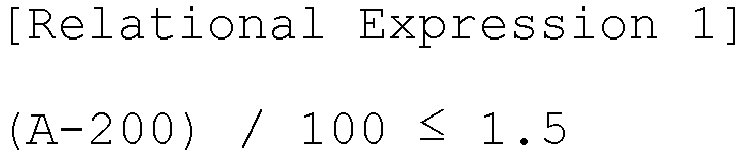
- In Relational Expression 1, A refers to a value calculated by the following Relational Expression 2.

- In Relational Expression 2, [C], [Mn], [Ni], [Cr], and [Mo] refer to contents (weight %)of carbon (C), manganese (Mn), nickel (Ni), chromium (Cr) and molybdenum (Mo) included in the steel sheet, and 0 is substituted when the corresponding element is not intentionally added.
- The armored steel may further include, by weight: one or more of 0.005 to 0.025% of titanium (Ti) and 0.2% or less of vanadium (V).
- A fraction of the tempered martensite may be 90% or more by area, and a fraction of retained austenite may be 1% by area to 10% by area.
- The armored steel may have a surface hardness of 460 to 540 HB, and an impact absorption energy of 19 J or more at -40°C.
- The armored steel may have a thickness of greater than 40 mm.
- According to an aspect of the present disclosure, a manufacturing method for a high-hardness armored steel having excellent low-temperature impact toughness, includes operations of: preparing a steel slab including by weight: preparing a steel slab including by weight: 0.29 to 0.37 % of carbon (C), 1.0 to 2.0% of silicon (Si), 0.5 to 1.6% of manganese (Mn), 0.5 to 1.2% of nickel (Ni), 0.4 to 1.5% of chromium (Cr), 0.05% or less of phosphorus (P), 0.02% or less of sulfur (S), 0.006% or less of nitrogen (N), 0.07% or less of aluminum (Al) (excluding 0%), 0.1 to 0.5% of molybdenum (Mo), 0.01 to 0.05% of niobium (Nb), 0.0002 to 0.005% of boron (B), 0.0005 to 0.004% of calcium (Ca), and a balance of iron (Fe) and inevitable impurities, satisfying the following [Relational Expression 1]; heating the steel slab in a temperature range of 1050 to 1250°C; rough rolling the heated steel slab in a temperature range of 950 to 1150°C; subjecting the heated steel slab to finish hot rolling in a temperature range of 850 to 950°C after the rough rolling to manufacture a hot-rolled steel sheet; and cooling the hot-rolled steel sheet to a cooling end temperature of 50 to 250°C at a cooling rate of 3°C/s or more and then air cooling the same to room temperature.


- In Relational Expression 2, [C], [Mn], [Ni], [Cr], and [Mo] refer to contents (weight %) of carbon (C), manganese (Mn), nickel (Ni), chromium (Cr), and molybdenum (Mo) included in the steel slab, and 0 is substituted when the corresponding element is not intentionally added.
- The steel slab may further include, by weight: at least one of 0.005 to 0.25% of titanium (Ti) and 0.2% or less of vanadium (V).
- The hot-rolled steel sheet may have a thickness greater than 40 mm.
- The solution to the above problems does not enumerate all the features of the present disclosure, and various beneficial merits of the present disclosure are not limited to the descriptions above, and may be more easily understood in a process of describing specific exemplary embodiments in the present disclosure.
- As set forth above, according to the present disclosure, armored steel having excellent low-temperature toughness while having ultra-high hardness may be provided.
- The present disclosure may provide armored steel having a target level of physical properties without performing a further heat treatment from optimization of an alloy composition and manufacturing conditions, and thus, is economically favorable.
- The effect of the present disclosure is not limited to the above, and may be interpreted as including an effect that can be inferred from the description described below by those skilled in the art.
- The present disclosure relates to high-hardness armored steel having excellent low-temperature impact toughness and a manufacturing method therefor. Hereinafter, preferred embodiments of the present disclosure will be described. Hereinafter, preferred embodiments of the present disclosure will be described. Embodiments of the present disclosure may be modified in various forms, and the scope of the present disclosure should not be construed as being limited to the embodiments described below. The present embodiments are provided to those skilled in the art to further elaborate the present disclosure.
- The present inventors have studied in depth, in order to provide a steel material having excellent physical properties such as high hardness characteristics, low-temperature impact toughness, and the like, which are essentially required physical properties, as a material which may be appropriately applied to wheeled armored vehicles, explosion-proof structures, and the like.
- In particular, the bulletproof performance of the steel material was intended to be improved by an economically favorable method, and thus the present disclosure was provided.
- Hereinafter, armored steel according to an aspect of the present disclosure will be described in more detail.
- Hereinafter, a steel composition of the present disclosure will be described in more detail. Hereinafter, % represents a content of each element based on weight, unless otherwise specified.
- Carbon (C) is an element which is effective for improving strength and hardness in steel having a low-temperature transformation phase such as a martensite or bainite phase, and is effective for hardenability improvement. In order to sufficiently obtain the effect described above, 0.29% or more of carbon (C) may be included. Preferably, a lower limit of a content of carbon (C) may be 0.30%, and more preferably, the lower limit of the content of carbon (C) may be 0.31%. However, when carbon (C) is excessively added, there may be a concern that weldability and toughness of steel are deteriorated, so in the present disclosure, an upper limit of the content of carbon (C) may be limited to 0.37%. Preferably, the upper limit of the content of carbon (C) may be 0.36%.
- Silicon (Si) is an element which is effective for improving strength due to solid solution strengthening together with a deoxidation effect, and is also an element suppressing formation of carbides such as cementite in a steel material containing a certain amount or more of C to promote production of residual austenite. In particular, since residual austenite which is uniformly distributed in steel having a low-temperature transformation phase such as martensite and bainite may effectively contribute to improvement of impact toughness without strength reduction. Therefore, in order to sufficiently obtain the effect described above, in the present disclosure, 1.0% or more of silicon (Si) may be included. Preferably, a lower limit of a content of silicon (Si) may be 1.1%, and more preferably, the lower limit of the content of silicon (Si) may be 1.2%. However, when silicon (Si) is excessively added, weldability may be rapidly deteriorated, so in the present disclosure, an upper limit of the content of silicon (Si) may be limited to 2.0%. Preferably, the upper limit of the content of silicon (Si) may be 1.9%, and more preferably, the upper limit of the content of silicon (Si) may be 1.8%.
- Manganese (Mn) is an element favorable to suppress production of ferrite and lower an Ar3 temperature, thereby improving quenching properties of steel to increase strength and toughness. In order to obtain a target level of hardness in the present disclosure, 0.5% or more of manganese (Mn) may be included. Preferably, a lower limit of a content of manganese (Mn) may be 0.6%, and more preferably, the lower limit of the content of manganese (Mn) may be 0.7%. However, when manganese (Mn) is excessively added, there may be a concern that weldability is deteriorated and center segregation is encouraged to deteriorate the physical properties in the center part of steel, so in the present disclosure, an upper limit of the content of manganese (Mn) may be limited to 1.6%. Preferably, the upper limit of the content of manganese (Mn) may be 1.5%, and more preferably, the upper limit of the content of manganese (Mn) may be 1.4%.
- Nickel (Ni) is an element favorable to improve both strength and toughness of steel. In order to obtain the effect described above, in the present disclosure, 0.5% or more of nickel (Ni) may be included. Preferably, a lower limit of a content of nickel (Ni) may be 0.6%, and more preferably, the lower limit of the content of nickel (Ni) may be 0.7%. However, nickel (Ni) is an expensive element, when nickel (Ni) is excessively added, manufacturing costs may be greatly increased, so in the present disclosure, an upper limit of the content of nickel (Ni) may be limited to 1.2%. Preferably, the upper limit of the content of nickel (Ni) may be 1.15%, and more preferably, the upper limit of the content of nickel (Ni) may be 1.1%.
- Chromium (Cr) is an element of increasing quenching properties of steel to improve strength, and effectively contributing to securing hardness in a surface part and a center part of steel. In addition, since chromium (Cr) is a relatively inexpensive element, chromium (Cr) is also an element for economically securing hardness and toughness. In order to obtain the effect described above, in the present disclosure, 0.4% or more of chromium (Cr) may be included. Preferably, a lower limit of a content of chromium (Cr) may be 0.5%. However, when chromium (Cr) is excessively added, weldability may be deteriorated, so in the present disclosure, an upper limit of the content of chromium (Cr) may be limited to 1.5%. Preferably, the upper limit of the content of chromium (Cr) may be 1.4%, and more preferably, the upper limit of the content of chromium (Cr) may be 1.3%.
- Phosphorus (P) is an element which is inevitably contained in steel, and is also an element which deteriorates toughness of the steel. Thus, it is preferred to lower a content of P as much as possible. In the present disclosure, even in the case of including phosphorus (P) up to 0.05%, the physical properties of the steel are not significantly influenced, and thus, an upper limit of the content of phosphorus (P) may be limited to 0.05%. More favorably, the content thereof may be limited to 0.03% or less. However, 0% may be excluded considering an inevitably contained level.
- Sulfur (S) is an element which is inevitably contained in steel, and is also an element forming MnS inclusions to deteriorate toughness of steel. Thus, it is preferred to lower a content of S as much as possible. In the present disclosure, even in the case of including sulfur (S) up to 0.02%, the physical properties of the steel are not significantly influenced, and thus, an upper limit of the content of sulfur (S) may be limited to 0.02%. More favorably, the content thereof may be limited to 0.01% or less. However, 0% may be excluded considering an inevitably contained level.
- Nitrogen (N) is an element which is favorable to improve strength of steel by forming precipitates in steel, but when a content of nitrogen (N) is more than a certain level, which may rather cause deterioration in toughness of steel. In the present disclosure, there is no difficulty in securing strength even when N is not contained, so in the present disclosure, an upper limit of a content of nitrogen (N) may be limited to 0.006%. However, 0% may be excluded considering an inevitably contained level.
- Aluminum (Al)is an element effective for lowering an oxygen content in molten steel as a deoxidizing agent of steel. However, when aluminum (Al) is excessively added, cleanliness of steel may be impaired, so in the present disclosure, an upper limit of a content of aluminum (Al) may be limited to 0.07%.
- On the other hand, when the content of aluminum (Al) is excessively lowered, a load may occur in a steelmaking process and manufacturing costs may be increased, and thus, in the present disclosure, 0% may be excluded from a lower limit of the content of aluminum (Al), and the lower limit thereof may be 0.01%.
- Molybdenum (Mo) is an element favorable to increase quenching properties of steel, and in particular, to improve hardness of a thick material having a certain thickness or more. In order to obtain the effect described above, in the present disclosure, 0.1% or more of molybdenum (Mo) may be included. Preferably, a lower limit of a content of molybdenum (Mo) may be 0.13%, and more preferably, the lower limit of the content of molybdenum (Mo) may be 0.15%. However, when molybdenum (Mo) is excessively added, not only manufacturing costs may be increased, but also weldability may be deteriorated, so in the present disclosure, an upper limit of the content of molybdenum (Mo) may be limited to 0.5%. Preferably, the upper limit of the content of molybdenum (Mo) may be 0.48%, and more preferably, the upper limit of the content of molybdenum (Mo) may be 0.45%.
- Niobium (Nb)is an element which is effective for increasing hardenability of austenite by being dissolved in austenite, and increasing strength of steel and suppressing growth of austenite crystal grains by forming carbonitrides such as Nb(C,N). In order to sufficiently obtain the effect described above, in the present disclosure, 0.01% or more of niobium (Ni) may be included. However, when niobium (Ni) is excessively added, coarse precipitates may be formed to become a starting point of brittle fracture, so in the present disclosure, an upper limit of a content of niobium (Nb) may be limited to 0.05%. Preferably, the upper limit of the content of niobium (Nb) content may be 0.04%.
- Boron (B) is an element effectively contributing to strength improvement by increasing quenching properties of steel even with a small addition amount thereof. In order to sufficiently obtain the effect, in the present disclosure, 0.0002% or more of boron (B) may be contained. Preferably, a lower limit of a content of boron (B) may be 0.0005%, and more preferably, the lower limit of the content of boron (B) may be 0.001%. However, when boron (B) is excessively added, toughness and weldability of steel may be rather deteriorated, so in the present disclosure, an upper limit of the content of boron (B) may be limited to 0.005%. Preferably, the upper limit of the content of boron (B) may be 0.004%, and more preferably, the upper limit of the content of boron (B) may be 0.003%.
- Calcium (Ca)is an element having a good binding force with sulfur (S) and producing CaS on the periphery (around) MnS, thereby suppressing elongation of MnS to improve toughness in a direction perpendicular to a rolling direction. In addition, CaS produced by adding Ca has an effect of increasing corrosion resistance under a humid external environment. In order to sufficiently obtain the effect described above, 0.0005% or more of Ca may be included. Preferably, a lower limit of a content of calcium (Ca) may be 0.001%. However, when calcium (Ca) is excessively added, defects such as nozzle clogging, or the like, may be caused in a steelmaking operation, so in the present disclosure, an upper limit of the content of calcium (Ca) may be limited to 0.004%. Preferably, the upper limit of the content of calcium (Ca) may be 0.003%.
- In addition to the above-described alloy composition, armored steel of the present disclosure may further include the following elements for the purpose of favorably securing target physical properties.
- Specifically, the armored steel of the present disclosure may further include at least one of titanium (Ti) and vanadium (V).
- Titanium (Ti) is an element which maximizes the effect of boron (B), which is an element favorable to improve quenching properties of steel. That is, titanium (Ti) is bonded to nitrogen (N) in steel to be precipitated into TiN to reduce the content of solid-solubilized N, while suppressing formation of BN of B therefrom to increase solid-solubilized B, thereby maximizing improvement of quenching properties. In order to sufficiently obtain the effect described above, 0.005% or more of titanium (Ti) may be contained. However, when titanium (Ti) is excessively added, coarse TiN precipitates may be formed and toughness of steel may be deteriorated, so in the present disclosure, an upper limit of the content of titanium (Ti) may be limited to 0.025%.
- Vanadium (V) is an element favorable to form a VC carbide when reheating after hot rolling, thereby suppressing growth of austenite crystal grains and improving quenching properties of steel to secure strength and toughness. However, since vanadium (V) is a relatively expensive element, an upper limit of a content of vanadium (V) may be limited to 0.2% in consideration of manufacturing costs.
- The armored steel according to an aspect of the present disclosure may include a remainder of Fe and other inevitable impurities in addition to the components described above. However, in a general manufacturing process, inevitable impurities may be inevitably added from raw materials or an ambient environment, and thus, impurities may not be excluded. A person skilled in the art of a general manufacturing process may be aware of the impurities, and thus, the descriptions of the impurities may not be provided in the present disclosure. In addition, additional addition of effective ingredients other than the above-mentioned ingredients is not entirely excluded.
- The armored steel according to an aspect of the present disclosure may satisfy the following [Relational Expression 1].

- In Relational Expression 1, A refers to a value calculated by the following [Relational Expression 2].

- In Relational Expression 2, [C], [Mn], [Ni], [Cr], and [Mo] refer to contents (weight %) of carbon (C), manganese (Mn), nickel (Ni), chromium (Cr), and molybdenum (Mo) included in a steel sheet, and 0 is substituted if the corresponding element is not intentionally added.
- The inventors of the present disclosure have conducted in-depth research on a method capable of securing high-hardness characteristics and excellent low-temperature impact toughness of a steel sheet at the same time, and have derived that it is effective to control not only a content range of each respective alloy composition, but also a relative content range of a specific alloy composition included in the steel sheet. In the present disclosure, not only the content range of each respective alloy compositions included in the steel sheet is controlled to be within a certain range, but also the relative content range of carbon (C), manganese (Mn), chromium (Cr), nickel (Ni), and molybdenum (Mo) is controlled to be within a certain range, as illustrated in [Relational Expression 1] and [Relational Expression 2], so that high hard characteristics and excellent low-temperature impact toughness may be effectively compatible. (A - 200)/100 defined by Relational Expression 1 may be 1.45 or less.
- The armor steel of the present disclosure having the above-described alloy composition may have a tempered martensite base structure including retained austenite as a microstructure, and may further include other inevitable structures. In this case, preferably, a fraction of retained austenite may be 1% by area to 10% by area, and a fraction of tempered martensite may be 90% or more by area.
- Retained austenite is a structure remaining without being completely phase transformed into martensite during a rapid cooling heat treatment, and has relatively low hardness but excellent toughness as compared to martensite. For this effect, the bullet-proof steel of the present disclosure may include 1% or more by area of retained austenite, more preferably 2% or more by area of retained austenite. On the other hand, when the retained austenite is excessively formed, the low-temperature impact toughness greatly increases, but it is difficult to secure target hardness characteristics. Therefore, in the present disclosure, an upper limit of the fraction of the retained austenite may be set to be 10% by area. The upper limit of the fraction of the retained austenite may be 5% by area, and a lower limit of the fraction of the tempered martensite may be 95% by area.
- Meanwhile, the armored steel of the present disclosure may have the above-described microstructural configuration over the entire thickness.
- The armored steel of the present disclosure having the above-described alloy composition and the proposed microstructure may have a thickness greater than 40 mm. An upper limit of the thickness thereof is not particularly limited, but a preferred thickness thereof may be 100 mm, and a more preferred thickness thereof may be 80 mm or less.
- The armored steel according to an aspect of the present disclosure may have a surface hardness of 460 to 540HB, exhibiting ultra-high hardness, and may have an impact absorption energy of 19 J or more at -40°C, exhibiting excellent low-temperature toughness.
- Here, the surface hardness refers to an average value of three measurements after milling a surface of the armor steel at 2 mm in a thickness direction using a Brinell hardness tester (load: 3000 kgf, 10 mm tungsten injection port).
- Hereinafter, a manufacturing method for armored steel according to an aspect of the present disclosure will be described in more detail.
- A steel slab having a predetermined component is prepared. Since the steel slab of the present disclosure has an alloy composition corresponding to the alloy composition of the hot-rolled steel sheet described above (including [Relational Expression 1] and [Relational Expression 2]), a description of the alloy composition of the steel slab is substituted for the description of the alloy composition of the above-described hot-rolled steel sheet.
- In brief, the armored steel may be manufactured by preparing a steel slab satisfying the alloy composition described above, and then subjecting the steel slab to the processes of [heating - rolling - cooling - self- tempering] . Hereinafter, each process condition will be described in detail.
- First, a steel slab having the alloy composition proposed in the present disclosure is prepared, which may be then heated in a temperature range of 1050 to 1250°C.
- When the temperature is lower than 1050°C during the heating, deformation resistance of steel is increased, so that a subsequent rolling process may not be effectively performed. On the other hand, when the temperature is higher than 1250°C, austenite crystal grains are coarsened, so that non-uniform structure may be formed.
- Therefore, the steel slab may be heated in a temperature range of 1050 to 1250°C.
- The steel slab heated as described above may be rolled, and then may be subjected to rough rolling and finish hot rolling to manufacture a hot-rolled steel sheet.
- First, the heated steel slab is roughly rolled in a temperature range of 950 to 1150°C to be manufactured into a bar, which may be then subjected to finish hot rolling in a temperature range of 850 to 950°C.
- When the temperature is lower than 950°C during the rough rolling, a rolling load is increased to reduce the steel slab relatively weakly, and thus, deformation is not sufficiently transferred to a center of the slab in the thickness direction, and as a result, defects such as voids may not be removed. On the other hand, when the temperature thereof is higher than 1150°C, recrystallization granularity is coarsened, which may be harmful to toughness.
- When the temperature is lower than 850°C during the finish hot rolling, two-phase region rolling is performed, so that there is a concern that ferrite may be produced in the microstructure. On the other hand, when the temperature thereof is higher than 950°C, the granularity of the final structure is coarsened to deteriorate low-temperature toughness.
- The hot rolled steel sheet manufactured through the rolling process described above is cooled to 50 to 250°C at a rate of 3°C/s or more and then air-cooled to room temperature.
- The cooling is performed to obtain a martensite base structure to satisfy high hardness, and when a cooling end temperature is higher than 250°C, phase transformation from austenite particles produced by hot rolling to martensite may not be completed, and thus hardness of a final product may be deteriorated. On the other hand, when the cooling end temperature is lower than 50°C, the phase transformation therefrom to martensite is completely completed, which is favorable in terms of securing hardness, but latent heat in a material decreases, so that a self-tempering effect cannot be obtained. Self-tempering is a method that can produce an effect similar to that of normal tempering through latent heat of rapidly cooled material without a separate subsequent process. Therefore, the cooling of the hot-rolled steel sheet is preferably ended in a range of 50 to 250°C. A lower limit of the cooling end temperature is more preferably 60°C, even more preferably 70°C, and most preferably 80°C. In addition, an upper limit of the cooling end temperature is more preferably 220°C, even more preferably 200°C, and most preferably 180°C.
- Meanwhile, when the cooling rate is less than 3°C/s during the cooling, bainite and ferrite, which are relatively soft phases, are generated, so that phase transformation by rapid cooling, that is, a martensite structure cannot be sufficiently obtained. However, since the cooling rate inevitably decreases physically when the thickness of the steel sheet becomes thick, there is no separate upper limit thereof. Therefore, the cooling rate is preferably 3°C/s or more. The cooling rate is more preferably 3.2°C/s or more, more preferably 3.5°C/s or more, and most preferably 4°C/s or more.
- In a process of cooling the steel sheet to a temperature range of 50 to 250 °C, and then air cooling the same to room temperature, self-tempering may be performed by latent heat in a central portion thereof, and martensite introduced during cooling may be softened through self-tempering, thereby effectively securing low-temperature impact toughness. In the present disclosure, the thickness of the hot-rolled steel sheet manufactured by the series of manufacturing processes is not limited, but a lower limit of the thickness thereof may be limited to be more than 40 mm in terms of securing a self-tempering effect. Preferably, the hot-rolled steel sheet may have a thickness of 41 mm or more, and an upper limit of the thickness thereof is also not limited, but the hot-rolled steel sheet may preferably have a thickness of 100 mm or less, more preferably 80 mm or less.
- Hereinafter, armored steel of the present disclosure and a manufacturing method therefor will be described in more detail through specific examples. It should be noted that the following examples are only for understanding of the present disclosure, and are not intended to specify the scope of the present disclosure. The scope of the present disclosure may be determined by the matters described in the claims and the matters reasonably inferred therefrom.
- A steel slab having alloy compositions shown in the following Table 1 was prepared, and then was subjected to [heating - rolling - cooling and self-tempering] according to process conditions shown in the following Table 2 to manufacture each hot rolled steel sheet. In this case, water cooling was performed to a cooling end temperature, and then air cooling was performed to room temperature. Alloy compositions not listed in Table 1 refers to inevitable impurities and iron (Fe). In addition, a part marked with"-" in Table 1 means that the corresponding element was not intentionally added, which is preferable to be interpreted as 0% by weight within an error range.
[Table 1] St ee 1 ty pe Alloy composition (wt%) [Relatio nal expressi on 1] C Si Mn P* S* Ni Cr Mo Nb V Al Ca* Ti B* N* A 0.4 9 1.4 1 0.8 8 71 19 0.1 2 0.6 6 0.3 4 0.0 2 - 0.0 4 22 0.01 2 20 47 0.92 B 0.2 3 0.3 6 1.2 2 69 23 0.4 3 0.5 2 0.1 5 0.0 1 0.0 5 0.0 3 16 0.01 5 18 49 1.90 C 0.3 3 1.3 8 1.0 2 72 22 0.8 5 0.7 5 0.4 2 0.0 4 - 0.0 3 17 - 21 48 1.41 D 0.3 6 1.2 4 0.9 6 76 19 1.0 9 0.6 6 0.3 6 0.0 2 - 0.0 3 19 0.01 5 22 50 1.28 E 0.3 1 1.6 2 1.2 5 73 20 0.7 1 0.8 7 0.4 3 0.0 3 0.0 4 0.0 4 20 - 19 46 1.44 F 0.2 9 1.0 7 0.5 4 74 21 0.5 4 1.2 3 0.3 1 0.0 2 0.0 3 0.0 3 19 0.01 2 20 44 1.73 P*, S*, Ca*, B*, and N* are represented in units of ppm [Table 2] Specime n No. Steel type Thicknes s (mm) Heating slab (°C) Rolling Cooling Rough rolling (°C) Finish hot rolling (°C) Cooling end temperatu re (°C) Cooling rate (°C/s) 1 A 50 1163 1037 911 128 2.2 2 A 50 1162 1028 944 122 10.4 3 A 60 1155 1033 925 121 6.6 4 B 45 1148 1056 915 16 19.2 5 B 50 1162 1024 908 179 10.6 6 B 70 1150 985 912 164 5.3 7 C 42 1148 1038 925 171 18 8 C 55 1129 992 916 23 9.4 9 C 76 1135 976 920 155 3.8 10 D 51 1163 1011 900 257 11.3 11 D 60 1164 1006 904 148 6.5 12 D 78 1151 969 896 126 4.1 13 E 45 1146 1045 917 153 16.2 14 E 60 1123 992 906 119 2.4 15 E 60 1127 987 905 134 7.1 16 E 80 1143 954 901 147 3.6 17 F 60 1138 990 906 171 6.8 - Thereafter, microstructure and mechanical properties of each hot-rolled steel sheet were measured, and the results thereof were shown in the following Table 3.
- The microstructure of each hot-rolled steel sheet was cut into an arbitrary size as a specimen to manufacture a mirror surface, a Nital etching solution was used to corrode the specimen, and then an optical microscope and a scanning electron microscope (SEM) were used to observe a 1/2t point which was a thickness center part. In this case, a fraction of the microstructure was measured by electron back-scattered diffraction (EBSD) analysis.
- In addition, hardness and toughness of each hot-rolled steel sheet were measured using a Brinell hardness tester (load: 3000 kgf, 10 mm tungsten injection port) and a Charpy impact tester.
- In this case, in the surface hardness, an average value of three measurements after a milling process of the surface of the hot-rolled sheet at 2 mm was used, and in the Charpy impact test, a specimen was collected at 1/4t point in the thickness direction, and then an average value of three measurements at -40°C was used.
[Table 3] Specime n No. Steel type Microstructure (area %) Surface hardness (HB) Impact toughness (J, @-40°C) TM F or B R-γ 1 A 0 F: 74, P: 26 0 267 102 2 A 94 - 6 612 17 3 A 95 - 5 620 16 4 B 100 - 0 494 12 5 B 96 - 4 422 35 6 B 97 - 3 445 29 7 C 96 - 4 506 28 8 C 98 - 2 574 17 9 C 97 - 3 528 24 10 D 58 B: 42 0 403 51 11 D 95 - 5 487 30 12 D 97 - 3 499 26 13 E 96 - 4 512 29 14 E 0 B: 77,F: 23 0 320 94 15 E 98 - 2 523 22 16 E 96 - 4 509 25 17 F 97 - 3 453 31 TM: Tempered martensite, B: Bainite, F: Ferrite, P: Pearlite R-γ: Retained austenite - As shown in Tables 1 to 3, it can be seen that specimens satisfying both the alloy compositions and the process conditions of the present disclosure have a surface hardness of 460 to 540 HB and impact absorption energy of 19 J or more at -40°C, but specimens not satisfying at least one of the alloy compositions or process conditions of the present disclosure do not have a surface hardness of 460 to 540 HB or impact absorption energy of 19 J or more at -40°C at the same time.
- While example embodiments have been shown and described above, it will be apparent to those skilled in the art that modifications and variations could be made without departing from the scope of the present disclosure as defined by the appended claims.
Claims (8)
- A high-hardness armored steel having excellent low-temperature impact toughness, comprising by weight:0.29 to 0.37% of carbon (C), 1.0 to 2.0% of silicon (Si), 0.5 to 1.6% of manganese (Mn), 0.5 to 1.2% of nickel (Ni), 0.4 to 1.5% of chromium (Cr), 0.05% or less of phosphorus (P), 0.02% or less of sulfur (S), 0.006% or less of nitrogen (N), 0.07% or less of aluminum (Al) (excluding 0%), 0.1 to 0.5% of molybdenum (Mo), 0.01 to 0.05% of niobium (Nb), 0.0002 to 0.005% of boron (B), 0.0005 to 0.004% of calcium (Ca), with a balance of iron (Fe) and inevitable impurities, satisfying the following [Relational Expression 1], wherein a tempered martensite base structure including retained austenite is included as a microstructure,
 in Relational Expression 1, A refers to a value calculated by the following Relational Expression 2,
 in Relational Expression 2, [C], [Mn], [Ni], [Cr], and [Mo] refer to contents (weight %)of carbon (C), manganese (Mn), nickel (Ni), chromium (Cr) and molybdenum (Mo) included in a steel sheet, and 0 is substituted when the corresponding element is not intentionally added.
 - The high-hardness armored steel having excellent low-temperature impact toughness of claim 1, wherein the armored steel further comprises, by weight: at least one of 0.005 to 0.025% of titanium (Ti) and 0.2% or less of vanadium (V) .
- The high-hardness armored steel having excellent low-temperature impact toughness of claim 1, wherein a fraction of the tempered martensite is 90% or more by area, and a fraction of the retained austenite is 1% by area to 10% by area.
- The high-hardness armored steel having excellent low-temperature impact toughness of claim 1, wherein the armored steel has a surface hardness of 460 to 540 HB and an impact absorption energy of 19 J or more at -40°C.
- The high-hardness armored steel having excellent low-temperature impact toughness of claim 1, wherein the armored steel has a thickness greater than 40 mm.
- A manufacturing method for a high-hardness armored steel having excellent low-temperature impact toughness, comprising operations of:preparing a steel slab including by weight: 0.29 to 0.37 % of carbon (C), 1.0 to 2.0% of silicon (Si), 0.5 to 1.6% of manganese (Mn), 0.5 to 1.2% of nickel (Ni), 0.4 to 1.5% of chromium (Cr), 0.05% or less of phosphorus (P), 0.02% or less of sulfur (S), 0.006% or less of nitrogen (N), 0.07% or less of aluminum (Al) (excluding 0%), 0.1 to 0.5% of molybdenum (Mo), 0.01 to 0.05% of niobium (Nb), 0.0002 to 0.005% of boron (B), 0.0005 to 0.004% of calcium (Ca), with a balance of iron (Fe) and inevitable impurities, satisfying the following [Relational Expression 1];heating the steel slab in a temperature range of 1050 to 1250°C;rough rolling the heated steel slab in a temperature range of 950 to 1150°C;subjecting the heated steel slab to finish hot rolling in a temperature range of 850 to 950°C after the rough rolling to manufacture a hot-rolled steel sheet; andcooling the hot-rolled steel sheet to a cooling end temperature of 50 to 250°C at a cooling rate of 3°C/s or more and then air cooling the same to room temperature,
 in Relational Expression 1, A refers to a value calculated by the following Relational Expression 2,
 in Relational Expression 2, [C], [Mn], [Ni], [Cr], and [Mo] refer to contents (weight %) of carbon (C), manganese (Mn), nickel (Ni), chromium (Cr), and molybdenum (Mo) included in the steel slab, and 0 is substituted when the corresponding element is not intentionally added.
 - The manufacturing method for high-hardness armored steel having excellent low-temperature impact toughness of claim 6, wherein the steel slab further comprises by weight: at least one of 0.005 to 0.025% of titanium (Ti) and 0.2% or less of vanadium (V).
- The manufacturing method for high-hardness armored steel having excellent low-temperature impact toughness of claim 6, wherein the hot-rolled steel sheet has a thickness greater than 40 mm.
Applications Claiming Priority (2)
| Application Number | Priority Date | Filing Date | Title |
|---|---|---|---|
| KR1020200179083A KR102498156B1 (en) | 2020-12-18 | 2020-12-18 | Armored steel havinh high hardness and excellent low-temperature impact toughness and method for manufacturing thereof |
| PCT/KR2021/015880 WO2022131542A1 (en) | 2020-12-18 | 2021-11-04 | High hardness armored steel having excellent low-temperature impact toughness, and manufacturing method therefor |
Publications (2)
| Publication Number | Publication Date |
|---|---|
| EP4265792A1 true EP4265792A1 (en) | 2023-10-25 |
| EP4265792A4 EP4265792A4 (en) | 2025-06-04 |
Family
ID=82059636
Family Applications (1)
| Application Number | Title | Priority Date | Filing Date |
|---|---|---|---|
| EP21906847.5A Pending EP4265792A4 (en) | 2020-12-18 | 2021-11-04 | High hardness armored steel having excellent low-temperature impact toughness, and manufacturing method therefor |
Country Status (4)
| Country | Link |
|---|---|
| EP (1) | EP4265792A4 (en) |
| KR (1) | KR102498156B1 (en) |
| AU (1) | AU2021401506B2 (en) |
| WO (1) | WO2022131542A1 (en) |
Family Cites Families (13)
| Publication number | Priority date | Publication date | Assignee | Title |
|---|---|---|---|---|
| FR2733516B1 (en) * | 1995-04-27 | 1997-05-30 | Creusot Loire | STEEL AND PROCESS FOR THE MANUFACTURE OF PARTS WITH HIGH ABRASION RESISTANCE |
| US20120174749A1 (en) * | 2007-09-25 | 2012-07-12 | University Of Pretoria | Armour steel |
| JP5365216B2 (en) * | 2008-01-31 | 2013-12-11 | Jfeスチール株式会社 | High-strength steel sheet and its manufacturing method |
| JP5136609B2 (en) * | 2010-07-29 | 2013-02-06 | Jfeスチール株式会社 | High-strength hot-dip galvanized steel sheet excellent in formability and impact resistance and method for producing the same |
| AU2013204206B2 (en) * | 2012-10-19 | 2016-09-15 | Bluescope Steel Limited | Steel Plate |
| CN103205634B (en) * | 2013-03-28 | 2016-06-01 | 宝山钢铁股份有限公司 | A kind of low-alloy high hardness wear-resisting steel plate and manufacture method thereof |
| CN103205627B (en) * | 2013-03-28 | 2015-08-26 | 宝山钢铁股份有限公司 | A kind of Low-alloy high-performance wear-resistant steel plate and manufacture method thereof |
| EP2789699B1 (en) * | 2013-08-30 | 2016-12-28 | Rautaruukki Oy | A high-hardness hot-rolled steel product, and a method of manufacturing the same |
| RU2583229C9 (en) * | 2014-11-27 | 2016-09-20 | Открытое акционерное общество "Магнитогорский металлургический комбинат" | Method of producing ultrahigh-strength sheet steel |
| CN105088090A (en) | 2015-08-28 | 2015-11-25 | 宝山钢铁股份有限公司 | Armor plate with tensile strength being 2000 MPa and manufacturing method thereof |
| KR20200024400A (en) * | 2018-08-28 | 2020-03-09 | 현대제철 주식회사 | Steel and method of manufacturing the same |
| KR102119959B1 (en) * | 2018-09-27 | 2020-06-05 | 주식회사 포스코 | Wear resistant steel having excellent hardness and impact toughness and method of manufacturing the same |
| CN109628835B (en) * | 2018-12-31 | 2020-07-24 | 钢铁研究总院 | A kind of cold-formable high-performance bulletproof steel plate and its manufacturing process |
-
2020
- 2020-12-18 KR KR1020200179083A patent/KR102498156B1/en active Active
-
2021
- 2021-11-04 WO PCT/KR2021/015880 patent/WO2022131542A1/en not_active Ceased
- 2021-11-04 EP EP21906847.5A patent/EP4265792A4/en active Pending
- 2021-11-04 AU AU2021401506A patent/AU2021401506B2/en active Active
Also Published As
| Publication number | Publication date |
|---|---|
| AU2021401506B2 (en) | 2025-01-02 |
| WO2022131542A1 (en) | 2022-06-23 |
| AU2021401506A1 (en) | 2023-07-06 |
| EP4265792A4 (en) | 2025-06-04 |
| KR20220088241A (en) | 2022-06-27 |
| KR102498156B1 (en) | 2023-02-08 |
Similar Documents
| Publication | Publication Date | Title |
|---|---|---|
| AU2021400482B2 (en) | High-hardness armored steel having excellent low-temperature impact toughness, and manufacturing method therefor | |
| AU2021401505B2 (en) | High-hardness armored steel having excellent low-temperature impact toughness, and manufacturing method therefor | |
| AU2021401506B2 (en) | High hardness armored steel having excellent low-temperature impact toughness, and manufacturing method therefor | |
| EP4265790A1 (en) | Armored steel having high hardness and excellent low-temperature impact toughness and manufacturing method therefor | |
| EP4265788A1 (en) | High-hardness bullet-proof steel with excellent low-temperature impact toughness and method for manufacturing same | |
| EP4265789A1 (en) | Armored steel having high hardness and excellent low-temperature impact toughness, and method for manufacturing same | |
| AU2021402965B2 (en) | High hardness armored steel having excellent low-temperature impact toughness, and manufacturing method therefor | |
| AU2021400778B2 (en) | High-hardness bullet-proof steel with excellent low-temperature impact toughness and method for manufacturing same | |
| AU2021402966B2 (en) | Armored steel having high hardness and excellent low-temperature impact toughness, and method for manufacturing same |
Legal Events
| Date | Code | Title | Description |
|---|---|---|---|
| STAA | Information on the status of an ep patent application or granted ep patent |
Free format text: STATUS: THE INTERNATIONAL PUBLICATION HAS BEEN MADE |
|
| PUAI | Public reference made under article 153(3) epc to a published international application that has entered the european phase |
Free format text: ORIGINAL CODE: 0009012 |
|
| STAA | Information on the status of an ep patent application or granted ep patent |
Free format text: STATUS: REQUEST FOR EXAMINATION WAS MADE |
|
| 17P | Request for examination filed |
Effective date: 20230621 |
|
| AK | Designated contracting states |
Kind code of ref document: A1 Designated state(s): AL AT BE BG CH CY CZ DE DK EE ES FI FR GB GR HR HU IE IS IT LI LT LU LV MC MK MT NL NO PL PT RO RS SE SI SK SM TR |
|
| DAV | Request for validation of the european patent (deleted) | ||
| DAX | Request for extension of the european patent (deleted) | ||
| REG | Reference to a national code |
Ref country code: DE Ref legal event code: R079 Free format text: PREVIOUS MAIN CLASS: C22C0038580000 Ipc: C22C0038440000 |
|
| A4 | Supplementary search report drawn up and despatched |
Effective date: 20250502 |
|
| RIC1 | Information provided on ipc code assigned before grant |
Ipc: C21D 1/60 20060101ALI20250425BHEP Ipc: C21D 1/22 20060101ALI20250425BHEP Ipc: C21D 1/19 20060101ALI20250425BHEP Ipc: C21D 1/18 20060101ALI20250425BHEP Ipc: C21D 1/02 20060101ALI20250425BHEP Ipc: C21D 6/00 20060101ALI20250425BHEP Ipc: C21D 8/02 20060101ALI20250425BHEP Ipc: C21D 9/46 20060101ALI20250425BHEP Ipc: C21D 9/42 20060101ALI20250425BHEP Ipc: C22C 38/58 20060101ALI20250425BHEP Ipc: C22C 38/50 20060101ALI20250425BHEP Ipc: C22C 38/46 20060101ALI20250425BHEP Ipc: C22C 38/00 20060101ALI20250425BHEP Ipc: C22C 38/34 20060101ALI20250425BHEP Ipc: C22C 38/06 20060101ALI20250425BHEP Ipc: C22C 38/04 20060101ALI20250425BHEP Ipc: C22C 38/02 20060101ALI20250425BHEP Ipc: C22C 38/54 20060101ALI20250425BHEP Ipc: C22C 38/48 20060101ALI20250425BHEP Ipc: C22C 38/44 20060101AFI20250425BHEP |