EP4265735A1 - Pcr multiplexing by target sequence independent reporter molecules with discriminable signal strengths - Google Patents
Pcr multiplexing by target sequence independent reporter molecules with discriminable signal strengths Download PDFInfo
- Publication number
- EP4265735A1 EP4265735A1 EP22212538.7A EP22212538A EP4265735A1 EP 4265735 A1 EP4265735 A1 EP 4265735A1 EP 22212538 A EP22212538 A EP 22212538A EP 4265735 A1 EP4265735 A1 EP 4265735A1
- Authority
- EP
- European Patent Office
- Prior art keywords
- target sequence
- sequence
- mediator
- signal
- nucleic acid
- Prior art date
- Legal status (The legal status is an assumption and is not a legal conclusion. Google has not performed a legal analysis and makes no representation as to the accuracy of the status listed.)
- Withdrawn
Links
Images


Classifications
-
- C—CHEMISTRY; METALLURGY
- C12—BIOCHEMISTRY; BEER; SPIRITS; WINE; VINEGAR; MICROBIOLOGY; ENZYMOLOGY; MUTATION OR GENETIC ENGINEERING
- C12Q—MEASURING OR TESTING PROCESSES INVOLVING ENZYMES, NUCLEIC ACIDS OR MICROORGANISMS; COMPOSITIONS OR TEST PAPERS THEREFOR; PROCESSES OF PREPARING SUCH COMPOSITIONS; CONDITION-RESPONSIVE CONTROL IN MICROBIOLOGICAL OR ENZYMOLOGICAL PROCESSES
- C12Q1/00—Measuring or testing processes involving enzymes, nucleic acids or microorganisms; Compositions therefor; Processes of preparing such compositions
- C12Q1/68—Measuring or testing processes involving enzymes, nucleic acids or microorganisms; Compositions therefor; Processes of preparing such compositions involving nucleic acids
- C12Q1/6844—Nucleic acid amplification reactions
- C12Q1/6851—Quantitative amplification
Definitions
- a common method here is the microfluidic dripping of the reaction mix with the nucleic acid to be detected into oil or the division into solid microcavities, whereby each unit formed forms a closed reaction space for amplification and detection, for example during a PCR. If a nucleic acid target sequence is present in a drop, it is amplified by PCR (or other amplification methods). The individual amplicons are usually detected by sequence-specific fluorogenic nucleic acid probes, with corresponding fluorescence signals being generated. In addition to absolute quantification, dPCR also has the advantage of reducing the influence of inhibitors.
- a "signal cluster" (also referred to as a population) in the data space can be assigned to a specific DNA or cDNA target sequence based on the fluorescence signal strength, which enables an alternative type of data classification (Quan et al. 2018; Whale et al. 2016).
- a relevant point of dPCR is multiplexing, since different nucleic acid target sequences often occur in very low concentrations in samples and it is highly relevant to detect as many target sequences as possible within a sample.
- the most common multiplex methods in dPCR are based on the fact that DNA reporter molecules generate a fluorescence signal for each DNA target sequence in a spectral range that corresponds to the detection range of a detection channel. One DNA target sequence can therefore be detected for each detection channel on the device side.
- the degree of multiplexing of a device is initially limited to the number of available detection channels.
- the dPCR devices currently available on the market have between 2-6 different fluorescence detection channels, which means that a maximum of 6 target sequences can be analyzed on the device side.
- a big problem here is that wavelengths can overlap with a large number of detection channels and the resulting crosstalk results in lower specificity and sensitivity.
- a method for increasing the multiplex level uses combinatorial approaches, e.g. using a combination of Taqman probes and DropOff probes as the target sequence of specific reporter molecules.
- the combinatorics of the signals generated by these probes also result in a higher degree of multiplexing ( (Madic et al. 2018; Stilla Technologies; Corné et al. 2021)). Since the individual mutations are sometimes only detected indirectly, they are Methods are also very complex in their development and very demanding in their evaluation and certification or transfer to new target panels is correspondingly time-consuming.
- different target sequence-specific probes for this purpose can, for example, use different fluorophores as labels or can carry multiple fluorophore labels in order to generate multiple populations in the same detection channel. Since in the ground state the signals of the probes described here are suppressed with low efficiency by FRET quenching, the initial signal suppression is comparatively low, which is why effective modeling of the signal strength and thus a separation of the populations in the data space is only possible to a limited extent. Since these labeled probes are also target sequence-specific, extensive optimization of their fluorescence properties is very inefficient, since new labeled probes have to be synthesized and this procedure has to be restarted when transferred to further sequences.
- the most common variant of this intensity multiplexing is therefore to vary the concentration of the different types of target sequence-specific reporter molecules (e.g. Taqman probes) while maintaining uniform and simple fluorescent labels per detection channel ( Fig.1 right) (Pecoraro et al. 2016; Whale et al. 2016).
- This can create additional populations in the data space of a graph.
- the individual PCR components and in particular the fluorogenic reporters with identical fluorescent labels must be well coordinated with one another, for example in orthogonal concentration ratios, which is not always possible in practice.
- This method can also be supplemented by combining with other dyes which have further fluorescence markings which have their emission maximum between different fluorescence detection channels and thereby in several Fluorescence channels can be detected equally.
- This creates corresponding populations between the other clusters in the data space which, however, becomes increasingly abstract as the dimension of the data space increases due to additional detection channels.
- Another variation of intensity multiplexing uses even more complex concentration variations to offset populations in data space, making them less susceptible to rain (Hughesman et al. 2016).
- a detection method for nucleic acids which, in contrast, does not use target sequence-specific reporter molecules and is based on a separation of nucleic acid detection using target sequence-specific mediator probes and signal generation using target sequence-unspecific universal reporters, is the Mediator Probe PCR, which was patented by the University of Freiburg in 2012 ( WO2013079307A1, Faltin et al. 2012 ). This method is designed for colorimetric multiplexing with standardizable reporter molecules. A signal is recorded for each detection channel, which can only be assigned to an activated universal reporter in a homogeneous reaction, regardless of its signal strength.
- Another patent also uses readout at different temperatures in real-time PCR in one approach in the same detection channel and can be interpreted as a further development of the above-mentioned technology from Seegene ( PCT/CN2018/084794 ).
- an extended reporter molecule is melted after detection.
- a reporter molecule can be used to differentiate between different target sequences. Since temperature control during readout cannot currently be implemented as standard in dPCR in commercially available devices, transfer to dPCR is not possible directly.
- Hahn-Schickard had already dealt with increasing the degree of multiplexing in PCR by generating virtual fluorescence channels using so-called photobleaching ( WO2016087637A1 ) (Schuler et al. 2016).
- photobleaching WO2016087637A1
- a step was added following a digital Mediator sample PCR with different universal reporter types with different fluorophore labels, in which these were marked by light LED lamp were bleached (bleaching) and read out in the same fluorescence detection channel.
- the universal reporters used did not have the necessary fluorophore and quencher configurations that enable monochrome identification. Due to the high dispersion of the fluorescence signal intensities of the reporter markings, it was not possible to clearly distinguish between a single fluorescence signal population with a higher "rain” and a second signal population in the data space. In particular, this technology does not enable an obvious evaluation of whether a multiplex reaction involves one or two populations, and therefore does not provide the possibility of direct multiplexing in the same detection channel using target sequence-unspecific reporters (Schlenker et al. 2021a).
- a first mediator probe thus comprises an oligonucleotide, which itself comprises a mediator sequence and a probe sequence.
- a second mediator probe thus further comprises an oligonucleotide, which itself comprises a mediator sequence, and a probe sequence.
- the mediator sequence of the first mediator probe preferably differs from the mediator sequence of the second mediator probe.
- the probe sequence of the first mediator probe preferably differs from the probe sequence of the second mediator probe.
- the mediator sequence of the first mediator probe differs from the mediator sequence of the second mediator probe, and the probe sequence of the first mediator probe differs from the probe sequence of the second mediator probe, respectively.
- the probe sequence of the second mediator probe therefore preferably also has an affinity for a "second" nucleic acid target sequence, which differs from the "first" nucleic acid target sequence (e.g. in its nucleic acid sequence), to which in turn the probe sequence of the first mediator probe has an affinity.
- additional (third, fourth, etc.) mediator probes are optionally available and optionally used additional (third, fourth, etc.) mediator probes.
- step c includes. providing at least two target sequence-independent reporter molecules of at least a first and a second type, each comprising at least one label with a respective measurable signal in the same detection channel and / or a respective signal intensity maximum in the same detection channel, and a nucleic acid sequence, each of which has a specific affinity has at least one mediator sequence.
- a “first” nucleic acid target sequence and a “second” nucleic acid target sequence preferably differ in their nucleic acid sequence and/or their epigenetic modifications. The same also applies to optionally present and optionally to be detected further (third, fourth, etc.) nucleic acid target sequences.
- target sequence-independent reporters in the form of labeled oligonucleotides are assigned to nucleic acid target sequences. These are activated by the release of another oligonucleotide as part of the nucleic acid detection reaction and thereby generate a signal.
- Different reporter molecule types are each modified with different labels (e.g. fluorophores and/or quenchers and/or fluorophores and quenchers in different numbers) and have different DNA sequences, which indirectly enable assignment to a target sequence.
- different target sequence-independent reporter molecule types generate signals of different signal strengths due to their different labels.
- the signals of different reporter molecule types can also be based on the same detection channel or the corresponding spanned data space (spanned by the axes in a multi-dimensional representation or by the different detection channels in a purely mathematical comparison/analysis and/or an algorithmic analysis).
- the different signal intensities can be distinguished and target sequences can be assigned.
- the signals from at least two different reporter complexes can preferably be detected in the same detection channel or the corresponding area of a data space.
- the method according to the invention enables precise, efficient (direct) monochrome multiplexing by target sequence non-specific reporter molecules. It thereby enables the efficient optimization of the reporter molecules independently of the target sequence and thus improves the separation of the signal populations in the same detection channel or the corresponding area of the data space. This enables precise detection of additional nucleic acid target sequences beyond the number of detection channels of the device. This is made possible because the use of target sequence-independent reporter molecules enables symmetrical multiple labeling with fluorophores and quenchers and/or labeling with different fluorophore labels for the same detection channel in a suitable configuration and/or modeling of the fluorescence signal generation, for example by contact quenching, compared to the target sequence specific reporter molecules is significantly simplified and improved.
- target sequence-independent reporter molecules e.g. universal reporters
- oligonucleotides which can each be assigned (indirectly) to a nucleic acid target sequence to be detected and which are released by binding a further oligonucleotide as part of a nucleic acid detection reaction (e.g. PCR or digital PCR).
- PCR nucleic acid detection reaction
- at least two target sequences to be detected are each assigned to two different types of target sequence non-specific reporter molecules , which generate a signal with different signal strength in the same detection channel.
- An advantage of the method according to the invention is the possibility of simultaneously detecting several target nucleic acid sequences in the same detection channel of a (PCR) device, for example the channel for the detection of a red fluorescence signal.
- This simultaneous detection in a single detection channel is achieved through the use of different target sequence non-specific reporter molecules, each comprising markers which generate different signals with similar fluorescence emission spectrum and which simultaneously in the same fluorescence detection channel of a device, e.g. a digital PCR device , can be detected and still be distinguishable from each other.
- the invention enables monochrome multiplexing, namely the detection of multiple targets within a single (“monochrome") fluorescence detection channel (with a specific wavelength range).
- a first or a second target sequence, each isolated in a drop is detected in emulsion drops by using two labeled probes, each of which generates a homogeneous signal that can be distinguished from non-specific amplifications.
- no labeled probes are used, which has the advantage that the labeled reporter molecules can be optimized to a greater extent than would be possible with the known prior art methods, since the reporter molecules according to the invention can then be used for further assays.
- the reporter molecules according to the invention can preferably only assume one configuration in which contact quenching occurs. Through this preferred Property preferably enables or supports (direct) monochrome multiplexing in the form according to the invention.
- a further advantage of the method according to the invention is that the desired detection properties can be precisely adjusted by choosing the respective reporter molecules used, which are independent of the target sequence to be detected.
- the easy-to-produce and design connector between reporter molecules with desired properties are the mediator probes, which include a probe and a mediator sequence.
- the mediator probes which include a probe and a mediator sequence.
- To individualize the target nucleic acid to be detected only the two different sequence components of the mediator probe need to be provided. These can then be combined with the target sequence non-specific reporter molecule that matches the mediator sequence.
- This independence allows a desired specific contact quenching to be set, which enables the detection of multiple distinguishable reporter molecule signals in the same detection channel.
- the optimization of the signals can be carried out once, regardless of numerous target sequences.
- the method according to the invention is resource-saving, since reporter molecule sets can be reused for any number of nucleic acid target sequences, which means that the initially one-off, complex development of the combinable reporter molecule signals is very labor and
- the method according to the invention enables direct detection of a nucleic acid target sequence since this can be assigned directly to a data population (signal population in the evaluation/analysis) and does not require combinatorics.
- the at least one label of a target sequence-independent reporter molecule is therefore at least one fluorophore and/or at least one quencher.
- Another essential property of this target sequence of non-specific reporter molecules in the efficient generation of precisely distinguishable signal populations is that a labeling configuration is chosen which makes it possible to generate signals in a way that their signal strengths are sufficiently robust, stable and therefore precise enough , so that they remain differentiable during the selection process without further process steps (such as bleaching). It turned out that this is possible, for example, by uniformly using configurations corresponding to the basic structure of a universal reporter or corresponding modifications.
- Target sequence non-specific reporter molecules can be modeled appropriately, allowing different signal strengths to be precisely set in the detection channel (Lehnert et al. 2018).
- different target sequence-independent reporter molecule types differ in the signal intensity and/or the emission spectrum of their at least one label.
- the at least one label of a target sequence-independent reporter molecule comprises at least two fluorophores and/or two quenchers with the same or different emission spectrum and/or the same or different signal intensity.
- a reporter molecule of a first type differs from that of at least a second type by the number of labels or number of fluorophores and/or quenchers.
- different types of target sequence-independent reporter molecules can be distinguished based on the signal strength and/or intensity of the fluorescence released upon their activation.
- different types of target sequence-independent reporter molecules may comprise different numbers and/or different fluorophores (with different emission spectra/colors and/or intensities) and/or quenchers, or any combination thereof.
- the marking comprises at least one fluorophore
- its fluorescence signal is suppressed until the reporter molecule is activated, preferably by contact quenching, also called contact quenching.
- contact quenching also called contact quenching.
- Activation preferably takes place through the binding of a mediator sequence to the corresponding target sequence-independent reporter molecule and/or through a subsequent extension of a mediator sequence already bound to the target sequence-independent reporter molecule by a polymerase during a nucleic acid detection reaction.
- the at least one label of a target sequence-independent reporter molecule therefore comprises at least one fluorophore and at least one quencher, with contact quenching preferably taking place between the at least one fluorophore and the at least one quencher as long as there is no mediator sequence on the corresponding target sequence-independent reporter molecule binds, or as long as a bound mediator sequence has not been extended during the nucleic acid detection reaction.
- this enables the detection of additional DNA target sequences in a suitable device, without the need for additional technical aids or the need to vary the concentrations of reporter molecules with fluorescence labels.
- MP-PCR digital Mediator Probe PCR
- a bleaching process e.g. via an LED or thermally
- the method according to the invention therefore represents an enormously high added value compared to the digital mediator sample PCR (MP-PCR) or other prior art methods, since it is directly compatible with existing platforms and can significantly simplify a possible diagnostic approval of a specific detection method.
- the method according to the invention offers additional new degrees of freedom in assay development, whereby the synthesis processes for corresponding target sequence-specific probes do not necessarily become complicated.
- the sensitivity of an assay according to the invention can be significantly increased, since additional nucleic acid sequences can be recorded for each reaction.
- Another advantage is that a suitable set of target sequence non-specific reporter molecules always creates populations in similar areas of the Data space is generated, which makes it possible to draw conclusions about the activated reporter regardless of the target sequences within the detection reaction and thus the same set with different nucleic acid target sequence panels can be used without complex optimization.
- the analysis of the signal, the signal strength and/or the emission spectrum of the signal under point e. the representation and/or analysis of the detected signal depending on the signal strength and/or the detection channel and/or the emission spectrum in a data space spanned by the evaluated detection channels.
- a data space is preferably generated by a plot, a diagram or a graph of the different detection channels or by a purely mathematical and / or algorithm and / or computer-based evaluation, comparison or contrast of the different detection channels, the respective fluorescence signals of the used target sequence-unspecific reporters in this 1 - n dimensional data space (depending on the number of detection channels required for the evaluation) generate data points which can be grouped into clusters (groups, collections).
- a data space is preferably the space which in a plot, diagram or graph is represented by an X-axis and a Y-axis (two-dimensional plot), and optionally in a three-dimensional graph additionally by a Z-axis, or at a correspondingly higher-dimensional space is spanned by a further axis and in which the data to be displayed (the detected signals) are displayed.
- detection channels used in the method are represented on the axes of a graph, for example the signals detected in the red detection channel on the clamped”.
- the reporter molecules used simultaneously in a PCR reaction differ from one another either by different types (e.g. colors, emission spectra, and/or intensities) of fluorophores and/or different types of quenchers and/or by the number of labels on the different reporter molecules .
- at least two target nucleic acids in the same detection channel are indirectly detected by reporter molecules with different or distinguishable signals.
- the signals to be generated for the detection of the target nucleic acids can, if necessary, be divided into several detection channels (and the markings of the different reporter molecule types can be selected accordingly), preferably at least Two target nucleic acids in the same detection channel can be detected indirectly by reporter molecules with different or distinguishable signals.
- At least a first and a second nucleic acid target sequence or at least a first, a second and a third, or even a fourth, fifth, sixth, seventh, eighth, ninth, tenth, eleventh, twelfth, thirteenth, fourteenth, fifteenth, sixteenth, seventeenth, eighteenth, nineteenth, twentieth, twenty-first or even more target sequences are detected or their presence is detected.
- the labeling of the at least one target sequence-independent reporter molecule comprises at least two complementary opposite nucleobases, each with at least one label, or at least two opposite bases offset by one base position relative to a complementary base pairing, each with at least one label.
- the present invention enables the simultaneous detection of several target nucleic acids (multiplexing), whereby the number of target nucleic acids detected simultaneously can be greater than the number of detection channels available in the detection device.
- the reporter molecules used in each case comprise markings which, despite the simultaneous detection of the signals of several different reporter molecules in the same detection channel, generate signals that can be distinguished from one another and can be represented during the analysis as distinct (non-overlapping) signal populations in two- or three-dimensional data space .
- this enables the signals that indicate the presence of different target nucleic acids to be distinguished despite detection in the same detection channel, as well as, in specific embodiments, also to be distinguished from background noise.
- the method according to the invention it is possible in embodiments to carry out data classification in the higher-dimensional data space (>3 dimensions, with more than three detection channels).
- the number of distinguishable target sequences in a digital PCR can be at least doubled compared to the available detection channels in embodiments, provided that this is not per se due to technical limitations on the device, such as possible crosstalk (mutual influence of fluorescence signals; false association of a fluorescence signal with the signal of another fluorophore due to the false detection of fluorescence from an adjacent detection channel) between different detection channels.
- a signal from a label of a reporter molecule is suppressed, deleted or quenched until a mediator sequence binds to the reporter molecule and is preferably extended by a polymerase as part of a nucleic acid amplification reaction.
- the polymerase achieves spatial separation, for example at least one fluorophore from at least one quencher, so that a signal is generated and can be detected.
- the signal of the labeling of a target sequence-independent reporter molecule is generated by the cleavage and/or separation of the target sequence-independent reporter molecule and/or by spatial separation of the at least one fluorophore and the at least one quencher.
- the at least one target sequence-independent reporter molecule is an oligonucleotide or an oligonucleotide complex.
- the nucleic acid detection reaction under step d an amplification process for DNA and/or cDNA.
- the nucleic acid detection reaction is carried out under step d. a PCR, RT-PCR, RPA or LAMP, and wherein in the context of DNA amplification, a mediator sequence of a mediator probe bound to a target nucleic acid is released by an enzymatic activity of a biomolecule, which then binds to a target sequence-independent reporter molecule, so that a signal is generated.
- detection occurs under step e. as part of digital amplification and/or signal generation.
- the target sequence-independent reporter molecules are universal reporters and/or modular reporter complexes and the (each) at least one released mediator sequence is a component of a Mediator Probe PCR or Mediator Displacement LAMP.
- the nucleic acid target sequence is created from a conversion of another biomolecule into DNA sequence information.
- the presence and/or amount of an RNA sequence (an embodiment of a biomolecule) in a sample may be determined by transcribing the RNA sequence into cDNA through a reverse transcription reaction.
- this cDNA can be amplified as part of the method according to the invention and indirectly detected by a target sequence-independent reporter molecule.
- the at least one marking comprises a marking selected from an electrochemically active and/or a magnetic marking.
- the signal is read out at different temperatures.
- the method according to the invention thus preferably enables direct endpoint detection of n targets in k detection channels, where n > k and n ⁇ 2.
- signals according to the invention are not generated by fluorogenic probes, but by target sequence-independent reporter molecules, which also can be described as population-specific reporters, which preferably differ clearly in the intensity range. This ensures greater flexibility in the experimental design process and enables the use of reporter molecules that utilize contact quenching for initial signal suppression. Furthermore, it enables controlled signal generation, resulting in more distinguishable and robust fluorescence signals that are particularly suitable for endpoint detection.
- Preferred embodiments of the present invention are based on universal reporter structures and are used in combination with mediator probes for target sequence detection.
- One of the basic principles of the method according to the invention is preferably the detection of n target nucleic acid sequences by n target-specific mediator probe types that activate n reporter molecule types, each reporter molecule type being marked with a unique fluorophore with defined optical properties ( Figure 1 ).
- n target-specific mediator probe types that activate n reporter molecule types
- each reporter molecule type being marked with a unique fluorophore with defined optical properties ( Figure 1 ).
- two fluorophores would be chosen that emit fluorescence in the same wavelength range but differ in their intensity in the detection range.
- the bound label-free mediator probes are cleaved by the polymerase and release a mediator sequence. This mediator activates a type of reporter molecule, which then produces a fluorescent signal.
- the sum of all droplets or compartments with a signal of a specific reporter molecule type forms a population in a specific region of the data space, corresponding to the unique fluorescent label.
- Those reporter molecule types that are labeled with fluorophores with higher quantum yields produce positive populations with higher fluorescence intensities ( Figure 1 bottom: High intensities are shown as larger circles), and those with lower quantum yields in the detection range produce positive populations with lower fluorescence intensities ( Figure 1 top: Low intensities are shown as smaller circles).
- the formed populations can be assigned to a specific target DNA sequence that is to be detected in the sample.
- a similar signal effect could be achieved, for example, by using two different ones Quencher types or two similar fluorophore labels can be observed on a reporter molecule in a duplex reporter molecule dPCR reaction.
- the presence of multiple targets in a compartment results in the formation of orthogonal populations. This means that by using four different types of reporter molecules, up to sixteen different populations could theoretically be detected and differentiated (e.g Figure 5 ).
- the present method has the advantage that the concentrations of the target sequence-independent reporter molecules can remain constant in different assays. This gives more freedom to the assay design and the fluorescent signal populations can be optimized with high efficiency.
- SNP detection another advantage of combining mediator probes with target sequence-independent reporter molecules comes into play.
- preferably bound mediator probes are cleaved highly specifically by the polymerase, with the mediator part being cleaved from the probe part.
- the cleavage side is preferably located between the first and second nucleotides of the probe part of the mediator probe. Only when cleavage has been performed correctly can the released Mediator fully bind to the Mediator binding site on the specific target sequence-independent reporter molecule type to initiate signal generation. If correct cleavage has not occurred, the 3' overhang present will preferentially hinder the elongation process on the target sequence-independent reporter molecule and no signal will be generated. Therefore, in the case of SNP detection, the first nucleotide can be preferentially positioned at the 5' end of the target-specific probe portion of a mediator probe above the SNP position to activate the specific target sequence-independent reporter molecule type.
- kit according to the invention is suitable or configured for carrying out the method according to the invention.
- a kit according to the invention may comprise more than two different types of target sequence-independent reporter molecules and optionally also more than a first and a second mediator probe, the mediator sequence of which has an affinity for the respective target sequence-independent reporter molecules of a first or second or further type , and whose oligonucleotide sequences each have an affinity for a first or a second or further nucleic acid target sequences, so that more than two different nucleic acid target sequences can be specifically detected.
- inventions described for one aspect of the invention may also be embodiments of any of the other aspects of the present invention. Accordingly, embodiments described for the method according to the invention can also be embodiments of the kit according to the invention. Additionally, any embodiment described herein may also include features of any other embodiment of the invention.
- the various aspects of the invention are united by, benefit from, based on and/or associated with the common and surprising discovery of the unexpected beneficial effects of the present method, namely the optimized simultaneous PCR detection of multiple target sequences by target sequence-independent reporter molecules.
- target sequence-independent reporter molecule describes a molecule or complex of at least one DNA oligonucleotide for signal generation during PCR in the presence of DNA target sequences.
- a target sequence-independent reporter molecule comprises at least one label and at least one quencher.
- a target sequence-independent reporter molecule includes one or more Mediator binding sites.
- a target sequence-independent reporter molecule can have at least 1, 2, 3, 4, 5, 6, 7, 8, 9, 10, 11, 12, 13, 14, 15, 16, 17, 18, 19, 20, 25 , 30, 40 or even 50 Mediator binding sites.
- a target sequence-independent reporter molecule comprises between 1 and 10 Mediator binding sites.
- An (activated) mediator or mediator sequence bound to a mediator binding site can, when extended by a (PCR) polymerase, be used for activation or degradation, digestion, (ab)cleavage or release of a or several labels, for example quenchers and/or fluorophores, from one or more modifications located/located, preferably upstream (at the 5' end) on the reporter molecule.
- PCR PCR polymerase
- Mediator nucleic acid sequences can be referred to both as Mediator probe and with the English term “Mediator Probe” or “Mediator Probe”. This always refers to nucleic acid probes that transmit a signal between a target nucleic acid that is homologous to the mediator probe and a target sequence-independent reporter molecule.
- a nucleic acid amplification reaction e.g. PCR or digital PCR reaction
- a polymerase migrating forward on the target nucleic acid can cleave or digest a mediator probe bound to the target nucleic acid.
- a mediator sequence or simply referred to as a “mediator”, is then released, which can bind to a mediator binding site of a target sequence-independent reporter molecule.
- a label is preferably activated, e.g. preferably a quencher is separated from a fluorophore, so that a signal is generated and/or a signal change is caused.
- a “mediator” or “mediator sequence” refers to a nucleic acid oligonucleotide that can be extended by the polymerase along the target sequence-independent reporter molecule.
- a “mediator probe” describes a nucleic acid oligonucleotide, preferably a DNA oligonucleotide, which establishes the connection between the target sequence and the target sequence-independent reporter molecule by binding to it during PCR in the presence of a DNA target sequence through the exonuclease Activity of the polymerase is cleaved and a mediator sequence is released, which then binds to an associated target sequence-independent reporter molecule for which it has an affinity.
- an affinity for a nucleic acid target sequence describes a physical attraction that two homologous nucleic acid sequences have to one another and which can cause them to bind to one another or hybridize with one another.
- affinity or successful hybridization of two homologous nucleic acid sequences with one another in preferred embodiments there is complete homology between two nucleic acid sequences of a certain length, such as between a probe sequence and a target nucleic acid sequence.
- the homologous sequences may contain at least one mismatch with each other.
- a data space is preferably generated by a plot, a diagram or a graph of the different detection channels or by a purely mathematical, algorithm and/or computer-based evaluation, comparison or contrast of the different detection channels, the respective fluorescence signals of the target sequence used -Independent reporter molecules in this 1 - n dimensional data space (depending on the number of detection channels required for the evaluation) generate data points, which can be grouped into clusters (groups, collections).
- a "data space” can be the space which in a plot, diagram or graph is preferably represented by an X-axis and a Y-axis (two-dimensional plot), and optionally - in the case of a three-dimensional graph - additionally by a Z-axis, or In the case of higher dimensions, it is additionally generated or "spanned" by another axis and in which the data to be displayed being represented.
- the data space can also be described as “spanned by the detection channels”.
- a data space is generated by a purely algorithm- and/or computer-based evaluation, comparison and/or contrast of the different detection channels and/or the signals detected therein and is preferably "spanned" by the analyzed detection channels.
- the method according to the invention can at least double the number of distinguishable target sequences in a digital PCR compared to the available detection channels, provided that this is not limited per se by technical limitations on the device, such as possible crosstalk between different detection channels.
- a "label” may include one or more fluorophores and/or one or more quenchers.
- reporter molecules can carry or comprise one or more fluorophores and/or quenchers.
- the proximity of a fluorophore to the quencher prevents detection/detection of its fluorescence.
- the reporter-quencher proximity is interrupted, for example by releasing one or more fluorophores and/or quenchers, in embodiments by partial degradation of the reporter molecule, for example at the 5' end, by hydrolysis through the 5'-to-3 '-Exonuclease activity of the PCR polymerase used for the amplification reaction happens.
- a target sequence-independent reporter molecule comprises at least one fluorophore and at least one quencher (these are preferably present in "pairs"), the quencher preferably suppressing the fluorophore signal until a mediator sequence binds to the reporter molecule and preferably by a polymerase is extended as part of a nucleic acid amplification reaction.
- the polymerase achieves spatial separation, for example of at least one fluorophore from at least one quencher, so that a signal is generated and can be detected.
- a target sequence independent reporter molecule may include one or more labels, for example at least 1, 2, 3, 4, 5, 6, 7, 8, 9, 10, 11, 12, 13, 14, 15, 16, 17, 18, 19, or 20 marks, or exactly 1, 2, 3, 4, 5, 6, 7, 8, 9, 10, 11, 12, 13, 14, 15, 16, 17, 18, 19, There may be 20 or even 25 marks.
- a target sequence independent reporter molecule includes 1, 2, 3, or up to 5 tags. In other embodiments, a target sequence independent reporter molecule includes 1, 2, 3, 4, 5, or even more than 5 tags.
- a signal-generating label is preferably a fluorophore or other dye which can generate a detectable signal.
- a signal-producing marker is an electroactive or magnetic marker.
- the terms "signal-generating marker” and “marker” are equivalent or interchangeable.
- a biomolecule preferably comprises nucleic acids.
- nucleic acid refers to nucleic acid molecules including, without limitation, DNA, ssDNA, dsDNA, RNA, mRNA, tRNA, lncRNA, ncRNA, microRNA, siRNA, rRNA, sgRNA, piRNA, rmRNA, snRNA, snoRNA, scaRNA, gRNA or viral RNA.
- Nucleic acid sequences herein refer to a sequential arrangement of nucleotides, the nucleotides being represented by their nucleobases in guanine (G), adenine (A), cytosine (C) and thymine (T) in DNA and uracil (U) in RNA.
- a nucleic acid sequence here can also refer to the sequence of consecutive letters or nucleobases (consisting of G, A, C and T or U), which represent the actual sequence of consecutive nucleic acids in a DNA or RNA strand.
- This nucleic acid sequence can be identified and characterized biochemically and bioinformatically using DNA or RNA sequencing or can be specifically detected by complementary nucleic acid probes (e.g. in embodiments herein by mediator probes), e.g. as part of a PCR, real-time PCR or detection reaction digital PCR.
- a sequence analysis can also include the comparison of the nucleic acid sequence obtained or a detection signal specific therefor with one or more reference nucleic acid sequences and/or with the detection signals of housekeeping genes.
- nucleotide can be abbreviated as "nt”.
- base pair two nucleobases bound together via hydrogen bonds
- a “target sequence” (also referred to herein as “target”) describes any nucleic acid sequence of interest that is to be detected by the method according to the invention.
- a target sequence can preferably be a DNA, cDNA, cfDNA or RNA sequence.
- a target sequence can represent part or all of the nucleic acid sequence of a target DNA.
- a mediator probe preferably comprises a sequence which is wholly or partially complementary to the nucleic acid sequence of the target sequence or a part thereof. In some embodiments, this mediator probe sequence is 100%, 99%, 95%, 90%, or 80% complementary to the target sequence.
- a mediator probe may, in some embodiments, tolerate one or more mismatches to the target sequence and still bind to it. In other embodiments, the mediator probe only binds to a target sequence if it matches the target sequence 100%.
- nucleic acid amplification reaction refers to any method that involves an enzymatic reaction that enables the amplification of nucleic acids.
- a preferred embodiment of the invention relates to a polymerase chain reaction (PCR).
- PCR Polymerase chain reaction
- PCR is the gold standard method for quickly producing millions to billions of copies (full copies or partial copies) of a given DNA sample, allowing the amplification of a very small DNA sample to a sufficiently large amount becomes.
- PCR amplifies a specific region of a DNA strand (the target DNA sequence), depending on where the primers used bind to start the amplification reaction.
- Almost all PCR applications use a heat-stable DNA polymerase enzyme, such as. B. Taq polymerase.
- Multiplexing generally means detecting multiple target sequences in one reaction simultaneously without the need to further divide the reaction mixture for the detection of multiple target sequences.
- multiplex PCR several individual PCR reactions for different DNA sequences or genes are combined under identical conditions to form a single reaction mixture. By being able to analyze multiple sequences simultaneously, information can be obtained from a single PCR reaction that would otherwise require multiple reagents and more time to complete.
- multiplexing reduces the cost and time required to perform a PCR because fewer reagents are used per experiment, experiments can be performed more quickly, and results can be analyzed more quickly.
- a target sequence to be detected can be divided into a single detection reaction in which it would not be detected, multiplex detections are more sensitive and are therefore very promising detection methods, especially in oncological diagnoses. Since pipetting errors can also be minimized in one reaction versus several, the use of multiplex PCR can also improve precision compared to single assays.
- Quantitative PCR or "real-time PCR” (“real-time PCR”), represents a specific form of PCR and is a standard method for detecting and quantifying a specific target sequence or for quantifying the level of gene expression in a sample Real time.
- fluorescently labeled probes or nucleic acids e.g. mediator probes
- a complementary sequence e.g. a target sequence
- the presence and the Amplification of target sequences is monitored in real time after or during each PCR cycle.
- Real-time PCR makes it possible to monitor the progress of an ongoing amplification reaction as it occurs (i.e.
- reaction kinetics in the early phases of PCR offers significant advantages over conventional PCR detection.
- reactions are characterized by the point in time during the cycle at which amplification of a target is first detected, rather than by the amount of target accumulated after a fixed number of cycles, as in classical PCR. The higher the starting copy number of the nucleic acid target, the more likely a significant increase in fluorescence will be observed.
- Real-time PCR enables analysis using optical signals that are used to detect a specific PCR product (the target sequence), using specific fluorochromes or fluorophores. An increase in DNA product during a PCR therefore results in an increase in the fluorescence intensity measured at each cycle. Using different colored labels, fluorescent probes can be used in multiplex assays to monitor multiple target sequences.
- qPCR While real-time qPCR depends on the relative amount of target nucleic acid being determined in each amplification cycle, "digital PCR", on the other hand, enables the absolute amount of target nucleic acid to be determined on the basis of Poisson statistics, which are subsequently determined is applied to an endpoint PCR amplification for the calculation of the target nucleic acid amount.
- the steps before amplification are usually comparable or similar between digital PCR and qPCR.
- all nucleic acid molecules are preferably pooled and then amplified and analyzed, while in digital PCR the nucleic acid molecules are preferably divided as best as possible into individual partitions (e.g.
- Recombinase polymerase amplification is a method for amplification (replication) of DNA and is a variant of isothermal DNA amplification.
- RPA is typically performed using a recombinase (single-strand binding protein) and a strand-displacing DNA polymerase, where the recombinase increases primer binding. If a strand-displacing polymerase is used, it is possible to carry out the reaction at 37 to 42 °C or even at room temperature.
- a reverse transcriptase enzyme By adding a reverse transcriptase enzyme to an RPA reaction, reverse transcription can be performed.
- the resulting DNA can optionally be additionally quantified in an RPA reaction (similar to qPCR) and/or several DNA sequences can be amplified in parallel in a multiplex process.
- LAMP loop-mediated isothermal amplification
- An isothermal amplification reaction usually takes place at a constant temperature. This property distinguishes LAMP from PCR, in which the reaction occurs with a series of alternating temperature steps or cycles.
- a strand-displacing DNA polymerase is usually used in LAMP.
- four to six primers can bind to six to eight DNA sequences, which requires special primer design.
- reverse transcription can be carried out by adding a reverse transcriptase.
- the DNA produced in a LAMP reaction can be quantified. It is also possible to detect multiple DNA sequences in parallel in a multiplex LAMP reaction.
- a “signal change” describes a fluorescence signal change.
- This signal change is preferably a significant, differentiable and/or characteristic change in the fluorescence signal, which is clearly demarcated or different from potential basic or background signals or background or background noise.
- a signal change preferably describes a significant, differentiable and/or characteristic change in the fluorescence signal, and not a fluorescence base or background signal or background or background noise.
- this signal change can mean an increase in the fluorescence intensity, in other words an increase in the fluorescence signal.
- a signal change is the decrease in fluorescent signal.
- the increase in a fluorescence signal is preferably due to the fact that the number of target sequence amplicons increases as a result of an amplification reaction and thereby the activation of associated signal complexes.
- the number of resulting cleavages, digestions and/or separations of the respective signal oligos from their binding site on the associated base strands increases, whereby at least one fluorophore is released and/or separated from its quencher (ie the distance from quencher and fluorophore increases in size to such an extent that the fluorescence signal is no longer quenched by the quencher).
- An increase (increase in number) of released and/or non-quenched fluorophores thus leads to an increase in the fluorescence signal, which is specific and indicative of a target sequence. The more target sequences are present and are bound by mediator probes in a PCR reaction, the more the fluorescence signal increases.
- the fluorescence signal is proportional or approximately proportional to the amount of the corresponding target sequence for which the fluorophore signal (eg its color) is specific/characteristic.
- the fluorophore signal eg its color
- the signal increases increasingly with the number of target sequence amplicons per reaction space until a signal plateau is reached, which is determined by the maximum Fluorescence intensity of the reporter molecules used for the respective detection is specified.
- there is ideally a uniform distribution of a maximum of 1 target sequence per reaction space e.g.
- the intensity/strength of a respective label, preferably specific for a target sequence, as well as the maximum achievable signal strength/intensity can depend on the number of labels per signal oligo and signal complex and/or the type of label (e.g. type of fluorophores and/or quenchers). depend.
- Fluorophore (or fluorochrome, similar to a chromophore) is a fluorescent chemical compound that can re-emit light when excited by light.
- Fluorophores for use as labels in the construction of labeled probes of the invention include, without limitation, rhodamine and derivatives such as Texas Red, fluorescein and derivatives such as 5-bromomethylfluorescein, Lucifer Yellow, IAEDANS, 7-Me2N-coumarin -4 -Acetate, 7-OH-4-CH3-coumarin-3-acetate, monobromobimane, pyrene trisulfonates such as Cascade Blue and monobromotrimethyl-ammoniobimane, 7-NH2-4CH3-25-coumarin-3-acetate (AMCA), FAM, TET, CAL Fluor Gold 540, JOE, VIC, Quasar 570, CAL Fluor Orange 560, Cy3, NED, Oyster 556, TMR, CAL Fluor Red 590
- Quenching refers to any process that reduces the fluorescence intensity of a given substance. Quenching (“quenching”) is the basis for Förster resonance energy transfer (FRET) assays or static or contact quenching assays or a combination of both. FRET is a dynamic quenching mechanism because energy transfer occurs while the donor is in the excited state. Contact quenching requires immediate spatial proximity in the form of physical contact between donor and quencher. A "quencher” is a molecule that quenches the fluorescence emitted by the fluorophore when it is excited by the light source of a PCR cycler or detection device.
- Quenchers for use as markers in the construction of labeled signal oligos and/or base strands of the invention include, without claiming to be exhaustive, DDQ-I, lowa Black, lowa Black FQ, QSY-9, BHQ-1, QSY-7, BHQ- 2, DDQ-II, 22 Eclipse, lowa Schwarz RQ, QSY-21, BHQ-3 Dabcyl,, QSY-35, BHQ-0, ElleQuencher, BMN-Q1, BMN-Q2, BMN-Q60, BMN-Q-535 , BMN-Q590, BMN-Q620, BMN-Q650.
- suitable reporter-quencher pairs and knows which ones should be selected for a particular application.
- Digital PCR refers to a PCR amplification reaction in which individual nucleic acid molecules are preferably divided into individual partitions (e.g. emulsion drops, cavities or gel beads), so that the PCR runs in each partition as a single reaction (in the case of emulsion drops, this reaction also often referred to as droplet PCR or digital droplet PCR) and allows each partition to be analyzed separately.
- This analysis is preferably carried out by fluorescence analysis (eg by laser excitation of a fluorophore and the detection of its emitted fluorescence) of each individual partition. If there is a target sequence in a partition and this is detected by the method according to the invention, this is preferably indicated by a specific fluorescence signal.
- the Naica system from Stilla Technologies was used for the exemplary embodiments listed; in the first step, the drops were generated with the geode and thermally processed.
- the dPCR protocol used was 5 min at 95°C followed by 45 cycles of 15 sec at 95°C and 60 sec at 58°C.
- the Prism 3 reader and the CrystalMiner software developed for it were used to evaluate the drops.
- Single-strength PerfeCTa ® MultiPlex qPCR ToughMix ® with 50 nM Alexa Fluor 488 as background fluorophore was used for all reactions.
- 0.5 ⁇ M forward and 0.25 ⁇ M reverse primers, 1.2 ⁇ M mediator probes, and 0.6 ⁇ M target sequence-independent reporters were used for the respective target sequences.
- the concentration of target sequence-independent reporters was reduced to 0.4 ⁇ M for the sixplex reaction.
- a signal is generated by a mediator probe (Mediator Probe) binding to a nucleic acid target sequence and, as part of a PCR reaction, being digested or cleaved by a polymerase which amplifies a nucleic acid sequence.
- the mediator or also called the mediator sequence, is thus released and can bind to a target sequence-independent reporter molecule. If the bound mediator is now recognized by a polymerase as a primer or starting oligonucleotide for amplification in the context of the PCR reaction, bound and extended by the polymerase, a separation or displacement of a localized mediator binding site occurs "downstream" (downstream of the amplification direction).
- the method according to the invention enables (direct) monochrome multiplexing in digital PCR by using at least two target sequence-independent reporter molecules (see, for example, “target sequence-independent reporter” in Figure 1 ) each with different fluorophore modifications (see e.g Figure 1 , shown therein as a circle or triangle) with an emission maximum in a detection channel (e.g. in the red) in a configuration that enables signal identification.
- target sequence-independent reporter molecules see, for example, “target sequence-independent reporter” in Figure 1
- each with different fluorophore modifications see e.g Figure 1 , shown therein as a circle or triangle
- an emission maximum in a detection channel e.g. in the red
- target sequence-independent reporter molecules in contrast to target sequence-specific Taqman probes of the prior art, contact quenching can be set more efficiently, whereby the differences in the signal strength of different fluorophores in the same detection channel can be enhanced or modeled more easily.
- the current state of the art usually requires several optical channels, further process steps or a complex concentration adjustment or modification of the reporter molecules.
- the method according to the invention makes it possible to detect different target sequences in a sample in the same detection channel without being limited by the points listed above.
- the use of target sequence-independent reporter molecules also enables the reuse of optimized designs for different target sequences and makes their application correspondingly more efficient. This allows, for example, different intensity combinations and/or to encode and differentiate different fluorophore colors of the respective markings, preferably different extended mediator sequences and thus different detected target sequences.
- multiple target sequences can be detected simultaneously via different fluorescence strengths and/or fluorescence colors by using different target sequence-independent reporter molecules.
- These target sequence-independent reporter molecules each have different mediator binding sites with fluorescence and/or quencher markings of different signal intensity and/or color/emission spectrum.
- target sequence-independent reporter molecules are preferably used, of which at least two reporter molecules can always generate signals that can be measured/detected in the same detection channel.
- target sequence-independent reporter molecules each with different fluorophore and quencher numbers and an emission maximum in the red detection channel
- different fluorescence signal strengths are generated by different numbers of fluorophores during digital PCR, thus enabling signal identification.
- target-sequence-independent reporter molecules e.g. in contrast to target-sequence-specific Taqman probes
- a symmetrical multiple modification of fluorophores and quenchers can be used more efficiently, thereby amplifying the differences in the signal strength of different fluorophores in the same detection channel.
- (direct) monochrome multiplexing was performed by using 2 target sequence-independent reporter molecules with different fluorophore labels in the red detection channel.
- the two different target sequence-independent reporter molecules were labeled either with Cy5 or with Atto-647N.
- the analysis included an amplification reaction as part of a digital PCR ("Mediator Probe” / Mediatorprobe PCR) in the Stilla Naica system, whereby the results obtained can be graphically displayed in several dimensions of a data space.
- Figure 2 shows a graphical evaluation and representation of the digital PCR results in the form of a 1-D (one-dimensional) plot.
- Figure 3 shows a graphical evaluation and representation of the digital PCR results in the form of a 2-D (two-dimensional) plot.
- the specific signals of the reporter complexes/reporter molecules in the red channel (“red", Y-axis) is compared to the background signal (background noise) in the built detection channel (“blue", X-axis) in a two-dimensional data space.
- the two different signals from the reporter complexes/reporter molecules can be easily differentiated from each other and from the background noise (in the blue detection channel) as distinct signal populations in the two-dimensional data space.
- Figure 4 shows a graphical evaluation and representation of the digital PCR results in the form of a 3-D (three-dimensional) plot.
- the specific signals of the reporter complexes/reporter molecules in the red channel (“red", Y-axis) were compared to both the background signal in the built detection channel ("blue", X-axis) and the signals of a negative control (sample without target gene) in the green channel ("green", Z axis) in a three-dimensional data space.
- the two different signals of the reporter complexes/reporter molecules can be easily differentiated from each other as distinct signal populations in the three-dimensional data space and from the background noise and a signal from the negative control - which is not detected here but is potentially present in other analyses.
- a (direct) monochrome multiplexing in two detection channels e.g. red and green channel.
- these can be represented in the form of signal populations in the data space (the space that is generated or spanned by an X-axis and a Y-axis and in which the data is displayed graphically).
- Figure 5 shows a theoretical diagram of the representation of an analysis of signals from an example with four different reporter molecules (ZUR1-ZUR4), where different florescence signal strengths are represented by different sized circles and positions in the data space.
- the data room will be in Figure 5 spanned by the The signal populations in the data space can be clearly assigned to one of the four types of activated target sequence-independent reporter molecules and could therefore, in contrast to target sequence-specific reporter molecules (e.g. Taqman probes), be used efficiently to detect different target sequence panels (target sequence assemblies or combinations).
- target sequence-specific reporter molecules e.g. Taqman probes
- samples in the red, green and blue detection channels could be analyzed in parallel during a (direct) monochrome mediator probe (Mediator probe) multiplex PCR.
- the samples were amplified and analyzed in a corresponding digital PCR system, such as the Stilla Naica system.
- a duplex reaction Reaction mixture comprising two different types of reporter molecules, each of which is specific for one of the two DNA target sequences was added, so that either both target sequences could be detected at the same time or only one or none of them could be detected in the respective detection channel.
- Figure 6 shows the results of this exemplary embodiment for the use of two different reporter complexes/reporter molecules in the red detection channel in a (direct) monochrome multiplexing analysis in the Stilla Naica system.
- the signals of a duplex reaction double reaction
- the signals that are characteristic of the target sequence 1 and target sequence 2 X axis
- the signals of the reactions when a target sequence is simply added are shown (individual reactions in the duplex reaction mixture), which are specific for the individual target sequence 1 (X-axis) or target sequence 2 (X-axis).
- the measured signal for the negative control (NTC; x-axis) is shown in the rightmost data space.
- the detected signal intensity in the red detection channel is listed on the Y-axis.
- two types of target sequence-independent reporter molecules ZUR05 and ZUR06, either labeled with Cy5/BHQ-2 or BHQ-2/Atto-647N, were used.
- the different signals of the reporter complexes/reporter molecules can be easily differentiated from one another as distinct signal populations in the two-dimensional data space, so that specific detection of both target sequences was possible.
- Figure 7 shows the results of this exemplary embodiment for the use of two different reporter complexes/reporter molecules in the green detection channel in a (direct) monochrome multiplexing analysis in the Stilla Naica system.
- the signals of a duplex reaction (double reaction) are shown, with the detected signals, which are specific for target sequence 1 and target sequence 2 (X axis), being shown in the leftmost data space.
- the two individual detections are shown after adding only one DNA target sequence for the individual detection of target sequence 1 (X-axis) or target sequence 2 (X-axis).
- the negative control (NTC; x-axis) is shown in the rightmost data space.
- the signal intensity in the green detection channel is listed on the Y-axis.
- two types of target sequence-independent reporter molecules ZUR02 and ZUR04 were used, either labeled with Dy530 and BMN-Q1 or with BMN536 and BHQ-1.
- the different signals of the reporter complexes/reporter molecules can be easily differentiated from one another as distinct signal populations in the two-dimensional data space, so that specific detection of both target sequences was possible.
- Figure 8 shows the results of this exemplary embodiment for the use of two different reporter complexes/reporter molecules in the blue detection channel in a (direct) monochrome multiplexing analysis in the Stilla Naica system.
- the signals of a duplex reaction (double reaction) are shown, with the signals that are specific for target sequence 1 and target sequence 2 (X axis) being shown in the leftmost data space.
- the two individual detections after the addition of only one DNA target sequence are shown, which indicate the presence of the individual target sequence 1 (X-axis) or target sequence 2 (X-axis).
- NTC negative control signal
- the Y-axis shows the signal intensity in the blue detection channel.
- two types of target sequence-independent reporter molecules ZUR07 and ZUR08
- ZUR07 and ZUR08 either labeled with FAM/BHQ-1 or with Atto488/BMN-Q1 were used.
- the different signals of the reporter complexes/reporter molecules can be easily differentiated from one another as distinct signal populations in the two-dimensional data space, so that specific detection of both target sequences was possible.
- samples in the green and blue detection channels could be analyzed simultaneously for the presence of 4 target sequences during a (direct) monochrome mediator probe (Mediator probe) multiplex PCR.
- the samples were amplified and analyzed in a corresponding digital PCR system, such as the Stilla Naica system.
- the reporter molecules for KRAS target gene variants (different BRAF or KRAS single nucleotide polymorphisms (SNP) or wild-type (WT) variants) generated a signal in the green detection channel (BMN536 and Dy-530 fluorophore) upon activation, the reporter molecules for BRAF target gene variants generated upon activation a signal in the blue detection channel (FAM and Atto 488 fluorophore).
- Figure 9 shows the result of this SNP analysis, with the signals of target sequences I and II detected individually in a partition being shown in the upper left quadrant of the data space. In the lower right quadrant of the data space, the signals of target sequences III and IV detected individually in a partition are shown. In the upper right quadrant of the data space, the signals from a KRAS and a BRAF target sequence (i.e. I+III, II+III, I+IV and II+IV) detected simultaneously in a partition are shown.
- the Y-axis shows the signal intensity in the green detection channel (BMN536 and Dy-530 fluorophore), and the X-axis shows the signal intensity in the blue detection channel (FAM and Atto 488 fluorophore).
- samples in the green, red and blue detection channels could be analyzed simultaneously for the presence of 6 target sequences during a (direct) monochrome mediator probe (Mediator probe) multiplex PCR.
- the samples were amplified and analyzed in a corresponding digital PCR system, such as the Stilla Naica system.
- the reporter molecules for BRAF target gene variants BRAF V600E and WT generated a signal in the blue detection channel (FAM or Atto 488 fluorophore) when activated
- the reporter molecules for KRAS WT and G12A target gene variants generated a signal in the green detection channel (DY-530 or BMN-) when activated.
- 536 fluorophore and the reporter molecules for KRAS G12D and G12V target gene variants generated a signal in the red detection channel (Cy5 and Atto-647N fluorophore, respectively) upon activation.
- Figure 10 shows the result of this analysis, with the signals of target sequences I and II detected individually in a partition being shown on the x-axis of the data space.
- the signals of the target sequences V and VI detected individually in a partition are shown on the Y-axis of the data space.
- the signals of target sequences III and IV individually detected in a partition are shown on the Z-axis of the data space.
- the data room also shows the signals from the respective KRAS or BRAF target sequences that were simultaneously detected in a partition.
- the Y-axis shows the signal intensity in the red detection channel
- the X-axis shows the signal intensity in the blue detection channel
- the Z-axis shows the signal intensity in the green detection channel.
- the number of distinguishable target sequences in a digital PCR can theoretically be at least doubled compared to the available detection channels, provided that this is not limited per se by technical limitations on the device side, such as crosstalk between different detection channels: Number of device-side detection channels Theoretical minimum number of differentiable target sequences 1 2 2 4 3 6 4 8th 5 10 6 12 7 14 N 2N
- Stilla Technologies High multiplex, ultrasensitive EGFR detection using the EGFR 6-color Crystal Digital PCRTM kit. Stilla Technologies. Available online at https://www.stillatechnolo-gies.com/wp-content/uploads/2021/12/StillaTechnologies-6-color-EGFR-kit-App-Note.pdf .
Landscapes
- Chemical & Material Sciences (AREA)
- Life Sciences & Earth Sciences (AREA)
- Organic Chemistry (AREA)
- Engineering & Computer Science (AREA)
- Zoology (AREA)
- Wood Science & Technology (AREA)
- Proteomics, Peptides & Aminoacids (AREA)
- Health & Medical Sciences (AREA)
- Biophysics (AREA)
- Chemical Kinetics & Catalysis (AREA)
- Immunology (AREA)
- Microbiology (AREA)
- Molecular Biology (AREA)
- Analytical Chemistry (AREA)
- Physics & Mathematics (AREA)
- Biotechnology (AREA)
- Biochemistry (AREA)
- Bioinformatics & Cheminformatics (AREA)
- General Engineering & Computer Science (AREA)
- General Health & Medical Sciences (AREA)
- Genetics & Genomics (AREA)
- Measuring Or Testing Involving Enzymes Or Micro-Organisms (AREA)
Abstract
Die Erfindung betrifft ein Verfahren zum spezifischen Nachweis von mindestens zwei Nukleinsäure-Zielsequenzen durch mindestens zwei Zielsequenz-Unabhängige-Reportermoleküle im selben Detektionskanal, wobei mindestens zwei Mediatorsonden, umfassend mindestens eine Sonden- und eine Mediatorsequenz, und mindestens zwei Zielsequenz-Unabhängigen-Reportermolekülen eines ersten und zweiten Typs, jeweils umfassend mindestens eine Markierung mit einem jeweiligen Signalintensitätsmaximum im selben Detektionskanal, eingesetzt werden, und wobei die mindestens zwei Nukleinsäure-Zielsequenzen mittels einer Nukleinsäure-Nachweisreaktion, aufgrund einer für sie charakteristischen Signalintensität und/oder Emissionsspektrum detektiert werden. Die Erfindung betrifft außerdem ein Kit, für die Durchführung des Verfahrens.The invention relates to a method for the specific detection of at least two nucleic acid target sequences by at least two target sequence-independent reporter molecules in the same detection channel, wherein at least two mediator probes, comprising at least one probe and one mediator sequence, and at least two target sequence-independent reporter molecules of a first and second type, each comprising at least one marker with a respective signal intensity maximum in the same detection channel, and wherein the at least two nucleic acid target sequences are detected by means of a nucleic acid detection reaction based on a signal intensity and/or emission spectrum characteristic of them. The invention also relates to a kit for carrying out the method.
Description
Präzise und sensitive Nukleinsäure-Nachweismethoden, als Weiterentwicklung der real-time PCR, insbesondere die digitale PCR, haben in den vergangenen Jahren die Molekular-Diagnostik revolutioniert, da sie bei der Detektion von seltenen Gentargets der Standard-PCR überlegen ist (Garcia-Murillas et al. 2015; Milbury et al. 2014). Bei der digitalen PCR (dPCR) wird der Reaktionsmix und die darin enthaltenen Nukleinsäuren (z.B. ctDNA oder DNA) auf tausende von Reaktions-Räume aufgeteilt, wodurch die Zielsequenzen voneinander separiert werden und deren Amplifikation und Detektion, insbesondere von seltenen Zielsequenzen, erleichtert wird. Eine gängige Methode ist hierbei das mikrofluidische Vertropfen des Reaktionsmixes mit der nachzuweisenden Nukleinsäure in Öl oder die Aufteilung auf feste Mikrokavitäten, wodurch jede gebildete Einheit einen abgeschlossenen Reaktionsraum für eine Amplifikation und Detektion, beispielsweise während einer PCR, bildet. Bei Anwesenheit einer Nukleinsäure-Zielsequenz in einem Tropfen wird diese durch die PCR (oder andere Amplifikationsmethoden) amplifiziert. Die einzelnen Amplifikate werden zumeist durch sequenzspezifische fluorogene Nukleinsäure-Sonden detektiert, wobei entsprechende Fluoreszenzsignale generiert werden. Neben der absoluten Quantifizierung hat die dPCR zudem den Vorteil, dass der Einfluss von Inhibitoren verringert. Da die Quantifizierung bei der digitalen PCR als Endpunktanalyse erfolgt kann über die Fluoreszenz-Signalstärke ein "Signalcluster" (auch als Population bezeichnet) im Datenraum einer bestimmten DNA oder cDNA-Zielsequenz zugeordnet werden, was eine alternative Art der Datenklassifizierung ermöglicht (Quan et al. 2018; Whale et al. 2016).Precise and sensitive nucleic acid detection methods, as a further development of real-time PCR, in particular digital PCR, have revolutionized molecular diagnostics in recent years, as they are superior to standard PCR in the detection of rare gene targets (Garcia-Murillas et al. 2015; Milbury et al. 2014). In digital PCR (dPCR), the reaction mix and the nucleic acids it contains (e.g. ctDNA or DNA) are divided into thousands of reaction spaces, which separates the target sequences from each other and facilitates their amplification and detection, especially of rare target sequences. A common method here is the microfluidic dripping of the reaction mix with the nucleic acid to be detected into oil or the division into solid microcavities, whereby each unit formed forms a closed reaction space for amplification and detection, for example during a PCR. If a nucleic acid target sequence is present in a drop, it is amplified by PCR (or other amplification methods). The individual amplicons are usually detected by sequence-specific fluorogenic nucleic acid probes, with corresponding fluorescence signals being generated. In addition to absolute quantification, dPCR also has the advantage of reducing the influence of inhibitors. Since quantification in digital PCR is carried out as an endpoint analysis, a "signal cluster" (also referred to as a population) in the data space can be assigned to a specific DNA or cDNA target sequence based on the fluorescence signal strength, which enables an alternative type of data classification (Quan et al. 2018; Whale et al. 2016).
Ein relevanter Punkt der dPCR ist das Multiplexen, da in Proben unterschiedliche Nukleinsäure-Zielsequenzen häufig in sehr geringen Konzentrationen vorkommen und es von hoher Relevanz ist, innerhalb einer Probe so viele Zielsequenzen wie möglich zu detektieren. Meist verbreitete Multiplex-Verfahren in der dPCR basieren darauf, dass DNA-Reportermoleküle je DNA-Zielsequenz ein Fluoreszenzsignal in einem Spektralbereich generieren, welches dem Detektionsbereich eines Detektionskanals entspricht. Je geräteseitigem Detektionskanal kann somit eine DNA-Zielsequenz nachgewiesen werden. Hierdurch ist der Multiplexgrad eines Gerätes zunächst aber auf die Anzahl an verfügbaren Detektionskanälen limitiert. Aktuell auf dem Markt verfügbare dPCR Geräte besitzen zwischen 2-6 unterschiedliche Fluoreszenzdetektionskanäle, wodurch geräteseitig maximal 6 Zielsequenzen analysiert werden können. Ein großes Problem hierbei ist, dass sich Wellenlängen bei einer hohen Anzahl an Detektionskanälen überschneiden können und durch den so entstehenden Crosstalk eine geringere Spezifität und Sensitivität erreicht wird.A relevant point of dPCR is multiplexing, since different nucleic acid target sequences often occur in very low concentrations in samples and it is highly relevant to detect as many target sequences as possible within a sample. The most common multiplex methods in dPCR are based on the fact that DNA reporter molecules generate a fluorescence signal for each DNA target sequence in a spectral range that corresponds to the detection range of a detection channel. One DNA target sequence can therefore be detected for each detection channel on the device side. As a result, the degree of multiplexing of a device is initially limited to the number of available detection channels. The dPCR devices currently available on the market have between 2-6 different fluorescence detection channels, which means that a maximum of 6 target sequences can be analyzed on the device side. A big problem here is that wavelengths can overlap with a large number of detection channels and the resulting crosstalk results in lower specificity and sensitivity.
Ein Verfahren zur Erhöhung des Multiplex Grades nutzt kombinatorische Ansätze, z.B. durch eine Kombination von Taqman-Sonden und DropOff-Probes als Zielsequenz spezifische Reportermoleküle. In diesem Fall ergibt sich durch die Kombinatorik der durch diese Sonden generierten Signale ebenfalls ein höherer Multiplexing-Grad ( (Madic et al. 2018; Stilla Technologies; Corné et al. 2021)). Da auch hier die einzelnen Mutationen z.T. nur indirekt nachgewiesen werden, sind diese Methoden ebenfalls sehr komplex in ihrer Entwicklung und sehr anspruchsvoll in der Auswertung und eine Zertifizierung oder Übertragung auf neue Target-Panels dementsprechend aufwendig.A method for increasing the multiplex level uses combinatorial approaches, e.g. using a combination of Taqman probes and DropOff probes as the target sequence of specific reporter molecules. In this case, the combinatorics of the signals generated by these probes also result in a higher degree of multiplexing ( (Madic et al. 2018; Stilla Technologies; Corné et al. 2021)). Since the individual mutations are sometimes only detected indirectly, they are Methods are also very complex in their development and very demanding in their evaluation and certification or transfer to new target panels is correspondingly time-consuming.
Darüber hinaus gibt es weitere Verfahren zur Steigerung des Multiplexing-Grades in der digitalen PCR, welches die Generierung zusätzliche Populationen im Datenraum zum Ziel haben. Ein US-Patent der Firma Bio-Rad (
Die gängigste Variante bei diesem Intensity-Multiplexing ist daher die Variation der Konzentration der unterschiedlichen Typen von Zielsequenz spezifischen Reportermolekülen (z.B. Taqman Sonden) unter beibehalten einheitlicher und einfacher Fluoreszenzmarkierungen je Detektionskanal (
Eine Nachweismethode für Nukleinsäuren, welche im Gegensatz hierzu nicht Zielsequenz spezifische Reportermoleküle nutzt und auf einer Trennung von Nukleinsäure-Detektion durch Zielsequenz spezifischen Mediatorsonden und einer Signalgenerierung durch Zielsequenz unspezifischen Universal Reporter beruht, ist die Mediator Probe PCR, welche 2012 durch die Universität Freiburg patentiert wurde (
Im gleichen Zeitraum wurde eine Technologie der Seegene Inc. entwickelt, welche ebenfalls auf einer Trennung von DNA-Sequenz Detektion und Signalgenerierung über zwei Nachweismoleküle in der real-time PCR beruht. Hierbei bindet eine unmarkierte PTO-Sonde an eine DNA-Zielsequenz, wird gespalten und setzt ein Fragment frei, welches anschießend mit einem fluoreszenzmarkiertem Zielsequenz-unspezifischen Nachweismoleküle (CTO-Molekül), einem verlängerten Duplex bildet. Hierbei wird dieser Prozess dahingehend genutzt, um die Signalgenerierung über unterschiedliche Längen dieser Nachweismoleküle zu beeinflussen. Dies ermöglicht z.B. eine Differenzierung mehrerer Zielsequenzen im selben Detektionskanal, indem man bei definierten, vorab festgelegten Temperaturen das Signal ausliest. Ein weiteres Patent nutzt ebenfalls das Auslesen bei verschiedenen Temperaturen in der real-time PCR in einem Ansatz im selben Detektionskanal und kann entsprechend als Weiterentwicklung der oben genannten Technologie von Seegene interpretiert werden (
Hahn-Schickard hatte sich bereits mit der Erhöhung des Multiplex-Grades in der PCR durch eine Generierung virtueller Fluoreszenzkanäle über das sogenannte Photobleaching befasst (
Ansätze um die Signalstärken an Zielsequenz unabhängigen Reportermolekülen (generiert durch z.B. unterschiedliche Fluorophore und/oder Quencher) so einzustellen, dass in einer Reaktion mehrere unterscheidbare Signalcluster im selben Detektionskanal bzw. in entsprechenden Bereich des mehrdimensionalen Datenraums entstehen und hierdurch die Vorteile einer indirekten Signalgenerierung hinsichtlich der Assay-Präzision und Robustheit ausgenutzt werden um das zuvor beschriebene Problem des kolorimetrischen Multiplexings oder Zielsequenz spezifischen Intensity-Multiplexings in einer digitalen PCR zu umgehen, fehlen bisher im Stand der Technik. Bisherwurde lediglich beschrieben in einer digitalen Amplifikation durch Zielsequenz unspezifische Reportermoleküle monochrom zu multiplexen und hierdurch höhere Multiplexgerade zu erzielen, indem man zusätzliche Prozessschritte einführt (z.B. Bleaching). Dies verkompliziert den Ablauf bzw. die Auswertung, verringert die Präzision, führt zu einem zusätzlichen Optimierungsaufwand und erschwert beispielsweise Zulassungsverfahren. Daher ist es die Aufgabe der vorliegenden Erfindung die Anzahl an nachweisbaren Nukleinsäure-Zielsequenzen im Rahmen einer Nachweisreaktion, über die Anzahl an geräteseitigen Detektionskanälen hinaus, zu erhöhen.Approaches to adjust the signal strengths of target sequence-independent reporter molecules (generated, for example, by different fluorophores and/or quenchers) in such a way that several distinguishable signal clusters are created in one reaction in the same detection channel or in the corresponding area of the multidimensional data space and thereby the advantages of indirect signal generation with regard to Assay precision and robustness can be exploited to circumvent the previously described problem of colorimetric multiplexing or target sequence-specific intensity multiplexing in a digital PCR, which are currently missing from the prior art. So far, it has only been described to monochromely multiplex non-specific reporter molecules in a digital amplification using a target sequence and thereby achieve higher multiplex levels by introducing additional process steps (e.g. bleaching). This complicates the process or evaluation, reduces precision, leads to additional optimization effort and, for example, makes approval procedures more difficult. It is therefore the object of the present invention to increase the number of detectable nucleic acid target sequences in the context of a detection reaction, beyond the number of detection channels on the device side.
Die vorliegende Erfindung löst diese Aufgabe durch das Verfahren der anhängigen und unabhängigen Ansprüche.The present invention solves this problem by the method of the appended and independent claims.
Daher bezieht sich die Erfindung in einem Aspekt auf ein Verfahren zum spezifischen Nachweis von mindestens zwei Nukleinsäure-Zielsequenzen durch mindestens zwei Zielsequenz-Unabhängige-Reportermoleküle im selben Detektionskanal, umfassend die Schritte:
- a. Bereitstellen von mindestens einer ersten und einer zweiten Nukleinsäure-Zielsequenz,
- b. Bereitstellen von mindestens einer ersten und einer zweiten Mediatorsonde, jeweils umfassend ein Oligonukleotid,
- wobei das Oligonukleotid einer ersten Mediatorsonde eine Mediatorsequenz, und eine Sonden-Sequenz umfasst, wobei die Mediatorsequenz eine Affinität zu einem Zielsequenz-Unabhängigen-Reportermolekül eines ersten Typs besitzt und die Sonden-Sequenz eine Affinität zu einer ersten Nukleinsäure-Zielsequenz aufweist,
- wobei das Oligonukleotid einer zweiten Mediatorsonde eine Mediatorsequenz, und eine Sonden-Sequenz umfasst, wobei die Mediatorsequenz eine Affinität zu einem Zielsequenz-Unabhängigen-Reportermolekül eines zweiten Typs besitzt und die Sonden-Sequenz eine Affinität zu einer zweiten Nukleinsäure-Zielsequenz aufweist,
- wobei die mindestens erste und zweite Mediatorsonden keine Markierungen, oder vorzugsweise keine signalerzeugenden Markierungen, besitzen,
- c. Bereitstellen von mindestens zwei Zielsequenz-Unabhängigen-Reportermolekülen mindestens eines ersten und eines zweiten Typs jeweils umfassend mindestens eine Markierung mit einem jeweils messbaren Signal im selben Detektionskanal, und eine Nukleinsäuresequenz, welche jeweils eine spezifische Affinität zu mindestens einer Mediatorsequenz besitzt,
wobei jeder Typ der mindesten zwei Zielsequenz-Unabhängigen-Reportermoleküle durch die jeweils mindestens eine Markierung dahingehend charakterisiert ist, dass diese jeweils eine Signalintensität besitzt, welche vorzugsweise für den jeweiligen Typ der Zielsequenz-Unabhängigen-Reportermoleküle einzigartig ist, und von den Signalintensitäten der Markierungen aller anderen Zielsequenz-Unabhängigen-Reportermolekül Typen unterscheidbar ist und eine direkte Zuordnung zu der jeweiligen Nukleinsäure-Zielsequenz ermöglicht, - d. Durchführen einer Nukleinsäure-Nachweisreaktion, wobei mindestens eine Mediatorsequenz mindestens einer ersten Mediatorsonde freigesetzt wird, wenn deren Sonden-Sequenz an mindestens eine erste Nukleinsäure-Zielsequenz bindet,
- wobei die mindestens eine freigesetzte Mediatorsequenz an das mindestens eine Zielsequenz-Unabhängige-Reportermolekül eines ersten Typs bindet, wobei durch die mindestens eine Markierung ein Signal erzeugt wird, welches durch seine Signalintensität und/oder Emissionsspektrum charakteristisch für die erste dem jeweiligen Zielsequenz-unabhängigen Reporter zugeordneten Nukleinsäure-Zielsequenz ist, an welche die mindestens eine Sonden-Sequenz der mindestens einen ersten Mediatorsonde gebunden hat,
- und optional wobei mindestens eine Mediatorsequenz mindestens einer zweiten Mediatorsonde freigesetzt wird, wenn deren Sonden-Sequenz an mindestens eine zweite Nukleinsäure-Zielsequenz bindet, wobei die mindestens eine freigesetzte Mediatorsequenz an das mindestens eine Zielsequenz-Unabhängige-Reportermolekül eines zweiten Typs bindet, wobei durch die mindestens eine Markierung ein Signal erzeugt wird, welches durch seine Signalintensität und/oder Emissionsspektrum charakteristisch für die zweite dem jeweiligen Zielsequenz-unabhängigen Reporter zugeordneten Nukleinsäure-Zielsequenz ist, an welche die mindestens eine Sonden-Sequenz der mindestens einen zweiten Mediatorsonde gebunden hat,
- e. Detektion des/der unter Schritt d. erzeugten Signals/Signale, umfassend die Detektion des Signals/der Signale in einem Detektionskanal und/oder eine Analyse des/der Signale Signals, der Signalstärke(n) und/oder des Emissionsspektrums/-spektren des Signals/der Signale und/oder des/der so generierten Cluster(s) des Signals/der Signale in einem Datenraum, bevorzugt wobei sich die Signale unterschiedlicher Zielsequenz-unspezifischer Reportermoleküle ebenfalls über ihre Signalstärken in identischen Detektionskanälen oder den entsprechenden Bereichen eines Datenraums unterscheiden lassen.
- a. Providing at least a first and a second nucleic acid target sequence,
- b. Providing at least a first and a second mediator probe, each comprising an oligonucleotide,
- wherein the oligonucleotide of a first mediator probe comprises a mediator sequence and a probe sequence, the mediator sequence having an affinity for a target sequence-independent reporter molecule of a first type and the probe sequence having an affinity for a first nucleic acid target sequence,
- wherein the oligonucleotide of a second mediator probe comprises a mediator sequence and a probe sequence, the mediator sequence having an affinity for a target sequence-independent reporter molecule of a second type and the probe sequence having an affinity for a second nucleic acid target sequence,
- wherein the at least first and second mediator probes have no markings, or preferably no signal-generating markings,
- c. Providing at least two target sequence-independent reporter molecules of at least a first and a second type, each comprising at least one label with a measurable signal in the same detection channel, and a nucleic acid sequence, each of which has a specific affinity for at least one mediator sequence,
wherein each type of the at least two target sequence-independent reporter molecules is characterized by the at least one label in such a way that each of them has a signal intensity which is preferably unique for the respective type of target sequence-independent reporter molecules, and by the signal intensities of the labels of all other target sequence-independent reporter molecule types can be distinguished and allows direct assignment to the respective nucleic acid target sequence, - d. Carrying out a nucleic acid detection reaction, wherein at least one mediator sequence of at least a first mediator probe is released when its probe sequence binds to at least a first nucleic acid target sequence,
- wherein the at least one released mediator sequence binds to the at least one target sequence-independent reporter molecule of a first type, with the at least one label generating a signal which is characterized by its signal intensity and/or emission spectrum is characteristic of the first nucleic acid target sequence assigned to the respective target sequence-independent reporter to which the at least one probe sequence of the at least one first mediator probe has bound,
- and optionally wherein at least one mediator sequence of at least a second mediator probe is released when its probe sequence binds to at least one second nucleic acid target sequence, wherein the at least one released mediator sequence binds to the at least one target sequence-independent reporter molecule of a second type, wherein by the at least one marking generates a signal which, by its signal intensity and/or emission spectrum, is characteristic of the second nucleic acid target sequence assigned to the respective target sequence-independent reporter, to which the at least one probe sequence of the at least one second mediator probe has bound,
- e. Detection of the under step d. generated signal(s), comprising the detection of the signal(s) in a detection channel and/or an analysis of the signal(s), the signal strength(s) and/or the emission spectrum(s) of the signal(s) and/or the signal(s) the cluster(s) of the signal(s) generated in this way in a data space, preferably wherein the signals of different target sequence-unspecific reporter molecules can also be distinguished via their signal strengths in identical detection channels or the corresponding areas of a data space.
In Ausführungsformen umfasst somit eine erste Mediatorsonde ein Oligonukleotid, welches selbst eine Mediatorsequenz, und eine Sonden-Sequenz umfasst. In Ausführungsformen umfasst somit ferner eine zweite Mediatorsonde ein Oligonukleotid, welches selbst eine Mediatorsequenz, und eine Sonden-Sequenz umfasst. Bevorzugt unterscheidet sich die Mediatorsequenz der ersten Mediatorsonde von der Mediatorsequenz der zweiten Mediatorsonde. Bevorzugt unterscheidet sich die Sonden-Sequenz der ersten Mediatorsonde von der Sonden-Sequenz der zweiten Mediator-sonde.In embodiments, a first mediator probe thus comprises an oligonucleotide, which itself comprises a mediator sequence and a probe sequence. In embodiments, a second mediator probe thus further comprises an oligonucleotide, which itself comprises a mediator sequence, and a probe sequence. The mediator sequence of the first mediator probe preferably differs from the mediator sequence of the second mediator probe. The probe sequence of the first mediator probe preferably differs from the probe sequence of the second mediator probe.
In anderen Worten, in Ausführungsformen des erfindungsgemäßen Verfahrens unterscheidet sich die Mediatorsequenz der ersten Mediatorsonde, von der Mediatorsequenz der zweiten Mediator-sonde, und die Sonden-Sequenz der ersten Mediatorsonde, von der Sonden-Sequenz der zweiten Mediatorsonde jeweils. Bevorzugt hat daher auch die Sonden-Sequenz der zweiten Mediatorsonde eine Affinität zu einer "zweiten" Nukleinsäure-Zielsequenz, welche sich von der "ersten" Nukleinsäure-Zielsequenz (z.B. in ihrer Nukleinsäuresequenz) unterscheidet, zu welcher wiederum die Sonden-Sequenz der ersten Mediatorsonde eine Affinität besitzt. Gleiches gilt auch für optional vorhandene und optional verwendete weitere (dritte, vierte, etc.) Mediatorsonden.In other words, in embodiments of the method according to the invention, the mediator sequence of the first mediator probe differs from the mediator sequence of the second mediator probe, and the probe sequence of the first mediator probe differs from the probe sequence of the second mediator probe, respectively. The probe sequence of the second mediator probe therefore preferably also has an affinity for a "second" nucleic acid target sequence, which differs from the "first" nucleic acid target sequence (e.g. in its nucleic acid sequence), to which in turn the probe sequence of the first mediator probe has an affinity. The same also applies to optionally available and optionally used additional (third, fourth, etc.) mediator probes.
In Ausführungsformen umfasst Schritt c. das Bereitstellen von mindestens zwei Zielsequenz-Unabhängigen-Reportermolekülen mindestens eines ersten und eines zweiten Typs jeweils umfassend mindestens eine Markierung mit einem jeweils messbaren Signal im selben Detektionskanal und/oder einem jeweiligen Signalintensitätsmaximum im selben Detektionskanal, und eine Nukleinsäuresequenz, welche jeweils eine spezifische Affinität zu mindestens einer Mediatorsequenz besitzt.In embodiments, step c includes. providing at least two target sequence-independent reporter molecules of at least a first and a second type, each comprising at least one label with a respective measurable signal in the same detection channel and / or a respective signal intensity maximum in the same detection channel, and a nucleic acid sequence, each of which has a specific affinity has at least one mediator sequence.
Erfindungsgemäß unterscheiden sich eine "erste" Nukleinsäure-Zielsequenz und eine "zweite" Nukleinsäure-Zielsequenz bevorzugt in ihrer Nukleinsäuresequenz und/oder ihren epigenetischen Modifikationen. Gleiches gilt auch für optional vorhandene und optional zu detektierende weitere (dritte, vierte, etc.) Nukleinsäure-Zielsequenzen.According to the invention, a “first” nucleic acid target sequence and a “second” nucleic acid target sequence preferably differ in their nucleic acid sequence and/or their epigenetic modifications. The same also applies to optionally present and optionally to be detected further (third, fourth, etc.) nucleic acid target sequences.
In bevorzugten Ausführungsformen des erfindungsgemäßen Verfahrens werden Zielsequenz-Unabhängige-Reporter in Form von markierten Oligonukleotiden Nukleinsäure-Zielsequenzen zugeordnet. Diese werden durch die Freisetzung eines weiteren Oligonukleotides im Rahmen der Nukleinsäure-Nachweisreaktion aktiviert und generieren hierdurch ein Signal. Unterschiedliche Reportermolekültypen sind jeweils mit unterschiedlichen Markierungen (z.B. Fluorophoren und/ oder Quenchern und/oder Fluorophore und Quencher in unterschiedlichen Anzahlen) modifiziert und besitzen unterschiedliche DNA-Sequenzen, welche die Zuordnung zu einer Zielsequenz indirekt ermöglichen. In identischen Detektionskanälen erzeugen in Ausführungsformen unterschiedliche Zielsequenz-Unabhängige-Reportermolekültypen aufgrund ihrer unterschiedlichen Markierungen Signale unterschiedlicher Signalstärken. Hierdurch können die Signale unterschiedlicher Reportermolekültypen mit jeweils unterschiedlichen Markierungen auch im selben Detektionskanal bzw. dem entsprechenden aufgespannten Datenraum (aufgespannt durch die Achsen in einer mehrdimensionalen Darstellung oder durch die unterschiedlichen Detektionskanäle in einer rein mathematischen Gegenüberstellung/Analyse und/ oder einer algorithmischen Analyse ) auf Basis der unterschiedlichen Signalintensitäten unterschieden und Zielsequenzen zugeordnet werden. Erfindungsgemäß können bevorzugt die Signale von mindestens zwei unterschiedlichen Reporterkomplexen im gleichen Detektionskanal oder dem entsprechenden Bereich eines Datenraums nachgewiesen werden. Hierbei ermöglicht die Tatsache, dass diese Reportermoleküle Zielsequenz unabhängig sind, erstmalig die Entwicklung von Reportermolekülen mit besonders gut unterscheidbaren Signalstärken innerhalb desselben Detektionskanals. Indem diese Zielsequenz-unabhängig sind können sie zudem geeignete Konfigurationen der Markierungen besitzen, welche eine solche Signalmodellierung effizient ermöglichen. Beispielsweise können deren Signale im initialen Zustand durch Kontakt-Quenching unterdrückt werden, wodurch sie im aktivierten Zustand höhere Unterschiede in der Signalgenerierung zeigen oder mehrfache Markierungen mit Fluorophoren und/oder Quenchern besitzen. Anwender können hierdurch die Anzahl in einer Reaktion nachweisbarer Zielsequenzen über die Anzahl an Detektionskanäle hinaus erhöhen, ohne zusätzliche Geräte kaufen bzw. Geräte erweitern zu müssen oder weitere aufwendige Prozessschritte zu implementieren, was einen enormen Mehrwert darstellt und eine hohe Kosteneffizienz gewährleistet. Bestehende Laborabläufe könnten beibehalten werden und bereits zertifizierte Geräte können weitergenutzt werden, ohne dass eine erneute Implementierung und ggf. Re-Zertifizierung notwendig wird. Weiterhin ermöglicht dies eine effiziente Optimierung dieser Zielsequenz-Unabhänigen-Reportermoleküle, da diese anschließend für weitere Zielsequenzen eingesetzt werden können und nicht von Neu, in Zielsequenzabhängigkeit, entwickelt und optimiert werden müssen. Somit erzielt die Erfindung eine erleichterte und effiziente Prozessoptimierung für die standartmäßige Detektion von verschiedenen Zielsequenzen und eine Reduktion des benötigten Arbeits- und Kostenaufwandes.In preferred embodiments of the method according to the invention, target sequence-independent reporters in the form of labeled oligonucleotides are assigned to nucleic acid target sequences. These are activated by the release of another oligonucleotide as part of the nucleic acid detection reaction and thereby generate a signal. Different reporter molecule types are each modified with different labels (e.g. fluorophores and/or quenchers and/or fluorophores and quenchers in different numbers) and have different DNA sequences, which indirectly enable assignment to a target sequence. In identical detection channels, in embodiments, different target sequence-independent reporter molecule types generate signals of different signal strengths due to their different labels. As a result, the signals of different reporter molecule types, each with different markings, can also be based on the same detection channel or the corresponding spanned data space (spanned by the axes in a multi-dimensional representation or by the different detection channels in a purely mathematical comparison/analysis and/or an algorithmic analysis). the different signal intensities can be distinguished and target sequences can be assigned. According to the invention, the signals from at least two different reporter complexes can preferably be detected in the same detection channel or the corresponding area of a data space. The fact that these reporter molecules are target sequence independent makes it possible for the first time to develop reporter molecules with particularly easily distinguishable signal strengths within the same detection channel. Since these are target sequence independent, they can also have suitable configurations of the markings, which efficiently enable such signal modeling. For example, their signals can be suppressed in the initial state by contact quenching, whereby they show higher differences in signal generation in the activated state or have multiple labels with fluorophores and/or quenchers. This allows users to increase the number of target sequences detectable in a reaction beyond the number of detection channels without having to purchase additional devices or expand devices or implement further complex process steps, which represents enormous added value and ensures high cost efficiency. Existing laboratory processes could be retained and devices that have already been certified can continue to be used without the need for renewed implementation and, if necessary, re-certification. Furthermore, this enables efficient optimization of these target sequence-independent reporter molecules, since they can then be used for other target sequences and do not have to be developed and optimized from scratch in a target sequence-dependent manner. The invention thus achieves a simplified and efficient process optimization for the standard detection of various target sequences and a reduction in the required work and costs.
Das erfindungsgemäße Verfahren ermöglicht ein präzises effizientes (direktes) monochromes Multiplexing durch Zielsequenz-Unspezifische-Reportermoleküle. Es ermöglicht hierdurch das effiziente Zielsequenz unabhängige optimieren der Reportermoleküle und verbessert so die Auftrennung der Signalpopulationen im selben Detektionskanal oder dem entsprechenden Bereich des Datenraums. Hierdurch wird ein präziser Nachweis an zusätzlichen Nukleinsäure-Zielsequenzen, über die Anzahl an Detektionskanälen des Gerätes hinaus, ermöglicht. Dies wird ermöglicht, da durch den Einsatz von Zielsequenz unabhängigen Reportermolekülen eine symmetrische Mehrfachmarkierung mit Fluorophoren und Quenchern und/oder eine Markierung mit unterschiedlichen Fluorophormarkierung für denselben Detektionskanal in einer geeigneten Konfiguration und/oder eine Modellierung der Fluoreszenzsignalgenerierung, durch z.B. Kontakt-Quenching, gegenüber Zielsequenz spezifischen Reportermolekülen wesentlich vereinfacht und verbessert wird.The method according to the invention enables precise, efficient (direct) monochrome multiplexing by target sequence non-specific reporter molecules. It thereby enables the efficient optimization of the reporter molecules independently of the target sequence and thus improves the separation of the signal populations in the same detection channel or the corresponding area of the data space. This enables precise detection of additional nucleic acid target sequences beyond the number of detection channels of the device. This is made possible because the use of target sequence-independent reporter molecules enables symmetrical multiple labeling with fluorophores and quenchers and/or labeling with different fluorophore labels for the same detection channel in a suitable configuration and/or modeling of the fluorescence signal generation, for example by contact quenching, compared to the target sequence specific reporter molecules is significantly simplified and improved.
Dies geschieht unter Verwendung von Zielsequenz-Unabhängigen-Reportermolekülen (z.B. Universal Reporter), wobei es sich um markierte Oligonukleotide handelt, welche jeweils (indirekt) einer nachzuweisenden Nukleinsäure-Zielsequenz zugeordnet werden können und welche durch die Bindung eines freigesetzten weiteren Oligonukleotides im Rahmen einer Nukleinsäurenachweisreaktion (z.B. PCR oder digitaler PCR) aktiviert werden. Zur Unterscheidung der Signale, welche die Anwesenheit unterschiedlicher Nukleinsäure-Zielsequenzen repräsentieren/anzeigen, im selben Detektionskanal bzw. im entsprechenden Bereich des Datenraums (der graphischen Darstellung der detektierten Signale) werden mindestens zwei nachzuweisende Zielsequenzen je zwei unterschiedlichen Typen von Zielsequenz-Unspezifischen-Reportermolekülen zugeordnet, welche im selben Detektionskanal ein Signal mit unterschiedlicher Signalstärke generieren.This is done using target sequence-independent reporter molecules (e.g. universal reporters), which are labeled oligonucleotides, which can each be assigned (indirectly) to a nucleic acid target sequence to be detected and which are released by binding a further oligonucleotide as part of a nucleic acid detection reaction (e.g. PCR or digital PCR). To distinguish between the signals that represent/indicate the presence of different nucleic acid target sequences in the same detection channel or in the corresponding area of the data space (the graphical representation of the detected signals), at least two target sequences to be detected are each assigned to two different types of target sequence non-specific reporter molecules , which generate a signal with different signal strength in the same detection channel.
Ein Vorteil des erfindungsgemäßen Verfahrens ist die Möglichkeit mehrere Ziel-Nukleinsäuresequenzen in demselben Detektionskanal eines (PCR-)Gerätes, z.B. dem Kanal für die Detektion eines roten Fluoreszenzsignals, gleichzeitig zu detektieren. Diese gleichzeitige Detektion in einem einzigen Detektionskanal wird durch die Verwendung von unterschiedlichen Zielsequenz-Unspezifischen-Reportermolekülen erreicht, die jeweils Markierungen umfassen welche unterschiedliche Signale mit ähnlichen Fluoreszenz-Emissionsspektrum generieren und welche gleichzeitig im gleichen Fluoreszenz-Detektionskanal eines Gerätes, z.B. ein digitales PCR-Gerät, detektiert werden können und trotzdem unterscheidbar voneinander sind. Durch dieses Merkmal ermöglicht die Erfindung ein monochromes Multiplexing, nämlich die Detektion mehrerer Targets innerhalb eines einzigen ("monochrom") Fluoreszenzdetektionskanals (mit einem bestimmten Wellenlängenbereich).An advantage of the method according to the invention is the possibility of simultaneously detecting several target nucleic acid sequences in the same detection channel of a (PCR) device, for example the channel for the detection of a red fluorescence signal. This simultaneous detection in a single detection channel is achieved through the use of different target sequence non-specific reporter molecules, each comprising markers which generate different signals with similar fluorescence emission spectrum and which simultaneously in the same fluorescence detection channel of a device, e.g. a digital PCR device , can be detected and still be distinguishable from each other. Through this feature, the invention enables monochrome multiplexing, namely the detection of multiple targets within a single ("monochrome") fluorescence detection channel (with a specific wavelength range).
In manchen digitalen PCR Verfahren des Standes der Technik werden in Emulsionstropfen eine erste oder eine zweite Zielsequenz, jeweils vereinzelt in einem Tropfen, nachgewiesen, indem zwei markierte Sonden eingesetzt werden, welche jeweils ein homogenes Signal generieren, das von unspezifischen Amplifikationen unterscheidbar ist. Im erfindungsgemäßen Verfahren werden keine markieren Sonden eingesetzt, was den Vorteil bringt, dass die markierten Reportermoleküle stärker optimiert werden können, als dies bei den bekannten Verfahren das Standes der Technik möglich wäre, da die erfindungsgemäßen Reportermoleküle anschließend für weitere Assays genutzt werden können. Zudem können die erfindungsgemäßen Reportermoleküle bevorzugt nur eine Konfiguration einnehmen in welcher es zum Kontakt-Quenching kommt. Durch diese bevorzugte Eigenschaft wird das (direkte) monochrome Multiplexing in der erfindungsgemäßen Form bevorzugt ermöglicht oder unterstützt.In some digital PCR methods of the prior art, a first or a second target sequence, each isolated in a drop, is detected in emulsion drops by using two labeled probes, each of which generates a homogeneous signal that can be distinguished from non-specific amplifications. In the method according to the invention, no labeled probes are used, which has the advantage that the labeled reporter molecules can be optimized to a greater extent than would be possible with the known prior art methods, since the reporter molecules according to the invention can then be used for further assays. In addition, the reporter molecules according to the invention can preferably only assume one configuration in which contact quenching occurs. Through this preferred Property preferably enables or supports (direct) monochrome multiplexing in the form according to the invention.
Ein weiterer Vorteil des erfindungsgemäßen Verfahrens ist, dass sich die gewünschten Detektions-Eigenschaften durch die Wahl der jeweiligen verwendeten Reportermoleküle präzise einstellen lassen, welche unabhängig von der zu detektierenden Zielsequenz sind. Das einfach herzustellende und zu designende Verbindungsstück zwischen Reportermolekülen mit gewünschten Eigenschaften (z.B. Fluoreszenzstärke und/oder Farbe) sind die Mediator-Sonden, welche eine Sonden- und eine Mediatorsequenz umfassen. Für die Individualisierung der zu detektierenden Ziel-Nukleinsäure müssen lediglich die zwei unterschiedlichen Sequenzbestandteile der Mediatorsonde bereitgestellt werden. Diese können dann mit dem zur Mediatorsequenz passenden Zielsequenz-Unspezifischen-Reportermolekül kombiniert werden. Durch diese Unabhängigkeit kann ein gewünschtes spezifisches Kontakt-Quenching eingestellt werden, was die Detektion mehrerer unterscheidbarer Reportermolekül-Signale im gleichen Detektionskanal ermöglicht. Außerdem kann so die Optimierung der Signale unabhängig von zahlreichen Zielsequenzen einmalig durchgeführt werden. Zusätzlich ist das erfindungsgemäße Verfahren Ressourcen-schonend, da Reportermolekül-Sets für beliebig viele Nukleinsäure-Zielsequenzen wiederverwendet werden können, wodurch die initial einmalig aufwendige Entwicklung der kombinierbaren Reportermolekül-Signale sehr Arbeits- und Kosten effizient ist.A further advantage of the method according to the invention is that the desired detection properties can be precisely adjusted by choosing the respective reporter molecules used, which are independent of the target sequence to be detected. The easy-to-produce and design connector between reporter molecules with desired properties (e.g. fluorescence strength and/or color) are the mediator probes, which include a probe and a mediator sequence. To individualize the target nucleic acid to be detected, only the two different sequence components of the mediator probe need to be provided. These can then be combined with the target sequence non-specific reporter molecule that matches the mediator sequence. This independence allows a desired specific contact quenching to be set, which enables the detection of multiple distinguishable reporter molecule signals in the same detection channel. In addition, the optimization of the signals can be carried out once, regardless of numerous target sequences. In addition, the method according to the invention is resource-saving, since reporter molecule sets can be reused for any number of nucleic acid target sequences, which means that the initially one-off, complex development of the combinable reporter molecule signals is very labor and cost efficient.
Außerdem ermöglicht das erfindungsgemäße Verfahren einen direkten Nachweis einer Nukleinsäure-Zielsequenz da dieses einer Daten-Population (Signalpopulation in der Auswertung/Analyse) direkt zugeordnet werden, und keine Kombinatorik erfordert.In addition, the method according to the invention enables direct detection of a nucleic acid target sequence since this can be assigned directly to a data population (signal population in the evaluation/analysis) and does not require combinatorics.
Eine Möglichkeit unterschiedliche Signalstärken durch unterschiedliche Markierungen an Reportermolekülen zu erzeugen, ergibt sich z.B. aus den physikalischen Moleküleigenschaften der Markierungen, welche durch ein Kontakt-Quenching nach der Aktivierung des Zielsequenz-unspezifischen Reportermoleküls verstärkt werden:
In Ausführungsformen handelt es sich daher bei der mindestens einen Markierung eines Zielsequenz-Unabhängigen-Reportermoleküls um mindestens ein Fluorophor und/oder mindestens einen Quencher.One possibility of generating different signal strengths through different labels on reporter molecules arises, for example, from the physical molecular properties of the labels, which are enhanced by contact quenching after activation of the target sequence-unspecific reporter molecule:
In embodiments, the at least one label of a target sequence-independent reporter molecule is therefore at least one fluorophore and/or at least one quencher.
Eine weitere essentielle Eigenschaft dieser Zielsequenz unspezifischen Reportermoleküle bei der effizienten Generierung präziser unterscheidbarer Signalpopulationen ist es, dass eine Markierungs-Konfiguration gewählt wird, welche es ermöglicht Signale in einer Art und Weise zu erzeugen, dass ihre Signalstärken ausreichend robust, stabil und hierdurch präzise genug sind, sodass sie im Rahmen des Ausleseprozesses ohne weitere Prozessschritte (wie z.B. Bleichen) differenzierbar bleiben. Es zeigte sich, dass dies z.B. möglich ist, indem Konfigurationen entsprechend der Basisstruktur eines universellen Reporters oder entsprechende Abwandlungen einheitlich verwendet werden. Zielsequenz-Unspezifische-Reportermoleküle können in geeigneter Weise modelliert werden, wodurch unterschiedliche Signalstärken präzise im Detektionskanal einstellbar sind (Lehnert et al. 2018).Another essential property of this target sequence of non-specific reporter molecules in the efficient generation of precisely distinguishable signal populations is that a labeling configuration is chosen which makes it possible to generate signals in a way that their signal strengths are sufficiently robust, stable and therefore precise enough , so that they remain differentiable during the selection process without further process steps (such as bleaching). It turned out that this is possible, for example, by uniformly using configurations corresponding to the basic structure of a universal reporter or corresponding modifications. Target sequence non-specific reporter molecules can be modeled appropriately, allowing different signal strengths to be precisely set in the detection channel (Lehnert et al. 2018).
Folglich unterscheiden sich in Ausführungsformen unterschiedliche Zielsequenz-Unabhängige-Reportermolekül Typen durch die Signalintensität und/oder das Emissionsspektrum ihrer mindestens einen Markierung.Consequently, in embodiments, different target sequence-independent reporter molecule types differ in the signal intensity and/or the emission spectrum of their at least one label.
In Ausführungsformen umfasst die mindestens eine Markierung eines Zielsequenz-Unabhängigen-Reportermoleküls mindestens zwei Fluorophore und/oder zwei Quencher mit gleicher oder unterschiedlichem Emissionsspektrum und/oder gleicher oder unterschiedlicher Signalintensität.In embodiments, the at least one label of a target sequence-independent reporter molecule comprises at least two fluorophores and/or two quenchers with the same or different emission spectrum and/or the same or different signal intensity.
In manchen Ausführungsformen unterscheidet sich ein Reportermolekül eines ersten Typs von dem eines mindestens zweiten Typs durch die Anzahl an Markierungen bzw. Anzahl an Fluorophoren und/oder Quenchern. Somit können unterschiedliche Typen von Zielsequenz-Unabhängigen-Reportermolekülen anhand der Signalstärke und/oder Intensität der bei ihrer Aktivierung freigesetzten Fluoreszenz unterschieden werden. Hierfür können unterschiedliche Typen von Zielsequenz-Unabhängigen-Reportermolekülen eine unterschiedliche Anzahl und/oder unterschiedliche Fluorophore (mit unterschiedlichen Emissionsspektren/Farben und/oder Intensitäten) und/oder Quencher oder jede Kombination davon umfassen.In some embodiments, a reporter molecule of a first type differs from that of at least a second type by the number of labels or number of fluorophores and/or quenchers. Thus, different types of target sequence-independent reporter molecules can be distinguished based on the signal strength and/or intensity of the fluorescence released upon their activation. To this end, different types of target sequence-independent reporter molecules may comprise different numbers and/or different fluorophores (with different emission spectra/colors and/or intensities) and/or quenchers, or any combination thereof.
In bevorzugten Ausführungsformen in denen die Markierung mindestens einen Fluorophor umfasst, wird dessen Fluoreszenzsignal bis zur Aktivierung des Reportermoleküls vorzugsweise durch Kontakt-Quenching, auch Kontakt-Löschung genannt, unterdrückt. Somit wird bevorzugt kein Signal durch ein nicht-aktiviertes Reportermolekül freigesetzt. Eine Aktivierung findet vorzugsweise durch die Bindung einer Mediatorsequenz am entsprechenden Zielsequenz-Unabhängigen-Reportermolekül und/oder durch eine anschließende Verlängerung einer bereits am Zielsequenz-Unabhängigen-Reportermolekül gebundenen Mediatorsequenz durch eine Polymerase während einer Nukleinsäure-Nachweisreaktion statt.In preferred embodiments in which the marking comprises at least one fluorophore, its fluorescence signal is suppressed until the reporter molecule is activated, preferably by contact quenching, also called contact quenching. Thus, preferably no signal is released by a non-activated reporter molecule. Activation preferably takes place through the binding of a mediator sequence to the corresponding target sequence-independent reporter molecule and/or through a subsequent extension of a mediator sequence already bound to the target sequence-independent reporter molecule by a polymerase during a nucleic acid detection reaction.
In Ausführungsformen umfasst daher die mindestens eine Markierung eines Zielsequenz-Unabhängigen-Reportermoleküls mindestens ein Fluorophor und mindestens einen Quencher, wobei zwischen dem mindestens einen Fluorophor und dem mindestens einen Quencher bevorzugt ein Kontakt-Quenching stattfindet, solange keine Mediatorsequenz am entsprechenden Zielsequenz-Unabhängigen-Reportermolekül bindet, oder solange eine gebundene Mediatorsequenz während der Nukleinsäure-Nachweisreaktion nicht verlängert wurde.In embodiments, the at least one label of a target sequence-independent reporter molecule therefore comprises at least one fluorophore and at least one quencher, with contact quenching preferably taking place between the at least one fluorophore and the at least one quencher as long as there is no mediator sequence on the corresponding target sequence-independent reporter molecule binds, or as long as a bound mediator sequence has not been extended during the nucleic acid detection reaction.
Dies ermöglicht z.B. im Rahmen einer digitalen DNA-Amplifikation und fluoreszenzbasierten Detektion den Nachweis zusätzlicher DNA-Zielsequenzen in einem dafür geeigneten Gerät, ohne das weitere technische Hilfsmittel notwendig werden oder die Konzentrationen von Reportermolekülen mit Fluoreszenzmarkierungen variiert werden müssen. Hierdurch können z.B. ähnliche Ergebnisse wie durch die digitale Mediator Probe PCR (MP-PCR) in Kombination mit dem Photobleaching generiert werden, ohne dass der Einsatz eines Bleichprozesses (z.B. über eine LED oder thermisch) notwendig wird, was den experimentellen Aufwand signifikant reduziert, vereinfacht und bereits in bestehenden Geräten umsetzbar macht. Somit stellt das erfindungsgemäße Verfahren entsprechend einen enorm hohen Mehrwert gegenüber der digitalen Mediator Probe PCR (MP-PCR) oder anderen Verfahren des Standes der Technik dar, da es direkt mit existierenden Plattformen kompatibel ist und eine mögliche diagnostische Zulassung eines spezifischen Nachweisverfahrens signifikant vereinfachen kann. Das erfindungsgemäße Verfahren bietet zusätzliche neue Freiheitsgrade in der Assay-Entwicklung, wobei die Syntheseprozesse für entsprechende Zielsequenz spezifische Sonden sich nicht zwangsweise verkomplizieren. Zudem kann so die Sensitivität eines erfindungsgemäßen Assays signifikant gesteigert werden, da je Reaktion zusätzliche Nukleinsäuresequenzen miterfassen kann. Ein weiterer Vorteil ist, dass ein geeignetes Set an Zielsequenz-Unspezifischen-Reportermolekülen Populationen stets in ähnlichen Bereichen des Datenraums generiert, wodurch Rückschlüsse auf den jeweils aktivierten Reporter unabhängig der Zielsequenzen innerhalb der Nachweisreaktion möglich sind und somit dasselbe Set mit unterschiedlichen Nukleinsäure-Zielsequenz-Panels ohne aufwendige Optimierung eingesetzt werden kann.For example, in the context of digital DNA amplification and fluorescence-based detection, this enables the detection of additional DNA target sequences in a suitable device, without the need for additional technical aids or the need to vary the concentrations of reporter molecules with fluorescence labels. This makes it possible, for example, to generate results similar to those achieved by the digital Mediator Probe PCR (MP-PCR) in combination with photobleaching, without the use of a bleaching process (e.g. via an LED or thermally), which significantly reduces and simplifies the experimental effort and can already be implemented in existing devices. The method according to the invention therefore represents an enormously high added value compared to the digital mediator sample PCR (MP-PCR) or other prior art methods, since it is directly compatible with existing platforms and can significantly simplify a possible diagnostic approval of a specific detection method. The method according to the invention offers additional new degrees of freedom in assay development, whereby the synthesis processes for corresponding target sequence-specific probes do not necessarily become complicated. In addition, the sensitivity of an assay according to the invention can be significantly increased, since additional nucleic acid sequences can be recorded for each reaction. Another advantage is that a suitable set of target sequence non-specific reporter molecules always creates populations in similar areas of the Data space is generated, which makes it possible to draw conclusions about the activated reporter regardless of the target sequences within the detection reaction and thus the same set with different nucleic acid target sequence panels can be used without complex optimization.
In Ausführungsformen des erfindungsgemäßen Verfahrens umfasst die Analyse des Signals, der Signalstärke und/oder des Emissionsspektrums des Signals unter Punkt e. die Darstellung und/oder Analyse des detektierten Signals abhängig von der Signalstärke und/oder dem Detektionskanal und/oder des Emissionsspektrums in einem durch die ausgewerteten Detektionskanäle aufgespannten Datenraum.In embodiments of the method according to the invention, the analysis of the signal, the signal strength and/or the emission spectrum of the signal under point e. the representation and/or analysis of the detected signal depending on the signal strength and/or the detection channel and/or the emission spectrum in a data space spanned by the evaluated detection channels.
Im Kontext der vorliegenden Erfindung wird ein Datenraum vorzugsweise durch einen Plot, ein Diagramm oder einen Graphen der unterschiedlichen Detektionskanäle erzeugt oder durch eine rein mathematische und/oder Algorithmen- und/oder computerbasierte Auswertung, Vergleich oder Gegenüberstellung der unterschiedlichen Detektionskanäle, wobei die jeweiligen Fluoreszenzsignale der eingesetzten Zielsequenz-unspezifischen Reporter in diesem 1 - n dimensionalen Datenraum (je nach Anzahl der für die Auswertung benötigten Detektionskanäle) Datenpunkte generieren, welche sich zu Clustern (Gruppen, Ansammlungen) gruppieren können.In the context of the present invention, a data space is preferably generated by a plot, a diagram or a graph of the different detection channels or by a purely mathematical and / or algorithm and / or computer-based evaluation, comparison or contrast of the different detection channels, the respective fluorescence signals of the used target sequence-unspecific reporters in this 1 - n dimensional data space (depending on the number of detection channels required for the evaluation) generate data points which can be grouped into clusters (groups, collections).
Bevorzugt ist im Kontext der vorliegenden Erfindung ein Datenraum der Raum, welcher in einem Plot, Diagramm oder Graph durch eine X-Achse und eine Y-Achse (zweidimensionaler Plot), und optional bei einem dreidimensionalen Graph zusätzlich durch eine Z-Achse, oder bei einem entsprechend höherdimensionalen Raum durch eine weitere Achse, aufgespannt wird und in dem die darzustellenden Daten (der detektierten Signale) dargestellt werden. In Ausführungsformen in denen auf den Achsen eines Graphs im Verfahren verwendete Detektionskanäle dargestellt werden, zum Beispiel die im roten Detektionskanals detektierten Signale auf derX-Achse und die im grünen Detektionskanals detektierten Signale auf der Y-Achse, kann der Datenraum auch als "von den Detektionskanälen aufgespannt" bezeichnet werden. Vorzugsweise ist es möglich die im Datenraum dargestellten detektierten Signale, welche vorzugsweise in Form von distinkten Signalpopulationen dargestellt werden können, einer Zielsequenz eindeutig zuzuordnen. Dieses ist vorzugsweise auch möglich, wenn mehrere, für jeweils unterschiedliche Zielsequenzen spezifische, Signale im gleichen Detektionskanal detektiert wurden.In the context of the present invention, a data space is preferably the space which in a plot, diagram or graph is represented by an X-axis and a Y-axis (two-dimensional plot), and optionally in a three-dimensional graph additionally by a Z-axis, or at a correspondingly higher-dimensional space is spanned by a further axis and in which the data to be displayed (the detected signals) are displayed. In embodiments in which detection channels used in the method are represented on the axes of a graph, for example the signals detected in the red detection channel on the clamped". Preferably, it is possible to clearly assign the detected signals represented in the data space, which can preferably be represented in the form of distinct signal populations, to a target sequence. This is preferably also possible if several signals specific for different target sequences were detected in the same detection channel.
In Ausführungsformen unterscheiden sich die gleichzeitig in einer PCR-Reaktion eingesetzten Reportermoleküle untereinander entweder durch unterschiedliche Arten (z.B. Farben, Emissionsspektra, und/oder Intensitäten) von Fluorophoren und/oder unterschiedlichen Arten von Quenchern und/oder durch die Anzahl der Markierungen auf den unterschiedlichen Reportermolekülen. In Ausführungsformen des erfindungsgemäßen monochromen Multiplexing werden mindestens zwei Ziel-Nukleinsäuren im gleichen Detektionskanal indirekt durch Reportermoleküle mit unterschiedlichen bzw. unterscheidbaren Signalen detektiert. Bei mehr als zwei zu detektierenden Ziel-Nukleinsäuren können in Ausführungsformen, die für den Nachweis der Ziel-Nukleinsäuren zu generierenden Signale, wenn nötig, auf mehrere Detektionskanäle aufgeteilt werden (und die Markierungen der unterschiedlichen Reportermolekül-Typen entsprechend ausgewählt werden), wobei bevorzugt mindestens zwei Ziel-Nukleinsäuren im gleichen Detektionskanal indirekt durch Reportermoleküle mit unterschiedlichen bzw. unterscheidbaren Signalen detektiert werden.In embodiments, the reporter molecules used simultaneously in a PCR reaction differ from one another either by different types (e.g. colors, emission spectra, and/or intensities) of fluorophores and/or different types of quenchers and/or by the number of labels on the different reporter molecules . In embodiments of the monochrome multiplexing according to the invention, at least two target nucleic acids in the same detection channel are indirectly detected by reporter molecules with different or distinguishable signals. If there are more than two target nucleic acids to be detected, in embodiments, the signals to be generated for the detection of the target nucleic acids can, if necessary, be divided into several detection channels (and the markings of the different reporter molecule types can be selected accordingly), preferably at least Two target nucleic acids in the same detection channel can be detected indirectly by reporter molecules with different or distinguishable signals.
In Ausführungsformen können mindestens eine erste und eine zweite Nukleinsäure-Zielsequenz, oder auch mindestens eine erste, eine zweite und eine dritte, oder sogar eine vierte, fünfte, sechste, siebte, achte, neunte, zehnte, elfte, zwölfte, dreizehnte, vierzehnte, fünfzehnte, sechzehnte, siebzehnte, achtzehnte, neunzehnte, zwanzigste, einundzwanzigste oder sogar mehr Zielsequenzen nachgewiesen bzw. ihre Anwesenheit detektiert werden.In embodiments, at least a first and a second nucleic acid target sequence, or at least a first, a second and a third, or even a fourth, fifth, sixth, seventh, eighth, ninth, tenth, eleventh, twelfth, thirteenth, fourteenth, fifteenth, sixteenth, seventeenth, eighteenth, nineteenth, twentieth, twenty-first or even more target sequences are detected or their presence is detected.
Entsprechend der Anzahl der zu detektierenden Nukleinsäure-Zielsequenzen werden mindestens eine erste, zweite, dritte, vierte, fünfte, sechste, siebte, achte, neunte, zehnte, elfte, zwölfte, dreizehnte, vierzehnte, fünfzehnte, sechzehnte, siebzehnte, achtzehnte, neun-zehnte, zwanzigste, einundzwanzigste oder sogar mehr Mediatorsonden, jeweils umfassend ein Oligonukleotid, dies jeweils umfassend eine Mediatorsequenz und eine Sonden-Sequenz, bereitgestellt.Depending on the number of nucleic acid target sequences to be detected, at least a first, second, third, fourth, fifth, sixth, seventh, eighth, ninth, tenth, eleventh, twelfth, thirteenth, fourteenth, fifteenth, sixteenth, seventeenth, eighteenth, ninth tenth, twentieth, twenty-first or even more mediator probes, each comprising an oligonucleotide, each comprising a mediator sequence and a probe sequence.
Entsprechend werden je nach Anzahl der zu detektierenden Nukleinsäure-Zielsequenzen Zielsequenz-Unabhängigen-Reportermoleküle eines ersten, zweiten, dritten, vierten, fünften, sechsten, siebten, achten, neunten, zehnten, elfte, zwölfte, dreizehnte, vierzehnte, fünfzehnte, sechzehnte, siebzehnte, achtzehnte, neun-zehnte, zwanzigste, einundzwanzigste oder sogar mehr, Typs bereitgestellt und im erfindungsgemäßen Verfahren oder Kit wie hierin beschrieben verwendet.Accordingly, depending on the number of nucleic acid target sequences to be detected, target sequence-independent reporter molecules of a first, second, third, fourth, fifth, sixth, seventh, eighth, ninth, tenth, eleventh, twelfth, thirteenth, fourteenth, fifteenth, sixteenth, seventeenth , eighteenth, nineteenth, twentieth, twenty-first or even more, types provided and used in the method or kit according to the invention as described herein.
Ein Fachmann versteht, wie er erfindungsgemäß Typen von Zielsequenz-Unabhängigen-Reportermolekülen und deren Markierungen kombinieren kann, um den Nachweis von gewünschten Zielsequenzen gemäß der Erfindung zu erreichen.One skilled in the art will understand how to combine types of target sequence independent reporter molecules and their tags according to the invention to achieve detection of desired target sequences according to the invention.
In Ausführungsformen umfasst die Markierung des mindestens einen Zielsequenz-Unabhängigen-Reportermoleküls mindestens zwei komplementäre gegenüberliegende Nukleobasen mit jeweils mindestens einer Markierung oder mindestens zwei um eine Basenposition gegenüber einer komplementären Basenpaarung versetzte gegenüberliegende Basen mit jeweils mindestens eine Markierung.In embodiments, the labeling of the at least one target sequence-independent reporter molecule comprises at least two complementary opposite nucleobases, each with at least one label, or at least two opposite bases offset by one base position relative to a complementary base pairing, each with at least one label.
Die vorliegende Erfindung ermöglicht die gleichzeitige Detektion von mehreren Ziel-Nukleinsäuren (Multiplexing), wobei die Zahl der gleichzeitig detektierten Ziel-Nukleinsäuren größer sein kann als die Anzahl der im Detektionsgerät verfügbaren Detektionskanäle. Dieses wird dadurch ermöglicht, dass die jeweils verwendeten Reportermoleküle Markierungen umfassen, die trotz gleichzeitiger Detektion der Signale mehrerer unterschiedliche Reportermoleküle im gleichen Detektionskanal voneinander unterscheidbare Signale generieren und bei der Analyse als distinkte (nicht überlappende) Signalpopulationen im zwei-, oder dreidimensionalen Datenraum dargestellt werden können. In Ausführungsformen ermöglicht dies die Unterscheidung der Signale, welche die Präsenz unterschiedlicher Ziel-Nukleinsäuren anzeigen, trotz Detektion im gleichen Detektionskanal, sowie, in spezifischen Ausführungsformen, auch die Unterscheidung vom Hintergrundrauschen.The present invention enables the simultaneous detection of several target nucleic acids (multiplexing), whereby the number of target nucleic acids detected simultaneously can be greater than the number of detection channels available in the detection device. This is made possible by the fact that the reporter molecules used in each case comprise markings which, despite the simultaneous detection of the signals of several different reporter molecules in the same detection channel, generate signals that can be distinguished from one another and can be represented during the analysis as distinct (non-overlapping) signal populations in two- or three-dimensional data space . In embodiments, this enables the signals that indicate the presence of different target nucleic acids to be distinguished despite detection in the same detection channel, as well as, in specific embodiments, also to be distinguished from background noise.
In Ausführungsformen des erfindungsgemäßen Verfahrens findet in Schritt d.-e. n unterschiedliche Nukleinsäure-Zielsequenzen durch n unterschiedliche Zielsequenz-Unabhängige-Reportermolekül Typen indirekt detektiert werden, wobei die Detektion des in Schritt d. erzeugten Signals in k Detektionskanälen statt,
- wobei n > k ist und n ≥ 2 ist, und
- wobei mindestens zwei unterschiedliche Zielsequenz-Unabhängige-Reportermolekül Typen in Schritt e. im gleichen Detektionskanal detektiert und/oder bei der Darstellung unter Punkt e. im gleichen Bereich eines Datenraums dargestellt werden.
- where n > k and n ≥ 2, and
- where at least two different target sequence-independent reporter molecule types in step e. detected in the same detection channel and/or in the representation under point e. be displayed in the same area of a data room.
Durch die Anwendung des erfindungsgemäßen Verfahrens ist es in Ausführungsformen möglich, im höherdimensionalen Datenraum (>3 Dimensionen, bei mehr als drei Detektionskanälen) eine Datenklassifizierung durchzuführen. Durch das erfindungsgemäße Verfahren kann die Anzahl an unterscheidbaren Zielsequenzen in einer digitalen PCR in Ausführungsformen mindestens gegenüber den zur Verfügung stehenden Detektionskanälen verdoppelt werden, sofern dies nicht perse durch geräteseitige technische Limitationen, wie einem möglichen Crosstalk (gegenseitige Beeinflussung von Fluoreszenzsignalen; fälschliche Assoziation eines Fluoreszenzsignals mit dem Signal eines anderen Fluorophors durch die fälschliche Detektion einer Fluoreszenz von einem benachbarten Detektionskanal) zwischen unterschiedlichen Detektionskanälen, eingeschränkt ist.By using the method according to the invention, it is possible in embodiments to carry out data classification in the higher-dimensional data space (>3 dimensions, with more than three detection channels). Through the method according to the invention, the number of distinguishable target sequences in a digital PCR can be at least doubled compared to the available detection channels in embodiments, provided that this is not per se due to technical limitations on the device, such as possible crosstalk (mutual influence of fluorescence signals; false association of a fluorescence signal with the signal of another fluorophore due to the false detection of fluorescence from an adjacent detection channel) between different detection channels.
In Ausführungsformen wird ein Signal einer Markierung eines Reportermoleküls solange unterdrückt, gelöscht oder gequencht, bis eine Mediatorsequenz an das Reportermolekül bindet und vorzugsweise durch eine Polymerase im Rahmen einer Nukleinsäure-Amplifikationsreaktion verlängert wird. In Ausführungsformen wird durch die Polymerase eine räumliche Trennung, z.B. mindestens eines Fluorophors von mindestens einem Quencher, erreicht, sodass ein Signal generiert wird und detektiert werden kann.In embodiments, a signal from a label of a reporter molecule is suppressed, deleted or quenched until a mediator sequence binds to the reporter molecule and is preferably extended by a polymerase as part of a nucleic acid amplification reaction. In embodiments, the polymerase achieves spatial separation, for example at least one fluorophore from at least one quencher, so that a signal is generated and can be detected.
In Ausführungsformen des erfindungsgemäßen Verfahrens wird das Signal der Markierung eines Zielsequenz-Unabhängigen-Reportermoleküls durch die Spaltung und/oder Auftrennung des Zielsequenz-Unabhängigen-Reportermolekül und/oder durch räumliche Trennung des mindestens einen Fluorophor und des mindestens einen Quencher erzeugt.In embodiments of the method according to the invention, the signal of the labeling of a target sequence-independent reporter molecule is generated by the cleavage and/or separation of the target sequence-independent reporter molecule and/or by spatial separation of the at least one fluorophore and the at least one quencher.
In Ausführungsformen ist das mindestens eine Zielsequenz-Unabhängige-Reportermolekül ein Oligonukleotid oder ein Oligonukleotid-Komplex ist.In embodiments, the at least one target sequence-independent reporter molecule is an oligonucleotide or an oligonucleotide complex.
In Ausführungsformen des erfindungsgemäßen Verfahrens umfasst die Nukleinsäure-Nachweisreaktion unter Schritt d. ein Amplifikationsverfahren für DNA und/oder cDNA.In embodiments of the method according to the invention, the nucleic acid detection reaction under step d. an amplification process for DNA and/or cDNA.
In Ausführungsformen des erfindungsgemäßen Verfahrens ist die Nukleinsäure-Nachweisreaktion unter Schritt d. eine PCR, RT-PCR, RPA oder LAMP, und wobei im Rahmen der DNA-Amplifikation durch eine enzymatische Aktivität eines Biomoleküls eine Mediatorsequenz einer an eine Ziel-Nukleinsäure gebundene Mediatorsonde freigesetzt wird, welche darauf an ein Zielsequenz-Unabhängiges-Reportermolekül bindet, sodass ein Signal generiert wird.In embodiments of the method according to the invention, the nucleic acid detection reaction is carried out under step d. a PCR, RT-PCR, RPA or LAMP, and wherein in the context of DNA amplification, a mediator sequence of a mediator probe bound to a target nucleic acid is released by an enzymatic activity of a biomolecule, which then binds to a target sequence-independent reporter molecule, so that a signal is generated.
In Ausführungsformen erfolgt die Detektion unter Schritt e. im Rahmen einer digitalen Amplifikation und/oder Signalgenerierung.In embodiments, detection occurs under step e. as part of digital amplification and/or signal generation.
In Ausführungsformen des erfindungsgemäßen Verfahrens handelt es sich bei den Zielsequenz-Unabhängigen-Reportermolekülen um Universal Reporter und/oder modulare Reporterkomplexe und bei der (jeweils) mindestens einen freigesetzten Mediatorsequenz um eine Komponente einer Mediator Probe PCR oder Mediator Displacement LAMP.In embodiments of the method according to the invention, the target sequence-independent reporter molecules are universal reporters and/or modular reporter complexes and the (each) at least one released mediator sequence is a component of a Mediator Probe PCR or Mediator Displacement LAMP.
In Ausführungsformen ist die Nukleinsäure-Zielsequenz aus einer Konvertierung eines anderen Biomoleküls in DNA-Sequenzinformationen entstanden.In embodiments, the nucleic acid target sequence is created from a conversion of another biomolecule into DNA sequence information.
In manchen Ausführungsformen kann die Anwesenheit und/oder Menge einer RNA Sequenz (eine Ausführungsform eines Biomoleküls) in einer Probe bestimmt werden, indem die RNA Sequenz durch eine reverse Transkriptions-Reaktion in cDNA umgeschrieben wird. Diese cDNA kann in Ausführungsformen im Rahmen des erfindungsgemäßen Verfahrens amplifiziert und durch ein Zielsequenz-Unabhängiges-Reportermolekül indirekt nachgewiesen werden.In some embodiments, the presence and/or amount of an RNA sequence (an embodiment of a biomolecule) in a sample may be determined by transcribing the RNA sequence into cDNA through a reverse transcription reaction. In embodiments, this cDNA can be amplified as part of the method according to the invention and indirectly detected by a target sequence-independent reporter molecule.
In Ausführungsformen des erfindungsgemäßen Verfahrens umfasst die mindestens eine Markierung eine Markierung ausgewählt aus einer elektrochemisch aktiven und/oder einer magnetischen Markierung.In embodiments of the method according to the invention, the at least one marking comprises a marking selected from an electrochemically active and/or a magnetic marking.
In Ausführungsformen des erfindungsgemäßen Verfahrens wird das Signal bei unterschiedlichen Temperaturen ausgelesen.In embodiments of the method according to the invention, the signal is read out at different temperatures.
Bevorzugt ermöglicht das erfindungsgemäße Verfahren somit eine direkte Endpunktdetektion von n Targets in k-Detektionskanälen, wobei n > k und n ≥ 2. Im Gegensatz zum Stand der Technik werden Signale erfindungsgemäß nicht durch fluorogene Sonden, sondern durch Zielsequenz-Unabhängige-Reportermoleküle, welche auch als populations-spezifische Reporter beschrieben werden können, erzeugt, welche sich bevorzugt im Intensitätsbereich eindeutig unterscheiden. Dies gewährleistet eine größere Flexibilität im experimentellen Designprozess und ermöglicht die Verwendung von Reportermolekülen, welche Kontaktquenching zur anfänglichen Signalunterdrückung nutzen. Darüber hinaus ermöglicht es eine kontrollierte Signalerzeugung, was zu besser unterscheidbaren und robusteren Fluoreszenzsignalen führt, die sich besonders für die Endpunktdetektion eignen. Bevorzugte Ausführungsformen der vorliegenden Erfindung basieren auf universellen Reporterstrukturen und werden in Kombination mit Mediatorsonden für den Zielsequenznachweis verwendet. Eines der Grundprinzipien des erfindungs-gemäßen Verfahrens ist bevorzugt der Nachweis von n Ziel-Nukleinsäuresequenzen durch n zielspezifische Mediatorsonden-Typen, die n Reportermolekül-Typen aktivieren, wobei jeder Reportermolekül-Typ mit einem einzigartigen Fluorophor mit definierten optischen Eigenschaften markiert ist (
In einem weiteren Aspekt bezieht sich die Erfindung auf ein Kit umfassend:
- mindestens ein Zielsequenz-Unabhängiges-Reportermolekül eines ersten Typs umfassend mindestens eine Markierung,
- optional mindestens ein Zielsequenz-Unabhängiges-Reportermolekül eines zweiten Typs umfassend mindestens eine Markierung, welche bevorzugt im selben Detektionskanal oder dem entsprechenden Bereich eines Datenraums ein Signal emittiert, wie das mindestens eine Zielsequenz-Unabhängige-Reportermolekül eines ersten Typs,
- optional mindestens eine erste Mediatorsonde, deren Mediatorsequenz eine Affinität für das mindestens eine Zielsequenz-Unabhängige-Reportermolekül eines ersten Typs besitzt, und deren Oligonukleotidsequenz eine Affinität zu einer ersten Nukleinsäure-Zielsequenz aufweist,
- optional mindestens eine zweite Mediatorsonde, deren Mediatorsequenz eine Affinität für das mindestens eine Zielsequenz-Unabhängige-Reportermolekül eines zweiten Typs besitzt, und deren Oligonukleotidsequenz eine Affinität zu einer zweiten Nukleinsäure-Zielsequenz aufweist,
- optional mindestens ein Puffer,
- optional eine Polymerase
- optional eine Reverse-Transkriptase
- optional mindestens ein PCR-Primer.
- at least one target sequence-independent reporter molecule of a first type comprising at least one label,
- optionally at least one target sequence-independent reporter molecule of a second type comprising at least one marker, which preferably emits a signal in the same detection channel or the corresponding region of a data space as the at least one target sequence-independent reporter molecule of a first type,
- optionally at least one first mediator probe, whose mediator sequence has an affinity for the at least one target sequence-independent reporter molecule of a first type, and whose oligonucleotide sequence has an affinity for a first nucleic acid target sequence,
- optionally at least one second mediator probe, the mediator sequence of which has an affinity for the at least one target sequence-independent reporter molecule of a second Type, and whose oligonucleotide sequence has an affinity for a second nucleic acid target sequence,
- optionally at least one buffer,
- optionally a polymerase
- optionally a reverse transcriptase
- optionally at least one PCR primer.
In einer Ausführungsform ist das erfindungsgemäße Kit für die Durchführung des erfindungsgemäßen Verfahrens geeignet oder konfiguriert.In one embodiment, the kit according to the invention is suitable or configured for carrying out the method according to the invention.
In Ausführungsformen kann ein erfindungsgemäßes Kit mehr als zwei unterschiedliche Typen von Zielsequenz-Unabhängigen-Reportermolekülen umfassen und optional auch mehr als eine erste und eine zweite Mediatorsonde, deren Mediatorsequenz eine Affinität zu den jeweiligen Zielsequenz-Unabhängigen-Reportermolekülen eines ersten oder zweiten oder weiteren Typs besitzen, und deren Oligonukleotidsequenz entsprechend jeweils eine Affinität zu einer ersten oder einer zweiten oder weiteren Nukleinsäure-Zielsequenzen aufweisen, sodass mehr als zwei unterschiedliche Nukleinsäure-Zielsequenzen spezifisch detektiert werden können.In embodiments, a kit according to the invention may comprise more than two different types of target sequence-independent reporter molecules and optionally also more than a first and a second mediator probe, the mediator sequence of which has an affinity for the respective target sequence-independent reporter molecules of a first or second or further type , and whose oligonucleotide sequences each have an affinity for a first or a second or further nucleic acid target sequences, so that more than two different nucleic acid target sequences can be specifically detected.
Die für einen Aspekt der Erfindung beschriebenen Ausführungsformen können auch Ausführungsformen von jedem der anderen Aspekte der vorliegenden Erfindung sein. Dementsprechend können für das erfindungsgemäße Verfahren beschriebene Ausführungsformen auch Ausführungsformen des erfindungsgemäßen Kits sein. Außerdem kann jede hierin beschriebene Ausführungsform auch Merkmale jeder anderen Ausführungsform der Erfindung umfassen. Die verschiedenen Aspekte der Erfindung werden durch die gemeinsame und überraschende Entdeckung der unerwarteten vorteilhaften Wirkungen des vorliegenden Verfahrens, nämlich der optimierten gleichzeitigen PCR-Detektion von multiplen Zielsequenzen durch Zielsequenz-Unabhängige-Reportermoleküle vereint, profitieren davon, basieren darauf und/oder sind damit verbunden.The embodiments described for one aspect of the invention may also be embodiments of any of the other aspects of the present invention. Accordingly, embodiments described for the method according to the invention can also be embodiments of the kit according to the invention. Additionally, any embodiment described herein may also include features of any other embodiment of the invention. The various aspects of the invention are united by, benefit from, based on and/or associated with the common and surprising discovery of the unexpected beneficial effects of the present method, namely the optimized simultaneous PCR detection of multiple target sequences by target sequence-independent reporter molecules.
Der Begriff "Zielsequenz-Unabhängiges-Reportermolekül" beschreibt ein Molekül oder Komplex aus mindestens einem DNA-Oligonukleotid zur Signalgenerierung während einer PCR in Gegenwart von DNA-Zielsequenzen. Vorzugsweise umfasst ein Zielsequenz-Unabhängiges-Reportermolekül mindestens eine Markierung, sowie mindestens einen Quencher.The term “target sequence-independent reporter molecule” describes a molecule or complex of at least one DNA oligonucleotide for signal generation during PCR in the presence of DNA target sequences. Preferably, a target sequence-independent reporter molecule comprises at least one label and at least one quencher.
In Ausführungsformen umfasst ein Zielsequenz-Unabhängiges-Reportermolekül ein oder mehrere Mediator-Bindestellen. Somit kann ein Zielsequenz-Unabhängiges-Reportermolekül mindestens 1, 2, 3, 4, 5, 6, 7, 8, 9, 10, 11, 12, 13, 14, 15, 16, 17, 18, 19, 20, 25, 30, 40 oder sogar 50 Mediator-Bindestellen umfassen. In bevorzugten Ausführungsformen umfasst ein Zielsequenz-Unabhängiges-Reportermolekül zwischen 1 und 10 Mediator-Bindestellen. Ein an eine Mediator-Bindestelle gebundener (aktivierter) Mediator oder Mediatorsequenz kann bei seiner Verlängerung durch eine (PCR) Polymerase zur Aktivierung bzw. dem Abbau, Verdau, (Ab)Spaltung oder Freisetzung eines oder mehrerer Markierungen, z.B. Quencher und/oder Fluorophore von einer oder mehrerer, vorzugsweise stromaufwärts (gen 5' Ende) am Reportermolekül gelegenen/lokalisierten Modifikation führen.In embodiments, a target sequence-independent reporter molecule includes one or more Mediator binding sites. Thus, a target sequence-independent reporter molecule can have at least 1, 2, 3, 4, 5, 6, 7, 8, 9, 10, 11, 12, 13, 14, 15, 16, 17, 18, 19, 20, 25 , 30, 40 or even 50 Mediator binding sites. In preferred embodiments, a target sequence-independent reporter molecule comprises between 1 and 10 Mediator binding sites. An (activated) mediator or mediator sequence bound to a mediator binding site can, when extended by a (PCR) polymerase, be used for activation or degradation, digestion, (ab)cleavage or release of a or several labels, for example quenchers and/or fluorophores, from one or more modifications located/located, preferably upstream (at the 5' end) on the reporter molecule.
Im Kontext der vorliegenden Erfindung können Mediator-Nukleinsäuresequenzen sowohl als Mediatorsonde, als auch mit dem englischen Begriff "Mediator Probe" oder "Mediatorprobe" bezeichnet werden. Gemeint sind immer Nukleinsäure-Sonden, welche ein Signal zwischen einer zur Mediatorsonde homologen Ziel-Nukleinsäure und einem Zielsequenz-Unabhängige-Reportermolekülen übertragen. Während einer Nukleinsäure-Amplifikationsreaktion, z.B. PCR oder digitalen PCR-Reaktion, kann eine an der Ziel-Nukleinsäure vorwärts wandernde Polymerasen eine an die Ziel-Nukleinsäure gebundene Mediatorsonde spalten oder verdauen. Daraufhin wird eine Mediatorsequenz, oder auch einfach als "Mediator" bezeichnet, freigesetzt, welche an eine Mediatorbindestelle eines Zielsequenz-Unabhängigen-Reportermoleküls binden kann. Bindet eine Polymerase im Rahmen der PCR nun auch an das Reportermolekül und beginnt die gebundenen Mediatorsequenz zu verlängern, wird vorzugsweise eine Markierung aktiviert, z.B. vorzugsweise ein Quencher von einem Fluorophor getrennt, sodass ein Signal erzeugt wird und/oder eine Signaländerung bewirkt wird. In anderen Worten, hierin bezieht sich ein "Mediator" oder "Mediatorsequenz" auf ein Nukleinsäure-Oligonukleotid, welches durch die Polymerase entlang des Zielsequenz-Unabhängigen-Reportermoleküls verlängert werden kann. Eine "Mediatorsonde" beschreibt ein Nukleinsäure-Oligonukleotid, vorzugsweise ein DNA-Oligonukleotid, welches die Verbindung zwischen der Zielsequenz und dem Zielsequenz-Unabhängigen-Reportermolekül herstellt, indem es während einer PCR in Gegenwart einer DNA-Zielsequenz an diese bindet, durch die Exonuklease-Aktivität der Polymerase gespalten wird und eine Mediatorsequenz freisetzt, welche daraufhin an ein zugehöriges Zielsequenz-Unabhängiges-Reportermolekül bindet, zu welchem es eine Affinität besitzt.In the context of the present invention, Mediator nucleic acid sequences can be referred to both as Mediator probe and with the English term “Mediator Probe” or “Mediator Probe”. This always refers to nucleic acid probes that transmit a signal between a target nucleic acid that is homologous to the mediator probe and a target sequence-independent reporter molecule. During a nucleic acid amplification reaction, e.g. PCR or digital PCR reaction, a polymerase migrating forward on the target nucleic acid can cleave or digest a mediator probe bound to the target nucleic acid. A mediator sequence, or simply referred to as a “mediator”, is then released, which can bind to a mediator binding site of a target sequence-independent reporter molecule. If a polymerase also binds to the reporter molecule during the PCR and begins to extend the bound mediator sequence, a label is preferably activated, e.g. preferably a quencher is separated from a fluorophore, so that a signal is generated and/or a signal change is caused. In other words, herein a "mediator" or "mediator sequence" refers to a nucleic acid oligonucleotide that can be extended by the polymerase along the target sequence-independent reporter molecule. A "mediator probe" describes a nucleic acid oligonucleotide, preferably a DNA oligonucleotide, which establishes the connection between the target sequence and the target sequence-independent reporter molecule by binding to it during PCR in the presence of a DNA target sequence through the exonuclease Activity of the polymerase is cleaved and a mediator sequence is released, which then binds to an associated target sequence-independent reporter molecule for which it has an affinity.
Im Kontext der vorliegenden Erfindung beschreibt eine Affinität zu einer Nukleinsäure-Zielsequenz eine physikalische Anziehungskraft, welche zwei homologe Nukleinsäuresequenzen zueinander besitzen, und welche dazu führen kann, dass diese aneinander binden bzw. miteinander hybridisieren. Für eine Affinität oder erfolgreiche Hybridisierung zweier homologer Nukleinsäuresequenzen miteinander besteht in bevorzugten Ausführungsformen eine vollständige Homologie zwischen zwei Nukleinsäuresequenzen einer bestimmten Länge, wie z.B. zwischen einer Sondensequenz und einer Zielnukleinsäure Sequenz. In anderen Ausführungsformen können die homologen Sequenzen mindestens einen Mismatch zueinander enthalten.In the context of the present invention, an affinity for a nucleic acid target sequence describes a physical attraction that two homologous nucleic acid sequences have to one another and which can cause them to bind to one another or hybridize with one another. For affinity or successful hybridization of two homologous nucleic acid sequences with one another, in preferred embodiments there is complete homology between two nucleic acid sequences of a certain length, such as between a probe sequence and a target nucleic acid sequence. In other embodiments, the homologous sequences may contain at least one mismatch with each other.
Im Kontext der vorliegenden Erfindung wird ein Datenraum vorzugsweise durch einen Plot, ein Diagramm oder einen Graphen der unterschiedlichen Detektionskanäle erzeugt oder durch eine rein mathematische, Algorithmen- und/oder computerbasierte Auswertung, Vergleich oder Gegenüberstellung der unterschiedlichen Detektionskanäle, wobei die jeweiligen Fluoreszenzsignale der eingesetzten Zielsequenz-Unabhängigen-Reportermoleküle in diesem 1 - n dimensionalen Datenraum (je nach Anzahl der für die Auswertung benötigten Detektionskanäle) Datenpunkte generieren, welche sich zu Clustern (Gruppen, Ansammlungen) gruppieren können. Somit kann in Ausführungsformen ein "Datenraum" den Raum welcher in einem Plot, Diagramm oder Graph bevorzugt durch eine X-Achse und eine Y-Achse (zweidimensionaler Plot), und optional -bei einem dreidimensionalen Graph- zusätzlich durch eine Z-Achse, oder bei höheren Dimensionen zusätzlich durch eine weitere Achse erzeugt oder "aufgespannt" wird und in dem die darzustellenden Daten dargestellt werden. In Ausführungsformen in denen auf den Achsen eines Graphs oder Plots die, in den jeweiligen Detektionskanälen detektierten, Signale dargestellt werden - zum Beispiel die Signale des roten Detektionskanals auf der X-Achse, die Signale des grünen Detektionskanals auf der Y-Achse und die Signales des blauen Detektionskanals auf der Z-Achse des Plots - kann der Datenraum auch als "von den Detektionskanälen aufgespannt" bezeichnet werden. In weiteren Ausführungsformen wird ein Datenraum durch eine rein Algorithmus- und/oder computerbasierte Auswertung, Vergleich und/oder Gegenüberstellung der unterschiedlichen Detektionskanäle und/oder der darin detektierten Signale generiert und dabei vorzugsweise durch die analysierten Detektionskanäle "aufgespannt".In the context of the present invention, a data space is preferably generated by a plot, a diagram or a graph of the different detection channels or by a purely mathematical, algorithm and/or computer-based evaluation, comparison or contrast of the different detection channels, the respective fluorescence signals of the target sequence used -Independent reporter molecules in this 1 - n dimensional data space (depending on the number of detection channels required for the evaluation) generate data points, which can be grouped into clusters (groups, collections). Thus, in embodiments, a "data space" can be the space which in a plot, diagram or graph is preferably represented by an X-axis and a Y-axis (two-dimensional plot), and optionally - in the case of a three-dimensional graph - additionally by a Z-axis, or In the case of higher dimensions, it is additionally generated or "spanned" by another axis and in which the data to be displayed being represented. In embodiments in which the signals detected in the respective detection channels are displayed on the axes of a graph or plot - for example the signals of the red detection channel on the X-axis, the signals of the green detection channel on the Y-axis and the signals of the blue detection channel on the Z-axis of the plot - the data space can also be described as “spanned by the detection channels”. In further embodiments, a data space is generated by a purely algorithm- and/or computer-based evaluation, comparison and/or contrast of the different detection channels and/or the signals detected therein and is preferably "spanned" by the analyzed detection channels.
Durch die Anwendung des erfindungsgemäßen Verfahrens ist es in Ausführungsformen möglich, im höherdimensionalen Datenraum (>3 Dimensionen, bei mehr als drei Detektionskanälen) eine Datenklassifizierung durchzuführen. Durch das erfindungsgemäße Verfahren kann in Ausführungsformen die Anzahl an unterscheidbaren Zielsequenzen in einer digitalen PCR mindestens gegenüber den zur Verfügung stehenden Detektionskanälen verdoppelt werden, sofern dies nicht per se durch geräteseitige technische Limitationen, wie einem möglichen Crosstalk zwischen unterschiedlichen Detektionskanälen, eingeschränkt ist.By using the method according to the invention, it is possible in embodiments to carry out data classification in the higher-dimensional data space (>3 dimensions, with more than three detection channels). In embodiments, the method according to the invention can at least double the number of distinguishable target sequences in a digital PCR compared to the available detection channels, provided that this is not limited per se by technical limitations on the device, such as possible crosstalk between different detection channels.
Im Kontext der vorliegenden Erfindung kann eine "Markierung" ein oder mehrere Fluorophore und/oder ein oder mehrere Quencher umfassen. Dementsprechend können im Kontext der Erfindung Reportermoleküle ein oder mehrere Fluorophore und/oder Quencher tragen bzw. umfassen. Die Nähe eines Fluorophors zum Quencher verhindert den Nachweis/Detektion seiner Fluoreszenz. In Ausführungsformen wird die Reporter-Quencher-Nähe unterbrochen, z.B. durch Freisetzung eines oder mehrerer Fluorophore und/oder Quencher, wobei dies in Ausführungsformen durch den teilweisen Abbau des Reportermoleküls, z.B. am 5' Ende, durch Hydrolyse durch die 5`-zu-3'-Exonuklease-Aktivität der PCR-Polymerase, die für die Amplifikationsreaktion verwendet wird, geschieht. Somit wird eine ungelöschte Emission von Fluoreszenz ermöglicht, die nach Anregung mit einem Laser nachgewiesen werden kann. In bevorzugten Ausführungsformen umfasst ein Zielsequenz-Unabhängiges-Reportermolekül mindestens ein Fluorophor und mindestens ein Quencher (diese sind bevorzugt also "paarweise" vorhanden), wobei der Quencher vorzugsweise das Fluorophor-Signal unterdrückt, bis eine Mediatorsequenz an das Reportermolekül bindet und vorzugsweise durch eine Polymerase im Rahmen einer Nukleinsäure-Amplifikationsreaktion verlängertwird. In Ausführungsformen wird durch die Polymerase eine räumliche Trennung, z.B. mindestens eines Fluorophors von mindestens einem Quencher, erreicht, sodass ein Signal generiert wird und detektiert werden kann. In Ausführungsformen, in denen mehrere Quencher-Fluorophor-Paare innerhalb eines Zielsequenz-Unabhängigen-Reportermolekül vorhanden sind, können die Paare jeweils auch in unterschiedlichen Lokalisationen zueinander angeordnet sein. Ein Zielsequenz-Unabhängiges-Reportermolekül kann eine oder mehrere Markierungen umfassen, so können zum Beispiel mindestens 1, 2, 3, 4, 5, 6, 7, 8, 9, 10, 11, 12, 13, 14, 15, 16, 17, 18, 19, oder 20 Markierungen, oder exakt 1, 2, 3, 4, 5, 6, 7, 8, 9, 10, 11, 12, 13, 14, 15, 16, 17, 18, 19, 20 oder sogar 25 Markierungen vorhanden sein. In manchen Ausführungsformen umfasst ein Zielsequenz-Unabhängiges-Reportermolekül 1, 2, 3 oder bis zu 5 Markierungen. In anderen Ausführungsformen umfasst ein Zielsequenz-Unabhängiges-Reportermolekül 1, 2, 3, 4, 5, oder sogar mehr als 5 Markierungen.In the context of the present invention, a "label" may include one or more fluorophores and/or one or more quenchers. Accordingly, in the context of the invention, reporter molecules can carry or comprise one or more fluorophores and/or quenchers. The proximity of a fluorophore to the quencher prevents detection/detection of its fluorescence. In embodiments, the reporter-quencher proximity is interrupted, for example by releasing one or more fluorophores and/or quenchers, in embodiments by partial degradation of the reporter molecule, for example at the 5' end, by hydrolysis through the 5'-to-3 '-Exonuclease activity of the PCR polymerase used for the amplification reaction happens. This enables unquenched emission of fluorescence, which can be detected after excitation with a laser. In preferred embodiments, a target sequence-independent reporter molecule comprises at least one fluorophore and at least one quencher (these are preferably present in "pairs"), the quencher preferably suppressing the fluorophore signal until a mediator sequence binds to the reporter molecule and preferably by a polymerase is extended as part of a nucleic acid amplification reaction. In embodiments, the polymerase achieves spatial separation, for example of at least one fluorophore from at least one quencher, so that a signal is generated and can be detected. In embodiments in which multiple quencher-fluorophore pairs are present within a target sequence-independent reporter molecule, the pairs can each also be arranged in different locations from one another. A target sequence independent reporter molecule may include one or more labels, for example at least 1, 2, 3, 4, 5, 6, 7, 8, 9, 10, 11, 12, 13, 14, 15, 16, 17, 18, 19, or 20 marks, or exactly 1, 2, 3, 4, 5, 6, 7, 8, 9, 10, 11, 12, 13, 14, 15, 16, 17, 18, 19, There may be 20 or even 25 marks. In some embodiments, a target sequence independent reporter molecule includes 1, 2, 3, or up to 5 tags. In other embodiments, a target sequence independent reporter molecule includes 1, 2, 3, 4, 5, or even more than 5 tags.
Erfindungsgemäß ist eine signalerzeugende Markierung bevorzugt ein Fluorophor oder anderer Farbstoff, welcher ein detektierbares Signal erzeugen kann. In manchen Ausführungsformen ist eine signalerzeugende Markierung eine elektroaktive oder magnetische Markierung. Im Kontext mancher Ausführungsformen sind die Begriffe "signalerzeugende Markierung" und "Markierung" äquivalent oder austauschbar.According to the invention, a signal-generating label is preferably a fluorophore or other dye which can generate a detectable signal. In some embodiments, a signal-producing marker is an electroactive or magnetic marker. In the context of some embodiments, the terms "signal-generating marker" and "marker" are equivalent or interchangeable.
Im Kontext der Erfindung umfasst ein Biomolekül vorzugsweise Nukleinsäuren.In the context of the invention, a biomolecule preferably comprises nucleic acids.
Der Begriff "Nukleinsäure" bezieht sich auf Nukleinsäuremoleküle, einschließlich, ohne Einschränung, DNA, ssDNA, dsDNA, RNA, mRNA, tRNA, IncRNA, ncRNA, microRNA, siRNA, rRNA, sgRNA, piRNA, rmRNA, snRNA, snoRNA, scaRNA, gRNA oder virale RNA. Nukleinsäuresequenzen beziehen sich hierin auf eine aufeinanderfolgende Anordnung von Nukleotiden, wobei die Nukleotide durch ihre Nukleobasen in Guanin (G), Adenin (A), Cytosin (C) und Thymin (T) in DNA und Uracil (U) in RNA dargestellt werden. Eine Nukleinsäuresequenz kann sich hier auch auf die Sequenz aufeinanderfolgender Buchstaben bzw. Nukleobasen (bestehend aus G, A, C und T oder U) beziehen, die die tatsächliche Sequenz aufeinanderfolgender Nukleinsäuren in einem DNA- oder RNA-Strang darstellen. Diese Nukleinsäuresequenz kann unter Verwendung von DNA- oder RNA-Sequenzierung biochemisch und bioinformatisch identifiziert und charakterisiert werden oder durch komplementäre Nukleinsäure-Sonden (z.B. in Ausführungsformen hierin durch Mediatorsonden) spezifisch detektiert werden, z.B. im Rahmen einer PCR, real-time PCR oder Detektionsreaktion einer digitalen PCR. Eine Sequenzanalyse kann auch den Vergleich der erhaltenen Nukleinsäuresequenz oder eines dafür spezifischen Detektionssignals mit einer oder mehrerer Referenz-Nukleinsäuresequenzen und/oder mit den Detektionssignalen von Haushaltsgenen umfassen. Der Begriff Nukleotid kann mit "nt" abgekürzt werden. Der Begriff Basenpaar (zwei über Wasserstoffbrücken aneinander gebundene Nukleobasen) kann mit "bp" abgekürzt werden.The term "nucleic acid" refers to nucleic acid molecules including, without limitation, DNA, ssDNA, dsDNA, RNA, mRNA, tRNA, lncRNA, ncRNA, microRNA, siRNA, rRNA, sgRNA, piRNA, rmRNA, snRNA, snoRNA, scaRNA, gRNA or viral RNA. Nucleic acid sequences herein refer to a sequential arrangement of nucleotides, the nucleotides being represented by their nucleobases in guanine (G), adenine (A), cytosine (C) and thymine (T) in DNA and uracil (U) in RNA. A nucleic acid sequence here can also refer to the sequence of consecutive letters or nucleobases (consisting of G, A, C and T or U), which represent the actual sequence of consecutive nucleic acids in a DNA or RNA strand. This nucleic acid sequence can be identified and characterized biochemically and bioinformatically using DNA or RNA sequencing or can be specifically detected by complementary nucleic acid probes (e.g. in embodiments herein by mediator probes), e.g. as part of a PCR, real-time PCR or detection reaction digital PCR. A sequence analysis can also include the comparison of the nucleic acid sequence obtained or a detection signal specific therefor with one or more reference nucleic acid sequences and/or with the detection signals of housekeeping genes. The term nucleotide can be abbreviated as "nt". The term base pair (two nucleobases bound together via hydrogen bonds) can be abbreviated as "bp".
Eine "Zielsequenz" (hierin auch als "Target" bezeichnet) beschreibt im Kontext der Erfindung jede Nukleinsäuresequenz von Interesse, welche durch das erfindungsgemäße Verfahren nachgewiesen werden soll. Eine Zielsequenz kann vorzugsweise eine DNA, cDNA, cfDNA oder RNA Sequenz sein. Eine Zielsequenz kann ein Teil oder die gesamte Nukleinsäuresequenz einer Ziel-DNA darstellen. Eine Mediatorsonde umfasst vorzugsweise eine Sequenz, welche ganz oder teilweise komplementär zu der Nukleinsäuresequenz der Zielsequenz oder einem Teil davon ist. In manchen Ausführungsformen ist diese Sequenz der Mediatorsonde zu 100%, zu 99 %, 95%, 90% oder zu 80% komplementär zu der Zielsequenz. Eine Mediatorsonde kann in manchen Ausführungsformen eine oder mehrere Fehlpaarungen zu der Zielsequenz tolerieren und trotzdem an diese binden. In andere Ausführungsformen bindet die Mediatorsonde nur an eine Zielsequenz, wenn sie zu 100% mit der Zielsequenz übereinstimmt.In the context of the invention, a “target sequence” (also referred to herein as “target”) describes any nucleic acid sequence of interest that is to be detected by the method according to the invention. A target sequence can preferably be a DNA, cDNA, cfDNA or RNA sequence. A target sequence can represent part or all of the nucleic acid sequence of a target DNA. A mediator probe preferably comprises a sequence which is wholly or partially complementary to the nucleic acid sequence of the target sequence or a part thereof. In some embodiments, this mediator probe sequence is 100%, 99%, 95%, 90%, or 80% complementary to the target sequence. A mediator probe may, in some embodiments, tolerate one or more mismatches to the target sequence and still bind to it. In other embodiments, the mediator probe only binds to a target sequence if it matches the target sequence 100%.
Der Begriff "Nukleinsäure-Amplifikationsreaktion" bezieht sich auf jedes Verfahren, das eine enzymatische Reaktion umfasst, die die Amplifikation von Nukleinsäuren ermöglicht. Eine bevorzugte Ausführungsform der Erfindung betrifft eine Polymerase-Kettenreaktion (PCR). Die "Polymerase-Kettenreaktion" ("PCR") ist die Goldstandard Methode, um schnell Millionen bis Milliarden Kopien (vollständige Kopien oder Teilkopien) einer bestimmten DNA-Probe herzustellen, wodurch die Amplifikation einer sehr kleinen DNA-Probe auf eine ausreichend große Menge ermöglicht wird. PCR amplifiziert eine bestimmte Region eines DNA-Strangs (die DNA-Zielsequenz), je nachdem, wo die verwendeten Primer binden, um die Amplifikationsreaktion zu starten. Fast alle PCR-Anwendungen verwenden ein hitzestabiles DNA-Polymerase-Enzym, wie z. B. Taq-Polymerase.The term "nucleic acid amplification reaction" refers to any method that involves an enzymatic reaction that enables the amplification of nucleic acids. A preferred embodiment of the invention relates to a polymerase chain reaction (PCR). "Polymerase chain reaction"("PCR") is the gold standard method for quickly producing millions to billions of copies (full copies or partial copies) of a given DNA sample, allowing the amplification of a very small DNA sample to a sufficiently large amount becomes. PCR amplifies a specific region of a DNA strand (the target DNA sequence), depending on where the primers used bind to start the amplification reaction. Almost all PCR applications use a heat-stable DNA polymerase enzyme, such as. B. Taq polymerase.
"Multiplexing" bedeutet im Allgemeinen, mehrere Zielsequenzen in einer Reaktion gleichzeitig nachzuweisen, ohne dass es nötig ist das Reaktionsgemisch für den Nachweis mehrerer Zielsequenzen weiter aufzuteilen. Bei einer "Multiplex-PCR" werden mehrere einzelne PCR-Reaktionen für verschiedene DNA-Sequenzen oder Gene unter identischen Bedingungen zu einem einzigen Reaktionsgemisch kombiniert. Indem mehrere Sequenzen gleichzeitig analysiert werden können, können Informationen aus einer einzigen PCR-Reaktion gewonnen werden, für die andernfalls ein Vielfaches an Reagenzien und mehr Zeit zur Durchführung erforderlich wären. Somit reduziert "multiplexing" den Kosten- und Zeitaufwand für die Durchführung einer PCR, da weniger Reagenzien pro Experiment verwendet, Experimente schneller durchgeführt und Ergebnisse schneller analysiert werden können. Da durch das Aufteilen eines Reaktionsgemisches eine nachzuweisende Zielsequenz auf eine Einzelnachweisreaktion aufgeteilt werden kann, in welcher sie nicht nachgewiesen werden würde, sind multiplex Nachweise sensitiver und sind daher insbesondere in onkologischen Diagnosen sehr vielversprechende Nachweismethoden. Da auch Pipettierfehler bei einer Reaktion gegenüber mehreren minimiert werden können, kann der Einsatz einer Multiplex-PCR auch die Präzision gegenüber Einzelassays verbessern."Multiplexing" generally means detecting multiple target sequences in one reaction simultaneously without the need to further divide the reaction mixture for the detection of multiple target sequences. In a "multiplex PCR" several individual PCR reactions for different DNA sequences or genes are combined under identical conditions to form a single reaction mixture. By being able to analyze multiple sequences simultaneously, information can be obtained from a single PCR reaction that would otherwise require multiple reagents and more time to complete. Thus, "multiplexing" reduces the cost and time required to perform a PCR because fewer reagents are used per experiment, experiments can be performed more quickly, and results can be analyzed more quickly. Since by dividing a reaction mixture, a target sequence to be detected can be divided into a single detection reaction in which it would not be detected, multiplex detections are more sensitive and are therefore very promising detection methods, especially in oncological diagnoses. Since pipetting errors can also be minimized in one reaction versus several, the use of multiplex PCR can also improve precision compared to single assays.
Quantitative PCR ("qPCR") oder"real-time PCR" ("Echtzeit-PCR"), stellt eine spezifische Form der PCR dar und ist eine Standardmethode zum Nachweis und zur Quantifizierung einer spezifischen Zielsequenz oder zur Quantifizierung des Genexpressionsniveaus in einer Probe in Echtzeit. Bei der qPCR werden fluoreszenzmarkierte Sonden oder Nukleinsäuren (z.B. Mediatorsonden) in der PCR-Reaktion hybridisiert und in Ausführungsformen von der PCR-Polymerase eingebaut bzw. verlängert sobald sie an eine komplementäre Sequenz binden (z.B. eine Zielsequenz), wobei in Ausführungsformen das Vorhandensein und die Amplifikation von Zielsequenzen nach oder während eines jeden PCR-Zyklus in Echtzeit überwacht wird. Eine real-time PCR ermöglicht es, den Fortschritt einer laufenden Amplifikationsreaktion während ihres Auftretens (d. h. in Echtzeit) zu überwachen. Daten werden daher während der PCR-Reaktion gesammelt und nicht am Endpunkt wie bei der herkömmlichen PCR. Die Messung der Reaktionskinetik in den frühen Phasen der PCR bietet deutliche Vorteile gegenüber dem herkömmlichen PCR-Nachweis. In Ausführungsformen der real-time PCR werden Reaktionen durch den Zeitpunkt während des Zyklus charakterisiert, an dem die Amplifikation eines Ziels erstmals nachgewiesen wird, und nicht durch die Menge des Ziels, die sich nach einer festgelegten Anzahl von Zyklen angesammelt hat, wie bei einer klassischen PCR. Je höher die Start-Kopienanzahl des Nukleinsäure-Targets ist, desto eher wird eine signifikante Zunahme der Fluoreszenz beobachtet. Die real-time PCR ermöglicht eine Analyse mittels optischer Signale, die zum Nachweis eines spezifischen PCR-Produkts (der Zielsequenz), wobei spezifische Fluorochrome bzw. Fluorophore verwendet werden. Eine Zunahme des DNA-Produkts während einer PCR führt daher zu einer Zunahme der bei jedem Zyklus gemessenen Fluoreszenzintensität. Unter Verwendung verschiedenfarbiger Markierungen können fluoreszierende Sonden in Multiplex-Assays zum Überwachen mehrerer Zielsequenzen verwendet werden.Quantitative PCR ("qPCR") or "real-time PCR" ("real-time PCR"), represents a specific form of PCR and is a standard method for detecting and quantifying a specific target sequence or for quantifying the level of gene expression in a sample Real time. In qPCR, fluorescently labeled probes or nucleic acids (e.g. mediator probes) are hybridized in the PCR reaction and, in embodiments, incorporated or extended by the PCR polymerase as soon as they bind to a complementary sequence (e.g. a target sequence), in embodiments the presence and the Amplification of target sequences is monitored in real time after or during each PCR cycle. Real-time PCR makes it possible to monitor the progress of an ongoing amplification reaction as it occurs (i.e. in real time). Data is therefore collected during the PCR reaction and not at the end point as in traditional PCR. Measuring reaction kinetics in the early phases of PCR offers significant advantages over conventional PCR detection. In embodiments of real-time PCR, reactions are characterized by the point in time during the cycle at which amplification of a target is first detected, rather than by the amount of target accumulated after a fixed number of cycles, as in classical PCR. The higher the starting copy number of the nucleic acid target, the more likely a significant increase in fluorescence will be observed. Real-time PCR enables analysis using optical signals that are used to detect a specific PCR product (the target sequence), using specific fluorochromes or fluorophores. An increase in DNA product during a PCR therefore results in an increase in the fluorescence intensity measured at each cycle. Using different colored labels, fluorescent probes can be used in multiplex assays to monitor multiple target sequences.
Während die Real-time qPCR davon abhängig ist, dass in jedem Amplifikationszyklus die relative Menge der Zielnukleinsäure bestimmt wird, ermöglicht die "digitale PCR" hingegen eine Bestimmung der absoluten Menge der Zielnukleinsäure auf Basis der Poisson-Statistik, welche im Anschluss an eine Endpunkt-PCR-Amplifikation für die Berechnung der Zielnukleinsäure-Menge angewandt wird. Die Schritte vor der Amplifikation sind üblicherweise vergleichbar oder ähnlich zwischen digitaler PCR und qPCR. Jedoch werden in der qPCR vorzugsweise alle Nukleinsäuremoleküle gepoolt und anschließend amplifiziert und analysiert, während in der digitalen PCR die Nukleinsäuremoleküle vorzugsweise bestmöglich auf Einzelpartitionen (z.B. Emulsions-Tropfen, Kavitäten oder Gel-Beads) aufgeteilt werden, wodurch die PCR in jeder Partition als Einzelreaktion abläuft (im Fall von Emulsions-Tropfen, wird diese Reaktion auch oft als droplet PCR oder digital droplet PCR bezeichnet) und eine separate Analyse jeder Partition ermöglicht. Die zufällige Aufteilung der Nukleinsäuremoleküle in einzelne Partitionen erfolgt bei der digitalen PCR gemäß der Poisson-Verteilung. Bei der Analyse der digitalen PCR wird dann die Poisson-Statistik angewandt, um die durchschnittliche Anzahl an Nukleinsäuremolekülen pro Partition (keines, eines oder mehrere) zu bestimmen. Die statistische Poisson-Analyse der Anzahl positiver und negativer Reaktionen liefert eine präzise absolute Quantifizierung der Target-Sequenz.While real-time qPCR depends on the relative amount of target nucleic acid being determined in each amplification cycle, "digital PCR", on the other hand, enables the absolute amount of target nucleic acid to be determined on the basis of Poisson statistics, which are subsequently determined is applied to an endpoint PCR amplification for the calculation of the target nucleic acid amount. The steps before amplification are usually comparable or similar between digital PCR and qPCR. However, in qPCR all nucleic acid molecules are preferably pooled and then amplified and analyzed, while in digital PCR the nucleic acid molecules are preferably divided as best as possible into individual partitions (e.g. emulsion drops, cavities or gel beads), so that the PCR runs as a single reaction in each partition (in the case of emulsion drops, this reaction is often referred to as droplet PCR or digital droplet PCR) and allows each partition to be analyzed separately. In digital PCR, the random division of the nucleic acid molecules into individual partitions occurs according to the Poisson distribution. Digital PCR analysis then applies Poisson statistics to determine the average number of nucleic acid molecules per partition (none, one, or more). Statistical Poisson analysis of the number of positive and negative reactions provides precise absolute quantification of the target sequence.
Die Recombinase Polymerase Amplification ("RPA", engl. für ,Rekombinase-Polymerase-Amplifikation') ist eine Methode zur Amplifikation (Vervielfältigung) von DNA und ist eine Variante der isothermalen DNA-Amplifikation. RPA wird in der Regel unter der Verwendung einer Rekombinase (Einzelstrang-bindendes Protein) und einer strangversetzenden DNA-Polymerase durchgeführt, wobei die Rekombinase die Primer-Bindung erhöht. Wenn eine strangversetzende Polymerase verwendet wird, ist es möglich die Reaktion bei 37 bis 42 °C oder sogar bei Raumtemperatur durchzuführen. Durch Zugabe eines reversen Transkriptase-Enzyms zu einer RPA-Reaktion kann eine reverse Transkription durchgeführt werden. In verschiedenen Varianten der RPA kann die entstehende DNA eine RPA-Reaktion optional zusätzlich quantifiziert werden (ähnlich zur qPCR) und/oder mehrere DNA-Sequenzen können in einem Multiplex-Verfahren parallel amplifiziert werden.Recombinase polymerase amplification ("RPA") is a method for amplification (replication) of DNA and is a variant of isothermal DNA amplification. RPA is typically performed using a recombinase (single-strand binding protein) and a strand-displacing DNA polymerase, where the recombinase increases primer binding. If a strand-displacing polymerase is used, it is possible to carry out the reaction at 37 to 42 °C or even at room temperature. By adding a reverse transcriptase enzyme to an RPA reaction, reverse transcription can be performed. In various variants of RPA, the resulting DNA can optionally be additionally quantified in an RPA reaction (similar to qPCR) and/or several DNA sequences can be amplified in parallel in a multiplex process.
Der Begriff "loop-mediated isothermal amplification" oder "LAMP" (englisch für "Schleifen-vermittelte isothermale Amplifikation") bezeichnet eine Methode zur Amplifikation von DNA, wobei auch die LAMP eine Variante der isothermen DNA-Amplifikation darstellt. Eine isotherme Amplifikationsreaktion erfolgt in der Regel bei einer konstanten Temperatur. Diese Eigenschaft unterscheidet die LAMP von der PCR bei der die Reaktion mit einer Reihe von alternierenden Temperaturschritten oder Zyklen erfolgt. In der LAMP wird üblicherweise eine strangversetzende DNA-Polymerase eingesetzt. Bei einer LAMP-Reaktion können, zum Beispiel, vier bis sechs Primer an sechs bis acht DNA-Sequenzen binden, was ein besonderes Primerdesign erfordert. Im Rahmen einer LAMP-Reaktion kann durch Zugabe einer reversen Transkriptase eine reverse Transkription durchgeführt werden. Zusätzlich kann die in einer LAMP-Reaktion entstehende DNA quantifiziert werden. Es ist auch möglich mehrere DNA-Sequenzen parallel in einer Multiplex-LAMP-Reaktion nachzuweisen.The term “loop-mediated isothermal amplification” or “LAMP” refers to a method for amplifying DNA, with LAMP also representing a variant of isothermal DNA amplification. An isothermal amplification reaction usually takes place at a constant temperature. This property distinguishes LAMP from PCR, in which the reaction occurs with a series of alternating temperature steps or cycles. A strand-displacing DNA polymerase is usually used in LAMP. In a LAMP reaction, for example, four to six primers can bind to six to eight DNA sequences, which requires special primer design. As part of a LAMP reaction, reverse transcription can be carried out by adding a reverse transcriptase. In addition, the DNA produced in a LAMP reaction can be quantified. It is also possible to detect multiple DNA sequences in parallel in a multiplex LAMP reaction.
Im Kontext der Erfindung beschreibt eine "Signaländerung" eine Fluoreszenzsignaländerung. Diese Signaländerung ist vorzugsweise eine signifikante, differenzierbare und/oder charakteristische Änderung des Fluoreszenzsignals, welche sich deutlich von potentiellen Basis- oder Hintergrundsignalen bzw. Grund- oder Hintergrundrauschen abgrenzt bzw. unterscheidet. Dem Fachmann ist bewusst, dass unter manchen Versuchsbedingungen im Rahmen von Fluoreszenzdetektionen unspezifische Fluoreszenz-Basissignale bzw. Grund- oder Hintergrundrauschen durch Fluorophore auftreten können. Daher beschreibt eine Signaländerung im Kontext der Erfindung vorzugsweise eine signifikante, differenzierbare und/oder charakteristische Änderung des Fluoreszenzsignals, und kein Fluoreszenz-Basis- oder Hintergrundsignal bzw. Grund- oder Hintergrundrauschen. Diese Signaländerung kann in bevorzugten Ausführungsformen eine Zunahme der Fluoreszenzintensität, in anderen Worten eine Zunahme des Fluoreszenzsignals bedeuten. In manchen Ausführungsformen ist eine Signaländerung die Abnahme des Fluoreszenzsignals. Die Zunahme eines Fluoreszenzsignals ist vorzugsweise dadurch bedingt, dass durch eine Amplifikationsreaktion die Anzahl der Zielsequenz-Amplifikate steigt und dadurch die Aktivierung zugehöriger Signalkomplexe. Entsprechend steigt die Anzahl der jeweils daraus resultierenden (Ab-)Spaltungen, Verdaue und/oder Trennungen der jeweiligen Signaloligos von ihrer Bindestelle auf den zugehörigen Basissträngen, wodurch je mindestens ein Fluorophor freigesetzt und/oder von seinem Quencher getrennt wird (d.h. der Abstand von Quencher und Fluorophor sich derart vergrößert, dass das Fluoreszenzsignal nicht mehr durch den Quencher gelöscht wird). Eine Zunahme (Vergrößerung der Anzahl) der freigesetzten und/oder nicht-gelöschten Fluorophore führt somit zu einer Zunahme des Fluoreszenzsignals, welches hierin jeweils für eine Zielsequenz spezifisch und indikativ ist. Je mehr Zielsequenzen somit vorhanden sind und durch Mediatorsonden in einer PCR Reaktion gebunden werden, umso mehr steigt das Fluoreszenzsignal. Vorzugsweise ist das Fluoreszenzsignal proportional oder annährend proportional zu der Menge der korrespondierenden Zielsequenz, für welche das Fluorophor-Signal (z.B. seine Farbe) spezifisch/charakteristisch ist. Da im Rahmen einer digitalen oder "droplet" PCR bevorzugt nur eine Zielsequenz je Reaktionsraum (z.B. Partition, Emulsions-Tropfen) vorhanden ist, steigt das Signal zunehmend mit der Anzahl der Zielsequenz-Amplifikate je Reaktionsraum bis zum Erreichen eines Signalplateaus, welches durch die maximale Fluoreszenzintensität der für den jeweiligen Nachweis eingesetzten Reportermoleküle vorgegeben ist. In bevorzugten Ausführungsformen liegt idealerweise eine gleichmäßige Verteilung von max. 1 Zielsequenz je Reaktionsraum (z.B. Partition, Emulsions-Tropfen) bei beginnender Amplifikation vor, sodass bei einer ähnlichen Amplifikationseffizienz und ähnlicher maximaler Fluoreszenzintensität der Nachweismoleküle in allen Reaktionsräumen (die eine Zielsequenz enthalten) das spezifische Signal für den Nachweis einer identischen Zielsequenz in unterschiedlichen Reaktionsräumen mit vergleichbarer Höhe/Stärke/Intensität bei der Auslese mittels digitaler oder "droplet" PCR entsteht, welches vorzugsweise indikativ für das Vorhandensein und/oder die Anzahl der vorhandenen Zielsequenz-Amplifikate in jedem Reaktionsraum ist. In Ausführungsformen kann die, vorzugsweise für eine Zielsequenz spezifische, Intensität/Stärke einer jeweiligen Markierung sowie die maximal erreichbare Signalstärke/Intensität von der Anzahl der Markierungen je Signaloligo und Signalkomplex und/oder der Art der Markierung (z.B. Art der Fluorophore und/oder Quencher) abhängen.In the context of the invention, a "signal change" describes a fluorescence signal change. This signal change is preferably a significant, differentiable and/or characteristic change in the fluorescence signal, which is clearly demarcated or different from potential basic or background signals or background or background noise. The person skilled in the art is aware that under some experimental conditions in the context of fluorescence detection, unspecific fluorescence basic signals or background or background noise due to fluorophores may occur. Therefore, in the context of the invention, a signal change preferably describes a significant, differentiable and/or characteristic change in the fluorescence signal, and not a fluorescence base or background signal or background or background noise. In preferred embodiments, this signal change can mean an increase in the fluorescence intensity, in other words an increase in the fluorescence signal. In some embodiments, a signal change is the decrease in fluorescent signal. The increase in a fluorescence signal is preferably due to the fact that the number of target sequence amplicons increases as a result of an amplification reaction and thereby the activation of associated signal complexes. Accordingly, the number of resulting cleavages, digestions and/or separations of the respective signal oligos from their binding site on the associated base strands increases, whereby at least one fluorophore is released and/or separated from its quencher (ie the distance from quencher and fluorophore increases in size to such an extent that the fluorescence signal is no longer quenched by the quencher). An increase (increase in number) of released and/or non-quenched fluorophores thus leads to an increase in the fluorescence signal, which is specific and indicative of a target sequence. The more target sequences are present and are bound by mediator probes in a PCR reaction, the more the fluorescence signal increases. Preferably, the fluorescence signal is proportional or approximately proportional to the amount of the corresponding target sequence for which the fluorophore signal (eg its color) is specific/characteristic. Since in the context of a digital or "droplet" PCR there is preferably only one target sequence per reaction space (e.g. partition, emulsion drop), the signal increases increasingly with the number of target sequence amplicons per reaction space until a signal plateau is reached, which is determined by the maximum Fluorescence intensity of the reporter molecules used for the respective detection is specified. In preferred embodiments, there is ideally a uniform distribution of a maximum of 1 target sequence per reaction space (e.g. partition, emulsion drop) when amplification begins, so that with a similar amplification efficiency and similar maximum fluorescence intensity of the detection molecules in all reaction spaces (which contain a target sequence), the specific Signal for the detection of an identical target sequence in different reaction spaces with comparable height/strength/intensity arises during the readout using digital or "droplet" PCR, which is preferably indicative of the presence and/or the number of target sequence amplicons present in each reaction space. In embodiments, the intensity/strength of a respective label, preferably specific for a target sequence, as well as the maximum achievable signal strength/intensity can depend on the number of labels per signal oligo and signal complex and/or the type of label (e.g. type of fluorophores and/or quenchers). depend.
"Fluorophor" (oder Fluorochrom, ähnlich einem Chromophor) ist eine fluoreszierende chemische Verbindung, die bei Lichtanregung Licht wieder emittieren kann. Fluorophore zur Verwendung als Markierungen bei der Konstruktion markierter Sonden der Erfindung umfassen, ohne Anspruch auf Vollständigkeit zu erheben, Rhodamin und Derivate, wie Texas Red, Fluorescein und Derivate, wie 5-Brommethylfluorescein, Lucifer Yellow, IAEDANS, 7-Me2N-Cumarin -4-Acetat, 7-OH-4-CH3-Cumarin-3-Acetat, Monobrombiman, Pyrentrisulfonate wie Cascade Blue und Monobromtrimethyl-Ammoniobiman, 7-NH2-4CH3-25-Cumarin-3-Acetat (AMCA), FAM, TET, CAL Fluor Gold 540, JOE, VIC, Quasar 570, CAL Fluor Orange 560, Cy3, NED, Oyster 556, TMR, CAL Fluor Rot 590, HEX, ROX, LC Rot 610, CAL Fluor Rot 610, Texas Rot, LC Rot 610, CAL Fluor Rot 610, LC Rot 640, CAL Fluor Rot 635, Cy5, LC Rot 670, Quasar 670, Oyster 645, LC Rot 705, Cy5.5, BODIPY FL, Rhodamine Green, Oregon Green 30 488, Oregon Green 514, Cal Gold, BODIPY R6Gj, Yakima Yellow, Cal Orange, BODIPY TMR-X, JOE, HEX, Quasar-570 /Cy3, TAMRA, Rhodamine Red-X, Redmond Red, BODIPY 581/591, Cy3.5, Cal Red/Texas Red, BODIPY TR-X , BODIPY 630/665-X, Quasar-670/Cy5, Pulsar-650, Dy490, Atto-488, Atto532, Atto-Rho-6G, Dy590, Atto-Rho101, Cy5, Dy-636, Atto-647N, Cy5.5, Dy682, Atto-680, BMN-488, BMN-505, BMN-536, BMN-562,"Fluorophore" (or fluorochrome, similar to a chromophore) is a fluorescent chemical compound that can re-emit light when excited by light. Fluorophores for use as labels in the construction of labeled probes of the invention include, without limitation, rhodamine and derivatives such as Texas Red, fluorescein and derivatives such as 5-bromomethylfluorescein, Lucifer Yellow, IAEDANS, 7-Me2N-coumarin -4 -Acetate, 7-OH-4-CH3-coumarin-3-acetate, monobromobimane, pyrene trisulfonates such as Cascade Blue and monobromotrimethyl-ammoniobimane, 7-NH2-4CH3-25-coumarin-3-acetate (AMCA), FAM, TET, CAL Fluor Gold 540, JOE, VIC, Quasar 570, CAL Fluor Orange 560, Cy3, NED, Oyster 556, TMR, CAL Fluor Red 590, HEX, ROX, LC Red 610, CAL Fluor Red 610, Texas Red, LC Red 610, CAL Fluor Red 610, LC Red 640, CAL Fluor Red 635, Cy5, LC Red 670, Quasar 670, Oyster 645, LC Red 705, Cy5.5, BODIPY FL, Rhodamine Green, Oregon Green 30 488, Oregon Green 514, Cal Gold, BODIPY R6Gj, Yakima Yellow, Cal Orange, BODIPY TMR-X, JOE, HEX, Quasar-570 /Cy3, TAMRA, Rhodamine Red-X, Redmond Red, BODIPY 581/591, Cy3.5, Cal Red/Texas Red, BODIPY TR-X, BODIPY 630/665-X, Quasar-670/Cy5, Pulsar-650, Dy490, Atto -488, Atto532, Atto-Rho-6G, Dy590, Atto-Rho101, Cy5, Dy-636, Atto-647N, Cy5.5, Dy682, Atto-680, BMN-488, BMN-505, BMN-536, BMN -562,
"Quenching" bezieht sich auf jeden Prozess, der die Fluoreszenzintensität einer gegebenen Substanz verringert. Quenchen ("Löschen") ist die Grundlage für Förster-Resonanzenergietransfer (FRET)-Assays oder Statische- bzw. Kontaktquenching-Assays oder einer Kombination aus beiden. FRET ist ein dynamischer Löschmechanismus, da die Energieübertragung stattfindet, während sich der Donor im angeregten Zustand befindet. Beim Kontaktquenchen ist eine unmittelbare räumliche Nähe in Form eines physischen Kontakts von Donor und Quencher notwendig. Ein "Quencher" ist ein Molekül, das die vom Fluorophor emittierte Fluoreszenz löscht, wenn dieses durch die Lichtquelle eines PCR-Cyclers oder Detektionsgerätes angeregt wird. Quencher zur Verwendung als Markierungen bei der Konstruktion markierter Signaloligos und/oder Basisstränge der Erfindung umfassen, ohne Anspruch auf Vollständigkeit zu erheben, DDQ-I, lowa Black, lowa Black FQ, QSY-9, BHQ-1, QSY-7, BHQ-2, DDQ-II, 22 Eclipse, lowa Schwarz RQ, QSY-21, BHQ-3 Dabcyl,, QSY-35, BHQ-0, ElleQuencher, BMN-Q1, BMN-Q2, BMN-Q60, BMN-Q-535, BMN-Q590, BMN-Q620, BMN-Q650. Der Fachmann kennt geeignete Reporter-Quencher-Paare und weiß, welche für eine jeweilige Anwendung auszuwählen sind."Quenching" refers to any process that reduces the fluorescence intensity of a given substance. Quenching (“quenching”) is the basis for Förster resonance energy transfer (FRET) assays or static or contact quenching assays or a combination of both. FRET is a dynamic quenching mechanism because energy transfer occurs while the donor is in the excited state. Contact quenching requires immediate spatial proximity in the form of physical contact between donor and quencher. A "quencher" is a molecule that quenches the fluorescence emitted by the fluorophore when it is excited by the light source of a PCR cycler or detection device. Quenchers for use as markers in the construction of labeled signal oligos and/or base strands of the invention include, without claiming to be exhaustive, DDQ-I, lowa Black, lowa Black FQ, QSY-9, BHQ-1, QSY-7, BHQ- 2, DDQ-II, 22 Eclipse, lowa Schwarz RQ, QSY-21, BHQ-3 Dabcyl,, QSY-35, BHQ-0, ElleQuencher, BMN-Q1, BMN-Q2, BMN-Q60, BMN-Q-535 , BMN-Q590, BMN-Q620, BMN-Q650. The person skilled in the art knows suitable reporter-quencher pairs and knows which ones should be selected for a particular application.
Die Erfindung wird durch die folgenden Beispiele weiter beschrieben. Diese sollen den Umfang der Erfindung nicht einschränken, sondern stellen bevorzugte Ausführungsformen verschiedener Aspekte der Erfindung dar, welche zur Veranschaulichung der hierin beschriebenen Erfindung bereitgestellt werden.The invention is further described by the following examples. These are not intended to limit the scope of the invention, but rather represent preferred embodiments of various aspects of the invention provided to illustrate the invention described herein.
Im den folgenden Ausführungsbeispielen wurden PCR-Amplifikationen in Form von digitaler PCR durchgeführt. Digitale PCR bezeichnet eine PCR-Amplifikationsreaktion in welcher einzelne Nukleinsäuremoleküle vorzugsweise auf einzelne Partitionen (z.B. Emulsions-Tropfen, Kavitäten oder Gel-Beads) aufgeteilt werden, wodurch die PCR in jeder Partition als Einzelreaktion abläuft (im Fall von Emulsions-Tropfen, wird diese Reaktion auch oft als droplet PCR oder digital droplet PCR bezeichnet) und eine separate Analyse jeder Partition ermöglicht. Diese Analyse erfolgt vorzugsweise durch Fluoreszenzanalyse (z.B. durch Laser-Anregung eines Fluorophors und der Detektion von dessen emittierter Fluoreszenz) jeder einzelnen Partition. Befindet sich eine Zielsequenz in einer Partition, und wird diese durch das erfindungsgemäße Verfahren detektiert, wird dies vorzugsweise durch ein spezifisches Fluoreszenzsignal angezeigt.In the following exemplary embodiments, PCR amplifications were carried out in the form of digital PCR. Digital PCR refers to a PCR amplification reaction in which individual nucleic acid molecules are preferably divided into individual partitions (e.g. emulsion drops, cavities or gel beads), so that the PCR runs in each partition as a single reaction (in the case of emulsion drops, this reaction also often referred to as droplet PCR or digital droplet PCR) and allows each partition to be analyzed separately. This analysis is preferably carried out by fluorescence analysis (eg by laser excitation of a fluorophore and the detection of its emitted fluorescence) of each individual partition. If there is a target sequence in a partition and this is detected by the method according to the invention, this is preferably indicated by a specific fluorescence signal.
Für die aufgeführten Ausführungsbeispiele wurde das Naica System von Stilla Technologies verwendet, im ersten Schritt wurde mit der Geode die Tropfen generiert und thermisch prozessiert. Das verwendet dPCR-Protokoll war 5 min bei 95°C gefolgt von 45 Zyklen mit 15 sec bei 95°C und 60 sec bei 58°C. Für die Auswertung der Tropfen wurde der Prism 3-Reader, sowie die dazu entwickelte CrystalMiner Software (Version 3.1.6.3) verwendet.The Naica system from Stilla Technologies was used for the exemplary embodiments listed; in the first step, the drops were generated with the geode and thermally processed. The dPCR protocol used was 5 min at 95°C followed by 45 cycles of 15 sec at 95°C and 60 sec at 58°C. The
Für alle Reaktionen wurde einfach konzentrierter PerfeCTa® MultiPlex qPCR ToughMix® mit 50 nM Alexa Fluor 488 als Hintergrundfluorophor verwendet. In Duplex- und Vierplex-Reaktionen wurden für die jeweiligen Zielsequenzen 0,5 µM Vorwärts- und 0,25 µM Rückwärtsprimer, 1,2 µM Mediatorsonden und 0,6 µM Zielsequenz-Unabhängige-Reporter verwendet. Die Konzentration der Zielsequenz-Unabhängige-Reporter wurde verringert auf 0,4 µM für die Sechsplex-Reaktion.Single-strength PerfeCTa ® MultiPlex qPCR ToughMix ® with 50




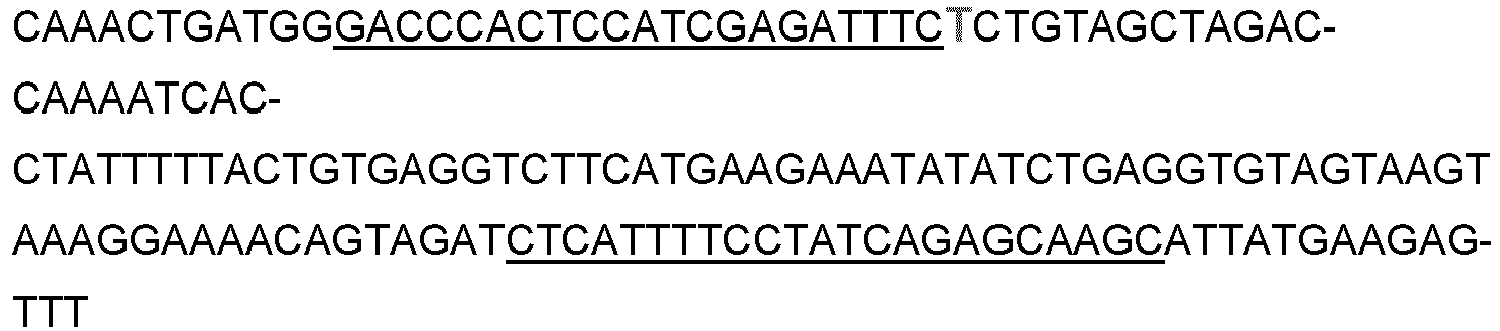


Im vorliegenden Beispiel wird ein Signal generiert, indem eine Mediatorsonde (Mediator Probe) an eine Nukleinsäure-Zielsequenz bindet und im Rahmen einer PCR-Reaktion von einer Polymerase, welche eine Nukleinsäuresequenz amplifiziert, verdaut oder gespalten wird. Somit wird der Mediator, oder auch Mediatorsequenz genannt, freigesetzt und kann an ein Zielsequenz-Unabhängiges-Reportermolekül binden. Wird der gebundene Mediator nun im Rahmen der PCR-Reaktion als Primer oder Start-Oligonukleotid für eine Amplifikation von einer Polymerase erkannt, durch die Polymerase gebunden und verlängert, erfolgt eine Abtrennung oder Verdrängung eines "downstream" (stromabwärts der Amplifikationsrichtung) von der Mediatorbindestelle lokalisierten Quenchers oder Fluorophors, sodass ein Signal durch einen - zuvor durch Kontakt-Quenching gelöschten - Fluorophor erzeugt wird. Dieses Signal ist charakteristisch für die Nukleinsäure-Zielsequenz, an welche die Mediatorsonde (Mediator Probe) zuvor gebunden hat. Das erfindungsgemäße Verfahren ermöglicht ein (direktes) monochromes Multiplexing in der digitalen PCR durch Einsatz von mindestens zwei Zielsequenz-Unabhängigen-Reportermolekülen (siehe z.B. "Zielsequenz-Unabhängiger-Reporter" in
Zum (direkten) Multiplexen, also dem gleichzeitigen Nachweis verschiedener Zielsequenzen in einer zu analysierenden Probe und/oder in einer Reaktion sind im bisherigem Stand der Technik meist mehrere optische Kanäle, weitere Prozessschritte oder eine aufwendige Konzentrationsabstimmung oder Modifikation der Reportermoleküle erforderlich. Im Gegensatz hierzu gibt das erfindungsgemäßes Verfahren die Möglichkeit, verschiedene Zielsequenzen in einer Probe im gleichen Detektionskanal zu detektieren ohne durch die vorab aufgeführten Punkte limitiert zu sein. Der Einsatz von Zielsequenz-unabhängigen Reportermolekülen ermöglicht zudem die Wiederverwendung optimierter Designs für verschiedene Zielsequenzen und macht deren Anwendung entsprechend effizienter. Hierbei ermöglichen es, z.B. verschiedene Intensitätskombinationen und/oder verschiedene Fluorophor-Farben der jeweiligen Markierungen, vorzugsweise unterschiedliche verlängerte Mediatorsequenzen und somit unterschiedliche nachgewiesene Zielsequenzen zu kodieren und zu differenzieren.For (direct) multiplexing, i.e. the simultaneous detection of different target sequences in a sample to be analyzed and/or in a reaction, the current state of the art usually requires several optical channels, further process steps or a complex concentration adjustment or modification of the reporter molecules. In contrast to this, the method according to the invention makes it possible to detect different target sequences in a sample in the same detection channel without being limited by the points listed above. The use of target sequence-independent reporter molecules also enables the reuse of optimized designs for different target sequences and makes their application correspondingly more efficient. This allows, for example, different intensity combinations and/or to encode and differentiate different fluorophore colors of the respective markings, preferably different extended mediator sequences and thus different detected target sequences.
In Ausführungsformen können über verschiedene Fluoreszenzstärken und/oder Fluoreszenzfarben mehrere Zielsequenzen gleichzeitig nachgewiesen werden, indem verschiedene Zielsequenz-Unabhängige-Reportermoleküle eingesetzt werden. Hierbei besitzen diese Zielsequenz-Unabhängigen-Reportermoleküle jeweils unterschiedliche Mediatorbindestellen mit Fluoreszenz- und/ oder Quencher-Markierungen unterschiedlicher Signalintensität und/oder Farbe/Emissionsspektrum. Bevorzugt werden jedoch Zielsequenz-Unabhängige-Reportermoleküle eingesetzt von denen jeweils immer mindestens zwei Reportermoleküle Signale erzeugen können, welche im gleichen Detektionskanal gemessen/detektiert werden können.In embodiments, multiple target sequences can be detected simultaneously via different fluorescence strengths and/or fluorescence colors by using different target sequence-independent reporter molecules. These target sequence-independent reporter molecules each have different mediator binding sites with fluorescence and/or quencher markings of different signal intensity and/or color/emission spectrum. However, target sequence-independent reporter molecules are preferably used, of which at least two reporter molecules can always generate signals that can be measured/detected in the same detection channel.
Durch die Erzeugung von Signalen mit unterschiedlichen Signalstärken, sind diese so in einem Fluoreszenzkanal unterscheidbar. Diese Ausführungsformen bieten insbesondere in der digitalen PCR erhebliche Vorteile um unterschiedliche Signalcluster unterscheidbar zu machen und stellen eine Verbesserung des Standes der Technik dar.By generating signals with different signal strengths, they can be distinguished in a fluorescence channel. These embodiments offer significant advantages, particularly in digital PCR, in order to make different signal clusters distinguishable and represent an improvement in the prior art.
Ein Beispiel in welchem zwei Zielsequenz-Unabhängigen-Reportermoleküle mit jeweils unterschiedlicher Fluorophor und Quencher-Anzahlen und einem Emissionsmaximum im roten Detektionskanal verwendet werden ist ein weiteres Beispiel für (direktes) monochromes Multiplexing gemäß der vorliegenden Erfindung. In diesem Beispiel werden während der digitalen PCR jeweils unterschiedliche Fluoreszenz-Signalstärken durch unterschiedliche Anzahlen an Fluorophoren generiert und ermöglichen so eine Signalidentifikation. Durch den Einsatz Zielsequenz-Unabhängiger-Reportermoleküle kann, z.B. im Gegensatz zu Zielsequenz spezifischen Taqman-Sonden, effizienter eine symmetrische Mehrfachmodifizierung an Fluorophoren und Quenchern genutzt werden, wodurch die Unterschiede in der Signalstärke unterschiedlicher Fluorophore im selben Detektionskanal verstärkt werden.An example in which two target sequence-independent reporter molecules, each with different fluorophore and quencher numbers and an emission maximum in the red detection channel, are used is a further example of (direct) monochrome multiplexing according to the present invention. In this example, different fluorescence signal strengths are generated by different numbers of fluorophores during digital PCR, thus enabling signal identification. By using target-sequence-independent reporter molecules, e.g. in contrast to target-sequence-specific Taqman probes, a symmetrical multiple modification of fluorophores and quenchers can be used more efficiently, thereby amplifying the differences in the signal strength of different fluorophores in the same detection channel.
Bei einer Probenanalyse wurde ein (direktes) monochromes Multiplexing durch den Einsatz von 2 Zielsequenz-Unabhängigen-Reportermolekülen mit unterschiedlichen Fluorophor-Markierungen im roten Detektionskanal durchgeführt. Hierbei wurden die zwei unterschiedlichen Zielsequenz-Unabhängigen-Reportermoleküle entweder mit Cy5 oder mit Atto-647N markiert. Die Analyse umfasste ein Amplifikationsreaktion im Rahmen einer digitalen PCR ("Mediator Probe" / Mediatorsonden-PCR) im Stilla Naica System, wobei die erhaltenen Ergebnisse in mehreren Dimensionen eines Datenraums graphisch dargestellt werden können.In sample analysis, (direct) monochrome multiplexing was performed by using 2 target sequence-independent reporter molecules with different fluorophore labels in the red detection channel. Here, the two different target sequence-independent reporter molecules were labeled either with Cy5 or with Atto-647N. The analysis included an amplification reaction as part of a digital PCR ("Mediator Probe" / Mediatorprobe PCR) in the Stilla Naica system, whereby the results obtained can be graphically displayed in several dimensions of a data space.
Im vorliegenden Experiment erfolgt in einer digitalen PCR-Reaktion unter Verwendung von Mediatorsonden (Mediator Probes) durch den Einsatz von vier verschiedenen Typen von Zielsequenz-Unabhängigen-Reportermolekülen (ZUR1-ZUR4) mit unterschiedlichen Fluoreszenzmarkierungen ein (direktes) monochromes Multiplexing in zwei Detektionskanälen (z.B. roter und grüner Kanal). Bei einer graphischen Darstellung der während der digitalen PCR-Reaktion detektierten Signale, welche durch die verschiedenen Typen von Reportermolekülen generiert werden, können diese in Form von Signalpopulationen im Datenraum (der Raum der durch eine X-Achse und eine Y-Achse generiert oder aufgespannt wird und in dem die Daten graphisch dargestellt werden) dargestellt werden.In the present experiment, a (direct) monochrome multiplexing in two detection channels (e.g. red and green channel). In a graphical representation of the signals detected during the digital PCR reaction, which are generated by the different types of reporter molecules, these can be represented in the form of signal populations in the data space (the space that is generated or spanned by an X-axis and a Y-axis and in which the data is displayed graphically).
In einem weiteren Ausführungsbeispiel der Erfindung konnten während einer (direkten) monochromen Mediatorsonden-(Mediator Probe) multiplex PCR jeweils Proben im roten, grünen und blauen Detektionskanal parallel analysiert werden. Hierfür wurden die Proben in einem entsprechenden digitalen PCR System, wie dem Stilla Naica System, amplifiziert und analysiert. Für jeden Detektionskanal wurden hierbei jeweils zwei, eine und keiner DNA-Zielsequenz zu einer Duplexreaktion (Reaktionsgemisch umfassend zwei verschiedene Reportermolekültypen, welche jeweils für eine der zwei DNA-Zielsequenzen spezifisch sind) zugegeben, sodass entweder beide Zielsequenzen gleichzeitig oder jeweils nur eine oder keine davon im jeweiligen Detektionskanal detektiert werden konnte.In a further exemplary embodiment of the invention, samples in the red, green and blue detection channels could be analyzed in parallel during a (direct) monochrome mediator probe (Mediator probe) multiplex PCR. For this purpose, the samples were amplified and analyzed in a corresponding digital PCR system, such as the Stilla Naica system. For each detection channel, two, one and no DNA target sequences were used to form a duplex reaction (Reaction mixture comprising two different types of reporter molecules, each of which is specific for one of the two DNA target sequences) was added, so that either both target sequences could be detected at the same time or only one or none of them could be detected in the respective detection channel.
Die unterschiedlichen Signale der Reporterkomplexe/Reportermoleküle sind als distinkte Signalpopulationen im zweidimensionalen Datenraum gut voneinander differenzierbar, sodass jeweils eine spezifische Detektion beider Zielsequenzen möglich war.The different signals of the reporter complexes/reporter molecules can be easily differentiated from one another as distinct signal populations in the two-dimensional data space, so that specific detection of both target sequences was possible.
Die unterschiedlichen Signale der Reporterkomplexe/Reportermoleküle sind als distinkte Signalpopulationen im zweidimensionalen Datenraum gut voneinander differenzierbar, sodass jeweils eine spezifische Detektion beider Zielsequenzen möglich war.The different signals of the reporter complexes/reporter molecules can be easily differentiated from one another as distinct signal populations in the two-dimensional data space, so that specific detection of both target sequences was possible.
Die unterschiedlichen Signale der Reporterkomplexe/Reportermoleküle sind als distinkte Signalpopulationen im zweidimensionalen Datenraum gut voneinander differenzierbar, sodass jeweils eine spezifische Detektion beider Zielsequenzen möglich war.The different signals of the reporter complexes/reporter molecules can be easily differentiated from one another as distinct signal populations in the two-dimensional data space, so that specific detection of both target sequences was possible.
In einem weiteren Ausführungsbeispiel der Erfindung konnten während einer (direkten) monochromen Mediatorsonden-(Mediator Probe) multiplex PCR jeweils Proben im grünen und blauen Detektionskanal auf die Präsenz von 4 Zielsequenzen gleichzeitig analysiert werden. Hierfür wurden die Proben in einem entsprechenden digitalen PCR System, wie dem Stilla Naica System, amplifiziert und analysiert. In dieser "4-Plex Mediator Probe PCR" wurden vierZielsequenz-Unabhängige-Reportermoleküle, sowie vier Zielsequenz spezifische Mediatorsonden bereitgestellt, um die DNA-Zielsequenzen I - KRAS G12A (KRAS-Genmutation G12A), II - KRAS WT (KRAS-Wildtypgen), III - BRAF V600E (BRAF-Genmutation V600E) und IV- BRAF WT (BRAF-Wildtypgen) zu detektieren. Die Reportermoleküle für KRAS Zielgenvarianten (unterschiedliche BRAF oder KRAS Single Nucleotide Polymorphisms (SNP) oder Wild-Typ (WT) Varianten) erzeugten bei Aktivierung ein Signal im grünen Detektionskanal (BMN536 und Dy-530 Fluorophor), die Reportermoleküle für BRAF Zielgenvarianten erzeugten bei Aktivierung ein Signal im blauen Detektionskanal (FAM und Atto 488 Fluorophor).In a further exemplary embodiment of the invention, samples in the green and blue detection channels could be analyzed simultaneously for the presence of 4 target sequences during a (direct) monochrome mediator probe (Mediator probe) multiplex PCR. For this purpose, the samples were amplified and analyzed in a corresponding digital PCR system, such as the Stilla Naica system. In this "4-Plex Mediator Probe PCR" four target sequence-independent reporter molecules as well as four target sequence-specific mediator probes were provided to detect the DNA target sequences I - KRAS G12A (KRAS gene mutation G12A), II - KRAS WT (KRAS wild-type gene), III - BRAF V600E (BRAF gene mutation V600E) and IV - BRAF WT (BRAF wild-type gene). The reporter molecules for KRAS target gene variants (different BRAF or KRAS single nucleotide polymorphisms (SNP) or wild-type (WT) variants) generated a signal in the green detection channel (BMN536 and Dy-530 fluorophore) upon activation, the reporter molecules for BRAF target gene variants generated upon activation a signal in the blue detection channel (FAM and
Wie in
In einem weiteren Ausführungsbeispiel der Erfindung konnten während einer (direkten) monochromen Mediatorsonden-(Mediator Probe) multiplex PCR jeweils Proben im grünen, roten und blauen Detektionskanal auf die Präsenz von 6 Zielsequenzen gleichzeitig analysiert werden. Hierfür wurden die Proben in einem entsprechenden digitalen PCR System, wie dem Stilla Naica System, amplifiziert und analysiert. In dieser "6-Plex Mediator Probe PCR" wurden sechs Zielsequenz-Unabhängige-Reportermoleküle, sowie sechs Zielsequenz-spezifische Mediatorsonden bereitgestellt, um die Zielsequenzen I - BRAF V600E (BRAF-Genmutation V600E), II - BRAF WT (BRAF-Wildtypgen), III - KRAS WT (KRAS-Wildtypgen), IV - KRAS G12A (KRAS-Genmutation G12A), V - KRAS G12D (KRAS-Genmutation G12D), VI- KRAS G12V (KRAS-Genmutation G12V) zu detektieren. Die Reportermoleküle für BRAF Zielgenvarianten BRAF V600E und WT erzeugten bei Aktivierung ein Signal im blauen Detektionskanal (FAM bzw. Atto 488 Fluorophor), die Reportermoleküle für KRAS WT und G12A Zielgenvarianten erzeugten bei Aktivierung ein Signal im grünen Detektionskanal (DY-530 bzw. BMN-536 Fluorophor) und die Reportermoleküle für KRAS G12D und G12V Zielgenvarianten erzeugten bei Aktivierung ein Signal im roten Detektionskanal (Cy5 bzw. Atto-647N Fluorophor).In a further exemplary embodiment of the invention, samples in the green, red and blue detection channels could be analyzed simultaneously for the presence of 6 target sequences during a (direct) monochrome mediator probe (Mediator probe) multiplex PCR. For this purpose, the samples were amplified and analyzed in a corresponding digital PCR system, such as the Stilla Naica system. In this "6-Plex Mediator Probe PCR" six target sequence-independent reporter molecules as well as six target sequence-specific mediator probes were provided to detect the target sequences I - BRAF V600E (BRAF gene mutation V600E), II - BRAF WT (BRAF wild-type gene), III - KRAS WT (KRAS wild-type gene), IV - KRAS G12A (KRAS gene mutation G12A), V - KRAS G12D (KRAS gene mutation G12D), VI- KRAS G12V (KRAS gene mutation G12V). The reporter molecules for BRAF target gene variants BRAF V600E and WT generated a signal in the blue detection channel (FAM or
Wie in
Durch die Anwendung des beschriebenen Verfahrens ist es ebenfalls möglich, im höherdimensionalen Datenraum (>3 Dimensionen bei mehr als drei Detektionskanälen) eine Datenklassifizierung durchzuführen. Durch das beschriebene Verfahren kann die Anzahl an unterscheidbaren Zielsequenzen in einer digitalen PCR theoretisch mindestens gegenüber den zur Verfügung stehenden Detektionskanälen verdoppelt werden, sofern dies nicht per se durch geräteseitige technische Limitationen wie einem Crosstalk zwischen unterschiedlichen Detektionskanälen eingeschränkt ist:
Dem Fachmann sind hierbei entsprechende Verfahren bekannt, wie höherdimensionale Datenstrukturen klassifiziert werden können.The person skilled in the art is aware of corresponding methods for classifying higher-dimensional data structures.
Die Erfindung wird weiter durch die folgenden Figuren beschrieben. Diese sollen den Umfang der Erfindung nicht einschränken, sondern stellen bevorzugte Ausführungsformen von Aspekten der Erfindung dar, die zur Veranschaulichung der hierin beschriebenen Erfindung bereitgestellt werden.
-
Figur 1 : Direktes monochromes Multiplexing in der digitalen PCR durch Einsatz von zwei Zielsequenz-Unabhänigen-Reportermolekülen ("ZUR") eines ersten (A) und eines zweiten (B) Typs mit jeweils unterschiedlicher Fluorophor-Markierung (dargestellt als Kreis oder Dreieck) mit einem Emissionsmaximum im roten Detektionskanal in einer Konfiguration, welche eine Signalidentifikation ermöglicht. Unterschiedliche Signalstärken der Fluoreszenz, welche charakteristisch für eine jeweilige Nukleinsäure-Zielsequenz sind, werden durch unterschiedlich große Kreise dargestellt. Durch den Einsatz Zielsequenz-Unabhängiger-Reportermoleküle kann im Gegensatz zu Zielsequenz spezifischen Taqman-Sonden effizienter ein Kontakt-Quenching (des mind. einen Fluorophors durch mind. einen Quencher) eingestellt werden, wodurch die Unterschiede in der Signalstärke unterschiedlicher Fluorophore im selben Detektionskanal verstärkt werden. Der mind. eine Quencher ist am 5'-Ende des Reportermoleküls lokalisiert ("5'-Quencher modification"). Jeder Typ der Reportermoleküle ("ZUR 1" unter (A) oder "ZUR 2" unter (B)) wird durch eine spezifische Mediator Sequenz ("Mediator 1" unter (A) oder "Mediator 2" unter (B)) gebunden und aktiviert, welche zuvor von der zugehörigen Mediator-Sonde ("Mediator Probe 1" unter (A) oder "Mediator Probe 2" unter (B)) abgespalten und/oder freigesetzt wurde. -
Figur 2 : Der Graph stellt die Ergebnisse desAusführungsbeispiels 3 durch einen eindimensionalen Plot (1-D-Plot) dar.Im Beispiel 2 wurden zwei Nukleinsäure-Zielsequenzen durch eine (direkte) monochrome ("Mediator Probe") Duplex-PCR (digitale PCR im Stilla Naica System) mittels zugehöriger spezifischer Zielsequenz-Unabhängiger-Reportermolekültypen eines ersten und eines zweiten Typs nachgewiesen. Die zwei unterschiedlichen Reportermolekül-Typen umfassten entweder den roten Fluorophor Cy5 oder den roten Fluorophor Atto 647N als Markierung, welche charakteristisch für die jeweilige Nukleinsäure-Zielsequenz waren und im roten Detektionskanal eines Stilla Naica Systems (digitales PCR-System) detektiert und analysiert wurden. -
Figur 3 : Der Graph stellt die Ergebnisse desAusführungsbeispiels 3 durch einen zweidimensionalen (2-D) Plot dar.Im Beispiel 2 wurden zwei Nukleinsäure-Zielsequenzen durch eine (direkte) monochrome ("Mediator Probe") Duplex-PCR (digitale PCR im Stilla Naica System) mittels zugehöriger spezifischer Zielsequenz-Unabhängiger-Reportermolekültypen eines ersten und eines zweiten Typs nachgewiesen. Die zwei unterschiedlichen Reportermolekül-Typen umfassten entweder den roten Fluorophor Cy5 oder den roten Fluorophor Atto 647N als Markierung, welche charakteristisch für die jeweilige Nukleinsäure-Zielsequenz waren und im roten Detektionskanal eines Stilla Naica Systems (digitales PCR-System) detektiert wurden. Dieser Plot stellt in einem 2-D Datenraum die spezifischen Signale der Reporterkomplexe/Reportermoleküle im roten Kanal ("Red", Y-Achse) dem Hintergrundsignal (Hintergrundrauschen) im bauen Detektionskanal ("Blue", X-Achse) i gegenüber. Einheit der Y-Achse: relative fluorescence units (RFU). -
Figur 4 : Der Graph stellt die Ergebnisse desAusführungsbeispiels 3 durch einen dreidimensionalen (3-D) Plot dar.Im Beispiel 2 wurden zwei Nukleinsäure-Zielsequenzen durch eine (direkte) monochrome ("Mediator Probe") Duplex-PCR (digitale PCR im Stilla Naica System) mittels zugehöriger spezifischer Zielsequenz-Unabhängiger-Reportermolekültypen eines ersten und eines zweiten Typs nachgewiesen. Die zwei unterschiedlichen Reportermolekül-Typen umfassten entweder den roten Fluorophor Cy5 oder den roten Fluorophor Atto 647N als Markierung, welche charakteristisch für die jeweilige Nukleinsäure-Zielsequenz waren und im roten Detektionskanal eines Stilla Naica Systems (digitales PCR-System) detektiert wurden. Dieser Plot stellt in einem 3-D Datenraum die spezifischen Signale der Reporterkomplexe/Reportermoleküle im roten Kanal ("Red", Y-Achse) dem Hintergrundsignal (Hintergrundrauschen) im blauen Detektionskanal ("Blue", X-Achse) und den Signalen einer Negativkontrolle (enthielt kein Zielsequenz) im grünen Detektionskanal ("Green", Z-Achse) gegenüber. Einheit der Achsen: relative fluorescence units (RFU). -
Figur 5 : Dargestellt ist ein Schema des Versuchsdesigns und der verwendeten Reportermoleküle desAusführungsbeispiels 4.Im Ausführungsbeispiel 4 erfolgt in einer digitalen PCR-Reaktion unter Verwendung von vier verschiedenen Typen von Zielsequenz-Unabhängigen-Reportermolekülen (ZUR1-ZUR4) mit unterschiedlichen Fluoreszenzmarkierungen ein direktes monochromes Multiplexing in zwei Detektionskanälen (z.B. roter Kanal (X-Achse) und grüner Kanal (Y-Achse)). Die vier verschiedenen Typen von Zielsequenz-Unabhängigen-Reportermolekülen (ZUR1-ZUR4) werden jeweils von einer spezifischen Mediatorsequenz (Mediator Typ 1-4) gebunden und aktiviert, wobei das generierte und detektierte Fluoreszenzsignal jeweils spezifisch für eine jeweilige Nukleinsäure-Zielsequenz ist. -
Figur 6 : Dargestellt sind die Ergebnisse desAusführungsbeispiels 5. Es wurden zwei verschiedenen Zielsequenz-Unabhängige-Reportermolekültypen im roten Detektionskanal in einer (direkten) monochromen Multiplexing-PCR Analyse im Stilla Naica System verwendet. Dargestellt sind die Signale einer Duplexreaktion (Doppelreaktion), wobei im äußerst linken Datenraum die Signale, welche diePräsenz der Zielsequenz 1 und Zielsequenz 2 (X-Achse) anzeigen, dargestellt sind. Im mittleren Datenraum sind jeweils die Signale der Einzelnachweise nach Zugabe von nur jeweils einer DNA-Zielsequenz), welche für die Zielsequenz 1 (X-Achse) und Zielsequenz 2 (X-Achse) spezifisch sind, dargestellt. Im äußerst rechten Datenraum ist das Signal der Negativkontrolle (NTC; X-Achse) dargestellt. Auf der Y-Achse ist die Signalintensität im roten Detektionskanal ("Red") aufgeführt. Zur Signalgenerierung wurden zwei Typen von Zielsequenz-Unabhängigen-Reportermolekülen (ZUR05 und ZUR06) eingesetzt, entweder markiert mit Cy5/BHQ-2 oder BHQ-2/Atto-647N. Einheit der Y-Achse: relative fluorescence units (RFU). -
Figur 7 : Dargestellt sind die Ergebnisse dieses Ausführungsbeispiels 5 für die Verwendung von zwei verschiedenen Reporterkomplexen/Reportermolekülen im grünen Detektionskanal in einer (direkten) monochromen Multiplexing-Analyse im Stilla Naica System. Dargestellt sind die Signale einer Duplexreaktion (Doppelreaktion), wobei im äußerst linken Datenraum die Signale, welche für dieZielsequenz 1 und Zielsequenz 2 (X-Achse) spezifisch sind, dargestellt sind. Im mittleren Datenraum sind jeweils die beiden Einzelnachweise nach Zugabe von nur jeweils einer DNA-Zielsequenz für den Nachweis der einzelnen Zielsequenz 1 (X-Achse) bzw. Zielsequenz 2 (X-Achse) dargestellt. Im äußerst rechten Datenraum ist das Signal der Negativkontrolle (NTC; X-Achse) dargestellt. Auf der Y-Achse ist die Signalintensität im grünen Detektionskanal aufgeführt. Zur Signalgenerierung wurden zwei Typen von Zielsequenz-Unabhängigen-Reportermolekülen (ZUR02 und ZUR04) eingesetzt, entweder markiert mit Dy530/BMN-Q1 oder mit BMN536/BHQ-1. Einheit der Y-Achse: relative fluorescence units (RFU). -
Figur 8 : Dargestellt sind die Ergebnisse dieses Ausführungsbeispiels 5 für die Verwendung von zwei verschiedenen Reporterkomplexen/Reportermolekülen im blauen Detektionskanal in einer (direkten) monochromen Multiplexing-Analyse im Stilla Naica System. Dargestellt sind die Signale einer Duplexreaktion (Doppelreaktion), wobei im äußerst linken Datenraum die Signale, welche für dieZielsequenz 1 und Zielsequenz 2 (X-Achse) spezifisch sind, dargestellt sind. Im mittleren Datenraum sind jeweils die Einzelnachweise nach Zugabe von nur jeweils einer DNA-Zielsequenz, welche die Präsenz der einzelnen Zielsequenz 1 (X-Achse) bzw. Zielsequenz 2 (X-Achse) anzeigen, dargestellt. Im äußerst rechten Datenraum ist das Signal der Negativkontrolle (NTC; X-Achse) dargestellt. Auf der Y-Achse ist die Signalintensität im blauen Detektionskanal aufgeführt. Zur Signalgenerierung wurden zwei Typen von Zielsequenz-Unabhängigen-Reportermolekülen (ZUR07 und ZUR08) eingesetzt, entweder markiert mit FAM/BHQ-1 oder mit Atto488/BMN-Q1. Einheit der Y-Achse: relative fluorescence units (RFU). -
Figur 9 : Dargestellt ist das Ergebnis des Ausführungsbeispiels 6 wobei durch eine (direkte) monochrome Mediatorsonden-(Mediator Probe) multiplex PCR jeweils Proben im grünen und blauen Detektionskanal auf diePräsenz von 4 Zielsequenzen gleichzeitig analysiert wurden. Hierfür wurden die Proben in einem entsprechenden digitalen PCR-System (Stilla Naica System), amplifiziert und analysiert. In dieser "4-Plex Mediator Probe PCR" wurden spezifische Zielsequenz-Unabhängige-Reportermoleküle für die Zielsequenzen I - KRAS G12A (KRAS-Genmutation G12A), II - KRAS WT (KRAS-Wildtypgen), III - BRAF V600E (BRAF-Genmutation V600E) und IV- BRAF WT (BRAF-Wildtypgen) eingesetzt. Die Reportermoleküle für KRAS-Zielgenvarianten erzeugten bei Aktivierung ein Signal im grünen Detektionskanal (Y-Achse), die Reportermoleküle für BRAF Zielgenvarianten erzeugten bei Aktivierung ein Signal im blauen Detektionskanal (X-Achse). Im abgebildeten 2-D Plot (2-D Datenraum) sind die einzeln in einer Partition detektierten Signale der Zielsequenzen I und II im linken oberen Quadrant des Datenraums dargestellt sind. Im rechten unteren Quadrant des 2-D Datenraums sind die einzeln in einer Partition detektierten Signale der Zielsequenzen III und IV dargestellt. Im rechten oberen Quadrant des 2-D Datenraums sind die gleichzeitig in einer Partition detektierten Signale von jeweils einer KRAS und einer BRAF-Zielsequenz (also I+III, II+III, I+IV und II+IV) dargestellt. Auf der Y-Achse ist die Signalintensität im grünen Detektionskanal, auf der X-Achse die Signalintensität im blauen Detektionskanal aufgeführt. Einheit der Achsen: relative fluorescence units (RFU). -
Figur 10 : Die Figur zeigt in einem dreidimensionalen (3-D) Plot die Ergebnisse des Ausführungsbeispiels 6 wobei mittels einer (direkten) monochromen Mediatorsonden-(Mediator Probe) multiplex PCR jeweils Proben im grünen, roten und blauen Detektionskanal auf die Präsenz von 6 Zielsequenzen gleichzeitig analysiert wurden. Hierfür wurden die Proben in einem entsprechenden digitalen PCR-System (Stilla Naica System) amplifiziert und analysiert. In dieser "6-Plex Mediator Probe PCR" wurden spezifische Zielsequenz-Unabhängige-Reportermoleküle (ZUR02, ZUR04-ZUR08) für die folgenden Zielsequenzen eingesetzt: I - BRAF V600E (BRAF-Genmutation V600E; ZUR07, Markierung: FAM/BHQ-1), II - BRAF WT (BRAF-Wildtypgen; ZUR08, Markierung:Atto 488/BMN-W1), III - KRAS WT (KRAS-Wildtypgen; ZUR02, Markierung: DY-530/BMN-Q1), IV - KRAS G12A (KRAS-Genmutation G12A; ZUR04, Markierung: Cy5/BHQ-1), V - KRAS G12D (KRAS-Genmutation G12D; ZUR05, Markierung: Cy5/BHQ-2), VI- KRAS G12V (KRAS-Genmutation G12V, ZUR06, Markierung: Atto 647N/BHQ-2). Die Reportermoleküle für BRAF Zielgenvarianten BRAF V600E und WT erzeugten bei Aktivierung ein Signal im blauen Detektionskanal (FAM bzw.Atto 488 Fluorophor), die Reportermoleküle für KRAS WT und G12A Zielgenvarianten erzeugten bei Aktivierung ein Signal im grünen Detektionskanal (DY-530 bzw. BMN-536 Fluorophor) und die Reportermoleküle für KRAS G12D und G12V Zielgenvarianten erzeugten bei Aktivierung ein Signal im roten Detektionskanal (Cy5 bzw. Atto-647N Fluorophor). Im 3-D Plot (3-D Datenraum) sind die einzeln in einer Partition detektierten Signale der Zielsequenzen I und II auf der X-Achse dargestellt. Auf der Y-Achse des 3-D Datenraums sind die einzeln in einer Partition detektierten Signale der Zielsequenzen V und VI dargestellt. Auf der Z-Achse des 3-D Datenraums sind die einzeln in einer Partition detektierten Signale der Zielsequenzen III und IV dargestellt. Im 3-D Datenraum sind zudem die gleichzeitig in einer Partition detektierten Signale von den jeweiligen KRAS bzw. BRAF-Zielsequenzen dargestellt. Auf der Y-Achse ist die Signalintensität im roten Detektionskanal, auf der X-Achse die Signalintensität im blauen Detektionskanal und auf der Z-Achse die die Signalintensität im grünen Detektionskanal aufgeführt. Einheit der Achsen: relative fluorescence units (RFU). -
Figur 11 : Eine Möglichkeit unterschiedliche Signalstärken durch unterschiedliche Markierungen an Reportermolekülen zu erzeugen, ergibt sich in Ausführungsformen z.B. aus den physikalischen Moleküleigenschaften der Markierungen, welche durch ein Kontakt-Quenching nach der Aktivierung des Zielsequenz-unspezifischen Reportermoleküls verstärkt werden. In beiden Graphen sind auf der X-Achse die fixen Dimensionen einer Markierung ("Marker") und des gemessenen Signals dargestellt, z.B. Wellenlänge, Potential, Frequenz etc. Auf der Y-Achse sind die variablen Dimensionen des gemessenen Signals, hier die Signalstärke, dargestellt. Die Punkte zeigen im jeweiligen Graph den Schnittpunkt der jeweiligen Signalstärken 1 und 2 desFluorophors 1oder 2 und der jeweiligen Messwellenlänge an.
-
Figure 1 : Direct monochrome multiplexing in digital PCR by using two target sequence-independent reporter molecules ("ZUR") of a first (A) and a second (B) type, each with a different fluorophore label (represented as a circle or triangle) with an emission maximum in the red detection channel in a configuration that enables signal identification. Different fluorescence signal strengths, which are characteristic of a respective nucleic acid target sequence, are represented by circles of different sizes. By using target sequence-independent reporter molecules, in contrast to target sequence-specific Taqman probes, contact quenching (of at least one fluorophore by at least one quencher) can be set more efficiently, thereby increasing the differences in the signal strength of different fluorophores in the same detection channel . The at least one quencher is located at the 5' end of the reporter molecule ("5'-quencher modification"). Each type of reporter molecule ("ZUR 1" under (A) or "ZUR 2" under (B)) is bound by a specific mediator sequence ("Mediator 1" under (A) or "Mediator 2" under (B)). activated, which was previously split off and/or released from the associated Mediator probe ("Mediator Probe 1" under (A) or "Mediator Probe 2" under (B)). -
Figure 2 : The graph represents the results ofexemplary embodiment 3 by a one-dimensional plot (1-D plot). In example 2, two nucleic acid target sequences were determined by a (direct) monochrome ("Mediator Probe") duplex PCR (digital PCR in Stilla Naica system) by means of associated specific target sequence-independent reporter molecule types of a first and a second type. The two different reporter molecule types included either the red fluorophore Cy5 or the red fluorophore Atto 647N as a label, which were characteristic of the respective nucleic acid target sequence and were detected and analyzed in the red detection channel of a Stilla Naica system (digital PCR system). -
Figure 3 : The graph represents the results ofexemplary embodiment 3 by a two-dimensional (2-D) plot. In example 2, two nucleic acid target sequences were determined by a (direct) monochrome ("Mediator Probe") duplex PCR (digital PCR in the Stilla Naica system ) by means of associated specific target sequence-independent reporter molecule types of a first and a second type. The two different reporter molecule types included either the red fluorophore Cy5 or the red fluorophore Atto 647N as a label, which were characteristic of the respective nucleic acid target sequence and were detected in the red detection channel of a Stilla Naica system (digital PCR system). In a 2-D data space, this plot compares the specific signals of the reporter complexes/reporter molecules in the red channel ("Red", Y-axis) with the background signal (background noise) in the built detection channel ("Blue", X-axis). Y-axis unit: relative fluorescence units (RFU). -
Figure 4 : The graph represents the results ofexemplary embodiment 3 by a three-dimensional (3-D) plot. In example 2, two nucleic acid target sequences were determined by a (direct) monochrome ("Mediator Probe") duplex PCR (digital PCR in the Stilla Naica system ) by means of associated specific target sequence-independent reporter molecule types of a first and a second type. The two different reporter molecule types included either the red fluorophore Cy5 or the red fluorophore Atto 647N as a label, which were characteristic of the respective nucleic acid target sequence and were detected in the red detection channel of a Stilla Naica system (digital PCR system). This plot represents in a 3-D data space the specific signals of the reporter complexes/reporter molecules in the red channel ("Red", Y-axis) the background signal (background noise) in the blue detection channel ("Blue", X-axis) and the signals of a negative control (contained no target sequence) in the green detection channel (“Green”, Z-axis). Unit of the axes: relative fluorescence units (RFU). -
Figure 5 : Shown is a diagram of the experimental design and the reporter molecules used inexemplary embodiment 4. Inexemplary embodiment 4, direct monochrome multiplexing takes place in a digital PCR reaction using four different types of target sequence-independent reporter molecules (ZUR1-ZUR4) with different fluorescent labels two detection channels (e.g. red channel (X-axis) and green channel (Y-axis)). The four different types of target sequence-independent reporter molecules (ZUR1-ZUR4) are each bound and activated by a specific mediator sequence (Mediator types 1-4), with the generated and detected fluorescence signal being specific for a respective nucleic acid target sequence. -
Figure 6 : Shown are the results ofexemplary embodiment 5. Two different target sequence-independent reporter molecule types were used in the red detection channel in a (direct) monochrome multiplexing PCR analysis in the Stilla Naica system. The signals of a duplex reaction (double reaction) are shown, with the signals indicating the presence oftarget sequence 1 and target sequence 2 (X axis) being shown in the leftmost data space. In the middle data space, the signals of the individual detections after adding only one DNA target sequence, which are specific for target sequence 1 (X-axis) and target sequence 2 (X-axis), are shown. The signal from the negative control (NTC; x-axis) is shown in the rightmost data space. The Y-axis shows the signal intensity in the red detection channel (“Red”). For signal generation, two types of target sequence-independent reporter molecules (ZUR05 and ZUR06), either labeled with Cy5/BHQ-2 or BHQ-2/Atto-647N, were used. Y-axis unit: relative fluorescence units (RFU). -
Figure 7 : Shown are the results of thisexemplary embodiment 5 for the use of two different reporter complexes/reporter molecules in the green detection channel in a (direct) monochrome multiplexing analysis in the Stilla Naica system. The signals of a duplex reaction (double reaction) are shown, with the signals for thetarget sequence 1 and target sequence 2 (X-axis) are specific, are shown. In the middle data space, the two individual detections are shown after adding only one DNA target sequence for the detection of the individual target sequence 1 (X-axis) or target sequence 2 (X-axis). The signal from the negative control (NTC; x-axis) is shown in the rightmost data space. The signal intensity in the green detection channel is listed on the Y-axis. For signal generation, two types of target sequence-independent reporter molecules (ZUR02 and ZUR04), either labeled with Dy530/BMN-Q1 or with BMN536/BHQ-1, were used. Y-axis unit: relative fluorescence units (RFU). -
Figure 8 : Shown are the results of thisexemplary embodiment 5 for the use of two different reporter complexes/reporter molecules in the blue detection channel in a (direct) monochrome multiplexing analysis in the Stilla Naica system. The signals of a duplex reaction (double reaction) are shown, with the signals that are specific fortarget sequence 1 and target sequence 2 (X axis) being shown in the leftmost data space. In the middle data space, the individual detections after the addition of only one DNA target sequence are shown, which indicate the presence of the individual target sequence 1 (X-axis) or target sequence 2 (X-axis). The signal from the negative control (NTC; x-axis) is shown in the rightmost data space. The Y-axis shows the signal intensity in the blue detection channel. For signal generation, two types of target sequence-independent reporter molecules (ZUR07 and ZUR08), either labeled with FAM/BHQ-1 or with Atto488/BMN-Q1, were used. Y-axis unit: relative fluorescence units (RFU). -
Figure 9 : Shown is the result of exemplary embodiment 6, in which samples in the green and blue detection channels were analyzed simultaneously for the presence of 4 target sequences using a (direct) monochrome mediator probe (Mediator Probe) multiplex PCR. For this purpose, the samples were amplified and analyzed in a corresponding digital PCR system (Stilla Naica System). In this "4-Plex Mediator Probe PCR" specific target sequence independent reporter molecules were used for the target sequences I - KRAS G12A (KRAS gene mutation G12A), II - KRAS WT (KRAS wild-type gene), III - BRAF V600E (BRAF gene mutation V600E ) and IV-BRAF WT (BRAF wild-type gene) were used. The reporter molecules for KRAS target gene variants generated a signal in the green detection channel (Y-axis) upon activation, the reporter molecules for BRAF target gene variants generated a signal in the blue detection channel (X-axis) upon activation. In the 2-D plot (2-D data space) shown, the signals of target sequences I and II individually detected in a partition are shown in the upper left quadrant of the data space. In the lower right quadrant of the 2-D data space, the signals of target sequences III and IV detected individually in a partition are shown. In the upper right quadrant of the 2-D data space, the signals from a KRAS and a BRAF target sequence (i.e. I+III, II+III, I+IV and II+IV) detected simultaneously in a partition are shown. The signal intensity in the green detection channel is shown on the Y-axis and the signal intensity in the blue detection channel is shown on the X-axis. Unit of the axes: relative fluorescence units (RFU). -
Figure 10 : The figure shows the results of exemplary embodiment 6 in a three-dimensional (3-D) plot, in which samples in the green, red and blue detection channels are analyzed simultaneously for the presence of 6 target sequences using a (direct) monochrome mediator probe (Mediator Probe) multiplex PCR became. For this purpose, the samples were stored in an appropriate digital PCR system (Stilla Naica System) amplified and analyzed. In this "6-Plex Mediator Probe PCR" specific target sequence independent reporter molecules (ZUR02, ZUR04-ZUR08) were used for the following target sequences: I - BRAF V600E (BRAF gene mutation V600E; ZUR07, label: FAM/BHQ-1) , II - BRAF WT (BRAF wild-type gene; ZUR08, marking:Atto 488/BMN-W1), III - KRAS WT (KRAS wild-type gene; ZUR02, marking: DY-530/BMN-Q1), IV - KRAS G12A (KRAS -Gene mutation G12A; ZUR04, marking: Cy5/BHQ-1), V - KRAS G12D (KRAS gene mutation G12D; ZUR05, marking: Cy5/BHQ-2), VI- KRAS G12V (KRAS gene mutation G12V, ZUR06, marking: Atto 647N/BHQ-2). The reporter molecules for BRAF target gene variants BRAF V600E and WT generated a signal in the blue detection channel (FAM orAtto 488 fluorophore) when activated, the reporter molecules for KRAS WT and G12A target gene variants generated a signal in the green detection channel (DY-530 or BMN-) when activated. 536 fluorophore) and the reporter molecules for KRAS G12D and G12V target gene variants generated a signal in the red detection channel (Cy5 and Atto-647N fluorophore, respectively) upon activation. In the 3-D plot (3-D data space), the signals of target sequences I and II detected individually in a partition are shown on the x-axis. The signals of the target sequences V and VI detected individually in a partition are shown on the Y-axis of the 3-D data space. The signals of target sequences III and IV individually detected in a partition are shown on the Z-axis of the 3-D data space. The 3-D data space also shows the signals from the respective KRAS or BRAF target sequences that were simultaneously detected in a partition. The Y-axis shows the signal intensity in the red detection channel, the X-axis shows the signal intensity in the blue detection channel and the Z-axis shows the signal intensity in the green detection channel. Unit of the axes: relative fluorescence units (RFU). -
Figure 11 : One possibility of generating different signal strengths through different markings on reporter molecules arises in embodiments, for example, from the physical molecular properties of the markings, which are amplified by contact quenching after activation of the target sequence-unspecific reporter molecule. In both graphs, the x-axis shows the fixed dimensions of a marker and the measured signal, e.g. wavelength, potential, frequency, etc. The Y-axis shows the variable dimensions of the measured signal, here the signal strength shown. In the respective graph, the points indicate the intersection of therespective signal strengths fluorophore
Claims (16)
wobei jeder Typ der mindesten zwei Zielsequenz-Unabhängigen-Reportermoleküle durch die jeweils mindestens eine Markierung dahingehend charakterisiert ist, dass diese jeweils eine Signalintensität besitzt, welche von den Signalintensitäten der Markierungen aller anderen Zielsequenz-Unabhängigen-Reportermolekül Typen unterscheidbar ist und eine direkte Zuordnung zu der jeweiligen Nukleinsäure-Zielsequenz ermöglicht,
wobei die mindestens eine freigesetzte Mediatorsequenz an mindestens ein Zielsequenz-Unabhängige-Reportermolekül eines ersten Typs bindet, wobei durch die mindestens eine Markierung ein Signal erzeugt wird, welches durch seine Signalintensität und/oder Emissionsspektrum charakteristisch für die erste dem jeweiligen Zielsequenz-Unabhängigen Reporter zugeordneten Nukleinsäure-Zielsequenz ist, an welche die mindestens eine Sonden-Sequenz der mindestens einen ersten Mediator-sonde gebunden hat,
wherein each type of the at least two target sequence-independent reporter molecules is characterized by the at least one label in such a way that each of them has a signal intensity which is distinguishable from the signal intensities of the labels of all other target sequence-independent reporter molecule types and a direct assignment to the respective nucleic acid target sequence enables
wherein the at least one released mediator sequence binds to at least one target sequence-independent reporter molecule of a first type, wherein the at least one label generates a signal which, by its signal intensity and / or emission spectrum, is characteristic of the first nucleic acid assigned to the respective target sequence-independent reporter -target sequence is to which the at least one probe sequence of the at least one first mediator probe has bound,
wobei zwischen dem mindestens einen Fluorophor und dem mindestens einen Quencher bevorzugt ein Kontakt-Quenching stattfindet, solange keine Mediatorsequenz am entsprechenden Zielsequenz-Unabhängigen-Reportermolekül bindet, oder solange eine gebundene Mediatorsequenz während der Nukleinsäure-Nachweisreaktion nicht verlängert wurde.Method according to one of the preceding claims, wherein the at least one label of a target sequence-independent reporter molecule comprises at least one fluorophore and at least one quencher,
wherein contact quenching preferably takes place between the at least one fluorophore and the at least one quencher as long as no mediator sequence binds to the corresponding target sequence-independent reporter molecule, or as long as a bound mediator sequence has not been extended during the nucleic acid detection reaction.
Priority Applications (5)
| Application Number | Priority Date | Filing Date | Title |
|---|---|---|---|
| EP23721670.0A EP4511511A1 (en) | 2022-04-22 | 2023-04-21 | Pcr multiplexing through target sequence-independent reporter molecules with distinguishable signal strengths |
| JP2024562024A JP2025513429A (en) | 2022-04-22 | 2023-04-21 | PCR multiplexing with target sequence independent reporter molecules with distinguishable signal strengths - Patents.com |
| CN202380038528.5A CN119156453A (en) | 2022-04-22 | 2023-04-21 | PCR multiplexing techniques by target sequence independent reporter molecules with distinguishable signal intensities |
| PCT/EP2023/060507 WO2023203227A1 (en) | 2022-04-22 | 2023-04-21 | Pcr multiplexing through target sequence-independent reporter molecules with distinguishable signal strengths |
| US18/858,312 US20250270624A1 (en) | 2022-04-22 | 2023-04-21 | Pcr multiplexing through target sequence-independent reporter molecules with distinguishable signal strengths |
Applications Claiming Priority (1)
| Application Number | Priority Date | Filing Date | Title |
|---|---|---|---|
| EP22169459 | 2022-04-22 |
Publications (1)
| Publication Number | Publication Date |
|---|---|
| EP4265735A1 true EP4265735A1 (en) | 2023-10-25 |
Family
ID=81346665
Family Applications (1)
| Application Number | Title | Priority Date | Filing Date |
|---|---|---|---|
| EP22212538.7A Withdrawn EP4265735A1 (en) | 2022-04-22 | 2022-12-09 | Pcr multiplexing by target sequence independent reporter molecules with discriminable signal strengths |
Country Status (1)
| Country | Link |
|---|---|
| EP (1) | EP4265735A1 (en) |
Cited By (1)
| Publication number | Priority date | Publication date | Assignee | Title |
|---|---|---|---|---|
| CN119842874A (en) * | 2025-03-24 | 2025-04-18 | 北京百力格生物科技有限公司 | Non-target-dependent method for detecting genotype of SNP sites in target genes and kit thereof |
Citations (5)
| Publication number | Priority date | Publication date | Assignee | Title |
|---|---|---|---|---|
| WO2013079307A1 (en) | 2011-11-10 | 2013-06-06 | Albert-Ludwigs-Universität Freiburg | Bifunctional oligonucleotide probe for universal real time multianalyte detection |
| US20140171341A1 (en) * | 2011-03-18 | 2014-06-19 | Bio-Rad Laboratories, Inc. | Multiplexed digital assays |
| WO2014149480A1 (en) * | 2013-03-15 | 2014-09-25 | Bio-Rad Laboratories, Inc. | Digital assays with a generic reporter |
| WO2016087637A1 (en) | 2014-12-04 | 2016-06-09 | Hahn-Schickard-Gesellschaft für angewandte Forschung e.V. | Method and system for detecting and distinguishing between at least two dyes |
| US20190002963A1 (en) * | 2017-06-28 | 2019-01-03 | ChromaCode, Inc. | Multiplexed fluorometric measurements with droplet pcr systems |
-
2022
- 2022-12-09 EP EP22212538.7A patent/EP4265735A1/en not_active Withdrawn
Patent Citations (6)
| Publication number | Priority date | Publication date | Assignee | Title |
|---|---|---|---|---|
| US20140171341A1 (en) * | 2011-03-18 | 2014-06-19 | Bio-Rad Laboratories, Inc. | Multiplexed digital assays |
| US9921154B2 (en) | 2011-03-18 | 2018-03-20 | Bio-Rad Laboratories, Inc. | Multiplexed digital assays |
| WO2013079307A1 (en) | 2011-11-10 | 2013-06-06 | Albert-Ludwigs-Universität Freiburg | Bifunctional oligonucleotide probe for universal real time multianalyte detection |
| WO2014149480A1 (en) * | 2013-03-15 | 2014-09-25 | Bio-Rad Laboratories, Inc. | Digital assays with a generic reporter |
| WO2016087637A1 (en) | 2014-12-04 | 2016-06-09 | Hahn-Schickard-Gesellschaft für angewandte Forschung e.V. | Method and system for detecting and distinguishing between at least two dyes |
| US20190002963A1 (en) * | 2017-06-28 | 2019-01-03 | ChromaCode, Inc. | Multiplexed fluorometric measurements with droplet pcr systems |
Non-Patent Citations (21)
| Title |
|---|
| "Digital PCRTM kit", STILLA TECHNOLOGIES |
| ALEXANDRA S. WHALE ET AL: "Fundamentals of multiplexing with digital PCR", BIOMOLECULAR DETECTION AND QUANTIFICATION, vol. 10, 1 December 2016 (2016-12-01), pages 15 - 23, XP055504396, ISSN: 2214-7535, DOI: 10.1016/j.bdq.2016.05.002 * |
| CORNE, JULIENLE DU, FANNYQUILLIEN, VERONIQUEGODEY, FLORENCEROBERT, LUCIEBOURIEN, HELOISE ET AL.: "Development of multiplex digital PCR assays forthe detection of PIK3CA mutations in the plasma of metastatic breast cancer patients", SCIENTIFIC REPORTS, vol. 11, no. 1, 2021, pages 17316 |
| DOBNIK DAVID ET AL: "Multiplex quantification of four DNA targets in one reaction with Bio-Rad droplet digital PCR system for GMO detection", vol. 6, no. 1, 14 October 2016 (2016-10-14), XP055776264, Retrieved from the Internet <URL:http://www.nature.com/articles/srep35451> DOI: 10.1038/srep35451 * |
| FALTIN, BERNDWADLE, SIMONROTH, GÜNTERZENGERLE, ROLANDSTETTEN, FELIX VON: "Media-tor probe PCR: a novel approach for detection of real-time PCR based on label-free primary probes and standardized secondary universal fluorogenic reporters", CLINICAL CHEMISTRY, vol. 58, no. 11, 2012, pages 1546 - 1556 |
| GARCIA-MURILLAS, ISAACSCHIAVON, GAIAWEIGELT, BRITTANG, CHARLOTTEHREBIEN, SARAHCUTTS, ROSALIND J. ET AL.: "Mutation tracking in circulating tumor DNA predicts relapse in early breast cancer", SCIENCE TRANSLATIONAL MEDICINE, vol. 7, no. 302, 2015, pages 302 - 133, XP055440860, DOI: 10.1126/scitranslmed.aab0021 |
| HUGHESMAN, CURTIS B.LU, X. J. DAVIDLIU, KELLY Y. P.ZHU, YUQIPOH, CATHERINE F.HAYNES, CHARLES: "A Robust Protocol for Using Multiplexed Droplet Digital PCR to Quantify Somatic Copy Number Alterations in Clinical Tissue Specimens", PLOS ONE, vol. 11, no. 8, 2016, pages e0161274, XP055590753, DOI: 10.1371/journal.pone.0161274 |
| KIPF ELENA ET AL: "Advanced Minimal Residual Disease Monitoring for Acute Lymphoblastic Leukemia with Multiplex Mediator Probe PCR", vol. 24, no. 1, 1 January 2022 (2022-01-01), pages 57 - 68, XP093018907, ISSN: 1525-1578, Retrieved from the Internet <URL:https://www.sciencedirect.com/science/article/pii/S1525157821003317/pdfft?md5=9635830895fb24330e3bf1dfb8c50431&pid=1-s2.0-S1525157821003317-main.pdf> DOI: 10.1016/j.jmoldx.2021.10.001 * |
| KIPF, ELENASCHLENKER, FRANZISKABORST, NADINEFILLIES, MARIONKIRSCHNER-SCHWABE, RENATEZENGERLE, ROLAND ET AL.: "Advanced Minimal Residual Disease Monitoring for Acute Lym-phoblastic Leukemia with Multiplex Mediator Probe PCR", THE JOURNAL OF MOLECULAR DIAGNOS-TICS : JMD, vol. 24, no. 1, 2022, pages 57 - 68 |
| LEHNERT MICHAEL ET AL: "Fluorescence signal-to-noise optimisation for real-time PCR using universal reporter oligonucleotides", vol. 10, no. 28, 1 January 2018 (2018-01-01), GB, pages 3444 - 3454, XP055931738, ISSN: 1759-9660, Retrieved from the Internet <URL:https://pubs.rsc.org/en/content/articlepdf/2018/ay/c8ay00812d> DOI: 10.1039/C8AY00812D * |
| LEHNERT, MICHAELKIPF, ELENASCHLENKER, FRANZISKABORST, NADINEZENGERLE, ROLANDSTETTEN, FELIX VON: "Fluorescence signal-to-noise optimisation for real-time PCR using universal reporter oligonucleotides", ANAL. METHODS, vol. 10, no. 28, 2018, pages 3444 - 3454, XP055931738, DOI: 10.1039/C8AY00812D |
| MADIC, JORDAN; JOVELET, CECILE; LOPEZ, JULIEN; ANDRE, BARBARA; FATIEN, JEAN; MIRAN, ISABELLE: "EGFR C797S, EGFR T790M and EGFR sensitizing mutations in non-small cell lung cancer revealed by six-color crystal digital PCR", ONCOTARGET, vol. 9, no. 100, 2018, pages 37393 - 37406 |
| MILBURY, COREN A.ZHONG, QUNLIN, JESSEWILLIAMS, MIGUELOLSON, JEFFLINK, DARREN R.HUTCHISON, BRIAN: "Determining lower limits of detection of digital PCR assays for cancerrelated gene mutations", BIOMOLECULAR DETECTION AND QUANTIFICATION, vol. 1, no. 1, 2014, pages 8 - 22, XP055555749, DOI: 10.1016/j.bdq.2014.08.001 |
| PECORARO S.BERBEN G.BURNS M.CORBISIER P.DE GIACOMO M.DE LOOSE M.DAGAND E.DOB-NIK D.ERIKSSON R.HOLST-JENSEN A.: "Overview and recom-mendations for the application of digital PCR", JRC TECHNICAL REPORT. LUXEMBOURG: PUBLICATIONS OFFICE OF THE EUROPEAN UNION, 2019, Retrieved from the Internet <URL:https://publications.jrc.ec.europa.eu/repository/handle/JRC115736> |
| PECORARO S.BERBEN G.BURNS M.CORBISIER P.DE GIACOMO M.DE LOOSE M.DAGAND E.DOBNIK D.ERIKSSON R.HOLST-JENSEN A.: "Overview and recom-mendations for the application of digital PCR. JRC Technical Report", LUXEMBOURG: PUBLICATIONS OFFICE OF THE EUROPEAN UNION, 2019, Retrieved from the Internet <URL:https://publications.jrc.ec.europa.eu/repository/handle/JRC115736> |
| SCHLENKER FRANZISKA ET AL: "Stringent Base Specific and Optimization-Free Multiplex Mediator Probe ddPCR for the Quantification of Point Mutations in Circulating Tumor DNA", CANCERS, vol. 13, no. 22, 16 November 2021 (2021-11-16), pages 5742, XP093072713, DOI: 10.3390/cancers13225742 * |
| SCHLENKER, FRANZISKAKIPF, ELENABORST, NADINEHUTZENLAUB, TOBIASZENGERLE, ROLANDSTETTEN, FELIX VONJUELG, PETER: "Virtual Fluorescence Color Channels by Selective Photobleach-ing in Digital PCR Applied to the Quantification of KRAS Point Mutations", ANALYTICAL CHEMISTRY, vol. 93, no. 30, 2021, pages 10538 - 10545 |
| SCHLENKER, FRANZISKAKIPF, ELENADEUTER, MAXHÖFFKES, INGALEHNERT, MICHAELZENGERLE, RO-LAND ET AL.: "Stringent Base Specific and Optimization-Free Multiplex Mediator Probe ddPCR for the Quantification of Point Mutations in Circulating Tumor DNA", CANCERS, vol. 13, no. 22, 2021 |
| SCHULER, FRIEDRICHTROTTER, MARTINZENGERLE, ROLANDSTETTEN, FELIX VON: "Monochrome Multiplexing in Polymerase Chain Reaction by Photobleaching of Fluorogenic Hydrolysis Probes", ANALYTICAL CHEMISTRY, vol. 88, no. 5, 2016, pages 2590 - 2595 |
| SIMON WADLE ET AL: "Simplified development of multiplex real-time PCR through master mix augmented by universal fluorogenic reporters", BIOTECHNIQUES, vol. 61, no. 3, 1 January 2016 (2016-01-01), US, pages 123 - 128, XP055527930, ISSN: 0736-6205, DOI: 10.2144/000114443 * |
| WHALE, ALEXANDRA S.HUGGETT, JIM F.TZONEV, SVILEN: "Fundamentals of multiplexing with digital PCR", BIOMOLECULAR DETECTION AND QUANTIFICATION, vol. 10, 2016, pages 15 - 23, XP055504396, DOI: 10.1016/j.bdq.2016.05.002 |
Cited By (1)
| Publication number | Priority date | Publication date | Assignee | Title |
|---|---|---|---|---|
| CN119842874A (en) * | 2025-03-24 | 2025-04-18 | 北京百力格生物科技有限公司 | Non-target-dependent method for detecting genotype of SNP sites in target genes and kit thereof |
Similar Documents
| Publication | Publication Date | Title |
|---|---|---|
| DE69531133T2 (en) | Process for damping the fluorescence in solution of fluorescence-labeled oligonucleotide probes | |
| DE60018616T2 (en) | Digital Amplification | |
| DE69421277T2 (en) | NUCLEIC ACID SEQUENCE ANALYSIS BY THE METHOD OF PARALLEL PRIMER EXTENSION | |
| DE69524425T2 (en) | NUCLEOTIDE SEQUENCING METHOD | |
| DE60114525T2 (en) | Array-based methods for the synthesis of nucleic acid mixtures | |
| DE10120798B4 (en) | Method for determining gene expression | |
| DE60025840T2 (en) | METHOD FOR DETECTING VARIATIONS OR POLYMORPHISMS | |
| EP2776585B1 (en) | Bifunctional oligonucleotidprobe suitable for universal real-time multianalyte detection | |
| EP2167685B1 (en) | Method and probe/primer system for the "real time" detection of a nucleic acid target | |
| EP3559275A1 (en) | Two-part mediator probe | |
| DE10338308B4 (en) | Method for the detection of cytosine methylations in DNA | |
| DE69902086T2 (en) | METHOD FOR DETECTING NUCLEIC ACID TARGET SEQUENCES BY MEANS OF VITRO TRANSCRIPTION FROM AN RNA PROMOTER | |
| CA2955967A1 (en) | Multifunctional oligonucleotides | |
| DE69427876T2 (en) | METHOD FOR DETECTING A TARGETED NUCLEIC ACID | |
| DE112020000525B4 (en) | METHODS FOR DETECTING MULTIPLE TARGETS BASED ON A SINGLE DETECTION PROBE USING A TAGGED SEQUENCE SNP | |
| EP2467498A1 (en) | Method for detecting target nucleic acids | |
| WO2023203227A1 (en) | Pcr multiplexing through target sequence-independent reporter molecules with distinguishable signal strengths | |
| DE69921594T2 (en) | METHODS FOR SYNTHESIS OF POLYNUCLEOTIDES BY LIGATION OF MULTIPLE OLIGOMERS | |
| EP4511509A1 (en) | Nucleic acid detection in a pcr by means of a target-sequence-unspecific modular reporter complex | |
| EP2315854A1 (en) | Process for the quantitative determination of the copier number of a predetermined sequence in a sample | |
| EP4265734A1 (en) | Nucleic acid detection in pcr using a target sequence unspecific modular reporter complex | |
| EP2556168A1 (en) | Method for detecting specific nucleic acid sequences | |
| DE112016007245T5 (en) | Method for detecting target nucleic acid molecules | |
| EP2706124B1 (en) | Simultaneous detection of different micro RNA biogenesis forms | |
| DE112018008028B4 (en) | METHOD FOR MULTIPLE ANALYSIS OF AMPLICONE USING FLUORESCENCE-BASED MULTIPLE MELTING ANALYSIS |
Legal Events
| Date | Code | Title | Description |
|---|---|---|---|
| STAA | Information on the status of an ep patent application or granted ep patent |
Free format text: STATUS: THE APPLICATION HAS BEEN PUBLISHED |
|
| PUAI | Public reference made under article 153(3) epc to a published international application that has entered the european phase |
Free format text: ORIGINAL CODE: 0009012 |
|
| AK | Designated contracting states |
Kind code of ref document: A1 Designated state(s): AL AT BE BG CH CY CZ DE DK EE ES FI FR GB GR HR HU IE IS IT LI LT LU LV MC ME MK MT NL NO PL PT RO RS SE SI SK SM TR |
|
| RAP3 | Party data changed (applicant data changed or rights of an application transferred) |
Owner name: HAHN-SCHICKARD-GESELLSCHAFT FUER ANGEWANDTE FORSCHUNG E. V. |
|
| STAA | Information on the status of an ep patent application or granted ep patent |
Free format text: STATUS: THE APPLICATION IS DEEMED TO BE WITHDRAWN |
|
| 18D | Application deemed to be withdrawn |
Effective date: 20240426 |