EP4262044A1 - Detection device and detection method - Google Patents
Detection device and detection method Download PDFInfo
- Publication number
- EP4262044A1 EP4262044A1 EP21919758.9A EP21919758A EP4262044A1 EP 4262044 A1 EP4262044 A1 EP 4262044A1 EP 21919758 A EP21919758 A EP 21919758A EP 4262044 A1 EP4262044 A1 EP 4262044A1
- Authority
- EP
- European Patent Office
- Prior art keywords
- lithium
- impedance
- real part
- secondary battery
- ion secondary
- Prior art date
- Legal status (The legal status is an assumption and is not a legal conclusion. Google has not performed a legal analysis and makes no representation as to the accuracy of the status listed.)
- Pending
Links
Images




Classifications
-
- G—PHYSICS
- G01—MEASURING; TESTING
- G01N—INVESTIGATING OR ANALYSING MATERIALS BY DETERMINING THEIR CHEMICAL OR PHYSICAL PROPERTIES
- G01N27/00—Investigating or analysing materials by the use of electric, electrochemical, or magnetic means
- G01N27/02—Investigating or analysing materials by the use of electric, electrochemical, or magnetic means by investigating impedance
-
- G—PHYSICS
- G01—MEASURING; TESTING
- G01R—MEASURING ELECTRIC VARIABLES; MEASURING MAGNETIC VARIABLES
- G01R31/00—Arrangements for testing electric properties; Arrangements for locating electric faults; Arrangements for electrical testing characterised by what is being tested not provided for elsewhere
- G01R31/36—Arrangements for testing, measuring or monitoring the electrical condition of accumulators or electric batteries, e.g. capacity or state of charge [SoC]
- G01R31/389—Measuring internal impedance, internal conductance or related variables
-
- G—PHYSICS
- G01—MEASURING; TESTING
- G01R—MEASURING ELECTRIC VARIABLES; MEASURING MAGNETIC VARIABLES
- G01R31/00—Arrangements for testing electric properties; Arrangements for locating electric faults; Arrangements for electrical testing characterised by what is being tested not provided for elsewhere
- G01R31/36—Arrangements for testing, measuring or monitoring the electrical condition of accumulators or electric batteries, e.g. capacity or state of charge [SoC]
- G01R31/382—Arrangements for monitoring battery or accumulator variables, e.g. SoC
-
- G—PHYSICS
- G01—MEASURING; TESTING
- G01R—MEASURING ELECTRIC VARIABLES; MEASURING MAGNETIC VARIABLES
- G01R31/00—Arrangements for testing electric properties; Arrangements for locating electric faults; Arrangements for electrical testing characterised by what is being tested not provided for elsewhere
- G01R31/36—Arrangements for testing, measuring or monitoring the electrical condition of accumulators or electric batteries, e.g. capacity or state of charge [SoC]
- G01R31/392—Determining battery ageing or deterioration, e.g. state of health
-
- H—ELECTRICITY
- H01—ELECTRIC ELEMENTS
- H01M—PROCESSES OR MEANS, e.g. BATTERIES, FOR THE DIRECT CONVERSION OF CHEMICAL ENERGY INTO ELECTRICAL ENERGY
- H01M10/00—Secondary cells; Manufacture thereof
- H01M10/05—Accumulators with non-aqueous electrolyte
- H01M10/052—Li-accumulators
-
- H—ELECTRICITY
- H01—ELECTRIC ELEMENTS
- H01M—PROCESSES OR MEANS, e.g. BATTERIES, FOR THE DIRECT CONVERSION OF CHEMICAL ENERGY INTO ELECTRICAL ENERGY
- H01M10/00—Secondary cells; Manufacture thereof
- H01M10/42—Methods or arrangements for servicing or maintenance of secondary cells or secondary half-cells
-
- H—ELECTRICITY
- H01—ELECTRIC ELEMENTS
- H01M—PROCESSES OR MEANS, e.g. BATTERIES, FOR THE DIRECT CONVERSION OF CHEMICAL ENERGY INTO ELECTRICAL ENERGY
- H01M10/00—Secondary cells; Manufacture thereof
- H01M10/42—Methods or arrangements for servicing or maintenance of secondary cells or secondary half-cells
- H01M10/48—Accumulators combined with arrangements for measuring, testing or indicating the condition of cells, e.g. the level or density of the electrolyte
-
- H—ELECTRICITY
- H01—ELECTRIC ELEMENTS
- H01M—PROCESSES OR MEANS, e.g. BATTERIES, FOR THE DIRECT CONVERSION OF CHEMICAL ENERGY INTO ELECTRICAL ENERGY
- H01M10/00—Secondary cells; Manufacture thereof
- H01M10/54—Reclaiming serviceable parts of waste accumulators
-
- H—ELECTRICITY
- H02—GENERATION; CONVERSION OR DISTRIBUTION OF ELECTRIC POWER
- H02J—ELECTRIC POWER NETWORKS; CIRCUIT ARRANGEMENTS OR SYSTEMS FOR SUPPLYING OR DISTRIBUTING ELECTRIC POWER; SYSTEMS FOR STORING ELECTRIC ENERGY
- H02J7/00—Circuit arrangements for charging or discharging batteries or for supplying loads from batteries
- H02J7/80—Circuit arrangements for charging or discharging batteries or for supplying loads from batteries including monitoring or indicating arrangements
- H02J7/84—Control of state of health [SOH]
-
- H—ELECTRICITY
- H01—ELECTRIC ELEMENTS
- H01M—PROCESSES OR MEANS, e.g. BATTERIES, FOR THE DIRECT CONVERSION OF CHEMICAL ENERGY INTO ELECTRICAL ENERGY
- H01M10/00—Secondary cells; Manufacture thereof
- H01M10/05—Accumulators with non-aqueous electrolyte
- H01M10/052—Li-accumulators
- H01M10/0525—Rocking-chair batteries, i.e. batteries with lithium insertion or intercalation in both electrodes; Lithium-ion batteries
-
- H—ELECTRICITY
- H01—ELECTRIC ELEMENTS
- H01M—PROCESSES OR MEANS, e.g. BATTERIES, FOR THE DIRECT CONVERSION OF CHEMICAL ENERGY INTO ELECTRICAL ENERGY
- H01M10/00—Secondary cells; Manufacture thereof
- H01M10/42—Methods or arrangements for servicing or maintenance of secondary cells or secondary half-cells
- H01M10/425—Structural combination with electronic components, e.g. electronic circuits integrated to the outside of the casing
-
- H—ELECTRICITY
- H01—ELECTRIC ELEMENTS
- H01M—PROCESSES OR MEANS, e.g. BATTERIES, FOR THE DIRECT CONVERSION OF CHEMICAL ENERGY INTO ELECTRICAL ENERGY
- H01M10/00—Secondary cells; Manufacture thereof
- H01M10/42—Methods or arrangements for servicing or maintenance of secondary cells or secondary half-cells
- H01M10/425—Structural combination with electronic components, e.g. electronic circuits integrated to the outside of the casing
- H01M2010/4271—Battery management systems including electronic circuits, e.g. control of current or voltage to keep battery in healthy state, cell balancing
-
- Y—GENERAL TAGGING OF NEW TECHNOLOGICAL DEVELOPMENTS; GENERAL TAGGING OF CROSS-SECTIONAL TECHNOLOGIES SPANNING OVER SEVERAL SECTIONS OF THE IPC; TECHNICAL SUBJECTS COVERED BY FORMER USPC CROSS-REFERENCE ART COLLECTIONS [XRACs] AND DIGESTS
- Y02—TECHNOLOGIES OR APPLICATIONS FOR MITIGATION OR ADAPTATION AGAINST CLIMATE CHANGE
- Y02E—REDUCTION OF GREENHOUSE GAS [GHG] EMISSIONS, RELATED TO ENERGY GENERATION, TRANSMISSION OR DISTRIBUTION
- Y02E60/00—Enabling technologies; Technologies with a potential or indirect contribution to GHG emissions mitigation
- Y02E60/10—Energy storage using batteries
Definitions
- This description discloses a detection device, a management device, and a detection method.
- Patent Literature 1 As a degradation determination method for a lithium secondary battery, there has been proposed a method of discharging the battery to a state with SOC of 10% or below and detecting a battery status based on a measured value of impedance of the battery under measurement (see, for example, Patent Literature 1). According to Patent Literature 1, the proposed detection method can simply and highly accurately detect the status of the lithium secondary battery.
- Another proposal is a method of calculating an inclination angle in linear approximation of complex impedances at two or more different frequencies within a diffusion region of the secondary battery, determining the battery to be normal in capacity balance if the inclination angle is not less than a threshold, and determining the battery to be abnormal for the reason of imbalance in capacity if the inclination angle is less than the threshold (see, for example, Patent Literature 2).
- the proposed detection method can highly accurately detect a status of the battery, especially whether the battery is normal or abnormal and a degradation degree of the battery by a complex impedance analysis of the battery.
- Still another proposal is a method of detecting a change in status of a constituent member of the battery based on a change in peak of a relaxation time in a frequency band appearing in an arc shape on a Nyquist plot that is obtained from a measurement result of AC (alternating current) impedance (see, for example, Patent Literature 3).
- the proposed detection method can analyze an internal status or a change in the status of the battery.
- Patent Literatures 1 to 3 aim to detect a status of degradation of the lithium-ion secondary battery
- the status of the battery degradation includes, for example, degradation accompanied by deposition of lithium metal and degradation not accompanied by the deposition of the lithium metal
- Patent Literatures 1 to 3 cannot detect those detailed statuses.
- Patent Literature 1 estimates an amount of deposited lithium from a reaction resistance value
- the reaction resistance value is a parameter affecting not only the amount of the deposited lithium, but also an amount of a coating film formed, and it seems difficult to say that Patent Literature 1 can accurately diagnose the deposited lithium.
- Patent Literature 2 intends to determine whether the capacity balance is normal or abnormal based on frequency differentiation of the two or more complex impedances
- Patent Literature 2 does not take into consideration, for example, detection of deposition of the lithium metal.
- Patent Literature 3 intends to obtain the peak of the relaxation time from the Nyquist plot of the AC impedance and to estimate the amount of the coating film formed on an electrode
- the frequency band used is at low frequencies of 10 mHz to 10 kHz, for example, and a difficulty arises in separating the amount of the deposited lithium and the amount of the formed coating film.
- a technique of detecting the status of the degradation of the lithium-ion secondary battery in detail is demanded.
- the present disclosure has been made in view of the above-described problems, and a main object of the present disclosure is to provide a novel detection device, management device, and detection method each capable of detecting the status of the lithium-ion secondary battery in detail.
- a battery status such as the presence of lithium metal and foreign metal and formation of a coating film inside the lithium-ion secondary battery, can be examined in detail from AC impedance characteristics of the lithium-ion secondary battery in a particular frequency band, and have succeeded in accomplishing the invention disclosed in this description.
- a detection device disclosed in this description is a detection device for detecting a status of a lithium-ion secondary battery, the detection device including: a control module that acquires real part of AC impedance at a frequency at which the real part of the AC impedance is increased 10 times or more than the real part of the AC impedance at 1 kHz due to a skin effect, and that detects deposition of lithium and/or the presence of foreign metal inside the lithium-ion secondary battery by using the acquired real part of the AC impedance.
- a management device disclosed in this description is a management device for managing the lithium-ion secondary battery based on information obtained from the above-described detection device, the management device including: a management module that sets a recycle application of the lithium-ion secondary battery by using a detection result of lithium deposition inside the lithium-ion secondary battery, the detection result being output from the control module.
- a management device disclosed in this description is a management device for managing the lithium-ion secondary battery based on information obtained from the above-described detection device, the management device including: a management module that sets whether to ship the lithium-ion secondary battery by using a detection result of the presence of foreign metal inside the lithium-ion secondary battery, the detection result being output from the control module.
- a detection method disclosed in this description is a detection method of detecting a status of a lithium-ion secondary battery, the detection method including the step of: detecting deposition of lithium and/or the presence of foreign metal inside the lithium-ion secondary battery by using real part of AC impedance at a frequency at which the real part of the AC impedance is increased 10 times or more than the real part of the AC impedance at 1 kHz due to a skin effect.
- the novel detection device, management device, and detection method each capable of detecting the status of the lithium-ion secondary battery in detail can be provided.
- the reason why the present disclosure has the above-mentioned advantageous effect is inferred as follows.
- a decrease in resistance attributable to the lithium deposition can be captured at a high frequency at which diffusion, reaction, movement, and so on of components of the lithium-ion secondary battery, such as lithium ions, cannot follow, the high frequency being within a high frequency band (for example, a frequency band not lower than 100 kHz) in which measurement can be performed.
- the frequencies of the AC impedance substantially studied in Patent Literatures 1 to 3 are in a range not higher than 10 kHz and is 1/1000 or less than the frequency used in the present disclosure at which the real part of the AC impedance is increased 10 times or more due to the skin effect. In other words, obtained information is different at frequencies used.
- Fig. 1 is a schematic explanatory view illustrating an example of a battery management system 10.
- the battery management system 10 is, for example, a system for executing management of sale and use of a lithium-ion secondary battery (cell 30) manufactured.
- the battery management system 10 includes a detection device 11 and a management device 20.
- the cell 30 is constituted as the lithium-ion secondary battery.
- the cell 30 may include, for example, a positive electrode, a negative electrode, and an ion conducting medium that is disposed between the positive electrode and the negative electrode and that conducts carrier ions.
- the positive electrode may contain, as a positive electrode active material, a carbide containing a transition metal element, an oxide containing lithium and a transition metal element, or the like.
- a lithium manganese composite oxide expressed by a basic composition formula such as Li (1-x )MnO 2 e.g., 0 ⁇ x ⁇ 1, this is similarly applied to the following description
- Li (1-x) Mn 2 O 4 Li cobalt composite oxide expressed by a
- the term "basic composition formula" indicates that the material may contain one or more other elements.
- the negative electrode may contain, as a negative electrode active material, a carbon material, a composite oxide containing lithium, or the like.
- the negative electrode active material may be, for example, lithium, an inorganic compound such as a lithium alloy or a tin compound, a carbon material capable of occluding and releasing lithium ions, a composite oxide containing a plurality of elements, or a conductive polymer.
- Examples of the carbon material may be cokes, glassy carbons, graphites, non-graphitizable carbons, pyrolytic carbons, carbon fibers, and so on. Among those examples, the graphites such as artificial graphite and natural graphite are preferable.
- the composite oxide may be a lithium titanium composite oxide, a lithium vanadium composite oxide, and so on.
- the ion conducting medium can be given as, for example, an electrolyte solution in which support salt is dissolved.
- the support salt may be, for example, lithium salt such as LiPF 6 or LiBF 4 .
- Examples of a solvent for the electrolyte solution may be carbonates, esters, ethers, nitriles, furans, sulfolanes, dioxolanes, and so on. Those examples can be used solely or in combination.
- the carbonates may be, for example, cyclic carbonates such as ethylene carbonate, propylene carbonate, vinylene carbonate, butylene carbonate, and chloroethylene carbonate, or chain carbonates such as dimethyl carbonate, ethyl methyl carbonate, diethyl carbonate, ethyl-n-butyl carbonate, methyl-t-butyl carbonate, di-i-propyl carbonate, and t-butyl-i-propyl carbonate.
- cyclic carbonates such as ethylene carbonate, propylene carbonate, vinylene carbonate, butylene carbonate, and chloroethylene carbonate
- chain carbonates such as dimethyl carbonate, ethyl methyl carbonate, diethyl carbonate, ethyl-n-butyl carbonate, methyl-t-butyl carbonate, di-i-propyl carbonate, and t-butyl-i-propyl carbonate.
- the ion conducting medium can be made of, for example, a solid ion-conducting polymer, an inorganic solid electrolyte, a mixed material of an organic polymer electrolyte and an inorganic solid electrolyte, or inorganic solid powders bound together by an organic binder.
- a separator may be disposed between the positive electrode and the negative electrode.
- the detection device 11 detects a status of degradation of the lithium-ion secondary battery, for example, the presence of a deposit of inert lithium metal and foreign metal inside the cell 30 and a status of formation of a coating film.
- the detection device 11 includes a control module 12, a storage unit 13, a signal generator 14, a measuring unit 15, and a communication unit 16.
- the control module 12 is constituted as, for example, a CPU-centric microprocessor and controls the entirety of the device.
- the control module 12 outputs signals to the storage unit 13, the signal generator 14, and the communication unit 16 and receives signals from the storage unit 13, the measuring unit 15, and the communication unit 16.
- the control module 12 detects at least one of a status of deposition of solid metal lithium and the presence of the foreign metal inside the cell 30 by using information about real part of AC impedance, the information being obtained from the measuring unit 15.
- the storage unit 13 is constituted as, for example, a storage device with a large capacity, such as a HDD, and stores information of measurement results and programs for use in inspection of the cell 30.
- the signal generator 14 generates a signal of a predetermined frequency at which the real part of the AC impedance is increased 10 times or more than that at 1 kHz due to a skin effect and applies the generated signal of the predetermined frequency to the cell 30.
- the predetermined frequency for use in detecting the real part of the AC impedance may be set to, for example, a range higher than 10 kHz or a range not lower than 100 kHz.
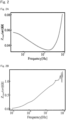
- Fig. 2 is a graph representing a relationship of an example of real part Z of AC impedance with respect to frequencies from a low frequency to a high frequency.
- Fig. 2A represents the relationship in a range of 1 Hz to 100 kHz
- Fig. 2B represents the relationship in a range of 100 kHz to 100 MHz.
- the AC impedance measured near 1 kHz has an ohmic resistance component.
- the detection device 11 detects the real part of the AC impedance at a frequency, namely in a high frequency band, at or in which the real part of the AC impedance is increased twice, 5 times, or 10 times, for example, in comparison with the ohmic resistance.
- the signal generator 14 may apply, to the cell 30, a signal in a high frequency band in which diffusion, reaction, movement, and so on of components of the lithium-ion secondary battery, such as lithium ions, cannot follow.
- the signal generator 14 may output a signal in a frequency band not lower than 100 kHz, more preferably at a frequency not lower than 200 kHz, or even more preferably at a frequency not lower than 250 kHz.
- the signal generator 14 may output a signal in a range not lower than 0.5 MHz and not higher than 5 MHz or a signal in a range not lower than 10 MHz and not higher than 100 MHz.
- degradation attributable to the deposition of the inert solid metal lithium and the presence of the foreign metal inside the cell 30, and so on can be determined by using the real part of the AC impedance in the range not lower than 0.5 MHz and not higher than 5 MHz.
- degradation attributable to the formation of the coating film can be determined by using the real part of the AC impedance in the range not lower than 10 MHz and not higher than 100 MHz.
- the measuring unit 15 measures at least one of voltage and current responses from the cell 30 corresponding to the signal output from the signal generator 14 to the cell 30.
- the control module 12 obtains the response(s) from the measuring unit 15 and can derive real part and imaginary part of AC impedance.
- the communication unit 16 is an interface for communication with an external device. The communication unit 16 performs communication with the external device, the management device 20 connected locally, and so on via an external network 17, such as the Internet, or a LAN.
- the management device 20 performs management of the cell 30 based on the information detected by the detection device 11.
- the management device 20 executes processing to set details of reclamation, exchange, and maintenance of the used cells 30 with a management module 21.
- the management module 21 is constituted as, for example, a CPU-centric microprocessor and controls the entirety of the device.
- the management device 20 may determine the cell 30 to be used in a limited field in recycling applications based on a remaining capacity of active lithium.
- the recycling applications include, for example, reuse in a prescribed usual application like an on-vehicle battery or a mobile battery, reuse depending on the degradation, such as a fixed-point power supply in which high output power is not necessary, and recycling by dismantling.
- the management device 20 may execute processing to quantify a remaining value of the lithium-ion secondary battery, including a remaining available time, based on the remaining capacity of the active lithium.
- the management device 20 may calculate a utility value of the cell 30 and output the calculated utility value.
- Fig. 3 is an explanatory view illustrating an example of an equivalent circuit model of the lithium-ion secondary battery. More specifically, Fig. 3A illustrates a mechanical structure model, Fig. 3B illustrates a full model of the equivalent circuit, Fig. 3C illustrates a simplified model of the equivalent circuit, and Fig. 3D illustrates a model of the equivalent circuit in terms of high-frequency function. Fig. 3D represents a model excluding parameters for which impedance can be regarded as substantially zero in terms of high-frequency function.
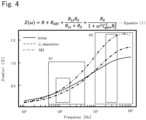
- Fig. 4 is a graph representing a relationship between the frequency and the impedance real part in degradation. Table 1 lists notes on various elements. Fig.
- FIG. 4 indicates results of impedance characteristics calculated by using the equivalent circuit model of Fig. 3 and an Equation (1).
- One of degradation patterns of the lithium-ion secondary battery is the deposition of the lithium metal inside the cell, and there is a concern that more deposition of the metal makes the battery more unsafe.
- three types of batteries namely, an initial battery, a battery having degraded with lithium deposition, and a battery having degraded with deposition of SEI (solid electrolyte interphase, also called a coating film), have been studied as representing the status of the lithium-ion secondary battery. As seen from a region A1 in Fig.
- a decrease in the real part of the AC impedance depending on an amount of the deposited lithium is confirmed in a range not lower than 0.5 MHz and a range not higher than 5 MHz, particularly in a range around 1 MHz.
- the battery having degraded with the SEI deposition it can be confirmed for the battery having degraded with the SEI deposition that, in the above-mentioned frequency ranges, the real part of the AC impedance is hardly changed in comparison with the initial battery.
- whether the battery degradation is caused by the lithium deposition or the formation of the coating film can be clearly distinguished based on the decrease in the real part of the AC impedance, for example, an amount of change in the real part.
- Fig. 4 represents the calculation results in accordance with the Equation (1)
- results having been measured by using a 18650 lithium-ion secondary battery also exhibits a similar tendency to that appearing in a waveform illustrated in Fig. 3 . This proves that the calculation results of Fig. 4 are true.
- Table 1 symbol name L a geometrical inductance of anode side L c geometrical inductance of cathode side L sum of L a and L c C geo geometrical capacitancce between anode and cathode CPE dla electrical double layer capacitance of anode side CPE dlc electrical double layer capacitance of cathode side CPE dl sum of CPE dla and CPE dlc R a parastic ohmic resistance of anode side R c parastic ohmic resistance of cathode side R sum of R a , R c and R s ur f R CTa charge transfer resistance of anode side R CTc charge transfer resistance of cathode side R CT sum of R CTa and R CTb R Li resistance of Lithium dendrite R S resitance of electrolyte R SEI resitance of SEI R sur f resitance of cathode surface film Z Wa Warburg impedance of an
- Equation (1) a value of the real part of the AC impedance at the high frequency can be expressed by the Equation (1) given below.
- R Li varying with the lithium metal deposition is denoted by R Li ( ⁇ ) to explicitly indicate frequency dependence
- R SEI varying with the SEI deposition is denoted by R SEI ( ⁇ ) to explicitly indicate frequency dependence ( ⁇ denotes an angular frequency).
- Equation (1) When parameters other than R Li (2 ⁇ f), R SEI ( ⁇ ), and R S , R S being a resistance parallel to R Li ( ⁇ ), are denoted by R etc because those parameters hardly cause impedance variations with the degradation, the Equation (1) can be rewritten into the following Equation (2) using R Li ( ⁇ ), R SEI ( ⁇ ), R S , and R etc . Assuming here the amount of the deposited metal lithium to be denoted by Q Li and the amount of the deposited SEI to be denoted by Q SEI , a relational expression between each of the amounts of both the depositions and impedance is given by the following Equation (3).
- ⁇ Li denotes a coefficient for converting Li impedance to the amount of the deposition
- ⁇ SEI denotes a coefficient for converting SEI impedance to the amount of the deposition
- R init SEI ( ⁇ ) denotes impedance corresponding to the initial SEI
- R degr SEI ( ⁇ ) denotes impedance corresponding to the SEI after the degradation.
- Equation (4) 0
- Q Li can be obtained from an impedance change between before and after the degradation by using the following Equation (6). Since Z init ( ⁇ ) and Z degr ( ⁇ ) are values obtainable with the measurement and ⁇ Li and R S take values specific to the materials and the shape of the battery, the amount of the deposited lithium can be estimated.
- Equation 9 Q SEI can be obtained from an impedance change between before and after the degradation by using the following Equation (9).
- Equation (9) k denotes a constant depending on a frequency ratio based on the skin effect of the lithium metal.
- Equation (10) is held because inactivated lithium is generated in the form of metal lithium and SEI.
- Q Li + Q SEI is obtained by acquiring the impedance at 1 MHz and the impedance at 20 MHz, and therefore the capacity degradation degree can be calculated.
- the amount of the deposited metal lithium can be estimated if ⁇ Cap and the impedance at 20 MHz are obtained. Accordingly, a proportion of the metal deposition in a degraded status can be estimated by using the results of impedance measurements in, for example, the above-mentioned two frequency bands.
- the detection method may include a detection step of detecting deposition of lithium and/or the presence of foreign metal inside the lithium-ion secondary battery by using the real part of the AC impedance at the frequency at which the real part of the AC impedance is increased 10 times or more than that at 1 kHz due to the skin effect.
- the detection method may include, prior to the detection step, an acquisition step of acquiring the real part of the AC impedance by applying, to the lithium-ion secondary battery, the frequency at which the real part of the AC impedance is increased 10 times or more than that at 1 kHz due to the skin effect.
- the detection step is described here mainly about the case of detecting the deposition of the inert solid metal lithium and detecting degradation of the battery.
- Fig. 5 is a flowchart illustrating an outline of arithmetic processing to detect a cell status, the arithmetic processing being incorporated in the control module 12. More specifically, Fig. 5A represents the arithmetic processing for the frequency region A1, and Fig. 5B represents the arithmetic processing for the frequency region A2.
- the control module 12 calculates the degradation degree of the cell 30 and the amount of the deposited metal lithium from the real part of the AC impedance in the high frequency band. Furthermore, because a resistance change caused by mixing of the foreign metal into the battery can be detected based on the above-described principle with respect to the deposition of the metal lithium, it is possible to perform inspection before shipment by using the detected information and to improve quality in a production process. As illustrated in Fig.
- the control module 12 executes processing to measure the real part of the AC impedance of the cell 30 in the frequency region A1, to derive an amount of change in the real part from an initial value, and to obtain the amount of the deposited metal lithium from the amount of change in the real part of the AC impedance by using a MAP acquired in advance (S10).
- the MAP can be set based on, for example, a relationship between the amount of change in the real part of the AC impedance and the amount of the deposited metal lithium, the relationship being empirically obtained in advance by experiences, for example.
- the control module 12 presents, for example, a safety rate of the target cell 30 based on the obtained amount of the deposited metal lithium. After the calculation in S10, as illustrated in Fig.
- the control module 12 executes processing to measure the real part of the AC impedance of the cell 30 in the frequency region A2 and to obtain a remaining capacity SOC from the real part of the AC impedance by using a MAP acquired in advance (S20).
- the MAP can be set based on, for example, a relationship between an amount of change in the real part of the AC impedance and the remaining capacity SOC, the relationship being empirically obtained in advance by experiences, for example.
- the control module 12 presents, for example, the safety rate and the remaining capacity SOC of the target cell 30, and so on.
- Fig. 6 is a flowchart illustrating an example of a status detection process routine executed by the control module 12 in the detection device 11.
- the routine is executed at timing of detecting the status of degradation of the cell 30. That timing may be set to, for example, timing when a routine start command is input by a worker, or timing after the lapse of a predetermined period (for example, one week or one month) during which the deterioration progresses up to a recognizable level.
- the control module 12 executes the routine with the aid of the signal generator 14 and the measuring unit 15.
- the control module 12 instructs the signal generator 14 to generate a signal of a particular frequency (S100) and instructs the measuring unit 15 to measure a voltage and/or a current that has been input to, output from, and reflected by the cell 30 (S110).
- the particular frequency may be set to the above-described frequency at which the real part of the AC impedance is increased 10 times or more than that at 1 kHz due to the skin effect, or the above-described high frequency, namely the frequency of 100 kHz or higher, at which diffusion, reaction, movement, and so on of the components of the lithium-ion secondary battery, such as the lithium ions, cannot follow.
- the control module 12 calculates the AC impedance from the measured voltage and/or current (S120) and compares a calculation result with reference data (S130).
- the control module acquires the real part of the AC impedance and further acquires, as an amount of change, a difference value between the acquired real part and the real part of the AC impedance of the cell 30 in an initial state.
- the reference data may be set to, for example, a prescribed range (e.g., a range S1 in Fig. 5A ) that is prescribed as a range of the amount of the deposited solid metal lithium where charge and discharge can be safely performed in the cell 30 in the degraded status.
- the control module 12 determines whether the obtained amount of change in the real part of the AC impedance is within the prescribed range (S140). If the obtained amount of change is within the prescribed range, the control module 12 stores, in the storage unit 13, the target cell 30 as a battery in which the amount of the deposited solid metal lithium is small (S150), and then ends the routine. On the other hand, if the amount of change in the real part of the AC impedance, obtained in S140, is outside the prescribed range, the control module 12 stores, in the storage unit 13, the target cell 30 as a battery in which the amount of the deposited solid metal lithium is large (S160), and then ends the routine.
- the control module 12 may output a determination result in S140 to a display unit (not illustrated) to be displayed on it.
- Fig. 7 is a flowchart illustrating an example of a pre-shipment inspection process routine executed by the control module 12 in the detection device 11.
- This routine is stored in the storage unit 13 and is executed when pre-shipment inspection is performed after manufacturing of the cell 30.
- this routine may be executed by the management module 21 in the management device 20.
- the control module 12 executes the above-described status detection process (S200) and determines whether the obtained amount of change in the real part of the AC impedance is within the prescribed range (S210).
- the control module 12 regards this result as indicating that no foreign metals are present inside the cell 30. Thus, the control module 12 outputs information indicating that shipment of the cell 30 is allowed (S220), and then ends the routine. On the other hand, if the obtained amount of change in the real part of the AC impedance is outside the prescribed range, the control module 12 regards this result as indicating that any foreign metal is present inside the cell 30. Thus, the control module 12 outputs information indicating that the target cell 30 should be transferred to recycling by dismantling (S230), and then ends the routine. The control module 12 may output the above information to be stored in the storage unit 13 or to be displayed on the display unit.
- the presence of the foreign metal inside the cell 30 can be determined when the amount of change in the real part of the AC impedance is outside the prescribed range. That cell 30 cannot be shipped, and hence it is transferred to, for example, recycling by dismantling for further utilization of resources.
- FIG. 8 is a flowchart illustrating an example of a reclamation determination process routine executed by the control module 12 in the detection device 11.
- This routine is stored in the storage unit 13 and is executed after the cell 30 has been used and collected for reclamation.
- this routine may be executed by the management module 21 in the management device 20.
- the control module 12 executes the above-described status detection process (S200) and derives a degradation degree from the acquired real part of the AC impedance (S300).
- the degradation degree can be derived from, for example, a relationship between the remaining capacity SOC obtained in the above-described S20 and the degradation degree, the relationship being empirically acquired in advance.
- the control module 12 determines whether the degradation degree is within a predetermined allowable range (S310).
- the predetermined allowable range may be set to, for example, a range (e.g., a range S2 in Fig. 5A ) that is empirically prescribed as a limit range of the amount of the deposited solid metal lithium, the limit range representing that charge and discharge cannot be safely performed in the cell 30 in the degraded status if the degradation degree exceeds the allowable range.
- the control module 12 outputs the information indicating that the target cell 30 should be transferred to recycling by dismantling (S320).
- the control module 12 may output the above information to be stored in the storage unit 13 or to be displayed on the display unit.
- the control module 12 determines whether the amount of the deposited solid metal lithium is within a prescribed range (S330).
- the amount of the deposited solid metal lithium can be obtained through the above-described process in S10.
- the prescribed range may be prescribed as a range (e.g., the range S1 in Fig. 5A ) of the amount of the deposited solid metal lithium where charge and discharge can be safely performed in the cell 30 in the degraded status. If the amount of the deposited solid metal lithium is within the prescribed range, the control module 12 outputs information indicating that the cell 30 should be reused in a usual application (S340), and then ends the routine.
- the control module 12 outputs information indicating that the cell 30 should be reused in an application corresponding to the degradation of the cell 30 (S350), and then ends the routine.
- the application corresponding to the degradation is, for example, the case that an on-vehicle battery for which a high output power in a short time is required is reused as a fixed power supply for housing, for example, in which high-rate performance is less likely to be demanded.
- using the detection device 11 makes it possible to grasp the degradation degree of the cell 30 and to grasp a more detailed status of the degradation such as whether the degradation is caused by the formation of the coating film on the electrode or by the deposition of the inert solid metal lithium on the electrode.
- the cell 30 in this embodiment corresponds to a "lithium-ion secondary battery” in the present disclosure.
- the detection device 11 corresponds to a “detection device”
- the management device 20 corresponds to a “management device”
- the control module 12 corresponds to a "control module”. Note that the description of the operation of the detection device 11 in this embodiment is further intended to clarify an example of the detection method according to the present disclosure.
- the embodiment described above can provide the novel detection device 11, management device 20, and detection method each capable of detecting the status of the lithium-ion secondary battery in detail.
- the reason why the present disclosure has the above-mentioned advantageous effect is inferred as follows.
- a decrease in resistance attributable to the lithium deposition can be captured at a high frequency at which diffusion, reaction, movement, and so on of the components of the lithium-ion secondary battery, such as the lithium ions, cannot follow, the high frequency being within a high frequency band (for example, the frequency band not lower than 100 kHz) in which measurement can be performed.
- a high frequency band for example, the frequency band not lower than 100 kHz
- the detection device 11 detects the deposition of lithium and/or the presence of foreign metal inside the lithium-ion secondary battery by using the real part of the AC impedance in the frequency band not lower than 100 kHz. Particularly, the deposition of the inert solid metal lithium and/or the presence of the foreign metal inside the lithium-ion secondary battery is detected based on a decrease in the real part of the AC impedance, the decrease being obtained in the frequency range not lower than 0.5 MHz and not higher than 5 MHz. Furthermore, the detection device 11 estimates the amount of the coating film deposited on the electrode based on an increase in the real part of the AC impedance, the increase being obtained in the frequency range not lower than 10 MHz, and detects the degradation caused by the formation of the coating film.
- the detection device 11 can more clearly distinguish the status of the degradation attributable to the deposition of the slid metal lithium and the status of the degradation attributable to the formation of the coating film by using a plurality of different frequency bands. By utilizing the information obtained as described above, the detection device 11 can more appropriately select the reuse application of the cell 30.
- the present disclosure is not limited to that case, and the detection device 11 may be applied to the battery management system 10 in which the cells 30 are connected directly, or the battery management system 10 in which the cells 30 are connected in parallel.
- Fig. 9 is an explanatory view illustrating an example of a data storage for lease of cells.
- Figs. 9 and 10 represent an example of service that can be provided by an administrator.
- the battery management system 10 to be implemented in cooperation with a management algorithm for managing battery lease
- lease service capable of managing safety in use can be provided.
- a battery lease system 500 acquires, from a customer, information such as the customer ID, the purpose of use, the date of use, service points, and the place of use.
- the battery lease system 500 further acquires information such as the battery ID, the remaining capacity SOC, the charged capacity, the status of lithium deposition, the status of degradation, and the place of use of a battery module after having been used.
- the battery lease system 500 can lease an appropriate battery module to the customer after executing setting of a price of the battery module to be leased, arrangement for matching with the customer, maintenance, and management for safety in use.
- Fig. 10 is an explanatory view illustrating an example of a data storage for sale of cells.
- the battery management system 10 to be implemented in cooperation with an algorithm for managing a degradation safety rate, resale service for reusable batteries can be built.
- a battery reuse system 510 acquires, from a customer, information such as the customer ID, the purpose of use, the date of use, service points, and the place of use.
- the battery reuse system 510 further acquires information such as the battery ID, the remaining capacity SOC, the charged capacity, the status of lithium deposition, the status of degradation, and the place of use of a battery module after having been used.
- the battery reuse system 510 can sale an appropriate reusable battery module to the customer after executing setting of a price of the battery module to be leased, arrangement for matching with the customer, maintenance, and management for safety in use.
- the management device 20 may execute the pre-shipment inspection process routine. Even in such a case, the result of detecting whether the foreign metal is present can be properly utilized.
- the management device 20 may execute the reclamation determination process routine. Even in such a case, the information regarding the deposition of the solid metal lithium can be properly used for determining reuse or recycling of the cell 30.
- Cylindrical 18650 lithium-ion secondary batteries being commercially available and using LiNi 1/3 Co 1/3 Mn 1/3 O 2 as the positive electrode active material and graphite as the negative electrode active material were degraded by using two types of degradation methods to prepare batteries that were brought into two different statuses of degradation.
- a first type of battery a plurality of batteries was prepared by repeating a charge-discharge cycle at 60°C and 0.5C such that the degradation degree relative to the initial capacity was reduced to about a level of 92% to 84%, the above cycle indicating a degradation condition under which the deposition of the inert solid metal lithium is very small.
- a plurality of batteries was prepared by repeating a charge-discharge cycle at 20°C and 2C such that the degradation degree relative to the initial capacity was reduced to a level of about 92% to 87%, the above cycle indicating a degradation condition under which the inert solid metal lithium is apt to deposit.
- the AC impedance was measured under the same conditions of the frequency range and the remaining capacity SOC as those of initial conditions.
- the initial impedance of the battery was measured in a range of 100 kHz to 100 MHz by using a network analyzer (E5061B available from Keysight Co.). Then, the impedance of each of the above-described degraded batteries was also measured in a similar manner.
- Measurement conditions were set to the remaining capacity SOC of 40% and the measurement temperature of 20°C.
- the difference between the measured initial real part and the measured real part after the degradation was calculated and obtained as an amount of change ⁇ Z re (m ⁇ ) in the real part of the AC impedance.
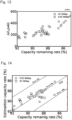
- Fig. 11 is a graph representing a relationship between a capacity remaining rate and an amount of change in the impedance real part at 100 kHz according to EXPERIMENTAL EXAMPLE 1.
- Fig. 12 is a graph representing a relationship between the capacity remaining rate and the amount of change in the impedance real part at 1.5 MHz according to EXPERIMENTAL EXAMPLE 1.
- Photos of electrodes after dismantling in the battery with a large amount of the deposited metal lithium and the battery with no deposition are attached to Fig. 12 .
- Fig. 13 is a graph representing a relationship between the capacity remaining rate and the amount of change in the impedance real part at 20 MHz according to EXPERIMENTAL EXAMPLE 1.
- Figs. 11 is a graph representing a relationship between a capacity remaining rate and an amount of change in the impedance real part at 100 kHz according to EXPERIMENTAL EXAMPLE 1.
- Fig. 12 is a graph representing a relationship between the capacity remaining
- the degraded battery with no deposition of the metal lithium is denoted by "o"
- the degraded battery with the deposition of the metal lithium is denoted by " ⁇ ”.
- the amount of change in the real part of the AC impedance at the frequency of 100 kHz exhibits no difference in resistance depending on whether the metal lithium is deposited, and a change in resistance cannot be observed.
- the value of the real part of the AC impedance is reduced only in the degraded battery with the deposition of the metal lithium.
- the status of the degradation caused by the deposition of the metal lithium can be detected separately from the status of the degradation caused by the formation of the SEI based on the amount of change in the real part of the AC impedance in the frequency band, for example, not lower than 0.5 MHz and not higher than 5 MHz.
- the change in resistance relative to the initial value of the real part of the AC impedance at 20 MHz indicates that the amount of change in the real part of the AC impedance varies depending on the amount of the coating film (SEI) formed on the electrode.
- the degradation caused by the formation of the SEI can be evaluated based on the amount of change in the real part of the AC impedance relative to the initial value in the frequency band in the range, for example, not lower than 10 MHz and not higher than 100 MHz.
- Fig. 14 is a graph representing a relationship between the capacity remaining rate (%) obtained from actual measurement of the degraded battery and the estimation capacity rate (%) obtained from the AC impedance.
- the estimation capacity rate is a value of the degradation degree calculated using the values of the real part of the impedance at 1 MHz and 20 MHz. As seen from Fig. 14 , an error between the capacity remaining rate (%) measured actually and the estimation capacity rate (%) given as the calculation result is within 13%, and the degradation degree can also be obtained with high reliability by calculation.
- the detection device, the management device, and the detection method disclosed in this description can be utilized in the technical field of detecting the status of the lithium-ion secondary battery.
- 10 battery management system 11 detection device, 12 control module, 13 storage unit, 14 signal generator, 15 measuring unit, 16 communication unit, 17 external network, 20 management device, 21 management module, 30 cell, 500 battery lease system, and 510 battery reuse system.
Landscapes
- Chemical & Material Sciences (AREA)
- Chemical Kinetics & Catalysis (AREA)
- Electrochemistry (AREA)
- Engineering & Computer Science (AREA)
- General Physics & Mathematics (AREA)
- Physics & Mathematics (AREA)
- Manufacturing & Machinery (AREA)
- General Chemical & Material Sciences (AREA)
- Immunology (AREA)
- Health & Medical Sciences (AREA)
- Life Sciences & Earth Sciences (AREA)
- Analytical Chemistry (AREA)
- Biochemistry (AREA)
- General Health & Medical Sciences (AREA)
- Pathology (AREA)
- Power Engineering (AREA)
- Secondary Cells (AREA)
- Charge And Discharge Circuits For Batteries Or The Like (AREA)
- Tests Of Electric Status Of Batteries (AREA)
Abstract
Description
- This description discloses a detection device, a management device, and a detection method.
- Until now, as a degradation determination method for a lithium secondary battery, there has been proposed a method of discharging the battery to a state with SOC of 10% or below and detecting a battery status based on a measured value of impedance of the battery under measurement (see, for example, Patent Literature 1). According to
Patent Literature 1, the proposed detection method can simply and highly accurately detect the status of the lithium secondary battery. Another proposal is a method of calculating an inclination angle in linear approximation of complex impedances at two or more different frequencies within a diffusion region of the secondary battery, determining the battery to be normal in capacity balance if the inclination angle is not less than a threshold, and determining the battery to be abnormal for the reason of imbalance in capacity if the inclination angle is less than the threshold (see, for example, Patent Literature 2). According toPatent Literature 2, the proposed detection method can highly accurately detect a status of the battery, especially whether the battery is normal or abnormal and a degradation degree of the battery by a complex impedance analysis of the battery. Still another proposal is a method of detecting a change in status of a constituent member of the battery based on a change in peak of a relaxation time in a frequency band appearing in an arc shape on a Nyquist plot that is obtained from a measurement result of AC (alternating current) impedance (see, for example, Patent Literature 3). According toPatent Literature 3, the proposed detection method can analyze an internal status or a change in the status of the battery. -
- PTL 1:
JP 2012-212513 A - PTL 2:
WO 2013/115038 A1 - PTL 3:
WO 2017/179266 A1 - Although the above-described
Patent Literatures 1 to 3 aim to detect a status of degradation of the lithium-ion secondary battery, the status of the battery degradation includes, for example, degradation accompanied by deposition of lithium metal and degradation not accompanied by the deposition of the lithium metal, andPatent Literatures 1 to 3 cannot detect those detailed statuses. For example, althoughPatent Literature 1 estimates an amount of deposited lithium from a reaction resistance value, the reaction resistance value is a parameter affecting not only the amount of the deposited lithium, but also an amount of a coating film formed, and it seems difficult to say thatPatent Literature 1 can accurately diagnose the deposited lithium. Furthermore, althoughPatent Literature 2 intends to determine whether the capacity balance is normal or abnormal based on frequency differentiation of the two or more complex impedances,Patent Literature 2 does not take into consideration, for example, detection of deposition of the lithium metal. Moreover, althoughPatent Literature 3 intends to obtain the peak of the relaxation time from the Nyquist plot of the AC impedance and to estimate the amount of the coating film formed on an electrode, the frequency band used is at low frequencies of 10 mHz to 10 kHz, for example, and a difficulty arises in separating the amount of the deposited lithium and the amount of the formed coating film. Thus, a technique of detecting the status of the degradation of the lithium-ion secondary battery in detail is demanded. - The present disclosure has been made in view of the above-described problems, and a main object of the present disclosure is to provide a novel detection device, management device, and detection method each capable of detecting the status of the lithium-ion secondary battery in detail.
- As a result of intensive studies aiming at achievement of the above-mentioned object, the inventors have found that a battery status, such as the presence of lithium metal and foreign metal and formation of a coating film inside the lithium-ion secondary battery, can be examined in detail from AC impedance characteristics of the lithium-ion secondary battery in a particular frequency band, and have succeeded in accomplishing the invention disclosed in this description.
- A detection device disclosed in this description is a detection device for detecting a status of a lithium-ion secondary battery, the detection device including:
a control module that acquires real part of AC impedance at a frequency at which the real part of the AC impedance is increased 10 times or more than the real part of the AC impedance at 1 kHz due to a skin effect, and that detects deposition of lithium and/or the presence of foreign metal inside the lithium-ion secondary battery by using the acquired real part of the AC impedance. - A management device disclosed in this description is a management device for managing the lithium-ion secondary battery based on information obtained from the above-described detection device, the management device including:
a management module that sets a recycle application of the lithium-ion secondary battery by using a detection result of lithium deposition inside the lithium-ion secondary battery, the detection result being output from the control module. - Alternatively, a management device disclosed in this description is a management device for managing the lithium-ion secondary battery based on information obtained from the above-described detection device, the management device including:
a management module that sets whether to ship the lithium-ion secondary battery by using a detection result of the presence of foreign metal inside the lithium-ion secondary battery, the detection result being output from the control module. - A detection method disclosed in this description is a detection method of detecting a status of a lithium-ion secondary battery, the detection method including the step of:
detecting deposition of lithium and/or the presence of foreign metal inside the lithium-ion secondary battery by using real part of AC impedance at a frequency at which the real part of the AC impedance is increased 10 times or more than the real part of the AC impedance at 1 kHz due to a skin effect. - According to the present disclosure, the novel detection device, management device, and detection method each capable of detecting the status of the lithium-ion secondary battery in detail can be provided. The reason why the present disclosure has the above-mentioned advantageous effect is inferred as follows. For example, a decrease in resistance attributable to the lithium deposition can be captured at a high frequency at which diffusion, reaction, movement, and so on of components of the lithium-ion secondary battery, such as lithium ions, cannot follow, the high frequency being within a high frequency band (for example, a frequency band not lower than 100 kHz) in which measurement can be performed. It is also inferred that, in such a high frequency band, the measurement is not affected by degradation caused by diffusion, reaction, movement, and so on of other components than the lithium ions and has sensitivity for only metal deposition. The frequencies of the AC impedance substantially studied in
Patent Literatures 1 to 3 are in a range not higher than 10 kHz and is 1/1000 or less than the frequency used in the present disclosure at which the real part of the AC impedance is increased 10 times or more due to the skin effect. In other words, obtained information is different at frequencies used. -
-
Fig. 1 is an explanatory view illustrating an example of abattery management system 10. -
Fig. 2 is a graph representing an example of a relationship of real part Z of AC impedance with respect to frequency. -
Fig. 3 is an explanatory view illustrating an example of an equivalent circuit model. -
Fig. 4 is a graph representing a relationship between the frequency and the impedance real part in degradation. -
Fig. 5 is a flowchart illustrating an outline of arithmetic processing to detect a cell status. -
Fig. 6 is a flowchart illustrating an example of a status detection process routine. -
Fig. 7 is a flowchart illustrating an example of a pre-shipment inspection process routine. -
Fig. 8 is a flowchart illustrating an example of a reclamation determination process routine. -
Fig. 9 is an explanatory view illustrating an example of a data storage for lease of cells. -
Fig. 10 is an explanatory view illustrating an example of a data storage for sale of cells. -
Fig. 11 is a graph representing a relationship between a capacity remaining rate and an amount of change in the impedance real part at 100 kHz. -
Fig. 12 is a graph representing a relationship between the capacity remaining rate and the amount of change in the impedance real part at 1.5 MHz. -
Fig. 13 is a graph representing a relationship between the capacity remaining rate and the amount of change in the impedance real part at 20 MHz. -
Fig. 14 is a graph representing a relationship between the capacity remaining rate and an estimation capacity rate. Description of Embodiments - An embodiment of a detection device disclosed in this description will be described below with reference to the drawings.
Fig. 1 is a schematic explanatory view illustrating an example of abattery management system 10. Thebattery management system 10 is, for example, a system for executing management of sale and use of a lithium-ion secondary battery (cell 30) manufactured. Thebattery management system 10 includes adetection device 11 and amanagement device 20. - First, the
cell 30 as a measurement target is described. Thecell 30 is constituted as the lithium-ion secondary battery. Thecell 30 may include, for example, a positive electrode, a negative electrode, and an ion conducting medium that is disposed between the positive electrode and the negative electrode and that conducts carrier ions. The positive electrode may contain, as a positive electrode active material, a carbide containing a transition metal element, an oxide containing lithium and a transition metal element, or the like. The positive electrode active material can be made of, for example, a lithium manganese composite oxide expressed by a basic composition formula such as Li(1-x)MnO2 (e.g., 0 < x < 1, this is similarly applied to the following description) or Li(1-x)Mn2O4, a lithium cobalt composite oxide expressed by a basic composition formula such as Li(1-x)CoO2, a lithium nickel composite oxide expressed by a basic composition formula such as Li(1-x)NiO2, or a lithium nickel cobalt manganese composite oxide expressed by a basic composition formula such as Li(1-x)NiaCobMncO2 (a + b + c = 1) . The term "basic composition formula" indicates that the material may contain one or more other elements. The negative electrode may contain, as a negative electrode active material, a carbon material, a composite oxide containing lithium, or the like. The negative electrode active material may be, for example, lithium, an inorganic compound such as a lithium alloy or a tin compound, a carbon material capable of occluding and releasing lithium ions, a composite oxide containing a plurality of elements, or a conductive polymer. Examples of the carbon material may be cokes, glassy carbons, graphites, non-graphitizable carbons, pyrolytic carbons, carbon fibers, and so on. Among those examples, the graphites such as artificial graphite and natural graphite are preferable. Examples of the composite oxide may be a lithium titanium composite oxide, a lithium vanadium composite oxide, and so on. The ion conducting medium can be given as, for example, an electrolyte solution in which support salt is dissolved. The support salt may be, for example, lithium salt such as LiPF6 or LiBF4. Examples of a solvent for the electrolyte solution may be carbonates, esters, ethers, nitriles, furans, sulfolanes, dioxolanes, and so on. Those examples can be used solely or in combination. More specifically, the carbonates may be, for example, cyclic carbonates such as ethylene carbonate, propylene carbonate, vinylene carbonate, butylene carbonate, and chloroethylene carbonate, or chain carbonates such as dimethyl carbonate, ethyl methyl carbonate, diethyl carbonate, ethyl-n-butyl carbonate, methyl-t-butyl carbonate, di-i-propyl carbonate, and t-butyl-i-propyl carbonate. The ion conducting medium can be made of, for example, a solid ion-conducting polymer, an inorganic solid electrolyte, a mixed material of an organic polymer electrolyte and an inorganic solid electrolyte, or inorganic solid powders bound together by an organic binder. In the solid electrolyte or thepower storage device 13, a separator may be disposed between the positive electrode and the negative electrode. - The
detection device 11 detects a status of degradation of the lithium-ion secondary battery, for example, the presence of a deposit of inert lithium metal and foreign metal inside thecell 30 and a status of formation of a coating film. Thedetection device 11 includes acontrol module 12, astorage unit 13, asignal generator 14, a measuringunit 15, and acommunication unit 16. Thecontrol module 12 is constituted as, for example, a CPU-centric microprocessor and controls the entirety of the device. Thecontrol module 12 outputs signals to thestorage unit 13, thesignal generator 14, and thecommunication unit 16 and receives signals from thestorage unit 13, the measuringunit 15, and thecommunication unit 16. Thecontrol module 12 detects at least one of a status of deposition of solid metal lithium and the presence of the foreign metal inside thecell 30 by using information about real part of AC impedance, the information being obtained from the measuringunit 15. Thestorage unit 13 is constituted as, for example, a storage device with a large capacity, such as a HDD, and stores information of measurement results and programs for use in inspection of thecell 30. Thesignal generator 14 generates a signal of a predetermined frequency at which the real part of the AC impedance is increased 10 times or more than that at 1 kHz due to a skin effect and applies the generated signal of the predetermined frequency to thecell 30. The predetermined frequency for use in detecting the real part of the AC impedance may be set to, for example, a range higher than 10 kHz or a range not lower than 100 kHz.Fig. 2 is a graph representing a relationship of an example of real part Z of AC impedance with respect to frequencies from a low frequency to a high frequency.Fig. 2A represents the relationship in a range of 1 Hz to 100 kHz, andFig. 2B represents the relationship in a range of 100 kHz to 100 MHz. The AC impedance measured near 1 kHz has an ohmic resistance component. Thedetection device 11 detects the real part of the AC impedance at a frequency, namely in a high frequency band, at or in which the real part of the AC impedance is increased twice, 5 times, or 10 times, for example, in comparison with the ohmic resistance. Thesignal generator 14 may apply, to thecell 30, a signal in a high frequency band in which diffusion, reaction, movement, and so on of components of the lithium-ion secondary battery, such as lithium ions, cannot follow. In an example, thesignal generator 14 may output a signal in a frequency band not lower than 100 kHz, more preferably at a frequency not lower than 200 kHz, or even more preferably at a frequency not lower than 250 kHz. Thesignal generator 14 may output a signal in a range not lower than 0.5 MHz and not higher than 5 MHz or a signal in a range not lower than 10 MHz and not higher than 100 MHz. For example, degradation attributable to the deposition of the inert solid metal lithium and the presence of the foreign metal inside thecell 30, and so on can be determined by using the real part of the AC impedance in the range not lower than 0.5 MHz and not higher than 5 MHz. As another example, degradation attributable to the formation of the coating film can be determined by using the real part of the AC impedance in the range not lower than 10 MHz and not higher than 100 MHz. The measuringunit 15 measures at least one of voltage and current responses from thecell 30 corresponding to the signal output from thesignal generator 14 to thecell 30. Thecontrol module 12 obtains the response(s) from the measuringunit 15 and can derive real part and imaginary part of AC impedance. Thecommunication unit 16 is an interface for communication with an external device. Thecommunication unit 16 performs communication with the external device, themanagement device 20 connected locally, and so on via anexternal network 17, such as the Internet, or a LAN. - The
management device 20 performs management of thecell 30 based on the information detected by thedetection device 11. Themanagement device 20 executes processing to set details of reclamation, exchange, and maintenance of the usedcells 30 with amanagement module 21. Themanagement module 21 is constituted as, for example, a CPU-centric microprocessor and controls the entirety of the device. In an example, by using a result of detecting the status of the deposition of the solid metal lithium inside thecell 30, the result being output from thedetection device 11, themanagement device 20 may determine thecell 30 to be used in a limited field in recycling applications based on a remaining capacity of active lithium. The recycling applications include, for example, reuse in a prescribed usual application like an on-vehicle battery or a mobile battery, reuse depending on the degradation, such as a fixed-point power supply in which high output power is not necessary, and recycling by dismantling. Moreover, by using the result of detecting the status of the deposition of the solid metal lithium inside thecell 30, the result being output from thedetection device 11, themanagement device 20 may execute processing to quantify a remaining value of the lithium-ion secondary battery, including a remaining available time, based on the remaining capacity of the active lithium. Alternatively, by using the result of detecting the status of the deposition of the solid metal lithium inside thecell 30, the result being output from thedetection device 11, themanagement device 20 may calculate a utility value of thecell 30 and output the calculated utility value. - The operation principle of the
detection device 11 is now described.Fig. 3 is an explanatory view illustrating an example of an equivalent circuit model of the lithium-ion secondary battery. More specifically,Fig. 3A illustrates a mechanical structure model,Fig. 3B illustrates a full model of the equivalent circuit,Fig. 3C illustrates a simplified model of the equivalent circuit, andFig. 3D illustrates a model of the equivalent circuit in terms of high-frequency function.Fig. 3D represents a model excluding parameters for which impedance can be regarded as substantially zero in terms of high-frequency function.Fig. 4 is a graph representing a relationship between the frequency and the impedance real part in degradation. Table 1 lists notes on various elements.Fig. 4 indicates results of impedance characteristics calculated by using the equivalent circuit model ofFig. 3 and an Equation (1). One of degradation patterns of the lithium-ion secondary battery is the deposition of the lithium metal inside the cell, and there is a concern that more deposition of the metal makes the battery more unsafe. Here, three types of batteries, namely, an initial battery, a battery having degraded with lithium deposition, and a battery having degraded with deposition of SEI (solid electrolyte interphase, also called a coating film), have been studied as representing the status of the lithium-ion secondary battery. As seen from a region A1 inFig. 4 , a decrease in the real part of the AC impedance depending on an amount of the deposited lithium is confirmed in a range not lower than 0.5 MHz and a range not higher than 5 MHz, particularly in a range around 1 MHz. On the other hand, it can be confirmed for the battery having degraded with the SEI deposition that, in the above-mentioned frequency ranges, the real part of the AC impedance is hardly changed in comparison with the initial battery. Thus, whether the battery degradation is caused by the lithium deposition or the formation of the coating film can be clearly distinguished based on the decrease in the real part of the AC impedance, for example, an amount of change in the real part. Moreover, an increase in the impedance depending on an amount of the deposited SEI can be confirmed in a range not lower than 10 MHz and a range not higher than 100 MHz, particularly in a region A2 around 20 MHz. Thus, it is inferred that, in the above-mentioned frequency ranges, an influence of the degradation with the SEI deposition appears more significantly than that of the degradation with the lithium deposition. WhileFig. 4 represents the calculation results in accordance with the Equation (1), results having been measured by using a 18650 lithium-ion secondary battery also exhibits a similar tendency to that appearing in a waveform illustrated inFig. 3 . This proves that the calculation results ofFig. 4 are true.Table 1 symbol name La geometrical inductance of anode side Lc geometrical inductance of cathode side L sum of La and Lc Cgeo geometrical capacitancce between anode and cathode CPEdla electrical double layer capacitance of anode side CPEdlc electrical double layer capacitance of cathode side CPEdl sum of CPEdla and CPEdlc Ra parastic ohmic resistance of anode side Rc parastic ohmic resistance of cathode side R sum of Ra , Rc and Rs ur f RCTa charge transfer resistance of anode side RCTc charge transfer resistance of cathode side RCT sum of RCTa and RCTb RLi resistance of Lithium dendrite RS resitance of electrolyte RSEI resitance of SEI Rsur f resitance of cathode surface film ZWa Warburg impedance of anode side ZWc Warburg impedance of cathode side ZW sum of ZWa and ZWc - As seen from
Fig. 3D , a value of the real part of the AC impedance at the high frequency can be expressed by the Equation (1) given below. Here, RLi varying with the lithium metal deposition is denoted by RLi(ω) to explicitly indicate frequency dependence, and RSEI varying with the SEI deposition is denoted by RSEI(ω) to explicitly indicate frequency dependence (ω denotes an angular frequency). When parameters other than RLi(2πf), RSEI(ω), and RS, RS being a resistance parallel to RLi(ω), are denoted by Retc because those parameters hardly cause impedance variations with the degradation, the Equation (1) can be rewritten into the following Equation (2) using RLi(ω), RSEI(ω), RS, and Retc. Assuming here the amount of the deposited metal lithium to be denoted by QLi and the amount of the deposited SEI to be denoted by QSEI, a relational expression between each of the amounts of both the depositions and impedance is given by the following Equation (3). Here, αLi denotes a coefficient for converting Li impedance to the amount of the deposition, αSEI denotes a coefficient for converting SEI impedance to the amount of the deposition, Rinit SEI(ω) denotes impedance corresponding to the initial SEI, and Rdegr SEI (ω) denotes impedance corresponding to the SEI after the degradation. The reason why the equation regarding the SEI includes subtraction resides in that the SEI is already formed in the initial battery and is observed as impedance. Since the metal lithium is not deposited in the initial battery and QLi = 0 is held, Rinit SEI (ω) = ∞ is held (Rinit Li (ω) denotes initial lithium impedance) . Furthermore, RSEI(ω) = 0 is assumed because the SEI hardly causes a dielectric saturation loss when the frequency is about 1 MHz. In this case, initial impedance Zinit(ω) and impedance Zdegr(ω) after the degradation around 1 MHz can be expressed by the following Equations (4) and (5), respectively. Here, QLi can be obtained from an impedance change between before and after the degradation by using the following Equation (6). Since Zinit(ω) and Zdegr(ω) are values obtainable with the measurement and αLi and RS take values specific to the materials and the shape of the battery, the amount of the deposited lithium can be estimated. Moreover, impedances in the initial state and after the degradation around 20 MHz can be expressed, respectively, by the following Equations (7) and (8). As in the above-described case, QSEI can be obtained from an impedance change between before and after the degradation by using the following Equation (9). In the Equation (9), k denotes a constant depending on a frequency ratio based on the skin effect of the lithium metal. On condition of 1 MHz (= ω1), k = √(ω2/ω1) is given because the ratio indicates comparison with 20 MHz (= ω2). Assuming a capacity degradation degree of the battery to be ΔCap, the following Equation (10) is held because inactivated lithium is generated in the form of metal lithium and SEI. In the Equation (10), QLi + QSEI is obtained by acquiring the impedance at 1 MHz and the impedance at 20 MHz, and therefore the capacity degradation degree can be calculated. Likewise, the amount of the deposited metal lithium can be estimated if ΔCap and the impedance at 20 MHz are obtained. Accordingly, a proportion of the metal deposition in a degraded status can be estimated by using the results of impedance measurements in, for example, the above-mentioned two frequency bands.
Math. 1



- An operation of the above-described
detection device 11 according to this embodiment, especially, a method of detecting the status of the lithium-ion secondary battery, the method being executed by thedetection device 11, will be described below. The detection method may include a detection step of detecting deposition of lithium and/or the presence of foreign metal inside the lithium-ion secondary battery by using the real part of the AC impedance at the frequency at which the real part of the AC impedance is increased 10 times or more than that at 1 kHz due to the skin effect. Furthermore, the detection method may include, prior to the detection step, an acquisition step of acquiring the real part of the AC impedance by applying, to the lithium-ion secondary battery, the frequency at which the real part of the AC impedance is increased 10 times or more than that at 1 kHz due to the skin effect. For convenience of explanation, the detection step is described here mainly about the case of detecting the deposition of the inert solid metal lithium and detecting degradation of the battery. -
Fig. 5 is a flowchart illustrating an outline of arithmetic processing to detect a cell status, the arithmetic processing being incorporated in thecontrol module 12. More specifically,Fig. 5A represents the arithmetic processing for the frequency region A1, andFig. 5B represents the arithmetic processing for the frequency region A2. Thecontrol module 12 calculates the degradation degree of thecell 30 and the amount of the deposited metal lithium from the real part of the AC impedance in the high frequency band. Furthermore, because a resistance change caused by mixing of the foreign metal into the battery can be detected based on the above-described principle with respect to the deposition of the metal lithium, it is possible to perform inspection before shipment by using the detected information and to improve quality in a production process. As illustrated inFig. 5A , thecontrol module 12 executes processing to measure the real part of the AC impedance of thecell 30 in the frequency region A1, to derive an amount of change in the real part from an initial value, and to obtain the amount of the deposited metal lithium from the amount of change in the real part of the AC impedance by using a MAP acquired in advance (S10). The MAP can be set based on, for example, a relationship between the amount of change in the real part of the AC impedance and the amount of the deposited metal lithium, the relationship being empirically obtained in advance by experiences, for example. In addition, thecontrol module 12 presents, for example, a safety rate of thetarget cell 30 based on the obtained amount of the deposited metal lithium. After the calculation in S10, as illustrated inFig. 5B , thecontrol module 12 executes processing to measure the real part of the AC impedance of thecell 30 in the frequency region A2 and to obtain a remaining capacity SOC from the real part of the AC impedance by using a MAP acquired in advance (S20). The MAP can be set based on, for example, a relationship between an amount of change in the real part of the AC impedance and the remaining capacity SOC, the relationship being empirically obtained in advance by experiences, for example. Moreover, thecontrol module 12 presents, for example, the safety rate and the remaining capacity SOC of thetarget cell 30, and so on. - More detailed processing in the
detection device 11 will be described below.Fig. 6 is a flowchart illustrating an example of a status detection process routine executed by thecontrol module 12 in thedetection device 11. The routine is executed at timing of detecting the status of degradation of thecell 30. That timing may be set to, for example, timing when a routine start command is input by a worker, or timing after the lapse of a predetermined period (for example, one week or one month) during which the deterioration progresses up to a recognizable level. Thecontrol module 12 executes the routine with the aid of thesignal generator 14 and the measuringunit 15. Upon start of the routine, thecontrol module 12 instructs thesignal generator 14 to generate a signal of a particular frequency (S100) and instructs the measuringunit 15 to measure a voltage and/or a current that has been input to, output from, and reflected by the cell 30 (S110). The particular frequency may be set to the above-described frequency at which the real part of the AC impedance is increased 10 times or more than that at 1 kHz due to the skin effect, or the above-described high frequency, namely the frequency of 100 kHz or higher, at which diffusion, reaction, movement, and so on of the components of the lithium-ion secondary battery, such as the lithium ions, cannot follow. - Then, the
control module 12 calculates the AC impedance from the measured voltage and/or current (S120) and compares a calculation result with reference data (S130). The control module acquires the real part of the AC impedance and further acquires, as an amount of change, a difference value between the acquired real part and the real part of the AC impedance of thecell 30 in an initial state. The reference data may be set to, for example, a prescribed range (e.g., a range S1 inFig. 5A ) that is prescribed as a range of the amount of the deposited solid metal lithium where charge and discharge can be safely performed in thecell 30 in the degraded status. Then, thecontrol module 12 determines whether the obtained amount of change in the real part of the AC impedance is within the prescribed range (S140). If the obtained amount of change is within the prescribed range, thecontrol module 12 stores, in thestorage unit 13, thetarget cell 30 as a battery in which the amount of the deposited solid metal lithium is small (S150), and then ends the routine. On the other hand, if the amount of change in the real part of the AC impedance, obtained in S140, is outside the prescribed range, thecontrol module 12 stores, in thestorage unit 13, thetarget cell 30 as a battery in which the amount of the deposited solid metal lithium is large (S160), and then ends the routine. Here, thecontrol module 12 may output a determination result in S140 to a display unit (not illustrated) to be displayed on it. - An evaluation process for the
cell 30, executed by using the detection result of the status detection process routine for thecell 30, will be described below.Fig. 7 is a flowchart illustrating an example of a pre-shipment inspection process routine executed by thecontrol module 12 in thedetection device 11. This routine is stored in thestorage unit 13 and is executed when pre-shipment inspection is performed after manufacturing of thecell 30. As an alternative, this routine may be executed by themanagement module 21 in themanagement device 20. Upon start of the routine, thecontrol module 12 executes the above-described status detection process (S200) and determines whether the obtained amount of change in the real part of the AC impedance is within the prescribed range (S210). If the obtained amount of change in the real part of the AC impedance is within the prescribed range, thecontrol module 12 regards this result as indicating that no foreign metals are present inside thecell 30. Thus, thecontrol module 12 outputs information indicating that shipment of thecell 30 is allowed (S220), and then ends the routine. On the other hand, if the obtained amount of change in the real part of the AC impedance is outside the prescribed range, thecontrol module 12 regards this result as indicating that any foreign metal is present inside thecell 30. Thus, thecontrol module 12 outputs information indicating that thetarget cell 30 should be transferred to recycling by dismantling (S230), and then ends the routine. Thecontrol module 12 may output the above information to be stored in thestorage unit 13 or to be displayed on the display unit. Because the solid metal lithium generated due to charge and discharge is not present inside thecell 30 immediately after manufacturing, the presence of the foreign metal inside thecell 30 can be determined when the amount of change in the real part of the AC impedance is outside the prescribed range. Thatcell 30 cannot be shipped, and hence it is transferred to, for example, recycling by dismantling for further utilization of resources. - A selection process for the reuse application of the
cell 30, executed by using the detection result of the status detection process routine for thecell 30, will be described below.Fig. 8 is a flowchart illustrating an example of a reclamation determination process routine executed by thecontrol module 12 in thedetection device 11. This routine is stored in thestorage unit 13 and is executed after thecell 30 has been used and collected for reclamation. As an alternative, this routine may be executed by themanagement module 21 in themanagement device 20. Upon start of the routine, thecontrol module 12 executes the above-described status detection process (S200) and derives a degradation degree from the acquired real part of the AC impedance (S300). The degradation degree can be derived from, for example, a relationship between the remaining capacity SOC obtained in the above-described S20 and the degradation degree, the relationship being empirically acquired in advance. - Then, the
control module 12 determines whether the degradation degree is within a predetermined allowable range (S310). The predetermined allowable range may be set to, for example, a range (e.g., a range S2 inFig. 5A ) that is empirically prescribed as a limit range of the amount of the deposited solid metal lithium, the limit range representing that charge and discharge cannot be safely performed in thecell 30 in the degraded status if the degradation degree exceeds the allowable range. If the degradation degree is outside the allowable range, thecontrol module 12 outputs the information indicating that thetarget cell 30 should be transferred to recycling by dismantling (S320). Thecontrol module 12 may output the above information to be stored in thestorage unit 13 or to be displayed on the display unit. On the other hand, if the degradation degree is within the allowable range in S310, thecontrol module 12 determines whether the amount of the deposited solid metal lithium is within a prescribed range (S330). The amount of the deposited solid metal lithium can be obtained through the above-described process in S10. The prescribed range may be prescribed as a range (e.g., the range S1 inFig. 5A ) of the amount of the deposited solid metal lithium where charge and discharge can be safely performed in thecell 30 in the degraded status. If the amount of the deposited solid metal lithium is within the prescribed range, thecontrol module 12 outputs information indicating that thecell 30 should be reused in a usual application (S340), and then ends the routine. On the other hand, if the amount of the deposited solid metal lithium is outside the prescribed range, thecontrol module 12 outputs information indicating that thecell 30 should be reused in an application corresponding to the degradation of the cell 30 (S350), and then ends the routine. The application corresponding to the degradation is, for example, the case that an on-vehicle battery for which a high output power in a short time is required is reused as a fixed power supply for housing, for example, in which high-rate performance is less likely to be demanded. As described above, using thedetection device 11 makes it possible to grasp the degradation degree of thecell 30 and to grasp a more detailed status of the degradation such as whether the degradation is caused by the formation of the coating film on the electrode or by the deposition of the inert solid metal lithium on the electrode. - Correspondence between constituent elements in this embodiment and constituent elements in the present disclosure is clarified here. The
cell 30 in this embodiment corresponds to a "lithium-ion secondary battery" in the present disclosure. Thedetection device 11 corresponds to a "detection device", themanagement device 20 corresponds to a "management device", and thecontrol module 12 corresponds to a "control module". Note that the description of the operation of thedetection device 11 in this embodiment is further intended to clarify an example of the detection method according to the present disclosure. - The embodiment described above can provide the
novel detection device 11,management device 20, and detection method each capable of detecting the status of the lithium-ion secondary battery in detail. The reason why the present disclosure has the above-mentioned advantageous effect is inferred as follows. For example, a decrease in resistance attributable to the lithium deposition can be captured at a high frequency at which diffusion, reaction, movement, and so on of the components of the lithium-ion secondary battery, such as the lithium ions, cannot follow, the high frequency being within a high frequency band (for example, the frequency band not lower than 100 kHz) in which measurement can be performed. It is also inferred that, in such a high frequency band, the measurement is not affected by degradation caused by diffusion, reaction, movement, and so on of other components than the lithium ions and has sensitivity for only the metal deposition. - Furthermore, the
detection device 11 detects the deposition of lithium and/or the presence of foreign metal inside the lithium-ion secondary battery by using the real part of the AC impedance in the frequency band not lower than 100 kHz. Particularly, the deposition of the inert solid metal lithium and/or the presence of the foreign metal inside the lithium-ion secondary battery is detected based on a decrease in the real part of the AC impedance, the decrease being obtained in the frequency range not lower than 0.5 MHz and not higher than 5 MHz. Furthermore, thedetection device 11 estimates the amount of the coating film deposited on the electrode based on an increase in the real part of the AC impedance, the increase being obtained in the frequency range not lower than 10 MHz, and detects the degradation caused by the formation of the coating film. Thus, thedetection device 11 can more clearly distinguish the status of the degradation attributable to the deposition of the slid metal lithium and the status of the degradation attributable to the formation of the coating film by using a plurality of different frequency bands. By utilizing the information obtained as described above, thedetection device 11 can more appropriately select the reuse application of thecell 30. - It is needless to say that the present disclosure is not limited to the above-described embodiment and can be implemented in various forms insofar as falling within the technical scope of the present disclosure.
- While the above embodiment is described in connection with the
battery management system 10 including onecell 30, the present disclosure is not limited to that case, and thedetection device 11 may be applied to thebattery management system 10 in which thecells 30 are connected directly, or thebattery management system 10 in which thecells 30 are connected in parallel. -
Fig. 9 is an explanatory view illustrating an example of a data storage for lease of cells.Figs. 9 and 10 represent an example of service that can be provided by an administrator. Assuming, for example, thebattery management system 10 to be implemented in cooperation with a management algorithm for managing battery lease, lease service capable of managing safety in use can be provided. As illustrated inFig. 9 , abattery lease system 500 acquires, from a customer, information such as the customer ID, the purpose of use, the date of use, service points, and the place of use. Thebattery lease system 500 further acquires information such as the battery ID, the remaining capacity SOC, the charged capacity, the status of lithium deposition, the status of degradation, and the place of use of a battery module after having been used. Then, thebattery lease system 500 can lease an appropriate battery module to the customer after executing setting of a price of the battery module to be leased, arrangement for matching with the customer, maintenance, and management for safety in use. -
Fig. 10 is an explanatory view illustrating an example of a data storage for sale of cells. Assuming, for example, thebattery management system 10 to be implemented in cooperation with an algorithm for managing a degradation safety rate, resale service for reusable batteries can be built. As illustrated inFig. 10 , abattery reuse system 510 acquires, from a customer, information such as the customer ID, the purpose of use, the date of use, service points, and the place of use. Thebattery reuse system 510 further acquires information such as the battery ID, the remaining capacity SOC, the charged capacity, the status of lithium deposition, the status of degradation, and the place of use of a battery module after having been used. Then, thebattery reuse system 510 can sale an appropriate reusable battery module to the customer after executing setting of a price of the battery module to be leased, arrangement for matching with the customer, maintenance, and management for safety in use. - While the above embodiment is described in connection with the case of executing the pre-shipment inspection process routine by the
detection device 11, namely the case in which thedetection device 11 has the function of the management device in the present disclosure, there is no especial reason for limiting the present disclosure to that case, and themanagement device 20 may execute the pre-shipment inspection process routine. Even in such a case, the result of detecting whether the foreign metal is present can be properly utilized. - While the above embodiment is described in connection with the case of executing the reclamation determination process routine by the
detection device 11, namely the case in which thedetection device 11 has the function of the management device in the present disclosure, there is no especial reason for limiting the present disclosure to that case, and themanagement device 20 may execute the reclamation determination process routine. Even in such a case, the information regarding the deposition of the solid metal lithium can be properly used for determining reuse or recycling of thecell 30. - An example in which the detection device and the detection method according to the present disclosure have been reviewed in detail will be described below as an experimental example.
- Cylindrical 18650 lithium-ion secondary batteries being commercially available and using LiNi1/3Co1/3Mn1/3O2 as the positive electrode active material and graphite as the negative electrode active material were degraded by using two types of degradation methods to prepare batteries that were brought into two different statuses of degradation. As a first type of battery, a plurality of batteries was prepared by repeating a charge-discharge cycle at 60°C and 0.5C such that the degradation degree relative to the initial capacity was reduced to about a level of 92% to 84%, the above cycle indicating a degradation condition under which the deposition of the inert solid metal lithium is very small. As a second type of battery, a plurality of batteries was prepared by repeating a charge-discharge cycle at 20°C and 2C such that the degradation degree relative to the initial capacity was reduced to a level of about 92% to 87%, the above cycle indicating a degradation condition under which the inert solid metal lithium is apt to deposit. For each of the prepared batteries, the AC impedance was measured under the same conditions of the frequency range and the remaining capacity SOC as those of initial conditions. First, the initial impedance of the battery was measured in a range of 100 kHz to 100 MHz by using a network analyzer (E5061B available from Keysight Co.). Then, the impedance of each of the above-described degraded batteries was also measured in a similar manner. Measurement conditions were set to the remaining capacity SOC of 40% and the measurement temperature of 20°C. The difference between the measured initial real part and the measured real part after the degradation was calculated and obtained as an amount of change ΔZre(mΩ) in the real part of the AC impedance.
- An estimation capacity rate of each of the above-described degraded batteries were calculated from the measurement values of the AC impedance by using the above-mentioned Equations (9) and (10). Table 2 lists parameters used.
Table 2 symbol value α Li 2 αSEI 20 RS (@1MHz) 0.39 RS (@20MHz) 0.3 -
Fig. 11 is a graph representing a relationship between a capacity remaining rate and an amount of change in the impedance real part at 100 kHz according to EXPERIMENTAL EXAMPLE 1.Fig. 12 is a graph representing a relationship between the capacity remaining rate and the amount of change in the impedance real part at 1.5 MHz according to EXPERIMENTAL EXAMPLE 1. Photos of electrodes after dismantling in the battery with a large amount of the deposited metal lithium and the battery with no deposition are attached toFig. 12 .Fig. 13 is a graph representing a relationship between the capacity remaining rate and the amount of change in the impedance real part at 20 MHz according to EXPERIMENTAL EXAMPLE 1. InFigs. 11 to 14 , the degraded battery with no deposition of the metal lithium is denoted by "o", and the degraded battery with the deposition of the metal lithium is denoted by "□". As seen fromFig. 11 , the amount of change in the real part of the AC impedance at the frequency of 100 kHz exhibits no difference in resistance depending on whether the metal lithium is deposited, and a change in resistance cannot be observed. By contrast, as seen fromFig. 12 , at the frequency of 1.5 MHz, the value of the real part of the AC impedance is reduced only in the degraded battery with the deposition of the metal lithium. To confirm the presence or the absence of the deposition, respective typical ones of the two types of the degraded batteries were dismantled, and the amounts of the deposited lithium were examined. As a result, it was confirmed that the metal lithium was not deposited in the degraded battery examined under the condition causing no deposition of the metal lithium, and that the metal lithium was deposited in the degraded battery examined under the condition causing the deposition of the metal lithium. Thus, as seen fromFigs. 11 and4 , the status of the degradation caused by the deposition of the metal lithium can be detected separately from the status of the degradation caused by the formation of the SEI based on the amount of change in the real part of the AC impedance in the frequency band, for example, not lower than 0.5 MHz and not higher than 5 MHz. Furthermore, as seen fromFig. 13 , the change in resistance relative to the initial value of the real part of the AC impedance at 20 MHz indicates that the amount of change in the real part of the AC impedance varies depending on the amount of the coating film (SEI) formed on the electrode. In other words, as seen fromFigs. 13 and4 , the degradation caused by the formation of the SEI can be evaluated based on the amount of change in the real part of the AC impedance relative to the initial value in the frequency band in the range, for example, not lower than 10 MHz and not higher than 100 MHz. -
Fig. 14 is a graph representing a relationship between the capacity remaining rate (%) obtained from actual measurement of the degraded battery and the estimation capacity rate (%) obtained from the AC impedance. The estimation capacity rate is a value of the degradation degree calculated using the values of the real part of the impedance at 1 MHz and 20 MHz. As seen fromFig. 14 , an error between the capacity remaining rate (%) measured actually and the estimation capacity rate (%) given as the calculation result is within 13%, and the degradation degree can also be obtained with high reliability by calculation. - While EXAMPLE of the present disclosure has been described in detail above, the present disclosure is in no way limited to the above-described EXAMPLE and can be variously modified within the scope not departing from the gist of the present disclosure.
- The present application claims priority from
Japanese Patent Application No. 2021-003692, filed on January 13, 2021 - The detection device, the management device, and the detection method disclosed in this description can be utilized in the technical field of detecting the status of the lithium-ion secondary battery.
- 10 battery management system, 11 detection device, 12 control module, 13 storage unit, 14 signal generator, 15 measuring unit, 16 communication unit, 17 external network, 20 management device, 21 management module, 30 cell, 500 battery lease system, and 510 battery reuse system.
Claims (9)
- A detection device for detecting a status of a lithium-ion secondary battery, the detection device comprising:
a control module that acquires real part of AC impedance at a frequency at which the real part of the AC impedance is increased 10 times or more than the real part of the AC impedance at 1 kHz due to a skin effect, and that detects deposition of lithium and/or presence of foreign metal inside the lithium-ion secondary battery by using the acquired real part of the AC impedance. - The detection device according to Claim 1, wherein the control module detects the deposition of the lithium and/or the presence of the foreign metal inside the lithium-ion secondary battery by using the real part of the AC impedance in a frequency band not lower than 100 kHz.
- The detection device according to Claim 1 or 2, wherein the control module detects the deposition of the lithium and/or the presence of the foreign metal inside the lithium-ion secondary battery based on a decrease in the real part of the AC impedance, the decrease being obtained at a frequency in a range not lower than 0.5 MHz.
- The detection device according to any one of Claims 1 to 3, wherein the control module estimates, on the deposited lithium, an amount of the lithium deposited as inert solid metal lithium.
- The detection device according to any one of Claims 1 to 4, wherein the control module detects degradation caused by formation of a coating film on the electrode based on an increase in the real part of the AC impedance, the increase being obtained at a frequency in a range not lower than 10 MHz.
- The detection device according to Claim 5, wherein the control module estimates an amount of the coating film deposited.
- A management device for managing the lithium-ion secondary battery based on information obtained from the detection device according to any one of Claims 1 to 6, the management device comprising:
a management module that sets a recycle application of the lithium-ion secondary battery by using a detection result of lithium deposition inside the lithium-ion secondary battery, the detection result being output from the control module. - A management device for managing the lithium-ion secondary battery based on information obtained from the detection device according to any one of Claims 1 to 6, the management device comprising:
a management module that sets whether to ship the lithium-ion secondary battery by using a detection result of the presence of the foreign metal inside the lithium-ion secondary battery, the detection result being output from the control module. - A detection method of detecting a status of a lithium-ion secondary battery, the detection method comprising the step of:
detecting deposition of lithium and/or presence of foreign metal inside the lithium-ion secondary battery by using real part of AC impedance at a frequency at which the real part of the AC impedance is increased 10 times or more than the real part of the AC impedance at 1 kHz due to a skin effect.
Applications Claiming Priority (2)
| Application Number | Priority Date | Filing Date | Title |
|---|---|---|---|
| JP2021003692A JP7347451B2 (en) | 2021-01-13 | 2021-01-13 | Detection device, management device and detection method |
| PCT/JP2021/048851 WO2022153874A1 (en) | 2021-01-13 | 2021-12-28 | Detection device and detection method |
Publications (2)
| Publication Number | Publication Date |
|---|---|
| EP4262044A1 true EP4262044A1 (en) | 2023-10-18 |
| EP4262044A4 EP4262044A4 (en) | 2025-01-15 |
Family
ID=82365328
Family Applications (1)
| Application Number | Title | Priority Date | Filing Date |
|---|---|---|---|
| EP21919758.9A Pending EP4262044A4 (en) | 2021-01-13 | 2021-12-28 | DETECTION DEVICE AND DETECTION METHOD |
Country Status (5)
| Country | Link |
|---|---|
| US (1) | US12560564B2 (en) |
| EP (1) | EP4262044A4 (en) |
| JP (2) | JP7347451B2 (en) |
| CN (1) | CN114764122B (en) |
| WO (1) | WO2022153874A1 (en) |
Families Citing this family (13)
| Publication number | Priority date | Publication date | Assignee | Title |
|---|---|---|---|---|
| JP7505451B2 (en) * | 2021-06-17 | 2024-06-25 | 株式会社豊田中央研究所 | DETECTION APPARATUS, MANAGEMENT APPARATUS, AND DETECTION METHOD |
| JP7540403B2 (en) | 2021-06-29 | 2024-08-27 | 株式会社デンソー | Battery measurement device and battery measurement method |
| JP7701696B2 (en) * | 2021-07-03 | 2025-07-02 | 国立研究開発法人物質・材料研究機構 | Differential electrochemical impedance analysis |
| KR102650095B1 (en) * | 2021-11-30 | 2024-03-21 | 주식회사 민테크 | Method and apparatus for detecting defects of rechargeable battery |
| JP7775720B2 (en) * | 2022-01-20 | 2025-11-26 | 株式会社デンソー | Secondary Battery System |
| DE112022007543T5 (en) * | 2022-07-14 | 2025-06-18 | Ennet Company Limited | BATTERY DIAGNOSTIC DEVICE |
| JP2024047817A (en) * | 2022-09-27 | 2024-04-08 | 株式会社豊田中央研究所 | Foreign object detection device |
| WO2024232003A1 (en) * | 2023-05-09 | 2024-11-14 | 三菱電機株式会社 | Battery deterioration determination device and battery deterioration determination method |
| KR20250041676A (en) * | 2023-09-18 | 2025-03-26 | 현대자동차주식회사 | Apparatus for diagnosing state of battery and method thereof |
| CN118688686B (en) * | 2024-08-22 | 2025-01-03 | 宁德时代新能源科技股份有限公司 | Method, device, equipment, medium and program product for detecting abnormality of connection components |
| JP2026064308A (en) | 2024-10-02 | 2026-04-14 | トヨタ自動車株式会社 | Battery management device, battery management method, and program |
| JP2026071855A (en) | 2024-10-17 | 2026-04-30 | トヨタ自動車株式会社 | Battery management device, battery management method, and control program |
| JP2026075207A (en) | 2024-10-22 | 2026-05-08 | トヨタ自動車株式会社 | Battery management device and battery management method |
Family Cites Families (31)
| Publication number | Priority date | Publication date | Assignee | Title |
|---|---|---|---|---|
| JPH0843506A (en) * | 1994-08-02 | 1996-02-16 | Nippon Telegr & Teleph Corp <Ntt> | Degradation state detection method for nickel-based batteries |
| JP4390226B2 (en) * | 1998-07-10 | 2009-12-24 | アオイ電子株式会社 | Manufacturing method of multilayer secondary battery |
| FI118656B (en) | 2006-05-05 | 2008-01-31 | Finnish Electric Vehicle Techn | Method and apparatus for maintaining accumulator cells |
| JP5071747B2 (en) * | 2011-01-13 | 2012-11-14 | 横河電機株式会社 | Secondary battery inspection device, secondary battery inspection method, secondary battery manufacturing method |
| US20120316815A1 (en) * | 2011-01-14 | 2012-12-13 | Kenichi Morigaki | Method for evaluating deterioration of lithium ion secondary battery, and battery pack |
| JP2012212513A (en) * | 2011-03-30 | 2012-11-01 | Toyota Motor Corp | State detection method of lithium secondary battery |
| JP5850492B2 (en) * | 2011-10-13 | 2016-02-03 | 学校法人早稲田大学 | Battery system and battery evaluation method |
| CN102539005B (en) | 2011-12-26 | 2013-06-05 | 浙江大学 | Coupling-based non-contact temperature measurement system and coupling-based non-contact temperature measurement method |
| JP5873113B2 (en) | 2012-01-31 | 2016-03-01 | プライムアースEvエナジー株式会社 | Battery state detection device |
| CN107370249B (en) | 2012-03-14 | 2020-06-09 | 索尼公司 | Power transmitting device and non-contact power supply system |
| CN102967831B (en) | 2012-09-17 | 2015-04-22 | 常州大学 | On-line detection system and detection method of lead-acid storage battery performance |
| CN103163377A (en) | 2013-03-13 | 2013-06-19 | 中国南方电网有限责任公司调峰调频发电公司 | Method for detecting internal resistance of storage battery through inductor-capacitor series discharge |
| US10753979B2 (en) * | 2013-04-04 | 2020-08-25 | The Boeing Company | In-situ battery monitoring system |
| CN104950176B (en) | 2015-06-09 | 2017-07-21 | 浙江大学 | A kind of internal resistance measurement device of contactless electric automobile energy-storage system |
| CN104914312B (en) * | 2015-06-18 | 2018-01-30 | 哈尔滨工业大学 | A kind of method for calculating the distribution of ac impedance spectroscopy relaxation time |
| JP2017033824A (en) * | 2015-08-04 | 2017-02-09 | トヨタ自動車株式会社 | Lithium ion secondary battery |
| WO2017159031A1 (en) * | 2016-03-18 | 2017-09-21 | ソニー株式会社 | Secondary battery charging system, temperature information acquisition device, secondary battery charging method, and electrochemical impedance spectrum in-situ measurment method |
| WO2017179266A1 (en) | 2016-04-12 | 2017-10-19 | ソニー株式会社 | Analyzing device, analysis method, manufacturing method, electricity storage device, electricity storage system, electronic instrument, electric vehicle, and electric power system |
| JP6369510B2 (en) | 2016-08-25 | 2018-08-08 | トヨタ自動車株式会社 | Diagnostic device and diagnostic method for lithium ion secondary battery |
| JP6747382B2 (en) * | 2017-05-26 | 2020-08-26 | トヨタ自動車株式会社 | Lithium-ion battery state estimation device and state estimation method |
| CN112041695B (en) * | 2018-05-07 | 2023-09-29 | 三菱电机株式会社 | Battery degradation detection device and battery temperature estimation device |
| CN108614220B (en) | 2018-05-14 | 2019-09-20 | 浙江大学 | A Method for Measuring Battery Internal Resistance Based on Damped Oscillation |
| JP2019211232A (en) | 2018-05-31 | 2019-12-12 | トヨタ自動車株式会社 | Battery system |
| CN109581240B (en) * | 2018-11-29 | 2020-05-29 | 北京航空航天大学 | Lithium ion battery failure analysis method based on alternating current impedance method |
| JP7153196B2 (en) | 2018-12-26 | 2022-10-14 | トヨタ自動車株式会社 | BATTERY CHARACTERISTICS EVALUATION DEVICE AND BATTERY CHARACTERISTICS EVALUATION METHOD |
| JP6810200B1 (en) | 2019-06-27 | 2021-01-06 | 株式会社日立製作所 | Tilting settler |
| JP7204929B2 (en) * | 2019-08-12 | 2023-01-16 | 日産自動車株式会社 | Short-circuit estimating device for secondary battery, short-circuit estimating method, and short-circuit estimating system |
| JP7395327B2 (en) * | 2019-11-12 | 2023-12-11 | 日産自動車株式会社 | Determination device and method for determining precipitation of lithium contained in secondary batteries |
| KR102745441B1 (en) | 2020-06-02 | 2024-12-20 | 주식회사 엘지에너지솔루션 | System for Providing Battery Service and Method thereof |
| JP7505451B2 (en) * | 2021-06-17 | 2024-06-25 | 株式会社豊田中央研究所 | DETECTION APPARATUS, MANAGEMENT APPARATUS, AND DETECTION METHOD |
| JP7775720B2 (en) * | 2022-01-20 | 2025-11-26 | 株式会社デンソー | Secondary Battery System |
-
2021
- 2021-01-13 JP JP2021003692A patent/JP7347451B2/en active Active
- 2021-11-29 CN CN202111434789.8A patent/CN114764122B/en active Active
- 2021-12-28 EP EP21919758.9A patent/EP4262044A4/en active Pending
- 2021-12-28 US US18/266,891 patent/US12560564B2/en active Active
- 2021-12-28 WO PCT/JP2021/048851 patent/WO2022153874A1/en not_active Ceased
-
2023
- 2023-07-21 JP JP2023118784A patent/JP7605257B2/en active Active
Also Published As
| Publication number | Publication date |
|---|---|
| CN114764122A (en) | 2022-07-19 |
| JP2023139149A (en) | 2023-10-03 |
| US20240044827A1 (en) | 2024-02-08 |
| JP2022108602A (en) | 2022-07-26 |
| CN114764122B (en) | 2025-08-08 |
| US12560564B2 (en) | 2026-02-24 |
| EP4262044A4 (en) | 2025-01-15 |
| JP7347451B2 (en) | 2023-09-20 |
| JP7605257B2 (en) | 2024-12-24 |
| WO2022153874A1 (en) | 2022-07-21 |
Similar Documents
| Publication | Publication Date | Title |
|---|---|---|
| US12560564B2 (en) | Detection device, management device, and detection method | |
| Zhu et al. | Electrochemical impedance study of commercial LiNi0. 80Co0. 15Al0. 05O2 electrodes as a function of state of charge and aging | |
| CN105378498B (en) | State Estimation Method for Electric Storage Device | |
| JP5088081B2 (en) | Battery measuring method and battery manufacturing method | |
| JP6337233B2 (en) | Battery evaluation method and battery characteristic evaluation apparatus | |
| EP3145021A1 (en) | Secondary-battery monitoring device and method for predicting capacity of secondary battery | |
| JP7468395B2 (en) | Secondary battery control device | |
| US20120316815A1 (en) | Method for evaluating deterioration of lithium ion secondary battery, and battery pack | |
| US20110012604A1 (en) | Secondary battery system | |
| CN104204829B (en) | The inspection device of all-solid-state battery and inspection method | |
| US20140111214A1 (en) | Electric storage condition detecting apparatus | |
| JP5874543B2 (en) | Storage device lifetime estimation device, lifetime estimation method, and storage system | |
| CN107064847A (en) | A kind of batteries of electric automobile state-of-charge bearing calibration and device | |
| US20220179010A1 (en) | Estimation apparatus and estimation method | |
| JP7018374B2 (en) | Electrode plate inspection device and electrode plate inspection method | |
| US20230366939A1 (en) | Diagnosis method of secondary battery, charging and discharging control method, diagnosis apparatus, management system, and non-transitory storage medium | |
| EP4332594B1 (en) | State of charge determination method and apparatus for battery system | |
| CN116466251A (en) | secondary battery system | |
| JP2022139501A (en) | Deterioration determination device, deterioration determination system, deterioration determination method and its program | |
| Sarlashkar et al. | Pseudo electrochemical impedance spectroscopy method for in-situ performance and safety assessment of lithium-ion battery energy storage systems for grid-scale applications | |
| JP2011247841A (en) | Method and device for measuring internal resistance of lithium ion battery | |
| Christophersen et al. | Electrochemical impedance spectroscopy testing on the advanced technology development program lithium-ion cells | |
| US20250208227A1 (en) | Battery degradation state estimation device, degradation suppression system, degradation state estimation method, and degradation suppression method | |
| JP7671673B2 (en) | Method for determining abnormality in lithium-ion secondary batteries | |
| US20260072093A1 (en) | Method for measuring internal resistance of battery |
Legal Events
| Date | Code | Title | Description |
|---|---|---|---|
| STAA | Information on the status of an ep patent application or granted ep patent |
Free format text: STATUS: THE INTERNATIONAL PUBLICATION HAS BEEN MADE |
|
| PUAI | Public reference made under article 153(3) epc to a published international application that has entered the european phase |
Free format text: ORIGINAL CODE: 0009012 |
|
| STAA | Information on the status of an ep patent application or granted ep patent |
Free format text: STATUS: REQUEST FOR EXAMINATION WAS MADE |
|
| 17P | Request for examination filed |
Effective date: 20230710 |
|
| AK | Designated contracting states |
Kind code of ref document: A1 Designated state(s): AL AT BE BG CH CY CZ DE DK EE ES FI FR GB GR HR HU IE IS IT LI LT LU LV MC MK MT NL NO PL PT RO RS SE SI SK SM TR |
|
| DAV | Request for validation of the european patent (deleted) | ||
| DAX | Request for extension of the european patent (deleted) | ||
| REG | Reference to a national code |
Ref country code: DE Ref legal event code: R079 Free format text: PREVIOUS MAIN CLASS: H02J0007000000 Ipc: G01R0031389000 |
|
| A4 | Supplementary search report drawn up and despatched |
Effective date: 20241213 |
|
| RIC1 | Information provided on ipc code assigned before grant |
Ipc: H01M 10/0525 20100101ALN20241209BHEP Ipc: H01M 10/54 20060101ALI20241209BHEP Ipc: H01M 10/48 20060101ALI20241209BHEP Ipc: H01M 10/42 20060101ALI20241209BHEP Ipc: H01M 10/052 20100101ALI20241209BHEP Ipc: G01R 31/392 20190101ALI20241209BHEP Ipc: H02J 7/00 20060101ALI20241209BHEP Ipc: G01R 31/389 20190101AFI20241209BHEP |