EP4261253A1 - Thermoplastic resin composition - Google Patents
Thermoplastic resin composition Download PDFInfo
- Publication number
- EP4261253A1 EP4261253A1 EP22870265.0A EP22870265A EP4261253A1 EP 4261253 A1 EP4261253 A1 EP 4261253A1 EP 22870265 A EP22870265 A EP 22870265A EP 4261253 A1 EP4261253 A1 EP 4261253A1
- Authority
- EP
- European Patent Office
- Prior art keywords
- polymer
- weight
- monomer unit
- based monomer
- thermoplastic resin
- Prior art date
- Legal status (The legal status is an assumption and is not a legal conclusion. Google has not performed a legal analysis and makes no representation as to the accuracy of the status listed.)
- Pending
Links
Classifications
-
- C—CHEMISTRY; METALLURGY
- C08—ORGANIC MACROMOLECULAR COMPOUNDS; THEIR PREPARATION OR CHEMICAL WORKING-UP; COMPOSITIONS BASED THEREON
- C08L—COMPOSITIONS OF MACROMOLECULAR COMPOUNDS
- C08L55/00—Compositions of homopolymers or copolymers, obtained by polymerisation reactions only involving carbon-to-carbon unsaturated bonds, not provided for in groups C08L23/00 - C08L53/00
- C08L55/02—ABS [Acrylonitrile-Butadiene-Styrene] polymers
-
- C—CHEMISTRY; METALLURGY
- C08—ORGANIC MACROMOLECULAR COMPOUNDS; THEIR PREPARATION OR CHEMICAL WORKING-UP; COMPOSITIONS BASED THEREON
- C08L—COMPOSITIONS OF MACROMOLECULAR COMPOUNDS
- C08L25/00—Compositions of, homopolymers or copolymers of compounds having one or more unsaturated aliphatic radicals, each having only one carbon-to-carbon double bond, and at least one being terminated by an aromatic carbocyclic ring; Compositions of derivatives of such polymers
- C08L25/02—Homopolymers or copolymers of hydrocarbons
- C08L25/04—Homopolymers or copolymers of styrene
- C08L25/08—Copolymers of styrene
- C08L25/12—Copolymers of styrene with unsaturated nitriles
-
- C—CHEMISTRY; METALLURGY
- C08—ORGANIC MACROMOLECULAR COMPOUNDS; THEIR PREPARATION OR CHEMICAL WORKING-UP; COMPOSITIONS BASED THEREON
- C08F—MACROMOLECULAR COMPOUNDS OBTAINED BY REACTIONS ONLY INVOLVING CARBON-TO-CARBON UNSATURATED BONDS
- C08F212/00—Copolymers of compounds having one or more unsaturated aliphatic radicals, each having only one carbon-to-carbon double bond, and at least one being terminated by an aromatic carbocyclic ring
- C08F212/02—Monomers containing only one unsaturated aliphatic radical
- C08F212/04—Monomers containing only one unsaturated aliphatic radical containing one ring
- C08F212/06—Hydrocarbons
- C08F212/08—Styrene
- C08F212/10—Styrene with nitriles
-
- C—CHEMISTRY; METALLURGY
- C08—ORGANIC MACROMOLECULAR COMPOUNDS; THEIR PREPARATION OR CHEMICAL WORKING-UP; COMPOSITIONS BASED THEREON
- C08F—MACROMOLECULAR COMPOUNDS OBTAINED BY REACTIONS ONLY INVOLVING CARBON-TO-CARBON UNSATURATED BONDS
- C08F220/00—Copolymers of compounds having one or more unsaturated aliphatic radicals, each having only one carbon-to-carbon double bond, and only one being terminated by only one carboxyl radical or a salt, anhydride ester, amide, imide or nitrile thereof
- C08F220/02—Monocarboxylic acids having less than ten carbon atoms; Derivatives thereof
- C08F220/10—Esters
- C08F220/26—Esters containing oxygen in addition to the carboxy oxygen
- C08F220/32—Esters containing oxygen in addition to the carboxy oxygen containing epoxy radicals
- C08F220/325—Esters containing oxygen in addition to the carboxy oxygen containing epoxy radicals containing glycidyl radical, e.g. glycidyl (meth)acrylate
-
- C—CHEMISTRY; METALLURGY
- C08—ORGANIC MACROMOLECULAR COMPOUNDS; THEIR PREPARATION OR CHEMICAL WORKING-UP; COMPOSITIONS BASED THEREON
- C08F—MACROMOLECULAR COMPOUNDS OBTAINED BY REACTIONS ONLY INVOLVING CARBON-TO-CARBON UNSATURATED BONDS
- C08F279/00—Macromolecular compounds obtained by polymerising monomers on to polymers of monomers having two or more carbon-to-carbon double bonds as defined in group C08F36/00
- C08F279/02—Macromolecular compounds obtained by polymerising monomers on to polymers of monomers having two or more carbon-to-carbon double bonds as defined in group C08F36/00 on to polymers of conjugated dienes
- C08F279/04—Vinyl aromatic monomers and nitriles as the only monomers
-
- C—CHEMISTRY; METALLURGY
- C08—ORGANIC MACROMOLECULAR COMPOUNDS; THEIR PREPARATION OR CHEMICAL WORKING-UP; COMPOSITIONS BASED THEREON
- C08L—COMPOSITIONS OF MACROMOLECULAR COMPOUNDS
- C08L23/00—Compositions of homopolymers or copolymers of unsaturated aliphatic hydrocarbons having only one carbon-to-carbon double bond; Compositions of derivatives of such polymers
- C08L23/02—Compositions of homopolymers or copolymers of unsaturated aliphatic hydrocarbons having only one carbon-to-carbon double bond; Compositions of derivatives of such polymers not modified by chemical after-treatment
- C08L23/04—Homopolymers or copolymers of ethene
- C08L23/06—Polyethylene
-
- C—CHEMISTRY; METALLURGY
- C08—ORGANIC MACROMOLECULAR COMPOUNDS; THEIR PREPARATION OR CHEMICAL WORKING-UP; COMPOSITIONS BASED THEREON
- C08L—COMPOSITIONS OF MACROMOLECULAR COMPOUNDS
- C08L2203/00—Applications
- C08L2203/30—Applications used for thermoforming
-
- C—CHEMISTRY; METALLURGY
- C08—ORGANIC MACROMOLECULAR COMPOUNDS; THEIR PREPARATION OR CHEMICAL WORKING-UP; COMPOSITIONS BASED THEREON
- C08L—COMPOSITIONS OF MACROMOLECULAR COMPOUNDS
- C08L2205/00—Polymer mixtures characterised by other features
- C08L2205/02—Polymer mixtures characterised by other features containing two or more polymers of the same C08L -group
- C08L2205/025—Polymer mixtures characterised by other features containing two or more polymers of the same C08L -group containing two or more polymers of the same hierarchy C08L, and differing only in parameters such as density, comonomer content, molecular weight, structure
-
- C—CHEMISTRY; METALLURGY
- C08—ORGANIC MACROMOLECULAR COMPOUNDS; THEIR PREPARATION OR CHEMICAL WORKING-UP; COMPOSITIONS BASED THEREON
- C08L—COMPOSITIONS OF MACROMOLECULAR COMPOUNDS
- C08L2205/00—Polymer mixtures characterised by other features
- C08L2205/03—Polymer mixtures characterised by other features containing three or more polymers in a blend
-
- C—CHEMISTRY; METALLURGY
- C08—ORGANIC MACROMOLECULAR COMPOUNDS; THEIR PREPARATION OR CHEMICAL WORKING-UP; COMPOSITIONS BASED THEREON
- C08L—COMPOSITIONS OF MACROMOLECULAR COMPOUNDS
- C08L2205/00—Polymer mixtures characterised by other features
- C08L2205/03—Polymer mixtures characterised by other features containing three or more polymers in a blend
- C08L2205/035—Polymer mixtures characterised by other features containing three or more polymers in a blend containing four or more polymers in a blend
-
- C—CHEMISTRY; METALLURGY
- C08—ORGANIC MACROMOLECULAR COMPOUNDS; THEIR PREPARATION OR CHEMICAL WORKING-UP; COMPOSITIONS BASED THEREON
- C08L—COMPOSITIONS OF MACROMOLECULAR COMPOUNDS
- C08L2207/00—Properties characterising the ingredient of the composition
- C08L2207/20—Recycled plastic
Definitions
- the present invention relates to a thermoplastic resin composition, and specifically, a thermoplastic resin composition whose moldability and recyclability are excellent.
- the spoilers are very large and are used for automobiles, the spoilers are generally produced by extrusion blow molding using thermoplastic resin compositions comprising diene-based graft polymers.
- a defect rate is less than 3%, so there is an advantage of excellent manufacturing efficiency compared to injection molding whose defect rate is 10%.
- thermoplastic resin composition which has high melt strength and excellent recyclability and is suitable for sanding and coating processes.
- thermoplastic resin composition a method of using a high-molecular-weight polymer and a branched polymer as components of a thermoplastic resin composition has been proposed to increase melt strength, but there are problems such as the occurrence of a melt fracture phenomenon and degradation of surface characteristics. Also, since deterioration of a thermoplastic resin composition needs to be minimized to improve the recyclability of a thermoplastic resin composition, and a thermoplastic resin composition needs to be extruded at a relatively low temperature to minimize deterioration, there is a problem such as a reduction in thermoplastic resin composition productivity.
- thermoplastic resin composition which is capable of maintaining productivity while improving the moldability and surface characteristics of a spoiler.
- the present invention is directed to providing a thermoplastic resin composition whose moldability is excellent due to having high melt strength and whose surface characteristics and recyclability are enhanced.
- thermoplastic resin composition which comprises: a diene-based graft polymer; a first polymer comprising a vinyl cyanide-based monomer unit and an alkyl-substituted styrene-based monomer unit; a second polymer comprising a vinyl cyanide-based monomer unit, an aromatic vinyl-based monomer unit, and a (meth)acrylate-based monomer unit represented by Chemical Formula 1 below; a third polymer comprising a vinyl cyanide-based monomer unit and an alkyl-unsubstituted styrene-based monomer unit and having a weight-average molecular weight of 80,000 to 220,000 g/mol; a fourth polymer comprising a vinyl cyanide-based monomer unit and an alkyl-unsubstituted styrene-based monomer unit and having a weight-average molecular weight of 1,500,000 to 5,000,000 g/mol; and a fifth polymer comprising an
- the present invention provides a thermoplastic resin composition in which the fifth polymer has a weight-average molecular weight of 500 to 5,500 g/mol.
- the present invention provides a thermoplastic resin composition in which the fifth polymer has a softening point of 130 to 140 °C measured in accordance with ASTM D1525.
- the present invention provides a thermoplastic resin composition in which the diene-based graft polymer comprises a diene-based rubber polymer to which an aromatic vinyl-based monomer unit and a vinyl cyanide-based monomer unit are grafted.
- the present invention provides a thermoplastic resin composition in which the diene-based graft polymer is comprised in an amount of 23.00 to 43.00 parts by weight with respect to 100 parts by weight of the sum of the diene-based graft polymer, the first polymer, the second polymer, the third polymer, and the fourth polymer.
- the present invention provides a thermoplastic resin composition in which the first polymer comprises an alkyl-unsubstituted styrene-based monomer unit.
- the present invention provides a thermoplastic resin composition in which the first polymer is an acrylonitrile/styrene/ ⁇ -methyl styrene polymer.
- the present invention provides a thermoplastic resin composition in which the first polymer is comprised in an amount of 36.00 to 56.00 parts by weight with respect to 100 parts by weight of the sum of the diene-based graft polymer, the first polymer, the second polymer, the third polymer, and the fourth polymer.
- the present invention provides a thermoplastic resin composition in which the second polymer is an acrylonitrile/styrene/glycidyl methacrylate polymer.
- the present invention provides a thermoplastic resin composition in which the second polymer is comprised in an amount of 0.05 to 7.00 parts by weight with respect to 100 parts by weight of the sum of the diene-based graft polymer, the first polymer, the second polymer, the third polymer, and the fourth polymer.
- the present invention provides a thermoplastic resin composition in which the third polymer is comprised in an amount of 9.00 to 29.00 parts by weight with respect to 100 parts by weight of the sum of the diene-based graft polymer, the first polymer, the second polymer, the third polymer, and the fourth polymer.
- the present invention provides a thermoplastic resin composition in which the fourth polymer is comprised in an amount of 0.10 to 9.00 parts by weight with respect to 100 parts by weight of the sum of the diene-based graft polymer, the first polymer, the second polymer, the third polymer, and the fourth polymer.
- thermoplastic resin composition according to the present invention exhibits excellent moldability due to having high melt strength, and the surface characteristics and recyclability thereof are excellent.
- a "diene-based rubber polymer” is prepared by polymerizing diene-based monomers, and the diene-based monomer may be one or more selected from the group consisting of 1,3-butadiene, isoprene, chloroprene, and piperylene, with 1,3-butadiene being preferred.
- an "alkyl-unsubstituted styrene-based monomer” may be one or more selected from the group consisting of styrene, 4-fluorostyrene, 4-chlorostyrene, 2-chlorostyrene, 4-bromostyrene, and 2-bromostyrene, with styrene having excellent moldability being preferred.
- a unit derived from an "alkyl-unsubstituted styrene-based monomer” is an "alkyl-unsubstituted styrene-based monomer unit.”
- an "alkyl-substituted styrene-based monomer” may be one or more selected from the group consisting of ⁇ -methyl styrene, p-methyl styrene, and 2,4-dimethyl styrene, with ⁇ -methyl styrene having excellent heat resistance being preferred.
- a unit derived from an "alkyl-substituted styrene-based monomer” is an "alkyl-substituted styrene-based monomer unit.”
- a "vinyl cyanide-based monomer” may refer to one or more selected from the group consisting of acrylonitrile, 2-methyl acrylonitrile, 2-ethyl acrylonitrile, and 2-chloro acrylonitrile. Among those listed above, acrylonitrile effective for improving chemical resistance is preferred.
- a unit derived from a "vinyl cyanide-based monomer” may be a "vinyl cyanide-based monomer unit.”
- an "olefin-based monomer” may be one or more selected from the group consisting of ethylene, propylene, and butene.
- a unit derived from an olefin-based monomer may be an olefin-based monomer unit.
- a "C 1 to C 10 alkyl group” may be one or more selected from the group consisting of a methyl group, an ethyl group , a propyl group, an n-propyl group, an isopropyl group, a butyl group, an n-butyl group, an isobutyl group, a tert-butyl group, a sec-butyl group, a 1-methyl-butyl group, a 1-ethyl-butyl group, a pentyl group, an n-pentyl group, an isopentyl group, a neopentyl group, a tert-pentyl group, a hexyl group, an n-hexyl group, a 1-methylpentyl group, a 2-methylpentyl group, a 4-methyl-2-pentyl group, a 3,3-dimethylbutyl group, a 2-ethy
- a "C 1 to C 10 alkylene group” may refer to a C 1 to C 10 alkyl group having two binding sites (i.e., a divalent group).
- the "average particle diameter of a diene-based rubber polymer” may be measured by a dynamic light scattering method, specifically, by using Nicomp 380 HPL (commercially available from Nicomp).
- an average particle diameter may refer to an arithmetic average particle diameter in the particle size distribution as measured by a dynamic light scattering method, that is, an average particle diameter based on a scattering intensity distribution.
- the weight-average molecular weight of third to fifth polymers may be measured as a relative value with respect to a standard polystyrene sample by gel permeation chromatography (PL GPC220 commercially available from Agilent Technologies) using tetrahydrofuran as an eluent.
- PL GPC220 commercially available from Agilent Technologies
- thermoplastic resin composition comprises: 1) a diene-based graft polymer; 2) a first polymer comprising a vinyl cyanide-based monomer unit and an alkyl-substituted styrene-based monomer unit; 3) a second polymer comprising a vinyl cyanide-based monomer unit, an aromatic vinyl-based monomer unit, and a (meth)acrylate-based monomer unit represented by Chemical Formula 1 below; 4) a third polymer comprising a vinyl cyanide-based monomer unit and an alkyl-unsubstituted styrene-based monomer unit and having a weight-average molecular weight of 80,000 to 220,000 g/mol; 5) a fourth polymer comprising a vinyl cyanide-based monomer unit and an alkyl-unsubstituted styrene-based monomer unit and having a weight-average molecular weight of 1,500,000 to 5,000,000 g/mol; and 6)
- thermoplastic resin composition according to an embodiment of the present invention will be described in detail.
- the diene-based graft polymer is a component that improves the impact resistance of the thermoplastic resin composition.
- the diene-based graft polymer may comprise a diene-based rubber polymer to which an aromatic vinyl-based monomer unit and a vinyl cyanide-based monomer unit are grafted and also comprise an aromatic vinyl-based monomer unit and a vinyl cyanide-based monomer unit which are not grafted to a diene-based rubber polymer.
- the diene-based rubber polymer may have an average particle diameter of 200 to 400 nm, preferably, 250 to 350 nm. When the above-described range is satisfied, room-temperature and low-temperature impact resistance can be improved.
- the diene-based rubber polymer may be comprised in an amount of 50 to 70 wt%, preferably, 55 to 65 wt% in the diene-based graft polymer.
- a diene-based graft polymer having excellent room-temperature and low-temperature impact resistance can be prepared.
- the aromatic vinyl-based monomer unit may be comprised in an amount of 20 to 40 wt%, preferably, 25 to 35 wt% in the diene-based graft polymer.
- a diene-based graft polymer having excellent moldability can be prepared.
- the vinyl cyanide-based monomer unit may be comprised in an amount of 1 to 20 wt%, preferably, 5 to 15 wt% in the diene-based graft polymer.
- a diene-based graft polymer having excellent chemical resistance can be prepared.
- the diene-based graft polymer may be an acrylonitrile/butadiene/styrene graft polymer comprising a butadiene rubber polymer to which an acrylonitrile unit and a styrene unit are grafted.
- the diene-based graft polymer may be comprised in an amount of 23.00 to 43.00 parts by weight, preferably, 28.00 to 38.00 parts by weight with respect to 100 parts by weight of the sum of the diene-based graft polymer, the first polymer, the second polymer, the third polymer, and the fourth polymer.
- the impact resistance of the thermoplastic resin composition can be improved.
- the first polymer is a component that improves the heat resistance of the thermoplastic resin composition and is a non-grafted polymer.
- the first polymer comprises a vinyl cyanide-based monomer unit and an alkyl-substituted styrene-based monomer unit.
- the first polymer may comprise 10 to 40 wt% of the vinyl cyanide-based monomer unit and 60 to 90 wt% of the alkyl-substituted styrene-based monomer unit, and it is preferable that the first polymer comprises 15 to 35 wt% of the vinyl cyanide-based monomer unit and 65 to 85 wt% of the alkyl-substituted styrene-based monomer unit.
- a first polymer whose heat resistance is excellent and whose moldability, impact resistance, and chemical resistance are not degraded can be prepared. Also, the first polymer can be prevented from being phase-separated from the thermoplastic resin composition.
- the first polymer may further comprise an alkyl-unsubstituted styrene-based monomer unit to realize excellent moldability.
- the alkyl-unsubstituted styrene-based monomer unit may be comprised in an amount of 15 wt% or less, preferably, 10 wt% or less.
- the first polymer may be one or more selected from the group consisting of an acrylonitrile/ ⁇ -methyl styrene polymer and an acrylonitrile/styrene/ ⁇ -methyl styrene polymer.
- the first polymer may be comprised in an amount of 36.00 to 56.00 parts by weight, preferably, 41.00 to 51.00 parts by weight with respect to 100 parts by weight of the sum of the diene-based graft polymer, the first polymer, the second polymer, the third polymer, and the fourth polymer.
- a thermoplastic resin composition having excellent heat resistance can be prepared.
- the second polymer is a non-grafted polymer comprising a vinyl cyanide-based monomer unit, an aromatic vinyl-based monomer unit, and a (meth)acrylate-based monomer unit represented by the following Chemical Formula 1: in Chemical Formula 1,
- the second polymer may be polymerized through a double bond of the (meth)acrylate-based monomer represented by Chemical Formula 1, a double bond of the vinyl cyanide-based monomer, and a double bond of the aromatic vinyl-based monomer.
- thermoplastic resin composition When the second polymer is comprised in a thermoplastic resin composition, the second polymer reacts with the remaining components when a thermoplastic resin composition melts, and thus a thermoplastic resin composition having a branched structure can be prepared. Also, a thermoplastic resin composition having a branched structure can realize not only high melt strength but also excellent surface characteristics.
- R is preferably a C 1 to C 4 alkyl group
- L is preferably a C 1 to C 4 alkylene group.
- the second polymer may comprise 10.00 to 40.00 wt% of the vinyl cyanide-based monomer unit, 50.00 to 85.00 wt% of the aromatic vinyl-based monomer unit, and 0.05 to 10.00 wt% of the (meth)acrylate-based monomer unit represented by Chemical Formula 1, and it is preferable that the second polymer comprises 15.00 to 35.00 wt% of the vinyl cyanide-based monomer unit, 45.00 to 80.00 wt% of the aromatic vinyl-based monomer unit, and 0.05 to 10.00 wt% of the (meth)acrylate-based monomer unit represented by Chemical Formula 1.
- a second polymer having excellent dispersibility, appropriate viscosity, and appropriate reactivity can be prepared. Also, the second polymer can be prevented from being phase-separated from the thermoplastic resin composition.
- the second polymer may be an acrylonitrile/styrene/glycidyl methacrylate polymer.
- the second polymer may be comprised in an amount of 0.05 to 7.00 parts by weight, preferably, 0.05 to 6.50 parts by weight with respect to 100 parts by weight of the sum of the diene-based graft polymer, the first polymer, the second polymer, the third polymer, and the fourth polymer.
- a parison sagging phenomenon of a spoiler manufactured using the thermoplastic resin composition can be prevented from occurring, and melt fracture can be minimized.
- the third polymer is a component that improves the moldability of the thermoplastic resin composition.
- the third polymer is a non-grafted polymer comprising a vinyl cyanide-based monomer unit and an alkyl-unsubstituted styrene-based monomer unit.
- the third polymer may have a weight-average molecular weight of 80,000 to 220,000 g/mol, preferably, 90,000 to 200,000 g/mol.
- a thermoplastic resin composition whose moldability and impact resistance are excellent can be prepared. Below the above-described condition, melt strength is degraded, and above the above-described condition, viscosity is rapidly increased, and thus melt fracture occurs, leading to degradation of surface quality.
- the third polymer may comprise the vinyl cyanide-based monomer unit and the alkyl-unsubstituted styrene-based monomer unit in a weight ratio of 15:85 to 35:65, preferably, 20:80 to 30:70.
- a third polymer whose chemical resistance and moldability are excellent can be prepared.
- the third polymer may be an acrylonitrile/styrene polymer.
- the third polymer may be comprised in an amount of 9.00 to 29.00 parts by weight, preferably, 14.00 to 24.00 parts by weight with respect to 100 parts by weight of the sum of the diene-based graft polymer, the first polymer, the second polymer, the third polymer, and the fourth polymer.
- a thermoplastic resin composition having improved moldability can be prepared.
- the fourth polymer is a component that allows high melt strength to be realized by increasing the viscosity of the thermoplastic resin composition. Also, the fourth polymer may work synergistically with the second polymer to minimize the occurrence of melt fracture, which is caused by flow imbalance when the thermoplastic resin composition melts.
- the fourth polymer is a non-grafted polymer comprising a vinyl cyanide-based monomer unit and an alkyl-unsubstituted styrene-based monomer unit.
- the fourth polymer may have a weight-average molecular weight of 1,500,000 to 5,000,000 g/mol, preferably, 2,000,000 to 5,000,000 g/mol.
- a thermoplastic resin composition having high viscosity can be prepared. Below the above-described condition, melt strength is degraded, and above the above-described condition, dispersibility is degraded.
- the fourth polymer may comprise the vinyl cyanide-based monomer unit and the aromatic vinyl-based monomer unit in a weight ratio of 15:85 to 35:65, preferably, 20:80 to 30:70. When the above-described range is satisfied, a fourth polymer whose chemical resistance and moldability are excellent can be prepared.
- the fourth polymer may be an acrylonitrile/styrene polymer.
- the fourth polymer may be comprised in an amount of 0.10 to 9.00 parts by weight, preferably, 0.50 to 7.00 parts by weight with respect to 100 parts by weight of the sum of the diene-based graft polymer, the first polymer, the second polymer, the third polymer, and the fourth polymer.
- the fifth polymer is a component that improves recyclability by reducing deterioration of the thermoplastic resin composition due to friction between thermoplastic resin compositions and friction between the thermoplastic resin composition and equipment in extrusion, processing, and recycling of the thermoplastic resin composition.
- the fifth polymer is a non-grafted polymer comprising an olefin-based monomer unit and having a density of 970 to 1,000 kg/m 3 measured in accordance with ASTM D1505.
- the density of the fifth polymer is less than the above-described range, a reduction in deterioration of the thermoplastic resin composition due to friction between thermoplastic resin compositions and friction between the thermoplastic resin composition and equipment in extrusion, processing, and recycling of the thermoplastic resin composition is not possible, and thus recyclability may not be improved.
- the density of the fifth polymer exceeds the above-described range, the viscosity and surface energy of the thermoplastic resin composition are increased to increase friction between the thermoplastic resin composition and equipment, and thus surface quality is degraded.
- the fifth polymer may be comprised in an amount of 0.10 to 3.00 parts by weight, preferably, 0.3 to 3 parts by weight with respect to 100 parts by weight of the sum of the diene-based graft polymer, the first polymer, the second polymer, the third polymer, and the fourth polymer.
- the thermoplastic resin composition achieves high melt strength, and thus the parison sagging phenomenon of a spoiler manufactured using the thermoplastic resin composition does not occur. Also, even when the thermoplastic resin composition is recycled, impact resistance is not excessively degraded. However, below the above-described condition, when the thermoplastic resin composition is recycled, impact resistance is excessively degraded. Above the above-described condition, melt strength is degraded, and thus a parison sagging phenomenon occurs.
- the fifth polymer may have a weight-average molecular weight of 500 to 5,500 g/mol, preferably, 700 to 5,000 g/mol.
- the recyclability of the thermoplastic resin composition can be enhanced.
- the fifth polymer may have a softening point of 130 to 140 °C, preferably, 132 to 138 °C measured in accordance with ASTM D1525.
- the fifth polymer may be polyethylene.
- thermoplastic resin composition according to an embodiment of the present invention may further comprise an additive such as an antioxidant and a lubricant.
- thermoplastic resin compositions were mixed in amounts shown in Tables 1 to 3 below and stirred to prepare thermoplastic resin compositions. Also, the amounts of the above-described components were based on 100 parts by weight of the sum of the diene-based graft polymer, the first polymer, the second polymer, the third polymer, and the fourth polymer.
- thermoplastic resin composition of the examples and comparative examples was extruded to prepare a pellet.
- a physical property of the pellet was evaluated by the method described below, and results thereof are shown in Tables 1 to 3 below.
- the pellet prepared in Experimental Example 1 was injection-molded to prepare a sample.
- the physical properties of the sample were evaluated by the methods described below, and results thereof are shown in Tables 1 to 3.
- IZOD impact strength (kJ/m 2 ): measured under notched and 23 °C conditions in accordance with ISO 179.
- IZOD impact strength retention rate IZOD impact strength is decreased by deterioration of polymers, which are components of the thermoplastic resin composition, when the product is repeatedly used.
- the thermoplastic resin composition was extruded 4 times to prepare a sample. Then, the IZOD impact strength of the sample prepared by 4-time extrusion was measured under notched and 23 °C conditions in accordance with ISO 179, and the measurement result was substituted into the following equation to calculate an IZOD impact strength retention rate.
- Parison sagging determined by discharging a parison having a length of 500 mm and a weight of 500 g and measuring the time taken for the parison to sag.
- Melt fracture determined by measuring melt fracture at 220 °C using a capillary rheometer and measuring a shear rate at which melt fracture occurred.
- Examples 1 to 7 were excellent in impact resistance, impact resistance retention rate, tension resistance, and heat resistance, did not show a parison sagging phenomenon within a short period of time, and did also not show a melt fracture phenomenon.
- the impact resistance and impact resistance retention rate of Example 1 comprising a small amount of a fifth polymer were slightly degraded, but the other physical properties were excellent as compared to Examples 2 and 3.
- Example 3 comprising the largest amount of a fifth polymer showed a parison sagging phenomenon within a relatively short period of time, but equivalent levels of the other physical properties were exhibited as compared to Examples 1 and 2.
- Example 4 When Examples 2 and 4 to 6 were compared, the impact resistance and impact resistance retention rate of Example 4 comprising the smallest amount of a second polymer were slightly degraded, but the other physical properties were excellent as compared to Examples 2, 5, and 6. Also, Example 6 comprising the largest amount of a second polymer showed a melt fracture phenomenon at a rate of 251/s or more unlike Examples 2, 4, and 5, but the other physical properties were excellent.
- Example 2 comprising 1.50 parts by weight of a fourth polymer did not show a melt fracture phenomenon unlike Example 7 comprising 0.50 parts by weight of a fourth polymer and Example 8 comprising 7.00 parts by weight of a fourth polymer. From these experiment results, it can be seen that, when an appropriate amount of a fourth polymer is comprised, the best physical properties are realized.
- Comparative Example 1 not comprising a fifth polymer exhibited a poor impact resistance retention rate, and therefore, it can be seen that the recycling thereof is not possible. Also, it can be seen that, since recycling is not possible, the versatility of the thermoplastic resin composition is low.
- Comparative Example 2 comprising a small amount of a fifth polymer exhibited a poor impact resistance retention rate, and therefore, it can be seen that the recycling thereof is not possible. Also, it can be seen that, since recycling is not possible, the versatility of the thermoplastic resin composition is low.
- Comparative Examples 3 and 4 comprising excessive amounts of a fifth polymer showed a parison sagging phenomenon within a short period of time, and therefore, it can be seen that they are not suitable for a tail light housing.
- Comparative Example 5 comprising low-density polyethylene instead of a fifth polymer
- Comparative Example 6 comprising polypropylene exhibited poor impact resistance retention rates, and therefore, it can be seen that the recycling thereof is not possible. Also, it can be seen that, since recycling is not possible, the versatility of the thermoplastic resin composition is low.
- Comparative Example 7 not comprising a fourth polymer showed a melt fracture phenomenon at a rate of less than 251/s, and therefore, it can be seen that it is not suitable for a tail light housing.
- Comparative Example 8 not comprising a second polymer exhibited a poor impact resistance retention rate, and therefore, it can be seen that the recycling thereof is not possible. Also, it can be seen that, since recycling is not possible, the versatility of the thermoplastic resin composition is low.
Landscapes
- Chemical & Material Sciences (AREA)
- Health & Medical Sciences (AREA)
- Chemical Kinetics & Catalysis (AREA)
- Medicinal Chemistry (AREA)
- Polymers & Plastics (AREA)
- Organic Chemistry (AREA)
- Compositions Of Macromolecular Compounds (AREA)
Abstract
Description
- This application claims priority to and the benefit of
Korean Patent Application No. 10-2021-0123939, filed on September 16, 2021 Korean Patent Application No. 10-2022-0115074, filed on September 13, 2022 - The present invention relates to a thermoplastic resin composition, and specifically, a thermoplastic resin composition whose moldability and recyclability are excellent.
- Since spoilers are very large and are used for automobiles, the spoilers are generally produced by extrusion blow molding using thermoplastic resin compositions comprising diene-based graft polymers. When the spoilers are manufactured by extrusion blow molding, a defect rate is less than 3%, so there is an advantage of excellent manufacturing efficiency compared to injection molding whose defect rate is 10%.
- However, despite the low defect rate, there are many difficulties in developing a suitable thermoplastic resin composition in terms of the specificity of the extrusion blow molding process, specifically, a parison weight needs to be 6 kg or more, a crushed material needs to be used at 60% or more to reduce costs, quality needs to be not degraded even when the crushed material is recycled at least 5 times, and sanding and coating processes need to be performed. Therefore, it is very important to develop a thermoplastic resin composition which has high melt strength and excellent recyclability and is suitable for sanding and coating processes.
- Meanwhile, a method of using a high-molecular-weight polymer and a branched polymer as components of a thermoplastic resin composition has been proposed to increase melt strength, but there are problems such as the occurrence of a melt fracture phenomenon and degradation of surface characteristics. Also, since deterioration of a thermoplastic resin composition needs to be minimized to improve the recyclability of a thermoplastic resin composition, and a thermoplastic resin composition needs to be extruded at a relatively low temperature to minimize deterioration, there is a problem such as a reduction in thermoplastic resin composition productivity.
- Therefore, it is very important to develop a thermoplastic resin composition which is capable of maintaining productivity while improving the moldability and surface characteristics of a spoiler.
- (Patent Document 1)
KR0574453B - The present invention is directed to providing a thermoplastic resin composition whose moldability is excellent due to having high melt strength and whose surface characteristics and recyclability are enhanced.
- 1) One aspect of the present invention provides a thermoplastic resin composition which comprises: a diene-based graft polymer; a first polymer comprising a vinyl cyanide-based monomer unit and an alkyl-substituted styrene-based monomer unit; a second polymer comprising a vinyl cyanide-based monomer unit, an aromatic vinyl-based monomer unit, and a (meth)acrylate-based monomer unit represented by Chemical Formula 1 below; a third polymer comprising a vinyl cyanide-based monomer unit and an alkyl-unsubstituted styrene-based monomer unit and having a weight-average molecular weight of 80,000 to 220,000 g/mol; a fourth polymer comprising a vinyl cyanide-based monomer unit and an alkyl-unsubstituted styrene-based monomer unit and having a weight-average molecular weight of 1,500,000 to 5,000,000 g/mol; and a fifth polymer comprising an olefin-based monomer unit and having a density of 970 to 1,000 kg/m3 measured in accordance with ASTM D1505, wherein the fifth polymer is comprised in an amount of 0.10 to 3.00 parts by weight with respect to 100 parts by weight of the sum of the diene-based graft polymer, the first polymer, the second polymer, the third polymer, and fourth polymer:
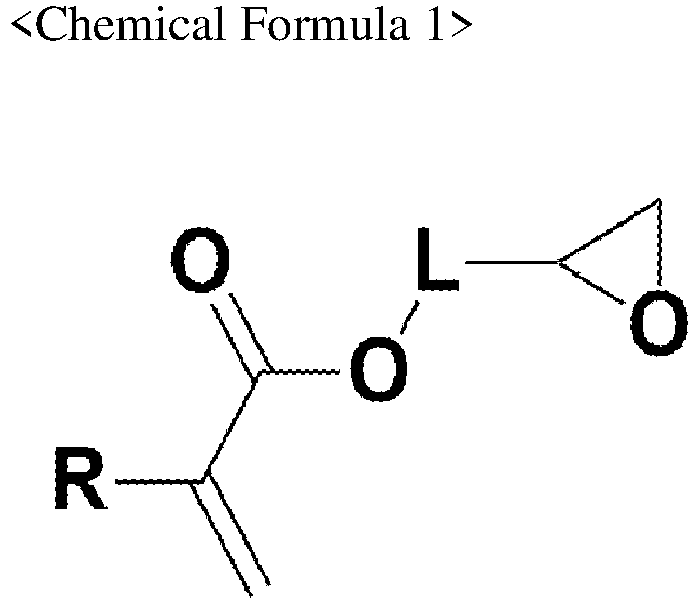
- R represents hydrogen or a C1 to C10 alkyl group,
- L represents a C1 to C10 alkylene group.
- 2) According to 1), the present invention provides a thermoplastic resin composition in which the fifth polymer has a weight-average molecular weight of 500 to 5,500 g/mol.
- 3) According to 1) or 2), the present invention provides a thermoplastic resin composition in which the fifth polymer has a softening point of 130 to 140 °C measured in accordance with ASTM D1525.
- 4) According to any one of 1) to 3), the present invention provides a thermoplastic resin composition in which the diene-based graft polymer comprises a diene-based rubber polymer to which an aromatic vinyl-based monomer unit and a vinyl cyanide-based monomer unit are grafted.
- 5) According to any one of 1) to 4), the present invention provides a thermoplastic resin composition in which the diene-based graft polymer is comprised in an amount of 23.00 to 43.00 parts by weight with respect to 100 parts by weight of the sum of the diene-based graft polymer, the first polymer, the second polymer, the third polymer, and the fourth polymer.
- 6) According to any one of 1) to 5), the present invention provides a thermoplastic resin composition in which the first polymer comprises an alkyl-unsubstituted styrene-based monomer unit.
- 7) According to 6), the present invention provides a thermoplastic resin composition in which the first polymer is an acrylonitrile/styrene/α-methyl styrene polymer.
- 8) According to any one of 1) to 7), the present invention provides a thermoplastic resin composition in which the first polymer is comprised in an amount of 36.00 to 56.00 parts by weight with respect to 100 parts by weight of the sum of the diene-based graft polymer, the first polymer, the second polymer, the third polymer, and the fourth polymer.
- 9) According to any one of 1) to 8), the present invention provides a thermoplastic resin composition in which the second polymer is an acrylonitrile/styrene/glycidyl methacrylate polymer.
- 10) According to any one of 1) to 9), the present invention provides a thermoplastic resin composition in which the second polymer is comprised in an amount of 0.05 to 7.00 parts by weight with respect to 100 parts by weight of the sum of the diene-based graft polymer, the first polymer, the second polymer, the third polymer, and the fourth polymer.
- 11) According to any one of 1) to 10), the present invention provides a thermoplastic resin composition in which the third polymer is comprised in an amount of 9.00 to 29.00 parts by weight with respect to 100 parts by weight of the sum of the diene-based graft polymer, the first polymer, the second polymer, the third polymer, and the fourth polymer.
- 12) According to any one of 1) to 11), the present invention provides a thermoplastic resin composition in which the fourth polymer is comprised in an amount of 0.10 to 9.00 parts by weight with respect to 100 parts by weight of the sum of the diene-based graft polymer, the first polymer, the second polymer, the third polymer, and the fourth polymer.
- A thermoplastic resin composition according to the present invention exhibits excellent moldability due to having high melt strength, and the surface characteristics and recyclability thereof are excellent.
- Hereinafter, the present invention will be described in further detail to aid in understanding the present invention.
- Terms and words used in this specification and claims should not be interpreted as being limited to commonly used meanings or meanings in dictionaries, and, based on the principle that the inventors can appropriately define concepts of terms in order to describe their invention in the best way, the terms and words should be interpreted with meanings and concepts which are consistent with the technical spirit of the present invention.
- In the present invention, a "diene-based rubber polymer" is prepared by polymerizing diene-based monomers, and the diene-based monomer may be one or more selected from the group consisting of 1,3-butadiene, isoprene, chloroprene, and piperylene, with 1,3-butadiene being preferred.
- In the present invention, an "alkyl-unsubstituted styrene-based monomer" may be one or more selected from the group consisting of styrene, 4-fluorostyrene, 4-chlorostyrene, 2-chlorostyrene, 4-bromostyrene, and 2-bromostyrene, with styrene having excellent moldability being preferred. Also, a unit derived from an "alkyl-unsubstituted styrene-based monomer" is an "alkyl-unsubstituted styrene-based monomer unit."
- In the present invention, an "alkyl-substituted styrene-based monomer" may be one or more selected from the group consisting of α-methyl styrene, p-methyl styrene, and 2,4-dimethyl styrene, with α-methyl styrene having excellent heat resistance being preferred. Also, a unit derived from an "alkyl-substituted styrene-based monomer" is an "alkyl-substituted styrene-based monomer unit."
- In the present invention, a "vinyl cyanide-based monomer" may refer to one or more selected from the group consisting of acrylonitrile, 2-methyl acrylonitrile, 2-ethyl acrylonitrile, and 2-chloro acrylonitrile. Among those listed above, acrylonitrile effective for improving chemical resistance is preferred.
- Also, a unit derived from a "vinyl cyanide-based monomer" may be a "vinyl cyanide-based monomer unit."
- In the present invention, an "olefin-based monomer" may be one or more selected from the group consisting of ethylene, propylene, and butene. A unit derived from an olefin-based monomer may be an olefin-based monomer unit.
- In the present invention, a "C1 to C10 alkyl group" may be one or more selected from the group consisting of a methyl group, an ethyl group , a propyl group, an n-propyl group, an isopropyl group, a butyl group, an n-butyl group, an isobutyl group, a tert-butyl group, a sec-butyl group, a 1-methyl-butyl group, a 1-ethyl-butyl group, a pentyl group, an n-pentyl group, an isopentyl group, a neopentyl group, a tert-pentyl group, a hexyl group, an n-hexyl group, a 1-methylpentyl group, a 2-methylpentyl group, a 4-methyl-2-pentyl group, a 3,3-dimethylbutyl group, a 2-ethylbutyl group, a heptyl group, an n-heptyl group, a 1-methylhexyl group, a cyclopentylmethyl group, a cyclohexylmethyl group, an octyl group, an n-octyl group, a tert-octyl group, a 1-methylheptyl group, a 2-ethylhexyl group, a 2-propylpentyl group, an n-nonyl group, a 2,2-dimethylheptyl group, a 1-ethyl-propyl group, a 1,1-dimethyl-propyl group, an isohexyl group, a 2-methylpentyl group, a 4-methylhexyl group, and a 5-methylhexyl group.
- In the present invention, a "C1 to C10 alkylene group" may refer to a C1 to C10 alkyl group having two binding sites (i.e., a divalent group).
- In the present invention, the "average particle diameter of a diene-based rubber polymer" may be measured by a dynamic light scattering method, specifically, by using Nicomp 380 HPL (commercially available from Nicomp). In this specification, an average particle diameter may refer to an arithmetic average particle diameter in the particle size distribution as measured by a dynamic light scattering method, that is, an average particle diameter based on a scattering intensity distribution.
- In the present invention, the weight-average molecular weight of third to fifth polymers may be measured as a relative value with respect to a standard polystyrene sample by gel permeation chromatography (PL GPC220 commercially available from Agilent Technologies) using tetrahydrofuran as an eluent.
- A thermoplastic resin composition according to an embodiment of the present invention comprises: 1) a diene-based graft polymer; 2) a first polymer comprising a vinyl cyanide-based monomer unit and an alkyl-substituted styrene-based monomer unit; 3) a second polymer comprising a vinyl cyanide-based monomer unit, an aromatic vinyl-based monomer unit, and a (meth)acrylate-based monomer unit represented by Chemical Formula 1 below; 4) a third polymer comprising a vinyl cyanide-based monomer unit and an alkyl-unsubstituted styrene-based monomer unit and having a weight-average molecular weight of 80,000 to 220,000 g/mol; 5) a fourth polymer comprising a vinyl cyanide-based monomer unit and an alkyl-unsubstituted styrene-based monomer unit and having a weight-average molecular weight of 1,500,000 to 5,000,000 g/mol; and 6) a fifth polymer comprising an olefin-based monomer unit and having a density of 970 to 1,000 kg/m3 measured in accordance with ASTM D1505, wherein the fifth polymer is comprised in an amount of 0.10 to 3.00 parts by weight with respect to 100 parts by weight of the sum of the diene-based graft polymer, the first polymer, the second polymer, the third polymer, and the fourth polymer.


- In Chemical Formula 1,
- R represents hydrogen or a C1 to C10 alkyl group,
- L represents a C1 to C10 alkylene group.
- Hereinafter, components of the thermoplastic resin composition according to an embodiment of the present invention will be described in detail.
- The diene-based graft polymer is a component that improves the impact resistance of the thermoplastic resin composition. The diene-based graft polymer may comprise a diene-based rubber polymer to which an aromatic vinyl-based monomer unit and a vinyl cyanide-based monomer unit are grafted and also comprise an aromatic vinyl-based monomer unit and a vinyl cyanide-based monomer unit which are not grafted to a diene-based rubber polymer.
- The diene-based rubber polymer may have an average particle diameter of 200 to 400 nm, preferably, 250 to 350 nm. When the above-described range is satisfied, room-temperature and low-temperature impact resistance can be improved.
- The diene-based rubber polymer may be comprised in an amount of 50 to 70 wt%, preferably, 55 to 65 wt% in the diene-based graft polymer. When the above-described condition is satisfied, a diene-based graft polymer having excellent room-temperature and low-temperature impact resistance can be prepared.
- The aromatic vinyl-based monomer unit may be comprised in an amount of 20 to 40 wt%, preferably, 25 to 35 wt% in the diene-based graft polymer. When the above-described condition is satisfied, a diene-based graft polymer having excellent moldability can be prepared.
- The vinyl cyanide-based monomer unit may be comprised in an amount of 1 to 20 wt%, preferably, 5 to 15 wt% in the diene-based graft polymer. When the above-described condition is satisfied, a diene-based graft polymer having excellent chemical resistance can be prepared.
- The diene-based graft polymer may be an acrylonitrile/butadiene/styrene graft polymer comprising a butadiene rubber polymer to which an acrylonitrile unit and a styrene unit are grafted.
- The diene-based graft polymer may be comprised in an amount of 23.00 to 43.00 parts by weight, preferably, 28.00 to 38.00 parts by weight with respect to 100 parts by weight of the sum of the diene-based graft polymer, the first polymer, the second polymer, the third polymer, and the fourth polymer. When the above-described condition is satisfied, the impact resistance of the thermoplastic resin composition can be improved.
- The first polymer is a component that improves the heat resistance of the thermoplastic resin composition and is a non-grafted polymer. The first polymer comprises a vinyl cyanide-based monomer unit and an alkyl-substituted styrene-based monomer unit.
- The first polymer may comprise 10 to 40 wt% of the vinyl cyanide-based monomer unit and 60 to 90 wt% of the alkyl-substituted styrene-based monomer unit, and it is preferable that the first polymer comprises 15 to 35 wt% of the vinyl cyanide-based monomer unit and 65 to 85 wt% of the alkyl-substituted styrene-based monomer unit. When the above-described condition is satisfied, a first polymer whose heat resistance is excellent and whose moldability, impact resistance, and chemical resistance are not degraded can be prepared. Also, the first polymer can be prevented from being phase-separated from the thermoplastic resin composition.
- The first polymer may further comprise an alkyl-unsubstituted styrene-based monomer unit to realize excellent moldability. In this case, the alkyl-unsubstituted styrene-based monomer unit may be comprised in an amount of 15 wt% or less, preferably, 10 wt% or less.
- The first polymer may be one or more selected from the group consisting of an acrylonitrile/α-methyl styrene polymer and an acrylonitrile/styrene/α-methyl styrene polymer.
- The first polymer may be comprised in an amount of 36.00 to 56.00 parts by weight, preferably, 41.00 to 51.00 parts by weight with respect to 100 parts by weight of the sum of the diene-based graft polymer, the first polymer, the second polymer, the third polymer, and the fourth polymer. When the above-described condition is satisfied, a thermoplastic resin composition having excellent heat resistance can be prepared.
- The second polymer is a non-grafted polymer comprising a vinyl cyanide-based monomer unit, an aromatic vinyl-based monomer unit, and a (meth)acrylate-based monomer unit represented by the following Chemical Formula 1:


- R represents hydrogen or a C1 to C10 alkyl group,
- L represents a C1 to C10 alkylene group.
- The second polymer may be polymerized through a double bond of the (meth)acrylate-based monomer represented by Chemical Formula 1, a double bond of the vinyl cyanide-based monomer, and a double bond of the aromatic vinyl-based monomer.
- When the second polymer is comprised in a thermoplastic resin composition, the second polymer reacts with the remaining components when a thermoplastic resin composition melts, and thus a thermoplastic resin composition having a branched structure can be prepared. Also, a thermoplastic resin composition having a branched structure can realize not only high melt strength but also excellent surface characteristics.
- In Chemical Formula 1, R is preferably a C1 to C4 alkyl group, and L is preferably a C1 to C4 alkylene group.
- The second polymer may comprise 10.00 to 40.00 wt% of the vinyl cyanide-based monomer unit, 50.00 to 85.00 wt% of the aromatic vinyl-based monomer unit, and 0.05 to 10.00 wt% of the (meth)acrylate-based monomer unit represented by Chemical Formula 1, and it is preferable that the second polymer comprises 15.00 to 35.00 wt% of the vinyl cyanide-based monomer unit, 45.00 to 80.00 wt% of the aromatic vinyl-based monomer unit, and 0.05 to 10.00 wt% of the (meth)acrylate-based monomer unit represented by Chemical Formula 1. When the above-described condition is satisfied, a second polymer having excellent dispersibility, appropriate viscosity, and appropriate reactivity can be prepared. Also, the second polymer can be prevented from being phase-separated from the thermoplastic resin composition.
- The second polymer may be an acrylonitrile/styrene/glycidyl methacrylate polymer.
- The second polymer may be comprised in an amount of 0.05 to 7.00 parts by weight, preferably, 0.05 to 6.50 parts by weight with respect to 100 parts by weight of the sum of the diene-based graft polymer, the first polymer, the second polymer, the third polymer, and the fourth polymer. When the above-described condition is satisfied, a parison sagging phenomenon of a spoiler manufactured using the thermoplastic resin composition can be prevented from occurring, and melt fracture can be minimized.
- The third polymer is a component that improves the moldability of the thermoplastic resin composition. The third polymer is a non-grafted polymer comprising a vinyl cyanide-based monomer unit and an alkyl-unsubstituted styrene-based monomer unit.
- The third polymer may have a weight-average molecular weight of 80,000 to 220,000 g/mol, preferably, 90,000 to 200,000 g/mol. When the above-described condition is satisfied, a thermoplastic resin composition whose moldability and impact resistance are excellent can be prepared. Below the above-described condition, melt strength is degraded, and above the above-described condition, viscosity is rapidly increased, and thus melt fracture occurs, leading to degradation of surface quality.
- The third polymer may comprise the vinyl cyanide-based monomer unit and the alkyl-unsubstituted styrene-based monomer unit in a weight ratio of 15:85 to 35:65, preferably, 20:80 to 30:70. When the above-described range is satisfied, a third polymer whose chemical resistance and moldability are excellent can be prepared.
- The third polymer may be an acrylonitrile/styrene polymer.
- The third polymer may be comprised in an amount of 9.00 to 29.00 parts by weight, preferably, 14.00 to 24.00 parts by weight with respect to 100 parts by weight of the sum of the diene-based graft polymer, the first polymer, the second polymer, the third polymer, and the fourth polymer. When the above-described condition is satisfied, a thermoplastic resin composition having improved moldability can be prepared.
- The fourth polymer is a component that allows high melt strength to be realized by increasing the viscosity of the thermoplastic resin composition. Also, the fourth polymer may work synergistically with the second polymer to minimize the occurrence of melt fracture, which is caused by flow imbalance when the thermoplastic resin composition melts.
- The fourth polymer is a non-grafted polymer comprising a vinyl cyanide-based monomer unit and an alkyl-unsubstituted styrene-based monomer unit.
- The fourth polymer may have a weight-average molecular weight of 1,500,000 to 5,000,000 g/mol, preferably, 2,000,000 to 5,000,000 g/mol. When the above-described condition is satisfied, a thermoplastic resin composition having high viscosity can be prepared. Below the above-described condition, melt strength is degraded, and above the above-described condition, dispersibility is degraded.
- The fourth polymer may comprise the vinyl cyanide-based monomer unit and the aromatic vinyl-based monomer unit in a weight ratio of 15:85 to 35:65, preferably, 20:80 to 30:70. When the above-described range is satisfied, a fourth polymer whose chemical resistance and moldability are excellent can be prepared.
- The fourth polymer may be an acrylonitrile/styrene polymer.
- The fourth polymer may be comprised in an amount of 0.10 to 9.00 parts by weight, preferably, 0.50 to 7.00 parts by weight with respect to 100 parts by weight of the sum of the diene-based graft polymer, the first polymer, the second polymer, the third polymer, and the fourth polymer. When the above-described condition is satisfied, melt fracture of a spoiler manufactured using the thermoplastic resin composition can be minimized, and even when the thermoplastic resin composition is recycled, impact resistance cannot be excessively degraded.
- The fifth polymer is a component that improves recyclability by reducing deterioration of the thermoplastic resin composition due to friction between thermoplastic resin compositions and friction between the thermoplastic resin composition and equipment in extrusion, processing, and recycling of the thermoplastic resin composition.
- The fifth polymer is a non-grafted polymer comprising an olefin-based monomer unit and having a density of 970 to 1,000 kg/m3 measured in accordance with ASTM D1505. When the density of the fifth polymer is less than the above-described range, a reduction in deterioration of the thermoplastic resin composition due to friction between thermoplastic resin compositions and friction between the thermoplastic resin composition and equipment in extrusion, processing, and recycling of the thermoplastic resin composition is not possible, and thus recyclability may not be improved. When the density of the fifth polymer exceeds the above-described range, the viscosity and surface energy of the thermoplastic resin composition are increased to increase friction between the thermoplastic resin composition and equipment, and thus surface quality is degraded.
- The fifth polymer may be comprised in an amount of 0.10 to 3.00 parts by weight, preferably, 0.3 to 3 parts by weight with respect to 100 parts by weight of the sum of the diene-based graft polymer, the first polymer, the second polymer, the third polymer, and the fourth polymer. When the above-described condition is satisfied, the thermoplastic resin composition achieves high melt strength, and thus the parison sagging phenomenon of a spoiler manufactured using the thermoplastic resin composition does not occur. Also, even when the thermoplastic resin composition is recycled, impact resistance is not excessively degraded. However, below the above-described condition, when the thermoplastic resin composition is recycled, impact resistance is excessively degraded. Above the above-described condition, melt strength is degraded, and thus a parison sagging phenomenon occurs.
- The fifth polymer may have a weight-average molecular weight of 500 to 5,500 g/mol, preferably, 700 to 5,000 g/mol. When the above-described condition is satisfied, the recyclability of the thermoplastic resin composition can be enhanced.
- The fifth polymer may have a softening point of 130 to 140 °C, preferably, 132 to 138 °C measured in accordance with ASTM D1525. When the above-described condition is satisfied, the above-described deterioration is further reduced, and thus the recyclability of the thermoplastic resin composition can be improved.
- The fifth polymer may be polyethylene.
- The thermoplastic resin composition according to an embodiment of the present invention may further comprise an additive such as an antioxidant and a lubricant.
- Hereinafter, the present invention will be described in detail with reference to embodiments so that those skilled in the art can easily carry out the present invention. However, the present invention may be embodied in several different forms, and therefore, is not limited to embodiments described herein.
- Components used in examples and comparative examples below are as follows.
- Diene-based graft polymer: DP270M commercially available from LG Chem (prepared by graft emulsion polymerization of styrene and acrylonitrile to a butadiene rubber polymer having an average particle diameter of 300 nm)
- First polymer: 99UH commercially available from LG Chem (acrylonitrile/styrene/α-methyl styrene polymer)
- Second polymer: SAG-005 commercially available from Fine-Blend (acrylonitrile/styrene/glycidyl methacrylate polymer)
- Third polymer: 80HF commercially available from LG Chem (acrylonitrile/styrene polymer having a weight-average molecular weight of 150,000 g/mol)
- Fourth polymer: ZB869 commercially available from Fine-Blend (acrylonitrile/styrene polymer having a weight-average molecular weight of 5,000,000 g/mol)
- Fifth polymer: Hi-WAX 400P commercially available from Mitsui Chemicals (polyethylene having a density of 980 kg/m3, a weight-average molecular weight of 4,000 g/mol, and a softening point of 136 °C)
- Low-density polyethylene: Hi-WAX 420P commercially available from Mitsui Chemicals (polyethylene having a density of 930 kg/m3, a weight-average molecular weight of 4,000 g/mol, and a softening point of 118 °C)
- Polypropylene: Hi-WAX NP055 commercially available from Mitsui Chemicals (polypropylene having a density of 900 kg/m3, a weight-average molecular weight of 700 g/mol, and a softening point of 148 °C)
- Branched SAN polymer: EMI-230B commercially available from Fine-Blend (acrylonitrile/styrene polymer having a degree of branching of 5 to 7 and a polydispersity index of 4.2)
- Antioxidant 1: Irganox 1010 commercially available from BASF
- Antioxidant 2: ADK STAB PEP-36 commercially available from ADEKA
- Lubricant 1: Ethylene bis stearamide
- Lubricant 2: Calcium stearate
- The above-described components were mixed in amounts shown in Tables 1 to 3 below and stirred to prepare thermoplastic resin compositions. Also, the amounts of the above-described components were based on 100 parts by weight of the sum of the diene-based graft polymer, the first polymer, the second polymer, the third polymer, and the fourth polymer.
- Each thermoplastic resin composition of the examples and comparative examples was extruded to prepare a pellet. A physical property of the pellet was evaluated by the method described below, and results thereof are shown in Tables 1 to 3 below.
- (1) Melt flow index (cm3/10 min): measured under conditions of 220 °C and 10 kg/cm3 in accordance with ISO 1133.
- The pellet prepared in Experimental Example 1 was injection-molded to prepare a sample. The physical properties of the sample were evaluated by the methods described below, and results thereof are shown in Tables 1 to 3.
- (1) IZOD impact strength (kJ/m2): measured under notched and 23 °C conditions in accordance with ISO 179.
- (2) IZOD impact strength retention rate: IZOD impact strength is decreased by deterioration of polymers, which are components of the thermoplastic resin composition, when the product is repeatedly used. In order to reproduce the same levels of impact strength and deterioration as those of the recycled product immediately before final consumption, the thermoplastic resin composition was extruded 4 times to prepare a sample. Then, the IZOD impact strength of the sample prepared by 4-time extrusion was measured under notched and 23 °C conditions in accordance with ISO 179, and the measurement result was substituted into the following equation to calculate an IZOD impact strength retention rate.
- IZOD impact strength retention rate = (IZOD impact strength of sample prepared by 4-time extrusion) / (IZOD impact strength measured in (1))
- Good: 0.85 or more, Fair: 0.80 or more, and Poor: less than 0.80
- (3) Tensile strength (MPa): measured under conditions of 50 mm/min and 23 °C in accordance with ISO 527.
- (4) Heat deflection temperature (°C): The tensile strength of the sample (thickness: 4 mm) was measured under 1.8 MPa and unannealed conditions in accordance with ISO 075.
- (5) Parison sagging: determined by discharging a parison having a length of 500 mm and a weight of 500 g and measuring the time taken for the parison to sag.
- Good: 60 seconds or more, Fair: 20 seconds or more and less than 60 seconds, and Poor: less than 20 seconds
- (6) Melt fracture: determined by measuring melt fracture at 220 °C using a capillary rheometer and measuring a shear rate at which melt fracture occurred.
- Good: No occurrence of melt fracture
- Fair: Occurrence of melt fracture at a rate of 251/s or more,
- Poor: Occurrence of melt fracture at a rate of less than 251/s
- Referring to Tables 1 to 3, Examples 1 to 7 were excellent in impact resistance, impact resistance retention rate, tension resistance, and heat resistance, did not show a parison sagging phenomenon within a short period of time, and did also not show a melt fracture phenomenon. When Examples 1 to 3 were compared, the impact resistance and impact resistance retention rate of Example 1 comprising a small amount of a fifth polymer were slightly degraded, but the other physical properties were excellent as compared to Examples 2 and 3. Also, Example 3 comprising the largest amount of a fifth polymer showed a parison sagging phenomenon within a relatively short period of time, but equivalent levels of the other physical properties were exhibited as compared to Examples 1 and 2. When Examples 2 and 4 to 6 were compared, the impact resistance and impact resistance retention rate of Example 4 comprising the smallest amount of a second polymer were slightly degraded, but the other physical properties were excellent as compared to Examples 2, 5, and 6. Also, Example 6 comprising the largest amount of a second polymer showed a melt fracture phenomenon at a rate of 251/s or more unlike Examples 2, 4, and 5, but the other physical properties were excellent.
- When Examples 2, 7, and 8 were compared, Example 2 comprising 1.50 parts by weight of a fourth polymer did not show a melt fracture phenomenon unlike Example 7 comprising 0.50 parts by weight of a fourth polymer and Example 8 comprising 7.00 parts by weight of a fourth polymer. From these experiment results, it can be seen that, when an appropriate amount of a fourth polymer is comprised, the best physical properties are realized.
- Meanwhile, Comparative Example 1 not comprising a fifth polymer exhibited a poor impact resistance retention rate, and therefore, it can be seen that the recycling thereof is not possible. Also, it can be seen that, since recycling is not possible, the versatility of the thermoplastic resin composition is low.
- In addition, Comparative Example 2 comprising a small amount of a fifth polymer exhibited a poor impact resistance retention rate, and therefore, it can be seen that the recycling thereof is not possible. Also, it can be seen that, since recycling is not possible, the versatility of the thermoplastic resin composition is low.
- Comparative Examples 3 and 4 comprising excessive amounts of a fifth polymer showed a parison sagging phenomenon within a short period of time, and therefore, it can be seen that they are not suitable for a tail light housing.
- Comparative Example 5 comprising low-density polyethylene instead of a fifth polymer and Comparative Example 6 comprising polypropylene exhibited poor impact resistance retention rates, and therefore, it can be seen that the recycling thereof is not possible. Also, it can be seen that, since recycling is not possible, the versatility of the thermoplastic resin composition is low.
- Comparative Example 7 not comprising a fourth polymer showed a melt fracture phenomenon at a rate of less than 251/s, and therefore, it can be seen that it is not suitable for a tail light housing.
- Comparative Example 8 not comprising a second polymer exhibited a poor impact resistance retention rate, and therefore, it can be seen that the recycling thereof is not possible. Also, it can be seen that, since recycling is not possible, the versatility of the thermoplastic resin composition is low.
| Classification | Example 1 | Example 2 | Example 3 | Example 4 | Example 5 | Example 6 |
| Diene-based graft polymer (parts by weight) | 33.00 | 33.00 | 33.00 | 33.00 | 33.00 | 33.00 |
| First polymer (parts by weight) | 46.00 | 46.00 | 46.00 | 46.00 | 46.00 | 46.00 |
| Second polymer (parts by weight) | 0.50 | 0.50 | 0.50 | 0.05 | 1.50 | 5.00 |
| Third polymer (parts by weight) | 19.00 | 19.00 | 19.00 | 19.45 | 18.00 | 14.50 |
| Fourth polymer (parts by weight) | 1.50 | 1.50 | 1.50 | 1.50 | 1.50 | 1.50 |
| Fifth polymer (parts by weight) | 0.10 | 1.00 | 3.00 | 1.00 | 1.00 | 1.00 |
| Low-density polyethylene (parts by weight) | 0.00 | 0.00 | 0.00 | 0.00 | 0.00 | 0.00 |
| Polypropylene (parts by weight) | 0.00 | 0.00 | 0.00 | 0.00 | 0.00 | 0.00 |
| Antioxidant 1 (parts by weight) | 0.30 | 0.30 | 0.30 | 0.30 | 0.30 | 0.30 |
| Antioxidant 2 (parts by weight) | 0.30 | 0.30 | 0.30 | 0.30 | 0.30 | 0.30 |
| Lubricant 1 (parts by weight) | 0.20 | 0.20 | 0.20 | 0.20 | 0.20 | 0.20 |
| Lubricant 2 (parts by weight) | 0.30 | 0.30 | 0.30 | 0.30 | 0.30 | 0.30 |
| Melt flow index (cm3/10 min) | 3.6 | 3.6 | 3.8 | 4.0 | 1.2 | 0.5 |
| IZOD impact strength (kJ/m2) | 34 | 36 | 36 | 34 | 37 | 35 |
| IZOD impact strength retention rate | Fair | Good | Good | Fair | Good | Good |
| Tensile strength (MPa) | 39 | 38 | 37 | 39 | 38 | 37 |
| Heat deflection temperature (°C) | 85 | 84 | 83 | 85 | 84 | 83 |
| Parison sagging | Good | Good | Fair | Good | Good | Good |
| Melt fracture | Good | Good | Good | Good | Good | Fair |
| Classification | Example 7 | Example 8 | Comparative Example 1 | Comparative Example 2 | Comparative Example 3 |
| Diene-based graft polymer (parts by weight) | 33.00 | 33.00 | 33.00 | 33.00 | 33.00 |
| First polymer (parts by weight) | 46.00 | 46.00 | 46.00 | 46.00 | 46.00 |
| Second polymer (parts by weight) | 0.50 | 0.50 | 0.50 | 0.50 | 0.50 |
| Third polymer (parts by weight) | 20.00 | 13.50 | 19.00 | 19.00 | 19.00 |
| Fourth polymer (parts by weight) | 0.50 | 7.00 | 1.50 | 1.50 | 1.50 |
| Fifth polymer (parts by weight) | 1.00 | 1.00 | 0.00 | 0.05 | 3.30 |
| Low-density polyethylene (parts by weight) | 0.00 | 0.00 | 0.00 | 0.00 | 0.00 |
| Polypropylene (parts by weight) | 0.00 | 0.00 | 0.00 | 0.00 | 0.00 |
| Antioxidant 1 (parts by weight) | 0.30 | 0.30 | 0.30 | 0.30 | 0.30 |
| Antioxidant 2 (parts by weight) | 0.30 | 0.30 | 0.30 | 0.30 | 0.30 |
| Lubricant 1 (parts by weight) | 0.20 | 0.20 | 0.20 | 0.20 | 0.20 |
| Lubricant 2 (parts by weight) | 0.30 | 0.30 | 0.30 | 0.30 | 0.30 |
| Melt flow index (cm3/10 min) | 4.5 | 0.8 | 3.7 | 3.6 | 3.8 |
| IZOD impact strength (kJ/m2) | 36 | 34 | 34 | 34 | 36 |
| IZOD impact strength retention rate | Good | Fair | Poor | Poor | Good |
| Tensile strength (MPa) | 37 | 40 | 39 | 39 | 36 |
| Heat deflection temperature (°C) | 84 | 85 | 85 | 85 | 83 |
| Parison sagging | Good | Good | Good | Good | Poor |
| Melt fracture | Fair | Fair | Fair | Fair | Good |
| Classification | Comparative Example 4 | Comparative Example 5 | Comparative Example 6 | Comparative Example 7 | Comparative Example 8 |
| Diene-based graft polymer (parts by weight) | 33.00 | 33.00 | 33.00 | 33.00 | 33.00 |
| First polymer (parts by weight) | 46.00 | 46.00 | 46.00 | 46.00 | 46.00 |
| Second polymer (parts by weight) | 0.50 | 0.50 | 0.50 | 0.50 | 0.00 |
| Third polymer (parts by weight) | 19.00 | 19.00 | 19.00 | 20.50 | 14.50 |
| Fourth polymer (parts by weight) | 1.50 | 1.50 | 1.50 | 0.00 | 1.50 |
| Fifth polymer (parts by weight) | 4.00 | 0.00 | 0.00 | 1.00 | 1.00 |
| Low-density polyethylene (parts by weight) | 0.00 | 1.00 | 0.00 | 0.00 | 0.00 |
| Polypropylene (parts by weight) | 0.00 | 0.00 | 1.00 | 0.00 | 0.00 |
| Branched acrylonitrile/styrene polymer (parts by weight) | 0.00 | 0.00 | 0.00 | 0.00 | 5.00 |
| Antioxidant 1 (parts by weight) | 0.30 | 0.30 | 0.30 | 0.30 | 0.30 |
| Antioxidant 2 (parts by weight) | 0.30 | 0.30 | 0.30 | 0.30 | 0.30 |
| Lubricant 1 (parts by weight) | 0.20 | 0.20 | 0.20 | 0.20 | 0.20 |
| Lubricant 2 (parts by weight) | 0.30 | 0.30 | 0.30 | 0.30 | 0.30 |
| Melt flow index (cm3/10 min) | 3.8 | 3.5 | 3.3 | 4.8 | 4.0 |
| IZOD impact strength (kJ/m2) | 36 | 36 | 36 | 36 | 33 |
| IZOD impact strength retention rate | Good | Poor | Poor | Good | Poor |
| Tensile strength (MPa) | 36 | 38 | 39 | 37 | 40 |
| Heat deflection temperature (°C) | 83 | 84 | 84 | 84 | 84 |
| Parison sagging | Poor | Good | Good | Good | Good |
| Melt fracture | Good | Good | Good | Poor | Good |
Claims (12)
- A thermoplastic resin composition comprising:a diene-based graft polymer;a first polymer comprising a vinyl cyanide-based monomer unit and an alkyl-substituted styrene-based monomer unit;a second polymer comprising a vinyl cyanide-based monomer unit, an aromatic vinyl-based monomer unit, and a (meth)acrylate-based monomer unit represented by Chemical Formula 1 below;a third polymer comprising a vinyl cyanide-based monomer unit and an alkyl-unsubstituted styrene-based monomer unit and having a weight-average molecular weight of 80,000 to 220,000 g/mol;a fourth polymer comprising a vinyl cyanide-based monomer unit and an alkyl-unsubstituted styrene-based monomer unit and having a weight-average molecular weight of 1,500,000 to 5,000,000 g/mol; anda fifth polymer comprising an olefin-based monomer unit and having a density of 970 to 1,000 kg/m3 measured in accordance with ASTM D1505,wherein the fifth polymer is comprised in an amount of 0.10 to 3.00 parts by weight with respect to 100 parts by weight of the sum of the diene-based graft polymer, the first polymer, the second polymer, the third polymer, and the fourth polymer:

 R represents hydrogen or a C1 to C10 alkyl group,L represents a C1 to C10 alkylene group.
 - The thermoplastic resin composition of claim 1, wherein the fifth polymer has a weight-average molecular weight of 500 to 5,500 g/mol.
- The thermoplastic resin composition of claim 1, wherein the fifth polymer has a softening point of 130 to 140 °C measured in accordance with ASTM D1525.
- The thermoplastic resin composition of claim 1, wherein the diene-based graft polymer comprises a diene-based rubber polymer to which an aromatic vinyl-based monomer unit and a vinyl cyanide-based monomer unit are grafted.
- The thermoplastic resin composition of claim 1, wherein the diene-based graft polymer is comprised in an amount of 23.00 to 43.00 parts by weight with respect to 100 parts by weight of the sum of the diene-based graft polymer, the first polymer, the second polymer, the third polymer, and the fourth polymer.
- The thermoplastic resin composition of claim 1, wherein the first polymer comprises an alkyl-unsubstituted styrene-based monomer unit.
- The thermoplastic resin composition of claim 1, wherein the first polymer is one or more selected from the group consisting of an acrylonitrile/α-methyl styrene polymer and an acrylonitrile/styrene/α-methyl styrene polymer.
- The thermoplastic resin composition of claim 1, wherein the first polymer is comprised in an amount of 36.00 to 56.00 parts by weight with respect to 100 parts by weight of the sum of the diene-based graft polymer, the first polymer, the second polymer, the third polymer, and the fourth polymer.
- The thermoplastic resin composition of claim 1, wherein the second polymer is an acrylonitrile/styrene/glycidyl methacrylate polymer.
- The thermoplastic resin composition of claim 1, wherein the second polymer is comprised in an amount of 0.05 to 7.00 parts by weight with respect to 100 parts by weight of the sum of the diene-based graft polymer, the first polymer, the second polymer, the third polymer, and the fourth polymer.
- The thermoplastic resin composition of claim 1, wherein the third polymer is comprised in an amount of 9.00 to 29.00 parts by weight with respect to 100 parts by weight of the sum of the diene-based graft polymer, the first polymer, the second polymer, the third polymer, and the fourth polymer.
- The thermoplastic resin composition of claim 1, wherein the fourth polymer is comprised in an amount of 0.10 to 9.00 parts by weight with respect to 100 parts by weight of the sum of the diene-based graft polymer, the first polymer, the second polymer, the third polymer, and the fourth polymer.
Applications Claiming Priority (3)
| Application Number | Priority Date | Filing Date | Title |
|---|---|---|---|
| KR20210123939 | 2021-09-16 | ||
| KR1020220115074A KR102867174B1 (en) | 2021-09-16 | 2022-09-13 | Thermoplastic resin composition |
| PCT/KR2022/013711 WO2023043181A1 (en) | 2021-09-16 | 2022-09-14 | Thermoplastic resin composition |
Publications (2)
| Publication Number | Publication Date |
|---|---|
| EP4261253A1 true EP4261253A1 (en) | 2023-10-18 |
| EP4261253A4 EP4261253A4 (en) | 2024-08-07 |
Family
ID=85603208
Family Applications (1)
| Application Number | Title | Priority Date | Filing Date |
|---|---|---|---|
| EP22870265.0A Pending EP4261253A4 (en) | 2021-09-16 | 2022-09-14 | Thermoplastic resin composition |
Country Status (3)
| Country | Link |
|---|---|
| US (1) | US20240132713A1 (en) |
| EP (1) | EP4261253A4 (en) |
| WO (1) | WO2023043181A1 (en) |
Family Cites Families (8)
| Publication number | Priority date | Publication date | Assignee | Title |
|---|---|---|---|---|
| KR100574453B1 (en) | 2003-12-22 | 2006-04-26 | 제일모직주식회사 | Polyphenylene ether-based resin composition excellent in chemical resistance |
| JP4828223B2 (en) * | 2005-12-16 | 2011-11-30 | 三井化学株式会社 | Thermoplastic resin molding |
| KR101150016B1 (en) * | 2006-12-29 | 2012-06-01 | 주식회사 엘지화학 | Styrenic themoplastic resin compositions with good mechanical properties and low gloss |
| KR20130075793A (en) * | 2011-12-28 | 2013-07-08 | 제일모직주식회사 | Thermoplastic resin composition having excellent appearance and colorability |
| US20210115244A1 (en) * | 2017-12-19 | 2021-04-22 | Ineos Styrolution Group Gmbh | Abs thermoplastic molding composition for blow molding |
| KR102256539B1 (en) * | 2018-09-28 | 2021-05-25 | 롯데첨단소재(주) | Thermoplastic resin composition and molded article using the same |
| KR102483996B1 (en) * | 2019-04-30 | 2023-01-03 | 롯데케미칼 주식회사 | Thermoplastic resin composition and molded article using the same |
| KR102493671B1 (en) * | 2019-10-23 | 2023-02-06 | 주식회사 엘지화학 | Thermoplastic resin composition |
-
2022
- 2022-09-14 US US18/273,484 patent/US20240132713A1/en active Pending
- 2022-09-14 EP EP22870265.0A patent/EP4261253A4/en active Pending
- 2022-09-14 WO PCT/KR2022/013711 patent/WO2023043181A1/en not_active Ceased
Also Published As
| Publication number | Publication date |
|---|---|
| WO2023043181A1 (en) | 2023-03-23 |
| EP4261253A4 (en) | 2024-08-07 |
| US20240132713A1 (en) | 2024-04-25 |
Similar Documents
| Publication | Publication Date | Title |
|---|---|---|
| KR102298295B1 (en) | Thermoplastic resin composition | |
| US8236896B2 (en) | Powdery processing aid for polyolefin resins, method for producing the same, resin composition and shaped article | |
| JP6149783B2 (en) | Thermoplastic resin composition and molded article thereof | |
| KR102171738B1 (en) | Thermoplastic resin composition, method for preparing the resin composition and molding product comprising the resin composition | |
| EP3708599B1 (en) | Method of preparing graft copolymer, graft copolymer, and thermoplastic resin molded article including graft copolymer | |
| JP7616277B2 (en) | Thermoplastic elastomer composition, joining member and method for producing same | |
| KR102570571B1 (en) | Thermoplastic resin composition and molded article using the same | |
| KR102717806B1 (en) | Thermoplastic resin composition and molded article using the same | |
| JP7024457B2 (en) | Thermoplastic Elastomer Compositions and Joining Members | |
| EP3770193A1 (en) | Method for preparing graft copolymer powder | |
| US20240132713A1 (en) | Thermoplastic resin composition | |
| EP4299669A1 (en) | Thermoplastic resin composition and molded article using same | |
| JP3378485B2 (en) | Methyl methacrylate resin injection molding | |
| KR102867174B1 (en) | Thermoplastic resin composition | |
| KR102483996B1 (en) | Thermoplastic resin composition and molded article using the same | |
| JP4398826B2 (en) | Antistatic thermoplastic resin composition and molded article using the same | |
| CN116745360A (en) | Thermoplastic resin composition | |
| KR101821621B1 (en) | A method for continuous producing a rubber-modified styrenic thermoplastic having advanced environmental stress crack resistance for cooking oil | |
| EP3056543B1 (en) | Resin composition containing polycarbonate resin for window frames | |
| EP3916049B1 (en) | Thermoplastic resin composition | |
| KR102954203B1 (en) | Thermoplastic resin composition, method for preparing the thermoplastic resin composition and molding products thereof | |
| EP3922675B1 (en) | Thermoplastic resin composition | |
| KR102645611B1 (en) | Thermoplastic resin composition, method for preparing the same and article prepared therefrom | |
| KR102755434B1 (en) | Thermoplastic resin composition | |
| CA2051322C (en) | Thermoplastic elastomer composition |
Legal Events
| Date | Code | Title | Description |
|---|---|---|---|
| STAA | Information on the status of an ep patent application or granted ep patent |
Free format text: STATUS: THE INTERNATIONAL PUBLICATION HAS BEEN MADE |
|
| PUAI | Public reference made under article 153(3) epc to a published international application that has entered the european phase |
Free format text: ORIGINAL CODE: 0009012 |
|
| STAA | Information on the status of an ep patent application or granted ep patent |
Free format text: STATUS: REQUEST FOR EXAMINATION WAS MADE |
|
| 17P | Request for examination filed |
Effective date: 20230713 |
|
| AK | Designated contracting states |
Kind code of ref document: A1 Designated state(s): AL AT BE BG CH CY CZ DE DK EE ES FI FR GB GR HR HU IE IS IT LI LT LU LV MC MK MT NL NO PL PT RO RS SE SI SK SM TR |
|
| A4 | Supplementary search report drawn up and despatched |
Effective date: 20240709 |
|
| RIC1 | Information provided on ipc code assigned before grant |
Ipc: C08L 51/04 20060101ALI20240703BHEP Ipc: C08L 33/14 20060101ALI20240703BHEP Ipc: C08L 25/12 20060101ALI20240703BHEP Ipc: C08L 55/02 20060101AFI20240703BHEP |
|
| DAV | Request for validation of the european patent (deleted) | ||
| DAX | Request for extension of the european patent (deleted) |