EP4260692A1 - Seal member for livestock sensor and livestock sensor - Google Patents
Seal member for livestock sensor and livestock sensor Download PDFInfo
- Publication number
- EP4260692A1 EP4260692A1 EP21903313.1A EP21903313A EP4260692A1 EP 4260692 A1 EP4260692 A1 EP 4260692A1 EP 21903313 A EP21903313 A EP 21903313A EP 4260692 A1 EP4260692 A1 EP 4260692A1
- Authority
- EP
- European Patent Office
- Prior art keywords
- tfe
- group
- copolymer
- livestock
- rubber
- Prior art date
- Legal status (The legal status is an assumption and is not a legal conclusion. Google has not performed a legal analysis and makes no representation as to the accuracy of the status listed.)
- Pending
Links
Images
Classifications
-
- C—CHEMISTRY; METALLURGY
- C08—ORGANIC MACROMOLECULAR COMPOUNDS; THEIR PREPARATION OR CHEMICAL WORKING-UP; COMPOSITIONS BASED THEREON
- C08F—MACROMOLECULAR COMPOUNDS OBTAINED BY REACTIONS ONLY INVOLVING CARBON-TO-CARBON UNSATURATED BONDS
- C08F14/00—Homopolymers and copolymers of compounds having one or more unsaturated aliphatic radicals, each having only one carbon-to-carbon double bond, and at least one being terminated by a halogen
- C08F14/18—Monomers containing fluorine
- C08F14/26—Tetrafluoroethene
-
- A—HUMAN NECESSITIES
- A61—MEDICAL OR VETERINARY SCIENCE; HYGIENE
- A61B—DIAGNOSIS; SURGERY; IDENTIFICATION
- A61B5/00—Measuring for diagnostic purposes; Identification of persons
- A61B5/68—Arrangements of detecting, measuring or recording means, e.g. sensors, in relation to patient
- A61B5/6846—Arrangements of detecting, measuring or recording means, e.g. sensors, in relation to patient specially adapted to be brought in contact with an internal body part, i.e. invasive
- A61B5/6867—Arrangements of detecting, measuring or recording means, e.g. sensors, in relation to patient specially adapted to be brought in contact with an internal body part, i.e. invasive specially adapted to be attached or implanted in a specific body part
- A61B5/6871—Stomach
-
- A—HUMAN NECESSITIES
- A61—MEDICAL OR VETERINARY SCIENCE; HYGIENE
- A61B—DIAGNOSIS; SURGERY; IDENTIFICATION
- A61B5/00—Measuring for diagnostic purposes; Identification of persons
- A61B5/68—Arrangements of detecting, measuring or recording means, e.g. sensors, in relation to patient
- A61B5/6846—Arrangements of detecting, measuring or recording means, e.g. sensors, in relation to patient specially adapted to be brought in contact with an internal body part, i.e. invasive
- A61B5/6847—Arrangements of detecting, measuring or recording means, e.g. sensors, in relation to patient specially adapted to be brought in contact with an internal body part, i.e. invasive mounted on an invasive device
- A61B5/6861—Capsules, e.g. for swallowing or implanting
-
- A—HUMAN NECESSITIES
- A01—AGRICULTURE; FORESTRY; ANIMAL HUSBANDRY; HUNTING; TRAPPING; FISHING
- A01K—ANIMAL HUSBANDRY; AVICULTURE; APICULTURE; PISCICULTURE; FISHING; REARING OR BREEDING ANIMALS, NOT OTHERWISE PROVIDED FOR; NEW BREEDS OF ANIMALS
- A01K11/00—Marking of animals
- A01K11/006—Automatic identification systems for animals, e.g. electronic devices, transponders for animals
- A01K11/007—Boluses
-
- A—HUMAN NECESSITIES
- A01—AGRICULTURE; FORESTRY; ANIMAL HUSBANDRY; HUNTING; TRAPPING; FISHING
- A01K—ANIMAL HUSBANDRY; AVICULTURE; APICULTURE; PISCICULTURE; FISHING; REARING OR BREEDING ANIMALS, NOT OTHERWISE PROVIDED FOR; NEW BREEDS OF ANIMALS
- A01K29/00—Other apparatus for animal husbandry
-
- A—HUMAN NECESSITIES
- A01—AGRICULTURE; FORESTRY; ANIMAL HUSBANDRY; HUNTING; TRAPPING; FISHING
- A01K—ANIMAL HUSBANDRY; AVICULTURE; APICULTURE; PISCICULTURE; FISHING; REARING OR BREEDING ANIMALS, NOT OTHERWISE PROVIDED FOR; NEW BREEDS OF ANIMALS
- A01K29/00—Other apparatus for animal husbandry
- A01K29/005—Monitoring or measuring activity
-
- A—HUMAN NECESSITIES
- A61—MEDICAL OR VETERINARY SCIENCE; HYGIENE
- A61B—DIAGNOSIS; SURGERY; IDENTIFICATION
- A61B5/00—Measuring for diagnostic purposes; Identification of persons
- A61B5/01—Measuring temperature of body parts ; Diagnostic temperature sensing, e.g. for malignant or inflamed tissue
-
- A—HUMAN NECESSITIES
- A61—MEDICAL OR VETERINARY SCIENCE; HYGIENE
- A61B—DIAGNOSIS; SURGERY; IDENTIFICATION
- A61B5/00—Measuring for diagnostic purposes; Identification of persons
- A61B5/103—Measuring devices for testing the shape, pattern, colour, size or movement of the body or parts thereof, for diagnostic purposes
- A61B5/11—Measuring movement of the entire body or parts thereof, e.g. head or hand tremor or mobility of a limb
- A61B5/1118—Determining activity level
-
- A—HUMAN NECESSITIES
- A61—MEDICAL OR VETERINARY SCIENCE; HYGIENE
- A61B—DIAGNOSIS; SURGERY; IDENTIFICATION
- A61B5/00—Measuring for diagnostic purposes; Identification of persons
- A61B5/145—Measuring characteristics of blood in vivo, e.g. gas concentration or pH-value ; Measuring characteristics of body fluids or tissues, e.g. interstitial fluid or cerebral tissue
- A61B5/14539—Measuring characteristics of blood in vivo, e.g. gas concentration or pH-value ; Measuring characteristics of body fluids or tissues, e.g. interstitial fluid or cerebral tissue for measuring pH
-
- C—CHEMISTRY; METALLURGY
- C08—ORGANIC MACROMOLECULAR COMPOUNDS; THEIR PREPARATION OR CHEMICAL WORKING-UP; COMPOSITIONS BASED THEREON
- C08L—COMPOSITIONS OF MACROMOLECULAR COMPOUNDS
- C08L27/00—Compositions of homopolymers or copolymers of compounds having one or more unsaturated aliphatic radicals, each having only one carbon-to-carbon double bond, and at least one being terminated by a halogen; Compositions of derivatives of such polymers
- C08L27/02—Compositions of homopolymers or copolymers of compounds having one or more unsaturated aliphatic radicals, each having only one carbon-to-carbon double bond, and at least one being terminated by a halogen; Compositions of derivatives of such polymers not modified by chemical after-treatment
- C08L27/12—Compositions of homopolymers or copolymers of compounds having one or more unsaturated aliphatic radicals, each having only one carbon-to-carbon double bond, and at least one being terminated by a halogen; Compositions of derivatives of such polymers not modified by chemical after-treatment containing fluorine atoms
-
- A—HUMAN NECESSITIES
- A61—MEDICAL OR VETERINARY SCIENCE; HYGIENE
- A61B—DIAGNOSIS; SURGERY; IDENTIFICATION
- A61B2503/00—Evaluating a particular growth phase or type of persons or animals
- A61B2503/40—Animals
-
- A—HUMAN NECESSITIES
- A61—MEDICAL OR VETERINARY SCIENCE; HYGIENE
- A61B—DIAGNOSIS; SURGERY; IDENTIFICATION
- A61B2562/00—Details of sensors; Constructional details of sensor housings or probes; Accessories for sensors
- A61B2562/16—Details of sensor housings or probes; Details of structural supports for sensors
-
- A—HUMAN NECESSITIES
- A61—MEDICAL OR VETERINARY SCIENCE; HYGIENE
- A61B—DIAGNOSIS; SURGERY; IDENTIFICATION
- A61B2562/00—Details of sensors; Constructional details of sensor housings or probes; Accessories for sensors
- A61B2562/18—Shielding or protection of sensors from environmental influences, e.g. protection from mechanical damage
-
- C—CHEMISTRY; METALLURGY
- C08—ORGANIC MACROMOLECULAR COMPOUNDS; THEIR PREPARATION OR CHEMICAL WORKING-UP; COMPOSITIONS BASED THEREON
- C08F—MACROMOLECULAR COMPOUNDS OBTAINED BY REACTIONS ONLY INVOLVING CARBON-TO-CARBON UNSATURATED BONDS
- C08F114/00—Homopolymers of compounds having one or more unsaturated aliphatic radicals, each having only one carbon-to-carbon double bond, and at least one being terminated by a halogen
- C08F114/18—Monomers containing fluorine
- C08F114/26—Tetrafluoroethene
-
- C—CHEMISTRY; METALLURGY
- C08—ORGANIC MACROMOLECULAR COMPOUNDS; THEIR PREPARATION OR CHEMICAL WORKING-UP; COMPOSITIONS BASED THEREON
- C08F—MACROMOLECULAR COMPOUNDS OBTAINED BY REACTIONS ONLY INVOLVING CARBON-TO-CARBON UNSATURATED BONDS
- C08F214/00—Copolymers of compounds having one or more unsaturated aliphatic radicals, each having only one carbon-to-carbon double bond, and at least one being terminated by a halogen
- C08F214/18—Monomers containing fluorine
- C08F214/26—Tetrafluoroethene
-
- C—CHEMISTRY; METALLURGY
- C08—ORGANIC MACROMOLECULAR COMPOUNDS; THEIR PREPARATION OR CHEMICAL WORKING-UP; COMPOSITIONS BASED THEREON
- C08F—MACROMOLECULAR COMPOUNDS OBTAINED BY REACTIONS ONLY INVOLVING CARBON-TO-CARBON UNSATURATED BONDS
- C08F214/00—Copolymers of compounds having one or more unsaturated aliphatic radicals, each having only one carbon-to-carbon double bond, and at least one being terminated by a halogen
- C08F214/18—Monomers containing fluorine
- C08F214/26—Tetrafluoroethene
- C08F214/262—Tetrafluoroethene with fluorinated vinyl ethers
-
- Y—GENERAL TAGGING OF NEW TECHNOLOGICAL DEVELOPMENTS; GENERAL TAGGING OF CROSS-SECTIONAL TECHNOLOGIES SPANNING OVER SEVERAL SECTIONS OF THE IPC; TECHNICAL SUBJECTS COVERED BY FORMER USPC CROSS-REFERENCE ART COLLECTIONS [XRACs] AND DIGESTS
- Y02—TECHNOLOGIES OR APPLICATIONS FOR MITIGATION OR ADAPTATION AGAINST CLIMATE CHANGE
- Y02A—TECHNOLOGIES FOR ADAPTATION TO CLIMATE CHANGE
- Y02A40/00—Adaptation technologies in agriculture, forestry, livestock or agroalimentary production
- Y02A40/70—Adaptation technologies in agriculture, forestry, livestock or agroalimentary production in livestock or poultry
Definitions
- the disclosure relates to seals for livestock sensors and livestock sensors.
- Patent Literature 1 discloses a detection device for detecting an internal state of the first stomach (rumen) of cattle, the detection device including an O-ring for preventing entry of rumen fluid.
- Patent Literature 1 WO 2010/147175
- the disclosure aims to provide a seal for a livestock sensor that has excellent resistance to organic acids and excellently low acid permeability, and a livestock sensor including the same.
- the disclosure relates to a seal for a livestock sensor, the seal containing a resin or a rubber free from a chlorine atom.
- the resin is preferably a fluororesin.
- the fluororesin preferably includes at least one selected from the group consisting of polytetrafluoroethylene, a tetrafluoroethylene/perfluoro(alkyl vinyl ether) copolymer, a tetrafluoroethylene/hexafluoropropylene copolymer, a tetrafluoroethylene/perfluoroalkyl allyl ether copolymer, and a chlorotrifluoroethylene/tetrafluoroethylene/perfluoro(alkyl vinyl ether) copolymer.
- the rubber is preferably a fluorine-containing rubber.
- the fluorine-containing rubber is preferably a perfluororubber.
- the disclosure also relates to a livestock sensor including the seal for a livestock sensor.
- the disclosure can provide a seal for a livestock sensor that has excellent resistance to organic acids and excellently low acid permeability, and a livestock sensor including the same.
- Livestock sensors to be orally administered to livestock are required to be resistant to organic acids such as gastric acid.
- a seal containing a specific material has excellent resistance to organic acids and excellently low acid permeability and thus can be suitably used as a seal for a livestock sensor.
- the seal for a livestock sensor of the disclosure has been thus completed.
- the seal for a livestock sensor of the disclosure contains a resin or a rubber free from a chlorine atom and thus has excellent resistance to organic acids and excellently low acid permeability.
- the seal is less likely to corrode even when it contacts with gastric juice, for example and is not likely to allow permeation of gastric juice, for example, thereby preventing the gastric juice, for example, from entering the inside of the livestock sensor to avoid corrosion of a component such as an internal substrate.
- the resin examples include a fluororesin and a silicone resin.
- a fluororesin is preferred as it has much better resistance to organic acids, much lower acid permeability, and a high specific gravity.
- the fluororesin preferably has a melting point of 100°C to 360°C, more preferably 140°C to 350°C, still more preferably 160°C to 340°C.
- the melting point is the temperature corresponding to the maximum value on a heat-of-fusion curve obtained by increasing the temperature at a rate of 10°C/min using a differential scanning calorimeter (DSC).
- DSC differential scanning calorimeter
- the fluororesin preferably has a specific gravity of 1.8 or higher.
- the fluororesin having a specific gravity within the above range can increase the specific gravity of the livestock sensor, facilitating placement (submerging) of the sensor in a body fluid such as gastric juice.
- the specific gravity is more preferably 1.9 or higher, still more preferably 2.0 or higher.
- the upper limit of the specific gravity is preferably, but is not limited to, 3.0 or lower, more preferably 2.5 or lower.
- the specific gravity of the fluororesin is measured in conformity with ASTM D-792.
- fluororesin examples include polytetrafluoroethylene (PTFE), a tetrafluoroethylene (TFE)/perfluoro(alkyl vinyl ether) (PAVE) copolymer (PFA), a TFE/hexafluoropropylene (HFP) copolymer (FEP), an ethylene (Et)/TFE copolymer (ETFE), an Et/TFE/HFP copolymer (EFEP), polychlorotrifluoroethylene (PCTFE), a chlorotrifluoroethylene (CTFE)/TFE copolymer, a CTFE/TFE/PAVE copolymer, an Et/CTFE copolymer, polyvinyl fluoride (PVF), polyvinylidene fluoride (PVdF), a vinylidene fluoride (VdF)/TFE copolymer, a VdF/HFP copolymer, a VdF/TFE/HFP copolymer,
- the fluororesin is preferably a perhalopolymer as it has much better resistance to organic acids and much lower acid permeability.
- a perhalopolymer is a polymer in which every carbon atom constituting the main chain of the polymer is coupled with a halogen atom.
- the fluororesin preferably includes at least one selected from the group consisting of PTFE, PFA, FEP, a TFE/perfluoroalkyl allyl ether copolymer, and a CTFE/TFE/PAVE copolymer, more preferably at least one selected from the group consisting of PTFE, PFA, and a CTFE/TFE/PAVE copolymer.
- the PTFE may be a TFE homopolymer consisting only of a tetrafluoroethylene (TFE) unit, or may be a modified PTFE containing a TFE unit and a modifying monomer unit based on a modifying monomer copolymerizable with TFE.
- TFE tetrafluoroethylene
- the modifying monomer may be any monomer copolymerizable with TFE, and examples thereof include a perfluoroolefin such as hexafluoropropylene (HFP); a chlorofluoroolefin such as chlorotrifluoroethylene (CTFE); a hydrogen-containing fluoroolefin such as trifluoroethylene and vinylidene fluoride (VdF); a perfluorovinyl ether; a perfluoroalkyl allyl ether; a (perfluoroalkyl)ethylene; and ethylene.
- a perfluoroolefin such as hexafluoropropylene (HFP); a chlorofluoroolefin such as chlorotrifluoroethylene (CTFE); a hydrogen-containing fluoroolefin such as trifluoroethylene and vinylidene fluoride (VdF); a perfluorovinyl ether; a perfluoroalky
- Rf is a perfluoroorganic group.
- perfluoro organic group herein means an organic group in which all hydrogen atoms bonded to any carbon atom are replaced by fluorine atoms.
- the perfluoro organic group may contain an ether oxygen.
- perfluorovinyl ether examples include a perfluoro(alkyl vinyl ether) (PAVE) represented by the formula (1) wherein Rf is a C1-C10 perfluoroalkyl group.
- the perfluoroalkyl group preferably has 1 to 5 carbon atoms.
- Examples of the perfluoroalkyl group in the PAVE include a perfluoromethyl group, a perfluoroethyl group, a perfluoropropyl group, a perfluorobutyl group, a perfluoropentyl group, and a perfluorohexyl group.
- Preferred is perfluoro(propyl vinyl ether) (PPVE) wherein the perfluoroalkyl group is a perfluoropropyl group.
- perfluorovinyl ether examples include: those represented by the formula (1) wherein Rf is a C4-C9 perfluoro(alkoxyalkyl) group, those represented by the formula (1) wherein Rf is represented by the following formula: wherein m is 0 or an integer of 1 to 4; and those represented by the formula (1) wherein Rf is a group represented by the following formula: wherein n is an integer of 1 to 4.
- Examples of the (perfluoroalkyl)ethylene include, but are not limited to, (perfluorobutyl)ethylene (PFBE), (perfluorohexyl)ethylene (PFHE), and (perfluorooctyl)ethylene.
- the modifying monomer in the modified PTFE preferably includes at least one selected from the group consisting of HFP, CTFE, VdF, PPVE, PFBE, and ethylene, more preferably at least one selected from the group consisting of HFP and CTFE.
- the amount of the modifying monomer unit is preferably in the range of 0.00001 to 1.0% by mass.
- the lower limit of the amount of the modifying monomer unit is more preferably 0.0001% by mass, still more preferably 0.001% by mass, even more preferably 0.005% by mass, further preferably 0.010% by mass, particularly preferably 0.030% by mass.
- the upper limit of the amount of the modifying monomer unit is preferably 0.90% by mass, more preferably 0.50% by mass, still more preferably 0.40% by mass, even more preferably 0.30% by mass.
- modifying monomer unit herein means a moiety that is part of the molecular structure of the modified PTFE and is derived from a modifying monomer.
- all monomer units herein means all moieties derived from monomers in the molecular structure of the modified PTFE.
- the PTFE preferably has a melting point of 324°C to 360°C.
- the melting point of PTFE means the first melting point.
- the first melting point is the temperature corresponding to the maximum value on a heat-of-fusion curve obtained by heating a PTFE that has no history of being heated up to a temperature of 300°C or higher, at a rate of 10°C/min using a differential scanning calorimeter (DSC).
- DSC differential scanning calorimeter
- the PTFE preferably has a standard specific gravity (SSG) of 2.130 to 2.280.
- the standard specific gravity is more preferably 2.220 or lower, still more preferably 2.200 or lower, while it is preferably 2.140 or higher, more preferably 2.150 or higher.
- the SSG is measured by a water displacement method in conformity with ASTM D-792 using a sample molded in conformity with ASTM D 4895-89.
- the PTFE preferably has non-melt secondary processibility.
- the non-melt secondary processibility means a property of a polymer such that the melt flow rate cannot be measured at a temperature higher than the crystallization melting point in conformity with ASTM D-1238 and D-2116.
- the PFA is preferably, but is not limited to, a copolymer having a molar ratio of the TFE unit to the PAVE unit (TFE unit/PAVE unit) of 70/30 or more and less than 99/1, more preferably 70/30 or more and 98.9/1.1 or less, still more preferably 80/20 or more and 98.9/1.1 or less.
- the PFA is also preferably a copolymer containing 0.1 to 10 mol% (the sum of the TFE unit and the PAVE unit is 90 to 99.9 mol%), more preferably 0.1 to 5 mol%, particularly preferably 0.2 to 4 mol% of a monomer unit derived from a monomer copolymerizable with TFE and PAVE.
- Examples of the monomer copolymerizable with TFE and PAVE further include unsaturated monocarboxylic acids, unsaturated dicarboxylic acids, and acid anhydrides of unsaturated dicarboxylic acids, such as itaconic acid, itaconic anhydride, citraconic anhydride, and 5-norbornene-2,3-dicarboxylic anhydride.
- the PFA preferably has a melting point of 180°C or higher and lower than 324°C, more preferably 230°C to 320°C, still more preferably 280°C to 320°C.
- the FEP is preferably, but is not limited to, a copolymer having a molar ratio of the TFE unit to the HFP unit (TFE unit/HFP unit) of 70/30 or more and less than 99/1, more preferably 70/30 or more and 98.9/1.1 or less, still more preferably 80/20 or more and 98.9/1.1 or less.
- the FEP is also preferably a copolymer containing 0.1 to 10 mol% (the sum of the TFE unit and the HFP unit is 90 to 99.9 mol%), more preferably 0.1 to 5 mol%, particularly preferably 0.2 to 4 mol% of a monomer unit derived from a monomer copolymerizable with TFE and HFP.
- Examples of the monomer copolymerizable with TFE and HFP include PAVE, a monomer represented by the formula (X), and an alkyl perfluorovinyl ether derivative represented by the formula (II).
- Examples of the monomer copolymerizable with TFE and HFP further include unsaturated monocarboxylic acids, unsaturated dicarboxylic acids, acid anhydrides of unsaturated dicarboxylic acids, such as itaconic acid, itaconic anhydride, citraconic anhydride, and 5-norbornene-2,3-dicarboxylic anhydride.
- the FEP preferably has a melting point of 150°C or higher and lower than 324°C, more preferably 200°C to 320°C, still more preferably 240°C to 320°C.
- CTFE/TFE/PAVE copolymer is a copolymer consisting essentially of CTFE, TFE, and PAVE.
- the PAVE in the CTFE/TFE/PAVE copolymer may be perfluoro(methyl vinyl ether) (PMVE), perfluoro(ethyl vinyl ether) (PEVE), perfluoro(propyl vinyl ether) (PPVE), perfluoro(butyl vinyl ether), or the like, and preferably includes at least one selected from the group consisting of PMVE, PEVE, and PPVE.
- the CTFE/TFE/PAVE copolymer preferably contains the PAVE unit in an amount of 0.5 mol% or more and 5 mol% or less of all monomer units.
- the CTFE/TFE/PAVE copolymer preferably has a melting point of 160°C to 270°C.
- the amounts of the respective monomer units in the polymer described above can be calculated by appropriate combination of NMR, FT-IR, elemental analysis, and X-ray fluorescence analysis in accordance with the types of the monomers.
- the fluororesin is also preferably a melt-fabricable fluororesin. Use of a melt-fabricable fluororesin improves processibility.
- melt-fabricable herein means that the polymer can be melted and processed using a conventional processor such as an extruder or an injection molding machine.
- the melt-fabricable fluororesin preferably has a melt flow rate (MFR) of 0.1 to 100 g/10 min, more preferably 0.5 to 50 g/10 min.
- the MFR herein is a value obtained in conformity with ASTM D1238 using a melt indexer, as the mass (g/10 min) of a polymer flowing out of a nozzle (inner diameter: 2 mm, length: 8 mm) per 10 minutes at a measurement temperature specified according to the type of the fluoropolymer (e.g., 372°C for PFA and FEP, 297°C for CPT and ETFE) and a load specified according to the type of the fluoropolymer (e.g., 5 kg for PFA, FEP, CPT, and ETFE).
- a measurement temperature specified according to the type of the fluoropolymer e.g., 372°C for PFA and FEP, 297°C for CPT and ETFE
- a load specified according to the type of the fluoropolymer e.g., 5 kg for PFA, FEP, CPT, and ETFE.
- melt-fabricable fluororesin examples include those mentioned above, including PFA, FEP, ETFE, EFEP, PCTFE, a CTFE/TFE/PAVE copolymer, and PVdF.
- the melt-fabricable fluororesin preferably includes at least one selected from the group consisting of PFA, FEP, and a CTFE/TFE/PAVE copolymer.
- the rubber free from a chlorine atom is preferably amorphous.
- amorphous means that the rubber has a melting peak ( ⁇ H) of 2.0 J/g or lower determined by DSC (temperature-increasing rate: 10°C/min).
- Examples of the rubber free from a chlorine atom include fluorine-containing rubbers (excluding those containing chlorine atoms) such as a fluororubber and a fluorosilicone rubber, fluorine-free rubbers free from a chlorine atom.
- fluororubber examples include a partially fluorinated rubber and a perfluororubber.
- Examples of the partially fluorinated rubber include a vinylidene fluoride (VdF)-based fluorororubber, a tetrafluoroethylene (TFE)/propylene (Pr)-based fluororubber, a tetrafluoroethylene (TFE)/propylene/vinylidene fluoride (VdF)-based fluororubber, an ethylene/hexafluoropropylene (HFP)-based fluororubber, an ethylene/hexafluoropropylene (HFP)/vinylidene fluoride (VdF)-based fluororubber, and an ethylene/hexafluoropropylene (HFP)/tetrafluoroethylene (TFE)-based fluororubber.
- Preferred among these is at least one selected from the group consisting of a vinylidene fluoride-based fluororubber and a tetrafluoroethylene/propylene-
- the vinylidene fluoride-based fluororubber is preferably a copolymer containing 45 to 85 mol% of vinylidene fluoride and 55 to 15 mol% of at least one different monomer copolymerizable with vinylidene fluoride.
- Preferred is a copolymer containing 50 to 80 mol% of vinylidene fluoride and 50 to 20 mol% of at least one different monomer copolymerizable with vinylidene fluoride.
- the amounts of the respective monomers constituting the fluoropolymer herein can be calculated by appropriate combination of NMR, FT-IR, elemental analysis, and X-ray fluorescence analysis in accordance with the types of the monomers.
- vinylidene fluoride-based fluorororubber examples include a VdF/HFP-based rubber, a VdF/HFP/TFE-based rubber, a rubber based on VdF and a fluoromonomer rubber represented by the formula (6), a rubber based on VdF, a fluoromonomer represented by the formula (6), and TFE, a VdF/perfluoro(methyl vinyl ether) (PMVE)-based rubber, a VdF/PMVE/TFE-based rubber, and a VdF/PMVE/TFE/HFP-based rubber.
- a VdF/HFP-based rubber examples include a VdF/HFP-based rubber, a VdF/HFP/TFE-based rubber, a rubber based on VdF and a fluoromonomer rubber represented by the formula (6), and TFE, a VdF/perfluoro(methyl vinyl ether) (PMVE)-based rubber,
- the tetrafluoroethylene/propylene-based fluororubber is preferably a copolymer containing 45 to 70 mol% of tetrafluoroethylene, 55 to 30 mol% of propylene, and 0 to 5 mol% of a fluoromonomer giving a crosslinking site.
- the perfluorororubber preferably includes at least one selected from the group consisting of perfluororubbers containing TFE, such as a copolymer of TFE/a fluoromonomer represented by the formula (8), (9), or (10) and a copolymer of TFE/a fluoromonomer represented by the formula (8), (9), or (10)/a monomer giving a crosslinking site.
- perfluororubbers containing TFE such as a copolymer of TFE/a fluoromonomer represented by the formula (8), (9), or (10) and a copolymer of TFE/a fluoromonomer represented by the formula (8), (9), or (10)/a monomer giving a crosslinking site.
- the compositional ratio is preferably (45 to 90)/(10 to 55) (mol%), more preferably (55 to 80)/(20 to 45), still more preferably (55 to 70)/(30 to 45).
- the compositional ratio is preferably (45 to 89.9)/(10 to 54.9)/(0.01 to 4) (mol%), more preferably (55 to 77. 9)/(20 to 49.9)/(0.1 to 3.5), still more preferably (55 to 69.8)/(30 to 44.8)/(0.2 to 3).
- the compositional ratio is preferably (50 to 90)/(10 to 50) (mol%), more preferably (60 to 88)/(12 to 40), still more preferably (65 to 85)/(15 to 35).
- the compositional ratio is preferably (50 to 89.9)/(10 to 49.9)/(0.01 to 4) (mol%), more preferably (60 to 87.9)/(12 to 39.9)/(0.1 to 3.5), still more preferably (65 to 84.8)/(15 to 34.8)/(0.2 to 3).
- the copolymers tend to lose the properties as a rubber elastic body and to have the properties similar to those of resin.
- the perfluororubber preferably includes at least one selected from the group consisting of a copolymer of TFE/a fluoromonomer represented by the formula (10)/a fluoromonomer giving a crosslinking site, a copolymer of TFE/a perfluorovinyl ether represented by the formula (10), a copolymer of TFE/a fluoromonomer represented by the formula (8), and a copolymer of TFE/a fluoromonomer represented by the formula (8)/a monomer giving a crosslinking site.
- perfluororubber examples include the perfluororubbers disclosed in WO 97/24381 , JP S61-57324 B , JP H4-81608 B , and JP H5-13961 B .
- the monomer giving a crosslinking site is a monomer (cure-site monomer) containing a crosslinkable group that can give a fluoropolymer a crosslinking site to form a crosslink with use of a crosslinking agent.
- the monomer giving a crosslinking site preferably includes at least one selected from the group consisting of:
- X 3 is preferably a fluorine atom.
- R f 121 and R f 131 are preferably C1-C5 perfluoroalkylene groups.
- R 121 is preferably a hydrogen atom.
- X 5 is preferably a cyano group, an alkoxycarbonyl group, an iodine atom, a bromine atom, or -CH 2 I.
- X 6 is preferably a cyano group, an alkoxycarbonyl group, an iodine atom, a bromine atom, or-CH 2 OH.
- the fluororubber preferably has a glass transition temperature of -70°C or higher, more preferably -60°C or higher, still more preferably -50°C or higher. In order to achieve good cold resistance, the fluororubber has a glass transition temperature of preferably 5°C or lower, more preferably 0°C or lower, still more preferably -3°C or lower.
- the glass transition temperature can be determined as follows. Specifically, using a differential scanning calorimeter (DSC822e available from Mettler-Toledo International Inc.), 10 mg of a sample is heated at a rate of 10°C/min to give a DSC curve, and the temperature is read at the intermediate point of two intersections between each of the extension lines of the base lines before and after the secondary transition of the DSC curve and the tangent line at the inflection point of the DSC curve.
- DSC822e available from Mettler-Toledo International Inc.
- the fluororubber preferably has a Mooney viscosity ML(1+20) at 170°C of 30 or higher, more preferably 40 or higher, still more preferably 50 or higher. In order to achieve good processibility, the fluororubber preferably has a Mooney viscosity ML(1+20) at 170°C of 150 or lower, more preferably 120 or lower, still more preferably 110 or lower.
- the fluororubber preferably has a Mooney viscosity ML(1+20) at 140°C of 30 or higher, more preferably 40 or higher, still more preferably 50 or higher. In order to achieve good processibility, the fluororubber preferably has a Mooney viscosity ML(1+20) at 140°C of 180 or lower, more preferably 150 or lower, still more preferably 110 or lower.
- the fluororubber preferably has a Mooney viscosity ML(1+10) at 100°C of 10 or higher, more preferably 20 or higher, still more preferably 30 or higher. In order to achieve good processibility, the fluororubber preferably has a Mooney viscosity ML(1+10) at 100°C of 120 or lower, more preferably 100 or lower, still more preferably 80 or lower.
- the Mooney viscosity can be determined using a Mooney viscometer MV2000E available from Alpha Technologies Inc. at 170°C, 140°C, or 100°C in conformity with JIS K 6300.
- fluorine-free rubbers free from a chlorine atom examples include nitrile rubber, hydrogenated nitrile rubber, styrene-butadiene rubber, polybutadiene rubber, natural rubber, isoprene rubber, ethylene- ⁇ -olefin rubber, ethylene- ⁇ -olefin-nonconjugated diene rubber, acrylic rubber, ethylene acrylic rubber, silicone rubber, butyl rubber, ethylene-vinyl ester rubber, and ethylene-methacrylate rubber. Preferred among these are nitrile rubber and silicone rubber.
- the rubber free from a chlorine atom is preferably a fluorine-containing rubber, more preferably a fluororubber, still more preferably a perfluororubber.
- the seal of the disclosure may further contain a different component in addition to the resin or rubber.
- the different component include various additives such as fillers (e.g., carbon black, barium sulfate), acid acceptors, processing aids (e.g., wax), plasticizers, colorants, stabilizers, adhesion aids, release agents, conductivity-imparting agents, thermal-conductivity-imparting agents, surface non-adhesive agents, flexibility-imparting agents, heat resistance improvers, and flame retardants.
- the amount of the different component is preferably 0 to 50 parts by mass, more preferably 0 to 20 parts by mass, still more preferably 0 to 10 parts by mass per 100 parts by mass of the resin or rubber.
- the seal of the disclosure can be produced by molding the resin by a known molding method such as cutting, injection molding, extrusion molding, or compression molding.
- the seal of the disclosure can also be produced by crosslink-molding a rubber composition containing the rubber and a crosslinking agent (and a crosslinking aid, if necessary) by a known method.
- the seal of the disclosure is used in a livestock sensor to prevent entry of a fluid (liquid or gas) or a foreign substance, preferably a fluid, from the outside.
- the fluid is preferably a liquid, more preferably a body fluid containing an organic acid in livestock, still more preferably livestock gastric juice, particularly preferably livestock rumen fluid.
- the seal preferably prevents a fluid or a foreign substance from entering a space that contains a detecting portion or a substrate of the livestock sensor.
- the form of the seal is not limited, and can be determined according to the application site. Examples thereof include a packing, an O-ring, and a gasket.
- a livestock sensor to which the seal of the disclosure is applied is placed in the livestock body and detects the state of the livestock (e.g., pH, temperature, amount of exercise (acceleration)).
- the livestock sensor is preferably configured to be orally administered to livestock.
- the livestock sensor is preferably a wireless transmission sensor capable of wirelessly transmitting acquired data.
- the disclosure also relates to a livestock sensor including the above-described seal of the disclosure.
- the livestock sensor of the disclosure is less likely to deteriorate even when it contacts with gastric juice, for example, and is not likely to allow permeation of gastric juice, for example, thereby preventing the gastric juice, for example, from entering the inside to avoid corrosion of a component such as an internal substrate.
- the livestock sensor preferably includes a housing.
- the housing is preferably a member capable of containing a detecting portion and other necessary parts inside.
- the housing of the disclosure may be configured such that a portion thereof can be separated (for example, the main body and the cap).
- the housing may be formed of any material, including resins such as a fluororesin or a fluorine-free resin; or metals such as stainless steel.
- resins such as a fluororesin or a fluorine-free resin
- metals such as stainless steel.
- the outer surface of a metal housing may be coated with resin.
- the housing may have any shape that can contain the detecting portion and other necessary parts inside, such as a tubular shape (e.g., circular tube, square tube), a bottle shape, a bottomed circular tubular shape, or a bottomed square tubular shape.
- a tubular shape e.g., circular tube, square tube
- a bottle shape e.g., a bottomed circular tubular shape
- a bottomed square tubular shape e.g., a tubular shape, a bottle shape, a bottomed circular tubular shape, and a bottomed square tubular shape
- a circular tubular shape and a bottomed circular tubular shape e.g., circular tube, square tube
- the livestock sensor preferably includes a detecting portion contained in the housing.
- the detecting portion include a pH sensor, a temperature sensor, a piezoelectric sensor, an acceleration sensor, and a position sensor.
- the livestock are preferably ruminant animals including cattle (dairy cattle, beef cattle), sheep, and goats. Cattle are particularly preferred.
- the livestock sensor is preferably placed in an internal organ of livestock, more preferably in the stomach, still more preferably in the rumen, particularly preferably in the rumen fluid.
- the livestock sensor is preferably left in the livestock body for one month or longer, more preferably six months or longer, still more preferably one year or longer, particularly preferably three years or longer.
- the livestock sensor preferably has a specific gravity of 1.8 or higher, more preferably 2.0 or higher.
- the livestock sensor having a specific gravity within the above range can be easily placed (submerged) in a body fluid such as gastric juice.
- the livestock sensor may have any size that allows oral administration to livestock.
- the diameter may be 10 to 35 mm and the length may be 40 to 150 mm, for example.
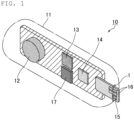
- FIG. 1 shows an exemplary structure of the livestock sensor of the disclosure.
- the livestock sensor of the disclosure is not limited to this.
- a livestock sensor 10 in FIG. 1 includes a housing 11.
- the housing 11 contains a signal processing circuit 13 connected to a battery 12.
- the signal processing circuit 13 is provided with an acceleration sensor 14 and a radio transmitter 17.
- To the signal processing circuit 13 are electrically connected a temperature sensor 15 and a fixed pH sensor 16.
- the temperature sensor 15 and the fixed pH sensor 16 are partly exposed outside the housing 11 so as to contact with the rumen fluid.
- the housing 11 is provided with a packing 1 to prevent rumen fluid from flowing into the space containing the signal processing circuit 13.
- the packing 1 corresponds to the seal of the disclosure.
- Sheets each having a thickness of 0.2 mm and a diameter of 120 mm were produced from the respective materials by compression molding using a heat press.
- PTFE was molded at a temperature that is 50°C to 70°C higher than the melting point and at a pressure of 5 MPa.
- Other resins were each molded at a temperature that is 40°C higher than the melting point and at a pressure of 3 MPa.
- the rubbers were crosslink-molded by press vulcanization at a temperature of 100°C to 200°C.
- test piece (the above sheet) was immersed in an 80% aqueous solution of acetic acid at 50°C for one month, and the appearance thereof was observed and evaluated based on the following criteria.
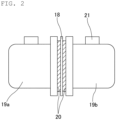
- a sample sheet 18 (the above sheet) was sandwiched between two glass containers 19a and 19b (each having a capacity of 200 ml) shown in FIG. 2 using O-rings 20.
- the container 19a on one side of the sheet was charged with 200 ml of hydrochloric acid having a concentration of 35 mass% or nitric acid having a concentration of 60 mass%, and the container 19b on the other side was charged with 200 ml of pure water.
- the system was placed in a constant-temperature bath (the sample sheet 18 had a wetted surface of 70 mm ⁇ ). The system was left in such a state for 40 days, and a sample in an amount of about 1 ml was collected from a sampling port 21 of the container 19b containing pure water.
- the hydrochloric acid ion concentration or nitric acid ion concentration (Y ppm) of the sample was quantified by ion chromatography (IC7000-E available from Yokogawa Electric Corporation).
- the permeation amount of hydrochloric acid or nitric acid (X g ⁇ cm/cm 2 ) was calculated using the following formula, and the permeation coefficient of hydrochloric acid or nitric acid was determined.
Landscapes
- Life Sciences & Earth Sciences (AREA)
- Health & Medical Sciences (AREA)
- Environmental Sciences (AREA)
- Biophysics (AREA)
- Physics & Mathematics (AREA)
- Public Health (AREA)
- Veterinary Medicine (AREA)
- Pathology (AREA)
- Engineering & Computer Science (AREA)
- Biomedical Technology (AREA)
- Heart & Thoracic Surgery (AREA)
- Medical Informatics (AREA)
- Molecular Biology (AREA)
- Surgery (AREA)
- Animal Behavior & Ethology (AREA)
- General Health & Medical Sciences (AREA)
- Chemical & Material Sciences (AREA)
- Animal Husbandry (AREA)
- Biodiversity & Conservation Biology (AREA)
- Chemical Kinetics & Catalysis (AREA)
- Medicinal Chemistry (AREA)
- Polymers & Plastics (AREA)
- Organic Chemistry (AREA)
- Optics & Photonics (AREA)
- Dentistry (AREA)
- Oral & Maxillofacial Surgery (AREA)
- Physiology (AREA)
- Birds (AREA)
- Zoology (AREA)
- Addition Polymer Or Copolymer, Post-Treatments, Or Chemical Modifications (AREA)
- Compositions Of Macromolecular Compounds (AREA)
- Laminated Bodies (AREA)
Abstract
Description
- The disclosure relates to seals for livestock sensors and livestock sensors.
- In the recent study in the field of livestock production, it has been considered to place sensors in the cattle's body to manage the health and breeding of cattle.
- Patent Literature 1 discloses a detection device for detecting an internal state of the first stomach (rumen) of cattle, the detection device including an O-ring for preventing entry of rumen fluid.
- Patent Literature 1:
WO 2010/147175 - The disclosure aims to provide a seal for a livestock sensor that has excellent resistance to organic acids and excellently low acid permeability, and a livestock sensor including the same.
- The disclosure relates to a seal for a livestock sensor, the seal containing a resin or a rubber free from a chlorine atom.
- The resin is preferably a fluororesin.
- The fluororesin preferably includes at least one selected from the group consisting of polytetrafluoroethylene, a tetrafluoroethylene/perfluoro(alkyl vinyl ether) copolymer, a tetrafluoroethylene/hexafluoropropylene copolymer, a tetrafluoroethylene/perfluoroalkyl allyl ether copolymer, and a chlorotrifluoroethylene/tetrafluoroethylene/perfluoro(alkyl vinyl ether) copolymer.
- The rubber is preferably a fluorine-containing rubber.
- The fluorine-containing rubber is preferably a perfluororubber.
- The disclosure also relates to a livestock sensor including the seal for a livestock sensor.
- The disclosure can provide a seal for a livestock sensor that has excellent resistance to organic acids and excellently low acid permeability, and a livestock sensor including the same.
-
-
FIG. 1 is a cross-sectional view of an exemplary structure of a livestock sensor. -
FIG. 2 is a cross-sectional diagram of a test device for inspecting chemical permeability. - Livestock sensors to be orally administered to livestock (placed in the livestock body, particularly in the stomach) are required to be resistant to organic acids such as gastric acid.
- Conventionally, sufficient study has not been made on the material of a seal used in such a livestock sensor.
- As a result of intensive studies, the present inventors found that a seal containing a specific material has excellent resistance to organic acids and excellently low acid permeability and thus can be suitably used as a seal for a livestock sensor. The seal for a livestock sensor of the disclosure has been thus completed.
- The disclosure will be specifically described below.
- The seal for a livestock sensor of the disclosure contains a resin or a rubber free from a chlorine atom and thus has excellent resistance to organic acids and excellently low acid permeability. When used in a livestock sensor, the seal is less likely to corrode even when it contacts with gastric juice, for example and is not likely to allow permeation of gastric juice, for example, thereby preventing the gastric juice, for example, from entering the inside of the livestock sensor to avoid corrosion of a component such as an internal substrate.
- Examples of the resin include a fluororesin and a silicone resin. A fluororesin is preferred as it has much better resistance to organic acids, much lower acid permeability, and a high specific gravity.
- The fluororesin preferably has a melting point of 100°C to 360°C, more preferably 140°C to 350°C, still more preferably 160°C to 340°C.
- The melting point is the temperature corresponding to the maximum value on a heat-of-fusion curve obtained by increasing the temperature at a rate of 10°C/min using a differential scanning calorimeter (DSC).
- The fluororesin preferably has a specific gravity of 1.8 or higher. The fluororesin having a specific gravity within the above range can increase the specific gravity of the livestock sensor, facilitating placement (submerging) of the sensor in a body fluid such as gastric juice. The specific gravity is more preferably 1.9 or higher, still more preferably 2.0 or higher. The upper limit of the specific gravity is preferably, but is not limited to, 3.0 or lower, more preferably 2.5 or lower.
- The specific gravity of the fluororesin is measured in conformity with ASTM D-792.
- Examples of the fluororesin include polytetrafluoroethylene (PTFE), a tetrafluoroethylene (TFE)/perfluoro(alkyl vinyl ether) (PAVE) copolymer (PFA), a TFE/hexafluoropropylene (HFP) copolymer (FEP), an ethylene (Et)/TFE copolymer (ETFE), an Et/TFE/HFP copolymer (EFEP), polychlorotrifluoroethylene (PCTFE), a chlorotrifluoroethylene (CTFE)/TFE copolymer, a CTFE/TFE/PAVE copolymer, an Et/CTFE copolymer, polyvinyl fluoride (PVF), polyvinylidene fluoride (PVdF), a vinylidene fluoride (VdF)/TFE copolymer, a VdF/HFP copolymer, a VdF/TFE/HFP copolymer, a VdF/HFP/(meth)acrylic acid copolymer, a VdF/CTFE copolymer, a VdF/pentafluoropropylene copolymer, a VdF/PAVE/TFE copolymer, and a TFE/perfluoroalkyl allyl ether copolymer. The perfluoroalkyl allyl ether is a monomer represented by CF2=CFCF2-O-Rf4 (wherein Rf4 is a C1-C5 perfluoroalkyl group) .
- The fluororesin is preferably a perhalopolymer as it has much better resistance to organic acids and much lower acid permeability. A perhalopolymer is a polymer in which every carbon atom constituting the main chain of the polymer is coupled with a halogen atom.
- The fluororesin preferably includes at least one selected from the group consisting of PTFE, PFA, FEP, a TFE/perfluoroalkyl allyl ether copolymer, and a CTFE/TFE/PAVE copolymer, more preferably at least one selected from the group consisting of PTFE, PFA, and a CTFE/TFE/PAVE copolymer.
- The PTFE may be a TFE homopolymer consisting only of a tetrafluoroethylene (TFE) unit, or may be a modified PTFE containing a TFE unit and a modifying monomer unit based on a modifying monomer copolymerizable with TFE.
- The modifying monomer may be any monomer copolymerizable with TFE, and examples thereof include a perfluoroolefin such as hexafluoropropylene (HFP); a chlorofluoroolefin such as chlorotrifluoroethylene (CTFE); a hydrogen-containing fluoroolefin such as trifluoroethylene and vinylidene fluoride (VdF); a perfluorovinyl ether; a perfluoroalkyl allyl ether; a (perfluoroalkyl)ethylene; and ethylene. One type or two or more types of modifying monomers may be used.
- The perfluorovinyl ether is not limited, and may be, for example, an unsaturated perfluoro compound represented by the following formula (1):
CF2=CF-ORf (1)
wherein Rf is a perfluoroorganic group. The term "perfluoro organic group" herein means an organic group in which all hydrogen atoms bonded to any carbon atom are replaced by fluorine atoms. The perfluoro organic group may contain an ether oxygen. - Examples of the perfluorovinyl ether include a perfluoro(alkyl vinyl ether) (PAVE) represented by the formula (1) wherein Rf is a C1-C10 perfluoroalkyl group. The perfluoroalkyl group preferably has 1 to 5 carbon atoms.
- Examples of the perfluoroalkyl group in the PAVE include a perfluoromethyl group, a perfluoroethyl group, a perfluoropropyl group, a perfluorobutyl group, a perfluoropentyl group, and a perfluorohexyl group. Preferred is perfluoro(propyl vinyl ether) (PPVE) wherein the perfluoroalkyl group is a perfluoropropyl group.
- Examples of the perfluorovinyl ether further include: those represented by the formula (1) wherein Rf is a C4-C9 perfluoro(alkoxyalkyl) group, those represented by the formula (1) wherein Rf is represented by the following formula:


- Examples of the (perfluoroalkyl)ethylene include, but are not limited to, (perfluorobutyl)ethylene (PFBE), (perfluorohexyl)ethylene (PFHE), and (perfluorooctyl)ethylene.
- The modifying monomer in the modified PTFE preferably includes at least one selected from the group consisting of HFP, CTFE, VdF, PPVE, PFBE, and ethylene, more preferably at least one selected from the group consisting of HFP and CTFE.
- In the modified PTFE, the amount of the modifying monomer unit is preferably in the range of 0.00001 to 1.0% by mass. The lower limit of the amount of the modifying monomer unit is more preferably 0.0001% by mass, still more preferably 0.001% by mass, even more preferably 0.005% by mass, further preferably 0.010% by mass, particularly preferably 0.030% by mass. The upper limit of the amount of the modifying monomer unit is preferably 0.90% by mass, more preferably 0.50% by mass, still more preferably 0.40% by mass, even more preferably 0.30% by mass.
- The term "modifying monomer unit" herein means a moiety that is part of the molecular structure of the modified PTFE and is derived from a modifying monomer. The term "all monomer units" herein means all moieties derived from monomers in the molecular structure of the modified PTFE.
- The PTFE preferably has a melting point of 324°C to 360°C. The melting point of PTFE means the first melting point. The first melting point is the temperature corresponding to the maximum value on a heat-of-fusion curve obtained by heating a PTFE that has no history of being heated up to a temperature of 300°C or higher, at a rate of 10°C/min using a differential scanning calorimeter (DSC).
- The PTFE preferably has a standard specific gravity (SSG) of 2.130 to 2.280. The standard specific gravity is more preferably 2.220 or lower, still more preferably 2.200 or lower, while it is preferably 2.140 or higher, more preferably 2.150 or higher. The SSG is measured by a water displacement method in conformity with ASTM D-792 using a sample molded in conformity with ASTM D 4895-89.
- The PTFE preferably has non-melt secondary processibility. The non-melt secondary processibility means a property of a polymer such that the melt flow rate cannot be measured at a temperature higher than the crystallization melting point in conformity with ASTM D-1238 and D-2116.
- The PFA is preferably, but is not limited to, a copolymer having a molar ratio of the TFE unit to the PAVE unit (TFE unit/PAVE unit) of 70/30 or more and less than 99/1, more preferably 70/30 or more and 98.9/1.1 or less, still more preferably 80/20 or more and 98.9/1.1 or less. The PFA is also preferably a copolymer containing 0.1 to 10 mol% (the sum of the TFE unit and the PAVE unit is 90 to 99.9 mol%), more preferably 0.1 to 5 mol%, particularly preferably 0.2 to 4 mol% of a monomer unit derived from a monomer copolymerizable with TFE and PAVE.
- Examples of the monomer copolymerizable with TFE and PAVE include HFP, a vinyl monomer represented by the formula (I): CZ1Z2=CZ3(CF2)nZ4 (wherein Z1, Z2, and Z3 are the same as or different from each other and each are a hydrogen atom or a fluorine atom; Z4 is a hydrogen atom, a fluorine atom, or a chlorine atom; and n is an integer of 2 to 10), an alkyl perfluorovinyl ether derivative represented by the formula (II): CF2=CF-OCH2-Rf1 (wherein Rf1 is a C1-C5 perfluoroalkyl group), and an allyl ether monomer represented by the formula (X): CZ5Z6=CZ7-CZ8Z9-O-Rf4 (wherein Z5, Z6, and Z7 are the same as or different from each other and each represent a hydrogen atom, a chlorine atom, or a fluorine atom; Z8 and Z9 each are a hydrogen atom or a fluorine atom; and Rf4 is a C1-C5 perfluoroalkyl group). Examples of the allyl ether monomer include CH2=CFCF2-O-Rf4, CF2=CFCF2-O-Rf4 (perfluoroalkyl allyl ether), CF2=CFCH2-O-Rf4, and CH2=CHCF2-O-Rf4 (in the formulas, Rf4 is the same as that in the formula (X)
- Examples of the monomer copolymerizable with TFE and PAVE further include unsaturated monocarboxylic acids, unsaturated dicarboxylic acids, and acid anhydrides of unsaturated dicarboxylic acids, such as itaconic acid, itaconic anhydride, citraconic anhydride, and 5-norbornene-2,3-dicarboxylic anhydride.
- The PFA preferably has a melting point of 180°C or higher and lower than 324°C, more preferably 230°C to 320°C, still more preferably 280°C to 320°C.
- The FEP is preferably, but is not limited to, a copolymer having a molar ratio of the TFE unit to the HFP unit (TFE unit/HFP unit) of 70/30 or more and less than 99/1, more preferably 70/30 or more and 98.9/1.1 or less, still more preferably 80/20 or more and 98.9/1.1 or less. The FEP is also preferably a copolymer containing 0.1 to 10 mol% (the sum of the TFE unit and the HFP unit is 90 to 99.9 mol%), more preferably 0.1 to 5 mol%, particularly preferably 0.2 to 4 mol% of a monomer unit derived from a monomer copolymerizable with TFE and HFP.
- Examples of the monomer copolymerizable with TFE and HFP include PAVE, a monomer represented by the formula (X), and an alkyl perfluorovinyl ether derivative represented by the formula (II).
- Examples of the monomer copolymerizable with TFE and HFP further include unsaturated monocarboxylic acids, unsaturated dicarboxylic acids, acid anhydrides of unsaturated dicarboxylic acids, such as itaconic acid, itaconic anhydride, citraconic anhydride, and 5-norbornene-2,3-dicarboxylic anhydride.
- The FEP preferably has a melting point of 150°C or higher and lower than 324°C, more preferably 200°C to 320°C, still more preferably 240°C to 320°C.
- The CTFE/TFE/PAVE copolymer (CPT) is a copolymer consisting essentially of CTFE, TFE, and PAVE.
- The PAVE in the CTFE/TFE/PAVE copolymer may be perfluoro(methyl vinyl ether) (PMVE), perfluoro(ethyl vinyl ether) (PEVE), perfluoro(propyl vinyl ether) (PPVE), perfluoro(butyl vinyl ether), or the like, and preferably includes at least one selected from the group consisting of PMVE, PEVE, and PPVE.
- The CTFE/TFE/PAVE copolymer preferably contains the PAVE unit in an amount of 0.5 mol% or more and 5 mol% or less of all monomer units.
- The values of constituent units such as a CTFE unit are obtainable by 19F-NMR analysis.
- The CTFE/TFE/PAVE copolymer preferably has a melting point of 160°C to 270°C.
- The amounts of the respective monomer units in the polymer described above can be calculated by appropriate combination of NMR, FT-IR, elemental analysis, and X-ray fluorescence analysis in accordance with the types of the monomers.
- The fluororesin is also preferably a melt-fabricable fluororesin. Use of a melt-fabricable fluororesin improves processibility.
- The term "melt-fabricable" herein means that the polymer can be melted and processed using a conventional processor such as an extruder or an injection molding machine.
- The melt-fabricable fluororesin preferably has a melt flow rate (MFR) of 0.1 to 100 g/10 min, more preferably 0.5 to 50 g/10 min.
- The MFR herein is a value obtained in conformity with ASTM D1238 using a melt indexer, as the mass (g/10 min) of a polymer flowing out of a nozzle (inner diameter: 2 mm, length: 8 mm) per 10 minutes at a measurement temperature specified according to the type of the fluoropolymer (e.g., 372°C for PFA and FEP, 297°C for CPT and ETFE) and a load specified according to the type of the fluoropolymer (e.g., 5 kg for PFA, FEP, CPT, and ETFE).
- Examples of the melt-fabricable fluororesin include those mentioned above, including PFA, FEP, ETFE, EFEP, PCTFE, a CTFE/TFE/PAVE copolymer, and PVdF. The melt-fabricable fluororesin preferably includes at least one selected from the group consisting of PFA, FEP, and a CTFE/TFE/PAVE copolymer.
- The rubber free from a chlorine atom is preferably amorphous. The term "amorphous" means that the rubber has a melting peak (ΔH) of 2.0 J/g or lower determined by DSC (temperature-increasing rate: 10°C/min).
- Examples of the rubber free from a chlorine atom include fluorine-containing rubbers (excluding those containing chlorine atoms) such as a fluororubber and a fluorosilicone rubber, fluorine-free rubbers free from a chlorine atom.
- Examples of the fluororubber include a partially fluorinated rubber and a perfluororubber. A perfluororubber as it has much better resistance to organic acids and much lower acid permeability is preferred.
- Examples of the partially fluorinated rubber include a vinylidene fluoride (VdF)-based fluororubber, a tetrafluoroethylene (TFE)/propylene (Pr)-based fluororubber, a tetrafluoroethylene (TFE)/propylene/vinylidene fluoride (VdF)-based fluororubber, an ethylene/hexafluoropropylene (HFP)-based fluororubber, an ethylene/hexafluoropropylene (HFP)/vinylidene fluoride (VdF)-based fluororubber, and an ethylene/hexafluoropropylene (HFP)/tetrafluoroethylene (TFE)-based fluororubber. Preferred among these is at least one selected from the group consisting of a vinylidene fluoride-based fluororubber and a tetrafluoroethylene/propylene-based fluororubber.
- The vinylidene fluoride-based fluororubber is preferably a copolymer containing 45 to 85 mol% of vinylidene fluoride and 55 to 15 mol% of at least one different monomer copolymerizable with vinylidene fluoride. Preferred is a copolymer containing 50 to 80 mol% of vinylidene fluoride and 50 to 20 mol% of at least one different monomer copolymerizable with vinylidene fluoride.
- The amounts of the respective monomers constituting the fluoropolymer herein can be calculated by appropriate combination of NMR, FT-IR, elemental analysis, and X-ray fluorescence analysis in accordance with the types of the monomers.
- Examples of the at least one different monomer copolymerizable with vinylidene fluoride includes tetrafluoroethylene (TFE), hexafluoropropylene (HFP), a fluoroalkyl vinyl ether, trifluoroethylene, trifluoropropylene, pentafluoropropylene, trifluorobutene, tetrafluoroisobutene, hexafluoroisobutene, vinyl fluoride, a perfluoroalkyl allyl ether, a fluoromonomer represented by the formula (6): CH2=CFRf61 (wherein Rf61 is a C1-C12 linear or branched fluoroalkyl group), a fluoromonomer represented by the formula (7): CH2=CH-(CF2)n-X2 (wherein X2 is H or F and n is an integer of 3 to 10), a monomer giving a crosslinking site; and non-fluorinated monomers such as ethylene, propylene, and an alkyl vinyl ether. Each of these can be used alone or in any combination. Among these, at least one selected from the group consisting of TFE, HFP, and a fluoroalkyl vinyl ether is preferably used.
- The fluoroalkyl vinyl ether preferably includes at least one selected from the group consisting of a fluoromonomer represented by the formula (8):
CF2=CF-ORf81
(wherein Rf81 is a C1-C8 perfluoroalkyl group), a fluoromonomer represented by the formula (9):
CF2=CFOCF2ORf91
(wherein Rf91 is a C1-C6 linear or branched perfluoroalkyl group, a C5-C6 cyclic perfluoroalkyl group, or a C2-C6 linear or branched perfluorooxyalkyl group containing 1 to 3 oxygen atom(s)), and a fluoromonomer represented by the formula (10):
CF2=CFO(CF2CF(Y10)O)m(CF2)nF
(wherein Y10 is a fluorine atom or a trifluoromethyl group, m is an integer of 1 to 4, and n is an integer of 1 to 4). More preferred is a fluoromonomer represented by the formula (8). - The perfluoroalkyl allyl ether is preferably a fluoromonomer represented by the formula (11): CF2=CF-CF2ORf111 (wherein Rf111 is a C1-C5 perfluoroalkyl group).
- Specific examples of the vinylidene fluoride-based fluororubber include a VdF/HFP-based rubber, a VdF/HFP/TFE-based rubber, a rubber based on VdF and a fluoromonomer rubber represented by the formula (6), a rubber based on VdF, a fluoromonomer represented by the formula (6), and TFE, a VdF/perfluoro(methyl vinyl ether) (PMVE)-based rubber, a VdF/PMVE/TFE-based rubber, and a VdF/PMVE/TFE/HFP-based rubber. The rubber based on VdF and a fluoromonomer represented by the formula (6) is preferably VdF/CH2=CFCF3 rubber. The rubber based on VdF, a fluoromonomer represented by the formula (6), and TFE is preferably VdF/TFE/CH2=CFCF3 rubber.
- The VdF/CH2=CFCF3-based rubber is preferably a copolymer containing 40 to 99.5 mol% of VdF and 0.5 to 60 mol% of CH2=CFCF3, more preferably a copolymer containing 50 to 85 mol% of VdF and 20 to 50 mol% of CH2=CFCF3.
- The tetrafluoroethylene/propylene-based fluororubber is preferably a copolymer containing 45 to 70 mol% of tetrafluoroethylene, 55 to 30 mol% of propylene, and 0 to 5 mol% of a fluoromonomer giving a crosslinking site.
- The perfluororubber preferably includes at least one selected from the group consisting of perfluororubbers containing TFE, such as a copolymer of TFE/a fluoromonomer represented by the formula (8), (9), or (10) and a copolymer of TFE/a fluoromonomer represented by the formula (8), (9), or (10)/a monomer giving a crosslinking site.
- In the case of a TFE/PMVE copolymer, the compositional ratio is preferably (45 to 90)/(10 to 55) (mol%), more preferably (55 to 80)/(20 to 45), still more preferably (55 to 70)/(30 to 45).
- In the case of a copolymer of TFE/PMVE/a monomer giving a crosslinking site, the compositional ratio is preferably (45 to 89.9)/(10 to 54.9)/(0.01 to 4) (mol%), more preferably (55 to 77. 9)/(20 to 49.9)/(0.1 to 3.5), still more preferably (55 to 69.8)/(30 to 44.8)/(0.2 to 3).
- In the case of a copolymer of TFE/a C4-C12 fluoromonomer represented by the formula (8), (9), or (10), the compositional ratio is preferably (50 to 90)/(10 to 50) (mol%), more preferably (60 to 88)/(12 to 40), still more preferably (65 to 85)/(15 to 35).
- In the case of a copolymer of TFE/a C4-C12 fluoromonomer represented by the formula (8), (9), or (10)/a monomer giving a crosslinking site, the compositional ratio is preferably (50 to 89.9)/(10 to 49.9)/(0.01 to 4) (mol%), more preferably (60 to 87.9)/(12 to 39.9)/(0.1 to 3.5), still more preferably (65 to 84.8)/(15 to 34.8)/(0.2 to 3).
- If the compositional ratios are out of the ranges mentioned above, the copolymers tend to lose the properties as a rubber elastic body and to have the properties similar to those of resin.
- The perfluororubber preferably includes at least one selected from the group consisting of a copolymer of TFE/a fluoromonomer represented by the formula (10)/a fluoromonomer giving a crosslinking site, a copolymer of TFE/a perfluorovinyl ether represented by the formula (10), a copolymer of TFE/a fluoromonomer represented by the formula (8), and a copolymer of TFE/a fluoromonomer represented by the formula (8)/a monomer giving a crosslinking site.
- Examples of the perfluororubber include the perfluororubbers disclosed in
WO 97/24381 JP S61-57324 B JP H4-81608 B JP H5-13961 B - The monomer giving a crosslinking site is a monomer (cure-site monomer) containing a crosslinkable group that can give a fluoropolymer a crosslinking site to form a crosslink with use of a crosslinking agent.
- The monomer giving a crosslinking site preferably includes at least one selected from the group consisting of:
- a fluoromonomer represented by the formula (12):
CX3 2=CX3-Rf 121CHR121X4
(wherein X3 is a hydrogen atom, a fluorine atom, or CH3; Rf 121 is a fluoroalkylene group, a perfluoroalkylene group, a fluoro(poly)oxyalkylene group, or a perfluoro(poly)oxyalkylene group; R121 is a hydrogen atom or CH3; and X4 is an iodine atom or a bromine atom); - a fluoromonomer represented by the formula (13):
CX3 2=CX3-Rf 131X4
(wherein X3 is a hydrogen atom, a fluorine atom, or CH3; Rf 131 is a fluoroalkylene group, a perfluoroalkylene group, a fluoropolyoxyalkylene group, or a perfluoropolyoxyalkylene group; and X4 is an iodine atom or a bromine atom); - a fluoromonomer represented by the formula (14):
CF2=CFO(CF2CF(CF3)O)m(CF2)n-X5
(wherein m is an integer of 0 to 5; n is an integer of 1 to 3; and X5 is a cyano group, a carboxy group, an alkoxycarbonyl group, an iodine atom, a bromine atom, or-CH2I); - a fluoromonomer represented by the formula (15):
CH2=CFCF2O(CF(CF3)CF2O)m(CF(CF3))n-X6
(wherein m is an integer of 0 to 5; n is an integer of 1 to 3; X6 is a cyano group, a carboxy group, an alkoxycarbonyl group, an iodine atom, a bromine atom, or -CH2OH), and - a monomer represented by the formula (16):
CR162R163=CR164-Z-CR165=CR166R167
(wherein R162, R163, R164, R165, R166, and R167 are the same as or different from each other, and are each a hydrogen atom or a C1-C5 alkyl group; Z is a C1-C18 linear or branched alkylene group optionally containing an oxygen atom, a C3-C18 cycloalkylene group, a C1-C10 alkylene or oxyalkylene group that is at least partially fluorinated, or a (per)fluoropolyoxyalkylene group represented by -(Q)p-CF2O-(CF2CF2O)m(CF2O)n-CF2-(Q)p- (wherein Q is an alkylene group or an oxyalkylene group; p is 0 or 1; and m/n is 0.2 to 5) and having a molecular weight of 500 to 10000). - X3 is preferably a fluorine atom. Rf 121 and Rf 131 are preferably C1-C5 perfluoroalkylene groups. R121 is preferably a hydrogen atom. X5 is preferably a cyano group, an alkoxycarbonyl group, an iodine atom, a bromine atom, or -CH2I. X6 is preferably a cyano group, an alkoxycarbonyl group, an iodine atom, a bromine atom, or-CH2OH.
- The monomer giving a crosslinking site preferably includes at least one selected from the group consisting of CF2=CFOCF2CF(CF3)OCF2CF2CN, CF2=CFOCF2CF(CF3)OCF2CF2COOH, CF2=CFOCF2CF(CF3)OCF2CF2CH2I, CF2=CFOCF2CF2CH2I, CH2=CFCF2OCF(CF3)CF2OCF(CF3)CN, CH2=CFCF2OCF(CF3)CF2OCF(CF3)COOH, CH2=CFCF2OCF(CF3)CF2OCF(CF3)CH2OH, CH2=CHCF2CF2I, CH2=CH(CF2)2CH=CH2, CH2=CH(CF2)6CH=CH2, and CF2=CFO(CF2)5CN, more preferably at least one selected from the group consisting of CF2=CFOCF2CF(CF3)OCF2CF2CN and CF2=CFOCF2CF2CH2I.
- In order to achieve excellent compression set performance at high temperature, the fluororubber preferably has a glass transition temperature of -70°C or higher, more preferably -60°C or higher, still more preferably -50°C or higher. In order to achieve good cold resistance, the fluororubber has a glass transition temperature of preferably 5°C or lower, more preferably 0°C or lower, still more preferably -3°C or lower.
- The glass transition temperature can be determined as follows. Specifically, using a differential scanning calorimeter (DSC822e available from Mettler-Toledo International Inc.), 10 mg of a sample is heated at a rate of 10°C/min to give a DSC curve, and the temperature is read at the intermediate point of two intersections between each of the extension lines of the base lines before and after the secondary transition of the DSC curve and the tangent line at the inflection point of the DSC curve.
- In order to achieve good heat resistance, the fluororubber preferably has a Mooney viscosity ML(1+20) at 170°C of 30 or higher, more preferably 40 or higher, still more preferably 50 or higher. In order to achieve good processibility, the fluororubber preferably has a Mooney viscosity ML(1+20) at 170°C of 150 or lower, more preferably 120 or lower, still more preferably 110 or lower.
- In order to achieve good heat resistance, the fluororubber preferably has a Mooney viscosity ML(1+20) at 140°C of 30 or higher, more preferably 40 or higher, still more preferably 50 or higher. In order to achieve good processibility, the fluororubber preferably has a Mooney viscosity ML(1+20) at 140°C of 180 or lower, more preferably 150 or lower, still more preferably 110 or lower.
- In order to achieve good heat resistance, the fluororubber preferably has a Mooney viscosity ML(1+10) at 100°C of 10 or higher, more preferably 20 or higher, still more preferably 30 or higher. In order to achieve good processibility, the fluororubber preferably has a Mooney viscosity ML(1+10) at 100°C of 120 or lower, more preferably 100 or lower, still more preferably 80 or lower.
- The Mooney viscosity can be determined using a Mooney viscometer MV2000E available from Alpha Technologies Inc. at 170°C, 140°C, or 100°C in conformity with JIS K 6300.
- Examples of the fluorine-free rubbers free from a chlorine atom include nitrile rubber, hydrogenated nitrile rubber, styrene-butadiene rubber, polybutadiene rubber, natural rubber, isoprene rubber, ethylene-α-olefin rubber, ethylene-α-olefin-nonconjugated diene rubber, acrylic rubber, ethylene acrylic rubber, silicone rubber, butyl rubber, ethylene-vinyl ester rubber, and ethylene-methacrylate rubber. Preferred among these are nitrile rubber and silicone rubber.
- In order to achieve much better resistance to organic acids and much lower acid permeability as well as a high specific gravity, the rubber free from a chlorine atom is preferably a fluorine-containing rubber, more preferably a fluororubber, still more preferably a perfluororubber.
- The seal of the disclosure may further contain a different component in addition to the resin or rubber. Examples of the different component include various additives such as fillers (e.g., carbon black, barium sulfate), acid acceptors, processing aids (e.g., wax), plasticizers, colorants, stabilizers, adhesion aids, release agents, conductivity-imparting agents, thermal-conductivity-imparting agents, surface non-adhesive agents, flexibility-imparting agents, heat resistance improvers, and flame retardants. The amount of the different component is preferably 0 to 50 parts by mass, more preferably 0 to 20 parts by mass, still more preferably 0 to 10 parts by mass per 100 parts by mass of the resin or rubber.
- The seal of the disclosure can be produced by molding the resin by a known molding method such as cutting, injection molding, extrusion molding, or compression molding. The seal of the disclosure can also be produced by crosslink-molding a rubber composition containing the rubber and a crosslinking agent (and a crosslinking aid, if necessary) by a known method.
- The seal of the disclosure is used in a livestock sensor to prevent entry of a fluid (liquid or gas) or a foreign substance, preferably a fluid, from the outside. The fluid is preferably a liquid, more preferably a body fluid containing an organic acid in livestock, still more preferably livestock gastric juice, particularly preferably livestock rumen fluid.
- The seal preferably prevents a fluid or a foreign substance from entering a space that contains a detecting portion or a substrate of the livestock sensor.
- The form of the seal is not limited, and can be determined according to the application site. Examples thereof include a packing, an O-ring, and a gasket.
- A livestock sensor to which the seal of the disclosure is applied is placed in the livestock body and detects the state of the livestock (e.g., pH, temperature, amount of exercise (acceleration)). The livestock sensor is preferably configured to be orally administered to livestock. Further, the livestock sensor is preferably a wireless transmission sensor capable of wirelessly transmitting acquired data.
- The disclosure also relates to a livestock sensor including the above-described seal of the disclosure. When including the seal of the disclosure, the livestock sensor of the disclosure is less likely to deteriorate even when it contacts with gastric juice, for example, and is not likely to allow permeation of gastric juice, for example, thereby preventing the gastric juice, for example, from entering the inside to avoid corrosion of a component such as an internal substrate.
- The livestock sensor preferably includes a housing. The housing is preferably a member capable of containing a detecting portion and other necessary parts inside. Also, the housing of the disclosure may be configured such that a portion thereof can be separated (for example, the main body and the cap).
- The housing may be formed of any material, including resins such as a fluororesin or a fluorine-free resin; or metals such as stainless steel. The outer surface of a metal housing may be coated with resin.
- The housing may have any shape that can contain the detecting portion and other necessary parts inside, such as a tubular shape (e.g., circular tube, square tube), a bottle shape, a bottomed circular tubular shape, or a bottomed square tubular shape. Preferred among these are a tubular shape, a bottle shape, a bottomed circular tubular shape, and a bottomed square tubular shape, and more preferred are a circular tubular shape and a bottomed circular tubular shape.
- The livestock sensor preferably includes a detecting portion contained in the housing. Examples of the detecting portion include a pH sensor, a temperature sensor, a piezoelectric sensor, an acceleration sensor, and a position sensor.
- The livestock are preferably ruminant animals including cattle (dairy cattle, beef cattle), sheep, and goats. Cattle are particularly preferred.
- The livestock sensor is preferably placed in an internal organ of livestock, more preferably in the stomach, still more preferably in the rumen, particularly preferably in the rumen fluid.
- The livestock sensor is preferably left in the livestock body for one month or longer, more preferably six months or longer, still more preferably one year or longer, particularly preferably three years or longer.
- The livestock sensor preferably has a specific gravity of 1.8 or higher, more preferably 2.0 or higher. The livestock sensor having a specific gravity within the above range can be easily placed (submerged) in a body fluid such as gastric juice.
- The livestock sensor may have any size that allows oral administration to livestock. In the case of the circular tubular sensor, the diameter may be 10 to 35 mm and the length may be 40 to 150 mm, for example.
-
FIG. 1 shows an exemplary structure of the livestock sensor of the disclosure. The livestock sensor of the disclosure is not limited to this. - A
livestock sensor 10 inFIG. 1 includes ahousing 11. - The
housing 11 contains asignal processing circuit 13 connected to abattery 12. Thesignal processing circuit 13 is provided with anacceleration sensor 14 and aradio transmitter 17. To thesignal processing circuit 13 are electrically connected atemperature sensor 15 and a fixedpH sensor 16. - The
temperature sensor 15 and the fixedpH sensor 16 are partly exposed outside thehousing 11 so as to contact with the rumen fluid. - The
housing 11 is provided with a packing 1 to prevent rumen fluid from flowing into the space containing thesignal processing circuit 13. The packing 1 corresponds to the seal of the disclosure. - The disclosure will be described in more detail with reference to examples, but the disclosure is not limited only to these examples.
- The materials used in the experimental examples are shown below.
- PTFE: TFE homopolymer (melting point: 327°C, SSG: 2.2)
- PFA: TFE/PPVE copolymer (melting point: 306°C, MFR: 14 g/10 min)
- CPT: CTFE/TFE/PPVE copolymer (melting point: 248°C, MFR: 30 g/10 min)
- FEP: TFE/HFP copolymer (melting point: 265°C, MFR: 7 g/10 min)
- Perfluororubber (FFKM): TFE/PMVE copolymer
- Silicone rubber: KE-136Y-U available from Shin-Etsu Chemical Co., Ltd.
- Chloroprene rubber (CR): Denka Chloroprene M-40 available from Denka Company Limited
- Chlorosulfonated polyethylene rubber (CSM): Hypalon 40 available from DuPont
- Sheets each having a thickness of 0.2 mm and a diameter of 120 mm were produced from the respective materials by compression molding using a heat press. PTFE was molded at a temperature that is 50°C to 70°C higher than the melting point and at a pressure of 5 MPa. Other resins were each molded at a temperature that is 40°C higher than the melting point and at a pressure of 3 MPa. The rubbers were crosslink-molded by press vulcanization at a temperature of 100°C to 200°C.
- Using the resulting sheets, the long-term chemical resistance and the chemical permeability were evaluated by the following methods. Table 1 shows the results.
- A test piece (the above sheet) was immersed in an 80% aqueous solution of acetic acid at 50°C for one month, and the appearance thereof was observed and evaluated based on the following criteria.
- Good: No change in appearance (no change in appearance including discoloration, swelling, or cracks)
- Acceptable: Slight change in appearance (slight change in appearance including discoloration, swelling, or cracks)
- Poor: Significant change in appearance (significant change in appearance including discoloration, swelling, or cracks)
- A sample sheet 18 (the above sheet) was sandwiched between two
glass containers FIG. 2 using O-rings 20. Thecontainer 19a on one side of the sheet was charged with 200 ml of hydrochloric acid having a concentration of 35 mass% or nitric acid having a concentration of 60 mass%, and thecontainer 19b on the other side was charged with 200 ml of pure water. The system was placed in a constant-temperature bath (thesample sheet 18 had a wetted surface of 70 mmϕ). The system was left in such a state for 40 days, and a sample in an amount of about 1 ml was collected from asampling port 21 of thecontainer 19b containing pure water. The hydrochloric acid ion concentration or nitric acid ion concentration (Y ppm) of the sample was quantified by ion chromatography (IC7000-E available from Yokogawa Electric Corporation). The permeation amount of hydrochloric acid or nitric acid (X g·cm/cm2) was calculated using the following formula, and the permeation coefficient of hydrochloric acid or nitric acid was determined.
[Table 1] Example 1 Example 2 Example 3 Example 4 Example 5 Example 6 Comparative Example 1 Comparative Example 2 Material PTFE PFA CPT FFKM FEP Silicone rubber CR CSM Evaluation item (1) Long-term chemical resistance Good Good Good Good Good Acceptable Poor Poor (2) Chemical permeability (g·cm/cm2·sec) 35%HCl 7.5 × 10⁻¹¹ 1.5 × 10⁻¹¹ 0.3 × 10⁻¹¹ 4.0 × 10⁻¹¹ 1.4 × 10⁻¹¹ > 1.0 × 10⁻⁹ > 1.0 × 10⁻⁹ > 1.0 × 10⁻⁹ 60%HNO3 5.7 × 10⁻¹² 1.5 × 10⁻¹² 0.4 × 10⁻¹² 50 × 10-12 1.3 × 10⁻¹² > 1.0 × 10⁻¹⁰ > 1.0 × 10⁻¹⁰ > 1.0 × 10⁻¹⁰ Comprehensive evaluation Good Good Good Good Good Acceptable Poor Poor -
- 1: packing
- 10: livestock sensor
- 11: housing
- 12: battery
- 13: signal processing circuit
- 14: acceleration sensor
- 15: temperature sensor
- 16: fixed pH sensor
- 17: radio transmitter
- 18: sample sheet
- 19a, 19b: glass container
- 20: O-ring
- 21: sampling port
Claims (6)
- A seal for a livestock sensor, the seal comprising:a resin, ora rubber free from a chlorine atom.
- The seal for a livestock sensor according to claim 1,
wherein the resin is a fluororesin. - The seal for a livestock sensor according to claim 2,
wherein the fluororesin includes at least one selected from the group consisting of polytetrafluoroethylene, a tetrafluoroethylene/perfluoro(alkyl vinyl ether) copolymer, a tetrafluoroethylene/hexafluoropropylene copolymer, a tetrafluoroethylene/perfluoroalkyl allyl ether copolymer, and a chlorotrifluoroethylene/tetrafluoroethylene/perfluoro(alkyl vinyl ether) copolymer. - The seal for a livestock sensor according to any one of claims 1 to 3,
wherein the rubber is a fluorine-containing rubber. - The seal for a livestock sensor according to claim 4,
wherein the fluorine-containing rubber is a perfluororubber. - A livestock sensor comprising the seal for a livestock sensor according to any one of claims 1 to 5.
Applications Claiming Priority (2)
| Application Number | Priority Date | Filing Date | Title |
|---|---|---|---|
| JP2020205068 | 2020-12-10 | ||
| PCT/JP2021/044384 WO2022124209A1 (en) | 2020-12-10 | 2021-12-03 | Seal member for livestock sensor and livestock sensor |
Publications (2)
| Publication Number | Publication Date |
|---|---|
| EP4260692A1 true EP4260692A1 (en) | 2023-10-18 |
| EP4260692A4 EP4260692A4 (en) | 2024-10-30 |
Family
ID=81973225
Family Applications (1)
| Application Number | Title | Priority Date | Filing Date |
|---|---|---|---|
| EP21903313.1A Pending EP4260692A4 (en) | 2020-12-10 | 2021-12-03 | SEALING ELEMENT FOR LIVESTOCK SENSOR AND LIVESTOCK SENSOR |
Country Status (6)
| Country | Link |
|---|---|
| US (1) | US20230312777A1 (en) |
| EP (1) | EP4260692A4 (en) |
| JP (1) | JPWO2022124209A1 (en) |
| KR (1) | KR20230091170A (en) |
| CN (1) | CN116528754A (en) |
| WO (1) | WO2022124209A1 (en) |
Families Citing this family (1)
| Publication number | Priority date | Publication date | Assignee | Title |
|---|---|---|---|---|
| JP7712525B2 (en) | 2020-12-10 | 2025-07-24 | ダイキン工業株式会社 | Housing for livestock sensor and livestock sensor |
Family Cites Families (16)
| Publication number | Priority date | Publication date | Assignee | Title |
|---|---|---|---|---|
| JPS5871906A (en) | 1981-10-22 | 1983-04-28 | Daikin Ind Ltd | Manufacture of fluorine-containing elastic copolymer |
| US4513128A (en) | 1983-06-23 | 1985-04-23 | E. I. Du Pont De Nemours And Company | Fluorinated vinyl ether copolymers having low glass transition temperatures |
| JPS61223007A (en) | 1985-03-28 | 1986-10-03 | Daikin Ind Ltd | Emulsion polymerization of fluoroelastomer |
| JPH08272296A (en) * | 1995-03-29 | 1996-10-18 | Nitto Denko Corp | Individual identification label |
| US6140437A (en) | 1995-12-28 | 2000-10-31 | Daikin Industries Ltd. | Fluorine-containing elastic copolymers, curable composition containing the same and sealant made therefrom |
| US8636648B2 (en) * | 1999-03-01 | 2014-01-28 | West View Research, Llc | Endoscopic smart probe |
| JP2009028245A (en) * | 2007-07-26 | 2009-02-12 | Hoya Corp | Capsule-shaped medical treatment device |
| AT505607B1 (en) * | 2007-08-09 | 2010-11-15 | Mario Fallast | PROBE FOR MEASURING AT LEAST ONE CONDITIONAL SIZE OF THE ORGANISM OF ANIMATED ANIMAL |
| EP2438812B1 (en) | 2009-06-19 | 2015-12-02 | Incorporated National University Iwate University | Detection device and monitoring system therefor |
| KR20120052244A (en) * | 2009-07-29 | 2012-05-23 | 아사히 가라스 가부시키가이샤 | Fluororesin film and method for producing same |
| JP2011089828A (en) * | 2009-10-21 | 2011-05-06 | Toyota Central R&D Labs Inc | Chemical stability evaluation device |
| RU2719939C2 (en) * | 2014-09-17 | 2020-04-23 | Марс, Инкорпорейтед | Apparatus |
| JP2017123225A (en) * | 2016-01-05 | 2017-07-13 | Jsr株式会社 | Redox flow fuel cell and diaphragm for redox flow fuel cell |
| DE202017007388U1 (en) * | 2016-05-19 | 2021-02-12 | Metamodix, Inc. | Tools for pyloric anchor recovery |
| JP6846701B2 (en) * | 2017-01-18 | 2021-03-24 | 国立研究開発法人産業技術総合研究所 | pH sensor and monitoring system |
| CN111329453A (en) * | 2020-04-02 | 2020-06-26 | 西北农林科技大学 | Low-power consumption wireless monitoring device for pH value and temperature value of cow rumen |
-
2021
- 2021-12-03 WO PCT/JP2021/044384 patent/WO2022124209A1/en not_active Ceased
- 2021-12-03 JP JP2022568241A patent/JPWO2022124209A1/ja active Pending
- 2021-12-03 CN CN202180080714.6A patent/CN116528754A/en active Pending
- 2021-12-03 KR KR1020237017785A patent/KR20230091170A/en active Pending
- 2021-12-03 EP EP21903313.1A patent/EP4260692A4/en active Pending
-
2023
- 2023-06-07 US US18/330,632 patent/US20230312777A1/en active Pending
Also Published As
| Publication number | Publication date |
|---|---|
| CN116528754A (en) | 2023-08-01 |
| EP4260692A4 (en) | 2024-10-30 |
| WO2022124209A1 (en) | 2022-06-16 |
| JPWO2022124209A1 (en) | 2022-06-16 |
| US20230312777A1 (en) | 2023-10-05 |
| KR20230091170A (en) | 2023-06-22 |
Similar Documents
| Publication | Publication Date | Title |
|---|---|---|
| US6849314B2 (en) | Fluoropolymer blends and multilayer articles | |
| JP4768270B2 (en) | Fuel management system including a fluoroelastomer layer having a hydrotalcite compound | |
| US9266986B2 (en) | Chlorotrifluoroethylene copolymer | |
| JP2002540275A5 (en) | ||
| JP2020100843A (en) | Fluorine resin molding | |
| CN105722680B (en) | Laminate, method for producing laminate, and fluororubber composition | |
| JP2001151825A (en) | Fluorinated copolymer and low chemical liquid permeable fluorinated resin composition | |
| JP6715005B2 (en) | Fluororesin molding | |
| US20230312777A1 (en) | Seal member for livestock sensor and livestock sensor | |
| JP4569568B2 (en) | Fluid transfer member | |
| CN107108806A (en) | The copolymer of 1,3,3,3 tetrafluoropropenes | |
| CN120620790A (en) | Laminate body | |
| JP2001151826A (en) | Chemical solution permeation suppressor, chemical solution permeation suppressive fluororesin composition containing the suppressor | |
| US12601618B2 (en) | Casing for livestock sensor and livestock sensor | |
| JP2018015935A (en) | LAMINATE, PROCESS FOR PRODUCING LAMINATE, AND FLUORINE RUBBER COMPOSITION | |
| US20230309514A1 (en) | Housing for livestock sensor and livestock sensor | |
| WO2022124221A1 (en) | Animal husbandry sensor casing and animal husbandry sensor | |
| JP2010234777A (en) | Laminated body | |
| JPWO2006095857A1 (en) | Chlorotrifluoroethylene copolymer-containing laminate and method for producing the same | |
| JP2022092318A (en) | Livestock farming device weight | |
| JP2017052854A (en) | Fluorine resin composition excellent in blister resistance | |
| JP2006321224A (en) | Laminated hose made of fluorine-containing copolymer | |
| JP7389398B1 (en) | laminate |
Legal Events
| Date | Code | Title | Description |
|---|---|---|---|
| STAA | Information on the status of an ep patent application or granted ep patent |
Free format text: STATUS: THE INTERNATIONAL PUBLICATION HAS BEEN MADE |
|
| PUAI | Public reference made under article 153(3) epc to a published international application that has entered the european phase |
Free format text: ORIGINAL CODE: 0009012 |
|
| STAA | Information on the status of an ep patent application or granted ep patent |
Free format text: STATUS: REQUEST FOR EXAMINATION WAS MADE |
|
| 17P | Request for examination filed |
Effective date: 20230629 |
|
| AK | Designated contracting states |
Kind code of ref document: A1 Designated state(s): AL AT BE BG CH CY CZ DE DK EE ES FI FR GB GR HR HU IE IS IT LI LT LU LV MC MK MT NL NO PL PT RO RS SE SI SK SM TR |
|
| P01 | Opt-out of the competence of the unified patent court (upc) registered |
Effective date: 20231201 |
|
| DAV | Request for validation of the european patent (deleted) | ||
| DAX | Request for extension of the european patent (deleted) | ||
| REG | Reference to a national code |
Ref country code: DE Ref legal event code: R079 Free format text: PREVIOUS MAIN CLASS: A01K0029000000 Ipc: A61B0005000000 |
|
| A4 | Supplementary search report drawn up and despatched |
Effective date: 20241002 |
|
| RIC1 | Information provided on ipc code assigned before grant |
Ipc: C08F 214/26 20060101ALN20240926BHEP Ipc: C08F 114/26 20060101ALN20240926BHEP Ipc: A61B 5/145 20060101ALN20240926BHEP Ipc: A61B 5/11 20060101ALN20240926BHEP Ipc: A61B 5/01 20060101ALN20240926BHEP Ipc: A01K 11/00 20060101ALI20240926BHEP Ipc: A61B 5/00 20060101AFI20240926BHEP |