EP4252525B1 - Substratplatte für eine dachbegrünung sowie verfahren zur dachbegrünung - Google Patents
Substratplatte für eine dachbegrünung sowie verfahren zur dachbegrünung Download PDFInfo
- Publication number
- EP4252525B1 EP4252525B1 EP23163818.0A EP23163818A EP4252525B1 EP 4252525 B1 EP4252525 B1 EP 4252525B1 EP 23163818 A EP23163818 A EP 23163818A EP 4252525 B1 EP4252525 B1 EP 4252525B1
- Authority
- EP
- European Patent Office
- Prior art keywords
- substrate
- weight
- fraction
- range
- panel
- Prior art date
- Legal status (The legal status is an assumption and is not a legal conclusion. Google has not performed a legal analysis and makes no representation as to the accuracy of the status listed.)
- Active
Links
Images

Classifications
-
- A—HUMAN NECESSITIES
- A01—AGRICULTURE; FORESTRY; ANIMAL HUSBANDRY; HUNTING; TRAPPING; FISHING
- A01G—HORTICULTURE; CULTIVATION OF VEGETABLES, FLOWERS, RICE, FRUIT, VINES, HOPS OR SEAWEED; FORESTRY; WATERING
- A01G24/00—Growth substrates; Culture media; Apparatus or methods therefor
- A01G24/20—Growth substrates; Culture media; Apparatus or methods therefor based on or containing natural organic material
- A01G24/22—Growth substrates; Culture media; Apparatus or methods therefor based on or containing natural organic material containing plant material
-
- A—HUMAN NECESSITIES
- A01—AGRICULTURE; FORESTRY; ANIMAL HUSBANDRY; HUNTING; TRAPPING; FISHING
- A01G—HORTICULTURE; CULTIVATION OF VEGETABLES, FLOWERS, RICE, FRUIT, VINES, HOPS OR SEAWEED; FORESTRY; WATERING
- A01G24/00—Growth substrates; Culture media; Apparatus or methods therefor
- A01G24/40—Growth substrates; Culture media; Apparatus or methods therefor characterised by their structure
- A01G24/44—Growth substrates; Culture media; Apparatus or methods therefor characterised by their structure in block, mat or sheet form
-
- D—TEXTILES; PAPER
- D04—BRAIDING; LACE-MAKING; KNITTING; TRIMMINGS; NON-WOVEN FABRICS
- D04H—MAKING TEXTILE FABRICS, e.g. FROM FIBRES OR FILAMENTARY MATERIAL; FABRICS MADE BY SUCH PROCESSES OR APPARATUS, e.g. FELTS, NON-WOVEN FABRICS; COTTON-WOOL; WADDING ; NON-WOVEN FABRICS FROM STAPLE FIBRES, FILAMENTS OR YARNS, BONDED WITH AT LEAST ONE WEB-LIKE MATERIAL DURING THEIR CONSOLIDATION
- D04H1/00—Non-woven fabrics formed wholly or mainly of staple fibres or like relatively short fibres
- D04H1/40—Non-woven fabrics formed wholly or mainly of staple fibres or like relatively short fibres from fleeces or layers composed of fibres without existing or potential cohesive properties
- D04H1/413—Non-woven fabrics formed wholly or mainly of staple fibres or like relatively short fibres from fleeces or layers composed of fibres without existing or potential cohesive properties containing granules other than absorbent substances
-
- D—TEXTILES; PAPER
- D04—BRAIDING; LACE-MAKING; KNITTING; TRIMMINGS; NON-WOVEN FABRICS
- D04H—MAKING TEXTILE FABRICS, e.g. FROM FIBRES OR FILAMENTARY MATERIAL; FABRICS MADE BY SUCH PROCESSES OR APPARATUS, e.g. FELTS, NON-WOVEN FABRICS; COTTON-WOOL; WADDING ; NON-WOVEN FABRICS FROM STAPLE FIBRES, FILAMENTS OR YARNS, BONDED WITH AT LEAST ONE WEB-LIKE MATERIAL DURING THEIR CONSOLIDATION
- D04H1/00—Non-woven fabrics formed wholly or mainly of staple fibres or like relatively short fibres
- D04H1/40—Non-woven fabrics formed wholly or mainly of staple fibres or like relatively short fibres from fleeces or layers composed of fibres without existing or potential cohesive properties
- D04H1/42—Non-woven fabrics formed wholly or mainly of staple fibres or like relatively short fibres from fleeces or layers composed of fibres without existing or potential cohesive properties characterised by the use of certain kinds of fibres insofar as this use has no preponderant influence on the consolidation of the fleece
- D04H1/4266—Natural fibres not provided for in group D04H1/425
-
- E—FIXED CONSTRUCTIONS
- E04—BUILDING
- E04D—ROOF COVERINGS; SKY-LIGHTS; GUTTERS; ROOF-WORKING TOOLS
- E04D11/00—Roof covering, as far as not restricted to features covered by only one of groups E04D1/00 - E04D9/00; Roof covering in ways not provided for by groups E04D1/00 - E04D9/00, e.g. built-up roofs, elevated load-supporting roof coverings
- E04D11/002—Roof covering, as far as not restricted to features covered by only one of groups E04D1/00 - E04D9/00; Roof covering in ways not provided for by groups E04D1/00 - E04D9/00, e.g. built-up roofs, elevated load-supporting roof coverings consisting of two or more layers, at least one of the layers permitting turfing of the roof
-
- E—FIXED CONSTRUCTIONS
- E04—BUILDING
- E04D—ROOF COVERINGS; SKY-LIGHTS; GUTTERS; ROOF-WORKING TOOLS
- E04D3/00—Roof covering by making use of flat or curved slabs or stiff sheets
- E04D3/02—Roof covering by making use of flat or curved slabs or stiff sheets of plane slabs, slates, or sheets, or in which the cross-section is unimportant
- E04D3/18—Roof covering by making use of flat or curved slabs or stiff sheets of plane slabs, slates, or sheets, or in which the cross-section is unimportant of specified materials, or of combinations of materials, not covered by any of groups E04D3/04, E04D3/06 or E04D3/16
-
- Y—GENERAL TAGGING OF NEW TECHNOLOGICAL DEVELOPMENTS; GENERAL TAGGING OF CROSS-SECTIONAL TECHNOLOGIES SPANNING OVER SEVERAL SECTIONS OF THE IPC; TECHNICAL SUBJECTS COVERED BY FORMER USPC CROSS-REFERENCE ART COLLECTIONS [XRACs] AND DIGESTS
- Y02—TECHNOLOGIES OR APPLICATIONS FOR MITIGATION OR ADAPTATION AGAINST CLIMATE CHANGE
- Y02A—TECHNOLOGIES FOR ADAPTATION TO CLIMATE CHANGE
- Y02A30/00—Adapting or protecting infrastructure or their operation
- Y02A30/24—Structural elements or technologies for improving thermal insulation
- Y02A30/254—Roof garden systems; Roof coverings with high solar reflectance
-
- Y—GENERAL TAGGING OF NEW TECHNOLOGICAL DEVELOPMENTS; GENERAL TAGGING OF CROSS-SECTIONAL TECHNOLOGIES SPANNING OVER SEVERAL SECTIONS OF THE IPC; TECHNICAL SUBJECTS COVERED BY FORMER USPC CROSS-REFERENCE ART COLLECTIONS [XRACs] AND DIGESTS
- Y02—TECHNOLOGIES OR APPLICATIONS FOR MITIGATION OR ADAPTATION AGAINST CLIMATE CHANGE
- Y02B—CLIMATE CHANGE MITIGATION TECHNOLOGIES RELATED TO BUILDINGS, e.g. HOUSING, HOUSE APPLIANCES OR RELATED END-USER APPLICATIONS
- Y02B80/00—Architectural or constructional elements improving the thermal performance of buildings
- Y02B80/32—Roof garden systems
Definitions
- the present application relates to a substrate plate for a green roof according to the preamble of claim 1. It is made of renewable raw materials.
- renewable raw materials are organic raw materials that come from agricultural, forestry and fishing production and are used by humans for specific purposes outside the food and feed sector.
- Natural fibers such as flax fibers or hemp fibers, can be used as renewable raw materials, at least in part, to form a substrate plate.
- Green roofs are used in particular on flat roofs.
- a substrate layer is typically applied to the roof in question, which is typically made of artificial materials such as perlite, expanded clay, polystyrene, lava or pumice. This layer forms the substrate for the desired green roof.
- the plants with which the roof is to be greened are finally applied to the substrate in the form of a sedum mat, for example, and provided with fertilizer if necessary.
- the procedure described is disadvantageous in that the substrate has a comparatively poor carbon footprint and therefore lacks the ecologically important sustainability. Disposal of the substrate in the event of later dismantling is also complex.
- the German patent specification discloses DE 196 48 105 C2 a vegetation element for greening roof surfaces.
- This vegetation element comprises a vegetation carrier, which can be made of organic material.
- the vegetation carrier which is a substrate mat, can consist of coconut, flax, hemp or cotton, for example. These materials have in common that they rot in the open air.
- the flexible design of the vegetation carrier is of particular importance, which contributes to the fact that the vegetation carrier can be rolled up according to the principle of a flexible mat.
- green roofs are typically created by roofers who are much more familiar with working with panel materials than with bulk materials that are typically used as a substrate for a green roof.
- the present application is therefore based on the object of providing an alternative to pourable substrate that can be processed more easily and is at the same time particularly sustainable.
- the substrate plate according to the invention is characterized in that it has a plate body which has a hemp portion, in particular in the form of hemp fibers, in a range between 40 mass percent (hereinafter "M-%") and 90 M-% of a dry total mass of the plate body and a flax portion, in particular in the form of flax fibers, in a range between 1 M-% and M-40% of the dry total mass of the plate body.
- M-% mass percent
- flax portion in particular in the form of flax fibers
- the hemp portion and/or the flax portion contains or contain shives. These can in particular be formed from hemp shives and/or flax shives.
- the proportion of shives in the hemp portion or the flax portion is preferably between 40 M-% and 80 M-%, preferably between 50 M-% and 60 M-%, in each case based on the dry mass of the respective portion.
- shives refers to broken, wood-like particles that arise during the production of flax fibers or hemp fibers in the mechanical process of deforestation of the plant stem.
- the panel body can also contain other fibers, including renewable raw materials, in particular plant fibers such as wood fibers and/or coconut fibers.
- a composition is conceivable in which the panel body has a hemp content of 50 M-% and a flax content of 20 M-%. This panel body also has a wood content in the form of wood fibers of 20 M-% and a coconut content in the form of coconut fibers of 10 M-%.
- the substrate plate according to the invention has many advantages. Firstly, it is at least almost completely or completely made of renewable raw materials, which are Exposed to the weather, they will rot over time. In this way, the substrate plate is particularly well suited to binding carbon dioxide and in this way forming at least a temporary sink for carbon dioxide.
- the substrate plate according to the invention can bind at least 1.5 kg of carbon dioxide per square meter of the (roof) area it covers, preferably at least 2.0 kg CO 2 /m 2 .
- Another advantage is that if the roof in question is dismantled, the green roof is completely biodegradable and can be composted, for example. There is no need for separate disposal of previously applied bulk material, as is generally the case under state of the art technology. The substrate plate is therefore particularly sustainable and ecologically valuable.
- the structure of the plate body of the substrate plate according to the invention is particularly advantageous with regard to its physical properties.
- the substrate plate is therefore particularly hydrophilic and therefore particularly well suited to absorbing water and storing it for a long time. This property is particularly advantageous for supplying plants with water, so that the substrate plate is suitable for supplying plants growing on it with water even in the presence of longer dry periods.
- the aforementioned shives contribute in a particularly advantageous manner to the substrate plate having a rigid structure overall. As such, it cannot be rolled, but has an inherent rigidity that enables it to be processed as a self-supporting plate.
- a large number of individual substrate plates constructed according to the invention can be stored on pallets and delivered to a construction site, whereby the individual substrate plates can be placed together particularly easily on a respective roof or other surface that is to be greened with the aid of the substrate plates.
- the substrate plate according to the invention is completely bound, i.e. it is free of washable fine particles.
- a so-called "gravel catch strip” is typically installed on the roof to catch gravel washed out as a result of weathering. Even finer, sandy components also get into the drainage channels and can lead to undesirable deposits.
- a further advantage of the substrate plate according to the invention is that it provides a uniform surface for a green roof. This makes it particularly easy to produce a large number of substrate plates that can be placed next to one another. whereupon the "substrate layer" formed thereby has a constant build-up thickness. Fluctuating build-up thicknesses, which can occur with poured substrate, are therefore eliminated.
- the substrate plate is not subject to erosion, for example as a result of wind loads.
- the homogeneity of the substrate plate contributes to the storage capacity of the substrate layer formed being at least essentially the same across the entire surface, for example a roof. The plants will therefore probably be able to develop equally well across the entire surface and thus achieve a uniform greening.
- the substrate plate can preferably have a length in a range between 80 cm and 200 cm, preferably between 100 cm and 150 cm. It is also advantageous if the width of the substrate plate is in a range between 30 cm and 100 cm, preferably between 50 cm and 80 cm.
- the thickness of a substrate plate according to the invention is preferably in a range between 2 cm and 12 cm, preferably between 3 cm and 8 cm, more preferably between 4 cm and 5 cm. Substrate plates with such dimensions have proven to be particularly easy to process.
- the hemp content of the plate body is between 50 M-% and 80 M-% of the total mass of the plate body. This is just as advantageous for the ability of the substrate plate to absorb and store water as it is for the stability and rigidity of the substrate plate. Furthermore, a design such as this can be advantageous in which the flax content is in a range between 1 M-% and 30 M-% based on the total mass of the plate body.
- the proportion of shives in the hemp portion or the flax portion is in a range between 40 M-% and 80 M-%, preferably between 50 M-% and 60 M-%.
- This embodiment has proven to be particularly advantageous in order to achieve a high rigidity of the substrate plate without at the same time dispensing with too large a proportion of the other fiber components of the hemp and/or flax, which are typically responsible for the hydrophilic properties of the substrate plate and also connect the shives to one another and thus act as a matrix of the plate body.
- the design of the shives it is also particularly advantageous if they have a fiber length in the range between 1 mm and 50 mm, preferably between 5 mm and 15 mm.
- flax fibers of the flax portion have a diameter in the range between 1 mm and 3 mm. It is also advantageous if the flax fibers have a fiber length in the range between 50 mm and 150 mm.
- hemp fibers of the hemp portion it is advantageous if they have a fiber length in the range between 50 mm and 150 mm and, independently of this or in combination with this, a diameter in the range between 5 mm and 15 mm.
- the ranges mentioned have proven to be particularly advantageous for the properties of the substrate plate, each considered individually, but especially in combination with one another.
- the plate body has a density of at most 200 kg/m 3 , preferably at most 150 kg/m 3 , more preferably at most 100 kg/m 3 .
- Substrate plates with such a design are particularly easy to process and also offer a high internal free volume in which water can be absorbed and stored.
- the substrate plate according to the invention can preferably absorb and bind at least 0.5 kg of water per kg of its own weight (dry), preferably at least 0.6 kg of water per kg of its own weight (dry), more preferably at least 0.7 kg of water per kg of its own weight (dry).
- a substrate plate which comprises mineral fertilizer distributed on a surface of the plate body and/or within the plate body is also particularly advantageous.
- the mineral fertilizer is particularly advantageous for providing nutrients to plants for which the substrate plate serves as a carrier, and thereby supporting their growth.
- the mineral fertilizer can either be incorporated into the plate body during the production of the substrate plate or applied to the surface of the plate body. The latter can be done subsequently, in particular, after the plate body has been completed.
- the underlying object is further achieved according to the invention by means of a method.
- This method provides that a plurality of substrate plates according to the invention are placed directly on a roof surface, with the substrate plates directly adjacent to one another. The substrate plates then together form a closed surface on the respective roof surface. Plants or plant seeds are then applied directly to at least part of the substrate plates.
- the substrate plates are preferably completely covered with the plants or plant seeds. It can be particularly advantageous if plant seeds are sprayed onto the substrate plates.
- This method is particularly simple and quick. , which means that even larger areas can be quickly greened.
- pre-grown sedum mats to the substrate plates, in particular to roll them out on them. Such sedum mats contain partially developed plants, which are applied to the substrate plates with their roots, so that the plants can continue to develop on and with the help of the substrate plates.
- the plate body has an inhomogeneous structure. This has the advantage that plants that grow on the plate body can take root particularly easily in the plate body, since there are areas of low density or low strength available for the roots in which they can spread particularly well. The roots can, however, avoid other areas of greater density or greater strength, which are caused, for example, by the shives.
- a substrate plate that has at least one light surface can be particularly advantageous.
- This design has the advantage that the plate body does not heat up as much as a result of solar radiation, as is known from the typically dark substrate fillings of the prior art. This prevents the surface temperature of the plate body from rising too much, which in turn promotes plant growth. Furthermore, the evaporation of water is reduced.
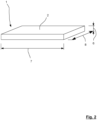
- FIG. 1 An example of implementation that can be found in the Figures 1 and 2 is shown, comprises a substrate plate 1 according to the invention, which comprises a plate body 2.
- a plate body 2 This is formed from renewable raw materials, wherein the plate body 2 in the example shown has a hemp portion of 80 M-% formed by hemp fibers and a flax portion of 20 M-% formed by flax fibers (each based on a dry total mass of the plate body 2 ).
- the plate body 2 is designed such that the hemp portion contains shives 3 , wherein the shives 3 here make up approximately 50 M-% of the hemp portion (based on its total mass) of the plate body 2.
- the shives 3 have a fiber length in the range between 10 mm and 30 mm They are primarily responsible for the rigid structure of the substrate plate 1 , since the shives 3 have a rigid, wood-like structure and thus ensure that the plate body 2 is inherently stable. This means that the plate body 2 at least essentially retains its plate-like shape when stored at specific points, for example at two storage locations, and in particular does not collapse in on itself like a soft mat. These properties make it possible for the substrate plate 1 to be laid individually piece by piece in the manner of a rigid plate, which makes it particularly easy to form a continuous surface formed by a plurality of individual substrate plates 1 .
- the hemp fibers of the hemp portion of the plate body 2 shown each have a diameter in the range between 5 mm and 15 mm.
- the diameter of the flax fibers of the flax portion is in the range between 1 mm and 3 mm.
- the hemp fibers of the hemp portion each have a fiber length in the range between 50 mm and 100 mm.
- the plate body 2 here has a density of approx. 90 kg/m 3 and is therefore particularly easy to process. In particular, with this density, the individual substrate plates 1 can be produced with comparatively large dimensions without this making the processing of the substrate plates 1 more difficult.
- Substrate plate 1 has a thickness 6 of 5 cm, a length 7 of 120 cm and a width 8 of 60 cm. Therefore, the volume of the plate body 2 in the example shown is 0.036 m 3 , so that the plate body 2 has a total mass of less than 3.5 kg.
- the substrate plate 1 comprises mineral fertilizer 4, which is applied in the form of individual particles both to a surface 5 of the plate body 2 and distributed within the plate body 2.
- the mineral fertilizer 4 is particularly well suited to serve as a source of nutrients for plants that are cultivated on the substrate plate 1 .
- the surface 5 of the plate body 2 in the substrate plate 1 shown is formed in a light beige color, whereby the heating of the surface 5 by incident solar radiation is comparatively low.
Landscapes
- Engineering & Computer Science (AREA)
- Architecture (AREA)
- Civil Engineering (AREA)
- Structural Engineering (AREA)
- Life Sciences & Earth Sciences (AREA)
- Environmental Sciences (AREA)
- Textile Engineering (AREA)
- Cultivation Of Plants (AREA)
- Finishing Walls (AREA)
Description
- Die vorliegende Anmeldung betrifft eine Substratplatte für eine Dachbegrünung gemäß dem Oberbegriff von Anspruch 1. Sie ist von nachwachsenden Rohstoffen gebildet.
- Bei "nachwachsenden Rohstoffen" handelt es sich im Sinne der vorliegenden Anmeldung um organische Rohstoffe, die aus landwirtschaftlicher, forstwirtschaftlicher und Fischerei-Produktion stammen und vom Menschen zielgerichtet für weiterführende Anwendungszwecke außerhalb des Nahrungs- und Futterbereiches verwendet werden. Für die Bildung einer Substratplatte können zumindest anteilig als nachwachsende Rohstoffe insbesondere Naturfasern wie beispielsweise Flachsfasern oder Hanffasern zum Einsatz kommen.
- Dachbegrünungen kommen insbesondere auf Flachdächern zum Einsatz. Hierzu wird typischerweise auf dem jeweiligen Dach eine Substratschüttung aufgebracht, die typischerweise von künstlichen Materialien wie Perliten, Blähton, Styropor; Lava oder Bims gebildet ist. Diese Schüttung bildet das Substrat für die gewünschte Dachbegrünung. Die Pflanzen, mit denen das Dach begrünt werden soll, werden schließlich beispielsweise in Form einer Sedummatte auf das Substrat aufgebracht und gegebenenfalls mit Dünger versorgt. Die beschriebene Vorgehensweise ist insoweit nachteilig, als das Substrat eine vergleichsweise schlechte Klimabilanz aufweist und es ihm mithin an der ökologisch wichtigen Nachhaltigkeit mangelt. Auch ist eine Entsorgung des Substrats bei einem späteren Rückbau aufwendig.
- Um diesem Problem zu begegnen, offenbart beispielsweise die deutsche Patentschrift
DE 196 48 105 C2 ein Vegetationselement für die Begrünung von Dachflächen. Dieses Vegetationselement umfasst einen Vegetationsträger, der von organischem Material gebildet sein kann. Der Vegetationsträger, der eine Substratmatte darstellt, kann beispielsweise aus Kokos, Flachs, Hanf oder Baumwolle bestehen. Diese Materialien haben gemeinsam, dass sie in der freien Natur verrotten. Von besonderer Bedeutung ist gemäß genannter Schrift die flexible Ausgestaltung des Vegetationsträger, die dazu beiträgt, dass der Vegetationsträger nach dem Prinzip einer flexiblen Matte aufgerollt werden kann. - Für die Verarbeitung von Substrat für eine Dachbegrünung hat es sich als vorteilhaft herausgestellt, wenn dieses vergleichbar zu Wärmedämmplatten verarbeitet werden kann. Hintergrund hierzu ist, dass das Gewerk, das typischerweise die jeweilige Dachbegrünung erstellt, dasselbe ist, dass auch das zugehörige Dach errichtet. Mit anderen Worten werden Dachbegrünungen typischerweise von Dachdeckern erstellt, die im Umgang mit plattenförmigen Materialien deutlich besser vertraut sind als mit Schüttgütern, die typischerweise als Substrat für eine Dachbegrünung verwendet werden.
- Der vorliegenden Anmeldung liegt mithin die Aufgabe zugrunde, eine Alternative zu schüttfähigem Substrat bereitzustellen, das einfacher verarbeitet werden kann und gleichzeitig besonders nachhaltig ist.
- Die zugrunde liegende Aufgabe wird erfindungsgemäß mit den Merkmalen des Anspruchs 1 gelöst. Vorteilhafte Ausgestaltungen ergeben sich aus den zugehörigen Unteransprüchen.
- Die erfindungsgemäße Substratplatte ist dadurch gekennzeichnet, dass sie einen Plattenkörper aufweist, der einen Hanfanteil, insbesondere in Form von Hanffasern, in einem Bereich zwischen 40 Massenprozent (nachfolgend "M-%") und 90 M-% einer trockenen Gesamtmasse des Plattenkörpers sowie einen Flachsanteil, insbesondere in Form von Flachsfasern, in einem Bereich zwischen 1 M-% und M-40 % der trockenen Gesamtmasse des Plattenkörpers aufweist. Weiterhin ist vorgesehen, dass der Hanfanteil und/oder der Flachsanteil Schäben enthält bzw. enthalten. Diese können insbesondere von Hanfschäben und/oder Flachsschäben gebildet sein. Bevorzugt beträgt ein Anteil der Schäben an dem Hanfanteil bzw. dem Flachsanteil zwischen 40 M-% und 80 M-%, vorzugsweise zwischen 50 M-% und 60 M-%, jeweils bezogen auf die trockene Masse des jeweiligen Anteils. Als Schäben werden gebrochene, holzähnliche Teilchen bezeichnet, die bei der Erzeugung vor allem von Flachsfasern oder Hanffasern im maschinellen Prozess der Entholzung des Pflanzenstängels anfallen. Als weitere Bestandteile kann der Plattenkörper weitere Fasern auch nachwachsenden Rohstoffe, insbesondere Pflanzenfasern wie beispielsweise Holzfasern und/oder Kokosfasern, aufweisen. Beispielsweise ist eine Zusammensetzung denkbar, bei der der Plattenkörper einen Hanfanteil von 50 M-%, einen Flachsanteil von 20 M-% aufweist. Des Weiteren weist dieser Plattenkörper einen Holzanteil in Form von Holzfasern von 20 M-% und einen Kokosanteil in Form von Kokosfasern von 10 M-% auf.
- Die erfindungsgemäße Substratplatte hat viele Vorteile. Zum einen ist sie zumindest nahezu vollständig oder vollständig von nachwachsenden Rohstoffen gebildet, die der freien Witterung ausgesetzt mit der Zeit verrotten. Auf diese Weise ist die Substratplatte besonders gut dazu geeignet, Kohlendioxid zu binden und auf diese Weise eine zumindest temporäre Senke für Kohlendioxid zu bilden. Insbesondere kann die erfindungsgemäße Substratplatte mindestens 1,5 kg Kohlendioxid pro Quadratmeter der von ihr belegten (Dach-)Fläche, vorzugsweise mindestens 2,0 kg CO2/m2, binden. Weiterhin ist der Vorteil gegeben, dass bei einem eventuellen Rückbau des jeweiligen Dachs die Dachbegrünung vollständig biologisch abbaubar ist und beispielsweise kompostiert werden kann. Eine gesonderte Entsorgung eines zuvor aufgebrachten Schüttguts, wie es der Stand der Technik in aller Regel vorsieht, entfällt entsprechend. Die Substratplatte ist entsprechend besonders nachhaltig und ökologisch wertvoll.
- Im Übrigen ist der erfindungsgemäße Aufbau des Plattenkörpers der Substratplatte im Hinblick auf deren physikalischen Eigenschaften besonders vorteilhaft. Somit ist die Substratplatte besonders hydrophil und hierdurch besonders gut dazu geeignet, Wasser aufzunehmen und über lange Zeit zu speichern. Diese Eigenschaft ist für die Versorgung von Pflanzen mit Wasser besonders vorteilhaft, sodass die Substratplatte auch in Gegenwart längerer Trockenphasen dazu geeignet ist, auf ihr wachsende Pflanzen mit Wasser zu versorgen. Weiterhin tragen in besonders vorteilhafter Weise die genannten Schäben dazu bei, dass die Substratplatte insgesamt eine steife Struktur erhält. Als solche ist sie nicht rollbar, sondern weist eine Eigensteifigkeit auf, die eine Verarbeitung als selbsttragende Platte ermöglicht. Insbesondere kann eine Vielzahl einzelner Substratplatten, die erfindungsgemäß aufgebaut sind, palettenweise gelagert und zu einer Baustelle geliefert werden, wobei die einzelnen Substratplatten besonders einfach auf einem jeweiligen Dach oder einer sonstigen Fläche, die unter Zuhilfenahme der Substratplatten begrünt werden soll, aneinandergelegt werden können.
- Insbesondere gegenüber im Stand der Technik üblichen Schüttgütern ist weiterhin als Vorteil anzusehen, dass die erfindungsgemäße Substratplatte vollständig gebunden ist, das heißt frei von auswaschbaren Feinanteilen ist. Bei geschütteten Substraten ist typischerweise auf einem jeweiligen Dach eine sog. "Kiesfangleiste" anzubringen, damit infolge Bewitterung ausgewaschener Kies aufgefangen wird. Noch feinere, sandige Bestandteile gelangen überdies in die Abflusskanäle und können zu unerwünschten Ablagerungen führen. Diese Probleme sind mittels der erfindungsgemäßen Substratplatte vermieden.
- Ein weiterer Vorteil der erfindungsgemäßen Substratplatte ist darin zusehen, dass diese eine gleichmäßige Fläche für eine Dachbegrünung bereitstellt. Somit kann besonders einfach eine Vielzahl mehrerer Substratplatten hergestellt werden, die aneinandergelegt werden, woraufhin die dadurch gebildete "Substratschicht" eine konstante Aufbaustärke aufweist. Schwankende Aufbaustärken, die bei geschüttetem Substrat auftreten können, entfallen entsprechend. Außerdem unterliegt die Substratplatte keinen Erosionserscheinungen, beispielsweise infolge Windbelastung. Schließlich trägt die Homogenität der Substratplatte dazu bei, dass die Speicherfähigkeit der gebildeten Substratschicht über die gesamte Fläche, beispielsweise eines Dachs, zumindest im Wesentlichen gleich ist. Die Pflanzen werden sich mithin voraussichtlich über die gesamte Fläche gleich gut entwickeln können und hierdurch einer Gleichmäßigkeit der Begrünung erzielen.
- Die Substratplatte kann bevorzugt eine Länge im einem Bereich zwischen 80 cm und 200 cm, vorzugsweise zwischen 100 cm und 150 cm, aufweisen. Ferner ist es vorteilhaft, wenn eine Breite der Substratplatte in einem Bereich zwischen 30 cm und 100 cm, vorzugsweise zwischen 50 cm und 80 cm, liegt. Eine Dicke einer erfindungsgemäßen Substratplatte liegt bevorzugt in einem Bereich zwischen 2 cm und 12 cm, vorzugsweise zwischen 3 cm und 8 cm, weiter vorzugsweise zwischen 4 cm und 5 cm. Substratplatten mit derartigen Abmessungen haben sich als besonders gut verarbeitbar herausgestellt.
- In einer besonders vorteilhaften Weiterbildung beträgt der Hanfanteil des Plattenkörpers zwischen 50 M-% und 80 M-% an der Gesamtmasse des Plattenkörpers. Dies ist für die Fähigkeit der Substratplatte zur Aufnahme und Speicherung von Wasser ebenso vorteilhaft wie für die Stabilität bzw. Steifigkeit der Substratplatte. Weiterhin kann eine solche Ausgestaltung von Vorteil sein, bei der der Flachsanteil in einem Bereich zwischen 1 M-% und 30 M-% bezogen auf die Gesamtmasse des Plattenkörpers liegt.
- In einer besonders vorteilhaften Ausgestaltung der erfindungsgemäßen Substratplatte liegt ein Anteil der Schäben an dem Hanfanteil bzw. dem Flachsanteil in einem Bereich zwischen 40 M-% und 80 M-%, vorzugsweise zwischen 50 M-% und 60 M-%. Diese Ausgestaltung hat sich als besonders vorteilhaft herausgestellt, um eine hohe Steifigkeit der Substratplatte zu erreichen ohne gleichzeitig auf einen zu großen Anteil der übrigen Faserbestandteile des Hanfs und/oder des Flachs zu verzichten, die typischerweise für die hydrophilen Eigenschaften der Substratplatte verantwortlich sind und zudem die Schäben untereinander verbinden und insoweit als Matrix des Plattenkörpers wirken. Betreffend die Ausgestaltung der Schäben ist es weiterhin besonders von Vorteil, wenn diese eine Faserlänge im Bereich zwischen 1 mm und 50 mm, vorzugsweise zwischen 5 mm und 15 mm, aufweisen.
- Weiterhin kann es besonders von Vorteil sein, wenn Flachsfasern des Flachsanteils einen Durchmesser im Bereich zwischen 1 mm und 3 mm aufweisen. Überdies ist es von Vorteil, wenn die Flachsfasern eine Faserlänge im Bereich zwischen 50 mm und 150 mm aufweisen. Betreffend Hanffasern des Hanfanteils ist es von Vorteil, wenn diese eine Faserlänge im Bereich zwischen 50 mm und 150 mm und unabhängig davon oder in Kombination hiermit einen Durchmesser im Bereich zwischen 5 mm und 15 mm aufweisen. Die genannten Bereiche haben sich jeweils für sich allein betrachtet, insbesondere jedoch in Kombination miteinander als besonders vorteilhaft für die Eigenschaften der Substratplatte herausgestellt.
- Die erfindungsgemäße Substratplatte weiter ausgestaltend weist der Plattenkörper eine Dichte von höchstens 200 kg/m3, vorzugsweise höchstens 150 kg/m3, weiter vorzugsweise höchstens 100 kg/m3, auf. Substratplatten mit einer solchen Ausgestaltung sind besonders gut zu verarbeiten und bieten überdies ein hohes inneres Freivolumen, in dem Wasser aufgenommen und gespeichert werden kann. Insbesondere kann die erfindungsgemäße Substratplatte bevorzugt mindestens 0,5 kg Wasser pro kg Eigengewicht (trocken), vorzugsweise mindestens 0,6 kg Wasser pro kg Eigengewicht (trocken), weiter vorzugsweise mindestens 0,7 kg Wasser pro kg Eigengewicht (trocken) aufnehmen und binden.
- Besonders vorteilhaft ist des Weiteren eine solche Substratplatte, die Mineraldünger umfasst, der an einer Oberfläche des Plattenkörpers und/oder innerhalb des Plattenkörpers verteilt ist. Der Mineraldünger es besonders von Vorteil, um Pflanzen, denen die Substratplatte als Träger dient, Nährstoffe zur Verfügung zu stellen und hierdurch deren Wachstum zu unterstützen. Der Mineraldünger kann entweder bereits bei der Herstellung der Substratplatte in den Plattenkörper eingearbeitet werden oder auf die Oberfläche des Plattenkörpers aufgetragen werden. Letzteres kann insbesondere nachträglich nach Fertigstellung des Plattenkörpers erfolgen.
- Die zugrunde liegende Aufgabe wird ferner erfindungsgemäß mittels eines Verfahrens gelöst. Dieses Verfahren sieht vor, dass eine Mehrzahl von erfindungsgemäßen Substratplatten unmittelbar auf eine Dachfläche aufgelegt werden, wobei die Substratplatten unmittelbar aneinander angrenzen. Die Substratplatten bilden daraufhin gemeinsam eine geschlossene Fläche auf der jeweiligen Dachfläche. Sodann werden Pflanzen oder Pflanzensamen unmittelbar auf zumindest einen Teil der Substratplatten aufgebracht. Vorzugsweise werden die Substratplatten vollflächig mit den Pflanzen oder Pflanzensamen bedeckt. Hierbei kann es besonders von Vorteil sein, wenn Pflanzensamen auf die Substratplatten aufgespritzt werden. Dieses Verfahren ist besonders einfach und zügig durchzuführen, wodurch auch größere Flächen zügig begrünt werden können. Ebenfalls ist es denkbar, bereits vorgezogene Sedummatten auf die Substratplatten aufzubringen, insbesondere auf diesen auszurollen. Derartige Sedummatten umfassen bereits teilentwickelte Pflanzen, die mit ihrem Wurzelwerk auf die Substratplatten aufgebracht werden, sodass die Pflanzen sich auf und mithilfe der Substratplatten weiter entwickeln können.
- In einer weiterhin vorteilhaften Ausgestaltung weist der Plattenkörper eine inhomogene Struktur auf. Dies hat den Vorteil, dass Pflanzen, die auf dem Plattenkörper wachsen, besonders einfach in dem Plattenkörper wurzeln können, da für die Wurzeln Bereiche geringer Dichte bzw. geringer Festigkeit bereitstehen, in denen sie sich besonders gut fortsetzen können. Andere Bereiche größerer Dichte bzw. größerer Festigkeit, die beispielsweise durch die Schäben bedingt sind, können die Wurzeln hingegen meiden.
- Schließlich kann eine solche Substratplatte besonders vorteilhaft sein, die mindestens eine helle Oberfläche aufweist, vorzugsweise in einem weißen oder beigen Farbton. Diese Ausgestaltung hat den Vorteil, dass sich der Plattenkörper infolge Sonnenbestrahlung nicht so stark aufheizt, wie dies von den typischerweise dunklen Substratschüttungen des Standes der Technik bekannt ist. Hierdurch wird verhindert, dass eine Oberflächentemperatur des Plattenkörpers zu stark ansteigt, wodurch wiederum das Pflanzenwachstum begünstigt ist. Des Weiteren wird die Verdunstung von Wasser reduziert.
- Die Erfindung ist nachstehend anhand eines Ausführungsbeispiels, das in den Figuren dargestellt ist, näher erläutert. Es zeigt:
- Fig. 1:
- Einen Querschnitt durch eine erfindungsgemäße Substratplatte,
- Fig. 2:
- Eine perspektivische Ansicht der Substratplatte gemäß
Figur 1 . - Ein Ausführungsbeispiel, das in den
Figuren 1 und2 dargestellt ist, umfasst eine erfindungsgemäße Substratplatte 1, die einen Plattenkörper 2 umfasst. Dieser ist von nachwachsenden Rohstoffen gebildet, wobei der Plattenkörper 2 in dem gezeigten Beispiel einen von Hanffasern gebildeten Hanfanteil von 80 M-% und einen von Flachsfasern gebildeten Flachsanteil von 20 M-% (jeweils bezogen auf eine trockene Gesamtmasse des Plattenkörpers 2) aufweist. Ferner ist der Plattenkörper 2 derart ausgebildet, dass der Hanfanteil Schäben 3 enthält, wobei die Schäben 3 hier ca. 50 M-% des Hanfanteils (bezogen auf dessen Gesamtmasse) des Plattenkörpers 2 ausmachen. Die Schäben 3 weisen in dem gezeigten Beispiel eine Faserlänge im Bereich zwischen 10 mm und 30 mm auf. Sie sind primär für die steife Struktur der Substratplatte 1 verantwortlich, da die Schäben 3 eine steife, holzartige Struktur aufweisen und auf diese Weise dafür sorgen, dass der Plattenkörper 2 eigenstabil ausgebildet ist. Dies bedeutet, dass der Plattenkörper 2 bei einer punktuellen Lagerung an beispielsweise zwei Lagerstellen zumindest im Wesentlichen seine plattenförmige Form beibehält und insbesondere nicht vergleichbar zu einer weichen Matte in sich zusammenfällt. Diese Eigenschaften ermöglichen es, dass die Substratplatte 1 nach Art einer steifen Platte einzeln stückweise verlegt werden kann, wodurch die Bildung einer zusammenhängenden Fläche, die von einer Mehrzahl von einzelnen Substratplatten 1 gebildet ist, besonders einfach fällt. - In besonders bevorzugter Weise weisen die Hanffasern des Hanfanteils des gezeigten Plattenkörpers 2 jeweils einen Durchmesser im Bereich zwischen 5 mm und 15 mm auf. Der Durchmesser der Flachsfasern des Flachsanteils bewegt sich indes im Bereich zwischen 1 mm und 3 mm. Die Hanffasern des Hanfanteils weisen in dem gezeigten Beispiel jeweils eine Faserlänge im Bereich zwischen 50 mm und 100 mm auf. Dasselbe gilt für die Flachsfasern des Flachsanteils. Der Plattenkörper 2 weist hier eine Dichte von ca. 90 kg/m3 auf und ist mithin besonders leicht verarbeitbar. Insbesondere können bei dieser Dichte die einzelnen Substratplatten 1 mit vergleichsweise großen Abmessungen hergestellt werden, ohne dass hierdurch die Verarbeitung der Substratplatten 1 erschwert wird. In dem gezeigten Beispiel weist der Plattenkörper 2. Substratplatte 1 eine Dicke 6 von 5 cm, eine Länge 7 von 120 cm und eine Breite 8 von 60 cm auf. Mithin beträgt das Volumen des Plattenkörpers 2 in dem gezeigten Beispiel 0,036 m3, sodass der Plattenkörper 2 insgesamt eine Masse von weniger als 3,5 kg aufweist.
- In besonders bevorzugter Weise umfasst die Substratplatte 1 Mineraldünger 4, der in Form einzelner Partikel sowohl auf eine Oberfläche 5 des Plattenkörpers 2 aufgetragen als auch innerhalb des Plattenkörpers 2 verteilt ist. Der Mineraldünger 4 ist besonders gut dazu geeignet, Pflanzen, die auf der Substratplatte 1 kultiviert werden, als Nährstoffquelle zu dienen.
- Die Oberfläche 5 des Plattenkörpers 2 ist bei der gezeigten Substratplatte 1 in einem hellbeigen Farbton ausgebildet, wodurch eine Aufheizung der Oberfläche 5 bei einfallender Sonnenstrahlung vergleichsweise gering ausfällt.
-
- 1
- Substratplatte
- 2
- Plattenkörper
- 3
- Schäbe
- 4
- Mineraldünger
- 5
- Oberfläche
- 6
- Dicke
- 7
- Länge
- 8
- Breite
Claims (16)
- Substratplatte (1) für eine Dachbegrünung, die von nachwachsenden Rohstoffen gebildet ist,
dadurch gekennzeichnet, dassein Plattenkörper (2) der Substratplatte (1) bezogen auf seine Gesamtmasse einen Hanfanteil in einem Bereich zwischen 40 M-% und 90 M-% sowie einen Flachsanteil in einem Bereich zwischen 1 M-% und 40 M-% aufweist,wobei der Hanfanteil und/oder der Flachsanteil Schäben (3) enthält,wobei die Schäben (3) dazu beitragen, dass die Substratplatte (1) insgesamt eine steife Struktur erhält und als solche nicht rollbar ist, sondern eine Eigensteifigkeit aufweist, die eine Verarbeitung als selbsttragende Platte ermöglicht. - Substratplatte (1) nach Anspruch 1, dadurch gekennzeichnet, dass der Hanfanteil in einem Bereich zwischen 50 M-% und 80 M-% liegt.
- Substratplatte (1) nach einem der vorhergehenden Ansprüche, dadurch gekennzeichnet, dass der Flachsanteil in einem Bereich zwischen 1 M-% und 30 M-% liegt.
- Substratplatte (1) nach einem der vorhergehenden Ansprüche, dadurch gekennzeichnet, dass ein Anteil der Schäben (3) an dem Hanfanteil und/oder dem Flachsanteil in einem Bereich zwischen 40 M-% und 80 M-%, vorzugsweise zwischen 50 M-% und 60 M-%, liegt.
- Substratplatte (1) nach einem der vorhergehenden Ansprüche, dadurch gekennzeichnet, dass die Schäben (3) eine Faserlänge im Bereich zwischen 1 mm und 50 mm, vorzugsweise zwischen 5 mm und 30 mm, aufweisen.
- Substratplatte (1) nach einem der vorhergehenden Ansprüche, dadurch gekennzeichnet, dass Hanffasern des Hanfanteils einen Durchmesser im Bereich zwischen 5 mm und 15 mm aufweisen.
- Substratplatte (1) nach einem der vorhergehenden Ansprüche, dadurch gekennzeichnet, dass Flachsfasern des Flachsanteils einen Durchmesser im Bereich zwischen 1 mm und 3 mm aufweisen.
- Substratplatte (1) nach einem der vorhergehenden Ansprüche, dadurch gekennzeichnet, dass Hanffasern des Hanfanteils eine Faserlänge im Bereich zwischen 50 mm und 150 mm aufweisen.
- Substratplatte (1) nach einem der vorhergehenden Ansprüche, dadurch gekennzeichnet, dass Flachsfasern des Flachsanteils eine Faserlänge im Bereich zwischen 50 mm und 150 mm aufweisen.
- Substratplatte (1) nach einem der vorhergehenden Ansprüche, dadurch gekennzeichnet, dass der Plattenkörper (2) eine Dichte von höchstens 200 kg/m3, vorzugweise höchstens 150 kg/m3, weiter vorzugsweise höchsten 100 kg/m3, aufweist.
- Substratplatte (1) nach einem der vorhergehenden Ansprüche, dadurch gekennzeichnet, dass der Plattenkörper (2) eine Dicke (6) zwischen 2 cm und 12 cm, vorzugsweise zwischen 3 cm und 8 cm, weiter vorzugsweise zwischen 4 cm und 6 cm, aufweist.
- Substratplatte (1) nach einem der vorhergehenden Ansprüche, dadurch gekennzeichnet, dass der Plattenkörper (2) eine Länge (7) im Bereich zwischen 80 cm und 200 cm, vorzugsweise zwischen 100 cm und 150 cm, aufweist.
- Substratplatte (1) nach einem der vorhergehenden Ansprüche, dadurch gekennzeichnet, dass der Plattenkörper (2) eine Breite (8) im Bereich zwischen 30 cm und 90 cm, vorzugsweise zwischen 50 cm und 70 cm, aufweist.
- Verfahren zur Dachbegrünung, wobei eine Mehrzahl von Substratplatten (1) gemäß einem der vorhergehenden Ansprüche derart unmittelbar auf eine Dachfläche aufgelegt wird, dass die Substratplatten (1) unmittelbar aneinander angrenzen und gemeinsam eine geschlossene Fläche auf der Dachfläche ausbilden.
- Verfahren nach Anspruch 14, dadurch gekennzeichnet, dass Pflanzen oder Pflanzensamen unmittelbar auf zumindest einen Teil der Substratplatten (1) aufgebracht werden und/oder mindestens eine Sedummatte unmittelbar auf zumindest einen Teil der Substratplatten (1) aufgebracht wird.
- Verwendung einer Substratplatte (1) als Substratplatte für eine Dachbegrünung, wobei die Substratplatte (1) von nachwachsenden Rohstoffen gebildet ist, wobei ein Plattenkörper (2) der Substratplatte (1) bezogen auf seine Gesamtmasse einen Hanfanteil in einem Bereich zwischen 40 M-% und 90 M-% sowie einen Flachsanteil in einem Bereich zwischen 1 M-% und 40 M-% aufweist, wobei der Hanfanteil und/oder der Flachsanteil Schäben (3) enthält, wobei die Schäben (3) dazu beitragen, dass die Substratplatte (1) insgesamt eine steife Struktur erhält und als solche nicht rollbar ist, sondern eine Eigensteifigkeit aufweist, die eine Verarbeitung als selbsttragende Platte ermöglicht.
Applications Claiming Priority (1)
| Application Number | Priority Date | Filing Date | Title |
|---|---|---|---|
| DE202022101758.1U DE202022101758U1 (de) | 2022-04-01 | 2022-04-01 | Substratplatte für Dachbegrünung |
Publications (3)
| Publication Number | Publication Date |
|---|---|
| EP4252525A1 EP4252525A1 (de) | 2023-10-04 |
| EP4252525B1 true EP4252525B1 (de) | 2024-08-21 |
| EP4252525C0 EP4252525C0 (de) | 2024-08-21 |
Family
ID=85726817
Family Applications (1)
| Application Number | Title | Priority Date | Filing Date |
|---|---|---|---|
| EP23163818.0A Active EP4252525B1 (de) | 2022-04-01 | 2023-03-23 | Substratplatte für eine dachbegrünung sowie verfahren zur dachbegrünung |
Country Status (2)
| Country | Link |
|---|---|
| EP (1) | EP4252525B1 (de) |
| DE (1) | DE202022101758U1 (de) |
Family Cites Families (6)
| Publication number | Priority date | Publication date | Assignee | Title |
|---|---|---|---|---|
| DE19504167A1 (de) | 1995-02-08 | 1996-08-14 | Neue Baumwollspinnerei & Weber | Anzuchtkörper, insbesondere für Jungpflanzen, Verfahren und Vorrichtung zur Herstellung eines Anzuchtkörpers |
| DE19648105C2 (de) | 1996-11-21 | 1999-07-15 | Wolfgang Behrens | Vegetationselement |
| DE19903218A1 (de) | 1998-03-12 | 1999-09-23 | Klaus Hofmann | Winterstreumittel |
| DK172928B1 (da) * | 1998-05-01 | 1999-10-04 | Landbrugets Radgvningcenter | Fremgangsmade til fremstilling af enfibermatte,fibermatte samt anvendelse af en sadan fibermatte. |
| EP2963167B1 (de) * | 2014-06-30 | 2019-05-08 | NAPORO Klima Dämmstoff GmbH | Verfahren zur Herstellung von Faservliesmatten, insbesondere Dämmstoffmatten, sowie die nach diesem Verfahren erhältlichen Faservliesmatten |
| DE102014115138A1 (de) * | 2014-10-17 | 2016-04-21 | Frank Schneider | Verfahren zum Ausbilden eines textilen Materials unter Verwendung von Hanf und Faserverbundwerkstoff aus diesem textilen Material |
-
2022
- 2022-04-01 DE DE202022101758.1U patent/DE202022101758U1/de active Active
-
2023
- 2023-03-23 EP EP23163818.0A patent/EP4252525B1/de active Active
Also Published As
| Publication number | Publication date |
|---|---|
| EP4252525A1 (de) | 2023-10-04 |
| DE202022101758U1 (de) | 2023-07-05 |
| EP4252525C0 (de) | 2024-08-21 |
Similar Documents
| Publication | Publication Date | Title |
|---|---|---|
| DE19523406C1 (de) | Aus mehreren Schichten bestehendes Vegetationselement | |
| EP0706753B1 (de) | Hygroskopische Steinwollmatte | |
| DE4219275C2 (de) | Mehrschichtiges Vegetationselement | |
| EP0939585B1 (de) | Bahnförmiger vegetationskörper | |
| DE102009050715A1 (de) | Begrüntes Bauelement für horizontale, schräge und/oder vertikale Flächen von Bauwerken | |
| WO1998057534A1 (de) | Vegetationsträger, bestehend aus einer matte aus ineinander gewirrten organischen fasern | |
| EP2190281B1 (de) | Geomatte | |
| DE2836960A1 (de) | Pflanzenaufzuchtmatte | |
| DE3408698A1 (de) | Vegetationskoerper | |
| DE19648105C2 (de) | Vegetationselement | |
| WO2004073388A1 (de) | Matte für vegetationskörper | |
| DE3233016C2 (de) | Substrat für Vegetationen und Verwendung des Substrats | |
| DE202022101757U1 (de) | Substratplatte für Dachbegrünung | |
| EP4252525B1 (de) | Substratplatte für eine dachbegrünung sowie verfahren zur dachbegrünung | |
| EP0700883B1 (de) | Schüttfähiges Vegetationserdsubstrat, Verfahren zum herstellen desselben und seine Verwendung | |
| EP0450346B1 (de) | Erosionsschutz- und Pflanzmatte | |
| DE4301312C2 (de) | Pflanzsubstrat | |
| DE19629669B4 (de) | Begrünungsmatte | |
| WO2011072758A1 (de) | Dachbegrünungskassette | |
| EP1634493B1 (de) | Vegetationselement, Verkaufseinheit aus einem Vegetationselement und Verfahren zur Herstellung einer Verkaufseinheit | |
| EP0971576B1 (de) | Vegetationselement für die begrünung von mit vertiefungen und erhöhungen versehenen dächern | |
| EP2918160A2 (de) | Dachbegrünungskassette | |
| DE202023105121U1 (de) | Begrünungsmodul | |
| DE19905764A1 (de) | Vorrichtung zur Anzucht von Pflanzen und ein geeignetes Verfahren hierzu | |
| DE102024205737A1 (de) | Dränageplatte und diese umfassender dachbegrünungsaufbau |
Legal Events
| Date | Code | Title | Description |
|---|---|---|---|
| PUAI | Public reference made under article 153(3) epc to a published international application that has entered the european phase |
Free format text: ORIGINAL CODE: 0009012 |
|
| STAA | Information on the status of an ep patent application or granted ep patent |
Free format text: STATUS: THE APPLICATION HAS BEEN PUBLISHED |
|
| AK | Designated contracting states |
Kind code of ref document: A1 Designated state(s): AL AT BE BG CH CY CZ DE DK EE ES FI FR GB GR HR HU IE IS IT LI LT LU LV MC ME MK MT NL NO PL PT RO RS SE SI SK SM TR |
|
| STAA | Information on the status of an ep patent application or granted ep patent |
Free format text: STATUS: REQUEST FOR EXAMINATION WAS MADE |
|
| 17P | Request for examination filed |
Effective date: 20231207 |
|
| RBV | Designated contracting states (corrected) |
Designated state(s): AL AT BE BG CH CY CZ DE DK EE ES FI FR GB GR HR HU IE IS IT LI LT LU LV MC ME MK MT NL NO PL PT RO RS SE SI SK SM TR |
|
| GRAP | Despatch of communication of intention to grant a patent |
Free format text: ORIGINAL CODE: EPIDOSNIGR1 |
|
| STAA | Information on the status of an ep patent application or granted ep patent |
Free format text: STATUS: GRANT OF PATENT IS INTENDED |
|
| INTG | Intention to grant announced |
Effective date: 20240326 |
|
| GRAS | Grant fee paid |
Free format text: ORIGINAL CODE: EPIDOSNIGR3 |
|
| GRAA | (expected) grant |
Free format text: ORIGINAL CODE: 0009210 |
|
| STAA | Information on the status of an ep patent application or granted ep patent |
Free format text: STATUS: THE PATENT HAS BEEN GRANTED |
|
| AK | Designated contracting states |
Kind code of ref document: B1 Designated state(s): AL AT BE BG CH CY CZ DE DK EE ES FI FR GB GR HR HU IE IS IT LI LT LU LV MC ME MK MT NL NO PL PT RO RS SE SI SK SM TR |
|
| REG | Reference to a national code |
Ref country code: GB Ref legal event code: FG4D Free format text: NOT ENGLISH |
|
| REG | Reference to a national code |
Ref country code: CH Ref legal event code: EP |
|
| REG | Reference to a national code |
Ref country code: IE Ref legal event code: FG4D Free format text: LANGUAGE OF EP DOCUMENT: GERMAN |
|
| REG | Reference to a national code |
Ref country code: DE Ref legal event code: R096 Ref document number: 502023000117 Country of ref document: DE |
|
| U01 | Request for unitary effect filed |
Effective date: 20240911 |
|
| U07 | Unitary effect registered |
Designated state(s): AT BE BG DE DK EE FI FR IT LT LU LV MT NL PT RO SE SI Effective date: 20241002 |
|
| PG25 | Lapsed in a contracting state [announced via postgrant information from national office to epo] |
Ref country code: NO Free format text: LAPSE BECAUSE OF FAILURE TO SUBMIT A TRANSLATION OF THE DESCRIPTION OR TO PAY THE FEE WITHIN THE PRESCRIBED TIME-LIMIT Effective date: 20241121 |
|
| PG25 | Lapsed in a contracting state [announced via postgrant information from national office to epo] |
Ref country code: PL Free format text: LAPSE BECAUSE OF FAILURE TO SUBMIT A TRANSLATION OF THE DESCRIPTION OR TO PAY THE FEE WITHIN THE PRESCRIBED TIME-LIMIT Effective date: 20240821 Ref country code: GR Free format text: LAPSE BECAUSE OF FAILURE TO SUBMIT A TRANSLATION OF THE DESCRIPTION OR TO PAY THE FEE WITHIN THE PRESCRIBED TIME-LIMIT Effective date: 20241122 |
|
| PG25 | Lapsed in a contracting state [announced via postgrant information from national office to epo] |
Ref country code: IS Free format text: LAPSE BECAUSE OF FAILURE TO SUBMIT A TRANSLATION OF THE DESCRIPTION OR TO PAY THE FEE WITHIN THE PRESCRIBED TIME-LIMIT Effective date: 20241221 |
|
| PG25 | Lapsed in a contracting state [announced via postgrant information from national office to epo] |
Ref country code: HR Free format text: LAPSE BECAUSE OF FAILURE TO SUBMIT A TRANSLATION OF THE DESCRIPTION OR TO PAY THE FEE WITHIN THE PRESCRIBED TIME-LIMIT Effective date: 20240821 |
|
| PG25 | Lapsed in a contracting state [announced via postgrant information from national office to epo] |
Ref country code: ES Free format text: LAPSE BECAUSE OF FAILURE TO SUBMIT A TRANSLATION OF THE DESCRIPTION OR TO PAY THE FEE WITHIN THE PRESCRIBED TIME-LIMIT Effective date: 20240821 Ref country code: RS Free format text: LAPSE BECAUSE OF FAILURE TO SUBMIT A TRANSLATION OF THE DESCRIPTION OR TO PAY THE FEE WITHIN THE PRESCRIBED TIME-LIMIT Effective date: 20241121 |
|
| PG25 | Lapsed in a contracting state [announced via postgrant information from national office to epo] |
Ref country code: RS Free format text: LAPSE BECAUSE OF FAILURE TO SUBMIT A TRANSLATION OF THE DESCRIPTION OR TO PAY THE FEE WITHIN THE PRESCRIBED TIME-LIMIT Effective date: 20241121 Ref country code: PL Free format text: LAPSE BECAUSE OF FAILURE TO SUBMIT A TRANSLATION OF THE DESCRIPTION OR TO PAY THE FEE WITHIN THE PRESCRIBED TIME-LIMIT Effective date: 20240821 Ref country code: NO Free format text: LAPSE BECAUSE OF FAILURE TO SUBMIT A TRANSLATION OF THE DESCRIPTION OR TO PAY THE FEE WITHIN THE PRESCRIBED TIME-LIMIT Effective date: 20241121 Ref country code: IS Free format text: LAPSE BECAUSE OF FAILURE TO SUBMIT A TRANSLATION OF THE DESCRIPTION OR TO PAY THE FEE WITHIN THE PRESCRIBED TIME-LIMIT Effective date: 20241221 Ref country code: HR Free format text: LAPSE BECAUSE OF FAILURE TO SUBMIT A TRANSLATION OF THE DESCRIPTION OR TO PAY THE FEE WITHIN THE PRESCRIBED TIME-LIMIT Effective date: 20240821 Ref country code: GR Free format text: LAPSE BECAUSE OF FAILURE TO SUBMIT A TRANSLATION OF THE DESCRIPTION OR TO PAY THE FEE WITHIN THE PRESCRIBED TIME-LIMIT Effective date: 20241122 Ref country code: ES Free format text: LAPSE BECAUSE OF FAILURE TO SUBMIT A TRANSLATION OF THE DESCRIPTION OR TO PAY THE FEE WITHIN THE PRESCRIBED TIME-LIMIT Effective date: 20240821 |
|
| U20 | Renewal fee for the european patent with unitary effect paid |
Year of fee payment: 3 Effective date: 20250217 |
|
| PG25 | Lapsed in a contracting state [announced via postgrant information from national office to epo] |
Ref country code: SM Free format text: LAPSE BECAUSE OF FAILURE TO SUBMIT A TRANSLATION OF THE DESCRIPTION OR TO PAY THE FEE WITHIN THE PRESCRIBED TIME-LIMIT Effective date: 20240821 |
|
| PG25 | Lapsed in a contracting state [announced via postgrant information from national office to epo] |
Ref country code: CZ Free format text: LAPSE BECAUSE OF FAILURE TO SUBMIT A TRANSLATION OF THE DESCRIPTION OR TO PAY THE FEE WITHIN THE PRESCRIBED TIME-LIMIT Effective date: 20240821 |
|
| PG25 | Lapsed in a contracting state [announced via postgrant information from national office to epo] |
Ref country code: SK Free format text: LAPSE BECAUSE OF FAILURE TO SUBMIT A TRANSLATION OF THE DESCRIPTION OR TO PAY THE FEE WITHIN THE PRESCRIBED TIME-LIMIT Effective date: 20240821 |
|
| PLBE | No opposition filed within time limit |
Free format text: ORIGINAL CODE: 0009261 |
|
| STAA | Information on the status of an ep patent application or granted ep patent |
Free format text: STATUS: NO OPPOSITION FILED WITHIN TIME LIMIT |
|
| 26N | No opposition filed |
Effective date: 20250522 |
|
| PG25 | Lapsed in a contracting state [announced via postgrant information from national office to epo] |
Ref country code: MC Free format text: LAPSE BECAUSE OF FAILURE TO SUBMIT A TRANSLATION OF THE DESCRIPTION OR TO PAY THE FEE WITHIN THE PRESCRIBED TIME-LIMIT Effective date: 20240821 |
|
| PG25 | Lapsed in a contracting state [announced via postgrant information from national office to epo] |
Ref country code: IE Free format text: LAPSE BECAUSE OF NON-PAYMENT OF DUE FEES Effective date: 20250323 |