EP4251983B1 - Feuchtigkeitsdetektion und -schätzung mit mehreren frequenzen - Google Patents
Feuchtigkeitsdetektion und -schätzung mit mehreren frequenzen Download PDFInfo
- Publication number
- EP4251983B1 EP4251983B1 EP22752041.8A EP22752041A EP4251983B1 EP 4251983 B1 EP4251983 B1 EP 4251983B1 EP 22752041 A EP22752041 A EP 22752041A EP 4251983 B1 EP4251983 B1 EP 4251983B1
- Authority
- EP
- European Patent Office
- Prior art keywords
- absorbent article
- amplitude
- multiple frequencies
- signal
- sense signal
- Prior art date
- Legal status (The legal status is an assumption and is not a legal conclusion. Google has not performed a legal analysis and makes no representation as to the accuracy of the status listed.)
- Active
Links
Images



Classifications
-
- A—HUMAN NECESSITIES
- A61—MEDICAL OR VETERINARY SCIENCE; HYGIENE
- A61F—FILTERS IMPLANTABLE INTO BLOOD VESSELS; PROSTHESES; DEVICES PROVIDING PATENCY TO, OR PREVENTING COLLAPSING OF, TUBULAR STRUCTURES OF THE BODY, e.g. STENTS; ORTHOPAEDIC, NURSING OR CONTRACEPTIVE DEVICES; FOMENTATION; TREATMENT OR PROTECTION OF EYES OR EARS; BANDAGES, DRESSINGS OR ABSORBENT PADS; FIRST-AID KITS
- A61F13/00—Bandages or dressings; Absorbent pads
- A61F13/15—Absorbent pads, e.g. sanitary towels, swabs or tampons for external or internal application to the body; Supporting or fastening means therefor; Tampon applicators
- A61F13/42—Absorbent pads, e.g. sanitary towels, swabs or tampons for external or internal application to the body; Supporting or fastening means therefor; Tampon applicators with wetness indicator or alarm
-
- G—PHYSICS
- G01—MEASURING; TESTING
- G01N—INVESTIGATING OR ANALYSING MATERIALS BY DETERMINING THEIR CHEMICAL OR PHYSICAL PROPERTIES
- G01N27/00—Investigating or analysing materials by the use of electric, electrochemical, or magnetic means
- G01N27/02—Investigating or analysing materials by the use of electric, electrochemical, or magnetic means by investigating impedance
- G01N27/22—Investigating or analysing materials by the use of electric, electrochemical, or magnetic means by investigating impedance by investigating capacitance
- G01N27/223—Investigating or analysing materials by the use of electric, electrochemical, or magnetic means by investigating impedance by investigating capacitance for determining moisture content, e.g. humidity
- G01N27/225—Investigating or analysing materials by the use of electric, electrochemical, or magnetic means by investigating impedance by investigating capacitance for determining moisture content, e.g. humidity by using hygroscopic materials
-
- G—PHYSICS
- G01—MEASURING; TESTING
- G01N—INVESTIGATING OR ANALYSING MATERIALS BY DETERMINING THEIR CHEMICAL OR PHYSICAL PROPERTIES
- G01N27/00—Investigating or analysing materials by the use of electric, electrochemical, or magnetic means
- G01N27/02—Investigating or analysing materials by the use of electric, electrochemical, or magnetic means by investigating impedance
- G01N27/22—Investigating or analysing materials by the use of electric, electrochemical, or magnetic means by investigating impedance by investigating capacitance
- G01N27/228—Circuits therefor
-
- A—HUMAN NECESSITIES
- A61—MEDICAL OR VETERINARY SCIENCE; HYGIENE
- A61F—FILTERS IMPLANTABLE INTO BLOOD VESSELS; PROSTHESES; DEVICES PROVIDING PATENCY TO, OR PREVENTING COLLAPSING OF, TUBULAR STRUCTURES OF THE BODY, e.g. STENTS; ORTHOPAEDIC, NURSING OR CONTRACEPTIVE DEVICES; FOMENTATION; TREATMENT OR PROTECTION OF EYES OR EARS; BANDAGES, DRESSINGS OR ABSORBENT PADS; FIRST-AID KITS
- A61F13/00—Bandages or dressings; Absorbent pads
- A61F13/15—Absorbent pads, e.g. sanitary towels, swabs or tampons for external or internal application to the body; Supporting or fastening means therefor; Tampon applicators
- A61F13/42—Absorbent pads, e.g. sanitary towels, swabs or tampons for external or internal application to the body; Supporting or fastening means therefor; Tampon applicators with wetness indicator or alarm
- A61F2013/424—Absorbent pads, e.g. sanitary towels, swabs or tampons for external or internal application to the body; Supporting or fastening means therefor; Tampon applicators with wetness indicator or alarm having an electronic device
-
- G—PHYSICS
- G01—MEASURING; TESTING
- G01N—INVESTIGATING OR ANALYSING MATERIALS BY DETERMINING THEIR CHEMICAL OR PHYSICAL PROPERTIES
- G01N27/00—Investigating or analysing materials by the use of electric, electrochemical, or magnetic means
- G01N27/02—Investigating or analysing materials by the use of electric, electrochemical, or magnetic means by investigating impedance
- G01N27/026—Dielectric impedance spectroscopy
Definitions
- the present disclosure relates to moisture detection and estimation in an absorbent article such as diaper.
- Disposable absorbent article such as disposable diaper is a product that is capable of receiving and retaining bodily exudates or excretions so as to prevent contamination of the clothing or external environment.
- a disposable diaper the user is allowed to urinate or defecate without the use of a toilet.
- diapers there are numerous other types of disposable absorbent articles such as e.g. under pads, incontinence pads, fitted briefs, belted shields, liners, all-in-one pads, pullup incontinence pants, training pants, protective underwear, catamenial napkins, and incontinence guards etc.
- disposable absorbent article In order to prevent contamination of the clothing or external environment, disposable absorbent article is provided with an absorbent core capable of receiving and retaining bodily exudates or excretions, and a substantially liquid impervious layer.
- disposable absorbent products consist of a layered construction, which allows the bodily exudates or excretions to be distributed and transferred to the absorbent core where they are retained in.
- a disposable absorbent article may be used until the absorbent core is saturated with e.g. bodily exudates or excretions. When the absorbent core is saturated, the disposable absorbent article needs to be removed, disposed of, and replaced with a clean and dry article.
- Embodiments are presented herein of, inter alia, moisture detection and estimation in an absorbent article with use of multiple frequencies.
- a method of moisture detection and estimation in an absorbent article with use of multiple frequencies comprises: applying, by capacitive coupling, drive signal of multiple frequencies to a drive electrode in the absorbent article; sensing, by capacitive coupling, sense signal of the multiple frequencies from a sense electrode in the absorbent article; detecting the first wetness event in the absorbent article with use of sense signal of a frequency of the multiple frequencies; and detecting the saturation of the absorbent article with use of sense signal of another frequency of the multiple frequencies.
- FIG. 1 illustrates an exemplary disposable absorbent article in an exploded perspective view.
- a disposable absorbent article 100 primarily consists of an absorbent core 140 sandwiched between a liquid pervious layer 120 and a substantially liquid impervious layer 160.
- a disposable absorbent article 100 has a substantially liquid impervious layer 160 configured to prevent the bodily exudates or excretions absorbed and retained in the absorbent core 140 from wetting articles, such as bed sheets and undergarments, which contact the disposable absorbent article 100.
- an absorbent core 140 made of a superabsorbent material.
- a liquid pervious layer 120 that is joined to the layer 160 in an assembled state of the disposable absorbent article and is placed next to the skin of the user when in use. Additional structural features such as additional layer(s), elastic members and fastening means for securing the article in place, such as tape tab fasteners, may also be included.
- the liquid pervious layer 120 is configured to be penetrable by bodily exudates and excretions in a direction into the absorbent core 140 to enable them to be absorbed and retained in the underlying absorbent core 140. It is appreciated that the layer 120 may be made of a variety of liquid pervious materials, e.g. nonwoven fabric.
- the absorbent core 140 is made up of hydrophilic superabsorbent polymers (SAP) and fibrous material, as a non-limiting example.
- SAP hydrophilic superabsorbent polymers
- fibrous material as a non-limiting example.
- the polymers act like tiny sponges that retain many times their weight in liquid.
- the substantially liquid impervious layer 160 is made of a material substantially impervious to liquids.
- the substantially liquid impervious layer 160 may be manufactured from a thin plastic film, although other liquid impervious materials may also be used.
- the substantially liquid impervious layer 160 is configured to prevent the bodily exudates or excretions absorbed and retained in the absorbent core from wetting articles, such as bed sheets and undergarments, which contact the diaper.
- the layers 120 and 160 are coextensive and have generally larger dimension, in length and/or width, than the absorbent core 140.
- an exemplary pod 200 primarily consists of two halves 220 and 240 that are pivotably coupled to each other with a pivotal connection 260. At least one of the two halves 220 and 240 is provided with a number of (e.g. at least two) contacts 280 or 280' on its inner side (i.e. the side facing the other half). As a non-limiting example, both the two halves 220 and 240 have each a number of contacts 280 or 280' on their respective inner side, as illustrated in Figure 3 . In the example as illustrated in Figure 3 , there are four (the same number as the conductive lines 180' as illustrated in Figure 2 ) contacts 280 and 280' on the two halves 220 and 240 respectively.
- the pod 200 as illustrated in Figure 3 is clipped on a disposable absorbent article (e.g. 100' as illustrated in Figure 2 ) at one of its waist end edges and coupled to the conductive lines (e.g. 180' in Figure 2 ) with the contacts 280 and/or 280' on the pod 200.
- the bodily exudates or excretions absorbed and retained in the absorbent core (e.g. 140' in Figure 2 ) of the absorbent article will cause at least two of the spaced-apart electrodes (conductive lines, e.g. 180' in Figure 2 ) to be connected to each other, and thus the pod 200 can detect the presence and/or amount of the exudates or excretions in the disposal absorbent article (e.g. 100' in Figure 2 ) by applying a drive signal to at least one of the electrodes (the drive electrode) and sensing a sense signal from at least another one of the electrodes (the sense electrode).
- the spaced-apart conductive lines may be provided on any layer, on which at least two of the spaced-apart conductive lines, with the aid of the bodily exudates or excretion absorbed and retained in the disposable absorbent article, will connect to each other, which in turn enables the detection of the presence and/or amount of the exudates or excretions in the disposal absorbent article.
- the pod 200 in particular its contacts 280 and 280', cannot make physical contact with the electrodes (conductive lines, e.g. 180' in Figure 2 ) on the disposable absorbent article (e.g. 100' in Figure 2 ) due to the presence of outermore material or layer(s) of the article, e.g. material or layer(s) further away from the absorbent core, with respect to the conductive lines, e.g. the substantially liquid impervious layer (e.g. 160' in Figure 2 ) and/or the liquid pervious layer (e.g. 120' in Figure 2 ). That is, in use, the pod 200 is capacitively coupled to the electrodes (conductive lines, e.g. 180' in Figure 2 ) by aligning its contacts 280 and 280' with the conductive lines (e.g. 180' in Figure 2 ) and placing them in close proximity.
- the electrodes conductive lines, e.g. 180' in Figure 2
- the substantially liquid impervious layer e.g. 160' in Figure 2
- an absorbent article such as a diaper is provided with at least two electrodes, i.e. at least one drive electrode and at least one sense electrode, in an embodiment of the present disclosure. Further, a pod is provided to make capacitive contact with these electrodes in the absorbent article, that is, the pod touches the electrodes but does not make physic contact with electrodes.
- a drive signal is applied to a drive electrode in the absorbent article, and in response, a sense signal is sensed from a sense electrode in the absorbent article. It is appreciated that the drive signal cannot be a DC signal because of the capacitive coupling.
- a significant rise e.g. a sharp jump or a gradual upslope
- a sense signal of a low frequency e.g. around 10 kHz
- a sense signal of high frequency e.g. ranging from 70 kHz - 500 Khz gradually increases in its amplitude as more and more wetness events occur in the absorbent article.
- multiple frequencies may be used for moisture detection and estimation of an absorbent article in an embodiment of the present disclosure.
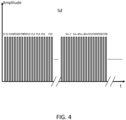
- the drive signal that is to be applied to the drive electrode of the absorbent article may be a periodic signal that is swept with the same amplitude in a period over a range of frequencies f1, f2, ..., fm, such as e.g. 5 kHz, 10 kHz, ..., 3 MHz.
- the drive signal Sd is a sinewave signal that is swept over frequencies ranged from f1 to fm such as e.g. 5 kHz to 3 MHz, with each frequency being of the same amplitude and lasting for the same time interval e.g. 10ms.
- the drive signal 100 is a sinewave signal of 5 kHz from 0ms to 10ms, then a sinewave signal of 10 kHz from 10ms to 20 ms, then a sinewave signal of 15 kHz from 20ms to 30ms, ..., finally a sinewave signal of 3 MHz from 1.99s to 2s, and then repeats periodically, as an example. It is appreciated that between different frequencies there may exist time interval with no signal.
- the drive signal may be a sinewave signal of 5 kHz from 0ms to 10ms, then 0 (i.e.
- Figure 4 illustrates amplitude vs. time graph of an exemplary drive signal Sd according to an embodiment of the present disclosure.
- a sense signal 200 is sensed from a sense electrode of the absorbent article. It is appreciated that in response to a sinewave signal of a specific frequency being applied to a drive electrode of an absorbent article, a sinewave signal of the same specific frequency is sensed from a sense electrode of the absorbent article, but with a smaller amplitude.
- FIG. 5 illustrates amplitude vs. time graphs G showing the sense signals Ss of various frequencies, according to an embodiment of the present disclosure.
- the uppermost graph G1 illustrates the sense signal 200-1 of 5 kHz
- the second uppermost graph G2 illustrates the sense signal 200-2 of 10 kHz
- a graph Ga illustrates the sense signal 200-a of 5a kHz
- a graph Gb illustrates the sense signal 200-b of 5b kHz
- a graph Gm illustrates the sense signal 200-m of 5m kHz
- a graph Gn illustrates the sense signal 200-n of 5n kHz, ..., that are sensed from the sense electrode in response to the drive signal 100 as illustrated in Figure 4 being applied to the drive electrode, where a, b, m, and n are integers.
- a first wetness event is assumed to occur at time t1, which causes the connection between the electrodes (the drive electrode and the sense electrode) in the absorbent article.
- a sharp jump in amplitude that changes beyond a threshold height Hj within a period shorter than a threshold period Tj may occur at or around t1 in a sense signal of a low frequency.
- This sense signal of the low frequency does not change in its amplitude much before and after this jump, even though further wetness events occur in the absorbent article later. It can be seen from Figure 5 that a jump in amplitude of a height H within a period T appears around t1 in signal 200-a and the signal 200-a does not change in its amplitude much before and after this jump, as an example.
- a sharp jump in amplitude that changes beyond a threshold height Hj within a period shorter than a threshold period Tj in a sense signal of a low frequency can be used to determine the first wetness event in an absorbent article.
- the change in amplitude of the sense signal of a low frequency in response to the first wetness event might be smoother, e.g. a gradual upslope
- a threshold height Hs greater than the threshold height Hj may be used to determine the first wetness event in an absorbent article. That is, in addition or alternatively to the sharp jump in amplitude as described above, a gradual upslope in amplitude with a height beyond a threshold height Hs in a sense signal of a low frequency may be used to determine the first wetness event in an absorbent article, in an embodiment of the present disclosure.
- an upslope in amplitude of a height H' occurs around t1 in the sense signal 200-b that also does not change much before and after the first wetness event t1.
- a periodic drive signal that is swept in a period over a range of frequencies is applied to a drive electrode in an absorbent article, and by using bandpass filter, a sense signal is sensed from a sense electrode in the absorbent article for each frequency in the frequency range.
- the sense signals of low frequencies e.g. around 10 kHz are checked for a sharp jump e.g. of a height beyond Hj within a period T shorter than Tj or for a gradual slop e.g. of a height beyond Hs in their amplitudes.
- the sense signal of low frequency with which the first wetness event in an absorbent article is determined by checking a sharp jump or a gradual upslope in its amplitude, does not change in amplitude much after the sharp jump or the gradual upslope, and thus cannot be further used to estimate or detect the saturation in the absorbent article.
- a sense signal of high frequency e.g. ranging from 70 kHz - 500 Khz gradually increases in its amplitude as more and more wetness events occur in the absorbent article.
- the sense signals of higher frequencies may be used to estimate or detect the saturation in the absorbent article after the first wetness event is determined, in an embodiment of the present disclosure.
- the difference in amplitude from the first wetness event (e.g. time t1 in Figure 5 ) is determined in each of all sense signals of higher frequencies. Once the difference in amplitude from the first wetness event (e.g. time t1 in Figure 5 ) is determined in any one of the sense signals of higher frequencies to be beyond a threshold amount Ts, the saturation is detected in the absorbent article.
- the difference in amplitude from the first wetness event t1 is Dm2 in the sense signal 200-m, and is Dn2 in the sense signal 200-n.
- the differences in amplitude from t1 to t2 are all less than the threshold amount Ts in all the sense signals of higher frequencies.
- the difference in amplitude from the first wetness event t1 is Dm3 in the sense signal 200-m, and is Dn3 in the sense signal 200-n.
- the difference in amplitude of the sense signal 200-n from t1 to t2 is greater than the threshold amount Ts, which may be used as indication of the saturation in the absorbent article, according to an embodiment of the present disclosure.
- the sense signal 200n in which a difference in amplitude from t1 greater than the threshold amount Ts is first detected, may be e.g. about 100 kHz.
- a periodic drive signal that is swept in a period over a range of frequencies is applied to a drive electrode in an absorbent article, and by using bandpass filter, a sense signal is sensed from a sense electrode in the absorbent article for each frequency in the frequency range.
- the first wetness event which is determined as described above with use of a sense signal of low frequency, is used as baseline, and the difference in amplitude from the first wetness event is compared to a threshold amount Ts in each of all sense signals of higher frequencies e.g. ranging from 70 kHz to 500 kHz, and whenever a difference in amplitude is determined to be greater than the threshold amount Ts, the saturation is detected in the absorbent article.
- the threshold amount Ts may be changed depending on the orientation of the user. For example, according to an embodiment of the present disclosure, a smaller threshold amount Ts is assigned to an orientation of user in which the wetness spot is further away from the pod.
- multiple frequencies are used for moisture detection and estimation of an absorbent article.
- a low frequency is used to determine the first wetness event in the absorbent article, which is in turn used as a baseline for moisture or saturation estimation, while another high frequency is used to estimate or detect the saturation of the absorbent article.
- low frequencies are checked for a sharp jump or a gradual upslope in amplitude that acts as indication of the first wetness event in the absorbent article. Then the differences in amplitude from the baseline of high frequencies are compared to a threshold amount in order to detect or estimate the saturation of the absorbent article.
Landscapes
- Health & Medical Sciences (AREA)
- Chemical & Material Sciences (AREA)
- Life Sciences & Earth Sciences (AREA)
- General Health & Medical Sciences (AREA)
- Chemical Kinetics & Catalysis (AREA)
- Pathology (AREA)
- Immunology (AREA)
- General Physics & Mathematics (AREA)
- Biochemistry (AREA)
- Analytical Chemistry (AREA)
- Physics & Mathematics (AREA)
- Electrochemistry (AREA)
- Vascular Medicine (AREA)
- Veterinary Medicine (AREA)
- Public Health (AREA)
- Animal Behavior & Ethology (AREA)
- Heart & Thoracic Surgery (AREA)
- Biomedical Technology (AREA)
- Engineering & Computer Science (AREA)
- Epidemiology (AREA)
- Absorbent Articles And Supports Therefor (AREA)
- Orthopedics, Nursing, And Contraception (AREA)
Claims (7)
- Verfahren zur Feuchtigkeitserkennung und -schätzung in einem absorptionsfähigen Artikel unter Verwendung mehrerer Frequenzen, umfassend:Anwenden eines Ansteuersignals mit mehreren Frequenzen auf eine Ansteuerelektrode in dem absorptionsfähigen Artikel durch kapazitive Kopplung;Erfassen eines Erfassungssignals mit den mehreren Frequenzen von einer Erfassungselektrode in dem absorptionsfähigen Artikel durch kapazitive Kopplung;Erkennen des ersten Nässeereignisses in dem absorptionsfähigen Artikel unter Verwendung eines Erfassungssignals mit einer Frequenz von den mehreren Frequenzen; undErkennen der Sättigung des absorptionsfähigen Artikels unter Verwendung eines Erfassungssignals mit einer anderen Frequenz von den mehreren Frequenzen.
- Verfahren nach Anspruch 1, wobei das Erkennen des ersten Nässeereignisses umfasst:
Erkennen des ersten Nässeereignisses in dem absorptionsfähigen Artikel, wenn ein deutlicher Sprung einer Amplitude in dem Erfassungssignal mit der Frequenz bestimmt wird, der sich innerhalb einer Periode, die kürzer als eine Grenzperiode ist, über eine Grenzhöhe hinaus ändert. - Verfahren nach Anspruch 1, wobei das Erkennen des ersten Nässeereignisses umfasst:
Erkennen des ersten Nässeereignisses in dem absorptionsfähigen Artikel, wenn ein allmählicher Anstieg einer Amplitude in dem Erfassungssignal mit der Frequenz bestimmt wird, der sich über eine Grenzhöhe hinaus ändert. - Verfahren nach Anspruch 1, wobei das Erkennen der Sättigung umfasst:Bestimmen eines Unterschieds einer Amplitude von dem ersten Nässeereignis in dem Erfassungssignal mit der anderen Frequenz; undErkennen der Sättigung, wenn der Unterschied der Amplitude größer als ein Grenzbetrag ist.
- Verfahren nach Anspruch 4, wobei der Grenzbetrag in Abhängigkeit von der Ausrichtung des absorptionsfähigen Artikels geändert wird.
- Verfahren nach einem der Ansprüche 1-5, wobei das Anwenden eines Ansteuersignals mit mehreren Frequenzen umfasst:
Anwenden eines periodischen Ansteuersignals, das in einer Periode über die mehreren Frequenzen gewobbelt wird. - Verfahren nach einem der Ansprüche 1-5, wobei das Erfassen eines Erfassungssignals mit den mehreren Frequenzen umfasst:
Bestimmen eines Erfassungssignals durch Verwenden eines Bandpassfilters für jede der mehreren Frequenzen.
Applications Claiming Priority (2)
| Application Number | Priority Date | Filing Date | Title |
|---|---|---|---|
| US202163148440P | 2021-02-11 | 2021-02-11 | |
| PCT/CA2022/050199 WO2022170435A1 (en) | 2021-02-11 | 2022-02-10 | Moisture detection and estimation with multiple frequencies |
Publications (3)
| Publication Number | Publication Date |
|---|---|
| EP4251983A1 EP4251983A1 (de) | 2023-10-04 |
| EP4251983A4 EP4251983A4 (de) | 2024-09-11 |
| EP4251983B1 true EP4251983B1 (de) | 2025-05-14 |
Family
ID=82703319
Family Applications (1)
| Application Number | Title | Priority Date | Filing Date |
|---|---|---|---|
| EP22752041.8A Active EP4251983B1 (de) | 2021-02-11 | 2022-02-10 | Feuchtigkeitsdetektion und -schätzung mit mehreren frequenzen |
Country Status (4)
| Country | Link |
|---|---|
| US (1) | US20220249296A1 (de) |
| EP (1) | EP4251983B1 (de) |
| CN (1) | CN116888463A (de) |
| WO (1) | WO2022170435A1 (de) |
Families Citing this family (1)
| Publication number | Priority date | Publication date | Assignee | Title |
|---|---|---|---|---|
| WO2025227264A1 (en) * | 2024-05-02 | 2025-11-06 | Raja Tuli | Saturation detection in an absorbent article |
Family Cites Families (19)
| Publication number | Priority date | Publication date | Assignee | Title |
|---|---|---|---|---|
| US5760694A (en) * | 1996-05-07 | 1998-06-02 | Knox Security Engineering Corporation | Moisture detecting devices such as for diapers and diapers having such devices |
| AU3070597A (en) * | 1996-05-07 | 1997-11-26 | Knox Security Engineering Corporation | Moisture detecting devices such as for diapers and diapers having such devices |
| US7042213B2 (en) * | 2004-07-13 | 2006-05-09 | Lucent Technologies Inc. | Magnetometer having an electromechanical resonator |
| EP1686026A1 (de) * | 2005-01-31 | 2006-08-02 | IEE INTERNATIONAL ELECTRONICS & ENGINEERING S.A. | Kapazitiver Differenzialregensensor |
| US7642396B2 (en) * | 2005-08-31 | 2010-01-05 | Kimberly-Clark Worldwide, Inc. | Method and device for detecting the presence of multiple insults in an absorbent article |
| SE534533C2 (sv) * | 2009-10-07 | 2011-09-27 | Pampett Ab | Metod och system för detektering av fukt vid en absorberande artikel |
| US20190290501A1 (en) * | 2011-06-03 | 2019-09-26 | The Procter & Gamble Company | Absorbent articles comprising sensors |
| WO2013016765A1 (en) * | 2011-08-01 | 2013-02-07 | Fred Bergman Healthcare Pty Ltd | A capacitive wetness sensor and method for manufacturing the same |
| RU2484453C1 (ru) * | 2011-12-13 | 2013-06-10 | Федеральное государственное бюджетное образовательное учреждение высшего профессионального образования "Башкирский государственный университет" | Способ определения водонасыщенности керна |
| US9820891B2 (en) * | 2013-07-31 | 2017-11-21 | Digisense Ltd | Sensor for urine and stool detection |
| EP3049900B1 (de) * | 2013-09-27 | 2020-11-18 | Sensel, Inc. | Berührungssensor-detektorsysteme und verfahren |
| US9494538B2 (en) * | 2014-04-04 | 2016-11-15 | Deere & Company | Agricultural moisture sensor with co-planar electrodes |
| NL2013740B1 (en) * | 2014-11-04 | 2016-09-07 | Stichting Imec Nederland | A system for monitoring incontinence. |
| GB2532492A (en) * | 2014-11-21 | 2016-05-25 | Ibm | A broker service apparatus for controlling a mobile device |
| US10028865B2 (en) * | 2016-06-13 | 2018-07-24 | Verily Life Sciences Llc | Hardware to determine when a diaper needs to be changed and provide electronic notification |
| US10426672B2 (en) * | 2016-08-26 | 2019-10-01 | Vener8 Technologies | Moisture detection and notification system |
| US20180288557A1 (en) * | 2017-03-29 | 2018-10-04 | Samsung Electronics Co., Ltd. | Use of earcons for roi identification in 360-degree video |
| CN107854220B (zh) * | 2017-11-03 | 2022-02-18 | 深圳一代科技有限公司 | 一种电子感湿吸收用品及其潮湿程度检测方法 |
| WO2020060570A1 (en) * | 2018-09-21 | 2020-03-26 | Peter Lee | Diaper with wet diaper monitoring device |
-
2022
- 2022-02-10 EP EP22752041.8A patent/EP4251983B1/de active Active
- 2022-02-10 WO PCT/CA2022/050199 patent/WO2022170435A1/en not_active Ceased
- 2022-02-10 CN CN202280014019.4A patent/CN116888463A/zh active Pending
- 2022-02-10 US US17/669,038 patent/US20220249296A1/en active Pending
Also Published As
| Publication number | Publication date |
|---|---|
| WO2022170435A1 (en) | 2022-08-18 |
| EP4251983A1 (de) | 2023-10-04 |
| EP4251983A4 (de) | 2024-09-11 |
| CN116888463A (zh) | 2023-10-13 |
| US20220249296A1 (en) | 2022-08-11 |
Similar Documents
| Publication | Publication Date | Title |
|---|---|---|
| AU2019232842B2 (en) | Disposable hygienic article with means for diagnostic testing | |
| EP0808146B1 (de) | Saugfähiger gegenstand mit aufnahmelaschen | |
| US6190369B1 (en) | Disposable absorbent article having improved in-use storage capacity for low and medium low viscosity feces | |
| RU2443403C2 (ru) | Абсорбирующее изделие с повышенной мягкостью | |
| US5624426A (en) | Diaper having an improved leg cuff | |
| EP1311221B1 (de) | Absorbierender artikel mit verbessertem befestigungssystem | |
| CA2795046C (en) | Absorbent article having leg cuffs | |
| US6066774A (en) | Absorbent article with fiber optic waste inspection system | |
| US8277432B2 (en) | Shaped absorbent article with edge elastics | |
| EP2008626A1 (de) | Einwegwindel | |
| JP2004201719A (ja) | 使い捨て着用物品 | |
| CN101868208A (zh) | 成形吸收性物品 | |
| AU2019240557B2 (en) | Fastener for an absorbent article | |
| AU2005334265A1 (en) | Method for detection of unfastening or removal of absorbent article from the body | |
| US20220249296A1 (en) | Moisture detection and estimation with multiple frequencies | |
| CA2302374A1 (en) | Diaper having adjustable absorbent assemblies | |
| US8911419B2 (en) | Absorbent article with improved fastening system | |
| US12329615B2 (en) | Absorbent article with conductive material on two layers | |
| WO2013087655A1 (en) | Articles with urine receiving pocket in registry with genitals | |
| US20250186268A1 (en) | Detecton unit with conductive rubber | |
| US20250339318A1 (en) | Saturation Detection in an Absorbent Article | |
| HK1008483A (en) | Disposable absorbent article having improved in-use storage capacity for low and medium low viscosity faeces | |
| MXPA00004534A (en) | Absorbent article with fiber optic waste inspection system |
Legal Events
| Date | Code | Title | Description |
|---|---|---|---|
| STAA | Information on the status of an ep patent application or granted ep patent |
Free format text: STATUS: THE INTERNATIONAL PUBLICATION HAS BEEN MADE |
|
| PUAI | Public reference made under article 153(3) epc to a published international application that has entered the european phase |
Free format text: ORIGINAL CODE: 0009012 |
|
| STAA | Information on the status of an ep patent application or granted ep patent |
Free format text: STATUS: REQUEST FOR EXAMINATION WAS MADE |
|
| 17P | Request for examination filed |
Effective date: 20230628 |
|
| AK | Designated contracting states |
Kind code of ref document: A1 Designated state(s): AL AT BE BG CH CY CZ DE DK EE ES FI FR GB GR HR HU IE IS IT LI LT LU LV MC MK MT NL NO PL PT RO RS SE SI SK SM TR |
|
| DAV | Request for validation of the european patent (deleted) | ||
| DAX | Request for extension of the european patent (deleted) | ||
| A4 | Supplementary search report drawn up and despatched |
Effective date: 20240809 |
|
| RIC1 | Information provided on ipc code assigned before grant |
Ipc: A61F 13/42 20060101ALI20240805BHEP Ipc: G01N 27/02 20060101AFI20240805BHEP |
|
| GRAP | Despatch of communication of intention to grant a patent |
Free format text: ORIGINAL CODE: EPIDOSNIGR1 |
|
| STAA | Information on the status of an ep patent application or granted ep patent |
Free format text: STATUS: GRANT OF PATENT IS INTENDED |
|
| INTG | Intention to grant announced |
Effective date: 20250221 |
|
| GRAS | Grant fee paid |
Free format text: ORIGINAL CODE: EPIDOSNIGR3 |
|
| GRAA | (expected) grant |
Free format text: ORIGINAL CODE: 0009210 |
|
| STAA | Information on the status of an ep patent application or granted ep patent |
Free format text: STATUS: THE PATENT HAS BEEN GRANTED |
|
| P01 | Opt-out of the competence of the unified patent court (upc) registered |
Free format text: CASE NUMBER: APP_15679/2025 Effective date: 20250331 |
|
| AK | Designated contracting states |
Kind code of ref document: B1 Designated state(s): AL AT BE BG CH CY CZ DE DK EE ES FI FR GB GR HR HU IE IS IT LI LT LU LV MC MK MT NL NO PL PT RO RS SE SI SK SM TR |
|
| REG | Reference to a national code |
Ref country code: GB Ref legal event code: FG4D |
|
| REG | Reference to a national code |
Ref country code: CH Ref legal event code: EP |
|
| REG | Reference to a national code |
Ref country code: DE Ref legal event code: R096 Ref document number: 602022014717 Country of ref document: DE |
|
| REG | Reference to a national code |
Ref country code: IE Ref legal event code: FG4D |
|
| REG | Reference to a national code |
Ref country code: NL Ref legal event code: MP Effective date: 20250514 |
|
| PG25 | Lapsed in a contracting state [announced via postgrant information from national office to epo] |
Ref country code: FI Free format text: LAPSE BECAUSE OF FAILURE TO SUBMIT A TRANSLATION OF THE DESCRIPTION OR TO PAY THE FEE WITHIN THE PRESCRIBED TIME-LIMIT Effective date: 20250514 Ref country code: ES Free format text: LAPSE BECAUSE OF FAILURE TO SUBMIT A TRANSLATION OF THE DESCRIPTION OR TO PAY THE FEE WITHIN THE PRESCRIBED TIME-LIMIT Effective date: 20250514 Ref country code: PT Free format text: LAPSE BECAUSE OF FAILURE TO SUBMIT A TRANSLATION OF THE DESCRIPTION OR TO PAY THE FEE WITHIN THE PRESCRIBED TIME-LIMIT Effective date: 20250915 |
|
| REG | Reference to a national code |
Ref country code: LT Ref legal event code: MG9D |
|
| PG25 | Lapsed in a contracting state [announced via postgrant information from national office to epo] |
Ref country code: NO Free format text: LAPSE BECAUSE OF FAILURE TO SUBMIT A TRANSLATION OF THE DESCRIPTION OR TO PAY THE FEE WITHIN THE PRESCRIBED TIME-LIMIT Effective date: 20250814 Ref country code: GR Free format text: LAPSE BECAUSE OF FAILURE TO SUBMIT A TRANSLATION OF THE DESCRIPTION OR TO PAY THE FEE WITHIN THE PRESCRIBED TIME-LIMIT Effective date: 20250815 |
|
| PG25 | Lapsed in a contracting state [announced via postgrant information from national office to epo] |
Ref country code: PL Free format text: LAPSE BECAUSE OF FAILURE TO SUBMIT A TRANSLATION OF THE DESCRIPTION OR TO PAY THE FEE WITHIN THE PRESCRIBED TIME-LIMIT Effective date: 20250514 Ref country code: NL Free format text: LAPSE BECAUSE OF FAILURE TO SUBMIT A TRANSLATION OF THE DESCRIPTION OR TO PAY THE FEE WITHIN THE PRESCRIBED TIME-LIMIT Effective date: 20250514 |
|
| REG | Reference to a national code |
Ref country code: AT Ref legal event code: MK05 Ref document number: 1795158 Country of ref document: AT Kind code of ref document: T Effective date: 20250514 |
|
| PG25 | Lapsed in a contracting state [announced via postgrant information from national office to epo] |
Ref country code: BG Free format text: LAPSE BECAUSE OF FAILURE TO SUBMIT A TRANSLATION OF THE DESCRIPTION OR TO PAY THE FEE WITHIN THE PRESCRIBED TIME-LIMIT Effective date: 20250514 |
|
| PG25 | Lapsed in a contracting state [announced via postgrant information from national office to epo] |
Ref country code: HR Free format text: LAPSE BECAUSE OF FAILURE TO SUBMIT A TRANSLATION OF THE DESCRIPTION OR TO PAY THE FEE WITHIN THE PRESCRIBED TIME-LIMIT Effective date: 20250514 |
|
| PG25 | Lapsed in a contracting state [announced via postgrant information from national office to epo] |
Ref country code: AT Free format text: LAPSE BECAUSE OF FAILURE TO SUBMIT A TRANSLATION OF THE DESCRIPTION OR TO PAY THE FEE WITHIN THE PRESCRIBED TIME-LIMIT Effective date: 20250514 |
|
| PG25 | Lapsed in a contracting state [announced via postgrant information from national office to epo] |
Ref country code: RS Free format text: LAPSE BECAUSE OF FAILURE TO SUBMIT A TRANSLATION OF THE DESCRIPTION OR TO PAY THE FEE WITHIN THE PRESCRIBED TIME-LIMIT Effective date: 20250814 |
|
| PG25 | Lapsed in a contracting state [announced via postgrant information from national office to epo] |
Ref country code: IS Free format text: LAPSE BECAUSE OF FAILURE TO SUBMIT A TRANSLATION OF THE DESCRIPTION OR TO PAY THE FEE WITHIN THE PRESCRIBED TIME-LIMIT Effective date: 20250914 |
|
| PG25 | Lapsed in a contracting state [announced via postgrant information from national office to epo] |
Ref country code: LV Free format text: LAPSE BECAUSE OF FAILURE TO SUBMIT A TRANSLATION OF THE DESCRIPTION OR TO PAY THE FEE WITHIN THE PRESCRIBED TIME-LIMIT Effective date: 20250514 |
|
| PG25 | Lapsed in a contracting state [announced via postgrant information from national office to epo] |
Ref country code: DK Free format text: LAPSE BECAUSE OF FAILURE TO SUBMIT A TRANSLATION OF THE DESCRIPTION OR TO PAY THE FEE WITHIN THE PRESCRIBED TIME-LIMIT Effective date: 20250514 Ref country code: SM Free format text: LAPSE BECAUSE OF FAILURE TO SUBMIT A TRANSLATION OF THE DESCRIPTION OR TO PAY THE FEE WITHIN THE PRESCRIBED TIME-LIMIT Effective date: 20250514 |
|
| PG25 | Lapsed in a contracting state [announced via postgrant information from national office to epo] |
Ref country code: CZ Free format text: LAPSE BECAUSE OF FAILURE TO SUBMIT A TRANSLATION OF THE DESCRIPTION OR TO PAY THE FEE WITHIN THE PRESCRIBED TIME-LIMIT Effective date: 20250514 |
|
| PG25 | Lapsed in a contracting state [announced via postgrant information from national office to epo] |
Ref country code: EE Free format text: LAPSE BECAUSE OF FAILURE TO SUBMIT A TRANSLATION OF THE DESCRIPTION OR TO PAY THE FEE WITHIN THE PRESCRIBED TIME-LIMIT Effective date: 20250514 |
|
| PG25 | Lapsed in a contracting state [announced via postgrant information from national office to epo] |
Ref country code: SK Free format text: LAPSE BECAUSE OF FAILURE TO SUBMIT A TRANSLATION OF THE DESCRIPTION OR TO PAY THE FEE WITHIN THE PRESCRIBED TIME-LIMIT Effective date: 20250514 |
|
| PG25 | Lapsed in a contracting state [announced via postgrant information from national office to epo] |
Ref country code: IT Free format text: LAPSE BECAUSE OF FAILURE TO SUBMIT A TRANSLATION OF THE DESCRIPTION OR TO PAY THE FEE WITHIN THE PRESCRIBED TIME-LIMIT Effective date: 20250514 |
|
| REG | Reference to a national code |
Ref country code: DE Ref legal event code: R097 Ref document number: 602022014717 Country of ref document: DE |
|
| PLBE | No opposition filed within time limit |
Free format text: ORIGINAL CODE: 0009261 |
|
| STAA | Information on the status of an ep patent application or granted ep patent |
Free format text: STATUS: NO OPPOSITION FILED WITHIN TIME LIMIT |
|
| REG | Reference to a national code |
Ref country code: CH Ref legal event code: L10 Free format text: ST27 STATUS EVENT CODE: U-0-0-L10-L00 (AS PROVIDED BY THE NATIONAL OFFICE) Effective date: 20260325 |
|
| PGFP | Annual fee paid to national office [announced via postgrant information from national office to epo] |
Ref country code: GB Payment date: 20260109 Year of fee payment: 5 |
|
| PGFP | Annual fee paid to national office [announced via postgrant information from national office to epo] |
Ref country code: DE Payment date: 20260218 Year of fee payment: 5 |
|
| PGFP | Annual fee paid to national office [announced via postgrant information from national office to epo] |
Ref country code: FR Payment date: 20260219 Year of fee payment: 5 |
|
| 26N | No opposition filed |
Effective date: 20260217 |