EP4249929B1 - Bestimmung der spannungskurve einer offenen schaltung für wiederaufladbare batterien - Google Patents
Bestimmung der spannungskurve einer offenen schaltung für wiederaufladbare batterien Download PDFInfo
- Publication number
- EP4249929B1 EP4249929B1 EP22163134.4A EP22163134A EP4249929B1 EP 4249929 B1 EP4249929 B1 EP 4249929B1 EP 22163134 A EP22163134 A EP 22163134A EP 4249929 B1 EP4249929 B1 EP 4249929B1
- Authority
- EP
- European Patent Office
- Prior art keywords
- battery
- stress
- computer
- implemented method
- spectrum
- Prior art date
- Legal status (The legal status is an assumption and is not a legal conclusion. Google has not performed a legal analysis and makes no representation as to the accuracy of the status listed.)
- Active
Links
Images


Classifications
-
- G—PHYSICS
- G01—MEASURING; TESTING
- G01R—MEASURING ELECTRIC VARIABLES; MEASURING MAGNETIC VARIABLES
- G01R31/00—Arrangements for testing electric properties; Arrangements for locating electric faults; Arrangements for electrical testing characterised by what is being tested not provided for elsewhere
- G01R31/36—Arrangements for testing, measuring or monitoring the electrical condition of accumulators or electric batteries, e.g. capacity or state of charge [SoC]
- G01R31/385—Arrangements for measuring battery or accumulator variables
- G01R31/387—Determining ampere-hour charge capacity or SoC
- G01R31/388—Determining ampere-hour charge capacity or SoC involving voltage measurements
-
- G—PHYSICS
- G01—MEASURING; TESTING
- G01R—MEASURING ELECTRIC VARIABLES; MEASURING MAGNETIC VARIABLES
- G01R31/00—Arrangements for testing electric properties; Arrangements for locating electric faults; Arrangements for electrical testing characterised by what is being tested not provided for elsewhere
- G01R31/36—Arrangements for testing, measuring or monitoring the electrical condition of accumulators or electric batteries, e.g. capacity or state of charge [SoC]
- G01R31/367—Software therefor, e.g. for battery testing using modelling or look-up tables
-
- G—PHYSICS
- G01—MEASURING; TESTING
- G01R—MEASURING ELECTRIC VARIABLES; MEASURING MAGNETIC VARIABLES
- G01R31/00—Arrangements for testing electric properties; Arrangements for locating electric faults; Arrangements for electrical testing characterised by what is being tested not provided for elsewhere
- G01R31/36—Arrangements for testing, measuring or monitoring the electrical condition of accumulators or electric batteries, e.g. capacity or state of charge [SoC]
- G01R31/374—Arrangements for testing, measuring or monitoring the electrical condition of accumulators or electric batteries, e.g. capacity or state of charge [SoC] with means for correcting the measurement for temperature or ageing
-
- G—PHYSICS
- G01—MEASURING; TESTING
- G01R—MEASURING ELECTRIC VARIABLES; MEASURING MAGNETIC VARIABLES
- G01R31/00—Arrangements for testing electric properties; Arrangements for locating electric faults; Arrangements for electrical testing characterised by what is being tested not provided for elsewhere
- G01R31/36—Arrangements for testing, measuring or monitoring the electrical condition of accumulators or electric batteries, e.g. capacity or state of charge [SoC]
- G01R31/382—Arrangements for monitoring battery or accumulator variables, e.g. SoC
-
- G—PHYSICS
- G01—MEASURING; TESTING
- G01R—MEASURING ELECTRIC VARIABLES; MEASURING MAGNETIC VARIABLES
- G01R31/00—Arrangements for testing electric properties; Arrangements for locating electric faults; Arrangements for electrical testing characterised by what is being tested not provided for elsewhere
- G01R31/36—Arrangements for testing, measuring or monitoring the electrical condition of accumulators or electric batteries, e.g. capacity or state of charge [SoC]
- G01R31/392—Determining battery ageing or deterioration, e.g. state of health
-
- G—PHYSICS
- G01—MEASURING; TESTING
- G01R—MEASURING ELECTRIC VARIABLES; MEASURING MAGNETIC VARIABLES
- G01R31/00—Arrangements for testing electric properties; Arrangements for locating electric faults; Arrangements for electrical testing characterised by what is being tested not provided for elsewhere
- G01R31/36—Arrangements for testing, measuring or monitoring the electrical condition of accumulators or electric batteries, e.g. capacity or state of charge [SoC]
- G01R31/396—Acquisition or processing of data for testing or for monitoring individual cells or groups of cells within a battery
-
- Y—GENERAL TAGGING OF NEW TECHNOLOGICAL DEVELOPMENTS; GENERAL TAGGING OF CROSS-SECTIONAL TECHNOLOGIES SPANNING OVER SEVERAL SECTIONS OF THE IPC; TECHNICAL SUBJECTS COVERED BY FORMER USPC CROSS-REFERENCE ART COLLECTIONS [XRACs] AND DIGESTS
- Y02—TECHNOLOGIES OR APPLICATIONS FOR MITIGATION OR ADAPTATION AGAINST CLIMATE CHANGE
- Y02E—REDUCTION OF GREENHOUSE GAS [GHG] EMISSIONS, RELATED TO ENERGY GENERATION, TRANSMISSION OR DISTRIBUTION
- Y02E60/00—Enabling technologies; Technologies with a potential or indirect contribution to GHG emissions mitigation
- Y02E60/10—Energy storage using batteries
Definitions
- the dependency of the open circuit voltage on the state of charge of a battery i.e., the OCV curve is determined, e.g., to facilitate determination of the state of health or state of charge of the battery.
- the OCV curve can be determined based on the values of multiple independent parameters, e.g., half-cell potentials (open-circuit potential) derived from degradation modes such as loss of lithium inventory or loss of active material at the cathode or anode.
- the ageing state of a rechargeable battery e.g., a lithium-ion battery
- various models such as physical-chemical models, semi-empirical models or data-based models are known.
- a computer-implemented method includes obtaining at least one stress spectrum.
- a computer program or a computer-program product or a computer-readable storage medium includes program code.
- the program code can be loaded and executed by at least one processor.
- the at least one processor Upon loading and executing the program code, the at least one processor performs a method.
- the method includes obtaining at least one stress spectrum.
- the at least one stress spectrum is indicative of a strength of multiple stress factors onto a battery during an observation duration.
- the computer-implemented method further includes determining values of multiple independent parameters of a predetermined parameterization associated with an open-circuit voltage curve of the battery. The values are determined based on the at least one stress spectrum. Further, the computer-implemented method includes determining the open-circuit voltage curve based on the values of the multiple independent parameters of the open-circuit voltage curve.
- a device includes a processor and a memory.
- the processor can load program code from the memory and execute the program code.
- the at least one processor performs a method.
- the method includes obtaining at least one stress spectrum.
- the at least one stress spectrum is indicative of a strength of multiple stress factors onto a battery during an observation duration.
- the computer-implemented method further includes determining values of multiple independent parameters of a predetermined parameterization associated with an open-circuit voltage curve of the battery. The values are determined based on the at least one stress spectrum. Further, the computer-implemented method includes determining the open-circuit voltage curve based on the values of the multiple independent parameters of the open-circuit voltage curve.
- circuits and other electrical devices generally provide for a plurality of circuits or other electrical devices. All references to the circuits and other electrical devices and the functionality provided by each are not intended to be limited to encompassing only what is illustrated and described herein. While particular labels may be assigned to the various circuits or other electrical devices disclosed, such labels are not intended to limit the scope of operation for the circuits and the other electrical devices. Such circuits and other electrical devices may be combined with each other and/or separated in any manner based on the particular type of electrical implementation that is desired.
- any circuit or other electrical device disclosed herein may include any number of microcontrollers, a graphics processor unit (GPU), integrated circuits, memory devices (e.g., FLASH, random access memory (RAM), read only memory (ROM), electrically programmable read only memory (EPROM), electrically erasable programmable read only memory (EEPROM), or other suitable variants thereof), and software which co-act with one another to perform operation(s) disclosed herein.
- any one or more of the electrical devices may be configured to execute a program code that is embodied in a non-transitory computer readable medium programmed to perform any number of the functions as disclosed.
- state estimation can be applied to rechargeable batteries such as lithium-ion batteries.
- OCV open-circuit voltage curve
- SOC state of charge
- the OCV curve it may be possible to determine one or more estimates of states of the battery. For instance, it would be possible to determine the aging state of the battery, e.g., a state of health (SOH) of the battery. Typically, both the capacity, as well as the impedance of the battery will change as a function of age of the battery. Thus, to make a prediction of the available capacity, it is helpful to determine the SOH.
- SOH state of health
- the OCV curve serves as a unique fingerprint capturing all different kinds of degradation modes of the battery.
- LIBs degrade gradually during use, leading to chemical and mechanical changes at the electrodes. These changes can happen due to a variety of concurrent chemical, mechanical, electrical, and thermal degradation mechanisms. Because the OCV of a lithium-ion battery is the potential difference between both electrodes, the changes at the electrodes manifest itself in changes in the OCV. The large number of degradation mechanisms are commonly categorized into a smaller number of degradation modes, depending on their effect on the changes in the OCV.A first example degradation mode would be loss of active material at an electrode of the battery. A second example degradation mode would be loss of mobile charge carrier inventory of the battery.
- the OCV curve is typically measured at the beginning of life for a battery cell and this OCV curve is then stored and used in an electric-thermal model of the battery.
- the OCV curve in reference techniques, can be measured with specific low-current or current-interruption methods; such measurements typically require a long time duration.
- changes of the OCV curve over lifetime are either neglected or partially updated in operation, since a full measurement of the OCV curve using such reference techniques is impractical during application.
- time series data of the voltage of the battery can be analyzed for relaxation points - i.e., where the battery has been at rest without charging or discharging for a significantly long time duration - and the OCV curve is then updated accordingly.
- a further drawback of using a look-up table is that there is no unambiguous relationship between the aged OCV curve and state of health ,i.e., aging. Typically, a significant variation of the OCV curve for a given state of health is observed for batteries of an ensemble. Thus, using the look-up table inherently limits accuracy.
- a parameterization of the OCV curve is relied upon.
- the parameterization includes multiple parameters. This means: Depending on the values that these parameters take, different OCV curves are obtained.
- the parameterization can specify the impact of various parameters onto the OCV curve. For instance, the shape and/or value of the OCV curve can vary as a function of the specific values that the parameters take.
- the OCV curve can be determined.
- the OCV curve can be determined depending on stress factors such as temperature, mean SOC, depth-of-discharge (DOD), time, charge and discharge C-rate.
- stress factors such as temperature, mean SOC, depth-of-discharge (DOD), time, charge and discharge C-rate.
- TAB. 1 Two-step approach for determining the OCV curve.
- the determination of the OCV curve can be assisted by machine-learning algorithms or other appropriately parameterized models that are employed in step I.
- look-up tables are avoided.
- STEP BRIEF DESCRIPTION EXAMPLE DETAILS I Determine parameter values One or more parameter values of the parameterization can be determined. There are various options available for implementing such determination of the one or more parameter values.
- a predetermined model can be used.
- the predetermined model can be parameterized during training, i.e., based on training data obtained for a reference battery of the same battery type.
- the machine-learning algorithm can be trained to determine the one or more parameter values of the parameterization based on input data that is determined during operation of the battery.
- the machine-learning algorithm could be implemented by an artificial neural network algorithm.
- it is possible that such model for determining the parameter values operates based on at least one stress spectrum that is indicative of a strength of multiple stress factors onto the battery during operation in an observation duration.
- the respective data structure of the at least one stress spectrum can take the form of a 2-D array, wherein each array entry specifies the relative occurrence of operation of the battery at a respective operation point.
- Such stress spectrum may not require including a temporal resolution of occurrence of specific stress factors onto the battery.
- such at least one stress spectrum can accumulate occurrences (without a particular time instance of occurrence) for multiple stress factors.
- Each one of the at least one stress spectrum may be resolved with respect to two or more dimensions, different dimensions characterizing different operating points of the battery. For instance, example stress spectra may be resolved along one or more of the following dimensions: state of charge; depth of discharge; temperature; charging rate or discharging rate; exposure time; to give just a few examples.
- Such observables can be defined as averages across a certain stress interval. For instance, one example stress spectrum could resolve charging rate vis-à-vis depth of discharge. Another example stress spectrum could resolve charging rate vis-à-vis temperature. Yet another charging spectrum could resolve state of charge of vis-à-vis exposure time. II Determine OCV curve Based on the parameter values that are determined in step I, it is then possible to determine the OCV curve. This is based on the predetermined parameterization that translates the parameter values into shape and/or amplitude of the OCV curve.
- the parameterization can be with respect to various parameters.
- the parameters can be mathematically defined.
- the multiple independent parameters can include orthogonal components of a functional decomposition of the OCV curve.
- Different basis functions for the parameterization can be chosen, so that the parameter values define the relative strength of contribution of the individual basis function as well as their position along SOC axis, e.g., the amplitude and/or position/localization (e.g., along SOC axis). I.e., the different contributions can be scaled and/or shifted.
- the OCV curve could be parametrized in accordance with a wavelet decomposition.
- the multiple independent parameters parametrized multiple degradation modes of the battery.
- Degradation modes could be loss of active material at an electrode of the battery and/or loss of mobile charge carriers battery, e.g., loss of lithium inventory, to give a few examples.
- orthogonal degradation modes namely the cathode potential and the anode potential.
- Various degradation modes are disclosed in Birkl, Christoph R., et al. "Degradation diagnostics for lithium ion cells.” Journal of Power Sources 341 (2017): 373-386 .
- Such techniques are based on the finding that it is possible to determine the impact of various operating profiles - captured by the at least one stress spectrum - specifically onto different degradation modes.
- a machine-learning algorithm can be used to determine the strength of individual degradation modes, i.e., respective parameter values of the parameterization, depending on the at least one stress spectrum, cf. TAB. 1: step I.
- a model-based two-step update of the OCV curve results in a reduced voltage and temperature error in any electrical thermal (ET) model, thus a more accurate calculation of simulated stress factors leading to an error reduction of the capacity prediction by any electrical thermal aging (ETA) model. Also, a reduced error for aged batteries for any state determination algorithm dependent on OCV data can be achieved. Multi-dimensional look-up tables can be avoided.
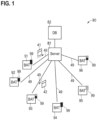
- FIG. 1 illustrates aspects associated with a system 80.
- the system 80 comprises a server 81 which is connected to a database 82.
- the system 80 comprises communication connections 49 between the server 81 and each of several batteries 91-96.
- the communication connections 49 could be implemented, for example, via a cellular network.
- the batteries 91-96 may comprise several types. Different types of batteries can be differentiated, for example, as relates to one or more of the following properties: shape of the cell (i.e., round cell, prismatic cell, etc.), cooling system (air cooling with active or passive design, coolant in coolant hose, passive cooling elements, etc.), the cell chemistry (e.g., electrode materials used, electrolytes, etc.), etc. There may also be a certain amount of variance between batteries 91-96 of the same type associated with such properties. For example, it is possible for batteries 91-96 of one and the same type to be mounted differently and thus different cooling systems are used. In addition, the same battery cells may sometimes be arranged differently such that there is variance in an electrical and thermal system analysis of the collection of cells.
- such battery-specific and/or type-specific effects can be considered in association with different parameterizations of an OCV curve. For instance, different parameterizations may be determined for different types of batteries.
- FIG. 1 illustrates by way of example that the batteries 91-96 can transmit state data 41 to the server 81 via the communication connections 49.
- the state data 41 can be indicative of one or more operating values of the respective battery 91-96, i.e., it is possible to index measured data.
- the state data 41 can be transmitted in an event-driven manner or according to a predefined timetable.
- state data 41 can be used in connection with determining an OCV curve for the various batteries 91-96. For instance, it would be possible that based on these state data 41, at least one stress spectrum is determined at the server 81. Then, based on the at least one stress spectrum, the server 81 can determine values of multiple independent parameters that are associated with the OCV curve.
- the state data 41 could already include or consist of the at least one stress spectrum; i.e., the at least one stress spectrum can be determined locally at the batteries 91-96. Thereby, reduced signaling bandwidth is required on the communication connections 49, because typically the stress spectra can be devoid of temporal resolution, thus resulting in a smaller size of the associated data structure if compared to, e.g., time series data.
- FIG. 1 also illustrates by way of example that the server 81 can transmit control data 42 to the batteries 91-96 via the communication connections 49.
- the control data 42 can index one or more operating limits for the future operation of the respective battery 91-96.
- the control data could index one or more control parameters for thermal management of the respective battery 91-96 and/or charge management of the respective battery 91-96.
- the server 81 can thus influence or control the operation of the batteries 91-96 through the use of the control data 42.
- the server 81 may determine the control data based on a current OCV curve that is determined for the respective battery 91-96. More specifically, the server 81 may determine the control data 42 based on a state estimate of the battery that is determined based on the OCV curve. For instance, the control data 42 could be determined based on an SOH that is determined based on the OCV curve.
- FIG. 1 additionally illustrates schematically the respective SOH 99 for each of the batteries 91-96.
- the SOH 99 of a battery 91-96 may comprise one or more different variables depending on implementation.
- Typical variables of the SOH 99 may be, for example: electrical capacity, i.e., the maximum possible stored charge; and/or electrical impedance, i.e., the frequency response of the resistance or alternating current resistance as a ratio between the electrical voltage and electrical current strength.
- FIG. 2 illustrates aspects associated with the batteries 91-96.
- the batteries 91-96 are coupled to a respective device 69. This device is driven by electrical energy from the respective battery 91-96.
- the batteries 91-96 comprise or are associated with one or more management systems 61, e.g., a BMS or a different control logic such as an on-board unit in the case of a vehicle.
- the management system 61 can be implemented, for example, by software on a CPU. Alternatively, or additionally, an application-specific integrated circuit (ASIC) or a field-programmable gate array (FPGA) can be used, for example.
- ASIC application-specific integrated circuit
- FPGA field-programmable gate array
- the batteries 91-96 can communicate with the management system 61 via a bus system, for example.
- the batteries 91-96 also comprise a communication interface 62.
- the management system 61 can establish a communication connection 49 with the server 81 via the communication interface 62.
- management system 61 is designated separately from the batteries 91-96 in FIG. 2 , it is also possible in other examples for the management system 61 to be part of the batteries 91-96.
- the batteries 91-96 comprise one or more battery blocks 63.
- Each battery block 63 typically comprises several battery cells connected in parallel and/or in series. Electrical energy can be stored there.
- FIG. 3 illustrates aspects associated with the server 81.
- the server 81 comprises a processor 51 and a memory 52.
- the memory 52 may comprise a volatile memory element and/or a nonvolatile memory element.
- the server 81 also comprises a communication interface 53.
- the processor 51 can establish a communication connection 49 with each of the batteries 91-96 and the database 82 via the communication interface 53.
- program code may be stored in the memory 52 and loaded by the processor 51.
- the processor 51 can then execute the program code.
- the execution of the program code causes the processor 51 to execute one or more of the following processes, as they are described in detail herein in association with the various examples: characterizing batteries 91-96; carrying out one or more state predictions for one or more of the batteries 91-96, for example based on operating values such as at least one stress spectrum which are received from the corresponding batteries 91-96 as state data 41 via the communication connection; determining an OCV curve of batteries 91-96; implementing an aging estimate of batteries based on one or more operating profiles and a determined OCV curve; transmitting control data 42 to batteries 91-96, for example, in order to set boundary operating conditions; storing an event of state monitoring of a corresponding battery 91-96 in a database 82; etc.
- FIG. 4 schematically illustrates a method according to various examples.
- FIG. 4 schematically illustrates aspects with respect to setting up one or more models that facilitate determining an OCV curve according to various examples.
- the parameterization breaks down an OCV curve into constituting basis functions, as well as employing such parameterization for determining the OCV curve during use.
- Determining the parameterization can be implemented in a laboratory measurement.
- ground truth labels specifying the degradation modes as a function of stress spectra could be obtained from measurements or could be obtained from simulations or could be obtained from literature.
- the multiple independent parameters include orthogonal components of a functional decomposition of the OCV curve.
- Box 3110 inference can take place.
- ground truth is not required.
- Box 3110 builds on box 3105. It is possible to monitor operation of a battery during an observation duration and determine at least one stress spectrum during the observation duration. This at least one stress spectrum can then serve as an input to an appropriate algorithm, e.g., a machine-learning algorithm, that determines values of multiple independent parameters of a predetermined parameterization based thereon. Then, using the predetermined parameterization, it is possible to determine the OCV curve based on these values. It would optionally be possible to estimate the state of the battery based on the OCV curve, e.g., determine an estimate of the state of health. Details with respect to box 3110 are explained in connection with FIG. 5 .
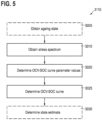
- FIG. 5 is a flowchart of a method according to various examples.
- FIG. 5 schematically illustrates aspects with respect to a method facilitating a state estimation of the state of the battery.
- the method of FIG. 5 could be executed by a device including a processor that can load and execute program code.
- the method of FIG. 5 could be executed by the server 81, more specifically, by the processor 51 upon loading and executing program code from the memory 52.
- the method of FIG. 5 pertains to inference. As such, the method of FIG. 5 can implement box 3110 of the method of FIG. 4 .
- the method of FIG. 5 uses a pre-trained model that can determine one or more parameter values of parameters of a parameterization of an OCV curve based on at least one stress spectrum. Also, the parameterization is predetermined such that once the one or more parameter values have been determined it is possible to determine the OCV curve.
- Optional boxes are labeled with dashed lines in FIG. 5 .
- an aging state of the battery For instance, the SOH of the battery can be obtained. For instance, a previous estimate of the aging state can be obtained. More specifically, it is possible to obtain at least one indicator that is indicative of an aging state of the battery associated with an observation duration.
- such at least one indicator could be loaded from a memory.
- Such at least one indicator could be obtained from a previous iteration of the method, e.g., where previously the state of health has been determined based on the OCV curve.
- the at least one indicator that can thus be indicative of the aging state at a beginning of prior to the observation duration.
- Such techniques are based on the finding that it can sometimes be helpful to have a reference baseline for determining parameter values of the parameterization of the OCV curve based on at least one stress spectrum; this is because the impact of certain stress factors onto the OCV curve can itself vary over the course of aging of the battery. For instance, a deep discharge of the battery can have a less severe impact on to the shape of the OCV curve and/or the amplitude of the OCV curve for a relatively young battery if compared to the impact of the same deep discharge onto an aged battery.
- box 3010 includes determining the at least one stress spectrum based on time series data of, e.g., terminal voltage, current, temperature, and/or other observables of the operation of the battery.
- time series data of a terminal voltage of the battery as well as a current of the battery.
- the stress interval can be associated with exposure of the battery to a given stress factor of the multiple stress factors. It would then be possible to determine the at least one stress spectrum based on at least one of an incidence or a duration of the stress intervals for each one of the multiple stress factors. Thus, it would be possible to count the frequency of occurrence of certain stress factors. Alternatively or additionally, it would be possible to determine the length of exposure of the battery to a given stress factor.
- stress interval could be characterized by a significant change of the terminal voltage over time and a large level of the battery current for an extended duration, i.e., beyond respective thresholds. This would pertain to a fast discharging of the battery. It would be, in particular, be possible to detect such fast discharging of the battery, e.g., occurrence of fast discharging, duration or depth-of-discharge of the fast discharging.
- Such an approach is fundamentally different to the prior art techniques that attempt to update the OCV curve by obtaining measurements for the OCV during the relaxation of the battery, i.e., at operating states where the battery has not been charged or discharged for a certain time duration.
- the at least one stress spectrum is indicative of one or stress factors as observed during an observation duration.
- the observation duration could correspond to a predetermined time duration during which the battery has been operated.
- the observation period could be defined with respect to a previous update of the OCV curve, i.e., the time period that has lapsed since a previous execution of box 3010.
- Such prediction of the at least one stress spectrum can be seen as an augmentation of the at least one stress spectrum so that future operation is covered as well.
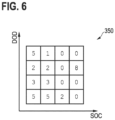
- FIG. 6 illustrates a two dimensional (2-D) stress spectrum 350, indicating the frequency of occurrence of operating the battery at certain depth of discharge charging operations, as well as respective mean SOC values. This is only one example. It would be possible to rely on higher-dimensional stress spectra, e.g., 3-D or 4-D stress spectra. It would be possible to rely on stress spectra that are resolved with respect to different operating dimensions, e.g., temperature, charging rate, to give just a few examples.
- the OCV curve it is possible to determine one or more parameter values of a predetermined parameterization of the OCV curve. This determination at box 3020 depends on the at least one stress spectrum that is obtained at box 3010, as well as - where applicable - the aging state of the battery is obtained at box 3005. For instance, respective input channels of a neural network algorithm can receive each one of the at least one stress spectrum, and optionally the ageing state.
- the multiple independent parameters can define a shape and an amplitude of the OCV curve of the battery.
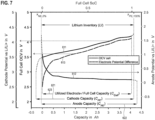
- An example parameterization is illustrated in FIG. 7 .
- FIG. 7 illustrates two parameters impacting the OCV curve, namely, the open-circuit potential (OCP) for the positive electrode and the negative electrode, respectively.
- OCP open-circuit potential
- FIG. 7 illustrates the cathode OCP 611 (left scale) and the anode OCP 612 (right scale), varying across the cathode capacity 621 and the anode capacity 622.
- LAM active material
- LLI loss of lithium inventory
- LI i describes the amount of lithium inventory in the aged state
- LI 0 describes the amount of lithium inventory in the non-aged state.
- the degradation modes according to Eqs. 1-3 thus specify impacts on the anode and cathode OCP which, in turn, translate into the OCV curve; thus, the degradation modes are parameters of a respective predetermined parameterization of the OCV curve.
- the specific values of the LAM or LLI thus specify rules for changes of the anode and cathode OCP to thereby yield the OCV curve, i.e., the horizontal compression and/or horizontal shift, as explained above.
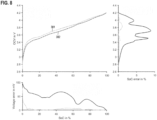
- FIG. 8 illustrates the resulting OCV curve 381 obtained from such techniques.
- OCV curve 381 could correspond to the OCV curve 613.
- OCV curve 381 Illustrated is the OCV curve 381 that is determined based on the open circuit potentials as degradation modes for the negative and positive electrodes, as discussed above in connection with FIG. 7 . Also illustrated is a reference OCV curve 382, that has been calculated according to reference techniques. It is apparent that the OCV curve 381 deviates in both shape and amplitude from the reference OCV curve 382. This translates into errors in the SOC estimation ( FIG. 8 : right side), as well as errors in the estimation of the open circuit voltage based on SOC ( FIG. 8 : bottom part).
Landscapes
- Physics & Mathematics (AREA)
- General Physics & Mathematics (AREA)
- Secondary Cells (AREA)
Claims (15)
- Computerimplementiertes Verfahren, das Folgendes umfasst:- Erhalten mindestens eines Belastungsspektrums (350), das eine Stärke mehrerer Belastungsfaktoren auf eine Batterie (91) während einer Beobachtungsdauer anzeigt,- Bestimmen von Werten mehrerer unabhängiger Parameter (611, 612) einer vorbestimmten Parametrisierung, die mit einer Leerlaufspannungskurve (613, 381) der Batterie assoziiert sind, basierend auf dem mindestens einen Belastungsspektrum, und- Bestimmen der Leerlaufspannungskurve (613, 381) auf der Grundlage der Werte der mehreren unabhängigen Parameter der Leerlaufspannungskurve.
- Computerimplementiertes Verfahren nach Anspruch 1,
wobei die mehreren unabhängigen Parameter der Parametrisierung mehrere Degradationsmodi der Batterie parametrisieren. - Computerimplementiertes Verfahren nach Anspruch 1 oder 2,
wobei die mehreren unabhängigen Parameter einen ersten Indikator, der den Verlust von aktivem Material an einer Elektrode der Batterie am Ende der Beobachtungsdauer anzeigt, und einen zweiten Indikator, der den Verlust eines mobilen Ladungsträgerbestands der Batterie am Ende der Beobachtungsdauer anzeigt, umfassen. - Computerimplementiertes Verfahren nach Anspruch 1,
wobei die mehreren unabhängigen Parameter der Parametrisierung orthogonale Komponenten einer funktionalen Zerlegung der Leerlaufspannungskurve umfassen. - Computerimplementiertes Verfahren nach einem der vorhergehenden Ansprüche,
wobei das mindestens eine Belastungsspektrum mindestens ein mehrdimensionales Belastungsspektrum umfasst, wobei eine oder mehrere Dimensionen des mindestens einen mehrdimensionalen Belastungsspektrums aus der Gruppe ausgewählt sind, die Folgendes umfasst:durchschnittliche Temperatur während eines bestimmten Belastungsintervalls;durchschnittliche Lade- oder Entladerate während eines bestimmten Belastungsintervalls;Entladungstiefe eines jeweiligen Belastungsintervalls; unddurchschnittlicher Ladungszustand eines jeweiligen Belastungsintervalls. - Computerimplementiertes Verfahren nach einem der vorhergehenden Ansprüche,
wobei die mehrfachen Belastungsfaktoren sowohl mit der zyklischen als auch mit der kalendarischen Alterung der Batterie verbunden sind. - Computerimplementiertes Verfahren nach einem der vorangegangenen Ansprüche, das ferner Folgendes umfasst:- Erhalten von Zeitreihendaten einer Klemmenspannung der Batterie und eines Stroms der Batterie,- Identifizieren mehrerer Belastungsintervalle in den Zeitreihendaten, wobei jedes Belastungsintervall mit der Exposition der Batterie gegenüber einem entsprechenden Belastungsfaktor der mehreren Belastungsfaktoren verbunden ist, und- Bestimmen des mindestens einen Belastungsspektrums auf der Grundlage von mindestens einer Häufigkeit oder einer Dauer der Belastungsintervalle für jeden einzelnen der mehreren Belastungsfaktoren.
- Computerimplementiertes Verfahren nach einem der vorangegangenen Ansprüche, das ferner Folgendes umfasst:- Erhalten von Zeitreihendaten einer Klemmenspannung der Batterie und eines Stroms der Batterie,- Identifizieren eines oder mehrerer Belastungsintervalle in den Zeitreihendaten, die mit einer schnellen Entladung der Batterie verbunden sind,
und- Bestimmen des mindestens einen Belastungsspektrums auf der Grundlage der Häufigkeit und/oder der Dauer des einen oder der mehreren Belastungsintervalle, die mit dem schnellen Entladen der Batterie verbunden sind. - Computerimplementiertes Verfahren nach einem der vorangegangenen Ansprüche, das ferner Folgendes umfasst:- Erhalten mindestens eines weiteren Belastungsspektrums, das die Stärke der mehrfachen Belastungsfaktoren auf die Batterie während einer weiteren Beobachtungsdauer angibt, und- Vorhersagen des mindestens einen Belastungsspektrums auf der Grundlage des mindestens einen weiteren Belastungsspektrums und eines vorgegebenen Nutzungsmusters der Batterie während der Beobachtungsdauer.
- Computerimplementiertes Verfahren nach einem der vorangegangenen Ansprüche, das ferner Folgendes umfasst:- Erhalten von mindestens einem Indikator, der einen Alterungszustand der Batterie in Verbindung mit der Beobachtungsdauer anzeigt,wobei die mehreren unabhängigen Parameter ferner auf der Grundlage des mindestens einen Indikators bestimmt werden, der den Alterungszustand der Batterie anzeigt.
- Computerimplementiertes Verfahren nach Anspruch 10,
wobei der mindestens eine Indikator, der den Alterungszustand anzeigt, einen ersten Indikator, der einen Verlust von aktivem Material an einer Elektrode der Batterie zu Beginn der Beobachtungsdauer anzeigt, und einen zweiten Indikator, der einen Verlust eines mobilen Ladungsträgerbestands der Batterie zu Beginn der Beobachtungsdauer anzeigt, umfasst. - Computerimplementiertes Verfahren nach einem der vorhergehenden Ansprüche,
wobei die mehreren unabhängigen Parameter eine Form und eine Amplitude der Leerlaufspannungskurve der Batterie definieren. - Computerimplementiertes Verfahren nach einem der vorhergehenden Ansprüche,
wobei die mehreren unabhängigen Parameter auf der Grundlage des mindestens einen Belastungsspektrums unter Verwendung eines vorbestimmten Modells bestimmt werden, wobei das vorbestimmte Modell auf der Grundlage von Trainingsdaten parametrisiert wird, die für eine Referenzbatterie desselben Batterietyps der Batterie erhalten wurden. - Computerimplementiertes Verfahren nach einem der vorangegangenen Ansprüche, das ferner Folgendes umfasst:- Bestimmen der Schätzung des Batteriezustands auf der Grundlage der Leerlaufspannungskurve.
- Computerimplementiertes Verfahren nach einem der vorangegangenen Ansprüche, das ferner Folgendes umfasst:- in einer Labormessung, Bestimmen zumindest eines Teils der Parametrisierung des Leerlaufspannungsverlaufs der Batterie in Bezug auf die mehreren unabhängigen Parameter oder ein Modell zur Bestimmung der Werte der mehreren unabhängigen Parameter auf der Grundlage des mindestens einen Belastungsspektrums.
Priority Applications (3)
| Application Number | Priority Date | Filing Date | Title |
|---|---|---|---|
| EP22163134.4A EP4249929B1 (de) | 2022-03-21 | 2022-03-21 | Bestimmung der spannungskurve einer offenen schaltung für wiederaufladbare batterien |
| CN202310249924.4A CN116794541A (zh) | 2022-03-21 | 2023-03-15 | 可充电电池的开路电压曲线的确定 |
| US18/186,697 US20230296685A1 (en) | 2022-03-21 | 2023-03-20 | Determination of open circuit voltage curve for rechargeable batteries |
Applications Claiming Priority (1)
| Application Number | Priority Date | Filing Date | Title |
|---|---|---|---|
| EP22163134.4A EP4249929B1 (de) | 2022-03-21 | 2022-03-21 | Bestimmung der spannungskurve einer offenen schaltung für wiederaufladbare batterien |
Publications (3)
| Publication Number | Publication Date |
|---|---|
| EP4249929A1 EP4249929A1 (de) | 2023-09-27 |
| EP4249929B1 true EP4249929B1 (de) | 2024-09-18 |
| EP4249929C0 EP4249929C0 (de) | 2024-09-18 |
Family
ID=80928617
Family Applications (1)
| Application Number | Title | Priority Date | Filing Date |
|---|---|---|---|
| EP22163134.4A Active EP4249929B1 (de) | 2022-03-21 | 2022-03-21 | Bestimmung der spannungskurve einer offenen schaltung für wiederaufladbare batterien |
Country Status (3)
| Country | Link |
|---|---|
| US (1) | US20230296685A1 (de) |
| EP (1) | EP4249929B1 (de) |
| CN (1) | CN116794541A (de) |
Families Citing this family (2)
| Publication number | Priority date | Publication date | Assignee | Title |
|---|---|---|---|---|
| TWI901381B (zh) * | 2023-10-10 | 2025-10-11 | 立錡科技股份有限公司 | 電池控制參數推估系統及電池控制參數推估方法 |
| CN119827987A (zh) * | 2023-12-14 | 2025-04-15 | 重庆弗迪电池研究院有限公司 | 电池ocv曲线修正方法及相关产品 |
Citations (10)
| Publication number | Priority date | Publication date | Assignee | Title |
|---|---|---|---|---|
| US20130317771A1 (en) | 2012-05-25 | 2013-11-28 | GM Global Technology Operations LLC | Modeling changes in the state-of-charge open circuit voltage curve by using regressed parameters in a reduced order physics based model |
| US20140214347A1 (en) | 2013-01-31 | 2014-07-31 | GM Global Technology Operations LLC | Method to detect open-circuit voltage shift through optimization fitting of the anode electrode half-cell voltage curve |
| US10302704B2 (en) | 2015-08-20 | 2019-05-28 | Samsung Electronics Co., Ltd. | Method and battery system predicting state of charge of a battery |
| DE102019111976A1 (de) | 2019-05-08 | 2020-11-12 | TWAICE Technologies GmbH | Kapazitätsbestimmung bei Batterien |
| US20210173012A1 (en) | 2019-12-04 | 2021-06-10 | Robert Bosch Gmbh | Method and system for estimation of open circuit voltage of a battery cell |
| WO2021143983A1 (de) | 2020-01-14 | 2021-07-22 | TWAICE Technologies GmbH | Charakterisierung von wiederaufladbaren batterien mit maschinen-gelernten algorithmen |
| US20210270907A1 (en) | 2020-02-28 | 2021-09-02 | Denso Corporation | Battery deterioration prediction system |
| DE102020008052A1 (de) | 2020-01-14 | 2021-09-16 | TWAICE Technologies GmbH | Charakterisierung von wiederaufladbaren Batterien mit Maschinen-gelernten Algorithmen |
| WO2021181536A1 (ja) | 2020-03-10 | 2021-09-16 | 三菱電機株式会社 | 劣化度診断装置 |
| DE102020008050A1 (de) | 2020-01-14 | 2021-10-21 | TWAICE Technologies GmbH | Charakterisierung von wiederaufladbaren Batterien mit Maschinen-gelernten Algorithmen |
Family Cites Families (2)
| Publication number | Priority date | Publication date | Assignee | Title |
|---|---|---|---|---|
| JP2015230193A (ja) * | 2014-06-04 | 2015-12-21 | ソニー株式会社 | 劣化状態推定装置、充電状態推定装置、ocvカーブ算出生成装置および蓄電装置 |
| JP6326452B2 (ja) * | 2016-06-15 | 2018-05-16 | 本田技研工業株式会社 | 電池状態推定装置および電池状態推定方法 |
-
2022
- 2022-03-21 EP EP22163134.4A patent/EP4249929B1/de active Active
-
2023
- 2023-03-15 CN CN202310249924.4A patent/CN116794541A/zh active Pending
- 2023-03-20 US US18/186,697 patent/US20230296685A1/en active Pending
Patent Citations (10)
| Publication number | Priority date | Publication date | Assignee | Title |
|---|---|---|---|---|
| US20130317771A1 (en) | 2012-05-25 | 2013-11-28 | GM Global Technology Operations LLC | Modeling changes in the state-of-charge open circuit voltage curve by using regressed parameters in a reduced order physics based model |
| US20140214347A1 (en) | 2013-01-31 | 2014-07-31 | GM Global Technology Operations LLC | Method to detect open-circuit voltage shift through optimization fitting of the anode electrode half-cell voltage curve |
| US10302704B2 (en) | 2015-08-20 | 2019-05-28 | Samsung Electronics Co., Ltd. | Method and battery system predicting state of charge of a battery |
| DE102019111976A1 (de) | 2019-05-08 | 2020-11-12 | TWAICE Technologies GmbH | Kapazitätsbestimmung bei Batterien |
| US20210173012A1 (en) | 2019-12-04 | 2021-06-10 | Robert Bosch Gmbh | Method and system for estimation of open circuit voltage of a battery cell |
| WO2021143983A1 (de) | 2020-01-14 | 2021-07-22 | TWAICE Technologies GmbH | Charakterisierung von wiederaufladbaren batterien mit maschinen-gelernten algorithmen |
| DE102020008052A1 (de) | 2020-01-14 | 2021-09-16 | TWAICE Technologies GmbH | Charakterisierung von wiederaufladbaren Batterien mit Maschinen-gelernten Algorithmen |
| DE102020008050A1 (de) | 2020-01-14 | 2021-10-21 | TWAICE Technologies GmbH | Charakterisierung von wiederaufladbaren Batterien mit Maschinen-gelernten Algorithmen |
| US20210270907A1 (en) | 2020-02-28 | 2021-09-02 | Denso Corporation | Battery deterioration prediction system |
| WO2021181536A1 (ja) | 2020-03-10 | 2021-09-16 | 三菱電機株式会社 | 劣化度診断装置 |
Non-Patent Citations (11)
| Title |
|---|
| BIRKL C. R., MCTURK E., ROBERTS M. R., BRUCE P. G., HOWEY D. A.: "A Parametric Open Circuit Voltage Model for Lithium Ion Batteries", JOURNAL OF THE ELECTROCHEMICAL SOCIETY, vol. 162, no. 12, 1 January 2015 (2015-01-01), pages A2271 - A2280, XP093291108, ISSN: 0013-4651, DOI: 10.1149/2.0331512jes |
| BIRKL CHRISTOPH R.; ROBERTS MATTHEW R.; MCTURK EUAN; BRUCE PETER G.; HOWEY DAVID A.: "Degradation diagnostics for lithium ion cells", JOURNAL OF POWER SOURCES, vol. 341, 12 December 2016 (2016-12-12), AMSTERDAM, NL, pages 373 - 386, XP029864035, ISSN: 0378-7753, DOI: 10.1016/j.jpowsour.2016.12.011 |
| BIRKL CHRISTOPH: "Diagnosis and Prognosis of Degradation in Lithium-Ion Batteries", DISSERTATION, 3 March 2018 (2018-03-03), pages 1 - 191, XP093291100 |
| D12'- English description of D12 |
| DUBARRY MATTHIEU, TRUCHOT CYRIL, LIAW BOR YANN: "Synthesize battery degradation modes via a diagnostic and prognostic model", JOURNAL OF POWER SOURCES, vol. 219, 1 December 2012 (2012-12-01), AMSTERDAM, NL, pages 204 - 216, XP093227575, ISSN: 0378-7753, DOI: 10.1016/j.jpowsour.2012.07.016 |
| LAVIGNE L.; SABATIER J.; FRANCISCO J. MBALA; GUILLEMARD F.; NOURY A.: "Lithium-ion Open Circuit Voltage (OCV) curve modelling and its ageing adjustment", JOURNAL OF POWER SOURCES, vol. 324, 6 June 2016 (2016-06-06), AMSTERDAM, NL, pages 694 - 703, XP029624652, ISSN: 0378-7753, DOI: 10.1016/j.jpowsour.2016.05.121 |
| LAVIGNE LOIC, SABATIER JOCELYN, FRANCISCO JUNIOR MBALA, GUILLEMARD FRANCK, NOURY AGNIESZKA: "Lithium-ion Batteries Aging Motinoring Througth Open Circuit Voltage (OCV) Curve Modelling and Adjustment : ", PROCEEDINGS OF THE 13TH INTERNATIONAL CONFERENCE ON INFORMATICS IN CONTROL, AUTOMATION AND ROBOTICS - SCITEPRESS - SCIENCE AND AND TECHNOLOGY PUBLICATIONS, vol. 1, 1 January 2016 (2016-01-01), pages 57 - 67, XP093291090, ISBN: 978-989-758-198-4, DOI: 10.5220/0005961400570067 |
| MARONGIU ANDREA; NLANDI NSOMBO; RONG YAO; SAUER DIRK UWE: "On-board capacity estimation of lithium iron phosphate batteries by means of half-cell curves", JOURNAL OF POWER SOURCES, vol. 324, 26 May 2016 (2016-05-26), AMSTERDAM, NL, pages 158 - 169, XP029624586, ISSN: 0378-7753, DOI: 10.1016/j.jpowsour.2016.05.041 |
| TIAN JINPENG, XIONG RUI, SHEN WEIXIANG, SUN FENGCHUN: "Electrode ageing estimation and open circuit voltage reconstruction for lithium ion batteries", ENERGY STORAGE MATERIALS, vol. 37, 1 May 2021 (2021-05-01), pages 283 - 295, XP093291080, ISSN: 2405-8297, DOI: 10.1016/j.ensm.2021.02.018 |
| XIONG RUI, YU QUANQING, WANG LE YI, LIN CHENG: "A novel method to obtain the open circuit voltage for the state of charge of lithium ion batteries in electric vehicles by using H infinity filter", APPLIED ENERGY, vol. 207, 1 December 2017 (2017-12-01), GB , pages 346 - 353, XP093094525, ISSN: 0306-2619, DOI: 10.1016/j.apenergy.2017.05.136 |
| ZHANG CAIPING, JIANG JIUCHUN, ZHANG LINJING, LIU SIJIA, WANG LEYI, LOH POH: "A Generalized SOC-OCV Model for Lithium-Ion Batteries and the SOC Estimation for LNMCO Battery", ENERGIES, vol. 9, no. 11, 1 January 2016 (2016-01-01), pages 1 - 16, XP055774172, DOI: 10.3390/en9110900 |
Also Published As
| Publication number | Publication date |
|---|---|
| US20230296685A1 (en) | 2023-09-21 |
| CN116794541A (zh) | 2023-09-22 |
| EP4249929C0 (de) | 2024-09-18 |
| EP4249929A1 (de) | 2023-09-27 |
Similar Documents
| Publication | Publication Date | Title |
|---|---|---|
| Chen et al. | A novel data-driven method for mining battery open-circuit voltage characterization | |
| EP3748380B1 (de) | Batteriekapazitätsvorhersagesystem unter verwendung von lade- und entladezyklen einer batterie zur vorhersage von kapazitätsschwankungen sowie zugehöriges verfahren | |
| EP3992648B1 (de) | Vorrichtung und verfahren zur batteriediagnose | |
| US10310020B2 (en) | Method, device and system for estimating the charge state of a battery | |
| Berecibar et al. | State of health estimation algorithm of LiFePO4 battery packs based on differential voltage curves for battery management system application | |
| KR102335180B1 (ko) | 배터리의 노화 상태 추정 장치 및 방법 | |
| US12241942B2 (en) | Method for estimating aging state of battery and apparatus for performing method therefor | |
| JP5442583B2 (ja) | 電源装置用状態検知装置及び電源装置 | |
| US20230213587A1 (en) | Method and System for Efficiently Monitoring Battery Cells of a Device Battery in an External Central Processing Unit Using a Digital Twin | |
| EP3988952B1 (de) | Verfahren zur erkennung einer abnormalen batteriezelle | |
| CN114462259B (zh) | 基于soc的电池剩余寿命预测方法、系统、汽车及介质 | |
| US20230296685A1 (en) | Determination of open circuit voltage curve for rechargeable batteries | |
| CN115219932A (zh) | 用于评价设备电池组的相对老化状态的方法和装置 | |
| Li et al. | Real-time estimation of lead-acid battery parameters: A dynamic data-driven approach | |
| CN114578248A (zh) | 用于预测电池运行的设备中设备电池的老化状态的方法和装置 | |
| KR20240067640A (ko) | 실차 수집 빅 데이터 기반 배터리 soh 추정 모델 구축 방법 및 배터리 soh 모델 구축 시스템 | |
| US20220187376A1 (en) | Method and Device for Predicting a State of Health of an Energy Storage System | |
| US20230324463A1 (en) | Method and Apparatus for Operating a System for Detecting an Anomaly of an Electrical Energy Store for a Device by Means of Machine Learning Methods | |
| EP4571333A1 (de) | Batterieverwaltungsvorrichtung und betriebsverfahren dafür | |
| CN117630673A (zh) | 用于针对蓄能器初始提供老化状态模型的方法和装置 | |
| JP7709326B2 (ja) | 二次電池の劣化箇所推定システム、二次電池制御システム、及び二次電池の劣化箇所推定方法 | |
| EP4253975B1 (de) | Schätzung der batteriekapazität unter verwendung eines rekursiven filters | |
| KR102835531B1 (ko) | 배터리 데이터 관리 장치 및 그것의 동작 방법 | |
| EP4517351A1 (de) | Vorrichtung und verfahren zur schätzung von soh | |
| KR102830243B1 (ko) | Soh 추정 장치 및 방법 |
Legal Events
| Date | Code | Title | Description |
|---|---|---|---|
| PUAI | Public reference made under article 153(3) epc to a published international application that has entered the european phase |
Free format text: ORIGINAL CODE: 0009012 |
|
| STAA | Information on the status of an ep patent application or granted ep patent |
Free format text: STATUS: THE APPLICATION HAS BEEN PUBLISHED |
|
| AK | Designated contracting states |
Kind code of ref document: A1 Designated state(s): AL AT BE BG CH CY CZ DE DK EE ES FI FR GB GR HR HU IE IS IT LI LT LU LV MC MK MT NL NO PL PT RO RS SE SI SK SM TR |
|
| STAA | Information on the status of an ep patent application or granted ep patent |
Free format text: STATUS: REQUEST FOR EXAMINATION WAS MADE |
|
| GRAP | Despatch of communication of intention to grant a patent |
Free format text: ORIGINAL CODE: EPIDOSNIGR1 |
|
| STAA | Information on the status of an ep patent application or granted ep patent |
Free format text: STATUS: GRANT OF PATENT IS INTENDED |
|
| 17P | Request for examination filed |
Effective date: 20240311 |
|
| RBV | Designated contracting states (corrected) |
Designated state(s): AL AT BE BG CH CY CZ DE DK EE ES FI FR GB GR HR HU IE IS IT LI LT LU LV MC MK MT NL NO PL PT RO RS SE SI SK SM TR |
|
| INTG | Intention to grant announced |
Effective date: 20240415 |
|
| TPAC | Observations filed by third parties |
Free format text: ORIGINAL CODE: EPIDOSNTIPA |
|
| GRAS | Grant fee paid |
Free format text: ORIGINAL CODE: EPIDOSNIGR3 |
|
| GRAA | (expected) grant |
Free format text: ORIGINAL CODE: 0009210 |
|
| STAA | Information on the status of an ep patent application or granted ep patent |
Free format text: STATUS: THE PATENT HAS BEEN GRANTED |
|
| AK | Designated contracting states |
Kind code of ref document: B1 Designated state(s): AL AT BE BG CH CY CZ DE DK EE ES FI FR GB GR HR HU IE IS IT LI LT LU LV MC MK MT NL NO PL PT RO RS SE SI SK SM TR |
|
| REG | Reference to a national code |
Ref country code: GB Ref legal event code: FG4D |
|
| REG | Reference to a national code |
Ref country code: CH Ref legal event code: EP |
|
| REG | Reference to a national code |
Ref country code: IE Ref legal event code: FG4D |
|
| REG | Reference to a national code |
Ref country code: DE Ref legal event code: R096 Ref document number: 602022006118 Country of ref document: DE |
|
| U01 | Request for unitary effect filed |
Effective date: 20240918 |
|
| U07 | Unitary effect registered |
Designated state(s): AT BE BG DE DK EE FI FR IT LT LU LV MT NL PT RO SE SI Effective date: 20240930 |
|
| PG25 | Lapsed in a contracting state [announced via postgrant information from national office to epo] |
Ref country code: NO Free format text: LAPSE BECAUSE OF FAILURE TO SUBMIT A TRANSLATION OF THE DESCRIPTION OR TO PAY THE FEE WITHIN THE PRESCRIBED TIME-LIMIT Effective date: 20241218 |
|
| PG25 | Lapsed in a contracting state [announced via postgrant information from national office to epo] |
Ref country code: GR Free format text: LAPSE BECAUSE OF FAILURE TO SUBMIT A TRANSLATION OF THE DESCRIPTION OR TO PAY THE FEE WITHIN THE PRESCRIBED TIME-LIMIT Effective date: 20241219 |
|
| PG25 | Lapsed in a contracting state [announced via postgrant information from national office to epo] |
Ref country code: HR Free format text: LAPSE BECAUSE OF FAILURE TO SUBMIT A TRANSLATION OF THE DESCRIPTION OR TO PAY THE FEE WITHIN THE PRESCRIBED TIME-LIMIT Effective date: 20240918 |
|
| PG25 | Lapsed in a contracting state [announced via postgrant information from national office to epo] |
Ref country code: RS Free format text: LAPSE BECAUSE OF FAILURE TO SUBMIT A TRANSLATION OF THE DESCRIPTION OR TO PAY THE FEE WITHIN THE PRESCRIBED TIME-LIMIT Effective date: 20241218 |
|
| PG25 | Lapsed in a contracting state [announced via postgrant information from national office to epo] |
Ref country code: RS Free format text: LAPSE BECAUSE OF FAILURE TO SUBMIT A TRANSLATION OF THE DESCRIPTION OR TO PAY THE FEE WITHIN THE PRESCRIBED TIME-LIMIT Effective date: 20241218 Ref country code: NO Free format text: LAPSE BECAUSE OF FAILURE TO SUBMIT A TRANSLATION OF THE DESCRIPTION OR TO PAY THE FEE WITHIN THE PRESCRIBED TIME-LIMIT Effective date: 20241218 Ref country code: HR Free format text: LAPSE BECAUSE OF FAILURE TO SUBMIT A TRANSLATION OF THE DESCRIPTION OR TO PAY THE FEE WITHIN THE PRESCRIBED TIME-LIMIT Effective date: 20240918 Ref country code: GR Free format text: LAPSE BECAUSE OF FAILURE TO SUBMIT A TRANSLATION OF THE DESCRIPTION OR TO PAY THE FEE WITHIN THE PRESCRIBED TIME-LIMIT Effective date: 20241219 |
|
| PG25 | Lapsed in a contracting state [announced via postgrant information from national office to epo] |
Ref country code: IS Free format text: LAPSE BECAUSE OF FAILURE TO SUBMIT A TRANSLATION OF THE DESCRIPTION OR TO PAY THE FEE WITHIN THE PRESCRIBED TIME-LIMIT Effective date: 20250118 |
|
| PG25 | Lapsed in a contracting state [announced via postgrant information from national office to epo] |
Ref country code: SM Free format text: LAPSE BECAUSE OF FAILURE TO SUBMIT A TRANSLATION OF THE DESCRIPTION OR TO PAY THE FEE WITHIN THE PRESCRIBED TIME-LIMIT Effective date: 20240918 |
|
| PG25 | Lapsed in a contracting state [announced via postgrant information from national office to epo] |
Ref country code: ES Free format text: LAPSE BECAUSE OF FAILURE TO SUBMIT A TRANSLATION OF THE DESCRIPTION OR TO PAY THE FEE WITHIN THE PRESCRIBED TIME-LIMIT Effective date: 20240918 |
|
| PG25 | Lapsed in a contracting state [announced via postgrant information from national office to epo] |
Ref country code: CZ Free format text: LAPSE BECAUSE OF FAILURE TO SUBMIT A TRANSLATION OF THE DESCRIPTION OR TO PAY THE FEE WITHIN THE PRESCRIBED TIME-LIMIT Effective date: 20240918 Ref country code: PL Free format text: LAPSE BECAUSE OF FAILURE TO SUBMIT A TRANSLATION OF THE DESCRIPTION OR TO PAY THE FEE WITHIN THE PRESCRIBED TIME-LIMIT Effective date: 20240918 |
|
| PG25 | Lapsed in a contracting state [announced via postgrant information from national office to epo] |
Ref country code: SK Free format text: LAPSE BECAUSE OF FAILURE TO SUBMIT A TRANSLATION OF THE DESCRIPTION OR TO PAY THE FEE WITHIN THE PRESCRIBED TIME-LIMIT Effective date: 20240918 |
|
| U20 | Renewal fee for the european patent with unitary effect paid |
Year of fee payment: 4 Effective date: 20250326 |
|
| PLBI | Opposition filed |
Free format text: ORIGINAL CODE: 0009260 |
|
| PLAB | Opposition data, opponent's data or that of the opponent's representative modified |
Free format text: ORIGINAL CODE: 0009299OPPO |
|
| PLAX | Notice of opposition and request to file observation + time limit sent |
Free format text: ORIGINAL CODE: EPIDOSNOBS2 |
|
| 26 | Opposition filed |
Opponent name: MUELLER-BORE & PARTNERPATENTANWAELTE PARTG MBB Effective date: 20250618 |
|
| R26 | Opposition filed (corrected) |
Opponent name: MUELLER-BORE & PARTNERPATENTANWAELTE PARTG MBB Effective date: 20250618 |
|
| PG25 | Lapsed in a contracting state [announced via postgrant information from national office to epo] |
Ref country code: MC Free format text: LAPSE BECAUSE OF FAILURE TO SUBMIT A TRANSLATION OF THE DESCRIPTION OR TO PAY THE FEE WITHIN THE PRESCRIBED TIME-LIMIT Effective date: 20240918 |
|
| REG | Reference to a national code |
Ref country code: CH Ref legal event code: H13 Free format text: ST27 STATUS EVENT CODE: U-0-0-H10-H13 (AS PROVIDED BY THE NATIONAL OFFICE) Effective date: 20251023 |
|
| PG25 | Lapsed in a contracting state [announced via postgrant information from national office to epo] |
Ref country code: CH Free format text: LAPSE BECAUSE OF NON-PAYMENT OF DUE FEES Effective date: 20250331 |
|
| PG25 | Lapsed in a contracting state [announced via postgrant information from national office to epo] |
Ref country code: IE Free format text: LAPSE BECAUSE OF NON-PAYMENT OF DUE FEES Effective date: 20250321 |
|
| RDAF | Communication despatched that patent is revoked |
Free format text: ORIGINAL CODE: EPIDOSNREV1 |