EP4249384A1 - Verdichtbarer einwegbehälter - Google Patents
Verdichtbarer einwegbehälter Download PDFInfo
- Publication number
- EP4249384A1 EP4249384A1 EP22163812.5A EP22163812A EP4249384A1 EP 4249384 A1 EP4249384 A1 EP 4249384A1 EP 22163812 A EP22163812 A EP 22163812A EP 4249384 A1 EP4249384 A1 EP 4249384A1
- Authority
- EP
- European Patent Office
- Prior art keywords
- container
- strip
- application point
- disposable
- carton
- Prior art date
- Legal status (The legal status is an assumption and is not a legal conclusion. Google has not performed a legal analysis and makes no representation as to the accuracy of the status listed.)
- Withdrawn
Links
- 235000013361 beverage Nutrition 0.000 claims abstract description 27
- 239000012530 fluid Substances 0.000 claims abstract description 17
- 238000000034 method Methods 0.000 claims abstract description 10
- 239000000853 adhesive Substances 0.000 claims description 75
- 230000001070 adhesive effect Effects 0.000 claims description 75
- 239000002390 adhesive tape Substances 0.000 claims description 19
- 239000008267 milk Substances 0.000 claims description 9
- 235000013336 milk Nutrition 0.000 claims description 9
- 210000004080 milk Anatomy 0.000 claims description 9
- 235000013618 yogurt Nutrition 0.000 claims description 9
- 235000011389 fruit/vegetable juice Nutrition 0.000 claims description 8
- 235000020094 liqueur Nutrition 0.000 claims description 7
- 235000020354 squash Nutrition 0.000 claims description 7
- 235000014347 soups Nutrition 0.000 claims description 5
- 238000005096 rolling process Methods 0.000 claims description 4
- XLYOFNOQVPJJNP-UHFFFAOYSA-N water Substances O XLYOFNOQVPJJNP-UHFFFAOYSA-N 0.000 claims description 4
- 235000014214 soft drink Nutrition 0.000 claims description 3
- 235000014101 wine Nutrition 0.000 claims description 2
- 239000007788 liquid Substances 0.000 abstract description 7
- 238000005056 compaction Methods 0.000 abstract description 3
- 239000004033 plastic Substances 0.000 description 31
- 239000000047 product Substances 0.000 description 18
- 238000010586 diagram Methods 0.000 description 13
- 239000003292 glue Substances 0.000 description 12
- 239000002184 metal Substances 0.000 description 8
- 239000000463 material Substances 0.000 description 4
- 239000007799 cork Substances 0.000 description 3
- 238000000605 extraction Methods 0.000 description 3
- 230000000284 resting effect Effects 0.000 description 3
- 235000013339 cereals Nutrition 0.000 description 2
- 230000003203 everyday effect Effects 0.000 description 2
- 235000013305 food Nutrition 0.000 description 2
- 235000007319 Avena orientalis Nutrition 0.000 description 1
- 244000075850 Avena orientalis Species 0.000 description 1
- 241000195940 Bryophyta Species 0.000 description 1
- 244000020551 Helianthus annuus Species 0.000 description 1
- 235000003222 Helianthus annuus Nutrition 0.000 description 1
- 239000004677 Nylon Substances 0.000 description 1
- 244000061456 Solanum tuberosum Species 0.000 description 1
- 235000002595 Solanum tuberosum Nutrition 0.000 description 1
- 240000006365 Vitis vinifera Species 0.000 description 1
- 235000014787 Vitis vinifera Nutrition 0.000 description 1
- 230000000694 effects Effects 0.000 description 1
- 235000013312 flour Nutrition 0.000 description 1
- 239000010794 food waste Substances 0.000 description 1
- 239000012263 liquid product Substances 0.000 description 1
- 235000013575 mashed potatoes Nutrition 0.000 description 1
- 235000011929 mousse Nutrition 0.000 description 1
- 229920001778 nylon Polymers 0.000 description 1
- 230000000717 retained effect Effects 0.000 description 1
- 150000003839 salts Chemical class 0.000 description 1
- 235000002639 sodium chloride Nutrition 0.000 description 1
Images




Classifications
-
- B—PERFORMING OPERATIONS; TRANSPORTING
- B65—CONVEYING; PACKING; STORING; HANDLING THIN OR FILAMENTARY MATERIAL
- B65D—CONTAINERS FOR STORAGE OR TRANSPORT OF ARTICLES OR MATERIALS, e.g. BAGS, BARRELS, BOTTLES, BOXES, CANS, CARTONS, CRATES, DRUMS, JARS, TANKS, HOPPERS, FORWARDING CONTAINERS; ACCESSORIES, CLOSURES, OR FITTINGS THEREFOR; PACKAGING ELEMENTS; PACKAGES
- B65D5/00—Rigid or semi-rigid containers of polygonal cross-section, e.g. boxes, cartons or trays, formed by folding or erecting one or more blanks made of paper
- B65D5/0005—Rigid or semi-rigid containers of polygonal cross-section, e.g. boxes, cartons or trays, formed by folding or erecting one or more blanks made of paper of variable capacity
-
- B—PERFORMING OPERATIONS; TRANSPORTING
- B65—CONVEYING; PACKING; STORING; HANDLING THIN OR FILAMENTARY MATERIAL
- B65D—CONTAINERS FOR STORAGE OR TRANSPORT OF ARTICLES OR MATERIALS, e.g. BAGS, BARRELS, BOTTLES, BOXES, CANS, CARTONS, CRATES, DRUMS, JARS, TANKS, HOPPERS, FORWARDING CONTAINERS; ACCESSORIES, CLOSURES, OR FITTINGS THEREFOR; PACKAGING ELEMENTS; PACKAGES
- B65D5/00—Rigid or semi-rigid containers of polygonal cross-section, e.g. boxes, cartons or trays, formed by folding or erecting one or more blanks made of paper
- B65D5/36—Rigid or semi-rigid containers of polygonal cross-section, e.g. boxes, cartons or trays, formed by folding or erecting one or more blanks made of paper specially constructed to allow collapsing and re-erecting without disengagement of side or bottom connections
- B65D5/3607—Rigid or semi-rigid containers of polygonal cross-section, e.g. boxes, cartons or trays, formed by folding or erecting one or more blanks made of paper specially constructed to allow collapsing and re-erecting without disengagement of side or bottom connections formed by folding or erecting a single blank
- B65D5/3614—Rigid or semi-rigid containers of polygonal cross-section, e.g. boxes, cartons or trays, formed by folding or erecting one or more blanks made of paper specially constructed to allow collapsing and re-erecting without disengagement of side or bottom connections formed by folding or erecting a single blank to form a tubular body, at least one of the ends of the body remaining connected
- B65D5/3628—Rigid or semi-rigid containers of polygonal cross-section, e.g. boxes, cartons or trays, formed by folding or erecting one or more blanks made of paper specially constructed to allow collapsing and re-erecting without disengagement of side or bottom connections formed by folding or erecting a single blank to form a tubular body, at least one of the ends of the body remaining connected collapsed along median lines of two opposite sides of the rectangular tubular body
-
- B—PERFORMING OPERATIONS; TRANSPORTING
- B65—CONVEYING; PACKING; STORING; HANDLING THIN OR FILAMENTARY MATERIAL
- B65D—CONTAINERS FOR STORAGE OR TRANSPORT OF ARTICLES OR MATERIALS, e.g. BAGS, BARRELS, BOTTLES, BOXES, CANS, CARTONS, CRATES, DRUMS, JARS, TANKS, HOPPERS, FORWARDING CONTAINERS; ACCESSORIES, CLOSURES, OR FITTINGS THEREFOR; PACKAGING ELEMENTS; PACKAGES
- B65D5/00—Rigid or semi-rigid containers of polygonal cross-section, e.g. boxes, cartons or trays, formed by folding or erecting one or more blanks made of paper
- B65D5/42—Details of containers or of foldable or erectable container blanks
-
- B—PERFORMING OPERATIONS; TRANSPORTING
- B65—CONVEYING; PACKING; STORING; HANDLING THIN OR FILAMENTARY MATERIAL
- B65D—CONTAINERS FOR STORAGE OR TRANSPORT OF ARTICLES OR MATERIALS, e.g. BAGS, BARRELS, BOTTLES, BOXES, CANS, CARTONS, CRATES, DRUMS, JARS, TANKS, HOPPERS, FORWARDING CONTAINERS; ACCESSORIES, CLOSURES, OR FITTINGS THEREFOR; PACKAGING ELEMENTS; PACKAGES
- B65D1/00—Rigid or semi-rigid containers having bodies formed in one piece, e.g. by casting metallic material, by moulding plastics, by blowing vitreous material, by throwing ceramic material, by moulding pulped fibrous material or by deep-drawing operations performed on sheet material
- B65D1/02—Bottles or similar containers with necks or like restricted apertures, designed for pouring contents
- B65D1/0223—Bottles or similar containers with necks or like restricted apertures, designed for pouring contents characterised by shape
- B65D1/0292—Foldable bottles
-
- B—PERFORMING OPERATIONS; TRANSPORTING
- B65—CONVEYING; PACKING; STORING; HANDLING THIN OR FILAMENTARY MATERIAL
- B65D—CONTAINERS FOR STORAGE OR TRANSPORT OF ARTICLES OR MATERIALS, e.g. BAGS, BARRELS, BOTTLES, BOXES, CANS, CARTONS, CRATES, DRUMS, JARS, TANKS, HOPPERS, FORWARDING CONTAINERS; ACCESSORIES, CLOSURES, OR FITTINGS THEREFOR; PACKAGING ELEMENTS; PACKAGES
- B65D2313/00—Connecting or fastening means
- B65D2313/08—Double sided adhesive tape, e.g. for suspension of the container
-
- B—PERFORMING OPERATIONS; TRANSPORTING
- B65—CONVEYING; PACKING; STORING; HANDLING THIN OR FILAMENTARY MATERIAL
- B65D—CONTAINERS FOR STORAGE OR TRANSPORT OF ARTICLES OR MATERIALS, e.g. BAGS, BARRELS, BOTTLES, BOXES, CANS, CARTONS, CRATES, DRUMS, JARS, TANKS, HOPPERS, FORWARDING CONTAINERS; ACCESSORIES, CLOSURES, OR FITTINGS THEREFOR; PACKAGING ELEMENTS; PACKAGES
- B65D5/00—Rigid or semi-rigid containers of polygonal cross-section, e.g. boxes, cartons or trays, formed by folding or erecting one or more blanks made of paper
- B65D5/02—Rigid or semi-rigid containers of polygonal cross-section, e.g. boxes, cartons or trays, formed by folding or erecting one or more blanks made of paper by folding or erecting a single blank to form a tubular body with or without subsequent folding operations, or the addition of separate elements, to close the ends of the body
- B65D5/06—Rigid or semi-rigid containers of polygonal cross-section, e.g. boxes, cartons or trays, formed by folding or erecting one or more blanks made of paper by folding or erecting a single blank to form a tubular body with or without subsequent folding operations, or the addition of separate elements, to close the ends of the body with end-closing or contents-supporting elements formed by folding inwardly a wall extending from, and continuously around, an end of the tubular body
- B65D5/067—Gable-top containers
Definitions
- the present disclosure relates to a product container for easy compaction before disposal, in particular a compactable container for holding a consumer product in an expanded state of the container, e.g. a disposable container for holding a liquid beverage, or other product.
- Product containers for holding products for example consumable products, e.g. food, dry or fluid, for example liquids such as milk, juice, yoghurt, water, cordial, soup, or the like, in containers, such as cartons, plastic containers, in particular soft plastic containers, or the like, are part of everyday life for many consumers in different parts of the world.
- the products are stored in such containers and sold to the end users and when the container is empty, or at least substantially empty, it must be disposed of.
- Many types of containers are often for one time only use, in particular cartons, or are reused very seldom. Disposal of these type of containers, when the containers are empty and cannot be reused anymore, is also an everyday activity for many users, who need to find a way to dispose of these containers, once they have been used for the last time before disposal.
- Such product containers are typically light with thin walls but they occupy large volumes, because they are configured to contain the products in an expanded state. For disposal some consumers compact these empty containers to reduce the volume such that they take up less space in the bin.
- An organized way to compact such container is fold and/or roll these containers in order to efficiently reduce the volume. Folding may be done using, for example, one crease, or two creases or three creases or several creases and a big portion of the volume may be reduced by simple folding, before disposing of the container in a paper or recycle bin or similar.
- the present disclosure addresses these problems stated above and identifies solutions.
- the inventors have realized that it is very advantageous to have a container that can be disposed in a compact state.
- a container that can firstly be folded or rolled into a compact state, and secondly kept in such compact state by use of a retaining element such that the dispose container occupy a minimal volume in the recycle bin.
- the retaining element may also be disposable and may be conveniently attached to the container and used for disposal.
- the present disclosure therefore relates to a disposable container, e.g. a container, for holding a product, such as a fluid beverage, in an expanded state, the container comprising a retaining element, such that when bringing the container in substantially empty condition from the expanded state to a compact state, the retaining element is configured to retain the empty container in the compact state, such as folded or rolled.
- a disposable container e.g. a container, for holding a product, such as a fluid beverage
- the container comprising a retaining element, such that when bringing the container in substantially empty condition from the expanded state to a compact state, the retaining element is configured to retain the empty container in the compact state, such as folded or rolled.
- the product may be a fluid or liquid product, such as a beverage
- the beverage may be selected from the group of: milk, juice, soft drink, water, cordial, wine, yoghurt, or the like.
- the presently disclosed disposable container may be a carton container, such as a substantially rectangular carton container, or a plastic container, such as a soft plastic beverage container or a soft plastic bag for beverages or other products.
- the container may be provided with a retaining element such that when folding or rolling the container in substantially empty condition from the expanded state to a folded compact state, the retaining element is configured to retain and/or maintain and/or secure the empty container in the compact state, such as folded or rolled.
- the retaining element may function as a locking element.
- the retaining element may be configured to retain, maintain, secure and/or lock the container in the compact state.
- the retaining element may be integrated within the container or the retaining element may be external to the container.
- the retaining element may be molded into a side of the container, or it may be integrated into the container and stored in a pocket or reservoir formed within layers of the carton.
- the pocket or reservoir may contain the retaining element in the form, for example, of a string or a strip.
- the pocket or reservoir may have an external hole for extraction of the retaining element, for example from one end of a string.
- the pocket or reservoir may contain glue.
- the retaining element may be external to the container and attached to the container, for example with glue, or hot-melted glue.
- the container is elongated, with a bottom side and a top side which have lateral portions, typically two lateral portions.
- a milk carton may have a top side which comprises two lateral portions on the top side.
- the retaining element is be placed on a lateral portion of the top side or on a top portion of a lateral side of the container.
- the container when empty, may be folded in such a way to bring the bottom side towards the top side, and the retaining element may be used to retain, lock, maintain or secure the container in the compact state, ready for disposal, with the bottom side kept close to the top side by means of the retaining element.
- the bottom side By means of the retaining element, the bottom side may be kept close to the top side in a compact state of the container and this provides that the container is in a minimum volume state, but also has a reduced shape and total size that makes the container easy and convenient to dispose of, even in a smaller paper or recycle bin.
- the total length of the container when kept in the compact state by the retaining element, may be half or one third or one fourth of the total length of the container when the container is not in the compact state.
- the retaining element is placed on a lateral portion of a bottom side of the container, or on a bottom side, and the retaining element may be used to keep the folded container in a compact state.
- the present disclosure further relates to a method to reduce volume of an empty disposable container, the method comprising the steps of:
- the disposable container of the above method may advantageously be the presently disclosed disposable container.
- the inventors have further realized that folding a container when empty may reduce volume, but it is not convenient enough for disposal, because, even when folded, the container does not necessarily stay in the compact state and sometimes naturally tends to unfold. Also containers that, when ready for disposal, may be rolled, have a tendency to unroll and exit from the compact state.
- the inventors have therefore realized that is very convenient to use a retaining element to keep the container in the compact state, for example with the bottom side and top side of the folded container facing each other.
- the retaining element may be conveniently placed on a lateral portion of a top side or bottom side of the container, or on a bottom side.
- the retaining element may comprise two parts that may be located in different parts of the container, for example one at the bottom and one at the top of the containers, and said two parts may engage one with the other when the container in empty and folded.
- the retaining element may be used to hold together the bottom side and the top side of the container thereby keeping the container in a compact state which is very convenient for disposal.
- the retaining element may be attached to the container, for example by means of adhesive or it may be integrated within the container, for example between the layers of the container.
- the inventors have realized that, for most containers, it is convenient to place the retaining element, such as a strip of adhesive material, on a lateral portion of a top or bottom side of the container.
- the retaining element such as an adhesive strip
- the retaining element can be, for example, tied around the top and bottom side to keep the bottom side and the top side together, so that the container is kept in a compact state and ready for convenient disposal.
- the use of the retaining element further ensures that the container does not exit its compact state and therefore cannot unfold or unroll when disposed in the paper or recycle bin or inside the recycle bin.
- This is very convenient for disposal, because the retaining element ensures that a length of the container in compact state is less, such as at least half, a length in the expanded state, and the fact that the container, by use of the retaining element, cannot exit the compact state, is very convenient for disposal, especially if the size of the recycle bin, such as a home recycle bin, is limited and the recycle bin may receive a container with a reduced length, such as halved, compared to the total length of the container when not folded.
- the present disclosure further relates to a disposable carton (container) for holding a fluid beverage, such as milk, yoghurt, juice, soup, cordial, etc., comprising a strip integrated in the carton, the strip configured to, when being pulled, perforate the carton bringing the carton to a compactable and/or foldable state.
- a fluid beverage such as milk, yoghurt, juice, soup, cordial, etc.
- the presently disclosed carton may have a self-supporting structure and may have an initial hollow shape, e.g. known from a standard rectangular carton beverage container, and the carton may be configured for containing a liquid beverage and maintain its initial shape.
- a user of the presently disclosed carton may pull the integrated strip in the carton to perforate the carton and such that the carton collapses into a foldable shape.
- This solution also makes it possible to efficiently reduce the size of the empty carton such that it does not take much space in the recycle bin.
- a further advantage with the integrated perforation strip is that the perforation of the carton makes it possible to more easy access the inner volume of the carton, such that remaining fluid beverage content can be accessed and consumed.
- Excess fluid beverage in an carton is for example known from high viscosity beverages like yoghurt, where it is difficult to get the remaining 5-10% content out of the beverage container.
- the carton With the perforation strip solution the carton can be opened such that the remaining fluid beverage can be accessed and consumed, thereby reducing food waste.
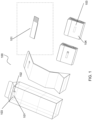
- Fig. 1 shows a schematic diagram of one embodiment of the presently disclosed foldable container.
- the container (100) is a carton, such as a milk carton or a juice carton or a yoghurt carton and the retaining element (101) is a double sided adhesive tape.
- the adhesive tape adheres to, for example it is glued on, the carton, from one side.
- the retaining element comprises a cover (103) and an extended non-sticky portion (102) configured to pull up the cover and free a glued side of the adhesive retaining element when the carton is ready for disposal.
- the adhesive retaining element may be integrated in the carton, from a side facing the carton, by other means than glue.
- the position of the adhesive tape may be on a top portion of a lateral side of the carton, or on a lateral side of a top portion of the carton, or in any other portion of the carton such that, when the carton is folded and the top portion of the carton is facing the bottom portion of the carton, the adhesive tape may retain the carton in a compact state by adhesion of two ends of the carton.
- the double sided adhesive tape (101) is covered by the cover (103).
- the cover (103) may be pulled off using the non-sticky portion (102) and the carton, after being folded such that a top side of the carton faces a bottom side of the carton, may be retained in a compact state occupying a minimal volume.
- the carton In this compact configuration (104), the carton may be disposed of and may consume a minimal volume in a recycle-bin.
- the retaining element may be a double-sided adhesive tape located on a first application point on a lateral portion of a top side or a lateral portion of a bottom side of the container or a top portion of a lateral side of the container, said double-sided adhesive tape being covered with a removable cover with an extended non-sticky portion for pulling off said cover.
- the double-sided adhesive tape is configured to hold the container in a compact state after the container has been emptied and folded, by adhering to two facing and opposite surfaces of the folded container.
- the adhesive tape retains, holds and/or maintains the container in a compact state, by adhering to two facing and opposite surfaces of the folded container.
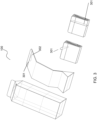
- Fig. 2 shows an embodiment of the presently disclosed disposable foldable container.
- the container is preferably a carton for liquids (100) and the retaining element (201) is preferably located on a first application point on a top side of the carton or on a top portion of a lateral side of the carton, or on a lateral portion of a top side of a carton.
- the retaining element is a folded strip provided with adhesive in at least one region of the strip, preferably along all the strip with the exception of a non-adhesive pull area (202), preferably located at a second end of the strip.
- the strip may be adhering to the carton with a first end of the strip by means of glue on a first side of the strip or by other means, and may be folded with multiple folds when the carton is not ready for disposal.
- the retaining element may be a strip (201) and a first end of the strip is adhering to a first application point (203) on the container, a second end of the strip is provided with a non-adhesive pull area, a central part of the strip is provided with adhesive, the strip is folded in multiple folds on the application point, and the strip may be configured, by pulling the second end of the strip, to be unfolded and tied around the container with the second end attached to a second application point (204), said second application point preferably located on a different side than the first application point, thereby holding the container in a compact state after the container has been emptied and folded.
- the folded strip When the container is ready for disposal, the folded strip may be unfolded, and tied around the folded container to maintain it in a compact, folded, state, wherein, for example, a top side of the container may face a bottom side of the container.
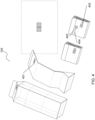
- Fig. 3 shows a schematic diagram of one embodiment of the presently disclosed disposable foldable container (100), where the container comprises an attachment element (302), such as a hanger or a plastic ring or a drop of hot-melted glue, and an elastic string attached to the attachment element to form a loop (301).
- the container (100) may be a carton or a soft plastic container for liquids or other foldable container for liquids/fluids.
- the elastic string hangs on the attachment element when the container is not ready for disposal.
- the container is folded and the elastic string is stretched and tied around the folded container to maintain it in a compact state.
- the position of the attachment element, on a first application point of the container may be on a top or bottom side of the container, or on a lateral side or central side of the container.
- the length of the string is such that the stretched string may be tied around the container and may hold the container in a compact state, when the container is folded and ready for disposal.
- the presently disclosed disposable container may comprise an attachment element, such as a ring or a hanger, secured to a first application point of the container, wherein the locking element is an elastic string having a first end and a second end attached to said attachment element forming an elastic loop, and configured such that said loop can be stretched and tied around the container and thereby hold the container in a compact state, after the container has been emptied and folded.
- an attachment element such as a ring or a hanger
- the elastic string may be attached to the container by use of glue, for example a drop of hot-melted glue, attaching a small portion of the loop-formed elastic string (301) to the container.
- glue for example a drop of hot-melted glue
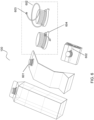
- Fig. 4 shows a schematic diagram of an embodiment of the presently disclosed foldable container.
- the retaining element (401) comprises an elastic strip (404) provided with a first adhesive element (402) at a first end and a second adhesive element (403) on a second end of the strip.
- the retaining element is placed on a first application point of the container on a lateral portion of a top side of the container, or on a top portion of a lateral side of the container.
- both adhesive (402) and (403) are on the first application point.
- the fourth adhesive element (402) is attached, by means of glue or other means, to the container.
- the second adhesive element (403) is attached more weakly to the container, by means of weaker glue than the glue in the first adhesive element (402).
- the container When the container is ready for disposable, it can be folded and the user can pull-off the second adhesive element, stretch the elastic strip, tie the strip around the container and secure the second adhesive element (403) to a second application point of the container, holding the container in a compact state.
- the retaining element comprises an elastic or stretchable strip, and a first end of the strip may be provided with a first adhesive element and a second end of the strip may be provided with a second adhesive element, such as slip adhesive, said second adhesive element having weaker adhesion than the first adhesive element.
- the second end of the strip is attached to a third application point, on the same side of the first application point, and the strip is contracted and shorter than a lateral side of the container.
- the strip is configured to be pulled in a second end for stretching of the strip, such that the strip can be tied around the container to hold the container in a compact state, when the container is empty and folded, by attaching the second end of the strip to a fourth application point, said fourth application point preferably located on the same side as the first application point.
- Fig. 5 shows a schematic diagram of an embodiment of the presently disclosed container.
- the retaining element is a strip (503) having a first end (504) and a second end (502).
- the first end is attached to a first application point (501) and the strip is rolled around the first application point and adhere to the container.
- the strip may be embedded in an adhesive tape (507) adhering to the first application point of the container.
- the first application point may be located on a lateral portion of a top side of the container or on a top portion of a lateral side of the container.
- the second end (502) of the strip is available to a user for pulling. When the container is ready for disposal, the user may pull the string from the second end of the string, may tie it around the container and may fix the second end of the string by adhesion to the container, holding the container in a compact state.
- the retaining element may be a strip having a first end attached to a first application point located on a lateral portion of a top side or a lateral portion of a bottom side of the container.
- the first end of the strip may be provided with a first adhesive such that the first end of the strip is secured to the first application point of the container.
- a second end of the strip may be provided with a second adhesive.
- At least a central portion of the strip may be provided with a third adhesive.
- the strip may be rolled around the first application point of the container, forming a spiral shape adhering to the container and the second end of the strip may be available for pulling by a user.
- the strip may be elastic.
- a central body of the strip may be embedded in an adhesive tape such that the central body of the strip can be extracted from the tape by pulling the second end of the strip.
- the strip is configured to be pulled in a second end for unrolling of the strip, such that the strip can be tied around the container to hold the container in a compact state, when the container is empty and folded, by attaching the second end of the strip to a second application point, said second application point preferably located on the same side as the first application point.
- the first application point and the second application point (506) may be in the same area of the container and/or may be both provided with adhesive, or wherein the second application point may be coinciding with the first application point.
- Fig. 6 shows a schematic diagram of an embodiment of the presently disclosed container.
- the container comprises a rigid element (601) such as a plastic cork.
- the retaining element is a spiral (602) such as a plastic spiral.
- the spiral is revolved around the rigid element.
- a user may unroll the spiral from the rigid element by pulling a second end (603) of the spiral, tie the spiral around the folded container, and lock the second end of the spiral in a second locking element (604) to hold the container in a compact state.
- One embodiment of the presently disclosed disposable container may be further comprising a rigid element, such as a plastic cork or a screw, the rigid element comprising a second locking element and the rigid element located on a first application point on a lateral portion of a top side of the container, wherein the retaining element is a spiral, such as a plastic spiral, revolved around the rigid element.
- a rigid element such as a plastic cork or a screw
- the rigid element comprising a second locking element and the rigid element located on a first application point on a lateral portion of a top side of the container, wherein the retaining element is a spiral, such as a plastic spiral, revolved around the rigid element.
- a first end of the spiral is attached to the container via the rigid element, and the spiral can be unrolled from the rigid element by pulling a second end of the spiral and wherein, also when the spiral is unrolled, the first end of the spiral is attached to the container.
- the second end of the spiral may be attached, via the second locking element located on the rigid element, to the rigid element, for holding the container when the container is in a compact state.
- Fig. 7 shows a schematic diagram of an embodiment of the presently disclosed foldable container.
- the container is provided with a string (705) with a first and a second end. The first end of the string is attached to the container.
- the string is rolled around a first application point (701) and attached to the container with glue or other fastening means.
- a user may pull off the string by the second end of the string, tie the string around the container in compact state, and fix the second end of the string to at least a fixing point (702) in the container.
- the fixing point may be a cut in a sleeve of the container.
- the retaining element may be a string rolled around and adhering to a first application point on the container, the string having a first end attached to the first application point, and wherein the container is provided with a fixing point, such as a cut in a sleeve of the container.
- the string may be configured to be unrolled by pulling a second end of the string and tied around the container with the second end of the string held at the fixing point and thereby holding the container in a compact state, after the container has been emptied and folded.
- the string may be contained, in a resting position, in a pocket or a reservoir within two layers of the container, that is a region of one side of the container wherein two layers of the container are not glued together or not heated together for the extension of the pocket or reservoir.
- One end of the string may be attached, such as glued or heated together, to a layer of the container and the string, in a resting position, may be contained in the pocket or the reservoir within layers of the container.
- the pocket or reservoir may have one opening or hole for extraction of the string by pulling a second end of the string.
- a second end of the string may be arranged to exit an opening or hole of said pocket or reservoir, such that a user may be able to extract the string by pulling the second end of the string.
- a user may pull the string, from the second end of the string, and tie it around the folded container.
- the second end of the string may then be secured to the container at at least one fixing point (702), such as a cut in a sleeve of the container.
- Fig. 8 shows a schematic diagram of an embodiment of the presently disclosed foldable container.
- the retaining element comprises a first string (801) and a second string (802).
- the first string is placed at the top of the container.
- the second string is placed at the bottom of the container.
- the retaining element may comprise a first and a second string integrated in the container, wherein the first string has a first end fixed at a top end of the container and a second end available for pulling, and the second string has a first end fixed at a bottom end of the container and a second end available for pulling.
- the first and the second string are configured for being pulled from their second ends, extracted from the container while still having their first ends attached to the container, and thereby tied together, such as in a knot, to hold the container in a compact state after the container has been emptied and folded.
- Fig. 9 shows a schematic diagram of an embodiment of the presently disclosed foldable container.
- the retaining element comprises an application element (901) and a fixing element (902).
- Different examples of application elements are shown in (901A, 901B, 901C) and different examples of corresponding fixing element are shown in (902A, 902B, 902C).
- the application element and the fixing element are placed at opposite sides of the container. When the container is ready for disposal and folded, the application element engages with the fixing element, holding the container in compact state.
- the retaining element may comprise an application element, such as a hook or hump or bump or a clip, and a fixing element, such as a joint or an interlocking element, wherein the application element and the fixing element are located at opposite sides of the container, such as a top side and a bottom side.
- an application element such as a hook or hump or bump or a clip
- a fixing element such as a joint or an interlocking element
- the application element is configured to engage in the fixing element when the container is empty and folded, holding the container in the compact state.
- Fig. 10 shows a schematic diagram of an embodiment of the presently disclosed foldable container.
- the retaining element comprises a stripe (1001) that is integrated in the container, for example in the bottom side of the container.
- the stripe may be placed between layers of the container.
- the stripe may comprise an end (1002) which is available for a user to pull and a user may pull the string from said end to extract the stripe.
- a perforation (1003) in the container may facilitate extraction of the stripe.
- the retaining element is a stripe integrated at a bottom side of the container, with a first end attached to the container and a second end comprising a snip for pulling and an adhesive region.
- the stripe is configured for being pulled out of the container, tied around the container and adhere to the container, holding the container in a compact state once folded.
- Fig. 11 shows a schematic diagram of an embodiment of the presently disclosed foldable container.
- the retaining element (1101) comprises a foldable element in a foldable rigid material, such as metal or plastic or combination thereof.
- One portion or side (1101) of the retaining element is attached to an application point of the container located on a lateral portion of a top side of the container.
- a second portion or side (1103) of the retaining element is folded on top of the first side (1102).
- the second portion or side of the retaining element is lifted by an user, folded backwords, in preferably two creases (1104 and 1105), around the container, holding the container in a compact state.
- the retaining element comprises a foldable element in a foldable rigid material, such as metal or plastic, and wherein the retaining element has a first portion attached to the container.
- the retaining element is configured to be folded around the container, by folding a second portion of the foldable element, and thereby holding the container in a compact state, when the container is empty and folded.
- Fig. 12 shows a schematic diagram of an embodiment of the presently disclosed foldable container.
- the retaining element comprises a fixing element, such as a fixing eye (1201) and a strip, such as a plastic strip (1202).
- the fixing element (1201) may be located at a top side of the container and the plastic string (1202) may be located at a bottom side of the container.
- a user may fold the container in a compact state and may engage the strip in the fixing element, holding the container in the compact state.
- the plastic strip (1202) may be a plastic strip cable or a lock type nylon cable tie or similar.
- the retaining element comprises a fixing element located preferably on a top of the container, the fixing element comprising a fixing eye, and wherein the retaining element further comprises a strip, such as a plastic strip, located preferably at a bottom side of the container, integrated in the container and having a first end attached to the container.
- the strip can be pulled from a second end of the string and wherein said second end of the strip is configured to be locked in the fixing eye of the fixing element once the container is empty and folded, holding the container into the compact state.
- Fig. 13 shows a schematic diagram of an embodiment of the presently disclosed foldable container.
- the retaining element is an elongated foldable rigid stripe (1301), such as a metal stripe or a plastic stripe, integrated or glued along a long side of the container.
- a user may fold the container to bring it to a compact state and the stripe (1301) may fold following the creases of the container and may retain the container in the compact state.
- the retaining element comprises an elongated foldable rigid stripe, such as a metal stripe or a plastic stripe, integrated or glued along a long side of the container.
- the retaining element is configured to bend at each crease when the container is empty and folded and is configured to hold the container in the compact state.
- Fig. 14 shows a schematic diagram of an embodiment of the presently disclosed foldable container.
- the retaining element may comprise a first adhesive element (1401) and a second adhesive element (1402).
- the first adhesive element may be located at a top side of the container and the second adhesive element may be located at a bottom side of the container.
- a user may fold the container such that the a top side of the container may face a bottom side of the container and the first and second adhesive elements may engage holding the container in a compact sate.
- the first and second adhesive elements may be covered by a pull-off cover. The pull-off cover may be removed when folding the container in a compact state.
- the retaining element may comprise a first and a second adhesive elements, the first adhesive element located at a top side of the container and the second adhesive element located at a bottom side of the container.
- the first and second adhesive elements are configured to engage with each other to hold the container in a compact state.
- the presently disclosed disposable container when in a non-compact state, may be used for storage, other than beverages, of consumable products such a cereals, raisins, potato mousse, sunflower bins or other bins.
- the present disclosure further relates to a disposable carton for holding a fluid beverage, such as milk, yoghurt, juice, soup, cordial, mashed potatoes, or other dry content, such as dry food content, such as salt, oats, flour, cereals, etc.
- a fluid beverage such as milk, yoghurt, juice, soup, cordial, mashed potatoes, or other dry content, such as dry food content, such as salt, oats, flour, cereals, etc.
- the disposable carton comprising a strip integrated in the carton, the strip configured to, when being pulled, perforate the carton bringing the carton to a compactable and/or foldable state.
- the strip integrated in the carton has a first end available for pulling.
- the string may be integrated in the carton and may have one end external to the carton, which an user may pull to perforate the carton.
- the disposable carton may have a self-supporting structure, and may be configured such that pulling of the strip and perforation of the carton collapses the structure of the carton.
- the carton is configured to be perforated by pulling of the strip and that such perforation collapses the structure of the carton, because the so collapsed structure of the carton makes the carton foldable and compactable, which is advantageous for disposal of the carton.
- a first end of the strip may be external to the carton or extractable from the carton and available for pulling.
- the strip may be embedded within different layers of the carton.
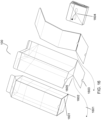
- the strip (1501) may be arranged along a partial or a full contour of a bottom edge (1503) of the carton and the strip, when being pulled, may be configured to perforate partially or fully said bottom edge of the carton.
- the bottom edge structure of the carton after pulling the string from its first end (1502), is opened and brings the carton to a compactable or foldable state.
- the bottom edge of the carton may be square or rectangular and may be perforated in at least three quarters of its contour, so that the bottom side of the carton is opened to collapse the structure of the carton and make it foldable.
- the strip (1601) may have a second end (1605) attached to the carton and the strip may be configured to, after perforating the carton, be used to retain the carton in a compact state after the carton has been brought to a compact state, by use of a knot (1604).
- the strip may be first used to perforate the carton and, after being pulled and having perforated the carton, for example the bottom edge (1603) of the carton, may be used to retain the carton in a compact state after folding.
- the strip may therefore have a double use. In the first use, when the strip is pulled, it may perforate the carton to collapse its structure and make it compactable. In the second use, the strip may be used to retain the carton by being tied around the carton and fixed by a knot made by a user.
- the strip may advantageously have a second end which is attached to the carton even after pulling.
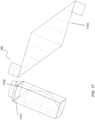
- the strip may be arranged along a partial or a full contour of a top edge of the carton, along at least a lateral or side edge of the carton, and along a partial or a full contour of a bottom edge of the carton; and the strip, when being pulled, may be configured to perforate partially or fully said top edge, perforate fully said at least lateral or side edge and perforate partially or fully said bottom edge.
- the strip (1701) may be arranged along a partial or a full contour of a top edge of the carton, the strip may extend diagonally along at least one lateral side of the carton and along a partial or a full contour of a bottom edge of the carton; and the strip, when being pulled, may be configured to perforate partially or fully said top edge, perforate diagonally said at least one lateral side of the carton, and perforate partially or fully said bottom edge.
- the presently disclosed disposable carton may be an embodiment of the presently disclosed disposable container.
- the presently disclosed disposable carton may be provided with a retaining element as in the presently disclosed disposable container. Therefore the presently disclosed carton may be provided with a strip for perforation and/or a retaining element as in the presently disclosed disposable container.
Landscapes
- Engineering & Computer Science (AREA)
- Mechanical Engineering (AREA)
- Cartons (AREA)
Priority Applications (1)
| Application Number | Priority Date | Filing Date | Title |
|---|---|---|---|
| EP22163812.5A EP4249384A1 (de) | 2022-03-23 | 2022-03-23 | Verdichtbarer einwegbehälter |
Applications Claiming Priority (1)
| Application Number | Priority Date | Filing Date | Title |
|---|---|---|---|
| EP22163812.5A EP4249384A1 (de) | 2022-03-23 | 2022-03-23 | Verdichtbarer einwegbehälter |
Publications (1)
| Publication Number | Publication Date |
|---|---|
| EP4249384A1 true EP4249384A1 (de) | 2023-09-27 |
Family
ID=82117245
Family Applications (1)
| Application Number | Title | Priority Date | Filing Date |
|---|---|---|---|
| EP22163812.5A Withdrawn EP4249384A1 (de) | 2022-03-23 | 2022-03-23 | Verdichtbarer einwegbehälter |
Country Status (1)
| Country | Link |
|---|---|
| EP (1) | EP4249384A1 (de) |
Citations (8)
| Publication number | Priority date | Publication date | Assignee | Title |
|---|---|---|---|---|
| US3180555A (en) * | 1964-03-10 | 1965-04-27 | Edward J Barrett | Expandable and collapsible container |
| US4848589A (en) * | 1988-01-21 | 1989-07-18 | Olson Bradley J | User expandable container |
| DE29600776U1 (de) * | 1995-01-20 | 1996-03-07 | Iturria Tellechea, Javier Maria, San Sebastian | Verbesserter prismatischer Behälter |
| EP0748741A1 (de) * | 1995-06-15 | 1996-12-18 | Rodolfo Ficini | Haltevorrichtung, um die Expansion von kompressibelen Behältern nach ihrer Kompression zu vermeiden |
| WO1997041035A1 (es) * | 1996-04-26 | 1997-11-06 | Antonio Moreno Marco | Dispositivo para compactar envases y publicaciones |
| JPH09328116A (ja) * | 1996-06-10 | 1997-12-22 | Shigeya Takahashi | 資源リサイクルがしやすいプラスチックボトル |
| NL1031884C1 (nl) * | 2006-05-24 | 2007-11-27 | Arnoldus Gijsbertus Wilh Andel | Opvouwbaar rilpak. |
| ITVR20110224A1 (it) * | 2011-12-13 | 2013-06-14 | Paoluccio Schiro' | Bottiglia collassabile |
-
2022
- 2022-03-23 EP EP22163812.5A patent/EP4249384A1/de not_active Withdrawn
Patent Citations (8)
| Publication number | Priority date | Publication date | Assignee | Title |
|---|---|---|---|---|
| US3180555A (en) * | 1964-03-10 | 1965-04-27 | Edward J Barrett | Expandable and collapsible container |
| US4848589A (en) * | 1988-01-21 | 1989-07-18 | Olson Bradley J | User expandable container |
| DE29600776U1 (de) * | 1995-01-20 | 1996-03-07 | Iturria Tellechea, Javier Maria, San Sebastian | Verbesserter prismatischer Behälter |
| EP0748741A1 (de) * | 1995-06-15 | 1996-12-18 | Rodolfo Ficini | Haltevorrichtung, um die Expansion von kompressibelen Behältern nach ihrer Kompression zu vermeiden |
| WO1997041035A1 (es) * | 1996-04-26 | 1997-11-06 | Antonio Moreno Marco | Dispositivo para compactar envases y publicaciones |
| JPH09328116A (ja) * | 1996-06-10 | 1997-12-22 | Shigeya Takahashi | 資源リサイクルがしやすいプラスチックボトル |
| NL1031884C1 (nl) * | 2006-05-24 | 2007-11-27 | Arnoldus Gijsbertus Wilh Andel | Opvouwbaar rilpak. |
| ITVR20110224A1 (it) * | 2011-12-13 | 2013-06-14 | Paoluccio Schiro' | Bottiglia collassabile |
Similar Documents
| Publication | Publication Date | Title |
|---|---|---|
| KR100426836B1 (ko) | 커피 등을 위한 필터장치 | |
| US5184896A (en) | Self-expanding flexible pouch including improved extensible stay to maximize opening | |
| US4875576A (en) | Mixing kit | |
| US6536048B2 (en) | Adjustable disposable garment protector | |
| US5213253A (en) | Pocket-container, in particular for taking drinks or other food | |
| US20120014622A1 (en) | Disposable storage bags | |
| US10080417B2 (en) | Container | |
| US4886206A (en) | Disposable container with foldable spout | |
| US20110226914A1 (en) | Collapsible support structure for a bag | |
| US20110309096A1 (en) | Food and condiment container | |
| US2334156A (en) | Package for tea and like commodities | |
| US20100155407A1 (en) | Drinking Container Lid Fastener | |
| US20050061826A1 (en) | Wipe dispenser and threader for wipe dispenser | |
| US20090206092A1 (en) | Novel food container assembly | |
| US11338966B2 (en) | Disposable container | |
| US20080093433A1 (en) | Condiment receptacle for food container | |
| US20070045338A1 (en) | Food dispensing and distributing apparatus including sauce holder, and method of using | |
| US11801975B1 (en) | Storable plastic bag support apparatus | |
| WO2014186688A2 (en) | Tea storage, infusion, and disposal | |
| US20210371188A1 (en) | Rolled product with interwoven units of product | |
| US20100116144A1 (en) | Foldable Brew Basket | |
| JP2007534564A (ja) | 折り目とフック及びそれ以上のアクセサリを伴うファスナとを具備する偏平に折り畳まれた防水カートン | |
| US20150023614A1 (en) | Flexible Pouches for Goods on a Roll | |
| US20060222738A1 (en) | Package for draining an infusion bag | |
| US3361309A (en) | Disposable container for dispensing liquids |
Legal Events
| Date | Code | Title | Description |
|---|---|---|---|
| PUAI | Public reference made under article 153(3) epc to a published international application that has entered the european phase |
Free format text: ORIGINAL CODE: 0009012 |
|
| STAA | Information on the status of an ep patent application or granted ep patent |
Free format text: STATUS: THE APPLICATION HAS BEEN PUBLISHED |
|
| AK | Designated contracting states |
Kind code of ref document: A1 Designated state(s): AL AT BE BG CH CY CZ DE DK EE ES FI FR GB GR HR HU IE IS IT LI LT LU LV MC MK MT NL NO PL PT RO RS SE SI SK SM TR |
|
| STAA | Information on the status of an ep patent application or granted ep patent |
Free format text: STATUS: THE APPLICATION IS DEEMED TO BE WITHDRAWN |
|
| 18D | Application deemed to be withdrawn |
Effective date: 20240328 |