EP4249328B1 - Amusement park ride vibration system - Google Patents
Amusement park ride vibration system Download PDFInfo
- Publication number
- EP4249328B1 EP4249328B1 EP23191459.9A EP23191459A EP4249328B1 EP 4249328 B1 EP4249328 B1 EP 4249328B1 EP 23191459 A EP23191459 A EP 23191459A EP 4249328 B1 EP4249328 B1 EP 4249328B1
- Authority
- EP
- European Patent Office
- Prior art keywords
- ride
- vibrator
- shaft
- handle
- motor
- Prior art date
- Legal status (The legal status is an assumption and is not a legal conclusion. Google has not performed a legal analysis and makes no representation as to the accuracy of the status listed.)
- Active
Links
Images



Classifications
-
- A—HUMAN NECESSITIES
- A63—SPORTS; GAMES; AMUSEMENTS
- A63G—MERRY-GO-ROUNDS; SWINGS; ROCKING-HORSES; CHUTES; SWITCHBACKS; SIMILAR DEVICES FOR PUBLIC AMUSEMENT
- A63G31/00—Amusement arrangements
-
- A—HUMAN NECESSITIES
- A63—SPORTS; GAMES; AMUSEMENTS
- A63G—MERRY-GO-ROUNDS; SWINGS; ROCKING-HORSES; CHUTES; SWITCHBACKS; SIMILAR DEVICES FOR PUBLIC AMUSEMENT
- A63G31/00—Amusement arrangements
- A63G31/02—Amusement arrangements with moving substructures
-
- A—HUMAN NECESSITIES
- A63—SPORTS; GAMES; AMUSEMENTS
- A63G—MERRY-GO-ROUNDS; SWINGS; ROCKING-HORSES; CHUTES; SWITCHBACKS; SIMILAR DEVICES FOR PUBLIC AMUSEMENT
- A63G31/00—Amusement arrangements
- A63G31/16—Amusement arrangements creating illusions of travel
-
- A—HUMAN NECESSITIES
- A63—SPORTS; GAMES; AMUSEMENTS
- A63G—MERRY-GO-ROUNDS; SWINGS; ROCKING-HORSES; CHUTES; SWITCHBACKS; SIMILAR DEVICES FOR PUBLIC AMUSEMENT
- A63G7/00—Up-and-down hill tracks; Switchbacks
-
- B—PERFORMING OPERATIONS; TRANSPORTING
- B60—VEHICLES IN GENERAL
- B60R—VEHICLES, VEHICLE FITTINGS, OR VEHICLE PARTS, NOT OTHERWISE PROVIDED FOR
- B60R21/00—Arrangements or fittings on vehicles for protecting or preventing injuries to occupants or pedestrians in case of accidents or other traffic risks
- B60R2021/0065—Type of vehicles
- B60R2021/0097—Amusement vehicles
Definitions
- the present disclosure relates generally to amusement park rides.
- ride vehicles that carry passengers along a ride path, such as a track.
- ride path features such as turns, loops, twists, and so forth, that are part of the ride path.
- ride vehicles and amusement park-style attractions may include other features that enhance the ride vehicle experience for passengers.
- ride vehicles, ride paths, and/or other elements of the ride system may include lights, speakers, interactive elements, specialized environments, and/or other features that provide sensory stimulation for the passenger in the ride vehicle to enhance the ride experience. It will be appreciated that passengers enjoying the ride vehicle experience may desire different levels of sensory stimulation.
- GB 2317836 A describes an amusement machine, for example a coin-freed arcade machine, that comprises at least one handle which upon being grasped by the user of the machine, severely vibrates the handle giving the sensation of receiving an electrical shock
- the machine may be a simulation of an electric chair.
- the present invention is directed to a ride vibrator according to claim 1, and a method of controlling a ride vibrator according to claim 13. Additional features and embodiments of the invention are defined in the dependent claims.
- a ride vibration system in an example useful for understanding the present invention, includes a rider support feature coupled to a ride vehicle and accessible to a rider positioned in the ride vehicle.
- the system includes a vibrator with a motor that rotates an eccentric mass to generate vibrations.
- the vibrator is at least partially integrated with the rider support feature and transfers the vibrations to the rider support feature.
- An input device receives a vibration intensity selection.
- a controller couples to the vibrator and to the input device. The controller receives the vibration intensity selection and controls the motor to control an intensity of the vibrations.
- a ride vibration system includes a restraint system that restrains a rider in a seat and a vibrator that generates vibrations.
- An input device receives a vibration intensity selection for the ride vibration system.
- a controller couples the vibrator to the input device. The controller receives the vibration intensity selection and controls an intensity of the vibrations.
- a high-frequency vibrator includes a shaft.
- An eccentric mass couples to the shaft. The eccentric mass vibrates the shaft in response to rotation of the shaft.
- a vibrator housing receives the shaft and the eccentric mass. The vibrator housing couples to a ride vehicle.
- a bearing couples to the shaft. The bearing transfers shaft vibrations to the vibrator housing.
- a motor couples to the shaft and rotates the shaft.
- An input device comprises a first touch-sensitive sensor disposed on a first handle portion of a handle and a second touch-sensitive sensor disposed on a second handle portion of the handle, wherein the input device couples to the motor. The input device changes a rotational speed of the motor to control vibration of the vibrator in response to a rider contacting the first handle portion of the handle or the second handle portion of the handle.
- first, second, etc. may be used herein to describe various elements, these elements should not be limited by these terms. These terms are only used to distinguish one element from another. For example, a first object could be termed a second object, and, similarly, a second object could be termed a first object, without departing from the scope of the present disclosure.
- Amusement parks include many rides that provide unique and entertaining experiences for riders.
- Amusement parks typically include a wide variety of rides to accommodate the thrill sensitivities and immersive experience desires of different visitors. Accordingly, these rides are designed around a hypothetical riders, such as children, teenagers, adults, and/or senior citizens. For example, the amount of twist, rotation, acceleration, deceleration, height of ride, special effects, etc. are designed with a hypothetical rider in mind.
- the rides may also be designed to include special effects to create a more immersive experience such as incorporating fog, water, and vibration. Unfortunately, what may be thrilling to a child may not be for a teenager or adult.
- the same ride may include adjustable special effects or adjustable sensations to accommodate different riders.
- two different riders may have an equally satisfying experience on the same ride. For example, differently aged siblings or parents and their children may share a ride and receive a ride tailored to their personal preferences.
- the ride vibration system discussed in detail below may increase the immersive experience of a ride by simulating vibrations from gun recoil, vehicle movement, explosions, electrical shock, among others.
- the amount and/or intensity of the vibrations produced by the vibration system may be tailored to the rider.
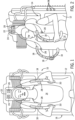
- FIGS. 1 and 2 respectively illustrate a front view and a perspective view of a ride vibration system 10 in accordance with present embodiments.
- the ride vibration system 10 may include a seat 12 that receives a rider 14 and a restraint system 16 that holds the rider 14 in the seat 12 during the ride. During the ride various images and scenes may flash and/or pass by the rider 14. The rider 14 may associate these images and scenes with vibration, electrical shock, among others. To enhance the experience and/or make it more lifelike, the ride vibration system 10 includes one or more vibrators 18 that generate vibrations at specific times during the ride.
- the vibrators 18 may generate vibrations so that the rider 14 senses a motion associated with the rapid recoil of the gun.
- the scene may involve electricity, and the vibrators 18 may generate high-frequency vibrations that may fool the rider 14 into believing they are being electrically shocked.
- the vibrators 18 may be placed within restraint handles 20 of the restraint system 16. These restraint handles 20 may be grabbed by the rider 14 during the ride enabling vibrations generated by the vibrators 18 to be transferred through the handles 20 and into the hands and body of the rider 14.
- the amount of vibration produced by the vibrator 18 is controlled with a controller 22.
- the controller 22 communicatively couples to the vibrator 18 (e.g., wired connection, wireless connection).
- the controller 22 includes a processor 24 and a memory 26.
- the processor 24 may be a microprocessor that executes software to control motors (e.g., high frequency motors, stepper motors) to generate vibrations in response to the location, time, current scene/image of the ride, or a combination thereof.
- the processor 24 may include multiple microprocessors, one or more "general-purpose" microprocessors, one or more special-purpose microprocessors, and/or one or more application specific integrated circuits (ASICs), field-programmable gate arrays (FPGAs), or some combination thereof.
- the processor 24 may include one or more reduced instruction set computer (RISC) processors.
- RISC reduced instruction set computer
- the memory 26 may include a volatile memory, such as random access memory (RAM), and/or a nonvolatile memory, such as read-only memory (ROM).
- RAM random access memory
- ROM read-only memory
- the memory 26 may store a variety of information and may be used for various purposes.
- the memory 26 may store processor executable instructions, such as firmware or software, for the processor 24 to execute.
- the memory 26 may include ROM, flash memory, a hard drive, or any other suitable optical, magnetic, or solid-state storage medium, or a combination thereof.
- the memory 26 may store data, instructions, and any other suitable data.
- the processor 24 executes instructions on the memory 26 to control the vibrators 18.
- the controller 22 may control the vibrators 18 in response to feedback from the rider 14 and/or a ride operator.
- the ride vibration system 10 may include one or more input devices (e.g., buttons and/or dials 28, touch sensitive handles) that enable the rider 14 to adjust the intensity of the vibrations generated by the vibrator 18.
- buttons and/or dials 28 may be placed on the restraint system 16, on the handles 20, and/or on the seat 12 enabling a rider 14 to easily access and change the vibrational intensity.
- buttons or dials 28 may be placed out of reach of the rider 14 while on the ride. The vibrational intensity may therefore be adjusted before the ride by the rider 14 and/or the ride operator.
- the ride operator may ask the rider 14 what their desired ride intensity level is.
- the ride operator may then adjust the dial and/or push the button(s) 28 in response to the feedback from the rider 14.
- the rider 14, prior to getting onto the ride may be provided information regarding increasing or decreasing the intensity of the ride (e.g., during an informational video).
- the rider 14 may then adjust the dial(s) and/or button(s) 28 prior to being restrained. Once restrained, the rider 14 may no longer be able to access the button(s) and/or dial(s) 28 or they may be deactivated.
- the input device(s) may enable a variety of control of the vibrators 18.
- a dial 28 may enable an analog like input to the controller 22 regarding the desired vibrational intensity. That is, the vibrational intensity may be varied to multiple levels between no vibration and a maximum vibration of the vibrators 18. Buttons 28 may similarly control the amount of vibrational feedback.
- a button 28 may turn the vibrator 18 completely on or completely off. In some embodiments, depressing the button 28 repeatedly may change the vibrational intensity level.
- the ride vibration system 10 may include multiple buttons 28 (e.g., color coded buttons) with each one associated with a specific vibrational intensity (e.g., low, medium, high).
- the ride vibration system 10 may include two buttons or dials 28 (e.g., input devices) placed on the restraint system 16 over the shoulders. These buttons or dials 28 may individually control the respective vibrators 18 in the proximately located handles 20 or elsewhere on the seat 12 or restraint system 16. For example, one button 28 may control vibrators 18 in the handles 20 or just one of the handles 20 and the other button 28 may control vibrators 18 in the seat 12 and/or in the other handle 20.
- the buttons or dials 28 may also control all of the vibrators 18. For example, adjusting one of the buttons or dials 28 may adjust the intensity of all of the vibrators 18. In some embodiments, the buttons 28 may control different vibrational special effects. For example, one of the buttons 28 may control the intensity of all of the vibrators 18 for simulating vehicle vibration, recoil vibration, etc. and the other button 28 may control the intensity of vibrations that simulate electrical shock.
- the ride vibration system 10 may include an input device(s) that senses the touch of the rider 14 on the handles 20 with one or more sensors (e.g., touch-sensitive sensors). These sensors couple to the controller 22.
- the controller 22 in response to a signal from the sensor, activates the vibrators 18.
- the controller 22 may adjust the intensity of the vibrations.
- each handle 20 may be divided into sections (e.g., 1, 2, 3, or more sections). These sections may be color coded, include written messages, and/or include a physical divider (e.g., bands, circumferential lip). In one embodiment, the sections may be color coded red, yellow, and green to indicate the vibrational intensity available to the rider 14.
- the rider 14 may grab the section on the handle 20 that correlates to the desired level of vibration.
- the sensors e.g., touch-sensitive sensors
- each handle 20 may include a vibrator 18 for each section.
- the controller 22 may therefore drive the vibrator 18 associated with that section.
- the controller 22 may adjust all of the vibrators 18 to match the desired intensity.
- each handle 20 may include one or more vibrators 18 that are driven at the same intensity level depending on which section of the handle 20 the rider 14 grabs.
- FIGS. 3 and 4 respectively illustrate a perspective view and a front view of a ride vibration system 50 in accordance with present embodiments.
- the ride vibration system 50 includes a restraint system 52 that holds a rider in the seat 12.
- the ride vibration system 50 includes one or more vibrators 18 that generate vibrations at desired times during the ride.
- the vibrators 18 may generate vibrations that transfer to the rider and simulate vehicle vibration, shock via electricity, recoil, among others.
- the vibrators 18 may be placed within upper and lower restraint handles 54 and 56 of the restraint system 52.
- the vibrator 18 is controlled with the controller 22, which controls motors (e.g., high frequency motors, stepper motors) to generate vibrations.
- the controller 22 communicatively couples to the vibrator 18 (e.g., wired connection, wireless connection).
- the controller 22 may control the vibrators 18 in response to feedback from the rider 14. For example, the controller 22 may provide a different vibratory experience depending on if the upper or lower restraint handles 54, 56 are grabbed. In some embodiments, the controller 22 may detect, with a sensor, if the upper restraint handles 54 are being used and provide a more intense vibratory sensation. Similarly, the controller 22 may detect, with a sensor, if the lower restraint handles 54 are being used and provide a less intense vibratory experience, or in some embodiments no vibration. This arrangement may be reversed with the vibrators 18 in the upper restraint handles 54 providing less intense vibrations than the vibrators 18 in the lower restraint handles 56.
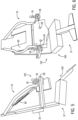
- FIGS. 5 and 6 respectively illustrate a side view and a perspective view of a ride vibration system 100 in accordance with present embodiments.
- the ride vibration system 100 may include handles 102 with vibrators 18.
- the handles 102 do not form part of the restraint system 16 (e.g., chest restraint 82). However, the handles 102 are positioned so that the rider may grab the handles 102 if a more intense experience is desired.
- the ride vibration system 100 is similar to that of the vibration systems discussed above, wherein the vibratory experience may be similarly controlled with one or more buttons and/or dials 28 (e.g., input devices), by grabbing the handles 102, or the like.
- the handles 102 may have dual functions. For example, in addition to providing sensory effects when engaged by the rider, they may operate as joy sticks to guide other aspects of the ride.
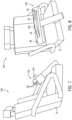
- FIGS. 7 and 8 respectively illustrate a side view and a perspective view of a ride vibration system 130 in accordance with present embodiments.
- the ride vibration system 130 includes a lap restraint system 132 that holds a rider in the seat 12.
- the lap restraint system 132 may include one or more restraint handles 134 that a rider may grab during the ride.
- Vibrators 18 may be placed within the restraint handles 134 of the restraint system 16. These restraint handles 134 may be grabbed by the rider 14 during the ride, enabling the vibrations generated by the vibrators 18 to be transferred through the restraint handles 134 to the rider 14.
- the ride vibration system 100 may be similar to that of the vibration systems discussed above, wherein the vibratory experience may be similarly controlled with one or more buttons and/or dials 28 (e.g., input devices).
- FIGS. 9 and 10 respectively illustrate a side view and a perspective view of a ride vibration system 160.
- the ride vibration system 160 may be coupled to the seat 12.
- the ride vibration system 160 may include one or more vibrators 18 coupled to a seat cushion 162 and/or to a back cushion 164.
- the seat cushion 162 and/or the back cushion 164 may be made from a hard or semi-hard material to facilitate vibration transfer from the vibrators 18 to the rider.
- the cushions 162, 164 may be made from hard foam.
- the vibratory experience may be similarly controlled with one or more buttons and/or dials 28.
- the buttons 28 may be placed on the restraint 166 and/or on the seat 12. As explained above, these buttons 28 may control the vibrational intensity of one or more vibrators 18 to customize the ride experience for the rider.
- FIG. 11 is a perspective view of the vibrator 18.
- the vibrator 18 includes a motor 190 (e.g., high frequency motor, stepper motor).
- the motor 190 is contained within a housing 192 (e.g., motor housing).
- the housing 192 may include a vibration dampening material (e.g., rubber, plastic) that resists vibration transfer from the vibrator 18 into a seat and/or restraint.
- the motor 190 couples to a shaft 194 with an eccentric mass 196.
- the eccentric mass 196 unevenly distributes weight about the shaft 194, which creates vibration as the motor 190 rotates the shaft 194. These vibrations may then be transferred to a housing 198 through bearings 200.
- the bearings 200 support the shaft 194 within the housing 198 at two locations. In some embodiments, there may be a different number of bearings 200 (e.g., 1, 2, 3, or more). In some embodiments, the two locations may be on opposite sides of the eccentric mass 196.
- the housing 198 may be the handle on a ride (e.g., restraint handle) or a separate housing placed within the handle or other portion of a restraint system or seat.
- the vibrators 18 may therefore be modular, which may facilitate replacement over the lifetime of the ride.
- FIG. 12 is a perspective view of the vibrator 18.
- the vibrator 18 includes a motor 220 (e.g., high frequency motor, stepper motor).
- the motor 220 is contained within a housing 222.
- the housing 222 may include a vibration dampening material (e.g., rubber, plastic) that resists vibration transfer.
- the motor 220 couples to a shaft 224 with multiple eccentric masses 226 (e.g., 2, 3, 4, or more).
- the eccentric masses 226 unevenly distributes weight about the shaft 224, which creates vibration as the motor 220 rotates the shaft 224. These vibrations may then be transferred to a housing 228 through bearings 230.
- the bearings 230 support the shaft 224 within the housing 228 to block contact between the shaft 224 and the housing 228.
- the vibrator 18 may include multiple bearings 230 (e.g., 1, 2, 3, 4, 5, or more).
- a pair of bearings 203 may be placed on opposite sides of each eccentric mass 226 along the longitudinal axis of the shaft 224.
- the housing 228 may be placed in the handle on a ride (e.g., restraint handle) or a separate housing placed within the handle or other portion of a restraint system or seat.
- FIG. 13 is a perspective view of the vibrator 18 with different features relative to the previously illustrated embodiments.
- the vibrator 18 includes a motor 250 (e.g., high frequency motor, stepper motor).
- the motor 250 is contained within a housing 252.
- the housing 252 may be the handle on a ride (e.g., restraint handle) or a separate housing placed within the handle or other portion of a restraint system or seat.
- the motor 250 couples to a shaft 254 with an eccentric mass 256.
- the eccentric mass 256 unevenly distributes weight about the shaft 254, which vibrates the shaft 254 as the motor 250 rotates the shaft 254.
- These vibrations may then be transferred to a housing 252 through one or more connectors 258, such as annular rings that couple to the motor 250 and to the housing 252.
- the housing 252 may couple to a mounting plate 260 that enables the vibrator 18 to couple to a ride.
- the mounting plate 260 may be made out of or include a layer of vibration dampening material (e.g., rubber, plastic) that resists vibration transfer to a restraint system and/or a seat.
- Present embodiments address a need for variability in haptic effects that can be efficiently presented for entertainment purposes during an amusement park ride.
- technical effects of the present embodiments include the ability to select certain thrill levels or intensity levels that are implemented through controlled vibration levels. It should be understood that other effects may also be controlled in conjunction with these haptic effects. For example, lighting on the ride vehicle or along the ride path may be adjusted in conjunction with the vibrational effects.
- other sensory-based activity e.g., audio presentation, video display, olfactory emission
- the appeal of an amusement park ride can be multiplied. Indeed, a single ride system may appeal to numerous age groups and riders with varying thrill level interests.
- technical effects in accordance with present embodiments include efficient and intuitive selection of thrill levels. For example, selection of a thrill level may be required as part of engaging with the ride vehicle and mistaken adjustment may be avoided by blocking thrill level selection activities after the ride has started. However, in some embodiments, thrill level selection can be made throughout a course of the ride. Also, efficient and intuitive thrill level selection may be facilitated by simply grabbing a handle with appropriate labeling or a portion of a handle with appropriate labeling. Thus, not only is the ride more appealing to a larger set of amusement park guests because of the options but because the options are easily identified and selectable.
- the terms “inner” and “outer”; “up” and “down”; “upper” and “lower”; “upward” and “downward”; “above” and “below”; “inward” and “outward”; and other like terms as used herein refer to relative positions to one another and are not intended to denote a particular direction or spatial orientation.
- the terms “couple,” “coupled,” “connect,” “connection,” “connected,” “in connection with,” and “connecting” refer to “in direct connection with” or “in connection with via one or more intermediate elements or members.”
Landscapes
- Apparatuses For Generation Of Mechanical Vibrations (AREA)
- Seats For Vehicles (AREA)
- Vibration Prevention Devices (AREA)
- User Interface Of Digital Computer (AREA)
- Connection Of Motors, Electrical Generators, Mechanical Devices, And The Like (AREA)
Description
- The present disclosure relates generally to amusement park rides.
- Many amusement park-style rides include ride vehicles that carry passengers along a ride path, such as a track. As the ride vehicle travels along the ride path, the ride vehicle may be subjected to a variety of ride path features, such as turns, loops, twists, and so forth, that are part of the ride path.
- It is common for ride vehicles and amusement park-style attractions to include other features that enhance the ride vehicle experience for passengers. For example, ride vehicles, ride paths, and/or other elements of the ride system may include lights, speakers, interactive elements, specialized environments, and/or other features that provide sensory stimulation for the passenger in the ride vehicle to enhance the ride experience. It will be appreciated that passengers enjoying the ride vehicle experience may desire different levels of sensory stimulation.
- This section is intended to introduce the reader to various aspects of art that may be related to various aspects of the present disclosure, which are described below. This discussion is believed to be helpful in providing the reader with background information to facilitate a better understanding of the various aspects of the present disclosure. Accordingly, it should be understood that these statements are to be read in this light, and not as admissions of prior art.
-
GB 2317836 A - The present invention is directed to a ride vibrator according to claim 1, and a method of controlling a ride vibrator according to claim 13. Additional features and embodiments of the invention are defined in the dependent claims.
- Certain embodiments commensurate in scope with the present disclosure are summarized below. These embodiments are not intended to limit the scope of the disclosure, but rather these embodiments are intended only to provide a brief summary of certain disclosed embodiments. Indeed, the present disclosure may encompass a variety of forms that may be similar to or different from the embodiments set forth below.
- In an example useful for understanding the present invention, a ride vibration system includes a rider support feature coupled to a ride vehicle and accessible to a rider positioned in the ride vehicle. The system includes a vibrator with a motor that rotates an eccentric mass to generate vibrations. The vibrator is at least partially integrated with the rider support feature and transfers the vibrations to the rider support feature. An input device receives a vibration intensity selection. A controller couples to the vibrator and to the input device. The controller receives the vibration intensity selection and controls the motor to control an intensity of the vibrations.
- In an example useful for understanding the present invention, a ride vibration system includes a restraint system that restrains a rider in a seat and a vibrator that generates vibrations. An input device receives a vibration intensity selection for the ride vibration system. A controller couples the vibrator to the input device. The controller receives the vibration intensity selection and controls an intensity of the vibrations.
- In accordance with an embodiment, a high-frequency vibrator includes a shaft. An eccentric mass couples to the shaft. The eccentric mass vibrates the shaft in response to rotation of the shaft. A vibrator housing receives the shaft and the eccentric mass. The vibrator housing couples to a ride vehicle. A bearing couples to the shaft. The bearing transfers shaft vibrations to the vibrator housing. A motor couples to the shaft and rotates the shaft. An input device comprises a first touch-sensitive sensor disposed on a first handle portion of a handle and a second touch-sensitive sensor disposed on a second handle portion of the handle, wherein the input device couples to the motor. The input device changes a rotational speed of the motor to control vibration of the vibrator in response to a rider contacting the first handle portion of the handle or the second handle portion of the handle.
- These and other features, aspects, and advantages of the present disclosure will become better understood when the following detailed description is read with reference to the accompanying drawings in which like characters represent like parts throughout the drawings, wherein:
-
FIG. 1 is a front view of a ride vibration system, in accordance with an embodiment of the present disclosure; -
FIG. 2 is a perspective view of a ride vibration system, in accordance with an embodiment of the present disclosure; -
FIG. 3 is a perspective view of a ride vibration system, in accordance with an embodiment of the present disclosure; -
FIG. 4 is a front view of a ride vibration system, in accordance with an embodiment of the present disclosure; -
FIG. 5 is a side view of a ride vibration system, in accordance with an embodiment of the present disclosure; -
FIG. 6 is a perspective view of a ride vibration system, in accordance with an embodiment of the present disclosure; -
FIG. 7 is a side view of a ride vibration system, in accordance with an embodiment of the present disclosure; -
FIG. 8 is a perspective view of a ride vibration system, in accordance with an embodiment of the present disclosure; -
FIG. 9 is a side view of a ride vibration system, in accordance with an embodiment of the present disclosure; -
FIG. 10 is a perspective view of a ride vibration system, in accordance with an embodiment of the present disclosure; -
FIG. 11 is a perspective view of a vibrator, in accordance with an embodiment of the present disclosure; -
FIG. 12 is a perspective view of a vibrator, in accordance with an embodiment of the present disclosure; and -
FIG. 13 is a perspective view of a vibrator, in accordance with an embodiment of the present disclosure. - Reference will now be made in detail to specific embodiments illustrated in the accompanying drawings and figures. In the following detailed description, numerous specific details are set forth in order to provide a thorough understanding of the disclosure. However, it will be apparent to one of ordinary skill in the art that embodiments may be practiced without these specific details. In other instances, well-known methods, procedures, and components, have not been described in detail so as not to unnecessarily obscure aspects of the embodiments.
- It will also be understood that, although the terms first, second, etc. may be used herein to describe various elements, these elements should not be limited by these terms. These terms are only used to distinguish one element from another. For example, a first object could be termed a second object, and, similarly, a second object could be termed a first object, without departing from the scope of the present disclosure.
- The terminology used herein is for the purpose of describing particular embodiments only and is not intended to be limiting. As used in the description and the appended claims, the singular forms "a," "an" and "the" are intended to include the plural forms as well, unless the context clearly indicates otherwise. It will also be understood that the term "and/or" as used herein refers to and encompasses any and all possible combinations of one or more of the associated listed items. It will be further understood that the terms "has," "having," "includes," "including," "comprises" and/or "comprising," when used in this specification, are inclusive terms that specify the presence of stated features, integers, steps, operations, elements, and/or components, but do not preclude the presence or addition of one or more other features, integers, operations, elements, components, and/or groups thereof. Further, as used herein, the term "if" may be construed to mean "when" or "upon" or "in response to determining" or "in response to detecting," depending on the context.
- Amusement parks include many rides that provide unique and entertaining experiences for riders. Amusement parks typically include a wide variety of rides to accommodate the thrill sensitivities and immersive experience desires of different visitors. Accordingly, these rides are designed around a hypothetical riders, such as children, teenagers, adults, and/or senior citizens. For example, the amount of twist, rotation, acceleration, deceleration, height of ride, special effects, etc. are designed with a hypothetical rider in mind. The rides may also be designed to include special effects to create a more immersive experience such as incorporating fog, water, and vibration. Unfortunately, what may be thrilling to a child may not be for a teenager or adult. In accordance with present embodiments, the same ride may include adjustable special effects or adjustable sensations to accommodate different riders. By including adjustable special effects, two different riders may have an equally satisfying experience on the same ride. For example, differently aged siblings or parents and their children may share a ride and receive a ride tailored to their personal preferences. The ride vibration system discussed in detail below may increase the immersive experience of a ride by simulating vibrations from gun recoil, vehicle movement, explosions, electrical shock, among others. Furthermore, the amount and/or intensity of the vibrations produced by the vibration system may be tailored to the rider.
-
FIGS. 1 and 2 respectively illustrate a front view and a perspective view of aride vibration system 10 in accordance with present embodiments. Theride vibration system 10 may include aseat 12 that receives arider 14 and arestraint system 16 that holds therider 14 in theseat 12 during the ride. During the ride various images and scenes may flash and/or pass by therider 14. Therider 14 may associate these images and scenes with vibration, electrical shock, among others. To enhance the experience and/or make it more lifelike, theride vibration system 10 includes one ormore vibrators 18 that generate vibrations at specific times during the ride. For example, if the scene involves the firing of a potato gun, thevibrators 18 may generate vibrations so that therider 14 senses a motion associated with the rapid recoil of the gun. In another example, the scene may involve electricity, and thevibrators 18 may generate high-frequency vibrations that may fool therider 14 into believing they are being electrically shocked. - As illustrated, the
vibrators 18 may be placed within restraint handles 20 of therestraint system 16. These restraint handles 20 may be grabbed by therider 14 during the ride enabling vibrations generated by thevibrators 18 to be transferred through thehandles 20 and into the hands and body of therider 14. The amount of vibration produced by thevibrator 18 is controlled with acontroller 22. Thecontroller 22 communicatively couples to the vibrator 18 (e.g., wired connection, wireless connection). Thecontroller 22 includes aprocessor 24 and amemory 26. For example, theprocessor 24 may be a microprocessor that executes software to control motors (e.g., high frequency motors, stepper motors) to generate vibrations in response to the location, time, current scene/image of the ride, or a combination thereof. Theprocessor 24 may include multiple microprocessors, one or more "general-purpose" microprocessors, one or more special-purpose microprocessors, and/or one or more application specific integrated circuits (ASICs), field-programmable gate arrays (FPGAs), or some combination thereof. For example, theprocessor 24 may include one or more reduced instruction set computer (RISC) processors. - The
memory 26 may include a volatile memory, such as random access memory (RAM), and/or a nonvolatile memory, such as read-only memory (ROM). Thememory 26 may store a variety of information and may be used for various purposes. For example, thememory 26 may store processor executable instructions, such as firmware or software, for theprocessor 24 to execute. Thememory 26 may include ROM, flash memory, a hard drive, or any other suitable optical, magnetic, or solid-state storage medium, or a combination thereof. Thememory 26 may store data, instructions, and any other suitable data. In operation, theprocessor 24 executes instructions on thememory 26 to control thevibrators 18. - In some embodiments, the
controller 22 may control thevibrators 18 in response to feedback from therider 14 and/or a ride operator. For example, theride vibration system 10 may include one or more input devices (e.g., buttons and/or dials 28, touch sensitive handles) that enable therider 14 to adjust the intensity of the vibrations generated by thevibrator 18. These buttons and/or dials 28 may be placed on therestraint system 16, on thehandles 20, and/or on theseat 12 enabling arider 14 to easily access and change the vibrational intensity. In some embodiments, buttons or dials 28 may be placed out of reach of therider 14 while on the ride. The vibrational intensity may therefore be adjusted before the ride by therider 14 and/or the ride operator. For example, the ride operator may ask therider 14 what their desired ride intensity level is. The ride operator may then adjust the dial and/or push the button(s) 28 in response to the feedback from therider 14. In some embodiments, therider 14, prior to getting onto the ride, may be provided information regarding increasing or decreasing the intensity of the ride (e.g., during an informational video). Therider 14 may then adjust the dial(s) and/or button(s) 28 prior to being restrained. Once restrained, therider 14 may no longer be able to access the button(s) and/or dial(s) 28 or they may be deactivated. - The input device(s) may enable a variety of control of the
vibrators 18. For example, adial 28 may enable an analog like input to thecontroller 22 regarding the desired vibrational intensity. That is, the vibrational intensity may be varied to multiple levels between no vibration and a maximum vibration of thevibrators 18.Buttons 28 may similarly control the amount of vibrational feedback. For example, abutton 28 may turn thevibrator 18 completely on or completely off. In some embodiments, depressing thebutton 28 repeatedly may change the vibrational intensity level. In still other embodiments, theride vibration system 10 may include multiple buttons 28 (e.g., color coded buttons) with each one associated with a specific vibrational intensity (e.g., low, medium, high). - As illustrated in
FIGS. 1 and 2 , theride vibration system 10 may include two buttons or dials 28 (e.g., input devices) placed on therestraint system 16 over the shoulders. These buttons or dials 28 may individually control therespective vibrators 18 in the proximately located handles 20 or elsewhere on theseat 12 orrestraint system 16. For example, onebutton 28 may controlvibrators 18 in thehandles 20 or just one of thehandles 20 and theother button 28 may controlvibrators 18 in theseat 12 and/or in theother handle 20. The buttons or dials 28 may also control all of thevibrators 18. For example, adjusting one of the buttons or dials 28 may adjust the intensity of all of thevibrators 18. In some embodiments, thebuttons 28 may control different vibrational special effects. For example, one of thebuttons 28 may control the intensity of all of thevibrators 18 for simulating vehicle vibration, recoil vibration, etc. and theother button 28 may control the intensity of vibrations that simulate electrical shock. - In some embodiments, the
ride vibration system 10 may include an input device(s) that senses the touch of therider 14 on thehandles 20 with one or more sensors (e.g., touch-sensitive sensors). These sensors couple to thecontroller 22. Thecontroller 22, in response to a signal from the sensor, activates thevibrators 18. In some embodiments, depending on where therider 14 grips thehandle 20 thecontroller 22 may adjust the intensity of the vibrations. For example, each handle 20 may be divided into sections (e.g., 1, 2, 3, or more sections). These sections may be color coded, include written messages, and/or include a physical divider (e.g., bands, circumferential lip). In one embodiment, the sections may be color coded red, yellow, and green to indicate the vibrational intensity available to therider 14. In operation, therider 14 may grab the section on thehandle 20 that correlates to the desired level of vibration. The sensors (e.g., touch-sensitive sensors) detect the location of the rider's hands on thehandles 20 and in response drives one ormore vibrators 18 to create the desired vibrational intensity. For example, each handle 20 may include avibrator 18 for each section. Thecontroller 22 may therefore drive thevibrator 18 associated with that section. In some embodiments, instead of drivingindividual vibrators 18 differently, thecontroller 22 may adjust all of thevibrators 18 to match the desired intensity. For example, each handle 20 may include one ormore vibrators 18 that are driven at the same intensity level depending on which section of thehandle 20 therider 14 grabs. -
FIGS. 3 and 4 respectively illustrate a perspective view and a front view of aride vibration system 50 in accordance with present embodiments. As illustrated, theride vibration system 50 includes arestraint system 52 that holds a rider in theseat 12. As explained above, to enhance the experience and/or make it more lifelike, theride vibration system 50 includes one ormore vibrators 18 that generate vibrations at desired times during the ride. For example, thevibrators 18 may generate vibrations that transfer to the rider and simulate vehicle vibration, shock via electricity, recoil, among others. Thevibrators 18 may be placed within upper and lower restraint handles 54 and 56 of therestraint system 52. These restraint handles 54, 56 may be grabbed by therider 14 during the ride, thereby enabling the vibrations generated by thevibrators 18 to be transferred through the restraint handles 54, 56 and into the hands and body of therider 14. Thevibrator 18 is controlled with thecontroller 22, which controls motors (e.g., high frequency motors, stepper motors) to generate vibrations. Thecontroller 22 communicatively couples to the vibrator 18 (e.g., wired connection, wireless connection). - In some embodiments, the
controller 22 may control thevibrators 18 in response to feedback from therider 14. For example, thecontroller 22 may provide a different vibratory experience depending on if the upper or lower restraint handles 54, 56 are grabbed. In some embodiments, thecontroller 22 may detect, with a sensor, if the upper restraint handles 54 are being used and provide a more intense vibratory sensation. Similarly, thecontroller 22 may detect, with a sensor, if the lower restraint handles 54 are being used and provide a less intense vibratory experience, or in some embodiments no vibration. This arrangement may be reversed with thevibrators 18 in the upper restraint handles 54 providing less intense vibrations than thevibrators 18 in the lower restraint handles 56. In some embodiments, instead of detecting which restraint handles 54, 56 are being used, thecontroller 22 may always turn on all of thevibrators 18 at the desired time and for a desired time period. However, each restrainhandle restraint 58, theride vibration system 50 may includedampers 60 between the restraint handles 54, 56 to block and/or reduce the transmission of vibration into therestraint 58 and/orseat 12. -
FIGS. 5 and 6 respectively illustrate a side view and a perspective view of aride vibration system 100 in accordance with present embodiments. As illustrated, theride vibration system 100 may includehandles 102 withvibrators 18. As illustrated, thehandles 102 do not form part of the restraint system 16 (e.g., chest restraint 82). However, thehandles 102 are positioned so that the rider may grab thehandles 102 if a more intense experience is desired. Theride vibration system 100 is similar to that of the vibration systems discussed above, wherein the vibratory experience may be similarly controlled with one or more buttons and/or dials 28 (e.g., input devices), by grabbing thehandles 102, or the like. In some embodiments, thehandles 102 may have dual functions. For example, in addition to providing sensory effects when engaged by the rider, they may operate as joy sticks to guide other aspects of the ride. -
FIGS. 7 and 8 respectively illustrate a side view and a perspective view of aride vibration system 130 in accordance with present embodiments. Theride vibration system 130 includes alap restraint system 132 that holds a rider in theseat 12. Thelap restraint system 132 may include one or more restraint handles 134 that a rider may grab during the ride.Vibrators 18 may be placed within the restraint handles 134 of therestraint system 16. These restraint handles 134 may be grabbed by therider 14 during the ride, enabling the vibrations generated by thevibrators 18 to be transferred through the restraint handles 134 to therider 14. Theride vibration system 100 may be similar to that of the vibration systems discussed above, wherein the vibratory experience may be similarly controlled with one or more buttons and/or dials 28 (e.g., input devices). -
FIGS. 9 and 10 respectively illustrate a side view and a perspective view of aride vibration system 160. As illustrated, theride vibration system 160 may be coupled to theseat 12. For example, theride vibration system 160 may include one ormore vibrators 18 coupled to aseat cushion 162 and/or to aback cushion 164. In some embodiments, theseat cushion 162 and/or theback cushion 164 may be made from a hard or semi-hard material to facilitate vibration transfer from thevibrators 18 to the rider. For example, thecushions buttons 28 may be placed on therestraint 166 and/or on theseat 12. As explained above, thesebuttons 28 may control the vibrational intensity of one ormore vibrators 18 to customize the ride experience for the rider. -
FIG. 11 is a perspective view of thevibrator 18. Thevibrator 18 includes a motor 190 (e.g., high frequency motor, stepper motor). The motor 190 is contained within a housing 192 (e.g., motor housing). In some embodiments, thehousing 192 may include a vibration dampening material (e.g., rubber, plastic) that resists vibration transfer from thevibrator 18 into a seat and/or restraint. The motor 190 couples to ashaft 194 with aneccentric mass 196. Theeccentric mass 196 unevenly distributes weight about theshaft 194, which creates vibration as the motor 190 rotates theshaft 194. These vibrations may then be transferred to ahousing 198 throughbearings 200. As illustrated, thebearings 200 support theshaft 194 within thehousing 198 at two locations. In some embodiments, there may be a different number of bearings 200 (e.g., 1, 2, 3, or more). In some embodiments, the two locations may be on opposite sides of theeccentric mass 196. Thehousing 198 may be the handle on a ride (e.g., restraint handle) or a separate housing placed within the handle or other portion of a restraint system or seat. Thevibrators 18 may therefore be modular, which may facilitate replacement over the lifetime of the ride. -
FIG. 12 is a perspective view of thevibrator 18. Thevibrator 18 includes a motor 220 (e.g., high frequency motor, stepper motor). Themotor 220 is contained within ahousing 222. In some embodiments, thehousing 222 may include a vibration dampening material (e.g., rubber, plastic) that resists vibration transfer. Themotor 220 couples to ashaft 224 with multiple eccentric masses 226 (e.g., 2, 3, 4, or more). Theeccentric masses 226 unevenly distributes weight about theshaft 224, which creates vibration as themotor 220 rotates theshaft 224. These vibrations may then be transferred to ahousing 228 throughbearings 230. As illustrated, thebearings 230 support theshaft 224 within thehousing 228 to block contact between theshaft 224 and thehousing 228. Thevibrator 18 may include multiple bearings 230 (e.g., 1, 2, 3, 4, 5, or more). For example, a pair of bearings 203 may be placed on opposite sides of eacheccentric mass 226 along the longitudinal axis of theshaft 224. Thehousing 228 may be placed in the handle on a ride (e.g., restraint handle) or a separate housing placed within the handle or other portion of a restraint system or seat. -
FIG. 13 is a perspective view of thevibrator 18 with different features relative to the previously illustrated embodiments. Thevibrator 18 includes a motor 250 (e.g., high frequency motor, stepper motor). Themotor 250 is contained within ahousing 252. Thehousing 252 may be the handle on a ride (e.g., restraint handle) or a separate housing placed within the handle or other portion of a restraint system or seat. Themotor 250 couples to ashaft 254 with aneccentric mass 256. Theeccentric mass 256 unevenly distributes weight about theshaft 254, which vibrates theshaft 254 as themotor 250 rotates theshaft 254. These vibrations may then be transferred to ahousing 252 through one ormore connectors 258, such as annular rings that couple to themotor 250 and to thehousing 252. Thehousing 252 may couple to a mountingplate 260 that enables thevibrator 18 to couple to a ride. In some embodiments, the mountingplate 260 may be made out of or include a layer of vibration dampening material (e.g., rubber, plastic) that resists vibration transfer to a restraint system and/or a seat. - Present embodiments address a need for variability in haptic effects that can be efficiently presented for entertainment purposes during an amusement park ride. As discussed above, technical effects of the present embodiments include the ability to select certain thrill levels or intensity levels that are implemented through controlled vibration levels. It should be understood that other effects may also be controlled in conjunction with these haptic effects. For example, lighting on the ride vehicle or along the ride path may be adjusted in conjunction with the vibrational effects. Likewise, other sensory-based activity (e.g., audio presentation, video display, olfactory emission) may be coordinated with selected vibrational levels. As a result of implementing embodiments in accordance with the present techniques, the appeal of an amusement park ride can be multiplied. Indeed, a single ride system may appeal to numerous age groups and riders with varying thrill level interests.
- Further, technical effects in accordance with present embodiments include efficient and intuitive selection of thrill levels. For example, selection of a thrill level may be required as part of engaging with the ride vehicle and mistaken adjustment may be avoided by blocking thrill level selection activities after the ride has started. However, in some embodiments, thrill level selection can be made throughout a course of the ride. Also, efficient and intuitive thrill level selection may be facilitated by simply grabbing a handle with appropriate labeling or a portion of a handle with appropriate labeling. Thus, not only is the ride more appealing to a larger set of amusement park guests because of the options but because the options are easily identified and selectable.
- As used herein, the terms "inner" and "outer"; "up" and "down"; "upper" and "lower"; "upward" and "downward"; "above" and "below"; "inward" and "outward"; and other like terms as used herein refer to relative positions to one another and are not intended to denote a particular direction or spatial orientation. The terms "couple," "coupled," "connect," "connection," "connected," "in connection with," and "connecting" refer to "in direct connection with" or "in connection with via one or more intermediate elements or members."
- The foregoing description, for purpose of explanation, has been described with reference to specific embodiments. However, the illustrative discussions above are not intended to be exhaustive or to limit the disclosure to the precise forms disclosed. Many modifications and variations are possible in view of the above teachings. Moreover, the order in which the elements of the methods described herein are illustrate and described may be re-arranged, and/or two or more elements may occur simultaneously. The embodiments were chosen and described in order to best explain the principals of the disclosure and its practical applications, to thereby enable others skilled in the art to best utilize the disclosure and various embodiments with various modifications as are suited to the particular use contemplated. The scope of the invention is defined by the appended claims.
- The techniques presented and claimed herein are referenced and applied to material objects and concrete examples of a practical nature that demonstrably improve the present technical field and, as such, are not abstract, intangible or purely theoretical.
Claims (15)
- A ride vibrator (18), comprising:a shaft (194;254);an eccentric mass (196;256) coupled to the shaft (194;254), wherein the eccentric mass (196;256) is configured to vibrate the shaft (194;254) in response to rotation of the shaft (194;254);a vibrator housing configured to receive the shaft (194;254) and the eccentric mass (196;256), wherein the vibrator housing is configured to couple to a ride vehicle;a bearing (200) coupled to the shaft (194;254), wherein the bearing (200) is configured to transfer shaft (194;254) vibrations to the vibrator housing;a motor (190;250) coupled to the shaft (194;254) and configured to rotate the shaft (194;254); andan input device comprising a first touch-sensitive sensor disposed on a first handle portion of a handle (20; 102; 134) and a second touch-sensitive sensor disposed on a second handle portion of the handle (20; 102; 134), wherein the input device is configured to couple to the motor (190;250), wherein the input device is configured to receive a selection of a change to a rotational speed of the motor (190;250) to control vibration of the vibrator (18) in response to a rider (140) contacting the first handle portion of the handle (20; 102; 134) or the second handle portion of the handle (20; 102; 134).
- The ride vibrator (18) of Claim 1, comprising a plurality of eccentric masses (226) coupled to the shaft (194;254) at different positions along a longitudinal axis of the shaft (194;254).
- The ride vibrator (18) of Claim 2, comprising a plurality of bearings (230), wherein the plurality of bearings (230) is configured to separate the plurality of eccentric masses (226) from each other along the longitudinal axis of the shaft (194;254).
- The ride vibrator (18) of Claim 1, wherein the input device is accessible to a rider (14) secured within a riding area of the ride vehicle.
- The ride vibrator (18) of Claim 1, comprising a motor housing (192;252) configured to house the motor (190;250), wherein the motor housing (192;252) couples to the vibrator housing, and wherein the motor housing (192;252) comprises a dampening material configured to block or reduce the transfer of vibrations from the shaft (194;254) through the motor housing (192;252).
- The ride vibrator (18) of Claim 5, further comprising one or more connectors (258) coupling the motor (190;250) to the housing.
- The ride vibrator (18) of Claim 6, wherein the one or more connectors (258) comprise one or more annular rings.
- The ride vibrator (18) of any of Claims 5 to 7, wherein the motor housing (192;252) couples to a mounting plate (260) configured to couple the ride vibrator (18) to the ride vehicle.
- The ride vibrator (18) of any of Claims 5 to 8, wherein the motor housing (192;252) is a handle on the ride vehicle or a separate housing placed within the handle (20;102;134).
- The ride vibrator (18) of Claim 1, wherein the input device comprises a button (28), a dial (28), or combination thereof.
- The ride vibrator (18) of Claim 1, wherein the input device comprises a plurality of buttons (28), wherein each button (28) of the plurality of buttons (28) corresponds to a different vibrational intensity level.
- The ride vibrator (18) of Claim 10 or Claim 11, wherein the input device is configured to control vibrational special effects, wherein vibrational special effects comprise vehicle vibration, recoil vibration, electrical shock, or combination thereof.
- A method of controlling a ride vibrator (18) according to any preceding claim, the method comprising:receiving a selection of a change to a rotational speed of the motor (190;250), wherein receiving comprises detecting, with the first touch-sensitive sensor, the use of the first handle portion of the handle (20; 102; 134) or with the second touch-sensitive sensor, the use of the second handle portion of the handle (20; 102; 134), and in response, providing a vibrator sensation in the portion of the handle (20; 102; 134); andcontrolling the motor (190;250) of the ride vibrator (18) to control an intensity of vibrations in accordance with the selection.
- The method of Claim 13, further comprising controlling an activation time of the ride vibrator (18) and a time period the ride vibrator (18) is turned on.
- The method of Claim 13, further comprising adjusting a dial (28) or depressing a button (28) of the input device repeatedly to adjust a vibrational intensity level.
Applications Claiming Priority (4)
| Application Number | Priority Date | Filing Date | Title |
|---|---|---|---|
| US201862779347P | 2018-12-13 | 2018-12-13 | |
| US16/438,216 US10967285B2 (en) | 2018-12-13 | 2019-06-11 | Amusement park ride vibration system |
| PCT/US2019/065285 WO2020123405A2 (en) | 2018-12-13 | 2019-12-09 | Amusement park ride vibration system |
| EP19828502.5A EP3894034B1 (en) | 2018-12-13 | 2019-12-09 | Amusement park ride vibration system |
Related Parent Applications (2)
| Application Number | Title | Priority Date | Filing Date |
|---|---|---|---|
| EP19828502.5A Division EP3894034B1 (en) | 2018-12-13 | 2019-12-09 | Amusement park ride vibration system |
| EP19828502.5A Division-Into EP3894034B1 (en) | 2018-12-13 | 2019-12-09 | Amusement park ride vibration system |
Publications (3)
| Publication Number | Publication Date |
|---|---|
| EP4249328A2 EP4249328A2 (en) | 2023-09-27 |
| EP4249328A3 EP4249328A3 (en) | 2024-01-10 |
| EP4249328B1 true EP4249328B1 (en) | 2025-06-25 |
Family
ID=71072298
Family Applications (2)
| Application Number | Title | Priority Date | Filing Date |
|---|---|---|---|
| EP23191459.9A Active EP4249328B1 (en) | 2018-12-13 | 2019-12-09 | Amusement park ride vibration system |
| EP19828502.5A Active EP3894034B1 (en) | 2018-12-13 | 2019-12-09 | Amusement park ride vibration system |
Family Applications After (1)
| Application Number | Title | Priority Date | Filing Date |
|---|---|---|---|
| EP19828502.5A Active EP3894034B1 (en) | 2018-12-13 | 2019-12-09 | Amusement park ride vibration system |
Country Status (10)
| Country | Link |
|---|---|
| US (1) | US10967285B2 (en) |
| EP (2) | EP4249328B1 (en) |
| JP (1) | JP7422151B2 (en) |
| KR (1) | KR102850521B1 (en) |
| CN (1) | CN113164819B (en) |
| ES (2) | ES3037505T3 (en) |
| MY (1) | MY208137A (en) |
| RU (1) | RU2761537C1 (en) |
| SG (1) | SG11202105149TA (en) |
| WO (1) | WO2020123405A2 (en) |
Family Cites Families (16)
| Publication number | Priority date | Publication date | Assignee | Title |
|---|---|---|---|---|
| US3865430A (en) | 1973-04-24 | 1975-02-11 | Antonio Tanus | Theater chair automatically movable by remote control |
| GB2317836B (en) | 1996-06-18 | 2000-01-12 | David Jones | Coin operated electric shock simulator |
| JP3587634B2 (en) * | 1996-10-23 | 2004-11-10 | 本田技研工業株式会社 | Vehicle riding simulation device |
| RU2159141C1 (en) * | 1999-03-17 | 2000-11-20 | Основин Евгений Владимирович | Attraction |
| JP4081466B2 (en) * | 2004-10-21 | 2008-04-23 | 泉陽興業株式会社 | Amusement measuring instruments and attraction facilities incorporating them |
| US20060135271A1 (en) * | 2004-12-17 | 2006-06-22 | Casey Joseph F | Amusement ride vehicle with sensory stimulation effects |
| US7670230B2 (en) * | 2006-12-13 | 2010-03-02 | Pet Chent Hsu | Transmission mechanism for balance training apparatus |
| JP2010252977A (en) * | 2009-04-23 | 2010-11-11 | Sega Corp | Bike game machine and steering handle type input device used therefor |
| JP5003734B2 (en) * | 2009-08-06 | 2012-08-15 | 株式会社日本自動車部品総合研究所 | Information presentation device |
| US20110276156A1 (en) | 2010-05-10 | 2011-11-10 | Continental Automotive Systems, Inc. | 4D Vehicle Entertainment System |
| EP2799324A4 (en) * | 2011-12-26 | 2015-04-29 | Yamaha Motor Co Ltd | DEVICE FOR PRESENTING SKILFULNESS INFORMATION |
| US9505377B2 (en) * | 2013-11-18 | 2016-11-29 | Jeffery L. Biegun | Passenger restraint for amusement park ride |
| US9600999B2 (en) * | 2014-05-21 | 2017-03-21 | Universal City Studios Llc | Amusement park element tracking system |
| EP3932506B1 (en) * | 2014-08-11 | 2024-04-17 | VR Coaster GmbH & Co. KG | Method for operating a device, in particular an amusement ride, a means of transport, a fitness machine or the like |
| US10238979B2 (en) * | 2014-09-26 | 2019-03-26 | Universal City Sudios LLC | Video game ride |
| US10821934B2 (en) * | 2017-10-24 | 2020-11-03 | Universal City Studios Llc | Passenger restraint with integrated audio system |
-
2019
- 2019-06-11 US US16/438,216 patent/US10967285B2/en active Active
- 2019-12-09 JP JP2021532897A patent/JP7422151B2/en active Active
- 2019-12-09 KR KR1020217021960A patent/KR102850521B1/en active Active
- 2019-12-09 RU RU2021119414A patent/RU2761537C1/en active
- 2019-12-09 EP EP23191459.9A patent/EP4249328B1/en active Active
- 2019-12-09 ES ES23191459T patent/ES3037505T3/en active Active
- 2019-12-09 ES ES19828502T patent/ES2971015T3/en active Active
- 2019-12-09 SG SG11202105149TA patent/SG11202105149TA/en unknown
- 2019-12-09 CN CN201980082421.4A patent/CN113164819B/en active Active
- 2019-12-09 EP EP19828502.5A patent/EP3894034B1/en active Active
- 2019-12-09 WO PCT/US2019/065285 patent/WO2020123405A2/en not_active Ceased
- 2019-12-09 MY MYPI2021002700A patent/MY208137A/en unknown
Also Published As
| Publication number | Publication date |
|---|---|
| EP4249328A2 (en) | 2023-09-27 |
| KR20210100180A (en) | 2021-08-13 |
| MY208137A (en) | 2025-04-17 |
| ES2971015T3 (en) | 2024-06-03 |
| US10967285B2 (en) | 2021-04-06 |
| KR102850521B1 (en) | 2025-08-25 |
| CA3121237A1 (en) | 2020-06-18 |
| EP4249328A3 (en) | 2024-01-10 |
| EP3894034A2 (en) | 2021-10-20 |
| WO2020123405A2 (en) | 2020-06-18 |
| US20200188801A1 (en) | 2020-06-18 |
| JP7422151B2 (en) | 2024-01-25 |
| JP2022513755A (en) | 2022-02-09 |
| WO2020123405A3 (en) | 2020-07-23 |
| EP3894034B1 (en) | 2023-11-22 |
| CN113164819B (en) | 2023-10-13 |
| ES3037505T3 (en) | 2025-10-02 |
| RU2761537C1 (en) | 2021-12-09 |
| SG11202105149TA (en) | 2021-06-29 |
| CN113164819A (en) | 2021-07-23 |
Similar Documents
| Publication | Publication Date | Title |
|---|---|---|
| CA3060297C (en) | Seated motion simulation amusement park attraction | |
| JP6803469B2 (en) | Transducer system that provides tactile sensation | |
| JP5443137B2 (en) | System and method for providing an augmented reality experience | |
| EP3890853B1 (en) | Ride vehicle restraint system | |
| KR20180002809A (en) | Ride the simulator | |
| JP2017102401A (en) | Virtual Reality System | |
| US20200138200A1 (en) | Furniture with a built-in joyride | |
| EP3533506A1 (en) | Vr amusement ride device | |
| JPWO2016189572A1 (en) | Play facilities | |
| EP3894034B1 (en) | Amusement park ride vibration system | |
| CA3121237C (en) | Amusement park ride vibration system | |
| JP2022532394A (en) | Event system | |
| HK40057686A (en) | Amusement park ride vibration system | |
| HK40057686B (en) | Amusement park ride vibration system | |
| CN115397531A (en) | Multi-level water effect system | |
| JP3235301U (en) | Fitness control system and spin bike | |
| JP2026501470A (en) | Systems and methods for providing dynamic and personalized attributes in ride vehicles | |
| JP7716008B2 (en) | Seats and seating systems | |
| KR102153723B1 (en) | Screen Riding Exercise Device Using Sensor | |
| JP2019170940A (en) | Program, information processor, and method | |
| HK40019746A (en) | Seated motion simulation amusement park attraction |
Legal Events
| Date | Code | Title | Description |
|---|---|---|---|
| PUAI | Public reference made under article 153(3) epc to a published international application that has entered the european phase |
Free format text: ORIGINAL CODE: 0009012 |
|
| STAA | Information on the status of an ep patent application or granted ep patent |
Free format text: STATUS: THE APPLICATION HAS BEEN PUBLISHED |
|
| AC | Divisional application: reference to earlier application |
Ref document number: 3894034 Country of ref document: EP Kind code of ref document: P |
|
| AK | Designated contracting states |
Kind code of ref document: A2 Designated state(s): AL AT BE BG CH CY CZ DE DK EE ES FI FR GB GR HR HU IE IS IT LI LT LU LV MC MK MT NL NO PL PT RO RS SE SI SK SM TR |
|
| REG | Reference to a national code |
Ref country code: DE Ref legal event code: R079 Free format text: PREVIOUS MAIN CLASS: B60R0021000000 Ipc: A63G0007000000 Ref document number: 602019071834 Country of ref document: DE |
|
| PUAL | Search report despatched |
Free format text: ORIGINAL CODE: 0009013 |
|
| AK | Designated contracting states |
Kind code of ref document: A3 Designated state(s): AL AT BE BG CH CY CZ DE DK EE ES FI FR GB GR HR HU IE IS IT LI LT LU LV MC MK MT NL NO PL PT RO RS SE SI SK SM TR |
|
| RIC1 | Information provided on ipc code assigned before grant |
Ipc: B60R 21/00 20060101ALI20231201BHEP Ipc: A63G 31/16 20060101ALI20231201BHEP Ipc: A63G 31/00 20060101ALI20231201BHEP Ipc: A63G 7/00 20060101AFI20231201BHEP |
|
| STAA | Information on the status of an ep patent application or granted ep patent |
Free format text: STATUS: REQUEST FOR EXAMINATION WAS MADE |
|
| 17P | Request for examination filed |
Effective date: 20240710 |
|
| RBV | Designated contracting states (corrected) |
Designated state(s): AL AT BE BG CH CY CZ DE DK EE ES FI FR GB GR HR HU IE IS IT LI LT LU LV MC MK MT NL NO PL PT RO RS SE SI SK SM TR |
|
| GRAP | Despatch of communication of intention to grant a patent |
Free format text: ORIGINAL CODE: EPIDOSNIGR1 |
|
| STAA | Information on the status of an ep patent application or granted ep patent |
Free format text: STATUS: GRANT OF PATENT IS INTENDED |
|
| INTG | Intention to grant announced |
Effective date: 20250124 |
|
| GRAS | Grant fee paid |
Free format text: ORIGINAL CODE: EPIDOSNIGR3 |
|
| GRAA | (expected) grant |
Free format text: ORIGINAL CODE: 0009210 |
|
| STAA | Information on the status of an ep patent application or granted ep patent |
Free format text: STATUS: THE PATENT HAS BEEN GRANTED |
|
| AC | Divisional application: reference to earlier application |
Ref document number: 3894034 Country of ref document: EP Kind code of ref document: P |
|
| AK | Designated contracting states |
Kind code of ref document: B1 Designated state(s): AL AT BE BG CH CY CZ DE DK EE ES FI FR GB GR HR HU IE IS IT LI LT LU LV MC MK MT NL NO PL PT RO RS SE SI SK SM TR |
|
| REG | Reference to a national code |
Ref country code: GB Ref legal event code: FG4D |
|
| REG | Reference to a national code |
Ref country code: CH Ref legal event code: EP |
|
| REG | Reference to a national code |
Ref country code: CH Ref legal event code: EP |
|
| REG | Reference to a national code |
Ref country code: IE Ref legal event code: FG4D |
|
| REG | Reference to a national code |
Ref country code: DE Ref legal event code: R096 Ref document number: 602019071834 Country of ref document: DE |
|
| P01 | Opt-out of the competence of the unified patent court (upc) registered |
Free format text: CASE NUMBER: APP_29612/2025 Effective date: 20250622 |
|
| REG | Reference to a national code |
Ref country code: ES Ref legal event code: FG2A Ref document number: 3037505 Country of ref document: ES Kind code of ref document: T3 Effective date: 20251002 |
|
| PG25 | Lapsed in a contracting state [announced via postgrant information from national office to epo] |
Ref country code: FI Free format text: LAPSE BECAUSE OF FAILURE TO SUBMIT A TRANSLATION OF THE DESCRIPTION OR TO PAY THE FEE WITHIN THE PRESCRIBED TIME-LIMIT Effective date: 20250625 |
|
| REG | Reference to a national code |
Ref country code: LT Ref legal event code: MG9D |
|
| PG25 | Lapsed in a contracting state [announced via postgrant information from national office to epo] |
Ref country code: NO Free format text: LAPSE BECAUSE OF FAILURE TO SUBMIT A TRANSLATION OF THE DESCRIPTION OR TO PAY THE FEE WITHIN THE PRESCRIBED TIME-LIMIT Effective date: 20250925 Ref country code: GR Free format text: LAPSE BECAUSE OF FAILURE TO SUBMIT A TRANSLATION OF THE DESCRIPTION OR TO PAY THE FEE WITHIN THE PRESCRIBED TIME-LIMIT Effective date: 20250926 |
|
| PG25 | Lapsed in a contracting state [announced via postgrant information from national office to epo] |
Ref country code: BG Free format text: LAPSE BECAUSE OF FAILURE TO SUBMIT A TRANSLATION OF THE DESCRIPTION OR TO PAY THE FEE WITHIN THE PRESCRIBED TIME-LIMIT Effective date: 20250625 |
|
| PG25 | Lapsed in a contracting state [announced via postgrant information from national office to epo] |
Ref country code: HR Free format text: LAPSE BECAUSE OF FAILURE TO SUBMIT A TRANSLATION OF THE DESCRIPTION OR TO PAY THE FEE WITHIN THE PRESCRIBED TIME-LIMIT Effective date: 20250625 |
|
| PG25 | Lapsed in a contracting state [announced via postgrant information from national office to epo] |
Ref country code: RS Free format text: LAPSE BECAUSE OF FAILURE TO SUBMIT A TRANSLATION OF THE DESCRIPTION OR TO PAY THE FEE WITHIN THE PRESCRIBED TIME-LIMIT Effective date: 20250925 |
|
| PG25 | Lapsed in a contracting state [announced via postgrant information from national office to epo] |
Ref country code: LV Free format text: LAPSE BECAUSE OF FAILURE TO SUBMIT A TRANSLATION OF THE DESCRIPTION OR TO PAY THE FEE WITHIN THE PRESCRIBED TIME-LIMIT Effective date: 20250625 |
|
| REG | Reference to a national code |
Ref country code: NL Ref legal event code: MP Effective date: 20250625 |
|
| PG25 | Lapsed in a contracting state [announced via postgrant information from national office to epo] |
Ref country code: NL Free format text: LAPSE BECAUSE OF FAILURE TO SUBMIT A TRANSLATION OF THE DESCRIPTION OR TO PAY THE FEE WITHIN THE PRESCRIBED TIME-LIMIT Effective date: 20250625 |
|
| PG25 | Lapsed in a contracting state [announced via postgrant information from national office to epo] |
Ref country code: PT Free format text: LAPSE BECAUSE OF FAILURE TO SUBMIT A TRANSLATION OF THE DESCRIPTION OR TO PAY THE FEE WITHIN THE PRESCRIBED TIME-LIMIT Effective date: 20251027 |
|
| REG | Reference to a national code |
Ref country code: CH Ref legal event code: U11 Free format text: ST27 STATUS EVENT CODE: U-0-0-U10-U11 (AS PROVIDED BY THE NATIONAL OFFICE) Effective date: 20260101 |
|
| PG25 | Lapsed in a contracting state [announced via postgrant information from national office to epo] |
Ref country code: IS Free format text: LAPSE BECAUSE OF FAILURE TO SUBMIT A TRANSLATION OF THE DESCRIPTION OR TO PAY THE FEE WITHIN THE PRESCRIBED TIME-LIMIT Effective date: 20251025 |
|
| PGFP | Annual fee paid to national office [announced via postgrant information from national office to epo] |
Ref country code: GB Payment date: 20251229 Year of fee payment: 7 |
|
| PG25 | Lapsed in a contracting state [announced via postgrant information from national office to epo] |
Ref country code: SM Free format text: LAPSE BECAUSE OF FAILURE TO SUBMIT A TRANSLATION OF THE DESCRIPTION OR TO PAY THE FEE WITHIN THE PRESCRIBED TIME-LIMIT Effective date: 20250625 |
|
| PGFP | Annual fee paid to national office [announced via postgrant information from national office to epo] |
Ref country code: AT Payment date: 20251230 Year of fee payment: 7 |
|
| PGFP | Annual fee paid to national office [announced via postgrant information from national office to epo] |
Ref country code: IT Payment date: 20251219 Year of fee payment: 7 |
|
| PGFP | Annual fee paid to national office [announced via postgrant information from national office to epo] |
Ref country code: FR Payment date: 20251226 Year of fee payment: 7 |
|
| PG25 | Lapsed in a contracting state [announced via postgrant information from national office to epo] |
Ref country code: CZ Free format text: LAPSE BECAUSE OF FAILURE TO SUBMIT A TRANSLATION OF THE DESCRIPTION OR TO PAY THE FEE WITHIN THE PRESCRIBED TIME-LIMIT Effective date: 20250625 |
|
| PG25 | Lapsed in a contracting state [announced via postgrant information from national office to epo] |
Ref country code: PL Free format text: LAPSE BECAUSE OF FAILURE TO SUBMIT A TRANSLATION OF THE DESCRIPTION OR TO PAY THE FEE WITHIN THE PRESCRIBED TIME-LIMIT Effective date: 20250625 |
|
| PG25 | Lapsed in a contracting state [announced via postgrant information from national office to epo] |
Ref country code: EE Free format text: LAPSE BECAUSE OF FAILURE TO SUBMIT A TRANSLATION OF THE DESCRIPTION OR TO PAY THE FEE WITHIN THE PRESCRIBED TIME-LIMIT Effective date: 20250625 |
|
| PG25 | Lapsed in a contracting state [announced via postgrant information from national office to epo] |
Ref country code: SK Free format text: LAPSE BECAUSE OF FAILURE TO SUBMIT A TRANSLATION OF THE DESCRIPTION OR TO PAY THE FEE WITHIN THE PRESCRIBED TIME-LIMIT Effective date: 20250625 |
|
| PG25 | Lapsed in a contracting state [announced via postgrant information from national office to epo] |
Ref country code: RO Free format text: LAPSE BECAUSE OF FAILURE TO SUBMIT A TRANSLATION OF THE DESCRIPTION OR TO PAY THE FEE WITHIN THE PRESCRIBED TIME-LIMIT Effective date: 20250625 |
|
| PGFP | Annual fee paid to national office [announced via postgrant information from national office to epo] |
Ref country code: ES Payment date: 20260102 Year of fee payment: 7 |
|
| PG25 | Lapsed in a contracting state [announced via postgrant information from national office to epo] |
Ref country code: DK Free format text: LAPSE BECAUSE OF FAILURE TO SUBMIT A TRANSLATION OF THE DESCRIPTION OR TO PAY THE FEE WITHIN THE PRESCRIBED TIME-LIMIT Effective date: 20250625 |
|
| PGFP | Annual fee paid to national office [announced via postgrant information from national office to epo] |
Ref country code: DE Payment date: 20251229 Year of fee payment: 7 |
|
| PGFP | Annual fee paid to national office [announced via postgrant information from national office to epo] |
Ref country code: CH Payment date: 20260101 Year of fee payment: 7 |
|
| PLBE | No opposition filed within time limit |
Free format text: ORIGINAL CODE: 0009261 |
|
| STAA | Information on the status of an ep patent application or granted ep patent |
Free format text: STATUS: NO OPPOSITION FILED WITHIN TIME LIMIT |
|
| REG | Reference to a national code |
Ref country code: CH Ref legal event code: L10 Free format text: ST27 STATUS EVENT CODE: U-0-0-L10-L00 (AS PROVIDED BY THE NATIONAL OFFICE) Effective date: 20260507 |