EP4248919B1 - Vorrichtung für die behandlung und prävention von bruxismus, verfahren zur anwendung einer solchen vorrichtung - Google Patents
Vorrichtung für die behandlung und prävention von bruxismus, verfahren zur anwendung einer solchen vorrichtung Download PDFInfo
- Publication number
- EP4248919B1 EP4248919B1 EP22305329.9A EP22305329A EP4248919B1 EP 4248919 B1 EP4248919 B1 EP 4248919B1 EP 22305329 A EP22305329 A EP 22305329A EP 4248919 B1 EP4248919 B1 EP 4248919B1
- Authority
- EP
- European Patent Office
- Prior art keywords
- person
- heart rate
- temporal
- analysis
- control module
- Prior art date
- Legal status (The legal status is an assumption and is not a legal conclusion. Google has not performed a legal analysis and makes no representation as to the accuracy of the status listed.)
- Active
Links
Images


Classifications
-
- A—HUMAN NECESSITIES
- A61—MEDICAL OR VETERINARY SCIENCE; HYGIENE
- A61F—FILTERS IMPLANTABLE INTO BLOOD VESSELS; PROSTHESES; DEVICES PROVIDING PATENCY TO, OR PREVENTING COLLAPSING OF, TUBULAR STRUCTURES OF THE BODY, e.g. STENTS; ORTHOPAEDIC, NURSING OR CONTRACEPTIVE DEVICES; FOMENTATION; TREATMENT OR PROTECTION OF EYES OR EARS; BANDAGES, DRESSINGS OR ABSORBENT PADS; FIRST-AID KITS
- A61F5/00—Orthopaedic methods or devices for non-surgical treatment of bones or joints; Nursing devices ; Anti-rape devices
- A61F5/56—Devices for preventing snoring
-
- A—HUMAN NECESSITIES
- A61—MEDICAL OR VETERINARY SCIENCE; HYGIENE
- A61F—FILTERS IMPLANTABLE INTO BLOOD VESSELS; PROSTHESES; DEVICES PROVIDING PATENCY TO, OR PREVENTING COLLAPSING OF, TUBULAR STRUCTURES OF THE BODY, e.g. STENTS; ORTHOPAEDIC, NURSING OR CONTRACEPTIVE DEVICES; FOMENTATION; TREATMENT OR PROTECTION OF EYES OR EARS; BANDAGES, DRESSINGS OR ABSORBENT PADS; FIRST-AID KITS
- A61F5/00—Orthopaedic methods or devices for non-surgical treatment of bones or joints; Nursing devices ; Anti-rape devices
- A61F5/56—Devices for preventing snoring
- A61F2005/563—Anti-bruxisme
Definitions
- the invention relates to a device and a method for combating bruxism.
- Bruxism is a dental disorder that corresponds to an unconscious movement, day or night, of the jaws outside the chewing phase.
- the patent application FR2618327 proposes a device that detects the sounds or vibrations emitted by the person grinding their teeth and which, in response to these detected sounds or vibrations, emits a reflexogenic or disturbing stimulus to stop the disorder.
- a device which is placed near the head of the person suffering from bruxism, is complicated to implement to be truly effective because many adjustments must be made for the device to be effective.
- EMG electromyogram
- a device to combat bruxism which includes a headband to be placed around a person's head, equipped with electrodes, which are placed on the temporal muscles, and which are capable of detecting a bruxism phenomenon by detecting signals (EMG-type examination also).
- the headband is associated with a hearing aid also worn by the person, which emits an audible signal by the person to alert him/her of the bruxism phenomenon in progress.
- the invention provides an alternative to the devices described above, which makes it possible to reduce the phenomenon of bruxism by using a device to be worn preferably at night.
- the invention relates to this end to a device for helping to combat bruxism, as defined by claim 1. It comprises a structure designed to be worn on a person's head, said structure comprising a headband having a plane of symmetry on either side of which it extends.
- the device according to the invention is remarkable in that said structure comprises two arms symmetrical with respect to said plane of symmetry, said two arms being connected to said headband by a first arm end, and having a second free arm end, said second free arm end of each of the arms being able to be positioned against a masseter muscle when said person wears said structure and comprising a masseter circuit, able to detect a contraction of the masseter muscle on which said free arm end is positioned, said masseter circuit comprising a vibration device able to adopt either an operating state in which it emits vibrations, or a standby state in which it does not emit vibrations, said device comprising an analysis and control module, communicating with said masseter circuits, and with said vibration devices, said analysis and control module being able to collect and analyze data relating to said detected contractions, and able to control the transition of the vibration device from said standby state to said operating state, and vice versa.
- the device identifies muscular activities characteristic of bruxism and provides a response to these contractions when they are identified as characterizing the phenomenon of bruxism.
- the vibrations generated are detected by the neural network of the masseter muscles, which transmits false information to the brain aimed at preventing the brain from ordering the contraction of these same muscles.
- the method comprises an additional step in which data relating to muscle contractions detected or not detected during a given time are recorded.
- said recorded data can be loaded into the memory of said base independent of said structure and in that the communication module of said base transmits, to a remote server, said recorded data, said remote server processing said data to restore them, in particular via an application implemented by a computer tool, to said person.
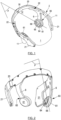
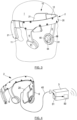
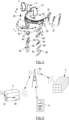
- FIGS. 1 to 3 show part of a device according to the invention, which is designed to identify one or more bruxism phenomena in a person 1, to collect data specific to this phenomenon and to generate an action aimed at reducing the phenomenon.
- This part is in the form of a helmet-shaped structure 2 and is associated with a base 3, shown in figure 4 .
- the base 3 makes it possible to load the data collected by the helmet-shaped structure to transmit them to a remote server 4, implementing an application (for example a mobile application), which allows the person 1 to follow, for example on his smartphone 5 (implementing the application), the evolution of the bruxism episodes that he undergoes and the results obtained on these phenomena using the helmet-shaped structure 2.
- an application for example a mobile application
- Structure 2 shown in Figures 1 and 2 includes a headband 20 which is designed so that, when the person wears the structure, the headband 20 is placed on a person's forehead and extends on either side of the head 10, above the person's ears 11.
- the strip 20 has two symmetrical parts with respect to a plane of symmetry P, vertical when the structure is worn by the person 1.
- the ends of the headband 20 are secured to two boxes 21, which are placed behind the ears 11 of the person.
- the two boxes 21 can accommodate, on the one hand, two SONETONE® type devices 23, which can capture and possibly amplify the sounds emitted by the person 1 (each of the boxes includes a device 23 - see figure 5 ). The usefulness of these devices and their interactions with other elements of the device according to the invention will be explained later.
- one of the boxes 21 accommodates a battery 23, ensuring the energy supply of the structure for its operation ( figure 5 ).
- the headband 20 is not designed to go around the head, the back of the person's head 10 is thus free and can rest on a comfortable support without pressure on the back of the skull.
- the headband 20 integrates two temporal circuits 22, which can be seen in particular on the figure 5 : the two temporal circuits 22 are placed in the headband at a position where they are placed against the temporal muscles of the person 1 when he wears the structure 2.
- the temporal circuits 22 are EMG type sensors or Flexiforce ® sensors for recording the electrical activity of a muscle or nerve, to enable electromyography (also called electroneuromyogram) to be performed: thus during a bruxism phenomenon, when the temporal muscles contract, the temporal circuits are able to detect it and generate data specific to the activity of the temporal muscles.
- electromyography also called electroneuromyogram
- a memory which the structure also includes: this memory is incorporated in a motherboard 25 placed in one of the boxes 21.
- the structure 1 also comprises two arms 6, integral with the strip 20, symmetrical with respect to the plane P and which extend downwards from the strip to have free ends 60 carrying two cassettes 61.
- Each cassette 61 is located at such a distance from the headband that it is placed against a masseter muscle of the person's face 1 when the person is wearing the structure 2.
- each of the cassettes 61 comprises a circuit 62, called “masseter circuit”, capable of detecting a contraction of the masseter muscle on which said free end 60 of each arm 6 is positioned.
- the masseter circuit 61 comprises flexible piezoresistive force sensors 63, known for example commercially as Flexiforce® sensors, which are capable of detecting a contraction of the masseter muscle and of emitting data upon this detection.
- the muscle contraction sensor 63 comprises a printed circuit 64 on a flexible strip, on which a pad 65 rests: when contracting, the masseter muscle exerts pressure on the pad 64 which presses on the circuit 64, which then generates data characteristic of the muscle contraction (force and duration for example).
- each cassette has a foam 65 with suitable cutouts, accommodating these elements.
- One of the foam cutouts 65 is designed to accommodate a vibration device 60, capable of emitting vibrations and capable of operating in a first mode where it does not generate vibrations (standby state) and in a second mode where it generates vibrations (being in operation).
- the control of the operation of the vibration devices 66 is ensured by an analysis and control module, which is incorporated into the motherboard 25.
- the analysis and control module is capable of collecting data relating to these contractions or to this electrical activity, to analyze them in order to provide a possible response. These data and the response provided by the analysis and control module are recorded in the memory of the structure 2, which is also included in the motherboard 25.
- the response possibly provided, mentioned above, by the analysis and control module consists of switching the vibration devices from their standby state to their operating state, or vice versa, according to predetermined threshold data entered in the motherboard: this involves determining whether, depending on the intensity of the muscle contractions and their contraction duration, it is necessary to generate vibrations at the level of the masseter muscles or not.
- the vibrations generated have frequencies of 10 to 150 Hz and amplitudes of 0.1 to 5 mm: these frequency and amplitude ranges are such that they are detectable by the masseter muscles and by the neurons that ensure their contraction, to allow data to be transmitted to the brain aimed at deceiving it and reducing the brain activity at the origin of the contraction of the masseter and temporal muscles that characterize bruxism episodes.
- the analysis and control module orders the operation of the vibration devices which indicate to the brain that the masseter or temporal muscles are contracted, so that the brain stops ordering this contraction: in fact, by receiving messages generated by the vibrations captured by the muscles, the brain is deceived and stops generating orders at the origin of the bruxism phenomenon.
- the analysis and control module also communicates with another device that the structure comprises, in the headband 20: the headband comprises a heart rate detector 30, positioned substantially in said plane of symmetry P (or positioned in said plane of symmetry) of said structure 2, capable of being positioned on a forehead 12 of the person.
- the position of the heart rate detector is given here as an example of implementation. According to other embodiments of a device according to the invention, the heart rate detector could be positioned on a temporal artery, for example (therefore not positioned in the plane of symmetry), without departing from the scope of the invention.
- the heart rate sensor 30 communicates with the analysis and control module and consists of an oximeter, i.e. a device that measures the heart rate and the concentration of oxygen in the blood.
- an oximeter i.e. a device that measures the heart rate and the concentration of oxygen in the blood.
- This oximeter thus has the advantage of monitoring another parameter that can indicate a phenomenon of bruxism, since a link has been demonstrated between the phenomenon of bruxism and a change in the heart rate of people experiencing these phenomena: this is how a person's heart rate can increase by 40%.
- the analysis and control module can also control the operating state of the vibration devices, to fool the brain and thus contribute to a return to normal of the person's heart rate.
- the noise detection devices 23 are also connected with the analysis and control module. They are also connected with the memory of the structure 2 to record the various noises made by the person, for example snoring, grinding of teeth, the sound of the person's breathing which may stop and reveal sleep apnea phenomena.
- a final gyroscope-type device also equips the structure 2 of the device according to the invention: it is included in the headband 2, for example, and makes it possible to detect the movements of the person's head during their sleep, to record this movement information in the form of data in the memory of the motherboard 25.
- all the information collected by the devices equipping the structure 2 is recorded in the analysis and control module of the structure, to enable the delivery to the person not only of information relating to the phenomenon of bruxism that they are experiencing, its evolution following the use of the device in accordance with the invention, but also other information on phenomena that may or may not be linked to bruxism.
- the device includes a base 3, attached to the structure, which was presented further in this story, which is designed not only to retrieve the data recorded in the memory of the structure 2, but also to transmit this data so that it can be returned to the person, for example via a smartphone application or via a website.
- the structure is not designed, in fact, to transmit information directly to a remote server: to do this, it would be necessary to equip the structure with a communication module that emits waves. Even if this embodiment is not excluded from the embodiments in accordance with the invention, it was chosen to produce a separate base, equipped with such a communication module, which is placed at a distance from the person when they are wearing the structure, so as not to put the person in contact with possible transmission waves between the base and a remote server.
- the base therefore makes it possible to recover the data recorded in the structure and includes, for this purpose, a communication module, as well as a module for receiving and storing data from structure 2: these modules bearing the references 50 and 51 respectively have been schematically represented by dotted rectangles on the figure 4 .
- the communication module 50 ensures the transfer of data, for example via a long-distance communication network 53 to a remote server 4 which implements a smartphone or Internet application dedicated to the invention.
- the update information of the application and the data it includes, concerning the person using the device according to the invention, are transmitted to the smartphone 5 also by the long-distance communication network 53.
- Base 3 also allows the battery 24 of structure 2 to be recharged.
- base 3 is equipped with a USB socket, which connects to a USB cable (reference 40, figure 4 ) connected to the box 21 of the structure 2 containing the battery 24.
- a person suffering from bruxism wishes to have a first session with the device in accordance with the invention.
- Structure 2 is positioned on the person's head 1, and the structure is put into operation by pressing the contact button, for example.
- the temporal muscles also generate electrical activity.
- the masseter and temporalis circuits then transmit data relating to the contraction of the temporalis and/or masseter muscles to the structure's analysis and control module.
- the person may emit sounds produced by the grinding of teeth rubbing against each other: in this case, these events are captured by SONOTONE ® type devices and are also recorded by this analysis and control module.
- These sounds can be associated with recorded data instead of the sound itself, for example the intensity of the sound and its duration can be recorded.
- Heart rate can also be recorded in real time by the analysis and control module, thanks to the oximeter positioned on the person's forehead 12.
- the analysis and control module activates the vibration devices, which bring the masseter muscles into contact with the vibrations.
- Data is considered to be characteristic of a bruxism phenomenon if the intensity and duration of the muscle contractions are consistent with those identified as indicating a bruxism phenomenon in a database contained on the motherboard 25 of the structure.
- the data collected by the analysis and control module are compared with the data in the database
- the device can operate by generating vibrations as soon as activity is detected at the masseters and/or temporalis.
- the vibrations, generated by The vibration devices in the masseter circuits are perceived by the masseter muscles, which relax under their action.
- the neural network of the masseter muscles captures these vibrations and sends a signal to the brain according to which the muscles are stimulated, so that the brain, deceived, stops ordering the contraction of these masseter muscles.
- the control of the operation of the vibration devices can be activated or deactivated by also monitoring the person's heart rate.
- the oximeter then detects that the person's heart rate drops to a predetermined threshold, below which the analysis and control module stops the vibration devices from operating.
- the threshold below which the vibration devices are deactivated and above which the vibration devices are activated is determined for each person.
- the analysis and control module records the person's heart rate at regular time intervals and takes an average to determine an average heart rate.
- the control module will determine the threshold value by multiplying this average heart rate by 1.3, so that the vibration devices are triggered if the person's heart rate is identified as being higher than 20% of its average value, for example.
- the data received by the analysis and control module is recorded for a predetermined time.
- This time can be eight hours, for example.
- Several sessions can also be recorded by the structure before the data is collected by base 3, when the structure's battery is recharged.
- Base 3 transmits the data it has collected to the remote server, for example by associating them with a user identifier: thus, the server only informs the user account with the data it receives. This data is then returned, for example in the form of curves or a table to the user (person 1) who can thus follow, on his smartphone, the evolution of the bruxism episodes that she may have, their duration and intensity, as the device according to the invention is used.
- FIG. 7 is a graph illustrating events occurring during a session with the device according to the invention.
- the time elapsed, in seconds, is indicated on the abscissa, the ordinates on the left correspond to the number of bits recorded, generated by an electrical or muscular activity of the masseters and the ordinates on the right correspond to the intensity of the vibrations generated by the vibration device, depending on the vibration mode that is activated.
- the reference 80 corresponds to the activity of the right masseter recorded, the reference 70 corresponds to the activity of the left masseter recorded.
- Reference 91 corresponds to a second mode of operation: the vibration devices 66 are triggered three times for ten seconds, these three triggers being generated following the detection, by one of the sensors 63, of activity of the left or right masseters for at least 2 seconds.
- FIG. 8 is another graph, illustrating the events during another session implementing the device according to the invention.
- the time elapsed, in seconds, is indicated on the abscissa, the ordinates on the left correspond to the number of bits recorded, generated by electrical or muscular activity of the masseters and the ordinates on the right correspond to the intensity of the vibrations generated by the vibration device.
- the activity of the left and right masseters is not significant (curves 70 and 80 are regular and substantially flat, or flat). However, it is noted that the vibration devices are activated twice (reference 93) when the heart rate detector, illustrated by the curve bearing the reference 100, records a sudden increase in heart rate (increase in heart rate of more than 20%).
Landscapes
- Health & Medical Sciences (AREA)
- Otolaryngology (AREA)
- Pulmonology (AREA)
- Nursing (AREA)
- Orthopedic Medicine & Surgery (AREA)
- Engineering & Computer Science (AREA)
- Biomedical Technology (AREA)
- Heart & Thoracic Surgery (AREA)
- Vascular Medicine (AREA)
- Life Sciences & Earth Sciences (AREA)
- Animal Behavior & Ethology (AREA)
- General Health & Medical Sciences (AREA)
- Public Health (AREA)
- Veterinary Medicine (AREA)
- Measurement Of The Respiration, Hearing Ability, Form, And Blood Characteristics Of Living Organisms (AREA)
Claims (16)
- Vorrichtung zur Unterstützung der Bekämpfung von Bruxismus, umfassend eine Struktur (2), die geeignet ist, auf dem Kopf (1) einer Person getragen zu werden, wobei die Struktur (2) ein Band (20) umfasst, das eine Symmetrieebene (P) aufweist, von der aus es sich beidseitig erstreckt, wobei die Struktur (2) zwei Arme (6) umfasst, die symmetrisch bezüglich der Symmetrieebene (P) sind, wobei die zwei Arme (6) über ein erstes Armende mit dem Band (20) verbunden sind, wobei die Vorrichtung dadurch gekennzeichnet ist, dass sich die beiden Arme (6) vom Band aus nach unten erstrecken und jeweils ein zweites, freies Ende (60) aufweisen, wobei sich das zweite, freie Armende (60) jeweils in einem solchen Abstand von dem Band befindet, dass es sich gegen einen Kaumuskel positionieren kann, wenn die Person die Struktur (2) trägt, und das zweite Ende (60) eine Kauschaltung (63) trägt, die eine Kontraktion des Kaumuskels nachweisen kann, auf dem das freie Armende (60) positioniert ist, wobei das freie Ende eine Vibrationsvorrichtung (66) umfasst, die entweder einen Funktionszustand, gemäß dem sie Schwingungen aussendet, oder einen Wachzustand, gemäß dem sie keine Schwingungen aussendet, annehmen kann,
wobei die Vorrichtung ein Analyse- und Steuermodul (25) umfasst, das mit den Kauschaltungen (63) und mit den Vibrationsvorrichtungen (66) kommuniziert, wobei das Analyse- und Steuermodul (25) in der Lage ist, die Daten bezüglich der nachgewiesenen Kontraktionen zu sammeln und zu analysieren, und in der Lage ist, den Übergang der Vibrationsvorrichtungen (66) vom Funktionszustand zum Wachzustand und umgekehrt zu steuern. - Vorrichtung gemäß Anspruch 1, dadurch gekennzeichnet, dass das Band (20) einen Herzfrequenzdetektor (30) umfasst, der sich entweder auf der Stirn (12) der Person oder auf einer Schläfenarterie positionieren kann, wobei der Herzfrequenzdetektor (30) mit dem Analyse- und Steuermodul (25) kommunizieren kann.
- Vorrichtung gemäß einem der vorstehenden Ansprüche, dadurch gekennzeichnet, dass das Band (20) zwei Schläfenschaltungen (22) umfasst, wobei die zwei Schläfenschaltungen (22) auf den Schläfenmuskeln der Person, die die Struktur (2) trägt, positioniert werden können und Kontraktionen der Schläfenmuskeln dieser Person nachweisen können.
- Vorrichtung gemäß einem der vorstehenden Ansprüche, dadurch gekennzeichnet, dass die Struktur (2) einen Speicher umfasst, um die von dem Analyse- und Steuermodul (25) empfangenen Daten in Bezug auf die nachgewiesenen Kontraktionen aufzuzeichnen.
- Vorrichtung gemäß einem der vorstehenden Ansprüche, dadurch gekennzeichnet, dass die Struktur (2) eine Batterie (24) umfasst, und dadurch, dass die Vorrichtung eine Basis (3) umfasst, die von der Struktur (2) losgelöst ist, wobei die Basis (3) die Batterie (24) wiederaufladen kann.
- Vorrichtung gemäß Anspruch 4 und 5, dadurch gekennzeichnet, dass die Basis (3) ein Modul (50) zur Kommunikation mit einem Fernserver (4) umfasst, und dadurch, dass die Basis (3) ein Modul (51) zum Empfangen und Speichern von Daten umfasst, das die in dem Speicher der Struktur (2) aufgezeichneten Daten aufnehmen und speichern kann, wobei das Kommunikationsmodul (50) die gespeicherten Daten an den Fernserver (4) senden kann.
- Vorrichtung gemäß einem der vorstehenden Ansprüche, dadurch gekennzeichnet, dass die Kauschaltungen (63) flexible piezoresistive Kraftsensoren (63, 64) umfassen, wobei die Kraftsensoren (63, 64) eine Kontraktion des Kaumuskels nachweisen können.
- Vorrichtung gemäß einem der vorstehenden Ansprüche, dadurch gekennzeichnet, dass die Schläfenschaltungen (22) EMG-Sensoren umfassen, die Kontraktionen des Schläfenmuskels der Person und/oder eine neuronale Aktivität an den Schläfenmuskeln der Person nachweisen können.
- Vorrichtung gemäß Anspruch 2, dadurch gekennzeichnet, dass der Herzfrequenzdetektor (30) ein Oximeter umfasst.
- Vorrichtung gemäß Anspruch 2, dadurch gekennzeichnet, dass der Herzfrequenzdetektor photoplethysmographische Sensoren umfasst.
- Vorrichtung gemäß einem der vorstehenden Ansprüche, dadurch gekennzeichnet, dass die Struktur (2) wenigstens eine Apparatur (23) umfasst, mit der die von der Person ausgehenden Geräusche nachgewiesen und gegebenenfalls verstärkt werden können, wobei die wenigstens eine Apparatur (23) mit dem Analyse- und Steuermodul (25) kommunizieren kann.
- Vorrichtung gemäß einem der vorstehenden Ansprüche, dadurch gekennzeichnet, dass die Struktur (2) ein Gyroskop oder einen Beschleunigungsmesser umfasst, das bzw. der mit dem Analyse- und Steuermodul kommunizieren kann.
- Verfahren zur Anwendung einer Vorrichtung gemäß einem der vorstehenden Ansprüche, die wenigstens die Merkmale von Anspruch 3 umfasst, wobei das Verfahren die folgenden Schritte umfasst:- Nachweis von Kontraktionen des Schläfenmuskels der Person durch die Schläfenschaltungen (22) und/oder- Nachweis einer Kontraktion eines Kaumuskels, auf dem das freie Armende positioniert ist, durch die Kauschaltungen (63),- Analyse der von dem Analyse- und Steuermodul (25) nachgewiesenen Muskelkontraktionen und- Aktivierung wenigstens einer der Vibrationsvorrichtungen (66) durch das Analyse- und Steuermodul (25) auf Befehl des Funktionszustands des wenigstens einen der Vibrationsvorrichtungen (66).
- Verfahren gemäß Anspruch 13, das eine Vorrichtung gemäß Anspruch 2, 9 oder 10 anwendet, dadurch gekennzeichnet, dass es einen zusätzlichen Schritt umfasst, gemäß dem:- man eine mittlere Herzfrequenz der Person bestimmt,- man eine reale Herzfrequenz der Person überwacht, indem man in regelmäßigen Zeitabständen Herzfrequenzdaten von dem Herzfrequenzdetektor (30) bestimmt,- man die bestimmten Herzfrequenzdaten mit der mittleren Herzfrequenz vergleicht und- wenn die bestimmten Herzfrequenzdaten größer als ein vorbestimmter Prozentsatz der mittleren Herzfrequenz sind, aktiviert das Analyse- und Steuermodul (25) wenigstens eine der Vibrationsvorrichtungen (66) auf Befehl des Funktionszustands des wenigstens einen der Vibrationsvorrichtungen.
- Verfahren gemäß einem der Ansprüche 13 oder 14, dadurch gekennzeichnet, dass man Daten in Bezug auf nachgewiesene oder nicht nachgewiesene Muskelkontraktionen über einen gegebenen Zeitraum aufzeichnet.
- Verfahren gemäß Anspruch 15, das die Vorrichtung gemäß Anspruch 5 anwendet, dadurch gekennzeichnet, dass die aufgezeichneten Daten in das Modul (51) zum Empfangen und Speichern von Daten der Basis (3) geladen werden, und dadurch, dass das Kommunikationsmodul (50) der Basis (3) die aufgezeichneten Daten an einen Fernserver (4) sendet, wobei der Fernserver (4) die aufgezeichneten Daten verarbeitet, um sie insbesondere über eine App, die von einem IT-Werkzeug ausgeführt wird, an die Person zurückzugeben.
Priority Applications (2)
| Application Number | Priority Date | Filing Date | Title |
|---|---|---|---|
| EP22305329.9A EP4248919B1 (de) | 2022-03-21 | 2022-03-21 | Vorrichtung für die behandlung und prävention von bruxismus, verfahren zur anwendung einer solchen vorrichtung |
| PCT/EP2023/057012 WO2023180229A1 (fr) | 2022-03-21 | 2023-03-20 | Dispositif pour le traitement et la prévention du bruxisme, procédé de mise en œuvre d'un tel dispositif |
Applications Claiming Priority (1)
| Application Number | Priority Date | Filing Date | Title |
|---|---|---|---|
| EP22305329.9A EP4248919B1 (de) | 2022-03-21 | 2022-03-21 | Vorrichtung für die behandlung und prävention von bruxismus, verfahren zur anwendung einer solchen vorrichtung |
Publications (2)
| Publication Number | Publication Date |
|---|---|
| EP4248919A1 EP4248919A1 (de) | 2023-09-27 |
| EP4248919B1 true EP4248919B1 (de) | 2024-09-04 |
Family
ID=80999155
Family Applications (1)
| Application Number | Title | Priority Date | Filing Date |
|---|---|---|---|
| EP22305329.9A Active EP4248919B1 (de) | 2022-03-21 | 2022-03-21 | Vorrichtung für die behandlung und prävention von bruxismus, verfahren zur anwendung einer solchen vorrichtung |
Country Status (2)
| Country | Link |
|---|---|
| EP (1) | EP4248919B1 (de) |
| WO (1) | WO2023180229A1 (de) |
Family Cites Families (4)
| Publication number | Priority date | Publication date | Assignee | Title |
|---|---|---|---|---|
| FR2618327A1 (fr) | 1987-07-24 | 1989-01-27 | Mequignon Jean Claude | Dispositif destine a lutter contre le grincement des dents, diurne ou nocturne, manifestation du bruxisme |
| WO1997043954A1 (en) | 1996-05-24 | 1997-11-27 | Brux Care L.L.C. | Bruxism biofeedback apparatus and method |
| JP5308445B2 (ja) | 2007-09-21 | 2013-10-09 | サンスター スイス エスエー | 電極の接続状態の監視 |
| US20190313934A1 (en) * | 2016-06-10 | 2019-10-17 | Biotrak Health, Inc. | Device and system for monitoring and treating muscle tension-related medical conditions |
-
2022
- 2022-03-21 EP EP22305329.9A patent/EP4248919B1/de active Active
-
2023
- 2023-03-20 WO PCT/EP2023/057012 patent/WO2023180229A1/fr not_active Ceased
Also Published As
| Publication number | Publication date |
|---|---|
| WO2023180229A1 (fr) | 2023-09-28 |
| EP4248919A1 (de) | 2023-09-27 |
Similar Documents
| Publication | Publication Date | Title |
|---|---|---|
| US8160689B2 (en) | Method of and apparatus for monitoring of muscle activity | |
| US7885706B2 (en) | System and device for seizure detection | |
| US20050240086A1 (en) | Intelligent wearable monitor systems and methods | |
| JP2021509078A (ja) | ブラキシズム管理用の装置及び方法 | |
| FR2917298A1 (fr) | Dispositif de traitement pouvant etre porte par un patient et procede de traitement cardiaque d'un patient | |
| EP2825257A1 (de) | Externes defibrillatorsystem für den haushaltsgebrauch | |
| US20240389933A1 (en) | Bruxism, sleep, and dental health monitoring platform | |
| WO2016083999A1 (fr) | Dispositif de stimulation vibrotactile | |
| US7310648B2 (en) | System for compression of physiological signals | |
| FR3124398A1 (fr) | Dispositif de neurostimulation électrique transcutanée comprenant des surfaces conductrices et une interface de connexion a un patch d’electrostimulation | |
| CN110916867A (zh) | 颈部可穿戴设备、颈部可穿戴系统及其交互平台 | |
| US12502124B2 (en) | Diagnosis and monitoring of bruxism using earbud motion sensors | |
| EP4248919B1 (de) | Vorrichtung für die behandlung und prävention von bruxismus, verfahren zur anwendung einer solchen vorrichtung | |
| US20210369189A1 (en) | Bruxism detection and correction device | |
| JP7410854B2 (ja) | 睡眠モニタリングに関する改善 | |
| US20210022679A1 (en) | Sensor Devices and Methods for Detecting when a Sensor Device is Worn | |
| FR2982130A1 (fr) | Systeme therapeutique intelligent pour traitement neuropsychomoteur sous forme d'une semelle integrant des moyens generant des vibrations | |
| EP0681447A1 (de) | Vorrichtung und verfahren zur bestimmung von physiologischen daten sowie anwendung | |
| EP3264981B1 (de) | Hilfsvorrichtung für personen mit motorischen störungen neurologischen ursprungs | |
| EP2675342B1 (de) | Endgerät zur unterstützung bei der fernüberwachung einer mit einer medizinischen hilfsvorrichtung verbundenen person und überwachungsvorrichtung dafür | |
| KR102607378B1 (ko) | 딥러닝을 이용한 기도에서의 음식물 역류 감지 시스템 | |
| FR2978027A1 (fr) | Dispositif acoustique d'acquisition du rythme cardiaque | |
| WO2024115682A1 (en) | Device for detecting and treating bruxism and method for doing the same | |
| Freitas et al. | Technologies Applied to Diagnosis and Treatment of Bruxism and Sleep Bruxism: Literature Review | |
| FR2768323A1 (fr) | Appareil de detection et de restitution du bruit cardiaque |
Legal Events
| Date | Code | Title | Description |
|---|---|---|---|
| PUAI | Public reference made under article 153(3) epc to a published international application that has entered the european phase |
Free format text: ORIGINAL CODE: 0009012 |
|
| STAA | Information on the status of an ep patent application or granted ep patent |
Free format text: STATUS: THE APPLICATION HAS BEEN PUBLISHED |
|
| AK | Designated contracting states |
Kind code of ref document: A1 Designated state(s): AL AT BE BG CH CY CZ DE DK EE ES FI FR GB GR HR HU IE IS IT LI LT LU LV MC MK MT NL NO PL PT RO RS SE SI SK SM TR |
|
| STAA | Information on the status of an ep patent application or granted ep patent |
Free format text: STATUS: REQUEST FOR EXAMINATION WAS MADE |
|
| 17P | Request for examination filed |
Effective date: 20240222 |
|
| RBV | Designated contracting states (corrected) |
Designated state(s): AL AT BE BG CH CY CZ DE DK EE ES FI FR GB GR HR HU IE IS IT LI LT LU LV MC MK MT NL NO PL PT RO RS SE SI SK SM TR |
|
| GRAP | Despatch of communication of intention to grant a patent |
Free format text: ORIGINAL CODE: EPIDOSNIGR1 |
|
| STAA | Information on the status of an ep patent application or granted ep patent |
Free format text: STATUS: GRANT OF PATENT IS INTENDED |
|
| RIC1 | Information provided on ipc code assigned before grant |
Ipc: A61F 5/56 20060101ALN20240320BHEP Ipc: A61F 5/058 20060101AFI20240320BHEP |
|
| INTG | Intention to grant announced |
Effective date: 20240411 |
|
| GRAS | Grant fee paid |
Free format text: ORIGINAL CODE: EPIDOSNIGR3 |
|
| GRAA | (expected) grant |
Free format text: ORIGINAL CODE: 0009210 |
|
| STAA | Information on the status of an ep patent application or granted ep patent |
Free format text: STATUS: THE PATENT HAS BEEN GRANTED |
|
| AK | Designated contracting states |
Kind code of ref document: B1 Designated state(s): AL AT BE BG CH CY CZ DE DK EE ES FI FR GB GR HR HU IE IS IT LI LT LU LV MC MK MT NL NO PL PT RO RS SE SI SK SM TR |
|
| REG | Reference to a national code |
Ref country code: GB Ref legal event code: FG4D Free format text: NOT ENGLISH |
|
| REG | Reference to a national code |
Ref country code: CH Ref legal event code: EP |
|
| REG | Reference to a national code |
Ref country code: IE Ref legal event code: FG4D Free format text: LANGUAGE OF EP DOCUMENT: FRENCH |
|
| REG | Reference to a national code |
Ref country code: DE Ref legal event code: R096 Ref document number: 602022005885 Country of ref document: DE |
|
| P01 | Opt-out of the competence of the unified patent court (upc) registered |
Free format text: CASE NUMBER: APP_52812/2024 Effective date: 20240920 |
|
| REG | Reference to a national code |
Ref country code: LT Ref legal event code: MG9D |
|
| REG | Reference to a national code |
Ref country code: NL Ref legal event code: MP Effective date: 20240904 |
|
| PG25 | Lapsed in a contracting state [announced via postgrant information from national office to epo] |
Ref country code: NO Free format text: LAPSE BECAUSE OF FAILURE TO SUBMIT A TRANSLATION OF THE DESCRIPTION OR TO PAY THE FEE WITHIN THE PRESCRIBED TIME-LIMIT Effective date: 20241204 |
|
| PG25 | Lapsed in a contracting state [announced via postgrant information from national office to epo] |
Ref country code: FI Free format text: LAPSE BECAUSE OF FAILURE TO SUBMIT A TRANSLATION OF THE DESCRIPTION OR TO PAY THE FEE WITHIN THE PRESCRIBED TIME-LIMIT Effective date: 20240904 Ref country code: GR Free format text: LAPSE BECAUSE OF FAILURE TO SUBMIT A TRANSLATION OF THE DESCRIPTION OR TO PAY THE FEE WITHIN THE PRESCRIBED TIME-LIMIT Effective date: 20241205 |
|
| PG25 | Lapsed in a contracting state [announced via postgrant information from national office to epo] |
Ref country code: BG Free format text: LAPSE BECAUSE OF FAILURE TO SUBMIT A TRANSLATION OF THE DESCRIPTION OR TO PAY THE FEE WITHIN THE PRESCRIBED TIME-LIMIT Effective date: 20240904 |
|
| PG25 | Lapsed in a contracting state [announced via postgrant information from national office to epo] |
Ref country code: LV Free format text: LAPSE BECAUSE OF FAILURE TO SUBMIT A TRANSLATION OF THE DESCRIPTION OR TO PAY THE FEE WITHIN THE PRESCRIBED TIME-LIMIT Effective date: 20240904 |
|
| PG25 | Lapsed in a contracting state [announced via postgrant information from national office to epo] |
Ref country code: HR Free format text: LAPSE BECAUSE OF FAILURE TO SUBMIT A TRANSLATION OF THE DESCRIPTION OR TO PAY THE FEE WITHIN THE PRESCRIBED TIME-LIMIT Effective date: 20240904 |
|
| PG25 | Lapsed in a contracting state [announced via postgrant information from national office to epo] |
Ref country code: ES Free format text: LAPSE BECAUSE OF FAILURE TO SUBMIT A TRANSLATION OF THE DESCRIPTION OR TO PAY THE FEE WITHIN THE PRESCRIBED TIME-LIMIT Effective date: 20240904 Ref country code: RS Free format text: LAPSE BECAUSE OF FAILURE TO SUBMIT A TRANSLATION OF THE DESCRIPTION OR TO PAY THE FEE WITHIN THE PRESCRIBED TIME-LIMIT Effective date: 20241204 |
|
| PG25 | Lapsed in a contracting state [announced via postgrant information from national office to epo] |
Ref country code: RS Free format text: LAPSE BECAUSE OF FAILURE TO SUBMIT A TRANSLATION OF THE DESCRIPTION OR TO PAY THE FEE WITHIN THE PRESCRIBED TIME-LIMIT Effective date: 20241204 Ref country code: NO Free format text: LAPSE BECAUSE OF FAILURE TO SUBMIT A TRANSLATION OF THE DESCRIPTION OR TO PAY THE FEE WITHIN THE PRESCRIBED TIME-LIMIT Effective date: 20241204 Ref country code: LV Free format text: LAPSE BECAUSE OF FAILURE TO SUBMIT A TRANSLATION OF THE DESCRIPTION OR TO PAY THE FEE WITHIN THE PRESCRIBED TIME-LIMIT Effective date: 20240904 Ref country code: HR Free format text: LAPSE BECAUSE OF FAILURE TO SUBMIT A TRANSLATION OF THE DESCRIPTION OR TO PAY THE FEE WITHIN THE PRESCRIBED TIME-LIMIT Effective date: 20240904 Ref country code: GR Free format text: LAPSE BECAUSE OF FAILURE TO SUBMIT A TRANSLATION OF THE DESCRIPTION OR TO PAY THE FEE WITHIN THE PRESCRIBED TIME-LIMIT Effective date: 20241205 Ref country code: FI Free format text: LAPSE BECAUSE OF FAILURE TO SUBMIT A TRANSLATION OF THE DESCRIPTION OR TO PAY THE FEE WITHIN THE PRESCRIBED TIME-LIMIT Effective date: 20240904 Ref country code: ES Free format text: LAPSE BECAUSE OF FAILURE TO SUBMIT A TRANSLATION OF THE DESCRIPTION OR TO PAY THE FEE WITHIN THE PRESCRIBED TIME-LIMIT Effective date: 20240904 Ref country code: BG Free format text: LAPSE BECAUSE OF FAILURE TO SUBMIT A TRANSLATION OF THE DESCRIPTION OR TO PAY THE FEE WITHIN THE PRESCRIBED TIME-LIMIT Effective date: 20240904 |
|
| REG | Reference to a national code |
Ref country code: AT Ref legal event code: MK05 Ref document number: 1719604 Country of ref document: AT Kind code of ref document: T Effective date: 20240904 |
|
| PG25 | Lapsed in a contracting state [announced via postgrant information from national office to epo] |
Ref country code: NL Free format text: LAPSE BECAUSE OF FAILURE TO SUBMIT A TRANSLATION OF THE DESCRIPTION OR TO PAY THE FEE WITHIN THE PRESCRIBED TIME-LIMIT Effective date: 20240904 |
|
| PG25 | Lapsed in a contracting state [announced via postgrant information from national office to epo] |
Ref country code: IS Free format text: LAPSE BECAUSE OF FAILURE TO SUBMIT A TRANSLATION OF THE DESCRIPTION OR TO PAY THE FEE WITHIN THE PRESCRIBED TIME-LIMIT Effective date: 20250104 Ref country code: PT Free format text: LAPSE BECAUSE OF FAILURE TO SUBMIT A TRANSLATION OF THE DESCRIPTION OR TO PAY THE FEE WITHIN THE PRESCRIBED TIME-LIMIT Effective date: 20250106 |
|
| PG25 | Lapsed in a contracting state [announced via postgrant information from national office to epo] |
Ref country code: RO Free format text: LAPSE BECAUSE OF FAILURE TO SUBMIT A TRANSLATION OF THE DESCRIPTION OR TO PAY THE FEE WITHIN THE PRESCRIBED TIME-LIMIT Effective date: 20240904 Ref country code: SM Free format text: LAPSE BECAUSE OF FAILURE TO SUBMIT A TRANSLATION OF THE DESCRIPTION OR TO PAY THE FEE WITHIN THE PRESCRIBED TIME-LIMIT Effective date: 20240904 |
|
| PG25 | Lapsed in a contracting state [announced via postgrant information from national office to epo] |
Ref country code: AT Free format text: LAPSE BECAUSE OF FAILURE TO SUBMIT A TRANSLATION OF THE DESCRIPTION OR TO PAY THE FEE WITHIN THE PRESCRIBED TIME-LIMIT Effective date: 20240904 Ref country code: EE Free format text: LAPSE BECAUSE OF FAILURE TO SUBMIT A TRANSLATION OF THE DESCRIPTION OR TO PAY THE FEE WITHIN THE PRESCRIBED TIME-LIMIT Effective date: 20240904 |
|
| PG25 | Lapsed in a contracting state [announced via postgrant information from national office to epo] |
Ref country code: CZ Free format text: LAPSE BECAUSE OF FAILURE TO SUBMIT A TRANSLATION OF THE DESCRIPTION OR TO PAY THE FEE WITHIN THE PRESCRIBED TIME-LIMIT Effective date: 20240904 Ref country code: PL Free format text: LAPSE BECAUSE OF FAILURE TO SUBMIT A TRANSLATION OF THE DESCRIPTION OR TO PAY THE FEE WITHIN THE PRESCRIBED TIME-LIMIT Effective date: 20240904 |
|
| PG25 | Lapsed in a contracting state [announced via postgrant information from national office to epo] |
Ref country code: IT Free format text: LAPSE BECAUSE OF FAILURE TO SUBMIT A TRANSLATION OF THE DESCRIPTION OR TO PAY THE FEE WITHIN THE PRESCRIBED TIME-LIMIT Effective date: 20240904 Ref country code: SK Free format text: LAPSE BECAUSE OF FAILURE TO SUBMIT A TRANSLATION OF THE DESCRIPTION OR TO PAY THE FEE WITHIN THE PRESCRIBED TIME-LIMIT Effective date: 20240904 |
|
| REG | Reference to a national code |
Ref country code: DE Ref legal event code: R097 Ref document number: 602022005885 Country of ref document: DE |
|
| PG25 | Lapsed in a contracting state [announced via postgrant information from national office to epo] |
Ref country code: DK Free format text: LAPSE BECAUSE OF FAILURE TO SUBMIT A TRANSLATION OF THE DESCRIPTION OR TO PAY THE FEE WITHIN THE PRESCRIBED TIME-LIMIT Effective date: 20240904 |
|
| PLBE | No opposition filed within time limit |
Free format text: ORIGINAL CODE: 0009261 |
|
| STAA | Information on the status of an ep patent application or granted ep patent |
Free format text: STATUS: NO OPPOSITION FILED WITHIN TIME LIMIT |
|
| 26N | No opposition filed |
Effective date: 20250605 |
|
| PG25 | Lapsed in a contracting state [announced via postgrant information from national office to epo] |
Ref country code: SE Free format text: LAPSE BECAUSE OF FAILURE TO SUBMIT A TRANSLATION OF THE DESCRIPTION OR TO PAY THE FEE WITHIN THE PRESCRIBED TIME-LIMIT Effective date: 20240904 |
|
| REG | Reference to a national code |
Ref country code: DE Ref legal event code: R119 Ref document number: 602022005885 Country of ref document: DE |
|
| PG25 | Lapsed in a contracting state [announced via postgrant information from national office to epo] |
Ref country code: MC Free format text: LAPSE BECAUSE OF FAILURE TO SUBMIT A TRANSLATION OF THE DESCRIPTION OR TO PAY THE FEE WITHIN THE PRESCRIBED TIME-LIMIT Effective date: 20240904 |
|
| REG | Reference to a national code |
Ref country code: CH Ref legal event code: H13 Free format text: ST27 STATUS EVENT CODE: U-0-0-H10-H13 (AS PROVIDED BY THE NATIONAL OFFICE) Effective date: 20251023 |
|
| PG25 | Lapsed in a contracting state [announced via postgrant information from national office to epo] |
Ref country code: LU Free format text: LAPSE BECAUSE OF NON-PAYMENT OF DUE FEES Effective date: 20250321 |
|
| REG | Reference to a national code |
Ref country code: BE Ref legal event code: MM Effective date: 20250331 |
|
| PG25 | Lapsed in a contracting state [announced via postgrant information from national office to epo] |
Ref country code: DE Free format text: LAPSE BECAUSE OF NON-PAYMENT OF DUE FEES Effective date: 20251001 |
|
| PG25 | Lapsed in a contracting state [announced via postgrant information from national office to epo] |
Ref country code: BE Free format text: LAPSE BECAUSE OF NON-PAYMENT OF DUE FEES Effective date: 20250331 |
|
| PG25 | Lapsed in a contracting state [announced via postgrant information from national office to epo] |
Ref country code: CH Free format text: LAPSE BECAUSE OF NON-PAYMENT OF DUE FEES Effective date: 20250331 |
|
| PG25 | Lapsed in a contracting state [announced via postgrant information from national office to epo] |
Ref country code: IE Free format text: LAPSE BECAUSE OF NON-PAYMENT OF DUE FEES Effective date: 20250321 |
|
| PGFP | Annual fee paid to national office [announced via postgrant information from national office to epo] |
Ref country code: FR Payment date: 20260327 Year of fee payment: 5 |