EP4246790A1 - Wandlerschaltung, vorladesteuerungsverfahren für die wandlerschaltung und fotovoltaisches system - Google Patents
Wandlerschaltung, vorladesteuerungsverfahren für die wandlerschaltung und fotovoltaisches system Download PDFInfo
- Publication number
- EP4246790A1 EP4246790A1 EP21921817.9A EP21921817A EP4246790A1 EP 4246790 A1 EP4246790 A1 EP 4246790A1 EP 21921817 A EP21921817 A EP 21921817A EP 4246790 A1 EP4246790 A1 EP 4246790A1
- Authority
- EP
- European Patent Office
- Prior art keywords
- unit
- switch
- input
- resonant
- electric energy
- Prior art date
- Legal status (The legal status is an assumption and is not a legal conclusion. Google has not performed a legal analysis and makes no representation as to the accuracy of the status listed.)
- Granted
Links
Images










Classifications
-
- H—ELECTRICITY
- H02—GENERATION; CONVERSION OR DISTRIBUTION OF ELECTRIC POWER
- H02M—APPARATUS FOR CONVERSION BETWEEN AC AND AC, BETWEEN AC AND DC, OR BETWEEN DC AND DC, AND FOR USE WITH MAINS OR SIMILAR POWER SUPPLY SYSTEMS; CONVERSION OF DC OR AC INPUT POWER INTO SURGE OUTPUT POWER; CONTROL OR REGULATION THEREOF
- H02M1/00—Details of apparatus for conversion
- H02M1/0083—Converters characterised by their input or output configuration
- H02M1/0093—Converters characterised by their input or output configuration wherein the output is created by adding a regulated voltage to or subtracting it from an unregulated input
-
- H—ELECTRICITY
- H02—GENERATION; CONVERSION OR DISTRIBUTION OF ELECTRIC POWER
- H02M—APPARATUS FOR CONVERSION BETWEEN AC AND AC, BETWEEN AC AND DC, OR BETWEEN DC AND DC, AND FOR USE WITH MAINS OR SIMILAR POWER SUPPLY SYSTEMS; CONVERSION OF DC OR AC INPUT POWER INTO SURGE OUTPUT POWER; CONTROL OR REGULATION THEREOF
- H02M3/00—Conversion of DC power input into DC power output
- H02M3/01—Resonant DC/DC converters
-
- H—ELECTRICITY
- H02—GENERATION; CONVERSION OR DISTRIBUTION OF ELECTRIC POWER
- H02M—APPARATUS FOR CONVERSION BETWEEN AC AND AC, BETWEEN AC AND DC, OR BETWEEN DC AND DC, AND FOR USE WITH MAINS OR SIMILAR POWER SUPPLY SYSTEMS; CONVERSION OF DC OR AC INPUT POWER INTO SURGE OUTPUT POWER; CONTROL OR REGULATION THEREOF
- H02M1/00—Details of apparatus for conversion
- H02M1/0095—Hybrid converter topologies, e.g. NPC mixed with flying capacitor, thyristor converter mixed with MMC or charge pump mixed with buck
-
- H—ELECTRICITY
- H02—GENERATION; CONVERSION OR DISTRIBUTION OF ELECTRIC POWER
- H02M—APPARATUS FOR CONVERSION BETWEEN AC AND AC, BETWEEN AC AND DC, OR BETWEEN DC AND DC, AND FOR USE WITH MAINS OR SIMILAR POWER SUPPLY SYSTEMS; CONVERSION OF DC OR AC INPUT POWER INTO SURGE OUTPUT POWER; CONTROL OR REGULATION THEREOF
- H02M1/00—Details of apparatus for conversion
- H02M1/32—Means for protecting converters other than automatic disconnection
-
- H—ELECTRICITY
- H02—GENERATION; CONVERSION OR DISTRIBUTION OF ELECTRIC POWER
- H02M—APPARATUS FOR CONVERSION BETWEEN AC AND AC, BETWEEN AC AND DC, OR BETWEEN DC AND DC, AND FOR USE WITH MAINS OR SIMILAR POWER SUPPLY SYSTEMS; CONVERSION OF DC OR AC INPUT POWER INTO SURGE OUTPUT POWER; CONTROL OR REGULATION THEREOF
- H02M1/00—Details of apparatus for conversion
- H02M1/36—Means for starting or stopping converters
-
- H—ELECTRICITY
- H02—GENERATION; CONVERSION OR DISTRIBUTION OF ELECTRIC POWER
- H02M—APPARATUS FOR CONVERSION BETWEEN AC AND AC, BETWEEN AC AND DC, OR BETWEEN DC AND DC, AND FOR USE WITH MAINS OR SIMILAR POWER SUPPLY SYSTEMS; CONVERSION OF DC OR AC INPUT POWER INTO SURGE OUTPUT POWER; CONTROL OR REGULATION THEREOF
- H02M3/00—Conversion of DC power input into DC power output
- H02M3/02—Conversion of DC power input into DC power output without intermediate conversion into AC
- H02M3/04—Conversion of DC power input into DC power output without intermediate conversion into AC by static converters
- H02M3/10—Conversion of DC power input into DC power output without intermediate conversion into AC by static converters using discharge tubes with control electrode or semiconductor devices with control electrode
- H02M3/145—Conversion of DC power input into DC power output without intermediate conversion into AC by static converters using discharge tubes with control electrode or semiconductor devices with control electrode using devices of a triode or transistor type requiring continuous application of a control signal
- H02M3/155—Conversion of DC power input into DC power output without intermediate conversion into AC by static converters using discharge tubes with control electrode or semiconductor devices with control electrode using devices of a triode or transistor type requiring continuous application of a control signal using semiconductor devices only
- H02M3/156—Conversion of DC power input into DC power output without intermediate conversion into AC by static converters using discharge tubes with control electrode or semiconductor devices with control electrode using devices of a triode or transistor type requiring continuous application of a control signal using semiconductor devices only with automatic control of output voltage or current, e.g. switching regulators
- H02M3/158—Conversion of DC power input into DC power output without intermediate conversion into AC by static converters using discharge tubes with control electrode or semiconductor devices with control electrode using devices of a triode or transistor type requiring continuous application of a control signal using semiconductor devices only with automatic control of output voltage or current, e.g. switching regulators including plural semiconductor devices as final control devices for a single load
-
- H—ELECTRICITY
- H02—GENERATION; CONVERSION OR DISTRIBUTION OF ELECTRIC POWER
- H02M—APPARATUS FOR CONVERSION BETWEEN AC AND AC, BETWEEN AC AND DC, OR BETWEEN DC AND DC, AND FOR USE WITH MAINS OR SIMILAR POWER SUPPLY SYSTEMS; CONVERSION OF DC OR AC INPUT POWER INTO SURGE OUTPUT POWER; CONTROL OR REGULATION THEREOF
- H02M7/00—Conversion of AC power input into DC power output; Conversion of DC power input into AC power output
- H02M7/42—Conversion of DC power input into AC power output without possibility of reversal
- H02M7/44—Conversion of DC power input into AC power output without possibility of reversal by static converters
- H02M7/48—Conversion of DC power input into AC power output without possibility of reversal by static converters using discharge tubes with control electrode or semiconductor devices with control electrode
- H02M7/483—Converters with outputs that each can have more than two voltages levels
- H02M7/487—Neutral point clamped inverters
-
- Y—GENERAL TAGGING OF NEW TECHNOLOGICAL DEVELOPMENTS; GENERAL TAGGING OF CROSS-SECTIONAL TECHNOLOGIES SPANNING OVER SEVERAL SECTIONS OF THE IPC; TECHNICAL SUBJECTS COVERED BY FORMER USPC CROSS-REFERENCE ART COLLECTIONS [XRACs] AND DIGESTS
- Y02—TECHNOLOGIES OR APPLICATIONS FOR MITIGATION OR ADAPTATION AGAINST CLIMATE CHANGE
- Y02B—CLIMATE CHANGE MITIGATION TECHNOLOGIES RELATED TO BUILDINGS, e.g. HOUSING, HOUSE APPLIANCES OR RELATED END-USER APPLICATIONS
- Y02B70/00—Technologies for an efficient end-user side electric power management and consumption
- Y02B70/10—Technologies improving the efficiency by using switched-mode power supplies [SMPS], i.e. efficient power electronics conversion e.g. power factor correction or reduction of losses in power supplies or efficient standby modes
Definitions
- This application relates to the field of electronic technologies, and in particular, to a conversion circuit, a conversion circuit precharge control method, and a photovoltaic system.
- a conventional direct current converter generally transfers energy by using a magnetic element, for example, an inductor or a transformer, so that the conventional direct current converter operates in a hard switching state.
- the hard switching state causes a large loss of a switch in the direct current converter, reducing operating efficiency of the direct current converter.
- the magnetic element for example, the inductor or the transformer, has a large volume. Therefore, power density of the conventional direct current converter is low.
- a new direct current converter for example, a resonant switched capacitor converter (resonant switched capacitor converter, RSCC)
- RSCC resonant switched capacitor converter
- a resonant unit is used to transfer energy, so that a power switch device in the RSCC can operate in a soft switching state, thereby improving operating efficiency of the RSCC.
- the resonant unit usually includes a resonant inductor and a resonant capacitor, and has a smaller volume than the magnetic element, for example, the inductor or the transformer, in the conventional direct current converter. Therefore, the RSCC also has higher power density.
- the RSCC may be used in a voltage conversion application scenario, for example, boost conversion, buck conversion, or voltage polarity conversion.
- the RSCC includes a plurality of switching transistors (switches), a plurality of capacitors, a plurality of diodes, and a resonant unit.
- the resonant unit usually includes a resonant inductor and a resonant capacitor.
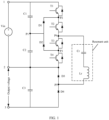
- FIG. 1 is a diagram of a topology of an RSCC circuit. After an input voltage is supplied to the RSCC, a target voltage can be output by controlling on/off states of the plurality of switches. Before the RSCC enters an operating state for outputting the target voltage, a voltage of an output filter capacitor is approximately zero.
- a current generated by the resonant inductor in the resonant unit causes impact to a power switching transistor in the RSCC, affecting performance of the switching transistor and degrading operating performance of the RSCC.
- This application provides a conversion circuit, a conversion circuit precharge control method, and a photovoltaic system, to avoid additional costs, and avoid impact on a switch caused by a current generated in a circuit at a moment when an RSCC enters an operating state, thereby ensuring operating performance of the RSCC.
- this application provides a conversion circuit, including a first power supply, a resonant switched capacitor converter RSCC, and a control circuit.
- the RSCC includes a switch unit, an output filter unit, a first input end S 1, a second input end S2, and an output end S3.
- the switch unit is connected between the first input end S 1 and the second input end S2.
- the output filter unit is connected between the second input end S2 and the output end S3.
- One electrode of the first power supply is connected to the first input end S 1, and the other electrode of the first power supply is connected to the second input end S2.
- the first power supply is configured to supply an input voltage to the RSCC.
- the control circuit is connected to the switch unit, and is configured to: before controlling the RSCC to operate, control the switch unit in the RSCC to transmit, to the output filter unit, electric energy supplied by the first power supply.
- the RSCC in the conversion circuit may be used in a direct current-direct current conversion scenario, for example, in a direct current-direct current conversion circuit, and may perform boost conversion, buck conversion, polarity conversion, or the like.
- the control circuit in the conversion circuit may control the RSCC to operate. Before controlling the RSCC to operate, the control circuit controls the switch unit in the RSCC to transmit, to the output filter unit, the electric energy supplied by the first power supply, to increase a voltage of the output filter unit.
- the voltage of the output filter unit is not zero because electric energy is stored in the output filter unit.
- a current formed in the circuit is weak, and has weak impact on the switch unit in the RSCC, thereby ensuring performance of the switch unit.
- the control circuit controls the switch unit in the RSCC, so that the first power supply can charge the output filter unit, thereby increasing the voltage of the output filter unit, and ensuring power density of the RSCC without adding an additional charging circuit.
- the RSCC further includes a resonant unit and a clamping unit.
- the clamping unit and the output filter unit are connected in parallel.
- the switch unit is connected to an end of the resonant unit, and another end of the resonant unit is connected to the clamping unit.
- the control circuit is specifically configured to: control the switch unit to transmit, to the resonant unit, the electric energy supplied by the first power supply; and control the switch unit to transmit the electric energy in the resonant unit to the output filter unit.
- control circuit may control the switch unit to transmit, to the resonant unit, the energy supplied by the first power supply, so that the first power supply can charge the resonant unit; and then control the switch unit to transmit the electric energy in the resonant unit to the output filter unit, so that the resonant unit can charge the output filter unit. Because electric energy is stored in the resonant unit and the output filter unit, a voltage of the resonant unit is not zero, and the voltage of the output filter unit is not zero, thereby reducing a current formed in the circuit at a moment when the RSCC starts to operate.
- control circuit controls the switch unit to transmit, to the resonant unit, the electric energy supplied by the first power supply, the first power supply, the switch unit, the resonant unit, and the clamping unit form a first path
- an open circuit occurs between the switch unit and the second input end S2
- an open circuit occurs between the clamping unit and the output end S3
- the control circuit controls the switch unit to transmit the electric energy in the resonant unit to the output filter unit
- the switch unit, the resonant unit, the clamping unit, and the output filter unit form a second path, and an open circuit occurs between the clamping unit and the second input end S2.
- the resonant unit in the RSCC may serve as an energy transfer unit.
- the control circuit may first control the switch unit, so that the first power supply, the switch unit, the resonant unit, and the clamping unit form the first path, and the first power supply may charge the resonant unit through the first path. Then the control circuit controls the switch unit, so that the switch unit, the resonant unit, the clamping unit, and the output filter unit form the second path, and the resonant unit may charge the output filter unit through the second path.
- the RSCC further includes an input filter unit, and the input filter unit and the switch unit are connected in parallel.
- the input filter unit is configured to store the electric energy supplied by the first power supply.
- the input filter unit includes a first input filter subunit and a second input filter subunit. The first input filter subunit and the second input filter subunit are connected in series. An end at which the first input filter subunit and the second input filter subunit are connected is connected to the switch unit.
- control circuit When controlling the switch unit to transmit, to the resonant unit, the electric energy supplied by the first power supply, the control circuit is specifically configured to: control the switch unit to transmit, to the resonant unit, electric energy supplied by the first power supply to the first input filter subunit; or control the switch unit to transmit, to the resonant unit, electric energy supplied by the first power supply to the first input filter subunit and electric energy supplied by the first power supply to the second input filter subunit.
- the input filter unit and the switch unit are connected in parallel, and the input filter unit is connected between the two electrodes of the first power supply.
- the first power supply may supply the electrical energy to the input filter unit.
- the input filter unit may also store the electric energy supplied by the first power supply.
- the input filter unit in the RSCC may include a plurality of input filter subunits.
- the control circuit may use one or more input filter subunits in the input filter unit as an energy transfer unit.
- the control circuit may control the switch unit to transmit electric energy in the one or more input filter subunits to the resonant unit.
- the control circuit uses one or more input filter subunits in the input filter unit as an energy transfer unit, and can flexibly charge the resonant unit in a fine-grained manner.
- a third path is formed by the first input filter subunit, the switch unit, the resonant unit, and the clamping unit, an open circuit occurs between the switch unit and the first input end S1, an open circuit occurs between the switch unit and the second input end S2, and an open circuit occurs between the clamping unit and the output filter unit.
- the control circuit controls the switch unit to transmit, to the resonant unit, the electric energy supplied by the first power supply to the first input filter subunit and the electric energy supplied by the first power supply to the second input filter subunit
- the control circuit controls the switch unit to transmit the electric energy in the first input filter subunit and the electric energy in the second input filter subunit to the resonant unit, where a fourth path is formed by the first input filter subunit, the second input filter subunit, the switch unit, the resonant unit, and the clamping unit, an open circuit occurs between the switch unit and the second input end S2, and an open circuit occurs between the clamping unit and the output filter unit.
- the control circuit controls the switch unit, so that the third path is formed by the first input filter subunit, the switch unit, the resonant unit, and the clamping unit.
- the first input filter subunit may charge the resonant unit through the third path.
- the control circuit controls the switch unit, so that the fourth path is formed by the first input filter subunit, the second input filter subunit, the switch unit, the resonant unit, and the clamping unit.
- the first input filter subunit and the second input filter subunit may charge the resonant unit through the fourth path.
- control circuit is further configured to control the switch unit to transmit the electric energy in the first input filter subunit to the output filter unit.
- control circuit may control the switch unit, so that the resonant unit may charge the output filter unit.
- the control circuit may further control the switch unit, so that the first input filter subunit charges the output filter unit.
- the control circuit may use an input filter subunit in the input filter unit as an energy transfer unit, for example, use the first input filter subunit to charge the output filter unit, so that the control circuit can flexibly charge the output filter unit in a fine-grained manner, to protect an element in the conversion circuit.
- the control circuit controls the switch unit to transmit the electric energy in the resonant unit to the output filter unit
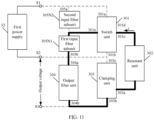
- the resonant unit, the switch unit, the output filter unit, and the clamping unit form a fifth path
- an open circuit occurs between the switch unit and the first input filter subunit
- an open circuit occurs between the switch unit and the second input end S2.
- control circuit may use the resonant unit in the RSCC as an energy transfer unit. After the resonant unit is charged, the control circuit may control the switch unit, so that the resonant unit, the switch unit, the output filter unit, and the clamping unit form the fifth path. The resonant unit may charge the output filter unit through the fifth path.
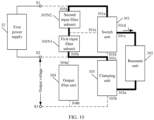
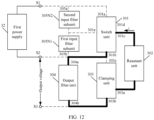
- the control circuit controls the switch unit to transmit the electric energy in the first input filter subunit to the output filter unit, the first input filter subunit, the switch unit, the resonant unit, the clamping unit, and the output filter unit form a sixth path, an open circuit occurs between the switch unit and the second input end S2, an open circuit occurs between the switch unit and the first input end S1, and an open circuit occurs between the clamping unit and the second input end S2.
- control circuit may use the resonant unit and the first input filter subunit in the RSCC as energy transfer units.
- the control circuit controls the switch unit, so that the first input filter subunit, the switch unit, the resonant unit, the clamping unit, and the output filter unit form the sixth path.
- the first input filter subunit and the resonant unit may charge the output filter unit.
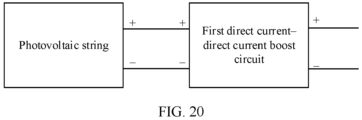
- the first power supply includes at least one photovoltaic string and a first direct current-direct current boost circuit.
- a positive electrode of the at least one photovoltaic string is connected to a positive input end of the first direct current-direct current boost circuit, and a negative electrode of the at least one photovoltaic string is connected to a negative input end of the first direct current-direct current boost circuit.
- a positive output end of the first direct current-direct current boost circuit is connected to the first input end S1, and a negative output end of the first direct current-direct current boost circuit is connected to the second input end S2.
- the first direct current-direct current boost circuit is configured to convert a voltage supplied by the at least one photovoltaic string into the input voltage.
- the conversion circuit may be applied to a photovoltaic power generating scenario.
- the first power supply may include a photovoltaic string and a first direct current-direct current boost circuit.
- the control circuit controls the switch unit in the RSCC to transmit, to the output filter unit, the electric energy supplied by the first power supply, thereby ensuring operating performance of the switch unit in the RSCC, and ensuring operating performance of the conversion circuit in the photovoltaic power generating scenario.
- this application provides a photovoltaic system, including at least one conversion circuit according to the first aspect, a plurality of photovoltaic strings, at least one second direct current-direct current boost circuit, and a direct current-alternating current inverter circuit.
- a positive output end of each second direct current-direct current boost circuit is connected to a positive input end of the direct current-alternating current inverter circuit.
- a negative output end of the second direct current-direct current boost circuit is separately connected to a second input end S2 of an RSCC in one conversion circuit and a zero-level end of the direct current-alternating current inverter circuit. Negative output ends of second direct current-direct current boost circuits are connected to second input end S2 of RSCC in different conversion circuits.
- An output end S3 of an RSCC in each conversion circuit is connected to a negative input end of the direct current-alternating current inverter circuit.
- a positive input end of each second direct current-direct current boost circuit is connected to a positive electrode of at least one photovoltaic string.
- a negative input end of the second direct current-direct current boost circuit is connected to a negative electrode of the at least one photovoltaic string.
- Each second direct current-direct current boost circuit is configured to perform boost processing on a voltage supplied by a connected photovoltaic string to obtain a first input voltage, and supply the first input voltage to the direct current-alternating current inverter circuit.
- the RSCC in the conversion circuit supplies a second input voltage to the direct current-alternating current inverter circuit.
- An output end of the direct current-alternating current inverter circuit is connected to a power grid, to convert the first input voltage and the second input voltage into alternating-current voltage, and supply the alternating-current voltage to the power grid.
- the photovoltaic system includes any conversion circuit according to the first aspect, and during operating, the RSCC in the conversion circuit may supply the second input voltage to the direct current-alternating current inverter circuit in the photovoltaic system.
- a control circuit in the conversion circuit may control a switch unit in the RSCC to transmit, to an output filter unit in the RSCC, electric energy supplied by a first power supply, to avoid impact on the switch unit caused by a current generated in the circuit at a moment when the RSCC enters an operating state, thereby ensuring operating performance of the switch unit, operating performance of the RSCC, and operating performance of the photovoltaic system, without additional costs of a charging circuit, a control switch, or the like.
- an embodiment of this application provides a conversion circuit precharge control method, applied to a conversion circuit.
- the conversion circuit includes a first power supply and a resonant switched capacitor converter RSCC.
- the RSCC includes a switch unit and an output filter unit.
- the method may be performed by a control circuit or a controller, and the method includes: The control circuit controls the switch unit to transmit, to the output filter unit, electric energy supplied by the first power supply. If determining that a voltage of the output filter unit is greater than a preset threshold, the control circuit controls the RSCC to operate.
- the control circuit controls the switch unit in the RSCC to transmit, to the output filter unit, the electric energy supplied by the first power supply, to increase the voltage of the output filter unit.
- the voltage of the output filter unit is not zero because electric energy is stored in the output filter unit.
- a current formed in the circuit is weak, and has weak impact on the switch unit in the RSCC, thereby ensuring performance of the switch unit.
- the control circuit controls the switch unit in the RSCC, so that the first power supply can charge the output filter unit, thereby increasing the voltage of the output filter unit, and ensuring power density of the RSCC without adding an additional charging circuit.
- the RSCC further includes a resonant unit
- the controlling the switch unit to transmit, to the output filter unit, electric energy supplied by the first power supply includes: The control circuit controls the switch unit to transmit, to the resonant unit, the electric energy supplied by the first power supply. The control circuit controls the switch unit to transmit the electric energy in the resonant unit to the output filter unit.
- control circuit may control the switch unit to transmit, to the resonant unit, the energy supplied by the first power supply, so that the first power supply can charge the resonant unit; and then control the switch unit to transmit the electric energy in the resonant unit to the output filter unit, so that the resonant unit can charge the output filter unit. Because electric energy is stored in the resonant unit and the output filter unit, a voltage of the resonant unit is not zero, and the voltage of the output filter unit is not zero, thereby reducing a current formed in the circuit at a moment when the RSCC starts to operate.
- the RSCC further includes an input filter unit, the input filter unit includes a first input filter subunit and a second input filter subunit, and the method further includes: The control circuit controls the switch unit to transmit electric energy in the first input filter subunit to the output filter unit.
- control circuit may further control the switch unit, so that the first input filter subunit charges the output filter unit.
- the control circuit may use an input filter subunit in the input filter unit as an energy transfer unit, for example, use the first input filter subunit to charge the output filter unit, so that the control circuit can flexibly charge the output filter unit in a fine-grained manner, to protect an element in the conversion circuit.
- the controlling the switch unit to transmit, to the resonant unit, the electric energy supplied by the first power supply includes: The control circuit controls the switch unit to transmit, to the resonant unit, electric energy supplied by the first power supply to the first input filter subunit; or the control circuit controls the switch unit to transmit, to the resonant unit, electric energy supplied by the first power supply to the first input filter subunit and electric energy supplied by the first power supply to the second input filter subunit.
- the control circuit in a process of controlling the switch unit to transmit, to the resonant unit, the electric energy supplied by the first power supply, may use one or more input filter subunits in the input filter unit as an energy transfer unit.
- the control circuit may control the switch unit to transmit electric energy in the one or more input filter subunits to the resonant unit. For example, energy in the first input filter subunit is transmitted to the resonant unit, thereby alleviating impact on the switch unit caused by a current generated in a process of charging the resonant unit.
- the control circuit uses one or more input filter subunits in the input filter unit as an energy transfer unit, and can flexibly charge the resonant unit in a fine-grained manner.
- an embodiment of this application provides a conversion circuit precharge control method, applied to a control circuit or a controller.
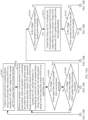
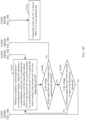
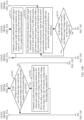
- the method may include the following steps: controlling a switch unit to transmit electric energy in a first input filter subunit to a resonant unit, until a voltage of the resonant unit is greater than a first preset threshold; performing an operation 1 and an operation 2 in a first preset manner, where the operation 1 is controlling the switch unit to transmit the electric energy in the first input filter subunit and electric energy in a second input filter subunit to the resonant unit, and the operation 2 is controlling the switch unit to transmit electric energy in the resonant unit and the electric energy in the first input filter subunit to an output filter unit; and performing an operation 3 and an operation 4 in a second preset manner, where the operation 3 is controlling the switch unit to transmit the electric energy in the first input filter subunit to the resonant unit, and the operation 3 is controlling the switch unit to transmit the electric energy in the resonant unit to the output filter unit.
- the controller may control, in each control period, the switch unit to transmit the electric energy in the first input filter subunit to the resonant unit, until the voltage of the resonant unit is greater than the first preset threshold, so that the voltage of the resonant unit may be gradually increased and is greater than the first preset threshold. Then the controller uses the first input filter subunit and the resonant unit as energy transfer units, and may perform the operation 1 and the operation 2 in the first preset manner, to transmit, to the output filter unit, electric energy supplied by a first power supply. In this proc ess, a current generated in the circuit is weak, thereby ensuring operating performance of the switch unit.
- a voltage of the output filter unit is not zero.
- the controller may also perform the operation 3 and the operation 4 in the second preset manner, to transmit, to the output filter unit, the electric energy supplied by the first power supply, and more electric energy is supplied to the output filter unit.
- the controller may further control the switch unit to transmit the electric energy in the resonant unit and the electric energy in the first input filter subunit to the output filter unit, until the voltage of the resonant unit is less than or equal to a sum of the voltage of the output filter unit and a voltage of the first input filter subunit.
- the controller controls the switch unit, so that the resonant unit and the first input filter subunit charge the output filter unit, and the voltage of the resonant unit is less than or equal to the sum of the voltage of the output filter unit and the voltage of the first input filter subunit, thereby reducing a spike current generated in a subsequent charging process of the controller, and alleviating impact on operating performance of the switch unit.
- the controller may perform an operation 5 and an operation 6 in a third preset manner, until the voltage of the output filter unit is greater than an input voltage supplied by the first power supply.
- the operation 5 is controlling the switch unit to transmit the electric energy in the first input filter subunit and the electric energy in the second input filter subunit to the resonant unit.
- the operation 6 is controlling the switch unit to transmit the electric energy in the resonant unit to the output filter unit.
- the controller may perform the operation 5 and the operation 6 in the third preset manner, so that the voltage of the output filter unit is the input voltage. If the voltage of the output filter unit is greater than or equal to the input voltage, it can be determined that a charging process is completed.
- the controller may control an RSCC to operate.
- the controller may control the switch unit to transmit the electric energy in the resonant unit to the output filter unit, until the voltage of the resonant unit is equal to the first preset threshold; or control the switch unit to transmit the electric energy in the first input filter subunit to the output filter unit, until the voltage of the resonant unit is equal to the first preset threshold.
- an embodiment of this application provides a computer-readable storage medium.
- the computer-readable storage medium includes a computer program.
- the processor is enabled to perform the technical solution according to any one of the third aspect or the possible designs of the third aspect or the technical solution according to any one of the fourth aspect or the possible designs of the fourth aspect in the embodiments of this application.
- an embodiment of this application provides a computer program product.
- the computer program product When the computer program product is run on an electronic device, the electronic device is enabled to perform the technical solution according to any one of the third aspect or the possible designs of the third aspect or the technical solution according to any one of the fourth aspect or the possible designs of the fourth aspect in the embodiments of this application.
- a photovoltaic power generating system, an electric vehicle, and a renewable energy system impose increasing requirements on an electronic power converter.
- a conventional direct current converter generally transfers energy by using a magnetic element, for example, an inductor or a transformer. Because the direct current converter operates in a hard switching state, a loss of a switch in the conventional direct current converter is large, and operating efficiency is low. In addition, performance of a system in which the direct current converter is used is also affected. For example, performance of a photovoltaic power generating system is affected.
- the magnetic element for example, the inductor or the transformer, in the conventional direct current converter has a large volume. Therefore, power density of the conventional direct current converter is low.
- an RSCC is a new direct current converter.
- a resonant unit including a resonant inductor and a resonant capacitor is used to transfer energy.
- the resonant unit has a small volume, and therefore the RSCC has high power density.
- the resonant unit may further enable a power switch device in the RSCC to operate in a soft switching state, thereby improving operating efficiency of the RSCC, and improving performance of a system in which the RSCC is used.
- the RSCC may be used in a direct current-direct current conversion circuit, and may perform voltage conversion, for example, boost conversion, buck conversion, or voltage polarity conversion, on a direct-current voltage, and output a converted direct-current voltage.
- the RSCC includes a plurality of switching transistors (switches), a plurality of capacitors, a plurality of diodes, and a resonant unit. After an input voltage is supplied to the RSCC, a target voltage is output by controlling off states of a plurality of switches.
- FIG. 1 shows a topology of a conversion circuit including an RSCC.
- the conversion circuit includes a power supply (an input voltage is Vin) and the RSCC.
- the RSCC includes three connection endpoints: a first input endpoint 1 and a second input endpoint 2. One terminal of the power supply is connected to the first input endpoint 1, and the other terminal of the power supply is connected to the second input endpoint 2 ( FIG. 1 shows an example in which a positive electrode of the power supply is connected to the first input endpoint 1 and a negative electrode of the power supply is connected to the second input endpoint 2).
- the RSCC includes: a first branch formed by a filter capacitor C1, a filter capacitor C2, and an output filter capacitor C3 that are connected in series, a second branch formed by a switch T1, a switch T2, a switch T3, a switch T4, a diode D3, and a diode D4 that are connected in series, a diode D1, a diode D2, and a resonant unit.
- the resonant unit includes a resonant capacitor Cr and a resonant inductor Lr that are connected in series.
- an end of the filter capacitor C1 is connected to the first input endpoint 1, and another end of the filter capacitor C1 is connected to the filter capacitor C2.
- An end of the output filter capacitor C3 is connected to the filter capacitor C2, and another end of the output filter capacitor C3 is connected to an output endpoint 3.
- an end of the switch T1 is connected to the first input endpoint 1, and another end of the switch T1 is connected to the switch T2.
- An end of the switch T4 is connected to the switch T3, and another end of the switch T4 is connected to a cathode of the diode D3.
- An anode of the diode D3 is connected to a cathode of the diode D4, and an anode of the diode D4 is connected to the output endpoint 3.
- a node P1 is disposed between the filter capacitor C1 and the filter capacitor C2.
- a node P2 is disposed between the switch T1 and the switch T2.
- a node P3 is disposed between the switch T3 and the switch T4.
- a node P4 is disposed between the switch T2 and the switch T3.
- a node P5 is disposed between the diode D3 and the diode D4.
- An anode of the diode D 1 is separately connected to the node P1 and a cathode of the diode D2, and a cathode of the diode D1 is connected to the node P2.
- An anode of diode D2 is connected to the node P3.
- the resonant unit is connected between the node P4 and the node P5.
- Control terminals of the switch T1, the switch T2, the switch T3, and the switch T4 in the RSCC may be connected to a control circuit.
- the control circuit may transmit a drive signal or a pulse signal to the switch, to control the switch to be in an on state or in an off state.
- the control circuit may further transmit, at different control timings and based on a preset control timing and a drive signal for a switch that corresponds to each control timing, the drive signal corresponding to the control timing to the switch, so that the RSCC is in an operating state, to convert an input voltage into a target output voltage.
- a voltage of the output filter capacitor C3 is approximately zero, and a voltage of the resonant capacitor Cr is also approximately zero.
- a current generated by the resonant inductor Lr causes impact to a power element, for example, a switch. This affects performance of the switch element, and degrades operating performance of the RSCC.
- power elements for example, the output filter capacitor and the resonant capacitor, in the RSCC may be charged before the control circuit controls the RSCC to enter the operating state, thereby reducing the current generated by the resonant inductor Lr at the moment when the RSCC starts to operate, and alleviating impact of the current on each switch.
- a charging circuit and a switch control unit are connected to the RSCC.
- the charging circuit may charge the output filter capacitor C3, and may also charge the resonant capacitor Cr.
- the switch control unit may control the charging circuit to separately charge the output filter capacitor C3 and the resonant capacitor Cr, so that voltages of the output filter capacitor C3 and the resonant capacitor Cr are not zero before the RSCC enters the operating state.
- the charging circuit and the switch control power supply are added, to avoid impact on each switch caused by the current formed by the resonant inductor Lr when the RSCC is in the operating state.
- costs of the conversion circuit are increased, and an area of the conversion circuit is also increased, decreasing power density of the conversion circuit.
- an embodiment of this application provides a method for charging an output filter capacitor in an RSCC.
- the method may be applied to a conversion circuit including an RSCC, to avoid additional costs, and avoid impact on a switch caused by a current generated in the circuit at a moment when the RSCC enters an operating state, thereby ensuring operating performance of the RSCC.
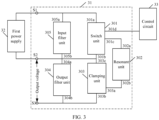
- a conversion circuit may include an RSCC 31, a first power supply 32, and a control circuit 33.
- the RSCC 31 may include a switch unit 301, an output filter unit 304, a first input end S1, a second input end S2, and an output end S3.
- the switch unit 301 may be connected between the first input end S1 and the second input end S2.
- the control circuit 33 is connected to the switch unit 301, and may control the switch unit 301.
- the output filter unit 304 may be connected between the second input end S2 and the output end S3.
- the output filter unit 304 may include at least one capacitor, for example, an output filter capacitor.
- Two electrodes of the first power supply 32 are respectively connected to the first input end S1 and the second input end S2 of the RSCC 31.
- a positive electrode of the first power supply 32 is connected to the first input end S1
- a negative electrode of the first power supply 32 is connected to the second input end S2.
- the first power supply 32 may supply electric energy to the RSCC 31.
- the control circuit 33 may be used in the method for charging an output filter capacitor in an RSCC in this application. Before controlling the RSCC to operate, the control circuit 33 may control the switch unit 301 to transmit, to the output filter unit 304, the electric energy supplied by the first power supply. In this embodiment of this application, that the control circuit 33 controls the RSCC 31 to operate may be controlling the RSCC 31 to be in an operating state. For example, the RSCC 31 is controlled to convert an input voltage supplied by the first power supply 32 into a target voltage, which is also referred to as a target output voltage. The target voltage may be output to a load, for example, an inverter circuit, through the second input end S2 and the output end S3 of the RSCC 31.
- a load for example, an inverter circuit
- the RSCC 31 may be applied to a boost conversion, buck conversion, or polarity conversion scenario, or the like.
- a value of the target voltage may be greater than that of the input voltage.
- a value of the target voltage may be less than that of the input voltage.
- the target voltage and the input voltage may have a same absolute value and opposite polarities.
- the RSCC 31 may also be applied to other voltage conversion scenarios. The scenarios are not listed one by one herein.
- the control circuit 33 may be implemented as a controller.
- the control circuit 33 may also include a plurality of control units, and different control units may be configured to control the RSCC to be in different operating states.
- a first control unit is configured to control the RSCC 31 to be in an operating state
- a second control unit is configured to: before the RSCC 31 operates, control the switch unit 301 to transmit, to the output filter unit 304, the electric energy supplied by the first power supply 32.
- a process of controlling, by the control circuit 33 before the RSCC 31 operates, the switch unit 301 to transmit, to the output filter unit 304, the electric energy supplied by the first power supply 32 may be considered as controlling the RSCC 31 to be in a precharge state.
- the control circuit 33 may control the switch unit 301 to transmit, to the output filter unit 304, the electric energy supplied by the first power supply 32, so that the first power supply 32 charges the output filter unit 304 in the RSCC 31.
- the control circuit 33 may transmit (or supply) a control signal or a drive signal to the control switch unit 301.
- the switch unit 301 may transmit, to the output filter unit 304, the electric energy supplied by the first power supply 32.
- the switch unit 301 may not transmit, to the output filter unit 304, the electric energy supplied by the first power supply 32.
- the control circuit 33 may further control duration of transmitting, by the switch unit 301 to the output filter unit 304, the electric energy supplied by the first power supply 32.
- the control circuit 33 continuously transmits a control signal or a drive signal to the switch unit 301 within preset duration.
- the switch unit 301 continuously transmits, to the output filter unit 304 within the preset duration, the electric energy supplied by the first power supply 32.
- the preset duration may be less than one control period.
- a voltage increase status of the output filter unit 304 varies with the duration of charging the output filter unit 304.
- voltage increase statuses at two ends of the output filter unit vary as the duration of transmitting, by the control circuit 33, the control signal or the drive signal to the switch unit 301 varies.
- the control circuit may continuously transmit a control signal or a drive signal to the switch unit 301 within first duration, or the control circuit may continuously transmit a control signal or a drive signal to the switch unit 301 within second duration. If the first duration and the second duration have different values, a voltage increase that occurs after the output filter unit 304 is charged for the first duration is different from a voltage increase that occurs after the output filter unit 304 is charged for the second duration.
- the control circuit 33 may control, a plurality of times, the switch unit 301 to transmit the electric energy of the first power supply 32 to the output filter unit 304, so that the output filter unit 304 can be charged a plurality of times. Duration of controlling, by the control circuit 33 each time, the switch unit 301 to transmit the electric energy of the first power supply 32 to the output filter unit 304 may be the same or vary. In other words, the control circuit 33 may continuously transmit a control signal or a drive signal to the switch unit 301 in a same time period or different time periods in each control period, so that the switch unit 301 transmits the electric energy of the first power supply 32 to the output filter unit 304.
- the RSCC 31 may further include a resonant unit 302 and a clamping unit 303.
- the clamping unit 303 and the output filter unit 304 are connected in parallel.
- the clamping unit 303 may be configured to prevent a voltage at the second input end S2 from changing.
- the switch unit 301 is connected to an end of the resonant unit 302, and another end of the resonant unit 302 is connected to the clamping unit 303.
- the resonant unit 302 may include a resonant capacitor and a resonant inductor that are connected in series.
- the resonant unit 302 may be configured to transfer energy, so that a switch device in the switch unit 301 operates in a soft switching state.
- the RSCC 31 may also include an input filter unit 305.
- the input filter unit 305 and the switch unit 301 are connected in parallel, and the input filter unit 305 may be configured to: when the RSCC 31 is in the operating state, stabilize the input voltage supplied by the first power supply 32.
- the input filter unit 305 may include at least one capacitor connected in series.
- the input filter unit 305 is connected between the two electrodes of the first power supply 32.
- the first power supply 32 may directly supply electric energy to the input filter unit 305, and the input filter unit 305 may also be configured to store the electric energy supplied by the first power supply 32.
- a first end 301a of the switch unit 301 is separately connected to the first input end S1 of the RSCC 31 and an input end 305a of the input filter unit 305.
- a second end 301b of the switch unit 301 is connected to the second input end S2.
- a third end 301c of the switch unit 301 is connected to a first end 302a of the resonant unit 302.
- a fourth end 301d of the switch unit 301 may be connected to the control circuit 33.
- a second end 302b of the resonant unit 302 is connected to a first input end 303a of the clamping unit 303.
- a second input end 303b of the clamping unit 303 is connected to the output end S3 of the RSCC 31.
- An output end 303c of the clamping unit 303 is connected to the second input end S2 of the RSCC 31.
- the input end 305a of the input filter unit 305 is separately connected to the first input end S1 and the first end 301a of the switch unit 301.
- An output end 305b of the input filter unit 305 is separately connected to the second input end S2 and an input end 304a of the output filter unit 304.
- the input end 304a of the output filter unit 304 is separately connected to the output end 305b of the input filter unit 305 and the second input end S2.
- An output end 304b of the output filter unit 304 is connected to the output end S3 of the RSCC 31.
- the resonant unit 302 may be further configured to transfer electric energy, in other words, the resonant unit 302 serves as an energy transfer unit (an energy relay unit, an energy relay assembly, or an energy relay module).
- the control circuit 33 may control the switch unit 301 to transmit, to the resonant unit 302, the electric energy supplied by the first power supply 32, so that the first power supply 32 can charge the resonant unit 302; and then control the switch unit 301 to transmit the electric energy in the resonant unit 302 to the output filter unit 304, so that the resonant unit 302 can charge the output filter unit 304.
- the resonant unit 302 may serve as an energy transfer medium to be charged by the first power supply 32.
- the resonant unit 302 may also supply electric energy to the output filter unit 304 after being charged, to charge the output filter unit
- a voltage of the output filter unit 304 is not zero because the output filter unit 304 is charged.
- the electric energy in the resonant unit 302 decreases, and a voltage decreases.
- a voltage value of the resonant unit 302 is still greater than zero.
- the resonant inductor in the resonant unit 302 generates a weak current, thereby alleviating impact on the switch unit 301.
- the control circuit 33 controls the switch unit 301, so that the output filter unit 304 and the resonant unit 302 in the RSCC 31 are charged, thereby ensuring performance of a switch element in the conversion circuit and power density of the conversion circuit.
- the resonant capacitor and the output filter capacitor in the RSCC are charged by using an element in the conversion circuit, without additional costs.
- the switch unit 301 may include a plurality of switches connected in series.
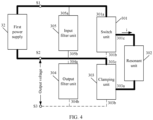
- the control circuit 33 when the control circuit 33 controls the switch unit 301 to transmit, to the resonant unit 302, the electric energy supplied by the first power supply 32, the control circuit 33 may control an on/off status of each switch in the switch unit 301, so that the first power supply 32, the switch unit 301, the resonant unit 302, and the clamping unit 303 form a first path, an open circuit occurs between the switch unit 301 and the second input end S2, and an open circuit occurs between the second input end 303b of the clamping unit 303 and the output end S3.
- the first end 302a of the resonant unit 302 is connected to one electrode of the first power supply 32 through the switch unit 301, the second end 302b of the resonant unit 302 is connected to the other electrode of the first power supply 32 through the clamping unit 303, and the first power supply 32 may charge the resonant unit 302.
- FIG. 4 shows a path and an open circuit status in the RSCC 31 in the process of charging the resonant unit 302 by the first power supply 32, where a bold line indicates the first path in the RSCC 31, and a dashed line indicates the open circuit status in the RSCC 31.
- the control circuit 33 may control, a plurality of times, the switch unit 301 to transmit, to the resonant unit 302, the electric energy supplied by the first power supply 32, so that the resonant unit 302 is charged a plurality of times. After the resonant unit 302 charges the output filter unit 304, the voltage decreases. To further reduce the current generated by the inductor in the resonant unit 302 at the moment when the RSCC 31 enters the operating state, the control circuit 33 may control the switch unit 301 again to transmit, to the resonant unit 302, the electric energy supplied by the first power supply 32, so that the first power supply 32 charges the resonant unit 302 again.
- Duration of charging the resonant power supply 302 each time may be the same or vary.
- the control circuit 33 may control the switch unit 301 to continuously transmit, to the resonant unit 302 within preset duration, the electric energy supplied by the first power supply 32, to control the duration of charging the resonant unit 302 to be the preset duration.
- the preset duration may be less than duration corresponding to one control period.
- the duration corresponding to one control period may be 55 microseconds, and the preset duration may be 1.8% ⁇ 55 microseconds, or the preset duration may be 2% ⁇ 55 microseconds.
- the control circuit 33 may control an on/off status of each switch in the switch unit 301, so that the switch unit 301, the resonant unit 302, the clamping unit 303, and the output filter unit 304 form a second path, the second end 301b of the switch unit 301 is connected to the second input end S2, and an open circuit occurs between the output end 303c of the clamping unit 303 and the second input end S2.
- the resonant unit 302 stores the electric energy supplied by the first power supply 32.
- FIG. 5 shows a path and an open circuit status in the RSCC 31 in a process of charging the output filter unit 304 by the resonant unit 302, where a bold line indicates the second path in the RSCC 31, and a dashed line indicates the open circuit status in the RSCC 31.
- the output filter unit 304 may also be charged a plurality of times.
- the control circuit 33 may control, a plurality of times, the switch unit 301 to transmit the electric energy in the resonant unit 302 to the output filter unit 304. After the resonant unit 302 is charged again, the control circuit 33 may control the switch unit 301 to transmit the electric energy in the resonant unit 302 to the output filter unit 304. Duration of charging the output filter unit 304 each time may be the same or vary.
- the control circuit 33 may determine whether the voltage of the resonant unit 302 is within a first voltage range. If the voltage of the resonant unit 302 is less than a minimum value within the first voltage range, the control circuit 33 may control the switch unit 301 to transmit, to the resonant unit 302, the electric energy supplied by the first power supply 32.
- the first voltage range may also be determined based on a voltage supplied by the first power supply 32.
- a value within the first voltage range may be any value close to a half voltage value 0.5Vin of an output voltage Vin of the first power supply 32.
- the minimum value within the first voltage range may be 0.48Vin, and the first voltage range may be [0.48Vin, Vin].
- the first voltage range may include inconsecutive values, for example, ⁇ 0.48Vin, 0.485Vin, 0.5Vin, 0.51Vin ⁇ .
- a value range close to the half voltage value 0.5Vin of the output voltage Vin of the first power supply 32 may be configured based on a parameter of an element in the RSCC.
- the control circuit 33 may alternatively determine whether the voltage of the output filter unit 304 is greater than or equal to a preset voltage value. If voltages at the two ends of the output filter unit 303 are greater than or equal to the preset voltage value, the control circuit 33 may determine that charging of the output filter unit 304 in the RSCC 31 is completed.
- the preset voltage value may be the input voltage Vin.
- the control circuit 33 may further control the RSCC 31 to enter the operating state to output the target voltage. After determining that the charging of the output filter unit 304 is completed, the control circuit 33 may also determine whether the voltage of the resonant unit 302 is within a first voltage range. If the voltage of the resonant unit 302 is less than a minimum value within the first voltage range, the control circuit 33 may control, once or a plurality of times, the switch unit 301 to transmit, to the resonant unit 302, the electric energy supplied by the first power supply 32, so that the voltage of the resonant unit 302 is greater than or equal to the minimum value within the first voltage range.
- control circuit 33 determines that the voltage of the output filter unit 304 is greater than or equal to the preset voltage value and the voltage of the resonant unit 302 is greater than or equal to the minimum value within the first voltage range, the control circuit 33 may determine that charging of the output filter unit 304 and the resonant unit 302 is completed, and then control the RSCC 31 to enter the operating state to output the target voltage.
- the switch unit 301 may include at least two switches, two of the at least two switches are connected in series, a first node is disposed on a connection line between the two switches, and the first node may serve as the third end 301c of the switch unit 301.
- the switch in this embodiment of this application may be a power switching transistor, for example, a field effect transistor.
- a field effect transistor for example, a field effect transistor.
- the switch unit 301 may include two switches connected in series. As shown in FIG. 6 , the switch unit 301 includes a switch T5 and a switch T6. Anend of the switch T5, that is not connected to the switch T6 may serve as the first end 301a of the switch unit 301. An end, of the switch T6, that is not connected to the switch T5 may serve as the second end 301b of the switch unit 301. A first node M1 in the switch unit is disposed on a connection line between the switch T6 and the switch T5, and may serve as the third end 301c of the switch unit 301. The first node M1 is connected to the first end 302a of the resonant unit 302.
- the clamping unit 303 may include two diodes connected in series, and a second node M2 is disposed on a connection line between the two diodes, and serves as the first input end 303a of the clamping unit 303.
- the second node M2 is separately connected to an anode of one diode and a cathode of the other diode.
- a diode whose cathode is connected to the second node M2 may be a first diode, and an anode of the first diode may serve as the second input end 303b of the clamping unit 303 and is connected to the output end S3 of the RSCC 31.
- the other diode is a second diode, an anode of the second diode is connected to the second node M2, and a cathode of the second diode may serve as the output end 303c of the clamping unit 303 and is connected to the second input end S2 of the RSCC 31.
- the clamping unit 303 includes a diode D5 and a diode D6 that are connected in series, an anode of the diode D5 is connected to a cathode of the diode D6, a cathode of the diode D5 is the output end 303c of the clamping unit 303, the anode of the diode D5 may serve as the first input end 303a of the clamping unit 303, and an anode of the diode D6 is the second output end 303b of the clamping unit 303.
- the resonant unit 302 is connected between the first node M1 and the second node M2. Because the diode has a forward conduction characteristic, when a current output by the resonant unit 302 flows through the second node M2, the cathode of the diode D6 is connected to the second node M2, the current cannot flow to the diode D6, and the diode D6 is in a cut-off state, so that an open circuit can occur between the second input end 303b of the clamping unit 303 and the output end S3 of the RSCC 31.
- the clamping unit 303 may alternatively include one diode and a switch, and the diode and the switch are connected in series.
- the second node M2 is disposed on a connection line between the diode and the switch, and serves as the first input end 303a of the clamping unit 303.
- An end, of the switch, that is not connected to the second node M2 may serve as the second input end 303b of the clamping unit 303.
- a cathode of the diode may serve as the output end 303c of the clamping unit 303.
- the control circuit 33 may control an on/off status of the switch.
- the control circuit 33 may control the switch in the clamping unit 303 to be in an off state, so that an open circuit can occur between the second input end 303b of the clamping unit 303 and the output end S3 of the RSCC 31.
- the control circuit 33 may control the switch in the clamping unit 303 to be in an on state, so that the second input end 303b of the clamping unit 303 can be connected to the output end S3 of the RSCC 31.
- clamping unit 303 may alternatively include another element, to implement a role or a function of the clamping unit 303 in the RSCC 31 in this embodiment of this application. This is not particularly limited in this embodiment of the present invention.
- the resonant inductor and the resonant capacitor in the resonant unit 302 may be connected in series.
- the resonant unit 302 may include a capacitor C6 and an inductor L1 that are connected in series.
- An end, of the capacitor C6, that is not connected to the inductor L1 may serve as the first end 302a of the resonant unit 302.
- An end, of the inductor L1, that is not connected to the capacitor C6 serves as the second end 302b of the resonant unit 302.
- the second end 302b of the resonant unit 302 may be connected to the second node M2 between the diode D5 and the diode D6.
- the first end 302a of the resonant unit 302 may be connected to the first node M1 between the switch T5 and the switch T6.
- the input filter unit 305 may include a capacitor C4.
- the output filter unit 304 may include a capacitor C5.
- the control circuit 33 may be connected to each of the at least two switches in the switch unit 301, and the control circuit 33 may control an on/off status of each switch.
- the control circuit 33 may control on/off statuses of the at least two switches in the switch unit 301, so that the first power supply 32, the switch unit 301, the resonant unit 302, and the clamping unit 303 form the first path, an open circuit occurs between the switch unit 301 and the second input end S2, an open circuit occurs between the clamping unit 303 and the output end S3 of the RSCC 31, and the first power supply 32 is controlled to charge the resonant unit 302 and the input filter unit 305.
- the switch unit 301 may include two switches: a switch T5 and a switch T6.
- the control circuit 33 is separately connected to the switch T5 and the switch T6.
- the control circuit 33 may control the switch T5 in the switch unit 301 to be switched on and the switch T6 in the switch unit 301 to be switched off, and an electrode of the first power supply 32 is connected to the resonant unit 302 through the switch T5 in the switch unit 301.
- a voltage of the resonant capacitor C6 in the resonant unit 302 is different, so that an induced current generated by the resonant inductor L1 is input to the clamping unit 303, and then flows to the other electrode of the first power supply 32 through the diode D5 in the clamping unit 303.
- the second end 302b of the resonant unit 302 is connected to the other electrode of the first power supply through the diode D5 in the clamping unit 303, and the first power supply 32, the switch unit 301, the resonant unit 302, and the clamping unit 303 form the first path.
- the electric energy supplied by the first power supply 32 is transmitted to the resonant unit 302 through the switch T5 in the switch unit 301, so that the first unit 32 can charge the resonant capacitor C6 in the resonant unit 302.
- the two electrodes of the first power supply 32 are respectively connected to two ends of the capacitor C4 in the input filter unit 305, and the capacitor C4 may store the electric energy supplied by the first power supply 32.
- control circuit 33 may further control the switch T5 to be switched off, and control the switch T6 to be switched on, and the capacitor C6 in the resonant unit 302 is connected to the input end 305a of the input filter unit 305 through the switch T6 in the switch unit 301.
- the output end 304b of the output filter unit 304 is connected to the inductor L1 in the resonant unit 302 through the diode D6 in the clamping unit 303, so that the second path is formed by the resonant unit 302, the switch unit 301, the output filter unit 304, and the clamping unit 303. Electric energy in the resonant capacitor C6 in the resonant unit 302 may be transmitted to the output filter unit 304 through the switch T6 in the switch unit 301, so that the resonant unit 302 can charge the output filter unit 304.
- the control circuit 33 may use the resonant unit 302 as an intermediate medium for transmitting energy a plurality of times.
- the control circuit 33 may control on/off statuses of the switch T5 and the switch T6 in the switch unit 301 in a plurality of control periods, to control the switch unit 301 to transmit, to the output filter unit 305, the electric energy supplied by the first power supply 32.
- control circuit 33 may enable, based on a preset control operation in each control period, the switch unit 301 to transmit, to the output filter unit 305, the electric energy supplied by the first power supply 32.
- the control circuit 33 may perform a control operation of continuously transmitting a control signal or a drive signal to the switch T5.
- the control circuit 33 may supply a pulse signal whose pulse width is preset duration to the switch T5 in the first control period.
- the switch T5 After receiving the pulse signal, the switch T5 enters an on state until the pulse ends.
- the switch T6 receives no pulse signal, and is in an open-circuit state.
- Duration of the first control period may be 55 microseconds, and the preset duration may be 1.8% ⁇ 55 microseconds, or the preset duration may be 2% ⁇ 55 microseconds.
- the control circuit 33 may perform a control operation of continuously transmitting a control signal or a drive signal to the switch T5 in a first half period of the first control period, or the control circuit 33 may perform a control operation of continuously transmitting a control signal or a drive signal to the switch T5 in a last half period of the first control period.
- the switch T5 is in the on state
- the switch T6 is in the off state
- the electric energy supplied by the first power supply 32 is transmitted to the resonant unit 302 through the switch T5.
- the control circuit 33 may perform a control operation of continuously transmitting a control signal or a drive signal to the switch T6.
- the control circuit 33 may supply a pulse signal whose pulse width is preset duration to the switch T6 in the second control period. After receiving the pulse signal, the switch T6 enters an on state until the pulse ends. The switch T5 receives no pulse signal, and is in an open-circuit state. Duration of the second control period may be 55 microseconds, and the preset duration may be 1.8% ⁇ 55 microseconds, or the preset duration may be 2% ⁇ 55 microseconds.
- the control circuit 33 may perform a control operation of continuously transmitting a control signal or a drive signal to the switch T6 in a first half period of the second control period, or the control circuit 33 may perform a control operation of continuously transmitting a control signal or a drive signal to the switch T6 in a last half period of the first control period.
- the switch T6 is in the on state
- the switch T5 is in the off state
- the electric energy in the resonant unit 302 is transmitted to the output filter unit 304 through the switch T6.
- the plurality of control periods may include at least one first control period and at least one second control period.
- the control circuit 33 performs different control operations in different control periods.
- the control circuit 33 performs different control operations in different periods, so that the first power supply 32 can charge the resonant unit 302 and then the resonant unit 302 charges the output filter unit 304, where these two charging processes are performed alternately.
- the control circuit 33 may determine voltages at two ends of an element by using a conditioning circuit connected in parallel to the element. For example, a voltage of the capacitor C5 in the output filter unit 304 is determined by using a conditioning circuit connected in parallel to the capacitor C5.
- the control circuit 33 may determine voltages at two ends of an element by using an analog/digital sampling circuit connected in parallel to the element, for example, determine a voltage of the capacitor C6 in the resonant unit 302 by using an analog/digital sampling circuit connected in parallel to the capacitor.
- the input filter unit 305 may also store the electric energy supplied by the first power supply 32.
- the control circuit 33 may alternatively use an input filter subunit in the input filter unit 305 as an energy transfer medium.
- the control circuit 33 may control the switch unit 301 to transmit electric energy in the input filter subunit to the resonant unit 302, so that the input filter subunit in the input filter unit 305 charges the resonant unit 302.
- a voltage at which the input filter subunit charges the resonant unit 302 is less than the input voltage supplied by the first power supply 32, and a spike current generated during charging is small, thereby alleviating current impact on a switch in the circuit.
- the input filter unit 305 includes two input filter subunits is used for description below.
- the two input filter subunits in the input filter unit 305 are denoted as a first input filter subunit 305N1 and a second input filter subunit 305N2.
- the first input filter subunit 305N1 and the second input filter subunit 305N2 are connected in series.
- An input end of the second input filter subunit 305N2 is connected to the first input end S1 of the RSCC 31, and an output end of the second input filter subunit 305N2 is connected to an input end of the first input filter subunit 305N1.
- An output end of the first input filter subunit 305N1 is separately connected to the second input end S2 and the input end 304a of the output filter unit 304.
- the first input filter subunit 305N1 may include at least one capacitor connected in series
- the second input filter subunit 305N2 may include at least one capacitor connected in series.
- the first end 301a of the switch unit 301 is separately connected to the first input end S1 of the RSCC 31 and the input end of the second input filter subunit 305N2.
- the second end 301b of the switch unit 301 is connected to the second input end S2.
- the third end 301c of the switch unit 301 is connected to the first end 302a of the resonant unit 302.
- the fourth end 301d of the switch unit 301 may be connected to the control circuit 33.
- the control circuit 33 may control the switch unit 301.
- a fifth end 301e of the switch unit 301 is separately connected to the output end of the second input filter subunit 305N2 and the input end of the first input filter subunit 305N1. In other words, the fifth terminal 301e of the switch unit 301 is connected between the first input filter subunit 305N1 and the second input filter subunit 305N2.
- the first end 302a of the resonant unit 302 is connected to the third end 301c of the switch unit 301, and the second end 302b of the resonant unit 302 is connected to the first input end 303a of the clamping unit 303.
- the first input end 303a of the clamping unit 303 is connected to the second end 302b of the resonant unit 302.
- the second input end 303b of the clamping unit 303 is connected to the output end S3 of the RSCC 31.
- the output end 303c of the clamping unit 303 is connected to the second input end S2 of the RSCC 31.
- the input end 304a of the output filter unit 304 is separately connected to the output end 305b of the input filter unit 305 and the second input end S2.
- the output end 304b of the output filter unit 304 is connected to the output end S3 of the RSCC 31.
- the output filter unit 304 may include at least one capacitor connected in series.
- the two electrodes of the first power supply 32 are respectively connected to the first input end S1 and the second input end S2 of the RSCC 31.
- the control circuit 33 Before the control circuit 33 controls the switch unit 301 to transmit, to the resonant unit 302, the electric energy supplied by the first power supply 32, the control circuit 33 may control an open circuit to occur between the switch unit 301 and the first input end S1 and an open circuit to occur between the switch unit 301 and the second input end S2, so that the switch unit 301 stops transmitting electric energy.
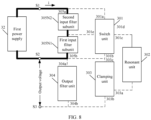
- a path is formed by the first power supply 32, the first input filter subunit 305N1, and the second input filter subunit 305N2, and the first power supply 32 may charge the first input filter subunit 305N1 and the second input filter subunit 305N2.
- control circuit 33 may control an open circuit to occur between the switch unit 301 and the second input filter subunit 305N2 and an open circuit to occur between the switch unit 301 and the second input end S2 of the RSCC 31, in other words, the control circuit 33 controls an open circuit to occur between the switch unit 301, the resonant unit 302, the clamping unit 303, and the output filter unit 304 in the RSCC 31, so that the first input filter subunit 305N1 and the second input filter subunit 305N2 are connected in series between the two electrodes of the first power supply 32, and the first power supply 32 charges the first input filter subunit 305N1 and the second input filter subunit 305N2.
- FIG. 8 shows a path and an open circuit status in the conversion circuit in a process of charging the first input filter subunit 305N1 and the second input filter subunit 305N2, where a bold line indicates an on part, and a dashed line indicates an open-circuit part.
- the control circuit 33 may control the switch unit 301 to transmit electric energy in any one of the first input filter subunit 305N1 and the second input filter subunit 305N2 to the resonant unit.
- the control circuit 33 controls the switch unit 301 to transmit the electric energy in the first input filter subunit 305N1 to the resonant unit 302, so that the first input filter subunit 305N1 can charge the resonant unit 302.
- the electrical energy in the first input filter subunit 305N1 is less than the electrical energy supplied by the first power supply 32, and the first input filter subunit 305N1 charges the resonant unit 302, thereby reducing a current generated in the circuit.
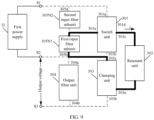
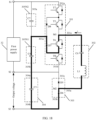
- the control circuit 33 may control an on/off status of each switch in the switch unit 301, so that a fourth path is formed by the first input filter subunit 305N1, the switch unit 301, the resonant unit 302, and the clamping unit 303, an open circuit occurs between the switch unit 301 and the first input end S1, an open circuit occurs between the switch unit 301 and the second input end S2 of the RSCC 31, an open circuit occurs between the clamping unit 303 and the output filter unit 304, and the first input filter subunit 305N1 may charge the resonant unit 302 through the fourth path.
- FIG. 9 shows a path and an open circuit status in the RSCC 31 in a process of charging the resonant unit 302 by the first input filter subunit 305N1, where a bold line indicates the fourth path, and a dashed line indicates an open-circuit part.
- the resonant unit 302 is charged by some of a plurality of input filter units, thereby alleviating impact of a current on an element in the RSCC 31 in a charging process, and further protecting an element in the conversion circuit.
- control circuit 33 When the control circuit 33 controls the switch unit 301 to transmit, to the resonant unit 302, the electric energy supplied by the first power supply 32, the control circuit 33 may alternatively control the switch unit 301 to transmit electric energy in the first input filter subunit 305N1 and the second input filter subunit 305N2 to the resonant unit 302 for charging.
- the control circuit 33 may control an on/off status of each switch in the switch unit 301, so that a fifth path is formed by the first input filter subunit 305N1, the second input filter subunit 305N2, the switch unit 301, the resonant unit 302, and the clamping unit 303, and control an open circuit to occur between the switch unit 301 and the second input end S2 of the RSCC 31, and an open circuit to occur between the clamping unit 303 and the output filter unit 304.
- the first input filter subunit 305N1 and the second input filter subunit 305N2 may charge the resonant unit 302 through the fifth path.
- FIG. 10 shows a path and an open circuit status in the RSCC 31 in a process of jointly charging the resonant unit 302 by the first input filter subunit 305N1 and the second input filter subunit 305N2, where a bold line indicates the fifth path, and a dashed line indicates an open-circuit part.
- control circuit 33 controls the switch unit 301 to transmit, to the resonant unit 302, the electric energy supplied by the first power supply 32.
- a path is formed by the first power supply 32, the switch unit 301, the resonant unit 302, and the clamping unit 303, an open circuit occurs between the switch unit 301 and the second input end S2, and an open circuit occurs between the clamping unit 303 and the output end S3.
- control circuit 33 When the control circuit 33 controls the switch unit 301 to transmit the electric energy in the resonant unit 302 to the output filter unit 304, the control circuit 33 may control the switch unit 301 to transmit the electric energy in the resonant unit 302 and the first input filter subunit 305N1 to the output filter unit 304, so that the resonant unit 302 and the first input filter subunit 305N1 can charge the output filter unit 304.
- the control circuit 33 may control an on/off status of each switch in the switch unit 301, so that the first input filter subunit 305N1, the switch unit 301, the resonant unit 302, the clamping unit 303, and the output filter unit 304 form a sixth path, an open circuit occurs between the second end 301b of the switch unit 301 and the second input end S2 of the RSCC 31, and an open circuit occurs between the first end 301a of the switch unit 301 and the first input end S1 of the RSCC 31.
- the resonant unit 302 and the first input filter subunit 305N1 charge the output filter unit 304 through the sixth path.
- FIG. 11 shows a path and an open circuit status in the RSCC 31 in a process of charging the output filter unit 304 by the resonant unit 302 and the first input filter subunit 305N1, where a bold line indicates the sixth path, and a dashed line indicates an open-circuit part.
- control circuit 33 controls the switch unit 301 to transmit the electric energy in the resonant unit 302 to the output filter unit 304, so that the resonant unit 302 can charge the output filter unit 304.
- the control circuit 33 may control an on/off status of each switch in the switch unit 301, so that the resonant unit 302, the switch unit 301, the output filter unit 304, and the clamping unit 303 form a seventh path, an open circuit occurs between the first end 301a of the switch unit 301 and the first input end S1 of the RSCC 31, an open circuit occurs between the second end 301b of the switch unit 301 and the second input end S2 of the RSCC 31, and an open circuit occurs between the fifth end301e of the switch unit 301 and the first input filter subunit 305N1.
- FIG. 12 shows a path and an open circuit status in the RSCC 31 in a process of charging the output filter unit 304 by the resonant unit 302, where a bold line indicates the seventh path, and a dashed line indicates an open-circuit part.
- the switch unit 301 may further include a switch T7, a switch T8, a diode D7, and a diode D8.
- An end of the switch T7 is separately connected to cathodes of the switch T5 and the diode D8.
- An end, of the switch T7, that is not connected to the switch T5 may serve as the first end 301a of the switch unit 301 and is connected to the first input end S1 of the RSCC 31.
- An end of the switch T8 is separately connected to anodes of the switch T6 and the diode D7.
- An end, of the switch T8, that is not connected to the switch T6 may serve as the second end 301b of the switch unit 301 and is connected to the second input end S2 of the RSCC 31.
- the first node M1 between the switch T5 and the switch T6 may be the third end 301c of the switch unit 301.
- An anode of the diode D8 is connected to a cathode of the diode D7.
- a connection point between the cathode of the diode D7 and the anode of the diode D8 in the switch unit 301 may serve as the fifth end 303e of the switch unit 301.
- the control circuit 33 may control all the four switches in the switch unit 301 to be in an off state. To be specific, the control circuit 33 controls the switch T7, the switch T5, the switch T6, and the switch T8 to be in the off state, to control the switch unit 301 to stop transmitting electric energy, so that the first power supply 32 can charge the first input filter subunit 305N1 and the second input filter subunit 305N2.
- the control circuit 33 may control the switch T7, the switch T6, and the switch T8 to be in an off state and the switch T5 to be in an on state, to control the switch unit 301 to transmit the electric energy in the first input filter subunit 305N1 to the resonant unit 302, so that the first input filter subunit 305N1 can charge the resonant unit 302.
- control circuit 33 may control the switch T7 and the switch T5 to be in an on state and control the switch T6 and the switch T8 to be in an off state, to control the switch unit 301 to transmit the electric energy in the first input filter subunit 305N1 and the second input filter subunit 305N2 to the resonant unit 302, so that the first input filter subunit 305N1 and the second input filter subunit 305N2 can jointly charge the resonant unit 302.
- the control circuit 33 may control the switch T7, the switch T5, and the switch T8 to be in an off state and control the switch T6 to be in an on state, so that the switch unit 301 transmits the electric energy in the resonant unit 302 and the first input filter subunit 305N1 to the output filter unit 304, and the resonant unit 302 and the first input filter subunit 305N1 can jointly charge the output filter unit 304.
- control circuit 33 may control the switch T7 and the switch T5 to be in an off state and control the switch T6 and the switch T8 to be in an on state, so that the switch unit 301 transmits the electric energy in the resonant unit 302 to the output filter unit 304, and the resonant unit 302 can charge the output filter unit 304.
- control circuit 33 may control a switching-on status of each switch in the switch unit 301, to change a voltage at the first node M1 in the switch unit 301 and a voltage at the second node M2 in the clamping unit 303.
- the switch T7 and the switch T5 are in an on state
- the switch T6 and the switch T8 are in an off state
- a voltage value at the first node M1 is equal to a voltage value at the first input end S1
- a voltage value at the second node M2 is equal to a voltage value at the second input end S2.
- the first power supply 32 may charge the resonant unit 302, or the first input filter subunit 305N1 and the second input filter subunit 305N2 jointly charge the resonant unit 302.
- the switch T6 is in an on state
- the switch T5, the switch T7, and the switch T8 are in an off state
- a voltage value at the first node M1 is equal to a voltage at a node between the first input filter subunit 305N1 and the second input filter subunit 305N1
- a voltage value at the second node M2 is equal to a voltage value at the second input end S2.
- the first input filter subunit 305N1 may charge the resonant unit 302.
- the resonant unit 302 is in a charged state
- a switch in the resonant unit 302, for transmitting electric energy varies, and there are a plurality of possibilities of a source of the voltage at the first node M1.
- the control circuit 33 also has more control modes for controlling the switch unit 301 to transmit, to the resonant unit 302, the electric energy supplied by the first power supply 32.
- the switch T7, the switch T5, and the switch T8 are in an off state, the switch T6 is controlled to be in an on state, a voltage value at the first node M1 is equal to a voltage at a node between the first input filter subunit 305N1 and the second input filter subunit 305N1, and a voltage value at the second node M2 is equal to a voltage value at the output end 304b of the output filter unit 304.
- the resonant unit 302 and the first input filter subunit 305N1 jointly charge the output filter unit 304.
- the switch T7 and the switch T5 are in an off state, the switch T6 and the switch T8 are controlled to be in an on state, a voltage value at the first node M1 is equal to a voltage value at the second input end S2, and a voltage value at the second node M2 is equal to a voltage value at the output end 304b of the output filter unit 304.
- the resonant unit 302 charges the output filter unit 304.
- the output filter unit 304 is in a charged state
- a switch in the resonant unit 302, for transmitting electric energy supplied by the resonant unit 302 varies, and there are also a plurality of possibilities for transmitting the electric energy in the resonant unit 302 to another unit, for example, the first input filter subunit 305N1 or the output filter unit 304, through the first node M1.
- the control circuit 33 also has more control modes for controlling the switch unit 301 to transmit the electric energy in the resonant unit 302 to the output filter unit 304.
- control circuit 33 may control, in a fine-grained manner by using the foregoing various control operations, a process of charging the output filter unit 304.
- control circuit 33 first controls the switch unit 301 to transmit the electric energy in the first input filter subunit 305N1 to the resonant unit 302, and the first input filter subunit 305N1 charges the resonant unit 302.
- the electric energy in the first input filter subunit 305N1 is less than the electric energy supplied by the first power supply 32, and a current generated in a process of charging the resonant unit 302 is small.
- control circuit 33 may perform any one of the foregoing control operations for charging the resonant unit 302, and may also perform any one of the foregoing control operations for charging the output filter unit 304.
- a time period in which the control operation for charging the resonant unit 302 is performed does not overlap a time period in which the control operation for charging the output filter unit 304 is performed.
- control circuit 33 may control, in a first half period of a first control period, the switch unit 301 to transmit the electric energy in the first input filter subunit 305N1 and the second input filter subunit 305N2 to the resonant unit 302; and the control circuit 33 may control, in a last half period of the first control period, the resonant unit 302 to control the switch unit 301 to transmit the electric energy in the resonant unit 302 to the output filter unit 304; or the control circuit 33 may control, in a last half period of the first control period, the switch unit 301 to transmit the electric energy in the first input filter subunit 305 and the electric energy in the resonant unit 302 to the output filter unit 304.
- control circuit 33 may control, in a first half period of a second control period, the switch unit 301 to transmit the electric energy in the first input filter subunit 305N1 to the resonant unit 302; and the control circuit 33 may control, in a last half period of the second control period, the switch unit 301 to transmit the electric energy in the resonant unit 302 to the output filter unit 304; or the control circuit 33 may control, in a last half period of the second control period, the switch unit 301 to transmit both the electric energy in the first input filter subunit 305 and the electric energy in the resonant unit 302 to the output filter unit 304.
- the control circuit 33 may perform, a plurality of times, any one of the foregoing control operations for charging the resonant unit 302, and perform, a plurality of times, any one of the foregoing control operations for charging the output filter unit 304.
- a time period in which the control operation for charging the resonant unit 302 is performed does not overlap a time period in which the control operation for charging the output filter unit 304 is performed.
- the control circuit 33 performs one control operation for charging the output filter unit 304.
- control circuit 33 may control, in a first time period of a first half period of a third control period, the switch unit 301 to transmit the electric energy in the first input filter subunit 305N1 and the second input filter subunit 305N2 to the resonant unit 302, or control the switch unit 301 to transmit the electric energy in the first input filter subunit 305N1 to the resonant unit 302.
- the control circuit 33 may control, in a second time period of the first half period of the first control period, the resonant unit 302 to control the switch unit 301 to transmit the electric energy in the resonant unit 302 to the output filter unit 304, or control the switch unit 301 to transmit the electric energy in the first input filter subunit 305 and the electric energy in the resonant unit 302 to the output filter unit 304.
- the control circuit 33 may control, in a third time period of a last half period of the third control period, the switch unit 301 to transmit the electric energy in the first input filter subunit 305N1 and the second input filter subunit 305N2 to the resonant unit 302, or control the switch unit 301 to transmit the electric energy in the first input filter subunit 305N1 to the resonant unit 302.
- the control circuit 33 may control, in a fourth time period of the last half period of the first control period, the resonant unit 302 to control the switch unit 301 to transmit the electric energy in the resonant unit 302 to the output filter unit 304, or control the switch unit 301 to transmit the electric energy in the first input filter subunit 305 and the electric energy in the resonant unit 302 to the output filter unit 304.
- control circuit 33 may further control, in a more fine-grained manner, the switch unit 301 to transmit, to the output filter unit 304, the electric energy supplied by the first power supply 32.
- the following embodiment of this application provides a control method.
- the method may be applied to the conversion circuit corresponding to FIG. 7 .
- the method may include a plurality of steps, and the control circuit may perform at least one step in one control period, or the control circuit may perform a step a plurality of times in one control period.
- the method includes the following steps.
- Step S1401 The control circuit 33 controls the switch unit 301 to transmit electric energy in the first input filter subunit 305N1 to the resonant unit 302, until a voltage of the resonant unit 302 is greater than a first preset threshold.
- the control circuit 33 may perform a preconfigured control operation to control the switch unit 301 to transmit, to the output filter unit 304, electric energy supplied by the first power supply 32.
- the control circuit 33 may first perform the control operation in step S1401, so that the voltage of the resonant unit 302 is greater than the first preset threshold, and a spike current generated in a subsequent charging process can be reduced.
- the first preset threshold may be a minimum value within a first voltage range.
- Step S1402 The control circuit 33 performs an operation 1 and an operation 2 in a first preset manner, where the operation 1 is controlling the switch unit 301 to transmit the electric energy in the first input filter subunit 305N1 and electric energy in the second input filter subunit 305N2 to the resonant unit 302, and the operation 2 is controlling the switch unit 301 to transmit electric energy in the resonant unit 302 and the electric energy in the first input filter subunit 305N1 to the output filter unit 304.
- the first preset manner may be an alternation manner of "the operation 1, the operation 2, the operation 1, the operation 2, ..”.
- the control circuit 33 may control duration of performing the operation 1, for example, control the duration of the operation 1 by controlling duration of a high-level pulse or controlling duration of a low-level pulse, to be specific, control duration of charging the resonant unit 302 by the first input filter subunit 305N1 and the second input filter subunit 305N2. Similarly, the control circuit 33 may also control duration of another charging operation.
- the first preset manner may be alternatively an alternation manner of "the operation 2, the operation 1, the operation 2, the operation 1, ..”.
- the control circuit 33 uses the first input filter subunit 305N1 and the resonant unit 302 as intermediate media for transmitting energy, and may perform a control operation in the first preset manner to transfer the energy in the second input filter subunit 305N2 to the output filter unit 304. This may also be understood as that the second input filter subunit 305N2 charges the output filter unit 304. In step S1402, a voltage of the second input filter subunit 305N2 decreases, and a voltage of the first input filter subunit 305N1 increases.
- Step S1403 The control circuit 33 determines whether a voltage of the output filter unit 304 is greater than a second preset threshold; and if no, performs step S1404 next; or if yes, performs step S1405 next.
- the control circuit 33 may monitor the voltage of the output filter unit 304 in a process of alternately performing the operation 1 and the operation 2. If the voltage of the output filter unit 304 is greater than the second preset threshold, it may be considered that preliminary charging of the output filter unit 304 by the second input filter subunit 305N2 is completed.
- the second preset threshold may be a minimum value within a second voltage range.
- a value within the third voltage range may be any value close to a voltage value that is 0.3 times an output voltage Vin of the first power supply 32.
- the minimum value within the third voltage range may be 0.3Vin
- the second voltage range may be [0.3Vin, Vin].
- the second voltage range may include inconsecutive values, for example, ⁇ 0.3Vin, 0.31 Vin, 0.315Vin, 0.35Vin ⁇ .
- a value range close to the voltage value that is 0.3 times the output voltage Vin of the first power supply 32 may be configured based on a parameter of an element in the RSCC 31.
- Step S1404 The control circuit 33 determines whether the voltage of the first input filter subunit 305N1 is greater than a third preset threshold; and if yes, performs step S 1402 next; or if no, performs step S1405 next.
- the control circuit 33 may also monitor the voltage of the first input filter subunit 305N1 in the process of alternately performing the operation 1 and the operation 2.
- the third preset threshold may be the minimum value within the second voltage range.
- the minimum value within the second voltage range may be determined based on the input voltage Vin supplied by the first power supply 32 and a preset threshold ref. For example, if the preset threshold ref is 30 V, the minimum value within the second voltage range may be (0.5Vin + 30) V
- the second voltage range may be [0.5Vin + ref, Vin].
- the second voltage range may include inconsecutive values, for example, ⁇ 0.48Vin+ref, 0.485Vin+ref, 0.5Vin+ref ⁇ .
- the preset threshold ref may be configured based on a parameter of an element in the RSCC 31 or a scenario to which the conversion circuit is applied. Alternatively, the preset threshold ref may be determined based on a status of a test on impact of precharge on operating performance of the conversion circuit. For example, Vin is 1500 V, ref is 30 V, and the third preset threshold may be 780 V
- control circuit 33 may alternately perform the operation 1 and the operation 2, until the voltage of the first input filter subunit 305N1 falls within the second voltage range; or the control circuit 33 may alternately perform the operation 1 and the operation 2, until the voltage of the first input filter subunit 305N1 is greater than the second preset threshold.
- a sequence of performing step S1403 and step S1404 is not specifically limited in this embodiment of this application.
- Step S1405 The control circuit 33 determines whether the voltage of the resonant unit 302 is greater than a sum of the voltage of the output filter unit 304 and the voltage of the first input filter subunit 305N1; and if yes, performs step S 1406 next; or if no, performs step S1407 next.
- the control circuit 33 may also monitor the voltage of the resonant unit 302. If determining that the voltage of the resonant unit 302 is greater than the sum of the voltage of the output filter unit 304 and the voltage of the first input filter subunit 305N1, the control circuit 33 may control the switch unit 301 to transmit the electric energy in the resonant unit 302 and the electric energy in the first input power supply to the output filter unit 304. On the contrary, if determining that the voltage of the resonant unit 302 is less than or equal to the sum of the voltage of the input filter unit and the voltage of the first input filter subunit 305N1, the control circuit 33 may control the switch unit 301 to transmit the electric energy in the first input filter subunit 305N1 to the resonant unit 302.
- Step S1406 Control the switch unit 301 to transmit the electric energy in the resonant unit 302 and the electric energy in the first input filter subunit 305N1 to the output filter unit 304, until the voltage of the resonant unit 302 is less than or equal to the sum of the voltage of the output filter unit 304 and the voltage of the first input filter subunit 305N1.
- the control circuit 33 performs the operation of step S1406, to use the first input filter subunit 305N1 as an energy transmission medium, so that the energy in the resonant unit 302 can be transmitted to the output filter unit 304, the voltage of the resonant unit 302 decreases, and the voltage of the output filter unit 304 increases.
- Step S1407 The control circuit 33 performs an operation 3 and an operation 4 in a second preset manner, where the operation 3 is controlling the switch unit 301 to transmit the electric energy in the first input filter subunit 305N1 to the resonant unit 302, and the operation 3 is controlling the switch unit 301 to transmit the electric energy in the resonant unit 302 to the output filter unit 304.
- the voltage of the resonant unit 302 decreases, and when a voltage value of the resonant unit 302 decreases to be less than or equal to the sum of the voltage of the output filter unit 304 and the voltage of the first input filter subunit 305N1, the resonant unit 302 cannot continue to transmit energy to the output filter unit 304, and cannot charge the output filter unit 304.
- the control circuit 33 may perform the operation 3 to increase the voltage of the resonant unit 302, and the control circuit 33 may perform the operation 4 to enable the resonant unit 302 to charge the output filter unit 304.
- the second preset manner may be an alternation manner of "the operation 3, the operation 4, the operation 3, the operation 4, ".
- the control circuit 33 may control duration of performing the operation 3, for example, control the duration of the operation 3 by controlling duration of a high-level pulse or controlling duration of a low-level pulse.
- the control circuit 33 may also control duration of the operation 4.
- the second preset manner may be alternatively an alternation manner of "the operation 4, the operation 3, the operation 4, the operation 3, ##.
- the control circuit 33 uses the resonant unit 302 as an intermediate medium for transmitting energy, and may perform a control operation in the second preset manner to transfer the energy in the first input filter subunit 305N1 to the output filter unit 304, so that the first input filter subunit 305N1 can charge the output filter unit 304.
- the voltage of the first input filter subunit 305N1 decreases, and the voltage of the output filter unit 304 increases.
- Step S1408 The control circuit 33 determines whether the voltage of the output filter unit 304 is greater than the second preset threshold; and if no, performs step S1409 next; or if yes, performs step S 1410 next.
- the voltage of the output filter unit 304, the voltage 305N2 of the second input filter subunit 305N2, and the voltage of the first input filter subunit 305N1 all change. If determining that the voltage of the output filter unit 304 is greater than the second preset threshold, the control circuit 33 may stop performing step S1407, and perform step S1410. If determining that the voltage of the output filter unit 304 is less than or equal to the second preset threshold, the control circuit 33 may perform a determining process in step S1409.
- Step S1409 The control circuit 33 determines whether the voltage of the first input filter subunit 305N1 is less than or equal to the third preset threshold; and if yes, performs step S1401 next; or if no, performs step S1407 next.
- control circuit 33 when performing step S1408 and step S1409, the control circuit 33 may also perform step S1407. In other words, the control circuit 33 may also perform step S1408 and step S1409 in a process of performing step S1407.
- Step S1410 The control circuit 33 determines whether the voltage of the resonant unit 302 is greater than a fourth preset threshold; and if yes, performs step S 1411 next; or if no, performs step S1412 next.
- the fourth preset threshold may be a value greater than half of the input voltage Vin of the first power supply 32, for example, 0.55Vin.
- Step S1411 The control circuit 33 controls the switch unit 301 to transmit the electric energy in the resonant unit 302 to the output filter unit 304, until the voltage of the resonant unit 302 is greater than or equal to the first preset threshold.
- Step S1412 The control circuit 33 determines whether the voltage of the resonant unit 302 is less than the first preset threshold; and if yes, performs step S1413 next; or if no, performs step S1414 next.
- Step S1413 The control circuit 33 controls the switch unit 301 to transmit the electric energy in the resonant unit 302 and the electric energy in the first input filter subunit 305N1 to the output filter unit 304.
- Step S 1414 The control circuit 33 performs an operation 5 and an operation 6 in a third preset manner, until the voltage of the output filter unit 304 is greater than the input voltage supplied by the first power supply 32, where the operation 5 is controlling the switch unit 301 to transmit the electric energy in the first input filter subunit 305N1 and the electric energy in the second input filter subunit 305N2 to the resonant unit 302, and the operation 6 is controlling the switch unit 301 to transmit the electric energy in the resonant unit 302 to the output filter unit 304.
- Step S1415 The control circuit 33 determines whether the voltage of the output filter unit 304 is greater than or equal to the input voltage supplied by the first power supply 32; and if yes, performs step S1414 next; or if no, performs step S 1416 next.
- Step S1416 The control circuit 33 controls the switch unit 301, so that the RSCC 31 is in an operating state.
- the control circuit 33 may control the switch unit 301, to control the RSCC 31 to output a target voltage, so that the conversion circuit is in an operating state.
- an embodiment of this application further provides another control method.
- the method may be applied to the conversion circuit corresponding to FIG. 13 .
- the method may include a plurality of steps, and the control circuit 33 may perform at least one step in a control period.
- the method may include a plurality of steps, and the control circuit 33 may perform at least one step in one control period, or the control circuit 33 may perform a step a plurality of times in one control period.
- the method includes the following steps.
- Step S1501 The control circuit 33 transmits, in each control period, a control signal whose pulse width is preset duration to the switch T5, until a voltage of the resonant unit 302 is greater than a first preset threshold.
- the control circuit 33 may transmit a pulse signal to a switch, to control the switch to be switched on. Alternatively, the control circuit 33 may transmit no pulse signal to a switch, to control the switch to be switched on. In this embodiment of this application, an example in which the control circuit 33 transmits a pulse signal to a switch to control the switch to be switched on is used to describe this embodiment of this application, but is not construed as a specific limitation to this embodiment of this application.
- the switch T5 enters an on state after receiving the control signal, and the switch T5 may remain in the on state until no control signal is received.
- the switch T7, the switch T6, and the switch T8 are controlled to be in an off state in each control period.
- the preset duration is less than duration of one control period.
- the duration of one control period may be 55 microseconds, and the preset duration may be 1.8% ⁇ 55 microseconds, or the preset duration may be 2% ⁇ 55 microseconds.
- the preset duration may be in a first half period or a last half period of a control period.
- the switch T5 is in the on state, and the other switches are in the off state.
- the switch unit 301 transmits electric energy in the first input filter subunit 305N1 to the resonant unit 302.
- the control circuit 33 may transmit, a plurality of times, a control signal whose pulse width is the preset duration to the switch T5, so that the voltage of the resonant unit 302 gradually increases, until the voltage of the resonant unit 302 is greater than the first preset threshold, and then the control circuit 33 may perform step S1502.
- the first preset threshold may be a minimum value within a first voltage range.
- control circuit 33 may control all the switches in the switch unit 301 to be in an off state, so that the first power supply 32 charges the first input filter subunit 305N1.
- Step S1502 The control circuit 33 continuously transmits a control signal to the switch T5 in a first control period, transmits a control signal whose pulse width is the preset duration to the switch T7 in a first time period, and transmits a control signal whose pulse width is the preset duration to the switch T6 in a second time period, where the first control period includes at least one first time period and at least one second time period, and the first time period and the second time period have no intersection.
- the control circuit 33 may control the switch T5 to be in an on state throughout the first control period, and control the switch T8 to be in an off state throughout the first control period.
- the control circuit 33 may control the switch T7 to be in an on state in the first time period in the first control period, and control the switch T6 to be in an on state in the second time period in the first control period, where the first time period and the second time period have no intersection.
- the first control period may include a plurality of first time periods and a plurality of second time periods.
- the 1 st first time period may be earlier than the 1 st second time period, or may be later than the 1 st second time period.
- the control circuit 33 may control the switch T7 and the switch T6 to be alternately in an on state in the first control period. When the switch T7 is in an on state, the switch T6 may be in an off state. When the switch T7 is in an off state, the switch T6 may be in an on state.
- the control circuit 33 controls the switch T5 to be in an on state, the switch T8 to be in an off state, the switch T7 to be in an on state, and the switch T6 to be in an off state.
- the switch T5 and the switch T7 may transmit the electric energy in the first input filter subunit 305N1 and electric energy in the second input filter subunit 305N2 to the resonant unit 302.
- the control circuit 33 controls the switch T5 to be in an on state, the switch T8 to be in an off state, the switch T7 to be in an off state, and the switch T6 to be in an on state.
- the switch T5 and the switch T6 may transmit the electric energy in the first input filter subunit 305N1 and electric energy in the resonant unit 302 to the output filter unit 304.
- Step S1503 Determine whether a voltage of the output filter unit 304 is greater than a second preset threshold; and if no, perform step S1504 next; or if yes, perform step S1505 next.
- control circuit 33 may collect the voltage of the output filter unit 304 by using a collection apparatus, and determine a magnitude relationship between the voltage of the output filter unit 304 and the second preset threshold. In other words, step S1503 and step S1502 may be performed in parallel.
- Step S1504 The control circuit 33 determines whether a voltage of the first input filter subunit 305N1 is greater than a third preset threshold; and if yes, performs step S1502 next; or if no, performs step S1505 next.
- step S1502 the control circuit 33 may collect the voltage of the first input filter subunit 305N1 by using the collection apparatus, and determine a magnitude relationship between the voltage of the first input filter subunit 305N1 and the third preset threshold.
- step S1504, step S1502, and step S1503 may be performed in parallel.
- the control circuit 33 may perform step S1504 in parallel after performing step S1502.
- control circuit 33 performs the operation in step S1502 again.
- the control circuit 33 performs the control operation in step S1502 in a next control period, in other words, uses the next control period as the first control period.
- the control circuit 33 performs step S1503 and step S1504, to determine thatthe voltage of the output filter unit 304 or the voltage of the first input filter subunit 305N1 meets a condition, so as to determine an occasion for ending step S1502.
- This embodiment of this application provides two conditions for determining whether to end step S1502.
- the control circuit 33 may determine to end step S1502 only by determining that the voltage of the output filter unit 304 meets a condition, or may determine to end step S1502 only by determining that the voltage of the first input filter subunit 305N1 meets a condition.
- the control circuit 33 may perform step S1503 after performing step S1502, or perform step S1504 after performing step S1502.
- Step S1505 The control circuit 33 determines whether the voltage of the resonant unit 302 is greater than a sum of the voltage of the output filter unit 304 and the voltage of the first input filter subunit 305N1; and if yes, performs step S1506 next; or if no, performs step S1507 next.
- Step S1506 The control circuit 33 transmits a control signal, in each control period, a control signal whose pulse width is the preset duration to the switch T6, until the voltage of the resonant unit 302 is less than or equal to the sum of the voltage of the output filter unit 304 and the voltage of the first input filter subunit 305N1.
- the control circuit 33 may control the switch T7, the switch T5, and the switch T8 to be in an off state in each control period, and control the switch T6 to be in an on state in a preset time period in each control period. As shown in FIG. 18 , the control circuit 33 continuously transmits a control signal to the switch T6 in a preset time period in each control period, so that the switch T6 can remain in an on state in the preset time period, the switch T6 can transmit the energy in the resonant unit 302 to the output filter unit 304, and the voltage of the output filter unit 304 can slowly increase.
- step S1505 and step S1506 if it is determined that the resonant unit 302 has a large quantity of electricity, the resonant unit 302 may charge the output filter unit 304; or if the resonant unit 302 has a small quantity of electricity, the control circuit 33 may directly perform step S1507, so that the first input filter subunit 305N1 charges the resonant unit 302.
- step S1506 In a process of performing step S1506 by the control circuit 33, when the voltage of the resonant unit 302 decreases from being greater than the sum of the voltage of the first input filter subunit 305N1 and the voltage of the output filter unit 304 to being equal to the sum of the voltage of the first input filter subunit 305N1 and the voltage of the output filter unit 304, the circuit is in a steady state, and the resonant unit 302 stops discharging.
- Step S1507 The control circuit 33 continuously transmits a control signal to the switch T6 in a second control period, transmits a control signal whose pulse width is the preset duration to the switch T5 in a third time period, and transmits a control signal whose pulse width is the preset duration to the switch T8 in a fourth time period, where the second control period includes at least one third time period and at least one fourth time period, and the third time period and the fourth time period have no intersection.
- control circuit 33 may control the switch T6 to be in an on state throughout the second control period, and the switch T7 to be in an off state throughout the second control period.
- the control circuit 33 may control the switch T5 to be in an on state in the third time period in the second control period, and control the switch T8 to be in an on state in the fourth time period in the second control period, where the third time period and the fourth time period have no intersection.
- the second control period may include a plurality of third time periods and a plurality of fourth time periods.
- the 1 st third time period may be earlier than the 1 st fourth time period, or may be later than the 1 st fourth time period.
- the control circuit 33 may control the switch T5 and the switch T8 to be alternately in an on state in the second control period. When the switch T5 is in an on state, the switch T8 may be in an off state. When the switch T8 is in an off state, the switch T5 may be in an on state.
- the control circuit 33 controls the switch T6 to be in an on state, the switch T7 to be in an off state, the switch T8 to be in an on state, and the switch T5 to be in an off state.
- the switch T6 and the switch T8 may transmit the electric energy in the resonant unit 302 to the output filter unit 304.
- the control circuit 33 controls the switch T6 to be in an on state, the switch T7 to be in an off state, the switch T8 to be in an off state, and the switch T5 to be in an on state.
- the switch T5 may transmit the electric energy in the first input filter subunit 305N1 to the output filter unit 304.
- Step S1508 The control circuit 33 determines whether the voltage of the output filter unit 304 is greater than the second preset threshold; and if no, performs step S1509 next; or if yes, performs step S1510 next.
- step S1507 In a process of performing step S1507 by the control circuit 33, the voltage of the output filter unit 304, the voltage 305N2 of the second input filter subunit 305N2, and the voltage of the first input filter subunit 305N1 all change. If determining that the voltage of the output filter unit 304 is greater than the second preset threshold, the control circuit 33 may stop performing step S1507, and perform step S1510. If determining that the voltage of the output filter unit 304 is less than or equal to the second preset threshold, the control circuit 33 may perform a determining process in step S1509.
- Step S1509 The control circuit 33 determines whether the voltage of the first input filter subunit 305N1 is less than or equal to the third preset threshold; and if yes, performs step S1501 next; or if no, performs step S1507 next.
- control circuit 33 when performing step S1508 and step S1509, the control circuit 33 may also perform step S1507. In other words, the control circuit 33 may also perform step S1508 and step S1509 in a process of performing step S1507.
- the control circuit 33 performs step S1503 and step S1504, to determine whether the voltage of the output filter unit 304 or the voltage of the first input filter subunit 305N1 meets a condition, so as to determine an occasion for ending step S1507.
- This embodiment of this application provides two conditions for determining whether to end step S1507.
- control circuit 33 may determine to end step S1507 only by determining that the voltage of the output filter unit 304 meets a condition, or may determine to end step S1507 only by determining that the voltage of the first input filter subunit 305N1 meets a condition. In other words, the control circuit 33 may perform step S1508 after performing step S1507, or perform step S1509 after performing step S1507.
- Step S1510 The control circuit 33 determines whether the voltage of the resonant unit 302 is greater than a fourth preset threshold; and if yes, performs step S1511 next; or if no, performs step S1512 next.
- the fourth preset threshold may be a value greater than half of an input voltage Vin of the first power supply 32, for example, 0.55Vin.
- Step S1511 In each control period, the control circuit 33 continuously transmits a control signal to the switch T6, and transmits a control signal whose pulse width is the preset duration to the switch T8, until the voltage of the resonant unit 302 is less than or equal to the fourth preset threshold.
- the control circuit 33 controls the switch T6 to be in an on state, the switch T7 to be in an off state, the switch T8 to be in an on state, and the switch T5 to be in an off state.
- the switch T6 and the switch T8 may transmit the electric energy in the resonant unit 302 to the output filter unit 304.
- the control circuit 33 performs step S1511 to control the switch T6 and the switch T8 to transmit the electric energy in the resonant unit 302 to the output filter unit 304, thereby reducing voltages at two ends of the resonant unit 302.
- the control circuit 33 may perform step S1511 after determining that the voltage of the resonant unit 302 is less than or equal to the fourth preset threshold.
- Step S1512 The control circuit 33 determines whether the voltage of the resonant unit 302 is less than the first preset threshold; and if yes, performs step S1513 next; or if no, performs step S1514 next.
- Step S1513 The control circuit 33 transmits, in each control period, a control signal whose pulse width is the preset duration to the switch T5, until the voltage of the resonant unit 302 is greater than the first preset threshold.
- the switch T5 transmits the electric energy in the first input filter subunit 305N1 to the resonant unit 302, as shown in FIG. 16 .
- the control circuit 33 may also monitor whether the voltage of the resonant unit 302 is between the first preset threshold and the fourth preset threshold. If the control circuit 33 determines, in the process of performing step S1513, that the voltage of the resonant unit 302 is between the first preset threshold and the fourth preset threshold, the control circuit 33 may also directly perform step S1514.
- a process of performing step S1510 to step S1512 by the control circuit 33 may be understood as that the control circuit 33 controls a switch in the switch unit 301, to adjust a voltage value of the resonant unit 302 to be greater than the first preset threshold.
- Step S1514 In a third control period, the control circuit 33 transmits a control signal whose pulse width is the preset duration to the switch T5 and the switch T7 in a fifth time period, and transmits a control signal whose pulse width is the preset duration to the switch T6 and the switch T8 in a sixth time period, where the third control period includes at least one fifth time period and at least one sixth time period, and the fifth time period and the sixth time period have no intersection.
- the control circuit 33 controls the switch T5 and the switch T7 to be in an on state in the fifth time period in the third control period, as shown in FIG. 17 .
- the switch T5 and the switch T7 may transmit the electric energy in the first input filter subunit 305N1 and the electric energy in the second input filter subunit 305N2 to the resonant unit 302.
- the control circuit 33 controls the switch T6 and the switch T8 to be in an on state in the sixth time period in the third control period, as shown in FIG. 19 .
- the switch T6 and the switch T8 may transmit the electric energy in the resonant unit 302 to the output filter unit 304.
- Step S1515 The control circuit 33 determines whether the voltage of the output filter unit 304 is not less than the input voltage supplied by the first power supply 32; and if yes, performs step S1514 next; or if no, performs step S1516 next.
- Step S1516 The control circuit 33 controls the switch unit 301, so that the RSCC 31 outputs a target voltage.
- the control circuit 33 may control a switch in the switch unit 301 in a preset control mode, so that the RSCC 31 can output the target voltage, and the conversion circuit is controlled to be in an operating state.
- the conversion circuit and the control method provided in this application may be applied to a scenario in which an electronic power converter is used, for example, a photovoltaic power generating system, an electric vehicle, or a renewable energy system is used.
- the first power supply in the conversion circuit provided in this embodiment of this application may include at least one photovoltaic string and a direct current-direct current boost circuit.
- the direct current-direct current boost circuit is connected to the at least one photovoltaic string, and is configured to perform boost processing on a voltage supplied by the at least one photovoltaic string.
- Output ends of the direct current-direct current boost circuit may serve as the two electrodes of the first power supply and are respectively connected to the first input end and the second input end of the RSCC, to supply an input voltage to the RSCC.
- This application further provides a photovoltaic system.
- the system includes at least two photovoltaic strings, a maximum power point tracking (Maximum Power Point Tracking, MPPT) combiner box, a direct current-alternating current inverter circuit, a cable, and the like. An output end of the direct current-alternating current inverter circuit is connected to a power grid.
- the photovoltaic system further includes a control circuit. The control circuit may control the photovoltaic strings, the MPPT combiner box, and the direct current-alternating current inverter circuit.
- the MPPT combiner box may include two direct current-direct current boost circuits and one RSCC.
- Each direct current-direct current boost circuit is connected to at least one photovoltaic string.
- a positive input end of the direct current-direct current boost circuit is connected to a positive electrode of the photovoltaic string.
- a negative input end of the direct current-direct current boost circuit is connected to a negative electrode of the photovoltaic string.
- the RSCC may be any RSCC provided in the foregoing embodiments.
- a switch unit in the RSCC is connected to the control circuit.
- a positive output end of one of the two direct current-direct current boost circuits is connected to a positive input end of the direct current-alternating current inverter circuit.
- the two direct current-direct current boost circuits are denoted as a first direct current-direct current boost circuit and a second direct current-direct current boost circuit.
- a positive output end of the second direct current-direct current boost circuit is connected to the positive input end of the direct current-alternating current inverter circuit.
- a negative output end of the second direct current-direct current boost circuit is connected to a zero-level endend of the direct current-alternating current inverter circuit.
- a positive input end M1 of the RSCC is connected to a positive output end of the first direct current-direct current boost circuit.
- a negative input end S2 of the RSCC is separately connected to a negative output end of the first direct current-direct current boost circuit and the negative output end of the second direct current-direct current boost circuit.
- a positive output end M4 of the RSCC is separately connected to the negative output end of the second direct current-direct current boost circuit and the zero-level endend of the direct current-alternating current inverter circuit.
- a negative output end M4 of the RSCC is connected to a negative input end of the direct current-alternating current inverter circuit.
- both the negative input end M2 and the positive output end M4 of the RSCC are connected to the negative output end of the second direct current-direct current boost circuit.
- the negative input end M2 and the positive output end M4 of the RSCC may be a same endpoint, for example, the second input end S2 of the RSCC 31 in the foregoing embodiments.
- the positive input end M1 of the RSCC may be the first input end S1 of the RSCC 31.
- the negative output end M3 of the RSCC may be the output end S3 of the RSCC 31.
- the first direct current-direct current boost circuit and a photovoltaic string connected to the first direct current-direct current boost circuit may serve as a power supply to supply an input voltage to the RSCC.
- the photovoltaic string connected to the first direct current-direct current boost circuit and the first direct current-direct current boost circuit may serve as the first power supply in the foregoing embodiments to supply electric energy to the RSCC.
- the RSCC may be configured to convert the input voltage supplied by the first direct current-direct current boost circuit into a target voltage with an opposite polarity, to protect performance of an element of the photovoltaic string connected to the first direct current-direct current boost circuit.
- the first direct current-direct current boost circuit and the photovoltaic string connected to the first direct current-direct current boost circuit may be considered as the first power supply in the foregoing embodiments, to supply an input voltage to the RSCC connected to the first direct current-direct current boost circuit.
- the photovoltaic system provided in this embodiment of this application may include the conversion circuit provided in the foregoing embodiments.
- the MMPT combiner box and the direct current-alternating current inverter circuit in the photovoltaic system provided in this application may form a high-voltage string inverter.
- the photovoltaic system provided in this application may also be considered as a system including a high-voltage string inverter.
- the photovoltaic system may include a direct current-alternating current inverter circuit, a plurality of MPPT combiner boxes, and a plurality of photovoltaic strings.
- the photovoltaic system may also be referred to as a photovoltaic system based on a high-voltage string inverter.
- Each MPPT combiner box includes an RSCC and two direct current-direct current boost circuits.
- the two direct current-direct current boost circuits are a second direct current-direct current boost circuit and a first direct current-direct current boost circuit.
- a positive output end of the RSCC in each MPPT combiner box is connected to a zero-level endend of the direct current-alternating current inverter circuit, and a negative output end of the RSCC is connected to a negative input end of the direct current inverter circuit.
- a positive output end of the second direct current boost conversion circuit in each MPPT combiner box is connected to a positive input end of the direct current-alternating current inverter circuit.
- the RSCC in each MPPT combiner box is precharged, so that performance of elements such as an output filter capacitor of the RSCC can be protected, and operating performance of the RSCC can also be ensured, thereby protecting operating performance of the photovoltaic system.
- the RSCC is precharged without adding additional elements, thereby increasing power density of the RSCC, reducing complexity of the photovoltaic system, and simplifying a control procedure of the photovoltaic system.
- the photovoltaic system and the photovoltaic system provided in this embodiment of this application may be applied to an application scenario of a large-sized photovoltaic station, an application scenario of a small- or medium-sized distributed power station, and an application scenario of a household photovoltaic system.
- the photovoltaic system and the photovoltaic power generating system may convert light energy into a direct current, and then convert the direct current into an alternating current and supply the alternating current to a load or a power grid, and may also be referred to as a photovoltaic inversion system or a photovoltaic inverter system.
Landscapes
- Engineering & Computer Science (AREA)
- Power Engineering (AREA)
- Dc-Dc Converters (AREA)
- Charge And Discharge Circuits For Batteries Or The Like (AREA)
Applications Claiming Priority (1)
| Application Number | Priority Date | Filing Date | Title |
|---|---|---|---|
| PCT/CN2021/074236 WO2022160207A1 (zh) | 2021-01-28 | 2021-01-28 | 一种变换电路、变换电路预充电控制方法及光伏系统 |
Publications (3)
| Publication Number | Publication Date |
|---|---|
| EP4246790A1 true EP4246790A1 (de) | 2023-09-20 |
| EP4246790A4 EP4246790A4 (de) | 2024-01-03 |
| EP4246790B1 EP4246790B1 (de) | 2026-01-28 |
Family
ID=82652877
Family Applications (1)
| Application Number | Title | Priority Date | Filing Date |
|---|---|---|---|
| EP21921817.9A Active EP4246790B1 (de) | 2021-01-28 | 2021-01-28 | Wandlerschaltung, vorladesteuerungsverfahren für die wandlerschaltung und fotovoltaisches system |
Country Status (5)
| Country | Link |
|---|---|
| US (1) | US20230318434A1 (de) |
| EP (1) | EP4246790B1 (de) |
| CN (1) | CN116472662A (de) |
| AU (1) | AU2021424908A1 (de) |
| WO (1) | WO2022160207A1 (de) |
Cited By (1)
| Publication number | Priority date | Publication date | Assignee | Title |
|---|---|---|---|---|
| US20230369969A1 (en) * | 2021-11-19 | 2023-11-16 | Virginia Tech Intellectual Properties, Inc. | Voltage-balancing non-isolated high-step-down-ratio power supply |
Families Citing this family (1)
| Publication number | Priority date | Publication date | Assignee | Title |
|---|---|---|---|---|
| CN115411921A (zh) * | 2022-08-30 | 2022-11-29 | 华为数字能源技术有限公司 | 一种变换器和逆变器 |
Family Cites Families (17)
| Publication number | Priority date | Publication date | Assignee | Title |
|---|---|---|---|---|
| US7859870B1 (en) * | 2008-07-29 | 2010-12-28 | Lockheed Martin Corporation | Voltage clamps for energy snubbing |
| CN102545638B (zh) * | 2012-01-20 | 2016-03-30 | 华为技术有限公司 | 交错并联三电平dc/dc变换器和ac/dc变换器 |
| DE102012216691A1 (de) * | 2012-09-18 | 2014-03-20 | Bombardier Transportation Gmbh | Stromrichterschaltung und Verfahren zur Steuerung der Stromrichterschaltung |
| US9461535B2 (en) * | 2013-12-30 | 2016-10-04 | King Fahd University Of Petroleum And Minerals | Photovoltaic systems with maximum power point tracking controller |
| EP3347979A4 (de) * | 2015-09-13 | 2019-01-16 | Alpha Technologies Inc. | Energiesteuerungssysteme und -verfahren |
| JP6467524B2 (ja) * | 2015-11-25 | 2019-02-13 | 株式会社日立製作所 | 電力変換装置および鉄道車両 |
| EP3379678B1 (de) * | 2017-03-23 | 2022-11-02 | Solaredge Technologies Ltd. | Ausgleicherschaltung |
| CN109088535A (zh) * | 2017-06-14 | 2018-12-25 | 上海明石光电科技有限公司 | 一种开关电源及其软启动电路 |
| US10199928B1 (en) * | 2018-01-19 | 2019-02-05 | Infineon Technologies Austria Ag | Soft start of switched capacitor converters by reducing voltage provided by initial power switch |
| WO2019145015A1 (en) * | 2018-01-23 | 2019-08-01 | Huawei Technologies Co., Ltd. | Power converter |
| CN110677060B (zh) * | 2018-07-02 | 2021-08-03 | 台达电子工业股份有限公司 | 功率变换系统及其中直流母线电容的预充电方法 |
| CN108683332B (zh) * | 2018-07-25 | 2020-02-14 | 安徽工业大学 | 一种高增益、宽占空比控制Boost变换器 |
| CN109510485B (zh) * | 2018-11-15 | 2021-04-02 | 科世达(上海)管理有限公司 | 一种电源电路及其钳位电容的预充电控制方法 |
| CN109660119A (zh) * | 2018-12-19 | 2019-04-19 | 北京理工大学 | 一种谐振开关电容变换器 |
| US11201562B1 (en) * | 2019-06-23 | 2021-12-14 | Purdue Research Foundation | Soft-switching voltage-edge-rate-limiting power inverter |
| US11532987B2 (en) * | 2020-05-15 | 2022-12-20 | Halo Microelectronics Co., Ltd. | Power conversion circuit, power conversion system and power chip |
| CN113740597B (zh) * | 2020-09-08 | 2024-08-16 | 台达电子企业管理(上海)有限公司 | 开关管尖峰电压检测电路及方法 |
-
2021
- 2021-01-28 CN CN202180072802.1A patent/CN116472662A/zh active Pending
- 2021-01-28 EP EP21921817.9A patent/EP4246790B1/de active Active
- 2021-01-28 WO PCT/CN2021/074236 patent/WO2022160207A1/zh not_active Ceased
- 2021-01-28 AU AU2021424908A patent/AU2021424908A1/en active Pending
-
2023
- 2023-06-06 US US18/329,902 patent/US20230318434A1/en active Pending
Cited By (2)
| Publication number | Priority date | Publication date | Assignee | Title |
|---|---|---|---|---|
| US20230369969A1 (en) * | 2021-11-19 | 2023-11-16 | Virginia Tech Intellectual Properties, Inc. | Voltage-balancing non-isolated high-step-down-ratio power supply |
| US12244226B2 (en) * | 2021-11-19 | 2025-03-04 | Virginia Tech Intellectual Properties, Inc. | Voltage-balancing non-isolated high-step-down-ratio power supply |
Also Published As
| Publication number | Publication date |
|---|---|
| WO2022160207A1 (zh) | 2022-08-04 |
| EP4246790B1 (de) | 2026-01-28 |
| CN116472662A (zh) | 2023-07-21 |
| US20230318434A1 (en) | 2023-10-05 |
| EP4246790A4 (de) | 2024-01-03 |
| AU2021424908A1 (en) | 2023-06-29 |
Similar Documents
| Publication | Publication Date | Title |
|---|---|---|
| US20240253494A1 (en) | Charging module and charging system | |
| US20220337078A1 (en) | Battery management circuit for a mobile device | |
| US11894762B2 (en) | Direct current-direct current conversion circuit | |
| US11496053B2 (en) | Power conversion system with dc-bus pre-charge | |
| US10263429B2 (en) | Bidirectional DC-DC converter, power conditioner, and distributed power system | |
| US20210126471A1 (en) | System and method for managing charge control of a battery array | |
| EP3915826B1 (de) | Verfahren und system zum fahrzeug-zu-fahrzeug-laden von elektrofahrzeugen | |
| CN101090203A (zh) | 在线式不间断ups系统 | |
| CN114884191B (zh) | 一种多工作模式的复合电源系统及其控制方法 | |
| US11165358B2 (en) | Switching control method for isolated bidirectional DC-DC converter | |
| US20220085756A1 (en) | Inverter circuit, inverter, and photovoltaic power system | |
| CN118157286B (zh) | 一种电池均衡系统及电子设备 | |
| US20230318434A1 (en) | Conversion circuit, conversion circuit precharge control method, and photovoltaic system | |
| CN116995714B (zh) | 储能变流器及其控制方法 | |
| CN118659420A (zh) | 一种应对电网冲击的储能系统和应对电网冲击的控制方法 | |
| CN119765850A (zh) | 直流/直流变换器、储能系统及光储系统 | |
| CN214176934U (zh) | 一种充电电路 | |
| US12184176B2 (en) | High voltage multipliers | |
| CN111509808A (zh) | 一种锂电池组电池管理系统及管理方法 | |
| CN219938014U (zh) | 储能模块均衡电路及电源装置 | |
| Zhu et al. | A kilowatt-level flyback converter based on multiple input-terminal voltage multiplier for photovoltaic power generation systems | |
| EP4583389A2 (de) | Energiespeichersystem und startverfahren dafür | |
| CN118263917B (zh) | 电池控制系统、方法和装置 | |
| CN217883224U (zh) | 一种dc-dc电源电路 | |
| CN118842154B (zh) | 一种充电控制电路及储能系统 |
Legal Events
| Date | Code | Title | Description |
|---|---|---|---|
| STAA | Information on the status of an ep patent application or granted ep patent |
Free format text: STATUS: THE INTERNATIONAL PUBLICATION HAS BEEN MADE |
|
| PUAI | Public reference made under article 153(3) epc to a published international application that has entered the european phase |
Free format text: ORIGINAL CODE: 0009012 |
|
| STAA | Information on the status of an ep patent application or granted ep patent |
Free format text: STATUS: REQUEST FOR EXAMINATION WAS MADE |
|
| 17P | Request for examination filed |
Effective date: 20230613 |
|
| AK | Designated contracting states |
Kind code of ref document: A1 Designated state(s): AL AT BE BG CH CY CZ DE DK EE ES FI FR GB GR HR HU IE IS IT LI LT LU LV MC MK MT NL NO PL PT RO RS SE SI SK SM TR |
|
| A4 | Supplementary search report drawn up and despatched |
Effective date: 20231130 |
|
| RIC1 | Information provided on ipc code assigned before grant |
Ipc: H02M 3/07 20060101ALI20231124BHEP Ipc: H02M 3/00 20060101AFI20231124BHEP |
|
| DAV | Request for validation of the european patent (deleted) | ||
| DAX | Request for extension of the european patent (deleted) | ||
| STAA | Information on the status of an ep patent application or granted ep patent |
Free format text: STATUS: EXAMINATION IS IN PROGRESS |
|
| 17Q | First examination report despatched |
Effective date: 20250321 |
|
| REG | Reference to a national code |
Ref country code: DE Free format text: PREVIOUS MAIN CLASS: H02M0003000000 Ipc: H02M0001360000 Ref country code: DE Ref legal event code: R079 Ref document number: 602021047398 Country of ref document: DE Free format text: PREVIOUS MAIN CLASS: H02M0003000000 Ipc: H02M0001360000 |
|
| GRAP | Despatch of communication of intention to grant a patent |
Free format text: ORIGINAL CODE: EPIDOSNIGR1 |
|
| STAA | Information on the status of an ep patent application or granted ep patent |
Free format text: STATUS: GRANT OF PATENT IS INTENDED |
|
| RIC1 | Information provided on ipc code assigned before grant |
Ipc: H02M 1/36 20070101AFI20250829BHEP Ipc: H02M 3/00 20060101ALI20250829BHEP Ipc: H02M 1/00 20060101ALI20250829BHEP Ipc: H02M 1/32 20070101ALI20250829BHEP Ipc: H02M 3/158 20060101ALI20250829BHEP Ipc: H02M 7/487 20070101ALI20250829BHEP |
|
| INTG | Intention to grant announced |
Effective date: 20250911 |
|
| GRAS | Grant fee paid |
Free format text: ORIGINAL CODE: EPIDOSNIGR3 |
|
| GRAA | (expected) grant |
Free format text: ORIGINAL CODE: 0009210 |
|
| STAA | Information on the status of an ep patent application or granted ep patent |
Free format text: STATUS: THE PATENT HAS BEEN GRANTED |
|
| AK | Designated contracting states |
Kind code of ref document: B1 Designated state(s): AL AT BE BG CH CY CZ DE DK EE ES FI FR GB GR HR HU IE IS IT LI LT LU LV MC MK MT NL NO PL PT RO RS SE SI SK SM TR |
|
| REG | Reference to a national code |
Ref country code: CH Ref legal event code: F10 Free format text: ST27 STATUS EVENT CODE: U-0-0-F10-F00 (AS PROVIDED BY THE NATIONAL OFFICE) Effective date: 20260128 Ref country code: GB Ref legal event code: FG4D |
|
| REG | Reference to a national code |
Ref country code: DE Ref legal event code: R096 Ref document number: 602021047398 Country of ref document: DE |
|
| REG | Reference to a national code |
Ref country code: IE Ref legal event code: FG4D |
|
| PGFP | Annual fee paid to national office [announced via postgrant information from national office to epo] |
Ref country code: DE Payment date: 20260211 Year of fee payment: 6 |