EP4242896A2 - Identitätsauthentifizierungssystem - Google Patents
Identitätsauthentifizierungssystem Download PDFInfo
- Publication number
- EP4242896A2 EP4242896A2 EP23177287.2A EP23177287A EP4242896A2 EP 4242896 A2 EP4242896 A2 EP 4242896A2 EP 23177287 A EP23177287 A EP 23177287A EP 4242896 A2 EP4242896 A2 EP 4242896A2
- Authority
- EP
- European Patent Office
- Prior art keywords
- data
- identity authentication
- user
- information
- request device
- Prior art date
- Legal status (The legal status is an assumption and is not a legal conclusion. Google has not performed a legal analysis and makes no representation as to the accuracy of the status listed.)
- Granted
Links
Images


Classifications
-
- H—ELECTRICITY
- H04—ELECTRIC COMMUNICATION TECHNIQUE
- H04L—TRANSMISSION OF DIGITAL INFORMATION, e.g. TELEGRAPHIC COMMUNICATION
- H04L63/00—Network architectures or network communication protocols for network security
- H04L63/08—Network architectures or network communication protocols for network security for authentication of entities
- H04L63/0861—Network architectures or network communication protocols for network security for authentication of entities using biometrical features, e.g. fingerprint, retina-scan
-
- G—PHYSICS
- G06—COMPUTING OR CALCULATING; COUNTING
- G06F—ELECTRIC DIGITAL DATA PROCESSING
- G06F21/00—Security arrangements for protecting computers, components thereof, programs or data against unauthorised activity
- G06F21/30—Authentication, i.e. establishing the identity or authorisation of security principals
- G06F21/31—User authentication
- G06F21/32—User authentication using biometric data, e.g. fingerprints, iris scans or voiceprints
-
- G—PHYSICS
- G06—COMPUTING OR CALCULATING; COUNTING
- G06F—ELECTRIC DIGITAL DATA PROCESSING
- G06F21/00—Security arrangements for protecting computers, components thereof, programs or data against unauthorised activity
- G06F21/30—Authentication, i.e. establishing the identity or authorisation of security principals
- G06F21/31—User authentication
- G06F21/34—User authentication involving the use of external additional devices, e.g. dongles or smart cards
- G06F21/35—User authentication involving the use of external additional devices, e.g. dongles or smart cards communicating wirelessly
-
- G—PHYSICS
- G06—COMPUTING OR CALCULATING; COUNTING
- G06F—ELECTRIC DIGITAL DATA PROCESSING
- G06F21/00—Security arrangements for protecting computers, components thereof, programs or data against unauthorised activity
- G06F21/30—Authentication, i.e. establishing the identity or authorisation of security principals
- G06F21/45—Structures or tools for the administration of authentication
-
- G—PHYSICS
- G06—COMPUTING OR CALCULATING; COUNTING
- G06F—ELECTRIC DIGITAL DATA PROCESSING
- G06F21/00—Security arrangements for protecting computers, components thereof, programs or data against unauthorised activity
- G06F21/60—Protecting data
- G06F21/62—Protecting access to data via a platform, e.g. using keys or access control rules
- G06F21/6218—Protecting access to data via a platform, e.g. using keys or access control rules to a system of files or objects, e.g. local or distributed file system or database
- G06F21/6245—Protecting personal data, e.g. for financial or medical purposes
-
- G—PHYSICS
- G06—COMPUTING OR CALCULATING; COUNTING
- G06N—COMPUTING ARRANGEMENTS BASED ON SPECIFIC COMPUTATIONAL MODELS
- G06N20/00—Machine learning
-
- G—PHYSICS
- G06—COMPUTING OR CALCULATING; COUNTING
- G06N—COMPUTING ARRANGEMENTS BASED ON SPECIFIC COMPUTATIONAL MODELS
- G06N3/00—Computing arrangements based on biological models
- G06N3/02—Neural networks
- G06N3/04—Architecture, e.g. interconnection topology
- G06N3/045—Combinations of networks
-
- G—PHYSICS
- G06—COMPUTING OR CALCULATING; COUNTING
- G06N—COMPUTING ARRANGEMENTS BASED ON SPECIFIC COMPUTATIONAL MODELS
- G06N3/00—Computing arrangements based on biological models
- G06N3/02—Neural networks
- G06N3/08—Learning methods
-
- G—PHYSICS
- G06—COMPUTING OR CALCULATING; COUNTING
- G06V—IMAGE OR VIDEO RECOGNITION OR UNDERSTANDING
- G06V40/00—Recognition of biometric, human-related or animal-related patterns in image or video data
- G06V40/10—Human or animal bodies, e.g. vehicle occupants or pedestrians; Body parts, e.g. hands
- G06V40/16—Human faces, e.g. facial parts, sketches or expressions
-
- H—ELECTRICITY
- H04—ELECTRIC COMMUNICATION TECHNIQUE
- H04L—TRANSMISSION OF DIGITAL INFORMATION, e.g. TELEGRAPHIC COMMUNICATION
- H04L63/00—Network architectures or network communication protocols for network security
- H04L63/08—Network architectures or network communication protocols for network security for authentication of entities
- H04L63/0876—Network architectures or network communication protocols for network security for authentication of entities based on the identity of the terminal or configuration, e.g. MAC address, hardware or software configuration or device fingerprint
Definitions
- the present invention relates to an identity authentication system using biometric information of a user.
- a mobile electronic device allows its use by recognizing a user's face or iris.
- a gate security system opens a gate by recognizing a user's fingerprint.
- IP Internet protocol
- a code for identifying the mobile electronic device of the user for identity authentication every time, which is troublesome.
- an identification code a mobile phone number, a personal identification number (PIN), or the like for identifying a mobile electronic device may be used.
- the present invention is directed to providing an identity authentication system which allows non-face-to-face and contactless authentication and does not require the manual input of an identification code for identity authentication every time.
- the present invention is also directed to providing an identity authentication system with an improved security level.
- an identity authentication system including an identity authentication device in which first data including biometric information of a user is stored, an identity authentication request device configured to generate second data by sensing a body part of the user, and a server configured to receive the second data and select personal information of a user corresponding to the second data among pieces of pre-stored personal information of a plurality of users through machine learning of the second data.
- the identity authentication request device may transmit the second data to the identity authentication device which is identified on the basis of the personal information of the user received from the server, and the identity authentication device may determine whether the first data corresponds to the second data and transmit authentication data to the identity authentication request device as a result of the determination.
- the identity authentication request device may output an identification failure message and transmit a retraining command to the server.
- the identity authentication request device may perform a preset function when the authentication data includes the result representing that the first data corresponds to the second data and may output an authentication failure message when the authentication data includes the result representing that the first data does not correspond to the second data.
- the first data may include face information of the user, and the second data may include an image of the user's face.
- the machine learning may use at least one of a Haar-like algorithm and a convolutional neural network (CNN) algorithm.
- CNN convolutional neural network
- the server may transmit the personal information to the identity authentication request device and then permanently delete the second data used for the machine learning.
- the server may cumulatively store results of the machine learning as cumulative data.
- the personal information may include a mobile phone number for identifying the identity authentication device.
- the identity authentication device may include: a wireless communication circuit configured to receive the second data from the identity authentication request device, determine whether the first data corresponds to the second data, and transmit a result of the determination to the identity authentication request device; at least one processor electrically connected to the wireless communication circuit; and a memory electrically connected to the at least one processor and configured to store the first data.
- the identity authentication device may further include a camera module or a sensor module, the at least one processor may acquire the first data on the basis of data obtained by sensing the user's body through the camera module or the sensor module, and the memory may store the first data in a secure region.
- the identity authentication request device may include a sensor module, a camera module, a wireless communication circuit, and at least one processor electrically connected to the sensor module, the camera module, and the wireless communication circuit, the at least one processor may acquire the second data obtained by sensing the user's body through the sensor module or the camera module, the wireless communication circuit may transmit the second data to the identity authentication device, and the at least one processor may perform a predetermined function on the basis of the authentication data received from the identity authentication device through the wireless communication circuit.
- the at least one processor may transmit the second data to the identity authentication device and then permanently delete the second data.
- an identity authentication system including a plurality of identity authentication devices in which first data including biometric information of a user is stored in a distributed manner, an identity authentication request device configured to generate second data by sensing biometric information of the user, and a server configured to receive the second data and select personal information of the user corresponding to the second data among pieces of pre-stored personal information of a plurality of users through machine learning of the second data.
- the identity authentication request device may transmit the second data to the plurality of identity authentication devices which are identified on the basis of the personal information of the user received from the server.
- the plurality of identity authentication devices may determine whether the first data corresponds to the second data through mutual information exchange and transmit authentication data to the identity authentication request device as a result of the determination.
- the identity authentication request device may output an identification failure message and transmit a retraining command to the server.
- the identity authentication request device may perform a preset function when the authentication data includes the result representing that the first data corresponds to the second data and may output an authentication failure message when the authentication data includes the result representing that the first data does not correspond to the second data.
- the first data may include face information of the user, and the second data may include an image of the user's face.
- the machine learning may use at least one of a Haar-like algorithm and a CNN algorithm.
- the server may transmit the authentication data to the identity authentication request device and then permanently delete the second data used for the machine learning.
- the server may cumulatively store results of the machine learning as cumulative data.
- the personal information of the user may include mobile phone numbers for identifying each of the plurality of identity authentication devices.
- the terms “include,” “may include,” etc. indicate the presence of a stated function, operation, component, etc. and do not limit one or more additional functions, operations, components, etc. Also, it is to be understood that the terms “include,” “have,” etc. used herein indicate the presence of a feature, a numeral, a step, an operation, a component, a part, or a combination thereof and do not preclude the presence or addition of one or more other features, numerals, steps, operations, components, parts, or combinations thereof.
- FIG. 1 is a block diagram of an identity authentication system according to an exemplary embodiment of the present invention.
- an identity authentication system 1 may include an identity authentication device 100, an identity authentication request device 200, and a server 300.
- the identity authentication device 100 may perform identity authentication by comparing pre-stored biometric information (or first data) of a user and sensing information (or second data) of the user received from the identity authentication request device 200.
- the server 300 may receive personal information of the user from the identity authentication device 100 and store the personal information. Also, the server 300 may extract the biometric information (or the first data) from the sensing information (or the second data) of the user received from the identity authentication request device 200 and match the biometric information (or the first data) to the pre-stored personal information (e.g., identification information) of the user.
- the identification information may be any one of a telephone number and a personal identification number (PIN) for identifying the identity authentication device 100 in which the biometric information (or the first data) of the user is stored.
- the identity authentication request device 200 may transmit the sensing information (or the second data) of the user to the identity authentication device 100 which is identified on the basis of the personal information of the user received from the server 300.
- the identity authentication device 100 may perform identity authentication on the user by comparing the biometric information (or the first data) stored in the identity authentication device 100 and the sensing information (or the second data) obtained by the identity authentication request device 200.
- the identity authentication device 100 may be a portable electronic device of the user
- the identity authentication request device 200 may be an electronic device provided in a member store of a provider of a service that the user wants to use.
- the service that the user wants to use varies, and the electronic device related to the service may be present in various forms.
- the identity authentication device 100 may include a wireless communication circuit 110, a processor 120, a memory 130, an input/output device 140, a camera module 150, and a sensor module 160.
- the wireless communication circuit 110 may set communication between the identity authentication device 100 and an external device (e.g., the identity authentication request device 200 or the server 300).
- Wireless communication may include cellular communication which employs at least one of, for example, Long Term Evolution (LTE), LTE Advanced (LTE-A), code division multiple access (CDMA), wideband CDMA (WCDMA), universal mobile telecommunications system (UMTS), wireless broadband (WiBro), and global system for mobile communications (GSM).
- LTE Long Term Evolution
- LTE-A LTE Advanced
- CDMA code division multiple access
- WCDMA wideband CDMA
- UMTS universal mobile telecommunications system
- WiBro global system for mobile communications
- GSM global system for mobile communications
- wireless communication may employ at least one of, for example, Wi-Fi, Bluetooth, Bluetooth low energy (BLE), ZigBee, near field communication (NFC), magnetic secure transmission, radio frequency (RF), and a body area network (BAN).
- BLE Bluetooth low energy
- NFC near field communication
- wireless communication may employ a global navigation satellite system (GNSS).
- GNSS may be, for example, the global positioning system (GPS), the Global Navigation Satellite System (GLONASS), the BeiDou navigation satellite system, or Galileo, the European global satellite-based navigation system.
- GPS global positioning system
- GLONASS Global Navigation Satellite System
- BeiDou navigation satellite system BeiDou navigation satellite system
- Galileo the European global satellite-based navigation system.
- the processor 120 may include one or more of a central processing unit (CPU), an application processor, and a communication processor (CP).
- the processor 120 may perform, for example, computation or data processing for control of and/or communication with at least one of other components of the identity authentication device 100.
- the memory 130 may include a volatile memory and/or a non-volatile memory.
- the memory 130 may store, for example, instructions or data related to at least one of other components of the identity authentication device 100.
- the memory 130 may store software and/or programs.
- the programs may include, for example, a kernel, middleware, an application programming interface (API), and/or an application program (or "application").
- the memory 130 may include, for example, an internal memory or an external memory.
- the internal memory may include at least one of, for example, a volatile memory (e.g., a dynamic random access memory (DRAM), a static RAM (SRAM), or a synchronous dynamic RAM (SDRAM)), a non-volatile memory (e.g., a one-time programmable read-only memory (OTPROM)), a programmable ROM (PROM), an erasable programmable ROM (EPROM), an electrically erasable programmable ROM (EEPROM), a mask ROM, a flash ROM, a flash memory, a hard drive, and a solid state drive (SSD).
- a volatile memory e.g., a dynamic random access memory (DRAM), a static RAM (SRAM), or a synchronous dynamic RAM (SDRAM)
- a non-volatile memory e.g., a one-time programmable read-only memory (OTPROM)
- PROM programmable ROM
- EPROM erasable programmable ROM
- the external memory may include a flash drive, for example, a CompactFlash (CF), a Secure Digital (SD), a micro-SD, a mini-SD, an extreme Digital (xD), a multi-media card (MMC), a memory stick, or the like.
- the external memory may be functionally or physically connected to the identity authentication device 100 through one of various interfaces.
- the input/output device 140 may include, for example, a touch panel, a (digital) pen sensor, a key, an ultrasonic input device, a display, or an audio module.
- the touch panel may be at least one of, for example, capacitive, resistive, infrared, and ultrasonic types.
- the (digital) pen sensor may be a part of the touch panel or may include a separate recognition sheet by way of example.
- the key may include, for example, a hardware button, an optical key, or a keypad.
- the ultrasonic input device may detect ultrasonic waves generated by an input tool through a microphone to acquire data corresponding to the detected ultrasonic waves.
- the display may include a panel, a hologram device, a projector, and/or a control circuit for control thereof.
- the panel may be implemented to be, for example, flexible, transparent, or wearable.
- the panel may include a pressure sensor (or force sensor) which may measure the intensity of a user's touch pressure.
- the hologram device may display a stereoscopic image in the air using the interference of light.
- the projector may project light onto a screen to display an image.
- the screen may be positioned, for example, inside or outside the identity authentication device 100.
- the audio module may convert, for example, a sound into an electrical signal or vice versa.
- the audio module may process sound information input or output through, for example, a speaker, a receiver, an earphone, a microphone, or the like.
- the camera module 150 is, for example, a device which may capture a still image or a video.
- the camera module 150 may include one or more image sensors (e.g., a front sensor or a rear sensor), a lens, an image signal processor (ISP), or a flash (e.g., a light-emitting diode (LED) or a xenon lamp).
- image sensors e.g., a front sensor or a rear sensor
- ISP image signal processor
- flash e.g., a light-emitting diode (LED) or a xenon lamp.
- the sensor module 160 may, for example, measure a physical quantity or sense an operation state of the identity authentication device 100 and convert the measured or sensed information into an electrical signal.
- the sensor module 160 may include, for example, a sound sensor, a gesture sensor, a biometric sensor, an e-nose sensor, an electromyography (EMG) sensor, an electroencephalogram (EEG) sensor, an electrocardiogram (ECG) sensor, an infrared (IR) sensor, an iris sensor, and/or a fingerprint sensor.
- the sensor module 160 may further include a control circuit for controlling one or more sensors included therein.
- the identity authentication device 100 may further include a processor configured to control the sensor module 160 as a part of the processor 120 or separately from the processor 120 while the processor 120 is a sleep state.
- the identity authentication device 100 may include the wireless communication circuit 110, the at least one processor 120 electrically connected to the wireless communication circuit 110, and the memory 130 electrically connected to the at least one processor 120.
- the memory 130 may include biometric information (or first data) of users and information on the identity authentication request device 200.
- the biometric information (or the first data) of the users may include at least one of face information, voice information, fingerprint information, deoxyribonucleic acid (DNA) information, body skeleton information, hand shape information, retina information, iris information, vein information, ECG information, handwriting information, gait information, signature information, blood vessel information, sweat gland structure information, and biomolecule information.
- the information on the identity authentication request device 200 may include at least one of, for example, types of services related to the identity authentication request device 200, details of the services related to the identity authentication request device 200, the location of the identity authentication request device 200, the type of the identity authentication request device 200, and sensor information included in the identity authentication request device 200.
- the camera module 150 or the sensor module 160 may be included, and the at least one processor 120 may acquire the biometric information (or the first data) of the user on the basis of sensing data (or the second data) obtained by sensing the user's body through the camera module 150 or the sensor module 160 and store the biometric information (or the first data) of the user in a secure region of the memory 130.
- the at least one processor 120 may install an application related to the identity authentication request device 200 in response to a selection of the user and store the information on the identity authentication request device 200 in the memory 130.
- the at least one processor 120 may acquire data about one or more pieces of information, which are required by the identity authentication request device 200 through an application, using the input/output device 140 and transmit the one or more pieces of information acquired by the wireless communication circuit 110 to the identity authentication request device 200.
- the at least one processor 120 may receive sensing information (or the second data) from the identity authentication request device 200 using the wireless communication circuit 110 and determine whether the received sensing information (or the second data) corresponds to biometric information (or the first data). The at least one processor 120 may transmit information on whether the sensing information (or the second data) of the user corresponds to the biometric information (or the first data) of the user to the identity authentication request device 200 using the wireless communication circuit 110.
- the identity authentication request device 200 may include a wireless communication circuit 210, a processor 220, a memory 230, an input/output device 240, a sensor module 260, and a camera module 250.
- the wireless communication circuit 210 may set communication between the identity authentication request device 200 and an external device (e.g., the identity authentication device 100 or the server 300).
- the wireless communication circuit 210 may be implemented the same as the wireless communication circuit 110 of the identity authentication device 100.
- the processor 220 may include one or more of a CPU, an application processor, and a CP.
- the processor 220 may perform, for example, computation or data processing for control of and/or communication with at least one of the other components of the identity authentication request device 200.
- the memory 230 may include a volatile memory and/or a non-volatile memory.
- the memory 230 may store, for example, instructions or data related to at least one of the other components of the identity authentication request device 200.
- the memory 230 may store software and/or programs.
- the programs may include, for example, a kernel, middleware, an API, and/or an application program (or "application").
- the memory 230 may include, for example, an internal memory or an external memory.
- the internal memory may include at least one of, for example, a volatile memory (e.g., a DRAM, an SRAM, or an SDRAM), a non-volatile memory (e.g., an OTPROM), a PROM, an EPROM, an EEPROM, a mask ROM, a flash ROM, a flash memory, a hard drive, and an SSD.
- the external memory may include a flash drive, for example, a CF, an SD, a micro-SD, a mini-SD, an xD, an MMC, a memory stick, or the like.
- the external memory may be functionally or physically connected to the identity authentication request device 200 through one of various interfaces.
- the input/output device 240 may include, for example, a touch panel, a (digital) pen sensor, a key, an ultrasonic input device, a display, or an audio module.
- the touch panel may be at least one of, for example, capacitive, resistive, infrared, and ultrasonic types.
- the (digital) pen sensor may be a part of the touch panel or may include a separate recognition sheet by way of example.
- the key may include, for example, a hardware button, an optical key, or a keypad.
- the ultrasonic input device may detect ultrasonic waves generated by an input tool through a microphone to acquire data corresponding to the detected ultrasonic waves.
- the display may include a panel, a hologram device, a projector, and/or a control circuit for control thereof.
- the panel may be implemented to be, for example, flexible, transparent, or wearable.
- the panel may include a pressure sensor (or force sensor) which may measure the intensity of the user's touch pressure.
- the hologram device may display a stereoscopic image in the air using the interference of light.
- the projector may project light onto a screen to display an image.
- the screen may be positioned, for example, inside or outside the identity authentication request device 200.
- the audio module may convert, for example, a sound into an electrical signal or vice versa.
- the audio module may process sound information input or output through, for example, a speaker, a receiver, an earphone, a microphone, or the like.
- the camera module 250 is, for example, a device which may capture a still image or a video.
- the camera module 250 may include one or more image sensors (e.g., a front sensor or a rear sensor), a lens, an ISP, or a flash (e.g., an LED or a xenon lamp).
- the sensor module 260 may, for example, measure a physical quantity or sense an operation state of the identity authentication request device 200 and convert the measured or sensed information into an electrical signal.
- the sensor module 260 may include, for example, a gesture sensor, a biometric sensor, an e-nose sensor, an EMG sensor, an EEG sensor, an ECG sensor, an IR sensor, an iris sensor, and/or a fingerprint sensor.
- the sensor module 260 may further include a control circuit for controlling one or more sensors included therein.
- the identity authentication request device 200 may further include a processor configured to control the sensor module 260 as a part of the processor 220 or separately from the processor 220 while the processor 220 is a sleep state.
- the at least one processor 220 may acquire sensing information (or the second data) obtained by sensing the user's body through the sensor module 260 or the camera module 250.
- the sensing information (or the second data) of the user may be biometric information (or the first data) of the user which is unprocessed raw data.
- the sensing information (or the second data) of the user may include an image file, a voice file, an electronic document, and the like.
- sensing information (or the second data) corresponding to biometric information (or the first data) such as face information, fingerprint information, body skeleton information, hand shape information, iris information, handwriting information, signature information, and sweat gland structure information
- sensing information (or the second data) corresponding to biometric information (or the first data) such as a voice speaking a specific word, sentence, name, etc., a whistling sound, a cough sound
- sensing information (or the second data) corresponding to biometric information (or the first data) such as vein information, ECG information, ECG information, and blood vessel information, may be in the form of electronic documents.
- the at least one processor 220 may transmit the sensing information (or the second data) of the user to the server 300 using the wireless communication circuit 210 and acquire identification information, such as a phone number, of the identity authentication device 100 from the server 300. Also, the at least one processor 220 may transmit the sensing information (or the second data) of the user to the identified identity authentication device 100 and receive authentication data from the identity authentication device 100 using the wireless communication circuit 210. The at least one processor 220 may perform a predetermined function on the basis of the authentication data or output an authentication failure message through the input/output device 240.
- the memory 230 may not store the sensing information (or the second data) of the user.
- the at least one processor 220 may receive the authentication data from the identity authentication device 100 and then permanently delete the sensing information (or the second data) of the user in the memory 230.
- the server 300 may include a biometric information extractor 310, a matcher 320, and a database 330.
- the biometric information extractor 310 may receive sensing information (or the second data) of the user from the identity authentication request device 200 and extract the biometric information (or the first data) of the user from the received sensing information (or the second data) of the user through machine learning.
- the sensing information (or the second data) of the user may include an image file, a voice file, an electronic document, and the like.
- the sensing information (or the second data) of the user is in the form of an image file will be described below for convenience of description.
- the sensing information (or the second data) of the user may be an image obtained by capturing the user's face.
- the image may be in one file format among BMP, JPG (JPEG), GIF, EPS, TIF (TIFF), PSD, PIC, DXF, PP3, PICT, PNG, desktop color separations (DCS), FlashPix, PCX, PDF, PIXAR, Raw, Scitex CT (SCT), and Targa.
- the biometric information extractor 310 may extract face information of the user from the image through machine learning.
- the biometric information extractor 310 may extract the face information using at least one of a Haar-like algorithm and a convolutional neural network (CNN) algorithm.
- CNN convolutional neural network
- the biometric information extractor 310 may use an algorithm obtained by combining characteristics of the Haar-like algorithm and the CNN algorithm.
- the CNN algorithm exhibits excellent performance in big data processing.
- the biometric information extractor 310 may extract biometric information (or first data) on the basis of cumulative machine learning data stored in the database 330 in advance.
- the cumulative machine learning data may be obtained by accumulating machine learning results of the biometric information extractor 310 on sensing information (or second data).
- the cumulative machine learning data may include only features of images for determining which user corresponds to a face extracted from an arbitrary image. In other words, the cumulative machine learning data does not function alone as biometric information (or first data) but may be information for determining who is a user requesting identity authentication from the image received from the identity authentication request device 200.
- the matcher 320 may select personal information (e.g., identification information) of the user corresponding to the biometric information (or the first data) of the user extracted through the biometric information extractor 310 from among pieces of pre-stored personal information of a plurality of users. Also, the matcher 320 may transmit the selected personal information of the user to the identity authentication request device 200.
- personal information e.g., identification information
- the matcher 320 may transmit the selected personal information of the user to the identity authentication request device 200.
- the matcher 320 may determine whether the biometric information (or the first data) corresponds to a certain user's personal information on the basis of a lookup table pre-stored in the database 330.
- the lookup table may include personal information (e.g., identification information) corresponding to each of the plurality of users.
- the lookup table may be a table in which each of the plurality of users corresponds to identification information of one of the plurality of users.
- the identification information may be a phone number or a PIN for identifying the identity authentication device 100 in which biometric information (or first data) of a specific user is stored.
- the database 330 may include personal information of each of a registered plurality of users.
- personal information of a user may include a mobile phone number, a PIN, an identification (ID), a password, a name, a sex, an address, an e-mail address, and an identification number related to a service provided by the identity authentication request device 200.
- the database 330 may store cumulative data which is a machine learning result from the sensing information (or the second data) of the user and may not store either of the biometric information (or the first data) and the sensing information (or the second data).
- the cumulative data may be updated every time the biometric information extractor 310 performs machine learning on an image received from the identity authentication request device 200.
- the database 330 may include a lookup table in which the name of the user is matched to identification information (e.g., a mobile phone number) for identifying the identify authentication device 100 storing the biometric information (or the first data) of the user.
- identification information e.g., a mobile phone number
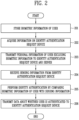
- FIG. 2 is a flowchart illustrating a method of performing identity authentication by an identity authentication device according to an exemplary embodiment of the present invention.
- the identity authentication device 100 may perform identity authentication by checking sensing information (or second data) received from the identity authentication request device 200.
- the identity authentication device 100 may store biometric information (or first data) of a user in the memory 130 on the basis of data obtained by sensing the user's body.
- the biometric information (or the first data) may include at least one of face information, voice information, fingerprint information, DNA information, body skeleton information, hand shape information, retina information, iris information, vein information, ECG information, handwriting information, gait information, signature information, blood vessel information, sweat gland structure information, and biomolecule information.
- the identity authentication device 100 may acquire a face image as sensing information (or second data) by imaging the user's face through the camera module 150, extract the biometric information (or the first data) from the face image, and store the biometric information in the memory 130.
- the biometric information (or the first data) includes a feature for distinguishing the specific user from a plurality of users.
- the identity authentication device 100 may store information on an ID card of the user in the memory 130 together with the biometric information (or the first data) of the user.
- the identity authentication device 100 may store one or more of ID card information, passport information, and driver's license information in the memory 130.
- the identity authentication device 100 may acquire information on the identity authentication request device 200 according to a selection of the user. For example, the identity authentication device 100 may install an application related to the identity authentication request device 200 according to a selection of the user for using a service provided by the identity authentication request device 200.
- the information related to the identity authentication request device 200 varies according to types or characteristics of the service provided by the identity authentication request device 200.
- the identity authentication device 100 may acquire information on the type of service provided by the identity authentication request device through the application, a sensor of the identity authentication request device 200, a camera of the identity authentication request device 200, the location of the identity authentication request device 200, a provider of the service, or use of the service.
- the identity authentication device 100 may install a hotel application provided by the hotel operator according to a selection of the user for application installation.
- the identity authentication device 100 may transmit personal information of the user excluding the biometric information (or the first data) of the user to the identity authentication request device 200 and the server 300 using the application.
- the personal information of the user may be input to the identity authentication device 100 according to an initial manual of the application, and the identity authentication device 100 may transmit the input personal information of the user to the identity authentication request device 200 and the server 300.
- the configuration in which the personal information of the user is directly transmitted from the identity authentication device 100 to the server 300 is exemplary, and the present invention is not limited thereto.
- the personal information of the user may be transmitted from the identity authentication device 100 to the server 300 via the identity authentication request device 200.
- Information on the user is information requested by the identity authentication request device 200 and the server 300 and may include one or more items for an administrator (or operator), who manages a service provided by the identity authentication request device 200 and the server 300, to identity the user.
- the information on the user may include at least one of a phone number, a PIN, an ID, a password, a name, a sex, an address, an e-mail address, an identification number (e.g., a membership registration number) related to the service provided by the identity authentication request device 200, the type of service in use, and details of the service.
- the information on the user does not include any form of biometric information (or the first data) of the user.
- the identity authentication device 100 may receive the sensing information (or the second data) from the identity authentication request device 200 through the wireless communication circuit 110.
- the identity authentication request device 200 may transmit data obtained by sensing the user's body through the sensor module 260 or the camera module 250 to the identity authentication device 100 so that identity authentication may be performed.
- the identity authentication device 100 may confirm a request for identity authentication by receiving the sensing information (or the second data) from the identity authentication request device 200.
- the identity authentication device 100 and the identity authentication request device 200 may set a type of biometric information (or first data) in advance.
- the identity authentication device 100 and the identity authentication request device 200 may be set together such that the identity authentication device receives the sensing information (or the second data) (e.g., the face image) from the identity authentication request device 200 and performs identity authentication.
- the identity authentication device 100 may check information on a device which transmits the sensing information (or the second data) on the basis of stored information on the identity authentication request device 200.
- the identity authentication device 100 may not perform an identity authentication process. For example, the identity authentication device 100 may determine whether the identity authentication request device 200 is a pre-registered device using an identification number of the device which transmits the sensing information (or the second data).
- the identity authentication device 100 may compare the biometric information (or the first data) of the user stored in the memory 130 with the sensing information (or the second data) received from the identity authentication request device 200 and determine whether to authenticate the user on the basis of the comparison result.
- the identity authentication device 100 may determine that the authentication is completed.
- the user's body sensed by the identity authentication request device 200 may be construed as corresponding to the body of a user of the identity authentication device 100.
- the identity authentication device 100 may determine that the identity authentication has failed.
- the user's body sensed by the identity authentication request device 200 may be construed as not corresponding to the body of the user of the identity authentication device 100.
- the identity authentication device 100 may transmit authentication data as an authentication result determined in operation 205 to the identity authentication request device 200 using the wireless communication circuit 110.
- the identity authentication device 100 may transmit authentication data, which is determined regarding whether the sensing information (or the second data) obtained by the identity authentication request device 200 corresponds to the user of the identity authentication device 100 on the basis of the biometric information (or the first data) of the user, to the identity authentication request device 200.
- the identity authentication device 100 may also transmit any one or more items predetermined in information on the user to the identity authentication request device 200. For example, the identity authentication device 100 may transmit the ID of the user to the identity authentication request device 200 together with data confirming that the identity authentication is completed. When the identity authentication fails, identity authentication device 100 may transmit data confirming that the identity authentication has failed to the identity authentication request device 200. When the identity authentication fails, the identity authentication device 100 may transmit data confirming that the identity authentication has failed to the identity authentication request device 200.
- the identity authentication device 100 While performing the identity authentication using the biometric information (or the first data) of the user, the identity authentication device 100 according to the exemplary embodiment may also authenticate the ID card of the user.
- the identity authentication device 100 may transmit the ID card information of the user stored in the memory 130 to the identity authentication request device 200 together with an authentication complete message.
- the identity authentication device 100 may transmit a message indicating that the authentication of the ID card has been completed to the identity authentication request device 200 together with the authentication complete message.
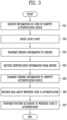
- FIG. 3 is a flowchart illustrating a method of requesting, by an identity authentication request device, identity authentication from an identity authentication device using sensing data obtained by sensing a user's body according to an exemplary embodiment of the present invention.
- the identity authentication request device 200 may transmit sensing data obtained by sensing an adjacent user's body to the identity authentication device 100 and receive data about whether the user has been authenticated.
- the identity authentication request device 200 may receive personal information of a user of the identity authentication device 100 from the identity authentication device 100.
- the personal information of the user is requested by the identity authentication request device 200 and may include one or more items for an administrator (or operator), who manages a service provided by the identity authentication request device 200, to identity the user.
- the personal information on the user may include at least one of a phone number, a PIN, an ID, a password, a name, a sex, an address, an e-mail address, an identification number (e.g., a membership registration number) related to the service provided by the identity authentication request device 200, the type of service in use, and details of the service.
- the identity authentication request device 200 may request the identity authentication device 100 to transmit the personal information of the user using an application.
- the identity authentication request device 200 may acquire sensing data (or second data) obtained by sensing a user's body through the camera module 250 or the sensor module 260.
- the identity authentication request device 200 may acquire a face image as sensing information (or second data) by imaging the user's face through the camera module 250.
- the identity authentication request device 200 may transmit the sensing information (or the second data) to the server 300 using the wireless communication circuit 210.
- the identity authentication request device 200 may transmit the face image to the server 300 as the sensing information (or the second data).
- the sensing information (or the second data) may be raw data transmitted from the camera module 250 or the sensor module 260, and the raw data is only transmitted to the identity authentication device 100 through the wireless communication circuit 210 without being stored in the memory 230 of the identity authentication request device 200.
- the identity authentication request device 200 may receive identification information from the server 300 through the wireless communication circuit 210.
- the identification information for identifying the identity authentication device 100 may be implemented in various ways.
- the identification information may be any one of a phone number and a PIN for specifying the identity authentication device 100 in which the biometric information (or first data) of the user is stored.
- the identity authentication request device 200 may specify the identity authentication device 100 to which the sensing information (or the second data) will be transmitted on the basis of the identification information.
- the identity authentication request device 200 may transmit the sensing information (or the second data) to the specified identity authentication device 100 through the wireless communication circuit 210.
- the identity authentication request device 200 may transmit the face image to the identity authentication device 100 as the sensing information (or the second data).
- the identity authentication request device 200 may receive authentication data from the identity authentication device 100 through the wireless communication circuit 210.
- the authentication data may include a first result representing that the biometric information (or the first data) of the user corresponds to the sensing information (or the second data) or a second result representing that the biometric information (or the first data) of the user does not correspond to the sensing information (or the second data).
- the identity authentication request device 200 may perform a predetermined first function according to successful authentication. For example, when it is determined to perform a function of opening a gate upon successful authentication, the identity authentication request device 200 may open the gate.
- the identity authentication request device 200 may perform a predetermined second function according to failed authentication. For example, when it is determined to output a failure notification message and a beep sound through the input/output device 240 upon failed authentication, the identity authentication request device 200 may output the text message "Authentication has failed" and output a voice message such as "Authentication has failed. Try again please.”
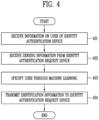
- FIG. 4 is a flowchart illustrating a method of specifying, by a server, a user whose identity authentication is requested using sensing data obtained by sensing a user's body and transmitting identification information to an identity authentication request device according to an exemplary embodiment of the present invention.
- the server 300 may receive personal information of a user of the identity authentication device 100 from the identity authentication device 100.
- the personal information of the user is information requested by the server 300 and may include one or more items for an administrator (or operator), who manages a service provided by the identity authentication request device 200, to identity the user.
- the personal information on the user may include at least one of a phone number, a PIN, an ID, a password, a name, a sex, an address, an e-mail address, an identification number (e.g., a membership registration number) related to the service provided by the identity authentication request device 200, the type of service in use, and details of the service.
- the identity authentication request device 200 may request the identity authentication device 100 to transmit the personal information of the user using an application.
- the server 300 may generate a lookup table on the basis of personal information of users.
- the lookup table may be a table in which each of a plurality of users corresponds to identification information of one of the users.
- the identification information may be a mobile phone number or a PIN for specifying the identity authentication device 100 in which biometric information (or first data) of a specific user is stored.
- the lookup table is not limited thereto and may be updated when the user manually inputs his or her identification information through the application.
- the server 300 may receive sensing information (or second data) from the identity authentication request device 200 to specify the user (or the identity authentication device 100).
- the identity authentication request device 200 requires identification information for specifying the identity authentication device 100 to which the sensing information (or the second data) will be transmitted.
- a determination of whether the biometric information (or the first data) of the user corresponds to the sensing information (or the second data) is not performed in a specific service server (not shown) but performed in the identity authentication device 100. Accordingly, unlike the specific service server having a fixed Internet protocol (IP) address, it is necessary to specify the identity authentication device 100 for performing identity authentication.
- IP Internet protocol
- the identity authentication request device 200 may acquire the sensing data (or the second data) obtained by sensing the user's body through the camera module 250 or the sensor module 260.
- the identity authentication request device 200 may acquire a face image as sensing information (or second data) by imaging the user's face through the camera module 250.
- the server 300 may specify the user (or the identity authentication device 100) from the received sensing information (or the second data) of the user through machine learning.
- the sensing information (or the second data) of the user may include an image file, a voice file, an electronic document, and the like.
- the sensing information (or the second data) of the user is in the form of an image file will be described below for convenience of description.
- the biometric information extractor 310 may extract face information of the user from the image through machine learning.
- the biometric information extractor 310 may extract the face information using at least one of a Haar-like algorithm and a CNN algorithm.
- the biometric information extractor 310 may use an algorithm obtained by combining characteristics of the Haar-like algorithm and the CNN algorithm.
- the CNN algorithm exhibits excellent performance in big data processing.
- the biometric information extractor 310 may extract the biometric information (or the first data) on the basis of cumulative machine learning data stored in the database 330 in advance.
- the cumulative machine learning data may be obtained by accumulating machine learning results of the biometric information extractor 310 on sensing information (or second data).
- the cumulative machine learning data may include only features of images for determining which user corresponds to a face extracted from an arbitrary image. In other words, the cumulative machine learning data does not function alone as biometric information (or first data) but may be information for determining who is a user requesting identity authentication from the image received from the identity authentication request device 200.
- the matcher 320 of the server 300 may select personal information (e.g., identification information) of a user corresponding to the biometric information (or the first data) of the user extracted through the biometric information extractor 310 from among pieces of pre-stored personal information of a plurality of users.
- personal information e.g., identification information
- the matcher 320 may determine whether the biometric information (or the first data) corresponds to a certain user's personal information on the basis of a lookup table pre-stored in the database 330.
- the lookup table may include personal information (e.g., identification information) corresponding to each of the plurality of users.
- the lookup table may be a table in which each of the plurality of users corresponds to identification information of one of the plurality of users.
- the identification information may be a phone number or a PIN for identifying the identity authentication device 100 in which biometric information (or first data) of a specific user is stored.
- the database 330 may store only cumulative data which is a machine learning result from the sensing information (or the second data) of the user and may not store either of the biometric information (or the first data) and the sensing information (or the second data).
- the cumulative data may be updated every time the biometric information extractor 310 performs machine learning on an image received from the identity authentication request device 200.
- the database 330 may include a lookup table in which each of a plurality of users corresponds to identification information (e.g., mobile phone numbers or PINs) of one of the plurality of users.
- the server 300 may transmit the identification information to the identity authentication request device 200. Accordingly, the identity authentication request device 200 may automatically specify the identity authentication device 100 to which the sensing information (or the second data) will be transmitted to perform an identity authentication operation.
- the identity authentication request device 200 may output an identification failure message and transmit a retraining command to the server 300.
- the sensing information (or the second data) may be considered as being transmitted to the wrong identity authentication device 100 on the basis of wrong identification information which is the wrong biometric information (or the first data) extracted from the sensing information (or the second data) of the user.
- the server 300 may increase the accuracy in extracting biometric information (or first data) from sensing information (or second data) of users through retraining.
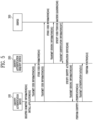
- FIG. 5 is a sequence diagram illustrating an identity authentication process triggered by an identity authentication request among an identity authentication device, an identity authentication request device, and a server according to an exemplary embodiment of the present invention.
- the server 300 may extract identification information corresponding to biometric information (or second data) through machine learning, the identity authentication request device 200 may specify the identity authentication device 100 on the basis of the identification information, and the specified identity authentication device 100 may receive sensing information (or second data) from the identity authentication request device 200, determine whether to authenticate the user by comparing the received sensing information with biometric information (or first data), and transmit authentication or non-authentication confirmation data to the identity authentication request device 200.
- biometric information or second data
- the server 300 may extract identification information corresponding to biometric information (or second data) through machine learning
- the identity authentication request device 200 may specify the identity authentication device 100 on the basis of the identification information
- the specified identity authentication device 100 may receive sensing information (or second data) from the identity authentication request device 200, determine whether to authenticate the user by comparing the received sensing information with biometric information (or first data), and transmit authentication or non-authentication confirmation data to the identity authentication request device 200.
- the identity authentication device 100 may store biometric information (or first data) of a user extracted on the basis of sensing data (or second data) obtained by sensing the user's body in the memory 130.
- the operation corresponds to operation 201 of FIG. 2 .
- the identity authentication device 100 may install an application related to the identity authentication request device 200 according to a selection of the user for using a service provided by the identity authentication request device 200.
- the operation corresponds to operation 202 of FIG. 2 .
- the identity authentication device 100 may transmit personal information of the user excluding biometric information of the user to the identity authentication request device 200 and the server 300 using the application.
- the operation corresponds to operation 203 of FIG. 2 and operation 301 of FIG. 3 .
- the identity authentication request device 200 and the server 300 may store the received personal information of the user in the memory 230 and the database 330, respectively.
- the identity authentication request device 200 may transmit sensing information (or second data) to the server 300.
- the operation corresponds to operation 303 of FIG. 3 .
- the server 300 may determine identification information for specifying the identity authentication device 100 to which the sensing information (or the second data) will be transmitted.
- the biometric information extractor 310 may extract biometric information (e.g., face information) of the user from the sensing information (e.g., an image) through machine learning.
- the matcher 320 may select identification information (e.g., a mobile phone number or a PIN) of the user corresponding to the biometric information (or the face information) of the user extracted by the biometric information extractor 310 from personal information (e.g., identification information) of a plurality of users pre-stored in the database 330.
- the database 330 may include a lookup table in which each of the plurality of users corresponds to the identification information (e.g., mobile phone numbers or PINs) of one of the plurality of users.
- the operation corresponds to operation 403 of FIG. 4 .
- the server 300 may transmit the identification information to the identity authentication request device 200.
- the operation corresponds to operation 404 of FIG. 4 .
- the identity authentication request device 200 may specify the identity authentication device 100 to which the sensing information (the second data) will be transmitted on the basis of the identification information (e.g., a mobile phone number or a PIN).
- the identification information e.g., a mobile phone number or a PIN.
- the identity authentication request device 200 may transmit the sensing information (or the second data) to the specified identity authentication device 100.
- the operation corresponds to operation 305 of FIG. 3 .
- the identity authentication device 100 may determine whether the sensing information (or the second data) received from the identity authentication request device 200 corresponds to the pre-stored biometric information (or the first data) of the user. The operation corresponds to operation 205 of FIG. 2 .
- the identity authentication device 100 may transmit authentication data to the identity authentication request device 200.
- the authentication data may include a first result representing that the biometric information (or the first data) of the user corresponds to the sensing information (or the second data) or a second result representing that the biometric information (or the first data) of the user does not correspond to the sensing information (or the second data).
- the operation corresponds to operation 206 of FIG. 2 .
- the identity authentication request device 200 may perform a predetermined function according to a result value of the received authentication data. For example, when authentication data including the first result is received, the identity authentication request device 200 may perform a function of opening a gate. On the other hand, when authentication data including the second result is received, the identity authentication request device 200 may output an authentication failure message. The operation corresponds to operation 307 of FIG. 3 .
- FIG. 6 is a sequence diagram illustrating an identity authentication process triggered by an identity authentication request among an identity authentication device, an identity authentication request device, and a server according to another exemplary embodiment of the present invention.
- the exemplary embodiment of FIG. 6 in which identity authentication is performed by at least two identity authentication devices 100_1 and 100_2 is different from the exemplary embodiment of FIG. 5 in which identity authentication is performed by the single identity authentication device 100.
- the number of identity authentication devices is not limited thereto.
- the first and second identity authentication devices 100_1 and 100_2 have substantially the same configuration as the identity authentication device 100 shown in FIG. 1 , and thus like components will be indicated by like reference numerals.
- the server 300 may extract identification information corresponding to biometric information (or second data) through machine learning
- the identity authentication request device 200 may specify the first and second identity authentication devices 100_1 and 100_2 on the basis of the identification information
- each of the specified first and second identity authentication devices 100_1 and 100_2 may receive first sensing information (or second data) from the identity authentication request device 200, combine first sub-biometric information pre-stored in the first identity authentication device 100_1 and second sub-biometric information pre-stored in the second identity authentication device 100_2 together, determine whether the first identity authentication device (or a first user) is authenticated by comparing the combined sub-biometric information with first biometric information (or first data) of a user, and transmit authentication or non-authentication confirmation data to the identity authentication request device 200.
- Each operation of FIG. 6 is as follows.
- the first identity authentication device 100_1 may store first biometric information (or first data) of a first user extracted on the basis of sensing data (or second data) obtained by sensing the first user's body in the memory 130.
- the second identity authentication device 100_2 may store second biometric information (or first data) of a second user extracted on the basis of sensing data (or second data) obtained by sensing the second user's body in the memory 130.
- the operation corresponds to operation 201 of FIG. 2 .
- the first and second identity authentication devices 100_1 and 100_2 may install an application related to the identity authentication request device 200 according to selections of the first and second users for using a service provided by the identity authentication request device 200.
- the operation corresponds to operation 202 of FIG. 2 .
- the first identity authentication device 100_1 may transmit second sub-biometric information to the second identity authentication device 100_2.
- the first biometric information of the first user may be divided into a plurality of pieces of sub-biometric information corresponding to the number of identity authentication devices connected to the identity authentication system 1.
- the first biometric information may include first sub-biometric information and second sub-biometric information.
- the second biometric information of the second user may be divided into a plurality of pieces of sub-biometric information corresponding to the number of identity authentication devices connected to the identity authentication system 1.
- each of the identity authentication devices does not store the complete biometric information, and thus security can be improved.
- the first identity authentication device 100_1 shown in FIG. 6 the first biometric information is deleted, and the first sub-metric information is stored. Since the second identity authentication device 100_2 has substantially the same configuration as the first identity authentication device 100_1, overlapping description will be omitted.
- the first biometric information may be stored in the first and second identity authentication devices 100_1 and 100_2 in a distributed manner.
- the first sub-biometric information may be stored in the first identity authentication device 100_1
- the second sub-biometric information may be stored in the second identity authentication device 100_2.
- the first identity authentication device 100_1 may transmit first personal information of the first user excluding the first biometric information of the first user to the identity authentication request device 200 and the server 300 using the application.
- the second identity authentication device 100_2 may transmit second personal information of the second user excluding the second biometric information of the second user to the identity authentication request device 200 and the server 300 using the application.
- the operation corresponds to operation 203 of FIG. 2 and operation 301 of FIG. 3 .
- the identity authentication request device 200 and the server 300 may store the received first personal information of the first user and the received second personal information of the second user in the memory 230 and the database 330, respectively.
- the identity authentication request device 200 may transmit first sensing information (or second data) of the first user to the server 300. This is on the assumption that identity authentication is requested for the first user of the first identity authentication device 100_1, and when identity authentication is requested for the second user of the second identity authentication device 100_2, second sensing information of the second user may be transmitted.
- the operation corresponds to operation 303 of FIG. 3 .
- the server 300 may determine identification information for specifying the first identity authentication device 100_1 to which the first sensing information (or the second data) will be transmitted.
- the biometric information extractor 310 may extract first biometric information (e.g., face information) of the first user from the first sensing information (e.g., an image) through machine learning.
- the matcher 320 may select identification information (e.g., a mobile phone number or a PIN) of the first user corresponding to the first biometric information (or the face information) of the first user extracted by the biometric information extractor 310 from personal information (e.g., identification information) of a plurality of users pre-stored in the database 330.
- the database 330 may include a lookup table in which biometric information (or face information) of the plurality of users corresponds to the identification information (e.g., mobile phone numbers or PINs) of the plurality of users on a one-to-one basis.
- the lookup table may be a table in which biometric information (or face information) of a user for whom identity authentication is requested corresponds to identification information (e.g., a mobile phone number and a PIN) of a plurality of identity authentication devices on a one-to-many basis.
- identification information e.g., a mobile phone number and a PIN
- the server 300 may transmit the identification information to the identity authentication request device 200.
- the operation corresponds to operation 404 of FIG. 4 .
- the identity authentication request device 200 may specify the first and second identity authentication devices 100_1 and 100_2 to which the first sensing information (the second data) of the first user will be transmitted on the basis of the identification information (e.g., the mobile phone number or the PIN).
- the operation corresponds to operation 304 of FIG. 3 .
- the identity authentication request device 200 may transmit the first sensing information (or the second data) of the first user to each of the specified first and second identity authentication devices 100_1 and 100_2. The operation corresponds to operation 305 of FIG. 3 .
- the first identity authentication device 100_1 may receive the second sub-biometric information from the second identity authentication device 100_2 and generate the first biometric information by combining the pre-stored first sub-biometric information and the second sub-biometric information together.
- identity authentication is performed by a plurality of identity authentication devices, and thus security is improved.
- the first identity authentication device 100_1 may determine whether the first sensing information (or the second data) received from the identity authentication request device 200 corresponds to the first biometric information (or the first data) combined in operation 612. The operation corresponds to operation 205 of FIG. 2 .
- the first identity authentication device 100_1 may transmit authentication data to the identity authentication request device 200.
- the authentication data may include a first result representing that the first biometric information (or the first data) corresponds to the first sensing information (or the second data) or a second result representing that the first biometric information (or the first data) does not correspond to the first sensing information (or the second data).
- the operation corresponds to operation 206 of FIG. 2 .
- the identity authentication request device 200 may perform a predetermined function according to a result value of the received authentication data. For example, when authentication data including the first result is received, the identity authentication request device 200 may perform a function of opening a gate. On the other hand, when authentication data including the second result is received, the identity authentication request device 200 may output an authentication failure message. The operation corresponds to operation 307 of FIG. 3 .
- the identity authentication system matches biometric information of a user to an identification code through machine learning and thus can allow non-face-to-face and contactless authentication which does not require the manual input of an identification code for identity authentication every time.
- the security level of the identity authentication system according to the exemplary embodiment of the present invention can be improved through a blockchain.
- the above-described embodiments may be implemented as a hardware component, a software component, and/or a combination of a hardware component and a software component.
- the devices, methods, and components described in the exemplary embodiments may be implemented using one or more general-purpose computers or special purpose computers such as a processor, a controller, an arithmetic logic unit (ALU), a digital signal processor, a microcomputer, a field programmable gate array (FPGA), a programmable logic unit (PLU), a microprocessor, or any other device capable of executing and responding to an instruction.
- a processing device may execute an operating system (OS) and one or more software applications executed on the OS.
- OS operating system
- software applications executed on the OS.
- the processing device may access, store, manipulate, process, and generate data in response to the execution of the software.
- the processing device may include a plurality of processing elements and/or a plurality of types of processing elements.
- the processing device may include a plurality of processors or a single processor and a single controller.
- other processing configurations such as a parallel processor, are also possible.
- Software may include a computer program, code, an instruction, or one or more combinations thereof and may form the processing device to be operated as desired or may independently or collectively command the processing device.
- the software and/or data may be permanently or temporarily embodied in any type of machine, component, physical device, virtual equipment, computer storage medium or device, or in a propagated signal wave in order to be interpreted by the processing device or provide an instruction or data to the processing device.
- the software may be distributed over a networked computer system to be stored or executed in a distributed manner.
- the software and data may be stored on one or more computer-readable recording media.
- the method according to the exemplary embodiment may be implemented in a program instruction form, which may be executed through various computing devices, and recorded on a computer-readable medium.
- the computer-readable medium may include program instructions, data files, data structures, etc. alone or in combination.
- the program instructions recorded on the medium may be specially designed and configured for the embodiment or may be known to and available for use by those of ordinary skill in the computer software field.
- Examples of the computer-readable recording medium include magnetic media, such as a hard disk, a floppy disk, and magnetic tape, optical recording media, such as a compact disc (CD)-ROM and a digital versatile disc (DVD), magneto-optical media, such as a floptical disk, and hardware devices which are specially configured to store and execute program instructions such as a ROM, a RAM, and a flash memory.
- Examples of the program instructions include not only machine language codes created by a compiler but also high-level language code that can be executed by a computer using an interpreter or the like.
- the above hardware devices may be changed to one or more software modules to perform the operations of the exemplary embodiment, and vice versa.
Landscapes
- Engineering & Computer Science (AREA)
- Theoretical Computer Science (AREA)
- Computer Security & Cryptography (AREA)
- General Engineering & Computer Science (AREA)
- Physics & Mathematics (AREA)
- Software Systems (AREA)
- General Physics & Mathematics (AREA)
- Computer Hardware Design (AREA)
- General Health & Medical Sciences (AREA)
- Health & Medical Sciences (AREA)
- Computing Systems (AREA)
- Computer Networks & Wireless Communication (AREA)
- Biomedical Technology (AREA)
- Bioethics (AREA)
- Artificial Intelligence (AREA)
- Medical Informatics (AREA)
- Data Mining & Analysis (AREA)
- Mathematical Physics (AREA)
- Evolutionary Computation (AREA)
- Signal Processing (AREA)
- Computer Vision & Pattern Recognition (AREA)
- Databases & Information Systems (AREA)
- Life Sciences & Earth Sciences (AREA)
- Biophysics (AREA)
- Computational Linguistics (AREA)
- Molecular Biology (AREA)
- Power Engineering (AREA)
- Multimedia (AREA)
- Human Computer Interaction (AREA)
- Oral & Maxillofacial Surgery (AREA)
- Collating Specific Patterns (AREA)
Priority Applications (1)
| Application Number | Priority Date | Filing Date | Title |
|---|---|---|---|
| EP25190104.7A EP4610866A3 (de) | 2020-11-09 | 2021-10-27 | Identitätsauthentifizierungssystem |
Applications Claiming Priority (2)
| Application Number | Priority Date | Filing Date | Title |
|---|---|---|---|
| KR1020200148635A KR102263768B1 (ko) | 2020-11-09 | 2020-11-09 | 사용자 생체 정보를 이용하는 본인 인증 시스템 |
| EP21204901.9A EP3995976B1 (de) | 2020-11-09 | 2021-10-27 | Identitätsauthentifizierungssystem |
Related Parent Applications (1)
| Application Number | Title | Priority Date | Filing Date |
|---|---|---|---|
| EP21204901.9A Division EP3995976B1 (de) | 2020-11-09 | 2021-10-27 | Identitätsauthentifizierungssystem |
Related Child Applications (2)
| Application Number | Title | Priority Date | Filing Date |
|---|---|---|---|
| EP25190104.7A Division EP4610866A3 (de) | 2020-11-09 | 2021-10-27 | Identitätsauthentifizierungssystem |
| EP25190104.7A Division-Into EP4610866A3 (de) | 2020-11-09 | 2021-10-27 | Identitätsauthentifizierungssystem |
Publications (4)
| Publication Number | Publication Date |
|---|---|
| EP4242896A2 true EP4242896A2 (de) | 2023-09-13 |
| EP4242896A3 EP4242896A3 (de) | 2023-09-27 |
| EP4242896B1 EP4242896B1 (de) | 2025-08-27 |
| EP4242896C0 EP4242896C0 (de) | 2025-08-27 |
Family
ID=76376636
Family Applications (3)
| Application Number | Title | Priority Date | Filing Date |
|---|---|---|---|
| EP23177287.2A Active EP4242896B1 (de) | 2020-11-09 | 2021-10-27 | Identitätsauthentifizierungssystem |
| EP21204901.9A Active EP3995976B1 (de) | 2020-11-09 | 2021-10-27 | Identitätsauthentifizierungssystem |
| EP25190104.7A Pending EP4610866A3 (de) | 2020-11-09 | 2021-10-27 | Identitätsauthentifizierungssystem |
Family Applications After (2)
| Application Number | Title | Priority Date | Filing Date |
|---|---|---|---|
| EP21204901.9A Active EP3995976B1 (de) | 2020-11-09 | 2021-10-27 | Identitätsauthentifizierungssystem |
| EP25190104.7A Pending EP4610866A3 (de) | 2020-11-09 | 2021-10-27 | Identitätsauthentifizierungssystem |
Country Status (5)
| Country | Link |
|---|---|
| US (1) | US20220150242A1 (de) |
| EP (3) | EP4242896B1 (de) |
| KR (1) | KR102263768B1 (de) |
| CN (1) | CN114462007A (de) |
| WO (1) | WO2022098189A1 (de) |
Families Citing this family (4)
| Publication number | Priority date | Publication date | Assignee | Title |
|---|---|---|---|---|
| KR102263768B1 (ko) * | 2020-11-09 | 2021-06-11 | 주식회사 고스트패스 | 사용자 생체 정보를 이용하는 본인 인증 시스템 |
| KR102463246B1 (ko) * | 2021-12-13 | 2022-11-04 | 주식회사 고스트패스 | 차량과 생체정보를 이용한 신원인증 방법 및 시스템 |
| US20230224177A1 (en) * | 2022-01-13 | 2023-07-13 | Bold Metrics Inc. | Methods and systems for user environment customization based on non-fungible tokens |
| US20260003468A1 (en) * | 2022-07-07 | 2026-01-01 | University Of Washington | Bio-impedance sensing for gesture input, object recognition, interaction with passive user interfaces, and/or user identification and/or authentication |
Family Cites Families (51)
| Publication number | Priority date | Publication date | Assignee | Title |
|---|---|---|---|---|
| EP1806902B1 (de) * | 2006-01-10 | 2008-06-25 | Alcatel Lucent | Verfahren und Zugangsserver, um einen Benutzer eine zentrale Anmeldungsprozedur bereitzustellen |
| US7512567B2 (en) * | 2006-06-29 | 2009-03-31 | Yt Acquisition Corporation | Method and system for providing biometric authentication at a point-of-sale via a mobile device |
| KR101088029B1 (ko) * | 2009-11-19 | 2011-11-29 | 최운호 | 스마트카드와 통신단말기를 이용한 전자화폐 인증 시스템 |
| JP5564242B2 (ja) * | 2009-12-24 | 2014-07-30 | 株式会社日立製作所 | 生体認証システム |
| KR102216877B1 (ko) * | 2014-02-19 | 2021-02-18 | 삼성전자 주식회사 | 전자장치에서 생체 정보를 이용한 인증 방법 및 장치 |
| KR20150133357A (ko) * | 2014-05-19 | 2015-11-30 | 최상태 | 생체정보 본인증명을 활용한 개인관련 코드 통합관리 시스템 및 생체정보 본인증명을 활용한 개인관련 코드 생성 방법 |
| US20160162673A1 (en) * | 2014-12-05 | 2016-06-09 | Gershom Kutliroff | Technologies for learning body part geometry for use in biometric authentication |
| EP3144690B1 (de) * | 2015-09-17 | 2018-07-11 | Volvo Car Corporation | Verfahren und vorrichtung zur bestimmung des zustands einer batterie in einem fahrzeug |
| US10172535B2 (en) * | 2015-10-28 | 2019-01-08 | Sk Planet Co., Ltd. | Wearable device and method for providing feedback information through vein authentication |
| KR102508490B1 (ko) * | 2015-12-18 | 2023-03-10 | 주식회사 유라코퍼레이션 | 전기자동차 충전케이블 제어장치의 자동 재폐로 장치 및 방법 |
| KR102456598B1 (ko) * | 2016-01-04 | 2022-10-20 | 삼성전자주식회사 | 전자 장치 및 그의 동작 방법 |
| KR20170098105A (ko) * | 2016-02-19 | 2017-08-29 | 삼성전자주식회사 | 인증 모듈을 갖는 전자 장치 및 인증 모듈의 동적 제어를 통한 사용자 인증 방법 |
| US10733275B1 (en) * | 2016-04-01 | 2020-08-04 | Massachusetts Mutual Life Insurance Company | Access control through head imaging and biometric authentication |
| WO2017201125A1 (en) * | 2016-05-18 | 2017-11-23 | The Regents Of The University Of California | Battery energy storage control systems and methods |
| JP6703264B2 (ja) * | 2016-06-22 | 2020-06-03 | 富士通株式会社 | 機械学習管理プログラム、機械学習管理方法および機械学習管理装置 |
| KR101758575B1 (ko) * | 2016-11-14 | 2017-07-26 | 이선관 | 모바일 디바이스를 이용한 금융 결제 방법 및 결제 시스템 |
| KR102263768B1 (ko) * | 2020-11-09 | 2021-06-11 | 주식회사 고스트패스 | 사용자 생체 정보를 이용하는 본인 인증 시스템 |
| US11588813B2 (en) * | 2016-12-08 | 2023-02-21 | Mastercard International Incorporated | Systems and methods for biometric authentication using existing databases |
| KR101882282B1 (ko) * | 2017-09-22 | 2018-08-24 | 엘지전자 주식회사 | 디지털 디바이스 및 그의 생체 인증 방법 |
| US10579809B2 (en) * | 2018-04-09 | 2020-03-03 | Securelyshare Software Private Limited | National identification number based authentication and content delivery |
| KR102596874B1 (ko) * | 2018-05-31 | 2023-11-02 | 삼성전자주식회사 | 생체 정보를 이용한 서비스 수행을 위한 시스템 및 그의 제어 방법 |
| US20190370688A1 (en) * | 2018-06-01 | 2019-12-05 | Jumio Corporation | Machine learning for isolated data sets |
| US20200036708A1 (en) * | 2018-06-15 | 2020-01-30 | Proxy, Inc. | Biometric credential improvement methods and apparatus |
| HUE072764T2 (hu) * | 2018-09-12 | 2025-12-28 | Isx Ip Ltd | Személyek azonosságának távoli ellenõrzése |
| WO2020146502A1 (en) * | 2019-01-10 | 2020-07-16 | Apple Inc. | Controlling the number of downlink-to-uplink and uplink-to-downlink switching points within a shared channel occupancy time in new radio systems operating on unlicensed spectrum |
| US11138302B2 (en) * | 2019-02-27 | 2021-10-05 | International Business Machines Corporation | Access control using multi-authentication factors |
| US11305665B2 (en) * | 2019-03-04 | 2022-04-19 | General Electric Company | Cyber-attack detection and electrical system stability for electric vehicle charging infrastructure |
| KR102215522B1 (ko) * | 2019-04-02 | 2021-02-16 | 한밭대학교 산학협력단 | 사용자 인증 시스템 및 방법 |
| US11501161B2 (en) * | 2019-04-04 | 2022-11-15 | Adobe Inc. | Method to explain factors influencing AI predictions with deep neural networks |
| CN110619269A (zh) * | 2019-08-08 | 2019-12-27 | 浙江中控技术股份有限公司 | 指纹远程管理及验证系统及其方法 |
| US11636195B2 (en) * | 2019-09-19 | 2023-04-25 | Atrium Separate Ip Holdings Number 4, Llc | Dynamic biometric identity verification system, method and device |
| KR20210041724A (ko) * | 2019-10-08 | 2021-04-16 | 엘지전자 주식회사 | 전기차 충전기의 고장 예측 장치 및 방법 |
| CN114303148A (zh) * | 2019-10-11 | 2022-04-08 | 三星电子株式会社 | 电子设备及其控制方法 |
| KR102156184B1 (ko) * | 2019-11-01 | 2020-09-15 | 이선관 | 사용자 생체 정보를 이용하여 본인 인증을 수행하는 전자 장치 및 그 동작 방법 |
| US11592828B2 (en) * | 2020-01-16 | 2023-02-28 | Nvidia Corporation | Using neural networks to perform fault detection in autonomous driving applications |
| KR102139257B1 (ko) * | 2020-04-24 | 2020-07-30 | 주식회사 풀스택 | 비대면 인증 서비스 제공 시스템 |
| CN112389220B (zh) * | 2020-11-06 | 2022-05-24 | 长春捷翼汽车零部件有限公司 | 一种电动车辆充电控制方法及装置 |
| US20220161786A1 (en) * | 2020-11-24 | 2022-05-26 | Hyundai Motor Company | System for evaluating risk values associated with object on road for vehicle and method for the same |
| CN112874369B (zh) * | 2021-01-12 | 2022-08-05 | 上海追日电气有限公司 | 一种充电管理系统的充电与供能优化方法及装置 |
| US20220292388A1 (en) * | 2021-03-09 | 2022-09-15 | Ford Global Technologies, Llc | Machine learning mobile device localization |
| KR20220128588A (ko) * | 2021-03-14 | 2022-09-21 | 박지오 | 전자 장치, 전자 장치의 제어 방법, 컴퓨터 프로그램 및 컴퓨터 판독 가능한 기록 매체 |
| DE102021202468A1 (de) * | 2021-03-15 | 2022-09-15 | Zf Friedrichshafen Ag | Vorrichtung und Verfahren zur modellbasierten prädizierten Regelung einer Komponente eines Fahrzeugs |
| WO2023283667A1 (de) * | 2021-07-14 | 2023-01-19 | Stop-In-Time Gmbh | Verfahren zur bremsung eines fahrzeugs |
| US12157481B2 (en) * | 2022-06-02 | 2024-12-03 | Ford Global Technologies, Llc | Systems and methods for hybrid open-loop and closed-loop path planning |
| KR102537928B1 (ko) * | 2022-08-01 | 2023-05-31 | 주식회사 크로커스 | 보존 전압 강하 및 충전 스케쥴링을 이용한 공동주택용 전력 관리 장치 |
| US12542007B2 (en) * | 2022-12-15 | 2026-02-03 | Cox Automotive, Inc. | Systems and methods for automatically predicting and scheduling vehicle repairs |
| KR20240149513A (ko) * | 2023-04-06 | 2024-10-15 | 현대자동차주식회사 | 지도 정보 및 움직임 센서를 이용한 실내 주행 정보 표시 장치 및 방법 |
| US20240367661A1 (en) * | 2023-05-01 | 2024-11-07 | Nvidia Corporation | In-cabin occupancy detection for autonomous systems and applications |
| US20240367685A1 (en) * | 2023-05-02 | 2024-11-07 | Waymo Llc | Rare example mining for autonomous vehicles |
| US20240370128A1 (en) * | 2023-05-05 | 2024-11-07 | Apple Inc. | User interfaces with dynamic content |
| US12122349B1 (en) * | 2024-01-26 | 2024-10-22 | GM Global Technology Operations LLC | Torque monitoring for multi-actuator vehicle systems |
-
2020
- 2020-11-09 KR KR1020200148635A patent/KR102263768B1/ko active Active
-
2021
- 2021-10-27 EP EP23177287.2A patent/EP4242896B1/de active Active
- 2021-10-27 EP EP21204901.9A patent/EP3995976B1/de active Active
- 2021-10-27 EP EP25190104.7A patent/EP4610866A3/de active Pending
- 2021-10-28 CN CN202111262265.5A patent/CN114462007A/zh active Pending
- 2021-10-29 US US17/515,290 patent/US20220150242A1/en active Pending
- 2021-11-08 WO PCT/KR2021/016141 patent/WO2022098189A1/ko not_active Ceased
Also Published As
| Publication number | Publication date |
|---|---|
| EP3995976A1 (de) | 2022-05-11 |
| EP4242896A3 (de) | 2023-09-27 |
| US20220150242A1 (en) | 2022-05-12 |
| WO2022098189A1 (ko) | 2022-05-12 |
| KR102263768B1 (ko) | 2021-06-11 |
| EP4610866A3 (de) | 2025-12-03 |
| EP3995976C0 (de) | 2023-06-07 |
| EP4610866A2 (de) | 2025-09-03 |
| EP4242896B1 (de) | 2025-08-27 |
| EP4242896C0 (de) | 2025-08-27 |
| CN114462007A (zh) | 2022-05-10 |
| EP3995976B1 (de) | 2023-06-07 |
Similar Documents
| Publication | Publication Date | Title |
|---|---|---|
| EP3995976B1 (de) | Identitätsauthentifizierungssystem | |
| KR102156184B1 (ko) | 사용자 생체 정보를 이용하여 본인 인증을 수행하는 전자 장치 및 그 동작 방법 | |
| EP3382530B1 (de) | Betriebsverfahren einer elektronischen vorrichtung zur funktionsausführung auf basis eines sprachbefehls in gesperrtem status und elektronische vorrichtung zur unterstützung davon | |
| US11508383B2 (en) | Method for operating content and electronic device for implementing same | |
| CN108475310B (zh) | 电子装置及其操作方法 | |
| US9712524B2 (en) | Method and apparatus for user authentication | |
| US9762573B2 (en) | Biometric framework allowing independent application control | |
| CN108702295B (zh) | 基于生物数据进行认证的电子设备及其操作方法 | |
| US7447895B2 (en) | BIOS locking device, computer system with a BIOS locking device and control method thereof | |
| CN107223254B (zh) | 用于隐藏设置处理的方法、用户装置和存储介质 | |
| US20180293370A1 (en) | Electronic device and method for storing fingerprint information | |
| KR102386893B1 (ko) | 이미지 데이터의 보안 방법 및 이를 지원하는 전자 장치 | |
| US12051055B2 (en) | Financial payment method and payment system using mobile device | |
| KR20170098096A (ko) | 생체 정보 기반 인증을 이용한 전자 장치들 간 연결 방법 및 장치 | |
| JP6472455B2 (ja) | 特性情報を抽出するための方法およびシステム | |
| WO2015172515A1 (zh) | 用于移动终端的虹膜识别方法和装置 | |
| KR102264591B1 (ko) | 영상 처리 방법 및 이를 지원하는 전자 장치 | |
| KR20180099423A (ko) | 잠금 상태에서의 음성 명령을 기반으로 하는 기능 실행 운용 방법 및 이를 지원하는 전자 장치 | |
| US12169539B2 (en) | Apparatus, system and method for application-specific biometric processing in a computer system | |
| CN105635041A (zh) | 基于人脸识别的整合登录系统及方法 | |
| US20240338701A1 (en) | Financial payment method and payment system using mobile device | |
| US20250380137A1 (en) | Identity authentication system | |
| CN113139164A (zh) | 自动输入密码的方法、系统及密码管理装置 | |
| US20240265080A1 (en) | Electronic Device for Performing User Authentication by Using User Biometric Information and Operation Method Thereof | |
| CN110837630B (zh) | 登录方法、图像处理方法和电子设备 |
Legal Events
| Date | Code | Title | Description |
|---|---|---|---|
| PUAI | Public reference made under article 153(3) epc to a published international application that has entered the european phase |
Free format text: ORIGINAL CODE: 0009012 |
|
| STAA | Information on the status of an ep patent application or granted ep patent |
Free format text: STATUS: THE APPLICATION HAS BEEN PUBLISHED |
|
| REG | Reference to a national code |
Ref legal event code: R079 Ref country code: DE Ref legal event code: R079 Ref document number: 602021037511 Country of ref document: DE Free format text: PREVIOUS MAIN CLASS: G06F0021620000 Ipc: G06F0021320000 |
|
| PUAL | Search report despatched |
Free format text: ORIGINAL CODE: 0009013 |
|
| AC | Divisional application: reference to earlier application |
Ref document number: 3995976 Country of ref document: EP Kind code of ref document: P |
|
| AK | Designated contracting states |
Kind code of ref document: A2 Designated state(s): AL AT BE BG CH CY CZ DE DK EE ES FI FR GB GR HR HU IE IS IT LI LT LU LV MC MK MT NL NO PL PT RO RS SE SI SK SM TR |
|
| AK | Designated contracting states |
Kind code of ref document: A3 Designated state(s): AL AT BE BG CH CY CZ DE DK EE ES FI FR GB GR HR HU IE IS IT LI LT LU LV MC MK MT NL NO PL PT RO RS SE SI SK SM TR |
|
| RIC1 | Information provided on ipc code assigned before grant |
Ipc: G06F 21/62 20130101ALI20230824BHEP Ipc: G06F 21/32 20130101AFI20230824BHEP |
|
| STAA | Information on the status of an ep patent application or granted ep patent |
Free format text: STATUS: REQUEST FOR EXAMINATION WAS MADE |
|
| 17P | Request for examination filed |
Effective date: 20240327 |
|
| RBV | Designated contracting states (corrected) |
Designated state(s): AL AT BE BG CH CY CZ DE DK EE ES FI FR GB GR HR HU IE IS IT LI LT LU LV MC MK MT NL NO PL PT RO RS SE SI SK SM TR |
|
| STAA | Information on the status of an ep patent application or granted ep patent |
Free format text: STATUS: EXAMINATION IS IN PROGRESS |
|
| 17Q | First examination report despatched |
Effective date: 20240723 |
|
| GRAP | Despatch of communication of intention to grant a patent |
Free format text: ORIGINAL CODE: EPIDOSNIGR1 |
|
| STAA | Information on the status of an ep patent application or granted ep patent |
Free format text: STATUS: GRANT OF PATENT IS INTENDED |
|
| INTG | Intention to grant announced |
Effective date: 20250324 |
|
| GRAS | Grant fee paid |
Free format text: ORIGINAL CODE: EPIDOSNIGR3 |
|
| GRAA | (expected) grant |
Free format text: ORIGINAL CODE: 0009210 |
|
| STAA | Information on the status of an ep patent application or granted ep patent |
Free format text: STATUS: THE PATENT HAS BEEN GRANTED |
|
| AC | Divisional application: reference to earlier application |
Ref document number: 3995976 Country of ref document: EP Kind code of ref document: P |
|
| AK | Designated contracting states |
Kind code of ref document: B1 Designated state(s): AL AT BE BG CH CY CZ DE DK EE ES FI FR GB GR HR HU IE IS IT LI LT LU LV MC MK MT NL NO PL PT RO RS SE SI SK SM TR |
|
| REG | Reference to a national code |
Ref country code: CH Ref legal event code: EP |
|
| U01 | Request for unitary effect filed |
Effective date: 20250827 |
|
| U07 | Unitary effect registered |
Designated state(s): AT BE BG DE DK EE FI FR IT LT LU LV MT NL PT RO SE SI Effective date: 20250902 |
|
| REG | Reference to a national code |
Ref country code: IE Ref legal event code: FG4D |
|
| REG | Reference to a national code |
Ref country code: CH Ref legal event code: U11 Free format text: ST27 STATUS EVENT CODE: U-0-0-U10-U11 (AS PROVIDED BY THE NATIONAL OFFICE) Effective date: 20251120 |
|
| U20 | Renewal fee for the european patent with unitary effect paid |
Year of fee payment: 5 Effective date: 20251027 |
|
| PG25 | Lapsed in a contracting state [announced via postgrant information from national office to epo] |
Ref country code: IS Free format text: LAPSE BECAUSE OF FAILURE TO SUBMIT A TRANSLATION OF THE DESCRIPTION OR TO PAY THE FEE WITHIN THE PRESCRIBED TIME-LIMIT Effective date: 20251227 |
|
| PGFP | Annual fee paid to national office [announced via postgrant information from national office to epo] |
Ref country code: GB Payment date: 20251120 Year of fee payment: 5 |
|
| PG25 | Lapsed in a contracting state [announced via postgrant information from national office to epo] |
Ref country code: NO Free format text: LAPSE BECAUSE OF FAILURE TO SUBMIT A TRANSLATION OF THE DESCRIPTION OR TO PAY THE FEE WITHIN THE PRESCRIBED TIME-LIMIT Effective date: 20251127 |
|
| PG25 | Lapsed in a contracting state [announced via postgrant information from national office to epo] |
Ref country code: HR Free format text: LAPSE BECAUSE OF FAILURE TO SUBMIT A TRANSLATION OF THE DESCRIPTION OR TO PAY THE FEE WITHIN THE PRESCRIBED TIME-LIMIT Effective date: 20250827 |
|
| PG25 | Lapsed in a contracting state [announced via postgrant information from national office to epo] |
Ref country code: GR Free format text: LAPSE BECAUSE OF FAILURE TO SUBMIT A TRANSLATION OF THE DESCRIPTION OR TO PAY THE FEE WITHIN THE PRESCRIBED TIME-LIMIT Effective date: 20251128 |
|
| PGFP | Annual fee paid to national office [announced via postgrant information from national office to epo] |
Ref country code: CH Payment date: 20251120 Year of fee payment: 5 |
|
| PG25 | Lapsed in a contracting state [announced via postgrant information from national office to epo] |
Ref country code: PL Free format text: LAPSE BECAUSE OF FAILURE TO SUBMIT A TRANSLATION OF THE DESCRIPTION OR TO PAY THE FEE WITHIN THE PRESCRIBED TIME-LIMIT Effective date: 20250827 |
|
| PG25 | Lapsed in a contracting state [announced via postgrant information from national office to epo] |
Ref country code: RS Free format text: LAPSE BECAUSE OF FAILURE TO SUBMIT A TRANSLATION OF THE DESCRIPTION OR TO PAY THE FEE WITHIN THE PRESCRIBED TIME-LIMIT Effective date: 20251127 |
|
| PG25 | Lapsed in a contracting state [announced via postgrant information from national office to epo] |
Ref country code: ES Free format text: LAPSE BECAUSE OF FAILURE TO SUBMIT A TRANSLATION OF THE DESCRIPTION OR TO PAY THE FEE WITHIN THE PRESCRIBED TIME-LIMIT Effective date: 20250827 |
|
| PG25 | Lapsed in a contracting state [announced via postgrant information from national office to epo] |
Ref country code: SM Free format text: LAPSE BECAUSE OF FAILURE TO SUBMIT A TRANSLATION OF THE DESCRIPTION OR TO PAY THE FEE WITHIN THE PRESCRIBED TIME-LIMIT Effective date: 20250827 |