EP4242266A1 - Curable composition - Google Patents
Curable composition Download PDFInfo
- Publication number
- EP4242266A1 EP4242266A1 EP22749927.4A EP22749927A EP4242266A1 EP 4242266 A1 EP4242266 A1 EP 4242266A1 EP 22749927 A EP22749927 A EP 22749927A EP 4242266 A1 EP4242266 A1 EP 4242266A1
- Authority
- EP
- European Patent Office
- Prior art keywords
- curable composition
- less
- resin component
- component
- isocyanate compound
- Prior art date
- Legal status (The legal status is an assumption and is not a legal conclusion. Google has not performed a legal analysis and makes no representation as to the accuracy of the status listed.)
- Pending
Links
- 239000000203 mixture Substances 0.000 title claims abstract description 229
- 239000000945 filler Substances 0.000 claims abstract description 56
- 238000001816 cooling Methods 0.000 claims abstract description 14
- -1 isocyanate compound Chemical class 0.000 claims description 88
- 229920005989 resin Polymers 0.000 claims description 86
- 239000011347 resin Substances 0.000 claims description 86
- 239000012948 isocyanate Substances 0.000 claims description 79
- 150000003077 polyols Chemical class 0.000 claims description 29
- 229920005862 polyol Polymers 0.000 claims description 27
- 239000003795 chemical substances by application Substances 0.000 claims description 11
- IQPQWNKOIGAROB-UHFFFAOYSA-N isocyanate group Chemical group [N-]=C=O IQPQWNKOIGAROB-UHFFFAOYSA-N 0.000 claims description 8
- 238000002156 mixing Methods 0.000 abstract description 34
- 230000008859 change Effects 0.000 abstract description 21
- 238000010292 electrical insulation Methods 0.000 abstract description 16
- 125000004432 carbon atom Chemical group C* 0.000 description 55
- 239000002245 particle Substances 0.000 description 27
- 125000002947 alkylene group Chemical group 0.000 description 26
- 239000011231 conductive filler Substances 0.000 description 22
- RRAMGCGOFNQTLD-UHFFFAOYSA-N hexamethylene diisocyanate Chemical compound O=C=NCCCCCCN=C=O RRAMGCGOFNQTLD-UHFFFAOYSA-N 0.000 description 20
- 239000005057 Hexamethylene diisocyanate Substances 0.000 description 17
- 238000000034 method Methods 0.000 description 17
- 239000000463 material Substances 0.000 description 16
- 239000003063 flame retardant Substances 0.000 description 15
- RNFJDJUURJAICM-UHFFFAOYSA-N 2,2,4,4,6,6-hexaphenoxy-1,3,5-triaza-2$l^{5},4$l^{5},6$l^{5}-triphosphacyclohexa-1,3,5-triene Chemical compound N=1P(OC=2C=CC=CC=2)(OC=2C=CC=CC=2)=NP(OC=2C=CC=CC=2)(OC=2C=CC=CC=2)=NP=1(OC=1C=CC=CC=1)OC1=CC=CC=C1 RNFJDJUURJAICM-UHFFFAOYSA-N 0.000 description 14
- 238000005227 gel permeation chromatography Methods 0.000 description 14
- 239000000654 additive Substances 0.000 description 13
- 230000017525 heat dissipation Effects 0.000 description 13
- 125000004450 alkenylene group Chemical group 0.000 description 12
- 125000004122 cyclic group Chemical group 0.000 description 12
- 150000002513 isocyanates Chemical class 0.000 description 12
- 230000000704 physical effect Effects 0.000 description 12
- 150000001875 compounds Chemical class 0.000 description 11
- 239000013638 trimer Substances 0.000 description 11
- 125000000304 alkynyl group Chemical group 0.000 description 10
- KXBFLNPZHXDQLV-UHFFFAOYSA-N [cyclohexyl(diisocyanato)methyl]cyclohexane Chemical compound C1CCCCC1C(N=C=O)(N=C=O)C1CCCCC1 KXBFLNPZHXDQLV-UHFFFAOYSA-N 0.000 description 9
- 125000004419 alkynylene group Chemical group 0.000 description 8
- 125000003118 aryl group Chemical group 0.000 description 7
- 238000006243 chemical reaction Methods 0.000 description 7
- 230000005484 gravity Effects 0.000 description 7
- NIMLQBUJDJZYEJ-UHFFFAOYSA-N isophorone diisocyanate Chemical compound CC1(C)CC(N=C=O)CC(C)(CN=C=O)C1 NIMLQBUJDJZYEJ-UHFFFAOYSA-N 0.000 description 7
- JOYRKODLDBILNP-UHFFFAOYSA-N Ethyl urethane Chemical compound CCOC(N)=O JOYRKODLDBILNP-UHFFFAOYSA-N 0.000 description 6
- OFOBLEOULBTSOW-UHFFFAOYSA-N Malonic acid Chemical compound OC(=O)CC(O)=O OFOBLEOULBTSOW-UHFFFAOYSA-N 0.000 description 6
- 239000000853 adhesive Substances 0.000 description 6
- 230000001070 adhesive effect Effects 0.000 description 6
- 125000003342 alkenyl group Chemical group 0.000 description 6
- 125000000217 alkyl group Chemical group 0.000 description 6
- 230000000052 comparative effect Effects 0.000 description 6
- 230000008569 process Effects 0.000 description 6
- 238000002411 thermogravimetry Methods 0.000 description 6
- OKTJSMMVPCPJKN-UHFFFAOYSA-N Carbon Chemical compound [C] OKTJSMMVPCPJKN-UHFFFAOYSA-N 0.000 description 5
- 230000000996 additive effect Effects 0.000 description 5
- PNEYBMLMFCGWSK-UHFFFAOYSA-N aluminium oxide Inorganic materials [O-2].[O-2].[O-2].[Al+3].[Al+3] PNEYBMLMFCGWSK-UHFFFAOYSA-N 0.000 description 5
- 238000005516 engineering process Methods 0.000 description 5
- 238000005259 measurement Methods 0.000 description 5
- 229920000642 polymer Polymers 0.000 description 5
- MQIUGAXCHLFZKX-UHFFFAOYSA-N Di-n-octyl phthalate Chemical compound CCCCCCCCOC(=O)C1=CC=CC=C1C(=O)OCCCCCCCC MQIUGAXCHLFZKX-UHFFFAOYSA-N 0.000 description 4
- XEEYBQQBJWHFJM-UHFFFAOYSA-N Iron Chemical compound [Fe] XEEYBQQBJWHFJM-UHFFFAOYSA-N 0.000 description 4
- 239000005058 Isophorone diisocyanate Substances 0.000 description 4
- DNIAPMSPPWPWGF-UHFFFAOYSA-N Propylene glycol Chemical compound CC(O)CO DNIAPMSPPWPWGF-UHFFFAOYSA-N 0.000 description 4
- WYURNTSHIVDZCO-UHFFFAOYSA-N Tetrahydrofuran Chemical compound C1CCOC1 WYURNTSHIVDZCO-UHFFFAOYSA-N 0.000 description 4
- KRKNYBCHXYNGOX-UHFFFAOYSA-N citric acid Natural products OC(=O)CC(O)(C(O)=O)CC(O)=O KRKNYBCHXYNGOX-UHFFFAOYSA-N 0.000 description 4
- 125000005442 diisocyanate group Chemical group 0.000 description 4
- 230000000694 effects Effects 0.000 description 4
- 125000002887 hydroxy group Chemical group [H]O* 0.000 description 4
- 238000009413 insulation Methods 0.000 description 4
- 239000004014 plasticizer Substances 0.000 description 4
- 230000009257 reactivity Effects 0.000 description 4
- VYPSYNLAJGMNEJ-UHFFFAOYSA-N silicon dioxide Inorganic materials O=[Si]=O VYPSYNLAJGMNEJ-UHFFFAOYSA-N 0.000 description 4
- PAPBSGBWRJIAAV-UHFFFAOYSA-N ε-Caprolactone Chemical compound O=C1CCCCCO1 PAPBSGBWRJIAAV-UHFFFAOYSA-N 0.000 description 4
- PUPZLCDOIYMWBV-UHFFFAOYSA-N (+/-)-1,3-Butanediol Chemical compound CC(O)CCO PUPZLCDOIYMWBV-UHFFFAOYSA-N 0.000 description 3
- LVAGMBHLXLZJKZ-UHFFFAOYSA-N 2-o-decyl 1-o-octyl benzene-1,2-dicarboxylate Chemical compound CCCCCCCCCCOC(=O)C1=CC=CC=C1C(=O)OCCCCCCCC LVAGMBHLXLZJKZ-UHFFFAOYSA-N 0.000 description 3
- PEDCQBHIVMGVHV-UHFFFAOYSA-N Glycerine Chemical compound OCC(O)CO PEDCQBHIVMGVHV-UHFFFAOYSA-N 0.000 description 3
- 230000009471 action Effects 0.000 description 3
- 125000002015 acyclic group Chemical group 0.000 description 3
- 125000001931 aliphatic group Chemical group 0.000 description 3
- WERYXYBDKMZEQL-UHFFFAOYSA-N butane-1,4-diol Chemical compound OCCCCO WERYXYBDKMZEQL-UHFFFAOYSA-N 0.000 description 3
- 230000015556 catabolic process Effects 0.000 description 3
- 238000006482 condensation reaction Methods 0.000 description 3
- 125000006165 cyclic alkyl group Chemical group 0.000 description 3
- MTHSVFCYNBDYFN-UHFFFAOYSA-N diethylene glycol Chemical compound OCCOCCO MTHSVFCYNBDYFN-UHFFFAOYSA-N 0.000 description 3
- 239000003085 diluting agent Substances 0.000 description 3
- 238000011049 filling Methods 0.000 description 3
- 125000001072 heteroaryl group Chemical group 0.000 description 3
- WNLRTRBMVRJNCN-UHFFFAOYSA-N hexanedioic acid Natural products OC(=O)CCCCC(O)=O WNLRTRBMVRJNCN-UHFFFAOYSA-N 0.000 description 3
- 238000004519 manufacturing process Methods 0.000 description 3
- 239000000178 monomer Substances 0.000 description 3
- CXMXRPHRNRROMY-UHFFFAOYSA-N n-Decanedioic acid Natural products OC(=O)CCCCCCCCC(O)=O CXMXRPHRNRROMY-UHFFFAOYSA-N 0.000 description 3
- XNGIFLGASWRNHJ-UHFFFAOYSA-N o-dicarboxybenzene Natural products OC(=O)C1=CC=CC=C1C(O)=O XNGIFLGASWRNHJ-UHFFFAOYSA-N 0.000 description 3
- TWNQGVIAIRXVLR-UHFFFAOYSA-N oxo(oxoalumanyloxy)alumane Chemical compound O=[Al]O[Al]=O TWNQGVIAIRXVLR-UHFFFAOYSA-N 0.000 description 3
- 239000005056 polyisocyanate Substances 0.000 description 3
- 229920001228 polyisocyanate Polymers 0.000 description 3
- 239000002904 solvent Substances 0.000 description 3
- 125000001424 substituent group Chemical group 0.000 description 3
- 239000013008 thixotropic agent Substances 0.000 description 3
- XLYOFNOQVPJJNP-UHFFFAOYSA-N water Substances O XLYOFNOQVPJJNP-UHFFFAOYSA-N 0.000 description 3
- DNIAPMSPPWPWGF-VKHMYHEASA-N (+)-propylene glycol Chemical compound C[C@H](O)CO DNIAPMSPPWPWGF-VKHMYHEASA-N 0.000 description 2
- ARXKVVRQIIOZGF-UHFFFAOYSA-N 1,2,4-butanetriol Chemical compound OCCC(O)CO ARXKVVRQIIOZGF-UHFFFAOYSA-N 0.000 description 2
- MTZUIIAIAKMWLI-UHFFFAOYSA-N 1,2-diisocyanatobenzene Chemical compound O=C=NC1=CC=CC=C1N=C=O MTZUIIAIAKMWLI-UHFFFAOYSA-N 0.000 description 2
- ZTNJGMFHJYGMDR-UHFFFAOYSA-N 1,2-diisocyanatoethane Chemical compound O=C=NCCN=C=O ZTNJGMFHJYGMDR-UHFFFAOYSA-N 0.000 description 2
- ZXHZWRZAWJVPIC-UHFFFAOYSA-N 1,2-diisocyanatonaphthalene Chemical compound C1=CC=CC2=C(N=C=O)C(N=C=O)=CC=C21 ZXHZWRZAWJVPIC-UHFFFAOYSA-N 0.000 description 2
- ZGDSDWSIFQBAJS-UHFFFAOYSA-N 1,2-diisocyanatopropane Chemical compound O=C=NC(C)CN=C=O ZGDSDWSIFQBAJS-UHFFFAOYSA-N 0.000 description 2
- OVBFMUAFNIIQAL-UHFFFAOYSA-N 1,4-diisocyanatobutane Chemical compound O=C=NCCCCN=C=O OVBFMUAFNIIQAL-UHFFFAOYSA-N 0.000 description 2
- CDMDQYCEEKCBGR-UHFFFAOYSA-N 1,4-diisocyanatocyclohexane Chemical compound O=C=NC1CCC(N=C=O)CC1 CDMDQYCEEKCBGR-UHFFFAOYSA-N 0.000 description 2
- VZXPHDGHQXLXJC-UHFFFAOYSA-N 1,6-diisocyanato-5,6-dimethylheptane Chemical compound O=C=NC(C)(C)C(C)CCCCN=C=O VZXPHDGHQXLXJC-UHFFFAOYSA-N 0.000 description 2
- UPMLOUAZCHDJJD-UHFFFAOYSA-N 4,4'-Diphenylmethane Diisocyanate Chemical compound C1=CC(N=C=O)=CC=C1CC1=CC=C(N=C=O)C=C1 UPMLOUAZCHDJJD-UHFFFAOYSA-N 0.000 description 2
- IRIAEXORFWYRCZ-UHFFFAOYSA-N Butylbenzyl phthalate Chemical compound CCCCOC(=O)C1=CC=CC=C1C(=O)OCC1=CC=CC=C1 IRIAEXORFWYRCZ-UHFFFAOYSA-N 0.000 description 2
- KCXZNSGUUQJJTR-UHFFFAOYSA-N Di-n-hexyl phthalate Chemical compound CCCCCCOC(=O)C1=CC=CC=C1C(=O)OCCCCCC KCXZNSGUUQJJTR-UHFFFAOYSA-N 0.000 description 2
- NIQCNGHVCWTJSM-UHFFFAOYSA-N Dimethyl phthalate Chemical compound COC(=O)C1=CC=CC=C1C(=O)OC NIQCNGHVCWTJSM-UHFFFAOYSA-N 0.000 description 2
- AEMRFAOFKBGASW-UHFFFAOYSA-N Glycolic acid Natural products OCC(O)=O AEMRFAOFKBGASW-UHFFFAOYSA-N 0.000 description 2
- DEAWYMVPWUVIEQ-UHFFFAOYSA-N N=C=O.N=C=O.C1CC2CCC1(C)C2 Chemical compound N=C=O.N=C=O.C1CC2CCC1(C)C2 DEAWYMVPWUVIEQ-UHFFFAOYSA-N 0.000 description 2
- IIGAAOXXRKTFAM-UHFFFAOYSA-N N=C=O.N=C=O.CC1=C(C)C(C)=C(C)C(C)=C1C Chemical compound N=C=O.N=C=O.CC1=C(C)C(C)=C(C)C(C)=C1C IIGAAOXXRKTFAM-UHFFFAOYSA-N 0.000 description 2
- QORUGOXNWQUALA-UHFFFAOYSA-N N=C=O.N=C=O.N=C=O.C1=CC=C(C(C2=CC=CC=C2)C2=CC=CC=C2)C=C1 Chemical compound N=C=O.N=C=O.N=C=O.C1=CC=C(C(C2=CC=CC=C2)C2=CC=CC=C2)C=C1 QORUGOXNWQUALA-UHFFFAOYSA-N 0.000 description 2
- PXHVJJICTQNCMI-UHFFFAOYSA-N Nickel Chemical compound [Ni] PXHVJJICTQNCMI-UHFFFAOYSA-N 0.000 description 2
- ALQSHHUCVQOPAS-UHFFFAOYSA-N Pentane-1,5-diol Chemical compound OCCCCCO ALQSHHUCVQOPAS-UHFFFAOYSA-N 0.000 description 2
- ZFOZVQLOBQUTQQ-UHFFFAOYSA-N Tributyl citrate Chemical compound CCCCOC(=O)CC(O)(C(=O)OCCCC)CC(=O)OCCCC ZFOZVQLOBQUTQQ-UHFFFAOYSA-N 0.000 description 2
- ZJCCRDAZUWHFQH-UHFFFAOYSA-N Trimethylolpropane Chemical compound CCC(CO)(CO)CO ZJCCRDAZUWHFQH-UHFFFAOYSA-N 0.000 description 2
- LUSFFPXRDZKBMF-UHFFFAOYSA-N [3-(hydroxymethyl)cyclohexyl]methanol Chemical compound OCC1CCCC(CO)C1 LUSFFPXRDZKBMF-UHFFFAOYSA-N 0.000 description 2
- YIMQCDZDWXUDCA-UHFFFAOYSA-N [4-(hydroxymethyl)cyclohexyl]methanol Chemical compound OCC1CCC(CO)CC1 YIMQCDZDWXUDCA-UHFFFAOYSA-N 0.000 description 2
- 239000004840 adhesive resin Substances 0.000 description 2
- 229920006223 adhesive resin Polymers 0.000 description 2
- 239000001361 adipic acid Substances 0.000 description 2
- 235000011037 adipic acid Nutrition 0.000 description 2
- 125000002723 alicyclic group Chemical group 0.000 description 2
- 229910052782 aluminium Inorganic materials 0.000 description 2
- XAGFODPZIPBFFR-UHFFFAOYSA-N aluminium Chemical compound [Al] XAGFODPZIPBFFR-UHFFFAOYSA-N 0.000 description 2
- WNROFYMDJYEPJX-UHFFFAOYSA-K aluminium hydroxide Chemical compound [OH-].[OH-].[OH-].[Al+3] WNROFYMDJYEPJX-UHFFFAOYSA-K 0.000 description 2
- 229910000147 aluminium phosphate Inorganic materials 0.000 description 2
- 238000004458 analytical method Methods 0.000 description 2
- ARCGXLSVLAOJQL-UHFFFAOYSA-N anhydrous trimellitic acid Natural products OC(=O)C1=CC=C(C(O)=O)C(C(O)=O)=C1 ARCGXLSVLAOJQL-UHFFFAOYSA-N 0.000 description 2
- 239000012752 auxiliary agent Substances 0.000 description 2
- SCABKEBYDRTODC-UHFFFAOYSA-N bis[2-(2-butoxyethoxy)ethyl] hexanedioate Chemical compound CCCCOCCOCCOC(=O)CCCCC(=O)OCCOCCOCCCC SCABKEBYDRTODC-UHFFFAOYSA-N 0.000 description 2
- DQXBYHZEEUGOBF-UHFFFAOYSA-N but-3-enoic acid;ethene Chemical compound C=C.OC(=O)CC=C DQXBYHZEEUGOBF-UHFFFAOYSA-N 0.000 description 2
- BMRWNKZVCUKKSR-UHFFFAOYSA-N butane-1,2-diol Chemical compound CCC(O)CO BMRWNKZVCUKKSR-UHFFFAOYSA-N 0.000 description 2
- OWBTYPJTUOEWEK-UHFFFAOYSA-N butane-2,3-diol Chemical compound CC(O)C(C)O OWBTYPJTUOEWEK-UHFFFAOYSA-N 0.000 description 2
- 229910052799 carbon Inorganic materials 0.000 description 2
- 125000003178 carboxy group Chemical group [H]OC(*)=O 0.000 description 2
- 239000013256 coordination polymer Substances 0.000 description 2
- 239000007822 coupling agent Substances 0.000 description 2
- 238000004132 cross linking Methods 0.000 description 2
- FOTKYAAJKYLFFN-UHFFFAOYSA-N decane-1,10-diol Chemical compound OCCCCCCCCCCO FOTKYAAJKYLFFN-UHFFFAOYSA-N 0.000 description 2
- DOIRQSBPFJWKBE-UHFFFAOYSA-N dibutyl phthalate Chemical compound CCCCOC(=O)C1=CC=CC=C1C(=O)OCCCC DOIRQSBPFJWKBE-UHFFFAOYSA-N 0.000 description 2
- 125000001142 dicarboxylic acid group Chemical group 0.000 description 2
- 235000014113 dietary fatty acids Nutrition 0.000 description 2
- FLKPEMZONWLCSK-UHFFFAOYSA-N diethyl phthalate Chemical compound CCOC(=O)C1=CC=CC=C1C(=O)OCC FLKPEMZONWLCSK-UHFFFAOYSA-N 0.000 description 2
- 239000002270 dispersing agent Substances 0.000 description 2
- 238000009826 distribution Methods 0.000 description 2
- 150000002148 esters Chemical class 0.000 description 2
- 239000005038 ethylene vinyl acetate Substances 0.000 description 2
- 230000001747 exhibiting effect Effects 0.000 description 2
- 239000000194 fatty acid Substances 0.000 description 2
- 229930195729 fatty acid Natural products 0.000 description 2
- 125000000524 functional group Chemical group 0.000 description 2
- XXMIOPMDWAUFGU-UHFFFAOYSA-N hexane-1,6-diol Chemical compound OCCCCCCO XXMIOPMDWAUFGU-UHFFFAOYSA-N 0.000 description 2
- 229910052742 iron Inorganic materials 0.000 description 2
- 239000007788 liquid Substances 0.000 description 2
- VTHJTEIRLNZDEV-UHFFFAOYSA-L magnesium dihydroxide Chemical compound [OH-].[OH-].[Mg+2] VTHJTEIRLNZDEV-UHFFFAOYSA-L 0.000 description 2
- 239000000347 magnesium hydroxide Substances 0.000 description 2
- 229910001862 magnesium hydroxide Inorganic materials 0.000 description 2
- 238000000691 measurement method Methods 0.000 description 2
- 229910052751 metal Inorganic materials 0.000 description 2
- 239000002184 metal Substances 0.000 description 2
- AYLRODJJLADBOB-QMMMGPOBSA-N methyl (2s)-2,6-diisocyanatohexanoate Chemical compound COC(=O)[C@@H](N=C=O)CCCCN=C=O AYLRODJJLADBOB-QMMMGPOBSA-N 0.000 description 2
- 125000002950 monocyclic group Chemical group 0.000 description 2
- SLCVBVWXLSEKPL-UHFFFAOYSA-N neopentyl glycol Chemical compound OCC(C)(C)CO SLCVBVWXLSEKPL-UHFFFAOYSA-N 0.000 description 2
- NBIIXXVUZAFLBC-UHFFFAOYSA-N phosphoric acid Substances OP(O)(O)=O NBIIXXVUZAFLBC-UHFFFAOYSA-N 0.000 description 2
- 229920001200 poly(ethylene-vinyl acetate) Polymers 0.000 description 2
- 125000003367 polycyclic group Chemical group 0.000 description 2
- 238000006116 polymerization reaction Methods 0.000 description 2
- 239000011148 porous material Substances 0.000 description 2
- 239000002243 precursor Substances 0.000 description 2
- 238000002360 preparation method Methods 0.000 description 2
- 230000035939 shock Effects 0.000 description 2
- 239000012798 spherical particle Substances 0.000 description 2
- 239000012756 surface treatment agent Substances 0.000 description 2
- DVKJHBMWWAPEIU-UHFFFAOYSA-N toluene 2,4-diisocyanate Chemical compound CC1=CC=C(N=C=O)C=C1N=C=O DVKJHBMWWAPEIU-UHFFFAOYSA-N 0.000 description 2
- 239000008096 xylene Substances 0.000 description 2
- BJEPYKJPYRNKOW-REOHCLBHSA-N (S)-malic acid Chemical group OC(=O)[C@@H](O)CC(O)=O BJEPYKJPYRNKOW-REOHCLBHSA-N 0.000 description 1
- YAXKTBLXMTYWDQ-UHFFFAOYSA-N 1,2,3-butanetriol Chemical compound CC(O)C(O)CO YAXKTBLXMTYWDQ-UHFFFAOYSA-N 0.000 description 1
- YPFDHNVEDLHUCE-UHFFFAOYSA-N 1,3-propanediol Substances OCCCO YPFDHNVEDLHUCE-UHFFFAOYSA-N 0.000 description 1
- ALVZNPYWJMLXKV-UHFFFAOYSA-N 1,9-Nonanediol Chemical compound OCCCCCCCCCO ALVZNPYWJMLXKV-UHFFFAOYSA-N 0.000 description 1
- RLPSARLYTKXVSE-UHFFFAOYSA-N 1-(1,3-thiazol-5-yl)ethanamine Chemical compound CC(N)C1=CN=CS1 RLPSARLYTKXVSE-UHFFFAOYSA-N 0.000 description 1
- BTUDGPVTCYNYLK-UHFFFAOYSA-N 2,2-dimethylglutaric acid Chemical group OC(=O)C(C)(C)CCC(O)=O BTUDGPVTCYNYLK-UHFFFAOYSA-N 0.000 description 1
- GOHPTLYPQCTZSE-UHFFFAOYSA-N 2,2-dimethylsuccinic acid Chemical group OC(=O)C(C)(C)CC(O)=O GOHPTLYPQCTZSE-UHFFFAOYSA-N 0.000 description 1
- YEVQZPWSVWZAOB-UHFFFAOYSA-N 2-(bromomethyl)-1-iodo-4-(trifluoromethyl)benzene Chemical compound FC(F)(F)C1=CC=C(I)C(CBr)=C1 YEVQZPWSVWZAOB-UHFFFAOYSA-N 0.000 description 1
- YCAJENWBJXXARG-UHFFFAOYSA-N 2-decoxycarbonyl-5-octoxycarbonylbenzoic acid Chemical compound CCCCCCCCCCOC(=O)C1=CC=C(C(=O)OCCCCCCCC)C=C1C(O)=O YCAJENWBJXXARG-UHFFFAOYSA-N 0.000 description 1
- LIAWCKFOFPPVGF-UHFFFAOYSA-N 2-ethyladamantane Chemical compound C1C(C2)CC3CC1C(CC)C2C3 LIAWCKFOFPPVGF-UHFFFAOYSA-N 0.000 description 1
- FRWYFWZENXDZMU-UHFFFAOYSA-N 2-iodoquinoline Chemical compound C1=CC=CC2=NC(I)=CC=C21 FRWYFWZENXDZMU-UHFFFAOYSA-N 0.000 description 1
- PZBLUWVMZMXIKZ-UHFFFAOYSA-N 2-o-(2-ethoxy-2-oxoethyl) 1-o-ethyl benzene-1,2-dicarboxylate Chemical compound CCOC(=O)COC(=O)C1=CC=CC=C1C(=O)OCC PZBLUWVMZMXIKZ-UHFFFAOYSA-N 0.000 description 1
- YJERZJLSXBRUDQ-UHFFFAOYSA-N 2-o-(3,4-dihydroxybutyl) 1-o-methyl benzene-1,2-dicarboxylate Chemical compound COC(=O)C1=CC=CC=C1C(=O)OCCC(O)CO YJERZJLSXBRUDQ-UHFFFAOYSA-N 0.000 description 1
- WHHSHXMIKFVAEK-UHFFFAOYSA-N 2-o-benzyl 1-o-octyl benzene-1,2-dicarboxylate Chemical compound CCCCCCCCOC(=O)C1=CC=CC=C1C(=O)OCC1=CC=CC=C1 WHHSHXMIKFVAEK-UHFFFAOYSA-N 0.000 description 1
- OMQBXAQAHHFSST-UHFFFAOYSA-N 2-o-decyl 1-o-hexyl benzene-1,2-dicarboxylate Chemical compound CCCCCCCCCCOC(=O)C1=CC=CC=C1C(=O)OCCCCCC OMQBXAQAHHFSST-UHFFFAOYSA-N 0.000 description 1
- DUHQIGLHYXLKAE-UHFFFAOYSA-N 3,3-dimethylglutaric acid Chemical group OC(=O)CC(C)(C)CC(O)=O DUHQIGLHYXLKAE-UHFFFAOYSA-N 0.000 description 1
- WZHHYIOUKQNLQM-UHFFFAOYSA-N 3,4,5,6-tetrachlorophthalic acid Chemical group OC(=O)C1=C(Cl)C(Cl)=C(Cl)C(Cl)=C1C(O)=O WZHHYIOUKQNLQM-UHFFFAOYSA-N 0.000 description 1
- ALKCLFLTXBBMMP-UHFFFAOYSA-N 3,7-dimethylocta-1,6-dien-3-yl hexanoate Chemical compound CCCCCC(=O)OC(C)(C=C)CCC=C(C)C ALKCLFLTXBBMMP-UHFFFAOYSA-N 0.000 description 1
- SIXWIUJQBBANGK-UHFFFAOYSA-N 4-(4-fluorophenyl)-1h-pyrazol-5-amine Chemical compound N1N=CC(C=2C=CC(F)=CC=2)=C1N SIXWIUJQBBANGK-UHFFFAOYSA-N 0.000 description 1
- HHDUMDVQUCBCEY-UHFFFAOYSA-N 4-[10,15,20-tris(4-carboxyphenyl)-21,23-dihydroporphyrin-5-yl]benzoic acid Chemical compound OC(=O)c1ccc(cc1)-c1c2ccc(n2)c(-c2ccc(cc2)C(O)=O)c2ccc([nH]2)c(-c2ccc(cc2)C(O)=O)c2ccc(n2)c(-c2ccc(cc2)C(O)=O)c2ccc1[nH]2 HHDUMDVQUCBCEY-UHFFFAOYSA-N 0.000 description 1
- DMIMWGHYIPFAIF-UHFFFAOYSA-N 5-nitro-2-piperidin-1-ylaniline Chemical compound NC1=CC([N+]([O-])=O)=CC=C1N1CCCCC1 DMIMWGHYIPFAIF-UHFFFAOYSA-N 0.000 description 1
- BJIUNQZHYLBUNL-UHFFFAOYSA-N 6-heptoxy-6-oxohexanoic acid Chemical compound CCCCCCCOC(=O)CCCCC(O)=O BJIUNQZHYLBUNL-UHFFFAOYSA-N 0.000 description 1
- OIUGWVWLEGLAGH-UHFFFAOYSA-N 6-nonoxy-6-oxohexanoic acid Chemical compound CCCCCCCCCOC(=O)CCCCC(O)=O OIUGWVWLEGLAGH-UHFFFAOYSA-N 0.000 description 1
- NWSGBTCJMJADLE-UHFFFAOYSA-N 6-o-decyl 1-o-octyl hexanedioate Chemical compound CCCCCCCCCCOC(=O)CCCCC(=O)OCCCCCCCC NWSGBTCJMJADLE-UHFFFAOYSA-N 0.000 description 1
- ZCYVEMRRCGMTRW-UHFFFAOYSA-N 7553-56-2 Chemical compound [I] ZCYVEMRRCGMTRW-UHFFFAOYSA-N 0.000 description 1
- QZCLKYGREBVARF-UHFFFAOYSA-N Acetyl tributyl citrate Chemical compound CCCCOC(=O)CC(C(=O)OCCCC)(OC(C)=O)CC(=O)OCCCC QZCLKYGREBVARF-UHFFFAOYSA-N 0.000 description 1
- 239000004925 Acrylic resin Substances 0.000 description 1
- 229920000178 Acrylic resin Polymers 0.000 description 1
- IJGRMHOSHXDMSA-UHFFFAOYSA-N Atomic nitrogen Chemical compound N#N IJGRMHOSHXDMSA-UHFFFAOYSA-N 0.000 description 1
- 229910052582 BN Inorganic materials 0.000 description 1
- PZNSFCLAULLKQX-UHFFFAOYSA-N Boron nitride Chemical compound N#B PZNSFCLAULLKQX-UHFFFAOYSA-N 0.000 description 1
- RYGMFSIKBFXOCR-UHFFFAOYSA-N Copper Chemical compound [Cu] RYGMFSIKBFXOCR-UHFFFAOYSA-N 0.000 description 1
- 239000004803 Di-2ethylhexylphthalate Substances 0.000 description 1
- PYGXAGIECVVIOZ-UHFFFAOYSA-N Dibutyl decanedioate Chemical compound CCCCOC(=O)CCCCCCCCC(=O)OCCCC PYGXAGIECVVIOZ-UHFFFAOYSA-N 0.000 description 1
- VOWAEIGWURALJQ-UHFFFAOYSA-N Dicyclohexyl phthalate Chemical compound C=1C=CC=C(C(=O)OC2CCCCC2)C=1C(=O)OC1CCCCC1 VOWAEIGWURALJQ-UHFFFAOYSA-N 0.000 description 1
- NEHDRDVHPTWWFG-UHFFFAOYSA-N Dioctyl hexanedioate Chemical compound CCCCCCCCOC(=O)CCCCC(=O)OCCCCCCCC NEHDRDVHPTWWFG-UHFFFAOYSA-N 0.000 description 1
- LYCAIKOWRPUZTN-UHFFFAOYSA-N Ethylene glycol Chemical group OCCO LYCAIKOWRPUZTN-UHFFFAOYSA-N 0.000 description 1
- UFHFLCQGNIYNRP-UHFFFAOYSA-N Hydrogen Chemical compound [H][H] UFHFLCQGNIYNRP-UHFFFAOYSA-N 0.000 description 1
- 240000007594 Oryza sativa Species 0.000 description 1
- 235000007164 Oryza sativa Nutrition 0.000 description 1
- 229910019142 PO4 Inorganic materials 0.000 description 1
- MURWRBWZIMXKGC-UHFFFAOYSA-N Phthalsaeure-butylester-octylester Natural products CCCCCCCCOC(=O)C1=CC=CC=C1C(=O)OCCCC MURWRBWZIMXKGC-UHFFFAOYSA-N 0.000 description 1
- 229910052581 Si3N4 Inorganic materials 0.000 description 1
- 239000006087 Silane Coupling Agent Substances 0.000 description 1
- BQCADISMDOOEFD-UHFFFAOYSA-N Silver Chemical compound [Ag] BQCADISMDOOEFD-UHFFFAOYSA-N 0.000 description 1
- YSMRWXYRXBRSND-UHFFFAOYSA-N TOTP Chemical compound CC1=CC=CC=C1OP(=O)(OC=1C(=CC=CC=1)C)OC1=CC=CC=C1C YSMRWXYRXBRSND-UHFFFAOYSA-N 0.000 description 1
- GWEVSGVZZGPLCZ-UHFFFAOYSA-N Titan oxide Chemical compound O=[Ti]=O GWEVSGVZZGPLCZ-UHFFFAOYSA-N 0.000 description 1
- RTAQQCXQSZGOHL-UHFFFAOYSA-N Titanium Chemical compound [Ti] RTAQQCXQSZGOHL-UHFFFAOYSA-N 0.000 description 1
- XSTXAVWGXDQKEL-UHFFFAOYSA-N Trichloroethylene Chemical compound ClC=C(Cl)Cl XSTXAVWGXDQKEL-UHFFFAOYSA-N 0.000 description 1
- YYQRGCZGSFRBAM-UHFFFAOYSA-N Triclofos Chemical compound OP(O)(=O)OCC(Cl)(Cl)Cl YYQRGCZGSFRBAM-UHFFFAOYSA-N 0.000 description 1
- DOOTYTYQINUNNV-UHFFFAOYSA-N Triethyl citrate Chemical compound CCOC(=O)CC(O)(C(=O)OCC)CC(=O)OCC DOOTYTYQINUNNV-UHFFFAOYSA-N 0.000 description 1
- 239000007983 Tris buffer Substances 0.000 description 1
- 239000012491 analyte Substances 0.000 description 1
- 125000002029 aromatic hydrocarbon group Chemical group 0.000 description 1
- 239000012298 atmosphere Substances 0.000 description 1
- 125000004429 atom Chemical group 0.000 description 1
- BDJRBEYXGGNYIS-UHFFFAOYSA-N azelaic acid group Chemical group C(CCCCCCCC(=O)O)(=O)O BDJRBEYXGGNYIS-UHFFFAOYSA-N 0.000 description 1
- 238000005452 bending Methods 0.000 description 1
- 230000008901 benefit Effects 0.000 description 1
- LTPBRCUWZOMYOC-UHFFFAOYSA-N beryllium oxide Inorganic materials O=[Be] LTPBRCUWZOMYOC-UHFFFAOYSA-N 0.000 description 1
- 230000015572 biosynthetic process Effects 0.000 description 1
- BJQHLKABXJIVAM-UHFFFAOYSA-N bis(2-ethylhexyl) phthalate Chemical compound CCCCC(CC)COC(=O)C1=CC=CC=C1C(=O)OCC(CC)CCCC BJQHLKABXJIVAM-UHFFFAOYSA-N 0.000 description 1
- ZFMQKOWCDKKBIF-UHFFFAOYSA-N bis(3,5-difluorophenyl)phosphane Chemical compound FC1=CC(F)=CC(PC=2C=C(F)C=C(F)C=2)=C1 ZFMQKOWCDKKBIF-UHFFFAOYSA-N 0.000 description 1
- ZWYAVGUHWPLBGT-UHFFFAOYSA-N bis(6-methylheptyl) decanedioate Chemical compound CC(C)CCCCCOC(=O)CCCCCCCCC(=O)OCCCCCC(C)C ZWYAVGUHWPLBGT-UHFFFAOYSA-N 0.000 description 1
- CJFLBOQMPJCWLR-UHFFFAOYSA-N bis(6-methylheptyl) hexanedioate Chemical compound CC(C)CCCCCOC(=O)CCCCC(=O)OCCCCCC(C)C CJFLBOQMPJCWLR-UHFFFAOYSA-N 0.000 description 1
- 125000001246 bromo group Chemical group Br* 0.000 description 1
- 125000006487 butyl benzyl group Chemical group 0.000 description 1
- 125000000484 butyl group Chemical group [H]C([*])([H])C([H])([H])C([H])([H])C([H])([H])[H] 0.000 description 1
- 238000011088 calibration curve Methods 0.000 description 1
- 125000002915 carbonyl group Chemical group [*:2]C([*:1])=O 0.000 description 1
- 150000001732 carboxylic acid derivatives Chemical class 0.000 description 1
- 239000000919 ceramic Substances 0.000 description 1
- 125000001309 chloro group Chemical group Cl* 0.000 description 1
- 239000004020 conductor Substances 0.000 description 1
- 229910052802 copper Inorganic materials 0.000 description 1
- 239000010949 copper Substances 0.000 description 1
- PMHQVHHXPFUNSP-UHFFFAOYSA-M copper(1+);methylsulfanylmethane;bromide Chemical compound Br[Cu].CSC PMHQVHHXPFUNSP-UHFFFAOYSA-M 0.000 description 1
- 230000001186 cumulative effect Effects 0.000 description 1
- IFDVQVHZEKPUSC-UHFFFAOYSA-N cyclohex-3-ene-1,2-dicarboxylic acid Chemical group OC(=O)C1CCC=CC1C(O)=O IFDVQVHZEKPUSC-UHFFFAOYSA-N 0.000 description 1
- QSAWQNUELGIYBC-UHFFFAOYSA-N cyclohexane-1,2-dicarboxylic acid Chemical group OC(=O)C1CCCCC1C(O)=O QSAWQNUELGIYBC-UHFFFAOYSA-N 0.000 description 1
- 125000000113 cyclohexyl group Chemical group [H]C1([H])C([H])([H])C([H])([H])C([H])(*)C([H])([H])C1([H])[H] 0.000 description 1
- 230000003247 decreasing effect Effects 0.000 description 1
- 230000006866 deterioration Effects 0.000 description 1
- UCVPKAZCQPRWAY-UHFFFAOYSA-N dibenzyl benzene-1,2-dicarboxylate Chemical compound C=1C=CC=C(C(=O)OCC=2C=CC=CC=2)C=1C(=O)OCC1=CC=CC=C1 UCVPKAZCQPRWAY-UHFFFAOYSA-N 0.000 description 1
- HCQHIEGYGGJLJU-UHFFFAOYSA-N didecyl hexanedioate Chemical compound CCCCCCCCCCOC(=O)CCCCC(=O)OCCCCCCCCCC HCQHIEGYGGJLJU-UHFFFAOYSA-N 0.000 description 1
- PUFGCEQWYLJYNJ-UHFFFAOYSA-N didodecyl benzene-1,2-dicarboxylate Chemical compound CCCCCCCCCCCCOC(=O)C1=CC=CC=C1C(=O)OCCCCCCCCCCCC PUFGCEQWYLJYNJ-UHFFFAOYSA-N 0.000 description 1
- HBGGXOJOCNVPFY-UHFFFAOYSA-N diisononyl phthalate Chemical compound CC(C)CCCCCCOC(=O)C1=CC=CC=C1C(=O)OCCCCCCC(C)C HBGGXOJOCNVPFY-UHFFFAOYSA-N 0.000 description 1
- FBSAITBEAPNWJG-UHFFFAOYSA-N dimethyl phthalate Natural products CC(=O)OC1=CC=CC=C1OC(C)=O FBSAITBEAPNWJG-UHFFFAOYSA-N 0.000 description 1
- 229960001826 dimethylphthalate Drugs 0.000 description 1
- DROMNWUQASBTFM-UHFFFAOYSA-N dinonyl benzene-1,2-dicarboxylate Chemical compound CCCCCCCCCOC(=O)C1=CC=CC=C1C(=O)OCCCCCCCCC DROMNWUQASBTFM-UHFFFAOYSA-N 0.000 description 1
- RLRMXWDXPLINPJ-UHFFFAOYSA-N dioctan-2-yl benzene-1,2-dicarboxylate Chemical compound CCCCCCC(C)OC(=O)C1=CC=CC=C1C(=O)OC(C)CCCCCC RLRMXWDXPLINPJ-UHFFFAOYSA-N 0.000 description 1
- MIMDHDXOBDPUQW-UHFFFAOYSA-N dioctyl decanedioate Chemical compound CCCCCCCCOC(=O)CCCCCCCCC(=O)OCCCCCCCC MIMDHDXOBDPUQW-UHFFFAOYSA-N 0.000 description 1
- 150000002009 diols Chemical group 0.000 description 1
- 238000007599 discharging Methods 0.000 description 1
- YCZJVRCZIPDYHH-UHFFFAOYSA-N ditridecyl benzene-1,2-dicarboxylate Chemical compound CCCCCCCCCCCCCOC(=O)C1=CC=CC=C1C(=O)OCCCCCCCCCCCCC YCZJVRCZIPDYHH-UHFFFAOYSA-N 0.000 description 1
- QQVHEQUEHCEAKS-UHFFFAOYSA-N diundecyl benzene-1,2-dicarboxylate Chemical compound CCCCCCCCCCCOC(=O)C1=CC=CC=C1C(=O)OCCCCCCCCCCC QQVHEQUEHCEAKS-UHFFFAOYSA-N 0.000 description 1
- 238000010828 elution Methods 0.000 description 1
- 239000003822 epoxy resin Substances 0.000 description 1
- 125000001033 ether group Chemical group 0.000 description 1
- ZANNOFHADGWOLI-UHFFFAOYSA-N ethyl 2-hydroxyacetate Chemical compound CCOC(=O)CO ZANNOFHADGWOLI-UHFFFAOYSA-N 0.000 description 1
- 238000011156 evaluation Methods 0.000 description 1
- 150000004665 fatty acids Chemical group 0.000 description 1
- VZCYOOQTPOCHFL-OWOJBTEDSA-N fumaric acid group Chemical group C(\C=C\C(=O)O)(=O)O VZCYOOQTPOCHFL-OWOJBTEDSA-N 0.000 description 1
- 229910021485 fumed silica Inorganic materials 0.000 description 1
- 239000011521 glass Substances 0.000 description 1
- JFCQEDHGNNZCLN-UHFFFAOYSA-N glutaric acid group Chemical group C(CCCC(=O)O)(=O)O JFCQEDHGNNZCLN-UHFFFAOYSA-N 0.000 description 1
- 235000011187 glycerol Nutrition 0.000 description 1
- 239000010439 graphite Substances 0.000 description 1
- 229910002804 graphite Inorganic materials 0.000 description 1
- 229910052736 halogen Inorganic materials 0.000 description 1
- 150000002367 halogens Chemical class 0.000 description 1
- 238000010438 heat treatment Methods 0.000 description 1
- 125000005842 heteroatom Chemical group 0.000 description 1
- KJPYHRLBRSHUOV-UHFFFAOYSA-N hexane-1,3,4-triol Chemical compound CCC(O)C(O)CCO KJPYHRLBRSHUOV-UHFFFAOYSA-N 0.000 description 1
- AAYGSSGHJGVNSK-UHFFFAOYSA-N hexane-1,3,6-triol Chemical group OCCCC(O)CCO AAYGSSGHJGVNSK-UHFFFAOYSA-N 0.000 description 1
- 229910052739 hydrogen Inorganic materials 0.000 description 1
- 239000001257 hydrogen Substances 0.000 description 1
- 238000002347 injection Methods 0.000 description 1
- 239000007924 injection Substances 0.000 description 1
- 239000012796 inorganic flame retardant Substances 0.000 description 1
- 229910052740 iodine Inorganic materials 0.000 description 1
- 239000011630 iodine Substances 0.000 description 1
- 230000001788 irregular Effects 0.000 description 1
- QQVIHTHCMHWDBS-UHFFFAOYSA-N isophthalic acid Chemical group OC(=O)C1=CC=CC(C(O)=O)=C1 QQVIHTHCMHWDBS-UHFFFAOYSA-N 0.000 description 1
- LVHBHZANLOWSRM-UHFFFAOYSA-N itaconic acid Chemical group OC(=O)CC(=C)C(O)=O LVHBHZANLOWSRM-UHFFFAOYSA-N 0.000 description 1
- 238000007561 laser diffraction method Methods 0.000 description 1
- 239000000395 magnesium oxide Substances 0.000 description 1
- CPLXHLVBOLITMK-UHFFFAOYSA-N magnesium oxide Inorganic materials [Mg]=O CPLXHLVBOLITMK-UHFFFAOYSA-N 0.000 description 1
- AXZKOIWUVFPNLO-UHFFFAOYSA-N magnesium;oxygen(2-) Chemical compound [O-2].[Mg+2] AXZKOIWUVFPNLO-UHFFFAOYSA-N 0.000 description 1
- VZCYOOQTPOCHFL-UPHRSURJSA-N maleic acid group Chemical group C(\C=C/C(=O)O)(=O)O VZCYOOQTPOCHFL-UPHRSURJSA-N 0.000 description 1
- ZQKXQUJXLSSJCH-UHFFFAOYSA-N melamine cyanurate Chemical compound NC1=NC(N)=NC(N)=N1.O=C1NC(=O)NC(=O)N1 ZQKXQUJXLSSJCH-UHFFFAOYSA-N 0.000 description 1
- 150000001247 metal acetylides Chemical class 0.000 description 1
- 229910001092 metal group alloy Inorganic materials 0.000 description 1
- 150000002739 metals Chemical class 0.000 description 1
- 229910052759 nickel Inorganic materials 0.000 description 1
- 150000004767 nitrides Chemical class 0.000 description 1
- YAFOVCNAQTZDQB-UHFFFAOYSA-N octyl diphenyl phosphate Chemical compound C=1C=CC=CC=1OP(=O)(OCCCCCCCC)OC1=CC=CC=C1 YAFOVCNAQTZDQB-UHFFFAOYSA-N 0.000 description 1
- MUBZPKHOEPUJKR-UHFFFAOYSA-N oxalic acid group Chemical group C(C(=O)O)(=O)O MUBZPKHOEPUJKR-UHFFFAOYSA-N 0.000 description 1
- 229910052760 oxygen Inorganic materials 0.000 description 1
- 239000012188 paraffin wax Substances 0.000 description 1
- 125000001997 phenyl group Chemical group [H]C1=C([H])C([H])=C(*)C([H])=C1[H] 0.000 description 1
- UDKSLGIUCGAZTK-UHFFFAOYSA-N phenyl pentadecane-1-sulfonate Chemical compound CCCCCCCCCCCCCCCS(=O)(=O)OC1=CC=CC=C1 UDKSLGIUCGAZTK-UHFFFAOYSA-N 0.000 description 1
- NBIIXXVUZAFLBC-UHFFFAOYSA-K phosphate Chemical compound [O-]P([O-])([O-])=O NBIIXXVUZAFLBC-UHFFFAOYSA-K 0.000 description 1
- 239000010452 phosphate Substances 0.000 description 1
- JQCXWCOOWVGKMT-UHFFFAOYSA-N phthalic acid diheptyl ester Natural products CCCCCCCOC(=O)C1=CC=CC=C1C(=O)OCCCCCCC JQCXWCOOWVGKMT-UHFFFAOYSA-N 0.000 description 1
- 125000001557 phthalyl group Chemical group C(=O)(O)C1=C(C(=O)*)C=CC=C1 0.000 description 1
- WLJVNTCWHIRURA-UHFFFAOYSA-N pimelic acid group Chemical group C(CCCCCC(=O)O)(=O)O WLJVNTCWHIRURA-UHFFFAOYSA-N 0.000 description 1
- 229920000647 polyepoxide Polymers 0.000 description 1
- 229920000728 polyester Polymers 0.000 description 1
- 229920001223 polyethylene glycol Polymers 0.000 description 1
- 229920005672 polyolefin resin Polymers 0.000 description 1
- 229920000166 polytrimethylene carbonate Polymers 0.000 description 1
- 239000010453 quartz Substances 0.000 description 1
- 235000009566 rice Nutrition 0.000 description 1
- 238000004062 sedimentation Methods 0.000 description 1
- HBMJWWWQQXIZIP-UHFFFAOYSA-N silicon carbide Chemical compound [Si+]#[C-] HBMJWWWQQXIZIP-UHFFFAOYSA-N 0.000 description 1
- 229910010271 silicon carbide Inorganic materials 0.000 description 1
- 239000000377 silicon dioxide Substances 0.000 description 1
- HQVNEWCFYHHQES-UHFFFAOYSA-N silicon nitride Chemical compound N12[Si]34N5[Si]62N3[Si]51N64 HQVNEWCFYHHQES-UHFFFAOYSA-N 0.000 description 1
- 239000011863 silicon-based powder Substances 0.000 description 1
- 229920002050 silicone resin Polymers 0.000 description 1
- 229910052709 silver Inorganic materials 0.000 description 1
- 239000004332 silver Substances 0.000 description 1
- 239000007787 solid Substances 0.000 description 1
- 239000000243 solution Substances 0.000 description 1
- 235000012424 soybean oil Nutrition 0.000 description 1
- 239000003549 soybean oil Substances 0.000 description 1
- 238000003756 stirring Methods 0.000 description 1
- TYFQFVWCELRYAO-UHFFFAOYSA-N suberic acid group Chemical group C(CCCCCCC(=O)O)(=O)O TYFQFVWCELRYAO-UHFFFAOYSA-N 0.000 description 1
- 239000000126 substance Substances 0.000 description 1
- 239000000758 substrate Substances 0.000 description 1
- KDYFGRWQOYBRFD-UHFFFAOYSA-N succinic acid group Chemical group C(CCC(=O)O)(=O)O KDYFGRWQOYBRFD-UHFFFAOYSA-N 0.000 description 1
- 125000000542 sulfonic acid group Chemical group 0.000 description 1
- 229910052717 sulfur Inorganic materials 0.000 description 1
- 238000004381 surface treatment Methods 0.000 description 1
- KKEYFWRCBNTPAC-UHFFFAOYSA-N terephthalic acid group Chemical group C(C1=CC=C(C(=O)O)C=C1)(=O)O KKEYFWRCBNTPAC-UHFFFAOYSA-N 0.000 description 1
- 238000012360 testing method Methods 0.000 description 1
- YLQBMQCUIZJEEH-UHFFFAOYSA-N tetrahydrofuran Natural products C=1C=COC=1 YLQBMQCUIZJEEH-UHFFFAOYSA-N 0.000 description 1
- 229920002803 thermoplastic polyurethane Polymers 0.000 description 1
- 239000010936 titanium Substances 0.000 description 1
- 229910052719 titanium Inorganic materials 0.000 description 1
- OGIDPMRJRNCKJF-UHFFFAOYSA-N titanium oxide Inorganic materials [Ti]=O OGIDPMRJRNCKJF-UHFFFAOYSA-N 0.000 description 1
- 238000012546 transfer Methods 0.000 description 1
- 229960001147 triclofos Drugs 0.000 description 1
- WEAPVABOECTMGR-UHFFFAOYSA-N triethyl 2-acetyloxypropane-1,2,3-tricarboxylate Chemical compound CCOC(=O)CC(C(=O)OCC)(OC(C)=O)CC(=O)OCC WEAPVABOECTMGR-UHFFFAOYSA-N 0.000 description 1
- 239000001069 triethyl citrate Substances 0.000 description 1
- VMYFZRTXGLUXMZ-UHFFFAOYSA-N triethyl citrate Natural products CCOC(=O)C(O)(C(=O)OCC)C(=O)OCC VMYFZRTXGLUXMZ-UHFFFAOYSA-N 0.000 description 1
- 235000013769 triethyl citrate Nutrition 0.000 description 1
- DQWPFSLDHJDLRL-UHFFFAOYSA-N triethyl phosphate Chemical compound CCOP(=O)(OCC)OCC DQWPFSLDHJDLRL-UHFFFAOYSA-N 0.000 description 1
- 125000005590 trimellitic acid group Chemical group 0.000 description 1
- JNXDCMUUZNIWPQ-UHFFFAOYSA-N trioctyl benzene-1,2,4-tricarboxylate Chemical compound CCCCCCCCOC(=O)C1=CC=C(C(=O)OCCCCCCCC)C(C(=O)OCCCCCCCC)=C1 JNXDCMUUZNIWPQ-UHFFFAOYSA-N 0.000 description 1
- 150000004072 triols Chemical group 0.000 description 1
- XZZNDPSIHUTMOC-UHFFFAOYSA-N triphenyl phosphate Chemical compound C=1C=CC=CC=1OP(OC=1C=CC=CC=1)(=O)OC1=CC=CC=C1 XZZNDPSIHUTMOC-UHFFFAOYSA-N 0.000 description 1
- 238000009281 ultraviolet germicidal irradiation Methods 0.000 description 1
- 235000015112 vegetable and seed oil Nutrition 0.000 description 1
- 239000008158 vegetable oil Substances 0.000 description 1
- 239000004034 viscosity adjusting agent Substances 0.000 description 1
- 238000005406 washing Methods 0.000 description 1
- 230000004580 weight loss Effects 0.000 description 1
Classifications
-
- C—CHEMISTRY; METALLURGY
- C08—ORGANIC MACROMOLECULAR COMPOUNDS; THEIR PREPARATION OR CHEMICAL WORKING-UP; COMPOSITIONS BASED THEREON
- C08G—MACROMOLECULAR COMPOUNDS OBTAINED OTHERWISE THAN BY REACTIONS ONLY INVOLVING UNSATURATED CARBON-TO-CARBON BONDS
- C08G18/00—Polymeric products of isocyanates or isothiocyanates
- C08G18/06—Polymeric products of isocyanates or isothiocyanates with compounds having active hydrogen
- C08G18/70—Polymeric products of isocyanates or isothiocyanates with compounds having active hydrogen characterised by the isocyanates or isothiocyanates used
- C08G18/72—Polyisocyanates or polyisothiocyanates
- C08G18/77—Polyisocyanates or polyisothiocyanates having heteroatoms in addition to the isocyanate or isothiocyanate nitrogen and oxygen or sulfur
- C08G18/78—Nitrogen
- C08G18/79—Nitrogen characterised by the polyisocyanates used, these having groups formed by oligomerisation of isocyanates or isothiocyanates
- C08G18/791—Nitrogen characterised by the polyisocyanates used, these having groups formed by oligomerisation of isocyanates or isothiocyanates containing isocyanurate groups
- C08G18/792—Nitrogen characterised by the polyisocyanates used, these having groups formed by oligomerisation of isocyanates or isothiocyanates containing isocyanurate groups formed by oligomerisation of aliphatic and/or cycloaliphatic isocyanates or isothiocyanates
-
- C—CHEMISTRY; METALLURGY
- C09—DYES; PAINTS; POLISHES; NATURAL RESINS; ADHESIVES; COMPOSITIONS NOT OTHERWISE PROVIDED FOR; APPLICATIONS OF MATERIALS NOT OTHERWISE PROVIDED FOR
- C09K—MATERIALS FOR MISCELLANEOUS APPLICATIONS, NOT PROVIDED FOR ELSEWHERE
- C09K5/00—Heat-transfer, heat-exchange or heat-storage materials, e.g. refrigerants; Materials for the production of heat or cold by chemical reactions other than by combustion
- C09K5/08—Materials not undergoing a change of physical state when used
- C09K5/14—Solid materials, e.g. powdery or granular
-
- C—CHEMISTRY; METALLURGY
- C08—ORGANIC MACROMOLECULAR COMPOUNDS; THEIR PREPARATION OR CHEMICAL WORKING-UP; COMPOSITIONS BASED THEREON
- C08G—MACROMOLECULAR COMPOUNDS OBTAINED OTHERWISE THAN BY REACTIONS ONLY INVOLVING UNSATURATED CARBON-TO-CARBON BONDS
- C08G18/00—Polymeric products of isocyanates or isothiocyanates
- C08G18/06—Polymeric products of isocyanates or isothiocyanates with compounds having active hydrogen
- C08G18/28—Polymeric products of isocyanates or isothiocyanates with compounds having active hydrogen characterised by the compounds used containing active hydrogen
- C08G18/40—High-molecular-weight compounds
- C08G18/42—Polycondensates having carboxylic or carbonic ester groups in the main chain
- C08G18/4266—Polycondensates having carboxylic or carbonic ester groups in the main chain prepared from hydroxycarboxylic acids and/or lactones
- C08G18/4269—Lactones
- C08G18/4277—Caprolactone and/or substituted caprolactone
-
- C—CHEMISTRY; METALLURGY
- C08—ORGANIC MACROMOLECULAR COMPOUNDS; THEIR PREPARATION OR CHEMICAL WORKING-UP; COMPOSITIONS BASED THEREON
- C08G—MACROMOLECULAR COMPOUNDS OBTAINED OTHERWISE THAN BY REACTIONS ONLY INVOLVING UNSATURATED CARBON-TO-CARBON BONDS
- C08G18/00—Polymeric products of isocyanates or isothiocyanates
- C08G18/06—Polymeric products of isocyanates or isothiocyanates with compounds having active hydrogen
- C08G18/70—Polymeric products of isocyanates or isothiocyanates with compounds having active hydrogen characterised by the isocyanates or isothiocyanates used
- C08G18/72—Polyisocyanates or polyisothiocyanates
- C08G18/721—Two or more polyisocyanates not provided for in one single group C08G18/73 - C08G18/80
- C08G18/722—Combination of two or more aliphatic and/or cycloaliphatic polyisocyanates
-
- C—CHEMISTRY; METALLURGY
- C08—ORGANIC MACROMOLECULAR COMPOUNDS; THEIR PREPARATION OR CHEMICAL WORKING-UP; COMPOSITIONS BASED THEREON
- C08G—MACROMOLECULAR COMPOUNDS OBTAINED OTHERWISE THAN BY REACTIONS ONLY INVOLVING UNSATURATED CARBON-TO-CARBON BONDS
- C08G18/00—Polymeric products of isocyanates or isothiocyanates
- C08G18/06—Polymeric products of isocyanates or isothiocyanates with compounds having active hydrogen
- C08G18/70—Polymeric products of isocyanates or isothiocyanates with compounds having active hydrogen characterised by the isocyanates or isothiocyanates used
- C08G18/72—Polyisocyanates or polyisothiocyanates
- C08G18/721—Two or more polyisocyanates not provided for in one single group C08G18/73 - C08G18/80
- C08G18/725—Combination of polyisocyanates of C08G18/78 with other polyisocyanates
-
- C—CHEMISTRY; METALLURGY
- C08—ORGANIC MACROMOLECULAR COMPOUNDS; THEIR PREPARATION OR CHEMICAL WORKING-UP; COMPOSITIONS BASED THEREON
- C08G—MACROMOLECULAR COMPOUNDS OBTAINED OTHERWISE THAN BY REACTIONS ONLY INVOLVING UNSATURATED CARBON-TO-CARBON BONDS
- C08G18/00—Polymeric products of isocyanates or isothiocyanates
- C08G18/06—Polymeric products of isocyanates or isothiocyanates with compounds having active hydrogen
- C08G18/70—Polymeric products of isocyanates or isothiocyanates with compounds having active hydrogen characterised by the isocyanates or isothiocyanates used
- C08G18/72—Polyisocyanates or polyisothiocyanates
- C08G18/73—Polyisocyanates or polyisothiocyanates acyclic
-
- C—CHEMISTRY; METALLURGY
- C08—ORGANIC MACROMOLECULAR COMPOUNDS; THEIR PREPARATION OR CHEMICAL WORKING-UP; COMPOSITIONS BASED THEREON
- C08G—MACROMOLECULAR COMPOUNDS OBTAINED OTHERWISE THAN BY REACTIONS ONLY INVOLVING UNSATURATED CARBON-TO-CARBON BONDS
- C08G18/00—Polymeric products of isocyanates or isothiocyanates
- C08G18/06—Polymeric products of isocyanates or isothiocyanates with compounds having active hydrogen
- C08G18/70—Polymeric products of isocyanates or isothiocyanates with compounds having active hydrogen characterised by the isocyanates or isothiocyanates used
- C08G18/72—Polyisocyanates or polyisothiocyanates
- C08G18/74—Polyisocyanates or polyisothiocyanates cyclic
- C08G18/75—Polyisocyanates or polyisothiocyanates cyclic cycloaliphatic
- C08G18/751—Polyisocyanates or polyisothiocyanates cyclic cycloaliphatic containing only one cycloaliphatic ring
- C08G18/752—Polyisocyanates or polyisothiocyanates cyclic cycloaliphatic containing only one cycloaliphatic ring containing at least one isocyanate or isothiocyanate group linked to the cycloaliphatic ring by means of an aliphatic group
- C08G18/753—Polyisocyanates or polyisothiocyanates cyclic cycloaliphatic containing only one cycloaliphatic ring containing at least one isocyanate or isothiocyanate group linked to the cycloaliphatic ring by means of an aliphatic group containing one isocyanate or isothiocyanate group linked to the cycloaliphatic ring by means of an aliphatic group having a primary carbon atom next to the isocyanate or isothiocyanate group
- C08G18/755—Polyisocyanates or polyisothiocyanates cyclic cycloaliphatic containing only one cycloaliphatic ring containing at least one isocyanate or isothiocyanate group linked to the cycloaliphatic ring by means of an aliphatic group containing one isocyanate or isothiocyanate group linked to the cycloaliphatic ring by means of an aliphatic group having a primary carbon atom next to the isocyanate or isothiocyanate group and at least one isocyanate or isothiocyanate group linked to a secondary carbon atom of the cycloaliphatic ring, e.g. isophorone diisocyanate
-
- C—CHEMISTRY; METALLURGY
- C08—ORGANIC MACROMOLECULAR COMPOUNDS; THEIR PREPARATION OR CHEMICAL WORKING-UP; COMPOSITIONS BASED THEREON
- C08G—MACROMOLECULAR COMPOUNDS OBTAINED OTHERWISE THAN BY REACTIONS ONLY INVOLVING UNSATURATED CARBON-TO-CARBON BONDS
- C08G18/00—Polymeric products of isocyanates or isothiocyanates
- C08G18/06—Polymeric products of isocyanates or isothiocyanates with compounds having active hydrogen
- C08G18/70—Polymeric products of isocyanates or isothiocyanates with compounds having active hydrogen characterised by the isocyanates or isothiocyanates used
- C08G18/72—Polyisocyanates or polyisothiocyanates
- C08G18/74—Polyisocyanates or polyisothiocyanates cyclic
- C08G18/75—Polyisocyanates or polyisothiocyanates cyclic cycloaliphatic
- C08G18/758—Polyisocyanates or polyisothiocyanates cyclic cycloaliphatic containing two or more cycloaliphatic rings
-
- C—CHEMISTRY; METALLURGY
- C08—ORGANIC MACROMOLECULAR COMPOUNDS; THEIR PREPARATION OR CHEMICAL WORKING-UP; COMPOSITIONS BASED THEREON
- C08K—Use of inorganic or non-macromolecular organic substances as compounding ingredients
- C08K3/00—Use of inorganic substances as compounding ingredients
- C08K3/18—Oxygen-containing compounds, e.g. metal carbonyls
- C08K3/20—Oxides; Hydroxides
- C08K3/22—Oxides; Hydroxides of metals
-
- C—CHEMISTRY; METALLURGY
- C08—ORGANIC MACROMOLECULAR COMPOUNDS; THEIR PREPARATION OR CHEMICAL WORKING-UP; COMPOSITIONS BASED THEREON
- C08K—Use of inorganic or non-macromolecular organic substances as compounding ingredients
- C08K7/00—Use of ingredients characterised by shape
- C08K7/16—Solid spheres
- C08K7/18—Solid spheres inorganic
-
- H—ELECTRICITY
- H01—ELECTRIC ELEMENTS
- H01M—PROCESSES OR MEANS, e.g. BATTERIES, FOR THE DIRECT CONVERSION OF CHEMICAL ENERGY INTO ELECTRICAL ENERGY
- H01M10/00—Secondary cells; Manufacture thereof
- H01M10/60—Heating or cooling; Temperature control
- H01M10/65—Means for temperature control structurally associated with the cells
- H01M10/653—Means for temperature control structurally associated with the cells characterised by electrically insulating or thermally conductive materials
-
- C—CHEMISTRY; METALLURGY
- C08—ORGANIC MACROMOLECULAR COMPOUNDS; THEIR PREPARATION OR CHEMICAL WORKING-UP; COMPOSITIONS BASED THEREON
- C08K—Use of inorganic or non-macromolecular organic substances as compounding ingredients
- C08K3/00—Use of inorganic substances as compounding ingredients
- C08K3/18—Oxygen-containing compounds, e.g. metal carbonyls
- C08K3/20—Oxides; Hydroxides
- C08K3/22—Oxides; Hydroxides of metals
- C08K2003/2227—Oxides; Hydroxides of metals of aluminium
Definitions
- the present application relates to curable compositions and a use thereof.
- thermoly conductive materials used for heat dissipation countermeasures curable compositions in which thermally conductive fillers are blended with resin components are known.
- Patent Document 1 a battery module to which a cured product of such a curable composition is applied is known.
- the curable composition may be required to have a low viscosity change over time to ensure processability, and the cured product of the curable composition may be required to have electrical insulation performance for safety, and element protection of electrical products, electronic products or batteries such as secondary batteries.
- a volume resistance should be increased.
- the cured product has a high crosslinking density, and in order to increase the crosslinking density, it is preferable to use a resin component having high reactivity due to many functional groups.
- Patent Document 1 Korean Laid-open Patent Publication No. 10-2016-0105354
- the present application is intended to provide a curable composition capable of solving the above problems.
- the present application is intended to provide a curable composition capable of securing processability due to excellent blending properties with a filler while having little viscosity change with time.
- the present application is intended to provide a curable composition for forming a cured product having excellent electrical insulation performance.
- the present application is intended to provide a device comprising, between an exothermic element and a cooling region, a cured product of a curable composition in thermal contact with both.
- room temperature as used in the present application is a natural temperature without particularly heating and cooling, which may mean any one temperature in a range of about 10°C to 30°C, for example, a temperature of about 15°C or more, about 18°C or more, about 20°C or more, or about 23°C or more, or of about 27 °C or less.
- alkyl group or alkylene group as used in the present application may be a linear or branched acyclic alkyl group or alkylene group with 1 to 20 carbon atoms, or 1 to 16 carbon atoms, or 1 to 12 carbon atoms, or 1 to 8 carbon atoms, or 1 to 6 carbon atoms, or may be a cyclic alkyl group or alkylene group with 3 to 20 carbon atoms, or 3 to 16 carbon atoms, or 3 to 12 carbon atoms, or 3 to 8 carbon atoms, or 3 to 6 carbon atoms, unless otherwise described.
- the cyclic alkyl group or alkylene group also includes an alkyl group or alkylene group with only a ring structure, and an alkyl group or alkylene group including a ring structure.
- an alkyl group or alkylene group including a ring structure For example, both a cyclohexyl group and a methyl cyclohexyl group correspond to a cyclic alkyl group.
- alkenyl group or alkenylene group as used in the present application may be a linear or branched acyclic alkenyl group or alkenylene group with 2 to 20 carbon atoms, or 2 to 16 carbon atoms, or 2 to 12 carbon atoms, or 2 to 8 carbon atoms, or 2 to 6 carbon atoms; or a cyclic alkenyl group or alkenylene group with 3 to 20 carbon atoms, or 3 to 16 carbon atoms, or 3 to 12 carbon atoms, or 3 to 8 carbon atoms, or 3 to 6 carbon atoms, unless otherwise described.
- an alkenyl group or alkenylene group with a ring structure it corresponds to a cyclic alkenyl group or alkenylene group.
- alkynyl group or alkynylene group as used in the present application may be a linear or branched acyclic alkynyl group or alkynylene group with 2 to 20 carbon atoms, or 2 to 16 carbon atoms, or 2 to 12 carbon atoms, or 2 to 8 carbon atoms, or 2 to 6 carbon atoms, or may be a cyclic alkynyl group or alkynylene group with 3 to 20 carbon atoms, or 3 to 16 carbon atoms, or 3 to 12 carbon atoms, or 3 to 8 carbon atoms, or 3 to 6 carbon atoms, unless otherwise described.
- an alkynyl group or alkynylene group with a ring structure it corresponds to a cyclic alkynyl group or alkynylene group.
- the alkyl group, alkylene group, alkenyl group, alkenylene group, alkynyl group and alkynylene group may also be optionally substituted with one or more substituents.
- the substituent may be one or more selected from the group consisting of halogen (chloro (Cl), iodine (I), bromo (Br), fluor (F)), an aryl group, a heteroaryl group, an ether group, a carbonyl group, a carboxyl group and a hydroxyl group, but is not limited thereto.
- aryl group as used in the present application may mean an aromatic ring in which one hydrogen is removed from an aromatic hydrocarbon ring, unless otherwise described.
- the aryl group may be monocyclic or polycyclic.
- heteroaryl group as used in the present application may mean a substituent including an aromatic ring containing one or more hetero atoms (e.g., N, O, S, etc.) as atoms forming a ring, unless otherwise described.
- the heteroaryl group may be monocyclic or polycyclic.
- weight average molecular weight as used in the present application basically means a representative molecular weight of a polymer compound, but even if it is a compound which is not a polymer compound, it may mean its mole molecular weight.
- the curable composition of the present application may be a heat dissipation composition.
- heat dissipation composition as used in the present application means a composition capable of forming a cured product having heat dissipation performance.
- heat dissipation performance as used in this application may mean a case where the cured product of the heat dissipation composition manufactured to a thickness of 4 mm exhibits a thermal conductivity of about 2.5 W/m ⁇ K or more when it is measured according to ASTM D5470 standard or ISO 22007-2 standard along the thickness direction.
- the thermal conductivity may also be 2.6 W/m ⁇ K or more, 2.7 W/m K or more, 2.8 W/m K or more, 2.9 W/m K or more, or 3.0 W/m K or more or so.
- the thermal conductivity has a higher value, it means higher heat conductance, so that the upper limit thereof is not particularly limited.
- the thermal conductivity may be 20 W/m ⁇ K or less, 18 W/m ⁇ K or less, 16 W/m ⁇ K or less, 14 W/m ⁇ K or less, 12 W/m ⁇ K or less, 10 W/m ⁇ K or less, 8 W/m ⁇ K or less, 6 W/m ⁇ K or less, or 4 W/m ⁇ K or less.
- the curable composition according to one example of the present application comprises a resin component and a filler.
- resin component as used in the present application comprises not only a component generally known as a resin, but also a component that can be converted into a resin through a curing reaction or a polymerization reaction.
- an adhesive resin or a precursor capable of forming an adhesive resin may be applied as the resin component.
- An example of such a resin component includes an acrylic resin, an epoxy resin, a urethane resin, an olefin resin, an EVA (ethylene vinyl acetate) resin or a silicone resin, and the like, or a precursor such as a polyol or an isocyanate compound, and the like, but is not limited thereto.
- curable composition as used in the present application also comprises not only a component generally known as a resin, but also a component that can be converted into a resin through a curing reaction or a polymerization reaction.
- the curable composition may be an adhesive composition, that is, an adhesive by itself, or a composition capable of forming an adhesive through a reaction such as a curing reaction.
- Such a curable composition may be a solvent-type curable composition, a water-based curable composition, or a solventless curable composition.
- the curable composition may be a one-component curable composition or a two-component curable composition.
- one-component curable composition as used in the present application means a composition that a main part and a curing agent part can react to form a resin when a specific condition (for example, a specific temperature or UV irradiation, etc.) is satisfied in a state where they are mixed together, as known.
- a specific condition for example, a specific temperature or UV irradiation, etc.
- two-component curable composition as used in the present application means a composition that it is separated into a main part and a curing agent part, and two separated parts are mixed and reacted, thereby being capable of forming a resin.
- the curable composition according to one example of the present application may be the main part, the curing agent part or a mixture thereof, or may refer to a state after mixing them, followed by performing the reaction.
- the two-component curable composition according to one example of the present application may be a urethane composition or a two-component urethane composition.
- the two-component urethane composition may comprise a main part comprising a resin component including a polyol and a curing agent part comprising a resin component including an isocyanate compound.
- the curable composition according to one example of the present application may comprise a resin component including a polyfunctional isocyanate compound and a difunctional isocyanate compound, and a filler.
- the polyfunctional isocyanate compound may mean a compound containing three or more isocyanate groups.
- the polyfunctional isocyanate compound may mean a compound containing 3 to 10, 3 to 9, 3 to 8, 3 to 7, 3 to 6, 3 to 5, 3 to 4 or 3 isocyanate groups.
- the difunctional isocyanate compound may mean a compound containing two isocyanate groups.
- the resin component of the curable composition according to one example of the present application may have a weight average molecular weight of 400 g/mol or more, 440 g/mol or more, 480 g/mol or more, 520 g/mol or more, 560 g/mol or more, or 600 g/mol or more, and in another example, the resin component may have a weight average molecular weight of 1,000 g/mol, 960 g/mol, 920 g/mol, 880 g/mol, 840 g/mol, or 800 g/mol or less.
- the weight average molecular weight of the resin component may be within a range formed by appropriately selecting the upper and lower limits as listed above.
- the resin component of the curable composition according to one example of the present application may have a polydispersity index (PDI) of 1.2 or more, 1.25 or more, 1.3 or more, 1.35 or more, 1.4 or more, and in another example, the resin component may have a polydispersity index of 1.8 or less, 1.75 or less, 1.7 or less, 1.65 or less, or 1.6 or less.
- the polydispersity index of the resin component may be within a range formed by appropriately selecting the upper and lower limits as listed above.
- the weight average molecular weight and the number average molecular weight of the resin component may be measured using GPC (gel permeation chromatography). Specifically, a resin component was put in a 20 mL vial and diluted in a THF (tetrahydrofuran) solvent to a concentration of about 20 mg/mL, and then after the standard sample for calibration and the resin component were filtered through a syringe filter, filter, pore size: 0.2 ⁇ m), the weight average molecular weight and number average molecular weight of the resin component were measured using a measuring instrument (Agilent Technologies' 1200 series). At this time, as the used column, Agilent technologies' TL Mix. of. A & B was used, and as the standard samples, MP: 364000, 91450, 17970, 4910 and 1300 were used.
- GPC gel permeation chromatography
- the polydispersity index of the resin component can be calculated from the weight average molecular weight and the number average molecular weight measured using the gel permeation chromatography, and the polydispersity index can be defined as a value obtained by dividing the weight average molecular weight by the number average molecular weight.
- the resin component of the curable composition according to one example of the present application may have a K value of 0.4 or more according to Equation 1 below.
- the resin component may have a K value of 0.425 or more, 0.45 or more, 0.475 or more, 0.5 or more, 0.525 or more, 0.5 or more, 0.575 or more, 0.6 or more, or 0.625 or more according to Equation 1 below, and in another example, the resin component may have a K value of 1.8 or less, 1.75 or less, 1.7 or less, 1.65 or less, 1.6 or less, 1.55 or less, or 1.5 or less according to Equation 1 below.
- the K value of the resin component according to Equation 1 below may be within a range formed by appropriately selecting the upper and lower limits as listed above.
- Equation 2 F is the number of isocyanate groups of the individual isocyanate compound, and M is the weight average molecular weight (unit: g/mol) of the individual isocyanate compound.
- the weight average molecular weight may be measured using GPC (gel permeation chromatography).
- M may be the molar mass (unit: g/mol) of the individual isocyanate compound, if necessary.
- the resin component of the curable composition according to one example of the present application may comprise the difunctional isocyanate compound in an amount of 15 parts by weight or more, 17.5 parts by weight or more, 20 parts by weight or more, 22.5 parts by weight or more, or 25 parts by weight or more relative to 100 parts by weight of the polyfunctional isocyanate compound.
- the resin component may comprise the difunctional isocyanate compound in an amount of 80 parts by weight or less, 76 parts by weight or less, 72 parts by weight or less, or 68 parts by weight or less relative to 100 parts by weight of the polyfunctional isocyanate compound.
- the content of the difunctional isocyanate compound in the resin component may be within a range formed by appropriately selecting the upper and lower limits as listed above.
- the content of the difunctional isocyanate compound in the resin component satisfies the above range, it is possible to form a curable composition having excellent blending properties when blended with a filler, and allowing the cured product to have excellent electrical insulation performance while having little viscosity change of the curable composition after blending.
- the resin component of the curable composition according to one example of the present application may have a room temperature viscosity of 400 cP or more, 420 cP or more, 440 cP or more, 460 cP or more, or 480 cP or more as measured at room temperature, and in another example, the resin component of the curable composition may have a room temperature viscosity of 600 cP or less, 580 cP or less, 560 cP or less, 540 cP or less, or 520 cP or less.
- the viscosity of the resin component may be a value measured using a viscosity measuring instrument (manufacturer: Brookfield, model name: Brookfield LV) and a spindle LV-63, and may be a value measured by setting a rotation speed to 20 rpm or 100 rpm when measuring the viscosity.
- the room temperature viscosity of the resin component may be within a range formed by appropriately selecting the upper and lower limits as listed above.
- the viscosity of the resin component When the viscosity of the resin component satisfies the above range, it may have excellent blending properties with the filler to ensure processability, and it has a small viscosity change even after being mixed with the filler.
- the resin component of the curable composition according to one example of the present application may comprise a polyfunctional isocyanate compound having a weight average molecular weight of 600 g/mol or more, 650 g/mol or more, 700 g/mol or more, 750 g/mol or more, or 800 g/mol or more, and in another example, the resin component may comprise a polyfunctional isocyanate compound having a weight average molecular weight of 2,000 g/mol or less, 1,500 g/mol or less, 1,000 g/mol or less, or 850 g/mol.
- the weight average molecular weight of the polyfunctional isocyanate compound may be within a range formed by appropriately selecting the upper and lower limits as listed above.
- the resin component of the curable composition according to one example of the present application may comprise a polyfunctional isocyanate compound having a polydispersity index (PDI) of 0.8 or more, 0.85 or more, 0.9 or more, 0.95 or more, or 1 or more, and in another example, the resin component may comprise a polyfunctional isocyanate compound having a polydispersity index of 1.5 or less, 1.45 or less, 1.4 or less, 1.35 or less, 1.3 or less, 1.25 or less, or 1.2 or less.
- the polydispersity index of the polyfunctional isocyanate compound may be within a range formed by appropriately selecting the upper and lower limits as listed above.
- the resin component of the curable composition may comprise a difunctional isocyanate compound having a weight average molecular weight of 100 g/mol or more, 110 g/mol or more, 120 g/mol or more, 130 g/mol or more, 140 g/mol or more, 150 g/mol or more, 160 g/mol or more, or 170 g/mol or more, and in another example, the resin component may comprise a difunctional isocyanate compound having a weight average molecular weight of 500 g/mol or less, 450 g/mol or less, 400 g/mol or less mol or less, 350 g/mol or less, 300 g/mol or less, or 250 g/mol.
- the weight average molecular weight of the difunctional isocyanate compound may be within a range formed by appropriately selecting the upper and lower limits as listed above.
- the resin component according to one example of the present application may comprise a difunctional isocyanate compound having a polydispersity index (PDI) of 0.8 or more, 0.85 or more, 0.9 or more, 0.95 or more, or 1 or more, and in another example, the resin component may comprise a difunctional isocyanate compound having a polydispersity index of 1.4 or less, 1.35 or less, 1.3 or less, 1.25 or less, 1.2 or less, 1.15 or less, or 1.1 or less.
- the polydispersity index of the difunctional isocyanate compound may be within a range formed by appropriately selecting the upper and lower limits as listed above.
- the weight average molecular weight and number average molecular weight of the polyfunctional isocyanate compound and the difunctional isocyanate compound in the resin component may be measured using gel permeation chromatography (GPC) in the same manner as the measurement method of the weight average molecular weight and number average molecular weight of the resin component.
- GPC gel permeation chromatography
- the difunctional isocyanate compound according to one example of the present application is not particularly limited as long as it contains two isocyanate groups, where a difunctional isocyanate compound mainly used in the art may be used.
- an aromatic difunctional isocyanate compound such as tolylene diisocyanate, diphenylmethane diisocyanate, phenylene diisocyanate, polyethylenephenylene polyisocyanate, xylene diisocyanate, tetramethylxylene diisocyanate, trizine diisocyanate, naphthalene diisocyanate and triphenylmethane triisocyanate, or an aliphatic difunctional isocyanate compound such as hexamethylene diisocyanate, trimethylhexamethylene diisocyanate, lysine diisocyanate, methyl norbornane diisocyanate, ethylene diisocyanate, propylene diisocyanate or tetramethylene diisocyanate, or an alicyclic difunctional isocyanate such as transcyclohexane-1,4-diisocyanate, isoborone diisocyanate, bis(
- the difunctional isocyanate compound according to one example of the present application may be a compound represented by the following formula 1.
- L 1 may contain a linear or branched alkylene group, a cyclic alkylene group, a cyclic alkenylene group or a cyclic alkynyl group. Specifically, L 1 may contain a linear or branched alkylene group with 1 to 20 carbon atoms, a cyclic alkylene group with 3 to 20 carbon atoms, a cyclic alkenylene group with 3 to 20 carbon atoms or a cyclic alkynyl group with 3 to 20 carbon atoms.
- L 1 may be represented by Formula 2 below.
- P 1 may be a cyclic alkylene group with 3 to 20 carbon atoms substituted with one or more alkyl groups
- L 2 and L 3 may be each independently a single bond or an alkylene group with 1 to 10 carbon atoms.
- L 2 and L 3 may be each independently a single bond or an alkylene group with 1 to 8 carbon atoms, and in another example, they may be each independently a single bond or an alkylene group with 1 to 4 carbon atoms.
- L 1 may be represented by Formula 3 below.
- the polyfunctional isocyanate compound according to one example of the present application is not particularly limited as long as it contains three or more isocyanate groups, and a trifunctional isocyanate compound mainly used in the art or an isocyanate compound containing more isocyanate groups may be used.
- the polyfunctional isocyanate compound one or more selected from a multimer of the difunctional isocyanate compound and a biuret compound may be used.
- an aromatic difunctional isocyanate compound such as tolylene diisocyanate, diphenylmethane diisocyanate, phenylene diisocyanate, polyethylenephenylene polyisocyanate, xylene diisocyanate, tetramethylxylene diisocyanate, trizine diisocyanate, naphthalene diisocyanate and triphenylmethane triisocyanate
- an aliphatic difunctional isocyanate compound such as hexamethylene diisocyanate, trimethylhexamethylene diisocyanate, lysine diisocyanate, methyl norbornane diisocyanate, ethylene diisocyanate, propylene diisocyanate or tetramethylene diisocyanate, or an aromatic difunctional isocyanate compound such as toly
- L 7 , L 8 and L 9 may be each independently an alkylene group, an alkenylene group or an alkynyl group. Specifically, L 7 , L 8 and L 9 may be each independently be an alkylene group with 1 to 20 carbon atoms, an alkenylene group with 2 to 20 carbon atoms, or an alkynyl group with 2 to 20 carbon atoms.
- the filler of the curable composition according to one example of the present application may be included, for example, for securing thixotropy and/or for securing heat dissipation (thermal conductivity) in a battery module or battery pack as needed in a process.
- the curable composition may comprise an excess amount of filler.
- the viscosity of the curable composition increases, whereby the processability may deteriorate upon injecting the composition into the case of the battery module. Therefore, sufficient low-viscosity properties are required so as not to interfere with processability, while comprising an excess amount of filler.
- thixotropy may be required, and it may be necessary that desired appropriate adhesive force is shown during curing and the curing itself proceeds at room temperature.
- the curable composition according to one example of the present application may be one in which an appropriate resin component is used to form a cured product having excellent electrical insulation performance, and simultaneously a resin component and a filler are appropriately combined and selected such that the cured product has heat dissipation performance, while securing the above-described processability and reducing the viscosity change with time.
- the thermal conductivity of the thermally conductive filler itself may be, for example, about 1 W/mK or more, about 5 W/mK or more, about 10 W/mK or more, or about 15 W/mK or more. In another example, the thermal conductivity of the thermally conductive filler itself may be, for example, about 400 W/mK or less, about 350 W/mK or less, or about 300 W/mK or less.
- the thermally conductive filler may include oxides such as aluminum oxide (alumina), magnesium oxide, beryllium oxide or titanium oxide; nitrides such as boron nitride, silicon nitride or aluminum nitride, carbides such as silicon carbide; hydrated metals such as aluminum hydroxide or magnesium hydroxide; metal filling materials such as copper, silver, iron, aluminum or nickel; metal alloy filling materials such as titanium; silicon powders such as quartz, glass or silica, but is not limited thereto.
- oxides such as aluminum oxide (alumina), magnesium oxide, beryllium oxide or titanium oxide
- nitrides such as boron nitride, silicon nitride or aluminum nitride, carbides such as silicon carbide; hydrated metals such as aluminum hydroxide or magnesium hydroxide; metal filling materials such as copper, silver, iron, aluminum or nickel; metal alloy filling materials such as titanium; silicon powders such as quartz, glass or silica, but is not limited thereto.
- a carbon filler such as graphite may also be considered.
- the carbon filler may utilize activated carbon.
- the shape or ratio of the filler included in the cured product is not particularly limited, which may be selected in consideration of the viscosity of the curable composition, the possibility of sedimentation in the cured product, desired thermal resistance or thermal conductivity, insulation, filling effects or dispersibility, and the like.
- the shape of the thermally conductive filler may be appropriately selected from a spherical shape and/or a non-spherical shape (e.g., needle-shaped and plate-shaped, etc.) as needed, which is not limited thereto.
- spherical particle as used in the present application means a particle having a sphericity of about 0.95 or more, and the non-spherical particle means a particle having a sphericity of less than 0.95.
- the sphericity of the filler which is a three-dimensional particle, may be defined as a ratio (S'/S) of the surface area (S') of a sphere having the same volume as that of a particle to the surface area (S) of the particle.
- S'/S the surface area of a sphere having the same volume as that of a particle to the surface area (S) of the particle.
- thermally conductive filler one or two or more suitably selected may be used as needed.
- those having different shapes may be mixed and used, and those having different average particle diameters may be mixed and used.
- aluminum hydroxide, aluminum and alumina may be mixed and used as the thermally conductive filler, and their shapes and average particle diameters may be different from each other.
- thermally conductive filler in consideration of the amount to be filled, but a thermally conductive filler of a form such as a needle shape or a plate shape may also be used in consideration of network formation or conductivity, and the like.
- the curable composition may comprise a thermally conductive filler having an average particle diameter in a range of 0.001 ⁇ m to 100 ⁇ m.
- the average particle diameter of the thermally conductive filler may be 0.01 ⁇ m or more, 0.1 or more, 0.5 ⁇ m or more, 1 ⁇ m or more, 2 ⁇ m or more, 3 ⁇ m or more, 4 ⁇ m or more, 5 ⁇ m or more, or about 6 ⁇ m or more.
- the average particle diameter of the thermally conductive filler may be about 95 ⁇ m or less, about 90 ⁇ m or less, about 85 ⁇ m or less, about 80 ⁇ m or less, about 75 ⁇ m or less, about 70 ⁇ m or less, about 65 ⁇ m or less, about 60 ⁇ m or less, about 55 ⁇ m or less, about 50 ⁇ m or less, about 45 ⁇ m or less, about 40 ⁇ m or less, about 35 ⁇ m or less, about 30 ⁇ m or less, about 25 ⁇ m or less, about 20 ⁇ m or less, about 15 ⁇ m or less, about 10 ⁇ m or less, or about 5 ⁇ m or less.
- the average particle diameter of the thermally conductive filler is a so-called D50 particle diameter (median particle diameter), which may mean a particle diameter accumulated at 50% on the basis of a volume of a particle size distribution. That is, a particle diameter at a point where the particle size distribution is obtained on the basis of the volume and the accumulated value becomes 50% in the cumulative curve with 100% of the total volume can be regarded as the average particle diameter.
- D50 particle diameter may be measured by a laser diffraction method.
- the content of the filler in the curable composition of the present application may be 80 wt% or more, 82.5 wt% or more, 85 wt% or more, or 87.5 wt% or more relative to the total weight of the curable composition, and in another example, the content of the filler may be 95 wt% or less, 92.5 wt% or less, or 90 wt% or less relative to the total weight of the curable composition.
- the content of the filler may be within a range formed by appropriately selecting the upper and lower limits as listed above.
- the curable composition according to the present application may further comprise the following additives.
- the curable composition according to the present application may further comprise a plasticizer, if necessary.
- the type of the plasticizer is not particularly limited, but for example, one or more of a phthalic acid compound, a phosphoric acid compound, an adipic acid compound, a sebacic acid compound, a citric acid compound, a glycolic acid compound, a trimellitic acid compound, a polyester compound, an epoxidized soybean oil, chlorinated paraffin, a chlorinated fatty acid ester, a fatty acid compound, a compound having a saturated aliphatic chain substituted with a sulfonic acid group to which a phenyl group is bonded (e.g., LANXESS' mesamoll) and a vegetable oil may be selected and used.
- a plasticizer is not particularly limited, but for example, one or more of a phthalic acid compound, a phosphoric acid compound, an adipic acid compound, a sebacic acid compound, a citric acid
- phthalic acid compound one or more of dimethyl phthalate, diethyl phthalate, dibutyl phthalate, dihexyl phthalate, di-n-octyl phthalate, di-2-ethylhexyl phthalate, diisooctyl phthalate, dicapryl phthalate, dinonyl phthalate, diisononyl phthalate, didecyl phthalate, diundecyl phthalate, dilauryl phthalate, ditridecyl phthalate, dibenzyl phthalate, dicyclohexyl phthalate, butyl benzyl phthalate, octyl decyl phthalate, butyl octyl phthalate, octyl benzyl phthalate, n-hexyl n-decyl phthalate, n-octyl phthalate and n-decyl
- phosphoric acid compound one or more of tricresyl phosphate, trioctyl phosphate, triphenyl phosphate, octyl diphenyl phosphate, cresyl diphenyl phosphate and trichloroethyl phosphate may be used.
- adipic acid compound one or more of dibutoxyethoxyethyl adipate (DBEEA), dioctyl adipate, diisooctyl adipate, di-n-octyl adipate, didecyl adipate, diisodecyl adipate, n-octyl n-decyl adipate, n-heptyl adipate and n-nonyl adipate may be used.
- DEEA dibutoxyethoxyethyl adipate
- sebacic acid compound one or more of dibutyl sebacate, dioctyl sebacate, diisooctyl sebacate and butyl benzyl may be used.
- citric acid compound one or more of triethyl citrate, acetyl triethyl citrate, tributyl citrate, acetyl tributyl citrate and acetyl trioctyl citrate may be used.
- glycolic acid compound one or more of methyl phthalyl ethyl glycolate, ethyl phthalyl ethyl glycolate and butyl phthalyl ethyl glycolate may be used.
- trimellitic acid compound one or more of trioctyl trimellitate and tri-n-octyl n-decyl trimellitate may be used.
- the curable composition according to the present application may comprise a viscosity modifier, for example, a thixotropic agent, a diluent, a surface treatment agent or a coupling agent, and the like, if necessary, for controlling the viscosity, for example, increasing or decreasing the viscosity, or for controlling the viscosity according to shear force.
- the thixotropic agent may adjust the viscosity of the curable composition according to shear force.
- the usable thixotropic agent may be exemplified by fumed silica and the like.
- the diluent is generally used to lower the viscosity of the curable composition, and as long as it may exhibit such an action, various types of diluents known in the art may be used without limitation.
- the surface treatment agent is for surface treatment of the filler introduced into the cured product of the curable composition, and as long as it may exhibit such an action, various types known in the art may be used without limitation.
- the coupling agent may be used, for example, to improve dispersibility of the thermally conductive filler such as alumina, as long as it may exhibit such an action, various types known in the art may be used without limitation.
- a liquid type flame retardant material (TEP, triethyl phosphate or TCPP, tris(1,3-chloro-2-propyl)phosphate, etc.) may also be used.
- a silane coupling agent capable of acting as a flame retardant synergist may also be added.
- the curable composition may comprise the constitutions as described above, and may be a solvent-type composition, a water-based composition, or a solventless composition, but considering the convenience of the manufacturing process to be described below, the solventless type may be appropriate.
- the curable composition according to one example of the present application may have a viscosity change rate of 0.5 or more, 0.55 or more, 0.6 or more, 0.65 or more, 0.7 or more, 0.75 or more, or 0.8 or more after 12 days according to Equation 3 below, and in another example, the curable composition may have a viscosity change rate of 1.6 or less, 1.55 or less, 1.5 or less, 1.45 or less, 1.4 or less, 1.35 or less, 1.3 or less, 1.25 or less, or 1.2 or less after 12 days according to Equation 3 below.
- ⁇ i and ⁇ f may be room temperature viscosities measured in the same manner as in the following room temperature viscosity measurement method.
- the two-component curable composition according to one example of the present application may comprise a main part and a curing agent part, where the main part may comprise a polyol, and the curing agent part may comprise the curable composition according to one example of the present application.
- the two-component curable composition according to one example of the present application may be a urethane composition, where the two-component curable composition may be a room temperature curing type.
- the polyol according to one example of the present application may be exemplified by an ester-based polyol.
- the ester-based polyol may include a carboxylic acid-based polyol and/or a caprolactone-based polyol.
- X is a dicarboxylic acid-derived unit
- Y is a polyol-derived unit, for example, a triol or diol unit
- n and m are arbitrary numbers.
- the dicarboxylic acid-derived unit is a unit formed by urethane reaction of dicarboxylic acid with polyol
- the polyol-derived unit is a unit formed by urethane reaction of polyol with dicarboxylic acid or caprolactone.
- Y in Formula 6 also represents a portion excluding the ester bond after the polyol forms the ester bond with caprolactone.
- the polyol-derived unit of Y is a unit derived from a polyol containing three or more hydroxy groups such as a triol unit
- a branched structure may be implemented in the Y portion of the formula structure.
- the type of the dicarboxylic acid-derived unit of X in Formula 5 is not particularly limited, but in order to secure desired physical properties, it may be one unit selected from the group consisting of a phthalic acid unit, an isophthalic acid unit, a terephthalic acid unit, a trimellitic acid unit, a tetrahydrophthalic acid unit, a hexahydrophthalic acid unit, a tetrachlorophthalic acid unit, an oxalic acid unit, an adipic acid unit, an azelaic acid unit, a sebacic acid unit, a succinic acid unit, a malic acid unit, a glutaric acid unit, a malonic acid unit, a pimelic acid unit, a suberic acid unit, a 2,2-dimethylsuccinic acid unit, a 3,3-dimethylglutaric acid unit, a 2,2-dimethylglutaric acid unit, a maleic acid unit, a fumaric acid unit
- the type of the polyol-derived unit of Y in Formulas 5 and 6 is not particularly limited, but it may be any one or two or more selected from the group consisting of an ethylene glycol unit, a propylene glycol unit, a 1,2-butylene glycol unit, a 2,3-butylene glycol unit, a 1,3-propanediol unit, a 1,3-butanediol unit, a 1,4-butanediol unit, a 1,6-hexanediol unit, a neopentyl glycol unit, a 1,2-ethylhexyldiol unit, a 1,5-pentanediol unit, a 1,10-decanediol unit, a 1,3-cyclohexanedimethanol unit, a 1,4-cyclohexanedimethanol unit, a glycerin unit and a trimethylolpropane unit.
- n is an arbitrary number, where the range may be selected in consideration of desired physical properties, and may be, for example, about 2 to 10 or 2 to 5.
- m is an arbitrary number, where the range may be selected in consideration of desired physical properties, and may be, for example, about 1 to 10 or 1 to 5.
- the polyol according to one example of the present application may be a polyol represented by Formula 7 below.
- L 10 may be a linear or branched alkylene group with 1 to 20 carbon atoms, a linear or branched alkenylene group with 2 to 20 carbon atoms, or a linear or branched alkynylene group with 2 to 20 carbon atoms.
- the linear or branched alkylene groups of L 10 above may each independently have 1 or more or 2 or more carbon atoms, and may have 10 or less, 8 or less, 6 or less, or 4 or less carbon atoms.
- the linear or branched alkenylene groups or linear or branched alkynylene groups of L 10 above may each independently have 2 or more or 3 or more carbon atoms, and may have 10 or less, 8 or less, 6 or less, or 4 or less carbon atoms.
- n may be a number of 1 or more, 3 or more, 5 or more, or 7 or more, and in another example, n may be a number of 20 or less, 16 or less, 12 or less, or 8 or less.
- the main part of the two-component curable composition according to one example of the present application may comprise a filler as needed in the process.
- a high content of filler is used in the main part of the present application.
- the content of the filler in the main part of the present application may be 80 wt% or more, 82.5 wt% or more, 85 wt% or more, or 87.5 wt% or more relative to the total weight of the main part, and in another example, the content of the filler may be 95 wt% or less, 92.5 wt% or less, or 90 wt% or less relative to the total weight of the main part.
- the content of the filler may be within a range formed by appropriately selecting the upper and lower limits as listed above.
- the filler is equal to the contents of the filler included in the curable composition according to one example of the present application, and the detailed contents will be omitted.
- the main part according to the present application may further comprise an additive, and the additive is equal to the contents of the additive included in the curable composition according to one example of the present application, and the detailed contents will be omitted.
- the additives may be further included in a state where the main part with or without additives and the curing agent part with or without additives are mixed.
- the main part may be included in an amount of 50 parts by weight or more, 60 parts by weight or more, 70 parts by weight or more, 80 parts by weight or more, or 90 parts by weight or more relative to 100 parts by weight of the curing agent part, and in another example, the main part may be included in an amount of 200 parts by weight or less, 180 parts by weight or less, 160 parts by weight or less, 140 parts by weight or less, or 120 parts by weight or less relative to 100 parts by weight of the curing agent part.
- the content of the main part in the two-component curable composition may be within a range formed by appropriately selecting the upper and lower limits as listed above.
- the two-component curable composition may be cured according to the above method to form a cured product, and may have at least one or more of the following physical properties.
- Each of the physical properties described below is independent, where any one physical property does not take precedence over the other properties, and the cured product of the two-component curable composition may satisfy at least one or two or more of the physical properties described below.
- the cured product of the two-component curable composition that satisfies at least one or two or more of the physical properties described below is caused by a combination of the respective components.
- the two-component curable composition may have a thermal conductivity of about 2.5 W/m ⁇ K or more when measured, in a state of being produced as a sample (cured product) with a thickness of 4 mm, according to ASTM D5470 standard or ISO 22007-2 standard along the thickness direction of the sample.
- the thermal conductivity may also be 2.6 W/m ⁇ K or more, 2.7 W/m ⁇ K or more, 2.8 W/m ⁇ K or more, 2.9 W/m ⁇ K or more, or 3.0 W/m ⁇ K or more or so.
- the thermal conductivity has a higher value, it means higher thermal conductance, so that the upper limit thereof is not particularly limited.
- the thermal conductivity may be 20 W/m ⁇ K or less, 18 W/m ⁇ K or less, 16 W/m ⁇ K or less, 14 W/m ⁇ K or less, 12 W/m ⁇ K or less, 10 W/m ⁇ K or less, 8 W/m ⁇ K or less, 6 W/m ⁇ K or less, or 4 W/m ⁇ K or less.
- the cured product of the two-component curable composition may have a thermal resistance of about 5 K/W or less, about 4.5 K/W or less, about 4 K/W or less, about 3.5 K/W or less, about 3 K/W or less, or about 2.8 K/W or less.
- the heat resistance may be a numerical value measured according to ASTM D5470 standard or ISO 22007-2 standard, and the measuring method is not particularly limited.
- the cured product of the two-component curable composition may have appropriate adhesive force to any substrate or module case with which the cured product of the two-component curable composition is in contact. If appropriate adhesive force can be secured, various materials, for example, cases or battery cells included in the battery module, and the like are prevented from peeling due to volume changes during charging and discharging, changes in the use temperature of the battery module or curing shrinkage, and the like, whereby excellent durability can be ensured. In addition, re-workability capable of enabling the module to be detached and reattached during the assembly process of the battery pack may be secured.
- the cured product of the two-component curable composition may secure durability in order to be applied to products requiring a long warranty period such as automobiles (in the case of automobiles, about 15 years or more).
- the durability may mean that after a thermal shock test in which one cycle is set to a process of maintaining the temperature at a low temperature of about -40°C for 30 minutes and then raising the temperature to 80°C and maintaining it for 30 minutes, and the cycle is repeated 100 times, separating or peeling, or cracks do not occur from the module case or battery cells of the battery module.
- the cured product of the two-component curable composition may have electrical insulation of 10 kV/mm or more, 15 kV/mm or more, or 20 kV/mm or more.
- a dielectric breakdown voltage has a higher value
- the cured product of the two-component curable composition shows excellent insulation, where it may be about 50 kV/mm or less, 45 kV/mm or less, 40 kV/mm or less, 35 kV/mm or less, or 30 kV/mm or less, but is not particularly limited.
- an insulating filler may be applied to the two-component curable composition.
- a ceramic filler is known as a component capable of securing insulation.
- the electrical insulation may be measured with a dielectric breakdown voltage measured according to ASTM D149 standard.
- the cured product of the two-component curable composition can secure the electrical insulation as above, stability can be secured while maintaining performance with respect to various materials, for example, a case or battery cell included in a battery module, and the like.
- the cured product of the two-component curable composition may have a volume resistance of 1 ⁇ 10 10 ⁇ cm or more, 3 ⁇ 10 10 ⁇ cm or more, 7 ⁇ 10 10 ⁇ cm or more, or 9 ⁇ 10 10 ⁇ cm or more, and in another example, the cured product of the two-component curable composition may have a volume resistance of 1 ⁇ 10 14 ⁇ cm or less, 7.5 ⁇ 10 13 ⁇ cm or less, 5 ⁇ 10 13 ⁇ cm or less, 2.5 ⁇ 10 13 ⁇ cm or less, or 1 ⁇ 10 13 ⁇ cm or less.
- the volume resistance of the cured product of the two-component curable composition may be within a range formed by appropriately selecting the upper and lower limits as listed above.
- the cured product of the two-component curable composition may have a specific gravity of 5 or less.
- the specific gravity may be 4.5 or less, 4 or less, 3.5 or less, or 3 or less.
- the specific gravity of the cured product of the two-component curable composition has a lower value, it is more advantageous for weight saving of the applied product, so that the lower limit thereof is not particularly limited.
- the specific gravity may be about 1.5 or more, or 2 or more.
- the cured product of the two-component curable composition does not include a volatile material if possible.
- the ratio of nonvolatile components may be 90 wt% or more, 95 wt% or more, or 98 wt% or more.
- the ratio with the nonvolatile component can be defined in the following manner.
- a portion remaining after the cured product of the two-component curable composition is maintained at 100°C for 1 hour or so can be defined as the nonvolatile content, and thus the ratio can be measured based on the ratio after maintaining it at 100°C for 1 hour or so with the initial weight of the cured product of the two-component curable composition.
- the cured product of the two-component curable composition may have an excellent resistance to deterioration, if necessary, where stability that does not react chemically, if possible, may be required.
- the cured product of the two-component curable composition may have a low shrinkage ratio during or after curing. Through this, it is possible to prevent occurrence of peeling or voids, and the like that may occur in the process of manufacturing or using various materials, for example, a case or battery cell included in a battery module, and the like.
- the shrinkage ratio may be appropriately adjusted within a range capable of exhibiting the above-described effects, which may be, for example, less than 5%, less than 3%, or less than about 1%. Since the shrinkage ratio is more advantageous as the numerical value is lower, the lower limit thereof is not particularly limited.
- the cured product of the two-component curable composition may also advantageously have a low coefficient of thermal expansion (CTE).
- CTE coefficient of thermal expansion
- the coefficient of thermal expansion may be appropriately adjusted within a range capable of exhibiting the above-described effects, which may be, for example, less than 300 ppm/K, less than 250 ppm/K, less than 200 ppm/K, less than 150 ppm/K, or less than 100 ppm/K. Since the coefficient of thermal expansion is more advantageous as the numerical value is lower, the lower limit thereof is not particularly limited.
- tensile strength may be appropriately adjusted, and through this, an excellent impact resistance and the like may be secured.
- the tensile strength may be adjusted, for example, in the range of about 1.0 MPa or more.
- a 5% weight loss temperature in thermogravimetric analyses may also be 400°C or higher, or the remaining amount at 800°C may be 70 wt% or more. Due to these characteristics, stability at high temperature may be further improved with respect to various materials, for example, a case or battery cell included in a battery module, and the like.
- the remaining amount at 800°C may be about 75 wt% or more, about 80 wt% or more, about 85 wt% or more, or about 90 wt% or more. In another example, the remaining amount at 800°C may be about 99 wt% or less.
- the polymer and/or monomer used in the two-component curable composition has generally high heat resistance compared to other polymers and/or monomers, the remaining amount more increases, and the polymer and/or monomer component included in the cured product of the two-component curable composition also affects the hardness as such.
- the two-component curable composition of the present application as well as the curable composition according to one example of the present application may be formed by mixing the respective components as listed above.
- the mixing order of the two-component curable composition of the present application and the curable composition according to one example of the present application is not particularly limited as long as all necessary components may be included.
- the two-component curable composition using the curable composition of the present application is used in various electric and electronic products such as a clothes iron, a washing machine, a dryer, a clothes manager, an electric shaver, a microwave oven, an electric oven, an electric rice cooker, a refrigerator, a dishwasher, an air conditioner, a fan, a humidifier, an air purifier, a mobile phone, a radiotelegraph, a television, a radio, a computer and a laptop, or batteries such as a secondary battery, whereby it can dissipate the generated heat.
- electric and electronic products such as a clothes iron, a washing machine, a dryer, a clothes manager, an electric shaver, a microwave oven, an electric oven, an electric rice cooker, a refrigerator, a dishwasher, an air conditioner, a fan, a humidifier, an air purifier, a mobile phone, a radiotelegraph, a television, a radio, a computer and a laptop, or batteries such as a secondary battery, whereby
- the cured product of the two-component curable composition may be positioned between the exothermic element and the cooling region to thermally contact them.
- the thermal contact means that the cured product of the two-component curable composition is in physically direct contact with the exothermic element and the cooling region to radiate heat generated from the exothermic element to the cooling region, or even if the cured product of the two-component curable composition is not in direct contact with the exothermic element and the cooling region (that is, there is a separate layer between the cured product of the two-component curable composition and the exothermic element and/or the cooling region), it dissipates heat generated from the exothermic element to the cooling region.
- the present application can provide a curable composition capable of securing processability due to excellent blending properties with a filler while having little viscosity change with time.
- the present application can provide a curable composition for forming a cured product having excellent electrical insulation performance.
- the present application can provide a device comprising, between an exothermic element and a cooling region, a cured product of a curable composition in thermal contact with both.
- hexamethylene diisocyanate (weight average molecular weight measured by GPC: 174 g/mol, PDI: 1.018), isophorone diisocyanate (weight average molecular weight measured by GPC: 232 g/mol, PDI: 1.041) or dicyclohexylmethane diisocyanate (weight average molecular weight measured by GPC: 233 g/mol, PDI: 1.036) was used.
- a main part included in a two-component curable composition according to one example of the present application comprises a polyol, and if necessary, may further comprise a filler and/or an additive.
- a caprolactone-based polyol having a weight average molecular weight of 860 g/mol was used.
- the main part (P) included in the two-component curable composition was prepared by adding the polyol (P1), the filler (P2) and the additive (P3) in a weight ratio of 5:50: 1.155 (P1: P2: P3), and stirring the added materials at 600 rpm in the revolution direction and 500 rpm in the rotation direction by a paste mixer.
- the filler (P2) included spherical alumina (aluminum oxide) having an average particle diameter of about 80 ⁇ m and the like, and as the other additives (P3), a plasticizer and a flame retardant, and the like were used.
- Hexamethylene diisocyanate trimer (R11) and hexamethylene diisocyanate (R12) were mixed in a weight ratio of 6:4 (R11: R12) to prepare an isocyanate mixture (R1) as a resin component.
- the filler (R2) included spherical alumina (aluminum oxide) having an average particle diameter of about 80 ⁇ m, and as the other additives (R3), a plasticizer and a flame retardant, and the like were used.
- a two-component curable composition (U) was prepared by mixing the curable composition (R) and the main part (P) according to Preparation Example of the main part in a weight ratio of 1: 1 (R: P).
- a curable composition (R) and a two-component curable composition (U) were prepared in the same manner as in Example 1 above, except that hexamethylene diisocyanate trimer (R11) and hexamethylene diisocyanate (R12) were mixed in a weight ratio of 7:3 (R11: R12) to prepare an isocyanate mixture (R1) as a resin component.
- a curable composition (R) and a two-component curable composition (U) were prepared in the same manner as in Example 1 above, except that hexamethylene diisocyanate trimer (R11) and isophorone diisocyanate (R13) were mixed in a weight ratio of 6:4 (R11: R13) to prepare an isocyanate mixture (R1) as a resin component.
- a curable composition (R) and a two-component curable composition (U) were prepared in the same manner as in Example 1 above, except that hexamethylene diisocyanate trimer (R11) and isophorone diisocyanate (R13) were mixed in a weight ratio of 7:3 (R11: R13) to prepare an isocyanate mixture (R1) as a resin component.
- a curable composition (R) and a two-component curable composition (U) were prepared in the same manner as in Example 1 above, except that hexamethylene diisocyanate trimer (R11) and isophorone diisocyanate (R13) were mixed in a weight ratio of 8:2 (R11: R13) to prepare an isocyanate mixture (R1) as a resin component.
- a curable composition (R) and a two-component curable composition (U) were prepared in the same manner as in Example 1 above, except that hexamethylene diisocyanate trimer (R11) and dicyclohexylmethane diisocyanate (R14) were mixed in a weight ratio of 6:4 (R11: R14) to prepare an isocyanate mixture (R1) as a resin component.
- a curable composition (R) and a two-component curable composition (U) were prepared in the same manner as in Example 1 above, except that hexamethylene diisocyanate trimer (R11) and dicyclohexylmethane diisocyanate (R14) were mixed in a weight ratio of 7:3 (R11: R14) to prepare an isocyanate mixture (R1) as a resin component.
- a curable composition (R) and a two-component curable composition (U) were prepared in the same manner as in Example 1 above, except that hexamethylene diisocyanate trimer (R11) and dicyclohexylmethane diisocyanate (R14) were mixed in a weight ratio of 8:2 (R11: R14) to prepare an isocyanate mixture (R1) as a resin component.
- a two-component curable composition (U) was prepared in the same manner as in Example 1 above, except that hexamethylene diisocyanate trimer (R11), the filler (R2) and the other additives (R3) were added in a weight ratio of 5:50:2 (R1: R2: R3), and the added materials were uniformly mixed by a paste mixer, whereby a curable composition (R) according to the present application was prepared.
- the volume resistance of the cured product of the two-component curable composition (U) was measured according to ASTM D257 measurement standard.
- the two-component curable composition (U) was left at room temperature and normal humidity (about 30 to 70 RH%) for 24 hours to produce a cured product of a disk-type two-component curable composition cut to a diameter of 10 cm and a thickness of about 0.2 cm.
- the applied voltage of 500 V, the measurement time of 1 minute and the thickness of the cured product of the two-component curable composition were input into a volume resistance measuring device (HIRESTA-US_MCP-HT800, supplier: MITSUBISHI CHEMICAL), and the volume resistance of the cured product of the two-component curable composition was measured.
- a volume resistance measuring device HIRESTA-US_MCP-HT800, supplier: MITSUBISHI CHEMICAL
- the blending property of the curable composition (R) was visually distinguished according to the following criteria under room temperature and normal humidity conditions.
- the blending property of the two-component curable composition (U) directly affects the blending property of the curable composition (R). That is, when the blending property of the curable composition (R) is poor, the blending property of the two-component curable composition (U) tends to be poor, and when the blending property of the curable composition (R) is excellent, the blending property of the two-component curable composition (U) tends to be excellent.
- the blending property of the two-component curable composition (U) can be predicted by evaluation of the blending property of the curable composition (R) as follows.
- the viscosity change rate of the curable composition (R) after 12 days was measured according to Equation 3 below.
- 1 day means 24 hours
- the viscosity after 12 days means the viscosity after 288 hours.
- Viscosity change rate after 12 days ⁇ f / ⁇ i
- the ⁇ f is the viscosity measured after leaving the curable composition at room temperature for 12 days.
- the ⁇ i is the viscosity (initial room temperature viscosity) of the curable composition before being left at room temperature for 12 days.
- ⁇ i and ⁇ f are the respective values measured using a viscosity measuring instrument (manufacturer: Brookfield, model name: DV3THB-CP) and a spindle CPA-52Z after it is rotated at a shear rate of 2.4/s for 180 seconds.
- the viscosity of the resin component was measured using a viscosity measuring instrument (manufacturer: Brookfield, model name: Brookfield LV) and a spindle LV-63. After performing zero adjustment of the viscometer, the spindle LV-63 was mounted on the spindle connection part of the viscometer.
- a plate was mounted on the plate connection part of the viscometer and adjusted to create a constant space (gap) between the spindle and the plate through an adjustment lever.
- the plate was separated, and 0.5 mL or so of the resin component was applied to the center of the separated plate.
- the plate coated with the resin component was mounted again on the plate connection part of the viscometer, and the measurement was performed after waiting until the torque value became zero.
- the viscosity value measured at a rotation speed of 20 rpm or 100 rpm was used as the viscosity of the resin component.
- the thermal conductivity was measured using a hot disk method. Specifically, in a state where each of the final two-component curable compositions prepared in Examples and Comparative Example above was cured into a disk-type sample having a diameter of 2 cm and a thickness of 4 mm, the thermal conductivity was measured with a thermal constant analyzer according to ISO 22007-2 standard along the thickness direction of the sample.
- Comparative Example 1 the cured product had excellent electrical insulation performance, but had poor blending properties, and the viscosity change with time was large.
Landscapes
- Chemical & Material Sciences (AREA)
- Chemical Kinetics & Catalysis (AREA)
- Organic Chemistry (AREA)
- Health & Medical Sciences (AREA)
- Medicinal Chemistry (AREA)
- Polymers & Plastics (AREA)
- Engineering & Computer Science (AREA)
- Electrochemistry (AREA)
- Manufacturing & Machinery (AREA)
- General Chemical & Material Sciences (AREA)
- Physics & Mathematics (AREA)
- Combustion & Propulsion (AREA)
- Thermal Sciences (AREA)
- Materials Engineering (AREA)
- Polyurethanes Or Polyureas (AREA)
- Compositions Of Macromolecular Compounds (AREA)
- Organic Insulating Materials (AREA)
- Macromonomer-Based Addition Polymer (AREA)
Abstract
Description
- This application claims the benefit of priority based on
Korean Patent Application No. 10-2021-0017008 dated February 5, 2021 Korean Patent Application No. 10-2022-0003898 dated January 11, 2022 - The present application relates to curable compositions and a use thereof.
- As the treatment of heat generated from electric products, electronic products or batteries such as secondary batteries, becomes an important issue, various heat dissipation countermeasures have been proposed. Among the thermally conductive materials used for heat dissipation countermeasures, curable compositions in which thermally conductive fillers are blended with resin components are known. In Patent Document 1, a battery module to which a cured product of such a curable composition is applied is known.
- The curable composition may be required to have a low viscosity change over time to ensure processability, and the cured product of the curable composition may be required to have electrical insulation performance for safety, and element protection of electrical products, electronic products or batteries such as secondary batteries.
- In order for the cured product of the curable composition to have excellent electrical insulation performance, a volume resistance should be increased. In order to increase the volume resistance, it is advantageous that the cured product has a high crosslinking density, and in order to increase the crosslinking density, it is preferable to use a resin component having high reactivity due to many functional groups.
- However, when the used amount of the resin component having high reactivity is increased, the blending properties with the filler are deteriorated, and there is a problem that the viscosity change with time is increased.
- Accordingly, there has been a demand for a curable composition that allows the cured product to have blending properties with the filler, and excellent electrical insulation performance while having little viscosity change with time.
- (Patent Document 1)
Korean Laid-open Patent Publication No. 10-2016-0105354 - The present application is intended to provide a curable composition capable of solving the above problems.
- The present application is intended to provide a curable composition capable of securing processability due to excellent blending properties with a filler while having little viscosity change with time.
- The present application is intended to provide a curable composition for forming a cured product having excellent electrical insulation performance.
- The present application is intended to provide a device comprising, between an exothermic element and a cooling region, a cured product of a curable composition in thermal contact with both.
- The term room temperature as used in the present application is a natural temperature without particularly heating and cooling, which may mean any one temperature in a range of about 10°C to 30°C, for example, a temperature of about 15°C or more, about 18°C or more, about 20°C or more, or about 23°C or more, or of about 27 °C or less.
- The term alkyl group or alkylene group as used in the present application may be a linear or branched acyclic alkyl group or alkylene group with 1 to 20 carbon atoms, or 1 to 16 carbon atoms, or 1 to 12 carbon atoms, or 1 to 8 carbon atoms, or 1 to 6 carbon atoms, or may be a cyclic alkyl group or alkylene group with 3 to 20 carbon atoms, or 3 to 16 carbon atoms, or 3 to 12 carbon atoms, or 3 to 8 carbon atoms, or 3 to 6 carbon atoms, unless otherwise described. Here, the cyclic alkyl group or alkylene group also includes an alkyl group or alkylene group with only a ring structure, and an alkyl group or alkylene group including a ring structure. For example, both a cyclohexyl group and a methyl cyclohexyl group correspond to a cyclic alkyl group.
- The term alkenyl group or alkenylene group as used in the present application may be a linear or branched acyclic alkenyl group or alkenylene group with 2 to 20 carbon atoms, or 2 to 16 carbon atoms, or 2 to 12 carbon atoms, or 2 to 8 carbon atoms, or 2 to 6 carbon atoms; or a cyclic alkenyl group or alkenylene group with 3 to 20 carbon atoms, or 3 to 16 carbon atoms, or 3 to 12 carbon atoms, or 3 to 8 carbon atoms, or 3 to 6 carbon atoms, unless otherwise described. Here, when an alkenyl group or alkenylene group with a ring structure is included, it corresponds to a cyclic alkenyl group or alkenylene group.
- The term alkynyl group or alkynylene group as used in the present application may be a linear or branched acyclic alkynyl group or alkynylene group with 2 to 20 carbon atoms, or 2 to 16 carbon atoms, or 2 to 12 carbon atoms, or 2 to 8 carbon atoms, or 2 to 6 carbon atoms, or may be a cyclic alkynyl group or alkynylene group with 3 to 20 carbon atoms, or 3 to 16 carbon atoms, or 3 to 12 carbon atoms, or 3 to 8 carbon atoms, or 3 to 6 carbon atoms, unless otherwise described. Here, when an alkynyl group or alkynylene group with a ring structure is included, it corresponds to a cyclic alkynyl group or alkynylene group.
- The alkyl group, alkylene group, alkenyl group, alkenylene group, alkynyl group and alkynylene group may also be optionally substituted with one or more substituents. In this case, the substituent may be one or more selected from the group consisting of halogen (chloro (Cl), iodine (I), bromo (Br), fluor (F)), an aryl group, a heteroaryl group, an ether group, a carbonyl group, a carboxyl group and a hydroxyl group, but is not limited thereto.
- The term aryl group as used in the present application may mean an aromatic ring in which one hydrogen is removed from an aromatic hydrocarbon ring, unless otherwise described. The aryl group may be monocyclic or polycyclic.
- The term heteroaryl group as used in the present application may mean a substituent including an aromatic ring containing one or more hetero atoms (e.g., N, O, S, etc.) as atoms forming a ring, unless otherwise described. The heteroaryl group may be monocyclic or polycyclic.
- The term weight average molecular weight as used in the present application basically means a representative molecular weight of a polymer compound, but even if it is a compound which is not a polymer compound, it may mean its mole molecular weight.
- The curable composition of the present application may be a heat dissipation composition. The term heat dissipation composition as used in the present application means a composition capable of forming a cured product having heat dissipation performance. In addition, the term heat dissipation performance as used in this application may mean a case where the cured product of the heat dissipation composition manufactured to a thickness of 4 mm exhibits a thermal conductivity of about 2.5 W/m·K or more when it is measured according to ASTM D5470 standard or ISO 22007-2 standard along the thickness direction.
- In another example, the thermal conductivity may also be 2.6 W/m·K or more, 2.7 W/m K or more, 2.8 W/m K or more, 2.9 W/m K or more, or 3.0 W/m K or more or so. As the thermal conductivity has a higher value, it means higher heat conductance, so that the upper limit thereof is not particularly limited. For example, the thermal conductivity may be 20 W/m·K or less, 18 W/m·K or less, 16 W/m·K or less, 14 W/m·K or less, 12 W/m·K or less, 10 W/m·K or less, 8 W/m·K or less, 6 W/m·K or less, or 4 W/m·K or less.
- The curable composition according to one example of the present application comprises a resin component and a filler.
- The term resin component as used in the present application comprises not only a component generally known as a resin, but also a component that can be converted into a resin through a curing reaction or a polymerization reaction. In one example, as the resin component, an adhesive resin or a precursor capable of forming an adhesive resin may be applied. An example of such a resin component includes an acrylic resin, an epoxy resin, a urethane resin, an olefin resin, an EVA (ethylene vinyl acetate) resin or a silicone resin, and the like, or a precursor such as a polyol or an isocyanate compound, and the like, but is not limited thereto.
- The term curable composition as used in the present application also comprises not only a component generally known as a resin, but also a component that can be converted into a resin through a curing reaction or a polymerization reaction. In addition, the curable composition may be an adhesive composition, that is, an adhesive by itself, or a composition capable of forming an adhesive through a reaction such as a curing reaction. Such a curable composition may be a solvent-type curable composition, a water-based curable composition, or a solventless curable composition.
- In addition, the curable composition may be a one-component curable composition or a two-component curable composition.
- The term one-component curable composition as used in the present application means a composition that a main part and a curing agent part can react to form a resin when a specific condition (for example, a specific temperature or UV irradiation, etc.) is satisfied in a state where they are mixed together, as known.
- In addition, the term two-component curable composition as used in the present application means a composition that it is separated into a main part and a curing agent part, and two separated parts are mixed and reacted, thereby being capable of forming a resin.
- The curable composition according to one example of the present application may be the main part, the curing agent part or a mixture thereof, or may refer to a state after mixing them, followed by performing the reaction.
- The two-component curable composition according to one example of the present application may be a urethane composition or a two-component urethane composition. The two-component urethane composition may comprise a main part comprising a resin component including a polyol and a curing agent part comprising a resin component including an isocyanate compound.
- The curable composition according to one example of the present application may comprise a resin component including a polyfunctional isocyanate compound and a difunctional isocyanate compound, and a filler.
- The polyfunctional isocyanate compound may mean a compound containing three or more isocyanate groups. In another example, the polyfunctional isocyanate compound may mean a compound containing 3 to 10, 3 to 9, 3 to 8, 3 to 7, 3 to 6, 3 to 5, 3 to 4 or 3 isocyanate groups.
- The difunctional isocyanate compound may mean a compound containing two isocyanate groups.
- The resin component of the curable composition according to one example of the present application may have a weight average molecular weight of 400 g/mol or more, 440 g/mol or more, 480 g/mol or more, 520 g/mol or more, 560 g/mol or more, or 600 g/mol or more, and in another example, the resin component may have a weight average molecular weight of 1,000 g/mol, 960 g/mol, 920 g/mol, 880 g/mol, 840 g/mol, or 800 g/mol or less. Here, the weight average molecular weight of the resin component may be within a range formed by appropriately selecting the upper and lower limits as listed above.
- In addition, the resin component of the curable composition according to one example of the present application may have a polydispersity index (PDI) of 1.2 or more, 1.25 or more, 1.3 or more, 1.35 or more, 1.4 or more, and in another example, the resin component may have a polydispersity index of 1.8 or less, 1.75 or less, 1.7 or less, 1.65 or less, or 1.6 or less. Here, the polydispersity index of the resin component may be within a range formed by appropriately selecting the upper and lower limits as listed above.
- Here, the weight average molecular weight and the number average molecular weight of the resin component may be measured using GPC (gel permeation chromatography). Specifically, a resin component was put in a 20 mL vial and diluted in a THF (tetrahydrofuran) solvent to a concentration of about 20 mg/mL, and then after the standard sample for calibration and the resin component were filtered through a syringe filter, filter, pore size: 0.2 µm), the weight average molecular weight and number average molecular weight of the resin component were measured using a measuring instrument (Agilent Technologies' 1200 series). At this time, as the used column, Agilent technologies' TL Mix. of. A & B was used, and as the standard samples, MP: 364000, 91450, 17970, 4910 and 1300 were used.
- The polydispersity index of the resin component can be calculated from the weight average molecular weight and the number average molecular weight measured using the gel permeation chromatography, and the polydispersity index can be defined as a value obtained by dividing the weight average molecular weight by the number average molecular weight.
- The resin component of the curable composition according to one example of the present application may have a K value of 0.4 or more according to Equation 1 below. In another example, the resin component may have a K value of 0.425 or more, 0.45 or more, 0.475 or more, 0.5 or more, 0.525 or more, 0.5 or more, 0.575 or more, 0.6 or more, or 0.625 or more according to Equation 1 below, and in another example, the resin component may have a K value of 1.8 or less, 1.75 or less, 1.7 or less, 1.65 or less, 1.6 or less, 1.55 or less, or 1.5 or less according to Equation 1 below. Here, the K value of the resin component according to Equation 1 below may be within a range formed by appropriately selecting the upper and lower limits as listed above.
- When the K value of the resin component according to Equation 1 below satisfies the above range, it is possible to form a curable composition having excellent blending properties when blended with a filler, and allowing the cured product to have excellent electrical insulation performance while having little viscosity change of the curable composition after blending. When the K value of the resin component according to Equation 1 below is smaller than the lower limit, the blending may be poor when blended with a filler, and the viscosity of the curable composition after blending may be rapidly increased.

- In Equation 1, N is a value obtained by Equation 2 below for individual isocyanate compounds included in the resin component, and W is the content (unit: wt%) of the individual isocyanate compounds based on the total amount of isocyanate compounds included in the resin component,

- In Equation 2, F is the number of isocyanate groups of the individual isocyanate compound, and M is the weight average molecular weight (unit: g/mol) of the individual isocyanate compound. The weight average molecular weight may be measured using GPC (gel permeation chromatography). In addition, M may be the molar mass (unit: g/mol) of the individual isocyanate compound, if necessary.
- The resin component of the curable composition according to one example of the present application may comprise the difunctional isocyanate compound in an amount of 15 parts by weight or more, 17.5 parts by weight or more, 20 parts by weight or more, 22.5 parts by weight or more, or 25 parts by weight or more relative to 100 parts by weight of the polyfunctional isocyanate compound. In another example, the resin component may comprise the difunctional isocyanate compound in an amount of 80 parts by weight or less, 76 parts by weight or less, 72 parts by weight or less, or 68 parts by weight or less relative to 100 parts by weight of the polyfunctional isocyanate compound. Here, the content of the difunctional isocyanate compound in the resin component may be within a range formed by appropriately selecting the upper and lower limits as listed above.
- When the content of the difunctional isocyanate compound in the resin component satisfies the above range, it is possible to form a curable composition having excellent blending properties when blended with a filler, and allowing the cured product to have excellent electrical insulation performance while having little viscosity change of the curable composition after blending.
- The resin component of the curable composition according to one example of the present application may have a room temperature viscosity of 400 cP or more, 420 cP or more, 440 cP or more, 460 cP or more, or 480 cP or more as measured at room temperature, and in another example, the resin component of the curable composition may have a room temperature viscosity of 600 cP or less, 580 cP or less, 560 cP or less, 540 cP or less, or 520 cP or less. At this time, the viscosity of the resin component may be a value measured using a viscosity measuring instrument (manufacturer: Brookfield, model name: Brookfield LV) and a spindle LV-63, and may be a value measured by setting a rotation speed to 20 rpm or 100 rpm when measuring the viscosity. Here, the room temperature viscosity of the resin component may be within a range formed by appropriately selecting the upper and lower limits as listed above.
- When the viscosity of the resin component satisfies the above range, it may have excellent blending properties with the filler to ensure processability, and it has a small viscosity change even after being mixed with the filler.
- The resin component of the curable composition according to one example of the present application may comprise a polyfunctional isocyanate compound having a weight average molecular weight of 600 g/mol or more, 650 g/mol or more, 700 g/mol or more, 750 g/mol or more, or 800 g/mol or more, and in another example, the resin component may comprise a polyfunctional isocyanate compound having a weight average molecular weight of 2,000 g/mol or less, 1,500 g/mol or less, 1,000 g/mol or less, or 850 g/mol. Here, the weight average molecular weight of the polyfunctional isocyanate compound may be within a range formed by appropriately selecting the upper and lower limits as listed above.
- In addition, the resin component of the curable composition according to one example of the present application may comprise a polyfunctional isocyanate compound having a polydispersity index (PDI) of 0.8 or more, 0.85 or more, 0.9 or more, 0.95 or more, or 1 or more, and in another example, the resin component may comprise a polyfunctional isocyanate compound having a polydispersity index of 1.5 or less, 1.45 or less, 1.4 or less, 1.35 or less, 1.3 or less, 1.25 or less, or 1.2 or less. The polydispersity index of the polyfunctional isocyanate compound may be within a range formed by appropriately selecting the upper and lower limits as listed above.
- The resin component of the curable composition according to one example of the present application may comprise a difunctional isocyanate compound having a weight average molecular weight of 100 g/mol or more, 110 g/mol or more, 120 g/mol or more, 130 g/mol or more, 140 g/mol or more, 150 g/mol or more, 160 g/mol or more, or 170 g/mol or more, and in another example, the resin component may comprise a difunctional isocyanate compound having a weight average molecular weight of 500 g/mol or less, 450 g/mol or less, 400 g/mol or less mol or less, 350 g/mol or less, 300 g/mol or less, or 250 g/mol. Here, the weight average molecular weight of the difunctional isocyanate compound may be within a range formed by appropriately selecting the upper and lower limits as listed above.
- In addition, the resin component according to one example of the present application may comprise a difunctional isocyanate compound having a polydispersity index (PDI) of 0.8 or more, 0.85 or more, 0.9 or more, 0.95 or more, or 1 or more, and in another example, the resin component may comprise a difunctional isocyanate compound having a polydispersity index of 1.4 or less, 1.35 or less, 1.3 or less, 1.25 or less, 1.2 or less, 1.15 or less, or 1.1 or less. Here, the polydispersity index of the difunctional isocyanate compound may be within a range formed by appropriately selecting the upper and lower limits as listed above.
- Here, the weight average molecular weight and number average molecular weight of the polyfunctional isocyanate compound and the difunctional isocyanate compound in the resin component may be measured using gel permeation chromatography (GPC) in the same manner as the measurement method of the weight average molecular weight and number average molecular weight of the resin component.
- The difunctional isocyanate compound according to one example of the present application is not particularly limited as long as it contains two isocyanate groups, where a difunctional isocyanate compound mainly used in the art may be used.
- As the difunctional isocyanate compound, an aromatic difunctional isocyanate compound such as tolylene diisocyanate, diphenylmethane diisocyanate, phenylene diisocyanate, polyethylenephenylene polyisocyanate, xylene diisocyanate, tetramethylxylene diisocyanate, trizine diisocyanate, naphthalene diisocyanate and triphenylmethane triisocyanate, or an aliphatic difunctional isocyanate compound such as hexamethylene diisocyanate, trimethylhexamethylene diisocyanate, lysine diisocyanate, methyl norbornane diisocyanate, ethylene diisocyanate, propylene diisocyanate or tetramethylene diisocyanate, or an alicyclic difunctional isocyanate such as transcyclohexane-1,4-diisocyanate, isoborone diisocyanate, bis(isocyanate methyl)cyclohexane diisocyanate or dicyclohexylmethane diisocyanate, and the like may be used, and in order to secure desired physical properties, it is appropriate to apply polyisocyanate other than aromatics.
- The difunctional isocyanate compound according to one example of the present application may be a compound represented by the following formula 1.
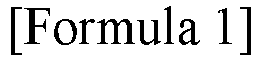

- In Formula 1, L1 may contain a linear or branched alkylene group, a cyclic alkylene group, a cyclic alkenylene group or a cyclic alkynyl group. Specifically, L1 may contain a linear or branched alkylene group with 1 to 20 carbon atoms, a cyclic alkylene group with 3 to 20 carbon atoms, a cyclic alkenylene group with 3 to 20 carbon atoms or a cyclic alkynyl group with 3 to 20 carbon atoms.
- In Formula 1, L1 may be represented by Formula 2 below.

- In Formula 2, P1 may be a cyclic alkylene group with 3 to 20 carbon atoms substituted with one or more alkyl groups, and L2 and L3 may be each independently a single bond or an alkylene group with 1 to 10 carbon atoms.
- Alternatively, in Formula 2, L2 and L3 may be each independently a single bond or an alkylene group with 1 to 8 carbon atoms, and in another example, they may be each independently a single bond or an alkylene group with 1 to 4 carbon atoms.
- In addition, in Formula 1, L1 may be represented by Formula 3 below.

- In Formula 3, P2 and P3 may be each independently a cyclic alkylene group with 3 to 20 carbon atoms, L4 and L6 may be each independently a single bond or an alkylene group with 1 to 10 carbon atoms, and L5 may be an alkylene group with 1 to 10 carbon atoms.
- Alternatively, in Formula 3, L4 and L6 may be each independently a single bond or an alkylene group with 1 to 8 carbon atoms, and in another example, they may be each independently a single bond or an alkylene group with 1 to 4 carbon atoms.
- Furthermore, in Formula 3, L5 may be an alkylene group with 1 to 8 carbon atoms, and in another example, it may be a single bond or an alkylene group with 1 to 4 carbon atoms.
- The polyfunctional isocyanate compound according to one example of the present application is not particularly limited as long as it contains three or more isocyanate groups, and a trifunctional isocyanate compound mainly used in the art or an isocyanate compound containing more isocyanate groups may be used.
- As the polyfunctional isocyanate compound, one or more selected from a multimer of the difunctional isocyanate compound and a biuret compound may be used. Specifically, as the polyfunctional isocyanate compound, an aromatic difunctional isocyanate compound such as tolylene diisocyanate, diphenylmethane diisocyanate, phenylene diisocyanate, polyethylenephenylene polyisocyanate, xylene diisocyanate, tetramethylxylene diisocyanate, trizine diisocyanate, naphthalene diisocyanate and triphenylmethane triisocyanate, or an aliphatic difunctional isocyanate compound such as hexamethylene diisocyanate, trimethylhexamethylene diisocyanate, lysine diisocyanate, methyl norbornane diisocyanate, ethylene diisocyanate, propylene diisocyanate or tetramethylene diisocyanate, or an alicyclic difunctional isocyanate such as transcyclohexane-1,4-diisocyanate, isoborone diisocyanate, bis(isocyanate methyl)cyclohexane diisocyanate or dicyclohexylmethane diisocyanate may be used, without being limited thereto.
- The polyfunctional isocyanate compound according to one example of the present application may be a trifunctional isocyanate compound, and in the case of the trifunctional isocyanate compound, it may be a compound represented by the following formula 4.


- In Formula 4, L7, L8 and L9 may be each independently an alkylene group, an alkenylene group or an alkynyl group. Specifically, L7, L8 and L9 may be each independently be an alkylene group with 1 to 20 carbon atoms, an alkenylene group with 2 to 20 carbon atoms, or an alkynyl group with 2 to 20 carbon atoms.
- The filler of the curable composition according to one example of the present application may be included, for example, for securing thixotropy and/or for securing heat dissipation (thermal conductivity) in a battery module or battery pack as needed in a process.
- As described below, the curable composition may comprise an excess amount of filler. When the excessive amount of filler is used, the viscosity of the curable composition increases, whereby the processability may deteriorate upon injecting the composition into the case of the battery module. Therefore, sufficient low-viscosity properties are required so as not to interfere with processability, while comprising an excess amount of filler. In addition, if only low viscosity is simply shown, it is also difficult to secure processability, so that proper thixotropy may be required, and it may be necessary that desired appropriate adhesive force is shown during curing and the curing itself proceeds at room temperature.
- Particularly, in order to form a cured product having excellent electrical insulation performance, it is advantageous to use a resin component with high reactivity due to many functional groups, but if the used amount of the resin component with high reactivity increases, there is a problem that the bending properties are lowered and the viscosity change with time increases.
- The curable composition according to one example of the present application may be one in which an appropriate resin component is used to form a cured product having excellent electrical insulation performance, and simultaneously a resin component and a filler are appropriately combined and selected such that the cured product has heat dissipation performance, while securing the above-described processability and reducing the viscosity change with time.
- The filler may be a thermally conductive filler, and this thermally conductive filler is a filler capable of forming a cured product having a thermal conductivity as described above.
- The thermal conductivity of the thermally conductive filler itself may be, for example, about 1 W/mK or more, about 5 W/mK or more, about 10 W/mK or more, or about 15 W/mK or more. In another example, the thermal conductivity of the thermally conductive filler itself may be, for example, about 400 W/mK or less, about 350 W/mK or less, or about 300 W/mK or less.
- The thermally conductive filler may include oxides such as aluminum oxide (alumina), magnesium oxide, beryllium oxide or titanium oxide; nitrides such as boron nitride, silicon nitride or aluminum nitride, carbides such as silicon carbide; hydrated metals such as aluminum hydroxide or magnesium hydroxide; metal filling materials such as copper, silver, iron, aluminum or nickel; metal alloy filling materials such as titanium; silicon powders such as quartz, glass or silica, but is not limited thereto.
- In addition, if insulation properties may be secured, application of a carbon filler such as graphite may also be considered. For example, the carbon filler may utilize activated carbon. The shape or ratio of the filler included in the cured product is not particularly limited, which may be selected in consideration of the viscosity of the curable composition, the possibility of sedimentation in the cured product, desired thermal resistance or thermal conductivity, insulation, filling effects or dispersibility, and the like.
- The shape of the thermally conductive filler may be appropriately selected from a spherical shape and/or a non-spherical shape (e.g., needle-shaped and plate-shaped, etc.) as needed, which is not limited thereto.
- The term spherical particle as used in the present application means a particle having a sphericity of about 0.95 or more, and the non-spherical particle means a particle having a sphericity of less than 0.95.
- The sphericity can be confirmed through a particle shape analysis of the particle. Specifically, the sphericity of the filler, which is a three-dimensional particle, may be defined as a ratio (S'/S) of the surface area (S') of a sphere having the same volume as that of a particle to the surface area (S) of the particle. For real particles, circularity is generally used. The circularity is expressed as a ratio of the boundary of a circle having the same image and the same area (A) as a two-dimensional image of a real particle thus obtained to the boundary (P) of the image, which is obtained by the following equation.

- The circularity is expressed as a value from 0 to 1, where a perfect circle has a value of 1, and as a particle has an irregular shape, it has a value lower than 1. The sphericity value in the present application has been measured as an average value of circularity measured with Marvern's particle shape analysis equipment (FPIA-3000).
- As the thermally conductive filler, one or two or more suitably selected may be used as needed. In addition, even if the same type of thermally conductive filler is used, those having different shapes may be mixed and used, and those having different average particle diameters may be mixed and used. For example, aluminum hydroxide, aluminum and alumina may be mixed and used as the thermally conductive filler, and their shapes and average particle diameters may be different from each other.
- In addition, it is advantageous to use a spherical thermally conductive filler in consideration of the amount to be filled, but a thermally conductive filler of a form such as a needle shape or a plate shape may also be used in consideration of network formation or conductivity, and the like.
- In one example, the curable composition may comprise a thermally conductive filler having an average particle diameter in a range of 0.001 µm to 100 µm. In another example, the average particle diameter of the thermally conductive filler may be 0.01 µm or more, 0.1 or more, 0.5 µm or more, 1 µm or more, 2 µm or more, 3 µm or more, 4 µm or more, 5 µm or more, or about 6 µm or more. In another example, the average particle diameter of the thermally conductive filler may be about 95 µm or less, about 90 µm or less, about 85 µm or less, about 80 µm or less, about 75 µm or less, about 70 µm or less, about 65 µm or less, about 60 µm or less, about 55 µm or less, about 50 µm or less, about 45 µm or less, about 40 µm or less, about 35 µm or less, about 30 µm or less, about 25 µm or less, about 20 µm or less, about 15 µm or less, about 10 µm or less, or about 5 µm or less.
- At this time, the average particle diameter of the thermally conductive filler is a so-called D50 particle diameter (median particle diameter), which may mean a particle diameter accumulated at 50% on the basis of a volume of a particle size distribution. That is, a particle diameter at a point where the particle size distribution is obtained on the basis of the volume and the accumulated value becomes 50% in the cumulative curve with 100% of the total volume can be regarded as the average particle diameter. Such a D50 particle diameter may be measured by a laser diffraction method.
- In order to obtain excellent heat dissipation performance, it may be considered that a high content of filler is used in the curable composition of the present application. In addition, in consideration of ensuring processability as well as securing excellent heat dissipation performance as described above, the content of the filler in the curable composition of the present application may be 80 wt% or more, 82.5 wt% or more, 85 wt% or more, or 87.5 wt% or more relative to the total weight of the curable composition, and in another example, the content of the filler may be 95 wt% or less, 92.5 wt% or less, or 90 wt% or less relative to the total weight of the curable composition. Here, the content of the filler may be within a range formed by appropriately selecting the upper and lower limits as listed above.
- The curable composition according to the present application may further comprise the following additives.
- The curable composition according to the present application may further comprise a plasticizer, if necessary. The type of the plasticizer is not particularly limited, but for example, one or more of a phthalic acid compound, a phosphoric acid compound, an adipic acid compound, a sebacic acid compound, a citric acid compound, a glycolic acid compound, a trimellitic acid compound, a polyester compound, an epoxidized soybean oil, chlorinated paraffin, a chlorinated fatty acid ester, a fatty acid compound, a compound having a saturated aliphatic chain substituted with a sulfonic acid group to which a phenyl group is bonded (e.g., LANXESS' mesamoll) and a vegetable oil may be selected and used.
- As the phthalic acid compound, one or more of dimethyl phthalate, diethyl phthalate, dibutyl phthalate, dihexyl phthalate, di-n-octyl phthalate, di-2-ethylhexyl phthalate, diisooctyl phthalate, dicapryl phthalate, dinonyl phthalate, diisononyl phthalate, didecyl phthalate, diundecyl phthalate, dilauryl phthalate, ditridecyl phthalate, dibenzyl phthalate, dicyclohexyl phthalate, butyl benzyl phthalate, octyl decyl phthalate, butyl octyl phthalate, octyl benzyl phthalate, n-hexyl n-decyl phthalate, n-octyl phthalate and n-decyl phthalate may be used.
- As the phosphoric acid compound, one or more of tricresyl phosphate, trioctyl phosphate, triphenyl phosphate, octyl diphenyl phosphate, cresyl diphenyl phosphate and trichloroethyl phosphate may be used.
- As the adipic acid compound, one or more of dibutoxyethoxyethyl adipate (DBEEA), dioctyl adipate, diisooctyl adipate, di-n-octyl adipate, didecyl adipate, diisodecyl adipate, n-octyl n-decyl adipate, n-heptyl adipate and n-nonyl adipate may be used.
- As the sebacic acid compound, one or more of dibutyl sebacate, dioctyl sebacate, diisooctyl sebacate and butyl benzyl may be used.
- As the citric acid compound, one or more of triethyl citrate, acetyl triethyl citrate, tributyl citrate, acetyl tributyl citrate and acetyl trioctyl citrate may be used.
- As the glycolic acid compound, one or more of methyl phthalyl ethyl glycolate, ethyl phthalyl ethyl glycolate and butyl phthalyl ethyl glycolate may be used.
- As the trimellitic acid compound, one or more of trioctyl trimellitate and tri-n-octyl n-decyl trimellitate may be used.
- Also, the curable composition according to the present application may comprise a viscosity modifier, for example, a thixotropic agent, a diluent, a surface treatment agent or a coupling agent, and the like, if necessary, for controlling the viscosity, for example, increasing or decreasing the viscosity, or for controlling the viscosity according to shear force. The thixotropic agent may adjust the viscosity of the curable composition according to shear force. The usable thixotropic agent may be exemplified by fumed silica and the like. The diluent is generally used to lower the viscosity of the curable composition, and as long as it may exhibit such an action, various types of diluents known in the art may be used without limitation. The surface treatment agent is for surface treatment of the filler introduced into the cured product of the curable composition, and as long as it may exhibit such an action, various types known in the art may be used without limitation. The coupling agent may be used, for example, to improve dispersibility of the thermally conductive filler such as alumina, as long as it may exhibit such an action, various types known in the art may be used without limitation.
- In addition, the curable composition according to the present application may further comprise a flame retardant or a flame retardant auxiliary agent, if necessary. The curable composition further comprising a flame retardant or a flame retardant auxiliary agent may be cured to form a flame retardant resin. As the flame retardant, various known flame retardants may be applied without particular limitation, and for example, a flame retardant in the form of a solid filler or a liquid flame retardant may be applied. The flame retardant includes, for example, an organic flame retardant such as melamine cyanurate or an inorganic flame retardant such as magnesium hydroxide, but is not limited thereto. When the amount of the thermally conductive filler included in the curable composition is large, a liquid type flame retardant material (TEP, triethyl phosphate or TCPP, tris(1,3-chloro-2-propyl)phosphate, etc.) may also be used. In addition, a silane coupling agent capable of acting as a flame retardant synergist may also be added.
- Furthermore, the curable composition may comprise the constitutions as described above, and may be a solvent-type composition, a water-based composition, or a solventless composition, but considering the convenience of the manufacturing process to be described below, the solventless type may be appropriate.
- When the viscosity of the curable composition satisfies the above range, processability is secured, whereby productivity can be improved.
- The curable composition according to one example of the present application may have a viscosity change rate of 0.5 or more, 0.55 or more, 0.6 or more, 0.65 or more, 0.7 or more, 0.75 or more, or 0.8 or more after 12 days according to Equation 3 below, and in another example, the curable composition may have a viscosity change rate of 1.6 or less, 1.55 or less, 1.5 or less, 1.45 or less, 1.4 or less, 1.35 or less, 1.3 or less, 1.25 or less, or 1.2 or less after 12 days according to Equation 3 below. Here, the viscosity change rate of the curable composition after 12 days according to Equation 3 below may be within a range formed by appropriately selecting the upper and lower limits as listed above.

- The µf is the viscosity measured after leaving the curable composition at room temperature for 12 days, and
The µi is the viscosity of the curable composition before being left at room temperature for 12 days. - At this time, µi and µf may be room temperature viscosities measured in the same manner as in the following room temperature viscosity measurement method.
- The viscosity of the curable composition may be a value measured using a viscosity measuring instrument (manufacturer: Brookfield, model name: DV3THB-CP) and a spindle CPA-52Z, and may be a value measured after it is rotated at a shear rate of 2.4/s for 180 seconds.
- The two-component curable composition according to one example of the present application may comprise a main part and a curing agent part, where the main part may comprise a polyol, and the curing agent part may comprise the curable composition according to one example of the present application.
- The two-component curable composition according to one example of the present application may be a urethane composition, where the two-component curable composition may be a room temperature curing type.
- The polyol according to one example of the present application means a compound containing two or more hydroxyl groups, which may be exemplified by (poly)ethylene glycol, diethylene glycol, (poly)propylene glycol, 1,2-butylene glycol, 2,3-butylene glycol, 1,3-propanediol, 1,3-butanediol, 1,4-butanediol, 1,6-hexanediol, neopentyl glycol, 1,2-ethylhexyldiol, 1,5-pentanediol, 1,9-nonanediol, 1,10-decanediol, 1,3-cyclohexanedimethanol and 1,4-cyclohexanedimethanol, (poly)ethylenetriol, diethylenetriol, (poly)propylenetriol, glycerin, 1,2,3-butanetriol, 1,2,4-butanetriol, 1,3,4-hexanetriol, 1,3,6-hexanetriol unit and trimethylolpropane, and the like, but is not particularly limited thereto.
- The polyol according to one example of the present application may be exemplified by an ester-based polyol. The ester-based polyol may include a carboxylic acid-based polyol and/or a caprolactone-based polyol.
- The polyol according to one example of the present application may be a polyol represented by the following formula 5 or 6.

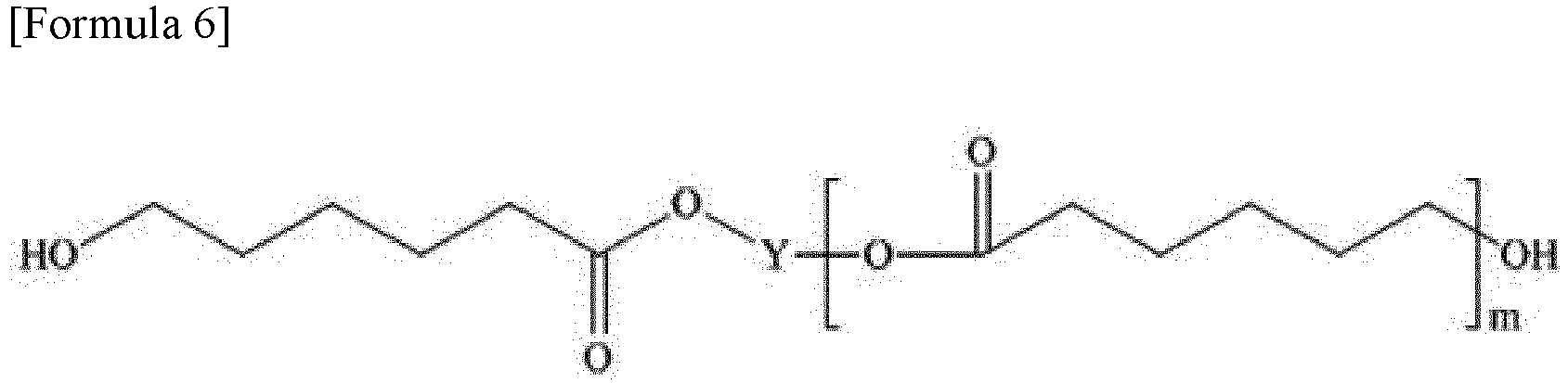
- In Formulas 5 and 6, X is a dicarboxylic acid-derived unit, Y is a polyol-derived unit, for example, a triol or diol unit, and n and m are arbitrary numbers.
- Here, the dicarboxylic acid-derived unit is a unit formed by urethane reaction of dicarboxylic acid with polyol, and the polyol-derived unit is a unit formed by urethane reaction of polyol with dicarboxylic acid or caprolactone.
- That is, when the hydroxy group of the polyol and the carboxyl group of the dicarboxylic acid react, a water (H2O) molecule is eliminated by the condensation reaction and simultaneously an ester bond is formed, where X in Formula 5 above means a portion excluding the ester bond after the dicarboxylic acid forms the ester bond by the condensation reaction, Y is also a portion excluding the ester bond after the polyol forms the ester bond by the condensation reaction, and the ester bond is shown in Formula 5.
- In addition, Y in Formula 6 also represents a portion excluding the ester bond after the polyol forms the ester bond with caprolactone.
- Meanwhile, when the polyol-derived unit of Y is a unit derived from a polyol containing three or more hydroxy groups such as a triol unit, a branched structure may be implemented in the Y portion of the formula structure.
- The type of the dicarboxylic acid-derived unit of X in Formula 5 is not particularly limited, but in order to secure desired physical properties, it may be one unit selected from the group consisting of a phthalic acid unit, an isophthalic acid unit, a terephthalic acid unit, a trimellitic acid unit, a tetrahydrophthalic acid unit, a hexahydrophthalic acid unit, a tetrachlorophthalic acid unit, an oxalic acid unit, an adipic acid unit, an azelaic acid unit, a sebacic acid unit, a succinic acid unit, a malic acid unit, a glutaric acid unit, a malonic acid unit, a pimelic acid unit, a suberic acid unit, a 2,2-dimethylsuccinic acid unit, a 3,3-dimethylglutaric acid unit, a 2,2-dimethylglutaric acid unit, a maleic acid unit, a fumaric acid unit, an itaconic acid unit and a fatty acid unit.
- The type of the polyol-derived unit of Y in Formulas 5 and 6 is not particularly limited, but it may be any one or two or more selected from the group consisting of an ethylene glycol unit, a propylene glycol unit, a 1,2-butylene glycol unit, a 2,3-butylene glycol unit, a 1,3-propanediol unit, a 1,3-butanediol unit, a 1,4-butanediol unit, a 1,6-hexanediol unit, a neopentyl glycol unit, a 1,2-ethylhexyldiol unit, a 1,5-pentanediol unit, a 1,10-decanediol unit, a 1,3-cyclohexanedimethanol unit, a 1,4-cyclohexanedimethanol unit, a glycerin unit and a trimethylolpropane unit.
- In Formula 5, n is an arbitrary number, where the range may be selected in consideration of desired physical properties, and may be, for example, about 2 to 10 or 2 to 5.
- In Formula 6, m is an arbitrary number, where the range may be selected in consideration of desired physical properties, and may be, for example, about 1 to 10 or 1 to 5.
- The polyol according to one example of the present application may be a polyol represented by Formula 7 below.

- In Formula 7, L10 may be a linear or branched alkylene group with 1 to 20 carbon atoms, a linear or branched alkenylene group with 2 to 20 carbon atoms, or a linear or branched alkynylene group with 2 to 20 carbon atoms.
- The linear or branched alkylene groups of L10 above may each independently have 1 or more or 2 or more carbon atoms, and may have 10 or less, 8 or less, 6 or less, or 4 or less carbon atoms. In addition, the linear or branched alkenylene groups or linear or branched alkynylene groups of L10 above may each independently have 2 or more or 3 or more carbon atoms, and may have 10 or less, 8 or less, 6 or less, or 4 or less carbon atoms.
- Also, in Formula 7, n may be a number of 1 or more, 3 or more, 5 or more, or 7 or more, and in another example, n may be a number of 20 or less, 16 or less, 12 or less, or 8 or less.
- The main part of the two-component curable composition according to one example of the present application may comprise a filler as needed in the process.
- In order to obtain excellent heat dissipation performance, it may be considered that a high content of filler is used in the main part of the present application. The content of the filler in the main part of the present application may be 80 wt% or more, 82.5 wt% or more, 85 wt% or more, or 87.5 wt% or more relative to the total weight of the main part, and in another example, the content of the filler may be 95 wt% or less, 92.5 wt% or less, or 90 wt% or less relative to the total weight of the main part. Here, the content of the filler may be within a range formed by appropriately selecting the upper and lower limits as listed above.
- Here, the filler is equal to the contents of the filler included in the curable composition according to one example of the present application, and the detailed contents will be omitted.
- The main part according to the present application may further comprise an additive, and the additive is equal to the contents of the additive included in the curable composition according to one example of the present application, and the detailed contents will be omitted. In addition, the additives may be further included in a state where the main part with or without additives and the curing agent part with or without additives are mixed.
- In the two-component curable composition according to one example of the present application, the main part may be included in an amount of 50 parts by weight or more, 60 parts by weight or more, 70 parts by weight or more, 80 parts by weight or more, or 90 parts by weight or more relative to 100 parts by weight of the curing agent part, and in another example, the main part may be included in an amount of 200 parts by weight or less, 180 parts by weight or less, 160 parts by weight or less, 140 parts by weight or less, or 120 parts by weight or less relative to 100 parts by weight of the curing agent part. Here, the content of the main part in the two-component curable composition may be within a range formed by appropriately selecting the upper and lower limits as listed above.
- In addition, at least one of the main part and the curing agent part in the two-component curable composition according to one example of the present application comprises a filler, where the total amount of the filler included in the two-component curable composition may be 80 wt% or more, 82.5 wt% or more, 85 wt% or more, or 87.5 wt% or more relative to the total weight of the two-component curable composition, and in another example, the total content of the filler may be 95 wt% or less, 92.5 wt% or less, or 90 wt% or less relative to the total weight of the two-component curable composition. Here, the content of the filler may be within a range formed by appropriately selecting the upper and lower limits as listed above.
- The two-component curable composition may be cured according to the above method to form a cured product, and may have at least one or more of the following physical properties. Each of the physical properties described below is independent, where any one physical property does not take precedence over the other properties, and the cured product of the two-component curable composition may satisfy at least one or two or more of the physical properties described below. The cured product of the two-component curable composition that satisfies at least one or two or more of the physical properties described below is caused by a combination of the respective components.
- The two-component curable composition may have a thermal conductivity of about 2.5 W/m·K or more when measured, in a state of being produced as a sample (cured product) with a thickness of 4 mm, according to ASTM D5470 standard or ISO 22007-2 standard along the thickness direction of the sample. In another example, the thermal conductivity may also be 2.6 W/m·K or more, 2.7 W/m·K or more, 2.8 W/m·K or more, 2.9 W/m·K or more, or 3.0 W/m·K or more or so. as the thermal conductivity has a higher value, it means higher thermal conductance, so that the upper limit thereof is not particularly limited. For example, the thermal conductivity may be 20 W/m·K or less, 18 W/m·K or less, 16 W/m·K or less, 14 W/m·K or less, 12 W/m·K or less, 10 W/m·K or less, 8 W/m·K or less, 6 W/m·K or less, or 4 W/m·K or less.
- The cured product of the two-component curable composition may have a thermal resistance of about 5 K/W or less, about 4.5 K/W or less, about 4 K/W or less, about 3.5 K/W or less, about 3 K/W or less, or about 2.8 K/W or less. When it is adjusted so that the heat resistance in this range can appear, excellent cooling efficiency or heat dissipation efficiency can be secured. The heat resistance may be a numerical value measured according to ASTM D5470 standard or ISO 22007-2 standard, and the measuring method is not particularly limited.
- The cured product of the two-component curable composition may have appropriate adhesive force to any substrate or module case with which the cured product of the two-component curable composition is in contact. If appropriate adhesive force can be secured, various materials, for example, cases or battery cells included in the battery module, and the like are prevented from peeling due to volume changes during charging and discharging, changes in the use temperature of the battery module or curing shrinkage, and the like, whereby excellent durability can be ensured. In addition, re-workability capable of enabling the module to be detached and reattached during the assembly process of the battery pack may be secured.
- The cured product of the two-component curable composition may secure durability in order to be applied to products requiring a long warranty period such as automobiles (in the case of automobiles, about 15 years or more). The durability may mean that after a thermal shock test in which one cycle is set to a process of maintaining the temperature at a low temperature of about -40°C for 30 minutes and then raising the temperature to 80°C and maintaining it for 30 minutes, and the cycle is repeated 100 times, separating or peeling, or cracks do not occur from the module case or battery cells of the battery module.
- The cured product of the two-component curable composition may have electrical insulation of 10 kV/mm or more, 15 kV/mm or more, or 20 kV/mm or more. As a dielectric breakdown voltage has a higher value, the cured product of the two-component curable composition shows excellent insulation, where it may be about 50 kV/mm or less, 45 kV/mm or less, 40 kV/mm or less, 35 kV/mm or less, or 30 kV/mm or less, but is not particularly limited. In order to achieve such a dielectric breakdown voltage, an insulating filler may be applied to the two-component curable composition. In general, among thermally conductive fillers, a ceramic filler is known as a component capable of securing insulation. The electrical insulation may be measured with a dielectric breakdown voltage measured according to ASTM D149 standard. In addition, if the cured product of the two-component curable composition can secure the electrical insulation as above, stability can be secured while maintaining performance with respect to various materials, for example, a case or battery cell included in a battery module, and the like.
- The cured product of the two-component curable composition may have a volume resistance of 1×10¹⁰ Ω·cm or more, 3×10¹⁰ Ω·cm or more, 7×10¹⁰ Ω·cm or more, or 9×10¹⁰ Ω·cm or more, and in another example, the cured product of the two-component curable composition may have a volume resistance of 1×10¹⁴ Ω·cm or less, 7.5×10¹³ Ω·cm or less, 5×10¹³ Ω·cm or less, 2.5×10¹³ Ω·cm or less, or 1×10¹³ Ω·cm or less. Here, the volume resistance of the cured product of the two-component curable composition may be within a range formed by appropriately selecting the upper and lower limits as listed above. The volume resistance may be measured by a volume resistance measuring device using a cured product of a two-component curable composition having a thickness of 0.2 cm according to ASTM D257 standard. If the cured product of the two-component curable composition can secure the volume resistance as described above, excellent electrical insulation performance can be ensured, so that as it is used in various materials, for example, a case or battery cells included in a battery module, it is possible to maintain performance, while ensuring stability.
- The cured product of the two-component curable composition may have a specific gravity of 5 or less. In another example, the specific gravity may be 4.5 or less, 4 or less, 3.5 or less, or 3 or less. As the specific gravity of the cured product of the two-component curable composition has a lower value, it is more advantageous for weight saving of the applied product, so that the lower limit thereof is not particularly limited. For example, the specific gravity may be about 1.5 or more, or 2 or more. In order for the cured product of the two-component curable composition to exhibit such a specific gravity, for example, a method of applying a filler that the desired thermal conductivity can be secured even at a low specific gravity when the thermal conductive filler is added, that is, a filler having a low specific gravity by itself, or applying a surface-treated filler, or the like may be used.
- It is appropriate that the cured product of the two-component curable composition does not include a volatile material if possible. For example, in the cured product of the two-component curable composition, the ratio of nonvolatile components may be 90 wt% or more, 95 wt% or more, or 98 wt% or more. Here, the ratio with the nonvolatile component can be defined in the following manner. That is, with regard to the nonvolatile content, a portion remaining after the cured product of the two-component curable composition is maintained at 100°C for 1 hour or so can be defined as the nonvolatile content, and thus the ratio can be measured based on the ratio after maintaining it at 100°C for 1 hour or so with the initial weight of the cured product of the two-component curable composition.
- The cured product of the two-component curable composition may have an excellent resistance to deterioration, if necessary, where stability that does not react chemically, if possible, may be required.
- It may be advantageous for the cured product of the two-component curable composition to have a low shrinkage ratio during or after curing. Through this, it is possible to prevent occurrence of peeling or voids, and the like that may occur in the process of manufacturing or using various materials, for example, a case or battery cell included in a battery module, and the like. The shrinkage ratio may be appropriately adjusted within a range capable of exhibiting the above-described effects, which may be, for example, less than 5%, less than 3%, or less than about 1%. Since the shrinkage ratio is more advantageous as the numerical value is lower, the lower limit thereof is not particularly limited.
- The cured product of the two-component curable composition may also advantageously have a low coefficient of thermal expansion (CTE). Through this, it is possible to prevent occurrence of peeling or voids, and the like that may occur in the process of manufacturing or using various materials, for example, a case or battery cell included in a battery module, and the like. The coefficient of thermal expansion may be appropriately adjusted within a range capable of exhibiting the above-described effects, which may be, for example, less than 300 ppm/K, less than 250 ppm/K, less than 200 ppm/K, less than 150 ppm/K, or less than 100 ppm/K. Since the coefficient of thermal expansion is more advantageous as the numerical value is lower, the lower limit thereof is not particularly limited.
- In the cured product of the two-component curable composition, tensile strength may be appropriately adjusted, and through this, an excellent impact resistance and the like may be secured. The tensile strength may be adjusted, for example, in the range of about 1.0 MPa or more.
- In the cured product of the two-component curable composition, a 5% weight loss temperature in thermogravimetric analyses (TGA) may also be 400°C or higher, or the remaining amount at 800°C may be 70 wt% or more. Due to these characteristics, stability at high temperature may be further improved with respect to various materials, for example, a case or battery cell included in a battery module, and the like. In another example, the remaining amount at 800°C may be about 75 wt% or more, about 80 wt% or more, about 85 wt% or more, or about 90 wt% or more. In another example, the remaining amount at 800°C may be about 99 wt% or less. The thermogravimetric analysis (TGA) may be measured within a range of 25°C to 800°C at a temperature increase rate of 20°C/min under a nitrogen (N2) atmosphere of 60 cm3/min. The thermogravimetric analysis (TGA) results can also be achieved by adjusting the composition of the cured product of the two-component curable composition. For example, the remaining amount at 800°C depends on the type or ratio of the thermally conductive filler contained in the cured product of the two-component curable composition, and when an excessive amount of the thermally conductive filler is included, the remaining amount increases. However, when the polymer and/or monomer used in the two-component curable composition has generally high heat resistance compared to other polymers and/or monomers, the remaining amount more increases, and the polymer and/or monomer component included in the cured product of the two-component curable composition also affects the hardness as such.
- The two-component curable composition of the present application as well as the curable composition according to one example of the present application may be formed by mixing the respective components as listed above. In addition, the mixing order of the two-component curable composition of the present application and the curable composition according to one example of the present application is not particularly limited as long as all necessary components may be included.
- The two-component curable composition using the curable composition of the present application is used in various electric and electronic products such as a clothes iron, a washing machine, a dryer, a clothes manager, an electric shaver, a microwave oven, an electric oven, an electric rice cooker, a refrigerator, a dishwasher, an air conditioner, a fan, a humidifier, an air purifier, a mobile phone, a radiotelegraph, a television, a radio, a computer and a laptop, or batteries such as a secondary battery, whereby it can dissipate the generated heat. In particular, in a battery for an electric car manufactured by gathering battery cells to form one battery module and combining several battery modules to form one battery pack, the curable composition according to one example of the present application may be used as a material for connecting the battery modules. When the curable composition according to one example of the present application is used as a material for connecting the battery modules, it may serve to dissipate heat generated in the battery cell and fix the battery cells from external shock and vibration.
- The cured product of the two-component curable composition of the present application may transfer heat generated from the exothermic element to the cooling region. That is, the cured product of the two-component curable composition may radiate heat generated from the exothermic element.
- The cured product of the two-component curable composition may be positioned between the exothermic element and the cooling region to thermally contact them. The thermal contact means that the cured product of the two-component curable composition is in physically direct contact with the exothermic element and the cooling region to radiate heat generated from the exothermic element to the cooling region, or even if the cured product of the two-component curable composition is not in direct contact with the exothermic element and the cooling region (that is, there is a separate layer between the cured product of the two-component curable composition and the exothermic element and/or the cooling region), it dissipates heat generated from the exothermic element to the cooling region.
- The present application can provide a curable composition capable of securing processability due to excellent blending properties with a filler while having little viscosity change with time.
- The present application can provide a curable composition for forming a cured product having excellent electrical insulation performance.
- The present application can provide a device comprising, between an exothermic element and a cooling region, a cured product of a curable composition in thermal contact with both.
- Hereinafter, the present invention will be described through Examples and Comparative Examples, but the scope of the present invention is not limited by the contents presented below.
- As a polyfunctional isocyanate compound, a trifunctional isocyanate compound, hexamethylene diisocyanate trimer (weight average molecular weight measured by GPC: 827 g/mol, PDI: 1.167) was used.
- In addition, as a difunctional isocyanate compound, hexamethylene diisocyanate (weight average molecular weight measured by GPC: 174 g/mol, PDI: 1.018), isophorone diisocyanate (weight average molecular weight measured by GPC: 232 g/mol, PDI: 1.041) or dicyclohexylmethane diisocyanate (weight average molecular weight measured by GPC: 233 g/mol, PDI: 1.036) was used.
- A main part included in a two-component curable composition according to one example of the present application comprises a polyol, and if necessary, may further comprise a filler and/or an additive.
- As the polyol included in the main part, a caprolactone-based polyol having a weight average molecular weight of 860 g/mol was used.
- The main part (P) included in the two-component curable composition was prepared by adding the polyol (P1), the filler (P2) and the additive (P3) in a weight ratio of 5:50: 1.155 (P1: P2: P3), and stirring the added materials at 600 rpm in the revolution direction and 500 rpm in the rotation direction by a paste mixer.
- The filler (P2) included spherical alumina (aluminum oxide) having an average particle diameter of about 80 µm and the like, and as the other additives (P3), a plasticizer and a flame retardant, and the like were used.
- Hexamethylene diisocyanate trimer (R11) and hexamethylene diisocyanate (R12) were mixed in a weight ratio of 6:4 (R11: R12) to prepare an isocyanate mixture (R1) as a resin component.
- The isocyanate mixture (R1), the filler (R2) and the other additives (R3) were added in a weight ratio of 5:50:2 (R1: R2: R3), and the added materials were uniformly mixed with a paste mixer, whereby a curable composition (R) according to the present application was prepared.
- Here, the filler (R2) included spherical alumina (aluminum oxide) having an average particle diameter of about 80 µm, and as the other additives (R3), a plasticizer and a flame retardant, and the like were used.
- In addition, a two-component curable composition (U) was prepared by mixing the curable composition (R) and the main part (P) according to Preparation Example of the main part in a weight ratio of 1: 1 (R: P).
- A curable composition (R) and a two-component curable composition (U) were prepared in the same manner as in Example 1 above, except that hexamethylene diisocyanate trimer (R11) and hexamethylene diisocyanate (R12) were mixed in a weight ratio of 7:3 (R11: R12) to prepare an isocyanate mixture (R1) as a resin component.
- A curable composition (R) and a two-component curable composition (U) were prepared in the same manner as in Example 1 above, except that hexamethylene diisocyanate trimer (R11) and hexamethylene diisocyanate (R12) were mixed in a weight ratio of 8:2 (R11: R12) to prepare an isocyanate mixture (R1) as a resin component.
- A curable composition (R) and a two-component curable composition (U) were prepared in the same manner as in Example 1 above, except that hexamethylene diisocyanate trimer (R11) and isophorone diisocyanate (R13) were mixed in a weight ratio of 6:4 (R11: R13) to prepare an isocyanate mixture (R1) as a resin component.
- A curable composition (R) and a two-component curable composition (U) were prepared in the same manner as in Example 1 above, except that hexamethylene diisocyanate trimer (R11) and isophorone diisocyanate (R13) were mixed in a weight ratio of 7:3 (R11: R13) to prepare an isocyanate mixture (R1) as a resin component.
- A curable composition (R) and a two-component curable composition (U) were prepared in the same manner as in Example 1 above, except that hexamethylene diisocyanate trimer (R11) and isophorone diisocyanate (R13) were mixed in a weight ratio of 8:2 (R11: R13) to prepare an isocyanate mixture (R1) as a resin component.
- A curable composition (R) and a two-component curable composition (U) were prepared in the same manner as in Example 1 above, except that hexamethylene diisocyanate trimer (R11) and dicyclohexylmethane diisocyanate (R14) were mixed in a weight ratio of 6:4 (R11: R14) to prepare an isocyanate mixture (R1) as a resin component.
- A curable composition (R) and a two-component curable composition (U) were prepared in the same manner as in Example 1 above, except that hexamethylene diisocyanate trimer (R11) and dicyclohexylmethane diisocyanate (R14) were mixed in a weight ratio of 7:3 (R11: R14) to prepare an isocyanate mixture (R1) as a resin component.
- A curable composition (R) and a two-component curable composition (U) were prepared in the same manner as in Example 1 above, except that hexamethylene diisocyanate trimer (R11) and dicyclohexylmethane diisocyanate (R14) were mixed in a weight ratio of 8:2 (R11: R14) to prepare an isocyanate mixture (R1) as a resin component.
- A two-component curable composition (U) was prepared in the same manner as in Example 1 above, except that hexamethylene diisocyanate trimer (R11), the filler (R2) and the other additives (R3) were added in a weight ratio of 5:50:2 (R1: R2: R3), and the added materials were uniformly mixed by a paste mixer, whereby a curable composition (R) according to the present application was prepared.
- The volume resistance of the cured product of the two-component curable composition (U) was measured according to ASTM D257 measurement standard.
- The two-component curable composition (U) was left at room temperature and normal humidity (about 30 to 70 RH%) for 24 hours to produce a cured product of a disk-type two-component curable composition cut to a diameter of 10 cm and a thickness of about 0.2 cm.
- The applied voltage of 500 V, the measurement time of 1 minute and the thickness of the cured product of the two-component curable composition were input into a volume resistance measuring device (HIRESTA-US_MCP-HT800, supplier: MITSUBISHI CHEMICAL), and the volume resistance of the cured product of the two-component curable composition was measured.
- The blending property of the curable composition (R) was visually distinguished according to the following criteria under room temperature and normal humidity conditions.
- The blending property of the two-component curable composition (U) directly affects the blending property of the curable composition (R). That is, when the blending property of the curable composition (R) is poor, the blending property of the two-component curable composition (U) tends to be poor, and when the blending property of the curable composition (R) is excellent, the blending property of the two-component curable composition (U) tends to be excellent.
- Therefore, the blending property of the two-component curable composition (U) can be predicted by evaluation of the blending property of the curable composition (R) as follows.
- OO: In the case that the curable composition immediately after blending is uniformly mixed
- O: In the case that the curable composition immediately after blending tends to be uniformly mixed, but the fluidity is slightly lower than OO above
- Δ: In the case that the filler is agglomerated in the curable composition immediately after blending and the composition is not mixed uniformly, but it is mixed uniformly after additionally adding a dispersant
- ×: In the case that the filler settles in the curable composition immediately after blending, or in the case that the filler is agglomerated in the curable composition immediately after blending, and the composition is not mixed uniformly and is mixed uniformly after additionally adding a dispersant, but the fluidity is slight lower than Δ above
- The viscosity change rate of the curable composition (R) after 12 days was measured according to Equation 3 below. Here, 1 day means 24 hours, and the viscosity after 12 days means the viscosity after 288 hours.

- The µf is the viscosity measured after leaving the curable composition at room temperature for 12 days, and
- The µi is the viscosity (initial room temperature viscosity) of the curable composition before being left at room temperature for 12 days.
- At this time, µi and µf are the respective values measured using a viscosity measuring instrument (manufacturer: Brookfield, model name: DV3THB-CP) and a spindle CPA-52Z after it is rotated at a shear rate of 2.4/s for 180 seconds.
- The viscosity of the resin component was measured using a viscosity measuring instrument (manufacturer: Brookfield, model name: Brookfield LV) and a spindle LV-63. After performing zero adjustment of the viscometer, the spindle LV-63 was mounted on the spindle connection part of the viscometer.
- A plate was mounted on the plate connection part of the viscometer and adjusted to create a constant space (gap) between the spindle and the plate through an adjustment lever. The plate was separated, and 0.5 mL or so of the resin component was applied to the center of the separated plate. The plate coated with the resin component was mounted again on the plate connection part of the viscometer, and the measurement was performed after waiting until the torque value became zero.
- The viscosity value measured at a rotation speed of 20 rpm or 100 rpm was used as the viscosity of the resin component.
- The number average molecular weight (Mn) and the weight average molecular weight (Mw) of the resin component (R1) were measured using GPC (gel permeation chromatography). The resin component as an analyte is put in a 20 mL vial, and diluted in a THF (tetrahydrofuran) solvent to a concentration of about 20 mg/mL. Thereafter, the standard sample for calibration and the sample to be analyzed were filtered through a syringe filter (pore size: 0.2 µm) and then measured. As the analysis program, Agilent technologies' ChemStation was used, and the number average molecular weight (Mn) and the weight average molecular weight (Mw) were obtained by comparing the elution times of the samples with the calibration curve. Here, as the polydispersity index (PDI), the value obtained by dividing the weight average molecular weight (Mw) by the number average molecular weight (Mn) was used.
-
- Instrument: Agilent technologies' 1200 series
- Column: using Agilent technologies' TL Mix. A&B
- Solvent: THF
- Column temperature: 40°C
- Sample concentration: 20 mg/mL, 10 µl injection
- Using MP: 364000, 91450, 17970, 4910, 1300 as standard sample
- The thermal conductivity was measured using a hot disk method. Specifically, in a state where each of the final two-component curable compositions prepared in Examples and Comparative Example above was cured into a disk-type sample having a diameter of 2 cm and a thickness of 4 mm, the thermal conductivity was measured with a thermal constant analyzer according to ISO 22007-2 standard along the thickness direction of the sample.
- Physical properties were measured for Examples and Comparative Example above, and the results are as shown in Table 1 below.
[Table 1] Classification Curable composition Cured product Blending property Viscosity change rate (12 days) Volume resistance (×1011 Ω·cm Thermal conductivity (W/mK) Example 1 OO 0.65 1.05 3.217 Example 2 OO 0.58 1.52 3.237 Example 3 O 0.59 3.31 3.009 Example 4 OO 0.84 8.93 3.189 Example 5 O 1.02 9.29 3.060 Example 6 Δ 1.39 13.6 3.088 Example 7 OO 1.04 11.6 3.322 Example 8 O 1.26 11.5 3.222 Example 9 Δ 1.21 10.4 3.157 Comparative Example 1 × 1.63 13.4 3.189 - Referring to Table 1, Examples 1 to 9 had good blending properties and little viscosity change with time. In addition, it can be seen that the cured products according to Examples 1 to 9 also have excellent electrical insulation performance and thermal conductivity.
- On the other hand, in Comparative Example 1, the cured product had excellent electrical insulation performance, but had poor blending properties, and the viscosity change with time was large.
Claims (12)
- A curable composition comprising:a resin component including a polyfunctional isocyanate compound and a difunctional isocyanate compound; anda filler.
- The curable composition according to claim 1, wherein the resin component has a weight average molecular weight in a range of 400 to 1,000 g/mol.
- The curable composition according to claim 1, wherein the resin component has a polydispersity index (PDI) in a range of 1.2 to 1.8.
- The curable composition according to claim 1, wherein the polyfunctional isocyanate compound has a weight average molecular weight of 600 to 2,000 g/mol and a polydispersity index (PDI) in a range of 0.8 to 1.5.
- The curable composition according to claim 1, wherein the difunctional isocyanate compound has a weight average molecular weight of 100 to 500 g/mol and a polydispersity index (PDI) in a range of 0.8 to 1.4.
- The curable composition according to claim 1, wherein the resin component has a K value of 0.4 or more according to Equation 1 below:
 wherein, N is a value obtained by Equation 2 below for individual isocyanate compounds included in the resin component, and W is the content (wt%) of the individual isocyanate compounds based on the total amount of isocyanate compounds included in the resin component,
 wherein, F is the number of isocyanate groups of the individual isocyanate compound, and M is the weight average molecular weight (g/mol) of the individual isocyanate compound.
 - The curable composition according to claim 1, wherein the resin component has a room temperature viscosity in a range of 400 to 600 cP.
- The curable composition according to claim 1, wherein the resin component comprises the difunctional isocyanate compound in an amount of 15 to 80 parts by weight relative to 100 parts by weight of the polyfunctional isocyanate compound.
- The curable composition according to claim 1, comprising the filler in an amount of 80 to 95 wt%.
- A two-component curable composition comprising:a main part comprising a resin component including a polyol; anda curing agent part comprising the curable composition of claim 1.
- The two-component curable composition according to claim 10, forming a cured product having a volume resistance in a range of 1×10¹⁰ to 1×10¹⁴ Ω·cm.
- A device comprising:an exothermic element; and a cooling region, andcomprising, between the exothermic element and the cooling region, a cured product of the two-component curable composition of claim 10 in thermal contact with both.
Applications Claiming Priority (3)
| Application Number | Priority Date | Filing Date | Title |
|---|---|---|---|
| KR20210017008 | 2021-02-05 | ||
| KR1020220003898A KR102535889B1 (en) | 2021-02-05 | 2022-01-11 | cureable composition |
| PCT/KR2022/001342 WO2022169175A1 (en) | 2021-02-05 | 2022-01-26 | Curable composition |
Publications (2)
| Publication Number | Publication Date |
|---|---|
| EP4242266A1 true EP4242266A1 (en) | 2023-09-13 |
| EP4242266A4 EP4242266A4 (en) | 2024-05-29 |
Family
ID=82741374
Family Applications (1)
| Application Number | Title | Priority Date | Filing Date |
|---|---|---|---|
| EP22749927.4A Pending EP4242266A4 (en) | 2021-02-05 | 2022-01-26 | Curable composition |
Country Status (5)
| Country | Link |
|---|---|
| US (1) | US20240301267A1 (en) |
| EP (1) | EP4242266A4 (en) |
| JP (2) | JP2023549885A (en) |
| TW (1) | TWI800239B (en) |
| WO (1) | WO2022169175A1 (en) |
Family Cites Families (15)
| Publication number | Priority date | Publication date | Assignee | Title |
|---|---|---|---|---|
| GB1328361A (en) * | 1969-10-23 | 1973-08-30 | Gen Electric | Moisture-thickened silicone compounds |
| DE3702667A1 (en) * | 1987-01-27 | 1988-08-04 | Mankiewicz Gebr & Co | SHAPE DIMENSIONS |
| DE19908562A1 (en) * | 1998-03-25 | 1999-10-07 | Henkel Kgaa | Polyurethane, used in e.g. adhesives |
| AT408658B (en) * | 1999-12-23 | 2002-02-25 | Solutia Austria Gmbh | AQUEOUS COATING AGENT |
| DE102004003495A1 (en) * | 2004-01-23 | 2005-08-11 | Bayer Materialscience Ag | Orthoestergruppenhaltige binder |
| JP5664366B2 (en) * | 2011-03-11 | 2015-02-04 | 日立化成株式会社 | Thermal latent curing agent, method for producing the same, and thermosetting epoxy resin composition |
| JP2014231563A (en) * | 2013-05-29 | 2014-12-11 | 旭硝子株式会社 | Method of producing curable resin composition |
| CN107431147B (en) | 2015-02-27 | 2021-05-18 | 株式会社Lg化学 | battery module |
| WO2018076199A1 (en) * | 2016-10-26 | 2018-05-03 | Covestro Deutschland Ag | Tdi based low-viscosity polyisocyanates with isocyanurate groups |
| KR102162494B1 (en) * | 2018-03-28 | 2020-10-07 | 주식회사 엘지화학 | Resin composition |
| KR102162495B1 (en) * | 2018-03-28 | 2020-10-07 | 주식회사 엘지화학 | Resin composition |
| KR102162493B1 (en) * | 2018-03-28 | 2020-10-07 | 주식회사 엘지화학 | Resin composition |
| WO2020179610A1 (en) * | 2019-03-05 | 2020-09-10 | Dic株式会社 | Adhesive, adhesive for packaging material for battery, laminate, packaging material for battery, container for battery, and battery |
| KR102421433B1 (en) * | 2019-04-08 | 2022-07-18 | 주식회사 엘지화학 | Curable Resin Composition |
| KR102248922B1 (en) * | 2020-04-24 | 2021-05-06 | 주식회사 엘지화학 | Resin Composition |
-
2022
- 2022-01-26 WO PCT/KR2022/001342 patent/WO2022169175A1/en not_active Ceased
- 2022-01-26 TW TW111103381A patent/TWI800239B/en active
- 2022-01-26 JP JP2023529101A patent/JP2023549885A/en active Pending
- 2022-01-26 EP EP22749927.4A patent/EP4242266A4/en active Pending
- 2022-01-26 US US18/038,512 patent/US20240301267A1/en active Pending
-
2025
- 2025-04-16 JP JP2025067673A patent/JP2025100749A/en active Pending
Also Published As
| Publication number | Publication date |
|---|---|
| US20240301267A1 (en) | 2024-09-12 |
| TW202239804A (en) | 2022-10-16 |
| EP4242266A4 (en) | 2024-05-29 |
| WO2022169175A1 (en) | 2022-08-11 |
| JP2025100749A (en) | 2025-07-03 |
| TWI800239B (en) | 2023-04-21 |
| JP2023549885A (en) | 2023-11-29 |
Similar Documents
| Publication | Publication Date | Title |
|---|---|---|
| US12297313B2 (en) | Resin composition including trimodal filler component, battery module, battery pack, and automobile including the same | |
| EP4006089A1 (en) | Resin composition | |
| EP3626770B1 (en) | Resin composition | |
| EP3674339B1 (en) | Resin composition | |
| KR20220043762A (en) | resin composition | |
| KR20200047476A (en) | Resin Composition | |
| KR102851425B1 (en) | Two-Component Resin Composition | |
| KR20200118919A (en) | Curable Resin Composition | |
| KR102535889B1 (en) | cureable composition | |
| US20240301267A1 (en) | Curable Composition | |
| TWI832151B (en) | Composition and battery comprising thereof | |
| KR102910616B1 (en) | Composition and method for preparing the composition | |
| KR20230023475A (en) | Curable composition | |
| KR20230046689A (en) | Curable composition and two-component curable composition | |
| CN116568722A (en) | curable composition | |
| KR102940038B1 (en) | resin composition | |
| JP7640171B2 (en) | Curable composition and two-component curable composition | |
| EP4524173A1 (en) | Curable composition | |
| KR20250045648A (en) | Resin composition | |
| KR20230035722A (en) | Curable composition | |
| KR20250098747A (en) | Curable Composition | |
| KR20220132878A (en) | Curable compositon |
Legal Events
| Date | Code | Title | Description |
|---|---|---|---|
| STAA | Information on the status of an ep patent application or granted ep patent |
Free format text: STATUS: THE INTERNATIONAL PUBLICATION HAS BEEN MADE |
|
| PUAI | Public reference made under article 153(3) epc to a published international application that has entered the european phase |
Free format text: ORIGINAL CODE: 0009012 |
|
| STAA | Information on the status of an ep patent application or granted ep patent |
Free format text: STATUS: REQUEST FOR EXAMINATION WAS MADE |
|
| 17P | Request for examination filed |
Effective date: 20230605 |
|
| AK | Designated contracting states |
Kind code of ref document: A1 Designated state(s): AL AT BE BG CH CY CZ DE DK EE ES FI FR GB GR HR HU IE IS IT LI LT LU LV MC MK MT NL NO PL PT RO RS SE SI SK SM TR |
|
| DAV | Request for validation of the european patent (deleted) | ||
| DAX | Request for extension of the european patent (deleted) | ||
| A4 | Supplementary search report drawn up and despatched |
Effective date: 20240429 |
|
| RIC1 | Information provided on ipc code assigned before grant |
Ipc: C09D 175/04 20060101ALI20240423BHEP Ipc: C08G 18/72 20060101ALI20240423BHEP Ipc: C08L 75/04 20060101AFI20240423BHEP |