EP4242244A1 - Method for producing block copolymer - Google Patents
Method for producing block copolymer Download PDFInfo
- Publication number
- EP4242244A1 EP4242244A1 EP21889128.1A EP21889128A EP4242244A1 EP 4242244 A1 EP4242244 A1 EP 4242244A1 EP 21889128 A EP21889128 A EP 21889128A EP 4242244 A1 EP4242244 A1 EP 4242244A1
- Authority
- EP
- European Patent Office
- Prior art keywords
- block copolymer
- monomer
- solvent
- styrene
- vinyl aromatic
- Prior art date
- Legal status (The legal status is an assumption and is not a legal conclusion. Google has not performed a legal analysis and makes no representation as to the accuracy of the status listed.)
- Pending
Links
- 229920001400 block copolymer Polymers 0.000 title claims abstract description 66
- 238000004519 manufacturing process Methods 0.000 title claims abstract description 27
- 239000000178 monomer Substances 0.000 claims abstract description 106
- 229920002554 vinyl polymer Polymers 0.000 claims abstract description 65
- UAEPNZWRGJTJPN-UHFFFAOYSA-N methylcyclohexane Chemical compound CC1CCCCC1 UAEPNZWRGJTJPN-UHFFFAOYSA-N 0.000 claims abstract description 52
- GDOPTJXRTPNYNR-UHFFFAOYSA-N methylcyclopentane Chemical compound CC1CCCC1 GDOPTJXRTPNYNR-UHFFFAOYSA-N 0.000 claims abstract description 38
- 150000001993 dienes Chemical class 0.000 claims abstract description 37
- 238000006116 polymerization reaction Methods 0.000 claims abstract description 36
- 239000002798 polar solvent Substances 0.000 claims abstract description 25
- GYNNXHKOJHMOHS-UHFFFAOYSA-N methyl-cycloheptane Natural products CC1CCCCCC1 GYNNXHKOJHMOHS-UHFFFAOYSA-N 0.000 claims abstract description 21
- 239000003505 polymerization initiator Substances 0.000 claims abstract description 18
- 238000010539 anionic addition polymerization reaction Methods 0.000 claims abstract description 17
- 239000012454 non-polar solvent Substances 0.000 claims abstract description 14
- 238000000034 method Methods 0.000 claims abstract description 13
- 239000012046 mixed solvent Substances 0.000 claims abstract description 12
- 230000000379 polymerizing effect Effects 0.000 claims abstract description 9
- PPBRXRYQALVLMV-UHFFFAOYSA-N Styrene Natural products C=CC1=CC=CC=C1 PPBRXRYQALVLMV-UHFFFAOYSA-N 0.000 claims description 80
- KAKZBPTYRLMSJV-UHFFFAOYSA-N Butadiene Chemical group C=CC=C KAKZBPTYRLMSJV-UHFFFAOYSA-N 0.000 claims description 68
- WYURNTSHIVDZCO-UHFFFAOYSA-N Tetrahydrofuran Chemical group C1CCOC1 WYURNTSHIVDZCO-UHFFFAOYSA-N 0.000 claims description 39
- 239000002904 solvent Substances 0.000 claims description 36
- YLQBMQCUIZJEEH-UHFFFAOYSA-N tetrahydrofuran Natural products C=1C=COC=1 YLQBMQCUIZJEEH-UHFFFAOYSA-N 0.000 claims description 19
- RTZKZFJDLAIYFH-UHFFFAOYSA-N ether Substances CCOCC RTZKZFJDLAIYFH-UHFFFAOYSA-N 0.000 claims description 13
- 125000003011 styrenyl group Chemical group [H]\C(*)=C(/[H])C1=C([H])C([H])=C([H])C([H])=C1[H] 0.000 claims description 5
- 125000001033 ether group Chemical group 0.000 claims description 2
- MZRVEZGGRBJDDB-UHFFFAOYSA-N N-Butyllithium Chemical compound [Li]CCCC MZRVEZGGRBJDDB-UHFFFAOYSA-N 0.000 description 26
- 239000011347 resin Substances 0.000 description 26
- 229920005989 resin Polymers 0.000 description 26
- 239000004793 Polystyrene Substances 0.000 description 22
- 229920002223 polystyrene Polymers 0.000 description 22
- 238000005259 measurement Methods 0.000 description 21
- 230000035800 maturation Effects 0.000 description 20
- VLKZOEOYAKHREP-UHFFFAOYSA-N n-Hexane Chemical compound CCCCCC VLKZOEOYAKHREP-UHFFFAOYSA-N 0.000 description 20
- 238000006243 chemical reaction Methods 0.000 description 16
- 239000000243 solution Substances 0.000 description 14
- 239000006185 dispersion Substances 0.000 description 11
- 239000000203 mixture Substances 0.000 description 11
- XLYOFNOQVPJJNP-UHFFFAOYSA-N water Substances O XLYOFNOQVPJJNP-UHFFFAOYSA-N 0.000 description 11
- 238000005160 1H NMR spectroscopy Methods 0.000 description 10
- 239000005062 Polybutadiene Substances 0.000 description 10
- 239000012295 chemical reaction liquid Substances 0.000 description 10
- 230000008034 disappearance Effects 0.000 description 10
- 238000004821 distillation Methods 0.000 description 10
- 229920002857 polybutadiene Polymers 0.000 description 10
- 239000007787 solid Substances 0.000 description 6
- 238000009826 distribution Methods 0.000 description 5
- RRHGJUQNOFWUDK-UHFFFAOYSA-N Isoprene Chemical compound CC(=C)C=C RRHGJUQNOFWUDK-UHFFFAOYSA-N 0.000 description 4
- 239000007788 liquid Substances 0.000 description 4
- 229920000468 styrene butadiene styrene block copolymer Polymers 0.000 description 4
- QTBSBXVTEAMEQO-UHFFFAOYSA-N Acetic acid Chemical compound CC(O)=O QTBSBXVTEAMEQO-UHFFFAOYSA-N 0.000 description 3
- CERQOIWHTDAKMF-UHFFFAOYSA-N Methacrylic acid Chemical compound CC(=C)C(O)=O CERQOIWHTDAKMF-UHFFFAOYSA-N 0.000 description 3
- OKKJLVBELUTLKV-UHFFFAOYSA-N Methanol Chemical compound OC OKKJLVBELUTLKV-UHFFFAOYSA-N 0.000 description 3
- 239000011203 carbon fibre reinforced carbon Substances 0.000 description 3
- KRKNYBCHXYNGOX-UHFFFAOYSA-N citric acid Chemical compound OC(=O)CC(O)(C(O)=O)CC(O)=O KRKNYBCHXYNGOX-UHFFFAOYSA-N 0.000 description 3
- 230000000052 comparative effect Effects 0.000 description 3
- 239000011261 inert gas Substances 0.000 description 3
- 238000007086 side reaction Methods 0.000 description 3
- IGGDKDTUCAWDAN-UHFFFAOYSA-N 1-vinylnaphthalene Chemical group C1=CC=C2C(C=C)=CC=CC2=C1 IGGDKDTUCAWDAN-UHFFFAOYSA-N 0.000 description 2
- SDJHPPZKZZWAKF-UHFFFAOYSA-N 2,3-dimethylbuta-1,3-diene Chemical compound CC(=C)C(C)=C SDJHPPZKZZWAKF-UHFFFAOYSA-N 0.000 description 2
- VEXZGXHMUGYJMC-UHFFFAOYSA-N Hydrochloric acid Chemical compound Cl VEXZGXHMUGYJMC-UHFFFAOYSA-N 0.000 description 2
- 125000000129 anionic group Chemical group 0.000 description 2
- 150000001450 anions Chemical group 0.000 description 2
- 239000000010 aprotic solvent Substances 0.000 description 2
- 230000003247 decreasing effect Effects 0.000 description 2
- 239000012535 impurity Substances 0.000 description 2
- 229910052751 metal Inorganic materials 0.000 description 2
- 239000002184 metal Substances 0.000 description 2
- BDAGIHXWWSANSR-UHFFFAOYSA-N methanoic acid Natural products OC=O BDAGIHXWWSANSR-UHFFFAOYSA-N 0.000 description 2
- 229920000642 polymer Polymers 0.000 description 2
- 229920000346 polystyrene-polyisoprene block-polystyrene Polymers 0.000 description 2
- 229920003048 styrene butadiene rubber Polymers 0.000 description 2
- PBGBMQLUDCDJQJ-CGXWXWIYSA-N (2z,4e)-3,4-dimethylhexa-2,4-diene Chemical compound C\C=C(\C)/C(/C)=C/C PBGBMQLUDCDJQJ-CGXWXWIYSA-N 0.000 description 1
- PMJHHCWVYXUKFD-SNAWJCMRSA-N (E)-1,3-pentadiene Chemical group C\C=C\C=C PMJHHCWVYXUKFD-SNAWJCMRSA-N 0.000 description 1
- GBVSONMCEKNESD-UHFFFAOYSA-N 1,1'-biphenyl;lithium Chemical group [Li].C1=CC=CC=C1C1=CC=CC=C1 GBVSONMCEKNESD-UHFFFAOYSA-N 0.000 description 1
- NWUYHJFMYQTDRP-UHFFFAOYSA-N 1,2-bis(ethenyl)benzene;1-ethenyl-2-ethylbenzene;styrene Chemical compound C=CC1=CC=CC=C1.CCC1=CC=CC=C1C=C.C=CC1=CC=CC=C1C=C NWUYHJFMYQTDRP-UHFFFAOYSA-N 0.000 description 1
- BGJSXRVXTHVRSN-UHFFFAOYSA-N 1,3,5-trioxane Chemical compound C1OCOCO1 BGJSXRVXTHVRSN-UHFFFAOYSA-N 0.000 description 1
- RYHBNJHYFVUHQT-UHFFFAOYSA-N 1,4-Dioxane Chemical compound C1COCCO1 RYHBNJHYFVUHQT-UHFFFAOYSA-N 0.000 description 1
- ZMYIIHDQURVDRB-UHFFFAOYSA-N 1-phenylethenylbenzene Chemical group C=1C=CC=CC=1C(=C)C1=CC=CC=C1 ZMYIIHDQURVDRB-UHFFFAOYSA-N 0.000 description 1
- KGIGUEBEKRSTEW-UHFFFAOYSA-N 2-vinylpyridine Chemical group C=CC1=CC=CC=N1 KGIGUEBEKRSTEW-UHFFFAOYSA-N 0.000 description 1
- OSWFIVFLDKOXQC-UHFFFAOYSA-N 4-(3-methoxyphenyl)aniline Chemical compound COC1=CC=CC(C=2C=CC(N)=CC=2)=C1 OSWFIVFLDKOXQC-UHFFFAOYSA-N 0.000 description 1
- KFDVPJUYSDEJTH-UHFFFAOYSA-N 4-ethenylpyridine Chemical group C=CC1=CC=NC=C1 KFDVPJUYSDEJTH-UHFFFAOYSA-N 0.000 description 1
- GSXOBSRPSWHPLE-UHFFFAOYSA-N C1=CC=CC2=CC=CC=C12.CC(=C)C1=CC=CC=C1 Chemical compound C1=CC=CC2=CC=CC=C12.CC(=C)C1=CC=CC=C1 GSXOBSRPSWHPLE-UHFFFAOYSA-N 0.000 description 1
- NTZRDKVFLPLTPU-UHFFFAOYSA-N CC[Na] Chemical compound CC[Na] NTZRDKVFLPLTPU-UHFFFAOYSA-N 0.000 description 1
- KWYHDKDOAIKMQN-UHFFFAOYSA-N N,N,N',N'-tetramethylethylenediamine Chemical compound CN(C)CCN(C)C KWYHDKDOAIKMQN-UHFFFAOYSA-N 0.000 description 1
- XBDQKXXYIPTUBI-UHFFFAOYSA-N Propionic acid Chemical compound CCC(O)=O XBDQKXXYIPTUBI-UHFFFAOYSA-N 0.000 description 1
- PJANXHGTPQOBST-VAWYXSNFSA-N Stilbene Natural products C=1C=CC=CC=1/C=C/C1=CC=CC=C1 PJANXHGTPQOBST-VAWYXSNFSA-N 0.000 description 1
- XZKRXPZXQLARHH-XVNBXDOJSA-N [(1e)-buta-1,3-dienyl]benzene Chemical compound C=C\C=C\C1=CC=CC=C1 XZKRXPZXQLARHH-XVNBXDOJSA-N 0.000 description 1
- NTVIBFNHMURTMP-UHFFFAOYSA-N [Li]CC=CC[Li] Chemical compound [Li]CC=CC[Li] NTVIBFNHMURTMP-UHFFFAOYSA-N 0.000 description 1
- ICKXMDGNIZPYRS-UHFFFAOYSA-N [Li]CCCCCC[Li] Chemical compound [Li]CCCCCC[Li] ICKXMDGNIZPYRS-UHFFFAOYSA-N 0.000 description 1
- 239000003463 adsorbent Substances 0.000 description 1
- 229910052783 alkali metal Inorganic materials 0.000 description 1
- 150000001340 alkali metals Chemical class 0.000 description 1
- 229910052784 alkaline earth metal Inorganic materials 0.000 description 1
- 150000001342 alkaline earth metals Chemical class 0.000 description 1
- 125000003545 alkoxy group Chemical group 0.000 description 1
- 125000000217 alkyl group Chemical group 0.000 description 1
- XYLMUPLGERFSHI-UHFFFAOYSA-N alpha-Methylstyrene Chemical compound CC(=C)C1=CC=CC=C1 XYLMUPLGERFSHI-UHFFFAOYSA-N 0.000 description 1
- 229910052782 aluminium Inorganic materials 0.000 description 1
- XAGFODPZIPBFFR-UHFFFAOYSA-N aluminium Chemical compound [Al] XAGFODPZIPBFFR-UHFFFAOYSA-N 0.000 description 1
- 239000011260 aqueous acid Substances 0.000 description 1
- 229910052792 caesium Inorganic materials 0.000 description 1
- TVFDJXOCXUVLDH-UHFFFAOYSA-N caesium atom Chemical compound [Cs] TVFDJXOCXUVLDH-UHFFFAOYSA-N 0.000 description 1
- 229910052799 carbon Inorganic materials 0.000 description 1
- 238000001816 cooling Methods 0.000 description 1
- 229920001577 copolymer Polymers 0.000 description 1
- 230000009849 deactivation Effects 0.000 description 1
- 230000000694 effects Effects 0.000 description 1
- BLHLJVCOVBYQQS-UHFFFAOYSA-N ethyllithium Chemical compound [Li]CC BLHLJVCOVBYQQS-UHFFFAOYSA-N 0.000 description 1
- 235000019253 formic acid Nutrition 0.000 description 1
- 238000005227 gel permeation chromatography Methods 0.000 description 1
- 238000010438 heat treatment Methods 0.000 description 1
- GNOIPBMMFNIUFM-UHFFFAOYSA-N hexamethylphosphoric triamide Chemical compound CN(C)P(=O)(N(C)C)N(C)C GNOIPBMMFNIUFM-UHFFFAOYSA-N 0.000 description 1
- 238000009776 industrial production Methods 0.000 description 1
- 239000003999 initiator Substances 0.000 description 1
- 238000002347 injection Methods 0.000 description 1
- 239000007924 injection Substances 0.000 description 1
- 239000003456 ion exchange resin Substances 0.000 description 1
- 229920003303 ion-exchange polymer Polymers 0.000 description 1
- URMHJZVLKKDTOJ-UHFFFAOYSA-N lithium;(3-methyl-1-phenylpentyl)benzene Chemical compound [Li+].C=1C=CC=CC=1[C-](CC(C)CC)C1=CC=CC=C1 URMHJZVLKKDTOJ-UHFFFAOYSA-N 0.000 description 1
- UUQLCJCZFWUWHH-UHFFFAOYSA-N lithium;1-phenylhexylbenzene Chemical compound [Li+].C=1C=CC=CC=1[C-](CCCCC)C1=CC=CC=C1 UUQLCJCZFWUWHH-UHFFFAOYSA-N 0.000 description 1
- UBJFKNSINUCEAL-UHFFFAOYSA-N lithium;2-methylpropane Chemical compound [Li+].C[C-](C)C UBJFKNSINUCEAL-UHFFFAOYSA-N 0.000 description 1
- WGOPGODQLGJZGL-UHFFFAOYSA-N lithium;butane Chemical compound [Li+].CC[CH-]C WGOPGODQLGJZGL-UHFFFAOYSA-N 0.000 description 1
- PDZGAEAUKGKKDE-UHFFFAOYSA-N lithium;naphthalene Chemical compound [Li].C1=CC=CC2=CC=CC=C21 PDZGAEAUKGKKDE-UHFFFAOYSA-N 0.000 description 1
- ZUVAACFIEPYYOP-UHFFFAOYSA-N methoxycyclopropane Chemical compound COC1CC1 ZUVAACFIEPYYOP-UHFFFAOYSA-N 0.000 description 1
- IJJSYKQZFFGIEE-UHFFFAOYSA-N naphthalene;potassium Chemical compound [K].C1=CC=CC2=CC=CC=C21 IJJSYKQZFFGIEE-UHFFFAOYSA-N 0.000 description 1
- URXNVXOMQQCBHS-UHFFFAOYSA-N naphthalene;sodium Chemical compound [Na].C1=CC=CC2=CC=CC=C21 URXNVXOMQQCBHS-UHFFFAOYSA-N 0.000 description 1
- PMJHHCWVYXUKFD-UHFFFAOYSA-N piperylene Natural products CC=CC=C PMJHHCWVYXUKFD-UHFFFAOYSA-N 0.000 description 1
- ZYBHSWXEWOPHBJ-UHFFFAOYSA-N potassium;propan-2-ylbenzene Chemical compound [K+].C[C-](C)C1=CC=CC=C1 ZYBHSWXEWOPHBJ-UHFFFAOYSA-N 0.000 description 1
- 238000000746 purification Methods 0.000 description 1
- 238000010791 quenching Methods 0.000 description 1
- 230000000171 quenching effect Effects 0.000 description 1
- 238000001179 sorption measurement Methods 0.000 description 1
- PJANXHGTPQOBST-UHFFFAOYSA-N stilbene Chemical compound C=1C=CC=CC=1C=CC1=CC=CC=C1 PJANXHGTPQOBST-UHFFFAOYSA-N 0.000 description 1
- 235000021286 stilbenes Nutrition 0.000 description 1
- 150000003440 styrenes Chemical group 0.000 description 1
- 239000000126 substance Substances 0.000 description 1
- 239000000758 substrate Substances 0.000 description 1
- 150000003512 tertiary amines Chemical class 0.000 description 1
- 238000005406 washing Methods 0.000 description 1
Classifications
-
- C—CHEMISTRY; METALLURGY
- C08—ORGANIC MACROMOLECULAR COMPOUNDS; THEIR PREPARATION OR CHEMICAL WORKING-UP; COMPOSITIONS BASED THEREON
- C08F—MACROMOLECULAR COMPOUNDS OBTAINED BY REACTIONS ONLY INVOLVING CARBON-TO-CARBON UNSATURATED BONDS
- C08F297/00—Macromolecular compounds obtained by successively polymerising different monomer systems using a catalyst of the ionic or coordination type without deactivating the intermediate polymer
- C08F297/02—Macromolecular compounds obtained by successively polymerising different monomer systems using a catalyst of the ionic or coordination type without deactivating the intermediate polymer using a catalyst of the anionic type
- C08F297/04—Macromolecular compounds obtained by successively polymerising different monomer systems using a catalyst of the ionic or coordination type without deactivating the intermediate polymer using a catalyst of the anionic type polymerising vinyl aromatic monomers and conjugated dienes
-
- C—CHEMISTRY; METALLURGY
- C08—ORGANIC MACROMOLECULAR COMPOUNDS; THEIR PREPARATION OR CHEMICAL WORKING-UP; COMPOSITIONS BASED THEREON
- C08F—MACROMOLECULAR COMPOUNDS OBTAINED BY REACTIONS ONLY INVOLVING CARBON-TO-CARBON UNSATURATED BONDS
- C08F212/00—Copolymers of compounds having one or more unsaturated aliphatic radicals, each having only one carbon-to-carbon double bond, and at least one being terminated by an aromatic carbocyclic ring
- C08F212/02—Monomers containing only one unsaturated aliphatic radical
- C08F212/04—Monomers containing only one unsaturated aliphatic radical containing one ring
- C08F212/06—Hydrocarbons
- C08F212/08—Styrene
-
- C—CHEMISTRY; METALLURGY
- C08—ORGANIC MACROMOLECULAR COMPOUNDS; THEIR PREPARATION OR CHEMICAL WORKING-UP; COMPOSITIONS BASED THEREON
- C08F—MACROMOLECULAR COMPOUNDS OBTAINED BY REACTIONS ONLY INVOLVING CARBON-TO-CARBON UNSATURATED BONDS
- C08F236/00—Copolymers of compounds having one or more unsaturated aliphatic radicals, at least one having two or more carbon-to-carbon double bonds
- C08F236/02—Copolymers of compounds having one or more unsaturated aliphatic radicals, at least one having two or more carbon-to-carbon double bonds the radical having only two carbon-to-carbon double bonds
- C08F236/04—Copolymers of compounds having one or more unsaturated aliphatic radicals, at least one having two or more carbon-to-carbon double bonds the radical having only two carbon-to-carbon double bonds conjugated
- C08F236/06—Butadiene
-
- Y—GENERAL TAGGING OF NEW TECHNOLOGICAL DEVELOPMENTS; GENERAL TAGGING OF CROSS-SECTIONAL TECHNOLOGIES SPANNING OVER SEVERAL SECTIONS OF THE IPC; TECHNICAL SUBJECTS COVERED BY FORMER USPC CROSS-REFERENCE ART COLLECTIONS [XRACs] AND DIGESTS
- Y02—TECHNOLOGIES OR APPLICATIONS FOR MITIGATION OR ADAPTATION AGAINST CLIMATE CHANGE
- Y02T—CLIMATE CHANGE MITIGATION TECHNOLOGIES RELATED TO TRANSPORTATION
- Y02T10/00—Road transport of goods or passengers
- Y02T10/80—Technologies aiming to reduce greenhouse gasses emissions common to all road transportation technologies
- Y02T10/86—Optimisation of rolling resistance, e.g. weight reduction
Definitions
- the present invention relates to a method for producing a block copolymer.
- the present application claims priority to Japan Patent Application No. 2020-186761, filed on November 9, 2020 , and the contents thereof are incorporated herein.
- Block copolymers containing blocks obtained by polymerizing conjugated diene monomers and blocks obtained by polymerizing vinyl aromatic monomers may be thermally cured to obtain cured products excellent in water resistance, heat resistance, insulating properties, adhesion to substrate, and the like. Those cured products are applied to general industrial articles. It is known that the block copolymers may be produced by anionic polymerization. The block copolymers are required to be produced as block copolymers having the most suitable molecular weights, molecular weight distributions, and composition ratios depending on uses.
- Patent Document 1 discloses that 4,000 g of tetrahydrofuran, 220 g of a styrene monomer, 0.7 g of n-butyllithium were added to an autoclave made of aluminum for polymerization at 70°C for 60 minutes, and 560 g of a 1,3-butadiene monomer was then added for polymerization for 150 minutes, 220 g of a styrene monomer was finally added for polymerization for 60 minutes, a large amount of methanol was added to stop the reaction, and a styrene-butadiene-styrene block copolymer was then obtained.
- the obtained block copolymer seems to have had a bound styrene content of 41%, a 1,2-vinyl bond amount of 86% in butadiene blocks, and a number average molecular weight of 92000.
- Patent Document 1 Japanese unexamined Patent Application Publication No. 06-192502
- tetrahydrofuran that was the solvent and n-butyllithium that was the polymerization initiator may cause a side reaction, and some of the polymerization initiator may be deactivated.
- Some problems were that a polymer having a prescribed molecular weight was not obtained consequently, and that the molecular weight distribution (Mw/Mn) increased.
- the above-mentioned side reaction may be reduced by changing tetrahydrofuran into a nonpolar solvent and by adjusting the polymerization temperature to -20°C or less. In this case, the polymerization may not, however, be completed due to a low polymerization rate.
- the polymerization reaction was required to be performed in a temperature range that is not high temperature or low temperature, namely in a temperature range of -5°C to 35°C. It is because special heating equipment or cooling equipment does not need to be used, and the polymerization reaction is advantageously performed in the temperature range from the viewpoint of industrial production methods.
- An object of the present invention is to provide a method that enables producing a target block copolymer at a temperature of -5°C to 35°C.
- the present inventors have earnestly examined to solve the above-mentioned problem and consequently completed the present invention.
- the present invention includes the following aspects.
- polymerization reaction may be performed in a temperature range of -5°C to 35°C. Since the side reaction during the polymerization may be suppressed, a target block copolymer may be produced.
- a block copolymer to which a production method of the present invention is directed is a block copolymer comprising a block containing a repeating unit derived from a vinyl aromatic monomer and a block containing a repeating unit derived from a conjugated diene monomer.
- the block copolymer is preferably a block copolymer consisting only of a block containing a repeating unit derived from a conjugated diene monomer and a block containing a repeating unit derived from a vinyl aromatic monomer.
- the block copolymer may be a linear block copolymer, a graft block copolymer, or a star block copolymer. Among these, the linear block copolymer is preferable.
- the terminals of the block copolymer may be modified with various chemically acceptable structures. Among those, the terminals of the block copolymer preferably have unmodified structures.
- the block containing the repeating unit derived from the vinyl aromatic monomer is a block in which only the vinyl aromatic monomer is polymerized or a block in which the vinyl aromatic monomer and a monomer other than the vinyl aromatic monomer (however, except the conjugated diene monomer) are copolymerized.
- the block containing the repeating unit derived from the vinyl aromatic monomer is preferably a block in which only the vinyl aromatic monomer is polymerized.
- Several blocks containing the repeating unit derived from the vinyl aromatic monomer may be contained in the block copolymer.
- the vinyl aromatic monomer is not particularly limited, as the vinyl aromatic monomer, styrene; ⁇ -methylstyrene; a styrene-based monomer such as styrene substituted with alkoxy groups; 2-vinylpyridine; 4-vinylpyridine; vinylnaphthalene; vinylnaphthalene substituted with alkyl groups; or the like may be exemplified. These may be used alone or used by combination of two or more thereof.
- the vinyl aromatic monomer is preferably a styrene-based monomer, and more preferably styrene.
- the conjugated diene monomer is excluded.
- a (meth)acrylic acid ester monomer or the like may be exemplified.
- the block containing the repeating unit derived from the conjugated diene monomer is a block in which only the conjugated diene monomer is polymerized or a block in which the conjugated diene monomer and a monomer other than the conjugated diene monomer (however, except the vinyl aromatic monomer) are copolymerized.
- the block containing the repeating unit derived from the conjugated diene monomer is preferably a block only the conjugated diene monomer is polymerized.
- Several blocks containing the repeating unit derived from the conjugated diene monomer may be contained in the block copolymer. Some or all of carbon-carbon double bonds in the repeating unit derived from the conjugated diene monomer may be hydrogenated.
- the conjugated diene monomer is not particularly limited, as the conjugated diene monomer, 1,3-butadiene, isoprene, piperylene, 1-phenyl-1,3-butadiene, (2Z,4E)-3,4-dimethyl-2,4-hexadiene, 2,3-dimethyl-1,3-butadiene, or the like may be exemplified. These may be used alone or used by combination of two or more thereof. Among these, the conjugated diene monomer is preferably 1,3-butadiene or isoprene.
- the vinyl aromatic monomer is excluded.
- a (meth)acrylic acid ester monomer or the like may be exemplified.
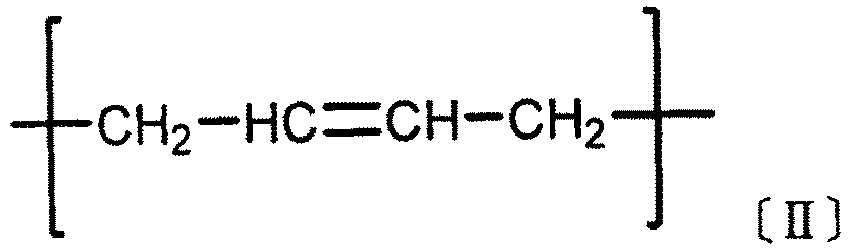
- the repeating unit derived from 1,3-butadiene may be represented by a 1,2-bond structure [I] and/or a 1,4-bond structure [II] .
- the molar ratio of the 1,2-bond structure [I] to the 1,4-bond structure [II] is preferably 90:10 to 100:0.
- Some or all of carbon-carbon double bonds in the 1,2-bond structure [I] and the 1,4-bond structure [II] may be hydrogenated.
- blocks that may be contained besides the block containing the repeating unit derived from the conjugated diene monomer and the block containing the repeating unit derived from the vinyl aromatic monomer is not particularly limited, as the block, a block consisting of a repeating unit derived from a (meth)acrylic acid ester monomer or the like may be exemplified.
- the content of the other blocks that may be contained besides the block containing the repeating unit derived from the conjugated diene monomer and the block containing the repeating unit derived from the vinyl aromatic monomer is not particularly limited, the content may be selected from 50% by weight or less, 40% by weight or less, 30% by weight or less, 20% by weight or less, 10% by weight or less, and the like in the block copolymer.
- a styrene-butadiene block copolymer, a styrene-isoprene block copolymer, a styrene-butadiene-styrene block copolymer, a styrene-isoprene-styrene block copolymer, a butadiene-styrene-butadiene block copolymer, hydrogenated products thereof, or the like may be exemplified.
- the styrene-butadiene-styrene block copolymer (SBS) is preferable.
- the weight ratio of the block containing the repeating unit derived from the conjugated diene monomer to the block containing the repeating unit derived from the vinyl aromatic monomer in the block copolymer is not particularly limited, as the weight ratio, 10:90 to 80:20, 10:90 to 70:30, 10:90 to 60:40, 20:80 to 80:20, 30:70 to 80:20, 40:60 to 80:20, or the like may be exemplified. Among these, the weight ratio is preferably 10:90 to 80:20, 10:90 to 70:30, or 10:90 to 60:40.
- the number average molecular weight (Mn) of the block copolymer is not particularly limited, as the number average molecular weight, 2,000 to 100,000, 2,000 to 80,000, 2,000 to 60,000, 2,000 to 50,000, 2,000 to 40,000, and the like may be exemplified.
- the molecular weight distribution (also referred to as the degree of dispersion) (Mw/Mn) of the block copolymer is not particularly limited, as the molecular weight distribution, 1 to 5, 1 to 3, or the like may be exemplified.
- the number average molecular weight (Mn) and the molecular weight distribution (Mw/Mn) are measured by gel permeation chromatograph (GPC) using polystyrene as a standard substance. The measurement conditions thereof are mobile phase: THF (tetrahydrofuran), mobile phase flow rate: 1 mL/minute, column temperature: 40°C, sample injection amount: 40 ⁇ l, and sample concentration: 2% by weight.
- a method for producing a block copolymer of the present invention comprises a step (A) of polymerizing a vinyl aromatic monomer in a mixed solvent containing a nonpolar solvent and an aprotic polar solvent using an anionic polymerization initiator at -5°C to 35°C and a step (B) of adding a conjugated diene monomer for further polymerization at -5°C to 35°C after the step (A).
- the method optionally comprises a step (C) of adding a vinyl aromatic monomer for further polymerization at -5°C to 35°C after the step (B).
- the step A is a step of polymerizing the vinyl aromatic monomer described above at -5°C to 35°C in the mixed solvent containing the nonpolar solvent and the aprotic polar solvent using the anionic polymerization initiator.
- the nonpolar solvent methylcyclohexane and methylcyclopentane may be exemplified, the nonpolar solvent is preferably methylcyclohexane. These solvents may be used alone or used as a mixed solvent of two thereof.
- an ether solvent such as diethyl ether, cyclopropyl methyl ether, tetrahydrofuran (THF), dioxane, or trioxane; a tertiary amine such as tetramethylethylenediamine; hexamethylphosphoric triamide; or the like may be exemplified.
- an ether solvent is preferable, and tetrahydrofuran is more preferable.
- These solvents may be used alone or used as a mixed solvent of two or more thereof.
- aprotic polar solvent amount ranges such as 5 to 20 parts by weight and 5 to 15 parts by weight with respect to 100 parts by weight of the at least one solvent selected from methylcyclohexane and methylcyclopentane may be exemplified.
- the total amount of the solvent used may be appropriately set by the scale of the reaction and the like, the solvent having a weight that is 1 to 100 times, 1 to 50 times, 1 to 30 times, or 1 to 20 times the weight of the block copolymer to be produced may usually be used.
- the anionic polymerization initiator is an anionic species that may polymerize anionic polymerizable unsaturated bonds
- the anionic polymerization initiator is not particularly limited. Specifically, organic alkali metals, organic alkaline-earth metals, carbon anionic species derived from 1,1-diphenylethylene or stilbene, or the like may be exemplified.
- an alkyllithium such as ethyl lithium, n-butyllithium, sec-butyllithium, or t-butyllithium; ethyl sodium; lithium biphenyl; lithium naphthalene; sodium naphthalene; potassium naphthalene; ⁇ -methylstyrene naphthalene dianion; 1,1-diphenylhexyllithium; 1,1-diphenyl-3-methylpentyl lithium; 1,4-dilithio-2-butene; 1,6-dilithiohexane; polystyryllithium; cumyl potassium; cumyl cesium; or the like may be illustrated.
- the anionic polymerization initiator to be used for the present invention may be used alone or used by combination of two or more thereof.
- the temperature of the polymerization reaction may be selected from ranges such as -5 to 35°C, -5 to 30°C, 0 to 35°C, and 0 to 30°C.
- the vinyl aromatic monomer may be added to the mixed solvent containing the at least one solvent selected from methylcyclohexane and methylcyclopentane and the aprotic polar solvent, and then the anionic polymerization initiator may be added.
- the anionic polymerization initiator may be added to the mixed solvent containing the at least one solvent selected from methylcyclohexane and methylcyclopentane and the aprotic polar solvent, and then the vinyl aromatic monomer may be added.
- the vinyl aromatic monomer and the anionic polymerization initiator may be added to the mixed solvent containing the at least one solvent selected from methylcyclohexane and methylcyclopentane and the aprotic polar solvent at almost the same time.
- the polymerization reaction is preferably performed in the presence of inert gas.
- the polymerization time may be appropriately set depending on the reaction scale and the like, the polymerization time is usually 0.1 to 100 hours, and preferably 1 to 24 hours.
- the step (B) of the production method of the present invention is a step of adding the conjugated diene monomer described above for further polymerization after the step (A).
- the conjugated diene monomer may be continuously added, or may be divided into a plurality of portions, and the portions may be added.
- the conjugated diene monomer may be undiluted or diluted with the aprotic solvent for addition.
- the conjugated diene monomer may be polymerized from the terminal anions of the blocks obtained in the step (A) containing the repeating unit derived from the vinyl aromatic monomer for growth to produce the block copolymer of the present invention.
- aprotic polar solvent amount ranges such as 5 to 20 parts by weight and 5 to 15 parts by weight with respect to 100 parts by weight of the at least one solvent selected from methylcyclohexane and methylcyclopentane may be exemplified.
- the solvent to be used in the step (A) is successively used, but the same or different solvent may also be newly added.
- the aprotic polar solvent the same may be illustrated as illustrated in the step (A).
- the temperature of the polymerization reaction may be selected from ranges such as -5 to 35°C, -5 to 30°C, 0 to 35°C, and 0 to 30°C.
- the polymerization reaction is preferably performed in the presence of inert gas.
- the polymerization time may be appropriately set depending on the reaction scale and the like, the polymerization time is usually 0.1 to 100 hours, and preferably 1 to 24 hours.
- the step (C) is an optional step.
- the step (C) of the production method of the present invention is a step of adding the vinyl aromatic monomer described above for further polymerization after the step (B).
- the vinyl aromatic monomer may be continuously added, or may be divided into a plurality of portions, and the portions may be added.
- the vinyl aromatic monomer may be undiluted or diluted with the aprotic solvent for addition.
- the vinyl aromatic monomer may be polymerized from the terminal anions of the blocks obtained in the step (B) containing the repeating unit derived from the conjugated diene monomer for growth to produce the block copolymer of the present invention.
- aprotic polar solvent amount ranges such as 5 to 20 parts by weight and 5 to 15 parts by weight with respect to 100 parts by weight of the at least one solvent selected from methylcyclohexane and methylcyclopentane may be exemplified.
- the solvent to be used in the step (C) generally, the solvent to be used in the step (A) is successively used, but the same or different solvent may be newly added.
- the aprotic polar solvent the same may be illustrated as illustrated in the step (A).
- the temperature of the polymerization reaction may be selected from ranges such as -5 to 35°C, -5 to 30°C, 0 to 35°C, and 0 to 30°C.
- the polymerization reaction is preferably performed in the presence of inert gas.
- the polymerization time may be appropriately set depending on the reaction scale and the like, the polymerization time is usually 0.1 to 100 hours, and preferably 1 to 24 hours.
- the obtained block copolymer may be purified by a purification method to be usually performed.
- Metal impurities derived from the anionic polymerization initiator may be removed depending on the use of the copolymer.
- the washing treatment of the block copolymer using an aqueous acid solution such as hydrochloric acid, an aqueous formic acid solution, an aqueous acetic acid solution, an aqueous propionic acid solution, or an aqueous citric acid solution
- adsorption treatment using an adsorbent such as an ion exchange resin, or the like is exemplified.
- Some or all of the carbon-carbon double bonds contained in the obtained block copolymer may be hydrogenated by a common method.
- MCH methylcyclohexane
- THF tetrahydrofuran
- the number average molecular weight (Mn) was 14, 702
- the degree of dispersion (Mw/Mn) was 1.05
- the rate of 1,2-vinyl bonds was 91%.
- the obtained reaction liquid was water-washed, the upper layer was then collected, and the solvent was removed by distillation under reduced pressure. The residue was then vacuum-dried at 80°C for 5 hours to obtain a white solid resin.
- the molecular weight of the obtained resin was evaluated by GPC measurement, and the rate of 1,2-vinyl bonds in the butadiene units of the resin was evaluated by 1 H-NMR measurement. Consequently, the number average molecular weight (Mn) was 21,140, the degree of dispersion (Mw/Mn) was 1.14, and the rate of 1,2-vinyl bonds was 96%.
- the obtained reaction liquid was water-washed, the upper layer was then collected, and the solvent was removed by distillation under reduced pressure. The residue was then vacuum-dried at 80°C for 5 hours to obtain a white solid resin.
- the molecular weight of the obtained resin was evaluated by GPC measurement, and the rate of 1,2-vinyl bonds in the butadiene units of the resin was evaluated by 1 H-NMR measurement. Consequently, the number average molecular weight (Mn) was 16, 453, the degree of dispersion (Mw/Mn) was 1.15, and the rate of 1,2-vinyl bonds was 93%.
- the obtained reaction liquid was water-washed, the upper layer was then collected, and the solvent was removed by distillation under reduced pressure. The residue was then vacuum-dried at 80°C for 5 hours to obtain a white solid resin.
- the molecular weight of the obtained resin was evaluated by GPC measurement, and the rate of 1,2-vinyl bonds in the butadiene units of the resin was evaluated by 1 H-NMR measurement. Consequently, the number average molecular weight (Mn) was 19,560, the degree of dispersion (Mw/Mn) was 1.18, and the rate of 1,2-vinyl bonds was 90%.
- the obtained reaction liquid was water-washed, the upper layer was then collected, and the solvent was removed by distillation under reduced pressure to obtain a colorless and transparent viscous liquid.
- the molecular weight of the obtained resin was evaluated by GPC measurement, and the rate of 1,2-vinyl bonds in the butadiene units of the resin was evaluated by 1 H-NMR measurement. Consequently, the number average molecular weight (Mn) was 5,723, the degree of dispersion (Mw/Mn) was 1.07, and the rate of 1,2-vinyl bonds was 90%.
- the obtained reaction liquid was water-washed, the upper layer was then collected, and the solvent was removed by distillation under reduced pressure to obtain a colorless and transparent viscous liquid.
- the molecular weight of the obtained resin was evaluated by GPC measurement, and the rate of 1,2-vinyl bonds in the butadiene units of the resin was evaluated by 1 H-NMR measurement. Consequently, the number average molecular weight (Mn) was 6,141, the degree of dispersion (Mw/Mn) was 1.04, and the rate of 1,2-vinyl bonds was 95%.
- the obtained reaction liquid was water-washed, the upper layer was then collected, and the solvent was removed by distillation under reduced pressure to obtain a colorless and transparent viscous liquid.
- the molecular weight of the obtained resin was evaluated by GPC measurement, and the rate of 1,2-vinyl bonds in the butadiene units of the resin was evaluated by 1 H-NMR measurement. Consequently, the number average molecular weight (Mn) was 5,804, the degree of dispersion (Mw/Mn) was 1.05, and the rate of 1,2-vinyl bonds was 96%.
- the obtained reaction liquid was water-washed, the upper layer was then collected, and the solvent was removed by distillation under reduced pressure to obtain a colorless and transparent viscous liquid.
- the molecular weight of the obtained resin was evaluated by GPC measurement, and the rate of 1,2-vinyl bonds in the butadiene units of the resin was evaluated by 1 H-NMR measurement. Consequently, the number average molecular weight (Mn) was 5,029, the degree of dispersion (Mw/Mn) was 1.07, and the rate of 1,2-vinyl bonds was 91%.
- the obtained reaction liquid was water-washed, the upper layer was then collected, and the solvent was removed by distillation under reduced pressure. The residue was then vacuum-dried at 80°C for 5 hours to obtain a white solid resin.
- the molecular weight of the obtained resin was evaluated by GPC measurement, and the rate of 1,2-vinyl bonds in the butadiene units of the resin was evaluated by 1 H-NMR measurement. Consequently, the number average molecular weight (Mn) was 24,393, the degree of dispersion (Mw/Mn) was 1.19, and the rate of 1,2-vinyl bonds was 85%.
- Comparative Example 1 in which the reaction was performed at 40°C, the initiator efficiency decreased as compared with Examples 1 to 4, and the rate of 1,2-vinyl bonds also decreased.
- the obtained reaction liquid was water-washed, the upper layer was then collected, and the solvent was removed by distillation under reduced pressure. The residue was then vacuum-dried at 80°C for 5 hours to obtain a white solid resin.
- the molecular weight of the obtained resin was evaluated by GPC measurement, and the rate of 1,2-vinyl bonds in the butadiene units of the resin was evaluated by 1 H-NMR measurement. Consequently, the number average molecular weight (Mn) was 20,512, and the degree of dispersion (Mw/Mn) was 1.23. However, a monomodal peak was not obtained, and peaks derived from the deactivation during the polymerization were observed. The rate of 1,2-vinyl bonds was 94%.
Landscapes
- Chemical & Material Sciences (AREA)
- Health & Medical Sciences (AREA)
- Chemical Kinetics & Catalysis (AREA)
- Medicinal Chemistry (AREA)
- Polymers & Plastics (AREA)
- Organic Chemistry (AREA)
- Inorganic Chemistry (AREA)
- Graft Or Block Polymers (AREA)
- Macromolecular Compounds Obtained By Forming Nitrogen-Containing Linkages In General (AREA)
Abstract
Description
- The present invention relates to a method for producing a block copolymer. The present application claims priority to
Japan Patent Application No. 2020-186761, filed on November 9, 2020 - Block copolymers containing blocks obtained by polymerizing conjugated diene monomers and blocks obtained by polymerizing vinyl aromatic monomers may be thermally cured to obtain cured products excellent in water resistance, heat resistance, insulating properties, adhesion to substrate, and the like. Those cured products are applied to general industrial articles. It is known that the block copolymers may be produced by anionic polymerization. The block copolymers are required to be produced as block copolymers having the most suitable molecular weights, molecular weight distributions, and composition ratios depending on uses.
- Patent Document 1 discloses that 4,000 g of tetrahydrofuran, 220 g of a styrene monomer, 0.7 g of n-butyllithium were added to an autoclave made of aluminum for polymerization at 70°C for 60 minutes, and 560 g of a 1,3-butadiene monomer was then added for polymerization for 150 minutes, 220 g of a styrene monomer was finally added for polymerization for 60 minutes, a large amount of methanol was added to stop the reaction, and a styrene-butadiene-styrene block copolymer was then obtained. The obtained block copolymer seems to have had a bound styrene content of 41%, a 1,2-vinyl bond amount of 86% in butadiene blocks, and a number average molecular weight of 92000.
- Patent Document 1:
Japanese unexamined Patent Application Publication No. 06-192502 - In the method described in Patent Document 1, tetrahydrofuran that was the solvent and n-butyllithium that was the polymerization initiator may cause a side reaction, and some of the polymerization initiator may be deactivated. Some problems were that a polymer having a prescribed molecular weight was not obtained consequently, and that the molecular weight distribution (Mw/Mn) increased. The above-mentioned side reaction may be reduced by changing tetrahydrofuran into a nonpolar solvent and by adjusting the polymerization temperature to -20°C or less. In this case, the polymerization may not, however, be completed due to a low polymerization rate. The polymerization reaction was required to be performed in a temperature range that is not high temperature or low temperature, namely in a temperature range of -5°C to 35°C. It is because special heating equipment or cooling equipment does not need to be used, and the polymerization reaction is advantageously performed in the temperature range from the viewpoint of industrial production methods. An object of the present invention is to provide a method that enables producing a target block copolymer at a temperature of -5°C to 35°C.
- The present inventors have earnestly examined to solve the above-mentioned problem and consequently completed the present invention. The present invention includes the following aspects.
- (1) A method for producing a block copolymer, the method comprising:
- a step (A) of polymerizing a vinyl aromatic monomer in a mixed solvent comprising at least one nonpolar solvent selected from methylcyclohexane and methylcyclopentane and an aprotic polar solvent by using an anionic polymerization initiator, at -5°C to 35°C; and
- a step (B) of adding a conjugated diene monomer for further polymerization at -5°C to 35°C after the step (A).
- (2) A method for producing a block copolymer, the method comprising:
- a step (A) of polymerizing a vinyl aromatic monomer at in a mixed solvent comprising at least one nonpolar solvent selected from methylcyclohexane and methylcyclopentane and an aprotic polar solvent by using an anionic polymerization initiator, at -5°C to 35°C;
- a step (B) of adding a conjugated diene monomer for further polymerization at -5°C to 35°C after the step (A); and
- a step (C) of adding a vinyl aromatic monomer for further polymerization at -5°C to 35°C after the step (B).
- (3) The method for producing a block copolymer according to (1) or (2), wherein, with respect to contents of the at least one nonpolar solvent selected from methylcyclohexane and methylcyclopentane, and the aprotic polar solvent, the content of the aprotic polar solvent is 5 to 20 parts by weight with respect to 100 parts by weight of the at least one nonpolar solvent selected from methylcyclohexane and methylcyclopentane.
- (4) The method for producing a block copolymer according to any one of (1) to (3), wherein the aprotic polar solvent is an ether solvent.
- (5) The method for producing a block copolymer according to (4), wherein the ether solvent is tetrahydrofuran.
- (6) The method for producing a block copolymer according to any one of (1) to (5), wherein the anionic polymerization initiator is an alkyllithium.
- (7) The method for producing a block copolymer according to any one of (1) to (6), wherein the vinyl aromatic monomer is a styrene-based monomer.
- (8) The method for producing a block copolymer according to (7), wherein the styrene-based monomer is styrene.
- (9) The method for producing a block copolymer according to any one of (1) to (8), wherein the conjugated diene monomer is 1,3-butadiene.
- According to a method for producing a polymer of the present invention, polymerization reaction may be performed in a temperature range of -5°C to 35°C. Since the side reaction during the polymerization may be suppressed, a target block copolymer may be produced.
- A block copolymer to which a production method of the present invention is directed is a block copolymer comprising a block containing a repeating unit derived from a vinyl aromatic monomer and a block containing a repeating unit derived from a conjugated diene monomer. The block copolymer is preferably a block copolymer consisting only of a block containing a repeating unit derived from a conjugated diene monomer and a block containing a repeating unit derived from a vinyl aromatic monomer. The block copolymer may be a linear block copolymer, a graft block copolymer, or a star block copolymer. Among these, the linear block copolymer is preferable. The terminals of the block copolymer may be modified with various chemically acceptable structures. Among those, the terminals of the block copolymer preferably have unmodified structures.
- The block containing the repeating unit derived from the vinyl aromatic monomer is a block in which only the vinyl aromatic monomer is polymerized or a block in which the vinyl aromatic monomer and a monomer other than the vinyl aromatic monomer (however, except the conjugated diene monomer) are copolymerized. The block containing the repeating unit derived from the vinyl aromatic monomer is preferably a block in which only the vinyl aromatic monomer is polymerized. Several blocks containing the repeating unit derived from the vinyl aromatic monomer may be contained in the block copolymer.
- Although the vinyl aromatic monomer is not particularly limited, as the vinyl aromatic monomer, styrene; α-methylstyrene; a styrene-based monomer such as styrene substituted with alkoxy groups; 2-vinylpyridine; 4-vinylpyridine; vinylnaphthalene; vinylnaphthalene substituted with alkyl groups; or the like may be exemplified. These may be used alone or used by combination of two or more thereof. Among these, the vinyl aromatic monomer is preferably a styrene-based monomer, and more preferably styrene.
- As the monomer other than the vinyl aromatic monomer copolymerized with the vinyl aromatic monomer, the conjugated diene monomer is excluded. As the monomer other than the vinyl aromatic monomer, a (meth)acrylic acid ester monomer or the like may be exemplified.
- The block containing the repeating unit derived from the conjugated diene monomer is a block in which only the conjugated diene monomer is polymerized or a block in which the conjugated diene monomer and a monomer other than the conjugated diene monomer (however, except the vinyl aromatic monomer) are copolymerized. The block containing the repeating unit derived from the conjugated diene monomer is preferably a block only the conjugated diene monomer is polymerized. Several blocks containing the repeating unit derived from the conjugated diene monomer may be contained in the block copolymer. Some or all of carbon-carbon double bonds in the repeating unit derived from the conjugated diene monomer may be hydrogenated.
- Although the conjugated diene monomer is not particularly limited, as the conjugated diene monomer, 1,3-butadiene, isoprene, piperylene, 1-phenyl-1,3-butadiene, (2Z,4E)-3,4-dimethyl-2,4-hexadiene, 2,3-dimethyl-1,3-butadiene, or the like may be exemplified. These may be used alone or used by combination of two or more thereof. Among these, the conjugated diene monomer is preferably 1,3-butadiene or isoprene.
- As the monomer other than the conjugated diene monomer copolymerizing with the conjugated diene monomer, the vinyl aromatic monomer is excluded. As the monomer other than the conjugated diene monomer, a (meth)acrylic acid ester monomer or the like may be exemplified.
- In using 1,3-butadiene as the conjugated diene monomer, the repeating unit derived from 1,3-butadiene may be represented by a 1,2-bond structure [I] and/or a 1,4-bond structure [II] . In a block containing the repeating unit derived from 1,3-butadiene, the molar ratio of the 1,2-bond structure [I] to the 1,4-bond structure [II] is preferably 90:10 to 100:0. Some or all of carbon-carbon double bonds in the 1,2-bond structure [I] and the 1,4-bond structure [II] may be hydrogenated.

- Although other blocks that may be contained besides the block containing the repeating unit derived from the conjugated diene monomer and the block containing the repeating unit derived from the vinyl aromatic monomer is not particularly limited, as the block, a block consisting of a repeating unit derived from a (meth)acrylic acid ester monomer or the like may be exemplified. Although the content of the other blocks that may be contained besides the block containing the repeating unit derived from the conjugated diene monomer and the block containing the repeating unit derived from the vinyl aromatic monomer is not particularly limited, the content may be selected from 50% by weight or less, 40% by weight or less, 30% by weight or less, 20% by weight or less, 10% by weight or less, and the like in the block copolymer.
- As the block copolymer containing the block containing the repeating unit derived from the conjugated diene monomer and the block containing the repeating unit derived from the vinyl aromatic monomer, a styrene-butadiene block copolymer, a styrene-isoprene block copolymer, a styrene-butadiene-styrene block copolymer, a styrene-isoprene-styrene block copolymer, a butadiene-styrene-butadiene block copolymer, hydrogenated products thereof, or the like may be exemplified. Among these, the styrene-butadiene-styrene block copolymer (SBS) is preferable.
- Although the weight ratio of the block containing the repeating unit derived from the conjugated diene monomer to the block containing the repeating unit derived from the vinyl aromatic monomer in the block copolymer is not particularly limited, as the weight ratio, 10:90 to 80:20, 10:90 to 70:30, 10:90 to 60:40, 20:80 to 80:20, 30:70 to 80:20, 40:60 to 80:20, or the like may be exemplified. Among these, the weight ratio is preferably 10:90 to 80:20, 10:90 to 70:30, or 10:90 to 60:40.
- Although the number average molecular weight (Mn) of the block copolymer is not particularly limited, as the number average molecular weight, 2,000 to 100,000, 2,000 to 80,000, 2,000 to 60,000, 2,000 to 50,000, 2,000 to 40,000, and the like may be exemplified. Although the molecular weight distribution (also referred to as the degree of dispersion) (Mw/Mn) of the block copolymer is not particularly limited, as the molecular weight distribution, 1 to 5, 1 to 3, or the like may be exemplified. The number average molecular weight (Mn) and the molecular weight distribution (Mw/Mn) are measured by gel permeation chromatograph (GPC) using polystyrene as a standard substance. The measurement conditions thereof are mobile phase: THF (tetrahydrofuran), mobile phase flow rate: 1 mL/minute, column temperature: 40°C, sample injection amount: 40 µl, and sample concentration: 2% by weight.
- A method for producing a block copolymer of the present invention comprises a step (A) of polymerizing a vinyl aromatic monomer in a mixed solvent containing a nonpolar solvent and an aprotic polar solvent using an anionic polymerization initiator at -5°C to 35°C and a step (B) of adding a conjugated diene monomer for further polymerization at -5°C to 35°C after the step (A). The method optionally comprises a step (C) of adding a vinyl aromatic monomer for further polymerization at -5°C to 35°C after the step (B).
- The step A is a step of polymerizing the vinyl aromatic monomer described above at -5°C to 35°C in the mixed solvent containing the nonpolar solvent and the aprotic polar solvent using the anionic polymerization initiator.
- Although, as the nonpolar solvent, methylcyclohexane and methylcyclopentane may be exemplified, the nonpolar solvent is preferably methylcyclohexane. These solvents may be used alone or used as a mixed solvent of two thereof.
- As the aprotic polar solvent, an ether solvent such as diethyl ether, cyclopropyl methyl ether, tetrahydrofuran (THF), dioxane, or trioxane; a tertiary amine such as tetramethylethylenediamine; hexamethylphosphoric triamide; or the like may be exemplified. Among these, an ether solvent is preferable, and tetrahydrofuran is more preferable. These solvents may be used alone or used as a mixed solvent of two or more thereof.
- Although the amounts of the at least one solvent selected from methylcyclohexane and methylcyclopentane and the aprotic polar solvent are not particularly limited, aprotic polar solvent amount ranges such as 5 to 20 parts by weight and 5 to 15 parts by weight with respect to 100 parts by weight of the at least one solvent selected from methylcyclohexane and methylcyclopentane may be exemplified.
- Although the total amount of the solvent used may be appropriately set by the scale of the reaction and the like, the solvent having a weight that is 1 to 100 times, 1 to 50 times, 1 to 30 times, or 1 to 20 times the weight of the block copolymer to be produced may usually be used.
- As long as the anionic polymerization initiator is an anionic species that may polymerize anionic polymerizable unsaturated bonds, the anionic polymerization initiator is not particularly limited. Specifically, organic alkali metals, organic alkaline-earth metals, carbon anionic species derived from 1,1-diphenylethylene or stilbene, or the like may be exemplified. More specifically, an alkyllithium such as ethyl lithium, n-butyllithium, sec-butyllithium, or t-butyllithium; ethyl sodium; lithium biphenyl; lithium naphthalene; sodium naphthalene; potassium naphthalene; α-methylstyrene naphthalene dianion; 1,1-diphenylhexyllithium; 1,1-diphenyl-3-methylpentyl lithium; 1,4-dilithio-2-butene; 1,6-dilithiohexane; polystyryllithium; cumyl potassium; cumyl cesium; or the like may be illustrated. The anionic polymerization initiator to be used for the present invention may be used alone or used by combination of two or more thereof.
- The temperature of the polymerization reaction may be selected from ranges such as -5 to 35°C, -5 to 30°C, 0 to 35°C, and 0 to 30°C.
- In the polymerization reaction, the vinyl aromatic monomer may be added to the mixed solvent containing the at least one solvent selected from methylcyclohexane and methylcyclopentane and the aprotic polar solvent, and then the anionic polymerization initiator may be added. Alternatively, the anionic polymerization initiator may be added to the mixed solvent containing the at least one solvent selected from methylcyclohexane and methylcyclopentane and the aprotic polar solvent, and then the vinyl aromatic monomer may be added. Or the vinyl aromatic monomer and the anionic polymerization initiator may be added to the mixed solvent containing the at least one solvent selected from methylcyclohexane and methylcyclopentane and the aprotic polar solvent at almost the same time.
- The polymerization reaction is preferably performed in the presence of inert gas. Although the polymerization time may be appropriately set depending on the reaction scale and the like, the polymerization time is usually 0.1 to 100 hours, and preferably 1 to 24 hours.
- The step (B) of the production method of the present invention is a step of adding the conjugated diene monomer described above for further polymerization after the step (A). The conjugated diene monomer may be continuously added, or may be divided into a plurality of portions, and the portions may be added. The conjugated diene monomer may be undiluted or diluted with the aprotic solvent for addition.
- The conjugated diene monomer may be polymerized from the terminal anions of the blocks obtained in the step (A) containing the repeating unit derived from the vinyl aromatic monomer for growth to produce the block copolymer of the present invention.
- Although the amounts of the at least one solvent selected from methylcyclohexane and methylcyclopentane and the aprotic polar solvent in the step (B) are not particularly limited, aprotic polar solvent amount ranges such as 5 to 20 parts by weight and 5 to 15 parts by weight with respect to 100 parts by weight of the at least one solvent selected from methylcyclohexane and methylcyclopentane may be exemplified.
- As a solvent to be used in the step (B), generally, the solvent to be used in the step (A) is successively used, but the same or different solvent may also be newly added. As the aprotic polar solvent, the same may be illustrated as illustrated in the step (A).
- The temperature of the polymerization reaction may be selected from ranges such as -5 to 35°C, -5 to 30°C, 0 to 35°C, and 0 to 30°C.
- The polymerization reaction is preferably performed in the presence of inert gas. Although the polymerization time may be appropriately set depending on the reaction scale and the like, the polymerization time is usually 0.1 to 100 hours, and preferably 1 to 24 hours.
- The step (C) is an optional step. The step (C) of the production method of the present invention is a step of adding the vinyl aromatic monomer described above for further polymerization after the step (B). The vinyl aromatic monomer may be continuously added, or may be divided into a plurality of portions, and the portions may be added. The vinyl aromatic monomer may be undiluted or diluted with the aprotic solvent for addition.
- The vinyl aromatic monomer may be polymerized from the terminal anions of the blocks obtained in the step (B) containing the repeating unit derived from the conjugated diene monomer for growth to produce the block copolymer of the present invention.
- Although the amounts of the at least one solvent selected from methylcyclohexane and methylcyclopentane and the aprotic polar solvent in the step (C) are not particularly limited, aprotic polar solvent amount ranges such as 5 to 20 parts by weight and 5 to 15 parts by weight with respect to 100 parts by weight of the at least one solvent selected from methylcyclohexane and methylcyclopentane may be exemplified.
- As the solvent to be used in the step (C), generally, the solvent to be used in the step (A) is successively used, but the same or different solvent may be newly added. As the aprotic polar solvent, the same may be illustrated as illustrated in the step (A).
- The temperature of the polymerization reaction may be selected from ranges such as -5 to 35°C, -5 to 30°C, 0 to 35°C, and 0 to 30°C.
- The polymerization reaction is preferably performed in the presence of inert gas. Although the polymerization time may be appropriately set depending on the reaction scale and the like, the polymerization time is usually 0.1 to 100 hours, and preferably 1 to 24 hours.
- After quenching by a method to be usually performed, the obtained block copolymer may be purified by a purification method to be usually performed. Metal impurities derived from the anionic polymerization initiator may be removed depending on the use of the copolymer. As the method for removing the metal impurities, the washing treatment of the block copolymer using an aqueous acid solution such as hydrochloric acid, an aqueous formic acid solution, an aqueous acetic acid solution, an aqueous propionic acid solution, or an aqueous citric acid solution, adsorption treatment using an adsorbent such as an ion exchange resin, or the like is exemplified.
- Some or all of the carbon-carbon double bonds contained in the obtained block copolymer may be hydrogenated by a common method.
- Then, the present invention will be described more specifically by showing the Examples. However, the technical scope of the present invention is not limited to the Examples.
- 218.62 g of methylcyclohexane (hereinafter abbreviated to MCH) and 24.29 g of tetrahydrofuran (hereinafter abbreviated to THF) were added to a 500-mL flask, and the temperature in the system was adjusted to 20°C. Then, 2.95 g of n-butyllithium (15.1%, solution in n-hexane) was added, and immediately, 15.47 g of styrene in a dropping funnel was dropped. After the dropping, the mixture was matured for 10 minutes, and the disappearance of the monomer was confirmed by GC. Then, 30.00 g of butadiene was dropped. After the maturation for 15 minutes, 15.43 g of styrene was then dropped. After the maturation for 30 minutes, 0.42 g of pure water was added to stop the reaction. The obtained reaction liquid was water-washed, the upper layer was then collected, and the solvent was removed by distillation under reduced pressure. The residue was then vacuum-dried at 80°C for 5 hours to obtain a white solid resin. The molecular weight of the obtained resin was evaluated by gel permeation chromatography (hereinafter abbreviated to GPC, polystyrene standard) measurement, and the rate of 1,2-vinyl bonds in the butadiene units of the resin was evaluated by 1H-NMR measurement. Consequently, the number average molecular weight (Mn) was 14, 702, the degree of dispersion (Mw/Mn) was 1.05, and the rate of 1,2-vinyl bonds was 91%. The weight ratio between the butadiene blocks and the styrene blocks in the block copolymer was as follows: polystyrene/polybutadiene/polystyrene = 27/46/27.
- 218.26 g of MCH and 24.11 g of THF were added to a 500-mL flask, and the temperature in the system was adjusted to 0°C. Then, 2.72 g of n-butyllithium (15.1%, solution in n-hexane) was added, and immediately, 14.82 g of styrene in a dropping funnel was dropped. After the dropping, the mixture was matured for 10 minutes, and the disappearance of the monomer was confirmed by GC. Then, 33.85 g of butadiene was dropped. After the maturation for 60 minutes, 14.80 g of styrene was dropped. After the maturation for 30 minutes, 0.55 g of pure water was added to stop the reaction. The obtained reaction liquid was water-washed, the upper layer was then collected, and the solvent was removed by distillation under reduced pressure. The residue was then vacuum-dried at 80°C for 5 hours to obtain a white solid resin. The molecular weight of the obtained resin was evaluated by GPC measurement, and the rate of 1,2-vinyl bonds in the butadiene units of the resin was evaluated by 1H-NMR measurement. Consequently, the number average molecular weight (Mn) was 21,140, the degree of dispersion (Mw/Mn) was 1.14, and the rate of 1,2-vinyl bonds was 96%. The weight ratio between the butadiene blocks and the styrene blocks in the block copolymer was as follows: polystyrene/polybutadiene/polystyrene = 25/50/25.
- 215.89 g of MCH and 23.95 g of THF were added to a 500-mL flask, and the temperature in the system was adjusted to 10°C. Then, 2.63 g of n-butyllithium (15.1%, solution in n-hexane) was added, and immediately, 14.88 g of styrene in a dropping funnel was dropped. After the dropping, the mixture was matured for 10 minutes, and the disappearance of the monomer was confirmed by GC. Then, 33.21 g of butadiene was dropped. After the maturation for 30 minutes, 15.14 g of styrene was dropped. After the maturation for 30 minutes, 0.55 g of pure water was added to stop the reaction. The obtained reaction liquid was water-washed, the upper layer was then collected, and the solvent was removed by distillation under reduced pressure. The residue was then vacuum-dried at 80°C for 5 hours to obtain a white solid resin. The molecular weight of the obtained resin was evaluated by GPC measurement, and the rate of 1,2-vinyl bonds in the butadiene units of the resin was evaluated by 1H-NMR measurement. Consequently, the number average molecular weight (Mn) was 16, 453, the degree of dispersion (Mw/Mn) was 1.15, and the rate of 1,2-vinyl bonds was 93%. The weight ratio between the butadiene blocks and the styrene blocks in the block copolymer was as follows: polystyrene/polybutadiene/polystyrene = 27/46/27.
- 216.01 g of MCH and 24.00 g of THF were added to a 500-mL flask, and the temperature in the system was adjusted to 30°C. Then, 2.96 g of n-butyllithium (15.1%, solution in n-hexane) was added, and immediately, 15.08 g of styrene in a dropping funnel was dropped. After the dropping, the mixture was matured for 10 minutes, and the disappearance of the monomer was confirmed by GC. Then, 32.30 g of butadiene was dropped. After the maturation for 15 minutes, 15.21 g of styrene was dropped. After the maturation for 30 minutes, 0.62 g of pure water was added to stop the reaction. The obtained reaction liquid was water-washed, the upper layer was then collected, and the solvent was removed by distillation under reduced pressure. The residue was then vacuum-dried at 80°C for 5 hours to obtain a white solid resin. The molecular weight of the obtained resin was evaluated by GPC measurement, and the rate of 1,2-vinyl bonds in the butadiene units of the resin was evaluated by 1H-NMR measurement. Consequently, the number average molecular weight (Mn) was 19,560, the degree of dispersion (Mw/Mn) was 1.18, and the rate of 1,2-vinyl bonds was 90%. The weight ratio between the butadiene blocks and the styrene blocks in the block copolymer was as follows: polystyrene/polybutadiene/polystyrene = 26/48/26.
- 219.07 g of MCH and 25.70 g of THF were added to a 500-mL flask, and the temperature in the system was adjusted to 20°C. Then, 9.01 g of n-butyllithium (15.1%, solution in n-hexane) was added, and immediately, 6.21 g of styrene in a dropping funnel was dropped. After the dropping, the mixture was matured for 10 minutes, and the disappearance of the monomer was confirmed by GC. Then, 53.53 g of butadiene was dropped. After the maturation for 15 minutes, 6.21 g of styrene was dropped. After the maturation for 30 minutes, 1.66 g of pure water was added to stop the reaction. The obtained reaction liquid was water-washed, the upper layer was then collected, and the solvent was removed by distillation under reduced pressure to obtain a colorless and transparent viscous liquid. The molecular weight of the obtained resin was evaluated by GPC measurement, and the rate of 1,2-vinyl bonds in the butadiene units of the resin was evaluated by 1H-NMR measurement. Consequently, the number average molecular weight (Mn) was 5,723, the degree of dispersion (Mw/Mn) was 1.07, and the rate of 1,2-vinyl bonds was 90%. The weight ratio between the butadiene blocks and the styrene blocks in the block copolymer was as follows: polystyrene/polybutadiene/polystyrene = 9/82/9.
- 215.72 g of MCH and 23.95 g of THF were added to a 500-mL flask, and the temperature in the system was adjusted to 0°C. Then, 8.37 g of n-butyllithium (15.1%, solution in n-hexane) was added, and immediately, 6.01 g of styrene in a dropping funnel was dropped. After the dropping, the mixture was matured for 10 minutes, and the disappearance of the monomer was confirmed by GC. Then, 47.00 g of butadiene was dropped. After the maturation for 15 minutes, 5.89 g of styrene was dropped. After the maturation for 30 minutes, 1.66 g of pure water was added to stop the reaction. The obtained reaction liquid was water-washed, the upper layer was then collected, and the solvent was removed by distillation under reduced pressure to obtain a colorless and transparent viscous liquid. The molecular weight of the obtained resin was evaluated by GPC measurement, and the rate of 1,2-vinyl bonds in the butadiene units of the resin was evaluated by 1H-NMR measurement. Consequently, the number average molecular weight (Mn) was 6,141, the degree of dispersion (Mw/Mn) was 1.04, and the rate of 1,2-vinyl bonds was 95%. The weight ratio between the butadiene blocks and the styrene blocks in the block copolymer was as follows: polystyrene/polybutadiene/polystyrene = 9/82/9.
- 215.83 g of MCH and 24.04 g of THF were added to a 500-mL flask, and the temperature in the system was adjusted to 10°C. Then, 8.44 g of n-butyllithium (15.1%, solution in n-hexane) was added, and immediately, 6.30 g of styrene in a dropping funnel was dropped. After the dropping, the mixture was matured for 10 minutes, and the disappearance of the monomer was confirmed by GC. Then, 49.52 g of butadiene was dropped. After the maturation for 15 minutes, 5.75 g of styrene was dropped. After the maturation for 30 minutes, 1.66 g of pure water was added to stop the reaction. The obtained reaction liquid was water-washed, the upper layer was then collected, and the solvent was removed by distillation under reduced pressure to obtain a colorless and transparent viscous liquid. The molecular weight of the obtained resin was evaluated by GPC measurement, and the rate of 1,2-vinyl bonds in the butadiene units of the resin was evaluated by 1H-NMR measurement. Consequently, the number average molecular weight (Mn) was 5,804, the degree of dispersion (Mw/Mn) was 1.05, and the rate of 1,2-vinyl bonds was 96%. The weight ratio between the butadiene blocks and the styrene blocks in the block copolymer was as follows: polystyrene/polybutadiene/polystyrene = 10/80/10.
- 216.56 g of MCH and 24.06 g of THF were added to a 500-mL flask, and the temperature in the system was adjusted to 30°C. Then, 8.60 g of n-butyllithium (15.1%, solution in n-hexane) was added, and immediately, 6.30 g of styrene added to a dropping funnel was dropped. After the dropping, the mixture was matured for 10 minutes, and the disappearance of the monomer was confirmed by GC. Then, 54.30 g of butadiene was dropped. After the maturation for 15 minutes, 5.75 g of styrene was dropped. After the maturation for 30 minutes, 1.66 g of pure water was added to stop the reaction. The obtained reaction liquid was water-washed, the upper layer was then collected, and the solvent was removed by distillation under reduced pressure to obtain a colorless and transparent viscous liquid. The molecular weight of the obtained resin was evaluated by GPC measurement, and the rate of 1,2-vinyl bonds in the butadiene units of the resin was evaluated by 1H-NMR measurement. Consequently, the number average molecular weight (Mn) was 5,029, the degree of dispersion (Mw/Mn) was 1.07, and the rate of 1,2-vinyl bonds was 91%. The weight ratio between the butadiene blocks and the styrene blocks in the block copolymer was as follows: polystyrene/polybutadiene/polystyrene = 10/80/10.
- 215.94 g of MCH and 24.11 g of THF were added to a 500-mL flask, and the temperature in the system was adjusted to 40°C. Then, 2.69 g of n-butyllithium (15.1%, solution in n-hexane) was added, and immediately 14.84 g of styrene in a dropping funnel was dropped. After the dropping, the mixture was matured for 10 minutes, and the disappearance of the monomer was confirmed by GC. Then, 33.74 g of butadiene was dropped. After the maturation for 15 minutes, 14.88 g of styrene was dropped. After the maturation for 30 minutes, 0.57 g of pure water was added to stop the reaction. The obtained reaction liquid was water-washed, the upper layer was then collected, and the solvent was removed by distillation under reduced pressure. The residue was then vacuum-dried at 80°C for 5 hours to obtain a white solid resin. The molecular weight of the obtained resin was evaluated by GPC measurement, and the rate of 1,2-vinyl bonds in the butadiene units of the resin was evaluated by 1H-NMR measurement. Consequently, the number average molecular weight (Mn) was 24,393, the degree of dispersion (Mw/Mn) was 1.19, and the rate of 1,2-vinyl bonds was 85%. In Comparative Example 1, in which the reaction was performed at 40°C, the initiator efficiency decreased as compared with Examples 1 to 4, and the rate of 1,2-vinyl bonds also decreased. The weight ratio between the butadiene blocks and the styrene blocks in the block copolymer was as follows: polystyrene/polybutadiene/polystyrene = 25/50/25.
- 215.94 g of MCH and 24.06 g of THF were added to a 500-mL flask, and the temperature in the system was adjusted to -10°C. Then, 2.96 g of n-butyllithium (15.1%, solution in n-hexane) was added, and immediately 15.14 g of styrene in a dropping funnel was dropped. After the dropping, the mixture was matured for 10 minutes, and the disappearance of the monomer was confirmed by GC. Then, 34.79 g of butadiene was dropped. After the maturation for 120 minutes, 15.09 g of styrene was dropped. After the maturation for 30 minutes, 0.57 g of pure water was added to stop the reaction. The obtained reaction liquid was water-washed, the upper layer was then collected, and the solvent was removed by distillation under reduced pressure. The residue was then vacuum-dried at 80°C for 5 hours to obtain a white solid resin. The molecular weight of the obtained resin was evaluated by GPC measurement, and the rate of 1,2-vinyl bonds in the butadiene units of the resin was evaluated by 1H-NMR measurement. Consequently, the number average molecular weight (Mn) was 20,512, and the degree of dispersion (Mw/Mn) was 1.23. However, a monomodal peak was not obtained, and peaks derived from the deactivation during the polymerization were observed. The rate of 1,2-vinyl bonds was 94%. The weight ratio between the butadiene blocks and the styrene blocks in the block copolymer was as follows: polystyrene/polybutadiene/polystyrene = 10/80/10.
Claims (9)
- A method for producing a block copolymer, the method comprising:a step (A) of polymerizing a vinyl aromatic monomer in a mixed solvent comprising at least one nonpolar solvent selected from methylcyclohexane and methylcyclopentane and an aprotic polar solvent by using an anionic polymerization initiator, at -5°C to 35°C; anda step (B) of adding a conjugated diene monomer for further polymerization at -5°C to 35°C after the step (A).
- A method for producing a block copolymer, the method comprising:a step (A) of polymerizing a vinyl aromatic monomer in a mixed solvent comprising at least one nonpolar solvent selected from methylcyclohexane and methylcyclopentane and an aprotic polar solvent by using an anionic polymerization initiator, at -5°C to 35°C;a step (B) of adding a conjugated diene monomer for further polymerization at -5°C to 35°C after the step (A); anda step (C) of adding a vinyl aromatic monomer for further polymerization at -5°C to 35°C after the step (B).
- The method for producing a block copolymer according to claim 1 or 2, wherein, with respect to contents of the at least one nonpolar solvent selected from methylcyclohexane and methylcyclopentane and the aprotic polar solvent, the content of the aprotic polar solvent is 5 to 20 parts by weight with respect to 100 parts by weight of the at least one nonpolar solvent selected from methylcyclohexane and methylcyclopentane.
- The method for producing a block copolymer according to any one of claims 1 to 3, wherein the aprotic polar solvent is an ether solvent.
- The method for producing a block copolymer according to claim 4, wherein the ether solvent is tetrahydrofuran.
- The method for producing a block copolymer according to any one of claims 1 to 5, wherein the anionic polymerization initiator is an alkyllithium.
- The method for producing a block copolymer according to any one of claims 1 to 6, wherein the vinyl aromatic monomer is a styrene-based monomer.
- The method for producing a block copolymer according to claim 7, wherein the styrene-based monomer is styrene.
- The method for producing a block copolymer according to any one of claims 1 to 8, wherein the conjugated diene monomer is 1,3-butadiene.
Applications Claiming Priority (2)
| Application Number | Priority Date | Filing Date | Title |
|---|---|---|---|
| JP2020186761 | 2020-11-09 | ||
| PCT/JP2021/039983 WO2022097575A1 (en) | 2020-11-09 | 2021-10-29 | Method for producing block copolymer |
Publications (2)
| Publication Number | Publication Date |
|---|---|
| EP4242244A1 true EP4242244A1 (en) | 2023-09-13 |
| EP4242244A4 EP4242244A4 (en) | 2024-10-02 |
Family
ID=81457914
Family Applications (1)
| Application Number | Title | Priority Date | Filing Date |
|---|---|---|---|
| EP21889128.1A Pending EP4242244A4 (en) | 2020-11-09 | 2021-10-29 | PROCESS FOR PRODUCING A BLOCK COPOLYMER |
Country Status (8)
| Country | Link |
|---|---|
| US (1) | US20230399451A1 (en) |
| EP (1) | EP4242244A4 (en) |
| JP (1) | JP7805947B2 (en) |
| KR (1) | KR20230104599A (en) |
| CN (1) | CN116472298A (en) |
| AU (1) | AU2021373444A1 (en) |
| TW (1) | TWI850596B (en) |
| WO (1) | WO2022097575A1 (en) |
Family Cites Families (10)
| Publication number | Priority date | Publication date | Assignee | Title |
|---|---|---|---|---|
| JPH06192502A (en) | 1992-12-25 | 1994-07-12 | Daicel Chem Ind Ltd | Thermosetting resin composition |
| JP4647052B2 (en) | 1999-12-22 | 2011-03-09 | 株式会社クラレ | Process for producing α-methylstyrene block copolymer |
| DE60138305D1 (en) * | 2000-11-20 | 2009-05-20 | Kuraray Co | PRESSURE-SENSITIVE ADHESIVE AND BLOCK POLYMER FOR USE THEREIN |
| CN101305022B (en) * | 2005-11-12 | 2012-06-20 | 陶氏环球技术有限责任公司 | Brominated butadiene/vinyl aromatic copolymers, blends of such copolymers with a vinyl aromatic polymer, and polymeric foams formed from such blends |
| JP2010280853A (en) * | 2009-06-05 | 2010-12-16 | Bridgestone Corp | Rubber composition and pneumatic tire using the same |
| TWI638847B (en) * | 2015-02-09 | 2018-10-21 | 旭化成股份有限公司 | Block copolymer composition, molding material, resin composition, and molded body |
| US12037427B2 (en) * | 2018-09-28 | 2024-07-16 | Nippon Steel Chemical & Material Co., Ltd. | Polyfunctional vinyl aromatic copolymer and method for manufacturing same, copolymer rubber obtained therefrom, rubber composition, rubber crosslinked material, and tire member |
| FR3086661B1 (en) | 2018-10-02 | 2021-06-11 | Michelin & Cie | PROCESS FOR SYNTHESIS OF A THERMOPLASTIC ELASTOMER INCLUDING AT LEAST ONE POLY BLOCK (ALPHA-METHYLSTYRENE) |
| JP7259533B2 (en) | 2019-05-14 | 2023-04-18 | スズキ株式会社 | Vehicle drive system |
| JP7345570B2 (en) | 2020-01-29 | 2023-09-15 | 日本曹達株式会社 | Thermosetting composition containing styrene-butadiene-styrene block polymer and method for curing the same |
-
2021
- 2021-10-29 EP EP21889128.1A patent/EP4242244A4/en active Pending
- 2021-10-29 JP JP2022560751A patent/JP7805947B2/en active Active
- 2021-10-29 KR KR1020237013066A patent/KR20230104599A/en active Pending
- 2021-10-29 US US18/033,149 patent/US20230399451A1/en active Pending
- 2021-10-29 CN CN202180072335.2A patent/CN116472298A/en active Pending
- 2021-10-29 AU AU2021373444A patent/AU2021373444A1/en active Pending
- 2021-10-29 WO PCT/JP2021/039983 patent/WO2022097575A1/en not_active Ceased
- 2021-11-04 TW TW110141169A patent/TWI850596B/en active
Also Published As
| Publication number | Publication date |
|---|---|
| JP7805947B2 (en) | 2026-01-26 |
| CN116472298A (en) | 2023-07-21 |
| EP4242244A4 (en) | 2024-10-02 |
| JPWO2022097575A1 (en) | 2022-05-12 |
| TW202225200A (en) | 2022-07-01 |
| AU2021373444A1 (en) | 2023-05-25 |
| WO2022097575A1 (en) | 2022-05-12 |
| TWI850596B (en) | 2024-08-01 |
| US20230399451A1 (en) | 2023-12-14 |
| KR20230104599A (en) | 2023-07-10 |
| AU2021373444A9 (en) | 2025-03-20 |
Similar Documents
| Publication | Publication Date | Title |
|---|---|---|
| US5514753A (en) | Process for preparing a block copolymer | |
| KR102172741B1 (en) | Polarity modifier system for high vinyl block copolymerization | |
| EP2899255B1 (en) | Oil composition comprising a viscosity index improver | |
| JPH04227917A (en) | Functional thermoplastic elastomer | |
| JP2002249506A (en) | Method for producing diene elastomer by anionic polymerization | |
| JP4368303B2 (en) | COUPLED STYRENE BLOCK COPOLYMER AND METHOD FOR PREPARING THE SAME | |
| US10889676B2 (en) | Method for synthesizing a thermoplastic elastomer comprising at least one poly(α-methylstyrene) block | |
| KR102824774B1 (en) | Method for synthesizing a thermoplastic elastomer comprising at least one poly(alpha-methylstyrene) block | |
| EP1333042B1 (en) | Star block copolymer and preparing method thereof | |
| JP3431284B2 (en) | Method for producing block copolymer | |
| JPS5871909A (en) | Block copolymer of conjugate diene or vinyl substituted aromatic hydrocarbon and acryl ester and manufacture | |
| JP2006517984A (en) | Conjugated diene block (co) polymers and methods for their preparation | |
| US5700874A (en) | Alkoxysilane-modified polymer and adhesive composition using said polymer | |
| CN119894950A (en) | Triblock polymers having a diene central block rich in ethylene and two end blocks of polystyrene and polyethylene respectively | |
| CN119173567A (en) | Elastomer matrix comprising a thermoplastic elastomer | |
| US20230399451A1 (en) | Method for producing block copolymer | |
| JPH0848709A (en) | Industrially applicable method for producing difunctional anion polymerization initiator and use of the initiator | |
| JPH10218908A (en) | Anionic copolymerization of conjugated diene with vinylarene in the presence of tetrahydropyranylmethanol alkyl ether | |
| US8481644B2 (en) | Low chloride polybutadiene | |
| US5932663A (en) | Block copolymer and preparation thereof by anionic polymerization | |
| CN109749010B (en) | Random copolymer and random copolymer composition, use thereof and anionic polymerization process | |
| CN115197357A (en) | Alternating copolymer and preparation method and application thereof | |
| RU2858199C2 (en) | Butadiene-isoprene rubber, method for its production and use | |
| CN118515798A (en) | Composite structure regulator and its application in preparing polymer, polymer and its preparation method | |
| CN117069881A (en) | Low cis polybutadiene rubber and its preparation method and application |
Legal Events
| Date | Code | Title | Description |
|---|---|---|---|
| STAA | Information on the status of an ep patent application or granted ep patent |
Free format text: STATUS: THE INTERNATIONAL PUBLICATION HAS BEEN MADE |
|
| PUAI | Public reference made under article 153(3) epc to a published international application that has entered the european phase |
Free format text: ORIGINAL CODE: 0009012 |
|
| STAA | Information on the status of an ep patent application or granted ep patent |
Free format text: STATUS: REQUEST FOR EXAMINATION WAS MADE |
|
| 17P | Request for examination filed |
Effective date: 20230331 |
|
| AK | Designated contracting states |
Kind code of ref document: A1 Designated state(s): AL AT BE BG CH CY CZ DE DK EE ES FI FR GB GR HR HU IE IS IT LI LT LU LV MC MK MT NL NO PL PT RO RS SE SI SK SM TR |
|
| RAP3 | Party data changed (applicant data changed or rights of an application transferred) |
Owner name: NIPPON SODA CO., LTD. |
|
| DAV | Request for validation of the european patent (deleted) | ||
| DAX | Request for extension of the european patent (deleted) | ||
| A4 | Supplementary search report drawn up and despatched |
Effective date: 20240904 |
|
| RIC1 | Information provided on ipc code assigned before grant |
Ipc: C08F 297/04 20060101AFI20240829BHEP |