EP4241270B1 - Maschinenlernunterstützte räumliche rauschschätzung und -unterdrückung - Google Patents
Maschinenlernunterstützte räumliche rauschschätzung und -unterdrückung Download PDFInfo
- Publication number
- EP4241270B1 EP4241270B1 EP21816246.9A EP21816246A EP4241270B1 EP 4241270 B1 EP4241270 B1 EP 4241270B1 EP 21816246 A EP21816246 A EP 21816246A EP 4241270 B1 EP4241270 B1 EP 4241270B1
- Authority
- EP
- European Patent Office
- Prior art keywords
- noise
- speech
- covariance
- suppression gain
- probability
- Prior art date
- Legal status (The legal status is an assumption and is not a legal conclusion. Google has not performed a legal analysis and makes no representation as to the accuracy of the status listed.)
- Active
Links
Images


Classifications
-
- G—PHYSICS
- G10—MUSICAL INSTRUMENTS; ACOUSTICS
- G10L—SPEECH ANALYSIS TECHNIQUES OR SPEECH SYNTHESIS; SPEECH RECOGNITION; SPEECH OR VOICE PROCESSING TECHNIQUES; SPEECH OR AUDIO CODING OR DECODING
- G10L21/00—Speech or voice signal processing techniques to produce another audible or non-audible signal, e.g. visual or tactile, in order to modify its quality or its intelligibility
- G10L21/02—Speech enhancement, e.g. noise reduction or echo cancellation
- G10L21/0208—Noise filtering
- G10L21/0216—Noise filtering characterised by the method used for estimating noise
- G10L21/0232—Processing in the frequency domain
-
- G—PHYSICS
- G10—MUSICAL INSTRUMENTS; ACOUSTICS
- G10L—SPEECH ANALYSIS TECHNIQUES OR SPEECH SYNTHESIS; SPEECH RECOGNITION; SPEECH OR VOICE PROCESSING TECHNIQUES; SPEECH OR AUDIO CODING OR DECODING
- G10L25/00—Speech or voice analysis techniques not restricted to a single one of groups G10L15/00 - G10L21/00
- G10L25/27—Speech or voice analysis techniques not restricted to a single one of groups G10L15/00 - G10L21/00 characterised by the analysis technique
- G10L25/30—Speech or voice analysis techniques not restricted to a single one of groups G10L15/00 - G10L21/00 characterised by the analysis technique using neural networks
-
- G—PHYSICS
- G10—MUSICAL INSTRUMENTS; ACOUSTICS
- G10L—SPEECH ANALYSIS TECHNIQUES OR SPEECH SYNTHESIS; SPEECH RECOGNITION; SPEECH OR VOICE PROCESSING TECHNIQUES; SPEECH OR AUDIO CODING OR DECODING
- G10L25/00—Speech or voice analysis techniques not restricted to a single one of groups G10L15/00 - G10L21/00
- G10L25/78—Detection of presence or absence of voice signals
- G10L25/84—Detection of presence or absence of voice signals for discriminating voice from noise
-
- G—PHYSICS
- G10—MUSICAL INSTRUMENTS; ACOUSTICS
- G10L—SPEECH ANALYSIS TECHNIQUES OR SPEECH SYNTHESIS; SPEECH RECOGNITION; SPEECH OR VOICE PROCESSING TECHNIQUES; SPEECH OR AUDIO CODING OR DECODING
- G10L21/00—Speech or voice signal processing techniques to produce another audible or non-audible signal, e.g. visual or tactile, in order to modify its quality or its intelligibility
- G10L21/02—Speech enhancement, e.g. noise reduction or echo cancellation
- G10L21/0208—Noise filtering
- G10L21/0216—Noise filtering characterised by the method used for estimating noise
- G10L2021/02161—Number of inputs available containing the signal or the noise to be suppressed
- G10L2021/02166—Microphone arrays; Beamforming
Definitions
- This disclosure relates generally to audio signal processing, and in particular to noise estimation and suppression in voice communications.
- Document US2015/215700A1 relates to method of post-processing banded gains for applying to an audio signal, an apparatus to post-processed banded gains, and a tangible computer-readable storage medium comprising instructions that when executed carry out the method.
- the banded gains are determined by input processing one or more input audio signals.
- the method includes post-processing the banded gains to generate post-processed gains, generating a particular post-processed gain for a particular frequency band including percentile filtering using gain values from one or more previous frames of the one or more input audio signals and from gain values for frequency bands adjacent to the particular frequency band.
- banding unit 102 which combines the subbands of the block/frame into bands according to a psychoacoustic model and outputs banded power 110 (e.g. banded power expressed in dB).
- banded power 110 e.g. banded power expressed in dB
- the subbands output by filterbank 101 are also input into direction detection unit 104, which generates and outputs microphone covariance vector 112.
- direction detection unit 104 which generates and outputs microphone covariance vector 112.
- banding unit 102 and direction detection unit 104 are a single unit which produces a band power in decibels and a covariance vector for each of the bands.
- Banded power 110 is input into a machine learning classifier 103.
- machine learning classifier 103 is a pre-trained neural network classifier that estimates and outputs probabilities 111 of a plurality of classes, including but not limited to a speech class, a stationary noise class, a nonstationary noise class and a reverberation class for each block/frame and each band.
- the stationary noise class is used to drive speech/noise directionality model 105 and noise level model 106.
- the machine learning classifier estimated and outputs probabilities for speech and stationary noise.
- the machine learning classifier outputs a probability of reverberation
- the estimated probabilities of speech, stationary noise, nonstationary noise and reverberation are used to separate the reverberation from the noise.
- any time-frequency tiles classified as reverberation are added neither to the speech/noise directionality model 105 nor noise level model 106.
- Probabilities 111 are input into speech/noise directionality model 105 together with the microphone covariance vectors 112. Probabilities 111 are also input into speech/noise level model 106 together with banded power 110. For each band and each block/frame, speech/noise directionality model 105 estimates and outputs a respective mean and/or covariance 114 for speech and noise for each band, based on microphone covariance vectors 112. Noise level model 106 estimates and outputs a mean and variance 113 of noise power for each band for each block/frame. In some embodiments, noise level model 106 also outputs a mean and variance of speech.
- the machine learning classifier 103 comprises a neural network (NN).
- Input to example NN 103 includes 61 banded powers of the current frame and an input linear dense layer maps the banded powers to 256 features.
- the 256 features go through a set of GRU layers, each of which contains 256 hidden units, and at last a dense layer with some nonlinear kernel.
- NN 103 outputs the relative weights for each class and for each band which are converted to probabilities using a softmax function.
- NN 103 is trained using labeled voice with noise mixed and using cross entropy as the cost function.
- an Adam optimizer is used for the training the neural network.
- Other examples of machine learning classifiers include but are not limited to k-nearest neighbors, support vector machine or decision tree.
- the output of multiplication unit 108 is then converted to a time domain output audio signal by inverse filterbank 109 to arrive at a noise suppressed output signal.
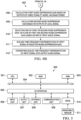
- Process 400 begins receiving an input audio signal comprising a number of blocks/frames (401). For each block/frame, process 400 continues by converting the block/frame into subbands (402), where each subband has a different spectra than the other subbands, combining he subbands into bands and determining a power in each band (403), and determining a microphone covariance based on the subbands (404).
- the input unit 506 includes one or more microphones in different positions (depending on the host device) enabling capture of audio signals in various formats (e.g., mono, stereo, spatial, immersive, and other suitable formats).
- various formats e.g., mono, stereo, spatial, immersive, and other suitable formats.
Landscapes
- Engineering & Computer Science (AREA)
- Physics & Mathematics (AREA)
- Signal Processing (AREA)
- Health & Medical Sciences (AREA)
- Audiology, Speech & Language Pathology (AREA)
- Human Computer Interaction (AREA)
- Computational Linguistics (AREA)
- Acoustics & Sound (AREA)
- Multimedia (AREA)
- Quality & Reliability (AREA)
- Artificial Intelligence (AREA)
- Evolutionary Computation (AREA)
- Circuit For Audible Band Transducer (AREA)
Claims (15)
- Verfahren zur Audioverarbeitung, umfassend:Empfangen von Bändern von Leistungsspektren eines Eingangsaudiosignals und einer Mikrofonkovarianz für jedes Band unter Verwendung mindestens eines Prozessors, wobei die Mikrofonkovarianz auf einer Konfiguration von Mikrofonen basiert, die zum Aufnehmen des Eingangsaudiosignals verwendet werden;für jedes Band:Schätzen der jeweiligen Wahrscheinlichkeiten von Sprache und Rauschen unter Verwendung eines Klassifikators des maschinellen Lernens;Schätzen eines Satzes von Mittelwerten für Sprache und Rauschen oder eines Satzes von Mittelwerten und Kovarianzen für Sprache und Rauschen unter Verwendung eines Richtungsmodells basierend auf der Mikrofon-Kovarianz für das Band und den Wahrscheinlichkeiten;Schätzen eines Mittelwerts und einer Kovarianz der Rauschleistung basierend auf den Wahrscheinlichkeiten und den Leistungsspektren unter Verwendung eines Pegelmodells;Bestimmen einer ersten Rauschunterdrückungsverstärkung unter Verwendung des mindestens einen Prozessors basierend auf dem Satz von Mittelwerten für Sprache und Rauschen oder dem Satz von Mittelwerten und Kovarianzen für Sprache bzw. Rauschen, die unter Verwendung des Richtungsmodells geschätzt werden;Bestimmen einer zweiten Rauschunterdrückungsverstärkung unter Verwendung des mindestens einen Prozessors basierend auf dem Mittelwert und der Kovarianz, die unter Verwendung des Pegelmodells geschätzt werden;Auswählen der ersten Rauschunterdrückungsverstärkung oder der zweiten Rauschunterdrückungsverstärkung oder einer Summe der ersten Rauschunterdrückungsverstärkung und der zweiten Rauschunterdrückungsverstärkung unter Verwendung des mindestens einen Prozessors, basierend auf einem Signal-RauschVerhältnis des Eingangsaudiosignals;Skalieren einer Zeit-Frequenz-Darstellung des Eingangssignals mit der ausgewählten ersten oder zweiten Rauschunterdrückungsverstärkung oder der Summe davon für das Band unter Verwendung des mindestens einen Prozessors; undUmwandeln der Zeit-Frequenz-Darstellung in ein Ausgangsaudiosignal unter Verwendung des mindestens einen Prozessors.
- Verfahren nach Anspruch 1, weiter umfassend:Empfangen eines Audio-Eingangssignals, das eine Anzahl von Blöcken/Rahmen umfasst, unter Verwendung des mindestens einen Prozessors;für jeden Block/Rahmen:Umwandeln, unter Verwendung des mindestens einen Prozessors, des Blocks/Rahmens in Teilbänder, wobei jedes Teilband Spektren aufweist, die sich von den anderen Teilbändern unterscheiden;Kombinieren der Teilbänder zu Bändern unter Verwendung des mindestens einen Prozessors; undBestimmen der Bandleistung unter Verwendung des mindestens einen Prozessors.
- Verfahren nach Anspruch 1, wobei der Klassifikator des maschinelles Lernens ein neuronales Netzwerk ist.
- Verfahren nach Anspruch 1 oder 2, wobei die Mikrofonkovarianz als ein normalisierter Vektor dargestellt wird.
- Verfahren nach einem der vorstehenden Ansprüche 1-4, wobei das Bestimmen der ersten Rauschunterdrückungsverstärkung Folgendes umfasst:Berechnen einer Wahrscheinlichkeit von Sprache für das Band;Einstellen der ersten Rauschunterdrückungsverstärkung gleich einer maximalen Unterdrückungsverstärkung, wenn die Wahrscheinlichkeit von Sprache für das Band kleiner als ein Schwellenwert ist; undEinstellen der ersten Rauschunterdrückungsverstärkung durch Rampenfunktion von der maximalen Unterdrückungsverstärkung in Richtung Null zum Erhöhen der Wahrscheinlichkeit von Sprache.
- Verfahren nach Anspruch 5, wobei die Wahrscheinlichkeit von Sprache unter Verwendung des Satzes von Mittelwerten für Sprache und Rauschen und der Kovarianz, die durch das Richtungsmodell geschätzt wird, berechnet wird.
- Verfahren nach Anspruch 5, wobei die Wahrscheinlichkeit von Sprache unter Verwendung des Satzes von Mittelwerten für Sprache und Rauschen und der Kovarianz, die durch das Richtungsmodell geschätzt wird, sowie einer gemeinsamen Gaußschen Dichtefunktion mit mehreren Variablen berechnet wird.
- Verfahren nach einem der vorstehenden Ansprüche 1-7, wobei das Bestimmen der zweiten Rauschunterdrückungsverstärkung Folgendes umfasst:Einstellen der zweiten Rauschunterdrückungsverstärkung gleich einer maximalen Unterdrückungsverstärkung, wenn die Bandleistung kleiner als ein erster Schwellenwert ist;Einstellen der Rauschunterdrückungsverstärkung durch Rampenfunktion von der maximalen Unterdrückungsverstärkung in Richtung Null zum Erhöhen der Wahrscheinlichkeit von Sprache.
- Verfahren nach einem der vorstehenden Ansprüche 1 bis 8, wobei die Schätzung unter Verwendung des Richtungsmodells Zeit-Frequenz-Kacheln verwendet, die als Sprache und Rauschen klassifiziert werden, jedoch Zeit-Frequenz-Kacheln ausschließt, die als Nachhall klassifiziert werden.
- Verfahren nach einem der vorstehenden Ansprüche 1-9, wobei das Schätzen eines Mittelwerts für Sprache basierend auf der Mikrofonkovarianz für das Band und der Wahrscheinlichkeit von Sprache unter Verwendung eines Richtungs- oder Pegelmodells weiter Folgendes umfasst:
Berechnen einer zeitlichen Durchschnittsschätzung des Mittelwerts für Sprache unter Verwendung eines Tiefpassfilters erster Ordnung mit dem Mittelwert für Sprache und der Mikrofonkovarianz als Eingaben für den Filter, und Gewichten der Eingaben für den Filter nach der Wahrscheinlichkeit von Sprache. - Verfahren nach einem der vorstehenden Ansprüche 1-10, wobei das Schätzen eines Mittelwerts für Rauschen basierend auf der Mikrofonkovarianz für das Band und der Wahrscheinlichkeit von Rauschen unter Verwendung eines Richtungs- oder Pegelmodells weiter Folgendes umfasst:
Berechnen einer zeitlichen Durchschnittsschätzung des Mittelwerts für Rauschen unter Verwendung eines Tiefpassfilters erster Ordnung mit dem Mittelwert für Rauschen und dem Mikrofon-Kovarianzvektor als Eingaben für den Filter, und Gewichten der Eingaben für den Filter nach der Rauschenwahrscheinlichkeit. - Verfahren nach einem der vorstehenden Ansprüche 1-11, wobei das Schätzen einer Kovarianz für Sprache basierend auf der Mikrofonkovarianz für das Band und der Wahrscheinlichkeit von Sprache unter Verwendung eines Richtungs- oder Pegelmodells weiter Folgendes umfasst:
Berechnen einer zeitlichen Durchschnittsschätzung der Kovarianz für Sprache unter Verwendung eines Tiefpassfilters erster Ordnung mit der Kovarianz für Sprache und dem Mikrofon-Kovarianzvektor als Eingaben für den Filter, und Gewichten der Eingaben für den Filter nach der Wahrscheinlichkeit von Sprache. - Verfahren nach einem der vorstehenden Ansprüche 1-12, wobei das Schätzen einer Kovarianz für Rauschen basierend auf der Mikrofonkovarianz für das Band und der Wahrscheinlichkeit von Rauschen unter Verwendung eines Richtungs- oder Pegelmodells weiter Folgendes umfasst:
Berechnen einer zeitlichen Durchschnittsschätzung der Kovarianz für Rauschen unter Verwendung eines Tiefpassfilters erster Ordnung mit der Kovarianz für Rauschen und dem Mikrofon-Kovarianzvektor als Eingaben für den Filter, und Gewichten der Eingaben für den Filter nach der Wahrscheinlichkeit von Rauschen. - System, umfassend:einen oder mehrere Computerprozessoren; undein nichtflüchtiges, computerlesbares Medium, das Anweisungen speichert, die, wenn sie von dem einem oder den mehreren Prozessoren ausgeführt werden, den einen oder die mehreren Prozessoren dazu veranlassen, Operationen nach einem der Ansprüche 1-13 durchführen.
- Nichtflüchtiges, computerlesbares Medium, das Anweisungen speichert, die, wenn sie von einem oder mehreren Prozessoren ausgeführt werden, den einen oder die mehreren Prozessoren dazu veranlassen, Operationen nach einem der Ansprüche 1-13 durchführen.
Priority Applications (1)
| Application Number | Priority Date | Filing Date | Title |
|---|---|---|---|
| EP25168573.1A EP4593012A3 (de) | 2020-11-05 | 2021-11-04 | Maschinenlernunterstützte räumliche rauschschätzung und -unterdrückung |
Applications Claiming Priority (3)
| Application Number | Priority Date | Filing Date | Title |
|---|---|---|---|
| US202063110228P | 2020-11-05 | 2020-11-05 | |
| US202163210215P | 2021-06-14 | 2021-06-14 | |
| PCT/US2021/058131 WO2022098920A1 (en) | 2020-11-05 | 2021-11-04 | Machine learning assisted spatial noise estimation and suppression |
Related Child Applications (1)
| Application Number | Title | Priority Date | Filing Date |
|---|---|---|---|
| EP25168573.1A Division EP4593012A3 (de) | 2020-11-05 | 2021-11-04 | Maschinenlernunterstützte räumliche rauschschätzung und -unterdrückung |
Publications (2)
| Publication Number | Publication Date |
|---|---|
| EP4241270A1 EP4241270A1 (de) | 2023-09-13 |
| EP4241270B1 true EP4241270B1 (de) | 2025-04-09 |
Family
ID=78819650
Family Applications (2)
| Application Number | Title | Priority Date | Filing Date |
|---|---|---|---|
| EP21816246.9A Active EP4241270B1 (de) | 2020-11-05 | 2021-11-04 | Maschinenlernunterstützte räumliche rauschschätzung und -unterdrückung |
| EP25168573.1A Pending EP4593012A3 (de) | 2020-11-05 | 2021-11-04 | Maschinenlernunterstützte räumliche rauschschätzung und -unterdrückung |
Family Applications After (1)
| Application Number | Title | Priority Date | Filing Date |
|---|---|---|---|
| EP25168573.1A Pending EP4593012A3 (de) | 2020-11-05 | 2021-11-04 | Maschinenlernunterstützte räumliche rauschschätzung und -unterdrückung |
Country Status (6)
| Country | Link |
|---|---|
| US (1) | US12555591B2 (de) |
| EP (2) | EP4241270B1 (de) |
| JP (1) | JP7820035B2 (de) |
| KR (1) | KR20230101846A (de) |
| ES (1) | ES3025478T3 (de) |
| WO (1) | WO2022098920A1 (de) |
Families Citing this family (3)
| Publication number | Priority date | Publication date | Assignee | Title |
|---|---|---|---|---|
| DE112021007013B4 (de) * | 2021-04-07 | 2024-10-10 | Mitsubishi Electric Corporation | Informationsverarbeitungseinrichtung, ausgabeverfahren und ausgabeprogramm |
| CN115295015B (zh) * | 2022-07-27 | 2025-06-27 | 广州市迪声音响有限公司 | 一种噪声筛除系统及方法 |
| KR102883119B1 (ko) | 2023-08-03 | 2025-11-07 | 주식회사 엘지에너지솔루션 | 전극 조립체 보호 결합체 및 이를 포함하는 이차 전지 |
Family Cites Families (35)
| Publication number | Priority date | Publication date | Assignee | Title |
|---|---|---|---|---|
| WO2006114101A1 (en) | 2005-04-26 | 2006-11-02 | Aalborg Universitet | Detection of speech present in a noisy signal and speech enhancement making use thereof |
| JP5127754B2 (ja) * | 2009-03-24 | 2013-01-23 | 株式会社東芝 | 信号処理装置 |
| EP2751806B1 (de) * | 2011-09-02 | 2019-10-02 | GN Audio A/S | Verfahren und system zur störgeräuschsunterdrückung für audiosignale |
| EP2645362A1 (de) | 2012-03-26 | 2013-10-02 | Fraunhofer-Gesellschaft zur Förderung der angewandten Forschung e.V. | Vorrichtung und Verfahren zur Verbesserung der empfundenen Tonqualitätswiedergabe durch Kombination von aktiver Rauschunterdrückung und Wahrnehmungsrauschkompensation |
| EP2880655B8 (de) * | 2012-08-01 | 2016-12-14 | Dolby Laboratories Licensing Corporation | Perzentilfilterung einer rauschunterdrückungsverstärkung |
| DK2701145T3 (en) * | 2012-08-24 | 2017-01-16 | Retune DSP ApS | Noise cancellation for use with noise reduction and echo cancellation in personal communication |
| US9640194B1 (en) | 2012-10-04 | 2017-05-02 | Knowles Electronics, Llc | Noise suppression for speech processing based on machine-learning mask estimation |
| US9881631B2 (en) | 2014-10-21 | 2018-01-30 | Mitsubishi Electric Research Laboratories, Inc. | Method for enhancing audio signal using phase information |
| US20170061978A1 (en) | 2014-11-07 | 2017-03-02 | Shannon Campbell | Real-time method for implementing deep neural network based speech separation |
| DK3057337T3 (da) * | 2015-02-13 | 2020-05-11 | Oticon As | Høreapparat omfattende en adskilt mikrofonenhed til at opfange en brugers egen stemme |
| US9666183B2 (en) | 2015-03-27 | 2017-05-30 | Qualcomm Incorporated | Deep neural net based filter prediction for audio event classification and extraction |
| CN106157967A (zh) * | 2015-04-28 | 2016-11-23 | 杜比实验室特许公司 | 脉冲噪声抑制 |
| CN106683661B (zh) | 2015-11-05 | 2021-02-05 | 阿里巴巴集团控股有限公司 | 基于语音的角色分离方法及装置 |
| US10373612B2 (en) | 2016-03-21 | 2019-08-06 | Amazon Technologies, Inc. | Anchored speech detection and speech recognition |
| US10861478B2 (en) | 2016-05-30 | 2020-12-08 | Oticon A/S | Audio processing device and a method for estimating a signal-to-noise-ratio of a sound signal |
| WO2017218386A1 (en) | 2016-06-13 | 2017-12-21 | Med-El Elektromedizinische Geraete Gmbh | Recursive noise power estimation with noise model adaptation |
| US10090001B2 (en) | 2016-08-01 | 2018-10-02 | Apple Inc. | System and method for performing speech enhancement using a neural network-based combined symbol |
| US9972339B1 (en) | 2016-08-04 | 2018-05-15 | Amazon Technologies, Inc. | Neural network based beam selection |
| US10224058B2 (en) | 2016-09-07 | 2019-03-05 | Google Llc | Enhanced multi-channel acoustic models |
| US10403299B2 (en) | 2017-06-02 | 2019-09-03 | Apple Inc. | Multi-channel speech signal enhancement for robust voice trigger detection and automatic speech recognition |
| US10546593B2 (en) | 2017-12-04 | 2020-01-28 | Apple Inc. | Deep learning driven multi-channel filtering for speech enhancement |
| US10522167B1 (en) | 2018-02-13 | 2019-12-31 | Amazon Techonlogies, Inc. | Multichannel noise cancellation using deep neural network masking |
| US10553236B1 (en) | 2018-02-27 | 2020-02-04 | Amazon Technologies, Inc. | Multichannel noise cancellation using frequency domain spectrum masking |
| US10535362B2 (en) | 2018-03-01 | 2020-01-14 | Apple Inc. | Speech enhancement for an electronic device |
| CN108564941B (zh) | 2018-03-22 | 2020-06-02 | 腾讯科技(深圳)有限公司 | 语音识别方法、装置、设备及存储介质 |
| US10957337B2 (en) | 2018-04-11 | 2021-03-23 | Microsoft Technology Licensing, Llc | Multi-microphone speech separation |
| US10573301B2 (en) | 2018-05-18 | 2020-02-25 | Intel Corporation | Neural network based time-frequency mask estimation and beamforming for speech pre-processing |
| US10986437B1 (en) * | 2018-06-21 | 2021-04-20 | Amazon Technologies, Inc. | Multi-plane microphone array |
| US10726856B2 (en) | 2018-08-16 | 2020-07-28 | Mitsubishi Electric Research Laboratories, Inc. | Methods and systems for enhancing audio signals corrupted by noise |
| WO2020041497A1 (en) | 2018-08-21 | 2020-02-27 | 2Hz, Inc. | Speech enhancement and noise suppression systems and methods |
| US10636434B1 (en) | 2018-09-28 | 2020-04-28 | Apple Inc. | Joint spatial echo and noise suppression with adaptive suppression criteria |
| CN111261146B (zh) | 2020-01-16 | 2022-09-09 | 腾讯科技(深圳)有限公司 | 语音识别及模型训练方法、装置和计算机可读存储介质 |
| EP3866165B1 (de) * | 2020-02-14 | 2022-08-17 | System One Noc & Development Solutions, S.A. | Verfahren zur verbesserung von telefonsprachsignalen auf basis von neuronalen faltungsnetzwerken |
| CN111341331B (zh) | 2020-02-25 | 2023-04-18 | 厦门亿联网络技术股份有限公司 | 基于局部注意力机制的语音增强方法、装置及介质 |
| US20230267947A1 (en) * | 2020-07-31 | 2023-08-24 | Dolby Laboratories Licensing Corporation | Noise reduction using machine learning |
-
2021
- 2021-11-04 EP EP21816246.9A patent/EP4241270B1/de active Active
- 2021-11-04 WO PCT/US2021/058131 patent/WO2022098920A1/en not_active Ceased
- 2021-11-04 ES ES21816246T patent/ES3025478T3/es active Active
- 2021-11-04 KR KR1020237018257A patent/KR20230101846A/ko active Pending
- 2021-11-04 US US18/251,876 patent/US12555591B2/en active Active
- 2021-11-04 JP JP2023526932A patent/JP7820035B2/ja active Active
- 2021-11-04 EP EP25168573.1A patent/EP4593012A3/de active Pending
Also Published As
| Publication number | Publication date |
|---|---|
| KR20230101846A (ko) | 2023-07-06 |
| EP4241270A1 (de) | 2023-09-13 |
| WO2022098920A1 (en) | 2022-05-12 |
| JP2023550605A (ja) | 2023-12-04 |
| EP4593012A3 (de) | 2025-12-17 |
| US12555591B2 (en) | 2026-02-17 |
| ES3025478T3 (en) | 2025-06-09 |
| EP4593012A2 (de) | 2025-07-30 |
| JP7820035B2 (ja) | 2026-02-25 |
| US20230410829A1 (en) | 2023-12-21 |
Similar Documents
| Publication | Publication Date | Title |
|---|---|---|
| CN101965613B (zh) | 信号增强装置及方法 | |
| EP4241270B1 (de) | Maschinenlernunterstützte räumliche rauschschätzung und -unterdrückung | |
| US9741360B1 (en) | Speech enhancement for target speakers | |
| US10210883B2 (en) | Signal processing apparatus for enhancing a voice component within a multi-channel audio signal | |
| EP2210427B1 (de) | Vorrichtung, Verfahren und Computerprogramm zum Extrahieren eines Umgebungssignal | |
| US8891778B2 (en) | Speech enhancement | |
| CN104685562B (zh) | 用于从嘈杂输入信号中重构目标信号的方法和设备 | |
| CN116057626B (zh) | 使用机器学习的降噪 | |
| US10818302B2 (en) | Audio source separation | |
| EP4167226B1 (de) | Audiodatenverarbeitungsverfahren und -vorrichtung sowie vorrichtung und speichermedium | |
| EP4128226B1 (de) | Automatische nivellierung von sprachinhalt | |
| JP2013054258A (ja) | 音源分離装置とその方法とプログラム | |
| CN113823301A (zh) | 语音增强模型的训练方法和装置及语音增强方法和装置 | |
| CN106031196A (zh) | 信号处理装置、方法以及程序 | |
| Ma et al. | Perceptual Kalman filtering for speech enhancement in colored noise | |
| CN118899005B (zh) | 一种音频信号处理方法、装置、计算机设备及存储介质 | |
| JP4960933B2 (ja) | 音響信号強調装置とその方法と、プログラムと記録媒体 | |
| US10297272B2 (en) | Signal processor | |
| CN116547753A (zh) | 机器学习辅助的空间噪声估计和抑制 | |
| RU2842598C1 (ru) | Оценка и подавление пространственного шума на основе машинного обучения | |
| Wang et al. | Multichannel linear prediction-based speech dereverberation considering sparse and low-rank priors | |
| Leutnant et al. | Investigations into a statistical observation model for logarithmic mel power spectral density features of noisy reverberant speech | |
| Kühne et al. | Smooth soft mel-spectrographic masks based on blind sparse source separation. | |
| CN117995217A (zh) | 杂音抑制方法、可读介质、电子设备及程序产品 | |
| Park et al. | Noise robust feature for automatic speech recognition based on mel-spectrogram gradient histogram. |
Legal Events
| Date | Code | Title | Description |
|---|---|---|---|
| STAA | Information on the status of an ep patent application or granted ep patent |
Free format text: STATUS: UNKNOWN |
|
| STAA | Information on the status of an ep patent application or granted ep patent |
Free format text: STATUS: THE INTERNATIONAL PUBLICATION HAS BEEN MADE |
|
| PUAI | Public reference made under article 153(3) epc to a published international application that has entered the european phase |
Free format text: ORIGINAL CODE: 0009012 |
|
| STAA | Information on the status of an ep patent application or granted ep patent |
Free format text: STATUS: REQUEST FOR EXAMINATION WAS MADE |
|
| 17P | Request for examination filed |
Effective date: 20230525 |
|
| AK | Designated contracting states |
Kind code of ref document: A1 Designated state(s): AL AT BE BG CH CY CZ DE DK EE ES FI FR GB GR HR HU IE IS IT LI LT LU LV MC MK MT NL NO PL PT RO RS SE SI SK SM TR |
|
| DAV | Request for validation of the european patent (deleted) | ||
| DAX | Request for extension of the european patent (deleted) | ||
| P01 | Opt-out of the competence of the unified patent court (upc) registered |
Effective date: 20240123 |
|
| GRAP | Despatch of communication of intention to grant a patent |
Free format text: ORIGINAL CODE: EPIDOSNIGR1 |
|
| STAA | Information on the status of an ep patent application or granted ep patent |
Free format text: STATUS: GRANT OF PATENT IS INTENDED |
|
| INTG | Intention to grant announced |
Effective date: 20241104 |
|
| GRAS | Grant fee paid |
Free format text: ORIGINAL CODE: EPIDOSNIGR3 |
|
| GRAA | (expected) grant |
Free format text: ORIGINAL CODE: 0009210 |
|
| STAA | Information on the status of an ep patent application or granted ep patent |
Free format text: STATUS: THE PATENT HAS BEEN GRANTED |
|
| AK | Designated contracting states |
Kind code of ref document: B1 Designated state(s): AL AT BE BG CH CY CZ DE DK EE ES FI FR GB GR HR HU IE IS IT LI LT LU LV MC MK MT NL NO PL PT RO RS SE SI SK SM TR |
|
| REG | Reference to a national code |
Ref country code: GB Ref legal event code: FG4D |
|
| REG | Reference to a national code |
Ref country code: CH Ref legal event code: EP |
|
| REG | Reference to a national code |
Ref country code: DE Ref legal event code: R096 Ref document number: 602021029012 Country of ref document: DE |
|
| REG | Reference to a national code |
Ref country code: IE Ref legal event code: FG4D |
|
| REG | Reference to a national code |
Ref country code: NL Ref legal event code: FP |
|
| REG | Reference to a national code |
Ref country code: ES Ref legal event code: FG2A Ref document number: 3025478 Country of ref document: ES Kind code of ref document: T3 Effective date: 20250609 |
|
| REG | Reference to a national code |
Ref country code: AT Ref legal event code: MK05 Ref document number: 1784297 Country of ref document: AT Kind code of ref document: T Effective date: 20250409 |
|
| PG25 | Lapsed in a contracting state [announced via postgrant information from national office to epo] |
Ref country code: FI Free format text: LAPSE BECAUSE OF FAILURE TO SUBMIT A TRANSLATION OF THE DESCRIPTION OR TO PAY THE FEE WITHIN THE PRESCRIBED TIME-LIMIT Effective date: 20250409 Ref country code: PT Free format text: LAPSE BECAUSE OF FAILURE TO SUBMIT A TRANSLATION OF THE DESCRIPTION OR TO PAY THE FEE WITHIN THE PRESCRIBED TIME-LIMIT Effective date: 20250811 |
|
| REG | Reference to a national code |
Ref country code: LT Ref legal event code: MG9D |
|
| PG25 | Lapsed in a contracting state [announced via postgrant information from national office to epo] |
Ref country code: NO Free format text: LAPSE BECAUSE OF FAILURE TO SUBMIT A TRANSLATION OF THE DESCRIPTION OR TO PAY THE FEE WITHIN THE PRESCRIBED TIME-LIMIT Effective date: 20250709 Ref country code: GR Free format text: LAPSE BECAUSE OF FAILURE TO SUBMIT A TRANSLATION OF THE DESCRIPTION OR TO PAY THE FEE WITHIN THE PRESCRIBED TIME-LIMIT Effective date: 20250710 |
|
| PG25 | Lapsed in a contracting state [announced via postgrant information from national office to epo] |
Ref country code: PL Free format text: LAPSE BECAUSE OF FAILURE TO SUBMIT A TRANSLATION OF THE DESCRIPTION OR TO PAY THE FEE WITHIN THE PRESCRIBED TIME-LIMIT Effective date: 20250409 |
|
| PG25 | Lapsed in a contracting state [announced via postgrant information from national office to epo] |
Ref country code: BG Free format text: LAPSE BECAUSE OF FAILURE TO SUBMIT A TRANSLATION OF THE DESCRIPTION OR TO PAY THE FEE WITHIN THE PRESCRIBED TIME-LIMIT Effective date: 20250409 |
|
| PG25 | Lapsed in a contracting state [announced via postgrant information from national office to epo] |
Ref country code: HR Free format text: LAPSE BECAUSE OF FAILURE TO SUBMIT A TRANSLATION OF THE DESCRIPTION OR TO PAY THE FEE WITHIN THE PRESCRIBED TIME-LIMIT Effective date: 20250409 |
|
| PG25 | Lapsed in a contracting state [announced via postgrant information from national office to epo] |
Ref country code: AT Free format text: LAPSE BECAUSE OF FAILURE TO SUBMIT A TRANSLATION OF THE DESCRIPTION OR TO PAY THE FEE WITHIN THE PRESCRIBED TIME-LIMIT Effective date: 20250409 |
|
| PG25 | Lapsed in a contracting state [announced via postgrant information from national office to epo] |
Ref country code: RS Free format text: LAPSE BECAUSE OF FAILURE TO SUBMIT A TRANSLATION OF THE DESCRIPTION OR TO PAY THE FEE WITHIN THE PRESCRIBED TIME-LIMIT Effective date: 20250709 |
|
| PG25 | Lapsed in a contracting state [announced via postgrant information from national office to epo] |
Ref country code: IS Free format text: LAPSE BECAUSE OF FAILURE TO SUBMIT A TRANSLATION OF THE DESCRIPTION OR TO PAY THE FEE WITHIN THE PRESCRIBED TIME-LIMIT Effective date: 20250809 |
|
| PG25 | Lapsed in a contracting state [announced via postgrant information from national office to epo] |
Ref country code: LV Free format text: LAPSE BECAUSE OF FAILURE TO SUBMIT A TRANSLATION OF THE DESCRIPTION OR TO PAY THE FEE WITHIN THE PRESCRIBED TIME-LIMIT Effective date: 20250409 |
|
| PGFP | Annual fee paid to national office [announced via postgrant information from national office to epo] |
Ref country code: NL Payment date: 20251022 Year of fee payment: 5 |
|
| PGFP | Annual fee paid to national office [announced via postgrant information from national office to epo] |
Ref country code: DE Payment date: 20251022 Year of fee payment: 5 |
|
| PGFP | Annual fee paid to national office [announced via postgrant information from national office to epo] |
Ref country code: GB Payment date: 20251023 Year of fee payment: 5 |
|
| REG | Reference to a national code |
Ref country code: DE Ref legal event code: R097 Ref document number: 602021029012 Country of ref document: DE |
|
| PG25 | Lapsed in a contracting state [announced via postgrant information from national office to epo] |
Ref country code: SM Free format text: LAPSE BECAUSE OF FAILURE TO SUBMIT A TRANSLATION OF THE DESCRIPTION OR TO PAY THE FEE WITHIN THE PRESCRIBED TIME-LIMIT Effective date: 20250409 Ref country code: DK Free format text: LAPSE BECAUSE OF FAILURE TO SUBMIT A TRANSLATION OF THE DESCRIPTION OR TO PAY THE FEE WITHIN THE PRESCRIBED TIME-LIMIT Effective date: 20250409 |
|
| PGFP | Annual fee paid to national office [announced via postgrant information from national office to epo] |
Ref country code: IT Payment date: 20251022 Year of fee payment: 5 |
|
| PGFP | Annual fee paid to national office [announced via postgrant information from national office to epo] |
Ref country code: FR Payment date: 20251022 Year of fee payment: 5 |
|
| PG25 | Lapsed in a contracting state [announced via postgrant information from national office to epo] |
Ref country code: CZ Free format text: LAPSE BECAUSE OF FAILURE TO SUBMIT A TRANSLATION OF THE DESCRIPTION OR TO PAY THE FEE WITHIN THE PRESCRIBED TIME-LIMIT Effective date: 20250409 |
|
| PG25 | Lapsed in a contracting state [announced via postgrant information from national office to epo] |
Ref country code: EE Free format text: LAPSE BECAUSE OF FAILURE TO SUBMIT A TRANSLATION OF THE DESCRIPTION OR TO PAY THE FEE WITHIN THE PRESCRIBED TIME-LIMIT Effective date: 20250409 |
|
| PG25 | Lapsed in a contracting state [announced via postgrant information from national office to epo] |
Ref country code: SK Free format text: LAPSE BECAUSE OF FAILURE TO SUBMIT A TRANSLATION OF THE DESCRIPTION OR TO PAY THE FEE WITHIN THE PRESCRIBED TIME-LIMIT Effective date: 20250409 |
|
| PGFP | Annual fee paid to national office [announced via postgrant information from national office to epo] |
Ref country code: ES Payment date: 20251201 Year of fee payment: 5 |
|
| PLBE | No opposition filed within time limit |
Free format text: ORIGINAL CODE: 0009261 |
|
| STAA | Information on the status of an ep patent application or granted ep patent |
Free format text: STATUS: NO OPPOSITION FILED WITHIN TIME LIMIT |
|
| REG | Reference to a national code |
Ref country code: CH Ref legal event code: L10 Free format text: ST27 STATUS EVENT CODE: U-0-0-L10-L00 (AS PROVIDED BY THE NATIONAL OFFICE) Effective date: 20260218 |
|
| PG25 | Lapsed in a contracting state [announced via postgrant information from national office to epo] |
Ref country code: RO Free format text: LAPSE BECAUSE OF FAILURE TO SUBMIT A TRANSLATION OF THE DESCRIPTION OR TO PAY THE FEE WITHIN THE PRESCRIBED TIME-LIMIT Effective date: 20250409 |
|
| 26N | No opposition filed |
Effective date: 20260112 |