EP4239972A2 - Verfahren und vorrichtung zur ermöglichung des offloads von netzwerkverkehr über eine verbundene zellulare vorrichtung - Google Patents
Verfahren und vorrichtung zur ermöglichung des offloads von netzwerkverkehr über eine verbundene zellulare vorrichtung Download PDFInfo
- Publication number
- EP4239972A2 EP4239972A2 EP23183162.9A EP23183162A EP4239972A2 EP 4239972 A2 EP4239972 A2 EP 4239972A2 EP 23183162 A EP23183162 A EP 23183162A EP 4239972 A2 EP4239972 A2 EP 4239972A2
- Authority
- EP
- European Patent Office
- Prior art keywords
- cellular
- network
- link
- cellular phone
- overlay
- Prior art date
- Legal status (The legal status is an assumption and is not a legal conclusion. Google has not performed a legal analysis and makes no representation as to the accuracy of the status listed.)
- Pending
Links
Images



Classifications
-
- H—ELECTRICITY
- H04—ELECTRIC COMMUNICATION TECHNIQUE
- H04W—WIRELESS COMMUNICATION NETWORKS
- H04W40/00—Communication routing or communication path finding
- H04W40/02—Communication route or path selection, e.g. power-based or shortest path routing
- H04W40/22—Communication route or path selection, e.g. power-based or shortest path routing using selective relaying for reaching a BTS [Base Transceiver Station] or an access point
-
- H—ELECTRICITY
- H04—ELECTRIC COMMUNICATION TECHNIQUE
- H04L—TRANSMISSION OF DIGITAL INFORMATION, e.g. TELEGRAPHIC COMMUNICATION
- H04L45/00—Routing or path finding of packets in data switching networks
- H04L45/24—Multipath
- H04L45/243—Multipath using M+N parallel active paths
-
- H—ELECTRICITY
- H04—ELECTRIC COMMUNICATION TECHNIQUE
- H04W—WIRELESS COMMUNICATION NETWORKS
- H04W36/00—Hand-off or reselection arrangements
- H04W36/16—Performing reselection for specific purposes
- H04W36/22—Performing reselection for specific purposes for handling the traffic
-
- H—ELECTRICITY
- H04—ELECTRIC COMMUNICATION TECHNIQUE
- H04L—TRANSMISSION OF DIGITAL INFORMATION, e.g. TELEGRAPHIC COMMUNICATION
- H04L47/00—Traffic control in data switching networks
- H04L47/10—Flow control; Congestion control
- H04L47/12—Avoiding congestion; Recovering from congestion
- H04L47/125—Avoiding congestion; Recovering from congestion by balancing the load, e.g. traffic engineering
-
- H—ELECTRICITY
- H04—ELECTRIC COMMUNICATION TECHNIQUE
- H04W—WIRELESS COMMUNICATION NETWORKS
- H04W84/00—Network topologies
- H04W84/02—Hierarchically pre-organised networks, e.g. paging networks, cellular networks, WLAN [Wireless Local Area Network] or WLL [Wireless Local Loop]
- H04W84/10—Small scale networks; Flat hierarchical networks
- H04W84/12—WLAN [Wireless Local Area Networks]
Definitions
- the exemplary embodiment(s) of the present invention relates to communication networks. More specifically, the disclosed embodiment(s) of the present application relates to offloading network traffic between various network communication channels.
- a network routing element such as a home unit or modem, maintains a primary link and a secondary link for facilitating network communication between various attached devices and remote content providers.
- the network routing element is able to identify a cellular and wireless capable (“CWC") device (e.g., a smart phone or a cellular phone) containing a hybrid module capable of facilitating a hybrid function of being a wireless client.
- CWC cellular and wireless capable
- the hybrid function for example, is able to activate a secondary link via an overlay channel between a cellular transceiver of the CWC device and a wireless transceiver of the CWC device.
- the network traffic can be transmitted or offloaded between the primary link and the secondary link based on a variety of criteria such as the type of traffic as well as condition of the network.
- Exemplary embodiment(s) of the present invention is described herein in the context of a method, device, and apparatus for providing network communication using alternative transmission channels via one or more overlay networks.
- system is used generically herein to describe any number of components, elements, sub-systems, devices, packet switch elements, packet switches, access switches, routers, networks, computer and/or communication devices or mechanisms, or combinations of components thereof.
- computer includes a processor, memory, and buses capable of executing instruction wherein the computer refers to one or a cluster of computers, personal computers, workstations, mainframes, or combinations of computers thereof.
- IP communication network can mean any type of network having an access network able to transmit data in the form of packets or cells, such as ATM (Asynchronous Transfer Mode) type, on a transport medium, for example, the TCP/IP or UDP/IP type.
- ATM Asynchronous Transfer Mode
- ATM cells are the result of decomposition (or segmentation) of packets of data, IP type, and those packets (here IP packets) comprise an IP header, a header specific to the transport medium (for example UDP or TCP) and payload data.
- IP packets here IP packets
- UDP or TCP transport medium
- the IP network may also include a satellite network, a DVB-RCS (Digital Video Broadcasting-Return Channel System) network, providing Internet access via satellite, or an SDMB (Satellite Digital Multimedia Broadcast) network, a terrestrial network, a cable (xDSL) network or a mobile or cellular network (GPRS/EDGE, or UMTS (where applicable of the MBMS (Multimedia Broadcast/Multicast Services) type, or the evolution of the UMTS known as LTE (Long Term Evolution), 5G, or DVB-H (Digital Video Broadcasting-Handhelds)), or a hybrid (satellite and terrestrial) network.
- a satellite network a DVB-RCS (Digital Video Broadcasting-Return Channel System) network, providing Internet access via satellite, or an SDMB (Satellite Digital Multimedia Broadcast) network, a terrestrial network, a cable (xDSL) network or a mobile or cellular network (GPRS/EDGE, or UMTS (where applicable of the MBMS (
- a network routing element such as a home unit or modem, maintains a primary link and a secondary link for facilitating network communication between various attached devices and remote content providers.
- the network routing element is able to identify a cellular and wireless capable (“CWC") device (e.g., a smart phone or a cellular phone) containing a hybrid module capable of facilitating a hybrid function of being a wireless client.
- CWC cellular and wireless capable
- the hybrid function for example, is able to activate a secondary link via an overlay channel between a cellular transceiver of the CWC device and a wireless transceiver of the CWC device.
- the network traffic can be transmitted or offloaded between the primary link and the secondary link based on the type of traffic as well as condition of the network.
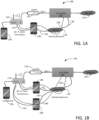
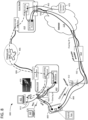
- FIG. 1A is a block diagram 100 illustrating an exemplary networking system containing alternative links using one or more overlay networks in accordance with some embodiments of the present invention.
- Diagram 100 includes a network routing device 110, a core node 116, a telecommunications network such as Internet 118, two cellular and wireless capable (“CWC") devices 106-108.
- CWC devices 106-108 in some embodiments, can be cellular phones, smart phones, portable phones, tablets, autonomous vehicles, cars, laptops, desktops, watches, and/or a combination of cellular phone, smart phone, portable phone, tablet, car, laptop, and/or desktop that has a cellular capability.
- network routing device 110 communicates with core node 116 via a primary link 120 and/or a secondary link 130 via a wireless client. It should be noted that the underlying concept of the exemplary embodiment(s) of the present invention would not change if one or more blocks (or devices) were added to or removed from diagram 100.
- a cellular network also known as a mobile network, is a communications network including wired and/or wireless communication network(s).
- the last link of a cellular network usually is wireless connection via various cell towers and/or base stations.
- the cellular network generates, broadcasts, or distributes radio signals across a designated geographic area wherein the geographic area is generally divided into cells.
- Each cell of a cellular network serves one or more transceivers. It should be noted that a cell may use a different set of frequencies from neighboring cells for minimizing noise and/or cross interferences.
- Wi-Fi is a wireless technology using radio wavelengths facilitating signal transmission within the wireless local area networking (WLAN) environment which is standardized in accordance with the IEEE 802.11 standards.
- a Wi-Fi client is a device connected to a Wi-Fi (wireless) network wherein the client is capable of transmitting and receiving wireless data or network traffic.
- a node is generally an actual physical computer, server, or a cluster of computers and/or servers capable of processing and distributing network traffics.
- a function of the network system is to provide one or more alternative communication links, connections, or channels for facilitating network communication.
- the system includes primary link 120 and secondary link 130 wherein secondary link 130 is facilitated by CWC device or cellular device 108.
- CWC device 108 can be a cellular phone, smart phone, portable phone, tablet, car, laptop, and/or desktop that has a cellular capability.
- the terms "CWC device,” “cellular device,” “cellular phone,” “smart phone,” and “portable phone” are referring to the same or similar devices and they can be used interchangeably.
- Primary link 120 includes a primary link switch or switch 112 and core node 116.
- one end of primary link is coupled to network routing device 110 or a home unit while the second end of primary link 120 is coupled to core node 116.
- Primary link switch 112 manages and facilitates network communication between a primary link interface of a network device such as network routing device 110 and a node such as core node 116.
- primary link 120 includes a satellite-based communication network and/or a landline-based network.
- primary link 120 can comprise one or more satellites and/or terrestrial components.
- Core node 116 includes a communication network overlay module or hybrid module operable to facilitate the secondary link.
- Network routing device 110 is a router, switch, hub, home unit, set-top box, gaming console, and/or modem that contains a routing controller and an overlay module.
- the routing controller manages and/or routes network traffic through network routing device 110.
- the routing controller is able to provide load balance between the links such as between primary link 120 and secondary link 130.
- the overlay module not shown in FIG. 1A , is capable of facilitating and maintaining additional link(s) including facilitating to setup connections between network device 110 and the wireless transceiver of smart phone 108.
- the routing controller facilitates offloading network traffic from primary link 120 to secondary link 130 based on criteria such as the nature of the data, application, as well as network conditions.
- CWC device or smart phone 106 or 108 can be a cellular phone, wireless phone, iPhone, portable phone, laptop computer, tablet, set-top box or the like. It should be noted that CWC device or smart phone 106 or 108 is capable of handling both cellular communication as well as wireless communication.
- a function of CWC device 108 which includes a wireless transceiver, cellular transceiver, and hybrid module is to act as a wireless client.
- a wireless client is a WiFi client.
- Secondary link 130 includes a wireless connection 132, smart phone 108, cellular connection 136, and network connection 138.
- smart phone 108 is able to facilitate establishing a secondary link including a connection or overlay connection between the wireless transceiver and the cellular transceiver of the smart phone for data transmission between wireless connection 132 and cellular connection 136.
- secondary link 130 includes one or more overlay networks via cell towers for data transmission. It should be noted that secondary link 136 may include wireless as well as landline connections.
- Primary link 120 and secondary link 130 are coupled to Internet 118.
- wireless connection 132 is a WiFi connection and wireless transceiver is a WiFi transceiver.
- a function of cellular device 108 which connects to network device 110 via Wi-Fi 132 is to setup an overlay network (not shown in FIG. 1A ) between wireless connection 132 and cellular connection 136 for network traffic offloading between the primary link and the secondary link.
- An advantage of using an overlay network is that the cellular device is used as a Wi-Fi client for offloading network traffic.
- FIG. 1B is a block diagram 102 illustrating a network system containing multiple alternative links using overlay networks in accordance with some embodiments of the present invention.
- Diagram 102 includes network routing device 110, core node 116, Internet 118, three cellular devices 104-108.
- network routing device 110 communicates with core node 116 via a primary link 120 and/or an alternative links such as secondary link 130 via a wireless client. It should be noted that the underlying concept of the exemplary embodiment(s) of the present invention would not change if one or more blocks (or devices) were added to or removed from diagram 102.
- Diagram 102 is similar to diagram 100 shown in FIG. 1A except that diagram 102 illustrates a third link 140 using cellular device 104 as a wireless client.
- third link 140 capable of transmitting information includes a wireless connection 142 and a cellular connection 146 via an overlay channel inside of cellular device 104.
- An advantage of establishing multiple links via multiple cellular devices is to increase flexibility of transmission bandwidth via multiple overlay networks.
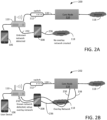
- FIG. 2A is a block diagram 200 illustrating a process of monitoring and detecting a potential wireless client for an alternative link in accordance with some embodiments of the present invention.
- Diagram 200 includes routing device 110, core node 116, Internet 118, cellular devices 106 and 208.
- routing device 110 communicates with core node 116 via a primary link 120. It should be noted that the underlying concept of the exemplary embodiment(s) of the present invention would not change if one or more blocks (or devices) were added to or removed from diagram 200.
- Diagram 200 is similar to diagram 100 shown in FIG. 1A except that diagram 200 illustrates a scenario before a secondary link is established or built.
- routing device 110 includes a hybrid module or hybrid application ("App") configured to monitor and detect nearby potential candidates for wireless clients. For example, routing device 110 monitors and/or detects a wireless client candidate as cellular device 208 entering the vicinity of routing device 110. Upon detecting cellular device 208 which contains a hybrid module capable of being a wireless client, routing device 110 identifies and verifies physical or potential connections 232-236 as well as Internet 118 for potentially establishing an alternative link for handling network traffic. It should be noted that vicinity of routing device 110 refers to a geographic area surrounding routing device 110 that has the wireless coverage from routing device 110.
- App hybrid module or hybrid application
- routing device 110 is continuously monitoring and identifying potential wireless clients within the vicinity of routing device 110 for alternative links. It should be noted that wireless clients such as cellular phones can move in and out of the nearby or vicinity area of routing device 110 continuously. To maintain a scenario of multiple links within a network system, links or channels for network communication are continuously established as well as torn down.
- a function of the hybrid module is to automatically detect cellular devices connecting to a known network.
- a detection of a potential wireless client can trigger a process of setting up an alternative or secondary link using overlay network(s) with minimal user involvement.
- An advantage of using a wireless client is that multiple number of cellular devices or phones can be in and out of the vicinity area or zone all the time. Links are constantly terminated as well as created.
- FIG. 2B is a block diagram 202 illustrating a process of establishing an alternative link using a cellular device as a wireless client in accordance with some embodiments of the present invention.
- Diagram 202 includes a routing device 110, core node 116, Internet 118, cellular devices 106 and 208.
- routing device 110 communicates with core node 116 via a primary link 120 and/or a secondary link 130 via a wireless client. It should be noted that the underlying concept of the exemplary embodiment(s) of the present invention would not change if one or more blocks (or devices) were added to or removed from diagram 200.
- Diagram 202 is similar to diagram 200 shown in FIG. 2A except that diagram 202 illustrates a scenario that follows the scenario presented in diagram 200.
- identifying cellular phone 208 is a wireless client candidate as shown in diagram 200 in FIG. 2A
- a new link or secondary link 230 is established using an overlay network via wireless link 232, cellular phone 208 as the wireless client, cellular link 236, and Internet 118.
- Secondary link 230 can be used to offload network traffics from primary link 120.
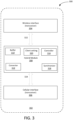
- FIG. 3 is a block diagram 300 illustrating a cellular device 302 containing a hybrid module 308 capable of configuring the cellular device as a wireless client in accordance with some embodiments of the present invention.
- Diagram 300 includes a wireless interface or transceiver 304 (e.g., a WiFi transceiver), hybrid module 308, and cellular interface or transceiver 306.
- wireless interface 304 and cellular interface 306 are coupled to hybrid module 308 using buses 322-324. It should be noted that the underlying concept of the exemplary embodiment(s) of the present invention would not change if one or more blocks (or devices) were added to or removed from diagram 300.
- Wireless interface 304 is a wireless transceiver capable of transmitting or receiving wireless data to or from a wireless network.
- Cellular interface 306 is a cellular transceiver capable of transmitting or receiving cellular data to or from a cellular network.
- a function of hybrid module 308 is to facilitate seamless data transfer between wireless interface 304 and cellular interface 306.
- Hybrid module 308 includes a buffer 310, converter 312, controller 316, synchronizer 318, and client setting 320.
- Buffer 310 is used for buffering data between wireless transceiver and cellular transceiver.
- converter 312 may be used to convert data packets and/or protocols (e.g., between wireless data and cellular data).
- Controller 316 manages various hybrid functions, such as potential wireless client detection or monitoring, establishing new link(s), tearing down existing link(s), buffer capacity, conversion sequence, transmission sequence, data characteristics, and the like.
- Synchronizer 318 in some embodiments, is used to synchronize packets between the primary link and the second link.
- Client setting 320 is used to set up a new link based on the availability of wireless clients.
- a process of hybrid module capable of providing alternative communication channels establishes a wireless connection between an overlay module of a home unit and a wireless transceiver of a cellular phone.
- the network traffic can be transported via the transmission tunnel.
- an overlay network is provided as part of a secondary link between the home unit and a core node. It should be noted that while maintaining the primary link, the network traffic can be offloaded between the primary link and the secondary link.
- An advantage of having a secondary link using cellular network is to provide time sensitive data while the primary link is used to handle volume data such as movie and/or backup data.
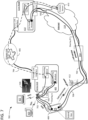
- FIG. 4 is a block diagram 400 illustrating an exemplary network system capable of creating a secondary link using an overlay network in accordance with some embodiments of the present invention.
- Diagram 400 includes a home unit 402, cellular device 408, core node 410, Internet 118, and cell tower 412.
- Home unit 402 which can be or comprise a modem, router, switch, and/or hub, includes a primary link interface 460, HU routing control, home unit (“HU") overlay module 466, and local or wireless interface 430.
- HU home unit
- the underlying concept of the exemplary embodiment(s) of the present invention would not change if one or more blocks (or devices) were added to or removed from diagram 400.
- element 118 can comprise other or additional networks such as one or more private networks.
- Cellular device 408 which can be a wireless and cellular capable device, includes a hybrid app 450 able to communicate with local interface 430 via wireless connection 432 and cell tower 412 via a cell connection 434.
- Cellular device 408 can be any type of cellular capable device such as a smart phone such as, but not limited to, iPhone ® , Samsung Galaxy ® phones, Android ® phones, and the like.
- Cellular device 408 can alternatively be another type of cellular device such as a tablet, laptop computer, game console, or the like.
- the cellular device 408 can be used as a wireless client.
- cellular device 408 is able to access information on the Internet 118 or other communications network via cell tower 412 through cell connection 434 and cell service provider 414.
- cell service provider 414 facilities communication between cellular device 408 and Internet 118 via connections 436-438.
- HU 402 which is coupled to multiple user devices 420-426 via local interface 430 is able to access information in content server 470 via the primary link and core node 410.
- WiFi connections one or more of user devices 420-426 can be connected to the local interface 430 of the HU 402 by other types of connections including wired connections.
- cellular device 408 can alternatively be connected to the local interface 430 by a WiFi connection (as shown in Figures 5-9 ) or other types of connections including a wired connection.
- the core node 410 can be an internet service provider (ISP).
- Content server 470 may include or host one or more content providers which, for example, provide film, video, audio, music, and/or any other online entertainment.
- the content provider may also be an online interactive gaming provider.
- the content provider may provide a real-time interactive conference call.
- content provider may host Web sites and thus provide Web pages.
- Core node 410 includes a core node (“CN") overlay module 468, CN routing control, primary link interface 462, and internet interface 464. While Internet interface 464 is coupled to Internet 118 via connection 458, CN 410 is also coupled to the primary link via connection 456 through primary link interface 462.
- the primary link includes a satellite communication network 406.
- the primary link includes connection 452, satellite communication network 406, and connection 456.
- a satellite link is merely an example, however, and primary link 406 can comprise other types of links such as a terrestrial link.
- hybrid app 450, HU overlay module 466, and CN overlay module 468 are working together to establishing alternative links for enhancing overall network performance.
- the network system employs a core node 410, which can provide a communications or other service (e.g, ISP) to home unit 402 via a primary link 406 (e.g., a satellite link).
- a primary link 406 e.g., a satellite link.
- Multiple user devices e.g., a laptop, smart TV, etc.
- 420-426 are connected to home unit 402 via wireless connection(s).
- the initial link between home unit 402 and core node 410 is the primary link.
- the routing control at core node 410 and home unit 402 are configured to send all transmissions over the primary link and/or one or more other alternate links (not shown).
- a mobile cellar device 408 e.g., a "smart phone" with a cell plan that includes Internet service is moved into proximity of home unit 402.
- FIG. 5 is a block diagram 500 illustrating an exemplary process of creating a secondary link using an overlay network via a cellular device in accordance with some embodiments of the present invention.
- Diagram 500 includes home unit 402, cellular device 408, core node 410, Internet 118, and cell tower 412.
- Diagram 500 is similar to diagram 400 shown in FIG. 4 except that diagram 500 illustrates a secondary link 502 containing overlay network A and overlay network B.
- Secondary link 502 uses wireless, cellular, Internet connections to connect HU 402 with hybrid app 450 and CN 410. It should be noted that the underlying concept of the exemplary embodiment(s) of the present invention would not change if one or more blocks (or devices) were added to or removed from diagram 500.
- cellular device 408 In operation, as cellular device 408 is brought into proximity or vicinity (e.g., by wireless connection and/or WiFi) to home unit 402, cellular device 408 (e.g., app 450) sets up a first overlay (A) connection with home unit 402 and a second overlay (B) connection through cell service provider 414 to core node 410 as shown creating secondary link 502.
- the overlay connections A and B form a secondary link 502 between home unit 402 and core node 410 which results in a hybrid network.
- the routing controllers in core node 410 and home unit 402 can be configured to route selectively network traffic over one of the primary link and the secondary link which is facilitated through the cellular device.
- the overlays can be VPN (virtual private network) connections or tunnels that operate in accordance with a protocol such as VxLAN (virtual extensible local-area network) or GRE (generic routing encapsulation).
- VxLAN virtual extensible local-area network
- GRE Generic routing encapsulation
- the cellular device 408 in addition to providing the secondary link 502 as discussed above, can function as a user device generally the same as another other user device (e.g., devices 420-426) connected to the HU 402.
- FIG. 6 is a block diagram 600 illustrating an exemplary process of routing network traffic via alternative links in accordance with some embodiments of the present invention.
- Diagram 600 includes home unit 402, cellular device 408, core node 410, Internet 118, and cell tower 412.
- Diagram 600 is similar to diagram 500 shown in FIG. 5 except that diagram 600 illustrates a process of return link network traffic from a device such as user equipment or device 422. It should be noted that the underlying concept of the exemplary embodiment(s) of the present invention would not change if one or more blocks (or devices) were added to or removed from diagram 600.
- routing control in home unit 402 selects the primary link 406 or the secondary link 502. For example, the routing control can match the type of network traffic to the characteristics of the primary link or the secondary link. If routing control selects the primary link 406, it sends 606 the network traffic over the primary link 406 to the core node 410. If routing control in home unit 402 selects the secondary link 502, it sends 608 the network traffic over overlay A to the cellular device 408, which then sends the network traffic over overly B to the core node 410.
- overlay B can traverse multiple connections such as a cell connection of the cellular device 408 to a cell tower 412, equipment of a cell service provider 414, and or the Internet 118 or other communications networks.
- connections such as a cell connection of the cellular device 408 to a cell tower 412, equipment of a cell service provider 414, and or the Internet 118 or other communications networks.
- user device 422 sends network traffic to a content server 470 on the Internet 118.
- User device 422 provides data packets of the network traffic addressed to content server 470 through the local interface of the home unit 402, where HU routing control determines whether to send the packets over the primary link 406 or the secondary link 502. If HU routing control determines to send the data packets over the secondary link 502, an HU overlay module in the HU 402 and the hybrid app on cellular device 408 can use tunneling or data encapsulation techniques to route the packets over overlay A and overlay B to core node 410.
- the HU overlay module in HU 402 can effect an inner encapsulation of the packets for transport to the core node 410, which effectively creates an inner overlay (not shown) from the HU 402 to the core node 410.
- the HU overlay module can then effect a first outer encapsulation of the packets for transport over overlay A to the cellular device 408, which can de-capsulate the first outer encapsulation.
- the cellular device 408 can then effect a second outer encapsulation of the packets for transport over overlay B to the core node 410, which can de-capsulate the second outer and the inner encapsulations.
- the core node 410 can then forward the packets to their original destination, which in this example is content server 470.
- FIG. 7 is a block diagram 700 illustrating an exemplary process of routing network traffic via alternative links in accordance with some embodiments of the present invention.
- the example illustrated in FIG. 7 is similar to the example of FIG. 6 except that the network traffic originates from the cellular device 408 as a user device rather than user device 422.
- Diagram 700 includes home unit 402, cellular device 408, core node 410, Internet 118, and cell tower 412.
- the cellular device 408 can function as a user device. As with any of the user devices 420-426, when cellular device 408 has network traffic to send to a content server 470 or other entity on a network such as the Internet 118, routing control in home unit 402 selects the primary link 406 or the secondary link 502. As noted above, routing control can match the type of network traffic to the characteristics of the primary link or the secondary link
- cellular device 408 sends network traffic to content server 470 on the Internet 118.
- Cellular device 408 provides data packets of the network traffic addressed to content server 470 through the local interface of the home unit 402, where HU routing control determines whether to send the packets over the primary link 406 or the secondary link 502. If HU routing control selects the primary link 406, it sends 706 the packets over the primary link 406 to the core node 410.
- the HU overlay module in the HU 402 and the hybrid app on cellular device 408 can use tunneling or data encapsulation techniques to route the packets over overlay A and overlay B to core node 410, for example, in any manner described above.
- the HU overlay module in the HU 402 can effect an inner encapsulation of the packets with the core node 410 as the destination of the inner encapsulation. As noted, this effectively creates an inner overlay (not shown) from the home unit 402 to the core node 410.
- the HU overlay module can then effect a first outer encapsulation of the packets for transport over overlay A back to the cellular device 408, which can de-capsulate the first outer encapsulation.
- the cellular device 408 can then effect a second outer encapsulation of the packets for transport over overlay B to the core node 410, which can de-capsulate the second outer and the inner encapsulations.
- the core node 410 can then forward the packets to their original destination, which in this example is content server 470.
- FIG. 8 is a block diagram illustrating an exemplary process of routing network traffic originating from, e.g., the Internet 118, and addressed to a user device (e.g., any of user devices 420-426 or cellular device 408) via alternative links in accordance with some embodiments of the present invention.
- Diagram 800 includes home unit 402, cellular device 408, core node 410, Internet 118, and cell tower 412.
- Diagram 800 is similar to diagram 600 shown in FIG. 6 except that diagram 800 illustrates a process of sending forward link network traffic originating from content server 470 to a user device such as devices 420-426 or the cellular device 408.
- CN routing control at core node 410 may select secondary link 502 assuming that secondary link 502 offers faster transmission speed than primary link 406.
- time sensitive data may include data related to interactive video games, live conference calls, real-time control, and the like.
- the CN routing control at core node 410 selects primary link 406.
- primary link 406 is selected if the data sent by content server 470 is not time sensitive and the primary link 406 is generally slower than secondary link 502. Regardless of whether the data was sent over the primary link 806 or the secondary link 808, upon reaching the HU routing control of home unit 402, the data is forwarded to the destination user device (user device 422 in the example illustrated in FIG. 8 ) via wireless connection 810.
- content server 470 sends 802 network traffic to user device 422.
- Core node 410 receives from the content server 470 data packets of the traffic addressed to user device 422.
- CN routing control in the core node 410 determines whether to send the packets over the primary link 406 or the secondary link 806. If CN routing control selects the former, the packets are forwarded 806 across the primary link 406. If CN routing control, however, selects the secondary link 502, it sends 808 the traffic over overlay B to the cellular device 408, which then sends the traffic over overlay A to the HU 402.
- the CN overlay module in the core node 410 can effect an inner encapsulation of the packets of the traffic for transport to the home unit 402.
- the CN overlay module can also effect a first outer encapsulation of the packets for transport over overlay B to the cellular device 408, which can de-capsulate the first outer encapsulation.
- the cellular device 408 can then effect a second outer encapsulation of the packets for transport over overlay A to the home unit 402, which can de-capsulate the second outer and the inner encapsulations.
- the home unit 402 can then forward the packets to their original destination, which in this example is user device 422.
- FIG. 9 is similar to the example of FIG. 8 except that the network traffic is destined for the cellular device 408 as a user device rather than user device 422.
- Diagram 900 includes home unit 402, cellular device 408, core node 410, Internet 118, and cell tower 412. As shown, content server 470 originates network traffic destined for cellular device 408 as the user device.
- CN routing control of core node 410 determines whether to send the packets over the primary link 406 the secondary link 502. If CN routing control selects the primary link 406, it sends 906 the packets over the primary link 406 to the home unit 402.
- the traffic can be sent 908 over the secondary link 502 comprising overlay B and overlay A to the HU 402.
- the HU 402 can then forward the traffic over the local interface to the destination user device, which in this case is the cellular device 408.
- the CN overlay module in the core node 410 can effect an inner encapsulation of the packets for transport to the home unit 402. This effectively creates an overlay (not shown) from the core node 410 to the home unit 402.
- the CN overlay module can then also effect a first outer encapsulation of the packets for transport over overlay B to the cellular device 408, which can de-capsulate the first outer encapsulation.
- the cellular device 408 can then effect a second outer encapsulation of the packets for transport over overlay A to the home unit 402, which can de-capsulate the second outer and the inner encapsulations.
- the home unit 402 can then forward the packets to their original destination, which in this example is the cellular device 408 as a user device of home unit 402.
- a cellular device such as a smart phone is used to establish a secondary connection or link using multiple overlays or overlay networks.
- the first overlay is established between home unit 402 and cellular device 408 while the second overlay is created between cellular device 408 and core node 410.
- a function of cellular device 408 can be to be a "man-in-the-middle" as a wireless client.
- An advantage of using a cellular device with a hybrid module is to configure the cellular device as part of secondary link 908 to enhance network performance.
- hybrid module Another advantage of using a hybrid module is that it automatically sets up and employs the secondary link in response to a cellular device connecting to the home unit. It should be noted that the secondary link can be taken down by the hybrid module(s) for channel reconfiguration when the cellular device such as cellular device 408 is disconnected from home unit 402. For example, cellular device 408 moves out of wireless zone or coverage facilitated by local interface 430.
- Exemplary aspects of the present invention include various processing steps, which will be described below.
- the steps may be embodied in machine, router, or computer executable instructions.
- the instructions can be used to create a general purpose or special purpose system, which is programmed with the instructions, to perform the steps of the exemplary aspects of the present invention.
- the steps may be performed by specific hardware components that contain hard-wired logic for performing the steps, or by any combination of programmed computer components and custom hardware components.
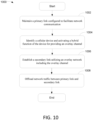
- FIG. 10 is a flowchart 1000 illustrating an exemplary process of establishing an alternative link using a cellular device as a wireless client in accordance with some embodiments of the present invention.
- the process illustrated by flowchart 1000 can be performed on any of the systems illustrated in Figures 1A-9 .
- a process capable of providing alternative communication channels for facilitating network communication maintains a primary link configured to facilitate network communication between attached devices and multiple content providers.
- the network traffic is transported via a communications network containing a satellite communication network.
- Primary link 406 in Figures 4-9 is a non-limiting example. Examples of ways in which block 1002 can be performed include any of the examples discussed above with respect to Figures 4-9 .
- a hybrid function of the CWC device is activated for providing an overlay channel between a cellular transceiver and a wireless transceiver of the CWC device.
- the process continuously monitors and surveys nearby cellular phones for potential wireless clients.
- the cellular device is configured to be a wireless client capable of establishing an overlay network or channel for facilitating a secondary link.
- the process is capable of establishing a secondary link utilizing an overlay network including the overlay channel.
- the process is able to create a wireless communication channel, overlay channel, cellular channel, and Internet as at least a portion of the secondary link.
- Secondary link 502 in Figures 4-9 is a non-limiting example. Examples of ways in which block 1006 can be performed include any of the examples discussed above with respect to Figures 4-9 .
- the network traffic can be offloaded between the primary link and the secondary link.
- the network traffic is transmitted via the secondary link in accordance with characteristic of the network traffic.
- an interactive video conference or video game is more time sensitive than a data backup or playing media such as a video from a provider such as YouTube ® .
- the cellular transceiver of the CDC device receives a data stream from a cellular connection and subsequently transmits the data stream to the network routing element via a wireless connection.
- the process is further capable of identifying a smart phone and activating a hybrid function of the smart phone for providing a second overlay channel between a cellular transceiver and a wireless transceiver of the smart phone.
- Non-limiting examples of ways in which block 1008 can be performed include any of the examples illustrated and discussed above with respect to Figures 6-9 .
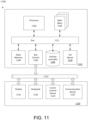
- FIG. 11 is a block diagram 1100 illustrating an exemplary computer system, host machine, router, home unit, node, or base station capable of providing and facilitating an overlay network in accordance with some embodiments of the present invention.
- system includes a processing unit 1101, interface bus 1111, and I/O unit 1120.
- Processing unit 1101 includes a processor 1102, main memory 1104, system bus 1111, static memory device 1106, bus control unit 1105, and overlay controller 1185 for facilitating overlay operations. It should be noted that the underlying concept of the exemplary embodiment(s) of the present invention would not change if one or more blocks (circuit or elements) were added to or removed from diagram 1100.
- Bus 1111 is used to transmit information between various components and processor 1102 for data processing.
- Processor 1102 may be any one of a wide variety of general-purpose processors, embedded processors, or microprocessors, such as ARM ® embedded processors, Intel ® Core TM Duo, Core TM Quad, Xeon ® , Pentium TM microprocessor, Motorola TM 68040, AMD ® family processors, or Power PC TM microprocessor.
- a function of processor 1102 is able to execute instructions based on instruction sets stored in memory 1104.
- Main memory 1104 which may include multiple levels of cache memories, stores frequently used data and instructions.
- Main memory 1104 may be RAM (random access memory), MRAM (magnetic RAM), or flash memory.
- Static memory 1106 may be a ROM (read-only memory), which is coupled to bus 1111, for storing static information and/or instructions.
- Bus control unit 1105 is coupled to buses 1111-1112 and controls which component, such as main memory 1104 or processor 1102, can use the bus.
- Bus control unit 1105 manages the communications between bus 1111 and bus 1112.
- Mass storage memory 1106, which may be a magnetic disk, optical disk, hard disk drive, floppy disk, CD-ROM, solid state drive (“SSD”), and/or flash memories, are used for storing large amounts of data.
- I/O unit 1120 in one example, includes a display 1121, keyboard 1122, cursor control device 1123, and communication device 1125.
- Display device 1121 may be a liquid crystal device, cathode ray tube ("CRT"), touch-screen display, or other suitable display device.
- Keyboard 1122 may be a conventional alphanumeric input device for communicating information between computer system 1100 and computer operator(s).
- cursor control device 1123 is another type of user input device, such as a conventional mouse, touch mouse, trackball, or other type of cursor for communicating information between system 1100 and user(s).
- Communication device 1125 is coupled to bus 1111 for accessing information from remote computers or servers through a wide-area communication network.
- Communication device 1125 may include a modem, network interface device, and/or other similar devices that facilitate communication between computer 1100 and external network or devices.
Landscapes
- Engineering & Computer Science (AREA)
- Computer Networks & Wireless Communication (AREA)
- Signal Processing (AREA)
- Mobile Radio Communication Systems (AREA)
- Data Exchanges In Wide-Area Networks (AREA)
Priority Applications (1)
| Application Number | Priority Date | Filing Date | Title |
|---|---|---|---|
| EP23183162.9A EP4239972A3 (de) | 2019-09-27 | 2019-09-27 | Verfahren und vorrichtung zur ermöglichung des offloads von netzwerkverkehr über eine verbundene zellulare vorrichtung |
Applications Claiming Priority (3)
| Application Number | Priority Date | Filing Date | Title |
|---|---|---|---|
| EP23183162.9A EP4239972A3 (de) | 2019-09-27 | 2019-09-27 | Verfahren und vorrichtung zur ermöglichung des offloads von netzwerkverkehr über eine verbundene zellulare vorrichtung |
| EP19790353.7A EP4018606B1 (de) | 2019-09-27 | 2019-09-27 | Verfahren und vorrichtung zum offload von netzwerkverkehr über eine angeschlossene zellulare vorrichtung |
| PCT/US2019/053439 WO2021061150A1 (en) | 2019-09-27 | 2019-09-27 | Method and apparatus for enabling offloading network traffic via a connected cellular device |
Related Parent Applications (2)
| Application Number | Title | Priority Date | Filing Date |
|---|---|---|---|
| EP19790353.7A Division EP4018606B1 (de) | 2019-09-27 | 2019-09-27 | Verfahren und vorrichtung zum offload von netzwerkverkehr über eine angeschlossene zellulare vorrichtung |
| EP19790353.7A Division-Into EP4018606B1 (de) | 2019-09-27 | 2019-09-27 | Verfahren und vorrichtung zum offload von netzwerkverkehr über eine angeschlossene zellulare vorrichtung |
Publications (2)
| Publication Number | Publication Date |
|---|---|
| EP4239972A2 true EP4239972A2 (de) | 2023-09-06 |
| EP4239972A3 EP4239972A3 (de) | 2023-10-25 |
Family
ID=68290343
Family Applications (2)
| Application Number | Title | Priority Date | Filing Date |
|---|---|---|---|
| EP23183162.9A Pending EP4239972A3 (de) | 2019-09-27 | 2019-09-27 | Verfahren und vorrichtung zur ermöglichung des offloads von netzwerkverkehr über eine verbundene zellulare vorrichtung |
| EP19790353.7A Active EP4018606B1 (de) | 2019-09-27 | 2019-09-27 | Verfahren und vorrichtung zum offload von netzwerkverkehr über eine angeschlossene zellulare vorrichtung |
Family Applications After (1)
| Application Number | Title | Priority Date | Filing Date |
|---|---|---|---|
| EP19790353.7A Active EP4018606B1 (de) | 2019-09-27 | 2019-09-27 | Verfahren und vorrichtung zum offload von netzwerkverkehr über eine angeschlossene zellulare vorrichtung |
Country Status (12)
| Country | Link |
|---|---|
| US (1) | US12167290B2 (de) |
| EP (2) | EP4239972A3 (de) |
| AU (1) | AU2019467280B2 (de) |
| BR (1) | BR112022005779A2 (de) |
| CA (1) | CA3151899A1 (de) |
| DK (1) | DK4018606T3 (de) |
| ES (1) | ES2960572T3 (de) |
| FI (1) | FI4018606T3 (de) |
| HU (1) | HUE064712T2 (de) |
| MX (1) | MX2022003727A (de) |
| PL (1) | PL4018606T3 (de) |
| WO (1) | WO2021061150A1 (de) |
Families Citing this family (1)
| Publication number | Priority date | Publication date | Assignee | Title |
|---|---|---|---|---|
| US20230216768A1 (en) * | 2022-01-04 | 2023-07-06 | Vmware, Inc. | Enhanced path selection using online detection of paths overlaps |
Family Cites Families (23)
| Publication number | Priority date | Publication date | Assignee | Title |
|---|---|---|---|---|
| US6862622B2 (en) | 1998-07-10 | 2005-03-01 | Van Drebbel Mariner Llc | Transmission control protocol/internet protocol (TCP/IP) packet-centric wireless point to multi-point (PTMP) transmission system architecture |
| WO2006111809A1 (en) * | 2005-04-20 | 2006-10-26 | Nokia Siemens Networks Oy | Load balancing communications system comprising cellular overlay and ad hoc networks |
| US8032472B2 (en) | 2007-04-04 | 2011-10-04 | Tuen Solutions Limited Liability Company | Intelligent agent for distributed services for mobile devices |
| GB2449923B (en) * | 2007-06-09 | 2011-09-28 | King S College London | Inter-working of networks |
| US8270952B2 (en) | 2009-01-28 | 2012-09-18 | Headwater Partners I Llc | Open development system for access service providers |
| US8635335B2 (en) | 2009-01-28 | 2014-01-21 | Headwater Partners I Llc | System and method for wireless network offloading |
| US8155158B2 (en) | 2008-11-12 | 2012-04-10 | Patricio Humberto Saavedra | System, apparatus and method for providing aggregated network connections |
| US8559340B2 (en) | 2009-12-22 | 2013-10-15 | Samsung Electronics Co., Ltd. | Method and apparatus for service discovery in Wi-Fi direct network |
| US8432871B1 (en) | 2010-03-26 | 2013-04-30 | Juniper Networks, Inc. | Offloading mobile traffic from a mobile core network |
| EP2716132A2 (de) | 2011-06-02 | 2014-04-09 | Interdigital Patent Holdings, Inc. | Verfahren, vorrichtung, und systeme zur verwaltung von konvergierter gateway-kommunikation |
| US9258344B2 (en) * | 2011-08-01 | 2016-02-09 | Intel Corporation | Multi-hop single sign-on (SSO) for identity provider (IdP) roaming/proxy |
| US10148732B2 (en) | 2012-02-09 | 2018-12-04 | Connectify, Inc. | Secure remote computer network |
| US9374270B2 (en) | 2012-06-06 | 2016-06-21 | Juniper Networks, Inc. | Multicast service in virtual networks |
| US9686232B2 (en) | 2012-06-25 | 2017-06-20 | Connectify, Inc. | Network address translating router for mobile networking |
| WO2014113630A1 (en) * | 2013-01-20 | 2014-07-24 | Apple Inc. | Offloading traffic via a wireless peer-to-peer connection |
| US9374770B2 (en) * | 2013-03-14 | 2016-06-21 | Qualcomm Incorporated | Communications methods and apparatus that facilitate discovery of small coverage area base stations |
| US10237162B2 (en) | 2014-06-10 | 2019-03-19 | Viprinet Europe Gmbh | Device for bundling a plurality of internet access media with forward error correction |
| US9521069B2 (en) * | 2015-05-08 | 2016-12-13 | Ooma, Inc. | Managing alternative networks for high quality of service communications |
| US10201031B2 (en) * | 2015-11-11 | 2019-02-05 | Apple Inc. | Radio resource aggregation with suspend/resume support |
| US9801127B2 (en) * | 2016-02-23 | 2017-10-24 | Cisco Technology, Inc. | System and method to provide power management for a multimode access point in a network environment |
| US10931477B2 (en) | 2016-03-18 | 2021-02-23 | Plume Design, Inc. | Layer two network tunnels for Wi-Fi client bridging in a distributed Wi-Fi network |
| EP3440777A4 (de) | 2016-04-06 | 2020-03-18 | Hughes Network Systems, LLC | Hybridsatellitensysteme für breitbandkommunikation mit verbesserter leistung und verbesserter dienstgüte |
| CN113676902B (zh) * | 2020-04-30 | 2024-04-23 | 华为技术有限公司 | 一种提供无线上网的系统、方法及电子设备 |
-
2019
- 2019-09-27 DK DK19790353.7T patent/DK4018606T3/da active
- 2019-09-27 CA CA3151899A patent/CA3151899A1/en active Pending
- 2019-09-27 ES ES19790353T patent/ES2960572T3/es active Active
- 2019-09-27 PL PL19790353.7T patent/PL4018606T3/pl unknown
- 2019-09-27 FI FIEP19790353.7T patent/FI4018606T3/fi active
- 2019-09-27 MX MX2022003727A patent/MX2022003727A/es unknown
- 2019-09-27 AU AU2019467280A patent/AU2019467280B2/en active Active
- 2019-09-27 EP EP23183162.9A patent/EP4239972A3/de active Pending
- 2019-09-27 WO PCT/US2019/053439 patent/WO2021061150A1/en not_active Ceased
- 2019-09-27 BR BR112022005779A patent/BR112022005779A2/pt unknown
- 2019-09-27 HU HUE19790353A patent/HUE064712T2/hu unknown
- 2019-09-27 EP EP19790353.7A patent/EP4018606B1/de active Active
-
2022
- 2022-03-21 US US17/700,244 patent/US12167290B2/en active Active
Also Published As
| Publication number | Publication date |
|---|---|
| FI4018606T3 (fi) | 2023-11-07 |
| PL4018606T3 (pl) | 2024-02-19 |
| EP4018606A1 (de) | 2022-06-29 |
| CA3151899A1 (en) | 2021-04-01 |
| HUE064712T2 (hu) | 2024-04-28 |
| AU2019467280B2 (en) | 2026-01-15 |
| EP4239972A3 (de) | 2023-10-25 |
| AU2019467280A1 (en) | 2022-04-14 |
| BR112022005779A2 (pt) | 2022-06-21 |
| ES2960572T3 (es) | 2024-03-05 |
| DK4018606T3 (en) | 2023-10-16 |
| WO2021061150A1 (en) | 2021-04-01 |
| US20220217605A1 (en) | 2022-07-07 |
| EP4018606B1 (de) | 2023-08-09 |
| US12167290B2 (en) | 2024-12-10 |
| MX2022003727A (es) | 2022-05-02 |
Similar Documents
| Publication | Publication Date | Title |
|---|---|---|
| US10979933B2 (en) | Method, network device, and system for implementing data processing, and storage medium | |
| CN104581892B (zh) | 一种终端的数据传输方法和装置 | |
| US20210076164A1 (en) | Method, system and apparatus for multicast session management in 5g communication network | |
| CN110351893A (zh) | 分发上行链路数据流的方法和使用其的用户设备 | |
| US11405770B2 (en) | Multicast handover for mobile communications | |
| US9544840B2 (en) | Distributed method for client optimization | |
| US20220015026A1 (en) | Method for network resource sharing, electronic device, and non-transitory computer-readable storage medium | |
| CN116208222B (zh) | 数据传输方法、装置、设备以及存储介质 | |
| US12237998B2 (en) | Method and apparatus for distributing network traffic over multiple communication networks | |
| US10091730B2 (en) | Adaptive management of wireless clients based on clients radio behaviors and capabilities | |
| WO2020073756A1 (zh) | 通信方法、装置、计算机可读介质及电子设备 | |
| CN113596917A (zh) | 基于信令辅助实现gtp通信数据报文处理方法、装置 | |
| US12167290B2 (en) | Method and apparatus for enabling offloading network traffic via a connected cellular device | |
| CN117917908A (zh) | 用于前传的链路聚合 | |
| US20210250278A1 (en) | Efficient flow distribution across link-aggregation group members | |
| WO2011085028A2 (en) | Method and system for providing information access, multimedia content access, and phone connectivity | |
| US20090296703A1 (en) | Method and system for dynamic roaming across wireless networks | |
| WO2017062014A1 (en) | Radio access network orchestrator for wireless networks | |
| US12279323B2 (en) | Split multi-link system | |
| US20250056307A1 (en) | Apparatus, method and computer program product | |
| Gupta et al. | A survey on wireless technology 5G | |
| Al-Yasiri et al. | Design and Implementation of Mobile Computing Simulator | |
| WO2022222736A1 (zh) | 业务处理方法、装置、系统、可读取存储介质和电子设备 | |
| WO2024214226A1 (ja) | 端末装置、シェアリングアクセスポイント、シェアードアクセスポイント、及び無線通信方法 | |
| WO2023142981A1 (zh) | 通信方法及相关装置 |
Legal Events
| Date | Code | Title | Description |
|---|---|---|---|
| PUAI | Public reference made under article 153(3) epc to a published international application that has entered the european phase |
Free format text: ORIGINAL CODE: 0009012 |
|
| STAA | Information on the status of an ep patent application or granted ep patent |
Free format text: STATUS: THE APPLICATION HAS BEEN PUBLISHED |
|
| AC | Divisional application: reference to earlier application |
Ref document number: 4018606 Country of ref document: EP Kind code of ref document: P |
|
| AK | Designated contracting states |
Kind code of ref document: A2 Designated state(s): AL AT BE BG CH CY CZ DE DK EE ES FI FR GB GR HR HU IE IS IT LI LT LU LV MC MK MT NL NO PL PT RO RS SE SI SK SM TR |
|
| PUAL | Search report despatched |
Free format text: ORIGINAL CODE: 0009013 |
|
| AK | Designated contracting states |
Kind code of ref document: A3 Designated state(s): AL AT BE BG CH CY CZ DE DK EE ES FI FR GB GR HR HU IE IS IT LI LT LU LV MC MK MT NL NO PL PT RO RS SE SI SK SM TR |
|
| RIC1 | Information provided on ipc code assigned before grant |
Ipc: H04W 84/12 20090101ALN20230918BHEP Ipc: H04L 47/125 20220101ALN20230918BHEP Ipc: H04W 40/22 20090101ALI20230918BHEP Ipc: H04L 45/243 20220101AFI20230918BHEP |
|
| STAA | Information on the status of an ep patent application or granted ep patent |
Free format text: STATUS: REQUEST FOR EXAMINATION WAS MADE |
|
| 17P | Request for examination filed |
Effective date: 20240417 |
|
| RBV | Designated contracting states (corrected) |
Designated state(s): AL AT BE BG CH CY CZ DE DK EE ES FI FR GB GR HR HU IE IS IT LI LT LU LV MC MK MT NL NO PL PT RO RS SE SI SK SM TR |
|
| GRAP | Despatch of communication of intention to grant a patent |
Free format text: ORIGINAL CODE: EPIDOSNIGR1 |
|
| STAA | Information on the status of an ep patent application or granted ep patent |
Free format text: STATUS: GRANT OF PATENT IS INTENDED |
|
| RIC1 | Information provided on ipc code assigned before grant |
Ipc: H04L 45/243 20220101AFI20260305BHEP Ipc: H04W 40/22 20090101ALI20260305BHEP Ipc: H04L 47/125 20220101ALN20260305BHEP Ipc: H04W 84/12 20090101ALN20260305BHEP |
|
| INTG | Intention to grant announced |
Effective date: 20260330 |