EP4239039B1 - Schmierstoffzusammensetzung enthaltend eine ionische flüssigkeit - Google Patents
Schmierstoffzusammensetzung enthaltend eine ionische flüssigkeit Download PDFInfo
- Publication number
- EP4239039B1 EP4239039B1 EP22186356.6A EP22186356A EP4239039B1 EP 4239039 B1 EP4239039 B1 EP 4239039B1 EP 22186356 A EP22186356 A EP 22186356A EP 4239039 B1 EP4239039 B1 EP 4239039B1
- Authority
- EP
- European Patent Office
- Prior art keywords
- weight
- lubricant composition
- base oil
- composition according
- proportion
- Prior art date
- Legal status (The legal status is an assumption and is not a legal conclusion. Google has not performed a legal analysis and makes no representation as to the accuracy of the status listed.)
- Active
Links
Images

Classifications
-
- C—CHEMISTRY; METALLURGY
- C10—PETROLEUM, GAS OR COKE INDUSTRIES; TECHNICAL GASES CONTAINING CARBON MONOXIDE; FUELS; LUBRICANTS; PEAT
- C10M—LUBRICATING COMPOSITIONS; USE OF CHEMICAL SUBSTANCES EITHER ALONE OR AS LUBRICATING INGREDIENTS IN A LUBRICATING COMPOSITION
- C10M137/00—Lubricating compositions characterised by the additive being an organic non-macromolecular compound containing phosphorus
- C10M137/12—Lubricating compositions characterised by the additive being an organic non-macromolecular compound containing phosphorus having a phosphorus-to-carbon bond
-
- C—CHEMISTRY; METALLURGY
- C10—PETROLEUM, GAS OR COKE INDUSTRIES; TECHNICAL GASES CONTAINING CARBON MONOXIDE; FUELS; LUBRICANTS; PEAT
- C10M—LUBRICATING COMPOSITIONS; USE OF CHEMICAL SUBSTANCES EITHER ALONE OR AS LUBRICATING INGREDIENTS IN A LUBRICATING COMPOSITION
- C10M169/00—Lubricating compositions characterised by containing as components a mixture of at least two types of ingredient selected from base-materials, thickeners or additives, covered by the preceding groups, each of these compounds being essential
- C10M169/04—Mixtures of base-materials and additives
-
- C—CHEMISTRY; METALLURGY
- C10—PETROLEUM, GAS OR COKE INDUSTRIES; TECHNICAL GASES CONTAINING CARBON MONOXIDE; FUELS; LUBRICANTS; PEAT
- C10M—LUBRICATING COMPOSITIONS; USE OF CHEMICAL SUBSTANCES EITHER ALONE OR AS LUBRICATING INGREDIENTS IN A LUBRICATING COMPOSITION
- C10M105/00—Lubricating compositions characterised by the base-material being a non-macromolecular organic compound
- C10M105/08—Lubricating compositions characterised by the base-material being a non-macromolecular organic compound containing oxygen
- C10M105/32—Esters
- C10M105/34—Esters of monocarboxylic acids
-
- C—CHEMISTRY; METALLURGY
- C10—PETROLEUM, GAS OR COKE INDUSTRIES; TECHNICAL GASES CONTAINING CARBON MONOXIDE; FUELS; LUBRICANTS; PEAT
- C10M—LUBRICATING COMPOSITIONS; USE OF CHEMICAL SUBSTANCES EITHER ALONE OR AS LUBRICATING INGREDIENTS IN A LUBRICATING COMPOSITION
- C10M105/00—Lubricating compositions characterised by the base-material being a non-macromolecular organic compound
- C10M105/08—Lubricating compositions characterised by the base-material being a non-macromolecular organic compound containing oxygen
- C10M105/32—Esters
- C10M105/36—Esters of polycarboxylic acids
-
- C—CHEMISTRY; METALLURGY
- C10—PETROLEUM, GAS OR COKE INDUSTRIES; TECHNICAL GASES CONTAINING CARBON MONOXIDE; FUELS; LUBRICANTS; PEAT
- C10M—LUBRICATING COMPOSITIONS; USE OF CHEMICAL SUBSTANCES EITHER ALONE OR AS LUBRICATING INGREDIENTS IN A LUBRICATING COMPOSITION
- C10M107/00—Lubricating compositions characterised by the base-material being a macromolecular compound
- C10M107/20—Lubricating compositions characterised by the base-material being a macromolecular compound containing oxygen
- C10M107/30—Macromolecular compounds obtained otherwise than by reactions only involving carbon-to-carbon unsaturated bonds
-
- C—CHEMISTRY; METALLURGY
- C10—PETROLEUM, GAS OR COKE INDUSTRIES; TECHNICAL GASES CONTAINING CARBON MONOXIDE; FUELS; LUBRICANTS; PEAT
- C10M—LUBRICATING COMPOSITIONS; USE OF CHEMICAL SUBSTANCES EITHER ALONE OR AS LUBRICATING INGREDIENTS IN A LUBRICATING COMPOSITION
- C10M111/00—Lubrication compositions characterised by the base-material being a mixture of two or more compounds covered by more than one of the main groups C10M101/00 - C10M109/00, each of these compounds being essential
- C10M111/04—Lubrication compositions characterised by the base-material being a mixture of two or more compounds covered by more than one of the main groups C10M101/00 - C10M109/00, each of these compounds being essential at least one of them being a macromolecular organic compound
-
- C—CHEMISTRY; METALLURGY
- C10—PETROLEUM, GAS OR COKE INDUSTRIES; TECHNICAL GASES CONTAINING CARBON MONOXIDE; FUELS; LUBRICANTS; PEAT
- C10M—LUBRICATING COMPOSITIONS; USE OF CHEMICAL SUBSTANCES EITHER ALONE OR AS LUBRICATING INGREDIENTS IN A LUBRICATING COMPOSITION
- C10M115/00—Lubricating compositions characterised by the thickener being a non-macromolecular organic compound other than a carboxylic acid or salt thereof
- C10M115/08—Lubricating compositions characterised by the thickener being a non-macromolecular organic compound other than a carboxylic acid or salt thereof containing nitrogen
-
- C—CHEMISTRY; METALLURGY
- C10—PETROLEUM, GAS OR COKE INDUSTRIES; TECHNICAL GASES CONTAINING CARBON MONOXIDE; FUELS; LUBRICANTS; PEAT
- C10M—LUBRICATING COMPOSITIONS; USE OF CHEMICAL SUBSTANCES EITHER ALONE OR AS LUBRICATING INGREDIENTS IN A LUBRICATING COMPOSITION
- C10M117/00—Lubricating compositions characterised by the thickener being a non-macromolecular carboxylic acid or salt thereof
- C10M117/06—Lubricating compositions characterised by the thickener being a non-macromolecular carboxylic acid or salt thereof having more than one carboxyl group bound to an acyclic carbon atom or cycloaliphatic carbon atom
-
- C—CHEMISTRY; METALLURGY
- C10—PETROLEUM, GAS OR COKE INDUSTRIES; TECHNICAL GASES CONTAINING CARBON MONOXIDE; FUELS; LUBRICANTS; PEAT
- C10M—LUBRICATING COMPOSITIONS; USE OF CHEMICAL SUBSTANCES EITHER ALONE OR AS LUBRICATING INGREDIENTS IN A LUBRICATING COMPOSITION
- C10M133/00—Lubricating compositions characterised by the additive being an organic non-macromolecular compound containing nitrogen
- C10M133/02—Lubricating compositions characterised by the additive being an organic non-macromolecular compound containing nitrogen having a carbon chain of less than 30 atoms
- C10M133/04—Amines, e.g. polyalkylene polyamines; Quaternary amines
- C10M133/12—Amines, e.g. polyalkylene polyamines; Quaternary amines having amino groups bound to a carbon atom of a six-membered aromatic ring
-
- C—CHEMISTRY; METALLURGY
- C10—PETROLEUM, GAS OR COKE INDUSTRIES; TECHNICAL GASES CONTAINING CARBON MONOXIDE; FUELS; LUBRICANTS; PEAT
- C10M—LUBRICATING COMPOSITIONS; USE OF CHEMICAL SUBSTANCES EITHER ALONE OR AS LUBRICATING INGREDIENTS IN A LUBRICATING COMPOSITION
- C10M135/00—Lubricating compositions characterised by the additive being an organic non-macromolecular compound containing sulfur, selenium or tellurium
- C10M135/08—Lubricating compositions characterised by the additive being an organic non-macromolecular compound containing sulfur, selenium or tellurium containing a sulfur-to-oxygen bond
-
- C—CHEMISTRY; METALLURGY
- C10—PETROLEUM, GAS OR COKE INDUSTRIES; TECHNICAL GASES CONTAINING CARBON MONOXIDE; FUELS; LUBRICANTS; PEAT
- C10M—LUBRICATING COMPOSITIONS; USE OF CHEMICAL SUBSTANCES EITHER ALONE OR AS LUBRICATING INGREDIENTS IN A LUBRICATING COMPOSITION
- C10M141/00—Lubricating compositions characterised by the additive being a mixture of two or more compounds covered by more than one of the main groups C10M125/00 - C10M139/00, each of these compounds being essential
- C10M141/10—Lubricating compositions characterised by the additive being a mixture of two or more compounds covered by more than one of the main groups C10M125/00 - C10M139/00, each of these compounds being essential at least one of them being an organic phosphorus-containing compound
-
- C—CHEMISTRY; METALLURGY
- C10—PETROLEUM, GAS OR COKE INDUSTRIES; TECHNICAL GASES CONTAINING CARBON MONOXIDE; FUELS; LUBRICANTS; PEAT
- C10M—LUBRICATING COMPOSITIONS; USE OF CHEMICAL SUBSTANCES EITHER ALONE OR AS LUBRICATING INGREDIENTS IN A LUBRICATING COMPOSITION
- C10M169/00—Lubricating compositions characterised by containing as components a mixture of at least two types of ingredient selected from base-materials, thickeners or additives, covered by the preceding groups, each of these compounds being essential
-
- C—CHEMISTRY; METALLURGY
- C10—PETROLEUM, GAS OR COKE INDUSTRIES; TECHNICAL GASES CONTAINING CARBON MONOXIDE; FUELS; LUBRICANTS; PEAT
- C10M—LUBRICATING COMPOSITIONS; USE OF CHEMICAL SUBSTANCES EITHER ALONE OR AS LUBRICATING INGREDIENTS IN A LUBRICATING COMPOSITION
- C10M171/00—Lubricating compositions characterised by purely physical criteria, e.g. containing as base-material, thickener or additive, ingredients which are characterised exclusively by their numerically specified physical properties, i.e. containing ingredients which are physically well-defined but for which the chemical nature is either unspecified or only very vaguely indicated
-
- C—CHEMISTRY; METALLURGY
- C10—PETROLEUM, GAS OR COKE INDUSTRIES; TECHNICAL GASES CONTAINING CARBON MONOXIDE; FUELS; LUBRICANTS; PEAT
- C10M—LUBRICATING COMPOSITIONS; USE OF CHEMICAL SUBSTANCES EITHER ALONE OR AS LUBRICATING INGREDIENTS IN A LUBRICATING COMPOSITION
- C10M2207/00—Organic non-macromolecular hydrocarbon compounds containing hydrogen, carbon and oxygen as ingredients in lubricant compositions
- C10M2207/10—Carboxylix acids; Neutral salts thereof
- C10M2207/12—Carboxylix acids; Neutral salts thereof having carboxyl groups bound to acyclic or cycloaliphatic carbon atoms
- C10M2207/125—Carboxylix acids; Neutral salts thereof having carboxyl groups bound to acyclic or cycloaliphatic carbon atoms having hydrocarbon chains of eight up to twenty-nine carbon atoms, i.e. fatty acids
- C10M2207/128—Carboxylix acids; Neutral salts thereof having carboxyl groups bound to acyclic or cycloaliphatic carbon atoms having hydrocarbon chains of eight up to twenty-nine carbon atoms, i.e. fatty acids containing hydroxy groups; Ethers thereof
- C10M2207/1285—Carboxylix acids; Neutral salts thereof having carboxyl groups bound to acyclic or cycloaliphatic carbon atoms having hydrocarbon chains of eight up to twenty-nine carbon atoms, i.e. fatty acids containing hydroxy groups; Ethers thereof used as thickening agents
-
- C—CHEMISTRY; METALLURGY
- C10—PETROLEUM, GAS OR COKE INDUSTRIES; TECHNICAL GASES CONTAINING CARBON MONOXIDE; FUELS; LUBRICANTS; PEAT
- C10M—LUBRICATING COMPOSITIONS; USE OF CHEMICAL SUBSTANCES EITHER ALONE OR AS LUBRICATING INGREDIENTS IN A LUBRICATING COMPOSITION
- C10M2207/00—Organic non-macromolecular hydrocarbon compounds containing hydrogen, carbon and oxygen as ingredients in lubricant compositions
- C10M2207/28—Esters
- C10M2207/2805—Esters used as base material
-
- C—CHEMISTRY; METALLURGY
- C10—PETROLEUM, GAS OR COKE INDUSTRIES; TECHNICAL GASES CONTAINING CARBON MONOXIDE; FUELS; LUBRICANTS; PEAT
- C10M—LUBRICATING COMPOSITIONS; USE OF CHEMICAL SUBSTANCES EITHER ALONE OR AS LUBRICATING INGREDIENTS IN A LUBRICATING COMPOSITION
- C10M2207/00—Organic non-macromolecular hydrocarbon compounds containing hydrogen, carbon and oxygen as ingredients in lubricant compositions
- C10M2207/28—Esters
- C10M2207/282—Esters of (cyclo)aliphatic oolycarboxylic acids
- C10M2207/2825—Esters of (cyclo)aliphatic oolycarboxylic acids used as base material
-
- C—CHEMISTRY; METALLURGY
- C10—PETROLEUM, GAS OR COKE INDUSTRIES; TECHNICAL GASES CONTAINING CARBON MONOXIDE; FUELS; LUBRICANTS; PEAT
- C10M—LUBRICATING COMPOSITIONS; USE OF CHEMICAL SUBSTANCES EITHER ALONE OR AS LUBRICATING INGREDIENTS IN A LUBRICATING COMPOSITION
- C10M2207/00—Organic non-macromolecular hydrocarbon compounds containing hydrogen, carbon and oxygen as ingredients in lubricant compositions
- C10M2207/28—Esters
- C10M2207/34—Esters having a hydrocarbon substituent of thirty or more carbon atoms, e.g. substituted succinic acid derivatives
- C10M2207/345—Esters having a hydrocarbon substituent of thirty or more carbon atoms, e.g. substituted succinic acid derivatives used as base material
-
- C—CHEMISTRY; METALLURGY
- C10—PETROLEUM, GAS OR COKE INDUSTRIES; TECHNICAL GASES CONTAINING CARBON MONOXIDE; FUELS; LUBRICANTS; PEAT
- C10M—LUBRICATING COMPOSITIONS; USE OF CHEMICAL SUBSTANCES EITHER ALONE OR AS LUBRICATING INGREDIENTS IN A LUBRICATING COMPOSITION
- C10M2209/00—Organic macromolecular compounds containing oxygen as ingredients in lubricant compositions
- C10M2209/10—Macromolecular compoundss obtained otherwise than by reactions only involving carbon-to-carbon unsaturated bonds
- C10M2209/103—Polyethers, i.e. containing di- or higher polyoxyalkylene groups
- C10M2209/1033—Polyethers, i.e. containing di- or higher polyoxyalkylene groups used as base material
-
- C—CHEMISTRY; METALLURGY
- C10—PETROLEUM, GAS OR COKE INDUSTRIES; TECHNICAL GASES CONTAINING CARBON MONOXIDE; FUELS; LUBRICANTS; PEAT
- C10M—LUBRICATING COMPOSITIONS; USE OF CHEMICAL SUBSTANCES EITHER ALONE OR AS LUBRICATING INGREDIENTS IN A LUBRICATING COMPOSITION
- C10M2209/00—Organic macromolecular compounds containing oxygen as ingredients in lubricant compositions
- C10M2209/10—Macromolecular compoundss obtained otherwise than by reactions only involving carbon-to-carbon unsaturated bonds
- C10M2209/103—Polyethers, i.e. containing di- or higher polyoxyalkylene groups
- C10M2209/107—Polyethers, i.e. containing di- or higher polyoxyalkylene groups of two or more specified different alkylene oxides covered by groups C10M2209/104 - C10M2209/106
- C10M2209/1075—Polyethers, i.e. containing di- or higher polyoxyalkylene groups of two or more specified different alkylene oxides covered by groups C10M2209/104 - C10M2209/106 used as base material
-
- C—CHEMISTRY; METALLURGY
- C10—PETROLEUM, GAS OR COKE INDUSTRIES; TECHNICAL GASES CONTAINING CARBON MONOXIDE; FUELS; LUBRICANTS; PEAT
- C10M—LUBRICATING COMPOSITIONS; USE OF CHEMICAL SUBSTANCES EITHER ALONE OR AS LUBRICATING INGREDIENTS IN A LUBRICATING COMPOSITION
- C10M2215/00—Organic non-macromolecular compounds containing nitrogen as ingredients in lubricant Compositions
- C10M2215/02—Amines, e.g. polyalkylene polyamines; Quaternary amines
- C10M2215/06—Amines, e.g. polyalkylene polyamines; Quaternary amines having amino groups bound to carbon atoms of six-membered aromatic rings
- C10M2215/064—Di- and triaryl amines
-
- C—CHEMISTRY; METALLURGY
- C10—PETROLEUM, GAS OR COKE INDUSTRIES; TECHNICAL GASES CONTAINING CARBON MONOXIDE; FUELS; LUBRICANTS; PEAT
- C10M—LUBRICATING COMPOSITIONS; USE OF CHEMICAL SUBSTANCES EITHER ALONE OR AS LUBRICATING INGREDIENTS IN A LUBRICATING COMPOSITION
- C10M2215/00—Organic non-macromolecular compounds containing nitrogen as ingredients in lubricant Compositions
- C10M2215/10—Amides of carbonic or haloformic acids
- C10M2215/102—Ureas; Semicarbazides; Allophanates
- C10M2215/1026—Ureas; Semicarbazides; Allophanates used as thickening material
-
- C—CHEMISTRY; METALLURGY
- C10—PETROLEUM, GAS OR COKE INDUSTRIES; TECHNICAL GASES CONTAINING CARBON MONOXIDE; FUELS; LUBRICANTS; PEAT
- C10M—LUBRICATING COMPOSITIONS; USE OF CHEMICAL SUBSTANCES EITHER ALONE OR AS LUBRICATING INGREDIENTS IN A LUBRICATING COMPOSITION
- C10M2219/00—Organic non-macromolecular compounds containing sulfur, selenium or tellurium as ingredients in lubricant compositions
- C10M2219/04—Organic non-macromolecular compounds containing sulfur, selenium or tellurium as ingredients in lubricant compositions containing sulfur-to-oxygen bonds, i.e. sulfones, sulfoxides
-
- C—CHEMISTRY; METALLURGY
- C10—PETROLEUM, GAS OR COKE INDUSTRIES; TECHNICAL GASES CONTAINING CARBON MONOXIDE; FUELS; LUBRICANTS; PEAT
- C10M—LUBRICATING COMPOSITIONS; USE OF CHEMICAL SUBSTANCES EITHER ALONE OR AS LUBRICATING INGREDIENTS IN A LUBRICATING COMPOSITION
- C10M2223/00—Organic non-macromolecular compounds containing phosphorus as ingredients in lubricant compositions
- C10M2223/06—Organic non-macromolecular compounds containing phosphorus as ingredients in lubricant compositions having phosphorus-to-carbon bonds
- C10M2223/065—Organic non-macromolecular compounds containing phosphorus as ingredients in lubricant compositions having phosphorus-to-carbon bonds containing sulfur
-
- C—CHEMISTRY; METALLURGY
- C10—PETROLEUM, GAS OR COKE INDUSTRIES; TECHNICAL GASES CONTAINING CARBON MONOXIDE; FUELS; LUBRICANTS; PEAT
- C10N—INDEXING SCHEME ASSOCIATED WITH SUBCLASS C10M RELATING TO LUBRICATING COMPOSITIONS
- C10N2020/00—Specified physical or chemical properties or characteristics, i.e. function, of component of lubricating compositions
- C10N2020/01—Physico-chemical properties
- C10N2020/077—Ionic Liquids
-
- C—CHEMISTRY; METALLURGY
- C10—PETROLEUM, GAS OR COKE INDUSTRIES; TECHNICAL GASES CONTAINING CARBON MONOXIDE; FUELS; LUBRICANTS; PEAT
- C10N—INDEXING SCHEME ASSOCIATED WITH SUBCLASS C10M RELATING TO LUBRICATING COMPOSITIONS
- C10N2030/00—Specified physical or chemical properties which is improved by the additive characterising the lubricating composition, e.g. multifunctional additives
- C10N2030/02—Pour-point; Viscosity index
-
- C—CHEMISTRY; METALLURGY
- C10—PETROLEUM, GAS OR COKE INDUSTRIES; TECHNICAL GASES CONTAINING CARBON MONOXIDE; FUELS; LUBRICANTS; PEAT
- C10N—INDEXING SCHEME ASSOCIATED WITH SUBCLASS C10M RELATING TO LUBRICATING COMPOSITIONS
- C10N2040/00—Specified use or application for which the lubricating composition is intended
- C10N2040/02—Bearings
-
- C—CHEMISTRY; METALLURGY
- C10—PETROLEUM, GAS OR COKE INDUSTRIES; TECHNICAL GASES CONTAINING CARBON MONOXIDE; FUELS; LUBRICANTS; PEAT
- C10N—INDEXING SCHEME ASSOCIATED WITH SUBCLASS C10M RELATING TO LUBRICATING COMPOSITIONS
- C10N2040/00—Specified use or application for which the lubricating composition is intended
- C10N2040/135—Steam engines or turbines
-
- C—CHEMISTRY; METALLURGY
- C10—PETROLEUM, GAS OR COKE INDUSTRIES; TECHNICAL GASES CONTAINING CARBON MONOXIDE; FUELS; LUBRICANTS; PEAT
- C10N—INDEXING SCHEME ASSOCIATED WITH SUBCLASS C10M RELATING TO LUBRICATING COMPOSITIONS
- C10N2040/00—Specified use or application for which the lubricating composition is intended
- C10N2040/29—Hybrid or electric engines
- C10N2040/292—Electric engines
-
- C—CHEMISTRY; METALLURGY
- C10—PETROLEUM, GAS OR COKE INDUSTRIES; TECHNICAL GASES CONTAINING CARBON MONOXIDE; FUELS; LUBRICANTS; PEAT
- C10N—INDEXING SCHEME ASSOCIATED WITH SUBCLASS C10M RELATING TO LUBRICATING COMPOSITIONS
- C10N2050/00—Form in which the lubricant is applied to the material being lubricated
- C10N2050/10—Form in which the lubricant is applied to the material being lubricated semi-solid; greasy
Definitions
- the present invention relates to a lubricant composition containing an ionic liquid and its use.
- ionic liquids can be used as additives in lubricants such as lubricating greases and lubricating oils. This can have a positive effect on tribologically relevant properties such as friction, wear and electrical conductivity. Good results are achieved in particular with ionic liquids that contain CFx groups. These groups are usually contained in the anions and, as additives in lubricants, improve their thermal resilience and electrical conductivity. Due to its very good thermal and hydrolytic resistance, bis(trifluoromethylsulfonyl)imide (bta) is an important representative of these anions.
- Trihexyl(tetradecyl)phosphonium bis(fluorosulfonyl)imide is mentioned as a possible second ionic liquid.
- ionic liquids based on bis(fluorosulfonyl)imide (fsi) as anion have a significantly lower thermal stability than ionic liquids that contain CFx groups. This can be explained primarily by the fact that the fsi anion lacks strong carbon-fluorine bonds, which has a negative effect on the stability of the molecule as a whole.
- the non-polar base oils can have a polar component. However, this is always less than 50% by weight, based on the total weight of the base oil.
- the EP2164935B1 describes the use of selected ionic liquids with fluorine-containing anions in lubricant compositions to reduce aging phenomena of the lubricant and to reduce electrical resistance.
- US 2013/053287 A1 describes synthetic lubricants that contain an ionic liquid and an imidazolium phosphate ester salt.
- the anion bis(fluorosulfonyl)imide is preferred for the ionic liquid.
- the lubricant composition comprises a base oil which has a solubility for the ionic liquid methyltrioctylammonium bis(fluorosulfonyl)imide of at least 3% by weight at a room temperature of 20°C.
- This solubility shows the high polarity of the base oil.
- the base oil also contains a base oil A which also has a solubility for the ionic liquid methyltrioctylammonium bis(fluorosulfonyl)imide of at least 3% by weight at a room temperature of 20°C.
- the solubility for the ionic liquid methyltrioctylammonium bis(fluorosulfonyl)imide is preferably carried out as described in the test methods chapter.
- the base oil can contain one or more base oils A and optionally also base oils other than base oil A. According to the invention, however, the lubricant composition preferably does not contain any other base oils besides the base oil.
- the base oil has a solubility for the ionic liquid methyltrioctylammonium bis(fluorosulfonyl)imide of at least 3% by weight, preferably at least 5% by weight, even more preferably at least 10% by weight.
- the base oil at a room temperature of 20°C has a solubility for the ionic liquid methyltrioctylammonium bis(fluorosulfonyl)imide of at least in the range from 3% to 30% by weight and/or at least in the range from 5% to 30% by weight, and/or at least in the range from 10% to 30% by weight and/or at least in the range from 3% to 20% by weight, and/or at least in the range from 5% to 20% by weight, and/or at least in the range from 10% to 20% by weight, and/or at least in the range from 3% to 15% by weight and/or at least in the range from 5% to 15% by weight and/or at least in the range from 10% to 15% by weight.
- the base oil A has a solubility for the ionic liquid methyltrioctylammonium bis(fluorosulfonyl)imide of at least 3% by weight, preferably at least 5% by weight, even more preferably at least 10% by weight.
- the base oil A at a room temperature of 20°C has a solubility for the ionic liquid methyltrioctylammonium bis(fluorosulfonyl)imide at least in the range from 3 wt.% to 99 and/or at least in the range from 5 wt.% to 99 wt.%, and/or at least in the range from 10 wt.% to 99 wt.%, and/or at least in the range from 3 wt.% to 80 wt.%, and/or at least in the range from 5 wt.% to 80 wt.%, and/or at least in the range from 10 wt.% to 80 wt.%, and/or at least in the range from 3 wt.% to 15 % by weight and/or at least in the range of 5 % by weight to 15 % by weight and/or at least in the range of 10 % by weight to 15 % by weight.
- the base oil A is present in a proportion of 50 to 100% by weight and/or in a proportion of more than 55% by weight, for example from 55 to 100% by weight, and/or in a proportion of more than 60% by weight, for example from 60 to 100% by weight, even more preferably in a proportion of more than 70% by weight, for example from 70 to 100% by weight, in each case based on the total weight of the base oil.
- the proportion of base oil, based on the total weight of the lubricant composition is 20 wt.% to 99.5 wt.%, preferably 40 wt.% to 95%, more preferably 60 wt.% to 90%, even more preferably 70 wt.% to 95% and in particular 75 wt.% to 85 wt.%.
- the base oil A is an ester and/or a polyglycol, wherein the polyglycol is preferably a polyglycol containing unsubstituted ethylene units as carbon groups in the repeat unit.
- a particularly preferred polyglycol is a polyalkylene glycol containing unsubstituted ethylene units as carbon groups in the repeat unit, preferably a polyalkylene glycol containing unsubstituted ethylene units and methyl-substituted ethylene units as carbon groups in the repeat unit.
- a likewise preferred polyglycol is a polyalkylene glycol containing unsubstituted ethylene units as carbon groups in the repeat unit, wherein the weight proportion of the unsubstituted ethylene units is preferably at least 20% by weight based on Total weight of the polyglycol, for example 20 wt.% to 100 wt.%, preferably at least 30 wt.% based on the total weight of the polyglycol, for example 30 wt.% to 100 wt.%.
- the ester has an oxygen/carbon weight ratio of more than 0.1, for example from 0.1 to 0.35, preferably more than 0.15, for example from 0.15 to 0.30 and/or the polyglycol has an oxygen/carbon weight ratio of more than 0.44, for example from 0.44 to 0.70, preferably more than 0.50, for example from 0.50 to 0.68.
- a particularly preferred polyglycol is selected from homopolymers of ethylene oxide as the sole monomer and/or copolymers with unsubstituted ethyl groups and 1-methylethyl groups as carbon groups in the repeat unit, the weight proportion of the unsubstituted ethylene units in the copolymers preferably being at least 20% by weight based on the total weight of the polyglycol, for example 20% by weight to 90% by weight, preferably at least 30% by weight based on the total weight of the polyglycol, for example 30% by weight to 90% by weight.
- the end groups of the particularly preferred polyglycol are, independently of one another, preferably hydroxide groups and/or C1-C20 alkoxide groups, preferably C1-C6 alkoxide groups.
- the alkoxide end groups can additionally be substituted.
- the end groups can be introduced during the production of the polyglycol by reacting the monomeric ethylene oxides with a monofunctional starter.
- Monofunctional starters are preferably water and alcohols, especially butanol.
- Two or more chains of the polyglycol can also be linked via an end group.
- Alkyl groups are preferred as the linking end group. This can be achieved when producing the polyglycol from ethylene oxides with a nucleophilic di- or higher functional starters.
- difunctional starters are diols, especially 1,2-ethanediol.
- esters are carboxylic acid esters, preferably monoesters, diesters, triesters, tetraesters, pentaesters, polyesters, preferably estolides. Diesters, triesters, tetraesters, pentaesters, polyesters, estolides and mixtures thereof are particularly preferred.
- carboxylic acid esters are aromatic esters, preferably of aromatic C8 to C20, preferably C8 to C10 di-, tri- or tetracarboxylic acids with one or in a mixture of aliphatic C7 to C22 alcohols and aliphatic esters, preferably of aliphatic C4 to C22 monocarboxylic acids and/or dicarboxylic acids with an aliphatic mono-, di-, tri-, tetra, penta, hexa-alcohol present individually or in a mixture with a carbon number of 3 to 22, preferably polyol esters, such as preferably complex esters, estolides and mixtures thereof.
- the acid and/or alcohol component and/or hydroxycarboxylic acid component of the carboxylic acid esters independently of one another preferably have a number of carbon atoms from C3 to C54.
- Preferred acid components have a number of carbon atoms from C4 to C22
- preferred alcohol components have a number of carbon atoms from C3 to C22
- /or preferred hydroxycarboxylic acid components have a number of carbon atoms from C14 to C22.
- Preferred diesters are diesters whose acid component has fewer than 36 carbon atoms, preferably 6 carbon atoms to 20 carbon atoms, more preferably 6 carbon atoms to 12 carbon atoms.
- the advantage of these esters is their good dissolving power for the ionic liquid methyltrioctylammonium bis(fluorosulfonyl)imide.
- Estolides are oligomeric aliphatic hydroxycarboxylic acids, preferably 12-hydroxystearic acid or oligomers of unsaturated carboxylic acids, preferably oleic acid, in which the terminal carboxylic acid group is Mono-alcohol, dialcohol, trialcohol and/or tetra-alcohol, preferably branched monoalcohols, very particularly preferably Guerbet alcohols, and in which any free hydroxide groups present can be esterified by reaction with monocarboxylic acids or dicarboxylic acids.
- the ester is selected from the group consisting of aliphatic esters of aliphatic monocarboxylic acids having a carbon number of C 5 to C 22 with an aliphatic tri, tetra, hexa-alcohol present individually or in mixtures with a carbon number of C 3 to C 10, in particular trimethylolpropane, pentaerythritol and/or dipentaerythritol, and/or aliphatic esters of aliphatic dicarboxylic acids having a carbon number of C 6 to C 20, with an aliphatic mono- and/or dialcohol present individually or in mixtures with a carbon number of 6 to 22, estolides and aromatic esters of aromatic tri- and tetracarboxylic acids with one or in mixtures of aliphatic C7 to C22 alcohols and mixtures thereof.
- Base oils which are also suitable according to the invention contain the base oil A in a mixture with a base oil B, wherein the base oil B has a solubility for the ionic liquid methyltrioctylammonium bis(fluorosulfonyl)imide of less than 3% by weight, for example from 01% by weight to 3% by weight, preferably less than 2.5% by weight, for example from 0.01% by weight to 2.5% by weight, even more preferably less than 2% by weight, for example from 0.01% by weight to 2% by weight, even more preferably less than 1% by weight, for example from 0.01% by weight to 1% by weight.
- the base oil B is a base oil B1 which has an oxygen/carbon weight ratio of at most 0.1, for example from 0 to 0.1 and/or a base oil B2 which has a proportion of halogens and/or silicon of more than 5 wt.%, for example 5 wt.% to 30 wt.%, preferably from 10 wt.% to 25 wt.%, based on the total weight of the base oil B2.
- the proportion of the base oil A is more than 50% by weight, for example from 50 to 90% by weight, more preferably more than 60% by weight, for example from 60 to 85% by weight, in particular more than 70% by weight, for example from 70 to 85% by weight, based on the total weight of the base oil.
- Preferred base oils B are selected from the group consisting of base oils of groups I, II, II+, III, IV and base oils of group V according to the classification of the American Petroleum Institute (API) [NLGI Spokesman, N. Samman, Volume 70, Number 11, p.14ff], preferably diphenyl ethers, alkylated naphthalenes, polyisobutylenes, silicone oils, polytetrahydrofurans and oxetane polymers, polyalkylene glycols which, preferably exclusively, have ethylene units substituted with aliphatic and/or aromatic alkyl groups, the weight proportion of unsubstituted ethylene units in the polyalkylene glycols being less than 20% by weight based on the total weight of the polyalkylene glycol and esters, preferably aliphatic esters of aliphatic dicarboxylic acids, with a carbon number of C22 to C40, preferably C34 to C38 with a singly or in mixtures present aliphatic mono
- the proportion of base oil B is preferably less than 50% by weight, for example 10 to 49% by weight, more preferably at most 40% by weight, for example 10% to 40% by weight, in particular at most 30% by weight, for example 10 to 30% by weight, based on the total weight of the base oil.
- the proportion of base oil B is preferably at most 48% by weight, for example 5 to 48% by weight, more preferably at most 40% by weight, for example 10% to 40% by weight, in particular at most 30% by weight, for example 10 to 30% by weight, based on the total weight of the lubricant composition.
- the lubricant composition according to the invention preferably has a kinematic viscosity at 40 °C of 20 mm 2 /sec to 1500 mm 2 /sec, preferably from 20 mm 2 /sec to 320 mm 2 /sec, more preferably from 25 mm 2 /sec to 220 mm 2 /sec, even more preferably from 30 mm 2 /sec to 150 mm 2 /sec.
- the kinematic viscosity is determined according to ASTM D 7042, edition 2021.01.
- the proportion of the ionic liquid whose anion is bis(fluorosulfonyl)imide is according to the invention 0.5 wt.% to 80 wt.%, more preferably 2 wt.% to 40 wt.%, more preferably 2 wt.% to 20 wt.%, more preferably 3 wt.% to 15 wt.% and in particular from 5 wt.% to 10 wt.%, based on the total weight of the lubricant composition.
- the base oil contains the base oil A and the base oil B in a weight ratio between base oil A and base oil B of at least 50:50, for example from 50:50 to 60:40, particularly preferably at least 60:40, for example from 60:40 to 70:30, even more preferably at least 70:30, for example from 70:30 to 90:10, in particular at least 80:20, for example from 80:20 to 90:10.
- the base oil contains the base oil A and the base oil B in a weight ratio between base oil A and base oil B of 50:50 to 60:40 and the proportion of ionic liquid whose anion is bis(fluorosulfonyl)imide (fsi) is from 0.5 to 10 wt.%, preferably from 3 to 10 wt.%, based on the total weight of the lubricant composition, and/or in a weight ratio between base oil A and base oil B of 60:40 to 70:30 and the proportion of ionic liquid whose anion is bis(fluorosulfonyl)imide (fsi) is from 0.5 wt.% to 15 wt.%, preferably from 3 wt.% to 15 wt.%, based on the total weight of the lubricant composition and/or in a weight ratio between base oil A and base oil B of 70:30 to 90:10 and the proportion of ionic liquid whose anion Bis(fluorosulf
- the ionic liquid has a cation selected from the group consisting of symmetrical and asymmetrical ammonium ions, NR 1 R 2 R 3 R 4 + and phosphonium ions PR 1 R 2 R 3 R 4 +.
- the radicals R 1 to R 4 can be independently of one another, branched or unbranched, substituted or unsubstituted C 1 - to C 24 -, preferably C 1 - to C 18 -, particularly preferably C 6 - to C 18 -alkyl groups or C 6 - to C 30 - aryl groups.
- Preferred substituents are alkoxy, carboxy, amido, amino, thiocarboxy, carbamoyl, oxo, thioxo and/or hydroxy.
- the radicals R 1 to R 4 are selected so that they have a total of at least 10 carbon atoms, preferably at least 20 carbon atoms, more preferably at least 25 carbon atoms.
- the ionic liquid has one or more cations selected from the group consisting of: trihexyltetradecylphosphonium, tributyltetradecylphosphonium, tetraoctylphosphonium, trioctylmethylammonium, tributylmethylphosphonium, tributylphosphonium. Trihexyltetradecylphosphonium, tributyltetradecylphosphonium, tetraoctylphosphonium and trioctylmethylammonium are particularly preferred.
- the lubricant composition according to the invention can also contain mixtures of different ionic liquids in which the anions are each bis(fluorosulfonyl)imide but the cations are different.
- the lubricant composition according to the invention can also contain further ionic liquids whose anion is not bis(fluorosulfonyl)imide.
- the proportion of the further ionic liquid is preferably 0.5% by weight to 5% by weight, based on the total weight of the lubricant composition.
- the lubricant composition does not contain any ionic liquids whose anion is not bis(fluorosulfonyl)imide. This is advantageous because the use several ionic liquids increases the complexity of the manufacturing process and, associated with this, the manufacturing costs. More preferably, the lubricant composition does not contain any ionic liquid that contains bis(trifluoromethylsulfonyl)imide (bta) as an anion. This is advantageous for toxicological reasons.
- the lubricant composition does not contain any ionic liquids whose anion is not bis(fluorosulfonyl)imide, or these are present in a proportion of at most 0.5% by weight, based on the total weight of the lubricant composition. More preferably, the lubricant composition does not contain any ionic liquid that contains perfluoroalkyl groups, or ionic liquids that contain perfluoroalkyl groups are present in a proportion of at most 0.5% by weight, based on the total weight of the lubricant composition. This is advantageous for toxicological reasons.
- the lubricant composition contains a thickener.
- the lubricant composition is designed as a lubricating grease.
- Lubricating greases are a preferred embodiment of the lubricant composition because the positive effects on the service life, attributable to the ionic liquid fsi, are particularly evident in lubricating greases, since lubricating greases are usually present in smaller quantities than lubricating oils at the lubrication point.
- the lubricant composition preferably contains the thickener in a proportion of 3 to 35 wt.%, more preferably 4 to 30 wt.%, in particular 6 to 20 wt.%, in each case based on the total weight of the lubricant composition.
- the worked penetration (in 1/10 mm) of the lubricant composition formed as a lubricating grease is between 400 and 200, even preferably between 330 and 220, even more preferably between 300 and 250.
- the worked penetration is determined according to DIN ISO 2137, edition 2016.12.
- the thickener is preferably selected from urea, aluminum complex soaps, metal simple soaps of the elements of the 1st and 2nd main groups of the periodic table, in particular lithium simple soaps, metal complex soaps of the elements of the 1st and 2nd main groups of the periodic table, in particular lithium complex soaps, bentonite, sulfonate, silicate, polyimide and mixtures thereof.
- Urea is understood to mean reaction products of organic mono-, di-, tri- and higher-functional isocyanates and/or mixtures thereof with aliphatic and/or aromatic mono-, di-, tri- or higher-functional organic amines.
- the thickener is a urea.
- ureas are that they can be used at high application temperatures and thus the combination with the ionic liquid containing fsi as an anion leads to lubricating greases with a particularly long service life.
- a diisocyanate preferably 2,4-diisocyana
- the thickener is a diurea containing aliphatic, cycloaliphatic/aliphatic and/or cycloaliphatic ureas.
- the thickener is a diurea represented by formula A where R 2 is a divalent aromatic C6-15 hydrocarbon radical; and R 1 and R 3 are independently a C6-20 cycloalkyl radical, in particular cyclohexyl radical or a straight-chain or branched C8-20 alkyl radical.
- Diurea compounds which can preferably be used according to the invention are described in DE112012001102A1 .
- the thickener is a lithium complex soap.
- the advantage of lithium complex soaps is that they can be used at high application temperatures and thus the combination with the ionic liquid containing fsi as anion leads to lubricating greases with a particularly long service life.
- Preferred lithium complex soaps are produced starting from C4-C36 dicarboxylic acids, preferably azelaic acid, sebacic acid, suberic acid, terephthalic acid, dodecanedioic acid and/or starting from higher-functional carboxylic acids with 3 or more, preferably 3 to 4 carboxylic acid groups, where the number of carbon groups can be 6 to 60, such as preferably citric acid and trimer acids, and/or starting from ester compounds, in particular methyl esters and/or triglycerides of one or more of the aforementioned acids, each combined with one or more monocarboxylic acids, preferably combined with one or more C4-C24 monocarboxylic acids, preferably stearic acid, hydroxystearic acid, in particular 12-hydroxystearic acid, palmitic acid, oleic acid, salicylic acid, ester compounds, in particular methyl esters and/or triglycerides of one or more of the aforementioned acids and/or combined with sebacic acid
- the lubricant composition can also contain inorganic and/or organic solid lubricants.
- Preferred solid lubricants are selected from the group consisting of polytetrafluoroethylene (PTFE), molybdenum disulfide, graphite, graphene, boron nitride (hexagonal), tin(IV) sulfide, zinc(II) sulfide, tungsten disulfide, metal sulfide, phosphate, preferably calcium phosphate, carbonate, preferably calcium carbonate, metal oxide, preferably amorphous silicon dioxide, silicate and layered silicate, talc, mica and mixtures thereof.
- PTFE polytetrafluoroethylene
- molybdenum disulfide graphite, graphene, boron nitride (hexagonal)
- tin(IV) sulfide zinc(II) sulfide
- tungsten disulfide metal s
- Particularly preferred solid lubricants are selected from the group consisting of molybdenum disulfide, graphite, graphene, boron nitride (hexagonal), tin(IV) sulfide, zinc(II) sulfide, tungsten disulfide, metal sulfide, phosphate, preferably calcium phosphate, carbonate, preferably calcium carbonate, metal oxide, preferably amorphous silicon dioxide, silicate and layered silicate, talc, mica and mixtures thereof.
- the proportion of solid lubricant in the lubricant composition according to the invention is preferably 0.5 wt.% to 23 wt.%, more preferably 0.5 wt.% to 20 wt.% and in particular 0.5 wt.% to 18 wt.%, in each case based on the total weight of the lubricant composition.
- the lubricant composition can contain additives, for example against corrosion, oxidation (antioxidants) and to protect against metal influences, for example chelating compounds, radical scavengers, UV stabilizers, reaction layer formers, viscosity improvers, pour point depressants, adhesion improvers and/or additives to reduce oil separation in greases.
- additives for example against corrosion, oxidation (antioxidants) and to protect against metal influences, for example chelating compounds, radical scavengers, UV stabilizers, reaction layer formers, viscosity improvers, pour point depressants, adhesion improvers and/or additives to reduce oil separation in greases.
- the proportion of additives in the lubricant composition according to the invention is preferably 0.5% by weight to 23% by weight, more preferably 0.5% by weight to 20% by weight, even more preferably 1% by weight to 18% by weight and in particular 1.5% by weight to 12% by weight, based on the total weight of the lubricant composition.
- Additives in the form of phosphorus-, sulfur-containing, nitrogen-containing and/or oxygen-containing compounds, polymers and/or mixtures thereof are preferably used.
- Particularly preferred additives are aromatic amines, phenols, in particular alkylated phenols, triazoles such as benzotriazoles, tolyltriazoles, esters, in particular sulphurised fatty acid esters, glycerol mono- or di-esters, sorbitan esters, thiadiazoles, dithiocarbamates, in particular molybdenum dithiocarbamates, phosphates, in particular thiophosphates, oligomeric phosphates, oligomeric thiophosphates, dithiophosphates, zinc dialkyldithiophosphates, molybdenum dithiophosphates, amine phosphates, trialkyl phosphates, triaryl phosphates, phosphites, metal salts, carboxylic acids, polymers, in particular polymethacrylates, olefin copolymers and/or mixtures thereof.
- triazoles such as benzotriazoles, tolyltri
- Very preferred additives are aromatic amines, alkylated phenols, thiadiazoles, dithiocarbamates, triaryl phosphates, amine phosphates, benzotriazoles and/or mixtures thereof.
- Aromatic amines are particularly preferred additives, as it was surprisingly found that their use results in a particularly strong Delaying the onset of oxidation can be achieved by the ionic liquid.
- Aromatic amines preferred according to the invention are styrenated diphenylamine, phenyl-alpha-naphthylamine, phenyl-beta-naphthylamine, octylated and/or butylated diphenylamine, in particular p,p ⁇ -dioctyldiphenylamine, nonylated diphenylamine.
- the lubricant composition comprises diphenylamine, in particular p,p ⁇ -dioctyldiphenylamine, as antioxidants.
- the lubricant composition comprises the additives in a proportion of 0.5 wt.% to 23 wt.%, more preferably from 0.5 wt.% to 20 wt.%, in particular from 0.5 wt.% to 10 wt.%, based on the total weight of the lubricant composition.
- the lubricant composition is characterized by a lower service temperature of not greater than -30°C, for example from -60°C to -30°C, preferably not greater than -40°C, for example from -60°C to -40°C, determined according to IP 186, Edition 2015 and/or preferably an upper service temperature of at least +160°C, for example from 160°C to 220°C, preferably at least +180°C, for example from 180°C to 220°C, determined according to DIN 51821 1+2, Edition 2016,7.
- a lower service temperature of not greater than -30°C, for example from -60°C to -30°C, preferably not greater than -40°C, for example from -60°C to -40°C, determined according to IP 186, Edition 2015 and/or preferably an upper service temperature of at least +160°C, for example from 160°C to 220°C, preferably at least +180°C, for example from 180°C to 220°C, determined according to DIN 51821 1+2,
- Preferred embodiments of the aforementioned lubricant composition include embodiments described with reference to the lubricant composition according to the invention, mutatis mutandis.
- preferred embodiments of the aforementioned lubricant composition for the base oil A' include embodiments described with reference to the lubricant composition according to the invention for the base oil A.
- a further object of the present invention comprises the use of the lubricant composition according to the invention for the lubrication of drive elements, preferably rolling bearings, gears, plain bearings, actuators and/or chains.
- drive elements preferably rolling bearings, gears, plain bearings, actuators and/or chains, to which electrical potentials are applied.
- Further preferred drive elements are rolling bearings, gears, plain bearings, actuators and/or chains which are arranged in systems and machines for the production and conveyance of food, in wind turbines, in vehicles, preferably automobiles, in particular in hybrid and electric vehicles, in rail vehicles, industrial plants, industrial robots and/or in ships.
- the drive elements are particularly preferably selected from pulley bearings, fan bearings, vacuum pump bearings, rolling bearings of electric motors, in particular of hybrid and electric vehicles, generators, in particular of electric vehicles and rail vehicles, wind turbines, industrial engines, auxiliary units in vehicles and/or joints of vehicles.
- the lubricant composition is particularly preferably used for lubricating rolling bearings of electric motors of hybrid and/or electric vehicles.
- the lubricant composition according to the invention has a combination of properties that is particularly suitable for these applications.
- the very good temperature stability combined with the ability to dissipate electrical potentials is particularly advantageous.
- a further subject matter of the present invention comprises the use of the lubricant composition for lubricating drive elements, preferably rolling bearings, where a lower operating temperature of not greater than -30°C, for example from -60°C to -30°C, preferably not greater than -40°C, for example from -60°C to -30°C, determined according to IP 186, Edition 2015 and/or preferably an upper service temperature of at least +160°C, for example from 160°C to 220°C, more preferably at least +180°C, for example from 180°C to 220°C, determined according to DIN 51821 1+2 Edition 2016,7 is necessary.
- the TGA measurements show a better temperature stability for P666(14) bta compared to P666(14) fsi. Both in the measurement with air and with N 2 , the values for evaporation losses are lower for P666(14) bta.
- the better temperature stability for bta can be explained by the strong carbon-fluorine bond in the anion.
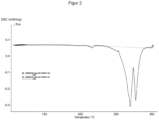
- Figure 2 shows that P666(14) fsi exhibits a significant exothermic reaction at around 270°C, but P666(14) bta does not. Both investigations confirm the lower thermal stability of the ionic liquid with the fsi anion in pure substance.
- trihexyl(tetradecyl)phosphonium bis(fluorosulfonyl)imide (P666(14) fsi) and trihexyl(tetradecyl)phosphonium bis(trifluoromethylsulfonyl)imide (P666(14) bta) are filled into cylindrical screw-top vials (base area 1.5 cm 2 , height 5 cm). 200 mg of each of the two ILs are weighed precisely.
- One vial without a ball and one vial with a ball (100Cr6 steel balls according to DIN 51350-1, edition 2015-03) are used for two test temperatures.
- the evaporation losses for both substances are naturally higher than at 150°C.
- the value curve for the P666(14) fsi is unremarkable in contrast to the lower test temperature. Nevertheless, at the end of the period they are higher than for the P666(14) bta.
- the observed values can be understood to mean that in addition to decomposition with loss of mass, phenomena such as absorption/release of water, corrosion of the steel ball and catalyzed decomposition also play a role.
- the tests of the substances in their pure form suggest that the stability of the IL containing fsi is lower than the stability of the IL containing bta.
- the base grease A consists of 85 wt.% of a trimellitic acid ester with C9 - C11 alcohols with an oxygen/carbon ratio of 0.20 with a base oil viscosity at 40°C of approx. 72 mm 2 /sec (TMSE-A), 11 wt.% of a urea thickener consisting of the reaction products of aliphatic saturated amines, aliphatic unsaturated amines and aromatic amines with a mixture of MDI (4,4'-diisocyanatodiphenylmethane) and TDI (mixture of 2,4-diisocyanatotoluene and 2,6-diisocyanatotoluene in a molar ratio of approx. 4:1).
- MDI 4,4'-diisocyanatodiphenylmethane
- TDI mixture of 2,4-diisocyanatototoluene and 2,6-diisocyanatotolu
- the grease 1 according to the invention surprisingly shows an approximately 50% improved service life at 180°C compared to the comparison grease 2, which contains an ionic liquid not according to the invention.
- the grease according to the invention also meets the service life requirement of DIN 51821 1+2 at 200°C.
- the grease 1 according to the invention shows a significant increase in the service life achieved, based on the L 50 value, by more than a factor of 2.5.
- the grease 3 according to the invention also shows an increase in service life by 50% compared to the base grease A.
- the basic fat B consists of:
- trimellitic acid ester with linear C8 and C10 alkyl groups which are present in a ratio of approximately 1:1 (molar) (TMSE-B) with an oxygen/carbon ratio of 0.22, 13.5 wt.% urea thickener, produced by the reaction of MDI (4,4'-diisocyanatodiphenylmethane) and octylamine in a ratio of 1.2 (molar), 1 wt.% p,p'-dioctyldiphenylamine, 1 wt.% calcium sulfonate corrosion inhibitor additive.
- MDI 4,4'-diisocyanatodiphenylmethane
- octylamine in a ratio of 1.2 (molar)
- 1 wt.% p,p'-dioctyldiphenylamine 1 wt.% calcium sulfonate corrosion inhibitor additive.
- the grease 6 according to the invention shows an increase in service life of approximately 50% while maintaining the very steep failure curve (high ß values).
- the grease 7 according to the invention shows an increase in service life of approximately 40%.
- Polyglycol A is a polyglycol with a kinematic viscosity of 220 mm 2 /sec. It is a random copolymer of ethylene oxide and propylene oxide in a ratio of 1:1 (molar) with glycol as starter. The oxygen/carbon ratio is 0.53.
- Trimellitic acid ester B (trimellitic acid ester with linear C8 and C10 alkyl groups, which are present in a ratio of approximately 1:1 (molar)) is used as the base oil, and p,p'-dioctyldiphenylamine is used as the amine antioxidant (Amin. AO).
- the shear viscosity is determined at 25°C at a shear rate of 300 1/s according to DIN 53019-1.3.
- the open dish test is carried out with aluminum evaporation dishes with a diameter of 50 mm. 5 g +/- 0.1 g are weighed in. The measurement is carried out in a convection oven. The measurement is carried out over 24/48/72 hours. The evaporation loss is determined and the shear viscosity is measured in each case.
- Oils 2, 3, 4, 5 and 6 represent lubricant compositions according to the invention.
- Base oil PAO 8/ trimellitic acid ester B with linear C8 and C10 alkyl groups (ratio of the two base oils 60:40). PAO 8 has an oxygen/carbon ratio of 0. The trimellitic acid ester B has an oxygen/carbon ratio of 0.22. This gives the base oil an oxygen/carbon ratio of 0.088 amount of N1888fsi 0 wt. % 1 wt. % 3 wt. % 5 wt. % 10 wt.
- the base oil mixture used here is not suitable for producing a lubricant composition according to the invention because the proportion of base oil A is too low and therefore the solubility of N1888fsi is too low.
- the trimellitic acid ester B has an oxygen/carbon ratio of 0.22. This gives the base oil an oxygen/carbon ratio of 0.15 amount of N1888fsi 0 wt. % 1 wt. % 3 wt. % 5 wt. % 10 wt.
- the base oil mixture used here is suitable for producing a lubricant composition according to the invention because a sufficient proportion of base oil A is present and thus the solubility of N1888fsi is sufficient.
- the trimellitic acid ester B has an oxygen/carbon ratio of 0.22. This gives the base oil an oxygen/carbon ratio of 0.18 amount of N1888fsi 0 wt. % 1 wt. % 3 wt. % 5 wt.
- the base oil mixture used here is suitable for producing a lubricant composition according to the invention because a sufficient proportion of base oil A is present and thus the solubility of N1888fsi is sufficient.
- Base oil Trimellitic acid ester B with linear C8 and C10 alkyl groups. The trimellitic acid ester B has an oxygen/carbon ratio of 0.22. amount of N1888fsi 0 wt. % 1 wt. % 3 wt. % 5 wt.
- the examples show that the ionic liquid N1888fsi is miscible with the trimellitic acid ester over a very wide concentration range.
- the base oil used here is suitable for producing a lubricant composition according to the invention because only base oil A is present and the solubility of N1888fsi is therefore very good.
- Base oil Polypropylene oxide homopolymer (non-polar), butanol started, kinematic viscosity at 40°C approx. 120 mm 2 /sec with oxygen/carbon ratio of 0.44 amount of N1888fsi 0 wt. % 1 wt. % 3 wt. % 5 wt.
- the base oil used here is not suitable for producing a lubricant composition according to the invention because no proportion of base oil A is present and therefore the solubility of N1888fsi is not sufficient.
- Base oil Polypropylene oxide homopolymer (non-polar), butanol initiated, kinematic viscosity at 40°C approx. 120 mm 2 /sec/ Trimellitic acid ester B with linear C8 and C10 alkyl groups (polar) mixing ratio based on mass percent 50:50. Oxygen/carbon ratio of 0.22 of the base oil is 0.33. amount of N1888fsi 0 wt. % 1 wt. % 3 wt. % 5 wt.
- the base oil mixture used here is suitable for producing a lubricant composition according to the invention, since a sufficient proportion of base oil A is present and therefore the solubility of N1888fsi is sufficient.
- Base oil Hydrogenated dimer acid ester (non-polar), alcohol component 2-ethylhexanol. Oxygen/carbon ratio is 0.10. amount of N1888fsi 0 wt. % 1 wt. % 3 wt. % 5 wt.
- the base oil used here is not suitable for producing a lubricant composition according to the invention because no proportion of base oil A is present and therefore the solubility of N1888fsi is not sufficient.
- the oxygen/carbon ratio is 0.66. amount of N1888fsi 0 wt. % 1 wt. % 3 wt. % 5 wt.
- the base oil used here is suitable for producing a lubricant composition according to the invention, since only base oil A is present and therefore the solubility of N1888fsi is very good.
- N1888fsi is readily soluble in base oils with a polar base oil content of more than 50% by weight, even in large quantities.
- the polar base oils are selected from esters and polyalkylene glycols produced with ethylene oxide as a component of the reaction mixture.
- the base grease C is classified as NLGI class 1.
- the base oil has a kinematic viscosity of 130 mm 2 /sec at 40°C and is a non-polar mixture of mineral oil/PAO.
- the oxygen/carbon ratio is almost 0.
- the thickener is a mixture of urea/calcium complex soap. It also contains the usual additives for oxidative stabilization, to improve load-bearing capacity and to protect against corrosion.
- the addition of the ionic liquid does not improve the service life; the L 50 value is even reduced. It has been shown that in greases whose base oil is non-polar (mineral oil and PAO), no improvement is achieved by using the ionic liquid.
- the weight proportion of trimellitic acid ester A in the total base oil is 52.6 wt.%.
- method standard Unit Example grease D + 3 % N8881 fsi according to invention
- Example grease D Comparison grease General data Walk penetration 60 DT DIN ISO 2137 1/10 mm 283 273 dropping point DIN ISO 2176 °C Greater than 300°C Greater than 300°C flow pressure at -40°C DIN 51805 mBar 537 825 oil separation after 30h/150°C ASTM D 6184 % by weight 7.3 5.8 specific resistance iAa DIN 53482 [ohm*cm ] 9.68E+07 3.88E+10 evaporation loss, 24 h/180°C DIN 58397 % 15.6 11.4 Shear viscosity at 25°C, shear rate 300 1/s, fresh DIN 53019-1.3 mPas 5300 5800 Shear viscosity at 25°C, shear rate 300 1/s, after evaporation loss test 24 h/180°C according to
- composition according to the invention shows advantages with regard to the reduction of the specific resistance, the low-temperature behavior (flow pressure) and the avoidance of hardening during storage at 180°C (no increase in the dynamic viscosity).
- Estolid base oil homopolymer 12-hydroxystearic acid, esterified with 2-ethylhexanol, kinematic viscosity at 40°C approx. 148 mm 2 /s; the oxygen/carbon ratio is 0.17) amount of N1888fsi 0 wt. % 1 wt. % 3 wt. % 5 wt.
- N8881 fsi is soluble in the estolide base oil in the concentration range investigated. With increasing amount of IL, the specific resistance is reduced.
- the base oil used here is suitable for producing a lubricant composition according to the invention, since only base oil A is present and thus the solubility of N1888fsi is sufficient.
- lubricant compositions and in particular greases that contain ionic liquids based on fsi as an anion achieve performance values that are in the range of a product additived with ionic liquids based on bta.
- Ionic liquids based on fsi are therefore a good alternative to ionic liquids containing bta.
- fsi-based additives have the advantage over additives containing bta of not containing any persistent CFx groups.
- the lubricant composition according to the invention can also meet the requirements regarding corrosion stability.
- lubricant compositions containing ionic liquids based on fsi are a good alternative to lubricant compositions containing ionic liquids containing bta in terms of their performance.
- the lubricant compositions according to the invention do not contain any persistent CFx groups and are therefore biodegradable.
- N1888 fsi is insoluble in base oil or base oil at a certain concentration if the turbidity value is more than 1 FNU higher than that of pure base oil or base oil when measured according to DIN EN ISO 7027 -1:2016-11 at 25°C.
- N1888 fsi is also insoluble in base oil or base oil at a certain concentration if two or more phases form. N1888 fsi is soluble in base oil or base oil at a certain concentration if the turbidity value in the turbidity measurement according to DIN EN ISO 7027 -1:2016-11 at 25°C is no more than 1 FNU higher than that of pure base oil or base oil.
- a 2100 AN IS from Hach is preferably used as the measuring device.
- JPI-5S-68-11 is used to determine oxygen levels.
- the oxygen/carbon weight ratio is obtained from the oxygen mass fraction (wt%), determined according to JPI-5S-68-11, divided by the carbon fraction (wt%), determined according to ASTM D 5291:2021.
Landscapes
- Chemical & Material Sciences (AREA)
- Chemical Kinetics & Catalysis (AREA)
- General Chemical & Material Sciences (AREA)
- Oil, Petroleum & Natural Gas (AREA)
- Organic Chemistry (AREA)
- Health & Medical Sciences (AREA)
- Emergency Medicine (AREA)
- Lubricants (AREA)
Description
- Die vorliegende Erfindung betrifft eine Schmierstoffzusammensetzung, die eine Ionische Flüssigkeit enthält, und ihre Verwendung.
- Es ist bekannt, dass Ionische Flüssigkeiten als Additive in Schmierstoffen, wie Schmierfetten und Schmierölen, eingesetzt werden können. Dadurch können tribologisch relevante Eigenschaften wie Reibung, Verschleiß und elektrische Leitfähigkeit günstig beeinflusst werden. Gute Ergebnisse werden insbesondere mit Ionischen Flüssigkeiten erzielt, die CFx enthaltende Gruppen aufweisen. Diese Gruppen sind üblicherweise in den Anionen enthalten und verbessern als Additive in Schmierstoffen deren thermische Belastbarkeit und die elektrische Leitfähigkeit. Aufgrund seiner sehr guten thermischen und hydrolytischen Beständigkeit ist das Bis(trifluormethylsulfonyl)imid (bta) ein wichtiger Vertreter dieser Anionen.
- Nachteilig an CFx enthaltenden Verbindungen ist allerdings, dass diese Gruppen nicht biologisch abbaubar und derartige Gruppen enthaltende Ionische Flüssigkeiten als Folge persistent sind.
- Aus der
EP3872154 (A1 ) ist eine Schmierstoffzusammensetzung bekannt, umfassend - a) ein Schmiermittel, insbesondere enthaltend ein unpolares Basisöl,
- b) eine erste Ionische Flüssigkeit, die in Polyalphaolefin (PAO), insbesondere in PAO 400/40, hergestellt aus 1-Decen als Monomerkomponente, löslich ist,
- c) eine zweite Ionische Flüssigkeit, die in Polyalphaolefin (PAO), insbesondere in PAO 400/40, hergestellt aus 1-Decen als Monomerkomponente, unlöslich ist.
- Als eine mögliche zweite Ionische Flüssigkeit wird unter anderem Trihexyl(tetradecyl)phosphoniumbis(fluorsulfonyl)imid genannt. Dem Fachmann ist allerdings bekannt, dass Ionische Flüssigkeiten auf Basis von Bis(fluorsulfonyl)imid (fsi) als Anion eine deutlich niedrigere thermische Beständigkeit haben als Ionische Flüssigkeiten, die CFx enthaltende Gruppen aufweisen. Dies lässt sich vor allem damit erklären, dass im fsi Anion bindungsstarke Kohlenstoff-Fluor-Verbindungen fehlen, was sich negativ auf die Stabilität des Moleküls insgesamt auswirkt.
- Nachteilig an der beschriebenen Schmierstoffzusammensetzung ist ferner, dass die Verwendung zweier verschiedener Ionischer Flüssigkeiten die Komplexität des Herstellungsprozesses und damit verbunden die Herstellungskosten erhöht, sowie, dass die Schmierstoffzusammensetzung auf unpolare Basisöle beschränkt ist. Zwar können die unpolaren Basisöle einen polaren Anteil aufweisen. Dieser beträgt jedoch stets weniger als 50 Gew.%, bezogen auf das Gesamtgewicht des Basisöls.
- Die
EP2164935B1 beschreibt die Verwendung von ausgewählten Ionischen Flüssigkeiten mit Fluor enthaltenden Anionen in Schmierstoffzusammensetzungen zur Reduktion von Alterungserscheinungen des Schmierstoffs und zur Reduktion des elektrischen Widerstands. -
US 2009/270286 A1 beschreibt Schmierölzusammensetzungen auf Basis von Mischungen von ionischen Flüssigkeiten, wobei die Schmierölzusammensetzung ein Bis(fluorosulfonyl)imid Anion enthält. -
US 2013/053287 A1 beschreibt synthetische Schmiermittel, die eine ionische Flüssigkeit und ein Imidazoliumphosphatestersalz enthalten. Bei der ionischen Flüssigkeit ist das Anion Bis(fluorosulfonyl)imid bevorzugt. - Die Aufgabe der vorliegenden Erfindung besteht darin, eine Schmierstoffzusammensetzung bereitzustellen, die auf die Verwendung von bta enthaltenden Ionischen Flüssigkeiten verzichten kann und die dennoch gute tribologisch relevante Eigenschaften im Hinblick auf Reibung, Verschleiß und elektrische Leitfähigkeit aufweist. Darüber hinaus soll die Schmierstoffzusammensetzung eine ausreichende Temperaturstabilität, von vorzugsweise mindestens 180°C aufweisen sowie einen hohen Anteil an polaren Basisölen enthalten können.
- Diese Aufgabe wird gelöst durch eine Schmierstoffzusammensetzung umfassend:
- a) 20 bis 99,5 Gew.%, bezogen auf das Gesamtgewicht der Schmierstoffzusammensetzung, eines Grundöls, wobei das Grundöl bei einer Raumtemperatur von 20°C eine Lösbarkeit für die Ionische Flüssigkeit Methyltrioctylammonium-bis(fluorsulfonyl)imid von mindestens 3 Gew.% aufweist und wobei das Grundöl ein Basisöl A in einem Anteil von mindestens 50 Gew.%, bezogen auf das Gesamtgewicht des Grundöls, aufweist, wobei das Basisöl A bei einer Raumtemperatur von 20°C eine Lösbarkeit für die Ionische Flüssigkeit Methyltrioctylammonium-bis(fluorsulfonyl)imid von mindestens 3 Gew.% aufweist,
- b) 0,5 bis 80 Gew.%, bezogen auf das Gesamtgewicht der Schmierstoffzusammensetzung, einer Ionischen Flüssigkeit, deren Anion Bis(fluorsulfonyl)imid ist,
- Erfindungsgemäß wurde gefunden, dass es mit der Schmierstoffzusammensetzung möglich ist auf die Verwendung von Ionischen Flüssigkeiten, die bta enthalten, zu verzichten und dennoch gute tribologisch relevante Eigenschaften im Hinblick auf Reibung, Verschleiß und elektrische
- Leitfähigkeit zu erhalten. Darüber hinaus kann die Schmierstoffzusammensetzung einen hohen Anteil an polaren Basisölen enthalten und sie weist außerdem eine ausreichende Temperaturstabilität, von vorzugsweise mindestens 180°C auf. Die hohe Temperaturstabilität der erfindungsgemäßen Schmierstoffzusammensetzung war überraschend, da Ionische Flüssigkeiten auf Basis von Bis(fluorsulfonyl)imid als Anion bekanntermaßen eine nur geringe thermische Stabilität aufweisen. Ohne sich auf einen Mechanismus festzulegen, wird vermutet, dass die überraschend hohe thermische Stabilität von Bis(fluorsulfonyl)imid als Anion im erfindungsgemäßen Schmierstoff auf eine Solubilisierung durch das Grundöl zurückzuführen ist, die einen stabilisierenden Effekt hat. Ebenfalls denkbar ist eine Stabilisierung durch Unterbinden bzw. Verzögern von autokatalytischen Effekten durch das Grundöl.
- Erfindungsgemäß umfasst die Schmierstoffzusammensetzung ein Grundöl, das bei einer Raumtemperatur von 20°C eine Lösbarkeit für die Ionische Flüssigkeit Methyltrioctylammonium-bis(fluorsulfonyl)imid von mindestens 3 Gew.% aufweist. Diese Lösungsfähigkeit zeigt die hohe Polarität des Grundöls. Das Grundöl enthält ferner ein Basisöl A, das ebenfalls bei einer Raumtemperatur von 20°C eine Lösbarkeit für die Ionische Flüssigkeit Methyltrioctylammonium-bis(fluorsulfonyl)imid von mindestens 3 Gew.% aufweist. Die Lösbarkeit für die Ionische Flüssigkeit Methyltrioctylammonium-bis(fluorsulfonyl)imid wird vorzugsweise wie im Kapitel Prüfmethoden beschrieben durchgeführt.
- Das Grundöl kann ein oder mehrere Basisöle A und gegebenenfalls auch von Basisöl A verschiedene Basisöle enthalten. Erfindungsgemäß bevorzugt weist aber die Schmierstoffzusammensetzung neben dem Grundöl keine weiteren Grundöle auf.
- Das Grundöl weist bei einer Raumtemperatur von 20°C eine Lösbarkeit für die Ionische Flüssigkeit Methyltrioctylammonium-bis(fluorsulfonyl)imid von mindestens 3 Gew.%, bevorzugt mindestens 5 Gew.%, noch bevorzugter von mindestens 10 Gew.% auf.
- In einer bevorzugten Ausführungsform der Erfindung weist das Grundöl bei einer Raumtemperatur von 20°C eine Lösbarkeit für die Ionische Flüssigkeit Methyltrioctylammonium-bis(fluorsulfonyl)imid zumindest im Bereich von 3 Gew.% bis 30 und/oder zumindest im Bereich von 5 Gew.% bis 30 Gew.%, und/oder zumindest im Bereich von 10 Gew.% bis 30 Gew.% und/oder zumindest im Bereich von 3 Gew.% bis 20 Gew.%, und/oder zumindest im Bereich von 5 Gew.% bis 20 Gew.%, und/oder zumindest im Bereich von 10 Gew.% bis 20 Gew.%, und/oder zumindest im Bereich von 3 Gew.% bis 15 Gew.% und/oder zumindest im Bereich von 5 Gew.% bis 15 Gew.% und/oder zumindest im Bereich von 10 Gew.% bis 15 Gew.%, auf.
- Das Basisöl A weist bei einer Raumtemperatur von 20°C eine Lösbarkeit für die Ionische Flüssigkeit Methyltrioctylammonium-bis(fluorsulfonyl)imid von mindestens 3 Gew.%, bevorzugt mindestens 5 Gew.%, noch bevorzugter von mindestens 10 Gew.% auf.
- In einer weiteren bevorzugten Ausführungsform der Erfindung weist das Basisöl A bei einer Raumtemperatur von 20°C eine Lösbarkeit für die Ionische Flüssigkeit Methyltrioctylammonium-bis(fluorsulfonyl)imid zumindest im Bereich von 3 Gew.% bis 99 und/oder zumindest im Bereich von 5 Gew.% bis 99 Gew.%, und/oder zumindest im Bereich von 10 Gew.% bis 99 Gew.% und/oder zumindest im Bereich von 3 Gew.% bis 80 Gew.%, und/oder zumindest im Bereich von 5 Gew.% bis 80 Gew.%, und/oder zumindest im Bereich von 10 Gew.% bis 80 Gew.%, und/oder zumindest im Bereich von 3 Gew.% bis 15 Gew.% und/oder zumindest im Bereich von 5 Gew.% bis 15 Gew.% und/oder zumindest im Bereich von 10 Gew.% bis 15 Gew.%, auf.
- In einer bevorzugten Ausführungsform liegt das Basisöl A in einem Anteil von 50 bis 100 Gew.% und/oder in einem Anteil von mehr als 55 Gew.%, beispielsweise von 55 bis 100 Gew.%, und/oder in einem Anteil von mehr als 60 Gew.%, beispielsweise von 60 bis 100 Gew.%, noch bevorzugter in einem Anteil von mehr als 70 Gew.%, beispielsweise von 70 bis 100 Gew.%, jeweils bezogen auf das Gesamtgewicht des Grundöls vor.
- Der Anteil des Grundöls, bezogen auf das Gesamtgewicht der Schmierstoffzusammensetzung, beträgt 20 Gew.% bis 99,5 Gew.%, bevorzugt 40 Gew.% bis 95%, noch bevorzugter 60 Gew.% bis 90%, noch bevorzugter 70 Gew.% bis 95% und insbesondere 75 Gew.% bis 85 Gew.%.
- Der Anteil des Basisöls A bezogen auf das Gesamtgewicht der Schmierstoffzusammensetzung beträgt vorzugsweise 10 Gew.% bis 99,5 Gew.%, noch bevorzugter 35 Gew.% bis 95% Gew.%, noch bevorzugter 40 Gew.% bis 90 Gew.%, insbesondere 35 Gew.% bis 85 Gew.%.
- Erfindungsgemäß ist das Basisöl A ein Ester und/oder ein Polyglycol, wobei das Polyglycol vorzugsweise ein Polyglycol ist enthaltend unsubstituierte Ethyleneinheiten als Kohlenstoffgruppe in der Wiederholeinheit. Ein besonders bevorzugtes Polyglycol ist ein Polyalkylenglycol, enthaltend unsubstituierte Ethyleneinheiten als Kohlenstoffgruppe in der Wiederholeinheit, vorzugsweise ein Polyalkylenglycol enthaltend unsubstituierte Ethyleneinheiten und methylsubstituierte Ethyleneinheiten als Kohlenstoffgruppe in der Wiederholeinheit. Ein ebenfalls bevorzugtes Polyglycol ist ein Polyalkylenglycol, enthaltend unsubstituierte Ethyleneinheiten als Kohlenstoffgruppe in der Wiederholeinheit, wobei der Gewichtsanteil der unsubstituierten Ethyleneinheiten vorzugsweise mindestens 20 Gew.% bezogen auf Gesamtgewicht des Polyglykols, beispielsweise 20 Gew.% bis 100 Gew.%, vorzugsweise mindestens 30 Gew.% bezogen auf Gesamtgewicht des Polyglykols, beispielsweise 30 Gew.% bis 100 Gew.% beträgt.
- In einer bevorzugten Ausführungsform weist der Ester ein Sauerstoff/Kohlenstoff Gewichtsverhältnis von mehr als 0,1, beispielsweise von 0,1 bis 0,35 auf, bevorzugt von mehr als 0,15, beispielsweise von 0,15 bis 0,30 auf und/oder das Polyglycol ein Sauerstoff/Kohlenstoff Gewichtsverhältnis von mehr als 0,44, beispielsweise von 0,44 bis 0,70, bevorzugt von mehr als 0,50, beispielsweise von 0,50 bis 0,68 auf.
- Ein besonders bevorzugtes Polyglycol ist ausgewählt aus Homopolymeren aus Ethylenoxid als alleinigem Monomer und/oder Copolymeren mit unsubstituierten Ethylgruppen und 1-Methylethylgruppen als Kohlenstoffgruppen in der Wiederholeinheit, wobei der Gewichtsanteil der unsubstituierten Ethyleneinheiten in den Copolymeren vorzugsweise mindestens 20 Gew.% bezogen auf Gesamtgewicht des Polyglykols, beispielsweise 20 Gew.% bis 90 Gew.%, vorzugsweise mindestens 30 Gew.% bezogen auf Gesamtgewicht des Polyglykols, beispielsweise 30 Gew.% bis 90 Gew.% beträgt. Die Endgruppen des besonders bevorzugten Polyglycols sind, unabhängig voneinander bevorzugt Hydroxidgruppen und/oder C1-C20 Alkoxidgruppen, bevorzugt C1-C6 Alkoxidgruppen. Die Alkoxid- Endgruppen können zusätzlich substituiert sein. Die Endgruppen können bei der Herstellung des Polyglycols eingebracht werden, indem die monomeren Ethylenoxide, mit einem monofunktionellen Starter zur Reaktion gebracht werden. Monofunktionelle Starter sind bevorzugt Wasser und Alkohole, insbesondere Butanol. Es können auch zwei und mehrere Ketten des Polyglycols über eine Endgruppe verknüpft sein. Bevorzugt sind als verknüpfende Endgruppe Alkylgruppen. Dies kann bei der Herstellung des Polyglycols aus Ethylenoxiden mit einem nucleophilen di- oder höherfunktionellen Starter erfolgen. Beispiele für difunktionale Starter sind Diole, insbesondere 1,2-Ethandiol.
- Bevorzugte Ester sind Carbonsäureester, vorzugsweise Monoester, Diester, Triester, Tetraester, Pentaester, Polyester, bevorzugt Estolide. Insbesondere bevorzugt sind Diester, Triester, Tetraester, Pentaester, Polyester, Estolide und Gemische hiervon. Ebenfalls bevorzugte Carbonsäureester sind aromatische Ester, bevorzugt von aromatischen C8- bis C20-, vorzugsweise C8- bis C10- Di-, Tri- oder Tetracarbonsäuren mit einem oder in Mischung vorliegenden aliphatischen C7- bis C22-Alkoholen und aliphatische Ester, bevorzugt von aliphatischen C4- bis C22- Monocarbonsäuren und/oder Dicarbonsäuren mit einem einzeln oder in Mischungen vorliegenden aliphatischen Mono-, Di-, Tri-, Tetra, Penta, Hexa-Alkohol mit einer Kohlenstoffanzahl von 3 bis 22, vorzugsweise Polyolester, wie bevorzugt Komplexester, Estolide und Gemische hiervon. Die Säure- und/oder Alkoholkomponente und/oder Hydroxycarbonsäurekomponente der Carbonsäureester weist unabhängig voneinander bevorzugt eine Anzahl an Kohlenstoffatomen von C3 bis C54 auf. Dabei weisen bevorzugte Säurekomponenten eine Anzahl an Kohlenstoffatomen von C4 bis C22 auf, bevorzugte Alkoholkomponenten eine Anzahl an Kohlenstoffatomen von C3 bis C22 und/oder bevorzugte Hydroxycarbonsäurekomponenten eine Anzahl an Kohlenstoffatomen von C14 bis C22. Bevorzugte Diester sind Diester, deren Säurekomponente weniger als 36 Kohlenstoffatome aufweist, bevorzugt 6 Kohlenstoffatome bis 20 Kohlenstoffatome, noch bevorzugter 6 Kohlenstoffatome bis 12 Kohlenstoffatome. Vorteilhaft an diesen Estern ist ihr gutes Lösevermögen für die Ionische Flüssigkeit Methyltrioctylammonium-bis(fluorsulfonyl)imid.
- Estolide sind oligomere aliphatische Hydroxycarbonsäuren, bevorzugt 12-Hydroxystearinsäure oder Oligomere von ungesättigten Carbonsäuren, bevorzugt Ölsäure, bei denen die endständige Carbonsäuregruppe mit einem Mono-Alkohol, Dialkohol, Trialkohol und/oder Tetraalkohol, bevorzugt verzweigten Monoalkoholen, ganz besonders bevorzugt Guerbet Alkoholen, verestert ist und bei denen eventuell vorhandene freie Hydroxidgruppen durch Reaktion mit Moncarbonsäuren oder Dicarbonsäuren verestert sein können. Besonders bevorzugt sind aliphatische Ester von Monocarbonsäuren und/oder Dicarbonsäuren mit einer Kohlenstoffanzahl von C3 bis C20, bevorzugt C6 bis C20, mit einem einzeln oder in Mischungen vorliegenden Mono-, Di-, Tri-, Tetra, Penta und/oder Hexa-Alkohol mit einer Kohlenstoffanzahl von 3 bis 22.
- In einer besonders bevorzugten Ausführungsform ist der Ester ausgewählt aus der Gruppe bestehend aus aliphatischem Ester von aliphatischen Monocarbonsäuren mit einer Kohlenstoffanzahl von C 5 bis C 22 mit einem einzeln oder in Mischungen vorliegenden aliphatischen Tri, Tetra, Hexa-Alkohol mit einer Kohlenstoffanzahl von C 3 bis C 10, insbesondere Trimethylolpropan, Pentaerythrit und/oder Dipentaerythrit, und/oder aliphatischem Ester von aliphatischen Dicarbonsäuren mit einer Kohlenstoffanzahl von C 6 bis C 20, mit einem einzeln oder in Mischungen vorliegenden aliphatischen Mono- und/oder Dialkohol mit einer Kohlenstoffanzahl von 6 bis 22, Estoliden und aromatischem Ester von aromatischen Tri- und Tetracarbonsäuren mit einem oder in Mischung vorliegenden aliphatischen C7- bis C22-Alkoholen und Gemischen hiervon.
- Erfindungsgemäß ebenfalls geeignete Grundöle enthalten das Basisöl A im Gemisch mit einem Basisöl B, wobei das Basisöl B bei einer Raumtemperatur von 20°C eine Lösbarkeit für die Ionische Flüssigkeit Methyltrioctylammonium-bis(fluorsulfonyl)imid von weniger als 3 Gew.%, beispielsweise von 01 Gew.% bis 3 Gew.%, bevorzugt von weniger als 2,5 Gew.%, beispielsweise von 0,01 Gew.% bis 2,5 Gew.%, noch bevorzugter von weniger als 2 Gew.%, beispielsweise von 0,01 Gew.% bis 2 Gew.%, noch bevorzugter von weniger als 1 Gew.%, beispielsweise von 0,01 Gew.% bis 1 Gew.% aufweist.
- In einer bevorzugten Ausführungsform ist das Basisöl B ein Basisöl B1, das ein Sauerstoff/Kohlenstoff Gewichtsverhältnis von höchstens 0,1, beispielsweise von 0 bis 0,1 aufweist und/oder ein Basisöl B2, das einen Anteil an Halogenen und/oder Silicium von mehr als 5 Gew.%, beispielsweise 5 Gew.% bis 30 Gew.%, vorzugsweise von 10 Gew.% bis 25 Gew.% bezogen auf das Gesamtgewicht des Basisöles B2 aufweist.
- Enthält das Grundöl das Basisöl A im Gemisch mit einem Basisöl B, so beträgt der Anteil des Basisöls A mehr als 50 Gew.%, beispielsweise von 50 bis 90 Gew.%, noch bevorzugter mehr als 60 Gew.%, beispielsweise von 60 bis 85 Gew.%, insbesondere mehr als 70 Gew.%, beispielsweise von 70 bis 85 Gew.%, bezogen auf das Gesamtgewicht des Grundöls.
- Bevorzugte Basisöle B sind ausgewählt aus der Gruppe bestehend aus Basisölen der Gruppen I, II, II+, III, IV und aus Basisölen der Gruppe V nach der Klassifizierung des American Petroleum Institute (API) [NLGI Spokesman, N. Samman, Volume 70, Number 11, S.14ff], bevorzugt Diphenylethern, alkylierten Naphthalinen, Polyisobutylenen, Silikonölen, Polytetrahydrofuranen und Oxetan Polymeren, Polyalkylenglykolen, die, vorzugsweise ausschließlich, mit aliphatischen und/oder aromatischen Alkylgruppen substituierte Ethyleneinheiten aufweisen, wobei der Gewichtsanteil an unsubstituierten Ethyleneinheiten in den Polyalkylenglykolen weniger als 20 Gew.% bezogen auf das Gesamtgewicht des Polyalkylenglykols beträgt und Estern, bevorzugt aliphatischen Estern von aliphatischen Dicarbonsäuren, mit einer Kohlenstoffanzahl von C22 bis C40, bevorzugt C34 bis C38 mit einem einzeln oder in Mischungen vorliegenden aliphatischen Mono- und/oder Dialkohol mit einer Kohlenstoffanzahl von 6 bis 22, aliphatischen Estern von aliphatischen Tricarbonsäuren, mit einer Kohlenstoffanzahl von C33 bis C60, bevorzugt C50 bis C58 mit einem einzeln oder in Mischungen vorliegenden aliphatischen Mono- und/oder Dialkohol mit einer Kohlenstoffanzahl von 6 bis 22 und Gemischen hiervon. Besonders bevorzugte Basisöle sind alkylierte Diphenylether, Polyisobutylene, Polyalfaolefine und Gemische hiervon. Die Basisöle können auch aus Gemischen der vorangegangenen Basisöle zusammengesetzt sein.
- Der Anteil des Basisöls B, falls vorhanden, beträgt vorzugsweise weniger als 50 Gew.%, beispielsweise 10 bis 49 Gew.%, noch bevorzugter höchstens 40 Gew.%, beispielsweise 10 Gew.% bis 40 Gew.%, insbesondere höchstens 30 Gew.%, beispielsweise 10 bis 30 Gew.%, bezogen auf das Gesamtgewicht des Grundöls.
- Der Anteil des Basisöls B, falls vorhanden, beträgt vorzugsweise höchstens 48 Gew.%, beispielsweise 5 bis 48 Gew.%, noch bevorzugter höchstens 40 Gew.%, beispielsweise 10 Gew.% bis 40 Gew.%, insbesondere höchstens 30 Gew.%, beispielsweise 10 bis 30 Gew.%, bezogen auf das Gesamtgewicht der Schmierstoffzusammensetzung.
- Die erfindungsgemäße Schmierstoffzusammensetzung weist bevorzugt eine kinematische Viskosität bei 40 °C von 20 mm2/sec bis 1500 mm2/sec, bevorzugt von 20 mm2/sec bis 320 mm2/sec, noch bevorzugter von 25 mm2/sec bis 220 mm2/sec, noch bevorzugter von 30 mm2/sec bis 150 mm2/sec auf. Die kinematische Viskosität wird nach ASTM D 7042, Ausgabe 2021.01 bestimmt.
- Der Anteil der Ionischen Flüssigkeit, deren Anion Bis(fluorsulfonyl)imid ist, beträgt erfindungsgemäß 0,5 Gew.% bis 80 Gew.%, noch bevorzugter 2 Gew.% bis 40 Gew.%, noch bevorzugter 2 Gew.% bis 20 Gew.%, noch bevorzugter 3 Gew.% bis 15 Gew.% und insbesondere von 5 Gew.% bis 10 Gew.%, bezogen auf das Gesamtgewicht des Schmierstoffzusammensetzung.
- In einer bevorzugten Ausführungsform enthält das Grundöl das Basisöl A und das Basisöl B in einem Gewichtsverhältnis zwischen Basisöl A und Basisöl B von mindestens 50:50, beispielsweise von 50:50 bis 60:40, besonders bevorzugt mindestens 60:40, beispielsweise von 60:40 bis 70:30, noch bevorzugter mindestens 70:30, beispielsweise von 70:30 bis 90:10, insbesondere mindestens 80:20, beispielsweise von 80:20 bis 90:10.
- In einer weiteren bevorzugten Ausführungsform enthält das Grundöl das Basisöl A und das Basisöl B in einem Gewichtsverhältnis zwischen Basisöl A und Basisöl B von 50:50 bis 60:40 und der Anteil an Ionischer Flüssigkeit, deren Anion Bis(fluorsulfonyl)imid (fsi) ist, beträgt von 0,5 bis 10 Gew.%, bevorzugt von 3 bis 10 Gew.%, bezogen auf das Gesamtgewicht der Schmierstoffzusammensetzung, und/oder in einem Gewichtsverhältnis zwischen Basisöl A und Basisöl B von 60:40 bis 70:30 und der Anteil an Ionischer Flüssigkeit, deren Anion Bis(fluorsulfonyl)imid (fsi) ist, beträgt von 0,5 Gew. % bis 15 Gew. %, bevorzugt von 3 Gew. % bis 15 Gew.%, bezogen auf das Gesamtgewicht der Schmierstoffzusammensetzung und/oder in einem Gewichtsverhältnis zwischen Basisöl A und Basisöl B von 70:30 bis 90:10 und der Anteil an Ionischer Flüssigkeit, deren Anion Bis(fluorsulfonyl)imid (fsi) ist, beträgt 0,5 Gew.% bis 40 Gew.%, bevorzugt von 3 Gew.% bis 20 Gew.%, bezogen auf das Gesamtgewicht der Schmierstoffzusammensetzung und/oder in einem Gewichtsverhältnis zwischen Basisöl A und Basisöl B von 80:20 bis 90:10 und der Anteil an Ionischer Flüssigkeit, deren Anion Bis(fluorsulfonyl)imid (fsi) ist, beträgt 0,5 Gew.% bis 80 Gew.%, bezogen auf das Gesamtgewicht des Schmierstoffzusammensetzung.
- In einer weiteren bevorzugten Ausführungsform der Erfindung weist die Ionische Flüssigkeit ein Kation auf, ausgewählt aus der Gruppe bestehend aus symmetrischen und unsymmetrischen Ammoniumionen, NR1R2R3R4+ und Phosphoniumionen PR1R2R3R4+. Die Reste R1 bis R4 können dabei unabhängig voneinander verzweigte oder unverzweigte, substituierte oder unsubstituierte C1- bis C24-, bevorzugt C1- bis C18-, besonders bevorzugt C6- bis C18-Alkylgruppen oder C6- bis C30- Arylgruppen sein. Bevorzugte Substituenten sind dabei Alkoxy, Carboxy, Amido, Amino, Thiocarboxy, Carbamoyl, Oxo, Thioxo und/oder Hydroxy.
- Vorzugsweise sind die Reste R1 bis R4 so ausgewählt, dass sie in der Summe mindestens 10 Kohlenstoffatome aufweisen, vorzugsweise mindestens 20 Kohlenstoffatome, noch bevorzugter mindestens 25 Kohlenstoffatome.
- In einer besonders bevorzugten Ausführungsform der Erfindung weist die Ionische Flüssigkeit ein oder mehrere Kationen auf, ausgewählt aus der Gruppe bestehend aus: Trihexyltetradecylphosphonium, Tributyltetradecylphosphonium, Tetraoctylphosphonium, Trioctylmethylammonium, Tributylmetylphosphonium, Tributylphosphonium. Dabei sind Trihexyltetradecylphosphonium, Tributyltetradecylphosphonium, Tetraoctylphosphonium und Trioctylmethylammonium ganz besonders bevorzugt.
- Die erfindungsgemäße Schmierstoffzusammensetzung kann auch Gemische verschiedener Ionischer Flüssigkeiten aufweisen, bei denen die Anionen jeweils Bis(fluorsulfonyl)imid sind aber die Kationen verschieden. Die erfindungsgemäße Schmierstoffzusammensetzung kann auch noch weitere Ionische Flüssigkeiten aufweisen, deren Anion nicht Bis(fluorsulfonyl)imid ist. In diesem Fall beträgt der Anteil der weiteren Ionischen Flüssigkeit vorzugsweise 0,5 Gew.% bis 5 Gew.%, bezogen auf das Gesamtgewicht der Schmierstoffzusammensetzung.
- In einer bevorzugten Ausführungsform der Erfindung weist die Schmierstoffzusammensetzung jedoch keine Ionischen Flüssigkeiten auf, deren Anion nicht Bis(fluorsulfonyl)imid ist. Dies ist vorteilhaft, da die Verwendung mehrerer Ionischer Flüssigkeiten die Komplexität des Herstellungsprozesses und damit verbunden die Herstellungskosten erhöht. Weiter bevorzugt enthält die Schmierstoffzusammensetzung keine Ionische Flüssigkeit, die Bis(trifluormethylsulfonyl)imid (bta) als Anion enthält. Dies ist aus toxikologischen Gründen vorteilhaft. In einer weiteren Ausführungsform der Erfindung weist die Schmierstoffzusammensetzung keine Ionischen Flüssigkeiten, deren Anion nicht Bis(fluorsulfonyl)imid ist, auf oder diese höchstens in einem Anteil von 0,5 Gew.%, bezogen auf das Gesamtgewicht der Schmierstoffzusammensetzung. Weiter bevorzugt enthält die Schmierstoffzusammensetzung keine Ionische Flüssigkeit, die Perfluoralkylgruppen enthält oder Ionische Flüssigkeiten, die Perfluoralkylgruppen enthalten, in einem Anteil von höchstens 0,5 Gew.%, bezogen auf das Gesamtgewicht der Schmierstoffzusammensetzung. Dies ist aus toxikologischen Gründen vorteilhaft.
- In einer besonders bevorzugten Ausführungsform der Erfindung ist die Ionische Flüssigkeit, deren Anion Bis(fluorsulfonyl)imid ist, ausgewählt aus der Gruppe bestehend aus:
- P666(14) fsi, Trihexyl(tetradecyl)phosphonium bis(fluorsulfonyl)imid

- N1888 fsi, Methyltrioctylammonium-bis(fluorsulfonyl)imid

- P444(14) fsi, Tributyltetradecylphosphonium-bis(fluorsulfonyl)imid

- P8888 fsi, Tetraoctylphosphonium- bis(fluorsulfonyl)imid

- In einer weiteren bevorzugten Ausführungsform der Erfindung enthält die Schmierstoffzusammensetzung ein Verdickungsmittel. Mithin ist die Schmierstoffzusammensetzung in einer bevorzugten Ausführungsform als Schmierfett ausgebildet.
- Schmierfette sind eine bevorzugte Ausführungsform der Schmierstoffzusammensetzung, weil die positiven Wirkungen auf die Lebensdauer, zurückzuführen auf die Ionische Flüssigkeit fsi, in Schmierfetten besonders zum Tragen kommen, da Schmierfette üblicherweise in geringeren Mengen als Schmieröle an der Schmierstelle vorliegen.
- Bevorzugt enthält die Schmierstoffzusammensetzung das Verdickungsmittel in einem Anteil von 3 bis 35 Gew.%, noch bevorzugter von 4 bis 30 Gew.%, insbesondere von 6 bis 20 Gew.%, jeweils bezogen auf das Gesamtgewicht der Schmierstoffzusammensetzung.
- Bevorzugt liegt die Walkpenetration (in 1/10 mm) der als Schmierfett ausgebildeten Schmierstoffzusammensetzung zwischen 400 bis 200, noch bevorzugter zwischen 330 bis 220, noch bevorzugter zwischen 300 und 250. Die Walkpenetration wird dabei nach DIN ISO 2137, Ausgabe 2016.12 bestimmt.
- Vorzugsweise ist das Verdickungsmittel ausgewählt aus Harnstoff, Aluminiumkomplexseifen, Metall-Einfachseifen der Elemente der 1. und 2. Hauptgruppe des Periodensystems, insbesondere Lithiumeinfachseifen, Metall-Komplexseifen der Elemente der 1. und 2. Hauptgruppe des Periodensystems, insbesondere Lithiumkomplexseifen, Bentonit, Sulfonat, Silikat, Polyimid sowie Gemischen hiervon. Unter Harnstoff versteht man Reaktionsprodukte von organischen Mono-, Di-, Tri- und höherfunktionellen Isocyanaten und/oder deren Gemischen mit aliphatischen und/oder aromatischen Mono-, Di-, Tri- oder höherfunktionellen organischen Aminen.
- In einer weiteren besonders bevorzugten Ausführungsform ist das Verdickungsmittel ein Harnstoff. Vorteilhaft an Harnstoffen ist, dass sie bei hohen Anwendungstemperaturen verwendet werden können und damit die Kombination mit der Ionischen Flüssigkeit, enthaltend fsi als Anion, zu Schmierfetten mit besonders langer Lebensdauer führt. Ein bevorzugter Harnstoff ist ein Reaktionsprodukt aus einem Diisocyanat, vorzugsweise 2,4-Diisocyanatotoluol, 2,6-Diisocyanatotoluol, 4,4'-Diisocyanatodiphenylmethan 2,4'-Diisocyantodiphenylmethan, 4,4'-Diisocyanatodiphenyl, 4,4'-Diisocyanato-3,3'-dimethyldiphenyl, 4,4'-Diisocyanato-3,3'-dimethylphenylmethan, die einzeln oder in Kombination verwendet werden können, mit einem Amin oder Diamin der allgemeinen Formel (H2N)xR, wobei x = 1 oder 2 ist, und R ein Aryl-, Alkyl-, Cycloalkyl- oder Alkylenrest mit 2 bis 22 Kohlenstoffatomen ist, die einzeln oder in Kombination vorhanden sind.
- In einer besonders bevorzugten Ausführungsform ist das Verdickungsmittel ein Diharnstoff, der aliphatische, cycloaliphatisch/aliphatische und/oder cycloaliphatische Harnstoffe enthält.
- In einer besonders bevorzugten Ausführungsform ist das Verdickungsmittel ein durch Formel A dargestellter Diharnstoff

- Erfindungsgemäß bevorzugt verwendbare Diharnstoffverbindungen sind beschrieben in der
DE112012001102A1 . - Bevorzugte Verdicker enthalten Diharnstoffverbindungen ausgewählt aus:
- einem aliphatischen Harnstoff der Formel A:

- einem aliphatischen Harnstoff der Formel B:

- einem aliphatischen Harnstoff der Formel C:

- einem cycloaliphatisch/aliphatischen Harnstoff der Formel D:

- einem cycloaliphatisch/aliphatischen Harnstoff der Formel E:

- einem cycloaliphatischen Harnstoff der Formel F:

- Bei den Harnstoffen der Formeln A - E sind die Alkylgruppen unverzweigt.
- In einer weiteren besonders bevorzugten Ausführungsform ist das Verdickungsmittel eine Lithiumkomplexseife. Vorteilhaft an Lithiumkomplexseifen ist, dass sie bei hohen Anwendungstemperaturen verwendet werden können und damit die Kombination mit der ionischen Flüssigkeit, enthaltend fsi als Anion, zu Schmierfetten mit besonders langer Lebensdauer führt. Bevorzugte Lithiumkomplexseifen sind hergestellt, ausgehend von C4-C36 Dicarbonsäuren, vorzugsweise Azelainsäure, Sebazinsäure, Korksäure, Terephthalsäure, Dodecandisäure und/oder ausgehend von höherfunktionalen Carbonsäuren mit 3 oder mehr, vorzugsweise 3 bis 4 Carbonsäuregruppen, wobei die Anzahl an Kohlenstoffgruppen 6 bis 60 betragen kann, wie bevorzugt Zitronensäure und Trimersäuren, und/oder ausgehend von Esterverbindungen, insbesondere Methylestern und/oder Triglyceriden einer oder mehrerer der vorgenannten Säuren, jeweils kombiniert mit einer oder mehreren Monocarbonsäuren, vorzugsweise kombiniert mit einer oder mehreren C4-C24 Monocarbonsäuren, vorzugsweise Stearinsäure, Hydroxystearinsäure, insbesondere 12-Hydroxystearinsäure, Palmitinsäure, Ölsäure, Salicylsäure, Esterverbindungen, insbesondere Methylestern und/oder Triglyceriden einer oder mehrerer der vorgenannten Säuren und/oder kombiniert mit Sebazinsäuremonostearylamid und/oder Terephthalsäuremonostearylamid. Unter Trimersäuren versteht man durch Trimerisation ungesättigter Fettsäuren gewonnene Tricarbonsäuren mit bevorzugt 54 Kohlenstoff-Atomen, die Alkyl-Seitenketten, Doppelbindungen und cyclische Ringsysteme enthalten.
- Die Schmierstoffzusammensetzung kann auch anorganische und/oder organische Festschmierstoffe enthalten. Bevorzugte Festschmierstoffe sind ausgewählt aus der Gruppe bestehend aus Polytetrafluorethylen (PTFE), Molybdändisulfid, Graphit, Graphen, Bornitrid (hexagonal), Zinn(IV)-Sulfid, Zink(II)-Sulfid, Wolframdisulfid, Metallsulfid, Phosphat, vorzugsweise Calciumphosphat, Carbonat, vorzugsweise Calciumcarbonat, Metalloxid, vorzugsweise amorphem Siliziumdioxid, Silikat und Schichtsilikat, Talk, Glimmer und Gemischen hiervon. Besonders bevorzugte Festschmierstoffe sind ausgewählt aus der Gruppe bestehend aus Molybdändisulfid, Graphit, Graphen, Bornitrid (hexagonal), Zinn(IV)-Sulfid, Zink(II)-Sulfid, Wolframdisulfid, Metallsulfid, Phosphat, vorzugsweise Calciumphosphat, Carbonat, vorzugsweise Calciumcarbonat, Metalloxid, vorzugsweise amorphem Siliziumdioxid, Silikat und Schichtsilikat, Talk, Glimmer und Gemischen hiervon.
- Sofern vorhanden beträgt der Anteil an Festschmierstoff in der erfindungsgemäßen Schmierstoffzusammensetzung vorzugsweise 0,5 Gew.% bis 23 Gew.%, noch bevorzugter 0,5 Gew.% bis 20 Gew.% und insbesondere 0,5 Gew.% bis 18 Gew.%, jeweils bezogen auf das Gesamtgewicht der Schmierstoffzusammensetzung.
- Darüber hinaus kann die Schmierstoffzusammensetzung Additive, beispielsweise gegen Korrosion, Oxidation (Antioxidanten) und zum Schutz gegen Metalleinflüsse, beispielsweise Chelatverbindungen, Radikalfänger, UV-Stabilisatoren, Reaktionsschichtbildner, Viskositätsverbesserer, Pourpoint Depressants, Haftverbesserer und/oder Additive zur Reduktion der Ölabscheidung bei Fetten enthalten.
- Vorzugsweise beträgt der Anteil an Additiven in der erfindungsgemäßen Schmierstoffzusammensetzung 0,5 Gew.% bis 23 Gew.%, noch bevorzugter 0,5 Gew.% bis 20 Gew.%, noch bevorzugter 1 Gew.% bis 18 Gew.% und insbesondere 1,5 Gew.% bis 12 Gew.%, bezogen auf das Gesamtgewicht der Schmierstoffzusammensetzung. Bevorzugt werden Additive in Form von phosphor-, schwefelhaltigen, stickstoffhaltigen und/oder sauerstoffhaltigen Verbindungen, Polymeren und/oder Gemischen davon eingesetzt. Besonders bevorzugte Additive sind aromatische Amine, Phenole, insbesondere alkylierte Phenole, Triazole wie Benzotriazole, Tolyltriazole, Ester insbesondere geschwefelte Fettsäureester, Glycerin-mono- oder di-ester, Sorbitanester, Thiadiazole, Dithiocarbamate, insbesondere Molybdändithiocarbamate, Phosphate, insbesondere Thiophosphate, oligomere Phosphate, oligomere Thiophosphate, Dithiophosphate, Zinkdialkyldithiophosphate, Molybdändithiophosphate, Aminphosphate,Trialkylphosphate, Triarylphosphate, Phosphite, Metallsalze, Carbonsäuren, Polymere, insbesondere Polymethacrylate, Olefincopolymere und/oder Gemische davon.
- Ganz bevorzugte Additive sind aromatische Amine, alkylierte Phenole, Thiadiazole, Dithiocarbamate, Triarylphosphate, Aminphosphate, Benzotriazole und/oder deren Gemische.
- Ganz besonders bevorzugte Additive sind aromatische Amine, da überraschend gefunden wurde, dass bei ihrer Verwendung eine besonders starke Verzögerung des Oxidationsbeginns durch die Ionische Flüssigkeit erreicht werden kann.
- Erfindungsgemäß bevorzugte aromatische Amine sind styrolisiertes Diphenylamin, Phenyl-alpha-naphthylamin, Phenyl-beta-naphthylamin, octyliertes und/oder butyliertes Diphenylamin, insbesondere p,p`-Dioctyldiphenylamin, nonyliertes Diphenylamin. Mithin weist die Schmierstoffzusammensetzung in einer besonders bevorzugten Ausführungsform der Erfindung Diphenylamin, insbesondere p,p`-Dioctyldiphenylamin als Antioxidanten auf.
- In einer weiteren bevorzugten Ausführungsform der Erfindung umfasst die Schmierstoffzusammensetzung die Additive in einem Anteil von 0,5 Gew.% bis 23 Gew.%, noch bevorzugter von 0,5 Gew.% bis 20 Gew.%, insbesondere von 0,5 Gew.% bis 10 Gew.%, bezogen auf das Gesamtgewicht der Schm ierstoffzusam mensetzung.
- Vorzugsweise ist die Schmierstoffzusammensetzung gekennzeichnet durch eine untere Gebrauchstemperatur von nicht größer als -30°C, beispielsweise von -60°C bis -30°C, bevorzugt nicht größer als -40°C, beispielsweise von - 60°C bis -40°C, bestimmt nach IP 186, Edition 2015 und/oder bevorzugt eine obere Gebrauchstemperatur von mindestens +160°C, beispielsweise von 160°C bis 220°C, bevorzugt mindestens +180°C, beispielsweise von 180°C bis 220°C, bestimmt nach DIN 51821 1+2, Ausgabe 2016,7.
- Ein weiterer Gegenstand der vorliegenden Erfindung ist eine Schmierstoffzusammensetzung umfassend:
- a) 20 bis 99,5 Gew.%, bezogen auf das Gesamtgewicht der Schmierstoffzusammensetzung, eines Grundöls, wobei das Grundöl ein Basisöl A' in einem Anteil von mindestens 50 Gew.%, bezogen auf das Gesamtgewicht des Grundöls, aufweist, wobei das Basisöl A' einen Ester mit einem Sauerstoff/Kohlenstoff Gewichtsverhältnis von mehr als 0,1, beispielsweise von 0,1 bis 0,35, bevorzugt von mehr als 0,15, beispielsweise von 0,15 bis 0,30 aufweist und/oder ein Polyglycol, vorzugsweise ein Polyglycol, enthaltend unsubstituierte Ethyleneinheiten als Kohlenstoffgruppe in der Wiederholeinheit, mit einem Sauerstoff/Kohlenstoff Gewichtsverhältnis von mehr als 0,44, beispielsweise von 0,44 bis 0,70, bevorzugt von mehr als 0,50, beispielsweise von 0,50 bis 0,68,
- b) 0,5 bis 80 Gew.%, bezogen auf das Gesamtgewicht der Schmierstoffzusammensetzung, einer Ionischen Flüssigkeit, deren Anion Bis(fluorsulfonyl)imid ist.
- Dabei umfassen bevorzugte Ausführungsformen der vorgenannten Schmierstoffzusammensetzung im Bezug auf die erfindungsgemäße Schmierstoffzusammensetzung beschriebene Ausführungsformen mutatis mutandis. Beispielsweise umfassen bevorzugte Ausführungsformen der vorgenannten Schmierstoffzusammensetzung für das Basisöl A' im Bezug auf die erfindungsgemäße Schmierstoffzusammensetzung beschriebene Ausführungsformen für das Basisöl A.
- Ein weiterer Gegenstand der vorliegenden Erfindung umfasst die Verwendung der erfindungsgemäßen Schmierstoffzusammensetzung zur Schmierung von Antriebselementen, vorzugweise von Wälzlagern, Getrieben, Gleitlagern, Aktuatoren und/oder Ketten.
- Bevorzugt sind Antriebselemente, vorzugweise Wälzlager, Getriebe, Gleitlager, Aktuatoren und/oder Ketten, an denen elektrische Potentiale anliegen.
- Weiter bevorzugte Antriebselemente sind Wälzlager, Getriebe, Gleitlager, Aktuatoren und/oder Ketten, die in Anlagen und Maschinen zur Herstellung und Förderung von Lebensmitteln, in Windkraftanlagen, in Fahrzeugen, vorzugsweise Automobilen, insbesondere in Hybrid- und Elektrofahrzeugen, in Schienenfahrzeugen, Industrieanlagen, Industrierobotern und/oder in Schiffen angeordnet sind.
- Besonders bevorzugt sind die Antriebselemente ausgewählt aus Pulleylagern, Lüfterlagern, Vakuumpumpenlagern, Wälzlagern von Elektromotoren, insbesondere von Hybrid- und Elektrofahrzeugen, Generatoren, insbesondere von Elektrofahrzeugen und Schienenfahrzeugen, Windkraftanlagen, Industriemotoren, Nebenaggregaten in Fahrzeugen und/oder Gelenken von Fahrzeugen.
- Besonders bevorzugt wird die Schmierstoffzusammensetzung zur Schmierung von Wälzlagern von Elektromotoren von Hybrid- und/oder Elektrofahrzeugen eingesetzt.
- Hieran ist vorteilhaft, dass die erfindungsgemäße Schmierstoffzusammensetzung eine für diese Anwendungen besonders geeignete Kombination von Eigenschaften zeigt. Besonders vorteilhaft ist die sehr gute Temperaturstabilität kombiniert mit der Ableitfähigkeit für elektrische Potentiale.
- Ein weiterer Gegenstand der vorliegenden Erfindung umfasst die Verwendung der Schmierstoffzusammensetzung zur Schmierung von Antriebselementen, vorzugweise von Wälzlagern, bei denen eine untere Gebrauchstemperatur von nicht größer als -30°C, beispielsweise von -60°C bis -30°C, bevorzugt nicht größer als -40°C, beispielsweise von -60°C bis -30°C, bestimmt nach IP 186, Edition 2015 und/oder bevorzugt eine obere Gebrauchstemperatur von mindestens +160°C, beispielsweise von 160°C bis 220°C, noch bevorzugter mindestens +180°C, beispielsweise von 180°C bis 220°C, bestimmt nach DIN 51821 1+2 Ausgabe 2016,7 notwendig ist.
- Im Folgenden wird die Erfindung anhand mehrerer, die Erfindung nicht beschränkender Beispiele näher erläutert.
- Es werden TGA- Messungen der Ionischen Flüssigkeiten Trihexyl(tetradecyl)phosphonium bis(fluorsulfonyl)imid (P666(14) fsi) und Trihexyl(tetradecyl)phosphonium bis(trifluormethylsulfonyl)imid (P666(14) bta) durchgeführt und die erhaltenen Werte miteinander verglichen.
P666(14) bta P666(14) fsi P666(14) bta P666(14) fsi TGA dynamisch i.A.a. DIN 51006 Heizrate 1°C/min Spülgas Luft Stickstoff Antioxidans keine Tiegelmaterial Aluminium Verdampfungsverlust 120°C % (m) - 0,6 0,6 0,1 Verdampfungsverlust 140°C % (m) - 0,8 0,8 0,2 Verdampfungsverlust 160°C % (m) - 0,9 1,0 0,3 Verdampfungsverlust 180°C % (m) 0,4 1,2 1,1 0,5 Verdampfungsverlust 200°C % (m) 0,5 2,4 1,2 1,0 Verdampfungsverlust 220°C % (m) 0,8 3,9 1,3 1,9 Verdampfungsverlust 240°C % (m) 1,4 6,7 1,5 3,6 Verdampfungsverlust 260°C % (m) 2,1 12,9 1,8 7,3 Tabelle 2: TGA-Verdampfungsverluste unter Luft und N2 - Die TGA-Messungen zeigen, wie erwartet, eine bessere Temperaturstabilität für das P666(14) bta gegenüber P666(14) fsi. Sowohl bei der Messung mit Luft als auch mit N2 sind die Werte für Verdampfungsverluste für das P666(14) bta niedriger. Die bessere Temperaturstabilität für das bta lässt sich durch die bindungsstarke Kohlenstoff-Fluor-Verbindung im Anion erklären.
- Es werden DSC- Messungen der Ionischen Flüssigkeiten Trihexyl(tetradecyl)phosphonium bis(fluorsulfonyl)imid (P666(14) fsi) und Trihexyl(tetradecyl)phosphonium bis(trifluormethylsulfonyl)imid (P666(14) bta) durchgeführt.
- In
Figur 1 sind die Ergebnisse der DSC-Messungen unter O2-Atmosphäre dargestellt und inFigur 2 die Ergebnisse der DSC-Messungen unter N2-Atmosphäre. - Bei
Figur 1 ist zu erkennen, dass die P666(14) fsi einen früheren Onset und damit eine geringere Stabilität aufweist als P666(14) bta. -
Figur 2 zeigt, dass P666(14) fsi eine deutliche exotherme Reaktion um 270°C aufweist, das P666(14) bta aber nicht. Beide Untersuchungen bestätigen die geringere thermische Beständigkeit der Ionischen Flüssigkeit mit dem fsi Anion in Reinsubstanz. - Um den Verdampfungsverlust zu bestimmen, werden Trihexyl(tetradecyl)phosphonium bis(fluorsulfonyl)imid (P666(14) fsi) und Trihexyl(tetradecyl)phosphonium bis(trifluormethylsulfonyl)imid (P666(14) bta) in zylindrische Gewindegläschen (Grundfläche 1.5 cm2, Höhe 5 cm) gefüllt. Es werden jeweils 200 mg der beiden IL genau eingewogen. Für zwei Prüftemperaturen wird jeweils ein Gläschen ohne Kugel und ein Gläschen mit Kugel (100Cr6 Stahlkugeln nach DIN 51350-1, Ausgabe 2015-03) verwendet. Damit soll geprüft werden, ob Reaktionen zwischen dem Metall der Kugel und der ionischen Flüssigkeit im Gläschen auftreten.
Tabelle 3: Werte bei 150°C P666(14) bta fsi P666(14) bta fsi ohne Kugel mit Kugel Verdampfungsverlust nach 24 h [%] 1,15 -0,30 14,28 0 Verdampfungsverlust nach 48 h [%] 1,45 -0,15 15,94 14,44 Verdampfungsverlust nach 72 h [%] 1,45 -0,70 16,42 13,40 Verdampfungsverlust nach 168 h [%] 1,80 -1,90 17,40 12,03 Tabelle 4: Werte bei 180°C P666(14) bta fsi P666(14) bta fsi ohne Kugel mit Kugel Verdampfungsverlust nach 24 h [%] 1,50 0,50 2,00 0 Verdampfungsverlust nach 48 h [%] 2,00 2,64 2,59 1,85 Verdampfungsverlust nach 72 h [%] 2,25 5,33 4,59 4,13 Verdampfungsverlust nach 168 h [%] 2,99 13,04 4,60 14,04 - Bei einer Prüftemperatur von 150°C zeigen sich für beide Ionischen Flüssigkeiten in Reinsubstanz Unterschiede beim Verdampfungsverlust. Bei den Proben ohne Kugel erfolgt für das P666(14) bta ein durchgehender Anstieg des Verdampfungsverlustes über den gemessenen Zeitraum. Im Vergleich dazu lässt sich bei den Werten für die fsi-Probe insgesamt eine Gewichtszunahme beobachten. In Anwesenheit der Stahlkugel zeigt sich bei P666(14) fsi ein geringerer Verdampfungsverlust als bei P666(14) bta. Mit Kugel haben beide Substanzen insgesamt deutlich höhere Werte beim Verdampfungsverlust. Für das P666(14) fsi fällt der Wert nach anfänglichem Anstieg zum Ende hin jedoch wieder ab.
- Bei 180° sind die Verdampfungsverluste für beide Substanzen naturgemäß höher als bei 150°C. Der Werteverlauf für das P666(14) fsi ist im Gegensatz zur niedrigeren Prüftemperatur unauffällig. Trotzdem liegen diese am Ende des Zeitraums höher als beim P666(14) bta. Insgesamt können die beobachteten Werte so verstanden werden, dass neben einer Zersetzung unter Massenverlust auch Phänomene wie Aufnahme/Abgabe von Wasser, Korrosion der Stahlkugel und katalysierte Zersetzung eine Rolle spielen. Bei 180°C legen die Versuche der Substanzen in Reinform nahe, dass die Beständigkeit der fsi enthaltenden IL geringer ist als die Beständigkeit der bta enthaltenden IL.
- Herstellung zweier erfindungsgemäßer Fette und eines Vergleichsfettes aus einem Grundfett A.
- Das Grundfett A besteht zu 85 Gew.% aus einem Trimellithsäureester mit C9 - C11 Alkoholen mit einem Sauerstoff/Kohlenstoff Verhältnis von 0,20 mit einer Grundölviskosität bei 40°C von ca. 72 mm2/sec (TMSE-A), aus 11 Gew.% eines Harnstoffverdickers bestehend aus den Reaktionsprodukten von aliphatischen gesättigten Aminen, aliphatischen ungesättigten Aminen und aromatischen Aminen mit einem Gemisch aus MDI (4,4`-Diisocyanatodiphenylmethan) und TDI (Gemisch aus 2,4-Diisocyanatotoluol und 2,6-Diisocyanatotuol im molaren Verhältnis von ca. 4:1). Als Additive werden 0,5 Gew.% p,p`-Dioctyldiphenylamin und 3,5 Gew.% weitere Additive (Korrosionsschutz, Anti Wear) verwendet.
- Zu diesem Grundfett A werden 5 Gew.% P666(14) fsi (erfindungsgemäßes Fett 1) bzw. 5 Gew.% P666(14) bta (Vergleichsfett 2) gegeben und die Mischungen über ein Dreiwalzwerk homogenisiert. Beim erfindungsgemäßen Fett 3 werden 5 Gew.% N1888 fsi verwendet und identisch eingearbeitet.
- Verglichen mit dem Grundfett A ist der spezifische elektrische Widerstand um ca. 3 Zehnerpotenzen abgesenkt. Das erfindungsgemäße Fett 1 zeigt überraschenderweise eine um ca. 50% verbesserte Lebensdauer bei 180°C verglichen mit dem Vergleichsfett 2, das eine nicht erfindungsgemäße Ionische Flüssigkeit enthält. Das erfindungsgemäße Fett erfüllt auch die Lebensdaueranforderung der DIN 51821 1+2 bei 200°C
Methode Norm Einheit Fett 1 erfindungsgemäß Fett 2 Vergleichsfett Allgemeine Daten Aussehen, Farbe visuell beige beige Walkpenetration 60 DT DIN ISO 2137 1/10 mm 269 278 Tropfpunkt DIN ISO 2176 °C 262 268 Wassergehalt nach Karl Fischer % 0,05 0,06 Verhalten nach Walkung Verlängerte Walkbeständigkeit nach 100.000 DT DIN ISO 2137 1/10 mm +40 +53 Tieftemperaturverhalten Fließdruck bei -45°C DIN 51805 mBar 675 650 Ölabscheidung Ölabscheidung nach 30h/150°C ASTM D 6184 Gew % 3,7 2,8 Ölabscheidung nach 168h/40°C DIN 51817 Gew % 2,1 1,6 Obere Gebrauchstemperatur FAG FE 9 6000 rpm, 1.500 N, 180°C, B, Ausgabe 2016,07 DIN 51821 1+2 h L 10: 691 h L 10: 423 h L 50: 694 h L 50: 457 h FAG FE 9 6000 rpm, 1.500 N, 200°C, B, Ausgabe 2016,07 DIN 51821 1+2 h L 10: 113 h L 50: 249 h Medienbeständigkeit Wasserbeständigkeit statisch, 3h/90°C DIN 51807 0 0 SKF Emcor, dest. Wasser i.A.a. DIN 0 0 51802 Korrosionsverhalten Kupferkorrosion 24h/160°C DIN 51811 1 1 Geräuschverhalten SKF BeQuiet+ i.A.a. ÖNorm M8127 GN3 GN3 Elektrische Leitfähigkeit Spezifischer Elektrischer Widerstand i.A.a DIN 53482 Ohm*c m 3,18 * 106 3,81 * 106 Methode Anforderungen Fett 1 erfindungsgemäß Fett 3 erfindungsgemäß Grundfett A FAG FE 9 6000 rpm, 1.500 N, 200°C, B, DIN 51821 1+2, Ausgabe 2016.07 L 50 > 100h L 10: 113 h L 10: 105 h L 10: 60 h L 50: 249 h L 50: 146 h L 50: 90 h - Bei der Lebensdauerprüfung bei 200°C zeigt das erfindungsgemäße Fett 1 eine deutliche Steigerung bei der erreichten Lebensdauer, bezogen auf den L 50 Wert um mehr als den Faktor 2,5. Das erfindungsgemäße Fett 3 zeigt ebenfalls eine Steigerung der Lebensdauer um 50 % gegenüber dem Grundfett A.
- Es werden mehrere erfindungsgemäße Fette und ein Vergleichsfett aus einem Grundfett B hergestellt.
- 84,5 Gew.% Trimellithsäureester mit linearen C8 und C10 Alkylgruppen, die ca. im Verhältnis 1:1 (molar) vorliegen (TMSE-B) mit einem Sauerstoff/Kohlenstoff Verhältnis von 0,22, 13,5 Gew.% Harnstoffverdicker, hergestellt durch die Umsetzung von MDI (4,4`-Diisocyanatodiphenylmethan) und Oktylamin im Verhältnis 1.2 (molar), 1 Gew.% p,p'-Dioctyldiphenylamin, 1 Gew.% Calciumsulfonat-Korrosionschutzadditiv.
Gehalt Grundfett B N1888 fsi (Gew.%) P666614 fsi Gew.% FAG FE 9 6000 rpm, 1.500 N, 200°C, B, DIN 51821 1+2, Ausgabe 2016.07 Grundfett B 100 L 10 = 145 h L 50 = 187 h ß = 7,4 Erfindungsgemäßes Fett 4 99 1 L 10 = 92 h L 50 = 219 h ß = 2,2 Erfindungsgemäßes Fett 5 97 3 L 10 = 83 h L 50 = 141 h ß = 3,5 Erfindungsgemäßes Fett 6 95 5 L 10 = 203 h L 50 = 261 h ß = 7,5 Erfindungsgemäßes Fett 7 90 10 L 10 = 139h L 50 = 229 h ß = 3,8 Erfindungsgemäßes Fett 8 97 3 - Das erfindungsgemäße Fett 6 zeigt gegenüber dem Grundfett B (Vergleichsfett) eine Steigerung der Lebensdauer um ca. 50 % bei Erhalt der sehr steilen Ausfallkurve (hohe ß Werte). Das erfindungsgemäße Fett 7 zeigt eine Erhöhung der Lebensdauer um ca. 40 %.
- Alle erfindungsgemäßen Fette bestehen die Anforderung der DIN 51821 1+2 bei 200°C, da der L 50 Wert über 100 h liegt. Dadurch ist es möglich, den elektrischen Widerstand abzusenken (siehe nachfolgende Tabelle) unter Erhalt der oberen Gebrauchstemperatur von 200°C.
Spezifischer elektrischer Widerstand [ohm*cm], 10 V Gleichspannung i.A.a DIN 53482 Walkpenetration 60 Doppelhübe [1/10mm] DIN ISO 2137 Grundfett B 2,85E*10exp09 242 Erfindungsgemäßes Fett 4 3,51*10exp07 249 Erfindungsgemäßes Fett 5 5,98*10exp06 256 Erfindungsgemäßes Fett 6 2,35*10exp06 263 Erfindungsgemäßes Fett 7 7,49*10exp05 261 Erfindungsgemäßes Fett 8 5,51*10exp06 254 - Durch die Zugabe der IL P666(14) fsi wird der spezifische elektrische Widerstand signifikant heruntergesetzt. Die Walkpenetration verändert sich dagegen nur in geringem Umfang, was zeigt, dass die Verdickungswirkung durch die ionische Flüssigkeit nicht gestört wird.
- Es wird der spezifische elektrische Widerstand von Mischungen von P666(14) fsi bzw. P666(14) bta in einem Polyglykol gemessen.
- Als Polyglykol A wird ein Polyglykol mit einer kinematischen Viskosität von 220 mm2/sec verwendet. Es handelt sich um ein random Copolymer aus Ethylenoxid und Propylenoxid im Verhältnis 1:1 (molar) mit Glykol als Starter. Das Sauerstoff/Kohlenstoff Verhältnis beträgt 0,53.
Gehalt Polyglykol A (Gew.%) 100 99 97 65 90 Gehalt P666(14) fsi (Gew.%) 0 1 3 5 10 spez. Widerstand [Mohm*cm] 7,10 0,41 0,13 0,079 0,031 Gehalt Polyglykol A (Gew.%) 100 99 97 65 90 Gehalt P666(14) bta (Gew.%) 0 1 3 5 10 spez. Widerstand [Mohm*cm i.A.a DIN 53482] 7,10 0,68 0,22 0,13 0,056 - Die Tabellen zeigen, dass die erfindungsgemäßen Schmierstoffzusammensetzungen mit P666(14) fsi zu niedrigeren spezifischen Widerständen im Vergleich zu P666(14) bta führen.
- Dies war überraschend, da, wie in der folgenden Tabelle dargestellt, die Viskositäten von P666(14) fsi höher als die von P666(14) bta sind.
- Dies spricht dafür, dass beim fsi das Ionenpaar eigentlich fester aneinander gebunden, d.h. weniger beweglich ist, und deshalb eher geringere Leitfähigkeiten zeigen sollte. Dies ist aber, wie oben gezeigt, überraschenderweise nicht der Fall.
Beispiel 7 P666(14) fsi P666(14) bta Viskosität bei 40°C [mm2/s] 152,9 147,4 Viskosität bei 100°C [mm2/s] 19,87 18,33 VI 150 139 Dichte bei 20°C [g/cm3] 1,014 1,077 Dichte bei 100°C [g/cm3] 0,963 1,020 - Es wird der Einfluss von N1888 fsi auf die thermisch oxidative Beständigkeit eines Esteröles untersucht.
- Als Grundöl wird der Trimellithsäureester B (Trimellithsäureester mit linearen C8 und C10 Alkylgruppen, die ca. im Verhältnis 1:1 (molar) vorliegen) verwendet, als aminischer Antioxidant (Amin. AO) p,p'-Dioctyldiphenylamin.
Bezeichnung Öl 1 Öl 2 Öl 3 Öl 4 Amin. AO 1 1 3 3 N8881 fsi 0 1 1 3 TMSE-B 99 98 96 94 TGA, Luft, Temperaturgr adient 1 k/min 180 0,1 180 0,1 180 0,3 180 0,1 200 0,2 200 0,3 200 0,4 200 0,3 220 0,5 220 0,5 220 0,8 220 0,7 240 1,2 240 1,2 240 1,7 240 1,8 260 3,2 260 3,2 260 4,0 260 4,6 280 9,7 280 8,4 280 9,3 280 11,1 300 50,1 300 38,6 300 26,6 300 29,7 DSC, O2, Temperaturgradient 1 k/min Ox.start 204,5 Ox.start 256,7 Ox.start 240,2 Ox.start Onset 242,5 Onset 269,1 1. Onset 261,2 239,5 2. Onset 276,5 Onset 283,2 Offener Schälchentest 230°C, 24/48/ 72h Verlust [%] 43,24 29,64 22,38 23,02 63,22 54,92 36,58 34,28 79,76 (Lack) 69,63 (dickes Öl, leicht grisselig) 48,82 (Öl, grisselig) 53,03 (Öl, stark grisselig) Scherviskosität 108 113 119 125 Start 1355 266 209 208 24h 33800 1320 391 298 48h 12150 647 72h Spezif. Widerstand [Ohm*cm] i.A.a DIN 53482 3,43*1012 3,26*1010 2,95*1010 2,60*1010 Bezeichnung Öl 5 Öl 6 Öl 7 Amin. AO 0 0 3 N8881 fsi 3 1 0 TMSE-B 97 99 97 TGA, Luft, Temperaturgradient 1 k/min 180 0,1 180 0,3 180 0,3 200 0,2 200 0,5 200 0,5 220 0,7 220 0,9 220 0,9 240 2,0 240 1,9 240 1,9 260 8,4 260 4,4 260 4,2 280 21,7 280 20,2 280 10,6 300 49,2 300 51,8 300 45,3 DSC, O2, Temperaturgradient 1 k/min Ox.start 223,7 Ox.start 224,7 Ox.start 1. Onset 234,1 Onset 231,8 205,7 2. Onset 264,0 Onset 253,9 Offener Schälchentest 230°C, 24/48/ 72h Verlust [%] 36,26 38,49 28,30 56,86 59,95 53,14 73,04 (teerartig) 77,04 (gummiartig) 67,23 (teerartig) Scherviskosität 116 109 117 Start 577 920 405 24h 3550 11950 7630 48h 110500 42100 72h Spezif. Widerstand [Ohmcm] i.A.a DIN 53482 3,08*1010 4,99*1010 1,38*1013 - Die Scherviskosität wird bei 25°C bei einer Scherrate von 300 1/s nach DIN 53019-1,3 bestimmt. Der offene Schälchentest wird mit Verdampfungsschalen aus Aluminium, Durchmesser 50 mm durchgeführt. Es werden 5 g +/- 0,1 g eingewogen. Die Messung wird in einem Umluftofen durchgeführt. Die Messung erfolgt über 24/48/ 72h. Es wird jeweils der Verdampfungsverlust bestimmt und die Scherviskosität gemessen.
- Die Öle 2, 3, 4, 5 und 6 stellen erfindungsgemäße Schmierstoffzusammensetzungen dar.
- Vergleicht man die Proben die nur P666(14) fsi enthalten (Öl 6 und 5) mit den Proben, die nur amin. AO enthalten (Öl 1 und 7), zeigt sich, dass der Oxidationsbeginn durch die Ionische Flüssigkeit stärker verzögert wird.
- Einen starken positiven Einfluss sowohl auf die Verdampfungsverluste in der TGA bis 300°C, auf Oxidationsbeginn und Onset bei der DSC und auf die Verdampfungswerte beim offenen Schälchentest, siehe z.B. die Verdampfungswerte nach 24 h, zeigen die Muster bei denen der amininische Antioxidant p,p'-Dioctyldiphenylamin mit P666(14) fsi kombiniert ist.
- Es werden Lösbarkeitsversuche von N1888fsi in Grundölen, die Basisöle verschiedener Polarität enthalten, durchgeführt. Die Ergebnisse sind in den nachfolgenden Tabellen dargestellt.
Grundöl: PAO 8/ Trimellithsäureester B mit linearen C8 und C10 Alkylgruppen (Verhältnis der beiden Basisöle 60:40). PAO 8 hat ein Sauerstoff/Kohlenstoff Verhältnis von 0. Der Trimellithsäureester B hat ein Sauerstoff/Kohlenstoff Verhältnis von 0,22. Damit ergibt sich für das Grundöl ein Sauerstoff/Kohlenstoff Verhältnis von 0,088 Menge N1888fsi 0 Gew. % 1 Gew. % 3 Gew. % 5 Gew. % 10 Gew. % optische Beurteilung (klar/2 Phasen) klar klar 2 Phasen 2 Phasen 2 Phasen V 40 [mm2/s] 44,789 46,035 - - - V 100 [mm2/s] 7,58 7,73 - - - VI 136 136 - - - Dichte 40°C g/ml 0,8675 0,8692 - - - Dicht 100°C g/ml 0,8286 0,8300 - - - spez. Widerstand [Ω*cm] 1,60E+11 1,73E+08 - - - - Die hier verwendete Basisölmischung ist nicht zur Herstellung einer erfindungsgemäßen Schmierstoffzusammensetzung geeignet, da ein zu geringer Anteil an Basisöl A vorhanden ist und hierdurch die Lösbarkeit von N1888fsi zu gering ist.
Grundöl: PAO 8 / Trimellithsäureester B mit linearen C8 und C10 Alkylgruppen (Verhältnis der beiden Basisöle 30:70) PAO 8 hat ein Sauerstoff/Kohlenstoff Verhältnis von 0. Der Trimellithsäureester B hat ein Sauerstoff/Kohlenstoff Verhältnis von 0,22. Damit ergibt sich für das Grundöl ein Sauerstoff/Kohlenstoff Verhältnis von 0,15 Menge N1888fsi 0 Gew. % 1 Gew. % 3 Gew. % 5 Gew. % 10 Gew. % optische Beurteilung (klar/2 Phasen) klar klar klar klar klar V 40 [mm2/s] 46,608 47,900 50,759 53,966 63,845 V 100 [mm2/s] 7,68 7,81 8,14 8,53 9,66 V I 132 131 132 132 133 Dichte 40°C g/ml 0,9105 0,9118 0,9140 0,9163 0,9217 Dicht 100°C g/ml 0,8698 0,8710 0,8733 0,8754 0,8811 spez. Widerstand [Ω*cm] 1,25E+11 4,84E+07 5,73E+06 1,48E+06 3,36E+05 - Die hier verwendete Basisölmischung ist zur Herstellung einer erfindungsgemäßen Schmierstoffzusammensetzung geeignet, da ein ausreichender Anteil an Basisöl A vorhanden ist und hierdurch die Lösbarkeit von N1888fsi ausreichend ist.
Grundöl: PAO 8/ Trimellithsäureester B mit linearen C8 und C10 Alkylgruppen (Verhältnis der beiden Basisöle 20:80) PAO 8 hat ein Sauerstoff/Kohlenstoff Verhältnis von 0. Der Trimellithsäureester B hat ein Sauerstoff/Kohlenstoff Verhältnis von 0,22. Damit ergibt sich für das Grundöl ein Sauerstoff/Kohlenstoff Verhältnis von 0,18 Menge N1888fsi 0 Gew. % 1 Gew. % 3 Gew. % 5 Gew. % 10 Gew.% optische Beurteilung (klar/2 Phasen) klar klar klar klar klar V 40 [mm2/s] 47,839 49,129 51,802 54,932 63,716 V 100 [mm2/s] 7,77 7,90 8,20 8,56 9,53 V I 130 130 130 130 130 Dichte 40°C g/ml 0,9259 0,9270 0,9289 0,9309 0,9358 Dicht 100°C g/ml 0,8846 0,8857 0,8877 0,8896 0,8947 spez. Widerstand [Ω*cm] 9,55E+10 3,31E+07 3,89E+06 1,17E+06 3,05E+05 - Die hier verwendete Basisölmischung ist zur Herstellung einer erfindungsgemäßen Schmierstoffzusammensetzung geeignet, da ein ausreichender Anteil an Basisöl A vorhanden ist und hierdurch die Lösbarkeit von N1888fsi ausreichend ist.
Grundöl: Trimellithsäureester B mit linearen C8 und C10 Alkylgruppen. Der Trimellithsäureester B hat ein Sauerstoff/Kohlenstoff Verhältnis von 0,22. Menge N1888fsi 0 Gew. % 1 Gew. % 3 Gew. % 5 Gew. % 10 Gew.% optische Beurteilung (klar/2 Phasen) klar klar klar klar klar V 40 [mm2/s] 51,173 56,315 55,093 58,045 66,018 V 100 [mm2/s] 7,99 8,41 8,41 8,74 9,58 V I 125 121 125 126 125 Dichte 40°C g/ml 0,9587 0,9594 0,9612 0,9626 0,9663 Dicht 100°C g/ml 0,9162 0,9171 0,9186 0,9202 0,9241 spez. Widerstand [Ω*cm] 9,54E+10 1,54E+07 1,85E+06 6,55E+05 1,92E+05 Grundöl: Trimellithsäureester B mit linearen C8 und C10 Alkylgruppen Menge N1888fsi 20 Gew.% 40 Gew. % 60 Gew. % 80 Gew. % optische Beurteilung (klar/2 Phasen) klar klar klar klar V 40 [mm2/s] 84,201 125,240 167,340 200,530 V 100 [mm2/s] 11,31 14,77 18,34 21,32 V I 123 120 122 126 Dichte 40°C g/ml 0,9734 0,9883 0,9626 1,0173 Dicht 100°C g/ml 0,9872 0,9472 1,0158 0,9780 spez. Widerstand [Ω*cm] 6,98E+04 2,74E+04 2,35E+04 2,08E+04 - Die Beispiele zeigen, dass die Ionische Flüssigkeit N1888fsi über einen sehr weiten Konzentrationsbereich mischbar mit dem Trimellithsäureester ist. Das hier verwendete Basisöl ist zur Herstellung einer erfindungsgemäßen Schmierstoffzusammensetzung geeignet, da nur Basisöl A vorhanden ist und hierdurch die Lösbarkeit von N1888fsi sehr gut ist.
Grundöl: Polypropylenoxid homopolymer (unpolar), Butanol gestartet, kinematische Viskosität bei 40°C ca. 120 mm 2/sec mit Sauerstoff/Kohlenstoff Verhältnis von 0,44 Menge N1888fsi 0 Gew. % 1 Gew. % 3 Gew. % 5 Gew. % 10 Gew.% optische Beurteilung (klar/2 Phasen) klar 2 Phasen 2 Phasen 2 Phasen 2 Phasen V 40 [mm2/s] - - - - - V 100 [mm2/s] - - - - - V I - - - - - Dichte 40°C g/ml - - - - - Dicht 100°C g/ml - - - - - spez. Widerstand [Ω*cm] - - - - - - Das hier verwendete Basisöl ist nicht zur Herstellung einer erfindungsgemäßen Schmierstoffzusammensetzung geeignet, da kein Anteil an Basisöl A vorhanden ist und hierdurch die Lösbarkeit von N1888fsi nicht ausreichend ist.
Grundöl: Polypropylenoxid homopolymer (unpolar), Butanol gestartet, kinematische Viskosität bei 40°C ca. 120 mm 2/sec/ Trimellitsäureester B mit linearen C8 und C10 Alkylgruppen (polar) Mischungsverhältnis bezogen auf Massenprozent 50:50. Sauerstoff/Kohlenstoff Verhältnis von 0,22 des Grundöles beträgt 0,33. Menge N1888fsi 0 Gew. % 1 Gew. % 3 Gew. % 5 Gew. % 10 Gew.% optische Beurteilung (klar/2 Phasen) klar klar klar klar klar V 40 [mm2/s] 82,62 84,02 86,92 90,15 98,79 V 100 [mm2/s] 13,85 13,97 14,20 14,64 15,51 V I 173 172 170 170 167 Dichte 40°C g/ml 0,9675 0,9682 0,9693 0,9708 0,9741 Dicht 100°C g/ml 0,9241 0,9249 0,9263 0,9278 0,9312 spez. Widerstand [Ω*cm] 1,32E+10 1,18E+07 2,02E+06 7,91E+05 2,13E+05 - Die hier verwendete Basisölmischung ist zur Herstellung einer erfindungsgemäßen Schmierstoffzusammensetzung geeignet, da ein ausreichender Anteil an Basisöl A vorhanden ist und hierdurch die Lösbarkeit von N1888fsi ausreichend ist.
Grundöl: Hydrierter Dimersäureester (unpolar), Alkoholkomponente 2-Ethylhexanol. Sauerstoff/Kohlenstoff Verhältnis beträgt 0,10. Menge N1888fsi 0 Gew. % 1 Gew. % 3 Gew. % 5 Gew. % 10 Gew.% optische Beurteilung (klar/2 Phasen) klar klar 2 Phasen 2 Phasen 2 Phasen V 40 [mm2/s] 102,61 103,93 - - - V 100 [mm2/s] 14,33 14,40 - - - V I 143 142 - - - Dichte 40°C g/ml 0,8934 0,8947 - - - Dicht 100°C g/ml 0,8548 0,8561 - - - spez. Widerstand [Ω*cm] 1,36E+11 2,75E+08 - - - - Das hier verwendete Basisöl ist nicht zur Herstellung einer erfindungsgemäßen Schmierstoffzusammensetzung geeignet, da kein Anteil an Basisöl A vorhanden ist und hierdurch die Lösbarkeit von N1888fsi nicht ausreichend ist.
Polyethylenglycol, Molmasse 200 (polar). Das Sauerstoff/Kohlenstoff Verhältnis beträgt 0,66. Menge N1888fsi 0 Gew. % 1 Gew. % 3 Gew. % 5 Gew. % 10 Gew.% optische Beurteilung (klar/2 Phasen) klar klar klar klar klar V 40 [mm2/s] 22,33 22,46 22,80 23,14 24,17 V 100 [mm2/s] 4,16 4,19 4,23 4,28 4,40 V I 77 79 80 82 84 Dichte 40°C g/ml 1,1088 1,1081 1,1064 1,1048 1,1004 Dicht 100°C g/ml 1,0610 1,0603 1,0588 1,0573 1,0534 spez. Widerstand [Ω*cm] 8,54E+03 1,86E+03 8,68E+02 5,95E+02 3,37E+02 - Das hier verwendete Basisöl ist zur Herstellung einer erfindungsgemäßen Schmierstoffzusammensetzung geeignet, da nur Basisöl A vorhanden ist und hierdurch die Lösbarkeit von N1888fsi sehr gut ist.
- Es zeigt sich, dass N1888fsi in Grundölen mit einem Anteil von über 50 Gew.% polarem Basisöl auch in größeren Mengen gut löslich ist. Die polaren Basisöle sind aus Estern und Polyalkylenglykolen, die mit Ethylenoxid als Bestandteil des Reaktionsgemisches hergestellt sind, ausgewählt.
- Beispiel 9: Es wird ein Grundfett C und davon ausgehend ein nicht erfindungsgemäßes Fett 9 hergestellt:
Gehalt Grundfett C N1888 fsi (Gew.%) FAG FE 9 6000 rpm, 1.500 N, 160°C, A, DIN 51821 1+2, Ausgabe 2016.07 Grundfett C 100 L 10 = 164 h L 50 = 236 h ß = 7,4 Nicht erfindungsgemäßes Fett 9 97 3 L 10 = 167 h L 50 = 207 h ß = 8,7 - Das Grundfett C ist der NLGI Klasse 1 zuzuordnen. Das Grundöl weist eine kinematische Viskosität von 130 mm2/sec bei 40°C auf und ist eine unpolare Mischung aus Mineralöl/PAO. Das Sauerstoff/Kohlenstoff Verhältnis liegt nahezu bei 0. Der Verdicker ist eine Mischung aus Harnstoff/Calciumkomplexseife. Darüber hinaus sind übliche Additive zur oxidativen Stabilisierung, zur Verbesserung des Lasttragevermögens und zum Schutz vor Korrosion enthalten. Durch Zugabe der Ionischen Flüssigkeit wird keine Verbesserung der Lebensdauer erreicht, der L 50 Wert wird sogar erniedrigt. Es zeigt sich, dass in Fetten, deren Basisöl unpolar ist (Mineralöl und PAO), keine Verbesserung durch Einsatz der Ionischen Flüssigkeit erzielt wird.
- Es wird ein Schmierfett D mit folgender Zusammensetzung hergestellt:
- 41 Gew.% Trimellithsäureester A mit C9 - C11 V 40 ca 72 mm2/sec (Sauerstoff/Kohlenstoff Verhältnis von 0,20)
- 17 Gew.% PIB, Mn ca. 1300 g/mol bestimmt mit GPC (Sauerstoff/Kohlenstoff Verhältnis von 0,0)
- 20 Gew.% alkylierter Diphenylether, V 40 ca. 100 mm2/sec (Sauerstoff/Kohlenstoff Verhältnis von 0,04)
- 13 Gew.% Lithiumkomplexverdicker aus Azelainsäure/12-Hydroxystearinsäure 4 Gew.% aminischer Antioxidant
- 5 Gew.% Additivpackage Korrosionsschutz, AW und EP
- Der Gewichtsanteil des Trimellithsäureesters A am gesamten Grundöl beträgt 52,6 Gew.%.
Methode Norm Einheit Beispielfett D + 3 % N8881 fsi erfindungsgemäß Beispielfett D Vergleichsfett Allgemeine Daten Walkpenetration 60 DT DIN ISO 2137 1/10 mm 283 273 Tropfpunkt DIN ISO 2176 °C Größer 300°C Größer 300°C Fließdruck bei -40°C DIN 51805 mBar 537 825 Ölabscheidung nach 30h/150°C ASTM D 6184 Gew % 7,3 5,8 spez. Widerstand i.A.a DIN 53482 [ohm*cm ] 9,68E+07 3,88E+10 Verdampfungsverl ust, 24 h/180°C DIN 58397 % 15,6 11,4 Scherviskosität bei 25°C, Scherrate 300 1/s, frisch DIN 53019-1,3 mPas 5300 5800 Scherviskosität bei 25°C, Scherrate 300 1/s, nach Verdampfungsverlust Prüfung 24 h/180°C nach DIN 58397 DIN 53019-1,3 mPas 3660 5935 - Die erfindungsgemäße Zusammensetzung zeigt Vorteile bezüglich der Reduktion des spezifischen Widerstandes, des Tieftemperaturverhaltens (Fließdruck) und der Vermeidung von Verhärtung bei Lagerung bei 180°C (keine Erhöhung der dynamischen Viskosität).
-
Estolid Basisöl, Homopolymer 12-Hydroxystearinsäure, verestert mit 2-Ethylhexanol, kinematische Viskosität bei 40°C ca. 148 mm2/s; das Sauerstoff/Kohlenstoff Verhältnis beträgt 0,17) Menge N1888fsi 0 Gew. % 1 Gew. % 3 Gew. % 5 Gew. % 10 Gew.% optische Beurteilung (klar/2 Phasen) klar klar klar klar klar V 40 [mm2/s] 148,35 149,84 153,81 159,24 184,61 V 100 [mm2/s] 21,5 21,6 21,9 22,7 24,9 V I 170 170 169 171 167 Dichte 40°C g/ml 0,8990 0,9004 0,9028 0,9051 0,9111 Dicht 100°C g/ml 0,8598 0,8610 0,8634 0,8658 0,8719 spez. Widerstand [Ω*cm] 2,63E+10 8,83E+07 7,72E+06 2,35E+06 5,37E+05 - N8881 fsi ist im untersuchten Konzentrationsbereich in dem Estolid Basisöl löslich. Mit zunehmender Menge an IL wird der spezifische Widerstand reduziert.
- Das hier verwendete Basisöl ist zur Herstellung einer erfindungsgemäßen Schmierstoffzusammensetzung geeignet, da nur Basisöl A vorhanden ist und hierdurch die Lösbarkeit von N1888fsi ausreichend ist.
- Insgesamt konnte nachgewiesen werden, dass Schmierstoffzusammensetzungen und insbesondere Fette, die Ionische Flüssigkeiten auf Basis von fsi als Anion enthalten, Leistungswerte erzielen, die in den Bereichen eines mit Ionischen Flüssigkeiten auf Basis von bta additivierten Produktes liegen. Mithin sind Ionische Flüssigkeiten auf Basis von fsi eine gute Alternative zu bta enthaltenden Ionischen Flüssigkeiten. Darüber hinaus weisen Additive auf fsi-Basis gegenüber bta enthaltenden Additiven den Vorteil auf keine persistenten CFx-Gruppen zu enthalten.
- In den Versuchen, in denen das P666(14) fsi in Reinform untersucht wurde, zeigt sich anhand der Ergebnisse, wie erwartet, eine geringere thermische Stabilität im Vergleich zu P666(14) bta. Dies lässt sich vor allem damit erklären, dass im Anion bindungsstarke Kohlenstoff-Fluor-Verbindungen fehlen, was sich insgesamt auf die Stabilität des Moleküls auswirkt.
- Überraschend ist der Unterschied in der Leistung zwischen den beiden Ionischen Flüssigkeiten deutlich geringer, wenn sie als Additiv im Fett eingesetzt werden. Die Werte der abgeprüften Eigenschaften zeigen, dass sich das P666(14) fsi leistungsmäßig ganz ähnlich im betrachteten Fettsystem auswirkt wie P666(14) bta. Vorgaben an Hoch- bzw.
- Tieftemperatureigenschaften sowie an die elektrische Leitfähigkeit können mit dem fsi-Material als Additiv in den betrachteten Temperaturbereichen erfüllt werden.
- Darüber hinaus können mit der erfindungsgemäßen Schmierstoffzusammensetzung auch die Vorgaben bzgl. Korrosionsstabilität erfüllt werden.
- Insgesamt konnte gezeigt werden, dass Schmierstoffzusammensetzungen, die Ionische Flüssigkeiten auf Basis von fsi aufweisen, im Hinblick auf ihre Performance eine gute Alternative zu Schmierstoffzusammensetzung mit bta enthaltenden lonischen Flüssigkeiten sind. Darüber hinaus weisen die erfindungsgemäßen Schmierstoffzusammensetzung keine persistenten CFx-Gruppen auf und sind deshalb biologisch abbaubar.
- Zur Bestimmung der Lösbarkeit der lonischen Flüssigkeit N1888 fsi in den Basisölen oder Grundölen wird das Basisöl bzw. die Basisöle, die die Grundöle bilden, in einem Becherglas vorgelegt und N1888 fsi in der jeweiligen Konzentration zugegeben. Das Gemisch wird bei 60°C für 10 min mittels eines Magnetrührers gerührt. Nach Abkühlen auf Raumtemperatur werden die Mischungen optisch begutachtet und der elektrische Widerstand bestimmt. N1888 fsi ist in Basisöl oder Grundöl bei einer bestimmten Konzentration unlöslich, wenn bei der Trübungmessung nach DIN EN ISO 7027 -1:2016-11 bei 25°C der Trübungswert um mehr als 1 FNU höher liegt als bei reinem Basisöl oder Grundöl. Ebenso ist N1888 fsi in Basisöl oder Grundöl bei einer bestimmten Konzentration unlöslich, wenn sich zwei oder mehrere Phasen bilden. N1888 fsi ist in Basisöl oder Grundöl bei einer bestimmten Konzentration löslich, wenn bei der Trübungmessung nach DIN EN ISO 7027 -1:2016-11 bei 25°C der Trübungswert um höchstens 1 FNU höher liegt als bei reinem Basisöl oder Grundöl. Als Messgerät wird vorzugsweise ein 2100 AN IS von Hach verwendet.
- Zur Bestimmung der kinematischen Viskosität bei 40°C, 100°C, des Viskositätsindexes und der Dichten bei 40°C und 100°C wird, wenn nicht anders angegeben, ein Stabingerviskosimeter gemäß nach ASTM D 7042, Ausgabe 2021.01 verwendet.
- Bestimmung des Kohlenstoff- Gehaltes: Zur Bestimmung des Kohlenstoff-Gehalts wird die ASTM D 5291:2021 verwendet.
- Zur Bestimmung der Sauerstoffgehalte wird die JPI-5S-68-11 verwendet.
- Das Gewichtsverhältnis Sauerstoff/Kohlenstoff wird aus dem Massenanteil Sauerstoff (Gew.%), bestimmt nach JPI-5S-68-11, durch Division mit dem Kohlenstoffanteil (Gew.%), bestimmt nach ASTM D 5291:2021, erhalten.
Claims (28)
- Schmierstoffzusammensetzung umfassend:a) 20 bis 99,5 Gew.%, bezogen auf das Gesamtgewicht der Schmierstoffzusammensetzung, eines Grundöls, wobei das Grundöl bei einer Raumtemperatur von 20°C eine Lösbarkeit für die lonische Flüssigkeit Methyltrioctylammonium-bis(fluorsulfonyl)imid von mindestens 3 Gew.% aufweist und wobei das Grundöl ein Basisöl A in einem Anteil von mindestens 50 Gew.%, bezogen auf das Gesamtgewicht des Grundöls, aufweist, wobei das Basisöl A bei einer Raumtemperatur von 20°C eine Lösbarkeit für die lonische Flüssigkeit Methyltrioctylammonium-bis(fluorsulfonyl)imid von mindestens 3 Gew.% aufweist,b) 0,5 bis 80 Gew.%, bezogen auf das Gesamtgewicht der Schmierstoffzusammensetzung, einer lonischen Flüssigkeit, deren Anion Bis(fluorsulfonyl)imid ist,dadurch gekennzeichnet, dass das Basisöl A ein Ester und/oder ein Polyglycol ist.
- Schmierstoffzusammensetzung nach Anspruch 1, dadurch gekennzeichnet, dass das Basisöl A in einem Anteil von 50 bis 100 Gew.% und/oder in einem Anteil von mehr als 55 Gew.%, beispielsweise von 55 bis 100 Gew.%, und/oder in einem Anteil von mehr als 60 Gew.%, beispielsweise von 60 bis 100 Gew.%, noch bevorzugter in einem Anteil von mehr als 70 Gew.%, beispielsweise von 70 bis 100 Gew.%, jeweils bezogen auf das Gesamtgewicht des Grundöls vorliegt.
- Schmierstoffzusammensetzung nach Anspruch 1 oder 2, dadurch gekennzeichnet, dass der Anteil des Grundöls, bezogen auf das Gesamtgewicht der Schmierstoffzusammensetzung, 40 Gew.% bis 95 Gew.%, noch bevorzugter 60 Gew.% bis 90 Gew.%, noch bevorzugter 70 Gew.% bis 95 Gew.% und insbesondere 75 Gew.% bis 85 Gew.% beträgt.
- Schmierstoffzusammensetzung nach einem oder mehreren der vorangehenden Ansprüche, dadurch gekennzeichnet, dass der Anteil des Basisöls A, bezogen auf das Gesamtgewicht der Schmierstoffzusammensetzung, 10 Gew.% bis 99,5 Gew.%, noch bevorzugter 35 Gew.% bis 95 Gew.%, noch bevorzugter 40 Gew.% bis 90 Gew.%, insbesondere 35 Gew.% bis 85 Gew.% beträgt.
- Schmierstoffzusammensetzung nach einem oder mehreren der vorangehenden Ansprüche, dadurch gekennzeichnet, dass das Basisöl A ein Polyglycol, enthaltend unsubstituierte Ethyleneinheiten als Kohlenstoffgruppe in der Wiederholeinheit, ist.
- Schmierstoffzusammensetzung nach Anspruch 5, dadurch gekennzeichnet, dass der Ester ein Sauerstoff/Kohlenstoff Gewichtsverhältnis von mehr als 0,1, beispielsweise von 0,2 bis 0,35 aufweist und/oder das Polyglycol ein Sauerstoff/Kohlenstoff Gewichtsverhältnis von mehr als 0,44, beispielsweise von 0,44 bis 0,70 aufweist.
- Schmierstoffzusammensetzung nach Anspruch 5 oder 6, dadurch gekennzeichnet, dass das Polyglycol ausgewählt ist aus Homopolymeren aus Ethylenoxid als alleinigem Monomer und/oder Copolymeren mit unsubstituierten Ethylgruppen und 1-Methylethylgruppen als Kohlenstoffgruppen in der Wiederholeinheit, wobei der Gewichtsanteil der unsubstituierten Ethyleneinheiten in den Copolymeren vorzugsweise mindestens 20 Gew.%, beispielsweise 20 Gew.% bis 90 Gew.%, vorzugsweise mindestens 30 Gew.%, beispielsweise 30 Gew.% bis 90 Gew.%, bezogen auf Gesamtgewicht des Polyglykols beträgt und wobei die Endgruppen der Polyglycole, unabhängig voneinander, bevorzugt Hydroxidgruppen und/oder C1-C20 Alkoxidgruppen sind.
- Schmierstoffzusammensetzung nach Anspruch 5 oder 6, dadurch gekennzeichnet, dass der Ester ausgewählt ist aus Carbonsäureestern, vorzugsweise Monoestern, Diestern, Triestern, Tetraestern, Pentaestern, Polyestern, bevorzugt Estoliden und Gemischen hiervon.
- Schmierstoffzusammensetzung nach einem oder mehreren der Ansprüche 5, 6, oder 8, dadurch gekennzeichnet, dass der Ester ausgewählt ist aus der Gruppe bestehend aus aliphatischem Ester von aliphatischen Monocarbonsäuren mit einer Kohlenstoffanzahl von C 5 bis C 22 mit einem einzeln oder in Mischungen vorliegenden aliphatischen Tri, Tetra, Hexa-Alkohol mit einer Kohlenstoffanzahl von C 3 bis C10, insbesondere Trimethylolpropan, Pentaerythrit und/oder Dipentaerythrit, und/oder aliphatischem Ester von aliphatischen Dicarbonsäuren, mit einer Kohlenstoffanzahl von C6 bis C20, mit einem einzeln oder in Mischungen vorliegenden aliphatischen Mono- und/oder Dialkohol mit einer Kohlenstoffanzahl von 6 bis 22, Estoliden, aromatischem Ester von aromatischen Tri- und Tetracarbonsäuren mit einem oder in Mischung vorliegenden aliphatischen C7- bis C22-Alkoholen und Gemischen hiervon.
- Schmierstoffzusammensetzung nach einem oder mehreren der vorangehenden Ansprüche, dadurch gekennzeichnet, dass das Grundöl das Basisöl A im Gemisch mit einem Basisöl B enthält, wobei das Basisöl B bei einer Raumtemperatur von 20°C eine Lösbarkeit für die lonische Flüssigkeit Methyltrioctylammonium-bis(fluorsulfonyl)imid von weniger als 3 Gew.% aufweist.
- Schmierstoffzusammensetzung nach Anspruch 10, dadurch gekennzeichnet, dass das Basisöl B ein Basisöl B1 ist, das ein Sauerstoff/Kohlenstoff Gewichtsverhältnis von höchstens 0,1, beispielsweise von 0 bis 0,1 aufweist und/oder dass das Basisöl B ein Basisöl B2 ist, das einen Anteil an Halogenen und/oder Silicium von mehr als 5 Gew.%, bezogen auf das Gesamtgewicht des Basisöles B2 aufweist.
- Schmierstoffzusammensetzung nach Anspruch 10 oder 11, dadurch gekennzeichnet, dass das Basisöl B ausgewählt ist aus der Gruppe bestehend aus Basisölen der Gruppen I, II, II+, III, IV und aus Basisölen der Gruppe V nach der Klassifizierung des American Petroleum Institute (API) [NLGI Spokesman, N. Samman, Volume 70, Number 11, S.14ff], bevorzugt Diphenylethern, alkylierten Naphthalinen, Polyisobutylenen, Silikonölen, Polytetrahydrofuranen und Oxetan Polymeren, Polyalkylenglykolen, die mit aliphatischen und/oder aromatischen Alkylgruppen substituierte Ethyleneinheiten aufweisen, wobei der Gewichtsanteil an unsubstituierten Ethyleneinheiten in den Polyalkylenglykolen weniger als 20 Gew.% bezogen auf das Gesamtgewicht des Polyalkylenglykols beträgt und aliphatischen Estern von aliphatischen Dicarbonsäuren, mit einer Kohlenstoffanzahl von C 22 bis C40, bevorzugt C34 bis C38 mit einem einzeln oder in Mischungen vorliegenden aliphatischen Mono- und/oder Dialkohol mit einer Kohlenstoffanzahl von 6 bis 22, aliphatischen Estern von aliphatischen Tricarbonsäuren, mit einer Kohlenstoffanzahl von C33 bis C60, bevorzugt C50 bis C58 mit einem einzeln oder in Mischungen vorliegenden aliphatischen Mono- und/oder Dialkohol mit einer Kohlenstoffanzahl von 6 bis 22 und Gemischen hiervon.
- Schmierstoffzusammensetzung nach einem oder mehreren der Ansprüche 10 bis 12, dadurch gekennzeichnet, dass der Anteil des Basisöls B höchstens 48 Gew.%, beispielsweise 5 bis 48 Gew.%, noch bevorzugter höchstens 40 Gew.%, beispielsweise 10 Gew.% bis 40 Gew.%, insbesondere höchstens 30 Gew.%, beispielsweise 10 bis 30 Gew.%, jeweils bezogen auf das Gesamtgewicht der Schmierstoffzusammensetzung beträgt und/oder das Gewichtsverhältnis zwischen Basisöl A und Basisöl B, mindestens 50:50 beträgt, besonders bevorzugt mindestens 60:40, noch bevorzugter mindestens 70:30, insbesondere mindestens 80:20 beträgt.
- Schmierstoffzusammensetzung nach einem oder mehreren der Ansprüche 10 bis 13, dadurch gekennzeichnet, dass das Gewichtsverhältnis zwischen Basisöl A und Basisöl B 50:50 bis 60:40 beträgt und der Anteil an Ionischer Flüssigkeit, deren Anion Bis(fluorsulfonyl)imid ist, 0,5 bis 10 Gew.%, bezogen auf das Gesamtgewicht des Schmierstoffzusammensetzung beträgt und/oder das Gewichtsverhältnis zwischen Basisöl A und Basisöl B 60:40 bis 70:30 beträgt und der Anteil an Ionischer Flüssigkeit, deren Anion Bis(fluorsulfonyl)imid ist, 0,5 Gew.% bis 15 Gew.%, bezogen auf das Gesamtgewicht des Schmierstoffzusammensetzung, beträgt und/oder das Gewichtsverhältnis zwischen Basisöl A und Basisöl B 70:30 bis 90:10 beträgt und der Anteil an Ionischer Flüssigkeit, deren Anion Bis(fluorsulfonyl)imid ist 0,5 Gew.% bis 40 Gew.%, bezogen auf das Gesamtgewicht des Schmierstoffzusammensetzung beträgt und/oder das Gewichtsverhältnis zwischen Basisöl A und Basisöl B 80:20 bis 90:10 beträgt und der Anteil an Ionischer Flüssigkeit, deren Anion Bis(fluorsulfonyl)imid ist, 0,5 Gew.% bis 80 Gew.%, bezogen auf das Gesamtgewicht des Schmierstoffzusammensetzung, beträgt.
- Schmierstoffzusammensetzung nach einem oder mehreren der vorangehenden Ansprüche, gekennzeichnet, durch eine kinematische Viskosität bei 40 °C von 20 mm2/sec bis 1500 mm2/sec, bevorzugt von 20 mm2/sec bis 320 mm2/sec.
- Schmierstoffzusammensetzung nach einem oder mehreren der vorangehenden Ansprüche, dadurch gekennzeichnet, dass die lonische Flüssigkeit ein Kation aufweist, ausgewählt aus der Gruppe bestehend aus symmetrischen und unsymmetrischen Ammoniumionen, NR1R2R3R4+ und Phosphoniumionen PR1R2R3R4+, wobei die Reste R1 bis R4 unabhängig voneinander verzweigte oder unverzweigte, substituierte oder unsubstituierte C1- bis C24-, bevorzugt C1- bis C18-, besonders bevorzugt C6- bis C18-Alkylgruppen oder C6- bis C30-Arylgruppen sein können.
- Schmierstoffzusammensetzung nach einem oder mehreren der vorangehenden Ansprüche, dadurch gekennzeichnet, dass sie keine lonische Flüssigkeit aufweist, deren Anion nicht Bis(fluorsulfonyl)imid ist, oder lonische Flüssigkeiten, deren Anion nicht Bis(fluorsulfonyl)imid ist, in einem Anteil von höchstens als 0,5 Gew.%, bezogen auf das Gesamtgewicht der Schmierstoffzusammensetzung.
- Schmierstoffzusammensetzung nach einem oder mehreren der vorangehenden Ansprüche, dadurch gekennzeichnet, dass sie keine lonische Flüssigkeit aufweist, die Perfluoralkylgruppen enthält oder lonische Flüssigkeiten, die Perfluoralkylgruppen enthalten in einem Anteil von höchstens als 0,5 Gew.%, bezogen auf das Gesamtgewicht der Schmierstoffzusammensetzung.
- Schmierstoffzusammensetzung nach einem oder mehreren der vorangehenden Ansprüche, dadurch gekennzeichnet, dass die lonische Flüssigkeit, deren Anion Bis(fluorsulfonyl)imid ist, ausgewählt ist aus der Gruppe bestehend aus:Trihexyl(tetradecyl)phosphonium bis(fluorsulfonyl)imid
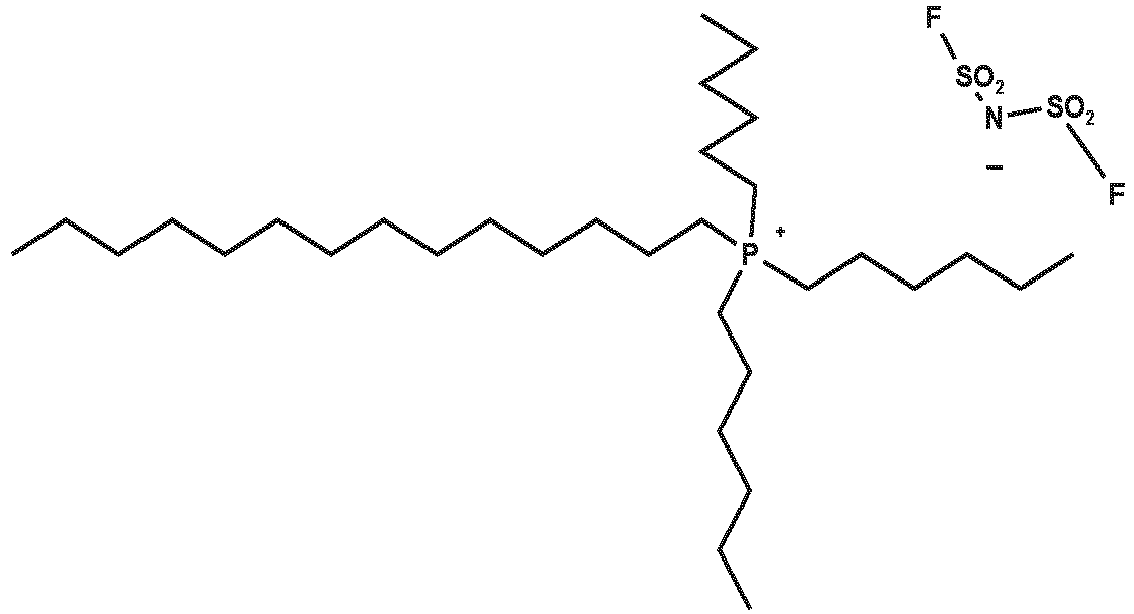 Methyltrioctylammonium-bis(fluorsulfonyl)imid
 Tributyltetradecylphosphonium-bis(fluorsulfonyl)imid
 Tetraoctylphosphonium- bis(fluorsulfonyl)imid
 und Gemischen hiervon.
 - Schmierstoffzusammensetzung nach einem oder mehreren der vorangehenden Ansprüche, dadurch gekennzeichnet, dass sie ein Verdickungsmittel in einem Anteil von 3 bis 35 Gew.%, noch bevorzugter von 4 bis 30 Gew.%, bezogen auf das Gesamtgewicht der Schmierstoffzusammensetzung, enthält, wobei das Verdickungsmittel vorzugsweise ausgewählt ist aus Harnstoff, Aluminiumkomplexseifen, Metall-Einfachseifen der Elemente der 1. und 2. Hauptgruppe des Periodensystems, insbesondere Lithiumeinfachseifen, Metall-Komplexseifen der Elemente der 1. und 2. Hauptgruppe des Periodensystems, insbesondere Lithiumkomplexseifen, Bentonit, Sulfonat, Silikat, Polyimid sowie Gemischen hiervon.
- Schmierstoffzusammensetzung nach Anspruch 20, dadurch gekennzeichnet, dass das Verdickungsmittel ein Harnstoff ist, vorzugsweise ein Harnstoff, der ein Reaktionsprodukt aus einem Diisocyanat, vorzugsweise 2,4-Diisocyanatotoluol, 2,6-Diisocyanatotoluol, 4,4'-Diisocyanatodiphenylmethan 2,4'-Diisocyantodiphenylmethan, 4,4'-Diisocyanatodiphenyl, 4,4'-Diisocyanato-3,3'-dimethyldiphenyl, 4,4'-Diisocyanato-3,3'-dimethylphenylmethan, die einzeln oder in Kombination verwendet werden können, mit einem Amin oder Diamin der allgemeinen Formel (H2N)xR ist, wobei x = 1 oder 2 ist, und R ein Aryl-, Alkyl-, Cycloalkyl- oder Alkylenrest mit 2 bis 22 Kohlenstoffatomen, die einzeln oder in Kombination vorhanden sind.
- Schmierstoffzusammensetzung nach Anspruch 20 oder 21, dadurch gekennzeichnet, dass das Verdickungsmittel ein Diharnstoff ist, der aliphatische, cycloaliphatisch/aliphatische und/oder cycloaliphatische Harnstoffe enthält, bevorzugt ein durch Formel A dargestellter Diharnstoff ist,

- Schmierstoffzusammensetzung nach einem oder mehreren der Ansprüche 20 bis 22, dadurch gekennzeichnet, dass das Verdickungsmittel eine Lithiumkomplexseife ist, bevorzugt eine Lithiumkomplexseife, hergestellt ausgehend von C4-C36 Dicarbonsäuren, vorzugsweise Azelainsäure, Sebazinsäure, Korksäure, Terephthalsäure, Dodecandisäure und/oder ausgehend von höherfunktionalen Carbonsäuren mit 3 oder mehr, vorzugsweise 3 bis 4 Carbonsäuregruppen, wobei die Anzahl an Kohlenstoffgruppen 6 bis 60 betragen kann, wie bevorzugt Zitronensäure und Trimersäuren, und/oder ausgehend von Esterverbindungen, insbesondere Methylestern und/oder Triglyceriden einer oder mehrerer der vorgenannten Säuren, jeweils kombiniert mit einer oder mehreren Monocarbonsäuren, vorzugsweise kombiniert mit einer oder mehreren C4-C24 Monocarbonsäuren, vorzugsweise Stearinsäure, Hydroxystearinsäure, insbesondere 12-Hydroxystearinsäure, Palmitinsäure, Ölsäure, Salicylsäure, Esterverbindungen, insbesondere Methylestern und/oder Triglyceriden einer oder mehrerer der vorgenannten Säuren und/oder kombiniert mit Sebazinsäuremonostearylamid und/oder Terephthalsäuremonostearylamid.
- Schmierstoffzusammensetzung nach einem oder mehreren der vorangehenden Ansprüche, dadurch gekennzeichnet, dass sie als Additiv ein aromatisches Amin, vorzugsweise ausgewählt aus styrolisiertem Diphenylamin, Phenyl-alpha-naphthylamin, Phenyl-betanaphthylamin, octyliertem und/oder butyliertem Diphenylamin, insbesondere p,p'-Dioctyldiphenylamin, nonyliertem Diphenylamin, vorzugsweise in einem Anteil von 0,5 Gew.% bis 23 Gew.%, noch bevorzugter von 0,5 Gew.% bis 20 Gew.%, insbesondere von 0,5 Gew.% bis 10 Gew.%, bezogen auf das Gesamtgewicht der Schmierstoffzusammensetzung enthält.
- Schmierstoffzusammensetzung nach einem oder mehreren der vorangehenden Ansprüche, gekennzeichnet durch eine untere Gebrauchstemperatur von nicht größer als -30°C bevorzugt nicht größer als -40°C nach IP 186, Edition 2015 und/oder eine obere Gebrauchstemperatur von mindestens +160°C, bevorzugt mindestens +180°C DIN 51821 1+2, Ausgabe 2016,7.
- Verwendung einer Schmierstoffzusammensetzung nach einem oder mehreren der vorangehenden Ansprüche zur Schmierung von Antriebselementen, vorzugweise von Wälzlagern, Getrieben, Gleitlagern, Aktuatoren und/oder Ketten, wobei an den Antriebselementen vorzugsweise elektrische Potentiale anliegen.
- Verwendung nach Anspruch 26, dadurch gekennzeichnet, dass die Antriebselemente ausgewählt sind aus Pulleylagern, Lüfterlagern, Vakuumpumpenlagern, Wälzlagern von Elektromotoren, insbesondere von Hybrid- und Elektrofahrzeugen, Generatoren, insbesondere von Elektrofahrzeugen und Schienenfahrzeugen, Windkraftanlagen, Industriemotoren, Nebenaggregaten in Fahrzeugen und/oder Gelenken von Fahrzeugen.
- Verwendung nach Anspruch 26 oder 27, dadurch gekennzeichnet, dass die Schmierstoffzusammensetzung zur Schmierung von Antriebselementen, vorzugweise von Wälzlagern, verwendet wird, bei denen eine untere Gebrauchstemperatur der Schmierstoffzusammensetzung von nicht größer als -30°C, bevorzugt nicht größer als -40°C nach IP 186, Edition 2015 und/oder bevorzugt eine obere Gebrauchstemperatur von mindestens +160°C, bevorzugt mindestens +180°C, bestimmt nach DIN 51821 1+2 Ausgabe 2016,7), notwendig ist.
Priority Applications (9)
| Application Number | Priority Date | Filing Date | Title |
|---|---|---|---|
| SI202230090T SI4239039T1 (sl) | 2022-07-21 | 2022-07-21 | Mazalni sestavek, ki vsebuje ionsko tekočino |
| ES22186356T ES3014908T3 (en) | 2022-07-21 | 2022-07-21 | Lubricating composition comprising an ionic liquid |
| EP22186356.6A EP4239039B1 (de) | 2022-07-21 | 2022-07-21 | Schmierstoffzusammensetzung enthaltend eine ionische flüssigkeit |
| PL22186356.6T PL4239039T3 (pl) | 2022-07-21 | 2022-07-21 | Kompozycja smaru zawierająca ciecz jonową |
| US18/997,115 US20260028547A1 (en) | 2022-07-21 | 2023-05-11 | Lubricant composition containing an ionic liquid |
| KR1020257002083A KR20250025472A (ko) | 2022-07-21 | 2023-05-11 | 이온성 액체를 함유하는 윤활제 조성물 |
| CN202380055130.2A CN119585405A (zh) | 2022-07-21 | 2023-05-11 | 包含离子液体的润滑剂组合物 |
| PCT/EP2023/062566 WO2024017517A1 (de) | 2022-07-21 | 2023-05-11 | Schmierstoffzusammensetzung enthaltend eine ionische flüssigkeit |
| JP2025503018A JP2025523225A (ja) | 2022-07-21 | 2023-05-11 | イオン性液体を含む潤滑剤組成物 |
Applications Claiming Priority (1)
| Application Number | Priority Date | Filing Date | Title |
|---|---|---|---|
| EP22186356.6A EP4239039B1 (de) | 2022-07-21 | 2022-07-21 | Schmierstoffzusammensetzung enthaltend eine ionische flüssigkeit |
Publications (2)
| Publication Number | Publication Date |
|---|---|
| EP4239039A1 EP4239039A1 (de) | 2023-09-06 |
| EP4239039B1 true EP4239039B1 (de) | 2024-12-25 |
Family
ID=82656275
Family Applications (1)
| Application Number | Title | Priority Date | Filing Date |
|---|---|---|---|
| EP22186356.6A Active EP4239039B1 (de) | 2022-07-21 | 2022-07-21 | Schmierstoffzusammensetzung enthaltend eine ionische flüssigkeit |
Country Status (9)
| Country | Link |
|---|---|
| US (1) | US20260028547A1 (de) |
| EP (1) | EP4239039B1 (de) |
| JP (1) | JP2025523225A (de) |
| KR (1) | KR20250025472A (de) |
| CN (1) | CN119585405A (de) |
| ES (1) | ES3014908T3 (de) |
| PL (1) | PL4239039T3 (de) |
| SI (1) | SI4239039T1 (de) |
| WO (1) | WO2024017517A1 (de) |
Families Citing this family (1)
| Publication number | Priority date | Publication date | Assignee | Title |
|---|---|---|---|---|
| EP4739758A1 (de) | 2023-07-05 | 2026-05-13 | Schaeffler Technologies AG & Co. KG | Schmierfettzusammensetzung für lager von schienenfahrzeugen |
Family Cites Families (7)
| Publication number | Priority date | Publication date | Assignee | Title |
|---|---|---|---|---|
| JP5159089B2 (ja) * | 2005-11-14 | 2013-03-06 | 日本合成化学工業株式会社 | 合成潤滑油 |
| EP1953211A4 (de) * | 2005-11-14 | 2011-03-23 | Nippon Synthetic Chem Ind | Synthetisches schmiermittel |
| JP2008177526A (ja) * | 2006-12-20 | 2008-07-31 | Sanyo Chem Ind Ltd | 磁性流体 |
| MX2009013879A (es) | 2007-06-20 | 2010-01-27 | Klueber Lubrication | Composicion de grasa lubricante. |
| JP5748485B2 (ja) * | 2010-02-01 | 2015-07-15 | 日本合成化学工業株式会社 | 合成潤滑剤 |
| JP5727276B2 (ja) | 2011-03-04 | 2015-06-03 | 協同油脂株式会社 | グリース組成物及びグリース封入転がり軸受 |
| DE102020102462A1 (de) | 2020-01-31 | 2021-08-05 | IoLiTec Ionic Liquids Technologies GmbH | Ionische Flüssigkeiten enthaltende Schmierstoffzusammensetzung |
-
2022
- 2022-07-21 ES ES22186356T patent/ES3014908T3/es active Active
- 2022-07-21 SI SI202230090T patent/SI4239039T1/sl unknown
- 2022-07-21 EP EP22186356.6A patent/EP4239039B1/de active Active
- 2022-07-21 PL PL22186356.6T patent/PL4239039T3/pl unknown
-
2023
- 2023-05-11 KR KR1020257002083A patent/KR20250025472A/ko active Pending
- 2023-05-11 CN CN202380055130.2A patent/CN119585405A/zh active Pending
- 2023-05-11 US US18/997,115 patent/US20260028547A1/en active Pending
- 2023-05-11 WO PCT/EP2023/062566 patent/WO2024017517A1/de not_active Ceased
- 2023-05-11 JP JP2025503018A patent/JP2025523225A/ja active Pending
Also Published As
| Publication number | Publication date |
|---|---|
| EP4239039A1 (de) | 2023-09-06 |
| SI4239039T1 (sl) | 2025-05-30 |
| WO2024017517A1 (de) | 2024-01-25 |
| PL4239039T3 (pl) | 2025-06-16 |
| CN119585405A (zh) | 2025-03-07 |
| ES3014908T3 (en) | 2025-04-28 |
| JP2025523225A (ja) | 2025-07-17 |
| US20260028547A1 (en) | 2026-01-29 |
| KR20250025472A (ko) | 2025-02-21 |
Similar Documents
| Publication | Publication Date | Title |
|---|---|---|
| EP2164935B1 (de) | Schmierfettzusammensetzung | |
| EP3372659B1 (de) | Hochtemperaturschmierstoffe | |
| DE102020002249B4 (de) | Schmierölzusammensetzung und deren Verwendung | |
| EP3872154B1 (de) | Ionische flüssigkeiten enthaltende schmierstoffzusammensetzung | |
| EP3375850B1 (de) | Hochtemperaturschmierstoff für die lebensmittelindustrie | |
| EP4073213B1 (de) | Verwendung einer schmierfettzusammensetzung mit hoher oberer gebrauchstemperatur | |
| EP2703476A1 (de) | Verwendung von blockcopolymeren Polyalkylenoxiden als Reibminderer in synthetischen Schmierstoffen | |
| EP4239039A1 (de) | Schmierstoffzusammensetzung enthaltend eine ionische flüssigkeit | |
| EP4310163B1 (de) | Schmierfettzusammensetzung enthaltend eine ionische flüssigkeit | |
| DE102020112993A1 (de) | Lithiumkomplexhybridfett | |
| EP4294897B1 (de) | Basisöl und schmierfluidzusammensetzung enthaltend das basisöl | |
| WO2025196189A1 (de) | Schmierstoffzusammensetzungen auf basis von polyglykol | |
| EP3841190B1 (de) | Verwendung einer schmiermittelzusammensetzung | |
| WO2023179897A1 (de) | Verwendung einer schmierstoffzusammensetzung zum schmieren von arbeitsgeräten | |
| EP4497806A1 (de) | Schmierfett | |
| DE102023113449A1 (de) | Schmierfett | |
| EP4491699A1 (de) | Phthalimidverbindungen als basisöl für schmierstoffzusammensetzungen | |
| WO2024240605A1 (de) | Schmierfett | |
| EP4467632A1 (de) | Schmierfett |
Legal Events
| Date | Code | Title | Description |
|---|---|---|---|
| PUAI | Public reference made under article 153(3) epc to a published international application that has entered the european phase |
Free format text: ORIGINAL CODE: 0009012 |
|
| STAA | Information on the status of an ep patent application or granted ep patent |
Free format text: STATUS: REQUEST FOR EXAMINATION WAS MADE |
|
| 17P | Request for examination filed |
Effective date: 20220721 |
|
| AK | Designated contracting states |
Kind code of ref document: A1 Designated state(s): AL AT BE BG CH CY CZ DE DK EE ES FI FR GB GR HR HU IE IS IT LI LT LU LV MC MK MT NL NO PL PT RO RS SE SI SK SM TR |
|
| RBV | Designated contracting states (corrected) |
Designated state(s): AL AT BE BG CH CY CZ DE DK EE ES FI FR GB GR HR HU IE IS IT LI LT LU LV MC MK MT NL NO PL PT RO RS SE SI SK SM TR |
|
| GRAP | Despatch of communication of intention to grant a patent |
Free format text: ORIGINAL CODE: EPIDOSNIGR1 |
|
| STAA | Information on the status of an ep patent application or granted ep patent |
Free format text: STATUS: GRANT OF PATENT IS INTENDED |
|
| RIC1 | Information provided on ipc code assigned before grant |
Ipc: C10M 171/00 20060101ALI20240708BHEP Ipc: C10M 169/04 20060101AFI20240708BHEP |
|
| INTG | Intention to grant announced |
Effective date: 20240719 |
|
| RIN1 | Information on inventor provided before grant (corrected) |
Inventor name: SCHMIDT-AMELUNXEN, MARTIN Inventor name: CHALL, DANIEL Inventor name: GRUNDEI, STEFAN |
|
| GRAS | Grant fee paid |
Free format text: ORIGINAL CODE: EPIDOSNIGR3 |
|
| GRAA | (expected) grant |
Free format text: ORIGINAL CODE: 0009210 |
|
| STAA | Information on the status of an ep patent application or granted ep patent |
Free format text: STATUS: THE PATENT HAS BEEN GRANTED |
|
| RAP3 | Party data changed (applicant data changed or rights of an application transferred) |
Owner name: KLUEBER LUBRICATION MUENCHEN GMBH & CO. KG |
|
| AK | Designated contracting states |
Kind code of ref document: B1 Designated state(s): AL AT BE BG CH CY CZ DE DK EE ES FI FR GB GR HR HU IE IS IT LI LT LU LV MC MK MT NL NO PL PT RO RS SE SI SK SM TR |
|
| P01 | Opt-out of the competence of the unified patent court (upc) registered |
Free format text: CASE NUMBER: APP_61707/2024 Effective date: 20241119 |
|
| REG | Reference to a national code |
Ref country code: GB Ref legal event code: FG4D Free format text: NOT ENGLISH |
|
| REG | Reference to a national code |
Ref country code: CH Ref legal event code: EP |
|
| REG | Reference to a national code |
Ref country code: DE Ref legal event code: R096 Ref document number: 502022002488 Country of ref document: DE |
|
| REG | Reference to a national code |
Ref country code: IE Ref legal event code: FG4D Free format text: LANGUAGE OF EP DOCUMENT: GERMAN |
|
| REG | Reference to a national code |
Ref country code: NL Ref legal event code: FP |
|
| REG | Reference to a national code |
Ref country code: SE Ref legal event code: TRGR |
|
| REG | Reference to a national code |
Ref country code: LT Ref legal event code: MG9D |
|
| PG25 | Lapsed in a contracting state [announced via postgrant information from national office to epo] |
Ref country code: HR Free format text: LAPSE BECAUSE OF FAILURE TO SUBMIT A TRANSLATION OF THE DESCRIPTION OR TO PAY THE FEE WITHIN THE PRESCRIBED TIME-LIMIT Effective date: 20241225 |
|
| PG25 | Lapsed in a contracting state [announced via postgrant information from national office to epo] |
Ref country code: FI Free format text: LAPSE BECAUSE OF FAILURE TO SUBMIT A TRANSLATION OF THE DESCRIPTION OR TO PAY THE FEE WITHIN THE PRESCRIBED TIME-LIMIT Effective date: 20241225 |
|
| PG25 | Lapsed in a contracting state [announced via postgrant information from national office to epo] |
Ref country code: BG Free format text: LAPSE BECAUSE OF FAILURE TO SUBMIT A TRANSLATION OF THE DESCRIPTION OR TO PAY THE FEE WITHIN THE PRESCRIBED TIME-LIMIT Effective date: 20241225 |
|
| PG25 | Lapsed in a contracting state [announced via postgrant information from national office to epo] |
Ref country code: NO Free format text: LAPSE BECAUSE OF FAILURE TO SUBMIT A TRANSLATION OF THE DESCRIPTION OR TO PAY THE FEE WITHIN THE PRESCRIBED TIME-LIMIT Effective date: 20250325 |
|
| PG25 | Lapsed in a contracting state [announced via postgrant information from national office to epo] |
Ref country code: LV Free format text: LAPSE BECAUSE OF FAILURE TO SUBMIT A TRANSLATION OF THE DESCRIPTION OR TO PAY THE FEE WITHIN THE PRESCRIBED TIME-LIMIT Effective date: 20241225 Ref country code: GR Free format text: LAPSE BECAUSE OF FAILURE TO SUBMIT A TRANSLATION OF THE DESCRIPTION OR TO PAY THE FEE WITHIN THE PRESCRIBED TIME-LIMIT Effective date: 20250326 |
|
| PG25 | Lapsed in a contracting state [announced via postgrant information from national office to epo] |
Ref country code: RS Free format text: LAPSE BECAUSE OF FAILURE TO SUBMIT A TRANSLATION OF THE DESCRIPTION OR TO PAY THE FEE WITHIN THE PRESCRIBED TIME-LIMIT Effective date: 20250325 |
|
| PG25 | Lapsed in a contracting state [announced via postgrant information from national office to epo] |
Ref country code: SM Free format text: LAPSE BECAUSE OF FAILURE TO SUBMIT A TRANSLATION OF THE DESCRIPTION OR TO PAY THE FEE WITHIN THE PRESCRIBED TIME-LIMIT Effective date: 20241225 |
|
| PG25 | Lapsed in a contracting state [announced via postgrant information from national office to epo] |
Ref country code: IS Free format text: LAPSE BECAUSE OF FAILURE TO SUBMIT A TRANSLATION OF THE DESCRIPTION OR TO PAY THE FEE WITHIN THE PRESCRIBED TIME-LIMIT Effective date: 20250425 |
|
| PG25 | Lapsed in a contracting state [announced via postgrant information from national office to epo] |
Ref country code: PT Free format text: LAPSE BECAUSE OF FAILURE TO SUBMIT A TRANSLATION OF THE DESCRIPTION OR TO PAY THE FEE WITHIN THE PRESCRIBED TIME-LIMIT Effective date: 20250428 |
|
| PG25 | Lapsed in a contracting state [announced via postgrant information from national office to epo] |
Ref country code: EE Free format text: LAPSE BECAUSE OF FAILURE TO SUBMIT A TRANSLATION OF THE DESCRIPTION OR TO PAY THE FEE WITHIN THE PRESCRIBED TIME-LIMIT Effective date: 20241225 |
|
| PG25 | Lapsed in a contracting state [announced via postgrant information from national office to epo] |
Ref country code: RO Free format text: LAPSE BECAUSE OF FAILURE TO SUBMIT A TRANSLATION OF THE DESCRIPTION OR TO PAY THE FEE WITHIN THE PRESCRIBED TIME-LIMIT Effective date: 20241225 |
|
| PG25 | Lapsed in a contracting state [announced via postgrant information from national office to epo] |
Ref country code: SK Free format text: LAPSE BECAUSE OF FAILURE TO SUBMIT A TRANSLATION OF THE DESCRIPTION OR TO PAY THE FEE WITHIN THE PRESCRIBED TIME-LIMIT Effective date: 20241225 |
|
| PGFP | Annual fee paid to national office [announced via postgrant information from national office to epo] |
Ref country code: SI Payment date: 20250701 Year of fee payment: 4 |
|
| PGFP | Annual fee paid to national office [announced via postgrant information from national office to epo] |
Ref country code: NL Payment date: 20250724 Year of fee payment: 4 |
|
| REG | Reference to a national code |
Ref country code: DE Ref legal event code: R097 Ref document number: 502022002488 Country of ref document: DE |
|
| PGFP | Annual fee paid to national office [announced via postgrant information from national office to epo] |
Ref country code: ES Payment date: 20250811 Year of fee payment: 4 |
|
| PG25 | Lapsed in a contracting state [announced via postgrant information from national office to epo] |
Ref country code: DK Free format text: LAPSE BECAUSE OF FAILURE TO SUBMIT A TRANSLATION OF THE DESCRIPTION OR TO PAY THE FEE WITHIN THE PRESCRIBED TIME-LIMIT Effective date: 20241225 |
|
| PGFP | Annual fee paid to national office [announced via postgrant information from national office to epo] |
Ref country code: DE Payment date: 20250728 Year of fee payment: 4 |
|
| PGFP | Annual fee paid to national office [announced via postgrant information from national office to epo] |
Ref country code: IT Payment date: 20250731 Year of fee payment: 4 Ref country code: PL Payment date: 20250704 Year of fee payment: 4 |
|
| PGFP | Annual fee paid to national office [announced via postgrant information from national office to epo] |
Ref country code: BE Payment date: 20250724 Year of fee payment: 4 |
|
| PGFP | Annual fee paid to national office [announced via postgrant information from national office to epo] |
Ref country code: AT Payment date: 20251020 Year of fee payment: 4 Ref country code: FR Payment date: 20250725 Year of fee payment: 4 |
|
| PGFP | Annual fee paid to national office [announced via postgrant information from national office to epo] |
Ref country code: SE Payment date: 20250725 Year of fee payment: 4 |
|
| PGFP | Annual fee paid to national office [announced via postgrant information from national office to epo] |
Ref country code: CZ Payment date: 20250707 Year of fee payment: 4 |
|
| PLBE | No opposition filed within time limit |
Free format text: ORIGINAL CODE: 0009261 |
|
| STAA | Information on the status of an ep patent application or granted ep patent |
Free format text: STATUS: NO OPPOSITION FILED WITHIN TIME LIMIT |
|
| REG | Reference to a national code |
Ref country code: CH Ref legal event code: L10 Free format text: ST27 STATUS EVENT CODE: U-0-0-L10-L00 (AS PROVIDED BY THE NATIONAL OFFICE) Effective date: 20251105 |
|
| 26N | No opposition filed |
Effective date: 20250926 |
|
| REG | Reference to a national code |
Ref country code: CH Ref legal event code: H13 Free format text: ST27 STATUS EVENT CODE: U-0-0-H10-H13 (AS PROVIDED BY THE NATIONAL OFFICE) Effective date: 20260224 |
|
| PG25 | Lapsed in a contracting state [announced via postgrant information from national office to epo] |
Ref country code: LU Free format text: LAPSE BECAUSE OF NON-PAYMENT OF DUE FEES Effective date: 20250721 |
|
| PG25 | Lapsed in a contracting state [announced via postgrant information from national office to epo] |
Ref country code: CH Free format text: LAPSE BECAUSE OF NON-PAYMENT OF DUE FEES Effective date: 20250731 |