EP4239022A1 - Curable fluorosilicone composition - Google Patents
Curable fluorosilicone composition Download PDFInfo
- Publication number
- EP4239022A1 EP4239022A1 EP21886362.9A EP21886362A EP4239022A1 EP 4239022 A1 EP4239022 A1 EP 4239022A1 EP 21886362 A EP21886362 A EP 21886362A EP 4239022 A1 EP4239022 A1 EP 4239022A1
- Authority
- EP
- European Patent Office
- Prior art keywords
- groups
- component
- group
- organopolysiloxane
- bonded
- Prior art date
- Legal status (The legal status is an assumption and is not a legal conclusion. Google has not performed a legal analysis and makes no representation as to the accuracy of the status listed.)
- Pending
Links
Classifications
-
- C—CHEMISTRY; METALLURGY
- C08—ORGANIC MACROMOLECULAR COMPOUNDS; THEIR PREPARATION OR CHEMICAL WORKING-UP; COMPOSITIONS BASED THEREON
- C08L—COMPOSITIONS OF MACROMOLECULAR COMPOUNDS
- C08L83/00—Compositions of macromolecular compounds obtained by reactions forming in the main chain of the macromolecule a linkage containing silicon with or without sulfur, nitrogen, oxygen or carbon only; Compositions of derivatives of such polymers
- C08L83/04—Polysiloxanes
- C08L83/08—Polysiloxanes containing silicon bound to organic groups containing atoms other than carbon, hydrogen and oxygen
-
- C—CHEMISTRY; METALLURGY
- C08—ORGANIC MACROMOLECULAR COMPOUNDS; THEIR PREPARATION OR CHEMICAL WORKING-UP; COMPOSITIONS BASED THEREON
- C08J—WORKING-UP; GENERAL PROCESSES OF COMPOUNDING; AFTER-TREATMENT NOT COVERED BY SUBCLASSES C08B, C08C, C08F, C08G or C08H
- C08J3/00—Processes of treating or compounding macromolecular substances
- C08J3/24—Crosslinking, e.g. vulcanising, of macromolecules
-
- C—CHEMISTRY; METALLURGY
- C08—ORGANIC MACROMOLECULAR COMPOUNDS; THEIR PREPARATION OR CHEMICAL WORKING-UP; COMPOSITIONS BASED THEREON
- C08F—MACROMOLECULAR COMPOUNDS OBTAINED BY REACTIONS ONLY INVOLVING CARBON-TO-CARBON UNSATURATED BONDS
- C08F238/00—Copolymers of compounds having one or more carbon-to-carbon triple bonds
- C08F238/02—Acetylene
-
- C—CHEMISTRY; METALLURGY
- C08—ORGANIC MACROMOLECULAR COMPOUNDS; THEIR PREPARATION OR CHEMICAL WORKING-UP; COMPOSITIONS BASED THEREON
- C08K—Use of inorganic or non-macromolecular organic substances as compounding ingredients
- C08K3/00—Use of inorganic substances as compounding ingredients
- C08K3/10—Metal compounds
- C08K3/11—Compounds containing metals of Groups 4 to 10 or of Groups 14 to 16 of the Periodic Table
-
- C—CHEMISTRY; METALLURGY
- C08—ORGANIC MACROMOLECULAR COMPOUNDS; THEIR PREPARATION OR CHEMICAL WORKING-UP; COMPOSITIONS BASED THEREON
- C08K—Use of inorganic or non-macromolecular organic substances as compounding ingredients
- C08K5/00—Use of organic ingredients
- C08K5/54—Silicon-containing compounds
- C08K5/541—Silicon-containing compounds containing oxygen
- C08K5/5415—Silicon-containing compounds containing oxygen containing at least one Si—O bond
- C08K5/5419—Silicon-containing compounds containing oxygen containing at least one Si—O bond containing at least one Si—C bond
-
- C—CHEMISTRY; METALLURGY
- C08—ORGANIC MACROMOLECULAR COMPOUNDS; THEIR PREPARATION OR CHEMICAL WORKING-UP; COMPOSITIONS BASED THEREON
- C08K—Use of inorganic or non-macromolecular organic substances as compounding ingredients
- C08K5/00—Use of organic ingredients
- C08K5/56—Organo-metallic compounds, i.e. organic compounds containing a metal-to-carbon bond
-
- C—CHEMISTRY; METALLURGY
- C08—ORGANIC MACROMOLECULAR COMPOUNDS; THEIR PREPARATION OR CHEMICAL WORKING-UP; COMPOSITIONS BASED THEREON
- C08K—Use of inorganic or non-macromolecular organic substances as compounding ingredients
- C08K9/00—Use of pretreated ingredients
- C08K9/10—Encapsulated ingredients
-
- C—CHEMISTRY; METALLURGY
- C08—ORGANIC MACROMOLECULAR COMPOUNDS; THEIR PREPARATION OR CHEMICAL WORKING-UP; COMPOSITIONS BASED THEREON
- C08G—MACROMOLECULAR COMPOUNDS OBTAINED OTHERWISE THAN BY REACTIONS ONLY INVOLVING UNSATURATED CARBON-TO-CARBON BONDS
- C08G77/00—Macromolecular compounds obtained by reactions forming a linkage containing silicon with or without sulfur, nitrogen, oxygen or carbon in the main chain of the macromolecule
- C08G77/04—Polysiloxanes
- C08G77/12—Polysiloxanes containing silicon bound to hydrogen
-
- C—CHEMISTRY; METALLURGY
- C08—ORGANIC MACROMOLECULAR COMPOUNDS; THEIR PREPARATION OR CHEMICAL WORKING-UP; COMPOSITIONS BASED THEREON
- C08G—MACROMOLECULAR COMPOUNDS OBTAINED OTHERWISE THAN BY REACTIONS ONLY INVOLVING UNSATURATED CARBON-TO-CARBON BONDS
- C08G77/00—Macromolecular compounds obtained by reactions forming a linkage containing silicon with or without sulfur, nitrogen, oxygen or carbon in the main chain of the macromolecule
- C08G77/04—Polysiloxanes
- C08G77/20—Polysiloxanes containing silicon bound to unsaturated aliphatic groups
-
- C—CHEMISTRY; METALLURGY
- C08—ORGANIC MACROMOLECULAR COMPOUNDS; THEIR PREPARATION OR CHEMICAL WORKING-UP; COMPOSITIONS BASED THEREON
- C08G—MACROMOLECULAR COMPOUNDS OBTAINED OTHERWISE THAN BY REACTIONS ONLY INVOLVING UNSATURATED CARBON-TO-CARBON BONDS
- C08G77/00—Macromolecular compounds obtained by reactions forming a linkage containing silicon with or without sulfur, nitrogen, oxygen or carbon in the main chain of the macromolecule
- C08G77/04—Polysiloxanes
- C08G77/22—Polysiloxanes containing silicon bound to organic groups containing atoms other than carbon, hydrogen and oxygen
- C08G77/24—Polysiloxanes containing silicon bound to organic groups containing atoms other than carbon, hydrogen and oxygen halogen-containing groups
-
- C—CHEMISTRY; METALLURGY
- C08—ORGANIC MACROMOLECULAR COMPOUNDS; THEIR PREPARATION OR CHEMICAL WORKING-UP; COMPOSITIONS BASED THEREON
- C08J—WORKING-UP; GENERAL PROCESSES OF COMPOUNDING; AFTER-TREATMENT NOT COVERED BY SUBCLASSES C08B, C08C, C08F, C08G or C08H
- C08J2383/00—Characterised by the use of macromolecular compounds obtained by reactions forming in the main chain of the macromolecule a linkage containing silicon with or without sulfur, nitrogen, oxygen, or carbon only; Derivatives of such polymers
- C08J2383/04—Polysiloxanes
-
- C—CHEMISTRY; METALLURGY
- C08—ORGANIC MACROMOLECULAR COMPOUNDS; THEIR PREPARATION OR CHEMICAL WORKING-UP; COMPOSITIONS BASED THEREON
- C08L—COMPOSITIONS OF MACROMOLECULAR COMPOUNDS
- C08L2205/00—Polymer mixtures characterised by other features
- C08L2205/02—Polymer mixtures characterised by other features containing two or more polymers of the same C08L -group
- C08L2205/025—Polymer mixtures characterised by other features containing two or more polymers of the same C08L -group containing two or more polymers of the same hierarchy C08L, and differing only in parameters such as density, comonomer content, molecular weight, structure
Definitions
- the present invention relates to a curable fluorosilicone composition.
- Curable fluorosilicone compositions that cure by an addition reaction in the presence of a platinum group metal based catalyst for hydrosilylation reaction are used as encapsulants for electrical and electronic components because when cured they form silicone cured products with superior cold resistance and solvent resistance (see Patent Documents 1 and 2). These curable fluorosilicone compositions have a slow curing speed, and when a satisfactory curing speed is attempted, the pot life at room temperature is dramatically shortened.
- Patent Document 3 proposes a method of controlling the cure initiation time and cure time of a curable fluorosilicone composition by blending a crosslinking agent mixture including an alkylhydrogensiloxane containing a fluoroalkyl group.
- Patent Documents 4 and 5 disclose a method of improving the storage stability and curability of a curable silicone composition by using an encapsulation type catalyst with a thermoplastic resin as a wall material and an encapsulated platinum group metal based catalyst for hydrosilylation reaction.
- an encapsulation type catalyst with an acrylic resin as a wall material can improve the pot life of said compositions at room temperature is not known.
- An object of the present invention is to provide a curable fluorosilicone composition having favorable curability and a sufficient pot life at room temperature.
- the curable fluorosilicone composition of the present invention comprises:
- component (A) includes a branched-chain organopolysiloxane having alkenyl groups bonded only to silicon atoms at the molecular chain terminals.
- component (B) includes an organopolysiloxane having hydrogen atoms bonded only to silicon atoms at the molecular chain terminals
- the organopolysiloxane is a mixture of a straight-chain organopolysiloxane having hydrogen atoms bonded only to silicon atoms at both molecular chain terminals and a branched-chain organopolysiloxane having hydrogen atoms bonded only to silicon atoms at the molecular chain terminals.
- component (D) is a silylated acetylene compound, and in particular a silylated acetylene compound represented by the following general formula:
- the curable fluorosilicone composition of the present invention is characterized by having favorable curability and a sufficient pot life at room temperature.
- the term "encapsulation type catalyst” means a resin particle having a thermoplastic acrylic resin as a wall material, containing or dispersing a platinum group metal catalyst for hydrosilylation reaction inside the resin particle, which normally does not promote or does not readily promote the hydrosilylation reaction, and a catalyst that dramatically promotes a hydrosilylation reaction when heated above the glass transfer point thereof.
- aliphatic unsaturated bond is a generic term for aliphatic carbon-carbon double bonds and aliphatic carbon-carbon triple bonds.
- silated acetylene compound means an acetylene compound having a silyl group, such as a reaction product in which a hydroxyl group in an acetylene alcohol is replaced with a siloxy group as disclosed in U.S. Patent No. 5,449,802 and U.S. Patent No. 5,708,046 .
- Component (A) is a base compound of the composition and is an organopolysiloxane having at least two alkenyl groups and at least one fluoroalkyl group having 3 to 12 carbon atoms in a molecule.
- alkenyl groups in component (A) include: vinyl groups, allyl groups, butenyl groups, pentenyl groups, hexenyl groups, heptenyl groups, octenyl groups, nonenyl groups, decenyl groups, and other alkenyl groups having 2 to 12 carbon atoms.
- vinyl groups and hexenyl groups are preferred.
- fluoroalkyl groups in component (A) include: 3,3,3-trifluoro-propyl groups, 4,4,4,3,3-pentafluorobutyl groups, 5,5,5,4,4,3,3-heptafluoropentyl groups, 6,6,6,5,5,4,4,3,3-nonafluorohexyl groups, and 7,7,7,6,6,5,5,4,4,3,3-undecafluoroheptyl groups; and 3,3,3-trifluoropropyl groups are preferable.
- examples of groups bonded to the silicon atom other than the alkenyl group and the fluoroalkyl group in component (A) include, alkyl groups having 1 to 12 carbon atoms such as methyl groups, ethyl groups, propyl groups, butyl groups, pentyl groups, hexyl groups, heptyl groups, and the like; aryl groups having 6 to 12 carbon atoms such as phenyl groups, tolyl groups, xylyl groups, and the like; aralkyl groups having 7 to 12 carbon atoms, such as benzyl groups, phenethyl groups, and the like, and methyl groups or phenyl groups are preferable. Furthermore, a small amount of hydroxyl groups, or methoxy groups, ethoxy groups, or other alkoxy groups may be bonded to the silicon atom in component (A) within a scope that does not impair an object of the present invention.
- the molecular structure of component (A) is not limited, and examples include: a straight-chain, a branched-chain, a partially branched straight-chain, and a resinoid, and straight-chain or branched-chain are preferable.
- the viscosity of component (A) at 25°C is not limited, but is preferably within a range of 100 to 100,000 mPa ⁇ s or within a range of 500 to 50,000 mPa ⁇ s.
- the viscosity of component (A) can be measured by a rotational viscometer or a rotational rheometer in accordance with JIS K7117-2:1999 "Plastics - Liquid, emulsion or dispersed resins - Method of measuring viscosity at constant shear rate by rotational viscometer.”
- component (A) examples include: copolymers of dimethylsiloxane, methyl(3,3,3-trifluoropropyl)siloxane capped at both molecular chain terminals with dimethylvinylsiloxy groups; copolymers of dimethylsiloxane, methylvinylsiloxane and methyl(3,3,3-trifluoropropyl)siloxane capped at both molecular chain terminals with dimethylvinylsiloxy groups; copolymers of dimethylsiloxane, methylphenylsiloxane and methyl(3,3,3-trifluoropropyl)siloxane capped at both molecular chain terminals with dimethylvinylsiloxy groups; copolymers of methyl(3,3,3-trifluoropropyl)siloxane and methylvinylsiloxane capped at both molecular chain terminals with trimethylsiloxy groups; and mixtures of two or more of
- Component (B) is a crosslinking agent of the present composition and is an organopolysiloxane having at least two silicon atom-bonded hydrogen atoms and at least one fluoroalkyl group having 3 to 12 carbon atoms in a molecule.
- examples of the fluoroalkyl groups in component (B) include 3,3,3-trifluoro-propyl groups, 4,4,4,3,3-pentafluorobutyl groups, 5,5,5,4,4,3,3-heptafluoropentyl groups, 6,6,6,5,5,4,4,3,3-nonafluorohexyl groups, 7,7,7,6,6,5,5,4,4,3,3-undecafluoroheptyl groups, and preferably 3,3,3-trifluoropropyl groups.
- examples of groups bonded to a silicon atom other than the hydrogen atoms and fluoroalkyl groups in component (B) include: alkyl groups having 1 to 12 carbon atoms such as methyl groups, ethyl groups, or propyl groups; aryl groups having 6 to 12 carbon atoms such as phenyl groups, tolyl groups, or xylyl groups. Methyl groups and phenyl groups are preferred.
- the molecular structure of component (B) is not limited, and examples include straight chain structures, branched chain structures, partially branched straight chain structures, cyclic structures, and resinoid structures.
- the viscosity of component (B) is not limited, but preferably the kinematic viscosity at 25°C is within a range of 1 to 10,000 mm 2 /s, or 1 to 2,000 mm 2 /s.
- the viscosity of component (B) can be measured by a viscometer in accordance with JIS K2283:2000 "Crude petroleum and petroleum products-Determination of kinematic viscosity and calculation of viscosity index from kinematic viscosity.”
- component (B) examples include, copolymers of methylhydrogensiloxane and methyl(3,3,3-trifluoropropyl)siloxane capped at both molecular chain terminals with trimethylsiloxy groups; copolymers of dimethylsiloxane, methylhydrogensiloxane and methyl(3,3,3-trifluoropropyl)siloxane capped at both molecular chain terminals with trimethylsiloxy groups; methyl(3,3,3-trifluoropropyl)polysiloxane capped at both molecular chain terminals with dimethylhydrogensiloxy groups; and copolymers of dimethylsiloxane, methylhydrogensiloxane and methyl(3,3,3-trifluoropropyl)siloxane capped at both molecular chain terminals with dimethylhydrogensiloxy groups; or mixtures of two or more of these, preferably including an organopolysiloxane having hydrogen atom
- the amount of component (B) is an amount such that silicon atom-bonded hydrogen atoms in this component is in a range of 0.1 to 10 moles, preferably in a range of 0.1 to 5 moles, in a range of 0.5 to 5 moles, or in a range of 0.5 to 3 moles, relative to 1 mole of a total of aliphatic unsaturated bonds in the present composition. This is because the present composition is sufficiently cured when the amount of component (B) is equal to or above the lower limit of the range described above, while the heat resistance of the resulting fluorosilicone cured product is enhanced when the amount of component (B) is equal to or below the upper limit of the range described above.
- Component (C) is an encapsulation type platinum group metal-based catalyst for hydrosilylation reaction for promoting curing of the present composition, and having an acrylic resin as a wall material.
- platinum metal-type catalyst in component (C) include platinum catalysts, rhodium catalysts, ruthenium catalysts, iridium catalysts, palladium catalysts, and the like, but platinum catalysts are preferred.
- platinum catalysts examples include platinum chloride, platinum chloride hexahydrate, platinum dichloride, alcoholic solutions of platinum chloride, olefin complexes of platinum chloride, platinum chloride and alkenylsiloxane complexes, diketone complexes of platinum, alkenylsiloxane complexes of platinum, and olefin complexes of platinum.
- Alkenylsiloxane complexes are preferred, and in particular, 1,3-diethynyl-1,1,3,3-tetramethyldisiloxane complexes of platinum.
- the acrylic resin which is the wall material of component (C) is not restricted, and examples thereof include polymethacrylate resin, polyacrylic resin, polyacrylamide resin, and acrylic/styrene copolymer resin, but polymethacrylate resins are preferable, such as polymethylmethacrylate resin, methylmethacrylate and butyl methacrylate copolymer resin, and the like.
- Component (C) preferably has a glass transition point in a range of 50 to 100°C. The glass transition point can be determined by the method described in JIS K7121-1987, "Method for Measuring the Transition Temperature of Plastics".
- the method for preparing the component (C) is not restricted, and for example, as proposed in Japanese Patent Application Publication Nos. S64-045468 and S64-047442 , the platinum group metal catalyst for hydrosilylation reaction can be dispersed in a solution of acrylic resin, and then dispersed in water to produce an encapsulation type catalyst.
- the platinum group metal catalyst for hydrosilylation reaction can be dispersed in acrylic monomer and then emulsified in water to polymerize the acrylic monomer and produce an encapsulation type catalyst.
- Component (D) is a hydrosilylation reaction inhibitor having an aliphatic unsaturated bond to improve the storage stability of the composition or to adjust the curability of the composition.
- component (D) include acetylene alcohols such as 1-ethynylcyclohexan-1-ol, 2-methyl-3-butyn-2-ol, 3,5-dimethyl-1-hexyn-3-ol, 2-phenyl-3-butyn-2-ol; and the like; enyne compounds such as 3-methyl-3-penten-1-yne, 3,5-dimethyl-3-hexen-1-yne, and the like; and silylated acetylene compounds in which the hydroxyl group of one of the aforementioned acetylene alcohols is replaced with a siloxy group, but a silylated acetylene compound is preferable.
- silylated acetylene compound for component (D) are disclosed, for example, in U.S. Patent No. 5,449,802 and U.S. Patent No. 5,708,046 , and examples include a silylated acetylene compound represented by the following general formula: a silylated acetylene compound represented by the following general formula: or a mixture thereof.
- R 1 s are the same or different, hydrogen atoms or monovalent hydrocarbon groups.
- the monovalent hydrocarbon groups for R 1 include alkyl groups having 1 to 12 carbon atoms such as methyl groups, ethyl groups, propyl groups, butyl groups, pentyl groups, hexyl groups, and heptyl groups; aryl groups having 6 to 12 carbon atoms such as phenyl groups, tolyl groups, and xylyl groups; alkyl groups having 7 to 12 carbon atoms such as benzyl groups and phenethyl groups, but methyl groups are preferable.
- R 2 is a linking group or an alkylene group.
- alkylene groups for R 2 include alkylene groups having 1 to 12 carbon atoms, such as methylene groups, ethylene groups, propylene groups, butylene groups, pentylene groups, hexylene groups, heptylene groups, or the like.
- R 2 is preferably a linking group.
- R 3 is an alkyl group, an alkenyl group, or an aryl group.
- alkyl groups for R 3 include alkyl groups having 1 to 12 carbon atoms, such as methyl groups, ethyl groups, propyl groups, butyl groups, pentyl groups, hexyl groups, heptyl groups, and the like.
- alkenyl groups for R 3 include alkenyl groups having 2 to 12 carbon atoms, such as vinyl groups, allyl groups, butenyl groups, pentenyl groups, hexenyl groups, heptenyl groups, and the like.
- aryl groups of R 3 are aryl groups having 6 to 12 carbon atoms, such as phenyl groups, tolyl groups, xylyl groups, and the like.
- a is an integer from 1 to 4, preferably 3 or 4.
- c is an integer from 4 to 6, and preferably is 5.
- the following compounds are examples of the silylated acetylene compound for component (D).
- component (D) The method for preparing the silylated acetylene compound for component (D) is known, for example, as disclosed in U.S. Patent No. 5,449,802 and U.S. Patent No. 5,708,046 , and component (D) can be prepared by a condensation reaction of acetylene alcohol represented by the following general formula: acetylene alcohol represented by the following general formula: and chlorosilane represnted by the following general formula: X d SiR 3 (4-d) .
- R 1 , R 2 , R 3 , "b", and “c” are the same as described above.
- X is a hydrolyzable group, and examples include alkoxy groups such as methoxy groups, ethoxy groups, propoxy groups, or the like; halogen atoms such as chlorine atoms or the like; or acetoxy groups.
- "d" is an integer of 1 to 4, preferably 2 or 3.
- the amount of component (C) and component (D) contained in the present composition is, relative to the present composition, an amount in which the platinum group metals in component (C) are 0.1 to 100 ppm by mass and the molar ratio of the aliphatic unsaturated bonds in component (D) relative to the platinum group metals in component (C) is 1 to 100.
- an amount where the platinum group metals in component (C) is 0.1 to 50 ppm by mass, and the molar ratio of the aliphatic unsaturated bonds in component (D) relative to the platinum group metals in component (C) is 1 to 50.
- the composition may also contain, as an optional component, an adhesion-promoting agent for the purpose of improving the adhesion of the resulting fluorosilicone cured product.
- an adhesion-promoting agent for the purpose of improving the adhesion of the resulting fluorosilicone cured product.
- An organosilicon compound having at least one alkoxy group bonded to a silicon atom in a molecule is preferable as the adhesion promoting agent.
- thes alkoxy groups include methoxy groups, ethoxy groups, propoxy groups, butoxy groups, and methoxyethoxy groups, with methoxy groups particularly preferable.
- examples of groups other than the alkoxy groups bonded to the silicon atoms of the organosilicon compound include: substituted or unsubstituted monovalent hydrocarbon groups such as alkyl groups, alkenyl groups, aryl groups, aralkyl groups, and halogenated alkyl groups; monovalent organic groups containing an epoxy group such as 3-glycidoxypropyl groups, 4-glycidoxybutyl groups, or similar glycidoxyalkyl groups; 2-(3,4-epoxycyclohexyl)ethyl groups, 3-(3,4-epoxycyclohexyl)propyl groups, or similar epoxycyclohexylalkyl groups; 4-oxylanylbutyl groups, 8-oxylanyloctyl groups, or similar oxylanylalkyl groups; and monovalent organic groups containing an acrylic group such as 3-methacryloxypropyl groups; hydrogen atoms; and the like.
- the organosilicon compound preferably has silicon bonded alkenyl groups or silicon bonded hydrogen atoms. Moreover, because favorable adhesion can be imparted to various substrates, this organic silicon compound preferably has at least one epoxy group-containing monovalent organic group in a molecule.
- organosilicon compound include an organosilane compound, an organosiloxane oligomer, and an alkyl silicate. Examples of molecular structures of this organosiloxane oligomer or alkyl silicate include a linear structure, a partially branched linear structure, a branched structure, a cyclic structure, and a network structure, among which a linear structure, a branched structure, and a network structure are particularly preferable.
- organosilicon compounds examples include: silane compounds such as 3-glycidoxypropyltrimethoxysilane, 2-(3,4-epoxycyclohexyl)ethyltrimethoxysilane, and 3-methacryloxypropyltrimethoxysilane; siloxane compounds having at least one of silicon bonded alkenyl groups and silicon bonded hydrogen atoms, and at least one silicon bonded alkoxy group in a molecule; and mixtures of a silane compound or siloxane compound having at least one silicon bonded alkoxy group and a siloxane compound having at least one silicon bonded hydroxyl group and at least one silicon bonded alkenyl group in a molecule; methylpolysilicate; ethylpolysilicate; and an epoxy group-containing ethylpolysilicate.
- the amount of the adhesion promoting agent is not particularly limited, but should be at most 5 mass% relative to the present composition.
- Metal compounds such as copper acetylacetonate and copper phthalocyanine may be added to the present composition as other optional components for the purpose of improving the heat resistance, cold resistance, or weather resistance of the resulting fluorosilicone cured product.
- the amount of such metal compound is not limited, but should be at most 100 ppm or at most 50 ppm by mass relative to the present composition.
- the present composition may also contain, as an optional component, an organopolysiloxane having a fluoroalkyl group with 3 to 12 carbon atoms, without having an alkenyl group and a hydrogen atom at the silicon atom in the molecule.
- the organopolysiloxane includes, for example, a copolymer of dimethylsiloxane and methyl(3,3,3-trifluoropropyl)siloxane capped at both molecular chain terminals with trimethylsiloxy groups, a methyl(3,3,3-trifluoropropyl)polysiloxane capped at both molecular chain terminals with trimethylsiloxy groups, and a mixture of two or more of these.
- the viscosity of the organopolysiloxane at 25°C is not restricted, but is preferably in a range of 100 to 100,000 mPa ⁇ s or 500 to 50,000 mPa s.
- the amount of the organopolysiloxane is not restricted, but should be at most 5 mas% of the present composition.
- the present composition may contain fillers to the extent that the purpose of the present invention is not impaired.
- fillers include: reinforcing fillers such as fumed silica, fused silica, and sedimented silica; bulking fillers such as quartz powder, diatomaceous earth, calcium carbonate, magnesium carbonate; heat-resistant additives such as cerium oxide, cerium hydroxide, and iron oxide; pigments such as red iron oxide, titanium oxide, carbon black; and flame retardants.
- the curable fluorosilicone composition of the present invention will be described in detail by examples. Note that the viscosity values in the examples are values at 25°C. The pot life of the curable fluorosilicone composition at 25°C and the curability were measured as follows.
- the initial viscosity (mPa s) of the curable fluorosilicone composition immediately after preparation at 25°C, and the viscosity (mPa s) of the curable fluorosilicone composition after standing at 25°C for 7 days and 21 days, respectively, were measured using a rotational rheometer (Anton Paar, Inc. MCR102 or 302) in accordance with the method specified in JIS K7117-2:1999. For this measurement, a cone plate with a diameter of 20 mm and 2° was used, and the shear rate was set at 10.0 (S -1 ). The ratio of the viscosity after a specified day to the initial viscosity was determined.
- the curable fluorosilicone composition was heated at 150°C for 1 hour to produce a cured product with a thickness of approximately 1.5 mm and a diameter of 15 mm.
- the shear modulus G' (Pa) of the cured product at 23°C was measured using a viscoelasticity measuring device (manufactured by Anton Paar, model number MCR302). The values were measured at an angular velocity of 6.28 ⁇ 10 -2 to 6.28 ⁇ 10 1 rad/s, and the value at 1.25 ⁇ 10 -1 rad/s was determined.
- a curable fluorosilicone composition was prepared by uniformly mixing the following components to achieve the composition shown in Table 1.
- the molar ratio of silicon atom-bonded hydrogen atoms in component (B) relative to 1 mole of the total aliphatic unsaturated bonds in the present composition was set at 0.7.
- component (A) The following component was used as component (A).
- (a-1): a branched-chain copolymer of dimethylsiloxane and methyl(3,3,3-trifluoropropyl)siloxane having a viscosity of 820 mPa s, wherein at least two molecular chain terminals are capped with dimethylvinylsiloxy groups and the other molecular chain terminals are capped with trimethylsiloxy groups (a content of vinyl groups approximately 1.03 mass%).
- component (B) The following components were used as component (B).
- component (C) The following components were used as component (C).
- component (D) The following components were used as component (D).
- component (F) The following components were used as component (F).
- the curable fluorosilicone composition of the present invention has favorable curability and a sufficient pot life at room temperature, and is therefore suitable, for example, as protective encapsulating material for electrical and electronic components such as integrated circuits; shock absorbing materials; and the like.
Landscapes
- Chemical & Material Sciences (AREA)
- Health & Medical Sciences (AREA)
- Chemical Kinetics & Catalysis (AREA)
- Medicinal Chemistry (AREA)
- Polymers & Plastics (AREA)
- Organic Chemistry (AREA)
- Compositions Of Macromolecular Compounds (AREA)
Abstract
Description
- The present invention relates to a curable fluorosilicone composition.
- Curable fluorosilicone compositions that cure by an addition reaction in the presence of a platinum group metal based catalyst for hydrosilylation reaction are used as encapsulants for electrical and electronic components because when cured they form silicone cured products with superior cold resistance and solvent resistance (see Patent Documents 1 and 2). These curable fluorosilicone compositions have a slow curing speed, and when a satisfactory curing speed is attempted, the pot life at room temperature is dramatically shortened.
- Therefore, Patent Document 3 proposes a method of controlling the cure initiation time and cure time of a curable fluorosilicone composition by blending a crosslinking agent mixture including an alkylhydrogensiloxane containing a fluoroalkyl group.
- On the other hand, Patent Documents 4 and 5 disclose a method of improving the storage stability and curability of a curable silicone composition by using an encapsulation type catalyst with a thermoplastic resin as a wall material and an encapsulated platinum group metal based catalyst for hydrosilylation reaction. However, in curable fluorosilicone compositions, the fact that use of an encapsulation type catalyst with an acrylic resin as a wall material can improve the pot life of said compositions at room temperature is not known.
-
- Patent Document 1:
Japanese Patent Application Publication No. H05-070693 - Patent Document 2:
Japanese Patent Application Publication No. H07-070444 - Patent Document 3:
Japanese Patent Application Publication No. H10-081825 - Patent Document 4:
Japanese Patent Application Publication No. S64-045468 - Patent Document 5:
Japanese Patent Application Publication No. H02-117960 - An object of the present invention is to provide a curable fluorosilicone composition having favorable curability and a sufficient pot life at room temperature.
- The curable fluorosilicone composition of the present invention comprises:
- (A) 100 parts by mass of an organopolysiloxane having at least two alkenyl groups and at least one fluoroalkyl group having 3 to 12 carbon atoms in a molecule;
- (B) an organopolysiloxane having at least two silicon atom-bonded hydrogen atoms and at least one fluoroalkyl group having 3 to 12 carbon atoms in a molecule, in an amount such that the amount of silicon atom-bonded hydrogen atoms in this component is 0.1 to 10 moles relative to 1 mole of a total of aliphatic unsaturated bonds in the present composition;
- (C) a platinum group metal-based catalyst for hydrosilylation reaction; and
- (D) a hydrosilylation reaction inhibitor having an aliphatic unsaturated bond;
- In various embodiments, component (A) includes a branched-chain organopolysiloxane having alkenyl groups bonded only to silicon atoms at the molecular chain terminals.
- In various embodiments, component (B) includes an organopolysiloxane having hydrogen atoms bonded only to silicon atoms at the molecular chain terminals, and in particular, the organopolysiloxane is a mixture of a straight-chain organopolysiloxane having hydrogen atoms bonded only to silicon atoms at both molecular chain terminals and a branched-chain organopolysiloxane having hydrogen atoms bonded only to silicon atoms at the molecular chain terminals.
- In various embodiments, component (D) is a silylated acetylene compound, and in particular a silylated acetylene compound represented by the following general formula:
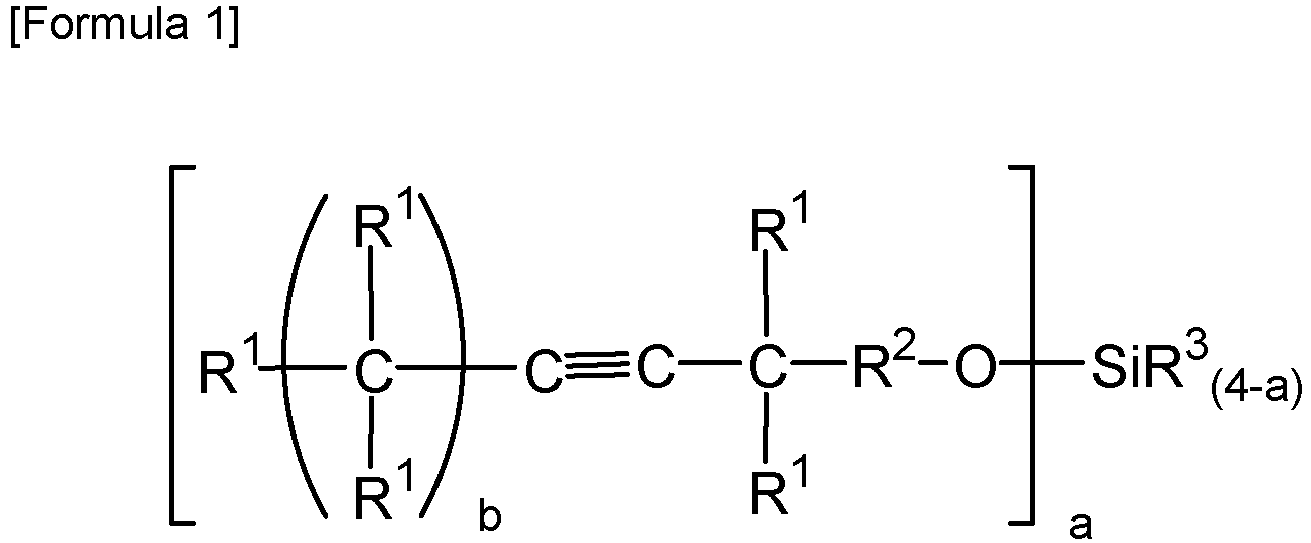
- (in the formula, R1s are the same or different, hydrogen atoms or monovalent hydrocarbon groups, R2 is a linking group or an alkylene group, R3 is an alkyl group, an alkenyl group, or an aryl group, "a" is an integer from 1 to 4, and "b" is an integer from 0 to 5.), a silylated acetylene compound represented by the following general formula:


- (in the formula, R1, R3, "a", and "b" are the same as described above, and "c" is an integer from 4 to 6)
- or a mixture thereof.
- The curable fluorosilicone composition of the present invention is characterized by having favorable curability and a sufficient pot life at room temperature.
- In this specification, the term "encapsulation type catalyst" means a resin particle having a thermoplastic acrylic resin as a wall material, containing or dispersing a platinum group metal catalyst for hydrosilylation reaction inside the resin particle, which normally does not promote or does not readily promote the hydrosilylation reaction, and a catalyst that dramatically promotes a hydrosilylation reaction when heated above the glass transfer point thereof.
- In this specification, "aliphatic unsaturated bond" is a generic term for aliphatic carbon-carbon double bonds and aliphatic carbon-carbon triple bonds.
- Further, in this specification, "silylated acetylene compound" means an acetylene compound having a silyl group, such as a reaction product in which a hydroxyl group in an acetylene alcohol is replaced with a siloxy group as disclosed in
U.S. Patent No. 5,449,802 andU.S. Patent No. 5,708,046 . - Component (A) is a base compound of the composition and is an organopolysiloxane having at least two alkenyl groups and at least one fluoroalkyl group having 3 to 12 carbon atoms in a molecule. Examples of the alkenyl groups in component (A) include: vinyl groups, allyl groups, butenyl groups, pentenyl groups, hexenyl groups, heptenyl groups, octenyl groups, nonenyl groups, decenyl groups, and other alkenyl groups having 2 to 12 carbon atoms. However, vinyl groups and hexenyl groups are preferred. Examples of the fluoroalkyl groups in component (A) include: 3,3,3-trifluoro-propyl groups, 4,4,4,3,3-pentafluorobutyl groups, 5,5,5,4,4,3,3-heptafluoropentyl groups, 6,6,6,5,5,4,4,3,3-nonafluorohexyl groups, and 7,7,7,6,6,5,5,4,4,3,3-undecafluoroheptyl groups; and 3,3,3-trifluoropropyl groups are preferable. Furthermore, examples of groups bonded to the silicon atom other than the alkenyl group and the fluoroalkyl group in component (A) include, alkyl groups having 1 to 12 carbon atoms such as methyl groups, ethyl groups, propyl groups, butyl groups, pentyl groups, hexyl groups, heptyl groups, and the like; aryl groups having 6 to 12 carbon atoms such as phenyl groups, tolyl groups, xylyl groups, and the like; aralkyl groups having 7 to 12 carbon atoms, such as benzyl groups, phenethyl groups, and the like, and methyl groups or phenyl groups are preferable. Furthermore, a small amount of hydroxyl groups, or methoxy groups, ethoxy groups, or other alkoxy groups may be bonded to the silicon atom in component (A) within a scope that does not impair an object of the present invention.
- The molecular structure of component (A) is not limited, and examples include: a straight-chain, a branched-chain, a partially branched straight-chain, and a resinoid, and straight-chain or branched-chain are preferable. Furthermore, the viscosity of component (A) at 25°C is not limited, but is preferably within a range of 100 to 100,000 mPa·s or within a range of 500 to 50,000 mPa·s. This is because, if the viscosity of component (A) is equal to or above the lower limit of the range described above, the mechanical strength of the resulting fluorosilicone cured product is improved, while if the viscosity is equal to or below the upper limit of the range described above, the workability and filling properties of the composition are improved. The viscosity of component (A) can be measured by a rotational viscometer or a rotational rheometer in accordance with JIS K7117-2:1999 "Plastics - Liquid, emulsion or dispersed resins - Method of measuring viscosity at constant shear rate by rotational viscometer."
- Examples of such component (A) include: copolymers of dimethylsiloxane, methyl(3,3,3-trifluoropropyl)siloxane capped at both molecular chain terminals with dimethylvinylsiloxy groups; copolymers of dimethylsiloxane, methylvinylsiloxane and methyl(3,3,3-trifluoropropyl)siloxane capped at both molecular chain terminals with dimethylvinylsiloxy groups; copolymers of dimethylsiloxane, methylphenylsiloxane and methyl(3,3,3-trifluoropropyl)siloxane capped at both molecular chain terminals with dimethylvinylsiloxy groups; copolymers of methyl(3,3,3-trifluoropropyl)siloxane and methylvinylsiloxane capped at both molecular chain terminals with trimethylsiloxy groups; and mixtures of two or more of these. In addition, containing a branched-chain organopolysiloxane having an alkenyl group bonded only to a silicon atom at the molecular chain treminal is preferable.
- Component (B) is a crosslinking agent of the present composition and is an organopolysiloxane having at least two silicon atom-bonded hydrogen atoms and at least one fluoroalkyl group having 3 to 12 carbon atoms in a molecule. In addition, examples of the fluoroalkyl groups in component (B) include 3,3,3-trifluoro-propyl groups, 4,4,4,3,3-pentafluorobutyl groups, 5,5,5,4,4,3,3-heptafluoropentyl groups, 6,6,6,5,5,4,4,3,3-nonafluorohexyl groups, 7,7,7,6,6,5,5,4,4,3,3-undecafluoroheptyl groups, and preferably 3,3,3-trifluoropropyl groups. Furthermore, examples of groups bonded to a silicon atom other than the hydrogen atoms and fluoroalkyl groups in component (B) include: alkyl groups having 1 to 12 carbon atoms such as methyl groups, ethyl groups, or propyl groups; aryl groups having 6 to 12 carbon atoms such as phenyl groups, tolyl groups, or xylyl groups. Methyl groups and phenyl groups are preferred.
- The molecular structure of component (B) is not limited, and examples include straight chain structures, branched chain structures, partially branched straight chain structures, cyclic structures, and resinoid structures. The viscosity of component (B) is not limited, but preferably the kinematic viscosity at 25°C is within a range of 1 to 10,000 mm2/s, or 1 to 2,000 mm2/s. This is because, if the viscosity of component (B) is equal to or above the lower limit of the range described above, the mechanical strength of the resulting fluorosilicone cured product is enhanced; on the other hand, if the viscosity is equal to or below the upper limit of the range described above, the handling workability and filling properties of the present composition are enhanced. The viscosity of component (B) can be measured by a viscometer in accordance with JIS K2283:2000 "Crude petroleum and petroleum products-Determination of kinematic viscosity and calculation of viscosity index from kinematic viscosity."
- Examples of component (B) include, copolymers of methylhydrogensiloxane and methyl(3,3,3-trifluoropropyl)siloxane capped at both molecular chain terminals with trimethylsiloxy groups; copolymers of dimethylsiloxane, methylhydrogensiloxane and methyl(3,3,3-trifluoropropyl)siloxane capped at both molecular chain terminals with trimethylsiloxy groups; methyl(3,3,3-trifluoropropyl)polysiloxane capped at both molecular chain terminals with dimethylhydrogensiloxy groups; and copolymers of dimethylsiloxane, methylhydrogensiloxane and methyl(3,3,3-trifluoropropyl)siloxane capped at both molecular chain terminals with dimethylhydrogensiloxy groups; or mixtures of two or more of these, preferably including an organopolysiloxane having hydrogen atoms bonded only to silicon atoms capping both molecular chain terminals, and in particular, a mixture of a straight-chain organopolysiloxane having hydrogen atoms bonded only to silicon atoms capping both molecular chain terminals and a branched-chain organopolysiloxane having hydrogen atoms bonded only to silicon atoms capping a molecular chain terminal is preferable.
- The amount of component (B) is an amount such that silicon atom-bonded hydrogen atoms in this component is in a range of 0.1 to 10 moles, preferably in a range of 0.1 to 5 moles, in a range of 0.5 to 5 moles, or in a range of 0.5 to 3 moles, relative to 1 mole of a total of aliphatic unsaturated bonds in the present composition. This is because the present composition is sufficiently cured when the amount of component (B) is equal to or above the lower limit of the range described above, while the heat resistance of the resulting fluorosilicone cured product is enhanced when the amount of component (B) is equal to or below the upper limit of the range described above.
- Component (C) is an encapsulation type platinum group metal-based catalyst for hydrosilylation reaction for promoting curing of the present composition, and having an acrylic resin as a wall material. Examples of the platinum metal-type catalyst in component (C) include platinum catalysts, rhodium catalysts, ruthenium catalysts, iridium catalysts, palladium catalysts, and the like, but platinum catalysts are preferred. Examples of the platinum catalysts are platinum chloride, platinum chloride hexahydrate, platinum dichloride, alcoholic solutions of platinum chloride, olefin complexes of platinum chloride, platinum chloride and alkenylsiloxane complexes, diketone complexes of platinum, alkenylsiloxane complexes of platinum, and olefin complexes of platinum. Alkenylsiloxane complexes are preferred, and in particular, 1,3-diethynyl-1,1,3,3-tetramethyldisiloxane complexes of platinum.
- The acrylic resin which is the wall material of component (C) is not restricted, and examples thereof include polymethacrylate resin, polyacrylic resin, polyacrylamide resin, and acrylic/styrene copolymer resin, but polymethacrylate resins are preferable, such as polymethylmethacrylate resin, methylmethacrylate and butyl methacrylate copolymer resin, and the like. Component (C) preferably has a glass transition point in a range of 50 to 100°C. The glass transition point can be determined by the method described in JIS K7121-1987, "Method for Measuring the Transition Temperature of Plastics".
- The method for preparing the component (C) is not restricted, and for example, as proposed in
Japanese Patent Application Publication Nos. S64-045468 S64-047442 Japanese Patent Application Publication Nos. H02-009440 H02-117960 - Component (D) is a hydrosilylation reaction inhibitor having an aliphatic unsaturated bond to improve the storage stability of the composition or to adjust the curability of the composition. Examples of such component (D) include acetylene alcohols such as 1-ethynylcyclohexan-1-ol, 2-methyl-3-butyn-2-ol, 3,5-dimethyl-1-hexyn-3-ol, 2-phenyl-3-butyn-2-ol; and the like; enyne compounds such as 3-methyl-3-penten-1-yne, 3,5-dimethyl-3-hexen-1-yne, and the like; and silylated acetylene compounds in which the hydroxyl group of one of the aforementioned acetylene alcohols is replaced with a siloxy group, but a silylated acetylene compound is preferable.
- These types of silylated acetylene compound for component (D) are disclosed, for example, in
U.S. Patent No. 5,449,802 andU.S. Patent No. 5,708,046 , and examples include a silylated acetylene compound represented by the following general formula: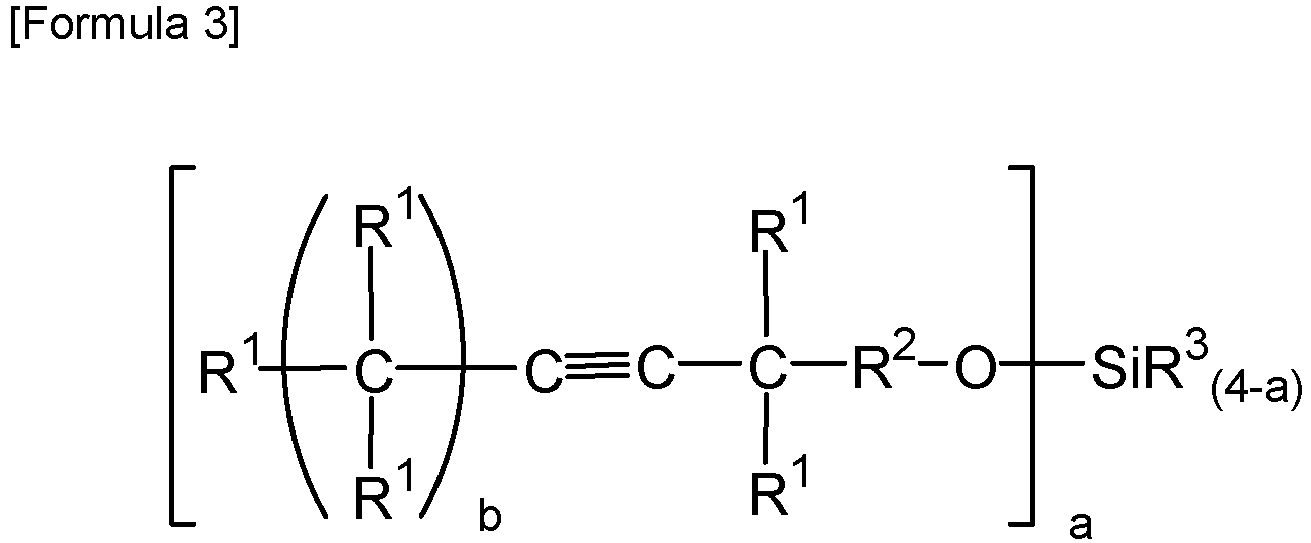

- In the formula, R1s are the same or different, hydrogen atoms or monovalent hydrocarbon groups. Examples of the monovalent hydrocarbon groups for R1 include alkyl groups having 1 to 12 carbon atoms such as methyl groups, ethyl groups, propyl groups, butyl groups, pentyl groups, hexyl groups, and heptyl groups; aryl groups having 6 to 12 carbon atoms such as phenyl groups, tolyl groups, and xylyl groups; alkyl groups having 7 to 12 carbon atoms such as benzyl groups and phenethyl groups, but methyl groups are preferable.
- In the formula, R2 is a linking group or an alkylene group. Examples of the alkylene groups for R2 include alkylene groups having 1 to 12 carbon atoms, such as methylene groups, ethylene groups, propylene groups, butylene groups, pentylene groups, hexylene groups, heptylene groups, or the like. R2 is preferably a linking group.
- In the formula, R3 is an alkyl group, an alkenyl group, or an aryl group. Examples of the alkyl groups for R3 include alkyl groups having 1 to 12 carbon atoms, such as methyl groups, ethyl groups, propyl groups, butyl groups, pentyl groups, hexyl groups, heptyl groups, and the like. Examples of the alkenyl groups for R3 include alkenyl groups having 2 to 12 carbon atoms, such as vinyl groups, allyl groups, butenyl groups, pentenyl groups, hexenyl groups, heptenyl groups, and the like. Examples of the aryl groups of R3 are aryl groups having 6 to 12 carbon atoms, such as phenyl groups, tolyl groups, xylyl groups, and the like.
- In the formulas, "a" is an integer from 1 to 4, preferably 3 or 4.
- In the formulas, "b" is an integer from 0 to 5, and preferably is 0.
- In the formula, "c" is an integer from 4 to 6, and preferably is 5.
- The following compounds are examples of the silylated acetylene compound for component (D).


- The method for preparing the silylated acetylene compound for component (D) is known, for example, as disclosed in
U.S. Patent No. 5,449,802 andU.S. Patent No. 5,708,046 , and component (D) can be prepared by a condensation reaction of acetylene alcohol represented by the following general formula:


XdSiR3 (4-d).
- In the above formulas, R1, R2, R3, "b", and "c" are the same as described above. In the above formula, X is a hydrolyzable group, and examples include alkoxy groups such as methoxy groups, ethoxy groups, propoxy groups, or the like; halogen atoms such as chlorine atoms or the like; or acetoxy groups. Furthermore, in the formula, "d" is an integer of 1 to 4, preferably 2 or 3.
- The amount of component (C) and component (D) contained in the present composition is, relative to the present composition, an amount in which the platinum group metals in component (C) are 0.1 to 100 ppm by mass and the molar ratio of the aliphatic unsaturated bonds in component (D) relative to the platinum group metals in component (C) is 1 to 100. Preferably, an amount where the platinum group metals in component (C) is 0.1 to 50 ppm by mass, and the molar ratio of the aliphatic unsaturated bonds in component (D) relative to the platinum group metals in component (C) is 1 to 50. This is because, when the amount of component (C) is equal to or above the lower limit of the range described above, curing of the present composition proceeds sufficiently, while, when the amount is equal to or below the upper limit of the range described above, the resulting fluorosilicone cured product is less likely to be colored. If the amount of component (D) is equal to or above the lower limit of the range described above, the pot life of the present composition at room temperature will be sufficient, and if the amount of component (D) is equal to or below the upper limit of the range described above, the curability of the present composition will be favorable.
- The composition may also contain, as an optional component, an adhesion-promoting agent for the purpose of improving the adhesion of the resulting fluorosilicone cured product. An organosilicon compound having at least one alkoxy group bonded to a silicon atom in a molecule is preferable as the adhesion promoting agent. Examples of thes alkoxy groups include methoxy groups, ethoxy groups, propoxy groups, butoxy groups, and methoxyethoxy groups, with methoxy groups particularly preferable. Moreover, examples of groups other than the alkoxy groups bonded to the silicon atoms of the organosilicon compound include: substituted or unsubstituted monovalent hydrocarbon groups such as alkyl groups, alkenyl groups, aryl groups, aralkyl groups, and halogenated alkyl groups; monovalent organic groups containing an epoxy group such as 3-glycidoxypropyl groups, 4-glycidoxybutyl groups, or similar glycidoxyalkyl groups; 2-(3,4-epoxycyclohexyl)ethyl groups, 3-(3,4-epoxycyclohexyl)propyl groups, or similar epoxycyclohexylalkyl groups; 4-oxylanylbutyl groups, 8-oxylanyloctyl groups, or similar oxylanylalkyl groups; and monovalent organic groups containing an acrylic group such as 3-methacryloxypropyl groups; hydrogen atoms; and the like. The organosilicon compound preferably has silicon bonded alkenyl groups or silicon bonded hydrogen atoms. Moreover, because favorable adhesion can be imparted to various substrates, this organic silicon compound preferably has at least one epoxy group-containing monovalent organic group in a molecule. Examples of such an organosilicon compound include an organosilane compound, an organosiloxane oligomer, and an alkyl silicate. Examples of molecular structures of this organosiloxane oligomer or alkyl silicate include a linear structure, a partially branched linear structure, a branched structure, a cyclic structure, and a network structure, among which a linear structure, a branched structure, and a network structure are particularly preferable. Examples of such an organosilicon compound include: silane compounds such as 3-glycidoxypropyltrimethoxysilane, 2-(3,4-epoxycyclohexyl)ethyltrimethoxysilane, and 3-methacryloxypropyltrimethoxysilane; siloxane compounds having at least one of silicon bonded alkenyl groups and silicon bonded hydrogen atoms, and at least one silicon bonded alkoxy group in a molecule; and mixtures of a silane compound or siloxane compound having at least one silicon bonded alkoxy group and a siloxane compound having at least one silicon bonded hydroxyl group and at least one silicon bonded alkenyl group in a molecule; methylpolysilicate; ethylpolysilicate; and an epoxy group-containing ethylpolysilicate. The amount of the adhesion promoting agent is not particularly limited, but should be at most 5 mass% relative to the present composition.
- Metal compounds such as copper acetylacetonate and copper phthalocyanine may be added to the present composition as other optional components for the purpose of improving the heat resistance, cold resistance, or weather resistance of the resulting fluorosilicone cured product. The amount of such metal compound is not limited, but should be at most 100 ppm or at most 50 ppm by mass relative to the present composition.
- The present composition may also contain, as an optional component, an organopolysiloxane having a fluoroalkyl group with 3 to 12 carbon atoms, without having an alkenyl group and a hydrogen atom at the silicon atom in the molecule. The organopolysiloxane includes, for example, a copolymer of dimethylsiloxane and methyl(3,3,3-trifluoropropyl)siloxane capped at both molecular chain terminals with trimethylsiloxy groups, a methyl(3,3,3-trifluoropropyl)polysiloxane capped at both molecular chain terminals with trimethylsiloxy groups, and a mixture of two or more of these. The viscosity of the organopolysiloxane at 25°C is not restricted, but is preferably in a range of 100 to 100,000 mPa·s or 500 to 50,000 mPa s. The amount of the organopolysiloxane is not restricted, but should be at most 5 mas% of the present composition.
- Further, the present composition may contain fillers to the extent that the purpose of the present invention is not impaired. Examples of fillers include: reinforcing fillers such as fumed silica, fused silica, and sedimented silica; bulking fillers such as quartz powder, diatomaceous earth, calcium carbonate, magnesium carbonate; heat-resistant additives such as cerium oxide, cerium hydroxide, and iron oxide; pigments such as red iron oxide, titanium oxide, carbon black; and flame retardants.
- The curable fluorosilicone composition of the present invention will be described in detail by examples. Note that the viscosity values in the examples are values at 25°C. The pot life of the curable fluorosilicone composition at 25°C and the curability were measured as follows.
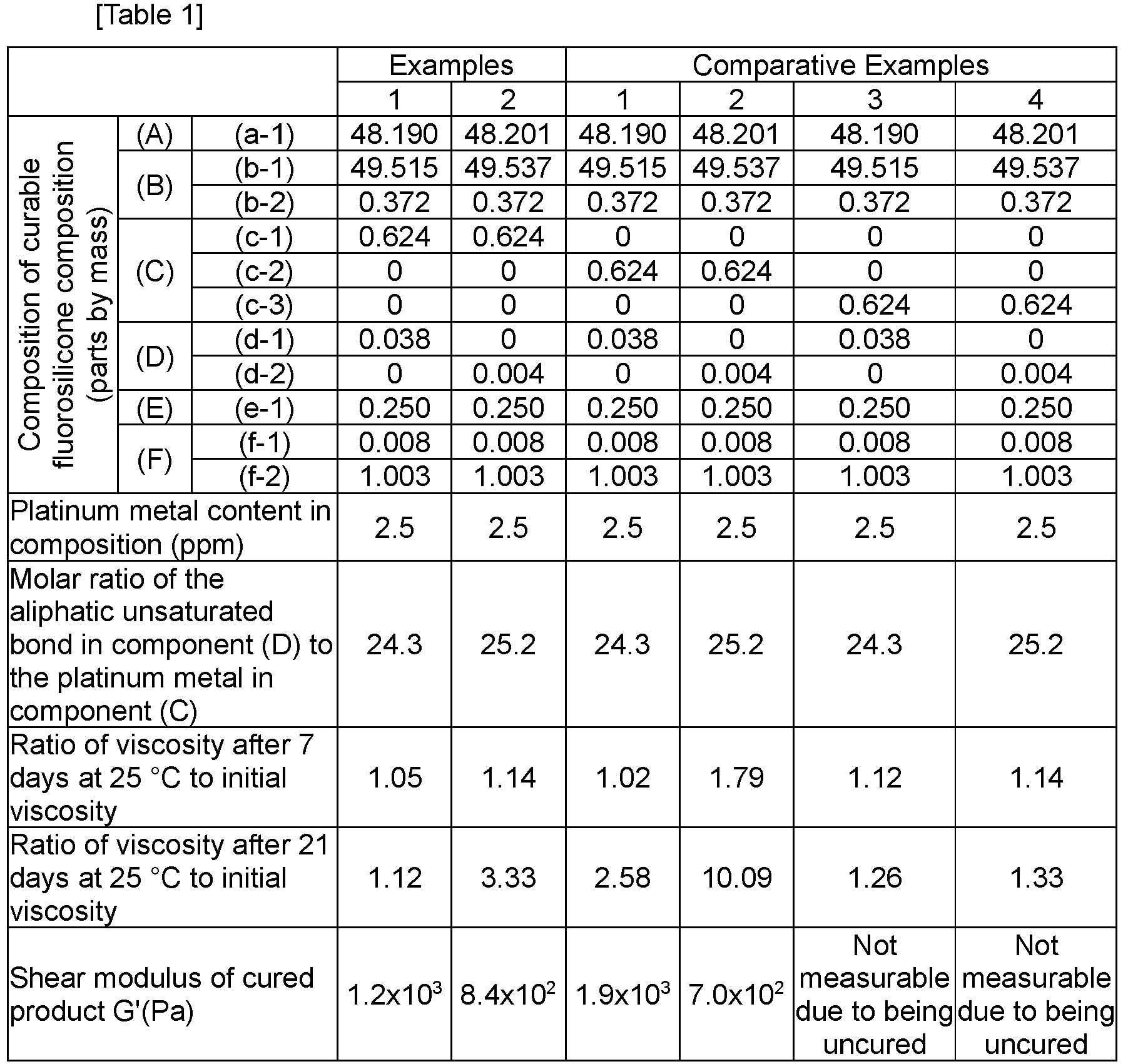
- The initial viscosity (mPa s) of the curable fluorosilicone composition immediately after preparation at 25°C, and the viscosity (mPa s) of the curable fluorosilicone composition after standing at 25°C for 7 days and 21 days, respectively, were measured using a rotational rheometer (Anton Paar, Inc. MCR102 or 302) in accordance with the method specified in JIS K7117-2:1999. For this measurement, a cone plate with a diameter of 20 mm and 2° was used, and the shear rate was set at 10.0 (S-1). The ratio of the viscosity after a specified day to the initial viscosity was determined.
- The curable fluorosilicone composition was heated at 150°C for 1 hour to produce a cured product with a thickness of approximately 1.5 mm and a diameter of 15 mm. The shear modulus G' (Pa) of the cured product at 23°C was measured using a viscoelasticity measuring device (manufactured by Anton Paar, model number MCR302). The values were measured at an angular velocity of 6.28×10⁻² to 6.28×101 rad/s, and the value at 1.25×10⁻¹ rad/s was determined.
- A curable fluorosilicone composition was prepared by uniformly mixing the following components to achieve the composition shown in Table 1. The molar ratio of silicon atom-bonded hydrogen atoms in component (B) relative to 1 mole of the total aliphatic unsaturated bonds in the present composition was set at 0.7.
- The following component was used as component (A).
(a-1): a branched-chain copolymer of dimethylsiloxane and methyl(3,3,3-trifluoropropyl)siloxane having a viscosity of 820 mPa s, wherein at least two molecular chain terminals are capped with dimethylvinylsiloxy groups and the other molecular chain terminals are capped with trimethylsiloxy groups (a content of vinyl groups = approximately 1.03 mass%). - The following components were used as component (B).
- (b-1): a copolymer of dimethylsiloxane and methyl(3,3,3-trifluoropropyl)siloxane capped at both molecular chain terminals with dimethylhydrogensiloxy groups and having a kinematic viscosity of 710 mm2/s (a content of silicon atom-bonded hydrogen atoms = approximately 0.024 mass%)
- (b-2): a branched-chain organopolysiloxane with a kinematic viscosity of 7 mm2/s and represented by the following formula:
CF3C2H4Si[OSi(CH3)2H]3
(a content of silicon atom-bonded hydrogen atoms = approximately 0.59 mass%) - The following components were used as component (C).
- (c-1): a dispersion of a methyl(3,3,3-trifluoropropyl)polysiloxane capped with trimethylsiloxy groups at both molecular chain terminals and having a viscosity of 1,300 mPa s, wherein and the dispersion contains 10 mass% of an encapsulation type catalyst with a glass transition temperature of 54.8°C made by microencapsulating in acrylic resin a 1,3-divinyltetramethyldisiloxane solution of a 1,3-divinyltetramethyldisiloxane complex of platinum (a content of platinum metal = approximately 0.04 mass%)
- (c-2): a dispersion of a methyl(3,3,3-trifluoropropyl)polysiloxane capped with trimethylsiloxy groups at both molecular chain terminals and having a viscosity of 1,300 mPa s, wherein the dispesrsion contains 10 mass% of an encapsulation type catalyst with a glass transition temperature of 60.5°C made by microencapsulating in silicone resin a 1,3-divinyltetramethyldisiloxane solution of a 1,3-divinyltetramethyldisiloxane complex of platinum (a content of platinum metal = approximately 0.04 mass%)
- (c-3): a dispersion of a methyl(3,3,3-trifluoropropyl)polysiloxane capped with trimethylsiloxy groups at both molecular chain terminals and having a viscosity of 1,300 mPa s, wherein the dispersion contains 10 mass% of an encapsulation type catalyst with a glass transition temperature of 135.1°C made by microencapsulating in polycarbonate resin a 1,3-divinyltetramethyldisiloxane solution of a 1,3-divinyltetramethyldisiloxane complex of platinum (a content of platinum metal = approximately 0.04 mass%)
- The following components were used as component (D).
- (d-1): a solution of a methyl(3,3,3-trifluoropropyl)polysiloxane with both molecular chain terminals capped with trimethylsiloxy groups and having a viscosity of 1,300 mPa s, wherein the solution contains 7.88 mass% of a silylated acetylene compound represented by the following formula:

- (d-2): 1-ethynyl-cyclohexan-1-ol
- The following component was used as component (E).
(e-1): an adhesion promoting agent containing a reaction product of a copolymeric oligomer of dimethylsiloxane and methylvinylsiloxane capped at both molecular chain terminals with silanol groups and having a viscosity of 20 mPa·s (a content of vinyl groups = 10.9 mass%) and 3-glycidoxypropyl trimethoxysilane at a molar ratio of 1:2.2. - The following components were used as component (F).
- (f-1): a dispersion of 3.75 mass% of copper acetylacetonate and a methyl(3,3,3-trifluoropropyl)polysiloxane capped at both molecular chain terminals with trimethylsiloxy groups and having a viscosity of 1,300 mPa·s
- (f-2): a dispersion of 35 mass% of carbon black and a methyl(3,3,3-trifluoropropyl)polysiloxane capped at both molecular chain terminals with trimethylsiloxy groups and having a viscosity of 1,300 mPa·s
- The curable fluorosilicone composition of the present invention has favorable curability and a sufficient pot life at room temperature, and is therefore suitable, for example, as protective encapsulating material for electrical and electronic components such as integrated circuits; shock absorbing materials; and the like.
Claims (6)
- A curable fluorosilicone composition comprising:(A) 100 parts by mass of an organopolysiloxane having at least two alkenyl groups and at least one fluoroalkyl group having 3 to 12 carbon atoms in a molecule;(B) an organopolysiloxane having at least two silicon atom-bonded hydrogen atoms and at least one fluoroalkyl group having 3 to 12 carbon atoms in a molecule, in an amount such that the amount of silicon atom-bonded hydrogen atoms in this component is 0.1 to 10 moles relative to 1 mole of a total of aliphatic unsaturated bonds in the present composition;(C) a platinum group metal-based catalyst for hydrosilylation reaction; and(D) a hydrosilylation reaction inhibitor having an aliphatic unsaturated bond;wherein component (C) is an encapsulation type catalyst having an acrylic resin as a wall material, and the amount of platinum group metals in component (C) of the present composition is 0.1 to 100 ppm by mass, and the molar ratio of the aliphatic unsaturated bond in component (D) to the platinum group metals in component (C) is 1 to 100.
- The curable fluorosilicone composition according to claim 1, wherein component (A) contains a branched-chain organopolysiloxane having alkenyl groups bonded only to silicon atoms at the molecular chain terminals.
- The curable fluorosilicone composition according to claim 1, wherein component (B) contains an organopolysiloxane having hydrogen atoms bonded only to silicon atoms at the molecular chain terminals.
- The curable fluorosilicone composition according to claim 1, wherein component (B) is a mixture of a straight-chain organopolysiloxane having hydrogen atoms bonded only to silicon atoms at both molecular chain terminals and a branched-chain organopolysiloxane having hydrogen atoms bonded only to silicon atoms at the molecular chain terminals.
- The curable fluorosilicone composition according to claim 1, wherein component (D) is a silylated acetylene compound.
- The curable fluorosilicone composition according to claim 1, wherein component (D) is a silylated acetylene compound represented by the following general formula:

 (in the formula, R1s are the same or different, hydrogen atoms or monovalent hydrocarbon groups, R2 is a linking group or an alkylene group, R3 is an alkyl group, an alkenyl group, or an aryl group, "a" is an integer from 1 to 4, and "b" is an integer from 0 to 5);a silylated acetylene compound represented by the following general formula:
 (in the formula, R1, R3, "a", and "b" are the same as described above, and "c" is an integer from 4 to 6);or a mixture thereof.
Applications Claiming Priority (2)
| Application Number | Priority Date | Filing Date | Title |
|---|---|---|---|
| JP2020181636 | 2020-10-29 | ||
| PCT/JP2021/039933 WO2022092245A1 (en) | 2020-10-29 | 2021-10-29 | Curable fluorosilicone composition |
Publications (2)
| Publication Number | Publication Date |
|---|---|
| EP4239022A1 true EP4239022A1 (en) | 2023-09-06 |
| EP4239022A4 EP4239022A4 (en) | 2024-11-20 |
Family
ID=81383389
Family Applications (1)
| Application Number | Title | Priority Date | Filing Date |
|---|---|---|---|
| EP21886362.9A Pending EP4239022A4 (en) | 2020-10-29 | 2021-10-29 | Curable fluorosilicone composition |
Country Status (7)
| Country | Link |
|---|---|
| US (1) | US20230392013A1 (en) |
| EP (1) | EP4239022A4 (en) |
| JP (1) | JP7736420B2 (en) |
| KR (1) | KR20230095087A (en) |
| CN (1) | CN116490556B (en) |
| TW (1) | TWI890864B (en) |
| WO (1) | WO2022092245A1 (en) |
Families Citing this family (1)
| Publication number | Priority date | Publication date | Assignee | Title |
|---|---|---|---|---|
| EP4239021A4 (en) * | 2020-10-29 | 2024-11-20 | Dow Toray Co., Ltd. | Curable fluorosilicone composition |
Family Cites Families (21)
| Publication number | Priority date | Publication date | Assignee | Title |
|---|---|---|---|---|
| JPS6032299A (en) | 1983-08-02 | 1985-02-19 | Morita Mfg Co Ltd | Automatic darkening degree adjustment device for panoramic X-ray imaging equipment |
| JPS61261A (en) * | 1984-06-13 | 1986-01-06 | Shin Etsu Chem Co Ltd | Silicone composition for release paper |
| JPS6347345A (en) | 1986-08-14 | 1988-02-29 | Japan Metals & Chem Co Ltd | Hydrogen storage material |
| US4766176A (en) | 1987-07-20 | 1988-08-23 | Dow Corning Corporation | Storage stable heat curable organosiloxane compositions containing microencapsulated platinum-containing catalysts |
| US4784879A (en) | 1987-07-20 | 1988-11-15 | Dow Corning Corporation | Method for preparing a microencapsulated compound of a platinum group metal |
| JPH0214244A (en) * | 1988-06-30 | 1990-01-18 | Toray Dow Corning Silicone Co Ltd | Thermosetting organopolysiloxane composition |
| JPH02117960A (en) | 1988-09-02 | 1990-05-02 | Dow Corning Corp | Method for curing storage-stable organosiloxane composition containing microencapsulated component |
| US5037932A (en) * | 1989-11-06 | 1991-08-06 | Dow Corning Corporation | Storage stable, one part fluorosilicone gel compositions |
| JPH0770444B2 (en) | 1990-06-19 | 1995-07-31 | 信英通信工業株式会社 | Electrolytic solution for driving electrolytic capacitors |
| JP2582690B2 (en) | 1991-09-13 | 1997-02-19 | 信越化学工業株式会社 | Silicone gel composition with excellent anti-vibration properties |
| US5239035A (en) * | 1992-04-09 | 1993-08-24 | Dow Corning Corporation | Curable organosiloxane gel compositions |
| JP2624097B2 (en) * | 1992-09-17 | 1997-06-25 | 信越化学工業株式会社 | Oil-resistant conductive ink composition and contact member |
| US5449802A (en) | 1994-12-27 | 1995-09-12 | Dow Corning Corporation | Acetylenic alcohols and ethers as accelerators for hydrosilation |
| JP3098946B2 (en) | 1995-09-21 | 2000-10-16 | 東レ・ダウコーニング・シリコーン株式会社 | Removable cured film-forming organopolysiloxane composition |
| US5665794A (en) * | 1996-05-20 | 1997-09-09 | Dow Corning Corporation | Method for controlling cure initiation and curing times of platinum group metal curing fluorosilicone compositions |
| DE10256316A1 (en) * | 2002-12-03 | 2004-06-24 | Bayer Ag | Polycarbonate molding compositions |
| JP4849814B2 (en) * | 2005-03-29 | 2012-01-11 | 東レ・ダウコーニング株式会社 | Hot-melt silicone adhesive |
| JP2006077254A (en) * | 2005-10-03 | 2006-03-23 | Dainippon Ink & Chem Inc | Normal temperature curing type aqueous resin composition |
| KR20080104279A (en) * | 2006-02-24 | 2008-12-02 | 다우 코닝 코포레이션 | Light-emitting device encapsulated with silicone and curable silicone composition for silicone manufacture |
| KR102536773B1 (en) * | 2017-03-27 | 2023-05-25 | 신에쓰 가가꾸 고교 가부시끼가이샤 | Addition Curing Silicone Composition |
| JP7121735B2 (en) * | 2017-06-19 | 2022-08-18 | ダウ・東レ株式会社 | Curable silicone composition, light-reflecting material comprising the same, and method for producing the same |
-
2021
- 2021-09-27 TW TW110135795A patent/TWI890864B/en active
- 2021-10-29 EP EP21886362.9A patent/EP4239022A4/en active Pending
- 2021-10-29 WO PCT/JP2021/039933 patent/WO2022092245A1/en not_active Ceased
- 2021-10-29 CN CN202180073572.0A patent/CN116490556B/en active Active
- 2021-10-29 JP JP2022559252A patent/JP7736420B2/en active Active
- 2021-10-29 KR KR1020237016926A patent/KR20230095087A/en active Pending
- 2021-10-29 US US18/034,005 patent/US20230392013A1/en active Pending
Also Published As
| Publication number | Publication date |
|---|---|
| CN116490556A (en) | 2023-07-25 |
| CN116490556B (en) | 2025-12-12 |
| US20230392013A1 (en) | 2023-12-07 |
| KR20230095087A (en) | 2023-06-28 |
| EP4239022A4 (en) | 2024-11-20 |
| JP7736420B2 (en) | 2025-09-09 |
| WO2022092245A1 (en) | 2022-05-05 |
| TWI890864B (en) | 2025-07-21 |
| TW202216855A (en) | 2022-05-01 |
| JPWO2022092245A1 (en) | 2022-05-05 |
Similar Documents
| Publication | Publication Date | Title |
|---|---|---|
| CN101300305B (en) | curable silicone composition | |
| JP3765444B2 (en) | Silicone gel composition and silicone gel for sealing and filling electric and electronic parts | |
| JP6024839B2 (en) | Organopolysiloxane compound, method for producing the same, and addition-curable silicone composition | |
| CN110527302A (en) | Heat-conductive silicone composition | |
| JP2011057755A (en) | Silicone composition and cured product thereof | |
| CN109929252A (en) | Ultraviolet-curing resin composition, bonding agent and solidfied material | |
| CN103571209A (en) | Addition-curable silicone composition and semiconductor device | |
| JP2010109034A (en) | Silicone resin composition for light-emitting diode element, and light-emitting diode element | |
| KR102679282B1 (en) | Thermally conductive silicone composition | |
| JP6998905B2 (en) | Additive-curable silicone compositions, cured products and opto-semiconductor devices | |
| JP7021137B2 (en) | Organically modified silicone resin composition for die bonding, cured product thereof, and optical semiconductor device | |
| JP2632606B2 (en) | Curable organopolysiloxane composition | |
| JP7736420B2 (en) | Curable fluorosilicone composition | |
| WO2022202885A1 (en) | Organopolysiloxane composition | |
| JP7088879B2 (en) | Additive-curable silicone compositions, cured products and opto-semiconductor devices | |
| EP4370606B1 (en) | Thermal conductive silicone composition | |
| TWI924703B (en) | Cured fluorosilicone oxide composition | |
| JP7736419B2 (en) | Curable fluorosilicone composition | |
| JP2016534160A (en) | One-component curable silicone composition and optical semiconductor device | |
| JP7721388B2 (en) | Curable silicone composition | |
| KR20200024719A (en) | Addition-curable silicone composition and semiconductor device | |
| KR20240165444A (en) | Curable silicone composition | |
| JP6726517B2 (en) | Resin composition for LED sealing agent and LED sealing agent | |
| JP2025012975A (en) | ORGANOMODIFIED SILICONE RESIN COMPOSITION FOR DIE BONDING, CURED PRODUCT THEREOF, AND OPTICAL SEMICONDUCTOR DEVICE | |
| JP2008081675A (en) | Diorganopolysiloxane and process for producing the same |
Legal Events
| Date | Code | Title | Description |
|---|---|---|---|
| STAA | Information on the status of an ep patent application or granted ep patent |
Free format text: STATUS: THE INTERNATIONAL PUBLICATION HAS BEEN MADE |
|
| PUAI | Public reference made under article 153(3) epc to a published international application that has entered the european phase |
Free format text: ORIGINAL CODE: 0009012 |
|
| STAA | Information on the status of an ep patent application or granted ep patent |
Free format text: STATUS: REQUEST FOR EXAMINATION WAS MADE |
|
| 17P | Request for examination filed |
Effective date: 20230511 |
|
| AK | Designated contracting states |
Kind code of ref document: A1 Designated state(s): AL AT BE BG CH CY CZ DE DK EE ES FI FR GB GR HR HU IE IS IT LI LT LU LV MC MK MT NL NO PL PT RO RS SE SI SK SM TR |
|
| P01 | Opt-out of the competence of the unified patent court (upc) registered |
Effective date: 20231117 |
|
| DAV | Request for validation of the european patent (deleted) | ||
| DAX | Request for extension of the european patent (deleted) | ||
| A4 | Supplementary search report drawn up and despatched |
Effective date: 20241023 |
|
| RIC1 | Information provided on ipc code assigned before grant |
Ipc: C08K 3/11 20180101ALI20241017BHEP Ipc: C08L 83/07 20060101ALI20241017BHEP Ipc: C08L 83/05 20060101ALI20241017BHEP Ipc: C08K 9/10 20060101ALI20241017BHEP Ipc: C08K 5/56 20060101ALI20241017BHEP Ipc: C08K 5/5419 20060101AFI20241017BHEP |