EP4230130B1 - Vorrichtung zur überwachung eines analyten im gewebe eines menschen oder tieres - Google Patents
Vorrichtung zur überwachung eines analyten im gewebe eines menschen oder tieres Download PDFInfo
- Publication number
- EP4230130B1 EP4230130B1 EP22158018.6A EP22158018A EP4230130B1 EP 4230130 B1 EP4230130 B1 EP 4230130B1 EP 22158018 A EP22158018 A EP 22158018A EP 4230130 B1 EP4230130 B1 EP 4230130B1
- Authority
- EP
- European Patent Office
- Prior art keywords
- subject
- analyte
- excitation radiation
- absorption
- tissue
- Prior art date
- Legal status (The legal status is an assumption and is not a legal conclusion. Google has not performed a legal analysis and makes no representation as to the accuracy of the status listed.)
- Active
Links
Images



Classifications
-
- A—HUMAN NECESSITIES
- A61—MEDICAL OR VETERINARY SCIENCE; HYGIENE
- A61B—DIAGNOSIS; SURGERY; IDENTIFICATION
- A61B5/00—Measuring for diagnostic purposes; Identification of persons
- A61B5/145—Measuring characteristics of blood in vivo, e.g. gas concentration or pH-value ; Measuring characteristics of body fluids or tissues, e.g. interstitial fluid or cerebral tissue
- A61B5/14532—Measuring characteristics of blood in vivo, e.g. gas concentration or pH-value ; Measuring characteristics of body fluids or tissues, e.g. interstitial fluid or cerebral tissue for measuring glucose, e.g. by tissue impedance measurement
-
- A—HUMAN NECESSITIES
- A61—MEDICAL OR VETERINARY SCIENCE; HYGIENE
- A61B—DIAGNOSIS; SURGERY; IDENTIFICATION
- A61B5/00—Measuring for diagnostic purposes; Identification of persons
- A61B5/0002—Remote monitoring of patients using telemetry, e.g. transmission of vital signals via a communication network
- A61B5/0015—Remote monitoring of patients using telemetry, e.g. transmission of vital signals via a communication network characterised by features of the telemetry system
- A61B5/0022—Monitoring a patient using a global network, e.g. telephone networks, internet
-
- A—HUMAN NECESSITIES
- A61—MEDICAL OR VETERINARY SCIENCE; HYGIENE
- A61B—DIAGNOSIS; SURGERY; IDENTIFICATION
- A61B5/00—Measuring for diagnostic purposes; Identification of persons
- A61B5/74—Details of notification to user or communication with user or patient; User input means
- A61B5/7405—Details of notification to user or communication with user or patient; User input means using sound
-
- A—HUMAN NECESSITIES
- A61—MEDICAL OR VETERINARY SCIENCE; HYGIENE
- A61B—DIAGNOSIS; SURGERY; IDENTIFICATION
- A61B5/00—Measuring for diagnostic purposes; Identification of persons
- A61B5/74—Details of notification to user or communication with user or patient; User input means
- A61B5/742—Details of notification to user or communication with user or patient; User input means using visual displays
-
- A—HUMAN NECESSITIES
- A61—MEDICAL OR VETERINARY SCIENCE; HYGIENE
- A61B—DIAGNOSIS; SURGERY; IDENTIFICATION
- A61B5/00—Measuring for diagnostic purposes; Identification of persons
- A61B5/74—Details of notification to user or communication with user or patient; User input means
- A61B5/746—Alarms related to a physiological condition, e.g. details of setting alarm thresholds or avoiding false alarms
-
- A—HUMAN NECESSITIES
- A61—MEDICAL OR VETERINARY SCIENCE; HYGIENE
- A61B—DIAGNOSIS; SURGERY; IDENTIFICATION
- A61B5/00—Measuring for diagnostic purposes; Identification of persons
- A61B5/74—Details of notification to user or communication with user or patient; User input means
- A61B5/7465—Arrangements for interactive communication between patient and care services, e.g. by using a telephone network
- A61B5/747—Arrangements for interactive communication between patient and care services, e.g. by using a telephone network in case of emergency, i.e. alerting emergency services
-
- A—HUMAN NECESSITIES
- A61—MEDICAL OR VETERINARY SCIENCE; HYGIENE
- A61B—DIAGNOSIS; SURGERY; IDENTIFICATION
- A61B2562/00—Details of sensors; Constructional details of sensor housings or probes; Accessories for sensors
- A61B2562/02—Details of sensors specially adapted for in-vivo measurements
- A61B2562/0219—Inertial sensors, e.g. accelerometers, gyroscopes, tilt switches
-
- A—HUMAN NECESSITIES
- A61—MEDICAL OR VETERINARY SCIENCE; HYGIENE
- A61B—DIAGNOSIS; SURGERY; IDENTIFICATION
- A61B5/00—Measuring for diagnostic purposes; Identification of persons
- A61B5/02—Detecting, measuring or recording for evaluating the cardiovascular system, e.g. pulse, heart rate, blood pressure or blood flow
- A61B5/021—Measuring pressure in heart or blood vessels
- A61B5/022—Measuring pressure in heart or blood vessels by applying pressure to close blood vessels, e.g. against the skin; Ophthalmodynamometers
-
- A—HUMAN NECESSITIES
- A61—MEDICAL OR VETERINARY SCIENCE; HYGIENE
- A61B—DIAGNOSIS; SURGERY; IDENTIFICATION
- A61B5/00—Measuring for diagnostic purposes; Identification of persons
- A61B5/02—Detecting, measuring or recording for evaluating the cardiovascular system, e.g. pulse, heart rate, blood pressure or blood flow
- A61B5/024—Measuring pulse rate or heart rate
-
- A—HUMAN NECESSITIES
- A61—MEDICAL OR VETERINARY SCIENCE; HYGIENE
- A61B—DIAGNOSIS; SURGERY; IDENTIFICATION
- A61B5/00—Measuring for diagnostic purposes; Identification of persons
- A61B5/08—Measuring devices for evaluating the respiratory organs
- A61B5/0816—Measuring devices for examining respiratory frequency
-
- A—HUMAN NECESSITIES
- A61—MEDICAL OR VETERINARY SCIENCE; HYGIENE
- A61B—DIAGNOSIS; SURGERY; IDENTIFICATION
- A61B5/00—Measuring for diagnostic purposes; Identification of persons
- A61B5/145—Measuring characteristics of blood in vivo, e.g. gas concentration or pH-value ; Measuring characteristics of body fluids or tissues, e.g. interstitial fluid or cerebral tissue
- A61B5/1455—Measuring characteristics of blood in vivo, e.g. gas concentration or pH-value ; Measuring characteristics of body fluids or tissues, e.g. interstitial fluid or cerebral tissue using optical sensors, e.g. spectral photometrical oximeters
-
- A—HUMAN NECESSITIES
- A61—MEDICAL OR VETERINARY SCIENCE; HYGIENE
- A61B—DIAGNOSIS; SURGERY; IDENTIFICATION
- A61B5/00—Measuring for diagnostic purposes; Identification of persons
- A61B5/68—Arrangements of detecting, measuring or recording means, e.g. sensors, in relation to patient
- A61B5/6801—Arrangements of detecting, measuring or recording means, e.g. sensors, in relation to patient specially adapted to be attached to or worn on the body surface
- A61B5/6813—Specially adapted to be attached to a specific body part
- A61B5/6825—Hand
- A61B5/6826—Finger
Definitions
- the method comprises a measurement procedure, in which the skin of the subject is brought in contact with a measurement body, which permits heat and/or pressure waves generated by absorption of excitation radiation in the tissue to be transferred to said measurement body.
- Excitation radiation is irradiated into the tissue to be absorbed by the analyte contained therein, wherein the intensity of said excitation radiation may be time-modulated, and wherein said excitation radiation may comprise radiation of different analyte-characteristic wavelengths that are irradiated one or both of simultaneously and sequentially.
- analyte-characteristic wavelengths are also wavelengths where the difference in absorption to that at the closest absorption peak or the closest local absorption minimum is less than 30%, preferably less than 20% of the difference in absorption between the closest absorption peak and closest local absorption minimum.
- Analyte-characteristic wavelengths may also include wavelengths where the absorption of other substances with which the analyte is mixed in the tissue, is particularly low.
- the measurement body is transparent for said detection light beam, and the detection light beam is directed to be totally or partially reflected at a surface of said measurement body that is in contact with said tissue.
- the detection device may comprise a photodetector, in particular a position sensitive photodetector which is capable of detecting a degree of deflection, in particular a deflection angle of said detection light beam due to said local change in refractive index.
- the method may further comprise an analyzing step, in which said analyzing is carried out based, at least in part, on said response signal.
- the response signal is indicative of the degree of absorption of excitation radiation comprising "analyte-characteristic wavelengths”
- the response signal is directly related to the concentration of the analyte in the tissue.
- the analyzing step is based at least in part on a measure of the concentration of the analyte in the tissue, and in some non-limiting applications, it may actually amount to determining this concentration.
- the above method has been employed by the applicant in devices for non-invasive measuring of a glucose level of a user.
- the "analyte” is formed by glucose
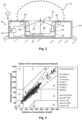
- the "tissue” is the skin of the user. It has been previously demonstrated that this method allows for very precise measurement of glucose concentration in the interstitial fluid within the skin of a person, which is found to be directly related with and hence representative of the glucose content of the patient's blood. Shown in Fig. 4 of the present application is the result of a Clark's error grid analysis taken from WO 2017/097824 A1 , demonstrating that the above analysis method allows for predicting the actual glucose concentration of a person very precisely.
- the above method may be implemented in stationary apparatuses, which may for example be used in a clinical setting or in a patient's home for monitoring an analyte level such as a glucose level of the user or patient (subject). While this may provide valuable information on a state of the user in everyday situations, e.g. by monitoring the glucose level at regular intervals, what is lacking are devices and methods that provide information pertaining to the state of the patient in emergency situations, in particular when the user is unconscious or otherwise unresponsive. As a results of this, valuable time may be lost by first responders. Moreover, inappropriate or wrong measures may be taken in particular by inexperienced first responders such as random bystanders, who might for example assume that an unresponsive persons is drunk rather than for example a hypoglycemic person with diabetes.
- the communication unit is configured to provide monitoring information pertaining to the degree of absorption of said excitation radiation and/or a first aid instruction based on the degree of absorption of said excitation radiation by acoustic, optical, and/or wireless communication means.
- the controller is configured to determine a state of consciousness of the subject that characterizes whether the subject is conscious and/or responsive, wherein the state of consciousness is determined based on said response signal and/or based on a sensor signal from one or more auxiliary sensors configured to measure a parameter indicative of whether the subject is conscious and/or responsive.
- the analyte is not particularly limited and may be any substance that absorbs excitation radiation at a plurality of analyte-characteristic wavelengths.
- the analyte is a physiologically relevant substance that is present in tissue of humans and/or animals.
- the analyte may in particular be glucose.
- the excitation radiation source is configured to generate excitation radiation at a plurality of wavelengths ("excitation wavelengths"), in particular at a plurality of analyte-characteristic wavelengths. Said plurality of wavelengths or analyte-characteristic wavelengths may for example comprise between 2 and 50 wavelengths, in some examples between 5 and 20 wavelengths.
- the excitation radiation source may for example be a light source such as a laser that is configured to generate excitation radiation in the optical spectrum, for example in the infrared spectrum, in particular in the near-infrared and/or mid-infrared spectrum.
- the device may comprise one or more optical elements such as waveguides, lenses and/or mirrors.
- some or all of said excitation wavelengths are in a range of 5 ⁇ m to 13 ⁇ m, preferably 8 ⁇ m to 11 ⁇ m. In alternative embodiments, some or all of said excitation wavelengths are in a range of 3 ⁇ m to 5 ⁇ m. This wavelength range is for example useful for detecting absorption of CH 2 and CH 3 vibrations in fatty acids.
- said detection device comprises a light source for generating a detection light beam travelling through at least a portion of said measurement body or a component included in said measurement body, said physical response of the measurement body to heat received from said tissue upon absorption of said excitation radiation is a local change in the refractive index of said measurement body or said component, and said detection device is configured for detecting one of a change in the light path or a change in the phase of detection beam due to said change in refractive index and for generating a response signal indicative of said change in light path or phase of the detection beam.
- the controller is configured to perform analyte measurements for detecting the analyte in said tissue, i.e. to control the excitation radiation source to irradiate excitation radiation, in particular excitation radiation at a plurality of analyte-characteristic wavelengths, into the tissue to be absorbed by the analyte contained therein and to control the detection device to detect said physical response and to generate a response signal indicative of the degree of absorption of said excitation radiation.
- the controller may be configured to control the excitation radiation source such that the intensity of said excitation radiation is time-modulated (e.g. pulsed) and/or such that different analyte-characteristic wavelengths that are irradiated one or both of simultaneously and sequentially.
- the controller may further be configured to perform an analyzing step, for example as described above.
- the controller may in particular be configured to determine a measure of the concentration of the analyte in the tissue, e.g. the concentration itself or a quantity that has a known functional relation to the concentration (for example is proportional to the concentration), based on the response signal.
- the modulation frequency of the excitation radiation has to be indeed "sufficiently low” such that the diffusion length ⁇ t is long enough to cover the distance between regions with interstitial fluid and the skin surface.
- the diffusion length depends on the physical properties of the tissue, namely density ⁇ , the specific heat capacity C p , and the thermal conductivity k t , and the present applicant noticed that these properties will not only vary from person to person, but may also vary for the same person with time, depending for example on whether the skin is dry or moist, whether the skilled person has used hand moisture lotion, or the like.
- the thermal diffusion length as a function of frequency is a material/tissue status that for best results should be assessed at or close to the time of the analyte measurement procedure in a material/tissue status analyzing procedure, e.g. as described in WO 2021/233559 A1 .
- a modulation frequency may be determined that is "sufficiently low" such that the response signal reflects at least in part absorption of excitation radiation within the interstitial fluid.
- the holding portion is configured to secure the device to a body part of the subject such as a limb.
- said body part is an upper limb of the subject such as an arm or a part thereof, in particular an upper arm and/or a wrist.
- the holding portion may be configured to be arranged around said body part such that the holding portion extends around the body part along a circumferential direction (e.g. substantially parallel to a surface of said body part). In other words, when arranged around said body part, the holding portion may extend around a circumference of the body part.
- the device and/or the holding portion may extend around the body part completely (by 360°, e.g.
- the holding portion may for example extend around the body part by between 180° and 360°, preferably between 270° and 360°.
- the holding portion may have a substantially circular or substantially elliptical shape.
- the holding portion or a part thereof may be attached to a main housing of the device, wherein the main housing may e.g. contain or hold some or all of the measurement body, the excitation radiation source, the detection device and the controller.
- the device may be configured to temporarily increase a contact pressure between the measurement body and the skin of the subject, e.g. to establish and maintain close contact for performing an analyte measurement.
- the device may for example be configured to temporarily increase the contact pressure to between 0.1 N/cm 2 and 100 N/cm 2 , preferably to between 1 N/cm 2 and 10 N/cm 2 .
- the actuated means may be configured to tighten the device (e.g. the holding portion) and/or to move the measurement body closer to the body part in order to ensure a tight fit and close contact between the measurement body and the skin.
- the controller is configured to control the actuated means to temporarily increase the contact pressure.
- Said actuated means for temporarily increasing the contact pressure may for example comprise one or more actuators, wherein the one or more actuators may e.g. include one or more of an electric actuator (e.g. an actuator comprising an electric motor), a magnetic actuator (e.g. an actuator configured to generate or switch a magnetic field to move a magnetic object or an electromagnet), a piezoelement (e.g. an element comprising or consisting of a piezoelectric material) and a fluid pump.
- an electric actuator e.g. an actuator comprising an electric motor
- a magnetic actuator e.g. an actuator configured to generate or switch a magnetic field to move a magnetic object or an electromagnet
- a piezoelement e.g. an element comprising or consisting of a piezoelectric material
- said actuated means for temporarily increasing the contact pressure may comprise one or more deformable members configured to be deformed, extended and/or retracted reversibly.
- the one or more deformable members may for example comprise one or more of a bimetallic element (e.g. an element such as a strip or coil comprising two or more materials, in particular metals, having different coefficients of thermal expansion), a shape-memory alloy structure (e.g. a structure or element that has a first shape (e.g. straight) at a first temperature and a second shape (e.g. bent) at a second temperature different from the first temperature), a bistable spring assembly (e.g.
- an assembly comprising one or more springs that can be compressed/stretched between two stable configurations, which may for example be defined by the arrangement of the springs and/or respective mechanical stops or detents), a pneumatically and/or hydraulically extendable member (e.g. a hydraulic or pneumatic cylinder or a pneumatically or hydraulically movable shaft or piston) and an inflatable body (e.g. a body enclosing a volume that is configured to receive a fluid such as air to be expanded from a compressed state to an expanded state).
- a pneumatically and/or hydraulically extendable member e.g. a hydraulic or pneumatic cylinder or a pneumatically or hydraulically movable shaft or piston
- an inflatable body e.g. a body enclosing a volume that is configured to receive a fluid such as air to be expanded from a compressed state to an expanded state.
- the main housing which may e.g. house the controller and a display
- the measurement body may be arranged on opposite sides of the device.
- the excitation radiation source may for example be arranged in or on the main housing or in or on a part or segment of the device and/or of the holding portion adjacent to the main housing.
- the measurement body is arranged in or on the main housing and the excitation radiation source is arranged in or on another part of the device and/or of the holding portion, which may e.g. be adjacent to the main housing.
- the communication unit may be configured to provide monitoring information pertaining to the degree of absorption of said excitation radiation by acoustic, optical, and/or wireless communication means.
- Said monitoring information may in particular pertain to or comprise a measure for the concentration of the analyte, for example pertain to or comprise the concentration of the analyte itself, e.g. as detailed below.
- the monitoring information may for example be based on the most recent analyte measurement or on a plurality of measurements.
- the monitoring information may for example comprise a time trace based on the most recent analyte measurements, e.g. a time trace of the concentration of the analyte.
- the communication unit may also be configured to provide one or more first aid instructions, wherein the first aid instructions are based on the degree of absorption of said excitation radiation at least in part.
- the first aid instructions may for example be instructions for actions or measures to be taken, e.g. by first responders, that are associated with certain values or ranges of the concentration of the analyte.
- the analyte may be glucose and the first aid instruction may either be to give food (or water) to the user or to not give food (or water) to the user depending on the glucose level, e.g. depending on whether the patient is hypoglycemic or hyperglycemic.
- Said communication means may for example comprise one or more of a loudspeaker, a display, an optical indicator (e.g. one or more light sources such as light-emitting diodes, LED) and a wireless communication module.
- the wireless communication module may for example be configured to exchange data with an external device such as a portable computing device (e.g. a smartphone, a smartwatch or a tablet) or a telephone (e.g. a telephone of an emergency call center) via one or more wireless communication methods known in the art.
- Said wireless communication methods may for example comprise one or more of a cellular network (e.g. a 4G and/or 5G cellular network), a wireless network (e.g. Wi-Fi), a short-range wireless technology such as Bluetooth and satellite communication channels.
- the device may comprise some or all of said communication means. Additionally or alternatively, some or all of said communication means may be comprised in an external device at least in part.
- the controller is configured to determine the state of consciousness of the subject based on the response signal (i.e. based on an analyte measurement) and/or based on a sensor signal from one or more auxiliary sensors, e.g. as detailed below.
- the controller is further configured to provide monitoring information pertaining to the degree of absorption of said excitation radiation and/or one or more first aid instructions based on the degree of absorption of said excitation radiation via the communication unit by one or more of said acoustical, optical, and/or wireless communication means in response to the state of consciousness indicating that the subject is unconscious and/or unresponsive.
- the controller may be configured to show the concentration of the analyte on a display of the device. Additionally or alternatively, the controller may activate an optical indicator such as an LED, which may e.g. indicate that the concentration of the analyte is below a threshold (e.g. a pre-defined threshold), and/or a plurality of optical indicators such as a row or array of LEDs, wherein a number of activated optical indicators may e.g. indicate the concentration of the analyte.
- the one or more optical indicators may for example be arranged next to corresponding labels on the device to indicate or explain their meaning.
- the controller is configured to provide the monitoring information by acoustic means, which may be easier to notice, recognize or understand for first responders in case of emergency.
- the controller may be configured to announce the concentration of the analyte via a loudspeaker, e.g. to read the concentration of the analyte aloud, and/or to announce that the concentration of the analyte is below a threshold (e.g. to announce that the subject is hypoglycemic).
- the controller may also be configured to provide the monitoring information to an emergency call center, a public safety answering point or professional first responders by wireless communication means, e.g. as part of an emergency call.
- the controller may be configured to provide one or more first aid instructions that are based on the degree of absorption of the excitation radiation, for example on the concentration of the analyte, e.g. as detailed above.
- the controller may in particular be configured to provide said first aid instructions by acoustical means, e.g. by acoustic playback on a loudspeaker.
- the controller may be configured to determine the first aid instructions based on the degree of absorption of the excitation radiation, e.g. using a corresponding look-up table.
- the controller may further take into account medical information pertaining to a general state of health of the subject, e.g. whether the subject as a certain medical condition such as diabetes.
- Recent advances in the miniaturization of components such as lasers for generating excitation radiation at a plurality of analyte-characteristic wavelengths enable the implementation of a method for detecting an analyte as set forth above in ever small devices.
- the method can be implemented in devices that are small enough to by carried around by a user over extended periods of time or even permanently, for example in wearable devices such as smartwatches, fitness trackers or chest-strap monitors (e.g. heart-rate monitors).
- wearable devices such as smartwatches, fitness trackers or chest-strap monitors (e.g. heart-rate monitors).
- the controller is configured to determine a concentration of the analyte in the tissue based on the response signal generated by the detection device, e.g. using a corresponding calibration curve and/or a corresponding classifier (e.g. a neural-network based classifier).
- the monitoring information may quantify the determined concentration of the analyte (e.g. comprise the value of the concentration or of a measure for the concentration) and/or may indicate whether the determined concentration is below or above one or more thresholds (e.g. pre-defined thresholds). If the analyte is glucose, the monitoring information may for example indicate whether (and optionally to what extent) the subject is hypoglycemic (i.e. has low blood sugar, e.g.
- the controller may be configured to provide different first aid instructions depending on whether the determined concentration is below or above one or more thresholds (e.g. pre-defined thresholds).
- the controller is configured to provide a first first aid instruction (e.g. to not give food to the subject) if a concentration of the analyte is above a threshold and to provide a second first aid instruction (e.g. to give food to the subject) if the concentration of the analyte is below the threshold.
- the controller may further be configured to provide medical information pertaining to a general state of health of the subject, in particular to one or more medical conditions of the subject, via the communication unit if the state of consciousness indicates that the subject is unconscious and/or unresponsive.
- the medical information may for example indicate whether the subject has a certain medical condition (e.g. diabetes or an allergy).
- the medical information may further comprise other information that may be useful for first responders such as for example an age of the user and/or a blood type of the user.
- the controller may for example be configured to control the communication unit to display on a display and/or to announce via a loudspeaker that the subject has diabetes.
- the controller may be configured to determine the state of consciousness based on the sensor signal from the one or more auxiliary sensors configured to measure a parameter indicative of whether the subject is conscious and/or responsive.
- an auxiliary sensor may for example be a sensor that is per se unrelated to the measurement apparatus for measuring the analyte absorption.
- an auxiliary sensor may be a sensor that is (primarily) used for other purposes than for detecting or monitoring the analyte.
- the controller may be configured to determine a value and/or a time trace of the respective parameter from or based on the corresponding sensor signal and/or to obtain said value and/or said time trace from the respective auxiliary sensor.
- the controller may be configured to compare said parameters and/or a rate of change of said parameters to one or more thresholds.
- An auxiliary sensor may for example be a pulse sensor, in particular an optical pulse sensor, configured to determine a pulse of the subject or an oxygen saturation sensor, in particular an optical oxygen saturation sensor, configured to determine an oxygen saturation level of blood of the subject.
- the pulse and the oxygen saturation are examples of parameters that are indicative of whether the subject is conscious and/or responsive.
- the controller may for example be configured to determine the state of consciousness by determining one or more of whether the pulse is below a threshold (e.g. a pre-defined threshold), whether the pulse is above a threshold (e.g. a pre-defined threshold) and whether a time trace of the pulse exhibits one or more characteristic features that may be associated with unconsciousness (e.g.
- a sudden change for example a rate of change of the pulse being above a threshold (e.g. a pre-defined threshold).
- a threshold e.g. a pre-defined threshold.
- the subject may for example be assumed to be unconscious and/or unresponsive if the pulse is below the threshold for more than a pre-defined amount of time.
- a similar analysis may additionally or alternatively be performed based on the oxygen saturation.
- auxiliary sensors are an acceleration sensor configured to determine an acceleration and/or a direction of gravity and a position sensor (e.g. a satellite-based position sensor such as a Global Positioning System (GPS) sensor) configured to determine a position, in particular a position of the position sensor and/or of the device.
- the controller may for example be configured to determine whether the acceleration experienced by the acceleration sensor and/or the device exhibits one or more characteristic features that may be associated with a fall of the user/subject (e.g. the user collapsing to the ground), for example that the acceleration is above a threshold (e.g. a pre-defined threshold), exhibits a sudden peak and/or is below a threshold (which may e.g. indicate that the user is lying on the ground motionless).
- a threshold e.g. a pre-defined threshold
- the device may comprise some or all of the one or more auxiliary sensors. Additionally or alternatively, some or all of the one or more auxiliary sensors may be external sensors, i.e. sensors of an external device, for example of a portable computing device such as a smartphone.
- the controller may for example be configured to obtain sensor signals and/or parameter values from external sensors using the communication unit, e.g. via a wireless communication means.
- the controller may be configured to determine a concentration of the analyte in the tissue based on the response signal generated by the detection device and to determine the state of consciousness based on the determined concentration.
- the controller may for example determine whether the determined concentration (and/or a rate of change of the concentration) is below a first threshold or above a second threshold.
- the subject may for example be assumed to be unconscious and/or unresponsive if the concentration is below the first threshold or above the second threshold for more than a pre-defined amount of time (e.g. for more than one minute) and/or for more than a pre-defined number of analyte measurements (e.g. for three or more successive analyte measurements).
- the controller is configured to determine the state of consciousness based on a combination of sensor signals from the one or more auxiliary sensors and the response signal from the analyte measurement, e.g. based on the determined concentration and on one or more parameters measured by the auxiliary sensors.
- the controller may for example be configured to determine the state of consciousness based on a combination of two or more, in some examples of three or more, in one example of four or more of the determined concentration, the pulse, the oxygen saturation, the breathing rate, the blood pressure, the acceleration and the position.
- the controller may for example be configured to determine the state of consciousness based on at least the determined concentration and the pulse, the determined concentration and the oxygen saturation, the determined concentration and the acceleration and/or any combination of these four parameters.
- the controller may determine the state of consciousness based on sensor signals from the one or more auxiliary sensors, but not based on the response signal. Performing an analyte measurement may require a lot of energy, e.g. for the excitation radiation source, and the auxiliary sensors may thus be more suitable for continuously monitoring the state of consciousness.
- the controller may further be configured to take into account user inputs to the device for determining the state of consciousness. For example, the controller may assume that the subject is conscious and responsive when the device receives user inputs. In some examples, the controller may request a user input, e.g. as a confirmation that the user is conscious and responsive.
- the communication unit may comprise a display for displaying the monitoring information, the first aid instruction and/or the medical information, for example a liquid-crystal display, in particular an organic light-emitting diode (OLED) display. Additionally or alternatively, the communication unit may comprise a loudspeaker for acoustic playback of the monitoring information, the first aid instruction and/or the medical information.
- the display and/or the loudspeaker may for example be arranged on or in a main housing of the device. In one example, the loudspeaker may be a headphone.
- the communication unit may comprise a wireless communication module that is configured to make an emergency call, e.g. via a cellular network and/or a satellite communication channel.
- the controller may for example be configured to control the communication unit to make an emergency call in response to the state of consciousness indicating that the subject is unconscious and/or unresponsive.
- the term "emergency call" may for example refer to any type of call, message or signal to an emergency contact point such as an emergency call center, a public safety answering point and/or one or more pre-defined emergency contacts (e.g. family members and/or friends).
- the wireless communication module may be configured to communicate (e.g. transmit and/or exchange data) with an external device, in particular a portable computing device such as a smartphone, for example via a wireless network such as Wi-Fi and/or via a short-range wireless technology such as Bluetooth.
- the controller may be configured to transmit the monitoring information, the first aid instruction and/or the medical information to the external device via the wireless communication module.
- the controller is further configured to cause the external device to provide the monitoring information, the first aid instruction and/or the medical information by acoustic, optical and/or wireless communication means of the external device, e.g. by sending corresponding commands or instructions to the external device.
- the controller may for example be configured to display the monitoring information, the first aid instruction and/or the medical information on a display of the external device.
- the controller may be configured to playback the monitoring information, the first aid instruction and/or the medical information via a loudspeaker of the external device and/or to provide the monitoring information, the first aid instructions and/or the medical information by wireless communication means of the external device.
- the controller is configured to cause the external device to make an emergency call, e.g. in response to determining that the subject has become unconscious or unresponsive.
- the controller is configured to change from a first means for providing the monitoring information (e.g. a first one of said acoustic, optical, and/or wireless communication means) to a second means for providing the monitoring information (e.g. a second one of said acoustic, optical, and/or wireless communication means) based on the state of consciousness, the response signal and/or the sensor signal from the one or more auxiliary sensors.
- the controller may for example be configured to provide the monitoring information by optical means, e.g. on a display, during normal operation, which may be less intrusive than for example acoustic means.
- the controller may for example switch to acoustic means such as a loudspeaker for providing the monitoring information.
- the controller may be configured to already switch to the second means if the controller determines based on the state of consciousness, the response signal and/or the sensor signal from the one or more auxiliary sensors that a medical anomaly or issue has occurred (e.g. that the subject is about to become unconscious and/or unresponsive).
- the controller may for example be configured to determine that a medical anomaly or issue has occurred based on corresponding thresholds for the determined concentration and/or the parameters determined by the auxiliary sensors and/or based on thresholds for a rate of change of the determined concentration and/or of the parameters determined by the auxiliary sensors.
- the controller may also be configured to perform analyte measurements in response to certain events, in particular in response to the state of consciousness indicating that the subject has become unconscious and/or unresponsive (which may e.g. have been determined using the auxiliary sensors) and/or in response to a medical anomaly or issue having occurred, for example in response to determining that the subject is about to become unconscious and/or unresponsive.
- the controller may further be configured to adjust a delay time between subsequent analyte measurements dynamically, in particular based on the state of consciousness, the response signal and/or the sensor signal from the one or more auxiliary sensors.
- the controller may for example be configured to adjust the time delay (e.g. decrease the time delay and thus increase the frequency of analyte measurements) in response to the state of consciousness indicating that the subject has become unconscious and/or unresponsive (which may e.g. have been determined using the auxiliary sensors) and/or in response to a medical anomaly or issue having occurred.
- the controller is configured to perform analyte measurements with a first time delay (or first frequency, e.g. once per hour) in a normal state (e.g.
- a state of consciousness of the subject is determined, wherein the state of consciousness characterizes whether the subject is conscious and/or responsive.
- the state of consciousness may be determined based on one or both of the response signal (e.g. based on the glucose level) and the sensor signals from the one or more auxiliary sensor 110, 112 (e.g. based on the pulse, the oxygen saturation and/or the acceleration).
- the state of consciousness is determined based on the sensor signals from the one or more auxiliary sensors 110, but not based the response signal. Performing an analyte measurement may require more energy than performing measurements with the auxiliary sensors and may thus be performed less frequently. The one or more auxiliary sensors 110, 112 may therefore be better suited to continuously monitor the state of consciousness. In some examples, no analyte measurements are performed prior to determining that the subject is unconscious and/or unresponsive in step 208.
- the state of consciousness may for example be determined by comparing the parameters measured by the auxiliary sensors to one or more thresholds. For example, the subject may be assumed to be unconscious if the pulse is below a pre-defined threshold for more than a pre-defined amount of time (e.g. below 30/min for more than 30 seconds). Additionally or alternatively, the state of consciousness may be determined based on a time trace of the pulse, e.g. by identifying one or more characteristic features of the subject becoming unconscious such as a sudden drop and/or a sudden spike in the pulse rate. A similar determination may also be made based on the oxygen saturation. In addition to or instead of these physiological parameters, non-physiological parameters such as the acceleration may be taken into account.
- the subject may for example be assumed to be unconscious if the acceleration exceeds a pre-defined threshold (e.g. as a result of the subject collapsing) prior to an extended period of no or negligible acceleration (e.g. as a result of the subject lying on the floor unconsciously).
- a pre-defined threshold e.g. as a result of the subject collapsing
- an extended period of no or negligible acceleration e.g. as a result of the subject lying on the floor unconsciously.
- a plurality of parameters are used in combination to determine the state of consciousness (e.g. pulse, oxygen saturation and acceleration), which may allow for determining the state of consciousness more reliably.
- determining the state of consciousness may also comprise requesting a user input, for example by asking the user to confirm that the user is conscious and responsive (e.g. by touching a button or the display 108B).
- step 208 the state of consciousness is assessed to determine whether the subject is or has become unconscious and/or unresponsive. If the state of consciousness indicates that the subject is conscious and responsive, the method 200 may return to step 202 for continued monitoring of the subject. Otherwise, i.e. if the state of consciousness indicates that the subject is unconscious and/or unresponsive, the method 200 may proceed to step 210.
- a means for providing monitoring information pertaining to the degree of absorption of the excitation radiation may be changed in step 210.
- the analyte concentration may only be provided by optical means (first means), e.g. by displaying the analyte concentration on the display 108B. This may allow for providing the analyte concentration to the subject/user in an unintrusive way in non-emergency situations.
- a second means for providing the monitoring information may be used in addition to or instead of the display 108B.
- the analyte concentration may additionally be announced using the loudspeaker 108C, which may be more likely to be noticed by first responders in case of emergency.
- monitoring information pertaining to the degree of absorption of said excitation radiation and/or a first aid instruction based on the degree of absorption of said excitation radiation is provided via the communication unit 108 by one or more of said acoustic, optical, and/or wireless communication means in case the state of consciousness indicates that the subject is unconscious and/or unresponsive.
- This may comprise announcing the analyte concentration (e.g. reading the glucose level aloud) determined in step 204 and/or information pertaining to the analyte concentration using the loudspeaker 108C.
- the analyte concentration may be compared with a threshold and a message may be announced via the loudspeaker 108C depending on whether the analyte concentration is above or below the threshold. For example, if the glucose level is below a pre-defined threshold (e.g. below 70 mg/dL, in one example below 50 mg/dL), the device 100 may point out that the subject/user is hypoglycemic.
- a pre-defined threshold e.g. below 70 mg/dL, in one example below 50 mg/dL
- first aid instructions may be provided, e.g. announced via the loudspeaker 108C and/or displayed on the display 108B, to assist first responders, in particular inexperienced first responders such as random bystanders.
- the first aid instructions are based on the degree of absorption of the excitation radiation (e.g. the analyte concentration) at least in part.
- different first aid instructions may be announced depending on whether the analyte concentration is above or below a threshold. For example, if the glucose level is below a pre-defined threshold (e.g. below 70 mg/dL, in one example below 50 mg/dL), the device 100 may point out that the subject/user is hypoglycemic and may instruct the first responders to give food and/or a sugary drink to the subject.
- a pre-defined threshold e.g. below 70 mg/dL, in one example below 50 mg/dL
- Step 212 may further comprise providing medical information pertaining to a general state of health of the subject, in particular to one or more medical conditions of the subject, via the communication unit 108.
- the device 100 may announce via the loudspeaker 108C that the subject has diabetes and/or other medical conditions such as allergies.
- step 212 may also comprise automatically making an emergency call, e.g. via the wireless communication module 108D. This may further comprise providing monitoring information pertaining to the degree of absorption of said excitation radiation and/or medical information as part of the emergency call, e.g. an analyte concentration, a time trace of the analyte concentration and/or information pertaining to the analyte concentration, for example whether the analyte concentration is above or below a threshold (e.g. whether the subject is hypoglycemic or not).
- monitoring information pertaining to the degree of absorption of said excitation radiation and/or medical information as part of the emergency call, e.g. an analyte concentration, a time trace of the analyte concentration and/or information pertaining to the analyte concentration, for example whether the analyte concentration is above or below a threshold (e.g. whether the subject is hypoglycemic or not).
- some or all of the actions taken in step 212 may be performed using an external device such as a smartphone of the subject.
- the controller 34 may control the wireless communication module 108D to provide the respective information to the external device and to cause the external device to provide this information (e.g. to announce the information via a loudspeaker of the device) and/or to make the emergency call.
- the method 200 may further comprise, in step 214, reducing a time delay between subsequent analyte measurements, e.g. by increasing a frequency of the analyte measurements (monitoring frequency).
- the frequency of the analyte measurement may be increased from the first frequency used previously, e.g. in step 204 prior to determining that the subject is unconscious and/or unresponsive, to a second frequency that is higher than the first frequency.
- the first frequency may e.g. be between once every 5 minutes to once every hour, whereas the second frequency may e.g. be between once every second to once every minute. In this way, monitoring information with increased accuracy may be provided in case of emergency at the expense of an increased energy consumption of the device 100.
- the method 200 may return to steps 202 and 204 to continue monitoring of the subject using the auxiliary sensors and/or the analyte measurements, e.g. with the increased second frequency for performing the analyte measurements in step 204.
- the device 100 may then determine again whether the subject is still unconscious and/or unresponsive and, if this is the case, may for example proceed to step 212 to provide updated monitoring information (e.g. the most recent analyte concentration or a rate of change of the analyte concentration) and/or updated first aid instructions.
- updated monitoring information e.g. the most recent analyte concentration or a rate of change of the analyte concentration
Landscapes
- Health & Medical Sciences (AREA)
- Life Sciences & Earth Sciences (AREA)
- Physics & Mathematics (AREA)
- Engineering & Computer Science (AREA)
- Surgery (AREA)
- Animal Behavior & Ethology (AREA)
- Pathology (AREA)
- Veterinary Medicine (AREA)
- Biomedical Technology (AREA)
- Heart & Thoracic Surgery (AREA)
- Medical Informatics (AREA)
- Molecular Biology (AREA)
- Public Health (AREA)
- Biophysics (AREA)
- General Health & Medical Sciences (AREA)
- Emergency Medicine (AREA)
- Optics & Photonics (AREA)
- Physiology (AREA)
- Business, Economics & Management (AREA)
- Critical Care (AREA)
- Emergency Management (AREA)
- Nursing (AREA)
- Computer Networks & Wireless Communication (AREA)
- Measurement Of The Respiration, Hearing Ability, Form, And Blood Characteristics Of Living Organisms (AREA)
Claims (11)
- Vorrichtung (100) zum Überwachen eines Analyten in Gewebe eines menschlichen oder tierischen Subjekts, wobei die Vorrichtung (100) Folgendes umfasst:einen Messkörper (16) mit einer Kontaktfläche (14), die geeignet ist, mit einer Haut des Subjekts in Kontakt gebracht zu werden, wobei der Kontakt ermöglicht, dass Wärme- und/oder Druckwellen, die durch Absorption von Anregungsstrahlung in dem Gewebe erzeugt werden, auf den Messkörper (16) übertragen werden;eine Anregungsstrahlungsquelle (26), die konfiguriert ist, um Anregungsstrahlung bei einer Vielzahl von Wellenlängen in das Gewebe einzustrahlen, um von dem darin enthaltenen Analyten absorbiert zu werden;eine Detektionsvorrichtung (28, 30) zum Detektieren einer physikalischen Reaktion des Messkörpers (16) oder einer darin enthaltenen Komponente auf eine Wärme- und/oder Druckwelle, die von dem Gewebe bei Absorption der Anregungsstrahlung empfangen wird, und zum Erzeugen eines Reaktionssignals basierend auf der detektierten physikalischen Reaktion, wobei das Reaktionssignal einen Grad der Absorption von Anregungsstrahlung anzeigt;eine Steuerung (34), um die Anregungsstrahlungsquelle (26) zu steuern, Anregungsstrahlung in das Gewebe einzustrahlen, um von dem darin enthaltenen Analyten absorbiert zu werden, und um die Detektionsvorrichtung (28, 30) zu steuern, die physikalische Reaktion zu detektieren und ein Reaktionssignal zu erzeugen, das den Grad der Absorption der Anregungsstrahlung anzeigt;einen Halteteil (104) zum Befestigen der Vorrichtung (100) an einem Körperteil (106), insbesondere einer Gliedmaße des Subjekts; undeine Kommunikationseinheit (108), die konfiguriert ist, um Überwachungsinformation, die den Grad der Absorption der Anregungsstrahlung betrifft, und/oder eine Erste-Hilfe-Anweisung basierend auf dem Grad der Absorption der Anregungsstrahlung durch akustische, optische und/oder drahtlose Kommunikationsmittel bereitzustellen;dadurch gekennzeichnet, dass die Steuerung (34) konfiguriert ist, um:einen Bewusstseinszustand des Subjekts zu bestimmen, der charakterisiert, ob das Subjekt bei Bewusstsein und/oder reaktionsfähig ist, wobei der Bewusstseinszustand basierend auf dem Reaktionssignal und/oder basierend auf einem Sensorsignal von einem oder mehreren Hilfssensoren (110, 112) bestimmt wird, die konfiguriert sind, um einen Parameter zu messen, der anzeigt, ob das Subjekt bei Bewusstsein und/oder reaktionsfähig ist; undals Reaktion darauf, dass der Bewusstseinszustand anzeigt, dass das Subjekt nicht bei Bewusstsein und/oder nicht reaktionsfähig ist, Überwachungsinformation, die den Grad der Absorption der Anregungsstrahlung betrifft, und/oder eine Erste-Hilfe-Anweisung basierend auf dem Grad der Absorption der Anregungsstrahlung über die Kommunikationseinheit (108) durch eines oder mehrere der akustischen, optischen und/oder drahtlosen Kommunikationsmittel bereitzustellen.
- Vorrichtung (100) nach Anspruch 1, wobei der Analyt Glukose ist, insbesondere wobei das Gewebe die Haut des Subjekts ist und der Analyt Glukose ist, die in einer interstitiellen Flüssigkeit davon vorhanden ist.
- Vorrichtung (100) nach Anspruch 1 oder 2, wobei die Steuerung (34) konfiguriert ist, um eine Konzentration des Analyten in dem Gewebe basierend auf dem von der Detektionsvorrichtung erzeugten Reaktionssignal zu bestimmen, und die Überwachungsinformation die bestimmte Konzentration des Analyten quantifiziert und/oder anzeigt, ob die bestimmte Konzentration unter oder über einem oder mehreren Schwellenwerten liegt.
- Vorrichtung (100) nach einem der vorhergehenden Ansprüche, wobei die Steuerung (34) ferner konfiguriert ist, um medizinische Information, die einen allgemeinen Gesundheitszustand des Subjekts, insbesondere eine oder mehrere Krankheiten des Subjekts, betrifft, über die Kommunikationseinheit (108) bereitzustellen, wenn der Bewusstseinszustand anzeigt, dass das Subjekt nicht bei Bewusstsein und/oder nicht reaktionsfähig ist.
- Vorrichtung (100) nach einem der vorhergehenden Ansprüche, wobei die Steuerung (34) konfiguriert ist, um den Bewusstseinszustand basierend auf dem Sensorsignal von dem einen oder den mehreren Hilfssensoren (110, 112) zu bestimmen, und der eine oder die mehreren Hilfssensoren (110, 112) einen oder mehreren der Folgenden umfassen:einen Pulssensor (110), der konfiguriert ist, um einen Puls des Subjekts zu bestimmen;einen Sauerstoffsättigungssensor (110), der konfiguriert ist, um ein Sauerstoffsättigungslevel von Blut des Subjekts zu bestimmen;einen Atmungssensor, der konfiguriert ist, um eine Atmungsrate des Subjekts zu bestimmen und/oder ob das Subjekt atmet;einen Blutdrucksensor, der konfiguriert ist, um einen Blutdruck des Subjekts zu bestimmen;einen Beschleunigungssensor (112), der konfiguriert ist, um eine Beschleunigung und/oder eine Richtung der Schwerkraft zu bestimmen; undeinen Positionssensor, der konfiguriert ist, um eine Position zu bestimmen.
- Vorrichtung (100) nach Anspruch 5, wobei die Vorrichtung (100) einige oder alle des einen oder der mehreren Hilfssensoren (110, 112) umfasst.
- Vorrichtung (100) nach einem der vorhergehenden Ansprüche, wobei die Steuerung (34) konfiguriert ist, um eine Konzentration des Analyten in dem Gewebe basierend auf dem von der Detektionsvorrichtung erzeugten Reaktionssignal zu bestimmen und den Bewusstseinszustand basierend auf der bestimmten Konzentration zu bestimmen.
- Vorrichtung (100) nach einem der vorhergehenden Ansprüche, wobei die Kommunikationseinheit (108) eine Anzeige (108B) zum Anzeigen der Überwachungsinformation, der Erste-Hilfe-Anweisung und/oder der medizinischen Information und/oder einen Lautsprecher (108C) zur akustischen Wiedergabe der Überwachungsinformation, der Erste-Hilfe-Anweisung und/oder der medizinischen Information umfasst.
- Vorrichtung (100) nach einem der vorhergehenden Ansprüche, wobei die Kommunikationseinheit (108) ein drahtloses Kommunikationsmodul (108D) umfasst, das konfiguriert ist, um einen Notruf zu tätigen und/oder mit einer externen Vorrichtung, insbesondere einer tragbaren Rechnervorrichtung, zu kommunizieren,
wobei die Steuerung (34) vorzugsweise konfiguriert ist, um:die Überwachungsinformation, die Erste-Hilfe-Anweisung und/oder die medizinischen Information über das drahtlose Kommunikationsmodul (108D) an die externe Vorrichtung zu übertragen; unddie externe Vorrichtung zu veranlassen, die Überwachungsinformation, die Erste-Hilfe-Anweisung und/oder die medizinischen Information auf einer Anzeige der externen Vorrichtung anzuzeigen, die Überwachungsinformation, die Erste-Hilfe-Anweisung und/oder die medizinischen Information über einen Lautsprecher der externen Vorrichtung wiederzugeben, die Überwachungsinformation, die Erste-Hilfe-Anweisung und/oder die medizinischen Information durch drahtlose Kommunikationsmittel der externen Vorrichtung bereitzustellen und/oder einen Notruf zu tätigen. - Vorrichtung (100) nach einem der vorhergehenden Ansprüche, wobei die Steuerung (34) konfiguriert ist, um von einem ersten Mittel (108B) zum Bereitstellen der Überwachungsinformation zu einem zweiten Mittel (108C, 108D) zum Bereitstellen der Überwachungsinformation basierend auf dem Bewusstseinszustand, dem Reaktionssignal und/oder dem Sensorsignal von dem einen oder den mehreren Hilfssensoren (110, 112) zu wechseln.
- Vorrichtung (100) nach einem der vorhergehenden Ansprüche, wobei die Steuerung (34) konfiguriert ist, um wiederholt Analytmessungen durch Steuern der Anregungsstrahlungsquelle (26) durchzuführen, um Anregungsstrahlung in das Gewebe einzustrahlen, um von dem darin enthaltenen Analyten absorbiert zu werden, und um die Detektionsvorrichtung (28, 30) zu steuern, die physikalische Reaktion zu detektieren und ein Reaktionssignal zu erzeugen, das den Grad der Absorption der Anregungsstrahlung anzeigt,wobei die Steuerung (34) vorzugsweise ferner konfiguriert ist, um eine Verzögerungszeit zwischen nachfolgenden Analytmessungen basierend auf dem Bewusstseinszustand, dem Reaktionssignal und/oder dem Sensorsignal von dem einen oder den mehreren Hilfssensoren (110, 112) anzupassen, und/oderwobei der Analyt Glukose ist und die Steuerung (34) konfiguriert ist, um eine Zeitspur einer Konzentration von Glukose in dem Gewebe aufzuzeichnen und einen Zeitpunkt einer jüngsten Nahrungsaufnahme durch das Subjekt basierend auf der Zeitspur zu bestimmen.
Priority Applications (1)
| Application Number | Priority Date | Filing Date | Title |
|---|---|---|---|
| EP22158018.6A EP4230130B1 (de) | 2022-02-22 | 2022-02-22 | Vorrichtung zur überwachung eines analyten im gewebe eines menschen oder tieres |
Applications Claiming Priority (1)
| Application Number | Priority Date | Filing Date | Title |
|---|---|---|---|
| EP22158018.6A EP4230130B1 (de) | 2022-02-22 | 2022-02-22 | Vorrichtung zur überwachung eines analyten im gewebe eines menschen oder tieres |
Publications (2)
| Publication Number | Publication Date |
|---|---|
| EP4230130A1 EP4230130A1 (de) | 2023-08-23 |
| EP4230130B1 true EP4230130B1 (de) | 2025-07-02 |
Family
ID=80623737
Family Applications (1)
| Application Number | Title | Priority Date | Filing Date |
|---|---|---|---|
| EP22158018.6A Active EP4230130B1 (de) | 2022-02-22 | 2022-02-22 | Vorrichtung zur überwachung eines analyten im gewebe eines menschen oder tieres |
Country Status (1)
| Country | Link |
|---|---|
| EP (1) | EP4230130B1 (de) |
Family Cites Families (5)
| Publication number | Priority date | Publication date | Assignee | Title |
|---|---|---|---|---|
| US8328420B2 (en) * | 2003-04-22 | 2012-12-11 | Marcio Marc Abreu | Apparatus and method for measuring biologic parameters |
| WO2014026113A1 (en) * | 2012-08-10 | 2014-02-13 | The Research Foundation For The State University Of New York | Near-infrared spectroscopy and optical reporter |
| DE102014108424B3 (de) | 2014-06-16 | 2015-06-11 | Johann Wolfgang Goethe-Universität | Nicht-invasive Stoffanalyse |
| EP3524962A1 (de) | 2015-12-09 | 2019-08-14 | Diamontech GmbH | Vorrichtung und verfahren zum analysieren eines stoffs |
| KR20200113550A (ko) * | 2019-03-25 | 2020-10-07 | 삼성전자주식회사 | 헬스케어 장치 및 방법 |
-
2022
- 2022-02-22 EP EP22158018.6A patent/EP4230130B1/de active Active
Also Published As
| Publication number | Publication date |
|---|---|
| EP4230130A1 (de) | 2023-08-23 |
Similar Documents
| Publication | Publication Date | Title |
|---|---|---|
| US7252639B2 (en) | Method and apparatus for measuring biological condition | |
| Tura et al. | Non-invasive glucose monitoring: Assessment of technologies and devices according to quantitative criteria | |
| US20200375547A1 (en) | Methods and apparatus for detecting motion via optomechanics | |
| JP6597410B2 (ja) | 生体情報測定装置および生体情報測定方法 | |
| CN106716295B (zh) | 定位用于数据收集的可穿戴设备 | |
| CN102512175B (zh) | 用于测定分析物浓度的光学传感器 | |
| KR101239340B1 (ko) | 휴대단말기와 무선 데이터 송수신이 가능한 패치형 센서를 이용한 실시간 건강관리 시스템 | |
| US10499839B1 (en) | Optimized biophotonic sensors | |
| US20050054907A1 (en) | Highly portable and wearable blood analyte measurement system | |
| JP2019506205A (ja) | 生理学的測定値の非侵襲的監視のための装置、システム、および方法 | |
| KR20190056871A (ko) | 생체정보 측정 장치 및 방법 | |
| JP2008543437A (ja) | 人の被検体内のブドウ糖を非侵襲的に感知するための方法と装置 | |
| US20170332914A1 (en) | Non-invasive body monitor | |
| JP2017184844A (ja) | 検出装置、第1検出システム、及び第2検出システム | |
| US20250160691A1 (en) | Wearable device and method for detecting an analyte in tissue of a human or animal subject | |
| KR102823260B1 (ko) | 비침습적 혈당치 추정을 위한 휴대용 장치 및 방법 | |
| JP4534535B2 (ja) | 生体評価装置、及び生体評価装置の制御方法 | |
| EP4230130A1 (de) | Vorrichtung und verfahren zur überwachung eines analyten im gewebe eines menschen oder tieres | |
| JP2005111161A (ja) | 生体情報計測装置及びその制御方法、制御プログラム及び記録媒体 | |
| JP4777623B2 (ja) | 生体センサ及び測定方法 | |
| WO2014151293A1 (en) | Continuous noninvasive measurement of analyte concentration using an optical bridge | |
| US20240366118A1 (en) | Methods And Devices For Non-Invasive Measuring Of Blood Glucose Using Focused Light Sources | |
| US11432748B2 (en) | Common depth noninvasive glucose concentration determination analyzer apparatus and method of use thereof | |
| TWI890642B (zh) | 非侵入式血糖量測方法及其量測裝置 | |
| EP4505940B1 (de) | Vorrichtung und verfahren zum nachweis eines analyten in gewebe mittels einer einstellbaren bestrahlungsposition |
Legal Events
| Date | Code | Title | Description |
|---|---|---|---|
| PUAI | Public reference made under article 153(3) epc to a published international application that has entered the european phase |
Free format text: ORIGINAL CODE: 0009012 |
|
| STAA | Information on the status of an ep patent application or granted ep patent |
Free format text: STATUS: THE APPLICATION HAS BEEN PUBLISHED |
|
| AK | Designated contracting states |
Kind code of ref document: A1 Designated state(s): AL AT BE BG CH CY CZ DE DK EE ES FI FR GB GR HR HU IE IS IT LI LT LU LV MC MK MT NL NO PL PT RO RS SE SI SK SM TR |
|
| STAA | Information on the status of an ep patent application or granted ep patent |
Free format text: STATUS: REQUEST FOR EXAMINATION WAS MADE |
|
| 17P | Request for examination filed |
Effective date: 20240221 |
|
| RBV | Designated contracting states (corrected) |
Designated state(s): AL AT BE BG CH CY CZ DE DK EE ES FI FR GB GR HR HU IE IS IT LI LT LU LV MC MK MT NL NO PL PT RO RS SE SI SK SM TR |
|
| STAA | Information on the status of an ep patent application or granted ep patent |
Free format text: STATUS: EXAMINATION IS IN PROGRESS |
|
| 17Q | First examination report despatched |
Effective date: 20240617 |
|
| 17Q | First examination report despatched |
Effective date: 20240625 |
|
| REG | Reference to a national code |
Ref country code: DE Free format text: PREVIOUS MAIN CLASS: A61B0005145000 Ref country code: DE Ref legal event code: R079 Ref document number: 602022016660 Country of ref document: DE Free format text: PREVIOUS MAIN CLASS: A61B0005145000 Ipc: A61B0005024000 |
|
| GRAP | Despatch of communication of intention to grant a patent |
Free format text: ORIGINAL CODE: EPIDOSNIGR1 |
|
| STAA | Information on the status of an ep patent application or granted ep patent |
Free format text: STATUS: GRANT OF PATENT IS INTENDED |
|
| RIC1 | Information provided on ipc code assigned before grant |
Ipc: A61B 5/00 20060101ALI20250113BHEP Ipc: A61B 5/145 20060101ALI20250113BHEP Ipc: A61B 5/1455 20060101ALI20250113BHEP Ipc: A61B 5/08 20060101ALI20250113BHEP Ipc: A61B 5/022 20060101ALI20250113BHEP Ipc: A61B 5/024 20060101AFI20250113BHEP |
|
| INTG | Intention to grant announced |
Effective date: 20250123 |
|
| GRAS | Grant fee paid |
Free format text: ORIGINAL CODE: EPIDOSNIGR3 |
|
| GRAA | (expected) grant |
Free format text: ORIGINAL CODE: 0009210 |
|
| STAA | Information on the status of an ep patent application or granted ep patent |
Free format text: STATUS: THE PATENT HAS BEEN GRANTED |
|
| AK | Designated contracting states |
Kind code of ref document: B1 Designated state(s): AL AT BE BG CH CY CZ DE DK EE ES FI FR GB GR HR HU IE IS IT LI LT LU LV MC MK MT NL NO PL PT RO RS SE SI SK SM TR |
|
| P01 | Opt-out of the competence of the unified patent court (upc) registered |
Free format text: CASE NUMBER: APP_24761/2025 Effective date: 20250523 |
|
| REG | Reference to a national code |
Ref country code: GB Ref legal event code: FG4D |
|
| REG | Reference to a national code |
Ref country code: CH Ref legal event code: EP |
|
| REG | Reference to a national code |
Ref country code: DE Ref legal event code: R096 Ref document number: 602022016660 Country of ref document: DE |
|
| REG | Reference to a national code |
Ref country code: IE Ref legal event code: FG4D |
|
| REG | Reference to a national code |
Ref country code: NL Ref legal event code: MP Effective date: 20250702 |
|
| PG25 | Lapsed in a contracting state [announced via postgrant information from national office to epo] |
Ref country code: PT Free format text: LAPSE BECAUSE OF FAILURE TO SUBMIT A TRANSLATION OF THE DESCRIPTION OR TO PAY THE FEE WITHIN THE PRESCRIBED TIME-LIMIT Effective date: 20251103 |
|
| PG25 | Lapsed in a contracting state [announced via postgrant information from national office to epo] |
Ref country code: NL Free format text: LAPSE BECAUSE OF FAILURE TO SUBMIT A TRANSLATION OF THE DESCRIPTION OR TO PAY THE FEE WITHIN THE PRESCRIBED TIME-LIMIT Effective date: 20250702 |
|
| REG | Reference to a national code |
Ref country code: AT Ref legal event code: MK05 Ref document number: 1808291 Country of ref document: AT Kind code of ref document: T Effective date: 20250702 |
|
| PG25 | Lapsed in a contracting state [announced via postgrant information from national office to epo] |
Ref country code: IS Free format text: LAPSE BECAUSE OF FAILURE TO SUBMIT A TRANSLATION OF THE DESCRIPTION OR TO PAY THE FEE WITHIN THE PRESCRIBED TIME-LIMIT Effective date: 20251102 |
|
| PG25 | Lapsed in a contracting state [announced via postgrant information from national office to epo] |
Ref country code: NO Free format text: LAPSE BECAUSE OF FAILURE TO SUBMIT A TRANSLATION OF THE DESCRIPTION OR TO PAY THE FEE WITHIN THE PRESCRIBED TIME-LIMIT Effective date: 20251002 |
|
| REG | Reference to a national code |
Ref country code: LT Ref legal event code: MG9D |
|
| PG25 | Lapsed in a contracting state [announced via postgrant information from national office to epo] |
Ref country code: AT Free format text: LAPSE BECAUSE OF FAILURE TO SUBMIT A TRANSLATION OF THE DESCRIPTION OR TO PAY THE FEE WITHIN THE PRESCRIBED TIME-LIMIT Effective date: 20250702 |
|
| PG25 | Lapsed in a contracting state [announced via postgrant information from national office to epo] |
Ref country code: FI Free format text: LAPSE BECAUSE OF FAILURE TO SUBMIT A TRANSLATION OF THE DESCRIPTION OR TO PAY THE FEE WITHIN THE PRESCRIBED TIME-LIMIT Effective date: 20250702 |
|
| PG25 | Lapsed in a contracting state [announced via postgrant information from national office to epo] |
Ref country code: HR Free format text: LAPSE BECAUSE OF FAILURE TO SUBMIT A TRANSLATION OF THE DESCRIPTION OR TO PAY THE FEE WITHIN THE PRESCRIBED TIME-LIMIT Effective date: 20250702 |
|
| PG25 | Lapsed in a contracting state [announced via postgrant information from national office to epo] |
Ref country code: GR Free format text: LAPSE BECAUSE OF FAILURE TO SUBMIT A TRANSLATION OF THE DESCRIPTION OR TO PAY THE FEE WITHIN THE PRESCRIBED TIME-LIMIT Effective date: 20251003 |
|
| PG25 | Lapsed in a contracting state [announced via postgrant information from national office to epo] |
Ref country code: CZ Free format text: LAPSE BECAUSE OF FAILURE TO SUBMIT A TRANSLATION OF THE DESCRIPTION OR TO PAY THE FEE WITHIN THE PRESCRIBED TIME-LIMIT Effective date: 20250702 Ref country code: SE Free format text: LAPSE BECAUSE OF FAILURE TO SUBMIT A TRANSLATION OF THE DESCRIPTION OR TO PAY THE FEE WITHIN THE PRESCRIBED TIME-LIMIT Effective date: 20250702 |
|
| PG25 | Lapsed in a contracting state [announced via postgrant information from national office to epo] |
Ref country code: LV Free format text: LAPSE BECAUSE OF FAILURE TO SUBMIT A TRANSLATION OF THE DESCRIPTION OR TO PAY THE FEE WITHIN THE PRESCRIBED TIME-LIMIT Effective date: 20250702 |
|
| PG25 | Lapsed in a contracting state [announced via postgrant information from national office to epo] |
Ref country code: BG Free format text: LAPSE BECAUSE OF FAILURE TO SUBMIT A TRANSLATION OF THE DESCRIPTION OR TO PAY THE FEE WITHIN THE PRESCRIBED TIME-LIMIT Effective date: 20250702 Ref country code: PL Free format text: LAPSE BECAUSE OF FAILURE TO SUBMIT A TRANSLATION OF THE DESCRIPTION OR TO PAY THE FEE WITHIN THE PRESCRIBED TIME-LIMIT Effective date: 20250702 |
|
| PG25 | Lapsed in a contracting state [announced via postgrant information from national office to epo] |
Ref country code: RS Free format text: LAPSE BECAUSE OF FAILURE TO SUBMIT A TRANSLATION OF THE DESCRIPTION OR TO PAY THE FEE WITHIN THE PRESCRIBED TIME-LIMIT Effective date: 20251002 |
|
| PG25 | Lapsed in a contracting state [announced via postgrant information from national office to epo] |
Ref country code: ES Free format text: LAPSE BECAUSE OF FAILURE TO SUBMIT A TRANSLATION OF THE DESCRIPTION OR TO PAY THE FEE WITHIN THE PRESCRIBED TIME-LIMIT Effective date: 20250702 |
|
| PG25 | Lapsed in a contracting state [announced via postgrant information from national office to epo] |
Ref country code: SM Free format text: LAPSE BECAUSE OF FAILURE TO SUBMIT A TRANSLATION OF THE DESCRIPTION OR TO PAY THE FEE WITHIN THE PRESCRIBED TIME-LIMIT Effective date: 20250702 |
|
| PGFP | Annual fee paid to national office [announced via postgrant information from national office to epo] |
Ref country code: GB Payment date: 20260223 Year of fee payment: 5 |
|
| PG25 | Lapsed in a contracting state [announced via postgrant information from national office to epo] |
Ref country code: DK Free format text: LAPSE BECAUSE OF FAILURE TO SUBMIT A TRANSLATION OF THE DESCRIPTION OR TO PAY THE FEE WITHIN THE PRESCRIBED TIME-LIMIT Effective date: 20250702 |
|
| PGFP | Annual fee paid to national office [announced via postgrant information from national office to epo] |
Ref country code: DE Payment date: 20260220 Year of fee payment: 5 |
|
| PG25 | Lapsed in a contracting state [announced via postgrant information from national office to epo] |
Ref country code: IT Free format text: LAPSE BECAUSE OF FAILURE TO SUBMIT A TRANSLATION OF THE DESCRIPTION OR TO PAY THE FEE WITHIN THE PRESCRIBED TIME-LIMIT Effective date: 20250702 |
|
| PGFP | Annual fee paid to national office [announced via postgrant information from national office to epo] |
Ref country code: FR Payment date: 20260227 Year of fee payment: 5 |
|
| PG25 | Lapsed in a contracting state [announced via postgrant information from national office to epo] |
Ref country code: EE Free format text: LAPSE BECAUSE OF FAILURE TO SUBMIT A TRANSLATION OF THE DESCRIPTION OR TO PAY THE FEE WITHIN THE PRESCRIBED TIME-LIMIT Effective date: 20250702 Ref country code: SK Free format text: LAPSE BECAUSE OF FAILURE TO SUBMIT A TRANSLATION OF THE DESCRIPTION OR TO PAY THE FEE WITHIN THE PRESCRIBED TIME-LIMIT Effective date: 20250702 |
|
| PLBE | No opposition filed within time limit |
Free format text: ORIGINAL CODE: 0009261 |
|
| STAA | Information on the status of an ep patent application or granted ep patent |
Free format text: STATUS: NO OPPOSITION FILED WITHIN TIME LIMIT |