EP4228630B1 - Nlrp3-aktivatoren zur behandlung von infektionskrankheiten oder krebs durch aktivierung des nlrp3-inflammasoms - Google Patents
Nlrp3-aktivatoren zur behandlung von infektionskrankheiten oder krebs durch aktivierung des nlrp3-inflammasoms Download PDFInfo
- Publication number
- EP4228630B1 EP4228630B1 EP21794528.6A EP21794528A EP4228630B1 EP 4228630 B1 EP4228630 B1 EP 4228630B1 EP 21794528 A EP21794528 A EP 21794528A EP 4228630 B1 EP4228630 B1 EP 4228630B1
- Authority
- EP
- European Patent Office
- Prior art keywords
- hydrogen
- och
- alkyl
- chf
- methyl
- Prior art date
- Legal status (The legal status is an assumption and is not a legal conclusion. Google has not performed a legal analysis and makes no representation as to the accuracy of the status listed.)
- Active
Links
Images









Classifications
-
- A—HUMAN NECESSITIES
- A61—MEDICAL OR VETERINARY SCIENCE; HYGIENE
- A61K—PREPARATIONS FOR MEDICAL, DENTAL OR TOILETRY PURPOSES
- A61K31/00—Medicinal preparations containing organic active ingredients
- A61K31/33—Heterocyclic compounds
- A61K31/395—Heterocyclic compounds having nitrogen as a ring hetero atom, e.g. guanethidine or rifamycins
- A61K31/397—Heterocyclic compounds having nitrogen as a ring hetero atom, e.g. guanethidine or rifamycins having four-membered rings, e.g. azetidine
-
- A—HUMAN NECESSITIES
- A61—MEDICAL OR VETERINARY SCIENCE; HYGIENE
- A61K—PREPARATIONS FOR MEDICAL, DENTAL OR TOILETRY PURPOSES
- A61K31/00—Medicinal preparations containing organic active ingredients
-
- A—HUMAN NECESSITIES
- A61—MEDICAL OR VETERINARY SCIENCE; HYGIENE
- A61K—PREPARATIONS FOR MEDICAL, DENTAL OR TOILETRY PURPOSES
- A61K31/00—Medicinal preparations containing organic active ingredients
- A61K31/16—Amides, e.g. hydroxamic acids
- A61K31/17—Amides, e.g. hydroxamic acids having the group >N—C(O)—N< or >N—C(S)—N<, e.g. urea, thiourea, carmustine
-
- A—HUMAN NECESSITIES
- A61—MEDICAL OR VETERINARY SCIENCE; HYGIENE
- A61K—PREPARATIONS FOR MEDICAL, DENTAL OR TOILETRY PURPOSES
- A61K31/00—Medicinal preparations containing organic active ingredients
- A61K31/275—Nitriles; Isonitriles
- A61K31/277—Nitriles; Isonitriles having a ring, e.g. verapamil
-
- A—HUMAN NECESSITIES
- A61—MEDICAL OR VETERINARY SCIENCE; HYGIENE
- A61K—PREPARATIONS FOR MEDICAL, DENTAL OR TOILETRY PURPOSES
- A61K31/00—Medicinal preparations containing organic active ingredients
- A61K31/33—Heterocyclic compounds
- A61K31/335—Heterocyclic compounds having oxygen as the only ring hetero atom, e.g. fungichromin
- A61K31/34—Heterocyclic compounds having oxygen as the only ring hetero atom, e.g. fungichromin having five-membered rings with one oxygen as the only ring hetero atom, e.g. isosorbide
- A61K31/341—Heterocyclic compounds having oxygen as the only ring hetero atom, e.g. fungichromin having five-membered rings with one oxygen as the only ring hetero atom, e.g. isosorbide not condensed with another ring, e.g. ranitidine, furosemide, bufetolol, muscarine
-
- A—HUMAN NECESSITIES
- A61—MEDICAL OR VETERINARY SCIENCE; HYGIENE
- A61K—PREPARATIONS FOR MEDICAL, DENTAL OR TOILETRY PURPOSES
- A61K31/00—Medicinal preparations containing organic active ingredients
- A61K31/33—Heterocyclic compounds
- A61K31/335—Heterocyclic compounds having oxygen as the only ring hetero atom, e.g. fungichromin
- A61K31/35—Heterocyclic compounds having oxygen as the only ring hetero atom, e.g. fungichromin having six-membered rings with one oxygen as the only ring hetero atom
- A61K31/351—Heterocyclic compounds having oxygen as the only ring hetero atom, e.g. fungichromin having six-membered rings with one oxygen as the only ring hetero atom not condensed with another ring
-
- A—HUMAN NECESSITIES
- A61—MEDICAL OR VETERINARY SCIENCE; HYGIENE
- A61K—PREPARATIONS FOR MEDICAL, DENTAL OR TOILETRY PURPOSES
- A61K31/00—Medicinal preparations containing organic active ingredients
- A61K31/33—Heterocyclic compounds
- A61K31/395—Heterocyclic compounds having nitrogen as a ring hetero atom, e.g. guanethidine or rifamycins
- A61K31/40—Heterocyclic compounds having nitrogen as a ring hetero atom, e.g. guanethidine or rifamycins having five-membered rings with one nitrogen as the only ring hetero atom, e.g. sulpiride, succinimide, tolmetin, buflomedil
- A61K31/402—1-aryl substituted, e.g. piretanide
-
- A—HUMAN NECESSITIES
- A61—MEDICAL OR VETERINARY SCIENCE; HYGIENE
- A61K—PREPARATIONS FOR MEDICAL, DENTAL OR TOILETRY PURPOSES
- A61K31/00—Medicinal preparations containing organic active ingredients
- A61K31/33—Heterocyclic compounds
- A61K31/395—Heterocyclic compounds having nitrogen as a ring hetero atom, e.g. guanethidine or rifamycins
- A61K31/40—Heterocyclic compounds having nitrogen as a ring hetero atom, e.g. guanethidine or rifamycins having five-membered rings with one nitrogen as the only ring hetero atom, e.g. sulpiride, succinimide, tolmetin, buflomedil
- A61K31/403—Heterocyclic compounds having nitrogen as a ring hetero atom, e.g. guanethidine or rifamycins having five-membered rings with one nitrogen as the only ring hetero atom, e.g. sulpiride, succinimide, tolmetin, buflomedil condensed with carbocyclic rings, e.g. carbazole
- A61K31/404—Indoles, e.g. pindolol
-
- A—HUMAN NECESSITIES
- A61—MEDICAL OR VETERINARY SCIENCE; HYGIENE
- A61K—PREPARATIONS FOR MEDICAL, DENTAL OR TOILETRY PURPOSES
- A61K31/00—Medicinal preparations containing organic active ingredients
- A61K31/33—Heterocyclic compounds
- A61K31/395—Heterocyclic compounds having nitrogen as a ring hetero atom, e.g. guanethidine or rifamycins
- A61K31/41—Heterocyclic compounds having nitrogen as a ring hetero atom, e.g. guanethidine or rifamycins having five-membered rings with two or more ring hetero atoms, at least one of which being nitrogen, e.g. tetrazole
- A61K31/4164—1,3-Diazoles
- A61K31/4178—1,3-Diazoles not condensed 1,3-diazoles and containing further heterocyclic rings, e.g. pilocarpine, nitrofurantoin
-
- A—HUMAN NECESSITIES
- A61—MEDICAL OR VETERINARY SCIENCE; HYGIENE
- A61K—PREPARATIONS FOR MEDICAL, DENTAL OR TOILETRY PURPOSES
- A61K31/00—Medicinal preparations containing organic active ingredients
- A61K31/33—Heterocyclic compounds
- A61K31/395—Heterocyclic compounds having nitrogen as a ring hetero atom, e.g. guanethidine or rifamycins
- A61K31/41—Heterocyclic compounds having nitrogen as a ring hetero atom, e.g. guanethidine or rifamycins having five-membered rings with two or more ring hetero atoms, at least one of which being nitrogen, e.g. tetrazole
- A61K31/42—Oxazoles
- A61K31/421—1,3-Oxazoles, e.g. pemoline, trimethadione
-
- A—HUMAN NECESSITIES
- A61—MEDICAL OR VETERINARY SCIENCE; HYGIENE
- A61K—PREPARATIONS FOR MEDICAL, DENTAL OR TOILETRY PURPOSES
- A61K31/00—Medicinal preparations containing organic active ingredients
- A61K31/33—Heterocyclic compounds
- A61K31/395—Heterocyclic compounds having nitrogen as a ring hetero atom, e.g. guanethidine or rifamycins
- A61K31/41—Heterocyclic compounds having nitrogen as a ring hetero atom, e.g. guanethidine or rifamycins having five-membered rings with two or more ring hetero atoms, at least one of which being nitrogen, e.g. tetrazole
- A61K31/4245—Oxadiazoles
-
- A—HUMAN NECESSITIES
- A61—MEDICAL OR VETERINARY SCIENCE; HYGIENE
- A61K—PREPARATIONS FOR MEDICAL, DENTAL OR TOILETRY PURPOSES
- A61K31/00—Medicinal preparations containing organic active ingredients
- A61K31/33—Heterocyclic compounds
- A61K31/395—Heterocyclic compounds having nitrogen as a ring hetero atom, e.g. guanethidine or rifamycins
- A61K31/41—Heterocyclic compounds having nitrogen as a ring hetero atom, e.g. guanethidine or rifamycins having five-membered rings with two or more ring hetero atoms, at least one of which being nitrogen, e.g. tetrazole
- A61K31/433—Thidiazoles
-
- A—HUMAN NECESSITIES
- A61—MEDICAL OR VETERINARY SCIENCE; HYGIENE
- A61K—PREPARATIONS FOR MEDICAL, DENTAL OR TOILETRY PURPOSES
- A61K31/00—Medicinal preparations containing organic active ingredients
- A61K31/33—Heterocyclic compounds
- A61K31/395—Heterocyclic compounds having nitrogen as a ring hetero atom, e.g. guanethidine or rifamycins
- A61K31/435—Heterocyclic compounds having nitrogen as a ring hetero atom, e.g. guanethidine or rifamycins having six-membered rings with one nitrogen as the only ring hetero atom
- A61K31/4353—Heterocyclic compounds having nitrogen as a ring hetero atom, e.g. guanethidine or rifamycins having six-membered rings with one nitrogen as the only ring hetero atom ortho- or peri-condensed with heterocyclic ring systems
- A61K31/4375—Heterocyclic compounds having nitrogen as a ring hetero atom, e.g. guanethidine or rifamycins having six-membered rings with one nitrogen as the only ring hetero atom ortho- or peri-condensed with heterocyclic ring systems the heterocyclic ring system containing a six-membered ring having nitrogen as a ring heteroatom, e.g. quinolizines, naphthyridines, berberine, vincamine
-
- A—HUMAN NECESSITIES
- A61—MEDICAL OR VETERINARY SCIENCE; HYGIENE
- A61K—PREPARATIONS FOR MEDICAL, DENTAL OR TOILETRY PURPOSES
- A61K31/00—Medicinal preparations containing organic active ingredients
- A61K31/33—Heterocyclic compounds
- A61K31/395—Heterocyclic compounds having nitrogen as a ring hetero atom, e.g. guanethidine or rifamycins
- A61K31/435—Heterocyclic compounds having nitrogen as a ring hetero atom, e.g. guanethidine or rifamycins having six-membered rings with one nitrogen as the only ring hetero atom
- A61K31/44—Non condensed pyridines; Hydrogenated derivatives thereof
- A61K31/4427—Non condensed pyridines; Hydrogenated derivatives thereof containing further heterocyclic ring systems
- A61K31/4439—Non condensed pyridines; Hydrogenated derivatives thereof containing further heterocyclic ring systems containing a five-membered ring with nitrogen as a ring hetero atom, e.g. omeprazole
-
- A—HUMAN NECESSITIES
- A61—MEDICAL OR VETERINARY SCIENCE; HYGIENE
- A61K—PREPARATIONS FOR MEDICAL, DENTAL OR TOILETRY PURPOSES
- A61K31/00—Medicinal preparations containing organic active ingredients
- A61K31/33—Heterocyclic compounds
- A61K31/395—Heterocyclic compounds having nitrogen as a ring hetero atom, e.g. guanethidine or rifamycins
- A61K31/435—Heterocyclic compounds having nitrogen as a ring hetero atom, e.g. guanethidine or rifamycins having six-membered rings with one nitrogen as the only ring hetero atom
- A61K31/47—Quinolines; Isoquinolines
-
- A—HUMAN NECESSITIES
- A61—MEDICAL OR VETERINARY SCIENCE; HYGIENE
- A61K—PREPARATIONS FOR MEDICAL, DENTAL OR TOILETRY PURPOSES
- A61K31/00—Medicinal preparations containing organic active ingredients
- A61K31/33—Heterocyclic compounds
- A61K31/395—Heterocyclic compounds having nitrogen as a ring hetero atom, e.g. guanethidine or rifamycins
- A61K31/435—Heterocyclic compounds having nitrogen as a ring hetero atom, e.g. guanethidine or rifamycins having six-membered rings with one nitrogen as the only ring hetero atom
- A61K31/47—Quinolines; Isoquinolines
- A61K31/4709—Non-condensed quinolines and containing further heterocyclic rings
-
- A—HUMAN NECESSITIES
- A61—MEDICAL OR VETERINARY SCIENCE; HYGIENE
- A61K—PREPARATIONS FOR MEDICAL, DENTAL OR TOILETRY PURPOSES
- A61K31/00—Medicinal preparations containing organic active ingredients
- A61K31/33—Heterocyclic compounds
- A61K31/395—Heterocyclic compounds having nitrogen as a ring hetero atom, e.g. guanethidine or rifamycins
- A61K31/535—Heterocyclic compounds having nitrogen as a ring hetero atom, e.g. guanethidine or rifamycins having six-membered rings with at least one nitrogen and one oxygen as the ring hetero atoms, e.g. 1,2-oxazines
- A61K31/5375—1,4-Oxazines, e.g. morpholine
-
- A—HUMAN NECESSITIES
- A61—MEDICAL OR VETERINARY SCIENCE; HYGIENE
- A61P—SPECIFIC THERAPEUTIC ACTIVITY OF CHEMICAL COMPOUNDS OR MEDICINAL PREPARATIONS
- A61P31/00—Antiinfectives, i.e. antibiotics, antiseptics, chemotherapeutics
-
- A—HUMAN NECESSITIES
- A61—MEDICAL OR VETERINARY SCIENCE; HYGIENE
- A61P—SPECIFIC THERAPEUTIC ACTIVITY OF CHEMICAL COMPOUNDS OR MEDICINAL PREPARATIONS
- A61P35/00—Antineoplastic agents
-
- A—HUMAN NECESSITIES
- A61—MEDICAL OR VETERINARY SCIENCE; HYGIENE
- A61P—SPECIFIC THERAPEUTIC ACTIVITY OF CHEMICAL COMPOUNDS OR MEDICINAL PREPARATIONS
- A61P37/00—Drugs for immunological or allergic disorders
- A61P37/02—Immunomodulators
- A61P37/04—Immunostimulants
Definitions
- a method for modulating NLRP3 activity comprising engaging NLRP3 with a compound of the present invention.
- the present invention relates to the use of the compounds of the present invention for boosting immune responses or breaking immune evasion in cancer diseases in a subject.
- present compound(s) or “compound(s) of the present invention” refers to compounds encompassed by a structural formula disclosed herein, such as Formulae (I), (I'), (I"), (Ia), (Ia1), (Ib), (Ib1), (1c), (1c1), (1c2), (1c3), (1c4), (1c5), (1c6), (1c7), (1c8), (1c9), (1c10), (1c11), (1c12), (1c13), (1c14), (Id), (II), (IIa), and (IIb) and includes any subgenus and specific compounds within the formula whose structure is disclosed herein.
- Compounds may be identified either by their chemical structure and/or chemical name.
- the chemical structure is determinative of the identity of the compound.
- the compounds described herein may contain one or more chiral centers and/or double bonds and therefore, may exist as stereoisomers, such as double-bond isomers ( i.e., geometric isomers), enantiomers or diastereomers. Accordingly, the chemical structures depicted herein encompass all possible enantiomers and stereoisomers of the illustrated compounds including the stereoisomerically pure form (e.g ., geometrically pure, enantiomerically pure or diastereomerically pure) and enantiomeric and stereoisomeric mixtures.
- Compounds may exist in unsolvated forms as well as solvated forms, including hydrated forms and as N-oxides. In general, compounds may be hydrated, solvated or N-oxides. Certain compounds may exist in multiple crystalline or amorphous forms. In general, all physical forms are equivalent for the uses contemplated herein and are intended to be within the scope of the present invention. Further, it should be understood, when partial structures of the compounds are illustrated, that brackets indicate the point of attachment of the partial structure to the rest of the molecule.
- tautomer refers to isomers that change into one another with great ease so that they can exist together in equilibrium.
- Alkyl by itself or as part of another substituent, refers to a saturated branched, or straight-chain hydrocarbon radical derived by the removal of one hydrogen atom from a single carbon atom of a parent alkane.
- Typical alkyl groups include, but are not limited to, methyl; ethyl; propyls such as propan-1-yl, propan-2-yl (isopropyl), etc.; butanyls such as butan-1-yl, butan-2-yl ( sec -butyl), 2-methyl-propan-1-yl (isobutyl), 2-methyl-propan-2-yl ( t -butyl); and the like.
- an alkyl group comprises from 1 to 20 carbon atoms (C 1 -C 20 alkyl). In other embodiments, an alkyl group comprises from 1 to 10 carbon atoms (C 1 -C 10 alkyl). In still other embodiments, an alkyl group comprises from 1 to 6 carbon atoms (C 1 -C 6 alkyl) or 1 to 4 carbon atoms (C 1 -C 4 alkyl). In still other embodiments, an alkyl group comprises from 1 to 3 carbon atoms (C 1 -C 3 alkyl). C 1 -C 6 alkyl is also known as "lower alkyl".
- Cycloalkyl by itself or as part of another substituent, refers to a saturated cycloalkyl hydrocarbon radical derived by the removal of one hydrogen atom from a single carbon atom of a parent cycloalkane. Cycloalkyl further includes cycloalkenyls as defined herein. Typical cycloalkyl groups include, but are not limited to, cyclopropyl, cyclobutyl, cyclopentyl, cyclohexyl; cyclopropenyl, cyclobutenyl, cyclopentenyl, cyclohexenyl; cyclobutadienyl, cyclohexadienyl; and the like.
- Cycloalkyl alkyl by itself or as part of another substituent, refers to an acyclic alkyl group in which one of the hydrogen atoms bonded to a carbon atom, typically a terminal or sp 3 carbon atom, is replaced with a cycloalkyl group as defined herein. That is, cycloalkyl alkyl can also be considered as an alkyl substituted by cycloalkyl.
- alkylene is specifically intended to include groups having any degree or level of saturation, i.e., groups having exclusively single carbon-carbon bonds, groups having one or more double carbon-carbon bonds, groups having one or more triple carbon-carbon bonds and groups having mixtures of single, double and triple carbon-carbon bonds.
- an alkylene group comprises from 1 to 20 carbon atoms (C 1 -C 20 alkylene).
- an alkylene group comprises from 1 to 10 carbon atoms (C 1 -C 10 alkylene).
- an alkylene group comprises from 1 to 6 carbon atoms (C 1 -C 6 alkylene).
- Alkenyl by itself or as part of another substituent, refers to an unsaturated branched or straight-chain monovalent hydrocarbon radical having at least one carbon-carbon double bond derived by the removal of one hydrogen atom from a single carbon atom of a parent alkene.
- the group may be in either the cis or trans conformation about the double bond(s).
- an alkenyl group comprises from 2 to 20 carbon atoms (C 2 -C 20 alkenyl). In other embodiments, an alkenyl group comprises from 2 to 10 carbon atoms (C 2 -C 10 alkenyl). In still other embodiments, an alkenyl group comprises from 2 to 6 carbon atoms (C 2 -C 6 alkenyl) or 1 to 4 carbon atoms (C 2 -C 4 alkenyl). C 2 -C 6 alkenyl is also known as "lower alkenyl".
- Cycloalkenyl alkyl by itself or as part of another substituent, refers to an acyclic alkyl group in which one of the hydrogen atoms bonded to a carbon atom, typically a terminal or sp 3 carbon atom, is replaced with a cycloalkenyl group as defined herein. That is, cycloalkenyl alkyl can also be considered as an alkyl substituted by cycloalkenyl.
- Typical cycloalkenyl alkyl groups include, but are not limited to, cyclopropenylmethyl, 2-cyclopropenylethan-1-yl, 2-cyclopropenylethen-1-yl, pentylmethyl, 2-pentenylethan-1-yl, 2-pentenylethen-1-yl, and the like. Where specific alkyl moieties are intended, the nomenclature cycloalkenyl alkanyl, cycloalkenyl alkenyl and/or cycloalkenyl alkynyl is used.
- a cycloalkenyl alkyl group is (C 4 -C 20 ) cycloalkenyl alkyl, e.g., the alkanyl, alkenyl or alkynyl moiety of the cycloalkenyl alkyl group is (C 1 -C 8 ) alkyl and the cycloalkenyl moiety is (C 3 -C 12 ) cycloalkenyl.
- a cycloalkenyl alkyl group is (C 4 -C 10 ) cycloalkenyl alkyl, e.g., the alkanyl, alkenyl or alkynyl moiety of the cycloalkenyl alkyl group is (C 1 -C 4 ) alkyl and the cycloalkenyl moiety is (C 3 -C 6 ) cycloalkenyl.
- an alkynyl group comprises from 1 to 20 carbon atoms (C 2 -C 20 alkynyl). In other embodiments, an alkynyl group comprises from 1 to 10 carbon atoms (C 2 -C 10 alkynyl). In still other embodiments, an alkynyl group comprises from 1 to 6 carbon atoms (C 2 -C 6 alkynyl) or 1 to 4 carbon atoms (C 2 -C 4 alkynyl). C 2 -C 6 alkynyl is also known as "lower alkynyl".
- Alkoxy by itself or as part of another substituent, refers to a radical of the formula -O-R 199 , where R 199 is alkyl or substituted alkyl as defined herein. In some embodiments, R 199 is a C 1 -C 3 alkyl substituent. In some embodiments, R 199 is a C 1 -C 2 alkyl substituent. In some embodiments, R 199 is a C 1 alkyl substituent.
- “Acyl” by itself or as part of another substituent refers to a radical -C(O0)R 200 , where R 200 is hydrogen, alkyl, substituted alkyl, aryl, substituted aryl, arylalkyl, substituted arylalkyl, heteroalkyl, substituted heteroalkyl, heteroarylalkyl or substituted heteroarylalkyl as defined herein.
- Representative examples include, but are not limited to formyl, acetyl, cyclohexylcarbonyl, cyclohexylmethylcarbonyl, benzoyl, benzylcarbonyl and the like.
- Aryl by itself or as part of another substituent, refers to a monovalent aromatic hydrocarbon group derived by the removal of one hydrogen atom from a single carbon atom of a parent aromatic ring system, as defined herein.
- Typical aryl groups include, but are not limited to, groups derived from aceanthrylene, acenaphthylene, acephenanthrylene, anthracene, azulene, benzene, chrysene, coronene, fluoranthene, fluorene, hexacene, hexaphene, hexalene, as-indacene, s-indacene, indane, indene, naphthalene, octacene, octaphene, octalene, ovalene, penta-2,4-diene, pentacene, pentalene, pentaphene, perylene, phenalene, phen
- an aryl group comprises from 6 to 18 carbon atoms (C 6 -C 18 aryl). In other embodiments, an aryl group comprises from 6 to 15 carbon atoms (C 6 -C 15 aryl). In still other embodiments, an aryl group comprises from 6 to 10 carbon atoms (C 6 -C 10 aryl).
- Arylalkyl by itself or as part of another substituent, refers to an acyclic alkyl group in which one of the hydrogen atoms bonded to a carbon atom, typically a terminal or sp 3 carbon atom, is replaced with an aryl group, as defined herein. That is, arylalkyl can also be considered as an alkyl substituted by aryl.
- Typical arylalkyl groups include, but are not limited to, benzyl, 2-phenylethan-1-yl, 2-phenylethen-1-yl, naphthylmethyl, 2-naphthylethan-1-yl, 2-naphthylethen-1-yl, naphthobenzyl, 2-naphthophenylethan-1-yl and the like. Where specific alkyl moieties are intended, the nomenclature arylalkanyl, arylalkenyl and/or arylalkynyl is used.
- an arylalkyl group is (C 6 -C 30 ) arylalkyl, e.g., the alkanyl, alkenyl or alkynyl moiety of the arylalkyl group is (C 1 -C 10 ) alkyl and the aryl moiety is (C 6 -C 18 ) aryl.
- an arylalkyl group is (C 6 -C 18 ) arylalkyl, e.g., the alkanyl, alkenyl or alkynyl moiety of the arylalkyl group is (C 1 -C 8 ) alkyl and the aryl moiety is (C 6 -C 12 ) aryl.
- an arylalkyl group is (C 6 -C 14 ) arylalkyl, e.g., the alkanyl, alkenyl or alkynyl moiety of the arylalkyl group is (C 1 -C 5 ) alkyl and the aryl moiety is (C 6 -C 10 ) aryl.
- Carbocyclic or “Carbocyclyl,” by itself or as part of another substituent, refers to a saturated or partially saturated, aromatic, cyclic monovalent hydrocarbon radical, including cycloalkyl, cycloalkenyl, and cycloalkynyl as defined herein.
- Typical carbocyclyl groups include, but are not limited to, groups derived from cyclopropane, cyclobutane, cyclopentane, cyclohexane, and the like.
- the cycloalkyl group comprises from 3 to 10 ring atoms (C 3 -C 10 cycloalkyl).
- the cycloalkyl group comprises from 3 to 7 ring atoms (C 3 -C 7 cycloalkyl).
- the carbocyclyl may be further substituted by one or more heteroatoms including, but not limited to, N, P, O, S, and Si, which attach to the carbon atoms of the cycloalkyl via monovalent or multivalent bond.
- Heteroalkyl by themselves or as part of other substituents, refer to alkyl groups, in which one or more of the carbon atoms, are each, independently of one another, replaced with the same or different heteroatoms or heteroatomic groups. Each atom in the linear heteroalkyl forms a member of the heteroalkyl.
- -CH 2 -O-CH 2 -CH 2 -O-CH 3 is a six-membered heteroalkyl.
- the heteroalkyl group comprises from 2 to 20 members. In other embodiments, the heteroalkyl group comprises from 2 to 15 members. In some embodiments, the heteroalkyl group comprises from 2 to 10 members. In other embodiments, the heteroalkyl group comprises from 2 to 5 members.
- Typical heteroatoms or heteroatomic groups which can replace the carbon atoms include, but are not limited to, -O-, -S-, -N-, -Si-, -NH-, -S(O)-, -S(O) 2 -, -S(O)NH-, -S(O) 2 NH- and the like and combinations thereof.
- the heteroatoms or heteroatomic groups may be placed at any interior position of the alkyl group.
- Heterocyclic ring or “Heterocyclyl” by itself or as part of another substituent, refers to a carbocyclic radical in which one or more carbon atoms are independently replaced with the same or different heteroatom.
- the heterocyclyl may be a cycloheteroaryl or a cycloheteroalkyl.
- the heterocyclyl may be further substituted by one or more heteroatoms including, but not limited to, N, P, O, S, and Si, which attach to the carbon atoms of the heterocyclyl via monovalent or multivalent bond.
- Typical heteroatoms to replace the carbon atom(s) include, but are not limited to, N, P, O, S, Si, etc.
- heterocyclyl groups include, but are not limited to, groups derived from epoxides, azirines, thiiranes, imidazolidine, morpholine, piperazine, piperidine, pyrazolidine, pyrrolidone, quinuclidine, and the like.
- heterocyclyl groups include, but are not limited to tetrahydrofuran, furan, pyrrolidine, pyridine, pyrazol, indolizine, quinoline, thiadiazol, oxadiazol and 1,2,4-oxadiazol.
- the heterocyclyl group comprises from 3 to 20 ring atoms (3-20 membered heterocyclyl).
- the heterocyclyl group comprises from 3 to 14 ring atoms (3-14 membered heterocyclyl). In more preferred embodiments, the heterocyclyl group comprises from 3 to 10 ring atoms (3-10 membered heterocyclyl). In still more preferred embodiments, the heterocyclyl group comprise from 5 to 7 ring atoms (5-7 membered heterocyclyl).
- a cycloheteroalkyl group may be substituted at a heteroatom, for example, a nitrogen atom, with a (C 1 -C 6 ) alkyl group.
- Halo by itself or as part of another substituent refers to a radical -F, -Cl, -Br or -I.
- Heteroaryl by itself or as part of another substituent, refers to a monovalent heteroaromatic radical derived by the removal of one hydrogen atom from a single atom of a parent heteroaromatic ring systems, as defined herein.
- Typical heteroaryl groups include, but are not limited to, groups derived from acridine, ⁇ -carboline, chromane, chromene, cinnoline, furan, imidazole, indazole, indole, indoline, indolizine, isobenzofuran, isochromene, isoindole, isoindoline, dihydroindoline, isoquinoline, isothiazole, isoxazole, naphthyridine, 1,5-naphthyridine, 1,6-naphthyridine, 1,8-naphthyridine, oxadiazole, oxazole, perimidine, phenanthr
- the heteroaryl group comprises from 5 to 20 ring atoms (5-20 membered heteroaryl). In other embodiments, the heteroaryl group comprises from 5 to 10 ring atoms (5-10 membered heteroaryl).
- Exemplary heteroaryl groups include those derived from furan, thiophene, pyrrole, benzothiophene, benzofuran, benzimidazole, indole, pyridine, pyrazole, quinoline, imidazole, oxazole, isoxazole and pyrazine.
- Heteroarylalkyl by itself or as part of another substituent refers to an acyclic alkyl group in which one of the hydrogen atoms bonded to a carbon atom, typically a terminal or sp 3 carbon atom, is replaced with a heteroaryl group. Where specific alkyl moieties are intended, the nomenclature heteroarylalkanyl, heteroarylakenyl and/or heteroarylalkynyl is used.
- the heteroarylalkyl group is a 4-30 membered heteroarylalkyl, e.g., the alkanyl, alkenyl or alkynyl moiety of the heteroarylalkyl is (C 1 -C 10 ) alkyl and the heteroaryl moiety is a 5-20-membered heteroaryl.
- the heteroarylalkyl is a 5-15 membered heteroarylalkyl, e.g., the alkanyl, alkenyl or alkynyl moiety is (C 1 -C 5 ) alkyl and the heteroaryl moiety is a 5-10 membered heteroaryl.
- Salt refers to a salt of a compound, which possesses the desired pharmacological activity of the parent compound.
- Such salts include: (1) acid addition salts, formed with inorganic acids such as hydrochloric acid, hydrobromic acid, sulfuric acid, nitric acid, phosphoric acid, and the like; or formed with organic acids such as acetic acid, propionic acid, hexanoic acid, cyclopentanepropionic acid, glycolic acid, pyruvic acid, lactic acid, malonic acid, succinic acid, malic acid, maleic acid, fumaric acid, tartaric acid, citric acid, benzoic acid, 3-(4-hydroxybenzoyl) benzoic acid, cinnamic acid, mandelic acid, methanesulfonic acid, ethanesulfonic acid, 1,2-ethane-disulfonic acid, 2-hydroxyethanesulfonic acid, benzenesulfonic acid, 4-chlorobenzenesul
- Solvate means a compound formed by solvation (the combination of solvent molecules with molecules or ions of the solute), or an aggregate that consists of a solute ion or molecule, i.e., a compound of the present invention, with one or more solvent molecules.
- solvation the combination of solvent molecules with molecules or ions of the solute
- aggregate that consists of a solute ion or molecule, i.e., a compound of the present invention, with one or more solvent molecules.
- water the solvent
- the corresponding solvate is "hydrate”.
- each compound of the present invention is a solvate.
- Substituted when used to modify a specified group or radical, means that one or more hydrogen atoms of the specified group or radical are each, independently of one another, replaced with the same or different substituent(s).
- -NR c R c is meant to include -NH 2 , -NH-alkyl, N-pyrrolidinyl and N-morpholinyl.
- a substituted alkyl is meant to include -alkylene-O-alkyl, -alkylene-heteroaryl, -alkylene-cycloheteroalkyl, -alkylene-C(O)OR b , -alkylene-C(O)NR b R b , and -CH 2 -CH 2 -C(O)-CH 3 .
- the one or more substituent groups, taken together with the atoms to which they are bonded, may form a cyclic ring including cycloalkyl and cycloheteroalkyl.
- substituent groups useful for substituting unsaturated carbon atoms in the specified group or radical include, but are not limited to, -R a , halo, -O - , -OR b , -SR b , -S-, -NR c R c , trihalomethyl, -CH 2 F; -CHF 2 ; -CF 3 ; -CH 2 Cl; -CHCl 2 ; - CCl 3 ;-CN, -OCN, -SCN, -NO, -NO 2 , -N 3 , -S(O) 2 R b , -S(O) 2 O - , -S(O) 2 OR b , -OS(O) 2 R b , -OS(O) 2 O - , -OS(O) 2 OR b , -P(O)(O - ) 2 , -P(O)(OR b )(O
- Substituent groups useful for substituting nitrogen atoms in heteroalkyl and cycloheteroalkyl groups include, but are not limited to, -R a , -O - , -OR b , -SR b , -S - , -NR c R c , trihalomethyl, -CH 2 F; - CHF 2 ; -CF 3 ; -CH 2 Cl; -CHCl 2 ; - CCl 3 ;-CN, -NO, -NO 2 , -S(O) 2 R b , -S(O) 2 O - , -S(O) 2 OR b , -OS(O) 2 R b , -OS(O) 2 O - , -OS(O) 2 OR b , -P (O)(O - ) 2 , -P(O)(OR b )(O - ), -P(O)(
- substituted specifically envisions and allows for one or more substitutions that are common in the art. However, it is generally understood by those skilled in the art that the substituents should be selected so as to not adversely affect the useful characteristics of the compound or adversely interfere with its function.
- Suitable substituents may include, for example, halogen groups, perfluoroalkyl groups, perfluoroalkoxy groups, alkyl groups, alkenyl groups, alkynyl groups, hydroxy groups, oxo groups, mercapto groups, alkylthio groups, alkoxy groups, aryl or heteroaryl groups, aryloxy or heteroaryloxy groups, arylalkyl or heteroarylalkyl groups, arylalkoxy or heteroarylalkoxy groups, amino groups, alkyl- and dialkylamino groups, carbamoyl groups, alkylcarbonyl groups, carboxyl groups, alkoxycarbonyl groups, alkylaminocarbonyl groups, dialkylamino carbonyl groups, arylcarbonyl groups, aryloxycarbonyl groups, alkylsulfonyl groups, arylsulfonyl groups, cycloalkyl groups, cyano groups, C 1 -C 6 alkyl
- substituted combinations such as "substituted arylalkyl,” either the aryl or the alkyl group may be substituted, or both the aryl and the alkyl groups may be substituted with one or more substituents. Additionally, in some cases, suitable substituents may combine to form one or more rings as known to those of skill in the art.
- a "substituted" cycloalkyl, heterocyclic ring or aryl group includes the substitution with one, two or three substituents, still more preferably with one or two substituents.
- optionally substituted denotes the presence or absence of the substituent group(s). That is, it means “substituted or unsubstituted”.
- optionally substituted alkyl includes both unsubstituted alkyl and substituted alkyl.
- the substituents used to substitute a specified group can be further substituted, typically with one or more of the same or different groups selected from the various groups specified above.
- Carrier refers to a diluent, excipient or vehicle with which a compound is administered.
- NLRP3 is meant to include, without limitation, nucleic acids, polynucleotides, oligonucleotides, sense and antisense polynucleotide strands, complementary sequences, peptides, polypeptides, proteins, homologous and/or orthologous NLRP3 molecules, isoforms, precursors, mutants, variants, derivatives, splice variants, alleles, different species, and active fragments thereof.
- an “activator” or an “agonist” of NLRP3 herein refers to a compound that can (positively) modulate the activity of NLRP3. Such modulation includes activating NLRP3, or increasing the activation of NLRP3.
- An “activator” or an “agonist” includes compounds that, at the protein level, directly bind or modify NLRP3 such that an activity of NLRP3 is increased, e.g., by activation, stabilization, altered distribution, or otherwise.
- the compound of Formula (I), (I') or (I") of the invention comprises X and X', wherein X and X' are each independently -(CH 2 ) m -, wherein each m is independently an integer from 0 to 1, 0 to 2, 0 to 3 or 0 to 4, or C 1 -C 3 alkyl, a C 1 -C 2 alkyl, preferably, -CH 2 -, - C 2 H 4 -, -C 3 H 6 -, -CH(CH 3 ) 2 -, -CH(CH(CH 3 ) 2 )-, -CH(CH 2 CH(CH 3 ) 2 )-, or -CH(CH 2 OH)-, preferably only one of X and X' is present and is a C 1 -C 3 alkyl, a C 1 -C 2 alkyl, preferably, -CH 2 -, -C 2 H 4 -, -C 3 H 6 -,
- the compound of Formula (I), (I') or (I") of the invention comprises X and X', wherein X and X' are each independently -(CH 2 ) m -, wherein each m is independently an integer from 0 to 2, preferably 0 or 1, more preferably 0.
- the compound of Formula (I), (I') or (I") of the invention comprises X and X', wherein X and X' are each independently -(CH 2 ) m -, wherein each m is independently an integer from 0 to 2, preferably 0 or 1, more preferably 0,and R 6 and R 7 are each independently hydrogen, wherein A and A' are preferably as defined herein below.
- the compound of Formula (I), (I') or (I") of the invention comprises none of X and X'; and wherein R 6 and R 7 when taken together form a five- or six-membered heterocyclic ring. preferably selected from and wherein A is preferably as defined herein below.
- the compound of Formula (I), (I') or (I") of the invention comprises none of X and X', and wherein R 7 , N and X when taken together form a five- or six-membered heterocyclic ring, preferably selected from and wherein A is as herein above and below.
- the compound of Formula (I), (I') or (I") of the invention comprises X and X', wherein X and X' are each independently a C 1 -C 3 alkyl, a C 1 -C 2 alkyl, preferably, -CH 2 -, -C 2 H 4 -, -C 3 H 6 -, -CH(CH 3 ) 2 -, -CH(CH(CH 3 ) 2 )-, -CH(CH 2 CH(CH 3 ) 2 )-, or - CH(CH 2 OH)-, preferably only one of X and X' is present and is a C 1 -C 3 alkyl, a C 1 -C 2 alkyl, preferably selected from the group consisting of, -CH 2 -, -C 2 H 4 -, -C 3 H 6 -, -CH(CH 3 ) 2 -, -CH(CH(CH 3 ) 2 )-, - CH(
- the compound of Formula (I), (I') or (I") of the invention comprises A and A', wherein A and A' are each independently benzene, imidazolidine, morpholine, piperazine, piperidine, pyrazolidine, pyrrolidone, quinuclidine, tetrahydrofuran, furan, pyrrolidine, pyridine, pyrazol, indolizine, quinoline, thiadiazol, oxadiazol, 1,2,4-oxadiazol, acridine, ⁇ -carboline, chromane, chromene, cinnoline, furan, imidazole, indazole, indole, indoline, indolizine, isobenzofuran, isochromene, isoindole, isoindoline, dihydroindoline, isoquinoline, isothiazole, isoxazole, naphthyridine,
- a and A' may be identical to each other or different to each other. In one preferred embodiment, A and A' are different to each other.
- the compound of Formula (I), (I') or (I") of the invention comprises X and X', wherein X and X' are each independently -(CH 2 ) m -, wherein each m is independently an integer from 0 to 2, preferably 0 or 1, more preferably 0.
- the compound of Formula (I), (I') or (I") of the invention comprises X and X', wherein X and X' are each independently a C 1 -C 3 alkyl, a C 1 -C 2 alkyl, preferably, -CH 2 -, -C 2 H 4 -, -C 3 H 6 -, -CH(CH 3 ) 2 -, -CH(CH(CH 3 ) 2 )-, -CH(CH 2 CH(CH 3 ) 2 )-, or - CH(CH 2 OH)-, preferably only one of X and X' is present and is a C 1 -C 3 alkyl, a C 1 -C 2 alkyl, preferably selected from the group consisting of, -CH 2 -, -C 2 H 4 -, -C 3 H 6 -, -CH(CH 3 ) 2 -, -CH(CH(CH 3 ) 2 )-, - CH(
- a and A' are each independently quinoline, isoquinoline, benzene, pyridine, naphthyridine, 1,5-naphthyridine, 1,6-naphthyridine, 1,8-naphthyridine, isothiazole, oxadiazole, or thiophene, preferably selected from groups as defined in the following in any of sections a) to h):
- X and/or X' are either not present, only one of X or X'is present or both of X and X' are present, and X and X' or are each preferably selected from -CH 2 -, -C 2 H 4 -, -C 3 H 6 -, - CHCH(CH 3 ) 2 -, -CHC(CH 3 ) 3 -, -CH(CH(CH 3 ) 2 )-, -CH(CH 2 CH(CH 3 ) 2 )-, or -CH(CH 2 OH)-.
- the compound of Formula (I), (I') or (I") of the invention is a compound of any one of Formulae (Ic), (Ic1), (Ic2), (Ic3), or (Ic4), or a pharmaceutically acceptable salt thereof:
- R 11 and R 12 are independently selected from the group consisting of C 1 -C 10 alkyl, C 2 -C 10 alkenyl, C 3 -C 20 cycloalkyl, C 6 -C 18 aryl, 5-20 membered heteroaryl, and 2-20
- R 6 and R 7 are independently each hydrogen, C 1-3 alkyl, preferably hydrogen, CH 3 , more preferably, either R 6 is hydrogen and R 7 is CH 3 , or R6 and R7 are both hydrogen; and
- the compound of Formula (I), (I') or (I") of the invention is a compound of any one of Formulae (Ic5), (Ic6), (Ic7), (Ic8), (Ic9) (Ic10), (Ic11), (Ic12), (Ic13), or (Ic14) or a pharmaceutically acceptable salt thereof: or
- R 11 and R 12 are independently selected from the group consisting of C 1 -C 10 alkyl, C 2 -C 10 alkenyl, C 3 -C 20 cycloalkyl, C 6 -C 18 aryl, 5-20 membered heteroaryl, and
- the compound of any of Formulae (Ic), (Ic5) and (Ic10) is as defined above, wherein R 21 , R 26 , R 27 and R 32 is preferably hydrogen.
- the compound of any of Formulae (Ic), (Ic1), (Ic2), (Ic3), (Ic4), (Ic6), (Ic7), (Ic8), (Ic9) (Ic10), (Ic11), (Ic12), (Ic13) or (Ic14), is as defined above, wherein R 21 , R 26 , R 33 and R 37 is preferably hydrogen.
- the compound of any of Formulae (Ic), (Ic1), (Ic2), (Ic3), (Ic4), (Ic5), (Ic6), (Ic7), (Ic8), (Ic9) (Ic10), (Ic11), (Ic12), (Ic13) or (Ic14) is as defined above, wherein R 21 to R 37 are each hydrogen.
- R 8 is not identical to R 9 .
- R 8 and R 9 are defined as indicated above.
- the present invention therefore also relates to a compound of Formula (Ia) or (Ia1), wherein the compound is a compound of Formula (la2) or (la3), wherein X is not present: or
- R 1 , R 2 , R 3 , R 4 , R 5 , R 8 and R 9 are preferably as defined above for Formula (la) or (la1),
- the present invention relates to a compound of Formula (la) or (la1), wherein the compound is a compound of Formula (la2) or (la3)
- R 9 is selected from C 1 -C 3 alkyl, pyrrolidine, -OCH 3 , -S(O) 2 CH 3 , - NHC(O)R 11 , or -NHC(O)NHR 11 , wherein R 11 is selected from C 2 -C 5 alkyl, C 3 -C 6 cycloalkyl, - CH 2 F; -CHF 2 ; -CF 3 ; -CH 2 Cl; -CHCl 2 ; -CCl 3 ;; or tetrahydrofuran or furan.
- R 9 is selected from C 1 alkyl, C 3 alkyl, pyrrolidine, -OCH 3 , - S(O) 2 CH 3 , -NHC(O)R 11 , or -NHC(O)NHR 11 , wherein R 11 is selected from C 5 cycloalkyl, -CHF 2 , or tetrahydrofuran or furan.
- the present invention relates to a compound of Formula (la) or (la1), wherein the compound is a compound of Formula (la1)
- R 8 is -S(O) 2 CH 3 , -NHC(O)R 11 , or -NHC(O)NHR 11 , wherein R 11 is selected from C 3 alkyl, C 3 cycloalkyl, -CHF 2 .
- the present invention relates to a compound of Formula (la) or (la1), wherein the compound is a compound of Formula (la2) or (la3),
- the present invention relates to a compound of Formula (Ia) or (Ia1), wherein the -X-A group is wherein R 10 is hydrogen or C 1 -C 3 alkyl, preferably -CH 2 -, -C 2 H 4 -, -C 3 H 6 -, -CH (CH 3 ) 2 , -CHCH(CH 3 ) 2 -, -CHC(CH 3 ) 3 -, - CH(CH(CH 3 ) 2 )-, or -CH(CH 2 CH(CH 3 ) 2 )-, or -CH(CH 2 OH)-,
- the invention is also directed to a compound related to Formula (Ia) or (la1) that is further defined according to any of Formulae (Ib), (Ib1), (Ib2) or (Ib3): or
- R 2 and R 3 together, form a five- or six-membered cyclic or heterocyclic ring, preferably selected from
- A is a oxadiazole. In one embodiment, A is
- the present invention relates to a compound wherein the compound is selected from the compounds delineated in Table 1.
- Table 1 No. Code Structure IUPAC-Name 1 EN22 1-phenyl-3-(quinolin-6-yl)urea 2 EN21 1-(2-methoxyphenyl )-3-((3-(4-(trifluoromethyl )phenyl)-1,2,4-oxadiazol-5-yl)methyl)urea 3 EN-A (EN23) 1,3-di(quinolin-6-yl)urea 4 AH4 3-phenyl-1-(quinolin-6-yl)thiourea 5 JB010 1-(4-methoxyphenyl )-3-(quinolin-6-yl)urea 6 BRM/BR G1 ATP Inhibitor-1 1-[3-(difluoromethyl )-1,2-thiazol-5-yl]-3-[2-fluoro-5-(hydroxymethy I)pyridin-4-yl]urea 7
- the present invention relates to a compound of Formula (Ila), wherein Formula (IIa) is represented by Formula (Ilb)
- the present invention relates to a compound of Formula (Ilb), wherein R 72 is -OR 73 , -NR 73 , wherein R 72 is preferably -NR 73 and wherein
- the present invention relates to the herein described use of the present compounds, wherein the present compound induces the NLRP3 inflammasome activation, thereby increasing the release of IL-1 ⁇ of 0.1 ⁇ 10 6 BMDCs upon administering the compound in a concentration of 50 ⁇ M of the compound and incubation of 2 hours.
- the increase of the release of the amount of IL-1 ⁇ corresponds preferably to at least a twofold increase, at least a threefold increase and an even more preferably at least a tenfold increase of the amounts of IL-1 ⁇ in comparison to BMDCs that are not administered the active compound.
- the present invention relates to the present compounds, wherein the present compound induces the NLRP3 inflammasome activation, thereby preferably increasing the release of IL-1 ⁇ of 0.1 ⁇ 10 6 BMDCs upon administering the compound in a concentration of 50 ⁇ M of the compound and incubation of 2 hours, wherein the increase is at least 0.1 ng ml -1 , 0.5 ng ml -1 , preferably 2 ng ml -1 , 10 ng ml -1 , 25 ng ml -1 , 50 ng ml -1 and more preferably 4 ng ml -1 or more.
- the increase of the release of IL-1 ⁇ of 0.1 ⁇ 10 6 BMDCs can be measured with the method described in Example 1.8.
- a compound of the present invention e.g., a compound that modulates e.g. agonizes
- NLRP3 a pharmaceutically acceptable salt, and/or hydrate, and/or cocrystal, and/or drug combination thereof
- a pharmaceutical composition that includes the compound of the invention and one or more pharmaceutically acceptable excipients, and optionally one or more additional therapeutic agents as described herein.
- the present compounds can be administered in combination with one or more conventional pharmaceutical excipients.
- Pharmaceutically acceptable excipients include, but are not limited to, ion exchangers, alumina, aluminum stearate, lecithin, self-emulsifying drug delivery systems (SEDDS) such as d-a-tocopherol polyethylene glycol 1000 succinate, surfactants used in pharmaceutical dosage forms such as Tweens, poloxamers or other similar polymeric delivery matrices, serum proteins, such as human serum albumin, buffer substances such as phosphates, tris, glycine, sorbic acid, potassium sorbate, partial glyceride mixtures of saturated vegetable fatty acids, water, salts or electrolytes, such as protamine sulfate, disodium hydrogen phosphate, potassium hydrogen phosphate, sodium-chloride, zinc salts, colloidal silica, magnesium trisilicate, polyvinyl pyrrolidone, cellulose-based substances, polyethylene glycol, sodium, sodium
- Cyclodextrins such as ⁇ -, ⁇ , and ⁇ -cyclodextrin, or chemically modified derivatives such as hydroxyalkyl cyclodextrins, including 2- and 3- hydroxypropyl-P-cyclodextrins, or other solubilized derivatives can also be used to enhance delivery of compounds described herein.
- Dosage forms or compositions containing a compound of the invention as described herein in the range of 0.005% to 100% with the balance made up from non-toxic excipient may be prepared.
- the contemplated compositions may contain 0.001%-100% of a compound of the invention provided herein, in one embodiment 0.1-95%, in another embodiment 75-85%, in a further embodiment 20-80%.
- Actual methods of preparing such dosage forms are known, or will be apparent, to those skilled in this art; for example, see Remington: The Science and Practice of Pharmacy, 22nd Edition (Pharmaceutical Press, London, UK. 2012 ).
- the present compounds described herein or a pharmaceutical composition thereof can be administered to subject in need thereof by any accepted route of administration.
- Acceptable routes of administration include, but are not limited to, buccal, cutaneous, endocervical, endosinusial, endotracheal, enteral, epidural, interstitial, intra-abdominal, intra-arterial, intrabronchial, intrabursal, intracerebral, intraci sternal, intracoronary, intradermal, intraductal, intraduodenal, intradural, intraepidermal, intraesophageal, intragastric, intragingival, intraileal, intralymphatic, intramedullary, intrameningeal, intramuscular, intraovarian, intraperitoneal, intraprostatic, intrapulmonary, intrasinal, intraspinal, intrasynovial, intratesticular, intrathecal, intratubular, intratumoral, intrauterine, intravascular, intravenous, nasal, nasogastric
- compositions can be formulated for parenteral administration, e.g., formulated for injection via the intravenous, intramuscular, sub-cutaneous, or even intraperitoneal routes.
- parenteral administration e.g., formulated for injection via the intravenous, intramuscular, sub-cutaneous, or even intraperitoneal routes.
- such compositions can be prepared as injectables, either as liquid solutions, emulsions or suspensions; solid forms suitable for use to prepare solutions, emulsions or suspensions upon the addition of a liquid prior to injection can also be prepared; and the preparations can also be emulsified.
- injectables either as liquid solutions, emulsions or suspensions
- solid forms suitable for use to prepare solutions, emulsions or suspensions upon the addition of a liquid prior to injection can also be prepared; and the preparations can also be emulsified.
- the preparation of such formulations will be known to those of skill in the art in light of the present disclosure.
- the pharmaceutical forms suitable for injectable use include sterile aqueous solutions or dispersions; formulations including sesame oil, peanut oil, or aqueous propylene glycol; and sterile powders for the extemporaneous preparation of sterile injectable solutions or dispersions.
- the form must be sterile and must be fluid to the extent that it may be easily injected. It also should be stable under the conditions of manufacture and storage and must be preserved against the contaminating action of microorganisms, such as bacteria and fungi.
- the carrier also can be a solvent or dispersion medium containing, for example, water, ethanol, polyol (for example, glycerol, propylene glycol, and liquid polyethylene glycol, and the like), suitable mixtures thereof, and vegetable oils.
- the proper fluidity can be maintained, for example, by the use of a coating, such as lecithin, by the maintenance of the required particle size in the case of dispersion, and by the use of surfactants.
- the prevention of the action of microorganisms can be brought about by various antibacterial and antifungal agents, for example, parabens, chlorobutanol, phenol, sorbic acid, thimerosal, and the like.
- isotonic agents for example, sugars or sodium chloride.
- Prolonged absorption of the injectable compositions can be brought about by the use in the compositions of agents delaying absorption, for example, aluminum monostearate and gelatin.
- Sterile injectable solutions are prepared by incorporating the active compounds in the required amount in the appropriate solvent with various of the other ingredients enumerated above, as required, followed by filtered sterilization.
- dispersions are prepared by incorporating the various sterilized active ingredients into a sterile vehicle which contains the basic dispersion medium and the required other ingredients from those enumerated above.
- the preferred methods of preparation are vacuum-drying and freeze-drying techniques, which yield a powder of the active ingredient, plus any additional desired ingredient from a previously sterile-filtered solution thereof.
- Intratumoral injections are discussed, e.g., in Lammers, et al., "Effect of Intratumoral Injection on the Biodistribution and the Therapeutic Potential of HPMA Copolymer-Based Drug Delivery Systems” Neoplasia. 2006, 10, 788-795 .
- Pharmacologically acceptable excipients usable in the rectal composition as a gel, cream, enema, or rectal suppository include, without limitation, any one or more of cocoa butter glycerides, synthetic polymers such as polyvinylpyrrolidone, PEG (like PEG ointments), glycerine, glycerinated gelatin, hydrogenated vegetable oils, poloxamers, mixtures of polyethylene glycols of various molecular weights and fatty acid esters of polyethylene glycol Vaseline, anhydrous lanolin, shark liver oil, sodium saccharinate, menthol, sweet almond oil, sorbitol, sodium benzoate, anoxid SBN, vanilla essential oil, aerosol, parabens in phenoxyethanol, sodium methyl p-oxybenzoate, sodium propyl p- oxybenzoate, diethylamine, carbomers, carbopol, methyloxybenzoate, macrogol cetostearyl ether, cocoyl caprylo
- suppositories can be prepared by mixing the present compound described herein with suitable non-irritating excipients or carriers such as cocoa butter, polyethylene glycol or a suppository wax which are solid at ambient temperature but liquid at body temperature and therefore melt in the rectum and release the active compound.
- suitable non-irritating excipients or carriers such as cocoa butter, polyethylene glycol or a suppository wax which are solid at ambient temperature but liquid at body temperature and therefore melt in the rectum and release the active compound.
- compositions for rectal administration are in the form of an enema.
- the dosage form may also comprise buffering agents.
- Solid compositions of a similar type may also be employed as fillers in soft and hard-filled gelatin capsules using such excipients as lactose or milk sugar as well as high molecular weight polyethylene glycols and the like.
- the compositions will take the form of a unit dosage form such as a pill or tablet and thus the composition may contain, along with a compound of the invention provided herein, a diluent such as lactose, sucrose, dicalcium phosphate, or the like; a lubricant such as magnesium stearate or the like; and a binder such as starch, gum acacia, polyvinylpyrrolidine, gelatin, cellulose, cellulose derivatives or the like.
- a diluent such as lactose, sucrose, dicalcium phosphate, or the like
- a lubricant such as magnesium stearate or the like
- a binder such as starch, gum acacia, polyvinylpyrrolidine, gelatin, cellulose, cellulose derivatives or the like.
- a powder, marume, solution or suspension (e.g., in propylene carbonate, vegetable oils, PEG's, poloxamer 124 or triglycerides) is encapsulated in a capsule (gelatin or cellulose base capsule).
- Unit dosage forms in which one or more of the present compounds provided herein or additional active agents are physically separated are also contemplated; e.g., capsules with granules (or tablets in a capsule) of each drug; two-layer tablets; two- compartment gel caps, etc. Enteric coated or delayed release oral dosage forms are also contemplated.
- physiologically acceptable compounds include wetting agents, emulsifying agents, dispersing agents or preservatives that are particularly useful for preventing the growth or action of microorganisms.
- Various preservatives are well known and include, for example, phenol and ascorbic acid.
- the excipients are sterile and generally free of undesirable matter. These compositions can be sterilized by conventional, well-known sterilization techniques. For various oral dosage form excipients such as tablets and capsules sterility is not required. The USP/NF standard is usually sufficient.
- solid oral dosage forms can further include one or more components that chemically and/or structurally predispose the composition for delivery of the compound of the invention to the stomach or the lower GI; e.g., the ascending colon and/or transverse colon and/or distal colon and/or small bowel.
- Exemplary formulation techniques are described in, e.g., Filipski, K.J., et al., Current Topics in Medicinal Chemistry, 2013, 13, 776-802 .
- Examples include upper-Gl targeting techniques, e.g., Accordion Pill (Intec Pharma), floating capsules, and materials capable of adhering to mucosal walls.
- upper-Gl targeting techniques e.g., Accordion Pill (Intec Pharma)
- floating capsules e.g., floating capsules, and materials capable of adhering to mucosal walls.
- enteric/pH-responsive coatings and excipients are available. These materials are typically polymers that are designed to dissolve or erode at specific pH ranges, selected based upon the GI region of desired drug release. These materials also function to protect acid labile drugs from gastric fluid or limit exposure in cases where the active ingredient may be irritating to the upper Gl (e.g., hydroxypropyl methylcellulose phthalate series, Coateric (polyvinyl acetate phthalate), cellulose acetate phthalate, hydroxypropyl methylcellulose acetate succinate, Eudragit series (methacrylic acid-methyl methacrylate copolymers), and Marcoat).
- Gl e.g., hydroxypropyl methylcellulose phthalate series, Coateric (polyvinyl acetate phthalate), cellulose acetate phthalate, hydroxypropyl methylcellulose acetate succinate, Eudragit series (methacrylic acid-methyl methacrylate copolymers), and Marcoat).
- Ocular compositions can include, without limitation, one or more of any of the following: viscogens (e.g., Carboxymethylcellulose, Glycerin, Polyvinylpyrrolidone, Polyethylene glycol); Stabilizers (e.g., Pluronic (triblock copolymers), Cyclodextrins); Preservatives (e.g., Benzalkonium chloride, EDTA, SofZia (boric acid, propylene glycol, sorbitol, and zinc chloride; Alcon Laboratories, Inc.), Purite (stabilized oxychloro complex; Allergan, Inc.)).
- viscogens e.g., Carboxymethylcellulose, Glycerin, Polyvinylpyrrolidone, Polyethylene glycol
- Stabilizers e.g., Pluronic (triblock copolymers), Cyclodextrins
- Preservatives e.g., Benzalkonium chloride, EDTA, So
- Topical compositions can include ointments and creams.
- Ointments are semisolid preparations that are typically based on petrolatum or other petroleum derivatives.
- Creams containing the selected active agent are typically viscous liquid or semisolid emulsions, often either oil-in-water or water-in-oil.
- Cream bases are typically water-washable, and contain an oil phase, an emulsifier and an aqueous phase.
- the oil phase also sometimes called the "internal" phase, is generally comprised of petrolatum and a fatty alcohol such as cetyl or stearyl alcohol; the aqueous phase usually, although not necessarily, exceeds the oil phase in volume, and generally contains a humectant.
- the emulsifier in a cream formulation is generally a nonionic, anionic, cationic or amphoteric surfactant.
- an ointment base should be inert, stable, nonirritating and non- sensitizing.
- compositions described herein can include one or more one or more of the following: lipids, interbilayer crosslinked multilamellar vesicles, biodegradeable poly(D,L-lactic-co-glycolic acid) [PLGA]-based or poly anhydride-based nanoparticles or microparticles, and nanoporous particle-supported lipid bilayers.
- lipids interbilayer crosslinked multilamellar vesicles
- biodegradeable poly(D,L-lactic-co-glycolic acid) [PLGA]-based or poly anhydride-based nanoparticles or microparticles and nanoporous particle-supported lipid bilayers.
- the dosages may be varied depending on the requirement of the patient, the severity of the condition being treating and the particular compound being employed. Determination of the proper dosage for a particular situation can be determined by one skilled in the medical arts.
- the total daily dosage may be divided and administered in portions throughout the day or by means providing continuous delivery.
- the compounds described herein are administered at a dosage of from about 0.0001 mg kg -1 to about 1000 mg kg -1 (e.g., from about 0.001 mg kg -1 to about 200 mg kg -1 ; from about 0.01 mg kg -1 to about 200 mg kg -1 ; from about 0.01 mg kg -1 to about 150 mg kg -1 ; from about 0.01 mg kg -1 to about 100 mg kg -1 ; from about 0.01 mg kg -1 to about 50 mg kg -1 ; from about 0.01 mg kg -1 to about 10 mg kg -1 ; from about 0.01 mg kg -1 to about 5 mg kg -1 ; from about 0.01 mg kg -1 to about 1 mg kg -1 ; from about 0.01 mg kg -1 to about 0.5 mg kg -1 ; from about 0.01 mg kg -1 to about 0.1 mg kg -1 ; from about 0.1 mg kg -1 to about 200 mg kg -1 ; from about 0.1 mg kg -1 to about 150 mg kg -1 ; from about 0.1 mg kg -1 to about 1000 mg kg
- the foregoing dosages can be administered on a daily basis (e.g., as a single dose or as two or more divided doses) or non-daily basis (e.g., every other day, every two days, every three days, once weekly, twice weeks, once every two weeks, once a month).
- a daily basis e.g., as a single dose or as two or more divided doses
- non-daily basis e.g., every other day, every two days, every three days, once weekly, twice weeks, once every two weeks, once a month.
- the period of administration of a compound described herein is for 1 day, 2 days, 3 days, 4 days, 5 days, 6 days, 7 days, 8 days, 9 days, 10 days, 1 1 days, 12 days, 13 days, 14 days, 3 weeks, 4 weeks, 5 weeks, 6 weeks, 7 weeks, 8 weeks, 9 weeks, 10 weeks, 11 weeks, 12 weeks, 4 months, 5 months, 6 months, 7 months, 8 months, 9 months, 10 months, 1 1 months, 12 months, or more.
- a period of during which administration is stopped is for 1 day, 2 days, 3 days, 4 days, 5 days, 6 days, 7 days, 8 days, 9 days, 10 days, 1 1 days, 12 days, 13 days, 14 days, 3 weeks, 4 weeks, 5 weeks, 6 weeks, 7 weeks, 8 weeks, 9 weeks, 10 weeks, 1 1 weeks, 12 weeks, 4 months, 5 months, 6 months, 7 months, 8 months, 9 months, 10 months, 11 months, 12 months, or more.
- a therapeutic compound is administered to an individual for a period of time followed by a separate period of time.
- a therapeutic compound is administered for a first period and a second period following the first period, with administration stopped during the second period, followed by a third period where administration of the therapeutic compound is started and then a fourth period following the third period where administration is stopped.
- the period of administration of a therapeutic compound followed by a period where administration is stopped is repeated for a determined or undetermined period of time.
- a period of administration is for 1 day, 2 days, 3 days, 4 days, 5 days, 6 days, 7 days, 8 days, 9 days, 10 days, 11 days, 12 days, 13 days, 14 days, 3 weeks, 4 weeks, 5 weeks, 6 weeks, 7 weeks, 8 weeks, 9 weeks, 10 weeks, 11 weeks, 12 weeks, 4 months, 5 months, 6 months, 7 months, 8 months, 9 months, 10 months, 11 months, 12 months, or more.
- a period of during which administration is stopped is for 1 day, 2 days, 3 days, 4 days, 5 days, 6 days, 7 days, 8 days, 9 days, 10 days, 11 days, 12 days, 13 days, 14 days, 3 weeks, 4 weeks, 5 weeks, 6 weeks, 7 weeks, 8 weeks, 9 weeks, 10 weeks, 11 weeks, 12 weeks, 4 months, 5 months, 6 months, 7 months, 8 months, 9 months, 10 months, 11 months, 12 months, or more.
- methods for treating a subject having condition, disease or disorder in which a decrease or increase in NLRP3 activity e.g., a decrease, e.g., repressed or impaired NLRP3 signaling
- a decrease or increase in NLRP3 activity e.g., a decrease, e.g., repressed or impaired NLRP3 signaling
- contributes to the pathology and/or symptoms and/or progression of the condition, disease or disorder e.g., cancer
- the subject can have a cancer.
- the mammal has been identified as having a cancer, or has been diagnosed as having a cancer.
- Non-limiting examples of cancer include: acute myeloid leukemia, adrenocortical carcinoma, Kaposi sarcoma, lymphoma, anal cancer, appendix cancer, teratoid/rhabdoid tumor, basal cell carcinoma, bile duct cancer, bladder cancer, bone cancer, brain cancer, breast cancer, bronchial tumor, carcinoid tumor, cardiac tumor, cervical cancer, chordoma, chronic lymphocytic leukemia, chronic myeloproliferative neoplasm, colon cancer, colorectal cancer, craniopharyngioma, bile duct cancer, endometrial cancer, ependymoma, esophageal cancer, esthesioneuroblastoma, Ewing sarcoma, eye cancer, fallopian tube cancer, gallbladder cancer, gastrointestinal carcinoid tumor, gastrointestinal stromal tumor, germ cell tumor, hairy cell leukemia, head and neck cancer, heart cancer, liver cancer, hypophar
- a medical professional e.g., a physician, a physician's assistant, or a technician
- Non-limiting examples of symptoms of cancer include: fatigue, lump or area of thickening felt under the skin, weight change, jaundice, darkening or redness of the skin, sores that won't heal, changes to existing moles, changes in bowel or bladder habits, persistent cough or trouble breathing, difficulty swallowing, hoarseness, persistent indigestion or discomfort after eating, persistent, unexplained muscle or joint pain, persistent, unexplained fevers or night sweats, and unexplained bleeding or bruising.
- Methods of diagnosing a subject as having a cancer or identifying a subject as having a cancer can further include performing one or more diagnostic tests (e.g., performing one or more diagnostic tests on a biopsy or a blood sample).
- a subject can be a subject having a cancer, a subject diagnosed as having a cancer, or a subject identified as having a cancer that has been unresponsive to a previously administered treatment for cancer. Diagnostic tests for diagnosing a subject as having a cancer or identifying a mammal as having a cancer are known in the art.
- the subject can have an infectious disease.
- the subject has been identified as having an infectious disease, or has been diagnosed as having an infectious disease.
- an infectious disease can be caused by a bacterium, virus, fungus, or a parasite.
- Non-limiting examples of infectious disease include: Acinetoobacter infection, actinomycosis, African sleeping sickness, acquired immunodeficiency syndrome, amebiasis, anaplasmosis, anthrax, Arcanobacterium haemolyticum infection, Argentine hemorrhagic fever, ascariasis, aspergillosis, astrovirus infection, babesiosis, Bacillus cereus infection, bacterial pneumonia, bacterial vaginosis, Bacteroides infection, balantidiasis, Baylisascaris infection, BK virus infection, black piedra, Blastocystic hominis infection, blastomycosis, Venezuelan hemorrhagic fever, botulism, Brazilian hemorrhagic fever, brucellosis, bubonic plaque, Burkholderi infection, Buruli ulcer, Calicivirus infection, camptobacteriosis, candidiasis, cat-scratch disease, cellulitis, Chagas disease, chan
- Methods for diagnosing a subject as having an infectious disease, or identifying a subject as having an infectious disease are well known in the art.
- a medical professional e.g., a physician, a physician's assistant, or a technician
- symptoms of infectious disease include: fever, diarrhea, fatigue, and muscle aches.
- Methods of diagnosing a mammal as having an infectious disease or identifying a subject as having an infectious disease can further include performing one or more diagnostic tests (e.g., performing one or more diagnostic tests on a biopsy or a blood sample). Diagnostic tests for diagnosing a subject as having an infectious disease or identifying a subject as having an infectious disease are known in the art.
- this disclosure contemplates both monotherapy regimens as well as combination therapy regimens.
- the methods described herein can further include administering one or more additional therapies (e.g., one or more additional therapeutic agents and/or one or more therapeutic regimens) in combination with administration of the compounds described herein.
- additional therapies e.g., one or more additional therapeutic agents and/or one or more therapeutic regimens
- the methods described herein can further include administering one or more additional cancer therapies.
- the one or more additional cancer therapies can include, without limitation, surgery, radiotherapy, chemotherapy, toxin therapy, immunotherapy, cryotherapy, cancer vaccines (e.g., HPV vaccine, hepatitis B vaccine, Oncophage, Provenge) and gene therapy, as well as combinations thereof.
- Immunotherapy including, without limitation, adoptive cell therapy, the derivation of stem cells and/or dendritic cells, blood transfusions, lavages, and/or other treatments, including, without limitation, freezing a tumor.
- the one or more additional cancer therapies is chemotherapy, which can include administering one or more additional chemotherapeutic agents.
- the additional chemotherapeutic agent is an immunomodulatory moiety, e.g., an immune checkpoint inhibitor.
- the immune checkpoint inhibitor targets an immune checkpoint receptor selected from the group consisting of CTLA-4, PD-1, PD-L1, PD-1 - PD-L1, PD-1 - PD- L2, T cell immunoglobulin and mucin 3 (TEVI3 or HAVCR2), Galectin 9 - TEVI3, Phosphatidylserine - TIM3, lymphocyte activation gene 3 protein (LAG3), MHC class II, - LAG3, 4- 1BB-4- 1BB ligand, OX40-OX40 ligand, GITR, GITR ligand - GITR, CD27, CD70-CD27, T FRSF25, TNFRSF25-TL1 A, CD40L, CD40-CD40 ligand, HVEM- LIGHT-LTA, HVEM, HVEM - BTLA, HVEM - CD 160, HVEM - LIGHT, HVEM- BTLA-CD160, CD80
- the immune checkpoint inhibitor is selected from the group consisting of: Urelumab, PF-05082566, MEDI6469, TRX518, Varlilumab, CP-870893, Pembrolizumab (PD-1), Nivolumab (PD-1), Atezolizumab (formerly MPDL3280A) (PD-L1), MEDI4736 (PD-L1), Avelumab (PD-L1), PDR001 (PD-1), BMS-986016, MGA271, Lirilumab, IPH2201, Emactuzumab, INCB024360, Galunisertib, Ulocuplumab, BKT140, Bavituximab, CC-90002, Bevacizumab, and MNRP1685A, and MGA271.
- the additional chemotherapeutic agent is a STING agonist.
- the STING agonist can include cyclic di-nucleotides, such as cAMP, cGMP, and cGAMP as well as modified cyclic di-nucleotides that include one or more of the following modification features (2'-0/3'-0 linkage, phosphorothioate linkage, adenine and/or guanine analogue, 2'-OH modification (e.g., -OCH3 or replacement, e.g., -F or N3). See, e.g., WO 2014/189805 .
- the additional chemotherapeutic agent is an alkylating agent.
- Alkylating agents are so named because of their ability to alkylate many nucleophilic functional groups under conditions present in cells, including, but not limited to cancer cells.
- an alkylating agent includes, but is not limited to, Cisplatin, carboplatin, mechlorethamine, cyclophosphamide, chlorambucil, ifosfamide and/or oxaliplatin.
- alkylating agents can function by impairing cell function by forming covalent bonds with the amino, carboxyl, sulfhydryl, and phosphate groups in biologically important molecules or they can work by modifying a cell's DNA.
- an alkylating agent is a synthetic, semisynthetic or derivative.
- the additional chemotherapeutic agent is an anti- metabolite.
- Antimetabolites masquerade as purines or pyrimidines, the building-blocks of DNA and in general, prevent these substances from becoming incorporated in to DNA during the "S" phase (of the cell cycle), stopping normal development and division. Antimetabolites can also affect RNA synthesis.
- an antimetabolite includes, but is not limited to azathioprine and/or mercaptopurine.
- an anti- metabolite is a synthetic, semisynthetic or derivative.
- the additional chemotherapeutic agent is a plant alkaloid and/or terpenoid.
- These alkaloids are derived from plants and block cell division by, in general, preventing microtubule function.
- a plant alkaloid and/or terpenoid is a vinca alkaloid, a podophyllotoxin and/or a taxane.
- Vinca alkaloids in general, bind to specific sites on tubulin, inhibiting the assembly of tubulin into microtubules, generally during the M phase of the cell cycle.
- a vinca alkaloid is derived, without limitation, from the Madagascar periwinkle, Catharanthus roseus (formerly known as Vinca rosea).
- a vinca alkaloid includes, without limitation, Vincristine, Vinblastine, Vinorelbine and/or Vindesine.
- a taxane includes, but is not limited, to Taxol, Paclitaxel and/or Docetaxel.
- a plant alkaloid or terpernoid is a synthetic, semisynthetic or derivative.
- a podophyllotoxin is, without limitation, an etoposide and/or teniposide.
- a taxane is, without limitation, docetaxel and/or ortataxel.
- a cancer therapeutic is a topoisomerase.
- Topoisomerases are essential enzymes that maintain the topology of DNA. Inhibition of type I or type II topoisom erases interferes with both transcription and replication of DNA by upsetting proper DNA supercoiling.
- a topoisomerase is, without limitation, a type I topoisomerase inhibitor or a type II topoisomerase inhibitor.
- a type I topoisomerase inhibitor is, without limitation, a camptothecin.
- a camptothecin is, without limitation, exatecan, irinotecan, lurtotecan, topotecan, BNP 1350, CKD 602, DB 67 (AR67) and/or ST 1481.
- a type II topoisomerase inhibitor is, without limitation, epipodophyllotoxin.
- an epipodophyllotoxin is, without limitation, an amsacrine, etoposid, etoposide phosphate and/or teniposide.
- a topoisomerase is a synthetic, semisynthetic or derivative, including those found in nature such as, without limitation, epipodophyllotoxins, substances naturally occurring in the root of American Mayapple (Podophyllum peltatum).
- the additional chemotherapeutic agent is a stilbenoid.
- a stilbenoid includes, but is not limited to, Resveratrol, Piceatannol, Pinosylvin, Pterostilbene, Alpha- Viniferin, Ampelopsin A, Ampelopsin E, Diptoindonesin C, Diptoindonesin F, Epsilon- Vinferin, Flexuosol A, Gnetin H, Hemsleyanol D, Hopeaphenol, Trans-Diptoindonesin B, Astringin, Piceid and Diptoindonesin A.
- a stilbenoid is a synthetic, semisynthetic or derivative.
- the additional chemotherapeutic agent is a cytotoxic antibiotic.
- a cytotoxic antibiotic is, without limitation, an actinomycin, an anthracenedione, an anthracycline, thalidomide, dichloroacetic acid, nicotinic acid, 2- deoxyglucose and/or chlofazimine.
- an actinomycin is, without limitation, actinomycin D, bacitracin, colistin (polymyxin E) and/or polymyxin B.
- an antracenedione is, without limitation, mitoxantrone and/or pixantrone.
- an anthracycline is, without limitation, bleomycin, doxorubicin (Adriamycin), daunorubicin (daunomycin), epirubicin, idarubicin, mitomycin, plicamycin and/or valrubicin.
- a cytotoxic antibiotic is a synthetic, semisynthetic or derivative.
- the additional chemotherapeutic agent is selected from endostatin, angiogenin, angiostatin, chemokines, angioarrestin, angiostatin (plasminogen fragment), basement-membrane collagen-derived anti-angiogenic factors (tumstatin, canstatin, or arrestin), anti-angiogenic antithrombin III, signal transduction inhibitors, cartilage-derived inhibitor (CDI), CD59 complement fragment, fibronectin fragment, gro- beta, heparinases, heparin hexasaccharide fragment, human chorionic gonadotropin (hCG), interferon alpha/beta/gamma, interferon inducible protein (IP-10), interleukin-12, kringle 5 (plasminogen fragment), metalloproteinase inhibitors (TIMPs), 2-methoxyestradiol, placental ribonuclease inhibitor, plasminogen activator inhibitor, platelet factor-4 (PF4), prolactin
- the additional chemotherapeutic agent is platinum, cisplatin, carboplatin, oxaliplatin, mechlorethamine, cyclophosphamide, chlorambucil, azathioprine, mercaptopurine, vincristine, vinblastine, vinorelbine, vindesine, etoposide and teniposide, paclitaxel, docetaxel, irinotecan, topotecan, amsacrine, etoposide, etoposide phosphate, teniposide, 5-fluorouracil, leucovorin, methotrexate, gemcitabine, taxane, leucovorin, mitomycin C, tegafur-uracil, idarubicin, fludarabine, mitoxantrone, ifosfamide and doxorubicin.
- Additional agents include inhibitors of mTOR (mammalian target of rapamycin), including but
- the additional chemotherapeutic agent can be selected from those delineated in U.S. Patent 7,927,613 .
- the methods can further include administering one or both of: (i) one or more anti-fungal agents (e.g., selected from the group of bifonazole, butoconazole, clotrimazole, econazole, ketoconazole, luliconazole, miconazole, omoconazole, oxiconazole, sertaconazole, sulconazole, tioconazole, albaconazole, efinaconazole, epoziconazole, fluconazole, isavuconazole, itraconazole, posaconazole, propiconazole, ravusconazole, terconazole, voriconazole, abafungin, amorolfin, butenafine, naftifine, ter
- the second therapeutic agent or regimen is administered to the subject prior to contacting with or administering the compound of the invention (e.g., about one hour prior, or about 6 hours prior, or about 12 hours prior, or about 24 hours prior, or about 48 hours prior, or about 1 week prior, or about 1 month prior).
- the second therapeutic agent or regimen is administered to the subject at about the same time as contacting with or administering the compound of the invention.
- the second therapeutic agent or regimen and the compound of the invention are provided to the subject simultaneously in the same dosage form.
- the second therapeutic agent or regimen and the compound of the invention are provided to the subject concurrently in separate dosage forms.
- the second therapeutic agent or regimen is administered to the subject after contacting with or administering the compound of the invention (e.g., about one hour after, or about 6 hours after, or about 12 hours after, or about 24 hours after, or about 48 hours after, or about 1 week after, or about 1 month after).
- the methods described herein further include the step of identifying a subject (e.g., a patient) in need of such treatment (e.g., by way of biopsy, endoscopy, or other conventional method known in the art).
- a subject e.g., a patient
- the NLRP3 protein can serve as a biomarker for certain types of cancer.
- the present compounds, methods, and compositions described herein can be administered to certain treatment-resistant patient populations (e.g., patients resistant to checkpoint inhibitors).
- certain treatment-resistant patient populations e.g., patients resistant to checkpoint inhibitors.
- the compounds of the present invention can be used as modulators, e.g., agonists, of the NLRP3 receptor in medicaments as well as in the development of biological or diagnostic assays.
- NLRP3 activators are useful to study the biology of inflammasome and thus make an important contribution to the fundamental understanding of the activation mechanisms of the NLRP3 inflammasome and enable the targeted development of specific drugs.
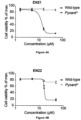
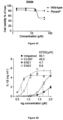
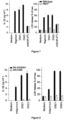
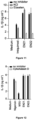
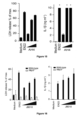
- the present compounds have been shown to induce typical characteristics of inflammasome activation, including the activation of caspase-1, the release of the biologically active forms of proinflammatory cytokines such as IL-1 ⁇ ( Figures 5A and 5B ). Moreover, inflammasome-dependent lytic cell death (pyroptosis) and ASC speck formation are induced by the present compounds ( Figure 6 , 7 , 13-16 and 18 ). For the induction of the lytic cell death, a concentration dependence can be observed ( Figures 4A-C , 13-16 and 18 ).
- Figure 4D shows the EC50 for induction of IL-1 ⁇ in BMDCs for compounds EN21 and EN22 in comparison to the imidazoquinoline NLRP3 activators imiquimod and CL097, wherein EC50 for EN21 and EN22 is surprisingly 10 times lower than for imiquimod and CL097.
- a further advantage of the present compounds is that the present compounds seem to activate NLRP3 rapidly. Especially with EN22, the inflammasome activation in BMDCs from wild-type mice without inhibitor is almost maximum after only 30 minutes. Thus, a rapid effectiveness of a medicament comprising the compounds of the invention is assumed.
- the present compounds do not inhibit mitochondrial respiration and are therefore less susceptible to unspecific undesired effects ( Figure 10 ).
- NLRP3 activators lead to massive potassium efflux from the cell via different mechanisms, which precedes inflammasome activation.
- the present compounds such as EN21 and EN22 activate the NLRP3 inflammasome independently of potassium efflux from the cell ( Figures 11 and 17 ).
- ROS reactive oxygen species
- NLRP3 activators such as uric acid crystals (mono sodium urate, MSU) or aluminum hydroxide
- the present compounds are not endocyted by immune cells, followed by endolysosomal rupture to induce inflammasome activation.
- the endocytosis inhibitor cytochalasin D can prevent particle-induced NLRP3 activation, but cannot prevent NLRP3 activation by EN21 and EN22 ( Figure 12 ).
- the present compounds are important to the pharmaceutical industry because they can increase or rapidly induce in a selective manner the NLRP3 inflammasome.
- the present invention relates to the present compounds for use as a medicament.
- the present compounds for use as a medicament are used in a therapeutically effective amount.
- the medicament can be in any physical form, such as a solid, semi-solid, plaster, solution, suspension, lotion, cream, foam, gel, paste, emulsion, or a combination thereof.
- examples of the medicament include, but are not limited to, a pharmaceutical composition, an ingestible composition, a personal care composition, and a combination thereof.
- the present invention relates to the present compounds for use in the prevention or treatment of a disease by activating the NLRP3 inflammasome, wherein the disease is selected from a group comprising infectious diseases or cancer.
- the present compounds may be used in the prevention or treatment of a bacterial infection.
- the present compounds may be used in the prevention or treatment of a viral infection.
- the viral infection may be selected from the group comprising genital warts, cutaneous warts and COVID-19.
- the present compounds may be used in the prevention of an infectious disease by boosting vaccination-mediated immunity against pathogens.
- the present compounds may be used in the prevention or treatment of a cancer. In one embodiment, the present compounds may be used in breaking the immune evasion in cancer diseases.
- the term "Immune evasion of cancer” or “cancer immune evasion” is the ability of cancer to persist in a host having a functioning immune system. There are a number of factors that contribute to tumor persistence despite having a normal host immune system. Immune editing is one of the key aspects why tumors evade surveillance causing the tumors to lie dormant in patients for years through "equilibrium” and “senescence” before re-emerging.
- the compounds of the present invention may be used as an adjuvant.
- the compounds of the present invention may be used to boost the immune response.
- the boost of the immune response by a compound of the present invention may be suitable during the prevention or treatment of cancer, an infectious disease or during a vaccination process.
- the compounds of the present invention may be used as an adjuvant in the context of vaccination to boost specific immune responses by activating the NLRP3 inflammasome.
- the present compounds may be used in the prevention or treatment of cancer, wherein the cancer is selected from the group comprising solid tumors, skin cancer, wherein skin cancer is selected from the group comprising superficial basal cell carcinoma, genital warts and actinic keratosis, acute myeloid leukemia, adrenocortical carcinoma, Kaposi sarcoma, lymphoma, anal cancer, appendix cancer, teratoid/rhabdoid tumor, basal cell carcinoma, bile duct cancer, bladder cancer, bone cancer, brain cancer, breast cancer, bronchial tumor, carcinoid tumor, cardiac tumor, cervical cancer, chordoma, chronic lymphocytic leukemia, chronic myeloproliferative neoplasm, colon cancer, colorectal cancer, craniopharyngioma, bile duct cancer, endometrial cancer, ependymoma, esophageal cancer, esthesioneuroblastoma, Ewing
- the present compounds may be used in the prevention or treatment of disease, wherein the compound activates the NLRP3 inflammasome and is preferably administered to a subject having a disease in which activation of the NLRP3 inflammasome contributes to the treatment of the pathology and/or symptoms of the disease and/or stops or decreases progression of the disease.
- a subject to be treated is a human or an animal, preferably a human.
- the present compounds are used in the activation of the NLRP3 inflammasome and TLR 7 and/or TLR 8 is not activated.
- the present compounds are administered in an amount of 0.0005 mg kg -1 to 1000 mg kg -1 , 0.005 mg kg -1 to 500 mg kg -1 , 0.05 mg kg -1 to 100 mg kg -1 , 0.5 mg kg -1 to 100 mg kg -1 , 5 mg kg -1 to 75 mg kg -1 , preferably about 50 mg kg -1 in a mouse or a human.
- the present compounds are administered topically, orally or systemically. In one embodiment of the invention, the present compounds are administered topically. In one embodiment of the invention, the present compounds are administered systemically.
- the present invention relates to a pharmaceutical composition
- a pharmaceutical composition comprising a compound of the present invention and one or more pharmaceutically acceptable excipients.
- the pharmaceutical composition can be in any physical form, such as a solid, semi-solid, plaster, solution, suspension, lotion, cream, foam, gel, paste, emulsion, or a combination thereof.
- the pharmaceutical composition is in form of a tablet, spray, ointment or gel, preferably an ointment.
- the pharmaceutical composition comprises the present compound in a concentration ranging from about 0.0001 ppm to 100,000 ppm. In another embodiment of the composition, the present compound is in a concentration ranging from about 0.001 ppm to 10,000 ppm. In another embodiment of the composition, the present compound is in a concentration ranging from about 0.01 ppm to 1,000 ppm. In another embodiment of the composition, the present compound is in a concentration ranging from about 0.1 ppm to 500 ppm. In another embodiment of the composition, the present compound is in a concentration ranging from about 1 ppm to 500 ppm. In another embodiment of the composition, the present compound is in a concentration ranging from about 10 ppm to 500 ppm. In another embodiment of the composition, the present compound is in a concentration ranging from about 1 ppm to 400 ppm.
- the present invention relates to the use of the compounds of the present invention for boosting immune responses or breaking immune evasion in cancer diseases in a subject.
- the present invention relates to a method for modulating NLRP3 activity, the method comprising contacting NLRP3 with a compound of the present invention.
- the method for modulating NLRP3 comprises increasing the activity of NLRP3.
- the method for modulating NLRP3 comprises that the increase of activity of the NLRP3 inflammasome can be measured by the increase of the released amount of IL-1 ⁇ of 0.25 ⁇ 10 6 BMDCs, upon administering the compound in a concentration of 50 ⁇ M of the compound and incubation of after 22 h, wherein the increase is at least 0.1 ng ml -1 , 0.5 ng ml -1 , 0.75 ng ml -1 , 1 ng ml -1 2 ng ml -1 , 10 ng ml -1 , 25 ng ml -1 , 50 ng ml -1 and more preferably 4 ng ml -1 or more, and still more preferably 6 ng ml -1 .
- the method for modulating NLRP3 is carried out in vitro or in vivo.
- the present invention relates to a method of treating cancer, comprising administering to a subject in need of such treatment an effective amount of a compound of the present invention, or a pharmaceutical composition of the present invention.
- the method of treating cancer comprises that the compound is administered in combination with one or more additional cancer therapies.
- the method of treating cancer comprises the one or more additional cancer therapies, which comprises surgery, radiotherapy, chemotherapy, toxin therapy, immunotherapy, cryotherapy or gene therapy, or a combination thereof.
- the method of treating cancer comprises chemotherapy, which comprises administering one or more additional chemotherapeutic agents.
- the method of treating cancer comprises chemotherapy, which comprises administering one or more additional chemotherapeutic agents, signal transduction inhibitors (kinase inhibitors) and immunomodulators (checkpoint inhibitors and STING agonists).
- chemotherapy comprises administering one or more additional chemotherapeutic agents, signal transduction inhibitors (kinase inhibitors) and immunomodulators (checkpoint inhibitors and STING agonists).
- the method of treating cancer comprises chemotherapy, which comprises administering one or more additional chemotherapeutic agents, wherein the one or more additional chemotherapeutic agents is selected from an alkylating agent (e.g., cisplatin, carboplatin, mechlorethamine, cyclophosphamide, chlorambucil, ifosfamide and/or oxaliplatin); an anti-metabolite (e.g.,azathioprine and/or mercaptopurine); a terpenoid (e.g., a vinca alkaloid and/or a taxane; e.g., Vincristine, Vinblastine, Vinorelbine and/or Vindesine Taxol, Pacllitaxel and/or Docetaxel); a topoisomerase (e.g., a type I topoisomerase and/or a type 2 topoisomerase; e.g., camptothecins,
- Additional chemotherapeutic agents might be immune checkpoint inhibitors.
- Preferred additional chemotherapeutic agents and/or immune checkpoint inhibitors are selected from the group consisting of Urelumab, PF-05082566, MEDI6469, TRX518, Varlilumab, CP-870893, Pembrolizumab (PD-1), Nivolumab (PD1), Atezolizumab (PD-L1), PDR001 (PD-1), BMS-986016, MGA271, Lirlumab, IPH2201, Emactuzumab, INCB024360, Galunisertib, Ulocuplumab, BKT140, Bavituximab, CC-90002, Bevacizumab, 1VINRP1685A, and MGA271.
- the present invention relates to a method for analyzing the activity of NLRP3 activation.
- the NLRP3 inflammasome activation may be tested in different cell types like for examples primary murine bone marrow-derived dendritic cells (BMDCs) and macrophages (BMDMs), THP-1 cells, human peripheral blood mononuclear cells (PBMCs). Cells are typically primed with 50 ng ml -1 LPS for 3 hours before inflammasome activation.
- BMDCs primary murine bone marrow-derived dendritic cells
- BMDMs macrophages
- THP-1 cells THP-1 cells
- PBMCs human peripheral blood mononuclear cells
- Markers of inflammasome activation are investigated by measuring release of the cytosolic enzyme lactate dehydrogenase (LDH) from the cells as a readout for lytic cell death and pyroptosis, detecting release of proinflammatory cytokines such as IL-1 ⁇ into the cell supernatants by enzyme-linked immunosorbent assay (ELISA), looking at caspase 1 activation and cleavage of Gasdermin D and pro IL-1 ⁇ via Immunoblotting and following ASC speck formation via immunofluorescence imaging.
- LDH lactate dehydrogenase
- the present invention relates to the method for analyzing the NLRP3 activation, which comprises the steps of: (i) priming cells with LPS, (ii) contacting the cells with present compounds (iii) detecting the release of IL-1 ⁇ into the cell supernatant by enzyme-linked immunosorbent assay (ELISA) and analyzing the cells by immunoblotting and immunofluorescence imaging.
- ELISA enzyme-linked immunosorbent assay
- the present invention relates to the use of the present compounds for analyzing the activity of NLRP3 activation in vitro.
- the present compounds are useful as modulators of NLRP3.
- new, specific NLRP3 activators out of about 50.000 small molecule compounds have been identified, which differ in their structure and several properties of NLRP3 activation from all previously known and protected NLRP3 activators and are novel and unique in them.
- NLRP3 activators presented herein are sufficiently soluble and cell-permeable inflammasome activators:
- the activators showed sufficient solubility in solvents such as DMSO and have the ability to pass the cell membrane, as only then the detection by the high-throughput screening is possible.
- the present compounds showed good activity in vitro. This was tested in cell culture in several different in vitro assays classically used to investigate inflammasome activation.
- LDH lactate dehydrogenase
- BMDCs Mouse bone marrow-derived dendritic cells
- the cells were spun down by centrifugation at 400x g, 4°C for 5 minutes and red blood cells lysed by resuspension and incubation for 5 minutes at room temperature in RBC lysis buffer. 9 ml of flushing medium were added and cells were again spun down by centrifugation at 400x g, 4°C for 5 minutes.
- BMDC medium RPMI, 10% fetal bovine serum, 1% penicillin-streptomycin100 U/ml, 20 ng/ml recombinant murine GM-CSF
- RPMI 10% fetal bovine serum
- penicillin-streptomycin100 U/ml 20 ng/ml recombinant murine GM-CSF
- BMDCs after 6 to 8 days of differentiation were harvested by transferring floating cells to 50 ml Falcon tubes and dislodging adherent cells with HBSS containing 5 mM EDTA.
- BMDCs from wild-type mice after 7 days of differentiation were harvested as described above. Depending on the volume of cell suspension needed for the experiment, the cells were resuspended in an appropriate volume of BMDC and counted with a Countess TM II FL Automated Cell Counter (Thermo Fisher Scientific). The concentration was adjusted to 0.25x 10 6 cells ml -1 and the cells were primed with 50 ng ml -1 E. coli K12 ultra-pure LPS.
- Luminescence signals were normalized to nigericin as a positive control for inflammasome activation and DMSO as a negative control. Small molecules were considered active and chosen for subsequent counter screening when they induced a reduction in the luminescence signal that was at least 50% (25% in some cases) of the reduction induced by 5 ⁇ M nigericin (see Figure 1 ).
- BMDCs from wild-type mice were harvested, counted and the concentration adjusted to 0.25 ⁇ 10 6 cells ml -1 .
- the cells were primed with 50 ng ml -1 E. coli K12 ultra-pure LPS directly before plating 40 ⁇ l per well cell suspension to white 384 well flat-bottom microplates and it was incubated for 3 hours at 37°C, 5% CO 2 in a humidified incubator.
- HTRF Homogeneous Time Resolved Fluorescence
- FRET fluorescence resonance energy transfer technology
- BMDCs after 7- 9 days of differentiation were harvested and counted with a Neubauer Chamber (Hecht Assistant) and the concentration was set to 1 Mio cells ml -1 .
- 100 ⁇ l cell suspension per well were seeded in 96-well plates.
- the cells were primed with 50 ng ml -1 E. coli K12 ultra-pure LPS for 3 hours and subsequently treated with canonical inflammasome activators or experimental compounds for 3 hours if not indicated differently (incubation time Figure 4D , 5 , 7, 8 , 11 , 13-18 : 3 h, Figure 12 : 4h).
- Concentrations of the stimuli were as follows if not indicated differently: 5 ⁇ M nigericin, 100 ⁇ M imiquimod (also known as R837), 100 ⁇ M CL097, 100 ⁇ M R848, 1 ⁇ g ml -1 poly(dA:dT), 300 ⁇ g ml -1 MSU. If an inhibitor was used before stimuli treatment, the inhibitor was added after 2.5 hours of priming and it was incubated for 30 minutes before inflammasome activation.
- Inhibitors were used as follows: 3 ⁇ M MCC950, 45 mM KCI, 30 ⁇ M ebselen (2-Phenyl-1,2-benzoselenazol-3-one), 5 ⁇ M cytochalasin D (see Figures 8 , 11 , 12 and 17 ).
- BMDCs after 7-9 days of stimulation were left unprimed and then stimulated as described in Example 1.4.
- Cell-free supernatants were analyzed via ELISA (see Figure 9 and 18 ).
- LDH lactate dehydrogenase
- Luminescence intensities were normalized as % of the highest signals obtained, usually in the untreated control conditions.
- Cytokines were quantified in cell-free supernatants by using enzyme-linked immunosorbent assay (ELISA) kits for murine IL-1 ⁇ , TNF and IL-6 (Thermo Fisher Scientific). The volumes of cell-free supernatants, antibodies and reagents used were reduced to 50 ⁇ l. Each condition was measured as 3 independent technical replicates and data was depicted as mean ⁇ SD. Absorbance at 450 nm and 570 nm was determined using a Tecan Infinite M200 plate reader (Tecan Life Sciences). Absolute values were interpolated from a standard curve that was generated with the Magellan TM Data Analysis Software. Depending on the expected cytokine quantity cell-free supernatants were diluted so that the detection values were within the linear range of the standard curve (see Figures 4D , 7-9 , and 11-19 ).
- ELISA enzyme-linked immunosorbent assay
- Cell lysates for immunoblotting were generated by lysing the cells with 1x reducing SDS-PAGE loading buffer followed by 1 freeze-thaw cycle. Cell-free supernatants were diluted with 3x reducing SDS-PAGE loading buffer. Samples from 3 independent technical replicates were pooled and proteins were separated via SDS-PAGE (sodium dodecyl sulfate polyacrylamide gel electrophoresis) using 12% polyacrylamide gels and applying 80-120 V for 1-2.5 hours. Afterwards, proteins were transferred to nitrocellulose membranes by application of 100 V for 100 minutes. Membranes were rinsed with PBS-tween and success of protein transfer checked via Ponceau S staining.
- SDS-PAGE sodium dodecyl sulfate polyacrylamide gel electrophoresis
- membranes were then washed with PBS-tween again until Ponceau was completely removed and blocked with 2% skim milk powder in PBS-tween for 1 hour at room temperature.
- Membranes were rinsed with PBS-tween again and primary antibodies applied overnight at 4°C (diluted in PBS-tween, 2% skim milk powder, 0.05% sodium azide).
- HRP-conjugated secondary antibodies diluted 1:5,000 in PBS-tween, 2% skim milk powder
- membranes were washed with PBS-tween for 2 hours, replacing with fresh PBS-tween every 15 minutes.
- Enhanced chemiluminescence substrate was applied before imaging with a cooled charge-coupled device. Depending on the signal intensity (16 bit, 64K grayscale) it was exposed for 2-15 minutes.
- BMDCs from either wild-type or ASC-citrine mice expressing a ASC fluorescent protein were seeded in chambered coverslips for cell imaging ( ⁇ -Slide, Ibidi) and primed with 50 ng ml -1 LPS for 3 hours. The cells were then incubated with the inflammasome activator of interest at the respective conditions. After the treatment, the cells were washed with PBS, fixed with 4% paraformaldehyde for 10 minutes and permeabilized with 0.1% (v/v) TritonTM X-100) for 5 minutes. The cells were then stained with polyclonal anti-ASC antibody derived from rabbit (Adipogen) and FITC anti-mouse CD45 antibody (Biolegend) overnight at 4°C.
- the cells were washed with blocking buffer and stained with a fluorescence labelled secondary antibody specific for rabbit for 30 minutes at room temperature, washed and subsequently resuspended in Vectashield ® Antifade Mounting Medium with DAPI (H-1200) (Vector Laboratories) diluted 1:10 in blocking buffer for at least 10 minutes. Confocal microscopy of the immunostained cells was then performed. Immunostaining for ASC is dispensable if BMDCs from ASC-citrine mice are used.
- Oxygen consumption rate (OCR) and extracellular acidification rate (ECAR) were measured by extracellular flux analysis with a Seahorse XFe96 Analyzer.
- OCR Oxygen consumption rate
- ECAR extracellular acidification rate
- the medium was then exchanged to bicarbonate- and phenol red-free seahorse base medium supplemented with 2 mM L-glutamine, 10 mM glucose and 5 mM HEPES, pH 7.4 and the cells were incubated at 37°C in a CO 2 -free incubator for 1 hour.
- 10x dilutions of compounds and inhibitors to be tested were prepared in seahorse base medium and loaded to the injection ports of the rehydrated XFe sensor cartridge.
- Aniline derivative (1 eq.) was dissolved in an aprotic solvent such as dry DCM or dry THF.
- Isocyanatobenzene, thioisocyanatobenzene, 1-isocyanato-4-methoxybenzene or 4-isocyanato-benzonitrile (1 eq.) dissolved in an aprotic solvent such as dry DCM or dry THF was added dropwise to the reaction with a syringe over 5 min. The reaction was stirred at 25 °C for 4h or until completion of the reaction and stopped by evaporation of the solvents.
- the crude solid was purified by filtration with cyclohexane/DCM and/or by flash column chromatography with a cyclohexane/ethyl acetate or DCM/methanol of varying eluent composition.
- Triphosgen (0.4 eq.) was dissolved in dry DCM or dry THF and a solution of a primary or secondary aromatic amine (1 eq.) and triethylamine (3 eq.) in dry DCM or dry THF was added dropwise with a syringe over 10 min. The reaction was stirred at 25 °C for 2h. The solvent was removed by a rotary evaporator under the hood. The crude was filtrated with cyclohexane and the filtrate collected and evaporated. The resulting solid containing the isocyanate was used without further purification in following reactions. No NMR spectra were recorded.
- An isocyanate (1.2 eq.) or carbamic chloride (1.2 eq.) synthesized via general synthesis procedure B was dissolved in an aprotic solvent such as dry DCM or dry THF and added dropwise with a syringe over 5 min to a solution of an aniline (1 eq.) or primary amine (1 eq.) dissolved in an aprotic solvent such as dry DCM or dry THF and stirred at 25 °C for 4h or until completion of the reaction.
- an aprotic solvent such as dry DCM or dry THF
- the crude solid was purified by filtration with cyclohexane/DCM and/or by flash column chromatography on SiO2 gel with a cyclohexane/ethyl acetate or DCM/MeOH of varying eluent composition or HPLC.
- N'-hydroxy-4- (trifluoromethyl)benzimidamide (2) (16.2 g, 79.4 mmol, 1 eq.) was added at once and the resulting mixture was stirred at 60°C until full consumption of 4-(trifluoromethyl)benzimidamide (2) was being achieved (TLC data, approximately 30 min for this scale). Then the reaction mixture was heated at 90°C for 12 h, cooled to r.t. and evaporated in vacuo. The resulting residue was diluted with 30 % aq. solution of potassium carbonate (200 mL) and ethyl acetate (200 mL), the water layer was separated and extracted with ethyl acetate (2 ⁇ 100 mL).
- 1-(4-methoxyphenyl)-3-(quinolin-6-yl)urea was synthesized according to general synthesis procedure A.
- 1-(4-cyanophenyl)-3-(quinolin-6-yl)urea was synthesized according to general synthesis procedure A.
- 1-(1,5-naphthyridin-2-yl)-3-phenylurea was synthesized according to general synthesis procedure A.
Landscapes
- Health & Medical Sciences (AREA)
- Chemical & Material Sciences (AREA)
- Medicinal Chemistry (AREA)
- Pharmacology & Pharmacy (AREA)
- Life Sciences & Earth Sciences (AREA)
- Animal Behavior & Ethology (AREA)
- General Health & Medical Sciences (AREA)
- Public Health (AREA)
- Veterinary Medicine (AREA)
- Epidemiology (AREA)
- Immunology (AREA)
- Chemical Kinetics & Catalysis (AREA)
- General Chemical & Material Sciences (AREA)
- Nuclear Medicine, Radiotherapy & Molecular Imaging (AREA)
- Organic Chemistry (AREA)
- Engineering & Computer Science (AREA)
- Bioinformatics & Cheminformatics (AREA)
- Communicable Diseases (AREA)
- Oncology (AREA)
- Pharmaceuticals Containing Other Organic And Inorganic Compounds (AREA)
- Plural Heterocyclic Compounds (AREA)
Claims (15)
- Verbindung zur Verwendung bei der Vorbeugung oder Behandlung einer Krankheit durch Aktivierung des NLRP3-Inflammasoms, wobei die Krankheit aus einer Gruppe ausgewählt ist, die Infektionskrankheiten oder Krebs umfasst, und(I) wobei die Verbindung eine Verbindung der Formel (I)
 B ausgewählt ist aus O oder S, vorzugsweise O;X und X' jeweils unabhängig voneinander vorhanden sind oder nicht, wobei X und X' jeweils unabhängig voneinander eine C1-C5-Alkylgruppe oder -CH(CH2OH)- sind; undR6 und R7 jeweils unabhängig voneinander Wasserstoff oder ein C1-C3-Alkyl sind, vorzugsweise -H, -CH3, -C2H5, -C3H7 oder -C3H9, oder optionalR6 und R7 zusammen einen fünfgliedrigen heterocyclischen Ring bilden, ausgewählt aus
 R7, N und X zusammen einen sechsgliedrigen heterocyclischen Ring bilden, ausgewählt aus
 und wobeiA und A' voneinander verschieden und jeweils unabhängig voneinander aus einer der folgenden Gruppen ausgewählt sind:a) eine Benzolgruppe mit der folgenden Struktur:
 Wasserstoff; -OH, -OCH3, -OCF3, -OCHF2, -OCH2OH; -OCH2CH3; -OCH(CH3)2; -F; - CI; -Br; -CN; NO2; NH2; C1-C5-Alkyl, C1-C5-Alkoxy, -CH3, -CH2F; -CHF2; -CF3; -CH2Cl; -CHCl2; -CCl3; CH(CH3)2; -CH2CH3; -CH-CH2-CH(CH3)2; -CH2-N(CH3)2; -CH(CH3)-NHC(O)CH3; - -NH-CH(CH3)2, -NH-Cyclopropyl, -CH3, CH2CH3, CH2CH(CH3)2; -C(O)-C2H5; -C(O)-CH3; -C(O)-Aziridin; -C(O)-Azetidin; -C(O)-Pyrrolidin; -C(CH3)=NOH; - S(O)2-Cyclopentyl; -S(O)2-CH3; -S(O)2-Cyclopentyl; Pyrrolidinyl,
 NHC(O)-R41, wobei R41 ausgewählt ist aus C1-C10 Cycloalkyl, C1-C10 Cycloheteroalkyl, Furan, Tetrahydrofuran, Cyclopentyl, Cyclobutyl, Cyclopropyl, -NH-CH(CH3)2, -NH-Cyclopropyl, C1-C5 Alkyl, -CH2F; -CHF2; -CF3; -CH2Cl; -CHCl2; -CCl3;-CH3, CH2CH3, CH2CH(CH3)2;-C(O)OR42, wobei R42 ausgewählt ist aus C1-C5-Alkyl, einschließlich -CH3; -CH2CH3, - CH2CH2CH3; -CH(CH3)2; -CH2CH2CH2CH3; -CH2NHS(O)2CH3;-NHR43, wobei R43 ausgewählt ist aus

 R53 vorzugsweise ausgewählt ist aus der Gruppe bestehend aus Wasserstoff, OH, - OCH3, -OCF3, -OCHF2, -OCH2OH; -OCH2CH3; -F; -Cl; -Br; -CN; NO2; NH2; C1-C5-Alkyl, C1-C5-Alkoxy, C2-C5-Alkenyl, vorzugsweise -CH3, CH(CH3)2; -CH2CH3; -CH-CH2-CH(CH3)2; -CH2-N(CH3)2; -CH(CH3)-NHC(O)CH3; -CH2F; -CHF2; -CF3; -CH2Cl; - CHCl2; -CCl3; -O-N=O, -N=O, -CH=NH, -N3, -SH, -SO3H, -SO2H, -S(O)2CH3-CN, - NC,-OCN, -NCO, -(C=O)OH, -(C=O)NHOH, -NH(C=O)NH2, -NH(C=S)NH2, - (C=O)NH2,-CHO,-CHS,-OCHO, -NCHO,
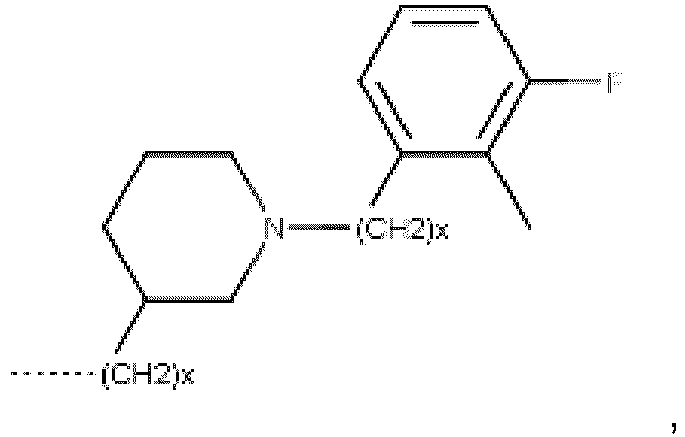

 R53 ist
 wobei R54, R55, R56, R57 oder R58 jeweils unabhängig voneinander ausgewählt sind aus Wasserstoff, -CH3, -C2H5, -CH2F; -CHF2; -CF3; -CH2Cl; -CHCl2; -CCl3; -OCH3, -F, -Cl, -Br, NH2, NO2, und x 0, 1 oder 2 ist;oder R53 ist
 R54, R55, R56, R57 oder R58 unabhängig von den obigen ausgewählt sind aus Wasserstoff, -CH3, -C2H5, -CH2F; -CHF2; -CF3; -CH2Cl; -CHCl2; -CCl3; -OCH3, -F, -Cl, -Br, NO2, NH2, und x 0, 1 oder 2 ist; wie oben definiert;
undwobei R1 und R2, R2 und R3, R3 und R4 oder R4 und R5 zusammen, vorzugsweise R2 und R3 zusammen, einen fünf- oder sechsgliedrigen zyklischen oder heterozyklischen Ring bilden, ausgewählt aus
 worin vorzugsweise entweder alle R1 bis R5 Wasserstoff sind,oder 1, 2 oder 3, vorzugsweise 1 oder 2 von R1 bis R5 nicht Wasserstoff sind und aus den oben unter a) für R1 bis R5 definierten Substitutionen ausgewählt sind, und die restlichen Substituenten von R1 bis R5 Wasserstoff sind;b) eine Pyridin-Gruppe, ausgewählt aus einer der folgenden Strukturen:
 Wasserstoff, -OH, -OCH3, CH3, F, Cl, Br, -CH2F; -CHF2; -CF3; -CH2Cl; -CHCl2; -CCl3 - OCF3, -OCHF2, -OCH2OH; -OCH2CH3; -CN; NO2; NH2; -CH3, CH(CH3)2; -CH2CH3; - CH2OH; -CH-CH2-CH(CH3)2; -CH2-N(CH3)2; -CH(CH3)-NHC(O)CH3;
 -C(O)OR42, wobei R42 ausgewählt ist aus C1-C5-Alkyl, einschließlich -CH3; -CH2CH3, - CH2CH2CH3; -CH(CH3)2; -CH2CH2CH2CH3; -CH2NHS(O)2CH3; -C(CH3)=NOH; -S(O)2-Cyclopentyl; -S(O)2-CH3; -S(O)2-Cyclopentyl; Pyrrolidinyl,
 -NHR43, wobei R43 ausgewählt ist aus
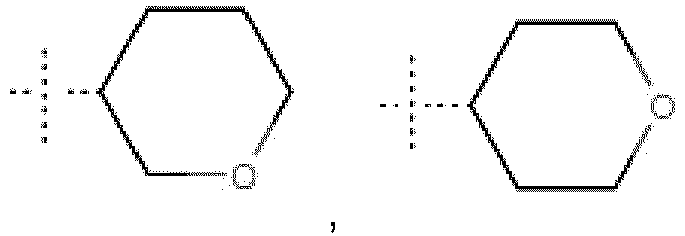 oder 1, 2 oder 3, vorzugsweise 1 oder 2 von R45 bis R47 nicht Wasserstoff sind und aus den oben unter b) für R44 bis R47 definierten Substitutionen ausgewählt sind, und die restlichen Substituenten von R44 bis R47 Wasserstoff sind;c) eine Chinolingruppe oder eine Isochinolingruppe, ausgewählt aus einer der folgenden Strukturen:


 R21 bis R26 jeweils unabhängig voneinander ausgewählt sind aus der Gruppe bestehend ausWasserstoff, OH, -OCH3, -OCF3, -OCHF2, -OCH2OH; -OCH2CH3; -F; -Cl; -Br; -CH2F; - CHF2; -CF3; -CH2Cl; -CHCl2; -CCl3; -CN; NO2; NH2; C1-C5-Alkyl, C1-C5-Alkoxy, C2-C5-Alkenyl, vorzugsweise -CH3, CH(CH3)2; -CH2CH3; -CH-CH2-CH(CH3)2; -CH2-N(CH3)2; -CH(CH3)-NHC(O)CH3; -O-N=O, -N=O, -CH=NH, -N3, -SH, -SO3H, -SO2H, -S(O)2CH3 -CN, -NC,-OCN, -NCO, -SCN, -NCS, -(P=O)(OH)2, -O(P=O)(OH)2, -(C=O)OH, - (C=O)NHOH, -NH(C=O)NH2, -NH(C=S)NH2, -(C=O)NH2,-CHO,-CHS, -OCHO, - NCHO, -C(O)-Aziridin; -C(O)-Azetidin; -C(O)-Pyrrolidin; -C(O)OR42, wobei R42 ausgewählt ist aus C1-C5-Alkyl, einschließlich -CH3; -CH2CH3, -CH2CH2CH3; - CH(CH3)2; -CH2CH2CH2CH3; -CH2NHS(O)2CH3; -C(CH3)=NOH; -S(O)2-cyclopentyl; - S(O)2-CH3; -S(O)2-cyclopentyl; Pyrrolidinyl,
 -NHC(O)-R41, wobei R41 ausgewählt ist aus C1-C10 Cycloalkyl, C1-C10 Cycloheteroalkyl, Furan, Tetrahydrofuran, Cyclopentyl, Cyclobutyl, Cyclopropyl, -NH-Cyclopropyl, - CH2F; - CHF2; -CF3; -CH2Cl; -CHCl2; -CCl3; -CH3, CH2CH3, CH2CH(CH3)2;-NHR43, wobei R43 ausgewählt ist aus
 oder, noch bevorzugter, wobei R21 bis R26 jeweils Wasserstoff, OH, -OCH3, -OCF3, - OCHF2, -OCH2OH; -OCH2CH3; -F; -Cl; -Br; -CH2F; -CHF2; -CF3; -CH2Cl; -CHCl2; - CCl3;-CN; NO2; NH2; C1-C5-Alkyl, C1-C5-Alkoxy, C2-C5-Alkenyl, vorzugsweise -CH3, CH(CH3)2; -CH2CH3; -CH-CH2-CH(CH3)2; -CH2-N(CH3)2; -CH(CH3)-NHC(O)CH3 sind;oder noch mehr bevorzugt, wobei R21 bis R26 jeweils Wasserstoff oder -F; Cl, Br sind,wobei vorzugsweise entweder alle R21 bis R26 Wasserstoff sind,oder 1, 2 oder 3, vorzugsweise 1 oder 2 von R21 bis R26 nicht Wasserstoff sind und aus den oben unter c) für R21 bis R26 definierten Substitutionen ausgewählt sind, und die restlichen Substituenten von R21 bis R26 Wasserstoff sind;d) eine 1,5-Naphthyridin-Gruppe, eine 1,6-Naphthyridin-Gruppe oder eine 1,8-Naphthyridin-Gruppe mit einer der folgenden Strukturen


 Wasserstoff, OH, -OCH3, -OCF3, -OCHF2, -OCH2OH; -OCH2CH3; -F; -Cl; -Br; -CH2F; - CHF2; -CF3; -CH2Cl; -CHCl2; -CCl3;-CN; NO2; NH2; C1-C5Alkyl, C1-C5Alkoxy, C2-C5 Alkenyl, vorzugsweise -CH3, CH(CH3)2; -CH2CH3; -CH-CH2-CH(CH3)2; -CH2-N(CH3)2; -CH(CH3)-NHC(O)CH3; -O-N=O, -N=O, -CH=NH, -N3, -SH, -SO3H, -SO2H, -S(O)2CH3 -CN, -NC,-OCN, -NCO, -SCN, -NCS, -(P=O)(OH)2, -O(P=O)(OH)2, -(C=O)OH, - (C=O)NHOH, -NH(C=O)NH2, -NH(C=S)NH2, -(C=O)NH2,-CHO,-CHS, -OCHO, - NCHO,-NHC(O)-R41, worin R41 ausgewählt ist aus C1-C40 Cycloalkyl, C1-C10 Cycloheteroalkyl, Furan, Tetrahydrofuran, Cyclopentyl, Cyclobutyl, Cyclopropyl, -NH-Cyclopropyl, - CH2F; -CHF2; -CF3; -CH2Cl; -CHCl2; -CCl3; -CH3, CH2CH3, CH2CH(CH3)2; -C(O)-Aziridin; -C(O)-Azetidin; -C(O)-Pyrrolidin;-C(O)OR42, wobei R42 ausgewählt ist aus C1-C5-Alkyl, einschließlich -CH3; -CH2CH3, - CH2CH2CH3; -CH(CH3)2; -CH2CH2CH2CH3; -CH2NHS(O)2CH3; -C(CH3)=NOH; -S(O)2-Cyclopentyl; -S(O)2-CH3; -S(O)2-Cyclopentyl; Pyrrolidinyl,


 oder noch bevorzugter, worin R48 bis R52 jeweils Wasserstoff, OH, -OCH3, -OCF3, - OCHF2, -OCH2OH; -OCH2CH3; -F; -Cl; -Br; -CH2F; -CHF2; -CF3; -CH2Cl; -CHCl2; - CCl3;-CN; NO2; NH2; C1-C5-Alkyl, C1-C5-Alkoxy, C2-C5-Alkenyl, vorzugsweise -CH3, CH(CH3)2; -CH2CH3; -CH-CH2-CH(CH3)2; -CH2-N(CH3)2; -CH(CH3)-NHC(O)CH3;oder noch mehr bevorzugt, wobei R48 bis R52 jeweils Wasserstoff oder -F; Cl, Br sind,worin vorzugsweise entweder alle R48 bis R52 Wasserstoff sind,oder 1, 2 oder 3, vorzugsweise 1 oder 2 von R48 bis R52 nicht Wasserstoff sind und aus Substitutionen ausgewählt sind, die hier oben unter d) für R48 bis R52 definiert oder dargestellt sind, und die restlichen Substituenten von R48 bis R52 Wasserstoff sind;e) eine Oxadiazolgruppe, ausgewählt aus einer der folgenden Strukturen:
R53 ist vorzugsweise ausgewählt aus der Gruppe bestehend aus:Wasserstoff, OH, -OCH3, -OCF3, -OCHF2, -OCH2OH; -OCH2CH3; -F; -Cl; -Br; -CN; NO2; NH2; C1-C5-Alkyl, C1-C5-Alkoxy, C2-C5-Alkenyl, vorzugsweise -CH3, CH(CH3)2; - CH2CH3; -CH-CH2-CH(CH3)2; -CH2-N(CH3)2; -CH(CH3)-NHC(O)CH3; -CH2F; -CHF2; - CF3; -CH2Cl; -CHCl2; -CCl3;-O-N=O, -N=O, -CH=NH, -N3, -SH, -SO3H, -SO2H, - S(O)2CH3-CN, -NC,-OCN, -NCO, -(C=O)OH, -(C=O)NHOH, -NH(C=O)NH2, -NH(C=S)NH2,-(C=O)NH2,-CHO,-CHS, -OCHO, -NCHO,


 R53 ist
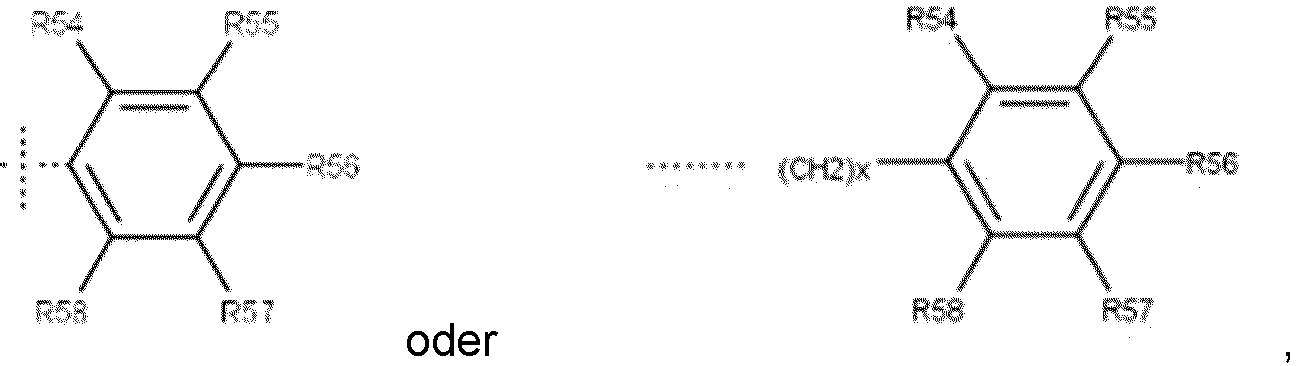 oder R53 ist
 und worin vorzugsweise entweder alle R54 bis R58 Wasserstoff sind,oder 1, 2 oder 3, vorzugsweise 1 oder 2 von R54 bis R58 nicht Wasserstoff sind und aus den oben unter e) für R54 bis R58 definierten Substitutionen ausgewählt sind, und die restlichen Positionen von R54 bis R58 Wasserstoff sind;f) eine Thiadiazolgruppe, ausgewählt aus einer der folgenden Strukturen:
 g) eine Isothiazolgruppe, ausgewählt aus einer der folgenden Strukturen:
 h) eine Thiophengruppe, ausgewählt aus einer der folgenden Strukturen:

oder(II) wobei die Verbindung eine Verbindung der Formel (Ic), eine Verbindung der Formel (Ic1), eine Verbindung der Formel (Ic2), eine Verbindung der Formel (Ic3) oder eine Verbindung der Formel (Ic4) oder ein pharmazeutisch akzeptables Salz davon ist:


 B = O oder S, vorzugsweise O;R6 und R7 unabhängig voneinander jeweils Wasserstoff oder C1-3-Alkyl sind, vorzugsweise Wasserstoff, CH3, noch bevorzugter entweder R6 Wasserstoff und R7 CH3, oder R6 und R7 beide Wasserstoff sind;R21 bis R37 jeweils unabhängig voneinander ausgewählt sind aus der Gruppe bestehend aus Wasserstoff, OH, -OCH3, -OCF3, -OCHF2, -OCH2OH; -OCH2CH3; - CH2F; -CHF2; -CF3; -CH2Cl; -CHCl2; -CCl3;-F; -Cl; -Br; -CN; NO2; NH2; -CH3, CH(CH3)2; -CH2CH3; -CH-CH2-CH(CH3)2; -CH2-N(CH3)2; -CH(CH3)-NHC(O)CH3; -O-N=O, -N=O, -OH, -NH2, -CH=NH, -N3, -SH, -SO3H, -SO2H, -S(O)2CH3-CN, -NC,-OCN, -NCO, -SCN, -NCS, -(P=O)(OH)2, -O(P=O)(OH)2, -(C=O)OH, -(C=O)NHOH, - NH(C=O)NH2, -NH(C=S)NH2, -(C=O)NH2, -CHO, -CHS, -OCHO, -NCHO, -B(OH)(2), (C=O)R11, (C=O)OR11, (C=O)SR11, (C=O)NR11R12, (SO2)R11 oder C(NR11)R12,-NHC(O)R11 und -NHC(O)NHR11,wobei R11 und R12 unabhängig voneinander ausgewählt sind aus der Gruppe bestehend aus C1-C5-Alkyl, vorzugsweise -CH3, CH(CH3)2; -CH2CH3; -CH-CH2-CH(CH3)2; -CH2-N(CH3)2; -CH(CH3)-NHC(O)CH3; I, -CH2F; -CHF2; -CF3; -CH2Cl; - CHCl2; -CCl3; -CHCl2, und -CCl3; odervorzugsweise worin R21 bis R37 jeweils unabhängig voneinander ausgewählt sind aus der Gruppe bestehend aus Wasserstoff, -CH2(SO2)CH3, -CH2(SO2)CH2CH3, - CH2CH2(SO2)CH2CH3; -(SO2)C1-C5-Alkyl, vorzugsweise -(SO2)CH3, -(SO2)CH2CH3, - CH2F; -CHF2; -CF3; -CH2Cl; -CHCl2; -CCl3; -F, -Cl, und -Br; oderworin vorzugsweise entweder alle R21 bis R37 Wasserstoff sind,oder 1, 2 oder 3, vorzugsweise 1 oder 2 von R21 bis R37 nicht Wasserstoff sind und aus den oben dargestellten Substitutionen ausgewählt sind, und die restlichen Positionen von R21 bis R37 Wasserstoff sind; oderbevorzugter, wobei R21 bis R37 jeweils Wasserstoff sind.
 - Verbindung zur Verwendung nach Anspruch 1, wobei die Verbindung eine Verbindung der Formel (Ic5), eine Verbindung der Formel (Ic6), eine Verbindung der Formel (Ic7), eine Verbindung der Formel (Ic8), eine Verbindung der Formel (Ic9) oder eine Verbindung der Formel (Ic10), eine Verbindung der Formel (Ic11), eine Verbindung der Formel (Ic12) oder eine Verbindung der Formel (Ic13) oder ein pharmazeutisch annehmbares Salz davon ist:


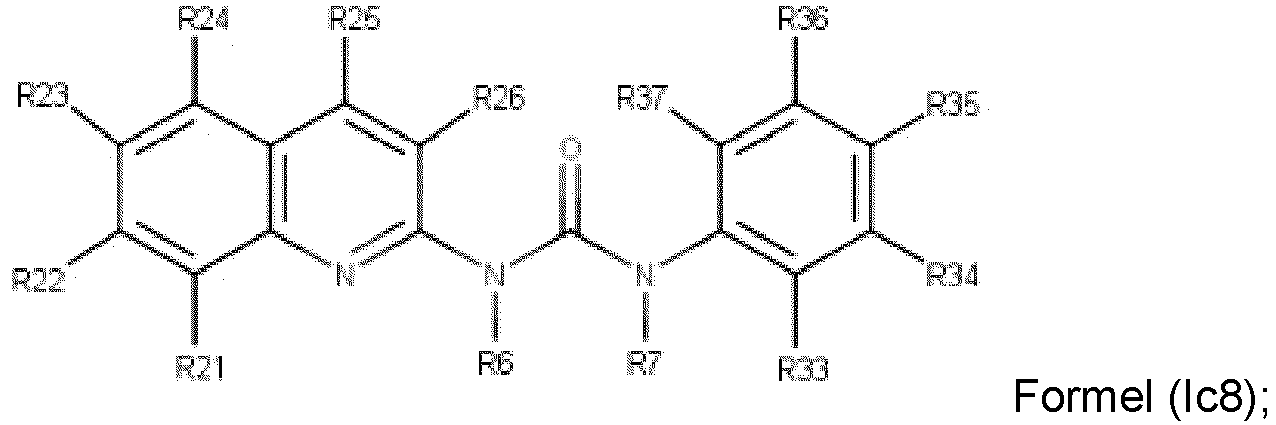


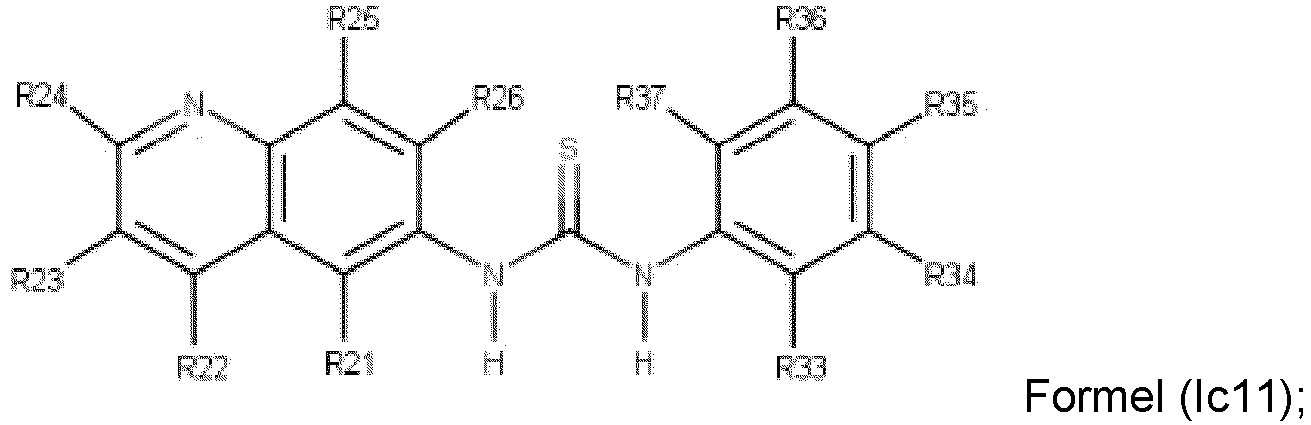


 worin R21 bis R37 jeweils unabhängig voneinander ausgewählt sind aus der Gruppe bestehend aus Wasserstoff, OH, -OCH3, -OCF3, -OCHF2, -OCH2OH; -OCH2CH3; - CH2F; -CHF2; -CF3; -CH2Cl; -CHCl2; -CCl3; -F; -Cl; -Br; -CN; NO2; NH2; -CH3, CH(CH3)2; -CH2CH3; oder -CH2(SO2)CH3, -CH2(SO2)CH2CH3, -CH2CH2(SO2)CH2CH3; -(SO2)C1-C5Alkyl, vorzugsweise -(SO2)CH3, -(SO2)CH2CH3, oderworin vorzugsweise entweder alle R21 bis R37 Wasserstoff sind,oder 1, 2 oder 3, vorzugsweise 1 oder 2 von R21 bis R37 nicht Wasserstoff sind und aus den oben dargestellten Substitutionen ausgewählt sind, und die restlichen Positionen von R21 bis R37 aus Wasserstoff ausgewählt sind; oderbevorzugter, wobei R21 bis R37 jeweils Wasserstoff sind.
 - Verbindung zur Verwendung nach einem der Ansprüche 1 oder 2, wobei die Verbindung eine Verbindung mit einer der Formeln (la) oder (la1) ist

 A und A' voneinander verschieden sind,X entweder vorhanden ist oder nicht, und wobei X, falls vorhanden, ausgewählt ist aus -CH2-, -C2H4-, -C3H6-, -C(CH3)2-, -CHCH(CH3)2-, -CHC(CH3)3-, -CH(CH(CH3)2)-, -CH(CH2CH(CH3)2)-, oder -CH(CH2OH)-; undR6 und R7 jeweils unabhängig voneinander Wasserstoff, -CH3, -C2H5, -C3H7 oder -C3H9 sind, oder optional,R6 und R7 zusammen einen fünfgliedrigen heterocyclischen Ring bilden, ausgewählt aus
 R7, N und X zusammen einen sechsgliedrigen heterocyclischen Ring bilden, ausgewählt aus
 wobei R1-R5 jeweils unabhängig voneinander ausgewählt sind aus der Gruppe bestehend aus Wasserstoff; -OH, -OCH3, -OCF3, -OCHF2, -OCH2OH; -OCH2CH3; - OCH(CH3)(2); -F; -Cl; -Br; -CN; NO2; NH2; -CH3, -CH2F; -CHF2; -CF3; -CH2Cl; -CHCl2; -CCl3; CH(CH3)2; -CH2CH3;-C(O)OR42, wobei R42 ausgewählt ist aus -CH3; -CH2CH3, -CH2CH2CH3; -CH(CH3)2; - CH2CH2CH(2)CH3;
 wobei R1 und R2, R2 und R3, R3 und R4 oder R4 und R5 zusammen, vorzugsweise R1 und R2 oder R2 und R3 zusammen, einen fünf- oder sechsgliedrigen zyklischen oder heterozyklischen Ring bildenausgewählt aus
 und worin A aus einem der folgenden Substituenten a) bis e) ausgewählt ist:a) eine Benzolgruppe mit der folgenden Struktur:
 Wasserstoff; -OH, -OCH3, -OCF3, -OCHF2, -OCH2OH; -OCH2CH3; -OCH(CH3)2; -F; - CI; -Br; -CN; NO2; NH2; -CH3, -CH2F; -CHF2; -CF3; -CH2Cl; -CHCl2; -CCl3;CH(CH3)2; - CH2CH3; -CH-CH2-CH(CH3)2; -CH2-N(CH3)(2); -CH(CH3)-NHC(O)CH3; -C(O)-C2H5; - C(O)-CH3; -C(O)-Aziridin; -C(O)-Azetidin; -C(O)-Pyrrolidin; -CH2NHS(O)2CH3; - C(CH3)=NOH; -S(O)2-Cyclopentyl; -S(O)2-CH3; -S(O)2-Cyclopentyl; Pyrrolidinyl, , ;
 -NHC(O)-R41, wobei R41 ausgewählt ist aus Furan, Tetrahydrofuran, Cyclopentyl, Cyclobutyl, Cyclopropyl, -NH-CH(CH3)2, -NH-Cyclopropyl, -CH2F; -CHF2; -CF3; - CH2Cl; -CHCl2; -CCl3;-CH3, CH2CH3, CH2CH(CH3)2;-C(O)OR42, wobei R42 ausgewählt ist aus C1-C5-Alkyl, einschließlich -CH3; -CH2CH3, - CH2CH2CH3; -CH(CH3)2; -CH2CH2CH2CH3;-NHR43, wobei R43 ausgewählt ist aus


 oder R53 ist
 oder R53

undwobei R61 und R62, R62 und R63, R63 und R64 oder R64 und R65 zusammen, vorzugsweise R62 und R63 zusammen, einen fünf- oder sechsgliedrigen zyklischen oder heterozyklischen Ringbilden, ausgewählt aus
 wobei X vorzugsweise nicht vorhanden ist, undworin vorzugsweise entweder alle R1 bis R5 Wasserstoff sind, oder 1, 2 oder 3, vorzugsweise 1 oder 2 von R1 bis R5 nicht Wasserstoff sind und aus den oben für R1 bis R5 definierten Substitutionen ausgewählt sind, und die restlichen Substituenten von R1 bis R5 Wasserstoff sind;b) eine Oxadiazolgruppe mit einer der folgenden Strukturen:
 R53 ist vorzugsweise ausgewählt aus der Gruppe bestehend aus Wasserstoff, OH, - OCH3, -OCF3, -OCHF2, -OCH2OH; -OCH2CH3; -F; -Cl; -Br; -CN; NO2; NH2; C1-C5-Alkyl, C1-C5-Alkoxy, C2-C5-Alkenyl, vorzugsweise -CH3, CH(CH3)2; -CH2CH3; -CH-CH2-CH(CH3)2; -CH2-N(CH3)(2); -CH(CH3)-NHC(O)CH3; -CH2F; -CHF2; -CF3; -CH2Cl; - CHCl2; -CCl3;-O-N=O, -N=O, -CH=NH, -N3, -SH, -SO3H, -SO2H, -S(O)2CH3-CN, -NC,-OCN, -NCO, -(C=O)OH, -(C=O)NHOH, -NH(C=O)NH2, -NH(C=S)NH2, -(C=O)NH2,-CHO,-CHS, - OCHO, -NCHO, -


 R53 ist
 oder R53 ist
 wobei X vorzugsweise ausgewählt ist aus -CH2-, -C2H4-, -C3H6-, -C(CH3)2-, - CHCH(CH(3))2-, -CHC(CH3)3-, -CH(CH(CH3)2)-, -CH(CH2CH(CH3)2)- oder - CH(CH2OH)-;und wobei vorzugsweise entweder alle R54 bis R58 Wasserstoff sind, oder 1, 2 oder 3, vorzugsweise 1 oder 2 von R54 bis R58 nicht Wasserstoff sind und aus den oben dargestellten Substitutionen ausgewählt sind, und die verbleibenden Positionen von R54 bis R58 aus Wasserstoff ausgewählt sind;c) eine Thiadiazolgruppe mit einer der folgenden Strukturen:
 worin R53 vorzugsweise wie oben definiert ist, undvorzugsweise ist X ausgewählt aus -CH2-, -C2H4-, -C3H6-, -C(CH3)2-, -CHCH(CH(3))2-, -CHC(CH3)3-, -CH(CH(CH3)2)-, -CH(CH2CH(CH3)2)-, oder -CH(CH2OH)-;d) eine Isothiazolgruppe mit der folgenden Struktur:
und X vorzugsweise ausgewählt ist aus -CH2-, -C2H4-, -C3H6-, -C(CH3)2-, - CHCH(CH(3))2-, -CHC(CH3)3-, -CH(CH(CH3)2)-, -CH(CH2CH(CH3)2)-, oder - CH(CH2OH)-; odere) eine Thiophengruppe, vorzugsweise

X -CH2-, -C2H4-, -C3H6-, -C(CH3)2-, -CHCH(CH3)2-, -CHC(CH3)3-, -CH(CH(CH3)2)-, - CH(CH2CH(CH3)2)-, oder -CH(CH2OH)- ist. - Verbindung zur Verwendung nach Anspruch 3, wobei R1, R2, R3, R4 und R5 jeweils unabhängig voneinander Wasserstoff, -OCH3, -OCF3, -OCH2CH3, -OCH(CH3)2, - - CH3, -C2H5, -Cl,
-Br, -CN, -CH2F; -CHF2; -CF3; -CH2Cl; -CHCl2; -CCl3;NO2, oder
 wobei X vorzugsweise nicht vorhanden ist, undwobei vorzugsweise entweder alle R1 bis R5 Wasserstoff sind, oder 1, 2 oder 3, vorzugsweise 1 oder 2 von R1 bis R5 nicht Wasserstoff sind und aus den hier in Anspruch 8 dargestellten Substitutionen ausgewählt sind, und die verbleibenden Positionen von R1 bis R5 aus Wasserstoff ausgewählt sind.
 - Verbindung zur Verwendung nach einem der Ansprüche 3 bis 4, wobei R6 und R7 jeweils unabhängig voneinander Wasserstoff sind, oder R6 und R7 zusammengenommen einen heterocyclischen Ring bilden, der ausgewählt ist aus:
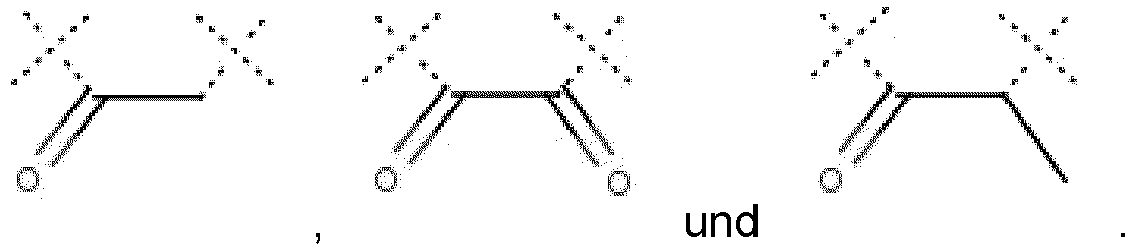
- Verbindung zur Verwendung nach einem der Ansprüche 3 bis 4, wobei R7, N und X zusammengenommen einen sechsgliedrigen heterocyclischen Ring bilden,
ausgewählt aus
- Verbindung zur Verwendung nach einem der Ansprüche 3 bis 6, worin R1, R2, R3, R4 und R5 jeweils Wasserstoff sind und/oder worin A
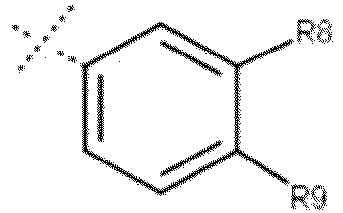 -S(O)2-cyclopentyl; Pyrrolidinyl
 NHC(O)-R41, wobei R41 ausgewählt ist aus Furan, Tetrahydrofuran, Cyclopentyl, Cyclobutyl, Cyclopropyl, -NH-CH(CH3)2, -NH-Cyclopropyl, C1-C5Alkyl, -CH2F; -CHF2; -CF3; -CH2Cl; -CHCl2; -CCl3;-CH3, CH2CH3, CH2CH(CH3)2;-C(O)OR42, wobei R42 ausgewählt ist aus -CH3; -CH2CH3, -CH2CH2CH3; -CH(CH3)2; - CH2CH2CH2CH3;-NHR43, wobei R43 ausgewählt ist aus

 R53 ist ausgewählt aus der Gruppe bestehend aus Wasserstoff, OH, -OCH3, -OCF3, - OCHF2, -OCH2OH; -OCH2CH3; -F; -Cl; -Br; -CN; NO2; NH2; -CH3, CH(CH3)2; -CH2CH3; -CH-CH2-CH(CH3)2; -CH2-N(CH3)2; -CH(CH3)-NHC(O)CH3; -CH2F; -CHF2; -CF3; - CH2Cl; -CHCl2; -CCl3;-O-N=O, -N=O, -CH=NH, -N3, -SH, -SO3H, -SO2H, -S(O)2CH3-CN, -NC,-OCN, -NCO, -(C=O)OH, -(C=O)NHOH, -NH(C=O)NH2, -NH(C=S)NH2, - (C=O)NH2,-CHO,-CHS, -OCHO, -NCHO,


 R53 ist
 oder R53 ist
 R8 und R9 zusammen einen fünf- oder sechsgliedrigen Cycloalkyl-, fünf- oder sechsgliedrigen Cycloheteroalkyl- oder fünf- oder sechsgliedrigen Aryl-, fünf- oder sechsgliedrigen Heteroarylring bilden, wobei der heterocyclische Ring vorzugsweise ausgewählt ist aus:
- Verbindung zur Verwendung nach Anspruch 7, mit der Maßgabe, dass R8 oder R9 nicht identisch miteinander sind.
- Verbindung zur Verwendung nach einem der Ansprüche 3 bis 8, wobei R1 bis R5 wie folgt ausgewählt sind:R1 ist Wasserstoff, -C1-C2 Alkoxy, -C(O)O-C1-C5 Alkyl, -OCH3, -C1-C3 Alkyl, Methyl oder Ethyl;R2 ist Wasserstoff, Methyl, -F, -Cl, -Br, -CN, -OCH3 oder -C(O)O-C1-C5-Alkyl;R3 ist Wasserstoff, Methyl, -CH(CH3)2, -CHF2, -F, -Cl, -Br, -CN, -OCH3, -OCF3, NO2 oder C(O)O-C1-C5-Alkyl,R4 ist Wasserstoff oder -F, -Cl, -Br oder -CF3; und/oderR5 ist Wasserstoff, Methyl, Ethyl oder -F, -Cl, -Br oder -CN, -CH2-Phenyl.
- Verbindung zur Verwendung nach einem der Ansprüche 3 bis 6, wobei die Verbindung eine Verbindung nach einer der Formeln (Ib), (Ib1), (Ib2) oder (Ib3) ist:


 worin X ausgewählt ist aus der Gruppe bestehend aus einem C1-C3-Alkyl,-CH(CH3)2 -CH2-, -C2H4-, -C3H6-, -CHCH(CH3)2-, -CHC(CH3)3-, -CH(CH(CH(3))2)-, oder - CH(CH2CH(CH3)(2))-, oder -CH(CH2OH)-, oder nicht vorhanden ist, undworin R53 ausgewählt ist aus der Gruppe bestehend aus Wasserstoff, OH, -OCH3, - OCF3, -OCHF2, -OCH2OH; -OCH2CH3; -F; -Cl; -Br; -CN; NO2; NH2; C1-C5-Alkyl, C1-C5-Alkoxy, C2-C5-Alkenyl, vorzugsweise -CH3, CH(CH3)2; -CH2CH3; -CH-CH2-CH(CH3)2; -CH2-N(CH3)2; -CH(CH3)-NHC(O)CH3; -CH2F; -CHF2; -CF3; -CH2Cl; - CHCI2; -CCl3;-O-N=O, -N=O, -CH=NH, -N3, -SH, -SO3H, -SO2H, -S(O)2CH3-CN, - NC,-OCN, -NCO, -(C=O)OH, -(C=O)NHOH, -NH(C=O)NH2, -NH(C=S)NH2, - (C=O)NH2,-CHO,-CHS, -OCHO, -NCHO,


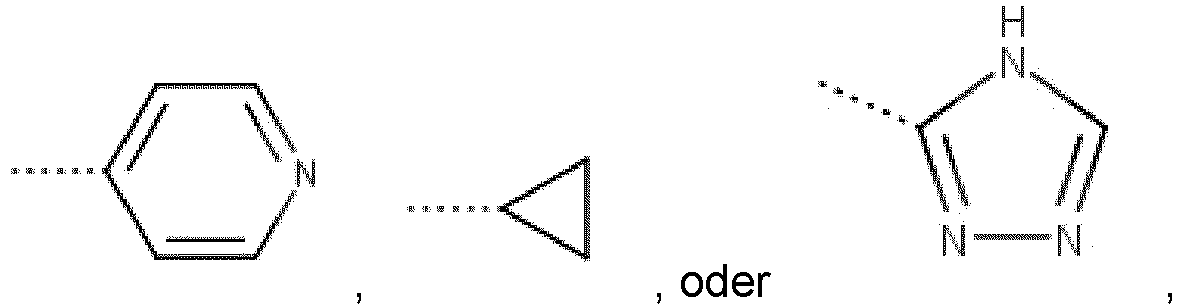 R53 ist
 oder R53 ist
 und wobei vorzugsweise entweder alle R54 bis R58 Wasserstoff sind, oder 1, 2 oder 3, vorzugsweise 1 oder 2 von R54 bis R58 nicht Wasserstoff sind und aus den oben dargestellten Substitutionen ausgewählt sind, und die verbleibenden Positionen von R54 bis R58 aus Wasserstoff ausgewählt sind.
 - Verbindung zur Verwendung nach Anspruch 1, wobei die Verbindung eine Verbindung der Formel (Id) ist:
 B O oder S ist, vorzugsweise O,X ausgewählt ist aus C1-C5-Alkyl, -CH2-, -C2H4-, -C3H6-, -C(CH3)2-, -CHCH(CH(3))2)-, -CHC(CH3)3-, -CH(CH(CH3)2)-, -CH(CH2CH(CH3)2)-, oder -CH(CH2OH)-;R1, R2, R4 und R5 unabhängig voneinander ausgewählt sind aus Wasserstoff, -CH3, - C2H5, -CH2CH3-CH2F; -CHF2; -CF3; -CH2Cl; -CHCl2; -CCl3; -OCH3, -F, -Cl, -Br, NO2, NH2, wobei vorzugsweise zwei oder drei von R1, R2, R4 und R5 Wasserstoff sind und die übrigen nicht Wasserstoff sind; undR54 und R55 unabhängig voneinander ausgewählt sind aus Wasserstoff, -CH3, -C2H5, -CH2F; -CHF2; -CF3; -CH2Cl; -CHCl2; -CCl3;-OCH3, -F, -Cl, -Br, NO2, NH2, vorzugsweise worin eines von R54 und R55 Wasserstoff ist und das andere eines von -CH3, -C2H5, -CH2F; -CHF2; -CF3; -CH2Cl; -CHCl2; -CCl3; -OCH3, -F, -Cl, -Br, NO2, NH2 ist.
 - Verbindung zur Verwendung nach einem der Ansprüche 3 bis 6 und 10 bis 11, wobei die Verbindung eine Verbindung nach einer der Formeln (Ib), (Ib1), (Ib2), (Ib3) oder (Id) ist und R1 bis R5 wie folgt ausgewählt sind:R1 Wasserstoff, -C1-C2 Alkoxy, -C(O)O-C1-C5 Alkyl, -OCH3, -C1-C3 Alkyl, Methyl oder Ethyl istR2 t Wasserstoff, Methyl, -F, -Cl, -Br, -CN, -OCH3 oder -C(O)O-C1-C5-Alkyl ist;R3, falls vorhanden, Wasserstoff, Methyl, -CH(CH3)2, -CHF2, -F, -Cl, -Br, -CN, -OCH3, -OCF3, NO2 oder -C(O)O-(C1-C5-Alkyl) ist;R4 Wasserstoff oder -F, -Cl, -Br oder -CF3 ist; und/oderR5 Wasserstoff, Methyl, Ethyl oder -F, -Cl, -Br, -CN oder -CH2-Phenyl ist.
- Verbindung zur Verwendung nach einem der Ansprüche 1 bis 12, wobei die Verbindung aus den in Tabelle 1 beschriebenen Verbindungen ausgewählt ist.
Tabelle 1: NO Code Struktur IUPAC-Name 1 DE22 
1-phenyl-3-(quinolin-6-yl)urea 2 DE21 
1-(2-methoxyphenyl)-3-((3-(4-(trifluoromethyl)p henyl)-1,2,4-oxadiazol-5-yl)methyl)urea 3 EN-A (EN23) 
1,3-di(quinolin-6-yl)urea 4 AH4 
3-phenyl-1-(quinolin-6-yl)thiourea 5 JB010 
1-(4-methoxyphenyl)-3-(quinolin-6-yl)urea 6 BRM/BR G1 ATP-Inhibitor-1 
1-[3-(difluoromethyl)-1,2-thiazol-5-yl]-3-[2-fluoro-5-(hydroxymethyl)p yridin-4-yl]urea 7 J B011 
1-(4-cyanophenyl)-3-(quinolin-6-yl)urea 8 PM07 
3-{4-[5-({1-[(3-fluoro-2-methylphenyl)me thyl]piperidin-3-yl}methyl)-1,2,4-oxadiazol-3-yl]phenyl}-1-(4-methoxyphenyl)u rea 9 PM16 
3-{4-[5-({1-[(3-fluoro-2-methylphenyl)me thyl]piperidin-3-yl}methyl)-1,2,4-oxadiazol-3-yl]phenyl}-1-phenylurea 10 JB014 
1-(quinolin-6-yl)-3-[4-({5-[4-(trifluoromethyl)p henyl]-1,2,4-oxadiazol-3-yl}methyl)phenyl] urea 11 AH1 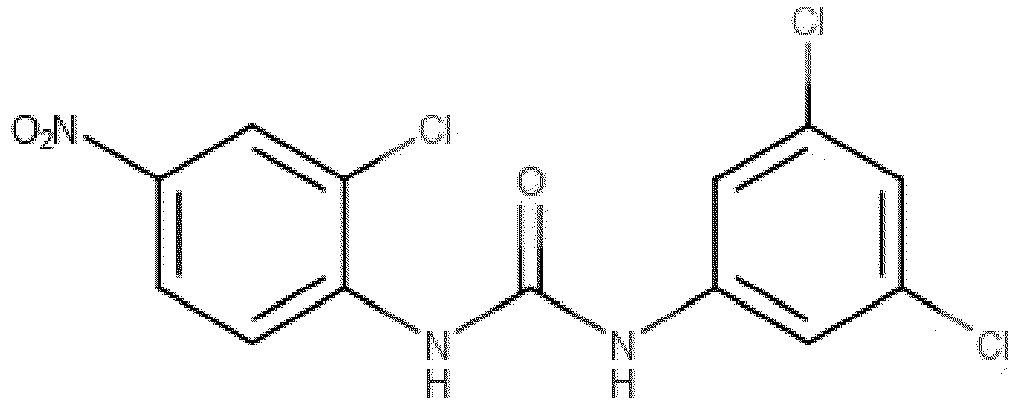
3-(2-chloro-4-nitrophenyl)-1-(3,5-dichlorophenyl)ur ea 12 AH3 
1-(3-chlorophenyl)-3-(3-fluoro-2-methylphenyl)ure a 13 JB002 
1-(1,5-naphthyridin-2-yl)-3-phenylurea 14 JB004 
1-(3-bromoquinolin-6-yl)-3-phenylurea 15 DE11-16 
1-benzyl-3-(quinolin-6-yl)urea 16 DE11-13 
1-(3-phenylpropyl)-3-(quinolin-6-yl)urea 17 L01.110 
3-(2-methyl-3-oxo-3,4-dihydro-2H-1,4-benzoxazin-6-yl)-1-phenylurea 18 L01.041 
3-(4-methyl-3-{[(propan-2-yl)carbamoyl]ami no}phenyl)-1-phenylurea 19 L01.004 
3-phenyl-1-[4-(pyrrolidin-1-yl)phenyl]urea 20 L01.007 
1-(5-fluoro-2-methoxyphenyl)-3-{2-methyl-1-[3-(pyridin-3-yl)-1,2,4-oxadiazol-5-yl]propyl}urea 21 L01.104 
N-{4-[(phenylcarbamo yl)amino]phenyl} cyclopentanecar boxamide 22 L01.116 
2,2-difluoro-N-{2-methyl-5-[(phenylcarbamo yl)amino]phenyl} acetamide 23 L01.113 
1-(3-chloro-2,6-diethylphenyl)-3-{2-methyl-1-[3-(pyridin-3-yl)-1,2,4-oxadiazol-5-yl]propyl}urea 24 L01.101 
N-{4-[(phenylcarbamo yl)amino]phenyl} oxolane-3-carboxamide 25 L01.092 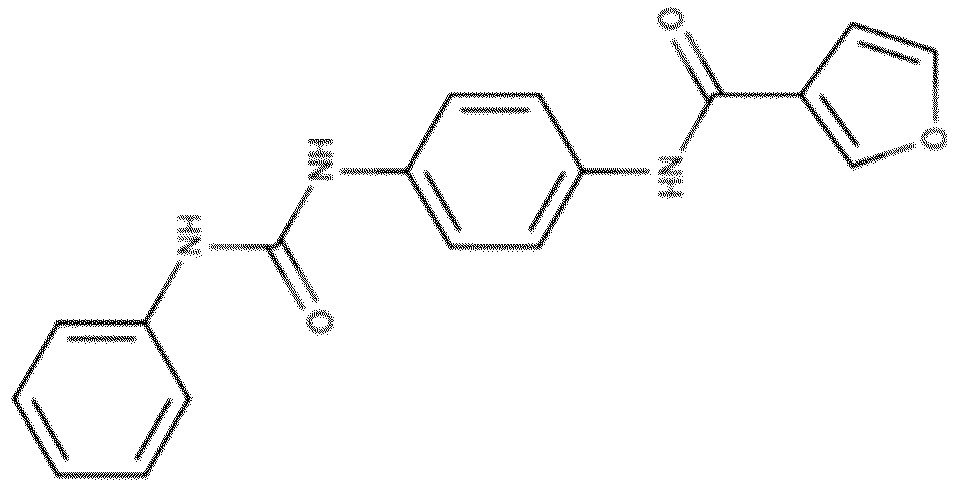
N-{4-[(phenylcarbamo yl)amino]phenyl}f uran-3-carboxamide 26 L01.124 
3-(3-fluoro-4-methylphenyl)-1-phenylurea 27 TCMDC-143175 
3-(2-chloro-4-nitrophenyl)-1-(3-chlorophenyl)ure a 28 A.C2 
3-(2-chloro-4-nitrophenyl)-1-(2-chlorophenyl)ure a 29 AH2 
3-(2-chloro-4-nitrophenyl)-1-(3-chlorophenyl)thio urea 30 EN11-07 
1-(2-phenylethyl)-3-(quinolin-6-yl)urea 31 EN11-02 
1-cyclohexyl-3-(quinolin-6-yl)urea 32 EN11-11 
3-benzyl-1-[(quinolin-6-yl)methyl]urea 33 L01.016 
2,2-difluoro-N-{4-[(phenylcarbamo yl)amino]phenyl} acetamide 34 L01.028 
3-cyclopropyl-1-{2-methyl-5-[(phenylcarbamo yl)amino]phenyl} urea 35 L01.047 
1-phenyl-3-[4-(propan-2-yl)phenyl]urea 36 L01.026 
3-(3-chloro-4-methoxyphenyl)-1-phenylurea 37 L01.127 
3-{[3-(4-methylphenyl)-1,2,4-oxadiazol-5-yl]methyl}-1-phenylimidazolidi ne-2,4-dione 38 L01.061 
1-phenyl-3-[4-(trifluoromethoxy )phenyl]urea 39 L01.128 
3-(2-methyl-1,3-dioxo-2,3-dihydro-1H-isoindol-5-yl)-1-phenylurea 40 L01.025 
3-[3-methyl-4-(pyrrolidin-1-yl)phenyl]-1-phenylurea 41 L01.008 
1-[4-(azetidine-1-carbonyl)phenyl]-3-phenylurea 42 L01.089 
1-phenyl-3-{[3-(thiophen-2-yl)-1,2,4-oxadiazol-5-yl]methyl}imidaz olidine-2,4-dione 43 L01.130 
3-{[3-(4-fluorophenyl)-1,2,4-oxadiazol-5-yl]methyl}-5-methyl-1-(4-methylphenyl)imi dazolidine-2,4-dione 44 L01.049 
3-{[3-(4-chlorophenyl)-1,2,4-oxadiazol-5-yl]methyl}-1-phenylimidazolidi ne-2,4-dione 45 L01.066 
3-(2,3-dihydro-1H-inden-5-yl)-1-phenylurea 46 L01.043 
1-(2-methoxyphenyl)-3-{[3-(pyridin-3-yl)-1,2,4-oxadiazol-5-yl]methyl}urea 47 L01.087 
1-phenyl-3-{[3-(thiophen-2-yl)-1,2,4-oxadiazol-5-yl]methyl}urea 48 L01.020 
3-(3-bromophenyl)-1-phenylurea 49 L01.035 
3-(4-chloro-3-methanesulfonyl phenyl)-1-phenylurea 50 L01.120 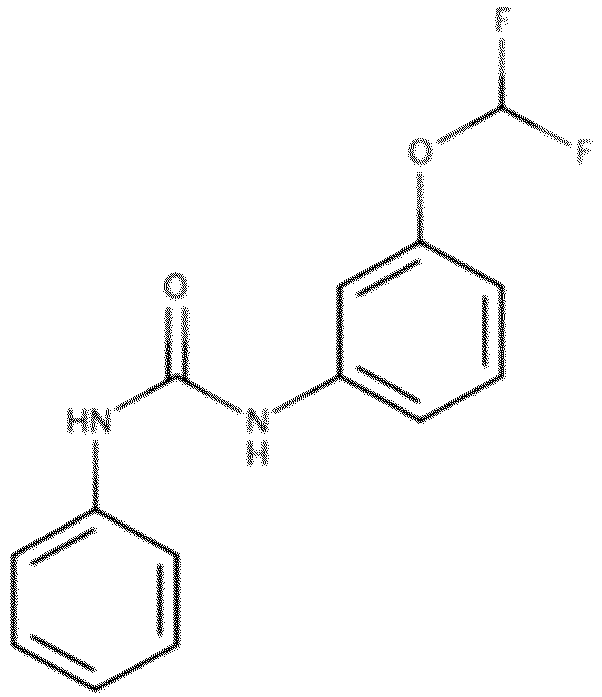
3-[3-(difluoromethoxy )phenyl]-1-phenylurea 51 L01.033 
3-{[3-(furan-2-yl)-1,2,4-oxadiazol-5-yl]methyl}-1-phenylimidazolidi ne-2,4-dione 52 L01.002 
1-[4-(cyanomethoxy)p henyl]-3-phenylurea 53 L01.027 
N-{3-[(phenylcarbamo yl)amino]phenyl}f uran-3-carboxamide 54 L01.003 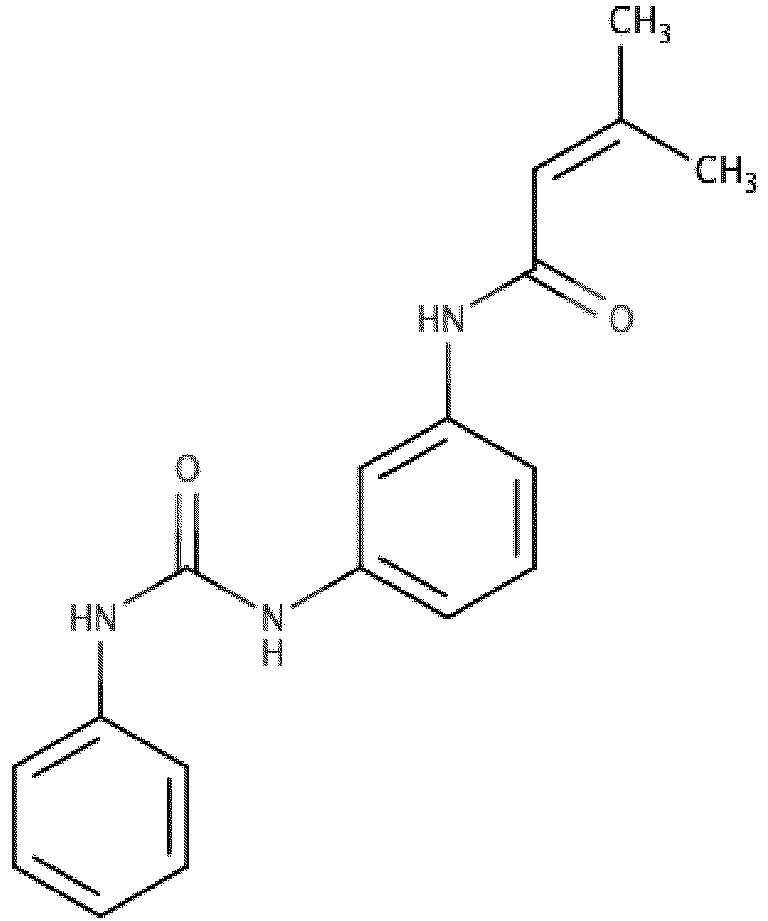
3-methyl-N-{3-[(phenylcarbamo yl)amino]phenyl} but-2-enamide 55 L01.038 
1-(4-cyanophenyl)-3-phenylurea 56 L01.069 
3-{[3-(3-methylphenyl)-1,2,4-oxadiazol-5-yl]methyl}-1-phenylimidazolidi ne-2,4-dione 57 L01.097 
1-(4-chlorophenyl)-3-[2-methyl-1-(3-phenyl-1,2,4-oxadiazol-5-yl)propyl]urea 58 L01.095 
3-{4-[1-(hydroxyimino)et hyl]phenyl}-1-phenylurea 59 L01.013 
1-(3,4-diethoxyphenyl)-3-{[3-(3-methoxyphenyl)-1,2,4-oxadiazol-5-yl]methyl}urea 60 L01.103 
N-{3-[(phenylcarbamo yl)amino]phenyl} cyclopentanecar boxamide 61 L01.071 
1-(4-methylphenyl)-3-{[3-(thiophen-3-yl)-1,2,4-oxadiazol-5-yl]methyl}imidaz olidine-2,4,5-trione 62 L01.115 
1-(3,5-dichlorophenyl)-3-{[3-(thiophen-3-yl)-1,2,4-oxadiazol-5-yl]methyl}urea 63 L01.045 
1-[3-(2-oxo-1,3-oxazolidin-3-yl)phenyl]-3-phenylurea 64 L01.077 
3-(3-methylphenyl)-1-phenylurea 65 L01.084 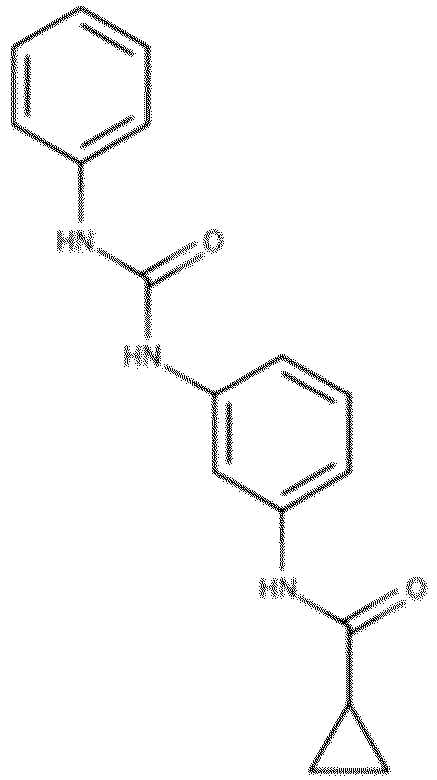
N-{3-[(phenylcarbamo yl)amino]phenyl} cyclopropanecar boxamide 66 L01.109 
N-{4-[(phenylcarbamo yl)amino]phenyl} acetamide 67 L01.122 
3-cyclopropyl-1-{3-[(phenylcarbamo yl)amino]phenyl} urea 68 L01.083 
3-[(3-cyclopropyl-1,2,4-oxadiazol-5-yl)methyl]-1-[2-(propan-2-yloxy)phenyl]ure a 69 L01.062 
1-(isoquinolin-5-yl)-3-{[3-(pyridin-3-yl)-1,2,4-oxadiazol-5-yl]methyl}urea 70 L01.081 
3-[(3-cyclopropyl-1,2,4-oxadiazol-5-yl)methyl]-1-(3-fluorophenyl)ure a 71 L01.114 
3-(1,3-dihydro-2-benzofuran-5-yl)-1-{2-methyl-1-[3-(pyridin-3-yl)-1,2,4-oxadiazol-5-yl]propyl}urea 72 L01.090 
N-(3-chlorophenyl)-3-[3-(thiophen-2-yl)-1,2,4-oxadiazol-5-yl]morpholine-4-carboxamide 73 L01.136 
1-(3-methoxyphenyl)-3-methyl-3-{[3-(pyridin-3-yl)-1,2,4-oxadiazol-5-yl]methyl}urea 74 L01.023 
2-methyl-N-{3-[(phenylcarbamo yl)amino]phenyl} propanamide 75 L01.064 
N-{4-[(phenylcarbamo yl)amino]phenyl}f uran-2-carboxamide 76 L01.093 
3-{3-methyl-1-[3-(4H-1,2,4-triazol-3-yl)-1,2,4-oxadiazol-5-yl]butyl}-1-[3-(4-methylpiperidin-1-yl)phenyl]urea 77 L01.125 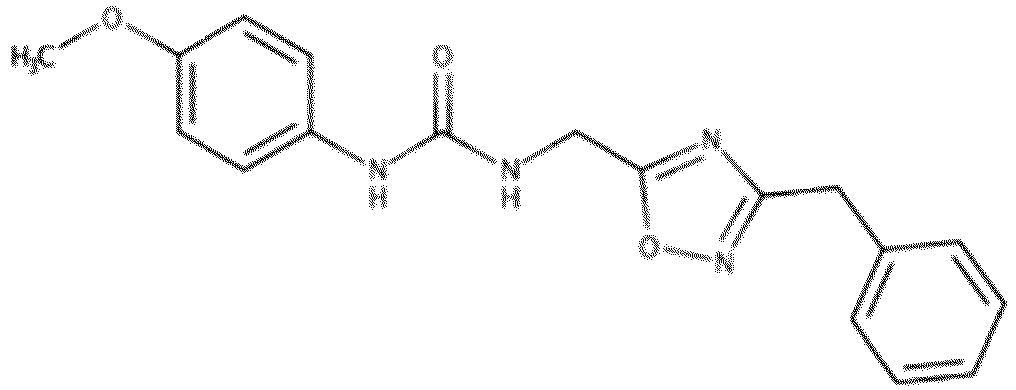
3-[(3-benzyl-1,2,4-oxadiazol-5-yl)methyl]-1-(4-methoxyphenyl)u rea 78 L01.005 
3-{2-methyl-1-[3-(pyridin-3-yl)-1,2,4-oxadiazol-5-yl]propyl}-1-[3-(trifluoromethyl)p henyl]urea 79 L01.135 
butyl 4-[({3-methyl-1-[3-(4H-1,2,4-triazol-3-yl)-1,2,4-oxadiazol-5-yl]butyl}carbamo yl)amino]benzoat e 80 L01.108 
3-(3-nitrophenyl)-1-phenylurea 81 L01.112 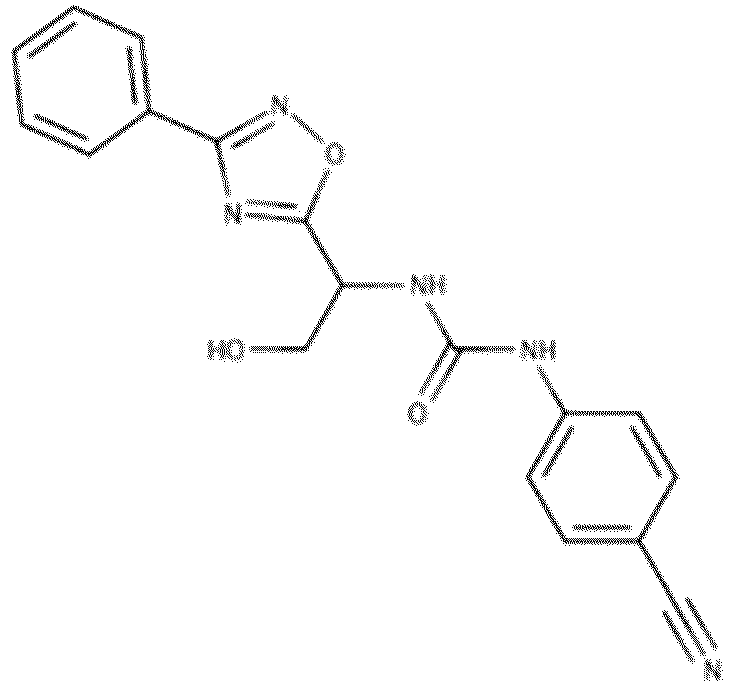
1-(4-cyanophenyl)-3-[2-hydroxy-1-(3-phenyl-1,2,4-oxadiazol-5-yl)ethyl]urea 82 L01.054 
1-[4-fluoro-2-(methoxymethyl) phenyl]-3-{2-methyl-1-[3-(pyridin-3-yl)-1,2,4-oxadiazol-5-yl]propyl}urea 83 L01.067 
3-[(3-benzyl-1,2,4-oxadiazol-5-yl)methyl]-1-(3-methoxyphenyl)u rea 84 L01.099 
N-[3-(cyclopentanesul fonyl)phenyl]-2-(3-phenyl-1,2,4-oxadiazol-5-yl)piperidine-1-carboxamide 85 L01.065 
1-{4-[(oxan-4-yl)amino]phenyl}-3-phenylurea 86 L01.132 
3-(3-{[(methylcarbam oyl)amino]methyl }phenyl)-1-phenylurea 87 L01.121 
3-{4-[(dimethylamino) methyl]phenyl}-1-phenylurea 88 L01.056 
1-(2-methoxy-6-methylphenyl)-3-{2-methyl-1-[3-(pyridin-3-yl)-1,2,4-oxadiazol-5-yl]propyl}urea 89 L01.088 
3-[(3-benzyl-1,2,4-oxadiazol-5-yl)methyl]-1-(4-methylphenyl)ure a 90 L01.042 
1-(2-chloro-4-nitrophenyl)-3-{[3-(pyridin-3-yl)-1,2,4-oxadiazol-5-yl]methyl}urea 91 L01.010 
3-{3-methyl-1-[3-(4H-1,2,4-triazol-3-yl)-1,2,4-oxadiazol-5-yl]butyl}-1-[3-(2-oxoimidazolidin-1-yl)phenyl]urea - Verbindung nach einem der Ansprüche 1 bis 13 zur Verwendung bei der Vorbeugung oder Behandlung einer Krankheit durch Aktivierung des NLRP3-Inflammasoms, wobei die Krankheit aus einer Gruppe ausgewählt ist, die Infektionskrankheiten oder Krebs umfasst, oder zur Verwendung zur Verstärkung von Immunantworten oder zum Durchbrechen der Immunevasion bei Krebskrankheiten in einem Subjekt, oder zur Verwendung als Adjuvans im Zusammenhang mit einer Impfung, um spezifische Immunantworten durch Aktivierung des NLRP3-Inflammasoms zu verstärken.
- Verwendung der in Anspruch 13 definierten Verbindungen zur Analyse der Aktivität der NLRP3-Aktivierung in vitro.
Applications Claiming Priority (2)
| Application Number | Priority Date | Filing Date | Title |
|---|---|---|---|
| EP20202297.6A EP3984535A1 (de) | 2020-10-16 | 2020-10-16 | Nlrp3-aktivatoren zur behandlung von infektionskrankheiten oder krebs durch aktivierung des nlrp3-inflammasoms |
| PCT/EP2021/078623 WO2022079246A1 (en) | 2020-10-16 | 2021-10-15 | Nlrp3 activators for use in the treatment of infectious diseases or cancer by activating nlrp3 inflammasome |
Publications (3)
| Publication Number | Publication Date |
|---|---|
| EP4228630A1 EP4228630A1 (de) | 2023-08-23 |
| EP4228630C0 EP4228630C0 (de) | 2025-03-05 |
| EP4228630B1 true EP4228630B1 (de) | 2025-03-05 |
Family
ID=72964464
Family Applications (2)
| Application Number | Title | Priority Date | Filing Date |
|---|---|---|---|
| EP20202297.6A Withdrawn EP3984535A1 (de) | 2020-10-16 | 2020-10-16 | Nlrp3-aktivatoren zur behandlung von infektionskrankheiten oder krebs durch aktivierung des nlrp3-inflammasoms |
| EP21794528.6A Active EP4228630B1 (de) | 2020-10-16 | 2021-10-15 | Nlrp3-aktivatoren zur behandlung von infektionskrankheiten oder krebs durch aktivierung des nlrp3-inflammasoms |
Family Applications Before (1)
| Application Number | Title | Priority Date | Filing Date |
|---|---|---|---|
| EP20202297.6A Withdrawn EP3984535A1 (de) | 2020-10-16 | 2020-10-16 | Nlrp3-aktivatoren zur behandlung von infektionskrankheiten oder krebs durch aktivierung des nlrp3-inflammasoms |
Country Status (3)
| Country | Link |
|---|---|
| US (1) | US20240277658A1 (de) |
| EP (2) | EP3984535A1 (de) |
| WO (1) | WO2022079246A1 (de) |
Families Citing this family (4)
| Publication number | Priority date | Publication date | Assignee | Title |
|---|---|---|---|---|
| US20240335429A1 (en) * | 2021-08-02 | 2024-10-10 | National University Of Singapore | Molecular glue and sall4 degrader |
| TW202442237A (zh) * | 2023-03-17 | 2024-11-01 | 美商凡特斯治療美國公司 | 用於抑制nlrp3的尿素衍生物及其用途 |
| WO2025190317A1 (en) * | 2024-03-13 | 2025-09-18 | National Institute Of Biological Sciences, Beijing | Urea compounds as nlrp3 agonists |
| WO2026054623A1 (ko) * | 2024-09-09 | 2026-03-12 | (주) 업테라 | 신규 nlrp3 억제제 화합물 |
Citations (3)
| Publication number | Priority date | Publication date | Assignee | Title |
|---|---|---|---|---|
| WO2003080578A1 (en) * | 2002-03-22 | 2003-10-02 | Merck Sharp & Dohme Limited | Heteroaromatic urea derivatives as vr-1 receptor modulators for treating pain |
| WO2006049941A2 (en) * | 2004-10-27 | 2006-05-11 | Neurogen Corporation | Diaryl ureas as cb1 antagonists |
| WO2020123675A1 (en) * | 2018-12-11 | 2020-06-18 | Duke University | Compositions and methods for the treatment of cancer |
Family Cites Families (16)
| Publication number | Priority date | Publication date | Assignee | Title |
|---|---|---|---|---|
| US7927613B2 (en) | 2002-02-15 | 2011-04-19 | University Of South Florida | Pharmaceutical co-crystal compositions |
| US20080020973A1 (en) * | 2004-08-03 | 2008-01-24 | The Johns Hopkins University | Assays for identification of topoisomerase inhibitors |
| EP2147310A4 (de) * | 2007-04-27 | 2010-09-08 | Univ Rochester | Zusammensetzungen und verfahren zur hemmung der g-protein-signalisierung |
| CA2708281A1 (en) * | 2007-12-11 | 2009-08-27 | Viamet Pharmaceuticals, Inc. | Metalloenzyme inhibitors using metal binding moieties in combination with targeting moieties |
| ME03586B (de) | 2013-05-18 | 2020-07-20 | Univ California | Zusammensetzungen und verfahren zur aktivierung einer vom stimulator des interferon-gens abhängigen signalisierung |
| US10533007B2 (en) | 2016-04-19 | 2020-01-14 | Innate Tumor Immunity, Inc. | NLRP3 modulators |
| JP6197971B1 (ja) * | 2016-04-22 | 2017-09-20 | 小野薬品工業株式会社 | Kcnq2〜5チャネル関連疾患の予防および/または治療剤 |
| IT201700017594A1 (it) * | 2017-02-16 | 2018-08-16 | Distretto Tecnologico Sicilia Micro E Nano Sistemi S C A R L | Nanoparticelle per il rilascio controllato di Sorafenib |
| GB2561540A (en) * | 2017-03-13 | 2018-10-24 | Nodthera Ltd | Chemical compounds |
| US11840543B2 (en) * | 2017-05-24 | 2023-12-12 | The University Of Queensland | Compounds and uses |
| AU2018297270B2 (en) * | 2017-07-06 | 2024-02-15 | Dignity Health | Novel treatment for hot flushes |
| KR102464483B1 (ko) * | 2017-09-04 | 2022-11-09 | 중앙대학교 산학협력단 | Traf4 결합 모티프를 이용한 혈전증 또는 암질환 치료용 약학조성물 |
| CN109893528B (zh) * | 2017-12-07 | 2022-12-06 | 福建医科大学 | 钩吻素子治疗脂质代谢紊乱及其相关疾病或病症的用途 |
| CN112521387B (zh) * | 2018-04-25 | 2023-08-22 | 先天肿瘤免疫公司 | Nlrp3调节剂 |
| US20230051589A1 (en) * | 2018-11-16 | 2023-02-16 | Novartis Ag | Compounds and compositions for treating conditions associated with nlrp activity |
| GB201819083D0 (en) * | 2018-11-23 | 2019-01-09 | Inflazome Ltd | Novel compounds |
-
2020
- 2020-10-16 EP EP20202297.6A patent/EP3984535A1/de not_active Withdrawn
-
2021
- 2021-10-15 WO PCT/EP2021/078623 patent/WO2022079246A1/en not_active Ceased
- 2021-10-15 US US18/030,875 patent/US20240277658A1/en active Pending
- 2021-10-15 EP EP21794528.6A patent/EP4228630B1/de active Active
Patent Citations (3)
| Publication number | Priority date | Publication date | Assignee | Title |
|---|---|---|---|---|
| WO2003080578A1 (en) * | 2002-03-22 | 2003-10-02 | Merck Sharp & Dohme Limited | Heteroaromatic urea derivatives as vr-1 receptor modulators for treating pain |
| WO2006049941A2 (en) * | 2004-10-27 | 2006-05-11 | Neurogen Corporation | Diaryl ureas as cb1 antagonists |
| WO2020123675A1 (en) * | 2018-12-11 | 2020-06-18 | Duke University | Compositions and methods for the treatment of cancer |
Non-Patent Citations (12)
| Title |
|---|
| ANTONIO LAVECCHIA ET AL: "Discovery of New Inhibitors of Cdc25B Dual Specificity Phosphatases by Structure-Based Virtual Screening", JOURNAL OF MEDICINAL CHEMISTRY, vol. 55, no. 9, 10 May 2012 (2012-05-10), pages 4142 - 4158, XP055156044, ISSN: 0022-2623, DOI: 10.1021/jm201624h * |
| DATABASE caplus [online] 1 January 2019 (2019-01-01), DE ITURRATE MARTINEZ ET AL: "Toward discovery of new leishmanicidal scaffolds able to inhibit Leishmania GSK-3", XP55961546, Database accession no. 2019:2225572 * |
| DATABASE HCAPLUS [online] 1 January 1962 (1962-01-01), MALATESTA ET AL: "Synthesis of some new anilides with local anesthetic activity", XP55880467, Database accession no. 1963:8592 * |
| DATABASE HCAPLUS [online] 1 January 1987 (1987-01-01), MURATA AU ET AL: "Chemical Abstract: AN 1987:636465", XP55880463, Database accession no. 1987:636465 * |
| DATABASE Registry [online] 1 January 2004 (2004-01-01), ANONYMOUS: "683206-01-1", XP055790629, Database accession no. 683206-01-1 * |
| DATABASE Registry [online] 1 January 2011 (2011-01-01), ANONYMOUS: "2,4-Imidazolidinedione, 1-(4-fluorophenyl)-5-methyl-3-[[3-(4-methylphenyl)- 1,2,4-oxadiazol-5-yl]methyl]-", XP055790630, Database accession no. 1277156-39-4 * |
| DATABASE Registry [online] 1 January 2011 (2011-01-01), ANONYMOUS: "Urea, N-(3-chloro-2,6-diethylphenyl)-N'-[2-methyl-1-[3-(3-pyridinyl)-1,2,4-oxadiazol-5-yl]propyl]-", XP055790631, Database accession no. 1311951-62-8 * |
| G�MEZ DAVID ESTEBAN ET AL: "Urea vs. thiourea in anion recognition", ORGANIC & BIOMOLECULAR CHEMISTRY, vol. 3, no. 8, 1 January 2005 (2005-01-01), pages 1495 - 1500, XP055961197, ISSN: 1477-0520, DOI: 10.1039/B500123D * |
| G�MEZ DAVID ESTEBAN ET AL: "Urea vs. thiourea in anion recognition", ORGANIC & BIOMOLECULAR CHEMISTRY, vol. 3, no. 8, 1 January 2005 (2005-01-01), pages 1495 - 1500, XP55961197, ISSN: 1477-0520, DOI: 10.1039/B500123D * |
| JULIEN P. N. PAPILLON ET AL: "Discovery of Orally Active Inhibitors of Brahma Homolog (BRM)/SMARCA2 ATPase Activity for the Treatment of Brahma Related Gene 1 (BRG1)/SMARCA4-Mutant Cancers", JOURNAL OF MEDICINAL CHEMISTRY, vol. 61, no. 22, 19 October 2018 (2018-10-19), US, pages 10155 - 10172, XP055619669, ISSN: 0022-2623, DOI: 10.1021/acs.jmedchem.8b01318 * |
| KHAN K M ET AL: "Unsymmetrically disubstituted urea derivatives: A potent class of antiglycating agents", BIOORGANIC & MEDICINAL CHEMISTRY, ELSEVIER, AMSTERDAM, NL, vol. 17, no. 6, 15 March 2009 (2009-03-15), pages 2447 - 2451, XP025981943, ISSN: 0968-0896, [retrieved on 20090209], DOI: 10.1016/J.BMC.2009.01.075 * |
| MUSUMECI DOMENICA ET AL: "Supplementary Material: Tandem application of ligand-based virtual screening and G4-OAS assay to identify novel G-quadruplex-targeting chemotypes", 1 January 2017 (2017-01-01), XP55880690, Retrieved from the Internet <URL:https://ars.els-cdn.com/content/image/1-s2.0-S0304416517300326-mmc2.pdf> [retrieved on 20220118] * |
Also Published As
| Publication number | Publication date |
|---|---|
| EP3984535A1 (de) | 2022-04-20 |
| WO2022079246A1 (en) | 2022-04-21 |
| EP4228630C0 (de) | 2025-03-05 |
| EP4228630A1 (de) | 2023-08-23 |
| US20240277658A1 (en) | 2024-08-22 |
Similar Documents
| Publication | Publication Date | Title |
|---|---|---|
| US12351580B2 (en) | NLRP3 modulators | |
| US11072612B2 (en) | NLRP3 modulators | |
| EP3784670B1 (de) | Nlrp3-modulatoren | |
| EP3837014B1 (de) | Vom imidazo[4,5-c]quinolin abgeleitete nlrp3-modulatoren | |
| US12024513B2 (en) | NLRP3 modulators | |
| EP3652166B1 (de) | Nlrp3-modulatoren | |
| US20240277658A1 (en) | Nlrp3 activators for use in the treatment of infectious diseases or cancer by activating nlrp3 inflammasome | |
| EP3911417B1 (de) | Heterocyclische nlrp3-modulatoren zur verwendung in der behandlung von krebs | |
| US12187706B2 (en) | NLRP3 modulators | |
| US12338228B2 (en) | NLRP3 modulators | |
| US12492200B2 (en) | NLRP3 modulators | |
| NZ757257B2 (en) | Substituted imidazo-quinolines as nlrp3 modulators | |
| HK40003517A (en) | Substituted imidazo-quinolines as nlrp3 modulators | |
| HK40003517B (en) | Substituted imidazo-quinolines as nlrp3 modulators |
Legal Events
| Date | Code | Title | Description |
|---|---|---|---|
| STAA | Information on the status of an ep patent application or granted ep patent |
Free format text: STATUS: UNKNOWN |
|
| STAA | Information on the status of an ep patent application or granted ep patent |
Free format text: STATUS: THE INTERNATIONAL PUBLICATION HAS BEEN MADE |
|
| PUAI | Public reference made under article 153(3) epc to a published international application that has entered the european phase |
Free format text: ORIGINAL CODE: 0009012 |
|
| STAA | Information on the status of an ep patent application or granted ep patent |
Free format text: STATUS: REQUEST FOR EXAMINATION WAS MADE |
|
| 17P | Request for examination filed |
Effective date: 20230411 |
|
| AK | Designated contracting states |
Kind code of ref document: A1 Designated state(s): AL AT BE BG CH CY CZ DE DK EE ES FI FR GB GR HR HU IE IS IT LI LT LU LV MC MK MT NL NO PL PT RO RS SE SI SK SM TR |
|
| DAV | Request for validation of the european patent (deleted) | ||
| DAX | Request for extension of the european patent (deleted) | ||
| STAA | Information on the status of an ep patent application or granted ep patent |
Free format text: STATUS: EXAMINATION IS IN PROGRESS |
|
| 17Q | First examination report despatched |
Effective date: 20240524 |
|
| GRAP | Despatch of communication of intention to grant a patent |
Free format text: ORIGINAL CODE: EPIDOSNIGR1 |
|
| STAA | Information on the status of an ep patent application or granted ep patent |
Free format text: STATUS: GRANT OF PATENT IS INTENDED |
|
| INTG | Intention to grant announced |
Effective date: 20241127 |
|
| GRAS | Grant fee paid |
Free format text: ORIGINAL CODE: EPIDOSNIGR3 |
|
| GRAA | (expected) grant |
Free format text: ORIGINAL CODE: 0009210 |
|
| STAA | Information on the status of an ep patent application or granted ep patent |
Free format text: STATUS: THE PATENT HAS BEEN GRANTED |
|
| AK | Designated contracting states |
Kind code of ref document: B1 Designated state(s): AL AT BE BG CH CY CZ DE DK EE ES FI FR GB GR HR HU IE IS IT LI LT LU LV MC MK MT NL NO PL PT RO RS SE SI SK SM TR |
|
| REG | Reference to a national code |
Ref country code: GB Ref legal event code: FG4D |
|
| REG | Reference to a national code |
Ref country code: CH Ref legal event code: EP |
|
| REG | Reference to a national code |
Ref country code: IE Ref legal event code: FG4D |
|
| REG | Reference to a national code |
Ref country code: DE Ref legal event code: R096 Ref document number: 602021027239 Country of ref document: DE |
|
| REG | Reference to a national code |
Ref country code: DE Ref legal event code: R081 Ref document number: 602021027239 Country of ref document: DE Owner name: ALBERT-LUDWIGS-UNIVERSITAET FREIBURG, KOERPERS, DE Free format text: FORMER OWNER: ANMELDERANGABEN UNKLAR / UNVOLLSTAENDIG, 80297 MUENCHEN, DE |
|
| U01 | Request for unitary effect filed |
Effective date: 20250402 |
|
| U07 | Unitary effect registered |
Designated state(s): AT BE BG DE DK EE FI FR IT LT LU LV MT NL PT RO SE SI Effective date: 20250429 |
|
| PG25 | Lapsed in a contracting state [announced via postgrant information from national office to epo] |
Ref country code: RS Free format text: LAPSE BECAUSE OF FAILURE TO SUBMIT A TRANSLATION OF THE DESCRIPTION OR TO PAY THE FEE WITHIN THE PRESCRIBED TIME-LIMIT Effective date: 20250605 |
|
| PG25 | Lapsed in a contracting state [announced via postgrant information from national office to epo] |
Ref country code: ES Free format text: LAPSE BECAUSE OF FAILURE TO SUBMIT A TRANSLATION OF THE DESCRIPTION OR TO PAY THE FEE WITHIN THE PRESCRIBED TIME-LIMIT Effective date: 20250305 |
|
| PG25 | Lapsed in a contracting state [announced via postgrant information from national office to epo] |
Ref country code: NO Free format text: LAPSE BECAUSE OF FAILURE TO SUBMIT A TRANSLATION OF THE DESCRIPTION OR TO PAY THE FEE WITHIN THE PRESCRIBED TIME-LIMIT Effective date: 20250605 |
|
| PG25 | Lapsed in a contracting state [announced via postgrant information from national office to epo] |
Ref country code: HR Free format text: LAPSE BECAUSE OF FAILURE TO SUBMIT A TRANSLATION OF THE DESCRIPTION OR TO PAY THE FEE WITHIN THE PRESCRIBED TIME-LIMIT Effective date: 20250305 |
|
| PG25 | Lapsed in a contracting state [announced via postgrant information from national office to epo] |
Ref country code: GR Free format text: LAPSE BECAUSE OF FAILURE TO SUBMIT A TRANSLATION OF THE DESCRIPTION OR TO PAY THE FEE WITHIN THE PRESCRIBED TIME-LIMIT Effective date: 20250606 |
|
| PG25 | Lapsed in a contracting state [announced via postgrant information from national office to epo] |
Ref country code: SM Free format text: LAPSE BECAUSE OF FAILURE TO SUBMIT A TRANSLATION OF THE DESCRIPTION OR TO PAY THE FEE WITHIN THE PRESCRIBED TIME-LIMIT Effective date: 20250305 |
|
| PG25 | Lapsed in a contracting state [announced via postgrant information from national office to epo] |
Ref country code: PL Free format text: LAPSE BECAUSE OF FAILURE TO SUBMIT A TRANSLATION OF THE DESCRIPTION OR TO PAY THE FEE WITHIN THE PRESCRIBED TIME-LIMIT Effective date: 20250305 |
|
| PG25 | Lapsed in a contracting state [announced via postgrant information from national office to epo] |
Ref country code: CZ Free format text: LAPSE BECAUSE OF FAILURE TO SUBMIT A TRANSLATION OF THE DESCRIPTION OR TO PAY THE FEE WITHIN THE PRESCRIBED TIME-LIMIT Effective date: 20250305 |
|
| PG25 | Lapsed in a contracting state [announced via postgrant information from national office to epo] |
Ref country code: SK Free format text: LAPSE BECAUSE OF FAILURE TO SUBMIT A TRANSLATION OF THE DESCRIPTION OR TO PAY THE FEE WITHIN THE PRESCRIBED TIME-LIMIT Effective date: 20250305 |
|
| PG25 | Lapsed in a contracting state [announced via postgrant information from national office to epo] |
Ref country code: IS Free format text: LAPSE BECAUSE OF FAILURE TO SUBMIT A TRANSLATION OF THE DESCRIPTION OR TO PAY THE FEE WITHIN THE PRESCRIBED TIME-LIMIT Effective date: 20250705 |
|
| REG | Reference to a national code |
Ref country code: CH Ref legal event code: U11 Free format text: ST27 STATUS EVENT CODE: U-0-0-U10-U11 (AS PROVIDED BY THE NATIONAL OFFICE) Effective date: 20251101 |
|
| U20 | Renewal fee for the european patent with unitary effect paid |
Year of fee payment: 5 Effective date: 20251008 |
|
| PGFP | Annual fee paid to national office [announced via postgrant information from national office to epo] |
Ref country code: GB Payment date: 20251022 Year of fee payment: 5 |
|
| PLBE | No opposition filed within time limit |
Free format text: ORIGINAL CODE: 0009261 |
|
| STAA | Information on the status of an ep patent application or granted ep patent |
Free format text: STATUS: NO OPPOSITION FILED WITHIN TIME LIMIT |
|
| REG | Reference to a national code |
Ref country code: CH Ref legal event code: L10 Free format text: ST27 STATUS EVENT CODE: U-0-0-L10-L00 (AS PROVIDED BY THE NATIONAL OFFICE) Effective date: 20260114 |
|
| PGFP | Annual fee paid to national office [announced via postgrant information from national office to epo] |
Ref country code: CH Payment date: 20251101 Year of fee payment: 5 |
|
| 26N | No opposition filed |
Effective date: 20251208 |