EP4228271B1 - Mediendatenübertragungs- und verarbeitungssystem und verfahren zum betrieb eines solchen systems - Google Patents
Mediendatenübertragungs- und verarbeitungssystem und verfahren zum betrieb eines solchen systems Download PDFInfo
- Publication number
- EP4228271B1 EP4228271B1 EP22156004.8A EP22156004A EP4228271B1 EP 4228271 B1 EP4228271 B1 EP 4228271B1 EP 22156004 A EP22156004 A EP 22156004A EP 4228271 B1 EP4228271 B1 EP 4228271B1
- Authority
- EP
- European Patent Office
- Prior art keywords
- processing
- processing card
- stream
- card
- master
- Prior art date
- Legal status (The legal status is an assumption and is not a legal conclusion. Google has not performed a legal analysis and makes no representation as to the accuracy of the status listed.)
- Active
Links
Images




Classifications
-
- H—ELECTRICITY
- H04—ELECTRIC COMMUNICATION TECHNIQUE
- H04N—PICTORIAL COMMUNICATION, e.g. TELEVISION
- H04N21/00—Selective content distribution, e.g. interactive television or video on demand [VOD]
- H04N21/20—Servers specifically adapted for the distribution of content, e.g. VOD servers; Operations thereof
- H04N21/23—Processing of content or additional data; Elementary server operations; Server middleware
- H04N21/24—Monitoring of processes or resources, e.g. monitoring of server load, available bandwidth, upstream requests
- H04N21/2402—Monitoring of the downstream path of the transmission network, e.g. bandwidth available
-
- H—ELECTRICITY
- H04—ELECTRIC COMMUNICATION TECHNIQUE
- H04L—TRANSMISSION OF DIGITAL INFORMATION, e.g. TELEGRAPHIC COMMUNICATION
- H04L1/00—Arrangements for detecting or preventing errors in the information received
- H04L1/22—Arrangements for detecting or preventing errors in the information received using redundant apparatus to increase reliability
-
- H—ELECTRICITY
- H04—ELECTRIC COMMUNICATION TECHNIQUE
- H04L—TRANSMISSION OF DIGITAL INFORMATION, e.g. TELEGRAPHIC COMMUNICATION
- H04L43/00—Arrangements for monitoring or testing data switching networks
- H04L43/10—Active monitoring, e.g. heartbeat, ping or trace-route
- H04L43/106—Active monitoring, e.g. heartbeat, ping or trace-route using time related information in packets, e.g. by adding timestamps
-
- H—ELECTRICITY
- H04—ELECTRIC COMMUNICATION TECHNIQUE
- H04L—TRANSMISSION OF DIGITAL INFORMATION, e.g. TELEGRAPHIC COMMUNICATION
- H04L65/00—Network arrangements, protocols or services for supporting real-time applications in data packet communication
- H04L65/60—Network streaming of media packets
- H04L65/65—Network streaming protocols, e.g. real-time transport protocol [RTP] or real-time control protocol [RTCP]
-
- H—ELECTRICITY
- H04—ELECTRIC COMMUNICATION TECHNIQUE
- H04L—TRANSMISSION OF DIGITAL INFORMATION, e.g. TELEGRAPHIC COMMUNICATION
- H04L65/00—Network arrangements, protocols or services for supporting real-time applications in data packet communication
- H04L65/80—Responding to QoS
-
- H—ELECTRICITY
- H04—ELECTRIC COMMUNICATION TECHNIQUE
- H04N—PICTORIAL COMMUNICATION, e.g. TELEVISION
- H04N21/00—Selective content distribution, e.g. interactive television or video on demand [VOD]
- H04N21/20—Servers specifically adapted for the distribution of content, e.g. VOD servers; Operations thereof
- H04N21/23—Processing of content or additional data; Elementary server operations; Server middleware
- H04N21/242—Synchronisation processes, e.g. processing of PCR [Programme Clock References]
-
- H—ELECTRICITY
- H04—ELECTRIC COMMUNICATION TECHNIQUE
- H04N—PICTORIAL COMMUNICATION, e.g. TELEVISION
- H04N21/00—Selective content distribution, e.g. interactive television or video on demand [VOD]
- H04N21/60—Network structure or processes for video distribution between server and client or between remote clients; Control signalling between clients, server and network components; Transmission of management data between server and client, e.g. sending from server to client commands for recording incoming content stream; Communication details between server and client
- H04N21/63—Control signaling related to video distribution between client, server and network components; Network processes for video distribution between server and clients or between remote clients, e.g. transmitting basic layer and enhancement layers over different transmission paths, setting up a peer-to-peer communication via Internet between remote STB's; Communication protocols; Addressing
- H04N21/631—Multimode Transmission, e.g. transmitting basic layers and enhancement layers of the content over different transmission paths or transmitting with different error corrections, different keys or with different transmission protocols
-
- H—ELECTRICITY
- H04—ELECTRIC COMMUNICATION TECHNIQUE
- H04N—PICTORIAL COMMUNICATION, e.g. TELEVISION
- H04N21/00—Selective content distribution, e.g. interactive television or video on demand [VOD]
- H04N21/60—Network structure or processes for video distribution between server and client or between remote clients; Control signalling between clients, server and network components; Transmission of management data between server and client, e.g. sending from server to client commands for recording incoming content stream; Communication details between server and client
- H04N21/63—Control signaling related to video distribution between client, server and network components; Network processes for video distribution between server and clients or between remote clients, e.g. transmitting basic layer and enhancement layers over different transmission paths, setting up a peer-to-peer communication via Internet between remote STB's; Communication protocols; Addressing
- H04N21/643—Communication protocols
- H04N21/64322—IP
Definitions
- the present disclosure relates to a media data transmission and processing system comprising a redundant data transmission network and a redundant processing unit. Furthermore, the present disclosure relates to a method for operating such a media data transmission and processing system.
- the video contributions usually come from more than one physical location. Cameras shooting the event typically are outside of a studio, for instance in a sports stadium. The camera signals are transferred to a video production server. In addition to that, there may be experts and a moderator in the studio discussing the sports event. Their discussion is covered by additional cameras generating further camera streams that are fed into the production server. A production director controls the video production by selecting camera streams, making cuts, and choosing video effects. Additional staff members of the production team may be involved for editing of the program stream, performing video effects etc.
- US 2020/2820750 A1 relates to a video transmission system comprising a distributor, a PTP grandmaster, a first transmitter, a second transmitter, and a receiver.
- the distributor duplicates video input from a single source.
- the first transmitter sends an IP packet stream A via a first transmission path to the receiver.
- the second transmitter sends an IP packet stream B via a second transmission path to the receiver.
- Each transmitter functions as a slave and synchronizes time with the PTP grandmaster. If first or second transmitter or the first or second transmission path fails, the receiver switches to IP packets B or A in order to reconstruct the video signals. Thus, even if one transmitter or transmission path fails, receiver can still reconstruct the video signals.
- KERO NIKOLAUS ET AL "Enhanced Redundancy of ST 2059-2 Time Transfer Over ST 2022-7 Redundant Networks", SMPTE MOTION IMAGING JOURNAL, US, (20190701), vol. 128, no. 6, doi:10.5594/JMI.2019.2914964, ISSN 1545-0279, pages 21 - 29 ) address the topic of time transfer over ST 2022-7 redundant networks and elaborates on the basic principles of message-based time transfer.
- Document D2 further describes by measurements in a test network how a dual-port PTP slave operates) (page 26, "Measurements"; figure 2 ). Based on measurements in a test network how a dual-port PTP slave operatesit is concluded that for distribution of PTP time information a packet-based switching mechanism as specified in ST 2022 - 7 cannot be readily applied because of latency issues.
- EP 2 870 749 B1 describes a distributed video production and playout system in which processing units are either located in a data center or distributed among various remote locations for performing different tasks required for the video production and play out systems.
- the video and audio data are exchanged between the processing units by data links transmitting the data as IP packets in an IP network. If the network connecting the processing units involved in a video production fails, then the production output signal is affected or gets lost entirely. Obviously, this is a worst-case scenario that must be avoided, especially for big and expensive sports events, for example a football world championship.
- One practical approach to avoid such a worst-case scenario is to transport the video signals redundantly across two independent redundant networks.
- the IP packets are transmitted across the redundant networks for instance according to a real-time transport protocol (RTP).
- RTP real-time transport protocol
- a processing unit can switch to the redundant backup network.
- the active network is frequently called the RED network and the backup network the BLUE network.
- This concept is specified in the SMPTE 2022-7 standard, which describes how a processing unit can select between the two networks to select the "better packet", that is a packet without errors, from the two networks or to switch over completely to the redundant backup network if it the data on the main network has many errors or the main network has failed completely.
- the processing unit can provide a valid output stream if both networks have a lot of errors as long as there is one valid packet in each stream that can be selected by the processing unit.
- Each data packet has a media content as payload, a PTP timestamp and a packet counter value.
- the SMPTE 2022-7 stipulates that the packets on both networks need to have exactly the same PTP timestamp and exactly the same packet counter value, which enables the processing unit to identify the correct packet in the backup network if a packet in the currently active network has been detected by a packet selector to be defective and needs to be replaced. Since the media content in these two packets must be the same, the replacement is seamless in the output production stream and invisible for a user. This concept is illustrated in Figures 1A-1C and will be explained further below. At this point, we note that the processing unit is a single point of failure, i.e. if the processing unit fails, then no data is available in the downstream network.
- data streams that are compliant with the SMPTE 2022-7 standard will be named briefly as “- 7 compliant data streams”.
- a device that is capable of replacing a defective packet in one of two redundant networks (RED and BLUE network) by the same packet in the other network is labeled as "SMPTE 2022-7 compliant device” or briefly as “- 7 compliant device”.
- the RED and BLUE networks are called SMPTE 2022-7 compliant networks or briefly "- 7 compliant networks”.
- systems that use the SMPTE 2110 suite of standards also use the -7 type of resilience. Therefore, such systems are also - 7 compliant in the sense as explained above and are suitable for implementing the present disclosure.
- the present disclosure takes the concept of SMPTE 2022-7 one step further by a new architecture transmission and processing system by processing the media data of the RED and of the BLUE network in a processing unit that comprises two independent processing cards.
- the system is configured such that if one of the two processing cards fails, then the system is still capable of providing one downstream data stream.
- the present disclosure suggests a media data transmission and processing system comprising a first and a second data transmission network transmitting the same multimedia data as a first and a second stream of IP packets.
- the IP packets contain media information, a PTP timestamp and a packet counter number.
- the second stream contains a packet with identical media information, PTP timestamp, and sequence number.
- the packets of the first and the second stream are provided as a first and second input stream to a processing unit comprising a first and a second processing card.
- the first and the second processing card output a processed first and second output stream, respectively.
- the first and second processing cards assign new PTP timestamps and sequence numbers to the packets of the first and second output streams.
- the first and second processing cards are connected by an interconnection.
- One processing card is configured to act as a Master for the other processing card, which is configured to act as a Slave.
- the Master and Slave processing cards process the IP packets containing the same media information in a coordinated manner, in particular in a synchronous manner.
- the Master processing card is configured to assign a new PTP timestamp and packet counter number to an IP packet currently processed in the Master processing card and to communicate the new PTP timestamp and packet counter number to the Slave processing card.
- the Master processing card is configured to cause the Slave processing card to assign the PTP timestamp and packet counter number received from the Master processing card to the packet of the second stream that contains the same media information than the IP packet currently processed in the Master processing card.
- the system is configured such that if one of the two processing cards fails, then the system is still capable of one downstream data stream. A key role in place the Master Slave configuration between the two processing cards.
- the Master and the Slave processing cards are connected with an interconnection to exchange command signals.
- the command signals enable the setup of the Master Slave configuration between the processing cards as well as communicating PTP timestamps and packet counter number of values from the Master processing card to the Slave processing card
- the Master and the Slave processing cards both comprise a processing block processing the first and second input data stream to generate the first and second output data stream.
- a first cross-connection connects the output of the processing block of the Master processing card with the input of the processing block of the Slave processing card and a second cross-connection connects the output of the processing block of the Slave processing card with the input of the processing block of the Master processing card.
- the cross connections enable the transmission of processed data packets from one processing card to the other processing card.
- each processing card comprises a probing engine analyzing the content of the input stream.
- the probing engine selects to output the processed data packets received from the other processing block via the first or second cross-connection if the probing engine detects an erroneous IP packet in the input stream.
- the probing engine is configured to analyze the data content in the audio and/or video baseband domain to detect whether a data packet meets predefined quality criteria.
- This kind of analysis can be applied in processing units having two processing cards, while, for instance, the - 7 compliant method is only comparative in processing units having a single processing card.
- the probing engine is configured to perform at least one of cyclic redundancy checks, freeze-frame detection, black frame detection, audio carrier loss and video carrier loss.
- the present disclosure suggests a method for operating a media data transmission and processing system according to a first aspect of the present disclosure.
- the method comprises
- the step of analyzing each input data stream involves analyzing the data content of the input stream in the audio and/or video baseband domain to detect whether a data packet meets predefined quality criteria.
- This kind of analysis can be applied in processing units having two processing cards.
- the step of analyzing each input data stream comprises performing at least one of cyclic redundancy checks, freeze-frame detection, black frame detection, audio carrier loss and the video carrier loss.
- the method further comprises, if the processing card that has initially been assigned with the Master status fails, assigning the Master status to the processing card that initially has been assigned with the Slave status. In this way the output streams can be provided without any glitches or even interruptions.
- the method may comprise
- the present disclosure suggests a distributed video production system comprising a media data transmission and processing system according to the first aspect of the present disclosure.
- the distributed video production system realizes the same advantages that have been mentioned with reference to the media data transmission and processing system according to the first aspect of the present disclosure.
- IP packet and "data packet” are used synonymously. The same applies to “media content” and a “media data”.
- Figure 1A shows a transmission system 100 and, in particular, the environment of a - 7 compliant device 101 performing data processing on data (processing unit) received from a first network 102 and from a second network 103.
- Both networks provide data streams according to the IP protocol at a data rate of 100 GB to the processing unit 101. In other embodiments the data rate of the networks is smaller or bigger than 100 GB.
- the networks 102, 103 and other networks described in the present disclosure are for example Ethernet networks.
- the - 7 compliant device 101 is a processing unit processing the received data.
- the device 101 performs for instance color gamut correction on the received data.
- the device 101 outputs two copies of each processed data package.
- the first copy of the processed data package is contained in the data stream that is provided to a network 104.
- the second copy of the processed data package is contained in another data stream that is provided to a network 105.
- the two streams are also known as -7 compliant streams.
- the network 102 represents a main or active network, which means that the device 101 processes only the data packets from network 102 if the data packets are error-free.
- the network 102 corresponds to the above-mentioned RED network.
- the network 103 provides the same data packets as a backup network which are used by the device 101 if an erroneous data packet is detected by the device 101 in the data stream provided by the RED network 102. The same applies mutatis mutandis if several erroneous data packets are detected by the device 101 in the data stream provided by the RED network 102. If the RED network complete fails, then only the data packets from network 103 are used by the device 101.
- the backup network 103 corresponds to the BLUE network.
- the RED network 102 and the BLUE network 103 are connected to the device 101 at a connector 107a and 107b, respectively.
- a packet selector 108 connects by default with the RED network 102 and transmits the received data packets to processing block 109 where data processing is performed.
- the processing block 109 contains at least one processor performing one kind of data processing that is required in a video production, for instance the above-mentioned color gamut correction. However, any other kind of data processing could be performed as well.
- the important point is that the processed data outputted from the processing block 109 are not identical to the data received by the processing block 109.
- the processing block 109 outputs two copies of each processed data packet to connectors 111a and 111b.
- the processing block 109 assigns identical PTP timestamps and packet counter numbers to each copy of the data packets. Consequently, the two copies of the data packets contain the same media content and have an identical timestamp and packet counter number.
- the connectors 111a, 111b are connected with the network 104 and 105, respectively.
- the networks 104, 105 are for instance 100G Ethernet networks.
- the process data packets could also be outputted into the networks 102 and 103 as Ethernet is bi-directional.
- the data streams provided by the networks 102 and 103 are - 7 compliant, i.e. for each data packet on the RED network 102 there is an identical data packet on the BLUE network 103 carrying the same media content and having the same timestamp and packet counter number.
- the two data streams outputted by the processing block 109 are - 7 compliant as well. Consequently, the networks 104, 105 function as RED and BLUE networks, respectively, for a downstream - 7 compliant processing device.
- the packet selector 108 performs algorithms to detect erroneous packets on the RED network 102 and complete network failures.
- the response of the packet selector 108 to a failure of network 102 is illustrated in Figure 1B .
- the network selector 108 switches from connector 107a to connector 107b.
- Appropriate buffers (not shown) within the device 101 enable providing the processing block 109 with an uninterrupted and seamless stream of data packets.
- "Seamless" in this context means that if data packet number N was the last correct data packet from the RED network 102, the next data packet N+1 is already received from the BLUE network 103.
- Figure 1C illustrates a situation where the - 7 compliant device 101 fails. In consequence of that, no data can be provided to the networks 104, 105 and downstream devices receive no more data. Thus, device 101 is a single point of failure and the video production is interrupted. As mentioned above, this worst-case scenario is to be avoided.
- the media data transmission and processing system aims at improving the situation by further enhancing the reliability of the system.
- the present disclosure suggests using a processing unit that comprises two fully independent processing cards that could be located in the same encloser powered by a redundant power supply or in two completely different racks in different rooms to provide an even higher resilience.
- FIG. 2 shows the architecture of a media data transmission and processing system 200 comprising a processing unit 201 that integrates two independent processing cards 202a and 202b.
- the processing unit 201 receives two - 7 compliant data streams from the RED network 102 and BLUE network 103.
- the data streams from networks 102, 103 are received by the processing unit 201 at connectors 107a and 107b.
- the input data received that the connectors 107a, 107b are processed in processing blocks 109a, 109b, respectively, and supplied as processed output data at connectors 111a, 111b. From the connectors 111a, 111b the processed output data are provided to downstream networks 104, 105.
- the system 200 further comprises cross-connections between the processing cards 202a and 202b.
- a first cross-connection 203 connects the output of processing block 109a with the input of processing block 109b.
- a second cross-connection 204 connects the output of processing block 109b with the input of processing card 109a.
- processing block 109a receives at its input unprocessed data from the RED network 102 and processed data from the processing block 109b.
- processing block 109b receives at its input unprocessed data from the BLUE network 103 and processed data from the processing block 109a.
- the processing block 109a detects erroneous or missing data in the input data stream received at the connector 107a. In response to that, the processing block 109a loops through the output data received from processing block 109b across the cross-connection 204. In this way it is achieved that the networks 104, 105 are supplied with redundant data, even though network 102 has failed intermittently or continuously. Due to this configuration, the processing cards 202a and 202b are no longer a single point of failure and therefore the system 200 is more reliable than the system 100 described with reference to figures 1A-1C .
- the selection criteria to switch between local input and backup input is based on a probing engine integrated in processing cards 109a, 109b that analyses the data on content in the audio and video baseband domain. It uses CRC checks, freeze frame and black detection algorithms as well as full audio and video carrier loss to detect erroneous and missing packets in the streams provided by red network 102 and blue network 103.
- the concept of media data transmission and processing system 200 is implemented in a protection switch that is commercially available under the brand name "Neuron Protect PXG1616 Switch" from EVS.
- the PXG1616 is a Neuron based protection switch that solves the single point of failure dilemma most ST2022-7 based networks have.
- the unit accepts both SDI and IP streams in either ST2022 or in ST2110 formats.
- the two boards exchange media data between the main and the backup unit.
- each unit has a data stream from either the RED or the BLUE network and copy this stream to the opposite member of the dual card solution.
- the processing cards 202a, 202b assign PTP timestamps and packet counter numbers individually.
- the IP packets do not receive identical PTP timestamps and packet numbers even though the processing cards are locked to a PTP protocol because small differences in the locking mechanism due to the analog behavior of the electronic components lead to small differences in the timestamps and packet counter numbers.
- the SMPTE 2022-7 standard does not tolerate even small differences. Therefore, there remains a need for a system and a method that assure equal timestamp and packet counter when both processing cards are running, and a -7 compliant redundant stream is provided by each processing card.
- the present disclosure suggests using an interconnection between processing blocks 109a and 109b to enable an intelligent Master- Slave function between the processing blocks 109a, 109b.
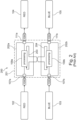
- a media data transmission and processing system 300 is illustrated in Figure 3 .
- the system 300 comprises a processing unit 301.
- the processing unit 301 integrates two processing cards 202a, 202b, which include processing blocks 109a, 109b.
- a bidirectional interconnection 302 connects the processing blocks 109a and 109b. If the system 300 is running normally, the processing cards 202a, 202b receive - 7 compliant streams from the networks 102, 103.
- each processing block 109a,109b a probing engine 303a,303b is integrated.
- the probing engines 303a,303b select an input stream to be processed by the processing block 109a,109b but instead of applying the - 7 methodology, the "good" stream is selected based on a content baseband video probing.
- the respective probing engine 303a, 303b switches seamlessly to the backup signal arriving trough cross-connection 203 or 204.
- the receiving selection criteria of the -7 methodology is removed in favor of a baseband probing method because -7 selection methods only work on single unit applications..
- processing block 109a receives from connector 107a the data stream from RED network 102 and on the other hand via cross-connection 204 processed output data from processing block 109b as a backup stream.
- probing engine 303a performs a content baseband video probing. By default, probing engine 303a selects the data stream received from connector 107a as input stream for processing block 109a.
- probing engine 303a detects that the quality of one or several data packets received at a connector 107a does not meet predefined quality criteria, then probing engine 303a seamlessly switches to the backup stream received via cross-connection 204. If many or all data packets received at a connector 107a are defective, then probing engine 303a switches permanently to the backup stream received via cross-connection 204 until the RED network 102 provides again data packets that meet the predefined quality criteria applied by the probing engine 303a.
- processing block 109b receives from connector 107b the data stream from BLUE network 103 and on the other hand via cross-connection 203 processed output data from processing block 109a as a backup stream.
- probing engine 303b performs a content baseband video probing. By default, probing engine 303b selects the data stream received from connector 107b as input stream for processing block 109b.
- probing engine 303b detects that the quality of one or several data packets received at a connector 107b does not meet predefined quality criteria, then probing engine 303b seamlessly switches to the backup stream received via cross-connection 203. If many or all data packets received at connector 107b are defective, then probing engine 303b switches permanently to the backup stream received via cross-connection 203 until the BLUE network 103 provides again data packets that meet the predefined quality criteria applied by the probing engine 303b.
- the - 7 methodology for selecting input data packets for processing is replaced in favor of a baseband probing method.
- a disadvantage of the - 7 selection method can be overcome. Namely, the - 7 selection methods only works on processing devices 101 having a single processing card 109. This type of processing devices has been described with reference to Figures 1A-1C .
- processing unit 301 is capable of overcoming the single point of failure problem of processing units having only a single processing card there remains a need to make the downstream signals in the output streams of processing unit 301 provided at connectors 111a,111b become -7 compliant. To be - 7 compliant, the data packets contained in the output streams provided by the processing unit 301 at the connectors 111a and 111b need to have exactly the same timestamp, packet counter, and content. To this end a Master Slave structure needs to be established between the processing cards 202a, 202b, and this is where the link 302 comes into play.
- either processing card can become Master or Slave.
- the processing card that is powered up first - the first processing card - will ask for an acknowledgement of the other processing card - the second processing card - being there. If no response from the second processing card is received the first processing card will enter into a Master status waiting for the second processing card to ask for an acknowledgement.
- This handshake procedure will determine which processing card is Master and which one is Slave. After these rules and classes are set, the Master processing card will start transmitting reference Slave commands for the Slave processing card to follow. These reference Slave commands are communicated through the interconnection 302 and are used to align packet counter and timestamp information when no PTP is available like with SDI inputs.
- the reference Slave commands make sure that if the two processing cards 202a,202b are each locked to a reference clock, but the reference clock sources are out of sync that the hysteresis differences between the two processors drop or repeat at exactly the same frame content.
- the processing unit 301 could provide a -7 compliant stream with equal packet counters and timestamps but with different video content (as in one frame shifted).
- processing card 202a and 202b can take on the role of the Master while the other processing card takes on the role of the Slave.
- processing card 202a functioning as a Master for processing card 202b that is the corresponding Slave. If processing block 109a fails in this situation, the processed data from processing card 202b are looped through processing card 202a. As a result, the dual processing cards 202a, 202b output two - 7 compliant data streams. Processing card 202b simultaneously takes over the role of the Master in the system 300 in the sense that it defines the new PTP timestamps and packet sequence numbers for the processed output data packets. If the defective processing card 202a is replaced, then processing card 202b remains to be the Master in the system 300. In this way any glitches in the timing of the data streams are securely avoided.
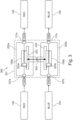
- FIG 4 shows the architecture of another media data transmission and processing system 400 according to the present disclosure.
- System 400 is designed for digesting big amounts of data, for example 8192 audio channels. Therefore, it includes a processing unit 401, which uses two individual processing cards 202a, 202b which are working in parallel to handle the enormous amount of data
- the Master and Slave status between the processing cards 202a, 202b is established in the same way as it has been described with reference to the embodiment shown in Figure 3 .
- the commands between the processing cards 202a, 202b are transmitted via the link 302.
- the link 302 enables to assign identical time stamps and packet counter numbers to the streams of processed output data streams, which are consequently - 7 compliant.
- the output data streams are provided at connectors 111a, 111b as output streams to RED network 104 and the BLUE network 105, respectively.
- the processing unit 401 in Figure 4 has no cross-connections 203, 204 between the processing blocks 109a and 109b. Failure of one of the processing cards 202a, 202b in the processing unit 401 therefore entails failure of RED network 104 or BLUE network 105. The failure of network 104 or 105 must be handled by a downstream - 7 compliant receiver, such as - 7 compliant device 101 or processing unit 301. This will be explained in further detail with reference to Figure 5 .
- Figure 5 shows a data transmission and processing system 500 comprising an upstream processing unit 401 and a downstream processing unit 301.
- Processing unit 401 receives the redundant - 7 compliant data streams from RED network 102 and BLUE network 103.
- Processing unit 401 outputs processed data to red network 104 and blue network 105, which at the same time are input networks for processing unit 301.
- Figure 5 exhibits the situation when processing card 202a fails. Then the downstream RED network 104 receives no output data from processing card 202a. In contrast to that processing card 202b of processing device 401 remains to be operative and outputs the processed data stream to BLUE network 105. Due to the failure of RED network 104, no input data are supplied to connector 107a of processing device 301.
- processing unit 301 is capable of reestablishing two - 7 compliant output data streams which are supplied to RED network 501 and BLUE network 502. Even if also processing card 202a of processing unit 301 fails at the same time, this has no impact on the downstream signals supplied to RED network 501 and BLUE network 502. Only if at the same time processing card 202b of processing unit 301 fails at the same time as processing card 202a of processing unit 401, then all data in downstream networks 501, 502 would be lost. Obviously, the simultaneous failure of two processing cards is very unlikely.
- processing card 202b in processing unit 401 is handled by the transmission system 500 in a corresponding way.
- the present disclosure suggests providing a physical bidirectional link between the main and the redundant half of a dual processing card solution in a processing unit, running a Master Slave algorithm to align the PTP timestamps and the packet counters in the downstream signals of the processing unit.
- This concept enables a full ST2022-7 compliant redundant stream that will be accepted by any - 7 compliant receiver.
- the connection 302 between the processing cards 202a and 202b is agnostic to which processing card functions as a Master and which one functions as a Slave. This prevents timing issues during alignment after a defective processing card is replaced.
- the processing card that starts the fastest will become Master, the other one Slave. When a Master is no longer operative the Slave becomes Master. A rebooted (repaired) processing card that is getting online will become Slave to the new Master, even though this processing card has been Master prior it failed.
- FIG. 6 shows a schematic flow diagram of a method for operating the media data transmission and processing system described in the present disclosure.
- a first input stream of IP packets is ingested into the first processing card 202a, wherein the IP packets contain media information, a PTP timestamp and a packet counter number.
- a second input stream of IP packets is ingested into the second processing card 202b, wherein the IP packets contain media information, a PTP timestamp and a packet counter number.
- step S3 the first and second stream of IP packets are processed in the first and second processing card 202a, 202b, respectively, to produce first and second output streams.
- step S4 one processing card is determined as a Master processing card and the other processing card as a Slave processing card. Finally, in step S5 new PTP timestamps and packet counter numbers to the first and second output streams are assigned such that the new PTP timestamps and packet counter numbers generated in the Master processing card are also assigned to the data packets processed in the Slave processing card.
Landscapes
- Engineering & Computer Science (AREA)
- Multimedia (AREA)
- Signal Processing (AREA)
- Computer Networks & Wireless Communication (AREA)
- Health & Medical Sciences (AREA)
- Cardiology (AREA)
- General Health & Medical Sciences (AREA)
- Data Exchanges In Wide-Area Networks (AREA)
Claims (14)
- Mediendatenübertragungs- und -verarbeitungssystem (300, 400, 500), das ein erstes und ein zweites Datenübertragungsnetz (102, 103), die dieselben Multimediadaten als einen ersten und einen zweiten Datenstrom von IP-Paketen übertragen, umfasst, wobei die IP-Pakete Medieninformationen, einen PTP-Zeitstempel und eine Paketzählernummer enthalten, wobei der zweite Datenstrom für jedes Paket in dem ersten Datenstrom ein Paket mit gleichen Medieninformationen, gleichem PTP-Zeitstempel und gleicher Laufnummer enthält, wobei die Pakete des ersten und des zweiten Datenstroms als ein erster und ein zweiter Eingangsdatenstrom für eine Verarbeitungseinheit (301) bereitgestellt werden, dadurch gekennzeichnet, dass die Verarbeitungseinheit (301) eine erste und eine zweite Verarbeitungskarte (202a, 202b) umfasst, wobei die erste und die zweite Verarbeitungskarte einen verarbeiteten ersten bzw. zweiten Ausgangsdatenstrom ausgeben, wobei die erste und die zweite Verarbeitungskarte den Paketen des ersten und des zweiten Ausgangsdatenstroms neue PTP-Zeitstempel und Laufnummern zuweisen, wobei- die erste und die zweite Verarbeitungskarte (202a, 202b) durch eine Zwischenverbindung (302) verbunden sind,- eine Verarbeitungskarte (202a) dafür konfiguriert ist, als ein Master für die andere Verarbeitungskarte (202b), die dafür konfiguriert ist, als ein Slave zu wirken, zu wirken;- die Master- und die Slave-Verarbeitungskarte die IP-Pakete, die dieselben Medieninformationen enthalten, auf koordinierte Weise, insbesondere auf synchrone Weise, verarbeiten;- die Master-Verarbeitungskarte (202a) zum Zuweisen eines neuen PTP-Zeitstempels und einer neuen Paketzählernummer zu einem IP-Paket, das gegenwärtig in der Master-Verarbeitungskarte verarbeitet wird, und zum Übermitteln des neuen PTP-Zeitstempels und der neuen Paketzählernummer an die Slave-Verarbeitungskarte (202b) konfiguriert ist,- die Master-Verarbeitungskarte (202a) dafür konfiguriert ist zu veranlassen, dass die Slave-Verarbeitungskarte (202b) den PTP-Zeitstempel und die Paketzählernummer, die von der Master-Verarbeitungskarte empfangen werden, dem Paket des zweiten Datenstroms, das dieselben Medieninformationen wie das gegenwärtig in der Master-Verarbeitungskarte verarbeitete IP-Paket enthält, zuweist.
- Mediendatenübertragungs- und -verarbeitungssystem nach Anspruch 1, wobei die Master- und die Slave-Verarbeitungskarte (202a, 202b) mit einer Zwischenverbindung (302) zum Austauschen von Befehlssignalen verbunden sind.
- Mediendatenübertragungs- und -verarbeitungssystem nach Anspruch 1, wobei sowohl die Master- als auch die Slave-Verarbeitungskarte (202a, 202b) einen Verarbeitungsblock (109a, 109b), der den ersten und den zweiten Eingangsdatenstrom verarbeitet, um den ersten und den zweiten Ausgangsdatenstrom zu erzeugen, umfasst,- wobei eine erste Querverbindung (203) einen Ausgang des Verarbeitungsblocks (109a) der Master-Verarbeitungskarte (202a) mit einem Eingang des Verarbeitungsblocks (109b) der Slave-Verarbeitungskarte (202b) verbindet, und- wobei eine zweite Querverbindung (204) einen Ausgang des Verarbeitungsblocks (109b) der Slave-Verarbeitungskarte (202b) mit einem Eingang des Verarbeitungsblocks (109a) der Master-Verarbeitungskarte (202a) verbindet.
- Mediendatenübertragungs- und -verarbeitungssystem nach Anspruch 3, wobei die durch die erste und durch die zweite Querverbindung (203, 204) bereitgestellten verarbeiteten Datenpakete über den Verarbeitungsblock der Master- bzw. Slave-Verarbeitungskarte (202a, 202b) geschleift werden.
- Mediendatenübertragungs- und -verarbeitungssystem nach Anspruch 3 oder 4, wobei- jede Verarbeitungskarte eine Sondierungs-Engine (303a, 303b), die den Inhalt des Eingangsdatenstroms analysiert, umfasst,- wobei die Sondierungs-Engine (303a, 303b) das Ausgeben der von dem anderen Verarbeitungsblock (109a, 109b) über die erste oder die zweite Querverbindung (203, 204) empfangenen verarbeiteten Datenpakete auswählt, falls die Sondierungs-Engine in dem Eingangsdatenstrom ein fehlerhaftes IP-Paket detektiert.
- Mediendatenübertragungs- und -verarbeitungssystem nach Anspruch 5, wobei die Sondierungs-Engine (303a, 303b) dafür konfiguriert ist, den Dateninhalt in dem Audio- und/oder Video-Basisbandbereich zu analysieren, um zu detektieren, ob ein Datenpaket im Voraus definierte Qualitätskriterien erfüllt.
- Mediendatenübertragungs- und -verarbeitungssystem nach Anspruch 5 oder 6, wobei die Sondierungs-Engine (303a, 303b) zum Ausführen zyklischer Redundanzprüfungen und/oder einer Detektion angehaltener Bilder und/oder einer Detektion schwarzer Bilder und/oder eines Audioträgerverlusts und/oder Detektion eines Videoträgerverlusts konfiguriert ist.
- Verfahren zum Betreiben eines Mediendatenübertragungs- und -verarbeitungssystems nach einem der vorhergehenden Ansprüche, wobei das Verfahren umfasst:- Aufnehmen eines ersten Eingangsdatenstroms von IP-Paketen in eine erste Verarbeitungskarte (202a), wobei die IP-Pakete Medieninformationen, einen PTP-Zeitstempel und eine Paketzählernummer enthalten;- Aufnehmen eines zweiten Eingangsdatenstroms von IP-Paketen in die zweite Verarbeitungskarte (202b), wobei die IP-Pakete Medieninformationen, einen PTP-Zeitstempel und eine Paketzählernummer enthalten;- Verarbeiten des ersten und des zweiten Datenstroms von IP-Paketen in der ersten bzw. in der zweiten Verarbeitungskarte (202a, 202b), um einen ersten und einen zweiten Ausgangsdatenstrom zu erzeugen;- Bestimmen einer Verarbeitungskarte als eine Master-Verarbeitungskarte (202a) und der anderen Verarbeitungskarte als eine Slave-Verarbeitungskarte;- Zuweisen neuer PTP-Zeitstempel und Paketzählernummern zu dem ersten und zu dem zweiten Ausgangsdatenstrom in der Weise, dass die in der Master-Verarbeitungskarte erzeugten neuen PTP-Zeitstempel und Paketzählernummern ebenfalls den in der Slave-Verarbeitungskarte verarbeiteten Datenpaketen zugewiesen werden.
- Verfahren nach Anspruch 8, das umfasst:- Analysieren jedes Eingangsdatenstroms, um ein oder mehrere fehlerhafte Datenpakete zu detektieren; und- Ersetzen des einen oder der mehreren detektierten fehlerhaften Datenpakete in einem Eingangsdatenstrom durch verarbeitete Datenpakete mit denselben Medieninformationen von dem anderen Eingangsdatenstrom.
- Verfahren nach Anspruch 9, wobei das Analysieren jedes Eingangsdatenstroms das Analysieren des Dateninhalts des Eingangsdatenstroms in dem Audio- und/oder Videobasisbandbereich, um zu detektieren, ob das Datenpaket im Voraus definierte Qualitätskriterien erfüllt, umfasst.
- Verfahren nach Anspruch 9 oder 10, wobei das Analysieren jedes Eingangsdatenstroms das Ausführen zyklischer Redundanzprüfungen und/oder einer Detektion angehaltener Bilder und/oder einer Detektion schwarzer Bilder und/oder eines Audioträgerverlusts und/oder Detektion eines Videoträgerverlusts umfasst.
- Verfahren zum Betreiben eines Mediendatenübertragungs- und -verarbeitungssystems nach einem der Ansprüche 8 bis 11, wobei das Verfahren umfasst:- Zuweisen eines Master-Status zu einer Verarbeitungskarte, die das Booten schneller als die andere Verarbeitungskarte abgeschlossen hat;- Zuweisen eines Slave-Status zu der anderen Verarbeitungskarte.
- Verfahren zum Betreiben eines Mediendatenübertragungs- und -verarbeitungssystems nach einem der Ansprüche 8 bis 12, wobei das Verfahren ferner umfasst:- Zuweisen des Master-Status zu der Verarbeitungskarte, der anfangs der Slave-Status zugewiesen gewesen ist, falls die Verarbeitungskarte, der anfangs der Master-Status zugewiesen gewesen ist, ausfällt.
- Verfahren zum Betreiben eines Mediendatenübertragungs]- und -verarbeitungssystems nach Anspruch 8 oder 9, wobei das Verfahren umfasst:- Ersetzen einer ausgefallenen Verarbeitungskarte durch eine neue Verarbeitungskarte und- Zuweisen des Slave-Status zu der neuen Verarbeitungskarte.
Priority Applications (2)
| Application Number | Priority Date | Filing Date | Title |
|---|---|---|---|
| EP22156004.8A EP4228271B1 (de) | 2022-02-09 | 2022-02-09 | Mediendatenübertragungs- und verarbeitungssystem und verfahren zum betrieb eines solchen systems |
| US18/166,625 US12328483B2 (en) | 2022-02-09 | 2023-02-09 | Media data transmission and processing system and method for operating such system |
Applications Claiming Priority (1)
| Application Number | Priority Date | Filing Date | Title |
|---|---|---|---|
| EP22156004.8A EP4228271B1 (de) | 2022-02-09 | 2022-02-09 | Mediendatenübertragungs- und verarbeitungssystem und verfahren zum betrieb eines solchen systems |
Publications (3)
| Publication Number | Publication Date |
|---|---|
| EP4228271A1 EP4228271A1 (de) | 2023-08-16 |
| EP4228271B1 true EP4228271B1 (de) | 2025-01-29 |
| EP4228271C0 EP4228271C0 (de) | 2025-01-29 |
Family
ID=80682738
Family Applications (1)
| Application Number | Title | Priority Date | Filing Date |
|---|---|---|---|
| EP22156004.8A Active EP4228271B1 (de) | 2022-02-09 | 2022-02-09 | Mediendatenübertragungs- und verarbeitungssystem und verfahren zum betrieb eines solchen systems |
Country Status (2)
| Country | Link |
|---|---|
| US (1) | US12328483B2 (de) |
| EP (1) | EP4228271B1 (de) |
Families Citing this family (1)
| Publication number | Priority date | Publication date | Assignee | Title |
|---|---|---|---|---|
| EP4586627A1 (de) | 2024-01-09 | 2025-07-16 | EVS Broadcast Equipment SA | Mediendatenverarbeitungsvorrichtung und verfahren zum umschalten zwischen mediendatenströmen |
Family Cites Families (3)
| Publication number | Priority date | Publication date | Assignee | Title |
|---|---|---|---|---|
| EP2683155A1 (de) | 2012-07-07 | 2014-01-08 | PIXarithmic GmbH | System und Verfahren zur Verarbeitung von Video und/oder Audiosignalen |
| US9306693B2 (en) * | 2013-11-15 | 2016-04-05 | Broadcom Corporation | Time synchronization architecture in a network device |
| US11190819B2 (en) * | 2017-09-14 | 2021-11-30 | Media Links Co., Ltd. | Video transmission system |
-
2022
- 2022-02-09 EP EP22156004.8A patent/EP4228271B1/de active Active
-
2023
- 2023-02-09 US US18/166,625 patent/US12328483B2/en active Active
Also Published As
| Publication number | Publication date |
|---|---|
| US12328483B2 (en) | 2025-06-10 |
| US20230276107A1 (en) | 2023-08-31 |
| EP4228271A1 (de) | 2023-08-16 |
| EP4228271C0 (de) | 2025-01-29 |
Similar Documents
| Publication | Publication Date | Title |
|---|---|---|
| CN101631011B (zh) | 适于进行ip流媒体实时处理及转发设备的热备方法及系统 | |
| JP5160170B2 (ja) | Stpのためのpps接続装置(時間同期装置)、時間同期システム、およびstpのためのpps接続あるいは時間同期装置を提供する方法 | |
| CN1826742B (zh) | 同步电路、同步系统和用于使电路同步的方法 | |
| US20140185632A1 (en) | Network and Method for Implementing a High-Availability Grand Master Clock | |
| JP2002517819A (ja) | 耐障害性演算用の冗長コンピュータ・ベース・システムを管理するための方法及び装置 | |
| CA2487828A1 (en) | Apparatus for redundant multiplexing and remultiplexing of program streams and best effort data | |
| CN101595667A (zh) | 促进协调定时网络中的服务器的同步 | |
| CN101179697B (zh) | 多点控制单元中多点处理器数据备份的实现方法及装置 | |
| CN112346925B (zh) | 一种进程级双机热备冗余系统及方法 | |
| EP4228271B1 (de) | Mediendatenübertragungs- und verarbeitungssystem und verfahren zum betrieb eines solchen systems | |
| US6259704B1 (en) | Digital transmission network | |
| JP2023509491A (ja) | クロックポート属性回復方法、デバイス、およびシステム | |
| AU2001241700B2 (en) | Multiple network fault tolerance via redundant network control | |
| CN114019785A (zh) | 一种多重冗余系统的数据同步方法、系统、设备以及介质 | |
| US8055801B2 (en) | Pulse-per-second attachment for STP | |
| Elmenreich et al. | Introduction to ttp/c and ttp/a | |
| US20070171820A1 (en) | Information processing apparatus, method, and program | |
| CN116530058A (zh) | 具有主从结构的自动化系统、分配器和电报传输方法 | |
| CN102761407A (zh) | 跨机框系统及其时间和频率透传的实现方法和装置 | |
| CN1097914C (zh) | 保持双工信息处理单元微同步运行的方法 | |
| CN112995737B (zh) | 多屏显卡输出的分布式网络上屏同步方法、系统及设备 | |
| EP4586627A1 (de) | Mediendatenverarbeitungsvorrichtung und verfahren zum umschalten zwischen mediendatenströmen | |
| US6516419B1 (en) | Network synchronization method and non-break clock switching method in extended bus connection system | |
| KR100198416B1 (ko) | 이중화 제어시스템에서의 동기제어를 위한 동기신호 감시회로 | |
| CN100508627C (zh) | 一种实现加扰器备份的系统及方法 |
Legal Events
| Date | Code | Title | Description |
|---|---|---|---|
| PUAI | Public reference made under article 153(3) epc to a published international application that has entered the european phase |
Free format text: ORIGINAL CODE: 0009012 |
|
| STAA | Information on the status of an ep patent application or granted ep patent |
Free format text: STATUS: THE APPLICATION HAS BEEN PUBLISHED |
|
| AK | Designated contracting states |
Kind code of ref document: A1 Designated state(s): AL AT BE BG CH CY CZ DE DK EE ES FI FR GB GR HR HU IE IS IT LI LT LU LV MC MK MT NL NO PL PT RO RS SE SI SK SM TR |
|
| STAA | Information on the status of an ep patent application or granted ep patent |
Free format text: STATUS: REQUEST FOR EXAMINATION WAS MADE |
|
| 17P | Request for examination filed |
Effective date: 20240208 |
|
| RBV | Designated contracting states (corrected) |
Designated state(s): AL AT BE BG CH CY CZ DE DK EE ES FI FR GB GR HR HU IE IS IT LI LT LU LV MC MK MT NL NO PL PT RO RS SE SI SK SM TR |
|
| GRAP | Despatch of communication of intention to grant a patent |
Free format text: ORIGINAL CODE: EPIDOSNIGR1 |
|
| STAA | Information on the status of an ep patent application or granted ep patent |
Free format text: STATUS: GRANT OF PATENT IS INTENDED |
|
| RIC1 | Information provided on ipc code assigned before grant |
Ipc: H04N 21/643 20110101ALI20240821BHEP Ipc: H04N 21/63 20110101ALI20240821BHEP Ipc: H04N 21/242 20110101ALI20240821BHEP Ipc: H04L 65/65 20220101ALI20240821BHEP Ipc: H04L 1/22 20060101ALI20240821BHEP Ipc: H04N 21/24 20110101AFI20240821BHEP |
|
| INTG | Intention to grant announced |
Effective date: 20240828 |
|
| GRAJ | Information related to disapproval of communication of intention to grant by the applicant or resumption of examination proceedings by the epo deleted |
Free format text: ORIGINAL CODE: EPIDOSDIGR1 |
|
| STAA | Information on the status of an ep patent application or granted ep patent |
Free format text: STATUS: REQUEST FOR EXAMINATION WAS MADE |
|
| GRAP | Despatch of communication of intention to grant a patent |
Free format text: ORIGINAL CODE: EPIDOSNIGR1 |
|
| STAA | Information on the status of an ep patent application or granted ep patent |
Free format text: STATUS: GRANT OF PATENT IS INTENDED |
|
| GRAS | Grant fee paid |
Free format text: ORIGINAL CODE: EPIDOSNIGR3 |
|
| GRAA | (expected) grant |
Free format text: ORIGINAL CODE: 0009210 |
|
| STAA | Information on the status of an ep patent application or granted ep patent |
Free format text: STATUS: THE PATENT HAS BEEN GRANTED |
|
| INTC | Intention to grant announced (deleted) | ||
| INTG | Intention to grant announced |
Effective date: 20241206 |
|
| AK | Designated contracting states |
Kind code of ref document: B1 Designated state(s): AL AT BE BG CH CY CZ DE DK EE ES FI FR GB GR HR HU IE IS IT LI LT LU LV MC MK MT NL NO PL PT RO RS SE SI SK SM TR |
|
| REG | Reference to a national code |
Ref country code: GB Ref legal event code: FG4D |
|
| REG | Reference to a national code |
Ref country code: CH Ref legal event code: EP |
|
| REG | Reference to a national code |
Ref country code: DE Ref legal event code: R096 Ref document number: 602022009897 Country of ref document: DE |
|
| REG | Reference to a national code |
Ref country code: IE Ref legal event code: FG4D |
|
| U01 | Request for unitary effect filed |
Effective date: 20250219 |
|
| U07 | Unitary effect registered |
Designated state(s): AT BE BG DE DK EE FI FR IT LT LU LV MT NL PT RO SE SI Effective date: 20250225 |
|
| U20 | Renewal fee for the european patent with unitary effect paid |
Year of fee payment: 4 Effective date: 20250224 |
|
| PG25 | Lapsed in a contracting state [announced via postgrant information from national office to epo] |
Ref country code: RS Free format text: LAPSE BECAUSE OF FAILURE TO SUBMIT A TRANSLATION OF THE DESCRIPTION OR TO PAY THE FEE WITHIN THE PRESCRIBED TIME-LIMIT Effective date: 20250429 |
|
| PG25 | Lapsed in a contracting state [announced via postgrant information from national office to epo] |
Ref country code: PL Free format text: LAPSE BECAUSE OF FAILURE TO SUBMIT A TRANSLATION OF THE DESCRIPTION OR TO PAY THE FEE WITHIN THE PRESCRIBED TIME-LIMIT Effective date: 20250129 |
|
| PG25 | Lapsed in a contracting state [announced via postgrant information from national office to epo] |
Ref country code: ES Free format text: LAPSE BECAUSE OF FAILURE TO SUBMIT A TRANSLATION OF THE DESCRIPTION OR TO PAY THE FEE WITHIN THE PRESCRIBED TIME-LIMIT Effective date: 20250129 |
|
| PG25 | Lapsed in a contracting state [announced via postgrant information from national office to epo] |
Ref country code: IS Free format text: LAPSE BECAUSE OF FAILURE TO SUBMIT A TRANSLATION OF THE DESCRIPTION OR TO PAY THE FEE WITHIN THE PRESCRIBED TIME-LIMIT Effective date: 20250529 Ref country code: NO Free format text: LAPSE BECAUSE OF FAILURE TO SUBMIT A TRANSLATION OF THE DESCRIPTION OR TO PAY THE FEE WITHIN THE PRESCRIBED TIME-LIMIT Effective date: 20250429 |
|
| PG25 | Lapsed in a contracting state [announced via postgrant information from national office to epo] |
Ref country code: HR Free format text: LAPSE BECAUSE OF FAILURE TO SUBMIT A TRANSLATION OF THE DESCRIPTION OR TO PAY THE FEE WITHIN THE PRESCRIBED TIME-LIMIT Effective date: 20250129 |
|
| PG25 | Lapsed in a contracting state [announced via postgrant information from national office to epo] |
Ref country code: GR Free format text: LAPSE BECAUSE OF FAILURE TO SUBMIT A TRANSLATION OF THE DESCRIPTION OR TO PAY THE FEE WITHIN THE PRESCRIBED TIME-LIMIT Effective date: 20250430 |
|
| REG | Reference to a national code |
Ref country code: CH Ref legal event code: PL |
|
| PG25 | Lapsed in a contracting state [announced via postgrant information from national office to epo] |
Ref country code: SM Free format text: LAPSE BECAUSE OF FAILURE TO SUBMIT A TRANSLATION OF THE DESCRIPTION OR TO PAY THE FEE WITHIN THE PRESCRIBED TIME-LIMIT Effective date: 20250129 |
|
| PG25 | Lapsed in a contracting state [announced via postgrant information from national office to epo] |
Ref country code: MC Free format text: LAPSE BECAUSE OF FAILURE TO SUBMIT A TRANSLATION OF THE DESCRIPTION OR TO PAY THE FEE WITHIN THE PRESCRIBED TIME-LIMIT Effective date: 20250129 |
|
| PG25 | Lapsed in a contracting state [announced via postgrant information from national office to epo] |
Ref country code: CH Free format text: LAPSE BECAUSE OF NON-PAYMENT OF DUE FEES Effective date: 20250228 |
|
| PG25 | Lapsed in a contracting state [announced via postgrant information from national office to epo] |
Ref country code: CZ Free format text: LAPSE BECAUSE OF FAILURE TO SUBMIT A TRANSLATION OF THE DESCRIPTION OR TO PAY THE FEE WITHIN THE PRESCRIBED TIME-LIMIT Effective date: 20250129 |
|
| PG25 | Lapsed in a contracting state [announced via postgrant information from national office to epo] |
Ref country code: SK Free format text: LAPSE BECAUSE OF FAILURE TO SUBMIT A TRANSLATION OF THE DESCRIPTION OR TO PAY THE FEE WITHIN THE PRESCRIBED TIME-LIMIT Effective date: 20250129 |
|
| PLBE | No opposition filed within time limit |
Free format text: ORIGINAL CODE: 0009261 |
|
| STAA | Information on the status of an ep patent application or granted ep patent |
Free format text: STATUS: NO OPPOSITION FILED WITHIN TIME LIMIT |
|
| 26N | No opposition filed |
Effective date: 20251030 |
|
| PG25 | Lapsed in a contracting state [announced via postgrant information from national office to epo] |
Ref country code: IE Free format text: LAPSE BECAUSE OF NON-PAYMENT OF DUE FEES Effective date: 20250209 |
|
| U20 | Renewal fee for the european patent with unitary effect paid |
Year of fee payment: 5 Effective date: 20260222 |