EP4227341A1 - Resin molding material, molded body and method for producing said molded body - Google Patents
Resin molding material, molded body and method for producing said molded body Download PDFInfo
- Publication number
- EP4227341A1 EP4227341A1 EP21877492.5A EP21877492A EP4227341A1 EP 4227341 A1 EP4227341 A1 EP 4227341A1 EP 21877492 A EP21877492 A EP 21877492A EP 4227341 A1 EP4227341 A1 EP 4227341A1
- Authority
- EP
- European Patent Office
- Prior art keywords
- group
- molding material
- resin molding
- resin
- equal
- Prior art date
- Legal status (The legal status is an assumption and is not a legal conclusion. Google has not performed a legal analysis and makes no representation as to the accuracy of the status listed.)
- Pending
Links
Images

Classifications
-
- C—CHEMISTRY; METALLURGY
- C08—ORGANIC MACROMOLECULAR COMPOUNDS; THEIR PREPARATION OR CHEMICAL WORKING-UP; COMPOSITIONS BASED THEREON
- C08L—COMPOSITIONS OF MACROMOLECULAR COMPOUNDS
- C08L63/00—Compositions of epoxy resins; Compositions of derivatives of epoxy resins
-
- H—ELECTRICITY
- H01—ELECTRIC ELEMENTS
- H01F—MAGNETS; INDUCTANCES; TRANSFORMERS; SELECTION OF MATERIALS FOR THEIR MAGNETIC PROPERTIES
- H01F1/00—Magnets or magnetic bodies characterised by the magnetic materials therefor; Selection of materials for their magnetic properties
- H01F1/01—Magnets or magnetic bodies characterised by the magnetic materials therefor; Selection of materials for their magnetic properties of inorganic materials
- H01F1/03—Magnets or magnetic bodies characterised by the magnetic materials therefor; Selection of materials for their magnetic properties of inorganic materials characterised by their coercivity
- H01F1/12—Magnets or magnetic bodies characterised by the magnetic materials therefor; Selection of materials for their magnetic properties of inorganic materials characterised by their coercivity of soft-magnetic materials
- H01F1/14—Magnets or magnetic bodies characterised by the magnetic materials therefor; Selection of materials for their magnetic properties of inorganic materials characterised by their coercivity of soft-magnetic materials metals or alloys
- H01F1/20—Magnets or magnetic bodies characterised by the magnetic materials therefor; Selection of materials for their magnetic properties of inorganic materials characterised by their coercivity of soft-magnetic materials metals or alloys in the form of particles, e.g. powder
- H01F1/22—Magnets or magnetic bodies characterised by the magnetic materials therefor; Selection of materials for their magnetic properties of inorganic materials characterised by their coercivity of soft-magnetic materials metals or alloys in the form of particles, e.g. powder pressed, sintered, or bound together
- H01F1/24—Magnets or magnetic bodies characterised by the magnetic materials therefor; Selection of materials for their magnetic properties of inorganic materials characterised by their coercivity of soft-magnetic materials metals or alloys in the form of particles, e.g. powder pressed, sintered, or bound together the particles being insulated
- H01F1/26—Magnets or magnetic bodies characterised by the magnetic materials therefor; Selection of materials for their magnetic properties of inorganic materials characterised by their coercivity of soft-magnetic materials metals or alloys in the form of particles, e.g. powder pressed, sintered, or bound together the particles being insulated by macromolecular organic substances
-
- C—CHEMISTRY; METALLURGY
- C08—ORGANIC MACROMOLECULAR COMPOUNDS; THEIR PREPARATION OR CHEMICAL WORKING-UP; COMPOSITIONS BASED THEREON
- C08G—MACROMOLECULAR COMPOUNDS OBTAINED OTHERWISE THAN BY REACTIONS ONLY INVOLVING UNSATURATED CARBON-TO-CARBON BONDS
- C08G59/00—Polycondensates containing more than one epoxy group per molecule; Macromolecules obtained by polymerising compounds containing more than one epoxy group per molecule using curing agents or catalysts which react with the epoxy groups
- C08G59/18—Macromolecules obtained by polymerising compounds containing more than one epoxy group per molecule using curing agents or catalysts which react with the epoxy groups ; e.g. general methods of curing
- C08G59/40—Macromolecules obtained by polymerising compounds containing more than one epoxy group per molecule using curing agents or catalysts which react with the epoxy groups ; e.g. general methods of curing characterised by the curing agents used
- C08G59/62—Alcohols or phenols
- C08G59/621—Phenols
-
- C—CHEMISTRY; METALLURGY
- C08—ORGANIC MACROMOLECULAR COMPOUNDS; THEIR PREPARATION OR CHEMICAL WORKING-UP; COMPOSITIONS BASED THEREON
- C08G—MACROMOLECULAR COMPOUNDS OBTAINED OTHERWISE THAN BY REACTIONS ONLY INVOLVING UNSATURATED CARBON-TO-CARBON BONDS
- C08G59/00—Polycondensates containing more than one epoxy group per molecule; Macromolecules obtained by polymerising compounds containing more than one epoxy group per molecule using curing agents or catalysts which react with the epoxy groups
- C08G59/18—Macromolecules obtained by polymerising compounds containing more than one epoxy group per molecule using curing agents or catalysts which react with the epoxy groups ; e.g. general methods of curing
- C08G59/68—Macromolecules obtained by polymerising compounds containing more than one epoxy group per molecule using curing agents or catalysts which react with the epoxy groups ; e.g. general methods of curing characterised by the catalysts used
- C08G59/687—Macromolecules obtained by polymerising compounds containing more than one epoxy group per molecule using curing agents or catalysts which react with the epoxy groups ; e.g. general methods of curing characterised by the catalysts used containing sulfur
-
- C—CHEMISTRY; METALLURGY
- C08—ORGANIC MACROMOLECULAR COMPOUNDS; THEIR PREPARATION OR CHEMICAL WORKING-UP; COMPOSITIONS BASED THEREON
- C08G—MACROMOLECULAR COMPOUNDS OBTAINED OTHERWISE THAN BY REACTIONS ONLY INVOLVING UNSATURATED CARBON-TO-CARBON BONDS
- C08G59/00—Polycondensates containing more than one epoxy group per molecule; Macromolecules obtained by polymerising compounds containing more than one epoxy group per molecule using curing agents or catalysts which react with the epoxy groups
- C08G59/18—Macromolecules obtained by polymerising compounds containing more than one epoxy group per molecule using curing agents or catalysts which react with the epoxy groups ; e.g. general methods of curing
- C08G59/68—Macromolecules obtained by polymerising compounds containing more than one epoxy group per molecule using curing agents or catalysts which react with the epoxy groups ; e.g. general methods of curing characterised by the catalysts used
- C08G59/688—Macromolecules obtained by polymerising compounds containing more than one epoxy group per molecule using curing agents or catalysts which react with the epoxy groups ; e.g. general methods of curing characterised by the catalysts used containing phosphorus
-
- H—ELECTRICITY
- H01—ELECTRIC ELEMENTS
- H01F—MAGNETS; INDUCTANCES; TRANSFORMERS; SELECTION OF MATERIALS FOR THEIR MAGNETIC PROPERTIES
- H01F41/00—Apparatus or processes specially adapted for manufacturing or assembling magnets, inductances or transformers; Apparatus or processes specially adapted for manufacturing materials characterised by their magnetic properties
- H01F41/02—Apparatus or processes specially adapted for manufacturing or assembling magnets, inductances or transformers; Apparatus or processes specially adapted for manufacturing materials characterised by their magnetic properties for manufacturing cores, coils, or magnets
- H01F41/0206—Manufacturing of magnetic cores by mechanical means
- H01F41/0246—Manufacturing of magnetic circuits by moulding or by pressing powder
-
- C—CHEMISTRY; METALLURGY
- C08—ORGANIC MACROMOLECULAR COMPOUNDS; THEIR PREPARATION OR CHEMICAL WORKING-UP; COMPOSITIONS BASED THEREON
- C08K—Use of inorganic or non-macromolecular organic substances as compounding ingredients
- C08K2201/00—Specific properties of additives
- C08K2201/002—Physical properties
- C08K2201/003—Additives being defined by their diameter
-
- C—CHEMISTRY; METALLURGY
- C08—ORGANIC MACROMOLECULAR COMPOUNDS; THEIR PREPARATION OR CHEMICAL WORKING-UP; COMPOSITIONS BASED THEREON
- C08K—Use of inorganic or non-macromolecular organic substances as compounding ingredients
- C08K2201/00—Specific properties of additives
- C08K2201/01—Magnetic additives
-
- C—CHEMISTRY; METALLURGY
- C08—ORGANIC MACROMOLECULAR COMPOUNDS; THEIR PREPARATION OR CHEMICAL WORKING-UP; COMPOSITIONS BASED THEREON
- C08L—COMPOSITIONS OF MACROMOLECULAR COMPOUNDS
- C08L2205/00—Polymer mixtures characterised by other features
- C08L2205/03—Polymer mixtures characterised by other features containing three or more polymers in a blend
Definitions
- the present invention relates to a resin molding material, a molded product, and a method for producing the molded product.
- a coil also referred to as “reactor”, “inductor”, or the like depending on application fields
- a magnetic core and an exterior member has been actively studied.
- magnetic materials with moldability, for producing the magnetic core or the exterior member of such coils has also been actively studied.
- Patent Document 1 discloses a molding material including a magnetic powder which contains first particles in which a content of iron exhibiting soft magnetism is equal to or more than 85% by mass, and a non-magnetic powder which exhibits non-magnetism, has an average particle diameter of equal to or less than 3 um, and is smaller than the magnetic powder.
- a volume fraction of the magnetic powder is 50% to 90% by volume of the molding material 1 (paragraphs 0107 and the like), and a volume fraction of a non-magnetic powder containing silica is 3% to 25% by volume of the magnetic powder (paragraphs 0124 and the like).
- Patent Document 2 discloses a resin composition for forming a magnetic core, which contains a thermosetting resin and a magnetic powder, in which a content of the magnetic powder is equal to or more than 50% by mass with respect to the total solid content of the resin composition for forming a magnetic core.
- a volume fraction of the magnetic powder is 35% to 90% by volume of the molding material 1 (paragraphs 0107 and the like), and a volume fraction of a non-magnetic powder containing silica is 3% to 25% by volume of the magnetic powder (paragraphs 0124 and the like) .
- the magnetic material obtained from the resin molding material (composition) it is necessary to increase filling of soft magnetic particles in order to improve magnetic characteristics such as magnetic permeability.
- the filling amount of the soft magnetic particles is increased, a viscosity of the resin molding material is increased, and fillability into a mold is lowered during molding such as compression molding. That is, there is a trade-off relationship between increasing the magnetic permeability of the magnetic material and improving the fillability into the mold.
- Patent Documents 1 and 2 the filling amount of the magnetic particles is small, and it is not intended to solve the above-described problems. Therefore, there is room for improvement in increasing the magnetic permeability of the magnetic material and the fillability into the mold.
- a resin molding material containing (A) soft magnetic particles, (B) a silica fine powder having an average particle diameter of equal to or more than 0.1 um and equal to or less than 2.0 um, and (C) a thermosetting resin, in which a content of the soft magnetic particles (A) is equal to or more than 96% by mass, and a content of the silica fine powder (B) is equal to or less than 1.5% by mass.
- a molded product obtained by curing the above-described resin molding material.
- a method for producing a molded product including a step of injecting a molten material of the above-described resin molding material into a mold using a transfer molding apparatus and a step of curing the molten material.
- a method for producing a molded product including a step of compression-molding the above-described resin molding material.
- Figs. 1A and 1B are cross-sectional views showing a configuration of a structural body according to the present embodiment.
- a resin molding material contains (A) soft magnetic particles, (B) a silica fine powder having an average particle diameter of equal to or more than 0.1 um and equal to or less than 2.0 um, and (C) a thermosetting resin.
- a content of the soft magnetic particles (A) is equal to or more than 96% by mass
- a content of the silica fine powder (B) is equal to or less than 1.5% by mass .
- the soft magnetism refers to ferromagnetism having a small coercive force, and generally, ferromagnetism having a coercive force of equal to or less than 800 Aim is referred to as soft magnetism.
- Examples of a constituent material of the soft magnetic particles (A) include a metal-containing material having an iron content of equal to or more than 85% by mass as a constituent element.
- a metal-containing material having an iron content of equal to or more than 85% by mass as a constituent element Such a metal material having a high iron content as a constituent element exhibits soft magnetism in which magnetic characteristics such as magnetic permeability and magnetic flux density are relatively good. Therefore, it is possible to obtain a resin molding material capable of exhibiting good magnetic characteristics, for example, in a case of being molded into a magnetic core or the like.
- Examples of a form of the metal-containing material include simple substances, solid solutions, eutectic crystals, and alloys such as an intermetallic compound.
- the particles including such a metal material it is possible to obtain a resin molding material having excellent magnetic characteristics derived from iron, that is, magnetic characteristics such as high magnetic permeability and high magnetic flux density.
- the above-described metal-containing material may contain an element other than iron as a constituent element.
- the element other than iron include B, C, N, O, Al, Si, P, S, Ti, V, Cr, Mn, Co, Ni, Cu, Zn, Y, Zr, Nb, Mo, Cd, In, and Sn, and one kind of these may be used or two or more kinds of these may be used in combination.
- one or more elements selected from Fe, Ni, Si, and Co can be included as a main element.
- metal-containing material examples include pure iron, silicon steel, iron-cobalt alloy, iron-nickel alloy, iron-chromium alloy, iron-aluminum alloy, carbonyl iron, stainless steel, and a composite material containing one or two or more of these. From the viewpoint of availability and the like, silicon steel or carbonyl iron can be preferably used.
- the soft magnetic particles may be other particles.
- the soft magnetic particles may be magnetic particles including Ni-based soft magnetic particles, Co-based soft magnetic particles, and the like.
- a median diameter D 50 of the soft magnetic particles (A) on a volume basis is preferably 0.5 to 75 um, more preferably 0.75 to 65 um, and still more preferably 1 to 60 um.
- the D 50 can be obtained by, for example, a laser diffraction/scattering type particle diameter distribution measuring device. Specifically, a particle diameter distribution curve is obtained by measuring the soft magnetic particles (A) in a dry manner with a particle diameter distribution measuring device "LA-950" manufactured by HORIBA, Ltd., and the D 50 can be obtained by analyzing this distribution curve.
- the resin molding material according to the present embodiment contains the soft magnetic particles (A) in an amount of equal to or more than 96% by mass.
- the upper limit value thereof is equal to or less than 98% by mass.
- the resin molding material according to the present embodiment contains the soft magnetic particles (A) in an amount of equal to or more than 82% by volume, preferably equal to or more than 84% by volume.
- the upper limit value thereof is equal to or less than 90% by volume.
- the resin molding material according to the present embodiment contains a silica fine powder (B).
- An average particle diameter of the silica fine powder (B) is equal to or more than 0.1 um and equal to or less than 2.0 um, preferably equal to or more than 0.1 um and equal to or less than 1.8 um, more preferably equal to or more than 0.1 um and equal to or less than 1.6 um, and still more preferably equal to or more than 0.1 um and equal to or less than 1.0 um.
- the silica fine powder (B) is uniformly dispersed in the resin molding material, so that fluidity is improved and the fillability or moldability can be improved. Therefore, a molded product with less molding defects is obtained, and particularly good magnetic characteristics are obtained in the molded product.
- the silica fine powder (B) has a high affinity with thermosetting resins and has high insulating property, the silica fine powder (B) is useful as a constituent material for non-magnetic powders used in resin molding materials.
- a true specific gravity of the silica fine powder (B) is preferably 1.0 to 6.0, more preferably 1.2 to 5.0, and still more preferably 1.5 to 4.5. Since such a silica fine powder (B) has a small specific gravity, the silica fine powder (B) easily flows together with a molten material of the thermosetting resin. Therefore, in a case where the molten material of the thermosetting resin flows toward gaps of a molding mold during molding, the silica fine powder (B) easily flows together with the molten material.
- the silica fine powder (B) is preferably spherical silica.
- a sphericity of the silica fine powder (B) is not particularly limited, but is preferably 0.50 to 1.00 and more preferably 0.75 to 1.00. In a case where the sphericity of the silica fine powder (B) is within the above-described range, fluidity of the resin molding material can be ensured by utilizing rolling properties of the silica fine powder (B) itself.
- the resin molding material according to the present embodiment can contain the silica fine powder (B) in an amount of equal to or less than 1.5% by mass, preferably equal to or less than 1.2% by mass and more preferably equal to or less than 1.0% by mass.
- the lower limit value thereof is equal to or more than 0.05% by mass, preferably equal to or more than 0.1% by mass.
- the resin molding material according to the present embodiment contains the silica fine powder (B) in the amount described above together with the soft magnetic particles (A) contained in the amount described above, a magnetic material having high magnetic permeability is obtained, and a resin molding material having sufficient fluidity is obtained, which is excellent in the fillability into the mold.
- a volume fraction of the silica fine powder (B) is equal to or less than 4% by volume, preferably equal to or less than 3% by volume and more preferably equal to or less than 2% by volume.
- the lower limit value thereof is equal to or more than 0.14% by volume, preferably equal to or more than 0.5% by volume.
- the average particle diameters of the magnetic particles (A) and the silica fine powder (B) mean a volume average particle diameter (for example, D 50 ), which can be measured using a laser diffraction particle diameter distribution analyzer.
- the sphericity of particles such as the silica fine powder (B) can be obtained by isoarea equivalent circle diameter/circumscribed circle diameter, in a case where, in a scanning electron microscope (SEM) image of each particle, a perfect circle equal to the area is defined as an isoarea equivalent circle. For 10 or more randomly selected particles, the isoarea equivalent circle diameter/circumscribed circle diameter is calculated, and the average value thereof is defined as "sphericity of particles".
- thermosetting resin (C) examples include an epoxy resin, a phenol resin, a polyimide resin, a bismaleimide resin, a urea resin, a melamine resin, a polyurethane resin, a cyanate ester resin, a silicone resin, an oxetane resin (oxetane compound), a (meth) acrylate resin, an unsaturated polyester resin, a diallyl phthalate resin, and a benzoxazine resin. These may be used alone or in combination of two or more thereof. From the viewpoint of heat resistance, the thermosetting resin (C) preferably includes, for example, an epoxy resin.
- epoxy resin known compounds can be used without particular limitation as long as the effects of the present invention can be exhibited.
- epoxy resin examples include bisphenol-type epoxy resins such as a bisphenol A-type epoxy resin, a bisphenol F-type epoxy resin, a tetramethyl bisphenol F-type epoxy resin, a bisphenol S-type epoxy resin, a bisphenol E-type epoxy resin, a bisphenol M-type epoxy resin, a bisphenol P-type epoxy resin, and a bisphenol Z-type epoxy resin; novolac-type epoxy resins such as a phenol novolac-type epoxy resin and a cresol novolac-type epoxy resin; and a biphenyl-type epoxy resin, a biphenylaralkyl-type epoxy resin, an arylalkylene-type epoxy resin, a naphthalene-type epoxy resin, an anthracene-type epoxy resin, a phenoxy-type epoxy resin, a dicyclopentadiene-type epoxy resin, a norbornene-type epoxy resin, an adamantane-type epoxy resin, a fluorene-
- the resin molding material according to the present embodiment may include only one type of the epoxy resin, or may include two or more types of the epoxy resin.
- epoxy resins of the same type, which have different molecular weights, may be used in combination.
- the epoxy resin in the present embodiment is at least one selected from an epoxy resin including a triphenylmethane structure, an epoxy resin including a biphenyl structure, and a bisphenol A-type or F-type epoxy resin.
- an epoxy resin including a triphenylmethane structure and a bisphenol A-type or F-type epoxy resin, or use an epoxy resin including a biphenyl structure.
- the epoxy resin including a triphenylmethane structure is specifically an epoxy resin including a partial structure in which three of four hydrogen atoms of methane (CH 4 ) are substituted with benzene rings.
- the benzene rings may be unsubstituted or substituted with a substituent. Examples of the substituent include a hydroxy group and a glycidyloxy group.
- the epoxy resin including a triphenylmethane structure includes a structural unit represented by General Formula (a1).
- a triphenylmethane skeleton is formed by connecting two or more of these structural units.
- Examples of the monovalent organic group of R 11 and R 12 include those listed as a monovalent organic group of R a and R b in General Formula (BP) described later.
- i and j are each independently preferably 0 to 2 and more preferably 0 or 1.
- both i and j are 0. That is, as the one aspect, all benzene rings in General Formula (a1) do not have a substituent other than the specified glycidyloxy group as a monovalent substituent.
- the epoxy resin including a biphenyl structure is specifically an epoxy resin including a structure in which two benzene rings are linked by a single bond.
- the benzene ring here may or may not have a substituent.
- the epoxy resin including a biphenyl structure has a partial structure represented by General Formula (BP).
- R a and R b include an alkyl group, an alkenyl group, an alkynyl group, an alkylidene group, an aryl group, an aralkyl group, an alkaryl group, a cycloalkyl group, an alkoxy group, a heterocyclic group, and a carboxyl group.
- alkyl group examples include a methyl group, an ethyl group, an n-propyl group, an isopropyl group, an n-butyl group, an isobutyl group, a sec-butyl group, a tert-butyl group, a pentyl group, a neopentyl group, a hexyl group, a heptyl group, an octyl group, a nonyl group, and a decyl group.
- alkenyl group examples include an allyl group, a pentenyl group, and a vinyl group.
- alkynyl group examples include an ethynyl group.
- alkylidene group examples include a methylidene group and an ethylidene group.
- aryl group examples include a tolyl group, a xylyl group, a phenyl group, a naphthyl group, and an anthracenyl group.
- aralkyl group examples include a benzyl group and a phenethyl group.
- alkaryl group examples include a tolyl group and a xylyl group.
- cycloalkyl group examples include an adamantyl group, a cyclopentyl group, a cyclohexyl group, and a cyclooctyl group.
- alkoxy group examples include a methoxy group, an ethoxy group, an n-propoxy group, an isopropoxy group, an n-butoxy group, an s-butoxy group, an isobutoxy group, a t-butoxy group, an n-pentyloxy group, a neopentyloxy group, and an n-hexyloxy group.
- heterocyclic group examples include an epoxy group and an oxetanyl group.
- the total number of carbon atoms in the monovalent organic group of R a and R b is, for example, 1 to 30, preferably 1 to 20, more preferably 1 to 10, and particularly preferably 1 to 6.
- r and s are each independently preferably 0 to 2 and more preferably 0 or 1. In one aspect, both r and s are 0.
- the epoxy resin including a biphenyl structure is preferably a biphenylaralkyl-type epoxy resin having a structural unit represented by General Formula (BP1).
- R c examples include the same monovalent organic group as those mentioned as specific examples of R a and R b .
- t is preferably 0 to 2 and more preferably 0 or 1.
- bisphenol A-type or F-type epoxy resin epoxy resin produced by a condensation reaction of bisphenol A or bisphenol F with epichlorohydrin
- epoxy resin represented by General Formula (EP) examples include an epoxy resin represented by General Formula (EP).
- Specific examples of the monovalent organic group of R a , R b , R c , and R d include the same monovalent organic group as those mentioned as specific examples the monovalent organic group of R a and R b in General Formula (BP).
- An amount of the epoxy resin in the resin molding material according to the present embodiment is, for example, 0.1% to 20% by mass, preferably 0.5% to 10% by mass.
- the amount of the epoxy resin in the resin molding material according to the present embodiment is, for example, 0.5% to 60% by volume, preferably 3% to 40% by volume.
- the phenol resin is not particularly limited, and examples thereof include novolac-type phenol resins such as a phenol novolac resin, a cresol novolac resin, and a bisphenol A novolac resin; and resol-type phenol resins. One of these may be used alone, or two or more thereof may be used in combination.
- phenol resins a phenol novolac resin is preferable.
- the urea resin is not particularly limited, and examples thereof include a resin obtained by a condensation of urea and formaldehyde.
- the melamine resin is not particularly limited, and for example, a resin obtained by reacting melamine and formaldehyde under neutral or weak alkali can be used.
- melamine resin a commercially available product such as a melamine resin manufactured by Sumitomo Chemical Co., Ltd. can also be used.
- the unsaturated polyester resin is not particularly limited, and for example, the unsaturated polyester resin includes an orthotype using phthalic acid anhydride as a raw material, which is the most common, an isotype using isophthalic acid as a raw material, or a paratype using terephthalic acid as a raw material can be used.
- the unsaturated polyester resin includes a prepolymer thereof. One of these may be used alone, or two or more thereof may be used in combination.
- the polyimide resin is not particularly limited, and for example, the polyimide resin can be synthesized by copolymerizing diamine, dianhydride, and anhydride to synthesize a polyamic acid which is a precursor of polyimide, and then imidizing the polyamic acid.
- the resin molding material according to the present embodiment can further contain a phenol-based curing agent (D).
- the phenol-based curing agent typically has two or more hydroxy groups in one molecule.
- the phenol-based curing agent preferably includes any skeleton selected from the group consisting of a novolac skeleton and a biphenyl skeleton. In a case where the phenol-based curing agent includes any of these skeletons, the durability of the molded product can be particularly enhanced.
- the "biphenyl skeleton” is a structure in which two benzene rings are connected by a single bond as in General Formula (BP) in the above description of the epoxy resin.
- phenol-based curing agent having a biphenyl skeleton examples include compounds having a structure in which, in General Formula (BP1) in the above description of the epoxy resin, the glycidyl group is substituted with a hydrogen atom.
- phenol-based curing agent having a novolac skeleton examples include compounds having a structural unit represented by General Formula (N).
- u is preferably 0 to 2, more preferably 0 or 1, and still more preferably 0.
- the phenol-based curing agent (D) is at least one selected from a novolac-type phenol resin and a biphenylaralkyl-type phenol resin.
- the number-average molecular weight (standard polystyrene-equivalent value measured by GPC) of the phenol-based curing agent (D) is, for example, approximately 200 to 800.
- a content of the phenol-based curing agent (D) in the resin molding material is, for example, 0.1% to 20% by mass, preferably 0.5% to 10% by mass.
- the content of the phenol-based curing agent (D) in the resin molding material is, for example, 0.5% to 60% by volume, preferably 3% to 40% by volume.
- the fluidity can be further improved, and mechanical properties or magnetic characteristics of a cured product to be obtained can be improved.
- the resin molding material according to the present embodiment can further contain a curing accelerator (E) .
- the curing accelerator (E) is not particularly limited as long as it accelerates a curing reaction of the epoxy resin, and a known epoxy curing accelerator can be used.
- phosphorus atom-containing compounds such as organic phosphine, a tetra-substituted phosphonium compound, a phosphobetaine compound, an adduct of phosphine compound and quinone compound, and an adduct of phosphonium compound and silane compound; imidazoles (imidazole-based curing accelerators) such as 2-methylimidazole and 2-phenylimidazole; and nitrogen atom-containing compounds such as amidines and tertiary amines, for example, 1,8-diazabicyclo[5.4.0]undecene-7 and benzyldimethylamine, and quaternary salts of amidine or amine.
- imidazoles imidazole-based curing accelerators
- nitrogen atom-containing compounds such as amidines and tertiary amines, for example, 1,8-diazabicyclo[5.4.0]undecene-7 and benzyldimethylamine, and quaternary
- a tetra-substituted phosphonium compound, a phosphobetaine compound, a phosphine compound, an adduct of a phosphine compound and a quinone compound, or an adduct of a phosphonium compound and a silane compound is preferable.
- the curing accelerator (E) In a case where the curing accelerator (E) is used, only one type may be used, or two or more types may be used.
- a content thereof is preferably 0.01% to 1% by mass and more preferably 0.04% to 0.8% by mass with respect to the entire resin molding material.
- a volume fraction thereof is preferably 0.05% to 5% by volume, and more preferably 0.10% to 0.4% by volume.
- the resin molding material according to the present embodiment can further contain a silicone compound (F).
- the fluidity of the resin molding material is further increased, the fillability into the mold is more excellent, and wettability is also improved, thereby suppressing generation of voids and the like.
- silicone compound (F) a known silicone compound can be used as long as the effects of the present invention are exhibited, and a silicone compound represented by General Formula (1) can be preferably used.
- R's each independently represent a substituted or unsubstituted monovalent organic group having 1 to 10 carbon atoms, and at least one of R's is a group selected from an amino group-substituted organic group, an epoxy group-substituted organic group, a polyoxyalkylene group-containing organic group, a hydroxyl group-substituted organic group, a vinyl group-substituted organic group, a carboxyl group-substituted organic group, an isocyanate group-substituted organic group, a mercapto group-substituted organic group, a (meth)acrylic group-substituted organic group, and an acid anhydride group-substituted organic group.
- n represents an integer of 1 to 100.
- R's is the above-described group
- the rest of R's is preferably an alkyl group or alkoxy group having 1 to 10 carbon atoms, more preferably an alkyl group having 1 to 10 carbon atoms, and still more preferably an alkyl group having 1 to 5 carbon atoms.
- At least one of R's is an epoxy group-substituted organic group.
- the silicone compound (F) is liquid at normal temperature (25°C).
- a functional group equivalent weight of the silicone compound (F) is preferably 200 to 30,000, and more preferably 300 to 20,000.
- a weight-average molecular weight of the silicone compound (F) is preferably 200 to 10,000, and more preferably 500 to 8,000.
- silicone compound (F) it is preferable to use a silicone compound represented by General Formula (1a).
- Q is an epoxy group-substituted organic group or a polyoxyalkylene group-containing organic group, and a plurality of Q's may be the same or different from each other.
- Q preferably includes an epoxy group-substituted organic group.
- a represents an integer of 1 to 50
- b represents an integer of 1 to 50.
- the above-described epoxy group-substituted organic group can be represented by General Formula (a).
- X 1 represents an alkylene group having 1 to 10 carbon atoms or an oxyalkylene group having 1 to 10 carbon atoms, in which the alkylene group may include an ether group.
- * represents a bonding site.
- polyoxyalkylene group-containing organic group can be represented by General Formula (b).
- X 2 represents an alkylene group having 1 to 10 carbon atoms or an oxyalkylene group having 1 to 10 carbon atoms
- R 1 represents a hydrogen atom or an alkylene group having 1 to 3 carbon atoms.
- silicone compound (F) examples include SF8421EG, FZ-3730, BY16-869, BY16-870, X-22-4741, X-22-178SX, and X-22-178DX (all manufactured by Toray ⁇ Dow Corning); and KF-1002 and X-22-343 (both manufactured by Shin-Etsu Chemical Co., Ltd.).
- the resin molding material according to the present embodiment can contain the silicone compound (F) in an amount of equal to or less than 0.5% by mass, preferably equal to or less than 0.4% by mass and more preferably equal to or less than 0.3% by mass.
- the lower limit value thereof is equal to or more than 0.01% by mass, preferably equal to or more than 0.05% by mass.
- the silicone compound (F) is not contained for the purpose of improving molding shrinkage, and the amount added is preferably within the above-described range.
- the resin molding material according to the present embodiment can further contain a carboxylic acid-based dispersant.
- a carboxylic acid-based dispersant By containing the carboxylic acid-based dispersant, the fillability of the resin molding material into the mold can be further improved.
- the carboxylic acid-based dispersant a known compound in the related art can be used without particular limitation as long as the effects of the present invention can be exhibited.
- the carboxylic acid-based dispersant includes at least one compound represented by General Formula (i).
- R represents a carboxyl group, a hydroxyl group, an alkyl group having 1 to 10 carbon atoms, an alkoxy group having 1 to 10 carbon atoms, an alkylcarboxyl group having 1 to 5 carbon atoms, an alkoxycarboxyl group having 1 to 5 carbon atoms, an alkyl alcohol group having 1 to 5 carbon atoms, or an alkoxy alcohol group having 1 to 5 carbon atoms, and a plurality of R's may be the same or different from each other.
- R is preferably a carboxyl group, a hydroxyl group, an alkyl group having 1 to 10 carbon atoms, an alkoxy group having 1 to 10 carbon atoms, or an alkylcarboxyl group having 1 to 5 carbon atoms.
- X represents an oxygen atom, an alkylene group having 1 to 30 carbon atoms, a divalent chain hydrocarbon group having 1 to 30 carbon atoms and having 1 or more double bonds, or a divalent chain hydrocarbon group having 1 to 30 carbon atoms and having 1 or more triple bonds, and a plurality of X's may be the same or different from each other.
- Examples of the divalent chain hydrocarbon group include an alkylene group.
- X is preferably an oxygen atom, an alkylene group having 1 to 20 carbon atoms, or a divalent chain hydrocarbon group having 1 to 20 carbon atoms and having 1 or more double bonds, and more preferably an oxygen atom, an alkylene group having 1 to 20 carbon atoms, or an alkylene group having 1 to 20 carbon atoms and having 1 double bond.
- n represents an integer of 0 to 20
- m represents an integer of 1 to 5.
- the compound represented by General Formula (i) is preferably a compound represented by General Formula (ia) or General Formula (ib) .
- the carboxylic acid-based dispersant can include at least one selected from these compounds.
- Q represents an alkylene group having 1 to 5 carbon atoms, and is preferably an alkylene group having 1 to 3 carbon atoms.
- X has the same definition as in General Formula (i) .
- An acid value of the carboxylic acid-based dispersant is 5 to 500 mgKOH/g, preferably 10 to 350 mgKOH/g and more preferably 15 to 100 mgKOH/g.
- the acid value is within the above-described range, a magnetic material having a high saturation magnetic flux density is obtained, and fluidity is excellent and moldability is excellent.
- the carboxylic acid-based dispersant is preferably solid or waxy.
- a content of the carboxylic acid-based dispersant is equal to or more than 0.01% by mass and equal to or less than 2% by mass, preferably equal to or more than 0.05% by mass and equal to or less than 1% by mass with respect to 100% by mass of the resin molding material.
- Examples of the compound represented by General Formula (i) included in the carboxylic acid-based dispersant include Hypermer KD-4 (mass-average molecular weight: 1700, acid value: 33 mgKOH/g), Hypermer KD-9 (mass-average molecular weight: 760, acid value: 74 mgKOH/g), Hypermer KD-12 (mass-average molecular weight: 490, acid value: 111 mgKOH/g), and Hypermer KD-16 (mass-average molecular weight: 370, acid value: 299 mgKOH/g), all manufactured by Croda International Plc.
- Hypermer KD-4 mass-average molecular weight: 1700, acid value: 33 mgKOH/g
- Hypermer KD-9 mass-average molecular weight: 760, acid value: 74 mgKOH/g
- Hypermer KD-12 mass-average molecular weight: 490, acid value: 111 mgKOH/g
- Hypermer KD-16 mass-average molecular weight: 370
- the resin molding material according to the present embodiment may contain a component other than the above-described components.
- the resin molding material according to the present embodiment may contain one or two or more of a low stress agent, a coupling agent, an adhesion aid, a mold release agent, a coloring agent, an antioxidant, an anticorrosion agent, a dye, a pigment, a flame retardant, and the like.
- Examples of the low stress agent include silicone compounds such as a polybutadiene compound, an acrylonitrile butadiene copolymer compound, a silicone oil, and a silicone rubber. In a case where a low stress agent is used, only one type may be used, or two or more types may be used in combination.
- the above-described coupling agent used for the surface treatment of the magnetic particles can be used.
- examples thereof include a silane-based coupling agent, a titanium-based coupling agent, a zirconia-based coupling agent, and an aluminum-based coupling agent.
- a coupling agent only one type may be used, or two or more types may be used in combination.
- the resin molding material according to the present embodiment can be produced by, for example, (1) mixing each component using a mixer, (2) kneading the mixture at approximately 120°C for equal to or more than 5 minutes, preferably approximately 10 minutes using a roll to obtain a kneaded product, (3) cooling the obtained kneaded product, and then (4) pulverizing the obtained kneaded product. From the above, a powdery resin molding material can be obtained. Since the powdery resin molding material according to the present embodiment is suppressed from agglomeration and solidification, the resin molding material has excellent fluidity and improved handleability.
- the resin molding material according to the present embodiment is preferably in a form of tablets or granules at 23°C, and more preferably in a form of tablets at 23°C.
- the powdery resin molding material can be tableted to form a tablet. Since the resin molding material is in the form of tablets or granules, it is easy to distribute and store the resin molding material, and it is easy to adopt the resin molding material to transfer molding or compression molding.
- the powdery resin molding material according to the present embodiment is suppressed from agglomeration and solidification, and can be made into a tablet-shaped or granular composition having a uniform composition.
- the resin molding material according to the present embodiment contains a predetermined amount of the silica fine powder (B), it is possible to improve the fluidity of the resin molding material in a case of being melted, and to enhance the fillability, the moldability, and the like.
- the fillability and moldability of the resin molding material can be accurately confirmed by the following "Spreadability test" in a case where the resin molding material is melted. That is, by carrying out the spreadability test, in a case where stress is continuously applied to the entire molten resin molding material, it is possible to confirm the characteristics of melting and spreading of the molten material, and it is possible to more accurately confirm the fillability and moldability to the mold under conditions close to conditions of the actual producing process.
- a spoonful (2.0 ml) of the resin molding material for gel measurement is placed on a gel plate at 175°C.
- a mold for thin burr measurement (lower mold: 3, 000 g) heated to 175°C is placed thereon, and allowed to stand for 5 minutes .
- the mold for thin burr measurement is removed, and the diameter of the resin molding material expanded into a substantially circular shape is measured.
- a flow length measured by a spiral flow test at a temperature of 175°C can be equal to or more than 30 cm, preferably equal to or more than 40 cm and more preferably equal to or more than 45 cm.
- the resin molding material is injected into a mold for measuring spiral flow according to EMMI-1-66 under conditions of a mold temperature of 175°C, an injection pressure of 6.9 MPa, and a pressure holding time of 180 seconds, thereby measuring the flow length.
- KTS-15 low-pressure transfer molding machine
- a Koka-type viscosity which is measured with a Koka-type viscosity measuring device under conditions of a measuring temperature of 175°C and a load of 40 kgf, is equal to or more than 30 Pa ⁇ s and equal to or less than 300 Pa ⁇ s, preferably equal to or more than 50 Pa ⁇ s and equal to or less than 250 Pa ⁇ s, and more preferably equal to or more than 60 Pa ⁇ s and equal to or less than 200 Pa ⁇ s.
- a glass transition temperature of a cured product which is obtained by melting and molding the resin molding material according to the present embodiment at 175°C and curing the resin molding material according to the present embodiment in an atmosphere at 175°C for 4 hours is preferably 150°C to 220°C and more preferably 160°C to 200°C.
- the resin molding material so that the glass transition temperature is equal to or higher than 150°C, for example, it is easy to clear heat resistance required for in-vehicle applications.
- By designing the resin molding material so that the glass transition temperature is equal to or lower than 220°C it is possible to mold the solid resin molding material at a relatively low temperature. This is preferable in terms of suppressing shrinkage of a molded product due to low temperature processing.
- a molded product according to the present embodiment can be obtained by curing the above-described resin molding material. Since the powdery resin molding material according to the present embodiment is highly filled with the soft magnetic particles (A), the resin molding material has excellent fillability and moldability, so that the obtained molded product (magnetic material) has a uniform composition, and can exhibit desired properties in terms of magnetic characteristics such as magnetic permeability and saturation magnetic flux density, and in terms of mechanical strength.
- a relative magnetic permeability of the molded product according to the present embodiment is equal to or more than 40, preferably equal to or more than 42 and more preferably equal to or more than 45.
- the molded product according to the present embodiment has a uniform composition as described above and includes a composite material having a high saturation magnetic flux density as described above, a high saturation magnetic flux density can be realized, which is equal to or more than 1.0T, preferably equal to or more than 1.2 T and more preferably equal to or more than 1.3 T.
- a method for producing a molded product is not particularly limited, and examples thereof include a transfer molding method and a compression molding method.
- a method for producing a molded product by the transfer molding method includes a step of injecting a molten material of the above-described resin molding material into a mold using a transfer molding apparatus, a step of curing the molten material, and a step of releasing a molded product from the mold.
- the transfer molding can be performed by appropriately using a known transfer molding apparatus. Specifically, first, a preheated resin molding material is placed in a heating chamber, which is also called a transfer chamber, and melted to obtain a molten material. Thereafter, the molten material is injected into a mold with a plunger and held as it is to cure the molten material. As a result, a desired molded product can be obtained.
- a heating chamber which is also called a transfer chamber
- the transfer molding is preferable.
- the preheating temperature can be appropriately adjusted to 60°C to 100°C
- the heating temperature for melting can be appropriately adjusted to 100°C to 250°C
- the mold temperature can be appropriately adjusted to 100°C to 200°C
- the pressure at which the molten material of the resin molding material is injected into the mold can be appropriately adjusted to 1 to 20 MPa.
- a method for producing a molded product by the compression molding method includes a step of compression-molding the above-described resin molding material.
- the method for producing a molded product by the compression molding method includes a step of compression-molding the resin molding material according to the present embodiment in a mold, and a step of releasing the molded product from the mold.
- the compression molding can be performed by appropriately using a known compression molding apparatus. Specifically, the above-described resin molding material is placed in a concave portion of a concave fixed mold which opens upward. The resin molding material can be preheated. As a result, the molded product can be uniformly cured, and the molding pressure can be reduced.
- a convex mold is moved to the concave fixed mold, and the resin molding material is compressed in a cavity formed by the convex portion and the concave portion.
- the resin molding material is sufficiently softened and fluidized at a low pressure, then the mold is closed, and the pressure is applied again thereto to cure the resin molding material for a predetermined time.
- the preheating temperature can be appropriately adjusted to 60°C to 100°C
- the heating temperature for melting can be appropriately adjusted to 100°C to 250°C
- the mold temperature can be appropriately adjusted to 100°C to 200°C
- the pressure for compressing the resin molding material with the mold can be appropriately adjusted to 1 to 20 MPa
- the curing time can be appropriately adjusted to 60 to 300 seconds.
- the molded product obtained by curing the resin molding material can be used for a magnetic core in an inductor or an exterior member for sealing a magnetic core and a coil.
- Fig. 1A shows an overview of the structural body as viewed from above a structural body 100.
- Fig. 1B shows a cross-sectional view taken along a line A-A' in Fig. 1A .
- the structural body 100 of the present embodiment can include a coil 10 and a magnetic core 20.
- the magnetic core 20 is filled inside the coil 10 which is an air-core coil.
- the coil 10 and the magnetic core 20 are sealed by an exterior member 30 (sealing member).
- the magnetic core 20 and the exterior member 30 can include the cured product of the resin molding material according to the present embodiment.
- the magnetic core 20 and the exterior member 30 may be formed as seamless integral members.
- the coil 10 is placed in a mold, and molding such as transfer molding is performed using the resin molding material according to the present embodiment to cure the resin molding material.
- molding such as transfer molding is performed using the resin molding material according to the present embodiment to cure the resin molding material.
- the magnetic core 20 filled in the coil 10 and the exterior member 30 around the magnetic core 20 can be integrally formed.
- the coil 10 may have a drawing portion (not shown) in which an end portion of the winding is pulled out to an outside of the exterior member 30.
- the coil 10 is usually formed by winding a winding having an insulating coating on the surface of a metal wire.
- the metal wire preferably has high conductivity, and copper and copper alloys can be suitably used.
- a coating such as enamel can be used. Examples of a cross-sectional shape of the winding include a circular shape, a rectangular shape, and a hexagonal shape.
- a cross-sectional shape of the magnetic core 20 is not particularly limited, but for example, in cross-sectional view, the cross-sectional shape may be a circular shape or a polygonal shape such as a quadrangle shape or a hexagon shape. Since the magnetic core 20 includes a transfer molded product of the resin molding material according to the present embodiment, it is possible to have a desired shape.
- the magnetic core 20 and exterior member 30, which have excellent moldability and magnetic characteristics such as high magnetic permeability, can be realized, so that low magnetic loss is expected in the structural body 100 (integrated inductor) including these members.
- the exterior member 30 having excellent mechanical properties can be realized, it is possible to improve durability, reliability, and manufacturing stability of the structural body 100. Therefore, the structural body 100 of the present embodiment can be used as an inductor for a booster circuit or a large current.
- each component described in Table 1 was prepared at the described ratio, and while mixing soft magnetic particles first, other components were added and uniformly mixed to obtain a mixture.
- the obtained mixture was kneaded at 120°C for 10 minutes. After completion of the kneading, the obtained kneaded product was cooled to room temperature to be solidified, and then pulverized and tableted. From the above, a tablet-shaped resin molding material was obtained.
- Table 1 shows evaluation results of the resin molding material and the molded product.
- the content (% by volume) of soft magnetic particles shown in Table 1 is a content (that is, a filling rate) in a case where the resin molding material containing soft magnetic particles is set as 100% by volume.
- Adhesion aid 1 CDA-1M (heavy metal inactivating agent, manufactured by ADEKA Corporation)
- Mold release agent 1 WE-4 (wax, manufactured by Clariant)
- Catalyst 1 compound represented by the following chemical formula
- Catalyst 2 compound represented by the following chemical formula
- Silicone oil silicone oil represented by the following chemical formula (liquid at normal temperature (25°C), FZ-3730, manufactured by Toray ⁇ Dow Corning)
- a spoonful (2.0 ml) of the resin molding material for gel measurement was placed on a gel plate at 175°C.
- a mold for thin burr measurement (lower mold: 3,000 g) heated to 175°C was placed thereon, and allowed to stand for 5 minutes .
- the mold for thin burr measurement was removed, and the diameter of the resin molding material expanded into a substantially circular shape was measured.
- the resin molding material was injected into a mold for measuring spiral flow according to EMMI-1-66 under conditions of a mold temperature of 175°C, an injection pressure of 6.9 MPa, and a pressure holding time of 180 seconds, thereby measuring a flow length.
- KTS-15 low-pressure transfer molding machine
- the resin molding material was injected into a mold for measuring spiral flow according to EMMI-1-66 under conditions of a mold temperature of 175°C, an injection pressure of 6.9 MPa, and a pressure holding time of 180 seconds, thereby measuring a flow length.
- the numerical value is larger, the fluidity is better.
- a Koka-type viscosity measuring device (Koka-type flow tester, Shimadzu Corporation, CFT-100EX) a Koka-type viscosity of the resin molding material was measured under conditions of a measuring temperature of 175°C, a load of 40 kgf, and a nozzle size of 1.0 mm in diameter ⁇ 10 mm in length.
- the resin molding material was injection-molded using a low-pressure transfer molding machine ("KTS-30" manufactured by KOHTAKI Corporation) at a mold temperature of 175°C, an injection pressure of 9.8 MPa, and a curing time of 120 seconds to obtain a columnar molded product having a diameter of 50 mm ⁇ and a thickness of 3 mm.
- KTS-30 low-pressure transfer molding machine
- the obtained molded product was cured at 175°C for 4 hours.
- the molded product was processed into a toroidal shape with an outer diameter of 27 mm ⁇ and an inner diameter of 15 mm ⁇ , thereby producing a test piece for evaluating relative magnetic permeability.
- a 42-turn primary coil and a 42-turn secondary coil were wound around the obtained toroidal-shaped molded product, and using a DC/AC magnetization property tester ("MTR-1488" manufactured by Metron Giken Co., Ltd.), AC measurement was performed. A value at a frequency of 50 kHz and a magnetic flux density of 50 mT was determined as the relative magnetic permeability.
- the resin molding material of Examples according to the present invention has a large diameter, and is excellent in melting and spreading characteristics in a case where stress is continuously applied to the entire molten resin molding material. Therefore, it is conjectured that the fillability, moldability, and the like to the mold are excellent. Furthermore, since the soft magnetic particles can be highly filled, a magnetic material with high magnetic permeability is obtained.
Landscapes
- Chemical & Material Sciences (AREA)
- Chemical Kinetics & Catalysis (AREA)
- Organic Chemistry (AREA)
- Polymers & Plastics (AREA)
- Medicinal Chemistry (AREA)
- Health & Medical Sciences (AREA)
- Engineering & Computer Science (AREA)
- Power Engineering (AREA)
- Dispersion Chemistry (AREA)
- Manufacturing & Machinery (AREA)
- Physics & Mathematics (AREA)
- Spectroscopy & Molecular Physics (AREA)
- Compositions Of Macromolecular Compounds (AREA)
- Soft Magnetic Materials (AREA)
Abstract
Description
- The present invention relates to a resin molding material, a molded product, and a method for producing the molded product.
- As parts of various electrical and electronic products, a coil (also referred to as "reactor", "inductor", or the like depending on application fields) including a magnetic core and an exterior member has been actively studied. In addition, magnetic materials with moldability, for producing the magnetic core or the exterior member of such coils, has also been actively studied.
- For example, Patent Document 1 discloses a molding material including a magnetic powder which contains first particles in which a content of iron exhibiting soft magnetism is equal to or more than 85% by mass, and a non-magnetic powder which exhibits non-magnetism, has an average particle diameter of equal to or less than 3 um, and is smaller than the magnetic powder. In the document, it is disclosed that a volume fraction of the magnetic powder is 50% to 90% by volume of the molding material 1 (paragraphs 0107 and the like), and a volume fraction of a non-magnetic powder containing silica is 3% to 25% by volume of the magnetic powder (paragraphs 0124 and the like).
- Patent Document 2 discloses a resin composition for forming a magnetic core, which contains a thermosetting resin and a magnetic powder, in which a content of the magnetic powder is equal to or more than 50% by mass with respect to the total solid content of the resin composition for forming a magnetic core. In the document, it is disclosed that a volume fraction of the magnetic powder is 35% to 90% by volume of the molding material 1 (paragraphs 0107 and the like), and a volume fraction of a non-magnetic powder containing silica is 3% to 25% by volume of the magnetic powder (paragraphs 0124 and the like) .
-
- [Patent Document 1]
Japanese Unexamined Patent Publication No. 2019-182950 - [Patent Document 2]
Japanese Unexamined Patent Publication No. 2019-080058 - Here, in the magnetic material obtained from the resin molding material (composition), it is necessary to increase filling of soft magnetic particles in order to improve magnetic characteristics such as magnetic permeability. However, in a case where the filling amount of the soft magnetic particles is increased, a viscosity of the resin molding material is increased, and fillability into a mold is lowered during molding such as compression molding. That is, there is a trade-off relationship between increasing the magnetic permeability of the magnetic material and improving the fillability into the mold.
- In Patent Documents 1 and 2, the filling amount of the magnetic particles is small, and it is not intended to solve the above-described problems. Therefore, there is room for improvement in increasing the magnetic permeability of the magnetic material and the fillability into the mold.
- As a result of intensive studies, the present inventors have completed the inventions provided below and solved the above-described problems. That is, the present invention can be shown below.
- According to the present invention, there is provided a resin molding material containing (A) soft magnetic particles, (B) a silica fine powder having an average particle diameter of equal to or more than 0.1 um and equal to or less than 2.0 um, and (C) a thermosetting resin, in which a content of the soft magnetic particles (A) is equal to or more than 96% by mass, and a content of the silica fine powder (B) is equal to or less than 1.5% by mass.
- According to the present invention, there is provided a molded product obtained by curing the above-described resin molding material.
- According to the present invention, there is provided a method for producing a molded product, including a step of injecting a molten material of the above-described resin molding material into a mold using a transfer molding apparatus and a step of curing the molten material.
- According to the present invention, there is provided a method for producing a molded product, including a step of compression-molding the above-described resin molding material.
- According to the present invention, it is possible to provide a resin molding material with which a magnetic material having high magnetic permeability and which is excellent in fillability into a mold.
-
Figs. 1A and 1B are cross-sectional views showing a configuration of a structural body according to the present embodiment. - Hereinafter, embodiments of the present invention will be described with reference to the drawings. In all drawings, the same constituents are designated by the same reference numerals, and description thereof will not be repeated. In addition, "to" represents from "equal to or more than" to "equal to or less than" unless otherwise specified.
- A resin molding material according to the present embodiment contains (A) soft magnetic particles, (B) a silica fine powder having an average particle diameter of equal to or more than 0.1 um and equal to or less than 2.0 um, and (C) a thermosetting resin. Here, a content of the soft magnetic particles (A) is equal to or more than 96% by mass, and a content of the silica fine powder (B) is equal to or less than 1.5% by mass .As a result, it is possible to provide a resin molding material with which a magnetic material having high magnetic permeability and which is excellent in fillability into a mold.
- Hereinafter, each component will be described.
- The soft magnetism refers to ferromagnetism having a small coercive force, and generally, ferromagnetism having a coercive force of equal to or less than 800 Aim is referred to as soft magnetism.
- Examples of a constituent material of the soft magnetic particles (A) include a metal-containing material having an iron content of equal to or more than 85% by mass as a constituent element. Such a metal material having a high iron content as a constituent element exhibits soft magnetism in which magnetic characteristics such as magnetic permeability and magnetic flux density are relatively good. Therefore, it is possible to obtain a resin molding material capable of exhibiting good magnetic characteristics, for example, in a case of being molded into a magnetic core or the like.
- Examples of a form of the metal-containing material include simple substances, solid solutions, eutectic crystals, and alloys such as an intermetallic compound. By using the particles including such a metal material, it is possible to obtain a resin molding material having excellent magnetic characteristics derived from iron, that is, magnetic characteristics such as high magnetic permeability and high magnetic flux density.
- In addition, the above-described metal-containing material may contain an element other than iron as a constituent element. Examples of the element other than iron include B, C, N, O, Al, Si, P, S, Ti, V, Cr, Mn, Co, Ni, Cu, Zn, Y, Zr, Nb, Mo, Cd, In, and Sn, and one kind of these may be used or two or more kinds of these may be used in combination. In the present embodiment, one or more elements selected from Fe, Ni, Si, and Co can be included as a main element.
- Specific examples of the above-described metal-containing material include pure iron, silicon steel, iron-cobalt alloy, iron-nickel alloy, iron-chromium alloy, iron-aluminum alloy, carbonyl iron, stainless steel, and a composite material containing one or two or more of these. From the viewpoint of availability and the like, silicon steel or carbonyl iron can be preferably used.
- The soft magnetic particles (Fe-based soft magnetic particles) may be other particles. For example, the soft magnetic particles may be magnetic particles including Ni-based soft magnetic particles, Co-based soft magnetic particles, and the like.
- A median diameter D50 of the soft magnetic particles (A) on a volume basis is preferably 0.5 to 75 um, more preferably 0.75 to 65 um, and still more preferably 1 to 60 um. By appropriately adjusting the particle diameter (median diameter), it is possible to further improve the fluidity during molding and improve magnetic performance.
- The D50 can be obtained by, for example, a laser diffraction/scattering type particle diameter distribution measuring device. Specifically, a particle diameter distribution curve is obtained by measuring the soft magnetic particles (A) in a dry manner with a particle diameter distribution measuring device "LA-950" manufactured by HORIBA, Ltd., and the D50 can be obtained by analyzing this distribution curve.
- The resin molding material according to the present embodiment contains the soft magnetic particles (A) in an amount of equal to or more than 96% by mass. The upper limit value thereof is equal to or less than 98% by mass. As a result, a magnetic material with high magnetic permeability can be obtained.
- In addition, the resin molding material according to the present embodiment contains the soft magnetic particles (A) in an amount of equal to or more than 82% by volume, preferably equal to or more than 84% by volume. The upper limit value thereof is equal to or less than 90% by volume.
- The resin molding material according to the present embodiment contains a silica fine powder (B).
- An average particle diameter of the silica fine powder (B) is equal to or more than 0.1 um and equal to or less than 2.0 um, preferably equal to or more than 0.1 um and equal to or less than 1.8 um, more preferably equal to or more than 0.1 um and equal to or less than 1.6 um, and still more preferably equal to or more than 0.1 um and equal to or less than 1.0 um. As a result, the silica fine powder (B) is uniformly dispersed in the resin molding material, so that fluidity is improved and the fillability or moldability can be improved. Therefore, a molded product with less molding defects is obtained, and particularly good magnetic characteristics are obtained in the molded product.
- Since the silica fine powder (B) has a high affinity with thermosetting resins and has high insulating property, the silica fine powder (B) is useful as a constituent material for non-magnetic powders used in resin molding materials.
- A true specific gravity of the silica fine powder (B) is preferably 1.0 to 6.0, more preferably 1.2 to 5.0, and still more preferably 1.5 to 4.5. Since such a silica fine powder (B) has a small specific gravity, the silica fine powder (B) easily flows together with a molten material of the thermosetting resin. Therefore, in a case where the molten material of the thermosetting resin flows toward gaps of a molding mold during molding, the silica fine powder (B) easily flows together with the molten material.
- The silica fine powder (B) is preferably spherical silica.
- A sphericity of the silica fine powder (B) is not particularly limited, but is preferably 0.50 to 1.00 and more preferably 0.75 to 1.00. In a case where the sphericity of the silica fine powder (B) is within the above-described range, fluidity of the resin molding material can be ensured by utilizing rolling properties of the silica fine powder (B) itself.
- The resin molding material according to the present embodiment can contain the silica fine powder (B) in an amount of equal to or less than 1.5% by mass, preferably equal to or less than 1.2% by mass and more preferably equal to or less than 1.0% by mass. From the viewpoint of the effects of the present invention, the lower limit value thereof is equal to or more than 0.05% by mass, preferably equal to or more than 0.1% by mass.
- Since the resin molding material according to the present embodiment contains the silica fine powder (B) in the amount described above together with the soft magnetic particles (A) contained in the amount described above, a magnetic material having high magnetic permeability is obtained, and a resin molding material having sufficient fluidity is obtained, which is excellent in the fillability into the mold.
- In addition, a volume fraction of the silica fine powder (B) is equal to or less than 4% by volume, preferably equal to or less than 3% by volume and more preferably equal to or less than 2% by volume. The lower limit value thereof is equal to or more than 0.14% by volume, preferably equal to or more than 0.5% by volume.
- The average particle diameters of the magnetic particles (A) and the silica fine powder (B) mean a volume average particle diameter (for example, D50), which can be measured using a laser diffraction particle diameter distribution analyzer.
- The sphericity of particles such as the silica fine powder (B) can be obtained by isoarea equivalent circle diameter/circumscribed circle diameter, in a case where, in a scanning electron microscope (SEM) image of each particle, a perfect circle equal to the area is defined as an isoarea equivalent circle. For 10 or more randomly selected particles, the isoarea equivalent circle diameter/circumscribed circle diameter is calculated, and the average value thereof is defined as "sphericity of particles".
- Examples of the thermosetting resin (C) include an epoxy resin, a phenol resin, a polyimide resin, a bismaleimide resin, a urea resin, a melamine resin, a polyurethane resin, a cyanate ester resin, a silicone resin, an oxetane resin (oxetane compound), a (meth) acrylate resin, an unsaturated polyester resin, a diallyl phthalate resin, and a benzoxazine resin. These may be used alone or in combination of two or more thereof. From the viewpoint of heat resistance, the thermosetting resin (C) preferably includes, for example, an epoxy resin.
- As the epoxy resin, known compounds can be used without particular limitation as long as the effects of the present invention can be exhibited.
- Examples of the above-described epoxy resin include bisphenol-type epoxy resins such as a bisphenol A-type epoxy resin, a bisphenol F-type epoxy resin, a tetramethyl bisphenol F-type epoxy resin, a bisphenol S-type epoxy resin, a bisphenol E-type epoxy resin, a bisphenol M-type epoxy resin, a bisphenol P-type epoxy resin, and a bisphenol Z-type epoxy resin; novolac-type epoxy resins such as a phenol novolac-type epoxy resin and a cresol novolac-type epoxy resin; and a biphenyl-type epoxy resin, a biphenylaralkyl-type epoxy resin, an arylalkylene-type epoxy resin, a naphthalene-type epoxy resin, an anthracene-type epoxy resin, a phenoxy-type epoxy resin, a dicyclopentadiene-type epoxy resin, a norbornene-type epoxy resin, an adamantane-type epoxy resin, a fluorene-type epoxy resin, and a trisphenylmethane-type epoxy resin.
- The resin molding material according to the present embodiment may include only one type of the epoxy resin, or may include two or more types of the epoxy resin. In addition, epoxy resins of the same type, which have different molecular weights, may be used in combination.
- From the viewpoint of the effects of the present invention, it is preferable that the epoxy resin in the present embodiment is at least one selected from an epoxy resin including a triphenylmethane structure, an epoxy resin including a biphenyl structure, and a bisphenol A-type or F-type epoxy resin.
- In the present embodiment, it is more preferable to use a combination of an epoxy resin including a triphenylmethane structure and a bisphenol A-type or F-type epoxy resin, or use an epoxy resin including a biphenyl structure.
- The epoxy resin including a triphenylmethane structure is specifically an epoxy resin including a partial structure in which three of four hydrogen atoms of methane (CH4) are substituted with benzene rings. The benzene rings may be unsubstituted or substituted with a substituent. Examples of the substituent include a hydroxy group and a glycidyloxy group.
- Specifically, the epoxy resin including a triphenylmethane structure includes a structural unit represented by General Formula (a1). A triphenylmethane skeleton is formed by connecting two or more of these structural units.


- In General Formula (a1),
- in a case of a plurality of R11' s, the plurality of R11' s are each independently a monovalent organic group, a halogen atom, a hydroxy group, or a cyano group,
- in a case of a plurality of R12' s, the plurality of R12' s are each independently a monovalent organic group, a halogen atom, a hydroxy group, or a cyano group,
- i is an integer of 0 to 3, and
- j is an integer of 0 to 4.
- Examples of the monovalent organic group of R11 and R12 include those listed as a monovalent organic group of Ra and Rb in General Formula (BP) described later.
i and j are each independently preferably 0 to 2 and more preferably 0 or 1. - In one aspect, both i and j are 0. That is, as the one aspect, all benzene rings in General Formula (a1) do not have a substituent other than the specified glycidyloxy group as a monovalent substituent.
- The epoxy resin including a biphenyl structure is specifically an epoxy resin including a structure in which two benzene rings are linked by a single bond. The benzene ring here may or may not have a substituent.
- Specifically, the epoxy resin including a biphenyl structure has a partial structure represented by General Formula (BP).

- In General Formula (BP),
- in a case of a plurality of Ra' s or Rb' s, the plurality of Ra' s or Rb' s are each independently a monovalent organic group, a hydroxyl group, or a halogen atom,
- r and s are each independently 0 to 4, and
- * represents that it is linked to another atomic group.
- Specific examples of the monovalent organic group of Ra and Rb include an alkyl group, an alkenyl group, an alkynyl group, an alkylidene group, an aryl group, an aralkyl group, an alkaryl group, a cycloalkyl group, an alkoxy group, a heterocyclic group, and a carboxyl group.
- Examples of the alkyl group include a methyl group, an ethyl group, an n-propyl group, an isopropyl group, an n-butyl group, an isobutyl group, a sec-butyl group, a tert-butyl group, a pentyl group, a neopentyl group, a hexyl group, a heptyl group, an octyl group, a nonyl group, and a decyl group.
- Examples of the alkenyl group include an allyl group, a pentenyl group, and a vinyl group.
- Examples of the alkynyl group include an ethynyl group.
- Examples of the alkylidene group include a methylidene group and an ethylidene group.
- Examples of the aryl group include a tolyl group, a xylyl group, a phenyl group, a naphthyl group, and an anthracenyl group.
- Examples of the aralkyl group include a benzyl group and a phenethyl group.
- Examples of the alkaryl group include a tolyl group and a xylyl group.
- Examples of the cycloalkyl group include an adamantyl group, a cyclopentyl group, a cyclohexyl group, and a cyclooctyl group.
- Examples of the alkoxy group include a methoxy group, an ethoxy group, an n-propoxy group, an isopropoxy group, an n-butoxy group, an s-butoxy group, an isobutoxy group, a t-butoxy group, an n-pentyloxy group, a neopentyloxy group, and an n-hexyloxy group.
- Examples of the heterocyclic group include an epoxy group and an oxetanyl group.
- The total number of carbon atoms in the monovalent organic group of Ra and Rb is, for example, 1 to 30, preferably 1 to 20, more preferably 1 to 10, and particularly preferably 1 to 6.
r and s are each independently preferably 0 to 2 and more preferably 0 or 1. In one aspect, both r and s are 0. - More specifically, the epoxy resin including a biphenyl structure is preferably a biphenylaralkyl-type epoxy resin having a structural unit represented by General Formula (BP1).

- In General Formula (BP1),
- definitions and specific aspects of Ra and Rb are the same as those of General Formula (BP),
- definitions and preferred ranges of r and s are the same as those of General Formula (BP),
- in a case of a plurality of Rc' s, the plurality of Rc' s are each independently a monovalent organic group, a hydroxyl group, or a halogen atom, and
- t is an integer of 0 to 3.
- Specific examples of the monovalent organic group of Rc include the same monovalent organic group as those mentioned as specific examples of Ra and Rb.
t is preferably 0 to 2 and more preferably 0 or 1. - Specific examples of the bisphenol A-type or F-type epoxy resin (epoxy resin produced by a condensation reaction of bisphenol A or bisphenol F with epichlorohydrin) include an epoxy resin represented by General Formula (EP).

- In General Formula (EP),
- a plurality of R's are each independently a hydrogen atom or a methyl group, preferably a methyl group,
- in a case of a plurality of Ra' s, Rb' s, Rc' s, or Rd' s, the plurality of Ra' s, Rb' s, Rc' s, or Rd' s are each independently a monovalent organic group, a hydroxyl group, or a halogen atom,
- p, q, r, and s are each independently 0 to 4, preferably 0 to 2, and
- n is an integer of 0 or more, usually 0 to 10 and preferably 0 to 5.
- Specific examples of the monovalent organic group of Ra, Rb, Rc, and Rd include the same monovalent organic group as those mentioned as specific examples the monovalent organic group of Ra and Rb in General Formula (BP).
- In the present embodiment, it is preferable to use a bisphenol A-type epoxy resin in which R's are methyl groups.
- An amount of the epoxy resin in the resin molding material according to the present embodiment is, for example, 0.1% to 20% by mass, preferably 0.5% to 10% by mass.
- The amount of the epoxy resin in the resin molding material according to the present embodiment is, for example, 0.5% to 60% by volume, preferably 3% to 40% by volume.
- The phenol resin is not particularly limited, and examples thereof include novolac-type phenol resins such as a phenol novolac resin, a cresol novolac resin, and a bisphenol A novolac resin; and resol-type phenol resins. One of these may be used alone, or two or more thereof may be used in combination.
- Among the phenol resins, a phenol novolac resin is preferable.
- The urea resin is not particularly limited, and examples thereof include a resin obtained by a condensation of urea and formaldehyde.
- The melamine resin is not particularly limited, and for example, a resin obtained by reacting melamine and formaldehyde under neutral or weak alkali can be used.
- In addition, as the melamine resin, a commercially available product such as a melamine resin manufactured by Sumitomo Chemical Co., Ltd. can also be used.
- The unsaturated polyester resin is not particularly limited, and for example, the unsaturated polyester resin includes an orthotype using phthalic acid anhydride as a raw material, which is the most common, an isotype using isophthalic acid as a raw material, or a paratype using terephthalic acid as a raw material can be used. In addition, the unsaturated polyester resin includes a prepolymer thereof. One of these may be used alone, or two or more thereof may be used in combination.
- The polyimide resin is not particularly limited, and for example, the polyimide resin can be synthesized by copolymerizing diamine, dianhydride, and anhydride to synthesize a polyamic acid which is a precursor of polyimide, and then imidizing the polyamic acid.
- The resin molding material according to the present embodiment can further contain a phenol-based curing agent (D).
- As a result, it is expected that durability of a molded product to be obtained is further improved. The phenol-based curing agent typically has two or more hydroxy groups in one molecule.
- The phenol-based curing agent preferably includes any skeleton selected from the group consisting of a novolac skeleton and a biphenyl skeleton. In a case where the phenol-based curing agent includes any of these skeletons, the durability of the molded product can be particularly enhanced.
- Specifically, the "biphenyl skeleton" is a structure in which two benzene rings are connected by a single bond as in General Formula (BP) in the above description of the epoxy resin.
- Specific examples of the phenol-based curing agent having a biphenyl skeleton include compounds having a structure in which, in General Formula (BP1) in the above description of the epoxy resin, the glycidyl group is substituted with a hydrogen atom.
- Specific examples of the phenol-based curing agent having a novolac skeleton include compounds having a structural unit represented by General Formula (N).

- In General Formula (N),
- R4 represents a monovalent substituent, and
- u is an integer of 0 to 3.
- Specific examples of the monovalent substituent of R4 include the same as those described as the monovalent substituent of Ra and Rb in General Formula (BP).
u is preferably 0 to 2, more preferably 0 or 1, and still more preferably 0. - In the present embodiment, it is preferable that the phenol-based curing agent (D) is at least one selected from a novolac-type phenol resin and a biphenylaralkyl-type phenol resin.
- In a case where the phenol-based curing agent (D) is a polymer or an oligomer, the number-average molecular weight (standard polystyrene-equivalent value measured by GPC) of the phenol-based curing agent (D) is, for example, approximately 200 to 800.
- A content of the phenol-based curing agent (D) in the resin molding material is, for example, 0.1% to 20% by mass, preferably 0.5% to 10% by mass.
- In addition, the content of the phenol-based curing agent (D) in the resin molding material is, for example, 0.5% to 60% by volume, preferably 3% to 40% by volume.
- By appropriately adjusting the amount of the phenol-based curing agent (D), the fluidity can be further improved, and mechanical properties or magnetic characteristics of a cured product to be obtained can be improved.
- The resin molding material according to the present embodiment can further contain a curing accelerator (E) . The curing accelerator (E) is not particularly limited as long as it accelerates a curing reaction of the epoxy resin, and a known epoxy curing accelerator can be used.
- Specific examples thereof include phosphorus atom-containing compounds such as organic phosphine, a tetra-substituted phosphonium compound, a phosphobetaine compound, an adduct of phosphine compound and quinone compound, and an adduct of phosphonium compound and silane compound; imidazoles (imidazole-based curing accelerators) such as 2-methylimidazole and 2-phenylimidazole; and nitrogen atom-containing compounds such as amidines and tertiary amines, for example, 1,8-diazabicyclo[5.4.0]undecene-7 and benzyldimethylamine, and quaternary salts of amidine or amine.
- A tetra-substituted phosphonium compound, a phosphobetaine compound, a phosphine compound, an adduct of a phosphine compound and a quinone compound, or an adduct of a phosphonium compound and a silane compound is preferable.
- In a case where the curing accelerator (E) is used, only one type may be used, or two or more types may be used.
- In a case where the curing accelerator (E) is used, a content thereof is preferably 0.01% to 1% by mass and more preferably 0.04% to 0.8% by mass with respect to the entire resin molding material. A volume fraction thereof is preferably 0.05% to 5% by volume, and more preferably 0.10% to 0.4% by volume. By setting such a numerical range, a sufficient curing accelerating effect can be obtained without excessively deteriorating other performance.
- The resin molding material according to the present embodiment can further contain a silicone compound (F).
- By containing the silicone compound (F), the fluidity of the resin molding material is further increased, the fillability into the mold is more excellent, and wettability is also improved, thereby suppressing generation of voids and the like.
- As the silicone compound (F), a known silicone compound can be used as long as the effects of the present invention are exhibited, and a silicone compound represented by General Formula (1) can be preferably used.
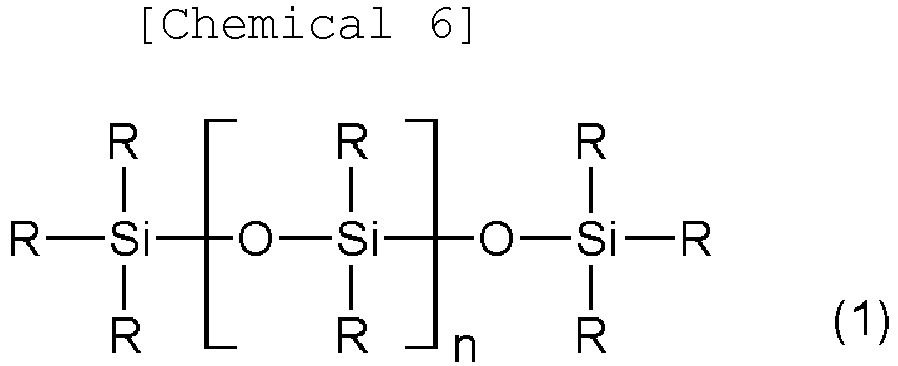
- In General Formula (1), R's each independently represent a substituted or unsubstituted monovalent organic group having 1 to 10 carbon atoms, and at least one of R's is a group selected from an amino group-substituted organic group, an epoxy group-substituted organic group, a polyoxyalkylene group-containing organic group, a hydroxyl group-substituted organic group, a vinyl group-substituted organic group, a carboxyl group-substituted organic group, an isocyanate group-substituted organic group, a mercapto group-substituted organic group, a (meth)acrylic group-substituted organic group, and an acid anhydride group-substituted organic group. n represents an integer of 1 to 100.
- In a case where at least one of R's is the above-described group, the rest of R's is preferably an alkyl group or alkoxy group having 1 to 10 carbon atoms, more preferably an alkyl group having 1 to 10 carbon atoms, and still more preferably an alkyl group having 1 to 5 carbon atoms.
- In the present embodiment, from the viewpoint of the effects of the present invention, it is preferable that at least one of R's is an epoxy group-substituted organic group.
- It is preferable that the silicone compound (F) is liquid at normal temperature (25°C).
- From the viewpoint of the effects of the present invention, a functional group equivalent weight of the silicone compound (F) is preferably 200 to 30,000, and more preferably 300 to 20,000.
- In addition, a weight-average molecular weight of the silicone compound (F) is preferably 200 to 10,000, and more preferably 500 to 8,000.
- As the silicone compound (F), it is preferable to use a silicone compound represented by General Formula (1a).

- In General Formula (1a), Q is an epoxy group-substituted organic group or a polyoxyalkylene group-containing organic group, and a plurality of Q's may be the same or different from each other. Q preferably includes an epoxy group-substituted organic group.
a represents an integer of 1 to 50, and b represents an integer of 1 to 50. - The above-described epoxy group-substituted organic group can be represented by General Formula (a).

- In Formula (a), X1 represents an alkylene group having 1 to 10 carbon atoms or an oxyalkylene group having 1 to 10 carbon atoms, in which the alkylene group may include an ether group. * represents a bonding site.
- The above-described polyoxyalkylene group-containing organic group can be represented by General Formula (b).

- In Formula (b), X2 represents an alkylene group having 1 to 10 carbon atoms or an oxyalkylene group having 1 to 10 carbon atoms, and R1 represents a hydrogen atom or an alkylene group having 1 to 3 carbon atoms.
- c represents an integer of 1 to 20, and d represents an integer of 1 to 20.
- * represents a bonding site.
- Examples of the silicone compound (F) include SF8421EG, FZ-3730, BY16-869, BY16-870, X-22-4741, X-22-178SX, and X-22-178DX (all manufactured by Toray·Dow Corning); and KF-1002 and X-22-343 (both manufactured by Shin-Etsu Chemical Co., Ltd.).
- The resin molding material according to the present embodiment can contain the silicone compound (F) in an amount of equal to or less than 0.5% by mass, preferably equal to or less than 0.4% by mass and more preferably equal to or less than 0.3% by mass. The lower limit value thereof is equal to or more than 0.01% by mass, preferably equal to or more than 0.05% by mass. As a result, the fluidity of the resin molding material is further increased, the fillability into the mold is particularly excellent, and wettability is also improved, thereby suppressing generation of voids and the like. In the present embodiment, the silicone compound (F) is not contained for the purpose of improving molding shrinkage, and the amount added is preferably within the above-described range.
- The resin molding material according to the present embodiment can further contain a carboxylic acid-based dispersant. By containing the carboxylic acid-based dispersant, the fillability of the resin molding material into the mold can be further improved.
- As the carboxylic acid-based dispersant, a known compound in the related art can be used without particular limitation as long as the effects of the present invention can be exhibited. In the present embodiment, it is preferable that the carboxylic acid-based dispersant includes at least one compound represented by General Formula (i).

- In General Formula (i), R represents a carboxyl group, a hydroxyl group, an alkyl group having 1 to 10 carbon atoms, an alkoxy group having 1 to 10 carbon atoms, an alkylcarboxyl group having 1 to 5 carbon atoms, an alkoxycarboxyl group having 1 to 5 carbon atoms, an alkyl alcohol group having 1 to 5 carbon atoms, or an alkoxy alcohol group having 1 to 5 carbon atoms, and a plurality of R's may be the same or different from each other.
- R is preferably a carboxyl group, a hydroxyl group, an alkyl group having 1 to 10 carbon atoms, an alkoxy group having 1 to 10 carbon atoms, or an alkylcarboxyl group having 1 to 5 carbon atoms.
- X represents an oxygen atom, an alkylene group having 1 to 30 carbon atoms, a divalent chain hydrocarbon group having 1 to 30 carbon atoms and having 1 or more double bonds, or a divalent chain hydrocarbon group having 1 to 30 carbon atoms and having 1 or more triple bonds, and a plurality of X's may be the same or different from each other. Examples of the divalent chain hydrocarbon group include an alkylene group.
- X is preferably an oxygen atom, an alkylene group having 1 to 20 carbon atoms, or a divalent chain hydrocarbon group having 1 to 20 carbon atoms and having 1 or more double bonds, and more preferably an oxygen atom, an alkylene group having 1 to 20 carbon atoms, or an alkylene group having 1 to 20 carbon atoms and having 1 double bond.
n represents an integer of 0 to 20, and m represents an integer of 1 to 5. - The compound represented by General Formula (i) is preferably a compound represented by General Formula (ia) or General Formula (ib) . The carboxylic acid-based dispersant can include at least one selected from these compounds.


- In General Formula (la), R, m, and n have the same definitions as in General Formula (i).

- In General Formula (ib), Q represents an alkylene group having 1 to 5 carbon atoms, and is preferably an alkylene group having 1 to 3 carbon atoms. X has the same definition as in General Formula (i) .
- An acid value of the carboxylic acid-based dispersant is 5 to 500 mgKOH/g, preferably 10 to 350 mgKOH/g and more preferably 15 to 100 mgKOH/g. In a case where the acid value is within the above-described range, a magnetic material having a high saturation magnetic flux density is obtained, and fluidity is excellent and moldability is excellent.
- The carboxylic acid-based dispersant is preferably solid or waxy.
- From the viewpoint of the effects of the present invention, a content of the carboxylic acid-based dispersant is equal to or more than 0.01% by mass and equal to or less than 2% by mass, preferably equal to or more than 0.05% by mass and equal to or less than 1% by mass with respect to 100% by mass of the resin molding material.
- Examples of the compound represented by General Formula (i) included in the carboxylic acid-based dispersant include Hypermer KD-4 (mass-average molecular weight: 1700, acid value: 33 mgKOH/g), Hypermer KD-9 (mass-average molecular weight: 760, acid value: 74 mgKOH/g), Hypermer KD-12 (mass-average molecular weight: 490, acid value: 111 mgKOH/g), and Hypermer KD-16 (mass-average molecular weight: 370, acid value: 299 mgKOH/g), all manufactured by Croda International Plc.
- The resin molding material according to the present embodiment may contain a component other than the above-described components. For example, the resin molding material according to the present embodiment may contain one or two or more of a low stress agent, a coupling agent, an adhesion aid, a mold release agent, a coloring agent, an antioxidant, an anticorrosion agent, a dye, a pigment, a flame retardant, and the like.
- Examples of the low stress agent include silicone compounds such as a polybutadiene compound, an acrylonitrile butadiene copolymer compound, a silicone oil, and a silicone rubber. In a case where a low stress agent is used, only one type may be used, or two or more types may be used in combination.
- As the coupling agent, the above-described coupling agent used for the surface treatment of the magnetic particles can be used. Examples thereof include a silane-based coupling agent, a titanium-based coupling agent, a zirconia-based coupling agent, and an aluminum-based coupling agent. In a case where a coupling agent is used, only one type may be used, or two or more types may be used in combination.
- Industrially, the resin molding material according to the present embodiment can be produced by, for example, (1) mixing each component using a mixer, (2) kneading the mixture at approximately 120°C for equal to or more than 5 minutes, preferably approximately 10 minutes using a roll to obtain a kneaded product, (3) cooling the obtained kneaded product, and then (4) pulverizing the obtained kneaded product. From the above, a powdery resin molding material can be obtained. Since the powdery resin molding material according to the present embodiment is suppressed from agglomeration and solidification, the resin molding material has excellent fluidity and improved handleability.
- The resin molding material according to the present embodiment is preferably in a form of tablets or granules at 23°C, and more preferably in a form of tablets at 23°C. The powdery resin molding material can be tableted to form a tablet. Since the resin molding material is in the form of tablets or granules, it is easy to distribute and store the resin molding material, and it is easy to adopt the resin molding material to transfer molding or compression molding.
- The powdery resin molding material according to the present embodiment is suppressed from agglomeration and solidification, and can be made into a tablet-shaped or granular composition having a uniform composition.
- Since the resin molding material according to the present embodiment contains a predetermined amount of the silica fine powder (B), it is possible to improve the fluidity of the resin molding material in a case of being melted, and to enhance the fillability, the moldability, and the like.
- The fillability and moldability of the resin molding material can be accurately confirmed by the following "Spreadability test" in a case where the resin molding material is melted. That is, by carrying out the spreadability test, in a case where stress is continuously applied to the entire molten resin molding material, it is possible to confirm the characteristics of melting and spreading of the molten material, and it is possible to more accurately confirm the fillability and moldability to the mold under conditions close to conditions of the actual producing process. Due to the excellent characteristics of the resin molding material, in injection molding, it is possible to accurately confirm the fillability and moldability to a narrow part of the mold, and in compression molding, in particular, it is possible to accurately confirm the moldability as well as the fillability to the mold in a case where the material is placed in a mold and then heated and pressed.
- A spoonful (2.0 ml) of the resin molding material for gel measurement is placed on a gel plate at 175°C. A mold for thin burr measurement (lower mold: 3, 000 g) heated to 175°C is placed thereon, and allowed to stand for 5 minutes . The mold for thin burr measurement is removed, and the diameter of the resin molding material expanded into a substantially circular shape is measured.
- Specifically, a flow length measured by a spiral flow test at a temperature of 175°C can be equal to or more than 30 cm, preferably equal to or more than 40 cm and more preferably equal to or more than 45 cm.
- As the spiral flow test, for example, with a low-pressure transfer molding machine ("KTS-15" manufactured by KOHTAKI Corporation), the resin molding material is injected into a mold for measuring spiral flow according to EMMI-1-66 under conditions of a mold temperature of 175°C, an injection pressure of 6.9 MPa, and a pressure holding time of 180 seconds, thereby measuring the flow length.
- In addition, in the resin molding material according to the present embodiment, a Koka-type viscosity, which is measured with a Koka-type viscosity measuring device under conditions of a measuring temperature of 175°C and a load of 40 kgf, is equal to or more than 30 Pa·s and equal to or less than 300 Pa·s, preferably equal to or more than 50 Pa·s and equal to or less than 250 Pa·s, and more preferably equal to or more than 60 Pa·s and equal to or less than 200 Pa·s.
- A glass transition temperature of a cured product which is obtained by melting and molding the resin molding material according to the present embodiment at 175°C and curing the resin molding material according to the present embodiment in an atmosphere at 175°C for 4 hours is preferably 150°C to 220°C and more preferably 160°C to 200°C. By designing the resin molding material so that the glass transition temperature is equal to or higher than 150°C, for example, it is easy to clear heat resistance required for in-vehicle applications. By designing the resin molding material so that the glass transition temperature is equal to or lower than 220°C, it is possible to mold the solid resin molding material at a relatively low temperature. This is preferable in terms of suppressing shrinkage of a molded product due to low temperature processing.
- A molded product according to the present embodiment can be obtained by curing the above-described resin molding material. Since the powdery resin molding material according to the present embodiment is highly filled with the soft magnetic particles (A), the resin molding material has excellent fillability and moldability, so that the obtained molded product (magnetic material) has a uniform composition, and can exhibit desired properties in terms of magnetic characteristics such as magnetic permeability and saturation magnetic flux density, and in terms of mechanical strength.
- Specifically, a relative magnetic permeability of the molded product according to the present embodiment is equal to or more than 40, preferably equal to or more than 42 and more preferably equal to or more than 45.
- In addition, the molded product according to the present embodiment has a uniform composition as described above and includes a composite material having a high saturation magnetic flux density as described above, a high saturation magnetic flux density can be realized, which is equal to or more than 1.0T, preferably equal to or more than 1.2 T and more preferably equal to or more than 1.3 T.
- A method for producing a molded product is not particularly limited, and examples thereof include a transfer molding method and a compression molding method.
- A method for producing a molded product by the transfer molding method includes a step of injecting a molten material of the above-described resin molding material into a mold using a transfer molding apparatus, a step of curing the molten material, and a step of releasing a molded product from the mold.
- The transfer molding can be performed by appropriately using a known transfer molding apparatus. Specifically, first, a preheated resin molding material is placed in a heating chamber, which is also called a transfer chamber, and melted to obtain a molten material. Thereafter, the molten material is injected into a mold with a plunger and held as it is to cure the molten material. As a result, a desired molded product can be obtained.
- From the viewpoint of controllability of dimensions of the molded product, improvement of degree of freedom in shape, and the like, the transfer molding is preferable.
- Various conditions in the transfer molding can be set optionally. For example, the preheating temperature can be appropriately adjusted to 60°C to 100°C, the heating temperature for melting can be appropriately adjusted to 100°C to 250°C, the mold temperature can be appropriately adjusted to 100°C to 200°C, and the pressure at which the molten material of the resin molding material is injected into the mold can be appropriately adjusted to 1 to 20 MPa.
- By not raising the mold temperature too high, shrinkage of the molded product can be suppressed.
- A method for producing a molded product by the compression molding method includes a step of compression-molding the above-described resin molding material. Specifically, the method for producing a molded product by the compression molding method includes a step of compression-molding the resin molding material according to the present embodiment in a mold, and a step of releasing the molded product from the mold.
- The compression molding can be performed by appropriately using a known compression molding apparatus. Specifically, the above-described resin molding material is placed in a concave portion of a concave fixed mold which opens upward. The resin molding material can be preheated. As a result, the molded product can be uniformly cured, and the molding pressure can be reduced.
- Next, from above, a convex mold is moved to the concave fixed mold, and the resin molding material is compressed in a cavity formed by the convex portion and the concave portion. First, the resin molding material is sufficiently softened and fluidized at a low pressure, then the mold is closed, and the pressure is applied again thereto to cure the resin molding material for a predetermined time.
- Various conditions in the compression molding can be set optionally. For example, the preheating temperature can be appropriately adjusted to 60°C to 100°C, the heating temperature for melting can be appropriately adjusted to 100°C to 250°C, the mold temperature can be appropriately adjusted to 100°C to 200°C, the pressure for compressing the resin molding material with the mold can be appropriately adjusted to 1 to 20 MPa, and the curing time can be appropriately adjusted to 60 to 300 seconds.
- By not raising the mold temperature too high, shrinkage of the molded product can be suppressed.
- Since a magnetic material with high magnetic permeability is obtained from the resin molding material according to the present embodiment, the molded product obtained by curing the resin molding material can be used for a magnetic core in an inductor or an exterior member for sealing a magnetic core and a coil.
- An overview of a structural body (integrated inductor) provided with an exterior member including the cured product of the resin molding material according to the present embodiment will be described with reference to
Figs. 1A and 1B . -
Fig. 1A shows an overview of the structural body as viewed from above astructural body 100.Fig. 1B shows a cross-sectional view taken along a line A-A' inFig. 1A . - As shown in
Figs. 1A and 1B , thestructural body 100 of the present embodiment can include acoil 10 and amagnetic core 20. Themagnetic core 20 is filled inside thecoil 10 which is an air-core coil. Thecoil 10 and themagnetic core 20 are sealed by an exterior member 30 (sealing member). Themagnetic core 20 and theexterior member 30 can include the cured product of the resin molding material according to the present embodiment. Themagnetic core 20 and theexterior member 30 may be formed as seamless integral members. - As a method for producing the
structural body 100 of the present embodiment, for example, thecoil 10 is placed in a mold, and molding such as transfer molding is performed using the resin molding material according to the present embodiment to cure the resin molding material. As a result, themagnetic core 20 filled in thecoil 10 and theexterior member 30 around themagnetic core 20 can be integrally formed. In this case, thecoil 10 may have a drawing portion (not shown) in which an end portion of the winding is pulled out to an outside of theexterior member 30. - The
coil 10 is usually formed by winding a winding having an insulating coating on the surface of a metal wire. The metal wire preferably has high conductivity, and copper and copper alloys can be suitably used. In addition, as the insulating coating, a coating such as enamel can be used. Examples of a cross-sectional shape of the winding include a circular shape, a rectangular shape, and a hexagonal shape. - On the other hand, a cross-sectional shape of the
magnetic core 20 is not particularly limited, but for example, in cross-sectional view, the cross-sectional shape may be a circular shape or a polygonal shape such as a quadrangle shape or a hexagon shape. Since themagnetic core 20 includes a transfer molded product of the resin molding material according to the present embodiment, it is possible to have a desired shape. - According to the cured product of the resin molding material according to the present embodiment, the
magnetic core 20 andexterior member 30, which have excellent moldability and magnetic characteristics such as high magnetic permeability, can be realized, so that low magnetic loss is expected in the structural body 100 (integrated inductor) including these members. In addition, since theexterior member 30 having excellent mechanical properties can be realized, it is possible to improve durability, reliability, and manufacturing stability of thestructural body 100. Therefore, thestructural body 100 of the present embodiment can be used as an inductor for a booster circuit or a large current. - The embodiments of the present invention have been described above, but these are examples of the present invention and various configurations other than the above can be adopted as long as the effects of the present invention are not impaired.
- Hereinafter, the present invention will be described in more detail by Examples, but the present invention is not limited thereto.
- First, each component described in Table 1 was prepared at the described ratio, and while mixing soft magnetic particles first, other components were added and uniformly mixed to obtain a mixture.
- Next, the obtained mixture was kneaded at 120°C for 10 minutes. After completion of the kneading, the obtained kneaded product was cooled to room temperature to be solidified, and then pulverized and tableted. From the above, a tablet-shaped resin molding material was obtained.
- Raw material components listed in Table 1 are shown below. Table 1 shows evaluation results of the resin molding material and the molded product. The content (% by volume) of soft magnetic particles shown in Table 1 is a content (that is, a filling rate) in a case where the resin molding material containing soft magnetic particles is set as 100% by volume.
-
- Iron-based particles 1: amorphous magnetic powder (manufactured by Epson Atmix Corporation, KUAMET6B2, median diameter D50: 50 um)
- Iron-based particles 2: amorphous magnetic powder (manufactured by Epson Atmix Corporation, AW2-08, median diameter D50: 4 um)
-
- Silica fine powder 1: molten silica, median diameter D50 = 0.5 um
- Silica ultrafine powder 1: AEROSIL-RX200, median diameter D50 = 12 nm
- Silica 1: SC-5500-SQ, median diameter D50 = 1.6 um, manufactured by Admatechs
- Silica 2: TS-6021, median diameter D50 = 10 um, manufactured by Micron, Inc.
-
- Epoxy resin 1: jER1032H60 (epoxy resin including a triphenylmethane structure, manufactured by Mitsubishi Chemical Corporation; solid at 23°C; containing the structural unit represented by General Formula (a1) described above)
- Epoxy resin 2: YL-6810 (bisphenol A-type epoxy resin manufactured by Mitsubishi Chemical Corporation; solid at 23°C; containing the structure represented by General Formula (EP) described above)
- Epoxy resin 3: NC3000L (biphenylaralkyl-type epoxy resin manufactured by Nippon Kayaku Co., Ltd.; solid at 23°C; containing the structural unit represented by General Formula (BP1) described above)
-
- Curing agent 1: PR-HF-3 (novolac-type phenol resin manufactured by Sumitomo Bakelite Co., Ltd.; solid at 23°C)
- Curing agent 2: MEH-7851SS (biphenylene skeleton-containing phenol aralkyl resin manufactured by MEIWA PLASTIC INDUSTRIES, LTD.; solid at 23°C)
- Adhesion aid 1: CDA-1M (heavy metal inactivating agent, manufactured by ADEKA Corporation)
- Mold release agent 1: WE-4 (wax, manufactured by Clariant)
-

- 37.5 g (0.15 mol) of 4,4'-bisphenol S and 100 ml of methanol were charged into a separable flask equipped with a stirring device and dissolved under stirring at room temperature. A solution obtained by dissolving 4.0 g (0.1 mol) of sodium hydroxide in 50 ml of methanol in advance was further added thereto under stirring. Subsequently, a solution obtained by dissolving 41.9 g (0.1 mol) of tetraphenylphosphonium bromide in 150 ml of methanol in advance was added to the mixture. Stirring was continued for a while, 300 ml of methanol was added thereto, and then the solution in the flask was added dropwise to a large amount of water under stirring to obtain white precipitates. The precipitates were filtered and dried to obtain the catalyst 1 as white crystals.
-

- 249.5 g of phenyltrimethoxysilane and 384.0 g of 2,3-dihydroxynaphthalene were added and dissolved in a flask containing 1800 g of methanol, and 231.5 g of 28% sodium methoxide-methanol solution was added dropwise thereto with stirring at room temperature. In a case where a solution prepared by dissolving 503.0 g of tetraphenylphosphonium bromide in 600 g of methanol in advance was added dropwise thereto with stirring at room temperature, crystals were precipitated. The precipitated crystals were filtered, washed with water, and dried in a vacuum to obtain a catalyst 2 as pink-white crystals.
-
- · Coupling agent 1: CF-4083 (phenylaminopropyltrimethoxysilane, manufactured by Toray·Dow Corning)
-
- · Dispersant 1: Hypermer KD-9 (mass-average molecular weight: 760, acid value: 74 mgKOH/g; manufactured by Croda International Plc)
- Silicone oil: silicone oil represented by the following chemical formula (liquid at normal temperature (25°C), FZ-3730, manufactured by Toray·Dow Corning)


- A spoonful (2.0 ml) of the resin molding material for gel measurement was placed on a gel plate at 175°C. A mold for thin burr measurement (lower mold: 3,000 g) heated to 175°C was placed thereon, and allowed to stand for 5 minutes . The mold for thin burr measurement was removed, and the diameter of the resin molding material expanded into a substantially circular shape was measured.
- A spiral flow test was performed using the resin molding materials of Examples and Comparative Examples.
- For the test, with a low-pressure transfer molding machine ("KTS-15" manufactured by KOHTAKI Corporation), the resin molding material was injected into a mold for measuring spiral flow according to EMMI-1-66 under conditions of a mold temperature of 175°C, an injection pressure of 6.9 MPa, and a pressure holding time of 180 seconds, thereby measuring a flow length. As the numerical value is larger, the fluidity is better.
- Using a Koka-type viscosity measuring device (Koka-type flow tester, Shimadzu Corporation, CFT-100EX), a Koka-type viscosity of the resin molding material was measured under conditions of a measuring temperature of 175°C, a load of 40 kgf, and a nozzle size of 1.0 mm in diameter × 10 mm in length.
- The resin molding material was injection-molded using a low-pressure transfer molding machine ("KTS-30" manufactured by KOHTAKI Corporation) at a mold temperature of 175°C, an injection pressure of 9.8 MPa, and a curing time of 120 seconds to obtain a columnar molded product having a diameter of 50 mmΦ and a thickness of 3 mm. Next, the obtained molded product was cured at 175°C for 4 hours. Thereafter, with a router processing machine, the molded product was processed into a toroidal shape with an outer diameter of 27 mmΦ and an inner diameter of 15 mmΦ, thereby producing a test piece for evaluating relative magnetic permeability. A 42-turn primary coil and a 42-turn secondary coil were wound around the obtained toroidal-shaped molded product, and using a DC/AC magnetization property tester ("MTR-1488" manufactured by Metron Giken Co., Ltd.), AC measurement was performed. A value at a frequency of 50 kHz and a magnetic flux density of 50 mT was determined as the relative magnetic permeability.
[Table 1] Product name Unit Comparative Example 1 Example 1 Example 2 Comparative Example 2 Example 3 Example 4 Example 5 Comparative Example 3 Example 6 Comparative Example 4 Example 7 Comparative Example 5 Iron-based particles 1 KUAMET6B2 77.37 77.24 77.24 77.37 77.24 77.24 77.12 77.24 77.24 77.24 77.03 76.83 Iron-based particles 2 AW2-08 19.34 19.31 19.31 19.34 19.31 19.31 19.28 19.31 19.31 19.31 19.26 19.21 Silica fine powder 1 0.37 0.37 0.37 0.37 0.73 1.00 1.60 Silica ultrafine powder 1 AEROSIL-RX200 (12 nm) 0.37 Silica 1 SC-5500-SQ (1.6 um) 0.37 Silica 2 TS-6021 (10 um) 0.37 Epoxy resin 1 jER1032H60 1.36 1.26 1.26 Epoxy resin 2 YL6810 0.35 0.32 0.32 Epoxy resin 3 NC3000L % by mass 1.57 1.46 1.47 1.36 1.41 1.47 1.48 1.24 1.05 curing agent 1 PR-HF-3 1.05 0.97 0.97 curing agent 2 MEH-7851SS 1.15 1.07 1.08 1.00 1.04 1.08 1.09 0.93 0.77 Adhesion aid 1 CDA-1M 0.07 0.06 0.06 0.07 0.06 0.06 0.06 0.06 0.06 0.06 0.06 0.05 Mold release agent 1 WE-4 0.06 0.05 0.05 0.06 0.05 0.05 0.05 0.05 0.05 0.05 0.05 0.04 Catalyst 1 0.01 0.01 0.01 0.01 0.01 0.01 0.01 0.01 0.01 0.01 0.01 0.01 Catalyst 2 0.05 0.04 0.04 0.08 0.08 0.06 0.05 0.05 0.06 0.06 0.05 0.04 coupling agent 1 CF-4083 0.15 0.15 0.15 0.15 0.15 0.15 0.15 0.26 0.15 0.13 0.17 0.2 Dispersant 1 Hypermer KD-9 0.20 0.20 0.10 0.20 0.20 0.10 0.10 0.10 0.10 0.10 0.10 0.10 Silicone oil FZ-3730 0.10 0.10 0.10 0.10 0.10 0.10 0.10 0.10 Total 100 100 100 100 100 100 100 100 100 100 100 100 Content of magnetic particles % by volume 84.0 84.0 84.0 84.0 84.0 84.0 84.0 84.0 84.0 84.0 84.0 84.0 Spreadability test mm 40 44 54 46 55 62 62 35 61 47 60 45 Spiral flow (175°C) cm 41 45 54 46 55 56 56 Not flow 50 35 48 23 Koka-type viscosity (175°C) Pa·s 105 143 131 85 101 115 119 Cannot measured 124 148 209 277 Relative magnetic permeability - 47 47 47 47 47 47 47 Cannot measured 47 47 47 47 - As shown in Table 1, in comparison between Comparative Example 1 and Examples 1 and 2, between Comparative Example 2 and Examples 3 to 5, between Comparative Examples 3 and 4 and Example 6, and between Comparative Example 5 and Example 7, as a result of the spread test, the resin molding material of Examples according to the present invention has a large diameter, and is excellent in melting and spreading characteristics in a case where stress is continuously applied to the entire molten resin molding material. Therefore, it is conjectured that the fillability, moldability, and the like to the mold are excellent. Furthermore, since the soft magnetic particles can be highly filled, a magnetic material with high magnetic permeability is obtained.
- Priority is claimed on
Japanese Patent Application No. 2020-168306, filed on October 5, 2020 -
- 100
- structural body
- 10
- coil
- 20
- magnetic core
- 30
- exterior member
Claims (15)
- A resin molding material comprising:(A) soft magnetic particles;(B) a silica fine powder having an average particle diameter of equal to or more than 0.1 um and equal to or less than 2.0 um; and(C) a thermosetting resin,wherein a content of the soft magnetic particles (A) is equal to or more than 96% by mass, anda content of the silica fine powder (B) is equal to or less than 1.5% by mass.
- The resin molding material according to claim 1,
wherein the thermosetting resin (C) includes an epoxy resin. - The resin molding material according to claim 2,
wherein the epoxy resin is at least one selected from a bisphenol A-type epoxy resin, a trisphenylmethane-type epoxy resin, and a biphenylaralkyl-type epoxy resin. - The resin molding material according to any one of claims 1 to 3, further comprising:
(D) a phenol-based curing agent. - The resin molding material according to claim 4,
wherein the phenol-based curing agent (D) is at least one selected from a novolac-type phenol resin and a biphenylaralkyl-type phenol resin. - The resin molding material according to any one of claims 1 to 5, further comprising:(E) a curing accelerator,wherein the curing accelerator (E) is at least one selected from a tetra-substituted phosphonium compound, a phosphobetaine compound, a phosphine compound, an adduct of a phosphine compound and a quinone compound, and an adduct of a phosphonium compound and a silane compound.
- The resin molding material according to any one of claims 1 to 6, further comprising:
(F) a silicone compound. - The resin molding material according to claim 7,wherein the silicone compound (F) is represented by General Formula (1),
 wherein, in General Formula (1), R's each independently represent a substituted or unsubstituted monovalent organic group having 1 to 10 carbon atoms, at least one of R's is a group selected from an amino group-substituted organic group, an epoxy group-substituted organic group, a polyoxyalkylene group-containing organic group, a hydroxyl group-substituted organic group, a vinyl group-substituted organic group, a carboxyl group-substituted organic group, an isocyanate group-substituted organic group, a mercapto group-substituted organic group, a (meth)acrylic group-substituted organic group, and an acid anhydride group-substituted organic group, and n represents an integer of 1 to 100.
 - The resin molding material according to any one of claims 1 to 8,
wherein the resin molding material is in a form of tablets or granules at 23°C. - The resin molding material according to any one of claims 1 to 9,
wherein a spiral flow length, which is measured according to EMMI-1-66 method under conditions of a mold temperature of 175°C, an injection pressure of 6.9 MPa, and a pressure holding time of 180 seconds, is equal to or more than 30 cm. - The resin molding material according to any one of claims 1 to 10,
wherein a Koka-type viscosity, which is measured with a Koka-type viscosity measuring device under conditions of a measuring temperature of 175°C and a load of 40 kgf, is equal to or more than 30 Pa·s and equal to or less than 300 Pa·s. - A molded product obtained by curing the resin molding material according to any one of claims 1 to 11.
- The molded product according to claim 12,
wherein a relative magnetic permeability is equal to or more than 40. - A method for producing a molded product, comprising:a step of injecting a molten material of the resin molding material according to any one of claims 1 to 11 into a mold using a transfer molding apparatus; anda step of curing the molten material.
- A method for producing a molded product, comprising:
a step of compression-molding the resin molding material according to any one of claims 1 to 11.
Applications Claiming Priority (2)
| Application Number | Priority Date | Filing Date | Title |
|---|---|---|---|
| JP2020168306 | 2020-10-05 | ||
| PCT/JP2021/036235 WO2022075191A1 (en) | 2020-10-05 | 2021-09-30 | Resin molding material, molded body and method for producing said molded body |
Publications (2)
| Publication Number | Publication Date |
|---|---|
| EP4227341A1 true EP4227341A1 (en) | 2023-08-16 |
| EP4227341A4 EP4227341A4 (en) | 2024-11-06 |
Family
ID=81126871
Family Applications (1)
| Application Number | Title | Priority Date | Filing Date |
|---|---|---|---|
| EP21877492.5A Pending EP4227341A4 (en) | 2020-10-05 | 2021-09-30 | RESIN MOLDING MATERIAL, MOLDED BODY AND METHOD FOR PRODUCING SAID MOLDED BODY |
Country Status (6)
| Country | Link |
|---|---|
| US (1) | US20230331981A1 (en) |
| EP (1) | EP4227341A4 (en) |
| JP (1) | JP7771969B2 (en) |
| CN (1) | CN116348516B (en) |
| TW (1) | TW202222885A (en) |
| WO (1) | WO2022075191A1 (en) |
Family Cites Families (24)
| Publication number | Priority date | Publication date | Assignee | Title |
|---|---|---|---|---|
| JP3185457B2 (en) * | 1993-03-10 | 2001-07-09 | 住友金属鉱山株式会社 | Composition for resin-bonded magnet, resin-bonded magnet and methods for producing them |
| JP3185458B2 (en) * | 1993-03-12 | 2001-07-09 | 住友金属鉱山株式会社 | Composition for resin-bonded magnet, resin-bonded magnet and method for producing the same |
| JPH0722226A (en) * | 1993-07-02 | 1995-01-24 | Sumitomo Metal Mining Co Ltd | Composition for resin-bonded magnet, resin-bonded magnet using the same, and method for producing the same |
| JP2003105067A (en) * | 2001-10-01 | 2003-04-09 | Mitsui Chemicals Inc | Epoxy resin composition and its production method |
| JP2003335920A (en) * | 2002-05-17 | 2003-11-28 | Mitsui Chemicals Inc | Epoxy resin composition and semiconductor device using the same |
| MY157584A (en) * | 2009-10-20 | 2016-06-30 | Sumitomo Bakelite Co | Epoxy resin composition for encapsulating semiconductor, semiconductor device, and mold releasing agent |
| HUE054387T2 (en) * | 2011-11-29 | 2021-09-28 | Sumitomo Bakelite Co | Resin composition for fixing, rotor, automobile, and method for manufacturing rotor |
| JP2013147549A (en) * | 2012-01-18 | 2013-08-01 | Shin-Etsu Chemical Co Ltd | Liquid epoxy resin composition and semiconductor apparatus |
| JP2013243268A (en) * | 2012-05-21 | 2013-12-05 | Hitachi Chemical Co Ltd | Dust core, coated metal powder for dust core, and methods for producing them |
| JP6613783B2 (en) * | 2015-10-08 | 2019-12-04 | 日立化成株式会社 | Bonded magnet cured body |
| CN105885266A (en) * | 2016-06-20 | 2016-08-24 | 李文军 | Insulating material capable of resisting impact damage and preparation method thereof |
| US11578183B2 (en) * | 2016-11-28 | 2023-02-14 | Somar Corporation | Resin composition, method for producing resin composition, resin composition molded body, and method for producing resin composition molded body |
| JP7511322B2 (en) * | 2017-10-20 | 2024-07-05 | 住友ベークライト株式会社 | Resin composition for forming magnetic core and structure |
| JP7511324B2 (en) * | 2017-10-20 | 2024-07-05 | 住友ベークライト株式会社 | Resin composition for molding inductor and integrated inductor |
| WO2019112002A1 (en) * | 2017-12-08 | 2019-06-13 | パナソニックIpマネジメント株式会社 | Composite magnetic powder, magnetic resin composition, magnetic resin paste, magnetic resin powder, magnetic resin slurry, magnetic resin sheet, magnetic resin sheet with metal foil, magnetic prepreg, and inductor component |
| JP7206615B2 (en) * | 2018-04-05 | 2023-01-18 | 住友ベークライト株式会社 | Molding materials and moldings |
| WO2019229960A1 (en) * | 2018-05-31 | 2019-12-05 | 日立化成株式会社 | Composition and molded object |
| JP2019210447A (en) * | 2018-06-04 | 2019-12-12 | 住友ベークライト株式会社 | Sealing resin composition, and electronic apparatus including the same and method for producing sealing resin composition |
| JP7127366B2 (en) * | 2018-06-04 | 2022-08-30 | 住友ベークライト株式会社 | Resin composition for molding magnetic member, magnetic member, coil, method for manufacturing magnetic member, and kit for molding magnetic member |
| JP2020145310A (en) * | 2019-03-06 | 2020-09-10 | Ntn株式会社 | Powder-compact magnetic core material |
| JP2020161726A (en) * | 2019-03-27 | 2020-10-01 | 旭化成株式会社 | Composite magnetic material for high frequencies |
| JP7303998B2 (en) | 2019-04-05 | 2023-07-06 | スズキ株式会社 | electric vehicle |
| CN113841207A (en) * | 2019-05-17 | 2021-12-24 | 住友电木株式会社 | Magnetic component forming resin composition and method for producing magnetic component |
| CN110783052B (en) * | 2019-11-06 | 2021-11-05 | 有研稀土新材料股份有限公司 | A composite rare earth anisotropic bonded magnet and preparation method thereof |
-
2021
- 2021-09-30 EP EP21877492.5A patent/EP4227341A4/en active Pending
- 2021-09-30 US US18/028,647 patent/US20230331981A1/en active Pending
- 2021-09-30 JP JP2022555425A patent/JP7771969B2/en active Active
- 2021-09-30 CN CN202180068331.7A patent/CN116348516B/en active Active
- 2021-09-30 WO PCT/JP2021/036235 patent/WO2022075191A1/en not_active Ceased
- 2021-10-04 TW TW110136901A patent/TW202222885A/en unknown
Also Published As
| Publication number | Publication date |
|---|---|
| US20230331981A1 (en) | 2023-10-19 |
| TW202222885A (en) | 2022-06-16 |
| EP4227341A4 (en) | 2024-11-06 |
| CN116348516A (en) | 2023-06-27 |
| JPWO2022075191A1 (en) | 2022-04-14 |
| WO2022075191A1 (en) | 2022-04-14 |
| JP7771969B2 (en) | 2025-11-18 |
| CN116348516B (en) | 2024-07-23 |
Similar Documents
| Publication | Publication Date | Title |
|---|---|---|
| JP2021080411A (en) | Resin molding material, molding, and molding production method | |
| JP2023130438A (en) | Magnetic core forming resin composition and structure | |
| JP7435693B2 (en) | Resin composition for melt molding, magnetic member, coil including magnetic member, method for manufacturing magnetic member | |
| US11987695B2 (en) | Resin composition for forming magnetic member and method for manufacturing magnetic member | |
| EP4083129A1 (en) | Solid resin molding material, molded article and method for producing molded article | |
| US20220380521A1 (en) | Resin composition and molded article | |
| JP2020163833A (en) | Resin molding material and manufacturing method of molded product | |
| JP2019080060A (en) | Inductor molding resin composition and integrated inductor | |
| WO2019106812A1 (en) | Compound powder | |
| JP7243035B2 (en) | RESIN COMPOSITION FOR TRANSFER MOLDING, ELECTRICAL AND ELECTRONIC DEVICE INCLUDING MOLDED PRODUCT OF SAID RESIN COMPOSITION, AND METHOD FOR MANUFACTURING MOLDED PRODUCT USING SAID RESIN COMPOSITION | |
| EP4227340A1 (en) | Resin molding material, molded body, and method for producing said molded body | |
| US20230331981A1 (en) | Resin molding material, molded product, and method for producing molded product | |
| JP2021123721A (en) | Resin molding material, molding, coil and method for manufacturing molding | |
| JP2023075583A (en) | Resin molding material, molded article, and method for manufacturing said molded article | |
| JP7547846B2 (en) | Resin molding material, molded product, and method for manufacturing said molded product | |
| JP2022187217A (en) | Resin molding material, molded article, and method for producing the molded article | |
| JP2023108807A (en) | Resin molding material, molded product, and method for manufacturing said molded product | |
| JP2021130811A (en) | Resin molding material, molding, and method for producing molding | |
| US20220177694A1 (en) | Resin composition for forming magnetic member and method for manufacturing magnetic member | |
| JP2023018448A (en) | Resin molding material, molding, coil and molding manufacturing method | |
| TW202402943A (en) | Soft magnetic material, molded product, manufacturing method of molded product |
Legal Events
| Date | Code | Title | Description |
|---|---|---|---|
| STAA | Information on the status of an ep patent application or granted ep patent |
Free format text: STATUS: THE INTERNATIONAL PUBLICATION HAS BEEN MADE |
|
| PUAI | Public reference made under article 153(3) epc to a published international application that has entered the european phase |
Free format text: ORIGINAL CODE: 0009012 |
|
| STAA | Information on the status of an ep patent application or granted ep patent |
Free format text: STATUS: REQUEST FOR EXAMINATION WAS MADE |
|
| 17P | Request for examination filed |
Effective date: 20230330 |
|
| AK | Designated contracting states |
Kind code of ref document: A1 Designated state(s): AL AT BE BG CH CY CZ DE DK EE ES FI FR GB GR HR HU IE IS IT LI LT LU LV MC MK MT NL NO PL PT RO RS SE SI SK SM TR |
|
| DAV | Request for validation of the european patent (deleted) | ||
| DAX | Request for extension of the european patent (deleted) | ||
| REG | Reference to a national code |
Ref country code: DE Ref legal event code: R079 Free format text: PREVIOUS MAIN CLASS: C08G0059060000 Ipc: H01F0001260000 |
|
| A4 | Supplementary search report drawn up and despatched |
Effective date: 20241008 |
|
| RIC1 | Information provided on ipc code assigned before grant |
Ipc: C08K 3/08 20060101ALI20241001BHEP Ipc: C08L 63/00 20060101ALI20241001BHEP Ipc: C08L 101/00 20060101ALI20241001BHEP Ipc: C08L 83/04 20060101ALI20241001BHEP Ipc: C08G 59/68 20060101ALI20241001BHEP Ipc: C08G 59/62 20060101ALI20241001BHEP Ipc: C08G 59/06 20060101ALI20241001BHEP Ipc: H01F 41/02 20060101ALI20241001BHEP Ipc: H01F 1/26 20060101AFI20241001BHEP |