EP4223850A1 - Composition - Google Patents
Composition Download PDFInfo
- Publication number
- EP4223850A1 EP4223850A1 EP22749981.1A EP22749981A EP4223850A1 EP 4223850 A1 EP4223850 A1 EP 4223850A1 EP 22749981 A EP22749981 A EP 22749981A EP 4223850 A1 EP4223850 A1 EP 4223850A1
- Authority
- EP
- European Patent Office
- Prior art keywords
- filler
- less
- specific gravity
- composition
- composition according
- Prior art date
- Legal status (The legal status is an assumption and is not a legal conclusion. Google has not performed a legal analysis and makes no representation as to the accuracy of the status listed.)
- Pending
Links
Classifications
-
- C—CHEMISTRY; METALLURGY
- C09—DYES; PAINTS; POLISHES; NATURAL RESINS; ADHESIVES; COMPOSITIONS NOT OTHERWISE PROVIDED FOR; APPLICATIONS OF MATERIALS NOT OTHERWISE PROVIDED FOR
- C09K—MATERIALS FOR MISCELLANEOUS APPLICATIONS, NOT PROVIDED FOR ELSEWHERE
- C09K5/00—Heat-transfer, heat-exchange or heat-storage materials, e.g. refrigerants; Materials for the production of heat or cold by chemical reactions other than by combustion
- C09K5/08—Materials not undergoing a change of physical state when used
- C09K5/14—Solid materials, e.g. powdery or granular
-
- C—CHEMISTRY; METALLURGY
- C09—DYES; PAINTS; POLISHES; NATURAL RESINS; ADHESIVES; COMPOSITIONS NOT OTHERWISE PROVIDED FOR; APPLICATIONS OF MATERIALS NOT OTHERWISE PROVIDED FOR
- C09J—ADHESIVES; NON-MECHANICAL ASPECTS OF ADHESIVE PROCESSES IN GENERAL; ADHESIVE PROCESSES NOT PROVIDED FOR ELSEWHERE; USE OF MATERIALS AS ADHESIVES
- C09J11/00—Features of adhesives not provided for in group C09J9/00, e.g. additives
- C09J11/02—Non-macromolecular additives
- C09J11/04—Non-macromolecular additives inorganic
-
- C—CHEMISTRY; METALLURGY
- C08—ORGANIC MACROMOLECULAR COMPOUNDS; THEIR PREPARATION OR CHEMICAL WORKING-UP; COMPOSITIONS BASED THEREON
- C08G—MACROMOLECULAR COMPOUNDS OBTAINED OTHERWISE THAN BY REACTIONS ONLY INVOLVING UNSATURATED CARBON-TO-CARBON BONDS
- C08G18/00—Polymeric products of isocyanates or isothiocyanates
- C08G18/06—Polymeric products of isocyanates or isothiocyanates with compounds having active hydrogen
- C08G18/28—Polymeric products of isocyanates or isothiocyanates with compounds having active hydrogen characterised by the compounds used containing active hydrogen
- C08G18/40—High-molecular-weight compounds
- C08G18/42—Polycondensates having carboxylic or carbonic ester groups in the main chain
- C08G18/4266—Polycondensates having carboxylic or carbonic ester groups in the main chain prepared from hydroxycarboxylic acids and/or lactones
- C08G18/4286—Polycondensates having carboxylic or carbonic ester groups in the main chain prepared from hydroxycarboxylic acids and/or lactones prepared from a combination of hydroxycarboxylic acids and/or lactones with polycarboxylic acids or ester forming derivatives thereof and polyhydroxy compounds
-
- C—CHEMISTRY; METALLURGY
- C08—ORGANIC MACROMOLECULAR COMPOUNDS; THEIR PREPARATION OR CHEMICAL WORKING-UP; COMPOSITIONS BASED THEREON
- C08G—MACROMOLECULAR COMPOUNDS OBTAINED OTHERWISE THAN BY REACTIONS ONLY INVOLVING UNSATURATED CARBON-TO-CARBON BONDS
- C08G18/00—Polymeric products of isocyanates or isothiocyanates
- C08G18/06—Polymeric products of isocyanates or isothiocyanates with compounds having active hydrogen
- C08G18/70—Polymeric products of isocyanates or isothiocyanates with compounds having active hydrogen characterised by the isocyanates or isothiocyanates used
- C08G18/72—Polyisocyanates or polyisothiocyanates
- C08G18/721—Two or more polyisocyanates not provided for in one single group C08G18/73 - C08G18/80
- C08G18/722—Combination of two or more aliphatic and/or cycloaliphatic polyisocyanates
-
- C—CHEMISTRY; METALLURGY
- C08—ORGANIC MACROMOLECULAR COMPOUNDS; THEIR PREPARATION OR CHEMICAL WORKING-UP; COMPOSITIONS BASED THEREON
- C08G—MACROMOLECULAR COMPOUNDS OBTAINED OTHERWISE THAN BY REACTIONS ONLY INVOLVING UNSATURATED CARBON-TO-CARBON BONDS
- C08G18/00—Polymeric products of isocyanates or isothiocyanates
- C08G18/06—Polymeric products of isocyanates or isothiocyanates with compounds having active hydrogen
- C08G18/70—Polymeric products of isocyanates or isothiocyanates with compounds having active hydrogen characterised by the isocyanates or isothiocyanates used
- C08G18/72—Polyisocyanates or polyisothiocyanates
- C08G18/73—Polyisocyanates or polyisothiocyanates acyclic
-
- C—CHEMISTRY; METALLURGY
- C08—ORGANIC MACROMOLECULAR COMPOUNDS; THEIR PREPARATION OR CHEMICAL WORKING-UP; COMPOSITIONS BASED THEREON
- C08G—MACROMOLECULAR COMPOUNDS OBTAINED OTHERWISE THAN BY REACTIONS ONLY INVOLVING UNSATURATED CARBON-TO-CARBON BONDS
- C08G18/00—Polymeric products of isocyanates or isothiocyanates
- C08G18/06—Polymeric products of isocyanates or isothiocyanates with compounds having active hydrogen
- C08G18/70—Polymeric products of isocyanates or isothiocyanates with compounds having active hydrogen characterised by the isocyanates or isothiocyanates used
- C08G18/72—Polyisocyanates or polyisothiocyanates
- C08G18/74—Polyisocyanates or polyisothiocyanates cyclic
- C08G18/75—Polyisocyanates or polyisothiocyanates cyclic cycloaliphatic
- C08G18/751—Polyisocyanates or polyisothiocyanates cyclic cycloaliphatic containing only one cycloaliphatic ring
- C08G18/752—Polyisocyanates or polyisothiocyanates cyclic cycloaliphatic containing only one cycloaliphatic ring containing at least one isocyanate or isothiocyanate group linked to the cycloaliphatic ring by means of an aliphatic group
- C08G18/753—Polyisocyanates or polyisothiocyanates cyclic cycloaliphatic containing only one cycloaliphatic ring containing at least one isocyanate or isothiocyanate group linked to the cycloaliphatic ring by means of an aliphatic group containing one isocyanate or isothiocyanate group linked to the cycloaliphatic ring by means of an aliphatic group having a primary carbon atom next to the isocyanate or isothiocyanate group
- C08G18/755—Polyisocyanates or polyisothiocyanates cyclic cycloaliphatic containing only one cycloaliphatic ring containing at least one isocyanate or isothiocyanate group linked to the cycloaliphatic ring by means of an aliphatic group containing one isocyanate or isothiocyanate group linked to the cycloaliphatic ring by means of an aliphatic group having a primary carbon atom next to the isocyanate or isothiocyanate group and at least one isocyanate or isothiocyanate group linked to a secondary carbon atom of the cycloaliphatic ring, e.g. isophorone diisocyanate
-
- C—CHEMISTRY; METALLURGY
- C08—ORGANIC MACROMOLECULAR COMPOUNDS; THEIR PREPARATION OR CHEMICAL WORKING-UP; COMPOSITIONS BASED THEREON
- C08G—MACROMOLECULAR COMPOUNDS OBTAINED OTHERWISE THAN BY REACTIONS ONLY INVOLVING UNSATURATED CARBON-TO-CARBON BONDS
- C08G18/00—Polymeric products of isocyanates or isothiocyanates
- C08G18/06—Polymeric products of isocyanates or isothiocyanates with compounds having active hydrogen
- C08G18/70—Polymeric products of isocyanates or isothiocyanates with compounds having active hydrogen characterised by the isocyanates or isothiocyanates used
- C08G18/72—Polyisocyanates or polyisothiocyanates
- C08G18/77—Polyisocyanates or polyisothiocyanates having heteroatoms in addition to the isocyanate or isothiocyanate nitrogen and oxygen or sulfur
- C08G18/78—Nitrogen
- C08G18/79—Nitrogen characterised by the polyisocyanates used, these having groups formed by oligomerisation of isocyanates or isothiocyanates
- C08G18/791—Nitrogen characterised by the polyisocyanates used, these having groups formed by oligomerisation of isocyanates or isothiocyanates containing isocyanurate groups
-
- C—CHEMISTRY; METALLURGY
- C08—ORGANIC MACROMOLECULAR COMPOUNDS; THEIR PREPARATION OR CHEMICAL WORKING-UP; COMPOSITIONS BASED THEREON
- C08K—Use of inorganic or non-macromolecular organic substances as compounding ingredients
- C08K3/00—Use of inorganic substances as compounding ingredients
- C08K3/01—Use of inorganic substances as compounding ingredients characterized by their specific function
- C08K3/013—Fillers, pigments or reinforcing additives
-
- C—CHEMISTRY; METALLURGY
- C08—ORGANIC MACROMOLECULAR COMPOUNDS; THEIR PREPARATION OR CHEMICAL WORKING-UP; COMPOSITIONS BASED THEREON
- C08K—Use of inorganic or non-macromolecular organic substances as compounding ingredients
- C08K3/00—Use of inorganic substances as compounding ingredients
- C08K3/18—Oxygen-containing compounds, e.g. metal carbonyls
- C08K3/20—Oxides; Hydroxides
- C08K3/22—Oxides; Hydroxides of metals
-
- C—CHEMISTRY; METALLURGY
- C08—ORGANIC MACROMOLECULAR COMPOUNDS; THEIR PREPARATION OR CHEMICAL WORKING-UP; COMPOSITIONS BASED THEREON
- C08K—Use of inorganic or non-macromolecular organic substances as compounding ingredients
- C08K5/00—Use of organic ingredients
- C08K5/16—Nitrogen-containing compounds
- C08K5/29—Compounds containing one or more carbon-to-nitrogen double bonds
-
- C—CHEMISTRY; METALLURGY
- C08—ORGANIC MACROMOLECULAR COMPOUNDS; THEIR PREPARATION OR CHEMICAL WORKING-UP; COMPOSITIONS BASED THEREON
- C08K—Use of inorganic or non-macromolecular organic substances as compounding ingredients
- C08K7/00—Use of ingredients characterised by shape
- C08K7/16—Solid spheres
- C08K7/18—Solid spheres inorganic
-
- C—CHEMISTRY; METALLURGY
- C09—DYES; PAINTS; POLISHES; NATURAL RESINS; ADHESIVES; COMPOSITIONS NOT OTHERWISE PROVIDED FOR; APPLICATIONS OF MATERIALS NOT OTHERWISE PROVIDED FOR
- C09J—ADHESIVES; NON-MECHANICAL ASPECTS OF ADHESIVE PROCESSES IN GENERAL; ADHESIVE PROCESSES NOT PROVIDED FOR ELSEWHERE; USE OF MATERIALS AS ADHESIVES
- C09J201/00—Adhesives based on unspecified macromolecular compounds
-
- H—ELECTRICITY
- H05—ELECTRIC TECHNIQUES NOT OTHERWISE PROVIDED FOR
- H05K—PRINTED CIRCUITS; CASINGS OR CONSTRUCTIONAL DETAILS OF ELECTRIC APPARATUS; MANUFACTURE OF ASSEMBLAGES OF ELECTRICAL COMPONENTS
- H05K7/00—Constructional details common to different types of electric apparatus
- H05K7/20—Modifications to facilitate cooling, ventilating, or heating
- H05K7/2039—Modifications to facilitate cooling, ventilating, or heating characterised by the heat transfer by conduction from the heat generating element to a dissipating body
-
- C—CHEMISTRY; METALLURGY
- C08—ORGANIC MACROMOLECULAR COMPOUNDS; THEIR PREPARATION OR CHEMICAL WORKING-UP; COMPOSITIONS BASED THEREON
- C08K—Use of inorganic or non-macromolecular organic substances as compounding ingredients
- C08K3/00—Use of inorganic substances as compounding ingredients
- C08K3/02—Elements
- C08K3/08—Metals
- C08K2003/0812—Aluminium
-
- C—CHEMISTRY; METALLURGY
- C08—ORGANIC MACROMOLECULAR COMPOUNDS; THEIR PREPARATION OR CHEMICAL WORKING-UP; COMPOSITIONS BASED THEREON
- C08K—Use of inorganic or non-macromolecular organic substances as compounding ingredients
- C08K3/00—Use of inorganic substances as compounding ingredients
- C08K3/18—Oxygen-containing compounds, e.g. metal carbonyls
- C08K3/20—Oxides; Hydroxides
- C08K3/22—Oxides; Hydroxides of metals
- C08K2003/2227—Oxides; Hydroxides of metals of aluminium
-
- C—CHEMISTRY; METALLURGY
- C08—ORGANIC MACROMOLECULAR COMPOUNDS; THEIR PREPARATION OR CHEMICAL WORKING-UP; COMPOSITIONS BASED THEREON
- C08K—Use of inorganic or non-macromolecular organic substances as compounding ingredients
- C08K2201/00—Specific properties of additives
- C08K2201/001—Conductive additives
-
- C—CHEMISTRY; METALLURGY
- C08—ORGANIC MACROMOLECULAR COMPOUNDS; THEIR PREPARATION OR CHEMICAL WORKING-UP; COMPOSITIONS BASED THEREON
- C08K—Use of inorganic or non-macromolecular organic substances as compounding ingredients
- C08K2201/00—Specific properties of additives
- C08K2201/002—Physical properties
- C08K2201/005—Additives being defined by their particle size in general
-
- C—CHEMISTRY; METALLURGY
- C08—ORGANIC MACROMOLECULAR COMPOUNDS; THEIR PREPARATION OR CHEMICAL WORKING-UP; COMPOSITIONS BASED THEREON
- C08K—Use of inorganic or non-macromolecular organic substances as compounding ingredients
- C08K2201/00—Specific properties of additives
- C08K2201/014—Additives containing two or more different additives of the same subgroup in C08K
-
- C—CHEMISTRY; METALLURGY
- C09—DYES; PAINTS; POLISHES; NATURAL RESINS; ADHESIVES; COMPOSITIONS NOT OTHERWISE PROVIDED FOR; APPLICATIONS OF MATERIALS NOT OTHERWISE PROVIDED FOR
- C09J—ADHESIVES; NON-MECHANICAL ASPECTS OF ADHESIVE PROCESSES IN GENERAL; ADHESIVE PROCESSES NOT PROVIDED FOR ELSEWHERE; USE OF MATERIALS AS ADHESIVES
- C09J2203/00—Applications of adhesives in processes or use of adhesives in the form of films or foils
- C09J2203/326—Applications of adhesives in processes or use of adhesives in the form of films or foils for bonding electronic components such as wafers, chips or semiconductors
-
- C—CHEMISTRY; METALLURGY
- C09—DYES; PAINTS; POLISHES; NATURAL RESINS; ADHESIVES; COMPOSITIONS NOT OTHERWISE PROVIDED FOR; APPLICATIONS OF MATERIALS NOT OTHERWISE PROVIDED FOR
- C09J—ADHESIVES; NON-MECHANICAL ASPECTS OF ADHESIVE PROCESSES IN GENERAL; ADHESIVE PROCESSES NOT PROVIDED FOR ELSEWHERE; USE OF MATERIALS AS ADHESIVES
- C09J2203/00—Applications of adhesives in processes or use of adhesives in the form of films or foils
- C09J2203/33—Applications of adhesives in processes or use of adhesives in the form of films or foils for batteries or fuel cells
-
- C—CHEMISTRY; METALLURGY
- C09—DYES; PAINTS; POLISHES; NATURAL RESINS; ADHESIVES; COMPOSITIONS NOT OTHERWISE PROVIDED FOR; APPLICATIONS OF MATERIALS NOT OTHERWISE PROVIDED FOR
- C09J—ADHESIVES; NON-MECHANICAL ASPECTS OF ADHESIVE PROCESSES IN GENERAL; ADHESIVE PROCESSES NOT PROVIDED FOR ELSEWHERE; USE OF MATERIALS AS ADHESIVES
- C09J2475/00—Presence of polyurethane
Definitions
- the present application relates to a composition and a product including thereof.
- a filler By blending a filler with a composition capable of forming an adhesive or pressure-sensitive adhesive, it is possible to form a cured product having desired physical properties. In order to secure the physical properties by the filler, it is necessary to introduce the filler in a high content into the composition. However, since the commonly used filler has a high specific gravity, the specific gravity of the composition increases when a high-content filler is introduced, whereby there are problems that it is difficult to reduce the weight of the applied product and the use is limited.
- an alumina filler has a high thermal conductivity, but has a high specific gravity, so that when the alumina filler is introduced in a high content for a high heat dissipation effect, it is difficult to reduce the weight of the product.
- the alumina filler is introduced in a low content in order to lower the specific gravity, there is a problem that the heat dissipation effect is deteriorated.
- the present application is intended to provide a composition capable of achieving a low specific gravity effect in a state where a filler is filled in a high content, and in a state where realization of physical properties by filling of the filler is sufficiently secured.
- the present application is intended to provide a composition having excellent storage stability without deterioration of physical properties such as a thermal conductivity.
- the physical properties in which the measured temperature affects the physical properties are those measured at room temperature unless otherwise specified.
- room temperature is a natural temperature without heating and cooling, which means, for example, any temperature within a range of about 10°C to 30°C, for example, a temperature of about 15°C, about 18°C, about 20°C, about 23°C or about 25°C or so. Also, in this specification, the unit of temperature is °C, unless otherwise specified.
- normal pressure is a natural pressure without being pressurized or depressurized, in which usually about 1 atmosphere or so is referred to as normal pressure.
- alkyl group or “alkylene group” as used herein may mean a linear or branched acyclic alkyl group or alkylene group having 1 to 20 carbon atoms, or 1 to 16 carbon atoms, or 1 to 12 carbon atoms, or 1 to 8 carbon atoms, or 1 to 6 carbon atoms, unless otherwise described.
- alkenyl group or “alkenylene group” as used herein may mean a linear or branched acyclic alkenyl group or alkenylene group having 2 to 20 carbon atoms, or 2 to 16 carbon atoms, or 2 to 12 carbon atoms, or 2 to 8 carbon atoms, or 2 to 6 carbon atoms, unless otherwise described.
- alkynyl group or “alkynylene group” as used in the present application may mean a linear or branched acyclic alkynyl group or alkynylene group having 2 to 20 carbon atoms, or 2 to 16 carbon atoms, or 2 to 12 carbon atoms, or 2 to 8 carbon atoms, or 2 to 6 carbon atoms, unless otherwise described.
- carboxylic acid-derived unit as used herein may mean a part excluding a carboxyl group in a carboxylic acid compound.
- polyol-derived unit as used herein may mean a part excluding a hydroxyl group in a polyol compound structure.
- D50 particle size is a particle diameter (median diameter) accumulated at 50% on the basis of a volume of a particle size distribution, which means a particle diameter at a point where the particle size distribution is obtained on the basis of the volume and the accumulated value becomes 50% in the cumulative curve with 100% of the total volume.
- a D50 particle size may be measured by a laser diffraction method.
- the term "spherical shape” means a case where sphericity is about 0.95 or more, and the "rectangular shape” means a case where sphericity is less than 0.95.
- the sphericity of the particle can be confirmed through a particle shape analysis of the particle.
- the sphericity of the filler which is a three-dimensional particle, may be defined as a ratio (S'/S) of the surface area (S') of a sphere having the same volume as that of a particle to the surface area (S) of the particle.
- S'/S the surface area of sphere having the same volume as that of a particle to the surface area (S) of the particle.
- circularity is generally used.
- the circularity is expressed as a ratio of the boundary of a circle having the same image and the same area (A) as a two-dimensional image of a real particle thus obtained to the boundary (P) of the image, which may be obtained by the following equation.
- the circularity is expressed as a value from 0 to 1, where a perfect circle has a value of 1, and as a particle has an irregular shape, it has a value lower than 1.
- the composition of the present application comprises a resin component and a filler component, wherein the filler component comprises a filler having a specific gravity of 3 or more and a filler having a specific gravity of less than 3.
- the content of the filler component in the composition is 80 wt% or more, and the composition forms a cured product having a specific gravity of less than 3.
- resin component may include a resin component by itself or a precursor of the resin component, that is, a component that can become a resin component through a reaction such as a curing reaction or a polymerization reaction.
- the resin component may be a polyol, an isocyanate compound, a urethane resin, an acrylic resin, an epoxy resin, an olefin resin or a silicone resin.
- a polyester polyol when the resin component is a polyol, a polyester polyol may be used.
- the polyester-based polyol of the present invention may be a polyol having non-crystallinity or sufficiently low crystallinity.
- non -crystallinity means a case where the crystallization temperature (Tc) and melting temperature (Tm) are not observed in a DSC (differential scanning calorimetry) analysis to be described below.
- the DSC analysis may be performed in the range of -80°C to 60°C at a rate of 10°C/min, which may be performed, for example, in a manner that the temperature is raised from 25°C to 60°C at the rate, and then reduced again to -80°C, and raised again to 60°C.
- the "sufficiently low crystallinity" means a case where the melting point (Tm) observed in the DSC analysis is less than 15°C, thereby being about 10°C or less, 5°C or less, 0°C or less, -5°C or less, -10°C or less, or about -20°C or less or so.
- the lower limit of the melting point is not particularly limited, but, for example, the melting point may be about -80°C or more, -75°C or more, or about - 70°C or more.
- polyester-based polyol for example, a carboxylic acid polyol or a caprolactone polyol may be used.
- the carboxylic acid polyol may be formed by reacting a component containing a carboxylic acid and a polyol (e.g., diol or triol, etc.), and the caprolactone polyol may be formed by reacting a component containing caprolactone and a polyol (e.g., diol or triol, etc.).
- the carboxylic acid may be a dicarboxylic acid.
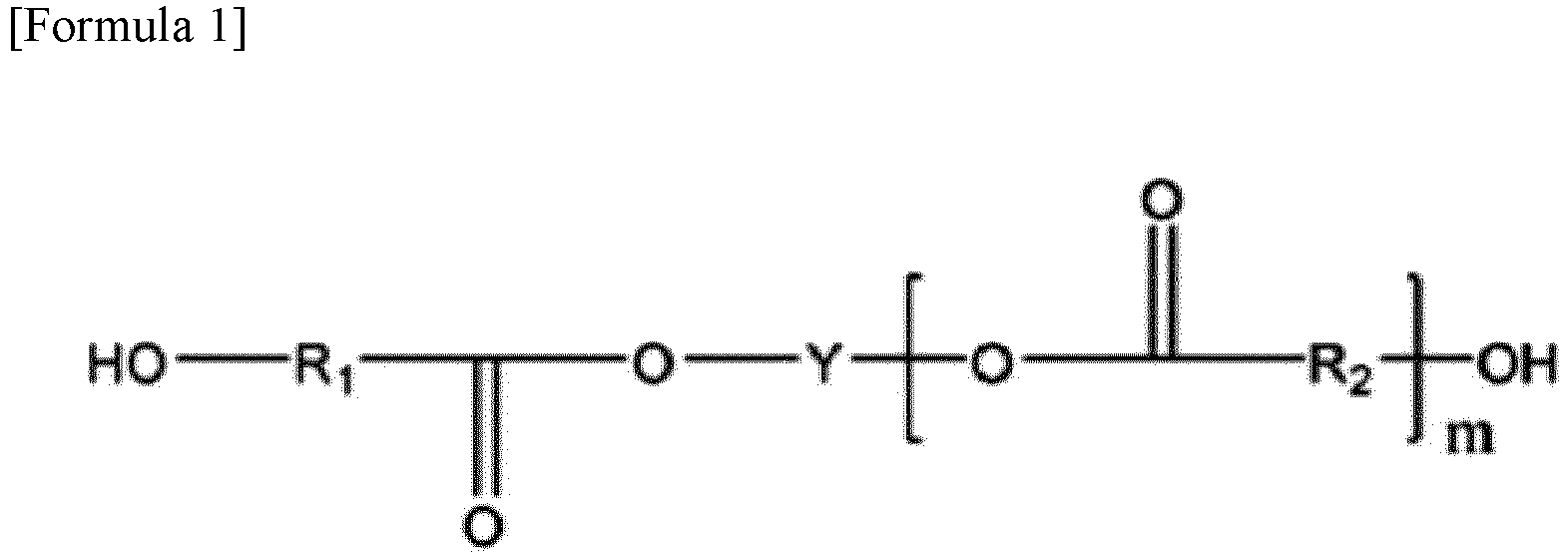
- the polyol may be a polyol represented by the following formula 1 or 2.
- X is a carboxylic acid-derived unit
- Y is a polyol-derived unit.
- the polyol-derived unit may be, for example, a triol unit or a diol unit.
- n and m may be any number.
- n may be a number in the range of 2 to 10 or 2 to 5
- m may be a number in the range of 1 to 10 or 1 to 5.
- R 1 and R 2 are each independently an alkylene group, and specific types of the alkylene group are the same as those described in the introduction of Technical Solution in this specification.
- the carboxylic acid-derived unit may mean a portion, which does not participate in the condensation reaction, in the carboxylic acid structure.
- the polyol-derived unit may mean a portion, which does not participate in the condensation reaction, in the polyol structure.
- Y in Formula 2 also represents a portion excluding the ester bond after the polyol forms the ester bond with caprolactone. That is, when the polyol and the caprolactone form the ester bond, the polyol-derived unit Y in Formula 2 may mean a portion, which does not participate in the ester bond, in the polyol structure.
- the ester bonds are represented in Formulas 1 and 2, respectively.
- the polyol-derived unit of Y is a unit derived from a polyol containing three or more hydroxy groups such as a triol unit
- a branched structure may be implemented in the Y portion of the formula structure.
- the type of the carboxylic acid-derived unit of X is not particularly limited, but in order to secure the desired physical properties, the unit may be a unit derived from one or more compounds selected from the group consisting of a fatty acid compound, an aromatic compound having two or more carboxyl groups, an alicyclic compound having two or more carboxyl groups and an aliphatic compound having two or more carboxyl groups.
- the aromatic compound having two or more carboxyl groups may be, for example, phthalic acid, isophthalic acid, terephthalic acid, trimellitic acid or tetrachlorophthalic acid.
- the alicyclic compound having two or more carboxyl groups may be, for example, tetrahydrophthalic acid or hexahydrophthalic acid or tetrachlorophthalic acid.
- the aliphatic compound having two or more carboxyl groups may be, for example, oxalic acid, adipic acid, azelaic acid, sebacic acid, succinic acid, malic acid, glutaric acid, malonic acid, pimelic acid, suberic acid, 2,2-dimethylsuccinic acid, 3,3-dimethylglutaric acid, 2,2-dimethylglutaric acid, maleic acid, fumaric acid or itaconic acid.
- the type of the polyol-derived unit of Y is not particularly limited, but in order to secure the desired physical properties, the unit may be derived from one or more compounds selected from the group consisting of an alicyclic compound having two or more hydroxy groups and an aliphatic compound having two or more hydroxy groups.
- the alicyclic compound having two or more hydroxyl groups may be, for example, 1,3-cyclohexanedimethanol or 1,4-cyclohexanedimethanol.
- the aliphatic compound having two or more hydroxyl groups may be, for example, ethylene glycol, propylene glycol, 1,2-butylene glycol, 2,3-butylene glycol, 1,3-propanediol, 1,3-butanediol, 1,4-butanediol, 1,6-hexanediol, neopentyl glycol, 1,2-ethylhexyldiol, 1,5-pentanediol, 1,9-nonandiol, 1,10-decanediol, glycerin or trimethylolpropane.
- the resin component when it is an isocyanate compound, it may comprise a difunctional isocyanate compound and a polyfunctional isocyanate compound.
- the polyfunctional isocyanate compound means a compound containing three or more isocyanate groups.
- the polyfunctional isocyanate compound may contain 3 to 10, 3 to 9, 3 to 8, 3 to 7, 3 to 6, 3 to 5 or 3 to 4 isocyanate groups.
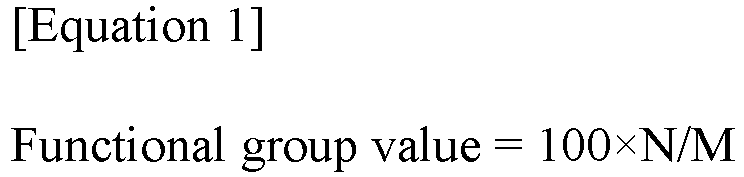
- the difunctional isocyanate compound may have a functional group value according to Equation 1 below in a range of 0.5 to 1.
- Functional group value 100 ⁇ N / M
- N is the number of isocyanate groups included in the isocyanate compound
- M is the molar mass (unit: g/mol) of the isocyanate compound.
- the functional group value of the difunctional isocyanate compound according to Equation 1 above may be 0.55 or more, 0.6 or more, 0.65 or more, 0.7 or more, 0.75 or more, 0.8 or more, or 0.85 or more, or may be 1 or less, 0.95 or less, or 0.9 or less.
- the difunctional isocyanate compound may have a molar mass in a range of 100 to 500 g/mol.
- the molar mass may be 110 g/mol or more, 120 g/mol or more, 130 g/mol or more, 140 g/mol or more, 150 g/mol or more, 160 g/mol or more, 170 g/mol or more, 180 g/mol or more, 190 g/mol or more, 200 g/mol or more, 210 g/mol or more, or 220 g/mol or more, or may be 480 g/mol or less, 460 g/mol or less, 440 g/mol or less, 420 g /mol or less, 400 g/mol or less, 380 g/mol or less, 360 g/mol or less, 340 g/mol or less, 320 g/mol or less, 300 g/mol or less, 280 g/mol or less, 260 g/mol or less, 240 g//
- the polyfunctional isocyanate compound may have a functional group value according to Equation 1 below in a range of 0.01 to 0.7.
- Functional group value 100 ⁇ N / M
- N is the number of isocyanate groups included in the isocyanate compound
- M is the molar mass (unit: g/mol) of the isocyanate compound.
- the functional group value of the polyfunctional isocyanate compound according to Equation 1 may be 0.05 or more, 0.1 or more, 0.15 or more, 0.2 or more, 0.25 or more, 0.3 or more, 0.35 or more, 0.4 or more, 0.45 or more, 0.5 or more, or may be 0.55 or more, 0.68 or less, 0.64 or less, 0.62 or less, or 0.6 or less.
- the polyfunctional isocyanate compound may have a molar mass in a range of 300 to 1500 g/mol.
- the molar mass may be 320 g/mol or more, 340 g/mol or more, 360 g/mol or more, 380 g/mol or more, 400 g/mol or more, 420 g/mol or more, 440 g/mol or more, 460 g/mol or more, 480 g/mol or more, or 500 g/mol or more, or may be 1500 g/mol or less, 1400 g/mol or less, 1300 g/mol or less, 1200 g/mol or less, 1100 g/mol or less, 1000 g/mol or less, 900 g/mol or less, 800 g/mol or less, 700 g/mol or less, 600 g/mol or less, 550 g/mol or less, or 520 g/mol or less.
- At least one or more of an aliphatic difunctional isocyanate compound and an aliphatic cyclic difunctional isocyanate compound may be used as the difunctional isocyanate compound of the present application, but it is preferable to use an aliphatic cyclic difunctional isocyanate compound.
- the aliphatic difunctional isocyanate compound may be exemplified by hexamethylene diisocyanate, trimethylhexamethylene diisocyanate, lysine diisocyanate, norbornane diisocyanate, ethylene diisocyanate, propylene diisocyanate and tetramethylene diisocyanate, and the like, but is not particularly limited thereto.
- the aliphatic cyclic difunctional isocyanate compound may be exemplified by transcyclohexane-1,4-diisocyanate, isophorone diisocyanate, bis(isocyanatemethyl)cyclohexane diisocyanate and dicyclohexylmethane diisocyanate, and the like, but is not particularly limited thereto.
- one or two or more of the difunctional isocyanate compounds may be used.
- polyfunctional isocyanate compound for example, a multimer above a trimer of the isocyanate compound may be used, and a compound in the form of a biuret which can be obtained by reacting the isocyanate compound with water may also be used. That is, one or more selected from a multimer of an isocyanate compound and a biuret compound may be used as the polyfunctional isocyanate compound.
- a multimer such as hexamethylene diisocyanate, trimethylhexamethylene diisocyanate, lysine diisocyanate, norbornane diisocyanate, ethylene diisocyanate, propylene diisocyanate, tetramethylene diisocyanate, transcyclohexane-1,4-diisocyanate, isophorone diisocyanate, bis(isocyanate methyl) cyclohexane diisocyanate and dicyclohexylmethane diisocyanate, and a compound in the form of a biuret may be included as an example of a polyfunctional isocyanate compound.
- the polyfunctional isocyanate compound may be a trifunctional isocyanate compound containing three isocyanate groups.
- the trifunctional isocyanate compound may be a compound represented by Formula 3 below.
- L 7 , L 8 and L 9 may be each independently an alkylene group, an alkenylene group or an alkynyl group. Specific types of the alkylene group, alkenylene group, or alkynyl group in the definition of Formula 3 above are the same as those described in the introduction of Technical Solution in this specification.
- the content of the polyfunctional isocyanate compound may be, in the entire isocyanate compound, 30 wt% or more, 35 wt% or more, 40 wt% or more, 45 wt% or more, 50 wt% or more, 55 wt% or more, or 60 wt% or more, or may be 85 wt% or less, 80 wt% or less, 75 wt% or less, 70 wt% or less, or 65 wt% or less.
- the content of the diisocyanate compound may be, in the entire isocyanate compound, 20 parts by weight or more, 25 parts by weight or more, 30 parts by weight or more, 35 parts by weight or more, 40 parts by weight or more, 45 parts by weight or more, 50 parts by weight or more, or 55 parts by weight or more, or may be 95 parts by weight or less, 90 parts by weight or less, 85 parts by weight or less, 80 parts by weight or less, 75 parts by weight or less, 70 parts by weight or less, or 65 parts by weight or less.
- the filler component included in the composition of the present application is a thermally conductive filler, which may secure heat dissipation or thermal conductivity of the composition or a cured product of the composition.
- the filler component may comprise a thermally conductive filler having a specific gravity of 3 or more and a thermally conductive filler having a specific gravity of less than 3.
- the thermally conductive filler component that can be used in the present application may be oxides such as alumina (aluminum oxide), magnesium oxide, beryllium oxide or titanium oxide; nitrides such as boron nitride, silicon nitride or aluminum nitride; carbides such as silicon carbide; hydrated metals such as aluminum hydroxide or magnesium hydroxide; metal filling materials such as copper, silver, iron, aluminum or nickel; metal alloy filling materials such as titanium; or silicon powders such as quartz, glass or silica, but is not limited thereto.
- a carbon filler such as graphite may also be considered.
- the carbon filler may utilize activated carbon, but is not limited thereto.
- the present application may appropriately select and use, in the above-described thermally conductive filler, a thermally conductive filler having a specific gravity of 3 or more and a thermally conductive filler having a specific gravity of less than 3. Also, if the cured product of the composition may be formed to have a specific gravity of less than 3 by appropriately mixing the thermally conductive filler having a specific gravity of 3 or more and a thermally conductive filler having a specific gravity of less than 3 in the above-described thermally conductive fillers, the type of the specific filler which can be selected and used is not limited.
- the composition of the present application may comprise a filler component in an amount of 80 wt% or more in order to secure desired physical properties (e.g., thermal conductivity).
- the filler component may be included in the composition in an amount of 82 wt% or more, 85 wt% or more, 87 wt% or more, or 90 wt% or more, and may be included in an amount of 95 wt% or less, 94 wt% or less, 93 wt% or less, 92 wt% or less, or 90 wt% or less.
- the specific gravity of the cured product of the composition increases and thus it is difficult to realize weight reduction of the product, so that it is required to lower the specific gravity of the cured product while comprising an excess of filler.
- desired physical properties e.g., thermal conductivity
- the filler component of the present application may comprise 60 wt% or more of the filler having a specific gravity of 3 or more.
- the filler having a specific gravity of 3 or more may be included in an amount of 62 wt% or more, 64 wt% or more, 66 wt% or more, 68 wt% or more, 70 wt% or more, 72 wt% or more, 74 wt% or more, 76 wt% or more, 78 wt% or more, or 80 wt% or more.
- the upper limit of the content of the filler component having a specific gravity of 3 or more may be, for example, 90 wt% or less, 89 wt% or less, 88 wt% or less, 87 wt% or less, 86 wt% or less, 85 wt% or less, 84 wt% or less, 83 wt% or less, 82 wt% or less, 81 wt% or less, or 80 wt% or less.
- the filler having a specific gravity of 3 or more is included in the above range, it is possible to provide a composition which achieves a low specific gravity effect in a state where a filler is filled in a high content and in a state where realization of physical properties by filling of the filler is sufficiently secured, and has improved storage stability without deterioration of physical properties such as a thermal conductivity.
- the filler having a specific gravity of less than 3 in the filler component may be included in an amount of 10 to 65 parts by weight relative to 100 parts by weight of the filler having a specific gravity of 3 or more.
- the filler having a specific gravity of less than 3 may be included in an amount of 13 parts by weight or more, 15 parts by weight or more, 18 parts by weight or more, 21 parts by weight or more, 24 parts by weight or more, 27 parts by weight or more, 30 parts by weight or more, or 33 parts by weight or more, or may be included in an amount of 62 parts by weight or less, 59 parts by weight or less, 56 parts by weight or less, 54 parts by weight or less, 50 parts by weight or less, 48 parts by weight or less, 46 parts by weight or less, 43 parts by weight or less, 40 parts by weight or less, 37 parts by weight or less, or 34 parts by weight or less, relative to 100 parts by weight of the filler having a specific gravity of 3 or more.
- the filler having a specific gravity of less than 3 is included in the above range relative to 100 parts by weight of the filler having a specific gravity of 3 or more, it is possible to provide a composition which achieves a low specific gravity effect in a state where a filler is filled in a high content and in a state where realization of physical properties by filling of the filler is sufficiently secured, and has improved storage stability without deterioration of physical properties such as a thermal conductivity.
- the filler having a specific gravity of less than 3 may have a D50 particle size of 50 to 90 ⁇ m.
- the D50 particle size of the filler having a specific gravity of less than 3 may be 51 ⁇ m or more, 52 ⁇ m or more, 53 ⁇ m or more, 54 ⁇ m or more, 55 ⁇ m or more, 56 ⁇ m or more, 57 ⁇ m or more, 58 ⁇ m or more, 59 ⁇ m or more, or 60 ⁇ m or more, or may be 85 ⁇ m or less, 80 ⁇ m or less, 75 ⁇ m or less, 70 ⁇ m or less, 65 ⁇ m or less, or 60 ⁇ m or less.
- the ratio of the filler having a specific gravity of less than 3 in the filler component may be 10 to 50 wt%. In another example, the ratio of the filler having a specific gravity of less than 3 may be 11 wt% or more, 12 wt% or more, 13 wt% or more, 14 wt% or more, 15 wt% or more, 16 wt% or more, 18 wt% or more, or 20 wt% or more, or may be 47 wt% or less, 45 wt% or less, 43 wt% or less, 40 wt% or less, 37 wt% or less, 35 wt% or less, 33 wt% or less, 30 wt% or less, 28 wt% or less, 26 wt% or less, 24 wt% or less, 22 wt% or less, or 20 wt% or less.
- the ratio of the filler having a specific gravity of less than 3 in the filler component is less than 10 wt%, there is a problem in that the specific gravity of the cured product increases, and if it exceeds 50 wt%, the temporal change phenomenon in the physical properties (e.g., thermal conductivity) of the cured product may occur, it is preferably included within the above-described range.
- the filler having a specific gravity of less than 3 is included in the above range, it is possible to provide a composition which achieves a low specific gravity effect in a state where a filler is filled in a high content and in a state where realization of physical properties by filling of the filler is sufficiently secured, and has improved storage stability without deterioration of physical properties such as a thermal conductivity.
- the filler component of the present application may comprise a first filler having a specific gravity of 3 or more and a D50 particle size in a range of 50 to 200 ⁇ m, and a second filler having a specific gravity of 3 or more and a D50 particle size in a range of 0.5 to 5 ⁇ m.
- the D50 particle size of the first filler may be 55 ⁇ m or more, 60 ⁇ m or more, 65 ⁇ m or more, or 70 ⁇ m or more, or may be 195 ⁇ m or less, 190 ⁇ m or less, 185 ⁇ m or less, 180 ⁇ m or less, 175 ⁇ m or less, 170 ⁇ m or less, 165 ⁇ m or less, 160 ⁇ m or less, 155 ⁇ m or less, 150 ⁇ m or less, 145 ⁇ m or less, 140 ⁇ m or less, 135 ⁇ m or less, 130 ⁇ m or less, 125 ⁇ m or less, about 120 ⁇ m or less, 115 ⁇ m or less, 110 ⁇ m or less, 105 ⁇ m or less, 100 ⁇ m or less, 95 ⁇ m or less, 90 ⁇ m or less, 85 ⁇ m or less, 80 ⁇ m or less, or about 75 ⁇ m or less.
- the D50 particle size of the second filler may be 0.01 ⁇ m or more, 0.1 ⁇ m or more, about 0.5 ⁇ m or more, 1 ⁇ m or more, 1.5 ⁇ m or more, or 2 ⁇ m or more, or may be 5 ⁇ m or less, 4.5 ⁇ m or less, about 4 ⁇ m or less, 3.5 ⁇ m or less, 3 ⁇ m or less, 2.5 ⁇ m or less, or 2 ⁇ m or less.
- the first filler may be included in an amount of 25 to 50 wt% in the filler component. In another example, the first filler may be included in an amount of 28 wt% or more, 30 wt% or more, 33 wt% or more, or 35 wt% or more, or may be included in an amount of 48 wt% or less, 46 wt% or less, 44 wt% or less, 42 wt% or less, 40 wt% or less, 38 wt% or less, or 35 wt% or less, in the filler component.
- the second filler may be included in an amount of 10 to 50 wt% in the filler component. In another example, the second filler may be included in an amount of 13 wt% or more, 15 wt% or more, 17 wt% or more, 20 wt% or more, 22 wt% or more, 25 wt% or more, 28 wt% or more, or 30 wt% or more, or may be included in an amount of 48 wt% or less, 46 wt% or less, 44 wt% or less, 42 wt% or less, 40 wt% or less, 38 wt% or less, 35 wt% or less, 33 wt% or less, or 30 wt% or less, in the filler component.
- the filler component of the present application may further comprise a third filler having a specific gravity of 3 or more and a D50 particle size in a range of 10 to 30 ⁇ m.
- the D50 particle size of the third filler may be 12 ⁇ m or more, 13 ⁇ m or more, 14 ⁇ m or more, 15 ⁇ m or more, 16 ⁇ m or more, 17 ⁇ m or more, 18 ⁇ m or more, 19 ⁇ m or more, or 20 ⁇ m or more, or may be about 29 ⁇ m or less, 28 ⁇ m or less, 27 ⁇ m or less, 26 ⁇ m or less, 25 ⁇ m or less, 24 ⁇ m or less, 23 ⁇ m or less, 22 ⁇ m or less, 21 ⁇ m or less, or 20 ⁇ m or less.
- the weight ratio (C3/C2) of the third filler (C3) to the second filler (C2) may be 1 or less.
- the weight ratio (C2/C3) may be 0.9 or less, 0.8 or less, 0.7 or less, 0.6 or less, 0.5 or less, or 0.4 or less, or may be 0 or more, 0.1 or more, 0.2 or more, or 0.3 or more.
- the shape of the filler component as described above may be used by appropriately selecting a spherical and/or rectangular shape (e.g., needle-shape and plate-shape, etc.) as needed, but is not limited thereto. Considering the amount to be filled, it is advantageous to use a spherical filler, but a rectangular filler such as a needle-shaped or plate-shaped filler may also be used in consideration of network formation or conductivity, and the like.
- a spherical and/or rectangular shape e.g., needle-shape and plate-shape, etc.
- the filler having a specific gravity of 3 or more and the filler having a specific gravity of less than 3 may have different shapes, respectively, and the first, second and third fillers having the same specific gravity may have different shapes, respectively.
- each of the first filler, the second filler and the third filler having the same specific gravity and the same particle size may be configured by mixing spherical and/or rectangular fillers, but in consideration of the cost reduction effect, it is preferable to use a rectangular filler as the second filler.
- the composition of the present application may be a one-component resin composition, a main composition or a curing agent composition of a two-component resin composition, or a mixture of a main composition and a curing agent composition of a two-component resin composition.
- the one-component resin composition is a resin composition in which the curable components are stored in a mixed state
- the two-component resin composition is a resin composition in which the curable components are physically separated into a main composition and a curing agent composition and stored separately.
- the main composition and the curing agent composition are mixed under conditions in which curing can occur at the time of use.
- the ratio (V1/V2) of the volume of the main composition (V1) to the volume (V2) of the curing agent composition may be in the range of 0.5 to 1.5 or in the range of 0.75 to 1.25.
- composition of the present application basically comprises the above components, that is, the resin component and the filler component, which may also comprise other components if necessary.
- the curing reaction of the composition comprising the main resin and the curing agent resin may be assisted by a catalyst.
- a catalyst for example, a tin-based catalyst may be used.
- DBTDL dibutyltin dilaurate
- the composition of the present application may further comprise a thiol compound.
- the thiol compound may be included in the composition to serve as a curing retardant to control the curing rate so that the composition of the present application is suitable for use.
- the composition of the present application has an advantage that the composition can be adjusted to have an appropriate curing rate in terms of workability.
- the thiol compound is a compound containing one thiol group, which may be represented by the following formula 4.
- R 5 is a single bond, an alkylene group, an alkenylene group or an alkynylene group
- R 6 , R 7 and R 8 may be each independently hydrogen, an alkyl group, an alkenyl group or an alkynyl group.
- alkylene group, alkenylene group or alkynylene group in the definition of Formula 4 above are the same as those described in the introduction of Technical Solution of this specification.
- the thiol compound may be exemplified by ethanethiol, propanethiol, butanethiol, pentanethiol, hexanethiol, heptanethiol, octanethiol, 2-ethylhexanethiol, nonanethiol, decanethiol, 2-propylheptanethiol, ethenethiol, propenethiol, butenethiol, acetylenethiol, propynethiol, butynthiol, benzenethiol, methylbenzenethiol, pyridinethiol and methylpyridinethiol, and the like, but is not particularly limited, as long as it contains one thiol group.
- the thiol compound one or two or more of the above-mentioned may be used as the thiol compound.
- the composition may comprise a viscosity modifier for control of the viscosity, for example, for increasing or decreasing the viscosity, or for control of the viscosity according to shear force.
- a viscosity modifier for control of the viscosity, for example, for increasing or decreasing the viscosity, or for control of the viscosity according to shear force.
- it may further comprise a thixotropic agent, a diluent, a dispersant or a coupling agent, and the like.
- the thixotropic agent adjusts the viscosity of the composition according to the shear force, whereby the manufacturing process of the battery module allows to be effectively performed.
- the usable thixotropic agent fumed silica and the like may be exemplified.
- the diluent or dispersant is generally used to lower the viscosity of the composition, and as long as it can exhibit such an action, various types known in the art can be used.
- the coupling agent for example, it can be used to improve the dispersibility of the filler, and as long as it can exhibit such an action, various types of known in the art can be used without limitation.
- the composition may further comprise a flame retardant or a flame retardant adjuvant, and the like.
- a flame retardant various known flame retardants may be applied without particular limitation, and for example, a flame retardant in the form of a solid filler or a liquid flame retardant, and the like may be applied.
- the flame retardant includes, for example, an organic flame retardant such as melamine cyanurate or an inorganic flame retardant such as magnesium hydroxide, but is not limited thereto. If the amount of filler to be filled is excessive, a liquid type flame retardant material (TEP, triethyl phosphate or TCPP, tris(1,3-chloro-2-propyl)phosphate, etc.) may also be used.
- TEP triethyl phosphate or TCPP, tris(1,3-chloro-2-propyl)phosphate, etc.
- a silane coupling agent capable of serving as a flame retardant synergist may also be added.
- the composition may comprise a hygroscopic agent.
- a hygroscopic agent When the hygroscopic agent is included, storage stability may be ensured, and problems such as surface hardening or viscosity increase of the composition due to moisture may be solved.
- the hygroscopic agent may be, for example, methyldiphenylethoxysilane, molecular sieves, p-toluenesulfonyl isocyanate (PTSI), Tosyl isocyanate (TI), for example, acid anhydride esters such as diethyl malonate and dimethyl succinate, (unsaturated) silane compounds represented by the following formula, and a mixture of the foregoing.
- composition of the present application may be cured to form a cured product, which may satisfy the following physical properties.
- the cured product after curing may have a specific gravity of less than 3.
- the specific gravity may be, for example, 2.95 or less, 2.9 or less, 2.85 or less, 2.8 or less, 2.75 or less, or 2.7 or less, but is not limited thereto.
- the specific gravity of the cured product of the composition of the present application has the lower value, it is advantageous in reducing the weight of the applied product, so that the lower limit of the specific gravity is not particularly limited, but it may be, for example, 0.5 or more, 1 or more, 1.5 or more, 2 or more, 2.3 or more, or 2.5 or more.
- the cured product of the composition of the present application has a low specific gravity characteristic as in the above range, whereby a weight reduction effect of the product to which the composition is applied can be expected.
- the specific gravity may be a numerical value measured according to a specific gravity measuring method to be described below.
- the composition of the present application may form a cured product having a thermal conductivity of 3W/m ⁇ K or more.
- the thermal conductivity may be 3.1 W/m ⁇ K or more, 3.2 W/m ⁇ K or more, 3.3 W/m ⁇ K or more, or 3.4 W/m ⁇ K or more, and may be 50 W/m ⁇ K or less, 45 W/m K or less, 40 W/m K or less, 35 W/m K or less, 30 W/m K or less, 25 W/m K or less, 20 W/m K or less, 15 W/ m K or less, 10 W/m K or less, 5 W/m ⁇ K or less, 4.5 W/m ⁇ K or less, about 4.0 W/m K or less, or 3.5 W/m ⁇ K or less.
- the thermal conductivity may be a value measured according to ASTM D5470 standard or ISO 22007-2 standard along the thickness direction of the sample.
- the cured product of the composition of the present application may have a thermal conductivity change rate of 0.99 or more according to Equation 2 below.
- the cured product of the composition of the present application may have a thermal conductivity change rate of 1 or more, 1.01 or more, 1.02 or more, 1.03 or more, 1.04 or more, or 1.05 or more, according to Equation 2 below.
- the upper limit of the thermal conductivity change rate is not limited, but may be, for example, 3 or less, 2.5 or less, 2 or less, 1.5 or less, 1.3 or less, 1.1 or less, 1.08 or less, or 1.06 or less.
- Thermal conductivity change rate Tc 2 / Tc 1
- Tc1 is the thermal conductivity measured after leaving the composition at room temperature (25°C) for 1 hour
- Tc2 is the thermal conductivity measured after leaving the composition at room temperature for 10 days.
- the cured product of the composition of the present application can realize low specific gravity properties of less than 3, and has excellent heat dissipation performance by satisfying thermal conductivity of 3W/m ⁇ K or more, and an effect of improved storage stability because physical properties such as thermal conductivity are not reduced over time.
- the present application also relates to a product comprising a heating element and the composition or a cured product thereof in thermal contact with the heating element.
- a product comprising a heating element and the composition or a cured product thereof in thermal contact with the heating element.
- the contents of the composition or a cured product thereof as described above may be equally applied to the composition or a cured product thereof.
- Products comprising the composition of the present application and its cured product may include various electric products and electronic products such as irons, washing machines, dryers, clothes conditioners, electric shavers, microwaves, electric ovens, electric rice cookers, refrigerators, dishwashers, air conditioners, electric fans, humidifiers, air purifiers, mobile phones, walkie-talkies, televisions, radios, computers and laptops, or batteries such as secondary batteries, and the like.
- the composition according to one example of the present application may be used as a material for connecting the battery modules.
- the composition according to one example of the present application may play a role in dissipating heat emitted from the battery cells and fixing the battery cells from external shock and vibration.
- composition of the present application and a cured product thereof may transfer heat generated from the heating element of the electric products and electronic products or the batteries as described above, and the like to a cooling region. That is, the composition of the present application and a cured product thereof may radiate heat generated from the heating element.
- the composition and a cured product thereof may be placed between the heating element and the cooling region to thermally contact them.
- the thermal contact means that the cured product of the composition is in direct physical contact with the heating element and cooling region to dissipate heat generated from the heating element to the cooling region, or even if the cured product does not directly contact the heating element and/or cooling region (that is, a separate layer exists between the cured product of the composition and the heating element and/or the cooling region), the heat generated by the heating element is dissipated to the cooling region. That is, the composition of the present application and a cured product thereof may dissipate heat in electric products and electronic products or batteries, and provide durability against impact, insulation, and the like.
- composition which achieves a low specific gravity effect in a state where a filler is filled in a high content and in a state where realization of physical properties by filling of the filler is sufficiently secured, and has improved storage stability without deterioration of physical properties such as a thermal conductivity.
- Spherical alumina (C1a) with a D50 particle size of 70 ⁇ m, spherical alumina (C3a) with a D50 particle size of 20 ⁇ m, rectangular alumina (C2) with a D50 particle size of 2 ⁇ m, and rectangular aluminum hydroxide (AH) with a D50 particle size of 60 ⁇ m were mixed in a weight ratio of 40:20:20:20 (C1a: C3a: C2: AH), respectively, to prepare a filler component.
- the specific gravity of alumina used is 3.965, and the specific gravity of aluminum hydroxide is 2.423.
- the D50 particle size of the filler as mentioned herein is a particle diameter (median diameter) accumulated at 50% in a cumulative curve on the basis of a volume of a particle size distribution.
- a particle size can be defined as a particle diameter at a point where the particle size distribution is obtained on the basis of the volume and the accumulated value becomes 50% in the cumulative curve with 100% of the total volume.
- the D50 particle size could be measured using Marven's MASTERSIZER 3000 equipment in accordance with ISO-13320, where ethanol was used as the solvent.
- the prepared filler component was mixed with a polyol and other additives (curing retardant, dispersant, flame retardant) in a weight ratio of 90:8:2 (filler component: polyol: additives), and the mixture was mixed and dispersed at 600 rpm in revolution and 500 rpm in rotation for 3 minutes or so with a paste mixer and then the generated heat was confirmed, and defoamed in a vacuum state at 600 rpm in revolution and 200 rpm in rotation for 4 minutes, thereby preparing a main composition.
- additives curing retardant, dispersant, flame retardant
- the polyol was a caprolactone polyol, in which one obtained by reacting 1,4-butanediol and caprolactone in a weight ratio of 1:2.79 (1,4-butanediol: caprolactone) was used.
- the prepared filler component was mixed with an isocyanate mixture and other additives (hygroscopic agent, dispersant, flame retardant) in a weight ratio of 90:8:2 (filler component: isocyanate mixture: additives), and the mixture was mixed and dispersed at 600 rpm in revolution and 500 rpm in rotation for 3 minutes or so with a paste mixer and then the generated heat was confirmed, and defoamed in a vacuum state at 600 rpm in revolution and 200 rpm in rotation for 4 minutes, thereby preparing a curing agent composition.
- additives hygroscopic agent, dispersant, flame retardant
- isocyanate mixture one obtained by mixing hexamethylene diisocyanate trimer (number of isocyanate groups: 3, molar mass: about 504.6 g/mol) and isophorone diisocyanate (number of isocyanate groups: 2, molar mass: about 222.3 g/mol) was used.
- the functional group value of hexamethylene diisocyanate trimer calculated by the following equation 1 is 0.59, and the functional group value of isophorone diisocyanate is 0.89.
- Functional group value 100 ⁇ N / M
- N is the number of isocyanate groups included in the isocyanate compound
- M is the molar mass (unit: g/mol) of the isocyanate compound.
- the main composition and the curing agent composition as prepared were mixed in a volume ratio of 1:1 to prepare a composition.
- a composition was prepared as in the same method as in Example 1 above, except that spherical alumina (C1a) with a D50 particle size of 70 ⁇ m, spherical alumina (C3a) with a D50 particle size of 20 ⁇ m, rectangular alumina (C2) with a D50 particle size of 2 ⁇ m, and rectangular aluminum hydroxide (AH) with a D50 particle size of 60 ⁇ m were mixed in a weight ratio of 35:20:20:25 (C1a: C3a: C2: AH), respectively, to prepare a filler.
- C1a spherical alumina
- C3a spherical alumina
- AH rectangular aluminum hydroxide
- a composition was prepared as in the same method as in Example 1 above, except that spherical alumina (C1a) with a D50 particle size of 70 ⁇ m, rectangular alumina (C2) with a D50 particle size of 2 ⁇ m, and rectangular aluminum hydroxide (AH) with a D50 particle size of 60 ⁇ m were mixed in a weight ratio of 30:40:30 (C1a: C2: AH), respectively, to prepare a filler.
- C1a spherical alumina
- C2 rectangular alumina
- AH rectangular aluminum hydroxide
- a composition was prepared as in the same method as in Example 1 above, except that spherical alumina (C1a) with a D50 particle size of 70 ⁇ m, rectangular alumina (C2) with a D50 particle size of 2 ⁇ m, and rectangular aluminum hydroxide (AH) with a D50 particle size of 60 ⁇ m were mixed in a weight ratio of 35:30:35 (C1a: C2: AH), respectively, to prepare a filler.
- C1a spherical alumina
- C2 rectangular alumina
- AH rectangular aluminum hydroxide
- a composition was prepared as in the same method as in Example 1 above, except that spherical alumina (C1a) with a D50 particle size of 70 ⁇ m, rectangular alumina (C3b) with a D50 particle size of 20 ⁇ m, rectangular alumina (C2) with a D50 particle size of 2 ⁇ m, and rectangular aluminum hydroxide (AH) with a D50 particle size of 60 ⁇ m were mixed in a weight ratio of 40:20:20:20 (C1a: C3b: C2: AH), respectively, to prepare a filler.
- spherical alumina (C1a) with a D50 particle size of 70 ⁇ m, rectangular alumina (C3b) with a D50 particle size of 20 ⁇ m, rectangular alumina (C2) with a D50 particle size of 2 ⁇ m, and rectangular aluminum hydroxide (AH) with a D50 particle size of 60 ⁇ m were mixed in a weight ratio of 40:20:20:20 (C1a: C3b: C2
- a composition was prepared as in the same method as in Example 1 above, except that spherical alumina (C1a) with a D50 particle size of 70 ⁇ m, rectangular alumina (C1b) with a D50 particle size of 70 ⁇ m, rectangular alumina (C3b) with a D50 particle size of 20 ⁇ m, rectangular alumina (C2) with a D50 particle size of 2 ⁇ m, and rectangular aluminum hydroxide (AH) with a D50 particle size of 60 ⁇ m were mixed in a weight ratio of 20:20:20:20:20 (C1a: C1b: C3b: C2: AH), respectively, to prepare a filler.
- C1a spherical alumina
- C1b with a D50 particle size of 70 ⁇ m
- C3b rectangular alumina
- AH rectangular aluminum hydroxide
- a composition was prepared as in the same method as in Example 1 above, except that spherical alumina (C1a) with a D50 particle size of 70 ⁇ m, spherical alumina (C3a) with a D50 particle size of 20 ⁇ m, rectangular alumina (C2) with a D50 particle size of 2 ⁇ m, and rectangular aluminum hydroxide (AH) with a D50 particle size of 60 ⁇ m were mixed in a weight ratio of 40: 10:30:20 (C1a: C3a: C2: AH), respectively, to prepare a filler.
- C1a spherical alumina
- C3a spherical alumina
- AH rectangular aluminum hydroxide
- a composition was prepared as in the same method as in Example 1 above, except that aluminum hydroxide was not used, and spherical alumina (C1a) having a D50 particle size of 70 ⁇ m, spherical alumina (C3a) with a D50 particle size of 20 ⁇ m, and rectangular alumina (C2) with a D50 particle size of 2 ⁇ m were mixed in a weight ratio of 60:20:20 (C1a: C3a: C2), respectively, to prepare a filler.
- rectangular alumina (C2) with a D50 particle size of 2 ⁇ m were mixed in a weight ratio of 60:20:20 (C1a: C3a: C2), respectively, to prepare a filler.
- a composition was prepared as in the same method as in Example 1 above, except that aluminum hydroxide was not used, and spherical alumina (C1a) having a D50 particle size of 70 ⁇ m, rectangular alumina (C3b) with a D50 particle size of 20 ⁇ m, and rectangular alumina (C2) with a D50 particle size of 2 ⁇ m were mixed in a weight ratio of 60:20:20 (C1a: C3b: C2), respectively, to prepare a filler.
- spherical alumina (C1a) having a D50 particle size of 70 ⁇ m, rectangular alumina (C3b) with a D50 particle size of 20 ⁇ m, and rectangular alumina (C2) with a D50 particle size of 2 ⁇ m were mixed in a weight ratio of 60:20:20 (C1a: C3b: C2), respectively, to prepare a filler.
- a composition was prepared as in the same method as in Example 1 above, except that aluminum hydroxide was not used, and spherical alumina (C1a) with a D50 particle size of 70 ⁇ m, rectangular alumina (C1b) with a D50 particle size of 70 ⁇ m, spherical alumina (C3a) with a D50 particle size of 20 ⁇ m, and rectangular alumina (C2) with a D50 particle size of 2 ⁇ m rectangular alumina were mixed in a weight ratio of 40:20:20:20 (C1a: C1b: C3a: C2), respectively, to prepare a filler.
- a composition was prepared as in the same method as in Example 1 above, except that aluminum hydroxide was not used, and spherical alumina (C1a) with a D50 particle size of 70 ⁇ m, rectangular alumina (C1b) with a D50 particle size of 70 ⁇ m, rectangular alumina (C3b) with a D50 particle size of 20 ⁇ m, and rectangular alumina (C2) with a D50 particle size of 2 ⁇ m were mixed in a weight ratio of 40:20:20:20 (C1a: C1b: C3b: C2), respectively, to prepare a filler.
- a composition was prepared as in the same method as in Example 1 above, except that aluminum hydroxide was not used, and spherical alumina (C1a) with a D50 particle size of 70 ⁇ m, spherical alumina (C3a) with a D50 particle size of 20 ⁇ m, and rectangular alumina (C2) with a D50 particle size of 2 ⁇ m were mixed in a weight ratio of 40:30:30 (C1a: C3a: C2), respectively, to prepare a filler.
- the thermal conductivities of the cured products of the compositions of Examples 1 to 7 and the compositions of Comparative Examples 1 to 5 were compared.
- the compositions were each left at 25°C for 1 hour to prepare a cured product.
- the thermal conductivity of the cured product of the composition was measured by a hot disk method according to ISO 22007-2 standard. Specifically, the thermal conductivity measurement may be performed by placing the composition in a mold having a thickness of about 5mm or so, and measuring the thermal conductivity in the thickness direction (through plane direction) using a Hot Disk device.
- the Hot Disk device is a device that can identify the thermal conductivity by measuring the temperature change (electrical resistance change) while the sensor with a nickel wire of a double spiral structure is heated, and the thermal conductivity was measured according to such a standard.
- thermal conductivity change degrees of the cured products of the compositions of Examples 1 to 7 and Comparative Examples 1 to 5 were compared. Specifically, the thermal conductivity of the cured product left at room temperature for 1 hour, the thermal conductivity of the cured product left at room temperature for 5 days, and the thermal conductivity of the cured product left at room temperature for 10 days were compared, whereby the thermal conductivity change degrees were compared.
- the thermal conductivities after 5 days and 10 days were measured by the same method as the method for measuring a thermal conductivity as described above.
- Tc1 is the thermal conductivity measured after leaving the composition at room temperature (25°C) for 1 hour
- Tc2 is the thermal conductivity measured after leaving the composition at room temperature for 10 days.
- the specific gravity was measured according to ASTM D1475 standard. For example, after the cured product is weighed and then weighed again in water, according to the above standard, the density and specific gravity may be calculated through the difference between the measured weights, or a predetermined amount (about 5 g) of powders or pellets is put into the already-measured volume in a pyrometer and the specific gravity may be calculated through the difference between the weight and the volume at 25°C.
Landscapes
- Chemical & Material Sciences (AREA)
- Organic Chemistry (AREA)
- Chemical Kinetics & Catalysis (AREA)
- Polymers & Plastics (AREA)
- Health & Medical Sciences (AREA)
- Medicinal Chemistry (AREA)
- Engineering & Computer Science (AREA)
- Inorganic Chemistry (AREA)
- Physics & Mathematics (AREA)
- Thermal Sciences (AREA)
- Combustion & Propulsion (AREA)
- Materials Engineering (AREA)
- Microelectronics & Electronic Packaging (AREA)
- Compositions Of Macromolecular Compounds (AREA)
- Polyurethanes Or Polyureas (AREA)
Abstract
Description
- This application claims the benefit of priority based on
Korean Patent Application No. 10-2021-0017013 dated February 5, 2021 - The present application relates to a composition and a product including thereof.
- By blending a filler with a composition capable of forming an adhesive or pressure-sensitive adhesive, it is possible to form a cured product having desired physical properties. In order to secure the physical properties by the filler, it is necessary to introduce the filler in a high content into the composition. However, since the commonly used filler has a high specific gravity, the specific gravity of the composition increases when a high-content filler is introduced, whereby there are problems that it is difficult to reduce the weight of the applied product and the use is limited.
- For example, an alumina filler has a high thermal conductivity, but has a high specific gravity, so that when the alumina filler is introduced in a high content for a high heat dissipation effect, it is difficult to reduce the weight of the product. In addition, when the alumina filler is introduced in a low content in order to lower the specific gravity, there is a problem that the heat dissipation effect is deteriorated.
- Therefore, it is required to develop a composition that can be filled with a filler in a high content, and thus can be used for various applications due to its low specific gravity while sufficiently ensuring realization of physical properties (e.g., heat dissipation performance).
- The present application is intended to provide a composition capable of achieving a low specific gravity effect in a state where a filler is filled in a high content, and in a state where realization of physical properties by filling of the filler is sufficiently secured.
- In addition, the present application is intended to provide a composition having excellent storage stability without deterioration of physical properties such as a thermal conductivity.
- Among physical properties mentioned in this specification, the physical properties in which the measured temperature affects the physical properties are those measured at room temperature unless otherwise specified.
- In this specification, the term "room temperature" is a natural temperature without heating and cooling, which means, for example, any temperature within a range of about 10°C to 30°C, for example, a temperature of about 15°C, about 18°C, about 20°C, about 23°C or about 25°C or so. Also, in this specification, the unit of temperature is °C, unless otherwise specified.
- Among physical properties mentioned in this specification, when the measured pressure affects the result, the relevant physical property is a physical property measured at normal pressure, unless otherwise specified. The term "normal pressure" is a natural pressure without being pressurized or depressurized, in which usually about 1 atmosphere or so is referred to as normal pressure.
- The term "alkyl group" or "alkylene group" as used herein may mean a linear or branched acyclic alkyl group or alkylene group having 1 to 20 carbon atoms, or 1 to 16 carbon atoms, or 1 to 12 carbon atoms, or 1 to 8 carbon atoms, or 1 to 6 carbon atoms, unless otherwise described.
- The terms "alkenyl group" or "alkenylene group" as used herein may mean a linear or branched acyclic alkenyl group or alkenylene group having 2 to 20 carbon atoms, or 2 to 16 carbon atoms, or 2 to 12 carbon atoms, or 2 to 8 carbon atoms, or 2 to 6 carbon atoms, unless otherwise described.
- The term "alkynyl group" or "alkynylene group" as used in the present application may mean a linear or branched acyclic alkynyl group or alkynylene group having 2 to 20 carbon atoms, or 2 to 16 carbon atoms, or 2 to 12 carbon atoms, or 2 to 8 carbon atoms, or 2 to 6 carbon atoms, unless otherwise described.
- The term "carboxylic acid-derived unit" as used herein may mean a part excluding a carboxyl group in a carboxylic acid compound. Similarly, the term "polyol-derived unit" as used herein may mean a part excluding a hydroxyl group in a polyol compound structure.
- In the present application, the term "D50 particle size" is a particle diameter (median diameter) accumulated at 50% on the basis of a volume of a particle size distribution, which means a particle diameter at a point where the particle size distribution is obtained on the basis of the volume and the accumulated value becomes 50% in the cumulative curve with 100% of the total volume. Such a D50 particle size may be measured by a laser diffraction method.
- In the present application, the term "spherical shape" means a case where sphericity is about 0.95 or more, and the "rectangular shape" means a case where sphericity is less than 0.95. The sphericity of the particle can be confirmed through a particle shape analysis of the particle. Specifically, the sphericity of the filler, which is a three-dimensional particle, may be defined as a ratio (S'/S) of the surface area (S') of a sphere having the same volume as that of a particle to the surface area (S) of the particle. For real particles, circularity is generally used. The circularity is expressed as a ratio of the boundary of a circle having the same image and the same area (A) as a two-dimensional image of a real particle thus obtained to the boundary (P) of the image, which may be obtained by the following equation. The sphericity in this specification is an average value of circularity measured by Marvern's particle shape analysis equipment (FPIA-3000).

- The circularity is expressed as a value from 0 to 1, where a perfect circle has a value of 1, and as a particle has an irregular shape, it has a value lower than 1.
- The composition of the present application comprises a resin component and a filler component, wherein the filler component comprises a filler having a specific gravity of 3 or more and a filler having a specific gravity of less than 3. The content of the filler component in the composition is 80 wt% or more, and the composition forms a cured product having a specific gravity of less than 3.
- In the present application, the term scope of resin component may include a resin component by itself or a precursor of the resin component, that is, a component that can become a resin component through a reaction such as a curing reaction or a polymerization reaction.
- In one example, the resin component may be a polyol, an isocyanate compound, a urethane resin, an acrylic resin, an epoxy resin, an olefin resin or a silicone resin.
- In one example of the present application, when the resin component is a polyol, a polyester polyol may be used. The polyester-based polyol of the present invention may be a polyol having non-crystallinity or sufficiently low crystallinity. In this specification, the "non -crystallinity" means a case where the crystallization temperature (Tc) and melting temperature (Tm) are not observed in a DSC (differential scanning calorimetry) analysis to be described below. The DSC analysis may be performed in the range of -80°C to 60°C at a rate of 10°C/min, which may be performed, for example, in a manner that the temperature is raised from 25°C to 60°C at the rate, and then reduced again to -80°C, and raised again to 60°C. In addition, here, the "sufficiently low crystallinity" means a case where the melting point (Tm) observed in the DSC analysis is less than 15°C, thereby being about 10°C or less, 5°C or less, 0°C or less, -5°C or less, -10°C or less, or about -20°C or less or so. At this time, the lower limit of the melting point is not particularly limited, but, for example, the melting point may be about -80°C or more, -75°C or more, or about - 70°C or more.
- In one example, as the polyester-based polyol, for example, a carboxylic acid polyol or a caprolactone polyol may be used.
- The carboxylic acid polyol may be formed by reacting a component containing a carboxylic acid and a polyol (e.g., diol or triol, etc.), and the caprolactone polyol may be formed by reacting a component containing caprolactone and a polyol (e.g., diol or triol, etc.). In this case, the carboxylic acid may be a dicarboxylic acid.
- In one example, the polyol may be a polyol represented by the following formula 1 or 2.

- In Formulas 1 and 2, X is a carboxylic acid-derived unit, and Y is a polyol-derived unit. The polyol-derived unit may be, for example, a triol unit or a diol unit. Also, n and m may be any number. For example, n may be a number in the range of 2 to 10 or 2 to 5, and m may be a number in the range of 1 to 10 or 1 to 5. In Formulas 1 and 2, R1 and R2 are each independently an alkylene group, and specific types of the alkylene group are the same as those described in the introduction of Technical Solution in this specification.
- That is, when the hydroxy group of the polyol and the carboxyl group of the carboxylic acid react, a water (H2O) molecule is eliminated by the condensation reaction and simultaneously an ester bond is formed. When the carboxylic acid forms the ester bond by the condensation reaction as such, the carboxylic acid-derived unit may mean a portion, which does not participate in the condensation reaction, in the carboxylic acid structure. In addition, the polyol-derived unit may mean a portion, which does not participate in the condensation reaction, in the polyol structure.
- Also, Y in Formula 2 also represents a portion excluding the ester bond after the polyol forms the ester bond with caprolactone. That is, when the polyol and the caprolactone form the ester bond, the polyol-derived unit Y in Formula 2 may mean a portion, which does not participate in the ester bond, in the polyol structure. The ester bonds are represented in Formulas 1 and 2, respectively.
- Meanwhile, in Formulas above, when the polyol-derived unit of Y is a unit derived from a polyol containing three or more hydroxy groups such as a triol unit, a branched structure may be implemented in the Y portion of the formula structure.
- In Formula 1 above, the type of the carboxylic acid-derived unit of X is not particularly limited, but in order to secure the desired physical properties, the unit may be a unit derived from one or more compounds selected from the group consisting of a fatty acid compound, an aromatic compound having two or more carboxyl groups, an alicyclic compound having two or more carboxyl groups and an aliphatic compound having two or more carboxyl groups.
- The aromatic compound having two or more carboxyl groups may be, for example, phthalic acid, isophthalic acid, terephthalic acid, trimellitic acid or tetrachlorophthalic acid. The alicyclic compound having two or more carboxyl groups may be, for example, tetrahydrophthalic acid or hexahydrophthalic acid or tetrachlorophthalic acid. In addition, the aliphatic compound having two or more carboxyl groups may be, for example, oxalic acid, adipic acid, azelaic acid, sebacic acid, succinic acid, malic acid, glutaric acid, malonic acid, pimelic acid, suberic acid, 2,2-dimethylsuccinic acid, 3,3-dimethylglutaric acid, 2,2-dimethylglutaric acid, maleic acid, fumaric acid or itaconic acid.
- Meanwhile, in Formulas 1 and 2, the type of the polyol-derived unit of Y is not particularly limited, but in order to secure the desired physical properties, the unit may be derived from one or more compounds selected from the group consisting of an alicyclic compound having two or more hydroxy groups and an aliphatic compound having two or more hydroxy groups.
- The alicyclic compound having two or more hydroxyl groups may be, for example, 1,3-cyclohexanedimethanol or 1,4-cyclohexanedimethanol. In addition, the aliphatic compound having two or more hydroxyl groups may be, for example, ethylene glycol, propylene glycol, 1,2-butylene glycol, 2,3-butylene glycol, 1,3-propanediol, 1,3-butanediol, 1,4-butanediol, 1,6-hexanediol, neopentyl glycol, 1,2-ethylhexyldiol, 1,5-pentanediol, 1,9-nonandiol, 1,10-decanediol, glycerin or trimethylolpropane.
- In one example of the present application, when the resin component is an isocyanate compound, it may comprise a difunctional isocyanate compound and a polyfunctional isocyanate compound.
- The difunctional isocyanate compound means a compound containing two isocyanate groups (-N=C=O) in one molecule, and the polyfunctional isocyanate compound means a compound containing three or more isocyanate groups. In another example, the polyfunctional isocyanate compound may contain 3 to 10, 3 to 9, 3 to 8, 3 to 7, 3 to 6, 3 to 5 or 3 to 4 isocyanate groups.
- The difunctional isocyanate compound may have a functional group value according to Equation 1 below in a range of 0.5 to 1.
- In Equation 1, N is the number of isocyanate groups included in the isocyanate compound, and M is the molar mass (unit: g/mol) of the isocyanate compound.
- In another example, the functional group value of the difunctional isocyanate compound according to Equation 1 above may be 0.55 or more, 0.6 or more, 0.65 or more, 0.7 or more, 0.75 or more, 0.8 or more, or 0.85 or more, or may be 1 or less, 0.95 or less, or 0.9 or less.
- The difunctional isocyanate compound may have a molar mass in a range of 100 to 500 g/mol. In another example, the molar mass may be 110 g/mol or more, 120 g/mol or more, 130 g/mol or more, 140 g/mol or more, 150 g/mol or more, 160 g/mol or more, 170 g/mol or more, 180 g/mol or more, 190 g/mol or more, 200 g/mol or more, 210 g/mol or more, or 220 g/mol or more, or may be 480 g/mol or less, 460 g/mol or less, 440 g/mol or less, 420 g /mol or less, 400 g/mol or less, 380 g/mol or less, 360 g/mol or less, 340 g/mol or less, 320 g/mol or less, 300 g/mol or less, 280 g/mol or less, 260 g/mol or less, 240 g/mol or less, or 230 g/mol or less.
- The polyfunctional isocyanate compound may have a functional group value according to Equation 1 below in a range of 0.01 to 0.7.

- In Equation 1, N is the number of isocyanate groups included in the isocyanate compound, and M is the molar mass (unit: g/mol) of the isocyanate compound.
- In another example, the functional group value of the polyfunctional isocyanate compound according to Equation 1 may be 0.05 or more, 0.1 or more, 0.15 or more, 0.2 or more, 0.25 or more, 0.3 or more, 0.35 or more, 0.4 or more, 0.45 or more, 0.5 or more, or may be 0.55 or more, 0.68 or less, 0.64 or less, 0.62 or less, or 0.6 or less.
- The polyfunctional isocyanate compound may have a molar mass in a range of 300 to 1500 g/mol. In another example, the molar mass may be 320 g/mol or more, 340 g/mol or more, 360 g/mol or more, 380 g/mol or more, 400 g/mol or more, 420 g/mol or more, 440 g/mol or more, 460 g/mol or more, 480 g/mol or more, or 500 g/mol or more, or may be 1500 g/mol or less, 1400 g/mol or less, 1300 g/mol or less, 1200 g/mol or less, 1100 g/mol or less, 1000 g/mol or less, 900 g/mol or less, 800 g/mol or less, 700 g/mol or less, 600 g/mol or less, 550 g/mol or less, or 520 g/mol or less.
- At least one or more of an aliphatic difunctional isocyanate compound and an aliphatic cyclic difunctional isocyanate compound may be used as the difunctional isocyanate compound of the present application, but it is preferable to use an aliphatic cyclic difunctional isocyanate compound.
- The aliphatic difunctional isocyanate compound may be exemplified by hexamethylene diisocyanate, trimethylhexamethylene diisocyanate, lysine diisocyanate, norbornane diisocyanate, ethylene diisocyanate, propylene diisocyanate and tetramethylene diisocyanate, and the like, but is not particularly limited thereto. The aliphatic cyclic difunctional isocyanate compound may be exemplified by transcyclohexane-1,4-diisocyanate, isophorone diisocyanate, bis(isocyanatemethyl)cyclohexane diisocyanate and dicyclohexylmethane diisocyanate, and the like, but is not particularly limited thereto. In addition, one or two or more of the difunctional isocyanate compounds may be used.
- As the polyfunctional isocyanate compound according to the present application, for example, a multimer above a trimer of the isocyanate compound may be used, and a compound in the form of a biuret which can be obtained by reacting the isocyanate compound with water may also be used. That is, one or more selected from a multimer of an isocyanate compound and a biuret compound may be used as the polyfunctional isocyanate compound.
- Specifically, a multimer such as hexamethylene diisocyanate, trimethylhexamethylene diisocyanate, lysine diisocyanate, norbornane diisocyanate, ethylene diisocyanate, propylene diisocyanate, tetramethylene diisocyanate, transcyclohexane-1,4-diisocyanate, isophorone diisocyanate, bis(isocyanate methyl) cyclohexane diisocyanate and dicyclohexylmethane diisocyanate, and a compound in the form of a biuret may be included as an example of a polyfunctional isocyanate compound.
- According to one example of the present application, the polyfunctional isocyanate compound may be a trifunctional isocyanate compound containing three isocyanate groups. The trifunctional isocyanate compound may be a compound represented by Formula 3 below.

- In Formula 3, L7, L8 and L9 may be each independently an alkylene group, an alkenylene group or an alkynyl group. Specific types of the alkylene group, alkenylene group, or alkynyl group in the definition of Formula 3 above are the same as those described in the introduction of Technical Solution in this specification.
- When the resin component is an isocyanate compound including a difunctional isocyanate compound and a polyfunctional isocyanate compound, the content of the polyfunctional isocyanate compound may be, in the entire isocyanate compound, 30 wt% or more, 35 wt% or more, 40 wt% or more, 45 wt% or more, 50 wt% or more, 55 wt% or more, or 60 wt% or more, or may be 85 wt% or less, 80 wt% or less, 75 wt% or less, 70 wt% or less, or 65 wt% or less.
- In addition, the content of the diisocyanate compound may be, in the entire isocyanate compound, 20 parts by weight or more, 25 parts by weight or more, 30 parts by weight or more, 35 parts by weight or more, 40 parts by weight or more, 45 parts by weight or more, 50 parts by weight or more, or 55 parts by weight or more, or may be 95 parts by weight or less, 90 parts by weight or less, 85 parts by weight or less, 80 parts by weight or less, 75 parts by weight or less, 70 parts by weight or less, or 65 parts by weight or less.
- The filler component included in the composition of the present application is a thermally conductive filler, which may secure heat dissipation or thermal conductivity of the composition or a cured product of the composition. In the present application, the filler component may comprise a thermally conductive filler having a specific gravity of 3 or more and a thermally conductive filler having a specific gravity of less than 3.
- The thermally conductive filler component that can be used in the present application may be oxides such as alumina (aluminum oxide), magnesium oxide, beryllium oxide or titanium oxide; nitrides such as boron nitride, silicon nitride or aluminum nitride; carbides such as silicon carbide; hydrated metals such as aluminum hydroxide or magnesium hydroxide; metal filling materials such as copper, silver, iron, aluminum or nickel; metal alloy filling materials such as titanium; or silicon powders such as quartz, glass or silica, but is not limited thereto. Furthermore, if insulating properties may be secured, the application of a carbon filler such as graphite may also be considered. For example, the carbon filler may utilize activated carbon, but is not limited thereto.
- The present application may appropriately select and use, in the above-described thermally conductive filler, a thermally conductive filler having a specific gravity of 3 or more and a thermally conductive filler having a specific gravity of less than 3. Also, if the cured product of the composition may be formed to have a specific gravity of less than 3 by appropriately mixing the thermally conductive filler having a specific gravity of 3 or more and a thermally conductive filler having a specific gravity of less than 3 in the above-described thermally conductive fillers, the type of the specific filler which can be selected and used is not limited.
- An excess of filler may be included in the composition of the present application. In one example, the composition of the present application may comprise a filler component in an amount of 80 wt% or more in order to secure desired physical properties (e.g., thermal conductivity). In another example, the filler component may be included in the composition in an amount of 82 wt% or more, 85 wt% or more, 87 wt% or more, or 90 wt% or more, and may be included in an amount of 95 wt% or less, 94 wt% or less, 93 wt% or less, 92 wt% or less, or 90 wt% or less.
- When an excessive amount of filler is included, the specific gravity of the cured product of the composition increases and thus it is difficult to realize weight reduction of the product, so that it is required to lower the specific gravity of the cured product while comprising an excess of filler. In addition, even if desired physical properties (e.g., thermal conductivity) are secured, it is required that the temporal change of the physical properties does not occur over time in order to secure storage stability and processability.
- In one example, the filler component of the present application may comprise 60 wt% or more of the filler having a specific gravity of 3 or more. In another example, the filler having a specific gravity of 3 or more may be included in an amount of 62 wt% or more, 64 wt% or more, 66 wt% or more, 68 wt% or more, 70 wt% or more, 72 wt% or more, 74 wt% or more, 76 wt% or more, 78 wt% or more, or 80 wt% or more. The upper limit of the content of the filler component having a specific gravity of 3 or more may be, for example, 90 wt% or less, 89 wt% or less, 88 wt% or less, 87 wt% or less, 86 wt% or less, 85 wt% or less, 84 wt% or less, 83 wt% or less, 82 wt% or less, 81 wt% or less, or 80 wt% or less. When the filler having a specific gravity of 3 or more is included in the above range, it is possible to provide a composition which achieves a low specific gravity effect in a state where a filler is filled in a high content and in a state where realization of physical properties by filling of the filler is sufficiently secured, and has improved storage stability without deterioration of physical properties such as a thermal conductivity.
- In one example, the filler having a specific gravity of less than 3 in the filler component may be included in an amount of 10 to 65 parts by weight relative to 100 parts by weight of the filler having a specific gravity of 3 or more. In another example, the filler having a specific gravity of less than 3 may be included in an amount of 13 parts by weight or more, 15 parts by weight or more, 18 parts by weight or more, 21 parts by weight or more, 24 parts by weight or more, 27 parts by weight or more, 30 parts by weight or more, or 33 parts by weight or more, or may be included in an amount of 62 parts by weight or less, 59 parts by weight or less, 56 parts by weight or less, 54 parts by weight or less, 50 parts by weight or less, 48 parts by weight or less, 46 parts by weight or less, 43 parts by weight or less, 40 parts by weight or less, 37 parts by weight or less, or 34 parts by weight or less, relative to 100 parts by weight of the filler having a specific gravity of 3 or more. When the filler having a specific gravity of less than 3 is included in the above range relative to 100 parts by weight of the filler having a specific gravity of 3 or more, it is possible to provide a composition which achieves a low specific gravity effect in a state where a filler is filled in a high content and in a state where realization of physical properties by filling of the filler is sufficiently secured, and has improved storage stability without deterioration of physical properties such as a thermal conductivity.
- In the present application, the filler having a specific gravity of less than 3 may have a D50 particle size of 50 to 90µm. In another example, the D50 particle size of the filler having a specific gravity of less than 3 may be 51µm or more, 52µm or more, 53µm or more, 54µm or more, 55µm or more, 56µm or more, 57µm or more, 58µm or more, 59µm or more, or 60µm or more, or may be 85µm or less, 80µm or less, 75µm or less, 70µm or less, 65µm or less, or 60µm or less.
- In one example, the ratio of the filler having a specific gravity of less than 3 in the filler component may be 10 to 50 wt%. In another example, the ratio of the filler having a specific gravity of less than 3 may be 11 wt% or more, 12 wt% or more, 13 wt% or more, 14 wt% or more, 15 wt% or more, 16 wt% or more, 18 wt% or more, or 20 wt% or more, or may be 47 wt% or less, 45 wt% or less, 43 wt% or less, 40 wt% or less, 37 wt% or less, 35 wt% or less, 33 wt% or less, 30 wt% or less, 28 wt% or less, 26 wt% or less, 24 wt% or less, 22 wt% or less, or 20 wt% or less. If the ratio of the filler having a specific gravity of less than 3 in the filler component is less than 10 wt%, there is a problem in that the specific gravity of the cured product increases, and if it exceeds 50 wt%, the temporal change phenomenon in the physical properties (e.g., thermal conductivity) of the cured product may occur, it is preferably included within the above-described range. When the filler having a specific gravity of less than 3 is included in the above range, it is possible to provide a composition which achieves a low specific gravity effect in a state where a filler is filled in a high content and in a state where realization of physical properties by filling of the filler is sufficiently secured, and has improved storage stability without deterioration of physical properties such as a thermal conductivity.
- In one example, the filler component of the present application may comprise a first filler having a specific gravity of 3 or more and a D50 particle size in a range of 50 to 200µm, and a second filler having a specific gravity of 3 or more and a D50 particle size in a range of 0.5 to 5µm.
- In one example, the D50 particle size of the first filler may be 55 µm or more, 60 µm or more, 65 µm or more, or 70 µm or more, or may be 195 µm or less, 190 µm or less, 185 µm or less, 180 µm or less, 175 µm or less, 170 µm or less, 165 µm or less, 160 µm or less, 155 µm or less, 150 µm or less, 145 µm or less, 140 µm or less, 135 µm or less, 130 µm or less, 125 µm or less, about 120 µm or less, 115 µm or less, 110 µm or less, 105 µm or less, 100 µm or less, 95 µm or less, 90 µm or less, 85 µm or less, 80 µm or less, or about 75 µm or less.
- Also, in one example, the D50 particle size of the second filler may be 0.01 µm or more, 0.1 µm or more, about 0.5 µm or more, 1 µm or more, 1.5 µm or more, or 2 µm or more, or may be 5 µm or less, 4.5 µm or less, about 4 µm or less, 3.5 µm or less, 3 µm or less, 2.5 µm or less, or 2 µm or less.
- In one example, the first filler may be included in an amount of 25 to 50 wt% in the filler component. In another example, the first filler may be included in an amount of 28 wt% or more, 30 wt% or more, 33 wt% or more, or 35 wt% or more, or may be included in an amount of 48 wt% or less, 46 wt% or less, 44 wt% or less, 42 wt% or less, 40 wt% or less, 38 wt% or less, or 35 wt% or less, in the filler component.
- In one example, the second filler may be included in an amount of 10 to 50 wt% in the filler component. In another example, the second filler may be included in an amount of 13 wt% or more, 15 wt% or more, 17 wt% or more, 20 wt% or more, 22 wt% or more, 25 wt% or more, 28 wt% or more, or 30 wt% or more, or may be included in an amount of 48 wt% or less, 46 wt% or less, 44 wt% or less, 42 wt% or less, 40 wt% or less, 38 wt% or less, 35 wt% or less, 33 wt% or less, or 30 wt% or less, in the filler component.
- The filler component of the present application may further comprise a third filler having a specific gravity of 3 or more and a D50 particle size in a range of 10 to 30 µm. In another example, the D50 particle size of the third filler may be 12 µm or more, 13 µm or more, 14 µm or more, 15 µm or more, 16 µm or more, 17 µm or more, 18 µm or more, 19 µm or more, or 20 µm or more, or may be about 29 µm or less, 28 µm or less, 27 µm or less, 26 µm or less, 25 µm or less, 24 µm or less, 23 µm or less, 22 µm or less, 21 µm or less, or 20 µm or less.
- The weight ratio (C3/C2) of the third filler (C3) to the second filler (C2) may be 1 or less. Specifically, the weight ratio (C2/C3) may be 0.9 or less, 0.8 or less, 0.7 or less, 0.6 or less, 0.5 or less, or 0.4 or less, or may be 0 or more, 0.1 or more, 0.2 or more, or 0.3 or more.
- The shape of the filler component as described above may be used by appropriately selecting a spherical and/or rectangular shape (e.g., needle-shape and plate-shape, etc.) as needed, but is not limited thereto. Considering the amount to be filled, it is advantageous to use a spherical filler, but a rectangular filler such as a needle-shaped or plate-shaped filler may also be used in consideration of network formation or conductivity, and the like.
- For example, the filler having a specific gravity of 3 or more and the filler having a specific gravity of less than 3 may have different shapes, respectively, and the first, second and third fillers having the same specific gravity may have different shapes, respectively. Also, in another example, each of the first filler, the second filler and the third filler having the same specific gravity and the same particle size may be configured by mixing spherical and/or rectangular fillers, but in consideration of the cost reduction effect, it is preferable to use a rectangular filler as the second filler.
- The composition of the present application may be a one-component resin composition, a main composition or a curing agent composition of a two-component resin composition, or a mixture of a main composition and a curing agent composition of a two-component resin composition. The one-component resin composition is a resin composition in which the curable components are stored in a mixed state, and the two-component resin composition is a resin composition in which the curable components are physically separated into a main composition and a curing agent composition and stored separately. In the case of the two-component resin composition, the main composition and the curing agent composition are mixed under conditions in which curing can occur at the time of use.
- When the composition of the present application is the mixture of the main composition and the curing agent composition of the two-component resin composition, the ratio (V1/V2) of the volume of the main composition (V1) to the volume (V2) of the curing agent composition may be in the range of 0.5 to 1.5 or in the range of 0.75 to 1.25.
- The composition of the present application basically comprises the above components, that is, the resin component and the filler component, which may also comprise other components if necessary.
- In one example, the curing reaction of the composition comprising the main resin and the curing agent resin may be assisted by a catalyst. As the catalyst, for example, a tin-based catalyst may be used. As one example of the tin-based catalyst, dibutyltin dilaurate (DBTDL) may be used.
- The composition of the present application may further comprise a thiol compound. The thiol compound may be included in the composition to serve as a curing retardant to control the curing rate so that the composition of the present application is suitable for use. In particular, by appropriately adjusting the contents of the catalyst and the thiol compound, the composition of the present application has an advantage that the composition can be adjusted to have an appropriate curing rate in terms of workability.
- In one example of the present application, the thiol compound is a compound containing one thiol group, which may be represented by the following formula 4.

- In Formula 4, R5 is a single bond, an alkylene group, an alkenylene group or an alkynylene group, and R6, R7 and R8 may be each independently hydrogen, an alkyl group, an alkenyl group or an alkynyl group.
- Specific types of the alkylene group, alkenylene group or alkynylene group in the definition of Formula 4 above are the same as those described in the introduction of Technical Solution of this specification.
- In one example, the thiol compound may be exemplified by ethanethiol, propanethiol, butanethiol, pentanethiol, hexanethiol, heptanethiol, octanethiol, 2-ethylhexanethiol, nonanethiol, decanethiol, 2-propylheptanethiol, ethenethiol, propenethiol, butenethiol, acetylenethiol, propynethiol, butynthiol, benzenethiol, methylbenzenethiol, pyridinethiol and methylpyridinethiol, and the like, but is not particularly limited, as long as it contains one thiol group. In addition, as the thiol compound, one or two or more of the above-mentioned may be used.
- The composition may comprise a viscosity modifier for control of the viscosity, for example, for increasing or decreasing the viscosity, or for control of the viscosity according to shear force. In addition, for example, it may further comprise a thixotropic agent, a diluent, a dispersant or a coupling agent, and the like.
- The thixotropic agent adjusts the viscosity of the composition according to the shear force, whereby the manufacturing process of the battery module allows to be effectively performed. As the usable thixotropic agent, fumed silica and the like may be exemplified.
- The diluent or dispersant is generally used to lower the viscosity of the composition, and as long as it can exhibit such an action, various types known in the art can be used.
- In the case of the coupling agent, for example, it can be used to improve the dispersibility of the filler, and as long as it can exhibit such an action, various types of known in the art can be used without limitation.
- The composition may further comprise a flame retardant or a flame retardant adjuvant, and the like. As the flame retardant, various known flame retardants may be applied without particular limitation, and for example, a flame retardant in the form of a solid filler or a liquid flame retardant, and the like may be applied. The flame retardant includes, for example, an organic flame retardant such as melamine cyanurate or an inorganic flame retardant such as magnesium hydroxide, but is not limited thereto. If the amount of filler to be filled is excessive, a liquid type flame retardant material (TEP, triethyl phosphate or TCPP, tris(1,3-chloro-2-propyl)phosphate, etc.) may also be used. In addition, a silane coupling agent capable of serving as a flame retardant synergist may also be added.
- In addition, the composition may comprise a hygroscopic agent. When the hygroscopic agent is included, storage stability may be ensured, and problems such as surface hardening or viscosity increase of the composition due to moisture may be solved. The hygroscopic agent may be, for example, methyldiphenylethoxysilane, molecular sieves, p-toluenesulfonyl isocyanate (PTSI), Tosyl isocyanate (TI), for example, acid anhydride esters such as diethyl malonate and dimethyl succinate, (unsaturated) silane compounds represented by the following formula, and a mixture of the foregoing.
- The composition of the present application may be cured to form a cured product, which may satisfy the following physical properties.
- In the composition of the present application, the cured product after curing may have a specific gravity of less than 3. The specific gravity may be, for example, 2.95 or less, 2.9 or less, 2.85 or less, 2.8 or less, 2.75 or less, or 2.7 or less, but is not limited thereto. As the specific gravity of the cured product of the composition of the present application has the lower value, it is advantageous in reducing the weight of the applied product, so that the lower limit of the specific gravity is not particularly limited, but it may be, for example, 0.5 or more, 1 or more, 1.5 or more, 2 or more, 2.3 or more, or 2.5 or more. The cured product of the composition of the present application has a low specific gravity characteristic as in the above range, whereby a weight reduction effect of the product to which the composition is applied can be expected. The specific gravity may be a numerical value measured according to a specific gravity measuring method to be described below.
- The composition of the present application may form a cured product having a thermal conductivity of 3W/m·K or more. Specifically, the thermal conductivity may be 3.1 W/m·K or more, 3.2 W/m·K or more, 3.3 W/m·K or more, or 3.4 W/m·K or more, and may be 50 W/m·K or less, 45 W/m K or less, 40 W/m K or less, 35 W/m K or less, 30 W/m K or less, 25 W/m K or less, 20 W/m K or less, 15 W/ m K or less, 10 W/m K or less, 5 W/m·K or less, 4.5 W/m·K or less, about 4.0 W/m K or less, or 3.5 W/m·K or less. In a state where the composition is prepared as a sample with a thickness of 5mm, the thermal conductivity may be a value measured according to ASTM D5470 standard or ISO 22007-2 standard along the thickness direction of the sample.
- In addition, the cured product of the composition of the present application may have a thermal conductivity change rate of 0.99 or more according to Equation 2 below. Specifically, the cured product of the composition of the present application may have a thermal conductivity change rate of 1 or more, 1.01 or more, 1.02 or more, 1.03 or more, 1.04 or more, or 1.05 or more, according to Equation 2 below. The upper limit of the thermal conductivity change rate is not limited, but may be, for example, 3 or less, 2.5 or less, 2 or less, 1.5 or less, 1.3 or less, 1.1 or less, 1.08 or less, or 1.06 or less.

- In Equation 2 above, Tc1 is the thermal conductivity measured after leaving the composition at room temperature (25°C) for 1 hour, and Tc2 is the thermal conductivity measured after leaving the composition at room temperature for 10 days.
- As described above, the cured product of the composition of the present application can realize low specific gravity properties of less than 3, and has excellent heat dissipation performance by satisfying thermal conductivity of 3W/m·K or more, and an effect of improved storage stability because physical properties such as thermal conductivity are not reduced over time.
- The present application also relates to a product comprising a heating element and the composition or a cured product thereof in thermal contact with the heating element. The contents of the composition or a cured product thereof as described above may be equally applied to the composition or a cured product thereof.
- Products comprising the composition of the present application and its cured product may include various electric products and electronic products such as irons, washing machines, dryers, clothes conditioners, electric shavers, microwaves, electric ovens, electric rice cookers, refrigerators, dishwashers, air conditioners, electric fans, humidifiers, air purifiers, mobile phones, walkie-talkies, televisions, radios, computers and laptops, or batteries such as secondary batteries, and the like. Particularly, in an electric car battery manufactured by combining battery cells to form one battery module and combining multiple battery modules to form one battery pack, the composition according to one example of the present application may be used as a material for connecting the battery modules. When the composition according to one example of the present application is used as the material for connecting the battery modules, it may play a role in dissipating heat emitted from the battery cells and fixing the battery cells from external shock and vibration.
- The composition of the present application and a cured product thereof may transfer heat generated from the heating element of the electric products and electronic products or the batteries as described above, and the like to a cooling region. That is, the composition of the present application and a cured product thereof may radiate heat generated from the heating element.
- The composition and a cured product thereof may be placed between the heating element and the cooling region to thermally contact them. The thermal contact means that the cured product of the composition is in direct physical contact with the heating element and cooling region to dissipate heat generated from the heating element to the cooling region, or even if the cured product does not directly contact the heating element and/or cooling region (that is, a separate layer exists between the cured product of the composition and the heating element and/or the cooling region), the heat generated by the heating element is dissipated to the cooling region. That is, the composition of the present application and a cured product thereof may dissipate heat in electric products and electronic products or batteries, and provide durability against impact, insulation, and the like.
- According to the present invention, it is possible to provide a composition which achieves a low specific gravity effect in a state where a filler is filled in a high content and in a state where realization of physical properties by filling of the filler is sufficiently secured, and has improved storage stability without deterioration of physical properties such as a thermal conductivity.
- Hereinafter, the present application will be described in detail through Examples, but the scope of the present application is not limited by Examples below.
- Spherical alumina (C1a) with a D50 particle size of 70µm, spherical alumina (C3a) with a D50 particle size of 20µm, rectangular alumina (C2) with a D50 particle size of 2µm, and rectangular aluminum hydroxide (AH) with a D50 particle size of 60µm were mixed in a weight ratio of 40:20:20:20 (C1a: C3a: C2: AH), respectively, to prepare a filler component. The specific gravity of alumina used is 3.965, and the specific gravity of aluminum hydroxide is 2.423.
- The D50 particle size of the filler as mentioned herein is a particle diameter (median diameter) accumulated at 50% in a cumulative curve on the basis of a volume of a particle size distribution. Such a particle size can be defined as a particle diameter at a point where the particle size distribution is obtained on the basis of the volume and the accumulated value becomes 50% in the cumulative curve with 100% of the total volume. The D50 particle size could be measured using Marven's MASTERSIZER 3000 equipment in accordance with ISO-13320, where ethanol was used as the solvent.
- The prepared filler component was mixed with a polyol and other additives (curing retardant, dispersant, flame retardant) in a weight ratio of 90:8:2 (filler component: polyol: additives), and the mixture was mixed and dispersed at 600 rpm in revolution and 500 rpm in rotation for 3 minutes or so with a paste mixer and then the generated heat was confirmed, and defoamed in a vacuum state at 600 rpm in revolution and 200 rpm in rotation for 4 minutes, thereby preparing a main composition.
- The polyol was a caprolactone polyol, in which one obtained by reacting 1,4-butanediol and caprolactone in a weight ratio of 1:2.79 (1,4-butanediol: caprolactone) was used.
- In addition, the prepared filler component was mixed with an isocyanate mixture and other additives (hygroscopic agent, dispersant, flame retardant) in a weight ratio of 90:8:2 (filler component: isocyanate mixture: additives), and the mixture was mixed and dispersed at 600 rpm in revolution and 500 rpm in rotation for 3 minutes or so with a paste mixer and then the generated heat was confirmed, and defoamed in a vacuum state at 600 rpm in revolution and 200 rpm in rotation for 4 minutes, thereby preparing a curing agent composition.
- As the isocyanate mixture, one obtained by mixing hexamethylene diisocyanate trimer (number of isocyanate groups: 3, molar mass: about 504.6 g/mol) and isophorone diisocyanate (number of isocyanate groups: 2, molar mass: about 222.3 g/mol) was used. The functional group value of hexamethylene diisocyanate trimer calculated by the following equation 1 is 0.59, and the functional group value of isophorone diisocyanate is 0.89.

- In Equation 1, N is the number of isocyanate groups included in the isocyanate compound, and M is the molar mass (unit: g/mol) of the isocyanate compound.
- The main composition and the curing agent composition as prepared were mixed in a volume ratio of 1:1 to prepare a composition.
- A composition was prepared as in the same method as in Example 1 above, except that spherical alumina (C1a) with a D50 particle size of 70µm, spherical alumina (C3a) with a D50 particle size of 20µm, rectangular alumina (C2) with a D50 particle size of 2µm, and rectangular aluminum hydroxide (AH) with a D50 particle size of 60µm were mixed in a weight ratio of 35:20:20:25 (C1a: C3a: C2: AH), respectively, to prepare a filler.
- A composition was prepared as in the same method as in Example 1 above, except that spherical alumina (C1a) with a D50 particle size of 70µm, rectangular alumina (C2) with a D50 particle size of 2µm, and rectangular aluminum hydroxide (AH) with a D50 particle size of 60µm were mixed in a weight ratio of 30:40:30 (C1a: C2: AH), respectively, to prepare a filler.
- A composition was prepared as in the same method as in Example 1 above, except that spherical alumina (C1a) with a D50 particle size of 70µm, rectangular alumina (C2) with a D50 particle size of 2µm, and rectangular aluminum hydroxide (AH) with a D50 particle size of 60µm were mixed in a weight ratio of 35:30:35 (C1a: C2: AH), respectively, to prepare a filler.
- A composition was prepared as in the same method as in Example 1 above, except that spherical alumina (C1a) with a D50 particle size of 70µm, rectangular alumina (C3b) with a D50 particle size of 20µm, rectangular alumina (C2) with a D50 particle size of 2µm, and rectangular aluminum hydroxide (AH) with a D50 particle size of 60µm were mixed in a weight ratio of 40:20:20:20 (C1a: C3b: C2: AH), respectively, to prepare a filler.
- A composition was prepared as in the same method as in Example 1 above, except that spherical alumina (C1a) with a D50 particle size of 70µm, rectangular alumina (C1b) with a D50 particle size of 70µm, rectangular alumina (C3b) with a D50 particle size of 20µm, rectangular alumina (C2) with a D50 particle size of 2µm, and rectangular aluminum hydroxide (AH) with a D50 particle size of 60µm were mixed in a weight ratio of 20:20:20:20:20 (C1a: C1b: C3b: C2: AH), respectively, to prepare a filler.
- A composition was prepared as in the same method as in Example 1 above, except that spherical alumina (C1a) with a D50 particle size of 70µm, spherical alumina (C3a) with a D50 particle size of 20µm, rectangular alumina (C2) with a D50 particle size of 2µm, and rectangular aluminum hydroxide (AH) with a D50 particle size of 60µm were mixed in a weight ratio of 40: 10:30:20 (C1a: C3a: C2: AH), respectively, to prepare a filler.
- A composition was prepared as in the same method as in Example 1 above, except that aluminum hydroxide was not used, and spherical alumina (C1a) having a D50 particle size of 70µm, spherical alumina (C3a) with a D50 particle size of 20µm, and rectangular alumina (C2) with a D50 particle size of 2µm were mixed in a weight ratio of 60:20:20 (C1a: C3a: C2), respectively, to prepare a filler.
- A composition was prepared as in the same method as in Example 1 above, except that aluminum hydroxide was not used, and spherical alumina (C1a) having a D50 particle size of 70µm, rectangular alumina (C3b) with a D50 particle size of 20µm, and rectangular alumina (C2) with a D50 particle size of 2µm were mixed in a weight ratio of 60:20:20 (C1a: C3b: C2), respectively, to prepare a filler.
- A composition was prepared as in the same method as in Example 1 above, except that aluminum hydroxide was not used, and spherical alumina (C1a) with a D50 particle size of 70µm, rectangular alumina (C1b) with a D50 particle size of 70µm, spherical alumina (C3a) with a D50 particle size of 20µm, and rectangular alumina (C2) with a D50 particle size of 2µm rectangular alumina were mixed in a weight ratio of 40:20:20:20 (C1a: C1b: C3a: C2), respectively, to prepare a filler.
- A composition was prepared as in the same method as in Example 1 above, except that aluminum hydroxide was not used, and spherical alumina (C1a) with a D50 particle size of 70µm, rectangular alumina (C1b) with a D50 particle size of 70µm, rectangular alumina (C3b) with a D50 particle size of 20µm, and rectangular alumina (C2) with a D50 particle size of 2µm were mixed in a weight ratio of 40:20:20:20 (C1a: C1b: C3b: C2), respectively, to prepare a filler.
- A composition was prepared as in the same method as in Example 1 above, except that aluminum hydroxide was not used, and spherical alumina (C1a) with a D50 particle size of 70µm, spherical alumina (C3a) with a D50 particle size of 20µm, and rectangular alumina (C2) with a D50 particle size of 2µm were mixed in a weight ratio of 40:30:30 (C1a: C3a: C2), respectively, to prepare a filler.
- The thermal conductivities of the cured products of the compositions of Examples 1 to 7 and the compositions of Comparative Examples 1 to 5 were compared. The compositions were each left at 25°C for 1 hour to prepare a cured product.
- The thermal conductivity of the cured product of the composition was measured by a hot disk method according to ISO 22007-2 standard. Specifically, the thermal conductivity measurement may be performed by placing the composition in a mold having a thickness of about 5mm or so, and measuring the thermal conductivity in the thickness direction (through plane direction) using a Hot Disk device. As stipulated in the above standard, the Hot Disk device is a device that can identify the thermal conductivity by measuring the temperature change (electrical resistance change) while the sensor with a nickel wire of a double spiral structure is heated, and the thermal conductivity was measured according to such a standard.
- Thereafter, the thermal conductivity change degrees of the cured products of the compositions of Examples 1 to 7 and Comparative Examples 1 to 5 were compared. Specifically, the thermal conductivity of the cured product left at room temperature for 1 hour, the thermal conductivity of the cured product left at room temperature for 5 days, and the thermal conductivity of the cured product left at room temperature for 10 days were compared, whereby the thermal conductivity change degrees were compared. The thermal conductivities after 5 days and 10 days were measured by the same method as the method for measuring a thermal conductivity as described above. The thermal conductivity change rate of the cured product left at room temperature for 10 days compared to the thermal conductivity of the cured product left at room temperature for 1 hour was calculated according to Equation 2 below.

- In Equation 2 above, Tc1 is the thermal conductivity measured after leaving the composition at room temperature (25°C) for 1 hour, and Tc2 is the thermal conductivity measured after leaving the composition at room temperature for 10 days.
- The thermal conductivities of the cured products in which the compositions of Examples 1 to 7 and Comparative Examples 1 to 5 were left at room temperature for 1 hour, the thermal conductivities of the cured products left at room temperature for 5 days, the thermal conductivities of the cured products left at room temperature for 10 days, and the thermal conductivity change rates (Tc2/Tc1) were summarized in Table 1 below.
[Table 1] First filler (C1) Third filler (C3) Second filler (C2) (wt%) Aluminum hydroxide (AH) (wt%) Thermal conductivity after 1 hours (Tc1) (W/m·K) Thermal conductivity after 5 days (W/m·K) Thermal conductivity after 10 days (W/m·K) Thermal conductivity change rate (Tc2/Tc1) (W/m·K) Spherical (C1a) (wt%) Rectangular (C1b) (wt%) Spherical (C3a) (wt%) Rectangular (C3b) (wt%) Example 1 40 - 20 - 20 20 318 3.22 3.23 1.02 2 35 - 20 - 20 25 300 3.01 3.10 1.03 3 30 - - - 40 30 3.09 3.05 3.11 1.01 4 35 - - - 30 35 3.03 3.05 3.05 1.01 5 40 - - 20 20 20 3.28 3.53 3.45 1.05 6 20 20 - 20 20 20 3.44 3.40 3.42 0.99 7 40 - 10 - 30 20 309 303 309 1 Comparative Example 1 60 - 20 - 20 - 3.07 3.09 3.02 0.98 2 60 - - 20 20 - 3.15 3.19 307 0.97 3 40 20 20 - 20 - 3.47 3.54 3.40 0.98 4 40 20 - 20 20 - 3.26 3.53 3.45 1.06 5 40 - 30 - 30 - 3.10 3.12 309 1 - The specific gravities of the cured products of the compositions of Examples 1 to 7 and the cured products of the compositions of Comparative Examples 1 to 5 were compared.
- The specific gravity was measured according to ASTM D1475 standard. For example, after the cured product is weighed and then weighed again in water, according to the above standard, the density and specific gravity may be calculated through the difference between the measured weights, or a predetermined amount (about 5 g) of powders or pellets is put into the already-measured volume in a pyrometer and the specific gravity may be calculated through the difference between the weight and the volume at 25°C.
- The specific gravities of the cured products of the compositions of Examples 1 to 7 and the cured products of the compositions of Comparative Examples 1 to 5 were summarized in Table 2 below.
[Table 2] First filler (C1) Third filler (C3) Second filler (C2) (wt%) Aluminum hydroxide (AH) (wt%) Specific gravity Spherical (C1a) (wt%) Rectangular (C1b) (wt%) Spherical (C3a) (wt%) Rectangular (C3b) (wt%) Example 1 40 - 20 - 20 20 2.9 2 35 - 20 - 20 25 2.8 3 30 - - - 40 30 2.8 4 35 - - - 30 35 2.7 5 40 - - 20 20 20 2.9 6 20 20 - 20 20 20 2.9 7 40 - 10 - 30 20 2.9 Comparative Example 1 60 - 20 - 20 - 3.0 2 60 - - 20 20 - 3.1 3 40 20 20 - 20 - 3.3 4 40 20 - 20 20 - 3.3 5 40 - 30 - 30 - 3.0
Claims (21)
- A composition comprising:a resin component; and a filler component, whereinthe filler component comprises a filler having a specific gravity of 3 or more and a filler having a specific gravity of less than 3, andthe content of the filler component is 80 wt% or more, andthe composition forms a cured product having a specific gravity of less than 3.
- The composition according to claim 1, wherein the resin component is a polyol, an isocyanate compound, a urethane resin, an acrylic resin, an epoxy resin, an olefin resin or a silicone resin.
- The composition according to claim 1, wherein the resin component comprises a difunctional isocyanate compound and a polyfunctional isocyanate compound.
- The composition according to claim 3, wherein the difunctional isocyanate compound has a functional group value according to the following equation 1 in a range of 0.5 to 1:

- The composition according to claim 3, wherein the difunctional isocyanate compound has a molar mass in a range of 100 to 500 g/mol.
- The composition according to claim 3, wherein the difunctional isocyanate compound is an aliphatic cyclic isocyanate compound.
- The composition according to claim 3, wherein the polyfunctional isocyanate compound has a functional group value according to the following equation 1 in a range of 0.01 to 0.7:

- The composition according to claim 3, wherein the polyfunctional isocyanate compound has a molar mass in a range of 300 to 1500 g/mol.
- The composition according to claim 3, wherein the polyfunctional isocyanate compound is a compound represented by the following formula 3:

- The composition according to claim 1, wherein the filler component comprises 60 wt% or more of the filler having a specific gravity of 3 or more.
- The composition according to claim 1, wherein the filler component comprises the filler having a specific gravity of less than 3 in an amount of 10 to 65 parts by weight relative to 100 parts by weight of the filler having a specific gravity of 3 or more.
- The composition according to claim 1, wherein a ratio of the filler having a specific gravity of less than 3 in the filler component is in a range of 10 to 50 wt%.
- The composition according to claim 1, wherein the filler component comprises a first filler having a specific gravity of 3 or more and a D50 particle size in a range of 50 to 200 µm and a second filler having a specific gravity of 3 or more and a D50 particle size in a range of 0.5 to 5 µm.
- The composition according to claim 13, wherein a ratio of the first filler in the filler component is in a range of 25 to 50 wt%.
- The composition according to claim 13, wherein a ratio of the second filler in the filler component is in a range of 10 to 50 wt%.
- The composition according to claim 13, wherein the second filler has a rectangular shape.
- The composition according to claim 13, wherein the filler component further comprises a third filler having a specific gravity of 3 or more and a D50 particle size in a range of 10 to 30 µm.
- The composition according to claim 17, wherein a weight ratio (C3/C2) of the third filler (C3) to the second filler (C2) is 1 or less.
- The composition according to claim 1, wherein the filler having a specific gravity of less than 3 has a D50 particle size in a range of 50 to 90 µm.
- The composition according to claim 1, wherein the cured product has a thermal conductivity of 3 W/m K or more.
- A product comprising a heating element; and the composition of claim 1 or a cured product thereof in thermal contact with the heating element.
Applications Claiming Priority (2)
| Application Number | Priority Date | Filing Date | Title |
|---|---|---|---|
| KR1020210017013A KR102583626B1 (en) | 2021-02-05 | 2021-02-05 | Compositon |
| PCT/KR2022/001597 WO2022169231A1 (en) | 2021-02-05 | 2022-01-28 | Composition |
Publications (2)
| Publication Number | Publication Date |
|---|---|
| EP4223850A1 true EP4223850A1 (en) | 2023-08-09 |
| EP4223850A4 EP4223850A4 (en) | 2024-05-15 |
Family
ID=82742303
Family Applications (1)
| Application Number | Title | Priority Date | Filing Date |
|---|---|---|---|
| EP22749981.1A Pending EP4223850A4 (en) | 2021-02-05 | 2022-01-28 | COMPOSITION |
Country Status (7)
| Country | Link |
|---|---|
| US (1) | US20240002715A1 (en) |
| EP (1) | EP4223850A4 (en) |
| JP (1) | JP7736384B2 (en) |
| KR (1) | KR102583626B1 (en) |
| CN (1) | CN116438275A (en) |
| TW (1) | TWI832151B (en) |
| WO (1) | WO2022169231A1 (en) |
Families Citing this family (1)
| Publication number | Priority date | Publication date | Assignee | Title |
|---|---|---|---|---|
| WO2025175472A1 (en) * | 2024-02-20 | 2025-08-28 | Henkel Ag & Co. Kgaa | Two-component thermally conductive polyurethane adhesive composition |
Family Cites Families (19)
| Publication number | Priority date | Publication date | Assignee | Title |
|---|---|---|---|---|
| JP2009013237A (en) | 2007-07-02 | 2009-01-22 | Dai Ichi Kogyo Seiyaku Co Ltd | Heat dissipation polyurethane resin composition and heat dissipation polyurethane sheet |
| JP2010150472A (en) * | 2008-12-26 | 2010-07-08 | Dai Ichi Kogyo Seiyaku Co Ltd | Polyurethane resin composition and polyurethane resin |
| JP5830940B2 (en) * | 2010-05-31 | 2015-12-09 | 日立化成株式会社 | Prepreg, metal-clad laminate and printed wiring board |
| KR20120129531A (en) * | 2011-05-20 | 2012-11-28 | 동우 화인켐 주식회사 | Thermoconductive adhesive composition |
| DE102012109500A1 (en) * | 2012-10-05 | 2014-04-10 | Dr. Neidlinger Holding Gmbh | Heat-dissipating polymer and resin compositions for producing the same |
| WO2014103569A1 (en) * | 2012-12-25 | 2014-07-03 | 住友金属鉱山株式会社 | Conductive adhesive composition and electronic element using same |
| JP5550161B1 (en) * | 2013-11-06 | 2014-07-16 | 第一工業製薬株式会社 | Polyurethane resin composition |
| JP2015089941A (en) * | 2014-05-15 | 2015-05-11 | 第一工業製薬株式会社 | Polyurethane resin composition |
| US11441011B2 (en) | 2016-02-01 | 2022-09-13 | Bando Chemical Industries, Ltd. | Thermally conductive molded resin article |
| CN108701779B (en) * | 2016-02-17 | 2019-09-06 | 大日本印刷株式会社 | Packaging material for battery, battery and method for manufacturing battery packaging material |
| KR102166470B1 (en) * | 2017-05-16 | 2020-10-16 | 주식회사 엘지화학 | Resin Composition |
| JP6866799B2 (en) * | 2017-08-01 | 2021-04-28 | 東洋インキScホールディングス株式会社 | Thermally conductive insulating sheet and composite member |
| US10434704B2 (en) * | 2017-08-18 | 2019-10-08 | Ppg Industries Ohio, Inc. | Additive manufacturing using polyurea materials |
| CN108440971A (en) * | 2018-06-07 | 2018-08-24 | 苏州佰旻电子材料科技有限公司 | A kind of new-energy automobile low-gravity heat conductive silica gel gasket and preparation method thereof |
| JP2020002236A (en) | 2018-06-27 | 2020-01-09 | 信越化学工業株式会社 | Heat-conductive silicone composition, heat-conductive silicone sheet, and method of manufacturing the same |
| KR102212922B1 (en) * | 2018-07-27 | 2021-02-05 | 주식회사 엘지화학 | Resin Composition |
| JP2020029524A (en) * | 2018-08-23 | 2020-02-27 | 信越化学工業株式会社 | Heat conductive silicone composition and heat conductive silicone cured product |
| JP7566788B2 (en) * | 2019-05-21 | 2024-10-15 | ディディピー スペシャルティ エレクトロニック マテリアルズ ユーエス,エルエルシー | Two-component interface material, system including interface material, and method thereof |
| JP7396193B2 (en) | 2020-05-14 | 2023-12-12 | 株式会社レゾナック | Urethane resin composition and cured product thereof |
-
2021
- 2021-02-05 KR KR1020210017013A patent/KR102583626B1/en active Active
-
2022
- 2022-01-28 JP JP2023522882A patent/JP7736384B2/en active Active
- 2022-01-28 CN CN202280007201.7A patent/CN116438275A/en active Pending
- 2022-01-28 TW TW111104025A patent/TWI832151B/en active
- 2022-01-28 US US18/031,756 patent/US20240002715A1/en active Pending
- 2022-01-28 EP EP22749981.1A patent/EP4223850A4/en active Pending
- 2022-01-28 WO PCT/KR2022/001597 patent/WO2022169231A1/en not_active Ceased
Also Published As
| Publication number | Publication date |
|---|---|
| JP7736384B2 (en) | 2025-09-09 |
| JP2023545487A (en) | 2023-10-30 |
| EP4223850A4 (en) | 2024-05-15 |
| TWI832151B (en) | 2024-02-11 |
| CN116438275A (en) | 2023-07-14 |
| KR20220113162A (en) | 2022-08-12 |
| TW202235512A (en) | 2022-09-16 |
| WO2022169231A1 (en) | 2022-08-11 |
| KR102583626B1 (en) | 2023-10-04 |
| US20240002715A1 (en) | 2024-01-04 |
Similar Documents
| Publication | Publication Date | Title |
|---|---|---|
| EP3626770B1 (en) | Resin composition | |
| CN114222791B (en) | Resin composition | |
| US12297313B2 (en) | Resin composition including trimodal filler component, battery module, battery pack, and automobile including the same | |
| KR101525487B1 (en) | Curable heat-dissipating composition | |
| KR20220043762A (en) | resin composition | |
| CN113840855A (en) | Curable composition | |
| CN113939572A (en) | Curable composition | |
| CN111511792A (en) | Thermally conductive polyurethane adhesive with excellent combination of mechanical properties | |
| EP3670559B1 (en) | Resin composition | |
| JP7736384B2 (en) | composition | |
| JP2009079115A (en) | Heat-storable urethane resin sheet molding | |
| KR102535889B1 (en) | cureable composition | |
| EP4242266A1 (en) | Curable composition | |
| KR102910616B1 (en) | Composition and method for preparing the composition | |
| KR20220043766A (en) | resin composition | |
| KR20250098748A (en) | Resin composition | |
| CN116568722A (en) | curable composition | |
| EP4524173A1 (en) | Curable composition | |
| KR20230035722A (en) | Curable composition | |
| JP2023531014A (en) | Curable composition and two-component curable composition |
Legal Events
| Date | Code | Title | Description |
|---|---|---|---|
| STAA | Information on the status of an ep patent application or granted ep patent |
Free format text: STATUS: THE INTERNATIONAL PUBLICATION HAS BEEN MADE |
|
| PUAI | Public reference made under article 153(3) epc to a published international application that has entered the european phase |
Free format text: ORIGINAL CODE: 0009012 |
|
| STAA | Information on the status of an ep patent application or granted ep patent |
Free format text: STATUS: REQUEST FOR EXAMINATION WAS MADE |
|
| 17P | Request for examination filed |
Effective date: 20230504 |
|
| AK | Designated contracting states |
Kind code of ref document: A1 Designated state(s): AL AT BE BG CH CY CZ DE DK EE ES FI FR GB GR HR HU IE IS IT LI LT LU LV MC MK MT NL NO PL PT RO RS SE SI SK SM TR |
|
| A4 | Supplementary search report drawn up and despatched |
Effective date: 20240415 |
|
| DAV | Request for validation of the european patent (deleted) | ||
| DAX | Request for extension of the european patent (deleted) | ||
| RIC1 | Information provided on ipc code assigned before grant |
Ipc: C08K 3/08 20060101ALI20240409BHEP Ipc: C08K 5/29 20060101ALI20240409BHEP Ipc: C08K 3/013 20180101ALI20240409BHEP Ipc: C09J 201/00 20060101ALI20240409BHEP Ipc: C09J 11/04 20060101AFI20240409BHEP |
|
| STAA | Information on the status of an ep patent application or granted ep patent |
Free format text: STATUS: EXAMINATION IS IN PROGRESS |
|
| 17Q | First examination report despatched |
Effective date: 20250424 |