EP4221069A1 - Appareil et procédé de chiffrement homomorphe à l'aide d'un automorphisme - Google Patents
Appareil et procédé de chiffrement homomorphe à l'aide d'un automorphisme Download PDFInfo
- Publication number
- EP4221069A1 EP4221069A1 EP23153683.0A EP23153683A EP4221069A1 EP 4221069 A1 EP4221069 A1 EP 4221069A1 EP 23153683 A EP23153683 A EP 23153683A EP 4221069 A1 EP4221069 A1 EP 4221069A1
- Authority
- EP
- European Patent Office
- Prior art keywords
- ciphertext
- key
- blind rotation
- operand
- rlwe
- Prior art date
- Legal status (The legal status is an assumption and is not a legal conclusion. Google has not performed a legal analysis and makes no representation as to the accuracy of the status listed.)
- Pending
Links
Images





Classifications
-
- H—ELECTRICITY
- H04—ELECTRIC COMMUNICATION TECHNIQUE
- H04L—TRANSMISSION OF DIGITAL INFORMATION, e.g. TELEGRAPHIC COMMUNICATION
- H04L9/00—Cryptographic mechanisms or cryptographic arrangements for secret or secure communications; Network security protocols
- H04L9/008—Cryptographic mechanisms or cryptographic arrangements for secret or secure communications; Network security protocols involving homomorphic encryption
-
- H—ELECTRICITY
- H04—ELECTRIC COMMUNICATION TECHNIQUE
- H04L—TRANSMISSION OF DIGITAL INFORMATION, e.g. TELEGRAPHIC COMMUNICATION
- H04L9/00—Cryptographic mechanisms or cryptographic arrangements for secret or secure communications; Network security protocols
- H04L9/08—Key distribution or management, e.g. generation, sharing or updating, of cryptographic keys or passwords
- H04L9/0861—Generation of secret information including derivation or calculation of cryptographic keys or passwords
- H04L9/0866—Generation of secret information including derivation or calculation of cryptographic keys or passwords involving user or device identifiers, e.g. serial number, physical or biometrical information, DNA, hand-signature or measurable physical characteristics
-
- H—ELECTRICITY
- H04—ELECTRIC COMMUNICATION TECHNIQUE
- H04L—TRANSMISSION OF DIGITAL INFORMATION, e.g. TELEGRAPHIC COMMUNICATION
- H04L9/00—Cryptographic mechanisms or cryptographic arrangements for secret or secure communications; Network security protocols
- H04L9/30—Public key, i.e. encryption algorithm being computationally infeasible to invert or user's encryption keys not requiring secrecy
- H04L9/3006—Public key, i.e. encryption algorithm being computationally infeasible to invert or user's encryption keys not requiring secrecy underlying computational problems or public-key parameters
-
- H—ELECTRICITY
- H04—ELECTRIC COMMUNICATION TECHNIQUE
- H04L—TRANSMISSION OF DIGITAL INFORMATION, e.g. TELEGRAPHIC COMMUNICATION
- H04L9/00—Cryptographic mechanisms or cryptographic arrangements for secret or secure communications; Network security protocols
- H04L9/30—Public key, i.e. encryption algorithm being computationally infeasible to invert or user's encryption keys not requiring secrecy
- H04L9/3006—Public key, i.e. encryption algorithm being computationally infeasible to invert or user's encryption keys not requiring secrecy underlying computational problems or public-key parameters
- H04L9/3026—Public key, i.e. encryption algorithm being computationally infeasible to invert or user's encryption keys not requiring secrecy underlying computational problems or public-key parameters details relating to polynomials generation, e.g. generation of irreducible polynomials
-
- H—ELECTRICITY
- H04—ELECTRIC COMMUNICATION TECHNIQUE
- H04L—TRANSMISSION OF DIGITAL INFORMATION, e.g. TELEGRAPHIC COMMUNICATION
- H04L9/00—Cryptographic mechanisms or cryptographic arrangements for secret or secure communications; Network security protocols
- H04L9/30—Public key, i.e. encryption algorithm being computationally infeasible to invert or user's encryption keys not requiring secrecy
- H04L9/3093—Public key, i.e. encryption algorithm being computationally infeasible to invert or user's encryption keys not requiring secrecy involving Lattices or polynomial equations, e.g. NTRU scheme
Definitions
- the following description relates to an apparatus and method with homomorphic encryption using automorphism.
- a blind rotation operation technology can be used to apply arbitrary function operations to ciphertext messages in homomorphic encryption schemes and provides high accuracy for operation results.
- blind rotation has a disadvantage of a significantly large size of a public key.
- a computing apparatus includes one or more processors and a memory storing instructions configured to cause the one or more processors to, for a blind rotation key for performing a blind rotation operation and an operand ciphertext of the blind rotation operation: generate a preprocessed ciphertext by performing preprocessing on the operand ciphertext based on automorphism, and generate an operation result of the homomorphic encryption by performing the blind rotation operation for the operand ciphertext on a vector component of the preprocessed ciphertext and a vector component the blind rotation key.
- the blind rotation key may be generated based on a secret key corresponding to the operand ciphertext and a secret key corresponding to an RLWE ciphertext.
- a form of the blind rotation key may be determined by comparing a range of a vector component of the operand ciphertext with a degree of an RLWE ciphertext.
- the one or more processors may perform the preprocessing based on the vector component of the blind rotation key, a range of a vector component of the operand ciphertext, and a degree of an RLWE ciphertext.
- the one or more processors may perform the preprocessing by determining whether a value obtained by multiplying a value, which is obtained by dividing the degree by the range, by the vector component of the blind rotation key is an even number.
- the processor may generate a modified vector by modifying the vector component of the blind rotation key based on a result of determining whether the value obtained by the multiplying is the even number.
- the processor may perform the blind rotation operation by performing an increment operation, an automorphism operation, and a key switching operation based on the preprocessed ciphertext.
- the one or more processors may determine a form of a secret key used in an increment operation based on the vector component of the blind rotation key, a range of a vector component of the operand ciphertext, and a degree of an RLWE ciphertext, and modify a vector component used in the increment operation based on the vector component of the blind rotation key, the range of the vector component of the operand ciphertext, and the degree of the RLWE ciphertext.
- the one or more processors may perform an automorphism operation based on a component of a modified vector generated by modifying a vector component of the blind rotation key based on a result of determining whether the value obtained by the multiplying is an even number, and a reciprocal of the component of the modified vector, and perform key switching based on a result of the automorphism operation.
- an operation method of homomorphic encryption is performed by a computing device including storage hardware and processing hardware, and the operation method includes receiving a blind rotation key for performing a blind rotation operation and an operand ciphertext of the blind rotation operation and storing the blind rotation key in the storage hardware, generating, by the processing hardware, a preprocessed ciphertext by performing preprocessing on the operand ciphertext based on automorphism, and generating, by the processing hardware, an operation result of the homomorphic encryption by performing the blind rotation operation for the operand ciphertext on a vector component of the preprocessed ciphertext based on the blind rotation key.
- the operand ciphertext may include an LWE ciphertext
- the blind rotation key may include an RGSW ciphertext or RLWE ciphertext.
- the blind rotation key may be generated based on a secret key corresponding to the operand ciphertext and a secret key corresponding to an RLWE ciphertext.
- a form of the blind rotation key may be determined by comparing a range of a vector component of the operand ciphertext with a degree of an RLWE ciphertext.
- the generating of the preprocessed ciphertext may include performing the preprocessing based on a vector component of the blind rotation key, a range of a vector component of the operand ciphertext, and a degree of an RLWE ciphertext.
- the performing of the preprocessing may include performing the preprocessing by determining whether a value obtained by multiplying a value, which is obtained by dividing the degree by the range, by the vector component of the blind rotation key is an even number.
- the performing of the preprocessing by determining whether the value obtained by the multiplying is the even number may include generating a modified vector by modifying the vector component of the blind rotation key based on a result of determining whether the value obtained by the multiplying is the even number.
- the generating of the operation result may include performing, by the processing hardware, the blind rotation operation by performing an increment operation, an automorphism operation, and a key switching operation based on the preprocessed ciphertext.
- the generating of the operation result may include determining, by the processing hardware, a form of a secret key used in an increment operation based on a vector component of the blind rotation key, a range of a vector component of the operand ciphertext, and a degree of an RLWE ciphertext, and modifying a vector component used in the increment operation based on the vector component of the blind rotation key, the range of the vector component of the operand ciphertext, and the degree of the RLWE ciphertext.
- the generating of the operation result may include performing, by the processing hardware, an automorphism operation based on a component of a modified vector generated by modifying a vector component of the blind rotation key based on a result of determining whether the value obtained by the multiplying is an even number, and a reciprocal of the component of the modified vector, and performing, by the processing hardware, key switching based on a result of the automorphism operation.
- FIG. 1 illustrates an example of a homomorphic encryption operation apparatus, according to one or more embodiments.
- a homomorphic encryption operation apparatus 10 may perform encryption and decryption using homomorphic encryption.
- the homomorphic encryption operation apparatus 10 may perform a blind rotation operation for a homomorphic encryption operation.
- the homomorphic encryption operation apparatus 10 may generate an operation result by performing the homomorphic encryption operation.
- the homomorphic encryption operation apparatus 10 may generate a blind rotation key for performing the blind rotation operation.
- the homomorphic encryption operation apparatus 10 may perform the blind rotation operation using the blind rotation key.
- Homomorphic encryption is a type of encryption that allows various operations to be performed on encrypted data.
- a result of an operation using ciphertexts may become a new ciphertext, and a plaintext obtained by decrypting the ciphertext may be the same result as if the operation had been performed on the original unencrypted data.
- the ciphertext may be in the form of a polynomial or a vector including (or representing) a polynomial.
- the homomorphic encryption operation apparatus 10 may derive the same result that would be obtained from an operation performed on a plaintext by decrypting a result of performing the same operation on the plaintext in an encrypted state, using homomorphic encryption.
- the homomorphic encryption operation apparatus 10 may perform an operation on a ciphertext and may perform a blind rotation operation (e.g., a lookup table (LUT) operation) and key generation.
- the homomorphic encryption operation apparatus 10 may perform an operation on a non-polynomial function using the blind rotation method in a homomorphic encryption scheme.
- the homomorphic encryption operation apparatus 10 may perform an encryption process of encrypting input data in privacy preserving machine learning (PPML) and application services.
- the homomorphic encryption operation apparatus 10 may perform an encryption process of encrypting an input value in PPML and application services.
- the homomorphic encryption operation apparatus 10 may not have a space constraint or limit for storing secret keys, which may make it possible to adjust a size of a secret key vector and thus increase cryptographic security in a homomorphic encryption scheme and application services using/implementing the homomorphic encryption scheme.
- the homomorphic encryption operation apparatus 10 may adjust a key storage space and a computational amount between a server and a client by changing a blind rotation key and procedures of preprocessing and blind rotation operations.
- the homomorphic encryption operation apparatus 10 may be implemented in a personal computer (PC), a data server, or a portable device.
- a portable device may be, for example, a laptop computer, a mobile phone, a smartphone, a tablet PC, a mobile Internet device (MID), a personal digital assistant (PDA), an enterprise digital assistant (EDA), a digital still camera, a digital video camera, a portable multimedia player (PMP), a personal or portable navigation device (PND), a handheld game console, an e-book, a smart device, and the like.
- the smart device may include, for example, a smart watch, a smart band, and a smart ring.
- the receiver 100 may include a receiving interface.
- the receiver 100 may receive a blind rotation key for performing a blind rotation operation and an operand ciphertext of the blind rotation operation.
- the operand ciphertext may be a learning with error (LWE) ciphertext.
- the processor 200 may process data stored in the memory 300.
- the processor 200 may execute a computer-readable code (e.g., software embodied as physically stored instructions/code) stored in the memory 300 and instructions induced/generated by the processor 200.
- a computer-readable code e.g., software embodied as physically stored instructions/code
- the hardware-implemented data processing device may include, for example, a microprocessor, a central processing unit (CPU), a processor core, a multi-core processor, a multiprocessor, an application-specific integrated circuit (ASIC), and/or a field-programmable gate array (FPGA).
- a microprocessor used in the singular herein is shorthand for "one or more processors", i.e., any combination of suitable processing hardware.
- the processor 200 may generate a preprocessed ciphertext by performing preprocessing on an operand ciphertext based on automorphism.
- the processor 200 may perform the preprocessing based on a vector component of a blind rotation key, a range of a vector component of an operand ciphertext, and a degree (e.g., polynomial degree) of an RLWE ciphertext.
- the processor 200 may perform the preprocessing by obtaining a value by multiplying a value obtained by dividing the degree by the size of the range by the vector component of the blind rotation key, and determining whether the thus-obtained value is an even number.
- the processor 200 may generate a modified vector by modifying the vector component of the blind rotation key based on a result of the determining whether the value obtained by the multiplying is an even number.
- the modified vector may be referred to as a preprocessed ciphertext.
- the processor 200 may generate an operation result of the homomorphic encryption by performing the blind rotation operation for the operand ciphertext on a vector component of the preprocessed ciphertext and a vector component of the blind rotation key.
- the processor 200 may perform the blind rotation operation by performing an increment operation, an automorphism operation, and a key switching operation based on the preprocessed ciphertext.
- the processor 200 may determine the form of a secret key used in the increment operation based on the vector component of the blind rotation key, the range of the vector component of the operand ciphertext, and the degree of the RLWE ciphertext.
- the processor 200 may modify a vector component used in the increment operation based on the vector component of the blind rotation key, the size of the range of the vector component of the operand ciphertext, and the degree of the RLWE ciphertext.
- the processor 200 may perform the automorphism operation based on a component of a modified vector component generated by modifying the vector component of the blind rotation key based on a result of determining whether the value obtained by the multiplying is an even number, and a reciprocal of the component of the modified vector.
- the processor 200 may perform key switching based on a result of the automorphism operation.
- the memory 300 may store instructions (or programs) executable by the processor 200.
- the instructions include instructions for performing the operation of the processor 200 and/or an operation of each component of the processor 200.
- the memory 300 may be embodied by a volatile or non-volatile memory device, which is not a signal per se.
- a volatile memory device may be implemented as a dynamic random access memory (DRAM), a static random access memory (SRAM), a thyristor RAM (T-RAM), a zero capacitor RAM (Z-RAM), or a twin transistor RAM (TTRAM), for example.
- DRAM dynamic random access memory
- SRAM static random access memory
- T-RAM thyristor RAM
- Z-RAM zero capacitor RAM
- TTRAM twin transistor RAM
- a non-volatile memory device may be implemented as an electrically erasable programmable read-only memory (EEPROM), a flash memory, a magnetic RAM (MRAM), a spin-transfer torque-MRAM (STT-MRAM), a conductive bridging RAM (CBRAM), a ferroelectric RAM (FeRAM), a phase change RAM (PRAM), a resistive RAM (RRAM), a nanotube RRAM, a polymer RAM (PoRAM), a nano-floating gate memory (NFGM), a holographic memory, a molecular electronic memory device, or an insulator resistance change memory, for example.
- EEPROM electrically erasable programmable read-only memory
- flash memory a flash memory
- MRAM magnetic RAM
- STT-MRAM spin-transfer torque-MRAM
- CBRAM conductive bridging RAM
- FeRAM ferroelectric RAM
- PRAM phase change RAM
- RRAM resistive RAM
- NFGM nano-floating gate memory
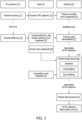
- FIG. 2 illustrates example operations of the homomorphic encryption operation apparatus illustrated in FIG. 1 .
- the phrase "the homomorphic encryption operation apparatus" refers to a variety of apparatuses as may be implemented according to the examples described herein; the phrase does not refer to a single specific apparatus but rather refers varying embodiments of a generic apparatus.
- a processor may perform a blind rotation operation by using automorphism.
- the processor 200 may change an LWE ciphertext vector component based on sizes and characteristics of the LWE ciphertext and the RLWE ciphertext.
- the processor 200 may perform the blind rotation based on the sizes and characteristics of the LWE ciphertext and the RLWE ciphertext.
- the processor 200 may reduce the amount of calculation of the blind rotation operation using automorphism.
- the processor 200 may reduce the size of a public key.
- the processor 200 may perform the blind rotation operation by dividing and replacing N (e.g., N is a natural number) RGSW ciphertexts with N + 1 RLWE' ciphertexts in the blind rotation operation process using automorphism, thereby reducing the size of the entire public key.
- N e.g., N is a natural number
- the ciphertext used by the processor 200 for the homomorphic encryption operation may be defined as below.
- a ciphertext of a message (or plaintext) m may be represented as ⁇ ⁇ ⁇ ⁇ Z q n + 1 .
- LWE s ( m ) will refer to encryption of the message m using a secret key s .
- a ciphertext of the message m may be represented as a b ⁇ R Q 2 .
- RLWE z ( m ) will refer to encryption of the message m using a secret key z.
- the RLWE ciphertext of the message m using the secret key z may be defined as in Equation 1.
- RLWE m a , a ⁇ z + e + m
- a represents a polynomial on Modulus Q and e represents an error polynomial having a small coefficient.
- a and e may be randomly generated.
- the RLWE' ciphertext of the message m with respect to the secret key s may be defined as in Equation 2.
- RLWE ′ m RLWE g 0 ⁇ m , RLWE g 1 ⁇ m , ... , RLWE g d ⁇ 1 ⁇ m
- the RGSW ciphertext of the message m for the secret key s may be defined by Equation 3 in terms of two RLWE' ciphertexts.
- RGSW m RLWE ′ ⁇ zm , RLWE ′ m
- the homomorphic encryption operation performed by the processor 200 may be defined as below.
- the automorphism ⁇ t of a polynomial ring may output a ( X t ) with respect to an element a ( X ) of the polynomial ring, and spaces of the domain and the co-domain may be the same.
- the processor 200 may output a X t , b X t ⁇ R Q 2 for an input a X , b X ⁇ R Q 2 through the automorphism operation.
- the processor 200 may obtain a ciphertext corresponding to a new secret key z 2 from a ciphertext corresponding to a secret key z 1 through a key switching operation.
- the processor 200 may perform the blind rotation operation.
- the processor 200 may reduce the size of the public key and the computational amount involved in the blind rotation process described above.
- the processor 200 may analyze the automorphism existing in the homomorphic encryption using a key switching key and the blind rotation key for the automorphism operation to minimize the computational amount.
- the blind rotation key may include RGSW X s i , RGSW X s i + s i + 1 , RGSW X ⁇ s i .
- the processor 200 may generate a new vector ⁇ for performing the blind rotation operation based on each vector component of ⁇ , and based on the comparison result obtained by comparing the range value q of the vector component of the LWE ciphertext and the degree 2N of the RLWE ciphertext.
- the processor 200 may perform the automorphism operation with respect to a vector component ⁇ i of the new vector.
- the processor 200 may perform an increment operation and a key switching operation to uniformly control the number of increment operations, which varies depending on a vector component in an update process.
- the processor 200 may update the RLWE ciphertext through the increment operation.
- the processor 200 may include a key generator 211 and an operator 215.
- an input 213 may represent input data used in the operator 215.
- the key generator 211 and the operator 215 may be implemented in different respective devices.
- the key generator 211 may be implemented on a client, and the operator 215 may be implemented on a server.
- the operator 215 may be, for example, any application, cloud service, or the like that open performs operations on cryptographically secure data.
- the operations shown in Figure 2 while useful if divided between entities as shown, can be divided among more than two computing devices/nodes, may all be performed my one computing device, etc.
- the key generator 211 may generate a secret key.
- the key generator 211 may generate a public key based on the secret key.
- the public key may include a blind rotation key.
- the key generator 211 may generate secret keys of the LWE ciphertext and the RLWE ciphertext.
- the key generator 211 may generate the LWE ciphertext based on the generated secret key.
- the key generator 211 may generate a public key (e.g., a key switching key and a blind rotation key) for performing the automorphism operation, and transmit the public key to the operator 215 together with a first vector component.
- the key switching key may be used to return a result of an automorphism operation to its original value.
- the public key may be transmitted to the operator 215 in a wired or wireless manner.
- the operator 215 may perform preprocessing for allowing the key generator 211 to determine which public key to generate.
- the operator 215 may modify the vector component of the received ciphertext.
- the operator 215 may update an RLWE ciphertext RLWE Q , z ( f ( X )) by receiving the modified vector component and the public key as an input.
- the operator 215 may perform an initial automorphism operation for RLWE Q , z ( f ( X )) as a first step of the update process.
- the operator 215 may generate an intermediate RLWE ciphertext as an operation result of the automorphism.
- the operator 215 may perform the blind rotation operation by performing a blind rotation loop.
- the operator 215 may perform the automorphism operation based on a second vector component 229 and an intermediate vector component 231.
- the second vector component 229 may be used in an intermediate process for calculating an inner product of the first vector component and the secret key.
- the operator 215 may calculate an inner product of the second vector component 229 and the secret key and then calculate the inner product of the first vector component and the secret key through postprocessing.
- the operator 215 may perform a final increment operation based on the intermediate RLWE ciphertext. In other words, the operator 215 may perform additional increment for a portion generated due to a difference between the vectors ⁇ and ⁇ .
- the processor 200 may provide a public key having a small size, regardless of a size of a vector component of a secret key, and may reduce the amount of related computational overhead.
- the processor 200 may perform the blind rotation operation rapidly while maintaining the integrity of the homomorphic encryption using a probability distribution having high security as a Gaussian distribution.
- FIG. 3 illustrates an example of a key generation operation, according to one or more embodiments.
- the key generator may generate a blind rotation key based on a range of a vector component of an operand ciphertext and a degree of an RLWE ciphertext.
- the processor 200 may generate different types of blind rotation keys by comparing the range with the degree.
- q is a natural number that represents a range of a vector component of an operand ciphertext
- 2N represents a degree (e.g., a polynomial degree) of an RLWE ciphertext which may be a representation of a polynomial.
- the key generator 211 may compare q with 2N. In operation 330, when q ⁇ 2N is satisfied, 2 N q ⁇ i is always even. Therefore, the key generator 211 may generate only RGSW( X s i ),RGSW( X - ⁇ s i ) as the blind rotation key.
- the blind rotation operation process using RGSW( X s i ),RGSW( X - ⁇ s i ) as the blind rotation key will be described in detail with reference to FIGS. 7 to 9 .
- the key generator 211 may generate RGSW( X s i ), RGSW( X s i +si+1 ) or RGSW( X s i ), RGSW( X - ⁇ s i ).
- 2N may be always divisible by q. In this case, q and 2N may be a power of 2.
- the blind rotation key is RGSW( X s i ), RGSW( X s i + si +1 ) will be described in detail with reference to FIGS. 4 to 6 .
- the key generator 211 may generate RGSW( X s i ), RGSW( X - ⁇ s i ) as the blind rotation key, in order to reduce the computational amount while preventing an increase of a key size.
- FIG. 4 illustrates an example of a preprocessing operation, according to one or more embodiments.
- the operator may perform the preprocessing.
- the operator 215 may perform the preprocessing based on the range q of the vector component of the operand ciphertext and the degree 2N of the RLWE ciphertext.
- the operator 215 may find an initial vector component, for which the automorphism operation may be performed, among vector components of 2 N q ⁇ ⁇ , and when there is no vector component for the automorphism operation (e.g., when all vector components are even), the operator 215 may generate the new vector ⁇ .
- the operator 215 may add 1 to i.
- the operator 215 may determine whether i is less than N. In operation 419, when i is less than N, the operator 215 may repeat operation 413, and when i is greater than or equal to N, the operator 215 may set i front to 0 and set ⁇ 0 to 2 N q ⁇ 0 ⁇ 1 .
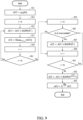
- FIG. 5 illustrates an example 500 of an input ciphertext and a blind rotation key, according to one or more embodiments.
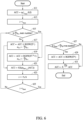
- FIG. 6 illustrates an example of a blind rotation operation, according to one or more embodiments.
- a key generator (e.g., the key generator 211 of FIG. 2 ) may generate RGSW( X s i ), RGSW( X s i + si +1 ) as the blind rotation key and generate an LWE ciphertext as an operand ciphertext.
- the key generator 211 may generate a key switching key and the blind rotation key for the automorphism operation using a secret key S of the LWE ciphertext and a secret key z of the RLWE ciphertext.
- the operator 215 may update a value ⁇ i +1 by performing the automorphism operation, the increment operation, and the key switching operation based on the new vector component ⁇ i and i front obtained in the preprocessing process.
- the operator 215 may perform an initial automorphism operation.
- the operator 215 may represent a function f ( X ) in the form of the RLWE ciphertext for the blind rotation operation.
- the operator 215 may perform the initial automorphism operation by performing the automorphism operation for ⁇ i front ′ , which is the reciprocal of ⁇ i front .
- the operator 215 may perform the automorphism operation for ⁇ i ⁇ i + 1 ′ and perform the key switching operation for restoring the secret key to the original secret key z.
- ⁇ i + 1 ′ may refer to a reciprocal of ⁇ i +1 .
- the operator 215 may increase i and perform the operation for a next index.
- the operator 215 may multiply X ⁇ by a result value.
- the processor 200 may perform n increment operations in total by using the generated public key, and when all vector components are even, the processor 200 may perform n + 1 increment operations. In the increment operation, the processor 200 may perform an operation of RLWE ⁇ RGSW and perform R Q ⁇ RLWE' in n times of key switching operation.
- the public key may include 4n + N - 1 or 4n + q - 1 RLWE' ciphertexts depending on the size of q, and the computational amount may be reduced, since 3n or 3n + 2 operations are performed.
- FIG. 7 illustrates another example of a preprocessing operation, according to one or more embodiments.
- the operator 215 may perform the blind rotation operation efficiently when the number of even-numbered vector components of 2 N q ⁇ ⁇ is larger than the number of odd-numbered vector components.
- the operator 215 may generate ⁇ ⁇ based on the number of even and odd-numbered components and generate a new vector ⁇ to perform the automorphism operation based on each component of ⁇ ⁇ .
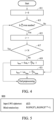
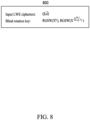
- FIG. 8 illustrates another example 800 of an input ciphertext and a blind rotation key, according to one or more embodiments.
- FIG. 9 illustrates another example of a blind rotation operation, according to one or more embodiments.
- a key generator (e.g., the key generator 211 of FIG. 2 ) may generate a key switching key and a blind rotation key RGSW( X s i ), RGSW( X - ⁇ s i ), respectively, for the automorphism operation based on a secret key S of an LWE ciphertext and a secret key z of an RLWE ciphertext, and may transmit the key switching key and the blind rotation key to an operator (e.g., the operator 215 of FIG. 2 ).
- an operator e.g., the operator 215 of FIG. 2 .
- the operator 215 may efficiently perform the blind rotation operation.
- the operator 215 may perform the automorphism operation, the increment operation, and the key switching operation for a vector component ⁇ i of a modified vector ⁇ generated through the preprocessing process, and may then perform the increment operation for RGSW( X - ⁇ - s i ).
- the operator 215 may perform an initial automorphism operation.
- the operator 215 may represent a function f ( X ) in the form of an RLWE ciphertext and perform the initial automorphism operation by performing the automorphism operation for a reciprocal ⁇ 0 ′ of ⁇ 0 ⁇ .
- the operator 215 may determine a first vector component by replacing i with 0. In operation 915, the operator 215 may perform the increment operation for RGSW( X s i )
- the operator 215 may perform the automorphism operation for ⁇ i ⁇ i + 1 ′ and perform the key switching operation to restore the secret key to the original secret key z.
- ⁇ i + 1 ′ is the reciprocal of ⁇ i +1 .
- the operator 215 may determine whether i is smaller than N. When i is smaller than N, the operator 215 may repeat operation 925. In operation 933, when i is greater than or equal to N, the operator 215 may perform the increment operation for RGSW( X - ⁇ i ).
- a processor may generate a blind rotation key in the form of n + 1 RGSW ciphertexts and a key switching key in the form of N - 1 or q - 1 RLWE' ciphertexts, regardless of the size of the secret key and ⁇ in the homomorphic encryption.
- the number of cases where the vector component of ⁇ ⁇ is an even number may be n 2 , and the operation of RLWE ⁇ RGSW may be performed n + n 2 times in the increment operation. Further, the operation of R Q ⁇ RLWE' may be performed n times in the key switching operation.
- the size of the public key may have the size of 2n + N + 1 or 2n + q + 1 RLWE' ciphertexts according to the size of q, and at most the operation may be performed 4n times.
- the processor 200 may reduce the size and computational amount of the public key through the operation process described above.
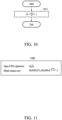
- FIG. 10 illustrates still another example of a preprocessing operation, according to one or more embodiments.
- an operator may perform the blind rotation operation efficiently with respect to an operand ciphertext (e.g., an input LWE ciphertext) ( ⁇ , ⁇ ).
- an operand ciphertext e.g., an input LWE ciphertext
- the operator 215 may generate a modified vector ⁇ using 2 N q ⁇ ⁇ .
- FIG. 11 illustrates still another example 1100 of an input ciphertext and a blind rotation key, according to one or more embodiments.
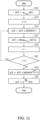
- FIG. 12 illustrates still another example of a blind rotation operation, according to one or more embodiments.
- a key generator (e.g., the key generator 211 of FIG. 2 ) may generate a key switching key and a blind rotation key RGSW( X s i ), RGSW( X - ⁇ s i ), respectively, for the automorphism operation based on a secret key S of an LWE ciphertext and a secret key z of an RLWE ciphertext, and transmit the key switching key and the blind rotation key to an operator (e.g., the operator 215 of FIG. 2 ).
- an operator e.g., the operator 215 of FIG. 2 .
- the example of FIG. 12 may illustrate a process of performing the blind rotation operation when all the vector components of 2 N q ⁇ ⁇ are even numbers.
- the operator 215 may perform the automorphism operation, the increment operation, and the key switching operation for a vector component ⁇ i of a modified vector ⁇ generated through the preprocessing process, and perform the increment operation for RGSW( X - ⁇ s i ).
- the operator 215 may perform an initial automorphism operation.
- the operator 215 may represent a function f ( X ) in the form of an RLWE ciphertext and perform the initial automorphism operation by performing the automorphism operation for the reciprocal ⁇ 0 ′ of ⁇ 0 ⁇ .
- the operator 215 may determine a first vector component by setting i to be 0. In operation 1215, the operator 215 may perform the increment operation for RGSW( X s i ).
- the operator 215 may perform the automorphism operation for ⁇ i ⁇ i + 1 ′ and perform the key switching operation to restore the secret key to the original secret key z.
- ⁇ i + 1 ′ may refer to a reciprocal of ⁇ i +1 .
- the operator 215 may increment i.
- the operator 215 may determine whether i is smaller than N. When i is smaller than N, the operator 215 may repeat operation 1215.
- the operator 215 may perform the increment operation for RGSW( X - ⁇ s i ) to compensate the vector transformation performed in operation 1011 of FIG. 10 .
- the operator 215 may multiply X ⁇ by a result value and end the blind rotation operation.
- a processor may perform the homomorphic encryption operation efficiently when all the vector components of ⁇ are even numbers in the homomorphic encryption or when q ⁇ N and q
- the processor 200 may generate the public key as the blind rotation key in the form of n + 1 RGSW ciphertexts and the key switching key in the form of N - 1 or q RLWE' ciphertexts.
- n + 1 performances of operation RLWE ⁇ RGSW may be required in the increment operation and n performances of operation R Q ⁇ RLWE' may be required in the key switching operation.
- the size of the public key may have the size of 2n + N + 1 or 2n + q + 1 RLWE' ciphertexts according to the size of q, and 3n + 2 times of operation to be performed.
- the processor 200 may reduce the size and associated computational amount of the public key through the process described above.
- FIGS. 13A and 13B illustrate examples 1300A and 1300B of an in-ciphertext and a blind rotation key.
- a processor may generate a public key in the form of an RLWE' ciphertext instead of an RGSW ciphertext.
- the size of the public key transmitted by a key generator (e.g., the key generator 211 of FIG. 2 ) to an operator (e.g., the operator 215 of FIG. 2 ) may be reduced.
- an algorithm 1 of FIG. 14 shows the example of FIGS. 4 to 6 in the form of pseudocode and an algorithm 2 of FIG. 15 shows the example of FIGS. 7 to 9 in the form of pseudocode.
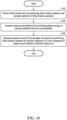
- FIG. 16 illustrates an example of an operation of the homomorphic encryption operation apparatus illustrated in FIG. 1 .
- a receiver may receive a blind rotation key for performing a blind rotation operation and an operand ciphertext of the blind rotation operation.
- the operand ciphertext may be an LWE ciphertext.
- the blind rotation key may include an RGSW ciphertext or an RLWE' ciphertext.
- the blind rotation key may be generated based on a secret key corresponding to the operand ciphertext and a secret key corresponding to the RLWE ciphertext.
- the form of the blind rotation key may be determined by comparing a range of a vector component of the operand ciphertext with a degree of an RLWE ciphertext.
- a processor may generate a preprocessed ciphertext by performing preprocessing on the operand ciphertext based on automorphism.
- the processor 200 may perform preprocessing based on the vector component of the blind rotation key, the range of the vector component of the operand ciphertext, and the degree of the RLWE ciphertext.
- the processor 200 may perform the preprocessing by determining whether a value obtained by multiplying a value, which is obtained by dividing the degree by the range, by the vector component of the blind rotation key is an even number.
- the processor 200 may generate a modified vector by modifying the vector component of the blind rotation key based on a result of determining whether the value obtained by the multiplying is an even number.
- the processor 200 may generate an operation result of the homomorphic encryption by performing the blind rotation operation for the operand ciphertext on a vector component of the preprocessed ciphertext and the blind rotation key.
- the processor 200 may perform the blind rotation operation by performing an increment operation, an automorphism operation, and a key switching operation based on the preprocessed ciphertext.
- the processor 200 may determine the form of a secret key used in the increment operation based on the vector component of the blind rotation key, the range of the vector component of the operand ciphertext, and the degree of the RLWE ciphertext.
- the processor 200 may modify a vector component used in the increment operation based on the vector component of the blind rotation key, the range of the vector component of the operand ciphertext, and the degree of the RLWE ciphertext.
- the processor 200 may perform the automorphism operation based on a component of a modified vector generated by modifying the vector component of the blind rotation key based on a result of determining whether the value obtained by the multiplying is an even number, and based on a reciprocal of the component of the modified vector.
- the processor 200 may perform key switching based on a result of the automorphism operation.
- the computing apparatuses, the processors, the memories, the displays, the information output system and hardware, the storage devices, and other apparatuses, devices, units, modules, and components described herein with respect to FIGS. 1-16 are implemented by or representative of hardware components.
- hardware components that may be used to perform the operations described in this application where appropriate include controllers, sensors, generators, drivers, memories, comparators, arithmetic logic units, adders, subtractors, multipliers, dividers, integrators, and any other electronic components configured to perform the operations described in this application.
- one or more of the hardware components that perform the operations described in this application are implemented by computing hardware, for example, by one or more processors or computers.
- a processor or computer may be implemented by one or more processing elements, such as an array of logic gates, a controller and an arithmetic logic unit, a digital signal processor, a microcomputer, a programmable logic controller, a field-programmable gate array, a programmable logic array, a microprocessor, or any other device or combination of devices that is configured to respond to and execute instructions in a defined manner to achieve a desired result.
- a processor or computer includes, or is connected to, one or more memories storing instructions or software that are executed by the processor or computer.
- Hardware components implemented by a processor or computer may execute instructions or software, such as an operating system (OS) and one or more software applications that run on the OS, to perform the operations described in this application.
- OS operating system
- the hardware components may also access, manipulate, process, create, and store data in response to execution of the instructions or software.
- processor or “computer” may be used in the description of the examples described in this application, but in other examples multiple processors or computers may be used, or a processor or computer may include multiple processing elements, or multiple types of processing elements, or both.
- a single hardware component or two or more hardware components may be implemented by a single processor, or two or more processors, or a processor and a controller.
- One or more hardware components may be implemented by one or more processors, or a processor and a controller, and one or more other hardware components may be implemented by one or more other processors, or another processor and another controller.
- One or more processors may implement a single hardware component, or two or more hardware components.
- a hardware component may have any one or more of different processing configurations, examples of which include a single processor, independent processors, parallel processors, single-instruction single-data (SISD) multiprocessing, single-instruction multiple-data (SIMD) multiprocessing, multiple-instruction single-data (MISD) multiprocessing, and multiple-instruction multiple-data (MIMD) multiprocessing.
- SISD single-instruction single-data
- SIMD single-instruction multiple-data
- MIMD multiple-instruction multiple-data
- FIGS. 1-16 that perform the operations described in this application are performed by computing hardware, for example, by one or more processors or computers, implemented as described above implementing instructions or software to perform the operations described in this application that are performed by the methods.
- a single operation or two or more operations may be performed by a single processor, or two or more processors, or a processor and a controller.
- One or more operations may be performed by one or more processors, or a processor and a controller, and one or more other operations may be performed by one or more other processors, or another processor and another controller.
- One or more processors, or a processor and a controller may perform a single operation, or two or more operations.
- Instructions or software to control computing hardware may be written as computer programs, code segments, instructions or any combination thereof, for individually or collectively instructing or configuring the one or more processors or computers to operate as a machine or special-purpose computer to perform the operations that are performed by the hardware components and the methods as described above.
- the instructions or software include machine code that is directly executed by the one or more processors or computers, such as machine code produced by a compiler.
- the instructions or software includes higher-level code that is executed by the one or more processors or computer using an interpreter.
- the instructions or software may be written using any programming language based on the block diagrams and the flow charts illustrated in the drawings and the corresponding descriptions herein, which disclose algorithms for performing the operations that are performed by the hardware components and the methods as described above.
- the instructions or software to control computing hardware for example, one or more processors or computers, to implement the hardware components and perform the methods as described above, and any associated data, data files, and data structures, may be recorded, stored, or fixed in or on one or more non-transitory computer-readable storage media.
- Examples of a non-transitory computer-readable storage medium include read-only memory (ROM), random-access programmable read only memory (PROM), electrically erasable programmable read-only memory (EEPROM), random-access memory (RAM), dynamic random access memory (DRAM), static random access memory (SRAM), flash memory, non-volatile memory, CD-ROMs, CD-Rs, CD+Rs, CD-RWs, CD+RWs, DVD-ROMs, DVD- Rs, DVD+Rs, DVD-RWs, DVD+RWs, DVD-RAMs, BD-ROMs, BD-Rs, BD-R LTHs, BD-REs, blue-ray or optical disk storage, hard disk drive (HDD), solid state drive (SSD), flash memory, a card type memory such as multimedia card micro or a card (for example, secure digital (SD) or extreme digital (XD)), magnetic tapes, floppy disks, magneto-optical data storage devices, optical data storage devices, hard disks, solid
- the instructions or software and any associated data, data files, and data structures are distributed over network-coupled computer systems so that the instructions and software and any associated data, data files, and data structures are stored, accessed, and executed in a distributed fashion by the one or more processors or computers.
Landscapes
- Engineering & Computer Science (AREA)
- Computer Security & Cryptography (AREA)
- Computer Networks & Wireless Communication (AREA)
- Signal Processing (AREA)
- Computing Systems (AREA)
- Theoretical Computer Science (AREA)
- Physics & Mathematics (AREA)
- Algebra (AREA)
- General Physics & Mathematics (AREA)
- Mathematical Analysis (AREA)
- Mathematical Optimization (AREA)
- Mathematical Physics (AREA)
- Pure & Applied Mathematics (AREA)
- Executing Machine-Instructions (AREA)
Applications Claiming Priority (2)
| Application Number | Priority Date | Filing Date | Title |
|---|---|---|---|
| KR20220013693 | 2022-01-28 | ||
| KR1020220055268A KR20230116641A (ko) | 2022-01-28 | 2022-05-04 | 자기 동형 사상을 이용한 동형 암호 연산 장치 및 방법 |
Publications (1)
| Publication Number | Publication Date |
|---|---|
| EP4221069A1 true EP4221069A1 (fr) | 2023-08-02 |
Family
ID=85132913
Family Applications (1)
| Application Number | Title | Priority Date | Filing Date |
|---|---|---|---|
| EP23153683.0A Pending EP4221069A1 (fr) | 2022-01-28 | 2023-01-27 | Appareil et procédé de chiffrement homomorphe à l'aide d'un automorphisme |
Country Status (2)
| Country | Link |
|---|---|
| US (1) | US20230246807A1 (fr) |
| EP (1) | EP4221069A1 (fr) |
Cited By (1)
| Publication number | Priority date | Publication date | Assignee | Title |
|---|---|---|---|---|
| US12556363B2 (en) * | 2022-02-24 | 2026-02-17 | Seoul National University R&Db Foundation | Method and device for multi-key homomorphic encryption |
Families Citing this family (6)
| Publication number | Priority date | Publication date | Assignee | Title |
|---|---|---|---|---|
| US12432043B2 (en) * | 2021-11-26 | 2025-09-30 | Samsung Electronics Co., Ltd. | Homomorphic encryption apparatus and method |
| US12368569B2 (en) | 2022-10-04 | 2025-07-22 | Samsung Electronics Co., Ltd. | Apparatus and method with homomorphic encryption |
| US12368570B2 (en) | 2022-10-04 | 2025-07-22 | Samsung Electronics Co., Ltd. | Apparatus and method with homomorphic encryption operation |
| CN117093621B (zh) * | 2023-08-10 | 2025-11-25 | 支付宝(杭州)信息技术有限公司 | 保护数据隐私的向量检索方法及装置 |
| US12542650B2 (en) | 2023-10-03 | 2026-02-03 | Bank Of America Corporation | Artificial intelligence (AI) based cloud architecture segmentation leveraging homomorphic encryption |
| CN117527223B (zh) * | 2023-11-30 | 2024-04-16 | 山东大学 | 一种基于格的抗量子密码的分布式解密方法及系统 |
Family Cites Families (1)
| Publication number | Priority date | Publication date | Assignee | Title |
|---|---|---|---|---|
| EP4348925A1 (fr) * | 2021-05-26 | 2024-04-10 | Zama SAS | Calcul sur des valeurs chiffrées par apprentissage avec erreurs (lwe) |
-
2023
- 2023-01-27 EP EP23153683.0A patent/EP4221069A1/fr active Pending
- 2023-01-27 US US18/102,229 patent/US20230246807A1/en active Pending
Non-Patent Citations (6)
| Title |
|---|
| "16th European Conference - Computer Vision - ECCV 2020", vol. 11892, 1 January 2019, CORNELL UNIVERSITY LIBRARY,, 201 Olin Library Cornell University Ithaca, NY 14853, article CRAIG GENTRY ET AL: "Compressible FHE with Applications to PIR : 17th International Conference, TCC 2019, Nuremberg, Germany, December 1–5, 2019, Proceedings, Part II", pages: 438 - 464, XP055659238, DOI: 10.1007/978-3-030-36033-7_17 * |
| ANDREY KIM ET AL: "General Bootstrapping Approach for RLWE-based Homomorphic Encryption", IACR INTERNATIONAL ASSOCIATION FOR CRYPTOLOGIC RESEARCH, vol. 20211015:073818, 15 October 2021 (2021-10-15), pages 1 - 28, XP061069086, [retrieved on 20211015] * |
| ANDREY KIM ET AL: "General Bootstrapping Approach for RLWE-based Homomorphic Encryption", vol. 20210528:091203, 26 May 2021 (2021-05-26), pages 1 - 22, XP061059400, Retrieved from the Internet <URL:https://eprint.iacr.org/2021/691.pdf> [retrieved on 20210526] * |
| BRAKERSKI ZVIKA ZVIK BRK@GMAIL COM ET AL: "(Leveled) Fully Homomorphic Encryption without Bootstrapping", ACM TRANSACTIONS ON COMPUTATION THEORY (TOCT), ACM, 2 PENN PLAZA, SUITE 701 NEW YORK NY 10121-0701 USA, vol. 6, no. 3, 1 July 2014 (2014-07-01), pages 1 - 36, XP058495605, ISSN: 1942-3454, DOI: 10.1145/2633600 * |
| ISHIMAKI YU ET AL: "Faster Homomorphic Trace-Type Function Evaluation", IEEE ACCESS, IEEE, USA, vol. 9, 5 April 2021 (2021-04-05), pages 53061 - 53077, XP011848637, DOI: 10.1109/ACCESS.2021.3071264 * |
| LI RUIQI ET AL: "Homomorphic Modular Reduction and Improved Bootstrapping for BGV Scheme", 18 October 2021, 20211018, PAGE(S) 466 - 484, XP047621613 * |
Cited By (1)
| Publication number | Priority date | Publication date | Assignee | Title |
|---|---|---|---|---|
| US12556363B2 (en) * | 2022-02-24 | 2026-02-17 | Seoul National University R&Db Foundation | Method and device for multi-key homomorphic encryption |
Also Published As
| Publication number | Publication date |
|---|---|
| US20230246807A1 (en) | 2023-08-03 |
Similar Documents
| Publication | Publication Date | Title |
|---|---|---|
| US20230246807A1 (en) | Apparatus and method with homomorphic encryption using automorphism | |
| US11722290B2 (en) | Method and apparatus for modulus refresh in homomorphic encryption | |
| US12432043B2 (en) | Homomorphic encryption apparatus and method | |
| US12231544B2 (en) | Method and apparatus with homomorphic encryption | |
| US12184771B2 (en) | Encryption key generating method, apparatus, ciphertext operation method and apparatus using the generated encryption key | |
| Dridi et al. | Prime factorization using quantum annealing and computational algebraic geometry | |
| US8756410B2 (en) | Polynomial evaluation delegation | |
| EP4436094A1 (fr) | Appareil et procédé pour réamorçage de chiffrement homomorphe | |
| Musanna et al. | Image encryption using quantum 3-D Baker map and generalized gray code coupled with fractional Chen’s chaotic system: F. Musanna, S. Kumar | |
| EP3907926A1 (fr) | Procédé et appareil de chiffrement utilisant le chiffrement homomorphe | |
| US20240313945A1 (en) | Apparatus and method with homomorphic encryption | |
| US20200374103A1 (en) | Apparatus for processing modular multiply operation and methods thereof | |
| JP7449911B2 (ja) | 同型暗号文に対する非多項式演算を行う装置 | |
| US20220052848A1 (en) | Method and apparatus with encryption based on error variance in homomorphic encryption | |
| EP4258591A1 (fr) | Appareil et procédé avec opération de chiffrement homomorphe | |
| US20240340158A1 (en) | Apparatus and method with homomorphic encryption operation | |
| Muthukumar et al. | Synchronization of a novel fractional order stretch-twist-fold (STF) flow chaotic system and its application to a new authenticated encryption scheme (AES) | |
| US12368569B2 (en) | Apparatus and method with homomorphic encryption | |
| EP3264669B1 (fr) | Système et procédé de recherche dans des données chiffrées à l'aide d'un chiffrement homomorphe | |
| US20250106005A1 (en) | Apparatus and method with intersection operation | |
| EP4351079B1 (fr) | Appareil et procédé avec opération de chiffrement homomorphe | |
| Tan et al. | High-precision homomorphic modular reduction for CKKS bootstrapping | |
| US20240273218A1 (en) | Apparatus and method with neural network operation of homomorphic encrypted data | |
| US12483382B2 (en) | Apparatus and method with homomorphic encryption | |
| Shortell et al. | Secure Convolutional Neural Network using FHE |
Legal Events
| Date | Code | Title | Description |
|---|---|---|---|
| PUAI | Public reference made under article 153(3) epc to a published international application that has entered the european phase |
Free format text: ORIGINAL CODE: 0009012 |
|
| STAA | Information on the status of an ep patent application or granted ep patent |
Free format text: STATUS: THE APPLICATION HAS BEEN PUBLISHED |
|
| AK | Designated contracting states |
Kind code of ref document: A1 Designated state(s): AL AT BE BG CH CY CZ DE DK EE ES FI FR GB GR HR HU IE IS IT LI LT LU LV MC ME MK MT NL NO PL PT RO RS SE SI SK SM TR |
|
| STAA | Information on the status of an ep patent application or granted ep patent |
Free format text: STATUS: REQUEST FOR EXAMINATION WAS MADE |
|
| 17P | Request for examination filed |
Effective date: 20240124 |
|
| RBV | Designated contracting states (corrected) |
Designated state(s): AL AT BE BG CH CY CZ DE DK EE ES FI FR GB GR HR HU IE IS IT LI LT LU LV MC ME MK MT NL NO PL PT RO RS SE SI SK SM TR |
|
| P01 | Opt-out of the competence of the unified patent court (upc) registered |
Effective date: 20240530 |
|
| STAA | Information on the status of an ep patent application or granted ep patent |
Free format text: STATUS: EXAMINATION IS IN PROGRESS |
|
| 17Q | First examination report despatched |
Effective date: 20260323 |