EP4221002B1 - Schnittstellenumwandlungsvorrichtung, steuerschaltung, speichermedium und netzwerkkonfigurationsverfahren - Google Patents
Schnittstellenumwandlungsvorrichtung, steuerschaltung, speichermedium und netzwerkkonfigurationsverfahren Download PDFInfo
- Publication number
- EP4221002B1 EP4221002B1 EP20964287.5A EP20964287A EP4221002B1 EP 4221002 B1 EP4221002 B1 EP 4221002B1 EP 20964287 A EP20964287 A EP 20964287A EP 4221002 B1 EP4221002 B1 EP 4221002B1
- Authority
- EP
- European Patent Office
- Prior art keywords
- communication
- interface conversion
- conversion apparatus
- unit
- fluctuation
- Prior art date
- Legal status (The legal status is an assumption and is not a legal conclusion. Google has not performed a legal analysis and makes no representation as to the accuracy of the status listed.)
- Active
Links
Images








Classifications
-
- H—ELECTRICITY
- H04—ELECTRIC COMMUNICATION TECHNIQUE
- H04W—WIRELESS COMMUNICATION NETWORKS
- H04W56/00—Synchronisation arrangements
- H04W56/003—Arrangements to increase tolerance to errors in transmission or reception timing
-
- H—ELECTRICITY
- H04—ELECTRIC COMMUNICATION TECHNIQUE
- H04J—MULTIPLEX COMMUNICATION
- H04J3/00—Time-division multiplex systems
- H04J3/02—Details
- H04J3/14—Monitoring arrangements
-
- H—ELECTRICITY
- H04—ELECTRIC COMMUNICATION TECHNIQUE
- H04J—MULTIPLEX COMMUNICATION
- H04J3/00—Time-division multiplex systems
- H04J3/02—Details
- H04J3/06—Synchronising arrangements
- H04J3/0635—Clock or time synchronisation in a network
- H04J3/0638—Clock or time synchronisation among nodes; Internode synchronisation
- H04J3/0658—Clock or time synchronisation among packet nodes
-
- H—ELECTRICITY
- H04—ELECTRIC COMMUNICATION TECHNIQUE
- H04L—TRANSMISSION OF DIGITAL INFORMATION, e.g. TELEGRAPHIC COMMUNICATION
- H04L41/00—Arrangements for maintenance, administration or management of data switching networks, e.g. of packet switching networks
- H04L41/02—Standardisation; Integration
- H04L41/0226—Mapping or translating multiple network management protocols
-
- H—ELECTRICITY
- H04—ELECTRIC COMMUNICATION TECHNIQUE
- H04L—TRANSMISSION OF DIGITAL INFORMATION, e.g. TELEGRAPHIC COMMUNICATION
- H04L41/00—Arrangements for maintenance, administration or management of data switching networks, e.g. of packet switching networks
- H04L41/08—Configuration management of networks or network elements
- H04L41/0803—Configuration setting
-
- H—ELECTRICITY
- H04—ELECTRIC COMMUNICATION TECHNIQUE
- H04L—TRANSMISSION OF DIGITAL INFORMATION, e.g. TELEGRAPHIC COMMUNICATION
- H04L43/00—Arrangements for monitoring or testing data switching networks
- H04L43/08—Monitoring or testing based on specific metrics, e.g. QoS, energy consumption or environmental parameters
- H04L43/0852—Delays
-
- H—ELECTRICITY
- H04—ELECTRIC COMMUNICATION TECHNIQUE
- H04L—TRANSMISSION OF DIGITAL INFORMATION, e.g. TELEGRAPHIC COMMUNICATION
- H04L43/00—Arrangements for monitoring or testing data switching networks
- H04L43/08—Monitoring or testing based on specific metrics, e.g. QoS, energy consumption or environmental parameters
- H04L43/0852—Delays
- H04L43/087—Jitter
-
- H—ELECTRICITY
- H04—ELECTRIC COMMUNICATION TECHNIQUE
- H04L—TRANSMISSION OF DIGITAL INFORMATION, e.g. TELEGRAPHIC COMMUNICATION
- H04L47/00—Traffic control in data switching networks
- H04L47/50—Queue scheduling
- H04L47/62—Queue scheduling characterised by scheduling criteria
- H04L47/6215—Individual queue per QOS, rate or priority
-
- H—ELECTRICITY
- H04—ELECTRIC COMMUNICATION TECHNIQUE
- H04L—TRANSMISSION OF DIGITAL INFORMATION, e.g. TELEGRAPHIC COMMUNICATION
- H04L67/00—Network arrangements or protocols for supporting network services or applications
- H04L67/01—Protocols
- H04L67/12—Protocols specially adapted for proprietary or special-purpose networking environments, e.g. medical networks, sensor networks, networks in vehicles or remote metering networks
-
- H—ELECTRICITY
- H04—ELECTRIC COMMUNICATION TECHNIQUE
- H04L—TRANSMISSION OF DIGITAL INFORMATION, e.g. TELEGRAPHIC COMMUNICATION
- H04L67/00—Network arrangements or protocols for supporting network services or applications
- H04L67/50—Network services
- H04L67/56—Provisioning of proxy services
- H04L67/565—Conversion or adaptation of application format or content
-
- H—ELECTRICITY
- H04—ELECTRIC COMMUNICATION TECHNIQUE
- H04L—TRANSMISSION OF DIGITAL INFORMATION, e.g. TELEGRAPHIC COMMUNICATION
- H04L67/00—Network arrangements or protocols for supporting network services or applications
- H04L67/50—Network services
- H04L67/60—Scheduling or organising the servicing of application requests, e.g. requests for application data transmissions using the analysis and optimisation of the required network resources
- H04L67/61—Scheduling or organising the servicing of application requests, e.g. requests for application data transmissions using the analysis and optimisation of the required network resources taking into account QoS or priority requirements
-
- H—ELECTRICITY
- H04—ELECTRIC COMMUNICATION TECHNIQUE
- H04L—TRANSMISSION OF DIGITAL INFORMATION, e.g. TELEGRAPHIC COMMUNICATION
- H04L69/00—Network arrangements, protocols or services independent of the application payload and not provided for in the other groups of this subclass
- H04L69/08—Protocols for interworking; Protocol conversion
-
- H—ELECTRICITY
- H04—ELECTRIC COMMUNICATION TECHNIQUE
- H04W—WIRELESS COMMUNICATION NETWORKS
- H04W56/00—Synchronisation arrangements
- H04W56/004—Synchronisation arrangements compensating for timing error of reception due to propagation delay
-
- H—ELECTRICITY
- H04—ELECTRIC COMMUNICATION TECHNIQUE
- H04J—MULTIPLEX COMMUNICATION
- H04J3/00—Time-division multiplex systems
- H04J3/02—Details
- H04J3/06—Synchronising arrangements
- H04J3/0635—Clock or time synchronisation in a network
- H04J3/0638—Clock or time synchronisation among nodes; Internode synchronisation
- H04J3/0658—Clock or time synchronisation among packet nodes
- H04J3/0661—Clock or time synchronisation among packet nodes using timestamps
- H04J3/0667—Bidirectional timestamps, e.g. NTP or PTP for compensation of clock drift and for compensation of propagation delays
Definitions
- the present disclosure relates to an interface conversion apparatus, a control circuit, a storage medium, and a network configuration method for a mobile wireless communication network.
- 5G 5th generation mobile communication
- 3GPP 3rd Generation Partnership Project
- TSC Time-Sensitive Communication
- TSN Time-Sensitive Networking
- IEEE Institute of Electrical and Electronics Engineers
- IEEE 802.1AS IEEE 802.1AS
- IEEE 802.1Qbv IEEE 802.1Qbv
- Patent Literature 1 discloses a technique for the wireless implementation of industrial networks, in which in order to make a 5G system into a logical TSN bridge on an industrial network, fluctuations in data arrival time in all wireless sections are absorbed, and thereafter packets are sent at a predetermined time to another TSN bridge and an endstation that perform communication. This allows the 5G system to be regarded as being in a logical TSN bridge having a fixed intra-apparatus communication delay, making it possible to ensure the required quality of the industrial protocol that uses TSN while treating the 5G system as an apparatus in the TSN network.
- the communication group selection unit 175 selects the communication group of the received packet from the identification information of the received packet with reference to the correspondence relationship between the communication group determined by the adjustment time determination unit 174 and the identification information of the packet. Specifically, the communication group selection unit 175 identifies the TSN communication group to which the Ethernet packet received from the 5G device connection unit 171 belongs, and transfers the Ethernet packet to the communication time adjustment unit 176.
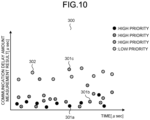
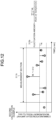
- FIGS. 16 and 17 are diagrams illustrating an example in which the measurement results illustrated in FIG. 10 are classified into communication groups based on the evaluation index information. Note that components identical to those in FIG. 10 are denoted by the same reference signs, and the description thereof will be omitted.
- FIG. 16 illustrates an example in which the measurement results 301a and 301b with "high priority" among the measurement results illustrated in FIG. 10 are classified into a first communication group.
- the time adjustment amount is a first time adjustment amount 310
- the buffer length is a first buffer length.
- FIG. 17 illustrates an example in which the measurement results 301c with "high priority” and the measurement results 302 with "low priority” among the measurement results illustrated in FIG. 10 are classified into a second communication group.
- the time adjustment amount is a second time adjustment amount 311
- the buffer length is a second buffer length.
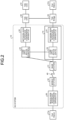
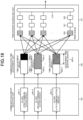
- FIG. 18 is a diagram illustrating an exemplary configuration for connection of communication groups in the data processing unit according to the first embodiment.
- the communication group selection unit 125 internally includes filters 601-1 to 601-n each corresponding to the evaluation index information 500 of one communication group 501.
- n is a natural number of two or more.
- each of the filters 601-1 to 601-n may be collectively referred to as the filter 601 when it is not necessary to distinguish therebetween.
- the filter 601 determines which packet's data identification information 400, among the packet's data identification information 400 registered in each communication group 501 in the communication-group-determination-processing, matches the data identification information 400 of the packet received from the 5G data communication unit 121.
- the filter 601 In response to determining that the packet received from the 5G data communication unit 121 belongs to its communication group 501, the filter 601 transfers the packet as data of its group to the communication time adjustment unit 126. In response to determining that the received packet does not belong to its communication group 501, the filter 601 does not transfer the packet to the communication time adjustment unit 126. In this manner, the communication group selection unit 125 transfers packets to corresponding time adjustment buffers 603-1 to 603-n of the communication time adjustment unit 126 through the filters 601 that are set based on the correspondence relationship between the communication group 501 and the data identification information 400 determined by the adjustment time determination unit 124.
- the communication time adjustment unit 126 internally includes time adjustment groups 602-1 to 602-n and the corresponding time adjustment buffers 603-1 to 603-n, respectively.
- the time adjustment groups 602-1 to 602-n correspond one-to-one to the filters 601-1 to 601-n of the respective communication groups 501 in the communication group selection unit 125.
- the time adjustment buffers 603-1 to 603-n corresponding to the time adjustment groups 602-1 to 602-n each have a length corresponding to the time adjustment amount 505 stored in the evaluation index information 500.
- the communication time adjustment unit 126 performs fluctuation adjustment for each of the time adjustment groups 602-1 to 602-n, and then performs transfer to the send queue 200 of the time-division scheduling unit 127 according to the priority.
- time-division scheduling unit 127 has been described with reference to FIG. 7 and thus is omitted here.
- FIG. 19 is a diagram illustrating another exemplary configuration for connection of communication groups in the data processing unit according to the first embodiment.
- FIG. 19 illustrates a connection configuration in which the time-division scheduling unit 127 is associated with individual communication groups 501. That is, in FIG. 19 , the data processing unit 120 includes time-division scheduling units 127-1 to 127-n for the respective communication groups 501. Stated differently, in FIG. 19 , the n time-division scheduling units 127-1 to 127-n constitute the time-division scheduling unit 127.
- the configuration of each of the time-division scheduling units 127-1 to 127-n is the same as that of the time-division scheduling unit 127 illustrated in FIG. 7 . In FIG.
- packets are sent from each of the time adjustment buffers 603-1 to 603-n of the communication time adjustment unit 126 to any of the send queues 200 of the time-division scheduling unit 127.
- packets are sent from the time adjustment buffers 603-1 to 603-n of the communication time adjustment unit 126 to the send queues 200 of the time-division scheduling units 127-1 to 127-n provided corresponding to the time adjustment buffers 603-1 to 603-n, respectively.
- FIG. 20 is a diagram illustrating an example of a TSN link established on the 5G system by application of communication groups according to the first embodiment.
- the network between the network-side interface conversion apparatus 70 and the device-side interface conversion apparatus 50 in the 5G system 10 includes a plurality of time adjustment groups having different fluctuation adjustment times.
- the time-constrained applications of the TSN bridge 20 and the endstations 21a and 21b can assume that there are a plurality of TSN links 700a, 700b, and 700n having a fixed delay time in the logical TSN bridge of the 5G system 10.
- the description in the first embodiment which focuses on the network-side interface conversion apparatus 70 for the sake of simplicity, also applies to the device-side interface conversion apparatus 50.
- processing for packets sent from the network-side interface conversion apparatus 70 often uses the same radio wave environment, and the technique of the present disclosure is expected to be beneficial to processing of packets transferred from the device-side interface conversion apparatus 50 connected to another mobile station 30 to the device-side interface conversion apparatus 50 via the network-side interface conversion apparatus 70.
- the network-side interface conversion apparatus 70 and the device-side interface conversion apparatus 50 measure and evaluate the communication delay amount and the fluctuation amount of data, and perform grouping into communication lines that are significantly affected by the radio wave environment and communication lines that are not significantly affected by the radio wave environment, thereby implementing control with different fluctuation adjustment times.
- data having the same priority can be classified into different communication groups 501, i.e. a communication group for data with a large communication delay amount and a communication group for data with a small communication delay amount, which are controlled using different fluctuation adjustment times.
- transmission performance can be improved in the mobile wireless communication network 1 including a large number of communication lines having different radio wave environments.
- the first embodiment is based on the premise that the communication delay between the device-side interface conversion apparatus 50 and the network-side interface conversion apparatus 70 can be measured on the mobile wireless communication network 1. However, there may be cases where the communication delay cannot be measured due to network function control or the like.
- the second embodiment a communication group selection method for use in such a situation will be described.
- the communication quality measurement units 123 and 173 measure the fluctuation amount 803 inside the mobile communication system from the difference between the times of input of packets at the interface conversion apparatus serving as a receiving terminal. Note that in the second embodiment, the communication delay amount cannot be directly recognized; however, because priority control based on QoS information, that is, priority, is applied in the mobile wireless communication network 1, the average of communication delay amount is regarded as being equivalent on each communication line, and the influence of the radio wave environment is grasped only with the fluctuation amount.
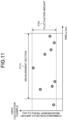
- FIG. 22 is a diagram illustrating an exemplary method of calculating an evaluation value of fluctuation amount from the measurement result of fluctuation amount in the 5G system according to the second embodiment.
- the horizontal axis represents the measurement time
- the vertical axis represents the fluctuation amount measurement result.
- the difference between the maximum value and the minimum value of fluctuation amount from the measurement results in a measurement section 810a is calculated as an evaluation value of fluctuation amount 812a.
- FIG. 23 is a diagram illustrating an exemplary method of calculating an evaluation value of fluctuation amount from the measurement result of fluctuation amount in the 5G system according to the second embodiment.
- the horizontal axis represents the measurement time
- the vertical axis represents the fluctuation amount measurement result.
- a time error 812b from a reference value i.e. an average 811 of measurement results of fluctuation amount in a measurement section 810b
- P i , P i+1 , etc. of fluctuation amount is calculated as an evaluation value P i , P i+1 , etc. of fluctuation amount.
- the median of measurement results of fluctuation amount or the maximum value of the time error 812b may be used, instead of the average 811 of measurement results of fluctuation amount.
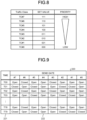
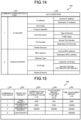
- FIG. 24 is a diagram illustrating an example of evaluation index information for communication-group-determination-processing stored in the memory provided in the network-side interface conversion apparatus according to the second embodiment.
- Evaluation index information 900 in FIG. 24 does not include an item corresponding to the communication delay amount allowable value 503, as compared with the evaluation index information 500 in FIG. 15 according to the first embodiment.
- the evaluation index information 900 is information prescribing, for each communication group 901, conditions of a permitted priority 902 that is an allowable priority and a fluctuation amount allowable value 903 that is an allowable fluctuation amount, and prescribing a time adjustment amount 904 that is a time for adjusting a received packet for each communication group 901.
- the communication groups 901 are arranged in ascending order of the time adjustment amount 904.
- step S15 the adjustment time determination unit 124 acquires the evaluation index information 900 illustrated in FIG. 24 from the memory 113 of the apparatus management unit 110.
- step S17 the adjustment time determination unit 124 determines whether the fluctuation amount measured by the communication quality measurement unit 123 satisfies the fluctuation amount allowable value 903 prescribed for the selected communication group 901. Consequently, the communication group 901 can be selected in step S19.
- the network-side interface conversion apparatus 70 and the device-side interface conversion apparatus 50 measure and evaluate the fluctuation amount of data, and perform grouping into communication lines that are significantly affected by the radio wave environment and communication lines that are not significantly affected by the radio wave environment, thereby implementing control with different fluctuation adjustment times.
- transmission performance concerning an industrial protocol with strict quality requirements can be improved in the mobile wireless communication network 1 including a large number of communication lines having different radio wave environments.
- the external interfaces 100a and 100b are external interfaces.
- the apparatus management unit 110, the data processing unit 120, and the communication unit 130 are implemented by processing circuitry.
- the processing circuitry may be a memory storing a program and a processor that executes the program stored in the memory, or may be dedicated hardware.
- the processing circuitry is also called a control circuit.
- FIG. 25 is a diagram illustrating an exemplary configuration of processing circuitry in the case that the processing circuitry provided in the network-side interface conversion apparatus according to the first and second embodiments is implemented by a processor and a memory.
- the processing circuitry 90 illustrated in FIG. 25 is a control circuit and includes a processor 91 and a memory 92.
- each function of the processing circuitry 90 is implemented by software, firmware, or a combination of software and firmware.
- Software or firmware is described as a program and stored in the memory 92.
- the processor 91 reads and executes the program stored in the memory 92, thereby implementing each function.
- the processing circuitry 90 includes the memory 92 for storing the program that results in the processing of the network-side interface conversion apparatus 70. It can also be said that this program is a program for causing the network-side interface conversion apparatus 70 to execute each function implemented by the processing circuitry 90.
- This program may be provided by a storage medium in which the program is stored, or may be provided by other means such as a communication medium.
- FIG. 26 is a diagram illustrating an exemplary configuration of processing circuitry in the case that the processing circuitry provided in the network-side interface conversion apparatus according to the first and second embodiments is configured by hardware.
- the processing circuitry 93 illustrated in FIG. 26 is a single circuit, a composite circuit, a programmed processor, a parallel programmed processor, an application specific integrated circuit (ASIC), a field-programmable gate array (FPGA), or a combination thereof.
- the processing circuitry 93 may be partially implemented by dedicated hardware, and partially implemented by software or firmware. In this manner, the processing circuitry 93 can implement the above-described functions using dedicated hardware, software, firmware, or a combination thereof.
- the hardware configuration of the network-side interface conversion apparatus 70 described above also applies to the hardware configuration of the device-side interface conversion apparatus 50.
- 1 mobile wireless communication network 10 5G system; 20 TSN bridge; 21 TSN device; 21a, 21b endstation; 30, 30a, 30b, 30c mobile station; 31, 31a, 31b, 31c base station; 32, 33 core apparatus; 40, 40a, 40b, 40c, 41a, 41b wireless signal; 50, 50a, 50b, 50c device-side interface conversion apparatus; 51, 52, 70 network-side interface conversion apparatus; 60 TSNCNC; 61 TSNCUC; 90, 93 processing circuitry; 91 processor; 100a, 100b, 150a, 150b external interface; 110, 160 apparatus management unit; 111, 161 management interface unit; 112, 162 power supply unit; 92, 113, 163 memory; 114, 164 clock management unit; 115, 165 apparatus management function unit; 120, 170 data processing unit; 121 5G data communication unit; 122, 172 clock synchronization unit; 123, 173 communication quality measurement unit; 124, 174 adjustment time determination unit; 125, 175 communication group selection unit
Landscapes
- Engineering & Computer Science (AREA)
- Computer Networks & Wireless Communication (AREA)
- Signal Processing (AREA)
- Environmental & Geological Engineering (AREA)
- Health & Medical Sciences (AREA)
- Computing Systems (AREA)
- General Health & Medical Sciences (AREA)
- Medical Informatics (AREA)
- Computer Security & Cryptography (AREA)
- Data Exchanges In Wide-Area Networks (AREA)
- Mobile Radio Communication Systems (AREA)
Claims (8)
- Schnittstellenkonvertierungsvorrichtung (50; 70), die in einem Mobilkommunikationssystem (1) vorgesehen ist, das Daten gemäß einem Industrieprotokoll überträgt, wobei die Schnittstellenkonvertierungsvorrichtung (50; 70) umfasst:eine Kommunikationsqualitätsmesseinheit (123; 173), die dazu eingerichtet ist, die Kommunikationsqualität innerhalb des Mobilkommunikationssystems (1) zu messen (S14); wobei die Kommunikationsqualität einen Kommunikationsverzögerungsbetrag und einen Schwankungsbetrag umfasst, der eine Variation im Kommunikationsverzögerungsbetrag pro Paket ist;eine Speichereinheit (113; 163), die zum Speichern (S14) von Verlaufsinformationen einschließlich eines Messergebnisses der von der Kommunikationsqualitätsmesseinheit (123; 173) gemessenen Kommunikationsqualität eingerichtet ist;eine Korrekturzeit-Bestimmungseinheit (124; 174), die eingerichtet ist zum: Verweisen auf (S15) Bewertungsindexinformationen, die für jede Kommunikationsgruppe eine zulässige Priorität (502), eine zulässige Variationsbreite des Messergebnisses der erlaubten Kommunikationsqualität (503, 504) und eine Schwankungkorrekturzeit (505) zum Absorbieren einer Schwankung in einer Eintreffzeit eines empfangenen Pakets spezifizieren; Auswählen (S16) einer Kommunikationsgruppe (501) mit der zulässigen Priorität (502), die der Prioritätsinformation entspricht, die dem von einer Datenkommunikationseinheit (121, 171) der Schnittstellenkonvertierungsvorrichtung (50, 70) erfassten (S12) Paket zugewiesen wird; und Bestimmen (S17), ob das aus den Verlaufsinformationen erhaltene Messergebnis der Kommunikationsqualität die für die ausgewählte Kommunikationsgruppe (501) vorgeschriebene zulässige Variationsbreite des Messergebnisses der Kommunikationsqualität erfüllt (503, 504);eine Kommunikationsgruppen-Auswahleinheit (125; 175), die dazu eingerichtet ist, die Kommunikationsgruppe (501) auszuwählen, die der Datenidentifikationsinformation des empfangenen Pakets entspricht, nachdem die ausgewählte Kommunikationsgruppe (501) bestimmt wird; wobei die Datenidentifikationsinformation von der Kommunikationsgruppen-Auswahleinheit (125; 175) aus dem empfangenen Paket erfasst wird (S13) und einen Kommunikationsprotokolltyp (401) und einen Datenidentifikator (402) enthält; undeine Kommunikationszeit-Anpassungseinheit (126; 176), die dazu eingerichtet ist, das für jede Kommunikationsgruppe empfangene Paket in Reaktion auf das Bestimmen (JA in S17), dass der Kommunikationsverzögerungsbetrag und der Schwankungsbetrag die für die ausgewählte Kommunikationsgruppe vorgeschriebenen Bedingungen erfüllen, unter Verwendung der Schwankung-Korrekturzeit in der der Kommunikationsgruppe entsprechenden Bewertungsindexinformation, die von der Korrekturzeit-Bestimmungseinheit (124; 174) bestimmt wird, zu steuern (S19).
- Schnittstellenkonvertierungsvorrichtung (50, 70) nach Anspruch 1, wobeials die Kommunikationsqualität die Kommunikationsqualitätsmesseinheit (123; 173) einen Verzögerungsbetrag innerhalb des Mobilkommunikationssystems (1) misst, der aus einer Differenz zwischen einer Zeit der Ausgabe von einer Schnittstellenkonvertierungsvorrichtung (50; 70), die als ein sendendes Endgerät in dem Mobilkommunikationssystem (1) dient, und einer Zeit der Eingabe von einer Schnittstellenkonvertierungsvorrichtung (50; 70), die als ein empfangendes Endgerät dient, gemessen wird, und einen Schwankungsbetrag des Pakets, der aus dem Verzögerungsbetrag berechnet wird,als den zulässigen Bereich der Kommunikationsqualität, die Bewertungsindexinformation einen zulässigen Wert des Verzögerungsbetrags und einen zulässigen Wert des Schwankungsbetrags enthält, unddie Korrekturzeit-Bestimmungseinheit (124; 174) sich auf die Bewertungsindexinformationen bezieht, um für jeden Satz der Identifikationsinformationen die Kommunikationsgruppe zu bestimmen, in der Messergebnisse des Verzögerungsbetrags und des Schwankungsbetrags, die aus den Verlaufsinformationen erhalten werden, den zulässigen Wert des Verzögerungsbetrags und den zulässigen Wert des Schwankungsbetrags erfüllen.
- Schnittstellenkonvertierungsvorrichtung (50, 70) nach Anspruch 1, wobeidie Kommunikationsqualitätsmesseinheit (123; 173) einen Schwankungsbetrag innerhalb des Mobilkommunikationssystems (1) aus einer Differenz zwischen Zeiten der Eingabe an einer Schnittstellenkonvertierungsvorrichtung (50; 70) misst, die als ein empfangendes Endgerät in dem Mobilkommunikationssystem (1) dient,als zulässigen Bereich der Kommunikationsqualität die Bewertungsindexinformation einen zulässigen Wert der Schwankung enthält, unddie Korrekturzeit-Bestimmungseinheit (124; 174), sich auf die Bewertungsindexinformationen bezieht, um für jeden Satz der Identifikationsinformationen die Kommunikationsgruppe zu bestimmen, in der ein aus der Verlaufsinformationen erhaltener Messwert des Schwankungsbetrags den zulässigen Wert des Schwankungsbetrags erfüllt.
- Schnittstellenkonvertierungsvorrichtung (50; 70) nach einem der Ansprüche 1 bis 3, wobei der zulässige Bereich der Kommunikationsqualität in Abhängigkeit von der Kommunikationsgruppe unterschiedlich ist.
- Schnittstellenkonvertierungsvorrichtung (50; 70) nach einem der Ansprüche 1 bis 4, wobei die Kommunikationsgruppen-Auswahleinheit (125; 175) die kommunikationsgruppenbezogene Paketverarbeitung einer anderen Schnittstellenkonvertierungsvorrichtung (50; 70) zuweist, die an einem geographisch anderen Ort vorgesehen ist.
- Steuerschaltung (90) zum Steuern einer Schnittstellenkonvertierungsvorrichtung (50; 70), die in einem Mobilkommunikationssystem (1) vorgesehen ist, das Daten gemäß einem Industrieprotokoll überträgt, wobei die Steuerschaltung (90) die Schnittstellenkonvertierungsvorrichtung (50; 70) veranlasst zum:Messen (S14) der Kommunikationsqualität innerhalb des Mobilkommunikationssystems (1); wobei die Kommunikationsqualität einen Kommunikationsverzögerungsbetrag und einen Schwankungsbetrag umfasst, der eine Variation im Kommunikationsverzögerungsbetrag pro Paket ist;Speichern (S14) von Verlaufsinformationen einschließlich eines Messergebnisses der gemessenen Kommunikationsqualität;Bezugnehmen (S15) auf Bewertungsindexinformationen, die für jede Kommunikationsgruppe eine zulässige Priorität (502), eine zulässige Variationsbreite des Messergebnisses der Kommunikationsqualität (503, 504) und eine Schwankungs-Korrekturzeit (505) zum Absorbieren einer Schwankung in einer Eintreffzeit eines empfangenen Pakets spezifizieren, und Auswählen (S16) einer Kommunikationsgruppe (501) mit der zulässigen Priorität (502), die den dem erfassten Paket (S12) zugewiesenen Prioritätsinformationen entspricht;und Bestimmen (S17), ob das aus den Verlaufsinformationen erhaltene Messergebnis der Kommunikationsqualität die für die ausgewählte Kommunikationsgruppe (501) vorgeschriebene zulässige Variationsbreite des Messergebnisses der Kommunikationsqualität erfüllt (503, 504);Auswählen der Kommunikationsgruppe, die der Datenidentifikationsinformation des empfangenen Pakets entspricht, nachdem die ausgewählte Kommunikationsgruppe (501) bestimmt wird; wobei die Datenidentifikationsinformation aus dem empfangenen Paket gewonnen wird (S13) und einen Kommunikationsprotokolltyp (401) und einen Datenidentifikator (402) enthält; undSteuern (S19) des für jede Kommunikationsgruppe empfangenen Pakets in Reaktion auf das Bestimmen (JA in S17), dass der Kommunikationsverzögerungsbetrag und der Schwankungsbetrag die für die ausgewählte Kommunikationsgruppe vorgeschriebenen Bedingungen erfüllen, unter Verwendung der Schwankungskorrekturzeit in den der bestimmten Kommunikationsgruppe entsprechenden Bewertungsindexinformationen.
- Speichermedium (92), das ein Programm zum Steuern einer Schnittstellenkonvertierungsvorrichtung (50; 70) speichert, die in einem Mobilkommunikationssystem (1) vorgesehen ist, das Daten gemäß einem Industrieprotokoll überträgt, wobei das Programm die Schnittstellenkonvertierungsvorrichtung (50; 70) veranlasst zum:Messen (S14) der Kommunikationsqualität innerhalb des Mobilkommunikationssystems (1); wobei die Kommunikationsqualität einen Kommunikationsverzögerungsbetrag und einen Schwankungsbetrag umfasst, der eine Variation im Kommunikationsverzögerungsbetrag pro Paket ist;Speichern (S14) von Verlaufsinformationen einschließlich eines Messergebnisses der gemessenen Kommunikationsqualität;Bezugnehmen (S15) auf Bewertungsindexinformationen, die für jede Kommunikationsgruppe eine zulässige Priorität (502), eine zulässige Variationsbreite des Messergebnisses der Kommunikationsqualität (503, 504) und eine Schwankungskorrekturzeit (505) zum Absorbieren einer Schwankung in einer Eintreffzeit eines empfangenen Pakets angeben, und Auswählen (S16) einer Kommunikationsgruppe mit der zulässigen Priorität (502) entsprechend der dem erfassten Paket (S12) zugewiesenen Prioritätsinformationen; und Bestimmen (S17), ob das aus den Verlaufsinformationen erhaltene Messergebnis der Kommunikationsqualität die für die ausgewählte Kommunikationsgruppe (501) vorgeschriebene zulässige Variationsbreite des Messergebnisses der Kommunikationsqualität erfüllt (503, 504);Auswählen der Kommunikationsgruppe, die der Datenidentifikationsinformation des empfangenen Pakets entspricht, nachdem die ausgewählte Kommunikationsgruppe (501) bestimmt wird; wobei die Datenidentifikationsinformation aus dem empfangenen Paket gewonnen wird (S13) und einen Kommunikationsprotokolltyp (401) und einen Datenidentifikator (402) enthält; undSteuern (S19) des für jede Kommunikationsgruppe empfangenen Pakets in Reaktion auf das Bestimmen (JA in S17), dass der Kommunikationsverzögerungsbetrag und der Schwankungsbetrag die für die ausgewählte Kommunikationsgruppe vorgeschriebenen Bedingungen erfüllen, unter Verwendung der Schwankungskorrekturzeit in den der bestimmten Kommunikationsgruppe entsprechenden Bewertungsindexinformationen.
- Netzwerkkonfigurationsverfahren für eine Schnittstellenkonvertierungsvorrichtung (50; 70), die in einem Mobilkommunikationssystem (1) vorgesehen werden soll, das Daten gemäß einem Industrieprotokoll überträgt, wobei das Netzwerkkonfigurationsverfahren umfasst:einen Schritt des Messens (S14) der Kommunikationsqualität innerhalb des Mobilkommunikationssystems (1) durch eine Kommunikationsqualitätsmesseinheit (123; 173); wobei die Kommunikationsqualität einen Kommunikationsverzögerungsbetrag und einen Schwankungsbetrag umfasst, der eine Variation des Kommunikationsverzögerungsbetrags pro Paket ist;einen Schritt in der Kommunikationsqualitätsmesseinheit (123; 173), bei dem eine Speichereinheit (113; 163) zum Speichern (S14) von Verlaufsinformationen, die ein Messergebnis der von der Kommunikationsqualitätsmesseinheit (123; 173) gemessenen Kommunikationsqualität enthalten, veranlasst wird;einen Schritt, durch eine Korrekturzeit-Bestimmungseinheit (124; 174), zum: Bezugnehmen (S15) auf Bewertungsindexinformationen, die für jede Kommunikationsgruppe eine zulässige Priorität (502), eine zulässige Variationsbreite des Messergebnisses der Kommunikationsqualität (503, 504) und eine Schwankungskorrekturzeit (505) zum Absorbieren einer Schwankung in einer Eintreffzeit eines empfangenen Pakets spezifizieren; und Auswählen (S16) einer Kommunikationsgruppe (501) mit der zulässigen Priorität (502), die der dem erfassten Paket (S12) zugewiesenen Prioritätsinformation entspricht; und Bestimmen (S17), ob das aus den Verlaufsinformationen erhaltene Messergebnis der Kommunikationsqualität die für die ausgewählte Kommunikationsgruppe (501) vorgeschriebene zulässige Variationsbreite des Messergebnisses der zulässigen Kommunikationsqualität (503, 504) erfüllt;einen Schritt des Auswählens der Kommunikationsgruppe, die der Datenidentifikationsinformation des empfangenen Pakets entspricht, durch eine Kommunikationsgruppen-Auswahleinheit (125; 175), nachdem die ausgewählte Kommunikationsgruppe (501) bestimmt wird; wobei die Datenidentifikationsinformation aus dem empfangenen Paket erfasst wird (S13) und einen Kommunikationsprotokolltyp (401) und einen Datenidentifikator (402) enthält; undeinen Schritt der Steuerung (S19) des für jede Kommunikationsgruppe empfangenen Pakets durch eine Kommunikationszeit-Anpassungseinheit (126; 176) als Reaktion auf das Bestimmen (JA in S17), dass der Kommunikationsverzögerungsbetrag und der Schwankungsbetrag die für die ausgewählte Kommunikationsgruppe vorgeschriebenen Bedingungen erfüllen, unter Verwendung der Schwankungskorrekturzeit in der der Kommunikationsgruppe entsprechenden Bewertungsindexinformation, die durch die Korrekturzeit-Bestimmungseinheit (124; 174) bestimmt wird.
Applications Claiming Priority (1)
| Application Number | Priority Date | Filing Date | Title |
|---|---|---|---|
| PCT/JP2020/045074 WO2022118435A1 (ja) | 2020-12-03 | 2020-12-03 | インタフェース変換装置、制御回路、記憶媒体およびネットワーク構成方法 |
Publications (3)
| Publication Number | Publication Date |
|---|---|
| EP4221002A1 EP4221002A1 (de) | 2023-08-02 |
| EP4221002A4 EP4221002A4 (de) | 2023-12-06 |
| EP4221002B1 true EP4221002B1 (de) | 2025-07-09 |
Family
ID=81853044
Family Applications (1)
| Application Number | Title | Priority Date | Filing Date |
|---|---|---|---|
| EP20964287.5A Active EP4221002B1 (de) | 2020-12-03 | 2020-12-03 | Schnittstellenumwandlungsvorrichtung, steuerschaltung, speichermedium und netzwerkkonfigurationsverfahren |
Country Status (5)
| Country | Link |
|---|---|
| US (1) | US12464481B2 (de) |
| EP (1) | EP4221002B1 (de) |
| JP (1) | JP7214062B2 (de) |
| CN (1) | CN116569595B (de) |
| WO (1) | WO2022118435A1 (de) |
Families Citing this family (2)
| Publication number | Priority date | Publication date | Assignee | Title |
|---|---|---|---|---|
| US12532278B2 (en) * | 2022-04-01 | 2026-01-20 | Intel Corporation | Methods and apparatus to provide performance measurements in time-sensitive networks |
| CN118677923B (zh) * | 2024-06-22 | 2024-12-06 | 新驰电气集团有限公司 | 一种物联网监控数据的并网方法、并网箱及其存储介质 |
Family Cites Families (15)
| Publication number | Priority date | Publication date | Assignee | Title |
|---|---|---|---|---|
| JP2007235221A (ja) * | 2006-02-27 | 2007-09-13 | Fujitsu Ltd | 揺らぎ吸収バッファ装置 |
| JP4744332B2 (ja) * | 2006-03-22 | 2011-08-10 | 富士通株式会社 | ゆらぎ吸収バッファ制御装置 |
| WO2008087724A1 (ja) * | 2007-01-18 | 2008-07-24 | Mitsubishi Electric Corporation | 無線通信システム |
| US7921317B2 (en) * | 2008-09-02 | 2011-04-05 | Unisys Corporation | Method and apparatus for synchronizing central processing units in a multiprocessor apparatus |
| JP5369814B2 (ja) * | 2009-03-26 | 2013-12-18 | ソニー株式会社 | 受信装置および受信装置の時刻修正方法 |
| WO2013069176A1 (ja) * | 2011-11-09 | 2013-05-16 | 日本電気株式会社 | 送信装置、送信方法、及びプログラムが格納された非一時的なコンピュータ可読媒体 |
| US9882818B2 (en) * | 2013-09-30 | 2018-01-30 | Apple Inc. | Adjusting a jitter buffer based on inter arrival jitter |
| US10965570B2 (en) * | 2016-08-17 | 2021-03-30 | Nec Corporation | Remote control device, system, method, and recording medium for determining a delay setting value |
| JP6867230B2 (ja) * | 2017-05-26 | 2021-04-28 | 日本電信電話株式会社 | 通信装置 |
| US10623326B2 (en) * | 2018-03-07 | 2020-04-14 | Cisco Technology, Inc. | Jitter compensation along multiple-path deterministic network segment |
| CN110351201B (zh) * | 2018-04-04 | 2021-09-14 | 华为技术有限公司 | 一种数据处理方法及装置 |
| WO2020104005A1 (en) | 2018-11-19 | 2020-05-28 | Nokia Technologies Oy | Signalling of dejittering buffer capabilities for tsn integration |
| US11930392B2 (en) * | 2018-11-20 | 2024-03-12 | Nokia Technologies Oy | Latency-bounded packet delivery in mobile communication system |
| EP3895398B1 (de) | 2018-12-12 | 2024-06-26 | Telefonaktiebolaget Lm Ericsson (Publ) | Kommunikationssystem mit de-jitter-puffer zur jitter-reduzierung |
| CN111262796A (zh) * | 2019-12-31 | 2020-06-09 | 南昌大学 | 一种基于时间敏感型的以太网通信系统及通信方法 |
-
2020
- 2020-12-03 CN CN202080107559.8A patent/CN116569595B/zh active Active
- 2020-12-03 JP JP2022557921A patent/JP7214062B2/ja active Active
- 2020-12-03 WO PCT/JP2020/045074 patent/WO2022118435A1/ja not_active Ceased
- 2020-12-03 EP EP20964287.5A patent/EP4221002B1/de active Active
-
2023
- 2023-03-23 US US18/189,015 patent/US12464481B2/en active Active
Also Published As
| Publication number | Publication date |
|---|---|
| JPWO2022118435A1 (de) | 2022-06-09 |
| US12464481B2 (en) | 2025-11-04 |
| US20230232353A1 (en) | 2023-07-20 |
| JP7214062B2 (ja) | 2023-01-27 |
| EP4221002A1 (de) | 2023-08-02 |
| CN116569595A (zh) | 2023-08-08 |
| WO2022118435A1 (ja) | 2022-06-09 |
| CN116569595B (zh) | 2025-06-13 |
| EP4221002A4 (de) | 2023-12-06 |
Similar Documents
| Publication | Publication Date | Title |
|---|---|---|
| CN112586033B (zh) | 用于通过无线电接入网的时间敏感联网的技术 | |
| US11889342B2 (en) | Method and apparatus for quality of service management | |
| CN116250217B (zh) | 考虑配置时间敏感网络的处理流集合的方法和时间敏感网络系统 | |
| US11432205B2 (en) | Data transmission method, communications apparatus, and user plane function entity | |
| WO2019214810A1 (en) | Management & orchestration aided transparent of 3gpp network into tsn bases industrial network | |
| KR102889399B1 (ko) | Tsn 플로우의 스케줄링 방법, 통신 시스템 및 중앙 네트워크 구성 엔티티 | |
| JP2011525333A (ja) | 異種ネットワーク上でのワイヤレスプロセス通信のためのシステム及び方法 | |
| US12464481B2 (en) | Interface conversion apparatus for a mobile communication system | |
| EP4005171B1 (de) | Integration eines kommunikationsnetzes in einem zeitsensitiven vernetzungssystem | |
| US20220239600A1 (en) | Avoiding jitter in a communication system | |
| Haxhibeqiri et al. | Bringing time-sensitive networking to wireless professional private networks: Filling gaps and bridging the innovation | |
| Trsek | Isochronous Wireless Network for Industrial Automation | |
| Vilgelm et al. | Time slotted channel hopping for smart metering: Measurements and analysis of medium access | |
| Ambrosy et al. | 5G packet delay considerations for different 5G-TSN communication scenarios | |
| Olvera-Irigoyen et al. | Available bandwidth probing for path selection in heterogeneous home networks | |
| Fiore et al. | Multihop multi-channel scheduling for wireless control in WirelessHART networks | |
| Ficzere et al. | 5G public network integration for a real-life PROFINET application | |
| US11252740B2 (en) | Controlling communications in heterogeneous networks | |
| Haxhibeqiri et al. | Safety-related applications over wireless time-sensitive networks | |
| TW202236824A (zh) | 通訊裝置、控制電路、記憶媒體以及通訊品質監視方法 | |
| US12177807B2 (en) | Interface conversion device, control circuit, storage medium, and anomaly detection method | |
| Arslanbenzer et al. | Utilizing lora for control link in software-defined aerial networks: Analysis and implementation | |
| Avila-Campos et al. | Removing the wires in time-sensitive networks | |
| Kirchhof et al. | Improving MAC protocols for wireless industrial networks via packet prioritization and cooperation | |
| TWI775124B (zh) | 物聯網系統、網路裝置與其通信方法 |
Legal Events
| Date | Code | Title | Description |
|---|---|---|---|
| STAA | Information on the status of an ep patent application or granted ep patent |
Free format text: STATUS: THE INTERNATIONAL PUBLICATION HAS BEEN MADE |
|
| PUAI | Public reference made under article 153(3) epc to a published international application that has entered the european phase |
Free format text: ORIGINAL CODE: 0009012 |
|
| STAA | Information on the status of an ep patent application or granted ep patent |
Free format text: STATUS: REQUEST FOR EXAMINATION WAS MADE |
|
| 17P | Request for examination filed |
Effective date: 20230412 |
|
| AK | Designated contracting states |
Kind code of ref document: A1 Designated state(s): AL AT BE BG CH CY CZ DE DK EE ES FI FR GB GR HR HU IE IS IT LI LT LU LV MC MK MT NL NO PL PT RO RS SE SI SK SM TR |
|
| REG | Reference to a national code |
Ref country code: DE Free format text: PREVIOUS MAIN CLASS: H99Z9999999999 Ref legal event code: R079 Ref document number: 602020054436 Country of ref document: DE Ipc: H04J0003060000 |
|
| A4 | Supplementary search report drawn up and despatched |
Effective date: 20231107 |
|
| RIC1 | Information provided on ipc code assigned before grant |
Ipc: H04L 69/08 20220101ALI20231031BHEP Ipc: H04J 3/06 20060101AFI20231031BHEP |
|
| DAV | Request for validation of the european patent (deleted) | ||
| DAX | Request for extension of the european patent (deleted) | ||
| STAA | Information on the status of an ep patent application or granted ep patent |
Free format text: STATUS: EXAMINATION IS IN PROGRESS |
|
| 17Q | First examination report despatched |
Effective date: 20240723 |
|
| GRAP | Despatch of communication of intention to grant a patent |
Free format text: ORIGINAL CODE: EPIDOSNIGR1 |
|
| STAA | Information on the status of an ep patent application or granted ep patent |
Free format text: STATUS: GRANT OF PATENT IS INTENDED |
|
| INTG | Intention to grant announced |
Effective date: 20250211 |
|
| GRAS | Grant fee paid |
Free format text: ORIGINAL CODE: EPIDOSNIGR3 |
|
| GRAA | (expected) grant |
Free format text: ORIGINAL CODE: 0009210 |
|
| STAA | Information on the status of an ep patent application or granted ep patent |
Free format text: STATUS: THE PATENT HAS BEEN GRANTED |
|
| AK | Designated contracting states |
Kind code of ref document: B1 Designated state(s): AL AT BE BG CH CY CZ DE DK EE ES FI FR GB GR HR HU IE IS IT LI LT LU LV MC MK MT NL NO PL PT RO RS SE SI SK SM TR |
|
| REG | Reference to a national code |
Ref country code: GB Ref legal event code: FG4D |
|
| REG | Reference to a national code |
Ref country code: CH Ref legal event code: EP |
|
| REG | Reference to a national code |
Ref country code: IE Ref legal event code: FG4D |
|
| REG | Reference to a national code |
Ref country code: DE Ref legal event code: R096 Ref document number: 602020054436 Country of ref document: DE |
|
| REG | Reference to a national code |
Ref country code: NL Ref legal event code: MP Effective date: 20250709 |
|
| PG25 | Lapsed in a contracting state [announced via postgrant information from national office to epo] |
Ref country code: PT Free format text: LAPSE BECAUSE OF FAILURE TO SUBMIT A TRANSLATION OF THE DESCRIPTION OR TO PAY THE FEE WITHIN THE PRESCRIBED TIME-LIMIT Effective date: 20251110 |
|
| PG25 | Lapsed in a contracting state [announced via postgrant information from national office to epo] |
Ref country code: NL Free format text: LAPSE BECAUSE OF FAILURE TO SUBMIT A TRANSLATION OF THE DESCRIPTION OR TO PAY THE FEE WITHIN THE PRESCRIBED TIME-LIMIT Effective date: 20250709 |
|
| REG | Reference to a national code |
Ref country code: AT Ref legal event code: MK05 Ref document number: 1812868 Country of ref document: AT Kind code of ref document: T Effective date: 20250709 |
|
| PG25 | Lapsed in a contracting state [announced via postgrant information from national office to epo] |
Ref country code: IS Free format text: LAPSE BECAUSE OF FAILURE TO SUBMIT A TRANSLATION OF THE DESCRIPTION OR TO PAY THE FEE WITHIN THE PRESCRIBED TIME-LIMIT Effective date: 20251109 |
|
| PGFP | Annual fee paid to national office [announced via postgrant information from national office to epo] |
Ref country code: DE Payment date: 20251028 Year of fee payment: 6 |
|
| PG25 | Lapsed in a contracting state [announced via postgrant information from national office to epo] |
Ref country code: NO Free format text: LAPSE BECAUSE OF FAILURE TO SUBMIT A TRANSLATION OF THE DESCRIPTION OR TO PAY THE FEE WITHIN THE PRESCRIBED TIME-LIMIT Effective date: 20251009 |
|
| REG | Reference to a national code |
Ref country code: LT Ref legal event code: MG9D |
|
| PG25 | Lapsed in a contracting state [announced via postgrant information from national office to epo] |
Ref country code: AT Free format text: LAPSE BECAUSE OF FAILURE TO SUBMIT A TRANSLATION OF THE DESCRIPTION OR TO PAY THE FEE WITHIN THE PRESCRIBED TIME-LIMIT Effective date: 20250709 |
|
| PG25 | Lapsed in a contracting state [announced via postgrant information from national office to epo] |
Ref country code: FI Free format text: LAPSE BECAUSE OF FAILURE TO SUBMIT A TRANSLATION OF THE DESCRIPTION OR TO PAY THE FEE WITHIN THE PRESCRIBED TIME-LIMIT Effective date: 20250709 |
|
| PG25 | Lapsed in a contracting state [announced via postgrant information from national office to epo] |
Ref country code: HR Free format text: LAPSE BECAUSE OF FAILURE TO SUBMIT A TRANSLATION OF THE DESCRIPTION OR TO PAY THE FEE WITHIN THE PRESCRIBED TIME-LIMIT Effective date: 20250709 |
|
| PGFP | Annual fee paid to national office [announced via postgrant information from national office to epo] |
Ref country code: FR Payment date: 20251117 Year of fee payment: 6 |
|
| PG25 | Lapsed in a contracting state [announced via postgrant information from national office to epo] |
Ref country code: GR Free format text: LAPSE BECAUSE OF FAILURE TO SUBMIT A TRANSLATION OF THE DESCRIPTION OR TO PAY THE FEE WITHIN THE PRESCRIBED TIME-LIMIT Effective date: 20251010 |
|
| PG25 | Lapsed in a contracting state [announced via postgrant information from national office to epo] |
Ref country code: SE Free format text: LAPSE BECAUSE OF FAILURE TO SUBMIT A TRANSLATION OF THE DESCRIPTION OR TO PAY THE FEE WITHIN THE PRESCRIBED TIME-LIMIT Effective date: 20250709 |
|
| PG25 | Lapsed in a contracting state [announced via postgrant information from national office to epo] |
Ref country code: LV Free format text: LAPSE BECAUSE OF FAILURE TO SUBMIT A TRANSLATION OF THE DESCRIPTION OR TO PAY THE FEE WITHIN THE PRESCRIBED TIME-LIMIT Effective date: 20250709 |
|
| PG25 | Lapsed in a contracting state [announced via postgrant information from national office to epo] |
Ref country code: BG Free format text: LAPSE BECAUSE OF FAILURE TO SUBMIT A TRANSLATION OF THE DESCRIPTION OR TO PAY THE FEE WITHIN THE PRESCRIBED TIME-LIMIT Effective date: 20250709 Ref country code: PL Free format text: LAPSE BECAUSE OF FAILURE TO SUBMIT A TRANSLATION OF THE DESCRIPTION OR TO PAY THE FEE WITHIN THE PRESCRIBED TIME-LIMIT Effective date: 20250709 |
|
| PG25 | Lapsed in a contracting state [announced via postgrant information from national office to epo] |
Ref country code: RS Free format text: LAPSE BECAUSE OF FAILURE TO SUBMIT A TRANSLATION OF THE DESCRIPTION OR TO PAY THE FEE WITHIN THE PRESCRIBED TIME-LIMIT Effective date: 20251009 |
|
| PG25 | Lapsed in a contracting state [announced via postgrant information from national office to epo] |
Ref country code: ES Free format text: LAPSE BECAUSE OF FAILURE TO SUBMIT A TRANSLATION OF THE DESCRIPTION OR TO PAY THE FEE WITHIN THE PRESCRIBED TIME-LIMIT Effective date: 20250709 |
|
| PG25 | Lapsed in a contracting state [announced via postgrant information from national office to epo] |
Ref country code: RO Free format text: LAPSE BECAUSE OF FAILURE TO SUBMIT A TRANSLATION OF THE DESCRIPTION OR TO PAY THE FEE WITHIN THE PRESCRIBED TIME-LIMIT Effective date: 20250709 |
|
| PG25 | Lapsed in a contracting state [announced via postgrant information from national office to epo] |
Ref country code: SM Free format text: LAPSE BECAUSE OF FAILURE TO SUBMIT A TRANSLATION OF THE DESCRIPTION OR TO PAY THE FEE WITHIN THE PRESCRIBED TIME-LIMIT Effective date: 20250709 |
|
| PG25 | Lapsed in a contracting state [announced via postgrant information from national office to epo] |
Ref country code: DK Free format text: LAPSE BECAUSE OF FAILURE TO SUBMIT A TRANSLATION OF THE DESCRIPTION OR TO PAY THE FEE WITHIN THE PRESCRIBED TIME-LIMIT Effective date: 20250709 |
|
| PG25 | Lapsed in a contracting state [announced via postgrant information from national office to epo] |
Ref country code: IT Free format text: LAPSE BECAUSE OF FAILURE TO SUBMIT A TRANSLATION OF THE DESCRIPTION OR TO PAY THE FEE WITHIN THE PRESCRIBED TIME-LIMIT Effective date: 20250709 |
|
| PG25 | Lapsed in a contracting state [announced via postgrant information from national office to epo] |
Ref country code: CZ Free format text: LAPSE BECAUSE OF FAILURE TO SUBMIT A TRANSLATION OF THE DESCRIPTION OR TO PAY THE FEE WITHIN THE PRESCRIBED TIME-LIMIT Effective date: 20250709 |
|
| PG25 | Lapsed in a contracting state [announced via postgrant information from national office to epo] |
Ref country code: SK Free format text: LAPSE BECAUSE OF FAILURE TO SUBMIT A TRANSLATION OF THE DESCRIPTION OR TO PAY THE FEE WITHIN THE PRESCRIBED TIME-LIMIT Effective date: 20250709 Ref country code: EE Free format text: LAPSE BECAUSE OF FAILURE TO SUBMIT A TRANSLATION OF THE DESCRIPTION OR TO PAY THE FEE WITHIN THE PRESCRIBED TIME-LIMIT Effective date: 20250709 |
|
| PLBE | No opposition filed within time limit |
Free format text: ORIGINAL CODE: 0009261 |
|
| STAA | Information on the status of an ep patent application or granted ep patent |
Free format text: STATUS: NO OPPOSITION FILED WITHIN TIME LIMIT |