EP4216121A1 - Marine vessel management system - Google Patents
Marine vessel management system Download PDFInfo
- Publication number
- EP4216121A1 EP4216121A1 EP23150143.8A EP23150143A EP4216121A1 EP 4216121 A1 EP4216121 A1 EP 4216121A1 EP 23150143 A EP23150143 A EP 23150143A EP 4216121 A1 EP4216121 A1 EP 4216121A1
- Authority
- EP
- European Patent Office
- Prior art keywords
- marine vessel
- port
- management system
- returning
- terminal device
- Prior art date
- Legal status (The legal status is an assumption and is not a legal conclusion. Google has not performed a legal analysis and makes no representation as to the accuracy of the status listed.)
- Pending
Links
Images



Classifications
-
- G—PHYSICS
- G07—CHECKING-DEVICES
- G07C—TIME OR ATTENDANCE REGISTERS; REGISTERING OR INDICATING THE WORKING OF MACHINES; GENERATING RANDOM NUMBERS; VOTING OR LOTTERY APPARATUS; ARRANGEMENTS, SYSTEMS OR APPARATUS FOR CHECKING NOT PROVIDED FOR ELSEWHERE
- G07C5/00—Registering or indicating the working of vehicles
- G07C5/08—Registering or indicating performance data other than driving, working, idle, or waiting time, with or without registering driving, working, idle or waiting time
- G07C5/0816—Indicating performance data, e.g. occurrence of a malfunction
- G07C5/0825—Indicating performance data, e.g. occurrence of a malfunction using optical means
-
- G—PHYSICS
- G06—COMPUTING OR CALCULATING; COUNTING
- G06Q—INFORMATION AND COMMUNICATION TECHNOLOGY [ICT] SPECIALLY ADAPTED FOR ADMINISTRATIVE, COMMERCIAL, FINANCIAL, MANAGERIAL OR SUPERVISORY PURPOSES; SYSTEMS OR METHODS SPECIALLY ADAPTED FOR ADMINISTRATIVE, COMMERCIAL, FINANCIAL, MANAGERIAL OR SUPERVISORY PURPOSES, NOT OTHERWISE PROVIDED FOR
- G06Q10/00—Administration; Management
- G06Q10/06—Resources, workflows, human or project management; Enterprise or organisation planning; Enterprise or organisation modelling
- G06Q10/063—Operations research, analysis or management
- G06Q10/0631—Resource planning, allocation, distributing or scheduling for enterprises or organisations
- G06Q10/06316—Sequencing of tasks or work
-
- B—PERFORMING OPERATIONS; TRANSPORTING
- B63—SHIPS OR OTHER WATERBORNE VESSELS; RELATED EQUIPMENT
- B63B—SHIPS OR OTHER WATERBORNE VESSELS; EQUIPMENT FOR SHIPPING
- B63B79/00—Monitoring properties or operating parameters of vessels in operation
- B63B79/10—Monitoring properties or operating parameters of vessels in operation using sensors, e.g. pressure sensors, strain gauges or accelerometers
-
- B—PERFORMING OPERATIONS; TRANSPORTING
- B63—SHIPS OR OTHER WATERBORNE VESSELS; RELATED EQUIPMENT
- B63B—SHIPS OR OTHER WATERBORNE VESSELS; EQUIPMENT FOR SHIPPING
- B63B79/00—Monitoring properties or operating parameters of vessels in operation
- B63B79/30—Monitoring properties or operating parameters of vessels in operation for diagnosing, testing or predicting the integrity or performance of vessels
-
- G—PHYSICS
- G06—COMPUTING OR CALCULATING; COUNTING
- G06Q—INFORMATION AND COMMUNICATION TECHNOLOGY [ICT] SPECIALLY ADAPTED FOR ADMINISTRATIVE, COMMERCIAL, FINANCIAL, MANAGERIAL OR SUPERVISORY PURPOSES; SYSTEMS OR METHODS SPECIALLY ADAPTED FOR ADMINISTRATIVE, COMMERCIAL, FINANCIAL, MANAGERIAL OR SUPERVISORY PURPOSES, NOT OTHERWISE PROVIDED FOR
- G06Q30/00—Commerce
- G06Q30/06—Buying, selling or leasing transactions
- G06Q30/0645—Rental transactions; Leasing transactions
-
- G—PHYSICS
- G06—COMPUTING OR CALCULATING; COUNTING
- G06Q—INFORMATION AND COMMUNICATION TECHNOLOGY [ICT] SPECIALLY ADAPTED FOR ADMINISTRATIVE, COMMERCIAL, FINANCIAL, MANAGERIAL OR SUPERVISORY PURPOSES; SYSTEMS OR METHODS SPECIALLY ADAPTED FOR ADMINISTRATIVE, COMMERCIAL, FINANCIAL, MANAGERIAL OR SUPERVISORY PURPOSES, NOT OTHERWISE PROVIDED FOR
- G06Q50/00—Information and communication technology [ICT] specially adapted for implementation of business processes of specific business sectors, e.g. utilities or tourism
- G06Q50/10—Services
-
- G—PHYSICS
- G07—CHECKING-DEVICES
- G07C—TIME OR ATTENDANCE REGISTERS; REGISTERING OR INDICATING THE WORKING OF MACHINES; GENERATING RANDOM NUMBERS; VOTING OR LOTTERY APPARATUS; ARRANGEMENTS, SYSTEMS OR APPARATUS FOR CHECKING NOT PROVIDED FOR ELSEWHERE
- G07C5/00—Registering or indicating the working of vehicles
- G07C5/008—Registering or indicating the working of vehicles communicating information to a remotely located station
-
- G—PHYSICS
- G05—CONTROLLING; REGULATING
- G05D—SYSTEMS FOR CONTROLLING OR REGULATING NON-ELECTRIC VARIABLES
- G05D1/00—Control of position, course, altitude or attitude of land, water, air or space vehicles, e.g. using automatic pilots
- G05D1/0011—Control of position, course, altitude or attitude of land, water, air or space vehicles, e.g. using automatic pilots associated with a remote control arrangement
- G05D1/0016—Control of position, course, altitude or attitude of land, water, air or space vehicles, e.g. using automatic pilots associated with a remote control arrangement characterised by the operator's input device
Definitions
- the present invention relates to a marine vessel management system that manages a marine vessel used in a rental business.
- a staff member of a rental business operator for example, a staff member of a marina to visually confirm the state of the marine vessel.
- the staff member of the marina needs to not only put the result of the visual confirmation into a checklist on paper but also describe the state of the marine vessel to a marine vessel user who has borrowed the marine vessel.
- the staff member of the rental business operator needs to directly deal with confirming the state of the marine vessel when leaving the port or when returning to the port, there is room for improvement in terms of reducing the burden on the rental business operator.
- a marine vessel management system includes a marine vessel, an information processing apparatus, and a portable terminal device possessed by a marine vessel user.
- the portable terminal device receives information about a state of the marine vessel via the information processing apparatus, and further displays the received information about the state of the marine vessel.
- a marine vessel management system includes a marine vessel, and a portable terminal device possessed by a marine vessel user.
- the portable terminal device receives information about a state of the marine vessel from the marine vessel, and further displays the received information about the state of the marine vessel.
- the portable terminal device when the marine vessel is leaving the port and/or when the marine vessel is returning to the port, since the portable terminal device receives the information about the state of the marine vessel and further displays the received information about the state of the marine vessel, the marine vessel user and the staff member of the marine vessel rental business operator are able to understand the state of the marine vessel by just confirming the portable terminal device. As a result, it is possible to eliminate the need for visual confirmation of the state of the marine vessel performed by the staff member of the marine vessel rental business operator, and it is possible to reduce the burden on the marine vessel rental business operator.
- FIG. 1 is a perspective view of a marine vessel managed by a marine vessel management system according to a preferred embodiment.
- a marine vessel 1 includes a hull 2, and a plurality of, for example, two outboard motors 3 that function as marine vessel propulsion devices and are mounted on the hull 2. It should be noted that the number of the outboard motors 3 provided on the marine vessel 1 is not limited to two, and may be one or three or more.
- the two outboard motors 3 are mounted side by side on the stern of the hull 2.
- Each outboard motor 3 includes an engine 23 (shown in FIG. 3 ) which may be an internal combustion engine functioning as a power source, and obtains a thrust from a propeller (not shown) which is rotated by a driving force of the corresponding engine 23.
- each outboard motor 3 may include an electric motor functioning as the power source, or may include both an engine and an electric motor functioning as the power source.
- a maneuvering seat 4a and a cabin 4b are provided on the bow side, which is the front portion of the hull 2, and storage spaces 4c, which are storage chambers, are provided on the middle portion of the hull 2 or the stern side being the rear portion of the hull 2.
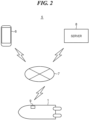
- FIG. 2 is a diagram for explaining a configuration of the marine vessel management system according to the preferred embodiment.
- a marine vessel management system 5 includes the marine vessel 1, a portable terminal device (for example, a smartphone 6) possessed by a marine vessel user who borrows the marine vessel 1, a public communication network (for example, the Internet 7), and a server 8 functioning as an information processing apparatus.
- the marine vessel 1 includes a cellular data communication module 9 (DCM: Data Communication Module) which is a communication terminal.
- DCM Data Communication Module
- a reservation management application for a marine vessel rental service is installed on the server 8, and an application for receiving provision of the marine vessel rental service (hereinafter, referred to as "a rental application") is installed on the smartphone 6.
- the marine vessel user inputs in advance the type of the marine vessel 1 to be borrowed out and the date and time (a borrowing reservation time) on the reservation management application.
- the marine vessel user is able to perform a leaving port procedure on the reservation management application before borrowing out the marine vessel 1 reserved.
- the DCM 9 is a module capable of performing wireless communications conforming to a predetermined communication standard.
- the DCM 9 is a module capable of performing communications conforming to the "International Mobile Telecommunication (IMT)-2000" standard (the so-called 3G standard) defined by the International Telecommunication Union (ITU), communications conforming to the LTE (Long Term Evolution) standard, or communications conforming to the "IMT-Advanced" standard (the so-called 4G standard).
- IMT International Mobile Telecommunication
- 3G International Telecommunication Union
- LTE Long Term Evolution
- 4G communications conforming to the "IMT-Advanced” standard
- the DCM 9 may be a communication module that performs communications conforming to a communication standard other than the communication standards described above.
- the smartphone 6 and the server 8 also perform communications conforming to the 3G standard, communications conforming to the LTE standard, communications conforming to the 4G standard, or communications conforming to one of other communication standards.
- the smartphone 6, the server 8, and the DCM 9 transmit/receive commands and data to/from each other via the Internet 7 by wireless communications conforming to one of the communication standards described above.
- the portable terminal device possessed by the marine vessel user is not limited to the smartphone 6, and may be any information terminal device that is portable and includes a display and an input unit accepting inputs, for example, may be a notebook-sized personal computer or a tablet personal computer.
- FIG. 3 is a block diagram that schematically shows respective components included in the marine vessel 1.
- the marine vessel 1 includes a boat control unit (BCU) 10, a multi-function display (MFD) 11, a remote controller 12, a steering wheel 13, a lock mechanism 14, a bilge water level sensor 15, a vessel speed sensor 16, a G sensor 17, a global positioning system (GPS) 18, a fuel remaining amount sensor 19, an oil remaining amount sensor 20, and a battery voltage sensor 21 that are provided on the hull 2, and further, each outboard motor 3 includes an engine control unit (ECU) 22, the engine 23, a rotation number sensor 24, and an intake air sensor 25.
- BCU boat control unit
- MFD multi-function display
- remote controller a steering wheel 13
- lock mechanism 14 a bilge water level sensor 15
- vessel speed sensor 16 a G sensor 17, a global positioning system (GPS) 18, a fuel remaining amount sensor 19, an oil remaining amount sensor 20, and a battery voltage sensor 21 that are provided on the hull 2
- GPS global positioning system
- the BCU 10 is a main controller of the marine vessel 1, and controls operations of the respective components of the marine vessel 1 according to various kinds of programs.
- the MFD 11 functions as a display that displays various kinds of information, and also functions as a touch panel that accepts inputs from the marine vessel user.
- the remote controller 12 includes levers (not shown) corresponding to the outboard motors 3, respectively. By operating each lever, the marine vessel user is able to switch a direction of the thrust generated by the corresponding outboard motor 3 between a forward moving direction and a backward moving direction, and adjust the output of the corresponding outboard motor 3 so as to adjust a vessel speed of the marine vessel 1.
- the steering wheel 13 is a device that enables the marine vessel user to determine a course of the marine vessel 1.
- the marine vessel user is able to change the orientations of the respective outboard motors 3 that function as a rudder of the marine vessel 1 so as to change an acting direction of the thrust by rotatably operating the steering wheel 13 to the left or right, and thus, it is possible for the marine vessel user to change the course of the marine vessel 1 leftward or rightward.
- the lock mechanism 14 unlocks or locks the cabin 4b and/or the storage spaces 4c of the marine vessel 1.
- the bilge water level sensor 15 measures the amount of water (bilge) accumulated in the bottom of the hull 2.
- the vessel speed sensor 16 measures the vessel speed of the marine vessel 1.
- the G sensor 17 measures a gravitational acceleration acting on the hull 2.
- the GPS 18 measures the position of the marine vessel 1 in the earth coordinate system.
- the fuel remaining amount sensor 19 measures the amount of fuel remaining in a fuel tank (not shown) provided on the hull 2.
- the oil remaining amount sensor 20 measures the amount of engine oil remaining in an engine oil tank (not shown) provided on the outboard motor 3.
- the battery voltage sensor 21 measures a voltage of a battery (not shown) provided on the hull 2.
- the ECU 22 is a controller for the engine 23 and controls the engine 23 according to control signals issued by the BCU 10.
- the rotation number sensor 24 measures a rotation number of the engine 23.
- the intake air sensor 25 measures an intake air amount of the engine 23.
- the respective components 9 to 25 described above are connected to each other by a control area network (CAN) 26 that is a network in which a plurality of nodes are individually connected to a bus.
- CAN control area network
- the measurement results of the components 15 to 21, 24, and 25 are transmitted to the BCU 10.
- the BCU 10 transmits the transmitted measurement results to the server 8 via the Internet 7 by the DCM 9.
- LAN local area network
- Ethernet registered trademark
- FIG. 4 is a flowchart that shows a leaving port processing executed by the marine vessel management system according to the preferred embodiment.
- the leaving port processing is executed in the marine vessel management system 5 when the marine vessel user borrows out the marine vessel 1 from a marina operator being a rental business operator of the marine vessel 1.
- the execution of the leaving port processing is started about a predetermined time before the borrowing reservation time of the marine vessel 1, for example, one hour before the borrowing reservation time.
- the server 8 judges whether or not the leaving port procedure performed by the marine vessel user on the reservation management application or in the marina reception has been completed (a step S401).
- the server 8 causes the smartphone 6 to display or pronounce a message that prompts the leaving port procedure (a step S402), and then the leaving port processing returns to the step S401.
- the server 8 transmits a code functioning as a smart key to the smartphone 6, and further judges whether or not an unlocking instruction to unlock the cabin 4b and/or the storage spaces 4c using the smart key on the rental application of the smartphone 6 has been issued (a step S403).
- the condition for transmitting the smart key to the smartphone 6 is not limited to the completion of the leaving port procedure, and may be the satisfaction of leaving port conditions (conditions related to a wind speed and the climate), or may be that the marine vessel user has approached the marine vessel 1 within a predetermined distance, for example, within 10 meters.
- the leaving port processing returns to the step S403, and waiting for the unlock instruction to be inputted, and on the other hand, in the case that the unlocking instruction has been issued, a command to instruct unlocking of the cabin 4b and/or the storage spaces 4c is transmitted from the server 8 to the BCU 10, and upon receiving the command to instruct unlocking of the cabin 4b and/or the storage spaces 4c, the BCU 10 unlocks the cabin 4b and/or the storage spaces 4c by using the lock mechanism 14 (a step S404).
- a state of the marine vessel 1 is confirmed (a step S405). Specifically, a command to instruct the transmission of the measurement results of the components 15 to 21 and an abnormality history of the engine 23 stored by the ECU 22 (hereinafter, referred to as "leaving port measurement results") is transmitted from the server 8 to the DCM 9, and upon receiving the command to instruct the transmission of the leaving port measurement results (information about the state of the marine vessel), the DCM 9 collects the leaving port measurement results and transmits them to the server 8. It should be noted that the BCU 10 and the ECU 22 may collect the leaving port measurement results and may transmit the collected leaving port measurement results to the server 8 via the DCM 9.
- the server 8 stores the transmitted leaving port measurement results and transmits them to the smartphone 6. In addition, at this time, if the server 8 stores an image obtained by photographing a damaged part on the marine vessel 1 (hereinafter, referred to as "a damaged image"), the server 8 will also transmit the damaged image to the smartphone 6.
- a damaged image an image obtained by photographing a damaged part on the marine vessel 1
- the smartphone 6 displays a leaving port checklist 27, which indicates the state of the marine vessel 1, on the rental application (a step S406).
- FIG. 5 is a diagram that shows an example of the leaving port checklist 27 displayed on the smartphone 6 when the marine vessel 1 is leaving a port.
- the leaving port checklist 27 includes an item 28 indicating whether or not the remaining amount of the engine oil is sufficient, an item 29 indicating whether or not the remaining amount of the fuel is full, an item 30 indicating whether or not the voltage of the battery is sufficient, an item 31 indicating whether or not the water level of the bilge is low enough, an item 32 indicating whether or not the cabin 4b and/or the storage spaces 4c have/has been unlocked, an item 33 indicating whether or not there is no abnormality history of the engine 23, and an item 34 indicating whether or not there is no damaged part on the hull 2.
- the leaving port checklist 27 does not need to include all of the items 28 to 34, and may include at least one of the items 28 to 34.
- Each of the items 28 to 34 is provided with a YES/NO field indicating whether or not the corresponding item is satisfied.
- "NO" part in the YES/NO field is displayed with shading
- "YES” part in the YES/NO field is displayed with shading.
- the leaving port checklist 27 includes a signature field 36 (a confirmation field) into which a signature of the marine vessel user is able to be inputted by using a stylus or the like.
- the signature field 36 is set to a non-inputtable state, and on the other hand, in the case that all of the items 28 to 34 are satisfied (in the case that "NO" parts in the YES/NO fields of all of the items 28 to 34 are displayed with shading), the signature field 36 is set to an inputtable state.
- the signature field 36 is set to the inputtable state.
- the server 8 judges whether or not the signature has been inputted into the signature field 36 of the leaving port checklist 27 (a step S407).
- the leaving port processing returns to the step S407, and on the other hand, in the case that the signature has been inputted into the signature field 36, a command to instruct starting power supply to the engine 23 (unlocking of the engine 23) and starting clocking of a rental time is transmitted from the server 8 to the BCU 10, and upon receiving the command to instruct starting power supply to the engine 23 and starting clocking of the rental time, the BCU 10 transmits a command, which instructs starting power supply to the engine 23, to the ECU 22, and the ECU 22 starts power supply to the engine 23 (a step S408). As a result, the engine 23 is able to be started. Further, the BCU 10 starts clocking of the rental time by using, for example, an internal clock (a step S409), and then ends the leaving port processing.
- FIG. 6 is a flowchart that shows a returning-to-port processing executed by the marine vessel management system according to the preferred embodiment.
- the returning-to-port processing is executed in the marine vessel management system 5 when the marine vessel 1 returns to the marina and the marine vessel user returns the marine vessel 1 to the marina operator.
- the server 8 judges whether or not a check instruction to perform the confirmation of the state of the marine vessel 1 has been inputted on the rental application of the smartphone 6 (a step S601).
- the returning-to-port processing returns to the step S601
- a command to instruct the transmission of the measurement results of the components 15 to 21, and the abnormality history such as overheating of the engine 23, a history of the intake air amount of the engine 23, and a history of the rotation number of the engine 23 that are stored by the ECU 22 (hereinafter, referred to as "returning-to-port measurement results") is transmitted from the server 8 to the DCM 9, and upon receiving the command to instruct the transmission of the returning-to-port measurement results (information about the state of the marine vessel), the DCM 9 collects the returning-to-port measurement results and transmits them to the server 8.
- the BCU 10 and the ECU 22 may collect the returning-to-port measurement results and may transmit the collected returning-to-port measurement results to the server 8 via the DCM 9. Furthermore, the server 8 stores the transmitted returning-to-port measurement results and transmits them to the smartphone 6. As a result, the state of the marine vessel 1 is confirmed and stored (a step S602).
- the smartphone 6 displays a returning-to-port checklist 38, which indicates the state of the marine vessel 1, on the rental application (a step S603).
- FIG. 7 is a diagram that shows an example of the returning-to-port checklist 38 displayed on the smartphone 6 when the marine vessel 1 is returning to the port.
- the returning-to-port checklist 38 includes an item 39 indicating whether or not the remaining amount of the engine oil is sufficient, an item 40 indicating whether or not the remaining amount of the fuel is full, an item 41 indicating whether or not the voltage of the battery is sufficient, an item 42 indicating whether or not the water level of the bilge is low enough, an item 43 indicating whether or not there is no abnormality history of the engine 23, and an item 44 indicating whether or not there is no contact history of the marine vessel 1.
- the returning-to-port checklist 38 does not need to include all of the items 39 to 44, and may include at least one of the items 39 to 44.
- each of the items 39 to 44 is provided with a YES/NO field indicating whether or not the corresponding item is satisfied.
- the returning-to-port checklist 38 includes a lender's signature field 45 (a confirmation field) into which a signature of a staff member of the marina is able to be inputted by using a stylus or the like, and a borrower's signature field 46 (a confirmation field) into which a signature of the marine vessel user is able to be inputted by using a stylus or the like.
- the server 8 judges whether or not there is a contact history of the marine vessel 1, and determines contact parts of foreign objects on the marine vessel 1. For example, in the case that a history of the gravitational acceleration acting on the hull 2 measured by the G sensor 17 includes an abnormal value such as a rapid decrease or a rapid increase, since it is conceivable that a foreign object has come into contact with the hull 2 and a sudden change in speed has occurred, it is judged that the foreign object has come into contact with the hull 2.
- the history of the rotation number of the engine 23 measured by the rotation number sensor 24 and the history of the intake air amount of the engine 23 measured by the intake air sensor 25 includes an abnormal value such as a rapid decrease or a rapid increase, since it is conceivable that a foreign object has come into contact with the propeller and an abnormal rotation of the engine has occurred, it is judged that the foreign object has come into contact with the propeller.
- the navigation trajectory of the marine vessel 1 measured by the GPS 18 includes a sudden course change, since it is conceivable that a foreign object has come into contact with the outboard motor 3 and the orientation of the outboard motor 3 has changed and the sudden course change has occurred, it is judged that the foreign object has come into contact with the outboard motor 3.
- a contact part image an image of a contact part of the foreign object on the hull 2 (hereinafter, referred to as "a contact part image") by photographing the hull 2 (a step S605).
- the server 8 may cause the smartphone 6 to display or pronounce a message that prompts obtaining of the contact part image.
- the server 8 judges whether or not the contact part image has been stored (a step S606).
- the storage of the contact part image in the server 8 is performed by touching a register button 48 after the marine vessel user or the staff member of the marina obtains the contact part image by using a camera provided in the smartphone 6, or the like. It should be noted that when a cancel button 49 is touched after the contact part image is obtained, the contact part image is not stored in the server 8.
- the returning-to-port processing returns to the step S605, and on the other hand, in the case of being judged in the step S606 that the contact part image has been stored, the returning-to-port processing proceeds to a step S607.
- step S607 it is judged whether or not the items that are not satisfied (hereinafter, referred to as "error items") exist in the items 39 to 43 other than the item 44 indicating whether or not there is no contact history of the marine vessel 1.
- error items the items that are not satisfied
- the server 8 notifies the staff member of the marina by a communication means such as a tablet personal computer that the error item exists (a step S608).
- the staff member of the marina who has received the notification confirms the part corresponding to the error item on the marine vessel 1, takes measures against the part corresponding to the error item as necessary (deals with the part corresponding to the error item as necessary), and then notifies the server 8 by a tablet personal computer or the like that the measures have been taken (the part corresponding to the error item has been dealt with).
- step S607 in the case that no error item exists in the items 39 to 43, the returning-to-port processing proceeds to a step S610, and both the lender's signature field 45 and the borrower's signature field 46 are set to the inputtable state. Moreover, in the case that the lender's signature field 45 and the borrower's signature field 46 are not displayed by default and no error item exists in the items 39 to 43, the lender's signature field 45 and the borrower's signature field 46 may be displayed from the beginning.
- the server 8 judges whether or not the signatures have been inputted into both the lender's signature field 45 and the borrower's signature field 46 of the returning-to-port checklist 38 (a step S611). In the case that the signature has not been inputted into at least one of the lender's signature field 45 and the borrower's signature field 46, the returning-to-port processing returns to the step S611. On the other hand, in the case that the signatures have been inputted into both the lender's signature field 45 and the borrower's signature field 46, a command to instruct ending power supply to the engine 23 (locking of the engine 23), locking of the cabin 4b and/or the storage spaces 4c, and ending clocking of the rental time is transmitted from the server 8 to the BCU 10.
- the BCU 10 Upon receiving the command to instruct ending power supply to the engine 23, locking of the cabin 4b and/or the storage spaces 4c, and ending clocking of the rental time, the BCU 10 transmits a command, which instructs ending power supply to the engine 23, to the ECU 22, and the ECU 22 ends power supply to the engine 23 (a step S612). Further, the BCU 10 locks the cabin 4b and/or the storage spaces 4c by using the lock mechanism 14 (a step S613), and then ends clocking of the rental time (a step S614).
- the server 8 calculates a rental fee and transmits the calculated rental fee to the smartphone 6.
- the smartphone 6 displays the transmitted rental fee on the rental application (a step S615).
- the server 8 judges whether or not a payment instruction has been inputted on the rental application by the marine vessel user (a step S616).
- the returning-to-port processing returns to the step S616, and on the other hand, in the case that the payment instruction has been inputted, the rental fee is paid by a predetermined method, for example, by credit card (a step S617), and the returning-to-port processing ends.
- the returning-to-port processing of FIG. 6 in the case that there is the contact history of the foreign object with the hull 2, if the contact part image is not obtained, the returning-to-port processing will not proceed, thus the confirmation of the contact part of the hull 2 is set to perform at a later date, just reminding the staff member of the marina and the marine vessel user that there is the contact history of the marine vessel 1 on the returning-to-port checklist 38, and the returning-to-port processing may proceed even if the contact part image is not obtained. Specifically, the steps S604 to S606 may be removed from the returning-to-port processing of FIG. 6 .
- the returning-to-port processing of FIG. 6 in the case that the error item exists in the items 39 to 43, if the part corresponding to the error item is not dealt with, the returning-to-port processing will not proceed, thus dealing with the part corresponding to the error item is set to perform at a later date, just reminding the staff member of the marina and the marine vessel user that the error item is displayed on the returning-to-port checklist 38, and the returning-to-port processing may proceed even if the part corresponding to the error item is not dealt with.
- the steps S607 to S609 may be removed from the returning-to-port processing of FIG. 6 .
- the calculation and payment of the rental fee is set to perform at a later date, and when the clocking of the rental time ends in the step S614, the returning-to-port processing of FIG. 6 may end.
- the smartphone 6 when the marine vessel 1 is leaving the port, and when the marine vessel 1 is returning to the port, the smartphone 6 receives the leaving port measurement results and the returning-to-port measurement results as the information about the state of the marine vessel 1 from the BCU 10 of the marine vessel 1, and further, based on the received leaving port measurement results and the received returning-to-port measurement results, the smartphone 6 displays the leaving port checklist 27 and the returning-to-port checklist 38 on the rental application. Therefore, the marine vessel user and the staff member of the marina are able to understand the state of the marine vessel 1 by just confirming the smartphone 6. As a result, it is possible to eliminate the need for visual confirmation of the state of the marine vessel 1 performed by the staff member of the rental business operator of the marine vessel 1, and it is possible to reduce the burden on the rental business operator.
- the leaving port measurement results and the returning-to-port measurement results are obtained by measuring by the components 15 to 21, it is possible to eliminate the need to land the marine vessel 1 in order to understand the state of the marine vessel 1. In this respect as well, it is possible to reduce the burden on the rental business operator.
- the server 8 since the server 8 stores the leaving port measurement results and the returning-to-port measurement results, it is possible to simplify the management of the state of the marine vessel 1.
- the checklists are displayed on the smartphone 6
- a checklist on paper may be created in the conventional manner when the marine vessel 1 is leaving the port, and the returning-to-port checklist 38 may be displayed on the smartphone 6 only when the marine vessel 1 is returning to the port
- a checklist on paper may be created in the conventional manner when the marine vessel 1 is returning to the port, and the leaving port checklist 27 may be displayed on the smartphone 6 only when the marine vessel 1 is leaving the port.
- the server 8 executes the reservation management application and transmits the code functioning as the smart key to the smartphone 6
- a server that executes the reservation management application and a server that transmits the code functioning as the smart key to the smartphone 6 may be provided instead of the server 8.
- the smartphone 6 may be a smartphone that the marina lends to the marine vessel user.
- the leaving port checklist 27 and the returning-to-port checklist 38 are displayed in response to the transmission of the leaving port measurement results and the returning-to-port measurement results to the smartphone 6, a QR code (registered trademark) corresponding to the leaving port measurement results and a QR code corresponding to the returning-to-port measurement results may be displayed on the MFD 11, and the leaving port checklist 27 and the returning-to-port checklist 38 may be displayed on the smartphone 6 in response to the marine vessel user reading the QR code corresponding to the leaving port measurement results and the QR code corresponding to the returning-to-port measurement results with the smartphone 6.
- a QR code registered trademark
- the DCM 9 of the marine vessel 1 and the smartphone 6 may communicate directly with each other.
- the DCM 9 and the smartphone 6 communicate with each other by short-range wireless communication such as Wi-Fi or Bluetooth (registered trademark), and the smartphone 6 executes the leaving port processing of FIG. 4 and the returning-to-port processing of FIG. 6 .
- the returning-to-port checklist 38 includes the lender's signature field 45 and the borrower's signature field 46
- the lender's signature field 45 may be configured to be displayed only in the case that there is the contact history of the foreign object with the hull 2 and to need the staff member's input.
- the returning-to-port checklist 38 needs the input of the signatures of both the staff member of the marina and the marine vessel user, the returning-to-port checklist 38 may only need the input of the signature of the marine vessel user.
- the marine vessel 1 in the marine vessel management system 5 includes the outboard motors 3, there is no limitation on the type of the marine vessel in the marine vessel management system 5, and the marine vessel in the marine vessel management system 5 may be a marine vessel equipped with inboard/outboard motors or inboard motors.
Landscapes
- Business, Economics & Management (AREA)
- Engineering & Computer Science (AREA)
- General Physics & Mathematics (AREA)
- Human Resources & Organizations (AREA)
- Physics & Mathematics (AREA)
- Strategic Management (AREA)
- Economics (AREA)
- Accounting & Taxation (AREA)
- Marketing (AREA)
- Theoretical Computer Science (AREA)
- General Business, Economics & Management (AREA)
- Tourism & Hospitality (AREA)
- Ocean & Marine Engineering (AREA)
- Chemical & Material Sciences (AREA)
- Finance (AREA)
- Mechanical Engineering (AREA)
- Combustion & Propulsion (AREA)
- Development Economics (AREA)
- Entrepreneurship & Innovation (AREA)
- Educational Administration (AREA)
- Game Theory and Decision Science (AREA)
- Operations Research (AREA)
- Quality & Reliability (AREA)
- Health & Medical Sciences (AREA)
- General Health & Medical Sciences (AREA)
- Primary Health Care (AREA)
- Management, Administration, Business Operations System, And Electronic Commerce (AREA)
Abstract
Description
- The present invention relates to a marine vessel management system that manages a marine vessel used in a rental business.
- For the purpose of promoting the spread of marine leisure, Yamaha Motor Co., Ltd. is running a marine vessel rental business, for example, a pleasure boat rental business (For example, see "Marine Club Sea Style", [online], Yamaha Motor Co., Ltd., [searched on January 12, 2022], Internet <URL: https://sea-style.yamaha-motor.co.jp/>). In this type of rental business, in principle, although a rental fee is charged according to the using time of a marine vessel, repair costs for damage to the hull of the marine vessel and power source failures (for example, engine failures) that occur while the marine vessel is being rented are also added to the rental fee. Therefore, in the marine vessel rental business, it is important to confirm the state of the marine vessel not only when leaving a port but also when returning to the port.
- However, in order to confirm the state of the marine vessel when leaving the port or when returning to the port, it is necessary for a staff member of a rental business operator, for example, a staff member of a marina to visually confirm the state of the marine vessel. In addition, the staff member of the marina needs to not only put the result of the visual confirmation into a checklist on paper but also describe the state of the marine vessel to a marine vessel user who has borrowed the marine vessel. In other words, since the staff member of the rental business operator needs to directly deal with confirming the state of the marine vessel when leaving the port or when returning to the port, there is room for improvement in terms of reducing the burden on the rental business operator.
- It is the object of the present invention to provide a marine vessel management system that is able to reduce the burden on a marine vessel rental business operator.
- According to the present invention said object is solved by a marine vessel management system having the features of
independent claim 1. Preferred embodiments are laid down in the dependent claims. - According to a preferred embodiment, a marine vessel management system includes a marine vessel, an information processing apparatus, and a portable terminal device possessed by a marine vessel user. When the marine vessel is leaving a port and/or when the marine vessel is returning to the port, the portable terminal device receives information about a state of the marine vessel via the information processing apparatus, and further displays the received information about the state of the marine vessel.
- According to another preferred embodiment, a marine vessel management system includes a marine vessel, and a portable terminal device possessed by a marine vessel user. When the marine vessel is leaving a port and/or when the marine vessel is returning to the port, the portable terminal device receives information about a state of the marine vessel from the marine vessel, and further displays the received information about the state of the marine vessel.
- According to the preferred embodiments, when the marine vessel is leaving the port and/or when the marine vessel is returning to the port, since the portable terminal device receives the information about the state of the marine vessel and further displays the received information about the state of the marine vessel, the marine vessel user and the staff member of the marine vessel rental business operator are able to understand the state of the marine vessel by just confirming the portable terminal device. As a result, it is possible to eliminate the need for visual confirmation of the state of the marine vessel performed by the staff member of the marine vessel rental business operator, and it is possible to reduce the burden on the marine vessel rental business operator.
- The above and other elements, features, steps, characteristics and advantages of the present invention will become more apparent from the following detailed description of the preferred embodiments with reference to the attached drawings.
-
-
FIG. 1 is a perspective view of a marine vessel managed by a marine vessel management system according to a preferred embodiment. -
FIG. 2 is a diagram for explaining a configuration of the marine vessel management system according to the preferred embodiment. -
FIG. 3 is a block diagram that schematically shows respective components included in the marine vessel ofFIG. 1 . -
FIG. 4 is a flowchart that shows a leaving port processing executed by the marine vessel management system according to the preferred embodiment. -
FIG. 5 is a diagram that shows an example of a leaving port checklist displayed on a smartphone when the marine vessel ofFIG. 1 is leaving a port. -
FIG. 6 is a flowchart that shows a returning-to-port processing executed by the marine vessel management system according to the preferred embodiment. -
FIG. 7 is a diagram that shows an example of a returning-to-port checklist displayed on the smartphone when the marine vessel ofFIG. 1 is returning to the port. - Hereinafter, preferred embodiments will be described with reference to the drawings.
-
FIG. 1 is a perspective view of a marine vessel managed by a marine vessel management system according to a preferred embodiment. Amarine vessel 1 includes ahull 2, and a plurality of, for example, twooutboard motors 3 that function as marine vessel propulsion devices and are mounted on thehull 2. It should be noted that the number of theoutboard motors 3 provided on themarine vessel 1 is not limited to two, and may be one or three or more. The twooutboard motors 3 are mounted side by side on the stern of thehull 2. Eachoutboard motor 3 includes an engine 23 (shown inFIG. 3 ) which may be an internal combustion engine functioning as a power source, and obtains a thrust from a propeller (not shown) which is rotated by a driving force of thecorresponding engine 23. It should be noted that eachoutboard motor 3 may include an electric motor functioning as the power source, or may include both an engine and an electric motor functioning as the power source. In addition, in themarine vessel 1, a maneuveringseat 4a and acabin 4b are provided on the bow side, which is the front portion of thehull 2, and storage spaces 4c, which are storage chambers, are provided on the middle portion of thehull 2 or the stern side being the rear portion of thehull 2. -
FIG. 2 is a diagram for explaining a configuration of the marine vessel management system according to the preferred embodiment. As shown inFIG. 2 , a marinevessel management system 5 includes themarine vessel 1, a portable terminal device (for example, a smartphone 6) possessed by a marine vessel user who borrows themarine vessel 1, a public communication network (for example, the Internet 7), and aserver 8 functioning as an information processing apparatus. In addition, themarine vessel 1 includes a cellular data communication module 9 (DCM: Data Communication Module) which is a communication terminal. - In the preferred embodiment, a reservation management application for a marine vessel rental service is installed on the
server 8, and an application for receiving provision of the marine vessel rental service (hereinafter, referred to as "a rental application") is installed on thesmartphone 6. The marine vessel user inputs in advance the type of themarine vessel 1 to be borrowed out and the date and time (a borrowing reservation time) on the reservation management application. In addition, the marine vessel user is able to perform a leaving port procedure on the reservation management application before borrowing out themarine vessel 1 reserved. - The
DCM 9 is a module capable of performing wireless communications conforming to a predetermined communication standard. For example, the DCM 9 is a module capable of performing communications conforming to the "International Mobile Telecommunication (IMT)-2000" standard (the so-called 3G standard) defined by the International Telecommunication Union (ITU), communications conforming to the LTE (Long Term Evolution) standard, or communications conforming to the "IMT-Advanced" standard (the so-called 4G standard). It should be noted that theDCM 9 may be a communication module that performs communications conforming to a communication standard other than the communication standards described above. In addition, as with theDCM 9, thesmartphone 6 and theserver 8 also perform communications conforming to the 3G standard, communications conforming to the LTE standard, communications conforming to the 4G standard, or communications conforming to one of other communication standards. In the preferred embodiment, thesmartphone 6, theserver 8, and the DCM 9 transmit/receive commands and data to/from each other via the Internet 7 by wireless communications conforming to one of the communication standards described above. - It should be noted that the portable terminal device possessed by the marine vessel user is not limited to the
smartphone 6, and may be any information terminal device that is portable and includes a display and an input unit accepting inputs, for example, may be a notebook-sized personal computer or a tablet personal computer. -
FIG. 3 is a block diagram that schematically shows respective components included in themarine vessel 1. As shown inFIG. 3 , themarine vessel 1 includes a boat control unit (BCU) 10, a multi-function display (MFD) 11, aremote controller 12, asteering wheel 13, alock mechanism 14, a bilgewater level sensor 15, avessel speed sensor 16, aG sensor 17, a global positioning system (GPS) 18, a fuel remainingamount sensor 19, an oil remainingamount sensor 20, and abattery voltage sensor 21 that are provided on thehull 2, and further, eachoutboard motor 3 includes an engine control unit (ECU) 22, theengine 23, arotation number sensor 24, and anintake air sensor 25. - The BCU 10 is a main controller of the
marine vessel 1, and controls operations of the respective components of themarine vessel 1 according to various kinds of programs. The MFD 11 functions as a display that displays various kinds of information, and also functions as a touch panel that accepts inputs from the marine vessel user. Theremote controller 12 includes levers (not shown) corresponding to theoutboard motors 3, respectively. By operating each lever, the marine vessel user is able to switch a direction of the thrust generated by thecorresponding outboard motor 3 between a forward moving direction and a backward moving direction, and adjust the output of thecorresponding outboard motor 3 so as to adjust a vessel speed of themarine vessel 1. Thesteering wheel 13 is a device that enables the marine vessel user to determine a course of themarine vessel 1. The marine vessel user is able to change the orientations of therespective outboard motors 3 that function as a rudder of themarine vessel 1 so as to change an acting direction of the thrust by rotatably operating thesteering wheel 13 to the left or right, and thus, it is possible for the marine vessel user to change the course of themarine vessel 1 leftward or rightward. - The
lock mechanism 14 unlocks or locks thecabin 4b and/or the storage spaces 4c of themarine vessel 1. The bilgewater level sensor 15 measures the amount of water (bilge) accumulated in the bottom of thehull 2. Thevessel speed sensor 16 measures the vessel speed of themarine vessel 1. TheG sensor 17 measures a gravitational acceleration acting on thehull 2. TheGPS 18 measures the position of themarine vessel 1 in the earth coordinate system. The fuel remainingamount sensor 19 measures the amount of fuel remaining in a fuel tank (not shown) provided on thehull 2. The oil remainingamount sensor 20 measures the amount of engine oil remaining in an engine oil tank (not shown) provided on theoutboard motor 3. Thebattery voltage sensor 21 measures a voltage of a battery (not shown) provided on thehull 2. - The ECU 22 is a controller for the
engine 23 and controls theengine 23 according to control signals issued by the BCU 10. Therotation number sensor 24 measures a rotation number of theengine 23. Theintake air sensor 25 measures an intake air amount of theengine 23. - In the
marine vessel 1, therespective components 9 to 25 described above are connected to each other by a control area network (CAN) 26 that is a network in which a plurality of nodes are individually connected to a bus. In theCAN 26, the measurement results of thecomponents 15 to 21, 24, and 25 are transmitted to theBCU 10. Also, theBCU 10 transmits the transmitted measurement results to theserver 8 via theInternet 7 by theDCM 9. It should be noted that the respective components of themarine vessel 1 may be connected to each other not by the CAN but by a local area network (LAN) such as Ethernet (registered trademark) that provides connections via a network device, or the respective components may be directly connected to each other. -
FIG. 4 is a flowchart that shows a leaving port processing executed by the marine vessel management system according to the preferred embodiment. The leaving port processing is executed in the marinevessel management system 5 when the marine vessel user borrows out themarine vessel 1 from a marina operator being a rental business operator of themarine vessel 1. In addition, the execution of the leaving port processing is started about a predetermined time before the borrowing reservation time of themarine vessel 1, for example, one hour before the borrowing reservation time. - As shown in
FIG. 4 , first, theserver 8 judges whether or not the leaving port procedure performed by the marine vessel user on the reservation management application or in the marina reception has been completed (a step S401). In the case that the leaving port procedure has not been completed, theserver 8 causes thesmartphone 6 to display or pronounce a message that prompts the leaving port procedure (a step S402), and then the leaving port processing returns to the step S401. On the other hand, in the case that the leaving port procedure has been completed, theserver 8 transmits a code functioning as a smart key to thesmartphone 6, and further judges whether or not an unlocking instruction to unlock thecabin 4b and/or the storage spaces 4c using the smart key on the rental application of thesmartphone 6 has been issued (a step S403). - Moreover, in the leaving port processing, although when the leaving port procedure has been completed, the smart key is transmitted to the
smartphone 6 and the unlocking instruction is able to be issued, the condition for transmitting the smart key to thesmartphone 6 is not limited to the completion of the leaving port procedure, and may be the satisfaction of leaving port conditions (conditions related to a wind speed and the climate), or may be that the marine vessel user has approached themarine vessel 1 within a predetermined distance, for example, within 10 meters. - As a result of the judgement performed in the step S403, in the case that the unlocking instruction has not been issued, the leaving port processing returns to the step S403, and waiting for the unlock instruction to be inputted, and on the other hand, in the case that the unlocking instruction has been issued, a command to instruct unlocking of the
cabin 4b and/or the storage spaces 4c is transmitted from theserver 8 to theBCU 10, and upon receiving the command to instruct unlocking of thecabin 4b and/or the storage spaces 4c, theBCU 10 unlocks thecabin 4b and/or the storage spaces 4c by using the lock mechanism 14 (a step S404). - Next, when at least one of the
cabin 4b and the storage spaces 4c is unlocked, a state of themarine vessel 1 is confirmed (a step S405). Specifically, a command to instruct the transmission of the measurement results of thecomponents 15 to 21 and an abnormality history of theengine 23 stored by the ECU 22 (hereinafter, referred to as "leaving port measurement results") is transmitted from theserver 8 to theDCM 9, and upon receiving the command to instruct the transmission of the leaving port measurement results (information about the state of the marine vessel), theDCM 9 collects the leaving port measurement results and transmits them to theserver 8. It should be noted that theBCU 10 and theECU 22 may collect the leaving port measurement results and may transmit the collected leaving port measurement results to theserver 8 via theDCM 9. Furthermore, theserver 8 stores the transmitted leaving port measurement results and transmits them to thesmartphone 6. In addition, at this time, if theserver 8 stores an image obtained by photographing a damaged part on the marine vessel 1 (hereinafter, referred to as "a damaged image"), theserver 8 will also transmit the damaged image to thesmartphone 6. - Next, based on the transmitted leaving port measurement results, the
smartphone 6 displays a leavingport checklist 27, which indicates the state of themarine vessel 1, on the rental application (a step S406). -
FIG. 5 is a diagram that shows an example of the leavingport checklist 27 displayed on thesmartphone 6 when themarine vessel 1 is leaving a port. As shown inFIG. 5 , the leavingport checklist 27 includes anitem 28 indicating whether or not the remaining amount of the engine oil is sufficient, anitem 29 indicating whether or not the remaining amount of the fuel is full, anitem 30 indicating whether or not the voltage of the battery is sufficient, anitem 31 indicating whether or not the water level of the bilge is low enough, anitem 32 indicating whether or not thecabin 4b and/or the storage spaces 4c have/has been unlocked, anitem 33 indicating whether or not there is no abnormality history of theengine 23, and anitem 34 indicating whether or not there is no damaged part on thehull 2. It should be noted that the leavingport checklist 27 does not need to include all of theitems 28 to 34, and may include at least one of theitems 28 to 34. - Each of the
items 28 to 34 is provided with a YES/NO field indicating whether or not the corresponding item is satisfied. In the case that the corresponding item is satisfied, "NO" part in the YES/NO field is displayed with shading, and on the other hand, in the case that the corresponding item is not satisfied, "YES" part in the YES/NO field is displayed with shading. In addition, in the case that there is a damaged part on thehull 2, not only "YES" part in the YES/NO field of theitem 34 is displayed with shading, but also the damaged image transmitted from theserver 8 is displayed on a damagedpart display frame 35. Further, the leavingport checklist 27 includes a signature field 36 (a confirmation field) into which a signature of the marine vessel user is able to be inputted by using a stylus or the like. - In the leaving
port checklist 27, in the case that even one of theitems 28 to 34 is not satisfied, thesignature field 36 is set to a non-inputtable state, and on the other hand, in the case that all of theitems 28 to 34 are satisfied (in the case that "NO" parts in the YES/NO fields of all of theitems 28 to 34 are displayed with shading), thesignature field 36 is set to an inputtable state. However, in the case that only theitem 34 indicating whether or not there is no damaged part on thehull 2 is not satisfied, when the marine vessel user who confirms the damaged image displayed on the damagedpart display frame 35 and judges that the damaged part shown in the damaged image does not interfere with the navigation of themarine vessel 1 touches anOK button 37, thesignature field 36 is set to the inputtable state. - Next, returning to
FIG. 4 , theserver 8 judges whether or not the signature has been inputted into thesignature field 36 of the leaving port checklist 27 (a step S407). In the case that the signature has not been inputted into thesignature field 36, the leaving port processing returns to the step S407, and on the other hand, in the case that the signature has been inputted into thesignature field 36, a command to instruct starting power supply to the engine 23 (unlocking of the engine 23) and starting clocking of a rental time is transmitted from theserver 8 to theBCU 10, and upon receiving the command to instruct starting power supply to theengine 23 and starting clocking of the rental time, theBCU 10 transmits a command, which instructs starting power supply to theengine 23, to theECU 22, and theECU 22 starts power supply to the engine 23 (a step S408). As a result, theengine 23 is able to be started. Further, theBCU 10 starts clocking of the rental time by using, for example, an internal clock (a step S409), and then ends the leaving port processing. -
FIG. 6 is a flowchart that shows a returning-to-port processing executed by the marine vessel management system according to the preferred embodiment. The returning-to-port processing is executed in the marinevessel management system 5 when themarine vessel 1 returns to the marina and the marine vessel user returns themarine vessel 1 to the marina operator. - As shown in
FIG. 6 , first, theserver 8 judges whether or not a check instruction to perform the confirmation of the state of themarine vessel 1 has been inputted on the rental application of the smartphone 6 (a step S601). In the case that the check instruction has not been inputted, the returning-to-port processing returns to the step S601, and on the other hand, in the case that the check instruction has been inputted, a command to instruct the transmission of the measurement results of thecomponents 15 to 21, and the abnormality history such as overheating of theengine 23, a history of the intake air amount of theengine 23, and a history of the rotation number of theengine 23 that are stored by the ECU 22 (hereinafter, referred to as "returning-to-port measurement results") is transmitted from theserver 8 to theDCM 9, and upon receiving the command to instruct the transmission of the returning-to-port measurement results (information about the state of the marine vessel), theDCM 9 collects the returning-to-port measurement results and transmits them to theserver 8. It should be noted that theBCU 10 and theECU 22 may collect the returning-to-port measurement results and may transmit the collected returning-to-port measurement results to theserver 8 via theDCM 9. Furthermore, theserver 8 stores the transmitted returning-to-port measurement results and transmits them to thesmartphone 6. As a result, the state of themarine vessel 1 is confirmed and stored (a step S602). - Next, based on the transmitted returning-to-port measurement results, the
smartphone 6 displays a returning-to-port checklist 38, which indicates the state of themarine vessel 1, on the rental application (a step S603). -
FIG. 7 is a diagram that shows an example of the returning-to-port checklist 38 displayed on thesmartphone 6 when themarine vessel 1 is returning to the port. As shown inFIG. 7 , the returning-to-port checklist 38 includes anitem 39 indicating whether or not the remaining amount of the engine oil is sufficient, anitem 40 indicating whether or not the remaining amount of the fuel is full, anitem 41 indicating whether or not the voltage of the battery is sufficient, anitem 42 indicating whether or not the water level of the bilge is low enough, anitem 43 indicating whether or not there is no abnormality history of theengine 23, and anitem 44 indicating whether or not there is no contact history of themarine vessel 1. It should be noted that the returning-to-port checklist 38 does not need to include all of theitems 39 to 44, and may include at least one of theitems 39 to 44. - Further, as with the leaving
port checklist 27, each of theitems 39 to 44 is provided with a YES/NO field indicating whether or not the corresponding item is satisfied. Furthermore, the returning-to-port checklist 38 includes a lender's signature field 45 (a confirmation field) into which a signature of a staff member of the marina is able to be inputted by using a stylus or the like, and a borrower's signature field 46 (a confirmation field) into which a signature of the marine vessel user is able to be inputted by using a stylus or the like. - In the marine
vessel management system 5, based on the returning-to-port measurement results, theserver 8 judges whether or not there is a contact history of themarine vessel 1, and determines contact parts of foreign objects on themarine vessel 1. For example, in the case that a history of the gravitational acceleration acting on thehull 2 measured by theG sensor 17 includes an abnormal value such as a rapid decrease or a rapid increase, since it is conceivable that a foreign object has come into contact with thehull 2 and a sudden change in speed has occurred, it is judged that the foreign object has come into contact with thehull 2. In addition, in the case that at least one of the history of the rotation number of theengine 23 measured by therotation number sensor 24 and the history of the intake air amount of theengine 23 measured by theintake air sensor 25 includes an abnormal value such as a rapid decrease or a rapid increase, since it is conceivable that a foreign object has come into contact with the propeller and an abnormal rotation of the engine has occurred, it is judged that the foreign object has come into contact with the propeller. Furthermore, in the case that the navigation trajectory of themarine vessel 1 measured by theGPS 18 includes a sudden course change, since it is conceivable that a foreign object has come into contact with theoutboard motor 3 and the orientation of theoutboard motor 3 has changed and the sudden course change has occurred, it is judged that the foreign object has come into contact with theoutboard motor 3. - Subsequently to the display of the returning-to-
port checklist 38, it is judged whether or not there is a contact history of the foreign object with the hull 2 (a step S604), in the case that there is the contact history of the foreign object with thehull 2, by displaying a damaged part display frame 47 on the returning-to-port checklist 38, thesmartphone 6 prompts obtaining of an image of a contact part of the foreign object on the hull 2 (hereinafter, referred to as "a contact part image") by photographing the hull 2 (a step S605). In addition to the display of the damaged part display frame 47, theserver 8 may cause thesmartphone 6 to display or pronounce a message that prompts obtaining of the contact part image. - Next, the
server 8 judges whether or not the contact part image has been stored (a step S606). The storage of the contact part image in theserver 8 is performed by touching aregister button 48 after the marine vessel user or the staff member of the marina obtains the contact part image by using a camera provided in thesmartphone 6, or the like. It should be noted that when a cancelbutton 49 is touched after the contact part image is obtained, the contact part image is not stored in theserver 8. - In the case of being judged in the step S606 that the contact part image has not been stored, the returning-to-port processing returns to the step S605, and on the other hand, in the case of being judged in the step S606 that the contact part image has been stored, the returning-to-port processing proceeds to a step S607.
- In the step S607, it is judged whether or not the items that are not satisfied (hereinafter, referred to as "error items") exist in the
items 39 to 43 other than theitem 44 indicating whether or not there is no contact history of themarine vessel 1. In the case that even at least one error item exists in theitems 39 to 43 (in the case that "YES" part in the YES/NO field of at least one of theitems 39 to 43 is displayed with shading), theserver 8 notifies the staff member of the marina by a communication means such as a tablet personal computer that the error item exists (a step S608). Here, the staff member of the marina who has received the notification confirms the part corresponding to the error item on themarine vessel 1, takes measures against the part corresponding to the error item as necessary (deals with the part corresponding to the error item as necessary), and then notifies theserver 8 by a tablet personal computer or the like that the measures have been taken (the part corresponding to the error item has been dealt with). - In a step S609 following the step S608, the
server 8 judges whether or not it has been notified that the part corresponding to the error item has been dealt with (the step S609). In the case that it has not been notified that the part corresponding to the error item has been dealt with, the returning-to-port processing returns to the step S609, and waiting for the part corresponding to the error item to be dealt with. On the other hand, in the case that it has been notified that the part corresponding to the error item has been dealt with, the returning-to-port processing returns to the step S607. - In the step S607, in the case that no error item exists in the
items 39 to 43, the returning-to-port processing proceeds to a step S610, and both the lender'ssignature field 45 and the borrower'ssignature field 46 are set to the inputtable state. Moreover, in the case that the lender'ssignature field 45 and the borrower'ssignature field 46 are not displayed by default and no error item exists in theitems 39 to 43, the lender'ssignature field 45 and the borrower'ssignature field 46 may be displayed from the beginning. - Next, the
server 8 judges whether or not the signatures have been inputted into both the lender'ssignature field 45 and the borrower'ssignature field 46 of the returning-to-port checklist 38 (a step S611). In the case that the signature has not been inputted into at least one of the lender'ssignature field 45 and the borrower'ssignature field 46, the returning-to-port processing returns to the step S611. On the other hand, in the case that the signatures have been inputted into both the lender'ssignature field 45 and the borrower'ssignature field 46, a command to instruct ending power supply to the engine 23 (locking of the engine 23), locking of thecabin 4b and/or the storage spaces 4c, and ending clocking of the rental time is transmitted from theserver 8 to theBCU 10. - Upon receiving the command to instruct ending power supply to the
engine 23, locking of thecabin 4b and/or the storage spaces 4c, and ending clocking of the rental time, theBCU 10 transmits a command, which instructs ending power supply to theengine 23, to theECU 22, and theECU 22 ends power supply to the engine 23 (a step S612). Further, theBCU 10 locks thecabin 4b and/or the storage spaces 4c by using the lock mechanism 14 (a step S613), and then ends clocking of the rental time (a step S614). Moreover, even in the case that the signatures have been inputted into both the lender'ssignature field 45 and the borrower'ssignature field 46, it is not necessary to perform all of ending power supply to theengine 23, locking of thecabin 4b, and locking of the storage spaces 4c, and at least one of ending power supply to theengine 23, locking of thecabin 4b, and locking of the storage spaces 4c need only be performed. - Next, based on the rental time that has been clocked, the consumption of the fuel, and the consumption of the engine oil, and in the case that the contact history of the
marine vessel 1 exists, further based on an estimate, etc. of repair costs for damage to thehull 2, etc. due to the contact history of themarine vessel 1, theserver 8 calculates a rental fee and transmits the calculated rental fee to thesmartphone 6. Thesmartphone 6 displays the transmitted rental fee on the rental application (a step S615). - After that, the
server 8 judges whether or not a payment instruction has been inputted on the rental application by the marine vessel user (a step S616). In the case that the payment instruction has not been inputted, the returning-to-port processing returns to the step S616, and on the other hand, in the case that the payment instruction has been inputted, the rental fee is paid by a predetermined method, for example, by credit card (a step S617), and the returning-to-port processing ends. - Moreover, in the returning-to-port processing of
FIG. 6 , in the case that there is the contact history of the foreign object with thehull 2, if the contact part image is not obtained, the returning-to-port processing will not proceed, thus the confirmation of the contact part of thehull 2 is set to perform at a later date, just reminding the staff member of the marina and the marine vessel user that there is the contact history of themarine vessel 1 on the returning-to-port checklist 38, and the returning-to-port processing may proceed even if the contact part image is not obtained. Specifically, the steps S604 to S606 may be removed from the returning-to-port processing ofFIG. 6 . - Furthermore, in the returning-to-port processing of
FIG. 6 , in the case that the error item exists in theitems 39 to 43, if the part corresponding to the error item is not dealt with, the returning-to-port processing will not proceed, thus dealing with the part corresponding to the error item is set to perform at a later date, just reminding the staff member of the marina and the marine vessel user that the error item is displayed on the returning-to-port checklist 38, and the returning-to-port processing may proceed even if the part corresponding to the error item is not dealt with. Specifically, the steps S607 to S609 may be removed from the returning-to-port processing ofFIG. 6 . Furthermore, the calculation and payment of the rental fee is set to perform at a later date, and when the clocking of the rental time ends in the step S614, the returning-to-port processing ofFIG. 6 may end. - According to the preferred embodiment, when the
marine vessel 1 is leaving the port, and when themarine vessel 1 is returning to the port, thesmartphone 6 receives the leaving port measurement results and the returning-to-port measurement results as the information about the state of themarine vessel 1 from theBCU 10 of themarine vessel 1, and further, based on the received leaving port measurement results and the received returning-to-port measurement results, thesmartphone 6 displays the leavingport checklist 27 and the returning-to-port checklist 38 on the rental application. Therefore, the marine vessel user and the staff member of the marina are able to understand the state of themarine vessel 1 by just confirming thesmartphone 6. As a result, it is possible to eliminate the need for visual confirmation of the state of themarine vessel 1 performed by the staff member of the rental business operator of themarine vessel 1, and it is possible to reduce the burden on the rental business operator. - In addition, since it is possible to reduce the burden on the rental business operator, it is possible for the rental business operator to promote labor saving, and since the marine vessel user also does not need to perform visual confirmation in order to confirm the state of the
marine vessel 1, it is also possible to reduce the burden on the marine vessel user. - Moreover, in the preferred embodiment, since the leaving port measurement results and the returning-to-port measurement results are obtained by measuring by the
components 15 to 21, it is possible to eliminate the need to land themarine vessel 1 in order to understand the state of themarine vessel 1. In this respect as well, it is possible to reduce the burden on the rental business operator. In addition, since theserver 8 stores the leaving port measurement results and the returning-to-port measurement results, it is possible to simplify the management of the state of themarine vessel 1. - In the preferred embodiment, although both when the
marine vessel 1 is leaving the port and when themarine vessel 1 is returning to the port, the checklists (the leavingport checklist 27 and the returning-to-port checklist 38) are displayed on thesmartphone 6, a checklist on paper may be created in the conventional manner when themarine vessel 1 is leaving the port, and the returning-to-port checklist 38 may be displayed on thesmartphone 6 only when themarine vessel 1 is returning to the port, alternatively, a checklist on paper may be created in the conventional manner when themarine vessel 1 is returning to the port, and the leavingport checklist 27 may be displayed on thesmartphone 6 only when themarine vessel 1 is leaving the port. - Furthermore, in the preferred embodiment, although the
server 8 executes the reservation management application and transmits the code functioning as the smart key to thesmartphone 6, a server that executes the reservation management application and a server that transmits the code functioning as the smart key to thesmartphone 6 may be provided instead of theserver 8. As a result, it is possible to improve the security level. Also, thesmartphone 6 may be a smartphone that the marina lends to the marine vessel user. - Although the leaving
port checklist 27 and the returning-to-port checklist 38 are displayed in response to the transmission of the leaving port measurement results and the returning-to-port measurement results to thesmartphone 6, a QR code (registered trademark) corresponding to the leaving port measurement results and a QR code corresponding to the returning-to-port measurement results may be displayed on theMFD 11, and the leavingport checklist 27 and the returning-to-port checklist 38 may be displayed on thesmartphone 6 in response to the marine vessel user reading the QR code corresponding to the leaving port measurement results and the QR code corresponding to the returning-to-port measurement results with thesmartphone 6. - Furthermore, in the marine
vessel management system 5, although theDCM 9 of themarine vessel 1 and thesmartphone 6 communicate with each other via theserver 8 and theInternet 7, theDCM 9 and thesmartphone 6 may communicate directly with each other. In this case, theDCM 9 and thesmartphone 6 communicate with each other by short-range wireless communication such as Wi-Fi or Bluetooth (registered trademark), and thesmartphone 6 executes the leaving port processing ofFIG. 4 and the returning-to-port processing ofFIG. 6 . - Moreover, although the returning-to-
port checklist 38 includes the lender'ssignature field 45 and the borrower'ssignature field 46, the lender'ssignature field 45 may be configured to be displayed only in the case that there is the contact history of the foreign object with thehull 2 and to need the staff member's input. - Furthermore, in the preferred embodiment, although the returning-to-
port checklist 38 needs the input of the signatures of both the staff member of the marina and the marine vessel user, the returning-to-port checklist 38 may only need the input of the signature of the marine vessel user. - Further, although the
marine vessel 1 in the marinevessel management system 5 includes theoutboard motors 3, there is no limitation on the type of the marine vessel in the marinevessel management system 5, and the marine vessel in the marinevessel management system 5 may be a marine vessel equipped with inboard/outboard motors or inboard motors.
Claims (15)
- A marine vessel management system (5) comprising:a marine vessel (1); anda portable terminal device (6) configured to be handled by a marine vessel user, andwherein when the marine vessel (1) is leaving a port and/or when the marine vessel (1) is returning to the port, the portable terminal device (6) receives information about a state of the marine vessel (1), and configured to display the received information about the state of the marine vessel (1).
- The marine vessel management system (5) according to claim 1, further comprising an information processing apparatus (8),
wherein the portable terminal device (6) is configured to receive information about a state of the marine vessel (1) via the information processing apparatus (8) or from the marine vessel (1), and configured to display the received information about the state of the marine vessel (1), when the marine vessel (1) is leaving a port and/or when the marine vessel (1) is returning to the port. - The marine vessel management system (5) according to claim 2, wherein the portable terminal device (6) is configured to display the information about the state of the marine vessel (1) as a returning-to-port checklist (38), when the marine vessel (1) is returning to the port.
- The marine vessel management system (5) according to claim 3, wherein the portable terminal device (6) is configured to display a confirmation field (45, 46) of the returning-to-port checklist (38), and
and the system is configured to lock at least one of a power source (23), a cabin (4b), and a storage space (4c) of the marine vessel (1) in response to an input to the confirmation field (45, 46). - The marine vessel management system (5) according to claim 4, wherein the returning-to-port checklist (38) includes at least one of presence/absence of contact with the marine vessel (1), an amount of bilge remaining in a hull (2) of the marine vessel (1), and presence/absence of abnormality in the power source (23) of the marine vessel (1).
- The marine vessel management system (5) according to claim 5, wherein the contact with the marine vessel (1) includes at least one of contact with the hull (2), contact with a propeller of the marine vessel (1), and contact with a rudder of the marine vessel (1).
- The marine vessel management system (5) according to claim 6, wherein in a case that there is the contact with the hull (2), the portable terminal device (6) is configured to prompt to photograph the hull (2).
- The marine vessel management system (5) according to claim 7, wherein in a case that there is the contact with the hull (2) and the hull (2) is not photographed, the portable terminal device (6) is configured to not display the confirmation field (45, 46) of the returning-to-port checklist (38).
- The marine vessel management system (5) according to any one of claims 6 to 8, wherein the system is configured to judge presence/absence of the contact with the hull (2) based on a history of a gravitational acceleration acting on the hull (2), and configured to judge presence/absence of the contact with the propeller of the marine vessel (1) based on at least one of a history of a rotation number of an engine that is the power source (23) and a history of an intake air amount of the engine.
- The marine vessel management system (5) according to any one of claims 5 to 9, wherein in a case that there is the contact with the marine vessel (1), the portable terminal device (6) is configured to display a confirmation field (46) for the marine vessel user and a confirmation field (45) for a rental business operator of the marine vessel (1) as the confirmation field.
- The marine vessel management system (5) according to any one of claims 2 to 10, wherein the information processing apparatus (8) is configured to store the information about the state of the marine vessel (1) when the marine vessel (1) is returning to the port.
- The marine vessel management system (5) according to any one of claims 2 to 11, wherein the information processing apparatus (8) is configured to calculate a rental fee based on a rental time of the marine vessel (1) and the state of the marine vessel (1) when the marine vessel (1) is returning to the port, and the portable terminal device (6) is configured to display the calculated rental fee.
- The marine vessel management system (5) according to any one of claims 1 to 12, wherein, the portable terminal device (6) is configured to display the information about the state of the marine vessel (1) as a leaving port checklist (27) when the marine vessel (1) is leaving the port and at least one of a cabin (4b) and a storage space (4c) of the marine vessel (1) is unlocked.
- The marine vessel management system (5) according to claim 13, whereinthe portable terminal device (6) is configured to display a confirmation field (36) of the leaving port checklist (27), andthe system is configured to unlock a power source (23) of the marine vessel (1) in response to an input to the confirmation field (36).
- The marine vessel management system (5) according to claim 14 or 14, wherein the portable terminal device (6) is configured to display information about the damage along with the leaving port checklist (27) in a case that there is damage to a hull (2) of the marine vessel (1).
Applications Claiming Priority (1)
| Application Number | Priority Date | Filing Date | Title |
|---|---|---|---|
| JP2022007725A JP2023106790A (en) | 2022-01-21 | 2022-01-21 | ship management system |
Publications (1)
| Publication Number | Publication Date |
|---|---|
| EP4216121A1 true EP4216121A1 (en) | 2023-07-26 |
Family
ID=84799652
Family Applications (1)
| Application Number | Title | Priority Date | Filing Date |
|---|---|---|---|
| EP23150143.8A Pending EP4216121A1 (en) | 2022-01-21 | 2023-01-03 | Marine vessel management system |
Country Status (3)
| Country | Link |
|---|---|
| US (1) | US20230237859A1 (en) |
| EP (1) | EP4216121A1 (en) |
| JP (1) | JP2023106790A (en) |
Families Citing this family (1)
| Publication number | Priority date | Publication date | Assignee | Title |
|---|---|---|---|---|
| US12272248B1 (en) * | 2024-03-04 | 2025-04-08 | William Chase | Marina slip occupancy detection |
Citations (9)
| Publication number | Priority date | Publication date | Assignee | Title |
|---|---|---|---|---|
| JP2013095245A (en) * | 2011-10-31 | 2013-05-20 | Yamaha Motor Co Ltd | Small ship |
| US20170262785A1 (en) * | 2016-03-08 | 2017-09-14 | Marinesoft. Co., Ltd. | Smart ship business device using positioning means |
| KR20170104897A (en) * | 2016-03-08 | 2017-09-18 | (주)마린소프트 | A mobile ship work processing device |
| US20180348007A1 (en) * | 2016-02-10 | 2018-12-06 | Fujitsu Limited | System for determination of port arrival and departure, port arrival and departure determination method, and recording medium recording port arrival and departure determination program |
| US20190359239A1 (en) * | 2018-05-22 | 2019-11-28 | Ge Global Sourcing Llc | Electronic job aid system for operator of a vehicle system |
| US20200216018A1 (en) * | 2019-01-08 | 2020-07-09 | Yamaha Hatsudoki Kabushiki Kaisha | Control system of marine vessel and portable device for marine vessel |
| WO2021054080A1 (en) * | 2019-09-20 | 2021-03-25 | パナソニックIpマネジメント株式会社 | Information processing device, information processing method, and information processing system |
| KR20210096454A (en) * | 2020-01-28 | 2021-08-05 | 케이제이엔지니어링 주식회사 | Ship Safety Management System And Method Thereof |
| US20220005141A1 (en) * | 2019-03-29 | 2022-01-06 | Panasonic Intellectual Property Management Co., Ltd. | Vehicle management device, vehicle management method, and vehicle |
Family Cites Families (5)
| Publication number | Priority date | Publication date | Assignee | Title |
|---|---|---|---|---|
| US8996210B2 (en) * | 2008-01-17 | 2015-03-31 | Sea-Watch Technologies, Inc. | Integrated vessel monitoring and control system |
| US9207758B2 (en) * | 2008-05-30 | 2015-12-08 | Honeywell International Inc. | Operator assistance methods and systems |
| US11074558B1 (en) * | 2017-04-28 | 2021-07-27 | Wells Fargo Bank, N.A. | Systems and methods for real-time trickle payments |
| US20220234702A1 (en) * | 2021-01-25 | 2022-07-28 | Modern Marine LLC | Systems and methods for controlling a watercraft |
| CN113761061B (en) * | 2021-08-20 | 2024-09-20 | 丹东思瑞思船舶科技有限公司 | Standardized inspection method and system for ship |
-
2022
- 2022-01-21 JP JP2022007725A patent/JP2023106790A/en active Pending
-
2023
- 2023-01-03 EP EP23150143.8A patent/EP4216121A1/en active Pending
- 2023-01-19 US US18/098,817 patent/US20230237859A1/en active Pending
Patent Citations (10)
| Publication number | Priority date | Publication date | Assignee | Title |
|---|---|---|---|---|
| JP2013095245A (en) * | 2011-10-31 | 2013-05-20 | Yamaha Motor Co Ltd | Small ship |
| US20180348007A1 (en) * | 2016-02-10 | 2018-12-06 | Fujitsu Limited | System for determination of port arrival and departure, port arrival and departure determination method, and recording medium recording port arrival and departure determination program |
| US20170262785A1 (en) * | 2016-03-08 | 2017-09-14 | Marinesoft. Co., Ltd. | Smart ship business device using positioning means |
| KR20170104897A (en) * | 2016-03-08 | 2017-09-18 | (주)마린소프트 | A mobile ship work processing device |
| US20190359239A1 (en) * | 2018-05-22 | 2019-11-28 | Ge Global Sourcing Llc | Electronic job aid system for operator of a vehicle system |
| US20200216018A1 (en) * | 2019-01-08 | 2020-07-09 | Yamaha Hatsudoki Kabushiki Kaisha | Control system of marine vessel and portable device for marine vessel |
| US20220005141A1 (en) * | 2019-03-29 | 2022-01-06 | Panasonic Intellectual Property Management Co., Ltd. | Vehicle management device, vehicle management method, and vehicle |
| WO2021054080A1 (en) * | 2019-09-20 | 2021-03-25 | パナソニックIpマネジメント株式会社 | Information processing device, information processing method, and information processing system |
| US20220207598A1 (en) * | 2019-09-20 | 2022-06-30 | Panasonic Intellectual Property Management Co., Ltd. | Information processing apparatus, method of information processing, and information processing system |
| KR20210096454A (en) * | 2020-01-28 | 2021-08-05 | 케이제이엔지니어링 주식회사 | Ship Safety Management System And Method Thereof |
Non-Patent Citations (1)
| Title |
|---|
| "Marine Club Sea Style", YAMAHA MOTOR CO., LTD., 12 January 2022 (2022-01-12), Retrieved from the Internet <URL:https://sea-style.yamaha-motor.co.jp> |
Also Published As
| Publication number | Publication date |
|---|---|
| US20230237859A1 (en) | 2023-07-27 |
| JP2023106790A (en) | 2023-08-02 |
Similar Documents
| Publication | Publication Date | Title |
|---|---|---|
| US12024041B2 (en) | V2V charge mapping | |
| US20130311002A1 (en) | Method and system for remote diagnostics of vessels and watercrafts | |
| JP6882588B1 (en) | Electric mobile and sharing system | |
| US20230237859A1 (en) | Marine vessel management system | |
| JP6880303B1 (en) | Sharing system | |
| US12447928B2 (en) | Vehicle with interior imaging system | |
| EP3957559B1 (en) | Marine vessel propulsion system and method, communication terminal, and keycode server | |
| JP2010023733A (en) | Hybrid vehicle, supply facility, and system and method for guidance of supply port arrangement of hybrid vehicle or leading of the vehicle | |
| KR102703529B1 (en) | Information processing device, non-transitory storage medium, and information processing method for managing vehicles that are used in car sharing service | |
| JP7467683B2 (en) | Diagnostic support device for work equipment | |
| CN115809911A (en) | A method and device for processing charging orders | |
| KR101377646B1 (en) | System and method for providing fueling information | |
| CN112837112B (en) | Information processing device and operation management method | |
| JP2022157359A (en) | Information processing method | |
| KR102725105B1 (en) | Information processing device, storage medium, and information processing method | |
| JP7432396B2 (en) | Vehicle rental service management device, vehicle rental service management method, and program | |
| CN116803774A (en) | Hydrogen supply system, reservation device, reservation method and storage medium | |
| US20230282038A1 (en) | Mobile compute system with interface verification mechanism and method of operation thereof | |
| JP7813917B2 (en) | Unmanned aerial vehicle accident response support system, method, and program | |
| JP7831268B2 (en) | Control method | |
| EP4220503A1 (en) | Marine vessel rental system and marine vessel rental method | |
| US12177290B1 (en) | Application download and management for marine electronic devices | |
| US12565295B2 (en) | Watercraft troubleshooting support system, and server, communication terminal and client terminal for the watercraft troubleshooting support system | |
| JP7760073B2 (en) | Battery sharing system, management device, control method, and program | |
| EP4044080B1 (en) | Work assistance server, work assistance method, and work assistance system |
Legal Events
| Date | Code | Title | Description |
|---|---|---|---|
| PUAI | Public reference made under article 153(3) epc to a published international application that has entered the european phase |
Free format text: ORIGINAL CODE: 0009012 |
|
| STAA | Information on the status of an ep patent application or granted ep patent |
Free format text: STATUS: THE APPLICATION HAS BEEN PUBLISHED |
|
| AK | Designated contracting states |
Kind code of ref document: A1 Designated state(s): AL AT BE BG CH CY CZ DE DK EE ES FI FR GB GR HR HU IE IS IT LI LT LU LV MC ME MK MT NL NO PL PT RO RS SE SI SK SM TR |
|
| P01 | Opt-out of the competence of the unified patent court (upc) registered |
Effective date: 20231127 |
|
| STAA | Information on the status of an ep patent application or granted ep patent |
Free format text: STATUS: REQUEST FOR EXAMINATION WAS MADE |
|
| 17P | Request for examination filed |
Effective date: 20240123 |
|
| RBV | Designated contracting states (corrected) |
Designated state(s): AL AT BE BG CH CY CZ DE DK EE ES FI FR GB GR HR HU IE IS IT LI LT LU LV MC ME MK MT NL NO PL PT RO RS SE SI SK SM TR |