EP4215857A1 - Wood drying process, dried wood obtained and dried wood element for covering containers - Google Patents
Wood drying process, dried wood obtained and dried wood element for covering containers Download PDFInfo
- Publication number
- EP4215857A1 EP4215857A1 EP20817051.4A EP20817051A EP4215857A1 EP 4215857 A1 EP4215857 A1 EP 4215857A1 EP 20817051 A EP20817051 A EP 20817051A EP 4215857 A1 EP4215857 A1 EP 4215857A1
- Authority
- EP
- European Patent Office
- Prior art keywords
- wood
- stage
- moisture content
- temperature
- oven
- Prior art date
- Legal status (The legal status is an assumption and is not a legal conclusion. Google has not performed a legal analysis and makes no representation as to the accuracy of the status listed.)
- Granted
Links
Images



Classifications
-
- F—MECHANICAL ENGINEERING; LIGHTING; HEATING; WEAPONS; BLASTING
- F26—DRYING
- F26B—DRYING SOLID MATERIALS OR OBJECTS BY REMOVING LIQUID THEREFROM
- F26B21/00—Arrangements for supplying or controlling air or other gases for drying solid materials or objects
- F26B21/30—Controlling, e.g. regulating, parameters of gas supply
- F26B21/35—Temperature; Pressure
-
- F—MECHANICAL ENGINEERING; LIGHTING; HEATING; WEAPONS; BLASTING
- F26—DRYING
- F26B—DRYING SOLID MATERIALS OR OBJECTS BY REMOVING LIQUID THEREFROM
- F26B21/00—Arrangements for supplying or controlling air or other gases for drying solid materials or objects
- F26B21/30—Controlling, e.g. regulating, parameters of gas supply
- F26B21/33—Humidity
-
- F—MECHANICAL ENGINEERING; LIGHTING; HEATING; WEAPONS; BLASTING
- F26—DRYING
- F26B—DRYING SOLID MATERIALS OR OBJECTS BY REMOVING LIQUID THEREFROM
- F26B9/00—Machines or apparatus for drying solid materials or objects at rest or with only local agitation; Domestic airing cupboards
- F26B9/06—Machines or apparatus for drying solid materials or objects at rest or with only local agitation; Domestic airing cupboards in stationary drums or chambers
-
- F—MECHANICAL ENGINEERING; LIGHTING; HEATING; WEAPONS; BLASTING
- F26—DRYING
- F26B—DRYING SOLID MATERIALS OR OBJECTS BY REMOVING LIQUID THEREFROM
- F26B2210/00—Drying processes and machines for solid objects characterised by the specific requirements of the drying goods
- F26B2210/16—Wood, e.g. lumber, timber
Definitions
- Procedure for drying wood, dried wood obtained therefrom and covering element for containers made of the dried wood obtained, of the type applied after the wood has been cut at its origin, the wood has lost moisture, and the wood having an equilibrium moisture content of 41% or more characterised in that it comprises: a first stage in which the wood is introduced in the oven at a temperature between 40-50°C and a relative humidity between 40-50%, for a period between 1 and 3 weeks, until the wood reaches an equilibrium moisture content between 25%-40%; a second stage in which the dried wood from the previous stage is introduced in the oven at a temperature between 45-55°C and a relative humidity between 45-55%, for a period between 4 and 15 days, until the wood reaches an equilibrium moisture content between 16%-25%; a third stage in which the dried wood from the second stage is introduced in the oven at a temperature between 50-60°C and a relative humidity between 30-40%, for a period between 4 and 15 days, until the wood reaches an equilibrium moisture content between 10%-16%; a fourth stage in which the wood obtained from the third
- the resin membranes inside the wood are damaged to achieve a speedy drying, the water and air permeability of the wood is improved, and the flexibility is increased.
- the method provided by the invention has the advantages of simplicity, short drying time, high efficiency, energy saving, cost reduction, low rate of degradation of the wood and similar advantages.
- the invention describes a drying device.
- the steam carries a large amount of the humidity
- the wood is dried with moist heat
- the humidity of the steam is absorbed when the wood absorbs the heat and, under the condition that the surface of the wood be moist, the surface is not dry, which prevents the cracking of the surface.
- the resin of the wood is softened so as to reach the effect that the waterways of the wood are unblocked and the wood moist can freely enter or exit, thus avoiding the internal cracking of the wood.
- the wood fibre cannot abruptly shrink under the effect of the moist heat, nor does it weaken, the fibre extensibility and flexibility being high.
- the present invention the type of patents that describe procedures for drying wood in ovens.
- That patent solves the problem of wood flexibility by means of a procedure that dries the wood applying temperatures above 60°C and pressure in periods of between 20 minutes and 2 hours.
- That patent has the disadvantage that the wood is damaged and bending occurs. To make up for this, pressure Is applied. In addition, the wood cracks due to the aggressive procedure and the flexibility obtained at the end of the procedure is not relevant.
- the present procedure solves the above problem by applying controlled temperature and a relative humidity inside the oven, using low temperatures at the beginning and lowering the balance moisture very gradually, and performing the procedure throughout very long periods, thus avoiding the occurrence tensions, cracks and changes of colour in the wood. Moreover, no undesired movement of the wood fibres occur.
- the wood obtained with this procedure will have a smooth contraction due to the progressive application of temperature and the controlled loss of moisture. In this manner, bending of the wood as a result of the drying is prevented and the wood remains plane and stable.
- the procedure that is the object of the invention can be applied to a large variety of woods, as different as beech, pine, ash, maple, etc.
- An object of the present invention is a procedure for drying wood, of the type applied after the wood has been cut at its origin, the wood has lost moisture and has reached an equilibrium moisture content of 41% or more, characterised in that it comprises: a first stage in which the wood is introduced in the oven at a temperature between 40-50°C and a relative humidity between 40-50%, for a period between 1 and 3 weeks, until the wood reaches an equilibrium moisture content between 25%-40%, a second stage in which the dried wood from the previous stage is introduced in the oven at a temperature between 45-55°C and a relative humidity between 45-55%, for a period between 4 and 15 days, until the wood reaches an equilibrium moisture content between 16%-25%, a third stage in which the dried wood from the second stage is introduced in the oven at a temperature between 50-60°C and a relative humidity between 30-40%, for a period between 4 and 15 days, until the wood reaches an equilibrium moisture content between 10%-16%, a fourth stage in which the wood obtained from the third stage is set aside at a controlled temperature
- a second additional object of the present invention is dried wood obtained in accordance with the procedure of Claim 1, characterised in that it comprises an equilibrium moisture content between 8-10%.
- a third additional object of the present invention is a covering element for containers of the dried wood obtained according to Claim 4, of the type attached to the orifice or the neck of the container, characterised in that it comprises a body that defines a cavity having walls inside which the orifice and the neck of the container are arranged, and attachment means of the walls to the orifice or to the neck of the container, said attachment means consisting at least of a strap.
- Figures 1 and 3 illustrate a body 1.
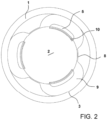
- Figures 2 and 4 illustrate a body 1, a cavity, walls 3, a strap 5 having a bulge 10, elements for positioning the neck 8 and a recess 9.
- Figure 5 shows a covering element 11 or cap, the body 1, the cavity, the strap 5 with its bulge 10, the elements for positioning the neck 8 and a container 4 with its neck 6, its protrusion 12 and its opening 7.
- the equilibrium moisture content is defined as the state wherein the humidity of the wood reaches an equilibrium with the environmental conditions to which it is subjected.
- the grains of the wood are narrow, it means that the wood is harder there than in the area where the wood grains are wider, which will be more flexible and more elastic. In effect, this characteristic coincides with the rainfall periods that the tree as undergone. Especially in countries with dry and rainy seasons, the same trunk will have areas where the grains are very near (which will coincide with a period of drought) and others where the grains will be further apart, corresponding to periods of rain.
- the beech wood obtained from a forest in Montseny, near Barcelona, where the rainy periods occur in certain seasons of the year will show alternate separate and near grains, as compared to beech wood from an East-Europe forest (for instance, the Carpathian mountains) where the rains fall throughout the year, the grains will be arranged with regular spacing.
- the second wood will always be more flexible than the first one and will have more moisture at balance at the time of felling, even though both are the species of wood, namely beech wood.
- the type of cut can influence the drying.
- the relative inclination of the cut can limit the flexibility.
- the density of the wood is also a conditioning element.
- the procedure for drying wood of the present invention is of the type applied after the wood has been cut at the source and the wood has lost moisture. In other words, after the wood is cut, it starts losing humidity.
- the wood used in the present procedure should have an equilibrium moisture content of about 41% or higher, approximately 60%. In case the wood would have a higher % than 60%, a there would be prior drying stage until reaching said range between 41-50%.
- the procedure is started by a first stage wherein the wood is introduced in the oven at a temperature between 40-50°C and a relative humidity between 40-50%, for a period between 1 and 3 weeks until the wood reaches an equilibrium moisture content between 25%-40%.
- the dried wood from the previous stage is introduced in the oven at a temperature between 45-55°C and a relative humidity between 45-55%, for a period between 4 and 15 days until the wood reaches an equilibrium moisture content between 16%-25%.
- the dried wood from the second stage is introduced in the oven at a temperature between 50-60°C and a relative humidity between 30-40%, for a period between 4 and 15 days, until the wood reaches an equilibrium moisture content between 10%-16%.
- the wood obtained from the third stage is allowed to rest at a controlled temperature between 18-25°C, during 2 and 4 weeks.
- the wood now recovers part of the humidity lost in the third stage and stabilizes. Recovery by the wood of such lost humidity equilibrium depends on the type of wood and ranges between 1% to 9%.
- the procedure continues to a fifth stage in which the wood from the fourth stage is introduced to the oven at a temperature between 50-60°C and a relative humidity between 25 - 35%, for a period between 4 and 15 days, until the wood reaches an equilibrium moisture content between 10%-16%.
- the wood dried from the previous stage is introduced in the oven at a temperature between 40-50°C and a relative humidity between 20-30%, for a period between 4 and 15 days, until the wood reaches an equilibrium moisture content between 6%-8%.
- the wood obtained from the sixth stage is allowed to rest at a controlled temperature between 18-25°C, for a period of 3 to 5 weeks, whereat the wood recovers between 1,5 to 2,5 % equilibrium humidity, the remains of temperature dissipate and the wood stabilizes, having a final humidity equilibrium between 8%-10%.
- a water shower is applied until the equilibrium humidity recovers the pre-established parameters. That is, since there are no two identical woods, if there is an equilibrium humidity issue with one of them because it dries too quickly, water is poured over it to solve this problem.
- the wood obtained according to the above-described procedure is a dried wood having an equilibrium moisture content in the range of 8-10%.
- One of the advantages of the wood dried according to the above-described procedure is that its flexibility increases 1,5 to 2 times comparatively to the flexibility it would have if it had been dried by an air-drying procedure. That is, a dried wood having little or null flexibility is transformed into a flexible wood, which allows applying the covering element 11 that will be described hereunder.
- One of the options for the use of such dried wood is by way of a covering element 11 for dried wood containers, as explained above.
- El covering element 11 is of the type that is attached to the opening 7 or to the neck 6 of container 4, such as a top or a cap.
- the covering element 11 comprises a body 1 which defines a cavity 2 having walls 3, inside which are the opening 7 and neck 6 of the container ( Fig. 5 ), and attachment means 5 for fixing the walls 3 to the opening or the neck, such attachment means 5 consisting at least one strap.
- the straps 5 may be as many as needed, starting from one.
- the walls 3 comprise a recess 9 provided behind the strap 5. In this way it, a narrower covering element 11 can be made, as the spacing for the flexing of the strap 5 is obtained from the recess.
- the strap 5, which is at least one, may optionally comprise at least one bulge 10 that fits into a protrusion 12 of the neck 6 of the container.
- the walls 3 comprise positioning elements 8 for the neck 6, which guide it towards a perfect positioning.
- This covering element 11 is very suitable, since it may apply a force for closing a container 4, for example, as the wood may reach the end of the path and adapt to the final fitting with the container, either starting up from a thread or from a clicking system.
- ash wood has been selected, arranged in strips of 40 x 40 x 600 cm, duly palletized and with adequate circulation of air.
- other shapes may be also suitable, such as a square or a round shape.
- the woods may have a thickness between 20cm (thin wood) to 100 cm (thick wood). Larger thicknesses could also be dried but the drying, due to the greater thickness, will be much more complicated.
- the wood volume will be approximately 20m 3 . Therefore, the oven should have a capacity enough to contain the 20m 3 .
- the wood starts to lose equilibrium moisture content as from the felling. In certain cases, throughout the period comprised between the felling of the trees, the preparation at the sawmill and its arrival to the oven, the wood will already have an equilibrium moisture content of about 41-50%, and will therefore be ready for the first stage.
- the wood In case the wood has not yet released the humidity and reached such 41-50%, it will have to be introduced into the oven for a pre-drying step, where the wood is heated for a period of one to three days, depending on the % of equilibrium moisture content, until it reaches an equilibrium moisture content in the range of 41-50%.
- the ovens or drying chambers where the wood drying takes place are provided with ventilation elements for allowing the recirculation of the air, heating elements, moisturizing elements, probes for controlling and recording the environmental conditions, probes for temperature and humidity control inside the oven, a water steam and condensation extraction system, electronic equipment for the management and control of the oven, etc.
- the first stage will begin, by introducing the mentioned ash wood into the oven at a temperature of 45°C and a relative humidity of approximately 60%, for dos weeks, until the wood reaches final values of equilibrium moisture content in a range of 25-40%.
- the second stage consists of arranging the dried ash wood from the first stage in the oven at a temperature of 50°C, a relative humidity of 45% for one week until reaching an equilibrium moisture content between 16% and 25%.
- the ash wood obtained from the second stage is placed inside the oven at a temperature of 55°C and a relative humidity of 35%, for one week, until the wood reaches an equilibrium moisture content in the range of 10-16%.
- the dried ash wood obtained from the third stage is allowed to rest at a stable temperature in the range of 18 and 25°C, for at least two weeks, but preferably three weeks, so that the wood recovers part of the lost equilibrium moisture content (in this case, between 1% and 3%, but with other woods it may reach 9%) and such equilibrium moisture content stabilizes.
- This stage is aimed at de-stressing the wood and thus respecting its morphology.
- the dried wood obtained from the fourth stage is introduced in the oven at a temperature of 55°C and a relative humidity of 30%, for one week, until the wood reaches an equilibrium moisture content between 10-16%.
- the dried ash wood from the previous stage is placed inside the oven at a temperature of 45°C, and a relative humidity of 25%, until the wood reaches an equilibrium moisture content between 6-8%.
- the dried wood obtained from the sixth stage is allowed to rest in an indoor warehouse at a controlled temperature between 18 and 25°C for a minimum of three weeks, preferably four weeks. In this way, the wood recovers 2% of equilibrium moisture content, and smoothly dissipates temperature remains. The dried and stabilized ash wood will thus have reached a final equilibrium moisture content in the range of 8-10%.
- One of the products made of dried wood is a covering element as illustrated in Figures 1 to 5 .
- a covering element 11 covers the orifice of a container 4. If the covering element is introduced inside the container through the opening, it is called a cap, if it is not introduced, it is called a lid or top, although both these terms may be considered equivalent in Spanish.
- these covering elements 11 for use in packaging include the use of a plastic insert, e.g., a polypropylene, which provides the mechanical functionality, either by friction, clicking, etc.
- Such plastic insert is covered by a wood sleeve, conferring a natural touch to the perfume or cosmetic, whereas inside there is plastic material that is necessary to have the above-stated mechanic functions that wood cannot provide.
- the plastic insert and the wooden sleeve are attached to each other by adhesives based on high temperature resin, for example.
- the idea of this embodiment of the wood obtained according to the above-stated procedure is to create a totally biodegradable product for a sector that demands the use of natural products, with the further advantage that the components will not need to be subsequently separated for recycling, as the plastic insert will no longer be included.
- the cap 11 of the practical embodiment (this example would be applicable to a lid as well) is made of the wood obtained according to the procedure, for example, ash wood, and consists of a body 1 that is provided outside and is visible.
- the attachment can be increased by adding bulges 10 to the straps 5, said bulges 10 are oriented towards the neck 6 and they fit in protrusions 12 made in the neck 6.
- the ability to flex the wood of the covering element or cap 11 over the container 4 allows it to fit to the bottle, the cap 11 is therefore able to exert force on the el neck 6 of the container and can therefore close the container 4 well. That is, a "pulling force" between the 11 and the container 4 is achieved.
- This cap 11 eliminates completely the plastic component, that is, the plastic insert between the body 1 and the neck 6, thus becoming a completely natural and eco-friendly cap 11.
- This invention describes a new procedure for drying wood, the dried wood obtained, and a covering element for containers made of the dried wood obtained.
- the examples provided herein are not limitative of the present invention, which may have different applications and/or adaptations, all of which within the scope of the following claims.
Landscapes
- Engineering & Computer Science (AREA)
- Mechanical Engineering (AREA)
- General Engineering & Computer Science (AREA)
- Drying Of Solid Materials (AREA)
- Chemical And Physical Treatments For Wood And The Like (AREA)
Abstract
Description
- Procedure for drying wood, dried wood obtained therefrom and covering element for containers made of the dried wood obtained, of the type applied after the wood has been cut at its origin, the wood has lost moisture, and the wood having an equilibrium moisture content of 41% or more, characterised in that it comprises: a first stage in which the wood is introduced in the oven at a temperature between 40-50°C and a relative humidity between 40-50%, for a period between 1 and 3 weeks, until the wood reaches an equilibrium moisture content between 25%-40%; a second stage in which the dried wood from the previous stage is introduced in the oven at a temperature between 45-55°C and a relative humidity between 45-55%, for a period between 4 and 15 days, until the wood reaches an equilibrium moisture content between 16%-25%; a third stage in which the dried wood from the second stage is introduced in the oven at a temperature between 50-60°C and a relative humidity between 30-40%, for a period between 4 and 15 days, until the wood reaches an equilibrium moisture content between 10%-16%; a fourth stage in which the wood obtained from the third stage is set aside at a controlled temperature between 18- 25°C, between 2 and 4 weeks, wherein the wood recovers part of the equilibrium moisture lost in the third stage and stabilizes, a fifth stage in which the wood from the fourth stage is introduced in the oven at a temperature between 50-60°C and a relative humidity between 25-35%, for a period between 4 and 15 days until the wood reaches an equilibrium moisture content between 10%-16%, a sixth stage in which the wood from the fifth stage is introduced in the oven at temperature between 40-50°C and a relative humidity between 20-30%, for a period between 4 and 15 days until the wood reaches an equilibrium moisture content between 6%-8%, and, a seventh stage in which the wood obtained from the sixth stage is allowed to rest at a controlled temperature between 18-25°C, for a period between 3 and 5 weeks, whereat the wood recovers between 1,5 and 2,5% equilibrium humidity, the remains of temperature dissipate and the wood stabilizes, having a final humidity equilibrium between 8%-10%.
- In the state of the art, different procedures are known of drying wood that aim at obtaining elasticity thereof.
- Thus, state of the art is Chinese Patent
CN102252502 "METHOD AND DEVICE FOR DRYING WOOD", of the year 2011, in the name XIZE YU , which refers to a method for drying wood. The method is characterised by comprising the sequential stages of: processing the wood by segments of wood of the required size, placing the wood segments in the drying devices and sealing the drying device; starting up a heating device, heating the drying device and securing that it reaches 65-80°C and is maintained at such temperature for a period between 20 minutes to 2 hours; starting up a suction device, vacuum the drying device to ensure that the intensity of the absolute pressure is kept within the range of not less than -0,098 MPa and no more than -0,05 MPa and is maintained as such between 20 minutes to 2 hours; start up a flushing device for pumping water; and turning off the heating device, the suction device, and the water flushing device, and taking the wood segments out. According to a method, the resin membranes inside the wood are damaged to achieve a speedy drying, the water and air permeability of the wood is improved, and the flexibility is increased. The method provided by the invention has the advantages of simplicity, short drying time, high efficiency, energy saving, cost reduction, low rate of degradation of the wood and similar advantages. In addition, the invention describes a drying device. - State of the art is also Chines patent
CN109682172 "Method for drying wood through moist heat microwave", in the name KOU ZONGHUI, of the year 2019 , referring to a method for drying wood through moist heat microwave. The method comprises the stages of (1) loading the wood, (2) injecting water, (3) executing the microwave heating and (5) extracting the moisture and cooling. In the process of drying the wood with steam, the flexibility of the wood fibre is maintained, while maintaining a good protective effect on the wood and avoiding wood distortion. The steam carries a large amount of the humidity, the wood is dried with moist heat, the humidity of the steam is absorbed when the wood absorbs the heat and, under the condition that the surface of the wood be moist, the surface is not dry, which prevents the cracking of the surface. Under heating and humidity conditions, the resin of the wood is softened so as to reach the effect that the waterways of the wood are unblocked and the wood moist can freely enter or exit, thus avoiding the internal cracking of the wood. The wood fibre cannot abruptly shrink under the effect of the moist heat, nor does it weaken, the fibre extensibility and flexibility being high. - The present invention the type of patents that describe procedures for drying wood in ovens.
- The closest document is Chinese patent N°
CN102252502 . - That patent solves the problem of wood flexibility by means of a procedure that dries the wood applying temperatures above 60°C and pressure in periods of between 20 minutes and 2 hours.
- That patent, on the other hand, has the disadvantage that the wood is damaged and bending occurs. To make up for this, pressure Is applied. In addition, the wood cracks due to the aggressive procedure and the flexibility obtained at the end of the procedure is not relevant.
- The present procedure solves the above problem by applying controlled temperature and a relative humidity inside the oven, using low temperatures at the beginning and lowering the balance moisture very gradually, and performing the procedure throughout very long periods, thus avoiding the occurrence tensions, cracks and changes of colour in the wood. Moreover, no undesired movement of the wood fibres occur.
- In addition, the wood obtained with this procedure will have a smooth contraction due to the progressive application of temperature and the controlled loss of moisture. In this manner, bending of the wood as a result of the drying is prevented and the wood remains plane and stable.
- In addition, the procedure that is the object of the invention can be applied to a large variety of woods, as different as beech, pine, ash, maple, etc.
- An object of the present invention is a procedure for drying wood, of the type applied after the wood has been cut at its origin, the wood has lost moisture and has reached an equilibrium moisture content of 41% or more, characterised in that it comprises: a first stage in which the wood is introduced in the oven at a temperature between 40-50°C and a relative humidity between 40-50%, for a period between 1 and 3 weeks, until the wood reaches an equilibrium moisture content between 25%-40%, a second stage in which the dried wood from the previous stage is introduced in the oven at a temperature between 45-55°C and a relative humidity between 45-55%, for a period between 4 and 15 days, until the wood reaches an equilibrium moisture content between 16%-25%, a third stage in which the dried wood from the second stage is introduced in the oven at a temperature between 50-60°C and a relative humidity between 30-40%, for a period between 4 and 15 days, until the wood reaches an equilibrium moisture content between 10%-16%, a fourth stage in which the wood obtained from the third stage is set aside at a controlled temperature between 18-25°C, between 2 and 4 weeks, wherein the wood recovers part of the equilibrium moisture lost in the third stage and stabilizes, a fifth stage in which the wood from the fourth stage is introduced in the oven at temperature between 50-60°C and a relative humidity between 25-35%, for a period between 4 and 15 days until the wood reaches an equilibrium moisture content between 10%-16%, a sixth stage in which the wood from the fifth stage is introduced in the oven at a temperature between 40- 50°C and a relative humidity between 20-30%, for a period between 4 and 15 days until the wood reaches an equilibrium moisture content between 6%-8%, and a seventh stage in which the wood obtained from the sixth stage is allowed to rest at a controlled temperature between 18-25°C, for a period between 3 and 5 weeks, whereat the wood recovers between 1,5 and 2,5 % equilibrium humidity, the remains of temperature dissipate and the wood stabilizes having a final humidity equilibrium between 8%-10%.
- A second additional object of the present invention is dried wood obtained in accordance with the procedure of
Claim 1, characterised in that it comprises an equilibrium moisture content between 8-10%. - A third additional object of the present invention is a covering element for containers of the dried wood obtained according to Claim 4, of the type attached to the orifice or the neck of the container, characterised in that it comprises a body that defines a cavity having walls inside which the orifice and the neck of the container are arranged, and attachment means of the walls to the orifice or to the neck of the container, said attachment means consisting at least of a strap.
- To facilitate the explanation, this description includes four sheets of drawings representing a practical embodiment, which is provided by way of a non-limiting example of the scope of the present invention:
-
Figure 1 is a general view of a covering element, -
Figure 2 is a lower view ofFigure 1 , -
Figure 3 is a side view ofFigure 1 , -
Figure 4 is a sectional cut by the line IV-IV ofFigure 3 , -
Figure 5 is a sectional cut of the covering element already assembled to the container. -
Figures 1 and3 illustrate abody 1. -
Figures 2 and4 illustrate abody 1, a cavity,walls 3, astrap 5 having abulge 10, elements for positioning theneck 8 and a recess 9. - Last,
Figure 5 shows a covering element 11 or cap, thebody 1, the cavity, thestrap 5 with itsbulge 10, the elements for positioning theneck 8 and a container 4 with itsneck 6, its protrusion 12 and itsopening 7. - Preliminarily, the equilibrium moisture content is defined as the state wherein the humidity of the wood reaches an equilibrium with the environmental conditions to which it is subjected.
- In addition, it should be noted that no two trees are alike, even if one grows next to the other. Nor are there two equal pieces of wood, even if they come from the same trunk (a piece of wood from the part of the trunk close to the ground will not be the same as another piece from the top of the trunk).
- The ranges of temperatures, humidity, etc., indicated are useful for manoeuvring within the specific characteristics of each piece of wood, bearing in mind the starting assumption that two trees of the same species and the same forest will always different.
- For example, if the grains of the wood are narrow, it means that the wood is harder there than in the area where the wood grains are wider, which will be more flexible and more elastic. In effect, this characteristic coincides with the rainfall periods that the tree as undergone. Especially in countries with dry and rainy seasons, the same trunk will have areas where the grains are very near (which will coincide with a period of drought) and others where the grains will be further apart, corresponding to periods of rain.
- By way of example, the beech wood obtained from a forest in Montseny, near Barcelona, where the rainy periods occur in certain seasons of the year, will show alternate separate and near grains, as compared to beech wood from an East-Europe forest (for instance, the Carpathian mountains) where the rains fall throughout the year, the grains will be arranged with regular spacing. This means that the second wood will always be more flexible than the first one and will have more moisture at balance at the time of felling, even though both are the species of wood, namely beech wood.
- In addition, the type of cut can influence the drying. The relative inclination of the cut can limit the flexibility.
- The density of the wood is also a conditioning element.
- If, in addition, there are different species of wood, the variations between them will justify the variation in percentages and in the ranges of temperature to be applied, as there shall also be different densities.
- The procedure for drying wood of the present invention is of the type applied after the wood has been cut at the source and the wood has lost moisture. In other words, after the wood is cut, it starts losing humidity.
- The wood used in the present procedure should have an equilibrium moisture content of about 41% or higher, approximately 60%. In case the wood would have a higher % than 60%, a there would be prior drying stage until reaching said range between 41-50%.
- In this way, the procedure is started by a first stage wherein the wood is introduced in the oven at a temperature between 40-50°C and a relative humidity between 40-50%, for a period between 1 and 3 weeks until the wood reaches an equilibrium moisture content between 25%-40%.
- These ranges are determined in view that certain types of woods will need a higher or a lower temperature, or for longer or shorter periods within the range, or a relative higher or lower humidity, all of which depends on the characteristics and the density of each particular wood.
- In a second stage the dried wood from the previous stage is introduced in the oven at a temperature between 45-55°C and a relative humidity between 45-55%, for a period between 4 and 15 days until the wood reaches an equilibrium moisture content between 16%-25%.
- In the third stage, the dried wood from the second stage is introduced in the oven at a temperature between 50-60°C and a relative humidity between 30-40%, for a period between 4 and 15 days, until the wood reaches an equilibrium moisture content between 10%-16%.
- In the fourth stage, the wood obtained from the third stage is allowed to rest at a controlled temperature between 18-25°C, during 2 and 4 weeks. The wood now recovers part of the humidity lost in the third stage and stabilizes. Recovery by the wood of such lost humidity equilibrium depends on the type of wood and ranges between 1% to 9%.
- The procedure continues to a fifth stage in which the wood from the fourth stage is introduced to the oven at a temperature between 50-60°C and a relative humidity between 25 - 35%, for a period between 4 and 15 days, until the wood reaches an equilibrium moisture content between 10%-16%.
- In the sixth stage the wood dried from the previous stage is introduced in the oven at a temperature between 40-50°C and a relative humidity between 20-30%, for a period between 4 and 15 days, until the wood reaches an equilibrium moisture content between 6%-8%.
- Last, in the seventh stage, the wood obtained from the sixth stage is allowed to rest at a controlled temperature between 18-25°C, for a period of 3 to 5 weeks, whereat the wood recovers between 1,5 to 2,5 % equilibrium humidity, the remains of temperature dissipate and the wood stabilizes, having a final humidity equilibrium between 8%-10%.
- Optionally, in at least one of the stages first, second, third, fifth and sixth, when the equilibrium humidity level is lower than the pre-established parameters, a water shower is applied until the equilibrium humidity recovers the pre-established parameters. That is, since there are no two identical woods, if there is an equilibrium humidity issue with one of them because it dries too quickly, water is poured over it to solve this problem.
- The wood obtained according to the above-described procedure is a dried wood having an equilibrium moisture content in the range of 8-10%. One of the advantages of the wood dried according to the above-described procedure is that its flexibility increases 1,5 to 2 times comparatively to the flexibility it would have if it had been dried by an air-drying procedure. That is, a dried wood having little or null flexibility is transformed into a flexible wood, which allows applying the covering element 11 that will be described hereunder.
- One of the options for the use of such dried wood is by way of a covering element 11 for dried wood containers, as explained above.
- El covering element 11 is of the type that is attached to the
opening 7 or to theneck 6 of container 4, such as a top or a cap. - The covering element 11 comprises a
body 1 which defines acavity 2 havingwalls 3, inside which are theopening 7 andneck 6 of the container (Fig. 5 ), and attachment means 5 for fixing thewalls 3 to the opening or the neck, such attachment means 5 consisting at least one strap. Thestraps 5 may be as many as needed, starting from one. - To facilitate the flexing of the
strap 5, thewalls 3 comprise a recess 9 provided behind thestrap 5. In this way it, a narrower covering element 11 can be made, as the spacing for the flexing of thestrap 5 is obtained from the recess. - In order to allow the attachment of the covering element to the container 4, the
strap 5, which is at least one, may optionally comprise at least onebulge 10 that fits into a protrusion 12 of theneck 6 of the container. - To facilitate guiding and engagement of the covering element with the container 4, the
walls 3 comprisepositioning elements 8 for theneck 6, which guide it towards a perfect positioning. In addition, it is useful to secure the attachment of the covering element 11 to the container 4 once thestrap 5 has been blocked at theneck 6. - This covering element 11 is very suitable, since it may apply a force for closing a container 4, for example, as the wood may reach the end of the path and adapt to the final fitting with the container, either starting up from a thread or from a clicking system.
- Now, in a practical embodiment, the workers will introduce the wood in the oven. For this practical embodiment, ash wood has been selected, arranged in strips of 40 x 40 x 600 cm, duly palletized and with adequate circulation of air. Besides this rectangular shape indicated, other shapes may be also suitable, such as a square or a round shape.
- The woods may have a thickness between 20cm (thin wood) to 100 cm (thick wood). Larger thicknesses could also be dried but the drying, due to the greater thickness, will be much more complicated.
- The wood volume will be approximately 20m3. Therefore, the oven should have a capacity enough to contain the 20m3.
- The wood starts to lose equilibrium moisture content as from the felling. In certain cases, throughout the period comprised between the felling of the trees, the preparation at the sawmill and its arrival to the oven, the wood will already have an equilibrium moisture content of about 41-50%, and will therefore be ready for the first stage.
- In case the wood has not yet released the humidity and reached such 41-50%, it will have to be introduced into the oven for a pre-drying step, where the wood is heated for a period of one to three days, depending on the % of equilibrium moisture content, until it reaches an equilibrium moisture content in the range of 41-50%.
- The ovens or drying chambers where the wood drying takes place are provided with ventilation elements for allowing the recirculation of the air, heating elements, moisturizing elements, probes for controlling and recording the environmental conditions, probes for temperature and humidity control inside the oven, a water steam and condensation extraction system, electronic equipment for the management and control of the oven, etc.
- Next, the first stage will begin, by introducing the mentioned ash wood into the oven at a temperature of 45°C and a relative humidity of approximately 60%, for dos weeks, until the wood reaches final values of equilibrium moisture content in a range of 25-40%.
- It is worth noting that these values are by way of example and that it will be necessary to adapt these values to the range stated in
Claim 1, for example by varying the temperature, the relative humidity, the period of time inside the oven, all of which will depend on the characteristics of the wood, since there are no two woods identical to each other. Another possibility would be, if at the end of the two-week period a pre-defined equilibrium moisture content has not been reached, the wood could be kept for an additional period or, if the wood should have reached such humidity content before the set period, the wood should be taken out of the oven in advance. - The second stage consists of arranging the dried ash wood from the first stage in the oven at a temperature of 50°C, a relative humidity of 45% for one week until reaching an equilibrium moisture content between 16% and 25%.
- At the third stage, the ash wood obtained from the second stage is placed inside the oven at a temperature of 55°C and a relative humidity of 35%, for one week, until the wood reaches an equilibrium moisture content in the range of 10-16%.
- Next, the dried ash wood obtained from the third stage is allowed to rest at a stable temperature in the range of 18 and 25°C, for at least two weeks, but preferably three weeks, so that the wood recovers part of the lost equilibrium moisture content (in this case, between 1% and 3%, but with other woods it may reach 9%) and such equilibrium moisture content stabilizes. This stage is aimed at de-stressing the wood and thus respecting its morphology.
- In the fifth stage the dried wood obtained from the fourth stage is introduced in the oven at a temperature of 55°C and a relative humidity of 30%, for one week, until the wood reaches an equilibrium moisture content between 10-16%.
- In the sixth stage, the dried ash wood from the previous stage is placed inside the oven at a temperature of 45°C, and a relative humidity of 25%, until the wood reaches an equilibrium moisture content between 6-8%.
- In the last, seventh stage, the dried wood obtained from the sixth stage is allowed to rest in an indoor warehouse at a controlled temperature between 18 and 25°C for a minimum of three weeks, preferably four weeks. In this way, the wood recovers 2% of equilibrium moisture content, and smoothly dissipates temperature remains. The dried and stabilized ash wood will thus have reached a final equilibrium moisture content in the range of 8-10%.
- As it was explained above, during the first, second, third, fifth and sixth stages, it is possible to intervene on the wood that is being dried if the extrapolations of the parameters do not adjust to the final result, and a water shower may be applied thereon to increase the wood equilibrium humidity or to increase or lower the temperature in order to influence the drying speed, increase or decrease the ventilation to influence the drying, etc.
- From the wood obtained in the above-described procedure a number of products can be produced, since the wood increases its flexibility and elasticity 1.5 or 2 times the flexibility and elasticity of wood that has been dried by means of a traditional air-drying procedure.
- One of the products made of dried wood is a covering element as illustrated in
Figures 1 to 5 . - A covering element 11 covers the orifice of a container 4. If the covering element is introduced inside the container through the opening, it is called a cap, if it is not introduced, it is called a lid or top, although both these terms may be considered equivalent in Spanish.
- Traditionally, these covering elements 11 for use in packaging, for instance, of perfumes, cosmetics, etc., include the use of a plastic insert, e.g., a polypropylene, which provides the mechanical functionality, either by friction, clicking, etc.
- Such plastic insert is covered by a wood sleeve, conferring a natural touch to the perfume or cosmetic, whereas inside there is plastic material that is necessary to have the above-stated mechanic functions that wood cannot provide.
- The plastic insert and the wooden sleeve are attached to each other by adhesives based on high temperature resin, for example.
- Therefore, the idea of this embodiment of the wood obtained according to the above-stated procedure is to create a totally biodegradable product for a sector that demands the use of natural products, with the further advantage that the components will not need to be subsequently separated for recycling, as the plastic insert will no longer be included.
- The cap 11 of the practical embodiment (this example would be applicable to a lid as well) is made of the wood obtained according to the procedure, for example, ash wood, and consists of a
body 1 that is provided outside and is visible. - Inside the
body 1 there is acavity having walls 3, wherein there are provided thestraps 5. When theneck 6 of the container 4 is introduced inside the cavity, said neck pushes thestraps 5 outwards, which straps, being flexible, bend towards thewalls 3, and which straps 5 being elastic, they recover their position by blocking theneck 6, and the covering element remains attached to the container 4. - The attachment can be increased by adding
bulges 10 to thestraps 5, said bulges 10 are oriented towards theneck 6 and they fit in protrusions 12 made in theneck 6. - To facilitate the guiding and the fitting of the neck, the possibility of arranging
positioning elements 8 in the neck has been envisaged. - In order to reduce the size of the covering element, space for the flexing of the
strap 5 has been gained out of thewalls 3, by making recesses 9 behind the strapping, which allow the bending manoeuvre of thestrap 5 towards thewalls 3 and the subsequent elastic recovery of thestrap 5. - The ability to flex the wood of the covering element or cap 11 over the container 4 allows it to fit to the bottle, the cap 11 is therefore able to exert force on the
el neck 6 of the container and can therefore close the container 4 well. That is, a "pulling force" between the 11 and the container 4 is achieved. - This cap 11 eliminates completely the plastic component, that is, the plastic insert between the
body 1 and theneck 6, thus becoming a completely natural and eco-friendly cap 11. - The resin-based adhesives that were needed to attach the insert inside the
cavity 2, which required high temperatures, are also unnecessary. - All of which is achieved while maintaining the mechanical functionality and the specifications, since the wood is kept flexible and elastic, thus obtaining a correct adjustment of the cap to the container.
- In addition, all European, American, or other special, regulations can be complied with in respect to all sizes.
- This invention describes a new procedure for drying wood, the dried wood obtained, and a covering element for containers made of the dried wood obtained. The examples provided herein are not limitative of the present invention, which may have different applications and/or adaptations, all of which within the scope of the following claims.
Claims (8)
- - Procedure for drying wood, of the type applied after the wood has been cut at its origin, the wood having lost moisture and having reached an equilibrium moisture content of 41% or more, characterised in that it comprises:- a first stage in which the wood is introduced in the oven at a temperature between 40-50°C and a relative humidity between 40-50%, for a period between 1 and 3 weeks, until the wood reaches an equilibrium moisture content between 25%-40%,- a second stage in which the dried wood from the previous stage is introduced in the oven at a temperature between 45-55°C and a relative humidity between 45-55%, for a period between 4 and 15 days, until the wood reaches an equilibrium moisture content between 16%-25%,- a third stage in which the dried wood from the second stage is introduced in the oven at a temperature between 50-60°C and a relative humidity between 30-40%, for a period between 4 and 15 days, until the wood reaches an equilibrium moisture content between 10%-16%,- a fourth stage in which the wood obtained from the third stage is allowed to rest at a controlled temperature between 18-25°C, between 2 and 4 weeks, wherein the wood recovers part of the equilibrium moisture lost in the third stage and stabilizes,- a fifth stage in the wood from the fourth stage is introduced in the oven at a temperature between 50-60°C and a relative humidity between 25-35%, for a period between 4 and 15 days until the wood reaches an equilibrium moisture content between 10%-16%,- a sixth stage in which the wood from the fifth stage is introduced in the oven at a temperature between 40-50°C and a relative humidity between 20-30%, for a period between 4 and 15 days, until the wood reaches an equilibrium moisture content between 6%-8%, and,- a seventh stage in which the wood obtained from the sixth stage is allowed to rest at a controlled temperature between 18-25°C, for a period between 3 and 5 weeks, whereat the wood recovers between 1,5 and 2,5 % equilibrium humidity, the remains of temperature dissipate and the wood stabilizes having a final humidity equilibrium between 8%-10%.
- Procedure according to Claim 1, characterised in that in at least one stage of the first, second, third, fifth and sixth stages, when the equilibrium moisture content is lower than the preestablished parameters, a water shower is applied until the equilibrium moisture content regains the preestablished parameters.
- Procedure according to Claim 1 o 2, characterised in that in at least one stage of the first, second, third, fifth and sixth stages, when the preestablished level of temperature inside the oven does not match the preestablished parameters, the temperature inside the oven is varied by either cooling down or heating up the oven until reaching again the preestablished values.
- Dried wood obtained according to the procedure of Claim 1, characterised in that it comprises an equilibrium moisture content of 8 - 10%
- Covering element for containers made of the dried wood obtained according to Claim 4, of the type that is attached to the opening or the neck of the container, characterised in that it comprises a body (1) that defines a cavity (2) having walls (3) inside which the opening (7) and the neck (6) of the container (4) are provided, and attachment means (5) of the walls (3) to the opening or the neck, said attachment means (5) consisting of at least one strap.
- - Element according to Claim 5, characterised in that the walls (3) comprise a recess (9) formed behind the strap (5).
- - Element according to Claims 5 or 6, characterised in that the strap (5), which is at least one in number, comprises at least one bulge (10) that fits in the neck (6) of the container.
- - Element according to Claim 5 or 6, characterised in that the walls (3) comprise positioning elements (8) of the neck (6).
Applications Claiming Priority (2)
| Application Number | Priority Date | Filing Date | Title |
|---|---|---|---|
| ES202032019 | 2020-09-16 | ||
| PCT/ES2020/070618 WO2022058631A1 (en) | 2020-09-16 | 2020-10-13 | Wood drying process, dried wood obtained and dried wood element for covering containers |
Publications (3)
| Publication Number | Publication Date |
|---|---|
| EP4215857A1 true EP4215857A1 (en) | 2023-07-26 |
| EP4215857B1 EP4215857B1 (en) | 2025-08-27 |
| EP4215857C0 EP4215857C0 (en) | 2025-08-27 |
Family
ID=80775956
Family Applications (1)
| Application Number | Title | Priority Date | Filing Date |
|---|---|---|---|
| EP20817051.4A Active EP4215857B1 (en) | 2020-09-16 | 2020-10-13 | Wood drying process, dried wood obtained and dried wood element for covering containers |
Country Status (4)
| Country | Link |
|---|---|
| US (1) | US20230314075A1 (en) |
| EP (1) | EP4215857B1 (en) |
| ES (1) | ES3053434T3 (en) |
| WO (1) | WO2022058631A1 (en) |
Families Citing this family (1)
| Publication number | Priority date | Publication date | Assignee | Title |
|---|---|---|---|---|
| CN119245302B (en) * | 2024-12-03 | 2025-03-11 | 云南省林业和草原科学院 | High temperature baking equipment for processing peeled walnuts |
Citations (1)
| Publication number | Priority date | Publication date | Assignee | Title |
|---|---|---|---|---|
| JP2019184097A (en) * | 2018-04-04 | 2019-10-24 | 国立大学法人 鹿児島大学 | Method of drying lumber |
Family Cites Families (8)
| Publication number | Priority date | Publication date | Assignee | Title |
|---|---|---|---|---|
| US674522A (en) * | 1899-06-28 | 1901-05-21 | Simon H M Seib | Cork. |
| JPS53103261A (en) * | 1977-02-19 | 1978-09-08 | Kitagawa Iron Works Co | Method of drying wooden products and apparatus therefor |
| US4250629A (en) * | 1979-02-21 | 1981-02-17 | Lewis Donald C | Lumber conditioning kiln |
| DE8324930U1 (en) * | 1983-08-31 | 1983-12-01 | KISICO, Kirchner, Simon & Co GmbH Kunststoffverarbeitung, 6227 Oestrich-Winkel | Sealing cap for closing vessels |
| JP3906313B2 (en) * | 2004-08-31 | 2007-04-18 | 株式会社加来野製作所 | Vacuum drying machine and wood drying method using the same |
| CN102049806A (en) * | 2009-10-29 | 2011-05-11 | 吴江市固友木门厂 | Pretreatment process for raw wood for wooden door |
| CN102252502A (en) | 2011-04-27 | 2011-11-23 | 于玺泽 | Method and device for drying wood |
| CN109682172A (en) | 2019-01-10 | 2019-04-26 | 寇宗辉 | A kind of method of damp and hot microwave drying timber |
-
2020
- 2020-10-13 US US18/044,633 patent/US20230314075A1/en active Pending
- 2020-10-13 EP EP20817051.4A patent/EP4215857B1/en active Active
- 2020-10-13 ES ES20817051T patent/ES3053434T3/en active Active
- 2020-10-13 WO PCT/ES2020/070618 patent/WO2022058631A1/en not_active Ceased
Patent Citations (1)
| Publication number | Priority date | Publication date | Assignee | Title |
|---|---|---|---|---|
| JP2019184097A (en) * | 2018-04-04 | 2019-10-24 | 国立大学法人 鹿児島大学 | Method of drying lumber |
Also Published As
| Publication number | Publication date |
|---|---|
| EP4215857B1 (en) | 2025-08-27 |
| US20230314075A1 (en) | 2023-10-05 |
| EP4215857C0 (en) | 2025-08-27 |
| ES3053434T3 (en) | 2026-01-22 |
| WO2022058631A1 (en) | 2022-03-24 |
Similar Documents
| Publication | Publication Date | Title |
|---|---|---|
| EP4215857B1 (en) | Wood drying process, dried wood obtained and dried wood element for covering containers | |
| AU2017348278B2 (en) | System for and method of manufacturing hemp products | |
| CN101664082A (en) | Fragrant white peony tea and production process thereof | |
| CN104026318B (en) | A kind of production method of steaming green tea | |
| CN105276930B (en) | A kind of method for suppressing drying of wood shrinkage | |
| CN113874183A (en) | System and method for manufacturing hemp products | |
| CN107471345A (en) | A kind of preparation method of antibacterial and mouldproof raw bamboo handicraft | |
| CN105660952A (en) | Chrysanthemum flower baking method | |
| CN109430449A (en) | A kind of " topaz " yellow tea production method | |
| US3070098A (en) | Process for curing and preserving plants | |
| CN107646997A (en) | A kind of processing technology of white tea | |
| JP2019184097A (en) | Method of drying lumber | |
| CN106313240A (en) | Drying treatment method for wood | |
| KR101170349B1 (en) | Method for preserving Tricholoma matsutake safely and effectively throughout long period of time | |
| CN107877647A (en) | A kind of drying means of Eucalyptus Wood | |
| Walker | The drying of timber | |
| Wood | Moisture content | |
| KR20030066202A (en) | Method for drying a bamboo tube without formation of splits and checks | |
| CN112741357A (en) | Preparation method of cigar tobacco leaves | |
| CN108450995B (en) | Loose leaf baking process in southeast tobacco region | |
| KR200482145Y1 (en) | Prevent fruit cracking cap for fruit and fruits vegetable | |
| GB2077784A (en) | Timber pretreated for seasoning and a method of pretreating timber for seasoning | |
| CN104477528B (en) | One kind flower arrangement flowers protection device | |
| KR20210081172A (en) | Plant delivery methods to minimize water loss using paraffin | |
| KR102700096B1 (en) | A string for weaving gulbi having an anti-slip pattern and a method for manufacturing the same |
Legal Events
| Date | Code | Title | Description |
|---|---|---|---|
| STAA | Information on the status of an ep patent application or granted ep patent |
Free format text: STATUS: UNKNOWN |
|
| STAA | Information on the status of an ep patent application or granted ep patent |
Free format text: STATUS: THE INTERNATIONAL PUBLICATION HAS BEEN MADE |
|
| PUAI | Public reference made under article 153(3) epc to a published international application that has entered the european phase |
Free format text: ORIGINAL CODE: 0009012 |
|
| STAA | Information on the status of an ep patent application or granted ep patent |
Free format text: STATUS: REQUEST FOR EXAMINATION WAS MADE |
|
| 17P | Request for examination filed |
Effective date: 20230331 |
|
| AK | Designated contracting states |
Kind code of ref document: A1 Designated state(s): AL AT BE BG CH CY CZ DE DK EE ES FI FR GB GR HR HU IE IS IT LI LT LU LV MC MK MT NL NO PL PT RO RS SE SI SK SM TR |
|
| DAV | Request for validation of the european patent (deleted) | ||
| DAX | Request for extension of the european patent (deleted) | ||
| STAA | Information on the status of an ep patent application or granted ep patent |
Free format text: STATUS: EXAMINATION IS IN PROGRESS |
|
| 17Q | First examination report despatched |
Effective date: 20240212 |
|
| GRAP | Despatch of communication of intention to grant a patent |
Free format text: ORIGINAL CODE: EPIDOSNIGR1 |
|
| STAA | Information on the status of an ep patent application or granted ep patent |
Free format text: STATUS: GRANT OF PATENT IS INTENDED |
|
| INTG | Intention to grant announced |
Effective date: 20250327 |
|
| GRAS | Grant fee paid |
Free format text: ORIGINAL CODE: EPIDOSNIGR3 |
|
| GRAA | (expected) grant |
Free format text: ORIGINAL CODE: 0009210 |
|
| STAA | Information on the status of an ep patent application or granted ep patent |
Free format text: STATUS: THE PATENT HAS BEEN GRANTED |
|
| AK | Designated contracting states |
Kind code of ref document: B1 Designated state(s): AL AT BE BG CH CY CZ DE DK EE ES FI FR GB GR HR HU IE IS IT LI LT LU LV MC MK MT NL NO PL PT RO RS SE SI SK SM TR |
|
| REG | Reference to a national code |
Ref country code: CH Ref legal event code: EP |
|
| REG | Reference to a national code |
Ref country code: DE Ref legal event code: R096 Ref document number: 602020057568 Country of ref document: DE |
|
| REG | Reference to a national code |
Ref country code: IE Ref legal event code: FG4D |
|
| U01 | Request for unitary effect filed |
Effective date: 20250926 |
|
| U07 | Unitary effect registered |
Designated state(s): AT BE BG DE DK EE FI FR IT LT LU LV MT NL PT RO SE SI Effective date: 20251008 |
|
| PG25 | Lapsed in a contracting state [announced via postgrant information from national office to epo] |
Ref country code: IS Free format text: LAPSE BECAUSE OF FAILURE TO SUBMIT A TRANSLATION OF THE DESCRIPTION OR TO PAY THE FEE WITHIN THE PRESCRIBED TIME-LIMIT Effective date: 20251227 |
|
| PG25 | Lapsed in a contracting state [announced via postgrant information from national office to epo] |
Ref country code: NO Free format text: LAPSE BECAUSE OF FAILURE TO SUBMIT A TRANSLATION OF THE DESCRIPTION OR TO PAY THE FEE WITHIN THE PRESCRIBED TIME-LIMIT Effective date: 20251127 |
|
| PG25 | Lapsed in a contracting state [announced via postgrant information from national office to epo] |
Ref country code: HR Free format text: LAPSE BECAUSE OF FAILURE TO SUBMIT A TRANSLATION OF THE DESCRIPTION OR TO PAY THE FEE WITHIN THE PRESCRIBED TIME-LIMIT Effective date: 20250827 |
|
| PG25 | Lapsed in a contracting state [announced via postgrant information from national office to epo] |
Ref country code: GR Free format text: LAPSE BECAUSE OF FAILURE TO SUBMIT A TRANSLATION OF THE DESCRIPTION OR TO PAY THE FEE WITHIN THE PRESCRIBED TIME-LIMIT Effective date: 20251128 |
|
| REG | Reference to a national code |
Ref country code: ES Ref legal event code: FG2A Ref document number: 3053434 Country of ref document: ES Kind code of ref document: T3 Effective date: 20260122 |
|
| PG25 | Lapsed in a contracting state [announced via postgrant information from national office to epo] |
Ref country code: PL Free format text: LAPSE BECAUSE OF FAILURE TO SUBMIT A TRANSLATION OF THE DESCRIPTION OR TO PAY THE FEE WITHIN THE PRESCRIBED TIME-LIMIT Effective date: 20250827 |
|
| PG25 | Lapsed in a contracting state [announced via postgrant information from national office to epo] |
Ref country code: RS Free format text: LAPSE BECAUSE OF FAILURE TO SUBMIT A TRANSLATION OF THE DESCRIPTION OR TO PAY THE FEE WITHIN THE PRESCRIBED TIME-LIMIT Effective date: 20251127 |
|
| U20 | Renewal fee for the european patent with unitary effect paid |
Year of fee payment: 6 Effective date: 20260107 |
|
| PG25 | Lapsed in a contracting state [announced via postgrant information from national office to epo] |
Ref country code: SM Free format text: LAPSE BECAUSE OF FAILURE TO SUBMIT A TRANSLATION OF THE DESCRIPTION OR TO PAY THE FEE WITHIN THE PRESCRIBED TIME-LIMIT Effective date: 20250827 |
|
| PGFP | Annual fee paid to national office [announced via postgrant information from national office to epo] |
Ref country code: ES Payment date: 20260122 Year of fee payment: 6 |
|
| PG25 | Lapsed in a contracting state [announced via postgrant information from national office to epo] |
Ref country code: CZ Free format text: LAPSE BECAUSE OF FAILURE TO SUBMIT A TRANSLATION OF THE DESCRIPTION OR TO PAY THE FEE WITHIN THE PRESCRIBED TIME-LIMIT Effective date: 20250827 |
|
| PG25 | Lapsed in a contracting state [announced via postgrant information from national office to epo] |
Ref country code: SK Free format text: LAPSE BECAUSE OF FAILURE TO SUBMIT A TRANSLATION OF THE DESCRIPTION OR TO PAY THE FEE WITHIN THE PRESCRIBED TIME-LIMIT Effective date: 20250827 |
|
| REG | Reference to a national code |
Ref country code: CH Ref legal event code: H13 Free format text: ST27 STATUS EVENT CODE: U-0-0-H10-H13 (AS PROVIDED BY THE NATIONAL OFFICE) Effective date: 20260527 |
|
| PG25 | Lapsed in a contracting state [announced via postgrant information from national office to epo] |
Ref country code: MC Free format text: LAPSE BECAUSE OF FAILURE TO SUBMIT A TRANSLATION OF THE DESCRIPTION OR TO PAY THE FEE WITHIN THE PRESCRIBED TIME-LIMIT Effective date: 20250827 |
|
| PLBE | No opposition filed within time limit |
Free format text: ORIGINAL CODE: 0009261 |
|
| STAA | Information on the status of an ep patent application or granted ep patent |
Free format text: STATUS: NO OPPOSITION FILED WITHIN TIME LIMIT |
|
| REG | Reference to a national code |
Ref country code: CH Ref legal event code: L10 Free format text: ST27 STATUS EVENT CODE: U-0-0-L10-L00 (AS PROVIDED BY THE NATIONAL OFFICE) Effective date: 20260708 |
|
| PG25 | Lapsed in a contracting state [announced via postgrant information from national office to epo] |
Ref country code: CH Free format text: LAPSE BECAUSE OF NON-PAYMENT OF DUE FEES Effective date: 20251031 |
|
| 26N | No opposition filed |
Effective date: 20260528 |