EP4215134B1 - Device and irrigation system for securing an elongate member to a medical instrument - Google Patents
Device and irrigation system for securing an elongate member to a medical instrument Download PDFInfo
- Publication number
- EP4215134B1 EP4215134B1 EP23161503.0A EP23161503A EP4215134B1 EP 4215134 B1 EP4215134 B1 EP 4215134B1 EP 23161503 A EP23161503 A EP 23161503A EP 4215134 B1 EP4215134 B1 EP 4215134B1
- Authority
- EP
- European Patent Office
- Prior art keywords
- base
- liner
- attachment device
- aperture
- elongate member
- Prior art date
- Legal status (The legal status is an assumption and is not a legal conclusion. Google has not performed a legal analysis and makes no representation as to the accuracy of the status listed.)
- Active
Links
Images



Classifications
-
- A—HUMAN NECESSITIES
- A61—MEDICAL OR VETERINARY SCIENCE; HYGIENE
- A61M—DEVICES FOR INTRODUCING MEDIA INTO, OR ONTO, THE BODY; DEVICES FOR TRANSDUCING BODY MEDIA OR FOR TAKING MEDIA FROM THE BODY; DEVICES FOR PRODUCING OR ENDING SLEEP OR STUPOR
- A61M3/00—Medical syringes, e.g. enemata; Irrigators
- A61M3/02—Enemata; Irrigators
- A61M3/027—Devices for holding the cannula in position, e.g. belts
-
- A—HUMAN NECESSITIES
- A61—MEDICAL OR VETERINARY SCIENCE; HYGIENE
- A61B—DIAGNOSIS; SURGERY; IDENTIFICATION
- A61B17/00—Surgical instruments, devices or methods
- A61B17/32—Surgical cutting instruments
- A61B17/320016—Endoscopic cutting instruments, e.g. arthroscopes, resectoscopes
- A61B17/32002—Endoscopic cutting instruments, e.g. arthroscopes, resectoscopes with continuously rotating, oscillating or reciprocating cutting instruments
-
- A—HUMAN NECESSITIES
- A61—MEDICAL OR VETERINARY SCIENCE; HYGIENE
- A61B—DIAGNOSIS; SURGERY; IDENTIFICATION
- A61B17/00—Surgical instruments, devices or methods
- A61B17/16—Instruments for performing osteoclasis; Drills or chisels for bones; Trepans
-
- A—HUMAN NECESSITIES
- A61—MEDICAL OR VETERINARY SCIENCE; HYGIENE
- A61B—DIAGNOSIS; SURGERY; IDENTIFICATION
- A61B17/00—Surgical instruments, devices or methods
- A61B17/32—Surgical cutting instruments
-
- A—HUMAN NECESSITIES
- A61—MEDICAL OR VETERINARY SCIENCE; HYGIENE
- A61B—DIAGNOSIS; SURGERY; IDENTIFICATION
- A61B90/00—Instruments, implements or accessories specially adapted for surgery or diagnosis and not covered by any of the groups A61B1/00 - A61B50/00, e.g. for luxation treatment or for protecting wound edges
- A61B90/08—Accessories or related features not otherwise provided for
-
- A—HUMAN NECESSITIES
- A61—MEDICAL OR VETERINARY SCIENCE; HYGIENE
- A61M—DEVICES FOR INTRODUCING MEDIA INTO, OR ONTO, THE BODY; DEVICES FOR TRANSDUCING BODY MEDIA OR FOR TAKING MEDIA FROM THE BODY; DEVICES FOR PRODUCING OR ENDING SLEEP OR STUPOR
- A61M1/00—Suction or pumping devices for medical purposes; Devices for carrying-off, for treatment of, or for carrying-over, body-liquids; Drainage systems
- A61M1/71—Suction drainage systems
- A61M1/77—Suction-irrigation systems
- A61M1/774—Handpieces specially adapted for providing suction as well as irrigation, either simultaneously or independently
-
- A—HUMAN NECESSITIES
- A61—MEDICAL OR VETERINARY SCIENCE; HYGIENE
- A61M—DEVICES FOR INTRODUCING MEDIA INTO, OR ONTO, THE BODY; DEVICES FOR TRANSDUCING BODY MEDIA OR FOR TAKING MEDIA FROM THE BODY; DEVICES FOR PRODUCING OR ENDING SLEEP OR STUPOR
- A61M3/00—Medical syringes, e.g. enemata; Irrigators
- A61M3/02—Enemata; Irrigators
- A61M3/0279—Cannula; Nozzles; Tips; their connection means
-
- A—HUMAN NECESSITIES
- A61—MEDICAL OR VETERINARY SCIENCE; HYGIENE
- A61M—DEVICES FOR INTRODUCING MEDIA INTO, OR ONTO, THE BODY; DEVICES FOR TRANSDUCING BODY MEDIA OR FOR TAKING MEDIA FROM THE BODY; DEVICES FOR PRODUCING OR ENDING SLEEP OR STUPOR
- A61M39/00—Tubes, tube connectors, tube couplings, valves, access sites or the like, specially adapted for medical use
- A61M39/10—Tube connectors; Tube couplings
-
- A—HUMAN NECESSITIES
- A61—MEDICAL OR VETERINARY SCIENCE; HYGIENE
- A61B—DIAGNOSIS; SURGERY; IDENTIFICATION
- A61B17/00—Surgical instruments, devices or methods
- A61B2017/00477—Coupling
-
- A—HUMAN NECESSITIES
- A61—MEDICAL OR VETERINARY SCIENCE; HYGIENE
- A61B—DIAGNOSIS; SURGERY; IDENTIFICATION
- A61B17/00—Surgical instruments, devices or methods
- A61B2017/00831—Material properties
- A61B2017/00951—Material properties adhesive
-
- A—HUMAN NECESSITIES
- A61—MEDICAL OR VETERINARY SCIENCE; HYGIENE
- A61B—DIAGNOSIS; SURGERY; IDENTIFICATION
- A61B17/00—Surgical instruments, devices or methods
- A61B17/16—Instruments for performing osteoclasis; Drills or chisels for bones; Trepans
- A61B17/1644—Instruments for performing osteoclasis; Drills or chisels for bones; Trepans using fluid other than turbine drive fluid
- A61B2017/1651—Instruments for performing osteoclasis; Drills or chisels for bones; Trepans using fluid other than turbine drive fluid for cooling
-
- A—HUMAN NECESSITIES
- A61—MEDICAL OR VETERINARY SCIENCE; HYGIENE
- A61B—DIAGNOSIS; SURGERY; IDENTIFICATION
- A61B17/00—Surgical instruments, devices or methods
- A61B17/32—Surgical cutting instruments
- A61B17/320016—Endoscopic cutting instruments, e.g. arthroscopes, resectoscopes
- A61B17/32002—Endoscopic cutting instruments, e.g. arthroscopes, resectoscopes with continuously rotating, oscillating or reciprocating cutting instruments
- A61B2017/320024—Morcellators, e.g. having a hollow cutting tube with an annular cutter for morcellating and removing tissue
-
- A—HUMAN NECESSITIES
- A61—MEDICAL OR VETERINARY SCIENCE; HYGIENE
- A61B—DIAGNOSIS; SURGERY; IDENTIFICATION
- A61B90/00—Instruments, implements or accessories specially adapted for surgery or diagnosis and not covered by any of the groups A61B1/00 - A61B50/00, e.g. for luxation treatment or for protecting wound edges
- A61B90/08—Accessories or related features not otherwise provided for
- A61B2090/0807—Indication means
- A61B2090/0808—Indication means for indicating correct assembly of components, e.g. of the surgical apparatus
-
- A—HUMAN NECESSITIES
- A61—MEDICAL OR VETERINARY SCIENCE; HYGIENE
- A61B—DIAGNOSIS; SURGERY; IDENTIFICATION
- A61B2217/00—General characteristics of surgical instruments
- A61B2217/002—Auxiliary appliance
- A61B2217/005—Auxiliary appliance with suction drainage system
-
- A—HUMAN NECESSITIES
- A61—MEDICAL OR VETERINARY SCIENCE; HYGIENE
- A61B—DIAGNOSIS; SURGERY; IDENTIFICATION
- A61B2217/00—General characteristics of surgical instruments
- A61B2217/002—Auxiliary appliance
- A61B2217/007—Auxiliary appliance with irrigation system
-
- A—HUMAN NECESSITIES
- A61—MEDICAL OR VETERINARY SCIENCE; HYGIENE
- A61M—DEVICES FOR INTRODUCING MEDIA INTO, OR ONTO, THE BODY; DEVICES FOR TRANSDUCING BODY MEDIA OR FOR TAKING MEDIA FROM THE BODY; DEVICES FOR PRODUCING OR ENDING SLEEP OR STUPOR
- A61M25/00—Catheters; Hollow probes
- A61M25/01—Introducing, guiding, advancing, emplacing or holding catheters
- A61M25/02—Holding devices, e.g. on the body
- A61M2025/0266—Holding devices, e.g. on the body using pads, patches, tapes or the like
-
- A—HUMAN NECESSITIES
- A61—MEDICAL OR VETERINARY SCIENCE; HYGIENE
- A61M—DEVICES FOR INTRODUCING MEDIA INTO, OR ONTO, THE BODY; DEVICES FOR TRANSDUCING BODY MEDIA OR FOR TAKING MEDIA FROM THE BODY; DEVICES FOR PRODUCING OR ENDING SLEEP OR STUPOR
- A61M25/00—Catheters; Hollow probes
- A61M25/01—Introducing, guiding, advancing, emplacing or holding catheters
- A61M25/09—Guide wires
- A61M2025/09125—Device for locking a guide wire in a fixed position with respect to the catheter or the human body
-
- A—HUMAN NECESSITIES
- A61—MEDICAL OR VETERINARY SCIENCE; HYGIENE
- A61M—DEVICES FOR INTRODUCING MEDIA INTO, OR ONTO, THE BODY; DEVICES FOR TRANSDUCING BODY MEDIA OR FOR TAKING MEDIA FROM THE BODY; DEVICES FOR PRODUCING OR ENDING SLEEP OR STUPOR
- A61M2205/00—General characteristics of the apparatus
- A61M2205/58—Means for facilitating use, e.g. by people with impaired vision
- A61M2205/583—Means for facilitating use, e.g. by people with impaired vision by visual feedback
Definitions
- surgical systems may employ irrigation systems in combination with a medical instrument.
- the irrigation system typically includes a fluid source and a flexible line or tube coupled to the medical instrument and configured to supply fluid from the fluid source. Therefore, there remains a need in the art for an attachment device for coupling an elongate member or tube to a medical instrument configured to overcome the various disadvantages of conventional irrigation tube coupling mechanisms.
- the present disclosure relates generally to an apparatus and method of removably securing an elongate member, such as a flexible line or tube, to a medical instrument.
- the apparatus comprises an attachment device that may be configured to secure an elongate member, which may include a lumen, to a medical instrument to facilitate irrigation.
- An attachment device for securing an elongate member to a medical instrument is defined in claim 1
- an attachment device assembly for securing an elongate member to a medical instrument is defined in claim 3
- an irrigation system comprising the attachment device of claim 1 or the attachment device assembly of claim 3 is defined in claim 7.
- Optional features are defined in the dependent claims.
- One exemplary configuration of the apparatus provides an attachment device comprising an adhesive disposed at least partially between a base and a liner.
- the base may comprise a first base aperture and a second base aperture, and the liner may be positioned adjacent the adhesive, such that it is at least partly between said first and second base apertures.
- the attachment device may be configured to removably secure an elongate member, such as a flexible line or tube, to a medical instrument by threading the elongate member through the base apertures and adhering an exposed portion of the adhesive to the medical instrument.
- the attachment device may comprise a liner, a base, and an adhesive.
- the base may further comprise a first base aperture and a second base aperture.
- the adhesive may be disposed at least partially between the base and the liner.
- the liner be positioned such that the liner is at least partially between the first base aperture and the second base aperture and is adjacent to the adhesive.
- the attachment device may comprise a first liner, a second liner, a base, and an adhesive.
- the base may comprise a first base aperture and a second base aperture.
- the adhesive may be positioned at least partially between the base and the first liner and the second liner.
- the first liner may be positioned adjacent to the first base aperture and the second liner may be positioned adjacent to the second base aperture.
- the first liner and the second liner may be axially aligned with a longitudinal axis defined by the first base aperture and the second base aperture.
- the attachment device comprises a base comprising a top surface, a bottom surface, a first base aperture, and a second base aperture.
- the attachment device further comprises an adhesive at least partially disposed on the bottom surface of the base such that the attachment device is free from adhesive on the bottom surface of the base between the first base aperture and the second base aperture.
- the attachment device may comprise a liner, a base, and an adhesive.
- the base may comprise a first base aperture and a second base aperture.
- the liner may be disposed on the adhesive that is positioned on the base at least partially between the first base aperture and the second base aperture.
- An exemplary configuration of an attachment device assembly for securing an elongate member to a medical instrument may comprise an attachment device.
- the attachment device may comprise a liner, a base, and an adhesive.
- the base may comprise a first base aperture and a second base aperture.
- the adhesive may be disposed at least partially between the base and the liner.
- the liner may be positioned at least partially between the first base aperture and the second base aperture and adjacent to the adhesive.
- the attachment device assembly may further comprise an indicator tab removably coupled to the attachment device, wherein the indicator tab comprises an indicia representative of a method of attaching the attachment device to the medical instrument.
- the attachment device assembly may comprise an attachment device.
- the attachment device may comprise a base comprising a first base aperture and a second base aperture.
- the attachment device may also comprise an adhesive disposed on the base.
- the attachment device assembly may further comprise an elongate member threaded through the first base aperture and the second base aperture.
- An exemplary irrigation system may comprise a medical instrument configured to cut tissue, said medical instrument having a body configured to be held by a user.
- the irrigation system may further comprise an elongate member and an attachment device configured to removably couple the elongate member to the medical instrument.
- the attachment device may comprise a liner, a base, and an adhesive.
- the base may comprise a first base aperture and a second base aperture.
- the adhesive may be disposed at least partially between the base and the liner.
- the liner may be positioned at least partially between the first base aperture and the second base aperture and adjacent to the adhesive.
- the elongate member may be threaded through the first base aperture and the second base aperture such that a portion of the elongate member is adjacent to the body of the medical instrument.
- a method of coupling an elongate member to a medical instrument may comprise the step of providing an attachment device.
- the attachment device may comprise a liner, a base comprising a first base aperture and a second base aperture, and an adhesive.
- the adhesive may be disposed at least partially between the base and the liner, and the liner may be at least partially between the first base aperture and the second base aperture and adjacent to the adhesive.
- the method may further comprise the step of threading an elongate member through the first base aperture and the second base aperture such that the elongate member is axially aligned with the liner.
- the method may also comprise the step of adhering the attachment device to the medical instrument, wherein an exposed portion of the adhesive removably couples the attachment device to the medical instrument such that the elongate member is at least partially disposed between the attachment device and the medical instrument.
- a method of manufacturing an attachment device for removably coupling an elongate member to a medical instrument may comprise the step of providing a base material having a top surface and an opposing bottom surface. The method may further comprise the step of applying an adhesive to the bottom surface of the base material. The method may also comprise the step of removably coupling a liner to the adhesive such that the liner is at least partially disposed between the first base aperture and the second base aperture and cutting a first base aperture and a second base aperture through the base material, the adhesive, and the liner.
- an elongate member such as those including a lumen, may be utilized to direct fluid from an irrigation source toward the surgical site and/or the cutting accessory.
- the elongate member may be disposable as part of the sterilization process, resulting in the elongate member only temporarily being attached to the medical instrument.
- additional elements such as the elongate member for providing irrigation, can result in increasing the size, profile, and/or general bulkiness of the medical instrument.
- a loose elongate member extending from the irrigation system to the cutting accessory may obstruct the medical professional's view and/or distract the medical professional during operation of the medical instrument during the medical procedure.
- the positioning of the elongate member relative to the medical instrument may similarly affect the ergonomics of the medical instrument, inhibiting the medical professional's ability to manipulate the medical instrument. Therefore, the medical professional may utilize an attachment device and/or assembly for securing an elongate member to a medical instrument, such as the attachment device 10 illustrated in Figures 1 and 2 .
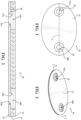
- the attachment device 10 may comprise a base 12, adhesive 14, and a liner 16, wherein the attachment device 10 is configured for attachment to a medical instrument 48.
- the attachment device 10 may be configured as a laminate, wherein each of the base 12, adhesive 14, and liner 16 makeup the various layers of the attachment device 10 as shown in Figure 3 , and may by positioned directly adjacent one another.
- the attachment device 10 comprises a base 12, an adhesive 14, and a liner 16 that have been layered on top of one another.
- the base 12, adhesive 14, and liner 16 may be configured as individual elements that may be assembled using the adhesive 14 to interconnect the base 12 and the liner 16.
- the base 12 may comprise a material that is flexible and tear-resistant.
- the base may comprise a plastic or composite material.
- the base 12 may similarly be resistant to degradation or erosion when utilized in a medical setting, such as a hospital or operating room.
- the base 12 may be cut in various shapes, such as a generally elliptical shape, as illustrated in Figures 1, 2, and 3 to define one or more apertures (18A, 18B) in a complementary shape, as described below.
- the generally elliptical shape may provide the necessary structural properties while also providing a limited profile when coupling the attachment device 10 to a medical instrument having a generally convex surface. While not shown in the figures, it is contemplated that the base 12 may be cut in different shapes and/or configurations based on the application.
- the base 12 may be cut in a square, rectangular, or similar polygonal shape. This may provide alternative structural properties and/or advantages when coupling the attachment device 10 to a generally flat surface.
- the examples described above are not intended to be limiting.
- the polygonal-shaped base may be coupled to a convex surface and the generally circular-shaped base 12 may be coupled to a flat surface.
- the base 12 may be at least partially translucent and treated for printing, such that text and/or graphics may be printed on a portion of the base 12.
- the base 12 may include printed identifying marks or graphics, as well as indicia representative of instructions for using the attachment device 10.
- the base 12 may also be markable, i.e., include a writing surface, such that a medical professional may write a date of use or installation on the base 12 using a typical writing utensil, such as a pen, marker, or pencil.
- the adhesive 14 may be generally disposed on at least one surface of the base 12 such that a portion of the adhesive 14 may be positioned between the base 12 and the liner 16.
- the adhesive 14 may be applied to or cover the entire area of at least one surface, such as the bottom, of the base 12, and the liner 16 may be configured to cover a defined area of the adhesive 14, leaving a portion of the adhesive disposed on the base 12 exposed.
- the exposed portion of the adhesive 14 (not covered by the liner 16) may be configured to removably couple the attachment device 10 to a medical instrument 48 (discussed in detail below). In other words, the liner remains on the attachment device 10 after the attachment device is secured to the medical instrument 48.
- the adhesive 14 may comprise a chemical compound, such as a paste, silicone, glue, rubber cement, or similar adhesive substance configured to adhere the base 12 to the liner 16 and/or the medical instrument 48.
- the adhesive 14 may similarly be configured as an adhesive tape, such as double-sided tape with an adhesive on both sides to allow for adhesion to both the base 12 and the liner 16.
- the adhesive 14 may be a medical grade adhesive manufactured by 3M TM , such as 3M TM 9865 Polyethylene Single Sided Medical Tape.
- the adhesive 14 may be configured such that it is suitable for use in wet and/or unclean environments and is safe for attachment to human skin.
- the liner 16 is configured to be coupled to the adhesive, such that the liner 16 may be positioned adjacent, such as directly adjacent, to the adhesive 14 opposite the base 12.
- the liner 16 may be configured to be disposed on the adhesive 14, such that the liner 16 covers a portion or defined area of the adhesive 14.
- the liner 16 may be removably coupled to the adhesive 14 of the attachment device 10.
- the liner 16 may comprise material that has been treated with a chemical compound that allows for easy removal of the liner 16 from the adhesive 14.
- the liner 16 may comprise a wax or Teflon TM coating.
- the liner 16 may be thought of as being similar to the backing of a sticker, wherein the liner 16 may remain coupled to the adhesive 14, but can be easily removed or separated from the adhesive 14. However, at least of the portion of the liner 16 may remain on the attachment device when the attachment device is secured to the medical instrument.
- the attachment device 10 may comprise a first base aperture 18A and a second base aperture 18B in the base 12. While the figures illustrate a configuration of the attachment device 10 comprising the first base aperture 18A and the second base aperture 18B, it should be understood that it is contemplated that the attachment device 10 may be configured with a single base aperture, or three or more base apertures. Depending on the location, shape, and/or number of base apertures 18A, 18B, the position and configuration of the adhesive 14 and/or liner 16 may be altered, including apertures thereof, which will be discussed in detail below.
- the first base aperture 18A and the second base aperture 18B may also be configured to define a longitudinal axis L, as illustrated in Figure 1 .
- the longitudinal axis L bisects the first base aperture 18A and the second base aperture 18B.
- the liner 16 may be configured to be substantially aligned with the longitudinal axis L defined by the first base aperture 18A and the second base aperture 18B.
- aligned is meant to refer to a longitudinal axis of the liner 16 being parallel to the longitudinal axis L.
- at least a portion of the liner 16 is disposed on the adhesive 14 between the first base aperture 18A and the second base aperture 18B.
- the liner 16 may be arranged in other fashions relative to the longitudinal axis L and/or the first and second base apertures 18A, 18B.
- the attachment device 10 may also comprise an adhesive aperture 19A, 19B in the adhesive 14.
- the adhesive aperture(s) 19A, 19B may be configured to be aligned, such as coaxial, with the first base aperture 18A and the second base aperture 18B.
- the liner 16 may also comprise a liner aperture(s) 21A, 21B, wherein the liner aperture(s) 21A, 21B may be aligned, such as coaxial, with the first base aperture 18A and the second base aperture 18B and/or the adhesive aperture(s) 19A, 19B.
- the base aperture(s) 18A, 18B, the adhesive apertures 19A, 19B, and the liner apertures 21A, 21B may be collectively arranged such that center of each aperture is aligned.
- the base aperture 18A, 18B, the adhesive apertures 19A, 19B, and liner apertures 21A, 21B may be partially coincident such that the elongate member can pass therethrough.
- the shapes and/or sizes of the base apertures 18A, 18B, adhesive apertures 19A, 19B, or liner apertures 21A, 21B may be the same or may be different.
- the size of the base aperture(s) 18A, 18B and/or the adhesive aperture(s) 19A, 19B may be configured to be larger than the liner aperture(s) 21A, 21B in order to prevent transference of the adhesive 14 to an object passing through the base aperture(s) 18A, 18B.
- the base 12 and/or the may further comprise a recess 20, bevel, chamfer, fillet, or similar transition between opposing surfaces of the base 12 surrounding the base aperture(s) 18A, 18B.
- the recess 20 surrounding the aperture(s) 18A, 18B may be configured to reduce any stresses or strain on the base 12 at the circumference of the aperture(s) 18A, 18B.
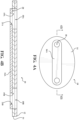
- a first exemplary liner 16A configuration is illustrated.
- the liner 16A is configured such that at least a portion of the liner 16A is removably coupled to the adhesive 14 this disposed on the base 12 between the first and second base apertures 18A, 18B.
- the liner 16A may also be configured to extend beyond the area of the adhesive 12 disposed on the base 12 between the first and second base apertures 18A, 18B.
- the liner 16A may be configured to also cover a portion of the adhesive 14 that is disposed on the base 12 surrounding the first and second base apertures 18A, 18B, as illustrated in Figures 4A and 4B , that is not on the base between the first and second apertures 18A, 18B.
- the liner 16A may comprise liner apertures 21A, 21B.
- the sectional view illustrated in Figure 4B illustrates an attachment device 10 wherein the base aperture(s) 18A, 18B, the adhesive aperture(s) 19A, 19B each comprise a generally uniform diameter.
- the liner aperture(s) 21A, 21B may be configured to be smaller relative to the size of the base aperture(s) 18A, 18B and /or the adhesive aperture(s) 19A, 19B. This may prevent the transference of the adhesive 14 to an object passing through the base aperture(s) 18A, 18B.
- the size of the liner aperture(s) 21A, 21B of the attachment device 10 may be may be the same size as the base aperture(s) 18A, 18B and /or the adhesive aperture(s) 19A, 19B.
- the base aperture(s) 18A, 18B, the adhesive aperture(s) 19A, 19B and/or liner aperture(s) 21A, 21B may be configured to comprise a uniform size, such as diameter, through the attachment device 10.
- the first base 18A, first liner 19A, and first adhesive 21A apertures may be sized and/or shaped differently than the second base 18B, second liner 19B, and second adhesive 21B apertures.
- the base aperture(s) 18A, 18B, the adhesive aperture(s) 19A, 19B, and the liner aperture(s) 21A, 21B may be generally aligned, such coaxial, when the base 12, adhesive 14, and/or liner 16 are layered or stacked on top of one another, such that the base aperture(s) 18A, 18B, the adhesive aperture(s) 19A, 19B, and the liner aperture(s) 21A, 21B form a continuous aperture through the attachment device 10.
- the size, shape, and/or position of each aperture may be different.
- the center of the base aperture(s) 18A, 18B and/or the adhesive aperture(s) 19A, 19B may be offset from the center of the liner aperture(s) 21A, 21B.
- the shape of the base aperture(s) 18A, 18B and/or the adhesive aperture(s) 19A, 19B may be different from the shape of the liner aperture(s) 21A, 21B.
- the liner aperture(s) 21A, 21B may be configured as a circle and the base aperture(s) 18A, 18B and/or the adhesive aperture(s) 19A, 19B may be configured as an ellipse. This configuration may assist with preventing transfer of the adhesive 14 to the elongate member 36.
- a portion of the adhesive 14 may be removed from the area of the base 12 that surrounds the base aperture(s) 18A, 18B, increasing the size, such as the diameter, of the adhesive aperture(s) 19A, 19B.
- a portion of the base 12 surrounding the base aperture(s) 18A, 18B is not in direct contact with the adhesive 14.
- a potential advantage of increasing the size, shape, and/or position of the base aperture 18A, 18B and/or adhesive aperture(s) 19A, 19B relative to the liner aperture(s) 21A, 21B is to prevent oozing or transference of the adhesive 14 onto the elongate member 36 when threaded through the base apertures 18A, 18B of the attachment device 10.
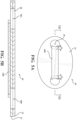
- a second exemplary liner 16B configuration is illustrated.
- the liner 16B is configured such that at least a portion of the liner 16B is coupled to the adhesive 14 that is disposed on the base between the first and second base apertures 18A, 18B.
- the portion of the liner 16B that is coupled to the adhesive 14 may not surround the first and second base apertures 18A, 18B and/or the adhesive aperture(s) 19A, 19B.
- the liner 16B is configured as a strip, belt, strap, band, or ribbon of material coupled to a portion of the adhesive 14 that is disposed on the base 12 between the first and second base apertures 18A, 18B.
- the length and width of the liner 16B may be configured based on the size of the base aperture(s) 18A, 18B, and/or the adhesive aperture(s) 19A, 19B, as well as the dimensions of the elongate member 36.
- the length and width of the liner 16B may also be configured based on the distance between the base aperture(s) 18A, 18B, and/or the adhesive aperture(s) 19A, 19B. While not required, the width of the liner 16B may typically be at least as large as the size of the base aperture(s) 18A, 18B, and/or the adhesive aperture(s) 19A, 19B.
- the width of the liner 16B may the same or larger that the diameter of the base aperture(s) 18A, 18B and/or the adhesive aperture(s) 19A, 19B.
- the length of the liner 16B may also be dependent on the size of the adhesive aperture(s) 19A, 19B.
- the liner 16B in order to prevent a portion of the adhesive 14 disposed on the base 12 that covers the area between the base aperture(s) 18A, 18B from being exposed, the edges of the liner 16B, the liner 16B may be configured to cover at least the portion of adhesive 14 disposed on the base 12 between the base aperture(s) 18A, 18B.
- the length of the liner 16B may be longer the distance between the edges of the base aperture(s) 18A, 18B and/or the adhesive aperture(s) 19A, 19B, such the liner 16B extends into and coves a portion of the base aperture(s) 18A, 18B and/or the adhesive aperture(s) 19A, 19B.
- the liner 16B may be similarly configured to extend between the edges of the base aperture(s) 18A, 18B, such that the liner 16B is also flush with the edge(s) of the base aperture(s) 18A, 18B.
- the length of the liner 16B may be shortened, such that the liner 16B will only cover the area on the base 12 that is between the base aperture(s) 18A, 18B that is in contact with the adhesive 14.
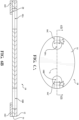
- a third exemplary liner 16C configuration is illustrated. Similar to the liner 16A, 16B configurations illustrated in Figures 4A-5B , the third exemplary configuration of the liner 16C may be coupled to the adhesive 14 and may be positioned adjacent the base aperture(s) 18A, 18B. The liner 16C may be couple to a portion of the adhesive 14 such that the liner 16C is substantially parallel, or collinear, with a longitudinal axis L that may bisect the first base aperture 18A and the second base aperture 18B.
- the liner 16C may be configured to be substantially aligned with the longitudinal axis L defined by the first base aperture 18A and the second base aperture 18B, wherein aligned is meant to refer to a longitudinal axis of the liner 16 being parallel to the longitudinal axis L. As illustrated in Figures 6A and 6B , it is not required that the liner 16C be disposed on a portion of the adhesive 14 between the first and second base apertures 18A, 18B.
- the liner 16C may comprise multiple pieces disconnected from one another and positioned adjacent to the base aperture(s) 18A, 18B, wherein the pieces of the liner 16C veer out from the base aperture(s) 18A, 18B relative to the center of the attachment device 10.
- the liner 16C may be disposed on a portion of the adhesive 14 that is disposed on the base 12 that is not between the first and second base apertures 18A, 18B, but is adjacent to the first and/or second base apertures 18A, 18B.
- the size and/or position of the liner 16C may be based, at least in part, on the size and/or position of the base aperture(s) 18A, 18B and/or the adhesive aperture(s) 19A, 19B, as well as the dimensions of the elongate member 36.
- the length and width of the liner 16C may also be configured based on the distance between the base aperture(s) 18A, 18B, and/or the adhesive aperture(s) 19A, 19B, and the outer edge of the attachment device 10. While not required, the width of the liner 16C may typically be at least as large as the size of the base aperture(s) 18A, 18B, and/or the adhesive aperture(s) 19A, 19B.
- the width of the liner 16C may the same or larger that the diameter of the base aperture(s) 18A, 18B and/or the adhesive aperture(s) 19A, 19B.
- the length of the liner 16C may also be dependent on the size of the adhesive aperture(s) 19A, 19B.
- the liner 16C in order to prevent a portion of the adhesive 14 disposed on the base 12 that covers the area between the base aperture(s) 18A, 18B and the outer edge(s) of the attachment device 10 from being exposed, the edges of the liner 16C, the liner 16C may be configured to cover at least the portion of adhesive 14 disposed on the base 12 between the base aperture(s) 18A, 18B and the outer edge(s) of the attachment device 10.
- the length of the liner 16C may be longer the distance between the edges of the base aperture(s) 18A, 18B and the outer edges of the attachment device 10, such the liner 16C extends into and coves a portion of the base aperture(s) 18A, 18B and/or the adhesive aperture(s) 19A, 19B.
- the liner 16C may be similarly configured to extend between the edges of the base aperture(s) 18A, 18B, such that the liner 16C is also flush with the edge(s) of the base aperture(s) 18A, 18B.
- the length of the liner 16C may be shortened, such that the liner 16C will only cover the area on the base 12 that is between the base aperture(s) 18A, 18B and the outer edge(s) of the attachment device 10 that is in contact with the adhesive 14.
- the attachment device 10 may be configured without a liner.
- a portion of the adhesive that corresponds to the same general location, position, and/or shape that the liner may be removed from the attachment device 10.
- the attachment device 10 may be configured to comprise a base 12 including a top surface and a bottom surface.
- the attachment device 10 may similarly comprises the first base aperture 18A, and the second base aperture 18B.
- the adhesive 14 may be at least partially disposed on the bottom surface of the base 12, such that the area of the base 12 base 12 between the first base aperture 18A and the second base aperture 18B is free from adhesive.
- the attachment device 10 may be configured wherein the area of the base 12 that is free from adhesive may correspond to the areas described above where the adhesive is covered by the liner.
- the attachment device assembly 30 may comprise the attachment device 10 described above and an indicator tab 32.
- the indicator tab 32 may comprise a second liner 22 configured to removably couple to the adhesive 14 of the attachment device 10 that is not covered by the liner 16.
- the second liner 22 and the liner 16 may comprise similar or the same materials.
- the liner 16 and second liner 22 may even be integrally formed from a single piece of material, wherein the material is cut to create the liner 16 and second liner 22.
- the liner 16 and second liner 22 may be cut such that the liner 16 is configured to remain coupled to the adhesive 14 of the attachment device 10 when the attachment device 10 is removed and/or separated from the indicator tab 32.
- the second liner 22 comprises a second liner aperture 24 corresponding to the shape of the liner 16 that remains coupled to the attachment device 10.
- a portion of the adhesive 14 that is disposed on the base 12 of the attachment device 10 corresponding to the second liner 22 is exposed.
- the exposed portion of the adhesive 14 may be configured to secure the attachment device 10 to another object, such as a medical instrument 48.
- the second liner 22 may be integrally formed with the indicator tab 32 of the attachment device assembly 30. However, while not illustrated in the figures, it is contemplated that the second liner 22 may be configured as an element of the indicator tab 32.
- the indicator tab 32 may be constructed of a laminate material or layers similar to the attachment device 10 described above. In this example configuration, the indicator tab 32 may comprise a base indicator layer, an adhesive indicator layer, and the second liner, wherein the second liner is removably coupled to the adhesive indicator layer.
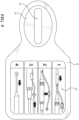
- the indicator tab 32 of the attachment device assembly 30 may further comprise an indicia portion 34.
- the indicia portion 34 similar to the base 12 of the attachment device 10, may be translucent and treated for printing, such that text and/or graphics may be printed on the indicia portion 34.
- the indicia portion 34 may include printed identifying marks, illustrations, text, or graphics that are representative of instructions for using the attachment device 10.
- the indicia portion 34 may also be markable, such that a medical professional may write a date of use or installation on the indicia portion 34 using a typical writing utensil, such as a pen, marker, or pencil. Referring to Figure 9 , an example illustration of the indicia portion 34 of the indicator tab 32 is shown.
- Illustrated in Figures 10 and 11 is an exemplary configuration of an irrigation assembly 50, including an elongate member 36 threaded through the attachment device assembly 30 described above.
- the elongate member 36 may be constructed from a plastic, a polymer, or similar durable and flexible material.
- the elongate member 36 may also comprise a lumen configured to create a canal, duct, or passageway that allows for the flow of a fluid.
- the elongate member may be used to provide fluid to the surgical site, or suction debris away from the surgical site through the elongate member 36.
- the elongate member 36 may be configured for a navigation tracker of a navigation system, or a control console.
- the elongate member may further comprise a distal end 38 and a proximal end 40.
- the proximal end 38 may be configured to couple to a surgical system, such as an irrigation system (not illustrated in the figures).
- the proximal end 40 may comprise a proximal coupler 42, wherein the proximal coupler 42 may be configured to couple the proximal end 40 to the surgical system.
- the proximal coupler 42 may comprise a barbed connector, a luer connector, electrical connector, or similar fitting.
- proximal coupler 42 may be coupled to the proximal end 40 of the elongate member 36 in a number of different ways, such as via ultraviolet bonding, gluing, cement, epoxy, plastic weld, and the like. It should also be appreciated that the proximal coupler 42 may be omitted, and the elongate member 36 may be coupled directly to the surgical system.
- the distal end 38 may be configured to couple to a medical instrument accessory 44, such as an irrigation sleeve.
- a medical instrument accessory 44 such as an irrigation sleeve.
- An exemplary irrigation sleeve for use with a medical instrument is disclosed in U.S. Patent Application Publication No. 2021/0153878 A1, filed on July 25, 2017 .
- the distal end 38 of the elongate member may comprise a barbed connector, a luer connector, or similar fitting configured to couple the elongate member 36 to the medical instrument accessory 44.
- the medical instrument accessory 44 may comprise an accessory coupler 46 configured to receive the distal end 38 of the elongate member 36.
- the accessory coupler 46 may be coupled to the distal end 38 of the elongate member 36 in a number of different ways, such as via ultraviolet bonding, gluing, cement, epoxy, plastic weld, and the like. It should also be appreciated that the accessory coupler 46 may be omitted, and the elongate member 36 may be configured to be positioned proximate to the medical instrument accessory 44 and apply fluid directly to the surgical sight.
- the attachment device 10 may comprise a number of base apertures 18A, 18B.
- the base aperture(s) 18A, 18B may be configured to receive the elongate member 36, which may be threaded through the base aperture(s) 18A, 18B in the attachment device 10.
- the dimensions and/or thickness of the base aperture(s) 18A, 18B may be configured to reduce any stresses or strain on the base 12 and/or elongate member 36 when the elongate member 36 is threaded through the base aperture(s) 18A, 18B.
- the diameter of the base aperture(s) 18A, 18B and/or distance between the base aperture(s) 18A, 18B may be configured to create a friction fit for the elongate member 36 when threaded through the base aperture(s) 18A, 18B. This will hold the elongate member 36 in place, unless an additional force is applied to the elongate member 36, such as the medical professional pulling the elongate member 36 in one direction or the other.
- the base may also comprise a recess 20, wherein the dimensions and/or thickness of the recess 20 surrounding the base aperture(s) 18A, 18B may be configured to reduce any stresses or strain on the base 12 and/or elongate member 36 when the elongate member 36 is threaded through the base aperture(s) 18A, 18B.
- the liner 16A, 16B, and 16C configuration may dictate the direction and orientation with which the elongate member 36 is threaded through the base aperture(s) 18A, 18B of the attachment device 10.
- the threading configuration of the elongate member 36 with relation to the attachment device 10 would correspond to the liner 16A, 16B illustrated in Figures 4A to 5B , wherein the liner 16A, 16B is positioned adjacent the adhesive 14 and at least partially between the base aperture(s) 18A, 18B.
- the elongate member 36 is threaded through the base aperture(s) 18A, 18B of the attachment device 10 such that an intermediary portion of the elongate member 36 that is positioned between the base aperture(s) 18A, 18B is adjacent to the liner 16A, 16B.
- Figure 11 shows the elongate member 36 positioned adjacent to the liner 16 as it extends between the base aperture(s) 18A, 18B.
- One of the many functions of the liner 16 is to prevent the elongate member 36 from being coupled to the adhesive 14, thus allowing the elongate member 36 to be slid axially when attached to the medical instrument 48.
- the threading configuration of the elongate member 36 may be configured to correspond to the liner 16C illustrated in Figures 6A and 6B . This would be the inverse of the elongate member 36 threading illustrated in Figures 10 and 11 .
- the liner 16C configuration illustrated in Figures 6A and 6B the liner 16C comprises two separate pieces that are placed adjacent to the base aperture(s) 18A, 18B. However, in this configuration, the liner 16C may not be positioned between the base aperture(s) 18A, 18B.
- the elongate member 36 In threading the elongate member 36 through the base aperture(s) 18A, 18B, the elongate member 36 is threaded through the base aperture(s) 18A, 18B of the attachment device 10 such that an intermediary portion of the elongate member 36 that is positioned between the base aperture(s) 18A, 18B is adjacent to the base 12, i.e., on the top of the attachment device 10.
- the opposing ends of the elongate member 36 are positioned adjacent to the pieces of the liner 16C.
- additional base aperture(s) 18A, 18B and/or liner configurations are contemplated to allow for additional threading configurations. Irrespective of the number of base aperture(s) 18A, 18B and/or pieces of liner 16, it should be appreciated that when threading the elongate member 36 through the base aperture(s) 18A, 18B, a piece of liner 16 will typically be included between the adhesive 14 and the elongate member 36 to prevent exposure of the elongate member 36 to the adhesive 14.
- the adhesive 14 that corresponds with the location of the liner 16 may be removed from the base 12 (referring to the liner 16A, 16B, and 16C illustrated in Figures 4A-6B ). By removing portions of the adhesive 14 that correspond with the location of the liner 16A, 16B, and 16C illustrated in the figures, the liner 16A, 16B, and 16C may be unnecessary, and therefore, the liner 16A, 16B, and 16C may be omitted from the attachment device 10.
- the surgical system 60 may be configured to comprise a medical instrument 48 and the irrigation assembly 50 described above.
- the medical instrument 48 may comprise a medical instrument accessory 44, such as a cutting accessory or irrigation sleeve.
- the elongate member 36 of the irrigation assembly 50 may be threaded through the base aperture(s) 18A, 18B of the attachment device 10, and the distal end 38 coupled to the medical instrument accessory 44.
- the attachment device 10 may be removed from the indicator tab 32, exposing a portion or area of the adhesive 14 that is not covered by the liner 16. The attachment device 10 may then be removably coupled to the medical instrument 48 via the exposed portion of the adhesive 14.
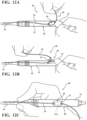
- the attachment device 10 may be coupled to the medical instrument 48 at any point along the body 52 of the medical instrument 48, as illustrated in Figure 12C .
- the attachment device 10 may be coupled to the body 52 of the medical instrument 48 proximate to the medical instrument accessory 44.
- the attachment device 10 may be coupled to the body 52 of the medical instrument 48 distal to the medical instrument accessory 44.
- the medical professional may select the location to couple the attachment device 10 to the medical instrument 48.
- the medical professional may consider the size of elongate member, type of medical procedure to be performed, ergonomic grip of the medical instrument 48, or the like, when selecting the location to couple the attachment device 10 to the medical instrument 48.
- the elongate member 36 is threaded through the base aperture(s) 18A, 18B of the attachment device 10 such that the elongate member 36 is axially aligned with the liner 16A when attached to the body 52 of the medical instrument.
- a portion of the elongate member 36 is positioned between the liner 16A and the body 52 of the medical instrument 48 when the attachment device 10 is coupled to the medical instrument 48.
- the presence of the liner 16A between the adhesive 14 and the elongate member 36 allows for the elongate member 36 to be axially slid while attached to the medical instrument 48. This allows for the medical professional to easily adjust the elongate member 36 to be taut, or provide additional slack in the elongate member 36 when needed.
- Figures 12A, 12B, and 12C illustrate various steps of an exemplary method of attaching the elongate member 36 to the medical instrument 48 using the attachment device 10.
- the method of attaching the elongate member 36 to the medical device may comprise providing the attachment device 10 and or assembly 30, wherein the attachment device 10 comprises the liner 16, the base 12, and the adhesive 14 disposed at least partially between the base 12 and the liner 16.
- the attachment device 10 may further comprise the first base aperture 18A and the second base aperture 18B.
- the liner 16 may be positioned adjacent to the adhesive 14, such that the liner 16 is at least partially between the first base aperture 18A and the second base aperture 18B and adjacent to the adhesive.
- the method may further comprise threading the elongate member 36 through the first base aperture 18A and the second base aperture 18B of the attachment device 10, such that the elongate member 36 is axially aligned with the liner 16.
- the liner 16C may be positioned proximate to the base aperture(s) 18A, 18B and positioned adjacent to the adhesive 14.
- the liner 16C may be aligned with the longitudinal axis defined by the base apertures 18A, 18B.
- the method of securing the elongate member 36 may further comprise adhering the attachment device 10 to the medical instrument 48.
- the attachment device 10 may be removably coupled to the body 52 of the medical instrument 48 by pressing the exposed portion of the adhesive 14 to the body 52 of the medical instrument 48, such that the elongate member 36 is at least partially disposed between the attachment device 10 and the medical instrument 48.
- the attachment device 10 including the elongate member 36 threaded through the aperture(s) 18A, 18B may be pressed against the base 52 to secure the attachment device 10 to the medical instrument 48.
- the method may further comprise separating the indicator tab 32 of the attachment device assembly 30 described above from the adhesive 14.
- the indicator tab 32 may be separated or removed by pulling on the elongate member 36 that is threaded through the attachment device 10 of the assembly 30.
- the indicator tab 32 may be configured to comprise indicia 34 representative of the method of coupling the attachment device 10 to the medical instrument 48.
- the method may further comprise axially sliding the elongate member 36 adjacent to the liner 16 such that the elongate member 36 is taut when the attachment device 10 is coupled to the medical instrument 48. For example, pulling on the proximal end 40 of the elongate member 36 to remove any slack in the distal end 38 of the elongate member 36. This may reduce the profile and or bulkiness of the surgical system 60. It may also prevent the elongate member 36 from becoming caught on or entangled with something during operation of the medical instrument 48. Alternatively, the elongate member 36 may be slid by pulling on the distal end 38 to create additional slack in the elongate member 36.
- the method may also comprise removing the second liner 22 from the adhesive 14, wherein removal of the second liner 22 exposes the portion of the adhesive 14 configured to removably couple the attachment device 10 to the medical instrument 48.
- the method may comprise separating the attachment device 10 from the medical instrument 48 by pulling on the elongate member 36.
- pulling on the proximal end 40 of the elongate member 36 may remove and/or detach the attachment device 10 from the medical instrument 48. Allowing the elongate member and attachment device 10 to be disposed of following a medical procedure as part of the sterilization process.
- a method of manufacturing the attachment device 10 and/or assembly 30 that is described above may comprise providing a base 12 having a top surface and an opposing bottom surface.
- One or more base aperture(s) 18A, 18B may be cut in the base 12.
- a die cutting process may be utilized to cut the first base apertures 18A and the second base aperture 18B.
- the adhesive 14 may be applied to the bottom surface of the base 12.
- the adhesive 14 may be applied to the base 12 such that the adhesive 14 is flush to the first base aperture18A and the second base aperture 18B.
- the adhesive 14 may be applied to the base 12 such that a portion of the base 12 surrounding the first base aperture 18A and the second base aperture 18B is free from the adhesive 14.
- the method may further comprise removably coupling the liner 16A, 16B, 16C to the adhesive 14, such that the liner 16A, 16B is at least partially disposed between the first base aperture 18A and the second base aperture 18B in the base 12.
- the liner 16C may be configured such that it is not positioned between the first base aperture 18A and the second base aperture 18B.
- the method may also comprise cutting a recess 20, bevel, chamfer, fillet, or similar transition in the top surface of the base 12 configured to surround each of the first base aperture 18A and the second base aperture 18B.
- the recess 20 may be created by making a secondary cut in any number of shapes, such as a circular cut.
- the shape of the recess 20 created by the secondary cut may correspond to the shape of the first base aperture 18A and the second base aperture 18B.
- the shape of the recess 20 may be different from the shape of the first base aperture 18A and the second base aperture 18B.
- the size and/or dimensions of the recess 20 created by the secondary cut may be larger than the size and/or dimensions of the first base aperture 18A and the second base aperture 18B.
- the secondary cut may be centered at the midpoint of the first base aperture 18A and the second base aperture 18B, wherein the diameter of the secondary cut to create the recess 20 is larger than the diameter of the first base aperture 18A and the second base aperture 18B.
- the secondary cut configured to create the recess may also be referred to as a "kiss-cut" or a relief cut.
- the attachment device 10 may be manufactured by starting pre-assembled piece of material that may include the base 12, the adhesive 14 applied to one surface of the base 12, and the liner 16A, 16B, 16C removably coupled to the adhesive 14.
- the method of manufacturing the attachment device 10 may comprise cutting one or more base aperture(s) 18A, 18B through the base 12, the adhesive 14, and the liner16A, 16B, 16C.
- the method may further comprise cutting the liner 16A, 16B, 16C such that the liner 16A, 16B is at least partially disposed between the first base aperture 18A and the second base aperture 18B in the base 12.
- the liner 16A, 16B, 16C may be cut such that the liner 16C it is not positioned between the first base aperture 18A and the second base aperture 18B.
- the method may also comprise cutting a recess 20, bevel, chamfer, fillet, or similar transition in the top surface of the base 12 configured to surround each of the first base aperture 18A and the second base aperture 18B.
- the recess 20 may be created by making a secondary cut in any number of shapes, such as a circular cut. Similar to as described above, the size and/or dimensions of the recess 20 created by the secondary cut may be larger than the size and/or dimensions of the first base aperture 18A and the second base aperture 18B.
- the secondary cut configured to create the recess may also be referred to as a "kiss-cut" or a relief cut.
- the method may further comprise threading the elongate member 36 through the first base aperture 18A and the second base aperture 18B.
- the elongate member 36 may be threaded with the attachment device 10 by starting the elongate member 36 adjacent to the top surface of the base 12, inserting the elongate member 36 through the first base aperture 18A, extending the elongate member 36 along the liner 16A, 16B, and inserting the elongate member 36 through the second base aperture 18B.
- the elongate member 36 may be threaded with the attachment device 10 by starting the elongate member 36 adjacent to the liner 16C, inserting the elongate member 36 through the first base aperture 18A, extending the elongate member 36 along the top surface of the base 12, and inserting the elongate member through the second base aperture 18B.
- the method may also comprise removably coupling an indicator tab 32 to the adhesive 14 proximate to the liner 16, wherein the indicator tab 32 may be configured to comprise indicia 34 representative of said method of coupling the attachment device to the medical instrument.
- the indicia 34 may include text, graphics, and/or images representing the method of coupling the elongate member 36 to the medical instrument.
- the indicia 34 may be printed on the indicator tab 32 as part of the method of manufacturing the attachment device 10 and/or assembly 30. For example, referring back to Figure 9 , an example of the indicia 34 that may be printed on the indicator tab 32 is illustrated.
- the indicia 32 include graphics and/or numerals indicating the steps of attaching the elongate member 36 to the cutting accessory, securing the elongate member 36 to the medical instrument 48 using the attachment device 10, and connecting the elongate member 36 to the medical system, such as an irrigation system.
- the liner 16 may comprise a second liner 22, wherein the second liner 22 is integrally formed with the indicator tab 32.
- the liner 16 and second liner 22 may initially comprise a single integral piece of liner 16, 22.
- the liner 16 is configured to remain coupled to the adhesive 14 when the indicator tab 32 is removed, it may be necessary to cut the liner 16, 22 to allow for easy separation of the liner 16 and second liner 22 when the attachment device 10 is removed from the indicator tab 32.
- the method of manufacturing the attachment device 10 may further comprise cutting the liner 16, 22 such that the second liner 22 may be configured to be separable from the liner 16, and wherein the liner 16 remains at least partially disposed between the first base aperture 18A and the second base aperture 18B.
- the method may also comprise cutting the liner aperture(s) 21A, 21B in the liner 16A, wherein the liner aperture(s) 21A, 21B is aligned with the base aperture(s) 18A, 18B.
- the base aperture(s) 18A, 18B may be defined by a first diameter
- the liner aperture(s) 21A may be defined by a second diameter.
- the attachment device 10 may be configured such that the first and second diameter are equal. However, it is also contemplated that the second diameter may be larger than the first diameter, and/or the first diameter may be larger than the second diameter.
Landscapes
- Health & Medical Sciences (AREA)
- Life Sciences & Earth Sciences (AREA)
- Heart & Thoracic Surgery (AREA)
- Surgery (AREA)
- Veterinary Medicine (AREA)
- Biomedical Technology (AREA)
- Engineering & Computer Science (AREA)
- Animal Behavior & Ethology (AREA)
- General Health & Medical Sciences (AREA)
- Public Health (AREA)
- Medical Informatics (AREA)
- Molecular Biology (AREA)
- Nuclear Medicine, Radiotherapy & Molecular Imaging (AREA)
- Anesthesiology (AREA)
- Hematology (AREA)
- Orthopedic Medicine & Surgery (AREA)
- Oral & Maxillofacial Surgery (AREA)
- Pulmonology (AREA)
- Pathology (AREA)
- Dentistry (AREA)
- Vascular Medicine (AREA)
- Endoscopes (AREA)
- External Artificial Organs (AREA)
- Surgical Instruments (AREA)
- Media Introduction/Drainage Providing Device (AREA)
Description
- Conventional medical procedures routinely involve the use of surgical tools and/or medical instruments to assist medical professionals in approaching, viewing, manipulation, or otherwise effecting treatment at localized surgical sites. In certain applications of medical instruments, such as those that involve the use of high-speed drills, rotating burs, open-window shavers, and the like, necessarily results in the accumulation of heat and/or debris at the surgical site. Here, surgical systems may employ irrigation systems in combination with a medical instrument. The irrigation system typically includes a fluid source and a flexible line or tube coupled to the medical instrument and configured to supply fluid from the fluid source. Therefore, there remains a need in the art for an attachment device for coupling an elongate member or tube to a medical instrument configured to overcome the various disadvantages of conventional irrigation tube coupling mechanisms.
- We refer to
US 2005/0107786 A1 ,US 2010/298778 A1 ,US 2005/234297 A1 andUS 2016/022277 A1 as technological background information. - The present disclosure relates generally to an apparatus and method of removably securing an elongate member, such as a flexible line or tube, to a medical instrument. The apparatus comprises an attachment device that may be configured to secure an elongate member, which may include a lumen, to a medical instrument to facilitate irrigation. An attachment device for securing an elongate member to a medical instrument is defined in
claim 1, an attachment device assembly for securing an elongate member to a medical instrument is defined inclaim 3 and an irrigation system comprising the attachment device ofclaim 1 or the attachment device assembly ofclaim 3 is defined in claim 7. Optional features are defined in the dependent claims. - One exemplary configuration of the apparatus provides an attachment device comprising an adhesive disposed at least partially between a base and a liner. The base may comprise a first base aperture and a second base aperture, and the liner may be positioned adjacent the adhesive, such that it is at least partly between said first and second base apertures. The attachment device may be configured to removably secure an elongate member, such as a flexible line or tube, to a medical instrument by threading the elongate member through the base apertures and adhering an exposed portion of the adhesive to the medical instrument.
- In another exemplary configuration of an attachment device for securing an elongate member to a medical instrument, the attachment device may comprise a liner, a base, and an adhesive. The base may further comprise a first base aperture and a second base aperture. The adhesive may be disposed at least partially between the base and the liner. The liner be positioned such that the liner is at least partially between the first base aperture and the second base aperture and is adjacent to the adhesive.
- In yet another exemplary configuration of an attachment device for securing an elongate member to a medical instrument, the attachment device may comprise a first liner, a second liner, a base, and an adhesive. The base may comprise a first base aperture and a second base aperture. The adhesive may be positioned at least partially between the base and the first liner and the second liner. The first liner may be positioned adjacent to the first base aperture and the second liner may be positioned adjacent to the second base aperture. The first liner and the second liner may be axially aligned with a longitudinal axis defined by the first base aperture and the second base aperture.
- In a configuration of an attachment device for securing an elongate member to a medical instrument according to
claim 1, the attachment device comprises a base comprising a top surface, a bottom surface, a first base aperture, and a second base aperture. The attachment device further comprises an adhesive at least partially disposed on the bottom surface of the base such that the attachment device is free from adhesive on the bottom surface of the base between the first base aperture and the second base aperture. - In still yet another exemplary configuration of an attachment device for securing an elongate member to a medical instrument, the attachment device may comprise a liner, a base, and an adhesive. The base may comprise a first base aperture and a second base aperture. The liner may be disposed on the adhesive that is positioned on the base at least partially between the first base aperture and the second base aperture.
- An exemplary configuration of an attachment device assembly for securing an elongate member to a medical instrument may comprise an attachment device. The attachment device may comprise a liner, a base, and an adhesive. The base may comprise a first base aperture and a second base aperture. The adhesive may be disposed at least partially between the base and the liner. The liner may be positioned at least partially between the first base aperture and the second base aperture and adjacent to the adhesive. The attachment device assembly may further comprise an indicator tab removably coupled to the attachment device, wherein the indicator tab comprises an indicia representative of a method of attaching the attachment device to the medical instrument.
- In an another exemplary configuration of an attachment device assembly for use with a medical instrument to facilitate irrigation, the attachment device assembly may comprise an attachment device. The attachment device may comprise a base comprising a first base aperture and a second base aperture. The attachment device may also comprise an adhesive disposed on the base. The attachment device assembly may further comprise an elongate member threaded through the first base aperture and the second base aperture.
- An exemplary irrigation system may comprise a medical instrument configured to cut tissue, said medical instrument having a body configured to be held by a user. The irrigation system may further comprise an elongate member and an attachment device configured to removably couple the elongate member to the medical instrument. The attachment device may comprise a liner, a base, and an adhesive. The base may comprise a first base aperture and a second base aperture. The adhesive may be disposed at least partially between the base and the liner. The liner may be positioned at least partially between the first base aperture and the second base aperture and adjacent to the adhesive. The elongate member may be threaded through the first base aperture and the second base aperture such that a portion of the elongate member is adjacent to the body of the medical instrument.
- A method of coupling an elongate member to a medical instrument may comprise the step of providing an attachment device. The attachment device may comprise a liner, a base comprising a first base aperture and a second base aperture, and an adhesive. The adhesive may be disposed at least partially between the base and the liner, and the liner may be at least partially between the first base aperture and the second base aperture and adjacent to the adhesive. The method may further comprise the step of threading an elongate member through the first base aperture and the second base aperture such that the elongate member is axially aligned with the liner. The method may also comprise the step of adhering the attachment device to the medical instrument, wherein an exposed portion of the adhesive removably couples the attachment device to the medical instrument such that the elongate member is at least partially disposed between the attachment device and the medical instrument.
- A method of manufacturing an attachment device for removably coupling an elongate member to a medical instrument may comprise the step of providing a base material having a top surface and an opposing bottom surface. The method may further comprise the step of applying an adhesive to the bottom surface of the base material. The method may also comprise the step of removably coupling a liner to the adhesive such that the liner is at least partially disposed between the first base aperture and the second base aperture and cutting a first base aperture and a second base aperture through the base material, the adhesive, and the liner.
- These and other embodiments, features, and advantages of the present disclosure will be apparent to those skilled in the art. The present disclosure is not to be limited to or by these embodiments, features, and advantages.
- Referring now to the drawings, exemplary illustrations are shown in detail. Although the drawings represent schematic embodiments, the drawings are not necessarily to scale and certain features may be exaggerated to better illustrate and explain an innovative aspect of an illustrative embodiment. Further, the exemplary illustrations described herein are not intended to be exhaustive or otherwise limiting or restricting to the precise form and configuration shown in the drawings and disclosed in the following detailed description.
- Advantages of the present disclosure will be readily appreciated as the same becomes better understood by reference to the following detailed description when considered in connection with the accompanying drawings.
-
Figure 1 is a top view of an attachment device for securing an elongate member to a medical instrument. -
Figure 2 is a perspective view of the attachment device ofFigure 1 . -
Figure 3 is a sectional view of the attachment device ofFigure 1 , illustrating an example configuration of the various elements of the attachment device. -
Figure 4A is a bottom view of the attachment device ofFigure 1 , illustrating a first embodiment of a liner. -
Figure 4B is a rotated sectional view of the attachment device ofFigure 4A including the first embodiment of the liner. -
Figure 5A is a bottom view of the attachment device ofFigure 1 , illustrating a second embodiment of a liner. -
Figure 5B is a rotated sectional view of the attachment device ofFigure 5A including the second embodiment of the liner. -
Figure 6A is a bottom view of the attachment device ofFigure 1 , illustrating a third embodiment of a liner. -
Figure 6B is a rotated sectional view of the attachment device ofFigure 6A including the third embodiment of the liner. -
Figure 7 is a top view of an attachment device assembly including an indicator tab and the attachment device ofFigure 1 . -
Figure 8 is a partially exploded view of the attachment device assembly ofFigure 7 . -
Figure 9 is a top view of an indicator tab including an example illustration of indicia on the indicator tab representing a method of securing an elongate member to a medical instrument using the attachment device. -
Figure 10 is a perspective view of a partially exploded and fully assembled attachment device assembly including an elongate member and an irrigation sleeve. -
Figure 11 is a top and bottom view of the assembled attachment device assembly ofFigure 10 including an elongate member and an irrigation sleeve. -
Figure 12A is a perspective view of a method of securing an elongate member to a medical instrument using the attachment device ofFigure 1 . -
Figure 12B is a perspective view of the method ofFigure 12A of securing an elongate member to a medical instrument using the attachment device ofFigure 1 . -
Figure 12C is a perspective view of the method ofFigure 12A of securing an elongate member to a medical instrument using the attachment device ofFigure 1 . - As medical professionals strive for reducing the size of the incisions and the amount of recovery time required following invasive medical procedures, the size of medical instruments used in various medical procedures have become smaller. Many of the medical instruments utilized in performing the various medical procedures may include the use of a cutting accessory, such as high-speed drills, rotating burs, open-window shavers, and the like. An exemplary medical instrument is disclosed in
U.S. Patent No. 5,941,891, granted on Aug. 24, 1999 . Many of these cutting accessories may require the use of irrigation or suction to reduce heat and/or remove debris at the surgical site. Similarly, irrigation may be utilized to lubricate a cutting accessory. Generally, an elongate member, such as those including a lumen, may be utilized to direct fluid from an irrigation source toward the surgical site and/or the cutting accessory. The elongate member may be disposable as part of the sterilization process, resulting in the elongate member only temporarily being attached to the medical instrument. The introduction of additional elements, such as the elongate member for providing irrigation, can result in increasing the size, profile, and/or general bulkiness of the medical instrument. A loose elongate member extending from the irrigation system to the cutting accessory may obstruct the medical professional's view and/or distract the medical professional during operation of the medical instrument during the medical procedure. The positioning of the elongate member relative to the medical instrument may similarly affect the ergonomics of the medical instrument, inhibiting the medical professional's ability to manipulate the medical instrument. Therefore, the medical professional may utilize an attachment device and/or assembly for securing an elongate member to a medical instrument, such as theattachment device 10 illustrated inFigures 1 and 2 . - Referring to
Figures 1, 2, and 3 , an example configuration of anattachment device 10 is illustrated. Accordingly, theattachment device 10 may comprise abase 12, adhesive 14, and aliner 16, wherein theattachment device 10 is configured for attachment to amedical instrument 48. Theattachment device 10 may be configured as a laminate, wherein each of thebase 12, adhesive 14, andliner 16 makeup the various layers of theattachment device 10 as shown inFigure 3 , and may by positioned directly adjacent one another. For example, referring toFigures 2 and 3 , theattachment device 10 comprises abase 12, an adhesive 14, and aliner 16 that have been layered on top of one another. Alternatively, thebase 12, adhesive 14, andliner 16 may be configured as individual elements that may be assembled using the adhesive 14 to interconnect thebase 12 and theliner 16. - The base 12 may comprise a material that is flexible and tear-resistant. For example, the base may comprise a plastic or composite material. The base 12 may similarly be resistant to degradation or erosion when utilized in a medical setting, such as a hospital or operating room. For example, the
base 12 may be cut in various shapes, such as a generally elliptical shape, as illustrated inFigures 1, 2, and 3 to define one or more apertures (18A, 18B) in a complementary shape, as described below. The generally elliptical shape may provide the necessary structural properties while also providing a limited profile when coupling theattachment device 10 to a medical instrument having a generally convex surface. While not shown in the figures, it is contemplated that the base 12 may be cut in different shapes and/or configurations based on the application. For example, thebase 12 may be cut in a square, rectangular, or similar polygonal shape. This may provide alternative structural properties and/or advantages when coupling theattachment device 10 to a generally flat surface. However, the examples described above are not intended to be limiting. For example, it is contemplated that the polygonal-shaped base may be coupled to a convex surface and the generally circular-shapedbase 12 may be coupled to a flat surface. - The base 12 may be at least partially translucent and treated for printing, such that text and/or graphics may be printed on a portion of the
base 12. For example, thebase 12 may include printed identifying marks or graphics, as well as indicia representative of instructions for using theattachment device 10. The base 12 may also be markable, i.e., include a writing surface, such that a medical professional may write a date of use or installation on the base 12 using a typical writing utensil, such as a pen, marker, or pencil. - The adhesive 14 may be generally disposed on at least one surface of the base 12 such that a portion of the adhesive 14 may be positioned between the base 12 and the
liner 16. For example, the adhesive 14 may be applied to or cover the entire area of at least one surface, such as the bottom, of thebase 12, and theliner 16 may be configured to cover a defined area of the adhesive 14, leaving a portion of the adhesive disposed on the base 12 exposed. The exposed portion of the adhesive 14 (not covered by the liner 16) may be configured to removably couple theattachment device 10 to a medical instrument 48 (discussed in detail below). In other words, the liner remains on theattachment device 10 after the attachment device is secured to themedical instrument 48. - The adhesive 14 may comprise a chemical compound, such as a paste, silicone, glue, rubber cement, or similar adhesive substance configured to adhere the base 12 to the
liner 16 and/or themedical instrument 48. The adhesive 14 may similarly be configured as an adhesive tape, such as double-sided tape with an adhesive on both sides to allow for adhesion to both thebase 12 and theliner 16. For example, the adhesive 14 may be a medical grade adhesive manufactured by 3M™, such as 3M™ 9865 Polyethylene Single Sided Medical Tape. The adhesive 14 may be configured such that it is suitable for use in wet and/or unclean environments and is safe for attachment to human skin. - The
liner 16 is configured to be coupled to the adhesive, such that theliner 16 may be positioned adjacent, such as directly adjacent, to the adhesive 14 opposite thebase 12. Theliner 16 may be configured to be disposed on the adhesive 14, such that theliner 16 covers a portion or defined area of the adhesive 14. Theliner 16 may be removably coupled to the adhesive 14 of theattachment device 10. Theliner 16 may comprise material that has been treated with a chemical compound that allows for easy removal of theliner 16 from the adhesive 14. For example, theliner 16 may comprise a wax or Teflon™ coating. Theliner 16 may be thought of as being similar to the backing of a sticker, wherein theliner 16 may remain coupled to the adhesive 14, but can be easily removed or separated from the adhesive 14. However, at least of the portion of theliner 16 may remain on the attachment device when the attachment device is secured to the medical instrument. - As illustrated in
Figures 1, 2, and 3 , theattachment device 10 may comprise afirst base aperture 18A and asecond base aperture 18B in thebase 12. While the figures illustrate a configuration of theattachment device 10 comprising thefirst base aperture 18A and thesecond base aperture 18B, it should be understood that it is contemplated that theattachment device 10 may be configured with a single base aperture, or three or more base apertures. Depending on the location, shape, and/or number ofbase apertures liner 16 may be altered, including apertures thereof, which will be discussed in detail below. - The
first base aperture 18A and thesecond base aperture 18B may also be configured to define a longitudinal axis L, as illustrated inFigure 1 . For example, the longitudinal axis L bisects thefirst base aperture 18A and thesecond base aperture 18B. In one or more of the configurations of theattachment device 10 described below, theliner 16 may be configured to be substantially aligned with the longitudinal axis L defined by thefirst base aperture 18A and thesecond base aperture 18B. In one aspect, aligned is meant to refer to a longitudinal axis of theliner 16 being parallel to the longitudinal axis L. More generally, in some aspects, at least a portion of theliner 16 is disposed on the adhesive 14 between thefirst base aperture 18A and thesecond base aperture 18B. In other words, in certain aspects, theliner 16 may be arranged in other fashions relative to the longitudinal axis L and/or the first andsecond base apertures - The
attachment device 10 may also comprise anadhesive aperture first base aperture 18A and thesecond base aperture 18B. It is further contemplated that theliner 16 may also comprise a liner aperture(s) 21A, 21B, wherein the liner aperture(s) 21A, 21B may be aligned, such as coaxial, with thefirst base aperture 18A and thesecond base aperture 18B and/or the adhesive aperture(s) 19A, 19B. Thus, in one aspect, the base aperture(s) 18A, 18B, theadhesive apertures liner apertures base aperture adhesive apertures liner apertures base apertures adhesive apertures liner apertures Figures 1 to 3 , the size of the base aperture(s) 18A, 18B and/or the adhesive aperture(s) 19A, 19B may be configured to be larger than the liner aperture(s) 21A, 21B in order to prevent transference of the adhesive 14 to an object passing through the base aperture(s) 18A, 18B. - Alternatively, in another configuration of the
attachment device 10, thebase 12 and/or the may further comprise arecess 20, bevel, chamfer, fillet, or similar transition between opposing surfaces of thebase 12 surrounding the base aperture(s) 18A, 18B. Therecess 20 surrounding the aperture(s) 18A, 18B may be configured to reduce any stresses or strain on the base 12 at the circumference of the aperture(s) 18A, 18B. - Referring to
Figures 4A and 4B , a firstexemplary liner 16A configuration is illustrated. In the first exemplary configuration of theliner 16A, theliner 16A is configured such that at least a portion of theliner 16A is removably coupled to the adhesive 14 this disposed on the base 12 between the first andsecond base apertures liner 16A may also be configured to extend beyond the area of the adhesive 12 disposed on the base 12 between the first andsecond base apertures liner 16A may be configured to also cover a portion of the adhesive 14 that is disposed on thebase 12 surrounding the first andsecond base apertures Figures 4A and 4B , that is not on the base between the first andsecond apertures liner 16A configuration, theliner 16A may compriseliner apertures - The sectional view illustrated in
Figure 4B illustrates anattachment device 10 wherein the base aperture(s) 18A, 18B, the adhesive aperture(s) 19A, 19B each comprise a generally uniform diameter. The liner aperture(s) 21A, 21B may be configured to be smaller relative to the size of the base aperture(s) 18A, 18B and /or the adhesive aperture(s) 19A, 19B. This may prevent the transference of the adhesive 14 to an object passing through the base aperture(s) 18A, 18B. While not shown in the figures, it is contemplated that the size of the liner aperture(s) 21A, 21B of theattachment device 10 may be may be the same size as the base aperture(s) 18A, 18B and /or the adhesive aperture(s) 19A, 19B. For example, the base aperture(s) 18A, 18B, the adhesive aperture(s) 19A, 19B and/or liner aperture(s) 21A, 21B may be configured to comprise a uniform size, such as diameter, through theattachment device 10. It is also contemplated that thefirst base 18A,first liner 19A, and first adhesive 21A apertures may be sized and/or shaped differently than thesecond base 18B,second liner 19B, and second adhesive 21B apertures. - The base aperture(s) 18A, 18B, the adhesive aperture(s) 19A, 19B, and the liner aperture(s) 21A, 21B may be generally aligned, such coaxial, when the
base 12, adhesive 14, and/orliner 16 are layered or stacked on top of one another, such that the base aperture(s) 18A, 18B, the adhesive aperture(s) 19A, 19B, and the liner aperture(s) 21A, 21B form a continuous aperture through theattachment device 10. Alternatively, it is also contemplated that the size, shape, and/or position of each aperture may be different. For example, the center of the base aperture(s) 18A, 18B and/or the adhesive aperture(s) 19A, 19B may be offset from the center of the liner aperture(s) 21A, 21B. In yet another configuration, the shape of the base aperture(s) 18A, 18B and/or the adhesive aperture(s) 19A, 19B may be different from the shape of the liner aperture(s) 21A, 21B. For example, the liner aperture(s) 21A, 21B may be configured as a circle and the base aperture(s) 18A, 18B and/or the adhesive aperture(s) 19A, 19B may be configured as an ellipse. This configuration may assist with preventing transfer of the adhesive 14 to theelongate member 36. - In another configuration, a portion of the adhesive 14 may be removed from the area of the base 12 that surrounds the base aperture(s) 18A, 18B, increasing the size, such as the diameter, of the adhesive aperture(s) 19A, 19B. In other words, a portion of the
base 12 surrounding the base aperture(s) 18A, 18B is not in direct contact with the adhesive 14. A potential advantage of increasing the size, shape, and/or position of thebase aperture elongate member 36 when threaded through thebase apertures attachment device 10. - Referring to
Figures 5A and 5B , a secondexemplary liner 16B configuration is illustrated. In the second exemplary configuration of theliner 16B, theliner 16B is configured such that at least a portion of theliner 16B is coupled to the adhesive 14 that is disposed on the base between the first andsecond base apertures liner 16B, the portion of theliner 16B that is coupled to the adhesive 14 may not surround the first andsecond base apertures liner 16B, as illustrated inFigures 5A and 5B , is configured as a strip, belt, strap, band, or ribbon of material coupled to a portion of the adhesive 14 that is disposed on the base 12 between the first andsecond base apertures - The length and width of the
liner 16B may be configured based on the size of the base aperture(s) 18A, 18B, and/or the adhesive aperture(s) 19A, 19B, as well as the dimensions of theelongate member 36. The length and width of theliner 16B may also be configured based on the distance between the base aperture(s) 18A, 18B, and/or the adhesive aperture(s) 19A, 19B. While not required, the width of theliner 16B may typically be at least as large as the size of the base aperture(s) 18A, 18B, and/or the adhesive aperture(s) 19A, 19B. For example, the width of theliner 16B may the same or larger that the diameter of the base aperture(s) 18A, 18B and/or the adhesive aperture(s) 19A, 19B. The length of theliner 16B may also be dependent on the size of the adhesive aperture(s) 19A, 19B. For example, in order to prevent a portion of the adhesive 14 disposed on the base 12 that covers the area between the base aperture(s) 18A, 18B from being exposed, the edges of theliner 16B, theliner 16B may be configured to cover at least the portion of adhesive 14 disposed on the base 12 between the base aperture(s) 18A, 18B. As illustrated inFigures 5A and 5B , the length of theliner 16B may be longer the distance between the edges of the base aperture(s) 18A, 18B and/or the adhesive aperture(s) 19A, 19B, such theliner 16B extends into and coves a portion of the base aperture(s) 18A, 18B and/or the adhesive aperture(s) 19A, 19B. Alternatively, if the adhesive 14 is flush with the base aperture(s) 18A, 18B, then theliner 16B may be similarly configured to extend between the edges of the base aperture(s) 18A, 18B, such that theliner 16B is also flush with the edge(s) of the base aperture(s) 18A, 18B. However, if a portion of the adhesive 14 is removed surrounding the base aperture(s) 18A, 18B, the length of theliner 16B may be shortened, such that theliner 16B will only cover the area on the base 12 that is between the base aperture(s) 18A, 18B that is in contact with the adhesive 14. - Referring to
Figures 6A and 6B , a thirdexemplary liner 16C configuration is illustrated. Similar to theliner Figures 4A-5B , the third exemplary configuration of theliner 16C may be coupled to the adhesive 14 and may be positioned adjacent the base aperture(s) 18A, 18B. Theliner 16C may be couple to a portion of the adhesive 14 such that theliner 16C is substantially parallel, or collinear, with a longitudinal axis L that may bisect thefirst base aperture 18A and thesecond base aperture 18B. Theliner 16C may be configured to be substantially aligned with the longitudinal axis L defined by thefirst base aperture 18A and thesecond base aperture 18B, wherein aligned is meant to refer to a longitudinal axis of theliner 16 being parallel to the longitudinal axis L. As illustrated inFigures 6A and 6B , it is not required that theliner 16C be disposed on a portion of the adhesive 14 between the first andsecond base apertures Figures 6A and 6B , theliner 16C may comprise multiple pieces disconnected from one another and positioned adjacent to the base aperture(s) 18A, 18B, wherein the pieces of theliner 16C veer out from the base aperture(s) 18A, 18B relative to the center of theattachment device 10. Alternatively, theliner 16C may be disposed on a portion of the adhesive 14 that is disposed on the base 12 that is not between the first andsecond base apertures second base apertures - The size and/or position of the
liner 16C may be based, at least in part, on the size and/or position of the base aperture(s) 18A, 18B and/or the adhesive aperture(s) 19A, 19B, as well as the dimensions of theelongate member 36. The length and width of theliner 16C may also be configured based on the distance between the base aperture(s) 18A, 18B, and/or the adhesive aperture(s) 19A, 19B, and the outer edge of theattachment device 10. While not required, the width of theliner 16C may typically be at least as large as the size of the base aperture(s) 18A, 18B, and/or the adhesive aperture(s) 19A, 19B. For example, the width of theliner 16C may the same or larger that the diameter of the base aperture(s) 18A, 18B and/or the adhesive aperture(s) 19A, 19B. The length of theliner 16C may also be dependent on the size of the adhesive aperture(s) 19A, 19B. For example, in order to prevent a portion of the adhesive 14 disposed on the base 12 that covers the area between the base aperture(s) 18A, 18B and the outer edge(s) of theattachment device 10 from being exposed, the edges of theliner 16C, theliner 16C may be configured to cover at least the portion of adhesive 14 disposed on the base 12 between the base aperture(s) 18A, 18B and the outer edge(s) of theattachment device 10. As illustrated inFigures 6A and 6B , the length of theliner 16C may be longer the distance between the edges of the base aperture(s) 18A, 18B and the outer edges of theattachment device 10, such theliner 16C extends into and coves a portion of the base aperture(s) 18A, 18B and/or the adhesive aperture(s) 19A, 19B. Alternatively, if the adhesive 14 is flush with the base aperture(s) 18A, 18B, then theliner 16C may be similarly configured to extend between the edges of the base aperture(s) 18A, 18B, such that theliner 16C is also flush with the edge(s) of the base aperture(s) 18A, 18B. However, if a portion of the adhesive 14 is removed surrounding the base aperture(s) 18A, 18B, the length of theliner 16C may be shortened, such that theliner 16C will only cover the area on the base 12 that is between the base aperture(s) 18A, 18B and the outer edge(s) of theattachment device 10 that is in contact with the adhesive 14. - While various configurations of the
liner 16 have been discussed above, it should be understood that it is also contemplated that theattachment device 10 may be configured without a liner. In an embodiment of theattachment device 10, that does not include the liner, a portion of the adhesive that corresponds to the same general location, position, and/or shape that the liner may be removed from theattachment device 10. For example, theattachment device 10 may be configured to comprise a base 12 including a top surface and a bottom surface. As described above, theattachment device 10 may similarly comprises thefirst base aperture 18A, and thesecond base aperture 18B. The adhesive 14 may be at least partially disposed on the bottom surface of thebase 12, such that the area of the base 12base 12 between thefirst base aperture 18A and thesecond base aperture 18B is free from adhesive. Theattachment device 10 may be configured wherein the area of the base 12 that is free from adhesive may correspond to the areas described above where the adhesive is covered by the liner. - Referring to
Figures 7 and 8 , an exemplary configuration of anattachment device assembly 30 is illustrated. Theattachment device assembly 30 may comprise theattachment device 10 described above and anindicator tab 32. Theindicator tab 32 may comprise asecond liner 22 configured to removably couple to the adhesive 14 of theattachment device 10 that is not covered by theliner 16. Thesecond liner 22 and theliner 16 may comprise similar or the same materials. Theliner 16 andsecond liner 22 may even be integrally formed from a single piece of material, wherein the material is cut to create theliner 16 andsecond liner 22. Theliner 16 andsecond liner 22 may be cut such that theliner 16 is configured to remain coupled to the adhesive 14 of theattachment device 10 when theattachment device 10 is removed and/or separated from theindicator tab 32. For example, as illustrated inFigure 8 , thesecond liner 22 comprises asecond liner aperture 24 corresponding to the shape of theliner 16 that remains coupled to theattachment device 10. When thesecond liner 22 is removed by separating theindicator tab 32 from theattachment device 10, a portion of the adhesive 14 that is disposed on thebase 12 of theattachment device 10 corresponding to thesecond liner 22 is exposed. The exposed portion of the adhesive 14 may be configured to secure theattachment device 10 to another object, such as amedical instrument 48. - The
second liner 22 may be integrally formed with theindicator tab 32 of theattachment device assembly 30. However, while not illustrated in the figures, it is contemplated that thesecond liner 22 may be configured as an element of theindicator tab 32. For example, theindicator tab 32 may be constructed of a laminate material or layers similar to theattachment device 10 described above. In this example configuration, theindicator tab 32 may comprise a base indicator layer, an adhesive indicator layer, and the second liner, wherein the second liner is removably coupled to the adhesive indicator layer. - The
indicator tab 32 of theattachment device assembly 30 may further comprise anindicia portion 34. Theindicia portion 34, similar to thebase 12 of theattachment device 10, may be translucent and treated for printing, such that text and/or graphics may be printed on theindicia portion 34. For example, theindicia portion 34 may include printed identifying marks, illustrations, text, or graphics that are representative of instructions for using theattachment device 10. Theindicia portion 34 may also be markable, such that a medical professional may write a date of use or installation on theindicia portion 34 using a typical writing utensil, such as a pen, marker, or pencil. Referring toFigure 9 , an example illustration of theindicia portion 34 of theindicator tab 32 is shown. - Illustrated in
Figures 10 and11 is an exemplary configuration of anirrigation assembly 50, including anelongate member 36 threaded through theattachment device assembly 30 described above. Theelongate member 36 may be constructed from a plastic, a polymer, or similar durable and flexible material. Theelongate member 36 may also comprise a lumen configured to create a canal, duct, or passageway that allows for the flow of a fluid. For example, the elongate member may be used to provide fluid to the surgical site, or suction debris away from the surgical site through theelongate member 36. Theelongate member 36 may be configured for a navigation tracker of a navigation system, or a control console. - The elongate member may further comprise a
distal end 38 and aproximal end 40. Theproximal end 38 may be configured to couple to a surgical system, such as an irrigation system (not illustrated in the figures). Theproximal end 40 may comprise aproximal coupler 42, wherein theproximal coupler 42 may be configured to couple theproximal end 40 to the surgical system. Theproximal coupler 42 may comprise a barbed connector, a luer connector, electrical connector, or similar fitting. It will be appreciated that theproximal coupler 42 may be coupled to theproximal end 40 of theelongate member 36 in a number of different ways, such as via ultraviolet bonding, gluing, cement, epoxy, plastic weld, and the like. It should also be appreciated that theproximal coupler 42 may be omitted, and theelongate member 36 may be coupled directly to the surgical system. - The
distal end 38 may be configured to couple to amedical instrument accessory 44, such as an irrigation sleeve. An exemplary irrigation sleeve for use with a medical instrument is disclosed inU.S. Patent Application Publication No. 2021/0153878 A1, filed on July 25, 2017 . Thedistal end 38 of the elongate member may comprise a barbed connector, a luer connector, or similar fitting configured to couple theelongate member 36 to themedical instrument accessory 44. Alternatively, themedical instrument accessory 44 may comprise anaccessory coupler 46 configured to receive thedistal end 38 of theelongate member 36. Theaccessory coupler 46 may be coupled to thedistal end 38 of theelongate member 36 in a number of different ways, such as via ultraviolet bonding, gluing, cement, epoxy, plastic weld, and the like. It should also be appreciated that theaccessory coupler 46 may be omitted, and theelongate member 36 may be configured to be positioned proximate to themedical instrument accessory 44 and apply fluid directly to the surgical sight. - As described above, the
attachment device 10 may comprise a number ofbase apertures elongate member 36, which may be threaded through the base aperture(s) 18A, 18B in theattachment device 10. The dimensions and/or thickness of the base aperture(s) 18A, 18B may be configured to reduce any stresses or strain on thebase 12 and/or elongatemember 36 when theelongate member 36 is threaded through the base aperture(s) 18A, 18B. The diameter of the base aperture(s) 18A, 18B and/or distance between the base aperture(s) 18A, 18B may be configured to create a friction fit for theelongate member 36 when threaded through the base aperture(s) 18A, 18B. This will hold theelongate member 36 in place, unless an additional force is applied to theelongate member 36, such as the medical professional pulling theelongate member 36 in one direction or the other. Alternatively, as discussed above, the base may also comprise arecess 20, wherein the dimensions and/or thickness of therecess 20 surrounding the base aperture(s) 18A, 18B may be configured to reduce any stresses or strain on thebase 12 and/or elongatemember 36 when theelongate member 36 is threaded through the base aperture(s) 18A, 18B. - As discussed above, there are a number of
different liner liner elongate member 36 is threaded through the base aperture(s) 18A, 18B of theattachment device 10. Referring toFigures 10 and11 , the threading configuration of theelongate member 36 with relation to theattachment device 10 would correspond to theliner Figures 4A to 5B , wherein theliner elongate member 36 is threaded through the base aperture(s) 18A, 18B of theattachment device 10 such that an intermediary portion of theelongate member 36 that is positioned between the base aperture(s) 18A, 18B is adjacent to theliner Figure 11 shows theelongate member 36 positioned adjacent to theliner 16 as it extends between the base aperture(s) 18A, 18B. One of the many functions of theliner 16 is to prevent theelongate member 36 from being coupled to the adhesive 14, thus allowing theelongate member 36 to be slid axially when attached to themedical instrument 48. - Alternatively, the threading configuration of the
elongate member 36 may be configured to correspond to theliner 16C illustrated inFigures 6A and 6B . This would be the inverse of theelongate member 36 threading illustrated inFigures 10 and11 . In theliner 16C configuration illustrated inFigures 6A and 6B , theliner 16C comprises two separate pieces that are placed adjacent to the base aperture(s) 18A, 18B. However, in this configuration, theliner 16C may not be positioned between the base aperture(s) 18A, 18B. In threading theelongate member 36 through the base aperture(s) 18A, 18B, theelongate member 36 is threaded through the base aperture(s) 18A, 18B of theattachment device 10 such that an intermediary portion of theelongate member 36 that is positioned between the base aperture(s) 18A, 18B is adjacent to thebase 12, i.e., on the top of theattachment device 10. The opposing ends of theelongate member 36 are positioned adjacent to the pieces of theliner 16C. - While not illustrated in the figures, it should be appreciated that additional base aperture(s) 18A, 18B and/or liner configurations are contemplated to allow for additional threading configurations. Irrespective of the number of base aperture(s) 18A, 18B and/or pieces of
liner 16, it should be appreciated that when threading theelongate member 36 through the base aperture(s) 18A, 18B, a piece ofliner 16 will typically be included between the adhesive 14 and theelongate member 36 to prevent exposure of theelongate member 36 to the adhesive 14. - Alternatively, instead of including a
liner 16 as an element of theattachment device 10, it is further contemplated that the adhesive 14 that corresponds with the location of theliner 16 may be removed from the base 12 (referring to theliner Figures 4A-6B ). By removing portions of the adhesive 14 that correspond with the location of theliner liner liner attachment device 10. - Referring to
Figures 12A, 12B, and 12C , an exemplary configuration of asurgical system 60 is illustrated. Thesurgical system 60 may be configured to comprise amedical instrument 48 and theirrigation assembly 50 described above. Themedical instrument 48 may comprise amedical instrument accessory 44, such as a cutting accessory or irrigation sleeve. Theelongate member 36 of theirrigation assembly 50 may be threaded through the base aperture(s) 18A, 18B of theattachment device 10, and thedistal end 38 coupled to themedical instrument accessory 44. - Referring to
Figure 12B , theattachment device 10 may be removed from theindicator tab 32, exposing a portion or area of the adhesive 14 that is not covered by theliner 16. Theattachment device 10 may then be removably coupled to themedical instrument 48 via the exposed portion of the adhesive 14. Theattachment device 10 may be coupled to themedical instrument 48 at any point along thebody 52 of themedical instrument 48, as illustrated inFigure 12C . For example, theattachment device 10 may be coupled to thebody 52 of themedical instrument 48 proximate to themedical instrument accessory 44. Alternatively, theattachment device 10 may be coupled to thebody 52 of themedical instrument 48 distal to themedical instrument accessory 44. The medical professional may select the location to couple theattachment device 10 to themedical instrument 48. For example, the medical professional may consider the size of elongate member, type of medical procedure to be performed, ergonomic grip of themedical instrument 48, or the like, when selecting the location to couple theattachment device 10 to themedical instrument 48. - As illustrated in
Figure 12C , theelongate member 36 is threaded through the base aperture(s) 18A, 18B of theattachment device 10 such that theelongate member 36 is axially aligned with theliner 16A when attached to thebody 52 of the medical instrument. A portion of theelongate member 36 is positioned between theliner 16A and thebody 52 of themedical instrument 48 when theattachment device 10 is coupled to themedical instrument 48. The presence of theliner 16A between the adhesive 14 and theelongate member 36 allows for theelongate member 36 to be axially slid while attached to themedical instrument 48. This allows for the medical professional to easily adjust theelongate member 36 to be taut, or provide additional slack in theelongate member 36 when needed. - Furthermore,
Figures 12A, 12B, and 12C illustrate various steps of an exemplary method of attaching theelongate member 36 to themedical instrument 48 using theattachment device 10. The method of attaching theelongate member 36 to the medical device may comprise providing theattachment device 10 and orassembly 30, wherein theattachment device 10 comprises theliner 16, thebase 12, and the adhesive 14 disposed at least partially between the base 12 and theliner 16. Theattachment device 10 may further comprise thefirst base aperture 18A and thesecond base aperture 18B. Theliner 16 may be positioned adjacent to the adhesive 14, such that theliner 16 is at least partially between thefirst base aperture 18A and thesecond base aperture 18B and adjacent to the adhesive. The method may further comprise threading theelongate member 36 through thefirst base aperture 18A and thesecond base aperture 18B of theattachment device 10, such that theelongate member 36 is axially aligned with theliner 16. Alternatively, as described above with reference to theliner 16C configuration illustrated inFigures 6A and 6B , theliner 16C may be positioned proximate to the base aperture(s) 18A, 18B and positioned adjacent to the adhesive 14. Theliner 16C may be aligned with the longitudinal axis defined by thebase apertures - The method of securing the
elongate member 36 may further comprise adhering theattachment device 10 to themedical instrument 48. Theattachment device 10 may be removably coupled to thebody 52 of themedical instrument 48 by pressing the exposed portion of the adhesive 14 to thebody 52 of themedical instrument 48, such that theelongate member 36 is at least partially disposed between theattachment device 10 and themedical instrument 48. For example, theattachment device 10 including theelongate member 36 threaded through the aperture(s) 18A, 18B may be pressed against the base 52 to secure theattachment device 10 to themedical instrument 48. - The method may further comprise separating the
indicator tab 32 of theattachment device assembly 30 described above from the adhesive 14. Theindicator tab 32 may be separated or removed by pulling on theelongate member 36 that is threaded through theattachment device 10 of theassembly 30. Theindicator tab 32 may be configured to compriseindicia 34 representative of the method of coupling theattachment device 10 to themedical instrument 48. - The method may further comprise axially sliding the
elongate member 36 adjacent to theliner 16 such that theelongate member 36 is taut when theattachment device 10 is coupled to themedical instrument 48. For example, pulling on theproximal end 40 of theelongate member 36 to remove any slack in thedistal end 38 of theelongate member 36. This may reduce the profile and or bulkiness of thesurgical system 60. It may also prevent theelongate member 36 from becoming caught on or entangled with something during operation of themedical instrument 48. Alternatively, theelongate member 36 may be slid by pulling on thedistal end 38 to create additional slack in theelongate member 36. - The method may also comprise removing the
second liner 22 from the adhesive 14, wherein removal of thesecond liner 22 exposes the portion of the adhesive 14 configured to removably couple theattachment device 10 to themedical instrument 48. - After adhering the
attachment device 10 to themedical instrument 48, the method may comprise separating theattachment device 10 from themedical instrument 48 by pulling on theelongate member 36. For example, pulling on theproximal end 40 of theelongate member 36 may remove and/or detach theattachment device 10 from themedical instrument 48. Allowing the elongate member andattachment device 10 to be disposed of following a medical procedure as part of the sterilization process. - A method of manufacturing the
attachment device 10 and/orassembly 30 that is described above may comprise providing a base 12 having a top surface and an opposing bottom surface. One or more base aperture(s) 18A, 18B may be cut in thebase 12. For example, a die cutting process may be utilized to cut thefirst base apertures 18A and thesecond base aperture 18B. The adhesive 14 may be applied to the bottom surface of thebase 12. The adhesive 14 may be applied to the base 12 such that the adhesive 14 is flush to the first base aperture18A and thesecond base aperture 18B. Alternatively, the adhesive 14 may be applied to the base 12 such that a portion of thebase 12 surrounding thefirst base aperture 18A and thesecond base aperture 18B is free from the adhesive 14. - The method may further comprise removably coupling the
liner liner first base aperture 18A and thesecond base aperture 18B in thebase 12. Alternatively, as described above, theliner 16C may be configured such that it is not positioned between thefirst base aperture 18A and thesecond base aperture 18B. - The method may also comprise cutting a
recess 20, bevel, chamfer, fillet, or similar transition in the top surface of the base 12 configured to surround each of thefirst base aperture 18A and thesecond base aperture 18B. Therecess 20 may be created by making a secondary cut in any number of shapes, such as a circular cut. The shape of therecess 20 created by the secondary cut may correspond to the shape of thefirst base aperture 18A and thesecond base aperture 18B. Alternatively, the shape of therecess 20 may be different from the shape of thefirst base aperture 18A and thesecond base aperture 18B. Generally, the size and/or dimensions of therecess 20 created by the secondary cut may be larger than the size and/or dimensions of thefirst base aperture 18A and thesecond base aperture 18B. For example, wherein the secondary cut is a circular cut, the secondary cut may be centered at the midpoint of thefirst base aperture 18A and thesecond base aperture 18B, wherein the diameter of the secondary cut to create therecess 20 is larger than the diameter of thefirst base aperture 18A and thesecond base aperture 18B. The secondary cut configured to create the recess may also be referred to as a "kiss-cut" or a relief cut. - It is further contemplated that the
attachment device 10 may be manufactured by starting pre-assembled piece of material that may include thebase 12, the adhesive 14 applied to one surface of thebase 12, and theliner attachment device 10 may comprise cutting one or more base aperture(s) 18A, 18B through thebase 12, the adhesive 14, and the liner16A, 16B, 16C. The method may further comprise cutting theliner liner first base aperture 18A and thesecond base aperture 18B in thebase 12. Alternatively, as described above, theliner liner 16C it is not positioned between thefirst base aperture 18A and thesecond base aperture 18B. The method may also comprise cutting arecess 20, bevel, chamfer, fillet, or similar transition in the top surface of the base 12 configured to surround each of thefirst base aperture 18A and thesecond base aperture 18B. Therecess 20 may be created by making a secondary cut in any number of shapes, such as a circular cut. Similar to as described above, the size and/or dimensions of therecess 20 created by the secondary cut may be larger than the size and/or dimensions of thefirst base aperture 18A and thesecond base aperture 18B. The secondary cut configured to create the recess may also be referred to as a "kiss-cut" or a relief cut. - The method may further comprise threading the
elongate member 36 through thefirst base aperture 18A and thesecond base aperture 18B. Utilizing theliner Figures 4A-5B , theelongate member 36 may be threaded with theattachment device 10 by starting theelongate member 36 adjacent to the top surface of thebase 12, inserting theelongate member 36 through thefirst base aperture 18A, extending theelongate member 36 along theliner elongate member 36 through thesecond base aperture 18B. Alternatively, utilizing theliner 16C configuration illustrated inFigures 6A and 6B , theelongate member 36 may be threaded with theattachment device 10 by starting theelongate member 36 adjacent to theliner 16C, inserting theelongate member 36 through thefirst base aperture 18A, extending theelongate member 36 along the top surface of thebase 12, and inserting the elongate member through thesecond base aperture 18B. - The method may also comprise removably coupling an
indicator tab 32 to the adhesive 14 proximate to theliner 16, wherein theindicator tab 32 may be configured to compriseindicia 34 representative of said method of coupling the attachment device to the medical instrument. Theindicia 34 may include text, graphics, and/or images representing the method of coupling theelongate member 36 to the medical instrument. Theindicia 34 may be printed on theindicator tab 32 as part of the method of manufacturing theattachment device 10 and/orassembly 30. For example, referring back toFigure 9 , an example of theindicia 34 that may be printed on theindicator tab 32 is illustrated. Theindicia 32 include graphics and/or numerals indicating the steps of attaching theelongate member 36 to the cutting accessory, securing theelongate member 36 to themedical instrument 48 using theattachment device 10, and connecting theelongate member 36 to the medical system, such as an irrigation system. - As described above, the
liner 16 may comprise asecond liner 22, wherein thesecond liner 22 is integrally formed with theindicator tab 32. In manufacturing theattachment device assembly 30, theliner 16 andsecond liner 22 may initially comprise a single integral piece ofliner liner 16 is configured to remain coupled to the adhesive 14 when theindicator tab 32 is removed, it may be necessary to cut theliner liner 16 andsecond liner 22 when theattachment device 10 is removed from theindicator tab 32. Therefore, the method of manufacturing theattachment device 10 may further comprise cutting theliner second liner 22 may be configured to be separable from theliner 16, and wherein theliner 16 remains at least partially disposed between thefirst base aperture 18A and thesecond base aperture 18B. - The method may also comprise cutting the liner aperture(s) 21A, 21B in the
liner 16A, wherein the liner aperture(s) 21A, 21B is aligned with the base aperture(s) 18A, 18B. The base aperture(s) 18A, 18B may be defined by a first diameter, and the liner aperture(s) 21A may be defined by a second diameter. Theattachment device 10 may be configured such that the first and second diameter are equal. However, it is also contemplated that the second diameter may be larger than the first diameter, and/or the first diameter may be larger than the second diameter. - Several embodiments have been discussed in the foregoing description. However, the embodiments discussed herein are not intended to be exhaustive or limit the
attachment device 10,attachment device assembly 30, and/or thesurgical system 60 to any particular form. The terminology which has been used is intended to be in the nature of words of description rather than of limitation. Many modifications and variations are possible in light of the above teachings.
Claims (6)
- An attachment device (10) for securing an elongate member (36) to a medical instrument (48), the attachment device (10) comprising:a base (12) comprising a top surface, a bottom surface, a first base aperture (18A), and a second base aperture (18B); andan adhesive (14) at least partially disposed on the bottom surface of the base (12);wherein the attachment device (10) is free from adhesive (14) on the bottom surface of the base (12) between the first base aperture (18A) and the second base aperture (18B).
- The attachment device (10) of claim 1, wherein the base (12) comprises a flexible material such that, when secured to the elongate member (36), the first base aperture (18A) and the second base aperture (18B) form a continuous aperture through the attachment device (10).
- An attachment device assembly (30) for securing an elongate member (36) to a medical instrument, the attachment device assembly (30) comprising:the attachment device (10) of claim 1 or 2; andan indicator tab (32) removably coupled to the attachment device (10), the indicator tab (32) comprising indicia (34) representative of a method of attaching the attachment device (10) to the medical instrument (48).
- The attachment device assembly (30) of claim 3, wherein the first base aperture (18A) and the second base aperture (18B) are adapted to receive the elongate member (36) threaded therethrough.
- The attachment device assembly (30) of claim 4,further comprising the elongate member (36) threaded through the first base aperture (18A) and the second base aperture (18B), said elongate member (36) adapted to provide irrigation,wherein the elongate member (36) comprises a first end (38) and an opposing second end (40),wherein the first end (38) comprises a first coupler configured to couple the elongate member (36) to the medical instrument (48), andwherein the second end (40) comprises a second coupler (42) configured to couple the elongate member (36) to a fluid source.
- An irrigation system comprising:a medical instrument (48) configured to cut tissue, the medical instrument (48) having a body (52) configured to be held by a user;an elongate member (36); andthe attachment device (10) of claim 1 or 2 or the attachment device assembly (30) of claim 3 or 4, wherein a coupling of the elongate member (36) to the medical instrument (48) by the attachment device (10) of the attachment device assembly (30) is removable; andwherein the elongate member (36) is threaded through the first base aperture (18A) and the second base aperture (18B) such that a portion of the elongate member (36) is adjacent to the body (52) of the medical instrument (48).
Applications Claiming Priority (3)
| Application Number | Priority Date | Filing Date | Title |
|---|---|---|---|
| US201862626440P | 2018-02-05 | 2018-02-05 | |
| PCT/US2019/016510 WO2019152924A1 (en) | 2018-02-05 | 2019-02-04 | Apparatus and method for securing an elongate member to a medical instrument |
| EP19721416.6A EP3749230B1 (en) | 2018-02-05 | 2019-02-04 | Apparatus and method for securing an elongate member to a medical instrument |
Related Parent Applications (1)
| Application Number | Title | Priority Date | Filing Date |
|---|---|---|---|
| EP19721416.6A Division EP3749230B1 (en) | 2018-02-05 | 2019-02-04 | Apparatus and method for securing an elongate member to a medical instrument |
Publications (2)
| Publication Number | Publication Date |
|---|---|
| EP4215134A1 EP4215134A1 (en) | 2023-07-26 |
| EP4215134B1 true EP4215134B1 (en) | 2025-01-29 |
Family
ID=66380125
Family Applications (2)
| Application Number | Title | Priority Date | Filing Date |
|---|---|---|---|
| EP23161503.0A Active EP4215134B1 (en) | 2018-02-05 | 2019-02-04 | Device and irrigation system for securing an elongate member to a medical instrument |
| EP19721416.6A Active EP3749230B1 (en) | 2018-02-05 | 2019-02-04 | Apparatus and method for securing an elongate member to a medical instrument |
Family Applications After (1)
| Application Number | Title | Priority Date | Filing Date |
|---|---|---|---|
| EP19721416.6A Active EP3749230B1 (en) | 2018-02-05 | 2019-02-04 | Apparatus and method for securing an elongate member to a medical instrument |
Country Status (8)
| Country | Link |
|---|---|
| US (1) | US20210030944A1 (en) |
| EP (2) | EP4215134B1 (en) |
| JP (2) | JP7404248B2 (en) |
| KR (2) | KR102680487B1 (en) |
| CN (1) | CN111683610B (en) |
| AU (2) | AU2019215215B2 (en) |
| CA (1) | CA3089972A1 (en) |
| WO (1) | WO2019152924A1 (en) |
Families Citing this family (12)
| Publication number | Priority date | Publication date | Assignee | Title |
|---|---|---|---|---|
| US10376675B2 (en) | 2015-01-29 | 2019-08-13 | Redsmith, Inc. | Rapid insertion integrated catheter and method of using an integrated catheter |
| MX2022008713A (en) | 2020-01-23 | 2022-08-11 | Bard Access Systems Inc | DIVISIBLE CATHETER COUPLING STATION SYSTEM AND METHOD. |
| KR20230007403A (en) | 2020-04-23 | 2023-01-12 | 바드 액세스 시스템즈, 인크. | RAPIDLY INSERTABLE CENTRAL CATHETERS INCLUDING CATHETER ASSEMBLIES |
| EP4142844A2 (en) * | 2020-04-27 | 2023-03-08 | Bard Access Systems, Inc. | Rapidly insertable central catheters including catheter assemblies and methods thereof |
| WO2021236158A1 (en) * | 2020-05-18 | 2021-11-25 | Safran Seats Usa Llc | Self-cleaning fabric covers for aircraft fixtures |
| EP4138975A1 (en) | 2020-05-21 | 2023-03-01 | Bard Access Systems, Inc. | Rapidly insertable central catheters including catheter assemblies |
| BR112022026708A2 (en) | 2020-06-29 | 2023-01-24 | Bard Access Systems Inc | QUICK INSERTION CENTRAL CATHETERS, INCLUDING SETS |
| CN216418033U (en) | 2020-06-29 | 2022-05-03 | 巴德阿克塞斯系统股份有限公司 | Rapidly insertable central catheter including a catheter assembly |
| JP7781876B2 (en) | 2020-10-28 | 2025-12-08 | バード・アクセス・システムズ,インコーポレーテッド | CATHETER DEPLOYMENT SYSTEM HAVING A STIFFENING SYSTEM - Patent application |
| MX2023007295A (en) | 2020-12-17 | 2023-07-04 | Bard Access Systems Inc | Rapidly insertable central catheters and assemblies. |
| CA3203907A1 (en) | 2020-12-21 | 2022-06-30 | Bard Access Systems, Inc. | Optimized structural support in catheter insertion systems |
| AU2021409944B2 (en) | 2020-12-21 | 2025-10-02 | Bard Access Systems, Inc. | Fluid path optimization in catheter insertion systems |
Family Cites Families (26)
| Publication number | Priority date | Publication date | Assignee | Title |
|---|---|---|---|---|
| US3918446A (en) * | 1974-05-03 | 1975-11-11 | E Med Corp | Securement device for intravenous catheter and its tubing |
| JPS60104144A (en) * | 1983-11-10 | 1985-06-08 | Nippon Zeon Co Ltd | Hot melt composition |
| JPS60104144U (en) * | 1983-12-21 | 1985-07-16 | 大衛株式会社 | Simple holder for securing medical infusion tubes, etc. |
| JPS63500850A (en) * | 1985-08-28 | 1988-03-31 | バレイラブ インコーポレーテッド | endoscopic ultrasonic aspirator |
| JP3279597B2 (en) * | 1991-08-21 | 2002-04-30 | アルケア株式会社 | Pouch catheter attachment brace |
| US5352211A (en) * | 1993-07-11 | 1994-10-04 | Louisville Laboratories | External stability device |
| US5888200A (en) | 1996-08-02 | 1999-03-30 | Stryker Corporation | Multi-purpose surgical tool system |
| WO2005049097A2 (en) * | 2003-11-13 | 2005-06-02 | Jerome Canady | Bipolar surgical forceps with argon plasma coagulation capability |
| JP4923231B2 (en) * | 2004-04-15 | 2012-04-25 | クック メディカル テクノロジーズ エルエルシー | Endoscopic surgical access instrument and method for articulating an external accessory channel |
| US20060041233A1 (en) * | 2004-08-18 | 2006-02-23 | Bowen Michael L | Reclosable apparatus and method to secure an appliance to a person |
| SE528868C2 (en) | 2005-07-14 | 2007-03-06 | Moelnlycke Health Care Ab | Tube Holder |
| US7621911B2 (en) * | 2006-04-27 | 2009-11-24 | Kirwan Surgical Products, Inc. | Disposable/removable tubing set for use with an electrosurgical instrument |
| CN104887171B (en) * | 2006-05-18 | 2018-03-20 | 智能医疗系统有限公司 | Flexible endoscope system and its function |
| EP2091424B1 (en) * | 2006-12-07 | 2016-05-04 | Koninklijke Philips N.V. | Handheld, repositionable ecg detector |
| US20080243082A1 (en) * | 2007-03-30 | 2008-10-02 | Closure Medical Corporation | System for surgical drain fixation |
| US8052652B2 (en) * | 2008-07-23 | 2011-11-08 | Venetec International, Inc. | Securement device |
| US8394067B2 (en) * | 2009-05-21 | 2013-03-12 | C.R. Bard, Inc. | Medical device securement system |
| US20110166529A1 (en) * | 2009-11-12 | 2011-07-07 | Lelievre Matthew J | Medical appliance securing device |
| US20120308754A1 (en) * | 2010-02-09 | 2012-12-06 | Avery Dennison Corporation | Healthcare Form Assembly Having a Plurality of Removable Strips with Perforated Liner Portion |
| WO2014113036A1 (en) * | 2013-01-21 | 2014-07-24 | Eikman Edward A | Disposable venous tourniquets with removable indicia-bearing portion and methods of use |
| MX2016001748A (en) * | 2013-08-16 | 2016-08-18 | Np Medical Inc | Catheter connection and stabilization device and methods of using same. |
| US10335322B2 (en) * | 2013-08-26 | 2019-07-02 | Lightside Md, Llc | Adhesive support devices and methods of making and using them |
| CN105530978B (en) * | 2013-09-06 | 2019-11-01 | C·R·巴德股份有限公司 | Medical product fixation system |
| EP3177215B1 (en) * | 2014-08-06 | 2020-01-01 | Stryker Corporation | Powered surgical handpiece with a chuck that facilitates alignment of the cutting accessory fitted to the tool |
| US10350388B2 (en) * | 2014-09-05 | 2019-07-16 | Tidi Securement Products, Llc | Peripheral intravenous and arterial catheter securement device |
| US10195400B2 (en) * | 2015-02-23 | 2019-02-05 | Michael J. Vaillancourt | Dresssing |
-
2019
- 2019-02-04 EP EP23161503.0A patent/EP4215134B1/en active Active
- 2019-02-04 CN CN201980011420.0A patent/CN111683610B/en active Active
- 2019-02-04 US US16/967,183 patent/US20210030944A1/en active Pending
- 2019-02-04 JP JP2020542087A patent/JP7404248B2/en active Active
- 2019-02-04 CA CA3089972A patent/CA3089972A1/en active Pending
- 2019-02-04 EP EP19721416.6A patent/EP3749230B1/en active Active
- 2019-02-04 KR KR1020207024052A patent/KR102680487B1/en active Active
- 2019-02-04 AU AU2019215215A patent/AU2019215215B2/en active Active
- 2019-02-04 WO PCT/US2019/016510 patent/WO2019152924A1/en not_active Ceased
- 2019-02-04 KR KR1020247021323A patent/KR102845739B1/en active Active
-
2023
- 2023-12-13 JP JP2023210450A patent/JP7656684B2/en active Active
-
2025
- 2025-03-12 AU AU2025201778A patent/AU2025201778A1/en active Pending
Also Published As
| Publication number | Publication date |
|---|---|
| KR20200118442A (en) | 2020-10-15 |
| JP2024026366A (en) | 2024-02-28 |
| JP7404248B2 (en) | 2023-12-25 |
| AU2019215215A1 (en) | 2020-07-23 |
| EP3749230B1 (en) | 2023-03-15 |
| US20210030944A1 (en) | 2021-02-04 |
| JP7656684B2 (en) | 2025-04-03 |
| CN111683610A (en) | 2020-09-18 |
| CA3089972A1 (en) | 2019-08-08 |
| KR102845739B1 (en) | 2025-08-13 |
| AU2025201778A1 (en) | 2025-04-03 |
| WO2019152924A1 (en) | 2019-08-08 |
| JP2021511909A (en) | 2021-05-13 |
| EP3749230A1 (en) | 2020-12-16 |
| AU2019215215B2 (en) | 2024-12-19 |
| JP2025098133A (en) | 2025-07-01 |
| CN111683610B (en) | 2025-01-07 |
| KR20240108541A (en) | 2024-07-09 |
| EP4215134A1 (en) | 2023-07-26 |
| KR102680487B1 (en) | 2024-07-03 |
Similar Documents
| Publication | Publication Date | Title |
|---|---|---|
| EP4215134B1 (en) | Device and irrigation system for securing an elongate member to a medical instrument | |
| RU2734911C2 (en) | Adhesive pad with release substrate | |
| EP2172164B1 (en) | Surgical drape | |
| US10391232B2 (en) | Cannula ingress system | |
| US5807317A (en) | Trocar with concave cutting surface | |
| DE69838619T2 (en) | MULTIPLE ATTACHABLE BAG WITH A MOVING ANZONE | |
| AU2015214381C1 (en) | Manufacturing an articulating ophthalmic surgical probe | |
| DE202007006382U1 (en) | Protective cover for a medical probe | |
| CN104902951B (en) | catheter | |
| JP7789974B2 (en) | Apparatus and method for securing an elongated member to a medical device | |
| EP1800607A1 (en) | Reinforcing tool for a medical needle | |
| EP3474768A1 (en) | Film sheath with built-in flange that allows for easy and secure attachment or bonding | |
| JP3225348U (en) | Endoscope hood tape and endoscope equipped with endoscope hood tape | |
| JP6544725B2 (en) | Skin removal tool | |
| US11419589B1 (en) | Biopsy instrument with ink-filled membrane | |
| JP3198441U (en) | Tube fixing sheet | |
| KR200381983Y1 (en) | A easy sticking disposable medical band | |
| WO2023032980A1 (en) | Tubular body fixing tool | |
| JP2025182062A (en) | Guide block release tool | |
| WO2019046380A1 (en) | Exchangeable needle safety mechanism | |
| JP2022143223A (en) | Catheter assembly and catheter assembly length adjusting method |
Legal Events
| Date | Code | Title | Description |
|---|---|---|---|
| PUAI | Public reference made under article 153(3) epc to a published international application that has entered the european phase |
Free format text: ORIGINAL CODE: 0009012 |
|
| STAA | Information on the status of an ep patent application or granted ep patent |
Free format text: STATUS: THE APPLICATION HAS BEEN PUBLISHED |
|
| AC | Divisional application: reference to earlier application |
Ref document number: 3749230 Country of ref document: EP Kind code of ref document: P |
|
| AK | Designated contracting states |
Kind code of ref document: A1 Designated state(s): AL AT BE BG CH CY CZ DE DK EE ES FI FR GB GR HR HU IE IS IT LI LT LU LV MC MK MT NL NO PL PT RO RS SE SI SK SM TR |
|
| STAA | Information on the status of an ep patent application or granted ep patent |
Free format text: STATUS: REQUEST FOR EXAMINATION WAS MADE |
|
| 17P | Request for examination filed |
Effective date: 20240118 |
|
| RBV | Designated contracting states (corrected) |
Designated state(s): AL AT BE BG CH CY CZ DE DK EE ES FI FR GB GR HR HU IE IS IT LI LT LU LV MC MK MT NL NO PL PT RO RS SE SI SK SM TR |
|
| GRAP | Despatch of communication of intention to grant a patent |
Free format text: ORIGINAL CODE: EPIDOSNIGR1 |
|
| STAA | Information on the status of an ep patent application or granted ep patent |
Free format text: STATUS: GRANT OF PATENT IS INTENDED |
|
| RIC1 | Information provided on ipc code assigned before grant |
Ipc: A61M 39/10 20060101ALN20240819BHEP Ipc: A61M 25/09 20060101ALN20240819BHEP Ipc: A61B 90/00 20160101ALN20240819BHEP Ipc: A61B 17/16 20060101ALN20240819BHEP Ipc: A61M 3/02 20060101ALI20240819BHEP Ipc: A61B 17/32 20060101AFI20240819BHEP |
|
| INTG | Intention to grant announced |
Effective date: 20240830 |
|
| RIC1 | Information provided on ipc code assigned before grant |
Ipc: A61M 39/10 20060101ALN20240826BHEP Ipc: A61M 25/09 20060101ALN20240826BHEP Ipc: A61B 90/00 20160101ALN20240826BHEP Ipc: A61B 17/16 20060101ALN20240826BHEP Ipc: A61M 3/02 20060101ALI20240826BHEP Ipc: A61B 17/32 20060101AFI20240826BHEP |
|
| RAP3 | Party data changed (applicant data changed or rights of an application transferred) |
Owner name: STRYKER EUROPEAN OPERATIONS HOLDINGS LLC |
|
| GRAS | Grant fee paid |
Free format text: ORIGINAL CODE: EPIDOSNIGR3 |
|
| GRAA | (expected) grant |
Free format text: ORIGINAL CODE: 0009210 |
|
| STAA | Information on the status of an ep patent application or granted ep patent |
Free format text: STATUS: THE PATENT HAS BEEN GRANTED |
|
| P01 | Opt-out of the competence of the unified patent court (upc) registered |
Free format text: CASE NUMBER: APP_66888/2024 Effective date: 20241218 |
|
| AC | Divisional application: reference to earlier application |
Ref document number: 3749230 Country of ref document: EP Kind code of ref document: P |
|
| AK | Designated contracting states |
Kind code of ref document: B1 Designated state(s): AL AT BE BG CH CY CZ DE DK EE ES FI FR GB GR HR HU IE IS IT LI LT LU LV MC MK MT NL NO PL PT RO RS SE SI SK SM TR |
|
| REG | Reference to a national code |
Ref country code: GB Ref legal event code: FG4D |
|
| REG | Reference to a national code |
Ref country code: CH Ref legal event code: EP |
|
| REG | Reference to a national code |
Ref country code: DE Ref legal event code: R096 Ref document number: 602019065585 Country of ref document: DE |
|
| REG | Reference to a national code |
Ref country code: IE Ref legal event code: FG4D |
|
| PGFP | Annual fee paid to national office [announced via postgrant information from national office to epo] |
Ref country code: DE Payment date: 20250325 Year of fee payment: 7 |
|
| PGFP | Annual fee paid to national office [announced via postgrant information from national office to epo] |
Ref country code: NL Payment date: 20250325 Year of fee payment: 7 |
|
| REG | Reference to a national code |
Ref country code: NL Ref legal event code: FP |
|
| PGFP | Annual fee paid to national office [announced via postgrant information from national office to epo] |
Ref country code: FR Payment date: 20250325 Year of fee payment: 7 |
|
| PGFP | Annual fee paid to national office [announced via postgrant information from national office to epo] |
Ref country code: GB Payment date: 20250327 Year of fee payment: 7 |
|
| PG25 | Lapsed in a contracting state [announced via postgrant information from national office to epo] |
Ref country code: RS Free format text: LAPSE BECAUSE OF FAILURE TO SUBMIT A TRANSLATION OF THE DESCRIPTION OR TO PAY THE FEE WITHIN THE PRESCRIBED TIME-LIMIT Effective date: 20250429 |
|
| PG25 | Lapsed in a contracting state [announced via postgrant information from national office to epo] |
Ref country code: FI Free format text: LAPSE BECAUSE OF FAILURE TO SUBMIT A TRANSLATION OF THE DESCRIPTION OR TO PAY THE FEE WITHIN THE PRESCRIBED TIME-LIMIT Effective date: 20250129 |
|
| PG25 | Lapsed in a contracting state [announced via postgrant information from national office to epo] |
Ref country code: PL Free format text: LAPSE BECAUSE OF FAILURE TO SUBMIT A TRANSLATION OF THE DESCRIPTION OR TO PAY THE FEE WITHIN THE PRESCRIBED TIME-LIMIT Effective date: 20250129 |
|
| PG25 | Lapsed in a contracting state [announced via postgrant information from national office to epo] |
Ref country code: ES Free format text: LAPSE BECAUSE OF FAILURE TO SUBMIT A TRANSLATION OF THE DESCRIPTION OR TO PAY THE FEE WITHIN THE PRESCRIBED TIME-LIMIT Effective date: 20250129 |
|
| REG | Reference to a national code |
Ref country code: LT Ref legal event code: MG9D |
|
| PG25 | Lapsed in a contracting state [announced via postgrant information from national office to epo] |
Ref country code: NO Free format text: LAPSE BECAUSE OF FAILURE TO SUBMIT A TRANSLATION OF THE DESCRIPTION OR TO PAY THE FEE WITHIN THE PRESCRIBED TIME-LIMIT Effective date: 20250429 Ref country code: IS Free format text: LAPSE BECAUSE OF FAILURE TO SUBMIT A TRANSLATION OF THE DESCRIPTION OR TO PAY THE FEE WITHIN THE PRESCRIBED TIME-LIMIT Effective date: 20250529 |
|
| REG | Reference to a national code |
Ref country code: AT Ref legal event code: MK05 Ref document number: 1762680 Country of ref document: AT Kind code of ref document: T Effective date: 20250129 |
|
| PG25 | Lapsed in a contracting state [announced via postgrant information from national office to epo] |
Ref country code: HR Free format text: LAPSE BECAUSE OF FAILURE TO SUBMIT A TRANSLATION OF THE DESCRIPTION OR TO PAY THE FEE WITHIN THE PRESCRIBED TIME-LIMIT Effective date: 20250129 |
|
| PG25 | Lapsed in a contracting state [announced via postgrant information from national office to epo] |
Ref country code: PT Free format text: LAPSE BECAUSE OF FAILURE TO SUBMIT A TRANSLATION OF THE DESCRIPTION OR TO PAY THE FEE WITHIN THE PRESCRIBED TIME-LIMIT Effective date: 20250529 Ref country code: LV Free format text: LAPSE BECAUSE OF FAILURE TO SUBMIT A TRANSLATION OF THE DESCRIPTION OR TO PAY THE FEE WITHIN THE PRESCRIBED TIME-LIMIT Effective date: 20250129 |
|
| PG25 | Lapsed in a contracting state [announced via postgrant information from national office to epo] |
Ref country code: GR Free format text: LAPSE BECAUSE OF FAILURE TO SUBMIT A TRANSLATION OF THE DESCRIPTION OR TO PAY THE FEE WITHIN THE PRESCRIBED TIME-LIMIT Effective date: 20250430 Ref country code: BG Free format text: LAPSE BECAUSE OF FAILURE TO SUBMIT A TRANSLATION OF THE DESCRIPTION OR TO PAY THE FEE WITHIN THE PRESCRIBED TIME-LIMIT Effective date: 20250129 |
|
| PG25 | Lapsed in a contracting state [announced via postgrant information from national office to epo] |
Ref country code: AT Free format text: LAPSE BECAUSE OF FAILURE TO SUBMIT A TRANSLATION OF THE DESCRIPTION OR TO PAY THE FEE WITHIN THE PRESCRIBED TIME-LIMIT Effective date: 20250129 |
|
| PGFP | Annual fee paid to national office [announced via postgrant information from national office to epo] |
Ref country code: IE Payment date: 20250402 Year of fee payment: 7 |
|
| PG25 | Lapsed in a contracting state [announced via postgrant information from national office to epo] |
Ref country code: SE Free format text: LAPSE BECAUSE OF FAILURE TO SUBMIT A TRANSLATION OF THE DESCRIPTION OR TO PAY THE FEE WITHIN THE PRESCRIBED TIME-LIMIT Effective date: 20250129 |
|
| REG | Reference to a national code |
Ref country code: CH Ref legal event code: PL |
|
| PG25 | Lapsed in a contracting state [announced via postgrant information from national office to epo] |
Ref country code: SM Free format text: LAPSE BECAUSE OF FAILURE TO SUBMIT A TRANSLATION OF THE DESCRIPTION OR TO PAY THE FEE WITHIN THE PRESCRIBED TIME-LIMIT Effective date: 20250129 |
|
| PG25 | Lapsed in a contracting state [announced via postgrant information from national office to epo] |
Ref country code: DK Free format text: LAPSE BECAUSE OF FAILURE TO SUBMIT A TRANSLATION OF THE DESCRIPTION OR TO PAY THE FEE WITHIN THE PRESCRIBED TIME-LIMIT Effective date: 20250129 |
|
| PG25 | Lapsed in a contracting state [announced via postgrant information from national office to epo] |
Ref country code: MC Free format text: LAPSE BECAUSE OF FAILURE TO SUBMIT A TRANSLATION OF THE DESCRIPTION OR TO PAY THE FEE WITHIN THE PRESCRIBED TIME-LIMIT Effective date: 20250129 |
|
| PG25 | Lapsed in a contracting state [announced via postgrant information from national office to epo] |
Ref country code: LU Free format text: LAPSE BECAUSE OF NON-PAYMENT OF DUE FEES Effective date: 20250204 Ref country code: IT Free format text: LAPSE BECAUSE OF FAILURE TO SUBMIT A TRANSLATION OF THE DESCRIPTION OR TO PAY THE FEE WITHIN THE PRESCRIBED TIME-LIMIT Effective date: 20250129 |
|
| PG25 | Lapsed in a contracting state [announced via postgrant information from national office to epo] |
Ref country code: CH Free format text: LAPSE BECAUSE OF NON-PAYMENT OF DUE FEES Effective date: 20250228 |
|
| PG25 | Lapsed in a contracting state [announced via postgrant information from national office to epo] |
Ref country code: EE Free format text: LAPSE BECAUSE OF FAILURE TO SUBMIT A TRANSLATION OF THE DESCRIPTION OR TO PAY THE FEE WITHIN THE PRESCRIBED TIME-LIMIT Effective date: 20250129 Ref country code: CZ Free format text: LAPSE BECAUSE OF FAILURE TO SUBMIT A TRANSLATION OF THE DESCRIPTION OR TO PAY THE FEE WITHIN THE PRESCRIBED TIME-LIMIT Effective date: 20250129 |
|
| PG25 | Lapsed in a contracting state [announced via postgrant information from national office to epo] |
Ref country code: RO Free format text: LAPSE BECAUSE OF FAILURE TO SUBMIT A TRANSLATION OF THE DESCRIPTION OR TO PAY THE FEE WITHIN THE PRESCRIBED TIME-LIMIT Effective date: 20250129 |
|
| PG25 | Lapsed in a contracting state [announced via postgrant information from national office to epo] |
Ref country code: SK Free format text: LAPSE BECAUSE OF FAILURE TO SUBMIT A TRANSLATION OF THE DESCRIPTION OR TO PAY THE FEE WITHIN THE PRESCRIBED TIME-LIMIT Effective date: 20250129 |
|
| REG | Reference to a national code |
Ref country code: DE Ref legal event code: R097 Ref document number: 602019065585 Country of ref document: DE |
|
| PLBE | No opposition filed within time limit |
Free format text: ORIGINAL CODE: 0009261 |
|
| STAA | Information on the status of an ep patent application or granted ep patent |
Free format text: STATUS: NO OPPOSITION FILED WITHIN TIME LIMIT |