EP4213073A1 - System und verfahren zur online-zeitreihenvorhersage mit spiking-reservoir - Google Patents
System und verfahren zur online-zeitreihenvorhersage mit spiking-reservoir Download PDFInfo
- Publication number
- EP4213073A1 EP4213073A1 EP22209874.1A EP22209874A EP4213073A1 EP 4213073 A1 EP4213073 A1 EP 4213073A1 EP 22209874 A EP22209874 A EP 22209874A EP 4213073 A1 EP4213073 A1 EP 4213073A1
- Authority
- EP
- European Patent Office
- Prior art keywords
- neurons
- time series
- time
- value
- reservoir
- Prior art date
- Legal status (The legal status is an assumption and is not a legal conclusion. Google has not performed a legal analysis and makes no representation as to the accuracy of the status listed.)
- Pending
Links
Images




Classifications
-
- G—PHYSICS
- G06—COMPUTING OR CALCULATING; COUNTING
- G06N—COMPUTING ARRANGEMENTS BASED ON SPECIFIC COMPUTATIONAL MODELS
- G06N3/00—Computing arrangements based on biological models
- G06N3/02—Neural networks
- G06N3/08—Learning methods
-
- G—PHYSICS
- G06—COMPUTING OR CALCULATING; COUNTING
- G06N—COMPUTING ARRANGEMENTS BASED ON SPECIFIC COMPUTATIONAL MODELS
- G06N3/00—Computing arrangements based on biological models
- G06N3/02—Neural networks
- G06N3/04—Architecture, e.g. interconnection topology
- G06N3/049—Temporal neural networks, e.g. delay elements, oscillating neurons or pulsed inputs
-
- G—PHYSICS
- G06—COMPUTING OR CALCULATING; COUNTING
- G06N—COMPUTING ARRANGEMENTS BASED ON SPECIFIC COMPUTATIONAL MODELS
- G06N3/00—Computing arrangements based on biological models
- G06N3/02—Neural networks
- G06N3/04—Architecture, e.g. interconnection topology
- G06N3/044—Recurrent networks, e.g. Hopfield networks
-
- G—PHYSICS
- G06—COMPUTING OR CALCULATING; COUNTING
- G06N—COMPUTING ARRANGEMENTS BASED ON SPECIFIC COMPUTATIONAL MODELS
- G06N3/00—Computing arrangements based on biological models
- G06N3/02—Neural networks
- G06N3/08—Learning methods
- G06N3/09—Supervised learning
-
- G—PHYSICS
- G06—COMPUTING OR CALCULATING; COUNTING
- G06N—COMPUTING ARRANGEMENTS BASED ON SPECIFIC COMPUTATIONAL MODELS
- G06N3/00—Computing arrangements based on biological models
- G06N3/02—Neural networks
- G06N3/08—Learning methods
- G06N3/0985—Hyperparameter optimisation; Meta-learning; Learning-to-learn
Definitions
- the disclosure herein generally relates to time series forecasting, and, more particularly, to a system and method for online time series forecasting using spiking reservoir.
- Time series forecasting is often required to make a system smart and efficient.
- Time series forecasting is frequently used in different domains including finance, manufacturing, Internet of Things (IoT), and the like.
- Different statistical models for e.g., Autoregressive Integrated Moving Average (ARIMA)
- ARIMA Autoregressive Integrated Moving Average
- the aforementioned statistical models work well for univariate and linear data.
- most practical time series data which includes stock market data, IoT sensor data, cosmic radiation data which are non-linear and nonstationary (having a time varying mean and variance) in nature results into concept drift due to the fact that they are often subject to unknown factors and uncertain events.
- Neural networks have been found to be a good fit owing to their capability of learning features from non-linear data and adaptability to wide variety of domains. Moreover, both statistical models and neural net models need a lot of data for training and learning. In reality, this requires a lot of working memory to store and analyze the data and a lot of computation power which is a practical bottleneck for edge computing scenarios which involves constrained edge devices such as robots, drones (in general (Automated guided vehicles (AGV)/Unmanned Aerial Vehicles (UAV)), mobile phones etc. Further, in many cases these constrained edge devices are incapable of on-board processing and rely on remote servers thereby increasing the communication cost, thus making the method to be prone to network outages.
- AGV Automaterial Vehicle
- UAV Unmanned Aerial Vehicles
- Reservoir computing paradigm offers efficient temporal feature extraction from time series using recurrent neural networks with low training cost.
- One of the existing works has shown the application of reservoirs in prediction of time series.
- Another existing work describes a double-reservoir based architecture of Echo State Network (ESN) for multi-regime time series - one being used for mapping the sensor measurement to its feature space while the other reservoir is used to analyze the influence of the regime parameter.
- ESN Echo State Network
- Some other existing work proved the efficiency of a memristor-based offline reservoir computing hardware system on chaotic timeseries forecasting.
- LSM Liquid State Machine
- a method for online time series forecasting using spiking reservoir includes receiving, via one or more hardware processors, a time series value F ( t ), at a time instance ' t ' as an input from a time series stream F ; converting, via the one or more hardware processors, the received time series value F ( t ) to an encoded multivariate spike train using a first temporal spike encoder at a plurality of input neurons; extracting, via the one or more hardware processors, a plurality of temporal features from the encoded multivariate spike train by a plurality of excitatory neurons of a reservoir, wherein the reservoir further comprises of recurrently connected population of a plurality of spiking neurons, and wherein the plurality of spiking neurons comprises of the plurality of excitatory neurons and a plurality of inhibitory neurons
- a system for online time series forecasting using spiking reservoir comprises: a memory storing instructions; one or more communication interfaces; and one or more hardware processors coupled to the memory via the one or more communication interfaces, wherein the one or more hardware processors are configured by the instructions to: receive a time series value F ( t ), at a time instance ' t ' as an input from a time series stream F .
- the system further comprises converting the received time series value F ( t ) to an encoded multivariate spike train using a first temporal spike encoder at a plurality of input neurons; extracting a plurality of temporal features from the encoded multivariate spike train by a plurality of excitatory neurons of a reservoir, wherein the reservoir further comprises of recurrently connected population of a plurality of spiking neurons, and wherein the plurality of spiking neurons comprises of the plurality of excitatory neurons and a plurality of inhibitory neurons; and performing iteratively at each time instance ' t ', (i) predicting a value of the time series Y ( t + k ) at the time instance ' t ' by performing a linear combination of the plurality of temporal features extracted at time ' t ' with a plurality of read-out weights at time ' t ' at an integrate out neuron; (ii) computing an error E ( t + k ) for the value of time series
- one or more non-transitory machine-readable information storage mediums comprising one or more instructions which when executed by one or more hardware processors cause receiving a time series value F ( t ), at a time instance ' t ' as an input from a time series stream F ; converting the received time series value F ( t ) to an encoded multivariate spike train using a first temporal spike encoder at a plurality of input neurons; extracting a plurality of temporal features from the encoded multivariate spike train by a plurality of excitatory neurons of a reservoir, wherein the reservoir further comprises of recurrently connected population of a plurality of spiking neurons, and wherein the plurality of spiking neurons comprises of the plurality of excitatory neurons and a plurality of inhibitory neurons; and performing iteratively at each time instance ' t ', (i) predicting a value of the time series Y ( t + k ) at the time instance ' t ' by performing
- the embodiments herein provide a system and method for online time series forecasting using spiking reservoir.
- the present disclosure utilizes a temporal spike encoding instead of traditional and widely used rate-based spike encoding schemes.
- the present disclosure provides feedback enhanced Liquid State Machine (LSM) capable of extracting temporal features of a time-series.
- LSM Liquid State Machine
- FORCE First Order Reduced and Controlled Error
- FIG. 1 through FIG. 6 where similar reference characters denote corresponding features consistently throughout the figures, there are shown preferred embodiments and these embodiments are described in the context of the following exemplary system and/or method.
- FIG. 1 illustrates an exemplary system 100 for online time series forecasting using spiking reservoir, according to some embodiments of the present disclosure.
- the system 100 includes one or more processors 104, communication interface device(s) or input/output (I/O) interface(s) 106, one or more data storage devices or memory 102 operatively coupled to the one or more processors 104.
- the one or more processors 104 that are hardware processors can be implemented as one or more microprocessors, microcomputers, microcontrollers, digital signal processors, central processing units, state machines, graphics controllers, logic circuitries, and/or any devices that manipulate signals based on operational instructions.
- the processor(s) are configured to fetch and execute computer-readable instructions stored in the memory.
- the system 100 can be implemented in a variety of computing systems, such as laptop computers, notebooks, hand-held devices, workstations, mainframe computers, servers, a network cloud and the like.
- the I/O interface device(s) 106 can include a variety of software and hardware interfaces, for example, a web interface, a graphical user interface, and the like and can facilitate multiple communications within a wide variety of networks N/W and protocol types, including wired networks, for example, LAN, cable, etc., and wireless networks, such as WLAN, cellular, or satellite.
- the I/O interface device(s) can include one or more ports for connecting a number of devices to one another or to another server.
- the memory 102 may include any computer-readable medium known in the art including, for example, volatile memory, such as static random-access memory (SRAM) and dynamic random access memory (DRAM), and/or non-volatile memory, such as read only memory (ROM), erasable programmable ROM, flash memories, hard disks, optical disks, and magnetic tapes.
- volatile memory such as static random-access memory (SRAM) and dynamic random access memory (DRAM)
- non-volatile memory such as read only memory (ROM), erasable programmable ROM, flash memories, hard disks, optical disks, and magnetic tapes.
- ROM read only memory
- erasable programmable ROM erasable programmable ROM
- the system 100 includes one or more data storage devices or memory 102 operatively coupled to the one or more processors 104 and is configured to store instructions configured for execution of steps of the method 300 by the one or more processors 104.
- FIG. 2 illustrates a functional block diagram of the system for online time series forecasting using spiking reservoir, according to some embodiments of the present disclosure.
- the system 200 includes a time series stream 202, an input module 204, a first temporal spike encoding module 206, a reservoir 208, a linear combination module 214, a second temporal spike encoding module 216.
- the reservoir 208 further includes an excitatory neurons module 210 and an inhibitory neurons module 212.
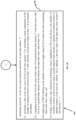
- FIGS. 3A and 3B show a flow diagram illustrating the steps involved in a method for online time series forecasting using spiking reservoir according to some embodiments of the present disclosure. Steps of the method of FIG. 3 shall be described in conjunction with the components of FIG. 2 .
- the one or more hardware processors 104 receive a time series value F ( t ), at a time instance ' t ' as an input from a time series stream F.
- the input module 204 receives the time series F ( t ) at ' t ' time from the time series stream 202.
- the one or more hardware processors 104 convert the received time series value F ( t ) to an encoded multivariate spike train using a first temporal spike encoder at a plurality of input neurons.
- the plurality of input neurons refers to the spiking neurons comprised in a plurality of excitatory neurons of a reservoir.
- the Spiking Neural Networks (SNN) work with a philosophy which is different from traditional artificial neural networks (ANN).
- the neurons in the SNN mimic the models of actual biological spiking neurons which emit "spikes" after reception of any external stimuli. Thus, depending on the value of the external stimuli, the information is carried through by one or more spikes.
- the present disclosure uses Leaky Integrate and Fire (LIF) model.
- LIF Leaky Integrate and Fire
- the membrane potential tends to evolve towards the resting potential, V rest . Without any input stimuli, membrane potential remains at V rest .
- Synapses between two consecutive neurons can be excitatory or inhibitory in nature, whose equilibrium potentials are represented by E exc and E inh respectively. Functionality of excitatory or inhibitory synapses are represented via conductance g e and g i respectively.
- E exc the equilibrium potential
- Functionality of excitatory or inhibitory synapses are represented via conductance g e and g i respectively.
- Excitatory pre-synaptic neurons contribute towards increasing membrane potential whereas inhibitory pre-synaptic neurons contribute towards decreasing it.
- the membrane potential upon crossing a threshold value, V thresh emits a spike.
- the present disclosure uses a Gaussian based temporal encoding scheme to convert the received time series F ( t ) to an encoded multivariate spike train which is depicted by the first temporal spike encoding module 206 of FIG. 2 .
- y(t) be variable denoting the time series value at ' t '.
- y min and y m ⁇ x be the theoretical upper and lower bounds on that variable y ( t ), then ' m ' neurons can be used for generating the receptive fields between the range y min , y max .
- This essentially divides the entire input space into ' m ' overlapping spatial regions, each attuned to an encoding neuron whose P (firing a spike) is given by the gaussian.
- the value of y ( t ) can be projected onto these gaussians to get all individual probabilities P (ith neuron spiking
- y ( t )) is very high and near to mean of the i th gaussian, then ideally there should not be any delay for i th neuron to fire. It should spike in the first time-step itself, similarly as P ( i th neuron spiking
- P thresh P ( i th neurons mean)] is divided into ' m ' probability thresholds such that the i th neuron spikes at a time where P ( i th neuron spiking
- P thresh is an encoding hyper-parameter which determines the boundary probability of spiking and non-spiking for an individual neuron.
- the one or more hardware processors 104 extract a plurality of temporal features from the encoded multivariate spike train by a plurality of excitatory neurons of a reservoir, wherein the reservoir further comprises of recurrently connected population of a plurality of spiking neurons, and wherein the plurality of spiking neurons comprises of the plurality of excitatory neurons and a plurality of inhibitory neurons.
- the encoded multivariate spike train is fed into the reservoir 208, which is a recurrently connected population of spiking neurons, also known as Liquid State Machines (LSM).
- LSM Liquid State Machines
- the present disclosure uses a dual-population reservoir, wherein one population is composed of the plurality of excitatory neurons which is depicted by the excitatory neurons module 210 and other is composed of the plurality of inhibitory neurons which is depicted by the inhibitory neurons module 212.
- Input population is connected exclusively to the plurality of excitatory neurons via a set of sparse input connection as shown in Figure 2 .
- the input population means the input encoding neurons that encodes the input time series into corresponding multivariate spike trains.
- the terms “excitatory neurons” and “excitatory population” can be interchangeable used.
- the terms “inhibitory neurons” and “inhibitory population” can be interchangeable used.
- the excitatory population extracts the temporal features present in the encoded multivariate spike train and further activates the inhibitory population via another set of connections thus forming a self-regulatory mechanism capable of extracting better temporal embeddings.
- temporary features and “temporal embeddings” can be interchangeable used.
- the separation of populations and connections help to efficiently fine tune the spiking behavior of the reservoir 208 by using a plurality of spiking neural network parameters like excitatory out-degree, inhibitory out-degree and the like.
- the recurrent connections within each of the plurality of excitatory population and each of the inhibitory population is very sparse and contain variable length cycles in them.
- the extracted temporal embedding is in the form of the spike train of reservoir neurons.
- the excitatory and the inhibitory population sizes were 6000 and 4800 respectively. It is to be noted that such sizes of the excitatory and the inhibitory population shall not be construed as the limiting scope of the present disclosure.
- the one or more hardware processors 104 perform iteratively at each time instance ' t ',
- FIGS. 4A and 4B show a use case example illustrating an original and predicted output of Mackey Glass Series (MGS) time series and spike encoded MGS timeseries respectively according to some embodiments of the present disclosure.
- the precision of the encoding is dependent on the number of encoding neurons which is also a tunable hyperparameter.
- 15 input encoding neurons have been used resulting in 15x magnification of the input timescale to spike time scale.
- FIG. 4A depicts unencoded MGS time series (an example of the input F(t)) for initial 100 timesteps.
- FIG. 4B depicts the corresponding encoded spike train (using 15 input encoding neurons).
- the post-encoding time scale magnification is depicted in FIGS. 4A and 4B .
- a set of learnable synapses called readout weights are modified such that the temporal embeddings produce the required supervised output i.e., the predicted or forecasted time series value.
- the output neuron produces a forecast for current time step as per Eqn. 10 (which is explained below in the later sections).
- the reservoirs are inherently plagued by rapidly fading memory problem and as such cannot learn long-term temporal filters. Moreover, if the magnitude of the input reduces, the activity and thus the output of spiking networks (including reservoirs) gradually die out.
- the present disclosure uses a feedback loop to the plurality of excitatory neurons of the reservoir 208 as shown in FIG.2 , to solve fading memory problem. Multiple signals can be used as feedback to the reservoir 208. Further, error between the predicted and desired output i.e., the predicted or forecasted time series value could be a good candidate, but if this error is large then it can drive the reservoir 208 to go into the chaotic regime.
- the present disclosure uses a combination of - (i) Teacher Forcing strategy (known in the art) (ii) output bounding weight initialization, and (iii) error controlling FORCE learning (known in the art). This also solves the dying out problem for continuous prediction.
- x trace [ i ] represents the i th neuronal spike trace
- ⁇ trace is a time constant which controls the exponential decay of the trace
- S is the instantaneous spike vector of the reservoir.
- these traces are exponentially decayed with time, giving priority to recent spike influences while retaining long term trends and patterns.
- adaptive filter learning rules like Recursive Least Squares (RLS) are used in FORCE learning and can be applied on x trace ( i ) for generating the desired output i.e., the predicted or forecasted time series value.
- RLS Recursive Least Squares
- the system 100 recursively estimates an inverse of the correlation matrix of the trace values with a regularization factor of ⁇ . Let this matrix be P ( t ).
- this matrix is updated by x trace ( i ) as shown in Eqn. 9.
- Y t W out T t ⁇ 1 x trace t ⁇ 1
- the FORCE learning ensures small prediction error, it is ideal for dealing with online learning scenarios where input data distribution often changes (known as concept drift). It is a major issue in all time-series forecasting methods. In case, if the FORCE learning is used for an online learning scenario, then the initial errors can accumulate over time to throw the reservoir into uncontrollable chaotic mode and output would deviate by a huge margin thus taking forever to converge.
- the initial weights i.e., all weights inside the Spiking reservoir networks, including the readout weights. Weights are typically associated with every synaptic connection between a pair of neurons) and feedback are random. Therefore, initial prediction error is high but later as the method of the present disclosure receives ground-truth information, the weights may be updated based on the error as per FORCE learning rule. This reduces the error and as the online learning proceeds, the error subsides and converges around zero.
- the method can be extended for prediction windows of any arbitrary size.
- R 2 Score Coefficient of Determination
- the performance comparison is a metric used to measure the goodness of regression models. It quantifies the amount of variance in the error of predicted value that remains unexplained with respect to the amount of variance in the input data.
- R 2 Score is not a scale dependent metric, and as such performance of forecasting is compared between datasets. Also, it is unitless and can be used as an accuracy measure for regression tasks.
- R 2 Score ranges from -infinity to 1.0, with 1.0 representing the model forecasting all the values correctly, accounting for all the variability in input data. Score of zero represents that the model is able to (or) predict (or predicts) the mean of the data without accounting for any variability.
- RMSE Root Means Square Error
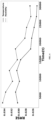
- FIG. 5 illustrates a Root Mean Square Error (RMSE) trend over time during prediction of MGS in accordance with some embodiments of the present disclosure.
- RMSE Root Mean Square Error
- the method of the present disclosure was then benchmarked against statistical Seasonal Autoregressive Integrated Moving Average (SARIMA) model (known in the art) for prediction window lengths ⁇ ⁇ 1,2,3,4,5 ⁇ .
- SARIMA statistical Seasonal Autoregressive Integrated Moving Average
- R 2 Score Coefficient of Determination
- R 2 Score was calculated for predictions done by both SARIMA and the present approach (refer Table I - for small prediction window sizes ( ⁇ 3), R 2 score of method of the present disclosure is within 1% of that obtained by SARIMA. For higher prediction window sizes, this margin increases with maximum deviation being 9%.
- the Long short-term memory (LSTM) does not perform well on stationary datasets but it produces comparable accuracy to that of Online ARIMA in scenarios 3 and 4.
- High accuracy for Online ARIMA (> 95%) on these datasets can be attributed to the fact that even though the scenarios are diverse, the underlying process which is generating the data is an ARIMA process under Markovian assumptions. This makes it relatively easier for Online ARIMA to model the time series and forecast for future.
- LSTM model the method of the present disclosure doesn't benefit from that advantage. In all these experiments the present model outperforms the Stacked LSTM model by around 5% on average without needing to store any of the data points.
- FIG. 6 illustrates a Root Mean Square Error (RMSE) trend during the prediction of a real-world dataset (temperature and humidity sensor data) in accordance with some embodiments of the present disclosure.
- RMSE Root Mean Square Error
- the method of the present disclosure is benchmarked on four real-life datasets from various domains as mentioned above. All of these real-world datasets are non-linear and non-stationary, with car registration dataset being very difficult to forecast due to its random oscillatory nature. For this reason, the Online ARIMA model underperformed compared to both LSTM and the method of the present disclosure.
- R 2 score of the method of the present disclosure is higher than both LSTM and Online ARIMA by at least 10% on average (refer Table III).
- the present online prediction method (also referred as method of the present disclosure) is benchmarked against offline models (SARIMA and Stacked LSTM) in terms of (i) number of trainable parameters, (ii) total number of parameter updates needed during the training, (iii) approximate power consumption and (iv) memory requirements (refer Table IV). Number of parameters and updates would be same as the number of neurons in the plurality of excitatory population of the reservoir in case of the present model as readout synaptic weights only get modified.
- the present method is supposed to do weight updates whenever the data arrives.
- LSTM has significantly higher number of parameters and has to iterate through data for multiple epochs, thus making number of updates to be very high.
- the number of parameters is very low along with number of updates for SARIMA but the cost of each update is much higher than FORCE based RLS learning rule as implemented by the method of the present disclosure. This is because at each step, it has to fit the SARIMA model on the entirety of the data seen so far.
- Both LSTM and SARIMA needs 200kJ computational power for MGS dataset.
- the power estimates for LSTM and SARIMA is calculated by measuring Intel Running Average Power Limit (RAPL), which gives an average estimate of energy consumption on the entire CPU socket and using Nvidia Management Library for Graphics Processing Unit (GPU) power consumption.
- RAPL Intel Running Average Power Limit
- the power consumption of the present spiking model was estimated indirectly by considering the total number of synaptic operations (SOP) along with the energy consumption figure per Synaptic Operation (SOP) provided by Intel Loihi (known in the art).
- SOP synaptic operations
- SOP Synaptic Operation
- the SNN model promises considerable reduction in power consumption - to the order of 10-5 times that of conventional hardware.
- the offline models has to store all the datapoints and iterate through them multiple times which required the offline models to keep a buffer same as the dataset size.
- the size is observed to be 6200 datapoints for MGS dataset but this grows linearly with the number of datapoints.
- the method and system 100 of the present disclosure do not need to keep a buffer for storing data since the learning is completely online. This way, the present approach saves 100% on the storage space.
- the spiking network is implemented using BindsNet v0.2.7 (known in art). Hyperparameter search was conducted on validation data using a Grid Search methodology. The major parameters tuned include various connectivity parameters like excitatory population's out-degree, input encoder's out-degree and various scaling parameters like input weight scaler, excitatory weight scaler and the like. All the experiments were run on an Nvidia DGX Server with a V100 GPU having 32GB as its VRAM. In case of randomized algorithms, an initial seed value of zero is used before sampling. SARIMA and Stacked LSTM models were implemented in Python for benchmarking purposes. SARIMAX implementation of pmdARIMA(v1.7.1) library was used for this purpose.
- the parameter tuning of SARIMAX model was done using auto-ARIMA functionality provided by pmd ARIMA. Stacked LSTM model was implemented on PyTorch (v1.2.0) with 3 hidden layers and 1000 hidden units. The network was then running 40 epochs on each dataset. The parameter tuning was conducted here also, using Grid Search. The stationarity of all the datasets was checked using Augumented Dickey-Fuller Test (ADF Test).
- ADF Test Augumented Dickey-Fuller Test
- the present disclosure provides a system and method for online time series forecasting using spiking reservoir.
- the embodiment of present disclosure herein addresses unresolved problem of avoiding rapidly fading memory problem while time series forecasting.
- the present disclosure uses the FORCE learning to reduce the error in future forecasting of time series, thus the present disclosure being an online-learning solution doesn't require to store data at the edge device and is capable of lifelong learning.
- the embodiments herein further provide continuous feedback to the reservoir to improve the memory of the reservoir.
- Such computer-readable storage means contain program-code means for implementation of one or more steps of the method, when the program runs on a server or mobile device or any suitable programmable device.
- the hardware device can be any kind of device which can be programmed including e.g., any kind of computer like a server or a personal computer, or the like, or any combination thereof.
- the device may also include means which could be e.g., hardware means like e.g., an application-specific integrated circuit (ASIC), a field-programmable gate array (FPGA), or a combination of hardware and software means, e.g., an ASIC and an FPGA, or at least one microprocessor and at least one memory with software processing components located therein.
- the means can include both hardware means and software means.
- the method embodiments described herein could be implemented in hardware and software.
- the device may also include software means. Alternatively, the embodiments may be implemented on different hardware devices, e.g., using a plurality of CPUs.
- the embodiments herein can comprise hardware and software elements.
- the embodiments that are implemented in software include but are not limited to, firmware, resident software, microcode, etc.
- the functions performed by various components described herein may be implemented in other components or combinations of other components.
- a computer-usable or computer readable medium can be any apparatus that can comprise, store, communicate, propagate, or transport the program for use by or in connection with the instruction execution system, apparatus, or device.
- a computer-readable storage medium refers to any type of physical memory on which information or data readable by a processor may be stored.
- a computer-readable storage medium may store instructions for execution by one or more processors, including instructions for causing the processor(s) to perform steps or stages consistent with the embodiments described herein.
- the term "computer-readable medium” should be understood to include tangible items and exclude carrier waves and transient signals, i.e., be non-transitory. Examples include random access memory (RAM), read-only memory (ROM), volatile memory, nonvolatile memory, hard drives, CD ROMs, DVDs, flash drives, disks, and any other known physical storage media.
Landscapes
- Engineering & Computer Science (AREA)
- Theoretical Computer Science (AREA)
- Physics & Mathematics (AREA)
- Data Mining & Analysis (AREA)
- General Health & Medical Sciences (AREA)
- Biomedical Technology (AREA)
- Biophysics (AREA)
- Computational Linguistics (AREA)
- Life Sciences & Earth Sciences (AREA)
- Evolutionary Computation (AREA)
- Artificial Intelligence (AREA)
- Molecular Biology (AREA)
- Computing Systems (AREA)
- General Engineering & Computer Science (AREA)
- General Physics & Mathematics (AREA)
- Mathematical Physics (AREA)
- Software Systems (AREA)
- Health & Medical Sciences (AREA)
- Management, Administration, Business Operations System, And Electronic Commerce (AREA)
Applications Claiming Priority (1)
| Application Number | Priority Date | Filing Date | Title |
|---|---|---|---|
| IN202221002396 | 2022-01-14 |
Publications (1)
| Publication Number | Publication Date |
|---|---|
| EP4213073A1 true EP4213073A1 (de) | 2023-07-19 |
Family
ID=84363862
Family Applications (1)
| Application Number | Title | Priority Date | Filing Date |
|---|---|---|---|
| EP22209874.1A Pending EP4213073A1 (de) | 2022-01-14 | 2022-11-28 | System und verfahren zur online-zeitreihenvorhersage mit spiking-reservoir |
Country Status (2)
| Country | Link |
|---|---|
| US (1) | US12443845B2 (de) |
| EP (1) | EP4213073A1 (de) |
Families Citing this family (3)
| Publication number | Priority date | Publication date | Assignee | Title |
|---|---|---|---|---|
| EP4213073A1 (de) * | 2022-01-14 | 2023-07-19 | Tata Consultancy Services Limited | System und verfahren zur online-zeitreihenvorhersage mit spiking-reservoir |
| CN117829380B (zh) * | 2024-03-05 | 2024-05-28 | 国网山东省电力公司信息通信公司 | 一种电力使用长期预测方法、系统、设备及介质 |
| CN120745720B (zh) * | 2025-09-03 | 2025-11-04 | 榆林学院 | 基于LTspice的与时间融合的神经元仿真系统及方法 |
Family Cites Families (18)
| Publication number | Priority date | Publication date | Assignee | Title |
|---|---|---|---|---|
| US20100179935A1 (en) * | 2009-01-13 | 2010-07-15 | Gm Global Technology Operations, Inc. | Spiking dynamical neural network for parallel prediction of multiple temporal events |
| US9020870B1 (en) * | 2010-06-14 | 2015-04-28 | Hrl Laboratories, Llc | Recall system using spiking neuron networks |
| US9665822B2 (en) * | 2010-06-30 | 2017-05-30 | International Business Machines Corporation | Canonical spiking neuron network for spatiotemporal associative memory |
| US8712940B2 (en) * | 2011-05-31 | 2014-04-29 | International Business Machines Corporation | Structural plasticity in spiking neural networks with symmetric dual of an electronic neuron |
| US10579925B2 (en) | 2013-08-26 | 2020-03-03 | Aut Ventures Limited | Method and system for predicting outcomes based on spatio/spectro-temporal data |
| US20150269482A1 (en) * | 2014-03-24 | 2015-09-24 | Qualcomm Incorporated | Artificial neural network and perceptron learning using spiking neurons |
| US10496922B1 (en) * | 2015-05-15 | 2019-12-03 | Hrl Laboratories, Llc | Plastic neural networks |
| US10671912B2 (en) | 2016-09-13 | 2020-06-02 | Sap Se | Spatio-temporal spiking neural networks in neuromorphic hardware systems |
| US20180276530A1 (en) * | 2017-03-24 | 2018-09-27 | Intel Corporation | Object recognition using a spiking neural network |
| EP3743856A4 (de) * | 2018-01-23 | 2021-10-27 | HRL Laboratories, LLC | Verfahren und system zum verteilten kodieren und lernen in neuromorphen netzwerken zur mustererkennung |
| US11288572B2 (en) * | 2018-04-17 | 2022-03-29 | Hrl Laboratories, Llc | Programming model for a bayesian neuromorphic compiler |
| CN112437929A (zh) * | 2018-10-11 | 2021-03-02 | 谷歌有限责任公司 | 带泄漏尖峰神经网络中的时间编码 |
| JP7564555B2 (ja) * | 2019-06-24 | 2024-10-09 | チエングドウ シンセンス テクノロジー カンパニー、リミテッド | 生理学的状態の検出のためのイベント駆動型スパイキング・ニューラル・ネットワーク・システム |
| EP3913534B1 (de) * | 2020-05-22 | 2023-11-22 | Tata Consultancy Services Limited | System und verfahren zur echtzeitradarbasierten aktionserkennung unter verwendung von neuronalen spiking-netzen (snn) |
| EP3926544B1 (de) * | 2020-06-18 | 2024-03-13 | Tata Consultancy Services Limited | System und verfahren zur gestenerkennung unter verwendung eines auf einem speicher basierenden neuronalen spiking-faltungsnetzes |
| US20220138537A1 (en) * | 2020-11-02 | 2022-05-05 | International Business Machines Corporation | Probabilistic nonlinear relationships cross-multi time series and external factors for improved multivariate time series modeling and forecasting |
| EP4009237B1 (de) * | 2020-12-04 | 2025-07-02 | Tata Consultancy Services Limited | Verfahren und system zur optimierten spike-kodierung für spikende neuronale netzwerke |
| EP4213073A1 (de) * | 2022-01-14 | 2023-07-19 | Tata Consultancy Services Limited | System und verfahren zur online-zeitreihenvorhersage mit spiking-reservoir |
-
2022
- 2022-11-28 EP EP22209874.1A patent/EP4213073A1/de active Pending
- 2022-11-29 US US18/070,858 patent/US12443845B2/en active Active
Non-Patent Citations (5)
| Title |
|---|
| A. INGROSSO, L. F. ABBOTT: "Training dynamically balanced excitatory-inhibitory networks", ARXIV.ORG, CORNELL UNIVERSITY LIBRARY, 201 OLIN LIBRARY CORNELL UNIVERSITY ITHACA, NY 14853, 29 December 2018 (2018-12-29), XP080995361, DOI: 10.48550/arXiv.1812.11424 * |
| A. M. GEORGE ET AL: "Online time-series forecasting using spiking reservoir", NEUROCOMPUTING, vol. 518, 31 October 2022 (2022-10-31), pages 82 - 94, XP093049541, DOI: 10.1016/j.neucom.2022.10.067 * |
| G. BELLEC ET AL: "Biologically inspired alternatives to backpropagation through time for learning in recurrent neural nets", ARXIV.ORG, CORNELL UNIVERSITY LIBRARY, 201 OLIN LIBRARY CORNELL UNIVERSITY ITHACA, NY 14853, 25 January 2019 (2019-01-25), XP081023715, DOI: 10.48550/arXiv.1901.09049 * |
| H. SUETANI: "Assimilating nonlinear dynamics with FORCE-learning: a perspective from chaotic synchronization", PROCEEDINGS OF THE 2017 INTERNATIONAL SYMPOSIUM ON NONLINEAR THEORY AND ITS APPLICATION (NOLTA'17), 4 December 2017 (2017-12-04), pages 268 - 270, XP093049857, DOI: 10.34385/proc.29.A3L-C-5 * |
| J. BÜCHEL ET AL: "Supervised training of spiking neural networks for robust deployment on mixed-signal neuromorphic processors", ARXIV.ORG, CORNELL UNIVERSITY LIBRARY, 201 OLIN LIBRARY CORNELL UNIVERSITY ITHACA, NY 14853, 28 October 2021 (2021-10-28), XP091065533, DOI: 10.48550/arXiv.2102.06408 * |
Also Published As
| Publication number | Publication date |
|---|---|
| US12443845B2 (en) | 2025-10-14 |
| US20230229911A1 (en) | 2023-07-20 |
Similar Documents
| Publication | Publication Date | Title |
|---|---|---|
| EP4213073A1 (de) | System und verfahren zur online-zeitreihenvorhersage mit spiking-reservoir | |
| Gasparin et al. | Deep learning for time series forecasting: The electric load case | |
| US11615305B2 (en) | System and method for machine learning architecture with variational hyper-RNN | |
| US11574164B2 (en) | Neural network cooperation | |
| Rahman et al. | Predicting prices of stock market using gated recurrent units (GRUs) neural networks | |
| US12505305B2 (en) | Adversarial bootstrapping for multi-turn dialogue model training | |
| KR102295805B1 (ko) | 학습 데이터 관리 방법 | |
| Wang et al. | Neural machine-based forecasting of chaotic dynamics | |
| Doherty et al. | Bayesian generalized kernel inference for occupancy map prediction | |
| US20180330275A1 (en) | Resource-efficient machine learning | |
| Tao et al. | Hierarchical attention-based recurrent highway networks for time series prediction | |
| US20230368002A1 (en) | Multi-scale artifical neural network and a method for operating same for time series forecasting | |
| KR20210152569A (ko) | 이미지 처리 방법, 이미지 처리 장치, 전자 기기 및 저장 매체 | |
| US20230351202A1 (en) | System and method for generating mixed variable type multivariate temporal synthetic data | |
| KR102457893B1 (ko) | 딥러닝 기반의 강수량 예측 방법 | |
| Rachkovskiy et al. | Sparse binary distributed encoding of scalars | |
| US12147915B2 (en) | Systems and methods for modelling prediction errors in path-learning of an autonomous learning agent | |
| Salimans | A structured variational auto-encoder for learning deep hierarchies of sparse features | |
| EP4270250A1 (de) | Verfahren und systeme zur zeitreihenklassifizierung unter verwendung eines reservoirbasierten neuronalen spiking-netzwerks | |
| George et al. | Online time-series forecasting using spiking reservoir | |
| Sweet et al. | Credit risk assessment using statistical and machine learning: Basic methodology and risk modeling applications | |
| Alghamdi et al. | A novel hybrid deep learning model for stock price forecasting | |
| Xu et al. | Time series prediction via recurrent neural networks with the information bottleneck principle | |
| Mahar et al. | Bitcoin price prediction app using deep learning algorithm | |
| Sanyour et al. | A Light-Weight Real-Time Anomaly Detection Framework for Edge Computing |
Legal Events
| Date | Code | Title | Description |
|---|---|---|---|
| PUAI | Public reference made under article 153(3) epc to a published international application that has entered the european phase |
Free format text: ORIGINAL CODE: 0009012 |
|
| STAA | Information on the status of an ep patent application or granted ep patent |
Free format text: STATUS: THE APPLICATION HAS BEEN PUBLISHED |
|
| AK | Designated contracting states |
Kind code of ref document: A1 Designated state(s): AL AT BE BG CH CY CZ DE DK EE ES FI FR GB GR HR HU IE IS IT LI LT LU LV MC ME MK MT NL NO PL PT RO RS SE SI SK SM TR |
|
| STAA | Information on the status of an ep patent application or granted ep patent |
Free format text: STATUS: REQUEST FOR EXAMINATION WAS MADE |
|
| 17P | Request for examination filed |
Effective date: 20231026 |
|
| RBV | Designated contracting states (corrected) |
Designated state(s): AL AT BE BG CH CY CZ DE DK EE ES FI FR GB GR HR HU IE IS IT LI LT LU LV MC ME MK MT NL NO PL PT RO RS SE SI SK SM TR |