EP3926544B1 - System und verfahren zur gestenerkennung unter verwendung eines auf einem speicher basierenden neuronalen spiking-faltungsnetzes - Google Patents
System und verfahren zur gestenerkennung unter verwendung eines auf einem speicher basierenden neuronalen spiking-faltungsnetzes Download PDFInfo
- Publication number
- EP3926544B1 EP3926544B1 EP20214398.8A EP20214398A EP3926544B1 EP 3926544 B1 EP3926544 B1 EP 3926544B1 EP 20214398 A EP20214398 A EP 20214398A EP 3926544 B1 EP3926544 B1 EP 3926544B1
- Authority
- EP
- European Patent Office
- Prior art keywords
- csnn
- spike
- layer
- features
- filters
- Prior art date
- Legal status (The legal status is an assumption and is not a legal conclusion. Google has not performed a legal analysis and makes no representation as to the accuracy of the status listed.)
- Active
Links
Images


Classifications
-
- G—PHYSICS
- G06—COMPUTING OR CALCULATING; COUNTING
- G06F—ELECTRIC DIGITAL DATA PROCESSING
- G06F18/00—Pattern recognition
- G06F18/20—Analysing
- G06F18/21—Design or setup of recognition systems or techniques; Extraction of features in feature space; Blind source separation
- G06F18/211—Selection of the most significant subset of features
- G06F18/2113—Selection of the most significant subset of features by ranking or filtering the set of features, e.g. using a measure of variance or of feature cross-correlation
-
- G—PHYSICS
- G06—COMPUTING OR CALCULATING; COUNTING
- G06N—COMPUTING ARRANGEMENTS BASED ON SPECIFIC COMPUTATIONAL MODELS
- G06N3/00—Computing arrangements based on biological models
- G06N3/02—Neural networks
- G06N3/04—Architecture, e.g. interconnection topology
- G06N3/049—Temporal neural networks, e.g. delay elements, oscillating neurons or pulsed inputs
-
- G—PHYSICS
- G06—COMPUTING OR CALCULATING; COUNTING
- G06F—ELECTRIC DIGITAL DATA PROCESSING
- G06F3/00—Input arrangements for transferring data to be processed into a form capable of being handled by the computer; Output arrangements for transferring data from processing unit to output unit, e.g. interface arrangements
- G06F3/01—Input arrangements or combined input and output arrangements for interaction between user and computer
- G06F3/011—Arrangements for interaction with the human body, e.g. for user immersion in virtual reality
-
- G—PHYSICS
- G06—COMPUTING OR CALCULATING; COUNTING
- G06F—ELECTRIC DIGITAL DATA PROCESSING
- G06F3/00—Input arrangements for transferring data to be processed into a form capable of being handled by the computer; Output arrangements for transferring data from processing unit to output unit, e.g. interface arrangements
- G06F3/01—Input arrangements or combined input and output arrangements for interaction between user and computer
- G06F3/017—Gesture based interaction, e.g. based on a set of recognized hand gestures
-
- G—PHYSICS
- G06—COMPUTING OR CALCULATING; COUNTING
- G06N—COMPUTING ARRANGEMENTS BASED ON SPECIFIC COMPUTATIONAL MODELS
- G06N3/00—Computing arrangements based on biological models
- G06N3/02—Neural networks
- G06N3/04—Architecture, e.g. interconnection topology
- G06N3/044—Recurrent networks, e.g. Hopfield networks
-
- G—PHYSICS
- G06—COMPUTING OR CALCULATING; COUNTING
- G06N—COMPUTING ARRANGEMENTS BASED ON SPECIFIC COMPUTATIONAL MODELS
- G06N3/00—Computing arrangements based on biological models
- G06N3/02—Neural networks
- G06N3/04—Architecture, e.g. interconnection topology
- G06N3/045—Combinations of networks
-
- G—PHYSICS
- G06—COMPUTING OR CALCULATING; COUNTING
- G06N—COMPUTING ARRANGEMENTS BASED ON SPECIFIC COMPUTATIONAL MODELS
- G06N3/00—Computing arrangements based on biological models
- G06N3/02—Neural networks
- G06N3/04—Architecture, e.g. interconnection topology
- G06N3/0464—Convolutional networks [CNN, ConvNet]
-
- G—PHYSICS
- G06—COMPUTING OR CALCULATING; COUNTING
- G06N—COMPUTING ARRANGEMENTS BASED ON SPECIFIC COMPUTATIONAL MODELS
- G06N3/00—Computing arrangements based on biological models
- G06N3/02—Neural networks
- G06N3/04—Architecture, e.g. interconnection topology
- G06N3/047—Probabilistic or stochastic networks
-
- G—PHYSICS
- G06—COMPUTING OR CALCULATING; COUNTING
- G06N—COMPUTING ARRANGEMENTS BASED ON SPECIFIC COMPUTATIONAL MODELS
- G06N3/00—Computing arrangements based on biological models
- G06N3/02—Neural networks
- G06N3/04—Architecture, e.g. interconnection topology
- G06N3/0495—Quantised networks; Sparse networks; Compressed networks
-
- G—PHYSICS
- G06—COMPUTING OR CALCULATING; COUNTING
- G06N—COMPUTING ARRANGEMENTS BASED ON SPECIFIC COMPUTATIONAL MODELS
- G06N3/00—Computing arrangements based on biological models
- G06N3/02—Neural networks
- G06N3/08—Learning methods
- G06N3/082—Learning methods modifying the architecture, e.g. adding, deleting or silencing nodes or connections
-
- G—PHYSICS
- G06—COMPUTING OR CALCULATING; COUNTING
- G06N—COMPUTING ARRANGEMENTS BASED ON SPECIFIC COMPUTATIONAL MODELS
- G06N3/00—Computing arrangements based on biological models
- G06N3/02—Neural networks
- G06N3/08—Learning methods
- G06N3/088—Non-supervised learning, e.g. competitive learning
-
- G—PHYSICS
- G06—COMPUTING OR CALCULATING; COUNTING
- G06V—IMAGE OR VIDEO RECOGNITION OR UNDERSTANDING
- G06V40/00—Recognition of biometric, human-related or animal-related patterns in image or video data
- G06V40/20—Movements or behaviour, e.g. gesture recognition
- G06V40/28—Recognition of hand or arm movements, e.g. recognition of deaf sign language
-
- G—PHYSICS
- G06—COMPUTING OR CALCULATING; COUNTING
- G06F—ELECTRIC DIGITAL DATA PROCESSING
- G06F2218/00—Aspects of pattern recognition specially adapted for signal processing
- G06F2218/02—Preprocessing
- G06F2218/04—Denoising
Definitions
- the disclosure herein generally relates to gesture recognition, and, more particularly, to system and method of gesture recognition using a reservoir based convolutional spiking neural network.
- Embodiments of the present disclosure present technological improvements as solutions to one or more of the above-mentioned technical problems recognized by the inventors in conventional systems.
- the embodiments of the present disclosure propose a bio-inspired spatio-temporal learning for gesture recognition on event-based data.
- a plurality of input events is obtained by using a neuromorphic camera.
- the plurality of input events is encoded and compressed to a frame by frame sparse video representation.
- a plurality of spatial features is learned/captured based on a convolutional layers with each filter for a class forming a filter block, learning features from a temporal segment of the input representation of the class by an unsupervised spike time dependent plasticity (STDP) at a training time.
- STDP unsupervised spike time dependent plasticity
- a desired features activations e.g., one or more spikes
- a reservoir e.g., a Liquid State Machine (LSM)
- LSM Liquid State Machine
- FIGS. 1 through 6 where similar reference characters denote corresponding features consistently throughout the figures, there are shown preferred embodiments and these embodiments are described in the context of the following exemplary system and/or method.
- FIG. 1 illustrates a system 100 for gesture recognition using the reservoir based convolutional spiking neural network, according to some embodiments of the present disclosure.
- the system 100 includes one or more processors 104, communication interface device(s) or input/output (I/O) interface(s) 106, and one or more data storage devices or memory 102 operatively coupled to the one or more processors 104.
- the memory 102 comprises a database 108.
- the one or more processors 104 that are hardware processors can be implemented as one or more microprocessors, microcomputers, microcontrollers, digital signal processors, central processing units, state machines, logic circuitries, and/or any devices that manipulate signals based on operational instructions.
- the processor(s) is configured to fetch and execute computer-readable instructions stored in the memory.
- the system 100 can be implemented in a variety of computing systems, such as laptop computers, notebooks, hand-held devices, workstations, mainframe computers, servers, a network cloud and the like.
- the I/O interface device(s) 106 can include a variety of software and hardware interfaces, for example, a web interface, a graphical user interface, and the like and can facilitate multiple communications within a wide variety of networks N/W and protocol types, including wired networks, for example, LAN, cable, etc., and wireless networks, such as WLAN, cellular, or satellite.
- the I/O interface device(s) can include one or more ports for connecting a number of devices to one another or to another server.
- the memory 102 may include any computer-readable medium known in the art including, for example, volatile memory, such as static random access memory (SRAM) and dynamic random access memory (DRAM), and/or non-volatile memory, such as read only memory (ROM), erasable programmable ROM, flash memories, hard disks, optical disks, and magnetic tapes.
- volatile memory such as static random access memory (SRAM) and dynamic random access memory (DRAM)
- non-volatile memory such as read only memory (ROM), erasable programmable ROM, flash memories, hard disks, optical disks, and magnetic tapes.
- the memory 102 includes a plurality of modules and a repository for storing data processed, received, and generated by the plurality of modules.
- the plurality of modules may include routines, programs, objects, components, data structures, and so on, which perform particular tasks or implement particular abstract data types.
- the database 108 stores information pertaining to inputs fed to the system 100 and/or outputs generated by the system 100 (e.g., data/output generated at each stage of the data processing), specific to the methodology described herein. More specifically, the database 108 stores information being processed at each step of the proposed methodology.
- the repository includes a system database and other data.
- the other data may include data generated as a result of the execution of one or more modules in the plurality of modules.
- the database 108 stores information pertaining to inputs fed to the system 100 and/or outputs generated by the system (e.g., at each stage), specific to the methodology described herein. More specifically, the database 108 stores information being processed at each step of the proposed methodology.
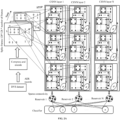
- FIG. 2A illustrates an exemplary gesture recognition architecture 200 for gesture recognition using the reservoir based convolutional spiking neural network, according to some embodiments of the present disclosure.
- the gesture recognition system focuses on recognizing a human hand gesture by a robot or a drone based on a spiking neural network (SNN) computing with a convolution and a reservoir.
- the gesture recognition system 200 alternatively corresponds to a spiking network architecture.
- the spiking network architecture includes a data pre-processing layer, a convolutional spiking layer (CSNN), and a reservoir layer.
- An event-based camera system for capturing a visual input in a spike representation.
- the input is taken from a neuromorphic event camera like a dynamic vision sensor (a DVS Camera) in the form of two-dimensional spike streams of resolution 128x128 represented as an AER Record (Address Event Representation).
- the data pre-processing layer in which a plurality of data captured by the dynamic vision sensor (DVS) or the DVS camera is stored as in the address event representation (AER) format.
- an encoder which encodes and compresses the spike input in the AER and converts into a frame by frame sparse video representation.
- the SNN network takes spiking input from the dynamic vision sensor (DVS) thereby making the input data sparse.
- one or more changes in luminosity e.g., referred as one or more events
- one or more changes in luminosity at a pixel is captured and are represented as quadruples [x, y, t, p] where (x, y) is the location of the pixel, t is the timestamp of occurrence of the event, and p signifies polarity of change in luminosity.
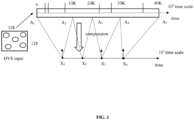
- the AER dataset includes events at nanosecond resolution. In an embodiment, by definition each of these records are separate temporal events but a few of the events can be considered as redundant for a classification task and compress the AER dataset to some lower time resolution scale.
- the spike streams are compressed per neuronal level by accumulating spikes at a sliding window of time, to obtain a plurality of output frames with reduced time granularity.
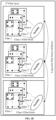
- FIG. 2B illustrates an exploded view of exemplary 'j th ' CSNN layer of the gesture recognition architecture 200 for the gesture recognition using the reservoir based convolutional spiking neural network, according to some embodiments of the present disclosure.
- the one or more spike frames are processed by a multi layered convolutional spiking neural network to learn one or more spatial features from at least one gesture or action.
- each sliding convolutional window in the one or more spike frames are connected to a neuron corresponding to a filter among plurality of filters corresponding to a filter block among one or more filter blocks in each convolutional layer from one or more convolutional layers.
- the filter blocks concentrate class-wise spatial features to a filter block for learning associated patterns with help of a long-term lateral inhibition mechanism.
- An at least one filter block is deactivated from a plurality of filter blocks corresponds to at least one gesture which are not currently being learnt.
- the plurality of filter blocks is configured to concentrate a plurality of class-wise spatial features to the filter block for learning associated patterns based on a long-term lateral inhibition mechanism.
- a special node switches between different filters according to an associated decay constant which distributes learning of different spatially co-located features on different filters.
- one or more weights of a synapse between an input and the CSNN layer are learned according to the spiking activity of the input layer using unsupervised two trace STDP learning rule.
- a spatio-temporal features is obtained by allowing the spike activations from a CSNN layer to flow through the reservoir.
- the CSNN layer is stacked to provide at least one of: (i) a low-level spatial features, (ii) a high-level spatial features, or combination thereof.
- the reservoir includes a sparse random cyclic connectivity, which acts as a random projection of the input spikes to an expanded spatio-temporal embedding.
- the at least one of spatial feature is classified by a classifier (e.g., a logistic regression) from the CSNN layer and the spatio-temporal features from the reservoir to obtain a set of prioritized gestures.
- a classifier e.g., a logistic regression
- the spatial feature extraction is hierarchical in nature, with first layers capturing one or more low level features like edges with complexity keep on increasing till last layer.
- the reservoir layer helps to extract the temporal aspects of the feature from the convolutional layer.
- the convolutional features of a layer along with associated one or more reservoir features form as an enriched feature set, which is then passed to a classifier for recognizing the gestures.
- FIG. 3 illustrates an exemplary compression technique for the gesture recognition, according to some embodiments of the present disclosure.
- the DVS dataset is captured in a resolution of 128x128 and once the compression is performed, the AER records are converted to multiple spike-frames of size 128x128, with each pixel having values 1 or 0 only.
- the DVS dataset is captured with no significant information is lost by incorporating the compression mechanism and beneficial in terms of faster processing time and less data handling.
- the convolutional spiking layer includes a class-wise filter blocks along with a lateral inhibition-based competition mechanism between the one or more filter blocks.
- the output from the data pre-processing layer acts as the input to the convolutional spiking layer.
- connectivity from input to the convolutional layer as well as from one convolutional layer to the next is same as that of a CNN based network.
- a class wise filter block includes multiple filters which helps to capture spatially co-located patterns within the spike-frames of a single gesture class.
- each spike frame of a gesture is connected to the one or more convolutional layers via a sliding window-based connectivity. For example, initially a same sized sliding window with dimensions w * h pixels is chosen within the input spike frame is taken. The input pixels belonging to the sliding window is connected to a single neuron of a filter block in a first convolutional layer. For a second neuron in the same filter block of the convolutional layer, the initial window is slided horizontally by a stride and each pixel in a new shifted window is connected to the second neuron. This process is repeated horizontally and then vertically till the entire spike-frame is connected to all the neurons on the filter of the convolutional layer.
- similar sliding mechanism connects those frames with same neurons in the same filter.
- the second and other consecutive layers can be connected to previous convolutional layers in the same fashion, upon the first convolutional layer is connected to the input.
- number of convolutional layers is a design choice, to be set according to the complexity of a spatial features present in the dataset.
- the proposed approach uses a switching mechanism.
- a convolutional spiking neural network architecture built for extraction of two dimensional (2D) spatial features from sparse videos without overlap and the architecture involves a switching mechanism for achieving the 2D spatial feature extraction without overlap.
- only one filter is activated among the filters of the same filter block at a particular time window.
- selection is performed by a special LIF neuron node, called a switcher node, at periodic intervals. By applying inhibition, the switcher node makes all other filters to remain inactive for 'some' time steps, except the next filter in the block.
- this duration of inactivation is entirely depending upon strength of inhibition applied by the switcher node and this strength is a configurable parameter.
- all filters start to compete again and only one which spikes the most is chosen as a dominant.
- this process is repeated during the training time of convolutional filters based on a decay time constant of the switcher node.
- the switcher node ensures that all filters obtain a chance during the training phase and that spatially co-located but temporally separable features appear on different filters without getting mixed up. This is essential for one or more spiking neurons to learn one or more overlapping features.
- the forced inhibition and the selection mechanism is applicable to one or more spiking neurons only to ensure that some of them learn a particular feature, unlike ANNs, where neurons are selected to learn by a global error reducing mechanism like a backpropagation.
- another level of long-term inhibition between the class-wise filter blocks which ensures that during training phase, only one of the filter blocks is active at a given point of time for a given gesture class and thereby not allowing one or more multiple filter blocks to learn same redundant pattern.
- the lateral inhibition among the filter blocks allows other filter blocks to compete for classes.
- one or more weights in the filter blocks are initialized randomly and one of those filter blocks wins for the first time for a particular gesture class and ensuring that spike maximally only for that particular class during the later part of training. Once a filter block wins due to maximum initial spiking, an inhibition signal of higher strength is sent to other filter blocks, preventing them from being activated.
- a switching periodicity is dependent on the total time associated with at least one gesture and different spatial patterns present in the gesture.
- the switching periodicity for that particular filter block can be set to a small value, if multiple repetitive patterns occur within a short duration. For example, a hand waving gesture repeats patterns more frequent than a right-hand rotation gesture and so for the filter block learning hand waving, the switching periodicity is set smaller compared to that of the hand rotation gesture.
- an optimal switching periodicity for a right-hand wave is found to be 10 ms (by parameter tuning) whereas for a right hand clockwise rotation, the optimal value is 62 ms.
- both long term inhibition between the filter block as well as switching of the filters within a block are removed as they are useful during training only.
- the reservoir layer where spiking activity of each of the CSNN layer i.e. the spatial features present within the gesture
- the temporal components of the gestures are captured explicitly by the spiking behaviour of recurrently connected sparse reservoir.
- the reservoir is a recurrent neural network where instead of training the recurrent connections, a population of neurons with cyclic connections and random sparse connectivity is constructed.
- the reservoir is a form of Liquid State Machine (LSM) which convert one or more spikes from the convolutional layer to one or more spatio-temporal features.
- the reservoir is a form of an Echo state Networks (ESN).
- LSM Liquid State Machine
- ESN Echo state Networks
- the CSNN layer is stacked to provide at least one of: (i) a low-level spatial features, (ii) a high-level spatial features, or combination thereof.
- the low level or the high-level spatial features fed into the reservoir for converting into the spatio temporal features at each level.
- the output spikes of the reservoir capture higher dimensional embedding of the spatio-temporal features present in the data.
- the output from the reservoir is connected to a readout layer of the neurons and the synaptic weights between the reservoir and the readout layer are modified to get the desired classification.
- connectivity from the one or more convolutional filter blocks to the reservoir is taken as a sparse connection with one or more random weights.
- an amount of sparsity is a hyper parameter and can be tuned for an optimal performance.
- a weight matrix of the reservoir is constructed as a random sample from uniform distribution with a specific density (i.e., 0.2).
- a reservoir weight matrix is constructed ensuring that associated spectral radius, i.e., a largest absolute eigenvalue is less than unity.
- one or more neurons in the reservoir acts as inhibitory as well as excitatory.
- ratio of the excitatory to the inhibitory is an important parameter to consider while designing the reservoirs.
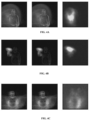
- FIGS. 4A-4C are exemplary simulated representations illustrating a comparison between an input, a compressed input, and an accumulated feature map of a filter layer of a filter block for gesture recognition, according to some embodiments of the present disclosure.
- the disclosed system for example the system or architecture 200 (of FIGS. 2A and 2B ) was trained for performing gesture recognition for actions of a target, such as a human being.
- the spiking neural network is trained and tested on an example DVS gesture data set and the data set include a set of 11 hand and arm gestures of 29 people under three different lighting conditions captured using a DVS128 camera.
- Each trial includes one person performing all 11 gestures sequentially in front of a static background.
- the gesture set includes hand waving (both arms), arm rotations (both arms, clockwise and counter-clockwise), arm rolling, hand clapping, playing guitar or drums in the air and some "other gestures" performed by that particular person.
- a three lighting conditions are combinations of a natural light, a fluorescent, and LED lights, which were selected to control the effect of shadows and flicker noise from fluorescent lights on the DVS128. Each gesture may last for about 6 seconds.
- To evaluate classifier performance out of total 29 persons' data, 23 were marked as the training set and the remaining 6 were kept for testing.
- Table I summarizes the parameters used for implementation of the neuron model and learning mechanism.
- Table I Parameter Value Parameter Value V thresh-static -15.0 mV V rest -65.0 mV ⁇ 100 ms ⁇ ⁇ 10 7 ms ⁇ pre 20 ms ⁇ post 20 ms ⁇ dep 10 -3 ⁇ pot 10 -2
- the threshold voltage of neurons V thresh-static is set at a comparatively high value to reduce spikes due to random noise.
- FIGS. 4A-4C shows the comparison between input, compressed input and the accumulated feature map of the filter layer of the filter block over the entire simulation time.
- First two rows show spatially overlapping classes namely right hand clockwise rotation and right hand wave while the third row represent one example from other gesture class.
- the learnt feature map only key regions where the hand motion occurs are being learnt and less significant details like the features of the person who does the gesture are treated as noise and are not learnt.
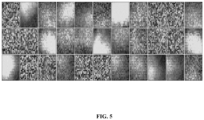
- FIG. 5 is an exemplary simulated representation illustrating one or more neuronal activities in the CSNN filters, according to some embodiments of the present disclosure.
- the spatial patterns learnt by corresponding neurons on different filter blocks are visualized. Each square block shows a 20 * 20 pattern learnt by a randomly chosen single neuron from the filter block. Three rows are shown in the figure, which represent learning by three such neurons from three different spatial positions of the filter block. Each column represents the pattern learnt by the corresponding neuron for a given class and there are 11 such columns.
- the patterns learnt are sparse and varied according to their spatial positions.
- FIG. 6 is an exemplary flow diagram illustrating a method of identifying a gesture from the plurality of gestures using the reservoir based convolutional spiking neural network, according to some embodiments of the present disclosure.
- the system 100 comprises one or more data storage devices or the memory 102 operatively coupled to the one or more hardware processors 104 and is configured to store instructions for execution of steps of the method by the one or more processors 104.
- the flow diagram depicted is better understood by way of following explanation/description. The steps of the method of the present disclosure will now be explained with reference to the components of the system as depicted in FIGS. 1 and 2A .
- two-dimensional spike streams is received from a neuromorphic event camera as an input.
- the two-dimensional spike streams is represented as an address event representation (AER) record.
- AER address event representation
- the address event representation (AER) record associated with at least one gestures from a plurality of gestures is preprocessed to obtain a plurality of spike frames.
- the plurality of spike frames is processed by a multi layered convolutional spiking neural network to learn a plurality of spatial features from the at least one gesture.
- each sliding convolutional window in the plurality of spike frames are connected to a neuron corresponding to a filter among plurality of filters corresponding to a filter block among plurality of filter blocks in each convolutional layer from plurality of convolutional layers.
- at least one filter block is deactivated from the plurality of filter blocks corresponds to at least one gesture which are not currently being learnt.
- the plurality of filter blocks are configured to concentrate a plurality of class-wise spatial features to the filter block for learning associated patterns based on a long-term lateral inhibition mechanism.
- spatio-temporal features is obtained by allowing the spike activations from a CSNN layer to flow through the reservoir.
- the CSNN layer is stacked to provide at least one of: (i) a low-level spatial features, (ii) a high-level spatial features, or combination thereof.
- the at least one of spatial feature is classified by a classifier from the CSNN layer and the spatio-temporal features from the reservoir to obtain a set of prioritized gestures.
- the spike streams may be compressed per neuronal level by accumulating spikes at a sliding window of time, to obtain a plurality of output frames with reduced time granularity.
- plurality of learned different spatially co-located features may be distributed on the plurality of filters from the plurality of filter blocks.
- a special node between filters of the filter block may be configured to switch between different filters based on an associated decay constant to distribute learning of different spatially co-located features on the different filters.
- a plurality of weights of a synapse between input and the CSNN layer may be learned using an unsupervised two trace STDP learning rule upon at least one spiking activity of the input layer.
- the reservoir may include a sparse random cyclic connectivity which acts as a random projection of the input spikes to an expanded spatio-temporal embedding.
- the embodiments of the present disclosure utilize a bio-plausible spiking neurons for gesture/action recognition.
- the embodiments of the present disclosure capture a spatial-temporal features of an action/gesture from video in an unsupervised manner i.e., using SNN in an efficient manner.
- the embodiments of the present disclosure are capable of processing visual input from an event-based camera (just like the human brain process the spikes captured through the human eyes).
- the embodiments of the present disclosure in which the compression of input streams results in a reduced computation for the gesture detection by reducing the number of spikes to process. Further, the compression also results in a lower temporal granularity (e.g., from a nanosecond timescale to a microsecond) so that running of spiking neurons can happen faster. There is no information loss in spatial dimensions and the loss of spikes results in removal of very fast irrelevant noise from the input data.
- the embodiments of the present disclosure utilize biological models of neurons (e.g., spiking neurons) and the bio-plausible learning mechanisms (e.g., STDP instead of Backpropagation in case of ANN).
- the embodiments of the present disclosure include time-based switching of filters according to classes/actions for learning 2D representations for video.
- the convolutional spiking neural network is learning based on unsupervised learning algorithm and the gesture recognition system utilizes a convolutional spiking architecture.
- the embodiments of the present disclosure in which the liquid state machines along with the convolutional layer is utilized so that both the spatial and the temporal features can be extracted.
- the embodiments of the present disclosure in which the filter block wise inhibition mechanism include benefits such as: (a) since all of the filter blocks are not active at a time, which reduces the number of active convolutional neurons of a CSNN layer during training time for each gesture, (b) enables to set different periodicity (i.e. different decay time constant) for the switcher nodes of different filter blocks according to associated gesture.
- the embodiments of the present disclosure can be extended to experiment with layers, parameter values and different connection patterns in order to enhance the accuracy for spatially overlapping classes.
- the embodiments of the present disclosure can be extended to replace the input DVS data set with live feed from the DVS camera so that the network can learn and classify in real time.
- the embodiments of the present disclosure are capable of running in a neuromorphic chip with low power and computational requirements capable of getting deployed at edge.
- the embodiments of the present disclosure allow a robot to learn gestures quickly by consuming very low power.
- the embodiments of the present disclosure in which the SNN of the gesture recognition system is trained on a DVS gesture data set and obtained an accuracy of 89% over eight spatially nonoverlapping classes and 65% accuracy on all eleven gesture classes therein.
- the trained model uses much lesser number of parameters for learning and ratio of test accuracy & number of parameters is much less compared to existing approaches.
- the embodiments herein can comprise hardware and software elements.
- the embodiments that are implemented in software include but are not limited to, firmware, resident software, microcode, etc.
- the functions performed by various components described herein may be implemented in other components or combinations of other components.
- a computer-usable or computer readable medium can be any apparatus that can comprise, store, communicate, propagate, or transport the program for use by or in connection with the instruction execution system, apparatus, or device.
- a computer-readable storage medium refers to any type of physical memory on which information or data readable by a processor may be stored.
- a computer-readable storage medium may store instructions for execution by one or more processors, including instructions for causing the processor(s) to perform steps or stages consistent with the embodiments described herein.
- the term "computer-readable medium” should be understood to include tangible items and exclude carrier waves and transient signals, i.e., be non-transitory. Examples include random access memory (RAM), read-only memory (ROM), volatile memory, nonvolatile memory, hard drives, CD ROMs, DVDs, flash drives, disks, and any other known physical storage media.
Landscapes
- Engineering & Computer Science (AREA)
- Theoretical Computer Science (AREA)
- Physics & Mathematics (AREA)
- General Engineering & Computer Science (AREA)
- General Physics & Mathematics (AREA)
- Data Mining & Analysis (AREA)
- Health & Medical Sciences (AREA)
- Life Sciences & Earth Sciences (AREA)
- Artificial Intelligence (AREA)
- Evolutionary Computation (AREA)
- General Health & Medical Sciences (AREA)
- Computational Linguistics (AREA)
- Computing Systems (AREA)
- Molecular Biology (AREA)
- Biophysics (AREA)
- Mathematical Physics (AREA)
- Software Systems (AREA)
- Biomedical Technology (AREA)
- Human Computer Interaction (AREA)
- Computer Vision & Pattern Recognition (AREA)
- Bioinformatics & Computational Biology (AREA)
- Evolutionary Biology (AREA)
- Bioinformatics & Cheminformatics (AREA)
- Probability & Statistics with Applications (AREA)
- Psychiatry (AREA)
- Social Psychology (AREA)
- Multimedia (AREA)
- Image Analysis (AREA)
- User Interface Of Digital Computer (AREA)
Claims (15)
- Prozessorimplementiertes Verfahren zum Lernen, eine Geste aus einer Mehrzahl von Gesten unter Verwendung einer auf einem Reservoir basierenden neuronalen Faltungs-Spiking-Netzwerkarchitektur zu identifizieren, die eine Mehrzahl von neuronalen Faltungs-Spiking-Netzwerkschichten, CSNN-Schichten, gefolgt von einer Reservoirschicht und einer Klassifizierungsschicht umfasst, durch
Trainieren der auf einem Reservoir basierenden CSNN an einem Gestendatensatz, wobei der Gestendatensatz einen Satz einer vordefinierten Anzahl von Gesten umfasst, die sequenziell vor einem statischen Hintergrund durchgeführt werden, wobei das Verfahren umfasst:Empfangen, von einer neuromorphen Ereigniskamera, einer Mehrzahl von Eingabeereignissen in Form von zweidimensionalen Spike-Strömen als eine Eingabe;Speichern, in dem Gestendatensatz, der Eingabe-Spike-Ströme in einer Adressereignisdarstellungs-Aufzeichnung, AER-Aufzeichnung, und wobei die AER-Aufzeichnung Ereignisse umfasst, die mit Nanosekundenauflösung gespeichert sind;Vorverarbeiten, über einen oder mehrere Hardwareprozessoren (104), der AER-Aufzeichnung, die mit mindestens einer Geste aus einer Mehrzahl von Gesten assoziiert ist, um eine Mehrzahl von Spike-Frames zu erhalten, wobei die Spike-Eingabe in der AER codiert und komprimiert und in eine Frame-für-Frame-spärliche Videodarstellung umgewandelt wird;Verarbeiten, durch die Mehrzahl von CSNN-Schichten, der Mehrzahl von Spike-Frames, um eine Mehrzahl von räumlichen Merkmalen aus der mindestens einen Geste zu lernen, wobei jedes gleitende Faltungsfenster in der Mehrzahl von Spike-Frames mit einem Neuron verbunden ist, das einem Filter unter einer Mehrzahl von Filtern entspricht, die einem Filterblock unter einer Mehrzahl von Filterblöcken in einer ersten CSNN-Schicht aus einer Mehrzahl von CSNN-Schichten entsprechen, um räumliche Merkmale niedriger Ebene bereitzustellen, wobei die anderen aufeinanderfolgenden CSNN-Schichten mit der vorherigen CSNN auf die gleiche Weise verbunden sind, wie die erste CSNN-Schicht mit der Mehrzahl von Spike-Frames verbunden ist, um räumliche Merkmale hoher Ebene bereitzustellen;wobei das Lernen der Mehrzahl von räumlichen Merkmalen das Deaktivieren, über den einen oder die mehreren Hardwareprozessoren (104), mindestens eines Filterblocks aus der Mehrzahl von Filterblöcken umfasst, die mindestens einer Geste entsprechen, die derzeit nicht gelernt wird, wobei die Mehrzahl von Filterblöcken konfiguriert ist, um eine Mehrzahl von klassenweisen räumlichen Merkmalen auf den Filterblock zu konzentrieren, um assoziierte Muster basierend auf einem langfristigen lateralen Hemmungsmechanismus zu lernen, wobei, sobald ein Filterblock aufgrund von maximalem anfänglichem Spiking gewinnt, ein Hemmungssignal an andere Filterblöcke gesendet wird, wodurch verhindert wird, dass sie aktiviert werden, wobei nur ein Filter unter den Filtern eines gleichen Filterblocks in einem bestimmten Zeitfenster durch einen periodischen Schaltmechanismus aktiviert wird, der Hemmung auf alle anderen Filter des gleichen Filterblocks anwendet, um für eine vorbestimmte Anzahl von Zeitschritten inaktiv zu bleiben, was sicherstellt, dass räumlich co-lokalisierte, aber zeitlich trennbare Merkmale auf verschiedenen Filtern erscheinen, ohne vermischt zu werden, und wobei eine unüberwachte Zwei-Spuren-Spike-Zeitabhängige-Plastizität-Lernregel, STDP-Lernregel, zum Lernen der synaptischen Gewichte der Verbindung verwendet wird;Erhalten, über den einen oder die mehreren Hardwareprozessoren (104), von räumlich-zeitlichen Merkmalen durch Zulassen, dass eine oder mehrere Spike-Aktivierungen von den CSNN-Schichten durch die Reservoirschicht fließen, wobei die Reservoirschicht zeitliche Aspekte mindestens eines räumlichen Merkmals aus den CSNN-Schichten extrahiert, wobei die räumlich-zeitlichen Merkmale zusammen mit den räumlichen Merkmalen der CSNN-Schichten an die Klassifizierungsschicht weitergeleitet werden; undKlassifizieren, durch die Klassifizierungsschicht, der räumlichen Merkmale aus der CSNN-Schicht und der räumlich-zeitlichen Merkmale aus der Reservoirschicht, um einen Satz von Gestenklassen zu erhalten. - Prozessorimplementiertes Verfahren nach Anspruch 1, wobei die Spike-Ströme pro neuronaler Ebene durch Akkumulieren von Spikes in einem gleitenden Zeitfenster komprimiert werden, um eine Mehrzahl von Ausgaberahmen mit reduzierter Zeitgranularität zu erhalten.
- Prozessorimplementiertes Verfahren nach Anspruch 1, wobei eine Mehrzahl von gelernten unterschiedlichen räumlich co-lokalisierten Merkmalen auf die Mehrzahl von Filtern aus der Mehrzahl von Filterblöcken verteilt wird.
- Prozessorimplementiertes Verfahren nach Anspruch 1, wobei ein spezieller Knoten zwischen Filtern des Filterblocks konfiguriert ist, um zwischen unterschiedlichen Filtern basierend auf einer assoziierten Zerfallskonstante umzuschalten, um das Lernen von unterschiedlichen räumlich co-lokalisierten Merkmalen auf die unterschiedlichen Filter zu verteilen.
- Prozessorimplementiertes Verfahren nach Anspruch 1, wobei eine Mehrzahl von synaptischen Gewichten zwischen einer CSNN-Schicht und ihrer Eingabeschicht unter Verwendung der unüberwachten zwei Spuren Spike Time Dependent Plasticity-Lernregel, STDP-Lernregel, bei mindestens einer Spiking-Aktivität der Eingabeschicht gelernt wird, wobei das Reservoir eine spärliche zufällige zyklische Konnektivität umfasst, die als eine zufällige Projektion der Eingabespikes auf eine erweiterte räumlich-zeitliche Einbettung wirkt.
- System (100) zum Lernen, um eine Geste aus einer Mehrzahl von Gesten unter Verwendung einer auf einem Reservoir basierenden neuronalen Faltungs-Spiking-Netzwerkarchitektur zu identifizieren, die eine Mehrzahl von neuronalen Faltungs-Sspiking-Netzwerkschichten, CSNN-Schichten, gefolgt von einer Reservoirschicht und einer Klassifizierungsschicht umfasst; umfassend:einen Speicher (102), der Anweisungen speichert;eine oder mehrere Kommunikationsschnittstellen (106); undeinen oder mehrere Hardwareprozessoren (104), die mit dem Speicher (102) über die eine oder die mehreren Kommunikationsschnittstellen (106) gekoppelt sind, wobei der eine oder die mehreren Hardwareprozessoren (104) durch die Anweisungen konfiguriert sind zum:Trainieren der auf einem Reservoir basierenden CSNN an einem Gestendatensatz, wobei der Gestendatensatz einen Satz einer vordefinierten Anzahl von Gesten umfasst, die sequenziell vor einem statischen Hintergrund durchgeführt werden;Empfangen, von einer neuromorphen Ereigniskamera, einer Mehrzahl von Eingabeereignissen in Form von zweidimensionalen Spike-Strömen als Eingabe;Speichern, in dem Gestendatensatz, der Eingabe-Spike-Ströme in einer Adressereignisdarstellungs-Aufzeichnung, AER-Aufzeichnung, und wobei die AER-Aufzeichnung Ereignisse umfasst, die mit Nanosekundenauflösung gespeichert sind;Vorverarbeiten der AER-Aufzeichnung, die mit mindestens einer Geste aus einer Mehrzahl von Gesten assoziiert ist, um eine Mehrzahl von Spike-Frames zu erhalten, wobei die Spike-Eingabe in der AER codiert und komprimiert und in eine Frame-für-Frame-spärliche Videodarstellung umgewandelt wird;Verarbeiten, durch die Mehrzahl von CSNN-Schichten, der Mehrzahl von Spike-Frames, um eine Mehrzahl von räumlichen Merkmalen aus der mindestens einen Geste zu lernen, wobei jedes gleitende Faltungsfenster in der Mehrzahl von Spike-Frames mit einem Neuron verbunden ist, das einem Filter unter einer Mehrzahl von Filtern entspricht, die einem Filterblock unter einer Mehrzahl von Filterblöcken in einer ersten CSNN-Schicht aus einer Mehrzahl von CSNN-Schichten entsprechen, um räumliche Merkmale niedriger Ebene bereitzustellen, wobei die anderen aufeinanderfolgenden CSNN-Schichten mit den vorherigen CSNN-Schichten auf die gleiche Weise verbunden sind, wie die erste CSNN-Schicht mit der Mehrzahl von Spike-Frames verbunden ist, um räumliche Merkmale hoher Ebene bereitzustellen;wobei, um die Mehrzahl von räumlichen Merkmalen zu lernen, die Gesten umfassen, mindestens ein Filterblock aus der Mehrzahl von Filterblöcken mindestens einer Geste entspricht, die derzeit nicht gelernt wird, wobei die Mehrzahl von Filterblöcken konfiguriert ist, um eine Mehrzahl von klassenweisen räumlichen Merkmalen auf den Filterblock zu konzentrieren, um assoziierte Muster basierend auf einem langfristigen lateralen Hemmungsmechanismus zu lernen, wobei, sobald ein Filterblock aufgrund von maximalem anfänglichem Spiking gewinnt, ein Hemmungssignal an andere Filterblöcke gesendet wird, wodurch verhindert wird, dass sie aktiviert werden, wobei nur ein Filter unter den Filtern eines gleichen Filterblocks in einem bestimmten Zeitfenster durch einen periodischen Schaltmechanismus aktiviert wird, der Hemmung auf alle anderen Filter des gleichen Filterblocks anwendet, um für eine vorbestimmte Anzahl von Zeitschritten inaktiv zu bleiben, was sicherstellt, dass räumlich co-lokalisierte, aber zeitlich trennbare Merkmale auf verschiedenen Filtern erscheinen, ohne sich zu mischen, und wobei eine unüberwachte Zwei-Spuren-Spike-Zeitabhängige-Plastizität-Lernregel, STDP-Lernregel, zum Lernen der synaptischen Gewichte der Verbindungen verwendet wird;Erhalten, von räumlich-zeitlichen Merkmalen durch Zulassen, dass eine oder mehrere Spike-Aktivierungen von den CSNN-Schichten durch die Reservoirschicht fließen, wobei die Reservoirschicht zeitliche Aspekte mindestens eines räumlichen Merkmals aus der CSNN-Schicht extrahiert, wobei die räumlich-zeitlichen Merkmale zusammen mit den räumlichen Merkmalen der CSNN-Schichten an die Klassifizierungsschicht weitergeleitet werden; undKlassifizieren, durch die Klassifizierungsschicht, der räumlichen Merkmale aus der CSNN-Schicht und der räumlich-zeitlichen Merkmale aus der Reservoirschicht, um einen Satz von Gestenklassen zu erhalten.
- System (100) nach Anspruch 6, wobei die Spike-Ströme pro neuronaler Ebene durch Akkumulieren von Spikes in einem gleitenden Zeitfenster komprimiert werden, um eine Mehrzahl von Ausgaberahmen mit reduzierter Zeitgranularität zu erhalten.
- System (100) nach Anspruch 6, wobei eine Mehrzahl von gelernten unterschiedlichen räumlich co-lokalisierten Merkmalen auf die Mehrzahl von Filtern aus der Mehrzahl von Filterblöcken verteilt wird.
- System (100) nach Anspruch 6, wobei ein spezieller Knoten zwischen Filtern des Filterblocks konfiguriert ist, um zwischen unterschiedlichen Filtern basierend auf einer assoziierten Zerfallskonstante umzuschalten, um das Lernen von unterschiedlichen räumlich co-lokalisierten Merkmalen auf die unterschiedlichen Filter zu verteilen.
- System (100) nach Anspruch 7, wobei eine Mehrzahl von synaptischen Gewichten zwischen einer CSNN-Schicht und ihrer Eingabeschicht unter Verwendung der unüberwachten zwei Spuren Spike Time Dependent Plasticity-Lernregel, STDP-Lernregel, bei mindestens einer Spiking-Aktivität der Eingabeschicht gelernt wird, wobei das Reservoir eine spärliche zufällige zyklische Konnektivität umfasst, die als eine zufällige Projektion der Eingabespikes auf eine erweiterte räumlich-zeitliche Einbettung wirkt.
- Ein oder mehrere nichtflüchtige maschinenlesbare Informationsspeichermedien, umfassend eine oder mehrere Anweisungen, die, wenn sie von einem oder mehreren Hardwareprozessoren ausgeführt werden, Aktionen durchführen, umfassend:Trainieren der auf einem Reservoir basierenden CSNN an einem Gestendatensatz, wobei der Gestendatensatz einen Satz einer vordefinierten Anzahl von Gesten umfasst, die sequenziell vor einem statischen Hintergrund durchgeführt werden;Empfangen, von einer neuromorphen Ereigniskamera, einer Mehrzahl von Eingabeereignissen in Form von zweidimensionalen Spike-Strömen als Eingabe;Speichern, in dem Gestendatensatz, der Eingabe-Spike-Ströme in einer Adressereignisdarstellungs-Aufzeichnung, AER-Aufzeichnung, und wobei die AER-Aufzeichnung Ereignisse umfasst, die mit Nanosekundenauflösung gespeichert sind;Vorverarbeiten der AER-Aufzeichnung, die mit mindestens einer Geste aus einer Mehrzahl von Gesten assoziiert ist, um eine Mehrzahl von Spike-Frames zu erhalten, wobei die Spike-Eingabe in der AER codiert und komprimiert und in eine Frame-für-Frame-spärliche Videodarstellung umgewandelt wird;Verarbeiten, durch die Mehrzahl von CSNN-Schichten, der Mehrzahl von Spike-Frames, um eine Mehrzahl von räumlichen Merkmalen aus der mindestens einen Geste zu lernen, wobei jedes gleitende Faltungsfenster in der Mehrzahl von Spike-Frames mit einem Neuron verbunden ist, das einem Filter unter einer Mehrzahl von Filtern entspricht, die einem Filterblock unter einer Mehrzahl von Filterblöcken in einer ersten CSNN-Schicht aus einer Mehrzahl von CSNN-Schichten entsprechen, um räumliche Merkmale niedriger Ebene bereitzustellen, wobei die anderen aufeinanderfolgenden CSNN-Schichten mit der vorherigen CSNN auf die gleiche Weise verbunden sind, wie die erste CSNN-Schicht mit der Mehrzahl von Spike-Frames verbunden ist, um räumliche Merkmale hoher Ebene bereitzustellen;wobei das Lernen der Mehrzahl von räumlichen Merkmalen das Deaktivieren mindestens eines Filterblocks aus der Mehrzahl von Filterblöcken umfasst, die mindestens einer Geste entsprechen, die derzeit nicht gelernt werden, wobei die Mehrzahl von Filterblöcken konfiguriert ist, um eine Mehrzahl von klassenweisen räumlichen Merkmalen auf den Filterblock zu konzentrieren, um assoziierte Muster basierend auf einem langfristigen lateralen Hemmungsmechanismus zu lernen, wobei, sobald ein Filterblock aufgrund maximaler anfänglicher Spiking gewinnt, ein Hemmungssignal an andere Filterblöcke gesendet wird, wodurch verhindert wird, dass sie aktiviert werden, wobei nur ein Filter unter den Filtern eines gleichen Filterblocks in einem bestimmten Zeitfenster durch einen periodischen Schaltmechanismus aktiviert wird, der Hemmung auf alle anderen Filter des gleichen Filterblocks anwendet, um für eine vorbestimmte Anzahl von Zeitschritten inaktiv zu bleiben, was sicherstellt, dass räumlich co-lokalisierte, aber zeitlich trennbare Merkmale auf verschiedenen Filtern erscheinen, ohne vermischt zu werden, und wobei eine unüberwachte Zwei-Spuren-Spike-Zeitabhängige-Plastizität-Lernregel, STDP-Lernregel, zum Lernen der synaptischen Gewichte der Verbindungen verwendet wird;Erhalten, von räumlich-zeitlichen Merkmalen durch Zulassen, dass eine oder mehrere Spike-Aktivierungen von einer CSNN-Schicht durch das Reservoir fließen, wobei die Reservoirschicht zeitliche Aspekte mindestens eines räumlichen Merkmals aus den CSNN-Schichten extrahiert, um durch die Reservoirschicht zu fließen, wobei die Reservoirschicht zeitliche Aspekte mindestens eines räumlichen Merkmals aus den CSNN-Schichten extrahiert, wobei die räumlich-zeitlichen Schichten zusammen mit den räumlichen Merkmalen der CSNN-Schichten an die Klassifizierungsschicht weitergeleitet werden; undKlassifizieren, durch die Klassifizierungsschicht, der räumlichen Merkmale aus der CSNN-Schicht und der räumlich-zeitlichen Merkmale aus der Reservoirschicht, um einen Satz von Gestenklassen zu erhalten.
- Ein oder mehrere nichtflüchtige maschinenlesbare Informationsspeichermedien nach Anspruch 11, wobei die Spike-Ströme pro neuronaler Ebene durch Akkumulieren von Spikes in einem gleitenden Zeitfenster komprimiert werden, um eine Mehrzahl von Ausgaberahmen mit reduzierter Zeitgranularität zu erhalten.
- Ein oder mehrere nichtflüchtige maschinenlesbare Informationsspeichermedien nach Anspruch 11, wobei eine Mehrzahl von gelernten unterschiedlichen räumlich co-lokalisierten Merkmalen auf die Mehrzahl von Filtern aus der Mehrzahl von Filterblöcken verteilt wird.
- Ein oder mehrere nichtflüchtige maschinenlesbare Informationsspeichermedien nach Anspruch 11, wobei ein spezieller Knoten zwischen Filtern des Filterblocks konfiguriert ist, um zwischen unterschiedlichen Filtern basierend auf einer assoziierten Zerfallskonstante umzuschalten, um das Lernen von unterschiedlichen räumlich co-lokalisierten Merkmalen auf die unterschiedlichen Filter zu verteilen.
- Ein oder mehrere nichtflüchtige maschinenlesbare Informationsspeichermedien nach Anspruch 11, wobei eine Mehrzahl von synaptischen Gewichten zwischen einer CSNN-Schicht und ihrer Eingabeschicht unter Verwendung der unüberwachten zwei Spuren Spike Time Dependent Plasticity-Lernregel, STDP-Lernregel, bei mindestens einer Spiking-Aktivität der Eingabeschicht gelernt wird, wobei das Reservoir eine spärliche zufällige zyklische Konnektivität umfasst, die als eine zufällige Projektion der Eingabespikes auf eine erweiterte räumlich-zeitliche Einbettung wirkt.
Applications Claiming Priority (1)
| Application Number | Priority Date | Filing Date | Title |
|---|---|---|---|
| IN202021025784 | 2020-06-18 |
Publications (3)
| Publication Number | Publication Date |
|---|---|
| EP3926544A1 EP3926544A1 (de) | 2021-12-22 |
| EP3926544C0 EP3926544C0 (de) | 2024-03-13 |
| EP3926544B1 true EP3926544B1 (de) | 2024-03-13 |
Family
ID=73854706
Family Applications (1)
| Application Number | Title | Priority Date | Filing Date |
|---|---|---|---|
| EP20214398.8A Active EP3926544B1 (de) | 2020-06-18 | 2020-12-16 | System und verfahren zur gestenerkennung unter verwendung eines auf einem speicher basierenden neuronalen spiking-faltungsnetzes |
Country Status (2)
| Country | Link |
|---|---|
| US (1) | US11256954B2 (de) |
| EP (1) | EP3926544B1 (de) |
Families Citing this family (8)
| Publication number | Priority date | Publication date | Assignee | Title |
|---|---|---|---|---|
| KR20210031269A (ko) * | 2019-09-11 | 2021-03-19 | 삼성전자주식회사 | 영상 인식 모델을 학습하는 전자 장치 및 그 동작 방법 |
| EP4213073A1 (de) * | 2022-01-14 | 2023-07-19 | Tata Consultancy Services Limited | System und verfahren zur online-zeitreihenvorhersage mit spiking-reservoir |
| CN114881070B (zh) * | 2022-04-07 | 2024-07-19 | 河北工业大学 | 一种基于仿生分层脉冲神经网络的aer对象识别方法 |
| CN116030535B (zh) * | 2023-03-24 | 2023-06-20 | 深圳时识科技有限公司 | 手势识别方法及装置、芯片和电子设备 |
| WO2025019525A1 (en) * | 2023-07-18 | 2025-01-23 | The Regents Of The University Of Michigan | Reservoir nodes-enabled neuromorphic vision sensing network |
| CN117253039B (zh) * | 2023-09-25 | 2025-12-09 | 北京理工大学 | 一种基于脉冲神经网络的目标分割方法与系统 |
| CN119048879B (zh) * | 2024-08-07 | 2025-11-07 | 浙江大学 | 一种结合滑动窗口的液体状态机设计方法 |
| CN121305691A (zh) * | 2025-12-11 | 2026-01-09 | 启元实验室 | 动态视觉手势识别方法及装置 |
Family Cites Families (12)
| Publication number | Priority date | Publication date | Assignee | Title |
|---|---|---|---|---|
| US6028626A (en) * | 1995-01-03 | 2000-02-22 | Arc Incorporated | Abnormality detection and surveillance system |
| US6236736B1 (en) * | 1997-02-07 | 2001-05-22 | Ncr Corporation | Method and apparatus for detecting movement patterns at a self-service checkout terminal |
| US6701016B1 (en) * | 2000-12-22 | 2004-03-02 | Microsoft Corporation | Method of learning deformation models to facilitate pattern matching |
| US7280697B2 (en) * | 2001-02-01 | 2007-10-09 | California Institute Of Technology | Unsupervised learning of object categories from cluttered images |
| US7152051B1 (en) * | 2002-09-30 | 2006-12-19 | Michael Lamport Commons | Intelligent control with hierarchical stacked neural networks |
| US8504361B2 (en) * | 2008-02-07 | 2013-08-06 | Nec Laboratories America, Inc. | Deep neural networks and methods for using same |
| US8942466B2 (en) | 2010-08-26 | 2015-01-27 | Brain Corporation | Sensory input processing apparatus and methods |
| US9015093B1 (en) | 2010-10-26 | 2015-04-21 | Michael Lamport Commons | Intelligent control with hierarchical stacked neural networks |
| US8811726B2 (en) * | 2011-06-02 | 2014-08-19 | Kriegman-Belhumeur Vision Technologies, Llc | Method and system for localizing parts of an object in an image for computer vision applications |
| US9177246B2 (en) | 2012-06-01 | 2015-11-03 | Qualcomm Technologies Inc. | Intelligent modular robotic apparatus and methods |
| US11651199B2 (en) | 2017-10-09 | 2023-05-16 | Intel Corporation | Method, apparatus and system to perform action recognition with a spiking neural network |
| CN109144260B (zh) | 2018-08-24 | 2020-08-18 | 上海商汤智能科技有限公司 | 动态动作检测方法、动态动作控制方法及装置 |
-
2020
- 2020-12-16 EP EP20214398.8A patent/EP3926544B1/de active Active
- 2020-12-17 US US17/124,584 patent/US11256954B2/en active Active
Non-Patent Citations (1)
| Title |
|---|
| GEORGE ARUN M ET AL: "A Reservoir-based Convolutional Spiking Neural Network for Gesture Recognition from DVS Input", 2020 INTERNATIONAL JOINT CONFERENCE ON NEURAL NETWORKS (IJCNN), IEEE, 19 July 2020 (2020-07-19), pages 1 - 9, XP033833891, DOI: 10.1109/IJCNN48605.2020.9206681 * |
Also Published As
| Publication number | Publication date |
|---|---|
| EP3926544A1 (de) | 2021-12-22 |
| EP3926544C0 (de) | 2024-03-13 |
| US11256954B2 (en) | 2022-02-22 |
| US20210397878A1 (en) | 2021-12-23 |
Similar Documents
| Publication | Publication Date | Title |
|---|---|---|
| EP3926544B1 (de) | System und verfahren zur gestenerkennung unter verwendung eines auf einem speicher basierenden neuronalen spiking-faltungsnetzes | |
| JP7317717B2 (ja) | ネットワーク計算エッジにわたってアプリケーションを連続して操作する、人工知能および深層学習においてメモリで境界された継続学習を可能にするシステムおよび方法 | |
| Shah et al. | Iterative deep learning for image set based face and object recognition | |
| CN112329685A (zh) | 一种融合型卷积神经网络人群异常行为检测的方法 | |
| EP3533230A1 (de) | Verfahren zur analyse von medieninhalten | |
| Salunke et al. | A new approach for automatic face emotion recognition and classification based on deep networks | |
| Shen et al. | Learning high-level concepts by training a deep network on eye fixations | |
| Alam et al. | Leveraging deep learning for computer vision: A review | |
| Liu | Human face expression recognition based on deep learning-deep convolutional neural network | |
| Tiwari | A deep learning approach to recognizing bees in video analysis of bee traffic | |
| Begampure et al. | Intelligent video analytics for human action detection: a deep learning approach with transfer learning | |
| He et al. | What catches the eye? Visualizing and understanding deep saliency models | |
| Jadhav et al. | Content based facial emotion recognition model using machine learning algorithm | |
| Muhamad et al. | A comparative study using improved LSTM/GRU for human action recognition | |
| Esan et al. | Surveillance detection of anomalous activities with optimized deep learning technique in crowded scenes | |
| Häusler et al. | Temporal autoencoding restricted boltzmann machine | |
| Zhdanov et al. | Improving human action recognition through hierarchical neural network classifiers | |
| Nishat et al. | Enhancing Fitness Movement Recognition with Attention Mechanism and Pre-Trained Feature Extractors | |
| Uetz et al. | Locally-connected hierarchical neural networks for gpu-accelerated object recognition | |
| Hoyer | Probabilistic models of early vision | |
| Liu et al. | Improved visual recognition memory model based on grid cells for face recognition | |
| Wang | Convolutional Neural Networks Based Video Anomaly Detection Approaches | |
| KR102883394B1 (ko) | Gui 기반 통합 개발환경의 스파이킹 신경망 입력데이터 처리시스템 | |
| Govindaprabhu et al. | An Elephant Identification Emissary: A Technological Odyssey in Elephant Recognition with IP & AI Solutions | |
| Fu et al. | Human action recognition based on sparse LSTM Auto-encoder and Improved 3D CNN |
Legal Events
| Date | Code | Title | Description |
|---|---|---|---|
| PUAI | Public reference made under article 153(3) epc to a published international application that has entered the european phase |
Free format text: ORIGINAL CODE: 0009012 |
|
| STAA | Information on the status of an ep patent application or granted ep patent |
Free format text: STATUS: THE APPLICATION HAS BEEN PUBLISHED |
|
| AK | Designated contracting states |
Kind code of ref document: A1 Designated state(s): AL AT BE BG CH CY CZ DE DK EE ES FI FR GB GR HR HU IE IS IT LI LT LU LV MC MK MT NL NO PL PT RO RS SE SI SK SM TR |
|
| B565 | Issuance of search results under rule 164(2) epc |
Effective date: 20210928 |
|
| STAA | Information on the status of an ep patent application or granted ep patent |
Free format text: STATUS: REQUEST FOR EXAMINATION WAS MADE |
|
| 17P | Request for examination filed |
Effective date: 20220622 |
|
| RBV | Designated contracting states (corrected) |
Designated state(s): AL AT BE BG CH CY CZ DE DK EE ES FI FR GB GR HR HU IE IS IT LI LT LU LV MC MK MT NL NO PL PT RO RS SE SI SK SM TR |
|
| STAA | Information on the status of an ep patent application or granted ep patent |
Free format text: STATUS: EXAMINATION IS IN PROGRESS |
|
| 17Q | First examination report despatched |
Effective date: 20221114 |
|
| REG | Reference to a national code |
Ref country code: DE Free format text: PREVIOUS MAIN CLASS: G06N0003040000 Ipc: G06N0003049000 Ref country code: DE Ref legal event code: R079 Ref document number: 602020027114 Country of ref document: DE Free format text: PREVIOUS MAIN CLASS: G06N0003040000 Ipc: G06N0003049000 |
|
| RIC1 | Information provided on ipc code assigned before grant |
Ipc: G06F 3/01 20060101ALI20230712BHEP Ipc: G06N 3/047 20230101ALI20230712BHEP Ipc: G06N 3/045 20230101ALI20230712BHEP Ipc: G06N 3/044 20230101ALI20230712BHEP Ipc: G06N 3/082 20230101ALI20230712BHEP Ipc: G06N 3/088 20230101ALI20230712BHEP Ipc: G06N 3/049 20230101AFI20230712BHEP |
|
| GRAP | Despatch of communication of intention to grant a patent |
Free format text: ORIGINAL CODE: EPIDOSNIGR1 |
|
| STAA | Information on the status of an ep patent application or granted ep patent |
Free format text: STATUS: GRANT OF PATENT IS INTENDED |
|
| INTG | Intention to grant announced |
Effective date: 20230922 |
|
| GRAS | Grant fee paid |
Free format text: ORIGINAL CODE: EPIDOSNIGR3 |
|
| GRAA | (expected) grant |
Free format text: ORIGINAL CODE: 0009210 |
|
| STAA | Information on the status of an ep patent application or granted ep patent |
Free format text: STATUS: THE PATENT HAS BEEN GRANTED |
|
| AK | Designated contracting states |
Kind code of ref document: B1 Designated state(s): AL AT BE BG CH CY CZ DE DK EE ES FI FR GB GR HR HU IE IS IT LI LT LU LV MC MK MT NL NO PL PT RO RS SE SI SK SM TR |
|
| REG | Reference to a national code |
Ref country code: GB Ref legal event code: FG4D |
|
| REG | Reference to a national code |
Ref country code: CH Ref legal event code: EP |
|
| REG | Reference to a national code |
Ref country code: DE Ref legal event code: R096 Ref document number: 602020027114 Country of ref document: DE |
|
| REG | Reference to a national code |
Ref country code: IE Ref legal event code: FG4D |
|
| U01 | Request for unitary effect filed |
Effective date: 20240313 |
|
| U07 | Unitary effect registered |
Designated state(s): AT BE BG DE DK EE FI FR IT LT LU LV MT NL PT SE SI Effective date: 20240321 |
|
| PG25 | Lapsed in a contracting state [announced via postgrant information from national office to epo] |
Ref country code: GR Free format text: LAPSE BECAUSE OF FAILURE TO SUBMIT A TRANSLATION OF THE DESCRIPTION OR TO PAY THE FEE WITHIN THE PRESCRIBED TIME-LIMIT Effective date: 20240614 |
|
| PG25 | Lapsed in a contracting state [announced via postgrant information from national office to epo] |
Ref country code: RS Free format text: LAPSE BECAUSE OF FAILURE TO SUBMIT A TRANSLATION OF THE DESCRIPTION OR TO PAY THE FEE WITHIN THE PRESCRIBED TIME-LIMIT Effective date: 20240613 Ref country code: HR Free format text: LAPSE BECAUSE OF FAILURE TO SUBMIT A TRANSLATION OF THE DESCRIPTION OR TO PAY THE FEE WITHIN THE PRESCRIBED TIME-LIMIT Effective date: 20240313 |
|
| PG25 | Lapsed in a contracting state [announced via postgrant information from national office to epo] |
Ref country code: ES Free format text: LAPSE BECAUSE OF FAILURE TO SUBMIT A TRANSLATION OF THE DESCRIPTION OR TO PAY THE FEE WITHIN THE PRESCRIBED TIME-LIMIT Effective date: 20240313 |
|
| PG25 | Lapsed in a contracting state [announced via postgrant information from national office to epo] |
Ref country code: RS Free format text: LAPSE BECAUSE OF FAILURE TO SUBMIT A TRANSLATION OF THE DESCRIPTION OR TO PAY THE FEE WITHIN THE PRESCRIBED TIME-LIMIT Effective date: 20240613 Ref country code: NO Free format text: LAPSE BECAUSE OF FAILURE TO SUBMIT A TRANSLATION OF THE DESCRIPTION OR TO PAY THE FEE WITHIN THE PRESCRIBED TIME-LIMIT Effective date: 20240613 Ref country code: HR Free format text: LAPSE BECAUSE OF FAILURE TO SUBMIT A TRANSLATION OF THE DESCRIPTION OR TO PAY THE FEE WITHIN THE PRESCRIBED TIME-LIMIT Effective date: 20240313 Ref country code: GR Free format text: LAPSE BECAUSE OF FAILURE TO SUBMIT A TRANSLATION OF THE DESCRIPTION OR TO PAY THE FEE WITHIN THE PRESCRIBED TIME-LIMIT Effective date: 20240614 Ref country code: ES Free format text: LAPSE BECAUSE OF FAILURE TO SUBMIT A TRANSLATION OF THE DESCRIPTION OR TO PAY THE FEE WITHIN THE PRESCRIBED TIME-LIMIT Effective date: 20240313 |
|
| PG25 | Lapsed in a contracting state [announced via postgrant information from national office to epo] |
Ref country code: IS Free format text: LAPSE BECAUSE OF FAILURE TO SUBMIT A TRANSLATION OF THE DESCRIPTION OR TO PAY THE FEE WITHIN THE PRESCRIBED TIME-LIMIT Effective date: 20240713 |
|
| PG25 | Lapsed in a contracting state [announced via postgrant information from national office to epo] |
Ref country code: SM Free format text: LAPSE BECAUSE OF FAILURE TO SUBMIT A TRANSLATION OF THE DESCRIPTION OR TO PAY THE FEE WITHIN THE PRESCRIBED TIME-LIMIT Effective date: 20240313 |
|
| PG25 | Lapsed in a contracting state [announced via postgrant information from national office to epo] |
Ref country code: CZ Free format text: LAPSE BECAUSE OF FAILURE TO SUBMIT A TRANSLATION OF THE DESCRIPTION OR TO PAY THE FEE WITHIN THE PRESCRIBED TIME-LIMIT Effective date: 20240313 |
|
| PG25 | Lapsed in a contracting state [announced via postgrant information from national office to epo] |
Ref country code: PL Free format text: LAPSE BECAUSE OF FAILURE TO SUBMIT A TRANSLATION OF THE DESCRIPTION OR TO PAY THE FEE WITHIN THE PRESCRIBED TIME-LIMIT Effective date: 20240313 |
|
| PG25 | Lapsed in a contracting state [announced via postgrant information from national office to epo] |
Ref country code: SK Free format text: LAPSE BECAUSE OF FAILURE TO SUBMIT A TRANSLATION OF THE DESCRIPTION OR TO PAY THE FEE WITHIN THE PRESCRIBED TIME-LIMIT Effective date: 20240313 |
|
| PG25 | Lapsed in a contracting state [announced via postgrant information from national office to epo] |
Ref country code: SM Free format text: LAPSE BECAUSE OF FAILURE TO SUBMIT A TRANSLATION OF THE DESCRIPTION OR TO PAY THE FEE WITHIN THE PRESCRIBED TIME-LIMIT Effective date: 20240313 Ref country code: SK Free format text: LAPSE BECAUSE OF FAILURE TO SUBMIT A TRANSLATION OF THE DESCRIPTION OR TO PAY THE FEE WITHIN THE PRESCRIBED TIME-LIMIT Effective date: 20240313 Ref country code: RO Free format text: LAPSE BECAUSE OF FAILURE TO SUBMIT A TRANSLATION OF THE DESCRIPTION OR TO PAY THE FEE WITHIN THE PRESCRIBED TIME-LIMIT Effective date: 20240313 Ref country code: PL Free format text: LAPSE BECAUSE OF FAILURE TO SUBMIT A TRANSLATION OF THE DESCRIPTION OR TO PAY THE FEE WITHIN THE PRESCRIBED TIME-LIMIT Effective date: 20240313 Ref country code: IS Free format text: LAPSE BECAUSE OF FAILURE TO SUBMIT A TRANSLATION OF THE DESCRIPTION OR TO PAY THE FEE WITHIN THE PRESCRIBED TIME-LIMIT Effective date: 20240713 Ref country code: CZ Free format text: LAPSE BECAUSE OF FAILURE TO SUBMIT A TRANSLATION OF THE DESCRIPTION OR TO PAY THE FEE WITHIN THE PRESCRIBED TIME-LIMIT Effective date: 20240313 |
|
| REG | Reference to a national code |
Ref country code: DE Ref legal event code: R097 Ref document number: 602020027114 Country of ref document: DE |
|
| PLBE | No opposition filed within time limit |
Free format text: ORIGINAL CODE: 0009261 |
|
| STAA | Information on the status of an ep patent application or granted ep patent |
Free format text: STATUS: NO OPPOSITION FILED WITHIN TIME LIMIT |
|
| U20 | Renewal fee for the european patent with unitary effect paid |
Year of fee payment: 5 Effective date: 20241225 |
|
| 26N | No opposition filed |
Effective date: 20241216 |
|
| PGFP | Annual fee paid to national office [announced via postgrant information from national office to epo] |
Ref country code: CH Payment date: 20250101 Year of fee payment: 5 |
|
| PG25 | Lapsed in a contracting state [announced via postgrant information from national office to epo] |
Ref country code: MC Free format text: LAPSE BECAUSE OF FAILURE TO SUBMIT A TRANSLATION OF THE DESCRIPTION OR TO PAY THE FEE WITHIN THE PRESCRIBED TIME-LIMIT Effective date: 20240313 |
|
| PG25 | Lapsed in a contracting state [announced via postgrant information from national office to epo] |
Ref country code: IE Free format text: LAPSE BECAUSE OF NON-PAYMENT OF DUE FEES Effective date: 20241216 |
|
| REG | Reference to a national code |
Ref country code: CH Ref legal event code: U11 Free format text: ST27 STATUS EVENT CODE: U-0-0-U10-U11 (AS PROVIDED BY THE NATIONAL OFFICE) Effective date: 20260101 |
|
| PGFP | Annual fee paid to national office [announced via postgrant information from national office to epo] |
Ref country code: GB Payment date: 20251223 Year of fee payment: 6 |
|
| U20 | Renewal fee for the european patent with unitary effect paid |
Year of fee payment: 6 Effective date: 20251223 |