EP4212366B1 - Hebevorrichtung zum anheben einer radachse eines fahrzeugs - Google Patents
Hebevorrichtung zum anheben einer radachse eines fahrzeugs Download PDFInfo
- Publication number
- EP4212366B1 EP4212366B1 EP23151044.7A EP23151044A EP4212366B1 EP 4212366 B1 EP4212366 B1 EP 4212366B1 EP 23151044 A EP23151044 A EP 23151044A EP 4212366 B1 EP4212366 B1 EP 4212366B1
- Authority
- EP
- European Patent Office
- Prior art keywords
- elongated member
- axis
- lifting arrangement
- length
- engaging device
- Prior art date
- Legal status (The legal status is an assumption and is not a legal conclusion. Google has not performed a legal analysis and makes no representation as to the accuracy of the status listed.)
- Active
Links
Images

Classifications
-
- B—PERFORMING OPERATIONS; TRANSPORTING
- B60—VEHICLES IN GENERAL
- B60G—VEHICLE SUSPENSION ARRANGEMENTS
- B60G13/00—Resilient suspensions characterised by arrangement, location or type of vibration dampers
- B60G13/001—Arrangements for attachment of dampers
-
- B—PERFORMING OPERATIONS; TRANSPORTING
- B62—LAND VEHICLES FOR TRAVELLING OTHERWISE THAN ON RAILS
- B62D—MOTOR VEHICLES; TRAILERS
- B62D61/00—Motor vehicles or trailers, characterised by the arrangement or number of wheels, not otherwise provided for, e.g. four wheels in diamond pattern
- B62D61/12—Motor vehicles or trailers, characterised by the arrangement or number of wheels, not otherwise provided for, e.g. four wheels in diamond pattern with variable number of ground engaging wheels, e.g. with some wheels arranged higher than others, or with retractable wheels
- B62D61/125—Motor vehicles or trailers, characterised by the arrangement or number of wheels, not otherwise provided for, e.g. four wheels in diamond pattern with variable number of ground engaging wheels, e.g. with some wheels arranged higher than others, or with retractable wheels the retractable wheel being a part of a set of tandem wheels
-
- B—PERFORMING OPERATIONS; TRANSPORTING
- B60—VEHICLES IN GENERAL
- B60G—VEHICLE SUSPENSION ARRANGEMENTS
- B60G17/00—Resilient suspensions having means for adjusting the spring or vibration-damper characteristics, for regulating the distance between a supporting surface and a sprung part of vehicle or for locking suspension during use to meet varying vehicular or surface conditions, e.g. due to speed or load
- B60G17/005—Suspension locking arrangements
-
- B—PERFORMING OPERATIONS; TRANSPORTING
- B60—VEHICLES IN GENERAL
- B60G—VEHICLE SUSPENSION ARRANGEMENTS
- B60G17/00—Resilient suspensions having means for adjusting the spring or vibration-damper characteristics, for regulating the distance between a supporting surface and a sprung part of vehicle or for locking suspension during use to meet varying vehicular or surface conditions, e.g. due to speed or load
- B60G17/015—Resilient suspensions having means for adjusting the spring or vibration-damper characteristics, for regulating the distance between a supporting surface and a sprung part of vehicle or for locking suspension during use to meet varying vehicular or surface conditions, e.g. due to speed or load the regulating means comprising electric or electronic elements
- B60G17/0152—Resilient suspensions having means for adjusting the spring or vibration-damper characteristics, for regulating the distance between a supporting surface and a sprung part of vehicle or for locking suspension during use to meet varying vehicular or surface conditions, e.g. due to speed or load the regulating means comprising electric or electronic elements characterised by the action on a particular type of suspension unit
- B60G17/0157—Resilient suspensions having means for adjusting the spring or vibration-damper characteristics, for regulating the distance between a supporting surface and a sprung part of vehicle or for locking suspension during use to meet varying vehicular or surface conditions, e.g. due to speed or load the regulating means comprising electric or electronic elements characterised by the action on a particular type of suspension unit non-fluid unit, e.g. electric motor
-
- B—PERFORMING OPERATIONS; TRANSPORTING
- B62—LAND VEHICLES FOR TRAVELLING OTHERWISE THAN ON RAILS
- B62D—MOTOR VEHICLES; TRAILERS
- B62D61/00—Motor vehicles or trailers, characterised by the arrangement or number of wheels, not otherwise provided for, e.g. four wheels in diamond pattern
- B62D61/12—Motor vehicles or trailers, characterised by the arrangement or number of wheels, not otherwise provided for, e.g. four wheels in diamond pattern with variable number of ground engaging wheels, e.g. with some wheels arranged higher than others, or with retractable wheels
-
- F—MECHANICAL ENGINEERING; LIGHTING; HEATING; WEAPONS; BLASTING
- F16—ENGINEERING ELEMENTS AND UNITS; GENERAL MEASURES FOR PRODUCING AND MAINTAINING EFFECTIVE FUNCTIONING OF MACHINES OR INSTALLATIONS; THERMAL INSULATION IN GENERAL
- F16F—SPRINGS; SHOCK-ABSORBERS; MEANS FOR DAMPING VIBRATION
- F16F9/00—Springs, vibration-dampers, shock-absorbers, or similarly-constructed movement-dampers using a fluid or the equivalent as damping medium
- F16F9/32—Details
- F16F9/56—Means for adjusting the length of, or for locking, the spring or damper, e.g. at the end of the stroke
-
- B—PERFORMING OPERATIONS; TRANSPORTING
- B60—VEHICLES IN GENERAL
- B60G—VEHICLE SUSPENSION ARRANGEMENTS
- B60G13/00—Resilient suspensions characterised by arrangement, location or type of vibration dampers
-
- B—PERFORMING OPERATIONS; TRANSPORTING
- B60—VEHICLES IN GENERAL
- B60G—VEHICLE SUSPENSION ARRANGEMENTS
- B60G17/00—Resilient suspensions having means for adjusting the spring or vibration-damper characteristics, for regulating the distance between a supporting surface and a sprung part of vehicle or for locking suspension during use to meet varying vehicular or surface conditions, e.g. due to speed or load
- B60G17/015—Resilient suspensions having means for adjusting the spring or vibration-damper characteristics, for regulating the distance between a supporting surface and a sprung part of vehicle or for locking suspension during use to meet varying vehicular or surface conditions, e.g. due to speed or load the regulating means comprising electric or electronic elements
- B60G17/016—Resilient suspensions having means for adjusting the spring or vibration-damper characteristics, for regulating the distance between a supporting surface and a sprung part of vehicle or for locking suspension during use to meet varying vehicular or surface conditions, e.g. due to speed or load the regulating means comprising electric or electronic elements characterised by their responsiveness, when the vehicle is travelling, to specific motion, a specific condition, or driver input
-
- B—PERFORMING OPERATIONS; TRANSPORTING
- B60—VEHICLES IN GENERAL
- B60G—VEHICLE SUSPENSION ARRANGEMENTS
- B60G2202/00—Indexing codes relating to the type of spring, damper or actuator
- B60G2202/20—Type of damper
- B60G2202/24—Fluid damper
-
- B—PERFORMING OPERATIONS; TRANSPORTING
- B60—VEHICLES IN GENERAL
- B60G—VEHICLE SUSPENSION ARRANGEMENTS
- B60G2202/00—Indexing codes relating to the type of spring, damper or actuator
- B60G2202/40—Type of actuator
- B60G2202/42—Electric actuator
-
- B—PERFORMING OPERATIONS; TRANSPORTING
- B60—VEHICLES IN GENERAL
- B60G—VEHICLE SUSPENSION ARRANGEMENTS
- B60G2202/00—Indexing codes relating to the type of spring, damper or actuator
- B60G2202/40—Type of actuator
- B60G2202/44—Axial actuator, e.g. telescopic
-
- B—PERFORMING OPERATIONS; TRANSPORTING
- B60—VEHICLES IN GENERAL
- B60G—VEHICLE SUSPENSION ARRANGEMENTS
- B60G2204/00—Indexing codes related to suspensions per se or to auxiliary parts
- B60G2204/40—Auxiliary suspension parts; Adjustment of suspensions
- B60G2204/419—Gears
-
- B—PERFORMING OPERATIONS; TRANSPORTING
- B60—VEHICLES IN GENERAL
- B60G—VEHICLE SUSPENSION ARRANGEMENTS
- B60G2204/00—Indexing codes related to suspensions per se or to auxiliary parts
- B60G2204/40—Auxiliary suspension parts; Adjustment of suspensions
- B60G2204/419—Gears
- B60G2204/4192—Gears rack and pinion
-
- B—PERFORMING OPERATIONS; TRANSPORTING
- B60—VEHICLES IN GENERAL
- B60G—VEHICLE SUSPENSION ARRANGEMENTS
- B60G2204/00—Indexing codes related to suspensions per se or to auxiliary parts
- B60G2204/40—Auxiliary suspension parts; Adjustment of suspensions
- B60G2204/47—Means for retracting the suspension
-
- B—PERFORMING OPERATIONS; TRANSPORTING
- B60—VEHICLES IN GENERAL
- B60G—VEHICLE SUSPENSION ARRANGEMENTS
- B60G2206/00—Indexing codes related to the manufacturing of suspensions: constructional features, the materials used, procedures or tools
- B60G2206/01—Constructional features of suspension elements, e.g. arms, dampers, springs
- B60G2206/40—Constructional features of dampers and/or springs
- B60G2206/41—Dampers
-
- B—PERFORMING OPERATIONS; TRANSPORTING
- B60—VEHICLES IN GENERAL
- B60G—VEHICLE SUSPENSION ARRANGEMENTS
- B60G2300/00—Indexing codes relating to the type of vehicle
- B60G2300/02—Trucks; Load vehicles
-
- B—PERFORMING OPERATIONS; TRANSPORTING
- B60—VEHICLES IN GENERAL
- B60G—VEHICLE SUSPENSION ARRANGEMENTS
- B60G2300/00—Indexing codes relating to the type of vehicle
- B60G2300/02—Trucks; Load vehicles
- B60G2300/026—Heavy duty trucks
- B60G2300/0262—Multi-axle trucks
-
- B—PERFORMING OPERATIONS; TRANSPORTING
- B60—VEHICLES IN GENERAL
- B60G—VEHICLE SUSPENSION ARRANGEMENTS
- B60G2300/00—Indexing codes relating to the type of vehicle
- B60G2300/04—Trailers
- B60G2300/042—Semi-trailers
-
- B—PERFORMING OPERATIONS; TRANSPORTING
- B60—VEHICLES IN GENERAL
- B60G—VEHICLE SUSPENSION ARRANGEMENTS
- B60G2300/00—Indexing codes relating to the type of vehicle
- B60G2300/40—Variable track or wheelbase vehicles
- B60G2300/402—Extra load carrying wheels, e.g. tag axles
Definitions
- the disclosure relates to a lifting arrangement for lifting a wheel axle of a vehicle.
- the disclosure also relates to a shock absorber device, a vehicle suspension system and to a vehicle.
- the invention can be applied in heavy-duty vehicles, such as trucks, buses and construction equipment. Although the invention will be described with respect to a truck, the invention is not restricted to this particular vehicle, but may also be used in other vehicles.
- US2917321A relates to a jacking device for automobiles or other road vehicles and, more specifically, to means for facilitating the removal of an automobile wheel or tire, especially in such cases as wherein the tire is deflated.
- a shock absorber for automobiles is disclosed with means for locking the shock absorber to prevent relative movement between the chassis of the vehicle and the suspension means therefor, whereby a jack suitably placed for engagement with the chassis or other accessible parts of the vehicle will elevate a wheel adjacent the locked shock absorber.
- FR 3 020 992 A1 , FR 2 927 036 A1 , WO 02/087908 A1 and US 5 700 026 A disclose other lifting arrangements for wheel axles.
- An object of the disclosure is to provide an improved lifting arrangement for a vehicle which alleviates at least one of the drawbacks of the prior art, or which at least provides a suitable alternative.
- Other objects of the disclosure are to provide a shock absorber device, a vehicle suspension system and a vehicle which alleviates at least one of the drawbacks of the prior art, or which at least provides a suitable alternative.
- the object is achieved by a lifting arrangement according to claim 1.
- a lifting arrangement for lifting a wheel axle of a vehicle comprising:
- the present invention is based on a realization that it is advantageous to provide the engaging device in a disengaged state as disclosed herein. Thereby, the risk of damaging sensitive mechanical elements which operate/drive the engaging device can be reduced. In particular, movements of the wheel axle caused by the vehicle driving over bumps, irregularities, pot-holes, etc., are allowed without damaging any of the mechanical elements which are used for operating/driving the engaging device.
- the lifting arrangement as disclosed herein a robust, reliable and cost-effective arrangement for lifting a wheel axle is achieved.
- the lifting arrangement may be used for releasing wheels of the wheel axle from ground and/or for unloading the wheel axle.
- the engaging device may be arranged to be provided in the disengaged state with respect to the second elongated member so that axial forces exerted on the wheel axle coupling portion from the wheel axle during use are prevented from being transferred to the engaging device.
- axial forces is meant forces which are directed in the axial direction along the second axis and/or the first axis.
- the lifting arrangement may be part of a vehicle suspension system, such as an air suspension system and/or a coil spring suspension system.
- first and second elongated members may be arranged so that the first axis and the second axis are aligned during movement between the maximum length and the minimum length or so that the first axis and the second axis are parallel during movement between the maximum length and the minimum length. This implies a robust and cost-effective configuration.
- first and second elongated members may be telescopically arranged relative each other. This implies a robust, compact and cost-effective configuration.
- the first and second elongated members may form a shock absorber device for the vehicle.
- by integrating the lifting arrangement with a shock absorber a more compact configuration is achieved.
- the engaging device is axially movable along the second axis relative the second elongated member.
- the engaging device may be axially movable in any direction along the second axis relative the second elongated member.
- the first or the second elongated member may comprise a stop surface for the engaging device, and, in the engaged state, the engaging device is arranged to engage with the stop surface and thereafter axially move the second elongated member along the second axis relative the first elongated member so that the length is reduced.
- the wheel axle can be lifted during use of the lifting arrangement.
- the first or the second elongated member may be releasable from the engaging device so that the length can be reduced.
- the wheel axle is allowed to be moved upwardly towards the vehicle frame, i.e. upwardly as seen with respect to a height direction of the vehicle.
- any upward movements of the wheel axle caused by the vehicle driving over bumps, irregularities etc. are still allowed during lifting of the wheel axle. This implies reduced risk of damaging any mechanical elements during the lifting procedure.
- the engaging device may be a nut member enclosing the second elongated member, or the engaging device may be at least one pin member movable in a track of the first elongated member.
- the lifting arrangement may further comprise a motor, such as an electric motor, wherein the engaging device is driven by the motor for axially moving the second elongated member along the second axis relative the first elongated member.
- a motor such as an electric motor
- the lifting arrangement may further comprise one or more mechanical driving elements, such as a gearbox and a screwing rod, for transferring a driving force from the motor to the engaging device.
- mechanical driving elements such as a gearbox and a screwing rod
- the engaging device may mechanically axially couple the first elongated member and the second elongated member together.
- the engaging device may comprise a first element and a second element, the first elongated member comprising the first element and the second elongated member comprising the second element, the first element and the second element being reversibly engageable with each other.
- the engaging device may in some embodiments be denoted an engaging system as disclosed herein.
- the engaging device may additionally or alternatively in some embodiments be denoted a first element as disclosed herein.
- one element among the first element and the second element of the engaging device may comprise a driving device and the other element among the first element and the second element of the engaging device may comprise a driven device, the driving device and the driven device being configured to cooperate by form-fitting.
- the driven device may comprise a rack or a helical path, such as a filet, a threading, a tapping of any shape, or the like.
- the engaging device may be configured to reversibly engage the driving device and the driven device.
- the first elongated member may comprise a piston rod.
- the first element of the engaging device may at least in part be mounted onto a dust cover of the piston rod.
- the dust cover may be rotatable relative to the second part around the second axis.
- the driving device may be mounted onto the dust cover and the motor may be configured to rotate the dust cover around the second axis.
- the second elongated member may comprise a stator.
- the rack or the helical path may be arranged on an outer face of the stator.
- a shock absorber device for a vehicle comprising a shock absorber extending along an axis and a lifting device, the shock absorber comprising a first part and a second part axially movable with regard to each other along the axis and having a first length along the axis in a rest position, the lifting device being mounted onto the shock absorber and being configured to adjust a length of the shock absorber along the axis between a second length and the first length, the second length being less than the first length, wherein the lifting device has a released configuration in which the lifting device allows the first part and the second part to axially move with regard to each other along the axis and an engaged configuration in which the lifting device axially couples the first part and the second part together.
- the lifting device and the shock absorber may be integrated together in a simple way. This may render such a shock absorber device simple, space saving and/or may help to reduce the weight relative to the devices of the prior art.
- the shock absorber device may be denoted a lifting arrangement as disclosed herein.
- the engaged configuration as disclosed herein may also be denoted an engaged state and the released configuration as disclosed herein may also be denoted a disengaged state.
- the engaged state as disclosed herein may also be denoted an engaged configuration and the released configuration as disclosed herein may also be denoted a disengaged state.
- the first part of the shock absorber device may in some embodiments be denoted a first elongated member as disclosed herein, or vice versa.
- the second part of the shock absorber device may in some embodiments be denoted a second elongated member as disclosed herein, or vice versa.
- the first length may be the length of the shock absorber when mounted onto a vehicle, the vehicle being empty (i.e. unloaded).
- the first length may be the maximum length of the shock absorber when not mounted onto a vehicle.
- the second length may be the minimal length of the shock absorber when totally compressed (i.e. maximum stroke).
- the second length may be strictly less than the first length.
- the difference between the first length and the second length, or between the maximum length and the minimum length may lie in a range of 5 cm to 20 cm.
- the shock absorber In the released configuration, the shock absorber is axially free (i.e. is not axially constrained/blocked) relative to the lifting device and may damp any potential shocks, as usual.
- the lifting device In the engaged configuration, the lifting device may cooperate with the shock absorber in order to axially couple the first and second parts of the shock absorber and to compress the shock absorber, i.e., reduce the axial length of the shock absorber, and an axle may be lifted. The other degrees of freedom than the axial movements may be blocked or not.
- the lifting device may mechanically axially couple the first part and the second part together.
- the lifting device may comprise an engaging system configured to reversibly axially couple the first part and the second part.
- the engaging system may be configured to operate a movable portion in order to couple/uncouple the first part and the second part.
- the engaging system may comprise a mechanical control device, e.g., comprising a cam and a rod or the like; an electrical control device, e.g., comprising a solenoid, an electromagnet, or the like, etc.
- the lifting device may comprise a first element and a second element, the first part of the shock absorber being provided with the first element and the second part of the shock absorber being provided with the second element, the first element and the second element being reversibly engageable with each other.
- the first/second element may be mounted or formed onto the first/second part, respectively.
- one element among the first element and the second element may comprise a driving device and the other element among the first element and the second element may comprise a driven device, the driving device and the driven device being configured to cooperate by form-fitting.
- the driving device may comprise a pinion, a tapping, a ball, a needle etc.
- the driven device may comprise a rack, a helical path (i.e. filet, threading, tapping of any shape or the like), etc.
- the engaging system may be configured to engage / disengage the driving device and the driven device.
- the lifting device may comprise a motor, for example an electric motor, an air driven motor or a hydraulically driven motor, configured to drive the driving device.
- a motor for example an electric motor, an air driven motor or a hydraulically driven motor, configured to drive the driving device.
- the motor may be configured to be mounted onto the vehicle or onto a portion of the shock absorber device. Such a motor may be electrically/air/hydraulically powered by any source already provided in the vehicle.
- the driven device may comprise a rack or a helical path.
- the helical path may be a filet, a threading, a tapping of any shape or the like.
- the engaging system may be configured to reversibly engage the driving device and the driven device.
- the first part may comprise a piston rod.
- the first element may be at least in part mounted onto a dust cover of the piston rod.
- the dust cover may be rotatable relative to the second part around the axis.
- the dust cover may be configured to also rotate relative to the piston rod, but not necessarily.
- the driving device may be mounted onto the dust cover and the motor may be configured to rotate the dust cover around the axis.
- the second part may comprise a stator.
- a stator is also known by the skilled person as "shock absorber outer tube”.
- the rack or the helical path may be arranged on an outer face of the stator.
- An embodiment relates to a vehicle comprising the shock absorber device according to any one of the embodiments of the present disclosure.
- the object is also achieved by a vehicle suspension system comprising a lifting arrangement and/or a shock absorber device as disclosed herein.
- the object is also achieved by a vehicle according to claim 14.
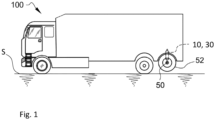
- Fig. 1 depicts a vehicle 100 according to an example embodiment of the present disclosure.
- the vehicle 100 is a truck, provided with wheels 52, in this example rear wheels, mounted on a wheel axle 50.
- the wheel axle 50 may be mounted onto a chassis, or vehicle frame, of the vehicle 100.
- a lifting arrangement 30 and/or a shock absorber device 10 according to example embodiments of the present disclosure is/are provided between the wheel axle 50 and the vehicle frame for lifting the wheel axle 50 from a ground surface S.
- the vehicle 100 may comprise as many shock absorber devices 10 as traditional dampers or the like usually used to mount the axle 50 on the chassis of the vehicle 100, in replacement of said traditional dampers or the like, or a mix of shock absorber device(s) 10 and of traditional dampers or the like.
- the vehicle 100 may comprise one or more lifting arrangements 30 together with one or more traditional dampers, together forming a vehicle suspension system.
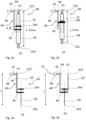
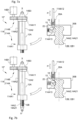
- the lifting arrangement 30 as shown in figs. 2a-b comprises:
- the lifting arrangement 30 further comprises:
- the vehicle frame coupling portion 322 and the wheel axle coupling portion 342 are offset from each other by a length L and the lifting arrangement 30 is arranged to adjust the length L between a maximum length Lmax, see fig. 2a , and a minimum length Lmin, see fig. 2b , by axially moving the second elongated member 34 along the second axis X2 relative the first elongated member 32.
- the maximum length Lmax may be a maximum length as seen when the vehicle 100 is provided on a flat surface. Alternatively, the maximum length Lmax may be a maximum length as seen when the vehicle 100 is lifted up so that its wheels are not in contact with a ground surface.
- the lifting arrangement 30 further comprises an engaging device 36 for axially moving the second elongated member 34 along the second axis X2 relative the first elongated member 32.
- the engaging device 36 is arranged to be provided in an engaged state with the second elongated member 34 so that the length L can be reduced and in a disengaged state with respect to the second elongated member 34 so that forces exerted on the wheel axle coupling portion 342 from the wheel axle 50 during use are prevented from being transferred to the engaging device 36.
- An example of the disengaged state is shown in fig.
- a gap, or distance, d is provided between a stop surface 344 of the second elongated member 34 and the engaging device 36, as seen in the axial direction along the axis X2.
- the engaging device 36 may be disengaged from the second elongated member 34 by moving away from the second elongated member 36 in a radially outward direction with respect to the axis X2.
- the engaging device 36 may be formed as a split nut member (not shown) which is disengaged from the second elongated member 34 by moving each split part of the nut member radially away from the second elongated member 34.
- the engaging device 36 and the second elongated member 34 may be connected via a helical groove, wherein the members 32, 34 are rotated relative each other for adjusting the length L.
- a part of the member 32 may be rotated relative the member 34. Examples of such a configuration will for example be explained in the below with respect to figs. 5-7b .
- Fig. 2b shows an example of the engaged state when the engaging device 36 and the stop surface 344 are in contact, i.e. in engagement.
- the length L is a minimum length Lmin, i.e. in this state, during use, the lifting arrangement 30 has lifted the wheel axle 50 as far away as possible from the ground surface S.
- the first and second elongated members 32, 34 may be arranged so that the first axis X1 and the second axis X2 are aligned during movement between the maximum length Lmax and the minimum length Lmin.
- the lifting arrangement 30 may be configured so that the first axis X1 and the second axis X2 are always aligned with respect to each other.
- the first 32', 32" and the second 34' elongated members may be arranged so that the first axis X1 and the second axis X2 are parallel during movement between the maximum length Lmax and the minimum length Lmin.
- the lifting arrangement 30 may be configured so that the first axis X1 and the second axis X2 are always parallel with respect to each other.
- the first and second elongated members 32, 34 may be telescopically arranged relative each other.
- one of the members 32, 34 may be configured to be axially movable relative the other member 34, 32 inside the other member 34, 32.
- the first elongated member 32 is arranged to be axially movable relative the second elongated member 34 inside the second elongated member 34.
- at least one of the members 32, 34 may as shown be of tubular shape.
- first and second elongated members 32, 34 may form a shock absorber device for the vehicle 100.
- the lifting arrangement 30 may be biased towards the maximum length Lmax.
- the engaging device 36 is axially movable along the second axis X2 relative the second elongated member 34, 34'.
- the second elongated member 34, 34' may as shown comprise a stop surface 344 for the engaging device 36, i.e. the stop surface 344 as already mentioned in the above.
- the engaging device 36 is arranged to engage with the stop surface 344 and thereafter axially move the second elongated member 34 along the second axis X2 relative the first elongated member 32 so that the length L is reduced.
- the second elongated member 34 is releasable from the engaging device 36 so that the length L can be reduced.
- the second elongated member 34 when the distance d has been reduced to zero, the second elongated member 34 is still allowed to move towards the vehicle frame coupling portion 322 along the axis X2 and away from the engaging device 36. Thereby, during the lifting procedure, the second elongated member 34 can still be moved upwardly without damaging the engaging device 36 and any mechanical elements for operating/driving the engaging device 36, i.e. mechanical elements for axially moving the engaging device 36 along the axis X2.
- the lifting arrangement 30 may further comprise a motor 38, such as an electric motor.
- the engaging device 36 is driven by the motor 38 for axially moving the second elongated member 34 along the second axis X2 relative the first elongated member 32.
- the motor may be an air-driven motor, a hydraulic motor, or any other type of motor.
- the lifting arrangement 30 may further comprise one or more mechanical driving elements 40, such as a gearbox 42 and a screwing rod 44, for transferring a driving force from the motor 38 to the engaging device 36.
- the engaging device 36 may be arranged to be axially moved along the screwing rod 44, e.g. by a helical connection between the screwing rod 44 and the engaging device 36. More specifically, a rotation of the screwing rod 44 caused by the motor 38 via the gearbox 42 may result in that the engaging device 36 is moved along the axis X2.
- the connection between the screwing rod 44 and the engaging device 36 may be a ball-screw connection.
- the screwing rod 44 forms the first elongated member 32' of the lifting arrangement 30.
- first and second elongated members 32, 32', 32", 34, 34' may be configured differently, such as formed as tube formed members or as screwing rods.
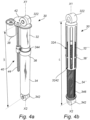
- Figs. 4a-b show respective example embodiments of lifting arrangements 30 according to the present disclosure.
- the engaging device 36 of the embodiment shown in fig. 4a is a nut member which encloses the second elongated member 34. More specifically, in the shown embodiment, the nut member 36 is arranged to be guided along the axis X2 by the outer peripheral surface of the second elongated member 34, which in the shown embodiment is a cylindrically shaped outer surface. Accordingly, the engaging device 36 may be arranged to slide on the second elongated member 34 along the axis X2.
- the engaging device 36' is at least one pin member which is provided in a track 324 of the first elongated member 32"'.
- the track 324 extends along the axis X1, i.e. in this example the axis X1 is aligned with the axis X2.
- the second elongated member 34" may be arranged inside the first elongated member 32′′′ in a telescopic configuration.
- the second elongated member 34" may be provided with threads 346 on its outer peripheral surface which are arranged to cooperate with the at least one pin member 36' so that the at least one pin member 36' is axially moved in the track 324 and/or axially moved relative the second elongated member 34" when the first elongated member 32′′′ is rotated about the axis X1 and/or X2 relative the second elongated member 34".
- the first and second elongated members 32′′′, 34" have been rotated relative each other so that the at least one pin member 36' contacts a lower end 3242 (i.e.
- a continued relative rotation of the first and second elongated members 32′′′, 34" will result in a reduction of the length L.
- the contact between the at least one pin member 36' and the lower end 3242 of the track 324 relates to the engaged state as disclosed herein. Accordingly, when there is no contact therebetween, the engaging device 36' is in a disengaged state.
- the relative rotation of the first and second elongated members 32′′′, 34" may be effectuated by a motor (not shown).
- the length L may be increased again.
- the lifting arrangement 30 may further comprise a locking mechanism (not shown) for axially locking the first and second elongated members relative each other when the lifting arrangement has lifted the wheel axle 50 to a lifted position during use. Thereby, the lifting arrangement 30 will maintain the wheel axle 50 in a lifted position.
- a locking mechanism (not shown) for axially locking the first and second elongated members relative each other when the lifting arrangement has lifted the wheel axle 50 to a lifted position during use. Thereby, the lifting arrangement 30 will maintain the wheel axle 50 in a lifted position.
- the lifting arrangement 30, such as the motor 38, may be controlled by a control unit (not shown) which issues control signals to the lifting arrangement 30, e.g. to the motor 38.
- the control signals may comprise a signal for lifting the wheel axle 50 during use and/or a signal for lowering the wheel axle 50 during use.
- the lifting arrangement 30 may further comprise a cover (not shown), e.g. a dust cover, for protecting the different elements of the lifting arrangement 30.
- a cover e.g. a dust cover
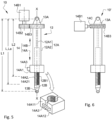
- Fig. 5 shows a shock absorber device 10 comprising a shock absorber 12 extending along an axis X and a lifting device 14.
- the axis X may correspond to the axis X1 and X2 as mentioned in the above, i.e. the axis X may correspond to two aligned axes.
- the shock absorber 12 comprises a first part 12A and a second part 12B axially movable with regard to each other along the axis X.
- the shock absorber 12 may have a first length L1 along the axis X in a rest position.
- the lifting device 14 is mounted onto the shock absorber 12 and is configured to adjust a length L of the shock absorber 12 along the axis X between a second length L2 and the first length L1, the second length L2 being less than the first length L1.
- the length L, L1, L2 may be measured between reference points (e.g. geometric centre of mounting through holes) of the mounting portions 13A and 13B.
- the first length L1 is the length of the shock absorber 12 when mounted onto the vehicle 100, the vehicle 100 being empty (i.e. unloaded).
- the second length L2 is the minimal length of the shock absorber 12 when totally compressed (i.e. maximum stroke).
- the lifting device 14 has a released configuration in which the lifting device 14 allows the first part 12A and the second part 12B to axially move with regard to each other along the axis X and an engaged configuration wherein the lifting device 14 axially couples the first part 12A and the second part 12B together.
- the shock absorber 12 is a damper, the first part 12A comprising a piston rod 12A1 and a dust cover 12A2 (i.e. dust cover of the piston).
- the second part 12B comprises a stator 12B1.
- the dust cover 12A2 is rotatable relative to the second part 12B, and in this example relative to the stator 12B1, around the axis X.
- the dust cover 12A2 is also rotatable relative to the piston rod 12A1 around the axis X.
- the lifting device 14 is configured to mechanically axially couple the first part 12A and the second part 12B.
- the first part 12A and the second part 12B are free to rotate relative to each other around the axis X when coupled with the help of the lifting device 14.
- the lifting device 14 comprises an engaging system 14A configured to reversibly axially couple the first part 12A and the second part 12B.
- the lifting device 14 in this example the engaging system 14A which also may be denoted an engaging device, also comprises a first element 14A1 provided on the first part 12A, in this example on the dust cover 12A2, and a second element 14A2 provided on the second part 12B, in this example on the stator 12B1.
- the first element 14A1 and the second element 14A2 are reversibly engageable with each other.
- the first element 14A1 comprises two half nuts 14A11 and 14A12, which may form all or part of a driving device
- the second element 14A2 comprise a helical path 14A21 which may form all or part of a driven device, the half nuts 14A11, 14A12 and the helical path 14A21 being configured to cooperate by form-fitting.
- the first element 14A1, in this example the half-nuts 14A11, 14A12 may be coupled in rotation around the axis X with the first part 12A, in this example with the dust cover 12A2.
- the helical path 14A21 is arranged on an outer face of the stator 12B1.
- the helical path may be formed on an inner face of the dust cover 12A2 while complementary "half nuts" (with a thread on the outer face) may coupled in rotation with the stator 12B1.
- the driving element would be the helical path and the driven element would be the "half nuts”.
- the helical path 14A21 may be protected by a rubber boot / rubber bellows to prevent penetration of dirt and water.
- the engaging system 14A is configured to reversibly engage the half nuts 14A11, 14A12 and the helical path 14A21.
- the engaging system 14A may comprise an electrical control device 14A3 including a solenoid, an electromagnet, or the like (not shown) to clamp/release the two half nuts 14A11, 14A12 with the helical path 14A21.
- the half nuts 14A11, 14A12 When the half nuts 14A11, 14A12 are clamped, the half nuts 14A11, 14A12 are engaged with the helical path 14A21 by form fitting. The first part 12A and the second part 12B are then axially coupled with each other along the axis X.
- the lifting device 14 may be considered to be in the engaged configuration, and axially couples the first part 12A and the second part 12B together along the axis X.
- the lifting device 14 may be considered to be in a released configuration, and allows the first part 12A and the second part 12B to axially move with regard to each other along the axis X.
- the lifting device 14 comprise a motor 14B1, for example an electric motor, an air driven motor or a hydraulically driven motor, configured to drive the half nuts 14A11, 14A12.
- the motor 14B1 may be part of a driving system 14B including, in addition to the motor 14B1, several gears 14B2, 14B3, in this example two gears.
- the motor 14B1 may be mounted on a part of the vehicle 100, for example a part on which the mounting part 13A is mounted.
- the gear 14B2 is driven by the motor 14B1 and is meshed with the gear 14B3, which is coupled in rotation with the first part 12A, in this example the dust cover 12A2.
- the rotation of the dust cover 12A2 via the motor 14B1 thus drives the half nuts 14A11, 14A12, which are coupled in rotation with the dust cover 12A2.
- the half nuts 14A11, 14A12 then drive the second part 12B via the helical path 14A21 and the axial length L of the shock absorber may be thus adjusted.
- the length L of the shock absorber 12 along the axis X may be adjusted from its rest position, for example between the second length L2 and the first length L1 in order to lift the axle 50 of the vehicle 100, as shown in fig. 1 .
- the lifting device 14 may rest in the engaged configuration in order to block the shock absorber 12 (i.e. to maintain the axial coupling between the first part 12A and the second part 12B), and thus block the axle 50 in the lifted position.
- the length L may be adjusted in order to move back to the rest position of the shock absorber 12.
- the axle 50 may be thus lowered and the wheels 52 may contact again the road.
- the half nuts14A11, 14A12 may be then disengaged from the helical path 14A21 and the lifting device 14 set in the released configuration.
- the first part 12A and the second part 12B are thus axially free relative to each other and the shock absorber 12 may be used as usual, for its damping function.
- the gear 14B2 may be replaced by a worm gear 14C and the arrangement of the motor 14B1 adapted accordingly.
- the rest of the shock absorber device 10' is identical to the shock absorber device 10 and not described again. It may be referred to the description of this embodiment in this respect.
- Another embodiment 10" of the shock absorber device is shown in figs. 7a and 7b .
- the shock absorber device 10" of this embodiment is similar to the shock absorber device 10 described in the above, only the engaging systems differ. The parts which are similar are not described again and it may be referred to the description of the embodiment of fig. 5 in this respect.
- the lifting device 114 comprises an engaging system 114A and a driving system 14B, similar to the one of the fig. 5 embodiment.
- the engaging system 114A comprises a first element 114A1 provided on the first part 12A, in this example the dust cover 12A2, and a second element 14A2, similar to the second element of the fig. 5 embodiment.
- the first element 114A1 and the second element 14A2 are reversibly engageable with each other.
- the first element 114A1 comprises a cam 114A11, a rod 114A12, and an engaging element 114A13, in the present example a ball. This may form a mechanical control device of the engaging system 114A.
- the cam 114A11 is rotatable around the axis X, and is coupled in rotation with the gear 14B3.
- the cam 114A11 is configured, when rotated, to axially move the rod 114A12 along the axis X between a first position (see fig. 7a ) and a second position (see fig. 7b ).
- the gear 14B3 is configured to sequentially rotate the cam 114A11 and the dust cover 12A2. Therefore, due to such a clutch, when the cam 114A11 is rotated (by the gear 14B3), the dust cover 12A2 is not rotated (by the gear 14B3), and when the dust cover 12A is rotated (by the gear 14B3), the cam 114A11 is not rotated (by the gear 14B3).
- the rod 114A12, the ball 114A13 and the casings 20A, 20B may be coupled in rotation with the dust cover 12A2 and are rotated together with the dust cover 12A2 when the dust cover 12A2 is rotated around the axis X.
- the rod 114A12 extends along the axis X between the cam 114A11 and the ball 114A13.
- the rod 114A12 may permanently contact both the ball 114A13 and the cam 114A11, but not necessarily.
- a distal end 15 of the rod 114A12 may cooperate with the ball 114A13 in order to radially move the ball 114A13 (i.e. move the ball 114A13 along an axis perpendicular to the axis X).
- the cam 114A11 is rotated around the axis X, the rod 114A12 is moved along the axis X as shown by the double arrow F1, in one direction or in the other direction opposite to the one direction.
- a return spring 18, disposed in a casing 20A through which the rod 114A12 extends, is configured to push the rod 114A12 axially toward the cam 114A11 so that the rod 114A12 permanently bears against the cam 114A11.
- the ball 114A13 is housed in a casing 20B, adjacent to the casing 20A, and in which the distal end 15 of the rod 114A12 extends.
- a return spring 22, disposed in the casing 20B pushes radially the ball 114A13 towards the first part 12B, in order the engage the ball 114A13 with the helical path 14A21. Due to the axial movement of the rod 114A12 according to the arrow F1 the ball 114A13 may be moved radially as shown by the double arrow F2, in one direction or in the other direction opposite to the one direction.
- the rod 114A12 is configured to push the ball 114A13 radially away from the first part 12B, in order to disengage to ball 114A13 from the helical path 14A21 (see fig. 7a ), or to free (or partially free) the ball 114A13 to be pushed by the return spring 22 toward the first part 12B, and to engage the ball 114A13 with the helical path 14A21 (see fig. 7b ).
- the ball 114A13 may form all or part of a driving device while the helical path 14A21 may form all or part of a driven device.
- the ball 114A13 is disengaged form the helical path 14A21 and the lifting device 114 may be considered to be in the released configuration.
- the gear 14B3 is driven. Due to the clutch between the gear 14B3 on one side and the cam 114A11 and the dust cover 12A2 on the other side, the cam 114A11 is rotated first together with the gear 14B3 while the dust cover 12A2 is not rotated.
- the rotation of the cam 114A11 allows the rod 114A12, by following the cam path, to move axially (upwardly in figs. 7a and 7b ) due to the return spring 18. This movement frees the ball 114A13 which is thus moved radially by the return spring 22 and engaged with the helical path 14A21, as shown in fig. 7b . Then, still due to the clutch between the gear 14B3 on one side and the cam 114A11 and the dust cover 12A2 on the other side, the motor 14B1 being still operated, the dust cover 12A2 starts to rotate together with the gear 14B3 while the cam 114A11is not rotated anymore.
- the length L of the shock absorber 12 along the axis X may be adjusted from its rest position, for example between the second length L2 and the first length L1 in order to lift the axle 50 of the vehicle 100, as shown in fig. 1 .
- the lifting device 14 remains in the engaged configuration and blocks the shock absorber 12 (i.e. to maintain the axial coupling between the first part 12A and the second part 12B), and thus block the axle 50 in the lifted position.
- the motor 14B1 When the motor 14B1 is operated in a second rotating direction, opposed to the first rotating direction, only the dust cover 12A2 is rotated (and not the cam 114A11) and the length L may be adjusted in order to move back to the rest position of the shock absorber 12.
- the axle 50 may be thus lowered and the wheels 52 may contact again the road.
- the cam 114A11 starts to rotate together with the gear 14B3 while the dust cover 12A2 is not rotated anymore.
- the rod 114A12 is then pushed downward (in figs. 4A and 4B ) and pushes the ball 114A13 radially outward which is then disengaged from the helical path 14A21.
- the first part 12A and the second part 12B are thus axially free relative to each other and the shock absorber 12 may be used as usual, for its damping function.
- the ball 114A13 and related parts may be replaced by the two half nuts 14A11, 14A12 of the fig. 5 embodiment, the rod 114A11 being configured to clamp/release the two half nuts 14A11, 14A12 with the helical path 14A21.
- a further embodiment 10′′′ of the shock absorber device is shown in fig. 8 .
- the shock absorber device 10′′′ of this embodiment is similar to the shock absorber device of the fig. 5 embodiment 10, and only the lifting device differs.
- the parts which are similar are not described again and it may be referred to the description of the fig. 5 embodiment in this respect.
- the lifting device 214 comprises a first element 214A, which may comprise in this example a pinion 214A1, and a second element 214B, which may comprise in this example a rack 214B1, and which are reversibly engageable with each other.
- the first element 214A is provided on the first part 12A, in this example on the dust cover 12A2.
- the second element 214B is provided on the second part 12B, in this example on an outer face of the stator 12B1.
- the pinion 214A1 may form a driving device while the rack 214B1 may form a driven device.
- the dust cover 12A2 and the stator 12B1 may be not rotatable relative to each other around the axis X, at least when coupled with the help of the lifting device 214.
- a control system 216 of the lifting device 214 comprises an engaging system 216A and a driving system 216B.
- the control system 216 may be directly mounted onto the dust cover 12A2.
- the engaging system 216A is configured to reversibly engage the pinion 214A1 and the rack 214B1, for example by moving the pinion 214A1 along the double arrow F3 in fig. 8 in order to engage /disengage the pinion 214A1 with/from the rack 214B1.
- Such an engaging system is known as such by the skilled person and is not described in detail. It may comprise an electrical or a mechanical control device.
- the lifting device 214 When the pinion 214A1 is engaged with the rack 214B1, the lifting device 214 may be considered to be in an engaged configuration.
- the lifting device 214 When the pinion 214A1 is disengaged from the rack 214B1, the lifting device 214 may be considered to be in a released configuration.
- the driving system 216B comprises a motor (not shown), for example an electric motor, an air driven motor or a hydraulically driven motor, configured to drive the pinion 214A1.
- the motor may drive the pinion 214A1 directly or via a gearbox (not shown).
- the stator 12B1 may be moved along the axis X, in one direction or in the opposite direction of the one direction (see double arrow F4).
- the length L of the shock absorber 12 along the axis X may be adjusted from the rest position of the shock absorber 12, for example between the second length L2 and the first length L1 in order to lift the axle 50 of the vehicle 100, as shown in fig. 1 .
- the lifting device 214 may rest in the engaged configuration in order to block the shock absorber 12 (i.e. to maintain the axial coupling between the first part 12A and the second part 12B), and thus block the axle 50 in the lifted position.
- the length L may be adjusted in order to come back to the rest position of the shock absorber 12.
- the axle 50 may be thus lowered and the wheels 52 may contact again the road S.
- the pinion 214A1 may be then disengaged from the rack 214B1 and the lifting device 14 set in the released configuration.
- the first part 12A and the second part 12B are thus axially free relative to each other and the shock absorber 12 may be used as usual, for its damping function.
- the vehicle 100 may be provided with any of the shock absorber devices and/or lifting arrangements disclosed in the present disclosure, for example with the shock absorber device 10, 10', 10", 10′′′, the lifting arrangement 30, and any variants thereof.
Landscapes
- Engineering & Computer Science (AREA)
- Mechanical Engineering (AREA)
- Chemical & Material Sciences (AREA)
- Combustion & Propulsion (AREA)
- Transportation (AREA)
- General Engineering & Computer Science (AREA)
- Vehicle Body Suspensions (AREA)
Claims (14)
- Hebevorrichtung (30, 10, 10', 10", 10‴) zum Anheben einer Radachse (50) eines Fahrzeugs (100), die Hebevorrichtung umfassend:- ein erstes längliches Element (32, 32', 32", 32‴, 12A), das sich entlang einer ersten Achse (X1, X) erstreckt, das erste längliche Element (32, 32', 32", 12A) umfassend einen Fahrzeugrahmen-Kupplungsabschnitt (322, 13A) zum Verbinden der Hebevorrichtung (30, 10, 10', 10", 10‴) mit einem Fahrzeugrahmen des Fahrzeugs (100) während der Verwendung,- ein zweites längliches Element (34, 34', 34", 12B), das sich entlang einer zweiten Achse (X2, X) erstreckt, das zweite längliche Element (34, 34', 34", 12B) umfassend einen Radachsenkupplungsabschnitt (342, 13B) zum Verbinden der Hebevorrichtung (30) mit der Radachse (50) des Fahrzeugs (100) während der Verwendung,wobei der Fahrzeugrahmen-Kupplungsabschnitt (322, 13A) und der Radachsenkupplungsabschnitt (342, 13B) um eine Länge (L) gegeneinander versetzt sind und wobei die Hebevorrichtung (30) angeordnet ist, um die Länge (L) zwischen einer maximalen Länge (Lmax) und einer minimalen Länge (Lmin) einzustellen, indem sie das zweite längliche Element (34, 34', 34", 12B) entlang der zweiten Achse (X2, X) relativ zu dem ersten länglichen Element (32, 32', 32", 32‴, 12A) axial bewegt,wobei die Hebevorrichtung (30, 10, 10', 10", 10‴) ferner eine Eingriffsvorrichtung (36, 36', 14A1) zum axialen Bewegen des zweiten länglichen Elements (34, 34', 34", 12B) entlang der zweiten Achse (X2, X) relativ zu dem ersten länglichen Element (32, 32', 32", 32‴, 12A) umfasst,wobei die Eingriffsvorrichtung (36, 36', 14A1, 114A1, 214A1) entlang der zweiten Achse (X2) relativ zu dem zweiten länglichen Element (34, 34', 34", 12B) axial bewegbar ist, und wobei die Eingriffsvorrichtung (36, 36', 14A1, 114A1, 214A1) angeordnet ist, dass sie in einem Eingriffszustand mit dem ersten länglichen Element (32‴) oder dem zweiten länglichen Element (34, 34', 34", 12B) vorgesehen ist, so dass die Länge (L) reduziert werden kann, und in einem gelösten Zustand in Bezug auf das erste längliche Element (32‴) oder das zweite längliche Element (34, 34', 34", 12B) reduziert werden kann, so dass Kräfte, die während der Verwendung der Radachse (50) auf den Radachsenkupplungsabschnitt (342, 13B) ausgeübt werden, daran gehindert werden, auf die Eingriffsvorrichtung (36, 36', 14A1, 114A1, 214A1) übertragen zu werden.
- Hebevorrichtung (30, 10, 10', 10", 10‴) nach Anspruch 1, wobei die ersten und zweiten länglichen Elemente (32, 32', 32", 34, 34', 34") so angeordnet sind, dass die erste Achse (X1, X) und die zweite Achse (X2, X) während der Bewegung zwischen der maximalen Länge (Lmax) und der minimalen Länge (Lmin) ausgerichtet sind oder so, dass die erste Achse (X1) und die zweite Achse (X2) während der Bewegung zwischen der maximalen Länge (Lmax) und der minimalen Länge (Lmin) parallel sind.
- Hebevorrichtung (30, 10, 10', 10", 10‴) nach einem der vorhergehenden Ansprüche, wobei das erste und das zweite längliche Element (32, 34) relativ zueinander teleskopisch angeordnet sind.
- Hebevorrichtung (30, 10, 10', 10", 10‴) nach einem der vorhergehenden Ansprüche, wobei das erste und das zweite längliche Element (32, 34, 12A, 12B) eine Stoßdämpfervorrichtung für das Fahrzeug (100) bilden.
- Hebevorrichtung (30) nach einem der vorhergehenden Ansprüche, wobei das erste (32‴) oder das zweite längliche Element (34, 34', 34") eine Anschlagfläche (3242, 344) für die Eingriffsvorrichtung (36, 36') aufweist, und wobei in dem Eingriffszustand, die Eingriffsvorrichtung (36, 36') angeordnet ist, um mit der Anschlagfläche (3242, 344) in Eingriff zu kommen und danach das zweite längliche Element (34, 34', 34") entlang der zweiten Achse (X2) relativ zu dem ersten länglichen Element (32, 32', 32") axial zu bewegen, so dass die Länge (L) reduziert wird.
- Hebevorrichtung (30) nach Anspruch 5, wobei im Eingriffszustand und mindestens bis zum Erreichen der Mindestlänge (Lmin) das erste (32‴) oder das zweite längliche Element (34, 34', 34") von der Eingriffsvorrichtung (36, 36') lösbar ist, so dass die Länge (L) reduziert werden kann.
- Hebevorrichtung (30) nach einem der vorhergehenden Ansprüche, wobei die Eingriffsvorrichtung (36) ein Mutterelement ist, das das zweite längliche Element (34) umschließt, oder wobei die Eingriffsvorrichtung (36') mindestens ein Stiftelement ist, das in einer Führungsbahn (324) des ersten länglichen Elements (32‴) bewegbar ist.
- Hebevorrichtung (30, 10, 10', 10", 10‴) nach einem der vorhergehenden Ansprüche, die ferner einen Motor (38, 14B1), wie z.B. einen Elektromotor umfasst, und wobei die Eingriffsvorrichtung (36, 36') durch den Motor angetrieben wird, um das zweite längliche Element (36, 36') entlang der zweiten Achse (X2) relativ zum ersten länglichen Element (32, 32', 32") axial zu bewegen.
- Hebevorrichtung (30, 10, 10', 10", 10‴) nach Anspruch 8, die ferner ein oder mehrere mechanischen Antriebselemente (40) umfasst, wie z.B. eine Getriebe (42, 14B2, 14B3, 14C) und eine Schraubstange (44), zur Übertragung einer Antriebskraft vom Motor (38, 14B1) auf die Eingriffsvorrichtung (36, 36', 14A1, 114A1, 214A1).
- Hebevorrichtung (30, 10, 10', 10", 10‴) nach einem der vorhergehenden Ansprüche, wobei die Eingriffsvorrichtung (36, 36', 14A1, 114A1, 214A1) im Eingriffszustand das erste längliche Element (32, 32', 32", 12A) und das zweite längliche Element (34, 34', 34", 12B) mechanisch axial miteinander koppelt.
- Hebevorrichtung (10, 10', 10", 10‴) nach einem der vorhergehenden Ansprüche, wobei die Eingriffsvorrichtung ein erstes Element (14A1, 114A1, 214A) und ein zweites Element (14A2, 214B) umfasst, wobei das erste längliche Element (12A) das erste Element (14A1, 114A1, 214A) umfasst und das zweite längliche Element (12B) das zweite Element (14A2, 214B) umfasst, wobei das erste Element (14A1, 114A1, 214A) und das zweite Element (14A2, 214B) reversibel miteinander in Eingriff gebracht werden können.
- Hebevorrichtung (10, 10', 10", 10‴) nach Anspruch 11, wobei ein Element zwischen dem ersten Element (14A1, 114A1, 214A) und dem zweiten Element (14A2, 214B) der Eingriffsvorrichtung eine Antriebsvorrichtung (14A11, 14A12; 114A13; 214A1) umfasst und das andere Element zwischen dem ersten Element (14A1, 114A1, 214A) und dem zweiten Element (14A2, 214B) der Eingriffsvorrichtung eine angetriebene Vorrichtung (14A21; 214B1) umfasst, wobei die Antriebsvorrichtung (14A11, 14A12; 114A13; 214A1) und die angetriebene Vorrichtung (14A21; 214B1) konfiguriert sind, um formschlüssig zusammenzuwirken.
- Hebevorrichtung (10, 10', 10", 10‴) nach Anspruch 12, wobei die angetriebene Vorrichtung eine Zahnstange (214B) oder eine spiralförmige Bahn (14A21) umfasst.
- Fahrzeug (100), das eine Hebevorrichtung (30) nach einem der vorhergehenden Ansprüche umfasst.
Applications Claiming Priority (2)
| Application Number | Priority Date | Filing Date | Title |
|---|---|---|---|
| PCT/EP2022/050902 WO2023134875A1 (en) | 2022-01-17 | 2022-01-17 | A shock absorber device and vehicle comprising such a shock absorber device |
| SE2250687A SE2250687A1 (en) | 2022-06-07 | 2022-06-07 | A lifting arrangement for lifting a wheel axle of a vehicle |
Publications (3)
| Publication Number | Publication Date |
|---|---|
| EP4212366A1 EP4212366A1 (de) | 2023-07-19 |
| EP4212366B1 true EP4212366B1 (de) | 2025-05-07 |
| EP4212366C0 EP4212366C0 (de) | 2025-05-07 |
Family
ID=84799749
Family Applications (1)
| Application Number | Title | Priority Date | Filing Date |
|---|---|---|---|
| EP23151044.7A Active EP4212366B1 (de) | 2022-01-17 | 2023-01-11 | Hebevorrichtung zum anheben einer radachse eines fahrzeugs |
Country Status (2)
| Country | Link |
|---|---|
| US (1) | US11993328B2 (de) |
| EP (1) | EP4212366B1 (de) |
Families Citing this family (1)
| Publication number | Priority date | Publication date | Assignee | Title |
|---|---|---|---|---|
| EP4466147B1 (de) * | 2022-01-17 | 2025-10-15 | Volvo Truck Corporation | Stossdämpfervorrichtung und fahrzeug mit solch einer stossdämpfervorrichtung |
Family Cites Families (18)
| Publication number | Priority date | Publication date | Assignee | Title |
|---|---|---|---|---|
| US2917321A (en) | 1957-10-08 | 1959-12-15 | Fennell Alfred Thomas | Car jacking device |
| US3784218A (en) | 1968-03-25 | 1974-01-08 | E Stone | Vehicle trailer |
| US5044614A (en) * | 1990-02-22 | 1991-09-03 | Rau John A | Shock absorber spring adjuster |
| US5573266A (en) | 1995-02-13 | 1996-11-12 | Safe-T-Vans, Inc. | Vehicle body lowering system |
| GB0110638D0 (en) | 2001-05-01 | 2001-06-20 | Covelink Marine Ltd | Vehicle with retractable wheel |
| GB0206903D0 (en) | 2002-03-23 | 2002-05-01 | Covelink Marine Ltd | Vehicle with retractable wheel |
| US6827184B1 (en) * | 2003-07-18 | 2004-12-07 | Wei-Li Lin | Shock-absorbing device of an automobile |
| GB2404171B (en) | 2003-07-25 | 2007-03-14 | Gibbs Tech Ltd | Amphibious vehicle with disconnectable retractable suspension |
| ITGE20040025A1 (it) * | 2004-03-31 | 2004-06-30 | Emanuele Calzolari | Sistema ammortizzante elettromagnetico |
| FR2927036B1 (fr) | 2008-02-05 | 2010-06-04 | Nexter Systems | Dispositif assurant le relevage des roues d'un engin |
| US9068616B1 (en) * | 2014-02-28 | 2015-06-30 | GM Global Technology Operations LLC | Vehicle suspension system |
| FR3020992A1 (fr) * | 2014-05-19 | 2015-11-20 | Peugeot Citroen Automobiles Sa | Dispositif permettant d'abaisser le seuil de chargement d'un vehicule a traverse deformable |
| US10935096B2 (en) * | 2014-09-19 | 2021-03-02 | Barnes Group Inc. | Electromechanical spring system |
| DE102016122771A1 (de) * | 2015-11-30 | 2017-06-01 | Steering Solutions Ip Holding Corporation | Automatisierte Federungseinstellvorrichtung |
| CN107757286B (zh) * | 2016-08-22 | 2019-11-22 | 比亚迪股份有限公司 | 汽车的悬架系统及具有其的汽车、控制方法 |
| JP6426785B2 (ja) * | 2017-04-17 | 2018-11-21 | 本田技研工業株式会社 | 電磁サスペンション装置 |
| US20190030974A1 (en) * | 2017-07-28 | 2019-01-31 | Yu-Jui Yang | Front lifting system for vehicle |
| JP6993452B2 (ja) * | 2020-03-19 | 2022-01-13 | 本田技研工業株式会社 | 電動サスペンション装置 |
-
2023
- 2023-01-10 US US18/095,151 patent/US11993328B2/en active Active
- 2023-01-11 EP EP23151044.7A patent/EP4212366B1/de active Active
Also Published As
| Publication number | Publication date |
|---|---|
| US20230227117A1 (en) | 2023-07-20 |
| EP4212366C0 (de) | 2025-05-07 |
| US11993328B2 (en) | 2024-05-28 |
| EP4212366A1 (de) | 2023-07-19 |
Similar Documents
| Publication | Publication Date | Title |
|---|---|---|
| US8317003B2 (en) | Wheel suspension for motor vehicles | |
| EP0662418B1 (de) | Lift-Achsen-Aufhängungssystem in Form eines Parallelogramms mit Steuerung der Achsen-Schwenkeinstellung | |
| US20160339823A1 (en) | Suspension for a multiple height vehicle | |
| US6237953B1 (en) | Automatic jack and wheel change system | |
| CN113561760B (zh) | 低非簧载质量近轮ipass系统 | |
| US9649967B2 (en) | Vehicle lowering system | |
| EP4212366B1 (de) | Hebevorrichtung zum anheben einer radachse eines fahrzeugs | |
| US7036847B2 (en) | Arrangement of a motor on a support winch | |
| CN112319168A (zh) | 悬架装置、移动底盘及机器人 | |
| US8770593B2 (en) | Vehicle suspension systems | |
| CN210793194U (zh) | 一种齿轨车驱动制动装置 | |
| EP4466147B1 (de) | Stossdämpfervorrichtung und fahrzeug mit solch einer stossdämpfervorrichtung | |
| KR102673390B1 (ko) | 전동식 차고 조절 장치 | |
| SE2250687A1 (en) | A lifting arrangement for lifting a wheel axle of a vehicle | |
| CN110356185B (zh) | 一种用于载重机车驱动轮的转动型抬升减震装置 | |
| US3216703A (en) | Vehicle lifting device | |
| US7464955B2 (en) | Articulated vehicle | |
| CN115139726A (zh) | 前悬架系统及具有其的车辆 | |
| WO2003051655A1 (en) | A road and railway going vehicle | |
| US3084756A (en) | Vehicle lifting and traversing device | |
| KR100353132B1 (ko) | 트럭의 피동륜 승강장치 및 방법 | |
| CN111439069A (zh) | 一种车桥 | |
| KR100748330B1 (ko) | 상용차용 쇽 업소버 | |
| CN118219961B (zh) | 一种多地形稳定运输的通信战车装载车辆 | |
| CN220262523U (zh) | 一种悬挂机构 |
Legal Events
| Date | Code | Title | Description |
|---|---|---|---|
| PUAI | Public reference made under article 153(3) epc to a published international application that has entered the european phase |
Free format text: ORIGINAL CODE: 0009012 |
|
| STAA | Information on the status of an ep patent application or granted ep patent |
Free format text: STATUS: THE APPLICATION HAS BEEN PUBLISHED |
|
| AK | Designated contracting states |
Kind code of ref document: A1 Designated state(s): AL AT BE BG CH CY CZ DE DK EE ES FI FR GB GR HR HU IE IS IT LI LT LU LV MC ME MK MT NL NO PL PT RO RS SE SI SK SM TR |
|
| STAA | Information on the status of an ep patent application or granted ep patent |
Free format text: STATUS: REQUEST FOR EXAMINATION WAS MADE |
|
| 17P | Request for examination filed |
Effective date: 20240118 |
|
| RBV | Designated contracting states (corrected) |
Designated state(s): AL AT BE BG CH CY CZ DE DK EE ES FI FR GB GR HR HU IE IS IT LI LT LU LV MC ME MK MT NL NO PL PT RO RS SE SI SK SM TR |
|
| GRAP | Despatch of communication of intention to grant a patent |
Free format text: ORIGINAL CODE: EPIDOSNIGR1 |
|
| STAA | Information on the status of an ep patent application or granted ep patent |
Free format text: STATUS: GRANT OF PATENT IS INTENDED |
|
| INTG | Intention to grant announced |
Effective date: 20241219 |
|
| GRAS | Grant fee paid |
Free format text: ORIGINAL CODE: EPIDOSNIGR3 |
|
| GRAA | (expected) grant |
Free format text: ORIGINAL CODE: 0009210 |
|
| STAA | Information on the status of an ep patent application or granted ep patent |
Free format text: STATUS: THE PATENT HAS BEEN GRANTED |
|
| AK | Designated contracting states |
Kind code of ref document: B1 Designated state(s): AL AT BE BG CH CY CZ DE DK EE ES FI FR GB GR HR HU IE IS IT LI LT LU LV MC ME MK MT NL NO PL PT RO RS SE SI SK SM TR |
|
| REG | Reference to a national code |
Ref country code: GB Ref legal event code: FG4D |
|
| REG | Reference to a national code |
Ref country code: CH Ref legal event code: EP |
|
| REG | Reference to a national code |
Ref country code: DE Ref legal event code: R096 Ref document number: 602023003235 Country of ref document: DE |
|
| REG | Reference to a national code |
Ref country code: IE Ref legal event code: FG4D |
|
| U01 | Request for unitary effect filed |
Effective date: 20250603 |
|
| U07 | Unitary effect registered |
Designated state(s): AT BE BG DE DK EE FI FR IT LT LU LV MT NL PT RO SE SI Effective date: 20250611 |
|
| PG25 | Lapsed in a contracting state [announced via postgrant information from national office to epo] |
Ref country code: ES Free format text: LAPSE BECAUSE OF FAILURE TO SUBMIT A TRANSLATION OF THE DESCRIPTION OR TO PAY THE FEE WITHIN THE PRESCRIBED TIME-LIMIT Effective date: 20250507 |
|
| PG25 | Lapsed in a contracting state [announced via postgrant information from national office to epo] |
Ref country code: GR Free format text: LAPSE BECAUSE OF FAILURE TO SUBMIT A TRANSLATION OF THE DESCRIPTION OR TO PAY THE FEE WITHIN THE PRESCRIBED TIME-LIMIT Effective date: 20250808 Ref country code: NO Free format text: LAPSE BECAUSE OF FAILURE TO SUBMIT A TRANSLATION OF THE DESCRIPTION OR TO PAY THE FEE WITHIN THE PRESCRIBED TIME-LIMIT Effective date: 20250807 |
|
| PG25 | Lapsed in a contracting state [announced via postgrant information from national office to epo] |
Ref country code: PL Free format text: LAPSE BECAUSE OF FAILURE TO SUBMIT A TRANSLATION OF THE DESCRIPTION OR TO PAY THE FEE WITHIN THE PRESCRIBED TIME-LIMIT Effective date: 20250507 |
|
| PG25 | Lapsed in a contracting state [announced via postgrant information from national office to epo] |
Ref country code: HR Free format text: LAPSE BECAUSE OF FAILURE TO SUBMIT A TRANSLATION OF THE DESCRIPTION OR TO PAY THE FEE WITHIN THE PRESCRIBED TIME-LIMIT Effective date: 20250507 |
|
| PG25 | Lapsed in a contracting state [announced via postgrant information from national office to epo] |
Ref country code: RS Free format text: LAPSE BECAUSE OF FAILURE TO SUBMIT A TRANSLATION OF THE DESCRIPTION OR TO PAY THE FEE WITHIN THE PRESCRIBED TIME-LIMIT Effective date: 20250807 |
|
| PG25 | Lapsed in a contracting state [announced via postgrant information from national office to epo] |
Ref country code: IS Free format text: LAPSE BECAUSE OF FAILURE TO SUBMIT A TRANSLATION OF THE DESCRIPTION OR TO PAY THE FEE WITHIN THE PRESCRIBED TIME-LIMIT Effective date: 20250907 |