EP4209986A1 - Verfahren und vorrichtung zur iterativen verwaltung eines kreditkartenmodells, elektronische vorrichtung und speichermedium - Google Patents
Verfahren und vorrichtung zur iterativen verwaltung eines kreditkartenmodells, elektronische vorrichtung und speichermedium Download PDFInfo
- Publication number
- EP4209986A1 EP4209986A1 EP22207776.0A EP22207776A EP4209986A1 EP 4209986 A1 EP4209986 A1 EP 4209986A1 EP 22207776 A EP22207776 A EP 22207776A EP 4209986 A1 EP4209986 A1 EP 4209986A1
- Authority
- EP
- European Patent Office
- Prior art keywords
- scorecard model
- sample
- part sample
- credit
- credit scorecard
- Prior art date
- Legal status (The legal status is an assumption and is not a legal conclusion. Google has not performed a legal analysis and makes no representation as to the accuracy of the status listed.)
- Withdrawn
Links
Images

Classifications
-
- G—PHYSICS
- G06—COMPUTING OR CALCULATING; COUNTING
- G06Q—INFORMATION AND COMMUNICATION TECHNOLOGY [ICT] SPECIALLY ADAPTED FOR ADMINISTRATIVE, COMMERCIAL, FINANCIAL, MANAGERIAL OR SUPERVISORY PURPOSES; SYSTEMS OR METHODS SPECIALLY ADAPTED FOR ADMINISTRATIVE, COMMERCIAL, FINANCIAL, MANAGERIAL OR SUPERVISORY PURPOSES, NOT OTHERWISE PROVIDED FOR
- G06Q40/00—Finance; Insurance; Tax strategies; Processing of corporate or income taxes
- G06Q40/03—Credit; Loans; Processing thereof
-
- G—PHYSICS
- G06—COMPUTING OR CALCULATING; COUNTING
- G06Q—INFORMATION AND COMMUNICATION TECHNOLOGY [ICT] SPECIALLY ADAPTED FOR ADMINISTRATIVE, COMMERCIAL, FINANCIAL, MANAGERIAL OR SUPERVISORY PURPOSES; SYSTEMS OR METHODS SPECIALLY ADAPTED FOR ADMINISTRATIVE, COMMERCIAL, FINANCIAL, MANAGERIAL OR SUPERVISORY PURPOSES, NOT OTHERWISE PROVIDED FOR
- G06Q10/00—Administration; Management
- G06Q10/06—Resources, workflows, human or project management; Enterprise or organisation planning; Enterprise or organisation modelling
- G06Q10/063—Operations research, analysis or management
-
- G—PHYSICS
- G06—COMPUTING OR CALCULATING; COUNTING
- G06Q—INFORMATION AND COMMUNICATION TECHNOLOGY [ICT] SPECIALLY ADAPTED FOR ADMINISTRATIVE, COMMERCIAL, FINANCIAL, MANAGERIAL OR SUPERVISORY PURPOSES; SYSTEMS OR METHODS SPECIALLY ADAPTED FOR ADMINISTRATIVE, COMMERCIAL, FINANCIAL, MANAGERIAL OR SUPERVISORY PURPOSES, NOT OTHERWISE PROVIDED FOR
- G06Q20/00—Payment architectures, schemes or protocols
- G06Q20/38—Payment protocols; Details thereof
- G06Q20/40—Authorisation, e.g. identification of payer or payee, verification of customer or shop credentials; Review and approval of payers, e.g. check credit lines or negative lists
- G06Q20/401—Transaction verification
- G06Q20/4016—Transaction verification involving fraud or risk level assessment in transaction processing
-
- G—PHYSICS
- G06—COMPUTING OR CALCULATING; COUNTING
- G06N—COMPUTING ARRANGEMENTS BASED ON SPECIFIC COMPUTATIONAL MODELS
- G06N20/00—Machine learning
Definitions
- the present invention relates to the technical field of machine learning, further relates to the field of smart finance and risk control technologies, and in particular, to a method and apparatus for iterating a credit scorecard model, an electronic device and a storage medium.
- a credit guarantee enterprise generally uses a risk control model to perform risk control on services.
- a credit scorecard model is a common risk control model.
- Rejection inference technologies are used for generating samples in related solutions.
- the proportion of performance samples of which loan duration reaches a performance period gradually decreases, and a distinction degree gets lower and lower, resulting in more difficult of an update process of the risk control model.
- At least some embodiments of the present invention provide a method and apparatus for iterating a credit scorecard model, an electronic device, and a storage medium, so as at least partially to solve the technical problem of a poor iteration effect of a risk control model in the related art.
- a method for iterating a credit scorecard model including: dividing multiple to-be-classified samples into a first part sample and a second part sample; classifying the first part sample by using a first credit scorecard model to obtain a first prediction result, and classifying the second part sample by using the first credit scorecard model to obtain a second prediction result, where the first credit scorecard model is an initial credit scorecard model of a current phase; and determining an input sample of a second credit scorecard model based on the first prediction result and the second prediction result, and iterating the first credit scorecard model according to the second prediction result and multiple history samples, to obtain a target credit scorecard model.
- the second credit scorecard model is an initial credit scorecard model of a next phase, and the multiple history samples are modeling samples of the first credit scorecard model.
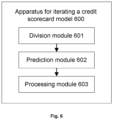
- an apparatus for iterating a credit scorecard model including: a division module, configured to divide multiple to-be-classified samples into a first part sample and a second part sample; a prediction module, configured to classify the first part sample by using a first credit scorecard model to obtain a first prediction result, and classify the second part sample by using the first credit scorecard model to obtain a second prediction result, where the first credit scorecard model is an initial credit scorecard model of a current phase; and a processing module, configured to determine an input sample of a second credit scorecard model based on the first prediction result and the second prediction result, and iterate the first credit scorecard model according to the second prediction result and multiple history samples, to obtain a target credit scorecard model.
- the second credit scorecard model is an initial credit scorecard model of a next phase, and the multiple history samples are modeling samples of the first credit scorecard model.
- an electronic device in another embodiment, includes at least one processor and a memory communicatively connected with the at least one processor.
- the memory is configured to store at least one instruction executable by the at least one processor.
- the at least one instruction is performed by the at least one processor, to cause the at least one processor to perform the method for iterating the credit scorecard model mentioned above.
- a non-transitory computer-readable storage medium storing at least one computer instruction.
- the at least one computer instruction is used for a computer to perform the method for iterating the credit scorecard model mentioned above.
- a computer program product in another embodiment, includes a computer program.
- the method for iterating the credit scorecard model mentioned above is implemented when the computer program is operated by a processor.
- the multiple to-be-classified samples are divided into the first part sample and the second part sample. Then, the first part sample is classified by using the first credit scorecard model to obtain the first prediction result, and the second part sample is classified by using the first credit scorecard model to obtain the second prediction result. Finally, the input sample of the second credit scorecard model is determined based on the first prediction result and the second prediction result, and the first credit scorecard model is iterated according to the second prediction result and multiple history samples, to obtain the target credit scorecard model.
- the purpose of obtaining the target credit scorecard model through efficient iteration can be achieved, and the optimization of an iteration effect of the risk control model can be realized, thereby solving the technical problem of a poor iteration effect of the risk control model in the related art.
- Rejection inference technologies are used for generating samples in related solutions.
- the proportion of performance samples of which loan duration reaches a performance period gradually decreases.
- a precondition risk control strategy filters a large number of potential bad users, a distinction degree of performance samples gets lower and lower, resulting in more difficult of an update process of the risk control model. For example, after a user applies a loan, the first three repayment periods are performance periods, and the duration of each repayment period is one month. A sample that loan duration reaches three months is the performance sample, and a sample that the loan duration does not reach three months is a non-performance sample.
- the potential bad users are abnormal users that are identified by the precondition risk control strategy, for example, the abnormal users that are identified by means of credit inquiry.
- An embodiment of the present invention provides a method for iterating a credit scorecard model. It is to be noted that the steps shown in the flowchart of the accompanying drawings may be executed in a computer system, such as a set of computer-executable instructions, and although a logical sequence is shown in the flowchart, in some cases, the steps shown or described may be executed in a different order than here.
- the method embodiment provided in this embodiment of the present invention may be performed in a mobile terminal, a computer terminal, or a similar electronic device.
- the electronic device is intended to represent various forms of digital computers, such as laptop computers, desktop computers, workbenches, personal digital assistants, servers, blade servers, mainframe computers, and other suitable computers.
- the electronic device may also express various forms of mobile devices, such as personal digital processing, cellular phones, smart phones, wearable devices, and other similar computing devices.
- the components shown herein, connections and relationships of the components, and functions of the components are examples, and are not intended to limit the implementation of the present invention described and/or required herein.
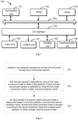
- Fig. 1 is a block diagram of a hardware structure of a computer terminal (or a mobile device) configured to implement a method for iterating a credit scorecard model according to an embodiment of the present invention.
- the computer terminal 100 includes a computing unit 101.
- the computing unit may perform various appropriate actions and processing operations according to a computer program stored in a Read-Only Memory (ROM) 102 or a computer program loaded from a storage unit 108 into a Random Access Memory (RAM) 103.
- ROM Read-Only Memory
- RAM Random Access Memory
- various programs and data required for the operation of the computer terminal 100 may also be stored.
- the computing unit 101, the ROM 102, and the RAM 103 are connected with each other by using a bus 104.
- An Input/Output (I/O) interface 105 is also connected with the bus 104.
- Multiple components in the computer terminal 100 are connected with the I/O interface 105, and include: an input unit 106, such as a keyboard and a mouse; an output unit 107, such as various types of displays and loudspeakers; the storage unit 108, such as a disk and an optical disc; and a communication unit 109, such as a network card, a modem, and a wireless communication transceiver.
- the communication unit 109 allows the computer terminal 100 to exchange information/data with other devices through a computer network, such as the Internet, and/or various telecommunication networks.
- the computing unit 101 may be various general and/or special processing assemblies with processing and computing capabilities. Some examples of the computing unit 101 include, but are not limited to, a Central Processing Unit (CPU), a Graphics Processing Unit (GPU), various dedicated Artificial Intelligence (Al) computing chips, various computing units for running machine learning model algorithms, a Digital Signal Processor (DSP), and any appropriate processors, controllers, microcontrollers, and the like.
- the computing unit 101 performs the method for iterating a credit scorecard model described here.
- the method for iterating a credit scorecard model may be implemented as a computer software program, which is tangibly included in a machine-readable medium, such as the storage unit 108.
- part or all of the computer programs may be loaded and/or installed on the computer terminal 100 via the ROM 102 and/or the communication unit 109.
- the computer program When the computer program is loaded into the RAM 103 and performed by the computing unit 101, at least one step of the method for iterating the credit scorecard model described here may be performed.
- the computing unit 101 may be configured to perform the method for iterating the credit scorecard model in any other suitable manners (for example, by means of firmware).
- Various implementations of systems and technologies described here may be implemented in a digital electronic circuit system, an integrated circuit system, a Field Programmable Gate Array (FPGA), an Application-Specific Integrated Circuit (ASIC), an Application-Specific Standard Product (ASSP), a System-On-Chip (SOC), a Load Programmable Logic Device (CPLD), computer hardware, firmware, software, and/or a combination thereof.
- FPGA Field Programmable Gate Array
- ASIC Application-Specific Integrated Circuit
- ASSP Application-Specific Standard Product
- SOC System-On-Chip
- CPLD Load Programmable Logic Device
- computer hardware firmware, software, and/or a combination thereof.
- the programmable processor may be a dedicated or general programmable processor, which can receive data and instructions from a storage system, at least one input device, and at least one output device, and transmit the data and instructions to the storage system, the at least one input device, and the at least one output device.
- the electronic device shown in Fig. 1 may include a hardware element (including a circuit), a software element (including a computer code stored on the computer-readable medium), or a combination of the hardware element and the software element.
- Fig. 1 is an example of a specific example, and is intended to illustrate the types of components that may be present in the above electronic device.
- the present invention provides the method for iterating the credit scorecard model shown in Fig. 2 .
- the method may be performed by the computer terminal shown in Fig. 1 or a similar electronic device.
- Fig. 2 is a flowchart of a method for iterating a credit scorecard model according to an embodiment of the present invention. As shown in Fig. 2 , the method may include the following steps.
- multiple to-be-classified samples are divided into a first part sample and a second part sample.
- the multiple to-be-classified samples are divided into the first part sample and the second part sample according to a preset division proportion.
- the preset division proportion may be flexibly set by a risk control service team.
- the preset division proportion is 9:1. That is, 90% of the to-be-classified samples are divided to the first part sample, and 10% of the to-be-classified samples are divided to the second part sample.
- the first part sample is classified by using a first credit scorecard model to obtain a first prediction result
- the second part sample is classified by using the first credit scorecard model to obtain a second prediction result.
- the first credit scorecard model is an initial credit scorecard model of a current phase.
- the first credit scorecard model is the initial credit scorecard model of any phase of a pre-loan phase, an in-loan phase, and a post-loan phase in a credit process of a user.
- a next phase is the in-loan phase.
- the next phase is the post-loan phase.
- the first credit scorecard model includes one of the following: an application scorecard model, a behavior scorecard model, and a collection scorecard model.
- the first credit scorecard model is a binary classification machine learning model.
- the application scorecard model may be represented as an A card model
- the behavior scorecard model may be represented as a B card model
- the collection scorecard model may be represented as a C card model.
- the application scorecard model is mainly applied in the pre-loan phase. That is, during a processing period of user application, a risk probability of default and delinquency within a certain time period is predicted after the user opens an account.
- a risk probability of default and delinquency within a certain time period is predicted after the user opens an account.
- the user passes prediction verification of the application scorecard model, it is determined that the user may borrow or lend money.
- the user does not pass the prediction verification of the application scorecard model, it is determined that the user cannot borrow or lend money.
- the behavior scorecard model is mainly applied in the in-loan phase. That is, during an account management period, future credit performance of the user is predicted according to various behavior features historically shown by the user.
- future credit performance of the user is predicted according to various behavior features historically shown by the user.
- the user passes prediction verification of the behavior scorecard model, it indicates that the user has the ability to repay.
- the user does not pass the prediction verification of the behavior scorecard model, it indicates that the user does not have the ability to repay. For example, the user borrows money from multiple banks, and the user may be late for repayment, so that it is necessary to take precautions.
- the collection scorecard model is mainly applied in the post-loan phase. That is, during the account management period, a probability of adopting a collection strategy is predicted for the overdue user, so that collection measures corresponding to the collection strategy are adopted.
- the user passes prediction verification of the collection scorecard model, it indicates that the user may make repayment on schedule.
- the user does not pass the prediction verification of the collection scorecard model, it indicates that the user cannot make repayment on schedule, so that the collection measures are required to remind the user for repayment. For example, a text message is sent to remind the user for repayment.
- the initial credit scorecard model of the next phase is the collection scorecard model.
- the method for iterating the credit scorecard model further includes the following steps.
- step S20 multiple candidate samples are filtered by using a blacklist manner, to obtain the multiple to-be-classified samples.
- the multiple candidate samples are filtered by using a blacklist library, to obtain the multiple to-be-classified samples.
- the blacklist library is the Pre A model.
- the multiple candidate samples are inputted into the Pre A model. If some samples in the blacklist library may be matched with the candidate samples, the candidate samples are filtered. If none sample in the blacklist library may be matched with the candidate samples, the candidate samples are determined as the to-be-classified sample.
- the multiple candidate samples are filtered by using the blacklist manner, to obtain the multiple to-be-classified samples, so that the candidate samples can be effectively selected, and invalid candidate samples are filtered. Therefore, the computation cost of iterating the credit scorecard model can be reduced, and the iteration efficiency can be effectively enhanced.
- step S22 an operation of classifying the first part sample by using the first credit scorecard model to obtain the first prediction result, and classifying the second part sample by using the first credit scorecard model to obtain the second prediction result includes the following step.
- the first part sample is classified by using the first credit scorecard model to obtain a prediction probability of each sample in the first part sample
- the second part sample is classified by using the first credit scorecard model to obtain a prediction probability of each sample in the second part sample.
- the first credit scorecard model is the application scorecard model
- the first part sample is classified by using the application scorecard model to obtain a default probability of each sample in the first part sample
- the second part sample is classified by using the application scorecard model to obtain a default probability of each sample in the second part sample.
- the first credit scorecard model is the behavior scorecard model
- the first part sample is classified by using the behavior scorecard model to obtain a probability that each sample in the first part sample has the ability to repay
- the second part sample is classified by using the behavior scorecard model to obtain a probability that each sample in the second part sample has the ability to repay.
- the first credit scorecard model is the collection scorecard model
- the first part sample is classified by using the collection scorecard model to obtain a probability that the collection strategy is required to be adopted for each sample in the first part sample
- the second part sample is classified by using the collection scorecard model to obtain a probability that the collection strategy is required to be adopted for each sample in the second part sample.
- the first part sample and the second part sample are classified by using the first credit scorecard model, to obtain the prediction probability of each sample in the first part sample and the second part sample.
- the input sample of the initial credit scorecard model of the next phase is determined by using the prediction probability, so as to further optimize the iteration effect.
- the prediction probability is an optional implementation for obtaining the prediction result, which does not constitute a limitation of the present invention.
- other prediction result manners may also be used.
- the first part sample is classified by using the first credit scorecard model to obtain a prediction confidence of each sample in the first part sample
- the second part sample is classified by using the first credit scorecard model to obtain a prediction confidence of each sample in the second part sample. Similar to the prediction probability, a value of the prediction confidence ranges from 0 to 1.
- an operation of determining the input sample of the second credit scorecard model based on the first prediction result and the second prediction result includes the following steps.
- a third part sample is selected from the first part sample by using a comparison result of the prediction probability of each sample in the first part sample and a preset probability threshold.
- the preset probability threshold is 0.8.
- the first credit scorecard model is the application scorecard model
- the first part sample is classified by using the application scorecard model to obtain the default probability of each sample in the first part sample, and samples of which the default probability in the first part sample is less than or equal to 0.8 are determined as the third part sample.
- a fourth part sample is selected from the second part sample by performing segmented sampling on the prediction probability of each sample in the second part sample.
- the third part sample and the fourth part sample are determined as the input sample of the second credit scorecard model.
- the input sample of the initial credit scorecard model of the next phase may be determined based on the first prediction result and the second prediction result, so as to further optimizing the iteration effect.
- step S23 an operation of iterating the first credit scorecard model according to the second prediction result and the multiple history samples, to obtain the target credit scorecard model includes the following steps.
- the fourth part sample is determined by means of the second prediction result.
- step S235 the fourth part sample and the multiple history samples are fused to obtain fused samples.
- the fourth part sample is determined according to the second prediction result. Then, the fourth part sample and the multiple history samples are fused to obtain the fused samples. Finally, the first credit scorecard model is iterated by using the fused samples, to obtain the target credit scorecard model.
- the input samples of the target credit scorecard model are objectively and truly distributed, so that the distinction degree of performance samples is higher, thereby achieving the optimization of the iteration effect of the risk control model.
- Fig. 5 is a schematic diagram of a flow diversion mechanism according to an embodiment of the present invention.
- the to-be-classified samples are divided into the first part sample and the second part sample according to a preset division proportion.
- the preset division proportion is 9:1, that is, 90% of the to-be-classified samples are divided to the first part sample, and 10% of the to-be-classified samples are divided to the second part sample. Segmented sampling is performed on the second part sample to obtain the fourth part sample, that is, iteration samples.
- division processes of the in-loan phase and the post-loan phase refer to the division process of the pre-loan phase, which are not described again.
- the present invention further provides an apparatus for iterating a credit scorecard model.
- the apparatus is configured to implement the foregoing embodiments and the preferred implementation, and what has been described will not be described again.
- the term "module” may be a combination of software and/or hardware that implements a predetermined function.
- the apparatus described in the following embodiments is exemplary implemented in software, but implementations in hardware, or a combination of software and hardware, are also possible and conceived.
- the division module 601 is configured to divide multiple to-be-classified samples into a first part sample and a second part sample.
- the processing module 603 is configured to determine an input sample of a second credit scorecard model based on the first prediction result and the second prediction result, and iterate the first credit scorecard model according to the second prediction result and multiple history samples, to obtain a target credit scorecard model.
- the second credit scorecard model is an initial credit scorecard model of a next phase, and the multiple history samples are modeling samples of the first credit scorecard model.
- the apparatus 600 for iterating the credit scorecard model further includes: a filter module 604, configured to filter multiple candidate samples by using a blacklist manner, to obtain the multiple to-be-classified samples.
- a filter module 604 configured to filter multiple candidate samples by using a blacklist manner, to obtain the multiple to-be-classified samples.
- the processing module 603 is further configured to: determine multiple overdue rates based on the prediction probability of each sample in the second part sample; determine multiple segmented sampling intervals by using the multiple overdue rates; and randomly select the fourth part sample from the second part sample according to the overdue rate corresponding to each of the multiple segmented sampling intervals.
- the first credit scorecard model includes one of the following: an application scorecard model, a behavior scorecard model, and a collection scorecard model.
- the electronic device may further include a transmission device and an input/output device.
- the transmission device is connected with the processor.
- the input/output device is connected with the processor.
- the first part sample is classified by using a first credit scorecard model to obtain a first prediction result
- the second part sample is classified by using the first credit scorecard model to obtain a second prediction result.
- Another embodiment of the present invention further provides a non-transitory computer-readable storage medium storing at least one computer instruction.
- the non-transitory computer-readable storage medium stores at least one computer instruction. Steps in the above method embodiments are performed when the computer instruction is run.
- the non-transitory computer-readable storage medium may be configured to store a computer program for performing the following steps.
- the first part sample is classified by using a first credit scorecard model to obtain a first prediction result
- the second part sample is classified by using the first credit scorecard model to obtain a second prediction result.
- an input sample of a second credit scorecard model is determined based on the first prediction result and the second prediction result, and the first credit scorecard model is iterated according to the second prediction result and multiple history samples, to obtain a target credit scorecard model.
- RAM Random Access Memory
- ROM Read-Only Memory
- EPROM or flash memory Erasable Programmable Read-Only Memory
- CD-ROM Compact Disk Read-Only Memory
- CD-ROM Compact Disk Read-Only Memory
- Program codes used to implement the audio processing method of the present invention can be written in any combination of at least one programming language. These program codes can be provided to the processors or controllers of general computers, special computers, or other programmable data processing devices, so that, when the program codes are performed by the processors or controllers, functions/operations specified in the flowcharts and/or block diagrams are implemented.
- the program codes can be performed entirely on a machine, partially performed on the machine, and partially performed on the machine and partially performed on a remote machine as an independent software package, or entirely performed on the remote machine or a server.
- the disclosed technical content can be implemented in other ways.
- the apparatus embodiments described above are illustrative.
- the division of the units may be a logical function division, and there may be other divisions in actual implementation.
- multiple units or components may be combined or integrated into another system, or some features can be ignored, or not implemented.
- the displayed or discussed mutual coupling or direct coupling or communication connection may be indirect coupling or communication connection through some interfaces, units or modules, and may be in electrical or other forms.
- the integrated unit is implemented in the form of the software functional unit and sold or used as an independent product, it can be stored in the computer readable storage medium.
- the computer software product is stored in a storage medium, including multiple instructions for causing a computer device (which may be a personal computer, a server, or a network device, and the like) to execute all or part of the steps of the method described in the various embodiments of the present invention.
- the foregoing storage medium includes a USB flash disk, a Read-Only Memory (ROM), a Random Access Memory (RAM), and various media that can store program codes, such as a mobile hard disk, a magnetic disk, or an optical disk.
Landscapes
- Business, Economics & Management (AREA)
- Engineering & Computer Science (AREA)
- Accounting & Taxation (AREA)
- Finance (AREA)
- Strategic Management (AREA)
- General Business, Economics & Management (AREA)
- General Physics & Mathematics (AREA)
- Economics (AREA)
- Theoretical Computer Science (AREA)
- Physics & Mathematics (AREA)
- Human Resources & Organizations (AREA)
- Development Economics (AREA)
- Marketing (AREA)
- Technology Law (AREA)
- Entrepreneurship & Innovation (AREA)
- Computer Security & Cryptography (AREA)
- Educational Administration (AREA)
- Game Theory and Decision Science (AREA)
- Operations Research (AREA)
- Quality & Reliability (AREA)
- Tourism & Hospitality (AREA)
- Management, Administration, Business Operations System, And Electronic Commerce (AREA)
- Financial Or Insurance-Related Operations Such As Payment And Settlement (AREA)
Applications Claiming Priority (1)
| Application Number | Priority Date | Filing Date | Title |
|---|---|---|---|
| CN202210018082.7A CN114358920A (zh) | 2022-01-07 | 2022-01-07 | 迭代信用评分卡模型的方法、装置、电子设备及存储介质 |
Publications (1)
| Publication Number | Publication Date |
|---|---|
| EP4209986A1 true EP4209986A1 (de) | 2023-07-12 |
Family
ID=81107436
Family Applications (1)
| Application Number | Title | Priority Date | Filing Date |
|---|---|---|---|
| EP22207776.0A Withdrawn EP4209986A1 (de) | 2022-01-07 | 2022-11-16 | Verfahren und vorrichtung zur iterativen verwaltung eines kreditkartenmodells, elektronische vorrichtung und speichermedium |
Country Status (3)
| Country | Link |
|---|---|
| US (1) | US20230222579A1 (de) |
| EP (1) | EP4209986A1 (de) |
| CN (1) | CN114358920A (de) |
Families Citing this family (5)
| Publication number | Priority date | Publication date | Assignee | Title |
|---|---|---|---|---|
| CN117216584B (zh) * | 2023-08-29 | 2025-12-26 | 中国建设银行股份有限公司 | 信用评价模型的生成方法、装置、设备和介质 |
| CN118735669B (zh) * | 2024-06-25 | 2025-01-17 | 天创信用服务有限公司 | 一种成本优化实现及模型构建的方法、设备及存储介质 |
| CN119295086B (zh) * | 2024-12-12 | 2025-05-13 | 贵州数创控股(集团)有限公司 | 一种基于区块链和大数据技术的可信数据交易平台及方法 |
| CN120543177B (zh) * | 2025-07-28 | 2025-09-19 | 上海冰鉴信息科技有限公司 | 基于大模型的风控策略动态优化方法及系统 |
| CN121352960B (zh) * | 2025-12-18 | 2026-04-03 | 成都锦城学院 | 一种贷后信息管理方法及管理系统 |
Citations (3)
| Publication number | Priority date | Publication date | Assignee | Title |
|---|---|---|---|---|
| CN107644375A (zh) * | 2016-07-22 | 2018-01-30 | 花生米浙江数据信息服务股份有限公司 | 一种专家模型与机器学习模型融合的小商户信用评估方法 |
| CN112199575A (zh) * | 2020-10-09 | 2021-01-08 | 深圳壹账通智能科技有限公司 | 虚拟银行开户方法、装置、设备和计算机存储介质 |
| CN112232947A (zh) * | 2020-10-23 | 2021-01-15 | 中国工商银行股份有限公司 | 贷中风险预测方法及装置 |
Family Cites Families (8)
| Publication number | Priority date | Publication date | Assignee | Title |
|---|---|---|---|---|
| WO2019061187A1 (zh) * | 2017-09-28 | 2019-04-04 | 深圳乐信软件技术有限公司 | 信用评价方法和装置以及梯度渐进决策树参数调整方法和装置 |
| CN109816509A (zh) * | 2018-12-14 | 2019-05-28 | 平安科技(深圳)有限公司 | 评分卡模型的生成方法、终端设备及介质 |
| CN110264093B (zh) * | 2019-06-21 | 2023-08-01 | 深圳前海微众银行股份有限公司 | 信用模型的建立方法、装置、设备及可读存储介质 |
| CN111079992A (zh) * | 2019-12-02 | 2020-04-28 | 腾讯科技(深圳)有限公司 | 数据处理方法、装置和存储介质 |
| CN111882140B (zh) * | 2019-12-17 | 2024-11-12 | 马上消费金融股份有限公司 | 风险评测方法、模型训练方法、装置、设备及存储介质 |
| CN111695084A (zh) * | 2020-04-26 | 2020-09-22 | 北京奇艺世纪科技有限公司 | 模型生成方法、信用评分生成方法、装置、设备及存储介质 |
| CN111738456A (zh) * | 2020-06-22 | 2020-10-02 | 北京芯盾时代科技有限公司 | 评分卡模型训练方法及装置 |
| CN112184412A (zh) * | 2020-09-22 | 2021-01-05 | 中国建设银行股份有限公司 | 一种信用评分卡模型的建模方法、装置、介质及电子设备 |
-
2022
- 2022-01-07 CN CN202210018082.7A patent/CN114358920A/zh active Pending
- 2022-10-25 US US17/972,896 patent/US20230222579A1/en not_active Abandoned
- 2022-11-16 EP EP22207776.0A patent/EP4209986A1/de not_active Withdrawn
Patent Citations (3)
| Publication number | Priority date | Publication date | Assignee | Title |
|---|---|---|---|---|
| CN107644375A (zh) * | 2016-07-22 | 2018-01-30 | 花生米浙江数据信息服务股份有限公司 | 一种专家模型与机器学习模型融合的小商户信用评估方法 |
| CN112199575A (zh) * | 2020-10-09 | 2021-01-08 | 深圳壹账通智能科技有限公司 | 虚拟银行开户方法、装置、设备和计算机存储介质 |
| CN112232947A (zh) * | 2020-10-23 | 2021-01-15 | 中国工商银行股份有限公司 | 贷中风险预测方法及装置 |
Also Published As
| Publication number | Publication date |
|---|---|
| CN114358920A (zh) | 2022-04-15 |
| US20230222579A1 (en) | 2023-07-13 |
Similar Documents
| Publication | Publication Date | Title |
|---|---|---|
| EP4209986A1 (de) | Verfahren und vorrichtung zur iterativen verwaltung eines kreditkartenmodells, elektronische vorrichtung und speichermedium | |
| US12242961B2 (en) | Training method and system of neural network model and prediction method and system | |
| EP3989131A1 (de) | Verfahren und system zur realisierung eines maschinenlernmodellierungsprozesses | |
| CN118211832A (zh) | 财税数据风险监测方法、系统、电子设备和存储介质 | |
| CN110674188A (zh) | 一种特征提取方法、装置及设备 | |
| CN115936895A (zh) | 基于人工智能的风险评估方法、装置、设备及存储介质 | |
| CN109345371A (zh) | 个人征信报告回溯方法及系统 | |
| CN111951011B (zh) | 监控系统阈值确定方法及装置 | |
| CN110197426B (zh) | 一种信用评分模型的建立方法、装置及可读存储介质 | |
| CN110941644B (zh) | 保单数据生成方法、装置、设备及存储介质 | |
| CN117036001A (zh) | 交易业务的风险识别处理方法、装置、设备及存储介质 | |
| CN110930078A (zh) | 一种业务对象识别方法、装置及设备 | |
| CN111429257A (zh) | 一种交易监控方法和装置 | |
| CN112712270B (zh) | 信息处理方法、装置、设备及存储介质 | |
| CN119809643B (zh) | 数据资产运营技术平台、运营方法、存储介质及电子设备 | |
| CN114723455A (zh) | 业务处理方法、装置、电子设备和存储介质 | |
| CN116611923A (zh) | 基于知识图谱的风险数据获取方法、系统、设备及存储介质 | |
| CN116757476A (zh) | 一种风险预测模型的构建、风险防控方法和装置 | |
| CN116630059A (zh) | 基于人工智能的流失预测方法、装置、设备及存储介质 | |
| CN112784219A (zh) | 基于app指数的用户风险预测方法、装置及电子设备 | |
| CN117787727B (zh) | 业务风险预测方法、装置、设备及存储介质 | |
| CN111126769A (zh) | 业绩统计数据的处理方法、装置、介质及设备 | |
| CN121998585A (zh) | 基于智能体编排画布的任务处理方法、装置、设备及介质 | |
| CN121684583A (zh) | 一种基于大模型的互联网态势感知分析方法和系统 | |
| US20230126127A1 (en) | Financial information enrichment for intelligent credit decision making |
Legal Events
| Date | Code | Title | Description |
|---|---|---|---|
| PUAI | Public reference made under article 153(3) epc to a published international application that has entered the european phase |
Free format text: ORIGINAL CODE: 0009012 |
|
| STAA | Information on the status of an ep patent application or granted ep patent |
Free format text: STATUS: THE APPLICATION HAS BEEN PUBLISHED |
|
| AK | Designated contracting states |
Kind code of ref document: A1 Designated state(s): AL AT BE BG CH CY CZ DE DK EE ES FI FR GB GR HR HU IE IS IT LI LT LU LV MC ME MK MT NL NO PL PT RO RS SE SI SK SM TR |
|
| STAA | Information on the status of an ep patent application or granted ep patent |
Free format text: STATUS: REQUEST FOR EXAMINATION WAS MADE |
|
| 17P | Request for examination filed |
Effective date: 20231201 |
|
| RBV | Designated contracting states (corrected) |
Designated state(s): AL AT BE BG CH CY CZ DE DK EE ES FI FR GB GR HR HU IE IS IT LI LT LU LV MC ME MK MT NL NO PL PT RO RS SE SI SK SM TR |
|
| STAA | Information on the status of an ep patent application or granted ep patent |
Free format text: STATUS: EXAMINATION IS IN PROGRESS |
|
| 17Q | First examination report despatched |
Effective date: 20240219 |
|
| STAA | Information on the status of an ep patent application or granted ep patent |
Free format text: STATUS: THE APPLICATION HAS BEEN WITHDRAWN |
|
| 18W | Application withdrawn |
Effective date: 20240612 |