EP4202095A1 - Yarn - Google Patents
Yarn Download PDFInfo
- Publication number
- EP4202095A1 EP4202095A1 EP22212748.2A EP22212748A EP4202095A1 EP 4202095 A1 EP4202095 A1 EP 4202095A1 EP 22212748 A EP22212748 A EP 22212748A EP 4202095 A1 EP4202095 A1 EP 4202095A1
- Authority
- EP
- European Patent Office
- Prior art keywords
- bio
- yarn
- polyamide
- monofilaments
- multifilament
- Prior art date
- Legal status (The legal status is an assumption and is not a legal conclusion. Google has not performed a legal analysis and makes no representation as to the accuracy of the status listed.)
- Pending
Links
Images
Classifications
-
- D—TEXTILES; PAPER
- D02—YARNS; MECHANICAL FINISHING OF YARNS OR ROPES; WARPING OR BEAMING
- D02G—CRIMPING OR CURLING FIBRES, FILAMENTS, THREADS, OR YARNS; YARNS OR THREADS
- D02G3/00—Yarns or threads, e.g. fancy yarns; Processes or apparatus for the production thereof, not otherwise provided for
- D02G3/22—Yarns or threads characterised by constructional features, e.g. blending, filament/fibre
- D02G3/38—Threads in which fibres, filaments, or yarns are wound with other yarns or filaments, e.g. wrap yarns, i.e. strands of filaments or staple fibres are wrapped by a helically wound binder yarn
-
- D—TEXTILES; PAPER
- D02—YARNS; MECHANICAL FINISHING OF YARNS OR ROPES; WARPING OR BEAMING
- D02G—CRIMPING OR CURLING FIBRES, FILAMENTS, THREADS, OR YARNS; YARNS OR THREADS
- D02G3/00—Yarns or threads, e.g. fancy yarns; Processes or apparatus for the production thereof, not otherwise provided for
- D02G3/22—Yarns or threads characterised by constructional features, e.g. blending, filament/fibre
- D02G3/36—Cored or coated yarns or threads
-
- D—TEXTILES; PAPER
- D02—YARNS; MECHANICAL FINISHING OF YARNS OR ROPES; WARPING OR BEAMING
- D02G—CRIMPING OR CURLING FIBRES, FILAMENTS, THREADS, OR YARNS; YARNS OR THREADS
- D02G3/00—Yarns or threads, e.g. fancy yarns; Processes or apparatus for the production thereof, not otherwise provided for
- D02G3/02—Yarns or threads characterised by the material or by the materials from which they are made
-
- D—TEXTILES; PAPER
- D02—YARNS; MECHANICAL FINISHING OF YARNS OR ROPES; WARPING OR BEAMING
- D02G—CRIMPING OR CURLING FIBRES, FILAMENTS, THREADS, OR YARNS; YARNS OR THREADS
- D02G3/00—Yarns or threads, e.g. fancy yarns; Processes or apparatus for the production thereof, not otherwise provided for
- D02G3/02—Yarns or threads characterised by the material or by the materials from which they are made
- D02G3/04—Blended or other yarns or threads containing components made from different materials
-
- D—TEXTILES; PAPER
- D02—YARNS; MECHANICAL FINISHING OF YARNS OR ROPES; WARPING OR BEAMING
- D02G—CRIMPING OR CURLING FIBRES, FILAMENTS, THREADS, OR YARNS; YARNS OR THREADS
- D02G3/00—Yarns or threads, e.g. fancy yarns; Processes or apparatus for the production thereof, not otherwise provided for
- D02G3/02—Yarns or threads characterised by the material or by the materials from which they are made
- D02G3/04—Blended or other yarns or threads containing components made from different materials
- D02G3/045—Blended or other yarns or threads containing components made from different materials all components being made from artificial or synthetic material
-
- D—TEXTILES; PAPER
- D02—YARNS; MECHANICAL FINISHING OF YARNS OR ROPES; WARPING OR BEAMING
- D02G—CRIMPING OR CURLING FIBRES, FILAMENTS, THREADS, OR YARNS; YARNS OR THREADS
- D02G3/00—Yarns or threads, e.g. fancy yarns; Processes or apparatus for the production thereof, not otherwise provided for
- D02G3/44—Yarns or threads characterised by the purpose for which they are designed
-
- D—TEXTILES; PAPER
- D02—YARNS; MECHANICAL FINISHING OF YARNS OR ROPES; WARPING OR BEAMING
- D02G—CRIMPING OR CURLING FIBRES, FILAMENTS, THREADS, OR YARNS; YARNS OR THREADS
- D02G3/00—Yarns or threads, e.g. fancy yarns; Processes or apparatus for the production thereof, not otherwise provided for
- D02G3/44—Yarns or threads characterised by the purpose for which they are designed
- D02G3/447—Yarns or threads for specific use in general industrial applications, e.g. as filters or reinforcement
-
- D—TEXTILES; PAPER
- D21—PAPER-MAKING; PRODUCTION OF CELLULOSE
- D21F—PAPER-MAKING MACHINES; METHODS OF PRODUCING PAPER THEREON
- D21F1/00—Wet end of machines for making continuous webs of paper
- D21F1/0027—Screen-cloths
-
- D—TEXTILES; PAPER
- D21—PAPER-MAKING; PRODUCTION OF CELLULOSE
- D21F—PAPER-MAKING MACHINES; METHODS OF PRODUCING PAPER THEREON
- D21F7/00—Other details of machines for making continuous webs of paper
- D21F7/08—Felts
-
- D—TEXTILES; PAPER
- D10—INDEXING SCHEME ASSOCIATED WITH SUBLASSES OF SECTION D, RELATING TO TEXTILES
- D10B—INDEXING SCHEME ASSOCIATED WITH SUBLASSES OF SECTION D, RELATING TO TEXTILES
- D10B2201/00—Cellulose-based fibres, e.g. vegetable fibres
-
- D—TEXTILES; PAPER
- D10—INDEXING SCHEME ASSOCIATED WITH SUBLASSES OF SECTION D, RELATING TO TEXTILES
- D10B—INDEXING SCHEME ASSOCIATED WITH SUBLASSES OF SECTION D, RELATING TO TEXTILES
- D10B2201/00—Cellulose-based fibres, e.g. vegetable fibres
- D10B2201/01—Natural vegetable fibres
-
- D—TEXTILES; PAPER
- D10—INDEXING SCHEME ASSOCIATED WITH SUBLASSES OF SECTION D, RELATING TO TEXTILES
- D10B—INDEXING SCHEME ASSOCIATED WITH SUBLASSES OF SECTION D, RELATING TO TEXTILES
- D10B2201/00—Cellulose-based fibres, e.g. vegetable fibres
- D10B2201/20—Cellulose-derived artificial fibres
-
- D—TEXTILES; PAPER
- D10—INDEXING SCHEME ASSOCIATED WITH SUBLASSES OF SECTION D, RELATING TO TEXTILES
- D10B—INDEXING SCHEME ASSOCIATED WITH SUBLASSES OF SECTION D, RELATING TO TEXTILES
- D10B2201/00—Cellulose-based fibres, e.g. vegetable fibres
- D10B2201/20—Cellulose-derived artificial fibres
- D10B2201/22—Cellulose-derived artificial fibres made from cellulose solutions
- D10B2201/24—Viscose
-
- D—TEXTILES; PAPER
- D10—INDEXING SCHEME ASSOCIATED WITH SUBLASSES OF SECTION D, RELATING TO TEXTILES
- D10B—INDEXING SCHEME ASSOCIATED WITH SUBLASSES OF SECTION D, RELATING TO TEXTILES
- D10B2211/00—Protein-based fibres, e.g. animal fibres
- D10B2211/01—Natural animal fibres, e.g. keratin fibres
- D10B2211/02—Wool
-
- D—TEXTILES; PAPER
- D10—INDEXING SCHEME ASSOCIATED WITH SUBLASSES OF SECTION D, RELATING TO TEXTILES
- D10B—INDEXING SCHEME ASSOCIATED WITH SUBLASSES OF SECTION D, RELATING TO TEXTILES
- D10B2331/00—Fibres made from polymers obtained otherwise than by reactions only involving carbon-to-carbon unsaturated bonds, e.g. polycondensation products
- D10B2331/02—Fibres made from polymers obtained otherwise than by reactions only involving carbon-to-carbon unsaturated bonds, e.g. polycondensation products polyamides
-
- D—TEXTILES; PAPER
- D10—INDEXING SCHEME ASSOCIATED WITH SUBLASSES OF SECTION D, RELATING TO TEXTILES
- D10B—INDEXING SCHEME ASSOCIATED WITH SUBLASSES OF SECTION D, RELATING TO TEXTILES
- D10B2331/00—Fibres made from polymers obtained otherwise than by reactions only involving carbon-to-carbon unsaturated bonds, e.g. polycondensation products
- D10B2331/04—Fibres made from polymers obtained otherwise than by reactions only involving carbon-to-carbon unsaturated bonds, e.g. polycondensation products polyesters, e.g. polyethylene terephthalate [PET]
-
- D—TEXTILES; PAPER
- D10—INDEXING SCHEME ASSOCIATED WITH SUBLASSES OF SECTION D, RELATING TO TEXTILES
- D10B—INDEXING SCHEME ASSOCIATED WITH SUBLASSES OF SECTION D, RELATING TO TEXTILES
- D10B2401/00—Physical properties
- D10B2401/12—Physical properties biodegradable
-
- D—TEXTILES; PAPER
- D10—INDEXING SCHEME ASSOCIATED WITH SUBLASSES OF SECTION D, RELATING TO TEXTILES
- D10B—INDEXING SCHEME ASSOCIATED WITH SUBLASSES OF SECTION D, RELATING TO TEXTILES
- D10B2505/00—Industrial
-
- D—TEXTILES; PAPER
- D10—INDEXING SCHEME ASSOCIATED WITH SUBLASSES OF SECTION D, RELATING TO TEXTILES
- D10B—INDEXING SCHEME ASSOCIATED WITH SUBLASSES OF SECTION D, RELATING TO TEXTILES
- D10B2505/00—Industrial
- D10B2505/04—Filters
Definitions
- the present invention relates to yarns, in particularly yarns used for manufacturing press felts.
- press felts are made from yarns consisting of monofilaments or twisted monofilaments.
- spun yarn is used together with the monofilaments, either twisted or wound around the filaments. The purpose of the spun yarn is to densify the felt and create a fast start-up and good nip dewatering.
- a yarn comprising a plurality of monofilaments twisted together, and a multifilament or a spun yarn wound around the plurality of monofilaments, wherein the multifilament or the spun yarn comprises a bio-based material, a recycled bio-based material or a recycled synthetic material.
- a method for manufacturing a yarn comprising: providing a plurality of monofilaments and a multifilament or a spun yarn, twisting the plurality of monofilaments together, and simultaneously or afterwards, winding the multifilament or the spun yarn around the plurality of monofilaments, wherein the multifilament or the spun yarn comprises a bio-based material, a recycled bio-based material or a recycled synthetic material.
- an industrial textile comprising the yarn.
- the yarn is used in an industrial textile, such as a press felt or a filter fabric.
- the yarn is used in a paper machine clothing.
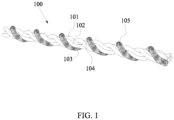
- FIGURE 1 illustrates a yarn in accordance with at least some embodiments of the present invention.
- bio-based material refers to a material, which is wholly or partly derived from renewable biomass sources, such as plants, trees or animals.
- the material can be obtained from for example, a sugar containing plant (e.g. corn or sugar cane), plant fat or oil (e.g. castor oil), organic acid (e.g. succinic acid), corn starch, straw, woodchips, sawdust, recycled food waste.
- a bio-based material can be for example, natural fibre, such as wool, cashmere, cotton, hemp, linen, bamboo or silk.
- the bio-based material can be obtained by processing from natural biopolymers including polysaccharides (e.g.
- bio-based material can be for example, polylactic acid (PLA), bio-polyamide (bio-PA), bio-polybutylene succinate (bio-PBS), bio-polyethylene (bio-PE), bio-polyethylene terephthalate (bio-PET), bi-polypropylene (bio-PP), or bio-polyhydroxyalkanoate (bio-PHA).
- PLA polylactic acid
- bio-PA bio-polyamide
- bio-PBS bio-polybutylene succinate
- bio-PE bio-polyethylene
- bio-PET bio-polyethylene terephthalate
- bio-PP bi-polypropylene
- bio-PHA bio-polyhydroxyalkanoate
- Cellulose-based materials are bio-based materials manufactured from cellulose, such as cellulose fibres or cellulose derivate, for example, by dissolving pulp, treating pulp mechanically or transforming pulp directly to fibres with water and without any chemicals.
- the cellulose-based material can be for example, viscose, lyocell, cupro, acetate, modal, or cellulose carbamate.
- synthetic material refers to synthetic man-made polymers, which are derived from crude oil.
- the synthetic material can be for example, polyamide (PA), polyester (PET), polyethylene naphthalate (PEN) or polyphenylene sulphide (PPS).
- the term "overfeed” means that a multifilament yarn or a spun yarn is fed faster than monofilaments in a yarn manufacturing. So, a length of the multifilament or the spun yarn is longer than a length of the monofilament in the yarn.
- a yarn 100 comprises a plurality of monofilaments 101, 102, 103, 104 twisted together, and a multifilament or a spun yarn 105 wound around the plurality of monofilaments 101, 102, 103, 104.
- the multifilament or the spun yarn 105 comprises a bio-based material, a recycled bio-based material or a recycled synthetic material. It has surprisingly been found that whole yarn does not have to be made from high quality materials, such as synthetic polyamide, but a part of the yarns, i.e. the multifilament or the spun yarn, can be made from a material, which has a lower strength.
- the material wears off due to its lower mechanical strength or dissolves due to its chemical composition, it opens the felt structure preventing it from getting too dense.
- a core comprising monofilaments provides strength for the yarn, and the multifilament or the spun yarn around the core provides a densifying effect that is needed at the start-up of the felt. Therefore, the multifilament or the spun yarn can be made of materials having a lower carbon footprint. Thanks to this, a carbon footprint of the whole yarn and products made from the yarn is reduced. So, the yarn comprising a bio-based material, a recycled bio-based material or a recycled synthetic material provides more sustainable option for generally used yarns manufactured entirely from fossil-based raw materials. Further, using of the recycled material saves energy and material resources. So, the yarn provides longer life time for the press felt by keeping it open longer and a low carbon footprint without sacrificing mechanical properties of the yarn.
- the bio-based material is a cellulose-based material.
- Cellulose is natural, biodegradable and recyclable material and causes significantly smaller carbon dioxide emissions than synthetic materials. Therefore, the cellulose-based material is more sustainable choice than fossil-based materials, which are refined and processed from crude oil.
- the cellulose-based material is selected from the group of viscose, lyocell, cupro, acetate, modal, bamboo and cellulose carbamate.
- a utilization of wood-based cellulose as the raw material for fibres leads to carbon-neutral cycle, whereby carbon dioxide, which binds to wood, is transported with the product and decomposes back into the atmosphere as a result of burning or biodegradation. Further, production of the cellulose fibres has lower impact on land use and lower emissions than production of many other fibers, such as cotton, allowing more farmland to be used for food production.
- the bio-based material is selected from the group of polylactic acid (PLA), bio-polyamide 6.10, bio-polyamide 4.10, bio-polyamide 5.10, bio-polyamide 10, bio-polyamide 10.10, bio-polyamide 11, bio-polybutylene succinate (bio-PBS), bio-polyethylene (bio-PE), bio-polyethylene terephthalate (bio-PET), bio-polypropylene (bio-PP), bio-polyhydroxyalkanoate (bio-PHA), wool, cotton, hemp, linen or bamboo.
- PLA can be manufactured from fermented plant starch, such as from corn, cassava, sugarcane or sugar beet pulp.
- Bio-polyamides and other bio-polymers are more sustainable choices than fossil-based polyamides, which are refined and processed from crude oil. Natural fibres, such as wool, cotton, hemp, linen and bamboo, are renewable and do not cause microplastic pollution.
- the bio-based material can be also biodegradable.
- PLA, bio-PBS, bio-PP and bio-PHA are also biodegradable.
- these materials are capable of being decomposed by bacteria or other living organisms and thereby avoiding pollution.
- the recycled bio-based material can be for example, recycled cotton, which is obtained from recycled garments and textiles. Using of the recycled material saves energy and material resources, and thus reduces carbon footprint of the yarn and a final product made of the yarn.
- the recycled synthetic material can be for example, recycled polyamide (PA), such as polyamide 6, polyamide 6.6, polyamide 6.10, polyamide 4.10, polyamide 10, polyamide 10.10, polyamide 11 or polyamide 12.
- PA recycled polyamide
- the plurality of monofilaments 101, 102, 103, 104 comprise polyamide (PA).
- the polyamide can be bio-based polyamide (bio-PA), synthetic polyamide or recycled polyamide.
- Bio-based polyamide can be for example, bio-polyamide 6.10, bio-polyamide 4.10, bio-polyamide 5.10, bio-polyamide 10, bio-polyamide 10.10, or bio-polyamide 11.
- the synthetic polyamide or the recycled polyamide can be for example, polyamide 6, polyamide 6.6, or polyamide 12.
- the above-mentioned polyamides are excellent choices when mechanical strength and wear resistance is needed.
- Polyamide 6 fibres are tough, possessing high tensile strength and elasticity.
- Polyamide 6 has high water absorption.
- Polyamide 6.6 has a high mechanical strength, a rigidity and a good heat and chemical stability.
- Polyamide 6.10 high impact resistance, chemical resistance and retention of dimension.
- Polyamide 11 has lower values of density, flexural and Young's modulus, water absorption, as well as melting and glass transition temperatures than polyamide 6. However, polyamide 11 is seen to have increased elasticity, abrasion resistance and, due to lower water absorption, dimensional stability in the presence of moisture than polyamide 6.
- the yarn 100 comprises 3-24 monofilaments 101, 102, 103, 104, preferably 3-12 monofilaments 101, 102, 103, 104, more preferably 3-6 monofilaments 101, 102, 103, 104.
- the yarn 100 can comprise 4, 6, 8 or 9 monofilaments 101, 102, 103, 104.
- a twist direction of the plurality of monofilaments 101, 102, 103, 104 is the same as a twist direction of the multifilament or the spun yarn 105.
- the direction of the twist may be to the right (Z twist), or to the left (S twist).
- a twist direction of the plurality of monofilaments 101, 102, 103, 104 is the opposite as a twist direction of the multifilament or the spun yarn 105.
- the direction of the twist may be to the right (Z twist), or to the left (S twist).
- FIGURE 1 illustrates a yarn 100 in accordance with at least some embodiments.
- the yarn comprises four monofilaments 101, 102, 103, 104 and a multifilament 105 wound around the said monofilaments.
- a twist direction of the four monofilaments 101, 102, 103, 104 is the same as a twist direction of the multifilament, being a left twist.
- diameters of the plurality of the monofilaments 101, 102, 103, 104 are 0.1-0.6 mm, preferably 0.2 mm.
- the diameters of the monofilaments can be selected according to the intended use of the yarn and the number of the monofilaments. For example, when the number of the monofilaments is increased, the diameter of the monofilaments can be decreased.
- the multifilament or the spun yarn 105 has a linear density of 50-150 dtex.
- the multifilament or the spun yarn 105 is twisted or non-twisted. Twisting of the multifilament or the spun yarn 105 facilitates its handling and entangles filaments of the multifilament and fibres of the spun yarn together. Further, the twisted multifilament or spun yarn has higher strength and elasticity (i.e. higher stretch). A surface of the twisted multifilament or spun yarn does not wear out so easily. Further, twisting can be used for forming texture to the yarn.
- the multifilament 105 When the multifilament 105 is twisted, it may be twisted in a first direction. Then, the multifilament 105 may be twisted in a second direction, which is opposite direction than the first direction, around the plurality of monofilaments 101, 102, 103, 104. Twisting of the multifilament provides a good tenacity.
- the multifilament 105 can be also textured. Texturing can be provided by curling the multifilament.
- the spun yarn 105 When the spun yarn 105 is used, the spun yarn 105 may be twisted in a first direction. Twisting of the spun yarn 105 holds staple fibres of the spun yarn together. Then, the spun yarn may be twisted in a second direction, which is opposite direction than the first direction, around the plurality of monofilaments 101, 102, 103, 104. This provides a good tenacity.
- the yarn 100 has an overfeed of the multifilament or the spun yarn 105 of 5-25 %, preferably about 15 %.
- the overfeed provides a densifying effect that is needed at the start-up of the felt.
- the cross-section of the monofilaments, the multifilament or the spun yarn 105 can be round, square, rectangular, oval or any other suitable shape.
- a linear density of the yarn 100 is 200-600 tex.
- a method for manufacturing a yarn 100 comprises providing a plurality of monofilaments 101, 102, 103, 104 and a multifilament or a spun yarn 105, twisting the plurality of the monofilaments together, and simultaneously or afterwards, winding the multifilament or the spun yarn 105 around the plurality of the monofilaments 101, 102, 103, 104.
- the multifilament or the spun yarn 105 comprises a bio-based material, a recycled bio-based material or a recycled synthetic material. So, twisting the plurality of the monofilaments together can be done first. After that, the multifilament or the spun yarn 105 can be wound around the plurality of the monofilaments. Alternatively, twisting the plurality of the monofilaments together and winding the multifilament or the spun yarn 105 around the plurality of the monofilaments can be done simultaneously.
- an industrial textile can comprise the yarn 100 according to an above-mentioned embodiment(s).
- the yarn provides fast start-up and good nip dewatering for press felts made from it.
- the yarn comprises the multifilament, there is also less dusting when weaving textiles from the yarn.
- the bio-based or recycled multifilament or the spun yarn is wearing off, it opens the felt structure thus lengthening its lifetime.
- the yarn 100 can be used in an industrial textile, such as a press felt or a filter fabric.
- the industrial textile can be woven or non-woven.
- the yarn 100 can be used in a paper machine clothing.
Landscapes
- Engineering & Computer Science (AREA)
- Mechanical Engineering (AREA)
- Textile Engineering (AREA)
- Yarns And Mechanical Finishing Of Yarns Or Ropes (AREA)
- Woven Fabrics (AREA)
- Paper (AREA)
Applications Claiming Priority (1)
| Application Number | Priority Date | Filing Date | Title |
|---|---|---|---|
| FI20216278A FI131412B1 (en) | 2021-12-15 | 2021-12-15 | Yarn |
Publications (1)
| Publication Number | Publication Date |
|---|---|
| EP4202095A1 true EP4202095A1 (en) | 2023-06-28 |
Family
ID=84488723
Family Applications (1)
| Application Number | Title | Priority Date | Filing Date |
|---|---|---|---|
| EP22212748.2A Pending EP4202095A1 (en) | 2021-12-15 | 2022-12-12 | Yarn |
Country Status (6)
| Country | Link |
|---|---|
| US (1) | US20230183890A1 (enExample) |
| EP (1) | EP4202095A1 (enExample) |
| JP (1) | JP2023088883A (enExample) |
| CN (1) | CN116262992A (enExample) |
| CA (1) | CA3182991A1 (enExample) |
| FI (1) | FI131412B1 (enExample) |
Cited By (1)
| Publication number | Priority date | Publication date | Assignee | Title |
|---|---|---|---|---|
| DE102023129361A1 (de) | 2023-10-25 | 2025-04-30 | Voith Patent Gmbh | Bespannung |
Families Citing this family (1)
| Publication number | Priority date | Publication date | Assignee | Title |
|---|---|---|---|---|
| WO2025200181A1 (zh) * | 2024-03-28 | 2025-10-02 | 华巧国际有限公司 | 生物能混捻细丝及其应用 |
Citations (5)
| Publication number | Priority date | Publication date | Assignee | Title |
|---|---|---|---|---|
| US4093512A (en) * | 1975-04-23 | 1978-06-06 | Huyck Corporation | Papermakers belts having ultra-high modulus load bearing yarns |
| US5514438A (en) * | 1993-01-26 | 1996-05-07 | Scapa Group Plc | Papermakers fabric |
| US20140096928A1 (en) * | 2012-10-08 | 2014-04-10 | Heimbach Gmbh & Co. Kg | Paper machine belt |
| US20170175301A1 (en) * | 2015-12-17 | 2017-06-22 | E I Du Pont De Nemours And Company | Hybrid Cord and Use Thereof |
| CN113355779A (zh) * | 2021-05-28 | 2021-09-07 | 上海全科企业发展有限公司 | 包芯纱处理工艺及其应用 |
Family Cites Families (12)
| Publication number | Priority date | Publication date | Assignee | Title |
|---|---|---|---|---|
| US2183703A (en) * | 1939-06-14 | 1939-12-19 | Fred C Werber | Method of making combination yarn |
| US3049153A (en) * | 1959-09-15 | 1962-08-14 | Ayers Ltd | Dryer felts |
| US3372848A (en) * | 1965-10-24 | 1968-03-12 | Leesona Corp | Feed roll assembly separable in response to thread depletion |
| US4274448A (en) * | 1978-08-09 | 1981-06-23 | Scapa Dryers, Inc. | Dryer felt with encapsulated, bulky center yarns |
| US4350731A (en) * | 1981-06-08 | 1982-09-21 | Albany International Corp. | Novel yarn and fabric formed therefrom |
| US5049425A (en) * | 1989-01-04 | 1991-09-17 | Abany International Corporation | Porous yarn for OMS pintles |
| JP2765995B2 (ja) * | 1989-10-05 | 1998-06-18 | 株式会社クラレ | ロープ |
| US7260924B2 (en) * | 2005-01-25 | 2007-08-28 | Voith Fabrics, Inc. | Seam pintle for paper making fabric |
| EP2505611A2 (en) * | 2009-11-25 | 2012-10-03 | Cheil Industries Inc. | Environmentally-friendly polyamide resin composition and molded product using same |
| CA2753489C (en) * | 2010-09-24 | 2014-06-10 | Trident Limited | Air rich yarn and fabric and its method of manufacturing |
| DE102011052477A1 (de) * | 2011-08-08 | 2013-02-14 | Mayser Gmbh & Co. Kg | Coregarn |
| DE202021101509U1 (de) * | 2021-03-23 | 2021-07-06 | Heimbach Gmbh | Industrielles Textil und Verwendung |
-
2021
- 2021-12-15 FI FI20216278A patent/FI131412B1/en active
-
2022
- 2022-11-30 CA CA3182991A patent/CA3182991A1/en active Pending
- 2022-12-09 US US18/078,812 patent/US20230183890A1/en not_active Abandoned
- 2022-12-12 EP EP22212748.2A patent/EP4202095A1/en active Pending
- 2022-12-14 JP JP2022199096A patent/JP2023088883A/ja active Pending
- 2022-12-15 CN CN202211617672.8A patent/CN116262992A/zh active Pending
Patent Citations (5)
| Publication number | Priority date | Publication date | Assignee | Title |
|---|---|---|---|---|
| US4093512A (en) * | 1975-04-23 | 1978-06-06 | Huyck Corporation | Papermakers belts having ultra-high modulus load bearing yarns |
| US5514438A (en) * | 1993-01-26 | 1996-05-07 | Scapa Group Plc | Papermakers fabric |
| US20140096928A1 (en) * | 2012-10-08 | 2014-04-10 | Heimbach Gmbh & Co. Kg | Paper machine belt |
| US20170175301A1 (en) * | 2015-12-17 | 2017-06-22 | E I Du Pont De Nemours And Company | Hybrid Cord and Use Thereof |
| CN113355779A (zh) * | 2021-05-28 | 2021-09-07 | 上海全科企业发展有限公司 | 包芯纱处理工艺及其应用 |
Cited By (2)
| Publication number | Priority date | Publication date | Assignee | Title |
|---|---|---|---|---|
| DE102023129361A1 (de) | 2023-10-25 | 2025-04-30 | Voith Patent Gmbh | Bespannung |
| WO2025087618A1 (de) | 2023-10-25 | 2025-05-01 | Voith Patent Gmbh | Bespannung |
Also Published As
| Publication number | Publication date |
|---|---|
| CN116262992A (zh) | 2023-06-16 |
| JP2023088883A (ja) | 2023-06-27 |
| CA3182991A1 (en) | 2023-06-15 |
| FI131412B1 (en) | 2025-04-07 |
| FI20216278A1 (en) | 2023-06-16 |
| US20230183890A1 (en) | 2023-06-15 |
Similar Documents
| Publication | Publication Date | Title |
|---|---|---|
| Grishanov | Structure and properties of textile materials | |
| Wulfhorst et al. | Textile technology | |
| Karmakar | Chemical technology in the pre-treatment processes of textiles | |
| Gries et al. | Textile technology: an introduction | |
| JP4498001B2 (ja) | ポリエステル複合繊維 | |
| EP4202095A1 (en) | Yarn | |
| Veit | Fibers: history, production, properties, market | |
| RU2754057C9 (ru) | Волокнистая мононить | |
| Jabbar et al. | Textile raw materials | |
| Eichhorn et al. | Handbook of textile fibre structure: volume 2: natural, regenerated, inorganic and specialist fibres | |
| KR20200126398A (ko) | 방적된 얀을 위한 셀룰로스 아세테이트를 함유하는 슬리버 | |
| Othman et al. | Utilization of regenerated cellulose fiber (banana fiber) in various textile applications and reinforced polymer composites | |
| Vhanbatte | Background and type of textile materials processed in textile industry | |
| JP2023088883A5 (enExample) | ||
| CN113106593B (zh) | 具有纳米级分支的动物皮革纤维包缠纱、面料及制品 | |
| Hussain et al. | Textile engineering: An introduction | |
| EP4155456A1 (en) | Press felt | |
| EP4353884A1 (en) | Method for producing durable biodegradable mixed yarns, device for producing mixed yarns, and mixed yarns obtained using said method | |
| Ahmad et al. | Textile raw materials | |
| Uddin et al. | Underexploited Hemp Fiber as a Blend Constituent with Cotton in Producing Vortex Yarns: Toward a Sustainable and Cleaner Future | |
| CN101525772A (zh) | 一种聚乳酸植绒绒毛的制造方法 | |
| Perepelkin | Trends and changes in world chemical fibre production. An analytical review. Part 2. Trends in the development of traditional and promising kinds of chemical fibres | |
| CN86102459A (zh) | 新型的水可分散性合成纤维 | |
| Tamta et al. | Innovative applications of pineapple leaf fibre in textiles and other fields | |
| US20240093412A1 (en) | Hemp fabric and method of making the same |
Legal Events
| Date | Code | Title | Description |
|---|---|---|---|
| PUAI | Public reference made under article 153(3) epc to a published international application that has entered the european phase |
Free format text: ORIGINAL CODE: 0009012 |
|
| STAA | Information on the status of an ep patent application or granted ep patent |
Free format text: STATUS: THE APPLICATION HAS BEEN PUBLISHED |
|
| AK | Designated contracting states |
Kind code of ref document: A1 Designated state(s): AL AT BE BG CH CY CZ DE DK EE ES FI FR GB GR HR HU IE IS IT LI LT LU LV MC ME MK MT NL NO PL PT RO RS SE SI SK SM TR |
|
| STAA | Information on the status of an ep patent application or granted ep patent |
Free format text: STATUS: REQUEST FOR EXAMINATION WAS MADE |
|
| 17P | Request for examination filed |
Effective date: 20231220 |
|
| RBV | Designated contracting states (corrected) |
Designated state(s): AL AT BE BG CH CY CZ DE DK EE ES FI FR GB GR HR HU IE IS IT LI LT LU LV MC ME MK MT NL NO PL PT RO RS SE SI SK SM TR |
|
| STAA | Information on the status of an ep patent application or granted ep patent |
Free format text: STATUS: EXAMINATION IS IN PROGRESS |
|
| 17Q | First examination report despatched |
Effective date: 20250410 |
|
| GRAP | Despatch of communication of intention to grant a patent |
Free format text: ORIGINAL CODE: EPIDOSNIGR1 |
|
| STAA | Information on the status of an ep patent application or granted ep patent |
Free format text: STATUS: GRANT OF PATENT IS INTENDED |
|
| INTG | Intention to grant announced |
Effective date: 20250916 |