EP4201996B1 - Polyesterfolie mit einem polymerphosphonatflammschutzmittel - Google Patents
Polyesterfolie mit einem polymerphosphonatflammschutzmittel Download PDFInfo
- Publication number
- EP4201996B1 EP4201996B1 EP23158190.1A EP23158190A EP4201996B1 EP 4201996 B1 EP4201996 B1 EP 4201996B1 EP 23158190 A EP23158190 A EP 23158190A EP 4201996 B1 EP4201996 B1 EP 4201996B1
- Authority
- EP
- European Patent Office
- Prior art keywords
- film
- polyester film
- polyester
- flame retardant
- film according
- Prior art date
- Legal status (The legal status is an assumption and is not a legal conclusion. Google has not performed a legal analysis and makes no representation as to the accuracy of the status listed.)
- Active
Links
Classifications
-
- C—CHEMISTRY; METALLURGY
- C08—ORGANIC MACROMOLECULAR COMPOUNDS; THEIR PREPARATION OR CHEMICAL WORKING-UP; COMPOSITIONS BASED THEREON
- C08J—WORKING-UP; GENERAL PROCESSES OF COMPOUNDING; AFTER-TREATMENT NOT COVERED BY SUBCLASSES C08B, C08C, C08F, C08G or C08H
- C08J5/00—Manufacture of articles or shaped materials containing macromolecular substances
- C08J5/18—Manufacture of films or sheets
-
- B—PERFORMING OPERATIONS; TRANSPORTING
- B29—WORKING OF PLASTICS; WORKING OF SUBSTANCES IN A PLASTIC STATE IN GENERAL
- B29C—SHAPING OR JOINING OF PLASTICS; SHAPING OF MATERIAL IN A PLASTIC STATE, NOT OTHERWISE PROVIDED FOR; AFTER-TREATMENT OF THE SHAPED PRODUCTS, e.g. REPAIRING
- B29C55/00—Shaping by stretching, e.g. drawing through a die; Apparatus therefor
- B29C55/02—Shaping by stretching, e.g. drawing through a die; Apparatus therefor of plates or sheets
- B29C55/10—Shaping by stretching, e.g. drawing through a die; Apparatus therefor of plates or sheets multiaxial
- B29C55/12—Shaping by stretching, e.g. drawing through a die; Apparatus therefor of plates or sheets multiaxial biaxial
-
- C—CHEMISTRY; METALLURGY
- C08—ORGANIC MACROMOLECULAR COMPOUNDS; THEIR PREPARATION OR CHEMICAL WORKING-UP; COMPOSITIONS BASED THEREON
- C08J—WORKING-UP; GENERAL PROCESSES OF COMPOUNDING; AFTER-TREATMENT NOT COVERED BY SUBCLASSES C08B, C08C, C08F, C08G or C08H
- C08J7/00—Chemical treatment or coating of shaped articles made of macromolecular substances
- C08J7/04—Coating
- C08J7/0427—Coating with only one layer of a composition containing a polymer binder
-
- C—CHEMISTRY; METALLURGY
- C08—ORGANIC MACROMOLECULAR COMPOUNDS; THEIR PREPARATION OR CHEMICAL WORKING-UP; COMPOSITIONS BASED THEREON
- C08J—WORKING-UP; GENERAL PROCESSES OF COMPOUNDING; AFTER-TREATMENT NOT COVERED BY SUBCLASSES C08B, C08C, C08F, C08G or C08H
- C08J7/00—Chemical treatment or coating of shaped articles made of macromolecular substances
- C08J7/04—Coating
- C08J7/043—Improving the adhesiveness of the coatings per se, e.g. forming primers
-
- C—CHEMISTRY; METALLURGY
- C08—ORGANIC MACROMOLECULAR COMPOUNDS; THEIR PREPARATION OR CHEMICAL WORKING-UP; COMPOSITIONS BASED THEREON
- C08J—WORKING-UP; GENERAL PROCESSES OF COMPOUNDING; AFTER-TREATMENT NOT COVERED BY SUBCLASSES C08B, C08C, C08F, C08G or C08H
- C08J7/00—Chemical treatment or coating of shaped articles made of macromolecular substances
- C08J7/04—Coating
- C08J7/052—Forming heat-sealable coatings
-
- C—CHEMISTRY; METALLURGY
- C08—ORGANIC MACROMOLECULAR COMPOUNDS; THEIR PREPARATION OR CHEMICAL WORKING-UP; COMPOSITIONS BASED THEREON
- C08K—Use of inorganic or non-macromolecular organic substances as compounding ingredients
- C08K5/00—Use of organic ingredients
- C08K5/49—Phosphorus-containing compounds
- C08K5/51—Phosphorus bound to oxygen
- C08K5/53—Phosphorus bound to oxygen bound to oxygen and to carbon only
- C08K5/5317—Phosphonic compounds, e.g. R—P(:O)(OR')2
- C08K5/5333—Esters of phosphonic acids
-
- C—CHEMISTRY; METALLURGY
- C08—ORGANIC MACROMOLECULAR COMPOUNDS; THEIR PREPARATION OR CHEMICAL WORKING-UP; COMPOSITIONS BASED THEREON
- C08K—Use of inorganic or non-macromolecular organic substances as compounding ingredients
- C08K5/00—Use of organic ingredients
- C08K5/49—Phosphorus-containing compounds
- C08K5/51—Phosphorus bound to oxygen
- C08K5/53—Phosphorus bound to oxygen bound to oxygen and to carbon only
- C08K5/5317—Phosphonic compounds, e.g. R—P(:O)(OR')2
- C08K5/5333—Esters of phosphonic acids
- C08K5/5357—Esters of phosphonic acids cyclic
-
- C—CHEMISTRY; METALLURGY
- C08—ORGANIC MACROMOLECULAR COMPOUNDS; THEIR PREPARATION OR CHEMICAL WORKING-UP; COMPOSITIONS BASED THEREON
- C08L—COMPOSITIONS OF MACROMOLECULAR COMPOUNDS
- C08L67/00—Compositions of polyesters obtained by reactions forming a carboxylic ester link in the main chain; Compositions of derivatives of such polymers
- C08L67/02—Polyesters derived from dicarboxylic acids and dihydroxy compounds
-
- C—CHEMISTRY; METALLURGY
- C08—ORGANIC MACROMOLECULAR COMPOUNDS; THEIR PREPARATION OR CHEMICAL WORKING-UP; COMPOSITIONS BASED THEREON
- C08L—COMPOSITIONS OF MACROMOLECULAR COMPOUNDS
- C08L85/00—Compositions of macromolecular compounds obtained by reactions forming a linkage in the main chain of the macromolecule containing atoms other than silicon, sulfur, nitrogen, oxygen and carbon; Compositions of derivatives of such polymers
- C08L85/02—Compositions of macromolecular compounds obtained by reactions forming a linkage in the main chain of the macromolecule containing atoms other than silicon, sulfur, nitrogen, oxygen and carbon; Compositions of derivatives of such polymers containing phosphorus
-
- C—CHEMISTRY; METALLURGY
- C08—ORGANIC MACROMOLECULAR COMPOUNDS; THEIR PREPARATION OR CHEMICAL WORKING-UP; COMPOSITIONS BASED THEREON
- C08J—WORKING-UP; GENERAL PROCESSES OF COMPOUNDING; AFTER-TREATMENT NOT COVERED BY SUBCLASSES C08B, C08C, C08F, C08G or C08H
- C08J2333/00—Characterised by the use of homopolymers or copolymers of compounds having one or more unsaturated aliphatic radicals, each having only one carbon-to-carbon double bond, and only one being terminated by only one carboxyl radical, or of salts, anhydrides, esters, amides, imides, or nitriles thereof; Derivatives of such polymers
- C08J2333/04—Characterised by the use of homopolymers or copolymers of compounds having one or more unsaturated aliphatic radicals, each having only one carbon-to-carbon double bond, and only one being terminated by only one carboxyl radical, or of salts, anhydrides, esters, amides, imides, or nitriles thereof; Derivatives of such polymers esters
-
- C—CHEMISTRY; METALLURGY
- C08—ORGANIC MACROMOLECULAR COMPOUNDS; THEIR PREPARATION OR CHEMICAL WORKING-UP; COMPOSITIONS BASED THEREON
- C08J—WORKING-UP; GENERAL PROCESSES OF COMPOUNDING; AFTER-TREATMENT NOT COVERED BY SUBCLASSES C08B, C08C, C08F, C08G or C08H
- C08J2367/00—Characterised by the use of polyesters obtained by reactions forming a carboxylic ester link in the main chain; Derivatives of such polymers
- C08J2367/02—Polyesters derived from dicarboxylic acids and dihydroxy compounds
-
- C—CHEMISTRY; METALLURGY
- C08—ORGANIC MACROMOLECULAR COMPOUNDS; THEIR PREPARATION OR CHEMICAL WORKING-UP; COMPOSITIONS BASED THEREON
- C08J—WORKING-UP; GENERAL PROCESSES OF COMPOUNDING; AFTER-TREATMENT NOT COVERED BY SUBCLASSES C08B, C08C, C08F, C08G or C08H
- C08J2433/00—Characterised by the use of homopolymers or copolymers of compounds having one or more unsaturated aliphatic radicals, each having only one carbon-to-carbon double bond, and only one being terminated by only one carboxyl radical, or of salts, anhydrides, esters, amides, imides, or nitriles thereof; Derivatives of such polymers
-
- C—CHEMISTRY; METALLURGY
- C08—ORGANIC MACROMOLECULAR COMPOUNDS; THEIR PREPARATION OR CHEMICAL WORKING-UP; COMPOSITIONS BASED THEREON
- C08J—WORKING-UP; GENERAL PROCESSES OF COMPOUNDING; AFTER-TREATMENT NOT COVERED BY SUBCLASSES C08B, C08C, C08F, C08G or C08H
- C08J2467/00—Characterised by the use of polyesters obtained by reactions forming a carboxylic ester link in the main chain; Derivatives of such polymers
- C08J2467/02—Polyesters derived from dicarboxylic acids and dihydroxy compounds
-
- C—CHEMISTRY; METALLURGY
- C08—ORGANIC MACROMOLECULAR COMPOUNDS; THEIR PREPARATION OR CHEMICAL WORKING-UP; COMPOSITIONS BASED THEREON
- C08J—WORKING-UP; GENERAL PROCESSES OF COMPOUNDING; AFTER-TREATMENT NOT COVERED BY SUBCLASSES C08B, C08C, C08F, C08G or C08H
- C08J2485/00—Characterised by the use of macromolecular compounds obtained by reactions forming in the main chain of the macromolecule a linkage containing atoms other than silicon, sulfur, nitrogen, oxygen, and carbon; Derivatives of such polymers
- C08J2485/02—Characterised by the use of macromolecular compounds obtained by reactions forming in the main chain of the macromolecule a linkage containing atoms other than silicon, sulfur, nitrogen, oxygen, and carbon; Derivatives of such polymers containing phosphorus
-
- C—CHEMISTRY; METALLURGY
- C08—ORGANIC MACROMOLECULAR COMPOUNDS; THEIR PREPARATION OR CHEMICAL WORKING-UP; COMPOSITIONS BASED THEREON
- C08L—COMPOSITIONS OF MACROMOLECULAR COMPOUNDS
- C08L2201/00—Properties
- C08L2201/02—Flame or fire retardant/resistant
Definitions
- the present invention relates to flame retardant polyester film, as well as a method of making the film and uses thereof.
- polyester films are well-known.
- most polymeric materials used in construction, textiles, furnishing and electrical applications are flammable.
- the most common approach is to add one or more flame retardant elements to the flammable polymer system but in turn these can cause other problems. For instance, it has proven difficult to achieve high enough loadings without adversely affecting subsequent processing and/or the physical properties of the polymer composition or polymer film.
- DE-10043779-A describes a biaxially oriented multi-layered film suitable for displays and protective glazing, wherein the film comprises a base layer of bi-benzene-modified thermoplastic polymer and a covering layer.
- the covering layer comprises a mixture, or blend, of two components.
- the first component may be polyethylene terephthalate (PET) and the second component may be mixture, or blend, of a copolymer derived from isophthalic acid, a sulfomonomer, an aliphatic or cycloaliphatic glycol and optionally an aliphatic dicarboxylic acid.
- the film may optionally comprise a flame retardant such as dimethyl methylphosphonate.
- DE-10035327-A describes an opaque biaxially oriented polyester film comprising at least one layer containing 2 to 60 wt% of a cycloolefin copolymer and at least one adhesion-promoted surface including a flame retardant.
- the flame retardant may be an organic phosphorus compound such as dimethyl methyl phosphonate.
- JP-2004131669-A describes a biaxially oriented polymer film for magnetic recording media, wherein the film contains a polyester and a polymer containing a phosphonic acid residue and a dihydric phenol residue, which is reported to provide excellent rigidity and toughness.
- JP-2006274112-A describes a biaxially oriented polyester film for magnetic recording media which exhibits excellent dimensional stability.
- the film comprises an enthalpy relaxation promotion agent, which can be a metal salt such as group 2 metal salt and a phosphorous compound such as dimethyl phenylphosphonate.
- JP-H06200131-A describes PEN-based polyesters and films made therefrom which exhibit improved electrical properties and which are suitable for electromagnetic tapes.
- the polyester comprises antimony, magnesium and phosphorus elements, wherein the phosphorus element may be selected from dimethyl methylphosphonate.
- KR-101234613-B describes an optical polyester film with high heat resistance, comprising a polyester substrate layer and an adhesive polymeric resin primer layer on at least one side of the film.
- the polyester film comprises a flame retardant particle selected from carboxyphosphinic acid and dimethyl methylphosphonate.
- US-2016168760-A1 relates to the use of polyphosphonates, copoly(phosphonate ester)s, copoly(phosphonate carbonate)s, and their respective oligomers, as flame retardant additives for polyester fibers to impart fire resistance while maintaining or improving processing characteristics for melt spinning fibers.
- a polyester film exhibiting a VTM-0 rating in the UL 94 test method, preferably an oriented polyester film, wherein the film comprises a polymeric phosphonate flame retardant in an amount of from about 1.0 to about 25.0 wt%, by total weight of the film and further comprising at least one metal cation selected from the group consisting of Group I and Group II metal cations; wherein the haze of the film is no more than about 8% and/or wherein the total light transmission of the film in the visible region is at least about 85%.
- a polyester film (preferably an oriented polyester film) exhibiting a VTM-0 rating in the UL 94 test method, wherein the film comprises a polymeric phosphonate flame retardant in an amount of from about 1.0 to about 25.0 wt%, by total weight of the film and further comprising at least one metal cation selected from the group consisting of sodium and potassium metal cations; wherein the haze of the film is no more than about 8% and/or wherein the total light transmission of the film in the visible region is at least about 85%.
- said phosphonate flame retardant in combination with at least one metal cation selected from the group consisting of Group I and Group II metal cations (particularly sodium and potassium metal cations) is particularly beneficial in providing a polyester film which exhibits excellent flame retardancy and high clarity and transparency of the film.
- the polyester film exhibits said properties even at relatively low loadings of said phosphonate flame retardant.
- the polyester film is a self-supporting film or sheet by which is meant a film or sheet capable of independent existence in the absence of a supporting base.
- the film may be a non-oriented (e.g. cast) polyester film.
- the film is uniaxially or biaxially oriented, more preferably biaxially oriented.
- the polyester(s) which constitute the film is/are preferably synthetic linear polyester(s).
- the polyester(s) which constitute the film is/are preferably crystallisable.
- the polyester(s) are thermoplastic. Suitable polyesters are obtainable by condensing one or more dicarboxylic acid(s) or their lower alkyl (up to 6 carbon atoms) diesters with one or more diols.
- the dicarboxylic acid component contains at least one aromatic dicarboxylic acid, which is preferably terephthalic acid, isophthalic acid (IPA), phthalic acid, 1,4-, 2,5-, 2,6- or 2,7-naphthalenedicarboxylic acid, and is preferably terephthalic acid (TA) or 2,6-naphthalenedicarboxylic acid, and preferably terephthalic acid.
- aromatic dicarboxylic acid which is preferably terephthalic acid, isophthalic acid (IPA), phthalic acid, 1,4-, 2,5-, 2,6- or 2,7-naphthalenedicarboxylic acid, and is preferably terephthalic acid (TA) or 2,6-naphthalenedicarboxylic acid, and preferably terephthalic acid.
- IPA isophthalic acid
- TA terephthalic acid
- TA 2,6-naphthalenedicarboxylic acid
- the polyester may optionally contain one or more residues derived from other dicarboxylic acids such as 4,4'-diphenyldicarboxylic acid, hexahydro-terephthalic acid, 1,10-decanedicarboxylic acid, and in particular aliphatic dicarboxylic acids including those of the general formula C n H 2n (COOH) 2 wherein n is 2 to 8, such as succinic acid, glutaric acid sebacic acid, adipic acid, azelaic acid, suberic acid or pimelic acid, preferably sebacic acid, adipic acid and azelaic acid, and more preferably azelaic acid.
- dicarboxylic acids such as 4,4'-diphenyldicarboxylic acid, hexahydro-terephthalic acid, 1,10-decanedicarboxylic acid, and in particular aliphatic dicarboxylic acids including those of the general formula C n H 2n (COOH) 2 where
- the diols are preferably selected from aliphatic and cycloaliphatic diols, e.g. ethylene glycol (EG), 1,3-propanediol, 1,4-butanediol and 1,4-cyclohexanedimethanol (CHDM), and preferably from ethylene glycol and 1,4-cyclohexanedimethanol (CHDM), preferably from ethylene glycol.
- EG ethylene glycol
- CHDM 1,3-propanediol
- CHDM 1,4-butanediol
- CHDM 1,4-cyclohexanedimethanol
- PET Polyethylene terephthalate
- PEN polyethylene 2,6-naphthalate
- the preferred PET and PEN polyesters may optionally contain relatively minor amounts of one or more residues derived from the other dicarboxylic acids and/or diols described above, and where such minor amounts are present then the total amount of said other dicarboxylic acid(s) is preferably less than 10 mol%, preferably less than 5 mol%, preferably less than 1 mol% of the total dicarboxylic acid fraction of the polyester and/or the total amount of said other diol(s) is preferably less than 15 mol%, preferably less than 10 mol%, preferably less than 5 mol% of the total diol fraction of the polyester.
- the polyester preferably contains only one dicarboxylic acid, preferably an aromatic dicarboxylic acid, preferably terephthalic acid or 2,6-naphthalenedicarboxylic acid, and preferably terephthalic acid.
- the polyester preferably contains only one diol, preferably an aliphatic diol, preferably ethylene glycol.
- the polyester contains one aromatic dicarboxylic acid and one aliphatic diol.
- the film-forming polyester resin is the major component of the film, and makes up at least 50% by weight of the total weight of a given layer, preferably at least 60%, preferably at least 65%, preferably at least 70%, preferably at least 75%, preferably at least 80%, more typically at least 85%, more typically at least 90% by weight of the total weight of a given layer.
- the intrinsic viscosity of the polyester from which the film is manufactured is preferably at least about 0.60, preferably at least about 0.61, preferably at least 0.62, preferably at least 0.63, preferably at least 0.64, preferably at least 0.65, preferably at least about 0.70, preferably at least about 0.75, and preferably at least about 0.80.
- the intrinsic viscosity of the polyester is not more than 0.85, preferably not more than 0.83.
- polyesters are conveniently effected in a known manner by condensation or ester interchange, generally at temperatures up to about 295 °C.
- solid state polymerisation may be used to increase the intrinsic viscosity of the polyesters to the desired value, using conventional techniques well-known in the art, for instance using a fluidised bed such as a nitrogen fluidised bed or a vacuum fluidised bed using a rotary vacuum drier.
- the polyester film comprises said phosphonate flame retardant in an amount of from about 1.0 to about 25.0 wt%, preferably at least about 5 wt%, preferably at least about 10 wt%, preferably at least about 12 wt%, preferably no more than about 20 wt%, preferably no more than about 18 wt%, preferably about 15 wt%, by total weight of any given layer of the film.
- the phosphonate flame retardant is preferably a phosphonate flame retardant of formula I: wherein:
- the group X is preferably selected from a C 1-20 alkyl, preferably a C 1-10 alkyl, preferably a C 1-5 alkyl, preferably methyl.
- the group -O-Ar-O- is preferably derived from bisphenol A, bisphenol F, and 4,4'-biphenol, preferably bisphenol A.
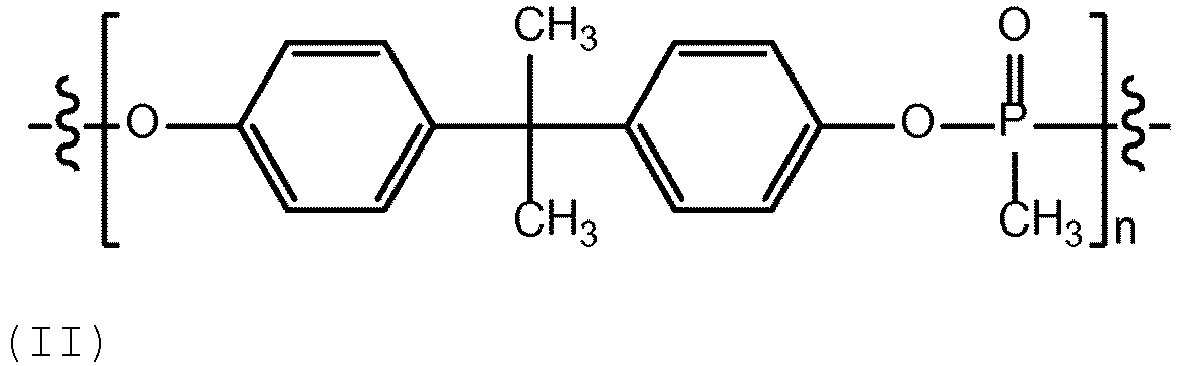
- the phosphonate flame retardant is or comprises a phosphonate flame retardant of formula II:
- the weight average molecular weight (Mw) of the phosphonate flame retardant is preferably in the range from about 10,000 to about 120,000, preferably from about 50,000 to about 120,000, preferably from about 80,000 to about 120,000 g/mol.
- the molecular weight (Mw) is suitably determined by gel permeation chromatography (GPC) and measured against polystyrene (PS) standards, for instance using the equipment described hereinbelow.
- the phosphonate flame retardant is preferably characterized by a phosphorus content of at least about 5wt%, preferably at least about 8 wt%, preferably at least about 10wt%, preferably no more than about 20wt%, preferably no more than about 15 wt%, preferably no more than about 12wt%, and is preferably about 11wt%, by weight of the phosphonate flame retardant.
- the glass transition temperature (Tg) of the phosphonate flame retardant is preferably in the range of from about 95 to about 120°C, preferably in the range of from about 110 to about 110°C.
- the phosphonate flame retardant is preferably introduced into the polyester composition after the polyester is manufactured.
- the phosphonate flame retardant is added to the polyester prior to or during the introduction of the polyester into the extruder used in the film-manufacturing process.
- the phosphonate flame retardant is added to the extruder used in the film-manufacturing process, it is preferably added at the start of the extruder barrel.
- the phosphonate flame retardant may be introduced into the extruder by a gravimetric feeder to provide the final film with the desired amount of phosphonate flame retardant. Masterbatching technology may also be used.
- the phosphonate flame retardant is preferably blended with the polyester.
- said phosphonate flame retardant is the only phosphorus-containing flame retardant additive, and preferably the only flame retardant additive, present in the oriented polyester film.
- the phosphonate flame retardant may be at least partially copolymerised with the polyester, preferably to form a block copolymer.
- the polyester film comprises at least one metal cation selected from the group consisting of Group I and Group II metal cations.
- the amount of the metal cation present in a given layer is at least 10ppm, preferably at least 15ppm, at least 40ppm, preferably at least 45ppm, preferably at least 65ppm, preferably at least 80ppm, and preferably at least 100ppm by weight, relative to the amount of polyester in a given layer.
- the amount of the metal cation is not more than about 1000ppm, preferably not more than about 500ppm, preferably not more than about 275ppm, typically not more than about 200ppm, and in one embodiment not more than about 150ppm by weight, relative to the amount of polyester in a given layer.
- the amount of the metal cation is in the range from 45ppm to 500ppm, more preferably from 65ppm to 275ppm, more preferably from 100ppm to 200ppm by weight, relative to the amount of polyester in a given layer.
- the terms "Group I” and “Group II” have their conventional chemical meaning and refer to the corresponding Groups in the periodic table.
- the metal cations are preferably selected from Group I metal cations, preferably selected from sodium and potassium, and most preferably sodium.
- the Group I or Group II cation is preferably present in the form of a salt with an appropriate counter-anion, preferably selected from hydroxide, polyacrylate, hydrogen carbonate, carboxylate, chloride, acetate, formate and nitrate.
- an appropriate counter-anion preferably selected from hydroxide, polyacrylate, hydrogen carbonate, carboxylate, chloride, acetate, formate and nitrate.
- the anion is selected from hydroxide or polyacrylate, preferably polyacrylates.
- Suitable polyacrylates include those having a weight average molecular weight (M W ) of from about 1,000 to about 10,000 g/mol.
- Molecular weight determination herein may be conducted on a Hewlett-Packard 1050 Series HPLC system equipped with two GPC Ultrastyragel columns, 10 3 and 10 4 ⁇ (5 ⁇ m mixed, 300 mm x 19 mm, Waters Millipore Corporation, Milford, MA, USA) and THF as mobile phase. The molecular weight is calculated by comparison with the retention times of polystyrene standards.
- the metal cation(s) may be added to the polyester or its monomers prior to polymerisation.
- the metal cations preferably in the form of its salt
- the metal cations are added at the start of the polymerisation reaction to prepare the polyester.
- the polyester film may further comprise any other additive conventionally employed in the manufacture of polyester films.
- agents such as particulate fillers, hydrolysis stabilisers, anti-oxidants, UV-stabilisers, cross-linking agents, dyes, lubricants, radical scavengers, thermal stabilisers, surface active agents, gloss improvers, prodegradents, viscosity modifiers and dispersion stabilisers may be incorporated as appropriate.
- particulate fillers preferably particulate fillers, hydrolysis stabilisers (preferably glycidyl esters of branched monocarboxylic acids) and anti-oxidants (preferably hindered phenols, secondary aromatic amines and hindered amines), and suitable additives in this regard are disclosed in WO-2012/120260 -A.
- UV-stabilisers are also of particular utility.
- Particulate fillers can improve handling and windability during manufacture and/or modulate optical properties, as is well known in the art.
- the particulate filler is typically a particulate inorganic filler (e.g. metal or metalloid oxides, such as alumina, titania, talc and silica (especially precipitated or diatomaceous silica and silica gels), calcined china clay and alkaline metal salts, such as the carbonates and sulphates of calcium and barium).
- metal or metalloid oxides such as alumina, titania, talc and silica (especially precipitated or diatomaceous silica and silica gels)
- calcined china clay and alkaline metal salts such as the carbonates and sulphates of calcium and barium.
- a particulate inorganic filler is preferably finely-divided, and the volume distributed median particle diameter (equivalent spherical diameter corresponding to 50% of the volume of all the particles, read on the cumulative distribution curve relating volume % to the diameter of the particles - often referred to as the "D(v,0.5)" value) thereof is preferably in the range from 0.01 to 5 ⁇ m, more preferably 0.05 to 1.5 ⁇ m, and particularly 0.15 to 1.2 ⁇ m.
- Preferably at least 90%, more preferably at least 95% by volume of the inorganic filler particles are within the range of the volume distributed median particle diameter ⁇ 0.8 ⁇ m, and particularly ⁇ 0.5 ⁇ m.
- Particle size of the filler particles may be measured by electron microscope, coulter counter, sedimentation analysis and static or dynamic light scattering. Techniques based on laser light diffraction are preferred.
- the aforementioned conventionally employed additives may be introduced into the polymer in a conventional manner. For example, by mixing with the monomeric reactants from which the film-forming polymer is derived, or the components may be mixed with the polymer by tumble or dry blending or by compounding in an extruder, followed by cooling and, usually, comminution into granules or chips. Masterbatching technology may also be employed.
- Formation of the polyester film may be effected by conventional extrusion techniques well-known in the art.
- the process comprises the steps of extruding a layer of molten polymer at a temperature within the range of from about 275 to about 300°C, preferably from about 290 to 295°C, quenching the extrudate and orienting the quenched extrudate.
- Orientation may be effected by any process known in the art for producing an oriented film, for example a tubular or flat film process.
- Biaxial orientation is effected by drawing in two mutually perpendicular directions in the plane of the film to achieve a satisfactory combination of mechanical and physical properties.
- simultaneous biaxial orientation may be effected by extruding a thermoplastics polyester tube which is subsequently quenched, reheated and then expanded by internal gas pressure to induce transverse orientation, and withdrawn at a rate which will induce longitudinal orientation.
- the film-forming polyester is extruded through a slot die and rapidly quenched upon a chilled casting drum to ensure that the polyester is quenched to the amorphous state.
- Orientation is then effected by stretching the quenched extrudate in at least one direction at a temperature above the glass transition temperature of the polyester.
- Sequential orientation may be effected by stretching a flat, quenched extrudate firstly in one direction, usually the longitudinal direction, i.e.
- Stretching is generally effected so that the dimension of the oriented film is from 2 to 5, more preferably 2.5 to 4.5 times its original dimension in the or each direction of stretching. More preferably, stretching is effect so that the dimension of the oriented film is from 3.0 to 3.3 times its original dimension in the forward draw, and from 3.3 to 3.9 times its original dimension in the sideways draw. Greater draw ratios (for example, up to about 8 times) may be used if orientation in only one direction is required.
- stretching is effected at temperatures higher than the T g of the polyester, preferably about 15°C higher than the T g . It is not necessary to stretch equally in the machine and transverse directions although this is preferred if balanced properties are desired.
- a stretched film may be, and preferably is, dimensionally stabilised by heat-setting under dimensional support at a temperature above the glass transition temperature of the polyester but below the melting temperature thereof, to induce the desired crystallisation of the polyester.
- TD transverse direction
- Toe-in can involve dimensional relaxation of the order 2 to 4%. While dimensional relaxation in the process or machine direction (MD) is also possible, as is known in the art.
- the actual heat-set temperature and time will vary depending on the composition of the film and its desired final thermal shrinkage but should not be selected so as to substantially degrade the toughness properties of the film such as tear resistance.
- a heat set temperature of about 180 to 245°C is generally desirable.
- the heat-set-temperature is within the range of from about 200 to about 225°C, which provides improvements in hydrolytic stability. After heat-setting the film is typically quenched rapidly in order induce the desired crystallinity of the polyester.
- the film is further stabilized through use of an in-line relaxation stage.
- the relaxation treatment can be performed off-line.
- the film is heated at a temperature lower than that of the heat-setting stage, and with a much reduced MD and TD tension.
- the tension experienced by the film is a low tension and typically less than 5 kg/m, preferably less than 3.5 kg/m, preferably less than 2.5 kg/m, and typically in the range of 1.0 to 2.0 kg/m of film width.
- the reduction in film speed (and therefore the strain relaxation) is typically in the range 0 to 2.5%, preferably 0.5 to 2.0%. There is no increase in the transverse dimension of the film during the heat-stabilisation step.
- the temperature to be used for the heat stabilisation step can vary depending on the desired combination of properties from the final film, with a higher temperature giving better, i.e. lower, residual shrinkage properties.
- a temperature of 135 to 250 °C is generally desirable, preferably 150 to 230 °C, more preferably 170 to 200 °C.
- the duration of heating will depend on the temperature used but is typically in the range of 10 to 40 seconds, with a duration of 20 to 30 seconds being preferred.
- This heat stabilisation process can be carried out by a variety of methods, including flat and vertical configurations and either "off-line” as a separate process step or "in-line” as a continuation of the film manufacturing process. Film thus processed will exhibit a smaller thermal shrinkage than that produced in the absence of such post heat-setting relaxation.
- the polyester film may be either a single layer or a composite structure comprising a plurality of polyester layers.
- One layer of a multi-layer polyester film may be a heat-sealable layer, as described hereinbelow.
- the polyester film is a single layer.
- Formation of a composite structure is preferably effected by co-extrusion, either by simultaneous coextrusion of the respective film-forming layers through independent orifices of a multi-orifice die, and thereafter uniting the still molten layers or, preferably, by single-channel coextrusion in which molten streams of the respective polymers are first united within a channel leading to a die manifold, and thereafter extruded together from the die orifice under conditions of streamline flow without intermixing thereby to produce a multi-layer film, which may be oriented and heat-set as hereinbefore described.
- the polyester layers of a composite film are selected from the polyesters described hereinabove, and preferably from PET or PET-based polyesters.
- any or each layer in a composite film may comprise any of the additives mentioned above, wherein the additive(s) in a given layer may be the same as or different to the additive(s) in other layers, and in the same or different amounts.
- phosphonate flame retardant is in at least the outer layers of a multi-layer film and preferably in each layer of a multi-layer film.
- the polyester film comprises 2 or 3 layers, preferably having an AB or BAB layer structure.
- An outer layer of a multi-layer polyester film suitably comprises particulate fillers to improve handling and windability during manufacture, as is conventional in the art, and such particulate filler is suitably present in amounts, generally not exceeding 2.5 %, preferably not exceeding 2.0%, preferably not exceeding 1.1%, preferably not exceeding 0.6%, preferably not exceeding 0.5% and preferably not exceeding 0.3% by weight of a layer.
- the film of the present invention may be heat-sealable.
- the heat-sealable functionality is preferably provided by disposing a heat-sealable layer on a polyester base layer.
- the polyester of a mono-layer film may itself be heat-sealable.
- the heat-sealable functionality is provided by disposing a heat-sealable layer on a polyester base layer which is not itself heat-sealable.
- a heat-sealable polyester is preferably a copolyester selected from copolyesters derived from one or more diol(s) and one or more dicarboxylic acid(s), wherein the copolyester comprises at least three different types of monomeric repeating units, and preferably wherein the aliphatic diol(s) and dicarboxylic acid(s) are selected from the dicarboxylic acids and diols described above.
- the copolyester of a heat-sealable copolyester layer is the major component of that layer, and makes up at least 50% by weight of the total weight of the layer, preferably at least 65%, preferably at least 80%, preferably at least 90%, more typically at least 95% by weight of the total weight of the layer.
- a heat-sealable copolyester is preferably selected from:
- heat-sealable functionality may be provided by coating a non-polyester heat-seal polymer onto the polyester film described herein.
- Suitable heat-seal layers comprise and preferably consist of an ethylene vinyl acetate (EVA).
- EVA polymers may be obtained from DuPont as Elvax TM resins. Typically, these resins have a vinyl acetate content in the range of 9% to 40%, and typically 15% to 30%.
- Formation of a heat-sealable layer may be effected by conventional techniques, the method of formation depending on the identity of the heat-sealable layer.
- Heat-sealable layers comprising copolyesters (i) and (ii) are suitably prepared by coextrusion.
- Heat-sealable layers comprising copolyester (iii) and EVA are suitably prepared by coating the heat-sealable polymer onto the polyester layer described hereinabove. Coating may be effected using any suitable coating technique, for instance as described hereinbelow.
- the thickness of a heat-sealable layer is preferably no more than 40%, more preferably no more than 30% and more preferably no more than 25%, and preferably at least 2.5% more preferably at least 5%, and preferably from about 10% to about 20%, of the total thickness of the film.
- the polyester film is optically clear.
- optically clear refers to a layer that provides a percentage of scattered light in the visible wavelength range of no more than 8%, preferably no more than 5% preferably no more than 4%, preferably no more than 3%, preferably no more than 2%, more preferably no more than 1%, and/or a total luminous transmission (TLT) for light in the visible region (400 nm to 700 nm) of at least 80%, preferably at least 88%, more preferably at least about 90%, more preferably at least about 92%.
- TLT total luminous transmission
- an optically clear film fulfils both of these criteria.
- any filler in the film is typically present in only small amounts, generally not exceeding 2.5 %, preferably not exceeding 2.0%, preferably not exceeding 1.1%, preferably not exceeding 0.6% and preferably not exceeding 0.3% by weight of a layer, preferably wherein the filler is silica.
- the windability of the film i.e. the absence of blocking or sticking when the film is wound up into a roll) is improved, without an unacceptable reduction in haze or other optical properties.
- the intrinsic viscosity of the polyester film is preferably at least about 0.70, preferably at least about 0.75, preferably at least 0.80, and preferably no more than about 0.85, preferably no more than about 0.83.
- the polyester film of the present invention exhibits surprisingly good flame retardant properties.
- the polyester film exhibits a VTM0 rating (as defined in the UL test method described hereinbelow), which has long been an objective of polyester film manufacturers.
- Conventional polyester films typically exhibit flame classification ratings no better than the VTM2 rating.
- a polymeric component is only deemed acceptable for use as part of a device or appliance with respect to its flammability if it exhibits a VTM0 rating, which has limited the range of applications in which polyester films have been used.
- the film of the present invention is semi-crystalline.
- semi-crystalline refers to a film which exhibits a crystallinity of at least 5%, preferably at least 10%, preferably at least 15%, preferably at least 20%, preferably at least 25%, and typically no higher than 50% or 45% or 40%.
- the polyester film of the invention preferably exhibits a low shrinkage, preferably less than 10%, preferably less than 5%, preferably less than 3%, preferably less than 2%, preferably less than 1% at 150°C over 30 minutes, particularly in the machine (longitudinal dimension) of the film.
- a low shrinkage preferably less than 10%, preferably less than 5%, preferably less than 3%, preferably less than 2%, preferably less than 1% at 150°C over 30 minutes, particularly in the machine (longitudinal dimension) of the film.
- shrinkage values are exhibited in both dimensions of the film (i.e. the longitudinal and transverse dimensions).
- the film of the present invention preferably exhibits an Ultimate Tensile Strength (UTS) in each of the longitudinal and transverse directions of the film of at least about 15, preferably at least about 18, preferably at least about 19, preferably at least about 20, preferably at least about 21 kg/mm 2 .
- UTS Ultimate Tensile Strength
- the multi-layer film of the present invention preferably exhibits an Elongation To Break (ETB) in each of the longitudinal and transverse directions of the film of at least 130 %, preferably at least 150 %, preferably at least 160 %, preferably at least 170 %, preferably at least 180 %, preferably at least 190 %, preferably at least 200 %.
- ETB Elongation To Break
- longitudinal direction and “transverse direction” of the film refer to the directions in which a film was stretched during its manufacture.
- machine direction is also used herein to refer to the longitudinal direction.
- the polyester film of the present invention may optionally have coated therein an acrylic resin layer.
- an acrylic layer may be used as adhesion-promoting layer, for instance as an ink-receptive layer to improve the adhesion of inks inks, dyes and/or lacquers etc to the surface of the polyester film.
- acrylic resin refers to a resin which comprises at least one acrylic and/or methacrylic component.
- the acrylic resin of the ink-receptive layer is suitably thermoset.
- the acrylic resin of the ink-receptive layer preferably comprises at least one monomer derived from an ester of acrylic acid and/or an ester of methacrylic acid, and/or derivatives thereof.
- the acrylic resin comprises greater than 50 mole %, preferably less than 98 mole %, more preferably in the range from 60 to 97 mole %, particularly 70 to 96 mole %, and especially 80 to 94 mole % of at least one monomer derived from an ester of acrylic acid and/or an ester of methacrylic acid, and/or derivatives thereof.
- a preferred acrylic resin comprises an alkyl ester of acrylic and/or methacrylic acid where the alkyl group contains up to ten carbon atoms such as methyl, ethyl, n-propyl, isopropyl, n-butyl, isobutyl, terbutyl, hexyl, 2-ethylhexyl, heptyl, and n-octyl.
- the acrylic resin comprises an alkyl acrylate (preferably an ethyl acrylate and/or butyl acrylate) and an alkyl methacrylate (preferably methyl methacrylate), and preferably the acrylic resin comprises ethyl acrylate and methyl methacrylate.
- the acrylate monomer is preferably present in a proportion in the range from 20 to 80 mole% (preferably 30 to 65 mole %), and the methacrylate monomer is preferably present in a proportion in the range from 20 to 80 mole % (preferably from 20 to 60 mole %).
- Other monomers which are suitable for use in the preparation of the acrylic resin which are preferably copolymerised as optional additional monomers together with said esters of acrylic acid and/or methacrylic acid and/or derivatives thereof, include acrylonitrile, methacrylonitrile, halo-substituted acrylonitrile, halo-substituted methacrylonitrile, acrylamide, methacrylamide, N-methylol acrylamide, N-ethanol acrylamide, N-propanol acrylamide, N-methacrylamide, N-ethanol methacrylamide, N-methyl acrylamide, N-tertiary butyl acrylamide, hydroxyethyl methacrylate, glycidyl acrylate, glycidyl methacrylate, dimethylamino ethyl methacrylate, itaconic acid, itaconic anhydride and half esters of itaconic acid.
- Suitable optional monomers include vinyl esters such as vinyl acetate, vinyl chloroacetate and vinyl benzoate, vinyl pyridine, vinyl chloride, vinylidene chloride, maleic acid, maleic anhydride, styrene and derivatives of styrene such as chloro styrene, hydroxy styrene and alkylated styrenes, wherein the alkyl group contains from one to ten carbon atoms.
- vinyl esters such as vinyl acetate, vinyl chloroacetate and vinyl benzoate, vinyl pyridine, vinyl chloride, vinylidene chloride, maleic acid, maleic anhydride, styrene and derivatives of styrene such as chloro styrene, hydroxy styrene and alkylated styrenes, wherein the alkyl group contains from one to ten carbon atoms.
- a preferred acrylic resin is derived from three monomers and comprises 35 to 60 mole % (preferably 40 to 50 mole %) of ethyl acrylate, 30 to 55 mole % (preferably 40 to 50 mole %) of methyl methacrylate, and 2 to 20 mole % (preferably 5 to 10 mol%) of acrylamide or methacrylamide, and preferably comprises approximate molar proportions 46/46/8% respectively of ethyl acrylate/methyl methacrylate/acrylamide or methacrylamide.
- the polymer is thermoset, for example in the presence of about 25 weight % of a methylated melamine-formaldehyde resin.
- a further preferred acrylic resin is derived from four monomers and comprises a copolymer comprising comonomers (a) 35 to 40 mole % alkyl acrylate, (b) 35 to 40 mole % alkyl methacrylate, (c) 10 to 15 mole % of a monomer containing a free carboxyl group, and (d) 15 to 20 mole % of a monomer containing a sulphonic acid group and/or a salt thereof.
- Ethyl acrylate is a particularly preferred monomer (a) and methyl methacrylate is a particularly preferred monomer (b).
- Monomer (c) containing a free carboxyl group i.e.
- a carboxyl group other than those involved in the polymerisation reaction by which the copolymer is formed suitably comprises a copolymerisable unsaturated carboxylic acid, and is preferably selected from acrylic acid, methacrylic acid, maleic acid, and/or itaconic acid (and preferably from acrylic acid and itaconic acid).
- the sulphonic acid group monomer (d) may be present as the free acid and/or a salt thereof, for example as the ammonium, substituted ammonium, or an alkali metal, such as lithium, sodium or potassium, salt.
- the sulphonate group does not participate in the polymerisation reaction by which the copolymer resin is formed.
- the sulphonic acid group monomer is preferably aromatic, and more preferably is p-styrene sulphonic acid and/or a salt thereof.
- the weight average molecular weight (M W ; measured as described herein) of the acrylic resin can vary over a wide range but is preferably in the range from 10,000 to 1,000,000, and more preferably 50,000 to 200,000.
- the acrylic resin component of the ink-receptive layer preferably comprises at least 30%, more preferably in the range from 40 to 99%, particularly 50 to 85%, and especially 70 to 80% by weight relative to the total weight of the ink-receptive layer.
- the acrylic resin of the ink-receptive layer is preferably the major component of the layer.
- the composition from which the ink-receptive layer of the second embodiment is derived suitably also contains a cross-linking agent, particularly wherein the ink-receptive layer is an acrylic resin-containing layer.
- the cross-linking agent functions to improve adhesion to the polyester base layer.
- the cross-linking agent should also function to internally cross-link the ink-receptive layer to provide solvent resistance.
- Suitable cross-linking agents comprise epoxy resins, alkyd resins, amine derivatives such as hexamethoxymethyl melamine, and/or condensation products of an amine, e.g.
- melamine diazine, urea, cyclic ethylene urea, cyclic propylene urea, thiourea, cyclic ethylene thiourea, alkyl melamines, aryl melamines, benzo guanamines, guanamines, alkyl guanamines and aryl guanamines, with an aldehyde, e.g. formaldehyde.
- a useful condensation product is that of melamine with formaldehyde. The condensation product is optionally alkoxylated.
- the cross-linking agent may suitably be used in amounts of up to 70%, preferably in the range from 1 to 60%, more preferably 15 to 50%, and especially 20 to 30% by weight relative to the total weight of the ink-receptive layer.
- a catalyst is preferably employed to facilitate cross-linking action of the cross-linking agent.
- Preferred catalysts for cross-linking melamine formaldehyde include para toluene sulphonic acid, maleic acid stabilised by reaction with a base, morpholinium paratoluene sulphonate, and ammonium nitrate.
- composition from which the ink-receptive layer of the second embodiment is derived optionally contains a plasticizer to aid film formation and handling.
- a plasticizer to aid film formation and handling.
- Any suitable plasticizer may be used, for instance phthalate esters such as alkyl benzyl phthalates, dialkyl adipate and m.p-cresol propoxylate.
- the acrylic resin is generally water-insoluble.
- the acrylic resin is applied to the polyester base layer as a coating composition in the form of an aqueous dispersion.
- An acrylic resin-containing ink-receptive layer may be applied, typically in the form of a coating composition, before, during or after the stretching operation in the production of an oriented film.
- the coating composition is preferably applied to the polyester base layer between the two stages (longitudinal and transverse) of a biaxial stretching operation.
- An acrylic resin-coated polyester base layer is heated (typically up to 240°C, preferably up to 220° C) in order to drive off the diluent of the composition (normally water, although organic solvent(s) can be used additionally or alternatively), and to assist in coalescing and forming the coating into a continuous and uniform layer, as well as facilitating cross-linking of cross-linkable coating compositions.
- the coating composition is preferably applied to the polyester base layer at a dry coat weight in the range from about 0.05 to 5 mg/dm 2 , especially 0.1 to 2.0 mg/dm 2 .
- the thickness of an ink-receptive layer (preferably the acrylic resin-containing ink-receptive layer) in the second embodiment is preferably no more than 1.5 ⁇ m, more preferably in the range of from 0.01 to 1.0 ⁇ m, and particularly 0.02 to 0.5 ⁇ m.
- the total thickness of the film of the present invention is preferably no more 500 ⁇ m, preferably no more than 350 ⁇ m, preferably no more than 250 ⁇ m, preferably no more than 150 ⁇ m, preferably no more than 100 ⁇ m, preferably no more than 75 ⁇ m, preferably no more than 50 ⁇ m, preferably at least about 5 ⁇ m, typically at least about 10 ⁇ m.
- the films of the present invention are suitable for any environment or end-use where flame retardancy is desired or advantageous, for instance in screens, shades or wall coverings, in the manufacture of electrical components and circuits such as capacitors and flexible printed circuitry, membrane touch switches, and in the manufacture of components for use in the construction and transport industries.
- the films are particularly useful in the manufacture of building cladding.
- the films are also particularly suitable as materials suitable for use in the interior of aircraft.
- a method for imparting flame retardancy to or improving flame retardancy of a polyester film comprising the step of providing in the film a combination of a polymeric phosphonate flame retardant, in an amount of from about 1.0 to about 25.0 wt% by total weight of the film, and at least one metal cation selected from the group consisting of Group I and Group II metal cations (particularly sodium and potassium, and particularly sodium);
- the term "improving flame retardancy” as used herein means that the flame retardancy of the polyester film is improved relative to a polyester film in which the combination of said polymeric phosphonate flame retardant and said at least one metal cation is absent.
- Optical clarity is evaluated by measuring total luminance transmission (TLT) and haze (% of scattered transmitted visible light) through the total thickness of the film using an M57D spherical hazemeter (Diffusion Systems) according to the standard test method ASTM D1003.
- TLT total luminance transmission
- haze % of scattered transmitted visible light
- ASTM D1003 M57D spherical hazemeter
- each rod was held shut by a spring clamp which, with a stand, held the test sample vertical.
- a burner flame was adjusted to produce a blue flame 20 ⁇ 1mm. Continuous adjustment of the propane supply and the air-port was necessary to achieve the correct height.
- the film sample was held vertically and the flame applied to the bottom of the tube 10 mm below the film at an angle of 45°. Flame application was for 3 seconds, maintaining the 10mm distance by moving the burner upwards as the film shrank away from it. After 3 seconds the flame was moved away from the sample and the duration (in seconds) of flaming after the first flame application noted (A). A repeat 3 second application was completed and the duration (in seconds) of flaming plus glowing after the second flame application (B) noted.
- PET polyesters P1 to P7 were prepared using a conventional synthetic procedure and comprising various additives, as shown in Table 1. The amounts in Table 1 are provided by weight relative to the final weight of the polymer produced, unless otherwise indicated. Polyesters P1, P2 and P7 were subjected to solid state polymerisation to increase their IV. Table 1 Polyester Additives IV P1 China clay: 0.21 wt%; 0.80 Sodium salt of an acrylic copolymer (500ppm of a 40% solids aq.
- P2 Irganox ® 1010 (Ciba-Geigy; tetrakis-(methylene 3-(4'-hydoxry-3', 5'-di-t-butylphenyl propionate) methane): 500 ppm; 0.80 Sodium salt of an acrylic copolymer (40% solids aq.
- a first series of polyester films based on polyesters P1, P6 and P7 was made. Forwards draw ratios were from about 3.0 to 3.3; sideways draw ratios were from about 3.3 to 3.5; and heat-setting was conducted at a temperatures of from about 190 to about 225°C, preferably with an initial zone having a temperature of about 225°C and a final zone having a temperature of about 190°C.
- a phosphonate flame retardant of formula I was added to the polyester at the start of the barrel of the extruder during film manufacture. In all cases, the phosphonate flame retardant was FRX Nofia ® HM1100 (available from FRX Polymers, Inc.) which has the structure shown below as formula (1):
- Example 2 The amount of phosphonate flame retardant present in the film is shown in Table 2, which also shows the haze and TLT (measured as described herein) of the final film.
- Table 2 Example Polymer Flame retardant (wt%) Extrusion temperature (°C) Haze (%) TLT (%) Comp.
- Example 1 P6 5 275 17.2 82.9 Comp.
- Example 2 P6 10 275 25.2 78.8 Comp.
- Example 3 P7 5 275 9.98 85.9
- Example 4 P7 10 275 19.8 81.7
- Example 1 P1 5 275 4.72 88.9 Example 2 P1 5 295 4.6 89.6
- a second series of polyester films based on PET polyesters P1-P7 were made, which in all cases contained 15 wt% of FRX Nofia ® HM1100 and having a final film thickness of 50 ⁇ m.
- Examples 5-16 were coated on one side with an acrylic resin adhesion-promoting layer (thickness ⁇ 0.5 ⁇ m).
- the composition of the films is described in Table 3, along with its properties, measured as described herein.
- a third series of sodium salt-containing films based on polyester P2 was made, containing varying amounts of FRX Nofia ® HM1100 flame retardant, as shown in Table 4.
- Table 4 Example Flame retardant (wt%) T g (°C) T m (°C) ⁇ H m (J/g) Crystallinity (%) Comp.Ex. 5 0 - 248.80 36.41 26.01
- Example 17 10 90.82 248.00 40.78 29.13
- Example 19 20 90.64 243.79 28.78 20.56
Landscapes
- Chemical & Material Sciences (AREA)
- Polymers & Plastics (AREA)
- Organic Chemistry (AREA)
- Health & Medical Sciences (AREA)
- Chemical Kinetics & Catalysis (AREA)
- Medicinal Chemistry (AREA)
- Engineering & Computer Science (AREA)
- Manufacturing & Machinery (AREA)
- Materials Engineering (AREA)
- Mechanical Engineering (AREA)
- Manufacture Of Macromolecular Shaped Articles (AREA)
- Laminated Bodies (AREA)
- Compositions Of Macromolecular Compounds (AREA)
- Coating Of Shaped Articles Made Of Macromolecular Substances (AREA)
- Shaping By String And By Release Of Stress In Plastics And The Like (AREA)
Claims (23)
- Polyesterfolie mit der Bewertung VTM-0 bei der UL-94-Testmethode, wobei die Folie ein polymeres Phosphonat-Flammschutzmittel in einer Menge von etwa 1,0 bis etwa 25,0 Gew.-%, bezogen auf das Gesamtgewicht der Folie, umfasst und ferner mindestens ein Metallkation, das aus der Gruppe bestehend aus Metallkationen der Gruppe I und Gruppe II ausgewählt ist, umfasst;
wobei die Trübung der Folie nicht mehr als etwa 8 % beträgt und/oder wobei die totale Lichttransmission der Folie im sichtbaren Bereich mindestens etwa 85 % beträgt; wobei die Trübung und die totale Lichttransmission gemäß der Methode in der Beschreibung bestimmt werden. - Polyesterfolie nach Anspruch 1, wobei es sich bei der Polyesterfolie um eine orientierte Folie, vorzugsweise eine biaxial orientierte Folie, handelt.
- Polyesterfolie nach einem der vorhergehenden Ansprüche, wobei die Polyesterfolie das Phosphonat-Flammschutzmittel in einer Menge von mindestens etwa 5 Gew.-%, vorzugsweise mindestens etwa 10 Gew.-%, vorzugsweise mindestens etwa 12 Gew.-%, vorzugsweise nicht mehr als etwa 20 Gew.-%, vorzugsweise nicht mehr als etwa 18 Gew.-%, bezogen auf das Gesamtgewicht der Folie, umfasst.
- Polyesterfolie nach einem der vorhergehenden Ansprüche, wobei es sich bei dem Phosphonat-Flammschutzmittel um ein Phosphonat-Flammschutzmittel der Formel I handelt:
 Ar für eine aromatische Gruppe steht und sich -O-Ar-O-von einer Verbindung mit einem oder mehreren gegebenenfalls substituierten Arylringen wie, aber ohne Beschränkung darauf, Resorcinolen, Hydrochinonen und Bisphenolen, wie Bisphenol A, Bisphenol F und 4,4'-Biphenol, Phenolphthalein, 4,4'-Thiodiphenol, 4,4'-Sulfonyldiphenol oder Kombinationen davon ableitet;X für ein C1-20-Alkyl, C2-20-Alken, C2-20-Alkin, C5-20-Cycloalkyl oder C6-20-Aryl steht undn für eine ganze Zahl von 1 bis etwa 100, vorzugsweise von 1 bis etwa 75, vorzugsweise von 2 bis etwa 50, oder eine beliebige ganze Zahl zwischen diesen Bereichen steht.
 - Polyesterfolie nach Anspruch 4, wobei X aus C1-20-Alkyl, vorzugsweise C1-10-Alkyl, vorzugsweise C1-5-Alkyl, vorzugsweise Methyl, ausgewählt ist.
- Polyesterfolie nach Anspruch 4 oder 5, wobei sich - O-Ar-O- von Bisphenol A, Bisphenol F und 4,4'-Biphenol, vorzugsweise Bisphenol A, ableitet.
- Polyesterfolie nach einem der vorhergehenden Ansprüche, wobei das Phosphonat-Flammschutzmittel die Formel II aufweist:
- Polyesterfolie nach einem der vorhergehenden Ansprüche, wobei das gewichtsmittlere Molekulargewicht (Mw) des Phosphonat-Flammschutzmittels im Bereich von etwa 10.000 bis etwa 120.000 g/mol, vorzugsweise von etwa 50.000 bis etwa 120.000 g/mol, vorzugsweise von etwa 80.000 bis etwa 120.000 g/mol, liegt;
wobei das gewichtsmittlere Molekulargewicht gemäß der Methode in der Beschreibung bestimmt wird. - Polyesterfolie nach einem der vorhergehenden Ansprüche, wobei das Phosphonat-Flammschutzmittel durch einen Phosphorgehalt von mindestens etwa 5 Gew.-%, vorzugsweise mindestens etwa 8 Gew.-%, vorzugsweise mindestens etwa 10 Gew.-%, vorzugsweise nicht mehr als etwa 20 Gew.-%, vorzugweise nicht mehr als etwa 15 Gew.-%, vorzugsweise nicht mehr als etwa 12 Gew.-%, und vorzugsweise etwa 11 Gew.-%, bezogen auf das Gewicht des Phosphonat-Flammschutzmittels, gekennzeichnet ist.
- Polyesterfolie nach einem der vorhergehenden Ansprüche, wobei die Glasübergangstemperatur (Tg) des Phosphonat-Flammschutzmittels im Bereich von etwa 95 bis etwa 120°C, vorzugsweise im Bereich von etwa 110 bis etwa 110 °C, liegt;
wobei die Glasübergangstemperatur gemäß der Methode in der Beschreibung bestimmt wird. - Polyesterfolie nach einem der vorhergehenden Ansprüche, wobei die Menge der Metallkationen in der Folie mindestens 10 ppm und vorzugsweise nicht mehr als etwa 1000 ppm, bezogen auf die Menge an Polyester, beträgt und/oder wobei die Metallkationen aus Natrium und Kalium ausgewählt sind und/oder wobei die Metallkationen in Form eines Salzes mit einem aus Hydroxid, Polyacrylat, Hydrogencarbonat, Carboxylat, Chlorid, Acetat, Formiat und Nitrat ausgewählten Gegenion vorliegen.
- Polyesterfolie nach einem der vorhergehenden Ansprüche, bei der es sich um eine biaxial orientierte Folie handelt und/oder wobei es sich bei dem Polyester um Polyethylenterephthalat handelt.
- Polyesterfolie nach einem der vorhergehenden Ansprüche, wobei die intrinsische Viskosität des Polyesters, aus dem die Folie hergestellt ist, mindestens 0,65 und nicht mehr als 0,85 beträgt;
wobei die intrinsische Viskosität gemäß der Methode in der Beschreibung bestimmt wird. - Polyesterfolie nach einem der vorhergehenden Ansprüche, wobei die Foliendicke nicht mehr als etwa 250 µm, vorzugsweise nicht mehr als etwa 150 µm, vorzugsweise nicht mehr als etwa 100 µm, vorzugsweise nicht mehr als 75 µm, vorzugsweise nicht mehr als 50 µm und vorzugsweise mindestens etwa 5 µm, vorzugsweise mindestens etwa 10 µm, beträgt.
- Polyesterfolie nach einem der vorhergehenden Ansprüche, bei der es sich um eine klare Folie handelt, wobei die Trübung der Folie nicht mehr als etwa 5 %, vorzugsweise nicht mehr als etwa 4 %, vorzugsweise nicht mehr als etwa 3 %, vorzugsweise nicht mehr als etwa 2 %, vorzugsweise nicht mehr als etwa 1 %, beträgt und/oder wobei die totale Lichttransmission der Folie im sichtbaren Bereich mindestens etwa 88 %, vorzugsweise mindestens etwa 90 %, vorzugsweise mindestens etwa 92 %, beträgt;
wobei die Trübung und die totale Lichttransmission gemäß der Methode in der Beschreibung bestimmt werden. - Polyesterfolie nach einem der vorhergehenden Ansprüche, bei der es sich um eine einschichtige Polyesterfolie handelt.
- Polyesterfolie nach einem der vorhergehenden Ansprüche, wobei die Folie mit einer haftvermittelnden Schicht, vorzugsweise einem Acrylharz, beschichtet ist.
- Polyesterfolie nach einem der vorhergehenden Ansprüche, wobei das Phosphonat-Flammschutzmittel zumindest teilweise mit dem Polyester copolymerisiert ist, vorzugsweise in Form eines Blockcopolymers.
- Polyesterfolie nach einem der vorhergehenden Ansprüche, bei der es sich um eine teilkristalline Folie mit einer Kristallinität im Bereich von 20 % bis 50 % handelt;
wobei die Kristallinität gemäß der Methode in der Beschreibung bestimmt wird. - Polyesterfolie nach einem der vorhergehenden Ansprüche, die einen Schrumpf von weniger als 5 % bei 150 °C über einen Zeitraum von 30 Minuten sowohl in der Längsausdehnung als auch in der Querausdehnung der Folie zeigt;
wobei der Schrumpf gemäß der Methode in der Beschreibung bestimmt wird. - Polyesterfolie nach einem der vorhergehenden Ansprüche, die eine Reißfestigkeit (Ultimate Tensile Strength, UTS) in der Längsrichtung und in der Querrichtung der Folie von mindestens 15 kg/mm2 und/oder eine Bruchdehnung (Elongation To Break, ETB) in der Längsrichtung und in der Querrichtung der Folie von mindestens 130 % zeigt;
wobei die Reißfestigkeit und die Bruchdehnung gemäß der Methode in der Beschreibung bestimmt werden. - Verfahren zur flammwidrigen Ausrüstung oder Verbesserung der Flammwidrigkeit einer Polyesterfolie, wobei das Verfahren den Schritt des Bereitstellens in der Folie einer Kombination von einem polymeren Phosphonat-Flammschutzmittel in einer Menge von etwa 1,0 bis etwa 25,0 Gew.-%, bezogen auf das Gesamtgewicht der Folie, und mindestens einem Metallkation, das aus der Gruppe bestehend aus Metallkationen der Gruppe I und Gruppe II ausgewählt ist, umfasst;wobei die Polyesterfolie bei der UL-94-Testmethode die Bewertung VTM-0 zeigt undwobei die Trübung der Folie nicht mehr als etwa 8 % beträgt und/oder wobei die totale Lichttransmission der Folie im sichtbaren Bereich mindestens etwa 85 % beträgt;wobei die Trübung und die totale Lichttransmission gemäß der Methode in der Beschreibung bestimmt werden.
- Verfahren nach Anspruch 22, wobei das polymere Phosphonat-Flammschutzmittel und/oder das mindestens eine Metallkation und/oder die Polyesterfolie wie in einem der Ansprüche 1 bis 21 definiert ist.
Applications Claiming Priority (3)
| Application Number | Priority Date | Filing Date | Title |
|---|---|---|---|
| GBGB1806916.1A GB201806916D0 (en) | 2018-04-27 | 2018-04-27 | Polyester film |
| PCT/GB2019/051165 WO2019207314A1 (en) | 2018-04-27 | 2019-04-26 | Polyester film comprising a polymeric phosphonate flame retardant |
| EP19721357.2A EP3784735B1 (de) | 2018-04-27 | 2019-04-26 | Polyesterfolie mit einem polymerphosphonat-flammschutzmittel |
Related Parent Applications (1)
| Application Number | Title | Priority Date | Filing Date |
|---|---|---|---|
| EP19721357.2A Division EP3784735B1 (de) | 2018-04-27 | 2019-04-26 | Polyesterfolie mit einem polymerphosphonat-flammschutzmittel |
Publications (2)
| Publication Number | Publication Date |
|---|---|
| EP4201996A1 EP4201996A1 (de) | 2023-06-28 |
| EP4201996B1 true EP4201996B1 (de) | 2025-06-18 |
Family
ID=62495156
Family Applications (2)
| Application Number | Title | Priority Date | Filing Date |
|---|---|---|---|
| EP19721357.2A Active EP3784735B1 (de) | 2018-04-27 | 2019-04-26 | Polyesterfolie mit einem polymerphosphonat-flammschutzmittel |
| EP23158190.1A Active EP4201996B1 (de) | 2018-04-27 | 2019-04-26 | Polyesterfolie mit einem polymerphosphonatflammschutzmittel |
Family Applications Before (1)
| Application Number | Title | Priority Date | Filing Date |
|---|---|---|---|
| EP19721357.2A Active EP3784735B1 (de) | 2018-04-27 | 2019-04-26 | Polyesterfolie mit einem polymerphosphonat-flammschutzmittel |
Country Status (7)
| Country | Link |
|---|---|
| US (2) | US11634548B2 (de) |
| EP (2) | EP3784735B1 (de) |
| JP (3) | JP7041759B2 (de) |
| KR (2) | KR102540588B1 (de) |
| CN (2) | CN115806729A (de) |
| GB (1) | GB201806916D0 (de) |
| WO (1) | WO2019207314A1 (de) |
Families Citing this family (6)
| Publication number | Priority date | Publication date | Assignee | Title |
|---|---|---|---|---|
| GB201806916D0 (en) | 2018-04-27 | 2018-06-13 | Dupont Teijin Films Us Lp | Polyester film |
| GB202013061D0 (en) * | 2020-08-21 | 2020-10-07 | Dupont Teijin Films Us Lp | Breathable composite polymeric films |
| JP7611086B2 (ja) * | 2021-06-29 | 2025-01-09 | タキロンシーアイ株式会社 | 熱可塑性樹脂フィルム、プリプレグ、およびプリプレグ積層体 |
| KR102725020B1 (ko) * | 2022-03-22 | 2024-11-01 | 도레이첨단소재 주식회사 | 난연성 폴리에스테르 필름 및 이의 제조방법 |
| CN115304769B (zh) * | 2022-08-10 | 2023-11-03 | 浙江帕司迪客新材料有限公司 | 基于4,4-硫代二苯酚可降解共聚酯、制备方法及用途 |
| KR102922051B1 (ko) * | 2023-09-15 | 2026-02-02 | 도레이첨단소재 주식회사 | 이축 연신 폴리에스테르 필름 및 이의 제조방법 |
Family Cites Families (36)
| Publication number | Priority date | Publication date | Assignee | Title |
|---|---|---|---|---|
| JPH01144453A (ja) | 1987-12-01 | 1989-06-06 | Kuraray Co Ltd | 耐衝撃性に優れた難燃性ポリエステル樹脂組成物 |
| US5256714A (en) * | 1987-12-29 | 1993-10-26 | General Electric Company | Flame retardant polyester blends |
| JP3278943B2 (ja) | 1992-12-28 | 2002-04-30 | 東レ株式会社 | ポリエステルおよびフィルム |
| DE10002161A1 (de) | 2000-01-20 | 2001-07-26 | Mitsubishi Polyester Film Gmbh | Matte, flammhemmend ausgerüstete koextrudierte Polyesterfolie, Verfahren zu ihrer Herstellung und ihre Verwendung |
| DE10002173A1 (de) | 2000-01-20 | 2001-07-26 | Mitsubishi Polyester Film Gmbh | Transparente, schwerentflammbare, thermoformbare, UV-stabile Folie aus kristallisierbaren Thermoplasten, Verfahren zu ihrer Herstellung und ihre Verwendung |
| DE10002157A1 (de) | 2000-01-20 | 2001-07-26 | Mitsubishi Polyester Film Gmbh | Weiße, flammhemmend ausgerüstete, orientierte Folie aus einem kristallisierbaren Thermoplasten, Verfahren zu ihrer Herstellung und ihre Verwendung |
| DE10002165A1 (de) | 2000-01-20 | 2001-07-26 | Mitsubishi Polyester Film Gmbh | Transparente, flammhemmend ausgerüstete, thermoformbare orientierte Folie aus kristallisierbaren Thermoplasten, Verfahren zu ihrer Herstellung und ihre Verwendung |
| JP2003524691A (ja) | 2000-01-20 | 2003-08-19 | ミツビシ ポリエステル フィルム ジーエムビーエイチ | 結晶性熱可塑性樹脂から成り熱成型可能で難燃性および耐紫外線性を有する白色フィルム及びその使用ならびにその製造方法 |
| DE10002160A1 (de) | 2000-01-20 | 2001-07-26 | Mitsubishi Polyester Film Gmbh | Matte, UV-stabile, schwerentflammbare koextrudierte Polyesterfolie, Verfahren zu ihrer Herstellung und ihre Verwendung |
| DE10002171A1 (de) | 2000-01-20 | 2001-07-26 | Mitsubishi Polyester Film Gmbh | Transparente, schwerentflammbare, UV-stabile Folie aus einem kristallisierbaren Thermoplasten, Verfahren zu ihrer Herstellung und ihre Verwendung |
| DE10007729A1 (de) | 2000-02-19 | 2001-08-23 | Mitsubishi Polyester Film Gmbh | Weiße, siegelfähige, UV-stabilisierte und flammhemmend ausgerüstete, biaxial orientierte Polyesterfolie, Verfahren zu ihrer Herstellung und ihre Verwendung |
| DE10007730A1 (de) | 2000-02-19 | 2001-08-23 | Mitsubishi Polyester Film Gmbh | Transparente, siegelfähige, flammhemmend ausgerüstete Polyesterfolie, Verfahren zu ihrer Herstellung und ihre Verwendung |
| DE10007725A1 (de) | 2000-02-19 | 2001-08-23 | Mitsubishi Polyester Film Gmbh | Einseitig matte, siegelfähige, UV stabilisierte und flammhemmend ausgerüstete, koextrudierte, biaxial orientierte Polyesterfolie, Verfahren zu ihrer Herstellung ihre Verwendung |
| DE10009286A1 (de) | 2000-02-28 | 2001-08-30 | Mitsubishi Polyester Film Gmbh | Weisse, biaxial orientierte, schwer entflammbare und UV-stabilisierte Polyesterfolie mit Cycloolefincopolymer, Verfahren zu ihrer Herstellung und ihre Verwendung |
| DE10012137A1 (de) | 2000-03-13 | 2001-09-20 | Mitsubishi Polyester Film Gmbh | Biaxial orientierte Polyesterfolie enthaltend ein Cycloolefincopolymer, Verfahren zu ihrer Herstellung und ihre Verwendung |
| DE10030237A1 (de) | 2000-06-20 | 2002-01-03 | Mitsubishi Polyester Film Gmbh | Weiße, siegelfähige, biaxial orientierte, schwer entflammbare, koextrudierte Polyesterfolie mit Cycloolefincopolymer(COC), Verfahren zu ihrer Herstellung und ihre Verwendung |
| DE10035327A1 (de) | 2000-07-20 | 2002-01-31 | Mitsubishi Polyester Film Gmbh | Opake, schwerentflammbare Polyesterfolie enthaltend Cycloolefincopolymer (COC) mit guter Oberflächenhaftung, Verfahren zu ihrer Herstellung und ihre Verwendung |
| DE10043779A1 (de) | 2000-09-06 | 2002-03-14 | Mitsubishi Polyester Film Gmbh | Matte, mehrschichtige, funktionalisierte Folie aus einem bibenzolmodifizierten Thermoplasten, Verfahren zu ihrer Herstellung und ihre Verwendung |
| JP2004131669A (ja) * | 2002-10-15 | 2004-04-30 | Toray Ind Inc | 二軸配向ポリエステルフィルム |
| JP4090893B2 (ja) * | 2003-01-15 | 2008-05-28 | 帝人化成株式会社 | 難燃性熱可塑性樹脂組成物 |
| DE102004032596A1 (de) | 2004-07-06 | 2006-02-16 | Mitsubishi Polyester Film Gmbh | Mehrschichtige, matte, thermoformbare, IR-reflektierende Polyesterfolie |
| JP2006274112A (ja) | 2005-03-30 | 2006-10-12 | Toray Ind Inc | 二軸配向ポリエステルフィルム |
| JP5266751B2 (ja) * | 2007-12-26 | 2013-08-21 | 東レ株式会社 | 熱可塑性樹脂組成物、その製造方法およびそれからなる成形品 |
| EP2385967A4 (de) | 2009-01-08 | 2012-06-13 | Clariant Int Ltd | Flammhemmende verbindungen für polyester und flammhemmende polyesterformzusammensetzungen daraus |
| US20110237695A1 (en) * | 2010-03-23 | 2011-09-29 | Clariant International Ltd. | Flame Retardant Combinations For Polyester Elastomers And Flame Retarded Extrusion Or Molding Compositions Therefrom |
| WO2012068264A2 (en) * | 2010-11-17 | 2012-05-24 | Frx Polymers, Inc. | Phosphonate polymers, copolymers, and their respective oligomers as flame retardants for polyester fibers |
| GB2488787A (en) | 2011-03-07 | 2012-09-12 | Dupont Teijin Films Us Ltd | Stabilised polyester films |
| KR101234613B1 (ko) | 2011-08-09 | 2013-02-18 | 도레이첨단소재 주식회사 | 내열성이 우수한 광학용 폴리에스테르 필름 |
| CN104603176B (zh) * | 2012-06-29 | 2018-12-28 | Frx聚合物股份有限公司 | 聚酯共-膦酸酯 |
| TWI572600B (zh) * | 2013-01-10 | 2017-03-01 | Konica Minolta Inc | 樹脂組成物、三唑化合物、光學薄膜、偏光板、光學透鏡、圓偏光板、及圖像顯示裝置 |
| US9267221B2 (en) | 2014-01-16 | 2016-02-23 | Uno & Company, Ltd. | Phosphonate flame-retardant polyester artificial hair and method of preparing same |
| US10125437B2 (en) * | 2016-06-14 | 2018-11-13 | Uno & Company Ltd. | Polyester artificial hair and method of preparing the same |
| TWI589627B (zh) * | 2016-07-04 | 2017-07-01 | Nanya Plastics Corp | 一種低可見光穿透兼具高紅外線阻隔的透明聚酯膜及其製法 |
| US10959223B2 (en) * | 2017-05-25 | 2021-03-23 | Qualcomm Incorporated | Transmission time interval bundling for wireless communications systems |
| JP2020537027A (ja) | 2017-10-16 | 2020-12-17 | エフアールエックス ポリマーズ、インク. | ポリエステル及びホスホン酸オリゴマー及びポリマーのブレンド |
| GB201806916D0 (en) | 2018-04-27 | 2018-06-13 | Dupont Teijin Films Us Lp | Polyester film |
-
2018
- 2018-04-27 GB GBGB1806916.1A patent/GB201806916D0/en not_active Ceased
-
2019
- 2019-04-26 KR KR1020227006190A patent/KR102540588B1/ko active Active
- 2019-04-26 EP EP19721357.2A patent/EP3784735B1/de active Active
- 2019-04-26 CN CN202310056792.3A patent/CN115806729A/zh active Pending
- 2019-04-26 EP EP23158190.1A patent/EP4201996B1/de active Active
- 2019-04-26 US US17/050,830 patent/US11634548B2/en active Active
- 2019-04-26 CN CN201980028459.3A patent/CN112041392B/zh active Active
- 2019-04-26 WO PCT/GB2019/051165 patent/WO2019207314A1/en not_active Ceased
- 2019-04-26 KR KR1020207033237A patent/KR102369357B1/ko active Active
- 2019-04-26 JP JP2020560405A patent/JP7041759B2/ja active Active
-
2022
- 2022-03-11 JP JP2022037783A patent/JP2022088443A/ja active Pending
-
2023
- 2023-03-08 US US18/180,436 patent/US11965073B2/en active Active
-
2025
- 2025-02-25 JP JP2025027680A patent/JP2025097992A/ja active Pending
Also Published As
| Publication number | Publication date |
|---|---|
| US20230257538A1 (en) | 2023-08-17 |
| BR112020021890A2 (pt) | 2021-01-26 |
| CN112041392A (zh) | 2020-12-04 |
| JP2022088443A (ja) | 2022-06-14 |
| US20210047500A1 (en) | 2021-02-18 |
| JP2025097992A (ja) | 2025-07-01 |
| CN115806729A (zh) | 2023-03-17 |
| US11634548B2 (en) | 2023-04-25 |
| US11965073B2 (en) | 2024-04-23 |
| KR20220030317A (ko) | 2022-03-10 |
| KR102369357B1 (ko) | 2022-03-02 |
| CN112041392B (zh) | 2023-01-31 |
| EP3784735B1 (de) | 2023-03-22 |
| GB201806916D0 (en) | 2018-06-13 |
| JP2021514025A (ja) | 2021-06-03 |
| WO2019207314A1 (en) | 2019-10-31 |
| KR102540588B1 (ko) | 2023-06-07 |
| EP3784735A1 (de) | 2021-03-03 |
| EP4201996A1 (de) | 2023-06-28 |
| JP7041759B2 (ja) | 2022-03-24 |
| KR20200141511A (ko) | 2020-12-18 |
Similar Documents
| Publication | Publication Date | Title |
|---|---|---|
| EP4201996B1 (de) | Polyesterfolie mit einem polymerphosphonatflammschutzmittel | |
| US9333692B2 (en) | Hydrolysis resistant polyester films | |
| CN102597056B (zh) | 耐水解性聚酯膜 | |
| EP1368405B1 (de) | Flammgehemmter polyester film | |
| EP3041677B1 (de) | Coextrudierte mehrlagige polyesterfolien mit hydrolysestabilität und verbesserter delaminierungsbeständigkeit | |
| BR122024016819A2 (pt) | Filme de poliéster, uso de um retardador de chama de fosfonato polimérico e método para conferir retardamento de chama | |
| BR112020021890B1 (pt) | Filme de poliéster |
Legal Events
| Date | Code | Title | Description |
|---|---|---|---|
| PUAI | Public reference made under article 153(3) epc to a published international application that has entered the european phase |
Free format text: ORIGINAL CODE: 0009012 |
|
| STAA | Information on the status of an ep patent application or granted ep patent |
Free format text: STATUS: THE APPLICATION HAS BEEN PUBLISHED |
|
| AC | Divisional application: reference to earlier application |
Ref document number: 3784735 Country of ref document: EP Kind code of ref document: P |
|
| AK | Designated contracting states |
Kind code of ref document: A1 Designated state(s): AL AT BE BG CH CY CZ DE DK EE ES FI FR GB GR HR HU IE IS IT LI LT LU LV MC MK MT NL NO PL PT RO RS SE SI SK SM TR |
|
| STAA | Information on the status of an ep patent application or granted ep patent |
Free format text: STATUS: REQUEST FOR EXAMINATION WAS MADE |
|
| 17P | Request for examination filed |
Effective date: 20231219 |
|
| RBV | Designated contracting states (corrected) |
Designated state(s): AL AT BE BG CH CY CZ DE DK EE ES FI FR GB GR HR HU IE IS IT LI LT LU LV MC MK MT NL NO PL PT RO RS SE SI SK SM TR |
|
| RAP3 | Party data changed (applicant data changed or rights of an application transferred) |
Owner name: MYLAR SPECIALTY FILMS U.S. LIMITED PARTNERSHIP |
|
| GRAP | Despatch of communication of intention to grant a patent |
Free format text: ORIGINAL CODE: EPIDOSNIGR1 |
|
| STAA | Information on the status of an ep patent application or granted ep patent |
Free format text: STATUS: GRANT OF PATENT IS INTENDED |
|
| RIC1 | Information provided on ipc code assigned before grant |
Ipc: C08J 5/18 20060101ALI20250320BHEP Ipc: C08J 7/052 20200101ALI20250320BHEP Ipc: C08J 7/043 20200101ALI20250320BHEP Ipc: C08J 7/04 20200101ALI20250320BHEP Ipc: C08L 67/02 20060101AFI20250320BHEP |
|
| INTG | Intention to grant announced |
Effective date: 20250402 |
|
| GRAS | Grant fee paid |
Free format text: ORIGINAL CODE: EPIDOSNIGR3 |
|
| GRAA | (expected) grant |
Free format text: ORIGINAL CODE: 0009210 |
|
| STAA | Information on the status of an ep patent application or granted ep patent |
Free format text: STATUS: THE PATENT HAS BEEN GRANTED |
|
| AC | Divisional application: reference to earlier application |
Ref document number: 3784735 Country of ref document: EP Kind code of ref document: P |
|
| AK | Designated contracting states |
Kind code of ref document: B1 Designated state(s): AL AT BE BG CH CY CZ DE DK EE ES FI FR GB GR HR HU IE IS IT LI LT LU LV MC MK MT NL NO PL PT RO RS SE SI SK SM TR |
|
| REG | Reference to a national code |
Ref country code: GB Ref legal event code: FG4D |
|
| REG | Reference to a national code |
Ref country code: CH Ref legal event code: EP |
|
| REG | Reference to a national code |
Ref country code: DE Ref legal event code: R096 Ref document number: 602019071426 Country of ref document: DE |
|
| REG | Reference to a national code |
Ref country code: CH Ref legal event code: EP |
|
| REG | Reference to a national code |
Ref country code: IE Ref legal event code: FG4D |
|
| PG25 | Lapsed in a contracting state [announced via postgrant information from national office to epo] |
Ref country code: FI Free format text: LAPSE BECAUSE OF FAILURE TO SUBMIT A TRANSLATION OF THE DESCRIPTION OR TO PAY THE FEE WITHIN THE PRESCRIBED TIME-LIMIT Effective date: 20250618 |
|
| REG | Reference to a national code |
Ref country code: LT Ref legal event code: MG9D |
|
| PG25 | Lapsed in a contracting state [announced via postgrant information from national office to epo] |
Ref country code: NO Free format text: LAPSE BECAUSE OF FAILURE TO SUBMIT A TRANSLATION OF THE DESCRIPTION OR TO PAY THE FEE WITHIN THE PRESCRIBED TIME-LIMIT Effective date: 20250918 Ref country code: GR Free format text: LAPSE BECAUSE OF FAILURE TO SUBMIT A TRANSLATION OF THE DESCRIPTION OR TO PAY THE FEE WITHIN THE PRESCRIBED TIME-LIMIT Effective date: 20250919 |
|
| PG25 | Lapsed in a contracting state [announced via postgrant information from national office to epo] |
Ref country code: BG Free format text: LAPSE BECAUSE OF FAILURE TO SUBMIT A TRANSLATION OF THE DESCRIPTION OR TO PAY THE FEE WITHIN THE PRESCRIBED TIME-LIMIT Effective date: 20250618 |
|
| PG25 | Lapsed in a contracting state [announced via postgrant information from national office to epo] |
Ref country code: HR Free format text: LAPSE BECAUSE OF FAILURE TO SUBMIT A TRANSLATION OF THE DESCRIPTION OR TO PAY THE FEE WITHIN THE PRESCRIBED TIME-LIMIT Effective date: 20250618 |
|
| PG25 | Lapsed in a contracting state [announced via postgrant information from national office to epo] |
Ref country code: RS Free format text: LAPSE BECAUSE OF FAILURE TO SUBMIT A TRANSLATION OF THE DESCRIPTION OR TO PAY THE FEE WITHIN THE PRESCRIBED TIME-LIMIT Effective date: 20250918 |
|
| REG | Reference to a national code |
Ref country code: NL Ref legal event code: MP Effective date: 20250618 |
|
| PG25 | Lapsed in a contracting state [announced via postgrant information from national office to epo] |
Ref country code: LV Free format text: LAPSE BECAUSE OF FAILURE TO SUBMIT A TRANSLATION OF THE DESCRIPTION OR TO PAY THE FEE WITHIN THE PRESCRIBED TIME-LIMIT Effective date: 20250618 |
|
| PG25 | Lapsed in a contracting state [announced via postgrant information from national office to epo] |
Ref country code: NL Free format text: LAPSE BECAUSE OF FAILURE TO SUBMIT A TRANSLATION OF THE DESCRIPTION OR TO PAY THE FEE WITHIN THE PRESCRIBED TIME-LIMIT Effective date: 20250618 |
|
| PG25 | Lapsed in a contracting state [announced via postgrant information from national office to epo] |
Ref country code: PT Free format text: LAPSE BECAUSE OF FAILURE TO SUBMIT A TRANSLATION OF THE DESCRIPTION OR TO PAY THE FEE WITHIN THE PRESCRIBED TIME-LIMIT Effective date: 20251020 |
|
| REG | Reference to a national code |
Ref country code: AT Ref legal event code: MK05 Ref document number: 1804166 Country of ref document: AT Kind code of ref document: T Effective date: 20250618 |
|
| PG25 | Lapsed in a contracting state [announced via postgrant information from national office to epo] |
Ref country code: IS Free format text: LAPSE BECAUSE OF FAILURE TO SUBMIT A TRANSLATION OF THE DESCRIPTION OR TO PAY THE FEE WITHIN THE PRESCRIBED TIME-LIMIT Effective date: 20251018 |
|
| PG25 | Lapsed in a contracting state [announced via postgrant information from national office to epo] |
Ref country code: AT Free format text: LAPSE BECAUSE OF FAILURE TO SUBMIT A TRANSLATION OF THE DESCRIPTION OR TO PAY THE FEE WITHIN THE PRESCRIBED TIME-LIMIT Effective date: 20250618 Ref country code: SM Free format text: LAPSE BECAUSE OF FAILURE TO SUBMIT A TRANSLATION OF THE DESCRIPTION OR TO PAY THE FEE WITHIN THE PRESCRIBED TIME-LIMIT Effective date: 20250618 |
|
| PG25 | Lapsed in a contracting state [announced via postgrant information from national office to epo] |
Ref country code: CZ Free format text: LAPSE BECAUSE OF FAILURE TO SUBMIT A TRANSLATION OF THE DESCRIPTION OR TO PAY THE FEE WITHIN THE PRESCRIBED TIME-LIMIT Effective date: 20250618 |
|
| PG25 | Lapsed in a contracting state [announced via postgrant information from national office to epo] |
Ref country code: PL Free format text: LAPSE BECAUSE OF FAILURE TO SUBMIT A TRANSLATION OF THE DESCRIPTION OR TO PAY THE FEE WITHIN THE PRESCRIBED TIME-LIMIT Effective date: 20250618 |
|
| PG25 | Lapsed in a contracting state [announced via postgrant information from national office to epo] |
Ref country code: EE Free format text: LAPSE BECAUSE OF FAILURE TO SUBMIT A TRANSLATION OF THE DESCRIPTION OR TO PAY THE FEE WITHIN THE PRESCRIBED TIME-LIMIT Effective date: 20250618 |
|
| PG25 | Lapsed in a contracting state [announced via postgrant information from national office to epo] |
Ref country code: SK Free format text: LAPSE BECAUSE OF FAILURE TO SUBMIT A TRANSLATION OF THE DESCRIPTION OR TO PAY THE FEE WITHIN THE PRESCRIBED TIME-LIMIT Effective date: 20250618 |
|
| PG25 | Lapsed in a contracting state [announced via postgrant information from national office to epo] |
Ref country code: ES Free format text: LAPSE BECAUSE OF FAILURE TO SUBMIT A TRANSLATION OF THE DESCRIPTION OR TO PAY THE FEE WITHIN THE PRESCRIBED TIME-LIMIT Effective date: 20250618 |
|
| PGFP | Annual fee paid to national office [announced via postgrant information from national office to epo] |
Ref country code: GB Payment date: 20260319 Year of fee payment: 8 |
|
| PG25 | Lapsed in a contracting state [announced via postgrant information from national office to epo] |
Ref country code: DK Free format text: LAPSE BECAUSE OF FAILURE TO SUBMIT A TRANSLATION OF THE DESCRIPTION OR TO PAY THE FEE WITHIN THE PRESCRIBED TIME-LIMIT Effective date: 20250618 |
|
| PG25 | Lapsed in a contracting state [announced via postgrant information from national office to epo] |
Ref country code: IT Free format text: LAPSE BECAUSE OF FAILURE TO SUBMIT A TRANSLATION OF THE DESCRIPTION OR TO PAY THE FEE WITHIN THE PRESCRIBED TIME-LIMIT Effective date: 20250618 |
|
| PGFP | Annual fee paid to national office [announced via postgrant information from national office to epo] |
Ref country code: FR Payment date: 20260320 Year of fee payment: 8 |
|
| PLBE | No opposition filed within time limit |
Free format text: ORIGINAL CODE: 0009261 |
|
| STAA | Information on the status of an ep patent application or granted ep patent |
Free format text: STATUS: NO OPPOSITION FILED WITHIN TIME LIMIT |
|
| REG | Reference to a national code |
Ref country code: CH Ref legal event code: L10 Free format text: ST27 STATUS EVENT CODE: U-0-0-L10-L00 (AS PROVIDED BY THE NATIONAL OFFICE) Effective date: 20260430 |