EP4201908B1 - Vorrichtung und verfahren zur herstellung von zementklinker und kalziniertem ton - Google Patents
Vorrichtung und verfahren zur herstellung von zementklinker und kalziniertem ton Download PDFInfo
- Publication number
- EP4201908B1 EP4201908B1 EP21217500.4A EP21217500A EP4201908B1 EP 4201908 B1 EP4201908 B1 EP 4201908B1 EP 21217500 A EP21217500 A EP 21217500A EP 4201908 B1 EP4201908 B1 EP 4201908B1
- Authority
- EP
- European Patent Office
- Prior art keywords
- clay
- cement clinker
- calcination
- preheated
- cement
- Prior art date
- Legal status (The legal status is an assumption and is not a legal conclusion. Google has not performed a legal analysis and makes no representation as to the accuracy of the status listed.)
- Active
Links
Images


Classifications
-
- C—CHEMISTRY; METALLURGY
- C04—CEMENTS; CONCRETE; ARTIFICIAL STONE; CERAMICS; REFRACTORIES
- C04B—LIME, MAGNESIA; SLAG; CEMENTS; COMPOSITIONS THEREOF, e.g. MORTARS, CONCRETE OR LIKE BUILDING MATERIALS; ARTIFICIAL STONE; CERAMICS; REFRACTORIES; TREATMENT OF NATURAL STONE
- C04B7/00—Hydraulic cements
- C04B7/36—Manufacture of hydraulic cements in general
- C04B7/43—Heat treatment, e.g. precalcining, burning, melting; Cooling
- C04B7/44—Burning; Melting
- C04B7/4407—Treatment or selection of the fuel therefor, e.g. use of hazardous waste as secondary fuel ; Use of particular energy sources, e.g. waste hot gases from other processes
- C04B7/4415—Waste hot gases
-
- C—CHEMISTRY; METALLURGY
- C04—CEMENTS; CONCRETE; ARTIFICIAL STONE; CERAMICS; REFRACTORIES
- C04B—LIME, MAGNESIA; SLAG; CEMENTS; COMPOSITIONS THEREOF, e.g. MORTARS, CONCRETE OR LIKE BUILDING MATERIALS; ARTIFICIAL STONE; CERAMICS; REFRACTORIES; TREATMENT OF NATURAL STONE
- C04B7/00—Hydraulic cements
- C04B7/36—Manufacture of hydraulic cements in general
- C04B7/43—Heat treatment, e.g. precalcining, burning, melting; Cooling
- C04B7/432—Preheating without addition of fuel
-
- C—CHEMISTRY; METALLURGY
- C04—CEMENTS; CONCRETE; ARTIFICIAL STONE; CERAMICS; REFRACTORIES
- C04B—LIME, MAGNESIA; SLAG; CEMENTS; COMPOSITIONS THEREOF, e.g. MORTARS, CONCRETE OR LIKE BUILDING MATERIALS; ARTIFICIAL STONE; CERAMICS; REFRACTORIES; TREATMENT OF NATURAL STONE
- C04B7/00—Hydraulic cements
- C04B7/36—Manufacture of hydraulic cements in general
- C04B7/43—Heat treatment, e.g. precalcining, burning, melting; Cooling
- C04B7/47—Cooling ; Waste heat management
- C04B7/475—Cooling ; Waste heat management using the waste heat, e.g. of the cooled clinker, in an other way than by simple heat exchange in the cement production line, e.g. for generating steam
-
- F—MECHANICAL ENGINEERING; LIGHTING; HEATING; WEAPONS; BLASTING
- F27—FURNACES; KILNS; OVENS; RETORTS
- F27B—FURNACES, KILNS, OVENS OR RETORTS IN GENERAL; OPEN SINTERING OR LIKE APPARATUS
- F27B7/00—Rotary-drum furnaces, i.e. horizontal or slightly inclined
- F27B7/20—Details, accessories or equipment specially adapted for rotary-drum furnaces
- F27B7/38—Arrangements of cooling devices
- F27B7/383—Cooling devices for the charge
-
- F—MECHANICAL ENGINEERING; LIGHTING; HEATING; WEAPONS; BLASTING
- F27—FURNACES; KILNS; OVENS; RETORTS
- F27D—DETAILS OR ACCESSORIES OF FURNACES, KILNS, OVENS OR RETORTS, IN SO FAR AS THEY ARE OF KINDS OCCURRING IN MORE THAN ONE KIND OF FURNACE
- F27D13/00—Apparatus for preheating charges; Arrangements for preheating charges
-
- C—CHEMISTRY; METALLURGY
- C04—CEMENTS; CONCRETE; ARTIFICIAL STONE; CERAMICS; REFRACTORIES
- C04B—LIME, MAGNESIA; SLAG; CEMENTS; COMPOSITIONS THEREOF, e.g. MORTARS, CONCRETE OR LIKE BUILDING MATERIALS; ARTIFICIAL STONE; CERAMICS; REFRACTORIES; TREATMENT OF NATURAL STONE
- C04B2290/00—Organisational aspects of production methods, equipment or plants
- C04B2290/20—Integrated combined plants or devices, e.g. combined foundry and concrete plant
-
- F—MECHANICAL ENGINEERING; LIGHTING; HEATING; WEAPONS; BLASTING
- F27—FURNACES; KILNS; OVENS; RETORTS
- F27D—DETAILS OR ACCESSORIES OF FURNACES, KILNS, OVENS OR RETORTS, IN SO FAR AS THEY ARE OF KINDS OCCURRING IN MORE THAN ONE KIND OF FURNACE
- F27D17/00—Arrangements for using waste heat; Arrangements for using, or disposing of, waste gases
- F27D17/10—Arrangements for using waste heat
-
- F—MECHANICAL ENGINEERING; LIGHTING; HEATING; WEAPONS; BLASTING
- F27—FURNACES; KILNS; OVENS; RETORTS
- F27M—INDEXING SCHEME RELATING TO ASPECTS OF THE CHARGES OR FURNACES, KILNS, OVENS OR RETORTS
- F27M2003/00—Type of treatment of the charge
- F27M2003/03—Calcining
Definitions
- the present invention relates to a device and method for the simultaneous manufacturing of calcined clay and cement clinker in separate production lines with heat transfer between the production lines.
- Cement is a versatile material which is widely used in building.
- manufacturing ordinary portland cement the most common cement, is an energy intensive process believed to be responsible for a considerable amount of man-made carbon dioxide emissions.
- Great effort has been made to reduce the carbon footprint and also to minimize the use of natural resources.
- Successful proposals are especially using waste as fuel, optimization of the manufacturing conditions, use of waste as replacement raw materials, substituting clinker with pozzolanic and/or latent hydraulic materials - in particular such derived from waste -, optimization of binder composition and also recycling demolished concrete.
- alternative cements are diligently examined. All these approaches provide progress, but many find limits due to a decreasing availability of suitable waste and the required fulfilment of safety and standardization needs.
- SCM supplementary cementitious material
- SCM cementitious material
- Interest in calcined clay has greatly increased over the last years due to a heavily rising demand for SCM and a decreasing availability of slag and fly ash, the most common SCMs.
- clay calcination in itself is an energy intensive process.
- Usual devices for calcining clay are rotary kilns and flash calciners. Information can be found e.g. in "A focus on flash calcining", Int. Cement Review Jan. 2021 and "Clay calcining technologies: the rotary kiln approach", Int. Cement Review Aug. 2021.
- the device and method according to the invention significantly reduce the overall energy demand for manufacturing cement clinker and calcined clay by using hot off gas from cement clinker cooling as combustion air in clay calcination.
- Clay calcination benefits from the possibility to precisely adjust the calcination temperature by using a flash calcination.
- the heat exchange between clay raw material and exhaust gas from the clay calcination section allows using a simple suction fan to feed the gas to the cement clinker raw meal calcination. Only very minor changes are needed to adapt an existing cement clinker manufacturing line by integration of the clay calcination and thereby transform the plant into a device according to the invention.
- Another big advantage is that the invention avoids very expensive emission control systems for SO x and other emissions generated in the clay calcination process.
- SO x i.e. SO 2 and/or SOs, generated both from sulphite present in the clay and sulphur present in the fuels is not scrubbed in the clay calcination process as no basic material like free lime is present. In case of a stand alone clay calcination unit this would potentially lead to very high SO x emissions requiring an expensive scrubbing system for emission control.
- the flue gas By rerouting gas from calcination units back to cement clinker kiln calciner, the flue gas will be "cleaned" by the free lime and limestone present in the clinker calcination process, thus reducing potential SO x emission to a very minimum value.
- organic emissions can be generated in the calcination unit from the organic material possibly present in the raw clay.
- organic emission will be partially or totally destroyed in the high temperature long residence time of the clinker calciner.
- the existing emission control systems are used. For example, injecting activated carbon after clinker calcination for reducing mercury and/or reducing NOx in the SNCR-system (or SCR-System) of the clinker calcination process. So, the method and device according to the invention have the big advantage, that no additional emission control systems for SO x , NO x , organic emissions, or heavy metals like Hg have to be installed.
- the cement manufacturing steps and lines correspond to the usual steps and devices used in manufacturing of any kind of portland cement clinker, calcium-sulfo-aluminate clinker and calcium-sulfo-aluminate-belite clinker.
- an existing cement manufacturing line can easily be retrofitted with the clay calcination line to convert it into a device according to the invention.
- cement raw meal is provided in a first step for the cement manufacturing.
- cement raw materials are ground and mixed as well as dried when necessary to obtain the cement raw meal.
- Mix design and particle sizes are adjusted as usual.
- Exhaust gas from the cement clinker production process (kiln) is usually used for drying cement raw materials within the grinding process.
- a useful preheating section comprises at least two, often three or four, cyclones.
- the preheating is coupled with a calcination to decarbonate a substantial amount of the calcium carbonate in the preheated cement clinker raw meal. Typically, decarbonation is not complete, a minor amount of the carbonate is only decarbonated in the kiln.
- the calciner receives preheated raw meal and gas which is heated by a calciner burner and/or in a separate burning chamber connected to the calciner.
- the burning process in the calciner can take place with conventional fossil fuels like gas, petroleum, and coal, but preferably it works with alternative fuels to reduce the carbon footprint of the whole process.
- Suitable alternative fuels are for example but not limited to combustible municipal, industrial and commercial waste, refuse-derived fuels, and biomass.
- At least a part of the combustion air for the calciner burner or burning chamber is provided by the exhaust gas from the clay calcination.
- the exhaust gas is heated to a temperature needed for the cement clinker raw meal calcination.
- all heat needed for the cement clinker raw meal calcination is added to the calciner burner or burning chamber using fuels as mentioned before.
- the gas heated in the calciner burner or burning chamber is generated in or fed into the cement calciner to start the calcination process.
- An advantage of using a burning chamber is that ashes coming from the burning process can be directed to the clinker sintering process in the kiln.
- a burning chamber is especially suitable for solid fuels generating a substantial amount of ashes.
- the preheated and subsequently precalcined cement clinker raw meal typically comprises from a few percent, e.g. from 1 to 5 wt.-%, up to 30 or 40 wt.-% carbonate.
- the precalcined cement raw meal is fed to the rotary kiln as usual. Inside the rotary kiln it is sintered to provide cement clinker.
- the kiln burner can also work either with fossil fuels or with alternative fuels. Again at least partly using alternative fuels is preferred.
- the combustion air for the kiln burner comes from the cement clinker cooler as known per se.
- the obtained cement clinker passes from the kiln to the cooler where it is cooled down with a counter current air stream.
- All known cooler types are useful, preferred are grate coolers.
- a part of the air heated up during cement clinker cooling is used as a first combustion air for sintering cement clinker raw meal in the rotary kiln as usual.
- Another part may be guided directly into the cement clinker raw meal calciner or used otherwise, e.g. for drying cement clinker raw materials, also as usual.
- a part of the hot air from the cement clinker cooler is divided out and used as a combustion air in the clay calcination.
- the cooled cement clinker is processed as usual, e.g. ground to cement with or without further constituents like sulfate.
- the cement i.e. the ground cement clinker, is mixed with the calcined clay to provide a composite cement.
- Clay raw material can have very variable compositions.
- Preferred clay raw materials contain substantial amounts of clay minerals like kaolinite, illite and montmorillonite, most preferred kaolinite. Typically, at least 15 wt.-%, preferably at least 20 wt.-%, most preferred at least 30 wt.-% clay minerals should be contained.
- the clay raw material can be pre-processed if necessary. For example, but not limited to, it can be dried to less than 1 wt.-% residual moisture and/or ground to a fineness around 10 to 15 wt.-% residue on a 90 ⁇ m sieve. For example hot kiln off gas in combination with any grinding equipment feasible is useful for this.
- non-clay phases like quartz and feldspar are separated off, e.g. as described EP4001236 A1 . Thereby, wear on the clay calcination section is reduced and unnecessary energy consumption for heating material not participating in the calcination is avoided.
- the clay raw material is preheated in a heat exchange section of the clay calcination line.
- a cyclone preheater with at least two, typically three or four cyclones, is used for this.
- the clay raw material is fed to the gaseous stream fed into the uppermost cyclone.
- the gaseous stream comprising calcined clay and exhaust gas from the clay calcination is fed to the lowermost cyclone. From that, calcined clay is obtained as solid material stream and guided into a cooling section, e.g. a heat exchanger, preferably a cyclone heat exchanger.
- the heat exchange section cools the exhaust gas from the clay calcination section transferring heat to the clay raw material for preheating it.
- the heat exchange cools the exhaust gas to a temperature, normally ⁇ 450 °C, allowing the use of a fan, preferably a booster fan, to feed the cooled exhaust gas to the cement raw meal calcination.
- a booster fan greatly eases retrofitting of existing cement manufacturing lines with the clay calcination line.
- the clay calcination line comprises a gas conditioning tower to provide additional cooling of the exhaust gas after it has been heat exchanged with the clay raw material.
- the gas is cooled with injected water inside the gas conditioning tower.
- a cost effective fan to counteract the pressure drop of the second combustion air in the clay calcination line when high amounts of hot air are fed to the clay calcination line to save fuel for flash calcination.
- Calcination of the clay raw material takes place with the clay raw material particles suspended in the gas heated by the clay calcination burner, thus, in the flash calciner.
- the calcination temperature (adjusted via the burner) and the residence time (adjusted by volume flow rate of the gas in the device) are adjusted to ensure essentially complete dehydroxylation of the clay phases while avoiding crystallization.
- a suitable compromise is defined to obtain the highest possible pozzolanic activity of the calcined clay.
- temperatures in the range from 600 to 980 °C and residence times from a few seconds, e.g. 1, 2 or 3 seconds, up to 5 or 10 seconds, are useful.
- the optimum temperature for a given clay raw material can be determined by thermogravimetry and differential scanning calorimetry. Often 750 to 850 °C is optimum but lower limits of 650 or 700 °C or upper limits of 900 or 950 °C or even above 980 °C are possible.
- the clay calcination burner can work with fossil fuels and alternative fuels. Preferably, it works with alternative fuels. Since the combustion air is provided by the hot air from the cement clinker cooler, energy demand is substantially reduced as compared to a use of ambient air or of a gas derived from "only" cooling the calcined clay as the second combustion air stream.
- the calcined clay which is separated from the exhaust gas in the heat exchanger section and cooled in a section for cooling calcined clay, is usually ready for mixing with cement. Calcination in gas suspension safely avoids agglomeration of the particles.
- Mixing of the calcined clay with the cement provides the composite cement. It can be accomplished in any known device, e.g. but not limited to in a mixing silo, drum, cooler, blender.
- the calcined clay can also be stored, e.g. in a silo, before mixing. Further, it is possible to add additional cement components during mixing cement and calcined clay, e.g. other constituents, admixtures, and/or additives.
- any amount in % or parts is by weight and in the case of doubt referring to the total weight of the composition/mixture concerned.
- a characterization as “approximately”, “around” and similar expression in relation to a numerical value means that up to 10 % higher and lower values are included, preferably up to 5 % higher and lower values, and in any case at least up to 1 % higher and lower values, the exact value being the most preferred value or limit.
- the term “substantially free” means that a particular material is not purposefully added to a composition, and is only present in trace amounts or as an impurity. As used herein, unless indicated otherwise, the term “free from” means that a composition does not comprise a particular material, i.e. the composition comprises 0 weight percent of such material.
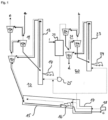
- FIG. 1 schematically shows a device according to the invention comprising a cement clinker manufacturing line 10 and a clay calcination line 20.
- the cement clinker manufacturing line 10 comprises a cement raw meal preheater and calciner section 11 equipped with three cyclones 12a, 12b, 12c for preheating cement raw meal a and a calciner 13 comprising a calciner burner 14 for precalcining the preheated cement raw meal.
- the cement clinker manufacturing line 10 further comprises a rotary kiln 15 equipped with a kiln burner 16 for sintering the precalcined cement raw meal to cement clinker c.
- the cement clinker manufacturing line 10 also comprises a cement clinker cooler 17 equipped with an air supply 18 and means for dividing hot air having passed the clinker cooler 17 into at least two streams.
- the clay calcination line 20 comprises a heat exchange section 21 equipped with three cyclones 22a, 22b, 22c for simultaneously preheating the clay raw material b and separating the calcined clay d from the air.
- the clay calcination line 20 further comprises a clay calcination section 23 adapted for calcining the preheated clay raw material being suspended in gas.
- the clay calcination section 23 is equipped with a clay calcination burner 24.
- a fan 25 is provided to transfer exhaust gas from the clay calcination section 23 to the calciner 13.
- a gas conditioning tower 26 equipped with a supply for water f is foreseen for cooling of the exhaust gas transferred from heat exchange section 21 to the calcination 13. Gas and air streams are indicated with dotted lines and material streams with solid lines in figure 1 .
- cement clinker raw meal a is fed to the gaseous stream rising from cyclone 12b to cyclone 12a.
- Clay raw material b is fed to the gaseous stream rising from cyclone 22b to cyclone 22a.
- Air is fed to the cooler 17 via the gas supply 18.
- Cooled exhaust gas e is discharged from the cement manufacturing line 10 from cyclone 12a and proceeded as normal. Remaining heat in the exhaust gas e can be used e.g. to dry raw materials but also in other ways.
- exhaust gas e from the cement manufacturing line 10 will be vented to the stack of the plant, usually after having been cleaned from NO x , SO x , heavy metals, and dust as needed.
- Such cleaning is known per se and can also occur in and in between devices shown in figure 1 , e.g. in the gas conditioning tower 26.
- Cooled cement clinker c leaves the cooler 17 and is also processed further as known.
- Calcined clay d is cooled after leaving the heat exchange section 21 and having been taken out from the cyclone 22c.
- the exhaust gas from the clay calcination 23 is utilized to preheat the clay raw material b and the cooled gas is transferred to the cement precalcination 13.
- the burners 14, 16, and 24 are fed both with conventional and alternative fuels. The fuel feed is not shown in the figures. In the shown set-up some gas from the cement clinker cooler 17 is transferred to the cement raw meal precalcination 13.
- the device schematically shown in figure 2 is very similar to the embodiment shown in figure 1 , the same parts are designated with the same reference signs.
- the difference between figure 1 and figure 2 is that due to smaller amounts of hot air being used as second combustion air in the clay calcination section 23 a gas conditioning tower is not needed.
- the temperature of the exhaust gas leaving cyclone 22a is low enough to pass it into the fan 25.
- this set-up can also be used with higher exhaust gas temperature when the fan 25 is compatible with such higher temperatures.
- FIG 3 a device with a burning chamber 19 instead of a calciner burner 14 is illustrated.
- exhaust gas from the clay calcination line 20 and tertiary air from clinker cooler 17 are fed into the burning chamber 19.
- the fuel feed is not shown.
- Ashes resulting from burning fuel in the burning chamber 19 are passed into the rotary kiln 15, preferably by adding them to the precalcined raw meal as shown.
Landscapes
- Engineering & Computer Science (AREA)
- Chemical & Material Sciences (AREA)
- Ceramic Engineering (AREA)
- Physics & Mathematics (AREA)
- Thermal Sciences (AREA)
- Materials Engineering (AREA)
- Structural Engineering (AREA)
- Organic Chemistry (AREA)
- Mechanical Engineering (AREA)
- General Engineering & Computer Science (AREA)
- Curing Cements, Concrete, And Artificial Stone (AREA)
Claims (11)
- Verfahren zur kombinierten Herstellung von Zementklinker und kalziniertem Ton, wobei
der Zementklinker durch die Schritte hergestellt wird:Bereitstellen eines Zementklinkerrohmehls, Vorwärmen des Zementklinkerrohmehls, um vorgewärmtes Zementklinkerrohmehl bereitzustellen, Vorkalzinieren des vorgewärmten Zementklinkerrohmehls, um vorkalziniertes Zementklinkerrohmehl bereitzustellen, Sintern des vorkalzinierten Zementklinkerrohmehls in einem Drehrohrofen, um den Zementklinker bereitzustellen, und Kühlen des Zementklinkers mit einem Luftstrom im Gegenstrom wobei Heißluft bereitgestellt wird,und der kalzinierte Ton durch die Schritte hergestellt wird:Bereitstellen eines Tonrohmaterials, Vorwärmen des Tonrohmaterials, um vorgewärmtes Tonrohmaterial bereitzustellen, Kalzinieren des vorgewärmten Tonrohmaterials suspendiert in heißem Gas in einem Flashcalcinator, um den kalzinierten Ton bereitzustellen, und Kühlen des kalzinierten Tons;wobei die heiße Luft vom Kühlen des Zementklinkers in mindestens zwei Ströme aufgeteilt wird, einen ersten Verbrennungsluftstrom, der beim Sintern des vorkalzinierten Zementrohmehls verwendet wird, und einen zweiten Verbrennungsluftstrom, der beim Kalzinieren des vorgewärmten Tonrohmaterials verwendet wird, und wobei Abgas aus dem Kalzinieren des vorgewärmten Tonrohmaterials in die Kalzinierung des vorgewärmten Zementrohmehls geleitet wird. - Verfahren gemäß Anspruch 1, wobei das Abgas aus der Kalzinierung des vorgewärmten Tonrohmaterials mit Wasser konditioniert wird.
- Verfahren gemäß Anspruch 1 oder 2, wobei das vorgewärmte Zementklinkerrohmehl mit Wärme aus einer mit festen Brennstoffen beschickten Brennkammer kalziniert wird.
- Verfahren gemäß einem der Ansprüche 1 bis 3, wobei das vorkalzinierte Zementklinkerrohmehl von 1 oder 5 Gew.-% bis 30 oder 40 Gew.-% Carbonat enthält.
- Verfahren gemäß einem der Ansprüche 1 bis 4, wobei das Tonrohmaterial auf weniger als 1 Gew.-% Feuchtigkeit getrocknet und/oder auf eine Feinheit von weniger als 10 oder 15 Gew.-% Rückstand auf einem 90 µm-Sieb gemahlen wird.
- Verfahren gemäß einem der Ansprüche 1 bis 5, wobei die Temperatur bei der Tonkalzinierung auf einen Bereich von 600, 650, 700 oder 750 °C bis 980, 950, 900 oder 850 °C eingestellt wird.
- Verfahren gemäß einem der Ansprüche 1 bis 6, wobei die Verweilzeit in der Tonkalzinierung auf einen Wert im Bereich von 1, 2 oder 3 Sekunden bis zu 5 oder 10 Sekunden eingestellt wird.
- Vorrichtung für die kombinierte Herstellung von Zementklinker (c) und kalziniertem Ton (d) umfassend eine Zementklinkerherstellungslinie (10) und eine Tonkalzinierungslinie (20),wobei die Zementklinkerherstellungslinie (10) einen Zementklinkerrohmehlvorwärmungs- und -kalzinierungsabschnitt (11) ausgestattet mit zwei oder mehr Zyklonen (12a, 12b, 12c) zum Vorwärmen des Zementklinkerrohmehls (a) und einem Kalzinator (13) umfassend einen Kalzinatorbrenner (14) oder eine Brennkammer (19) zum Vorkalzinieren des vorgewärmten Zementklinkerrohmehls, einen Drehrohrofen (15) ausgestattet mit einem Ofenbrenner (16) zum Sintern des vorkalzinierten Zementklinkerrohmehls zu Zementklinker (c), und einen Zementklinkerkühler (17) ausgestattet mit einer Luftzufuhr (18) zum Kühlen des Zementklinkers (c) und Mitteln zum Aufteilen von Heißluft, die den Klinkerkühler (17) passiert hat, in mindestens zwei Ströme, umfasst,wobei die Tonkalzinierungslinie (20) einen Wärmeaustauschabschnitt (21) ausgestattet mit mindestens zwei Zyklonen (22a, 22b, 22c) zum Vorwärmen eines Tonrohmaterials (b), einen Abschnitt zum Kühlen des kalzinierten Tons (d) und einen Flashcalcinator als Tonkalzinierungsabschnitt (23), der zum Kalzinieren von vorgewärmtem, in Gas suspendiertem Tonrohmaterial geeignet und mit einem Tonkalzinierungsbrenner (24) ausgestattet ist, umfasstund wobei ein Teil der Heißluft aus dem Zementklinkerkühler (17) als erste Verbrennungsluft dem Drehrohrofen (15) zugeführt wird und ein anderer Teil als zweite Verbrennungsluft dem Tonkalzinierungsabschnitt (23) zugeführt wird; und ein Abgas aus dem Tonkalzinierungsabschnitt (23) in den Kalzinator (13) geleitet wird.
- Vorrichtung gemäß Anspruch 8, wobei der Abschnitt zum Kühlen des kalzinierten Tons ein Wärmetauscher, vorzugsweise ein Zyklonwärmetauscher, ist.
- Vorrichtung gemäß Anspruch 8 oder 9 umfassend einen Gaskonditionierturm (26) zur Konditionierung des Abgases aus der Kalzinierung des vorgewärmten Tonrohmaterials.
- Vorrichtung gemäß einem der Ansprüche 8 bis 10 umfassend ein Gebläse (25), vorzugsweise ein Zusatzgebläse, zum Überführen des Abgases aus der Kalzinierung des vorgewärmten Tonrohmaterials in die Kalzinierung des vorgewärmten Zementrohmehls.
Priority Applications (7)
| Application Number | Priority Date | Filing Date | Title |
|---|---|---|---|
| PL21217500.4T PL4201908T3 (pl) | 2021-12-23 | 2021-12-23 | Urządzenie oraz sposób wytwarzania klinkieru cementowego i gliny kalcynowanej |
| EP21217500.4A EP4201908B1 (de) | 2021-12-23 | 2021-12-23 | Vorrichtung und verfahren zur herstellung von zementklinker und kalziniertem ton |
| ES21217500T ES3007511T3 (en) | 2021-12-23 | 2021-12-23 | Device and method for manufacturing cement clinker and calcined clay |
| AU2022420382A AU2022420382A1 (en) | 2021-12-23 | 2022-12-08 | Device and method for manufacturing cement clinker and calcined clay |
| US18/718,104 US20250084000A1 (en) | 2021-12-23 | 2022-12-08 | Device and method for manufacturing cement clinker and calcined clay |
| CA3235237A CA3235237A1 (en) | 2021-12-23 | 2022-12-08 | Device and method for manufacturing cement clinker and calcined clay |
| PCT/EP2022/085001 WO2023117466A1 (en) | 2021-12-23 | 2022-12-08 | Device and method for manufacturing cement clinker and calcined clay |
Applications Claiming Priority (1)
| Application Number | Priority Date | Filing Date | Title |
|---|---|---|---|
| EP21217500.4A EP4201908B1 (de) | 2021-12-23 | 2021-12-23 | Vorrichtung und verfahren zur herstellung von zementklinker und kalziniertem ton |
Publications (3)
| Publication Number | Publication Date |
|---|---|
| EP4201908A1 EP4201908A1 (de) | 2023-06-28 |
| EP4201908B1 true EP4201908B1 (de) | 2024-12-04 |
| EP4201908C0 EP4201908C0 (de) | 2024-12-04 |
Family
ID=79164833
Family Applications (1)
| Application Number | Title | Priority Date | Filing Date |
|---|---|---|---|
| EP21217500.4A Active EP4201908B1 (de) | 2021-12-23 | 2021-12-23 | Vorrichtung und verfahren zur herstellung von zementklinker und kalziniertem ton |
Country Status (7)
| Country | Link |
|---|---|
| US (1) | US20250084000A1 (de) |
| EP (1) | EP4201908B1 (de) |
| AU (1) | AU2022420382A1 (de) |
| CA (1) | CA3235237A1 (de) |
| ES (1) | ES3007511T3 (de) |
| PL (1) | PL4201908T3 (de) |
| WO (1) | WO2023117466A1 (de) |
Families Citing this family (2)
| Publication number | Priority date | Publication date | Assignee | Title |
|---|---|---|---|---|
| FR3158509A1 (fr) * | 2024-01-23 | 2025-07-25 | Fives Fcb | Procédé de réduction d’oxydes de fer III contenus dans une argile calcinée |
| CN119085308B (zh) * | 2024-11-06 | 2025-02-07 | 四川利森建材集团有限公司 | 一种水泥熟料煅烧用回转窑 |
Citations (4)
| Publication number | Priority date | Publication date | Assignee | Title |
|---|---|---|---|---|
| DE102008031165A1 (de) | 2008-07-03 | 2010-01-07 | Outotec Oyj | Verfahren zum Betreiben einer Anlage zur Herstellung von kalziniertem Ton |
| DE102011014498B4 (de) | 2011-03-18 | 2013-04-25 | Outotec Oyj | Verfahren zur Herstellung eines Klinkerersatzstoffes, Klinkerersatzstoff, Verwendung des Klinkerersatzstoffs, Zementklinker, Zement, Mörtel oder Beton, Verfahren zur Herstellung des Zementklinkers oder eines Baustoffs und Bauwerk |
| DE102016005285B3 (de) | 2016-04-30 | 2017-08-10 | Khd Humboldt Wedag Gmbh | Verfahren und Anlage zur Aktivierung von Tonen als Zusatzstoff für Beton |
| WO2021124261A1 (en) | 2019-12-18 | 2021-06-24 | Holcim Technology Ltd | Method of producing cement clinker and a second calcined material |
Family Cites Families (2)
| Publication number | Priority date | Publication date | Assignee | Title |
|---|---|---|---|---|
| FR2764367B1 (fr) | 1997-06-05 | 1999-08-20 | Malet Sa Entreprise | Installation de traitement thermique de matieres pulverulentes en suspension, et application pour la calcination flash de matieres minerales notamment argileuses |
| EP4001236A1 (de) | 2020-11-18 | 2022-05-25 | HeidelbergCement AG | Verfahren zur herstellung eines verbundbindemittels |
-
2021
- 2021-12-23 PL PL21217500.4T patent/PL4201908T3/pl unknown
- 2021-12-23 EP EP21217500.4A patent/EP4201908B1/de active Active
- 2021-12-23 ES ES21217500T patent/ES3007511T3/es active Active
-
2022
- 2022-12-08 AU AU2022420382A patent/AU2022420382A1/en active Pending
- 2022-12-08 WO PCT/EP2022/085001 patent/WO2023117466A1/en not_active Ceased
- 2022-12-08 US US18/718,104 patent/US20250084000A1/en active Pending
- 2022-12-08 CA CA3235237A patent/CA3235237A1/en active Pending
Patent Citations (4)
| Publication number | Priority date | Publication date | Assignee | Title |
|---|---|---|---|---|
| DE102008031165A1 (de) | 2008-07-03 | 2010-01-07 | Outotec Oyj | Verfahren zum Betreiben einer Anlage zur Herstellung von kalziniertem Ton |
| DE102011014498B4 (de) | 2011-03-18 | 2013-04-25 | Outotec Oyj | Verfahren zur Herstellung eines Klinkerersatzstoffes, Klinkerersatzstoff, Verwendung des Klinkerersatzstoffs, Zementklinker, Zement, Mörtel oder Beton, Verfahren zur Herstellung des Zementklinkers oder eines Baustoffs und Bauwerk |
| DE102016005285B3 (de) | 2016-04-30 | 2017-08-10 | Khd Humboldt Wedag Gmbh | Verfahren und Anlage zur Aktivierung von Tonen als Zusatzstoff für Beton |
| WO2021124261A1 (en) | 2019-12-18 | 2021-06-24 | Holcim Technology Ltd | Method of producing cement clinker and a second calcined material |
Non-Patent Citations (14)
| Title |
|---|
| ALONSO MÓNICA, HORNBERGER MATHIAS, SPÖRL REINHOLD, SCHEFFKNECHT GÜNTER, ABANADES CARLOS: "Characterization of a Marl-Type Cement Raw Meal as CO 2 Sorbent for Calcium Looping", ACS OMEGA, ACS PUBLICATIONS, US, vol. 3, no. 11, 30 November 2018 (2018-11-30), US , pages 15229 - 15234, XP093306002, ISSN: 2470-1343, DOI: 10.1021/acsomega.8b01795 |
| ANJAN KUMAR CHATTERJEE: "Cement Prodction Technology Principles and Practice", 8 May 2018, CRC PRESS TAYLOR & FRANCIS GROUP, ISBN: 978-1-138-57066-5, article ANJAN KUMAR CHATTERJEE: "3 Fuels commonly in use for clinker production", pages: 73 - 102, XP009563017, DOI: 10.1201/9780203703335 |
| ANJAN KUMAR CHATTERJEE: "Cement Prodction Technology Principles and Practice", 8 May 2018, CRC PRESS TAYLOR & FRANCIS GROUP, ISBN: 978-1-138-57066-5, article ANJAN KUMAR CHATTERJEE: "4 Alternative fuels and raw materials", pages: 103 - 140, XP009563018, DOI: 10.1201/9780203703335 |
| ANJAN KUMAR CHATTERJEE: "Cement Prodction Technology Principles and Practice", 8 May 2018, CRC PRESS TAYLOR & FRANCIS GROUP, ISBN: 978-1-138-57066-5, article ANJAN KUMAR CHATTERJEE: "5 Pyroprocessing and clinker cooling", pages: 141 - 173, XP009563019, DOI: 10.1201/9780203703335 |
| ANJAN KUMAR CHATTERJEE: "Cement Prodction Technology Principles and Practice", 8 May 2018, CRC PRESS TAYLOR & FRANCIS GROUP, ISBN: 978-1-138-57066-5, article ANJAN KUMAR CHATTERJEE: "9 Environmental mitigation and pollution control technologies", pages: 287 - 326, XP009563020, DOI: 10.1201/9780203703335 |
| ANONYMOUS: "Puzzolane aus Calcinierung kalkhaltiger und dotierter Tone - Untersuchungen zu de-ren Hydratationsverhalten im Zement", VDZ GGMBHFORSCHUNGSINSTITUT DER ZEMENTINDUSTRIE,19744 N, 1 January 2018 (2018-01-01), pages 1 - 5, XP093116633 * |
| B.B SABIR, S WILD, J BAI: "Metakaolin and calcined clays as pozzolans for concrete: a review", CEMENT AND CONCRETE COMPOSITES, ELSEVIER, vol. 23, no. 6, 1 December 2001 (2001-12-01), pages 441 - 454, XP055094814, ISSN: 09589465, DOI: 10.1016/S0958-9465(00)00092-5 |
| CHARLES E. MORTIMER, ULRICH MÜLLER: "Chemie: Das Basiswissen der Chemie, 13. Auflage", 1 January 2020, GEORG THIEME VERLAG KG, Stuttgart, ISBN: 978-3-13-242274-2, article CHARLES E. MORTIMER, ULRICH MÜLLER: "3 Stöchiometrie Teil I: Chemische Formeln", pages: 41 - 49, XP009563022, DOI: 10.1055/b-006-163279 |
| CHARLES E. MORTIMER, ULRICH MÜLLER: "Chemie: Das Basiswissen der Chemie, 13. Auflage", 1 January 2020, GEORG THIEME VERLAG KG, Stuttgart, ISBN: 978-3-13-242274-2, article CHARLES E. MORTIMER, ULRICH MÜLLER: "Die Elemente. Relative Atommassen auf fünf signifikante Stellen, sofern sie so genau bestimmbar sind.", pages: 714 - 714, XP009563021, DOI: 10.1055/b-006-163279 |
| FERREIRO S., CANUT M.M.C., LUND J., HERFORT D.: "Influence of fineness of raw clay and calcination temperature on the performance of calcined clay-limestone blended cements", APPLIED CLAY SCIENCE, ELSEVIER, AMSTERDAM, NL, vol. 169, 1 March 2019 (2019-03-01), AMSTERDAM, NL , pages 81 - 90, XP093306003, ISSN: 0169-1317, DOI: 10.1016/j.clay.2018.12.021 |
| HANEIN THEODORE ET AL: "Clay calcination technology: state-of-the-art review by the RILEM TC 282-CCL", MATERIALS AND STRUCTURES, SPRINGER NETHERLANDS, DORDRECHT, vol. 55, no. 1, 20 December 2021 (2021-12-20), XP037647494, ISSN: 1359-5997, [retrieved on 20211220], DOI: 10.1617/S11527-021-01807-6 * |
| HANEIN THEODORE; THIENEL KARL-CHRISTIAN; ZUNINO FRANCO; MARSH ALASTAIR T. M.; MAIER MATTHIAS; WANG BIN; CANUT MARIANA; JUENGER MAR: "Clay calcination technology: state-of-the-art review by the RILEM TC 282-CCL", MATERIALS AND STRUCTURES, SPRINGER NETHERLANDS, DORDRECHT, vol. 55, no. 1, 20 December 2021 (2021-12-20), Dordrecht, XP037647494, ISSN: 1359-5997, DOI: 10.1617/s11527-021-01807-6 |
| KAHAWALAGE AMILA CHANDRA, MELAAEN MORTEN C., TOKHEIM LARS-ANDRÉ: "SUBSTITUTION OF COAL BY REFUSE DERIVED FUELS (RDF) IN THE PRECALCINER OF A CEMENT KILN SYSTEM", ENERGY AND SUSTAINABILITY VII, WIT PRESS, vol. 1, 20 September 2017 (2017-09-20) - 22 September 2017 (2017-09-22), pages 411 - 423, XP093306000, ISBN: 978-1-78466-221-9, DOI: 10.2495/ESUS170391 |
| MAIA JOEL: "A focus on flash calcining", INTERNATIONAL CEMENT REVIEW, TRADESHIP PUBLICATIONS LTD, 1 January 2021 (2021-01-01), XP093305999, Retrieved from the Internet <URL:https://fctcombustion.com/wp-content/uploads/2021/03/ICRJan-2021-REPRINT-FCT-LR.pdf> |
Also Published As
| Publication number | Publication date |
|---|---|
| PL4201908T3 (pl) | 2025-02-24 |
| AU2022420382A1 (en) | 2024-05-23 |
| CA3235237A1 (en) | 2023-06-29 |
| US20250084000A1 (en) | 2025-03-13 |
| WO2023117466A1 (en) | 2023-06-29 |
| EP4201908A1 (de) | 2023-06-28 |
| ES3007511T3 (en) | 2025-03-20 |
| EP4201908C0 (de) | 2024-12-04 |
Similar Documents
| Publication | Publication Date | Title |
|---|---|---|
| Habert | Assessing the environmental impact of conventional and ‘green’cement production | |
| AU2007320876B2 (en) | Process for the production of cement | |
| US10294152B2 (en) | Method for producing a pozzolanic or latent-hydraulic cement clinker substitute | |
| CN113840813A (zh) | 用于碳化混凝土废料和/或固存co2的改进方法和装置 | |
| CN101041449A (zh) | 从粉煤灰中提取氧化铝及利用废渣生产水泥的方法 | |
| US20250084000A1 (en) | Device and method for manufacturing cement clinker and calcined clay | |
| US20230002277A1 (en) | Method of producing cement clinker and a second calcined material | |
| CN102020251B (zh) | 一种石膏制硫酸与水泥的改进生产工艺 | |
| CN101723610B (zh) | 湿式电石渣全代钙质原料预分解技术煅烧水泥熟料方法 | |
| US4102700A (en) | Process for the production of a mixture to be utilized in the production of building materials and a device for carrying out the process | |
| EP3738939A1 (de) | Verfahren zum kalzinieren von rohmehl für die zementklinkerherstellung | |
| EP4259590B1 (de) | Verfahren zur herstellung einer synthetischen karbonisierten mineralischen komponente in einer zementherstellungsanlage | |
| US20040157181A1 (en) | Method for manufacturing cement clinker | |
| WO2013110810A1 (en) | Use of organic fibre cement as a raw material in the production of cement clinker | |
| US20140178271A1 (en) | Cement Clinker Production with Low Emissions | |
| CN115259102B (zh) | 一种烟气分流制二氧化硫浓烟气和硅酸盐熟料的工艺和设备 | |
| CN105174756A (zh) | 一种利用锰铁渣制备水泥的方法 | |
| AU2009326594B2 (en) | Process for producing cement or cement substitutes | |
| WO2000064832A1 (en) | A plant and a process for manufacturing cement and electricity simultaneously | |
| EP4180404A1 (de) | Verfahren zur herstellung einer synthetischen karbonisierten mineralischen komponente in einer zementherstellungsanlage | |
| Dutta | Utilization of blast furnace slag as a raw material for the manufacture of portland cement clinker | |
| CN118993587A (zh) | 一种分质梯级利用煤气化灰渣大掺量制备的低碳水泥及其制备方法 | |
| Klewsaat | An Overview of Portland Cement and Lime Manufacturing |
Legal Events
| Date | Code | Title | Description |
|---|---|---|---|
| PUAI | Public reference made under article 153(3) epc to a published international application that has entered the european phase |
Free format text: ORIGINAL CODE: 0009012 |
|
| STAA | Information on the status of an ep patent application or granted ep patent |
Free format text: STATUS: THE APPLICATION HAS BEEN PUBLISHED |
|
| AK | Designated contracting states |
Kind code of ref document: A1 Designated state(s): AL AT BE BG CH CY CZ DE DK EE ES FI FR GB GR HR HU IE IS IT LI LT LU LV MC MK MT NL NO PL PT RO RS SE SI SK SM TR |
|
| RAP3 | Party data changed (applicant data changed or rights of an application transferred) |
Owner name: HEIDELBERG MATERIALS AG |
|
| STAA | Information on the status of an ep patent application or granted ep patent |
Free format text: STATUS: REQUEST FOR EXAMINATION WAS MADE |
|
| 17P | Request for examination filed |
Effective date: 20230811 |
|
| RBV | Designated contracting states (corrected) |
Designated state(s): AL AT BE BG CH CY CZ DE DK EE ES FI FR GB GR HR HU IE IS IT LI LT LU LV MC MK MT NL NO PL PT RO RS SE SI SK SM TR |
|
| TPAC | Observations filed by third parties |
Free format text: ORIGINAL CODE: EPIDOSNTIPA |
|
| STAA | Information on the status of an ep patent application or granted ep patent |
Free format text: STATUS: EXAMINATION IS IN PROGRESS |
|
| 17Q | First examination report despatched |
Effective date: 20240318 |
|
| GRAP | Despatch of communication of intention to grant a patent |
Free format text: ORIGINAL CODE: EPIDOSNIGR1 |
|
| STAA | Information on the status of an ep patent application or granted ep patent |
Free format text: STATUS: GRANT OF PATENT IS INTENDED |
|
| INTG | Intention to grant announced |
Effective date: 20240731 |
|
| TPAC | Observations filed by third parties |
Free format text: ORIGINAL CODE: EPIDOSNTIPA |
|
| GRAS | Grant fee paid |
Free format text: ORIGINAL CODE: EPIDOSNIGR3 |
|
| GRAA | (expected) grant |
Free format text: ORIGINAL CODE: 0009210 |
|
| STAA | Information on the status of an ep patent application or granted ep patent |
Free format text: STATUS: THE PATENT HAS BEEN GRANTED |
|
| AK | Designated contracting states |
Kind code of ref document: B1 Designated state(s): AL AT BE BG CH CY CZ DE DK EE ES FI FR GB GR HR HU IE IS IT LI LT LU LV MC MK MT NL NO PL PT RO RS SE SI SK SM TR |
|
| REG | Reference to a national code |
Ref country code: CH Ref legal event code: EP |
|
| REG | Reference to a national code |
Ref country code: DE Ref legal event code: R096 Ref document number: 602021022800 Country of ref document: DE |
|
| REG | Reference to a national code |
Ref country code: IE Ref legal event code: FG4D |
|
| U01 | Request for unitary effect filed |
Effective date: 20241211 |
|
| U07 | Unitary effect registered |
Designated state(s): AT BE BG DE DK EE FI FR IT LT LU LV MT NL PT RO SE SI Effective date: 20241220 |
|
| REG | Reference to a national code |
Ref country code: ES Ref legal event code: FG2A Ref document number: 3007511 Country of ref document: ES Kind code of ref document: T3 Effective date: 20250320 |
|
| U20 | Renewal fee for the european patent with unitary effect paid |
Year of fee payment: 4 Effective date: 20250217 |
|
| PG25 | Lapsed in a contracting state [announced via postgrant information from national office to epo] |
Ref country code: HR Free format text: LAPSE BECAUSE OF FAILURE TO SUBMIT A TRANSLATION OF THE DESCRIPTION OR TO PAY THE FEE WITHIN THE PRESCRIBED TIME-LIMIT Effective date: 20241204 |
|
| PGFP | Annual fee paid to national office [announced via postgrant information from national office to epo] |
Ref country code: ES Payment date: 20250227 Year of fee payment: 4 |
|
| PG25 | Lapsed in a contracting state [announced via postgrant information from national office to epo] |
Ref country code: NO Free format text: LAPSE BECAUSE OF FAILURE TO SUBMIT A TRANSLATION OF THE DESCRIPTION OR TO PAY THE FEE WITHIN THE PRESCRIBED TIME-LIMIT Effective date: 20250304 |
|
| PG25 | Lapsed in a contracting state [announced via postgrant information from national office to epo] |
Ref country code: GR Free format text: LAPSE BECAUSE OF FAILURE TO SUBMIT A TRANSLATION OF THE DESCRIPTION OR TO PAY THE FEE WITHIN THE PRESCRIBED TIME-LIMIT Effective date: 20250305 |
|
| PGFP | Annual fee paid to national office [announced via postgrant information from national office to epo] |
Ref country code: PL Payment date: 20250124 Year of fee payment: 4 |
|
| PG25 | Lapsed in a contracting state [announced via postgrant information from national office to epo] |
Ref country code: RS Free format text: LAPSE BECAUSE OF FAILURE TO SUBMIT A TRANSLATION OF THE DESCRIPTION OR TO PAY THE FEE WITHIN THE PRESCRIBED TIME-LIMIT Effective date: 20250304 |
|
| PG25 | Lapsed in a contracting state [announced via postgrant information from national office to epo] |
Ref country code: SM Free format text: LAPSE BECAUSE OF FAILURE TO SUBMIT A TRANSLATION OF THE DESCRIPTION OR TO PAY THE FEE WITHIN THE PRESCRIBED TIME-LIMIT Effective date: 20241204 |
|
| PG25 | Lapsed in a contracting state [announced via postgrant information from national office to epo] |
Ref country code: IS Free format text: LAPSE BECAUSE OF FAILURE TO SUBMIT A TRANSLATION OF THE DESCRIPTION OR TO PAY THE FEE WITHIN THE PRESCRIBED TIME-LIMIT Effective date: 20250404 |
|
| PG25 | Lapsed in a contracting state [announced via postgrant information from national office to epo] |
Ref country code: SK Free format text: LAPSE BECAUSE OF FAILURE TO SUBMIT A TRANSLATION OF THE DESCRIPTION OR TO PAY THE FEE WITHIN THE PRESCRIBED TIME-LIMIT Effective date: 20241204 |
|
| PG25 | Lapsed in a contracting state [announced via postgrant information from national office to epo] |
Ref country code: CZ Free format text: LAPSE BECAUSE OF FAILURE TO SUBMIT A TRANSLATION OF THE DESCRIPTION OR TO PAY THE FEE WITHIN THE PRESCRIBED TIME-LIMIT Effective date: 20241204 |
|
| REG | Reference to a national code |
Ref country code: CH Ref legal event code: PL |
|
| PLBI | Opposition filed |
Free format text: ORIGINAL CODE: 0009260 |
|
| PG25 | Lapsed in a contracting state [announced via postgrant information from national office to epo] |
Ref country code: MC Free format text: LAPSE BECAUSE OF FAILURE TO SUBMIT A TRANSLATION OF THE DESCRIPTION OR TO PAY THE FEE WITHIN THE PRESCRIBED TIME-LIMIT Effective date: 20241204 |
|
| 26 | Opposition filed |
Opponent name: SUEDBAYERISCHES PORTLAND-ZEMENTWERK GEBR.WIESBOECK & CO. GMBH Effective date: 20250808 |
|
| PLAX | Notice of opposition and request to file observation + time limit sent |
Free format text: ORIGINAL CODE: EPIDOSNOBS2 |
|
| PG25 | Lapsed in a contracting state [announced via postgrant information from national office to epo] |
Ref country code: CH Free format text: LAPSE BECAUSE OF NON-PAYMENT OF DUE FEES Effective date: 20241231 |
|
| PG25 | Lapsed in a contracting state [announced via postgrant information from national office to epo] |
Ref country code: IE Free format text: LAPSE BECAUSE OF NON-PAYMENT OF DUE FEES Effective date: 20241223 |