EP4199700B1 - System zur steuerung und verwaltung von hydroponischen oder ähnlichen kulturen auf modularen regalen - Google Patents
System zur steuerung und verwaltung von hydroponischen oder ähnlichen kulturen auf modularen regalen Download PDFInfo
- Publication number
- EP4199700B1 EP4199700B1 EP21765995.2A EP21765995A EP4199700B1 EP 4199700 B1 EP4199700 B1 EP 4199700B1 EP 21765995 A EP21765995 A EP 21765995A EP 4199700 B1 EP4199700 B1 EP 4199700B1
- Authority
- EP
- European Patent Office
- Prior art keywords
- modular
- crops
- tray
- trays
- control
- Prior art date
- Legal status (The legal status is an assumption and is not a legal conclusion. Google has not performed a legal analysis and makes no representation as to the accuracy of the status listed.)
- Active
Links
Images


Classifications
-
- A—HUMAN NECESSITIES
- A01—AGRICULTURE; FORESTRY; ANIMAL HUSBANDRY; HUNTING; TRAPPING; FISHING
- A01G—HORTICULTURE; CULTIVATION OF VEGETABLES, FLOWERS, RICE, FRUIT, VINES, HOPS OR SEAWEED; FORESTRY; WATERING
- A01G31/00—Soilless cultivation, e.g. hydroponics
- A01G31/02—Special apparatus therefor
- A01G31/06—Hydroponic culture on racks or in stacked containers
-
- A—HUMAN NECESSITIES
- A01—AGRICULTURE; FORESTRY; ANIMAL HUSBANDRY; HUNTING; TRAPPING; FISHING
- A01G—HORTICULTURE; CULTIVATION OF VEGETABLES, FLOWERS, RICE, FRUIT, VINES, HOPS OR SEAWEED; FORESTRY; WATERING
- A01G9/00—Cultivation in receptacles, forcing-frames or greenhouses; Edging for beds, lawn or the like
- A01G9/14—Greenhouses
- A01G9/143—Equipment for handling produce in greenhouses
-
- A—HUMAN NECESSITIES
- A01—AGRICULTURE; FORESTRY; ANIMAL HUSBANDRY; HUNTING; TRAPPING; FISHING
- A01G—HORTICULTURE; CULTIVATION OF VEGETABLES, FLOWERS, RICE, FRUIT, VINES, HOPS OR SEAWEED; FORESTRY; WATERING
- A01G9/00—Cultivation in receptacles, forcing-frames or greenhouses; Edging for beds, lawn or the like
- A01G9/24—Devices or systems for heating, ventilating, regulating temperature, illuminating, or watering, in greenhouses, forcing-frames, or the like
- A01G9/249—Lighting means
-
- Y—GENERAL TAGGING OF NEW TECHNOLOGICAL DEVELOPMENTS; GENERAL TAGGING OF CROSS-SECTIONAL TECHNOLOGIES SPANNING OVER SEVERAL SECTIONS OF THE IPC; TECHNICAL SUBJECTS COVERED BY FORMER USPC CROSS-REFERENCE ART COLLECTIONS [XRACs] AND DIGESTS
- Y02—TECHNOLOGIES OR APPLICATIONS FOR MITIGATION OR ADAPTATION AGAINST CLIMATE CHANGE
- Y02A—TECHNOLOGIES FOR ADAPTATION TO CLIMATE CHANGE
- Y02A40/00—Adaptation technologies in agriculture, forestry, livestock or agroalimentary production
- Y02A40/10—Adaptation technologies in agriculture, forestry, livestock or agroalimentary production in agriculture
- Y02A40/25—Greenhouse technology, e.g. cooling systems therefor
-
- Y—GENERAL TAGGING OF NEW TECHNOLOGICAL DEVELOPMENTS; GENERAL TAGGING OF CROSS-SECTIONAL TECHNOLOGIES SPANNING OVER SEVERAL SECTIONS OF THE IPC; TECHNICAL SUBJECTS COVERED BY FORMER USPC CROSS-REFERENCE ART COLLECTIONS [XRACs] AND DIGESTS
- Y02—TECHNOLOGIES OR APPLICATIONS FOR MITIGATION OR ADAPTATION AGAINST CLIMATE CHANGE
- Y02P—CLIMATE CHANGE MITIGATION TECHNOLOGIES IN THE PRODUCTION OR PROCESSING OF GOODS
- Y02P60/00—Technologies relating to agriculture, livestock or agroalimentary industries
- Y02P60/20—Reduction of greenhouse gas [GHG] emissions in agriculture, e.g. CO2
- Y02P60/21—Dinitrogen oxide [N2O], e.g. using aquaponics, hydroponics or efficiency measures
Definitions
- the present invention relates to a system for controlling and managing hydroponic cultivations located on modular shelves, otherwise known as vertical farming.
- It is a control system comprising a control and management station located inside a series of modular shelves arranged adjacent to one another, in which various vegetable crops are arranged, contained in respective movement trays.
- control and management station there are detection systems useful for checking the status of the cultivations in progress, i.e. able to diagnose the specific situation in which the vegetables are found and to establish any corrections to be applied to the nutrient elements.
- the present invention is advantageously applied in the sector systems for controlling and managing modular structures with a vertical layout intended for hydroponic, aeroponic and aquaponic farming or other similar structures that require the controlled movement of crops, or the like.
- Such modular structures are generally composed of four uprights that enable the positioning of a plurality of shelves intended to contain said trays, adapted to form, together with the uprights, modular shelves having a substantially parallelepiped conformation.
- Such modular structures contain equipment suitable for the containment and development of the vegetables inserted into the respective trays placed on the various levels of the respective structure, i.e. irrigation, lighting, ventilation and climate control systems and systems for the movement of the trays inside the structure or towards the loading/unloading stations.
- hydroponic farming systems even those arranged in vertical farms, are not able to effectively simulate the micro-climate suitable for each type of vegetable, as up to now no modular systems are envisaged to enable the plant development of the different plantations, particularly systems able to bring about the necessary modifications and corrections when necessary.
- the absence of an assiduous system for verifying the vegetal development of the farmed plants means that the trays must be placed at the maximum distance envisaged for their complete development, with notable waste in terms of spaces between the various trays superposed on the same module, which initially, i.e. in the period subsequent to insemination, remain substantially empty.
- Document US 2019307077 A1 discloses a vertical farming system including a storage structure having racks of storage shelves for housing plant-carrying containers.
- Mobile robots travel around the racks to transfer containers of plants to and from the storage shelves.
- one or more mobile robots may transport a container from a storage location to a workstation.
- care may be provided for the plant, including water and/or other nutrients, and data may be gathered on the plant. This may be done by an owner of the plant, or by an automated service robot positioned at the workstation.
- Data gathered on the plant, including for example photographs, may be sent by email or other communications schemes to an owner of the plant.
- Document EP 3326452 A1 discloses an illuminated cultivation storage system and a method for cultivating crops in an illuminated cultivation storage system.
- the system comprises a three-dimensional framework structure forming a grid of vertical and horizontal storage tunnels, a plurality of storage containers for holding growing crops.
- the storage containers being configured to be introduced into the framework structure.
- the system further has a plurality of lighting device, a transport system, and an illumination controller. Further, the interior of the framework structure exhibits distinguishable climate zones, each climate zone having a set of growth parameters including temperature.
- the system further comprises a growth monitoring station which includes sensors for determining a current growth status of crops and a growth controller connected to the transport system and being configured to operate the transport system in order to return storage containers to a designated climate zone based on the determined growth status.
- the present invention intends to make available a control and management system comprising a station for controlling and managing hydroponic cultivations on modular shelves, otherwise known as vertical farming, which is able to eliminate or at least reduce the drawbacks highlighted above.
- the invention sets out in particular to provide a control and management station which is placed inside one of the modular shelves arranged adjacent to one another, so that the crops to be analysed contained in respective modular movement spaces can be transported there.
- the information collected is handled by software included in the system which processes it by analysing the statuses with the expected ones with respect to a set of parameters taken from the typical growth curves, from the expected statuses of nutrient consumption detected by the data coming from the residual solution, if necessary compensating for any deficiencies with the integration of nutrients or whatever is required.
- actuators are also provided, which enable the nutrients to be brought into the tank and in aerial mode, whether they are in liquid or gaseous form.
- the system according to the invention enables the trays containing the crops to be controlled and positioned at different distances from one another, by varying the vertical positioning pitch on the basis of the development of the vegetables, with distance increases by about 100mm or even less vertically for better fragmentation and freedom of possible combinations.
- the system according to the invention enables the various shelves to be assembled or designed, so as to create contiguous, modular and scalable growth environments, wherein every environment is separated from the outside and from other environments of the same type by insulating walls. Such environments are placed in communication by a passage openable on command through which the crops are transitable on a tray.
- Each of these environments can be handled in a differentiated way in relation to the internal environmental parameters.
- the temperature, humidity, gas concentration or other parameters according to requirements can be differentiated and personalised.
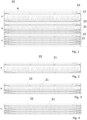
- a modular shelf comprising, in this case, three modular spaces A, B, C adapted to house a plurality of trays 21 alternating with a respective plurality of luminous bars 22, arranged on respective supports located at predefined distances.
- the trays and the luminous bars are arranged on supports distanced in a standardised way from one another vertically, inside respective modular spaces A, B, C, and figures 2, 3 and 4 represent different allocation configurations of the trays containing the crops.
- Configuration A which is better highlighted in figure 2 , comprises a single tray 21 placed below a single luminous bar 22 and in this case the vegetables contained have reached the maximum development envisaged for that modular space.
- Configuration B which is better highlighted in figure 3 , comprises a pair of trays 21 placed below a single luminous bar 22 and in this case the lower tray comprises sprouted plants whereas in the upper one the vegetables contained have reached an intermediate development.
- Configuration C which is better highlighted in figure 4 , comprises three single trays 21 placed below a single luminous bar 22 and in this case all three trays comprise sprouted plants, which require minimal space.
- This system is made so as to be able to position the trays containing the crops at different distances from one another.
- the positioning pitch vertically can for example be about 100mm but it could also be 50mm or a different measurement for better fragmentation and freedom of possible combinations.
- a vegetable grows over time according to generally sigmoid shaped curves and the initial sprouting step takes up much of the growth time. In this period the plant does not grow in height, the formation process of the stem and first leaves and the root system begins, and in this phase it does not occupy any space in height.
- the trays are positioned at a suitable distance from the bottom of the other trays or from the luminous bars.
- This system offers the possibility to handle the cultivations during their growth according to certain but not rigid rules on exposure to light sources which are used to trigger photosynthesis and different growth effects.
- the distance from the light sources is fixed for the entire growth time, from germination or straight after germination (if this takes place in specific rooms), until the end of growth. Therefore, from the first moment of exposure the lamps must emit the maximum number of photons to reach the leaves and trigger photosynthesis. The energy supply for obtaining such exposure is maximum right from the start.
- the system according to the invention enables Lambert's law to be exploited, according to which with the same fluence (micro-moles to the leaf expressed in micro-Einstein) the energy input (electrical for LEDs) depends on the square of the distance.
- E I/r 2 where "E” is the radiation or expected fluence, "I” the energy input, "r” the distance between the emitter (e.g. LED) and the radiated part (the leaves).
- the system according to the invention envisages the possibility to move the plant towards or away from the light source in steps, thanks to the data detected by the control and management station, therefore dynamically following the need to radiate the leaf and saving on the energy input.
- an adaptive and dynamic radiation system is obtained, which can be handled independently and automatically in indoor vertical farming, with the possibility to flexibly manage the plant according to the physiological needs, optimising its exposure to the light source as appropriate and managing the distance so as to also obtain notable energy savings.
- CO 2 generated in the dark phase by the plants is used by the plants placed below the light source, generating a half-closed cycle that is partially self-powered.
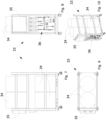
- the modular shelves 23 that compose a vertical farm are constituted by contiguous, modular and scalable growth environments. That is, every modular shelf constitutes a growth environment and is separated from the outside and from other environments of the same type, physically by means of insulating walls 24.
- the various modular shelves 23 are placed in communication with one another through passages 25, openable on command, through which it is possible to make the crops transit on a tray from one modular shelf to another.
- Each of these environments can be handled in a differentiated way in relation to the internal environmental parameters.
- the temperature, humidity, gas concentration and all the aerial parameters inside each modular shelf 23 can be differentiated.
- This system enables the crops to be moved from one environment to another during the time spent inside the modules, so as to obtain an improvement in the growth conditions and without the physical intervention of a human.
- This dynamic condition which can be actuated by the system independently, as a function of the growth results detected with the dedicated sensors in the control areas, enables a dynamic period climate system to be exploited, with the possibility to assign different climatic moments to different crops during the period of their formation and growth in an adaptive or programmed way.
- an area is provided inside a modular shelf, into which the crops contained in movement trays are taken for their analysis.
- control and management station 26 in which sensor control systems are located that are suitable for the detection of a status of the cultivations in progress.
- sensor control systems are located that are suitable for the detection of a status of the cultivations in progress.
- the cameras 27 are combined with an aerial irrigation or spraying system 28, and the whole is placed on a carriage 29 which slides on a crosspiece 30 placed in the upper area of the station 26.
- actuators 31 are also envisaged, for the purpose of collecting the residual nutrient solution in the trays and of introducing new or integrative solution.
- the information collected is handled by the software of the system which processes it by analysing the statuses with the expected ones with respect to a set of parameters taken from the typical growth curves, from the expected statuses of nutrient consumption detected by the data coming from the residual solution.
- the information system assesses the management of the continuation of the crop possibly varying the following parameters:
- control and management station 26 It is also possible for the control and management station 26 to handle in a different way the subsequent positioning of the tray inside the modular shelves, assigning different lighting or distances.
- Figures 7 to 10 represent a first carriage 33 intended for dosing and introducing corrective nutrients in the trays of the controlled hydroponic crops.
- figures 11 to 15 represent schematic views of a second carriage 37 intended for the quality analysis of the controlled residual nutrients, the mixing of the corrective components and their pumping into the hydroponic system.
- such a carriage 37 comprises a value analysis unit 38, a hydraulic pumping unit 39 and a mixing unit 40 of the corrective nutrients to be introduced into the trays of the controlled hydroponic crops.
Landscapes
- Life Sciences & Earth Sciences (AREA)
- Environmental Sciences (AREA)
- Hydroponics (AREA)
- Cultivation Of Plants (AREA)
Claims (7)
- System zum Steuern und Managen von hydroponischen oder ähnlichen Kulturen, die innerhalb mindestens eines modularen Regals (20, 23) angeordnet sind, wobei das mindestens eine modulare Regal (20, 23) mehrere modulare Räume (A, B, C) aufweist, die jeweils dazu ausgebildet sind, mindestens eine Wanne (21) zum Aufnehmen von Gemüsepflanzen und eine Lichtquelle (22), die dazu ausgebildet ist, die Wanne zum Aufnehmen der Gemüsepflanzen zu beleuchten, zu enthalten, wobei jeder modulare Raum (A, B, C) mit Stützelementen für die Wanne versehen ist, die vertikal in vorbestimmten Abständen getrennt sind, wobei die Wanne (21) innerhalb jedes modularen Regals (23) bewegt werden kann, wobei das mindestens eine modulare Regal (20, 23) ferner einen modularen Raum aufweist, der dazu ausgebildet ist, die Wanne (21) aufzunehmen, wobei in diesem Raum eine Steuer- und Managementstation (26) arbeitet, welche Sensoren, die in der Lage sind, die biologischen Parameter der Gemüsepflanzen zu bestimmen, und Aktuatoren (31), die in der Lage sind, die biologischen Parameter zu korrigieren, um diese auf vorbestimmte Wachstumswerte zurückzubringen, aufweist, wobei das System mehrere modulare Regale (20, 23) aufweist, die einander benachbart angeordnet sind und jeweils eine Wachstumsumgebung für Gemüsepflanzen definieren, wobei jede Umgebung von dem Außenbereich und von anderen Umgebungen derselben Art durch Isolierwände (24) getrennt ist, wobei das System dadurch gekennzeichnet ist, dass mindestens zwei der modularen Regale (20, 23) durch mindestens einen Durchgang (25) in Kommunikation miteinander angeordnet sind, der mittels Befehl geöffnet oder geschlossen werden kann und durch den die Pflanzen auf der Wanne passieren können, wobei der mindestens eine Durchgang (25) an dem modularen Raum angeordnet ist, in dem die Steuer- und Managementstation (26) arbeitet.
- System nach Anspruch 1, dadurch gekennzeichnet, dass jede Umgebung in Bezug auf die internen Umgebungsparameter Temperatur, Feuchtigkeit und Gaskonzentration auf differenzierte Weise gemanagt wird.
- System nach einem der vorhergehenden Ansprüche, dadurch gekennzeichnet, dass die Steuer- und Managementstation (26) Sensoren zum Detektieren der Blattabdeckung aufweist, die mittels Kameras (27) analysiert wird, welche mit einem Informationssystem verbunden sind, das dazu konfiguriert ist, die zu unterschiedlichen Zeitpunkten erfassten Bilder, die Informationen bezüglich Blattausdehnungsschwankungen der Gemüsepflanzen enthalten, zu vergleichen und derartige Informationen zu einem weiteren Informationssystem zu übertragen, das dazu konfiguriert ist, die zu unterschiedlichen Zeitpunkten erfassten Bilder zu vergleichen, die vegetativen Schwankungen der Pflanzen zu detektieren und allfällige Korrekturwerte einzustellen.
- System nach den vorhergehenden Ansprüchen, dadurch gekennzeichnet, dass die Aktuatoren (31) dazu konfiguriert sind, Proben von eventuell in einer Wanne vorhandener Restnährstofflösung zu entnehmen und die Proben zu einem Bereich für die Analyse von charakteristischen Parametern zu überführen.
- System nach Anspruch 4, dadurch gekennzeichnet, dass die in der Steuer- und Managementstation (26) erfassten Informationen von einer Steuersystemsoftware behandelt werden, die dazu konfiguriert ist, die detektierten Zustände mit den in Bezug auf einen von typischen Wachstumskurven gewonnenen Satz Parameter erwarteten und den erwarteten Nährstoffverbrauchszuständen, die anhand von aus der Restlösung stammenden Daten detektiert werden, zu vergleichen.
- System nach einem beliebigen der vorhergehenden Ansprüche, dadurch gekennzeichnet, dass es einen ersten Wagen (33) aufweist, der zum Dosieren und Einleiten korrigierender Nährstoffe in die Wannen der kontrollierten hydroponischen Pflanzen bestimmt ist, wobei der Wagen Nährstoffbehälter (34), eine elektrische Steuertafel (35) und eine hydraulische Dosierzentralsteuereinheit (36) aufweist.
- System nach Anspruch 6, dadurch gekennzeichnet, dass es einen zweiten Wagen (37) aufweist, der zur Analyse der Qualität der kontrollierten Restnährstoffe, zum Mischen der korrigierenden Komponenten und zum Pumpen derselben in die die Gemüsepflanzen aufnehmenden Wannen bestimmt ist, wobei der Wagen eine Wertanalyseeinheit (38), eine hydraulische Pumpeinheit (39) und eine Mischeinheit (40) der korrigierenden Nährstoffe, die in die die Gemüsepflanzen aufnehmenden Wannen eingeleitet werden sollen, aufweist.
Applications Claiming Priority (2)
| Application Number | Priority Date | Filing Date | Title |
|---|---|---|---|
| IT202000020326 | 2020-08-21 | ||
| PCT/IB2021/057403 WO2022038462A1 (en) | 2020-08-21 | 2021-08-11 | A system for controlling and managing hydroponic or similar cultivations on modular shelves |
Publications (3)
| Publication Number | Publication Date |
|---|---|
| EP4199700A1 EP4199700A1 (de) | 2023-06-28 |
| EP4199700C0 EP4199700C0 (de) | 2025-04-02 |
| EP4199700B1 true EP4199700B1 (de) | 2025-04-02 |
Family
ID=73038338
Family Applications (1)
| Application Number | Title | Priority Date | Filing Date |
|---|---|---|---|
| EP21765995.2A Active EP4199700B1 (de) | 2020-08-21 | 2021-08-11 | System zur steuerung und verwaltung von hydroponischen oder ähnlichen kulturen auf modularen regalen |
Country Status (4)
| Country | Link |
|---|---|
| US (1) | US20240196821A1 (de) |
| EP (1) | EP4199700B1 (de) |
| CA (1) | CA3192270A1 (de) |
| WO (1) | WO2022038462A1 (de) |
Families Citing this family (1)
| Publication number | Priority date | Publication date | Assignee | Title |
|---|---|---|---|---|
| NL2031566B1 (en) * | 2021-04-13 | 2023-06-08 | Sollum Tech Inc | Methods and systems for controlling horticultural light sources |
Family Cites Families (22)
| Publication number | Priority date | Publication date | Assignee | Title |
|---|---|---|---|---|
| US4713909A (en) * | 1978-05-12 | 1987-12-22 | Peter Roper | Indoor and outdoor cloth farm |
| US8151518B2 (en) * | 2008-06-17 | 2012-04-10 | New York Sun Works | Vertically integrated greenhouse |
| US10624275B1 (en) * | 2010-03-23 | 2020-04-21 | Myles D. Lewis | Semi-automated crop production system |
| US9010022B2 (en) * | 2010-09-09 | 2015-04-21 | Terrasphere Systems Llc | Vertical method and apparatus for growing plants |
| KR101263552B1 (ko) * | 2010-09-10 | 2013-05-13 | 주식회사 엘지씨엔에스 | 식물 재배 장치 및 이를 사용하는 식물 재배 시스템 |
| EP3476206A1 (de) * | 2013-03-14 | 2019-05-01 | Crop One Holdings, Inc. | Led-leuchten-synchronisierung in einem geschlossenen umweltsystem mit hohem wachstum und hoher dichte |
| KR101405345B1 (ko) * | 2013-03-21 | 2014-06-11 | 주식회사 태종 | 조명 위치가 조정되는 양액 순환식 인공재배함 |
| US20180242539A1 (en) * | 2014-03-21 | 2018-08-30 | Deb Ranjan Bhattacharya | An Intelligent Integrated Plant Growth System and a Process of Growing Plant Thereof |
| JP6151663B2 (ja) * | 2014-04-03 | 2017-06-21 | 株式会社椿本チエイン | 栽培システム |
| JP6289257B2 (ja) * | 2014-05-13 | 2018-03-07 | 富士機械製造株式会社 | 栽培装置及び栽培セル |
| WO2016129674A1 (ja) * | 2015-02-13 | 2016-08-18 | 伊東電機株式会社 | 植物栽培装置及び植物栽培システム |
| WO2016166311A1 (en) * | 2015-04-15 | 2016-10-20 | Ocado Innovation Limited | Growing system and method |
| MX2018004070A (es) * | 2015-10-08 | 2018-08-01 | Massivia Grow Holdings Llc | Sistemas y metodos de cultivo. |
| EP3326452B1 (de) * | 2016-11-24 | 2020-06-10 | Heliospectra AB | Anbaulagersystem |
| IT201700092004A1 (it) * | 2017-08-08 | 2019-02-08 | Thomas Ambrosi | Sistema di gestione automatico e modulare di colture idroponiche |
| GB201715204D0 (en) * | 2017-09-20 | 2017-11-01 | Lopez Juan Ramon | A modular, movable, versatile, vertical greenhouse |
| US11663414B2 (en) * | 2018-02-20 | 2023-05-30 | Fluence Bioengineering, Inc. | Controlled agricultural systems and methods of managing agricultural systems |
| US11778956B2 (en) * | 2018-04-06 | 2023-10-10 | Walmart Apollo, Llc | Automated vertical farming system using mobile robots |
| WO2019208279A1 (ja) * | 2018-04-23 | 2019-10-31 | 株式会社プランテックス | 栽培装置 |
| US11483981B1 (en) * | 2018-05-14 | 2022-11-01 | Crop One Holdings, Inc. | Systems and methods for providing a low energy use farm |
| US10440900B1 (en) * | 2019-01-22 | 2019-10-15 | Calyx Cultivation Tech. Corp. | Grow light with adjustable height and emission spectrum |
| US10667468B1 (en) * | 2019-06-19 | 2020-06-02 | Yi-Wen Tang | Spike light and spike light assembly including the same |
-
2021
- 2021-08-11 WO PCT/IB2021/057403 patent/WO2022038462A1/en not_active Ceased
- 2021-08-11 CA CA3192270A patent/CA3192270A1/en active Pending
- 2021-08-11 US US18/042,264 patent/US20240196821A1/en active Pending
- 2021-08-11 EP EP21765995.2A patent/EP4199700B1/de active Active
Also Published As
| Publication number | Publication date |
|---|---|
| CA3192270A1 (en) | 2022-02-24 |
| EP4199700A1 (de) | 2023-06-28 |
| EP4199700C0 (de) | 2025-04-02 |
| WO2022038462A1 (en) | 2022-02-24 |
| US20240196821A1 (en) | 2024-06-20 |
Similar Documents
| Publication | Publication Date | Title |
|---|---|---|
| EP3664597B1 (de) | Automatisches modulares system zur verwaltung von vertikalen farms | |
| JP7370051B2 (ja) | 農業管理システム | |
| EP3326452B1 (de) | Anbaulagersystem | |
| US20210045295A1 (en) | Method for the automated operation of a greenhouse, supply facility and automated greenhouse | |
| CA2793219A1 (en) | Semi-automated crop production system | |
| EP4199700B1 (de) | System zur steuerung und verwaltung von hydroponischen oder ähnlichen kulturen auf modularen regalen | |
| JPH104788A (ja) | 植物工場 | |
| Chun et al. | A closed-type transplant production system | |
| KR101332542B1 (ko) | 식물공장 재배작물의 육묘방법 및 그를 위한 육묘재배 장치 | |
| Kozai et al. | Closed systems with artificial lighting for production of high quality transplants using minimum resource and environmental pollution | |
| CA3051097C (en) | Farming management system | |
| RU203068U1 (ru) | Ферма для выращивания зеленных культур | |
| HK40030467A (en) | Automatic and modular system for managing vertical farms | |
| HK40030467B (en) | Automatic and modular system for managing vertical farms | |
| HK40014075B (zh) | 农用的系统和方法 |
Legal Events
| Date | Code | Title | Description |
|---|---|---|---|
| STAA | Information on the status of an ep patent application or granted ep patent |
Free format text: STATUS: UNKNOWN |
|
| STAA | Information on the status of an ep patent application or granted ep patent |
Free format text: STATUS: THE INTERNATIONAL PUBLICATION HAS BEEN MADE |
|
| PUAI | Public reference made under article 153(3) epc to a published international application that has entered the european phase |
Free format text: ORIGINAL CODE: 0009012 |
|
| STAA | Information on the status of an ep patent application or granted ep patent |
Free format text: STATUS: REQUEST FOR EXAMINATION WAS MADE |
|
| 17P | Request for examination filed |
Effective date: 20230209 |
|
| AK | Designated contracting states |
Kind code of ref document: A1 Designated state(s): AL AT BE BG CH CY CZ DE DK EE ES FI FR GB GR HR HU IE IS IT LI LT LU LV MC MK MT NL NO PL PT RO RS SE SI SK SM TR |
|
| P01 | Opt-out of the competence of the unified patent court (upc) registered |
Effective date: 20230711 |
|
| DAV | Request for validation of the european patent (deleted) | ||
| DAX | Request for extension of the european patent (deleted) | ||
| GRAP | Despatch of communication of intention to grant a patent |
Free format text: ORIGINAL CODE: EPIDOSNIGR1 |
|
| STAA | Information on the status of an ep patent application or granted ep patent |
Free format text: STATUS: GRANT OF PATENT IS INTENDED |
|
| GRAS | Grant fee paid |
Free format text: ORIGINAL CODE: EPIDOSNIGR3 |
|
| GRAA | (expected) grant |
Free format text: ORIGINAL CODE: 0009210 |
|
| STAA | Information on the status of an ep patent application or granted ep patent |
Free format text: STATUS: THE PATENT HAS BEEN GRANTED |
|
| INTG | Intention to grant announced |
Effective date: 20250129 |
|
| AK | Designated contracting states |
Kind code of ref document: B1 Designated state(s): AL AT BE BG CH CY CZ DE DK EE ES FI FR GB GR HR HU IE IS IT LI LT LU LV MC MK MT NL NO PL PT RO RS SE SI SK SM TR |
|
| REG | Reference to a national code |
Ref country code: GB Ref legal event code: FG4D |
|
| REG | Reference to a national code |
Ref country code: CH Ref legal event code: EP |
|
| REG | Reference to a national code |
Ref country code: IE Ref legal event code: FG4D |
|
| REG | Reference to a national code |
Ref country code: DE Ref legal event code: R096 Ref document number: 602021028600 Country of ref document: DE |
|
| U01 | Request for unitary effect filed |
Effective date: 20250429 |
|
| U07 | Unitary effect registered |
Designated state(s): AT BE BG DE DK EE FI FR IT LT LU LV MT NL PT RO SE SI Effective date: 20250507 |
|
| P04 | Withdrawal of opt-out of the competence of the unified patent court (upc) registered |
Free format text: CASE NUMBER: APP_20772/2025 Effective date: 20250430 |
|
| U20 | Renewal fee for the european patent with unitary effect paid |
Year of fee payment: 5 Effective date: 20250806 |
|
| PG25 | Lapsed in a contracting state [announced via postgrant information from national office to epo] |
Ref country code: ES Free format text: LAPSE BECAUSE OF FAILURE TO SUBMIT A TRANSLATION OF THE DESCRIPTION OR TO PAY THE FEE WITHIN THE PRESCRIBED TIME-LIMIT Effective date: 20250402 |
|
| PG25 | Lapsed in a contracting state [announced via postgrant information from national office to epo] |
Ref country code: NO Free format text: LAPSE BECAUSE OF FAILURE TO SUBMIT A TRANSLATION OF THE DESCRIPTION OR TO PAY THE FEE WITHIN THE PRESCRIBED TIME-LIMIT Effective date: 20250702 Ref country code: GR Free format text: LAPSE BECAUSE OF FAILURE TO SUBMIT A TRANSLATION OF THE DESCRIPTION OR TO PAY THE FEE WITHIN THE PRESCRIBED TIME-LIMIT Effective date: 20250703 |
|
| PG25 | Lapsed in a contracting state [announced via postgrant information from national office to epo] |
Ref country code: PL Free format text: LAPSE BECAUSE OF FAILURE TO SUBMIT A TRANSLATION OF THE DESCRIPTION OR TO PAY THE FEE WITHIN THE PRESCRIBED TIME-LIMIT Effective date: 20250402 |
|
| PG25 | Lapsed in a contracting state [announced via postgrant information from national office to epo] |
Ref country code: HR Free format text: LAPSE BECAUSE OF FAILURE TO SUBMIT A TRANSLATION OF THE DESCRIPTION OR TO PAY THE FEE WITHIN THE PRESCRIBED TIME-LIMIT Effective date: 20250402 |
|
| PG25 | Lapsed in a contracting state [announced via postgrant information from national office to epo] |
Ref country code: RS Free format text: LAPSE BECAUSE OF FAILURE TO SUBMIT A TRANSLATION OF THE DESCRIPTION OR TO PAY THE FEE WITHIN THE PRESCRIBED TIME-LIMIT Effective date: 20250702 |
|
| PG25 | Lapsed in a contracting state [announced via postgrant information from national office to epo] |
Ref country code: IS Free format text: LAPSE BECAUSE OF FAILURE TO SUBMIT A TRANSLATION OF THE DESCRIPTION OR TO PAY THE FEE WITHIN THE PRESCRIBED TIME-LIMIT Effective date: 20250802 |
|
| PG25 | Lapsed in a contracting state [announced via postgrant information from national office to epo] |
Ref country code: SM Free format text: LAPSE BECAUSE OF FAILURE TO SUBMIT A TRANSLATION OF THE DESCRIPTION OR TO PAY THE FEE WITHIN THE PRESCRIBED TIME-LIMIT Effective date: 20250402 |
|
| PG25 | Lapsed in a contracting state [announced via postgrant information from national office to epo] |
Ref country code: CZ Free format text: LAPSE BECAUSE OF FAILURE TO SUBMIT A TRANSLATION OF THE DESCRIPTION OR TO PAY THE FEE WITHIN THE PRESCRIBED TIME-LIMIT Effective date: 20250402 |
|
| PG25 | Lapsed in a contracting state [announced via postgrant information from national office to epo] |
Ref country code: SK Free format text: LAPSE BECAUSE OF FAILURE TO SUBMIT A TRANSLATION OF THE DESCRIPTION OR TO PAY THE FEE WITHIN THE PRESCRIBED TIME-LIMIT Effective date: 20250402 |
|
| PLBE | No opposition filed within time limit |
Free format text: ORIGINAL CODE: 0009261 |
|
| STAA | Information on the status of an ep patent application or granted ep patent |
Free format text: STATUS: NO OPPOSITION FILED WITHIN TIME LIMIT |
|
| REG | Reference to a national code |
Ref country code: CH Ref legal event code: L10 Free format text: ST27 STATUS EVENT CODE: U-0-0-L10-L00 (AS PROVIDED BY THE NATIONAL OFFICE) Effective date: 20260211 |
|
| 26N | No opposition filed |
Effective date: 20260105 |
|
| REG | Reference to a national code |
Ref country code: CH Ref legal event code: H13 Free format text: ST27 STATUS EVENT CODE: U-0-0-H10-H13 (AS PROVIDED BY THE NATIONAL OFFICE) Effective date: 20260324 |
|
| PG25 | Lapsed in a contracting state [announced via postgrant information from national office to epo] |
Ref country code: MC Free format text: LAPSE BECAUSE OF FAILURE TO SUBMIT A TRANSLATION OF THE DESCRIPTION OR TO PAY THE FEE WITHIN THE PRESCRIBED TIME-LIMIT Effective date: 20250402 |
|
| PG25 | Lapsed in a contracting state [announced via postgrant information from national office to epo] |
Ref country code: CH Free format text: LAPSE BECAUSE OF NON-PAYMENT OF DUE FEES Effective date: 20250831 |