EP4199197A1 - Sensor system, sensor device, and sensing method - Google Patents
Sensor system, sensor device, and sensing method Download PDFInfo
- Publication number
- EP4199197A1 EP4199197A1 EP21855966.4A EP21855966A EP4199197A1 EP 4199197 A1 EP4199197 A1 EP 4199197A1 EP 21855966 A EP21855966 A EP 21855966A EP 4199197 A1 EP4199197 A1 EP 4199197A1
- Authority
- EP
- European Patent Office
- Prior art keywords
- conductive part
- sensor
- conductive
- functional
- voltage
- Prior art date
- Legal status (The legal status is an assumption and is not a legal conclusion. Google has not performed a legal analysis and makes no representation as to the accuracy of the status listed.)
- Withdrawn
Links
Images

Classifications
-
- G—PHYSICS
- G01—MEASURING; TESTING
- G01R—MEASURING ELECTRIC VARIABLES; MEASURING MAGNETIC VARIABLES
- G01R27/00—Arrangements for measuring resistance, reactance, impedance, or electric characteristics derived therefrom
- G01R27/02—Measuring real or complex resistance, reactance, impedance, or other two-pole characteristics derived therefrom, e.g. time constant
- G01R27/16—Measuring impedance of element or network through which a current is passing from another source, e.g. cable, power line
-
- G—PHYSICS
- G01—MEASURING; TESTING
- G01N—INVESTIGATING OR ANALYSING MATERIALS BY DETERMINING THEIR CHEMICAL OR PHYSICAL PROPERTIES
- G01N27/00—Investigating or analysing materials by the use of electric, electrochemical, or magnetic means
- G01N27/26—Investigating or analysing materials by the use of electric, electrochemical, or magnetic means by investigating electrochemical variables; by using electrolysis or electrophoresis
- G01N27/416—Systems
-
- G—PHYSICS
- G01—MEASURING; TESTING
- G01N—INVESTIGATING OR ANALYSING MATERIALS BY DETERMINING THEIR CHEMICAL OR PHYSICAL PROPERTIES
- G01N27/00—Investigating or analysing materials by the use of electric, electrochemical, or magnetic means
- G01N27/02—Investigating or analysing materials by the use of electric, electrochemical, or magnetic means by investigating impedance
-
- H—ELECTRICITY
- H01—ELECTRIC ELEMENTS
- H01M—PROCESSES OR MEANS, e.g. BATTERIES, FOR THE DIRECT CONVERSION OF CHEMICAL ENERGY INTO ELECTRICAL ENERGY
- H01M14/00—Electrochemical current or voltage generators not provided for in groups H01M6/00 - H01M12/00; Manufacture thereof
-
- H—ELECTRICITY
- H02—GENERATION; CONVERSION OR DISTRIBUTION OF ELECTRIC POWER
- H02J—ELECTRIC POWER NETWORKS; CIRCUIT ARRANGEMENTS OR SYSTEMS FOR SUPPLYING OR DISTRIBUTING ELECTRIC POWER; SYSTEMS FOR STORING ELECTRIC ENERGY
- H02J7/00—Circuit arrangements for charging or discharging batteries or for supplying loads from batteries
-
- G—PHYSICS
- G01—MEASURING; TESTING
- G01N—INVESTIGATING OR ANALYSING MATERIALS BY DETERMINING THEIR CHEMICAL OR PHYSICAL PROPERTIES
- G01N27/00—Investigating or analysing materials by the use of electric, electrochemical, or magnetic means
- G01N27/02—Investigating or analysing materials by the use of electric, electrochemical, or magnetic means by investigating impedance
- G01N27/04—Investigating or analysing materials by the use of electric, electrochemical, or magnetic means by investigating impedance by investigating resistance
- G01N27/041—Investigating or analysing materials by the use of electric, electrochemical, or magnetic means by investigating impedance by investigating resistance of a solid body
-
- H—ELECTRICITY
- H02—GENERATION; CONVERSION OR DISTRIBUTION OF ELECTRIC POWER
- H02J—ELECTRIC POWER NETWORKS; CIRCUIT ARRANGEMENTS OR SYSTEMS FOR SUPPLYING OR DISTRIBUTING ELECTRIC POWER; SYSTEMS FOR STORING ELECTRIC ENERGY
- H02J2207/00—Details of circuit arrangements for charging or discharging batteries or supplying loads from batteries
- H02J2207/20—Charging or discharging characterised by the power electronics converter
-
- H—ELECTRICITY
- H02—GENERATION; CONVERSION OR DISTRIBUTION OF ELECTRIC POWER
- H02J—ELECTRIC POWER NETWORKS; CIRCUIT ARRANGEMENTS OR SYSTEMS FOR SUPPLYING OR DISTRIBUTING ELECTRIC POWER; SYSTEMS FOR STORING ELECTRIC ENERGY
- H02J7/00—Circuit arrangements for charging or discharging batteries or for supplying loads from batteries
- H02J7/855—Circuit arrangements for charging or discharging batteries or for supplying loads from batteries with circuits adapted for supplying loads from the battery
Definitions
- the present invention relates to a sensor system comprising a sensor operating on a self-sustaining power source.
- Electrodes There is a device in which two different kinds of metals are used as electrodes and immersed in an electrolytic solution to cause an oxidation reaction or a reduction reaction in each electrode to create a path through which electrons flow (that is, a battery), such as a voltaic battery or a Daniels battery.
- a battery such as a voltaic battery or a Daniels battery.
- a liquid used as an electrolytic solution of a battery may adversely affect a human body and an environment, such as fear of chemical burn, fear of fire or explosion, or generation of toxic gas, and thus handling of the electrolytic solution is very difficult.
- Patent Literature 1 JP 2007-181278 A
- At least one object of the present invention is to provide a sensor system comprising a sensor operating on a self-sustaining power source.
- the present invention solves the above problem by any of the following [1] to [18].
- a sensor system comprising a sensor operating on a self-sustaining power source.
- Fig. 1 is a block diagram illustrating a configuration of a sensor according to an embodiment of the present invention.
- the sensor includes a first conductive part 1, a second conductive part 2, a functional part 3, and a medium 4.
- the first conductive part 1 and the functional part 3 are electrically connected to each other, and the functional part 3 and the second conductive part 2 are electrically connected to each other.
- the term "electrically connected” means, for example, energizably connected by a conductive wire or the like.
- a part or the whole of the first conductive part 1 and the second conductive part 2 are in contact with the medium 4.
- the first conductive part 1 and the second conductive part 2 are not in contact with each other.
- the term "not in contact” refers to, for example, a state in which the first conductive part 1 and the second conductive part 2 are not in direct contact with each other.
- the distance between the position where the first conductive part 1 is in contact with the medium 4 and the position where the second conductive part 2 is in contact with the medium 4 is preferably 1 cm or more, more preferably 10 cm or more, still more preferably 100 cm or more, and particularly preferably 1000 cm (10 m) or more.
- both the first conductive part 1 and the second conductive part 2 have conductivity.
- examples of the material of the first conductive part 1 and the second conductive part 2 include metal, a conductive polymer, carbon, and the like.
- Shapes of the first conductive part 1 and the second conductive part 2 are not particularly limited.
- the first conductive part 1 and the second conductive part 2 may have a rectangular parallelepiped shape, a round columnar shape (rod shape), a pyramid shape, a conical shape, a plate shape, or a string shape, and may have any shape.
- the metal used for the first conductive part 1 and the second conductive part 2 can be appropriately selected from, for example, silver, copper, gold, aluminum, magnesium, zinc, nickel, platinum, tin, titanium, stainless steel, zinc oxide, magnesium oxide, oxides of the above-described metals, and the like.
- a predetermined metal may be coated with another metal different from the predetermined metal or another material having conductivity.
- first conductive part 1 and the second conductive part 2 may be different from each other, or may be the same as each other.
- a round columnar rod made of stainless steel can be used for the first conductive part 1
- a round columnar rod made of zinc can be used for the second conductive part 2.
- the first conductive part 1 and the second conductive part 2 are connected to the functional part 3 or a voltage boost circuit/voltage step-down circuit by a conductive wire.
- the measured value is preferably 100 ⁇ or more.
- a conductive part serving as a starting point of a current is defined as the first conductive part 1
- a conductive part serving as an ending point is defined as the second conductive part 2.
- Which conductive part functions as the first conductive part 1 is determined by a material of the conductive part or an environment surrounding the conductive part (for example, temperature, humidity, atmospheric pressure, pH, and the like). A chemical reaction occurs at an interface between the first conductive part 1 or the second conductive part 2 and the medium 4, and free electrons are generated in the conductive part.
- the conductive part made of a metal having a lower standard electrode potential is used as the first conductive part 1
- the conductive part made of a metal having a higher standard electrode potential is used as the second conductive part 2.
- electrons move from the second conductive part 2 toward the functional part 3
- electrons move from the functional part 3 toward the first conductive part 1. That is, a current is generated from the first conductive part 1 side to the second conductive part 2 side via the functional part 3.
- the metal constituting the conductive part is eluted as a cation into the medium 4 to generate free electrons, and in the first conductive part 1, the cation in water of the medium 4 reacts with the electrons to be electrically neutralized.
- the level of the standard electrode potential is determined by comparing relative values (relative values) of the standard electrode potentials of substances, and is not determined by using an absolute value of the standard electrode potential. For example, when substance A having a standard electrode potential of -5 V is compared with substance B having a standard electrode potential of +2 V, the standard electrode potential of substance A is low, and the standard electrode potential of substance B is high.
- either one of the conductive parts functions as the first conductive part 1 and the other conductive part functions as the second conductive part 2 depending on the conditions of the surrounding environment of the conductive parts, such as temperature, humidity, atmospheric pressure, and pH, for example, and a current is generated. Therefore, when conditions such as ambient temperature, humidity, atmospheric pressure, and pH of the two conductive parts are changed, the one functioning as the first conductive part may function as the second conductive part, and the one functioning as the second conductive part may function as the first conductive part.
- the electromotive force generated from the first conductive part 1 and the second conductive part 2 is preferably 0.9 V or less, more preferably 0.35 V or less, and still more preferably 0.25 V or less.
- the electromotive force generated from the first conductive part 1 and the second conductive part 2 is preferably 5 mV or more.
- the functional part 3 is, for example, a part that executes a predetermined function by energization.
- the functional part 3 can include an electric consumption part that consumes electric power and exerts a predetermined function, an electric storage part that stores electricity generated in a conductive part, an output voltage conversion part or the like that converts a voltage to be output, such as a voltage boost circuit and a voltage step-down circuit, a control part such as a microcomputer that controls a circuit, and a communication part or the like capable of wirelessly communicating with other devices.
- any of a light source such as an incandescent light bulb or a light emitting diode, a heat generator that emits heat, a sounding body that emits sound, a transmitter that emits a signal, and the like can be adopted.
- the electric storage part may be included in the voltage boost circuit or the voltage step-down circuit.
- a control part such as a microcomputer can control a circuit to release the electricity stored in the electric storage part under a predetermined condition. The released electricity is consumed by the electric consumption part.
- electric power is consumed slightly, and thus, it is possible to perform control so as to release the stored electricity while securing electric power necessary for activating the control part.
- the functional part 3 may include any one of the electric consumption part, the electric storage part, the output voltage conversion part, the communication part, and the control part, and may be formed by combining any two or more of the power consumption part, the electric storage part, the output voltage conversion part, the communication part, and the control part.
- the functional part 3 may be formed by integrally forming any two or more of the electric consumption part, the electric storage part, the output voltage conversion part, the communication part, and the control part, or may be formed separately while electrically connecting any of the electric consumption part, the electric storage part, the output voltage conversion part, the communication part, and the control part.
- Input impedance in the functional part 3 is preferably 1 k ⁇ or more, and more preferably 10 k ⁇ or more.
- the input impedance of the functional part 3 preferably has a non-linear current-voltage characteristic (I-V characteristic).
- the non-linear current-voltage characteristic refers to, for example, a case where, in a voltage change when a current flows through the functional part 3, the voltage value increases as a current value increases, but as the current value increases, an increase width of the voltage value required to increase the current value increases, and the voltage is not proportional to the current.
- the current value increases as the voltage value applied to the functional part 3 increases, but the degree of increase in the current value, which is increased by an increase in the voltage value, decreases as the voltage value increases, and the current value is not proportional to the voltage value. Since the input impedance in the functional part 3 has the non-linear current-voltage characteristic, the electromotive force generated between the first conductive part 1 and the second conductive part 2 is easily maintained.
- the functional part 3 preferably has a function of converting output impedance. As a result, an influence on an input signal of the functional part 3 can be controlled.
- the functional part 3 includes the electric storage part, and stores electric charge supplied from the first conductive part and/or the second conductive part.
- the control part performs control to release the stored electric charge in a time shorter than a time required to store the electric charge.
- the lower limit value of the operating voltage of the functional part 3 is preferably 0.9 V or less. It is more preferable to operate at 0.35 V or less, and it is still more preferable to operate at 20 mV or less.
- the medium 4 may be in any form of a gas, a liquid, and a solid.
- the medium 4 may be sol or gel.
- the medium 4 is not particularly limited as long as it can cause a chemical reaction at the interface between the first conductive part 1 and the second conductive part 2.
- the medium 4 may contain an electrolyte.
- the gas is not particularly limited as long as it is a gas when used in the present sensor, and examples thereof include oxygen, carbon dioxide, nitrogen, hydrogen, methane, and the like. When a gas is used as the medium 4, only a single type of gas may be used, or a mixture of a plurality of types of these gases may be used.
- the liquid used as the medium 4 is not particularly limited as long as it is a liquid when used in the present sensor, and, for example, not only water but also an organic solvent having high polarity, an organic solvent having low polarity, or a non-polar organic solvent can be used.
- the liquid used as the medium 4 may be a mixture of water and an organic solvent having high polarity, a mixture of two or more different organic solvents, an emulsion, or the like.
- As the water not only pure water but also water containing an electrolyte can be used.
- the concentration of cations may be 1 mol/L or less, 0.6 mol/L or less, 0.1 mol/L or less, 0.01 mol/L or less, 0.001 mol/L or less.
- the medium 4 does not have to be an electrolytic solution used in a battery.
- organic solvent having high polarity for example, lower alcohols such as methanol and ethanol, lower carboxylic acids such as formic acid and acetic acid, acetone, tetrahydrofuran, dimethyl sulfoxide, and the like can be used.
- organic solvent having low polarity higher alcohols such as hexanol and octanol, higher carboxylic acids such as hexanoic acid and octanoic acid, or the like can be used.
- non-polar organic solvent include aliphatic hydrocarbons such as hexane, octane, and nonane, and aromatic compounds such as benzene, toluene, and xylene.
- a liquid is used as the medium 4 only a single type of liquid may be used, or a mixture of a plurality of types of these liquids may be used.
- the solid used as the medium 4 is not particularly limited as long as it is a solid when used in the present sensor, and may be, for example, wood, plastic, metal, ceramics, concrete, or the like.
- a powdery or granular solid such as sand or soil can be used, and a plurality of stones or rocks stacked can also be used.
- sand, soil, stones, or rocks stacked on one another are used as the medium 4, fine voids are generated in the medium 4, but even if there are such voids, it is sufficient that the medium 4 is physically connected.
- One medium 4 can be formed by physically connecting mediam 4 having different compositions and characteristics. For example, when plastic is in contact with the first conductive part 1 and wood is in contact with the second conductive part 2, the plastic and wood come into contact with each other to function as the medium 4.
- Resistance value of the medium 4 between the first conductive part 1 and the second conductive part 2 is preferably 1 k ⁇ or more, and more preferably 10 k ⁇ or more.
- the medium 4 may be an insulator.
- the insulator refers to, for example, a non-conductor, and refers to a substance having a property of hardly passing electricity or heat.
- the electrical conductivity of the insulator is preferably 10 -5 S/m or less, more preferably 10 -8 S/m, and still more preferably 10 -11 S/m.
- the medium 4 preferably contains moisture.
- the water content of the medium 4 such as sand or soil is preferably 1% by mass or more, more preferably 5% by mass or more, and still more preferably 10% by mass or more.
- the water content of the medium 4 is preferably 200% by mass or less.
- the water content refers to a value obtained by dividing the weight of water by the sum of the weight of water and the weight of solid content.
- a sensor includes the first conductive part 1, the second conductive part 2, the functional part 3, and the medium 4.
- the medium 4 is in contact with both the first conductive part 1 and the second conductive part, and the functional part 3 is electrically connected to the first conductive part 1 and the second conductive part 2.
- a sensor according to an embodiment of the present invention may use a medium 4a and a medium 4b instead of the medium 4.
- the medium 4a and the medium 4b may be different types of media from each other, or may be the same type of media.
- the medium 4a and the medium 4b are housed in different containers and are in a not-in-contact state.
- a sensor according to an embodiment of the present invention may electrically connect the first conductive part 1 and the second conductive part 2 without using the medium 4.
- a plurality of first conductive parts 1a, 1b to 1n may be electrically connected in parallel.
- a plurality of second conductive parts 2a, 2b to 2m may be electrically connected in parallel.
- the plurality of first conductive parts 1a, 1b to 1n may be electrically connected in series.
- the plurality of second conductive parts 2a, 2b to 2m may be electrically connected in series.
- a part or the whole of the first conductive part 1 may be covered with an insulating part 5a, and a part or the whole of the second conductive part 2 may be covered with an insulating part 5b.
- the insulating parts 5a and 5b function as the medium 4.
- the insulating parts 5a and 5b may be made of insulators different from each other, or may be made of insulators having the same composition or properties.
- Figs. 1A to 1E may be combined.
- the combination is not limited as long as it is an aspect that exerts the effect of the present invention.
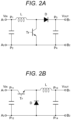
- Fig. 2 is a block diagram illustrating a configuration of an electric power conversion part according to an embodiment of the present invention.
- Fig. 2A is a circuit diagram of a voltage boost circuit according to an embodiment of the present invention.
- a voltage boost circuit or a voltage step-down circuit is an example of the functional part 3, and includes an electric storage part.
- an inductor L, a diode D, a transistor Tr, and a capacitor C are electrically connected.
- an input terminal A1 is connected to the first conductive part 1
- an input terminal A2 is connected to the second conductive part 2.
- An output terminal B1 and an output terminal B2 are connected to an electric consumption part, a control part, and the like.
- the control part may be connected in parallel with the voltage boost circuit between the voltage boost circuit, and the first conductive part 1 and the second conductive part 2.
- the voltage boost circuit may be based on the premise that the input voltage V IN is a voltage lower than a predetermined voltage, and boost control may not be executed at a voltage higher than the predetermined voltage.
- the input voltage V IN of the voltage boost circuit is preferably 5 mV or more. Note that ON/OFF of the transistor Tr is controlled by the control part.
- Fig. 2B is a circuit diagram of a voltage step-down circuit according to an embodiment of the present invention.
- the transistor Tr, the inductor L, the diode D, and the capacitor C are electrically connected.
- the input terminal A1 is connected to the first conductive part 1
- the input terminal A2 is connected to the second conductive part 2.
- the output terminal B1 and the output terminal B2 are connected to the electric consumption part, the control part, and the like.
- the control part may be connected in parallel with the voltage step-down circuit between the voltage step-down circuit, and the first conductive part 1 and the second conductive part 2.
- the input voltage V IN is the potential difference between a connection point P 11 and a connection point P 12
- the output voltage V OUT is the potential difference between a connection point P 13 and a connection point P 14 .
- the input voltage V IN is substantially equal to the output voltage V OUT .
- the voltage step-down circuit may be based on the premise that the input voltage V IN is higher than a predetermined voltage, and step-down control may not be executed at a voltage lower than the predetermined voltage. Note that ON/OFF of the transistor Tr is controlled by the control part.
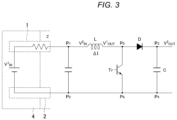
- Fig. 3 is a diagram illustrating a sensor according to an embodiment of the present invention.
- the potential difference between the first conductive part 1 and the second conductive part 2 can be defined as V 1 IN
- the potential difference between the connection point P 1 and the connection point P 2 can be defined as V 2 IN
- the potential difference between a connection point P 5 and a connection point P 6 can be defined as V 1 OUT
- the potential difference between the connection point P 3 and the connection point P 4 can be defined as V 2 OUT .
- a voltage boost circuit is connected to the first conductive part 1 at the connection point P 1 , and to the second conductive part 2 at the connection point P 2 .
- the inductor L, the diode D, the transistor Tr, and the capacitor C are electrically connected.
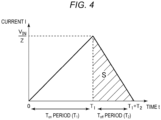
- Fig. 4 is a diagram illustrating a relationship between time and the current I when ON/OFF of the transistor in the sensor is switched according to an embodiment of the present invention.
- V 1 OUT - V 2 IN -L1 ⁇ dI/dt that dI/dt is a negative value. In this case, the current I decreases with time. The ON and OFF of the transistor Tr are periodically repeated.
- the first conductive part 1, the second conductive part 2, and the medium 4 are regarded as one type of battery, it can be considered that the current I flows due to the electromotive force V 1 IN .
- the internal impedance caused by the medium 4 is defined as Z
- I(t) V 1 IN /Z + A ⁇ e (-Z/L1 ⁇ t) is derived, where A is an integral constant.
- the current I while the transistor Tr is ON (hereinafter, referred to as a T on period) can be calculated by Equation (6).
- V' out V start + V f is a constant.
- the current I during the T off period can be expressed by a function of time t, the capacitor capacitance C1, the internal impedance Z, the inductance L1, V 1 IN , V' out , and K.
- I(T2) 0.
- the capacitor capacitance C1, the inductance L1, and V' out are constants, and when I(0) and T2 are measured, the values of V 1 IN and Z can be calculated.
- V 1 IN V 2 IN at the time point when the T off period is sufficiently long (the time point when the current I is consumed)
- V 1 IN can be specified by measuring V 2 IN .
- a sensor system is a sensor system utilizing the sensor described above.
- the control part of the sensor measures the internal impedance Z, or the input voltage V IN or the output voltage V OUT in the voltage boost circuit or the voltage step-down circuit in the sensor. That is, when the first conductive part 1 and the second conductive part 2 of the sensor come into contact with the medium 4, the internal impedance Z, or the input voltage V IN or the output voltage V OUT in the voltage boost circuit or the voltage step-down circuit in the sensor is measured.
- the input voltage V IN to be measured may be, for example, an input voltage V 2 IN when the T off period is sufficiently long and the current I becomes zero
- the output voltage V OUT to be measured by the sensor may be, for example, an output voltage V 2 OUT when the T off period is sufficiently long and the current I becomes zero
- the input voltage V IN to be measured by the sensor may be, for example, an input voltage V 2 IN at the time when the T off period is started
- the output voltage V OUT to be measured by the sensor may be, for example, an output voltage V 2 OUT at the time when the T off period is started.
- the input voltage V 2 IN at the start of the T off period is a value dependent on the impedance Z as is clear from Equation (3). Conversely, by measuring the input voltage V 2 IN , the fluctuation of the input voltage including the impedance Z can be grasped. Therefore, the input voltage V 2 IN at the start of the T off period is effective as measurement data.
- the measured information on the internal impedance Z or the input voltage V IN or the output voltage V OUT in the voltage boost circuit or the voltage step-down circuit in the sensor is transmitted from the communication part of the sensor to another computer device.
- the other computer device is not particularly limited as long as it is a computer device including a communication part and a control part, and examples thereof include a server device, a microcomputer included in another sensor, a desktop or notebook personal computer, a tablet terminal, a smartphone, a conventional mobile phone, and the like.
- a server device a microcomputer included in another sensor
- a desktop or notebook personal computer a tablet terminal, a smartphone, a conventional mobile phone, and the like
- a terminal device it is preferable that a dedicated application for using the sensor system of the present invention is installed.
- a sensor system includes at least two or more of the above sensors, and each of the sensors has the above configuration.
- a sensor system includes at least two or more sensors installed at different positions.
- the number of sensors is not limited to two, and can be designed as appropriate according to the application.
- being installed at different positions means being installed at a predetermined distance.
- the predetermined distance may be several meters, several hundred meters, or several kilometers, and can be designed as appropriate.
- At least two or more sensors installed at different positions each have the above configuration.
- the first conductive part 1 and the second conductive part 2 of the sensor come into contact with the medium 4, electric power is generated, and the internal impedance Z, or the input voltage V IN or the output voltage V OUT in the voltage boost circuit or the voltage step-down circuit in the sensor is measured. Then, it is detected whether the internal impedance Z, or the input voltage V IN or the output voltage V OUT in the voltage boost circuit or the voltage step-down circuit in at least one sensor, and the internal impedance Z, or the input voltage V IN or the output voltage V OUT in the voltage boost circuit or the voltage step-down circuit in another sensor different from the one sensor satisfy a predetermined condition.
- the other computer device determines whether the predetermined condition is satisfied.
- the other computer device is not particularly limited as long as it is a computer device including a communication part and a control part, and examples thereof include a server device, a microcomputer included in another sensor, and a terminal device. It is preferable that a dedicated application is installed in the other computer device.
- another computer device is a server device
- the server device detects that internal impedances Z or input voltages V IN or output voltages V OUT in voltage boost circuits or voltage step-down circuits in at least two or more sensors satisfy a predetermined condition
- information indicating that the predetermined condition is satisfied or the like may be transmitted from the communication part of the server device to the terminal device.
- the information indicating that the predetermined condition is satisfied or the like may be displayed on a display screen of the terminal device or output as a voice from a voice output unit of the terminal device.
- the internal impedance Z, or the input voltage V IN or the output voltage V OUT in the voltage boost circuit or the voltage step-down circuit in one sensor is transmitted to another sensor, and the microcomputer included in the other sensor can determine whether or not the internal impedance Z, or the input voltage V IN or the output voltage V OUT in the voltage boost circuit or the voltage step-down circuit in one sensor, and the internal impedance Z, or the input voltage V IN or the output voltage V OUT in the voltage boost circuit or the voltage step-down circuit in the other sensor satisfy a predetermined condition.
- one of at least two or more sensors included in the sensor system may be a master sensor, and all the other sensors may be sub-sensors.
- information on the internal impedance Z, or the input voltage V IN or the output voltage V OUT in the voltage boost circuit or the voltage step-down circuit in the sub-sensor is transmitted to the master sensor, and the microcomputer of the master sensor detects whether the internal impedances Z, or the input voltages V IN or the output voltages V OUT in the voltage boost circuits or the voltage step-down circuits in at least two or more sensors satisfy a predetermined condition.
- information on the internal impedance Z, or the input voltage V IN or the output voltage V OUT in the voltage boost circuit or the voltage step-down circuit in the master sensor is not transmitted to the other sensor, but is used when the microcomputer of the master sensor detects whether the internal impedances Z, or the input voltages V IN or the output voltages V OUT in the voltage boost circuits or the voltage step-down circuits in at least two or more sensors satisfy a predetermined condition.
- the microcomputer of the master sensor detects that the internal impedances Z or the input voltages V IN or the output voltages V OUT in the voltage boost circuits or the voltage step-down circuits in at least two or more sensors satisfy a predetermined condition
- information indicating that the predetermined condition is satisfied or the like may be transmitted from the communication part of the master sensor to the server device or the terminal device.
- information indicating that the predetermined condition is satisfied or the like may be further transmitted from the communication part of the server device to the terminal device. Then, the information indicating that the predetermined condition is satisfied or the like may be displayed on a display screen of the terminal device or output as a voice from a voice output unit of the terminal device.
- Satisfying a predetermined condition may mean that a relationship between the internal impedances Z or the input voltages V IN or the output voltages V OUT in the voltage boost circuits or the voltage step-down circuits in at least two or more sensors satisfies a predetermined condition.
- a magnitude relationship between the internal impedance Z, or the input voltage V IN or the output voltage V OUT in the voltage boost circuit or the voltage step-down circuit in a certain sensor, and the internal impedance Z, or the input voltage V IN or the output voltage V OUT in the voltage boost circuit or the voltage step-down circuit in another sensor different from the certain sensor may satisfy a predetermined condition.
- satisfying a predetermined condition may mean that relationships between the internal impedances Z or the input voltages V IN or the output voltages V OUT in the voltage boost circuits or the voltage step-down circuits in at least two or more sensors satisfy respective predetermined conditions.
- each of the internal impedance Z, or the input voltage V IN or the output voltage V OUT in the voltage boost circuit or the voltage step-down circuit in a certain sensor, and the internal impedance Z, or the input voltage V IN or the output voltage V OUT in the voltage boost circuit or the voltage step-down circuit in another sensor different from the certain sensor may satisfy a condition such as exceeding a predetermined threshold, being equal to or larger than a predetermined threshold, being smaller than a predetermined threshold, or being equal to or smaller than a predetermined threshold.
- the sensor system according to the first embodiment of the present invention can be used to predict the risk of a sediment disaster of a mountain by installing the sensors on the ground of the top of the mountain and the foot of the mountain.
- the medium 4 used by the sensor is soil of the ground of the mountain and water contained in the soil.
- the internal impedance Z, or the input voltage V IN or the output voltage V OUT in the voltage boost circuit or the voltage step-down circuit in the sensor (hereinafter, referred to as the internal impedance Z or the like in the sensor) changes depending on the proportion of the amount of water contained in the soil, that is, the water content of the soil.
- the relationship between the internal impedance Z or the like in the sensor and the water content of the soil is preferably measured in advance and stored in another computer device having a storage unit such as a server device.
- the information regarding the internal impedance Z or the like in the sensor measured by the sensor is transmitted from the communication part of the sensor to the server device. It is assumed that the server device stores the relationship between the internal impedance Z or the like in the sensor and the water content of the soil.
- the server device detects that the internal impedance Z or the like in the sensor installed at the foot of the mountain and the internal impedance Z or the like in the sensor installed at the top of the mountain satisfy a predetermined condition, information indicating that the predetermined condition is satisfied is transmitted from the communication part of the server device to the terminal device.
- the terminal device can also confirm information regarding the water content of the soil of the ground at the foot of the mountain and the top of the mountain. Since the information on the water content of the soil of the ground at the foot of the mountain and the top of the mountain can be confirmed, it is easy to grasp how high the risk of a sediment disaster of the mountain is.
- the case where the predetermined condition at this time is satisfied includes a case where the condition indicated by a predetermined inequality is satisfied, for example, a case where the internal impedance Z or the like in the sensor installed at the foot of the mountain is larger than twice the internal impedance Z or the like in the sensor installed at the top of the mountain.
- satisfying the predetermined condition for example, it can be seen that the water content of the soil of the ground at the foot of the mountain is higher than the water content of the soil of the ground at the top of the mountain, and the risk of a sediment disaster at the foot of the mountain is high.
- the case where the predetermined condition at this time is satisfied includes, for example, a case where each of the internal impedance Z or the like in the sensor installed at the foot of the mountain and the internal impedance Z or the like in the sensor installed at the top of the mountain is larger than twice the internal impedance Z or the like in the sensor installed at each part in normal times (average value of internal impedance Z or the like in the sensor for one year with average rainfall or in a specific season).
- the predetermined condition for example, it can be seen that the water content of the soil of the ground at the foot of the mountain and the water content of the soil of the ground at the top of the mountain are higher than those in normal times, and the risk of a sediment disaster of the entire mountain is high.
- the sensor system is configured to detect a change in the water content of the soil of the ground on which the sensor is installed.
- this change can be detected on the basis of the internal impedance Z or the like in the sensor.
- the soil of the ground and the water contained in the soil are each used as a medium, but the sensor of the present invention can use a material different from the soil or the water, for example, wood or the like as a medium.
- a sensor system includes at least two or more sensors installed at the same position, and a combination of a first conductive part and a second conductive part in one sensor is different from a combination of a first conductive part and a second conductive part in another sensor different from the one sensor.
- being installed at the same position means being installed within a predetermined distance.
- the predetermined distance may be several meters, several tens of centimeters, or several centimeters, and can be designed as appropriate.
- At least two or more sensors installed at the same position each have the above configuration.
- the internal impedance Z, or the input voltage V IN or the output voltage V OUT in the voltage boost circuit or the voltage step-down circuit in the sensor is measured by the sensor.
- the internal impedance Z or the input voltage V IN or the output voltage V OUT in the voltage boost circuit or the voltage step-down circuit in one sensor is different from the internal impedance Z or the input voltage V IN or the output voltage V OUT in the voltage boost circuit or the voltage step-down circuit in another sensor different from the one sensor even if they are installed at the same position, that is, even if they are in contact with the same medium.
- the fact that the combination of the first conductive part and the second conductive part in one sensor is different from the combination of the first conductive part and the second conductive part in another sensor different from the one sensor means that the combination of the materials of the first conductive part and the second conductive part in one sensor is different from the combination of the materials of the first conductive part and the second conductive part in another sensor different from the one sensor.
- zinc and stainless steel are used as materials of the first conductive part and the second conductive part in one sensor
- zinc and platinum are used as materials of the first conductive part and the second conductive part in another sensor different from the one sensor.
- the measured information on the internal impedance Z or the input voltage V IN or the output voltage V OUT in the voltage boost circuit or the voltage step-down circuit in the sensor is transmitted from the communication part of the sensor to another computer device. Then, another computer device detects whether internal impedances Z or input voltages V IN or output voltages V OUT in voltage boost circuits or voltage step-down circuits in at least two or more sensors satisfy a predetermined condition.
- the other computer device is not particularly limited as long as it is a computer device including a communication part and a control part, and examples thereof include a server device, a microcomputer included in another sensor, and a terminal device.
- the other computer device is a terminal device, it is preferable that a dedicated application is installed.
- another computer device is a server device
- the server device detects that internal impedances Z or input voltages V IN or output voltages V OUT in voltage boost circuits or voltage step-down circuits in at least two or more sensors satisfy a predetermined condition
- information indicating that the predetermined condition is satisfied or the like may be transmitted from the communication part of the server device to the terminal device.
- the information indicating that the predetermined condition is satisfied or the like may be displayed on a display screen of the terminal device or output as a voice from a voice output unit of the terminal device.
- one of at least two or more sensors included in the sensor system may be a master sensor, and all the other sensors may be sub-sensors.
- information on the internal impedance Z, or the input voltage V IN or the output voltage V OUT in the voltage boost circuit or the voltage step-down circuit in the sub-sensor is transmitted to the master sensor, and the microcomputer of the master sensor detects whether the internal impedances Z, or the input voltages V IN or the output voltages V OUT in the voltage boost circuits or the voltage step-down circuits in at least two or more sensors satisfy a predetermined condition.
- information on the internal impedance Z, or the input voltage V IN or the output voltage V OUT in the voltage boost circuit or the voltage step-down circuit in the master sensor is not transmitted to the microcomputer included in the other sensor, but is used when the microcomputer of the master sensor detects whether the internal impedances Z, or the input voltages V IN or the output voltages V OUT in the voltage boost circuits or the voltage step-down circuits in at least two or more sensors satisfy a predetermined condition.
- the microcomputer of the master sensor detects that the internal impedances Z or the input voltages V IN or the output voltages V OUT in the voltage boost circuits or the voltage step-down circuits in at least two or more sensors satisfy a predetermined condition
- information indicating that the predetermined condition is satisfied or the like may be transmitted from the communication part of the master sensor to the server device or the terminal device.
- information indicating that the predetermined condition is satisfied or the like may be further transmitted from the communication part of the server device to the terminal device. Then, the information indicating that the predetermined condition is satisfied or the like may be displayed on the display screen of the terminal device or output as a voice from the voice output unit.
- Satisfying a predetermined condition may mean that a relationship between the internal impedances Z or the input voltages V IN or the output voltages V OUT in the voltage boost circuits or the voltage step-down circuits in at least two or more sensors satisfies a predetermined condition.
- a magnitude relationship between the internal impedance Z, or the input voltage V IN or the output voltage V OUT in the voltage boost circuit or the voltage step-down circuit in a certain sensor, and the internal impedance Z, or the input voltage V IN or the output voltage V OUT in the voltage boost circuit or the voltage step-down circuit in another sensor different from the certain sensor may satisfy a predetermined condition.
- satisfying a predetermined condition may mean that relationships between the internal impedances Z or the input voltages V IN or the output voltages V OUT in the voltage boost circuits or the voltage step-down circuits in at least two or more sensors satisfy respective predetermined conditions.
- each of the internal impedance Z, or the input voltage V IN or the output voltage V OUT in the voltage boost circuit or the voltage step-down circuit in a certain sensor, and the internal impedance Z, or the input voltage V IN or the output voltage V OUT in the voltage boost circuit or the voltage step-down circuit in another sensor different from the certain sensor may satisfy a condition such as exceeding a predetermined threshold, being equal to or larger than a predetermined threshold, being smaller than a predetermined threshold, or being equal to or smaller than a predetermined threshold.
- the securing of an external power source for driving the sensor and replacement of a battery is saved, and the sensor and the sensor system can be easily used for a long period of time.
- the "conductive part” may be, for example, made of any material as long as it is an energizable member.
- the "functional part” is, for example, a part that executes a predetermined function by energization. The function may be to convert electricity into energy such as light or heat, or to control a circuit.
- the "voltage boost circuit” refers to, for example, a circuit that boosts and outputs an input voltage.
- the "voltage step-down circuit” refers to, for example, a circuit that steps down and outputs an input voltage.
- the "conductive polymer” refers to, for example, a polymer compound having electrical conductivity.
- Carbon refers to, for example, carbon fiber having conductivity.
- the “integrally forming” refers to, for example, joining different objects to each other, and more specifically, joining by a chemical and/or physical force such as adhesion using an adhesive, mechanical joining using another member, welding, and pressure bonding can be mentioned.
- the following test was performed at normal temperature and normal pressure.
- a circuit including the first conductive part 1, the second conductive part 2, the functional part 3, and the medium 4 illustrated in Fig. 1A was used.
- a plate-shaped member (0.5 mm thick, 10 cm ⁇ 15 cm) made of stainless steel (austenite, SUS 304 series) was used as the first conductive part 1
- a plate-shaped member (0.5 mm thick, 10 cm ⁇ 15 cm) made of a galvanized steel plate (iron) was used as the second conductive part 2
- the first conductive part 1, the second conductive part 2, and the functional part 3 were connected to each other by copper conductive wires.
- the functional part 3 includes an electric consumption part, an output voltage conversion part, a communication part, and a control part.
- the functional part 3 having an input impedance of 1 k ⁇ or more and a non-linear current-voltage characteristic was used.
- the electric consumption part an LED bulb that lights up when a current of 2 mA or more flows was used.
- a voltage boost circuit illustrated in Fig. 2A was used as the output voltage conversion part to form a sensor as shown in Figure 3 .
- the first conductive part 1 was connected to the input terminal A1 of the voltage boost circuit of the output voltage conversion part, and the output terminal B1 of the voltage boost circuit was connected to the LED bulb. Furthermore, the second conductive part 2 was connected to the input terminal A2 of the voltage boost circuit, and the output terminal B2 of the voltage boost circuit was connected to a terminal opposite to the terminal connected to the output terminal B1 of the LED bulb.
- Pure water (KOGA Chemical Mfg Co.,Ltd., high-purity purified water, temperature 25°C: medium 4) was placed in an acrylic container (cubic body with outer diameter of 15 cm ⁇ 15 cm ⁇ 15 cm, inner diameter of 14.5 cm) up to a height of 7.5 cm, and the first conductive part 1 and the second conductive part 2 were immersed in the pure water to construct the sensor.
- the first conductive part 1 and the second conductive part 2 were not in contact with each other, the distance between the first conductive part 1 and the second conductive part 2 was 12 cm, and the first conductive part 1 and the second conductive part 2 were installed so that plate-like planes of the first conductive part 1 and the second conductive part 2 were parallel to each other.
- the voltage between the first conductive part 1 and the second conductive part 2 in the sensor was measured (Measurement 1).
- a 34401A multimeter manufactured by Agilent Technologies was used for the measurement. The result is shown in Table 1.
- the LED bulb repeatedly blinked every 270 to 330 seconds. That is, it was confirmed that electromotive force was generated from the first conductive part 1 and/or the second conductive part 2.
- pure water (KOGA Chemical Mfg Co.,Ltd., high-purity purified water, temperature 25°C: medium 4) was placed in an acrylic container (cubic body with outer diameter of 15 cm ⁇ 15 cm ⁇ 15 cm, inner diameter of 14.5 cm) up to a height of 7.5 cm, and the first conductive part 1 and the second conductive part 2 were immersed in the pure water.
- the first conductive part 1 and the second conductive part 2 were not in contact with each other, the distance between the first conductive part 1 and the second conductive part 2 was 12 cm, and the first conductive part 1 and the second conductive part 2 were installed so that plate-like planes of the first conductive part 1 and the second conductive part 2 were parallel to each other.
- the first conductive part 1 and the second conductive part 2 were not electrically connected. Then, the voltage between the first conductive part 1 and the second conductive part 2 was measured using a 34401A multimeter (Measurement 2). Furthermore, in this state, the resistance value of the medium 4 between the first conductive part 1 and the second conductive part 2 was measured (Measurement 3).
- Measurements 1 to 3 were performed in the same manner as in Reference Example 1 except that the medium 4 was changed to soil (soil of house plant manufactured by PROTOLEAF, Inc.). The results are shown in Table 1.
- the LED bulb In the sensor shown in Reference Example 2, the LED bulb repeatedly blinked at substantially equal intervals every 21 to 23 seconds. That is, it was confirmed that electromotive force was generated from the first conductive part 1 and/or the second conductive part 2.
- Measurements 1 to 3 were performed in the same manner as in Reference Example 1 except that a waste cloth soaked in an aqueous solution in which 5 g of salt (Coarse Salt produced by Hakata Salt Co., Ltd.) was dissolved in 50 g of pure water (the same as in Example 1) was attached to the surfaces of the first conductive part 1 and the second conductive part 2 in contact with the medium 4, and the medium 4 was changed to sand (silica sand having a particle size peak (weight ratio) of about 0.9 mm manufactured by Toyo Matelan Corporation).
- sand silicon sand having a particle size peak (weight ratio) of about 0.9 mm manufactured by Toyo Matelan Corporation.
- Table 1 In the sensor shown in Reference Example 2, the LED bulb repeatedly blinked every 80 to 100 seconds.
Landscapes
- Chemical & Material Sciences (AREA)
- Chemical Kinetics & Catalysis (AREA)
- Electrochemistry (AREA)
- Physics & Mathematics (AREA)
- General Physics & Mathematics (AREA)
- Health & Medical Sciences (AREA)
- Life Sciences & Earth Sciences (AREA)
- General Health & Medical Sciences (AREA)
- Pathology (AREA)
- Biochemistry (AREA)
- Analytical Chemistry (AREA)
- Immunology (AREA)
- General Chemical & Material Sciences (AREA)
- Engineering & Computer Science (AREA)
- Molecular Biology (AREA)
- Power Engineering (AREA)
- Testing Or Calibration Of Command Recording Devices (AREA)
- Investigating Or Analyzing Materials By The Use Of Electric Means (AREA)
- Charge And Discharge Circuits For Batteries Or The Like (AREA)
- Hybrid Cells (AREA)
- Dc-Dc Converters (AREA)
- Burglar Alarm Systems (AREA)
- Measurement Of Resistance Or Impedance (AREA)
Abstract
Description
- The present invention relates to a sensor system comprising a sensor operating on a self-sustaining power source.
- There is a device in which two different kinds of metals are used as electrodes and immersed in an electrolytic solution to cause an oxidation reaction or a reduction reaction in each electrode to create a path through which electrons flow (that is, a battery), such as a voltaic battery or a Daniels battery.
- A liquid used as an electrolytic solution of a battery may adversely affect a human body and an environment, such as fear of chemical burn, fear of fire or explosion, or generation of toxic gas, and thus handling of the electrolytic solution is very difficult. In addition, there is a problem in that it is necessary to prevent liquid leakage at the time of commercialization, and the cost increases.
- Meanwhile, in recent years, energy harvesting technology that converts minute energy such as visible light, heat, radio waves, or organic matter decomposition processing by microorganisms into electric power has attracted attention, and research has been conducted to put a self-sustaining power source into practical use by using the energy harvesting technology. Furthermore, in the IoT field, research is in progress as a means that makes it possible to obtain various information in various environments by combining a sensor and a self-sustaining power source.
- For a self-sustaining power source type device used for a sensor or the like, it has been studied to use solar power generation (see, for example, Patent Literature 1), but it is likely to be affected by a time zone and weather, and stable power supply may not be possible.
- Patent Literature 1:
JP 2007-181278 A - At least one object of the present invention is to provide a sensor system comprising a sensor operating on a self-sustaining power source.
- The present invention solves the above problem by any of the following [1] to [18].
- [1] A sensor system comprising a plurality of sensors installed at different positions, each of the sensors including a first conductive part and a second conductive part, a medium, and a functional part, the first conductive part and the functional part being connected to each other, the second conductive part and the functional part being connected to each other, at least a part of the first conductive part and the second conductive part being in contact with the medium, the first conductive part and the second conductive part being not in contact with each other, and the sensor system being configured to detect that an internal impedance of one sensor and an internal impedance of another sensor satisfy a predetermined condition;
- [2] A sensor system comprising a plurality of sensors installed at different positions, each of the sensors including a first conductive part and a second conductive part, a medium, and a functional part, the first conductive part and the functional part being connected to each other, the second conductive part and the functional part being connected to each other, at least a part of the first conductive part and the second conductive part being in contact with the medium, the first conductive part and the second conductive part being not in contact with each other, and the sensor system being configured to detect that a predetermined voltage in one sensor and a predetermined voltage in another sensor satisfy a predetermined condition;
- [3] A sensor system comprising a plurality of sensors, each of the sensors including a first conductive part and a second conductive part, a medium, and a functional part, the first conductive part and the functional part being connected to each other, the second conductive part and the functional part being connected to each other, at least a part of the first conductive part and the second conductive part being in contact with the medium, the first conductive part and the second conductive part being not in contact with each other, a combination of the first conductive part and the second conductive part of one sensor being different from a combination of the first conductive part and the second conductive part of another sensor, and the sensor system being configured to detect that an internal impedance of the one sensor and an internal impedance of the other sensor satisfy a predetermined condition;
- [4] A sensor system comprising a plurality of sensors, each of the sensors including a first conductive part and a second conductive part, a medium, and a functional part, the first conductive part and the functional part being connected to each other, the second conductive part and the functional part being connected to each other, at least a part of the first conductive part and the second conductive part being in contact with the medium, the first conductive part and the second conductive part being not in contact with each other, a combination of the first conductive part and the second conductive part of one sensor being different from a combination of the first conductive part and the second conductive part of another sensor, and the sensor system being configured to detect that a predetermined voltage in the one sensor and a predetermined voltage in the other sensor satisfy a predetermined condition;
- [5] The sensor system according to any one of [1] to [4], wherein the functional part includes a voltage boost circuit or a voltage step-down circuit;
- [6] The sensor system according to [2] or [4], wherein the functional part includes a voltage boost circuit or a voltage step-down circuit, and the predetermined voltage in the sensor is an input voltage or an output voltage of the voltage boost circuit or the voltage step-down circuit;
- [7] The sensor system according to any one of [1] to [6], wherein the functional part has a conversion function of converting output impedance;
- [8] The sensor system according to any one of [1] to [7], wherein the functional part includes an electric storage part, and the electric storage part stores electric charge supplied from the first conductive part and/or the second conductive part, and the electric storage part has a function of releasing stored electric charge in a time shorter than a time required for storing;
- [9] The sensor system according to any one of [1] to [8], wherein the functional part includes an output voltage conversion part;
- [10] The sensor system according to any one of [1] to [9], wherein input impedance of the functional part has a non-linear current-voltage characteristic;
- [11] A sensor device comprising a plurality of sensors installed at different positions, each of the sensors including a first conductive part and a second conductive part, and a functional part, the first conductive part and the functional part being connected to each other, the second conductive part and the functional part being connected to each other, the first conductive part and the second conductive part being not in contact with each other, and the sensor device being configured to detect that an internal impedance of one sensor and an internal impedance of another sensor satisfy a predetermined condition, the internal impedance being the internal impedance when at least a part of the first conductive part and the second conductive part are brought into contact with a medium;
- [12] A sensor device comprising a plurality of sensors installed at different positions, each of the sensors including a first conductive part and a second conductive part, and a functional part, the first conductive part and the functional part being connected to each other, the second conductive part and the functional part being connected to each other, the first conductive part and the second conductive part being not in contact with each other, and the sensor device being configured to detect that a predetermined voltage in one sensor and a predetermined voltage in another sensor satisfy a predetermined condition, the predetermined voltage being the predetermined voltage when at least a part of the first conductive part and the second conductive part are brought into contact with a medium;
- [13] A sensor device comprising a plurality of sensors, each of the sensors including a first conductive part and a second conductive part, and a functional part, the first conductive part and the functional part being connected to each other, the second conductive part and the functional part being connected to each other, the first conductive part and the second conductive part being not in contact with each other, a combination of the first conductive part and the second conductive part of one sensor being different from a combination of the first conductive part and the second conductive part of another sensor, and the sensor device being configured to detect that an internal impedance of the one sensor and an internal impedance of the other sensor satisfy a predetermined condition, the internal impedance being the internal impedance when at least a part of the first conductive part and the second conductive part are brought into contact with a medium;
- [14] A sensor device comprising a plurality of sensors, each of the sensors including a first conductive part and a second conductive part, and a functional part, the first conductive part and the functional part being connected to each other, the second conductive part and the functional part being connected to each other, the first conductive part and the second conductive part being not in contact with each other, a combination of the first conductive part and the second conductive part of one sensor being different from a combination of the first conductive part and the second conductive part of another sensor, and the sensor device being configured to detect that a predetermined voltage in the one sensor and a predetermined voltage in the other sensor satisfy a predetermined condition, the predetermined voltage being the predetermined voltage when at least a part of the first conductive part and the second conductive part are brought into contact with a medium;
- [15] A sensing method executed in a sensor system comprising a plurality of sensors installed at different positions, each of the sensors including a first conductive part and a second conductive part, a medium, and a functional part, the first conductive part and the functional part being connected to each other, the second conductive part and the functional part being connected to each other, at least a part of the first conductive part and the second conductive part being in contact with the medium, the first conductive part and the second conductive part being not in contact with each other, and the sensor system being configured to detect that an internal impedance of one sensor and an internal impedance of another sensor satisfy a predetermined condition;
- [16] A sensing method executed in a sensor system comprising a plurality of sensors installed at different positions, each of the sensors including a first conductive part and a second conductive part, a medium, and a functional part, the first conductive part and the functional part being connected to each other, the second conductive part and the functional part being connected to each other, at least a part of the first conductive part and the second conductive part being in contact with the medium, the first conductive part and the second conductive part being not in contact with each other, and the sensor system being configured to detect that a predetermined voltage in one sensor and a predetermined voltage in another sensor satisfy a predetermined condition;
- [17] A sensing method executed in a sensor system comprising a plurality of sensors, each of the sensors including a first conductive part and a second conductive part, a medium, and a functional part, the first conductive part and the functional part being connected to each other, the second conductive part and the functional part being connected to each other, at least a part of the first conductive part and the second conductive part being in contact with the medium, the first conductive part and the second conductive part being not in contact with each other, a combination of the first conductive part and the second conductive part of one sensor being different from a combination of the first conductive part and the second conductive part of another sensor, and the sensor system being configured to detect that an internal impedance of the one sensor and an internal impedance of the other sensor satisfy a predetermined condition;
- [18] A sensing method executed in a sensor system comprising a plurality of sensors, each of the sensors including a first conductive part and a second conductive part, a medium, and a functional part, the first conductive part and the functional part being connected to each other, the second conductive part and the functional part being connected to each other, at least a part of the first conductive part and the second conductive part being in contact with the medium, the first conductive part and the second conductive part being not in contact with each other, a combination of the first conductive part and the second conductive part of one sensor being different from a combination of the first conductive part and the second conductive part of another sensor, and the sensor system being configured to detect that a predetermined voltage in the one sensor and a predetermined voltage in the other sensor satisfy a predetermined condition.
- According to the present invention, it is possible to provide a sensor system comprising a sensor operating on a self-sustaining power source.
-
-
Fig. 1 is a block diagram illustrating a configuration of a sensor according to an embodiment of the present invention. -
Fig. 2 is a block diagram illustrating a configuration of an electric power conversion part according to an embodiment of the present invention. -
Fig. 3 is a diagram illustrating a sensor according to an embodiment of the present invention. -
Fig. 4 is a diagram illustrating a relationship between time and a current I in a case where ON/OFF of a transistor in the sensor is switched according to an embodiment of the present invention. - Hereinafter, embodiments of the present invention will be described with reference to the accompanying drawings. Hereinafter, the description regarding effects is an aspect of the effects of the embodiments of the present invention, and is not limited to the description herein.
-
Fig. 1 is a block diagram illustrating a configuration of a sensor according to an embodiment of the present invention. As shown inFigs. 1A to 1E , the sensor includes a firstconductive part 1, a secondconductive part 2, afunctional part 3, and amedium 4. The firstconductive part 1 and thefunctional part 3 are electrically connected to each other, and thefunctional part 3 and the secondconductive part 2 are electrically connected to each other. The term "electrically connected" means, for example, energizably connected by a conductive wire or the like. - A part or the whole of the first
conductive part 1 and the secondconductive part 2 are in contact with themedium 4. The firstconductive part 1 and the secondconductive part 2 are not in contact with each other. The term "not in contact" refers to, for example, a state in which the firstconductive part 1 and the secondconductive part 2 are not in direct contact with each other. - The distance between the position where the first
conductive part 1 is in contact with themedium 4 and the position where the secondconductive part 2 is in contact with themedium 4 is preferably 1 cm or more, more preferably 10 cm or more, still more preferably 100 cm or more, and particularly preferably 1000 cm (10 m) or more. - It is preferable that both the first
conductive part 1 and the secondconductive part 2 have conductivity. Here, examples of the material of the firstconductive part 1 and the secondconductive part 2 include metal, a conductive polymer, carbon, and the like. Shapes of the firstconductive part 1 and the secondconductive part 2 are not particularly limited. The firstconductive part 1 and the secondconductive part 2 may have a rectangular parallelepiped shape, a round columnar shape (rod shape), a pyramid shape, a conical shape, a plate shape, or a string shape, and may have any shape. - The metal used for the first
conductive part 1 and the secondconductive part 2 can be appropriately selected from, for example, silver, copper, gold, aluminum, magnesium, zinc, nickel, platinum, tin, titanium, stainless steel, zinc oxide, magnesium oxide, oxides of the above-described metals, and the like. In addition, a predetermined metal may be coated with another metal different from the predetermined metal or another material having conductivity. - Materials of the first
conductive part 1 and the secondconductive part 2 may be different from each other, or may be the same as each other. For example, a round columnar rod made of stainless steel can be used for the firstconductive part 1, and a round columnar rod made of zinc can be used for the secondconductive part 2. In this case, the firstconductive part 1 and the secondconductive part 2 are connected to thefunctional part 3 or a voltage boost circuit/voltage step-down circuit by a conductive wire. - When polarization resistance is measured for at least one of the first
conductive part 1 or the secondconductive part 2 using an AC impedance method, the measured value is preferably 100 Ω or more. - Here, a conductive part serving as a starting point of a current is defined as the first
conductive part 1, and a conductive part serving as an ending point is defined as the secondconductive part 2. Which conductive part functions as the firstconductive part 1 is determined by a material of the conductive part or an environment surrounding the conductive part (for example, temperature, humidity, atmospheric pressure, pH, and the like). A chemical reaction occurs at an interface between the firstconductive part 1 or the secondconductive part 2 and themedium 4, and free electrons are generated in the conductive part. - For example, when different metals are used for the first
conductive part 1 and the secondconductive part 2, the conductive part made of a metal having a lower standard electrode potential is used as the firstconductive part 1, and the conductive part made of a metal having a higher standard electrode potential is used as the secondconductive part 2. In this case, electrons move from the secondconductive part 2 toward thefunctional part 3, and electrons move from thefunctional part 3 toward the firstconductive part 1. That is, a current is generated from the firstconductive part 1 side to the secondconductive part 2 side via thefunctional part 3. For example, in the secondconductive part 2, the metal constituting the conductive part is eluted as a cation into the medium 4 to generate free electrons, and in the firstconductive part 1, the cation in water of themedium 4 reacts with the electrons to be electrically neutralized. - The level of the standard electrode potential is determined by comparing relative values (relative values) of the standard electrode potentials of substances, and is not determined by using an absolute value of the standard electrode potential. For example, when substance A having a standard electrode potential of -5 V is compared with substance B having a standard electrode potential of +2 V, the standard electrode potential of substance A is low, and the standard electrode potential of substance B is high.
- On the other hand, even when the same metal is used for the conductive parts, either one of the conductive parts functions as the first
conductive part 1 and the other conductive part functions as the secondconductive part 2 depending on the conditions of the surrounding environment of the conductive parts, such as temperature, humidity, atmospheric pressure, and pH, for example, and a current is generated. Therefore, when conditions such as ambient temperature, humidity, atmospheric pressure, and pH of the two conductive parts are changed, the one functioning as the first conductive part may function as the second conductive part, and the one functioning as the second conductive part may function as the first conductive part. - The electromotive force generated from the first
conductive part 1 and the secondconductive part 2 is preferably 0.9 V or less, more preferably 0.35 V or less, and still more preferably 0.25 V or less. The electromotive force generated from the firstconductive part 1 and the secondconductive part 2 is preferably 5 mV or more. - The
functional part 3 is, for example, a part that executes a predetermined function by energization. Thefunctional part 3 can include an electric consumption part that consumes electric power and exerts a predetermined function, an electric storage part that stores electricity generated in a conductive part, an output voltage conversion part or the like that converts a voltage to be output, such as a voltage boost circuit and a voltage step-down circuit, a control part such as a microcomputer that controls a circuit, and a communication part or the like capable of wirelessly communicating with other devices. - As the electric consumption part, for example, any of a light source such as an incandescent light bulb or a light emitting diode, a heat generator that emits heat, a sounding body that emits sound, a transmitter that emits a signal, and the like can be adopted. The electric storage part may be included in the voltage boost circuit or the voltage step-down circuit. A control part such as a microcomputer can control a circuit to release the electricity stored in the electric storage part under a predetermined condition. The released electricity is consumed by the electric consumption part. In addition, even in the control part such as a microcomputer, electric power is consumed slightly, and thus, it is possible to perform control so as to release the stored electricity while securing electric power necessary for activating the control part.
- The
functional part 3 may include any one of the electric consumption part, the electric storage part, the output voltage conversion part, the communication part, and the control part, and may be formed by combining any two or more of the power consumption part, the electric storage part, the output voltage conversion part, the communication part, and the control part. In addition, thefunctional part 3 may be formed by integrally forming any two or more of the electric consumption part, the electric storage part, the output voltage conversion part, the communication part, and the control part, or may be formed separately while electrically connecting any of the electric consumption part, the electric storage part, the output voltage conversion part, the communication part, and the control part. - Input impedance in the
functional part 3 is preferably 1 kΩ or more, and more preferably 10 kΩ or more. In addition, the input impedance of thefunctional part 3 preferably has a non-linear current-voltage characteristic (I-V characteristic). The non-linear current-voltage characteristic refers to, for example, a case where, in a voltage change when a current flows through thefunctional part 3, the voltage value increases as a current value increases, but as the current value increases, an increase width of the voltage value required to increase the current value increases, and the voltage is not proportional to the current. In other words, the current value increases as the voltage value applied to thefunctional part 3 increases, but the degree of increase in the current value, which is increased by an increase in the voltage value, decreases as the voltage value increases, and the current value is not proportional to the voltage value. Since the input impedance in thefunctional part 3 has the non-linear current-voltage characteristic, the electromotive force generated between the firstconductive part 1 and the secondconductive part 2 is easily maintained. - The
functional part 3 preferably has a function of converting output impedance. As a result, an influence on an input signal of thefunctional part 3 can be controlled. - In addition, the
functional part 3 includes the electric storage part, and stores electric charge supplied from the first conductive part and/or the second conductive part. The control part performs control to release the stored electric charge in a time shorter than a time required to store the electric charge. - The lower limit value of the operating voltage of the
functional part 3 is preferably 0.9 V or less. It is more preferable to operate at 0.35 V or less, and it is still more preferable to operate at 20 mV or less. - The medium 4 may be in any form of a gas, a liquid, and a solid. The medium 4 may be sol or gel. The
medium 4 is not particularly limited as long as it can cause a chemical reaction at the interface between the firstconductive part 1 and the secondconductive part 2. The medium 4 may contain an electrolyte. As themedium 4, a medium having no conductivity is preferably used. The gas is not particularly limited as long as it is a gas when used in the present sensor, and examples thereof include oxygen, carbon dioxide, nitrogen, hydrogen, methane, and the like. When a gas is used as themedium 4, only a single type of gas may be used, or a mixture of a plurality of types of these gases may be used. - The liquid used as the
medium 4 is not particularly limited as long as it is a liquid when used in the present sensor, and, for example, not only water but also an organic solvent having high polarity, an organic solvent having low polarity, or a non-polar organic solvent can be used. The liquid used as themedium 4 may be a mixture of water and an organic solvent having high polarity, a mixture of two or more different organic solvents, an emulsion, or the like. As the water, not only pure water but also water containing an electrolyte can be used. - Among electrolytes contained in the water, the concentration of cations may be 1 mol/L or less, 0.6 mol/L or less, 0.1 mol/L or less, 0.01 mol/L or less, 0.001 mol/L or less. The
medium 4 does not have to be an electrolytic solution used in a battery. - As the organic solvent having high polarity, for example, lower alcohols such as methanol and ethanol, lower carboxylic acids such as formic acid and acetic acid, acetone, tetrahydrofuran, dimethyl sulfoxide, and the like can be used. As the organic solvent having low polarity, higher alcohols such as hexanol and octanol, higher carboxylic acids such as hexanoic acid and octanoic acid, or the like can be used. Examples of the non-polar organic solvent include aliphatic hydrocarbons such as hexane, octane, and nonane, and aromatic compounds such as benzene, toluene, and xylene. When a liquid is used as the
medium 4, only a single type of liquid may be used, or a mixture of a plurality of types of these liquids may be used. - The solid used as the
medium 4 is not particularly limited as long as it is a solid when used in the present sensor, and may be, for example, wood, plastic, metal, ceramics, concrete, or the like. As the solid used as themedium 4, for example, a powdery or granular solid such as sand or soil can be used, and a plurality of stones or rocks stacked can also be used. When sand, soil, stones, or rocks stacked on one another are used as themedium 4, fine voids are generated in themedium 4, but even if there are such voids, it is sufficient that themedium 4 is physically connected. - One medium 4 can be formed by physically connecting
mediam 4 having different compositions and characteristics. For example, when plastic is in contact with the firstconductive part 1 and wood is in contact with the secondconductive part 2, the plastic and wood come into contact with each other to function as themedium 4. - Resistance value of the medium 4 between the first
conductive part 1 and the secondconductive part 2 is preferably 1 kΩ or more, and more preferably 10 kΩ or more. - The medium 4 may be an insulator. The insulator refers to, for example, a non-conductor, and refers to a substance having a property of hardly passing electricity or heat. The electrical conductivity of the insulator is preferably 10-5 S/m or less, more preferably 10-8 S/m, and still more preferably 10-11 S/m.
- The medium 4 preferably contains moisture. The water content of the medium 4 such as sand or soil is preferably 1% by mass or more, more preferably 5% by mass or more, and still more preferably 10% by mass or more. The water content of the
medium 4 is preferably 200% by mass or less. Here, the water content refers to a value obtained by dividing the weight of water by the sum of the weight of water and the weight of solid content. - As illustrated in
Fig. 1A , a sensor according to an embodiment of the present invention includes the firstconductive part 1, the secondconductive part 2, thefunctional part 3, and themedium 4. Themedium 4 is in contact with both the firstconductive part 1 and the second conductive part, and thefunctional part 3 is electrically connected to the firstconductive part 1 and the secondconductive part 2. - As illustrated in
Fig. 1B , a sensor according to an embodiment of the present invention may use a medium 4a and a medium 4b instead of themedium 4. The medium 4a and the medium 4b may be different types of media from each other, or may be the same type of media. InFig. 1B , the medium 4a and the medium 4b are housed in different containers and are in a not-in-contact state. - As illustrated in
Fig. 1C , a sensor according to an embodiment of the present invention may electrically connect the firstconductive part 1 and the secondconductive part 2 without using themedium 4. - As illustrated in
Fig. 1D , in a sensor according to an embodiment of the present invention, a plurality of firstconductive parts conductive parts conductive parts conductive parts - As illustrated in
Fig. 1E , in at least one embodiment of the present invention, a part or the whole of the firstconductive part 1 may be covered with aninsulating part 5a, and a part or the whole of the secondconductive part 2 may be covered with aninsulating part 5b. By bringing the insulatingparts parts medium 4. Here, the insulatingparts - The configurations illustrated in
Figs. 1A to 1E may be combined. The combination is not limited as long as it is an aspect that exerts the effect of the present invention. -
Fig. 2 is a block diagram illustrating a configuration of an electric power conversion part according to an embodiment of the present invention.Fig. 2A is a circuit diagram of a voltage boost circuit according to an embodiment of the present invention. A voltage boost circuit or a voltage step-down circuit is an example of thefunctional part 3, and includes an electric storage part. - As illustrated, an inductor L, a diode D, a transistor Tr, and a capacitor C are electrically connected. For example, an input terminal A1 is connected to the first
conductive part 1, and an input terminal A2 is connected to the secondconductive part 2. An output terminal B1 and an output terminal B2 are connected to an electric consumption part, a control part, and the like. The control part may be connected in parallel with the voltage boost circuit between the voltage boost circuit, and the firstconductive part 1 and the secondconductive part 2. - When an input voltage VIN is applied while the transistor Tr is ON, electric energy is stored in the inductor L. The input voltage VIN is the potential difference between a connection point P1 and a connection point P2. When the transistor Tr is OFF, the energy stored in the inductor L is added to the electric energy derived from the input voltage VIN, and is output via the diode D. As a result, an output voltage VOUT, which is the potential difference between a connection point P3 and a connection point P4, is higher than the input voltage VIN. The voltage boost circuit may be based on the premise that the input voltage VIN is a voltage lower than a predetermined voltage, and boost control may not be executed at a voltage higher than the predetermined voltage. The input voltage VIN of the voltage boost circuit is preferably 5 mV or more. Note that ON/OFF of the transistor Tr is controlled by the control part.
-
Fig. 2B is a circuit diagram of a voltage step-down circuit according to an embodiment of the present invention. As illustrated, the transistor Tr, the inductor L, the diode D, and the capacitor C are electrically connected. For example, the input terminal A1 is connected to the firstconductive part 1, and the input terminal A2 is connected to the secondconductive part 2. The output terminal B1 and the output terminal B2 are connected to the electric consumption part, the control part, and the like. The control part may be connected in parallel with the voltage step-down circuit between the voltage step-down circuit, and the firstconductive part 1 and the secondconductive part 2. - When the transistor Tr is ON, electric energy is stored in the inductor L. The input voltage VIN is the potential difference between a connection point P11 and a connection point P12, and the output voltage VOUT is the potential difference between a connection point P13 and a connection point P14. In this case, the input voltage VIN is substantially equal to the output voltage VOUT. When the transistor Tr is OFF, the potential of at a connection point P15 at the left end of the inductor L becomes lower than the potential at the connection point P14, so that the output voltage VOUT becomes a lower voltage. The voltage step-down circuit may be based on the premise that the input voltage VIN is higher than a predetermined voltage, and step-down control may not be executed at a voltage lower than the predetermined voltage. Note that ON/OFF of the transistor Tr is controlled by the control part.
- Next, a method for measuring the internal impedance of a sensor of the present invention will be described.
Fig. 3 is a diagram illustrating a sensor according to an embodiment of the present invention. The potential difference between the firstconductive part 1 and the secondconductive part 2 can be defined as V1 IN, and the potential difference between the connection point P1 and the connection point P2 can be defined as V2 IN. The potential difference between a connection point P5 and a connection point P6 can be defined as V1 OUT, and the potential difference between the connection point P3 and the connection point P4 can be defined as V2 OUT. When power is generated by the sensor of the present invention, a current I flows between the firstconductive part 1 and the secondconductive part 2 in the direction of the connection point P1 and the connection point P5 by electromotive force V1 IN. - As illustrated in
Fig. 3 , a voltage boost circuit is connected to the firstconductive part 1 at the connection point P1, and to the secondconductive part 2 at the connection point P2. In the voltage boost circuit, the inductor L, the diode D, the transistor Tr, and the capacitor C are electrically connected. -
Fig. 4 is a diagram illustrating a relationship between time and the current I when ON/OFF of the transistor in the sensor is switched according to an embodiment of the present invention. Here, the relationship between V1 OUT and V2 IN can be expressed by Equation (1): V1 OUT - V2 IN = -L1 × dl/dt using the current I flowing through the inductor L and inductance L1. When the transistor Tr is ON, since V1 OUT = 0, Equation (2): V2 IN = L1 × dI/dt can be derived. In this case, dI/dt is a positive value, and the current I increases with time. On the other hand, when the transistor Tr is OFF, since V1 OUT > V2 IN is satisfied, it can be seen from Equation (1): V1 OUT - V2 IN = -L1 × dI/dt that dI/dt is a negative value. In this case, the current I decreases with time. The ON and OFF of the transistor Tr are periodically repeated. - Here, when the first
conductive part 1, the secondconductive part 2, and the medium 4 are regarded as one type of battery, it can be considered that the current I flows due to the electromotive force V1 IN. In this case, when the internal impedance caused by themedium 4 is defined as Z, the relationship between an input voltage and the internal impedance can be expressed by Equation (3): V1 IN = Z × I + V2 IN. - In addition, while the transistor Tr is OFF (hereinafter, referred to as a TOFF period), the capacitor C is charged with electric charge Q by the current I. Assuming that the voltage increased at the connection point P3 during the TOFF period is ΔV and the capacitor capacitance of the capacitor C is C1, Equation (4): Q = ∫Idt = C1 × ΔV holds.
- From Equations (2) and (3), V1 IN = L1 × dI/dt + Z × I is derived. By solving this equation, Equation (5): I(t) = V1 IN/Z + A × e(-Z/L1 × t) is derived, where A is an integral constant. In a case where the time when the transistor Tr is switched from OFF to ON is t = 0, as is clear from
Fig. 4 , the current I is zero when t = 0. Therefore, when t = 0 and I = 0 are substituted into Equation (5), it is found that the relationship of A = -V1 IN/Z holds. When this A = -V1 IN/Z is substituted into Equation (5), Equation (6): I(t) = V1 IN/Z × (1 - e(-Z/L1 × t)) can be derived. The current I while the transistor Tr is ON (hereinafter, referred to as a Ton period) can be calculated by Equation (6). When a time during which the transistor Tr is ON is sufficiently taken, the maximum value of the current I is V1 IN/Z. - The current I when the Ton period ends and the Toff period starts (that is, when time T1 has elapsed since the transistor Tr was switched from OFF to ON) can be calculated by substituting t = T1 into Equation (6). This is because the current I has continuity as can be seen from
Fig. 4 . When replacing (1 - e(-Z/L1 × T1)) with K (constant), the current I at t = T1 can be expressed as I(T1) = V1 IN/Z × (1 - e(-Z/L1 × T1)) = K × V1 IN/Z. Note that K satisfies the relationship of 0 ≤ K < 1, and when the value of Z/L1 × T1 becomes sufficiently large, K can be approximated to 1. - Next, Equation (7): L1 × dI/dt + Z × I = V1 IN - V1 OUT can be derived by Equations (1) and (3). Furthermore, by Equation (4), V2 OUT can be expressed by ∫Idt/C1 + Vstart. Here, Vstart is the voltage of the capacitor C at the start of the Toff period (t = T1) and is a constant. If the threshold voltage of the diode D is Vf, Equation (8): V1 OUT = V2 OUT + Vf = ∫Idt/C1 + Vstart + Vf = ∫Idt/C1 + V'out can be derived. Here, V'out = Vstart + Vf is a constant.
- Furthermore, Equation (9): ∫Idt/C1 + Z × I + L1 × dI/dt = V1 IN - V'out can be derived from Equations (7) and (8). By solving the differential equation of Equation (9), the current I during the Toff period can be expressed by a function of time t, the capacitor capacitance C1, the internal impedance Z, the inductance L1, V1 IN, V'out, and K. When the start time of the Toff period is t = 0, an initial value I(0) of the current I at that time is I(0) = K × V1 IN/Z. When the Toff period ends (that is, time T2 elapses after the transistor Tr is switched from ON to OFF, and the current I becomes zero), I(T2) = 0. The capacitor capacitance C1, the inductance L1, and V'out are constants, and when I(0) and T2 are measured, the values of V1 IN and Z can be calculated.
- Unlike the method described above, Z can be easily obtained. During the Toff period, since V1 OUT is a voltage that is about 10 times larger than V2 IN, dI/dt also has a large value. In this case, JIdt in Equation (4) corresponds to the area of the triangle S in
Fig. 4 . Therefore, Equation (9): ∫Idt = K × V1 IN/Z × T2/2 = C1 × ΔV is derived from Equation (4). Here, if the Ton time is sufficiently long, K ≈ 1 can be approximated, and thus, when K = 1 is substituted into Equation (9), Equation (10): V1 IN/Z × T2/2 = C1 × ΔV is derived. C1 is a constant, and Z can be calculated from ΔV at the time point when the Toff period is sufficiently long (the time point when the current I becomes the minimum value), V1 IN at the time point when the Toff period is sufficiently long (the time point when the current I becomes the minimum value), and T2 (the time when V1 OUT becomes equal to V2 IN). Since V1 IN = V2 IN at the time point when the Toff period is sufficiently long (the time point when the current I is consumed), V1 IN can be specified by measuring V2 IN. - Note that the calculation of the internal impedance Z is executed by the control part.
- A sensor system according to an embodiment of the present invention is a sensor system utilizing the sensor described above. When the first
conductive part 1 and the secondconductive part 2 of the sensor come into contact with themedium 4, electric power can be obtained, and the control part of the sensor measures the internal impedance Z, or the input voltage VIN or the output voltage VOUT in the voltage boost circuit or the voltage step-down circuit in the sensor. That is, when the firstconductive part 1 and the secondconductive part 2 of the sensor come into contact with themedium 4, the internal impedance Z, or the input voltage VIN or the output voltage VOUT in the voltage boost circuit or the voltage step-down circuit in the sensor is measured. - The input voltage VIN to be measured may be, for example, an input voltage V2 IN when the Toff period is sufficiently long and the current I becomes zero, and the output voltage VOUT to be measured by the sensor may be, for example, an output voltage V2 OUT when the Toff period is sufficiently long and the current I becomes zero. Furthermore, the input voltage VIN to be measured by the sensor may be, for example, an input voltage V2 IN at the time when the Toff period is started, and the output voltage VOUT to be measured by the sensor may be, for example, an output voltage V2 OUT at the time when the Toff period is started. The input voltage V2 IN at the start of the Toff period is a value dependent on the impedance Z as is clear from Equation (3). Conversely, by measuring the input voltage V2 IN, the fluctuation of the input voltage including the impedance Z can be grasped. Therefore, the input voltage V2 IN at the start of the Toff period is effective as measurement data.
- The measured information on the internal impedance Z or the input voltage VIN or the output voltage VOUT in the voltage boost circuit or the voltage step-down circuit in the sensor is transmitted from the communication part of the sensor to another computer device.
- Here, the other computer device is not particularly limited as long as it is a computer device including a communication part and a control part, and examples thereof include a server device, a microcomputer included in another sensor, a desktop or notebook personal computer, a tablet terminal, a smartphone, a conventional mobile phone, and the like. When the other computer device is a desktop or notebook personal computer, a tablet terminal, a smartphone, a conventional mobile phone, or the like (hereinafter, referred to as a terminal device), it is preferable that a dedicated application for using the sensor system of the present invention is installed.
- A sensor system according to an embodiment of the present invention includes at least two or more of the above sensors, and each of the sensors has the above configuration.
- A sensor system according to a first embodiment of the present invention includes at least two or more sensors installed at different positions. The number of sensors is not limited to two, and can be designed as appropriate according to the application. Here, being installed at different positions means being installed at a predetermined distance. The predetermined distance may be several meters, several hundred meters, or several kilometers, and can be designed as appropriate.
- At least two or more sensors installed at different positions each have the above configuration. When the first
conductive part 1 and the secondconductive part 2 of the sensor come into contact with themedium 4, electric power is generated, and the internal impedance Z, or the input voltage VIN or the output voltage VOUT in the voltage boost circuit or the voltage step-down circuit in the sensor is measured. Then, it is detected whether the internal impedance Z, or the input voltage VIN or the output voltage VOUT in the voltage boost circuit or the voltage step-down circuit in at least one sensor, and the internal impedance Z, or the input voltage VIN or the output voltage VOUT in the voltage boost circuit or the voltage step-down circuit in another sensor different from the one sensor satisfy a predetermined condition. - Information on the internal impedance Z or the input voltage VIN or the output voltage VOUT in the voltage boost circuit or the voltage step-down circuit measured in each sensor is transmitted from the communication part of the sensor to another computer device. Then, another computer device determines whether the predetermined condition is satisfied. Here, the other computer device is not particularly limited as long as it is a computer device including a communication part and a control part, and examples thereof include a server device, a microcomputer included in another sensor, and a terminal device. It is preferable that a dedicated application is installed in the other computer device.
- In addition, in a case where another computer device is a server device, when the server device detects that internal impedances Z or input voltages VIN or output voltages VOUT in voltage boost circuits or voltage step-down circuits in at least two or more sensors satisfy a predetermined condition, information indicating that the predetermined condition is satisfied or the like may be transmitted from the communication part of the server device to the terminal device. Then, the information indicating that the predetermined condition is satisfied or the like may be displayed on a display screen of the terminal device or output as a voice from a voice output unit of the terminal device.
- In addition, the internal impedance Z, or the input voltage VIN or the output voltage VOUT in the voltage boost circuit or the voltage step-down circuit in one sensor is transmitted to another sensor, and the microcomputer included in the other sensor can determine whether or not the internal impedance Z, or the input voltage VIN or the output voltage VOUT in the voltage boost circuit or the voltage step-down circuit in one sensor, and the internal impedance Z, or the input voltage VIN or the output voltage VOUT in the voltage boost circuit or the voltage step-down circuit in the other sensor satisfy a predetermined condition.
- For example, one of at least two or more sensors included in the sensor system may be a master sensor, and all the other sensors may be sub-sensors. In this case, information on the internal impedance Z, or the input voltage VIN or the output voltage VOUT in the voltage boost circuit or the voltage step-down circuit in the sub-sensor is transmitted to the master sensor, and the microcomputer of the master sensor detects whether the internal impedances Z, or the input voltages VIN or the output voltages VOUT in the voltage boost circuits or the voltage step-down circuits in at least two or more sensors satisfy a predetermined condition. In this case, information on the internal impedance Z, or the input voltage VIN or the output voltage VOUT in the voltage boost circuit or the voltage step-down circuit in the master sensor is not transmitted to the other sensor, but is used when the microcomputer of the master sensor detects whether the internal impedances Z, or the input voltages VIN or the output voltages VOUT in the voltage boost circuits or the voltage step-down circuits in at least two or more sensors satisfy a predetermined condition.
- In a case where the microcomputer of the master sensor detects that the internal impedances Z or the input voltages VIN or the output voltages VOUT in the voltage boost circuits or the voltage step-down circuits in at least two or more sensors satisfy a predetermined condition, information indicating that the predetermined condition is satisfied or the like may be transmitted from the communication part of the master sensor to the server device or the terminal device. In a case where the information indicating that the predetermined condition is satisfied or the like is transmitted to the server device, information indicating that the predetermined condition is satisfied or the like may be further transmitted from the communication part of the server device to the terminal device. Then, the information indicating that the predetermined condition is satisfied or the like may be displayed on a display screen of the terminal device or output as a voice from a voice output unit of the terminal device.
- Satisfying a predetermined condition may mean that a relationship between the internal impedances Z or the input voltages VIN or the output voltages VOUT in the voltage boost circuits or the voltage step-down circuits in at least two or more sensors satisfies a predetermined condition. For example, a magnitude relationship between the internal impedance Z, or the input voltage VIN or the output voltage VOUT in the voltage boost circuit or the voltage step-down circuit in a certain sensor, and the internal impedance Z, or the input voltage VIN or the output voltage VOUT in the voltage boost circuit or the voltage step-down circuit in another sensor different from the certain sensor may satisfy a predetermined condition.
- Alternatively, satisfying a predetermined condition may mean that relationships between the internal impedances Z or the input voltages VIN or the output voltages VOUT in the voltage boost circuits or the voltage step-down circuits in at least two or more sensors satisfy respective predetermined conditions. For example, each of the internal impedance Z, or the input voltage VIN or the output voltage VOUT in the voltage boost circuit or the voltage step-down circuit in a certain sensor, and the internal impedance Z, or the input voltage VIN or the output voltage VOUT in the voltage boost circuit or the voltage step-down circuit in another sensor different from the certain sensor may satisfy a condition such as exceeding a predetermined threshold, being equal to or larger than a predetermined threshold, being smaller than a predetermined threshold, or being equal to or smaller than a predetermined threshold.
- For example, the sensor system according to the first embodiment of the present invention can be used to predict the risk of a sediment disaster of a mountain by installing the sensors on the ground of the top of the mountain and the foot of the mountain. In this case, it is preferable to install the sensor such that the longitudinal directions of the first
conductive part 1 and the secondconductive part 2 of the sensor are perpendicular to the ground, and at least a part of the firstconductive part 1 and the secondconductive part 2 of the sensor are in contact with the soil of the ground or buried in the ground. - In this case, the medium 4 used by the sensor is soil of the ground of the mountain and water contained in the soil. Then, the internal impedance Z, or the input voltage VIN or the output voltage VOUT in the voltage boost circuit or the voltage step-down circuit in the sensor (hereinafter, referred to as the internal impedance Z or the like in the sensor) changes depending on the proportion of the amount of water contained in the soil, that is, the water content of the soil. The relationship between the internal impedance Z or the like in the sensor and the water content of the soil (for example, when the internal impedance Z in the sensor is how many kΩ, the water content of the soil is how many % by mass) is preferably measured in advance and stored in another computer device having a storage unit such as a server device.
- Here, it is assumed that the information regarding the internal impedance Z or the like in the sensor measured by the sensor is transmitted from the communication part of the sensor to the server device. It is assumed that the server device stores the relationship between the internal impedance Z or the like in the sensor and the water content of the soil.
- For example, when the water content of soil of the ground of a mountain increases due to rain or the like, the internal impedance Z or the like in the sensor changes. Then, in a case where the server device detects that the internal impedance Z or the like in the sensor installed at the foot of the mountain and the internal impedance Z or the like in the sensor installed at the top of the mountain satisfy a predetermined condition, information indicating that the predetermined condition is satisfied is transmitted from the communication part of the server device to the terminal device.
- Then, the information indicating that the predetermined condition is satisfied or the like is displayed on the display screen of the terminal device or output as a voice from the voice output unit of the terminal device. At this time, it is preferable that the terminal device can also confirm information regarding the water content of the soil of the ground at the foot of the mountain and the top of the mountain. Since the information on the water content of the soil of the ground at the foot of the mountain and the top of the mountain can be confirmed, it is easy to grasp how high the risk of a sediment disaster of the mountain is.
- Note that the case where the predetermined condition at this time is satisfied includes a case where the condition indicated by a predetermined inequality is satisfied, for example, a case where the internal impedance Z or the like in the sensor installed at the foot of the mountain is larger than twice the internal impedance Z or the like in the sensor installed at the top of the mountain. By satisfying the predetermined condition, for example, it can be seen that the water content of the soil of the ground at the foot of the mountain is higher than the water content of the soil of the ground at the top of the mountain, and the risk of a sediment disaster at the foot of the mountain is high.
- Alternatively, the case where the predetermined condition at this time is satisfied includes, for example, a case where each of the internal impedance Z or the like in the sensor installed at the foot of the mountain and the internal impedance Z or the like in the sensor installed at the top of the mountain is larger than twice the internal impedance Z or the like in the sensor installed at each part in normal times (average value of internal impedance Z or the like in the sensor for one year with average rainfall or in a specific season). By satisfying the predetermined condition, for example, it can be seen that the water content of the soil of the ground at the foot of the mountain and the water content of the soil of the ground at the top of the mountain are higher than those in normal times, and the risk of a sediment disaster of the entire mountain is high.
- In the first embodiment, the sensor system is configured to detect a change in the water content of the soil of the ground on which the sensor is installed. However, for example, even in a case where there is a change in the property (pH or composition) of the soil of the ground on which the sensor is installed, this change can be detected on the basis of the internal impedance Z or the like in the sensor. In addition, in the first embodiment, it has been described that the soil of the ground and the water contained in the soil are each used as a medium, but the sensor of the present invention can use a material different from the soil or the water, for example, wood or the like as a medium.
- A sensor system according to a second embodiment of the present invention includes at least two or more sensors installed at the same position, and a combination of a first conductive part and a second conductive part in one sensor is different from a combination of a first conductive part and a second conductive part in another sensor different from the one sensor. Here, being installed at the same position means being installed within a predetermined distance. The predetermined distance may be several meters, several tens of centimeters, or several centimeters, and can be designed as appropriate.
- At least two or more sensors installed at the same position each have the above configuration. When the first
conductive part 1 and the secondconductive part 2 of a sensor come into contact with themedium 4, the internal impedance Z, or the input voltage VIN or the output voltage VOUT in the voltage boost circuit or the voltage step-down circuit in the sensor is measured by the sensor. - However, since the combination of the first conductive part and the second conductive part in one sensor is different from the combination of the first conductive part and the second conductive part in another sensor different from the one sensor, the internal impedance Z or the input voltage VIN or the output voltage VOUT in the voltage boost circuit or the voltage step-down circuit in one sensor is different from the internal impedance Z or the input voltage VIN or the output voltage VOUT in the voltage boost circuit or the voltage step-down circuit in another sensor different from the one sensor even if they are installed at the same position, that is, even if they are in contact with the same medium. The fact that the combination of the first conductive part and the second conductive part in one sensor is different from the combination of the first conductive part and the second conductive part in another sensor different from the one sensor means that the combination of the materials of the first conductive part and the second conductive part in one sensor is different from the combination of the materials of the first conductive part and the second conductive part in another sensor different from the one sensor. Specifically, for example, zinc and stainless steel are used as materials of the first conductive part and the second conductive part in one sensor, and zinc and platinum are used as materials of the first conductive part and the second conductive part in another sensor different from the one sensor.
- The measured information on the internal impedance Z or the input voltage VIN or the output voltage VOUT in the voltage boost circuit or the voltage step-down circuit in the sensor is transmitted from the communication part of the sensor to another computer device. Then, another computer device detects whether internal impedances Z or input voltages VIN or output voltages VOUT in voltage boost circuits or voltage step-down circuits in at least two or more sensors satisfy a predetermined condition.
- Here, the other computer device is not particularly limited as long as it is a computer device including a communication part and a control part, and examples thereof include a server device, a microcomputer included in another sensor, and a terminal device. When the other computer device is a terminal device, it is preferable that a dedicated application is installed.
- In addition, in a case where another computer device is a server device, when the server device detects that internal impedances Z or input voltages VIN or output voltages VOUT in voltage boost circuits or voltage step-down circuits in at least two or more sensors satisfy a predetermined condition, information indicating that the predetermined condition is satisfied or the like may be transmitted from the communication part of the server device to the terminal device. Then, the information indicating that the predetermined condition is satisfied or the like may be displayed on a display screen of the terminal device or output as a voice from a voice output unit of the terminal device.
- When the other computer device is a microcomputer included in the other sensor, for example, one of at least two or more sensors included in the sensor system may be a master sensor, and all the other sensors may be sub-sensors. In this case, information on the internal impedance Z, or the input voltage VIN or the output voltage VOUT in the voltage boost circuit or the voltage step-down circuit in the sub-sensor is transmitted to the master sensor, and the microcomputer of the master sensor detects whether the internal impedances Z, or the input voltages VIN or the output voltages VOUT in the voltage boost circuits or the voltage step-down circuits in at least two or more sensors satisfy a predetermined condition. In this case, information on the internal impedance Z, or the input voltage VIN or the output voltage VOUT in the voltage boost circuit or the voltage step-down circuit in the master sensor is not transmitted to the microcomputer included in the other sensor, but is used when the microcomputer of the master sensor detects whether the internal impedances Z, or the input voltages VIN or the output voltages VOUT in the voltage boost circuits or the voltage step-down circuits in at least two or more sensors satisfy a predetermined condition.
- In a case where the microcomputer of the master sensor detects that the internal impedances Z or the input voltages VIN or the output voltages VOUT in the voltage boost circuits or the voltage step-down circuits in at least two or more sensors satisfy a predetermined condition, information indicating that the predetermined condition is satisfied or the like may be transmitted from the communication part of the master sensor to the server device or the terminal device. In a case where the information indicating that the predetermined condition is satisfied or the like is transmitted to the server device, information indicating that the predetermined condition is satisfied or the like may be further transmitted from the communication part of the server device to the terminal device. Then, the information indicating that the predetermined condition is satisfied or the like may be displayed on the display screen of the terminal device or output as a voice from the voice output unit.
- Satisfying a predetermined condition may mean that a relationship between the internal impedances Z or the input voltages VIN or the output voltages VOUT in the voltage boost circuits or the voltage step-down circuits in at least two or more sensors satisfies a predetermined condition. For example, a magnitude relationship between the internal impedance Z, or the input voltage VIN or the output voltage VOUT in the voltage boost circuit or the voltage step-down circuit in a certain sensor, and the internal impedance Z, or the input voltage VIN or the output voltage VOUT in the voltage boost circuit or the voltage step-down circuit in another sensor different from the certain sensor may satisfy a predetermined condition.
- Alternatively, satisfying a predetermined condition may mean that relationships between the internal impedances Z or the input voltages VIN or the output voltages VOUT in the voltage boost circuits or the voltage step-down circuits in at least two or more sensors satisfy respective predetermined conditions. For example, each of the internal impedance Z, or the input voltage VIN or the output voltage VOUT in the voltage boost circuit or the voltage step-down circuit in a certain sensor, and the internal impedance Z, or the input voltage VIN or the output voltage VOUT in the voltage boost circuit or the voltage step-down circuit in another sensor different from the certain sensor may satisfy a condition such as exceeding a predetermined threshold, being equal to or larger than a predetermined threshold, being smaller than a predetermined threshold, or being equal to or smaller than a predetermined threshold.
- In the sensor system according to the embodiment of the present invention, since the sensor includes a self-sustaining power source, labor such as securing of an external power source for driving the sensor and replacement of a battery is saved, and the sensor and the sensor system can be easily used for a long period of time.
- In the embodiments of the present invention, the "conductive part" may be, for example, made of any material as long as it is an energizable member. The "functional part" is, for example, a part that executes a predetermined function by energization. The function may be to convert electricity into energy such as light or heat, or to control a circuit.
- In the embodiments of the present invention, the "voltage boost circuit" refers to, for example, a circuit that boosts and outputs an input voltage. The "voltage step-down circuit" refers to, for example, a circuit that steps down and outputs an input voltage. The "conductive polymer" refers to, for example, a polymer compound having electrical conductivity. "Carbon" refers to, for example, carbon fiber having conductivity. The "integrally forming" refers to, for example, joining different objects to each other, and more specifically, joining by a chemical and/or physical force such as adhesion using an adhesive, mechanical joining using another member, welding, and pressure bonding can be mentioned.
- Hereinafter, reference examples according to an embodiment of the present invention is described. The present invention is not limited by these reference examples at all.
- The following test was performed at normal temperature and normal pressure. A circuit including the first
conductive part 1, the secondconductive part 2, thefunctional part 3, and the medium 4 illustrated inFig. 1A was used. A plate-shaped member (0.5 mm thick, 10 cm × 15 cm) made of stainless steel (austenite, SUS 304 series) was used as the firstconductive part 1, a plate-shaped member (0.5 mm thick, 10 cm × 15 cm) made of a galvanized steel plate (iron) was used as the secondconductive part 2, and the firstconductive part 1, the secondconductive part 2, and thefunctional part 3 were connected to each other by copper conductive wires. Thefunctional part 3 includes an electric consumption part, an output voltage conversion part, a communication part, and a control part. In addition, thefunctional part 3 having an input impedance of 1 kΩ or more and a non-linear current-voltage characteristic was used. As the electric consumption part, an LED bulb that lights up when a current of 2 mA or more flows was used. A voltage boost circuit illustrated inFig. 2A was used as the output voltage conversion part to form a sensor as shown inFigure 3 . - The first
conductive part 1 was connected to the input terminal A1 of the voltage boost circuit of the output voltage conversion part, and the output terminal B1 of the voltage boost circuit was connected to the LED bulb. Furthermore, the secondconductive part 2 was connected to the input terminal A2 of the voltage boost circuit, and the output terminal B2 of the voltage boost circuit was connected to a terminal opposite to the terminal connected to the output terminal B1 of the LED bulb. - Pure water (KOGA Chemical Mfg Co.,Ltd., high-purity purified water, temperature 25°C: medium 4) was placed in an acrylic container (cubic body with outer diameter of 15 cm × 15 cm × 15 cm, inner diameter of 14.5 cm) up to a height of 7.5 cm, and the first
conductive part 1 and the secondconductive part 2 were immersed in the pure water to construct the sensor. The firstconductive part 1 and the secondconductive part 2 were not in contact with each other, the distance between the firstconductive part 1 and the secondconductive part 2 was 12 cm, and the firstconductive part 1 and the secondconductive part 2 were installed so that plate-like planes of the firstconductive part 1 and the secondconductive part 2 were parallel to each other. - The voltage between the first
conductive part 1 and the secondconductive part 2 in the sensor was measured (Measurement 1). For the measurement, a 34401A multimeter manufactured by Agilent Technologies was used. The result is shown in Table 1. In the sensor shown in Reference Example 1, the LED bulb repeatedly blinked every 270 to 330 seconds. That is, it was confirmed that electromotive force was generated from the firstconductive part 1 and/or the secondconductive part 2. - Next, pure water (KOGA Chemical Mfg Co.,Ltd., high-purity purified water, temperature 25°C: medium 4) was placed in an acrylic container (cubic body with outer diameter of 15 cm × 15 cm × 15 cm, inner diameter of 14.5 cm) up to a height of 7.5 cm, and the first
conductive part 1 and the secondconductive part 2 were immersed in the pure water. The firstconductive part 1 and the secondconductive part 2 were not in contact with each other, the distance between the firstconductive part 1 and the secondconductive part 2 was 12 cm, and the firstconductive part 1 and the secondconductive part 2 were installed so that plate-like planes of the firstconductive part 1 and the secondconductive part 2 were parallel to each other. The firstconductive part 1 and the secondconductive part 2 were not electrically connected. Then, the voltage between the firstconductive part 1 and the secondconductive part 2 was measured using a 34401A multimeter (Measurement 2). Furthermore, in this state, the resistance value of the medium 4 between the firstconductive part 1 and the secondconductive part 2 was measured (Measurement 3). -
Measurements 1 to 3 were performed in the same manner as in Reference Example 1 except that themedium 4 was changed to soil (soil of house plant manufactured by PROTOLEAF, Inc.). The results are shown in Table 1. In the sensor shown in Reference Example 2, the LED bulb repeatedly blinked at substantially equal intervals every 21 to 23 seconds. That is, it was confirmed that electromotive force was generated from the firstconductive part 1 and/or the secondconductive part 2. -
Measurements 1 to 3 were performed in the same manner as in Reference Example 1 except that a waste cloth soaked in an aqueous solution in which 5 g of salt (Coarse Salt produced by Hakata Salt Co., Ltd.) was dissolved in 50 g of pure water (the same as in Example 1) was attached to the surfaces of the firstconductive part 1 and the secondconductive part 2 in contact with themedium 4, and themedium 4 was changed to sand (silica sand having a particle size peak (weight ratio) of about 0.9 mm manufactured by Toyo Matelan Corporation). The results are shown in Table 1. In the sensor shown in Reference Example 2, the LED bulb repeatedly blinked every 80 to 100 seconds. That is, it was confirmed that electromotive force was generated from the firstconductive part 1 and/or the secondconductive part 2.[Table 1] Measurement 1 [mV] Measurement 2 [mV] Measurement 3 [k Ω] Example 1 239 952 20 Example 2 291 822 1,700 Example 3 253 954 250 - Pure water placed in an acrylic container up to a height of 7.5 cm in Reference Example 1 was added up to a height of 10 cm. By adding pure water, it was possible to confirm a change in the internal impedance of the sensor described above. In addition, by adding pure water, a change in the input voltage V2 IN when the Toff period started was able to be confirmed. The internal impedance was calculated by the above-described calculation method.
- In Reference Example 2, when water was added to the soil to increase the water content, a change in the internal impedance of the sensor described above was able to be confirmed. In addition, by adding water, a change in the input voltage V2 IN when the Toff period started was able to be confirmed. The internal impedance was calculated by the above-described calculation method.
-
- 1
- First conductive part
- 2
- Second conductive part
- 3
- Functional part
- 4
- Medium
- 5
- Insulating part
Claims (18)
- A sensor system comprising a plurality of sensors installed at different positions,each of the sensors includinga first conductive part and a second conductive part,a medium, anda functional part,the first conductive part and the functional part being connected to each other,the second conductive part and the functional part being connected to each other,at least a part of the first conductive part and the second conductive part being in contact with the medium,the first conductive part and the second conductive part being not in contact with each other, andthe sensor system being configured to detect that an internal impedance of one sensor and an internal impedance of another sensor satisfy a predetermined condition.
- A sensor system comprising a plurality of sensors installed at different positions,each of the sensors includinga first conductive part and a second conductive part,a medium, anda functional part,the first conductive part and the functional part being connected to each other,the second conductive part and the functional part being connected to each other,at least a part of the first conductive part and the second conductive part being in contact with the medium,the first conductive part and the second conductive part being not in contact with each other, andthe sensor system being configured to detect that a predetermined voltage in one sensor and a predetermined voltage in another sensor satisfy a predetermined condition.
- A sensor system comprising a plurality of sensors,each of the sensors includinga first conductive part and a second conductive part,a medium, anda functional part,the first conductive part and the functional part being connected to each other,the second conductive part and the functional part being connected to each other,at least a part of the first conductive part and the second conductive part being in contact with the medium,the first conductive part and the second conductive part being not in contact with each other,a combination of the first conductive part and the second conductive part of one sensor being different from a combination of the first conductive part and the second conductive part of another sensor, andthe sensor system being configured to detect that an internal impedance of the one sensor and an internal impedance of the other sensor satisfy a predetermined condition.
- A sensor system comprising a plurality of sensors,each of the sensors includinga first conductive part and a second conductive part,a medium, anda functional part,the first conductive part and the functional part being connected to each other,the second conductive part and the functional part being connected to each other,at least a part of the first conductive part and the second conductive part being in contact with the medium,the first conductive part and the second conductive part being not in contact with each other,a combination of the first conductive part and the second conductive part of one sensor being different from a combination of the first conductive part and the second conductive part of another sensor, andthe sensor system being configured to detect that a predetermined voltage in the one sensor and a predetermined voltage in the other sensor satisfy a predetermined condition.
- The sensor system according to any one of claims 1 to 4, wherein the functional part includes a voltage boost circuit or a voltage step-down circuit.
- The sensor system according to claim 2 or 4, whereinthe functional part includes a voltage boost circuit or a voltage step-down circuit, andthe predetermined voltage in the sensor is an input voltage or an output voltage of the voltage boost circuit or the voltage step-down circuit.
- The sensor system according to any one of claims 1 to 6, wherein the functional part has a conversion function of converting output impedance.
- The sensor system according to any one of claims 1 to 7, whereinthe functional part includes an electric storage part, andthe electric storage part stores electric charge supplied from the first conductive part and/or the second conductive part, andthe electric storage part has a function of releasing stored electric charge in a time shorter than a time required for storing.
- The sensor system according to any one of claims 1 to 8, wherein the functional part includes an output voltage conversion part.
- The sensor system according to any one of claims 1 to 9, wherein input impedance of the functional part has a non-linear current-voltage characteristic.
- A sensor device comprising a plurality of sensors installed at different positions,each of the sensors includinga first conductive part and a second conductive part, anda functional part,the first conductive part and the functional part being connected to each other,the second conductive part and the functional part being connected to each other,the first conductive part and the second conductive part being not in contact with each other, andthe sensor device being configured to detect that an internal impedance of one sensor and an internal impedance of another sensor satisfy a predetermined condition, the internal impedance being the internal impedance when at least a part of the first conductive part and the second conductive part are brought into contact with a medium.
- A sensor device comprising a plurality of sensors installed at different positions,each of the sensors includinga first conductive part and a second conductive part, anda functional part,the first conductive part and the functional part being connected to each other,the second conductive part and the functional part being connected to each other,the first conductive part and the second conductive part being not in contact with each other, andthe sensor device being configured to detect that a predetermined voltage in one sensor and a predetermined voltage in another sensor satisfy a predetermined condition, the predetermined voltage being the predetermined voltage when at least a part of the first conductive part and the second conductive part are brought into contact with a medium.
- A sensor device comprising a plurality of sensors,each of the sensors includinga first conductive part and a second conductive part, anda functional part,the first conductive part and the functional part being connected to each other,the second conductive part and the functional part being connected to each other,the first conductive part and the second conductive part being not in contact with each other,a combination of the first conductive part and the second conductive part of one sensor being different from a combination of the first conductive part and the second conductive part of another sensor, andthe sensor device being configured to detect that an internal impedance of the one sensor and an internal impedance of the other sensor satisfy a predetermined condition, the internal impedance being the internal impedance when at least a part of the first conductive part and the second conductive part are brought into contact with a medium.
- A sensor device comprising a plurality of sensors,each of the sensors includinga first conductive part and a second conductive part, anda functional part,the first conductive part and the functional part being connected to each other,the second conductive part and the functional part being connected to each other,the first conductive part and the second conductive part being not in contact with each other,a combination of the first conductive part and the second conductive part of one sensor being different from a combination of the first conductive part and the second conductive part of another sensor, andthe sensor device being configured to detect that a predetermined voltage in the one sensor and a predetermined voltage in the other sensor satisfy a predetermined condition, the predetermined voltage being the predetermined voltage when at least a part of the first conductive part and the second conductive part are brought into contact with a medium.
- A sensing method executed in a sensor system comprising a plurality of sensors installed at different positions,each of the sensors includinga first conductive part and a second conductive part,a medium, anda functional part,the first conductive part and the functional part being connected to each other,the second conductive part and the functional part being connected to each other,at least a part of the first conductive part and the second conductive part being in contact with the medium,the first conductive part and the second conductive part being not in contact with each other, andthe sensor system being configured to detect that an internal impedance of one sensor and an internal impedance of another sensor satisfy a predetermined condition.
- A sensing method executed in a sensor system comprising a plurality of sensors installed at different positions,each of the sensors includinga first conductive part and a second conductive part,a medium, anda functional part,the first conductive part and the functional part being connected to each other,the second conductive part and the functional part being connected to each other,at least a part of the first conductive part and the second conductive part being in contact with the medium,the first conductive part and the second conductive part being not in contact with each other, andthe sensor system being configured to detect that a predetermined voltage in one sensor and a predetermined voltage in another sensor satisfy a predetermined condition.
- A sensing method executed in a sensor system comprising a plurality of sensors,each of the sensors includinga first conductive part and a second conductive part,a medium, anda functional part,the first conductive part and the functional part being connected to each other,the second conductive part and the functional part being connected to each other,at least a part of the first conductive part and the second conductive part being in contact with the medium,the first conductive part and the second conductive part being not in contact with each other,a combination of the first conductive part and the second conductive part of one sensor being different from a combination of the first conductive part and the second conductive part of another sensor, andthe sensor system being configured to detect that an internal impedance of the one sensor and an internal impedance of the other sensor satisfy a predetermined condition.
- A sensing method executed in a sensor system comprising a plurality of sensors,each of the sensors includinga first conductive part and a second conductive part,a medium, anda functional part,the first conductive part and the functional part being connected to each other,the second conductive part and the functional part being connected to each other,at least a part of the first conductive part and the second conductive part being in contact with the medium,the first conductive part and the second conductive part being not in contact with each other,a combination of the first conductive part and the second conductive part of one sensor being different from a combination of the first conductive part and the second conductive part of another sensor, andthe sensor system being configured to detect that a predetermined voltage in the one sensor and a predetermined voltage in the other sensor satisfy a predetermined condition.
Applications Claiming Priority (2)
| Application Number | Priority Date | Filing Date | Title |
|---|---|---|---|
| JP2020136072 | 2020-08-11 | ||
| PCT/JP2021/029571 WO2022034887A1 (en) | 2020-08-11 | 2021-08-10 | Sensor system, sensor device, and sensing method |
Publications (1)
| Publication Number | Publication Date |
|---|---|
| EP4199197A1 true EP4199197A1 (en) | 2023-06-21 |
Family
ID=80247952
Family Applications (1)
| Application Number | Title | Priority Date | Filing Date |
|---|---|---|---|
| EP21855966.4A Withdrawn EP4199197A1 (en) | 2020-08-11 | 2021-08-10 | Sensor system, sensor device, and sensing method |
Country Status (8)
| Country | Link |
|---|---|
| US (1) | US20230288463A1 (en) |
| EP (1) | EP4199197A1 (en) |
| JP (2) | JP7416487B2 (en) |
| KR (1) | KR20230048374A (en) |
| CN (1) | CN116034507A (en) |
| AU (1) | AU2021325484A1 (en) |
| CA (1) | CA3191178A1 (en) |
| WO (1) | WO2022034887A1 (en) |
Family Cites Families (12)
| Publication number | Priority date | Publication date | Assignee | Title |
|---|---|---|---|---|
| JPH04113231A (en) * | 1990-09-04 | 1992-04-14 | Ngk Spark Plug Co Ltd | Level sensor |
| KR950004944Y1 (en) * | 1992-11-24 | 1995-06-19 | 윤양중 | A contactless type conductive proximity switch |
| JP3546919B2 (en) * | 1998-01-30 | 2004-07-28 | 株式会社豊田中央研究所 | Nitrogen oxide and oxygen detection sensor |
| US7487677B2 (en) * | 2004-04-19 | 2009-02-10 | Fook Tin Technologies Ltd. | Apparatus and methods for monitoring water consumption and filter usage |
| JP2006349535A (en) | 2005-06-16 | 2006-12-28 | Taiheiyo Cement Corp | Composite sensor module and sensor device |
| JP2007181278A (en) | 2005-12-27 | 2007-07-12 | Morioka Seiko Instruments Inc | Autonomous power supply and wireless sensor network apparatus |
| EP2522740B1 (en) * | 2007-09-18 | 2015-03-04 | Ultizyme International Ltd. | Method for measuring substrate concentration and device for the same |
| EP2320219B1 (en) * | 2009-11-09 | 2015-03-11 | Delphi Technologies, Inc. | Method and system for diagnostics of a particulate matter sensor |
| US9265455B2 (en) * | 2012-11-13 | 2016-02-23 | Medtronic Minimed, Inc. | Methods and systems for optimizing sensor function by the application of voltage |
| JP2014135825A (en) * | 2013-01-09 | 2014-07-24 | Toyota Motor Corp | Power storage system |
| US9343783B2 (en) * | 2013-07-30 | 2016-05-17 | Elwha Llc | Electrochemical energy generation system having individually controllable cells |
| JP7205126B2 (en) * | 2018-09-20 | 2023-01-17 | 株式会社豊田中央研究所 | Corrosion sensors and corrosion evaluation systems |
-
2021
- 2021-08-10 CA CA3191178A patent/CA3191178A1/en active Pending
- 2021-08-10 AU AU2021325484A patent/AU2021325484A1/en not_active Abandoned
- 2021-08-10 US US18/020,345 patent/US20230288463A1/en not_active Abandoned
- 2021-08-10 JP JP2022542856A patent/JP7416487B2/en active Active
- 2021-08-10 KR KR1020237007787A patent/KR20230048374A/en not_active Withdrawn
- 2021-08-10 EP EP21855966.4A patent/EP4199197A1/en not_active Withdrawn
- 2021-08-10 WO PCT/JP2021/029571 patent/WO2022034887A1/en not_active Ceased
- 2021-08-10 CN CN202180056395.5A patent/CN116034507A/en active Pending
-
2023
- 2023-12-22 JP JP2023217349A patent/JP2024050541A/en active Pending
Also Published As
| Publication number | Publication date |
|---|---|
| JP2024050541A (en) | 2024-04-10 |
| JP7416487B2 (en) | 2024-01-17 |
| AU2021325484A1 (en) | 2023-04-13 |
| US20230288463A1 (en) | 2023-09-14 |
| CN116034507A (en) | 2023-04-28 |
| WO2022034887A1 (en) | 2022-02-17 |
| CA3191178A1 (en) | 2022-02-17 |
| KR20230048374A (en) | 2023-04-11 |
| JPWO2022034887A1 (en) | 2022-02-17 |
Similar Documents
| Publication | Publication Date | Title |
|---|---|---|
| JP6933416B2 (en) | Systems and equipment | |
| EP4167353A1 (en) | Sensor | |
| EP4199197A1 (en) | Sensor system, sensor device, and sensing method | |
| Han et al. | Real-time soil moisture monitoring using a graphene oxide sensor powered by a solar cell-based energy harvester | |
| US20230395820A1 (en) | Device and method | |
| WO2023145523A1 (en) | Power supply system | |
| WO2022080320A1 (en) | Illumination device and illumination method | |
| WO2023063427A1 (en) | System and method | |
| Zheng et al. | Toward Carbon-Zero Internet of Things: Soil-Powered Renewable Energy for Perpetual Sensing and Communication | |
| JP2023089938A (en) | Cathodic protection system and method | |
| JP2025014094A (en) | Systems and methods | |
| US20240003730A1 (en) | Sensor system, sensor device, and sensing method | |
| JP2024055704A (en) | System, device, and method | |
| JP2024139640A (en) | Systems, Apparatuses, and Methods | |
| Veluchamy | Chemical Sensors and Instrumentation Powered by Microbial Fuel Cells | |
| Martin et al. | Thin Film Power Source Integrated With a-Si: H/a-SiGe: H Thin Film MOSFETS on Flexible Substrates |
Legal Events
| Date | Code | Title | Description |
|---|---|---|---|
| STAA | Information on the status of an ep patent application or granted ep patent |
Free format text: STATUS: THE INTERNATIONAL PUBLICATION HAS BEEN MADE |
|
| PUAI | Public reference made under article 153(3) epc to a published international application that has entered the european phase |
Free format text: ORIGINAL CODE: 0009012 |
|
| STAA | Information on the status of an ep patent application or granted ep patent |
Free format text: STATUS: REQUEST FOR EXAMINATION WAS MADE |
|
| 17P | Request for examination filed |
Effective date: 20230307 |
|
| AK | Designated contracting states |
Kind code of ref document: A1 Designated state(s): AL AT BE BG CH CY CZ DE DK EE ES FI FR GB GR HR HU IE IS IT LI LT LU LV MC MK MT NL NO PL PT RO RS SE SI SK SM TR |
|
| DAV | Request for validation of the european patent (deleted) | ||
| DAX | Request for extension of the european patent (deleted) | ||
| STAA | Information on the status of an ep patent application or granted ep patent |
Free format text: STATUS: THE APPLICATION HAS BEEN WITHDRAWN |
|
| 18W | Application withdrawn |
Effective date: 20240801 |