EP4197486B1 - Rohling sowie verfahren zur herstellung eines solchen - Google Patents
Rohling sowie verfahren zur herstellung eines solchen Download PDFInfo
- Publication number
- EP4197486B1 EP4197486B1 EP22170325.9A EP22170325A EP4197486B1 EP 4197486 B1 EP4197486 B1 EP 4197486B1 EP 22170325 A EP22170325 A EP 22170325A EP 4197486 B1 EP4197486 B1 EP 4197486B1
- Authority
- EP
- European Patent Office
- Prior art keywords
- layer
- blank
- oxide
- content
- ceramic material
- Prior art date
- Legal status (The legal status is an assumption and is not a legal conclusion. Google has not performed a legal analysis and makes no representation as to the accuracy of the status listed.)
- Active
Links
Images


Classifications
-
- A—HUMAN NECESSITIES
- A61—MEDICAL OR VETERINARY SCIENCE; HYGIENE
- A61C—DENTISTRY; APPARATUS OR METHODS FOR ORAL OR DENTAL HYGIENE
- A61C13/00—Dental prostheses; Making same
- A61C13/0003—Making bridge-work, inlays, implants or the like
- A61C13/0022—Blanks or green, unfinished dental restoration parts
-
- A—HUMAN NECESSITIES
- A61—MEDICAL OR VETERINARY SCIENCE; HYGIENE
- A61C—DENTISTRY; APPARATUS OR METHODS FOR ORAL OR DENTAL HYGIENE
- A61C13/00—Dental prostheses; Making same
- A61C13/0003—Making bridge-work, inlays, implants or the like
-
- A—HUMAN NECESSITIES
- A61—MEDICAL OR VETERINARY SCIENCE; HYGIENE
- A61C—DENTISTRY; APPARATUS OR METHODS FOR ORAL OR DENTAL HYGIENE
- A61C13/00—Dental prostheses; Making same
- A61C13/08—Artificial teeth; Making same
- A61C13/082—Cosmetic aspects, e.g. inlays; Determination of the colour
-
- A—HUMAN NECESSITIES
- A61—MEDICAL OR VETERINARY SCIENCE; HYGIENE
- A61C—DENTISTRY; APPARATUS OR METHODS FOR ORAL OR DENTAL HYGIENE
- A61C13/00—Dental prostheses; Making same
- A61C13/08—Artificial teeth; Making same
- A61C13/083—Porcelain or ceramic teeth
-
- A—HUMAN NECESSITIES
- A61—MEDICAL OR VETERINARY SCIENCE; HYGIENE
- A61C—DENTISTRY; APPARATUS OR METHODS FOR ORAL OR DENTAL HYGIENE
- A61C5/00—Filling or capping teeth
- A61C5/70—Tooth crowns; Making thereof
-
- A—HUMAN NECESSITIES
- A61—MEDICAL OR VETERINARY SCIENCE; HYGIENE
- A61C—DENTISTRY; APPARATUS OR METHODS FOR ORAL OR DENTAL HYGIENE
- A61C8/00—Means to be fixed to the jaw-bone for consolidating natural teeth or for fixing dental prostheses thereon; Dental implants; Implanting tools
- A61C8/0012—Means to be fixed to the jaw-bone for consolidating natural teeth or for fixing dental prostheses thereon; Dental implants; Implanting tools characterised by the material or composition, e.g. ceramics, surface layer, metal alloy
-
- A—HUMAN NECESSITIES
- A61—MEDICAL OR VETERINARY SCIENCE; HYGIENE
- A61K—PREPARATIONS FOR MEDICAL, DENTAL OR TOILETRY PURPOSES
- A61K6/00—Preparations for dentistry
- A61K6/80—Preparations for artificial teeth, for filling teeth or for capping teeth
- A61K6/802—Preparations for artificial teeth, for filling teeth or for capping teeth comprising ceramics
- A61K6/807—Preparations for artificial teeth, for filling teeth or for capping teeth comprising ceramics comprising magnesium oxide
-
- A—HUMAN NECESSITIES
- A61—MEDICAL OR VETERINARY SCIENCE; HYGIENE
- A61K—PREPARATIONS FOR MEDICAL, DENTAL OR TOILETRY PURPOSES
- A61K6/00—Preparations for dentistry
- A61K6/80—Preparations for artificial teeth, for filling teeth or for capping teeth
- A61K6/802—Preparations for artificial teeth, for filling teeth or for capping teeth comprising ceramics
- A61K6/813—Preparations for artificial teeth, for filling teeth or for capping teeth comprising ceramics comprising iron oxide
-
- A—HUMAN NECESSITIES
- A61—MEDICAL OR VETERINARY SCIENCE; HYGIENE
- A61K—PREPARATIONS FOR MEDICAL, DENTAL OR TOILETRY PURPOSES
- A61K6/00—Preparations for dentistry
- A61K6/80—Preparations for artificial teeth, for filling teeth or for capping teeth
- A61K6/802—Preparations for artificial teeth, for filling teeth or for capping teeth comprising ceramics
- A61K6/818—Preparations for artificial teeth, for filling teeth or for capping teeth comprising ceramics comprising zirconium oxide
-
- A—HUMAN NECESSITIES
- A61—MEDICAL OR VETERINARY SCIENCE; HYGIENE
- A61K—PREPARATIONS FOR MEDICAL, DENTAL OR TOILETRY PURPOSES
- A61K6/00—Preparations for dentistry
- A61K6/80—Preparations for artificial teeth, for filling teeth or for capping teeth
- A61K6/802—Preparations for artificial teeth, for filling teeth or for capping teeth comprising ceramics
- A61K6/822—Preparations for artificial teeth, for filling teeth or for capping teeth comprising ceramics comprising rare earth metal oxides
-
- A—HUMAN NECESSITIES
- A61—MEDICAL OR VETERINARY SCIENCE; HYGIENE
- A61K—PREPARATIONS FOR MEDICAL, DENTAL OR TOILETRY PURPOSES
- A61K6/00—Preparations for dentistry
- A61K6/80—Preparations for artificial teeth, for filling teeth or for capping teeth
- A61K6/802—Preparations for artificial teeth, for filling teeth or for capping teeth comprising ceramics
- A61K6/824—Preparations for artificial teeth, for filling teeth or for capping teeth comprising ceramics comprising transition metal oxides
-
- B—PERFORMING OPERATIONS; TRANSPORTING
- B32—LAYERED PRODUCTS
- B32B—LAYERED PRODUCTS, i.e. PRODUCTS BUILT-UP OF STRATA OF FLAT OR NON-FLAT, e.g. CELLULAR OR HONEYCOMB, FORM
- B32B18/00—Layered products essentially comprising ceramics, e.g. refractory products
-
- C—CHEMISTRY; METALLURGY
- C01—INORGANIC CHEMISTRY
- C01G—COMPOUNDS CONTAINING METALS NOT COVERED BY SUBCLASSES C01D OR C01F
- C01G25/00—Compounds of zirconium
- C01G25/02—Oxides
-
- C—CHEMISTRY; METALLURGY
- C04—CEMENTS; CONCRETE; ARTIFICIAL STONE; CERAMICS; REFRACTORIES
- C04B—LIME, MAGNESIA; SLAG; CEMENTS; COMPOSITIONS THEREOF, e.g. MORTARS, CONCRETE OR LIKE BUILDING MATERIALS; ARTIFICIAL STONE; CERAMICS; REFRACTORIES; TREATMENT OF NATURAL STONE
- C04B35/00—Shaped ceramic products characterised by their composition; Ceramics compositions; Processing powders of inorganic compounds preparatory to the manufacturing of ceramic products
- C04B35/01—Shaped ceramic products characterised by their composition; Ceramics compositions; Processing powders of inorganic compounds preparatory to the manufacturing of ceramic products based on oxide ceramics
- C04B35/48—Shaped ceramic products characterised by their composition; Ceramics compositions; Processing powders of inorganic compounds preparatory to the manufacturing of ceramic products based on oxide ceramics based on zirconium or hafnium oxides, zirconates, zircon or hafnates
-
- C—CHEMISTRY; METALLURGY
- C04—CEMENTS; CONCRETE; ARTIFICIAL STONE; CERAMICS; REFRACTORIES
- C04B—LIME, MAGNESIA; SLAG; CEMENTS; COMPOSITIONS THEREOF, e.g. MORTARS, CONCRETE OR LIKE BUILDING MATERIALS; ARTIFICIAL STONE; CERAMICS; REFRACTORIES; TREATMENT OF NATURAL STONE
- C04B35/00—Shaped ceramic products characterised by their composition; Ceramics compositions; Processing powders of inorganic compounds preparatory to the manufacturing of ceramic products
- C04B35/622—Forming processes; Processing powders of inorganic compounds preparatory to the manufacturing of ceramic products
- C04B35/64—Burning or sintering processes
-
- C—CHEMISTRY; METALLURGY
- C04—CEMENTS; CONCRETE; ARTIFICIAL STONE; CERAMICS; REFRACTORIES
- C04B—LIME, MAGNESIA; SLAG; CEMENTS; COMPOSITIONS THEREOF, e.g. MORTARS, CONCRETE OR LIKE BUILDING MATERIALS; ARTIFICIAL STONE; CERAMICS; REFRACTORIES; TREATMENT OF NATURAL STONE
- C04B2235/00—Aspects relating to ceramic starting mixtures or sintered ceramic products
- C04B2235/02—Composition of constituents of the starting material or of secondary phases of the final product
- C04B2235/30—Constituents and secondary phases not being of a fibrous nature
- C04B2235/32—Metal oxides, mixed metal oxides, or oxide-forming salts thereof, e.g. carbonates, nitrates, (oxy)hydroxides, chlorides
- C04B2235/3205—Alkaline earth oxides or oxide forming salts thereof, e.g. beryllium oxide
- C04B2235/3206—Magnesium oxides or oxide-forming salts thereof
-
- C—CHEMISTRY; METALLURGY
- C04—CEMENTS; CONCRETE; ARTIFICIAL STONE; CERAMICS; REFRACTORIES
- C04B—LIME, MAGNESIA; SLAG; CEMENTS; COMPOSITIONS THEREOF, e.g. MORTARS, CONCRETE OR LIKE BUILDING MATERIALS; ARTIFICIAL STONE; CERAMICS; REFRACTORIES; TREATMENT OF NATURAL STONE
- C04B2235/00—Aspects relating to ceramic starting mixtures or sintered ceramic products
- C04B2235/02—Composition of constituents of the starting material or of secondary phases of the final product
- C04B2235/30—Constituents and secondary phases not being of a fibrous nature
- C04B2235/32—Metal oxides, mixed metal oxides, or oxide-forming salts thereof, e.g. carbonates, nitrates, (oxy)hydroxides, chlorides
- C04B2235/3205—Alkaline earth oxides or oxide forming salts thereof, e.g. beryllium oxide
- C04B2235/3208—Calcium oxide or oxide-forming salts thereof, e.g. lime
-
- C—CHEMISTRY; METALLURGY
- C04—CEMENTS; CONCRETE; ARTIFICIAL STONE; CERAMICS; REFRACTORIES
- C04B—LIME, MAGNESIA; SLAG; CEMENTS; COMPOSITIONS THEREOF, e.g. MORTARS, CONCRETE OR LIKE BUILDING MATERIALS; ARTIFICIAL STONE; CERAMICS; REFRACTORIES; TREATMENT OF NATURAL STONE
- C04B2235/00—Aspects relating to ceramic starting mixtures or sintered ceramic products
- C04B2235/02—Composition of constituents of the starting material or of secondary phases of the final product
- C04B2235/30—Constituents and secondary phases not being of a fibrous nature
- C04B2235/32—Metal oxides, mixed metal oxides, or oxide-forming salts thereof, e.g. carbonates, nitrates, (oxy)hydroxides, chlorides
- C04B2235/3224—Rare earth oxide or oxide forming salts thereof, e.g. scandium oxide
- C04B2235/3225—Yttrium oxide or oxide-forming salts thereof
-
- C—CHEMISTRY; METALLURGY
- C04—CEMENTS; CONCRETE; ARTIFICIAL STONE; CERAMICS; REFRACTORIES
- C04B—LIME, MAGNESIA; SLAG; CEMENTS; COMPOSITIONS THEREOF, e.g. MORTARS, CONCRETE OR LIKE BUILDING MATERIALS; ARTIFICIAL STONE; CERAMICS; REFRACTORIES; TREATMENT OF NATURAL STONE
- C04B2235/00—Aspects relating to ceramic starting mixtures or sintered ceramic products
- C04B2235/02—Composition of constituents of the starting material or of secondary phases of the final product
- C04B2235/30—Constituents and secondary phases not being of a fibrous nature
- C04B2235/32—Metal oxides, mixed metal oxides, or oxide-forming salts thereof, e.g. carbonates, nitrates, (oxy)hydroxides, chlorides
- C04B2235/3224—Rare earth oxide or oxide forming salts thereof, e.g. scandium oxide
- C04B2235/3229—Cerium oxides or oxide-forming salts thereof
-
- C—CHEMISTRY; METALLURGY
- C04—CEMENTS; CONCRETE; ARTIFICIAL STONE; CERAMICS; REFRACTORIES
- C04B—LIME, MAGNESIA; SLAG; CEMENTS; COMPOSITIONS THEREOF, e.g. MORTARS, CONCRETE OR LIKE BUILDING MATERIALS; ARTIFICIAL STONE; CERAMICS; REFRACTORIES; TREATMENT OF NATURAL STONE
- C04B2235/00—Aspects relating to ceramic starting mixtures or sintered ceramic products
- C04B2235/02—Composition of constituents of the starting material or of secondary phases of the final product
- C04B2235/30—Constituents and secondary phases not being of a fibrous nature
- C04B2235/32—Metal oxides, mixed metal oxides, or oxide-forming salts thereof, e.g. carbonates, nitrates, (oxy)hydroxides, chlorides
- C04B2235/3231—Refractory metal oxides, their mixed metal oxides, or oxide-forming salts thereof
- C04B2235/3232—Titanium oxides or titanates, e.g. rutile or anatase
-
- C—CHEMISTRY; METALLURGY
- C04—CEMENTS; CONCRETE; ARTIFICIAL STONE; CERAMICS; REFRACTORIES
- C04B—LIME, MAGNESIA; SLAG; CEMENTS; COMPOSITIONS THEREOF, e.g. MORTARS, CONCRETE OR LIKE BUILDING MATERIALS; ARTIFICIAL STONE; CERAMICS; REFRACTORIES; TREATMENT OF NATURAL STONE
- C04B2235/00—Aspects relating to ceramic starting mixtures or sintered ceramic products
- C04B2235/02—Composition of constituents of the starting material or of secondary phases of the final product
- C04B2235/30—Constituents and secondary phases not being of a fibrous nature
- C04B2235/32—Metal oxides, mixed metal oxides, or oxide-forming salts thereof, e.g. carbonates, nitrates, (oxy)hydroxides, chlorides
- C04B2235/3231—Refractory metal oxides, their mixed metal oxides, or oxide-forming salts thereof
- C04B2235/3239—Vanadium oxides, vanadates or oxide forming salts thereof, e.g. magnesium vanadate
-
- C—CHEMISTRY; METALLURGY
- C04—CEMENTS; CONCRETE; ARTIFICIAL STONE; CERAMICS; REFRACTORIES
- C04B—LIME, MAGNESIA; SLAG; CEMENTS; COMPOSITIONS THEREOF, e.g. MORTARS, CONCRETE OR LIKE BUILDING MATERIALS; ARTIFICIAL STONE; CERAMICS; REFRACTORIES; TREATMENT OF NATURAL STONE
- C04B2235/00—Aspects relating to ceramic starting mixtures or sintered ceramic products
- C04B2235/02—Composition of constituents of the starting material or of secondary phases of the final product
- C04B2235/30—Constituents and secondary phases not being of a fibrous nature
- C04B2235/32—Metal oxides, mixed metal oxides, or oxide-forming salts thereof, e.g. carbonates, nitrates, (oxy)hydroxides, chlorides
- C04B2235/3231—Refractory metal oxides, their mixed metal oxides, or oxide-forming salts thereof
- C04B2235/3241—Chromium oxides, chromates, or oxide-forming salts thereof
-
- C—CHEMISTRY; METALLURGY
- C04—CEMENTS; CONCRETE; ARTIFICIAL STONE; CERAMICS; REFRACTORIES
- C04B—LIME, MAGNESIA; SLAG; CEMENTS; COMPOSITIONS THEREOF, e.g. MORTARS, CONCRETE OR LIKE BUILDING MATERIALS; ARTIFICIAL STONE; CERAMICS; REFRACTORIES; TREATMENT OF NATURAL STONE
- C04B2235/00—Aspects relating to ceramic starting mixtures or sintered ceramic products
- C04B2235/02—Composition of constituents of the starting material or of secondary phases of the final product
- C04B2235/30—Constituents and secondary phases not being of a fibrous nature
- C04B2235/32—Metal oxides, mixed metal oxides, or oxide-forming salts thereof, e.g. carbonates, nitrates, (oxy)hydroxides, chlorides
- C04B2235/3231—Refractory metal oxides, their mixed metal oxides, or oxide-forming salts thereof
- C04B2235/3244—Zirconium oxides, zirconates, hafnium oxides, hafnates, or oxide-forming salts thereof
- C04B2235/3246—Stabilised zirconias, e.g. YSZ or cerium stabilised zirconia
-
- C—CHEMISTRY; METALLURGY
- C04—CEMENTS; CONCRETE; ARTIFICIAL STONE; CERAMICS; REFRACTORIES
- C04B—LIME, MAGNESIA; SLAG; CEMENTS; COMPOSITIONS THEREOF, e.g. MORTARS, CONCRETE OR LIKE BUILDING MATERIALS; ARTIFICIAL STONE; CERAMICS; REFRACTORIES; TREATMENT OF NATURAL STONE
- C04B2235/00—Aspects relating to ceramic starting mixtures or sintered ceramic products
- C04B2235/02—Composition of constituents of the starting material or of secondary phases of the final product
- C04B2235/30—Constituents and secondary phases not being of a fibrous nature
- C04B2235/32—Metal oxides, mixed metal oxides, or oxide-forming salts thereof, e.g. carbonates, nitrates, (oxy)hydroxides, chlorides
- C04B2235/3262—Manganese oxides, manganates, rhenium oxides or oxide-forming salts thereof, e.g. MnO
-
- C—CHEMISTRY; METALLURGY
- C04—CEMENTS; CONCRETE; ARTIFICIAL STONE; CERAMICS; REFRACTORIES
- C04B—LIME, MAGNESIA; SLAG; CEMENTS; COMPOSITIONS THEREOF, e.g. MORTARS, CONCRETE OR LIKE BUILDING MATERIALS; ARTIFICIAL STONE; CERAMICS; REFRACTORIES; TREATMENT OF NATURAL STONE
- C04B2235/00—Aspects relating to ceramic starting mixtures or sintered ceramic products
- C04B2235/02—Composition of constituents of the starting material or of secondary phases of the final product
- C04B2235/30—Constituents and secondary phases not being of a fibrous nature
- C04B2235/32—Metal oxides, mixed metal oxides, or oxide-forming salts thereof, e.g. carbonates, nitrates, (oxy)hydroxides, chlorides
- C04B2235/327—Iron group oxides, their mixed metal oxides, or oxide-forming salts thereof
- C04B2235/3272—Iron oxides or oxide forming salts thereof, e.g. hematite, magnetite
-
- C—CHEMISTRY; METALLURGY
- C04—CEMENTS; CONCRETE; ARTIFICIAL STONE; CERAMICS; REFRACTORIES
- C04B—LIME, MAGNESIA; SLAG; CEMENTS; COMPOSITIONS THEREOF, e.g. MORTARS, CONCRETE OR LIKE BUILDING MATERIALS; ARTIFICIAL STONE; CERAMICS; REFRACTORIES; TREATMENT OF NATURAL STONE
- C04B2235/00—Aspects relating to ceramic starting mixtures or sintered ceramic products
- C04B2235/02—Composition of constituents of the starting material or of secondary phases of the final product
- C04B2235/30—Constituents and secondary phases not being of a fibrous nature
- C04B2235/32—Metal oxides, mixed metal oxides, or oxide-forming salts thereof, e.g. carbonates, nitrates, (oxy)hydroxides, chlorides
- C04B2235/327—Iron group oxides, their mixed metal oxides, or oxide-forming salts thereof
- C04B2235/3275—Cobalt oxides, cobaltates or cobaltites or oxide forming salts thereof, e.g. bismuth cobaltate, zinc cobaltite
-
- C—CHEMISTRY; METALLURGY
- C04—CEMENTS; CONCRETE; ARTIFICIAL STONE; CERAMICS; REFRACTORIES
- C04B—LIME, MAGNESIA; SLAG; CEMENTS; COMPOSITIONS THEREOF, e.g. MORTARS, CONCRETE OR LIKE BUILDING MATERIALS; ARTIFICIAL STONE; CERAMICS; REFRACTORIES; TREATMENT OF NATURAL STONE
- C04B2235/00—Aspects relating to ceramic starting mixtures or sintered ceramic products
- C04B2235/02—Composition of constituents of the starting material or of secondary phases of the final product
- C04B2235/30—Constituents and secondary phases not being of a fibrous nature
- C04B2235/32—Metal oxides, mixed metal oxides, or oxide-forming salts thereof, e.g. carbonates, nitrates, (oxy)hydroxides, chlorides
- C04B2235/327—Iron group oxides, their mixed metal oxides, or oxide-forming salts thereof
- C04B2235/3279—Nickel oxides, nickalates, or oxide-forming salts thereof
-
- C—CHEMISTRY; METALLURGY
- C04—CEMENTS; CONCRETE; ARTIFICIAL STONE; CERAMICS; REFRACTORIES
- C04B—LIME, MAGNESIA; SLAG; CEMENTS; COMPOSITIONS THEREOF, e.g. MORTARS, CONCRETE OR LIKE BUILDING MATERIALS; ARTIFICIAL STONE; CERAMICS; REFRACTORIES; TREATMENT OF NATURAL STONE
- C04B2235/00—Aspects relating to ceramic starting mixtures or sintered ceramic products
- C04B2235/02—Composition of constituents of the starting material or of secondary phases of the final product
- C04B2235/30—Constituents and secondary phases not being of a fibrous nature
- C04B2235/32—Metal oxides, mixed metal oxides, or oxide-forming salts thereof, e.g. carbonates, nitrates, (oxy)hydroxides, chlorides
- C04B2235/3281—Copper oxides, cuprates or oxide-forming salts thereof, e.g. CuO or Cu2O
-
- C—CHEMISTRY; METALLURGY
- C04—CEMENTS; CONCRETE; ARTIFICIAL STONE; CERAMICS; REFRACTORIES
- C04B—LIME, MAGNESIA; SLAG; CEMENTS; COMPOSITIONS THEREOF, e.g. MORTARS, CONCRETE OR LIKE BUILDING MATERIALS; ARTIFICIAL STONE; CERAMICS; REFRACTORIES; TREATMENT OF NATURAL STONE
- C04B2235/00—Aspects relating to ceramic starting mixtures or sintered ceramic products
- C04B2235/02—Composition of constituents of the starting material or of secondary phases of the final product
- C04B2235/30—Constituents and secondary phases not being of a fibrous nature
- C04B2235/32—Metal oxides, mixed metal oxides, or oxide-forming salts thereof, e.g. carbonates, nitrates, (oxy)hydroxides, chlorides
- C04B2235/3298—Bismuth oxides, bismuthates or oxide forming salts thereof, e.g. zinc bismuthate
-
- C—CHEMISTRY; METALLURGY
- C04—CEMENTS; CONCRETE; ARTIFICIAL STONE; CERAMICS; REFRACTORIES
- C04B—LIME, MAGNESIA; SLAG; CEMENTS; COMPOSITIONS THEREOF, e.g. MORTARS, CONCRETE OR LIKE BUILDING MATERIALS; ARTIFICIAL STONE; CERAMICS; REFRACTORIES; TREATMENT OF NATURAL STONE
- C04B2235/00—Aspects relating to ceramic starting mixtures or sintered ceramic products
- C04B2235/60—Aspects relating to the preparation, properties or mechanical treatment of green bodies or pre-forms
- C04B2235/604—Pressing at temperatures other than sintering temperatures
-
- C—CHEMISTRY; METALLURGY
- C04—CEMENTS; CONCRETE; ARTIFICIAL STONE; CERAMICS; REFRACTORIES
- C04B—LIME, MAGNESIA; SLAG; CEMENTS; COMPOSITIONS THEREOF, e.g. MORTARS, CONCRETE OR LIKE BUILDING MATERIALS; ARTIFICIAL STONE; CERAMICS; REFRACTORIES; TREATMENT OF NATURAL STONE
- C04B2235/00—Aspects relating to ceramic starting mixtures or sintered ceramic products
- C04B2235/70—Aspects relating to sintered or melt-casted ceramic products
- C04B2235/74—Physical characteristics
- C04B2235/76—Crystal structural characteristics, e.g. symmetry
- C04B2235/765—Tetragonal symmetry
-
- C—CHEMISTRY; METALLURGY
- C04—CEMENTS; CONCRETE; ARTIFICIAL STONE; CERAMICS; REFRACTORIES
- C04B—LIME, MAGNESIA; SLAG; CEMENTS; COMPOSITIONS THEREOF, e.g. MORTARS, CONCRETE OR LIKE BUILDING MATERIALS; ARTIFICIAL STONE; CERAMICS; REFRACTORIES; TREATMENT OF NATURAL STONE
- C04B2235/00—Aspects relating to ceramic starting mixtures or sintered ceramic products
- C04B2235/70—Aspects relating to sintered or melt-casted ceramic products
- C04B2235/96—Properties of ceramic products, e.g. mechanical properties such as strength, toughness, wear resistance
- C04B2235/9646—Optical properties
- C04B2235/9661—Colour
-
- C—CHEMISTRY; METALLURGY
- C04—CEMENTS; CONCRETE; ARTIFICIAL STONE; CERAMICS; REFRACTORIES
- C04B—LIME, MAGNESIA; SLAG; CEMENTS; COMPOSITIONS THEREOF, e.g. MORTARS, CONCRETE OR LIKE BUILDING MATERIALS; ARTIFICIAL STONE; CERAMICS; REFRACTORIES; TREATMENT OF NATURAL STONE
- C04B2237/00—Aspects relating to ceramic laminates or to joining of ceramic articles with other articles by heating
- C04B2237/50—Processing aspects relating to ceramic laminates or to the joining of ceramic articles with other articles by heating
- C04B2237/58—Forming a gradient in composition or in properties across the laminate or the joined articles
- C04B2237/582—Forming a gradient in composition or in properties across the laminate or the joined articles by joining layers or articles of the same composition but having different additives
-
- C—CHEMISTRY; METALLURGY
- C04—CEMENTS; CONCRETE; ARTIFICIAL STONE; CERAMICS; REFRACTORIES
- C04B—LIME, MAGNESIA; SLAG; CEMENTS; COMPOSITIONS THEREOF, e.g. MORTARS, CONCRETE OR LIKE BUILDING MATERIALS; ARTIFICIAL STONE; CERAMICS; REFRACTORIES; TREATMENT OF NATURAL STONE
- C04B35/00—Shaped ceramic products characterised by their composition; Ceramics compositions; Processing powders of inorganic compounds preparatory to the manufacturing of ceramic products
- C04B35/01—Shaped ceramic products characterised by their composition; Ceramics compositions; Processing powders of inorganic compounds preparatory to the manufacturing of ceramic products based on oxide ceramics
- C04B35/48—Shaped ceramic products characterised by their composition; Ceramics compositions; Processing powders of inorganic compounds preparatory to the manufacturing of ceramic products based on oxide ceramics based on zirconium or hafnium oxides, zirconates, zircon or hafnates
- C04B35/486—Fine ceramics
Definitions
- the invention relates to a blank for use in producing a dental product, such as a dental restoration, veneer or implant component, consisting of or containing zirconium dioxide (ZrO 2 ) with a tetragonal phase, wherein the zirconium dioxide is stabilized with gadolinium(III) oxide (Gd 2 O 3 ) as the main stabilizer and with Y 2 O 3 as the secondary stabilizer.
- a dental product such as a dental restoration, veneer or implant component
- zirconium dioxide ZrO 2
- Gadolinium(III) oxide Gd 2 O 3
- a multiphase material based on zirconium dioxide is the EP 2 956 427 B1
- the content of tetragonal zirconium dioxide is between 94 vol.% and 96 vol.% in order to be able to solve the problem of providing a dental ceramic with good mechanical properties.
- the WO99/47065 A1 describes a process for producing a dental prosthesis that can be fitted onto a pre-prepared tooth stump and is based on a blank made of zirconium dioxide.
- the blank consists of a pre-sintered zirconium dioxide disc from which a shape corresponding to the dental prosthesis is worked out, taking into account the shrinkage behavior during the full or final sintering.
- the starting powder can contain coloring elements that are in oxide form.
- an inorganic-inorganic composite material and a process for its production are known.
- an open-pored, crystalline oxide-ceramic molded part is made from an oxide ceramic powder made of ZrO 2 (zirconium dioxide) after shaping and pre-sintering, an infiltration material is applied to this under vacuum at room temperature and the oxide ceramic is sintered in an air atmosphere and at ambient pressure to form the inorganic-inorganic composite material.
- ZrO 2 zirconium dioxide
- the WO 2015/199018 A1 A colored translucent zirconia body is to be removed, which consists of yttria-stabilized zirconia, erbia, iron oxide, cobalt oxide and aluminum oxide.
- From the US 8 936 845 B2 is a blank made of zirconium dioxide that is used to make dental prostheses and consists of several layers with different chemical compositions. The individual layers have different proportions of yttrium oxide.
- a blank made of zirconium dioxide for the manufacture of dental products according to the WO 2014/062375 A1 has at least two material regions which have different proportions of the tetragonal and cubic crystal phases, wherein in one of the regions the quotient is greater than 1 and in the other region the quotient is less than 1.
- the EP 2 371 344 A1 refers to a ceramic body that is enriched with a stabilizing agent from the surface to a desired depth.
- the CN113101230A , CN113 105 232 A and the JP H08 33701 A Powder mixtures for dental products can be found in which the main component is ZrO 2 .
- Other components are various rare earth oxides, including Gd 2 O 3 .
- the EP 3 517 072 A1 is a process for producing blanks for dental restorations. To produce them, layers of ceramic powder, the main component of which is zirconium dioxide, are filled into a matrix and then pressed. The layers have different compositions.
- the present invention is intended to achieve the object of ensuring that the blank has the strength required for use as a dental product, in particular as a restoration or implant, while at the same time displaying the desired optical properties in order to meet aesthetic requirements.
- Certain blanks can be given an appearance that corresponds to that of natural teeth.
- the invention provides that the zirconium dioxide is stabilized with Gd 2 O 3 as the main stabilizer with a content of between 2.5 and 4 mol%, relative to the content of ZrO 2 , and with Y 2 O 3 as the secondary stabilizer with a content of between 0.2 and 0.8 mol%, relative to the content of ZrO 2 , and that the tetragonal phase of the zirconium dioxide is between 40 and 80 vol%.
- the blank contains at least one colouring oxide from the group Pr, Er, Fe, Co, Ni, Ti, V, Cr, Cu, Mn, Tb.
- the invention provides that the proportion of Gd 2 O 3 is between 3 and 4 mol%, relative to the content of ZrO 2 .
- the tetragonal crystal phase of the zirconium dioxide of the blank is preferably between 45 vol.% and 75 vol.%.
- the proportion of the tetragonal phase of the stabilized zirconium dioxide is deliberately reduced in order to obtain a relatively high proportion of the cubic crystal phase in order to achieve the desired translucency. Regardless of this, the required strength or fracture toughness and flexural strength are provided in order to meet the mechanical requirements placed on a restoration or implant component.
- the mandatory content of at least one coloring oxide makes it possible to achieve an optical appearance that meets aesthetic requirements.
- the coloring of implant components has the advantage that if the implant becomes visible due to changes in the gums, this is hardly noticeable compared to implants made of titanium, for example.
- the content of the secondary stabilizer is between 0.2 and 0.8 mol%, relative to the content of zirconium dioxide.
- the proportion of the colouring oxide or oxides in % by weight of the blank is max. 1.5.
- the blank has at least two regions with different compositions.
- the total content of the stabilizer(s) can be the same in each area.
- the sum of the contents of the stabilizers in each layer can be the same, whereas the content of the coloring oxide(s) in the layers differs from one another.
- the total content and/or the stabilizers are different in the regions, whereas Y 2 O 3 is the same in the regions.
- the additional stabilizer(s) are referred to as secondary stabilizers, since the stabilizer Gd 2 O 3 is the main stabilizer, i.e. it is primarily used to stabilize the tetragonal crystal phase in zirconium dioxide.
- the blank or a region of the blank contains at least one element producing a fluorescence effect, in particular at least one oxide from the group Bi, Tb, Tm, Pr with a proportion in wt. % between 0.005 and 2.0, preferably between 0.005 and 0.5.
- a dental restoration such as a framework, bridge, crown, partial crown, from a blank, which can be provided without complex reworking, but at the same time meets the desired aesthetic requirements and has the necessary strength in areas subject to heavy loads, it is proposed in particular that a first region has a cavity within which the second region extends, which has a composition different from the first region.
- the first region can have a plurality of cavities, possibly with different internal geometries, in which a plurality of second regions extend and the first region has a higher translucency than the second region, the strength of which is higher than that of the first region.
- the blank is formed in multiple layers, comprising at least one bottom and one top layer of different compositions, wherein the layers contain at least one first coloring oxide, the proportion of which in the bottom layer comprising the first coloring oxide is lower than in the top layer comprising the first coloring oxide.
- the blank should have at least three layers, with the middle layer running between an upper and a lower layer consisting of a material from the upper layer and the lower layer.
- the first coloring oxide is at least one oxide from the group Co, Mn, Ni, Cr, in particular Co 2 O 3 or MnO 2 or a mixture thereof.
- the invention also relates to a method for producing a blank intended for producing a dental product, in particular a dental restoration, veneer, implant component, wherein stabilized powdery material containing or consisting of zirconium dioxide is introduced into a mold, pressed and then subjected to at least one heat treatment, wherein the zirconium dioxide is stabilized with gadolinium(III) oxide (Gd 2 O 3 ) as the main stabilizer and Y 2 O 3 as the secondary stabilizer and has the tetragonal phase, which is characterized in that the ceramic powder used is one whose content of gadolinium(III) oxide (Gd 2 O 3 ) is between 2.5 and 4 mol% and the content of the secondary stabilizer is between 0.2 and 0.8 mol%, each relative to the content of ZrO 2 and the tetragonal phase of the zirconium dioxide is between 40 and 80 vol%.
- stabilized powdery material containing or consisting of zirconium dioxide is introduced into a mold, pressed and then subjected to at least
- At least one coloring oxide from the group Pr, Er, Fe, Co, Ni, Ti, V, Cr, Cu, Mn, Tb is added to the ceramic material.
- the invention is characterized by a method for producing a blank from a ceramic material, wherein at least two layers of ceramic material, which consists of previously described mixtures, are introduced into a matrix in layers, wherein the layers can have different compositions, and then after the layers have been introduced, they are pressed and then sintered, wherein after the first layer has been introduced, the surface is structured in such a way that the height of the first layer, viewed along its surface, differs from one another in regions, i.e. does not have a uniform filling height, and then a second layer, which differs from the first layer in its composition, is introduced into the mold.
- an intermediate layer made of a ceramic material of a mixture according to the invention that differs from that of the first layer is filled into the matrix, that the material of the first layer is mixed with the material of the intermediate layer, and that the second layer is then introduced into the matrix.
- the material of the intermediate layer is mixed with that of the first layer starting from the free surface of the intermediate layer over a height that corresponds to twice or approximately twice the height of the intermediate layer.
- the material of the intermediate layer is one that matches that of the second layer.
- a first layer of pourable powdery material is first introduced into a matrix. After the material has been introduced, the surface is smoothed in order to then form a structure in such a way that elevations and valleys are produced which run in particular parallel to one another, but in particular concentrically or parallel to one another.
- the structure is formed by a moving relative to the first layer, A rotating element is formed, in particular, which structures the first layer in its surface area, in particular with a wave-, comb- or sawtooth-like section.
- the surface is essentially "raked" to form the structure, i.e. the alternating elevations and valleys.
- the structure is introduced in such a way that the volume of the elevations is equal to or approximately equal to the volume of the depressions or valleys.
- the sawtooth-like element should have V-shaped teeth that are symmetrical and whose flanks form an angle of between 15° and 45°.
- the distance between successive teeth i.e. the distance between tip and tip, should be between 1 and 4 mm, preferably between 1 mm and 3 mm.
- the pourable powdered second ceramic material is then introduced into the mold, increasing in quantity from the depressions in the structure formed by the valleys, so that as a result there is a quasi-continuous increase in the proportion of the second layer over the height of the elevations. After the surface has been smoothed, the layers are pressed together.
- the blank produced in this way is then processed, e.g. by milling and/or grinding, to produce a desired dental restoration, which is then sintered.
- Sintering takes place over a time between 10 minutes and 250 minutes in a temperature range between 1200 °C and 1600 °C.
- sintering should be carried out in the temperature range between 1400 °C and 1500 °C, preferably between 1400 °C and 1450 °C.
- the penetration of the layers has the advantage that different physical and optical properties can be achieved over the height of the blank.
- a tooth-colored edge area can be achieved after sintering, i.e. final or full sintering, which continuously decreases the intensity of the tooth color across the transition area created by the penetrating first and second layer materials.
- the dental restoration is then made from the blank, in particular by milling, taking the layer progression into account, whereby the dental restoration is "nested" in the blank in such a way that the tooth cutting edge runs in the area of the second layer.
- Gd 2 O 3 as the main stabilizer has the particular advantage that a high edge stability of the dental product can be achieved.
- the wall thickness can be up to 20% thinner.
- the possibility of mixing the layer materials is made possible by rotating a structuring element, in particular around an axis running along the longitudinal axis of the mold, in order to achieve the structure, which can also be described as wave-like or sawtooth-like, by displacing material from the surface of the first layer.
- a pressure element acting on the first layer in the direction of the surface, which in particular has elevations running in its surface with depressions running between them, so that the negative form is embossed into the surface of the first layer by the element, which can also be referred to as a stamp.
- the ceramic material of the second layer is filled in, then smoothed in order to press only the layers together and then pre-sinter the compact.
- the invention also relates to a dental product in the form of a dental restoration, in particular a crown, partial crown or bridge, wherein the restoration, viewed in the direction of the tooth axis, consists of at least one first layer running on the root side and a second layer running on the cutting side, wherein the strength of the first layer is greater than that of the second layer and the translucency of the second layer is greater than that of the first layer.
- the layers should contain a first coloring oxide, in particular at least one oxide from the group Co, Mn, Ni, Cr, preferably Co 3 O 4 or MnO 2 or a mixture thereof, wherein the proportion in the first layer is lower than in the second layer.
- a first coloring oxide in particular at least one oxide from the group Co, Mn, Ni, Cr, preferably Co 3 O 4 or MnO 2 or a mixture thereof, wherein the proportion in the first layer is lower than in the second layer.
- the dental product is a one-piece implant system consisting of implant and abutment, although this can also be two-piece in the usual way.
- a powdered ceramic material is first prepared whose main component is stabilized zirconia stabilized with Gd 2 O 3 as the main stabilizer and one or more secondary stabilizers.
- the secondary stabilizer is Y 2 O 3 with a content between 0.2 and 0.8 mol%, relative to the content of ZrO 2 .
- the total content of the stabilizer(s) should be between 2 mol% and 5.8 mol%.
- At least one coloring oxide is added, the proportion of which in the ceramic material should not be more than 1.5% by weight.
- Fe 2 O 3 , Er 2 O 3 , Co 3 O 4 or Tb 2 O 3 or a mixture of two or more of these oxides is selected as the coloring oxide.
- the mixture contains in weight percent HfO 2 ⁇ 3.0, Al 2 O 3 ⁇ 0.3, technically necessary, unavoidable impurities ⁇ 0.2. If necessary, a An element that produces a fluorescence effect, such as bismuth or thulium, can be added, the respective oxide content of which should be 0.005 to 2.0 wt.%, in particular 0.005 to 0.5 wt.%.
- a mixture 1 produced accordingly is filled into a mold or die 2 and pressed. After the green body produced in this way has been demolded, it is then subjected to a first heat treatment in the range between 800 °C and 1000 °C for a period of between 100 minutes and 150 minutes. This involves debinding if a binding agent has been added to the starting mixture, and then pre-sintering. The pre-sintered blank is then mechanically processed, for example to produce an artificial tooth. This is followed by sintering, i.e. sintering through in the temperature range between preferably 1400 °C and 1500 °C, with values between 1400 °C and 1450 °C being particularly noteworthy. The sintering process is carried out over a period of between 10 minutes and 250 minutes. In this way, a monochromatic dental product is produced. This can be a dental restoration or, more importantly, an implant system that consists of an implant and abutment and can therefore be manufactured in one piece or, as is usual, in two parts.
- Gd 2 O 3 as the main stabilizer has the advantage that, in contrast to proposals from the prior art, the proportion of the tetragonal crystal phase can be relatively low, namely between 40 vol.% and 80 vol.%, preferably between 45 vol.% and 75 vol.%, so that as a result the proportion of the cubic crystal phase is relatively high and thus a desired translucency can be achieved.
- a corresponding sintered blank has the strength, fracture toughness and hardness required for use in the dental field.
- the biaxial strength measured according to ISO 6872 with Gd 2 O 3 stabilized zirconium dioxide is in the range between 750 MPa and 1000 MPa depending on the sintering temperature and with gadolinium(III) oxide as the main stabilizer (3 mol%) and ytterbium oxide as the secondary stabilizer (0.5 mol%) in the range between 750 MPa and 850 MPa, values which are higher for zirconium dioxide stabilized with yttrium oxide.
- stabilized ZrO 2 can only be achieved if the tetragonal crystal phase was more than 90 vol.%.
- Zirconium dioxide stabilized with 3 mol% Gd 2 O 3 resulted in a fracture toughness Kic, measured according to the Chevron Notch Beam method, in the unit MPa m 0.5 in the range between 10 and 12 at sintering temperatures between 1350 °C and 1450 °C.
- Kic values between 8 and 10.5 MPa m 0.5 were obtained.
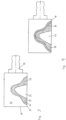
- Fig. 2 to 7 Further aspects which characterise the invention are to be clarified in order to produce monolithic products, in particular dental restorations, such as crowns, partial crowns or bridges, wherein the blanks have contour-close regions with respect to the restorations to be produced.
- dental restorations such as crowns, partial crowns or bridges
- blanks can be produced that have areas of ceramic material with different compositions and thus properties in order to achieve the desired optical and mechanical properties.
- the monolithically produced dental prosthesis offers the advantage that it can basically be used immediately after being worked out of the blank and subsequently sintered, without, for example, a cutting edge having to be applied and fired by hand.
- Desired strength values can be set specifically. The same applies to color, translucent and fluorescent properties.
- the powder can contain binding agents.
- the powder has a composition as explained above by way of example.
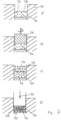
- an open cavity 18 is formed by means of a press stamp 16, whereby the material itself is not actually pressed. Rather, material is displaced or slightly compressed.
- the press plunger 16 is removed in order to fill the cavity with a second ceramic material 20, which may differ from the first ceramic material 14 in that the content of the stabilizer oxides present in the materials is the same in each material, but the coloring oxides added differ from one another, be it in terms of the element, be it in terms of the weight proportion or a combination thereof.
- each material contains different amounts of stabilizers, although at least each material contains Gd 2 O 3 as the main stabilizer and another secondary stabilizer.
- the materials 14, 20 or the layers or regions formed from them are then pressed in the die 10 of the press 12 by means of a lower and/or upper punch 22, 24 in order to achieve compaction.
- the green part 28 After pressing, the green part 28 has a density of approximately 3g/cm 3 ( Fig.3 ). Pressing can be carried out in the desired usual ranges with a pressure of e.g. between 1000 and 2000 bar.
- a second cavity 26 can be machined into the second material 20 after its compaction by means of the press stamp 22, 24 or optionally after pre-sintering, e.g. by milling.
- the blank 28 is pre-sintered, in particular in the range between 800°C and 1000°C for a period of between 100 minutes and 150 minutes. If a binding agent is present in the material, debinding and then pre-sintering take place first.
- the blank is provided with a holder in order to carry out processing, e.g. by milling and/or grinding, so that a desired dental product, such as a tooth, can be worked out of the blank 28, as can be seen from the Fig.5 will be explained.
- the tooth to be produced is preferably placed at least virtually in the blank 28 in such a way that the cutting area runs in the area 32 formed by the first ceramic material 14 and the dentin area runs in sections in the second area 34 formed by the second ceramic material 20.
- the blank 28 is then processed taking these data into account, taking the shrinkage behavior of the material into account.
- Fig.4 clarifies that after filling the first cavity 18 in the first ceramic material 14 and filling the second ceramic material 20 into the cavity 18, a second cavity 36 may be formed, if necessary, according to the procedure according to Fig. 2b is introduced in order to then introduce a third ceramic material 38 into the cavity 36 thus formed, which differs in its composition from the second ceramic material in such a way that in particular a higher strength can be achieved.
- a dental restoration in the example a tooth 42, is made from the blank 28.
- a dental restoration in the example a tooth 42, is made from the blank 28.
- the course of the first area 32 from the first ceramic material 14 and the second Region 34 made of the second ceramic material 20 in the blank 28 of the tooth 42 to be produced is virtually placed in the regions 32, 34 such that the cutting edge runs in the first region 32 and the dentin in the second region 34.
- a dental prosthesis is available which can be used immediately and in particular does not require veneering.
- a monolithic tooth is produced.
- the work out of the blank is made easier by the fact that the second area 34 already has an open cavity 26, as in connection with the. Fig.3 explained and from the Fig.5 becomes apparent.
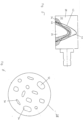
- a blank 28 with a plurality of regions 52, 54, 56, which consist of the second and optionally a third ceramic material and can have different geometries in order to be able to produce teeth with different geometries.
- the so-called second regions 52, 54, 56 formed from the second ceramic material 20 are embedded in the first ceramic material, i.e. surrounded by it, as the drawing shows.
- a dental product is preferably machined from the pre-sintered or, if applicable, from the green body before the blank is sintered, the invention is of course not departed from if such processing is only carried out after the blank has been completely sintered.
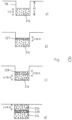
- a first material is filled into a matrix 110 of a press 112, which contains powdered starting materials, whereby zirconium dioxide is the base material, which is mixed with at least gadolinium (III) oxide. as a primary stabilizer and optionally stabilized with one or more secondary stabilizers. If necessary, one or more coloring oxides and/or elements that exhibit fluorescent properties are added. Binders can also be added.
- Fig. 7b After filling the first material into the die 110, the surface is smoothed and Fig. 7b structured.
- an element 116 e.g. in the form of a disk or plate or web, is used which, in the exemplary embodiment, has a jagged geometry on the layer side, so that a corresponding negative structure is formed in the surface 118 of the layer 114 by displacing material.
- This structure is represented by concentrically running elevations and valleys surrounded by them. The structure should be designed in such a way that the volume of the elevations is equal to or approximately equal to the volume of the depressions or valleys.
- a layer 124 consisting of a second material is then filled into the matrix 110, which differs from the first material with respect to the content of a stabilizer or the composition of the stabilizers or, with a constant content of stabilizer(s), with respect to the other components.
- the material of the second layer 124 penetrates into the bottom of the valleys 126 in the surface 118 of the layer, a continuous transition is created between the properties of the layer 114 and the layer 124, after which, according to Fig. 7d the layers 124, 114 have been pressed.
- the transition layer is in the Fig. 7d marked with 128.
- the layer 124 consists of a material that differs from that of the layer 114.
- the deviation should differ in particular in the color additives and, if one or more fluorescence-generating elements are added, in their proportions.
- the second layer 124 should be lower in terms of the tetragonal crystal phase content in layer 124 than in layer 114.
- a powdered first ceramic material is first introduced into a matrix 110, which corresponds to the layer 114 according to Fig.7
- the corresponding layer is in Fig. 8a marked with 214.
- the height of this layer 214 can be half the height of the total layers that are introduced into the die 110.
- a layer 227 with a thickness that is, for example, 1/10 of the total height of the layers is then applied to the layer 214.
- the material of the layer 227 can be the same as that of the second layer 124 according to Fig.7
- the layer 227 is mixed with a surface area of the layer 214 over a depth that should correspond to the thickness of the layer 227.
- a further layer 224 is then applied to the intermediate layer 228, which corresponds to the second layer 124 according to Fig.7 corresponds.
- the height of the layer 224 in the exemplary embodiment is therefore 4/10 of the total height H.
- the layers 224, 228, 214 are then pressed together in order to then carry out the process steps of pre-sintering, processing and sintering (through sintering), as explained. Processing after sintering can of course also be carried out.
Landscapes
- Health & Medical Sciences (AREA)
- Chemical & Material Sciences (AREA)
- Oral & Maxillofacial Surgery (AREA)
- Ceramic Engineering (AREA)
- Engineering & Computer Science (AREA)
- Epidemiology (AREA)
- Veterinary Medicine (AREA)
- Public Health (AREA)
- General Health & Medical Sciences (AREA)
- Animal Behavior & Ethology (AREA)
- Life Sciences & Earth Sciences (AREA)
- Dentistry (AREA)
- Plastic & Reconstructive Surgery (AREA)
- Organic Chemistry (AREA)
- Manufacturing & Machinery (AREA)
- Inorganic Chemistry (AREA)
- Structural Engineering (AREA)
- Materials Engineering (AREA)
- Composite Materials (AREA)
- Orthopedic Medicine & Surgery (AREA)
- Crystallography & Structural Chemistry (AREA)
- Dental Preparations (AREA)
- Compositions Of Oxide Ceramics (AREA)
- Dental Prosthetics (AREA)
- Inorganic Compounds Of Heavy Metals (AREA)
Priority Applications (6)
| Application Number | Priority Date | Filing Date | Title |
|---|---|---|---|
| EP22170325.9A EP4197486B1 (de) | 2022-04-27 | 2022-04-27 | Rohling sowie verfahren zur herstellung eines solchen |
| ES22170325T ES2983170T3 (es) | 2022-04-27 | 2022-04-27 | Pieza en bruto y procedimiento para la preparación de la misma |
| US18/858,992 US20250275839A1 (en) | 2022-04-27 | 2023-04-04 | Blank and method for manufacturing the same |
| PCT/EP2023/058748 WO2023208533A1 (en) | 2022-04-27 | 2023-04-04 | Blank and method for manufacturing the same |
| CA3256457A CA3256457A1 (en) | 2022-04-27 | 2023-04-04 | RAW PROCESS AND ITS MANUFACTURING PROCESS |
| JP2024563584A JP2025516223A (ja) | 2022-04-27 | 2023-04-04 | ブランクおよびブランクを製造するための方法 |
Applications Claiming Priority (1)
| Application Number | Priority Date | Filing Date | Title |
|---|---|---|---|
| EP22170325.9A EP4197486B1 (de) | 2022-04-27 | 2022-04-27 | Rohling sowie verfahren zur herstellung eines solchen |
Publications (2)
| Publication Number | Publication Date |
|---|---|
| EP4197486A1 EP4197486A1 (de) | 2023-06-21 |
| EP4197486B1 true EP4197486B1 (de) | 2024-04-24 |
Family
ID=81389195
Family Applications (1)
| Application Number | Title | Priority Date | Filing Date |
|---|---|---|---|
| EP22170325.9A Active EP4197486B1 (de) | 2022-04-27 | 2022-04-27 | Rohling sowie verfahren zur herstellung eines solchen |
Country Status (6)
| Country | Link |
|---|---|
| US (1) | US20250275839A1 (cg-RX-API-DMAC7.html) |
| EP (1) | EP4197486B1 (cg-RX-API-DMAC7.html) |
| JP (1) | JP2025516223A (cg-RX-API-DMAC7.html) |
| CA (1) | CA3256457A1 (cg-RX-API-DMAC7.html) |
| ES (1) | ES2983170T3 (cg-RX-API-DMAC7.html) |
| WO (1) | WO2023208533A1 (cg-RX-API-DMAC7.html) |
Families Citing this family (2)
| Publication number | Priority date | Publication date | Assignee | Title |
|---|---|---|---|---|
| WO2025003205A1 (en) * | 2023-06-28 | 2025-01-02 | Degudent Gmbh | A multilayer dental restoration with improved esthetical and mechanical properties |
| EP4483839A1 (en) * | 2023-06-28 | 2025-01-01 | DeguDent GmbH | A blank for use in preparing a dental bridge comprising at least one transition region |
Citations (6)
| Publication number | Priority date | Publication date | Assignee | Title |
|---|---|---|---|---|
| JPH0833701A (ja) | 1994-07-21 | 1996-02-06 | Shinagawa Refract Co Ltd | ジルコニア質医療用材料及びその製造方法 |
| WO2014124874A1 (de) * | 2013-02-13 | 2014-08-21 | Ceramtec Gmbh | Ein- und mehrphasige werkstoffe auf basis von zirkonoxid |
| US20140265065A1 (en) * | 2013-03-15 | 2014-09-18 | Amedica Corporation | Charge-compensating dopant stabilized alumina-zirconia ceramic materials and related materials, apparatus, and methods |
| EP3517072A1 (en) | 2015-12-28 | 2019-07-31 | DENTSPLY SIRONA Inc. | Blank and dental restoration |
| CN113101230A (zh) | 2021-03-03 | 2021-07-13 | 深圳爱尔创口腔技术有限公司 | 氧化锆组合物、荧光氧化锆及制备方法和氧化锆牙科制品 |
| CN113105232A (zh) | 2020-10-10 | 2021-07-13 | 深圳爱尔创口腔技术有限公司 | 氧化锆组合物、氧化锆预烧体及制备方法、氧化锆烧结体及制备方法和氧化锆牙科制品 |
Family Cites Families (6)
| Publication number | Priority date | Publication date | Assignee | Title |
|---|---|---|---|---|
| EP0943296A1 (de) | 1998-03-17 | 1999-09-22 | Eidgenössische Technische Hochschule Zürich | Zahnkronen und/oder Zahnbrücken |
| US20050164045A1 (en) | 2004-01-27 | 2005-07-28 | Ivoclar Vivadent Ag | Method for the production of an oxide ceramic shaped part and a part produced by such method |
| TWI414425B (zh) | 2009-03-13 | 2013-11-11 | Chan Li Machinery Co Ltd | Multi-layer tissue with pressure-resistant adhesive structure |
| EP2371344A1 (en) | 2010-03-31 | 2011-10-05 | Straumann Holding AG | Body made of a ceramic material |
| US10028809B2 (en) | 2012-10-17 | 2018-07-24 | 3M Innovative Properties Company | Multi sectional dental zirconia milling block, process of production and use thereof |
| WO2015199018A1 (ja) | 2014-06-23 | 2015-12-30 | 東ソー株式会社 | 着色透光性ジルコニア焼結体と粉末、及びその用途 |
-
2022
- 2022-04-27 EP EP22170325.9A patent/EP4197486B1/de active Active
- 2022-04-27 ES ES22170325T patent/ES2983170T3/es active Active
-
2023
- 2023-04-04 CA CA3256457A patent/CA3256457A1/en active Pending
- 2023-04-04 JP JP2024563584A patent/JP2025516223A/ja active Pending
- 2023-04-04 US US18/858,992 patent/US20250275839A1/en active Pending
- 2023-04-04 WO PCT/EP2023/058748 patent/WO2023208533A1/en not_active Ceased
Patent Citations (6)
| Publication number | Priority date | Publication date | Assignee | Title |
|---|---|---|---|---|
| JPH0833701A (ja) | 1994-07-21 | 1996-02-06 | Shinagawa Refract Co Ltd | ジルコニア質医療用材料及びその製造方法 |
| WO2014124874A1 (de) * | 2013-02-13 | 2014-08-21 | Ceramtec Gmbh | Ein- und mehrphasige werkstoffe auf basis von zirkonoxid |
| US20140265065A1 (en) * | 2013-03-15 | 2014-09-18 | Amedica Corporation | Charge-compensating dopant stabilized alumina-zirconia ceramic materials and related materials, apparatus, and methods |
| EP3517072A1 (en) | 2015-12-28 | 2019-07-31 | DENTSPLY SIRONA Inc. | Blank and dental restoration |
| CN113105232A (zh) | 2020-10-10 | 2021-07-13 | 深圳爱尔创口腔技术有限公司 | 氧化锆组合物、氧化锆预烧体及制备方法、氧化锆烧结体及制备方法和氧化锆牙科制品 |
| CN113101230A (zh) | 2021-03-03 | 2021-07-13 | 深圳爱尔创口腔技术有限公司 | 氧化锆组合物、荧光氧化锆及制备方法和氧化锆牙科制品 |
Also Published As
| Publication number | Publication date |
|---|---|
| CA3256457A1 (en) | 2023-11-02 |
| US20250275839A1 (en) | 2025-09-04 |
| WO2023208533A1 (en) | 2023-11-02 |
| JP2025516223A (ja) | 2025-05-27 |
| WO2023208533A9 (en) | 2024-12-19 |
| ES2983170T3 (es) | 2024-10-22 |
| EP4197486A1 (de) | 2023-06-21 |
Similar Documents
| Publication | Publication Date | Title |
|---|---|---|
| DE102016106370A1 (de) | Verfahren zur Herstellung eines eingefärbten Rohlings sowie Rohling | |
| EP3558671B1 (de) | Die verwendung eines mehrschichtigen oxidkeramikkörpers mit angepasstem sinterverhalten | |
| EP2819613B1 (de) | Rohling für die herstellung von zahnersatz | |
| DE102015122864A1 (de) | Verfahren zur Herstellung eines Rohlings sowie dentale Restauration | |
| DE102015122865A1 (de) | Verfahren zur Herstellung einer dentalen Restauration | |
| EP3829482B1 (de) | Mehrfarbiger rohling für dentale zwecke | |
| EP2024300B1 (de) | Verfahren zur herstellung einer keramik | |
| EP2588020B1 (de) | Zahnfrontverblendungskörper | |
| DE102015122861A1 (de) | Verfahren zur Herstellung eines Rohlings, Rohling sowie eine dentale Restauration | |
| EP1859758A1 (de) | Blockkörper | |
| EP4010300A1 (de) | Zirkondioxidrohling mit farb- und transluzenzverlauf | |
| WO1999047065A1 (de) | Zahnkronen und/oder zahnbrücken | |
| DE29924924U1 (de) | Formkörper zur Verwendung als Zahnersatz und dentales Hilfsteil | |
| EP0593611A1 (de) | Zahnregulierungsvorrichtung mit einem keramischen zahnaufsatz. | |
| DE102016119934A1 (de) | Verfahren zur Herstellung eines Rohlings, Rohling sowie eine dentale Restauration | |
| DE102016119935A1 (de) | Verfahren zur Herstellung einer dentalen Restauration | |
| EP4197486A1 (de) | Rohling sowie verfahren zur herstellung eines solchen | |
| EP2034947B1 (de) | Material und rohling für zahnersatz | |
| EP4431481A1 (de) | Oxidkeramik mit pigment | |
| EP3488813A1 (de) | Verfahren zur herstellung einer zahnersatz-vorrichtung umfassend eine interface-beschichtung, sowie eine solche zahnersatz-vorrichtung | |
| EP3772497A1 (de) | Zirkondioxidrohling mit farb- und transluzenzverlauf | |
| EP4201391A1 (de) | Mehrschichtiger aufbau | |
| EP3772498A1 (de) | Verfahren zur herstellung eines zirkondioxidrohlings mit farb- und transluzenzverlauf | |
| DE102017202417B3 (de) | Formkörper und Verfahren sowie Vorrichtung zu dessen Herstellung | |
| EP1824443B1 (de) | Hydroxylapatit-werkstoff und ein verfahren zu dessen herstellung |
Legal Events
| Date | Code | Title | Description |
|---|---|---|---|
| PUAI | Public reference made under article 153(3) epc to a published international application that has entered the european phase |
Free format text: ORIGINAL CODE: 0009012 |
|
| STAA | Information on the status of an ep patent application or granted ep patent |
Free format text: STATUS: REQUEST FOR EXAMINATION WAS MADE |
|
| STAA | Information on the status of an ep patent application or granted ep patent |
Free format text: STATUS: EXAMINATION IS IN PROGRESS |
|
| 17P | Request for examination filed |
Effective date: 20230118 |
|
| AK | Designated contracting states |
Kind code of ref document: A1 Designated state(s): AL AT BE BG CH CY CZ DE DK EE ES FI FR GB GR HR HU IE IS IT LI LT LU LV MC MK MT NL NO PL PT RO RS SE SI SK SM TR |
|
| 17Q | First examination report despatched |
Effective date: 20230615 |
|
| TPAC | Observations filed by third parties |
Free format text: ORIGINAL CODE: EPIDOSNTIPA |
|
| GRAP | Despatch of communication of intention to grant a patent |
Free format text: ORIGINAL CODE: EPIDOSNIGR1 |
|
| STAA | Information on the status of an ep patent application or granted ep patent |
Free format text: STATUS: GRANT OF PATENT IS INTENDED |
|
| GRAS | Grant fee paid |
Free format text: ORIGINAL CODE: EPIDOSNIGR3 |
|
| GRAA | (expected) grant |
Free format text: ORIGINAL CODE: 0009210 |
|
| STAA | Information on the status of an ep patent application or granted ep patent |
Free format text: STATUS: THE PATENT HAS BEEN GRANTED |
|
| TPAC | Observations filed by third parties |
Free format text: ORIGINAL CODE: EPIDOSNTIPA |
|
| RIC1 | Information provided on ipc code assigned before grant |
Ipc: A61C 8/00 20060101ALI20240219BHEP Ipc: A61C 5/70 20170101ALI20240219BHEP Ipc: A61K 6/813 20200101ALI20240219BHEP Ipc: A61K 6/807 20200101ALI20240219BHEP Ipc: C01G 25/02 20060101ALI20240219BHEP Ipc: B32B 18/00 20060101ALI20240219BHEP Ipc: A61K 6/824 20200101ALI20240219BHEP Ipc: A61K 6/822 20200101ALI20240219BHEP Ipc: C04B 35/486 20060101ALI20240219BHEP Ipc: A61K 6/818 20200101ALI20240219BHEP Ipc: A61C 13/083 20060101ALI20240219BHEP Ipc: A61C 13/00 20060101AFI20240219BHEP |
|
| INTG | Intention to grant announced |
Effective date: 20240306 |
|
| AK | Designated contracting states |
Kind code of ref document: B1 Designated state(s): AL AT BE BG CH CY CZ DE DK EE ES FI FR GB GR HR HU IE IS IT LI LT LU LV MC MK MT NL NO PL PT RO RS SE SI SK SM TR |
|
| REG | Reference to a national code |
Ref country code: GB Ref legal event code: FG4D Free format text: NOT ENGLISH |
|
| REG | Reference to a national code |
Ref country code: CH Ref legal event code: EP |
|
| P01 | Opt-out of the competence of the unified patent court (upc) registered |
Effective date: 20240402 |
|
| REG | Reference to a national code |
Ref country code: DE Ref legal event code: R096 Ref document number: 502022000785 Country of ref document: DE |
|
| REG | Reference to a national code |
Ref country code: IE Ref legal event code: FG4D Free format text: LANGUAGE OF EP DOCUMENT: GERMAN |
|
| REG | Reference to a national code |
Ref country code: SE Ref legal event code: TRGR |
|
| REG | Reference to a national code |
Ref country code: LT Ref legal event code: MG9D |
|
| REG | Reference to a national code |
Ref country code: NL Ref legal event code: FP |
|
| PG25 | Lapsed in a contracting state [announced via postgrant information from national office to epo] |
Ref country code: IS Free format text: LAPSE BECAUSE OF FAILURE TO SUBMIT A TRANSLATION OF THE DESCRIPTION OR TO PAY THE FEE WITHIN THE PRESCRIBED TIME-LIMIT Effective date: 20240824 |
|
| PG25 | Lapsed in a contracting state [announced via postgrant information from national office to epo] |
Ref country code: BG Free format text: LAPSE BECAUSE OF FAILURE TO SUBMIT A TRANSLATION OF THE DESCRIPTION OR TO PAY THE FEE WITHIN THE PRESCRIBED TIME-LIMIT Effective date: 20240424 |
|
| PG25 | Lapsed in a contracting state [announced via postgrant information from national office to epo] |
Ref country code: HR Free format text: LAPSE BECAUSE OF FAILURE TO SUBMIT A TRANSLATION OF THE DESCRIPTION OR TO PAY THE FEE WITHIN THE PRESCRIBED TIME-LIMIT Effective date: 20240424 Ref country code: FI Free format text: LAPSE BECAUSE OF FAILURE TO SUBMIT A TRANSLATION OF THE DESCRIPTION OR TO PAY THE FEE WITHIN THE PRESCRIBED TIME-LIMIT Effective date: 20240424 |
|
| PG25 | Lapsed in a contracting state [announced via postgrant information from national office to epo] |
Ref country code: GR Free format text: LAPSE BECAUSE OF FAILURE TO SUBMIT A TRANSLATION OF THE DESCRIPTION OR TO PAY THE FEE WITHIN THE PRESCRIBED TIME-LIMIT Effective date: 20240725 |
|
| PG25 | Lapsed in a contracting state [announced via postgrant information from national office to epo] |
Ref country code: PT Free format text: LAPSE BECAUSE OF FAILURE TO SUBMIT A TRANSLATION OF THE DESCRIPTION OR TO PAY THE FEE WITHIN THE PRESCRIBED TIME-LIMIT Effective date: 20240826 |
|
| REG | Reference to a national code |
Ref country code: ES Ref legal event code: FG2A Ref document number: 2983170 Country of ref document: ES Kind code of ref document: T3 Effective date: 20241022 |
|
| PG25 | Lapsed in a contracting state [announced via postgrant information from national office to epo] |
Ref country code: PL Free format text: LAPSE BECAUSE OF FAILURE TO SUBMIT A TRANSLATION OF THE DESCRIPTION OR TO PAY THE FEE WITHIN THE PRESCRIBED TIME-LIMIT Effective date: 20240424 |
|
| PG25 | Lapsed in a contracting state [announced via postgrant information from national office to epo] |
Ref country code: LV Free format text: LAPSE BECAUSE OF FAILURE TO SUBMIT A TRANSLATION OF THE DESCRIPTION OR TO PAY THE FEE WITHIN THE PRESCRIBED TIME-LIMIT Effective date: 20240424 |
|
| PG25 | Lapsed in a contracting state [announced via postgrant information from national office to epo] |
Ref country code: PT Free format text: LAPSE BECAUSE OF FAILURE TO SUBMIT A TRANSLATION OF THE DESCRIPTION OR TO PAY THE FEE WITHIN THE PRESCRIBED TIME-LIMIT Effective date: 20240826 Ref country code: PL Free format text: LAPSE BECAUSE OF FAILURE TO SUBMIT A TRANSLATION OF THE DESCRIPTION OR TO PAY THE FEE WITHIN THE PRESCRIBED TIME-LIMIT Effective date: 20240424 Ref country code: NO Free format text: LAPSE BECAUSE OF FAILURE TO SUBMIT A TRANSLATION OF THE DESCRIPTION OR TO PAY THE FEE WITHIN THE PRESCRIBED TIME-LIMIT Effective date: 20240724 Ref country code: LV Free format text: LAPSE BECAUSE OF FAILURE TO SUBMIT A TRANSLATION OF THE DESCRIPTION OR TO PAY THE FEE WITHIN THE PRESCRIBED TIME-LIMIT Effective date: 20240424 Ref country code: IS Free format text: LAPSE BECAUSE OF FAILURE TO SUBMIT A TRANSLATION OF THE DESCRIPTION OR TO PAY THE FEE WITHIN THE PRESCRIBED TIME-LIMIT Effective date: 20240824 Ref country code: HR Free format text: LAPSE BECAUSE OF FAILURE TO SUBMIT A TRANSLATION OF THE DESCRIPTION OR TO PAY THE FEE WITHIN THE PRESCRIBED TIME-LIMIT Effective date: 20240424 Ref country code: GR Free format text: LAPSE BECAUSE OF FAILURE TO SUBMIT A TRANSLATION OF THE DESCRIPTION OR TO PAY THE FEE WITHIN THE PRESCRIBED TIME-LIMIT Effective date: 20240725 Ref country code: FI Free format text: LAPSE BECAUSE OF FAILURE TO SUBMIT A TRANSLATION OF THE DESCRIPTION OR TO PAY THE FEE WITHIN THE PRESCRIBED TIME-LIMIT Effective date: 20240424 Ref country code: BG Free format text: LAPSE BECAUSE OF FAILURE TO SUBMIT A TRANSLATION OF THE DESCRIPTION OR TO PAY THE FEE WITHIN THE PRESCRIBED TIME-LIMIT Effective date: 20240424 Ref country code: RS Free format text: LAPSE BECAUSE OF FAILURE TO SUBMIT A TRANSLATION OF THE DESCRIPTION OR TO PAY THE FEE WITHIN THE PRESCRIBED TIME-LIMIT Effective date: 20240724 |
|
| PG25 | Lapsed in a contracting state [announced via postgrant information from national office to epo] |
Ref country code: LU Free format text: LAPSE BECAUSE OF NON-PAYMENT OF DUE FEES Effective date: 20240427 |
|
| REG | Reference to a national code |
Ref country code: BE Ref legal event code: MM Effective date: 20240430 |
|
| PG25 | Lapsed in a contracting state [announced via postgrant information from national office to epo] |
Ref country code: LU Free format text: LAPSE BECAUSE OF NON-PAYMENT OF DUE FEES Effective date: 20240427 |
|
| PG25 | Lapsed in a contracting state [announced via postgrant information from national office to epo] |
Ref country code: DK Free format text: LAPSE BECAUSE OF FAILURE TO SUBMIT A TRANSLATION OF THE DESCRIPTION OR TO PAY THE FEE WITHIN THE PRESCRIBED TIME-LIMIT Effective date: 20240424 |
|
| PG25 | Lapsed in a contracting state [announced via postgrant information from national office to epo] |
Ref country code: BE Free format text: LAPSE BECAUSE OF NON-PAYMENT OF DUE FEES Effective date: 20240430 |
|
| PG25 | Lapsed in a contracting state [announced via postgrant information from national office to epo] |
Ref country code: EE Free format text: LAPSE BECAUSE OF FAILURE TO SUBMIT A TRANSLATION OF THE DESCRIPTION OR TO PAY THE FEE WITHIN THE PRESCRIBED TIME-LIMIT Effective date: 20240424 |
|
| PG25 | Lapsed in a contracting state [announced via postgrant information from national office to epo] |
Ref country code: CZ Free format text: LAPSE BECAUSE OF FAILURE TO SUBMIT A TRANSLATION OF THE DESCRIPTION OR TO PAY THE FEE WITHIN THE PRESCRIBED TIME-LIMIT Effective date: 20240424 |
|
| REG | Reference to a national code |
Ref country code: DE Ref legal event code: R026 Ref document number: 502022000785 Country of ref document: DE |
|
| PG25 | Lapsed in a contracting state [announced via postgrant information from national office to epo] |
Ref country code: SK Free format text: LAPSE BECAUSE OF FAILURE TO SUBMIT A TRANSLATION OF THE DESCRIPTION OR TO PAY THE FEE WITHIN THE PRESCRIBED TIME-LIMIT Effective date: 20240424 Ref country code: RO Free format text: LAPSE BECAUSE OF FAILURE TO SUBMIT A TRANSLATION OF THE DESCRIPTION OR TO PAY THE FEE WITHIN THE PRESCRIBED TIME-LIMIT Effective date: 20240424 |
|
| PG25 | Lapsed in a contracting state [announced via postgrant information from national office to epo] |
Ref country code: SM Free format text: LAPSE BECAUSE OF FAILURE TO SUBMIT A TRANSLATION OF THE DESCRIPTION OR TO PAY THE FEE WITHIN THE PRESCRIBED TIME-LIMIT Effective date: 20240424 |
|
| PG25 | Lapsed in a contracting state [announced via postgrant information from national office to epo] |
Ref country code: SM Free format text: LAPSE BECAUSE OF FAILURE TO SUBMIT A TRANSLATION OF THE DESCRIPTION OR TO PAY THE FEE WITHIN THE PRESCRIBED TIME-LIMIT Effective date: 20240424 Ref country code: SK Free format text: LAPSE BECAUSE OF FAILURE TO SUBMIT A TRANSLATION OF THE DESCRIPTION OR TO PAY THE FEE WITHIN THE PRESCRIBED TIME-LIMIT Effective date: 20240424 Ref country code: RO Free format text: LAPSE BECAUSE OF FAILURE TO SUBMIT A TRANSLATION OF THE DESCRIPTION OR TO PAY THE FEE WITHIN THE PRESCRIBED TIME-LIMIT Effective date: 20240424 Ref country code: EE Free format text: LAPSE BECAUSE OF FAILURE TO SUBMIT A TRANSLATION OF THE DESCRIPTION OR TO PAY THE FEE WITHIN THE PRESCRIBED TIME-LIMIT Effective date: 20240424 Ref country code: DK Free format text: LAPSE BECAUSE OF FAILURE TO SUBMIT A TRANSLATION OF THE DESCRIPTION OR TO PAY THE FEE WITHIN THE PRESCRIBED TIME-LIMIT Effective date: 20240424 Ref country code: CZ Free format text: LAPSE BECAUSE OF FAILURE TO SUBMIT A TRANSLATION OF THE DESCRIPTION OR TO PAY THE FEE WITHIN THE PRESCRIBED TIME-LIMIT Effective date: 20240424 Ref country code: BE Free format text: LAPSE BECAUSE OF NON-PAYMENT OF DUE FEES Effective date: 20240430 Ref country code: MC Free format text: LAPSE BECAUSE OF FAILURE TO SUBMIT A TRANSLATION OF THE DESCRIPTION OR TO PAY THE FEE WITHIN THE PRESCRIBED TIME-LIMIT Effective date: 20240424 |
|
| PLBI | Opposition filed |
Free format text: ORIGINAL CODE: 0009260 |
|
| PLAB | Opposition data, opponent's data or that of the opponent's representative modified |
Free format text: ORIGINAL CODE: 0009299OPPO |
|
| 26 | Opposition filed |
Opponent name: IVOCLAR VIVADENT AG Effective date: 20250124 |
|
| R26 | Opposition filed (corrected) |
Opponent name: IVOCLAR VIVADENT AG Effective date: 20250124 |
|
| PLAX | Notice of opposition and request to file observation + time limit sent |
Free format text: ORIGINAL CODE: EPIDOSNOBS2 |
|
| PGFP | Annual fee paid to national office [announced via postgrant information from national office to epo] |
Ref country code: SE Payment date: 20250319 Year of fee payment: 4 |
|
| PGFP | Annual fee paid to national office [announced via postgrant information from national office to epo] |
Ref country code: NL Payment date: 20250319 Year of fee payment: 4 |
|
| PG25 | Lapsed in a contracting state [announced via postgrant information from national office to epo] |
Ref country code: IE Free format text: LAPSE BECAUSE OF NON-PAYMENT OF DUE FEES Effective date: 20240427 |
|
| PG25 | Lapsed in a contracting state [announced via postgrant information from national office to epo] |
Ref country code: SI Free format text: LAPSE BECAUSE OF FAILURE TO SUBMIT A TRANSLATION OF THE DESCRIPTION OR TO PAY THE FEE WITHIN THE PRESCRIBED TIME-LIMIT Effective date: 20240424 |
|
| PGFP | Annual fee paid to national office [announced via postgrant information from national office to epo] |
Ref country code: ES Payment date: 20250502 Year of fee payment: 4 |
|
| PGFP | Annual fee paid to national office [announced via postgrant information from national office to epo] |
Ref country code: CH Payment date: 20250501 Year of fee payment: 4 |
|
| PG25 | Lapsed in a contracting state [announced via postgrant information from national office to epo] |
Ref country code: CY Free format text: LAPSE BECAUSE OF FAILURE TO SUBMIT A TRANSLATION OF THE DESCRIPTION OR TO PAY THE FEE WITHIN THE PRESCRIBED TIME-LIMIT; INVALID AB INITIO Effective date: 20220427 |
|
| PLBB | Reply of patent proprietor to notice(s) of opposition received |
Free format text: ORIGINAL CODE: EPIDOSNOBS3 |
|
| PG25 | Lapsed in a contracting state [announced via postgrant information from national office to epo] |
Ref country code: HU Free format text: LAPSE BECAUSE OF FAILURE TO SUBMIT A TRANSLATION OF THE DESCRIPTION OR TO PAY THE FEE WITHIN THE PRESCRIBED TIME-LIMIT; INVALID AB INITIO Effective date: 20220427 |
|
| PG25 | Lapsed in a contracting state [announced via postgrant information from national office to epo] |
Ref country code: IT Free format text: LAPSE BECAUSE OF NON-PAYMENT OF DUE FEES Effective date: 20240427 |
|
| PGFP | Annual fee paid to national office [announced via postgrant information from national office to epo] |
Ref country code: GB Payment date: 20260319 Year of fee payment: 5 |
|
| PG25 | Lapsed in a contracting state [announced via postgrant information from national office to epo] |
Ref country code: IT Free format text: LAPSE BECAUSE OF NON-PAYMENT OF DUE FEES Effective date: 20240427 |
|
| PGFP | Annual fee paid to national office [announced via postgrant information from national office to epo] |
Ref country code: IT Payment date: 20260319 Year of fee payment: 5 |
|
| PGRI | Patent reinstated in contracting state [announced from national office to epo] |
Ref country code: IT Effective date: 20240430 |
|
| PGFP | Annual fee paid to national office [announced via postgrant information from national office to epo] |
Ref country code: FR Payment date: 20260319 Year of fee payment: 5 |
|
| PG25 | Lapsed in a contracting state [announced via postgrant information from national office to epo] |
Ref country code: TR Free format text: LAPSE BECAUSE OF FAILURE TO SUBMIT A TRANSLATION OF THE DESCRIPTION OR TO PAY THE FEE WITHIN THE PRESCRIBED TIME-LIMIT Effective date: 20240424 |
|
| PG25 | Lapsed in a contracting state [announced via postgrant information from national office to epo] |
Ref country code: LT Free format text: LAPSE BECAUSE OF FAILURE TO SUBMIT A TRANSLATION OF THE DESCRIPTION OR TO PAY THE FEE WITHIN THE PRESCRIBED TIME-LIMIT Effective date: 20240424 |
|
| PGFP | Annual fee paid to national office [announced via postgrant information from national office to epo] |
Ref country code: DE Payment date: 20260319 Year of fee payment: 5 |
|
| PGFP | Annual fee paid to national office [announced via postgrant information from national office to epo] |
Ref country code: AT Payment date: 20260714 Year of fee payment: 5 |