EP4197174B1 - Verfahren und vorrichtung zur verringerung des verhältnisses von spitzen- zu durchschnittsleistung bei der übertragung von protokolldateneinheiten der physikalischen schicht - Google Patents
Verfahren und vorrichtung zur verringerung des verhältnisses von spitzen- zu durchschnittsleistung bei der übertragung von protokolldateneinheiten der physikalischen schicht Download PDFInfo
- Publication number
- EP4197174B1 EP4197174B1 EP21914170.2A EP21914170A EP4197174B1 EP 4197174 B1 EP4197174 B1 EP 4197174B1 EP 21914170 A EP21914170 A EP 21914170A EP 4197174 B1 EP4197174 B1 EP 4197174B1
- Authority
- EP
- European Patent Office
- Prior art keywords
- sig
- ppdu
- sequence
- bits
- disregard
- Prior art date
- Legal status (The legal status is an assumption and is not a legal conclusion. Google has not performed a legal analysis and makes no representation as to the accuracy of the status listed.)
- Active
Links
Images





Classifications
-
- H—ELECTRICITY
- H04—ELECTRIC COMMUNICATION TECHNIQUE
- H04L—TRANSMISSION OF DIGITAL INFORMATION, e.g. TELEGRAPHIC COMMUNICATION
- H04L27/00—Modulated-carrier systems
- H04L27/26—Systems using multi-frequency codes
- H04L27/2601—Multicarrier modulation systems
- H04L27/2614—Peak power aspects
-
- H—ELECTRICITY
- H04—ELECTRIC COMMUNICATION TECHNIQUE
- H04L—TRANSMISSION OF DIGITAL INFORMATION, e.g. TELEGRAPHIC COMMUNICATION
- H04L27/00—Modulated-carrier systems
- H04L27/26—Systems using multi-frequency codes
- H04L27/2601—Multicarrier modulation systems
- H04L27/2614—Peak power aspects
- H04L27/2615—Reduction thereof using coding
-
- H—ELECTRICITY
- H04—ELECTRIC COMMUNICATION TECHNIQUE
- H04W—WIRELESS COMMUNICATION NETWORKS
- H04W28/00—Network traffic management; Network resource management
- H04W28/02—Traffic management, e.g. flow control or congestion control
- H04W28/06—Optimizing the usage of the radio link, e.g. header compression, information sizing, discarding information
- H04W28/065—Optimizing the usage of the radio link, e.g. header compression, information sizing, discarding information using assembly or disassembly of packets
-
- H—ELECTRICITY
- H04—ELECTRIC COMMUNICATION TECHNIQUE
- H04W—WIRELESS COMMUNICATION NETWORKS
- H04W84/00—Network topologies
- H04W84/02—Hierarchically pre-organised networks, e.g. paging networks, cellular networks, WLAN [Wireless Local Area Network] or WLL [Wireless Local Loop]
- H04W84/10—Small scale networks; Flat hierarchical networks
- H04W84/12—WLAN [Wireless Local Area Networks]
Definitions
- the present disclosure relates to wireless communication systems and, more specifically, to a system and method for reducing a peak to average power ratio (PAPR) in a universal signal (U-SIG) field of a physical layer protocol data unit (PPDU).
- PAPR peak to average power ratio
- U-SIG universal signal
- PPDU physical layer protocol data unit
- a U-SIG field is used in the IEEE standard 802.11be (Standard for Information technologyTelecommunications and information exchange between systems Local and metropolitan area network of May 2021) to convey information to all receivers about various important parameters such as a standard version (802.11be or later version), a bandwidth, a number of extremely high throughput, EHT, signal (EHT-SIG) symbols, etc.
- the receivers include both access points (AP) and/or stations (STAs).
- the U-SIG is composed of 2 Orthogonal Frequency Division Multiplexing (OFDM) symbols, and each OFDM symbol contains 26 information bits.
- OFDM Orthogonal Frequency Division Multiplexing
- the sequence of disregard bits may cause problems of performance for TB PPDUs. For example, if all disregard bits are set to 1, it will yield an un-necessarily high PAPR of the entire U-SIG field, which may require the transmitting STAs to increase the power amplifier backoff, which reduces the transmit power. If the STAs do not increase the backoff, the high PAPR may cause distortions to the transmitted signal (due to, for example, clipping of the time-domain signal).
- a communication device as claimed in claim 1 for transmitting a physical layer protocol data unit, PPDU, to one or more receiving devices is disclosed.
- the use of any of the sequences in the set of sequences recited in claim 1 as the sequence of disregard bits allows achieving an even more reduced Peak to Average Power Ratio (PAPR), thereby allowing the STA to refrain from increasing the power amplifier backoff and transmitting with higher efficiency.
- PAPR Peak to Average Power Ratio
- an access point as claimed in claim 2 for transmitting a physical layer protocol data unit, PPDU, to one or more communication devices is disclosed.
- the use of any of the sequences as claimed in claim 2 as the sequence of disregard bits allows achieving an even more reduced Peak to Average Power Ratio (PAPR), thereby allowing the STA to refrain from increasing the power amplifier backoff and transmitting with higher efficiency.
- PAPR Peak to Average Power Ratio
- a method as claimed in claim 4 for transmitting a physical layer protocol data unit, PPDU, in a communication device is disclosed.
- the use of any of the sequences as claimed in claim 4 as the sequence of disregard bits allows achieving an even more reduced Peak to Average Power Ratio (PAPR), thereby allowing the STA to refrain from increasing the power amplifier backoff and transmitting with higher efficiency.
- PAPR Peak to Average Power Ratio
- a method as claimed in claim 6 for transmitting a physical layer protocol data unit, PPDU, in an access point is disclosed.
- the use of any of the sequences as claimed in claim 6 as the sequence of disregard bits allows achieving an even more reduced Peak to Average Power Ratio (PAPR), thereby allowing the STA to refrain from increasing the power amplifier backoff and to transmit with higher efficiency.
- PAPR Peak to Average Power Ratio
- a machine-readable storage medium having stored thereon processor-executable instructions is disclosed. When executed by a processor of a device, said instructions cause the device to implement a method according to any of the methods disclosed.
- a computer program product comprising a computer-readable storage medium having computer-readable instructions stored thereon is disclosed, the computer-readable instructions being executable by a device comprising processing hardware to execute any of the methods disclosed.
- a computer storage medium, or computer program product of any one of the methods of reducing PAPR is disclosed.
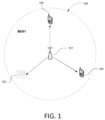
- Fig. 1 shows a system for reducing the PAPR in a field of PPDUs according to some embodiments of the present disclosure.
- System 100 includes an access point (AP) 101 and one or more stations (STAs), for example STA 102, STA 103, and STA 104 shown in Fig. 1 .
- the system 100 is also called basic service set (BSS) in the present disclosure.
- BSS basic service set
- the AP and the STAs communicate in both downlink and uplink.
- the arrows between AP and STAs shown in Fig. 1 only show downlink, but it should not be understood as a limitation of transmission.
- system 100 shows only one AP in the system
- system may include more than one AP in the system and the APs in the system may perform coordinated transmission.
- the system 100 in the present disclosure includes but is not limited to: a wireless fidelity (WIFI) communication system, a narrowband internet of things (NB-IoT) system, a long term evolution (LTE) system, a 5 th generation mobile communications system (5G) or beyond, a machine to machine (M2M) communications system, or the like.
- WIFI wireless fidelity
- NB-IoT narrowband internet of things
- LTE long term evolution
- 5G 5 th generation mobile communications system
- M2M machine to machine
- a communication device may be AP 101 or STAs
- a STA may be, for example, a mobile phone, an intelligent terminal, a tablet computer (tablet), a notebook computer (laptop), a video game console, a multimedia player, vehicle which supports WIFI, device to device (D2D) equipment, or any smart devices.
- the AP and/or STA may be stationary or mobile devices.
- the WIFI system may support all the Institute of Electrical and Electronic Engineers (IEEE) 802.11 serials including but not limited to: 802.11a/b/g, 802.11n, 802.11ac, 802.11ax, 802.11be or beyond.
- IEEE Institute of Electrical and Electronic Engineers
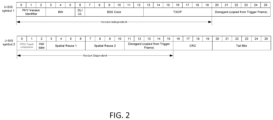
- Fig. 2 shows a U-SIG design for a TB PPDU in 802.11 be Release 1.
- the bits contained in the U-SIG's first symbol of TB PPDU convey information about the PHY version (e.g. 802.11be or a later version of the standard), the BW (e.g. 20MHz, 40MHz etc.), whether it is a DL or UL transmission, the BSS Color which differentiates between possibly different neighboring BSS values, TXOP which may include duration of the TXOP and/or how long the transmitter is taking advantage of the channel resources.
- the bits contained in the U-SIG's second symbol, for a TB PPDU convey information about a PPDU type (e.g. MU, TB), spatial reuse (e.g. spatial reuse 1 and spatial reuse 2) which allows multiple transmitters to transmit simultaneously on the same resources a CRC and 6 zero tail bits used for the convolutional code.
- a PPDU type e.g. MU, TB
- spatial reuse
- the sequence of disregard bits is located in the first and second U-SIG symbols; however, the CRC is computed as a function of all preceding bits which include both first U-SIG symbol and second U-SIG symbol, so the value of the CRC bits (located in the second U-SIG symbol) is also a function of the sequence of disregard bits located in the first U-SIG symbol.
- a trigger frame contains 9 reserved bits and all 9 bits are set to '1'.
- the 9 reserved bits are copied to the second symbol of the HE-SIG-A field of a TB PPDU.
- the sequence of disregard bits in the trigger frame, and TB PPDU comprises contiguous binary bits '1' which can lead to high PAPR, and the performance of the U-SIG field for a TB PPDU will be impacted in consequence (e.g. with lower PAPR, the power amplifier backoff can be reduced, thereby increasing efficiency).
- Fig. 3 shows a Complementary Cumulative Density Function (CCDF) of the PAPR of both U-SIG symbols for 320MHz BW
- U-SIG-1 means in Fig. 3 means the first symbol of the U-SIG field
- U-SIG-2 means the second symbol of the U-SIG field
- the sequence of disregard bits in the U-SIG symbols is assumed to be all ones.
- the U-SIG PAPR is higher than that of the data by a large margin. It is also larger than that of the L-SIG field, especially the PAPR of the U-SIG-2 symbol.
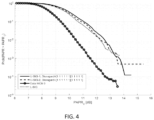
- Fig. 4 shows a CCDF of the PAPR of both U-SIG symbols for 40MHz BW. It is shown that the effect shown in relation to Fig. 5 is consistent for other BW values and puncturing patterns. Fig. 4 shows a similar comparison with 40 MHz BW. As shown therein, the PAPR of both U-SIG symbols also exceeds that of the L-SIG field and the data payload.
- pre-EHT fields that are duplicated on every 20MHz portion (e.g. L-SIG, U-SIG etc.) undergo per-20MHz phase rotation in order to reduce the PAPR.
- L-SIG Low-SIG
- U-SIG Low-SIG
- the U-SIG PAPR is higher than both data and L-SIG, which means it is the limiting factor in terms of performance (it may define the power amplifier backoff).
- the present disclosure provides a method and/or apparatus to reduce the PAPR of the TB PPDU, and in particular the PAPR of the U-SIG field.
- Embodiments present in the present disclosure may be a system, a method, and/or a computer program product.
- the computer program product may include a computer readable storage medium (or media) having computer readable program instructions thereon for causing a processor to carry out aspects of the embodiments.
- the computer readable storage medium can be a tangible device that can retain and store instructions for use by an instruction execution device.
- the computer readable storage medium may be, for example, but is not limited to: an electronic storage device, a magnetic storage device, an optical storage device, an electromagnetic storage device, a semiconductor storage device, or any suitable combination of the foregoing.
- a non-exhaustive list of more specific examples of the computer readable storage medium includes: a portable computer diskette, a hard disk, a random access memory (RAM), a read-only memory (ROM), an erasable programmable read-only memory (EPROM or Flash memory), a static random access memory (SRAM), a portable compact disc read-only memory (CD-ROM), a digital versatile disk (DVD), a memory stick, a floppy disk, and any suitable combination of the foregoing.
- RAM random access memory
- ROM read-only memory
- EPROM or Flash memory erasable programmable read-only memory
- SRAM static random access memory
- CD-ROM compact disc read-only memory
- DVD digital versatile disk
- memory stick a floppy disk, and any suitable combination of the foregoing.
- Computer readable program instructions described herein can be downloaded to respective computing/processing devices from a computer readable storage medium or to an external computer or external storage device via a network, for example, the Internet, a local area network, a wide area network and/or a wireless network.
- a network adapter card or network interface in each computing/processing device may receive computer readable program instructions from the network and forwards the computer readable program instructions for storage in a computer readable storage medium within the respective computing/processing device.
- the computer readable program instructions may execute entirely on the user's computer, partly on the user's computer, as a stand-alone software package, partly on the user's computer and partly on a remote computer or entirely on the remote computer or server.
- the remote computer may be connected to the user's computer through any type of network, including a local area network (LAN) or a wide area network (WAN), or the connection may be made to an external computer (for example, through the Internet using an Internet Service Provider).
- LAN local area network
- WAN wide area network
- Internet Service Provider for example, AT&T, MCI, Sprint, EarthLink, MSN, GTE, etc.
- electronic circuitry including, for example, programmable logic circuitry, field-programmable gate arrays (FPGA), or programmable logic arrays (PLA) may execute the computer readable program instructions by utilizing state information of the computer readable program instructions to personalize the electronic circuitry, in order to perform aspects of embodiments.
- FPGA field-programmable gate arrays
- PLA programmable logic arrays
- Fig. 5 is a schematic diagram of a possible logical structure of a communication device in the present disclosure according to some embodiments.
- the communication device includes a processor 402.
- the processor 402 may be configured to control and manage one or more actions of the communication device, e.g. configured to execute a code for operating on a sequence of disregard bits to reduce the PAPR and/or to process the data transmitted and/or received in the AP.
- the communication device may further include a memory 401 and a communications interface 403.
- the processor 402, the communications interface 403, and the memory 401 may be connected to each other or may be connected to each other by using a bus 404.
- the communications interface 403 is configured to support the communication device in performing communication
- the memory 401 is configured to store program code and data of the communication device.
- the processor 402 calls the code stored in the memory 401 to perform control and management.
- the memory 401 may or may not be coupled to the processor 402.
- the processor 402 may be a central processing unit, a general-purpose processor, a digital signal processor, an application-specific integrated circuit, a field programmable gate array or another programmable logical device, a transistor logical device, a hardware component, or any combination thereof.
- the processor 402 may implement or execute various example logical blocks, modules, and circuits described with reference to content disclosed in the present disclosure.
- the processor 402 may be a combination of processors implementing a computing function, for example, a combination of one or more microprocessors, or a combination of the digital signal processor and a microprocessor.
- the bus 404 may be a peripheral component interconnect (Peripheral Component Interconnect, PCI) bus, an extended industry standard architecture (Extended Industry Standard Architecture, EISA) bus, or the like.
- PCI peripheral component interconnect
- EISA Extended Industry Standard Architecture
- the bus may be classified into an address bus, a data bus, a control bus, and the like.
- the U-SIG may comprise at least a first U-SIG symbol and a second U-SIG symbol.
- the sequence of disregard bits in the present disclosure may be the predefined bits sequence in the prior art, e.g. present IEEE protocol.
- the sequence of disregard bits in some embodiments may be 5 or 6 bits and all bits are set as binary '1' in a TB PPDU.
- the sequence of disregard bits may refer to the 6-bit sequence of disregard bits of the first U-SIG symbol in the TB PPDU, and/or to the 5-bit sequence of disregard bits of the second U-SIG symbol in the TB PPDU. It should be noted that the sequence of disregard bits may include other number of binary bits and 5-bit or 6-bit is not a limitation in the present disclosure.
- Fig. 6 shows a CCDF of the PAPR assuming a disregard bits sequence in which all bits are set to '1' except a single '0' in the edge of either U-SIG-1 or U-SIG-2, assuming 320 MHz without puncturing.
- the sequence '111111' in U-SIG-1 and '11110' in U-SIG-2 (so in total '11111111110') is shown, which yields the lowest PAPR.
- Figure 7 compares the CCDF of the PAPR of the all 1s case with that of the '11111111110' sequence, with a single '0' in the end of the sequence, assuming 320 MHz without puncturing.
- Fig. 8 shows an example in which all bits are set to '1' except a single '0' in the edge of both U-SIG-1 and U-SIG-2. In other words, using two values of '0' in the entire sequence, one '0' in U-SIG-1 and one '0' in U-SIG-2.
- Fig. 8 shows a comparison between the CCDF of the PAPR of the all 1s case with that of the sequences suggested above, assuming 320 MHz without puncturing, for U-SIG-1. As shown in Fig. 8 , there is an improvement in the PAPR.
- Fig. 9 shows a comparison between the CCDF of the PAPR of the all 1s case with that of the same sequences as in Fig. 8 , assuming 320 MHz without puncturing, for U-SIG-2. As shown in Fig. 9 , there is an improvement in the PAPR.
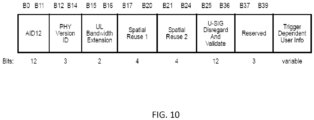
- Fig. 10 shows the special user info field from an exemplary trigger frame of the present disclosure.
- the field between B25 and B36 can be used as the field in which a disregard bits sequence is transmitted from an access point, which is received by communication devices and used as disregard bits sequence, such that a reduced PAPR is achieved.
- Fig. 11 shows a definition of the 'U-SIG Disregard and Validate' subfield, and the copying of the disregard bits sequence into the U-SIG field.
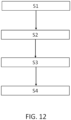
- Fig. 12 shows a workflow of a method for transmitting a physical layer protocol data unit, PPDU, in a communication device.
- the method comprises a step S1 of receiving a trigger frame in a first PPDU. Further, the method comprises a step S2 of obtaining a sequence of disregard bits of a universal signal, U-SIG, field in the first PPDU, wherein the sequence of disregard bits comprises at least one bit set to 0. Also, the method further comprises a step S3 of copying the sequence of disregard bits into the U-SIG field of a second PPDU, and a step S4 of transmitting the second PPDU, wherein the second PPDU comprises the sequence of disregard bits.
- Fig. 13 shows a workflow of a method for transmitting a physical layer protocol data unit, PPDU, in an access point.
- the method comprises a step S1 of setting a field of a trigger frame to a sequence comprising at least one 0.
- the method further comprises a step S2 of transmitting the PPDU to one or more communication devices, wherein the PPDU comprises the field of the trigger frame, wherein the field of the trigger frame is configured to be copied by the one or more communication devices into disregard bits of a universal signal, U-SIG, sequence.
- a compound or “at least one compound” may include a plurality of compounds, including mixtures thereof.
Landscapes
- Engineering & Computer Science (AREA)
- Computer Networks & Wireless Communication (AREA)
- Signal Processing (AREA)
- Mobile Radio Communication Systems (AREA)
- Communication Control (AREA)
- Dc Digital Transmission (AREA)
- Computer Security & Cryptography (AREA)
Claims (8)
- Kommunikationsgerät zum Senden einer Bitübertragungsschichtprotokolldateneinheit, PPDU, an ein oder mehrere Empfangsgeräte, wobei das Kommunikationsgerät Folgendes umfasst:
einen Prozessor, der zu Folgendem konfiguriert ist:Empfangen eines Auslöseframes in einer ersten PPDU;Erhalten einer Sequenz von Nichtbeachtungsbits eines Universalsignal-, U-SIG-, Felds in der ersten PPDU durch Erhalten einer der Sequenzen in dem Satz {11111111110, 11111011110, 01111111110}, wobei die Sequenz von Nichtbeachtungsbits mindestens ein Bit umfasst, das auf 0 eingestellt ist; undKopieren der Sequenz von Nichtbeachtungsbits in das U-SIG-Feld einer zweiten PPDU; undeinen Sender, der dazu konfiguriert ist, die zweite PPDU zu senden, wobei die zweite PPDU die Sequenz von Nichtbeachtungsbits umfasst. - Kommunikationsgerät nach Anspruch 1, wobei das U-SIG-Feld mindestens ein erstes U-SIG-Symbol und ein zweites U-SIG-Symbol umfasst.
- Zugangspunkt zum Senden einer Bitübertragungsschichtprotokolldateneinheit, PPDU, an ein oder mehrere Kommunikationsgeräte, wobei der Zugangspunkt Folgendes umfasst:einen Prozessor, der dazu konfiguriert ist, ein Feld eines Auslöseframes auf eine Sequenz, die mindestens eine 0 umfasst, durch Einstellen des Felds auf eine der Sequenzen in dem Satz {11111111110, 11111011110, 01111111110}; undeinen Sender, der dazu konfiguriert ist, die PPDU an das eine oder mehrere Kommunikationsgeräte zu senden, wobei die PPDU das Feld des Auslöseframes umfasst, wobei das Feld des Auslöseframes dazu konfiguriert ist, durch das eine oder mehrere Kommunikationsgeräte in Nichtbeachtungsbits einer Universalsignal-, U-SIG-, Sequenz kopiert zu werden.
- Verfahren zum Senden einer Bitübertragungsschichtprotokolldateneinheit, PPDU, in einem Kommunikationsgerät, wobei das Verfahren Folgendes umfasst:Empfangen eines Auslöseframes in einer ersten PPDU;Erhalten einer Sequenz von Nichtbeachtungsbits eines Universalsignal-, U-SIG-, Felds in der ersten PPDU, wobei die Sequenz von Nichtbeachtungsbits mindestens ein Bit umfasst, das auf 0 eingestellt ist, durch Erhalten einer der Sequenzen in dem Satz {11111111110, 11111011110, 01111111110};Kopieren der Sequenz von Nichtbeachtungsbits in das U-SIG-Feld einer zweiten PPDU; undSenden der zweiten PPDU, wobei die zweite PPDU die Sequenz von Nichtbeachtungsbits umfasst.
- Verfahren nach Anspruch 4, wobei das U-SIG-Feld mindestens ein erstes U-SIG-Symbol und ein zweites U-SIG-Symbol umfasst.
- Verfahren zum Senden einer Bitübertragungsschichtprotokolldateneinheit, PPDU, in einem Zugangspunkt, wobei das Verfahren Folgendes umfasst:Einstellen eines Felds eines Auslöseframes auf eine Sequenz aus dem Satz {11111111110, 11111011110, 01111111110}, wobei die Sequenz mindestens eine 0 umfasst; undSenden der PPDU an ein oder mehrere Kommunikationsgeräte, wobei die PPDU das Feld des Auslöseframes umfasst, wobei das Feld des Auslöseframes dazu konfiguriert ist, durch das eine oder mehrere Kommunikationsgeräte in Nichtbeachtungsbits einer Universalsignal-, U-SIG-, Sequenz kopiert zu werden.
- Maschinenlesbares Speichermedium, auf dem durch einen Prozessor ausführbare Anweisungen gespeichert sind, die, wenn sie durch einen Prozessor eines Geräts ausgeführt werden, das Gerät veranlassen, ein Verfahren nach einem der Ansprüche 4 bis 6 zu implementieren.
- Computerprogrammprodukt, das ein computerlesbares Speichermedium umfasst, auf dem computerlesbare Anweisungen gespeichert sind, wobei die computerlesbaren Anweisungen durch ein Gerät, das eine Verarbeitungshardware umfasst, ausführbar sind, um ein Verfahren nach einem der Ansprüche 4 bis 6 auszuführen.
Priority Applications (1)
| Application Number | Priority Date | Filing Date | Title |
|---|---|---|---|
| EP25154153.8A EP4586572A3 (de) | 2020-12-31 | 2021-12-23 | Verfahren und vorrichtung zur verringerung des verhältnisses von spitzen- zu durchschnittsleistung bei der übertragung von protokolldateneinheiten der physikalischen schicht |
Applications Claiming Priority (3)
| Application Number | Priority Date | Filing Date | Title |
|---|---|---|---|
| PCT/CN2020/141894 WO2022141331A1 (en) | 2020-12-31 | 2020-12-31 | Method and apparatus for reducing peak to average power ratio |
| PCT/CN2021/102908 WO2023272461A1 (en) | 2021-06-29 | 2021-06-29 | Method and apparatus for reducing a peak to average power ratio in the transmission of physical layer protocol data units |
| PCT/CN2021/141003 WO2022143433A1 (en) | 2020-12-31 | 2021-12-23 | Method and apparatus for reducing a peak to average power ratio in the transmission of physical layer protocol data units |
Related Child Applications (2)
| Application Number | Title | Priority Date | Filing Date |
|---|---|---|---|
| EP25154153.8A Division EP4586572A3 (de) | 2020-12-31 | 2021-12-23 | Verfahren und vorrichtung zur verringerung des verhältnisses von spitzen- zu durchschnittsleistung bei der übertragung von protokolldateneinheiten der physikalischen schicht |
| EP25154153.8A Division-Into EP4586572A3 (de) | 2020-12-31 | 2021-12-23 | Verfahren und vorrichtung zur verringerung des verhältnisses von spitzen- zu durchschnittsleistung bei der übertragung von protokolldateneinheiten der physikalischen schicht |
Publications (3)
| Publication Number | Publication Date |
|---|---|
| EP4197174A1 EP4197174A1 (de) | 2023-06-21 |
| EP4197174A4 EP4197174A4 (de) | 2024-02-14 |
| EP4197174B1 true EP4197174B1 (de) | 2025-03-05 |
Family
ID=82259119
Family Applications (2)
| Application Number | Title | Priority Date | Filing Date |
|---|---|---|---|
| EP25154153.8A Pending EP4586572A3 (de) | 2020-12-31 | 2021-12-23 | Verfahren und vorrichtung zur verringerung des verhältnisses von spitzen- zu durchschnittsleistung bei der übertragung von protokolldateneinheiten der physikalischen schicht |
| EP21914170.2A Active EP4197174B1 (de) | 2020-12-31 | 2021-12-23 | Verfahren und vorrichtung zur verringerung des verhältnisses von spitzen- zu durchschnittsleistung bei der übertragung von protokolldateneinheiten der physikalischen schicht |
Family Applications Before (1)
| Application Number | Title | Priority Date | Filing Date |
|---|---|---|---|
| EP25154153.8A Pending EP4586572A3 (de) | 2020-12-31 | 2021-12-23 | Verfahren und vorrichtung zur verringerung des verhältnisses von spitzen- zu durchschnittsleistung bei der übertragung von protokolldateneinheiten der physikalischen schicht |
Country Status (12)
| Country | Link |
|---|---|
| US (2) | US12244444B2 (de) |
| EP (2) | EP4586572A3 (de) |
| JP (2) | JP7597922B2 (de) |
| KR (2) | KR20260049685A (de) |
| CN (2) | CN116671077A (de) |
| AU (2) | AU2021413193B2 (de) |
| BR (1) | BR112023007336A2 (de) |
| CA (2) | CA3296646A1 (de) |
| ES (1) | ES3027163T3 (de) |
| MX (1) | MX2023004632A (de) |
| PL (1) | PL4197174T3 (de) |
| WO (1) | WO2022143433A1 (de) |
Families Citing this family (3)
| Publication number | Priority date | Publication date | Assignee | Title |
|---|---|---|---|---|
| KR20260049685A (ko) * | 2020-12-31 | 2026-04-14 | 후아웨이 테크놀러지 컴퍼니 리미티드 | 물리 계층 프로토콜 데이터 유닛의 전송에서 피크 대 평균 전력 비율을 감소시키는 방법 및 디바이스 |
| US20220255690A1 (en) * | 2021-02-09 | 2022-08-11 | Mediatek Singapore Pte. Ltd. | Signaling For UL TB PPDU With Distributed-Tone Resource Units In 6GHz Low-Power Indoor Systems |
| US20230362834A1 (en) * | 2022-05-04 | 2023-11-09 | Ofinno, Llc | Backward and Forward Compatible Spatial Reuse |
Family Cites Families (18)
| Publication number | Priority date | Publication date | Assignee | Title |
|---|---|---|---|---|
| CN107431584B (zh) * | 2014-12-05 | 2020-11-03 | 马维尔国际有限公司 | 用于在无线通信网络中进行通信的方法和装置 |
| WO2016106489A1 (zh) | 2014-12-29 | 2016-07-07 | 华为技术有限公司 | 传输帧的发送、接收方法及装置、设备 |
| US10187497B1 (en) * | 2015-12-15 | 2019-01-22 | Marvell International Ltd. | Systems and methods for performing data frame configuration on the physical layer for high-data rate wireless local area networks (WLANS) |
| EP3398179B1 (de) | 2015-12-28 | 2020-11-04 | Newracom, Inc. | Mehrfachnetzwerkzuweisungsvektorbetrieb |
| US10880066B2 (en) * | 2018-01-30 | 2020-12-29 | Qualcomm Incorporated | Multiplexing clients in wireless local area network transmissions |
| CN110417518B (zh) * | 2018-04-26 | 2022-08-26 | 华为技术有限公司 | 基于harq技术的通信方法、设备及系统 |
| EP3826257A4 (de) | 2018-09-07 | 2021-09-22 | LG Electronics Inc. | Verfahren und vorrichtung zur anwendung einer optimierten phasendrehung in einer wlan-umgebung mit drahtlosen vorrichtungen mit unterschiedlichen maximalen übertragbaren rf-bandbreiten |
| US10904061B2 (en) | 2019-01-16 | 2021-01-26 | Qualcomm Incorporated | Signal phase rotation |
| WO2020159163A1 (ko) * | 2019-01-28 | 2020-08-06 | 엘지전자 주식회사 | 무선 통신 시스템에서 패킷을 식별하는 방법 및 장치 |
| CN111786914B (zh) * | 2019-04-03 | 2024-04-12 | 华为技术有限公司 | 一种训练序列的传输方法及装置 |
| US11128515B2 (en) | 2019-04-30 | 2021-09-21 | Intel Corporation | Extreme high throughput future proof preamble design |
| CN118921259A (zh) * | 2019-05-14 | 2024-11-08 | 华为技术有限公司 | 发送和接收物理层协议数据单元的方法和装置 |
| WO2021033929A1 (ko) | 2019-08-20 | 2021-02-25 | 엘지전자 주식회사 | 무선랜 시스템에서 광대역을 통해 ppdu를 수신하는 방법 및 장치 |
| CN112469088A (zh) | 2019-09-09 | 2021-03-09 | 华为技术有限公司 | 正交频分多址接入ofdma混合传输方法和装置 |
| US11515982B2 (en) * | 2020-11-12 | 2022-11-29 | Qualcomm Incorporated | Special user information field for trigger frame |
| MX2023007863A (es) * | 2020-12-31 | 2023-09-15 | Huawei Tech Co Ltd | Método y aparato para reducir la relación de potencia de pico a promedio. |
| KR20260049685A (ko) * | 2020-12-31 | 2026-04-14 | 후아웨이 테크놀러지 컴퍼니 리미티드 | 물리 계층 프로토콜 데이터 유닛의 전송에서 피크 대 평균 전력 비율을 감소시키는 방법 및 디바이스 |
| CN115190573A (zh) * | 2021-04-01 | 2022-10-14 | 华为技术有限公司 | 空间复用方法、装置、设备和介质 |
-
2021
- 2021-12-23 KR KR1020267010238A patent/KR20260049685A/ko active Pending
- 2021-12-23 EP EP25154153.8A patent/EP4586572A3/de active Pending
- 2021-12-23 ES ES21914170T patent/ES3027163T3/es active Active
- 2021-12-23 WO PCT/CN2021/141003 patent/WO2022143433A1/en not_active Ceased
- 2021-12-23 MX MX2023004632A patent/MX2023004632A/es unknown
- 2021-12-23 KR KR1020237009968A patent/KR102949427B1/ko active Active
- 2021-12-23 CA CA3296646A patent/CA3296646A1/en active Pending
- 2021-12-23 CN CN202180087225.3A patent/CN116671077A/zh active Pending
- 2021-12-23 CA CA3193621A patent/CA3193621A1/en active Pending
- 2021-12-23 JP JP2023521417A patent/JP7597922B2/ja active Active
- 2021-12-23 CN CN202311026666.XA patent/CN117176532B/zh active Active
- 2021-12-23 PL PL21914170.2T patent/PL4197174T3/pl unknown
- 2021-12-23 BR BR112023007336A patent/BR112023007336A2/pt unknown
- 2021-12-23 EP EP21914170.2A patent/EP4197174B1/de active Active
- 2021-12-23 AU AU2021413193A patent/AU2021413193B2/en active Active
-
2023
- 2023-05-26 US US18/324,714 patent/US12244444B2/en active Active
-
2024
- 2024-11-28 JP JP2024207431A patent/JP7832285B2/ja active Active
-
2025
- 2025-01-16 AU AU2025200314A patent/AU2025200314A1/en active Pending
- 2025-02-28 US US19/067,417 patent/US20250267052A1/en active Pending
Also Published As
| Publication number | Publication date |
|---|---|
| AU2021413193B2 (en) | 2024-10-17 |
| MX2023004632A (es) | 2023-05-12 |
| ES3027163T3 (en) | 2025-06-12 |
| EP4197174A1 (de) | 2023-06-21 |
| JP2025037971A (ja) | 2025-03-18 |
| JP7832285B2 (ja) | 2026-03-17 |
| JP7597922B2 (ja) | 2024-12-10 |
| PL4197174T3 (pl) | 2025-06-09 |
| CA3193621A1 (en) | 2022-07-07 |
| EP4197174A4 (de) | 2024-02-14 |
| AU2025200314A1 (en) | 2025-02-13 |
| CA3296646A1 (en) | 2026-03-02 |
| EP4586572A3 (de) | 2025-10-08 |
| CN117176532B (zh) | 2024-09-17 |
| US12244444B2 (en) | 2025-03-04 |
| CN116671077A (zh) | 2023-08-29 |
| KR20260049685A (ko) | 2026-04-14 |
| KR102949427B1 (ko) | 2026-04-06 |
| US20250267052A1 (en) | 2025-08-21 |
| US20230300014A1 (en) | 2023-09-21 |
| WO2022143433A1 (en) | 2022-07-07 |
| CN117176532A (zh) | 2023-12-05 |
| EP4586572A2 (de) | 2025-07-16 |
| AU2021413193A1 (en) | 2023-03-30 |
| JP2023545749A (ja) | 2023-10-31 |
| BR112023007336A2 (pt) | 2024-01-09 |
| KR20230052979A (ko) | 2023-04-20 |
Similar Documents
| Publication | Publication Date | Title |
|---|---|---|
| US12143333B2 (en) | Method and apparatus for transmitting wireless local area network information | |
| US12244444B2 (en) | Method and apparatus for reducing a peak to average power ratio in the transmission of physical layer protocol data units | |
| JP7807495B2 (ja) | リソースインジケーション方法、アクセスポイント、及びステーション | |
| CN113676306A (zh) | 基于扩展带宽和多资源单元的通信的设备和方法 | |
| EP4301070A1 (de) | Kommunikationsverfahren und kommunikationsvorrichtung | |
| EP4554320A1 (de) | Datenübertragungsverfahren und kommunikationsvorrichtung | |
| US11949542B2 (en) | Method and apparatus for reducing peak to average power ratio | |
| CN114698030B (zh) | 一种带宽指示方法及设备、芯片和通信系统 | |
| WO2023272461A1 (en) | Method and apparatus for reducing a peak to average power ratio in the transmission of physical layer protocol data units |
Legal Events
| Date | Code | Title | Description |
|---|---|---|---|
| STAA | Information on the status of an ep patent application or granted ep patent |
Free format text: STATUS: THE INTERNATIONAL PUBLICATION HAS BEEN MADE |
|
| PUAI | Public reference made under article 153(3) epc to a published international application that has entered the european phase |
Free format text: ORIGINAL CODE: 0009012 |
|
| STAA | Information on the status of an ep patent application or granted ep patent |
Free format text: STATUS: REQUEST FOR EXAMINATION WAS MADE |
|
| 17P | Request for examination filed |
Effective date: 20230314 |
|
| AK | Designated contracting states |
Kind code of ref document: A1 Designated state(s): AL AT BE BG CH CY CZ DE DK EE ES FI FR GB GR HR HU IE IS IT LI LT LU LV MC MK MT NL NO PL PT RO RS SE SI SK SM TR |
|
| A4 | Supplementary search report drawn up and despatched |
Effective date: 20240116 |
|
| RIC1 | Information provided on ipc code assigned before grant |
Ipc: H04L 27/26 20060101AFI20240110BHEP |
|
| DAV | Request for validation of the european patent (deleted) | ||
| DAX | Request for extension of the european patent (deleted) | ||
| GRAP | Despatch of communication of intention to grant a patent |
Free format text: ORIGINAL CODE: EPIDOSNIGR1 |
|
| STAA | Information on the status of an ep patent application or granted ep patent |
Free format text: STATUS: GRANT OF PATENT IS INTENDED |
|
| INTG | Intention to grant announced |
Effective date: 20241008 |
|
| GRAS | Grant fee paid |
Free format text: ORIGINAL CODE: EPIDOSNIGR3 |
|
| GRAA | (expected) grant |
Free format text: ORIGINAL CODE: 0009210 |
|
| STAA | Information on the status of an ep patent application or granted ep patent |
Free format text: STATUS: THE PATENT HAS BEEN GRANTED |
|
| AK | Designated contracting states |
Kind code of ref document: B1 Designated state(s): AL AT BE BG CH CY CZ DE DK EE ES FI FR GB GR HR HU IE IS IT LI LT LU LV MC MK MT NL NO PL PT RO RS SE SI SK SM TR |
|
| REG | Reference to a national code |
Ref country code: GB Ref legal event code: FG4D |
|
| REG | Reference to a national code |
Ref country code: CH Ref legal event code: EP |
|
| REG | Reference to a national code |
Ref country code: IE Ref legal event code: FG4D |
|
| REG | Reference to a national code |
Ref country code: DE Ref legal event code: R096 Ref document number: 602021027343 Country of ref document: DE |
|
| REG | Reference to a national code |
Ref country code: NL Ref legal event code: FP |
|
| REG | Reference to a national code |
Ref country code: ES Ref legal event code: FG2A Ref document number: 3027163 Country of ref document: ES Kind code of ref document: T3 Effective date: 20250612 |
|
| PG25 | Lapsed in a contracting state [announced via postgrant information from national office to epo] |
Ref country code: RS Free format text: LAPSE BECAUSE OF FAILURE TO SUBMIT A TRANSLATION OF THE DESCRIPTION OR TO PAY THE FEE WITHIN THE PRESCRIBED TIME-LIMIT Effective date: 20250605 |
|
| PG25 | Lapsed in a contracting state [announced via postgrant information from national office to epo] |
Ref country code: FI Free format text: LAPSE BECAUSE OF FAILURE TO SUBMIT A TRANSLATION OF THE DESCRIPTION OR TO PAY THE FEE WITHIN THE PRESCRIBED TIME-LIMIT Effective date: 20250305 |
|
| REG | Reference to a national code |
Ref country code: LT Ref legal event code: MG9D |
|
| PG25 | Lapsed in a contracting state [announced via postgrant information from national office to epo] |
Ref country code: NO Free format text: LAPSE BECAUSE OF FAILURE TO SUBMIT A TRANSLATION OF THE DESCRIPTION OR TO PAY THE FEE WITHIN THE PRESCRIBED TIME-LIMIT Effective date: 20250605 |
|
| PG25 | Lapsed in a contracting state [announced via postgrant information from national office to epo] |
Ref country code: HR Free format text: LAPSE BECAUSE OF FAILURE TO SUBMIT A TRANSLATION OF THE DESCRIPTION OR TO PAY THE FEE WITHIN THE PRESCRIBED TIME-LIMIT Effective date: 20250305 |
|
| PG25 | Lapsed in a contracting state [announced via postgrant information from national office to epo] |
Ref country code: LV Free format text: LAPSE BECAUSE OF FAILURE TO SUBMIT A TRANSLATION OF THE DESCRIPTION OR TO PAY THE FEE WITHIN THE PRESCRIBED TIME-LIMIT Effective date: 20250305 |
|
| PG25 | Lapsed in a contracting state [announced via postgrant information from national office to epo] |
Ref country code: BG Free format text: LAPSE BECAUSE OF FAILURE TO SUBMIT A TRANSLATION OF THE DESCRIPTION OR TO PAY THE FEE WITHIN THE PRESCRIBED TIME-LIMIT Effective date: 20250305 Ref country code: GR Free format text: LAPSE BECAUSE OF FAILURE TO SUBMIT A TRANSLATION OF THE DESCRIPTION OR TO PAY THE FEE WITHIN THE PRESCRIBED TIME-LIMIT Effective date: 20250606 |
|
| REG | Reference to a national code |
Ref country code: AT Ref legal event code: MK05 Ref document number: 1773979 Country of ref document: AT Kind code of ref document: T Effective date: 20250305 |
|
| PG25 | Lapsed in a contracting state [announced via postgrant information from national office to epo] |
Ref country code: SE Free format text: LAPSE BECAUSE OF FAILURE TO SUBMIT A TRANSLATION OF THE DESCRIPTION OR TO PAY THE FEE WITHIN THE PRESCRIBED TIME-LIMIT Effective date: 20250305 |
|
| PG25 | Lapsed in a contracting state [announced via postgrant information from national office to epo] |
Ref country code: SM Free format text: LAPSE BECAUSE OF FAILURE TO SUBMIT A TRANSLATION OF THE DESCRIPTION OR TO PAY THE FEE WITHIN THE PRESCRIBED TIME-LIMIT Effective date: 20250305 |
|
| PG25 | Lapsed in a contracting state [announced via postgrant information from national office to epo] |
Ref country code: PT Free format text: LAPSE BECAUSE OF FAILURE TO SUBMIT A TRANSLATION OF THE DESCRIPTION OR TO PAY THE FEE WITHIN THE PRESCRIBED TIME-LIMIT Effective date: 20250707 |
|
| PG25 | Lapsed in a contracting state [announced via postgrant information from national office to epo] |
Ref country code: AT Free format text: LAPSE BECAUSE OF FAILURE TO SUBMIT A TRANSLATION OF THE DESCRIPTION OR TO PAY THE FEE WITHIN THE PRESCRIBED TIME-LIMIT Effective date: 20250305 |
|
| PG25 | Lapsed in a contracting state [announced via postgrant information from national office to epo] |
Ref country code: EE Free format text: LAPSE BECAUSE OF FAILURE TO SUBMIT A TRANSLATION OF THE DESCRIPTION OR TO PAY THE FEE WITHIN THE PRESCRIBED TIME-LIMIT Effective date: 20250305 Ref country code: CZ Free format text: LAPSE BECAUSE OF FAILURE TO SUBMIT A TRANSLATION OF THE DESCRIPTION OR TO PAY THE FEE WITHIN THE PRESCRIBED TIME-LIMIT Effective date: 20250305 |
|
| PG25 | Lapsed in a contracting state [announced via postgrant information from national office to epo] |
Ref country code: RO Free format text: LAPSE BECAUSE OF FAILURE TO SUBMIT A TRANSLATION OF THE DESCRIPTION OR TO PAY THE FEE WITHIN THE PRESCRIBED TIME-LIMIT Effective date: 20250305 |
|
| PG25 | Lapsed in a contracting state [announced via postgrant information from national office to epo] |
Ref country code: SK Free format text: LAPSE BECAUSE OF FAILURE TO SUBMIT A TRANSLATION OF THE DESCRIPTION OR TO PAY THE FEE WITHIN THE PRESCRIBED TIME-LIMIT Effective date: 20250305 |
|
| PG25 | Lapsed in a contracting state [announced via postgrant information from national office to epo] |
Ref country code: IS Free format text: LAPSE BECAUSE OF FAILURE TO SUBMIT A TRANSLATION OF THE DESCRIPTION OR TO PAY THE FEE WITHIN THE PRESCRIBED TIME-LIMIT Effective date: 20250705 |
|
| REG | Reference to a national code |
Ref country code: DE Ref legal event code: R097 Ref document number: 602021027343 Country of ref document: DE |
|
| PGFP | Annual fee paid to national office [announced via postgrant information from national office to epo] |
Ref country code: NL Payment date: 20251112 Year of fee payment: 5 |
|
| PGFP | Annual fee paid to national office [announced via postgrant information from national office to epo] |
Ref country code: DE Payment date: 20251104 Year of fee payment: 5 |
|
| PGFP | Annual fee paid to national office [announced via postgrant information from national office to epo] |
Ref country code: GB Payment date: 20251030 Year of fee payment: 5 |
|
| PLBE | No opposition filed within time limit |
Free format text: ORIGINAL CODE: 0009261 |
|
| STAA | Information on the status of an ep patent application or granted ep patent |
Free format text: STATUS: NO OPPOSITION FILED WITHIN TIME LIMIT |
|
| PG25 | Lapsed in a contracting state [announced via postgrant information from national office to epo] |
Ref country code: DK Free format text: LAPSE BECAUSE OF FAILURE TO SUBMIT A TRANSLATION OF THE DESCRIPTION OR TO PAY THE FEE WITHIN THE PRESCRIBED TIME-LIMIT Effective date: 20250305 |
|
| PGFP | Annual fee paid to national office [announced via postgrant information from national office to epo] |
Ref country code: IT Payment date: 20251121 Year of fee payment: 5 |
|
| REG | Reference to a national code |
Ref country code: CH Ref legal event code: L10 Free format text: ST27 STATUS EVENT CODE: U-0-0-L10-L00 (AS PROVIDED BY THE NATIONAL OFFICE) Effective date: 20260114 |
|
| PGFP | Annual fee paid to national office [announced via postgrant information from national office to epo] |
Ref country code: FR Payment date: 20251110 Year of fee payment: 5 |
|
| PGFP | Annual fee paid to national office [announced via postgrant information from national office to epo] |
Ref country code: PL Payment date: 20251117 Year of fee payment: 5 |
|
| 26N | No opposition filed |
Effective date: 20251208 |
|
| PGFP | Annual fee paid to national office [announced via postgrant information from national office to epo] |
Ref country code: ES Payment date: 20260113 Year of fee payment: 5 |