EP4195802A1 - Positionierung - Google Patents
Positionierung Download PDFInfo
- Publication number
- EP4195802A1 EP4195802A1 EP21213267.4A EP21213267A EP4195802A1 EP 4195802 A1 EP4195802 A1 EP 4195802A1 EP 21213267 A EP21213267 A EP 21213267A EP 4195802 A1 EP4195802 A1 EP 4195802A1
- Authority
- EP
- European Patent Office
- Prior art keywords
- cluster
- components
- features
- environment
- channel
- Prior art date
- Legal status (The legal status is an assumption and is not a legal conclusion. Google has not performed a legal analysis and makes no representation as to the accuracy of the status listed.)
- Pending
Links
Images



Classifications
-
- G—PHYSICS
- G01—MEASURING; TESTING
- G01S—RADIO DIRECTION-FINDING; RADIO NAVIGATION; DETERMINING DISTANCE OR VELOCITY BY USE OF RADIO WAVES; LOCATING OR PRESENCE-DETECTING BY USE OF THE REFLECTION OR RERADIATION OF RADIO WAVES; ANALOGOUS ARRANGEMENTS USING OTHER WAVES
- G01S5/00—Position-fixing by co-ordinating two or more direction or position line determinations; Position-fixing by co-ordinating two or more distance determinations
- G01S5/0009—Transmission of position information to remote stations
- G01S5/0072—Transmission between mobile stations, e.g. anti-collision systems
-
- H—ELECTRICITY
- H04—ELECTRIC COMMUNICATION TECHNIQUE
- H04W—WIRELESS COMMUNICATION NETWORKS
- H04W64/00—Locating users or terminals or network equipment for network management purposes, e.g. mobility management
-
- G—PHYSICS
- G01—MEASURING; TESTING
- G01S—RADIO DIRECTION-FINDING; RADIO NAVIGATION; DETERMINING DISTANCE OR VELOCITY BY USE OF RADIO WAVES; LOCATING OR PRESENCE-DETECTING BY USE OF THE REFLECTION OR RERADIATION OF RADIO WAVES; ANALOGOUS ARRANGEMENTS USING OTHER WAVES
- G01S13/00—Systems using the reflection or reradiation of radio waves, e.g. radar systems; Analogous systems using reflection or reradiation of waves whose nature or wavelength is irrelevant or unspecified
- G01S13/74—Systems using reradiation of radio waves, e.g. secondary radar systems; Analogous systems
- G01S13/76—Systems using reradiation of radio waves, e.g. secondary radar systems; Analogous systems wherein pulse-type signals are transmitted
- G01S13/765—Systems using reradiation of radio waves, e.g. secondary radar systems; Analogous systems wherein pulse-type signals are transmitted with exchange of information between interrogator and responder
-
- G—PHYSICS
- G01—MEASURING; TESTING
- G01S—RADIO DIRECTION-FINDING; RADIO NAVIGATION; DETERMINING DISTANCE OR VELOCITY BY USE OF RADIO WAVES; LOCATING OR PRESENCE-DETECTING BY USE OF THE REFLECTION OR RERADIATION OF RADIO WAVES; ANALOGOUS ARRANGEMENTS USING OTHER WAVES
- G01S5/00—Position-fixing by co-ordinating two or more direction or position line determinations; Position-fixing by co-ordinating two or more distance determinations
- G01S5/01—Determining conditions which influence positioning, e.g. radio environment, state of motion or energy consumption
- G01S5/014—Identifying transitions between environments
- G01S5/015—Identifying transitions between environments between indoor and outdoor environments
-
- H—ELECTRICITY
- H04—ELECTRIC COMMUNICATION TECHNIQUE
- H04W—WIRELESS COMMUNICATION NETWORKS
- H04W24/00—Supervisory, monitoring or testing arrangements
- H04W24/08—Testing, supervising or monitoring using real traffic
-
- H—ELECTRICITY
- H04—ELECTRIC COMMUNICATION TECHNIQUE
- H04W—WIRELESS COMMUNICATION NETWORKS
- H04W4/00—Services specially adapted for wireless communication networks; Facilities therefor
- H04W4/30—Services specially adapted for particular environments, situations or purposes
- H04W4/33—Services specially adapted for particular environments, situations or purposes for indoor environments, e.g. buildings
-
- H—ELECTRICITY
- H04—ELECTRIC COMMUNICATION TECHNIQUE
- H04W—WIRELESS COMMUNICATION NETWORKS
- H04W76/00—Connection management
- H04W76/20—Manipulation of established connections
-
- H—ELECTRICITY
- H04—ELECTRIC COMMUNICATION TECHNIQUE
- H04W—WIRELESS COMMUNICATION NETWORKS
- H04W76/00—Connection management
- H04W76/30—Connection release
-
- H—ELECTRICITY
- H04—ELECTRIC COMMUNICATION TECHNIQUE
- H04W—WIRELESS COMMUNICATION NETWORKS
- H04W84/00—Network topologies
- H04W84/02—Hierarchically pre-organised networks, e.g. paging networks, cellular networks, WLAN [Wireless Local Area Network] or WLL [Wireless Local Loop]
- H04W84/10—Small scale networks; Flat hierarchical networks
- H04W84/12—WLAN [Wireless Local Area Networks]
Definitions
- Example embodiments may relate to systems, methods and/or computer programs relating to positioning, for example for terminating an established positioning session under certain conditions.
- FTM Fine Timing Measurement
- an apparatus comprising: means for monitoring, for a plurality of time instances during transmission over a wireless channel of a positioning signal from a first terminal to the apparatus as part of a positioning session, one or more features of the wireless channel; means for identifying based on a value of one, or a combination, of the monitored one or more features between a first time instance and a second time instance, a change indicative of transition of at least one of the first terminal and the apparatus from a first environment to a second environment; and means for causing termination or adaptation of the positioning session responsive to the identification.
- the identifying means may be configured to identify the change based on knowledge of an expected change in one, or in a combination, of the one or more features due to transition of the at least one of the first terminal and the apparatus from the first environment to the second environment.
- the first environment may be an indoor environment and the second environment may be an outdoor environment.
- the apparatus may further comprise: means for computing a channel response for the wireless channel at the plurality of time instances; and means for determining the one or more features of the wireless channel based on components of the channel response.
- the means for determining the one or more features may be configured to: identify from the channel response a first cluster of components as distinct from a second cluster of components in the time domain; and determine a first set of features based on components of the first cluster and a second set of features based on components of the second cluster.
- the first cluster and the second cluster may be identified based on respective energy levels of the components of the channel response.
- the first cluster of components may comprise at least one of: components having a respective power within a predetermined range of a maximum power level of the components in the channel response; and components which collectively sum, when taken in time-domain order, a predetermined percentage, less than 100%, of the total channel power, and wherein the second cluster of components may comprise the remaining components.
- the one or more features of the wireless channel may comprise one, or a combination of: maximum cluster power P n A as the sum of powers for components of the first cluster; maximum cluster power P n B as the sum of powers for components of the second cluster; cluster sparsity S n A indicative of the number of components in the first cluster; cluster sparsity S n B indicative of the number of components in the second cluster; mean delay m n A of components of the first cluster; mean delay m n B of components of the second cluster; RMS delay spread d n A of components of the first cluster; and RMS delay spread d n B of components of the second cluster.
- the identifying means may be configured to identify a transition to the second environment in response to a computed change in value for a combination of the features meeting respective thresholds.
- the respective thresholds for the combination of the features may be determined by use of at least one of: a channel emulation tool, a simulator, and collected measurements appropriate to the wireless channel.
- the identifying means may comprise a trained classifier configured to take as input a set of test data based on a combination of the features and to provide an output identifying a transition to the second environment based on trained parameters of the classifier.
- the identifying means may be configured to output a binary result identifying a transition or no transition and usable by the termination or adaptation means.
- the apparatus may further comprise: means for evaluating a quality metric, at least indicative of the signal to noise ratio, SNR, for the wireless channel at or around the first time instance; and means for dynamically selecting one or a plurality of the channel features for the identifying means based on the evaluated quality metric.
- the means for dynamically selecting the one or the plurality of the channel features may be configured, responsive to the evaluated quality metric being indicative of a decreasing SNR, to select an increasing number of features from the second set of features based on components of the second cluster. In response to the evaluated quality metric being below a threshold, the selected features may be selected from the second set of features based on components of the second cluster.
- the apparatus may further comprise means for causing the apparatus to initiate a new positioning session with a different terminal, subsequent to the positioning session being terminated.
- the apparatus may further comprise means, responsive to the identification, for causing the apparatus to adapt the positioning session to use a different positioning technology.
- the apparatus may be a mobile user terminal.
- the positioning session may be in accordance with the 802.11 az standard.
- a method comprising: monitoring, for a plurality of time instances during transmission over a wireless channel of a positioning signal from a first terminal to a second terminal as part of a positioning session, one or more features of the wireless channel; identifying based on a value of one, or a combination, of the monitored one or more features between a first time instance and a second time instance, a change indicative of transition of at least one of the first and second terminals from a first environment to a second environment; and causing termination or adaptation of the active positioning session responsive to the identification.
- the identifying step may comprise identifying the change based on knowledge of an expected change in one, or in a combination, of the one or more features due to transition of the at least one of the first terminal and the apparatus from the first environment to the second environment.
- the first environment may be an indoor environment and the second environment may be an outdoor environment.
- the method may further comprise: computing a channel response for the wireless channel at the plurality of time instances; and determining the one or more features of the wireless channel based on components of the channel response.
- the determining step may comprise: identifying from the channel response a first cluster of components as distinct from a second cluster of components in the time domain; and determining a first set of features based on components of the first cluster and a second set of features based on components of the second cluster.
- the first cluster and the second cluster may be identified based on respective energy levels of the components of the channel response.
- the first cluster of components may comprise at least one of: components having a respective power within a predetermined range of a maximum power level of the components in the channel response; and components which collectively sum, when taken in time-domain order, a predetermined percentage, less than 100%, of the total channel power, and wherein the second cluster of components may comprise the remaining components.
- the one or more features of the wireless channel may comprise one, or a combination of: maximum cluster power P n A as the sum of powers for components of the first cluster; maximum cluster power P n B as the sum of powers for components of the second cluster; cluster sparsity S n A indicative of the number of components in the first cluster; cluster sparsity S n B indicative of the number of components in the second cluster; mean delay m n A of components of the first cluster; mean delay m n B of components of the second cluster; RMS delay spread d n A of components of the first cluster; and RMS delay spread d n B of components of the second cluster.
- the identifying step may identify a transition to the second environment in response to a computed change in value for a combination of the features meeting respective thresholds.
- the respective thresholds for the combination of the features may be determined by use of at least one of: a channel emulation tool, a simulator, and collected measurements appropriate to the wireless channel.
- the identifying step may involve use of a trained classifier for taking as input a set of test data based on a combination of the features and to provide an output identifying a transition to the second environment based on trained parameters of the classifier.
- the identifying step may output a binary result identifying a transition or no transition and usable by the termination or adaptation means.
- the method may further comprise: evaluating a quality metric, at least indicative of the signal to noise ratio, SNR, for the wireless channel at or around the first time instance; and dynamically selecting one or a plurality of the channel features for the identifying step based on the evaluated quality metric.
- the step of dynamically selecting the one or the plurality of the channel features may, responsive to the evaluated quality metric being indicative of a decreasing SNR, comprise selecting an increasing number of features from the second set of features based on components of the second cluster. In response to the evaluated quality metric being below a threshold, the selected features may be selected from the second set of features based on components of the second cluster.
- the method may further comprise causing the apparatus to initiate a new positioning session with a different terminal, subsequent to the positioning session being terminated.
- the method may further comprise, responsive to the identification, causing the apparatus to adapt the positioning session to use a different positioning technology.
- the method may be performed by a mobile user terminal.
- the positioning session may be in accordance with the 802.11 az standard.
- a computer program product comprising a set of instructions which, when executed on an apparatus, is configured to cause the apparatus to carry out the method of any preceding method definition.
- a non-transitory computer readable medium comprising program instructions stored thereon for performing a method, comprising: monitoring, for a plurality of time instances during transmission over a wireless channel of a positioning signal from a first terminal to a second terminal as part of a positioning session, one or more features of the wireless channel; identifying based on a value of one, or a combination, of the monitored one or more features between a first time instance and a second time instance, a change indicative of transition of at least one of the first and second terminals from a first environment to a second environment; and causing termination or adaptation of the active positioning session responsive to the identification.
- the program instructions of the fourth aspect may also perform operations according to any preceding method definition of the second aspect.
- an apparatus comprising: at least one processor; and at least one memory including computer program code which, when executed by the at least one processor, causes the apparatus to: monitor, for a plurality of time instances during transmission over a wireless channel of a positioning signal from a first terminal to a second terminal as part of a positioning session, one or more features of the wireless channel; identify based on a value of one, or a combination, of the monitored one or more features between a first time instance and a second time instance, a change indicative of transition of at least one of the first and second terminals from a first environment to a second environment; and cause termination or adaptation of the active positioning session responsive to the identification.
- the computer program code of the fifth aspect may also perform operations according to any preceding method definition of the second aspect.
- Example embodiments may relate to systems, methods and/or computer programs relating to positioning.
- GNSS Global Navigation Satellite System
- APs indoor access points
- Fine Timing Measurement is an addition to the IEEE 802.11 WLAN standard which uses time of flight information instead of received signal strength to measure range from an initiating station (ISTA), e.g. the target terminal, to a responding station (RSTA), e.g. another terminal such as an AP.
- IAA initiating station
- RSTA responding station
- the IEEE 802.11az standard introduces some enhancements on top of FTM.
- the IEEE 802.11az standard specifies that accurate positioning is mandatory for the ISTA.
- These enhancements may be based on high efficiency Neighbor Discovery Protocol (NDP) and multi-user physical protocol data unit (MU PPDU) frames which use the same headers, modulation, symbol length to allow for adaptation.
- NDP Neighbor Discovery Protocol
- MU PPDU multi-user physical protocol data unit
- PHY physical layer
- ToA time of arrival
- AoA angle of arrival
- RSRP reference signal received power
- AoD angle of departure
- the ISTA may initiate a positioning session (PS) with the RSTA.
- PS positioning session
- the session may be periodic one in the sense that the ISTA may require a new position estimate or a new data exchange every T seconds.
- Either or both of the ISTA and the RSTA may move over time, for example from a first environment where the PS was successfully established to a second environment.
- the first environment may be an indoor environment and the second environment may be an outdoor environment.
- the session quality may then degrade relatively quickly due to severe and/or sudden attenuation of signal quality, which may be due to structural features (e.g. thick walls) between the ISTA and RSTA.
- the ISTA may attempt to recover the PS by restarting the protocol with the RSTA a number of times, e.g. until a timer expires, so that the ISTA determines that the PS has been compromised such that recovery is no longer feasible.
- the ISTA may then terminate the PS with the RSTA.
- this may result in signaling overhead and energy consumption as well as degraded positioning accuracy and increased latency.
- Example embodiments provide a way of mitigating or avoiding such issues.
- example embodiments may provide a way for the ISTA to detect when the propagation environment between the ISTA and the RSTA has changed significantly, e.g. when at least one of the ISTA and the RSTA has transitioned from an indoor environment to an outdoor environment. The ISTA may then terminate or adapt the PS.
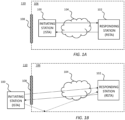
- FIG. 1A is a block diagram of a positioning scenario which may be useful for understanding example embodiments.
- An ISTA 100 is shown in signal communication with an RSTA 102 via a network 104 in an indoor environment 106, as distinct from an adjacent outdoor environment 110.
- a structural element 108 such as a concrete wall is shown at the boundary of the indoor environment 106 and the outdoor environment 110.
- the ISTA 100 may be any form of terminal capable of data communications.
- the ISTA 100 may be a mobile terminal such as a smartphone, a tablet computer, a laptop computer, a wearable terminal such as a smartwatch, or a terminal such as a personal computer (PC).
- a mobile terminal such as a smartphone, a tablet computer, a laptop computer, a wearable terminal such as a smartwatch, or a terminal such as a personal computer (PC).
- PC personal computer
- the RSTA 102 may also be any form of terminal capable of data communications.
- the RSTA 102 may be a WiFi AP, e.g. an AP configured to communicate using the IEEE 802.11 standard or an enhancement thereof.
- the network 104 may therefore be considered a WiFi network but it will be appreciated that any form of communications network may be employed.
- the ISTA 100 and the RSTA 102 may comprise respective communications functionality, such as modulation and demodulation components and one or more antennae (not shown.)
- the PS may be any form of known PS, such as one using FTM as mentioned above, and therefore a detailed explanation of the establishment process is not given here.
- the ISTA 100 may receive positioning signals s(t) from the RSTA 102 as part of the PS and use such positioning signals to compute one or more of ToA, AoA, AoD, RSRP as mentioned above, and thereby compute a current position using known methods which may involve multilateration.
- FIG. 2 is a flow diagram showing processing operations, indicated generally by reference numeral 200, according to example embodiments.
- the processing operations 200 may be performed in hardware, software, firmware, or a combination thereof.
- the processing operations may be performed by the ISTA 100 shown in FIG. 1A .
- a first operation 202 may comprise monitoring, for a plurality of time instances during transmission over a wireless channel of a positioning signal from a first terminal to a second terminal as part of a PS, one or more features of the wireless channel.
- a second operation 204 may comprise identifying based on a value of one, or a combination, of the monitored one or more features between a first time instance and a second time instance, a change indicative of transition of at least one of the first terminal and the second terminal from a first environment to a second environment.
- a third operation 206 may comprise causing termination or adaptation of the PS responsive to the identification.
- the second apparatus referred to in the first and second operations 202, 204 may refer to the ISTA.
- the first apparatus referred to in the first and second operations 202, 204 may refer to the RSTA 102.
- the monitoring referred to in the first operation 202 may involve measurement of a value of one, or a combination of the monitored one or more features at the ISTA 100.
- the value or value(s) may be received from the first apparatus, e.g. the RSTA 102 in FIG. 1A .
- Termination of the positioning session may involve ceasing communications related to at least the PS between the ISTA 100 and the RSTA 102.
- Adaptation of the positioning session may, for example, involve keeping the PS active but moving or transferring the PS to an alternative standard or protocol, e.g. from WiFi to a mobile radio access network (RAN) standard, e.g. one of the fourth generation (4G) or fifth generation (5G) New Radio (NR) standards.
- RAN mobile radio access network
- 4G fourth generation
- 5G fifth generation
- NR New Radio
- the transition may be from an indoor environment to an outdoor environment.
- each of the first to third operations 202, 204, 206 may be performed by one, or a respective "means", which may comprise hardware, software, firmware or a combination thereof.
- the hardware may comprise one or more processors, controllers or a combination thereof.
- the identifying means may be configured to identify the change based on knowledge of an expected change in one, or in a combination, of the one or more features due to transition of the at least one of the ISTA 100 and the RSTA 102 from the first environment to the second environment.
- the first operation 202 may involve monitoring the channel response of the wireless channel using active signals of the PS.
- other operations may comprise computing a channel response for the wireless channel at the plurality of time instances and determining the one or more features of the wireless channel based on components of the channel response.
- the channel response may be indicative of, but is not limited to, a channel impulse response for the wireless channel at the plurality of time instances.
- the components may comprise time-domain components.
- the received signal r(t) may be considered a noisy convolution between s(t) and a current, e.g. indoor channel.
- An impulse response is represented in equation (1) below which may be described as a train of impulses, each characterizing a reflection or the direct path between the ISTA 100 and the RSTA 102.
- a l refers to the complex gain of the i-th tap in the first cluster and b l refers to the complex gain of the i-th tap in the second cluster.
- FIG. 3 is a graphical view of an impulse response for an example indoor channel, showing components on a time/delay axis against power, and in which first and second clusters 302, 304 may be observed.
- the first cluster 302 may comprise L components which may characterize the strongest L reflections.
- the second cluster 304 may comprise K components which may characterize later-arriving reflections.
- This second cluster 304 may be referred to as the "diffuse channel tail" or simply “tail” of the channel response and may be characterized by closely-spaced taps (e.g. no more than a couple of T nanoseconds away from one another and usually all with relatively low and similar power.)
- a model can be provided for the channel response, indicative or representative of the channel impulse response. From this, by analysis of components of the channel response at given time instances, the one or more features may be identified and monitored as will be explained below.
- the RSTA 102 shown in FIG. 1A may transmit known positioning signals s(t) to the ISTA 100.
- the received signal r(t) is sampled and a noisy, sampled power delay profile (NSPDP) of the indoor channel may be obtained, for example by retaining the envelope of cross-correlation between the received samples with the known transmit signal s(t).
- NSP noisy, sampled power delay profile
- w(t) ( ⁇ * s )( t ) , ⁇ ( t ) may refer to additive white Gaussian noise (AWGN) and c ( t ) to the known autocorrelation of s(t).
- AWGN additive white Gaussian noise
- autocorrelation exhibits some advantageous properties such as a constant amplitude zero autocorrelation (CAZAC) waveform.
- CAZAC constant amplitude zero autocorrelation
- c(t - ⁇ l ) may be non-zero only around the true delays ⁇ l .
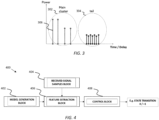
- FIG. 4 is a block diagram of an example system 400 according to example embodiments.
- the example system 400 may be provided by the ISTA 102 described with reference to FIG. 1A .
- the system 400 may comprise a model generation block 402, a received signal samples block 404, a feature extraction block 406 and a control block 408.
- the control block 408 may be configured to perform at least the operations described with respect to FIG. 2 .
- the model generation block 402 may be configured to generate the above mentioned model of the channel response, for example an indoor channel response, which is summarised by equation (3) above.
- the received signal samples block 404 may be configured to receive the positioning signals from the RSTA 102 and to sample the signals at the predefined sample rate T .
- the sampled positioning signals are provided to the feature extraction block 406.
- the feature extraction block 406 may be configured, based on the model of the channel response and the received signal samples from the received signal samples block 404, to determine the one or more features being monitored by the control block 408. In other words, the value of the one or features is determined for monitoring.
- FIG. 5 is a flow diagram showing processing operations, indicated generally by reference numeral 500, according to example embodiments.
- the processing operations 500 may be performed in hardware, software, firmware, or a combination thereof.
- the processing operations may be performed by the ISTA 100 shown in FIG. 1A .
- a first operation 202 may comprise providing a channel response for the wireless channel at the plurality of time instances.
- a second operation 504 may comprise identifying a first cluster of components as distinct from a second cluster of components.
- a third operation 506 may comprise determining a first set of features based on components of the first cluster and a second set of features based on components of the second cluster.
- each of the first to third operations 502, 504, 506 may be performed by one, or a respective "means", which may comprise a hardware, software, firmware or a combination thereof.
- the hardware may comprise one or more processors, controllers or a combination therefore.
- the first cluster and the second cluster may be identified based on respective energy levels of the components of the channel response.
- the first cluster of components may be determined as comprising at least one of:
- L' may be the index of a particular component a L ′ ⁇ where a L ′ ⁇ 2 ⁇ max a l ⁇ 2 2 .
- the second cluster of components may comprise the remaining components of the channel response.
- an index n may be used to designate the time instance, which may be a slot, sub frame, symbol number etc., at which values of the above sets of component data A and B are computed.
- values for the one or more features may be computed.
- the one or more features of the wireless channel may comprise one, or a combination of:
- the values for the one or more features computed at each time instance n may be stored in order to identify a change at between a first time instance and a second time instance.
- the values for the one or more features may be buffered in a First In First Out (FIFO) queue with size two, so that two consecutive sets are stored together: a first set of values for time instance n, and another set for time instance n-1 .
- FIFO First In First Out
- table 1 indicates an example set of eight features, mentioned above, alongside values for each of the features at n, n-1 which are indicated by respective feature indices 1 to 8.
- Table 1 Feature Collection Feature index Current instance n Previous instance n-1 1 P n A P n ⁇ 1 A 2 P n B P n ⁇ 1 B 3 S n A S n ⁇ 1 A 4 S n B S n ⁇ 1 B 5 m n A m n ⁇ 1 A 6 m n B m n ⁇ 1 B 7 d n A d n ⁇ 1 A 8 d n B d n ⁇ 1 B
- the values for the features, or the difference between values for the current time instance n and the previous time instance n-1 may be provided to the control block 408 which performs the operations described with reference to FIG. 2 above.
- the control block 408 may comprise a state change detector which outputs a binary result, e.g. a "o” or “1", or “false” or “true”, indicative of one or a plurality of the monitored feature values crossing a respective threshold or the difference between the previous and current values crossing a respective threshold.
- a threshold e.g. a predetermined threshold, associated with that feature. If a combination of features are monitored, then each respective feature value, or each respective difference, is tested against respective thresholds associated with those features.
- control block 408 may be configured to transition from a "0" to a "1” or from a "false” to a “true” output to signal that condition(s) have been identified corresponding to a significant signal degradation associated with one of the ISTA 100 and RSTA 102 transitioning from an indoor environment to an outdoor environment.
- the above-mentioned threshold(s) may be empiric thresholds, which may be determined by use of at least one of a channel emulation tool, a simulator, and collected measurements appropriate to the wireless channel.
- a trained classifier may be configured to take as input a set of test data based on values of the one or more features, or differences thereof, and to provide an output identifying the transition to the second environment, e.g. the outdoor environment, based on trained parameters of the classifier.
- the trained classifier may implement a decision tree, a decision forest, and/or a deep neural network (DNN) with Sigmoid or Softmax activation function, etc.
- the trained classifier may be trained with one or a combination of channel models extracted from, for example, a channel emulator tool, a simulator and/or indoor measurements collected via channel sounding.
- FIGs. 6 and 7 show example schematic views of trained classifier embodiments which may each provide the control block 408.
- FIG. 6 shows a trained classifier 602 that receives as input a set of test data 604 which may comprise the values of the above eight features in table 1, stacked together in a column vector, for providing a binary result, e.g. a "0" or “1", or “false” or “true” which may be based on changes from a previous set of test data held within the trained classifier.
- a set of test data 604 which may comprise the values of the above eight features in table 1, stacked together in a column vector, for providing a binary result, e.g. a "0" or "1", or “false” or “true” which may be based on changes from a previous set of test data held within the trained classifier.
- FIG. 7 shows a trained classifier 702 that receives as input a set of test data 704 which may comprise the difference between the current and previous values of the above eight features in table 1, again stacked together in a column vector, for providing a binary result, e.g. a "0" or "1", or "false” or "true.”
- control block 408 may be implemented as a regressor which may be configured to compute the probability associated with a sate change, which may be the probability that, at time instance n, ISTA 102 has moved outdoors. If the probability is above 50%, or an alternative value, the control block 408 may be configured to cause termination or adaptation of the positioning session.
- the choice as to which features to evaluate within the control block 408 may be determined and/or may dynamically change based on variable factors such as a quality metric.
- the quality metric may, for example, be indicative of at least the signal to noise ratio (SNR) for the wireless channel at or around the current time instance.
- a relatively large number of features may be selected for monitoring by the control block 408 in good SNR conditions.
- an SNR of > 6dB may be considered good SNR conditions.
- a decreasing quality metric such as decreasing SNR conditions, only a subset of features may be selected for monitoring. This may comprise selecting fewer features from the above-mentioned first set of features and/or an increasing number of features from the above-mentioned second set of features.
- Those features associated with the tail of the channel response are more likely to be characteristic of indoor propagation conditions and hence restricting monitoring to such tail features, or at least a majority of tail features, is more likely to provide a reliable result in poor SNR conditions.
- only features from the second set of features may be selected, e.g. those with index 2, 4, 8 and 8 in table 1.
- only feature index 8 may be selected.
- FIG. 8 is a block diagram of an example system 800 which may provide part of the control block 408 shown in FIG. 4 .
- Reference numeral 802 indicates the collection of eight features in table 1.
- Reference numeral 804 indicates an evaluation block which, in this case, evaluates the SNR at or around the current time instance. Depending on the evaluated SNR, being one of a high, medium and low SNR evaluation, one of three hypothesis testing blocks 802, 804, 806 is enabled to monitor values of selected features appropriate that the respective block and return a binary result, e.g. a "0" or "1", or "false” or "true.”
- Example embodiments may provide various technical advantages. For example, example embodiments may enable the ISTA 102 to detect when channel conditions have changed drastically, for example when at least of the ISTA 102 and RSTA 104 has moved from an indoor environment to an outdoor environment. By terminating re-establishment of a current PS, the ISTA 102 may instead initiate a new PS with a different RSTA, or alternatively, the ISTA may adapt by transitioning to another positioning technology such as NR positioning or GNSS.
- another positioning technology such as NR positioning or GNSS.
- FIG. 9 shows an apparatus according to some example embodiments, which may comprise the ISTA 102.
- the apparatus may be configured to perform the operations described herein, for example operations described with reference to any disclosed process.
- the apparatus comprises at least one processor 900 and at least one memory 901 directly or closely connected to the processor.
- the memory 901 includes at least one random access memory (RAM) 901a and at least one read-only memory (ROM) 901b.
- Computer program code (software) 905 is stored in the ROM 901b.
- the apparatus may be connected to a transmitter (TX) and a receiver (RX).
- the apparatus may, optionally, be connected with a user interface (UI) for instructing the apparatus and/or for outputting data.
- the at least one processor 900, with the at least one memory 901 and the computer program code 905 are arranged to cause the apparatus to at least perform at least the method according to any preceding process, for example as disclosed in relation to the flow diagrams described herein
- FIG. 10 shows a non-transitory media 1000 according to some embodiments.
- the non-transitory media 1000 is a computer readable storage medium. It may be e.g. a CD, a DVD, a USB stick, a blue ray disk, etc.
- the non-transitory media 1000 stores computer program code, causing an apparatus to perform the method of any preceding process for example as disclosed in relation to the flow diagrams and related features thereof.
- Names of network elements, protocols, and methods are based on current standards. In other versions or other technologies, the names of these network elements and/or protocols and/or methods may be different, as long as they provide a corresponding functionality. For example, embodiments may be deployed in 2G/3G/4G/5G networks and further generations of 3GPP but also in non-3GPP radio networks such as WiFi.
- a memory may be volatile or non-volatile. It may be e.g. a RAM, a SRAM, a flash memory, a FPGA block ram, a DCD, a CD, a USB stick, and a blue ray disk.
- each of the entities described in the present description may be based on a different hardware, or some or all of the entities may be based on the same hardware. It does not necessarily mean that they are based on different software. That is, each of the entities described in the present description may be based on different software, or some or all of the entities may be based on the same software.
- Each of the entities described in the present description may be embodied in the cloud.
- Implementations of any of the above described blocks, apparatuses, systems, techniques or methods include, as non-limiting examples, implementations as hardware, software, firmware, special purpose circuits or logic, general purpose hardware or controller or other computing devices, or some combination thereof. Some embodiments may be implemented in the cloud.
Landscapes
- Engineering & Computer Science (AREA)
- Computer Networks & Wireless Communication (AREA)
- Signal Processing (AREA)
- Radar, Positioning & Navigation (AREA)
- Remote Sensing (AREA)
- Physics & Mathematics (AREA)
- General Physics & Mathematics (AREA)
- Health & Medical Sciences (AREA)
- Toxicology (AREA)
- Mobile Radio Communication Systems (AREA)
- Position Fixing By Use Of Radio Waves (AREA)
Priority Applications (3)
| Application Number | Priority Date | Filing Date | Title |
|---|---|---|---|
| EP21213267.4A EP4195802A1 (de) | 2021-12-08 | 2021-12-08 | Positionierung |
| US18/060,754 US20230176165A1 (en) | 2021-12-08 | 2022-12-01 | Positioning |
| CN202211566955.4A CN116249199A (zh) | 2021-12-08 | 2022-12-07 | 定位 |
Applications Claiming Priority (1)
| Application Number | Priority Date | Filing Date | Title |
|---|---|---|---|
| EP21213267.4A EP4195802A1 (de) | 2021-12-08 | 2021-12-08 | Positionierung |
Publications (1)
| Publication Number | Publication Date |
|---|---|
| EP4195802A1 true EP4195802A1 (de) | 2023-06-14 |
Family
ID=78827937
Family Applications (1)
| Application Number | Title | Priority Date | Filing Date |
|---|---|---|---|
| EP21213267.4A Pending EP4195802A1 (de) | 2021-12-08 | 2021-12-08 | Positionierung |
Country Status (3)
| Country | Link |
|---|---|
| US (1) | US20230176165A1 (de) |
| EP (1) | EP4195802A1 (de) |
| CN (1) | CN116249199A (de) |
Citations (5)
| Publication number | Priority date | Publication date | Assignee | Title |
|---|---|---|---|---|
| US20140114568A1 (en) * | 2012-10-22 | 2014-04-24 | Qualcomm Incorporated | Changing a position determination scheme used by a user equipment during a transition between indoor and outdoor spaces relative to an enclosed environment |
| CN103826241A (zh) * | 2014-02-26 | 2014-05-28 | 西安电子科技大学 | 一种无线网络中室内外区分方法 |
| WO2016011433A2 (en) * | 2014-07-17 | 2016-01-21 | Origin Wireless, Inc. | Wireless positioning systems |
| KR101616720B1 (ko) * | 2014-10-29 | 2016-05-02 | 동명대학교 산학협력단 | 실내외 연속 위치추정 시스템 및 그 방법 |
| US20190349280A1 (en) * | 2018-05-09 | 2019-11-14 | Qualcomm Incorporated | Range measurement with closed-loop feedback on rtt quality |
-
2021
- 2021-12-08 EP EP21213267.4A patent/EP4195802A1/de active Pending
-
2022
- 2022-12-01 US US18/060,754 patent/US20230176165A1/en active Pending
- 2022-12-07 CN CN202211566955.4A patent/CN116249199A/zh active Pending
Patent Citations (5)
| Publication number | Priority date | Publication date | Assignee | Title |
|---|---|---|---|---|
| US20140114568A1 (en) * | 2012-10-22 | 2014-04-24 | Qualcomm Incorporated | Changing a position determination scheme used by a user equipment during a transition between indoor and outdoor spaces relative to an enclosed environment |
| CN103826241A (zh) * | 2014-02-26 | 2014-05-28 | 西安电子科技大学 | 一种无线网络中室内外区分方法 |
| WO2016011433A2 (en) * | 2014-07-17 | 2016-01-21 | Origin Wireless, Inc. | Wireless positioning systems |
| KR101616720B1 (ko) * | 2014-10-29 | 2016-05-02 | 동명대학교 산학협력단 | 실내외 연속 위치추정 시스템 및 그 방법 |
| US20190349280A1 (en) * | 2018-05-09 | 2019-11-14 | Qualcomm Incorporated | Range measurement with closed-loop feedback on rtt quality |
Also Published As
| Publication number | Publication date |
|---|---|
| US20230176165A1 (en) | 2023-06-08 |
| CN116249199A (zh) | 2023-06-09 |
Similar Documents
| Publication | Publication Date | Title |
|---|---|---|
| JP2016515212A (ja) | 到達時間算出を向上させる方法およびシステム | |
| WO2020229902A1 (en) | Line of sight detection based on channel impulse response reported | |
| EP3958593A1 (de) | Drahtloses positionierungsverfahren, positionierungseinrichtung und netzwerkvorrichtung | |
| CN113194427B (zh) | 一种基于软判决可视与非可视信道的识别方法、系统及装置 | |
| US20190313363A1 (en) | Method for identifying line of sight path and wireless device | |
| CN105247384A (zh) | 移动装置的距离确定 | |
| US10972141B2 (en) | Method for estimating arrival time based on noise cancellation | |
| US9316721B2 (en) | Method and system for estimating the location of a mobile terminal | |
| CN100355222C (zh) | 在移动通信系统中估算移动终端速度的设备和方法 | |
| US9521571B2 (en) | Method and apparatus of switching communications from a first channel to a second channel of higher-frequency | |
| Xie et al. | Identification of NLOS based on soft decision method | |
| CN116520237A (zh) | 检测方法、通信设备、装置及存储介质 | |
| CN105611629A (zh) | 基于能量检测的60GHz毫米波非视距识别与无线指纹定位方法 | |
| CN105979534A (zh) | 一种检测lte对wifi干扰的方法及系统 | |
| Malafaia et al. | Adaptive threshold spectrum sensing based on expectation maximization algorithm | |
| CN105531600A (zh) | 无线网络中用于用户速度估计的时间分析 | |
| CN115766349B (zh) | 定位测量 | |
| US20230176165A1 (en) | Positioning | |
| CN106576322A (zh) | 一种处理用于定位的信息的方法及装置 | |
| WO2013136774A1 (ja) | 信号検出装置及び信号検出方法 | |
| US10135554B1 (en) | Robust super-resolution processing for wireless ranging | |
| Ansari et al. | Analyzing non-stationary TDL channel models based on measurement data | |
| CN106992834B (zh) | 一种同步字检测方法、发送器及接收器 | |
| CN101471737B (zh) | 一种调整校准发送功率的方法及装置 | |
| KR101494966B1 (ko) | 인지 무선에서의 광대역 주파수 검출 방법 및 장치 |
Legal Events
| Date | Code | Title | Description |
|---|---|---|---|
| PUAI | Public reference made under article 153(3) epc to a published international application that has entered the european phase |
Free format text: ORIGINAL CODE: 0009012 |
|
| STAA | Information on the status of an ep patent application or granted ep patent |
Free format text: STATUS: THE APPLICATION HAS BEEN PUBLISHED |
|
| AK | Designated contracting states |
Kind code of ref document: A1 Designated state(s): AL AT BE BG CH CY CZ DE DK EE ES FI FR GB GR HR HU IE IS IT LI LT LU LV MC MK MT NL NO PL PT RO RS SE SI SK SM TR |
|
| STAA | Information on the status of an ep patent application or granted ep patent |
Free format text: STATUS: REQUEST FOR EXAMINATION WAS MADE |
|
| 17P | Request for examination filed |
Effective date: 20231129 |
|
| RBV | Designated contracting states (corrected) |
Designated state(s): AL AT BE BG CH CY CZ DE DK EE ES FI FR GB GR HR HU IE IS IT LI LT LU LV MC MK MT NL NO PL PT RO RS SE SI SK SM TR |
|
| STAA | Information on the status of an ep patent application or granted ep patent |
Free format text: STATUS: EXAMINATION IS IN PROGRESS |
|
| 17Q | First examination report despatched |
Effective date: 20251117 |